EP1157862A2 - Vehicle suspension system - Google Patents
Vehicle suspension system Download PDFInfo
- Publication number
- EP1157862A2 EP1157862A2 EP01303051A EP01303051A EP1157862A2 EP 1157862 A2 EP1157862 A2 EP 1157862A2 EP 01303051 A EP01303051 A EP 01303051A EP 01303051 A EP01303051 A EP 01303051A EP 1157862 A2 EP1157862 A2 EP 1157862A2
- Authority
- EP
- European Patent Office
- Prior art keywords
- suspension
- chassis
- unit
- wheel
- drive
- Prior art date
- Legal status (The legal status is an assumption and is not a legal conclusion. Google has not performed a legal analysis and makes no representation as to the accuracy of the status listed.)
- Withdrawn
Links
- 239000000725 suspension Substances 0.000 title claims abstract description 81
- 230000005540 biological transmission Effects 0.000 claims abstract description 23
- 230000035939 shock Effects 0.000 claims description 3
- 238000010521 absorption reaction Methods 0.000 claims 2
- 238000010276 construction Methods 0.000 description 3
- 238000013016 damping Methods 0.000 description 2
- 229910000831 Steel Inorganic materials 0.000 description 1
- 239000006096 absorbing agent Substances 0.000 description 1
- 230000000712 assembly Effects 0.000 description 1
- 238000000429 assembly Methods 0.000 description 1
- 238000002485 combustion reaction Methods 0.000 description 1
- 239000007788 liquid Substances 0.000 description 1
- 230000004048 modification Effects 0.000 description 1
- 238000012986 modification Methods 0.000 description 1
- 230000001172 regenerating effect Effects 0.000 description 1
- 239000010959 steel Substances 0.000 description 1
Images


Classifications
-
- B—PERFORMING OPERATIONS; TRANSPORTING
- B60—VEHICLES IN GENERAL
- B60K—ARRANGEMENT OR MOUNTING OF PROPULSION UNITS OR OF TRANSMISSIONS IN VEHICLES; ARRANGEMENT OR MOUNTING OF PLURAL DIVERSE PRIME-MOVERS IN VEHICLES; AUXILIARY DRIVES FOR VEHICLES; INSTRUMENTATION OR DASHBOARDS FOR VEHICLES; ARRANGEMENTS IN CONNECTION WITH COOLING, AIR INTAKE, GAS EXHAUST OR FUEL SUPPLY OF PROPULSION UNITS IN VEHICLES
- B60K17/00—Arrangement or mounting of transmissions in vehicles
- B60K17/22—Arrangement or mounting of transmissions in vehicles characterised by arrangement, location, or type of main drive shafting, e.g. cardan shaft
-
- B—PERFORMING OPERATIONS; TRANSPORTING
- B60—VEHICLES IN GENERAL
- B60G—VEHICLE SUSPENSION ARRANGEMENTS
- B60G11/00—Resilient suspensions characterised by arrangement, location or kind of springs
- B60G11/26—Resilient suspensions characterised by arrangement, location or kind of springs having fluid springs only, e.g. hydropneumatic springs
- B60G11/28—Resilient suspensions characterised by arrangement, location or kind of springs having fluid springs only, e.g. hydropneumatic springs characterised by means specially adapted for attaching the spring to axle or sprung part of the vehicle
-
- B—PERFORMING OPERATIONS; TRANSPORTING
- B60—VEHICLES IN GENERAL
- B60G—VEHICLE SUSPENSION ARRANGEMENTS
- B60G3/00—Resilient suspensions for a single wheel
- B60G3/02—Resilient suspensions for a single wheel with a single pivoted arm
- B60G3/12—Resilient suspensions for a single wheel with a single pivoted arm the arm being essentially parallel to the longitudinal axis of the vehicle
- B60G3/14—Resilient suspensions for a single wheel with a single pivoted arm the arm being essentially parallel to the longitudinal axis of the vehicle the arm being rigid
- B60G3/145—Resilient suspensions for a single wheel with a single pivoted arm the arm being essentially parallel to the longitudinal axis of the vehicle the arm being rigid the arm forming the axle housing
-
- B—PERFORMING OPERATIONS; TRANSPORTING
- B60—VEHICLES IN GENERAL
- B60G—VEHICLE SUSPENSION ARRANGEMENTS
- B60G7/00—Pivoted suspension arms; Accessories thereof
- B60G7/001—Suspension arms, e.g. constructional features
-
- B—PERFORMING OPERATIONS; TRANSPORTING
- B60—VEHICLES IN GENERAL
- B60G—VEHICLE SUSPENSION ARRANGEMENTS
- B60G2200/00—Indexing codes relating to suspension types
- B60G2200/10—Independent suspensions
- B60G2200/13—Independent suspensions with longitudinal arms only
- B60G2200/132—Independent suspensions with longitudinal arms only with a single trailing arm
-
- B—PERFORMING OPERATIONS; TRANSPORTING
- B60—VEHICLES IN GENERAL
- B60G—VEHICLE SUSPENSION ARRANGEMENTS
- B60G2200/00—Indexing codes relating to suspension types
- B60G2200/40—Indexing codes relating to the wheels in the suspensions
- B60G2200/422—Driving wheels or live axles
-
- B—PERFORMING OPERATIONS; TRANSPORTING
- B60—VEHICLES IN GENERAL
- B60G—VEHICLE SUSPENSION ARRANGEMENTS
- B60G2202/00—Indexing codes relating to the type of spring, damper or actuator
- B60G2202/10—Type of spring
- B60G2202/15—Fluid spring
- B60G2202/152—Pneumatic spring
-
- B—PERFORMING OPERATIONS; TRANSPORTING
- B60—VEHICLES IN GENERAL
- B60G—VEHICLE SUSPENSION ARRANGEMENTS
- B60G2204/00—Indexing codes related to suspensions per se or to auxiliary parts
- B60G2204/10—Mounting of suspension elements
- B60G2204/12—Mounting of springs or dampers
- B60G2204/126—Mounting of pneumatic springs
-
- B—PERFORMING OPERATIONS; TRANSPORTING
- B60—VEHICLES IN GENERAL
- B60G—VEHICLE SUSPENSION ARRANGEMENTS
- B60G2204/00—Indexing codes related to suspensions per se or to auxiliary parts
- B60G2204/10—Mounting of suspension elements
- B60G2204/12—Mounting of springs or dampers
- B60G2204/13—Mounting of springs or dampers with the spring, i.e. coil spring, or damper horizontally mounted
-
- B—PERFORMING OPERATIONS; TRANSPORTING
- B60—VEHICLES IN GENERAL
- B60G—VEHICLE SUSPENSION ARRANGEMENTS
- B60G2204/00—Indexing codes related to suspensions per se or to auxiliary parts
- B60G2204/10—Mounting of suspension elements
- B60G2204/14—Mounting of suspension arms
- B60G2204/143—Mounting of suspension arms on the vehicle body or chassis
-
- B—PERFORMING OPERATIONS; TRANSPORTING
- B60—VEHICLES IN GENERAL
- B60G—VEHICLE SUSPENSION ARRANGEMENTS
- B60G2204/00—Indexing codes related to suspensions per se or to auxiliary parts
- B60G2204/10—Mounting of suspension elements
- B60G2204/30—In-wheel mountings
-
- B—PERFORMING OPERATIONS; TRANSPORTING
- B60—VEHICLES IN GENERAL
- B60G—VEHICLE SUSPENSION ARRANGEMENTS
- B60G2206/00—Indexing codes related to the manufacturing of suspensions: constructional features, the materials used, procedures or tools
- B60G2206/01—Constructional features of suspension elements, e.g. arms, dampers, springs
- B60G2206/10—Constructional features of arms
- B60G2206/11—Constructional features of arms the arm being a radius or track or torque or steering rod or stabiliser end link
Definitions
- the invention relates to vehicle suspension systems in which a suspension for a vehicle wheel is associated with a drive unit.
- Vehicles usually have a prime mover or power unit which drives two or more wheels of a vehicle.
- individual drive units for hydraulically or electrically driving the individual wheels have been used.
- the invention provides an improved vehicle suspension system 200 incorporating a drive unit 18.
- the vehicle suspension system 200 comprises a suspension unit 15 for at least one wheel 110, 112, 114, 116, a drive unit 18 for the wheel 110, 112, 114, 116, and transmission means 28 between the drive unit 18 and the wheel 110, 112, 114, 116.
- the suspension unit 15 is pivotally attached to the chassis 120, and pivotally receives the wheel 110, 112, 114, 116.
- the transmission means 28 accommodates pivoting of the suspension unit relative to the chassis 120 during operation of the vehicle 100.
- the drive unit is a motor 18 arranged to drive the associated wheel 110, 112, 114, 116
- the transmission means 28 includes a drive shaft 20, step down gearing 25, and a right angle gear box 22 at the wheel 110, 112, 114, 116.
- a drive unit 18 for each of a pair of wheels 110, 112 or 114, 116 of the vehicle 100, and control means 130 for controlling the driven wheels to obtain the desired drive characteristies of the vehicle 100, whereby the driven wheels may be driven at the same or different speeds according to predetermined driving parameters of the vehicle 100, for example, travelling in a straight line or travelling around bends.
- exemplary embodiments include two suspension units 15 mounted on each end of a cross beam 10, which is mountable transversely on the vehicle chassis 120.
- a drive motor 18 for each drive wheel is mounted on the chassis 120 in association with each suspension unit 15 to drive the associated wheel 110, 112, 114, 116.
- the cross beam 10 may be mounted towards the rear of the vehicle 100 and under the chassis 120.
- the drive motor 18 or motors 18 of the vehicle 100 are electric motors 100 and the step down gearing 25 is mounted adjacent the associated driven wheel 110, 112, 114, 110.
- the motors 18 may be mounted above the cross beam 10 and at or above the lower level of the chassis 120, whereby the transmission from the motor 10 has a downwardly extending drive shaft 20.
- Constant velocity joints 21 may be provided towards each end of the drive shaft to accommodate movements of the wheel 110, 112, 114, 116.
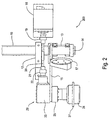
- suspension system 200 An exemplary embodiment of a suspension system 200 according to this invention is illustrated in Figs. 2-6.
- This invention has particular application to hybrid vehicles which have two power sources, one an electric power source powered by electric storage means, and the other a primary power source such as an internal combustion engine which is used to generate electric power upon depletion of the electric storage means.
- suspension system 200 can be utilized on a hybrid electric vehicle, such as bus 100 in Fig. 1.
- the invention is, however, not limited to hybrid electric vehicles.
- the invention can be utilized on any wheeled vehicle.
- the bus 100 may be of generally conventional construction having a structural unit or chassis 120 on which is mounted the body of the bus 100. Within the body is located the passenger space, including seating. The interior of the body of the bus 100 should have a generally flat floor, although the floor may have upward protrusions where the seating is located.
- Bus 100 includes four wheels 110, 112, 114, 116, arranged as a front pair of wheels and a rear pair of wheels.
- the bus 100 includes two rear wheels 114, 116 at opposite sides of the bus 100 and two front wheels 110 and 112, also at opposite sides of the bus 100.
- the two rear wheels 114, 116 may be driven by independent drive units, while the front wheels 110, 112 are not driven. Stated differently, there may be an individual drive unit for each rear wheel 114, 116.
- each wheel 110, 112, 114, 116 may have a separate drive unit, or only the front wheels 110, 112 may be driven, and have separate drive units. In bus 100 the rear wheels 114,116 are driven by separate drive units.
- a beam 10 which extends transversely to the direction of travel of the vehicle 100.
- the beam 10 is fixed to the chassis 120 through vibration isolators 11 to reduce the transmission of vibrations in the beam 10 to the chassis 120.
- the vibration isolators 11 are mounted on a pair of arms 12, spaced from one another along the beam inwardly of the ends of the beam 10. See Figs. 5 and 6.
- Suspension system 200 includes support member 13, pivot 14, trailing arm suspension unit 15, mounting 16, mounting pad 17 and drive unit 30.
- a support member 13 is rigidly attached to each end of the beam 10.
- Each support member 13 rotatably receives and engages a pivot 14.
- pivot 14 extends parallel to and is spaced upwardly from the beam 10.
- Trailing arm suspension unit 15 is fixedly attached to pivot 14, such that trailing arm suspension unit 15 rotates with pivot 14.
- the suspension unit 15 is a trailing arm unit in the form of a triangular frame.
- One comer of the triangular frame is mounted to pivot 14, such that the axis of rotation of pivot 14 is the axis of rotation of suspension unit 15.
- Other shapes of trailing arm units can be equally utilized.
- a mounting 16 is attached at another comer of the suspension unit 15.
- Mounting 16 is designed to receive a hub 24 of the wheels 114, 116.
- the outwardly-extending mounting pad 17 is attached to the third corner of the suspension unit 15.
- Mounting pad 17 is designed to interface with an air bag (not shown) for a resilient air suspension unit. The air bag is located between a part of the vehicle chassis 120 and the mounting pad 17.
- each trailing arm suspension unit 15 is associated with a drive unit 30.
- Drive unit 30 includes electric drive motor 18 and a drive chain, as described below.
- the electric drive motor 18 is rigidly mounted on the vehicle chassis 120.
- the motor 18 is located in a housing (not shown) formed as a protrusion in the floor of the vehicle body which lies above the level of the chassis.
- the motors 18 are protected because the motors 18 are located in housings formed on the vehicle chassis 120.
- the motors 18 may be liquid cooled and their location altered to further assist in utilizing this kind of motor.
- the motor 18 drives the wheel through a drive train which includes a constant velocity joint 19, a drive shaft 20, a further constant velocity joint 21, a spiral bevel gearbox 22 and a right angle gearbox 23. Any other suitable drive train would be utilized.
- This drive train results in a reduction in the rotational speed from the motor 18 to the mounting 16.
- the drive from the spiral bevel gearbox 22 is transmitted to the right angle gearbox 23 so that the drive axis is aligned with the rotational axis of the hub 24 and associated wheel.
- a planetary reduction gearing 25 is located between and interfaces with, the right-angle gearbox 23 and the wheel hub 24 to further reduce the drive ratio to the associated hub 24 and wheel 114, 116.
- the motor 18 rotates at a high speed during driving of the wheel, for example 800 rpm, and a significant reduction is obtained through the gearing to impart a suitable speed of rotation to the wheel 114, 116.
- the planetary gears 25 may have a gear reduction of the order of 10:1, and may be in the form of two planetary gears in series.
- the spiral bevel gear 22 may have a reduction ratio in the order of 1.6:1. These reduction ratios are provided as examples only, and any suitable ratios may be utilized.
- the constant velocity joints 19 and 21 allow the distance between the (a) motor 18 and (b) the hub 24 and gearbox assembly 29 (spiral bevel gearbox 22 and right angle gearbox 23) to change according to the movement of the suspension unit 15.
- the axis of the pivot 14 of the trailing suspension unit 15 is on one side and below the drive shaft 20.
- Rotation of the trailing arm suspension unit 15 about the axis of pivot 14 is "controlled" by the resilient mounting provided by the pad 17 and the associated airbag abutting against a portion of the vehicle chassis 120. This provides a damping force as to the rotation of the suspension unit 15.
- An arm 31 may be provided having a rubber support 30 between the arm 31 and the chassis 120.
- a steel cable (not shown) may extend between the arm 31 and the chassis 120.
- a shock absorber 32 may also be provided between the arm 15 and the chassis 120, attached by a bracket 33. See Fig. 5. Any suitable structural support member or assemblies may be utilized.
- each of the motors 18 is supplied electrical power from a common source in the form of electric storage means (not shown).
- a control system 130 controls power to the motors 18.
- the control system 130 controls the motors 18 to rotate at the same speed so that the drive wheels 114, 116 each rotate at the same speed, which normally occurs when the vehicle 100 is travelling in a straight line.
- the wheels 114, 116 rotate at different speeds to accommodate for the lack of a differential between the wheels 114, 116.
- the wheel at the outer side of the bus 100 rotates at a faster speed than the wheel at the inner side.
- the rotational speeds of the respective motors 18 are determined by the control system 130 according to the turning radius of the bus 100 and other desired driving characteristics.
- the wheel at the outer side of the bend is driven at greater torque than the wheel at the inner side to assist turning of the bus 100.
- the control system 130 is arranged to monitor the parameters of the vehicle travel and to select the power to each motor 18, including reverse drive.
- the electric drive to the wheels 114, 116 may be utilized to provide regenerative braking by which electrical power is generated during braking of the bus 100 to be fed back into the electric storage means and conserve energy, obtaining more efficient utilization of the available power.
- the wheel hub 24 is fitted with a disk 27 of a disk brake assembly for each wheel 114, 116 whereby the wheels 114, 116 are braked in the usual manner.
- suspension system 200 permits the suspension system 200 to be assembled prior to being installed on the bus 100, to ensure that the components are assembled in the desired relative orientation without misalignments and other problems, which may arise if the individual components are mounted directly to the vehicle chassis 120.
- the preassembled construction is attached to the vehicle chassis 120, at predetermined separate locations on the chassis 120, to ensure that the components are in the right relationship to one another and to the bus 100.
- the vehicle hubs 24 and wheels 114, 116 are each mounted on the trailing arm suspension unit 15, are independently suspended on the vehicle 100 and can move up and down independently about their pivots 14 to accommodate the road contours in the usual way, and under the restraint and damping action of the airbags.
- the drive is transmitted to the wheels 114, 116 from the motors 18 through the drive transmission arrangement which permits the transmission of power to the hubs irrespective of the relative position of the wheels 114, 116.
Landscapes
- Engineering & Computer Science (AREA)
- Mechanical Engineering (AREA)
- Chemical & Material Sciences (AREA)
- Combustion & Propulsion (AREA)
- Transportation (AREA)
- Arrangement Or Mounting Of Propulsion Units For Vehicles (AREA)
- Vehicle Body Suspensions (AREA)
Abstract
Description
- The invention relates to vehicle suspension systems in which a suspension for a vehicle wheel is associated with a drive unit.
- Vehicles usually have a prime mover or power unit which drives two or more wheels of a vehicle. However, individual drive units for hydraulically or electrically driving the individual wheels have been used.
- The invention provides an improved
vehicle suspension system 200 incorporating adrive unit 18. According to the invention, thevehicle suspension system 200 comprises asuspension unit 15 for at least onewheel drive unit 18 for thewheel drive unit 18 and thewheel suspension unit 15 is pivotally attached to thechassis 120, and pivotally receives thewheel chassis 120 during operation of thevehicle 100. - In various exemplary embodiments, the drive unit is a
motor 18 arranged to drive the associatedwheel drive shaft 20, step down gearing 25, and a rightangle gear box 22 at thewheel - In other exemplary embodiments, there is a
drive unit 18 for each of a pair ofwheels vehicle 100, and control means 130 for controlling the driven wheels to obtain the desired drive characteristies of thevehicle 100, whereby the driven wheels may be driven at the same or different speeds according to predetermined driving parameters of thevehicle 100, for example, travelling in a straight line or travelling around bends. - Other exemplary embodiments include two
suspension units 15 mounted on each end of across beam 10, which is mountable transversely on thevehicle chassis 120. In these embodiments, adrive motor 18 for each drive wheel is mounted on thechassis 120 in association with eachsuspension unit 15 to drive the associatedwheel wheel drive vehicle 100, thecross beam 10 may be mounted towards the rear of thevehicle 100 and under thechassis 120. - In other exemplary embodiments, the
drive motor 18 ormotors 18 of thevehicle 100 areelectric motors 100 and the step down gearing 25 is mounted adjacent the associated drivenwheel motors 18 may be mounted above thecross beam 10 and at or above the lower level of thechassis 120, whereby the transmission from themotor 10 has a downwardly extendingdrive shaft 20.Constant velocity joints 21 may be provided towards each end of the drive shaft to accommodate movements of thewheel - An exemplary embodiment of the invention is illustrated by the drawings, in which:
- Fig. 1 is a schematic view of an exemplary embodiment of a series hybrid electric vehicle on which the invention can be utilized;
- Fig. 2 is a plan view of a vehicle suspension system according to this invention;
- Fig. 3 is a side elevation of the system illustrated in Fig. 2;
- Fig. 4 is a further plan view of the system illustrated in Figs. 2 and 3;
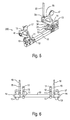
- Fig. 5 is a perspective view of a support bar and two of the vehicle suspension systems illustrated in Figs. 2-4, with the drive units omitted; and
- Fig. 6 is a plan view of the assembly of Fig. 5.
-
- An exemplary embodiment of a
suspension system 200 according to this invention is illustrated in Figs. 2-6. This invention has particular application to hybrid vehicles which have two power sources, one an electric power source powered by electric storage means, and the other a primary power source such as an internal combustion engine which is used to generate electric power upon depletion of the electric storage means. For example,suspension system 200 can be utilized on a hybrid electric vehicle, such asbus 100 in Fig. 1. The invention is, however, not limited to hybrid electric vehicles. The invention can be utilized on any wheeled vehicle. - The
bus 100 may be of generally conventional construction having a structural unit orchassis 120 on which is mounted the body of thebus 100. Within the body is located the passenger space, including seating. The interior of the body of thebus 100 should have a generally flat floor, although the floor may have upward protrusions where the seating is located.Bus 100 includes fourwheels - In various exemplary embodiments, the
bus 100 includes tworear wheels bus 100 and twofront wheels bus 100. The tworear wheels front wheels rear wheel wheel front wheels bus 100 the rear wheels 114,116 are driven by separate drive units. - Mounted to the underside of the rear of the
chassis 120 of thebus 100 is abeam 10 which extends transversely to the direction of travel of thevehicle 100. Thebeam 10 is fixed to thechassis 120 throughvibration isolators 11 to reduce the transmission of vibrations in thebeam 10 to thechassis 120. Thevibration isolators 11 are mounted on a pair ofarms 12, spaced from one another along the beam inwardly of the ends of thebeam 10. See Figs. 5 and 6. -
Suspension system 200 includessupport member 13,pivot 14, trailingarm suspension unit 15, mounting 16,mounting pad 17 anddrive unit 30. Asupport member 13 is rigidly attached to each end of thebeam 10. Eachsupport member 13 rotatably receives and engages apivot 14. In this exemplary embodiment,pivot 14 extends parallel to and is spaced upwardly from thebeam 10. Trailingarm suspension unit 15 is fixedly attached topivot 14, such that trailingarm suspension unit 15 rotates withpivot 14. In this exemplary embodiment, thesuspension unit 15 is a trailing arm unit in the form of a triangular frame. One comer of the triangular frame is mounted topivot 14, such that the axis of rotation ofpivot 14 is the axis of rotation ofsuspension unit 15. Other shapes of trailing arm units can be equally utilized. - A
mounting 16 is attached at another comer of thesuspension unit 15.Mounting 16 is designed to receive ahub 24 of thewheels mounting pad 17 is attached to the third corner of thesuspension unit 15.Mounting pad 17 is designed to interface with an air bag (not shown) for a resilient air suspension unit. The air bag is located between a part of thevehicle chassis 120 and themounting pad 17. - In this exemplary embodiment, each trailing
arm suspension unit 15 is associated with adrive unit 30.Drive unit 30 includeselectric drive motor 18 and a drive chain, as described below. Theelectric drive motor 18 is rigidly mounted on thevehicle chassis 120. In various exemplary embodiments, themotor 18 is located in a housing (not shown) formed as a protrusion in the floor of the vehicle body which lies above the level of the chassis. Themotors 18 are protected because themotors 18 are located in housings formed on thevehicle chassis 120. Themotors 18 may be liquid cooled and their location altered to further assist in utilizing this kind of motor. - In this exemplary embodiment, the
motor 18 drives the wheel through a drive train which includes a constant velocity joint 19, adrive shaft 20, a further constant velocity joint 21, aspiral bevel gearbox 22 and aright angle gearbox 23. Any other suitable drive train would be utilized. This drive train results in a reduction in the rotational speed from themotor 18 to the mounting 16. The drive from thespiral bevel gearbox 22 is transmitted to theright angle gearbox 23 so that the drive axis is aligned with the rotational axis of thehub 24 and associated wheel. A planetary reduction gearing 25 is located between and interfaces with, the right-angle gearbox 23 and thewheel hub 24 to further reduce the drive ratio to the associatedhub 24 andwheel - In practice, the
motor 18 rotates at a high speed during driving of the wheel, for example 800 rpm, and a significant reduction is obtained through the gearing to impart a suitable speed of rotation to thewheel planetary gears 25 may have a gear reduction of the order of 10:1, and may be in the form of two planetary gears in series. Thespiral bevel gear 22 may have a reduction ratio in the order of 1.6:1. These reduction ratios are provided as examples only, and any suitable ratios may be utilized. - The constant velocity joints 19 and 21 allow the distance between the (a)
motor 18 and (b) thehub 24 and gearbox assembly 29 (spiral bevel gearbox 22 and right angle gearbox 23) to change according to the movement of thesuspension unit 15. - As should be appreciated, in providing the drive assembly, the axis of the
pivot 14 of the trailingsuspension unit 15 is on one side and below thedrive shaft 20. - Rotation of the trailing
arm suspension unit 15 about the axis ofpivot 14 is "controlled" by the resilient mounting provided by thepad 17 and the associated airbag abutting against a portion of thevehicle chassis 120. This provides a damping force as to the rotation of thesuspension unit 15. - Various structural arrangements can be used to provide additional support the
unit 15, Anarm 31 may be provided having arubber support 30 between thearm 31 and thechassis 120. Alternatively, a steel cable (not shown) may extend between thearm 31 and thechassis 120. Ashock absorber 32 may also be provided between thearm 15 and thechassis 120, attached by abracket 33. See Fig. 5. Any suitable structural support member or assemblies may be utilized. - In this exemplary embodiment, each of the
motors 18 is supplied electrical power from a common source in the form of electric storage means (not shown). To ensure that themotors 18 rotate at the appropriate speeds relative to one another, acontrol system 130 controls power to themotors 18. In its simplest form, thecontrol system 130 controls themotors 18 to rotate at the same speed so that thedrive wheels vehicle 100 is travelling in a straight line. When thevehicle 100 is travelling around a bend, thewheels wheels bus 100 rotates at a faster speed than the wheel at the inner side. Thus, the rotational speeds of therespective motors 18 are determined by thecontrol system 130 according to the turning radius of thebus 100 and other desired driving characteristics. In various exemplary embodiments, the wheel at the outer side of the bend is driven at greater torque than the wheel at the inner side to assist turning of thebus 100. Thecontrol system 130 is arranged to monitor the parameters of the vehicle travel and to select the power to eachmotor 18, including reverse drive. - In addition, the electric drive to the
wheels bus 100 to be fed back into the electric storage means and conserve energy, obtaining more efficient utilization of the available power. - Specifically, in various exemplary embodiments, the
wheel hub 24 is fitted with adisk 27 of a disk brake assembly for eachwheel wheels - The arrangement of the individual components of
suspension system 200 described herein permits thesuspension system 200 to be assembled prior to being installed on thebus 100, to ensure that the components are assembled in the desired relative orientation without misalignments and other problems, which may arise if the individual components are mounted directly to thevehicle chassis 120. The preassembled construction is attached to thevehicle chassis 120, at predetermined separate locations on thechassis 120, to ensure that the components are in the right relationship to one another and to thebus 100. - It will be seen that the
vehicle hubs 24 andwheels arm suspension unit 15, are independently suspended on thevehicle 100 and can move up and down independently about theirpivots 14 to accommodate the road contours in the usual way, and under the restraint and damping action of the airbags. At the same time, the drive is transmitted to thewheels motors 18 through the drive transmission arrangement which permits the transmission of power to the hubs irrespective of the relative position of thewheels - While the invention has been described with reference to various exemplary embodiments thereof, it is to be understood that the invention is not limited to disclosed exemplary embodiments or constructions. To the contrary, the invention is intended to cover various modifications and equivalent arrangements. In addition, while the various elements of the disclosed invention are shown in various combinations and configurations, which are exemplary, other combinations and configurations, including more, less or only a single element, are also within the spirit and scope of the invention.
Claims (22)
- A wheel suspension assembly [200] for a vehicle [100] having wheels [110, 112, 114, 116] and a chassis[120], the suspension assembly [200] comprising:a suspension member [15] which is rotatably attachable to the chassis [120], the suspension member [15] being designed to rotatably receive a wheel [110, 112, 114, 116];a drive unit [18] which is mountable on the chassis [120]; anda transmission unit [28], for transferring a drive force from the drive unit [18] to the wheel [110, 112, 114, 116], the transmission unit [28]being extendible and retractable between the drive unit [18] and the wheel [110, 112, 114, 116] to accommodate pivoting of the suspension member [15] relative to the chassis [120].
- The suspension assembly [200] of claim 1, further comprising:
a transverse beam [10] attached to the chassis [120], the suspension member [15] being attached to the transverse beam [10]. - The suspension assembly [200] according to claim 2, wherein the suspension member [15] is attached to the transverse beam [10] at one end of the beam [10].
- The suspension assembly [200] of claim 2, further comprising:
vibration isolators [11] between the beam [10] and the chassis [120]. - The suspension assembly [200] of claim 1, wherein the transmission unit [28] comprises a gear reduction unit [19, 21, 22, 25, 27].
- The suspension assembly [200] of claim 1, further comprising a control unit [130] for controlling at least two of the wheels [110, 112, 114, 116] when driven to obtain the desired drive characteristics of the vehicle [100], whereby at least two of the wheels [110, 112, 114, 116] may be driven at the same or different speeds according to predetermined drive parameters of the vehicle [100].
- The suspension assembly [200] of claim 1, further comprising;
a drive unit [15] provided for each wheel [110, 112, 114, 116] of a pair of the wheels [110, 112, 114, 116]. - The suspension assembly [200] of claim 1, wherein the drive unit [18] is a motor [18].
- The suspension assembly [200] of claim 1, further comprising:
a pivot [14] which is rotatably attachable to the chassis [120], the suspension member [15] being attached to the pivot [14]. - The suspension assembly [200] of claim 9, wherein the suspension member [15] is a trailing arm suspension unit [15].
- The suspension assembly [200] of claim 10, wherein the trailing arm suspension unit [15] is in the form of a triangular frame, wherein a first corner of the triangular frame is mounted to the pivot [14] such that an axis of rotation of the pivot [14] is the axis of rotation of the trailing arm suspension unit [15], wherein a second corner is designed to rotatably receive a wheel [110, 112, 114, 116] and wherein a third comer interfaces with a shock absorption unit.
- The suspension assembly [200] of claim 1, wherein the transmission unit [28] comprises a constant velocity joint [19, 21] being extendible and retractable between the drive unit [18] and the wheel [110, 112, 114, 116] to accommodate pivoting of the suspension member [15] relative to the chassis [120].
- The suspension assembly [200] of claim 1, wherein the transmission unit [28] comprises a drive shaft [20] and two constant velocity joints [19, 21], said constant velocity joints being located at each end of said drive shaft [20] and, being extendible and retractable between the drive unit [18] and the wheel [110, 112, 114, 116] to accommodate pivoting of the respective suspension member [15] relative to the chassis [120].
- The suspension assembly [200] of claim 1, wherein the transmission unit [28] comprises a gearbox [29] aligning the rotational axis of the drive unit [18] with the rotational axis of the wheel [110, 112, 114, 116].
- The suspension assembly [200] of claim 2, wherein the drive unit [18] is mounted on the chassis [120] above the transverse beam [10], and wherein the transmission unit [28] includes a downwardly extending drive shaft [20].
- A wheel suspension assembly [200] for a vehicle having wheels [110, 112, 114, 116] and a chassis [120], the suspension assembly [200] comprising:at least two spaced suspension members [15] which are rotatably attachable to the chassis [120], each of the at least two suspension members [15] being designed to rotatably receive a wheel [110, 112, 114, 116];at least two spaced drive unit [18], which are, mountable on the chassis [120]; andat least two transmission units [28], each of said at least two transmission units [28] interconnecting one of said drive units [18] which are of said wheels [110, 112, 114, 116], each of said transmission units [28] transferring a drive force from said one of said drive units [18] to said one of said wheels [110, 112, 114, 116], the transmission unit [28] being extendible and retractable between said one of said drive units [18] and said one of said wheels [110, 112, 114, 116] to accommodate pivoting of the respective suspension member [15] relative to the chassis [120].
- The suspension assembly [200] of claim 16, further comprising:
at least two pivots [14] which are rotatably attachable to the chassis [120], each of said at least two suspension members [15] being attached to one of said at least two pivots [14]. - The suspension assembly [200] of claim 17, wherein the suspension members [15] are trailing arm suspension units [15].
- The suspension assembly [200] of claim 18, wherein the trailing arm suspension units [15] are in the form of a triangular frame, wherein a first corner of the triangular frame is mounted to one of said pivots [14] such that an axis of rotation of the pivot [14] is the axis of rotation of the trailing arm suspension unit [15], wherein a second corner is designed to rotatably receive a wheel [110, 112, 114, 116] and wherein a third comer interfaces with a shock absorption unit.
- The suspension assembly [200] of claim 16, wherein each of said at least two transmission units [15] comprises a constant velocity joint [19, 21] being extendible and retractable between each of said drive units [18] and one of said wheels [110, 112, 114, 116] to accommodate pivoting of one of said at least two suspension members [15] relative to the chassis [120].
- The suspension assembly [200] of claim 16, wherein each of said at least two transmission units [28] comprises a drive shaft [20] and two constant velocity joints [19, 21], said constant velocity joints [19, 21] being located at each end of said drive shaft [20] and, being extendible and retractable between the drive unit [18] and the wheel [110, 112, 114, 116] to accommodate pivoting of the respective suspension member [15] relative to the chassis [120].
- The suspension assembly [200] of claim 16, wherein the each of said at least two transmission units [28] comprises a gearbox [29] aligning the rotational axis of the drive unit [18] with the rotational axis of the wheel [110, 112, 114, 116].
Applications Claiming Priority (2)
| Application Number | Priority Date | Filing Date | Title |
|---|---|---|---|
| GBGB0007694.3A GB0007694D0 (en) | 2000-03-31 | 2000-03-31 | Vehicle suspension system |
| GB0007694 | 2000-03-31 |
Publications (2)
| Publication Number | Publication Date |
|---|---|
| EP1157862A2 true EP1157862A2 (en) | 2001-11-28 |
| EP1157862A3 EP1157862A3 (en) | 2005-09-14 |
Family
ID=9888726
Family Applications (1)
| Application Number | Title | Priority Date | Filing Date |
|---|---|---|---|
| EP01303051A Withdrawn EP1157862A3 (en) | 2000-03-31 | 2001-03-30 | Vehicle suspension system |
Country Status (3)
| Country | Link |
|---|---|
| US (1) | US6808033B2 (en) |
| EP (1) | EP1157862A3 (en) |
| GB (1) | GB0007694D0 (en) |
Families Citing this family (14)
| Publication number | Priority date | Publication date | Assignee | Title |
|---|---|---|---|---|
| US6979913B2 (en) * | 2004-02-20 | 2005-12-27 | Contour Hardening, Inc. | Vehicle mounted electrical generator system |
| US20060225930A1 (en) * | 2005-04-07 | 2006-10-12 | Schulte Juergen J | Dual axle electric motor drive and method of use |
| US20070158119A1 (en) * | 2006-01-06 | 2007-07-12 | Pascoe David M | Independent axle motors for a road coupled hybrid vehicle |
| US7364524B2 (en) * | 2006-05-01 | 2008-04-29 | American Axel & Manufacturing, Inc. | Driveline coupling for electric module |
| US7651153B2 (en) * | 2006-07-18 | 2010-01-26 | Unicell Limited | Delivery vehicle |
| EP2199137B1 (en) * | 2008-12-18 | 2012-06-20 | Klingelnberg AG | Lateral wheel motor assembly |
| DE102011005618A1 (en) * | 2011-03-16 | 2012-09-20 | Zf Friedrichshafen Ag | Drive device for driving a wheel for an electrically driven vehicle |
| US8720618B1 (en) * | 2011-03-28 | 2014-05-13 | Aura Systems Inc. | Retrofitting a vehicle to transfer mechanical power out of an engine compartment |
| JP5932581B2 (en) * | 2012-09-12 | 2016-06-08 | Ntn株式会社 | In-wheel motor drive suspension structure |
| US20140284121A1 (en) * | 2013-03-25 | 2014-09-25 | Hyundai Motor Company | Structure of trailing arm for vehicle |
| US9387756B1 (en) * | 2013-10-31 | 2016-07-12 | Quanta Products LLC | Vehicle hybrid drive arrangement |
| JP6948794B2 (en) * | 2017-01-10 | 2021-10-13 | 日立Astemo株式会社 | Motor drive |
| US11084371B2 (en) | 2017-01-10 | 2021-08-10 | Showa Corporation | Motor drive device |
| KR102777765B1 (en) * | 2019-12-03 | 2025-03-07 | 현대자동차주식회사 | Drive system of electric vehicle |
Family Cites Families (34)
| Publication number | Priority date | Publication date | Assignee | Title |
|---|---|---|---|---|
| US1481405A (en) * | 1924-01-22 | Motor mounting and deiving connection fob motor vehicles | ||
| US2176170A (en) * | 1936-07-20 | 1939-10-17 | Flowers Henry Fort | Control mechanism for vehicles |
| US2317623A (en) * | 1941-03-14 | 1943-04-27 | Joy Mfg Co | Vehicle drive |
| US2589863A (en) * | 1946-12-06 | 1952-03-18 | Orpheus F Quartullo | Gasoline-electric drive for vehicles |
| NL302468A (en) | 1961-05-11 | |||
| GB1158761A (en) | 1967-04-12 | 1969-07-16 | Ford Motor Co | Motor Vehicles |
| US4130172A (en) * | 1975-06-20 | 1978-12-19 | Moody Warren E | Electric vehicle |
| IT1070333B (en) * | 1976-04-21 | 1985-03-29 | Olivetti & Co Spa | SERIAL PRINTER PARTICULARLY FOR SILENT ELECTRICAL WRITING MACHINES |
| US4065153A (en) | 1976-08-19 | 1977-12-27 | United States Steel Corporation | Vehicle wheel suspension assembly |
| US4171830A (en) | 1978-03-02 | 1979-10-23 | Granning Suspensions, Inc. | Vehicle suspension lift system |
| US4166640B1 (en) | 1978-04-14 | 1994-03-22 | Boler Company Inc | Axle suspension for wheeled vehicles |
| GB2116497B (en) | 1982-03-17 | 1986-01-22 | Honda Motor Co Ltd | Motor tricycles |
| FR2530212A1 (en) | 1982-07-13 | 1984-01-20 | Durand Francois | Short-length motor vehicle for two people. |
| US4974697A (en) * | 1984-03-05 | 1990-12-04 | Gkn Automotive, Inc. | Independent wheel suspension system using thrust bearing constant velocity universal drive joints, bending and torsional motion resistance suspension members and a transversely pivotable differential |
| US4669571A (en) * | 1984-03-05 | 1987-06-02 | Gkn Automotive Components Inc. | Independent wheel suspension system using thrust bearing constant velocity universal drive joints as suspension members in combination with a single prop shaft joint and a transversely pivotable differential |
| SE449482B (en) | 1985-07-08 | 1987-05-04 | Bygg Och Transportekonomie Ab | DEVICE FOR OPENING THE BRAKE FORM OF INDUSTRIAL TRUCKS |
| US4878691A (en) | 1988-03-23 | 1989-11-07 | Dbx Corporation | Trailer suspension apparatus |
| US5058916A (en) | 1990-06-18 | 1991-10-22 | Lear Siegler Truck Products Corp. | Apparatus for providing additional lift in a retractable suspension |
| IT1241907B (en) | 1990-11-30 | 1994-02-01 | Digitalia S R L In Ragione Del | METHOD AND DEVICE FOR THE CONTROL OF TRANSMISSION IN ELECTRICALLY POWERED VEHICLES |
| AU666572B2 (en) | 1992-10-19 | 1996-02-15 | Hendrickson International Corporation | Axle suspension systems |
| US5512022A (en) | 1993-10-26 | 1996-04-30 | Suzuki; Naruhito | Motor mechanism |
| GB9402978D0 (en) * | 1994-02-16 | 1994-04-06 | Bernard Derek J C | Improved constant-velocity joint |
| EP0705724A3 (en) | 1994-10-07 | 1998-06-10 | Z.E.V. S.R.L. | Motor vehicle with balanced suspensions and increased stability |
| US5667029A (en) * | 1995-05-31 | 1997-09-16 | New York Institute Of Technology | Drive system for hybrid electric vehicle |
| US5704440A (en) * | 1995-05-31 | 1998-01-06 | New York Institute Of Technology | Energy distribution method for hydrid electric vehicle |
| US5680908A (en) * | 1996-01-29 | 1997-10-28 | Reed; Louis | Electric powered vehicle |
| US5649719A (en) | 1996-02-23 | 1997-07-22 | The Boler Company. | Linkage suspension system |
| US5878830A (en) * | 1997-02-18 | 1999-03-09 | Meritor Heavy Vehicle Systems, Llc. | Space saving mounting for electrically driven vehicle wheels |
| US6276474B1 (en) * | 1997-02-18 | 2001-08-21 | Rockwell Heavy Vehicle Systems, Inc. | Low floor drive unit assembly for an electrically driven vehicle |
| US5924504A (en) * | 1997-02-18 | 1999-07-20 | Meritor Heavy Vehicle Systems, Llc | Suspension drive unit assembly for an electrically driven vehicle |
| WO1999006230A1 (en) | 1997-07-29 | 1999-02-11 | The Gates Corporation | Independent suspension and drive arrangement and vehicles incorporating same |
| US6322089B1 (en) | 1997-10-04 | 2001-11-27 | Otto Sauer Achsenfabrik Keilberg | Suspension for motor vehicles |
| JP3533958B2 (en) | 1997-12-25 | 2004-06-07 | 日産自動車株式会社 | Hybrid vehicle control device |
| MXPA00012632A (en) | 1998-07-02 | 2002-07-02 | Boler Co | Trailing arm axle/suspension system. |
-
2000
- 2000-03-31 GB GBGB0007694.3A patent/GB0007694D0/en not_active Ceased
-
2001
- 2001-03-30 US US09/820,707 patent/US6808033B2/en not_active Expired - Lifetime
- 2001-03-30 EP EP01303051A patent/EP1157862A3/en not_active Withdrawn
Non-Patent Citations (1)
| Title |
|---|
| None |
Also Published As
| Publication number | Publication date |
|---|---|
| US20010025737A1 (en) | 2001-10-04 |
| EP1157862A3 (en) | 2005-09-14 |
| US6808033B2 (en) | 2004-10-26 |
| GB0007694D0 (en) | 2000-05-17 |
Similar Documents
| Publication | Publication Date | Title |
|---|---|---|
| US7703565B2 (en) | Disposition structure of drive device for vehicle | |
| US11679662B2 (en) | Suspension rear axle comprising two electric motors | |
| EP2001697B1 (en) | Driving wheel structure for motor vehicle | |
| US6808033B2 (en) | Vehicle suspension system | |
| JP6703965B2 (en) | Electric truck drive | |
| EP1101643B1 (en) | Low floor drive unit assembly for an electrically driven vehicle | |
| JP3196121B2 (en) | Electric car | |
| JP2012210899A (en) | In-wheel motor device | |
| US12145448B2 (en) | Drive axle system | |
| JP3961719B2 (en) | Axle structure of electric vehicle | |
| EP1344661B1 (en) | A suspension system for a low floor vehicle | |
| US3876026A (en) | Directionally driven automobile | |
| JPH04345528A (en) | Vertical installation structure for automotive engine | |
| WO2019207985A1 (en) | Drive unit support device | |
| JP4215305B2 (en) | Direct drive rubber tire trolley | |
| JP2005145132A (en) | Motor driving system of automobile | |
| JP2005153557A (en) | Motor driving system for automobile | |
| EP4527654A1 (en) | Electric drive axle arrangement and vehicle comprising the electric drive axle arrangement | |
| JP7435686B1 (en) | vehicle motor | |
| JPH0418899Y2 (en) | ||
| JPH0620151U (en) | Motor for electric vehicle with parking brake unit | |
| JP2026007406A (en) | Electric vehicle drive unit | |
| JP2000071983A (en) | Low-floor tram trolley | |
| JP2005205976A (en) | Vehicle driving force transmission device | |
| KR19980082366A (en) | Differential case support structure of the car |
Legal Events
| Date | Code | Title | Description |
|---|---|---|---|
| PUAI | Public reference made under article 153(3) epc to a published international application that has entered the european phase |
Free format text: ORIGINAL CODE: 0009012 |
|
| AK | Designated contracting states |
Kind code of ref document: A2 Designated state(s): AT BE CH CY DE DK ES FI FR GB GR IE IT LI LU MC NL PT SE TR |
|
| AX | Request for extension of the european patent |
Free format text: AL;LT;LV;MK;RO;SI |
|
| PUAL | Search report despatched |
Free format text: ORIGINAL CODE: 0009013 |
|
| AK | Designated contracting states |
Kind code of ref document: A3 Designated state(s): AT BE CH CY DE DK ES FI FR GB GR IE IT LI LU MC NL PT SE TR |
|
| AX | Request for extension of the european patent |
Extension state: AL LT LV MK RO SI |
|
| AKX | Designation fees paid | ||
| REG | Reference to a national code |
Ref country code: DE Ref legal event code: 8566 |
|
| STAA | Information on the status of an ep patent application or granted ep patent |
Free format text: STATUS: THE APPLICATION IS DEEMED TO BE WITHDRAWN |
|
| 18D | Application deemed to be withdrawn |
Effective date: 20060315 |