EP1154302A1 - Eyeglass and its manufacturing method - Google Patents
Eyeglass and its manufacturing method Download PDFInfo
- Publication number
- EP1154302A1 EP1154302A1 EP00902921A EP00902921A EP1154302A1 EP 1154302 A1 EP1154302 A1 EP 1154302A1 EP 00902921 A EP00902921 A EP 00902921A EP 00902921 A EP00902921 A EP 00902921A EP 1154302 A1 EP1154302 A1 EP 1154302A1
- Authority
- EP
- European Patent Office
- Prior art keywords
- lens
- value
- information
- spectacle lens
- spectacle
- Prior art date
- Legal status (The legal status is an assumption and is not a legal conclusion. Google has not performed a legal analysis and makes no representation as to the accuracy of the status listed.)
- Granted
Links
- 238000004519 manufacturing process Methods 0.000 title claims abstract description 49
- 238000013461 design Methods 0.000 claims abstract description 93
- 230000003287 optical effect Effects 0.000 claims abstract description 65
- 238000012545 processing Methods 0.000 claims abstract description 59
- 238000000034 method Methods 0.000 claims description 60
- 230000004438 eyesight Effects 0.000 claims description 29
- 230000010365 information processing Effects 0.000 claims description 26
- 210000004087 cornea Anatomy 0.000 claims description 19
- 208000001491 myopia Diseases 0.000 claims description 15
- 230000004323 axial length Effects 0.000 claims description 12
- 238000012937 correction Methods 0.000 claims description 11
- 238000005259 measurement Methods 0.000 claims description 10
- 210000001508 eye Anatomy 0.000 description 52
- 230000000750 progressive effect Effects 0.000 description 44
- 238000010586 diagram Methods 0.000 description 39
- 238000009826 distribution Methods 0.000 description 21
- 230000000007 visual effect Effects 0.000 description 21
- 201000009310 astigmatism Diseases 0.000 description 20
- 239000000047 product Substances 0.000 description 16
- 238000005457 optimization Methods 0.000 description 13
- 230000004075 alteration Effects 0.000 description 9
- 230000000694 effects Effects 0.000 description 7
- 230000014509 gene expression Effects 0.000 description 7
- 230000015572 biosynthetic process Effects 0.000 description 6
- 239000011248 coating agent Substances 0.000 description 6
- 238000000576 coating method Methods 0.000 description 6
- 239000000463 material Substances 0.000 description 6
- 238000004088 simulation Methods 0.000 description 6
- 241000196324 Embryophyta Species 0.000 description 5
- 238000004891 communication Methods 0.000 description 5
- 241000511976 Hoya Species 0.000 description 4
- 238000002360 preparation method Methods 0.000 description 4
- 238000005520 cutting process Methods 0.000 description 3
- 239000004033 plastic Substances 0.000 description 3
- 201000010041 presbyopia Diseases 0.000 description 3
- 230000004304 visual acuity Effects 0.000 description 3
- 230000000052 comparative effect Effects 0.000 description 2
- 238000005516 engineering process Methods 0.000 description 2
- 239000011521 glass Substances 0.000 description 2
- 230000003252 repetitive effect Effects 0.000 description 2
- 238000011160 research Methods 0.000 description 2
- 206010020675 Hypermetropia Diseases 0.000 description 1
- 241000500891 Insecta Species 0.000 description 1
- 240000004050 Pentaglottis sempervirens Species 0.000 description 1
- 235000004522 Pentaglottis sempervirens Nutrition 0.000 description 1
- 230000002350 accommodative effect Effects 0.000 description 1
- NIXOWILDQLNWCW-UHFFFAOYSA-N acrylic acid group Chemical group C(C=C)(=O)O NIXOWILDQLNWCW-UHFFFAOYSA-N 0.000 description 1
- 238000005452 bending Methods 0.000 description 1
- SYFOAKAXGNMQAX-UHFFFAOYSA-N bis(prop-2-enyl) carbonate;2-(2-hydroxyethoxy)ethanol Chemical compound OCCOCCO.C=CCOC(=O)OCC=C SYFOAKAXGNMQAX-UHFFFAOYSA-N 0.000 description 1
- 210000005252 bulbus oculi Anatomy 0.000 description 1
- 238000004364 calculation method Methods 0.000 description 1
- 239000000470 constituent Substances 0.000 description 1
- 230000001419 dependent effect Effects 0.000 description 1
- 210000005069 ears Anatomy 0.000 description 1
- 238000011156 evaluation Methods 0.000 description 1
- 230000004418 eye rotation Effects 0.000 description 1
- 230000001815 facial effect Effects 0.000 description 1
- 230000005484 gravity Effects 0.000 description 1
- 238000000227 grinding Methods 0.000 description 1
- 210000003128 head Anatomy 0.000 description 1
- 230000004305 hyperopia Effects 0.000 description 1
- 201000006318 hyperopia Diseases 0.000 description 1
- 238000007689 inspection Methods 0.000 description 1
- 230000003993 interaction Effects 0.000 description 1
- 230000004379 myopia Effects 0.000 description 1
- 239000004417 polycarbonate Substances 0.000 description 1
- 229920000515 polycarbonate Polymers 0.000 description 1
- 238000003672 processing method Methods 0.000 description 1
- 239000013589 supplement Substances 0.000 description 1
- XLYOFNOQVPJJNP-UHFFFAOYSA-N water Substances O XLYOFNOQVPJJNP-UHFFFAOYSA-N 0.000 description 1
Images











Classifications
-
- G—PHYSICS
- G02—OPTICS
- G02C—SPECTACLES; SUNGLASSES OR GOGGLES INSOFAR AS THEY HAVE THE SAME FEATURES AS SPECTACLES; CONTACT LENSES
- G02C7/00—Optical parts
- G02C7/02—Lenses; Lens systems ; Methods of designing lenses
-
- G—PHYSICS
- G02—OPTICS
- G02C—SPECTACLES; SUNGLASSES OR GOGGLES INSOFAR AS THEY HAVE THE SAME FEATURES AS SPECTACLES; CONTACT LENSES
- G02C7/00—Optical parts
- G02C7/02—Lenses; Lens systems ; Methods of designing lenses
- G02C7/024—Methods of designing ophthalmic lenses
- G02C7/027—Methods of designing ophthalmic lenses considering wearer's parameters
-
- G—PHYSICS
- G02—OPTICS
- G02C—SPECTACLES; SUNGLASSES OR GOGGLES INSOFAR AS THEY HAVE THE SAME FEATURES AS SPECTACLES; CONTACT LENSES
- G02C13/00—Assembling; Repairing; Cleaning
- G02C13/003—Measuring during assembly or fitting of spectacles
-
- G—PHYSICS
- G02—OPTICS
- G02C—SPECTACLES; SUNGLASSES OR GOGGLES INSOFAR AS THEY HAVE THE SAME FEATURES AS SPECTACLES; CONTACT LENSES
- G02C7/00—Optical parts
- G02C7/02—Lenses; Lens systems ; Methods of designing lenses
- G02C7/024—Methods of designing ophthalmic lenses
- G02C7/028—Special mathematical design techniques
-
- G—PHYSICS
- G02—OPTICS
- G02C—SPECTACLES; SUNGLASSES OR GOGGLES INSOFAR AS THEY HAVE THE SAME FEATURES AS SPECTACLES; CONTACT LENSES
- G02C7/00—Optical parts
- G02C7/02—Lenses; Lens systems ; Methods of designing lenses
- G02C7/06—Lenses; Lens systems ; Methods of designing lenses bifocal; multifocal ; progressive
- G02C7/061—Spectacle lenses with progressively varying focal power
-
- G—PHYSICS
- G05—CONTROLLING; REGULATING
- G05B—CONTROL OR REGULATING SYSTEMS IN GENERAL; FUNCTIONAL ELEMENTS OF SUCH SYSTEMS; MONITORING OR TESTING ARRANGEMENTS FOR SUCH SYSTEMS OR ELEMENTS
- G05B2219/00—Program-control systems
- G05B2219/30—Nc systems
- G05B2219/36—Nc in input of data, input key till input tape
- G05B2219/36384—Load machining program and workpiece delivery program together
-
- G—PHYSICS
- G05—CONTROLLING; REGULATING
- G05B—CONTROL OR REGULATING SYSTEMS IN GENERAL; FUNCTIONAL ELEMENTS OF SUCH SYSTEMS; MONITORING OR TESTING ARRANGEMENTS FOR SUCH SYSTEMS OR ELEMENTS
- G05B2219/00—Program-control systems
- G05B2219/30—Nc systems
- G05B2219/45—Nc applications
- G05B2219/45175—Glasses, spectacles
Definitions
- the present invention relates to a spectacle lens, which is designed and manufactured taking into consideration the distance between the center of rotation of the eye and a spectacle lens of an individual spectacles wearer, and a manufacturing method therefor.
- spectacle lenses comprises single vision lenses and multifocal lenses (including progressive-power lenses) with different optical characteristics
- they are generally designed on the basis of certain average utilization conditions.
- An example in which individual utilization conditions are taken into consideration is the method disclosed in Japanese Patent Application Laid-open No. 6-18823, in which there is proposed a progressive-power lens designed in consideration of individual utilization conditions, and there is disclosed the use of an aspheric surface, which is not accompanied by point symmetry axial symmetry in a prescription surface.
- utilization conditions refers to the distance between the back surface of a spectacle lens (the surface of the eye side) and the vertex of the cornea, the tilt of the frame, and so forth, and an attempt is made to optimize a prescription surface by using these data, in lens design.
- the technique disclosed in the above-mentioned publication has an object to optimize a progressive-power lens comprising a distance portion , a near portion , and an intermediate portion, and having a prescription surface for both far and near vision use, and in particular, takes into consideration the importance of utilization conditions in the case of a spectacle lens, like a progressive-power lens, having a prescription, which supplements the accommodative power in near vision for presbyopia.
- a progressive-power lens requires particularly accurate adjustment of s determining the conditions of a corrective prescription, is deemed particularly necessary. Therefore, the disclosure in the publication only emphasizes the accurateness of a near use prescription, and does not address overall wearing conditions for lenses such as spherical design lenses, aspherical single vision lenses, and bifocal lenses.
- the present invention was devised based on the above-mentioned circumstances, and has as an object to provide a spectacle lens and a manufacturing method thereof, having a prescription surface which has been further optimized by reviewing the wearing conditions for all spectacle lenses, which was not paid much attention to in the past, and by taking into consideration individual wearing conditions.
- a first invention is a spectacle lens characterized in that a spectacle lens is designed by using a value determined by either measuring or specifying for an individual spectacles wearer the value of the distance VR from a reference point on the back surface of a spectacle lens to the center of rotation of the eye, which adds together the value of the distance VC from a reference point of the back surface of a spectacle lens to the vertex of the cornea of the eye of the spectacles wearer at spectacle lenses wearing time, which is one of the required data in spectacle lens design, and the distance CR from the above-mentioned vertex of the cornea to the center of rotation of the eye, and manufacturing a spectacle lens based on this design specification.
- a second invention is a spectacle lens related to the first invention, characterized in that the value of the distance CR from the above-mentioned vertex of the cornea to the center of rotation of the eye utilizes a value obtained based on measurement data obtained by measuring the axial length of the eye CO of a spectacles wearer.
- a third invention is a spectacle lens related to either the first invention or the second invention, characterized in that the above-mentioned center of rotation of the eye is determined for distance vision, near vision, specified distance vision, and combination thereof, respectively, and is either selected and used on the basis of lens optical characteristics, or is used for appropriate viewing areas of a spectacle lens, respectively.
- a fourth invention is a spectacle lens characterized in that it is processed by obtaining an optimized lens form based on an optical model of wearing conditions simulated in accordance with design and/or processing condition data information selected as needed from among information comprising a prescription value, which comprises spectacle lens information, spectacle frame information, and data related to the individual VR value of a spectacles wearer, layout information, and process specification information.
- a prescription value which comprises spectacle lens information, spectacle frame information, and data related to the individual VR value of a spectacles wearer, layout information, and process specification information.
- a fifth invention is a spectacle lens related to the fourth invention, characterized in that an amount of inset for near vision is determined based on the above-mentioned VR value.
- a sixth invention is a spectacle lens related to the fourth invention, characterized in that the base curve of a convex surface is determined based on the above-mentioned VR value.
- a seventh invention is a spectacle lens related to the fourth invention, characterized in that power error correction for a pre-set reference prescription surface is performed based on the above-mentioned VR value.
- An eighth invention is a spectacle lens manufacturing method, wherein a terminal apparatus, which is installed at a spectacle lens ordering party, and an information processing system, which is installed at a spectacle lens processing party, and is connected by a telecommunications line to the above-mentioned terminal apparatus are provided for designing and manufacturing a spectacle lens based on information sent to the above-mentioned information processing system via the above-mentioned ordering party terminal apparatus;
- this spectacle lens manufacturing method comprising the steps of:
- a ninth invention is a spectacle lens manufacturing method, wherein, a terminal apparatus, which is installed at a spectacle lens ordering party, and an information processing system, which is installed at a spectacle lens processing party, and is connected by a telecommunications line to the above-mentioned terminal apparatus are provided for designing and manufacturing a spectacle lens based on information sent to the above-mentioned information processing system via the above-mentioned ordering party terminal apparatus, this spectacle lens manufacturing method comprising the steps of :
- a tenth invention is a spectacle lens manufacturing method wherein, a terminal apparatus, which is installed at a spectacle lens ordering party, and an information processing system, which is installed at a spectacle lens processing party, and is connected by a telecommunications line to the above-mentioned terminal apparatus are provided for designing and manufacturing a spectacle lens based on information sent to the above-mentioned information processing system via the above-mentioned ordering party terminal apparatus, this spectacle lens manufacturing method comprising the steps of :
- the present invention makes it possible to achieve a higher performance spectacle lens by designing a spectacle lens using a value determined for each individual spectacles wearer, as a value of distance VR from a reference point on the back surface of a spectacle lens to the center of rotation of the eye when the spectacle lenses is worn, which is one of the necessary data in the lens design, and manufacturing the lens based on the design specifications thus established.
- the value of the sum of a value of the distance VC from a reference point on the back surface of a spectacle lens to the vertex of the cornea of the eye of the spectacles wearer as found when spectacle lenses are being worn by the wearer, and a value of the distance CR from this vertex of the cornea to the center of rotation of the eye can be used as the VR value.
- the most important factor is the CR value, and because a CR value will differ physiologically from individual to individual, it is desirable that a CR value be accurately calculated by measurement. However, according to circumstances, individual CR values will not be necessary for all the cases. For example, it is also possible that CR values are classified into 2 to 5 groups, a value representing the respective groups is set, and this value is used as a CR value for the group. In the present invention, values as designated by an ordering side, including measured values in the broad sense are used as the CR values in lens design.
- a method for measuring a CR value for example, it is possible to use the eye rotation point measuring apparatus proposed by G. A. Fry and W. W. Hill and described in an article titled "THE CENTER OF ROTATION OF THE EYE" in the AMERICAN JOURNAL OF OPTOMETRY and ARCHIVES of AMERICAN ACADEMY OF OPTOMETRY (vol. 39, published November 1962). Further, there is also a method, by which a CR value is found by computing from the point of intersection of lines of sight of different directions.
- a method of utilizing a widely used apparatus for measuring the axial length of the eye is a method, which measures the axial length of the eye, wherefrom finds the central point of rotation of the eye by calculation.
- the location of the central point of rotation of the eye is not a fixed point in the eye, but rather is believed to change slightly in accordance with the direction or distance one is trying to view, as when viewing at a distance, and when viewing up close. Therefore, preferably, it is desirable to carry out processing on data differently according to the properties of the lens being designed, before using same in a design.
- a progressive-power lens different values of the location of central point of rotation as found in distance vision and in near vision are used respectively, for the distance vision region and the near vision region; in the case of a single vision lens for distance vision, a value of the location of central point of rotation as found in distance vision is used; and in the case of single vision lens for presbyopia, a value of the location of central point of rotation as found in near vision is used.
- VC values are treated, in the broad sense, as designated values.
- spectacle lens design is performed for the right and left eyes of each individual by using a VC value for the distance from a reference point on the back surface of a spectacle lens to the vertex of the cornea of the eye of a spectacles wearer, and a CR value for the distance from the vertex of the cornea to the center of rotation of the eye, but it is also important to compare a spectacle lens designed according to the present invention against a standard spectacle lens designed and manufactured by an existing design technique, and to give comparative data as to how different they are.
- lenses which were designed as spectacle lenses using a VC value and a CR value of the right and left eyes of each individual, respectively, are individually designed products that are manufactured one product at a time, manufacturing costs are higher than for a standardized product (standard product) that is manufactured in volume.
- ordering information such as a prescription value, which comprises spectacle lens information, spectacle frame information, and data related to a VR value of each spectacles wearer from a spectacles store
- layout information, and process specification information is sent to the information processing system of the spectacles processor side from the terminal apparatus of the spectacles store side
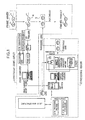
- Fig. 1 is a schematic diagram of a manufacturing method of a spectacle lens related to an aspect of the embodiment of the present invention
- Fig. 2 is a schematic diagram of an ordering screen
- Fig. 3 is a flowchart of a manufacturing process of a spectacle lens
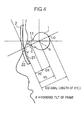
- Fig. 4 is a schematic diagram of an optical model of spectacles wearing.
- Reference Numeral 1 is a spectacles store (ordering party ), and Reference Numeral 2 is a spectacles processor (processing party).
- the spectacle lens manufacturing method of this aspect of the embodiment is such that a spectacle lens 3 is designed and manufactured based on information sent via a terminal apparatus installed at the spectacles store (ordering party) 1 to an information processing system installed at the processor (processing party) 2.
- the above-mentioned terminal apparatus via the above-mentioned terminal apparatus there is sent to the above-mentioned information processing system design and/or processing condition data information selected as needed from among information comprising a prescription value, which comprises spectacle lens information, spectacle frame information, and data related to the individual VR value of a spectacles wearer, layout information, and process specification information.
- the above-mentioned information processing system determines processing conditions by processing the information thereof, and obtains an optimized lens form based on an optical model of simulated wearing conditions, and a spectacle lens is manufactured.
- the preparation of prescription data and lens data for a spectacles wearer is performed at a spectacles store. Firstly, to determine a VR value for an individual (one of the prescription data), which is a characteristic of this aspect of the embodiment, a CR value of the right eye and left eye of each customer is measured, respectively, using a CR measuring apparatus.
- the axial length of the eye of the left and right eyes, respectively are measured using a popular commercial axial length measuring apparatus, and next, using a comparison coefficient of the relative location of the center of rotation of the eye (vertical direction) relative to the axial length of the eye, a CR value is computed via an operation, and this is used as the CR value for the left eye and right eye.
- the prescription is confirmed once again using either optometry data (spherical power, cylindrical power, cylinder axis, prismatic power, prism base setting, addition, distance PD, near PD, and so forth) from a customer's optometrist, or, as necessary, based on the optometry data thereof, using optometry equipment installed at a spectacles store.
- optometry data spherical power, cylindrical power, cylinder axis, prismatic power, prism base setting, addition, distance PD, near PD, and so forth
- lens data is prepared by making determinations based on interaction with the customer as to lens processing specification data, comprising the type of lens (single vision (spherical, aspherical), multifocal (bifocal, progressive) and so forth), power and type of lens material (glass, plastic), specification of surface processing options (tinting, wear-resistant coating (hard coating), antireflection coating, protection against ultraviolet rays, and so forth), center thickness, edge thickness, prism, and decentration, and layout specification data (for example, the inset, and specification for the location of the segment of a bifocal lens). Further, type of lens, and surface processing options can be substituted for by specifying a lens maker specification, and the model name thereof.
- lens processing specification data comprising the type of lens (single vision (spherical, aspherical), multifocal (bifocal, progressive) and so forth), power and type of lens material (glass, plastic), specification of surface processing options (tinting, wear-resistant coating (hard coating), antire
- Frames supplied by a frame maker are stocked at a spectacles store 1, and a customer selects a frame 4 of his/her liking.
- shape measurements are taken for the selected frame thereof using an installed 3-dimensional frame shape measuring apparatus (for example, GT-1000, 3DFT by Hoya Corporation), and frame data (for example, shape, FPD, bridge, frame curve, rim thickness, frame material, type (full frame, rimron, rimless), and so forth) is prepared.
- 3-dimensional frame shape measuring apparatus for example, GT-1000, 3DFT by Hoya Corporation
- frame data for example, shape, FPD, bridge, frame curve, rim thickness, frame material, type (full frame, rimron, rimless), and so forth
- the notation method for acquisition of frame data differs for each frame maker, and there are also various acquisition methods.
- the above-mentioned method indicated a method by which an actual frame shape is measured, but a method, in which information is already attached to a frame beforehand as a shape data barcode tag, acquires frame data by reading the data thereof. Further, in a case in which all frame data can be extracted from a frame model, frame data is extracted from the model data thereof.
- the frame tilt angle is determined, and the distance between the vertex of the cornea of the eye and the concave surface of a lens (VC value) is determined.
- a VR value is determined from the sum of this VC value and the CR value determined above.
- a spectacle lens ordering and inquiries system which is ordinarily utilized in the spectacles industry (for example, a typical system is the Hoya Online System manufactured by Hoya Corporation), can be used in the data communications thereof.
- a typical system is the Hoya Online System manufactured by Hoya Corporation
- this data communications is performed using a predetermined ordering screen.
- Fig. 2 is the system ordering screen thereof.
- Various information, comprising a VR value is sent to a host computer via the ordering screen.
- a host computer inputs and processes the various information sent from the above-mentioned terminal, and performs lens design simulation.
- Fig. 3 is a flowchart of a spectacle lens manufacturing process, and is a diagram showing a process, comprising simulation up until the manufacture of a prescription lens thereof.
- Fig. 3 first prescribed input items are checked.
- the main items thereof which are related to optical lens design, are physical lens data (refractive index, Abbe number, lspecific gravity, and so forth), prescription-related data (lens power, cylinder axis, addition, prismatic power, prism base setting , decentration, outer diameter, distance PD, near PD, lens thickness, VR value (CR value + VC value)), frame data (shape, DBL, FPD, frame curve, frame curve, and so forth), frame forward tilt, type of bevel, and other process specification data.
- lens data and frame data in particular, it is desirable to acquire basic physical and design data from a manufacturer beforehand.
- a spectacles wearing optical model for lens design is comprehensively simulated from the data thereof.
- Fig. 4 is a schematic diagram of an optical model of spectacles wearing, and is a diagram, which partially shows an outline of an optical model from the side.
- a lens is positioned in front of the eye by estimating the forward tilt of the frame.
- the VR value is the sum of the distance from the center of rotation R of the eye 1 to the vertex C of the cornea 11, that is, the CR value, and the distance from the vertex of the cornea C to a reference point V on the back surface 21 of a lens 2 (point of intersection of an extension of a straight line CR and a lens back surface 21) (VC value).
- optimization computations are performed by computer using lens design program calculations, the surface form of a concave surface, convex surface, and lens thickness are determined, and a prescription lens is determined.
- a prescription lens options based on variations of spectacle shape, such as an aspheric surface, spheric surface, bifocal, progressive , refractive index, and curvature, are taken into consideration, and either 1 type or a plurality of types of candidates are shown.
- a visual acuity examination apparatus uses a fixed VC value (hereinbelow, this value is referred to as VC0. Ordinarily, it is 14mm). Then, using this examination apparatus, an examiner (spectacles store, ophthalmologist, optician) obtains a corrective power value (D0). In the case of this embodiment, an examiner also takes into consideration frame shape, the shape of a patient's face, the corrective power value (D0) obtained via an optometry, and type of lens, and determines a VC value.
- the VC value is not the ordinarily used value of VC0 (14mm), and there are case which use as a prescription VC value a large measured VC value (for example, 20mm).
- D D0/(1 + (VC - VC0) ⁇ D0/1000)
- the corrective power thereof be corrected uniformly over the entire surface of a spectacle.
- D is less than 0.005.
- the ordering party uses an ordering system, which supplies (specifies) a VC value, CR value, D value (power) and so forth to the plant side, but if this embodiment is constituted such that in accordance with the ordering party transmitting initial information to the plant side, corrective computations are performed at the plant side, and design lens information is returned to the ordering party, and the ordering party references this information, prepares ordering information, and sends it to the plant side once again, the burden on the ordering party can be reduced.
- a lens curved surface form is initially selected as a candidate for use, and the optical characteristics of the lens thereof are determined using a ray tracing method or the like.
- a lens curved surface form the curved surface of which differs in accordance with a prescribed rule from the lens curved surface form thereof, is selected as a next candidate, and the optical characteristics of the lens thereof are determined in the same manner using a ray tracing method or the like.
- the optical characteristics of both lenses are evaluated by a prescribed method, and based on the results thereof, a determination is made to either use a candidate thereof, or to offer a subsequent candidate.
- design-related data comprising a VR
- design input data comprising a VR
- the spectacles optical model of Fig. 4 is assumed, and ray tracing computations are carried out.
- the starting point of ray tracing is the point of rotation (R).
- Points for carrying out ray tracing computations are set over the entire surface of a lens 2. The more numerous the number of set points, the more precise a design can be. For example, roughly 3 to 30,000 points can be used on a spectacle lens.
- the optical quantity (ordinarily, astigmatism, and curvature of field aberration) for each light ray is computed.
- the VC value and CR value which are related to the vertex of the cornea (C) are not used alone, but rather, the value of VR, which is the sum of the two, is used.
- an aspheric lens surface is expressed beforehand by an expression comprising a functionalized aspheric coefficient.
- a basic aspheric expression thereof is well known in the field of optical lenses, and furthermore, based thereon, as an application thereof, there are well-known expressions that determine functionalized optical surfaces on the basis of various lens design concepts.
- As specific aspheric expressions it is possible to cite, for example, Japanese Patent Application Laid-open No.S 52-115242, Japanese Patent Application Laid-open No. S58-24112, Japanese Patent Application Laid-open No. S61-501113, Japanese Patent Application Laid-open No. S64-40926, and WO97/26578. According to these patents, a lens surface can be determined by determining an aspheric coefficient in a disclosed expression.
- an optimization computation (method of least square attenuation), which changes an aspheric coefficient in a direction that reduces a sum of squares (called a merit function) weighted by the above-mentioned computed optical quantity that accompanies each light ray. Then, when a merit function constitutes less than a desired set optical quantity, an optimization computation is complete. An aspheric coefficient is determined at this point in time, and a lens form is decided. Furthermore, the above-mentioned optical quantities are clear even from the optical model of Fig.
- optical quantities are not individually functionally dependent on a VC value, and a CR value, which are 2 elements of a VR value, but rather have a functional relation to a VR value, which is the sum of a VC value and a CR value.
- Fig. 5 is a diagram showing optical data of a prescription lens with a VR value of 27mm, which was determined by the above-mentioned design technique.
- the basic specification for this prescription lens is a prescription for myopia, and is a single vision aspheric plastic lens (diethylene glycol bis allyl carbonate) of lens power: -4.00 diopter (D), refractive index (nd): 1.50, and outside diameter: 70mm.
- Fig. 6 is a diagram showing performance data of a case in which a person with a VR value of 27mm wore a prescription lens with a VR value of 27mm (Refer to Fig. 5). As shown in Fig. 6, there is practically no power error (average power error) in any angle of visual line, and it is evident that a lens design, which strives for optimization in an average power, has been performed, and that this lens design has extremely outstanding performance.
- Fig. 7 is a diagram showing performance data of a case in which a person with a VR value of 33mm wore a prescription lens with a VR value of 27mm (Refer to Fig. 5) (Target distance was set at infinity. Same holds true hereinbelow).
- large power errors average power errors
- power errors occur when a angle of visual line moves to a side field of view, which is away from the center of the lens, for example, in a direction of 30 degrees or 35 degrees.
- the quantity thereof is 0.245 (D) at 35 degrees, and, as can be seen, is extremely large.
- dioptric power classification is generally done at a pitch of 0.25 (D), and the power error value thereof is not a quantity that can be tolerated, indicating the need to select another prescription lens. Because all spectacle lenses ordinarily use the same design for a single lens item, the case shown in Fig. 7 can be thought of as a model case that occurs on a daily basis.
- Fig. 8 is a diagram showing optical data of a prescription lens with a VR value of 33mm.
- the difference in convex surface curve values is 0.0 diopter at a distance from the optical center of 0.0mm, and constitutes a -0.184 diopter at 15mm. Because this is an aspheric lens design, unlike a spheric lens design, a nonuniform convex curve correction is performed along the lens radial, and this differs from a uniform curve correction of power correction processing.
- Fig. 9 is a diagram showing performance data of a case in which a person with a VR value of 33mm wore a prescription lens with a VR value of 33mm (Refer to Fig. 8). As shown in Fig. 9, there is practically no power error (average power error) in any angle of visual line, and it is evident that a lens design, which strives for optimization in an average power, has been performed, and that this lens design has extremely outstanding performance.
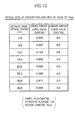
- Fig. 10 is a diagram showing optical data of a prescription lens with a VR value of 27mm in a case in which the power is a prescription for hyperopia, and is +4.00 (D)
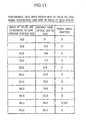
- Fig. 11 is a diagram showing performance data of a case in which a person with a VR value of 27mm wore a prescription lens with a VR value of 27mm (Refer to Fig. 10) (Target distance is set at infinity. The same holds true for hereinbelow)
- Fig. 12 is a diagram showing performance data of a case in which a person with a VR value of 33mm wore a prescription lens with a VR value of 27mm (Refer to Fig. 10)
- Fig. 10 is a diagram showing optical data of a prescription lens with a VR value of 27mm in a case in which the power is a prescription for hyperopia, and is +4.00 (D)
- Fig. 11 is a diagram showing performance data of a case in which a person with a VR value of 27
- FIG. 13 is a diagram showing optical data of a prescription lens with a VR value of 33mm in a case in which power is +4.00 (D)
- Fig. 14 is a diagram showing performance data of a case in which a person with a VR value of 33mm wore a prescription lens with a VR value of 33mm (Refer to Fig. 13). It is evident that the examples shown in these figures achieved the same results as the case shown in Fig. 5-Fig. 9.
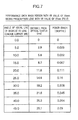
- Fig. 15 is a table for determining and showing power errors for various combinations of convex surface curve (base curve) values and lens power values in a case in which there is a single vision lens, and the VR value is set at 27mm
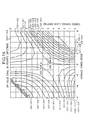
- Fig. 16 is a graph for showing the relationships indicated in Fig. 15 as power error contour lines.
- the examples shown in these figures are examples that treat the visual line direction as a 30 degree direction.
- the vertical axis is convex surface curves (base curves), and the horizontal axis is lens powers. From this table, it is clear that if a person with a lens power of -6.00 (D) selects a base curve of 2 (D), he will be able to achieve a lens with a good design that has a small power error.
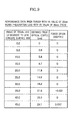
- Fig. 17 is a table for determining and showing power errors for various combinations of convex surface curve (base curve) values and lens power values in a case in which there is a single vision lens, and the VR value is set at 33mm
- Fig. 18 is a graph for showing the relationships indicated in Fig. 17 as power error contour lines.
- the examples shown in these figures are examples that treat the visual line direction as a 30 degree direction.
- the vertical axis is convex surface curves (base curves), and the horizontal axis is lens powers. From this table, it is clear that if a person with a lens power of -6.00 (D) selects a base curve of 1 (D), he will be able to achieve a lens with a good design that has a small power error.
- a case of a progressive-power lens will be explained.
- the design of a progressive-power lens is basically the same as that for a single vision lens, but from the standpoint of the structure thereof, there are also points that differ.
- the importance of a method for determining (correcting) the inset of a layout for a near portion will be explained while referring to Fig. 19 through Fig. 25.
- a progressive-power lens is constituted from a distance portion for long distance vision, a near portion for short distance vision, and an intermediate portion for intermediate vision, which smoothly connects the distance portion and the near portion.
- a spheric design is generally used for the distance portion and near portion (but there are also aspheric designs), and an aspheric design is used for the intermediate portion. Therefore, from the standpoint of design, it can be said that a progressive-power lens has a surface, which combines the spheric design of the above-mentioned single vision lens with an aspheric design.
- a progressive-power lens is a lens for presbyopia
- the portion from the intermediate portion to the near portion receives the most noticeable affects resulting from a difference in VR, and in this embodiment, the layout state thereof will be explained by focusing on the near portion thereof.
- the progressive-power lens of this embodiment is constituted such that lens is designed based on a prescribed optical design concept, the basic progressive refracting surface thereof is set as a functionalized surface via a prescribed numerical expression in a lens design program, and a prescription lens surface can be set up by inputting prescribed form determining element parameters, such as prescribed dioptric power.
- a prescription lens surface can be set up by inputting prescribed form determining element parameters, such as prescribed dioptric power.
- a lens surface is set up by determining the power distribution across an entire lens surface of a distance portion, a intermediate portion, and a near portion.
- elements for determining the power distribution thereof there are the base curve value of a distance portion, addition, horizontal power distribution of a distance portion and a near portion, the layout of a distance portion, near portion, and intermediate portion, progressive zone power change distribution, positioning of either a principal meridian or a principal sight line, positioning of astigmatism distribution, and positioning of average power distribution.
- a prescribed progressive refracting surface is set up by adding weighting to, and changing the weighting of these elements in accordance with individual design concepts.
- a progressive-power lens created based on a certain prescribed design concept like this a basic progressive refracting surface, comprising a plurality of base curves (for example, 2-8 curves) in accordance with the prescribed dioptric power thereof, is prepared beforehand. And a standard near portion inset INSETO is set as an initial value (for example, 2.5mm) in each.
- the near portion inset thereof is an inset toward the inner side of the near portion, which is set on a basic progressive refracting surface by treating as a reference a passage point on front surface of the lens of a line of sight at distance forward viewing (for example, a point on the principal meridian of a progressive-power lens), and is the distance in the horizontal direction from the principal meridian to the center of near portion of a progressive-power lens (Refer to Fig. 25).
- a basic progressive refracting surface of a prescribed base curve that corresponds to the prescribed dioptric power (for example, a 7 curve in the case of ADD 2.00 with a SPH + 3.00 diopter) is selected, and an initial value of INSET0 is set in the near portion of the basic progressive refracting surface thereof.
- this basic progressive refracting surface is treated as a front surface, and a lens design program is used to determine the form and location (a relative location on the optical axis relative to the front surface ) of a back surface of the lens, such that the lens thereof satisfies the power as prescribed (comprising a prism in a case in which a prism prescription is necessary).
- a back surface of the lens is set at this time, such that the thickness of the lens thereof is made thinnest owing to frame shape, type of frame, and layout of lens relative to frame.
- methods for determining a back surface of the lens having an optimal thickness like this are being implemented in the spectacles industry in lens ordering systems thereof, and are well-known technologies (for example, Japanese Patent Application Laid-open No. S59-55411, the HOYA METS system, and so forth), an explanation thereof will be omitted for this embodiment.
- a provisional optical model of a wearing state is set up on the basis of a prescribed near side object distance (working distance for near vision: a target distance for work to be done at a short distance) and the locations of the right and left eyes, a VR number of the invention of this case, which is obtained by measuring each individual spectacles wearer, distance PD, frame data, and frame forward tilt, and ray tracing computations are performed.
- the location of a point at which the visual line passes through the front surface of the lens when the right and left eyes actually identify a near object is determined via simulations based on the above-mentioned optical model, and next, a horizontal direction constituent (INSET1: the horizontal distance from the principal meridian to the center of near portion of the lens), which is the inset when there is convergence from the visual line in distance vision to the visual line in near vision in the location thereof, is determined.
- INSET1 the horizontal distance from the principal meridian to the center of near portion of the lens
- FIG. 24 is a diagram illustrating the divergence of the visual line between INSET0 and INSET1. This divergence is due to the fact that a line of sight passing through a lens on its way toward a near object is refracted by the lens, and the visual line actually passes through a location that differs from INSET0, which was set as a standard inset.
- the optical layout of the near portion changes in accordance with the changing of the inset, and to deal with this, the intermediate portion and distance portion are also changed, and a new progressive refracting surface is created while maintaining the basic refraction design surface, and then, an ideal inset is sought, and optimization is performed until optical conditions are satisfied such that the visual line in near vision is able to pass through a prescribed near object distance.
- INSET (n-1) INSET (n)
- the repetitive processing thereof (optimization) is completed, and a progressive refracting surface and back surface of the lens are determined as the final prescription lens.
- the refractive index of a lens material is 1.596
- the length of the progressive zone from the distance portion to the near portion is 15mm
- progressive refracting power increases having a location 4mm upwards from the center as a base point, and achieves addition 2.00 D at a location 11mm downward from the center.
- the PD of the right and left eye is 32.0mm in both the right and left
- the near object distance is set at 33.3cm.
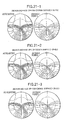
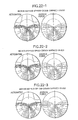
- Each diagram is a distribution of surface astigmatism, and surface average power for each progressive refracting surface, and shows a distribution range of ⁇ 80mm. Further, a ⁇ 50mm auxiliary circle is placed on the inside portion.
- Fig. 20-1 is a progressive refracting surface form for which the distance power (DF) for both the right and left is set at +3.00D, the convex curve (ABC) is set at 5.94D, lens thickness at the geometric center is set at 5.1mm, and the prism at the geometric center is set at 1.0 ⁇ base 270°
- Fig. 20-2 is a progressive refracting surface form for which the distance power (DF) for both the right and left is set at 0.00D, the convex curve (ABC) is set at 4.72D, center thickness is set at 2.7mm, and the prism is set at 1.0 ⁇ base 270°
- Fig. 20-1 is a progressive refracting surface form for which the distance power (DF) for both the right and left is set at +3.00D, the convex curve (ABC) is set at 5.94D, lens thickness at the geometric center is set at 5.1mm, and the prism at the geometric center is set at 1.0 ⁇ base 270°
- Fig. 20-2
- 20-3 is a progressive refracting surface form for which the distance power (DF) for both the right and left is set at -3.00D, the convex curve (ABC) is set at 3.49D, center thickness is set at 1.5mm, and the prism is set at 1.0 ⁇ base 270°.
- Fig. 21-1 is a progressive refracting surface form for which the distance power (DF) for both the right and left is set at +3.00D, the convex curve (ABC) is set at 5.94D, center thickness is set at 5.1mm, and the prism is set at 1.0 ⁇ base 270°
- Fig. 21-2 is a progressive refracting surface form for which the distance power (DF) for both the right and left is set at 0.00D, the convex curve (ABC) is set at 4.72D, center thickness is set at 2.7mm, and the prism is set at 1.0 ⁇ base 270°
- Fig. 21-1 is a progressive refracting surface form for which the distance power (DF) for both the right and left is set at +3.00D, the convex curve (ABC) is set at 5.94D, center thickness is set at 5.1mm, and the prism is set at 1.0 ⁇ base 270°
- Fig. 21-2 is a progressive refracting surface form for which the distance power (
- 21-3 is a progressive refracting surface form for which the distance power (DF) for both the right and left is set at -3.00D, the convex curve (ABC) is set at 3.49D, center thickness is set at 1.5mm, and the prism is set at 1.0 ⁇ base 270°.
- Fig. 22-1 is a progressive refracting surface form for which the distance power (DF) for both the right and left is set at +3.00D, the convex curve (ABC) is set at 5.94D, center thickness is set at 5.1mm, and the prism is set at 1.0 ⁇ base 270°
- Fig. 22-2 is a progressive refracting surface form for which the distance power (DF) for both the right and left is set at 0.00D, the convex curve (ABC) is set at 4.72D, center thickness is set at 2.7mm, and the prism is set at 1.0 ⁇ base 270°
- Fig. 22-1 is a progressive refracting surface form for which the distance power (DF) for both the right and left is set at +3.00D, the convex curve (ABC) is set at 5.94D, center thickness is set at 5.1mm, and the prism is set at 1.0 ⁇ base 270°
- Fig. 22-2 is a progressive refracting surface form for which the distance power (
- 22-3 is a progressive refracting surface form for which the distance power (DF) for both the right and left is set at -3.00D, the convex curve (ABC) is set at 3.49D, center thickness is set at 1.5mm, and the prism is set at 1.0 ⁇ base 270°.
- Fig. 23 shows the results of calculating as specific numerals the near portion insets INSET provided to the respective determined progressive refracting surfaces shown in Fig. 20, Fig. 21, and Fig. 22. From this it is clear that the insets of the near portions change in accordance with differences in VR.
- this method can also be used in the same way in a case in which the optical layout of the near portion of a bifocal (segment height, left-right location, and so forth) is determined, and a prescription lens is determined. That is, as shown in Fig. 26, since the near segment portion of a bifocal layout block is partitioned by a boundary line, the location of the near portion is adjusted in the same manner as the above-mentioned example of a progressive-power lens.
- astigmatism, average power error, and distortion can also be determined from ray tracing for either a selected basic progressive refracting surface, or a corrected progressive refracting surface and a back surface of the lens in the flowchart of Fig. 19.
- the form of a progressive refracting surface can be corrected, and aberration correction can be performed simultaneously from such values as astigmatism, average power error, and distortion determined by ray tracing.
- optimization is performed beforehand for a basic progressive refracting surface so as to diminish the respective deviations ( ⁇ A1, ⁇ B1, ⁇ C1) between estimated astigmatism A0, average power distribution B0 and distortion C0, and astigmatism A1, average power distribution B1 and distortion C1 determined by ray tracing.
- Weighting which corresponds to a location on a basic progressive refracting surface (center area, lateral area, distance portion, near portion, and so forth), is performed for each of the deviations thereof at this time.
- ray tracing is performed, and optimization is performed in the respective areas by using in the distance portion a VR value that differs at distance vision and at near vision.
- two VR values are interpolated and used at distance vision and near vision in accordance with a localized additional refracting power in the location thereof.
- a partial VR value for either only a distance portion, or only a near portion.
- the results thereof are displayed using, for example, an astigmatism diagram, bird's-eye view, and so forth, by a display processing program for optical performance computation results provided in a lens design program, and are constituted so as to enable comparison and study. Further, such results are set up to also be displayable on the personal computer of the ordering party via a communications line.
- the spectacles store side either confirms or selects a desired lens based on such results. Naturally, wearing parameters can be changed, new wearing conditions can be set, and a new prescription lens can be determined based on the simulation data thereof.
- results thereof there is performed, based on information of each type sent to a host computer by a display processing program for optical performance computation results provided in a lens design program, computations to determine how a spectacle lens of the individual design that is being ordered differs from a standard spectacle lens, the results thereof are returned to a spectacle store side terminal apparatus, and the differences therebetween can also be displayed thereon.
- a standard lens to be used as a comparison object can also be specified by the spectacles store side at this time, and in a case in which there is no specification of a standard lens as a comparison object, this embodiment is constituted such that a lens set in the host computer beforehand is treated as the comparison object. Based on such results, the spectacles store side can check the differences between a desired individual designed lens and a standard lens.
- a number of methods can be cited for comparing the differences between a spectacle lens of an individual design, and a standard spectacle lens.
- One method is a method in which the kind of aberration distribution achieved when the end user puts on the spectacles thereof is determined by ray tracing, and the results thereof are displayed on the spectacles store side terminal apparatus by lining up the aberration distribution of the standard spectacles beside the aberration distribution of the individually designed spectacles.
- a method such as the following.
- a method which, in the case of a single-vision aspheric lens, compares and displays using numerals and graphs a power error and astigmatism of when there is a 30 degree angle of visual line toward the lens concave surface, and the lens convex surface curve at the design center location of a spectacle lens of an individual design, and a standard spectacle lens, respectively.
- processing data thereof is prepared.
- This processing data is prepared on the basis of a lens processing program. Processing conditions of processing equipment are determined, driving of processing equipment is controlled, and instructions are given for selecting processing tools and for selecting a lens material by processing data. This processing data are sent to each manufacturing equipment in a factory with processing instructions.
- a lens blank is selected based on the processing instructions, and cutting and grinding lens processing are performed using an NC cutting machine. Also in a case in which surface processing (formation of a wear-resistant hard coating, formation of an anti-reflection coating, lens tinting, water repellant processing, formation of an ultraviolet ray cutting coating, anti-fogging treatment, and so forth) is required, processing is performed here. Then, a round shaped prescription lens is completed. Further, at this point, there are also cases in which a lens can be selected from finished products stocked beforehand for lens manufacture.
- the above-mentioned round lens is made to correspond to a prescribed lens form, and a bevel (V-shaped edge) is formed at the edge based on spectacles layout information.
- the formation of the bevel is performed by a machining center. This processing is performed using a tool and processing method disclosed in Japanese Utility Model Application Laid-open No. H6-17853, and Japanese Patent Application Laid-open No. H6-34923, which are related to the above application of this applicant.
- selecting of type of lens material glass, plastic, polycarbonate, acrylic, and so forth
- selecting of frame material inputting of frame PD (FPD, DBL), inputting of PD (both eyes, one eye), inputting of horizontal decentration distance X, inputting of vertical decentration distance Y, inputting of astigmatism axis, inputting of finished size, and specifications of bevel shape are used as processing conditions, and when the processing equipment is set to the processing mode, the input data thereof is automatically introduced by a program.
- a bevel formed lens is manufactured in this manner, passes through an inspection process at the factory, and is shipped to a spectacles store. At the spectacles store, the bevel formed lens is fitted into a selected frame, and spectacles are assembled. Further, in this embodiment, the bevel formation was explained as an aspect, which is implemented by a manufacturer, but this can also be performed at a spectacles store, and is not particularly limited to the manufacturing flow of this embodiment.
- a lens optical performance evaluation index average power was utilized in the above-mentioned aspect of the embodiment, but it is not limited thereto.
- indices such as astigmatism, average power error, distortion, spectacles magnification, RMS, and combinations thereof, and the index is not particularly limited.
- a lens design program, inquiry-based simulation program, display program and so forth can be incorporated beforehand into an ordering party terminal and accessory equipment (CD or the like), and can also be run on the same personal computer in the sense of an apparatus having a kind of information processing function.
- the present invention makes it possible to design and manufacture a higher performance spectacle lens that accords with the VR value (VC +CR) of each individual person by determining, by measuring each individual spectacles wearer, a value for the distance VR from a reference point on the back surface of a spectacle lens to the center of rotation of the eye, which adds a value for the distance VC from a reference point on the back surface of a spectacle lens when spectacles are being worn to the vertex of the cornea of a spectacles wearer's eyeball, which is one of the required data in spectacle lens design, and a value for the distance CR from the above-mentioned cornea vertex to the center of rotation of the eye, using the value thereof to perform spectacle lens design, and to manufacture a spectacle lens on the basis of the design specifications thereof.
- this spectacle lens and manufacturing method therefor makes it possible to supply a spectacle lens that excels in feeling when wearing it by designing and manufacturing a spectacle lens taking into consideration the distance between the center of rotation of the eye and the spectacle lens for an individual spectacles wearer, and can be applied to any of a single vision lens, a multifocal lens, and a progressive-power lens.
Landscapes
- Physics & Mathematics (AREA)
- Health & Medical Sciences (AREA)
- Ophthalmology & Optometry (AREA)
- General Physics & Mathematics (AREA)
- Optics & Photonics (AREA)
- General Health & Medical Sciences (AREA)
- Mathematical Physics (AREA)
- Eyeglasses (AREA)
- Crystals, And After-Treatments Of Crystals (AREA)
- Preparation Of Compounds By Using Micro-Organisms (AREA)
Abstract
Description
In this manner, according to the present invention, spectacle lens design is performed for the right and left eyes of each individual by using a VC value for the distance from a reference point on the back surface of a spectacle lens to the vertex of the cornea of the eye of a spectacles wearer, and a CR value for the distance from the vertex of the cornea to the center of rotation of the eye, but it is also important to compare a spectacle lens designed according to the present invention against a standard spectacle lens designed and manufactured by an existing design technique, and to give comparative data as to how different they are.
Claims (10)
- A spectacle lens, wherein there is determined, by either measurement or specification for an individual spectacles wearer, a value of the distance VR from a reference point on the back surface of a spectacle lens to the center of rotation of the eye, which is given by adding a value of the distance VC from a reference point on the back surface of a spectacle lens to the vertex of the cornea of the eye of a spectacles wearer when spectacles are being worn, which is one of the required data in spectacle lens design, to the distance CR from said cornea vertex to the center of rotation of the eye, and the spectacle lens is designed using the value VR thereof, and is manufactured based on the design specifications.
- The spectacle lens according to claim 1, wherein, said value of the distance CR from the cornea vertex to the center of rotation of the eye is obtained by measuring the axial length CO of the eye of a spectacles wearer, and using a value obtained based on measurement data thereof.
- The spectacle lens according to either of claims 1 or 2, wherein said center of rotation of the eye is determined for distance vision, near vision, specified distance vision, and combination thereof, respectively, and is either selected and used on the basis of lens optical characteristics, or is used for appropriate viewing areas of a spectacle lens, respectively.
- A spectacle lens, wherein processing is performed by obtaining an optimized lens form based on an optical model of wearing conditions simulated in accordance with design and/or processing condition data selected as needed from among information comprising a prescription value, which comprises spectacle lens information, spectacle frame information, and data related to the individual VR value of a spectacles wearer, layout information, and processing specification information.
- The spectacle lens according to claim 4, wherein an amount of inset for near vision is determined based on said VR value.
- The spectacle lens according to claim 4, wherein a base curve of a convex surface is determined based on said VR value.
- The spectacle lens according to claim 4, wherein power error correction is performed for a pre-set reference prescription surface based on said VR value.
- A spectacle lens manufacturing method, wherein a terminal apparatus, which is installed at a spectacle lens ordering party side; and an information processing system, which is installed at a spectacle lens processing party side and is connected by a telecommunications line to said terminal apparatus are provided for designing and manufacturing a spectacle lens based on information sent to said information processing system via said ordering party terminal apparatus; the method comprising the steps of:sending to said information processing system via said terminal apparatus design and/or processing condition data information selected as needed from among information comprising a prescription value, which comprises spectacle lens information, spectacle frame information, and data related to the VR value of each spectacles wearer, layout information, and process specification information, is sent; andobtaining an optimized lens form based on an optical model of wearing conditions simulated by said information processing system, determining processing conditions, and manufacturing a spectacle lens.
- A spectacle lens manufacturing method, wherein a terminal apparatus, which is installed at a spectacle lens ordering party side; and an information processing system, which is installed at a spectacle lens processing party side and is connected by a telecommunications line to said terminal apparatus are provided for designing and manufacturing a spectacle lens based on information sent to said information processing system via said ordering party terminal apparatus; the method comprising the steps of:sending sent to said information processing system via said terminal apparatus design and/or processing condition data information selected as needed from among information comprising a prescription value, which comprises spectacle lens information, spectacle frame information, and data related to the VR value of each spectacles wearer, layout information, and process specification information;determining an optimized lens form based on an optical model of wearing conditions simulated by said information processing system,also determining a standardized lens form by said information processing system using a standardized VR value in place of said VR value obtained for each spectacles wearer, while using other design and/or processing condition data sent via said terminal, andcomparing the optical characteristics of said optimized lens form against the optical characteristics of said standardized lens form, and based on the results of the comparison thereof, selecting either one of said lens forms, determining processing conditions of this selected lens form, and manufacturing a spectacle lens.
- A spectacle lens manufacturing method, wherein a spectacle lens is designed and manufactured while information is exchanged between a terminal apparatus, which is installed at a spectacle lens ordering party side, and a manufacturing side computer, which is connected to the ordering side computer to enable information exchange; the method comprising the steps of:inputting via said terminal apparatus design and/or processing condition data information selected as needed from among information comprising a prescription value, which comprises spectacle lens information, spectacle frame information, and data related to the VR value of a spectacles wearer, layout information, and process specification information, andobtaining an optimized lens form based on an optical model of wearing conditions simulated on the basis of the inputted information, determining processing conditions, and manufacturing a spectacle lens.
Priority Applications (1)
| Application Number | Priority Date | Filing Date | Title |
|---|---|---|---|
| EP07102210.7A EP1793262B1 (en) | 1999-02-12 | 2000-02-10 | Spectacle lens and manufacturing method therefor |
Applications Claiming Priority (3)
| Application Number | Priority Date | Filing Date | Title |
|---|---|---|---|
| JP3501799 | 1999-02-12 | ||
| JP3501799 | 1999-02-12 | ||
| PCT/JP2000/000763 WO2000048035A1 (en) | 1999-02-12 | 2000-02-10 | Eyeglass and its manufacturing method |
Related Child Applications (1)
| Application Number | Title | Priority Date | Filing Date |
|---|---|---|---|
| EP07102210.7A Division EP1793262B1 (en) | 1999-02-12 | 2000-02-10 | Spectacle lens and manufacturing method therefor |
Publications (3)
| Publication Number | Publication Date |
|---|---|
| EP1154302A1 true EP1154302A1 (en) | 2001-11-14 |
| EP1154302A4 EP1154302A4 (en) | 2002-07-03 |
| EP1154302B1 EP1154302B1 (en) | 2009-08-05 |
Family
ID=12430313
Family Applications (2)
| Application Number | Title | Priority Date | Filing Date |
|---|---|---|---|
| EP00902921A Expired - Lifetime EP1154302B1 (en) | 1999-02-12 | 2000-02-10 | Eyeglass and its manufacturing method |
| EP07102210.7A Expired - Lifetime EP1793262B1 (en) | 1999-02-12 | 2000-02-10 | Spectacle lens and manufacturing method therefor |
Family Applications After (1)
| Application Number | Title | Priority Date | Filing Date |
|---|---|---|---|
| EP07102210.7A Expired - Lifetime EP1793262B1 (en) | 1999-02-12 | 2000-02-10 | Spectacle lens and manufacturing method therefor |
Country Status (11)
| Country | Link |
|---|---|
| US (2) | US6637880B1 (en) |
| EP (2) | EP1154302B1 (en) |
| JP (3) | JP2011039551A (en) |
| KR (1) | KR100608406B1 (en) |
| CN (1) | CN1189775C (en) |
| AT (1) | ATE438880T1 (en) |
| AU (1) | AU769864B2 (en) |
| CA (1) | CA2362129C (en) |
| DE (1) | DE60042681D1 (en) |
| HK (1) | HK1043840B (en) |
| WO (1) | WO2000048035A1 (en) |
Cited By (22)
| Publication number | Priority date | Publication date | Assignee | Title |
|---|---|---|---|---|
| DE10121133A1 (en) * | 2001-04-30 | 2002-12-19 | Rodenstock Optik G | Process for the production of a lens taking into account the optimal, individual progression length |
| WO2004034131A1 (en) * | 2002-10-08 | 2004-04-22 | Hoya Corporation | Method for determining optical value of lens of eyeglasses, process for producing lens of eyeglasses, lens of eyeglasses and its ordering/ordr receiving system |
| EP1336891A4 (en) * | 2000-10-27 | 2005-10-12 | Hoya Corp | Production method for spectacle lens and supply system for spectacle lens |
| WO2006061832A3 (en) * | 2004-12-06 | 2006-09-14 | Opti Clip Int Llc | Imaging of primary eyewear for remote production of secondary eyewear |
| US7219075B2 (en) | 2002-04-16 | 2007-05-15 | Nidek Co., Ltd. | Lens ordering method and lens ordering system |
| EP1837699A1 (en) * | 2006-03-24 | 2007-09-26 | ESSILOR INTERNATIONAL Compagnie Générale d'Optique | Method for the determination of a progressive ophtalmic lens |
| FR2910647A1 (en) * | 2007-05-29 | 2008-06-27 | Essilor Int | Ophthalmic lens trimming method for use in spectacles, involves storing focusing and trimming characteristics of frame in new recordings of central register associated to type of frame, and acquiring characteristics of another frame |
| WO2008089997A1 (en) * | 2007-01-25 | 2008-07-31 | Rodenstock Gmbh | Reference points for orhto positioning |
| WO2010097161A1 (en) * | 2009-02-26 | 2010-09-02 | Carl Zeiss Vision Gmbh | Method and device for determining the location of the eye fulcrum |
| WO2010133813A1 (en) | 2009-05-20 | 2010-11-25 | Essilor International (Compagnie Generale D'optique) | Single vision ophthalmic lens |
| US8322855B2 (en) | 2004-05-06 | 2012-12-04 | Indo Internacional S.A. | Method for determining the visual behaviour of a Person |
| EP2667241A1 (en) * | 2012-05-23 | 2013-11-27 | Carl Zeiss Vision International GmbH | A method of manufacturing a spectacle lens providing an astigmatic correction and spectacles including such spectacle lens |
| EP2733648A1 (en) * | 2008-08-04 | 2014-05-21 | Carl Zeiss Vision GmbH | Systems and methods for ordering lenses |
| EP3109693A4 (en) * | 2014-02-20 | 2017-10-11 | Nikon Corporation | Glasses-lens design method, glasses-lens production method, glasses lens, glasses-lens design system, glasses-lens design program, and recording medium |
| EP3261003A1 (en) * | 2012-10-18 | 2017-12-27 | Essilor International | Method for providing at least part of an eyewear equipment |
| EP1744203B1 (en) * | 2004-05-05 | 2018-04-11 | Horizons Optical S.L.U. | Ophthalmic lens calculation method and corresponding lens |
| EP3309603A1 (en) * | 2016-10-11 | 2018-04-18 | Essilor International | Method for determining a parameter of an optical equipment |
| EP3395233A1 (en) * | 2017-04-25 | 2018-10-31 | Johnson & Johnson Vision Care Inc. | Ametropia treatment tracking methods and system |
| KR20180119505A (en) * | 2017-04-25 | 2018-11-02 | 존슨 앤드 존슨 비젼 케어, 인코포레이티드 | Ametropia treatment tracking methods and system |
| US10642067B2 (en) | 2016-01-27 | 2020-05-05 | Johnson & Johnson Vision Care, Inc. | Ametropia treatment tracking methods and system |
| DE10236713B4 (en) * | 2002-08-07 | 2020-08-06 | Carl Zeiss | Method and device for manufacturing plastic eyeglass lenses |
| EP3722865A1 (en) * | 2019-04-11 | 2020-10-14 | Essilor International | Methods and systems for optimizing an optical function of a progressive ophthalmic lens under specific wearing conditions |
Families Citing this family (90)
| Publication number | Priority date | Publication date | Assignee | Title |
|---|---|---|---|---|
| HK1043840B (en) * | 1999-02-12 | 2005-05-20 | Hoya株式会社 | Eyeglass manufacturing method |
| JP2002068610A (en) * | 2000-08-25 | 2002-03-08 | Mitsubishi Electric Corp | Information provision method for elevator equipment plan |
| JP4707706B2 (en) * | 2000-10-27 | 2011-06-22 | Hoya株式会社 | Eyeglass lens supply method |
| JP4707705B2 (en) * | 2000-10-27 | 2011-06-22 | Hoya株式会社 | Eyeglass lens supply method |
| DE10103113A1 (en) * | 2001-01-24 | 2002-08-01 | Rodenstock Optik G | Process for the manufacture of spectacle lenses |
| US7025910B2 (en) * | 2001-02-20 | 2006-04-11 | Q2100, Inc | Method of entering prescription information |
| US6962669B2 (en) * | 2001-02-20 | 2005-11-08 | Q2100, Inc. | Computerized controller for an eyeglass lens curing apparatus |
| US7051290B2 (en) * | 2001-02-20 | 2006-05-23 | Q2100, Inc. | Graphical interface for receiving eyeglass prescription information |
| US7139636B2 (en) | 2001-02-20 | 2006-11-21 | Q2100, Inc. | System for preparing eyeglass lenses with bar code reader |
| US7074352B2 (en) * | 2001-02-20 | 2006-07-11 | Q2100, Inc. | Graphical interface for monitoring usage of components of a lens forming apparatus |
| US7060208B2 (en) * | 2001-02-20 | 2006-06-13 | Q2100, Inc. | Method of preparing an eyeglass lens with a controller |
| US7037449B2 (en) * | 2001-02-20 | 2006-05-02 | Q2100, Inc. | Method for automatically shutting down a lens forming apparatus |
| US7045081B2 (en) * | 2001-02-20 | 2006-05-16 | Q2100, Inc. | Method of monitoring components of a lens forming apparatus |
| JP2002350785A (en) * | 2001-05-28 | 2002-12-04 | Menicon Co Ltd | How to design ophthalmic lenses |
| DE10140656A1 (en) * | 2001-08-24 | 2003-03-13 | Rodenstock Optik G | Process for designing and optimizing an individual lens |
| DE60323630D1 (en) * | 2002-05-16 | 2008-10-30 | Hoya Corp | METHOD AND DEVICE FOR EVALUATING A GLASS LENS OR FORM FOR FORMING A GLASS LENS AND METHOD AND SYSTEM FOR MAKING A GLASS LENS |
| US20040004633A1 (en) * | 2002-07-03 | 2004-01-08 | Perry James N. | Web-based system and method for ordering and fitting prescription lens eyewear |
| JP4158906B2 (en) * | 2002-07-19 | 2008-10-01 | Hoya株式会社 | Optical performance display method of spectacle lens |
| US7083279B2 (en) * | 2002-08-07 | 2006-08-01 | Carl Zeiss Vision Gmbh | Process and an apparatus for making plastic material spectacle lenses |
| JP4672550B2 (en) * | 2002-10-16 | 2011-04-20 | キャンベル・サイエンス・グループ・インコーポレーテッド | Corneal characteristic measuring device |
| DE10313275A1 (en) * | 2003-03-24 | 2004-10-14 | Rodenstock Gmbh | Procedure for calculating an individual progressive lens |
| DE10338033A1 (en) * | 2003-08-19 | 2005-03-31 | Rodenstock Gmbh | Individual single-vision lens |
| DE10339948A1 (en) * | 2003-08-29 | 2005-04-28 | Rodenstock Gmbh | Fault-tolerant progressive glass design |
| US8241534B2 (en) * | 2004-03-09 | 2012-08-14 | Hoya Corporation | Spectacle lens manufacturing method and spectacle lens manufacturing system |
| JP2005313548A (en) * | 2004-04-30 | 2005-11-10 | Hoya Corp | Method and system for applying marking onto spectacle lens, and spectacle lens |
| US7677726B2 (en) * | 2004-06-29 | 2010-03-16 | Hoya Corporation | Manufacturing method for spectacle lens and spectacle lens |
| CN101057170B (en) * | 2004-11-16 | 2012-08-29 | 埃西勒国际通用光学公司 | Method for designing spectacle lenses taking into account an individual's head and eye movement |
| DE102004059448A1 (en) * | 2004-11-19 | 2006-06-01 | Rodenstock Gmbh | Method and apparatus for manufacturing a spectacle lens; System and computer program product for manufacturing a spectacle lens |
| FR2878975B1 (en) * | 2004-12-03 | 2007-02-16 | Essilor Int | METHOD AND DEVICE FOR PREPARING THE MOUNTING OF A JOB OF TWO OPHTHALMIC LENSES OF THE SAME PAIR OF EYEWEAR |
| EP1752815A1 (en) * | 2005-08-11 | 2007-02-14 | Essilor International (Compagnie Generale D'optique) | Method of manufacturing an optical system |
| DE102005038859A1 (en) * | 2005-08-17 | 2007-03-01 | Rodenstock Gmbh | Tool for calculating the performance of progressive lenses |
| FR2906621B1 (en) * | 2006-09-28 | 2008-11-28 | Essilor Int | METHOD FOR DETERMINING AN OPHTHALMIC LENS |
| US8757800B2 (en) * | 2007-01-25 | 2014-06-24 | Rodenstock Gmbh | Method for optimizing a spectacle lens |
| US7784937B2 (en) | 2007-06-05 | 2010-08-31 | Digital Vision, Inc. | System and method of surfacing a lens, such as a lens for use with eyeglasses |
| US8002406B2 (en) | 2007-10-30 | 2011-08-23 | Digital Vision, Inc. | System and method for manufacturing a lens, such as an ophthalmic lens |
| EP2028529B1 (en) * | 2007-12-28 | 2020-09-09 | Essilor International | Method of calculating an optical system according to a given spectacle frame |
| EP2028531B1 (en) | 2007-12-28 | 2016-05-04 | Essilor International (Compagnie Generale D'optique) | Method of selecting a semi-finished ophthalmic lens according to a given spectacle frame |
| EP2037314B1 (en) * | 2007-12-28 | 2021-12-01 | Essilor International | A method and computer means for choosing spectacle lenses adapted to a frame |
| EP2028527B1 (en) * | 2007-12-28 | 2013-01-23 | Essilor International (Compagnie Générale D'Optique) | Method for selecting base-curves for an ophtalmic lens and related spectacle lens manufacturing method |
| EP2031434B1 (en) * | 2007-12-28 | 2022-10-19 | Essilor International | An asynchronous method for obtaining spectacle features to order |
| EP2027968B1 (en) * | 2007-12-28 | 2010-11-03 | Essilor International (Compagnie Generale D'optique) | Method of determining parameters for adding frames to an ophthalmic lens |
| JP5094968B2 (en) * | 2008-04-28 | 2012-12-12 | Hoya株式会社 | How to select lens design criteria |
| US8333469B2 (en) * | 2008-04-30 | 2012-12-18 | Essilor International (Compagnie Generale D'optique) | Method and system for providing financial data for optical labs sharing lens calculation software |
| WO2010026221A1 (en) * | 2008-09-04 | 2010-03-11 | Essilor International (Compagnie Generale D'optique) | Method for providing finishing parameters |
| WO2010034727A1 (en) * | 2008-09-24 | 2010-04-01 | Essilor International (Compagnie Generale D'optique) | Method for determining the inset of a progressive addition lens |
| TWI516828B (en) * | 2008-09-24 | 2016-01-11 | Tokai Optical Co Ltd | Glasses lens design method |
| JP4888466B2 (en) * | 2008-10-17 | 2012-02-29 | セイコーエプソン株式会社 | Manufacturing method of inner surface progressive multifocal lens |
| JP5710500B2 (en) | 2009-01-23 | 2015-04-30 | ローデンストック.ゲゼルシャフト.ミット.ベシュレンクテル.ハフツング | Design control using polygonal design |
| WO2010119183A1 (en) * | 2009-04-17 | 2010-10-21 | Essilor International (Compagnie Générale d'Optique) | Method for determining an ophthalmic lens |
| US8340799B2 (en) | 2009-12-22 | 2012-12-25 | Digital Vision, Inc. | Automated optical lens processing system, such as a system for providing supplemental information to laboratory technicians |
| JP5687435B2 (en) * | 2010-04-16 | 2015-03-18 | ホーヤ レンズ マニュファクチャリング フィリピン インク | Spectacle lens selection system, spectacle lens selection method, spectacle lens selection device, and spectacle lens selection result presentation device |
| DE102010018549B4 (en) * | 2010-04-28 | 2022-08-18 | Rodenstock Gmbh | Computer-implemented method for calculating a spectacle lens taking into account the rotation of the eye, device for calculating or optimizing a spectacle lens, computer program product, storage medium, method for manufacturing a spectacle lens, device for manufacturing a spectacle lens and use of a spectacle lens |
| WO2012045412A1 (en) * | 2010-10-04 | 2012-04-12 | Schneider Gmbh & Co. Kg | Apparatus and method for working an optical lens and also a transporting container for optical lenses |
| JP5784418B2 (en) * | 2011-08-30 | 2015-09-24 | Hoya株式会社 | Spectacle lens design method, spectacle lens manufacturing method, and spectacle lens design system |
| US20130132898A1 (en) * | 2011-11-17 | 2013-05-23 | Michael F. Cuento | System, Method and Software Product in Eyewear Marketing, Fitting Out and Retailing |
| US9236024B2 (en) | 2011-12-06 | 2016-01-12 | Glasses.Com Inc. | Systems and methods for obtaining a pupillary distance measurement using a mobile computing device |
| BR112014013687B1 (en) * | 2011-12-08 | 2021-12-21 | Hoya Corporation | LENS CUTTING SYSTEM, AND METHOD TO MANUFACTURE AN EYEWEAR LENS |
| EP2629140B1 (en) * | 2012-02-16 | 2019-08-14 | Hoya Corporation | Simulation system for wearing spectacles, simulation device for wearing spectacles and simulation program for wearing spectacles |
| EP2645193B1 (en) * | 2012-03-30 | 2019-04-24 | Johnson & Johnson Vision Care, Inc. | Contour form control |
| US20130314401A1 (en) | 2012-05-23 | 2013-11-28 | 1-800 Contacts, Inc. | Systems and methods for generating a 3-d model of a user for a virtual try-on product |
| US9286715B2 (en) | 2012-05-23 | 2016-03-15 | Glasses.Com Inc. | Systems and methods for adjusting a virtual try-on |
| US9483853B2 (en) | 2012-05-23 | 2016-11-01 | Glasses.Com Inc. | Systems and methods to display rendered images |
| JP6169342B2 (en) * | 2012-10-25 | 2017-07-26 | 株式会社ニコン・エシロール | Spectacle lens ordering device, spectacle lens providing system, spectacle lens ordering program, spectacle lens order receiving device, and spectacle lens order receiving program |
| JP6169343B2 (en) * | 2012-10-25 | 2017-07-26 | 株式会社ニコン・エシロール | Spectacle lens design method and spectacle lens manufacturing method |
| JP6052296B2 (en) * | 2012-11-05 | 2016-12-27 | 株式会社ニコン | Spectacle lens design method and spectacle lens design system |
| IN2015DN03235A (en) | 2012-11-07 | 2015-10-02 | Karus Therapeutics Ltd | |
| JP6012846B2 (en) * | 2013-02-28 | 2016-10-25 | Hoya株式会社 | Eyeglass lens design system, supply system, design method and manufacturing method |
| WO2014177389A1 (en) * | 2013-04-29 | 2014-11-06 | Essilor International (Compagnie Generale D'optique) | System for providing an ophthalmic lens |
| ES2688815T3 (en) | 2013-05-10 | 2018-11-07 | Karus Therapeutics Limited | Novel histone deacetylase inhibitors |
| CN103487947B (en) * | 2013-09-30 | 2015-02-18 | 苏州大学 | Evaluation method of free cambered lens with high curvature and large caliber and design processing method thereof |
| JP6312538B2 (en) * | 2014-06-18 | 2018-04-18 | 株式会社ニコン・エシロール | Lens design method, lens manufacturing method, lens design program, and lens design system |
| JP6460728B2 (en) * | 2014-10-31 | 2019-01-30 | 株式会社ニコン・エシロール | Lens design method, lens manufacturing method, lens design program, and lens design system |
| EP3037869A1 (en) * | 2014-12-23 | 2016-06-29 | Essilor International (Compagnie Generale D'optique) | A method for comparing a first ophthalmic lens with a second ophthalmic lens |
| PE20171775A1 (en) * | 2015-04-15 | 2017-12-21 | Vision Ease Lp | OPHTHALMIC LENS WITH GRADUATED MICROLENTS |
| WO2017149335A1 (en) * | 2016-03-04 | 2017-09-08 | Essilor International (Compagnie Générale d'Optique) | Method of determining a refractive power value characterising an ophthalmic lens and corresponding electronic device |
| WO2017149346A1 (en) * | 2016-03-04 | 2017-09-08 | Essilor International (Compagnie Générale d'Optique) | Method of ordering an ophthalmic lens and corresponding system |
| CA3044515C (en) * | 2016-11-30 | 2021-08-03 | Nikon-Essilor Co., Ltd. | Progressive power and single focus lenses, and methods and systems for designing, manufacturing, and ordering spectacle lenses |
| US10001660B1 (en) * | 2017-02-24 | 2018-06-19 | Edward Chow | Methods of designing reverse geometry lenses for myopia control |
| EP3398501B1 (en) * | 2017-05-02 | 2025-07-02 | Essilor International | Device for determining astigmatism of an eye of a person |
| CN110832387B (en) * | 2017-07-03 | 2021-09-14 | 株式会社尼康依视路 | Design method of eyeglass lens, eyeglass lens ordering device, and eyeglass lens ordering and ordering acceptance system |
| DE102018002384C5 (en) * | 2018-03-22 | 2022-03-10 | Shape Engineering GmbH | Method of manufacturing a spectacle lens |
| EP3844562A1 (en) * | 2018-08-28 | 2021-07-07 | Essilor International | Method for determining an ophthalmic lens |
| DE102018124608A1 (en) * | 2018-10-05 | 2020-04-09 | Arburg Gmbh + Co Kg | Mold clamping unit for an injection molding machine and method for locking a force transmission element |
| EP3789816A1 (en) * | 2019-09-05 | 2021-03-10 | Vivior AG | Device and method for mapping of visual scene onto projection surface |
| NL2023797B1 (en) * | 2019-09-09 | 2021-04-13 | Jozephus Cyrillus Ludovicus Bruls Georgius | Progressive addition eyeglass lens and method for manufacturing the same |
| JP7393169B2 (en) * | 2019-09-27 | 2023-12-06 | ホヤ レンズ タイランド リミテッド | Eyeglass lens design system, eyeglass lens design method, and eyeglass lens design program |
| CN111552096A (en) * | 2020-04-29 | 2020-08-18 | 陈奎 | Children's spectacle lenses with polyconcentric ring asymptotics that can partially restore vision |
| EP3974892A1 (en) * | 2020-09-25 | 2022-03-30 | Carl Zeiss Vision International GmbH | Computer implemented method of determining a numerical representation of a spectacle lens |
| JP7830148B2 (en) | 2022-02-04 | 2026-03-16 | ホヤ レンズ タイランド リミテッド | Lens frames for eye examinations, methods for measuring visual values, and methods for designing eyeglass lenses. |
| CN119738938B (en) * | 2024-12-30 | 2025-09-26 | 东莞怡力精密制造有限公司 | Lens assembling method and lens assembling device |
Family Cites Families (24)
| Publication number | Priority date | Publication date | Assignee | Title |
|---|---|---|---|---|
| US3434781A (en) | 1965-03-15 | 1969-03-25 | American Optical Corp | Ophthalmic lens series |
| US3960442A (en) * | 1974-08-05 | 1976-06-01 | American Optical Corporation | Ophthalmic lens series |
| CA1077315A (en) | 1976-03-22 | 1980-05-13 | Donald B. Whitney | Ophthalmic lenses and method of achieving off-axis correction thereof |
| US4310225A (en) | 1979-08-06 | 1982-01-12 | Gentex Corporation | Ophthalmic lens series |
| JPS5824112A (en) | 1981-07-08 | 1983-02-14 | オプテイツシエ・ウエルケ・ゲ−・ロ−デンストツク | Glasses lens with large positive refraction value |
| JPS5955411A (en) | 1982-09-24 | 1984-03-30 | Hoya Corp | Determination method of optimum thickness for spectacle lens |
| DE3343891C2 (en) | 1983-12-05 | 1986-06-05 | Optische Werke G. Rodenstock, 8000 München | Multifocal lens with a high positive refractive index |
| JPS6440926A (en) | 1987-08-07 | 1989-02-13 | Asahi Glass Co Ltd | Low-aberration spectacle lens |
| JP3150179B2 (en) * | 1991-12-27 | 2001-03-26 | ホーヤ株式会社 | Ophthalmic device tilting device and tilting method |
| DE4210008A1 (en) | 1992-03-27 | 1993-09-30 | Zeiss Carl Fa | Eyeglass lens |
| EP0867261B1 (en) | 1992-06-24 | 2003-01-08 | Hoya Corporation | Spectacle lens production |
| JP2982991B2 (en) | 1992-06-24 | 1999-11-29 | ホーヤ株式会社 | Eyeglass lens supply system |
| JP3213633B2 (en) | 1992-06-30 | 2001-10-02 | エヌティエヌ株式会社 | Rotation transmission device |
| US5790232A (en) * | 1994-10-31 | 1998-08-04 | Nikon Corporation | Spectacle lens and manufacturing method thereof |
| JP3196880B2 (en) * | 1995-09-22 | 2001-08-06 | ホーヤ株式会社 | Progressive multifocal lens |
| US5825454A (en) | 1996-01-16 | 1998-10-20 | Hoya Corporation | Aspherical spectacle lens |
| DE19612284A1 (en) * | 1996-03-28 | 1997-10-02 | Zeiss Carl Fa | Multifocal eyeglass lens |
| ATE367597T1 (en) * | 1996-04-04 | 2007-08-15 | Carl Zeiss Vision Au Holding | PROGRESSIVE LENSES AND METHODS OF DESIGN AND USE THEREOF |
| FR2753805B1 (en) * | 1996-09-20 | 1998-11-13 | Essilor Int | SET OF PROGRESSIVE MULTIFOCAL OPHTHALMIC LENSES |
| WO1998016862A1 (en) | 1996-10-14 | 1998-04-23 | Seiko Epson Corporation | Method of manufacturing progressive multifocal lens |
| JP3276866B2 (en) | 1996-12-27 | 2002-04-22 | ホーヤ株式会社 | Eyeglass processing method and eyeglass frame |
| DE19701312A1 (en) * | 1997-01-16 | 1998-07-23 | Zeiss Carl Fa | Spectacle lens with spherical front and multifocal back, and method for its production |
| WO2000004414A1 (en) | 1998-07-17 | 2000-01-27 | Sola International Holdings Ltd | Optical lens |
| HK1043840B (en) * | 1999-02-12 | 2005-05-20 | Hoya株式会社 | Eyeglass manufacturing method |
-
2000
- 2000-02-10 HK HK02105496.6A patent/HK1043840B/en not_active IP Right Cessation
- 2000-02-10 EP EP00902921A patent/EP1154302B1/en not_active Expired - Lifetime
- 2000-02-10 AT AT00902921T patent/ATE438880T1/en not_active IP Right Cessation
- 2000-02-10 AU AU24604/00A patent/AU769864B2/en not_active Ceased
- 2000-02-10 EP EP07102210.7A patent/EP1793262B1/en not_active Expired - Lifetime
- 2000-02-10 WO PCT/JP2000/000763 patent/WO2000048035A1/en not_active Ceased
- 2000-02-10 US US09/701,738 patent/US6637880B1/en not_active Expired - Lifetime
- 2000-02-10 CA CA002362129A patent/CA2362129C/en not_active Expired - Fee Related
- 2000-02-10 KR KR1020017010282A patent/KR100608406B1/en not_active Expired - Fee Related
- 2000-02-10 CN CNB008037345A patent/CN1189775C/en not_active Expired - Lifetime
- 2000-02-10 DE DE60042681T patent/DE60042681D1/en not_active Expired - Lifetime
-
2003
- 2003-08-08 US US10/636,674 patent/US6871955B2/en not_active Expired - Lifetime
-
2010
- 2010-10-14 JP JP2010231473A patent/JP2011039551A/en active Pending
- 2010-10-14 JP JP2010231474A patent/JP5031084B2/en not_active Expired - Fee Related
- 2010-10-14 JP JP2010231472A patent/JP5031083B2/en not_active Expired - Fee Related
Cited By (55)
| Publication number | Priority date | Publication date | Assignee | Title |
|---|---|---|---|---|
| EP1336891A4 (en) * | 2000-10-27 | 2005-10-12 | Hoya Corp | Production method for spectacle lens and supply system for spectacle lens |
| EP1956417A1 (en) * | 2000-10-27 | 2008-08-13 | Hoya Corporation | Spectacle Lens Manufacturing Method and Spectacle Lens Supply System |
| DE10121133B4 (en) * | 2001-04-30 | 2005-04-07 | Rodenstock Gmbh | Method for producing a spectacle lens taking into account the optimal, individual progression length |
| DE10121133A1 (en) * | 2001-04-30 | 2002-12-19 | Rodenstock Optik G | Process for the production of a lens taking into account the optimal, individual progression length |
| US7219075B2 (en) | 2002-04-16 | 2007-05-15 | Nidek Co., Ltd. | Lens ordering method and lens ordering system |
| DE10236713B4 (en) * | 2002-08-07 | 2020-08-06 | Carl Zeiss | Method and device for manufacturing plastic eyeglass lenses |
| WO2004034131A1 (en) * | 2002-10-08 | 2004-04-22 | Hoya Corporation | Method for determining optical value of lens of eyeglasses, process for producing lens of eyeglasses, lens of eyeglasses and its ordering/ordr receiving system |
| US7118215B2 (en) | 2002-10-08 | 2006-10-10 | Hoya Corporation | Method for determining optical value of lens of eyeglasses, process for producing lens of eyeglasses, lens of eyeglasses and its ordering/ordr receiving system |
| EP1553438B1 (en) * | 2002-10-08 | 2017-08-02 | Hoya Corporation | Method for determining optical value of lens of eyeglasses, process for producing lens of eyeglasses, lens of eyeglasses and its ordering-receiving system |
| EP1744203B1 (en) * | 2004-05-05 | 2018-04-11 | Horizons Optical S.L.U. | Ophthalmic lens calculation method and corresponding lens |
| US8322855B2 (en) | 2004-05-06 | 2012-12-04 | Indo Internacional S.A. | Method for determining the visual behaviour of a Person |
| WO2006061832A3 (en) * | 2004-12-06 | 2006-09-14 | Opti Clip Int Llc | Imaging of primary eyewear for remote production of secondary eyewear |
| US8303114B2 (en) | 2006-03-24 | 2012-11-06 | Essilor International (Compagnie Générale d'Optique) | Method for the determination of a progressive ophthalmic lens |
| US7637614B2 (en) | 2006-03-24 | 2009-12-29 | Essilor International (Compagnie Generale D'optique) | Method for the determination of a progressive ophthalmic lens |
| CN101042470B (en) * | 2006-03-24 | 2011-01-05 | 依视路国际集团(光学总公司) | Method for the determination of a progressive ophtalmic lens |
| FR2898993A1 (en) * | 2006-03-24 | 2007-09-28 | Essilor Int | METHOD FOR DETERMINING A PROGRESSIVE OPHTHALMIC LENS |
| EP1837699A1 (en) * | 2006-03-24 | 2007-09-26 | ESSILOR INTERNATIONAL Compagnie Générale d'Optique | Method for the determination of a progressive ophtalmic lens |
| WO2008089997A1 (en) * | 2007-01-25 | 2008-07-31 | Rodenstock Gmbh | Reference points for orhto positioning |
| US8789946B2 (en) | 2007-01-25 | 2014-07-29 | Rodenstock Gmbh | Reference points for ortho position |
| WO2008155481A3 (en) * | 2007-05-29 | 2009-02-19 | Essilor Int | Method for trimming ophthalmic lenses by reading out and updating a lens and/or frame database register |
| FR2910647A1 (en) * | 2007-05-29 | 2008-06-27 | Essilor Int | Ophthalmic lens trimming method for use in spectacles, involves storing focusing and trimming characteristics of frame in new recordings of central register associated to type of frame, and acquiring characteristics of another frame |
| US12014332B2 (en) | 2008-08-04 | 2024-06-18 | Carl Zeiss Vision Gmbh | Systems and methods for determining a lens prescription |
| US11521174B2 (en) | 2008-08-04 | 2022-12-06 | Carl Zeiss Vision Gmbh | Systems and methods for determining a lens prescription |
| EP2733648A1 (en) * | 2008-08-04 | 2014-05-21 | Carl Zeiss Vision GmbH | Systems and methods for ordering lenses |
| EP2310992B1 (en) * | 2008-08-04 | 2016-04-27 | Carl Zeiss Vision GmbH | Systems and methods for ordering lenses |
| EP3235422A1 (en) | 2009-02-26 | 2017-10-25 | Carl Zeiss Vision GmbH | Device and method for determining the eye's centre of rotation |
| WO2010097161A1 (en) * | 2009-02-26 | 2010-09-02 | Carl Zeiss Vision Gmbh | Method and device for determining the location of the eye fulcrum |
| EP2471441A1 (en) * | 2009-02-26 | 2012-07-04 | Carl Zeiss Vision GmbH | Device and method for determining the eye's centre of rotation |
| WO2010133813A1 (en) | 2009-05-20 | 2010-11-25 | Essilor International (Compagnie Generale D'optique) | Single vision ophthalmic lens |
| US9459468B2 (en) | 2012-05-23 | 2016-10-04 | Carl Zeiss Vision International Gmbh | Method of making a spectacle lens providing an astigmatic correction and spectacles including said spectacle lens |
| EP2667241A1 (en) * | 2012-05-23 | 2013-11-27 | Carl Zeiss Vision International GmbH | A method of manufacturing a spectacle lens providing an astigmatic correction and spectacles including such spectacle lens |
| EP3358393A1 (en) * | 2012-05-23 | 2018-08-08 | Carl Zeiss Vision International GmbH | A method of manufacturing a spectacle lens providing an astigmatic correction and spectacles including such spectacle lens |
| EP3261003A1 (en) * | 2012-10-18 | 2017-12-27 | Essilor International | Method for providing at least part of an eyewear equipment |
| US10749929B2 (en) | 2012-10-18 | 2020-08-18 | Essilor International | Providing eyewear equipment using a same identifier among designer, manufacturer, and purchaser |
| EP3109693A4 (en) * | 2014-02-20 | 2017-10-11 | Nikon Corporation | Glasses-lens design method, glasses-lens production method, glasses lens, glasses-lens design system, glasses-lens design program, and recording medium |
| US10126566B2 (en) | 2014-02-20 | 2018-11-13 | Nikon Corporation | Eyeglass lens design method, eyeglass lens manufacturing method, eyeglass lens, eyeglass lens design system, eyeglass lens design program, and recording medium |
| US12144544B2 (en) | 2016-01-27 | 2024-11-19 | Johnson & Johnson Vision Care, Inc. | Ametropia treatment tracking methods and system |
| US10642067B2 (en) | 2016-01-27 | 2020-05-05 | Johnson & Johnson Vision Care, Inc. | Ametropia treatment tracking methods and system |
| US10912456B2 (en) | 2016-01-27 | 2021-02-09 | Johnson & Johnson Vision Care, Inc. | Ametropia treatment tracking methods and system |
| WO2018069164A1 (en) * | 2016-10-11 | 2018-04-19 | Essilor International | Method for determining a parameter of an optical equipment |
| US11531217B2 (en) | 2016-10-11 | 2022-12-20 | Essilor International | Method for determining a parameter of an optical equipment |
| EP3309603A1 (en) * | 2016-10-11 | 2018-04-18 | Essilor International | Method for determining a parameter of an optical equipment |
| EP3395233A1 (en) * | 2017-04-25 | 2018-10-31 | Johnson & Johnson Vision Care Inc. | Ametropia treatment tracking methods and system |
| EP3395233B1 (en) | 2017-04-25 | 2022-04-20 | Johnson & Johnson Vision Care, Inc. | Ametropia treatment tracking methods and system |
| CN108836626B (en) * | 2017-04-25 | 2022-08-02 | 庄臣及庄臣视力保护公司 | Ametropia treatment tracking method and system |
| EP4049580A1 (en) * | 2017-04-25 | 2022-08-31 | Johnson & Johnson Vision Care, Inc. | Ametropia treatment tracking methods and system |
| TWI778051B (en) * | 2017-04-25 | 2022-09-21 | 美商壯生和壯生視覺關懷公司 | Computer-implemented method, computer system and computer program product for auxiliary treating myopia of an individual |
| EP4049580B1 (en) | 2017-04-25 | 2023-09-06 | Johnson & Johnson Vision Care, Inc. | Ametropia treatment tracking methods and system |
| AU2018202725B2 (en) * | 2017-04-25 | 2024-03-07 | Johnson & Johnson Vision Care, Inc. | Ametropia treatment tracking methods and system |
| CN108836626A (en) * | 2017-04-25 | 2018-11-20 | 庄臣及庄臣视力保护公司 | Ametropia treats method for tracing and system |
| KR20180119505A (en) * | 2017-04-25 | 2018-11-02 | 존슨 앤드 존슨 비젼 케어, 인코포레이티드 | Ametropia treatment tracking methods and system |
| AU2024202765B2 (en) * | 2017-04-25 | 2026-02-05 | Johnson & Johnson Vision Care, Inc. | Ametropia treatment tracking methods and system |
| WO2020208251A3 (en) * | 2019-04-11 | 2020-11-19 | Essilor International | Methods and systems for optimizing an optical function of a progressive ophthalmic lens under specific wearing conditions |
| EP3722865A1 (en) * | 2019-04-11 | 2020-10-14 | Essilor International | Methods and systems for optimizing an optical function of a progressive ophthalmic lens under specific wearing conditions |
| US12210223B2 (en) | 2019-04-11 | 2025-01-28 | Essilor International | Methods and systems for optimizing an optical function of a progressive ophthalmic lens under specific wearing conditions |
Also Published As
| Publication number | Publication date |
|---|---|
| CA2362129A1 (en) | 2000-08-17 |
| EP1793262B1 (en) | 2014-10-29 |
| ATE438880T1 (en) | 2009-08-15 |
| WO2000048035A1 (en) | 2000-08-17 |
| JP2011039550A (en) | 2011-02-24 |
| CN1189775C (en) | 2005-02-16 |
| US6637880B1 (en) | 2003-10-28 |
| CA2362129C (en) | 2006-10-03 |
| KR100608406B1 (en) | 2006-08-02 |
| JP5031083B2 (en) | 2012-09-19 |
| HK1043840B (en) | 2005-05-20 |
| DE60042681D1 (en) | 2009-09-17 |
| US6871955B2 (en) | 2005-03-29 |
| JP2011039551A (en) | 2011-02-24 |
| AU2460400A (en) | 2000-08-29 |
| US20040032565A1 (en) | 2004-02-19 |
| JP5031084B2 (en) | 2012-09-19 |
| EP1793262A2 (en) | 2007-06-06 |
| CN1340166A (en) | 2002-03-13 |
| EP1154302A4 (en) | 2002-07-03 |
| JP2011039552A (en) | 2011-02-24 |
| HK1043840A1 (en) | 2002-09-27 |
| AU769864B2 (en) | 2004-02-05 |
| KR20010102118A (en) | 2001-11-15 |
| EP1154302B1 (en) | 2009-08-05 |
| EP1793262A3 (en) | 2009-03-25 |
Similar Documents
| Publication | Publication Date | Title |
|---|---|---|
| CA2362129C (en) | Spectacle lens and manufacturing method therefor | |
| CA2366575C (en) | Progressive-power glasses lens and design process for same | |
| JP4954324B2 (en) | Manufacturing method of spectacle lens | |
| JPWO2000062116A1 (en) | Progressive power eyeglass lens and design method thereof | |
| EP2937730B1 (en) | Spectacle lenses | |
| JP4785815B2 (en) | Manufacturing method of progressive power lens | |
| JP4785814B2 (en) | Manufacturing method of progressive power lens | |
| US9753307B2 (en) | Spectacle lens, manufacturing method thereof and lens supply system | |
| JP4070445B2 (en) | Spectacle lens manufacturing method, spectacle lens, and spectacle lens supply method | |
| JP4707705B2 (en) | Eyeglass lens supply method | |
| JP4707706B2 (en) | Eyeglass lens supply method | |
| WO2022163151A1 (en) | Eyeglass lens design device, eyeglass lens design method, and program | |
| JPWO2000048035A1 (en) | Eyeglass lenses and their manufacturing method |
Legal Events
| Date | Code | Title | Description |
|---|---|---|---|
| PUAI | Public reference made under article 153(3) epc to a published international application that has entered the european phase |
Free format text: ORIGINAL CODE: 0009012 |
|
| 17P | Request for examination filed |
Effective date: 20010820 |
|
| AK | Designated contracting states |
Kind code of ref document: A1 Designated state(s): AT BE CH CY DE DK ES FI FR GB GR IE IT LI LU MC NL PT SE |
|
| AX | Request for extension of the european patent |
Free format text: AL;LT;LV;MK;RO;SI |
|
| A4 | Supplementary search report drawn up and despatched |
Effective date: 20020521 |
|
| AK | Designated contracting states |
Kind code of ref document: A4 Designated state(s): AT BE CH CY DE DK ES FI FR GB GR IE IT LI LU MC NL PT SE |
|
| 17Q | First examination report despatched |
Effective date: 20020829 |
|
| APBN | Date of receipt of notice of appeal recorded |
Free format text: ORIGINAL CODE: EPIDOSNNOA2E |
|
| APBR | Date of receipt of statement of grounds of appeal recorded |
Free format text: ORIGINAL CODE: EPIDOSNNOA3E |
|
| APAF | Appeal reference modified |
Free format text: ORIGINAL CODE: EPIDOSCREFNE |
|
| APBT | Appeal procedure closed |
Free format text: ORIGINAL CODE: EPIDOSNNOA9E |
|
| GRAP | Despatch of communication of intention to grant a patent |
Free format text: ORIGINAL CODE: EPIDOSNIGR1 |
|
| GRAS | Grant fee paid |
Free format text: ORIGINAL CODE: EPIDOSNIGR3 |
|
| GRAA | (expected) grant |
Free format text: ORIGINAL CODE: 0009210 |
|
| AK | Designated contracting states |
Kind code of ref document: B1 Designated state(s): AT BE CH CY DE DK ES FI FR GB GR IE IT LI LU MC NL PT SE |
|
| REG | Reference to a national code |
Ref country code: GB Ref legal event code: FG4D |
|
| REG | Reference to a national code |
Ref country code: CH Ref legal event code: EP |
|
| REG | Reference to a national code |
Ref country code: IE Ref legal event code: FG4D |
|
| REF | Corresponds to: |
Ref document number: 60042681 Country of ref document: DE Date of ref document: 20090917 Kind code of ref document: P |
|
| PG25 | Lapsed in a contracting state [announced via postgrant information from national office to epo] |
Ref country code: FI Free format text: LAPSE BECAUSE OF FAILURE TO SUBMIT A TRANSLATION OF THE DESCRIPTION OR TO PAY THE FEE WITHIN THE PRESCRIBED TIME-LIMIT Effective date: 20090805 Ref country code: SE Free format text: LAPSE BECAUSE OF FAILURE TO SUBMIT A TRANSLATION OF THE DESCRIPTION OR TO PAY THE FEE WITHIN THE PRESCRIBED TIME-LIMIT Effective date: 20090805 Ref country code: AT Free format text: LAPSE BECAUSE OF FAILURE TO SUBMIT A TRANSLATION OF THE DESCRIPTION OR TO PAY THE FEE WITHIN THE PRESCRIBED TIME-LIMIT Effective date: 20090805 Ref country code: ES Free format text: LAPSE BECAUSE OF FAILURE TO SUBMIT A TRANSLATION OF THE DESCRIPTION OR TO PAY THE FEE WITHIN THE PRESCRIBED TIME-LIMIT Effective date: 20091116 |
|
| NLV1 | Nl: lapsed or annulled due to failure to fulfill the requirements of art. 29p and 29m of the patents act | ||
| PG25 | Lapsed in a contracting state [announced via postgrant information from national office to epo] |
Ref country code: NL Free format text: LAPSE BECAUSE OF FAILURE TO SUBMIT A TRANSLATION OF THE DESCRIPTION OR TO PAY THE FEE WITHIN THE PRESCRIBED TIME-LIMIT Effective date: 20090805 |
|
| PG25 | Lapsed in a contracting state [announced via postgrant information from national office to epo] |
Ref country code: PT Free format text: LAPSE BECAUSE OF FAILURE TO SUBMIT A TRANSLATION OF THE DESCRIPTION OR TO PAY THE FEE WITHIN THE PRESCRIBED TIME-LIMIT Effective date: 20091205 |
|
| PG25 | Lapsed in a contracting state [announced via postgrant information from national office to epo] |
Ref country code: DK Free format text: LAPSE BECAUSE OF FAILURE TO SUBMIT A TRANSLATION OF THE DESCRIPTION OR TO PAY THE FEE WITHIN THE PRESCRIBED TIME-LIMIT Effective date: 20090805 |
|
| PLBE | No opposition filed within time limit |
Free format text: ORIGINAL CODE: 0009261 |
|
| STAA | Information on the status of an ep patent application or granted ep patent |
Free format text: STATUS: NO OPPOSITION FILED WITHIN TIME LIMIT |
|
| PG25 | Lapsed in a contracting state [announced via postgrant information from national office to epo] |
Ref country code: BE Free format text: LAPSE BECAUSE OF FAILURE TO SUBMIT A TRANSLATION OF THE DESCRIPTION OR TO PAY THE FEE WITHIN THE PRESCRIBED TIME-LIMIT Effective date: 20090805 |
|
| 26N | No opposition filed |
Effective date: 20100507 |
|
| REG | Reference to a national code |
Ref country code: CH Ref legal event code: PL |
|
| PG25 | Lapsed in a contracting state [announced via postgrant information from national office to epo] |
Ref country code: GR Free format text: LAPSE BECAUSE OF FAILURE TO SUBMIT A TRANSLATION OF THE DESCRIPTION OR TO PAY THE FEE WITHIN THE PRESCRIBED TIME-LIMIT Effective date: 20091106 Ref country code: LI Free format text: LAPSE BECAUSE OF NON-PAYMENT OF DUE FEES Effective date: 20100228 Ref country code: MC Free format text: LAPSE BECAUSE OF NON-PAYMENT OF DUE FEES Effective date: 20100301 Ref country code: CH Free format text: LAPSE BECAUSE OF NON-PAYMENT OF DUE FEES Effective date: 20100228 |
|
| PG25 | Lapsed in a contracting state [announced via postgrant information from national office to epo] |
Ref country code: IE Free format text: LAPSE BECAUSE OF NON-PAYMENT OF DUE FEES Effective date: 20100210 |
|
| PG25 | Lapsed in a contracting state [announced via postgrant information from national office to epo] |
Ref country code: IT Free format text: LAPSE BECAUSE OF FAILURE TO SUBMIT A TRANSLATION OF THE DESCRIPTION OR TO PAY THE FEE WITHIN THE PRESCRIBED TIME-LIMIT Effective date: 20090805 |
|
| PG25 | Lapsed in a contracting state [announced via postgrant information from national office to epo] |
Ref country code: CY Free format text: LAPSE BECAUSE OF FAILURE TO SUBMIT A TRANSLATION OF THE DESCRIPTION OR TO PAY THE FEE WITHIN THE PRESCRIBED TIME-LIMIT Effective date: 20090805 |
|
| PG25 | Lapsed in a contracting state [announced via postgrant information from national office to epo] |
Ref country code: LU Free format text: LAPSE BECAUSE OF NON-PAYMENT OF DUE FEES Effective date: 20100210 |
|
| REG | Reference to a national code |
Ref country code: FR Ref legal event code: PLFP Year of fee payment: 16 |
|
| REG | Reference to a national code |
Ref country code: FR Ref legal event code: PLFP Year of fee payment: 17 |
|
| REG | Reference to a national code |
Ref country code: FR Ref legal event code: PLFP Year of fee payment: 18 |
|
| REG | Reference to a national code |
Ref country code: FR Ref legal event code: PLFP Year of fee payment: 19 |
|
| PGFP | Annual fee paid to national office [announced via postgrant information from national office to epo] |
Ref country code: GB Payment date: 20180207 Year of fee payment: 19 |
|
| PGFP | Annual fee paid to national office [announced via postgrant information from national office to epo] |
Ref country code: FR Payment date: 20190111 Year of fee payment: 20 Ref country code: DE Payment date: 20190129 Year of fee payment: 20 |
|
| GBPC | Gb: european patent ceased through non-payment of renewal fee |
Effective date: 20190210 |
|
| PG25 | Lapsed in a contracting state [announced via postgrant information from national office to epo] |
Ref country code: GB Free format text: LAPSE BECAUSE OF NON-PAYMENT OF DUE FEES Effective date: 20190210 |
|
| REG | Reference to a national code |
Ref country code: DE Ref legal event code: R071 Ref document number: 60042681 Country of ref document: DE |