EP1153949A1 - Resin composition - Google Patents
Resin composition Download PDFInfo
- Publication number
- EP1153949A1 EP1153949A1 EP00940937A EP00940937A EP1153949A1 EP 1153949 A1 EP1153949 A1 EP 1153949A1 EP 00940937 A EP00940937 A EP 00940937A EP 00940937 A EP00940937 A EP 00940937A EP 1153949 A1 EP1153949 A1 EP 1153949A1
- Authority
- EP
- European Patent Office
- Prior art keywords
- resin composition
- polyolefin
- resin
- reacting
- coating
- Prior art date
- Legal status (The legal status is an assumption and is not a legal conclusion. Google has not performed a legal analysis and makes no representation as to the accuracy of the status listed.)
- Granted
Links
Images
Classifications
-
- C—CHEMISTRY; METALLURGY
- C09—DYES; PAINTS; POLISHES; NATURAL RESINS; ADHESIVES; COMPOSITIONS NOT OTHERWISE PROVIDED FOR; APPLICATIONS OF MATERIALS NOT OTHERWISE PROVIDED FOR
- C09J—ADHESIVES; NON-MECHANICAL ASPECTS OF ADHESIVE PROCESSES IN GENERAL; ADHESIVE PROCESSES NOT PROVIDED FOR ELSEWHERE; USE OF MATERIALS AS ADHESIVES
- C09J151/00—Adhesives based on graft polymers in which the grafted component is obtained by reactions only involving carbon-to-carbon unsaturated bonds; Adhesives based on derivatives of such polymers
- C09J151/06—Adhesives based on graft polymers in which the grafted component is obtained by reactions only involving carbon-to-carbon unsaturated bonds; Adhesives based on derivatives of such polymers grafted on to homopolymers or copolymers of aliphatic hydrocarbons containing only one carbon-to-carbon double bond
-
- C—CHEMISTRY; METALLURGY
- C08—ORGANIC MACROMOLECULAR COMPOUNDS; THEIR PREPARATION OR CHEMICAL WORKING-UP; COMPOSITIONS BASED THEREON
- C08F—MACROMOLECULAR COMPOUNDS OBTAINED BY REACTIONS ONLY INVOLVING CARBON-TO-CARBON UNSATURATED BONDS
- C08F255/00—Macromolecular compounds obtained by polymerising monomers on to polymers of hydrocarbons as defined in group C08F10/00
-
- C—CHEMISTRY; METALLURGY
- C08—ORGANIC MACROMOLECULAR COMPOUNDS; THEIR PREPARATION OR CHEMICAL WORKING-UP; COMPOSITIONS BASED THEREON
- C08F—MACROMOLECULAR COMPOUNDS OBTAINED BY REACTIONS ONLY INVOLVING CARBON-TO-CARBON UNSATURATED BONDS
- C08F255/00—Macromolecular compounds obtained by polymerising monomers on to polymers of hydrocarbons as defined in group C08F10/00
- C08F255/02—Macromolecular compounds obtained by polymerising monomers on to polymers of hydrocarbons as defined in group C08F10/00 on to polymers of olefins having two or three carbon atoms
-
- C—CHEMISTRY; METALLURGY
- C08—ORGANIC MACROMOLECULAR COMPOUNDS; THEIR PREPARATION OR CHEMICAL WORKING-UP; COMPOSITIONS BASED THEREON
- C08F—MACROMOLECULAR COMPOUNDS OBTAINED BY REACTIONS ONLY INVOLVING CARBON-TO-CARBON UNSATURATED BONDS
- C08F255/00—Macromolecular compounds obtained by polymerising monomers on to polymers of hydrocarbons as defined in group C08F10/00
- C08F255/08—Macromolecular compounds obtained by polymerising monomers on to polymers of hydrocarbons as defined in group C08F10/00 on to polymers of olefins having four or more carbon atoms
-
- C—CHEMISTRY; METALLURGY
- C08—ORGANIC MACROMOLECULAR COMPOUNDS; THEIR PREPARATION OR CHEMICAL WORKING-UP; COMPOSITIONS BASED THEREON
- C08L—COMPOSITIONS OF MACROMOLECULAR COMPOUNDS
- C08L51/00—Compositions of graft polymers in which the grafted component is obtained by reactions only involving carbon-to-carbon unsaturated bonds; Compositions of derivatives of such polymers
- C08L51/06—Compositions of graft polymers in which the grafted component is obtained by reactions only involving carbon-to-carbon unsaturated bonds; Compositions of derivatives of such polymers grafted on to homopolymers or copolymers of aliphatic hydrocarbons containing only one carbon-to-carbon double bond
-
- C—CHEMISTRY; METALLURGY
- C09—DYES; PAINTS; POLISHES; NATURAL RESINS; ADHESIVES; COMPOSITIONS NOT OTHERWISE PROVIDED FOR; APPLICATIONS OF MATERIALS NOT OTHERWISE PROVIDED FOR
- C09D—COATING COMPOSITIONS, e.g. PAINTS, VARNISHES OR LACQUERS; FILLING PASTES; CHEMICAL PAINT OR INK REMOVERS; INKS; CORRECTING FLUIDS; WOODSTAINS; PASTES OR SOLIDS FOR COLOURING OR PRINTING; USE OF MATERIALS THEREFOR
- C09D151/00—Coating compositions based on graft polymers in which the grafted component is obtained by reactions only involving carbon-to-carbon unsaturated bonds; Coating compositions based on derivatives of such polymers
- C09D151/06—Coating compositions based on graft polymers in which the grafted component is obtained by reactions only involving carbon-to-carbon unsaturated bonds; Coating compositions based on derivatives of such polymers grafted on to homopolymers or copolymers of aliphatic hydrocarbons containing only one carbon-to-carbon double bond
-
- C—CHEMISTRY; METALLURGY
- C08—ORGANIC MACROMOLECULAR COMPOUNDS; THEIR PREPARATION OR CHEMICAL WORKING-UP; COMPOSITIONS BASED THEREON
- C08L—COMPOSITIONS OF MACROMOLECULAR COMPOUNDS
- C08L2666/00—Composition of polymers characterized by a further compound in the blend, being organic macromolecular compounds, natural resins, waxes or and bituminous materials, non-macromolecular organic substances, inorganic substances or characterized by their function in the composition
- C08L2666/02—Organic macromolecular compounds, natural resins, waxes or and bituminous materials
Definitions
- polyolefin resins have good productivity, excellent moldability and many other advantages such as light weight, corrosion prevention and impact resistance, and are thus widely used for interiors and exteriors of automobiles and ships, home electrical appliances, furnitures, miscellaneous goods and building materials.
- polyolefin resin molded articles generally differ from polar synthetic resins represented by a polyurethane resin, polyamide resin, acrylic resin and polyester resin, and are nonpolar and crystalline. Consequently, general purpose coatings and adhesives are very difficult to coat or adhere these polyolefin resin molded articles.
- coating compositions have conventionally been proposed.
- a composition obtained by introducing maleic acid into polyolefin has been disclosed in JP-B-62-21027/1987
- a composition having chlorinated polyolefin as a primary component has been disclosed in JP-B-50-10916/1975.
- these compositions are poor in weatherability, though excellent in adhesion properties to polyolefin molded articles.
- uses are usually limited to primer or to places where weatherability is not desired.
- top coat is usually applied by using a two component system which requires complex operation.
- the present inventors have found that the resin composition obtained by reacting a mixture of polyolefin and a specific (co)polymer, or a reaction mass resulting from polymerization of specific copolymerizable monomers in the presence of polyolefin under radical generation in the presence of in organic solvent, is very effective for achieving the above objects.
- the invention has been completed.
- One of the resin composition in the invention can be obtained by reacting polyolefin (A) with the (co)polymer (B) prepared from the copolymerizable monomer mixture (C) comprising an ⁇ , ⁇ -monoethylenically unsaturated monomer and other copolymerizable monomers in the presence of the organic solvent under radical generation.
- Polyolefin (A) which can be used in the invention includes, for example, a homopolymer or copolymer of ethylene, propylene, 1-butene, 1-heptene, 1-octene, 1-hexene, 1-decene and 4-methyl-1-pentene. These homopolymer and copolymer can comprise diene such as butadiene. Particularly, on preparing coating, primer and adhesive which are used for coating polypropylene materials, polyolefin (A) which can be preferable used is polypropylene or a copolymer having 50 % by weight or more of propylene component.
- the above polyolefin preferably has a weight average molecular weight (hereinafter referred to simply as Mw) in the rage of 5,000 to 200,000.
- Mw weight average molecular weight
- Mw exceeding 200,000 gives high viscosity even in relatively low concentration on dissolving polyolefin into a solvent in the step of resin synthesis. Thus, preparation of the desired resin composition becomes difficult.
- Representative ⁇ , ⁇ -monoethylenically unsaturated monomers which can be used for preparing the (co)polymer (B) in the invention include, for example, methyl (meth)acrylate, ethyl (meth)acrylate, propyl (meth)acrylate, n-butyl (meth)acrylate, isobutyl (meth)acrylate, tert-butyl (meth)acrylate, 2-ethylhexyl (meth)acrylate, stearyl (meth)acrylate, tridecyl (meth)acrylate, lauryl (meth)acrylate, cyclohexyl (meth)acrylate, benzyl (meth)acrylate, phenyl (meth)acrylate, dimethylaminoethyl (meth)acrylate, diethylaminoethyl (meth)acrylate, and other (meth)acrylic acid esters; hydroxyethyl acryl
- the (co)polymer (B) in the invention can be prepared by using these monomers singly or as a mixture.
- known acrylate resin can be used as a (co)polymer (B) of the invention.
- the (co)polymer (B) prepared from these monomers can be modified to introduce a polymerizable unsaturated bond in the molecule.
- the modified (co)polymer (B) can also be used as a (co)polymer (B) of the invention.
- the (co)polymer prepared from hydroxymethyl acrylate, hydroxyethyl (meth)acrylate or other hydroxyvinyl compounds has a hydroxyl group in the structural units of the polymer molecule.
- the modified (co)polymer (B) can be prepared by addition of maleic anhydride, phthalic anhydride, succinic anhydride or other polymerizable unsaturated dicarboxylic anhydride to the hydroxyl group of the (co)polymer, by reacting the hydroxyl group with a remained isocyanate group resulting from reaction of a urethane resin having two isocyanate groups with a resin or monomer having a polymerizable unsaturated bond and hydroxyl group, or by other known processes.
- the above hydroxyl group containing (co)polymer (B) has a hydroxyl value in the range of preferably 1 to 200 KOH mg/g, more preferably 5 to 150 KOH mg/g as solid.
- ratio (A) / (B) is less than 1/9, the adhesive or coating obtained from the resin composition has poor adhesion properties to the substrate.
- the ratio (A)/(B) exceeding 9/1 is also unfavorable because weatherability becomes poor and adhesion to the top coat falls down.
- a particularly preferred solvent is aliphatic hydrocarbon having 6 to 20 carbon atoms.
- the organic solvent can be used in such an amount that the solution of polyolefin (A) in an organic solvent has an non-volatile content in the range of 2 to 70 % by weight.
- radical generation method which can be used is, for example, photo-irradiation in the presence of a photo-polymerization initiator, addition of organic peroxide, or other known methods.
- Photo-polymerization initiators include, for example, benzoyl, benzoin methyl ether, benzoin isopropyl ether, benzyl, benzophenone, 2-hydroxy-2-methylpropiophenone, 2,2-diethoxyacetophenone, benzyl methylketal, anthraquinone, chloroanthraquinone, ethylanthraquinone, butylanthraquinone, diphenyl sulfide, dithiocarbamate, 2-chlorothioxanthon, ⁇ -chlromethylnaphthalenanthracene, 3,3',4,4'-tetrabenzophenone and 2,4,6-trimethylbenzoyldiphenylphosphine oxide.
- These initiators can be used singly or as a mixture. Michler's ketone, trimethyleneamine, alkylmorpholine, and other amine compounds can also be used in combination with these initiators.
- the amount of the above photo-polymerization initiator is in the range of usually 0.01 to 10 % by weight, preferably 0.1 to 5 % by weight for the total weight of polyolefin (A) and (co)polymer (B).
- the amount of photo-polymerization initiator is less than 0.01 % by weight, the resulting resin solution is liable to develop a separation phenomenon.
- the amount exceeding 10 % by weight tends to cause gelation.
- Exemplarily organic peroxide includes compounds having a tert-butyl and/or benzyl group in the molecule, for example, di-tert-butyl peroxide, tert-butylperoxy-2-ethylhexanoate, benzoyl peroxide, dicumyl peroxide, tert-butylperoxybenzoate and cumene hydroperoxide. These peroxides can be used singly or as a mixture.
- di-tert-butyl peroxide and tert-butylperoxy-2-ethylhexanoate are more preferably used in the invention. That is, the organic peroxide having a tert-butyl and/or a benzyl groups in the molecule has a relatively high hydrogen drawing ability and is effective for improving grafting ratio to polyolefin. By using these peroxide compounds, the resin composition obtained becomes very difficult to develop separation phenomenon.
- the amount of the above organic peroxide is in the range of usually 2 to 50 % by weight, preferably 3 to 30 % by weight for the total amount of polyolefin (A) and (co)polymer (B).
- the amount of the organic peroxide is less than 3 % by weight, the resulting resin solution is liable to occur separation phenomenon. Further, addition of the organic peroxide at one time is liable to cause gelation of the reaction mixture. Thus, addition is preferably carried out many times by small portions over a long time.
- the ⁇ , ⁇ -monoethylenically unsaturated monomer and other copolymerizable monomers which are used for preparing the above-mentioned (co)polymer (B) can also be used in the copolymerizable monomer mixture (C).
- the organic solvent used for polymerizing the capolymerizable monomer mixture (C) in the presence of polyolefin (A) can be the same as the organic solvent used for the reaction of polyolefin (A) and the (co)polymer (B).
- Polymerization initiators are used for starting polymerization of the copolymerizable monomer mixture (C) in the presence of polyolefin (A).
- Representative polymerization initiators include, for example, di-tert-butyl peroxide, tert-butylperoxy-2-ethylhexanoate, benzoyl peroxide, dicumyl peroxide, lauroyl peroxide, tert-butylperoxybenzoate, cumene hydroperoxide and other organic peroxide compounds; azobisisobuyronitrile, 4,4'-azobis(4-cyanopentanoic acid), 2,2'-azobis[2-methyl-N-(2-hydroxyethyl)propionamide] and other azo compounds. These initiators can be used singly or as a mixture.
- the above organic solvent solution of polyolefin (A), the copolymerizable monomer mixture (C) and the above polymerization initiator are simultaneously fed to the reaction zone and polymerization of the monomer mixture (C) is carried out under a constant weight ratio; polyolefin (A)/copolymerizable monomer (C) which is in the range of 1/9 to 9/1, more preferably 2/8 to 8/2.
- the resin composition of the invention can be prepared by reacting thus obtained resin mixture under radical generation in an organic solvent similarly to the above reaction of polyolefin (A) and copolymer (B).
- the resin composition obtained by such process has much improved stability and low viscosity as compared with the resin composition obtained by reaction of (co)polymer (B) and polyolefin (A). Consequently, coating operation can be carried out in a high concentration.
- One or more materials selected from the group consisting of oils and fats, derivatives of the same, epoxy resin and polyester resin can be added as a third component in the stage of polymerizing the copolymerizable monomer mixture (C) in the presence of polyolefin (A) and/or the stage of reaction under radical generation.
- oils and fats which can be used as the third component include, for example, linseed oil, soybean oil and castor oil and purified products of these oils.
- oils and fats having polymerizable unsaturated bond When adding carboxylic anhydride having polymerizable unsaturated bond in the molecule to oils and fats having hydroxyl groups, the resulting oils and fats having polymerizable unsaturated bond can also be used for the invention.
- the above oils and fats and derivatives of the same can be used singly or as a mixture.
- Representative epoxy resins which can be used for the third component include epoxy resins obtained by reacting bisphenol A, bisphenol F or novolak with glycidyl ether, or obtained by adding propylene oxide or ethylene oxide to bisphenol A and successively reacting with glycidyl ether.
- Other epoxy resins which can be used include amine modified epoxy resin obtained by addition of polyfunctional amine to an epoxy group, aliphatic epoxy resin, alicyclic epoxy resin and polyether-based epoxy resin.
- Still another epoxy resin which is obtained by addition of polymerizable unsaturated carboxylic anhydride to the above hydroxylated epoxy resin and has polymerizable unsaturation in the molecule can also be used in the invention.
- the above epoxy resins can be used singly or as a mixture.
- the polyester resin which can be used for the third component can be obtained by polycondensation of a carboxylic acid ingredient and alcoholic ingredient.
- the carboxylic ingredient includes, for example, terephthalic acid, isophthalic acid, phthalic anhydride, naphthalenedicarboxylic acid, succinic acid, glutaric acid, adipic acid, azelaic acid, 1,10-decanedicarboxylic acid, cyclohexanedicarboxylic acid, trimeritic acid, maleic acid, fumaric acid and other pclycarboxylic acids and lower alcohol ester of the same; p-oxybenzoic acid and other hydroxycarboxylic acids; and benzoic acid and other monocarboxylic acids. These acids can be used singly or as a mixture.
- the alcohol ingredient includes, for example, ethylene glycol, diethylene glycol, 1,3-propanediol, 1,3-butanediol, 1,4-butanediol, 1,5-pentanediol, 1,6-hexanediol, 1,10-decanediol, 3-methylpentanediol, 2,2'-diethyl-1,3-propanediol, 2-ethyl-1,3-hexanediol, neopentylglycol, trimethylolethane, trimethylolpropane, glycerol, pentaerythritol, ethylene oxide adduct of bisphenol A, propylene oxide adduct of bisphenol A, propylene oxide adduct of hydrogenated bisphenol A and ethylene oxide adduct of hydrogenated bisphenol A.
- These alcoholic ingredients can be used singly or as a mixture.
- the invention can also use a polyester resin which is obtained by addition of carboxylic anhydride having polymerizable unsaturated bond in the molecule to the above hydroxyl group containing polyester resin and has a polymerizable unsaturated bond in the molecule.
- the above polyester resin can be used singly or as a mixture.
- the third component above can be added by feeding to a reactor or can be previously charged to the reactor.
- the amount of the third component is usually 0.5 to 60 % by weight, preferably 5 to 40 % by weight for the resin component.
- the third component can also be added after radical generation step.
- the resulting resin composition has particularly excellent stability, good compatibility with other resins, and extremely enhanced peel strength. Specifically, castor oil containing resin composition is very excellent.
- the resin composition of the invention can be used as intact for coating, primer or adhesive.
- the resin composition prepared from hydroxyethyl acrylate, 2-hydroxyethyl methacrylate, acrylic acid or methacrylic acid and having an active hydrogen atom and/or a hydroxyl group in the resin can be used for coating in combination with a curing agent capable of reacting with an active hydrogen atom and/or a hydroxyl group.
- a curing agent capable of reacting with an active hydrogen atom and/or a hydroxyl group.
- polyurethane-based coating, primer or adhesive can be used by mixing the resin composition with a polyisocyanate-based curing agent capable of reacting with an active hydrogen atom and/or a hydroxyl group.
- polyisocyanate-based curing agents which can be used include, for example, phenylene diisocyanate, tolylene diisocyanate, xylylene diisocyanate, diphenylmethane diisocyanate and other aromatic diisocyanates; hexamethylene diisocyanate, trimethylhexamethylene disocyanate, lysine diisocyanate and other aliphatic diisocyanates; and isophoron diisocyanate, dicyclohexylmethane diisocyanate and other alicyclic diisocyanates.
- Isocyanate terminated prepolymer obtained by reacting the above diisocyanate compounds with polyhydric alcohol, polyetherpolyol or polyesterpolyol can also be used.
- Amino resin prepared from melamine or urea can also be used as a curing agent.
- the equivalent ratio of an active hydrogen atom to an isocyanate group is preferably in the range of 0.5:1.0 to 1.0:0.5, more preferably 0.8:1:0 to 1.0:0.8.
- the weight ratio of resin composition of the invention/amino resin as solid is preferably in the range of 95/5 to 20/80, more preferably 90/10 to 60/40.
- the above obtained resin composition of the invention can be used as intact for coating, primer and adhesive.
- the resin composition can be incorporated, when needed, with additives such as an antioxidant, weatherability improver, heat stabilizer and other various species of stabilizers; inorganic pigment, organic pigment and other colorants; and carbon black, ferrite and other electrically conductive fillers.
- Spraying method is favorable.
- coating can be carried out by spraying with a spray gun on the surface of molded articles.
- Application can be usually carried out with ease at room temperature.
- No particular limitation is put upon the drying method after application. Natural drying, forced drying by heating and other suitable methods can be used.
- the resin composition of the invention and the mixture of the resin composition and the curing agent capable of reacting with an active hydrogen atom and/or a hydroxyl group can be used due to the characteristics thereof for a broad field of primer in addition to the above uses for coating.
- the dried surface obtained above can be further painted with other coatings by electrostatic deposition, spraying or brushing.
- Other coatings which can be used are not restricted in particular and include, for example, solvent type thermoplastic acrylate resin coating, solvent type thermosetting acrylate resin coating, acryl-modified alkyd resin coating, epoxy resin coating, polyurethane resin coating and melamine resin coating.
- the resin composition of the invention or the mixture thereof and curing agent capable of reacting with an active hydrogen atom and/or a hydroxyl group can be favorably used for a topcoat of molded articles prepared by using, for example, polyethylene, polypropylene, polystyrene and other polyolefins; ethylene-propylene copolymer, ethylene-butene copolymer, propylene-butene copolymer, ethylene-propylene-butene copolymer and other olefin copolymers; and mixture of polypropylene and synthetic rubber, and can also be used for surface treatment of polyamide resin, unsaturated polyester resin, polycarbonate resin and a steel plate or a steel plate treated by electro-deposition.
- the resin composition of the invention or the mixture thereof and curing agent capable of reacting with active hydrogen atom and/or a hydroxyl group can be used for a primer of coating and adhesive which consist primarily of polyurethane resin, polyester resin, melamine resin or epoxy resin.
- primer can improve adhesion properties of coating to various species of coated surface of articles and at the same time can form a coated film having excellent brilliancy.
- the resin composition of the invention or the mixture thereof and curing agent capable of reacting with active hydrogen atom and/or a hydroxyl group can be favorably used in particular for a topcoat of molded articles prepared by using polypropylene and other polyolefin, a mixture of polypropylene and synthetic rubber, unsaturated polyester, epoxy resin and polyurethane resin, and also for a primer for improving adhesion properties of the topcoat to the surface of these molded articles.
- PBD was added by three portions, that is, a 3/7 portion at: the first addition, 2/7 portion after 1 hour, and 2/7 portion after 2 hours. After finishing PBD addition, the reaction was carried out for 2 hours. Successively, the same solvent as used in the above reaction was added to make an nonvolatile content 30 %. The resin composition of the invention was thus obtained.
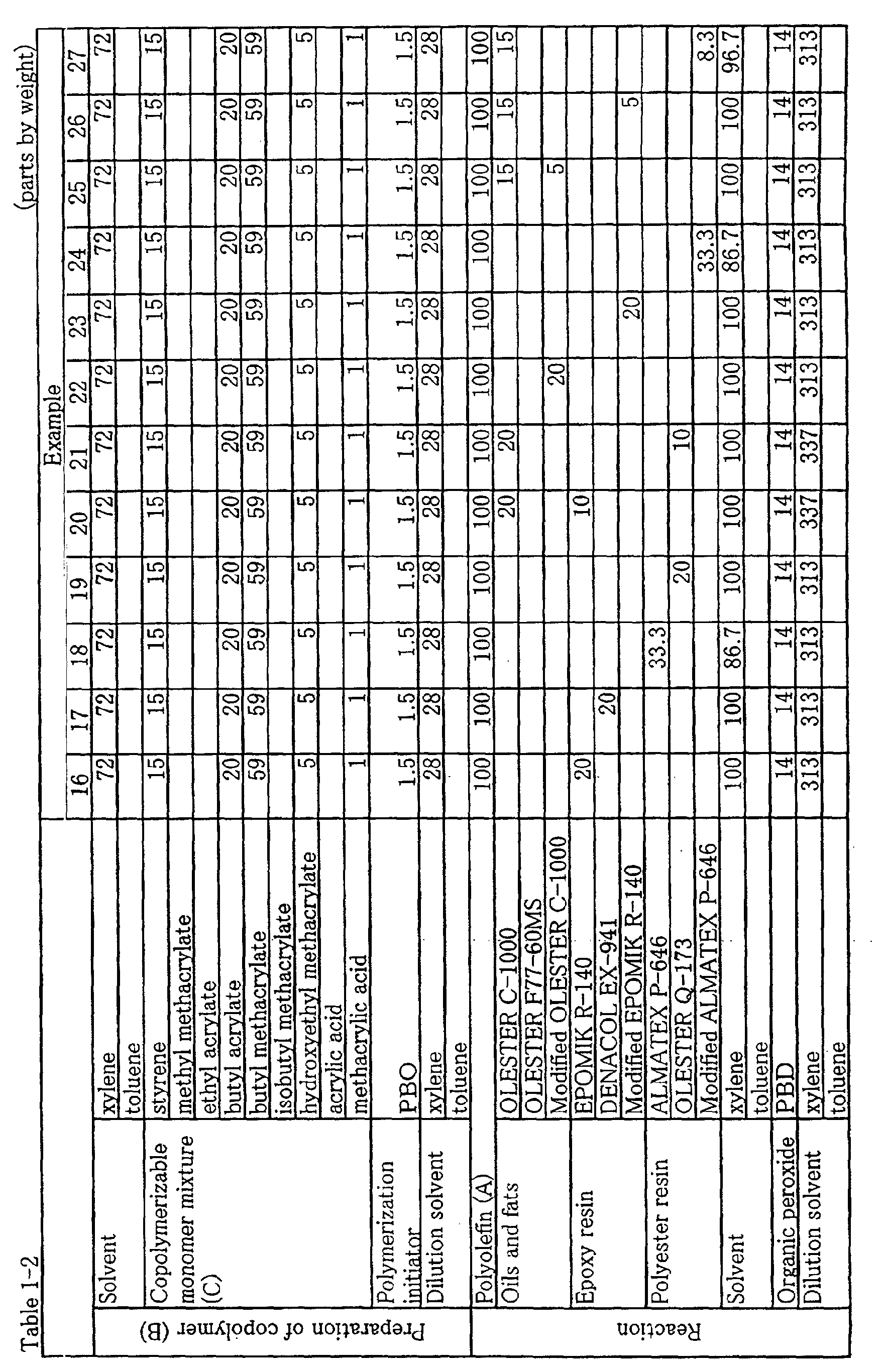
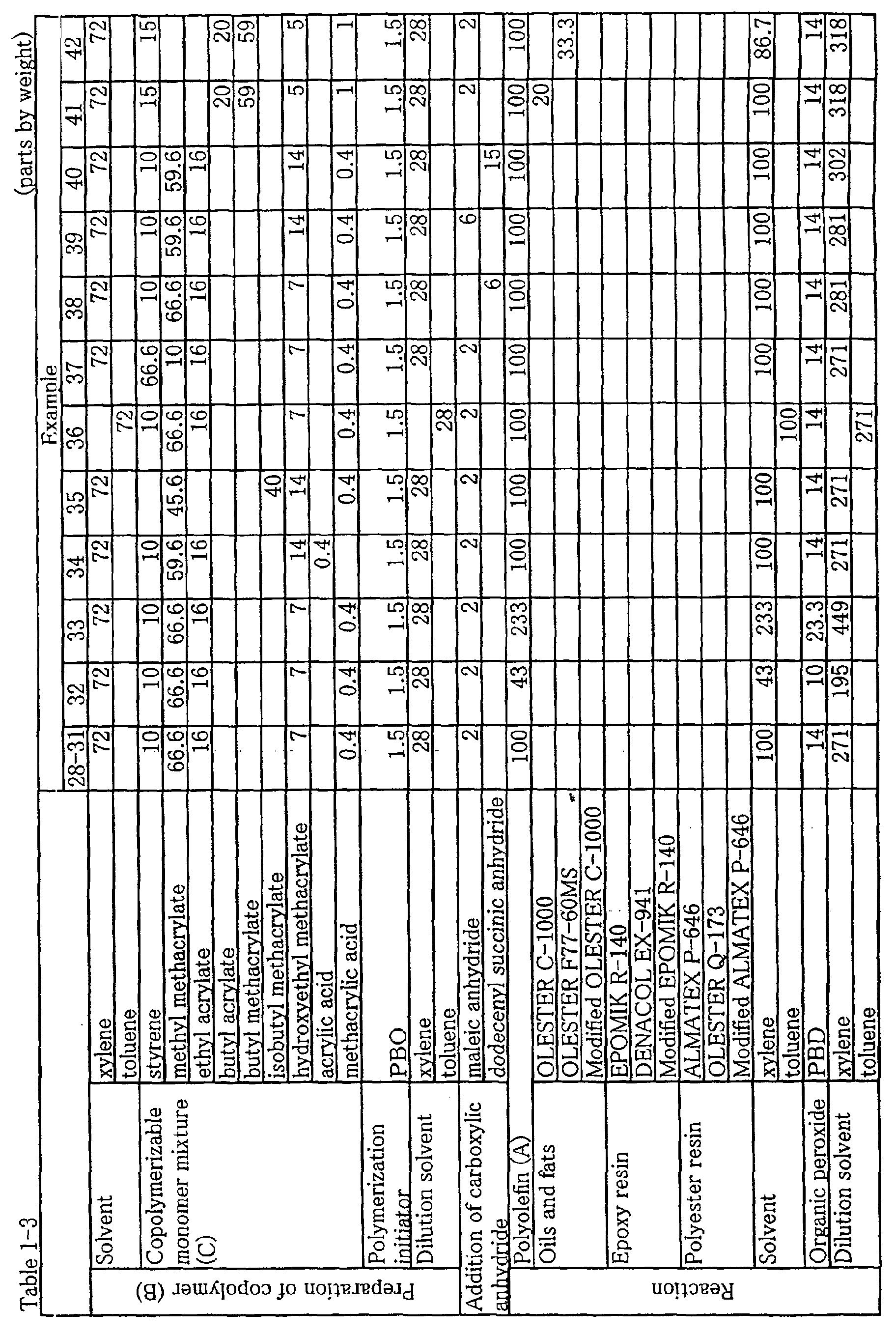
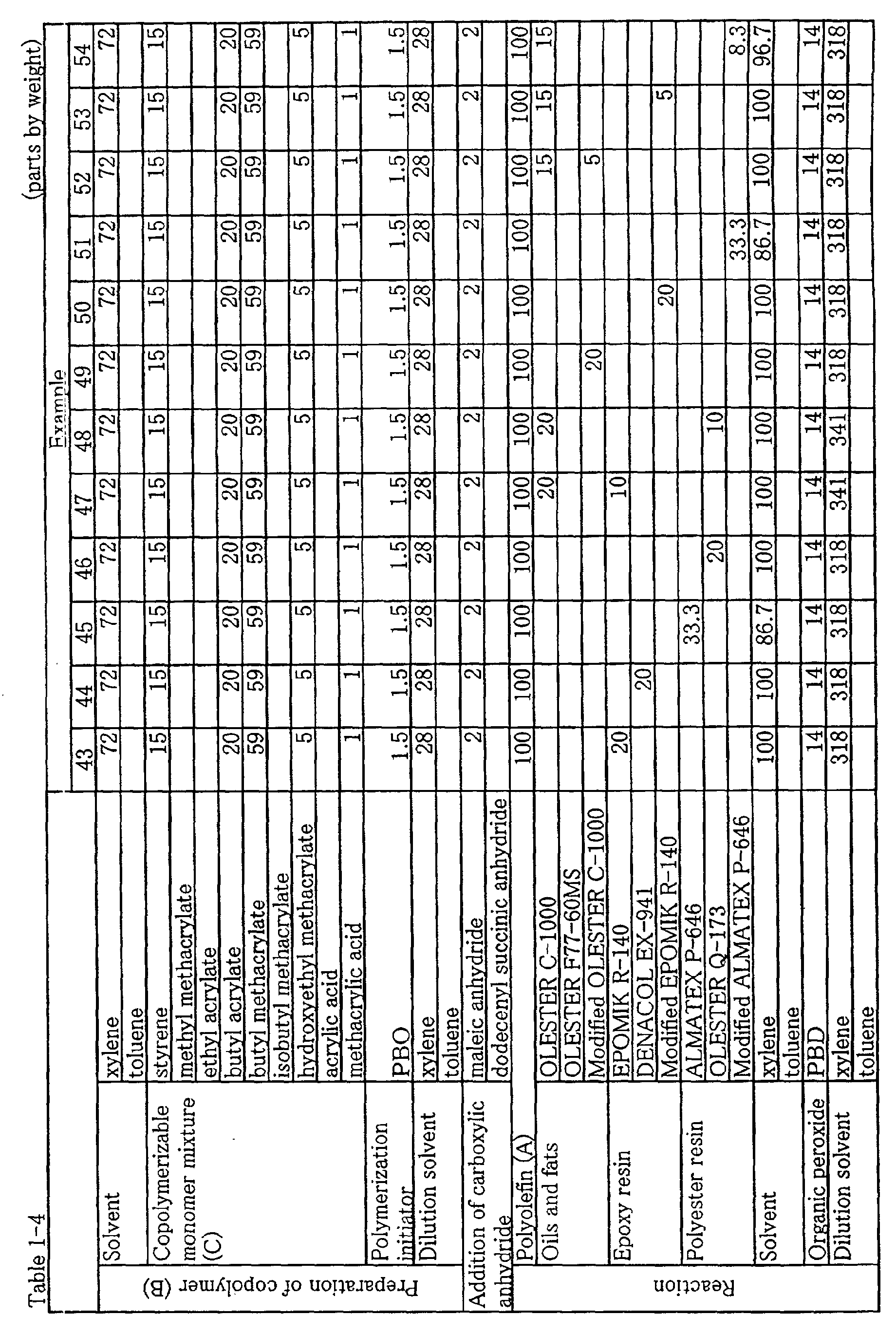
- polyolefin (A) and the solvent shown in Table 1-5 and 1-6 were charged and heated to 130°C in a nitrogen atmosphere. Successively, a mixture of monomer (C) and polymerization initiator which are shown in Table 1-5 and 1-6 were fed over 4 hours. In Examples 68-81, a mixture of copolymerizable monomer (C), polymerization initiator and the third component which are shown in Table 1-5 and 1-6 were fed over 4 hours. After 30 minutes from the end of feeding, the reaction temperature was raised to 135°C and the reaction was further continued for 30 minutes.
- the dilution solvent 1 shown in Table 1-5 and 1-6 was added in an amount shown in the Table and at the same time, 1 part of polymerization initiator PBD was added. After 30 minutes, the reaction mixture was heated to 160°C. Organic peroxide PBD shown in Table 1-5 and 1-6 was divided into three portions and added the first 3/7 portion after 30 minutes from temperature rise, second 2/7 portion after 1.5 hours and the third 2/7 portion after 2.5 hours. After finishing PBD addition, the reaction mixture was allowed to stand for 2 hours to progress the reaction. The dilution solvent 2 shown in Table 1-5 and 1-6 was added to make nonvolatile content 40 %. The resin composition of the invention was obtained.
- Example 64 polyolefin (A) and the solvent shown in Table 1-5 were charged to a four necked flask equipped with a stirrer, thermometer, reflux condenser and nitrogen inlet tube and heated to 100°C, a mixture of copolymerizable monomer mixture (C) in Table 1-5 and polymerization initiator, azobisisobutyronitrile (hereinafter referred to simply as AIBN) was fed to the reaction mixture over 4 hours. After 90 minutes, the dilution solvent 1 shown in Table 1-5 was added and at the same time 0.75 part of AIBN was added. After 30 minutes from addition of AIBN , the reaction mixture was heated to 160°C.
- AIBN azobisisobutyronitrile
- the organic peroxide PBD shown in Table 1-5 was divided into three portions and added the first 3/7 portion after 30 minutes from temperature rise; the second 2/7 portion after 1.5 hours and third 2/7 portion after 2.5 hours. After finishing PBD addition, the reaction mixture was allowed to stand for 2 hours to progress the reaction.
- the dilution solvent 2 shown in Table 1-5 was added to make a nonvolatile content 40 %.
- the resin composition of the invention was obtained.
- Tipeqe-CR93 Trade Mark of Ishihara Sangyo Co.
- Example 1 With each resin composition in Example 1, 28, 55, 58, 61 or 82-86, a curing agent OLESTER-NP1200 (Trade Mark of Mitsui Chemicals Inc., nonvolatile: 70 %, NCO: 7%) was mixed in an amount to obtain OH/NCO having 1/1 by mole. Coating resin was thus prepared.
- OLESTER-NP1200 Trade Mark of Mitsui Chemicals Inc., nonvolatile: 70 %, NCO: 7%
- C 2 is ethylene repeating unit
- C 3 is propylene repeating unit
- C 4 is butene repeating unit, respectively.
- Oils and fats or derivative thereof are oils and fats or derivative thereof.
- DENACOL EX-941 (Trade Mark of Nagase Chemical Industry, nonvolatile: 100 %, epoxy equivalent: 172 g/eq)
- ALMATEX P-646 (Trade Mark of Mitsui Chemicals, nonvolatile: 60 %, hydroxyl value: 35 KOH mg/g)
- OLESTER Q-173 (Trade Mark of Mitsui Chemicals, nonvolatile: 100 %, hydroxyl value: 245 KOH mg/g)
- SHELLSOL 70 used in the above examples is an isoparaffin based organic solvent manufactured by Shell Japan.
- Modified resins used in these examples were prepared by the following procedures.
- Modified EPOMIK R-140 has a polymerizable unsaturated bend in the molecule and was prepared by adding 0.12 g of maleic anhydride to 10 g of EPOMIK R-140 and reacting at 100°C for 3 hours with stirring.
- Modified ALMATEX P-646 has a polymerizable unsaturated bcnd in the molecule and was prepared by adding 0.004 g of maleic anhydride to 10 g of ALMATEX P-646 and reacting at 100°C for 3 hours with stirring.
- the resin composition was prepared by carrying out the same procedures as Example 1 except that PBD was not added.
- a resin composition was prepared by carrying out the same procedures as Example 1 except that the weight ratio of polyolefin (A) and (co)polymer (B) was 90.3/9.7 and the weight ratio of PBD and dilution solvent individually to the amount of resin solid was the same as Example 1, respectively.
- a resin composition was prepared by carrying out the same procedures as Example 28 except that PBD was not added.
- a resin composition was prepared by carrying out the same procedures as Example 28 except that the raw materials were used in an amount shown on the column of Reaction in Table 2-1.
- the weight ratio of polyolefin (A) and (co)polymer (B) in the resulting resin composition was 8/92 in Comparative Example 5 and 90.1/9.9 in Comparative Example 6.
- a resin composition was prepared by carrying out the same procedures as Example 61 except that PBD was not added.
- a resin composition was prepared by carrying out the same procedures as Example 61 except that polyolefin and copolymerizable monomer mixture were used in amounts so as to obtain 8/92 in the weight ratio of polyolefin (A) and copolymerizable monomer mixture (C).
- a resin composition was prepared by carrying out the same procedures as Example 61 except that polyolefin and copolymerizable monomer mixture were used in amounts so as to obtain 92/8 in the weight ratio of polyolefin (A) and copolymerizable monomer mixture (C).
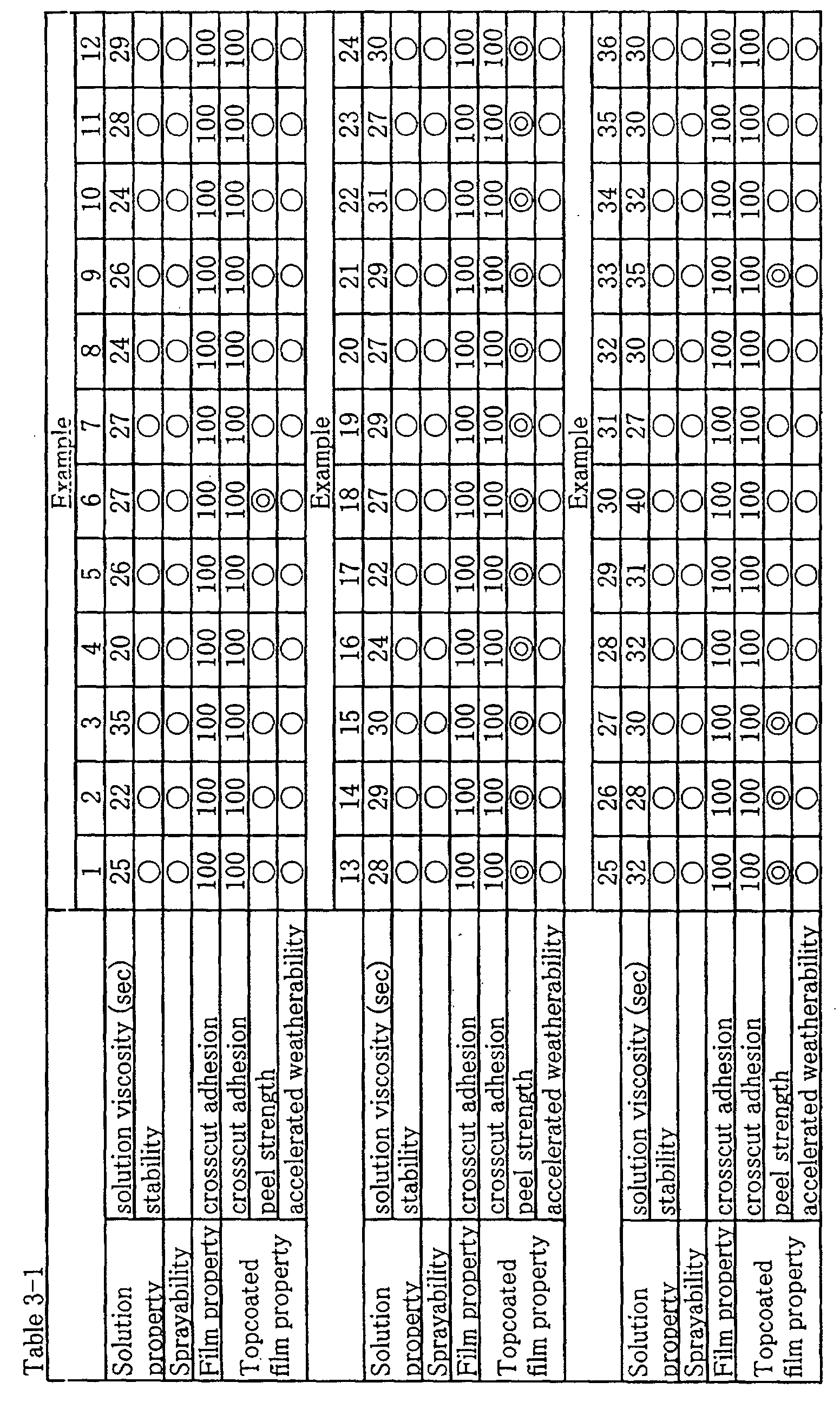
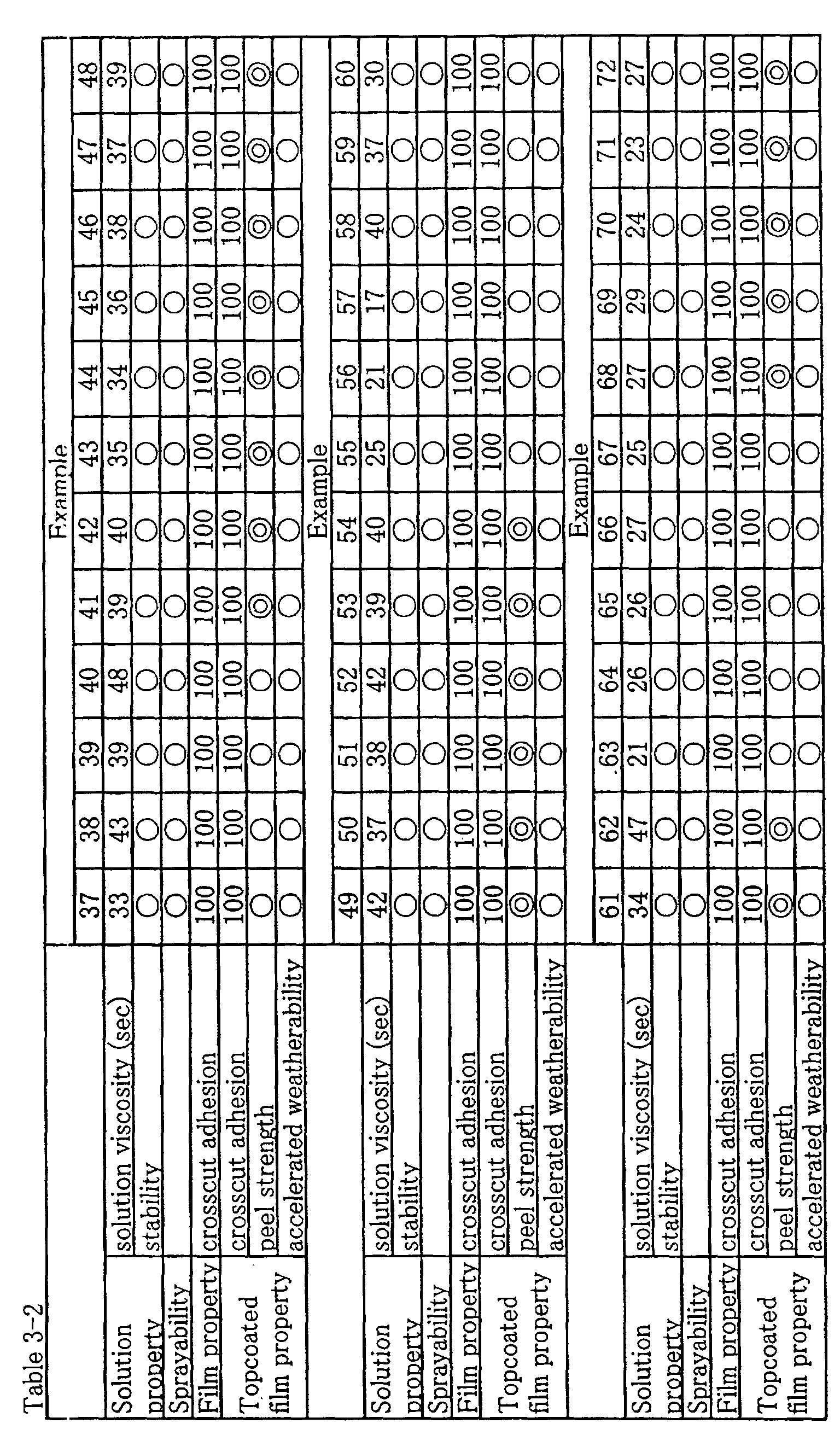
- the resin composition obtained was diluted with the same solvent as used in the preparation step so as to obtain an nonvolatile content of 30 %. Dropping time was measured at 25°C with a Ford Cup No. 4 in accordance with JIS K-5400. The results are shown in Table 3-1 to 3-3 on examples and Table 4 on comparative examples.
- a solution of resin composition obtained was diluted to have a nonvolatile content of 30 % and allowed to stand for a week at 40°C. Thereafter, the state of the solution was evaluated and divided into the following three classes.
- the solution of resin composition obtained was diluted with the same solvent used in the preparation step and controlled to have a dropping time of 15 ⁇ 2 seconds by using a Ford Cup No. 4 at 25°C.
- a polypropylene square plate J-705 manufactured by Grand Polymer Co.
- isopropyl alcohol was wiped with isopropyl alcohol and the resulting solution was sprayed on the plate so as to obtain a film thickness of 10 ⁇ m after drying.
- a crosscut adhesion test and weatherability test (Examples 82-106) were carried out.
- the topcoat used above was prepared by the following procedures.
- the principal component was obtained by dispersing Tipeqe CR-93 (manufactured by Ishihara Sangyo Co.) in OLESTER Q-186 (manufactured by Mitsui Chemicals Inc., nonvolatile: 50 %, hydoxyl value: 30 KOH mg/g) to have 30 PWC.
- a curing agent contaning NCO groups: OLESTER NM 89-50G (manufactured by Mitsui Chemicals Inc., nonvolatile 50 %, NCO 6 %) was mixed so as to obtain OH/NCO 0.95.
- a coated specimen was matched with an interval of 1 cm and the terminal portion was peeled. Peel strength was measured by pulling the peeled portion to the direction of 180° at a velocity of 50 mm/min. Peel strength was divided into the following three classes.
- the resin composition of the invention has good solution stability, does not cause liquid phase separation or solid precipitation, can be used as intact, and is excellent in sprayability at high concentration. Specifically, the resin composition has novel function and effect that adhesion to polyolefin molded articles is excellent.
- the resulting coated film has excellent weatherability and thus can be favorably used for coating and primer.
Landscapes
- Chemical & Material Sciences (AREA)
- Chemical Kinetics & Catalysis (AREA)
- Organic Chemistry (AREA)
- Health & Medical Sciences (AREA)
- Medicinal Chemistry (AREA)
- Polymers & Plastics (AREA)
- Life Sciences & Earth Sciences (AREA)
- Engineering & Computer Science (AREA)
- Materials Engineering (AREA)
- Wood Science & Technology (AREA)
- Graft Or Block Polymers (AREA)
- Paints Or Removers (AREA)
Abstract
Description



VEST PLAST VP-750 (Trade Mark of Huels Japan, Mw = 70,000, C2/C3/C4 = 11/66/23 (by mole))
VEST PLAST VP-708 (Trade Mark of Huels Japan, Mw = 45,000, C2/C3/C4 = 12/68/20 (by mole))
TAFMER S-4020 (Trade Mark of Mitsui Chemicals Inc., C2/C3 = 40/60 (by mole))
UBE TACK UT-2715 (Trade Mark of UBE Industries, Mw = 30,000, C3/C4 = 65/35 (by mole))

| (parts by weight) | ||||
| Comparative Example | ||||
| 7 | 8 | 9 | ||
| Solvent | SHELLSOL 70 | 72 | 72 | 72 |
| xylene | ||||
| Polyolefin (A) | 50 | 8 | 92 | |
| Copolymerizable monomer (C) | styrene | 5 | 9.2 | 0.8 |
| methyl methacrylate | 33.3 | 61.3 | 5.3 | |
| ethyl acrylate | 8 | 14.7 | 1.3 | |
| butyl acrylate | ||||
| butyl methacrylate | ||||
| isobutyl methacrylate | ||||
| 2-ethylhexyl acrylate | ||||
| hydroxyethyl acrylate | ||||
| hydroxyethyl methacrylate | 3.5 | 6.4 | 0.6 | |
| methacrylic acid | 0.2 | 0.37 | 0.03 | |
| Oils and fats | OLESTER C-1000 | |||
| OLESTER F77-60MS | ||||
| Epoxy resin | EPOMIK R-140 | |||
| DENACOL EX-941 | ||||
| Polyester resin | ALMATEX P-646 | |||
| OLESTER Q-173 | ||||
| Polymerization initiator | PBD | 1.0 | 1.0 | 1.0 |
| Dilution solvent 1 | SHELLSOL 70 | 28 | 28 | 28 |
| xylene | ||||
| Organic peroxide | PBD | 7 | 7 | |
| Dilution solvent 2 | xylene | 50 | 50 | 50 |
| SHELLSOL 70:isoparaffin based organic solvent (manufactured by Shell Japan) |


Claims (13)
- A resin composition characterized in being obtained by reacting polyolefin (A) with a (co)polymer (B) prepared from a copolymerizable monomer mixture (C) comprising an α,β-monoethylenically unsaturated monomer and other copolymerizable monomers, in a weight ratio (A) / (B) = 1/9 - 9/1, under radical generation in an organic solvent.
- A resin composition characterized in being obtained by polymerizing a copolymerizable monomer mixture (C) comprising an α,β -monoethylenically unsaturated monomer and other copolymerizable monomers in the presence of polyolefin (A) in a weight ratio (A)/(C) = 1/9 - 9/1 in an organic solvent, and successively by reacting the obtained reaction mass under radical generation.
- The resin composition according to claim 1, wherein the (co)polymer (B) is modified to have a polymerizable unsaturated bond in the molecule.
- The resin composition according to claim 3, wherein the modification is carried out by reacting a (co)polymer (B) having hydroxyl group in the molecule with a polymerizable unsaturated carboxylic anhydride.
- The resin composition according to anyone of claims 1 to 4, wherein the resin composition comprises one or more third components selected from the group consisting of fats and fatty oils, derivatives of the same, epoxy resin and polyester resin.
- The resin composition according to claim 5, wherein one or more third components have a polymerizable unsaturated bond in the molecule.
- The resin composition according to anyone of claims 1 to 6, wherein the polymerization reaction under radical generation is carried out in the presence of organic peroxide.
- The resin composition according to claim 7, wherein the organic peroxide has a tert-butyl and/or benzyl group.
- The resin composition characterized by removing the solvent from the resin composition in anyone of the claims 1 to 8 and diluting the residue with an optional organic solvent.
- A coating characterized by comprising the resin composition according to anyone of claims 1 to 9.
- A coated film characterized by applying the coating according to claim 10.
- A coating characterized by consisting of a principal component comprising the resin composition having an active hydrogen atom and/or hydroxyl group according to anyone of claims 1 to 9 and a curing agent capable of reacting with an active hydrogen atom and/or hydroxyl group.
- A coated film characterized by curing the coating according to claim 12.
Applications Claiming Priority (3)
| Application Number | Priority Date | Filing Date | Title |
|---|---|---|---|
| JP19157499 | 1999-07-06 | ||
| JP19157499 | 1999-07-06 | ||
| PCT/JP2000/004428 WO2001002451A1 (en) | 1999-07-06 | 2000-07-04 | Resin composition |
Publications (4)
| Publication Number | Publication Date |
|---|---|
| EP1153949A1 true EP1153949A1 (en) | 2001-11-14 |
| EP1153949A9 EP1153949A9 (en) | 2002-05-15 |
| EP1153949A4 EP1153949A4 (en) | 2004-08-18 |
| EP1153949B1 EP1153949B1 (en) | 2014-11-05 |
Family
ID=16276937
Family Applications (1)
| Application Number | Title | Priority Date | Filing Date |
|---|---|---|---|
| EP00940937.6A Expired - Lifetime EP1153949B1 (en) | 1999-07-06 | 2000-07-04 | Resin composition |
Country Status (5)
| Country | Link |
|---|---|
| US (1) | US6562901B1 (en) |
| EP (1) | EP1153949B1 (en) |
| KR (1) | KR100423565B1 (en) |
| TW (1) | TWI271419B (en) |
| WO (1) | WO2001002451A1 (en) |
Families Citing this family (14)
| Publication number | Priority date | Publication date | Assignee | Title |
|---|---|---|---|---|
| CN101218272A (en) * | 2005-03-03 | 2008-07-09 | 南达科他大豆处理机有限公司 | Novel polyols derived from vegetable oils by oxidation |
| DE102005026544A1 (en) | 2005-06-08 | 2006-12-14 | Henkel Kgaa | Reinforcement of cleaning performance of detergents by polymer |
| EP1928924B1 (en) * | 2005-09-23 | 2011-05-18 | National Starch and Chemical Investment Holding Corporation | Acrylic polymer-based adhesives |
| US7858698B2 (en) * | 2006-02-16 | 2010-12-28 | A-Line Products Corporation | Compositions containing functionalized oils and polyolefins |
| EP2978831B1 (en) | 2013-03-28 | 2020-12-02 | The Procter and Gamble Company | Cleaning compositions containing a polyetheramine, a soil release polymer, and a carboxymethylcellulose |
| WO2015148361A1 (en) | 2014-03-27 | 2015-10-01 | The Procter & Gamble Company | Cleaning compositions containing a polyetheramine |
| WO2015148360A1 (en) | 2014-03-27 | 2015-10-01 | The Procter & Gamble Company | Cleaning compositions containing a polyetheramine |
| WO2015187757A1 (en) | 2014-06-06 | 2015-12-10 | The Procter & Gamble Company | Detergent composition comprising polyalkyleneimine polymers |
| EP3186349B1 (en) | 2014-08-27 | 2019-09-25 | The Procter and Gamble Company | Detergent composition comprising a cationic polymer |
| WO2016032995A1 (en) | 2014-08-27 | 2016-03-03 | The Procter & Gamble Company | Method of treating a fabric |
| US9809782B2 (en) | 2014-08-27 | 2017-11-07 | The Procter & Gamble Company | Detergent composition comprising a cationic polymer and anionic/nonionic surfactant mixture |
| WO2016032993A1 (en) | 2014-08-27 | 2016-03-03 | The Procter & Gamble Company | Detergent composition comprising a cationic polymer |
| US9850452B2 (en) | 2014-09-25 | 2017-12-26 | The Procter & Gamble Company | Fabric care compositions containing a polyetheramine |
| CA3228918A1 (en) | 2021-08-10 | 2023-02-16 | Nippon Shokubai Co., Ltd. | Polyalkylene-oxide-containing compound |
Family Cites Families (9)
| Publication number | Priority date | Publication date | Assignee | Title |
|---|---|---|---|---|
| BE609226A (en) * | 1960-10-19 | 1900-01-01 | ||
| JPS52105993A (en) * | 1976-03-04 | 1977-09-06 | Idemitsu Kosan Co Ltd | Preparation of modified polypropylene |
| US4721757A (en) * | 1984-11-08 | 1988-01-26 | Rohm And Haas Company | Vinyl monomer compositions with accelerated surface cure |
| CA2110649C (en) * | 1992-12-17 | 2004-10-26 | Jacob Emert | Gel-free alpha-olefin dispersant additives useful in oleaginous compositions |
| US6013733A (en) * | 1996-02-16 | 2000-01-11 | Ppg Industries Ohio, Inc. | Coating of film-forming resin and functional flow control copolymer |
| JPH1112329A (en) | 1997-06-20 | 1999-01-19 | Toyo Ink Mfg Co Ltd | Aqueous resin dispersion |
| JPH11124440A (en) | 1997-10-22 | 1999-05-11 | Mitsubishi Chemical Corp | Thermoplastic elastomer |
| DE19748976A1 (en) * | 1997-11-06 | 1999-05-20 | Danubia Petrochem Polymere | Thermoplastic elastomers with high strength, elasticity and good colorability and the high impact polymer blends made from them |
| JP3794863B2 (en) * | 1999-04-23 | 2006-07-12 | 三井化学株式会社 | Resin composition |
-
2000
- 2000-07-04 WO PCT/JP2000/004428 patent/WO2001002451A1/en not_active Ceased
- 2000-07-04 EP EP00940937.6A patent/EP1153949B1/en not_active Expired - Lifetime
- 2000-07-04 KR KR10-2001-7002912A patent/KR100423565B1/en not_active Expired - Lifetime
- 2000-07-04 US US09/763,545 patent/US6562901B1/en not_active Expired - Lifetime
- 2000-07-06 TW TW089113370A patent/TWI271419B/en not_active IP Right Cessation
Also Published As
| Publication number | Publication date |
|---|---|
| EP1153949B1 (en) | 2014-11-05 |
| US6562901B1 (en) | 2003-05-13 |
| KR20010073131A (en) | 2001-07-31 |
| WO2001002451A1 (en) | 2001-01-11 |
| KR100423565B1 (en) | 2004-03-18 |
| EP1153949A9 (en) | 2002-05-15 |
| EP1153949A4 (en) | 2004-08-18 |
| TWI271419B (en) | 2007-01-21 |
Similar Documents
| Publication | Publication Date | Title |
|---|---|---|
| EP0260799B1 (en) | Primer compositions | |
| US6562901B1 (en) | Resin composition | |
| CA2577715A1 (en) | Aqueous primer composition | |
| KR100538372B1 (en) | Resin composition, coating materials containing the same, coating film and process for forming the film | |
| JP2004051808A (en) | Primer for polyolefin | |
| CN117500891A (en) | Aqueous coating composition | |
| EP1544267B1 (en) | Primer composition for coating | |
| JP2816617B2 (en) | Resin composition for paint | |
| JP3907525B2 (en) | Resin composition | |
| JP2820538B2 (en) | Water-dilutable binders, water-based lacquers containing these binders and primer or single-layer coatings on plastics | |
| JP4707802B2 (en) | Resin composition | |
| WO2025120726A1 (en) | Method for forming multilayer coating film, multilayer coating film, and aqueous primer coating composition | |
| JP3242177B2 (en) | Paint resin | |
| JP2539720B2 (en) | Binder-resin composition and method for producing the same | |
| JP2004352836A (en) | Resin composition and application thereof | |
| US5817370A (en) | Water-dilutable binders, aqueous coating materials containing these binders, and processes for the priming or one-layer coating of plastics | |
| JP2002037809A (en) | Resin composition | |
| JP2002069135A (en) | Acrylic copolymer, resin composition for coating and paint | |
| JP3794863B2 (en) | Resin composition | |
| JP2002332448A (en) | Resin composition for coating and coating composition containing the same | |
| JPH06142606A (en) | Coating method for polyolefin resin molded products | |
| JP2005239852A (en) | One-coat coating for plastics | |
| JP3867566B2 (en) | Resin composition for paint | |
| JPH08311397A (en) | Coating resin composition | |
| KR20040061208A (en) | Primer resin composition for Polyolefin and method for preparing the same |
Legal Events
| Date | Code | Title | Description |
|---|---|---|---|
| PUAI | Public reference made under article 153(3) epc to a published international application that has entered the european phase |
Free format text: ORIGINAL CODE: 0009012 |
|
| 17P | Request for examination filed |
Effective date: 20010326 |
|
| AK | Designated contracting states |
Kind code of ref document: A1 Designated state(s): DE FR GB |
|
| A4 | Supplementary search report drawn up and despatched |
Effective date: 20040706 |
|
| RIC1 | Information provided on ipc code assigned before grant |
Ipc: 7C 08L 51/06 B Ipc: 7C 08F 255/08 B Ipc: 7C 08L 23/02 B Ipc: 7C 08J 3/24 B Ipc: 7C 09D 151/06 B Ipc: 7C 08F 255/00 A Ipc: 7C 09J 151/06 B Ipc: 7C 08F 255/02 B |
|
| RAP1 | Party data changed (applicant data changed or rights of an application transferred) |
Owner name: MITSUI CHEMICALS, INC. |
|
| 17Q | First examination report despatched |
Effective date: 20061106 |
|
| GRAP | Despatch of communication of intention to grant a patent |
Free format text: ORIGINAL CODE: EPIDOSNIGR1 |
|
| INTG | Intention to grant announced |
Effective date: 20140530 |
|
| GRAS | Grant fee paid |
Free format text: ORIGINAL CODE: EPIDOSNIGR3 |
|
| GRAA | (expected) grant |
Free format text: ORIGINAL CODE: 0009210 |
|
| AK | Designated contracting states |
Kind code of ref document: B1 Designated state(s): DE FR GB |
|
| REG | Reference to a national code |
Ref country code: GB Ref legal event code: FG4D |
|
| REG | Reference to a national code |
Ref country code: DE Ref legal event code: R096 Ref document number: 60048768 Country of ref document: DE Effective date: 20141218 |
|
| REG | Reference to a national code |
Ref country code: DE Ref legal event code: R097 Ref document number: 60048768 Country of ref document: DE |
|
| PLBE | No opposition filed within time limit |
Free format text: ORIGINAL CODE: 0009261 |
|
| STAA | Information on the status of an ep patent application or granted ep patent |
Free format text: STATUS: NO OPPOSITION FILED WITHIN TIME LIMIT |
|
| 26N | No opposition filed |
Effective date: 20150806 |
|
| REG | Reference to a national code |
Ref country code: FR Ref legal event code: PLFP Year of fee payment: 17 |
|
| REG | Reference to a national code |
Ref country code: FR Ref legal event code: PLFP Year of fee payment: 18 |
|
| REG | Reference to a national code |
Ref country code: FR Ref legal event code: PLFP Year of fee payment: 19 |
|
| PGFP | Annual fee paid to national office [announced via postgrant information from national office to epo] |
Ref country code: DE Payment date: 20190719 Year of fee payment: 20 Ref country code: FR Payment date: 20190719 Year of fee payment: 20 |
|
| PGFP | Annual fee paid to national office [announced via postgrant information from national office to epo] |
Ref country code: GB Payment date: 20190719 Year of fee payment: 20 |
|
| REG | Reference to a national code |
Ref country code: DE Ref legal event code: R071 Ref document number: 60048768 Country of ref document: DE |
|
| REG | Reference to a national code |
Ref country code: GB Ref legal event code: PE20 Expiry date: 20200703 |
|
| PG25 | Lapsed in a contracting state [announced via postgrant information from national office to epo] |
Ref country code: GB Free format text: LAPSE BECAUSE OF EXPIRATION OF PROTECTION Effective date: 20200703 |