EP1153369B1 - Procede de detection d'objets portables et systeme de mise en oeuvre - Google Patents
Procede de detection d'objets portables et systeme de mise en oeuvre Download PDFInfo
- Publication number
- EP1153369B1 EP1153369B1 EP00902697A EP00902697A EP1153369B1 EP 1153369 B1 EP1153369 B1 EP 1153369B1 EP 00902697 A EP00902697 A EP 00902697A EP 00902697 A EP00902697 A EP 00902697A EP 1153369 B1 EP1153369 B1 EP 1153369B1
- Authority
- EP
- European Patent Office
- Prior art keywords
- antennas
- antenna
- sending
- receiving
- detected
- Prior art date
- Legal status (The legal status is an assumption and is not a legal conclusion. Google has not performed a legal analysis and makes no representation as to the accuracy of the status listed.)
- Expired - Lifetime
Links
Images


Classifications
-
- G—PHYSICS
- G06—COMPUTING OR CALCULATING; COUNTING
- G06K—GRAPHICAL DATA READING; PRESENTATION OF DATA; RECORD CARRIERS; HANDLING RECORD CARRIERS
- G06K7/00—Methods or arrangements for sensing record carriers, e.g. for reading patterns
- G06K7/10—Methods or arrangements for sensing record carriers, e.g. for reading patterns by electromagnetic radiation, e.g. optical sensing; by corpuscular radiation
- G06K7/10009—Methods or arrangements for sensing record carriers, e.g. for reading patterns by electromagnetic radiation, e.g. optical sensing; by corpuscular radiation sensing by radiation using wavelengths larger than 0.1 mm, e.g. radio-waves or microwaves
- G06K7/10316—Methods or arrangements for sensing record carriers, e.g. for reading patterns by electromagnetic radiation, e.g. optical sensing; by corpuscular radiation sensing by radiation using wavelengths larger than 0.1 mm, e.g. radio-waves or microwaves using at least one antenna particularly designed for interrogating the wireless record carriers
-
- G—PHYSICS
- G06—COMPUTING OR CALCULATING; COUNTING
- G06K—GRAPHICAL DATA READING; PRESENTATION OF DATA; RECORD CARRIERS; HANDLING RECORD CARRIERS
- G06K7/00—Methods or arrangements for sensing record carriers, e.g. for reading patterns
- G06K7/0008—General problems related to the reading of electronic memory record carriers, independent of its reading method, e.g. power transfer
-
- G—PHYSICS
- G06—COMPUTING OR CALCULATING; COUNTING
- G06K—GRAPHICAL DATA READING; PRESENTATION OF DATA; RECORD CARRIERS; HANDLING RECORD CARRIERS
- G06K7/00—Methods or arrangements for sensing record carriers, e.g. for reading patterns
- G06K7/10—Methods or arrangements for sensing record carriers, e.g. for reading patterns by electromagnetic radiation, e.g. optical sensing; by corpuscular radiation
- G06K7/10009—Methods or arrangements for sensing record carriers, e.g. for reading patterns by electromagnetic radiation, e.g. optical sensing; by corpuscular radiation sensing by radiation using wavelengths larger than 0.1 mm, e.g. radio-waves or microwaves
- G06K7/10316—Methods or arrangements for sensing record carriers, e.g. for reading patterns by electromagnetic radiation, e.g. optical sensing; by corpuscular radiation sensing by radiation using wavelengths larger than 0.1 mm, e.g. radio-waves or microwaves using at least one antenna particularly designed for interrogating the wireless record carriers
- G06K7/10356—Methods or arrangements for sensing record carriers, e.g. for reading patterns by electromagnetic radiation, e.g. optical sensing; by corpuscular radiation sensing by radiation using wavelengths larger than 0.1 mm, e.g. radio-waves or microwaves using at least one antenna particularly designed for interrogating the wireless record carriers using a plurality of antennas, e.g. configurations including means to resolve interference between the plurality of antennas
Definitions
- the invention relates to a detection method of portable objects from a network of N antennas and a detection system implementing said process.
- antenna the antenna itself but also the transceiver electronics signal associated with said antenna.
- portable object means any support smart card type information provided with an antenna, or any electronic tag.
- antennas are networked when the management body in charge of taking decision must be centralized. This is for example the case when trying to do access control physical for a residential complex, or a control access in the case of a public building. It is also the case when one wishes to be able to keep track of a object in a database.
- the networking of the antennas makes it possible not to duplicate intelligence in the system and allows for reduce the costs of the installation.
- a management system consisting of a body for centralized management of the network.
- the management body manages this situation by means of an algorithm collision avoidance to select objects mobile phones that have been detected by this antenna, one after the other.
- each antenna is polled every 1.6 seconds (64 x 25 milliseconds).
- the present invention aims to remedy these problems.
- the invention firstly relates to a method of detection of portable objects to manage a large number of antennas in a transparent way for the management body.
- the management body besides being provided with a means of successive selection of every portable object detected by the antennas, this means being preferably constituted by an algorithm anticollision which can be conventional in itself.
- the selection successive stages of each object is achieved through the anti-collision algorithm
- the reception of the signal resulting from the management body is obtained by reception of antenna response signals respectively on the point of entry of the organ reserved for each antenna and summation of said signals.
- the reception of a signal resulting from the management body is obtained by receiving said resultant signal at an entry point of the organ reserved for all the antennas of the network.
- the reception of the signal resulting in a step of identification of the origin of the response signals forming said signal resulting the reception of the signal resulting in a step of identification of the origin of the response signals forming said signal resulting.
- the identification of a response signal includes a step of storing the identification of the antenna corresponding known by the entry point on which the response signal is received.
- the memorization consists of position a flip-flop in a logical state and at the disable when the organ has entered into communication with the portable object detected by the antenna corresponding.
- the identification of a response signal includes a concatenation step of the identification of the antenna in the response signal transmitted by the antenna.
- the means to successively select each portable object detected according to a pre-established sequence include an anticollision algorithm.
- the means transmission-reception of the management body and the means of transmission-reception of the antennas are connected in point-to-point by transmission-type links series.
- the means transmission-reception of the management body include an entry point connected to all the antennas by a serial transmission type link.
- the management body includes a discriminator antenna.
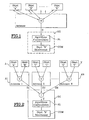
- the organ of management OG is able to send simultaneously on all the antennas of the signals that it emits and, to receive the set of responses of said antennas in form of a resulting signal S.
- the Management Authority OG is also able to select successively the portable objects detected by said antennas to communicate with them (function with the reference COM), this selection according to a pre-established sequence.
- anticollision algorithm AL which whether.
- AL collision avoidance algorithm detects a portable object among Q presented to N antennas.
- This sequence can handle for example a priority, that is, in this case to establish communication with the portable object which will present itself on the highest priority the N antennas having detected a portable object.
- the algorithm can also allow the communication between the management body and an object portable according to a given sequence number so arbitrary to the antennas and defined by the configuration of the system.
- Figure 2 illustrates a variant of the method according to the invention.
- each antenna from A1 to AN is likely to detect one or more objects.
- This variant does not change the principle of the invention. It is further expected that the link between antennas and the management body is of the point type at point, as will be seen in more detail in Figure 3.
- the management body realizes a sum incoming signals so as to see the entire network of antennas as a single entity.
- This body receives all the responses S1, S2 to SN antennas who have detected the presence of one or more wearable objects each and forms a resulting signal S.
- the anticollision algorithm will allow the organ manage the simultaneous arrival of network responses antennas.
- the advantage of the invention is that the notion of search of the state of the art disappears completely.
- the time required to establish the communication with a portable object presented in front of any antenna no longer depends on the number antennas on the network, but only number of portable objects presented simultaneously and the performance of the anti-collision algorithm.
- Another important advantage of this invention concerns the possibility of managing priorities.
- the notion of priority is valid both for the selection of an antenna and that of an object portable.
- the first embodiment is represented on Figure 3.
- the link can be an RS485 or RS422 or RS232 or other link.
- the TG management system comprises the management properly speaking OG equipped with intelligence to process and analyze information received portable objects.
- the management body simultaneously interrogate all network antennas to detect the presence of a portable object. this is symbolized by the set of signals E emitted to the outputs O1-ON by the transceiver device ER1 of the TG management system.
- the responses received from the antenna network are symbolized by the R signals from the circuits transmission-reception ER2 of the antenna network and arriving at the I1-IN entrances.
- each antenna has its own circuit transmission-reception, even if this is represented here schematically in the form of a block, this block illustrating the complete equipment of the antenna network.
- the information is back to the management body via a device D antenna discrimination that receives all of the response signals of said antennas by the points input D1 to DN.
- This device D The role of this device D is to collect this information from the antennas and transmit a resulting signal S to the management body by allowing him to know the origin.
- the antenna A2 has detected a portable object B which has been selected by the anti-collision algorithm AL.
- the device for antenna discrimination D has hard-wired logic comprising for example a set of RS flip-flops and a adder device AD.
- An RS flip-flop is affected to each antenna of the network.
- RS flip flop assigned to these antennas are set to 1, this which makes it possible to identify the origin of the return signal, that is to say, the antenna that emitted this signal.
- the discriminator D therefore makes it possible to give the identification number of the antenna to the organ of management that will enter into communication with the object portable detected by said antenna.
- the management body will enter into communication with a selected portable object and reset to 0 the state of the RS flip-flop corresponding to the antenna which has detected this portable object.
- This embodiment is particularly suitable to applications such as access control in a building with gateways to control and to manage and, manage the rights attributed to different individuals entering this building.
- This mode realization makes it possible to manage priorities according to the gateways and the rights attributed to people coming in.
- connection between the organ management and the antenna network is for example performed by an I2C bus.
- the equipment emission - ER1 is an open-collector type for superimpose all S1-SN response signals arriving at entry point I of the TG management system.
- the Management Authority OG is also equipped with a anti-collision algorithm AL and an intelligence to process and analyze information received portable objects.
- the management body Allows simultaneous interrogation of all antennas network from its point of exit O, for detect the presence of a portable object.
- This embodiment also allows to identify the antennas of the network.
- the anticollision algorithm is implemented by the management body upon receipt at its port of entry a return signal received by the transmitting-receiving system ER1.
- the equipment ER1 allows in this case to provide the resulting signal S to the management body.
- the equipment can have a single input port I at the level of the management body connected by a type connection serial transmission to all the antennas of the network.
- This link will be performed for example by a bus I2C.
- Equipment technology is a technology open collector, which allows the addition of all transmitted response signals.
- the Management Authority may know the origin of information because every antenna and more particularly, the logic L that each antenna includes, concatenates information identification of said antennas to the messages transmitted in response to signals issued by the management body.
- the antenna AN has detected a portable object A which has been selected by the AL collision avoidance algorithm for enter into communication with this portable object.
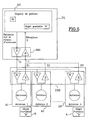
- a third embodiment is illustrated by the diagram of Figure 5.
- the same type is available liaison between the management body and the network antenna, that is to say a connection type parallel transmission with for example an I2C bus.
- the equipment ER1 transceiver of the organ of management has open collector type technology allowing the addition of reply signals received on input I so as to provide a resulting signal S to the management body itself.
- the management body contains the algorithm anticollision and intelligence to treat and analyze information received from objects portable.
- this body questions simultaneously all the antennas of the network for detect the presence of a portable object.
- This embodiment is particularly suitable in case it would not be necessary to know the origin of the information of the received signals.
- the invention applies to all types of objects non-contact type mobile phones ISO14443-A and ISO14443-B, tags (electronic tag), operating at frequencies of 13.56 MHz or 125 kHz.
Landscapes
- Engineering & Computer Science (AREA)
- Physics & Mathematics (AREA)
- Health & Medical Sciences (AREA)
- Toxicology (AREA)
- General Physics & Mathematics (AREA)
- Artificial Intelligence (AREA)
- Computer Vision & Pattern Recognition (AREA)
- Theoretical Computer Science (AREA)
- Electromagnetism (AREA)
- General Health & Medical Sciences (AREA)
- Computer Networks & Wireless Communication (AREA)
- Mobile Radio Communication Systems (AREA)
- Radar Systems Or Details Thereof (AREA)
- Geophysics And Detection Of Objects (AREA)
- Small-Scale Networks (AREA)
Description
- une augmentation de la complexité du système due à la gestion de la scrutation ;
- le temps de réaction allongé par la scrutation des antennes,
- l'installation complexe car l'organe de gestion doit connaítre la configuration du réseau,
- les antennes sont interrogées même si aucun objet n'est présenté,
- le nombre d'antennes du système est limité par le temps de scrutation.
- émission par l'organe de gestion de signaux simultanément vers toutes les antennes,
- réception par ledit organe d'un signal résultant comprenant des signaux réponse des antennes ayant détecté un objet portable,
- sélection successive de chaque objet détecté à partir de ce signal résultant, selon une séquence préétablie.
- l'organe de gestion comporte :
- des moyens d'émission-réception reliés aux moyens d'émission-réception des antennes,
- les moyens d'émission de l'organe de gestion étant aptes à émettre des signaux simultanément vers toutes les antennes,
- et les moyens de réception dudit organe étant aptes à recevoir les signaux réponse des antennes qui ont détecté un objet portable, sous la forme de signaux distincts pour chaque antenne ou d'un signal résultant, selon le type de liaison établie entre les moyens d'émission-réception de l'organe de gestion et les antennes, et,
- des moyens pour sélectionner successivement chaque objet portable détecté selon une séquence préétablie.
- la figure 1, représente le schéma de principe de l'invention,
- la figure 2, représente un schéma de principe selon une variante de l'invention.
- la figure 3, représente un premier mode de réalisation de l'invention,
- la figure 4, représente un deuxième mode de réalisation de l'invention, et
- la figure 5, représente un troisième mode de réalisation de l'invention.
- le temps de réponse du système à la présentation d'un objet est indépendant du nombre d'antennes.
- la complexité de l'organe de gestion est indépendante du nombre d'antennes,
- tout type de l'algorithme anticollision peut être utilisé pour la mise en oeuvre de ce procédé,
- l'organe de gestion n'a pas besoin de connaítre le nombre d'antennes installées dans le réseau,
- on peut supprimer totalement l'intelligence des antennes.
Claims (13)
- Procédé de détection d'objets portables à partir d'un réseau de N antennes, piloté par un organe de gestion centralisé, caractérisé en ce qu'il comporte les étapes suivantes :émission par l'organe de gestion de signaux simultanément vers toutes les antennes,réception par ledit organe d'un signal résultant comprenant des signaux réponse des antennes ayant détecté un objet portable,sélection successive de chaque objet détecté à partir de ce signal résultant, selon une séquence préétablie.
- Procédé de détection selon la revendication 1, caractérisé en ce que la sélection successive de chaque objet est réalisée par la mise en oeuvre d'un algorithme d'anticollision.
- Procédé de détection selon la revendication 1, caractérisé en ce que la réception du signal résultant par l'organe de gestion est obtenue par réception des signaux réponse des antennes respectivement sur le point d'entrée de l'organe réservé à chaque antenne et sommation desdits signaux.
- Procédé de détection selon la revendication 1, caractérisé en ce que la réception d'un signal résultant par l'organe de gestion est obtenue par réception dudit signal résultant en un point d'entrée de l'organe réservé à l'ensemble des antennes du réseau.
- Procédé de détection selon l'une quelconque des revendications précédentes, caractérisé en ce que la réception du signal résultant comporte une étape d'identification de l'origine des signaux réponse formant ledit signal résultant.
- Procédé de détection selon les revendications 3 et 5 caractérisé en ce que l'identification d'un signal réponse comporte une étape de mémorisation de l'identification de l'antenne correspondante connue par le point d'entrée sur lequel est reçu le signal réponse.
- Procédé de détection selon la revendication 6, caractérisé en ce que la mémorisation consiste à positionner une bascule dans un état logique et à la désactiver lorsque l'organe est entré en communication avec l'objet portable détecté par l'antenne correspondante.
- Procédé de détection selon les revendications 4 et 5, caractérisé en ce que l'identification d'un signal réponse comporte une étape de concaténation de l'identification de l'antenne dans le signal réponse émis par l'antenne.
- Système de détection d'objets portables comportant un réseau de N antennes associé à des moyens d'émission-réception et un organe de gestion centralisé, caractérisé en ce que :l'organe de gestion (OG) comporte :des moyens d'émission-réception (ER1) reliés aux moyens d'émission-réception des antennes,les moyens d'émission de l'organe de gestion étant aptes à émettre des signaux simultanément vers toutes les antennes,et les moyens de réception dudit organe étant aptes à recevoir les signaux réponse des antennes qui ont détecté un objet portable, sous la forme de signaux distincts pour chaque antenne ou d'un signal résultant, selon le type de liaison établie entre les moyens d'émission-réception de l'organe de gestion et les antennes
et,dés moyens pour sélectionner (AL) successivement chaque objet portable détecté selon une séquence préétablie. - Système de détection selon la revendication 9, caractérisé en ce que les moyens pour sélectionner successivement chaque objet portable détecté selon une séquence préétablie comportent un algorithme d'anticollision.
- Système de détection selon la revendication 9 ou 10, caractérisé en ce que les moyens d'émission-réception de l'organe de gestion et les moyens d'émission-réception des antennes sont reliés en point à point (I1-IN) par des liaisons de type transmission série.
- Système de détection selon la revendication 9 ou 10, caractérisé en ce que les moyens d'émission-réception de l'organe de gestion comportent un point d'entrée (I) relié à toutes les antennes par une liaison de type transmission série.
- Système de détection selon la revendication 11, caractérisé en ce que l'organe de gestion comporte un discriminateur d'antenne (D).
Applications Claiming Priority (3)
| Application Number | Priority Date | Filing Date | Title |
|---|---|---|---|
| FR9901521A FR2789493B1 (fr) | 1999-02-09 | 1999-02-09 | Procede de detection d'objets portables et systeme de mise en oeuvre |
| FR9901521 | 1999-02-09 | ||
| PCT/FR2000/000230 WO2000048134A1 (fr) | 1999-02-09 | 2000-01-31 | Procede de detection d'objets portables et systeme de mise en oeuvre |
Publications (2)
| Publication Number | Publication Date |
|---|---|
| EP1153369A1 EP1153369A1 (fr) | 2001-11-14 |
| EP1153369B1 true EP1153369B1 (fr) | 2005-03-23 |
Family
ID=9541794
Family Applications (1)
| Application Number | Title | Priority Date | Filing Date |
|---|---|---|---|
| EP00902697A Expired - Lifetime EP1153369B1 (fr) | 1999-02-09 | 2000-01-31 | Procede de detection d'objets portables et systeme de mise en oeuvre |
Country Status (9)
| Country | Link |
|---|---|
| US (1) | US6972663B1 (fr) |
| EP (1) | EP1153369B1 (fr) |
| CN (1) | CN1135502C (fr) |
| AT (1) | ATE291764T1 (fr) |
| AU (1) | AU2444900A (fr) |
| DE (1) | DE60018910T2 (fr) |
| ES (1) | ES2240059T3 (fr) |
| FR (1) | FR2789493B1 (fr) |
| WO (1) | WO2000048134A1 (fr) |
Families Citing this family (8)
| Publication number | Priority date | Publication date | Assignee | Title |
|---|---|---|---|---|
| WO2005071790A2 (fr) * | 2004-01-16 | 2005-08-04 | Meadwestvaco Corporation | Systemes et procedes d'attribution de priorite a des antennes de lecture |
| US20060132287A1 (en) * | 2004-12-16 | 2006-06-22 | Xerox Corporation | Radio frequency identification interrogation method and radio frequency identification device |
| GB2426407B (en) * | 2005-05-19 | 2010-01-06 | Roke Manor Research | Transceiver antannae arrangement |
| US20090102610A1 (en) * | 2007-10-22 | 2009-04-23 | The Stanley Works | Rfid antenna selection system and method |
| US9928349B2 (en) * | 2008-02-14 | 2018-03-27 | International Business Machines Corporation | System and method for controlling the disposition of computer-based objects |
| SMT201900386T1 (it) | 2013-04-12 | 2019-09-09 | Ardelyx Inc | Composti nhe3-leganti e metodi per l'inibizione del trasporto di fosfato |
| JP2020505333A (ja) | 2017-01-09 | 2020-02-20 | アルデリックス, インコーポレイテッド | Nhe媒介性アンチポートの阻害薬 |
| AU2018205400C1 (en) | 2017-01-09 | 2026-01-15 | Ardelyx, Inc. | Compounds useful for treating gastrointestinal tract disorders |
Family Cites Families (11)
| Publication number | Priority date | Publication date | Assignee | Title |
|---|---|---|---|---|
| US5019815A (en) * | 1979-10-12 | 1991-05-28 | Lemelson Jerome H | Radio frequency controlled interrogator-responder system with passive code generator |
| US5396224A (en) * | 1991-11-22 | 1995-03-07 | Hewlett-Packard Company | Telemetered patient location system and method |
| AU657853B2 (en) * | 1992-06-16 | 1995-03-23 | Motorola, Inc. | Electronic monitoring system |
| JP2951824B2 (ja) * | 1993-06-30 | 1999-09-20 | シャープ株式会社 | 移動体識別装置 |
| JPH08123919A (ja) * | 1994-10-28 | 1996-05-17 | Mitsubishi Electric Corp | 非接触icカードシステムおよびその通信方法 |
| NL9402057A (nl) * | 1994-12-07 | 1996-07-01 | Wilhelmus Johannes Maria Van D | Stelsel voor het autoriseren van codedragers. |
| JP3095654B2 (ja) * | 1995-02-06 | 2000-10-10 | 三菱重工業株式会社 | 移動体監視装置 |
| US6621410B1 (en) * | 1996-08-26 | 2003-09-16 | Rf Code, Inc. | System for item and orientation identification |
| AU5426298A (en) * | 1996-10-17 | 1998-05-11 | Pinpoint Corporation | Article tracking system |
| US5914671A (en) * | 1997-02-27 | 1999-06-22 | Micron Communications, Inc. | System and method for locating individuals and equipment, airline reservation system, communication system |
| US6456191B1 (en) * | 1999-03-23 | 2002-09-24 | Exi Wireless Systems Inc. | Tag system with anti-collision features |
-
1999
- 1999-02-09 FR FR9901521A patent/FR2789493B1/fr not_active Expired - Fee Related
-
2000
- 2000-01-31 ES ES00902697T patent/ES2240059T3/es not_active Expired - Lifetime
- 2000-01-31 EP EP00902697A patent/EP1153369B1/fr not_active Expired - Lifetime
- 2000-01-31 DE DE60018910T patent/DE60018910T2/de not_active Expired - Lifetime
- 2000-01-31 US US09/890,951 patent/US6972663B1/en not_active Expired - Lifetime
- 2000-01-31 AU AU24449/00A patent/AU2444900A/en not_active Abandoned
- 2000-01-31 AT AT00902697T patent/ATE291764T1/de not_active IP Right Cessation
- 2000-01-31 WO PCT/FR2000/000230 patent/WO2000048134A1/fr not_active Ceased
- 2000-01-31 CN CNB008056439A patent/CN1135502C/zh not_active Expired - Lifetime
Also Published As
| Publication number | Publication date |
|---|---|
| ATE291764T1 (de) | 2005-04-15 |
| WO2000048134A1 (fr) | 2000-08-17 |
| CN1345431A (zh) | 2002-04-17 |
| ES2240059T3 (es) | 2005-10-16 |
| DE60018910T2 (de) | 2006-03-30 |
| EP1153369A1 (fr) | 2001-11-14 |
| FR2789493B1 (fr) | 2001-03-09 |
| CN1135502C (zh) | 2004-01-21 |
| DE60018910D1 (de) | 2005-04-28 |
| AU2444900A (en) | 2000-08-29 |
| US6972663B1 (en) | 2005-12-06 |
| FR2789493A1 (fr) | 2000-08-11 |
Similar Documents
| Publication | Publication Date | Title |
|---|---|---|
| EP0495708B1 (fr) | Système de communication entre une borne et des mobiles | |
| EP0633551B1 (fr) | Procédé pour la transmission rapide et sûre de données contenues dans une carte à puce lors d'une télétransaction | |
| EP2199966A1 (fr) | Procédé de sécurisation de transactions, dispositif de transaction, serveur bancaire, terminal mobile, et produits programmes d'ordinateur correspondants | |
| FR2981027A1 (fr) | Systeme de controle a distance, cle electronique, et procede pour verrouiller et/ou deverrouiller automatiquement au moins un ouvrant d'un vehicule automobile et/ou pour demarrer un moteur d'un vehicule automobile a l'aide d'un systeme de controle a distance | |
| EP2537286B1 (fr) | Procédé d'authentification biométrique, système d'authentification et programme correspondant | |
| EP1153369A1 (fr) | Procede de detection d'objets portables et systeme de mise en oeuvre | |
| EP0897563A1 (fr) | Procede pour selectionner un module electronique parmi une pluralite de modules presents dans le champ d'interrogation d'un terminal | |
| CA2283685C (fr) | Procede perfectionne de gestion des collisions dans un systeme d'echange de donnees sans contact | |
| FR2848709A1 (fr) | Procede pour la localisation d'un dispositif portatif de systeme de securisation mains-libres, et systeme de securisation mains-libres associe | |
| FR2795826A1 (fr) | Procede et dispositif de localisation d'un emetteur dans l'espace | |
| EP1348204B1 (fr) | Systeme de detection du passage d'individus ou objets par une entree-sortie a un espace delimite | |
| EP1104919B1 (fr) | Protocole de détection de la présence d'individus ou d'objets dans un espace délimité et système de détection destiné à mettre en oeuvre un tel protocole | |
| FR3097582A1 (fr) | Procédé d’activation d’une fonction d’un véhicule par ultra haute fréquence avec un équipement portable d’utilisateur et dispositif d’activation d’une fonction associé | |
| WO1999022333A1 (fr) | Systeme pour la communication sans contact par induction entre un terminal et un objet portatif tel qu'une carte a puce | |
| EP0494710A2 (fr) | Carte intelligente pour la réception et la transmission d'informations, et son utilisation dans un système d'exploitation de structures polyvalentes | |
| FR3088667A1 (fr) | Systeme de gestion de cles, procede de deverrouillage d'une cle choisie par un utilisateur et procede d'enregistrement d’une cle dans un tel systeme de gestion de cles | |
| FR2741178A1 (fr) | Installation de protection contre le vol pour des vehicules automobiles | |
| EP1118200B1 (fr) | Poste mobile de traitement de donnees a module de communication locale | |
| FR2740249A1 (fr) | Installation pour la gestion d'une flotte de vehicules en particulier pour la gestion d'une flotte de taxis | |
| WO1990000844A1 (fr) | Systeme de communication et de gestion de donnees privees | |
| EP0942387A1 (fr) | Procédé et système de lecture multiple d'un ensemble dynamique d'étiquettes | |
| EP0714073A1 (fr) | Borne de communication sans contact avec des objets portatifs | |
| EP4685762A1 (fr) | Système de contrôle d'accès | |
| WO2022180144A1 (fr) | Procédé de validation d'un accès, pour un utilisateur, à une zone d'accès et système électronique de validation associé | |
| EP1466256A1 (fr) | Procede d'anti-collision d'elements a identifier par un ordinateur hote |
Legal Events
| Date | Code | Title | Description |
|---|---|---|---|
| PUAI | Public reference made under article 153(3) epc to a published international application that has entered the european phase |
Free format text: ORIGINAL CODE: 0009012 |
|
| 17P | Request for examination filed |
Effective date: 20010910 |
|
| AK | Designated contracting states |
Kind code of ref document: A1 Designated state(s): AT BE CH CY DE DK ES FI FR GB GR IE IT LI LU MC NL PT SE |
|
| AX | Request for extension of the european patent |
Free format text: AL;LT;LV;MK;RO;SI |
|
| 17Q | First examination report despatched |
Effective date: 20020315 |
|
| GRAP | Despatch of communication of intention to grant a patent |
Free format text: ORIGINAL CODE: EPIDOSNIGR1 |
|
| GRAS | Grant fee paid |
Free format text: ORIGINAL CODE: EPIDOSNIGR3 |
|
| GRAA | (expected) grant |
Free format text: ORIGINAL CODE: 0009210 |
|
| AK | Designated contracting states |
Kind code of ref document: B1 Designated state(s): AT BE CH CY DE DK ES FI FR GB GR IE IT LI LU MC NL PT SE |
|
| PG25 | Lapsed in a contracting state [announced via postgrant information from national office to epo] |
Ref country code: AT Free format text: LAPSE BECAUSE OF FAILURE TO SUBMIT A TRANSLATION OF THE DESCRIPTION OR TO PAY THE FEE WITHIN THE PRESCRIBED TIME-LIMIT Effective date: 20050323 Ref country code: NL Free format text: LAPSE BECAUSE OF FAILURE TO SUBMIT A TRANSLATION OF THE DESCRIPTION OR TO PAY THE FEE WITHIN THE PRESCRIBED TIME-LIMIT Effective date: 20050323 Ref country code: IE Free format text: LAPSE BECAUSE OF FAILURE TO SUBMIT A TRANSLATION OF THE DESCRIPTION OR TO PAY THE FEE WITHIN THE PRESCRIBED TIME-LIMIT Effective date: 20050323 Ref country code: FI Free format text: LAPSE BECAUSE OF FAILURE TO SUBMIT A TRANSLATION OF THE DESCRIPTION OR TO PAY THE FEE WITHIN THE PRESCRIBED TIME-LIMIT Effective date: 20050323 |
|
| REG | Reference to a national code |
Ref country code: GB Ref legal event code: FG4D Free format text: NOT ENGLISH |
|
| REG | Reference to a national code |
Ref country code: CH Ref legal event code: EP |
|
| REG | Reference to a national code |
Ref country code: IE Ref legal event code: FG4D Free format text: FRENCH |
|
| REF | Corresponds to: |
Ref document number: 60018910 Country of ref document: DE Date of ref document: 20050428 Kind code of ref document: P |
|
| PG25 | Lapsed in a contracting state [announced via postgrant information from national office to epo] |
Ref country code: DK Free format text: LAPSE BECAUSE OF FAILURE TO SUBMIT A TRANSLATION OF THE DESCRIPTION OR TO PAY THE FEE WITHIN THE PRESCRIBED TIME-LIMIT Effective date: 20050623 Ref country code: GR Free format text: LAPSE BECAUSE OF FAILURE TO SUBMIT A TRANSLATION OF THE DESCRIPTION OR TO PAY THE FEE WITHIN THE PRESCRIBED TIME-LIMIT Effective date: 20050623 |
|
| GBT | Gb: translation of ep patent filed (gb section 77(6)(a)/1977) |
Effective date: 20050725 |
|
| NLV1 | Nl: lapsed or annulled due to failure to fulfill the requirements of art. 29p and 29m of the patents act | ||
| PG25 | Lapsed in a contracting state [announced via postgrant information from national office to epo] |
Ref country code: PT Free format text: LAPSE BECAUSE OF FAILURE TO SUBMIT A TRANSLATION OF THE DESCRIPTION OR TO PAY THE FEE WITHIN THE PRESCRIBED TIME-LIMIT Effective date: 20050907 |
|
| REG | Reference to a national code |
Ref country code: ES Ref legal event code: FG2A Ref document number: 2240059 Country of ref document: ES Kind code of ref document: T3 |
|
| REG | Reference to a national code |
Ref country code: IE Ref legal event code: FD4D |
|
| PLBE | No opposition filed within time limit |
Free format text: ORIGINAL CODE: 0009261 |
|
| STAA | Information on the status of an ep patent application or granted ep patent |
Free format text: STATUS: NO OPPOSITION FILED WITHIN TIME LIMIT |
|
| PG25 | Lapsed in a contracting state [announced via postgrant information from national office to epo] |
Ref country code: LU Free format text: LAPSE BECAUSE OF NON-PAYMENT OF DUE FEES Effective date: 20060131 Ref country code: LI Free format text: LAPSE BECAUSE OF NON-PAYMENT OF DUE FEES Effective date: 20060131 Ref country code: BE Free format text: LAPSE BECAUSE OF NON-PAYMENT OF DUE FEES Effective date: 20060131 Ref country code: CH Free format text: LAPSE BECAUSE OF NON-PAYMENT OF DUE FEES Effective date: 20060131 Ref country code: MC Free format text: LAPSE BECAUSE OF NON-PAYMENT OF DUE FEES Effective date: 20060131 |
|
| 26N | No opposition filed |
Effective date: 20051227 |
|
| REG | Reference to a national code |
Ref country code: CH Ref legal event code: PL |
|
| BERE | Be: lapsed |
Owner name: GEMPLUS Effective date: 20060131 |
|
| PG25 | Lapsed in a contracting state [announced via postgrant information from national office to epo] |
Ref country code: SE Free format text: LAPSE BECAUSE OF FAILURE TO SUBMIT A TRANSLATION OF THE DESCRIPTION OR TO PAY THE FEE WITHIN THE PRESCRIBED TIME-LIMIT Effective date: 20050623 |
|
| PG25 | Lapsed in a contracting state [announced via postgrant information from national office to epo] |
Ref country code: CY Free format text: LAPSE BECAUSE OF FAILURE TO SUBMIT A TRANSLATION OF THE DESCRIPTION OR TO PAY THE FEE WITHIN THE PRESCRIBED TIME-LIMIT Effective date: 20050323 |
|
| REG | Reference to a national code |
Ref country code: FR Ref legal event code: CD Ref country code: FR Ref legal event code: TP |
|
| REG | Reference to a national code |
Ref country code: GB Ref legal event code: S117 Free format text: REQUEST FILED; REQUEST FOR CORRECTION UNDER SECTION 117 FILED ON 26 APRIL 2010 |
|
| REG | Reference to a national code |
Ref country code: GB Ref legal event code: 732E Free format text: REGISTERED BETWEEN 20110616 AND 20110622 |
|
| REG | Reference to a national code |
Ref country code: DE Ref legal event code: R082 Ref document number: 60018910 Country of ref document: DE Representative=s name: HOFFMANN - EITLE, DE |
|
| REG | Reference to a national code |
Ref country code: DE Ref legal event code: R081 Ref document number: 60018910 Country of ref document: DE Owner name: GEMALTO SA, FR Free format text: FORMER OWNER: GEMPLUS, GEMENOS, FR Effective date: 20120629 Ref country code: DE Ref legal event code: R082 Ref document number: 60018910 Country of ref document: DE Representative=s name: HOFFMANN - EITLE PATENT- UND RECHTSANWAELTE PA, DE Effective date: 20120629 Ref country code: DE Ref legal event code: R082 Ref document number: 60018910 Country of ref document: DE Representative=s name: HOFFMANN - EITLE, DE Effective date: 20120629 |
|
| REG | Reference to a national code |
Ref country code: FR Ref legal event code: PLFP Year of fee payment: 17 |
|
| REG | Reference to a national code |
Ref country code: FR Ref legal event code: PLFP Year of fee payment: 18 |
|
| REG | Reference to a national code |
Ref country code: FR Ref legal event code: PLFP Year of fee payment: 19 |
|
| PGFP | Annual fee paid to national office [announced via postgrant information from national office to epo] |
Ref country code: GB Payment date: 20181219 Year of fee payment: 20 Ref country code: FR Payment date: 20181220 Year of fee payment: 20 |
|
| PGFP | Annual fee paid to national office [announced via postgrant information from national office to epo] |
Ref country code: IT Payment date: 20190102 Year of fee payment: 20 Ref country code: DE Payment date: 20181218 Year of fee payment: 20 Ref country code: ES Payment date: 20190201 Year of fee payment: 20 |
|
| REG | Reference to a national code |
Ref country code: DE Ref legal event code: R071 Ref document number: 60018910 Country of ref document: DE |
|
| REG | Reference to a national code |
Ref country code: GB Ref legal event code: PE20 Expiry date: 20200130 |
|
| PG25 | Lapsed in a contracting state [announced via postgrant information from national office to epo] |
Ref country code: GB Free format text: LAPSE BECAUSE OF EXPIRATION OF PROTECTION Effective date: 20200130 |
|
| REG | Reference to a national code |
Ref country code: ES Ref legal event code: FD2A Effective date: 20220127 |
|
| PG25 | Lapsed in a contracting state [announced via postgrant information from national office to epo] |
Ref country code: ES Free format text: LAPSE BECAUSE OF EXPIRATION OF PROTECTION Effective date: 20200201 |