EP1152866B1 - Durable nonwoven abrasive product - Google Patents
Durable nonwoven abrasive product Download PDFInfo
- Publication number
- EP1152866B1 EP1152866B1 EP00902399A EP00902399A EP1152866B1 EP 1152866 B1 EP1152866 B1 EP 1152866B1 EP 00902399 A EP00902399 A EP 00902399A EP 00902399 A EP00902399 A EP 00902399A EP 1152866 B1 EP1152866 B1 EP 1152866B1
- Authority
- EP
- European Patent Office
- Prior art keywords
- web
- abrasive
- filaments
- product
- variegation
- Prior art date
- Legal status (The legal status is an assumption and is not a legal conclusion. Google has not performed a legal analysis and makes no representation as to the accuracy of the status listed.)
- Expired - Lifetime
Links
- 239000008187 granular material Substances 0.000 claims description 40
- 239000011230 binding agent Substances 0.000 claims description 34
- 239000000463 material Substances 0.000 claims description 31
- 239000004952 Polyamide Substances 0.000 claims description 10
- 229920002647 polyamide Polymers 0.000 claims description 10
- 239000012815 thermoplastic material Substances 0.000 claims description 3
- 239000000047 product Substances 0.000 description 89
- 238000000576 coating method Methods 0.000 description 43
- 239000011347 resin Substances 0.000 description 42
- 229920005989 resin Polymers 0.000 description 42
- 239000011248 coating agent Substances 0.000 description 32
- 238000010791 quenching Methods 0.000 description 22
- 238000000034 method Methods 0.000 description 16
- 238000012360 testing method Methods 0.000 description 15
- 238000004519 manufacturing process Methods 0.000 description 14
- 238000001125 extrusion Methods 0.000 description 11
- 229910052500 inorganic mineral Inorganic materials 0.000 description 10
- 239000011707 mineral Substances 0.000 description 10
- 230000008569 process Effects 0.000 description 10
- 239000002245 particle Substances 0.000 description 9
- 239000000203 mixture Substances 0.000 description 8
- 239000002184 metal Substances 0.000 description 6
- 229910052751 metal Inorganic materials 0.000 description 6
- 238000005452 bending Methods 0.000 description 5
- 238000013461 design Methods 0.000 description 5
- 239000007788 liquid Substances 0.000 description 5
- -1 poly(hexamethylene adipamide) Polymers 0.000 description 5
- 229920000642 polymer Polymers 0.000 description 5
- 229920002292 Nylon 6 Polymers 0.000 description 4
- 239000000654 additive Substances 0.000 description 4
- 239000012530 fluid Substances 0.000 description 4
- 235000019589 hardness Nutrition 0.000 description 4
- 230000000737 periodic effect Effects 0.000 description 4
- 229920001169 thermoplastic Polymers 0.000 description 4
- 239000004416 thermosoftening plastic Substances 0.000 description 4
- 238000004140 cleaning Methods 0.000 description 3
- 230000000052 comparative effect Effects 0.000 description 3
- 230000003750 conditioning effect Effects 0.000 description 3
- 230000000694 effects Effects 0.000 description 3
- 238000012986 modification Methods 0.000 description 3
- 230000004048 modification Effects 0.000 description 3
- 230000035515 penetration Effects 0.000 description 3
- 239000007921 spray Substances 0.000 description 3
- 239000008399 tap water Substances 0.000 description 3
- 235000020679 tap water Nutrition 0.000 description 3
- 230000004580 weight loss Effects 0.000 description 3
- 229920002302 Nylon 6,6 Polymers 0.000 description 2
- 229910000831 Steel Inorganic materials 0.000 description 2
- MCMNRKCIXSYSNV-UHFFFAOYSA-N Zirconium dioxide Chemical compound O=[Zr]=O MCMNRKCIXSYSNV-UHFFFAOYSA-N 0.000 description 2
- 238000005299 abrasion Methods 0.000 description 2
- 239000003082 abrasive agent Substances 0.000 description 2
- 230000001464 adherent effect Effects 0.000 description 2
- 230000001419 dependent effect Effects 0.000 description 2
- 238000011049 filling Methods 0.000 description 2
- 238000010438 heat treatment Methods 0.000 description 2
- 239000004615 ingredient Substances 0.000 description 2
- 230000003993 interaction Effects 0.000 description 2
- 230000001788 irregular Effects 0.000 description 2
- 238000011068 loading method Methods 0.000 description 2
- 230000033001 locomotion Effects 0.000 description 2
- 239000004033 plastic Substances 0.000 description 2
- 229920003023 plastic Polymers 0.000 description 2
- 238000002360 preparation method Methods 0.000 description 2
- 230000002035 prolonged effect Effects 0.000 description 2
- 230000001681 protective effect Effects 0.000 description 2
- 230000008439 repair process Effects 0.000 description 2
- HBMJWWWQQXIZIP-UHFFFAOYSA-N silicon carbide Chemical compound [Si+]#[C-] HBMJWWWQQXIZIP-UHFFFAOYSA-N 0.000 description 2
- 229910010271 silicon carbide Inorganic materials 0.000 description 2
- 229910001220 stainless steel Inorganic materials 0.000 description 2
- 239000010935 stainless steel Substances 0.000 description 2
- 239000010959 steel Substances 0.000 description 2
- 238000005496 tempering Methods 0.000 description 2
- 239000011800 void material Substances 0.000 description 2
- 238000003466 welding Methods 0.000 description 2
- WKBPZYKAUNRMKP-UHFFFAOYSA-N 1-[2-(2,4-dichlorophenyl)pentyl]1,2,4-triazole Chemical compound C=1C=C(Cl)C=C(Cl)C=1C(CCC)CN1C=NC=N1 WKBPZYKAUNRMKP-UHFFFAOYSA-N 0.000 description 1
- 239000010963 304 stainless steel Substances 0.000 description 1
- YBRVSVVVWCFQMG-UHFFFAOYSA-N 4,4'-diaminodiphenylmethane Chemical compound C1=CC(N)=CC=C1CC1=CC=C(N)C=C1 YBRVSVVVWCFQMG-UHFFFAOYSA-N 0.000 description 1
- 229920004142 LEXAN™ Polymers 0.000 description 1
- 239000004418 Lexan Substances 0.000 description 1
- ISWSIDIOOBJBQZ-UHFFFAOYSA-N Phenol Chemical compound OC1=CC=CC=C1 ISWSIDIOOBJBQZ-UHFFFAOYSA-N 0.000 description 1
- 239000004698 Polyethylene Substances 0.000 description 1
- 239000004743 Polypropylene Substances 0.000 description 1
- 229910000589 SAE 304 stainless steel Inorganic materials 0.000 description 1
- 229920006097 Ultramide® Polymers 0.000 description 1
- 230000000996 additive effect Effects 0.000 description 1
- PNEYBMLMFCGWSK-UHFFFAOYSA-N aluminium oxide Inorganic materials [O-2].[O-2].[O-2].[Al+3].[Al+3] PNEYBMLMFCGWSK-UHFFFAOYSA-N 0.000 description 1
- 238000013459 approach Methods 0.000 description 1
- 230000009286 beneficial effect Effects 0.000 description 1
- 239000002981 blocking agent Substances 0.000 description 1
- 238000009835 boiling Methods 0.000 description 1
- CJZGTCYPCWQAJB-UHFFFAOYSA-L calcium stearate Chemical class [Ca+2].CCCCCCCCCCCCCCCCCC([O-])=O.CCCCCCCCCCCCCCCCCC([O-])=O CJZGTCYPCWQAJB-UHFFFAOYSA-L 0.000 description 1
- 239000000919 ceramic Substances 0.000 description 1
- 239000007795 chemical reaction product Substances 0.000 description 1
- 230000001143 conditioned effect Effects 0.000 description 1
- 238000011109 contamination Methods 0.000 description 1
- 238000010924 continuous production Methods 0.000 description 1
- 229910052593 corundum Inorganic materials 0.000 description 1
- 239000010431 corundum Substances 0.000 description 1
- 238000005520 cutting process Methods 0.000 description 1
- 230000003247 decreasing effect Effects 0.000 description 1
- 230000007547 defect Effects 0.000 description 1
- 238000000151 deposition Methods 0.000 description 1
- 239000010432 diamond Substances 0.000 description 1
- 229910003460 diamond Inorganic materials 0.000 description 1
- 230000003292 diminished effect Effects 0.000 description 1
- KZHJGOXRZJKJNY-UHFFFAOYSA-N dioxosilane;oxo(oxoalumanyloxy)alumane Chemical compound O=[Si]=O.O=[Si]=O.O=[Al]O[Al]=O.O=[Al]O[Al]=O.O=[Al]O[Al]=O KZHJGOXRZJKJNY-UHFFFAOYSA-N 0.000 description 1
- 238000003618 dip coating Methods 0.000 description 1
- 238000001035 drying Methods 0.000 description 1
- 230000009977 dual effect Effects 0.000 description 1
- 238000007610 electrostatic coating method Methods 0.000 description 1
- 238000011067 equilibration Methods 0.000 description 1
- 238000011156 evaluation Methods 0.000 description 1
- 239000000835 fiber Substances 0.000 description 1
- 239000006260 foam Substances 0.000 description 1
- 239000002223 garnet Substances 0.000 description 1
- 230000005484 gravity Effects 0.000 description 1
- 239000004519 grease Substances 0.000 description 1
- 230000036541 health Effects 0.000 description 1
- 238000005286 illumination Methods 0.000 description 1
- 230000002452 interceptive effect Effects 0.000 description 1
- JEIPFZHSYJVQDO-UHFFFAOYSA-N iron(III) oxide Inorganic materials O=[Fe]O[Fe]=O JEIPFZHSYJVQDO-UHFFFAOYSA-N 0.000 description 1
- 239000012948 isocyanate Substances 0.000 description 1
- IQPQWNKOIGAROB-UHFFFAOYSA-N isocyanate group Chemical group [N-]=C=O IQPQWNKOIGAROB-UHFFFAOYSA-N 0.000 description 1
- 150000002513 isocyanates Chemical class 0.000 description 1
- 239000011344 liquid material Substances 0.000 description 1
- 239000000314 lubricant Substances 0.000 description 1
- 238000012423 maintenance Methods 0.000 description 1
- 238000005555 metalworking Methods 0.000 description 1
- 238000002156 mixing Methods 0.000 description 1
- 230000000877 morphologic effect Effects 0.000 description 1
- 229910052863 mullite Inorganic materials 0.000 description 1
- 239000003921 oil Substances 0.000 description 1
- 239000011146 organic particle Substances 0.000 description 1
- 230000010355 oscillation Effects 0.000 description 1
- TWNQGVIAIRXVLR-UHFFFAOYSA-N oxo(oxoalumanyloxy)alumane Chemical compound O=[Al]O[Al]=O TWNQGVIAIRXVLR-UHFFFAOYSA-N 0.000 description 1
- 239000003973 paint Substances 0.000 description 1
- 238000010422 painting Methods 0.000 description 1
- 230000000704 physical effect Effects 0.000 description 1
- 239000006223 plastic coating Substances 0.000 description 1
- 239000002985 plastic film Substances 0.000 description 1
- 239000004417 polycarbonate Substances 0.000 description 1
- 229920000515 polycarbonate Polymers 0.000 description 1
- 229920000728 polyester Polymers 0.000 description 1
- 229920000573 polyethylene Polymers 0.000 description 1
- 229920000139 polyethylene terephthalate Polymers 0.000 description 1
- 239000005020 polyethylene terephthalate Substances 0.000 description 1
- 229920000098 polyolefin Polymers 0.000 description 1
- 229920001155 polypropylene Polymers 0.000 description 1
- 229920002635 polyurethane Polymers 0.000 description 1
- 239000004814 polyurethane Substances 0.000 description 1
- 239000008262 pumice Substances 0.000 description 1
- 230000002441 reversible effect Effects 0.000 description 1
- 238000005488 sandblasting Methods 0.000 description 1
- 238000004904 shortening Methods 0.000 description 1
- 239000002893 slag Substances 0.000 description 1
- 238000005507 spraying Methods 0.000 description 1
- 238000007655 standard test method Methods 0.000 description 1
- 239000000758 substrate Substances 0.000 description 1
- 230000002459 sustained effect Effects 0.000 description 1
- 238000009864 tensile test Methods 0.000 description 1
- 238000010998 test method Methods 0.000 description 1
- 229920006345 thermoplastic polyamide Polymers 0.000 description 1
- 229920001187 thermosetting polymer Polymers 0.000 description 1
- 239000004634 thermosetting polymer Substances 0.000 description 1
- 230000008719 thickening Effects 0.000 description 1
- 239000011031 topaz Substances 0.000 description 1
- 229910052853 topaz Inorganic materials 0.000 description 1
- 238000012546 transfer Methods 0.000 description 1
- 238000013519 translation Methods 0.000 description 1
- XLYOFNOQVPJJNP-UHFFFAOYSA-N water Substances O XLYOFNOQVPJJNP-UHFFFAOYSA-N 0.000 description 1
- 239000002023 wood Substances 0.000 description 1
Images
Classifications
-
- B—PERFORMING OPERATIONS; TRANSPORTING
- B24—GRINDING; POLISHING
- B24D—TOOLS FOR GRINDING, BUFFING OR SHARPENING
- B24D3/00—Physical features of abrasive bodies, or sheets, e.g. abrasive surfaces of special nature; Abrasive bodies or sheets characterised by their constituents
- B24D3/001—Physical features of abrasive bodies, or sheets, e.g. abrasive surfaces of special nature; Abrasive bodies or sheets characterised by their constituents the constituent being used as supporting member
- B24D3/002—Flexible supporting members, e.g. paper, woven, plastic materials
- B24D3/004—Flexible supporting members, e.g. paper, woven, plastic materials with special coatings
-
- B—PERFORMING OPERATIONS; TRANSPORTING
- B24—GRINDING; POLISHING
- B24D—TOOLS FOR GRINDING, BUFFING OR SHARPENING
- B24D11/00—Constructional features of flexible abrasive materials; Special features in the manufacture of such materials
- B24D11/001—Manufacture of flexible abrasive materials
- B24D11/005—Making abrasive webs
-
- B—PERFORMING OPERATIONS; TRANSPORTING
- B24—GRINDING; POLISHING
- B24D—TOOLS FOR GRINDING, BUFFING OR SHARPENING
- B24D11/00—Constructional features of flexible abrasive materials; Special features in the manufacture of such materials
- B24D11/04—Zonally-graded surfaces
-
- B—PERFORMING OPERATIONS; TRANSPORTING
- B24—GRINDING; POLISHING
- B24D—TOOLS FOR GRINDING, BUFFING OR SHARPENING
- B24D3/00—Physical features of abrasive bodies, or sheets, e.g. abrasive surfaces of special nature; Abrasive bodies or sheets characterised by their constituents
- B24D3/02—Physical features of abrasive bodies, or sheets, e.g. abrasive surfaces of special nature; Abrasive bodies or sheets characterised by their constituents the constituent being used as bonding agent
- B24D3/20—Physical features of abrasive bodies, or sheets, e.g. abrasive surfaces of special nature; Abrasive bodies or sheets characterised by their constituents the constituent being used as bonding agent and being essentially organic
- B24D3/28—Resins or natural or synthetic macromolecular compounds
- B24D3/32—Resins or natural or synthetic macromolecular compounds for porous or cellular structure
-
- B—PERFORMING OPERATIONS; TRANSPORTING
- B24—GRINDING; POLISHING
- B24D—TOOLS FOR GRINDING, BUFFING OR SHARPENING
- B24D7/00—Bonded abrasive wheels, or wheels with inserted abrasive blocks, designed for acting otherwise than only by their periphery, e.g. by the front face; Bushings or mountings therefor
- B24D7/02—Wheels in one piece
-
- D—TEXTILES; PAPER
- D04—BRAIDING; LACE-MAKING; KNITTING; TRIMMINGS; NON-WOVEN FABRICS
- D04H—MAKING TEXTILE FABRICS, e.g. FROM FIBRES OR FILAMENTARY MATERIAL; FABRICS MADE BY SUCH PROCESSES OR APPARATUS, e.g. FELTS, NON-WOVEN FABRICS; COTTON-WOOL; WADDING ; NON-WOVEN FABRICS FROM STAPLE FIBRES, FILAMENTS OR YARNS, BONDED WITH AT LEAST ONE WEB-LIKE MATERIAL DURING THEIR CONSOLIDATION
- D04H3/00—Non-woven fabrics formed wholly or mainly of yarns or like filamentary material of substantial length
- D04H3/08—Non-woven fabrics formed wholly or mainly of yarns or like filamentary material of substantial length characterised by the method of strengthening or consolidating
- D04H3/12—Non-woven fabrics formed wholly or mainly of yarns or like filamentary material of substantial length characterised by the method of strengthening or consolidating with filaments or yarns secured together by chemical or thermo-activatable bonding agents, e.g. adhesives, applied or incorporated in liquid or solid form
Definitions
- This invention provides a durable, nonwoven abrasive product having a significantly longer useful product life compared to conventional, but similar abrasive products.
- Nonwoven, low-density abrasive products made of a uniform lofty web of continuous three-dimensionally bonded polyamide filaments have found successful application for treating or conditioning various types of surfaces. These applications include, in part, removing mill scale from steel coil stock, blending of weld lines, preparing surfaces for painting or other coating operation, and removing various surface coatings in repair and maintenance operations. These successes have spurred the inevitable pursuit of providing increased value to the end user for such abrasive products and particularly for increased useable product life.
- WO 98/53956 describes a low-density abrasive article comprising a nonwoven web and a multiplicity of abrasive particles, which are bonded to the nonwoven web by means of an adherent binder.
- Useful abrasive particles according to WO 98/53956 have particle sizes between about grade 4 to grade 36 and are made of an abrasive mineral having a Mohs hardness of less than about 8.
- the abrasive particles are made of synthetically manufactured fused mullite.
- the low-density abrasive product life (the time it takes to wear the abrasive product from its initial diameter to a diameter equal to that of its central attachment fixture) to be much shorter than desired. Under extreme conditions, the abrasive product life may be as short as one minute or less.
- the present invention provides an improved nonwoven abrasive product comprising an open, porous lofty web having a coil weight of 1.097 to 1.808 kg/m 2 (17 to 28g/24 in 2 ) comprised of a multitude of continuous three-dimensionally undulated filaments having a diameter of 0.355 to 0.508 mm (14 to 20 mils) formed from an organic thermoplastic material with adjacent filaments being interengaged and autogenously bonded where they touch one another and a multitude of abrasive granules dispersed throughout and adherently bonded to the filaments of said web by a binder material.
- the improved abrasive product has a porous, lofty web of multiple layers of coiled, autogenously bonded thermoplastic filaments, binder resin, abrasive granules and size resin, and typically exhibits product life of at least twice that of conventional, but similar, abrasive products.
- the present invention provides a porous, lofty web that, before adding binder resin, abrasive granules or size resin, has a coil weight in the range of between 1.097 and 1.808 kg/m 2 (17 and 28 g/24 in 2 ) and preferably in the range of between 1.162 and 1.486 kg/m 2 (18 and 23 g/24 in 2 ) .
- variable of a magnitude of between 10 and 20 mm is described.
- a porous, lofty web of multiple layers of coiled, autogenously bonded thermoplastic filaments, binder resin, abrasive granules and size resin, and exhibits a measured load at a 1.52 cm deflection (averaged values) of greater than 3.20 kg is described.
- the porous, lofty web has a uniform cross-section of at least one layer of filaments.
- Each layer of filaments includes a multitude of continuous three-dimensionally undulated filaments made of extruded thermoplastic material in which adjacent fdaments are interengaged and autogenously bonded where they touch one another.
- These undulated filaments preferably are made of polyamide polymers and have diameters of about 0.355 to 0.508 mm (14 to 20 mils).
- useful amounts of variegation include those having variegation periods (distance between density peaks) of between 10 and 20 mm.
- the porous, lofty web is impregnated or coated with a tough binder resin that both bonds a multitude of abrasive granules uniformly throughout the web and further bonds adjacent filaments to one another.
- a tough binder resin that both bonds a multitude of abrasive granules uniformly throughout the web and further bonds adjacent filaments to one another.
- an additional size resin is also impregnated or coated over the web, binder resin and abrasive granules to further bond the abrasive granules to the web.
- thermoplastic filaments other than polyamide filaments from which to make the lofty web have been unsuccessful.
- Attempts to produce a tougher, denser abrasive product by using finer filaments have resulted in process difficulties since the more numerous fine filaments cause a shadowing effect that results in insufficient resin and mineral penetration into the thickness of the lofty web.
- Still further attempts at using larger filament diameters have resulted in an abrasive product that has large voids in the lofty web due to higher amplitude oscillations of the molten filaments as they are integrated into a web.
- Variegation or the occurrence of density variation in the machine direction, has long been considered a defect in the manufacture of low-density abrasive products made of a uniform lofty web of continuous three-dimensionally bonded filaments.
- Variegation is, at least in part, a function of extrusion rate, melt temperature, quench tank geometry, quench fluid temperature, or harmonic mechanical motions of rollers, that occur during manufacture. Under conventional or typical operating conditions, variegation is not visually detectable. Under conditions of high extrusion rates and line speeds, variegation becomes visually detectable, and was considered to yield an unacceptable web. This empirical observation has served to limit production speeds practicable to make such abrasive articles.
- the bending stiffness of low-density abrasive products made of a uniform lofty web of continuous three-dimensionally bonded polyamide filaments has been long considered to have a relatively low useful maximum value, typically less than 3.20 kg. This low maximum value has been maintained because of the undesired operating vibrational forces typically encountered when using such low-density abrasive articles having a measured load at a 1.52 cm deflection values of greater than 3.20 kg.
- the end user will employ such articles not as a wheel where the abrasion is induced at the circumference of the article, but instead as a disc, where the abrasion occurs on a face of the disc.
- Such uses when abrading a workpiece on the face of the disc impart substantial lateral forces on the abrasive article.
- these types of uses may result in the article being flexed nearly 90° out-of-plane during each revolution, which causes heating of the article and a resultant shortening of useful product life.
- the present invention advantageously exploits the unexpected understanding that increasing the coil weight of a low-density abrasive product significantly increases the useful abrasive product life.
- the abrasive product life is more than doubled when compared to the product life of conventional low-density abrasive products.
- Useful exploitation is also made of the surprising discovery that variegation, or periodic density variation in the web along its machine direction of between 10 mm and 20 mm, actually increases overall web integrity, as exhibited by machine direction and cross direction tensile test results.
- the present invention also provides a low-density abrasive product that has a significant increase in the useful abrasive product life when the measured load at a 1.52 cm deflection value is greater than 3.20 kg.
- Coil refers to the web of undulated polymeric filaments prior to the application of any coatings or particles.
- “Variegation” refers to a sustained periodic variation of web (coil) density arising from manufacturing process conditions that is manifested as alternating higher and lower density “stripes” or “streaks" ("variegation pattern") traversing the web in the cross-machine direction, the periodicity appearing in the machine direction.
- the abrasive product can be formed in a continuous process, if desired, virtually directly from the basic ingredients, i.e., from polyamide filament-forming material, liquid curable binder resin and abrasive granules. That is, the polyamide filament-forming material can be extruded directly into a lofty, open, porous, filament web. Abrasive granules, binder and size resins are then applied to the web to provide the finished abrasive product.
- polyamide filament-forming material is inserted into an extruder equipped with a spinneret head which has a multitude of openings equally spaced in at least one row, preferably in a plurality of spaced rows of equally spaced openings.
- the row or rows of molten filaments are then extruded downwardly, permitted to freely fall a short distance through an air space and then into a quench bath.
- the filaments enter the quench bath, they begin to coil and undulate, thereby setting up a degree of resistance to the flow of the molten filaments, causing the molten filaments to oscillate just above the bath surface.
- the spacing of the extrusion openings from which the filaments are formed is such that, as the molten filaments coil and undulate at the bath surface, adjacent filaments touch one another.
- the coiling and undulating filaments are still sufficiently tacky as this occurs, and where the filaments touch, most adhere to one another to cause autogenous bonding to produce a lofty, open, porous filament web.
- the web is then directed into the quench bath between opposed rollers positioned a distance below the surface of the quench bath where the filaments of the integrated mat will still be sufficiently plastic to be permanently deformed as they pass therebetween.
- These rolls are operated at the same speed but in opposite directions to draw the formed filament web away from the area where the filaments initially coil and bond together.
- the rolls are spaced to contact the surfaces of the web with slight pressure sufficient to smooth any uneven surface loops or undulations to provide a web with generally flat surfaces.
- the roller contact will not provide a higher density of filaments at either surface of the web. Instead, the web will have a defined thickness after being passed between the rollers.
- the surfaces of the rolls are preferably smooth to produce the generally flat surface.
- the roll surfaces may have other configurations to provide an abrasive product with a modified surface.
- a pleated surface roller will produce webs with a pleated surface.
- the roller surface may have spikes uniformly disposed on its surface to provide for more secure web handling.
- the rolls are operated at a surface speed substantially slower than the extrusion speed to permit sufficient time for the filaments to coil and undulate and form a lofty web with a high degree of undulation in each filament. This process produces a web wherein each filament is coiled and undulated throughout its length.
- the undulations of each filament are typically irregular although it is possible to adjust the process to produce regular helically coiled filaments.
- Irregular filament undulation is characterized by random looping, kinking or bending of the filaments through the web in a pattern defined generally by the pattern of openings of the spinneret.
- a web is produced having layers of coiled and undulated filaments, each layer representing a row of extruded filaments. Each layer is discernible, sometimes with great difficulty, in the web.
- the adjacent filaments between layers will also be autogenously bonded together for the most part where they touch one another.
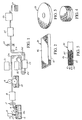
- Fig. 5 illustrates four rows 41, 42, 43 and 44 of undulated filaments 45. Note the outer rows 41 and 45, respectively, have substantially flat surfaces 46 and 47, respectively.
- polyamide filament-forming material is heated to a molten state and extruded from an extrusion spinneret 10 which contains at least one row of openings to provide a bundle of free-falling filaments 11.
- Filaments 11 are permitted to freely fall through an air space into a quench bath 12 where they coil and undulate at or near the surface of bath 12 to form an autogenously bonded web 13.
- web 13 is then passed between opposed smooth-surfaced rollers 14 and 15 which may have a pattern of uniformly spaced spikes projecting from the roller surface which are positioned to provide a substantially flat-surfaced web.
- Web 13 is then drawn around one of the rollers, e.g., roller 15, for removal from quench bath 12.
- Web 13 is then passed over idler roll 16 between guide roll set 17 and dried in forced air oven 18 to remove residual quench liquid.
- the web is wound onto a roll and stored for about 4 weeks to allow morphological equilibration.
- the web is then passed through roll coating station 19 where liquid curable binder resin 20 is applied to web 13.
- Other conventional web coating techniques may be employed to coat the web so long as such techniques provide a substantially uniform binder resin coating.
- dip coating and spray-coating techniques may also be used.
- the binder resin coating should be sufficient to permit uniform coating of the web with abrasive granules.
- the wet coated web is passed beneath a first abrasive granule dropping station 21 to coat one side of the web with abrasive granules and deployed in an S-shaped arrangement around suitable idler rollers 21a, 21b, 21c, 21d and 21e to reverse the web surfaces (that is, face the bottom side up).
- the other surface of the web is then passed under a second abrasive granule depositing station 22 to provide a web, which has been coated on both web surfaces with abrasive granules.
- abrasive granule applications or coating devices may also be used; e.g., the abrasive granules may be applied by spray methods such as employed in sandblasting except with milder conditions, by electrostatic coating methods, and the like.
- the abrasive granule-coated web is then passed through forced air oven 23, to cure the first binder resin coating and then a second coating of a size resin is applied with a suitable device such as spray station 24 which simultaneously sprays top and bottom surfaces of the web with a quantity of size resin material which will bond the abrasive granules to the surface of the web.
- a suitable device such as spray station 24 which simultaneously sprays top and bottom surfaces of the web with a quantity of size resin material which will bond the abrasive granules to the surface of the web.
- the quantity of the size resin coating should be limited so it will not cover or mask the abrasive granules.
- Typical shapes of the abrasive product of the invention include those depicted by Figs. 2, 3 and 4.
- Fig. 2 shows a rectangular shape abrasive product 30 while Fig. 3 shows an annulus shape abrasive product 50.
- Fig. 4 shows yet another embodiment which is made by stacking several layers of the web after the second application of binder resin but prior to the second curing step, compressing the stack and curing to provide a relatively densified abrasive product which may be cut into any of a variety of shapes such as a cylinder.
- the filament-forming material which is extruded to provide the lofty web contained in the low-density abrasive product of the invention is formed of a thermoplastic polyamide material which can be extruded through extrusion orifices to form filaments.
- Particularly useful polyamide materials for forming the filaments of the web of the abrasive product of this invention are polycaprolactam and poly(hexamethylene adipamide) (e.g., commonly referred to as nylon 6 and nylon 6,6).
- Other useful filament-forming materials may include polyolefins (e.g., polypropylene and polyethylene), polyesters (e.g., polyethylene terephthalate), polycarbonates and the like.
- the webs produced by the process described above are particularly suited for abrasive products because they are extremely open, porous, and lofty which permits prolonged usage of the abrasive product for conditioning (for example, surfaces where large amounts of attrited matter are produced), without filling the web and thus interfering with the abrasive product's properties.
- the degree of openness and loftiness is evidenced by the web void volume which is typically at least about 80% (preferably about 85% to about 97%) in the uncoated state.
- the web Upon coating with the binder resin, the web also has a considerable degree of structural integrity that permits prolonged usage of the abrasive article.
- the flattening effect of the rollers provides a unique abrasive structure that is highly open at the surface yet has a flat face capable of use on flat surfaces without requiring bending or modification of the web. Additionally, the web, even with the binder resin coating and abrasive granules, is flexible and conformable and will typically conform to most surfaces upon which it is used.
- the web may be made in a wide variety of thicknesses, limited principally by the design of the spinneret through which it is extruded and the gap between rollers 14 and 15 illustrated in Fig. 1. Typical web thicknesses useful for abrasive products will vary between 1/4 inch to 3 inches (0.63 to 7.6 cm).
- the filament diameter of the filaments in the web produced by the process described above may be varied by modification of the web-making process.
- the filament diameter for a suitable web is on the order of 0.355 to 0.508 mm (14 to 20 mils). Spinneret extrusion openings of 0.355 to 0.508 mm (14 to 20 mils) will produce such webs.
- the openings in the spinneret will be in rows, as previously stated, and separated by at least about 2.54 mm (0.1 inch) to produce satisfactory results.
- the openings of adjacent rows may be offset from one another although the spinneret performs suitably when the openings in the rows are aligned.
- the free fall height may vary between about 5.08 to 50.8 cm (2 to 20 inches) to produce a satisfactory product. Typically the free fall height will be on the order of from 12.7 to 38.1 cm (5 to 15 inches).
- Variegation manifests itself as a density variation periodicity.
- the peak-to-peak spacing of this periodicity increases as the production rate increases.
- the frequency of the periodicity increases as the production rate is decreased.
- Variegation may be detected analytically, but at some minimum amplitude or some maximum frequency, this pattern may be detected visually as discernibly heavier streaks that traverse the web in a cross-machine direction.
- harmonic distortions due to local boiling of the quench fluid are harmonic distortions due to local boiling of the quench fluid (and are therefore influenced by extruder output, extrusion die design, extrusion temperatures, quench conditions, and materials and additives), motion-induced standing waves in the quench tank (that are therefore dependent, at least in part, on the design and dimensions of the quench tank), asynchronous operation of the various rollers that contact the web, and/or a combination of the above.
- motion-induced standing waves in the quench tank that are therefore dependent, at least in part, on the design and dimensions of the quench tank
- asynchronous operation of the various rollers that contact the web and/or a combination of the above.
- the resultant web or coiled substrate weight is between 1.097 and 1.808 kg/m 2 (between 17 and 28 g/24 in 2 ) and preferably should weigh between 1.162 and 1.486 kg/m 2 (18 and 23 g/24 in 2 ). Lesser weights do not provide the increased useable life of the resulting abrasive product. Heavier web weights result in a product that is insufficiently compliant to smoothly run against a typical workpiece. For longest end-product life, variegation is present. The preferred period of variegation is between 10 and 20 mm (peak-to-peak). The widths in the machine direction of the higher density variegated areas are typically about 5 to 10 mm.
- the preferred binder resin employed in the production of the present abrasive products has a liquid state to provide a coatable composition, yet it can be cured to form a tough, adherent material capable of adherently bonding the abrasive granules to the web even under aggressive use conditions.
- the binder resin when cured will have a tensile strength of at least 2.06 x 10 4 kPa (3000 psi) and an ultimate elongation of at least 180% and a Shore D hardness of at least 40.
- the presently preferred resin binder material is a polyurethane which may be prepared from commercially available isocyanate prepolymeric materials such as materials sold under the trade designation ADIPRENE L type, for example, L-83, L-100, L-167, and L-315 (commercially available from Crompton & Knowles Corporation, Stamford, CT), which may be cured with, for example, p,p'-methylene dianiline (MDA).
- ADIPRENE L type for example, L-83, L-100, L-167, and L-315
- MDA p,p'-methylene dianiline
- the reactive isocyanate groups of these materials may be blocked with blocking agents such as ketoxime or phenol to give a liquid material that may be cured with MDA.
- the uncured, unblocked prepolymeric materials will have a nominal NCO content of from about 3% to 10%, a nominal viscosity at 30°C of about 6000 to 30,000 cps and a specific gravity of about 1.03 to 1.15 at 25°C.
- the quantity of binder resin is sufficient to adherently bond the abrasive granules throughout the web to provide a long-lifed abrasive product yet is limited so that it will not cover or mask the abrasive granules themselves.
- the binder resin also provides for additional filament to filament bonding in the web itself. While these filaments have been autogenously bonded together during the web forming operation, they may still be separated, especially if large mechanical forces are applied to the abrasive product.
- the binder resin should be applied in an amount between 0.310 to 1.050 kg/m 2 (4.8 to 16.2) (dry) g/24 in 2 .
- a lesser amount of binder resin will not provide the long life. Heavier coatings will cause the abrasive product to be too stiff for use in some applications causing vibrations during operation. Problematic "smearing", or transfer of binder resin to the surface of the workpiece, will also be more likely at higher coating weights.
- Suitable abrasive granules may be any known abrasive particles or materials commonly used in the abrasive articles.
- the abrasive granule size may vary from 10 grit to 600 grit (average diameter 2 to 0.01 mm) and the minerals forming the abrasive granules may vary in Mohs hardness from 4 to 10. Examples of minerals that provide useful abrasive granules include pumice, topaz, garnet, alumina, corundum, silicon carbide, zirconia, ceramic aluminum oxide, and diamond. Agglomerated granules of abrasive particles and a binder may also be useful.
- abrasive product may also contain mixtures of several granule sizes, different abrasive materials uniformly incorporated therein or different abrasive sizes, hardnesses or materials on either surface. It will be readily apparent in view of the present invention to modify the abrasive product for a particular application by selecting the appropriate abrasive material.
- the abrasive product of the present invention may be modified in other ways without departing from the scope of the claims.
- additive materials may be employed in the resin binder coating such as metal working lubricants (e.g., greases, oils, and metal stearates). Such additives are typically added during the second binder coating operation so as not to interfere with granule adhesion to the filaments.
- metal working lubricants e.g., greases, oils, and metal stearates.
- abrasive granules should be applied in an amount between 2.092 and 6.280 kg/m 2 (32.4 and 97.4 g/24 in 2 ).
- a second, or "size” coating of resin may be applied to the abrasive product.
- Size resins suitable for these size coatings are constitutionally the same as those used for the initial coating, and are applied and hardened in the same manner.
- Preferred coating weights for size resins are between 0.400 to 1.170 kg/m 2 (6.2 to 18.2 g/24 in 2 ).
- Abrasive products of the present invention will have a total weight, including all coatings, of between 3.9 to 10.4 kg/m 2 (60.4 to 159.8 g/24 in 2 ).
- Abrasive products of the present invention will exhibit variegation with a period of 10 to 20 mm, that is, with high-density peaks appearing 10 to 20 mm apart. This level of variegation in an abrasive product is likely indiscernible to the eye, but is readily detected by instrumental methods.
- the abrasive products of the present invention may be in any of a variety of shapes as typically encountered for nonwoven abrasive products. For example, suitable shapes in both rectangular pads or disc-shaped pads which may have a central opening for attachment of an arbor for rotation. Alternatively, they may be cut into shapes such as rectangular shapes and mounted about the periphery of a rotatable hub to provide a flap wheel. Other shapes are also contemplated. During converting steps, no particular care is taken to either include or avoid any particular variegation pattern, number or variegation periods.
- the abrasive product of this invention may be laminated to other layers to provide a modified abrasive article.
- the abrasive product may be laminated to a foam or sponge layer to provide dual cleaning functions or to provide a cushioning layer.
- Any of a variety of mounting devices or handles may also be applied to the abrasive product to provide an implement that may have a removable or permanently attached handle.
- the abrasive products of the present invention are aggressive treating or conditioning implements that may be utilized in any of a variety of situations. They are much more open than most commercially available nonwoven abrasive products and thus resist loading with swarf or other residual materials produced in use. They can thus be used for much longer periods of time than conventional nonwoven abrasive products. For example, these abrasive products will remove thick, hard, tough coatings of reflective sheeting material from road signs and will remove tempering or heat-treating oxides from metal surfaces.
- the abrasive products of the invention have an optimum balance of filament strength, resin strength and abrasive mineral adhesion to have an attrition rate such that fresh abrasive mineral particles are constantly being exposed so that the product performs consistently throughout its entire life.
- the abrasive products of the invention have been found to perform in a superior manner to conventional nonwoven abrasive products in the following situations such as removing paint from metal and wood surfaces, removing heat-treating and tempering oxides from wire rod and circular saw blades, removing thick protective grease coatings and oxide coatings from boiler heat exchange tubes prior to welding, removing rust, dirt and contamination from steel coil during reclaiming operations, removing reflective sheeting materials from highway signs during reclaiming operations, removing slag and oxide from the surface of welded parts, and removing the protective paper coating and hard plastic coatings during the reclamation of plastic sheets such as those formed of LEXAN polymer.
- These abrasive products also produce decorative finishes on metal parts such as stainless steel tubing and sheeting.
- the examples according to the present invention were evaluated for performance by using a wear test.
- the wear test rotated a disc shaped sample of the present abrasive product against a 304 stainless steel screen coupon for a period of four minutes.
- the screen coupon consisted of a 1.90 mm thick stainless steel sheet having a hexagonal close packed array of 7.92 mm diameter holes disposed 1.25 cm (center to center) apart.
- the abrasive discs evaluated consisted of 21.5 cm diameter disc of abrasive product which was compressed between 7.6 cm diameter holding flanges to produce a cylindrical abrasive surface. The compressed disc was rotated on a rotating shaft at a rate of 2500 rpm with a force of 6.8 kg between it and the screen coupon.
- the screen coupon was oscillated in a linear direction along the array of holes, the array of holes being moved in 12 second cycles 13.9 cm lengthwise.
- One disc was tested for each evaluation. In the wear test, the total weight of the coupon was measured before and after the test to determine the amount of material cut or removed (reported in the table in grams as "cut") from the screen coupon to give an indication of the relative cutting ability of the abrasive product.
- a preferred abrasive product of the invention will have a cut of at least 5 grams for the test identified above.
- the weight loss of the abrasive disc was also determined and is also reported in Tables 3, 5 and 6 as Disc Loss (g) (weight loss of material during testing measured in grams).
- the weight loss for a preferred abrasive product of this invention will be less than 40 grams.
- Uncoated web test specimens were cut to dimensions of approximately 10 cm x 15 cm (4" x 6") and placed on a black pad to maximize contrast.
- a video apparatus consisting of a video microscope (INFINIVAR, available from Infinity Photo-Optical Company, Boulder, CO), a CCD camera (model 4810, available from Cohu, Incorporated, Electronics Division, San Diego, CA), and a video display device was aimed at the specimen and positioned so that the displayed field of view was about the size of the specimen. Side incident illumination was adjusted to obtain the best image contrast for elucidating the variegation structure in the webs.
- NIH IMAGE software available from the National Institutes of Health, Washington, DC
- a frame grabber QUICKCAPTURE Data Translation, Incorporated, Marlboro, MA
- QUICKCAPTURE Data Translation, Incorporated, Marlboro, MA
- the images were exported to a MATHCAD (Mathsoft, Inc., Cambridge, MA) software routine.
- the routine produces intensity profile (proportional to fiber density) along the machine direction from each image.
- the first derivative of the data was generated from the profile, and the period of the variegation was calculated from the first derivative graph as the distance between adjacent positive peaks.
- Various regions in the images were analyzed to give mean values and standard deviation of the variegation period.
- Samples 5.1 x 17.8 x 1.27 cm (2.0 ⁇ 7.0 ⁇ 0.5 inch) were cut from each of the materials tested, in both the machine direction and cross direction of the web.
- Three to five samples were tested using a three point bend fixture on a SINTECH (MTS Systems Corporation, Eden Prairie, MN) load frame using ASTM Standard test method D790.
- the samples were supported between two 2.54 cm (1.000 inch) radius supports spaced 15.2 cm (6.0 inches) apart and deflected 2.54 cm (1.000 inch) at a strain rate of 25.4 cm/min (10 inches/min) using a loading nose of radius 1.27 cm (0.5 inch). This rapid strain rate exceeds that specified by ASTM D790, but more closely approximates the stresses experienced in the application of the material.
- the data was acquired and analyzed using a computerized data system. Measured load/deflection values were recorded. The average load at 1.524 cm (0.60 inch) deflection for each example is reported in Table 6.
- a continuous filament nonwoven web was made similarly to that of Example 1 of U.S. Patent No. 4,227,350.
- Polycaprolactam polymer nylon 6, available commercially under the trade designation ULTRAMID B3 from BASF Corporation, Polymers Division of Mt. Olive, NJ
- ULTRAMID B3 from BASF Corporation, Polymers Division of Mt. Olive, NJ
- the spinneret was heated to about 248°C and positioned about 30.48 cm (12 inches) above the surface of a quench bath which was continuously filled and flushed with tap water at the rate of about 2 liters/minute (about 0.5 gallon per minute). Filaments extruded from the spinneret were permitted to fall into the quench bath where they undulated and coiled between 10.16 cm (4 inch) diameter, 1.52 m (60 inch) long smooth-surfaced rolls. Both rolls were positioned in the bath with their axes of rotation about 5.1 cm (2 inches) below the surface of the bath, and the rolls were rotated in opposite directions at a rate of about 2.74 m/minute (9 feet/minute) surface speed.
- the rolls were spaced to lightly compress the surfaces of the resultant extruded web, providing a flattened but not densified surface on both sides.
- the polymer was extruded at a rate of about 318 kg/hr. (700 lb./hr.), producing a 1.50 m wide x 16.8 mm thick (59 inches wide, 0.66 inches thick) web having 8 rows of coiled, undulated filaments.
- the resulting web weighed about 1.356 kg/m 2 (20.99 g/24 in 2 ) and had a void volume of about 92.6%.
- the filament diameter averaged between 0.406 to 0.457 mm (16 to 18 mils).
- the web was carried from the quench bath around one of the rolls and excess water was removed from the web by drying with a room temperature (about 23°C) air blast. Web weights and filament diameters were varied by the adjustment of roll speed, air space for filament free-fall, and extruder output to produce the examples.
- the dried web thus formed was later converted to an abrasive composition by applying a binder resin coating, mineral coating, and. size coating.
- the binder resin coating contained the ingredient shown in Table 1 and was applied via a 2-roll coater. Following the application of the binder resin coating to achieve about 0.503 kg/m 2 (7.78 g/24 in 2 ) dry add-on, grade 36 SiC abrasive granules were then applied to the resin coated web via a drop coater. The web was agitated to encourage penetration of the granules into the interstitial spaces of the web. 2.6 kg/m 2 of abrasive granules were applied to the web. The composition was then heated in an oven for 6 minutes at 160°C. Coating conditions were varied to produce the various dry make and mineral coatings.
- a size coating of the composition shown in Table 2 was then sprayed on the top side of the composition and heated in an oven for 6 minutes at 160°C.
- the composition was inverted and the other side sprayed with an identical amount of the size coating and heated in an oven for 6 minutes at 160°C.
- the final size coating dry add-on was about 0.503 kg/m 2 (7.78 g/24 in 2 ).
- the resulting compositions were then converted into discs for wear testing.
- Example Coil weight, kg/m 2 Filament Diameter, mm Dry Make, kg/m 2 Mineral, kg/m 2 Mineral Penetration Cut (g) Disc Loss (g) L1 1.18 0.39 0.66 2.48 good 6.62 8.40 L2 1.22 0.37 0.64 2.48 fair 11.21 49.40 L3 1.15 0.34 0.66 2.42 fair 9.05 111.2 L4 1.20 0.30 0.74 2.34 poor 10.89 121.10 L5 1.02 0.31 0.56 2.43 fair 9.66 99.3 L6 1.01 0.34 0.52 2.49 good 8.10 110 L7 1.36 0.41 0.84 2.34 good 5.69 7.10 L8 1.44 0.47 0.86 2.46 fair 5.79 9.10 Control 0.97 0.38 0.47 2.57 good 8.81 93.9
- Examples L9-L11 were made identically to those of Examples L1 through L8, with the exception that the output and line speed were varied to produce exemplary amounts of variegation in the various webs and that the quench bath was flushed with tap water at a rate of about 40 liters/minute (about 10 gallons/minute) .
- the webs of Examples L12 and Control were made identically to those of L1 through L8, with the exception that the output and line speed were varied to produce exemplary amounts of variegation in the various webs.
- variegation levels were made from nil to extreme, the latter (Example L12) having density extremes varying from 0.05268 g/cm 3 to 0.01611 g/cm 3 , with the average Example L12 density being 0.0441 g/cm 3 .
- Tensile strength was measured according to ASTM D 1682, conditions 2C-T, and the values are reported in Table 4.
- Variegation levels were measured according to the Variegation Test. The widths of visually distinct high-density regions were measured.
- the webs of Examples L9 and L11, showing advantageous variegation and nil variegation, respectively, were converted into abrasive disc products as in Examples L1-L8. The coating weights are shown in Table 5. Abrasive discs were then tested according to the Wear Test, and the results reported in Table 5. The data show that the better abrasive discs are made from webs having an intermediate level of variegation.
- Example L13 through L16 and Comparative Example A were prepared identically to those of Examples L1-L8, with the exception that the weights of the various coatings were varied as shown in Table 6 and that for webs of Examples L13 through L16 the quench bath was flushed with tap water at a rate of about 10 gallons/minute (about 40 liters/minute). Comparative Example A was made according to Example 9 of U.S. Patent 4,227,350. The resulting webs were tested according to the Load/Deflection Test and the measured load at a 1.52 cm deflection values are reported in Table 6, showing that average load at a 1.52 cm deflection values greater than 3.20 kg were obtained for the higher various coating weights employed in Examples L13-L16.
- Abrasive articles such as discs, made from such webs with high average measured load/deflection values exhibit surprising use life increases when operated such that lateral forces are imparted (i.e., the abrasive articles are deflected out-of-plane during operation) to the abrasive disc.
Landscapes
- Engineering & Computer Science (AREA)
- Mechanical Engineering (AREA)
- Manufacturing & Machinery (AREA)
- Chemical & Material Sciences (AREA)
- Chemical Kinetics & Catalysis (AREA)
- General Chemical & Material Sciences (AREA)
- Textile Engineering (AREA)
- Polishing Bodies And Polishing Tools (AREA)
- Chemical Or Physical Treatment Of Fibers (AREA)
- Treatments For Attaching Organic Compounds To Fibrous Goods (AREA)
- Nonwoven Fabrics (AREA)
Applications Claiming Priority (10)
| Application Number | Priority Date | Filing Date | Title |
|---|---|---|---|
| 1998-05-21 | |||
| US23126399A | 1999-01-15 | 1999-01-15 | |
| US231263 | 1999-01-15 | ||
| US26449599A | 1999-03-08 | 1999-03-08 | |
| US264495 | 1999-03-08 | ||
| US40193899A | 1999-09-23 | 1999-09-23 | |
| US401938 | 1999-09-23 | ||
| US480800 | 2000-01-10 | ||
| US09/480,800 US6302930B1 (en) | 1999-01-15 | 2000-01-10 | Durable nonwoven abrasive product |
| PCT/US2000/000798 WO2000041850A1 (en) | 1999-01-15 | 2000-01-13 | Durable nonwoven abrasive product |
Publications (2)
| Publication Number | Publication Date |
|---|---|
| EP1152866A1 EP1152866A1 (en) | 2001-11-14 |
| EP1152866B1 true EP1152866B1 (en) | 2004-05-12 |
Family
ID=27617798
Family Applications (1)
| Application Number | Title | Priority Date | Filing Date |
|---|---|---|---|
| EP00902399A Expired - Lifetime EP1152866B1 (en) | 1999-01-15 | 2000-01-13 | Durable nonwoven abrasive product |
Country Status (4)
| Country | Link |
|---|---|
| US (1) | US6302930B1 (enExample) |
| EP (1) | EP1152866B1 (enExample) |
| JP (1) | JP4718013B2 (enExample) |
| DE (1) | DE60010663T2 (enExample) |
Families Citing this family (45)
| Publication number | Priority date | Publication date | Assignee | Title |
|---|---|---|---|---|
| JP3901939B2 (ja) * | 2000-12-05 | 2007-04-04 | 帝人コードレ株式会社 | 研磨用基布および研磨方法 |
| US6783562B2 (en) | 2002-05-22 | 2004-08-31 | Reemay, Inc. | Nonwoven abrasive composite |
| US6858292B2 (en) | 2002-09-06 | 2005-02-22 | 3M Innovative Properties Company | Abrasive articles with resin control additives |
| US7169199B2 (en) * | 2002-11-25 | 2007-01-30 | 3M Innovative Properties Company | Curable emulsions and abrasive articles therefrom |
| US6979713B2 (en) * | 2002-11-25 | 2005-12-27 | 3M Innovative Properties Company | Curable compositions and abrasive articles therefrom |
| US7121924B2 (en) * | 2004-04-20 | 2006-10-17 | 3M Innovative Properties Company | Abrasive articles, and methods of making and using the same |
| US20050260387A1 (en) * | 2004-05-20 | 2005-11-24 | 3M Innovative Properties Company | Three-dimensional textured article and methods of making same |
| GB0418633D0 (en) * | 2004-08-20 | 2004-09-22 | 3M Innovative Properties Co | Method of making abrasive article |
| US7811342B1 (en) | 2006-03-08 | 2010-10-12 | Saint-Gobain Abrasives, Inc. | Coated abrasive tools from non-blocked urethane prepolymer |
| JP5448289B2 (ja) * | 2006-06-15 | 2014-03-19 | スリーエム イノベイティブ プロパティズ カンパニー | 研磨ディスク |
| US7985269B2 (en) * | 2006-12-04 | 2011-07-26 | 3M Innovative Properties Company | Nonwoven abrasive articles and methods of making the same |
| US7628829B2 (en) * | 2007-03-20 | 2009-12-08 | 3M Innovative Properties Company | Abrasive article and method of making and using the same |
| US20080233850A1 (en) * | 2007-03-20 | 2008-09-25 | 3M Innovative Properties Company | Abrasive article and method of making and using the same |
| US20090075547A1 (en) * | 2007-09-19 | 2009-03-19 | Rotter Matin J | Cleaning pads with abrasive loaded filaments and anti-microbial agent |
| CN102107397B (zh) | 2009-12-25 | 2015-02-04 | 3M新设资产公司 | 研磨砂轮的制造方法及研磨砂轮 |
| CN102958649B (zh) * | 2010-06-28 | 2015-08-19 | 3M创新有限公司 | 非织造磨轮 |
| US9073179B2 (en) | 2010-11-01 | 2015-07-07 | 3M Innovative Properties Company | Laser method for making shaped ceramic abrasive particles, shaped ceramic abrasive particles, and abrasive articles |
| WO2012068082A1 (en) * | 2010-11-18 | 2012-05-24 | 3M Innovative Properties Company | Convolute abrasive wheel and method of making |
| WO2013003650A2 (en) | 2011-06-30 | 2013-01-03 | Saint-Gobain Abrasives, Inc. | Non-woven abrasive article with extended life |
| EP2964424B1 (en) * | 2013-03-04 | 2017-10-04 | 3M Innovative Properties Company | Nonwoven abrasive article containing formed abrasive particles |
| US10030322B2 (en) | 2013-07-15 | 2018-07-24 | Hills, Inc. | Method of forming a continuous filament spun-laid web |
| US9902046B2 (en) | 2013-09-16 | 2018-02-27 | 3M Innovative Properties Company | Nonwoven abrasive article with wax antiloading compound and method of using the same |
| ES2951938T3 (es) | 2013-12-27 | 2023-10-25 | Saint Gobain Abrasives Inc | Artículos abrasivos no tejidos hechos mediante soldadura por fricción |
| EP3105010B1 (en) | 2014-02-14 | 2021-04-28 | 3M Innovative Properties Company | Abrasive article and method of using the same |
| WO2015184344A1 (en) | 2014-05-29 | 2015-12-03 | Saint-Gobain Abrasives, Inc. | Abrasive article having a core including a polymer material |
| JP5796263B1 (ja) * | 2014-07-30 | 2015-10-21 | 有限会社 トラスト21 | 編成樹脂の製造装置及び編成樹脂の製造方法 |
| CN106573361B (zh) | 2014-08-27 | 2019-07-09 | 3M创新有限公司 | 制备磨料制品的方法 |
| US10507566B2 (en) | 2015-03-18 | 2019-12-17 | The Clorox Company | Process for manufacturing scrubby substrates and substrates made therefrom |
| JP2018510787A (ja) * | 2015-04-01 | 2018-04-19 | スリーエム イノベイティブ プロパティズ カンパニー | 側面カバー層を有する研磨ディスク |
| CN109070314B (zh) | 2016-05-06 | 2021-03-30 | 3M创新有限公司 | 可固化组合物、磨料制品及其制备方法 |
| WO2018042290A1 (en) | 2016-08-31 | 2018-03-08 | 3M Innovative Properties Company | Halogen and polyhalide mediated phenolic polymerization |
| EP3532560A4 (en) | 2016-10-25 | 2020-04-01 | 3M Innovative Properties Company | FUNCTIONAL ABRASIVE PARTICLES, ABRASIVE ARTICLES, AND PROCESSES FOR THE PRODUCTION AND USE THEREOF |
| US11253972B2 (en) | 2016-10-25 | 2022-02-22 | 3M Innovative Properties Company | Structured abrasive articles and methods of making the same |
| CN109863568B (zh) | 2016-10-25 | 2020-05-15 | 3M创新有限公司 | 制备可磁化磨料颗粒的方法 |
| US10947432B2 (en) | 2016-10-25 | 2021-03-16 | 3M Innovative Properties Company | Magnetizable abrasive particle and method of making the same |
| CN109890931B (zh) | 2016-10-25 | 2021-03-16 | 3M创新有限公司 | 可磁化磨料颗粒和包含可磁化磨料颗粒的磨料制品 |
| WO2018081044A1 (en) | 2016-10-25 | 2018-05-03 | 3M Innovative Properties Company | Magnetizable abrasive particle and method of making the same |
| US12269982B2 (en) | 2017-01-23 | 2025-04-08 | 3M Innovative Properties Company | Magnetically assisted disposition of magnetizable abrasive particles |
| EP3615724B1 (en) | 2017-04-28 | 2024-02-28 | 3M Innovative Properties Company | Large denier nonwoven fiber webs |
| BE1025501B1 (nl) * | 2017-08-22 | 2019-03-27 | Cibo N.V. | Schuurelement en werkwijze voor het vervaardigen van een schuurelement |
| US20210155836A1 (en) | 2018-04-12 | 2021-05-27 | 3M Innovative Properties Company | Magnetizable abrasive particle and method of making the same |
| WO2020261112A1 (en) | 2019-06-28 | 2020-12-30 | 3M Innovative Properties Company | Magnetizable abrasive particles and method of making the same |
| US11577367B2 (en) | 2019-07-18 | 2023-02-14 | 3M Innovative Properties Company | Electrostatic particle alignment method and abrasive article |
| US11926782B2 (en) | 2019-10-14 | 2024-03-12 | 3M Innovative Property Company | Magnetizable abrasive particle and method of making the same |
| CN114654705B (zh) * | 2022-02-18 | 2023-09-15 | 成都领益科技有限公司 | 热压成型工艺、扬声器网罩及耳机 |
Family Cites Families (23)
| Publication number | Priority date | Publication date | Assignee | Title |
|---|---|---|---|---|
| DE1694594C3 (de) | 1960-01-11 | 1975-05-28 | Minnesota Mining And Manufacturing Co., Saint Paul, Minn. (V.St.A.) | Reinigungs- und Polierkörper |
| US3260582A (en) | 1961-08-10 | 1966-07-12 | Norton Co | Polishing and abrading materials |
| US3401491A (en) | 1965-03-25 | 1968-09-17 | Armour & Co | Binder of an epoxy resin, polyamide resin and polyester for fibrous abrasive articles |
| US3837988A (en) | 1967-10-19 | 1974-09-24 | Minnesota Mining & Mfg | Composite mat |
| US3537121A (en) | 1968-01-17 | 1970-11-03 | Minnesota Mining & Mfg | Cleaning and buffing product |
| DE1778026C3 (de) | 1968-03-21 | 1981-06-11 | Enka Ag, 5600 Wuppertal | Polstermaterial aus einer Vielzahl von in Schlaufen liegenden, sich überkreuzenden synthetischen Endlosfäden |
| US3686049A (en) | 1969-07-03 | 1972-08-22 | Minnesota Mining & Mfg | Method of making coiled filament mat |
| US3691004A (en) | 1969-11-21 | 1972-09-12 | Akzona Inc | Matting of melt-spun amorphous polymer filaments and process |
| US3936337A (en) | 1973-12-18 | 1976-02-03 | Akzona Incorporated | Apparatus and process for the manufacture of structural mats |
| US4018575A (en) | 1974-03-18 | 1977-04-19 | Minnesota Mining And Manufacturing Company | Low density abrasive article |
| US4227350A (en) * | 1977-11-02 | 1980-10-14 | Minnesota Mining And Manufacturing Company | Low-density abrasive product and method of making the same |
| SU916287A1 (ru) | 1980-07-04 | 1982-03-30 | Ural Vnii Abrazivov Shlifovani | Способ изготовления шлифовальной шкурки с переменной плотностью зерна i |
| US4355489A (en) | 1980-09-15 | 1982-10-26 | Minnesota Mining And Manufacturing Company | Abrasive article comprising abrasive agglomerates supported in a fibrous matrix |
| CA1321073C (en) * | 1987-04-14 | 1993-08-10 | Thomas R. Mcavoy | Abrasive article containing helically crimped fibers |
| US4991362A (en) | 1988-09-13 | 1991-02-12 | Minnesota Mining And Manufacturing Company | Hand scouring pad |
| US5282900A (en) | 1992-03-19 | 1994-02-01 | Minnesota Mining And Manufacturing Company | Nonwoven surface treating articles, system including same, and method of treating calcium carbonate-containing surfaces with said system |
| US5363604A (en) | 1992-08-21 | 1994-11-15 | Minnesota Mining And Manufacturing Company | Entangled continuous filament nonwoven scouring articles and methods of making same |
| US5346516A (en) | 1993-09-16 | 1994-09-13 | Tepco, Ltd. | Non-woven abrasive material containing hydrogenated vegetable oils |
| US5573844A (en) | 1995-01-06 | 1996-11-12 | Minnesota Mining And Manufacturing Company | Conformable surface finishing article and method for manufacture of same |
| EP0828871B1 (en) | 1995-05-25 | 2003-07-23 | Minnesota Mining And Manufacturing Company | Undrawn, tough, durably melt-bondable, macrodenier, thermoplastic, multicomponent filaments |
| JP4150077B2 (ja) * | 1996-05-03 | 2008-09-17 | スリーエム カンパニー | 研磨製品を製造する方法及び装置 |
| US5733825A (en) | 1996-11-27 | 1998-03-31 | Minnesota Mining And Manufacturing Company | Undrawn tough durably melt-bondable macrodenier thermoplastic multicomponent filaments |
| US5928070A (en) | 1997-05-30 | 1999-07-27 | Minnesota Mining & Manufacturing Company | Abrasive article comprising mullite |
-
2000
- 2000-01-10 US US09/480,800 patent/US6302930B1/en not_active Expired - Lifetime
- 2000-01-13 EP EP00902399A patent/EP1152866B1/en not_active Expired - Lifetime
- 2000-01-13 JP JP2000593447A patent/JP4718013B2/ja not_active Expired - Lifetime
- 2000-01-13 DE DE60010663T patent/DE60010663T2/de not_active Expired - Lifetime
Also Published As
| Publication number | Publication date |
|---|---|
| US6302930B1 (en) | 2001-10-16 |
| DE60010663D1 (de) | 2004-06-17 |
| JP2003520688A (ja) | 2003-07-08 |
| JP4718013B2 (ja) | 2011-07-06 |
| EP1152866A1 (en) | 2001-11-14 |
| DE60010663T2 (de) | 2005-05-19 |
Similar Documents
| Publication | Publication Date | Title |
|---|---|---|
| US6302930B1 (en) | Durable nonwoven abrasive product | |
| US4227350A (en) | Low-density abrasive product and method of making the same | |
| EP0984847B1 (en) | Abrasive article comprising mullite | |
| EP0451944B1 (en) | Nonwoven surface finishing articles reinforced with a polymer backing layer and method of making same | |
| EP1165289B1 (en) | Abrasive article, method of making same, and abrading apparatus | |
| EP0359495B1 (en) | Hand scouring pad | |
| US5858140A (en) | Nonwoven surface finishing articles reinforced with a polymer backing layer and method of making same | |
| CA1165569A (en) | Abrasive article comprising abrasive agglomerates supported in a fibrous matrix | |
| JP4555080B2 (ja) | 研磨製品、その製造方法および使用方法、ならびにその製造のための装置 | |
| US5626512A (en) | Scouring articles and process for the manufacture of same | |
| US10625400B2 (en) | Nonwoven abrasive article containing formed abrasive particles | |
| WO2016167967A1 (en) | Nonwoven abrasive article and method of making the same | |
| CA2208086A1 (en) | Conformable surface finishing article and method for manufacture of same | |
| WO2000041850A1 (en) | Durable nonwoven abrasive product | |
| US20080155904A1 (en) | Method of abrading a metal workpiece | |
| US20080160879A1 (en) | Method of abrading a zirconium-based alloy workpiece | |
| US20050260387A1 (en) | Three-dimensional textured article and methods of making same | |
| US20240424643A1 (en) | Surface conditioning article and methods of making and using the same | |
| EP1386696A1 (en) | Abrasive product and the production process thereof |
Legal Events
| Date | Code | Title | Description |
|---|---|---|---|
| PUAI | Public reference made under article 153(3) epc to a published international application that has entered the european phase |
Free format text: ORIGINAL CODE: 0009012 |
|
| 17P | Request for examination filed |
Effective date: 20010816 |
|
| AK | Designated contracting states |
Kind code of ref document: A1 Designated state(s): AT BE CH CY DE DK ES FI FR GB GR IE IT LI LU MC NL PT SE |
|
| 17Q | First examination report despatched |
Effective date: 20020207 |
|
| GRAP | Despatch of communication of intention to grant a patent |
Free format text: ORIGINAL CODE: EPIDOSNIGR1 |
|
| GRAS | Grant fee paid |
Free format text: ORIGINAL CODE: EPIDOSNIGR3 |
|
| GRAA | (expected) grant |
Free format text: ORIGINAL CODE: 0009210 |
|
| AK | Designated contracting states |
Kind code of ref document: B1 Designated state(s): DE FR GB |
|
| REG | Reference to a national code |
Ref country code: GB Ref legal event code: FG4D |
|
| REG | Reference to a national code |
Ref country code: IE Ref legal event code: FG4D |
|
| REF | Corresponds to: |
Ref document number: 60010663 Country of ref document: DE Date of ref document: 20040617 Kind code of ref document: P |
|
| ET | Fr: translation filed | ||
| PLBE | No opposition filed within time limit |
Free format text: ORIGINAL CODE: 0009261 |
|
| STAA | Information on the status of an ep patent application or granted ep patent |
Free format text: STATUS: NO OPPOSITION FILED WITHIN TIME LIMIT |
|
| 26N | No opposition filed |
Effective date: 20050215 |
|
| PGFP | Annual fee paid to national office [announced via postgrant information from national office to epo] |
Ref country code: GB Payment date: 20080129 Year of fee payment: 9 |
|
| GBPC | Gb: european patent ceased through non-payment of renewal fee |
Effective date: 20090113 |
|
| PG25 | Lapsed in a contracting state [announced via postgrant information from national office to epo] |
Ref country code: GB Free format text: LAPSE BECAUSE OF NON-PAYMENT OF DUE FEES Effective date: 20090113 |
|
| REG | Reference to a national code |
Ref country code: FR Ref legal event code: PLFP Year of fee payment: 17 |
|
| REG | Reference to a national code |
Ref country code: FR Ref legal event code: PLFP Year of fee payment: 18 |
|
| REG | Reference to a national code |
Ref country code: FR Ref legal event code: PLFP Year of fee payment: 19 |
|
| PGFP | Annual fee paid to national office [announced via postgrant information from national office to epo] |
Ref country code: FR Payment date: 20181213 Year of fee payment: 20 |
|
| PGFP | Annual fee paid to national office [announced via postgrant information from national office to epo] |
Ref country code: DE Payment date: 20190102 Year of fee payment: 20 |
|
| REG | Reference to a national code |
Ref country code: DE Ref legal event code: R071 Ref document number: 60010663 Country of ref document: DE |