EP1152803B1 - Golf club and method of design - Google Patents
Golf club and method of design Download PDFInfo
- Publication number
- EP1152803B1 EP1152803B1 EP00919274A EP00919274A EP1152803B1 EP 1152803 B1 EP1152803 B1 EP 1152803B1 EP 00919274 A EP00919274 A EP 00919274A EP 00919274 A EP00919274 A EP 00919274A EP 1152803 B1 EP1152803 B1 EP 1152803B1
- Authority
- EP
- European Patent Office
- Prior art keywords
- club
- golfer
- loft
- golf
- design
- Prior art date
- Legal status (The legal status is an assumption and is not a legal conclusion. Google has not performed a legal analysis and makes no representation as to the accuracy of the status listed.)
- Expired - Lifetime
Links
- 238000013461 design Methods 0.000 title claims abstract description 86
- 238000000034 method Methods 0.000 title abstract description 14
- 238000004519 manufacturing process Methods 0.000 claims 2
- 235000000396 iron Nutrition 0.000 abstract description 9
- XEEYBQQBJWHFJM-UHFFFAOYSA-N Iron Chemical compound [Fe] XEEYBQQBJWHFJM-UHFFFAOYSA-N 0.000 description 21
- 229910052742 iron Inorganic materials 0.000 description 19
- 239000002023 wood Substances 0.000 description 17
- 230000008901 benefit Effects 0.000 description 4
- 238000012986 modification Methods 0.000 description 4
- 230000004048 modification Effects 0.000 description 4
- 238000005259 measurement Methods 0.000 description 3
- 239000002184 metal Substances 0.000 description 3
- 229910052751 metal Inorganic materials 0.000 description 3
- 239000004576 sand Substances 0.000 description 3
- 238000007796 conventional method Methods 0.000 description 2
- 230000007423 decrease Effects 0.000 description 2
- 230000000694 effects Effects 0.000 description 2
- 230000005484 gravity Effects 0.000 description 2
- 230000004075 alteration Effects 0.000 description 1
- 230000009286 beneficial effect Effects 0.000 description 1
- 238000001514 detection method Methods 0.000 description 1
- 230000003292 diminished effect Effects 0.000 description 1
- 238000011156 evaluation Methods 0.000 description 1
- 238000007373 indentation Methods 0.000 description 1
- 239000000463 material Substances 0.000 description 1
- 239000000203 mixture Substances 0.000 description 1
- 230000000284 resting effect Effects 0.000 description 1
Images



Classifications
-
- A—HUMAN NECESSITIES
- A63—SPORTS; GAMES; AMUSEMENTS
- A63B—APPARATUS FOR PHYSICAL TRAINING, GYMNASTICS, SWIMMING, CLIMBING, OR FENCING; BALL GAMES; TRAINING EQUIPMENT
- A63B69/00—Training appliances or apparatus for special sports
- A63B69/36—Training appliances or apparatus for special sports for golf
- A63B69/3658—Means associated with the ball for indicating or measuring, e.g. speed, direction
-
- A—HUMAN NECESSITIES
- A63—SPORTS; GAMES; AMUSEMENTS
- A63B—APPARATUS FOR PHYSICAL TRAINING, GYMNASTICS, SWIMMING, CLIMBING, OR FENCING; BALL GAMES; TRAINING EQUIPMENT
- A63B24/00—Electric or electronic controls for exercising apparatus of preceding groups; Controlling or monitoring of exercises, sportive games, training or athletic performances
- A63B24/0003—Analysing the course of a movement or motion sequences during an exercise or trainings sequence, e.g. swing for golf or tennis
-
- A—HUMAN NECESSITIES
- A63—SPORTS; GAMES; AMUSEMENTS
- A63B—APPARATUS FOR PHYSICAL TRAINING, GYMNASTICS, SWIMMING, CLIMBING, OR FENCING; BALL GAMES; TRAINING EQUIPMENT
- A63B24/00—Electric or electronic controls for exercising apparatus of preceding groups; Controlling or monitoring of exercises, sportive games, training or athletic performances
- A63B24/0021—Tracking a path or terminating locations
-
- A—HUMAN NECESSITIES
- A63—SPORTS; GAMES; AMUSEMENTS
- A63B—APPARATUS FOR PHYSICAL TRAINING, GYMNASTICS, SWIMMING, CLIMBING, OR FENCING; BALL GAMES; TRAINING EQUIPMENT
- A63B53/00—Golf clubs
- A63B53/005—Club sets
-
- A—HUMAN NECESSITIES
- A63—SPORTS; GAMES; AMUSEMENTS
- A63B—APPARATUS FOR PHYSICAL TRAINING, GYMNASTICS, SWIMMING, CLIMBING, OR FENCING; BALL GAMES; TRAINING EQUIPMENT
- A63B60/00—Details or accessories of golf clubs, bats, rackets or the like
-
- A—HUMAN NECESSITIES
- A63—SPORTS; GAMES; AMUSEMENTS
- A63B—APPARATUS FOR PHYSICAL TRAINING, GYMNASTICS, SWIMMING, CLIMBING, OR FENCING; BALL GAMES; TRAINING EQUIPMENT
- A63B60/00—Details or accessories of golf clubs, bats, rackets or the like
- A63B60/42—Devices for measuring, verifying, correcting or customising the inherent characteristics of golf clubs, bats, rackets or the like, e.g. measuring the maximum torque a batting shaft can withstand
-
- A—HUMAN NECESSITIES
- A63—SPORTS; GAMES; AMUSEMENTS
- A63B—APPARATUS FOR PHYSICAL TRAINING, GYMNASTICS, SWIMMING, CLIMBING, OR FENCING; BALL GAMES; TRAINING EQUIPMENT
- A63B24/00—Electric or electronic controls for exercising apparatus of preceding groups; Controlling or monitoring of exercises, sportive games, training or athletic performances
- A63B24/0021—Tracking a path or terminating locations
- A63B2024/0028—Tracking the path of an object, e.g. a ball inside a soccer pitch
- A63B2024/0031—Tracking the path of an object, e.g. a ball inside a soccer pitch at the starting point
-
- A—HUMAN NECESSITIES
- A63—SPORTS; GAMES; AMUSEMENTS
- A63B—APPARATUS FOR PHYSICAL TRAINING, GYMNASTICS, SWIMMING, CLIMBING, OR FENCING; BALL GAMES; TRAINING EQUIPMENT
- A63B2208/00—Characteristics or parameters related to the user or player
- A63B2208/12—Characteristics or parameters related to the user or player specially adapted for children
-
- A—HUMAN NECESSITIES
- A63—SPORTS; GAMES; AMUSEMENTS
- A63B—APPARATUS FOR PHYSICAL TRAINING, GYMNASTICS, SWIMMING, CLIMBING, OR FENCING; BALL GAMES; TRAINING EQUIPMENT
- A63B2220/00—Measuring of physical parameters relating to sporting activity
- A63B2220/80—Special sensors, transducers or devices therefor
- A63B2220/806—Video cameras
-
- A—HUMAN NECESSITIES
- A63—SPORTS; GAMES; AMUSEMENTS
- A63B—APPARATUS FOR PHYSICAL TRAINING, GYMNASTICS, SWIMMING, CLIMBING, OR FENCING; BALL GAMES; TRAINING EQUIPMENT
- A63B53/00—Golf clubs
- A63B53/007—Putters
-
- Y—GENERAL TAGGING OF NEW TECHNOLOGICAL DEVELOPMENTS; GENERAL TAGGING OF CROSS-SECTIONAL TECHNOLOGIES SPANNING OVER SEVERAL SECTIONS OF THE IPC; TECHNICAL SUBJECTS COVERED BY FORMER USPC CROSS-REFERENCE ART COLLECTIONS [XRACs] AND DIGESTS
- Y10—TECHNICAL SUBJECTS COVERED BY FORMER USPC
- Y10T—TECHNICAL SUBJECTS COVERED BY FORMER US CLASSIFICATION
- Y10T29/00—Metal working
- Y10T29/49—Method of mechanical manufacture
Definitions
- the present invention relates to golf clubs and methods of golf club design and more particularly to adjusting a certain golf club design parameter to improve club performance and to better suit an individual golfer's style of play.
- loft, length and lie As is commonly known in field of golf club design, there are three basic geometrical design parameters for golf clubs, namely, loft, length and lie. All conventional sets of golf clubs employ a range of each of these parameters in order to provide an assortment of clubs that can be used for various golf shots.
- the loft of the club is the angle of the club face relative to the sole of the club. The loft influences the angle of ascent of a struck golf ball and, accordingly, it is an important factor regarding the distance and trajectory of the shot.
- the loft of the club is also a factor in the backspin imparted on the struck golf ball. Higher lofted clubs are designed to produce more backspin than lower lofted clubs.
- the length of the club is normally measured from the end of the shaft to a plane defined by the sole of the club.
- the length influences the force with which the golf ball may be struck and thus has a significant effect on the distance of travel of the ball.
- the lie of the club is the angle of the centerline of the shaft with the ground line tangent to the sole at the centerline of the face. The lie allows the length and the loft to be adjusted such that the golfer can swing the club and have the sole contact the ground on its center between heel and toe or as otherwise intended by the manufacturer of the club.
- the rules of golf limit a golfer to 14 clubs, a mixture of irons, woods, and a putter.
- a typical set of "iron” clubs 2-iron through sand wedge
- the loft varies from about 20 to 56 degrees (and there is usually about a 4 degree difference per club), the length varies from about 40 to 35 inches, and the lie varies from about 58 to 64 degrees.
- a typical set of "wood” (including metal wood) clubs includes a driver and any one or more of a 2-wood through 11-wood.
- the loft of a fairly typical driver ranges from about 7 to 12 degrees.
- Other more exotic woods, such as a 7-wood have lofts as high as 20 degrees while certain specialty wood clubs have even higher lofts.
- the lowest lofted club is the longest and, as the loft increases, the length of the club decreases. Similarly, the lie of the club typically increases with decreases in club length.
- offset Another parameter more recently introduced in field of golf club design is known as offset.
- the offset of a club is typically the measurement of the leading edge of the club relative to the hosel.
- the center of mass of the club head is placed behind the centerline of the shaft. It is generally thought that this design produces greater loft and face closure at impact.
- face closure at impact can cause more of a right-to-left trajectory (for right-handed golfers) thereby reducing the incidence of slicing the shot.
- the design loft of the club is the angle at which the club face should strike the ball. Striking a ball with an "effective" loft that is different from the design loft occurs because not all golfers have the same swinging motion.
- design loft values for a given club e.g., 28 degrees for a 5-iron
- the design loft of the club is not necessarily the effective loft that the ball sees when struck by the club. This may result in the "standard" 5-iron having an effective loft of a 4-iron (or a 6-iron).
- a very small swing variation will have a dramatic impact upon the effective loft and may result in an effective 4-iron (or 6-iron) loft or even a 3-iron (or 7-iron) loft when, in fact, the golfer is using a 5-iron.
- the golfer be in a position to choose (or choose not) to strike the ball at an effective loft that equals or at least approximates the design loft of the club.
- the sole of a golf club is designed with a number of parameters in mind including width, curvature and bounce angle. If the club used by the golfer strikes the ball at an effective loft other than the design loft, the benefit of these design features may be inadvertently or intentionally diminished.
- a difference between the design loft and the effective loft may cause some golfers to adjust their swing (consciously or unconsciously) or to use a club other than the one designed for the particular shot they are about to hit. For instance, if a golfer frequently imparts an effective loft of a 4-iron to a 5-iron, the golfer may attempt to compensate by swinging more slowly to diminish the distance achieved by the shot. Alternatively, the golfer may switch to a 6-iron which may produce the desired effective loft but typically has less length and requires a harder swing. Either way, the golfer is shortchanged because the design and effective lofts do not match. A golfer should be able to use any club and have an effective loft that matches or at least approximates the design loft, if he or she so desires.
- the first such swing characteristic is the actual location of the golfer's hands relative to the ball when the club head strikes the ball. If, for example, the golfer's hands tend to be ahead of the club head (and ahead of the ball when it is actually struck) the club face will tend to strike the ball with an effective loft that is lower than the design loft of the club. Similarly, if the golfer's hands tend to be behind the club head (and behind the ball when it is actually struck), the effective loft will tend to be higher than the design loft.
- other swing characteristics have an influence on effective loft, it is this characteristic, location of the golfer's hands relative to the ball at impact, that primarily controls the effective loft of the club.
- the second swing characteristic that influences the effective loft is the location of the ball in the golfer's stance.
- a right-handed golfer who tends to play the ball forward (back) in his or her stance (i.e., towards (away from) the left armpit) will tend to have an effective loft that is higher (lower) than the design loft.
- a golfer who plays the ball in the middle of his or her stance may strike the ball earlier in his or her swing and have a lower effective loft than another golfer, using the same 5-iron, who plays the ball in the very front of his or her stance.
- the third swing characteristic that influences effective loft is the location of the golfer's hands when addressing the ball just before the swing begins.
- a golfer by putting his or her hands forward (back) in his or her stance (again, for right-handed golfers, this means towards (away from) the left armpit), may cause the effective loft of the club to be higher (lower) than the design loft.
- U.S. Pat. No. 5,224,702 to Turner is directed to an offset hosel design for a golf club.
- the disclosure in Turner addresses wood clubs and includes a hosel located at the back of the club head away from the face and angled toward the face of the club head at a predetermined angle which allegedly aids in preventing slicing or hooking a golf ball.
- the base of the hosel is located at least 1.25 inches from the leading edge of the club.
- the hosel and the shaft are angled toward the face of the club up to 15 degrees from vertical. Modifying this angle might adjust the effective loft, but there is little or no discussion about such a feature or any benefit therefrom.
- U.S. Pat. No. 4,804,148 to Maltby discusses removing material from a runner on the sole of a wood-type metal club head to adjust the face angle, lie and/or loft of the head. Maltby makes no mention of modifying any other portion of the club or club head and actually states that modification of the sole is sufficient to make the desired adjustments. Maltby makes no adjustment for effective loft.
- Golf is a very difficult game. It can be made less difficult by tailoring individual golf clubs and sets of golf clubs to the particularities of an individual golfer.
- the standard club designs and design methods make no account for the effective loft of a club for the individual golfer. Accordingly, there is a need for a golf club or a set of golf clubs designed with effective loft in mind. It is also clear that there is a need for designing a golf club or set of golf clubs with effective loft in mind for the individual golfer who will use the club or set of clubs.
- the present invention utilizes a lean angle in the design of a golf club to allow a golfer to customize the relationship between design and effective loft for one or more clubs in his or her bag.
- the design loft of a club is often specified by the manufacturer. Using the design loft (or the angle defined by the design loft) it is possible to orient the sole of the club on the playing surface in the manner intended by the manufacturer. If the design loft is not specified, but the characteristics of the sole are specified (and hence the designer's intended orientation of sole to playing surface), the club can be grounded as intended and the design loft determined by measurement. If neither the design loft nor the appropriate sole characteristics are specified by the club manufacturer, the design loft of the club is the angle of the club face when the club is grounded and the shaft is in a vertical plane.
- the lean angle of the club is the angle between (i) a projection of the centerline of the shaft onto a vertical plane, the plane being along an intended line of play and (ii) a vertical line in such vertical plane.
- the lean angle of a typical golf club usually is not specified by the manufacturer but in most cases a lean angle of 0 degrees can be inferred.
- the lean angle may be adjusted in a positive or negative direction based upon one or more of a number of different swing characteristics.
- the method of the present invention comprises determining the design loft and tailoring the lean angle of the club based upon such selections and a swing characteristic of the golfer.
- Tailoring the lean angle may be further based upon at least one of a lie, a length and an offset for the club.
- Such swing characteristics may include each of a location of the hands of the golfer upon impact of the club with a golf ball, an effective loft of the golf club, a relative difference between the design loft and an effective loft of the club, a location of the hands of the golfer when the golfer addresses a golf ball, a location of the golf ball in the stance of a golfer, and a location of the hands of the golfer with respect to a location of a golf ball.
- the method of the present invention may further include repeating the selecting step and the tailoring step for a plurality of golf clubs, and substantially matching the particular swing characteristic across the plurality of golf clubs.
- the method of the invention disclosed herein may also include determining such swing characteristic of the golfer by using a trained observer or an automated observing system.
- a typical golf club 10 includes a shaft 12 and a head 14 joined together at a hosel 16.
- the shaft 12 terminates at a grip end 13.
- the head 14 of the club 10 includes a face 17 and a sole 18.
- the face 17 of the club is the surface of the club used to strike a golf ball and the sole 18 of the club is the bottom surface of the club.
- the face 17 normally has indentations or grooves 20 machined into the surface to impart spin on a golf ball struck by the club.
- the sole 18 at its centerline 26 usually rests tangentially on a playing surface 22 when a golfer addresses a golf ball and at impact.
- "golf club” means any implement used to strike a golf ball and includes irons, woods, metal woods and putters.
- Lie 24 of the conventional club 10 is defined as the angle of a centerline 25 of the shaft with the playing surface 22 when the club rests on the playing surface 22 tangent to the sole 18 at a centerline 26 of the face 17.
- the range of lies for a typical set of irons (2-iron through sand wedge) is 58 to 64 degrees.
- the lie for a typical driver (1-wood) is in the 54 to 56 degree range, and 3-woods through 7-woods usually have a lie in the range of approximately 57 to 58 degrees.
- Length 32 of club 10 is the distance measured along the shaft from the grip end 13 of the shaft 12 to the playing surface 22 with the playing surface 22 tangent to the sole 18 at the centerline 26 of the face 17.
- a typical set of irons has a range of lengths from about 35 to 40 inches.
- Wood clubs (which include metal-wood clubs) are typically longer than irons, and a driver will often have a length of about 43 to 46 inches.
- the design loft of a club is often specified by the manufacturer. Using the design loft (or the angle defined by the design loft) it is possible to orient the sole of the club on the playing surface in the manner intended by the manufacturer. If the design loft is not specified, but the characteristics of the sole are specified (and hence the designer's intended orientation of sole to playing surface), the club can be grounded as intended and the design loft determined by measurement. If neither the design loft nor the appropriate sole characteristics are specified by the club manufacturer, the design loft of the club is the angle of the club face when the club is grounded and the shaft is in a vertical plane.
- FIG. 2 A side view of club 10 is shown in FIG. 2 .
- the sole 18 of the club is resting on the playing surface as intended by the manufacturer and, accordingly, the design loft 28 is the angle of the club face 17 along its centerline 26 relative to a line 30 perpendicular to the playing surface 22.
- the effective loft 40 will be substantially the same as the design loft 28.
- the range of design lofts for a typical set of irons (2-iron through sand wedge) is about 20 to 56 degrees.
- the design loft of a driver is usually between 7 and 12 degrees.
- the design loft of a 3-wood, 5-wood and 7-wood is usually about 15, 20 and 23 degrees, respectively.
- the offset of club 10 is the distance from a leading edge 19 of the club 10 relative to the hosel 16. In FIG. 2 the offset is substantially zero inches. A typical offset, however, may extend up to .300 inches for irons and even more for woods. Usually, lower lofted clubs (i.e., 2-irons, 3-irons, etc.) have a greater offset than higher lofted clubs. Clubs with an offset tend to have a center of gravity that is behind the centerline 25 of the shaft. This "offset" center of gravity introduces a dynamic process during a golf swing that can encourage face closure at impact and may reduce a natural tendency to slice the golf ball.
- a set of golf clubs typically includes the putter. Although special rules apply to them, putters all have design lofts, lengths, lies and offsets like other clubs.
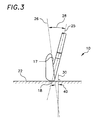
- FIG. 3 there is shown club 10 having the same design loft 28 as depicted in FIG. 2 .
- the club 10 rests on the playing surface 22 tilted towards the target (not shown, but usually in front of and perpendicular to the club face 17).
- the sole 18 of the club does not rest on the playing surface as intended by the manufacturer, with the result being that the design loft 28 differs from the effective loft 40 (as depicted in FIG. 3 , the effective loft is less than the design loft).
- the effective loft 40 is the angle of the club face 17 on its centerline 26 relative to a line 30 perpendicular to the playing surface 22.
- the effective loft 40 is the loft the golf ball (not shown) sees when struck by the club.
- FIG. 3 can be viewed as either depicting the club when the golfer addresses the golf ball (i.e.. when the golfer is standing over the ball, just before he or she commences his or her swing) or depicting the club in the middle of the swing at the point of impact with the ball (not shown).
- the effective loft 40 is different than the design loft 28 due to the orientation of the club relative to the playing surface 22.
- the loft differential (the amount by which the design loft 28 and the effective loft 40 differ) in FIG. 3 is just a few degrees, however, this can be significant in a golf shot where a 4 degree modification in loft can translate into approximately 10 to 20 yards of distance.
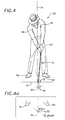
- FIG. 4 depicts a golfer 50 addressing a golf ball 52 with a relatively standard or conventional stance.
- the hands 62 of the golfer 50 in the conventional stance are normally slightly ahead of body-center 54 and the location of the ball 52 is slightly forward of body-center 54.
- the ball is closer to the golfer's left armpit 56 than his or her right armpit 58.
- the conventional stance usually entails keeping the ball between body center 54 and the instep of the left foot 60.
- the conventional stance further entails locating the club head (when using the longest club in the golfer's bag, usually the driver) at the furthest point forward (towards the instep of the left foot 60) in the stance.
- the golf ball 52 is then moved backwards in the stance, towards the right foot 59 (but typically not past body center 54), and in towards the body of the golfer 50 for progressively shorter, higher lofted clubs such as a wedge.
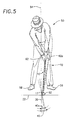
- FIG. 5 depicts an alteration to the conventional stance.
- the position of the hands 62a of the golfer 50 are further forward relative to the hands 62 (also as shown in FIG. 4 ), while the location of the ball 52 is the same.
- This stance is relatively common and many golfers prefer to extend the position of their hands even further forward in their stance than is standard.
- the effective loft 40a of the club 10 may be modified by utilizing this different stance. While the design loft of the club remains constant, the effective loft 40, 40a of the club will depend on the location of the golfer's hands 62, 62a, when the ball is actually struck. With the hand location moved forward, the face 17 of the club 10 is closed towards the playing surface 22. This in turn changes the effective loft 40, 40a of the club. Again, although the difference is a few degrees (as depicted here, on the order of 5 degrees), it can mean the difference between landing on the green and ending up in a pond on the far side of the green.
- FIGS. 4 and 5 also show the effect of hand location 62, 62a when the ball 52 is actually struck assuming now that FIGS. 4 and 5 represent the impact position.
- the location of the hands relative to the location of the ball when the ball is struck by the club primarily determines the effective loft 40, 40a of the club.
- the stance and the location of the ball in the stance have some influence on the resulting swing and the effective loft, however, the effective loft can be exactly determined only upon impact of the club and the ball.
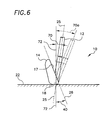
- FIG. 6 depicts a golf club 10 designed in accordance with the present invention.
- the lean angle 70 of golf club 10 is the angle between (i) a projection of the centerline 25 of the shaft onto a vertical plane, the plane being along an intended line of play and (ii) a vertical line 72 in such vertical plane.
- the lean angle 70 is greater than zero.
- the lean angle 70 could be varied by up to 90 degrees on either side of line 72. It will be readily apparent to those skilled in the art that such a large lean angle is not only impractical, but may be against the rules of golf as published by the United States Golf Association. See paragraph 4-1b(ii) of Appendix II to the Rules of Golf, as approved by the United States Golf Association and The Royal and Ancient Golf Club of St. Andrews, Scotland, effective January 1, 1998 (the "Rules of Golf"), and incorporated herein by reference. When “the club is in its normal address position”, such paragraph limits "the projection of the straight part of the shaft on to the vertical plane along the intended line of play" to no more than 20 degrees from the vertical.
- the Rules of Golf may limit the bounds of the lean angle 70 to no more than 20 degrees on either side of the line 72.
- the intended line of play is usually the direction in which the golfer is aiming.
- the intended line of play is typically perpendicular to the club face 17.
- the preferred range for the lean angle 70 in accordance with the present invention is -15 (negative indicating a lean angle towards the right foot of a right-handed golfer relative to line 72) to 15 degrees (positive indicating a lean angle towards the left foot of a right-handed golfer relative to line 72), more preferably a range between 0 and 15 degrees, and even more preferably between 3 and 10 degrees.
- the design loft 40 of the club 10 has already been determined.
- the lean angle 70 may be adjusted for a particular swing characteristic of the golfer. For example, if the golfer's hands tend to be the equivalent of about five degrees ahead of the club head 14 when the club head strikes the ball, the lean angle 70 can be adjusted from zero by a positive 5 degrees to compensate. A greater lean angle such as that indicated by reference numeral 70a may be used to further compensate and tailor the club to a swing characteristic of the golfer. This makes the club have an effective loft and a design loft that are substantially the same when the ball is struck at the club face.
- the lean angle 70 can be adjusted to make them similar or so that they have a relationship as desired by the golfer.
- the swing characteristics may include any one or more of the following: the location of the hands of the golfer upon impact of the club with the golf ball, the effective loft of the club, a relative difference between the design loft and an effective loft of the club, the location of the golf ball in the stance of the golfer when the golfer addresses a golf ball, the location of the hands of the golfer when the golfer addresses the golf ball, and the location of the hands of the golfer with respect to a location of the golf ball in the stance of the golfer when the golfer addresses the golf ball.
- FIGS. 7a, 7b and 7c the design loft 40 of each club 10 is the same.
- the lean angle 70, however, of each club is different.
- the lean angle 70 is about 0 degrees
- the lean angle is about -5 degrees
- the lean angle 70 is about 10 degrees.
- a lean angle 70 of about 0 degrees may be best suited for this swing characteristic of this golfer.
- a negative or positive lean angle 70 as shown in FIGS. 7b and 7c , respectively, may best suit this swing characteristic of this particular golfer.
- FIG. 8 shows an overhead view of the golfer 50 in his or her stance.
- a typical set of clubs and/or traditional instruction encourages or promotes the golfer to position the ball 52 to be close to body-center 54 for high lofted clubs such as, for example, a pitching wedge and to progressively locate the ball 52 in his or her stance towards his or her left armpit 56 for clubs with progressively lower lofts and greater lengths. Therefore, as the length of the club 10 increases, the typical set of clubs encourages the golfer to locate the ball in his or her stance generally along direction 73 (and not necessarily linearly). Thus, the golfer is forced to alter the location of the ball 52 with respect to his or her stance (i.e, the relative position between the left and right armpits) for each club in the set.
- FIG. 9 depicts a similar stance as in FIG. 8 , except that the hands 62 of the golfer 50 are located towards his or her left armpit 56 and are generally ahead of the golf ball 52.
- the golfer could choose to locate his or her hands virtually anywhere, including body center 54, for any or all clubs, and further position the ball in his or her stance as he or she desires.
- adjustment of the lean angle may allow (or encourage) the location of the golf ball to progress along direction 74 or 76, rather than the conventional direction 73, for progressively longer clubs.
- modification of the lean angle provides for an infinite number of hand positions, ball positions and relative positions thereof, while maintaining a desired effective loft of the club.
- Tailoring the lean angle 70 may be accomplished by using any of a number of conventional methods.
- the clubs including the hosel, if any, from which the shaft protrudes
- the clubs can be manufactured from the outset with a particular lean angle (in fact, most clubs are manufactured with a lean angle of 0 degrees).
- the clubs can be specially manufactured with a specified lean angle to fit one or more swing characteristics of the golfer.
- the hosel can be manipulated or bent using conventional methods to alter the lean angle, or any combination of these methods may be employed.
- a golf pro a person trained in the art of golf club design or any other trained observer can improve a golfer's club(s) by tailoring the lean angle of one or more golf clubs based upon one or more of the aforementioned swing characteristics.
- a further aid in evaluating a swing characteristic and tailoring the lean angle to suit such characteristic is a video camera (not shown) or any other detection means including electronic sensors mounted to the golfer, the club or the ball, sensors located in space surrounding the golfer or any other conventional golf swing evaluation technique.
- the video camera may be connected to a processor to more precisely evaluate the swing characteristic and tailor the lean angle based upon such characteristic.
- a video camera, along with a slow motion processor, may be especially useful in detecting the effective loft of a golf club as used by a particular golfer when he or she strikes a ball.
- the flight pattern of the ball as it leaves the club face is complicated (see The Search for the Perfect Swing, by Cochran and Stobbs, Triumph Books, Chicago, 1996, pages 148-167 , and incorporated herein by reference), it too can be used by an observer to evaluate the effective loft.
- By determining such effective loft and modifying the lean angle of the club to alter the effective loft to better suit the club to the golfer an improved score cannot be far behind.
Landscapes
- Health & Medical Sciences (AREA)
- General Health & Medical Sciences (AREA)
- Physical Education & Sports Medicine (AREA)
- Life Sciences & Earth Sciences (AREA)
- Biophysics (AREA)
- Golf Clubs (AREA)
- Compositions Of Macromolecular Compounds (AREA)
Applications Claiming Priority (3)
| Application Number | Priority Date | Filing Date | Title |
|---|---|---|---|
| US24851599A | 1999-02-08 | 1999-02-08 | |
| US248515 | 1999-02-08 | ||
| PCT/US2000/003218 WO2000051693A2 (en) | 1999-02-08 | 2000-02-08 | Golf club and method of design |
Publications (2)
| Publication Number | Publication Date |
|---|---|
| EP1152803A2 EP1152803A2 (en) | 2001-11-14 |
| EP1152803B1 true EP1152803B1 (en) | 2009-12-16 |
Family
ID=22939489
Family Applications (1)
| Application Number | Title | Priority Date | Filing Date |
|---|---|---|---|
| EP00919274A Expired - Lifetime EP1152803B1 (en) | 1999-02-08 | 2000-02-08 | Golf club and method of design |
Country Status (9)
| Country | Link |
|---|---|
| US (2) | US20060194642A1 (enExample) |
| EP (1) | EP1152803B1 (enExample) |
| JP (1) | JP4503188B2 (enExample) |
| AT (1) | ATE451952T1 (enExample) |
| AU (1) | AU765225B2 (enExample) |
| CA (1) | CA2359805C (enExample) |
| DE (1) | DE60043535D1 (enExample) |
| ES (1) | ES2335382T3 (enExample) |
| WO (1) | WO2000051693A2 (enExample) |
Families Citing this family (2)
| Publication number | Priority date | Publication date | Assignee | Title |
|---|---|---|---|---|
| CN1720082A (zh) * | 2002-12-06 | 2006-01-11 | 横滨橡胶株式会社 | 高尔夫球杆和中空高尔夫杆头的设计方法 |
| US7670234B1 (en) * | 2006-03-17 | 2010-03-02 | James Kellerman | Golf club system |
Family Cites Families (52)
| Publication number | Priority date | Publication date | Assignee | Title |
|---|---|---|---|---|
| US3332684A (en) * | 1964-01-20 | 1967-07-25 | Solheim Karsten | Golf club |
| US3961796A (en) * | 1973-06-11 | 1976-06-08 | Thompson Stanley C | Golfing iron head with downwardly tapered keel |
| US4063259A (en) * | 1975-10-29 | 1977-12-13 | Acushnet Company | Method of matching golfer with golf ball, golf club, or style of play |
| US4059270A (en) * | 1975-11-18 | 1977-11-22 | Bernard Sayers | Method for custom fitting golf clubs |
| US4468034A (en) * | 1983-02-16 | 1984-08-28 | Duclos Clovis R | Golf club loft and lie angle indicating device |
| US4540178A (en) * | 1983-08-30 | 1985-09-10 | Johnson Louis W | Golf iron and method of construction |
| GB2197209B (en) * | 1986-11-06 | 1990-06-06 | Norman William Wharton | Golf club |
| US4915387A (en) * | 1987-01-02 | 1990-04-10 | Bax-Go, Inc. | Golf practice and training device |
| US4784393A (en) * | 1987-05-26 | 1988-11-15 | Williams Robert E | Golf swing training device |
| US4921252A (en) * | 1987-09-14 | 1990-05-01 | Antonious A J | Iron type golf club head with integral sighting and alignment means |
| US4900028A (en) * | 1987-09-14 | 1990-02-13 | Antonious A J | Iron type golf club head with an integral sighting means |
| US4804184A (en) * | 1987-09-28 | 1989-02-14 | Ralph Maltby Enterprises, Inc. | Method of fitting golf club to golfer |
| US5125662A (en) * | 1987-11-25 | 1992-06-30 | Antonious A J | Set of iron type golf club heads with integral skid members on the sole |
| US4842243A (en) * | 1988-01-19 | 1989-06-27 | Lie Angle Solutions, Inc. | Method and apparatus for molding golf club heads |
| US4804148A (en) | 1988-02-19 | 1989-02-14 | Etheridge Johnny E | Crusher control system |
| US4915386A (en) * | 1988-10-25 | 1990-04-10 | Antonious A J | Perimeter weighted iron type golf club head with centrally located complementary weight |
| US5228688A (en) * | 1989-03-27 | 1993-07-20 | Davis C Michael | Constant swing golf club set |
| US5011151A (en) * | 1989-09-06 | 1991-04-30 | Antonious A J | Weight distribution for golf club head |
| JPH0413168U (enExample) * | 1990-05-22 | 1992-02-03 | ||
| US5462279A (en) * | 1990-12-06 | 1995-10-31 | Culpepper; Royce L. | Golf club capable of selective angle modification between the hosel and head, and selective shaft length and method of assembling the golf club |
| US5105550A (en) * | 1991-03-25 | 1992-04-21 | Wilson Sporting Goods Co. | Apparatus for measuring golf clubs |
| US5224702A (en) | 1991-12-13 | 1993-07-06 | Turner David A | Offset hosel golf club |
| US5199707A (en) * | 1992-06-01 | 1993-04-06 | Knox James G | Golf club |
| US5421098A (en) * | 1992-08-10 | 1995-06-06 | Muldoon; Douglas P. | Apparatus for adjusting golf club loft and lie |
| US5575719A (en) * | 1994-02-24 | 1996-11-19 | Acushnet Company | Method and apparatus to determine object striking instrument movement conditions |
| US5301944A (en) * | 1993-01-14 | 1994-04-12 | Koehler Terry B | Golf club head with improved sole |
| US5342054A (en) * | 1993-03-25 | 1994-08-30 | Timecap, Inc. | Gold practice apparatus |
| US5429353A (en) * | 1993-07-30 | 1995-07-04 | Acushnet Company | Golf club irons and method of manufacture of iron sets |
| US5388826A (en) * | 1994-02-14 | 1995-02-14 | Sherwood; Brad L. | Correlated set of golf club irons |
| US5377978A (en) * | 1994-07-05 | 1995-01-03 | Lee; Michael C. W. | Golf club hosel shift |
| US5435559A (en) * | 1994-08-24 | 1995-07-25 | Echelon Golf | Set of irons with progressive weighting system |
| US5547196A (en) * | 1994-09-27 | 1996-08-20 | Izett; George G. | Two-shafted golf wedge club and method for using same |
| US5772522A (en) * | 1994-11-23 | 1998-06-30 | United States Of Golf Association | Method of and system for analyzing a golf club swing |
| US5542666A (en) * | 1995-01-13 | 1996-08-06 | Acushnet Company | Insertable hosel extension for varying offset and inset of golf clubs |
| US5632695A (en) * | 1995-03-01 | 1997-05-27 | Wilson Sporting Goods Co. | Golf clubhead |
| US5549296A (en) * | 1995-03-10 | 1996-08-27 | Acushnet Company | Golf club sole configuration |
| US5603668A (en) * | 1995-04-13 | 1997-02-18 | Antonious; Anthony J. | Iron type golf club head with improved sole configuration |
| US5607363A (en) * | 1995-05-19 | 1997-03-04 | Acushnet Company | Golf club head with located hosel |
| US5536012A (en) * | 1995-07-14 | 1996-07-16 | D'amico; John | Golf club including positioning aid |
| US5564991A (en) * | 1995-09-20 | 1996-10-15 | Hirose; Tokuzo | Golf club |
| GB2308549A (en) * | 1995-12-29 | 1997-07-02 | David Brown Vallance | Matched golf clubs |
| US5626528A (en) * | 1996-01-26 | 1997-05-06 | Zevo Golf, Inc. | Golf club head and hosel construction |
| US5797805A (en) * | 1996-05-24 | 1998-08-25 | The Visual Edge | Method and system for producing personal golf lesson video |
| US5716288A (en) * | 1996-06-24 | 1998-02-10 | Thomas Golf, Inc. | Head for golf club irons |
| US5921869A (en) * | 1996-08-22 | 1999-07-13 | Lisco, Inc. | Perimeter weighted iron type golf club heads with multiple level weight pads |
| US6083123A (en) * | 1997-02-11 | 2000-07-04 | Zevo Golf Co., Inc. | Method for fitting golf clubs for golfers |
| US5928087A (en) * | 1997-08-05 | 1999-07-27 | Thomas Ramsay Watson | Adjustable loft golf club |
| US5911636A (en) * | 1998-01-16 | 1999-06-15 | Southeast Golf, Inc. | Golf club fitting method and system |
| US6093113A (en) * | 1998-02-03 | 2000-07-25 | D. W. Golf Club, Inc. | Golf club head with improved sole configuration |
| US6015354A (en) * | 1998-03-05 | 2000-01-18 | Ahn; Stephen C. | Golf club with adjustable total weight, center of gravity and balance |
| US6669571B1 (en) * | 1998-09-17 | 2003-12-30 | Acushnet Company | Method and apparatus for determining golf ball performance versus golf club configuration |
| US5971866A (en) * | 1999-01-26 | 1999-10-26 | Adams Golf, Inc. | Wedge type golf club tri-level sole configuration |
-
2000
- 2000-02-08 CA CA002359805A patent/CA2359805C/en not_active Expired - Fee Related
- 2000-02-08 WO PCT/US2000/003218 patent/WO2000051693A2/en not_active Ceased
- 2000-02-08 EP EP00919274A patent/EP1152803B1/en not_active Expired - Lifetime
- 2000-02-08 AU AU39987/00A patent/AU765225B2/en not_active Ceased
- 2000-02-08 ES ES00919274T patent/ES2335382T3/es not_active Expired - Lifetime
- 2000-02-08 DE DE60043535T patent/DE60043535D1/de not_active Expired - Lifetime
- 2000-02-08 JP JP2000602353A patent/JP4503188B2/ja not_active Expired - Fee Related
- 2000-02-08 AT AT00919274T patent/ATE451952T1/de not_active IP Right Cessation
-
2006
- 2006-04-10 US US11/401,619 patent/US20060194642A1/en not_active Abandoned
-
2009
- 2009-07-21 US US12/506,759 patent/US20100009770A1/en not_active Abandoned
Also Published As
| Publication number | Publication date |
|---|---|
| DE60043535D1 (de) | 2010-01-28 |
| US20060194642A1 (en) | 2006-08-31 |
| CA2359805A1 (en) | 2000-09-08 |
| CA2359805C (en) | 2009-01-20 |
| JP2002537915A (ja) | 2002-11-12 |
| WO2000051693A2 (en) | 2000-09-08 |
| JP4503188B2 (ja) | 2010-07-14 |
| EP1152803A2 (en) | 2001-11-14 |
| ATE451952T1 (de) | 2010-01-15 |
| US20100009770A1 (en) | 2010-01-14 |
| AU765225B2 (en) | 2003-09-11 |
| ES2335382T3 (es) | 2010-03-26 |
| AU3998700A (en) | 2000-09-21 |
| WO2000051693A3 (en) | 2001-01-04 |
Similar Documents
| Publication | Publication Date | Title |
|---|---|---|
| US8235832B2 (en) | Set of iron clubs with constant ground roll | |
| US6309310B1 (en) | Wood-type golf club heads provided with vertical grooves on hitting surface | |
| US7867105B2 (en) | Forged iron head and golf club having the same | |
| US5935020A (en) | Golf club head | |
| US5209473A (en) | Set of golf clubs having oval shape cavity back | |
| US7331876B2 (en) | Integrated putter system | |
| US6045453A (en) | Golf clubhead for putting or chipping the golfball | |
| US9630071B2 (en) | Golf club head or other ball striking device having custom machinable portions | |
| US5326105A (en) | Sea plane sole for a golf club | |
| US6342018B1 (en) | Golf club for chipping | |
| US4784390A (en) | Method of playing a matched set of gold clubs | |
| US6702689B2 (en) | Golf clubhead for putting or striking a golf ball | |
| US6641491B1 (en) | Golf sand wedge head | |
| US6723005B2 (en) | Golf clubs | |
| US20160346643A1 (en) | Golf Club Set Having Similar Properties | |
| US20120108356A1 (en) | Golf club apparatus and method | |
| US6033320A (en) | Utility golf club | |
| US20100009770A1 (en) | Golf club and method of design | |
| US20070032311A1 (en) | Golf club head and golf club | |
| JP2000510382A (ja) | 改良された湾曲打球面を備えるゴルフパター、パターシステム、およびその製造方法 | |
| EP3007783A2 (en) | Golf club | |
| KR102620145B1 (ko) | 골프클럽용 헤드 | |
| JPH11206925A (ja) | ゴルフクラブセット | |
| JP3597102B2 (ja) | ウッド型ゴルフクラブヘッド | |
| JP4469103B2 (ja) | ゴルフクラブヘッド |
Legal Events
| Date | Code | Title | Description |
|---|---|---|---|
| PUAI | Public reference made under article 153(3) epc to a published international application that has entered the european phase |
Free format text: ORIGINAL CODE: 0009012 |
|
| 17P | Request for examination filed |
Effective date: 20010910 |
|
| AK | Designated contracting states |
Kind code of ref document: A2 Designated state(s): AT BE CH CY DE DK ES FI FR GB GR IE IT LI LU MC NL PT SE |
|
| AX | Request for extension of the european patent |
Free format text: AL;LT;LV;MK;RO;SI |
|
| RIN1 | Information on inventor provided before grant (corrected) |
Inventor name: SOSIN, HOWARD, B. |
|
| 17Q | First examination report despatched |
Effective date: 20050314 |
|
| RIN1 | Information on inventor provided before grant (corrected) |
Inventor name: SOSIN, HOWARD, B. |
|
| GRAP | Despatch of communication of intention to grant a patent |
Free format text: ORIGINAL CODE: EPIDOSNIGR1 |
|
| GRAS | Grant fee paid |
Free format text: ORIGINAL CODE: EPIDOSNIGR3 |
|
| GRAA | (expected) grant |
Free format text: ORIGINAL CODE: 0009210 |
|
| AK | Designated contracting states |
Kind code of ref document: B1 Designated state(s): AT BE CH CY DE DK ES FI FR GB GR IE IT LI LU MC NL PT SE |
|
| REG | Reference to a national code |
Ref country code: GB Ref legal event code: FG4D |
|
| REG | Reference to a national code |
Ref country code: CH Ref legal event code: EP |
|
| REG | Reference to a national code |
Ref country code: IE Ref legal event code: FG4D |
|
| REF | Corresponds to: |
Ref document number: 60043535 Country of ref document: DE Date of ref document: 20100128 Kind code of ref document: P |
|
| REG | Reference to a national code |
Ref country code: ES Ref legal event code: FG2A Ref document number: 2335382 Country of ref document: ES Kind code of ref document: T3 |
|
| REG | Reference to a national code |
Ref country code: NL Ref legal event code: VDEP Effective date: 20091216 |
|
| PG25 | Lapsed in a contracting state [announced via postgrant information from national office to epo] |
Ref country code: SE Free format text: LAPSE BECAUSE OF FAILURE TO SUBMIT A TRANSLATION OF THE DESCRIPTION OR TO PAY THE FEE WITHIN THE PRESCRIBED TIME-LIMIT Effective date: 20091216 Ref country code: FI Free format text: LAPSE BECAUSE OF FAILURE TO SUBMIT A TRANSLATION OF THE DESCRIPTION OR TO PAY THE FEE WITHIN THE PRESCRIBED TIME-LIMIT Effective date: 20091216 |
|
| PG25 | Lapsed in a contracting state [announced via postgrant information from national office to epo] |
Ref country code: AT Free format text: LAPSE BECAUSE OF FAILURE TO SUBMIT A TRANSLATION OF THE DESCRIPTION OR TO PAY THE FEE WITHIN THE PRESCRIBED TIME-LIMIT Effective date: 20091216 |
|
| PG25 | Lapsed in a contracting state [announced via postgrant information from national office to epo] |
Ref country code: NL Free format text: LAPSE BECAUSE OF FAILURE TO SUBMIT A TRANSLATION OF THE DESCRIPTION OR TO PAY THE FEE WITHIN THE PRESCRIBED TIME-LIMIT Effective date: 20091216 Ref country code: PT Free format text: LAPSE BECAUSE OF FAILURE TO SUBMIT A TRANSLATION OF THE DESCRIPTION OR TO PAY THE FEE WITHIN THE PRESCRIBED TIME-LIMIT Effective date: 20100416 |
|
| PG25 | Lapsed in a contracting state [announced via postgrant information from national office to epo] |
Ref country code: BE Free format text: LAPSE BECAUSE OF FAILURE TO SUBMIT A TRANSLATION OF THE DESCRIPTION OR TO PAY THE FEE WITHIN THE PRESCRIBED TIME-LIMIT Effective date: 20091216 |
|
| PLBE | No opposition filed within time limit |
Free format text: ORIGINAL CODE: 0009261 |
|
| STAA | Information on the status of an ep patent application or granted ep patent |
Free format text: STATUS: NO OPPOSITION FILED WITHIN TIME LIMIT |
|
| PG25 | Lapsed in a contracting state [announced via postgrant information from national office to epo] |
Ref country code: MC Free format text: LAPSE BECAUSE OF NON-PAYMENT OF DUE FEES Effective date: 20100301 Ref country code: GR Free format text: LAPSE BECAUSE OF FAILURE TO SUBMIT A TRANSLATION OF THE DESCRIPTION OR TO PAY THE FEE WITHIN THE PRESCRIBED TIME-LIMIT Effective date: 20100317 Ref country code: CY Free format text: LAPSE BECAUSE OF FAILURE TO SUBMIT A TRANSLATION OF THE DESCRIPTION OR TO PAY THE FEE WITHIN THE PRESCRIBED TIME-LIMIT Effective date: 20091216 |
|
| 26N | No opposition filed |
Effective date: 20100917 |
|
| PG25 | Lapsed in a contracting state [announced via postgrant information from national office to epo] |
Ref country code: DK Free format text: LAPSE BECAUSE OF FAILURE TO SUBMIT A TRANSLATION OF THE DESCRIPTION OR TO PAY THE FEE WITHIN THE PRESCRIBED TIME-LIMIT Effective date: 20091216 |
|
| PGFP | Annual fee paid to national office [announced via postgrant information from national office to epo] |
Ref country code: IT Payment date: 20120224 Year of fee payment: 13 |
|
| PG25 | Lapsed in a contracting state [announced via postgrant information from national office to epo] |
Ref country code: LU Free format text: LAPSE BECAUSE OF NON-PAYMENT OF DUE FEES Effective date: 20100208 |
|
| PGFP | Annual fee paid to national office [announced via postgrant information from national office to epo] |
Ref country code: IE Payment date: 20130226 Year of fee payment: 14 Ref country code: CH Payment date: 20130225 Year of fee payment: 14 Ref country code: DE Payment date: 20130227 Year of fee payment: 14 Ref country code: FR Payment date: 20130311 Year of fee payment: 14 Ref country code: ES Payment date: 20130226 Year of fee payment: 14 Ref country code: GB Payment date: 20130227 Year of fee payment: 14 |
|
| REG | Reference to a national code |
Ref country code: DE Ref legal event code: R119 Ref document number: 60043535 Country of ref document: DE |
|
| REG | Reference to a national code |
Ref country code: CH Ref legal event code: PL |
|
| GBPC | Gb: european patent ceased through non-payment of renewal fee |
Effective date: 20140208 |
|
| PG25 | Lapsed in a contracting state [announced via postgrant information from national office to epo] |
Ref country code: CH Free format text: LAPSE BECAUSE OF NON-PAYMENT OF DUE FEES Effective date: 20140228 Ref country code: LI Free format text: LAPSE BECAUSE OF NON-PAYMENT OF DUE FEES Effective date: 20140228 |
|
| REG | Reference to a national code |
Ref country code: FR Ref legal event code: ST Effective date: 20141031 |
|
| REG | Reference to a national code |
Ref country code: IE Ref legal event code: MM4A |
|
| REG | Reference to a national code |
Ref country code: DE Ref legal event code: R119 Ref document number: 60043535 Country of ref document: DE Effective date: 20140902 |
|
| PG25 | Lapsed in a contracting state [announced via postgrant information from national office to epo] |
Ref country code: DE Free format text: LAPSE BECAUSE OF NON-PAYMENT OF DUE FEES Effective date: 20140902 Ref country code: GB Free format text: LAPSE BECAUSE OF NON-PAYMENT OF DUE FEES Effective date: 20140208 Ref country code: IE Free format text: LAPSE BECAUSE OF NON-PAYMENT OF DUE FEES Effective date: 20140208 Ref country code: FR Free format text: LAPSE BECAUSE OF NON-PAYMENT OF DUE FEES Effective date: 20140228 |
|
| REG | Reference to a national code |
Ref country code: ES Ref legal event code: FD2A Effective date: 20150505 |
|
| PG25 | Lapsed in a contracting state [announced via postgrant information from national office to epo] |
Ref country code: ES Free format text: LAPSE BECAUSE OF NON-PAYMENT OF DUE FEES Effective date: 20140209 |
|
| PG25 | Lapsed in a contracting state [announced via postgrant information from national office to epo] |
Ref country code: IT Free format text: LAPSE BECAUSE OF NON-PAYMENT OF DUE FEES Effective date: 20140208 |