EP1149621A1 - Gas adsorbent and using method thereof - Google Patents
Gas adsorbent and using method thereof Download PDFInfo
- Publication number
- EP1149621A1 EP1149621A1 EP01109873A EP01109873A EP1149621A1 EP 1149621 A1 EP1149621 A1 EP 1149621A1 EP 01109873 A EP01109873 A EP 01109873A EP 01109873 A EP01109873 A EP 01109873A EP 1149621 A1 EP1149621 A1 EP 1149621A1
- Authority
- EP
- European Patent Office
- Prior art keywords
- adsorption
- gas adsorbent
- titanium oxide
- base material
- mesh
- Prior art date
- Legal status (The legal status is an assumption and is not a legal conclusion. Google has not performed a legal analysis and makes no representation as to the accuracy of the status listed.)
- Withdrawn
Links
- 239000003463 adsorbent Substances 0.000 title claims abstract description 78
- 238000000034 method Methods 0.000 title claims abstract description 18
- 238000001179 sorption measurement Methods 0.000 claims abstract description 135
- GWEVSGVZZGPLCZ-UHFFFAOYSA-N Titan oxide Chemical compound O=[Ti]=O GWEVSGVZZGPLCZ-UHFFFAOYSA-N 0.000 claims abstract description 83
- OGIDPMRJRNCKJF-UHFFFAOYSA-N titanium oxide Inorganic materials [Ti]=O OGIDPMRJRNCKJF-UHFFFAOYSA-N 0.000 claims abstract description 56
- 239000002245 particle Substances 0.000 claims abstract description 29
- 239000004615 ingredient Substances 0.000 claims abstract description 18
- 238000005245 sintering Methods 0.000 claims abstract description 17
- 230000008929 regeneration Effects 0.000 claims abstract description 11
- 238000011069 regeneration method Methods 0.000 claims abstract description 11
- 239000011347 resin Substances 0.000 claims abstract description 11
- 229920005989 resin Polymers 0.000 claims abstract description 11
- NBVXSUQYWXRMNV-UHFFFAOYSA-N fluoromethane Chemical compound FC NBVXSUQYWXRMNV-UHFFFAOYSA-N 0.000 claims abstract description 10
- 239000000463 material Substances 0.000 claims description 79
- 238000010438 heat treatment Methods 0.000 claims description 14
- 239000000126 substance Substances 0.000 abstract description 15
- 238000000354 decomposition reaction Methods 0.000 abstract description 13
- 239000011248 coating agent Substances 0.000 description 61
- 238000000576 coating method Methods 0.000 description 61
- 239000003365 glass fiber Substances 0.000 description 48
- 239000007789 gas Substances 0.000 description 45
- 229920001343 polytetrafluoroethylene Polymers 0.000 description 44
- 239000004810 polytetrafluoroethylene Substances 0.000 description 44
- 239000011941 photocatalyst Substances 0.000 description 26
- XLYOFNOQVPJJNP-UHFFFAOYSA-N water Substances O XLYOFNOQVPJJNP-UHFFFAOYSA-N 0.000 description 25
- IKHGUXGNUITLKF-UHFFFAOYSA-N Acetaldehyde Chemical compound CC=O IKHGUXGNUITLKF-UHFFFAOYSA-N 0.000 description 24
- 239000011521 glass Substances 0.000 description 21
- 238000001035 drying Methods 0.000 description 20
- 238000011156 evaluation Methods 0.000 description 18
- 239000000843 powder Substances 0.000 description 17
- OKTJSMMVPCPJKN-UHFFFAOYSA-N Carbon Chemical compound [C] OKTJSMMVPCPJKN-UHFFFAOYSA-N 0.000 description 16
- 239000011888 foil Substances 0.000 description 15
- 239000000203 mixture Substances 0.000 description 15
- 229910052782 aluminium Inorganic materials 0.000 description 13
- XAGFODPZIPBFFR-UHFFFAOYSA-N aluminium Chemical compound [Al] XAGFODPZIPBFFR-UHFFFAOYSA-N 0.000 description 13
- 239000003795 chemical substances by application Substances 0.000 description 11
- 239000012153 distilled water Substances 0.000 description 11
- 238000002156 mixing Methods 0.000 description 11
- -1 polytetrafluoroethylene Polymers 0.000 description 11
- 238000003756 stirring Methods 0.000 description 11
- 239000004094 surface-active agent Substances 0.000 description 11
- 230000000052 comparative effect Effects 0.000 description 10
- 239000004744 fabric Substances 0.000 description 10
- 229920002313 fluoropolymer Polymers 0.000 description 10
- 238000007669 thermal treatment Methods 0.000 description 10
- 239000006185 dispersion Substances 0.000 description 9
- 238000004513 sizing Methods 0.000 description 9
- CURLTUGMZLYLDI-UHFFFAOYSA-N Carbon dioxide Chemical compound O=C=O CURLTUGMZLYLDI-UHFFFAOYSA-N 0.000 description 8
- 229910002092 carbon dioxide Inorganic materials 0.000 description 7
- XLOMVQKBTHCTTD-UHFFFAOYSA-N Zinc monoxide Chemical compound [Zn]=O XLOMVQKBTHCTTD-UHFFFAOYSA-N 0.000 description 6
- 229920001721 polyimide Polymers 0.000 description 6
- 230000000694 effects Effects 0.000 description 5
- 230000015572 biosynthetic process Effects 0.000 description 4
- 239000003054 catalyst Substances 0.000 description 4
- 229920001577 copolymer Polymers 0.000 description 4
- YXFVVABEGXRONW-UHFFFAOYSA-N Toluene Chemical compound CC1=CC=CC=C1 YXFVVABEGXRONW-UHFFFAOYSA-N 0.000 description 3
- 238000005520 cutting process Methods 0.000 description 3
- 230000006866 deterioration Effects 0.000 description 3
- 125000002485 formyl group Chemical class [H]C(*)=O 0.000 description 3
- 229920006395 saturated elastomer Polymers 0.000 description 3
- 239000011787 zinc oxide Substances 0.000 description 3
- QGZKDVFQNNGYKY-UHFFFAOYSA-N Ammonia Chemical compound N QGZKDVFQNNGYKY-UHFFFAOYSA-N 0.000 description 2
- KRHYYFGTRYWZRS-UHFFFAOYSA-M Fluoride anion Chemical compound [F-] KRHYYFGTRYWZRS-UHFFFAOYSA-M 0.000 description 2
- 239000004642 Polyimide Substances 0.000 description 2
- 241001000605 Semia Species 0.000 description 2
- 239000002131 composite material Substances 0.000 description 2
- HNPSIPDUKPIQMN-UHFFFAOYSA-N dioxosilane;oxo(oxoalumanyloxy)alumane Chemical compound O=[Si]=O.O=[Al]O[Al]=O HNPSIPDUKPIQMN-UHFFFAOYSA-N 0.000 description 2
- RTZKZFJDLAIYFH-UHFFFAOYSA-N ether Substances CCOCC RTZKZFJDLAIYFH-UHFFFAOYSA-N 0.000 description 2
- 229910052751 metal Inorganic materials 0.000 description 2
- 239000002184 metal Substances 0.000 description 2
- 239000004033 plastic Substances 0.000 description 2
- 229920001296 polysiloxane Polymers 0.000 description 2
- 238000012545 processing Methods 0.000 description 2
- 238000011867 re-evaluation Methods 0.000 description 2
- JOYRKODLDBILNP-UHFFFAOYSA-N Ethyl urethane Chemical compound CCOC(N)=O JOYRKODLDBILNP-UHFFFAOYSA-N 0.000 description 1
- CTQNGGLPUBDAKN-UHFFFAOYSA-N O-Xylene Chemical compound CC1=CC=CC=C1C CTQNGGLPUBDAKN-UHFFFAOYSA-N 0.000 description 1
- 229910021536 Zeolite Inorganic materials 0.000 description 1
- 238000010521 absorption reaction Methods 0.000 description 1
- 239000002253 acid Substances 0.000 description 1
- 229910021529 ammonia Inorganic materials 0.000 description 1
- 239000011230 binding agent Substances 0.000 description 1
- 239000001569 carbon dioxide Substances 0.000 description 1
- 230000007423 decrease Effects 0.000 description 1
- 238000003795 desorption Methods 0.000 description 1
- 238000011049 filling Methods 0.000 description 1
- 239000006260 foam Substances 0.000 description 1
- 238000011835 investigation Methods 0.000 description 1
- 238000004519 manufacturing process Methods 0.000 description 1
- WSFSSNUMVMOOMR-NJFSPNSNSA-N methanone Chemical compound O=[14CH2] WSFSSNUMVMOOMR-NJFSPNSNSA-N 0.000 description 1
- 230000007935 neutral effect Effects 0.000 description 1
- 239000004745 nonwoven fabric Substances 0.000 description 1
- 230000003647 oxidation Effects 0.000 description 1
- 238000007254 oxidation reaction Methods 0.000 description 1
- 239000002985 plastic film Substances 0.000 description 1
- 229920006255 plastic film Polymers 0.000 description 1
- 229920003223 poly(pyromellitimide-1,4-diphenyl ether) Polymers 0.000 description 1
- 230000000717 retained effect Effects 0.000 description 1
- 238000012360 testing method Methods 0.000 description 1
- 239000008096 xylene Substances 0.000 description 1
- 239000010457 zeolite Substances 0.000 description 1
Images
Classifications
-
- B—PERFORMING OPERATIONS; TRANSPORTING
- B01—PHYSICAL OR CHEMICAL PROCESSES OR APPARATUS IN GENERAL
- B01J—CHEMICAL OR PHYSICAL PROCESSES, e.g. CATALYSIS OR COLLOID CHEMISTRY; THEIR RELEVANT APPARATUS
- B01J20/00—Solid sorbent compositions or filter aid compositions; Sorbents for chromatography; Processes for preparing, regenerating or reactivating thereof
- B01J20/30—Processes for preparing, regenerating, or reactivating
- B01J20/34—Regenerating or reactivating
- B01J20/3441—Regeneration or reactivation by electric current, ultrasound or irradiation, e.g. electromagnetic radiation such as X-rays, UV, light, microwaves
-
- B—PERFORMING OPERATIONS; TRANSPORTING
- B01—PHYSICAL OR CHEMICAL PROCESSES OR APPARATUS IN GENERAL
- B01D—SEPARATION
- B01D53/00—Separation of gases or vapours; Recovering vapours of volatile solvents from gases; Chemical or biological purification of waste gases, e.g. engine exhaust gases, smoke, fumes, flue gases, aerosols
- B01D53/02—Separation of gases or vapours; Recovering vapours of volatile solvents from gases; Chemical or biological purification of waste gases, e.g. engine exhaust gases, smoke, fumes, flue gases, aerosols by adsorption, e.g. preparative gas chromatography
-
- B—PERFORMING OPERATIONS; TRANSPORTING
- B01—PHYSICAL OR CHEMICAL PROCESSES OR APPARATUS IN GENERAL
- B01D—SEPARATION
- B01D53/00—Separation of gases or vapours; Recovering vapours of volatile solvents from gases; Chemical or biological purification of waste gases, e.g. engine exhaust gases, smoke, fumes, flue gases, aerosols
- B01D53/02—Separation of gases or vapours; Recovering vapours of volatile solvents from gases; Chemical or biological purification of waste gases, e.g. engine exhaust gases, smoke, fumes, flue gases, aerosols by adsorption, e.g. preparative gas chromatography
- B01D53/04—Separation of gases or vapours; Recovering vapours of volatile solvents from gases; Chemical or biological purification of waste gases, e.g. engine exhaust gases, smoke, fumes, flue gases, aerosols by adsorption, e.g. preparative gas chromatography with stationary adsorbents
-
- B—PERFORMING OPERATIONS; TRANSPORTING
- B01—PHYSICAL OR CHEMICAL PROCESSES OR APPARATUS IN GENERAL
- B01J—CHEMICAL OR PHYSICAL PROCESSES, e.g. CATALYSIS OR COLLOID CHEMISTRY; THEIR RELEVANT APPARATUS
- B01J20/00—Solid sorbent compositions or filter aid compositions; Sorbents for chromatography; Processes for preparing, regenerating or reactivating thereof
- B01J20/02—Solid sorbent compositions or filter aid compositions; Sorbents for chromatography; Processes for preparing, regenerating or reactivating thereof comprising inorganic material
- B01J20/0203—Solid sorbent compositions or filter aid compositions; Sorbents for chromatography; Processes for preparing, regenerating or reactivating thereof comprising inorganic material comprising compounds of metals not provided for in B01J20/04
- B01J20/0211—Compounds of Ti, Zr, Hf
-
- B—PERFORMING OPERATIONS; TRANSPORTING
- B01—PHYSICAL OR CHEMICAL PROCESSES OR APPARATUS IN GENERAL
- B01J—CHEMICAL OR PHYSICAL PROCESSES, e.g. CATALYSIS OR COLLOID CHEMISTRY; THEIR RELEVANT APPARATUS
- B01J20/00—Solid sorbent compositions or filter aid compositions; Sorbents for chromatography; Processes for preparing, regenerating or reactivating thereof
- B01J20/02—Solid sorbent compositions or filter aid compositions; Sorbents for chromatography; Processes for preparing, regenerating or reactivating thereof comprising inorganic material
- B01J20/06—Solid sorbent compositions or filter aid compositions; Sorbents for chromatography; Processes for preparing, regenerating or reactivating thereof comprising inorganic material comprising oxides or hydroxides of metals not provided for in group B01J20/04
-
- B—PERFORMING OPERATIONS; TRANSPORTING
- B01—PHYSICAL OR CHEMICAL PROCESSES OR APPARATUS IN GENERAL
- B01J—CHEMICAL OR PHYSICAL PROCESSES, e.g. CATALYSIS OR COLLOID CHEMISTRY; THEIR RELEVANT APPARATUS
- B01J20/00—Solid sorbent compositions or filter aid compositions; Sorbents for chromatography; Processes for preparing, regenerating or reactivating thereof
- B01J20/28—Solid sorbent compositions or filter aid compositions; Sorbents for chromatography; Processes for preparing, regenerating or reactivating thereof characterised by their form or physical properties
- B01J20/28014—Solid sorbent compositions or filter aid compositions; Sorbents for chromatography; Processes for preparing, regenerating or reactivating thereof characterised by their form or physical properties characterised by their form
- B01J20/28033—Membrane, sheet, cloth, pad, lamellar or mat
-
- B—PERFORMING OPERATIONS; TRANSPORTING
- B01—PHYSICAL OR CHEMICAL PROCESSES OR APPARATUS IN GENERAL
- B01J—CHEMICAL OR PHYSICAL PROCESSES, e.g. CATALYSIS OR COLLOID CHEMISTRY; THEIR RELEVANT APPARATUS
- B01J20/00—Solid sorbent compositions or filter aid compositions; Sorbents for chromatography; Processes for preparing, regenerating or reactivating thereof
- B01J20/28—Solid sorbent compositions or filter aid compositions; Sorbents for chromatography; Processes for preparing, regenerating or reactivating thereof characterised by their form or physical properties
- B01J20/28014—Solid sorbent compositions or filter aid compositions; Sorbents for chromatography; Processes for preparing, regenerating or reactivating thereof characterised by their form or physical properties characterised by their form
- B01J20/28033—Membrane, sheet, cloth, pad, lamellar or mat
- B01J20/28035—Membrane, sheet, cloth, pad, lamellar or mat with more than one layer, e.g. laminates, separated sheets
-
- B—PERFORMING OPERATIONS; TRANSPORTING
- B01—PHYSICAL OR CHEMICAL PROCESSES OR APPARATUS IN GENERAL
- B01J—CHEMICAL OR PHYSICAL PROCESSES, e.g. CATALYSIS OR COLLOID CHEMISTRY; THEIR RELEVANT APPARATUS
- B01J20/00—Solid sorbent compositions or filter aid compositions; Sorbents for chromatography; Processes for preparing, regenerating or reactivating thereof
- B01J20/30—Processes for preparing, regenerating, or reactivating
- B01J20/34—Regenerating or reactivating
- B01J20/3433—Regenerating or reactivating of sorbents or filter aids other than those covered by B01J20/3408 - B01J20/3425
-
- B—PERFORMING OPERATIONS; TRANSPORTING
- B01—PHYSICAL OR CHEMICAL PROCESSES OR APPARATUS IN GENERAL
- B01J—CHEMICAL OR PHYSICAL PROCESSES, e.g. CATALYSIS OR COLLOID CHEMISTRY; THEIR RELEVANT APPARATUS
- B01J20/00—Solid sorbent compositions or filter aid compositions; Sorbents for chromatography; Processes for preparing, regenerating or reactivating thereof
- B01J20/30—Processes for preparing, regenerating, or reactivating
- B01J20/34—Regenerating or reactivating
- B01J20/3483—Regenerating or reactivating by thermal treatment not covered by groups B01J20/3441 - B01J20/3475, e.g. by heating or cooling
-
- B—PERFORMING OPERATIONS; TRANSPORTING
- B01—PHYSICAL OR CHEMICAL PROCESSES OR APPARATUS IN GENERAL
- B01D—SEPARATION
- B01D2253/00—Adsorbents used in seperation treatment of gases and vapours
- B01D2253/10—Inorganic adsorbents
- B01D2253/112—Metals or metal compounds not provided for in B01D2253/104 or B01D2253/106
-
- B—PERFORMING OPERATIONS; TRANSPORTING
- B01—PHYSICAL OR CHEMICAL PROCESSES OR APPARATUS IN GENERAL
- B01D—SEPARATION
- B01D2253/00—Adsorbents used in seperation treatment of gases and vapours
- B01D2253/30—Physical properties of adsorbents
- B01D2253/302—Dimensions
- B01D2253/304—Linear dimensions, e.g. particle shape, diameter
-
- B—PERFORMING OPERATIONS; TRANSPORTING
- B01—PHYSICAL OR CHEMICAL PROCESSES OR APPARATUS IN GENERAL
- B01D—SEPARATION
- B01D2259/00—Type of treatment
- B01D2259/40—Further details for adsorption processes and devices
- B01D2259/40083—Regeneration of adsorbents in processes other than pressure or temperature swing adsorption
- B01D2259/40088—Regeneration of adsorbents in processes other than pressure or temperature swing adsorption by heating
- B01D2259/40098—Regeneration of adsorbents in processes other than pressure or temperature swing adsorption by heating with other heating means
-
- B—PERFORMING OPERATIONS; TRANSPORTING
- B01—PHYSICAL OR CHEMICAL PROCESSES OR APPARATUS IN GENERAL
- B01D—SEPARATION
- B01D2259/00—Type of treatment
- B01D2259/45—Gas separation or purification devices adapted for specific applications
- B01D2259/4508—Gas separation or purification devices adapted for specific applications for cleaning air in buildings
-
- B—PERFORMING OPERATIONS; TRANSPORTING
- B01—PHYSICAL OR CHEMICAL PROCESSES OR APPARATUS IN GENERAL
- B01J—CHEMICAL OR PHYSICAL PROCESSES, e.g. CATALYSIS OR COLLOID CHEMISTRY; THEIR RELEVANT APPARATUS
- B01J2220/00—Aspects relating to sorbent materials
- B01J2220/40—Aspects relating to the composition of sorbent or filter aid materials
- B01J2220/46—Materials comprising a mixture of inorganic and organic materials
-
- Y—GENERAL TAGGING OF NEW TECHNOLOGICAL DEVELOPMENTS; GENERAL TAGGING OF CROSS-SECTIONAL TECHNOLOGIES SPANNING OVER SEVERAL SECTIONS OF THE IPC; TECHNICAL SUBJECTS COVERED BY FORMER USPC CROSS-REFERENCE ART COLLECTIONS [XRACs] AND DIGESTS
- Y02—TECHNOLOGIES OR APPLICATIONS FOR MITIGATION OR ADAPTATION AGAINST CLIMATE CHANGE
- Y02C—CAPTURE, STORAGE, SEQUESTRATION OR DISPOSAL OF GREENHOUSE GASES [GHG]
- Y02C20/00—Capture or disposal of greenhouse gases
- Y02C20/30—Capture or disposal of greenhouse gases of perfluorocarbons [PFC], hydrofluorocarbons [HFC] or sulfur hexafluoride [SF6]
Definitions
- the present invention relates to a gas adsorbent containing as an adsorbent a specific photocatalyst and a using method of this gas adsorbent. More specifically, the invention relates to a gas adsorbent which is usable again by decomposing and removing therefrom the component, which has been adsorbed to the adsorbent, through exposure to light or heating and a using method of the gas adsorbent.
- an adsorption sheet used for an air cleaner, treatment unit for polluted water or water purifier conventionally known are that obtained by bonding and retaining an adsorbent such as activated charcoal or zeolite on the surface or inside of a sheet and that obtained by processing a fibrous adsorbent into a sheet. More specifically, an adsorption sheet obtained by processing fibrous activated charcoal into a felt or paper form, that obtained by electrically filling fibrous activated charcoal in a urethane foam and that formed as a complex of activated charcoal with spun bonded nonwoven sheet are known ("JAPAN NONWOVENS REPORT", pp.10-16, published on November 10, 1999).
- the above-described adsorption sheets are however accompanied with the problem that when the sheets continue to adsorb an odorous substance or harmful substance from the air or water, their adsorption capacity inevitably becomes saturated within a predetermined term and exchange or disposal at predetermined intervals must be required.
- the adsorbent can be regenerated after desorption of the components adsorbed thereto, but for heightening the regeneration efficiency, heating at high temperatures are necessary, which poses problems in cost and durability.
- an odorous substance or harmful substance is desorbed from the adsorbent, it must be decomposed by another equipment.
- An object of the present invention is therefore to provide a gas adsorbent which has adsorbing performance of an odorous substance, can be regenerated by a simple manner and permits decomposition of adsorbed ingredients upon regeneration; and a using method thereof.
- the present inventors have carried out an extensive investigation to attain the above-described object. As a result, it has been found that use of anatase titanium oxide as an adsorbent makes it possible to attain the above-described object, leading to the completion of the invention.
- a gas adsorbent comprising anatase titanium oxide as a principal adsorbent.
- the above-described gas adsorbent is preferred to be obtained by sintering anatase titanium oxide together with fluoro-carbon resin particles and have an adsorption layer containing 20 to 80 wt.% of anatase titanium oxide.
- the above-described gas adsorbent is preferred to have the adsorption layer formed on the surface of a heat-resistible base material sheet or formed into a sheet, each in an amount of 20 g/m 2 or greater.
- the above-described gas adsorbent is preferred to be used after regeneration by decomposing and removing therefrom the component, which has been adsorbed to the gas adsorbent, through exposure to light or heating.
- a using method of any one of the above-described gas adsorbents which comprises adsorbing a gas to the gas adsorbent, subjecting the resulting gas adsorbent to exposure to a sun light or UV lamp, thereby decomposing and removing the adsorbed ingredient, and using the thus-regenerated gas adsorbent for adsorption again.
- the method comprises adsorbing a gas to the gas adsorbent, heating the gas adsorbent at 200 to 300°C, thereby decomposing and removing therefrom the adsorbed ingredient, and using the thus-regenerated gas adsorbent for adsorption again.
- a gas adsorbent according to the invention enables, as shown in the results of Examples which will be described later, adsorption of an odorous substance such as aldehyde on a practical level owing to anatase titanium oxide acting as an adsorbent.
- the adsorbent can be regenerated after decomposition and removal of the adsorbed ingredient by a simple treatment such as exposure to light or heating.
- the adsorbent of the invention has adsorbing performance of an odorous substance, can be regenerated by a simple manner and permits decomposition of the adsorbed ingredient upon regeneration. Accordingly, the adsorbent, which must otherwise be exchanged or disposed at predetermined intervals after adsorption capacity is saturated, can be used in repetition and its life can be extended, making it possible to save the cost spent for exchange.
- the gas adsorbent of the invention is obtained by sintering anatase titanium oxide together with fluoro-carbon resin particles and its adsorption layer contains 20 to 80 wt.% of anatase titanium oxide, adsorption and catalyst properties of it can be exhibited efficiently because anatase titanium oxide is suitably retained in the sintered fluoro-carbon resin particles and its content is appropriate.
- the gas adsorbent of the invention has the adsorption layer formed on the surface of a heat-resistible base material sheet or formed into a sheet, each in an amount of 20 g/m 2 or greater, it can be handled more readily because the gas adsorbent in the form of a sheet is able to have an increased effective contact area with a component to be adsorbed, and adsorption and catalyst properties of it can be improved further because the formation amount of the adsorption layer is appropriate.
- the gas adsorbent of the invention has effects and advantages as described above so that it is preferred to be used again after regenerated by decomposition and removal of the adsorbed ingredient by exposure to light or by heating.
- the using method of the gas adsorbent according to the invention employs the gas adsorbent of the invention having the above-described effects and advantages, the gas adsorbent can be regenerated in a simple manner by subjecting it to exposure to a sun light or UV lamp after adsorption of an odorous substance, thereby decomposing and removing the adsorbed ingredient.
- the adsorbed ingredient can be decomposed upon regeneration.
- the gas adsorbent of the invention contains anatase titanium oxide as an adsorbent.
- anatase titanium oxide in the form of powders having an average particle size of 0.2 to 5.0 ⁇ m is preferred.
- anatase titanium oxide powders examples include commercially available products such as "ST-01” (trade name; product of Ishihara Sangyo Co., Ltd.), an aqueous dispersion of anatase titanium oxide powders "NTI-4" (trade name; product of Resino Color Industry Co., Ltd.) and an aqueous dispersion of anatase titanium oxide powders "AC-10” (trade name; product of Dainichiseika Color & Chemicals Mfg. Co., Ltd.).
- Anatase titanium oxide can be held, similar to particulate activated charcoal or zeolite particles, directly or through a binder on a support ordinarily employed for a conventional adsorbent, but it is preferred to sinter anatase titanium oxide together with fluoro-carbon resin particles to form an adsorption layer.
- the adsorption layer thus formed preferably contains 20 to 80 wt.%, more preferably 30 to 60 wt.% of anatase titanium oxide.
- the content of anatase titanium oxide influences on the adsorption amount of an odorous substance or harmful substance. When the content is less than 20 wt.%, the adsorption performance tends to be insufficient, while the content exceeding 80 wt.% tend to cause a marked deterioration in the mechanical strength.
- the adsorption layer as described above can be formed suitably by applying a dispersion of fluoro-carbon resin particles and photocatalyst particles of titanium oxide to a base material, followed by sintering.
- fluoro-carbon resin particles include polytetrafluoroethylene (PTFE) powders, polytetrafluoroethylene ⁇ perfluoroalkylvinyl ether copolymer (PFA) powders and polytetrafluoroethylene ⁇ hexafluoropropylene copolymer (FEP) powders.
- PTFE polytetrafluoroethylene
- PFA polytetrafluoroethylene ⁇ perfluoroalkylvinyl ether copolymer
- FEP polytetrafluoroethylene ⁇ hexafluoropropylene copolymer
- a dispersion of the polytetrafluoroethylene powders commercially available products such as "XAD936" and “XAD639” (each trade name; product of Asahi Glass Fluoropolymers Co., Ltd.) can be used.
- a dispersion of the polytetrafluoroethylene ⁇ perfluoroalkylvinyl ether copolymer powders commercially available products such as "AD2CR” (trade name; product of Daikin Industries, Ltd.) are usable.
- a dispersion of the polytetrafluoroethylene ⁇ hexapropylene copolymer powders commercially available products such as "ND-1" (trade name; product of Daikin Industries, Ltd.) are usable.
- the gas adsorbent of the invention is preferably in the form of a sheet and such a gas adsorbent can be obtained by forming the above-described absorption layer on the surface of a heat-resistible base material sheet or forming the adsorption layer into a sheet.
- the adsorption layer may be formed on the surface of a heat-resistible base material by application of the above-exemplified dispersion onto the surface of the heat-resistible base material, followed by sintering, while the adsorption layer may be formed into a sheet by formation of the adsorption layer on the releasable surface of a heat-resistible base material sheet, followed by peeling.
- the formation amount of the adsorption layer at this time is preferably at least 20 g/m 2 , with 40 to 80 g/m 2 being more preferred. Amounts less than 20 g/m 2 tend to lower the adsorption performance.
- heat-resistible base material usable in the invention examples include metal foils (ex. aluminum foil and SUS foil), metal mesh (ex. SUS mesh), glass fiber cloth, glass fiber mesh, heat-resistible plastic films (ex. polyimide film and polytetrafluoroethylene film), heat plastic clothes (ex. polyimide cloth and polytetrafluoroethylene cloth) and heat-resistible plastic mesh (ex. polyimide mesh), each having heat resistance of 300°C or greater.
- the gas adsorbent of the invention is preferably used again after regenerated by decomposition and removal of the adsorbed ingredient therefrom through exposure to light or heating. More specifically, the adsorbent which has been used for adsorption is employed again for adsorption after decomposition and removal therefrom of the adsorbed ingredient by exposure to a sun light or to UV lamp. Alternatively, the adsorbent which has been used for adsorption is employed again for adsorption after decomposition and removal therefrom of the adsorbed ingredient by heating at 200 to 300°C.
- Adsorption using the gas adsorbent of the invention can be carried out under similar conditions to that using a commercially available adsorption sheet and at this time, an adsorption property equal to that of the activated charcoal type adsorbent can be obtained.
- the gas to be adsorbed include acid gases such as acetaldehyde and formaldehyde, neutral gases such as toluene and xylene and basic gases such as ammonia.
- the gas adsorbent of the invention is also effective for the adsorption of gases of a low concentration not greater than 200 ppm.
- Exposure to light is conducted in a similar manner and under similar conditions to the case where a photocatalyst is employed.
- Any one of the above-exemplified gases can be decomposed through oxidation or the like by the gas adsorbent of the invention. Heating is preferably conducted for several hours at 200 to 300°C. At temperatures less than 200°C, a decomposition rate is not sufficient, while those exceeding 300°C tend to cause a marked thermal deterioration of the fluoro-carbon resin.
- Regeneration of the gas adsorbent by decomposition and removal therefrom of the adsorbed ingredient can be repeated at least 100 times without lowering its adsorption property by 10% or greater.
- the adsorbent of the invention has a long life.
- KS5241 trade name; product of KAMEBO, LTD.
- KS5241 trade name; product of KAMEBO, LTD.
- a coating solution having a base concentration of 40 wt.% was obtained by mixing a PTFE dispersed solution ("XAD936", trade name; product of Asahi Glass Fluoropolymers Co., Ltd., having a base concentration of 60 wt.%), titanium oxide ("ST-01", trade name; product of Ishihara Sangyo Co., Ltd., average particle size: 3.3 ⁇ m) and distilled water to give a PTFE:titanium oxide composition ratio (weight ratio) of 9:1, followed by stirring. The whole surface of the above-described glass fiber mesh base material was dipped in the resulting coating solution.
- the glass fiber mesh base material thus dipped was pulled up and the surface was die coated by two wire bars (#3) to have a uniform thickness (coating buildup: 40 g/m z ).
- the resulting base material was then subjected to preliminary drying (removal of water) at 120°C x 2 minutes, sintering at 390°C x 2 minutes, and thermal treatment at 300°C x 20 hours in a drying oven to decompose and remove the surfactant in the PTFE dispersed solution and the sizing agent of the glass fiber mesh base material, whereby a mesh-like adsorption sheet was obtained.
- Adsorption and photocatalyst properties of the sheet thus obtained were evaluated in accordance with the below-described evaluation procedure of an adsorption property.
- the mesh-like adsorption sheet was cut into a sample piece of 110 mm ⁇ 165 mm. It was allowed to stand for 1 hour under a sun light to initialize the sample.
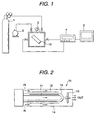
- the sample 12 was wound round a cold cathode lamp 15 of an evaluation unit 10 once, fixed by a stapler and covered around with a SUS case 14 (40 mm ⁇ ⁇ 170 mm).
- the evaluation unit was then connected with a DC cable in a vacuum desiccator 3 and inserted in this 8-liter vacuum desiccator 3. After a vacuum pump 2 was connected with the vacuum desiccator 3, pressure reduction was continued even to a gauge pressure of 700 to 750 mmHg.
- the vacuum desiccator 3 was then filled to be a normal pressure with a standard gas from a bomb 1 of a nitrogengas-base acetaldehyde standard gas (140 ppm) produced by Nippon Sanso Corporation.
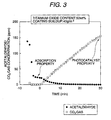
- a decline of the concentration of acetaldehyde was monitored by a photo acoustic gas monitor 4 by moving only an blower 13 and a difference between the acetaldehyde concentration at the time when the adsorption amount reached equilibrium and 140 ppm, that is, the initial concentration was determined as an adsorption amount (refer to FIG. 3).
- Example 2 In each of Examples 2 to 6, in a similar manner to Example 1 except for the change of a composition ratio (weight ratio) of the coating solution, a mesh-like adsorption sheet was prepared and its adsorption and photocatalyst properties were evaluated.
- a glass fiber mesh (“KS5241", trade name; product of KANEBO, LTD.) having a mesh number of 16 was cut into a piece of 300 mm x 450 mm, whereby a glass fiber mesh base material for hand coating was formed.
- a coating solution having a base concentration of 35 wt.% was obtained by mixing a PTFE dispersed solution ("XAD936", trade name; product of Asahi Glass Fluoropolymers Co., Ltd., having a base concentration of 60 wt.%), titanium oxide ("NTI-4", trade name; product of Resino Color Industry Co., Ltd., average particle size: 0.3 ⁇ m) and distilled water to give a PTFE:titanium oxide composition ratio (weight ratio) of 9:1, followed by stirring. The whole surface of the above-described glass fiber mesh base material was dipped in the resulting coating solution.
- the glass fiber mesh base material thus dipped was pulled up and the surface was die coated by two wire bars (#3) to have a uniform film thickness (coating buildup: 40 g/m 2 ).
- the resulting base material was then subjected to preliminary drying (removal of water) at 120°C x 2 minutes, sintering at 390°C x 2 minutes, and thermal treatment at 300°C x 20 hours in a drying oven to decompose and remove the surfactant in the PTFE dispersed solution and the sizing agent of the glass fiber mesh base material, whereby a mesh-like adsorption sheet was obtained. Adsorption and photocatalyst properties of the sheet thus obtained were evaluated as described above.
- Example 8 In each of Examples 8 to 12, in a similar manner to Example 7 except for the change of a composition ratio (weight ratio) of the coating solution, a mesh-like adsorption sheet was prepared and its adsorption and photocatalyst properties were evaluated.
- a glass fiber cloth (“K48K104", trade name; product of Arisawa Seisakujo) having a thickness of 50 ⁇ m was cut into a piece of 300 mm x 450 mm, whereby a glass fiber cloth base material for hand coating was formed.
- a coating solution having a base concentration of 35 wt.% was obtained by mixing a PTFE dispersed solution ("XAD936", trade name; product of Asahi Glass Fluoropolymers Co., Ltd., having a base concentration of 60 wt.%), titanium oxide ("NTI-4", trade name; product of Resino Color Industry Co., Ltd., average particle size: 0.3 ⁇ m) and distilled water to give a PTFE:titanium oxide composition ratio (weight ratio) of 6:4, followed by stirring. The whole surface of the above-described glass fiber cloth base material was dipped in the resulting coating solution.
- the glass fiber cloth base material thus dipped was pulled up and the surface was dip coated by two wire bars (#3) to have a uniform film thickness (coating buildup: 40 g/m 2 ).
- the resulting base material was then subjected to preliminary drying (removal of water) at 120°C x 2 minutes, sintering at 390°C x 2 minutes, and thermal treatment at 300°C x 20 hours in a drying oven to decompose and remove the surfactant in the PTFE dispersed solution and the sizing agent of the glass fiber cloth base material, whereby an adsorption sheet composed of a glass fiber cloth base material was obtained. Adsorption and photocatalyst properties of the sheet thus obtained were evaluated as described above.
- Example 13 In a similar manner to Example 13 except for the use of an aluminum foil base material for hand coating obtained by cutting a 50 ⁇ m thick aluminum foil ("Aluminum 1N30", trade name; product of Toyo Aluminum K.K.) into a piece of 300 mm x 450 mm, an adsorption sheet composed of an aluminum base material was produced and its adsorption and photocatalyst properties were evaluated.
- an aluminum foil base material for hand coating obtained by cutting a 50 ⁇ m thick aluminum foil ("Aluminum 1N30", trade name; product of Toyo Aluminum K.K.) into a piece of 300 mm x 450 mm.
- Example 13 In a similar manner to Example 13 except for the use of a polyimide film base material for hand coating obtained by cutting a 50 ⁇ m thick polyimide film ("KAPTON 100H", trade name; product of Du Pont-Toray Co., Ltd.) into a piece of 300 mm x 450 mm, an adsorption sheet composed of a polyimide film base material was produced and its adsorption and photocatalyst properties were evaluated.
- a polyimide film base material for hand coating obtained by cutting a 50 ⁇ m thick polyimide film ("KAPTON 100H", trade name; product of Du Pont-Toray Co., Ltd.) into a piece of 300 mm x 450 mm.
- Example 17 In a similar manner to Example 13 except for the use of a polytetrafluoroethylene film base material for hand coating obtained by cutting a 50 ⁇ m thick polytetrafluoroethylene film ("NITOFLON No. 900", trade name; product of NITTO DENKO CORPORATION) into a piece of 300 mm x 450 mm, an adsorption sheet composed of a polytetrafluoroethylene film base material was produced and its adsorption and photocatalyst properties were evaluated. (Example 17)
- a glass fiber mesh (“KS5241", trade name; product of KANEBO, LTD.) having a mesh number of 16 was cut into a piece of 300 mm x 450 mm, whereby a glass fiber mesh base material for hand coating was formed.
- a coating solution having a base concentration of 30 wt.% was obtained by mixing a PTFE dispersed solution ("XAD936", trade name; product of Asahi Glass Fluoropolymers Co., Ltd., having a base concentration of 60 wt.%), titanium oxide ("NTI-4", trade name; product of Resino Color Industry Co., Ltd., average particle size: 0.3 ⁇ m) and distilled water to give a PTFE:titanium oxide composition ratio (weight ratio) of 6:4, followed by stirring. The whole surface of the above-described glass fiber mesh base material was dipped in the resulting coating solution.
- the glass fiber mesh base material thus dipped was pulled up and the surface was die coated by two wire bars (#3) to have a uniform film thickness (coating buildup: 25 g/m 2 ).
- the resulting base material was then subjected to preliminary drying (removal of water) at 120°C x 2 minutes, sintering at 390°C x 2 minutes, and thermal treatment at 300°C x 20 hours in a drying oven to decompose and remove the surfactant in the PTFE dispersed solution and the sizing agent of the glass fiber mesh base material, whereby a mesh-like adsorption sheet was obtained. Adsorption and photocatalyst properties of the sheet thus obtained were evaluated as described above.
- a glass fiber mesh (“KS5241", trade name; product of KANEBO, LTD.) having a mesh number of 16 was cut into a piece of 300 mm x 450 mm, whereby a glass fiber mesh base material for hand coating was formed.
- a coating solution having a base concentration of 35 wt.% was obtained by mixing a PTFE dispersed solution ("XAD936", trade name; product of Asahi Glass Fluoropolymers Co., Ltd., having a base concentration of 60 wt.%), titanium oxide ("NTI-4", trade name; product of Resino Color Industry Co., Ltd., average particle size: 0.3 ⁇ m) and distilled water to give a PTEE:titanium oxide composition ratio (weight ratio) of 8:2, followed by stirring. The whole surface of the above-described glass fiber mesh base material was dipped in the resulting coating solution.
- the glass fiber mesh base material thus dipped was pulled up and the surface was die coated by two wire bars (#3) to have a uniform film thickness.
- the resulting base material was then subjected to preliminary drying (removal of water) at 120°C x 2 minutes and sintering at 390°C x 2 minutes. This coating procedure was repeated twice, whereby a sample having a coating buildup of 80 g/m 2 was obtained.
- thermal treatment of the sample at 300°C x 20 hr the surfactant in the PTFE dispersed solution and sizing agent of the glass fiber mesh base material were decomposed and removed, whereby a mesh-like adsorption sheet was obtained. Adsorption and photocatalyst properties of the sheet thus obtained were evaluated as described above.
- a silicone fluoride releasing agent was applied to a 50 ⁇ m thick aluminum foil ("Aluminum 1N30", trade name; product of Toyo Aluminum K.K.) at a coat weight of 0.05 to 0.5 g/m 2 and the resulting foil was cut into a piece of 300 mm x 450 mm, whereby a releasable aluminum-foil base material for hand coating was obtained.
- Al foil 1N30 trade name; product of Toyo Aluminum K.K.
- a coating solution having a base concentration of 30 wt.% was obtained by mixing a PTFE dispersed solution ("XAD936", trade name; product of Asahi Glass Fluoropolymers Co., Ltd., having a base concentration of 60 wt.%), titanium oxide ("NTI-4", trade name; product of Resino Color Industry Co., Ltd., average particle size: 0.3 ⁇ m) and distilled water to give a PTFE:titanium oxide composition ratio (weight ratio) of 6:4, followed by stirring.
- a PTFE dispersed solution ("XAD936", trade name; product of Asahi Glass Fluoropolymers Co., Ltd., having a base concentration of 60 wt.%)
- titanium oxide trade name; product of Resino Color Industry Co., Ltd., average particle size: 0.3 ⁇ m
- distilled water distilled water
- the releasable base material thus dipped was pulled up and the surface was die coated by two wire bars (#3) to have a uniform film thickness (coating buildup: 25 g/m 2 ).
- the resulting base material was then subjected to preliminary drying (drying of water) at 120°C x 2 minutes, sintering at 390°C x 2 minutes, and thermal treatment at 300°C x 20 hours in a drying oven to decompose and remove the surfactant in the PTFE dispersed solution.
- the coated film was peeled from the releasable aluminum-foil base material to yield a base-material-free adsorption sheet (coating buildup: 25 g/m 2 ). Adsorption and photocatalyst properties of the sheet thus obtained were evaluated as described above.
- a silicone fluoride releasing agent was applied to a 50 ⁇ m thick aluminum foil ("Aluminum 1N30", trade name; product of Toyo Aluminum K.K.) at a coat weight of 0.05 to 0.5 g/m 2 and the resulting foil was cut into a piece of 300 mm x 450 mm, whereby a releasable aluminum-foil base material for hand coating was obtained.
- Al foil 1N30 trade name; product of Toyo Aluminum K.K.
- a coating solution having a base concentration of 30 wt.% was obtained by mixing a PTFE dispersed solution ("XAD936", trade name; product of Asahi Glass Fluoropolymers Co., Ltd., having a base concentration of 60 wt.%), titanium oxide ("NTI-4", trade name; product of Resino Color Industry Co., Ltd., average particle size: 0.3 ⁇ m) and distilled water to give a PTFE:titanium oxide composition ratio (weight ratio) of 8:2, followed by stirring.
- a PTFE dispersed solution ("XAD936", trade name; product of Asahi Glass Fluoropolymers Co., Ltd., having a base concentration of 60 wt.%)
- titanium oxide trade name; product of Resino Color Industry Co., Ltd., average particle size: 0.3 ⁇ m
- distilled water distilled water
- the releasable base material thus dipped was pulled up and the surface was die coated by two wire bars (#3) to have a uniform film thickness.
- the resulting base material was then subjected to preliminary drying (removal of water) at 120°C x 2 minutes and sintering at 390°C x 2 minutes. This coating procedure was repeated twice to obtain a sample having a coating buildup of 80 g/m 2 .
- the sample was then thermally treated at 300°C for 20 hours to decompose and remove the surfactant in the PTFE dispersed solution.
- the coating film was peeled from the releasable aluminum-foil base material to yield a base-material-free adsorption sheet (coating buildup: 80 g/m 2 ). Adsorption and photocatalyst properties of the sheet thus obtained were evaluated as described above.
- a glass fiber mesh (“KS5241", trade name; product of KANEBO, LTD.) having a mesh number of 16 was cut into a piece of 300 mm x 450 mm, whereby a glass fiber mesh base material for hand coating was formed.
- a coating solution having a base concentration of 35 wt.% was obtained by mixing a PTFE dispersed solution ("XAD936", trade name; product of Asahi Glass Fluoropolymers Co., Ltd., having a base concentration of 60 wt.%), titanium oxide ("AC-10", trade name; product of Dainichiseika Color & Chemicals Mfg. Co., Ltd., average particle size: 1.5 ⁇ m) and distilled water to give a PTFE:titanium oxide composition ratio (weight ratio) of 8:2, followed by stirring. The whole surface of the above-described glass fiber mesh base material was dipped in the resulting coating solution.
- the glass fiber mesh base material thus dipped was pulled up and the surface was dice coated by two wire bars (#3) to have a uniform film thickness (coating buildup: 40 g/m 2 ).
- the resulting base material was then subjected to preliminary drying (removal of water) at 120°C x 2 minutes, sintering at 390°C x 2 minutes and thermal treatment at 300°C x 20 hr to decompose and remove the surfactant in the PTFE dispersed solution and sizing agent of the glass fiber mesh base material, whereby a mesh-like adsorption sheet was obtained. Adsorption and photocatalyst properties of the sheet thus obtained were evaluated as described above.
- Example 23 In a similar manner to Example 21 except for the change of the composition ratio (weight ratio) of the coating solution, a mesh-like adsorption sheet was obtained and its adsorption and photocatalyst properties were evaluated. (Example 23)
- a glass fiber mesh (“KS5241", trade name; product of KANEBO, LTD.) having a mesh number of 16 was cut into a piece of 300 mm x 450 mm, whereby a glass fiber mesh base material for hand coating was formed.
- a coating solution having a base concentration of 35 wt.% was obtained by mixing a PFA dispersed solution ("AD2CR”, trade name; product of Daikin Industries, Ltd., having a base concentration of 60 wt.%), titanium oxide ("NTI-4", trade name; product of Resino Color Industry Co., Ltd., average particle size: 0.3 ⁇ m) and distilled water to give a PFA;titanium oxide composition ratio (weight ratio) of 6:4, followed by stirring.
- the whole surface of the above-described glass fiber mesh material was dipped in the resulting coating solution.
- the glass fiber mesh base material thus dipped was pulled up and its surface was die coated by two wire bars (#3) to have a uniform film thickness (coating buildup: 40 g/m 2 ).
- the resulting base material was then subjected to preliminary drying (removal of water) at 120°C x 2 minutes, sintering at 390°C x 2 minutes, and thermal treatment at 300°C x 20 hours in a drying oven to decompose and remove the surfactant in the PFA dispersed solution and sizing agent of the glass fiber mesh base material, whereby a mesh-like adsorption sheet was obtained. Adsorption and photocatalyst properties of the sheet thus obtained were evaluated as described above.
- a glass fiber mesh (“KS5241", trade name; product of KANEBO, LTD.) having a mesh number of 16 was cut into a piece of 300 mm x 450 mm, whereby a glass fiber mesh base material for hand coating was formed.
- a coating solution having a base concentration of 35 wt.% was obtained by mixing an FEP dispersed solution ("ND-1", trade name; product of Daikin Industries, Ltd., having a base concentration of 60 wt.%), titanium oxide ("NTI-4", trade name; product of Resino Color Industry Co., Ltd., average particle size: 0.3 ⁇ m) and distilled water to give an FEP:titanium oxide composition ratio (weight ratio) of 6:4, followed by stirring.
- the whole surface of the glass fiber mesh base material was dipped in the resulting coating solution.
- the glass fiber mesh base material thus dipped was pulled up and the surface was die coated by two wire bars (#3) to have a uniform film thickness (coating buildup: 40 g/m 2 ).
- the resulting base material was then subjected to preliminary drying (removal of water) at 120°C x 2 minutes, sintering at 390°C x 2 minutes, and thermal treatment at 300°C x 20 hours in a drying oven to decompose and remove the surfactant in the FEP dispersed solution and sizing agent of the glass fiber mesh base material, whereby a mesh-like adsorption sheet was obtained. Adsorption and photocatalyst properties of the sheet thus obtained were evaluated as described above.
- Example 10 After evaluation of the adsorption property of the sample obtained in Example 10, it was exposed to a sun light for 1 hour and its adsorption property upon repeated use was evaluated by the above-described evaluation procedure of the adsorption property.
- Example 25 The operation of Example 25 was repeated 5 times and the adsorption property after 5-times repeated use was evaluated.
- Example 11 After evaluation of the adsorption property of the sample obtained in Example 11, the sample was thermally treated at 300°C for 2 hours. Then, the adsorption property upon repeated use was evaluated in accordance with the evaluation procedure as described above.
- Example 27 After repetition of the operations in Example 27 five times, the adsorption property after 5-times repeated use was evaluated.
- a glass fiber mesh (“KS5241", trade name; product of KANEBO, LTD.) having a mesh number of 16 was cut into a piece of 300 mm x 450 mm, whereby a glass fiber mesh base material for hand coating was formed.
- a coating solution having a base concentration of 35 wt.% was obtained by mixing a PTFE dispersed solution ("XAD936", trade name; product of Asahi Glass Fluoropolymers Co., Ltd., having a base concentration of 60 wt.%), zinc oxide ("NZN-4", trade name; product of Resino Color Industry Co., Ltd., average particle size: 0.3 ⁇ m) and distilled water to give a PTFE:zinc oxide composition ratio (weight ratio) of 8:2, followed by stirring. The whole surface of the above-described glass fiber mesh base material was dipped in the resulting coating solution.
- the glass fiber mesh base material thus dipped was pulled up and the surface was die coated by two wire bars (#3) to have a uniform film thickness (coating buildup: 40 g/m 2 ).
- the resulting base material was then subjected to preliminary drying (removal of water) at 120°C x 2 minutes, sintering at 390°C x 2 minutes, and thermal treatment at 300°C x 20 hours in a drying oven to decompose and remove the surfactant in the PTFE dispersed solution and the sizing agent of the glass fiber mesh base material, whereby a mesh-like adsorption sheet was obtained. Adsorption and photocatalyst properties of the sheet thus obtained were evaluated as described above.
- Comp. Ex. 1 Comp. Ex. 2 Amount of zinc oxide having an average particle size of 0.3 ⁇ m (wt.%) 20 40 Amount of PTFE powders (wt.%) 80 60 Kind of base material Glass mesh, 16 mesh Glass mesh, 16 mesh Coating buildup (g/m 2 ) 40 40 Adsorption amount of acetaldehyde (ppm) 6.1 7.3 Amount of CO 2 after exposure to UV rays for 30 min. (ppm) 19.5 23.8
Landscapes
- Chemical & Material Sciences (AREA)
- Analytical Chemistry (AREA)
- Chemical Kinetics & Catalysis (AREA)
- Organic Chemistry (AREA)
- Physics & Mathematics (AREA)
- Inorganic Chemistry (AREA)
- General Chemical & Material Sciences (AREA)
- Oil, Petroleum & Natural Gas (AREA)
- Engineering & Computer Science (AREA)
- Thermal Sciences (AREA)
- Health & Medical Sciences (AREA)
- Electromagnetism (AREA)
- General Health & Medical Sciences (AREA)
- Toxicology (AREA)
- Catalysts (AREA)
- Disinfection, Sterilisation Or Deodorisation Of Air (AREA)
- Exhaust Gas Treatment By Means Of Catalyst (AREA)
- Solid-Sorbent Or Filter-Aiding Compositions (AREA)
Abstract
Described are a gas adsorbent which comprises anatase
titanium oxide as an adsorbent, preferably, the gas
adsorbent obtained by sintering anatase titanium oxide
together with fluoro-carbon resin particles, and having an
adsorption layer containing 20 wt.% or greater of anatase
titanium oxide; and a using method of the gas adsorbent.
The gas adsorbent according to the invention has adsorption
performance of an odorous substance, can be regenerated in a
simple manner and permits decomposition of the adsorbed
ingredient upon regeneration.
Description
- The present invention relates to a gas adsorbent containing as an adsorbent a specific photocatalyst and a using method of this gas adsorbent. More specifically, the invention relates to a gas adsorbent which is usable again by decomposing and removing therefrom the component, which has been adsorbed to the adsorbent, through exposure to light or heating and a using method of the gas adsorbent.
- As an adsorption sheet used for an air cleaner, treatment unit for polluted water or water purifier, conventionally known are that obtained by bonding and retaining an adsorbent such as activated charcoal or zeolite on the surface or inside of a sheet and that obtained by processing a fibrous adsorbent into a sheet. More specifically, an adsorption sheet obtained by processing fibrous activated charcoal into a felt or paper form, that obtained by electrically filling fibrous activated charcoal in a urethane foam and that formed as a complex of activated charcoal with spun bonded nonwoven sheet are known ("JAPAN NONWOVENS REPORT", pp.10-16, published on November 10, 1999).
- The above-described adsorption sheets are however accompanied with the problem that when the sheets continue to adsorb an odorous substance or harmful substance from the air or water, their adsorption capacity inevitably becomes saturated within a predetermined term and exchange or disposal at predetermined intervals must be required. The adsorbent can be regenerated after desorption of the components adsorbed thereto, but for heightening the regeneration efficiency, heating at high temperatures are necessary, which poses problems in cost and durability. In addition, even if an odorous substance or harmful substance is desorbed from the adsorbent, it must be decomposed by another equipment.
- An object of the present invention is therefore to provide a gas adsorbent which has adsorbing performance of an odorous substance, can be regenerated by a simple manner and permits decomposition of adsorbed ingredients upon regeneration; and a using method thereof.
- The present inventors have carried out an extensive investigation to attain the above-described object. As a result, it has been found that use of anatase titanium oxide as an adsorbent makes it possible to attain the above-described object, leading to the completion of the invention.
- In one aspect of the invention, there is thus provided a gas adsorbent comprising anatase titanium oxide as a principal adsorbent.
- The above-described gas adsorbent is preferred to be obtained by sintering anatase titanium oxide together with fluoro-carbon resin particles and have an adsorption layer containing 20 to 80 wt.% of anatase titanium oxide.
- The above-described gas adsorbent is preferred to have the adsorption layer formed on the surface of a heat-resistible base material sheet or formed into a sheet, each in an amount of 20 g/m2 or greater.
- The above-described gas adsorbent is preferred to be used after regeneration by decomposing and removing therefrom the component, which has been adsorbed to the gas adsorbent, through exposure to light or heating.
- In another aspect of the invention, there is also provided a using method of any one of the above-described gas adsorbents, which comprises adsorbing a gas to the gas adsorbent, subjecting the resulting gas adsorbent to exposure to a sun light or UV lamp, thereby decomposing and removing the adsorbed ingredient, and using the thus-regenerated gas adsorbent for adsorption again.
- Alternatively, the method comprises adsorbing a gas to the gas adsorbent, heating the gas adsorbent at 200 to 300°C, thereby decomposing and removing therefrom the adsorbed ingredient, and using the thus-regenerated gas adsorbent for adsorption again.
- A gas adsorbent according to the invention enables, as shown in the results of Examples which will be described later, adsorption of an odorous substance such as aldehyde on a practical level owing to anatase titanium oxide acting as an adsorbent. In addition, owing to effects of anatase titanium oxide as a photocatalyst or decomposition catalyst, the adsorbent can be regenerated after decomposition and removal of the adsorbed ingredient by a simple treatment such as exposure to light or heating. As a result, the adsorbent of the invention has adsorbing performance of an odorous substance, can be regenerated by a simple manner and permits decomposition of the adsorbed ingredient upon regeneration. Accordingly, the adsorbent, which must otherwise be exchanged or disposed at predetermined intervals after adsorption capacity is saturated, can be used in repetition and its life can be extended, making it possible to save the cost spent for exchange.
- When the gas adsorbent of the invention is obtained by sintering anatase titanium oxide together with fluoro-carbon resin particles and its adsorption layer contains 20 to 80 wt.% of anatase titanium oxide, adsorption and catalyst properties of it can be exhibited efficiently because anatase titanium oxide is suitably retained in the sintered fluoro-carbon resin particles and its content is appropriate.
- When the gas adsorbent of the invention has the adsorption layer formed on the surface of a heat-resistible base material sheet or formed into a sheet, each in an amount of 20 g/m2 or greater, it can be handled more readily because the gas adsorbent in the form of a sheet is able to have an increased effective contact area with a component to be adsorbed, and adsorption and catalyst properties of it can be improved further because the formation amount of the adsorption layer is appropriate.
- The gas adsorbent of the invention has effects and advantages as described above so that it is preferred to be used again after regenerated by decomposition and removal of the adsorbed ingredient by exposure to light or by heating.
- Since the using method of the gas adsorbent according to the invention employs the gas adsorbent of the invention having the above-described effects and advantages, the gas adsorbent can be regenerated in a simple manner by subjecting it to exposure to a sun light or UV lamp after adsorption of an odorous substance, thereby decomposing and removing the adsorbed ingredient. In addition, in this method, the adsorbed ingredient can be decomposed upon regeneration.
- Similar effects and advantages are also available from another using method of the invention wherein the adsorbent is regenerated by decomposing and removing the adsorbed ingredient by heating at 200 to 300°C.
-
- FIG. 1 is a schematic view illustrating an apparatus used for evaluation of adsorption performance in Examples and Comparative Examples.
- FIG. 2 is a cross-sectional view illustrating the evaluation unit of the apparatus shown in FIG. 1.
- FIG. 3 is a graph showing the results of adsorption and photocatalyst properties in Example 11.
-
- The gas adsorbent of the invention contains anatase titanium oxide as an adsorbent. From the viewpoints of adsorption and catalyst properties, anatase titanium oxide in the form of powders having an average particle size of 0.2 to 5.0 µm is preferred. Examples of anatase titanium oxide powders include commercially available products such as "ST-01" (trade name; product of Ishihara Sangyo Co., Ltd.), an aqueous dispersion of anatase titanium oxide powders "NTI-4" (trade name; product of Resino Color Industry Co., Ltd.) and an aqueous dispersion of anatase titanium oxide powders "AC-10" (trade name; product of Dainichiseika Color & Chemicals Mfg. Co., Ltd.).
- Anatase titanium oxide can be held, similar to particulate activated charcoal or zeolite particles, directly or through a binder on a support ordinarily employed for a conventional adsorbent, but it is preferred to sinter anatase titanium oxide together with fluoro-carbon resin particles to form an adsorption layer. The adsorption layer thus formed preferably contains 20 to 80 wt.%, more preferably 30 to 60 wt.% of anatase titanium oxide. The content of anatase titanium oxide influences on the adsorption amount of an odorous substance or harmful substance. When the content is less than 20 wt.%, the adsorption performance tends to be insufficient, while the content exceeding 80 wt.% tend to cause a marked deterioration in the mechanical strength.
- The adsorption layer as described above can be formed suitably by applying a dispersion of fluoro-carbon resin particles and photocatalyst particles of titanium oxide to a base material, followed by sintering. Preferred examples of fluoro-carbon resin particles include polytetrafluoroethylene (PTFE) powders, polytetrafluoroethylene·perfluoroalkylvinyl ether copolymer (PFA) powders and polytetrafluoroethylene·hexafluoropropylene copolymer (FEP) powders. The above-described dispersion can be prepared by dispersing photocatalyst particles in a dispersion of the fluoro-carbon resin. As a dispersion of the polytetrafluoroethylene powders, commercially available products such as "XAD936" and "XAD639" (each trade name; product of Asahi Glass Fluoropolymers Co., Ltd.) can be used. As a dispersion of the polytetrafluoroethylene·perfluoroalkylvinyl ether copolymer powders, commercially available products such as "AD2CR" (trade name; product of Daikin Industries, Ltd.) are usable. As a dispersion of the polytetrafluoroethylene·hexapropylene copolymer powders, commercially available products such as "ND-1" (trade name; product of Daikin Industries, Ltd.) are usable.
- The gas adsorbent of the invention is preferably in the form of a sheet and such a gas adsorbent can be obtained by forming the above-described absorption layer on the surface of a heat-resistible base material sheet or forming the adsorption layer into a sheet. The adsorption layer may be formed on the surface of a heat-resistible base material by application of the above-exemplified dispersion onto the surface of the heat-resistible base material, followed by sintering, while the adsorption layer may be formed into a sheet by formation of the adsorption layer on the releasable surface of a heat-resistible base material sheet, followed by peeling. The formation amount of the adsorption layer at this time is preferably at least 20 g/m2, with 40 to 80 g/m2 being more preferred. Amounts less than 20 g/m2 tend to lower the adsorption performance.
- Examples of the heat-resistible base material usable in the invention include metal foils (ex. aluminum foil and SUS foil), metal mesh (ex. SUS mesh), glass fiber cloth, glass fiber mesh, heat-resistible plastic films (ex. polyimide film and polytetrafluoroethylene film), heat plastic clothes (ex. polyimide cloth and polytetrafluoroethylene cloth) and heat-resistible plastic mesh (ex. polyimide mesh), each having heat resistance of 300°C or greater.
- The gas adsorbent of the invention is preferably used again after regenerated by decomposition and removal of the adsorbed ingredient therefrom through exposure to light or heating. More specifically, the adsorbent which has been used for adsorption is employed again for adsorption after decomposition and removal therefrom of the adsorbed ingredient by exposure to a sun light or to UV lamp. Alternatively, the adsorbent which has been used for adsorption is employed again for adsorption after decomposition and removal therefrom of the adsorbed ingredient by heating at 200 to 300°C.
- Adsorption using the gas adsorbent of the invention can be carried out under similar conditions to that using a commercially available adsorption sheet and at this time, an adsorption property equal to that of the activated charcoal type adsorbent can be obtained. Examples of the gas to be adsorbed include acid gases such as acetaldehyde and formaldehyde, neutral gases such as toluene and xylene and basic gases such as ammonia. The gas adsorbent of the invention is also effective for the adsorption of gases of a low concentration not greater than 200 ppm.
- Exposure to light is conducted in a similar manner and under similar conditions to the case where a photocatalyst is employed. Any one of the above-exemplified gases can be decomposed through oxidation or the like by the gas adsorbent of the invention. Heating is preferably conducted for several hours at 200 to 300°C. At temperatures less than 200°C, a decomposition rate is not sufficient, while those exceeding 300°C tend to cause a marked thermal deterioration of the fluoro-carbon resin.
- Regeneration of the gas adsorbent by decomposition and removal therefrom of the adsorbed ingredient can be repeated at least 100 times without lowering its adsorption property by 10% or greater. Thus, the adsorbent of the invention has a long life.
- A description will next be made of Examples wherein the constitution and advantages of the invention are shown specifically.
- First, a glass fiber mesh ("KS5241", trade name; product of KAMEBO, LTD.) having a mesh number of 16 was cut into a piece of 300 mm x 450 mm, whereby a glass fiber mesh base material for hand coating was formed.
- In the next place, a coating solution having a base concentration of 40 wt.% was obtained by mixing a PTFE dispersed solution ("XAD936", trade name; product of Asahi Glass Fluoropolymers Co., Ltd., having a base concentration of 60 wt.%), titanium oxide ("ST-01", trade name; product of Ishihara Sangyo Co., Ltd., average particle size: 3.3 µm) and distilled water to give a PTFE:titanium oxide composition ratio (weight ratio) of 9:1, followed by stirring. The whole surface of the above-described glass fiber mesh base material was dipped in the resulting coating solution. The glass fiber mesh base material thus dipped was pulled up and the surface was die coated by two wire bars (#3) to have a uniform thickness (coating buildup: 40 g/mz). The resulting base material was then subjected to preliminary drying (removal of water) at 120°C x 2 minutes, sintering at 390°C x 2 minutes, and thermal treatment at 300°C x 20 hours in a drying oven to decompose and remove the surfactant in the PTFE dispersed solution and the sizing agent of the glass fiber mesh base material, whereby a mesh-like adsorption sheet was obtained. Adsorption and photocatalyst properties of the sheet thus obtained were evaluated in accordance with the below-described evaluation procedure of an adsorption property.
- The mesh-like adsorption sheet was cut into a sample piece of 110 mm × 165 mm. It was allowed to stand for 1 hour under a sun light to initialize the sample. As illustrated in FIG. 2, the
sample 12 was wound round acold cathode lamp 15 of anevaluation unit 10 once, fixed by a stapler and covered around with a SUS case 14 (40 mmØ × 170 mm). As illustrated in FIG. 1, the evaluation unit was then connected with a DC cable in avacuum desiccator 3 and inserted in this 8-liter vacuum desiccator 3. After avacuum pump 2 was connected with thevacuum desiccator 3, pressure reduction was continued even to a gauge pressure of 700 to 750 mmHg. - The
vacuum desiccator 3 was then filled to be a normal pressure with a standard gas from abomb 1 of a nitrogengas-base acetaldehyde standard gas (140 ppm) produced by Nippon Sanso Corporation. A decline of the concentration of acetaldehyde was monitored by a photoacoustic gas monitor 4 by moving only anblower 13 and a difference between the acetaldehyde concentration at the time when the adsorption amount reached equilibrium and 140 ppm, that is, the initial concentration was determined as an adsorption amount (refer to FIG. 3). When the adsorption amount of acetaldehyde reached equilibrium, aUV lamp 11 of theevaluation unit 10 was turned on and effects of a photocatalyst were found from the production amount of acarbon dioxide gas 30 minutes after exposure to UV rays (refer to FIG. 3). The measuring results at that time were output by a portable personal computer (the results of Example 11 were shown in FIG. 3). Theblower 13 at that time was in operation. - In each of Examples 2 to 6, in a similar manner to Example 1 except for the change of a composition ratio (weight ratio) of the coating solution, a mesh-like adsorption sheet was prepared and its adsorption and photocatalyst properties were evaluated.
- The above-described results are shown in Table 1.
Ex. 1 Ex. 2 Ex. 3 Ex. 4 Ex. 5 Ex. 6 Amount of titanium oxide having an average particle size of 3.3 µm (wt.%) 10 20 30 40 50 60 Amount of PTFE powders (wt.%) 90 80 70 60 50 40 Kind of base material Glass mesh, 16 mesh Glass mesh, 16 mesh Glass mesh, 16 mesh Glass mash, 16 mesh Glass mesh, 16 mesh Glass mesh, 16 mesh Coating buildup (g/m2) 40 40 40 40 40 40 Adsorption amount of acetaldehyde (ppm) 7.4 31.2 54.2 75.0 80.1 77.7 Amount of CO2 after exposure to UV rays for 30 minutes (ppm) 64.7 102.2 114.8 146.3 147.4 142.2 - From the results of Table 1, it has been found that the adsorption sheet obtained in any one of the above-described Examples permits adsorption of aldehyde and decomposition of it by UV rays and that the adsorption amount of the adsorption sheet showed a drastic increase by incorporating therein titanium oxide in an amount of at least 20 wt.%. (Example 7)
- First, a glass fiber mesh ("KS5241", trade name; product of KANEBO, LTD.) having a mesh number of 16 was cut into a piece of 300 mm x 450 mm, whereby a glass fiber mesh base material for hand coating was formed.
- In the next place, a coating solution having a base concentration of 35 wt.% was obtained by mixing a PTFE dispersed solution ("XAD936", trade name; product of Asahi Glass Fluoropolymers Co., Ltd., having a base concentration of 60 wt.%), titanium oxide ("NTI-4", trade name; product of Resino Color Industry Co., Ltd., average particle size: 0.3 µm) and distilled water to give a PTFE:titanium oxide composition ratio (weight ratio) of 9:1, followed by stirring. The whole surface of the above-described glass fiber mesh base material was dipped in the resulting coating solution. The glass fiber mesh base material thus dipped was pulled up and the surface was die coated by two wire bars (#3) to have a uniform film thickness (coating buildup: 40 g/m2). The resulting base material was then subjected to preliminary drying (removal of water) at 120°C x 2 minutes, sintering at 390°C x 2 minutes, and thermal treatment at 300°C x 20 hours in a drying oven to decompose and remove the surfactant in the PTFE dispersed solution and the sizing agent of the glass fiber mesh base material, whereby a mesh-like adsorption sheet was obtained. Adsorption and photocatalyst properties of the sheet thus obtained were evaluated as described above.
- In each of Examples 8 to 12, in a similar manner to Example 7 except for the change of a composition ratio (weight ratio) of the coating solution, a mesh-like adsorption sheet was prepared and its adsorption and photocatalyst properties were evaluated.
- The above-described results are shown in Table 2.
Ex. 7 Ex. 8 Ex. 9 Ex. 10 Ex. 11 Ex. 12 Amount of titanium oxide having an average particle size of 0.3 µm (wt.%) 10 20 30 40 50 60 Amount of PTFE powders (wt.%) 90 80 70 60 50 40 Kind of base material Glass mesh, 16 mesh Glass mesh, 16 mesh Glass mesh, 16 mesh Glass mesh, 16 mesh Glass mesh, 16 mesh Glass mesh, 16 mesh Coaling buildup (g/m2) 40 40 40 40 40 40 Adsorption amount of acetaldehyde (ppm) 19.4 56.6 96.4 108.7 116.3 125.6 Amounl of CO2 after exposure to UV rays for 30 minutes (ppm) 65.0 148.7 146.9 149.3 156.0 141.7 - From the results of Table 2, it has been found that the adsorption sheet obtained in any one of Examples 7 to 12 permits adsorption of aldehyde and decomposition of it by UV rays and the adsorption amount of the adsorption sheet showed a drastic increase by incorporating therein titanium oxide in an amount of at least 20 wt.%.
- First, a glass fiber cloth ("K48K104", trade name; product of Arisawa Seisakujo) having a thickness of 50 µm was cut into a piece of 300 mm x 450 mm, whereby a glass fiber cloth base material for hand coating was formed.
- In the next place, a coating solution having a base concentration of 35 wt.% was obtained by mixing a PTFE dispersed solution ("XAD936", trade name; product of Asahi Glass Fluoropolymers Co., Ltd., having a base concentration of 60 wt.%), titanium oxide ("NTI-4", trade name; product of Resino Color Industry Co., Ltd., average particle size: 0.3 µm) and distilled water to give a PTFE:titanium oxide composition ratio (weight ratio) of 6:4, followed by stirring. The whole surface of the above-described glass fiber cloth base material was dipped in the resulting coating solution. The glass fiber cloth base material thus dipped was pulled up and the surface was dip coated by two wire bars (#3) to have a uniform film thickness (coating buildup: 40 g/m2). The resulting base material was then subjected to preliminary drying (removal of water) at 120°C x 2 minutes, sintering at 390°C x 2 minutes, and thermal treatment at 300°C x 20 hours in a drying oven to decompose and remove the surfactant in the PTFE dispersed solution and the sizing agent of the glass fiber cloth base material, whereby an adsorption sheet composed of a glass fiber cloth base material was obtained. Adsorption and photocatalyst properties of the sheet thus obtained were evaluated as described above.
- In a similar manner to Example 13 except for the use of an aluminum foil base material for hand coating obtained by cutting a 50 µm thick aluminum foil ("Aluminum 1N30", trade name; product of Toyo Aluminum K.K.) into a piece of 300 mm x 450 mm, an adsorption sheet composed of an aluminum base material was produced and its adsorption and photocatalyst properties were evaluated.
- In a similar manner to Example 13 except for the use of a polyimide film base material for hand coating obtained by cutting a 50 µm thick polyimide film ("KAPTON 100H", trade name; product of Du Pont-Toray Co., Ltd.) into a piece of 300 mm x 450 mm, an adsorption sheet composed of a polyimide film base material was produced and its adsorption and photocatalyst properties were evaluated.
- In a similar manner to Example 13 except for the use of a polytetrafluoroethylene film base material for hand coating obtained by cutting a 50 µm thick polytetrafluoroethylene film ("NITOFLON No. 900", trade name; product of NITTO DENKO CORPORATION) into a piece of 300 mm x 450 mm, an adsorption sheet composed of a polytetrafluoroethylene film base material was produced and its adsorption and photocatalyst properties were evaluated. (Example 17)
- First, a glass fiber mesh ("KS5241", trade name; product of KANEBO, LTD.) having a mesh number of 16 was cut into a piece of 300 mm x 450 mm, whereby a glass fiber mesh base material for hand coating was formed.
- In the next place, a coating solution having a base concentration of 30 wt.% was obtained by mixing a PTFE dispersed solution ("XAD936", trade name; product of Asahi Glass Fluoropolymers Co., Ltd., having a base concentration of 60 wt.%), titanium oxide ("NTI-4", trade name; product of Resino Color Industry Co., Ltd., average particle size: 0.3 µm) and distilled water to give a PTFE:titanium oxide composition ratio (weight ratio) of 6:4, followed by stirring. The whole surface of the above-described glass fiber mesh base material was dipped in the resulting coating solution. The glass fiber mesh base material thus dipped was pulled up and the surface was die coated by two wire bars (#3) to have a uniform film thickness (coating buildup: 25 g/m2). The resulting base material was then subjected to preliminary drying (removal of water) at 120°C x 2 minutes, sintering at 390°C x 2 minutes, and thermal treatment at 300°C x 20 hours in a drying oven to decompose and remove the surfactant in the PTFE dispersed solution and the sizing agent of the glass fiber mesh base material, whereby a mesh-like adsorption sheet was obtained. Adsorption and photocatalyst properties of the sheet thus obtained were evaluated as described above.
- First, a glass fiber mesh ("KS5241", trade name; product of KANEBO, LTD.) having a mesh number of 16 was cut into a piece of 300 mm x 450 mm, whereby a glass fiber mesh base material for hand coating was formed.
- In the next place, a coating solution having a base concentration of 35 wt.% was obtained by mixing a PTFE dispersed solution ("XAD936", trade name; product of Asahi Glass Fluoropolymers Co., Ltd., having a base concentration of 60 wt.%), titanium oxide ("NTI-4", trade name; product of Resino Color Industry Co., Ltd., average particle size: 0.3 µm) and distilled water to give a PTEE:titanium oxide composition ratio (weight ratio) of 8:2, followed by stirring. The whole surface of the above-described glass fiber mesh base material was dipped in the resulting coating solution. The glass fiber mesh base material thus dipped was pulled up and the surface was die coated by two wire bars (#3) to have a uniform film thickness. The resulting base material was then subjected to preliminary drying (removal of water) at 120°C x 2 minutes and sintering at 390°C x 2 minutes. This coating procedure was repeated twice, whereby a sample having a coating buildup of 80 g/m2 was obtained. By thermal treatment of the sample at 300°C x 20 hr, the surfactant in the PTFE dispersed solution and sizing agent of the glass fiber mesh base material were decomposed and removed, whereby a mesh-like adsorption sheet was obtained. Adsorption and photocatalyst properties of the sheet thus obtained were evaluated as described above.
- The above-described results are shown in Table 3.
Ex. 13 Ex. 14 Ex. 15 Ex.16 Ex. 17 Ex. 18 Amount of titanium oxide having an average particle size of 03 µm (wt.%) 40 40 40 40 40 20 Amount of PTFE powders (wt.%) 60 60 60 60 60 80 Kind of base material Kind of base material Glass cloth (50 µm) Aluminum foll (50 µm) PT film (50 µm) PTFE film (50 µm) Glass mesh, 16 mesh Glass mesh, 16 mesh Coating buildup (g/m2) 40 40 40 40 25 80 Adsorption amount of acetaldehyde (ppm) 108.6 101.1 97.9 104.9 88.9 97.1 Amount of CO2 after exposure to UV rays for 30 minutes (ppm) 203.1 137.5 133.9 142.3 146.3 152.2 - From the results of Table 3, it has been found that any one of the above-described base materials exhibited good results and with an increase in the formation amount (coating buildup) of an adsorption layer from 25 g/m2, better results were available.
- First, a silicone fluoride releasing agent was applied to a 50 µm thick aluminum foil ("Aluminum 1N30", trade name; product of Toyo Aluminum K.K.) at a coat weight of 0.05 to 0.5 g/m2 and the resulting foil was cut into a piece of 300 mm x 450 mm, whereby a releasable aluminum-foil base material for hand coating was obtained.
- In the next place, a coating solution having a base concentration of 30 wt.% was obtained by mixing a PTFE dispersed solution ("XAD936", trade name; product of Asahi Glass Fluoropolymers Co., Ltd., having a base concentration of 60 wt.%), titanium oxide ("NTI-4", trade name; product of Resino Color Industry Co., Ltd., average particle size: 0.3 µm) and distilled water to give a PTFE:titanium oxide composition ratio (weight ratio) of 6:4, followed by stirring. The whole surface of the above-described releasable aluminum-foil base material was dipped in the resulting coating solution. The releasable base material thus dipped was pulled up and the surface was die coated by two wire bars (#3) to have a uniform film thickness (coating buildup: 25 g/m2). The resulting base material was then subjected to preliminary drying (drying of water) at 120°C x 2 minutes, sintering at 390°C x 2 minutes, and thermal treatment at 300°C x 20 hours in a drying oven to decompose and remove the surfactant in the PTFE dispersed solution.
- Then, the coated film was peeled from the releasable aluminum-foil base material to yield a base-material-free adsorption sheet (coating buildup: 25 g/m2). Adsorption and photocatalyst properties of the sheet thus obtained were evaluated as described above.
- First, a silicone fluoride releasing agent was applied to a 50 µm thick aluminum foil ("Aluminum 1N30", trade name; product of Toyo Aluminum K.K.) at a coat weight of 0.05 to 0.5 g/m2 and the resulting foil was cut into a piece of 300 mm x 450 mm, whereby a releasable aluminum-foil base material for hand coating was obtained.
- In the next place, a coating solution having a base concentration of 30 wt.% was obtained by mixing a PTFE dispersed solution ("XAD936", trade name; product of Asahi Glass Fluoropolymers Co., Ltd., having a base concentration of 60 wt.%), titanium oxide ("NTI-4", trade name; product of Resino Color Industry Co., Ltd., average particle size: 0.3 µm) and distilled water to give a PTFE:titanium oxide composition ratio (weight ratio) of 8:2, followed by stirring. The whole surface of the above-described releasable aluminum-foil base material was dipped in the resulting coating solution. The releasable base material thus dipped was pulled up and the surface was die coated by two wire bars (#3) to have a uniform film thickness. The resulting base material was then subjected to preliminary drying (removal of water) at 120°C x 2 minutes and sintering at 390°C x 2 minutes. This coating procedure was repeated twice to obtain a sample having a coating buildup of 80 g/m2. The sample was then thermally treated at 300°C for 20 hours to decompose and remove the surfactant in the PTFE dispersed solution.
- Then, the coating film was peeled from the releasable aluminum-foil base material to yield a base-material-free adsorption sheet (coating buildup: 80 g/m2). Adsorption and photocatalyst properties of the sheet thus obtained were evaluated as described above.
- First, a glass fiber mesh ("KS5241", trade name; product of KANEBO, LTD.) having a mesh number of 16 was cut into a piece of 300 mm x 450 mm, whereby a glass fiber mesh base material for hand coating was formed.
- In the next place, a coating solution having a base concentration of 35 wt.% was obtained by mixing a PTFE dispersed solution ("XAD936", trade name; product of Asahi Glass Fluoropolymers Co., Ltd., having a base concentration of 60 wt.%), titanium oxide ("AC-10", trade name; product of Dainichiseika Color & Chemicals Mfg. Co., Ltd., average particle size: 1.5 µm) and distilled water to give a PTFE:titanium oxide composition ratio (weight ratio) of 8:2, followed by stirring. The whole surface of the above-described glass fiber mesh base material was dipped in the resulting coating solution. The glass fiber mesh base material thus dipped was pulled up and the surface was dice coated by two wire bars (#3) to have a uniform film thickness (coating buildup: 40 g/m2). The resulting base material was then subjected to preliminary drying (removal of water) at 120°C x 2 minutes, sintering at 390°C x 2 minutes and thermal treatment at 300°C x 20 hr to decompose and remove the surfactant in the PTFE dispersed solution and sizing agent of the glass fiber mesh base material, whereby a mesh-like adsorption sheet was obtained. Adsorption and photocatalyst properties of the sheet thus obtained were evaluated as described above.
- In a similar manner to Example 21 except for the change of the composition ratio (weight ratio) of the coating solution, a mesh-like adsorption sheet was obtained and its adsorption and photocatalyst properties were evaluated. (Example 23)
- First, a glass fiber mesh ("KS5241", trade name; product of KANEBO, LTD.) having a mesh number of 16 was cut into a piece of 300 mm x 450 mm, whereby a glass fiber mesh base material for hand coating was formed.
- In the next place, a coating solution having a base concentration of 35 wt.% was obtained by mixing a PFA dispersed solution ("AD2CR", trade name; product of Daikin Industries, Ltd., having a base concentration of 60 wt.%), titanium oxide ("NTI-4", trade name; product of Resino Color Industry Co., Ltd., average particle size: 0.3 µm) and distilled water to give a PFA;titanium oxide composition ratio (weight ratio) of 6:4, followed by stirring. The whole surface of the above-described glass fiber mesh material was dipped in the resulting coating solution. The glass fiber mesh base material thus dipped was pulled up and its surface was die coated by two wire bars (#3) to have a uniform film thickness (coating buildup: 40 g/m2). The resulting base material was then subjected to preliminary drying (removal of water) at 120°C x 2 minutes, sintering at 390°C x 2 minutes, and thermal treatment at 300°C x 20 hours in a drying oven to decompose and remove the surfactant in the PFA dispersed solution and sizing agent of the glass fiber mesh base material, whereby a mesh-like adsorption sheet was obtained. Adsorption and photocatalyst properties of the sheet thus obtained were evaluated as described above.
- First, a glass fiber mesh ("KS5241", trade name; product of KANEBO, LTD.) having a mesh number of 16 was cut into a piece of 300 mm x 450 mm, whereby a glass fiber mesh base material for hand coating was formed.
- In the next place, a coating solution having a base concentration of 35 wt.% was obtained by mixing an FEP dispersed solution ("ND-1", trade name; product of Daikin Industries, Ltd., having a base concentration of 60 wt.%), titanium oxide ("NTI-4", trade name; product of Resino Color Industry Co., Ltd., average particle size: 0.3 µm) and distilled water to give an FEP:titanium oxide composition ratio (weight ratio) of 6:4, followed by stirring. The whole surface of the glass fiber mesh base material was dipped in the resulting coating solution. The glass fiber mesh base material thus dipped was pulled up and the surface was die coated by two wire bars (#3) to have a uniform film thickness (coating buildup: 40 g/m2). The resulting base material was then subjected to preliminary drying (removal of water) at 120°C x 2 minutes, sintering at 390°C x 2 minutes, and thermal treatment at 300°C x 20 hours in a drying oven to decompose and remove the surfactant in the FEP dispersed solution and sizing agent of the glass fiber mesh base material, whereby a mesh-like adsorption sheet was obtained. Adsorption and photocatalyst properties of the sheet thus obtained were evaluated as described above.
- The above-described results are shown in Table 4.
Ex. 19 Ex. 20 Ex. 21 Ex. 22 Ex. 23 Ex. 24 Amount of titanium oxide having an average particle size of 0.3 µm (wt.%) 40 20 - - 40 40 Amount of titanium oxide having an average particle size of 1.5 µm (wt.%) - - 20 40 - - Amount of PTFE powders (wt.%) 60 80 80 60 - - Amount of PFA powders (wt.%) - - - - 60 - Amount of FEP powders (wt.%) - - - - - 60 Kind of base material - - Glass mesh, 16 mesh Glass mesh, 16 mesh Glass mesh 16 mesh Glass mesh, 16 mesh Coating buildup (g/m2) 25 80 40 40 40 40 Adsorption amount of acetaldehyde (ppm) 97.7 102.4 54.1 103.9 94.9 97.6 Amount of CO2 after exposure to UV rays for 30 minutes (ppm) 201.4 147.1 97.7 116.3 143.1 142.4 - From the results of Table 4, it has been found that the base-material-free adsorption sheet or the adsorption sheet obtained using another resin also exhibited good results. (Example 25)
- After evaluation of the adsorption property of the sample obtained in Example 10, it was exposed to a sun light for 1 hour and its adsorption property upon repeated use was evaluated by the above-described evaluation procedure of the adsorption property.
- The operation of Example 25 was repeated 5 times and the adsorption property after 5-times repeated use was evaluated.
- After evaluation of the adsorption property of the sample obtained in Example 11, the sample was thermally treated at 300°C for 2 hours. Then, the adsorption property upon repeated use was evaluated in accordance with the evaluation procedure as described above.
- After repetition of the operations in Example 27 five times, the adsorption property after 5-times repeated use was evaluated.
- The above-described results are shown in Table 5.
Ex. 25 Ex. 26 Ex. 27 Ex. 28 Regeneration frequency by exposure to sun light (Sample of Ex. 10) 1 5 - - Regeneration frequency by heating (Sample of Example 11) - - 1 5 Adsorption amount of acetaldehyde (ppm) 106.3 110.1 114.8 118.1 Amount of CO2 after exposure to UV rays for 30 min. (ppm) 149.5 143.8 151.9 147.0 - From the results of Table 5, it has been found that regeneration by exposure to light or by heating hardly caused a deterioration in the performance.
- First, a glass fiber mesh ("KS5241", trade name; product of KANEBO, LTD.) having a mesh number of 16 was cut into a piece of 300 mm x 450 mm, whereby a glass fiber mesh base material for hand coating was formed.
- In the next place, a coating solution having a base concentration of 35 wt.% was obtained by mixing a PTFE dispersed solution ("XAD936", trade name; product of Asahi Glass Fluoropolymers Co., Ltd., having a base concentration of 60 wt.%), zinc oxide ("NZN-4", trade name; product of Resino Color Industry Co., Ltd., average particle size: 0.3 µm) and distilled water to give a PTFE:zinc oxide composition ratio (weight ratio) of 8:2, followed by stirring. The whole surface of the above-described glass fiber mesh base material was dipped in the resulting coating solution. The glass fiber mesh base material thus dipped was pulled up and the surface was die coated by two wire bars (#3) to have a uniform film thickness (coating buildup: 40 g/m2). The resulting base material was then subjected to preliminary drying (removal of water) at 120°C x 2 minutes, sintering at 390°C x 2 minutes, and thermal treatment at 300°C x 20 hours in a drying oven to decompose and remove the surfactant in the PTFE dispersed solution and the sizing agent of the glass fiber mesh base material, whereby a mesh-like adsorption sheet was obtained. Adsorption and photocatalyst properties of the sheet thus obtained were evaluated as described above.
- In a similar manner to Comparative Example 1 except for the change in the composition ratio (weight ratio) of the coating solution, a mesh-like adsorption sheet was obtained and adsorption and photocatalyst properties were evaluated.
- The above-described results are shown in Table 6.
Comp. Ex. 1 Comp. Ex. 2 Amount of zinc oxide having an average particle size of 0.3 µm (wt.%) 20 40 Amount of PTFE powders (wt.%) 80 60 Kind of base material Glass mesh, 16 mesh Glass mesh, 16 mesh Coating buildup (g/m2) 40 40 Adsorption amount of acetaldehyde (ppm) 6.1 7.3 Amount of CO2 after exposure to UV rays for 30 min. (ppm) 19.5 23.8 - From the results of Table 6, it has been found that the adsorption sheets using a photocatalyst other than titanium oxide hardly exhibited an adsorption property.
- An adsorption property of a commercially available adsorption sheet A ("Semia V" (regular type), trade name; product of Asahi Chemical Industry Co., Ltd.), a composite material of activated charcoal and spun-bond nonwoven sheet was evaluated in accordance with the above-described evaluation method.
- An adsorption property of a commercially available adsorption sheet B ("Semia V" (filter type), trade name; product of Asahi Chemical Industry Co., Ltd.), a composite material of activated charcoal and spun-bond nonwoven sheet was evaluated in accordance with the above-described evaluation method.
- After evaluation of the adsorption property of the sample obtained in Comparative Example 3, its adsorption property was evaluated again in accordance with the above-described evaluation method.
- After evaluation of the adsorption property of the sample obtained in Comparative Example 4, its adsorption property was evaluated again in accordance with the above-described evaluation method.
- The above-described results are shown in Table 7.
Comp. Ex. 3 Comp. Ex. 4 Comp. Ex. 5 Comp.Ex. 6 Commercially available adsorption sheet A B Re-evaluation of A after used for adsorption Re-evaluation of B after used for adsorption Adsorption amount of acetaldehyde (ppm) 94.3 125.3 10.7 3.9 - As the results of Table 7, it has been found that the adsorption sheets of Examples each exhibited a similar level of adsorption to commercially available adsorption sheets. It has also been found that when similar evaluation tests were repeated, the adsorption capacity of the commercially available adsorption sheets became saturated and they hardly exhibited adsorption performance.
Claims (8)
- A gas adsorbent comprising anatase titanium oxide as an adsorbent.
- The gas adsorbent according to claim 1, which is obtained by sintering anatase titanium oxide together with fluoro-carbon resin particles and comprises an adsorption layer containing 20 to 80 wt.% of the anatase titanium oxide.
- The gas adsorbent according to claim 1, which comprises one of an adsorption layer on a surface of a heat-resistible base material that is a sheet, and an adsorption layer that is a sheet, each of the adsorption layer is formed in an amount of 20 g/m2 or greater.
- The gas adsorbent according to claim 2, wherein the adsorption layer is formed on the surface of a heat-resistible base material sheet or the adsorption layer is formed into a sheet, each in an amount of 20 g/m2 or greater.
- The gas adsorbent according to claim 1, which is to be used again after regeneration by decomposing and removing an absorbed component, which is adsorbed to the gas adsorbent, upon one of light irradiation and heating.
- The gas adsorbent according to claim 1, wherein the anatase titanium oxide has an average particle size of 0.2 to 5.0 µm.
- A using method of a gas adsorbent, which comprises:adsorbing an adsorbed ingredient to a gas adsorbent comprising anatase titanium oxide as an adsorbent;subjecting the resulting gas adsorbent to exposure to one of a sun light an a UV lamp, so as to decompose and remove the adsorbed ingredient, and regenerate the gas adsorbent; andusing the thus-regenerated gas adsorbent for adsorption again.
- A using method of a gas adsorbent, which comprises:adsorbing an adsorbed ingredient to a gas adsorbent comprising anatase titanium oxide as an adsorbent;heating the gas adsorbent at 200 to 300°C, so as to decompose and remove the adsorbed ingredient, and regenerate the gas adsorbent; andusing the thus-regenerated gas adsorbent for adsorption again.
Applications Claiming Priority (2)
| Application Number | Priority Date | Filing Date | Title |
|---|---|---|---|
| JP2000121963 | 2000-04-24 | ||
| JP2000121963A JP2001300301A (en) | 2000-04-24 | 2000-04-24 | Gas adsorbent and method of using the same |
Publications (1)
| Publication Number | Publication Date |
|---|---|
| EP1149621A1 true EP1149621A1 (en) | 2001-10-31 |
Family
ID=18632509
Family Applications (1)
| Application Number | Title | Priority Date | Filing Date |
|---|---|---|---|
| EP01109873A Withdrawn EP1149621A1 (en) | 2000-04-24 | 2001-04-23 | Gas adsorbent and using method thereof |
Country Status (4)
| Country | Link |
|---|---|
| US (1) | US20020017192A1 (en) |
| EP (1) | EP1149621A1 (en) |
| JP (1) | JP2001300301A (en) |
| KR (1) | KR20010098845A (en) |
Cited By (2)
| Publication number | Priority date | Publication date | Assignee | Title |
|---|---|---|---|---|
| WO2008029115A1 (en) * | 2006-09-08 | 2008-03-13 | Porvair Filtration Group Limited | Co-sintered polymer structures |
| CN105107476A (en) * | 2015-08-26 | 2015-12-02 | 南昌航空大学 | Preparation method of self-cleaning intelligent adsorbing material |
Families Citing this family (6)
| Publication number | Priority date | Publication date | Assignee | Title |
|---|---|---|---|---|
| ITBG20020011A1 (en) * | 2002-03-29 | 2003-09-29 | Silvia Marabini | AUTOMATIC AND QUICK ANALYZER OF THE ACETALDEHYDE CONTENT IN PET PRODUCTS, PARTICULARLY PREFORMS AND ITS REALIZATION PROCEDURE. |
| JP2007029921A (en) * | 2005-07-29 | 2007-02-08 | Hideharu Osada | Gas component treatment method |
| JP2008194545A (en) * | 2006-05-12 | 2008-08-28 | Osada Giken Co Ltd | Method for oxidizing or decomposing target substances |
| JP4420051B2 (en) | 2007-03-28 | 2010-02-24 | ソニー株式会社 | Laser light generator |
| KR100931576B1 (en) * | 2007-11-30 | 2009-12-14 | 한국전자통신연구원 | Gas adsorption medium and adsorption pump apparatus having same |
| US20100095844A1 (en) * | 2008-10-17 | 2010-04-22 | Steril-Aire, Inc. | Portable room air purifier |
Citations (4)
| Publication number | Priority date | Publication date | Assignee | Title |
|---|---|---|---|---|
| DE3816599C1 (en) * | 1988-05-14 | 1989-03-16 | Huels Ag, 4370 Marl, De | Process for eliminating arsenic compounds from exhaust gases |
| EP0325133A1 (en) * | 1988-01-22 | 1989-07-26 | Hitachi, Ltd. | Apparatus for removing unpleasant odours |
| EP0668099A2 (en) * | 1991-10-31 | 1995-08-23 | Hitachi Zosen Corporation | Adsorbents for removing low-concentration nitrogen oxides |
| EP0950731A1 (en) * | 1996-12-13 | 1999-10-20 | Daikin Industries, Ltd. | Fibrous materials of fluororesins and deodorant and antibacterial fabrics made by using the same |
-
2000
- 2000-04-24 JP JP2000121963A patent/JP2001300301A/en active Pending
-
2001
- 2001-04-23 EP EP01109873A patent/EP1149621A1/en not_active Withdrawn
- 2001-04-24 KR KR1020010022121A patent/KR20010098845A/en not_active Ceased
- 2001-04-24 US US09/840,059 patent/US20020017192A1/en not_active Abandoned
Patent Citations (4)
| Publication number | Priority date | Publication date | Assignee | Title |
|---|---|---|---|---|
| EP0325133A1 (en) * | 1988-01-22 | 1989-07-26 | Hitachi, Ltd. | Apparatus for removing unpleasant odours |
| DE3816599C1 (en) * | 1988-05-14 | 1989-03-16 | Huels Ag, 4370 Marl, De | Process for eliminating arsenic compounds from exhaust gases |
| EP0668099A2 (en) * | 1991-10-31 | 1995-08-23 | Hitachi Zosen Corporation | Adsorbents for removing low-concentration nitrogen oxides |
| EP0950731A1 (en) * | 1996-12-13 | 1999-10-20 | Daikin Industries, Ltd. | Fibrous materials of fluororesins and deodorant and antibacterial fabrics made by using the same |
Cited By (2)
| Publication number | Priority date | Publication date | Assignee | Title |
|---|---|---|---|---|
| WO2008029115A1 (en) * | 2006-09-08 | 2008-03-13 | Porvair Filtration Group Limited | Co-sintered polymer structures |
| CN105107476A (en) * | 2015-08-26 | 2015-12-02 | 南昌航空大学 | Preparation method of self-cleaning intelligent adsorbing material |
Also Published As
| Publication number | Publication date |
|---|---|
| JP2001300301A (en) | 2001-10-30 |
| US20020017192A1 (en) | 2002-02-14 |
| KR20010098845A (en) | 2001-11-08 |
Similar Documents
| Publication | Publication Date | Title |
|---|---|---|
| JP4101873B2 (en) | Catalyst holding device and its production and use | |
| US11668222B2 (en) | Catalytic composite | |
| JP7326468B2 (en) | Large particle high performance catalyst tape | |
| JP2005279429A (en) | Chemical filter and manufacturing method thereof | |
| EP0398766A1 (en) | Ozone decomposing | |
| JP7322700B2 (en) | Multilayer filter media | |
| US20020017192A1 (en) | Gas adsorbent and using method thereof | |
| TWI387482B (en) | Air filter sheet, process for manufacturing same, and air filter | |
| JP2002017832A (en) | Deodorizing filter and manufacturing method thereof | |
| JPH11188085A (en) | Air purification unit | |
| JP2000210534A (en) | Photocatalytic deodorizing filter | |
| JP2005163243A (en) | Photocatalyst-carrying fibrous formed body | |
| EP2872247B1 (en) | Method for preparing highly porous microfibrous media with functional particles immobilized inside | |
| JP2006231324A (en) | Ozone-containing exhaust gas purification composition and ozone-containing exhaust gas purification filter | |
| JP4819367B2 (en) | Manufacturing method of air filter sheet | |
| JP2000093808A (en) | Photocatalyst sheet and photocatalyst sheet structure | |
| JP2002011312A (en) | Incinerator exhaust gas treatment filter and production method | |
| JPH11319580A (en) | Photocatalytic filter | |
| JP2002233718A (en) | Filter media for air filter | |
| JP2000237538A (en) | Photocatalytic air purification device | |
| JP2002096434A (en) | Hazardous gas treatment sheet and its manufacturing method | |
| JPH105545A (en) | Purification filter and method for producing the same | |
| JP2001205029A (en) | Chemical filter | |
| JP2000176294A (en) | Breathable photocatalyst structure and method of using the same | |
| JP2001259435A (en) | Photocatalyst carrier |
Legal Events
| Date | Code | Title | Description |
|---|---|---|---|
| PUAI | Public reference made under article 153(3) epc to a published international application that has entered the european phase |
Free format text: ORIGINAL CODE: 0009012 |
|
| AK | Designated contracting states |
Kind code of ref document: A1 Designated state(s): AT BE CH CY DE DK ES FI FR GB GR IE IT LI LU MC NL PT SE TR |
|
| AX | Request for extension of the european patent |
Free format text: AL;LT;LV;MK;RO;SI |
|
| AKX | Designation fees paid | ||
| REG | Reference to a national code |
Ref country code: DE Ref legal event code: 8566 |
|
| STAA | Information on the status of an ep patent application or granted ep patent |
Free format text: STATUS: THE APPLICATION IS DEEMED TO BE WITHDRAWN |
|
| 18D | Application deemed to be withdrawn |
Effective date: 20020601 |