EP1149576A1 - Composition pour la teinture d'oxydation des fibres kératiniques comprenant une 1-(4-aminophenyl)pyrroldine et un polymère épaississant à motif sucre - Google Patents
Composition pour la teinture d'oxydation des fibres kératiniques comprenant une 1-(4-aminophenyl)pyrroldine et un polymère épaississant à motif sucre Download PDFInfo
- Publication number
- EP1149576A1 EP1149576A1 EP01400880A EP01400880A EP1149576A1 EP 1149576 A1 EP1149576 A1 EP 1149576A1 EP 01400880 A EP01400880 A EP 01400880A EP 01400880 A EP01400880 A EP 01400880A EP 1149576 A1 EP1149576 A1 EP 1149576A1
- Authority
- EP
- European Patent Office
- Prior art keywords
- composition
- composition according
- aminophenyl
- radical
- weight
- Prior art date
- Legal status (The legal status is an assumption and is not a legal conclusion. Google has not performed a legal analysis and makes no representation as to the accuracy of the status listed.)
- Withdrawn
Links
Classifications
-
- A—HUMAN NECESSITIES
- A61—MEDICAL OR VETERINARY SCIENCE; HYGIENE
- A61K—PREPARATIONS FOR MEDICAL, DENTAL OR TOILETRY PURPOSES
- A61K8/00—Cosmetics or similar toiletry preparations
- A61K8/18—Cosmetics or similar toiletry preparations characterised by the composition
- A61K8/72—Cosmetics or similar toiletry preparations characterised by the composition containing organic macromolecular compounds
- A61K8/73—Polysaccharides
-
- A—HUMAN NECESSITIES
- A61—MEDICAL OR VETERINARY SCIENCE; HYGIENE
- A61K—PREPARATIONS FOR MEDICAL, DENTAL OR TOILETRY PURPOSES
- A61K8/00—Cosmetics or similar toiletry preparations
- A61K8/18—Cosmetics or similar toiletry preparations characterised by the composition
- A61K8/30—Cosmetics or similar toiletry preparations characterised by the composition containing organic compounds
- A61K8/49—Cosmetics or similar toiletry preparations characterised by the composition containing organic compounds containing heterocyclic compounds
- A61K8/4906—Cosmetics or similar toiletry preparations characterised by the composition containing organic compounds containing heterocyclic compounds with one nitrogen as the only hetero atom
- A61K8/4913—Cosmetics or similar toiletry preparations characterised by the composition containing organic compounds containing heterocyclic compounds with one nitrogen as the only hetero atom having five membered rings, e.g. pyrrolidone carboxylic acid
-
- A—HUMAN NECESSITIES
- A61—MEDICAL OR VETERINARY SCIENCE; HYGIENE
- A61K—PREPARATIONS FOR MEDICAL, DENTAL OR TOILETRY PURPOSES
- A61K8/00—Cosmetics or similar toiletry preparations
- A61K8/18—Cosmetics or similar toiletry preparations characterised by the composition
- A61K8/72—Cosmetics or similar toiletry preparations characterised by the composition containing organic macromolecular compounds
- A61K8/73—Polysaccharides
- A61K8/731—Cellulose; Quaternized cellulose derivatives
-
- A—HUMAN NECESSITIES
- A61—MEDICAL OR VETERINARY SCIENCE; HYGIENE
- A61K—PREPARATIONS FOR MEDICAL, DENTAL OR TOILETRY PURPOSES
- A61K8/00—Cosmetics or similar toiletry preparations
- A61K8/18—Cosmetics or similar toiletry preparations characterised by the composition
- A61K8/72—Cosmetics or similar toiletry preparations characterised by the composition containing organic macromolecular compounds
- A61K8/73—Polysaccharides
- A61K8/732—Starch; Amylose; Amylopectin; Derivatives thereof
-
- A—HUMAN NECESSITIES
- A61—MEDICAL OR VETERINARY SCIENCE; HYGIENE
- A61K—PREPARATIONS FOR MEDICAL, DENTAL OR TOILETRY PURPOSES
- A61K8/00—Cosmetics or similar toiletry preparations
- A61K8/18—Cosmetics or similar toiletry preparations characterised by the composition
- A61K8/72—Cosmetics or similar toiletry preparations characterised by the composition containing organic macromolecular compounds
- A61K8/73—Polysaccharides
- A61K8/733—Alginic acid; Salts thereof
-
- A—HUMAN NECESSITIES
- A61—MEDICAL OR VETERINARY SCIENCE; HYGIENE
- A61K—PREPARATIONS FOR MEDICAL, DENTAL OR TOILETRY PURPOSES
- A61K8/00—Cosmetics or similar toiletry preparations
- A61K8/18—Cosmetics or similar toiletry preparations characterised by the composition
- A61K8/72—Cosmetics or similar toiletry preparations characterised by the composition containing organic macromolecular compounds
- A61K8/73—Polysaccharides
- A61K8/737—Galactomannans, e.g. guar; Derivatives thereof
-
- A—HUMAN NECESSITIES
- A61—MEDICAL OR VETERINARY SCIENCE; HYGIENE
- A61Q—SPECIFIC USE OF COSMETICS OR SIMILAR TOILETRY PREPARATIONS
- A61Q5/00—Preparations for care of the hair
- A61Q5/10—Preparations for permanently dyeing the hair
Definitions
- the present invention relates to a composition for the oxidation dyeing of keratin fibers, in particular human keratin fibers such as hair, comprising, in a medium suitable for dyeing, at least one oxidation base chosen from 1- (4-aminophenyl) -pyrrolidines and their salts addition with an acid, and at least one thickening polymer comprising at least minus a sugar motif.
- oxidation bases in particular ortho- or para-phenylenediamines, ortho- or para-aminophenols, and heterocyclic bases.
- Oxidation dye precursors are compounds that are initially little or not colored which develop their tinctorial power within the hair in the presence oxidizing agents leading to the formation of colored compounds.
- the formation of these colored compounds results from either oxidative condensation "oxidation bases” on themselves, or an oxidative condensation of "oxidation bases” on color modifying compounds, or “couplers", which are generally present in dye compositions used in oxidation dyeing and are more particularly represented by metaphenylenediamines, meta-aminophenols and metadiphenols, and certain heterocyclic compounds.
- the dyes should also cover white hair, and be finally the least selective possible, that is to say to allow to obtain differences of weakest coloration possible throughout the same keratin fiber, which can indeed be sensitized differently (i.e. damaged) between its tip and its root.
- oxidation dyes capable of leading to colorations with varied, chromatic, powerful, aesthetic, not very selective, and resistant well to the various aggressions that fibers can undergo, by associating at least one oxidation base chosen from 1- (4-aminophenyl) -pyrrolidines and their addition salts with an acid and at least one thickening polymer comprising at least one sugar motif.
- saccharide motif means a portion monosaccharide (i.e. monosaccharide or oside or simple sugar) or a oligosaccharide portion (short chains formed from the sequence of units monosaccharides (possibly different) or a portion polysaccharide [long chains made up of monosaccharide units, possibly different, i.e. polyholosides or polysaccharides (homopolyosides or heteropolyosides)].
- the saccharide units can also be substituted by alkyl, or hydroxyalkyl, or alkoxy, or acyloxy, or carboxyl groups.
- the addition salts with an acid of 1- (4-aminophenyl) -pyrrolidines of formula (I) which can be used in the dye compositions according to the invention are in particular chosen from hydrochlorides, hydrobromides, sulfates, tartrates, lactates and acetates.
- the dye composition according to the invention thus defined, conducted after mixture with an oxidizing composition, to colorings in shades varied, chromatic, powerful, aesthetic, with low selectivity and excellent resistance properties both to agents atmospheric such as light and weather and vis-à-vis the sweating and various treatments that the hair can undergo.
- a ready-to-use composition for the oxidation dyeing of keratin fibers which comprises, in a medium suitable for dyeing, at least one 1- (4-aminophenyl) -pyrrolidine of formula (I), at least one thickening polymer comprising at least one sugar unit and at least one oxidizing agent.
- ready-to-use composition is meant within the meaning of the present invention, any composition intended to be applied immediately to keratin fibers.
- the invention also relates to a process for dyeing fiber oxidation.
- keratin, and in particular human keratin fibers such as hair consisting in applying a coloring composition to the fibers containing in a medium suitable for dyeing, at least one 1- (4-aminophenyl) -pyrrolidine of formula (I), the color being revealed at alkaline pH, neutral or acid using an oxidizing composition which is mixed just in time of use with the coloring composition or which is applied sequentially without intermediate rinsing, at least one thickening polymer comprising at least one sugar unit being present in the coloring composition and / or oxidizing.
- a coloring composition to the fibers containing in a medium suitable for dyeing, at least one 1- (4-aminophenyl) -pyrrolidine of formula (I), the color being revealed at alkaline pH, neutral or acid using an oxidizing composition which is mixed just in time of use with the coloring composition or which is applied sequentially without intermediate rinsing, at least one thickening polymer
- the invention also relates to dyeing devices with several compartments or "kits" for the oxidation dyeing of keratin fibers, in particular human keratin fibers such as the hair.
- Such devices comprise a first compartment containing at least one 1- (4-aminophenyl) -pyrrolidine of formula (I) and a second compartment containing an oxidizing agent, at least one thickening polymer comprising at least one sugar unit, being present in the first compartment and / or in the second compartment.
- Another multi-compartment dyeing device has at least one compartment containing at least one 1- (4-aminophenyl) -pyrrolidine of formula (I), at least one compartment containing at least one thickening polymer comprising at least one sugar motif, and at least one other compartment containing at least one oxidizing agent.
- the 1- (4-aminophenyl) -pyrrolidines of formula (I) according to the invention are compounds well known to those skilled in the art and in particular described and prepared in U.S. Patents Nos. 5,851,237, 5,876,464, and 5,993,491.
- the 1- (4-aminophenyl) -pyrrolidine (s) of formula (I) used in accordance with the invention preferably represent from 0.001 to 10% by weight approximately of the weight total of the composition in accordance with the invention and even more preferably of 0.01 to 8% approximately of this weight.
- Non-ionic guar gums can be modified or unmodified.
- Unmodified guar gums are for example the products sold under the name VIDOGUM GH 175 by the company UNIPECTINE, and under the MEYPRO-GUAR 50 and JAGUAR C names by the company MEYHALL.
- the modified nonionic guar gums are modified in particular by C 1 -C 6 hydroxyalkyl groups.
- hydroxyalkyl groups there may be mentioned, by way of example, the hydroxymethyl, hydroxyethyl, hydroxypropyl and hydroxybutyl groups.
- guar gums are well known in the state of the art and can, for example, be prepared by reacting oxides of corresponding alkenes, such as for example propylene oxides, with guar gum so as to obtain a guar gum modified by hydroxypropyl groups.
- the hydroxyalkylation rate which corresponds to the number of alkylene oxide molecules consumed by the number of free hydroxyl functions present on guar gum, preferably varies from 0.4 to 1.2.
- nonionic guar gums optionally modified by hydroxyalkyl groups are for example sold under the trade names JAGUAR HP8, JAGUAR HP60 and JAGUAR HP120, JAGUAR DC 293 and JAGUAR HP 105 by the company RHONE POULENC (MEYHALL) or under the name GALACTASOL 4H4FD2 by the company AQUALON.
- Biopolysaccharide gums of microbial origin such as gums scleroglucan or xanthan, gums from plant exudates such as that Aabic gums, Ghatti gum, Karaya gum, Tragacanth, Carrageenane, Agar and Carob, hydroxyalkylcelluloses and carboxymethylcelluloses, pectins, alginates and starches are fine known to those skilled in the art and described in particular in the work of Robert L. DAVIDSON entitled "Handbook of Water soluble gums and resins" published by Mc Graw Hill Book Company (1980).
- the scleroglucans more particularly used according to the present invention are represented by the products sold under the name ACTIGUM CS by the company SANOFI BIO INDUSTRIES and in particular ACTIGUM CS 11 and under the name AMIGEL by the company ALBAN MULLER INTERNATIONAL.
- Other scleroglucans such as the one treated with glyoxal in French patent application No. 2633940 can also be used.
- the Xanthans more particularly used according to the present invention are represented by the products sold under the names KELTROL, KELTROL T, KELTROL TF, KELTROL BT, KELTROL RD, KELTROL CG by the NUTRASWEET KELCO, or under the names RHODICARE S, RHODICARE H by RHODIA CHIMIE.
- Hydroxyalkyl (C 1 -C 6 ) celluloses are more particularly hydroxyethylcelluloses such as those sold under the names CELLOSIZE QP3L, CELLOSIZE QP4400H, CELLOSIZE QP30000H, CELLOSIZE HEC30000A, CELLOSIZE POLYMER PCG10, by the company AMERCHOLHRO, 250, NATRO NATROSOL 250M, NATROSOL 250HHXR, NATROSOL 250HHX, NATROSOL 250HR, NATROSOL HX, by the company HERCULES, or TYLOSE H1000 by the company HOECHST.
- Hydroxyalkyl (C 1 -C 6 ) celluloses are also more particularly hydroxypropylcelluloses such as the products sold under the names KLUCEL EF, KLUCEL H, KLUCEL LHF, KLUCEL MF, KLUCEL G, by the company AQUALON.
- carboxyalkyl (C 1 -C 6 ) celluloses carboxymethylcellulose is preferably used, the products sold under the names BLANOSE 7M8 / SF, BLANOSE RAFFINEE 7M, BLANOSE 7LF, BLANOSE 7MF, BLANOSE 9M31F, BLANOSE 12M31XP, BLANOSE being preferably mentioned.
- the thickening polymers comprising at least one sugar unit used in the compositions of the present invention are preferably present at a rate of About 0.01 to 10% by weight, in particular about 0.1 to 5% by weight relative to the total weight of the composition.
- the compositions of the invention contain at least one coupler.
- couplers mention may in particular be made of metaphenylenediamines, meta-aminophenols, metadiphenols, naphthols and couplers heterocyclics such as for example indole derivatives, derivatives indolinics, sesamol and its derivatives, pyridine derivatives, derivatives pyrazolotriazoles, pyrazolones, indazoles, benzimidazoles, benzothiazoles, benzoxazoles, 1,3-benzodioxoles, quinolines and their addition salts with an acid.
- couplers are more particularly chosen from 2,4-diamino 1- ( ⁇ -hydroxyethyloxy) benzene, 2-methyl 5-amino phenol, 5-N- ( ⁇ -hydroxyethyl) amino 2-methyl phenol, 3-amino phenol, 1,3-dihydroxy benzene, 1,3-dihydroxy 2-methyl benzene, 4-chloro 1,3-dihydroxy benzene, 2-amino 4- ( ⁇ -hydroxyethylamino) 1-methoxy benzene, 1,3-diamino benzene, 1,3-bis- (2,4-diaminophenoxy) propane, sesamol, 1-amino 2-methoxy 4,5-methylenedioxy benzene, ⁇ -naphthol, 6-hydroxy indole, 4-hydroxy indole, 4-hydroxy N-methyl indole, 6-hydroxy indoline, 2,6-dihydroxy 4-methyl pyridine, 1-H 3-methyl pyrazole 5-one, 1-phenyl
- the coupler (s) may be present in said composition according to the invention at a concentration of between 0.0001 and 15% by weight relative to the total weight of the composition.
- the dye composition according to the invention may, in addition, contain at least one additional oxidation base different from the 1- (4-aminophenyl) -pyrrolidines of formula (I) and / or at least one direct dye.
- additional oxidation bases which can be used according to the invention, there may be mentioned paraphenylenediamine, paratoluylenediamine, 2-hydroxyethylparaphenylenediamine, 1-N, N-bis (2-hydroxyethyl) -paraphenylenediamine, para-aminophenols such as 3-methyl-4-aminophenol and 4-aminophenol, orthophenylenes diamines, orthoaminophenols, double bases, heterocyclic bases such as pyrimidines such as 2,4,5,6-tetraaminopyrimidine or like pyrazoles such as 1 - (2-hydroxyethyl) -4,5-diamino-pyrazole, and their addition salts with an acid.
- the additional oxidation base (s) may be present at a concentration of between 0.0001 and 15% by weight relative to the total weight of said composition.
- the direct dyes used in particular to modify the nuances by enriching them with reflections can then be chosen from nitro, azo or anthraquinone, neutral, cationic or anionic dyes in the weight proportion of approximately 0.001 to 20% and preferably 0.01 to 10% of the total weight of the composition.
- the medium of the composition suitable for dyeing is preferably a medium aqueous consisting of water and may advantageously contain solvents cosmetically acceptable organic, including more particularly, alcohols such as ethyl alcohol, isopropyl alcohol, benzyl alcohol, and phenylethyl alcohol, or glycols or glycol ethers such as, for example, monomethyl, monoethyl and monobutyl ethers of ethylene glycol, propylene glycol or its ethers such as, for example, the monomethyl ether of propylene glycol, butylene glycol, dipropylene glycol as well as alkyl ethers diethylene glycol such as, for example, monoethyl ether or monobutyl ether diethylene glycol, in concentrations between about 0.5 and 20% and preferably between about 2 and 10% by weight relative to the total weight of the composition.
- solvents cosmetically acceptable organic including more particularly, alcohols such as ethyl alcohol, isopropyl alcohol, benzyl alcohol, and
- composition according to the invention may also contain an effective amount other agents, previously known in oxidation coloring, such as than various usual adjuvants such as sequestrants such as EDTA and acid etidronic, UV filters, waxes, volatile or non-volatile silicones, cyclic or linear or branched, preservatives, ceramides, pseudoceramides, vegetable, mineral or synthetic oils, vitamins or provitamins like panthenol, opacifiers, and other thickening agents than those defined according to the present invention as well as cationic polymers.
- agents previously known in oxidation coloring, such as than various usual adjuvants such as sequestrants such as EDTA and acid etidronic, UV filters, waxes, volatile or non-volatile silicones, cyclic or linear or branched, preservatives, ceramides, pseudoceramides, vegetable, mineral or synthetic oils, vitamins or provitamins like panthenol, opacifiers, and other thicken
- cationic polymer designates any polymer containing cationic groups and / or groups ionizable into cationic groups.
- Cationic polymers which can be used in accordance with the present invention can be chosen from among all those already known per se as improving the cosmetic properties of the hair, namely in particular those described in the patent application EP-A-337 354 and in French patents FR-2 270 846, 2 383,660, 2,598,611, 2,470,596 and 2,519,863.
- the preferred cationic polymers are chosen from those which contain units comprising primary, secondary, tertiary and / or amine groups quaternary can either be part of the main polymer chain, or be carried by a lateral substituent directly connected to it.
- the cationic polymers used generally have a number average molecular mass of between 500 and 5.10 6 approximately, and preferably between 10 3 and 3.10 6 approximately.
- cationic polymers which can be used in the context of the invention are polyalkyleneimines, in particular polyethyleneimines, polymers containing vinylpyridine or vinylpyridinium units, condensates of polyamines and epichlorohydrin, quaternary polyureylenes and derivatives of chitin.
- cationic polymers capable of being used in the context of the present invention, it is preferred to use the polymers of families (1), (9), (10) (11) and (14) and even more preferably the polymers of formulas (W) and (U) below:
- the concentration of cationic polymer in the composition according to the present invention can vary from 0.01 to 10% by weight relative to the total weight of the composition, preferably from 0.05 to 5% and even more preferably from 0.1 at 3%.
- Said composition may also contain reducing agents or antioxidants. These can be chosen in particular from sulfite of sodium, thioglycolic acid, thiolactic acid, sodium bisulfite, acid dehydroascorbic, hydroquinone, 2-methyl-hydroquinone, ter-butylhydroquinone and homogentisic acid, and then they're usually present in amounts ranging from about 0.05 to 1.5% by weight relative to the weight total of the composition.
- reducing agents or antioxidants can be chosen in particular from sulfite of sodium, thioglycolic acid, thiolactic acid, sodium bisulfite, acid dehydroascorbic, hydroquinone, 2-methyl-hydroquinone, ter-butylhydroquinone and homogentisic acid, and then they're usually present in amounts ranging from about 0.05 to 1.5% by weight relative to the weight total of the composition.
- composition according to the invention can also contain one or more alcohols fatty, these fatty alcohols being introduced in pure form or as a mixture.
- these fatty alcohols can include among them more particularly lauric, cetyl, stearyl alcohol, oleic and their mixtures.
- These fatty alcohols can represent from 0.001 to 20% by weight approximately of the total weight of the composition.
- the coloring composition and / or the oxidizing composition of the ready-to-use composition according to the invention contains at least one nonionic, anionic, cationic or amphoteric surfactant in the proportion of approximately 0.1 to 20% by weight. . Even more preferably, said composition contains at least one nonionic surfactant.
- the oxidizing agent is preferably chosen from hydrogen peroxide, urea peroxide, bromates or ferricyanides of alkali metals, persalts such as perborates and persulfates.
- the use of hydrogen peroxide is particularly preferred.
- This oxidizing agent advantageously consists of a solution of hydrogen peroxide, the titer of which can vary, more particularly, from approximately 1 to 40 volumes, and even more preferably from approximately 5 to 40. It is also possible to use, as oxidizing agent, one or more redox enzymes such as laccases, peroxidases and oxidoreductases with 2 electrons (such as uricase), where appropriate in the presence of their respective donor or cofactor.
- the pH of the coloring composition or of the ready-to-use composition and applied to keratin fibers is generally between the values 3 and 12. It is preferably between 6 and 11, and can be adjusted to the desired value using acidifying agents or alkalinizers well known from the state of the art in fiber dyeing keratinous.
- basifying agents there may be mentioned, by way of example, ammonia, alkali carbonates, alkanolamines such as mono-, di- and triethanolamines as well as their derivatives, hydroxyalkylamines and ethylenediamines oxyethylenated and / or oxypropylenes, sodium or potassium hydroxides and the compounds of formula (II) below: in which, W is a propylene residue optionally substituted by a hydroxyl group or a C 1 -C 4 alkyl radical; R 1, R 2, R 3 and R 4, identical or different, represent a hydrogen atom, an alkyl radical in C 1 -C 4 hydroxyalkyl or C 1 -C 4.
- Acidifying agents are conventionally, for example, mineral acids or organic like hydrochloric acid, orthophosphoric acid, acids carboxylic acids such as tartaric acid, citric acid, lactic acid, or sulfonic acids.
- the dye composition in accordance with the invention may be presented in various forms, such as in the form of liquids, powders, creams, gels, possibly pressurized, or in any other form suitable for dye keratin fibers, and in particular human hair.
- the dyeing process according to the invention preferably consists in applying the ready-to-use composition, carried out extemporaneously at the time of use at starting from the coloring composition according to the invention and from the oxidizing composition described above, on dry or wet keratin fibers, and leave it act during a pause time varying, preferably, from 1 to 60 minutes approximately, and more preferably from 10 to 45 minutes approximately, in rinsing the fibers, then optionally washing them with shampoo, then rinsing them again, and dry them.
- each of the compositions was mixed weight for weight dye described above with 20% hydrogen peroxide solution volumes (6% by weight).
- the mixtures thus produced were applied for 30 minutes to locks natural gray hair with 90% white.
- the locks were then rinsed, washed with a standard shampoo, rinsed again and then dried.
- the color was then measured with the MINOLTA CM2002 colorimeter in the L * a * b * system.
- the 3 parameters respectively designate the intensity (L *), the hue (a *), and the saturation (b *). According to this system, the higher the value of L, the lighter or less intense the color. Conversely, the lower the value of L, the darker or very intense the color.
- the dye with the combination according to the invention (1) is more powerful than that of prior art (2) [lower L value].
Landscapes
- Life Sciences & Earth Sciences (AREA)
- Health & Medical Sciences (AREA)
- Animal Behavior & Ethology (AREA)
- General Health & Medical Sciences (AREA)
- Public Health (AREA)
- Veterinary Medicine (AREA)
- Birds (AREA)
- Epidemiology (AREA)
- Cosmetics (AREA)
Abstract
Description
Cependant, les colorations obtenues en mettant en oeuvre ces compositions ne sont pas toujours assez puissantes, chromatiques, ou résistantes aux différentes agressions que peuvent subir les cheveux.
(i) au moins une 1-(4-aminophényl)-pyrrolidine de formule (I) suivante à titre de précurseur de colorant d'oxydation :
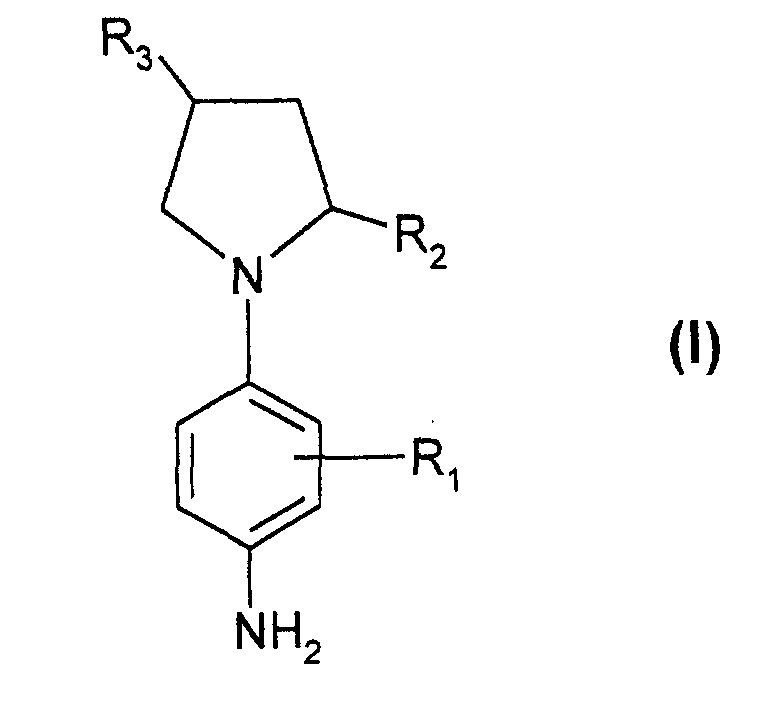
et ses sels d'addition avec un acide,
Par composition prête à l'emploi, on entend au sens de la présente invention, toute composition destinée à être appliquée immédiatement sur les fibres kératiniques.
De tels dispositifs comportent un premier compartiment contenant au moins une 1-(4-aminophényl)-pyrrolidine de formule (I) et un deuxième compartiment contenant un agent oxydant, au moins un polymère épaississant comportant au moins un motif sucre, étant présent dans le premier compartiment et/ou dans le second compartiment.
- R1, R2 et R3 désignent un atome d'hydrogène; le composé de formule (I) est
alors la 1-(4-aminophényl)-pyrrolidine,
ou, - R1 et R3 désignent un atome d'hydrogène et R2 désigne le radical -CH2OH; le
composé de formule (I) est alors le 1-(4-aminophényl)-2-pyrrolidineméthanol,
ou, - R1 désigne un atome d'hydrogène, R2 désigne le radical -CH2OH et R3 désigne
le radical OH; le composé de formule (I) est alors le 1-(4-aminophényl)-4-hydroxy-2-pyrrolidineméthanol,
ou, - R1 et R3 désignent un atome d'hydrogène et R2 désigne le radical -CONH2; le composé de formule (I) est alors la N-(4-aminophényl)-prolineamide.
Parmi les groupements hydroxyalkyle, on peut mentionner à titre d'exemple, les groupements hydroxyméthyle, hydroxyéthyle, hydroxypropyle et hydroxybutyle.
Le taux d'hydroxyalkylation, qui correspond au nombre de molécules d'oxyde d'alkylène consommées par le nombre de fonctions hydroxyle libres présentes sur la gomme de guar, varie de préférence de 0,4 à 1,2.
De telles gommes de guar non-ioniques éventuellement modifiées par des groupements hydroxyalkyle sont par exemple vendues sous les dénominations commerciales JAGUAR HP8, JAGUAR HP60 et JAGUAR HP120, JAGUAR DC 293 et JAGUAR HP 105 par la société RHONE POULENC (MEYHALL) ou sous la dénomination GALACTASOL 4H4FD2 par la société AQUALON.
Les hydroxyalkyl(C1-C6)celluloses sont également plus particulièrement des hydroxypropylcelluloses comme les produits vendus sous les dénominations KLUCEL EF, KLUCEL H, KLUCEL LHF, KLUCEL MF, KLUCEL G, par la société AQUALON.
Parmi les bases d'oxydation additionnelles utilisables selon l'invention, on peut citer la paraphénylènediamine, la paratoluylènediamine, la 2-hydroxyéthylparaphénylènediamine, la 1-N,N-bis(2-hydroxyéthyl)-paraphénylènediamine, les para-aminophénols tels que le 3-méthyl-4-aminophénol et le 4-aminophénol, les orthophénylènes diamines, les orthoaminophénols, les bases doubles, les bases hétérocycliques comme les pyrimidines telles que la 2,4,5,6-tétraaminopyrimidine ou comme les pyrazoles tel que le 1-(2-hydroxyéthyl)-4,5-diamino-pyrazole, et leurs sels d'addition avec un acide.
Les colorants directs utilisés notamment pour modifier les nuances en les enrichissant de reflets peuvent alors être choisis parmi les colorants nitrés, azoïques ou anthraquinoniques, neutres, cationiques ou anioniques dans la proportion pondérale d'environ 0,001 à 20% et de préférence de 0,01 à 10% du poids total de la composition.
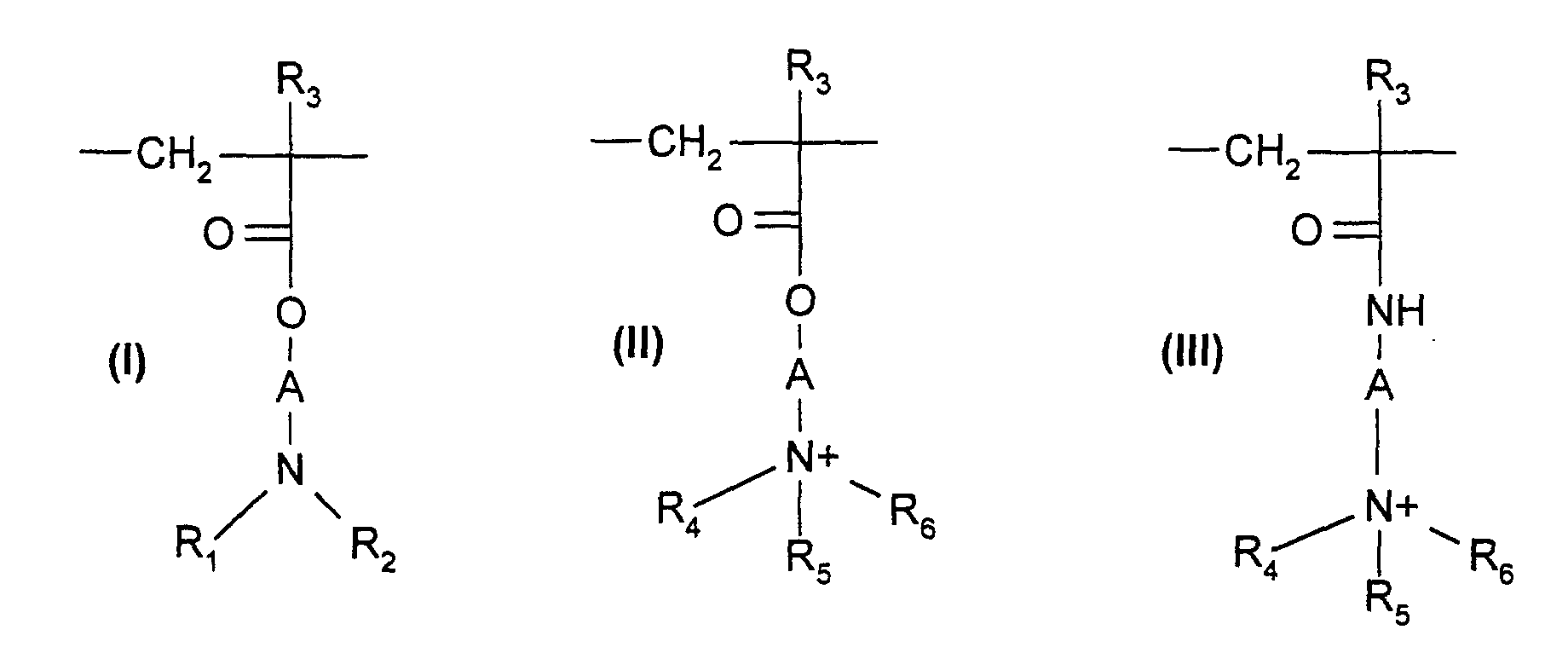

Ainsi, parmi ces polymères de la famille (1), on peut citer :
- les copolymères d'acrylamide et de diméthylaminoéthyl méthacrylate quaternisé au sulfate de diméthyle ou avec un hologénure de diméthyle, tel que celui vendu sous la dénomination HERCOFLOC par la société HERCULES,
- les copolymères d'acrylamide et de chlorure de méthacryloyloxyéthyltriméthylammonium décrits par exemple dans la demande de brevet EP-A-080976 et vendus sous la dénomination BINA QUAT P 100 par la société CIBA GEIGY,
- le copolymère d'acrylamide et de méthosulfate de méthacryloyloxyéthyltriméthylammonium vendu sous la dénomination RETEN par la société HERCULES,
- les copolymères vinylpyrrolidone / acrylate ou méthacrylate de dialkylaminoalkyle quaternisés ou non, tels que les produits vendus sous la dénomination "GAFQUAT" par la société ISP comme par exemple "GAFQUAT 734" ou "GAFQUAT 755" ou bien les produits dénommés "COPOLYMER 845, 958 et 937". Ces polymères sont décrits en détail dans les brevets français 2.077.143 et 2.393.573,
- les terpolymères méthacrylate de diméthyl amino éthyle/ vinylcaprolactame/ vinylpyrrolidone tel que le produit vendu sous la dénomination GAFFIX VC 713 par la société ISP,
- les copolymère vinylpyrrolidone / méthacrylamidopropyl dimethylamine commercialisés notamment sous la dénomination STYLEZE CC 10 par ISP,
- et les copolymères vinylpyrrolidone / méthacrylamide de diméthylaminopropyle quaternisés tel que le produit vendu sous la dénomination "GAFQUAT HS 100" par la société ISP.
Les produits commercialisés répondant à cette définition sont plus particulièrement les produits vendus sous la dénomination "Celquat L 200" et "Celquat H 100" par la Société National Starch.
De tels produits sont commercialisés notamment sous les dénominations commerciales de JAGUAR C13 S, JAGUAR C 15, JAGUAR C 17 ou JAGUAR C162 par la société MEYHALL.
Parmi ces dérivés, on peut citer plus particulièrement les polymères acide adipique/diméthylaminohydroxypropyl/diéthylène triamine vendus sous la dénomination "Cartaretine F, F4 ou F8" par la société Sandoz.
Des polymères de ce type sont en particulier commercialisés sous la dénomination "Hercosett 57" par la société Hercules Inc. ou bien sous la dénomination de "PD 170" ou "Delsette 101" par la société Hercules dans le cas du copolymère d'acide adipique/époxypropyl/diéthylène-triamine.

Parmi les polymères définis ci-dessus, on peut citer plus particulièrement l'homopolymère de chlorure de diméthyldiallylammonium vendu sous la dénomination "Merquat 100" par la société Calgon (et ses homologues de faible masse moléculaire moyenne en poids) et les copolymères de chlorure de diallyldiméthylammonium et d'acrylamide commercialisés sous la dénomination "MERQUAT 550".

où x et y désignent un nombre entier de 1 à 4, représentant un degré de polymérisation défini et unique ou un nombre quelconque de 1 à 4 représentant un degré de polymérisation moyen ;
Ces polymères ont une masse moléculaire moyenne en nombre généralement comprise entre 1000 et 100000.
Des polymères de ce type sont notamment décrits dans les brevets français 2.320.330, 2.270.846, 2.316.271, 2.336.434 et 2.413.907 et les brevets US 2.273.780, 2.375.853, 2.388.614, 2.454.547, 3.206.462, 2.261.002, 2.271.378, 3.874.870, 4.001.432, 3.929.990, 3.966.904, 4.005.193, 4.025.617, 4.025.627, 4.025.653, 4.026.945 et 4.027.020.On peut utiliser plus particulièrement les polymères qui sont constitués de motifs récurrents répondant à la formule (VIII) suivante:

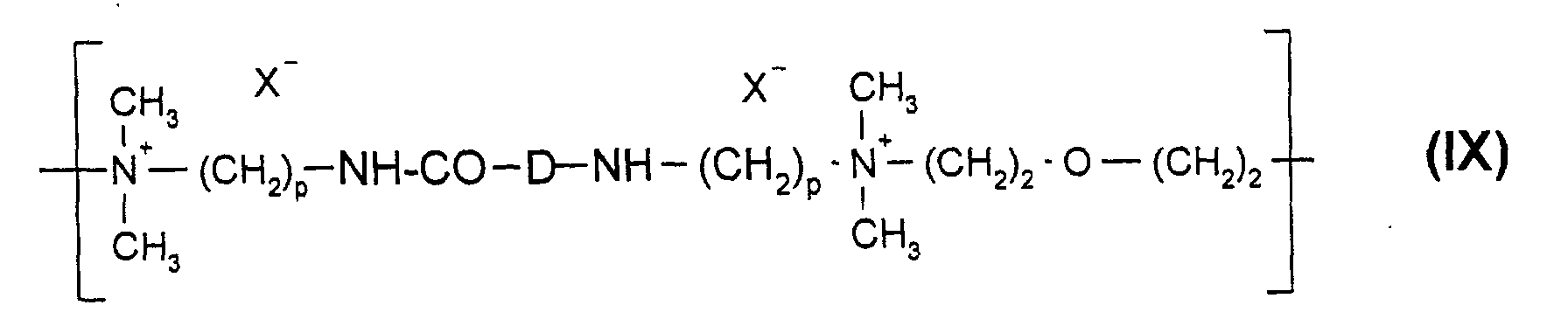
De tels polymères peuvent être préparés selon les procédés décrits dans les brevets U.S.A. n° 4 157 388, 4 390 689, 4 702 906, 4 719 282. Ils sont notamment décrits dans la demande de brevet EP-A-122 324.
Parmi eux, on peut par exemple citer, les produits "Mirapol A 15", "Mirapol AD1", "Mirapol AZ1" et "Mirapol 175" vendus par la société Miranol.

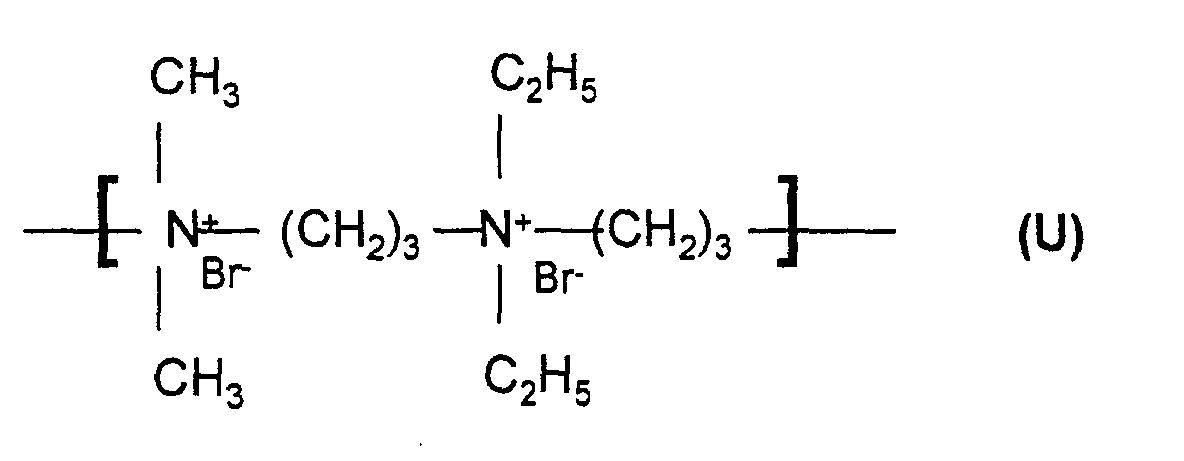
Encore plus préférentiellement ladite composition contient au moins un tensioactif nonionique.
On peut également utiliser à titre d'agent oxydant une ou plusieurs enzymes d'oxydoréduction telles que les laccases, les peroxydases et les oxydoréductases à 2 électrons (telles que l'uricase), le cas échéant en présence de leur donneur ou cofacteur respectif.


Dans le système L* a* b* les 3 paramètres désignent respectivement l'intensité (L*), la nuance (a*), et la saturation (b*).
Selon ce système, plus la valeur de L est élevée, plus la couleur est claire ou peu intense. Inversement, plus la valeur de L est faible, plus la couleur est foncée ou très intense.
| EXEMPLES | L* |
| 2 | 26.66 |
| 1 | 22.21 |
Claims (31)
- Composition pour la teinture d'oxydation des fibres kératiniques, en particulier des fibres kératiniques humaines telles que les cheveux, comprenant, dans un milieu approprié pour la teinture, (i) au moins une 1-(4-aminophényl)-pyrrolidine de formule (I) suivante à titre de précurseur de colorant d'oxydation :dans laquelle,
 R1 désigne un atome d'hydrogène, un radical alkyle en C1-C6, ou monohydroxyalkyle en C1-C5, ou polyhydroxyalkyle en C2-C5 ;R2 désigne un atome d'hydrogène, un radical -CONH2, ou monohydroxyalkyle en C1-C5, ou polyhydroxyalkyle en C2-C5 ;R3 désigne un atome d'hydrogène, ou un radical OH ; et ses sels d'addition avec un acide,
caractérisée par le fait qu'elle comprend en outre au moins un polymère épaississant comportant au moins un motif sucre. - Composition selon la revendication 1, caractérisée par le fait que dans la formule (I) des 1-(4-aminophényl)-pyrrolidines, R1, R2 et R3 désignent un atome d'hydrogène.
- Composition selon la revendication 1, caractérisée par le fait que dans la formule (I) des 1-(4-aminophényl)-pyrrolidines, R1 et R3 désignent un atome d'hydrogène et R2 désigne le radical -CH2OH.
- Composition selon la revendication 1, caractérisée par le fait que dans la formule (I) des 1-(4-aminophényl)-pyrrolidines, R1 désigne un atome d'hydrogène, R2 désigne le radical -CH2OH, et R3 désigne le radical -OH.
- Composition selon la revendication 1, caractérisée par le fait que dans la formule (I) des 1-(4-aminophényl)-pyrrolidines, R1 et R3 désignent un atome d'hydrogène, et R2 désigne le radical -CONH2.
- Composition selon l'une quelconque des revendications précédentes, caractérisée par le fait que les sels d'addition avec un acide des 1-(4-aminophényl)-pyrrolidines de formule (I) sont choisis parmi les chlorhydrates, les bromhydrates, les sulfates, les tartrates, les lactates et les acétates.
- Composition selon l'une quelconque des revendications précédentes, caractérisée par le fait que les 1-(4-aminophényl)-pyrrolidines de formule (I) et leurs sels d'addition avec un acide représentent de 0,001 à 10 % % en poids du poids total de la composition.
- Composition selon la revendication 7, caractérisée par le fait que les 1-(4-aminophényl)-pyrrolidines de formule (I) et leurs sels d'addition avec un acide représentent de 0,01 à 8% % en poids du poids total de la composition.
- Composition selon la revendication 1, caractérisée par le fait que le polymère épaississant comportant au moins un motif sucre est choisi dans le groupe comprenant :(1) - les gommes de guar non-ioniques;(2) - les gommes de biopolysaccharides d'origine microbienne telles que les gommes de Scléroglucane ou de Xanthane;(3) - les gommes issues d'exudats végétaux telles que les gommes Arabique, Ghatti, Karaya, Tragacanthe, Carrageenane, Agar et Caroube;(4) - les pectines;(5) - les alginates;(6) - les amidons;(7) - les hydroxyalkyl(C1-C6)celluloses et carboxyalkyl(C1-C6)celluloses.
- Composition selon la revendication 9, caractérisée par le fait que la gomme de guar non-ionique est non modifiée.
- Composition selon la revendication 9, caractérisée par le fait que l'hydroxyalkyl(C1-C6)cellulose est une hydroxyéthylcellulose ou une hydroxypropylcellulose.
- Composition selon la revendication 9, caractérisée par le fait que la carboxyalkyl(C1-C6)cellulose est une carboxyméthylcellulose.
- Composition selon l'une quelconque des revendications précédentes, caractérisée par le fait que le ou les polymères épaississants comportant au moins un motif sucre représentent de 0,01 à 10% en poids du poids total de la composition.
- Composition selon la revendication 13, caractérisée par le fait que le ou les polymères épaississants représentent de 0,1 à 5% en poids du poids total de la composition.
- Composition selon l'une quelconque des revendications précédentes, caractérisée par le fait qu'elle contient au moins un coupleur.
- Composition selon la revendication 15 , caractérisée par le fait que les coupleurs sont choisis parmi les métaphénylènediamines, les métaaminophénols, les métadiphénols, les naphtols, les coupleurs hétérocycliques, et les sels d'addition de ces composés avec un acide.
- Composition selon la revendication 16, caractérisée par le fait que les coupleurs sont choisis parmi le 2,4-diamino 1-(β-hydroxyéthyloxy) benzène, le 2-méthyl 5-amino phénol, le 5-N-(β-hydroxyéthyl)amino 2-méthyl phénol, le 3-amino phénol, le 1,3-dihydroxy benzène, le 1,3-dihydroxy 2-méthyl benzène, le 4-chloro 1,3-dihydroxy benzène, le 2-amino 4-(β-hydroxyéthylamino) 1-méthoxy benzène, le 1,3-diamino benzène, le 1,3-bis-(2,4-diaminophénoxy) propane, le sésamol, le 1-amino 2-méthoxy 4,5-méthylènedioxy benzène, l'α-naphtol, le 6-hydroxy indole, le 4-hydroxy indole, le 4-hydroxy N-méthyl indole, la 6-hydroxy indoline, la 2,6-dihydroxy 4-méthyl pyridine, le 1-H 3-méthyl pyrazole 5-one, le 1-phényl 3-méthyl pyrazole 5-one, la 2-amino 3-hydroxypyridine, le 3,6-diméthyl-pyrazolo-[3,2-c]-1,2,4-triazole, le 2,6-diméthyl-pyrazolo-[1,5-b]-1,2,4-triazole et leurs sels d'addition avec un acide.
- Composition selon l'une quelconque des revendications 15-17, caractérisée par le fait que les coupleurs sont présents dans des concentrations allant de 0,0001 à 15% en poids par rapport au poids total de la composition.
- Composition selon l'une quelconque des revendications précédentes, caractérisée par le fait qu'elle contient au moins une base d'oxydation additionnelle dans la proportion de 0,0001 à 15% en poids par rapport au poids total de la composition.
- Composition selon l'une quelconque des revendications précédentes, caractérisée par le fait qu'elle contient en outre au moins un colorant direct dans la proportion de 0,001 à 20% en poids par rapport au poids total de la composition.
- Composition selon l'une quelconque des revendications précédentes, caractérisée par le fait qu'elle contient en outre au moins un agent réducteur ou antioxydant dans des quantités allant de 0,05 à 1,5% en poids par rapport au poids total de la composition.
- Composition selon l'une quelconque des revendications précédentes, caractérisée par le fait qu'elle contient en outre au moins 0,01% en poids d'un polymère cationique par rapport au poids total de la composition.
- Composition prête à l'emploi pour la teinture d'oxydation des fibres kératiniques en particulier des fibres kératiniques humaines telles que les cheveux caractérisée par le fait qu'elle est obtenue par mélange d'une composition colorante telle que définie à l'une quelconque des revendications 1 à 22 et d'une composition oxydante contenant au moins un agent oxydant.
- Composition selon la revendication 23, caractérisée par le fait que l'agent oxydant est choisi parmi le peroxyde d'hydrogène, le peroxyde d'urée, les bromates ou ferricyanures de métaux alcalins, les persels, les enzymes d'oxydoréduction telles que les laccases, les peroxydases et les oxydoréductases à 2 électrons, le cas échéant en présence de leur donneur ou cofacteur respectif.
- Composition selon la revendication 24, caractérisée par le fait que l'agent oxydant est le peroxyde d'hydrogène.
- Composition selon la revendication 25, caractérisée par le fait que l'agent oxydant est une solution d'eau oxygénée dont le titre varie de 1 à 40 volumes.
- Composition selon l'une quelconque des revendications précédentes, caractérisée par le fait qu'elle possède un pH allant de 3 à 12.
- Composition selon la revendication 23, caractérisée par le fait que la composition colorante et/ou la composition oxydante contient au moins un tensioactif choisi parmi les tensioactifs anioniques, cationiques, non ioniques ou amphotères dans la proportion de 0,1 à 20% en poids par rapport au poids total de la composition.
- Procédé de teinture d'oxydation des fibres kératiniques, et en particulier des fibres kératiniques humaines telles que les cheveux, consistant à appliquer sur les fibres une composition colorante contenant, dans un milieu approprié pour la teinture, au moins une 1-(4-aminophényl)-pyrrolidine de formule (I) telle que définie à l'une quelconque des revendications 1 à 8, la couleur étant révélée à pH alcalin, neutre ou acide à l'aide d'une composition oxydante qui est mélangée juste au moment de l'emploi à la composition colorante ou qui est appliquée séquentiellement sans rinçage intermédiaire, au moins un polymère épaississant comportant au moins un motif sucre tel que défini à l'une quelconque des revendications 9 à 14 étant présent dans la composition colorante et/ou oxydante.
- Dispositif à plusieurs compartiments ou " Kit " pour la teinture d'oxydation des fibres kératiniques et en particulier des fibres kératiniques humaines telles que les cheveux, caractérisé par le fait qu'il comporte au moins deux compartiments, dont l'un d'entre eux contient au moins une 1-(4-aminophényl)-pyrrolidine de formule (I) telle que définie à l'une quelconque des revendications 1 à 8, et un deuxième compartiment contenant au moins un agent oxydant, au moins un polymère épaississant comportant au moins un motif sucre tel que défini à l'une quelconque des revendications 9 à 14 étant présent dans le premier compartiment et/ou dans le second compartiment.
- Dispositif à plusieurs compartiments ou " Kit" pour la teinture d'oxydation des fibres kératiniques et en particulier des fibres kératiniques humaines telles que les cheveux, caractérisé par le fait qu'il comporte au moins un compartiment contenant au moins une 1-(4-aminophényl)-pyrrolidine de formule (I) telle que définie à l'une quelconque des revendications 1 à 8, au moins un compartiment contenant au moins un polymère épaississant comportant au moins un motif sucre tel que défini à l'une quelconque des revendications 9 à 14, et au moins un autre compartiment contenant au moins un agent oxydant.
Applications Claiming Priority (2)
| Application Number | Priority Date | Filing Date | Title |
|---|---|---|---|
| FR0004992 | 2000-04-18 | ||
| FR0004992A FR2807651B1 (fr) | 2000-04-18 | 2000-04-18 | Composition pour la teinture d'oxydation des fibres keratiniques comprenant une 1-(4-aminophenyl)-pyrrolidine et un polymere epaississant a motif sucre |
Publications (1)
| Publication Number | Publication Date |
|---|---|
| EP1149576A1 true EP1149576A1 (fr) | 2001-10-31 |
Family
ID=8849382
Family Applications (1)
| Application Number | Title | Priority Date | Filing Date |
|---|---|---|---|
| EP01400880A Withdrawn EP1149576A1 (fr) | 2000-04-18 | 2001-04-05 | Composition pour la teinture d'oxydation des fibres kératiniques comprenant une 1-(4-aminophenyl)pyrroldine et un polymère épaississant à motif sucre |
Country Status (4)
| Country | Link |
|---|---|
| US (1) | US20030024058A9 (fr) |
| EP (1) | EP1149576A1 (fr) |
| JP (1) | JP2001335445A (fr) |
| FR (1) | FR2807651B1 (fr) |
Cited By (3)
| Publication number | Priority date | Publication date | Assignee | Title |
|---|---|---|---|---|
| EP1559410A1 (fr) * | 2004-01-28 | 2005-08-03 | L'oreal | Composition de teinture des fibres kératiniques contenant une alcool oxydase et un polymère à motif sucre |
| FR2945729A1 (fr) * | 2009-05-19 | 2010-11-26 | Oreal | Composition tinctoriale comprenant une base d'oxydation para-phenylene diamine secondaire et un polymere non associatif non cationique a motifs sucres. |
| WO2010133573A3 (fr) * | 2009-05-19 | 2011-05-05 | L'oreal | Composition de coloration comprenant une base d'oxydation para-phénylènediamine secondaire et un polymére épaississant |
Families Citing this family (6)
| Publication number | Priority date | Publication date | Assignee | Title |
|---|---|---|---|---|
| DE60127521T2 (de) | 2000-12-28 | 2007-12-06 | Kao Corp. | Haarbleichungs-und Haarfärbemittel |
| DE10359539A1 (de) * | 2003-12-17 | 2005-07-14 | Hans Schwarzkopf & Henkel Gmbh & Co. Kg | Pflegendes Oxidationsmittel in Tube |
| JP5016181B2 (ja) * | 2004-01-09 | 2012-09-05 | 花王株式会社 | 染毛剤組成物 |
| US11629071B2 (en) | 2017-02-13 | 2023-04-18 | Merck Patent Gmbh | Method for producing ultrapure water |
| EP3580177B1 (fr) | 2017-02-13 | 2023-12-13 | Merck Patent GmbH | Procédé et dispositif pour la production d'eau ultrapure |
| CN110300735A (zh) | 2017-02-13 | 2019-10-01 | 默克专利股份公司 | 用于生产超纯水的方法 |
Citations (8)
| Publication number | Priority date | Publication date | Assignee | Title |
|---|---|---|---|---|
| US5685882A (en) * | 1994-07-22 | 1997-11-11 | L'oreal | Use of guar gum in non-rinsed compositions for the dyeing of keratin fibers |
| DE19728336A1 (de) * | 1996-07-03 | 1998-01-08 | Schwarzkopf Gmbh Hans | Färbemittel |
| WO1998001106A2 (fr) * | 1996-07-03 | 1998-01-15 | Hans Schwarzkopf Gmbh & Co. Kg | Colorants d'oxydation |
| EP0891765A2 (fr) * | 1997-07-14 | 1999-01-20 | Bristol-Myers Squibb Company | Compositions oxydantes pour la teinture des cheveux |
| US5876464A (en) * | 1998-02-17 | 1999-03-02 | Bristol-Myers Squibb Company | Hair dyeing with N-(4-aminophenyl) prolineamide, couplers, and oxidizing agents |
| JPH11158048A (ja) * | 1997-12-01 | 1999-06-15 | Fuji Photo Film Co Ltd | ジアルキルアニリン化合物を配合する染毛剤組成物 |
| FR2773472A1 (fr) * | 1998-01-13 | 1999-07-16 | Oreal | Composition tictoriale et procedes de teinture des fibres keratiniques la mettant en oeuvre |
| EP0962452A1 (fr) * | 1998-05-13 | 1999-12-08 | Bristol-Myers Squibb Company | Composition de teinture d'oxydation et procédés comprenant de dérivés 2-pyrrolidineméthanol 1-(4-aminophényle) |
Family Cites Families (3)
| Publication number | Priority date | Publication date | Assignee | Title |
|---|---|---|---|---|
| JPH08217652A (ja) * | 1994-12-16 | 1996-08-27 | Yamahatsu Sangyo Kk | 酸化染毛剤組成物 |
| FR2780881B1 (fr) * | 1998-07-09 | 2001-08-10 | Oreal | Composition de teinture pour fibres keratiniques avec un colorant direct cationique et un polymere epaississant |
| FR2780880B1 (fr) * | 1998-07-09 | 2001-08-10 | Oreal | Composition de teinture pour fibres keratiniques avec un colorant direct cationique et un polymere epaississant |
-
2000
- 2000-04-18 FR FR0004992A patent/FR2807651B1/fr not_active Expired - Fee Related
-
2001
- 2001-04-05 EP EP01400880A patent/EP1149576A1/fr not_active Withdrawn
- 2001-04-18 US US09/836,643 patent/US20030024058A9/en not_active Abandoned
- 2001-04-18 JP JP2001120413A patent/JP2001335445A/ja not_active Withdrawn
Patent Citations (8)
| Publication number | Priority date | Publication date | Assignee | Title |
|---|---|---|---|---|
| US5685882A (en) * | 1994-07-22 | 1997-11-11 | L'oreal | Use of guar gum in non-rinsed compositions for the dyeing of keratin fibers |
| DE19728336A1 (de) * | 1996-07-03 | 1998-01-08 | Schwarzkopf Gmbh Hans | Färbemittel |
| WO1998001106A2 (fr) * | 1996-07-03 | 1998-01-15 | Hans Schwarzkopf Gmbh & Co. Kg | Colorants d'oxydation |
| EP0891765A2 (fr) * | 1997-07-14 | 1999-01-20 | Bristol-Myers Squibb Company | Compositions oxydantes pour la teinture des cheveux |
| JPH11158048A (ja) * | 1997-12-01 | 1999-06-15 | Fuji Photo Film Co Ltd | ジアルキルアニリン化合物を配合する染毛剤組成物 |
| FR2773472A1 (fr) * | 1998-01-13 | 1999-07-16 | Oreal | Composition tictoriale et procedes de teinture des fibres keratiniques la mettant en oeuvre |
| US5876464A (en) * | 1998-02-17 | 1999-03-02 | Bristol-Myers Squibb Company | Hair dyeing with N-(4-aminophenyl) prolineamide, couplers, and oxidizing agents |
| EP0962452A1 (fr) * | 1998-05-13 | 1999-12-08 | Bristol-Myers Squibb Company | Composition de teinture d'oxydation et procédés comprenant de dérivés 2-pyrrolidineméthanol 1-(4-aminophényle) |
Non-Patent Citations (1)
| Title |
|---|
| PATENT ABSTRACTS OF JAPAN vol. 1999, no. 11 30 September 1999 (1999-09-30) * |
Cited By (3)
| Publication number | Priority date | Publication date | Assignee | Title |
|---|---|---|---|---|
| EP1559410A1 (fr) * | 2004-01-28 | 2005-08-03 | L'oreal | Composition de teinture des fibres kératiniques contenant une alcool oxydase et un polymère à motif sucre |
| FR2945729A1 (fr) * | 2009-05-19 | 2010-11-26 | Oreal | Composition tinctoriale comprenant une base d'oxydation para-phenylene diamine secondaire et un polymere non associatif non cationique a motifs sucres. |
| WO2010133573A3 (fr) * | 2009-05-19 | 2011-05-05 | L'oreal | Composition de coloration comprenant une base d'oxydation para-phénylènediamine secondaire et un polymére épaississant |
Also Published As
| Publication number | Publication date |
|---|---|
| FR2807651B1 (fr) | 2002-05-24 |
| FR2807651A1 (fr) | 2001-10-19 |
| JP2001335445A (ja) | 2001-12-04 |
| US20020026675A1 (en) | 2002-03-07 |
| US20030024058A9 (en) | 2003-02-06 |
Similar Documents
| Publication | Publication Date | Title |
|---|---|---|
| EP0673641B1 (fr) | Composition de teinture d'oxydation des fibres kératiniques comprenant un dérivé de paraphénylènediamine et un polymère substantif cationique ou amphotère et utilisation | |
| CA2329839C (fr) | Composition pour la teinture d'oxydation des fibres keratiniques comprenant un polymere epaississant comportant au moins une chaine grasse et un alcool gras mono- ou poly-glycerole | |
| EP1149575A1 (fr) | Composition de teinture d'oxydation des fibres kératiniques comprenant une 1-(4-aminophényl)-pyrrolidine et un colorant direct particulier | |
| WO2002058647A1 (fr) | Composition de teinture d"oxydation pour fibres keratiques comprenant un poly(vinyllactame) cationique | |
| FR2833837A1 (fr) | Composition pour la teinture d'oxydation des fibres keratiniques comprenant un amide d'acide gras de colza oxyethylene | |
| CA2393478A1 (fr) | Composition de teinture d'oxydation pour fibres keratiniques comprenant un polymere epaississant a squelette aminoplaste-ether | |
| FR2753093A1 (fr) | Composition de teinture d'oxydation pour fibres keratiniques comprenant un polymere amphiphile anionique | |
| CA2330342A1 (fr) | Composition pour la teinture d'oxydation des fibres keratiniques comprenant un polymere epaississant comportant au moins une chaine grasse et un alcool gras ayant plus de vingt atomes de carbone | |
| CA2330335A1 (fr) | Composition pour la teinture d'oxydation des fibres keratiniques comprenant un alcool gras ayant plus de vingt atomes de carbone et un tensioactif non-ionique oxyalkylene de hlb superieure a 5 | |
| FR2751533A1 (fr) | Composition de teinture d'oxydation pour fibres keratiniques comprenant un polymere amphiphile non-ionique | |
| FR2812810A1 (fr) | Composition pour la teinture d'oxydation des fibres keratiniques comprenant un polymere amphiphile cationique, un alcool gras oxyalkylene ou polyglycerole et un solvant hydroxyle | |
| FR2833833A1 (fr) | Composition pour la teinture d'oxydation des fibres keratiniques comprenant un acide ether carboxylique oxyalkylene, un polymere associatif et un alcool gras insature | |
| FR2833836A1 (fr) | Composition pour la teinture d'oxydation des fibres keratiniques comprenant un acide ether carboxylique oxyalkylene et une cellulose quaternisee a chaine grasse | |
| WO2002045674A1 (fr) | Composition de teinture pour fibres keratiniques comprenant un polymere associatif et un polymere a motifs acrylamide, halogenure de dialkyldiallylammonium, et acide carboxylique vinylique | |
| WO2001078668A1 (fr) | Composition pour la teinture d'oxydation des fibres keratiniques comprenant un derive de la 3,5-diamino-pyridine et un polymere epaississant particulier | |
| FR2807654A1 (fr) | Composition pour la teinture d'oxydation des fibres keratiniques comprenant un derive de la 3, 5-diamino- pyridine et un polymere cationique ou amphotere | |
| CA2327277A1 (fr) | Compositions de teinture pour fibres keratiniques comprenant un compose non-ionique | |
| FR2833834A1 (fr) | Composition pour la teinture d'oxydation des fibres keratiniques comprenant un acide ether carboxylique oxyalkylene, un tensioactif mono-ou poly-glycerole et un alcool gras insature | |
| FR2807651A1 (fr) | Composition pour la teinture d'oxydation des fibres keratiniques comprenant une 1-(4-aminophenyl)-pyrrolidine et un polymere epaississant a motif sucre | |
| FR2807652A1 (fr) | Composition pour la teinture d'oxydation des fibres comprenant une 1-(4-aminophenyl)-pyrrolidine et un polymere cationique | |
| EP1413288A1 (fr) | Composition de teinture d'oxydation pour fibres kératiniques comprenant un poly (vinyllactame) cationique et au moins un colorant d'oxydation sous forme d'ion sulfate | |
| FR2845907A1 (fr) | Composition de teinture d'oxydation pour fibres keratiniques comprenant un poly(vinyllactame) cationique et au moins un acide gras en c10-c14, procedes et dispositifs de teinture d'oxydation | |
| EP1413289A1 (fr) | Composition de teinture d'oxydation pour fibres kératiniques comprenant un poly (vinyllactame) cationique et au moins un alcool grans en C10-C14, procédés et dispositifs de teinture d'oxydation | |
| WO2001066069A1 (fr) | Composition de teinture d'oxydation des fibres keratiniques et procede de teinture mettant en oeuvre cette composition | |
| WO2002000181A1 (fr) | Composition de teinture d'oxydation pour fibres keratiniques comprenant un polymere amphotere a chaine grasse |
Legal Events
| Date | Code | Title | Description |
|---|---|---|---|
| PUAI | Public reference made under article 153(3) epc to a published international application that has entered the european phase |
Free format text: ORIGINAL CODE: 0009012 |
|
| AK | Designated contracting states |
Kind code of ref document: A1 Designated state(s): AT BE CH CY DE DK ES FI FR GB GR IE IT LI LU MC NL PT SE TR |
|
| AX | Request for extension of the european patent |
Free format text: AL;LT;LV;MK;RO;SI |
|
| 17P | Request for examination filed |
Effective date: 20020502 |
|
| AKX | Designation fees paid |
Free format text: AT BE CH CY DE DK ES FI FR GB GR IE IT LI LU MC NL PT SE TR |
|
| 17Q | First examination report despatched |
Effective date: 20030530 |
|
| STAA | Information on the status of an ep patent application or granted ep patent |
Free format text: STATUS: THE APPLICATION IS DEEMED TO BE WITHDRAWN |
|
| 18D | Application deemed to be withdrawn |
Effective date: 20031010 |