EP1148570A2 - Nonaqueous electrolyte secondary battery - Google Patents
Nonaqueous electrolyte secondary battery Download PDFInfo
- Publication number
- EP1148570A2 EP1148570A2 EP01109161A EP01109161A EP1148570A2 EP 1148570 A2 EP1148570 A2 EP 1148570A2 EP 01109161 A EP01109161 A EP 01109161A EP 01109161 A EP01109161 A EP 01109161A EP 1148570 A2 EP1148570 A2 EP 1148570A2
- Authority
- EP
- European Patent Office
- Prior art keywords
- nonaqueous electrolyte
- negative electrode
- secondary battery
- active material
- positive electrode
- Prior art date
- Legal status (The legal status is an assumption and is not a legal conclusion. Google has not performed a legal analysis and makes no representation as to the accuracy of the status listed.)
- Granted
Links
Images
Classifications
-
- H—ELECTRICITY
- H01—ELECTRIC ELEMENTS
- H01M—PROCESSES OR MEANS, e.g. BATTERIES, FOR THE DIRECT CONVERSION OF CHEMICAL ENERGY INTO ELECTRICAL ENERGY
- H01M10/00—Secondary cells; Manufacture thereof
- H01M10/05—Accumulators with non-aqueous electrolyte
- H01M10/056—Accumulators with non-aqueous electrolyte characterised by the materials used as electrolytes, e.g. mixed inorganic/organic electrolytes
- H01M10/0564—Accumulators with non-aqueous electrolyte characterised by the materials used as electrolytes, e.g. mixed inorganic/organic electrolytes the electrolyte being constituted of organic materials only
- H01M10/0566—Liquid materials
- H01M10/0567—Liquid materials characterised by the additives
-
- H—ELECTRICITY
- H01—ELECTRIC ELEMENTS
- H01M—PROCESSES OR MEANS, e.g. BATTERIES, FOR THE DIRECT CONVERSION OF CHEMICAL ENERGY INTO ELECTRICAL ENERGY
- H01M10/00—Secondary cells; Manufacture thereof
- H01M10/05—Accumulators with non-aqueous electrolyte
-
- H—ELECTRICITY
- H01—ELECTRIC ELEMENTS
- H01M—PROCESSES OR MEANS, e.g. BATTERIES, FOR THE DIRECT CONVERSION OF CHEMICAL ENERGY INTO ELECTRICAL ENERGY
- H01M10/00—Secondary cells; Manufacture thereof
- H01M10/05—Accumulators with non-aqueous electrolyte
- H01M10/052—Li-accumulators
- H01M10/0525—Rocking-chair batteries, i.e. batteries with lithium insertion or intercalation in both electrodes; Lithium-ion batteries
-
- H—ELECTRICITY
- H01—ELECTRIC ELEMENTS
- H01M—PROCESSES OR MEANS, e.g. BATTERIES, FOR THE DIRECT CONVERSION OF CHEMICAL ENERGY INTO ELECTRICAL ENERGY
- H01M2300/00—Electrolytes
- H01M2300/0017—Non-aqueous electrolytes
- H01M2300/0025—Organic electrolyte
-
- Y—GENERAL TAGGING OF NEW TECHNOLOGICAL DEVELOPMENTS; GENERAL TAGGING OF CROSS-SECTIONAL TECHNOLOGIES SPANNING OVER SEVERAL SECTIONS OF THE IPC; TECHNICAL SUBJECTS COVERED BY FORMER USPC CROSS-REFERENCE ART COLLECTIONS [XRACs] AND DIGESTS
- Y02—TECHNOLOGIES OR APPLICATIONS FOR MITIGATION OR ADAPTATION AGAINST CLIMATE CHANGE
- Y02E—REDUCTION OF GREENHOUSE GAS [GHG] EMISSIONS, RELATED TO ENERGY GENERATION, TRANSMISSION OR DISTRIBUTION
- Y02E60/00—Enabling technologies; Technologies with a potential or indirect contribution to GHG emissions mitigation
- Y02E60/10—Energy storage using batteries
-
- Y—GENERAL TAGGING OF NEW TECHNOLOGICAL DEVELOPMENTS; GENERAL TAGGING OF CROSS-SECTIONAL TECHNOLOGIES SPANNING OVER SEVERAL SECTIONS OF THE IPC; TECHNICAL SUBJECTS COVERED BY FORMER USPC CROSS-REFERENCE ART COLLECTIONS [XRACs] AND DIGESTS
- Y02—TECHNOLOGIES OR APPLICATIONS FOR MITIGATION OR ADAPTATION AGAINST CLIMATE CHANGE
- Y02P—CLIMATE CHANGE MITIGATION TECHNOLOGIES IN THE PRODUCTION OR PROCESSING OF GOODS
- Y02P70/00—Climate change mitigation technologies in the production process for final industrial or consumer products
- Y02P70/50—Manufacturing or production processes characterised by the final manufactured product
Definitions
- the present invention relates to a nonaqueous electrolyte battery comprising a positive electrode having a positive electrode active material, a negative electrode containing a negative electrode active material capable of being doped/undoped with lithium, and a nonaqueous electrolyte.
- This type of battery has a high energy density and a low self-discharge, and is light-weight because a lithium containing composite oxide having a high discharge voltage, typically LiCoO 2 , is used as the material of the positive electrode.
- a lithium containing composite oxide having a high discharge voltage typically LiCoO 2
- LiCoO 2 a high discharge voltage
- the nonaqueous electrolyte secondary battery has a negative electrode composed of lithium or a lithium alloy
- lithium dendrite grows and reaches the positive electrode during repeated charge/discharge cycles, causing short-circuits inside the battery.
- dendrite is generated inside the battery, making the battery unusable.
- a so-called lithium-ion battery lithium dendrite does not precipitate, even when the charge/discharge cycle is repeated, and superior charge/discharge cycle characteristics can be obtained.
- lithium-ion secondary batteries have come to be used in various fields as the power sources of various electronic devices, especially portable devices.
- cellular phones for example, are used repetitively and perpetually consume electricity. Consequently, the secondary batteries used as the power sources of these portable electronic devices undergo a frequent charge and discharge.
- the lithium-ion secondary battery When the lithium-ion secondary battery is frequently charged and discharged, the battery capacity thereof is degraded due to the irreversible reactions occurring between the negative electrode and the nonaqueous electrolyte. As a result, the lithium-ion secondary battery suffers from a short cycle life.
- the nonaqueous electrolyte battery includes a positive electrode having a positive electrode active material, a negative electrode containing a negative electrode active material capable of being doped/undoped with lithium, and a nonaqueous electrolyte.
- the nonaqueous electrolyte contains at least one of thiols, thiophenes, thioanisoles, thiazoles, thioacetates, aromatic sulfones, and the derivatives thereof.
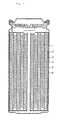
- Fig. 1 is a cross-sectional view of a nonaqueous electrolyte secondary battery according to an aspect of the present invention.
- a nonaqueous electrolyte secondary battery of the present invention is applied to what is known as a lithium-ion secondary battery.
- the lithium-ion secondary battery comprises a positive electrode, a negative electrode, and a nonaqueous electrolyte.
- Fig. 1 illustrates an exemplary structure of a nonaqueous electrolyte secondary battery according to the present invention.
- the battery is of a cylindrical shape and is formed by stacking a sheet-shaped positive electrode 2, a sheet-shaped negative electrode 4, and a separator 5 provided therebetween, rolling or spirally winding the stack in a longitudinal direction, placing the rolled electrodes into a battery case 6, and filling the battery case 6 with a nonaqueous electrolyte.
- the positive electrode 2 is prepared by forming positive electrode active material layers containing a positive electrode active material on the surfaces of a positive electrode collector 1.
- the negative electrode 4 is prepared by forming negative electrode active material layers containing a negative electrode active material on the surfaces of a negative electrode collector 3.
- the nonaqueous electrolyte contains at least one of thiols, thiophenes, thioanisoles, thiazoles, thioacetates, aromatic sulfones, and the derivatives thereof.
- thiols examples include aliphatic thiols such as methanethiol and ethanethiol; aromatic thiols such as thiophenol, 4-fluorothiophenol, 2-chlorothiophenol, 4-t-butylthiophenol, and 4-t-butyl-1,2-benzenethiol; and derivatives thereof.
- thiophenes examples include thiophene, 2-acetylthiophene, 3-acetylthiophene, 2,5-diacetylthiophene, 2-thiophenecarbonylchloride, 2-methoxycarbonylthiophene, 2,5-bismethoxycarbonylthiophene, and the derivatives thereof.
- thioanisoles examples include thioanisole, 4-methylthiobenzonitrile, 4-methylthioacetophenone, 2-methlthiobenzaldehyde, 2-chlorothioanisole, 4-bromothioanisole, and the derivatives thereof.
- thiazoles examples include thiazole, 1,2-benzisothiazole and derivatives thereof.
- thioacetates examples include methyl thioacetate, ethyl thioacetate, phenyl thioacetate, methyl fluoromethylthioacetate, methyl difluoromethylthioacetate, ethyl difluoromethylthioacetate, and the derivatives thereof.
- aromatic sulfones examples include methyl phenyl sulfone, 4-methylsulfonylacetophenone, tribromomethylphenylsulfone, and their derivatives.
- a film composed of the above-described organic compound contained in the nonaqueous electrolyte is formed on the surfaces of the negative electrode of the nonaqueous electrolyte battery.
- This film prevents the irreversible reactions between the negative electrode and the nonaqueous electrolyte and reduces the capacity degradation which would otherwise occur when a charge/discharge is performed repetitively.
- the content of at least one of thiols, thiophenes, thioanisoles, thiazoles, thioacetates, aromatic sulfones, and the derivatives thereof is preferably in the range of 0.03 percent by weight to 10 percent by weight of the entire nonaqueous electrolyte and, more preferably, in the range of 0.05 percent by weight to 10 percent by weight.
- the resulting film may not have a desired thickness.
- the content of the above-described organic compound exceeds 10 percent by weight, the film formed on the surfaces of the negative electrode may be excessively thick and may prevent lithium doping/undoping at the negative electrode.
- the negative electrode is prepared by forming negative electrode active material layers containing a negative electrode active material on a negative electrode collector.
- the negative electrode collector is composed of, for example, nickel foil.
- the negative electrode active materials materials capable of being doped/undoped with lithium, i.e., carbonaceous materials, crystallized or amorphous metal oxides, etc.
- carbonaceous materials are graphitizable carbonaceous materials, nongraphitizable carbonaceous materials, and graphite materials.
- a carbonaceous material may be used as the negative electrode active material.
- at least one material capable of being doped/undoped with lithium such as a metal capable of alloying with lithium or an alloy compound of such a metal may be used.
- the alloy compound is a compound represented by the formula M x M' y Li z (wherein M' is at least one of the metal elements other than Li and M, the value of x is greater than zero, and the values of y and z are greater than or equal to zero, respectively).
- semiconductive elements such as Bi, Si, and As are included in the metal elements.
- Examples of the metals which alloy with lithium are metals such as Mg, B, Al, Ga, In, Si, Ge, Sn, Pb, Sb, Bi, Cd, Ag, Zn, Hf, and Y.
- Examples of the alloy compounds are alloy compounds containing the above-described metal elements, for example, Li-Al, Li-Al-M (wherein M is at least one of Groups 2A, 3B, and 4B transition metals), AlSb, and CuMgSb.
- a Group 3B normal element elemental Si, elemental Sn, or alloys thereof.
- the alloys of Si and Sn are especially preferable.
- the Si or Sn alloy a compound described as M x Si or M x Sn, wherein M is at least one metal element other than Si or Sn, is used.
- Group 4B elements other than carbon, including at least one nonmetallic element may be used as the negative electrode active material. In this material, at least one of the Group 4B elements may be included. Furthermore, a metal element not of Group 4B, particularly lithium, may be included. Examples are SiC, Si 3 N 4 , Si 2 N 2 O, Ge 2 N 2 O, SiO x (wherein 0 ⁇ x ⁇ 2), LiSiO, and LiSnO.
- Group 4B elements other than carbon and including at least one nonmetallic element are required to be able to electrochemically intercalate and deintercalate lithium.
- the charge/discharge capacity is preferably 400 mAh/cm 3 or more, and more preferably 500 mAh/cm 3 or more. In calculating the charge/discharge capacity per unit volume, the true specific gravity of the above-described compound is used.
- the method for preparing the above-described metal capable of forming an alloy with lithium and the alloy compound of such a metal is not limited.
- a mechanical alloying process, a process of thermally treating mixed material compounds in an inert atmosphere or a reducing atmosphere, or the like may be employed.
- Intercalation of lithium into the negative electrode active material comprising a metal capable of forming an alloy with lithium or an alloy compound of such a metal may occur electrochemically inside the battery after the battery is formed; alternatively, lithium may be supplied from the positive electrode 2 or a source other than the positive electrode 2 to be electrochemically intercalated during and after the battery is made.
- the raw material may be formed as a lithium-containing material so as to form the negative electrode 4 containing lithium when the battery is made.
- the metal or the alloy may or may not be pulverized.
- a metal capable of forming an alloy with lithium and an alloy compound of such a metal When a metal capable of forming an alloy with lithium and an alloy compound of such a metal are to be pulverized, they only need to be pulverized to an extent that the maximum particle diameter thereof is less than a predetermined thickness of the negative electrode active material layer. There is no limit as to the method of pulverization. Typically, ball-milling or jet-milling is employed.
- the negative electrode active material comprising the metal capable of forming an alloy with lithium and the alloy compound of such a metal is preferably pulverized to an average particle diameter (volume mean particle diameter) of 50 ⁇ m or less and, more preferably, 20 ⁇ m or less.
- the negative electrode active material layer is formed as a solid by a chemical vapor deposition process, a sputtering process, a hot pressing, or the like.
- a carbonaceous material such as a nongraphitizable carbonaceous material
- carbonized materials obtained by baking a furan resin made of homopolymers/copolymers of furfuryl alcohol/furfural and copolymers of furfuryl alcohol/furfural with other resins may be used.
- the nongraphitizable carbonaceous material preferably has a (002) interplanar distance of 0.37 nm or more, a true density of less than 1.70 g/cm 3 , and an exothermic peak of less than 700°C in a differential thermal analysis (DTA), as its physical parameters.
- DTA differential thermal analysis
- phenol resin acrylic resin, vinyl halide resin, polyimide resin, polyamide-imide resin, polyamide resin, conjugated resin such as polyacetylene or poly(p-phenylene), cellulose and its derivative, or any polymeric organic compound may be used as the starting organic material.
- the material prepared by introducing a functional group including oxygen into a petroleum pitch having a specific H/C atomic ratio so as to form an oxygen crosslink does not melt during the process of carobonization at a temperature of 400°C or more and makes the nongraphitizable carbonaceous material into its final solid-state.
- the petroleum pitch is prepared by chemical polycondensation, extraction, thermal polycondensation, distillation (for example, vacuum distillation, atmospheric distillation, steam distillation), or the like, of coal tar, tars obtained by the high-temperature decomposition of ethylene bottom oil, petroleum, or the like, or asphalt.
- the H/C atomic ratio in the petroleum pitch is important and is required to be in the range of 0.6 to 0.8 in order to make nongraphitizable carbon.
- the method for introducing a functional group including oxygen into the petroleum pitch there are, a wet process using an aqueous solution of nitric acid, the mixed acid, sulfuric acid, hypochlorous acid, or the like, a dry process using an oxidizing gas (for example, oxygen), and a method utilizing reactions due to a solid reagent such as sulfur, ammonium nitrate, ammonium persulfate, ferric chloride, or the like.
- the oxygen content in the petroleum pitch is not limited; however, as disclosed in Japanese Laid-Open Patent Application Publication No. Hei 3-252053, the content is preferably 3% or more, and more preferably, 5% or more.
- the compound containing phosphorous, oxygen, and carbon as the main components disclosed in Japanese Laid-Open Patent Application Publication No. Hei 3-137010 exhibits the same physical parameters as the nongraphitizable carbonaceous material and can be used as the negative electrode active material.
- Any other organic material can also be used as the starting material as long as the material can be made into a nongraphitizable carbon by an oxygen crosslinking and solid phase carbonization process. There is no limit as to the method of the oxygen crosslinking.
- the temperature is elevated at a rate of 1 to 100°C per minute to a target temperature in the range of 900 to 1,300°C, and is maintained at the target temperature for 0 to 30 hours.
- the carbonization process may be omitted in some instances.
- the resulting nongraphitizable carbonaceous material is pulverized and classified to form a negative electrode active material.
- the pulverization may be performed before or after carbonization, heat treatment, or high-temperature baking, or during the elevation of the temperature.
- graphite material constituting the negative electrode active material natural graphite or artificial graphite prepared by treating a carbonized organic material at high temperatures may be used.
- the artificial graphite is prepared using an organic compound such as coal or pitch as the starting material.
- the pitch those obtained by distillation (for example, vacuum distillation, atmosphere distillation, and steam distillation), thermal polycondensation, extraction, and/or chemical polycondensation of coal tar, tars obtained by high-temperature decomposition of ethylene bottom oil, petroleum, or the like, may be used.
- the pitch formed by dry distillation of woods may also be used.
- poly(vinyl chloride) resin, polyvinyl acetate, polyvinyl butyral, or 3,5-dimethylphenol resin may be used.
- fused polycyclic hydrocarbon compounds such as naphthalene, phenanthrene, anthracene, triphenylene, pyrene, perylene, pentaphene, pentacene, etc., the derivatives thereof (for example, carboxylic acid, carboxylic acid anhydride, and carboxylic imide), the mixture thereof, condensed heterocyclics such as acenaphthylene, indole, isoindole, quinoline, isoquinoline, quinoxaline, phthalazine, carbazole, acridine, phenazine, phenanthridine, etc., and the derivatives thereof may also be used.
- fused polycyclic hydrocarbon compounds such as naphthalene, phenanthrene, anthracene, triphenylene, pyrene, perylene, pentaphene, pentacene, etc.
- the derivatives thereof for example, carboxylic acid, carboxylic acid
- the above-described organic material is carbonized at a temperature in the range of 300 to 700°C in an inert gas such as nitrogen, the temperature is then elevated at a rate of 1 to 100°C per minute until a target temperature in the range of 900 to 1,500°C is reached, and is maintained thereat for 0 to 30 hours in order to perform a heat treatment (that subjected to the process up to this point is referred to as the graphitizable carbonaceous material).
- thermal treatment is performed at a temperature of 2,000°C or more, preferably, 2,500°C or more. The process of carbonization and heat treatment may be omitted in some instances.
- the resulting artificial graphite is pulverized and classified to make a negative electrode active material.
- the pulverization may be performed before or after carbonization or heat treatment, or during the elevation of the temperature.
- the thermal treatment for graphitization is performed in the pulverized state, ultimately.
- the true density of the graphite material is preferably 2.1 g/cm 3 or more, and more preferably, 2.18 g/cm 3 or more.
- a (002) interplanar distance determined by X-ray diffraction analysis is preferably less than 0.340 nm and, more preferably, in the range of 0.335 nm to 0.337 nm.
- the c-axis crystallite thickness is required to be 14.0 nm or more.
- the bulk density, the average value of the shape parameter X (the average shape parameter X ave ), and specific surface area are important.
- the graphite material preferably has a bulk density, determined by the method described in Japanese Industrial Standard (JIS) K-1469, of 0.4 g/cm 3 or more, more preferably, 0.5 g/cm 3 or more, and most preferably 0.6 g/cm 3 or more.
- JIS Japanese Industrial Standard
- the negative electrode 4 contains the graphite material having a bulk density of 0.4 g/cm 3 or more, the negative electrode material does not separate from the negative electrode active material layers, thus achieving an improved electrode configuration. Accordingly, the nonaqueous electrolyte battery having such a negative electrode has a longer cycle life.
- the graphite material having an average value of the shape parameter X represented by the formula below, of 125 or less in addition to satisfying the above-described bulk density, is used in order to achieve a further increased cycle life.
- X (W / T) x (L / T)
- the shape parameter of the graphite material particles having the shape of a flat cylinder or rectangle is the product X obtained by multiplying the value of L divided by T and the value of W divided by L, wherein T is the thickness of the thinnest portion of the particle, L is the length in the longitudinal direction, and W is the length in a direction perpendicular to the longitudinal axis. If the shape parameter X is smaller, the height relative to the area of the base is increased and the powder has a reduced flatness.
- the negative electrode comprising the graphite material having the bulk density in the above-described range and the average shape parameter X ave of 125 or less has an excellent electrode configuration and achieves a longer cycle life.
- the average shape parameter X ave is preferably in the range of 2 to 115, more particularly, in the range of 2 to 100.
- the graphite material preferably has the bulk density and the average shape parameter X ave in the above-described ranges. Moreover, the graphite material preferably has a specific surface area, determined by a nitrogen-adsorption Brunauer-Emmett-Teller method, of 9 m 2 /g or less, more preferably 7 m 2 /g or less, and most preferably 5 m 2 /g or less. It is considered that submicron particles adhering to the graphite particles are causing the bulk density to decrease. When the particles adhere, the specific surface area is increased. Accordingly, a higher bulk density is achieved if the graphite material having a smaller specific surface is used, even when the particle sizes are comparable. Thus, the nonaqueous electrolyte battery comprising the negative electrode 4 containing such a graphite material has improved cycle characteristics.
- the graphite material has a 10% cumulative particle diameter of 3 ⁇ m or more, a 50% cumulative particle diameter of 10 ⁇ m or more, and a 90% cumulative particle diameter of 70 ⁇ m or less. Initial failures of the nonaqueous electrolyte battery are significantly reduced when the 90% cumulative particle diameter is 60 ⁇ m or less.
- the particle size distribution coincides with a normal distribution.
- the distribution number of the particles having smaller diameters is increased, the exothermic temperature generated from an abnormal situation such as overcharge may be elevated.
- failures such as short circuits may occur inside the battery at the time of initial charging. This is because when lithium is intercalated into the graphite layers constituting the negative electrode during charging, the size of crystallites of the graphite are expanded by approximately 10%, causing the negative electrode to press against the positive electrode 2 and the separator 5.
- the average fracture strength of the graphite particles is 6 kgf/mm 2 or more.
- graphite materials having a high crystallinity graphite hexagonal net faces are developed in the direction of the a axis and are stacked to make crystallites in the c axis.
- the bonds between the carbon hexagonal faces are yielded by van der Waals forces, are weak, and easily suffer from deformations due to stresses.
- the graphite material is press-formed to make the electrode, the graphite material is more likely to suffer from fractures than a carbonaceous material formed by a low-temperature heat treatment, and it is difficult to secure open pores. Since the nonaqueous electrolyte is held in the open pores, an increase in the number of open pores results in an increase in the amount of the electrolyte. Thus, diffusion of ions in the electrode is smooth, improving the discharge characteristics.
- a pulverized and classified graphitized molded material formed by thermally treating and graphitizing a molded carbonaceous material is used as the negative electrode active material.
- the molded graphitized material has a higher bulk density and higher fracture strength compared to the above-described graphite material.
- the molded graphitized material is formed by mixing coke, which is used as a filler, and binder pitch, which is used as a binder or sintering agent, so as to carbonize the binder pitch, impregnating the carbonized binder pitch with a pitch to perform carbonization, and further performing graphitization.
- the filler itself may be a material having bondability and sinterability. The same molded graphitized material can still be obtained.
- the resulting substance after the graphitization exhibits a polycrystalline structure. Furthermore, because elements such as sulfur and nitrogen contained therein are gasified and emitted during the thermal treatment, the passages thereof form micro pores. As a consequence, lithium doping/undoping at the negative electrode material is promoted. There is also a commercial advantage of high process efficiencies.
- the graphitizable material is formed using the same starting materials as those of the above-described artificial graphite.
- the coal and the pitch existing as a liquid at a temperature of approximately 400°C at the most, are kept at that temperature so that aromatic rings are condensed to be polycyclic and are aligned.
- a solid carbon-precursor that is, semicoke, is formed. This process is a typical process for making graphitizable carbon and is called a liquid-phase carbonization process.
- the metal oxide it is preferable to use an oxide containing a transition metal. Crystallized or amorphous compounds primarily containing iron oxide, ruthenium oxide, molybdenum oxide, tungsten oxide, titanium oxide, tin oxide, silicon oxide, or the like may be used as such an oxide. It is especially preferable to use a compound having a charge/discharge potential similar to that of metallic lithium.
- the positive electrode is prepared by forming positive electrode active material layers containing a positive electrode active material on the surfaces of a positive electrode collector.
- the positive electrode collector is composed of, for example, an aluminum foil.
- a lithium-based metal oxide, an intercalation compound containing lithium, or the like may be used. More specifically, it is preferable to use a composite oxide containing lithium and a transition metal represented by the general formula LiM x O y , wherein M includes at least one of Co, Ni, Mn, Fe, Al, V, and Ti).
- the positive electrode in a charged state preferably contains lithium at an amount corresponding to the charge/discharge capacity of 250 mAh or more, more preferably 300 mAh or more, per gram of the negative electrode carbonaceous material after undergoing a charge/discharge cycle for approximately five times.
- lithium may be supplied from sources other than positive electrode, typically from the electrolyte. It is sufficient if there is lithium at an amount corresponding to a charge/discharge capacity of 250 mAh or more per gram of the negative electrode carbonaceous material in the entire battery system. It should be noted here that the amount of lithium is determined based on the discharge capacity of the nonaqueous electrolyte battery.
- a gel electrolyte prepared by gelifying the above-described nonaqueous electrolyte using gelatinizer, a solid polymer electrolyte prepared by dissolving or mixing an electrolyte salt into a polymer matrix, or a polymer gel electrolyte prepared by stabilizing the above-described nonaqueous electrolyte in a polymer matrix may be used in the nonaqueous electrolyte battery.
- the nonaqueous solvent contains a high-dielectric-coefficient solvent highly capable of dissolving an electrolyte salt as the main solvent and a low-viscosity solvent highly capable of transferring electrolyte ions as the additive.
- PC propylene carbonate
- EC ethylene carbonate
- BC butylene carbonate
- VC vinylene carbonate
- sulfolanes butyrolactones
- valerolactones examples of the high-dielectric-coefficient solvents.
- low-viscosity solvents examples include symmetrical and asymmetrical chain carbonic esters such as diethyl carbonate, dimethyl carbonate (hereinafter referred to as "DMC"), methylethyl carbonate, and methylpropyl carbonate; carboxylate ester such as methyl propionate and ethyl propionate; and phosphoester such as trimethyl phosphate and triethyl phosphate.
- DMC dimethyl carbonate
- carboxylate ester such as methyl propionate and ethyl propionate
- phosphoester such as trimethyl phosphate and triethyl phosphate.
- the PC when used as the main solvent of the nonaqueous solvent in combination with graphite as the negative electrode active material, the PC may be decomposed by the graphite and, as a consequence, the capacity of the nonaqueous electrolyte battery may be degraded. Accordingly, when graphite is used as the negative electrode active material, the type of EC which withstands the decomposition by graphite or an EC compound in which at least one hydrogen atom is replaced with at least one halogen atom may be used as the main solvent of the nonaqueous solvent.
- a portion of the EC which withstands the decomposition by graphite or a compound with at least one halogen atom replacing at least one hydrogen atom may be replaced by a second component solvent.
- the nonaqueous electrolyte battery exhibits further superior characteristics.
- second component solvents examples include PC, BC, VC, 1,2-dimethoxyethane, 1,2-diethoxyethane, ⁇ -butyrolactone, valerolactone, tetrahydrofuran, 2-methyltetrahydrofuran, 1,3-dioxolane, 4-methy-1,3-dioxolane, and sulfolane, methylsulfolane.
- a carbonic ester based solvent such as PC, BC, VC, or the like at an amount of 40 percent by volume or less and more preferably 20 percent by volume or less.
- electrolyte salts there is no limit imposed as to the types of electrolyte salts as long as the electrolyte salt is a lithium salt exhibiting ion conductivity. Examples are LiClO 4 , LiAsF 6 , LiPF6, LiBF 4 , LiB(C 6 H 5 ) 4 , CH 3 SO 3 Li, CF 3 SO 3 Li, LiN(CF 3 SO 2 ) 2 , LiC(CF 3 SO 2 ) 3 , LiCl, and LiBr. These electrolyte salts may be used alone or in combination.
- poly(vinylidene fluoride), copolymers of vinylidene fluoride and hexafluoropropylene, polyamides, aromatic polyamides, polyolefins, polyesters, polycarbonates, polyimides, poly(met)acrylates, polyacrylonitrile, or the like may be used as the gelatinizer or as the polymer material for stabilizing the nonaqueous electrolyte.
- nonaqueous electrolyte secondary battery as shown in Fig. 1, the shape of the nonaqueous electrolyte secondary battery is not limited to this and may be square-shaped, laminate-shaped, card-shaped, etc.
- the present invention is described below by way of examples.
- a plurality of lithium-ion secondary batteries were prepared as the examples and as the comparative examples of the nonaqueous electrolyte secondary batteries.
- a graphitized-material powder was prepared as a negative electrode active material.
- the molded carbonaceous material was impregnated with a melt of binder pitch at a temperature of 200°C or less and was then thermally treated at a temperature of 1,000°C or less. This pitch-impregnation/baking process is repeated several times. Subsequently, the molded carbonaceous material was thermally treated in an inert atmosphere at a temperature of 2,800°C so as to form a molded graphitized material. The molded graphitized material was pulverized and classified to make a graphitized-material powder.
- the graphitized-material powder was subjected to an X-ray diffraction analysis.
- the results showed that the interplanar distance of the (002) plane was 0.337 nm and the thickness of the c-axis crystallite calculated from the (002) diffraction lines was 50.0 nm.
- the true density obtained by using a pycnometer was 2.23 g/cm 3
- the bulk density obtained by a method described in JIS K-1469 was 0.83 g/cm 3 .
- the average shape parameter X ave was 31.2 ⁇ m average diameter.
- the specific surface area measured by the Brunauer-Emmett-Teller method was 4.4 m 2 /g.
- the average particle diameter in the particle size distribution determined by a laser diffraction method was 31.2 ⁇ m, the 10% cumulative grain diameter was 12.3 ⁇ m, the 50% cumulative grain diameter was 29.5 ⁇ m, the 90% cumulative grain diameter was 53.7 ⁇ m, and the mean value of the fracture strength of the graphite particles was 7.1 kgf/mm 2 .
- the bulk density and the average shape parameter X ave were determined as follows.
- a molded-graphitized-material powder as the negative electrode active material was mixed with 10 parts by weight of poly(vinylidene fluoride) as the binder to prepare a negative electrode mixture.
- the mixture was dispersed into N-methylpyrrolidone to make a negative electrode mixture slurry.
- the negative electrode mixture slurry was evenly applied onto both surfaces of a copper foil which is used as a negative electrode collector and has a thickness of 10 ⁇ m, was dried, was press-formed at a predetermined pressure, and was slit so as to form a sheet-shaped negative electrode.
- a mixture of lithium carbonate 0.5 molar and cobalt carbonate 1 molar was sintered in air at a temperature of 900°C for five hours so as to synthesize LiCoO 2 to be used as a positive electrode active material.
- the resulting substance was subjected to an X-ray diffraction analysis and it was confirmed that the results coincided with the data of LiCoO 2 registered in JCPDS file.
- LiCoO 2 was pulverized to make a LiCoO 2 powder.
- the LiCoO 2 powder was also pulverized so that the 50% cumulative particle diameter thereof was 15 ⁇ m in the grain size distribution determined by a laser diffraction method.
- the negative electrode sheet and the positive electrode sheet formed as in the above were stacked with a separator composed of a microporous polypropylene film having a thickness of 25 ⁇ m therebetween in the order of the negative electrode, the separator, the positive electrode, and the separator.
- the stack was rolled a number of times so as to form spirally-wound electrodes having an outer diameter of 18 mm.
- the spirally-wound electrodes were then inserted into an iron battery case plated with nickel. Insulation plates were provided on the top face and the bottom face of the spirally-wound electrodes.
- a nickel negative electrode lead was led out from the negative electrode collector and was welded to the battery case.
- the battery case connected with the negative electrode functions as an external negative electrode of the nonaqueous electrolyte secondary battery.
- An aluminum positive electrode lead was led out from the positive electrode collector and was welded to a battery lid with a current blocking plate for blocking electronic current in response to the battery-inner-voltage therebetween.
- the battery lid connected with the positive electrode functions as an external positive electrode of the nonaqueous electrolyte secondary battery.
- the battery lid After filling the battery case with the nonaqueous electrolyte liquid prepared as above, the battery lid was fixed by caulking the battery case through a sealing gasket on which asphalt is applied.
- center pins for forming connections with the negative electrode lead and the positive electrode lead are provided.
- a safety valve for releasing inner gas when the pressure inside the battery became higher than a preset value and a PTC element for preventing temperature elevation inside the battery were provided.
- cylindrical nonaqueous electrolyte secondary battery having a diameter of 18 mm and height of 65 mm was formed.
- a nonaqueous electrolyte secondary battery was prepared as in Example 1 except that a nonaqueous electrolyte liquid prepared by adding 2 percent by weight of 4-t-butyl-1,2,-benzenethiol shown in Chemical Formula 2 to an equivolume solvent mixture of EC and DMC as an aromatic thiol and dissolving LiPf 6 at a proportion of 1.5 mol/l was used.
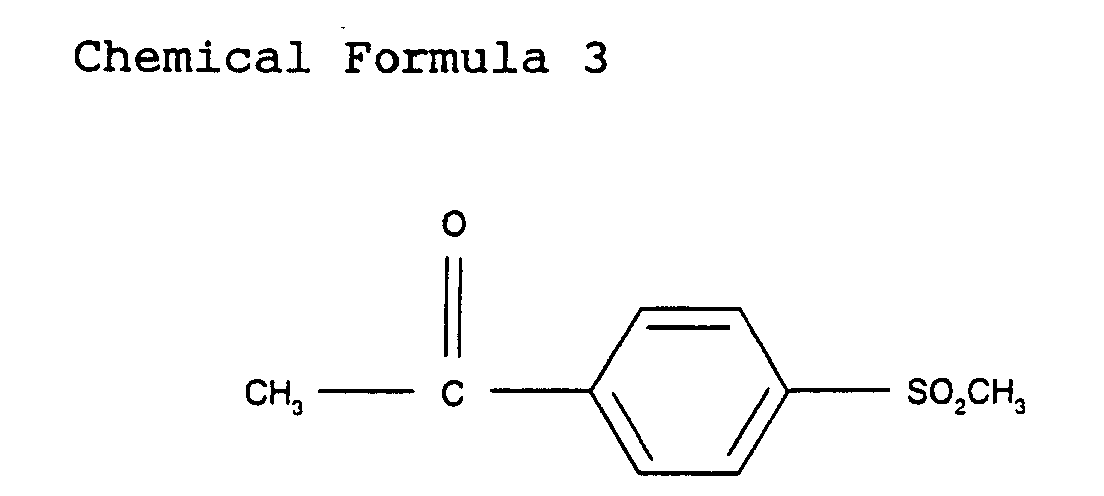
- a nonaqueous electrolyte secondary battery was prepared as in Example 1 except that a nonaqueous electrolyte liquid prepared by adding 2 percent by weight of 4-methylsulfonylacetophenone shown in Chemical Formula 3 to an equivolume solvent mixture of EC and DMC as an aromatic sulfone and dissolving LiPf 6 at a proportion of 1.5 mol/l was used.
- a nonaqueous electrolyte secondary battery was prepared as in Example 1 except that a nonaqueous electrolyte liquid prepared by adding 2 percent by weight of ethyl difluoromethylthioacetate as a thioacetate to an equivolume solvent mixture of EC and DMC as an aromatic thiol and dissolving LiPf 6 at a proportion of 1.5 mol/l was used.
- Example 5 a nonaqueous electrolyte liquid prepared by adding 2 percent by weight of ethyl difluoromethylthioacetate as a thioacetate to an equivolume solvent mixture of EC and DMC as an aromatic thiol and dissolving LiPf 6 at a proportion of 1.5 mol/l was used.
- a nonaqueous electrolyte secondary battery was prepared as in Example 1 except that a nonaqueous electrolyte liquid prepared by adding 2 percent by weight of phenyl thioacetate to an equivolume solvent mixture of EC and DMC as a thioacetate and dissolving LiPf 6 at a proportion of 1.5 mol/l was used.
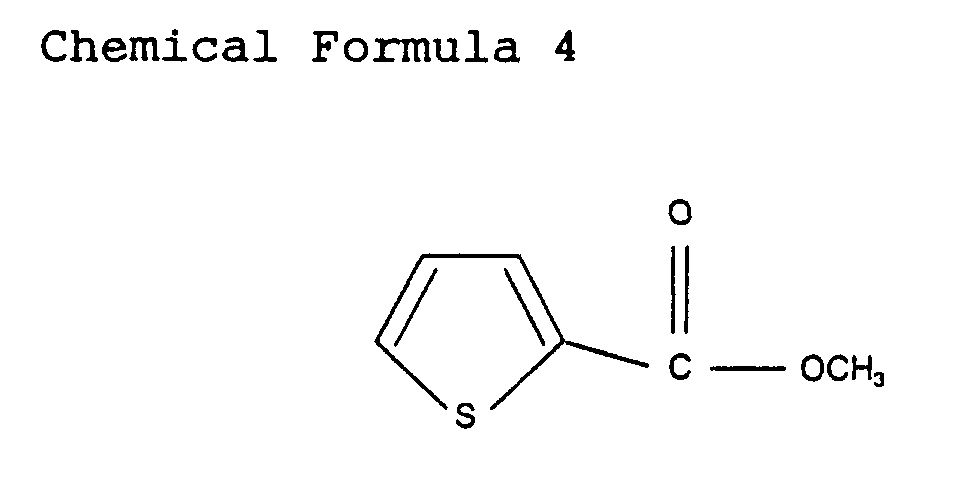
- a nonaqueous electrolyte secondary battery was prepared as in Example 1 except that a nonaqueous electrolyte liquid prepared by adding 2 percent by weight of 2-methoxycarbonylthiophene shown in Chemical Formula 4 to an equivolume solvent mixture of EC and DMC as a thiophene and dissolving LiPf 6 at a proportion of 1.5 mol/l was used.
- a nonaqueous electrolyte secondary battery was prepared as in Example 1 except that a nonaqueous electrolyte liquid prepared by adding 2 percent by weight of 1,2-benzisothiazole shown in Chemical Formula 5 to an equivolume solvent mixture of EC and DMC as a thiazole and dissolving LiPf 6 at a proportion of 1.5 mol/l was used.
- a nonaqueous electrolyte secondary battery was prepared as in Example 1 except that a nonaqueous electrolyte liquid prepared by adding 2 percent by weight of 4-methylthioacetophenone shown in Chemical Formula 6 to an equivolume solvent mixture of EC and DMC as a thianisole and dissolving LiPf 6 at a proportion of 1.5 mol/l was used.
- a nonaqueous electrolyte secondary battery was prepared as in Example 1 except that a nonaqueous electrolyte liquid prepared by dissolving LiPf 6 at a proportion of 1.5 mol/l in an equivolume mixture solvent of EC and DMC without adding anything else was used.
- a nonaqueous electrolyte secondary battery was prepared as in Example 1 except that a nonaqueous electrolyte liquid prepared by adding 2 percent by weight of diethylsulfon to an equivolume solvent mixture of EC and DMC and dissolving LiPf 6 at a proportion of 1.5 mol/l was used.
- a nonaqueous electrolyte secondary battery was prepared as in Example 1 except that a nonaqueous electrolyte liquid prepared by adding 2 percent by weight of ethylmethylsulfon to an equivolume solvent mixture of EC and DMC and dissolving LiPf 6 at a proportion of 1.5 mol/l was used.
- a nonaqueous electrolyte secondary battery was prepared as in Example 1 except that a nonaqueous electrolyte liquid prepared by adding 2 percent by weight of ethylene glycol sulfite to an equivolume solvent mixture of EC and DMC and dissolving LiPf 6 at a proportion of 1.5 mol/l was used.
- a nonaqueous electrolyte secondary battery was prepared as in Example 1 except that a nonaqueous electrolyte liquid prepared by adding 2 percent by weight of methylphenylsulfite to an equivolume solvent mixture of EC and DMC and dissolving LiPf 6 at a proportion of 1.5 mol/l was used.
- a nonaqueous electrolyte secondary battery was prepared as in Example 1 except that a nonaqueous electrolyte liquid prepared by adding 2 percent by weight of 1,3-propanesultone to an equivolume solvent mixture of EC and DMC and dissolving LiPf 6 at a proportion of 1.5 mol/l was used.
- a nonaqueous electrolyte secondary battery was prepared as in Example 1 except that a nonaqueous electrolyte liquid prepared by adding 2 percent by weight of sulfolane to an equivolume solvent mixture of EC and DMC and dissolving LiPf 6 at a proportion of 1.5 mol/l was used.
- a nonaqueous electrolyte secondary battery was prepared as in Example 1 except that a nonaqueous electrolyte liquid prepared by adding 2 percent by weight of 3-methylsulfolane to an equivolume solvent mixture of EC and DMC and dissolving LiPf 6 at a proportion of 1.5 mol/l was used.
- Examples 1 to 8 and Comparative Examples 1 to 8 of nonaqueous electrolyte secondary batteries were subjected to a constant-current charge at a charging voltage of 1.0 A to a limited voltage of 4.2 V. After reaching 4.2 V, a constant-voltage charge was performed. Subsequently, a constant-current discharge was performed at a discharging current of 1.0 A to a terminal voltage of 3.0 V in order to determine the initial capacity. Charge and discharge were repetitively performed under the above-described conditions and a discharge capacity after 200 cycles was measured so as to determine the rate of capacity retention, which is the ratio of the capacity after 200 cycles to the initial capacity.
- Comparative Example 1 which does not include any of thiols, thiophenes, thioanisoles, thiazoles, thioacetates, aromatic sulfones, or their derivatives, had a low initial capacity and a poor rate of capacity retention.
- a nonaqueous electrolyte secondary battery was prepared as in Example 6 except that the content of 2-methoxycarbonylthiophene was 0.03 percent by weight.
- a nonaqueous electrolyte secondary battery was prepared as in Example 6 except that the content of 2-methoxycarbonylthiophene was 0.05 percent by weight.
- a nonaqueous electrolyte secondary battery was prepared as in Example 6 except that the content of 2-methoxycarbonylthiophene was 10 percent by weight.
- a nonaqueous electrolyte secondary battery was prepared as in Example 6 except that the content of 2-methoxycarbonylthiophene was 12 percent by weight.
- Example 10 containing 0.05 percent by weight of 2-methoxycarbonylthiophene had a higher initial capacity and a higher rate of capacity retention than did Example 9 containing less than 0.05 weight percent of the same. Comparing Examples 11 and 12, Example 11 containing 10 percent by weight of 2-methoxycarbonylthiophene had a higher initial capacity and a higher rate of capacity retention than did Example 12 containing more than 10 of the same.
- a nonaqueous electrolyte secondary battery using a nonaqueous electrolyte containing 4-methylthioacetophenone was prepared as in Example 3 except that 45 parts by weight of a molded-graphitized-material powder made as in Example 1, 45 parts by weight of Mg 2 Si which is an alloy compound capable of forming an alloy with lithium, and 10 parts by weight of poly(vinylidene fluoride) as a binder were mixed to make a negative electrode mixture.
- a nonaqueous electrolyte secondary battery using a nonaqueous electrolyte not containing even a trace of organic sulfur compound such as 4-methylthioacetophenone was prepared as in Comparative Example 1 except that a negative electrode mixture was prepared as in Example 13.
- Example 13 of the nonaqueous electrolyte secondary battery containing an aromatic sulfone in the nonaqueous electrolyte liquid has a significantly high initial capacity and a superior rate of capacity retention.
- the nonaqueous electrolyte battery of the present invention comprising a nonaqueous electrolyte containing at least one of thiols, thiophenes, thioanisoles, thiazoles, thioacetates, aromatic sulfones, and the derivatives thereof has a longer cycle life since the capacity after cycling is significantly improved.
- the nonaqueous electrolyte secondary battery of the present invention contributes to significant improvements of the nonaqueous electrolyte secondary batteries.
Landscapes
- Chemical & Material Sciences (AREA)
- Engineering & Computer Science (AREA)
- Manufacturing & Machinery (AREA)
- Chemical Kinetics & Catalysis (AREA)
- Electrochemistry (AREA)
- General Chemical & Material Sciences (AREA)
- Materials Engineering (AREA)
- Physics & Mathematics (AREA)
- Condensed Matter Physics & Semiconductors (AREA)
- General Physics & Mathematics (AREA)
- Inorganic Chemistry (AREA)
- Secondary Cells (AREA)
- Battery Electrode And Active Subsutance (AREA)
- Carbon And Carbon Compounds (AREA)
Abstract
Description




| Organic Sulfur Compound | Content (wt.%) | Initial Capacity | Rate of Capacity retention (%) | ||
| Example 1 | | 2 | 1802 | 90 | |
| Example 2 | 4-t-butyl-1,2- | 2 | 1803 | 90 | |
| Example 3 | 4- | 2 | 1800 | 90 | |
| Example 4 | | 2 | 1801 | 92 | |
| Example 5 | | 2 | 1804 | 91 | |
| Example 6 | 2- | 2 | 1806 | 92 | |
| Example 7 | 1,2- | 2 | 1804 | 91 | |
| Example 8 | 4- | 2 | 1802 | 90 | |
| Comparative Example 1 | NONE | 0 | 1720 | 71 | |
| Comparative Example 2 | | 2 | 1733 | 74 | |
| Comparative Example 3 | | 2 | 1732 | 74 | |
| Comparative Example 4 | | 2 | 1740 | 75 | |
| Comparative Example 5 | | 2 | 1738 | 74 | |
| Comparative Example 6 | 1,3- | 2 | 1748 | 76 | |
| | sulfolane | 2 | 1724 | 72 | |
| Comparative Example 8 | 3- | 2 | 1728 | 72 |
| Organic Sulfur Compound | Content (wt.%) | Initial Capacity | Rate of Capacity retention (%) | |
| Example 9 | 2-methoxycarbonylthiophene | 0.03 | 1745 | 75 |
| Example 10 | 2-methoxycarbonylthiophene | 0.05 | 1803 | 88 |
| Example 11 | 2-methoxycarbonylthiophene | 10 | 1802 | 89 |
| Example 12 | 2-methoxycarbonylthiophene | 12 | 1730 | 73 |
| Organic Sulfur Compound | Content (wt.%) | Initial Capacity | Rate of Capacity retention (%) | |
| Example 13 | 4- | 2 | 2100 | 70 |
| Comparative Example 9 | None | 0 | 2010 | 63 |
Claims (12)
- A nonaqueous electrolyte secondary battery comprising a positive electrode having a positive electrode active material, a negative electrode containing a negative electrode active material capable of being doped/undoped with lithium, and a nonaqueous electrolyte,
wherein the nonaqueous electrolyte comprises at least one of thiols, thiophenes, thioanisoles, thiazoles, thioacetates, aromatic sulfones, and the derivatives thereof. - A nonaqueous electrolyte secondary battery according to Claim 1, wherein the content of at least one of thiols, thiophenes, thioanisoles, thiazoles, thioacetates, aromatic sulfones, and the derivatives thereof is in the range of 0.03 percent by weight to 10 percent by weight of the entire electrolyte.
- A nonaqueous electrolyte secondary battery according to one of Claims 1 and 2, wherein the thiols are selected from the group consisting of methanethiol, ethanethiol, thiophenol, 4-fluorothiophenol, 2-chlorothiophenol, 4-t-butylthiophenol, 4-t-butyl-1,2-benzenethiol, and derivatives thereof.
- A nonaqueous electrolyte secondary battery according to Claim 1, wherein the positive electrode active material comprises one of a lithium-containing metal oxide and an intercalation compound containing lithium.
- A nonaqueous electrolyte secondary battery according to Claim 4, wherein the positive electrode active material comprises a composite oxide of lithium and a transition metal represented by the general formula LiMxOy, wherein M is at least one selected from the group consisting of Co, Ni, Mn, Fe, Al, V, and Ti.
- A nonaqueous electrolyte secondary battery according to Claim 1, wherein the negative electrode active material comprises a carbonaceous material or at least one metal which alloys with lithium.
- A nonaqueous electrolyte secondary battery according to Claim 1, wherein the negative electrode active material comprises at least one selected from a carbonaceous material, a crystallized metal oxide, and an amorphous metal oxide.
- A nonaqueous electrolyte secondary battery according to Claim 1, wherein the negative electrode active material comprises a carbonaceous material selected from the group consisting of a graphitizable carbonaceous material, a nongraphitizable carbonaceous material, and a graphite material.
- A nonaqueous electrolyte secondary battery according to Claim 1, wherein the nonaqueous electrolyte is one selected from a liquid nonaqueous electrolyte prepared by dissolving an electrolyte salt into a nonaqueous solvent, a gelified electrolyte prepared by gelifying the nonaqueous electrolyte liquid by using a gelatinizer, a polymer gel electrolyte containing an electrolyte salt dissolved in a nonaqueous electrolyte which is held in a polymer matrix, and a solid electrolyte containing an electrolyte salt dissolved in a polymer matrix.
- A nonaqueous electrolyte secondary battery according to Claim 9, wherein the polymer matrix comprises one selected from the group consisting of poly(vinylidene fluoride), copolymers of vinylidene fluoride and hexafluoropropylene, polyamides, aromatic polyamides, polyolefins, polyesters, polycarbonates, polyimides, poly(met)acrylates, and polyacrylonitrile.
- A nonaqueous electrolyte secondary battery according to Claim 9, wherein the electrolyte salt comprises at least one lithium salt selected from the group consisting of LiClO4, LiAsF6, LiPF6, LiBF4, LiB(C6H5)4, CH3SO3Li, CF3SO3Li, LiN(CF3SO2)2, LiC(CF3SO2)3, LiCl, and LiBr.
- A nonaqueous electrolyte secondary battery according to Claim 1, further comprising a separator and an exterior casing,wherein the positive electrode comprises a positive electrode sheet comprising a positive electrode collector and positive electrode active material layers containing the positive electrode active material formed on the positive electrode collector,wherein the negative electrode comprises a negative electrode sheet comprising a negative electrode collector and negative electrode active material layers containing the negative electrode active material formed on the negative electrode collector,wherein the positive electrode and the negative electrode are stacked with the separator therebetween and the resulting stack is rolled in the longitudinal direction to form spirally-wound electrodes, andwherein the spirally-wound electrodes are accommodated in the exterior casing.
Applications Claiming Priority (4)
| Application Number | Priority Date | Filing Date | Title |
|---|---|---|---|
| JP2000122417 | 2000-04-18 | ||
| JP2000122417 | 2000-04-18 | ||
| JP2000333571A JP4529274B2 (en) | 2000-04-18 | 2000-10-31 | Non-aqueous electrolyte battery |
| JP2000333571 | 2000-10-31 |
Publications (3)
| Publication Number | Publication Date |
|---|---|
| EP1148570A2 true EP1148570A2 (en) | 2001-10-24 |
| EP1148570A3 EP1148570A3 (en) | 2004-09-08 |
| EP1148570B1 EP1148570B1 (en) | 2006-06-07 |
Family
ID=26590648
Family Applications (1)
| Application Number | Title | Priority Date | Filing Date |
|---|---|---|---|
| EP01109161A Expired - Lifetime EP1148570B1 (en) | 2000-04-18 | 2001-04-12 | Nonaqueous electrolyte secondary battery |
Country Status (8)
| Country | Link |
|---|---|
| US (2) | US6913856B2 (en) |
| EP (1) | EP1148570B1 (en) |
| JP (1) | JP4529274B2 (en) |
| KR (1) | KR100809853B1 (en) |
| CN (1) | CN1191657C (en) |
| DE (1) | DE60120271T2 (en) |
| MX (1) | MXPA01003860A (en) |
| TW (1) | TW490876B (en) |
Cited By (5)
| Publication number | Priority date | Publication date | Assignee | Title |
|---|---|---|---|---|
| EP1463143A3 (en) * | 2003-03-24 | 2008-04-16 | Samsung SDI Co., Ltd. | A non-aqoeous electrolyte and a lithium secondary battery comprising the same |
| WO2011073113A1 (en) * | 2009-12-15 | 2011-06-23 | Basf Se | Thiazol compounds as additives in electrolyte solutions for electrochemical cells and batteries |
| EP2784845A1 (en) * | 2013-03-29 | 2014-10-01 | Fuji Jukogyo Kabushiki Kaisha | Predoping material for electrical lithium or sodium storage device |
| EP2741356A4 (en) * | 2012-08-28 | 2016-01-20 | Lg Chemical Ltd | LITHIUM-ION RECHARGEABLE BATTERY PREVENTING AN INTERNAL SHORT CIRCUIT |
| EP3664213A4 (en) * | 2017-10-17 | 2020-11-18 | LG Chem, Ltd. | ELECTROLYTE FOR LITHIUM METAL BATTERY AND LITHIUM METAL BATTERY WITH IT |
Families Citing this family (52)
| Publication number | Priority date | Publication date | Assignee | Title |
|---|---|---|---|---|
| JP4629290B2 (en) * | 2000-12-26 | 2011-02-09 | トータル ワイヤレス ソリューショオンズ リミテッド | Lithium ion polymer secondary battery |
| US8252465B2 (en) | 2001-01-19 | 2012-08-28 | Samsung Sdi Co., Ltd. | Electrolyte for lithium secondary battery and lithium secondary battery comprising same |
| JP5589984B2 (en) * | 2001-02-02 | 2014-09-17 | ダイキン工業株式会社 | Electrode surface film forming agent |
| US7070881B2 (en) * | 2001-10-18 | 2006-07-04 | Quallion Llc | Electrical battery assembly and method of manufacture |
| JP4701579B2 (en) * | 2002-01-23 | 2011-06-15 | 日本電気株式会社 | Negative electrode for secondary battery |
| KR100458568B1 (en) * | 2002-04-03 | 2004-12-03 | 삼성에스디아이 주식회사 | An electrolyte for a lithium battery and a lithium battery comprising the same |
| CN100414743C (en) * | 2002-05-08 | 2008-08-27 | 株式会社杰士汤浅 | A non-aqueous electrolyte secondary battery |
| US20040013946A1 (en) * | 2002-07-15 | 2004-01-22 | Ube Industries, Ltd. | Non-aqueous electrolytic solution and lithium battery |
| KR100462784B1 (en) * | 2002-08-12 | 2004-12-29 | 삼성에스디아이 주식회사 | Nonaqueous electrolytic solution with improved safety and lithium battery employing the same |
| KR100467451B1 (en) * | 2002-09-04 | 2005-01-24 | 삼성에스디아이 주식회사 | An electrolyte for a lithium battery and a lithium battery comprising the same |
| KR100467435B1 (en) | 2002-09-06 | 2005-01-24 | 삼성에스디아이 주식회사 | An electrolyte for a lithium battery and a lithium battery comprising the same |
| US7608364B2 (en) | 2003-01-10 | 2009-10-27 | Nec Corporation | Lithium ion secondary battery |
| KR100515332B1 (en) * | 2003-04-28 | 2005-09-15 | 삼성에스디아이 주식회사 | An electrolyte for a lithium battery and a lithium battery comprising the same |
| KR100508923B1 (en) * | 2003-06-27 | 2005-08-17 | 삼성에스디아이 주식회사 | A non-aqueous electrolyte and a lithium secondary battery comprising the same |
| JP4319025B2 (en) * | 2003-12-25 | 2009-08-26 | 三洋電機株式会社 | Non-aqueous electrolyte secondary battery |
| KR20050096401A (en) * | 2004-03-30 | 2005-10-06 | 삼성에스디아이 주식회사 | Electrolyte for lithium battery and lithium battery comprising same |
| JP4625296B2 (en) * | 2004-03-31 | 2011-02-02 | 日立マクセル株式会社 | Non-aqueous secondary battery and electronic device using the same |
| JP4954717B2 (en) * | 2005-01-14 | 2012-06-20 | パナソニック株式会社 | Negative electrode for lithium ion secondary battery and method for producing the same, lithium ion secondary battery and method for producing the same |
| WO2009042071A2 (en) * | 2007-09-21 | 2009-04-02 | Sion Power Corporation | Electrolyte additives for lithium batteries and related methods |
| JP2010250969A (en) * | 2009-04-10 | 2010-11-04 | Panasonic Corp | Lithium battery |
| KR101688477B1 (en) * | 2009-05-08 | 2016-12-21 | 삼성에스디아이 주식회사 | Organic electrolytic solution and lithium battery employing the same |
| KR101237563B1 (en) * | 2009-08-13 | 2013-02-26 | 서울대학교산학협력단 | Amorphous phase negative active material and method of manufacturing electrode using thereof and rechargeable lithium battery comprising same |
| JP2011060655A (en) * | 2009-09-11 | 2011-03-24 | Panasonic Corp | Lithium battery |
| US9178249B2 (en) * | 2010-05-27 | 2015-11-03 | Uchicago Argonne, Llc | Electrode stabilizing materials |
| JP2010251339A (en) * | 2010-08-11 | 2010-11-04 | Nec Corp | Secondary battery, and negative electrode for the same |
| WO2012098639A1 (en) * | 2011-01-18 | 2012-07-26 | Necエナジーデバイス株式会社 | Nonaqueous electrolyte secondary battery |
| CN102569887B (en) * | 2012-01-04 | 2015-05-13 | 华南师范大学 | Non-water system high-voltage electrolyte additive and preparation method of electrolyte |
| JP5942677B2 (en) * | 2012-08-01 | 2016-06-29 | 日本電気株式会社 | Electrolytic solution and lithium secondary battery including the same |
| KR101579648B1 (en) * | 2012-08-28 | 2015-12-22 | 주식회사 엘지화학 | Lithium-ion secondary battery without internal short |
| KR101991149B1 (en) | 2012-12-19 | 2019-06-19 | 시온 파워 코퍼레이션 | Electrode structure and method for making same |
| JP6102494B2 (en) * | 2013-05-14 | 2017-03-29 | Tdk株式会社 | Non-aqueous electrolyte and lithium ion secondary battery |
| JP6102491B2 (en) * | 2013-05-14 | 2017-03-29 | Tdk株式会社 | Non-aqueous electrolyte and lithium ion secondary battery |
| JP6102492B2 (en) * | 2013-05-14 | 2017-03-29 | Tdk株式会社 | Non-aqueous electrolyte and lithium ion secondary battery |
| JP6102493B2 (en) * | 2013-05-14 | 2017-03-29 | Tdk株式会社 | Non-aqueous electrolyte and lithium ion secondary battery |
| KR101784738B1 (en) * | 2013-05-21 | 2017-10-13 | 삼성에스디아이 주식회사 | Additive for electrolyte and electrolyte and lithium secondary battery |
| US10411299B2 (en) * | 2013-08-02 | 2019-09-10 | Zenlabs Energy, Inc. | Electrolytes for stable cycling of high capacity lithium based batteries |
| JP6424436B2 (en) * | 2014-02-07 | 2018-11-21 | 日本電気株式会社 | Electrolyte and secondary battery using the same |
| JP6593802B2 (en) * | 2014-02-26 | 2019-10-23 | ビーエーエスエフ ソシエタス・ヨーロピア | Inorganic coordination polymers as gelling agents |
| KR102622781B1 (en) | 2014-05-01 | 2024-01-08 | 시온 파워 코퍼레이션 | Electrode fabrication methods and associated articles |
| GB2526312B (en) | 2014-05-20 | 2018-10-17 | Dyson Technology Ltd | Method of manufacturing an electrochemical cell |
| WO2016060038A1 (en) * | 2014-10-16 | 2016-04-21 | 株式会社Adeka | Non-aqueous electrolyte and non-aqueous electrolyte secondary cell |
| JP6120101B2 (en) * | 2014-12-25 | 2017-04-26 | トヨタ自動車株式会社 | Non-aqueous electrolyte secondary battery and manufacturing method thereof |
| CN106898816A (en) * | 2015-12-17 | 2017-06-27 | 张家港市国泰华荣化工新材料有限公司 | A kind of lithium battery electrolytes and lithium battery |
| WO2017167638A1 (en) * | 2016-03-31 | 2017-10-05 | Sony Corporation | Non-aqueous electrolytes and uses thereof |
| KR102586098B1 (en) * | 2016-06-02 | 2023-10-05 | 삼성에스디아이 주식회사 | Electrolyte for rechargeable lithium battery and rechargeable lithium battery including the same |
| JP6893311B2 (en) | 2016-10-31 | 2021-06-23 | パナソニックIpマネジメント株式会社 | Electrolytic capacitor |
| KR20180125370A (en) | 2017-05-15 | 2018-11-23 | 주식회사 엘지화학 | Lithium electrode and lithium battery compring the same |
| WO2018212438A2 (en) * | 2017-05-15 | 2018-11-22 | 주식회사 엘지화학 | Lithium electrode and lithium secondary battery comprising same |
| JP6723461B2 (en) * | 2017-07-21 | 2020-07-15 | 富士フイルム株式会社 | Solid electrolyte composition, solid electrolyte-containing sheet and all-solid secondary battery, and method for producing solid electrolyte-containing sheet and all-solid secondary battery |
| CN109256587A (en) * | 2018-07-18 | 2019-01-22 | 青海泰丰先行锂能科技有限公司 | Lithium metal secondary battery electrolyte and the lithium metal secondary battery for using the electrolyte |
| CN115621570A (en) * | 2021-07-15 | 2023-01-17 | 通用汽车环球科技运作有限责任公司 | Lithium alloy reservoir for electrochemical cells for cycling lithium ions |
| CN116742138A (en) * | 2023-07-17 | 2023-09-12 | 江苏天合储能有限公司 | A kind of electrolyte for halogenated thioester lithium battery and preparation method thereof |
Family Cites Families (15)
| Publication number | Priority date | Publication date | Assignee | Title |
|---|---|---|---|---|
| US4489145A (en) * | 1983-10-18 | 1984-12-18 | Abraham Kuzhikalail M | Lithium battery |
| JPS61161673A (en) * | 1985-01-08 | 1986-07-22 | Furukawa Electric Co Ltd:The | Secondary battery |
| JP3086510B2 (en) * | 1991-11-01 | 2000-09-11 | 三洋電機株式会社 | Non-aqueous electrolyte lithium battery |
| JP3844495B2 (en) * | 1994-04-08 | 2006-11-15 | ソニー株式会社 | Non-aqueous electrolyte secondary battery |
| US5593795A (en) * | 1995-05-01 | 1997-01-14 | Minnesota Mining And Manufacturing Company | Polymer electrolyte composition based upon thiol-ene chemistry |
| JPH08321312A (en) * | 1995-05-24 | 1996-12-03 | Sanyo Electric Co Ltd | Nonaqueous electrolyte battery |
| CA2156800C (en) * | 1995-08-23 | 2003-04-29 | Huanyu Mao | Polymerizable aromatic additives for overcharge protection in non-aqueous rechargeable lithium batteries |
| JPH09180757A (en) * | 1995-12-26 | 1997-07-11 | Sanyo Electric Co Ltd | High-molecular solid electrolyte battery |
| JP4005660B2 (en) * | 1997-03-28 | 2007-11-07 | Tdk株式会社 | Method for producing polymer solid electrolyte, polymer solid electrolyte, and electrochemical device using the same |
| JP3575735B2 (en) * | 1997-05-16 | 2004-10-13 | Necトーキン栃木株式会社 | Non-aqueous rechargeable lithium battery |
| US5948569A (en) * | 1997-07-21 | 1999-09-07 | Duracell Inc. | Lithium ion electrochemical cell |
| FR2767969B1 (en) * | 1997-08-29 | 1999-10-15 | Alsthom Cge Alcatel | LITHIUM RECHARGEABLE GENERATOR WITH ORGANIC ELECTROLYTE AND CARBON ANODE |
| JPH11307121A (en) * | 1998-04-22 | 1999-11-05 | Mitsubishi Chemical Corp | Electrolyte for lithium secondary battery |
| US6413677B1 (en) * | 1998-12-25 | 2002-07-02 | Ube Industries, Ltd. | Lithium secondary battery electrolyte and lithium secondary battery using the same |
| WO2001063686A1 (en) * | 2000-02-22 | 2001-08-30 | Sumitomo Seika Chemicals Co., Ltd. | Electrolytic solution composition for lithium secondary battery |
-
2000
- 2000-10-31 JP JP2000333571A patent/JP4529274B2/en not_active Expired - Fee Related
-
2001
- 2001-04-10 TW TW090108532A patent/TW490876B/en not_active IP Right Cessation
- 2001-04-12 DE DE60120271T patent/DE60120271T2/en not_active Expired - Lifetime
- 2001-04-12 EP EP01109161A patent/EP1148570B1/en not_active Expired - Lifetime
- 2001-04-17 KR KR1020010020370A patent/KR100809853B1/en not_active Expired - Fee Related
- 2001-04-17 MX MXPA01003860A patent/MXPA01003860A/en unknown
- 2001-04-18 US US09/837,847 patent/US6913856B2/en not_active Expired - Fee Related
- 2001-04-18 CN CNB011214392A patent/CN1191657C/en not_active Expired - Fee Related
-
2005
- 2005-04-21 US US11/111,401 patent/US20050208385A1/en not_active Abandoned
Cited By (9)
| Publication number | Priority date | Publication date | Assignee | Title |
|---|---|---|---|---|
| EP1463143A3 (en) * | 2003-03-24 | 2008-04-16 | Samsung SDI Co., Ltd. | A non-aqoeous electrolyte and a lithium secondary battery comprising the same |
| WO2011073113A1 (en) * | 2009-12-15 | 2011-06-23 | Basf Se | Thiazol compounds as additives in electrolyte solutions for electrochemical cells and batteries |
| US8940433B2 (en) | 2009-12-15 | 2015-01-27 | Basf Se | Thiazole compounds as additives in electrolyte solutions in electrochemical cells and batteries |
| US9234290B2 (en) | 2009-12-15 | 2016-01-12 | Basf Se | Thiazole compounds as additives in electrolyte solutions in electrochemical cells and batteries |
| EP2741356A4 (en) * | 2012-08-28 | 2016-01-20 | Lg Chemical Ltd | LITHIUM-ION RECHARGEABLE BATTERY PREVENTING AN INTERNAL SHORT CIRCUIT |
| US9397373B2 (en) | 2012-08-28 | 2016-07-19 | Lg Chem, Ltd. | Lithium ion secondary battery without internal short |
| EP2784845A1 (en) * | 2013-03-29 | 2014-10-01 | Fuji Jukogyo Kabushiki Kaisha | Predoping material for electrical lithium or sodium storage device |
| EP3664213A4 (en) * | 2017-10-17 | 2020-11-18 | LG Chem, Ltd. | ELECTROLYTE FOR LITHIUM METAL BATTERY AND LITHIUM METAL BATTERY WITH IT |
| US11495824B2 (en) | 2017-10-17 | 2022-11-08 | Lg Energy Solution, Ltd. | Electrolyte for lithium metal battery and lithium metal battery comprising same |
Also Published As
| Publication number | Publication date |
|---|---|
| KR20010098648A (en) | 2001-11-08 |
| US6913856B2 (en) | 2005-07-05 |
| KR100809853B1 (en) | 2008-03-04 |
| TW490876B (en) | 2002-06-11 |
| DE60120271T2 (en) | 2007-05-31 |
| JP4529274B2 (en) | 2010-08-25 |
| US20020018940A1 (en) | 2002-02-14 |
| DE60120271D1 (en) | 2006-07-20 |
| EP1148570B1 (en) | 2006-06-07 |
| CN1322028A (en) | 2001-11-14 |
| JP2002008720A (en) | 2002-01-11 |
| CN1191657C (en) | 2005-03-02 |
| US20050208385A1 (en) | 2005-09-22 |
| EP1148570A3 (en) | 2004-09-08 |
| MXPA01003860A (en) | 2004-11-10 |
Similar Documents
| Publication | Publication Date | Title |
|---|---|---|
| US6913856B2 (en) | Nonaqueous electrolyte secondary battery | |
| US7229713B2 (en) | Electrode and battery using the same | |
| JP3755502B2 (en) | Non-aqueous electrolyte battery | |
| JP3436033B2 (en) | Non-aqueous electrolyte secondary battery | |
| EP1372209A1 (en) | Battery | |
| US20040058247A1 (en) | Battery | |
| JP3709628B2 (en) | Non-aqueous electrolyte secondary battery | |
| JP2004047231A (en) | battery | |
| JP2001006730A (en) | Non-aqueous electrolyte battery | |
| JP4560854B2 (en) | Nonaqueous electrolyte secondary battery | |
| JP3552377B2 (en) | Rechargeable battery | |
| EP1369951A1 (en) | Battery | |
| JPH10312807A (en) | Method for producing lithium secondary battery and negative electrode | |
| JP2004363076A (en) | battery | |
| JP2002280080A (en) | Rechargeable battery charging method | |
| JP4781545B2 (en) | Non-aqueous electrolyte lithium secondary battery | |
| JPH07335262A (en) | Non-aqueous electrolyte secondary battery | |
| JP2004200115A (en) | Negative electrode and battery using it | |
| KR100698361B1 (en) | Anode active material, manufacturing method thereof and lithium secondary battery having same | |
| JP2001148241A (en) | Non-aqueous electrolyte battery | |
| JP3356157B2 (en) | Non-aqueous electrolyte secondary battery | |
| JP2004079342A (en) | battery | |
| KR100836515B1 (en) | Lithium Secondary Battery with High Voltage Electrolyte | |
| JP4080110B2 (en) | Non-aqueous electrolyte battery | |
| JP4300626B2 (en) | Non-aqueous electrolyte battery |
Legal Events
| Date | Code | Title | Description |
|---|---|---|---|
| PUAI | Public reference made under article 153(3) epc to a published international application that has entered the european phase |
Free format text: ORIGINAL CODE: 0009012 |
|
| AK | Designated contracting states |
Kind code of ref document: A2 Designated state(s): AT BE CH CY DE DK ES FI FR GB GR IE IT LI LU MC NL PT SE TR |
|
| AX | Request for extension of the european patent |
Free format text: AL;LT;LV;MK;RO;SI |
|
| PUAL | Search report despatched |
Free format text: ORIGINAL CODE: 0009013 |
|
| AK | Designated contracting states |
Kind code of ref document: A3 Designated state(s): AT BE CH CY DE DK ES FI FR GB GR IE IT LI LU MC NL PT SE TR |
|
| AX | Request for extension of the european patent |
Extension state: AL LT LV MK RO SI |
|
| 17P | Request for examination filed |
Effective date: 20050211 |
|
| 17Q | First examination report despatched |
Effective date: 20050406 |
|
| AKX | Designation fees paid |
Designated state(s): DE FI FR GB SE |
|
| GRAP | Despatch of communication of intention to grant a patent |
Free format text: ORIGINAL CODE: EPIDOSNIGR1 |
|
| GRAS | Grant fee paid |
Free format text: ORIGINAL CODE: EPIDOSNIGR3 |
|
| GRAA | (expected) grant |
Free format text: ORIGINAL CODE: 0009210 |
|
| AK | Designated contracting states |
Kind code of ref document: B1 Designated state(s): DE FI FR GB SE |
|
| REG | Reference to a national code |
Ref country code: SE Ref legal event code: TRGR Ref country code: GB Ref legal event code: FG4D |
|
| REF | Corresponds to: |
Ref document number: 60120271 Country of ref document: DE Date of ref document: 20060720 Kind code of ref document: P |
|
| ET | Fr: translation filed | ||
| PLBE | No opposition filed within time limit |
Free format text: ORIGINAL CODE: 0009261 |
|
| STAA | Information on the status of an ep patent application or granted ep patent |
Free format text: STATUS: NO OPPOSITION FILED WITHIN TIME LIMIT |
|
| 26N | No opposition filed |
Effective date: 20070308 |
|
| REG | Reference to a national code |
Ref country code: GB Ref legal event code: 746 Effective date: 20091130 |
|
| PGFP | Annual fee paid to national office [announced via postgrant information from national office to epo] |
Ref country code: FR Payment date: 20110510 Year of fee payment: 11 Ref country code: DE Payment date: 20110421 Year of fee payment: 11 Ref country code: SE Payment date: 20110414 Year of fee payment: 11 |
|
| PGFP | Annual fee paid to national office [announced via postgrant information from national office to epo] |
Ref country code: FI Payment date: 20110414 Year of fee payment: 11 Ref country code: GB Payment date: 20110421 Year of fee payment: 11 |
|
| REG | Reference to a national code |
Ref country code: SE Ref legal event code: EUG |
|
| GBPC | Gb: european patent ceased through non-payment of renewal fee |
Effective date: 20120412 |
|
| REG | Reference to a national code |
Ref country code: FR Ref legal event code: ST Effective date: 20121228 |
|
| PG25 | Lapsed in a contracting state [announced via postgrant information from national office to epo] |
Ref country code: GB Free format text: LAPSE BECAUSE OF NON-PAYMENT OF DUE FEES Effective date: 20120412 Ref country code: FI Free format text: LAPSE BECAUSE OF NON-PAYMENT OF DUE FEES Effective date: 20120412 |
|
| REG | Reference to a national code |
Ref country code: DE Ref legal event code: R119 Ref document number: 60120271 Country of ref document: DE Effective date: 20121101 |
|
| PG25 | Lapsed in a contracting state [announced via postgrant information from national office to epo] |
Ref country code: SE Free format text: LAPSE BECAUSE OF NON-PAYMENT OF DUE FEES Effective date: 20120413 Ref country code: FR Free format text: LAPSE BECAUSE OF NON-PAYMENT OF DUE FEES Effective date: 20120430 |
|
| PG25 | Lapsed in a contracting state [announced via postgrant information from national office to epo] |
Ref country code: DE Free format text: LAPSE BECAUSE OF NON-PAYMENT OF DUE FEES Effective date: 20121101 |