EP1143019A1 - Sheet steel and method for producing sheet steel - Google Patents
Sheet steel and method for producing sheet steel Download PDFInfo
- Publication number
- EP1143019A1 EP1143019A1 EP00962863A EP00962863A EP1143019A1 EP 1143019 A1 EP1143019 A1 EP 1143019A1 EP 00962863 A EP00962863 A EP 00962863A EP 00962863 A EP00962863 A EP 00962863A EP 1143019 A1 EP1143019 A1 EP 1143019A1
- Authority
- EP
- European Patent Office
- Prior art keywords
- rolling
- less
- cooling
- hot
- steel sheet
- Prior art date
- Legal status (The legal status is an assumption and is not a legal conclusion. Google has not performed a legal analysis and makes no representation as to the accuracy of the status listed.)
- Granted
Links
Images


Classifications
-
- C—CHEMISTRY; METALLURGY
- C21—METALLURGY OF IRON
- C21D—MODIFYING THE PHYSICAL STRUCTURE OF FERROUS METALS; GENERAL DEVICES FOR HEAT TREATMENT OF FERROUS OR NON-FERROUS METALS OR ALLOYS; MAKING METAL MALLEABLE, e.g. BY DECARBURISATION OR TEMPERING
- C21D9/00—Heat treatment, e.g. annealing, hardening, quenching or tempering, adapted for particular articles; Furnaces therefor
- C21D9/46—Heat treatment, e.g. annealing, hardening, quenching or tempering, adapted for particular articles; Furnaces therefor for sheet metals
- C21D9/48—Heat treatment, e.g. annealing, hardening, quenching or tempering, adapted for particular articles; Furnaces therefor for sheet metals deep-drawing sheets
-
- B—PERFORMING OPERATIONS; TRANSPORTING
- B21—MECHANICAL METAL-WORKING WITHOUT ESSENTIALLY REMOVING MATERIAL; PUNCHING METAL
- B21B—ROLLING OF METAL
- B21B1/00—Metal-rolling methods or mills for making semi-finished products of solid or profiled cross-section; Sequence of operations in milling trains; Layout of rolling-mill plant, e.g. grouping of stands; Succession of passes or of sectional pass alternations
- B21B1/40—Metal-rolling methods or mills for making semi-finished products of solid or profiled cross-section; Sequence of operations in milling trains; Layout of rolling-mill plant, e.g. grouping of stands; Succession of passes or of sectional pass alternations for rolling foils which present special problems, e.g. because of thinness
-
- C—CHEMISTRY; METALLURGY
- C21—METALLURGY OF IRON
- C21D—MODIFYING THE PHYSICAL STRUCTURE OF FERROUS METALS; GENERAL DEVICES FOR HEAT TREATMENT OF FERROUS OR NON-FERROUS METALS OR ALLOYS; MAKING METAL MALLEABLE, e.g. BY DECARBURISATION OR TEMPERING
- C21D8/00—Modifying the physical properties of ferrous metals or ferrous alloys by deformation combined with, or followed by, heat treatment
- C21D8/02—Modifying the physical properties of ferrous metals or ferrous alloys by deformation combined with, or followed by, heat treatment during manufacturing of plates or strips
- C21D8/0221—Modifying the physical properties of ferrous metals or ferrous alloys by deformation combined with, or followed by, heat treatment during manufacturing of plates or strips characterised by the working steps
- C21D8/0226—Hot rolling
-
- C—CHEMISTRY; METALLURGY
- C21—METALLURGY OF IRON
- C21D—MODIFYING THE PHYSICAL STRUCTURE OF FERROUS METALS; GENERAL DEVICES FOR HEAT TREATMENT OF FERROUS OR NON-FERROUS METALS OR ALLOYS; MAKING METAL MALLEABLE, e.g. BY DECARBURISATION OR TEMPERING
- C21D8/00—Modifying the physical properties of ferrous metals or ferrous alloys by deformation combined with, or followed by, heat treatment
- C21D8/02—Modifying the physical properties of ferrous metals or ferrous alloys by deformation combined with, or followed by, heat treatment during manufacturing of plates or strips
- C21D8/04—Modifying the physical properties of ferrous metals or ferrous alloys by deformation combined with, or followed by, heat treatment during manufacturing of plates or strips to produce plates or strips for drawing, e.g. for deep-drawing
- C21D8/0421—Modifying the physical properties of ferrous metals or ferrous alloys by deformation combined with, or followed by, heat treatment during manufacturing of plates or strips to produce plates or strips for drawing, e.g. for deep-drawing characterised by the working steps
- C21D8/0426—Hot rolling
-
- C—CHEMISTRY; METALLURGY
- C21—METALLURGY OF IRON
- C21D—MODIFYING THE PHYSICAL STRUCTURE OF FERROUS METALS; GENERAL DEVICES FOR HEAT TREATMENT OF FERROUS OR NON-FERROUS METALS OR ALLOYS; MAKING METAL MALLEABLE, e.g. BY DECARBURISATION OR TEMPERING
- C21D8/00—Modifying the physical properties of ferrous metals or ferrous alloys by deformation combined with, or followed by, heat treatment
- C21D8/02—Modifying the physical properties of ferrous metals or ferrous alloys by deformation combined with, or followed by, heat treatment during manufacturing of plates or strips
- C21D8/04—Modifying the physical properties of ferrous metals or ferrous alloys by deformation combined with, or followed by, heat treatment during manufacturing of plates or strips to produce plates or strips for drawing, e.g. for deep-drawing
- C21D8/0447—Modifying the physical properties of ferrous metals or ferrous alloys by deformation combined with, or followed by, heat treatment during manufacturing of plates or strips to produce plates or strips for drawing, e.g. for deep-drawing characterised by the heat treatment
- C21D8/0463—Modifying the physical properties of ferrous metals or ferrous alloys by deformation combined with, or followed by, heat treatment during manufacturing of plates or strips to produce plates or strips for drawing, e.g. for deep-drawing characterised by the heat treatment following hot rolling
-
- C—CHEMISTRY; METALLURGY
- C22—METALLURGY; FERROUS OR NON-FERROUS ALLOYS; TREATMENT OF ALLOYS OR NON-FERROUS METALS
- C22C—ALLOYS
- C22C38/00—Ferrous alloys, e.g. steel alloys
- C22C38/001—Ferrous alloys, e.g. steel alloys containing N
-
- C—CHEMISTRY; METALLURGY
- C22—METALLURGY; FERROUS OR NON-FERROUS ALLOYS; TREATMENT OF ALLOYS OR NON-FERROUS METALS
- C22C—ALLOYS
- C22C38/00—Ferrous alloys, e.g. steel alloys
- C22C38/02—Ferrous alloys, e.g. steel alloys containing silicon
-
- C—CHEMISTRY; METALLURGY
- C22—METALLURGY; FERROUS OR NON-FERROUS ALLOYS; TREATMENT OF ALLOYS OR NON-FERROUS METALS
- C22C—ALLOYS
- C22C38/00—Ferrous alloys, e.g. steel alloys
- C22C38/04—Ferrous alloys, e.g. steel alloys containing manganese
-
- C—CHEMISTRY; METALLURGY
- C21—METALLURGY OF IRON
- C21D—MODIFYING THE PHYSICAL STRUCTURE OF FERROUS METALS; GENERAL DEVICES FOR HEAT TREATMENT OF FERROUS OR NON-FERROUS METALS OR ALLOYS; MAKING METAL MALLEABLE, e.g. BY DECARBURISATION OR TEMPERING
- C21D1/00—General methods or devices for heat treatment, e.g. annealing, hardening, quenching or tempering
- C21D1/18—Hardening; Quenching with or without subsequent tempering
- C21D1/19—Hardening; Quenching with or without subsequent tempering by interrupted quenching
-
- C—CHEMISTRY; METALLURGY
- C21—METALLURGY OF IRON
- C21D—MODIFYING THE PHYSICAL STRUCTURE OF FERROUS METALS; GENERAL DEVICES FOR HEAT TREATMENT OF FERROUS OR NON-FERROUS METALS OR ALLOYS; MAKING METAL MALLEABLE, e.g. BY DECARBURISATION OR TEMPERING
- C21D2211/00—Microstructure comprising significant phases
- C21D2211/005—Ferrite
-
- C—CHEMISTRY; METALLURGY
- C21—METALLURGY OF IRON
- C21D—MODIFYING THE PHYSICAL STRUCTURE OF FERROUS METALS; GENERAL DEVICES FOR HEAT TREATMENT OF FERROUS OR NON-FERROUS METALS OR ALLOYS; MAKING METAL MALLEABLE, e.g. BY DECARBURISATION OR TEMPERING
- C21D2211/00—Microstructure comprising significant phases
- C21D2211/009—Pearlite
Definitions
- the present invention relates to a steel sheet such as hot-rolled steel sheets and cold-rolled steel sheets, and to a method for manufacturing the same.
- Steel sheets such as hot-rolled steel sheets and cold-rolled steel sheets are used in wide fields including automobiles, household electric appliances, and industrial machines. Since these steel sheets are subjected to some processing before use, they are requested to have various kinds of workability.
- high tension materials high tensile strength hot-rolled steel sheets having strengths of 340 MPa or higher class and for the uses other than deep drawing, for example, are required to have high stretch flanging performance during burring.
- the cold-rolled steel sheets having strengths of 440 MPa or lower and for the drawing uses are requested to have high r value and high breaking elongation.
- JP-A-9-241742 discloses a method for improving the homogeneity of mechanical properties in a hot-rolled coil by adopting continuous hot-rolling.
- the method is a technology that uses a process of continuous hot-rolling to improve the material quality of the rolled steel sheet at front end thereof and at rear end thereof, and to eliminate the dispersion in material quality within a coil.
- JP-B-61-15929 and JP-B-63-67524 disclose a method to improve the workability of high tension hot-rolled steel sheet by controlling the cooling speed after the hot-rolling and controlling the coiling temperature.
- JP-A-5-112831 discloses a method to apply strong drafting during hot-rolling and to apply rapid cooling.
- the technology intends to improve the r value of cold-rolled steel sheet by applying final reduction in thickness of hot-rolling to 30% or more and by applying rapid cooling immediately after completed the rolling, thus reducing the grain size in the hot-rolled steel sheet.
- JP-B-61-15929 aiming at the improvement in workability of high tension materials improves the balance of strength and ductility compared with conventional steel sheets, but fails to substantially solve the stretch flanging performance. Furthermore, the technology cannot improve the surface defects. Similarly, the high tension hot-rolled steel sheets manufactured by the method of JP-B-63-67524 cannot substantially solve the stretch flanging performance, though the breaking elongation and the toughness of steel sheets are improved.
- the average cooling speed immediately after the rolling which average cooling speed is a feature of the invention, is in a range of from 90 to 105°C/sec during 1 second after starting the cooling, and from 65 to 80°C/sec during 3 seconds after starting the cooling.
- level of cooling speed it was found that, under the hot-rolling condition in commercial apparatuses, the grains in the steel sheet, particularly those in rolling top portion, cannot be refined.
- the cause is presumably that the cooling cannot be started immediately after completed the finish-rolling, and there needs a time to start cooling. Since the cooling unit cannot be installed at directly adjacent to the exit of the final rolling stand owing to the necessity of installing finish thermometer and instruments to the exit of the final stand of finish-rolling mill, the cooling cannot be performed within, for example, 0.1 second after the completion of the finish-rolling. Particularly at the rolling top portion, high speed travel is not available and the rolling speed is slow, which results in long time before starting the cooling. Thus, the cooling at a cooling speed described in the patent disclosure cannot prevent the formation of coarse austenitic grains.
- the top portion of the steel strip after the hot-rolling is difficult to be rapidly cooled, thus the grains cannot be fully reduced in their size, which fails to obtain superior mechanical properties and homogeneity thereof.
- Increased reduction in thickness in the final pass of hot-rolling is favorable for reducing the size of austenitic grains.
- increase of the reduction in thickness to 30% or more as in the technology described in JP-A-5-112831 is difficult to be actually implemented because the insufficient shape of steel sheet likely occurs.
- high tension materials having 340 MPa or higher tensile strength are requested for hot-rolled steel sheets and cold-rolled steel sheets to have high stretch flanging performance during burring.
- the automobile application is requested to satisfy the collision safety as one of the critical characteristics, thus the steel sheets are requested to have excellent shock resistance (high shock absorption energy as an evaluation item of collision safety).
- Japanese Patent No. 2555436 As for the improvement in workability of high tension materials, there is a prior art, Japanese Patent No. 2555436.
- a Ti base precipitation hardening steel is processed at cooling speeds of from 30 to 150°C /sec after the finish-rolling, at coiling temperatures of from 250 to 540°C, thus improving the stretch flanging performance of high tension steels of 50 to 60 K class utilizing the formed (ferrite + bainite) structure.
- the cooling speeds of from 30 to 150°C/sec after the finish-rolling cannot be said to substantially improve the stretch flanging performance, and, there is a problem of low breaking elongation owing to the low temperature level of coiling.
- JP-B-7-56053 discloses a method to improve the stretch flanging performance of hot dip zinc-coated steel sheets as the substrate of hot-rolling sheets using (ferrite + pearlite) steels of 45 to 50 K class applying cooling speeds of 10°C/sec or more (Examples gave max. 95°C/sec) after the hot-rolling finishing.
- the cooling speed is, however, 95°C/sec at the maximum, and substantial improvement in the stretch flanging performance cannot be attained.
- JP-A-4-88125 discloses a method to improve the stretch flanging performance of the high tensile materials of 50 to 70 K class using (ferrite + pearlite) steels with the addition of 0.0005 to 0.0050% Ca, applying hot-rolling at high temperatures of (Ar 3 transformation point + 60 to 950°C), and applying cooling within 3 seconds after the hot-rolling at cooling speeds of 50°C /sec or more, preferably 150°C/sec or less, then the cooling is stopped at temperatures of from 410 to 620°C depending on the composition of the steel, followed by air cooling and coiling at 350 to 500°C of coiling temperatures. Since, however, slight amount of addition of Ca requires an RH degassing step in the steel making stage, the steel making cost increases. Furthermore, even with the cooling condition after the hot-rolling, which cooling is a feature of the technology, the stretch flanging performance cannot be drastically improved. In addition, low coiling temperature results in low breaking elongation.
- the method to strengthen the cooling after rolling As for the manufacturing of high tension steel sheets, there are methods to secure strength without adding large amount of alloying components: the method to strengthen the cooling after rolling; and the method to reduce grain size.
- the latter method particularly improves not only the strength but also the toughness, so that there are many proposals of the method, including JP-A-58-123823.
- JP-A-61-73829 discloses a method that combines the method to strengthen the cooling after rolling with the method to reduce grain size, and the feature of the method is to apply rapid cooling to the steel sheet, which was once prepared to fine microstructure under an adjustment of rolling condition, for further reducing the grain size. That is, the rapid cooling is given to a state that slight amount of ferritic grains were generated during or immediately after the rolling, thus to finely divide the transformed structure using the ferrite to create very fine microstructure, which gives steel sheet having high strength and high toughness.
- the method absolutely requires the precipitation of ferrite during or immediately after the rolling owing to the low temperature rolling. Therefore, there are problems of, when the rolling finishing temperature and the temperature to stop cooling varied in the rolling width direction or in the rolling longitudinal direction, the strength varies even in the same composition steels and in a coil, which fails to attain specified strength.
- the prior art intends to refine the grains by rolling followed by rapid cooling the microscopic structure of the steel sheets to secure high strength and high toughness. Owing to the method, the prior art likely induces unstable characteristics under the variations in manufacturing conditions.
- the present invention provides a method for manufacturing steel sheet comprising the steps of: forming a sheet bar; forming a steel strip; applying primary cooling and secondary cooling to the steel strip; and coiling the cooled steel strip.
- the step of forming the sheet bar comprises rough-rolling a continuously cast slab containing 0.8% or less C by weight.
- the step of forming the steel strip comprises finish-rolling the sheet bar at finishing temperatures of not less than (Ar 3 transformation point - 20°C).
- the step of cooling the steel strip comprises cooling the finish-rolled steel strip at cooling speeds of higher than 120°C /sec down to temperatures of from 500 to 800°C.
- the step of coiling the cooled steel strip comprises coiling the secondary-cooled steel strip at temperatures of from 400 to 750°C.
- the sheet bar when a sheet bar is formed by rough-rolling a continuously cast slab containing more than 0.8% and not more than 1% C by weight, the sheet bar is finish-rolled at finishing temperatures of not less than (Acm transformation point - 20°C).
- the present invention provides a method for manufacturing steel sheet comprising the steps of: forming a slab; forming a hot-rolled steel sheet; applying primary cooling and secondary cooling to the hot-rolled steel sheet; and coiling the cooled steel sheet.
- the step of forming the slab comprises continuous casting to give treatment for reducing segregation to manufacture the slab consisting essentially of 0.05 to 0.14% C, 0.5% or less Si, 0.5 to 2.5% Mn, 0.05% or less P, 0.1% or less S, 0.005% or less O, and less than 0.0005% Ca, by weight.
- the step of forming the hot-rolled steel sheet comprises hot-rolling the slab at finishing temperature of finish-rolling not less than Ar 3 transformation point.
- the primary cooling step comprises cooling the hot-rolled steel sheet starting the primary cooling within 2 seconds after the hot-rolling to temperatures of from 600 to 750°C at cooling speeds of from 100 to 2,000°C/sec.
- the secondary cooling step comprises cooling the primary-cooled steel sheet starting the secondary cooling to the above-described temperature range at cooling speeds of less than 50°C /sec.
- the secondary-cooled steel sheet is coiled at temperatures of from 450 to 650°C.
- the present invention provides a method for manufacturing steel sheet comprising hot-rolling step and cooling step.
- the step of hot-rolling comprises hot-rolling a steel consisting essentially of 0.03 to 0.12% C, 1% or less Si, 5 to 2% Mn, 0.02% or less P, 0.01% or less S, at least one element selected from the group consisting of 0.005 to 0.1% Nb, 0.005 to 0.1% V, and 0.005 to 0.1% Ti, by weight, at temperatures of 1,070°C or below to accumulated reductions in thickness of 30% or more.
- the step of hot-rolling may be carried out on a steel consisting essentially of 0.03 to 0.12% C, 1% or less Si, 0.5 to 2% Mn, 0.02% or less P, 0.01% or less S, and 0.05 to 0.5% Mo, by weight, at temperatures of 1,070°C or below to accumulated reductions in thickness of 30% or more.
- the step of cooling comprises cooling steel sheet within 6 seconds after the completion of the rolling to temperatures higher than 500°C and not higher than 700°C at average cooling speeds of not less than 80°C/sec.
- the method for manufacturing steel sheet according to the Preferred embodiment 1 comprises the steps of: forming a sheet bar by rough-rolling a continuous cast slab containing 0.8% or less C by weight; forming a steel strip by finish-rolling the sheet bar at finishing temperatures of finish-rolling of not less than (Ar 3 transformation point - 20°C); rapid cooling the steel strip after the finish-rolling down to temperatures of from 500 to 800°C at cooling speeds of higher than 120°C/sec; and coiling the steel strip after the rapid cooling at coiling temperatures of from 400 to 750°C.
- the continuously cast slab may be prepared by continuously casting a steel consisting essentially of 0.8% or less C, 2.5% or less Si, and 3.0% or less Mn, by weight. Furthermore, the continuously cast slab may be prepared by continuously casting a steel consisting essentially of 0.8% or less C, 2.5% or less Si, 3.0% or less Mn, and 0.01 to 0.2% at least one element selected from the group consisting of Ti, Nb, V, Mo, Zr, and Cr, by weight. Furthermore, the continuously cast slab may be prepared by continuously casting a steel consisting essentially of 0.8% or less C, 2.5% or less Si, 3.0% or less Mn, and 0.005% or less at least one of Ca and B, by weight.
- the continuously cast slab may be prepared by continuously casting a steel consisting essentially of 0.8% or less C, 2.5% or less Si, 3.0% or less Mn, 0.01 to 0.2% at least one element selected from the group consisting of Ti, Nb, V, Mo, Zr, and Cr, and 0.005% or less at least one of Ca and B, by weight.
- the C content may be specified to a range of from more than 0.8% and not more than 1.0% by weight, instead of 0.8% or less, and the finishing temperature may be specified to (Acm transformation point - 20°C) instead of (Ar 3 transformation point - 20°C), while adopting the same conditions for other variables.
- Carbon is an additive element to ensure the strength of steel. Excessive addition, however, results in significant degradation in workability. That is, more than 1% C content induces degradation in workability. Accordingly, the C content is specified to 1% or less.
- Silicon is an element to strengthen solid solution. If, however, the Si content exceeds 2.5%, the surface properties degrade. Consequently, the Si content is preferably 2.5% or less.
- Mn improves toughness of the steel sheet and has function to strengthen solid solution.
- Mn is an element that gives bad influence on workability. If the Mn content exceeds 3%, the strength increases to significantly degrade the workability. Therefore, the Mn content is preferably 3% or less.
- Phosphorus is an element that has a function to strengthen solid solution. If, however, the P content exceeds 0.2%, grain boundary brittleness caused from grain boundary segregation likely occurs. Accordingly, the P content is preferably 0.2% or less.
- Sulfur is an impurity element, and the S content is preferably minimized. If the S content exceeds 0.05%, fine sulfide precipitation increases to degrade the workability. Consequently, the S content is preferably 0.05% or less.
- the N content is preferably 0.02% or less.
- Oxygen content is required to be controlled to suppress crack generation on the surface of slab or below the surface layer of slab during continuous casting. If the O content exceeds 0.005%, the crack generation on slab becomes significant, and the workability which is an aim of the present invention also degrades. Accordingly, the O content is preferably 0.005% or less.
- Ca and B are effective elements to improve the workability of steel sheet, so these elements are preferably to be added. If, however, the sum of the Ca and B contents exceeds 0.005%, the deep drawing performance is degraded. Therefore, if Ca and/or B are added, the sum of the added contents is specified to 0.005% or less.
- Finishing temperature (for the case of C ⁇ 0.8%): (Ar 3 transformation point - 20°C) or above
- the finish-rolling is applied at finishing temperatures of (Ar 3 transformation point - 20°C) or above. The finish-rolling assures the homogeneous structure and the reduced grain size in succeeding steps, thus improves the workability such as the balance of strength and ductility, the stretch flanging performance, and increases the r value in a cold-rolled steel sheet.
- Finishing temperature (for the case of C > 0.8%): (Acm transformation point - 20°C) or above
- the finish-rolling is applied at finishing temperature of (Ar 3 transformation point - 20°C) or above.
- the finish-rolling assures the homogeneous microstructure and the reduced grain size in succeeding steps, thus improves the workability such as the quenching performance, the spheroidizing rate in cold-rolled steel sheet, and the stretch flanging performance.
- Cooling after rolled rapid cooling at cooling speed > 120°C /sec
- rapid cooling after rolled is necessary to establish fine structure of ferritic grains, pearlite and the like after the transformation and to uniformize the material quality. If the cooling is gradual cooling, the microstructure becomes coarse one, and in a high C steel, homogeneous pearlite structure cannot be attained to result in nonhomogeneous microstructure. If the cooling speed is 120°C/sec or less, the ferritic grains and the structure of pearlite and the like generated from transformation become coarse, and in a hypereutectoid steel, cementite precipitates to result in nonhomogeneous microstructure.
- End temperature of cooling 500 to 800°C
- the ferritic grains and the precipitates of pearlite and the like become fine in their size after the transformation, which improves the workability.
- the upper limit of the cooling speed is not specifically specified. From the viewpoint of industrial applicability, however, the upper limit of the cooling speed is 2,000°C/sec.
- Coiling temperature 400 to 750°C
- the steel strip After the secondary cooling, the steel strip is required to be coiled at coiling temperatures of from 400 to 750°C.
- the reason is that less than 400°C of coiling temperature induces the formation of low temperature transformation phase, and that above 750 °C of coiling temperature induces formation of coarse microstructure of grains and the like to degrade the workability.
- the continuously cast slab may be roughly-rolled either by direct hot-rolling or by reheating, before cooling to room temperature, to temperatures of 1,200°C or below by feeding at warm state into a heating furnace.
- the continuously cast slab is not cooled to room temperature but started the rough-rolling with direct-rolling in as-cast state, or is reheated to temperatures of 1,200°C or below, followed by starting rough-rolling.
- the temperature of slab before rolling becomes uniform and the mechanical properties in a coil becomes further homogeneous.
- the material to be rolled may be heated by an induction heating unit immediately before the finish-rolling or during the finish-rolling. According to the present invention, the temperature of the material during rolling becomes more uniform and the mechanical properties in a coil become more homogeneous.
- Time to start the rapid cooling more than 0.1 second and less than 1.0 second
- the rapid cooling can start within a period ranging from more than 0.1 second and less than 1.0 second.
- the ferritic grains and the precipitates of pearlite and the like are refined after the transformation, which further improves the workability.
- the steel sheet manufactured by the above-described method may further be subjected to cold-rolling and annealing.
- the material properties and structure of the hot-rolled coil are homogeneous, the annealing after the cold-rolling provides a cold-rolled steel sheet that has excellent workability and homogeneity of mechanical properties.
- the reduction in variations of temperature in a coil allows to manufacture a steel sheet in which the variations (maximum and minimum values) of tensile strength of the hot-rolled steel strip in the width direction and in the longitudinal direction thereof are within ⁇ 8% of the average of the tensile strength in a coil.
- the steel sheet having that small variations gives small variations of press-workability (such as spring back during bending) in a coil. That type of steel sheet contributes to the product yield and shape accuracy after the press-working at users' shops. That is, the steel sheet has excellent performance as the material.
- the steel composition is not specifically limited, and common existing compositions of hot-rolled steel sheets and cold-rolled steel sheet that have various characteristics may be applied. That is, simple carbon steel sheets or steel sheets containing special elements such as Ti, Nb, V, Mo, Zr, Ca, B are also applicable. According to the present invention, the addition of 0.02 to 2% Cu and the addition of 0.01% or less Sn are allowable. Within that range of Cu and Sn contents, these elements do not degrade the effect of the present invention.
- the temperature of slab before the rolling can be uniformized, thus the mechanical properties in a coil can further be homogenized.
- the temperature of the material during rolling can further be uniformized, and the mechanical properties in a coil can further be homogenized.
- the reduction in thickness in the final pass is preferably set to 8% or more and less than 30%.
- the reason is that full reduction of austenitic grain size preferably requires 8% or higher reduction in thickness, and that sustaining good shape of steel sheet preferably requires less than 30% reduction in thickness. From the point of size reduction in the hot-rolled steel sheet, it is preferable that the reduction in thickness at each rolling pass is set to higher than 10%.
- the finishing temperature when the C content is 0.8% or less, if the finish-rolling is conducted at temperatures of from (Ar 3 transformation point - 20°C) to (Ar 3 transformation point + 50°C), the grains immediately after the finish-rolling, or before the runout table cooling, can be refined.
- the finishing temperature of (Ar 3 transformation point + 50°C) or less the formation of coarse austenitic grains is prevented, and the reduction in ferritic grain size after rolling becomes easy.
- the refinement of grains in succeeding steps can be attained, thus improving the workability such as the balance of strength and ductility, the stretch flanging performance, and high r value in cold-rolled steel sheet.
- the difference in finishing temperature is preferably maintained to a small level. If the finish-rolling is conducted so as the finishing temperature difference in a material being rolled to fall in 50°C range, the microstructure of steel strip immediately after the finish-rolling becomes homogeneous, and the homogeneity of the mechanical properties after coiled is assured. As a result, the difference in microstructure and material properties of final products can be neglected. Therefore, the difference in finishing temperature in a material being rolled is preferably 50°C or less.
- the cooling after the rolling is preferably in combination of rapid cooling and slow cooling.
- slow cooling after the rapid cooling the local irregularity of end temperature of cooling is reduced, and the variations in absolute values of end temperature of cooling become less, so that the variations in material quality level is diminished.
- rapid cooling and slow cooling are hereinafter referred to the primary cooling and the secondary cooling, respectively.
- the temperature to stop the rapid cooling to regulate within the range of the present invention and for the temperature variations (maximum value - minimum value) in the width direction and in the longitudinal direction of coil after the rapid cooling to regulate within 60°C.
- the above-described performance at users site can be significantly improved.
- the variations in temperature to stop the rapid cooling to within 40°C can be minimized.
- the above-given variations of temperature to stop the rapid cooling may be regulated to within 20°C.
- the reduction in variations of material quality can be determined from the relation between the variations of these temperatures and the tensile strength.
- the temperature in the coil width direction according to the present invention covers the range of coil width except for the 30 mm area from each of the edges thereof.
- the variations in temperature after the rapid cooling can be reduced by applying cooling with a heat transfer coefficient of 2,000 kcal/m 2 h °C.
- Preferred heat transfer coefficients to reduce the variations of temperature are 5,000 kcal/m 2 h°C or more, further preferably 8,000 kcal/m 2 h°C or more.
- the time to start cooling is preferably longer than 0.5 second after the finish-rolling.
- slow cooling is applied for adjusting the coiling temperature.
- second cooling slow cooling
- the cooling speed of the secondary cooling is less than 60°C/sec
- accurate temperature control is available, thus the end temperature of cooling, or the temperature of coiling, becomes uniform.
- the structure of coil after the coiling becomes further homogeneous, so that it is preferable to give the secondary cooling to the steel strip at cooling speeds of less than 60 °C /sec for homogenizing the mechanical properties in a coil.
- the steel strip After the secondary cooling, the steel strip is necessary to be coiled at temperatures of from 400 to 750°C.
- the reason is that the coiling temperatures of less than 400°C induces the formation of low temperature transformed phase, and that the coiling temperature of higher than 750°C induces formation of coarse structure of grains or the like to degrade the workability.
- the coiling temperature of high C materials the coiling temperature is preferred to be applied at 450°C or more to prevent the formation of low temperature transformed phase. From the viewpoint of homogenization of the material quality of final products, it is preferred to regulate the difference in coiling temperature in a coil to 80°C or less.
- the present invention can also be applied to the direct rolling process in which a continuously cast slab is directly hot-rolled without passing through a heating furnace.
- the present invention is also effective to the continuous rolling process that uses a coil box and the like.
- the present invention is also effective when edge heating is applied.
- Annealing thus obtained hot-rolled coil after the cold-rolled provides cold-rolled steel sheet having both excellent workability and excellent homogenization of mechanical properties.
- the annealing is preferably applied by continuous annealing to assure homogeneity of the mechanical properties.
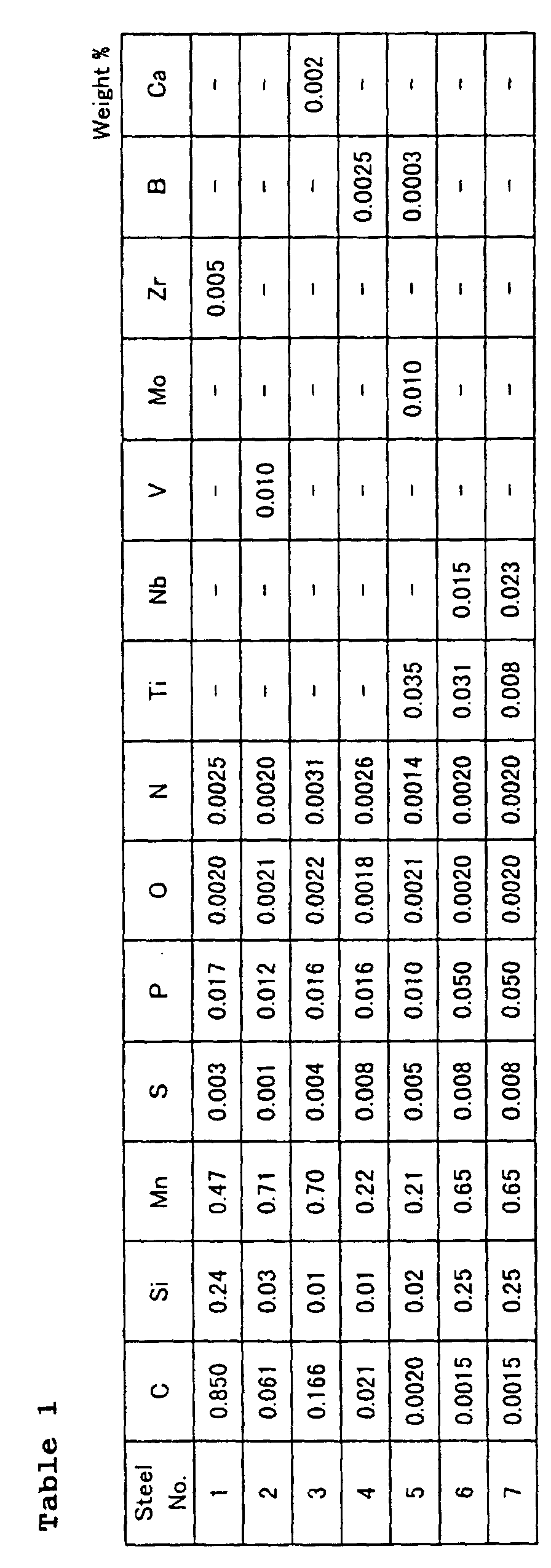
- Steels Nos. 1 through 7 having the chemical compositions given in Table 1 were prepared by melting. All these steels have the chemical compositions within the range of the present invention.
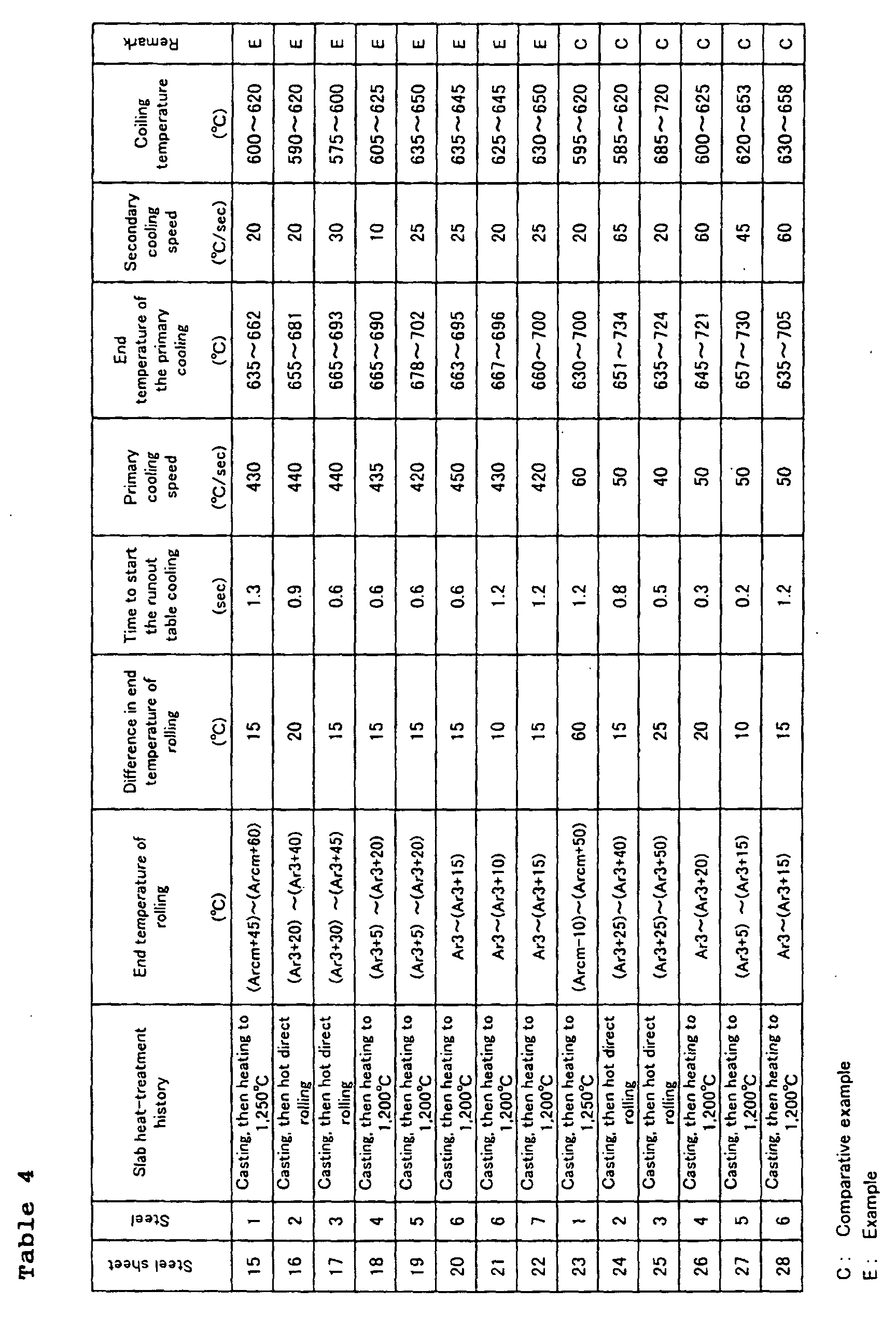
- the steels were rolled under the hot-rolling conditions given in Table 2 to form respective hot-rolled coils Nos. 1 through 14, each having a thickness of 3 mm.
- the heat transfer coefficients in the rapid cooling (primary cooling) in Example 1 were 3,000 to 4,000 kcal/m 2 h°C.
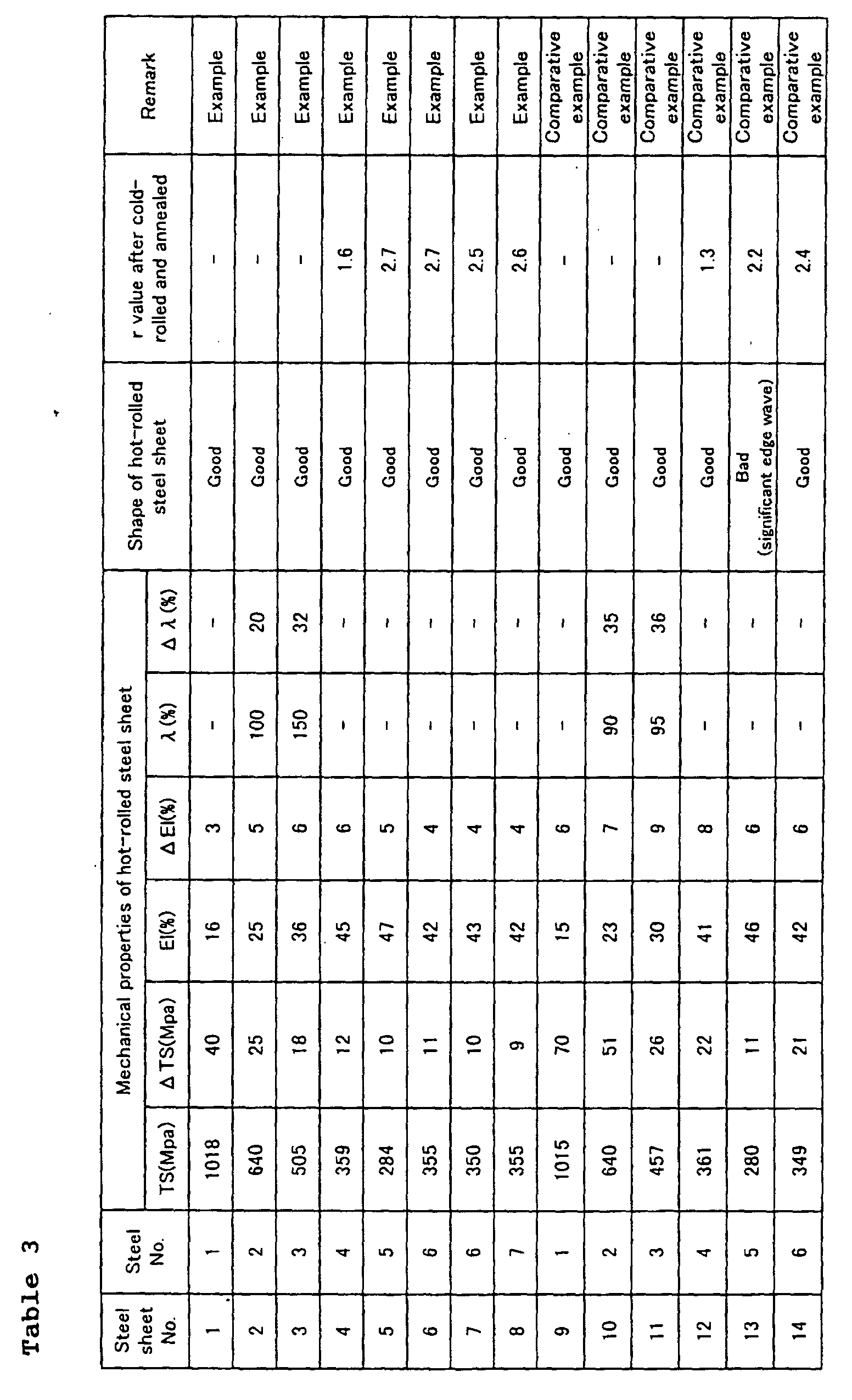
- Tension testing specimens were prepared by cutting at 5 positions on each of the hot-rolled coil in the longitudinal direction thereof. On each specimen, average tensile strength (TS), total elongation (El), dispersion in tensile strength ( ⁇ TS), and dispersion in total elongation ( ⁇ El) were determined. For a part of the hot-rolled coils, bore expanding rate ( ⁇ ) and dispersion in bore expanding rate ( ⁇ ⁇ ) were determined. Furthermore, for the hot-rolled coils Nos. 4 through 7 and Nos. 11 through 13, cold-rolling was applied after pickling to a sheet thickness of 0.8 mm, followed by applying continuous annealing, then the r value was determined to evaluate the deep drawing performance. Table 3 shows the result of determination of these mechanical properties of the hot-rolled coils and the cold-rolled and annealed sheets.
- the dispersions of mechanical properties, ⁇ TS, ⁇ El, and ⁇ ⁇ were smaller in the Examples of the present invention than those in the Comparative Examples, for all the chemical compositions tested.
- the steel sheets Nos. 9 through 14 of the Comparative Examples failed to satisfy one or more of the manufacturing conditions specified by the present invention, giving inferior homogeneity in the mechanical properties or inferior workability to the steel sheets Nos. 1 through 8 of the Examples of the present invention having the same chemical composition to the Comparative Example steels.
- the dispersion in mechanical properties in the width direction and in the longitudinal direction of these hot-rolled coils were determined. Furthermore, the hot-rolled coils Nos. 18 through 22 and Nos. 26 through 28 were cold-rolled after the pickling to a thickness of 0.8 mm, followed by applying continuous annealing, then the r value was determined to evaluate the deep drawing performance. Table 5 shows the result of determination of these mechanical properties of the hot-rolled coils and the cold-rolled and annealed sheets.
- ⁇ TS and ⁇ El indicate the half value of the difference between the maximum value and the minimum value of TS and El, respectively.
- the dispersions of mechanical properties, ⁇ TS and ⁇ El were smaller in the Examples of the present invention than those in the Comparative Examples, for all the chemical compositions tested.
- the steel sheets Nos. 23 through 28 of the Comparative Examples failed to satisfy one or more of the manufacturing conditions specified by the present invention, giving inferior homogeneity in the mechanical properties or inferior workability to the steel sheets Nos. 15 through 22 of the Examples of the present invention having the same chemical composition to the Comparative Example steels.
- the variations of temperature to stop the rapid cooling (primary cooling) in a coil are smaller than those in the conventional laminar cooling in prior art, and the variations in mechanical properties are reduced to further preferable level.
- the cooling method according to the present invention is the perforated ejection type providing high heat transfer coefficient.
- the present invention allows to manufacture steel sheet that has excellent homogeneity of mechanical properties in a coil, giving high El and ⁇ values of hot-rolled coil and high r value after cold-rolled and annealed, and providing excellent workability.
- the inventors of the present invention carried out extensive studies to improve the stretch flanging performance, the breaking elongation, and the shock resistance focusing on high tension steels which were manufactured by reheating continuously cast slab followed by hot-rolling thereof or which were manufactured by directly hot-rolling the continuously cast slab without reheating.
- the inventors of the present invention found that the stretch flanging performance and the breaking elongation are influenced by the presence of a banded structure enriched with C, Mn, or the like at center portion of the sheet thickness, and that the improvement in shock resistance becomes effective when the yield strength of the material is increased to a level that does not degrade the workability of the material.
- the present invention provides:
- composition and the manufacturing conditions are specified to attain the effect of the invention.
- the detail of the reasons of specification is described in the following.
- Carbon is added to secure the strength of the steel sheet. If the C content is less than 0.05%, the strength of 340 MPa or more, which is a target of the present invention, cannot be attained. If the C content exceeds 0.14%, the degradation of workability significantly degrades. Accordingly, the C content is specified to a range of from 0.05 to 0.14%.
- Silicon is an element to strengthen the solid solution, thus S is added to strengthen the steel sheet. If, however, the S content exceeds 0.5%, the surface property degrades. Consequently, the S content is specified to 0.5% or less.
- Manganese is added to 0.5% or more for improving the toughness of the steel sheet and to increase the strength by strengthening the solid solution. If the Mn content exceeds 2.5%, the workability significantly degrades. Therefore, the Mn content is specified to a range of from 0.5% to 2.5%.
- Phosphorus has a function to strengthen the solid solution to strengthen the steel sheet. If, however, the P content exceeds 0.05%, the workability degrades owing to segregation. Consequently, the P content is specified to 0.05% or less.
- Sulfur forms sulfide, and the quantity of sulfide increases to degrade the workability if the S content exceeds 0.01%. Accordingly, the S content is specified to 0.01% or less.
- Oxygen is specified to 0.005% or less to suppress crack generation on the surface of slab or under the surface layer of the slab during continuous casting.
- Calcium converts alumina oxide, which is a deoxidized product in the case of Al application for deoxidizing during steel melt manufacturing stage, into a low melting point Al-Ca-O base oxide. Since the Al-Ca-O base oxide extends during hot-rolling to degrade the workability (stretch flanging performance), the present invention treats Ca as an inevitable impurity. Consequently, Ca is not positively added, and the Ca content is specified to less than 0.005% which is a level of non-addition case.
- the present invention deals with the above-given elements as the basic composition components. Nevertheless, to further improve the characteristics, one or more of Ti, Nb, V, Mo, Zr, and Cr may further be added.
- 0.01 to 0.3% as the sum of one or more of Ti, Nb, V, Mo, Zr, and Cr can be added for improving the strength.
- presence of elements other than those described above is allowable as far as they do not give bad influence on the functions and effect of the present invention.
- presence of 2% or less Cu and 0.04% or less Sn is allowable.
- the present invention applies continuous casting.
- the treatment to reduce segregation is conducted to suppress the segregation of C, Mn, and the like during the continuous casting, to prevent the formation of a banded structure at center portion of the sheet thickness and the like, thus to attain excellent workability (stretch flanging performance), combining with the control of primary cooling speed after the finish-rolling (described after).
- Examples of the treatment to reduce segregation are electromagnetic agitation, light draft casting, and increase in cooling speed of ingot such as slab. These treatment methods can be applied separately or combined together.
- the reheating temperature is preferably not higher than 1,250°C.
- the end temperature of rolling at the finish-rolling mill is selected to Ar 3 transformation point or above to refine the ferritic grains and the pearlite after the transformation, thus improving the stretch flanging performance and the shock resistance.
- the cooling (primary cooling) on runout table after the hot-rolling starts within 2 seconds, preferably within 1 second, after the finish-rolling for reducing the size of ferritic grains and of pearlite after the transformation, thus improving the excellent workability and shock resistance with high yield strength.
- Fig. 1 shows the influence of the time to start cooling on the mechanical properties. In the case that the cooling started within 2 seconds after completing the finish-rolling, excellent workability and high strength can be attained.
- the cooling speed of the primary cooling is specified to refine the ferritic grains and the pearlite after the transformation and to improve the stretch flanging performance by the suppression of banded structure formation at center portion of the sheet thickness.
- the place of banded structure corresponds to the C and Mn enriched portion during the solidification step.
- the temperature of transformation from austenite to ferrite is low, and the banded structure transforms slower than any other portion. As a result, lots of pearlite are formed in the banded structure to degrade the stretch flanging performance.
- the cooling speed is 100°C/sec or more, the ferrite transformation becomes easy even in the C and Mn enriched portion, which gives homogeneous elements distribution to suppress the banded structure formation. Higher cooling speed is more preferable. In view of industrial applicability, however, the upper limit of the cooling speed is 2,000°C/sec. For the case of Comparative Method that applies the cooling speed outside of the range of present invention, the banded structure is observed, and the grain size is larger than that of the microstructure of the method of the present invention.
- the cooling speed is preferably 200°C/sec or more, and more preferably 400°C/sec or more for further improving the workability.
- the end temperature of the primary cooling is higher than 750°C, the ferritic grain refinement becomes difficult. And if it is less than 600°C, the secondary phase becomes a hard low temperature transformation phase. Therefore, the end temperature of the primary cooling is specified to a range of from 600°C or more and less than 750°C.
- the secondary cooling is applied.
- the secondary cooling may be given immediately after the stop of the primary cooling or by given after a certain period of time to stand for cooling. That is, the time to start the secondary cooling is not specifically specified.
- the cooling speed of the secondary cooling is specified to 50°C/sec or less to let the austenite structure adequately transform into pearlite structure to give excellent workability.
- the coiling temperature is regulated to a range of from 450 to 650°C because the coiling temperatures above 650°C induces formation of pearlite which is harmful to ductility and because the temperatures below 450°C induces formation of low temperature transformed phase to degrade the workability.
- the temperature difference in a coil is preferably to be regulated within 50°C by applying, for example, a cooling unit having excellent cooling controllability.
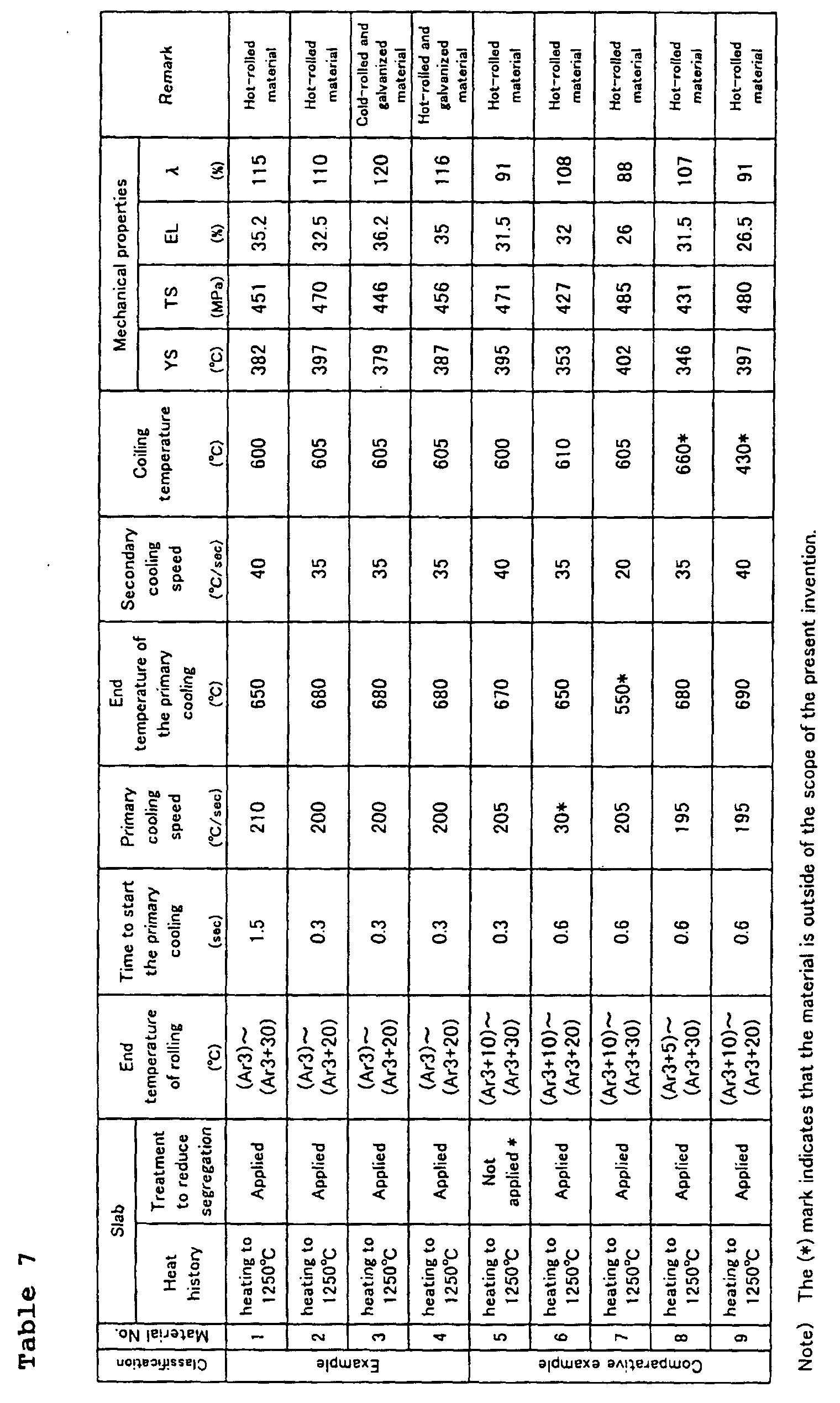
- hot-rolled steel sheets having a thickness of 2.0 mm were manufactured using the manufacturing method given in Table 7.
- the mechanical properties in as-hot-rolled state were determined.
- the mechanical properties were determined after hot-rolled, pickled, cold-rolled, and hot dip galvanized.
- the mechanical properties were determined after hot-rolled, pickled, and hot dip galvanized.
- the bore expanding rate ( ⁇ ) was determined. Table 7 also gives the evaluation result.
- the present invention provides:
- Carbon is added to secure the strength of the steel sheet. If the C content is less than 0.03%, the effect cannot be attained. If the C content exceeds 0.12%, the formation of low temperature transformation phase occurs to excessively increase the strength. Accordingly, the C content is specified to a range of from 0.03 to 0.12%.
- Silicon is added to enhance the ferrite precipitation and to prevent excessive increase in YS. If, however, the S content exceeds 1%, the weldability degrades. Consequently, the S content is specified to 1% or less.
- Manganese is added for strengthening the solid solution, for improving hardenability, and for improving the strength. If the Mn content is less than 0.5%, the effect cannot be attained. If the Mn content exceeds 2%, the workability degrades and the toughness degrades owing to the increase in the low temperature transformation phase. Therefore, the Mn content is specified to a range of from 0.5% to 2%.
- the P content is specified to 0.02% or less and the S content is specified to 0.01% or less.
- one or more of Nb, V, Ti, and Mo are added to improve the strength.
- the elements Nb, V, and Ti are the precipitation hardening elements, and they establish fine microstructure of hot-rolled steel sheet to increase the strength. To give the effect, each of these element is added to 0.005% or more. Excessive amount of these elements saturates the effect and degrades the weldability, and further degrades the toughness owing to the increase in low temperature transformation phase. Therefore, the upper limit of the addition of each of these element is specified to 0.1%.
- Molybdenum improves the hardenability, strengthens the structure, and increases the strength. To attain the effect, Mo is added to 0.05% or more. However, excessive addition of Mo degrades the weldability and the toughness owing to the increase in low temperature transformation phase. Consequently, the Mo content is specified to 0.5% or less.
- presence of elements other than those described above is allowable as far as they do not give bad influence on the functions and effect of the present invention.
- presence of 0.1% or less Al, Cu, Ni, B, Ca or the like and 0.05% or less B and Ca is allowable.
- the rolling is conducted at temperatures of 1,070°C or below with cumulative reduction in thickness of 30% or more.
- the cooling is started within 6 seconds after completed the rolling.
- the time to start cooling is within 3 seconds.
- the cooling speed is the most important variable in the present invention. Rapid cooling is adopted to prevent formation of coarse grains and to assure homogeneous fine grains, with the average cooling speeds of 80°C/sec or more, preferably 100°C/sec or more.
- the temperature to stop cooling is specified to 500°C or more.
- the temperature to stop cooling exceeds 700°C, the stability of strength cannot be obtained. Consequently, the temperature to stop cooling is specified to a range of from higher than 500°C to not higher than 700°C.
- the steps after the stop of the rapid cooling are not specifically specified.
- the process follows common practice to apply slow cooling by air cooling or by runout table cooling followed by coiling.
- the slow cooling gives preferable effect of reducing the formation of low temperature transformation phase and of suppressing excessive increase in YS value, thus, particularly the slow cooling at 40°C/sec or less is preferred.
- an induction heating unit at inlet of the continuous hot finish-rolling mill, or between the stands of the continuous hot finish-rolling mill to heat the sheet bar and further application of an induction heating unit between the stands of the continuous hot finish-rolling mill or the preceding step to the finish-rolling mill to heat the edge portions in width direction of the sheet bar assure the homogenization of mechanical properties, thus the heating does not induce problem.
- the heating of sheet bar may be given before or after the coil box or before or after the roughing mill, or after the coil box, or before or after the welder, without raising problem.
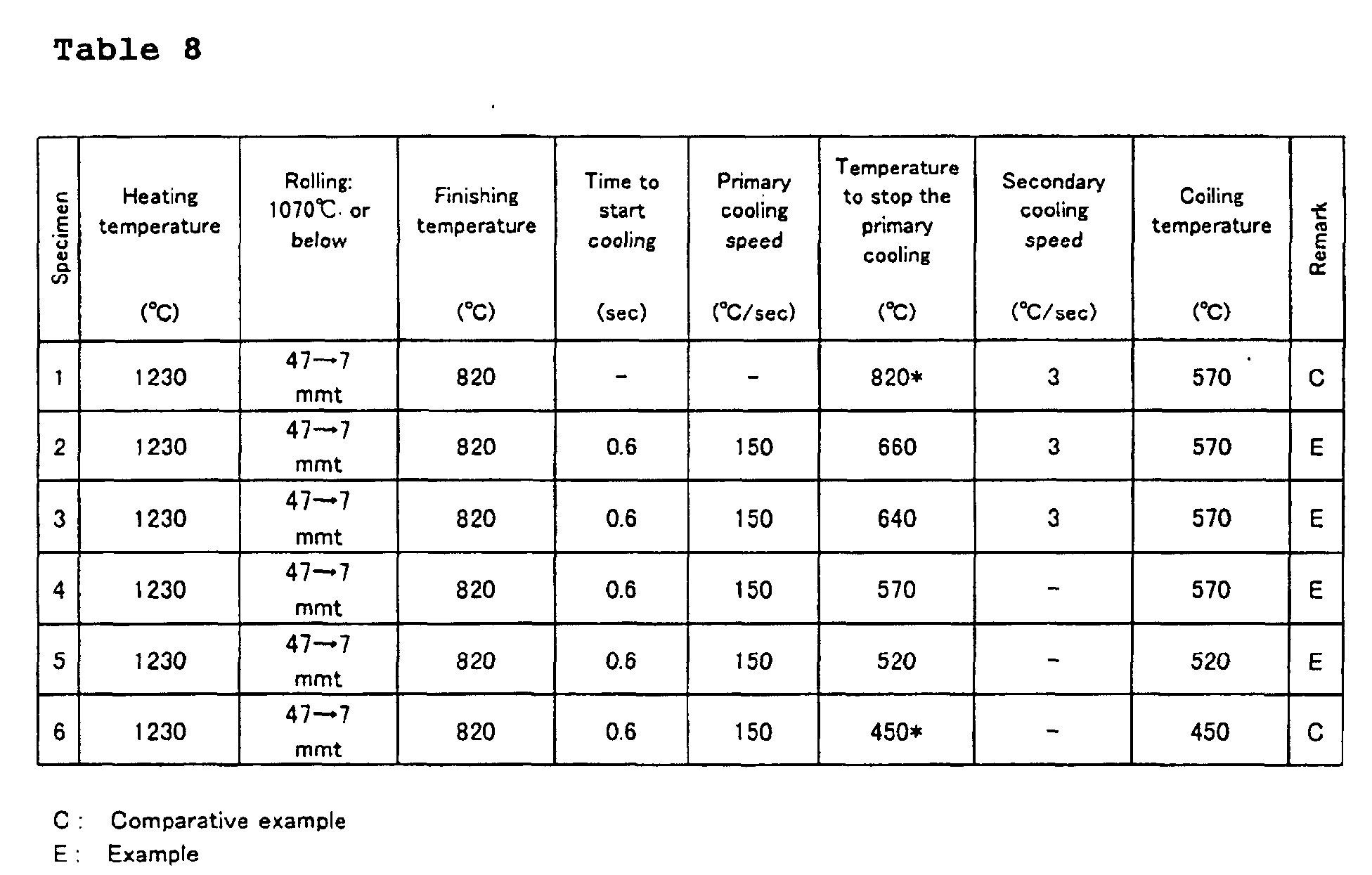
- the manufacturing conditions were varied in terms of the temperature to stop the primary cooling, which are given in Table 9.
- the primary cooling in the table expresses the rapid cooling after the rolling, and the secondary cooling therein expresses the slow cooling after the stop of the primary cooling and before the coiling.
- No. 1 and No. 6 are the Comparative Examples giving the temperatures to stop the primary cooling above 500°C and not more than 700°C, which are outside of the range of the present invention.
- the manufacturing conditions of the specimens Nos. 2 through 5 are within the range of the present invention, varying the temperature to stop the primary cooling, showing the Examples of the present invention. All the specimens had 7 mm in sheet thickness.
- the result of mechanical properties determination is shown in Table 10.
- Figs. 3 through 7 show the result of mechanical property test given in Table 10.
- the specimens given in Figs. 3 through 7 corresponded to 150°C/sec of the primary cooling speed and to 3°C/sec of the secondary cooling speed.
- the rapid cooling expresses the primary cooling.
Landscapes
- Chemical & Material Sciences (AREA)
- Engineering & Computer Science (AREA)
- Mechanical Engineering (AREA)
- Materials Engineering (AREA)
- Metallurgy (AREA)
- Organic Chemistry (AREA)
- Physics & Mathematics (AREA)
- Thermal Sciences (AREA)
- Crystallography & Structural Chemistry (AREA)
- Heat Treatment Of Sheet Steel (AREA)
Abstract
Description

| Steel sheet No. | Steel No. No. | Mechanical properties of hot-rolled steel sheet | r value after cold-rolled and annealed | Remark | |||
| TS(Mpa) | Δ TS(Mpa) | EI(%) | ΔEI(%) | ||||
| 15 | 1 | 1015 | 32 | 17 | 2 | - | Example |
| 16 | 2 | 632 | 17 | 26 | 4 | - | Example |
| 17 | 3 | 500 | 13 | 38 | 5 | - | Example |
| 18 | 4 | 354 | 8 | 45 | 5 | 1.7 | Example |
| 19 | 5 | 280 | 7 | 48 | 4 | 2.8 | Example |
| 20 | 6 | 352 | 6 | 43 | 2 | 2.7 | Example |
| 21 | 6 | 351 | 7 | 43 | 2 | 2.6 | Example |
| 22 | 7 | 353 | 8 | 43 | 2 | 2.7 | Example |
| 23 | 1 | 1014 | 90 | 13 | 6 | - | Comparative example |
| 24 | 2 | 641 | 55 | 23 | 6 | - | Comparative example |
| 25 | 3 | 458 | 41 | 30 | 8 | - | Comparative example |
| 26 | 4 | 360 | 32 | 40 | 7 | 1.3 | Comparative example |
| 27 | 5 | 281 | 25 | 43 | 7 | 2.1 | Comparative example |
| 28 | 6 | 340 | 31 | 41 | 6 | 2.2 | Comparative example |
| Chemical composition (wt. %) | Remark | |||||||
| C | Si | Mn | S | P | O | N | Ca | |
| 0.059 | 0.01 | 1.23 | 0.007 | 0.013 | 0.0023 | 0.0037 | - | Example |

| Specimen | YS (MPa) | TS (MPa) | EI (%) | TS·El (MPa·%) | YR (%) | vTrs (°C) |
| 1 | 612 | 652 | 30 | 19560 | 93.9 | -105 |
| 2 | 695 | 800 | 26.5 | 21200 | 86.9 | -115 |
| 3 | 688 | 795 | 26 | 20670 | 86.5 | -105 |
| 4 | 685 | 797 | 25.8 | 20004 | 85.9 | -110 |
| 5 | 699 | 806 | 24.2 | 19650 | 86 | -100 |
| 6 | 808 | 836 | 18.5 | 15466 | 96.7 | -85 |
Claims (30)
- A method for manufacturing steel sheet comprising the steps of:rough-rolling a continuously cast slab consisting essentially of 0.8% or less C, by weight to form a sheet bar;finish-rolling the sheet bar at finishing temperatures of (Ar3 transformation point - 20°C) or more to form a steel strip;rapid cooling the steel strip after completed the finish-rolling at cooling speeds of higher than 120°C/sec down to temperatures of from 500 to 800°C; andcoiling the steel strip after completed the rapid cooling at coiling temperatures of from 400 to 750°C.
- The method of claim 1, wherein the continuously cast slab contains 0.8% or less C, 2.5% or less Si, and 3.0% or less Mn, by weight.
- The method of claim 1, wherein the continuously cast slab contains 0.8% or less C, 2.5% or less Si, 3.0% or less Mn, and 0.01 to 0.2 % of at least one element selected from the group consisting of Ti, Nb, V, Mo, Zr, and Cr, by weight.
- The method of claim 1, wherein the continuously cast slab contains 0.8% or less C, 2.5% or less Si, 3.0% or less Mn, and 0.005% or less of at least one element selected from the group consisting of Ca and B, by weight.
- The method of claim 1, wherein the continuously cast slab contains 0.8% or less C, 2.5% or less Si, 3.0% or less Mn, 0.01 to 0.2% of at least one element selected from the group consisting of Ti, Nb, V, Mo, Zr, and Cr, and 0.005% or less at least one element selected from the group consisting of Ca and B, by weight.
- The method of claim 1, wherein the rough-rolling of the continuously cast slab is carried out by direct hot-rolling.
- The method of claim 1, wherein the rough-rolling of the continuously cast slab is carried out by reheating the slab to temperatures of 1,200°C or below before cooling thereof to room temperature.
- The method of claim 1, further comprising the step of heating the sheet bar by an induction heating unit immediately before the finish-rolling or during the finish-rolling.
- The method of claim 1, wherein the rapid cooling of the steel strip is started within a time ranging from more than 0.1 second and less than 1 second after completed the finish-rolling.
- The method of claim 1, further comprising the steps of: cold-rolling the coiled steel strip; and annealing the cold-rolled steel strip.
- The method of claim 1, wherein the rapid cooling step is carried out so as the temperature difference between the maximum value and the minimum value in width direction and in longitudinal direction of the steel strip after the rapid cooling to become 60°C or less.
- The method of claim 1, wherein the rapid cooling step is carried out by cooling the steel strip at heat transfer coefficients of 2,000 kcal/m2h°C or more.
- A steel sheet prepared by the method for manufacturing steel sheet of claim 1 and having variations of tensile strength in width direction and in longitudinal direction thereof within ± 8% of average value of the tensile strength in a coil.
- A method for manufacturing steel sheet comprising the steps of:rough-rolling a continuously cast slab consisting essentially of more than 0.8% and 1% or less C, by weight to form a sheet bar;finish-rolling thus obtained sheet bar at finishing temperatures of (Acm transformation point - 20°C) or more to form a steel strip;rapid cooling the steel strip after completed the finish-rolling at cooling speeds of higher than 120°C/sec down to temperatures of from 500 to 800°C; andcoiling the steel strip after completed the rapid cooling at coiling temperatures of from 400 to 750°C.
- The method of claim 14, wherein the rough-rolling of the continuously cast slab is carried out by direct hot-rolling.
- The method of claim 14, wherein the rough-rolling of the continuously cast slab is carried out by reheating the slab to temperatures of 1,200°C or less before cooling thereof to room temperature.
- The method of claim 14, further comprising the step of heating the sheet bar by an induction heating unit immediately before the finish-rolling or during the finish-rolling.
- The method of claim 14, wherein the rapid cooling of the steel strip is started within a time ranging from more than 0.1 second and less than 1 second after completed the finish-rolling.
- The method of claim 14, further comprising the steps of: cold-rolling the coiled steel strip; and annealing the cold-rolled steel strip.
- The method of claim 14, wherein the rapid cooling step is carried out so as the temperature difference between the maximum value and the minimum value in width direction and in longitudinal direction of the steel strip after the rapid cooling to become 60°C or less.
- The method of claim 14, wherein the rapid cooling step is carried out by cooling the steel strip at heat transfer coefficients of 2,000 kcal/m2h°C or more.
- A steel sheet prepared by the method for manufacturing steel sheet of claim 14 and having variations of tensile strength in width direction and in longitudinal direction thereof within ± 8% of average value of the tensile strength in a coil.
- A method for manufacturing steel sheet comprising the steps of:forming a slab consisting essentially of 0.05 to 0.14% C, 0.5% or less Si, 0.5 to 2.5% Mn, 0.05% or less P, 0.01% or less S, 0.005% or less O, and less than 0.0005% Ca, by weight, by continuous casting conducting treatment to reduce segregation;hot-rolling the slab at finishing temperatures of finish-rolling of Ar3 transformation point or more to form a hot-rolled steel sheet;starting primary cooling within 2 seconds after completed the hot-rolling at cooling speeds of from 100 to 2,000°C/sec to cool the hot-rolled steel sheet to a temperature range of from 600 to 750°C;applying secondary cooling, after cooling to the temperature range, at cooling speeds of less than 50°C/sec; andcoiling the secondary-cooled hot-rolled steel sheet at temperatures of from 450 to 650°C.
- The method of claim 23, further comprising the step of reheating the slab before the hot-rolling thereof.
- The method of claim 23, further comprising the steps of: pickling the coiled hot-rolled steel sheet; and annealing the pickled hot-rolled steel sheet.
- The method of claim 23, further comprising the steps of: pickling the coiled hot-rolled steel sheet; cold-rolling the pickled hot-rolled steel sheet; and annealing the cold-rolled steel sheet.
- The method of claim 23, wherein the slab further contains 0.01 to 0.3% at least one element selected from the group consisting of Ti, Nb, V, Mo, Zr, and Cr, by weight.
- A method for manufacturing steel sheet comprising the steps of :hot-rolling a steel consisting essentially of 0.03 to 0.12% C, 1% or less Si, 0.5 to 2% Mn, 0.02% or less P, 0.01% or less S, further at least one element selected from the group consisting of 0.005 to 0.1% Nb, 0.005 to 0.1% V, and 0.005 to 0.1% Ti, by weight, at temperatures of 1,070 °C or below to accumulated reductions in thickness of 30% or more; andcooling the hot-rolled steel sheet within 6 seconds after completed the rolling at average cooling speeds of not less than 80°C/sec to temperatures of from above 500°C to not more than 700°C.
- The method of claim 28, wherein the steel further contains 0.05 to 0.5% Mo.
- A method for manufacturing steel sheet comprising the steps of:hot-rolling a steel consisting essentially of 0.03 to 0.12% C, 1% or less Si, 0.5 to 2% Mn, 0.02% or less P, 0.01% or less S, and 0.05 to 0.5% Mo, by weight, at temperatures of 1,070°C or below to accumulated reductions in thickness of 30% or more; andcooling the hot-rolled steel sheet within 6 seconds after completed the rolling at average cooling speeds of not less than 80°C/sec to temperatures of from above 500°C to not more than 700°C.
Applications Claiming Priority (11)
| Application Number | Priority Date | Filing Date | Title |
|---|---|---|---|
| JP27595599 | 1999-09-29 | ||
| JP27595599 | 1999-09-29 | ||
| JP2000060282A JP3864663B2 (en) | 2000-03-06 | 2000-03-06 | Manufacturing method of high strength steel sheet |
| JP2000060282 | 2000-03-06 | ||
| JP2000119887 | 2000-04-20 | ||
| JP2000119887A JP2001303129A (en) | 2000-04-20 | 2000-04-20 | Manufacturing method of high-strength steel sheet |
| JP2000180903 | 2000-06-16 | ||
| JP2000180903 | 2000-06-16 | ||
| JP2000268894A JP3879381B2 (en) | 1999-09-29 | 2000-09-05 | Thin steel plate and method for producing thin steel plate |
| JP2000268894 | 2000-09-05 | ||
| PCT/JP2000/006639 WO2001023624A1 (en) | 1999-09-29 | 2000-09-27 | Sheet steel and method for producing sheet steel |
Publications (3)
| Publication Number | Publication Date |
|---|---|
| EP1143019A1 true EP1143019A1 (en) | 2001-10-10 |
| EP1143019A4 EP1143019A4 (en) | 2008-04-30 |
| EP1143019B1 EP1143019B1 (en) | 2014-11-26 |
Family
ID=27530608
Family Applications (1)
| Application Number | Title | Priority Date | Filing Date |
|---|---|---|---|
| EP00962863.7A Revoked EP1143019B1 (en) | 1999-09-29 | 2000-09-27 | Method for manufacturing a coiled steel sheet |
Country Status (4)
| Country | Link |
|---|---|
| US (2) | US6652670B2 (en) |
| EP (1) | EP1143019B1 (en) |
| KR (1) | KR100401272B1 (en) |
| WO (1) | WO2001023624A1 (en) |
Cited By (5)
| Publication number | Priority date | Publication date | Assignee | Title |
|---|---|---|---|---|
| EP1277846A1 (en) * | 2001-06-28 | 2003-01-22 | Kabushiki Kaisha Kobe Seiko Sho | High-carbon steel wire rod with superior drawability and method for production thereof |
| FR2847908A1 (en) * | 2002-12-03 | 2004-06-04 | Ascometal Sa | A BAINITIQUE STEEL COOLED, COOLED AND REINVENTED, AND METHOD OF MANUFACTURING THE SAME. |
| EP2420586A1 (en) * | 2002-02-07 | 2012-02-22 | JFE Steel Corporation | High strength steel plate and method for manufacturing the same |
| RU2591922C1 (en) * | 2015-07-21 | 2016-07-20 | Публичное акционерное общество "Северсталь" (ПАО "Северсталь") | Method of producing hot-rolled sheet from low-alloy steel |
| EP3128026A4 (en) * | 2014-03-31 | 2017-04-05 | JFE Steel Corporation | High-strength cold rolled steel sheet exhibiting excellent material-quality uniformity, and production method therefor |
Families Citing this family (18)
| Publication number | Priority date | Publication date | Assignee | Title |
|---|---|---|---|---|
| US6420364B1 (en) * | 1999-09-13 | 2002-07-16 | Boehringer Ingelheim Pharmaceuticals, Inc. | Compound useful as reversible inhibitors of cysteine proteases |
| DE60044180D1 (en) * | 1999-09-16 | 2010-05-27 | Jfe Steel Corp | METHOD FOR PRODUCING A THIN STAINLESS STEEL PLATE WITH HIGH STRENGTH |
| WO2001023624A1 (en) * | 1999-09-29 | 2001-04-05 | Nkk Corporation | Sheet steel and method for producing sheet steel |
| ATE490349T1 (en) * | 1999-09-29 | 2010-12-15 | Jfe Steel Corp | STEEL SHEET AND METHOD FOR THE PRODUCTION THEREOF |
| WO2004003247A1 (en) * | 2002-06-28 | 2004-01-08 | Posco | Super formable high strength steel sheet and method of manufacturing thereof |
| US7171114B2 (en) * | 2004-07-12 | 2007-01-30 | Milton Curtis A | Mirror-mimicking video system |
| ITMN20060021A1 (en) * | 2006-03-23 | 2007-09-24 | Gilcotubi S R L | PRODUCTION SYSTEM FOR STAINLESS AND WELDABLE TUBULAR STRUCTURES WITH HIGH MECHANICAL RESISTANCE AND ITS PRODUCT OBTAINED |
| JP5176431B2 (en) * | 2007-08-24 | 2013-04-03 | Jfeスチール株式会社 | Manufacturing method of high strength hot-rolled steel sheet |
| KR101150365B1 (en) * | 2008-08-14 | 2012-06-08 | 주식회사 포스코 | High carbon hot rolled steel coil and manufacturing method thereof |
| EP2578711B1 (en) * | 2010-05-27 | 2019-10-09 | Nippon Steel Corporation | Steel sheet and a method for its manufacture |
| KR101256618B1 (en) | 2010-12-28 | 2013-05-02 | 주식회사 포스코 | High carbon hot/cold rolled steel coil and manufactureing method thereof |
| BR112013023633A2 (en) * | 2011-03-18 | 2016-12-13 | Nippon Steel & Sumitomo Metal Corp | hot rolled steel sheet with excellent press forming capacity and its production method |
| JP2016537502A (en) * | 2013-09-19 | 2016-12-01 | タタ、スティール、アイモイデン、ベスローテン、フェンノートシャップTata Steel Ijmuiden Bv | Hot forming steel |
| RU2629420C1 (en) * | 2016-05-30 | 2017-08-29 | Публичное акционерное общество "Северсталь" (ПАО "Северсталь") | Method of production of high-strength rolled products with high cold resistance |
| KR101917454B1 (en) * | 2016-12-22 | 2018-11-09 | 주식회사 포스코 | Steel plate having excellent high-strength and high-toughness and method for manufacturing same |
| CN114574685B (en) * | 2020-11-30 | 2024-04-05 | 宝山钢铁股份有限公司 | Method for regulating and controlling surface and mechanical properties of short-process continuous casting and rolling plain carbon steel hot rolled strip steel |
| CN113059003B (en) * | 2021-03-01 | 2023-07-21 | 首钢京唐钢铁联合有限责任公司 | Method for controlling cold-rolled high-strength steel acid edging crack |
| CN114086073A (en) * | 2021-11-19 | 2022-02-25 | 安徽工业大学 | Production method of hot-rolled high-strength structural steel |
Family Cites Families (28)
| Publication number | Priority date | Publication date | Assignee | Title |
|---|---|---|---|---|
| JPS54135616A (en) | 1978-04-12 | 1979-10-22 | Nippon Steel Corp | Manufacture of cold rolled steel plate with superior formability |
| JPS5927370B2 (en) * | 1980-07-05 | 1984-07-05 | 新日本製鐵株式会社 | High strength cold rolled steel plate for press working |
| JPS5871330A (en) * | 1981-10-20 | 1983-04-28 | Kawasaki Steel Corp | Production of hot rolled steel strip having excellent uniformity in material quality |
| JPS58123823A (en) | 1981-12-11 | 1983-07-23 | Nippon Steel Corp | Manufacture of high strength hot rolled steel sheet of super fine grain |
| JPS59140332A (en) * | 1983-01-27 | 1984-08-11 | Nippon Steel Corp | High-strength hot-rolled steel sheet for working having composite structure |
| JPS59215423A (en) * | 1983-05-18 | 1984-12-05 | Kobe Steel Ltd | Production of high tensile hot rolled material having excellent cold processability without heat treatment |
| JPS60243226A (en) * | 1984-05-15 | 1985-12-03 | Kawasaki Steel Corp | Method and device for controlling quality of hot rolled material |
| JPS6115929A (en) | 1984-06-30 | 1986-01-24 | Nippon Jiryoku Senko Kk | Method for burning steel-making dust and sludge |
| JPS6173829A (en) | 1984-09-17 | 1986-04-16 | Nippon Steel Corp | Manufacture of high tensile steel composed of ultrafine structure |
| IT1213487B (en) | 1986-09-03 | 1989-12-20 | Afros Spa | EQUIPMENT FOR FEEDING AND DOSING OF LIQUIDS IN A MIXING HEAD. |
| JP2555436B2 (en) | 1988-12-29 | 1996-11-20 | 株式会社神戸製鋼所 | Hot-rolled steel sheet with excellent workability and its manufacturing method |
| JPH0762178B2 (en) | 1990-07-30 | 1995-07-05 | 新日本製鐵株式会社 | Method for producing high strength hot rolled steel sheet with excellent stretch flangeability and ductility |
| JPH05112831A (en) | 1991-06-24 | 1993-05-07 | Nippon Steel Corp | Manufacture of cold rolled steel sheet for deep drawing excellent in workability |
| JPH06248340A (en) * | 1993-02-23 | 1994-09-06 | Sumitomo Metal Ind Ltd | Method for producing hot rolled steel sheet with excellent workability |
| JP3455567B2 (en) * | 1993-08-17 | 2003-10-14 | 日新製鋼株式会社 | Method for producing high-strength hot-dip galvanized steel sheet with excellent workability |
| JP2842765B2 (en) | 1993-08-18 | 1999-01-06 | 日本電気株式会社 | Optical connector ferrule rotation stop structure |
| FR2735498B1 (en) * | 1995-06-15 | 1997-07-11 | Lorraine Laminage | PROCESS FOR PRODUCING A STRIP OF HOT-ROLLED STEEL SHEET WITH A HIGH ELASTICITY LIMIT USEFUL IN PARTICULAR FOR SHAPING |
| JP3477955B2 (en) * | 1995-11-17 | 2003-12-10 | Jfeスチール株式会社 | Method for producing high-strength hot-rolled steel sheet having ultrafine structure |
| JP3806176B2 (en) | 1996-03-12 | 2006-08-09 | 新日本製鐵株式会社 | Manufacturing method of hot-rolled steel sheet with small material variations by continuous hot-rolling process |
| JPH1036917A (en) * | 1996-07-25 | 1998-02-10 | Nippon Steel Corp | Manufacturing method of high strength hot rolled steel sheet with excellent stretch flangeability |
| JP3644216B2 (en) * | 1997-10-27 | 2005-04-27 | Jfeスチール株式会社 | Manufacturing method of high carbon hot rolled steel sheet |
| EP1136575A4 (en) * | 1999-08-10 | 2008-04-23 | Jfe Steel Corp | Method of producing cold rolled steel sheet |
| DE60044180D1 (en) * | 1999-09-16 | 2010-05-27 | Jfe Steel Corp | METHOD FOR PRODUCING A THIN STAINLESS STEEL PLATE WITH HIGH STRENGTH |
| WO2001023632A1 (en) * | 1999-09-28 | 2001-04-05 | Nkk Corporation | Hot-rolled steel sheet having high tensile strength and method for production thereof |
| WO2001023624A1 (en) * | 1999-09-29 | 2001-04-05 | Nkk Corporation | Sheet steel and method for producing sheet steel |
| ATE490349T1 (en) * | 1999-09-29 | 2010-12-15 | Jfe Steel Corp | STEEL SHEET AND METHOD FOR THE PRODUCTION THEREOF |
| US6364968B1 (en) * | 2000-06-02 | 2002-04-02 | Kawasaki Steel Corporation | High-strength hot-rolled steel sheet having excellent stretch flangeability, and method of producing the same |
| WO2002026424A1 (en) * | 2000-09-29 | 2002-04-04 | Ishikawajima-Harima Heavy Industries Company Limited | Production of thin steel strip |
-
2000
- 2000-09-27 WO PCT/JP2000/006639 patent/WO2001023624A1/en not_active Ceased
- 2000-09-27 KR KR10-2001-7002607A patent/KR100401272B1/en not_active Expired - Fee Related
- 2000-09-27 EP EP00962863.7A patent/EP1143019B1/en not_active Revoked
-
2001
- 2001-04-18 US US09/837,435 patent/US6652670B2/en not_active Expired - Lifetime
-
2003
- 2003-05-30 US US10/448,697 patent/US20030196731A1/en not_active Abandoned
Cited By (9)
| Publication number | Priority date | Publication date | Assignee | Title |
|---|---|---|---|---|
| EP1277846A1 (en) * | 2001-06-28 | 2003-01-22 | Kabushiki Kaisha Kobe Seiko Sho | High-carbon steel wire rod with superior drawability and method for production thereof |
| US6783609B2 (en) | 2001-06-28 | 2004-08-31 | Kabushiki Kaisha Kobe Seiko Sho | High-carbon steel wire rod with superior drawability and method for production thereof |
| EP2420586A1 (en) * | 2002-02-07 | 2012-02-22 | JFE Steel Corporation | High strength steel plate and method for manufacturing the same |
| FR2847908A1 (en) * | 2002-12-03 | 2004-06-04 | Ascometal Sa | A BAINITIQUE STEEL COOLED, COOLED AND REINVENTED, AND METHOD OF MANUFACTURING THE SAME. |
| EP1426452A1 (en) * | 2002-12-03 | 2004-06-09 | Ascometal | Cooled and annealed article in bainitic steel, and production process thereof |
| US7354487B2 (en) | 2002-12-03 | 2008-04-08 | Ascometal | Cooled and annealed bainite steel part, and a method of manufacturing it |
| EP3128026A4 (en) * | 2014-03-31 | 2017-04-05 | JFE Steel Corporation | High-strength cold rolled steel sheet exhibiting excellent material-quality uniformity, and production method therefor |
| US10329636B2 (en) | 2014-03-31 | 2019-06-25 | Jfe Steel Corporation | High-strength cold-rolled steel sheet with excellent material homogeneity and production method therefor |
| RU2591922C1 (en) * | 2015-07-21 | 2016-07-20 | Публичное акционерное общество "Северсталь" (ПАО "Северсталь") | Method of producing hot-rolled sheet from low-alloy steel |
Also Published As
| Publication number | Publication date |
|---|---|
| US20030196731A1 (en) | 2003-10-23 |
| US6652670B2 (en) | 2003-11-25 |
| KR20010074870A (en) | 2001-08-09 |
| EP1143019A4 (en) | 2008-04-30 |
| US20010050119A1 (en) | 2001-12-13 |
| WO2001023624A1 (en) | 2001-04-05 |
| KR100401272B1 (en) | 2003-10-17 |
| EP1143019B1 (en) | 2014-11-26 |
Similar Documents
| Publication | Publication Date | Title |
|---|---|---|
| US6652670B2 (en) | Steel sheet and method for manufacturing the same | |
| US6663725B2 (en) | High strength steel sheet and method for manufacturing the same | |
| JP3440894B2 (en) | High strength hot rolled steel sheet excellent in stretch flangeability and method for producing the same | |
| US6364968B1 (en) | High-strength hot-rolled steel sheet having excellent stretch flangeability, and method of producing the same | |
| CA2941202C (en) | Method for producing a high-strength flat steel product | |
| EP1149925B1 (en) | Sheet steel and method for producing sheet steel | |
| US6554925B2 (en) | Method for manufacturing cold-rolled steel sheet | |
| KR970000406B1 (en) | High strength cold-rolled steel sheet excelling in deep drawability and method of producing the same | |
| KR101917452B1 (en) | Cold rolled steel sheet with excellent bendability and hole expansion property, and method for manufacturing the same | |
| JP2006183141A (en) | High strength hot rolled steel sheet and method for producing the same | |
| JP3864663B2 (en) | Manufacturing method of high strength steel sheet | |
| JP4300793B2 (en) | Manufacturing method of hot-rolled steel sheet and hot-dip steel sheet with excellent material uniformity | |
| CN116194606B (en) | Steel sheet excellent in formability and work hardening rate | |
| CN111511949A (en) | Hot-rolled steel sheet excellent in expansion and method for producing the same | |
| JP3879381B2 (en) | Thin steel plate and method for producing thin steel plate | |
| JP5327301B2 (en) | High-strength steel sheet with excellent ductility and deep drawability and method for producing the same | |
| JP3959934B2 (en) | High-tensile cold-rolled steel sheet excellent in strain age hardening characteristics, impact resistance characteristics and workability, and a method for producing the same | |
| JP3932892B2 (en) | High-strength steel plate and high-strength electroplated steel plate excellent in ductility, stretch flangeability and shock absorption characteristics and methods for producing them | |
| JP4273646B2 (en) | High-strength thin steel sheet with excellent workability and manufacturing method thereof | |
| CN115427589A (en) | Hot-rolled flat steel product and method for the production thereof | |
| JPS61276929A (en) | Production of cold rolled dead soft steel sheet having good formability | |
| JP2019137873A (en) | High strength steel sheet having low yield strength and manufacturing method therefor |
Legal Events
| Date | Code | Title | Description |
|---|---|---|---|
| PUAI | Public reference made under article 153(3) epc to a published international application that has entered the european phase |
Free format text: ORIGINAL CODE: 0009012 |
|
| 17P | Request for examination filed |
Effective date: 20010613 |
|
| AK | Designated contracting states |
Kind code of ref document: A1 Designated state(s): AT BE CH CY DE DK ES FI FR GB GR IE IT LI LU MC NL PT SE |
|
| RAP1 | Party data changed (applicant data changed or rights of an application transferred) |
Owner name: JFE STEEL CORPORATION |
|
| RBV | Designated contracting states (corrected) |
Designated state(s): AT BE DE FR NL |
|
| RIC1 | Information provided on ipc code assigned before grant |
Ipc: C21D 8/02 20060101ALI20080320BHEP Ipc: C21D 9/46 20060101AFI20010411BHEP |
|
| A4 | Supplementary search report drawn up and despatched |
Effective date: 20080331 |
|
| 17Q | First examination report despatched |
Effective date: 20081208 |
|
| REG | Reference to a national code |
Ref country code: DE Ref legal event code: R079 Ref document number: 60048794 Country of ref document: DE Free format text: PREVIOUS MAIN CLASS: C21D0009460000 Ipc: C21D0009480000 |
|
| RIC1 | Information provided on ipc code assigned before grant |
Ipc: C21D 8/02 20060101ALI20131111BHEP Ipc: C21D 9/48 20060101AFI20131111BHEP Ipc: C22C 38/00 20060101ALI20131111BHEP |
|
| GRAP | Despatch of communication of intention to grant a patent |
Free format text: ORIGINAL CODE: EPIDOSNIGR1 |
|
| INTG | Intention to grant announced |
Effective date: 20140129 |
|
| GRAP | Despatch of communication of intention to grant a patent |
Free format text: ORIGINAL CODE: EPIDOSNIGR1 |
|
| INTG | Intention to grant announced |
Effective date: 20140703 |
|
| GRAS | Grant fee paid |
Free format text: ORIGINAL CODE: EPIDOSNIGR3 |
|
| GRAA | (expected) grant |
Free format text: ORIGINAL CODE: 0009210 |
|
| AK | Designated contracting states |
Kind code of ref document: B1 Designated state(s): AT BE DE FR NL |
|
| REG | Reference to a national code |
Ref country code: AT Ref legal event code: REF Ref document number: 698272 Country of ref document: AT Kind code of ref document: T Effective date: 20141215 |
|
| REG | Reference to a national code |
Ref country code: DE Ref legal event code: R096 Ref document number: 60048794 Country of ref document: DE Effective date: 20141231 |
|
| REG | Reference to a national code |
Ref country code: NL Ref legal event code: T3 |
|
| REG | Reference to a national code |
Ref country code: DE Ref legal event code: R026 Ref document number: 60048794 Country of ref document: DE |
|
| PLBI | Opposition filed |
Free format text: ORIGINAL CODE: 0009260 |
|
| PLAX | Notice of opposition and request to file observation + time limit sent |
Free format text: ORIGINAL CODE: EPIDOSNOBS2 |
|
| 26 | Opposition filed |
Opponent name: TATA STEEL IJMUIDEN BV Effective date: 20150826 |
|
| PLAF | Information modified related to communication of a notice of opposition and request to file observations + time limit |
Free format text: ORIGINAL CODE: EPIDOSCOBS2 |
|
| PLBB | Reply of patent proprietor to notice(s) of opposition received |
Free format text: ORIGINAL CODE: EPIDOSNOBS3 |
|
| REG | Reference to a national code |
Ref country code: AT Ref legal event code: UEP Ref document number: 698272 Country of ref document: AT Kind code of ref document: T Effective date: 20141126 |
|
| REG | Reference to a national code |
Ref country code: FR Ref legal event code: PLFP Year of fee payment: 17 |
|
| PGFP | Annual fee paid to national office [announced via postgrant information from national office to epo] |
Ref country code: NL Payment date: 20160826 Year of fee payment: 17 Ref country code: DE Payment date: 20160920 Year of fee payment: 17 |
|
| PGFP | Annual fee paid to national office [announced via postgrant information from national office to epo] |
Ref country code: AT Payment date: 20160826 Year of fee payment: 17 Ref country code: FR Payment date: 20160826 Year of fee payment: 17 |
|
| PGFP | Annual fee paid to national office [announced via postgrant information from national office to epo] |
Ref country code: BE Payment date: 20160815 Year of fee payment: 17 |
|
| REG | Reference to a national code |
Ref country code: DE Ref legal event code: R064 Ref document number: 60048794 Country of ref document: DE Ref country code: DE Ref legal event code: R103 Ref document number: 60048794 Country of ref document: DE |
|
| RDAF | Communication despatched that patent is revoked |
Free format text: ORIGINAL CODE: EPIDOSNREV1 |
|
| STAA | Information on the status of an ep patent application or granted ep patent |
Free format text: STATUS: THE PATENT HAS BEEN GRANTED |
|
| RDAG | Patent revoked |
Free format text: ORIGINAL CODE: 0009271 |
|
| 27W | Patent revoked |
Effective date: 20170315 |
|
| REG | Reference to a national code |
Ref country code: AT Ref legal event code: MA03 Ref document number: 698272 Country of ref document: AT Kind code of ref document: T Effective date: 20170315 |
|
| REG | Reference to a national code |
Ref country code: BE Ref legal event code: FP Effective date: 20150211 |
|
| STAA | Information on the status of an ep patent application or granted ep patent |
Free format text: STATUS: PATENT REVOKED |