EP1140427B1 - Nonwoven abrasive articles and method of preparing same - Google Patents
Nonwoven abrasive articles and method of preparing same Download PDFInfo
- Publication number
- EP1140427B1 EP1140427B1 EP99966160A EP99966160A EP1140427B1 EP 1140427 B1 EP1140427 B1 EP 1140427B1 EP 99966160 A EP99966160 A EP 99966160A EP 99966160 A EP99966160 A EP 99966160A EP 1140427 B1 EP1140427 B1 EP 1140427B1
- Authority
- EP
- European Patent Office
- Prior art keywords
- abrasive
- web
- nonwoven web
- coating
- densified
- Prior art date
- Legal status (The legal status is an assumption and is not a legal conclusion. Google has not performed a legal analysis and makes no representation as to the accuracy of the status listed.)
- Expired - Lifetime
Links
- 238000000034 method Methods 0.000 title description 39
- 238000000576 coating method Methods 0.000 claims description 116
- 239000011248 coating agent Substances 0.000 claims description 113
- 239000000835 fiber Substances 0.000 claims description 105
- 239000011230 binding agent Substances 0.000 claims description 97
- 238000004519 manufacturing process Methods 0.000 claims description 77
- 239000002243 precursor Substances 0.000 claims description 76
- 239000002131 composite material Substances 0.000 claims description 73
- 239000002002 slurry Substances 0.000 claims description 64
- 239000002245 particle Substances 0.000 claims description 47
- 239000000203 mixture Substances 0.000 claims description 31
- 229920000642 polymer Polymers 0.000 claims description 27
- 238000012876 topography Methods 0.000 claims description 23
- 229920000728 polyester Polymers 0.000 claims description 19
- 229920001169 thermoplastic Polymers 0.000 claims description 15
- KPUWHANPEXNPJT-UHFFFAOYSA-N disiloxane Chemical class [SiH3]O[SiH3] KPUWHANPEXNPJT-UHFFFAOYSA-N 0.000 claims description 12
- 238000010438 heat treatment Methods 0.000 claims description 12
- 239000004416 thermosoftening plastic Substances 0.000 claims description 11
- 239000004952 Polyamide Substances 0.000 claims description 9
- 229920002647 polyamide Polymers 0.000 claims description 9
- 125000001931 aliphatic group Chemical group 0.000 claims description 8
- 239000004593 Epoxy Substances 0.000 claims description 7
- 125000003118 aryl group Chemical group 0.000 claims description 6
- 125000001495 ethyl group Chemical group [H]C([H])([H])C([H])([H])* 0.000 claims description 6
- 125000002496 methyl group Chemical group [H]C([H])([H])* 0.000 claims description 6
- 125000001997 phenyl group Chemical group [H]C1=C([H])C([H])=C(*)C([H])=C1[H] 0.000 claims description 6
- 125000000524 functional group Chemical group 0.000 claims description 5
- 229920000098 polyolefin Polymers 0.000 claims description 5
- 125000004432 carbon atom Chemical group C* 0.000 claims description 4
- 239000012943 hotmelt Substances 0.000 claims description 4
- 125000004430 oxygen atom Chemical group O* 0.000 claims description 3
- 229910052710 silicon Inorganic materials 0.000 claims description 3
- 239000007795 chemical reaction product Substances 0.000 claims description 2
- XUIMIQQOPSSXEZ-UHFFFAOYSA-N Silicon Chemical group [Si] XUIMIQQOPSSXEZ-UHFFFAOYSA-N 0.000 claims 2
- -1 poly(hexamethylene adipamide) Polymers 0.000 description 30
- NIXOWILDQLNWCW-UHFFFAOYSA-M Acrylate Chemical compound [O-]C(=O)C=C NIXOWILDQLNWCW-UHFFFAOYSA-M 0.000 description 19
- 239000000463 material Substances 0.000 description 15
- 229920005989 resin Polymers 0.000 description 15
- 239000011347 resin Substances 0.000 description 15
- 239000000178 monomer Substances 0.000 description 14
- 230000008569 process Effects 0.000 description 13
- 239000004925 Acrylic resin Substances 0.000 description 11
- XLYOFNOQVPJJNP-UHFFFAOYSA-N water Substances O XLYOFNOQVPJJNP-UHFFFAOYSA-N 0.000 description 11
- 230000005855 radiation Effects 0.000 description 10
- 239000000654 additive Substances 0.000 description 9
- 239000000945 filler Substances 0.000 description 9
- 239000003999 initiator Substances 0.000 description 9
- 239000000126 substance Substances 0.000 description 9
- 238000005498 polishing Methods 0.000 description 8
- 229920000647 polyepoxide Polymers 0.000 description 8
- 239000004014 plasticizer Substances 0.000 description 7
- 229920001296 polysiloxane Polymers 0.000 description 7
- 238000012360 testing method Methods 0.000 description 7
- 239000004743 Polypropylene Substances 0.000 description 6
- DAKWPKUUDNSNPN-UHFFFAOYSA-N Trimethylolpropane triacrylate Chemical compound C=CC(=O)OCC(CC)(COC(=O)C=C)COC(=O)C=C DAKWPKUUDNSNPN-UHFFFAOYSA-N 0.000 description 6
- 150000001252 acrylic acid derivatives Chemical class 0.000 description 6
- 230000015572 biosynthetic process Effects 0.000 description 6
- 238000000280 densification Methods 0.000 description 6
- 238000002844 melting Methods 0.000 description 6
- 230000008018 melting Effects 0.000 description 6
- 229920001155 polypropylene Polymers 0.000 description 6
- 0 CCC(CC1C(CC2(*)C(CC(CCC(C(C3)C3C3)C(C4)C4C3C(CC)(CC)CC(C(CCC3CC3)C**)=CCC[C@](C3)(C3C(C)*)C3C(CC(C)CCCC4C(C)CCC4)C3)C(C)*)C2)C1)CC=CC Chemical compound CCC(CC1C(CC2(*)C(CC(CCC(C(C3)C3C3)C(C4)C4C3C(CC)(CC)CC(C(CCC3CC3)C**)=CCC[C@](C3)(C3C(C)*)C3C(CC(C)CCCC4C(C)CCC4)C3)C(C)*)C2)C1)CC=CC 0.000 description 5
- 229920006125 amorphous polymer Polymers 0.000 description 5
- 125000002915 carbonyl group Chemical group [*:2]C([*:1])=O 0.000 description 5
- 238000010276 construction Methods 0.000 description 5
- 239000003822 epoxy resin Substances 0.000 description 5
- JZMPIUODFXBXSC-UHFFFAOYSA-N ethyl carbamate;prop-2-enoic acid Chemical compound OC(=O)C=C.OC(=O)C=C.CCOC(N)=O JZMPIUODFXBXSC-UHFFFAOYSA-N 0.000 description 5
- 150000002734 metacrylic acid derivatives Chemical class 0.000 description 5
- 229910052751 metal Inorganic materials 0.000 description 5
- 239000002184 metal Substances 0.000 description 5
- 239000003504 photosensitizing agent Substances 0.000 description 5
- HBMJWWWQQXIZIP-UHFFFAOYSA-N silicon carbide Chemical compound [Si+]#[C-] HBMJWWWQQXIZIP-UHFFFAOYSA-N 0.000 description 5
- PXHVJJICTQNCMI-UHFFFAOYSA-N Nickel Chemical compound [Ni] PXHVJJICTQNCMI-UHFFFAOYSA-N 0.000 description 4
- 239000004698 Polyethylene Substances 0.000 description 4
- 108091092920 SmY RNA Proteins 0.000 description 4
- 241001237710 Smyrna Species 0.000 description 4
- MCMNRKCIXSYSNV-UHFFFAOYSA-N Zirconium dioxide Chemical compound O=[Zr]=O MCMNRKCIXSYSNV-UHFFFAOYSA-N 0.000 description 4
- PNEYBMLMFCGWSK-UHFFFAOYSA-N aluminium oxide Inorganic materials [O-2].[O-2].[O-2].[Al+3].[Al+3] PNEYBMLMFCGWSK-UHFFFAOYSA-N 0.000 description 4
- 229920003180 amino resin Polymers 0.000 description 4
- 150000001875 compounds Chemical class 0.000 description 4
- 238000001816 cooling Methods 0.000 description 4
- 239000003085 diluting agent Substances 0.000 description 4
- LNEPOXFFQSENCJ-UHFFFAOYSA-N haloperidol Chemical compound C1CC(O)(C=2C=CC(Cl)=CC=2)CCN1CCCC(=O)C1=CC=C(F)C=C1 LNEPOXFFQSENCJ-UHFFFAOYSA-N 0.000 description 4
- 239000000155 melt Substances 0.000 description 4
- 238000002156 mixing Methods 0.000 description 4
- TWNQGVIAIRXVLR-UHFFFAOYSA-N oxo(oxoalumanyloxy)alumane Chemical compound O=[Al]O[Al]=O TWNQGVIAIRXVLR-UHFFFAOYSA-N 0.000 description 4
- 229920000573 polyethylene Polymers 0.000 description 4
- 229910010271 silicon carbide Inorganic materials 0.000 description 4
- 239000007787 solid Substances 0.000 description 4
- 238000007711 solidification Methods 0.000 description 4
- 230000008023 solidification Effects 0.000 description 4
- 238000012546 transfer Methods 0.000 description 4
- 229940096522 trimethylolpropane triacrylate Drugs 0.000 description 4
- 239000002023 wood Substances 0.000 description 4
- FTALTLPZDVFJSS-UHFFFAOYSA-N 2-(2-ethoxyethoxy)ethyl prop-2-enoate Chemical compound CCOCCOCCOC(=O)C=C FTALTLPZDVFJSS-UHFFFAOYSA-N 0.000 description 3
- 229910052582 BN Inorganic materials 0.000 description 3
- PZNSFCLAULLKQX-UHFFFAOYSA-N Boron nitride Chemical compound N#B PZNSFCLAULLKQX-UHFFFAOYSA-N 0.000 description 3
- RYGMFSIKBFXOCR-UHFFFAOYSA-N Copper Chemical compound [Cu] RYGMFSIKBFXOCR-UHFFFAOYSA-N 0.000 description 3
- OWYWGLHRNBIFJP-UHFFFAOYSA-N Ipazine Chemical compound CCN(CC)C1=NC(Cl)=NC(NC(C)C)=N1 OWYWGLHRNBIFJP-UHFFFAOYSA-N 0.000 description 3
- 239000002202 Polyethylene glycol Substances 0.000 description 3
- 239000004372 Polyvinyl alcohol Substances 0.000 description 3
- QYKIQEUNHZKYBP-UHFFFAOYSA-N Vinyl ether Chemical class C=COC=C QYKIQEUNHZKYBP-UHFFFAOYSA-N 0.000 description 3
- ISAOCJYIOMOJEB-UHFFFAOYSA-N benzoin Chemical compound C=1C=CC=CC=1C(O)C(=O)C1=CC=CC=C1 ISAOCJYIOMOJEB-UHFFFAOYSA-N 0.000 description 3
- 239000003795 chemical substances by application Substances 0.000 description 3
- 230000006835 compression Effects 0.000 description 3
- 238000007906 compression Methods 0.000 description 3
- 229910052802 copper Inorganic materials 0.000 description 3
- 239000010949 copper Substances 0.000 description 3
- 238000002788 crimping Methods 0.000 description 3
- 125000004386 diacrylate group Chemical group 0.000 description 3
- 230000000694 effects Effects 0.000 description 3
- 238000010894 electron beam technology Methods 0.000 description 3
- 125000003700 epoxy group Chemical group 0.000 description 3
- 230000009969 flowable effect Effects 0.000 description 3
- 239000012948 isocyanate Substances 0.000 description 3
- 150000002513 isocyanates Chemical class 0.000 description 3
- ZFSLODLOARCGLH-UHFFFAOYSA-N isocyanuric acid Chemical compound OC1=NC(O)=NC(O)=N1 ZFSLODLOARCGLH-UHFFFAOYSA-N 0.000 description 3
- 230000007246 mechanism Effects 0.000 description 3
- 238000005065 mining Methods 0.000 description 3
- 239000003960 organic solvent Substances 0.000 description 3
- 229920001223 polyethylene glycol Polymers 0.000 description 3
- 238000006116 polymerization reaction Methods 0.000 description 3
- 230000000379 polymerizing effect Effects 0.000 description 3
- 229920001451 polypropylene glycol Polymers 0.000 description 3
- 229920002635 polyurethane Polymers 0.000 description 3
- 239000004814 polyurethane Substances 0.000 description 3
- 229920002451 polyvinyl alcohol Polymers 0.000 description 3
- 239000004800 polyvinyl chloride Substances 0.000 description 3
- 229920000915 polyvinyl chloride Polymers 0.000 description 3
- 238000002360 preparation method Methods 0.000 description 3
- 238000012545 processing Methods 0.000 description 3
- 229920002803 thermoplastic polyurethane Polymers 0.000 description 3
- 229920001187 thermosetting polymer Polymers 0.000 description 3
- 150000003673 urethanes Chemical class 0.000 description 3
- MYRTYDVEIRVNKP-UHFFFAOYSA-N 1,2-Divinylbenzene Chemical compound C=CC1=CC=CC=C1C=C MYRTYDVEIRVNKP-UHFFFAOYSA-N 0.000 description 2
- BPXVHIRIPLPOPT-UHFFFAOYSA-N 1,3,5-tris(2-hydroxyethyl)-1,3,5-triazinane-2,4,6-trione Chemical compound OCCN1C(=O)N(CCO)C(=O)N(CCO)C1=O BPXVHIRIPLPOPT-UHFFFAOYSA-N 0.000 description 2
- KWVGIHKZDCUPEU-UHFFFAOYSA-N 2,2-dimethoxy-2-phenylacetophenone Chemical compound C=1C=CC=CC=1C(OC)(OC)C(=O)C1=CC=CC=C1 KWVGIHKZDCUPEU-UHFFFAOYSA-N 0.000 description 2
- SMZOUWXMTYCWNB-UHFFFAOYSA-N 2-(2-methoxy-5-methylphenyl)ethanamine Chemical compound COC1=CC=C(C)C=C1CCN SMZOUWXMTYCWNB-UHFFFAOYSA-N 0.000 description 2
- NIXOWILDQLNWCW-UHFFFAOYSA-N 2-Propenoic acid Natural products OC(=O)C=C NIXOWILDQLNWCW-UHFFFAOYSA-N 0.000 description 2
- INQDDHNZXOAFFD-UHFFFAOYSA-N 2-[2-(2-prop-2-enoyloxyethoxy)ethoxy]ethyl prop-2-enoate Chemical compound C=CC(=O)OCCOCCOCCOC(=O)C=C INQDDHNZXOAFFD-UHFFFAOYSA-N 0.000 description 2
- HCLJOFJIQIJXHS-UHFFFAOYSA-N 2-[2-[2-(2-prop-2-enoyloxyethoxy)ethoxy]ethoxy]ethyl prop-2-enoate Chemical compound C=CC(=O)OCCOCCOCCOCCOC(=O)C=C HCLJOFJIQIJXHS-UHFFFAOYSA-N 0.000 description 2
- LWRBVKNFOYUCNP-UHFFFAOYSA-N 2-methyl-1-(4-methylsulfanylphenyl)-2-morpholin-4-ylpropan-1-one Chemical compound C1=CC(SC)=CC=C1C(=O)C(C)(C)N1CCOCC1 LWRBVKNFOYUCNP-UHFFFAOYSA-N 0.000 description 2
- RZVINYQDSSQUKO-UHFFFAOYSA-N 2-phenoxyethyl prop-2-enoate Chemical compound C=CC(=O)OCCOC1=CC=CC=C1 RZVINYQDSSQUKO-UHFFFAOYSA-N 0.000 description 2
- KUDUQBURMYMBIJ-UHFFFAOYSA-N 2-prop-2-enoyloxyethyl prop-2-enoate Chemical compound C=CC(=O)OCCOC(=O)C=C KUDUQBURMYMBIJ-UHFFFAOYSA-N 0.000 description 2
- KWOLFJPFCHCOCG-UHFFFAOYSA-N Acetophenone Chemical compound CC(=O)C1=CC=CC=C1 KWOLFJPFCHCOCG-UHFFFAOYSA-N 0.000 description 2
- OKTJSMMVPCPJKN-UHFFFAOYSA-N Carbon Chemical compound [C] OKTJSMMVPCPJKN-UHFFFAOYSA-N 0.000 description 2
- JOYRKODLDBILNP-UHFFFAOYSA-N Ethyl urethane Chemical compound CCOC(N)=O JOYRKODLDBILNP-UHFFFAOYSA-N 0.000 description 2
- UQSXHKLRYXJYBZ-UHFFFAOYSA-N Iron oxide Chemical compound [Fe]=O UQSXHKLRYXJYBZ-UHFFFAOYSA-N 0.000 description 2
- 239000004677 Nylon Substances 0.000 description 2
- 229920002292 Nylon 6 Polymers 0.000 description 2
- 229920002302 Nylon 6,6 Polymers 0.000 description 2
- 239000004697 Polyetherimide Substances 0.000 description 2
- ATUOYWHBWRKTHZ-UHFFFAOYSA-N Propane Chemical compound CCC ATUOYWHBWRKTHZ-UHFFFAOYSA-N 0.000 description 2
- 244000028419 Styrax benzoin Species 0.000 description 2
- 235000000126 Styrax benzoin Nutrition 0.000 description 2
- PPBRXRYQALVLMV-UHFFFAOYSA-N Styrene Chemical compound C=CC1=CC=CC=C1 PPBRXRYQALVLMV-UHFFFAOYSA-N 0.000 description 2
- 235000008411 Sumatra benzointree Nutrition 0.000 description 2
- 239000012963 UV stabilizer Substances 0.000 description 2
- 229920000180 alkyd Polymers 0.000 description 2
- HUMNYLRZRPPJDN-UHFFFAOYSA-N benzaldehyde Chemical compound O=CC1=CC=CC=C1 HUMNYLRZRPPJDN-UHFFFAOYSA-N 0.000 description 2
- 229960002130 benzoin Drugs 0.000 description 2
- 150000001735 carboxylic acids Chemical class 0.000 description 2
- 238000009960 carding Methods 0.000 description 2
- 239000003054 catalyst Substances 0.000 description 2
- 125000002091 cationic group Chemical group 0.000 description 2
- 239000000919 ceramic Substances 0.000 description 2
- CETPSERCERDGAM-UHFFFAOYSA-N ceric oxide Chemical compound O=[Ce]=O CETPSERCERDGAM-UHFFFAOYSA-N 0.000 description 2
- 229910000422 cerium(IV) oxide Inorganic materials 0.000 description 2
- 238000006243 chemical reaction Methods 0.000 description 2
- 238000004140 cleaning Methods 0.000 description 2
- 230000003750 conditioning effect Effects 0.000 description 2
- 239000007822 coupling agent Substances 0.000 description 2
- 238000004132 cross linking Methods 0.000 description 2
- 230000001419 dependent effect Effects 0.000 description 2
- 229910003460 diamond Inorganic materials 0.000 description 2
- 239000010432 diamond Substances 0.000 description 2
- 238000007516 diamond turning Methods 0.000 description 2
- DOIRQSBPFJWKBE-UHFFFAOYSA-N dibutyl phthalate Chemical compound CCCCOC(=O)C1=CC=CC=C1C(=O)OCCCC DOIRQSBPFJWKBE-UHFFFAOYSA-N 0.000 description 2
- 238000007607 die coating method Methods 0.000 description 2
- 239000006185 dispersion Substances 0.000 description 2
- 238000001035 drying Methods 0.000 description 2
- 150000002148 esters Chemical class 0.000 description 2
- UHESRSKEBRADOO-UHFFFAOYSA-N ethyl carbamate;prop-2-enoic acid Chemical compound OC(=O)C=C.CCOC(N)=O UHESRSKEBRADOO-UHFFFAOYSA-N 0.000 description 2
- 238000001704 evaporation Methods 0.000 description 2
- 238000011049 filling Methods 0.000 description 2
- 239000006260 foam Substances 0.000 description 2
- 239000011521 glass Substances 0.000 description 2
- 238000007756 gravure coating Methods 0.000 description 2
- 235000019382 gum benzoic Nutrition 0.000 description 2
- 239000007788 liquid Substances 0.000 description 2
- 229910001092 metal group alloy Inorganic materials 0.000 description 2
- 229910052759 nickel Inorganic materials 0.000 description 2
- 229920001778 nylon Polymers 0.000 description 2
- YNXCGLKMOXLBOD-UHFFFAOYSA-N oxolan-2-ylmethyl prop-2-enoate Chemical compound C=CC(=O)OCC1CCCO1 YNXCGLKMOXLBOD-UHFFFAOYSA-N 0.000 description 2
- 238000000206 photolithography Methods 0.000 description 2
- 239000004417 polycarbonate Substances 0.000 description 2
- 229920000515 polycarbonate Polymers 0.000 description 2
- 229920000570 polyether Polymers 0.000 description 2
- 229920001601 polyetherimide Polymers 0.000 description 2
- 229920000139 polyethylene terephthalate Polymers 0.000 description 2
- 239000005020 polyethylene terephthalate Substances 0.000 description 2
- 229920005862 polyol Chemical class 0.000 description 2
- 150000003077 polyols Chemical class 0.000 description 2
- 239000011118 polyvinyl acetate Substances 0.000 description 2
- 229920002689 polyvinyl acetate Polymers 0.000 description 2
- 239000000047 product Substances 0.000 description 2
- 150000003254 radicals Chemical class 0.000 description 2
- 230000008439 repair process Effects 0.000 description 2
- 150000003839 salts Chemical class 0.000 description 2
- 238000000926 separation method Methods 0.000 description 2
- 239000002904 solvent Substances 0.000 description 2
- 238000005507 spraying Methods 0.000 description 2
- 239000000454 talc Substances 0.000 description 2
- 229910052623 talc Inorganic materials 0.000 description 2
- LDHQCZJRKDOVOX-UHFFFAOYSA-N trans-crotonic acid Natural products CC=CC(O)=O LDHQCZJRKDOVOX-UHFFFAOYSA-N 0.000 description 2
- 239000003232 water-soluble binding agent Substances 0.000 description 2
- JNELGWHKGNBSMD-UHFFFAOYSA-N xanthone Chemical compound C1=CC=C2C(=O)C3=CC=CC=C3OC2=C1 JNELGWHKGNBSMD-UHFFFAOYSA-N 0.000 description 2
- PUPZLCDOIYMWBV-UHFFFAOYSA-N (+/-)-1,3-Butanediol Chemical compound CC(O)CCO PUPZLCDOIYMWBV-UHFFFAOYSA-N 0.000 description 1
- QNODIIQQMGDSEF-UHFFFAOYSA-N (1-hydroxycyclohexyl)-phenylmethanone Chemical compound C=1C=CC=CC=1C(=O)C1(O)CCCCC1 QNODIIQQMGDSEF-UHFFFAOYSA-N 0.000 description 1
- LNAZSHAWQACDHT-XIYTZBAFSA-N (2r,3r,4s,5r,6s)-4,5-dimethoxy-2-(methoxymethyl)-3-[(2s,3r,4s,5r,6r)-3,4,5-trimethoxy-6-(methoxymethyl)oxan-2-yl]oxy-6-[(2r,3r,4s,5r,6r)-4,5,6-trimethoxy-2-(methoxymethyl)oxan-3-yl]oxyoxane Chemical compound CO[C@@H]1[C@@H](OC)[C@H](OC)[C@@H](COC)O[C@H]1O[C@H]1[C@H](OC)[C@@H](OC)[C@H](O[C@H]2[C@@H]([C@@H](OC)[C@H](OC)O[C@@H]2COC)OC)O[C@@H]1COC LNAZSHAWQACDHT-XIYTZBAFSA-N 0.000 description 1
- PSGCQDPCAWOCSH-UHFFFAOYSA-N (4,7,7-trimethyl-3-bicyclo[2.2.1]heptanyl) prop-2-enoate Chemical compound C1CC2(C)C(OC(=O)C=C)CC1C2(C)C PSGCQDPCAWOCSH-UHFFFAOYSA-N 0.000 description 1
- 229920002818 (Hydroxyethyl)methacrylate Polymers 0.000 description 1
- MYWOJODOMFBVCB-UHFFFAOYSA-N 1,2,6-trimethylphenanthrene Chemical compound CC1=CC=C2C3=CC(C)=CC=C3C=CC2=C1C MYWOJODOMFBVCB-UHFFFAOYSA-N 0.000 description 1
- PBGPBHYPCGDFEZ-UHFFFAOYSA-N 1-ethenylpiperidin-2-one Chemical compound C=CN1CCCCC1=O PBGPBHYPCGDFEZ-UHFFFAOYSA-N 0.000 description 1
- VOBUAPTXJKMNCT-UHFFFAOYSA-N 1-prop-2-enoyloxyhexyl prop-2-enoate Chemical compound CCCCCC(OC(=O)C=C)OC(=O)C=C VOBUAPTXJKMNCT-UHFFFAOYSA-N 0.000 description 1
- PUGOMSLRUSTQGV-UHFFFAOYSA-N 2,3-di(prop-2-enoyloxy)propyl prop-2-enoate Chemical compound C=CC(=O)OCC(OC(=O)C=C)COC(=O)C=C PUGOMSLRUSTQGV-UHFFFAOYSA-N 0.000 description 1
- JAHNSTQSQJOJLO-UHFFFAOYSA-N 2-(3-fluorophenyl)-1h-imidazole Chemical compound FC1=CC=CC(C=2NC=CN=2)=C1 JAHNSTQSQJOJLO-UHFFFAOYSA-N 0.000 description 1
- KJSGODDTWRXQRH-UHFFFAOYSA-N 2-(dimethylamino)ethyl benzoate Chemical compound CN(C)CCOC(=O)C1=CC=CC=C1 KJSGODDTWRXQRH-UHFFFAOYSA-N 0.000 description 1
- VIIZJXNVVJKISZ-UHFFFAOYSA-N 2-(n-methylanilino)ethanol Chemical compound OCCN(C)C1=CC=CC=C1 VIIZJXNVVJKISZ-UHFFFAOYSA-N 0.000 description 1
- YIJYFLXQHDOQGW-UHFFFAOYSA-N 2-[2,4,6-trioxo-3,5-bis(2-prop-2-enoyloxyethyl)-1,3,5-triazinan-1-yl]ethyl prop-2-enoate Chemical compound C=CC(=O)OCCN1C(=O)N(CCOC(=O)C=C)C(=O)N(CCOC(=O)C=C)C1=O YIJYFLXQHDOQGW-UHFFFAOYSA-N 0.000 description 1
- UHFFVFAKEGKNAQ-UHFFFAOYSA-N 2-benzyl-2-(dimethylamino)-1-(4-morpholin-4-ylphenyl)butan-1-one Chemical compound C=1C=C(N2CCOCC2)C=CC=1C(=O)C(CC)(N(C)C)CC1=CC=CC=C1 UHFFVFAKEGKNAQ-UHFFFAOYSA-N 0.000 description 1
- FPYUJUBAXZAQNL-UHFFFAOYSA-N 2-chlorobenzaldehyde Chemical compound ClC1=CC=CC=C1C=O FPYUJUBAXZAQNL-UHFFFAOYSA-N 0.000 description 1
- IEVADDDOVGMCSI-UHFFFAOYSA-N 2-hydroxybutyl 2-methylprop-2-enoate Chemical compound CCC(O)COC(=O)C(C)=C IEVADDDOVGMCSI-UHFFFAOYSA-N 0.000 description 1
- OMIGHNLMNHATMP-UHFFFAOYSA-N 2-hydroxyethyl prop-2-enoate Chemical compound OCCOC(=O)C=C OMIGHNLMNHATMP-UHFFFAOYSA-N 0.000 description 1
- RIWRBSMFKVOJMN-UHFFFAOYSA-N 2-methyl-1-phenylpropan-2-ol Chemical compound CC(C)(O)CC1=CC=CC=C1 RIWRBSMFKVOJMN-UHFFFAOYSA-N 0.000 description 1
- KTALPKYXQZGAEG-UHFFFAOYSA-N 2-propan-2-ylthioxanthen-9-one Chemical compound C1=CC=C2C(=O)C3=CC(C(C)C)=CC=C3SC2=C1 KTALPKYXQZGAEG-UHFFFAOYSA-N 0.000 description 1
- GNSFRPWPOGYVLO-UHFFFAOYSA-N 3-hydroxypropyl 2-methylprop-2-enoate Chemical compound CC(=C)C(=O)OCCCO GNSFRPWPOGYVLO-UHFFFAOYSA-N 0.000 description 1
- QZPSOSOOLFHYRR-UHFFFAOYSA-N 3-hydroxypropyl prop-2-enoate Chemical compound OCCCOC(=O)C=C QZPSOSOOLFHYRR-UHFFFAOYSA-N 0.000 description 1
- DBCAQXHNJOFNGC-UHFFFAOYSA-N 4-bromo-1,1,1-trifluorobutane Chemical compound FC(F)(F)CCCBr DBCAQXHNJOFNGC-UHFFFAOYSA-N 0.000 description 1
- RTNUTCOTGVKVBR-UHFFFAOYSA-N 4-chlorotriazine Chemical class ClC1=CC=NN=N1 RTNUTCOTGVKVBR-UHFFFAOYSA-N 0.000 description 1
- NDWUBGAGUCISDV-UHFFFAOYSA-N 4-hydroxybutyl prop-2-enoate Chemical compound OCCCCOC(=O)C=C NDWUBGAGUCISDV-UHFFFAOYSA-N 0.000 description 1
- JTHZUSWLNCPZLX-UHFFFAOYSA-N 6-fluoro-3-methyl-2h-indazole Chemical compound FC1=CC=C2C(C)=NNC2=C1 JTHZUSWLNCPZLX-UHFFFAOYSA-N 0.000 description 1
- DXPPIEDUBFUSEZ-UHFFFAOYSA-N 6-methylheptyl prop-2-enoate Chemical compound CC(C)CCCCCOC(=O)C=C DXPPIEDUBFUSEZ-UHFFFAOYSA-N 0.000 description 1
- FIHBHSQYSYVZQE-UHFFFAOYSA-N 6-prop-2-enoyloxyhexyl prop-2-enoate Chemical compound C=CC(=O)OCCCCCCOC(=O)C=C FIHBHSQYSYVZQE-UHFFFAOYSA-N 0.000 description 1
- LVGFPWDANALGOY-UHFFFAOYSA-N 8-methylnonyl prop-2-enoate Chemical compound CC(C)CCCCCCCOC(=O)C=C LVGFPWDANALGOY-UHFFFAOYSA-N 0.000 description 1
- RZVHIXYEVGDQDX-UHFFFAOYSA-N 9,10-anthraquinone Chemical compound C1=CC=C2C(=O)C3=CC=CC=C3C(=O)C2=C1 RZVHIXYEVGDQDX-UHFFFAOYSA-N 0.000 description 1
- 229940076442 9,10-anthraquinone Drugs 0.000 description 1
- HRPVXLWXLXDGHG-UHFFFAOYSA-N Acrylamide Chemical compound NC(=O)C=C HRPVXLWXLXDGHG-UHFFFAOYSA-N 0.000 description 1
- QYEXBYZXHDUPRC-UHFFFAOYSA-N B#[Ti]#B Chemical compound B#[Ti]#B QYEXBYZXHDUPRC-UHFFFAOYSA-N 0.000 description 1
- 229910052580 B4C Inorganic materials 0.000 description 1
- 229930185605 Bisphenol Natural products 0.000 description 1
- 229910000906 Bronze Inorganic materials 0.000 description 1
- 101100066398 Caenorhabditis elegans fib-1 gene Proteins 0.000 description 1
- 229920013683 Celanese Polymers 0.000 description 1
- 239000004641 Diallyl-phthalate Substances 0.000 description 1
- 101000602015 Homo sapiens Protocadherin gamma-B4 Proteins 0.000 description 1
- 101001072237 Homo sapiens Protocadherin-16 Proteins 0.000 description 1
- WOBHKFSMXKNTIM-UHFFFAOYSA-N Hydroxyethyl methacrylate Chemical compound CC(=C)C(=O)OCCO WOBHKFSMXKNTIM-UHFFFAOYSA-N 0.000 description 1
- 229920001479 Hydroxyethyl methyl cellulose Polymers 0.000 description 1
- 229920000877 Melamine resin Polymers 0.000 description 1
- CERQOIWHTDAKMF-UHFFFAOYSA-M Methacrylate Chemical compound CC(=C)C([O-])=O CERQOIWHTDAKMF-UHFFFAOYSA-M 0.000 description 1
- CERQOIWHTDAKMF-UHFFFAOYSA-N Methacrylic acid Chemical compound CC(=C)C(O)=O CERQOIWHTDAKMF-UHFFFAOYSA-N 0.000 description 1
- VVQNEPGJFQJSBK-UHFFFAOYSA-N Methyl methacrylate Chemical compound COC(=O)C(C)=C VVQNEPGJFQJSBK-UHFFFAOYSA-N 0.000 description 1
- WHNWPMSKXPGLAX-UHFFFAOYSA-N N-Vinyl-2-pyrrolidone Chemical compound C=CN1CCCC1=O WHNWPMSKXPGLAX-UHFFFAOYSA-N 0.000 description 1
- AKNUHUCEWALCOI-UHFFFAOYSA-N N-ethyldiethanolamine Chemical compound OCCN(CC)CCO AKNUHUCEWALCOI-UHFFFAOYSA-N 0.000 description 1
- 229910019142 PO4 Inorganic materials 0.000 description 1
- 239000004642 Polyimide Substances 0.000 description 1
- 239000004793 Polystyrene Substances 0.000 description 1
- 239000004820 Pressure-sensitive adhesive Substances 0.000 description 1
- OFOBLEOULBTSOW-UHFFFAOYSA-N Propanedioic acid Natural products OC(=O)CC(O)=O OFOBLEOULBTSOW-UHFFFAOYSA-N 0.000 description 1
- 102100037554 Protocadherin gamma-B4 Human genes 0.000 description 1
- 229920000297 Rayon Polymers 0.000 description 1
- 229910052581 Si3N4 Inorganic materials 0.000 description 1
- VYPSYNLAJGMNEJ-UHFFFAOYSA-N Silicium dioxide Chemical compound O=[Si]=O VYPSYNLAJGMNEJ-UHFFFAOYSA-N 0.000 description 1
- 229910000831 Steel Inorganic materials 0.000 description 1
- NINIDFKCEFEMDL-UHFFFAOYSA-N Sulfur Chemical compound [S] NINIDFKCEFEMDL-UHFFFAOYSA-N 0.000 description 1
- YSMRWXYRXBRSND-UHFFFAOYSA-N TOTP Chemical compound CC1=CC=CC=C1OP(=O)(OC=1C(=CC=CC=1)C)OC1=CC=CC=C1C YSMRWXYRXBRSND-UHFFFAOYSA-N 0.000 description 1
- LCXXNKZQVOXMEH-UHFFFAOYSA-N Tetrahydrofurfuryl methacrylate Chemical compound CC(=C)C(=O)OCC1CCCO1 LCXXNKZQVOXMEH-UHFFFAOYSA-N 0.000 description 1
- 229910033181 TiB2 Inorganic materials 0.000 description 1
- GSEJCLTVZPLZKY-UHFFFAOYSA-N Triethanolamine Chemical compound OCCN(CCO)CCO GSEJCLTVZPLZKY-UHFFFAOYSA-N 0.000 description 1
- 229920001807 Urea-formaldehyde Polymers 0.000 description 1
- JUDXBRVLWDGRBC-UHFFFAOYSA-N [2-(hydroxymethyl)-3-(2-methylprop-2-enoyloxy)-2-(2-methylprop-2-enoyloxymethyl)propyl] 2-methylprop-2-enoate Chemical compound CC(=C)C(=O)OCC(CO)(COC(=O)C(C)=C)COC(=O)C(C)=C JUDXBRVLWDGRBC-UHFFFAOYSA-N 0.000 description 1
- YPCHGLDQZXOZFW-UHFFFAOYSA-N [2-[[4-methyl-3-[[3-prop-2-enoyloxy-2,2-bis(prop-2-enoyloxymethyl)propoxy]carbonylamino]phenyl]carbamoyloxymethyl]-3-prop-2-enoyloxy-2-(prop-2-enoyloxymethyl)propyl] prop-2-enoate Chemical compound CC1=CC=C(NC(=O)OCC(COC(=O)C=C)(COC(=O)C=C)COC(=O)C=C)C=C1NC(=O)OCC(COC(=O)C=C)(COC(=O)C=C)COC(=O)C=C YPCHGLDQZXOZFW-UHFFFAOYSA-N 0.000 description 1
- 239000003082 abrasive agent Substances 0.000 description 1
- 239000002253 acid Substances 0.000 description 1
- XECAHXYUAAWDEL-UHFFFAOYSA-N acrylonitrile butadiene styrene Chemical compound C=CC=C.C=CC#N.C=CC1=CC=CC=C1 XECAHXYUAAWDEL-UHFFFAOYSA-N 0.000 description 1
- 239000004676 acrylonitrile butadiene styrene Substances 0.000 description 1
- 229920000122 acrylonitrile butadiene styrene Polymers 0.000 description 1
- 230000009471 action Effects 0.000 description 1
- 239000012190 activator Substances 0.000 description 1
- 150000001266 acyl halides Chemical class 0.000 description 1
- WNLRTRBMVRJNCN-UHFFFAOYSA-L adipate(2-) Chemical class [O-]C(=O)CCCCC([O-])=O WNLRTRBMVRJNCN-UHFFFAOYSA-L 0.000 description 1
- 125000006177 alkyl benzyl group Chemical group 0.000 description 1
- 229910052782 aluminium Inorganic materials 0.000 description 1
- XAGFODPZIPBFFR-UHFFFAOYSA-N aluminium Chemical compound [Al] XAGFODPZIPBFFR-UHFFFAOYSA-N 0.000 description 1
- 150000001408 amides Chemical class 0.000 description 1
- PYKYMHQGRFAEBM-UHFFFAOYSA-N anthraquinone Natural products CCC(=O)c1c(O)c2C(=O)C3C(C=CC=C3O)C(=O)c2cc1CC(=O)OC PYKYMHQGRFAEBM-UHFFFAOYSA-N 0.000 description 1
- 239000003963 antioxidant agent Substances 0.000 description 1
- 235000006708 antioxidants Nutrition 0.000 description 1
- 239000002216 antistatic agent Substances 0.000 description 1
- 150000008365 aromatic ketones Chemical class 0.000 description 1
- 238000003491 array Methods 0.000 description 1
- 125000004429 atom Chemical group 0.000 description 1
- 125000000751 azo group Chemical group [*]N=N[*] 0.000 description 1
- 230000008901 benefit Effects 0.000 description 1
- WURBFLDFSFBTLW-UHFFFAOYSA-N benzil Chemical compound C=1C=CC=CC=1C(=O)C(=O)C1=CC=CC=C1 WURBFLDFSFBTLW-UHFFFAOYSA-N 0.000 description 1
- RWCCWEUUXYIKHB-UHFFFAOYSA-N benzophenone Chemical group C=1C=CC=CC=1C(=O)C1=CC=CC=C1 RWCCWEUUXYIKHB-UHFFFAOYSA-N 0.000 description 1
- 239000012965 benzophenone Substances 0.000 description 1
- QUDWYFHPNIMBFC-UHFFFAOYSA-N bis(prop-2-enyl) benzene-1,2-dicarboxylate Chemical compound C=CCOC(=O)C1=CC=CC=C1C(=O)OCC=C QUDWYFHPNIMBFC-UHFFFAOYSA-N 0.000 description 1
- FPODCVUTIPDRTE-UHFFFAOYSA-N bis(prop-2-enyl) hexanedioate Chemical compound C=CCOC(=O)CCCCC(=O)OCC=C FPODCVUTIPDRTE-UHFFFAOYSA-N 0.000 description 1
- IISBACLAFKSPIT-UHFFFAOYSA-N bisphenol A Chemical compound C=1C=C(O)C=CC=1C(C)(C)C1=CC=C(O)C=C1 IISBACLAFKSPIT-UHFFFAOYSA-N 0.000 description 1
- 239000004841 bisphenol A epoxy resin Substances 0.000 description 1
- 229910021418 black silicon Inorganic materials 0.000 description 1
- 229920001400 block copolymer Polymers 0.000 description 1
- INAHAJYZKVIDIZ-UHFFFAOYSA-N boron carbide Chemical compound B12B3B4C32B41 INAHAJYZKVIDIZ-UHFFFAOYSA-N 0.000 description 1
- 239000010974 bronze Substances 0.000 description 1
- QXJJQWWVWRCVQT-UHFFFAOYSA-K calcium;sodium;phosphate Chemical compound [Na+].[Ca+2].[O-]P([O-])([O-])=O QXJJQWWVWRCVQT-UHFFFAOYSA-K 0.000 description 1
- 239000004359 castor oil Substances 0.000 description 1
- 235000019438 castor oil Nutrition 0.000 description 1
- 230000015556 catabolic process Effects 0.000 description 1
- 150000001768 cations Chemical class 0.000 description 1
- 229920002678 cellulose Polymers 0.000 description 1
- 229920003086 cellulose ether Polymers 0.000 description 1
- 230000008859 change Effects 0.000 description 1
- 239000008199 coating composition Substances 0.000 description 1
- 230000000052 comparative effect Effects 0.000 description 1
- 239000008139 complexing agent Substances 0.000 description 1
- 238000007796 conventional method Methods 0.000 description 1
- KUNSUQLRTQLHQQ-UHFFFAOYSA-N copper tin Chemical compound [Cu].[Sn] KUNSUQLRTQLHQQ-UHFFFAOYSA-N 0.000 description 1
- LDHQCZJRKDOVOX-NSCUHMNNSA-N crotonic acid Chemical compound C\C=C\C(O)=O LDHQCZJRKDOVOX-NSCUHMNNSA-N 0.000 description 1
- KBLWLMPSVYBVDK-UHFFFAOYSA-N cyclohexyl prop-2-enoate Chemical compound C=CC(=O)OC1CCCCC1 KBLWLMPSVYBVDK-UHFFFAOYSA-N 0.000 description 1
- 238000006731 degradation reaction Methods 0.000 description 1
- QDOXWKRWXJOMAK-UHFFFAOYSA-N dichromium trioxide Chemical compound O=[Cr]O[Cr]=O QDOXWKRWXJOMAK-UHFFFAOYSA-N 0.000 description 1
- 235000014113 dietary fatty acids Nutrition 0.000 description 1
- 125000005594 diketone group Chemical group 0.000 description 1
- 230000003467 diminishing effect Effects 0.000 description 1
- VFHVQBAGLAREND-UHFFFAOYSA-N diphenylphosphoryl-(2,4,6-trimethylphenyl)methanone Chemical group CC1=CC(C)=CC(C)=C1C(=O)P(=O)(C=1C=CC=CC=1)C1=CC=CC=C1 VFHVQBAGLAREND-UHFFFAOYSA-N 0.000 description 1
- 239000002270 dispersing agent Substances 0.000 description 1
- 230000009977 dual effect Effects 0.000 description 1
- 239000000975 dye Substances 0.000 description 1
- 229920001971 elastomer Polymers 0.000 description 1
- 238000005323 electroforming Methods 0.000 description 1
- 238000004049 embossing Methods 0.000 description 1
- SUPCQIBBMFXVTL-UHFFFAOYSA-N ethyl 2-methylprop-2-enoate Chemical compound CCOC(=O)C(C)=C SUPCQIBBMFXVTL-UHFFFAOYSA-N 0.000 description 1
- STVZJERGLQHEKB-UHFFFAOYSA-N ethylene glycol dimethacrylate Substances CC(=C)C(=O)OCCOC(=O)C(C)=C STVZJERGLQHEKB-UHFFFAOYSA-N 0.000 description 1
- 238000001125 extrusion Methods 0.000 description 1
- 239000000194 fatty acid Substances 0.000 description 1
- 229930195729 fatty acid Natural products 0.000 description 1
- 150000004665 fatty acids Chemical class 0.000 description 1
- 235000013312 flour Nutrition 0.000 description 1
- 239000012530 fluid Substances 0.000 description 1
- 235000013305 food Nutrition 0.000 description 1
- MSYLJRIXVZCQHW-UHFFFAOYSA-N formaldehyde;6-phenyl-1,3,5-triazine-2,4-diamine Chemical class O=C.NC1=NC(N)=NC(C=2C=CC=CC=2)=N1 MSYLJRIXVZCQHW-UHFFFAOYSA-N 0.000 description 1
- 239000012949 free radical photoinitiator Substances 0.000 description 1
- 230000004927 fusion Effects 0.000 description 1
- 239000002223 garnet Substances 0.000 description 1
- 239000003292 glue Substances 0.000 description 1
- ZEMPKEQAKRGZGQ-XOQCFJPHSA-N glycerol triricinoleate Natural products CCCCCC[C@@H](O)CC=CCCCCCCCC(=O)OC[C@@H](COC(=O)CCCCCCCC=CC[C@@H](O)CCCCCC)OC(=O)CCCCCCCC=CC[C@H](O)CCCCCC ZEMPKEQAKRGZGQ-XOQCFJPHSA-N 0.000 description 1
- 239000010439 graphite Substances 0.000 description 1
- 229910002804 graphite Inorganic materials 0.000 description 1
- 238000000227 grinding Methods 0.000 description 1
- 239000008240 homogeneous mixture Substances 0.000 description 1
- 150000007857 hydrazones Chemical class 0.000 description 1
- 125000004356 hydroxy functional group Chemical group O* 0.000 description 1
- 125000002887 hydroxy group Chemical group [H]O* 0.000 description 1
- 239000001866 hydroxypropyl methyl cellulose Substances 0.000 description 1
- 229920003088 hydroxypropyl methyl cellulose Polymers 0.000 description 1
- UFVKGYZPFZQRLF-UHFFFAOYSA-N hydroxypropyl methyl cellulose Chemical compound OC1C(O)C(OC)OC(CO)C1OC1C(O)C(O)C(OC2C(C(O)C(OC3C(C(O)C(O)C(CO)O3)O)C(CO)O2)O)C(CO)O1 UFVKGYZPFZQRLF-UHFFFAOYSA-N 0.000 description 1
- 235000010979 hydroxypropyl methyl cellulose Nutrition 0.000 description 1
- 150000002460 imidazoles Chemical class 0.000 description 1
- 238000007373 indentation Methods 0.000 description 1
- 239000012784 inorganic fiber Substances 0.000 description 1
- 239000011147 inorganic material Substances 0.000 description 1
- LDHQCZJRKDOVOX-IHWYPQMZSA-N isocrotonic acid Chemical compound C\C=C/C(O)=O LDHQCZJRKDOVOX-IHWYPQMZSA-N 0.000 description 1
- 239000004816 latex Substances 0.000 description 1
- 229920000126 latex Polymers 0.000 description 1
- PBOSTUDLECTMNL-UHFFFAOYSA-N lauryl acrylate Chemical compound CCCCCCCCCCCCOC(=O)C=C PBOSTUDLECTMNL-UHFFFAOYSA-N 0.000 description 1
- CDOSHBSSFJOMGT-UHFFFAOYSA-N linalool Chemical compound CC(C)=CCCC(C)(O)C=C CDOSHBSSFJOMGT-UHFFFAOYSA-N 0.000 description 1
- 239000000314 lubricant Substances 0.000 description 1
- VZCYOOQTPOCHFL-UPHRSURJSA-N maleic acid Chemical compound OC(=O)\C=C/C(O)=O VZCYOOQTPOCHFL-UPHRSURJSA-N 0.000 description 1
- 239000011976 maleic acid Substances 0.000 description 1
- 230000036244 malformation Effects 0.000 description 1
- 229910044991 metal oxide Inorganic materials 0.000 description 1
- 150000004706 metal oxides Chemical class 0.000 description 1
- FQPSGWSUVKBHSU-UHFFFAOYSA-N methacrylamide Chemical compound CC(=C)C(N)=O FQPSGWSUVKBHSU-UHFFFAOYSA-N 0.000 description 1
- 229920000609 methyl cellulose Polymers 0.000 description 1
- CRVGTESFCCXCTH-UHFFFAOYSA-N methyl diethanolamine Chemical compound OCCN(C)CCO CRVGTESFCCXCTH-UHFFFAOYSA-N 0.000 description 1
- 239000001923 methylcellulose Substances 0.000 description 1
- 235000010981 methylcellulose Nutrition 0.000 description 1
- LVHBHZANLOWSRM-UHFFFAOYSA-N methylenebutanedioic acid Natural products OC(=O)CC(=C)C(O)=O LVHBHZANLOWSRM-UHFFFAOYSA-N 0.000 description 1
- 230000004048 modification Effects 0.000 description 1
- 238000012986 modification Methods 0.000 description 1
- 239000003607 modifier Substances 0.000 description 1
- 229940088644 n,n-dimethylacrylamide Drugs 0.000 description 1
- YLGYACDQVQQZSW-UHFFFAOYSA-N n,n-dimethylprop-2-enamide Chemical compound CN(C)C(=O)C=C YLGYACDQVQQZSW-UHFFFAOYSA-N 0.000 description 1
- YPHQUSNPXDGUHL-UHFFFAOYSA-N n-methylprop-2-enamide Chemical compound CNC(=O)C=C YPHQUSNPXDGUHL-UHFFFAOYSA-N 0.000 description 1
- QJGQUHMNIGDVPM-UHFFFAOYSA-N nitrogen group Chemical group [N] QJGQUHMNIGDVPM-UHFFFAOYSA-N 0.000 description 1
- 150000002832 nitroso derivatives Chemical class 0.000 description 1
- 229920003986 novolac Polymers 0.000 description 1
- 229940065472 octyl acrylate Drugs 0.000 description 1
- ANISOHQJBAQUQP-UHFFFAOYSA-N octyl prop-2-enoate Chemical compound CCCCCCCCOC(=O)C=C ANISOHQJBAQUQP-UHFFFAOYSA-N 0.000 description 1
- 239000003921 oil Substances 0.000 description 1
- 239000011368 organic material Substances 0.000 description 1
- 150000001451 organic peroxides Chemical class 0.000 description 1
- 150000002898 organic sulfur compounds Chemical class 0.000 description 1
- 125000002524 organometallic group Chemical group 0.000 description 1
- JRWNODXPDGNUPO-UHFFFAOYSA-N oxolane;prop-2-enoic acid Chemical compound C1CCOC1.OC(=O)C=C JRWNODXPDGNUPO-UHFFFAOYSA-N 0.000 description 1
- 238000012856 packing Methods 0.000 description 1
- 239000003973 paint Substances 0.000 description 1
- QNGNSVIICDLXHT-UHFFFAOYSA-N para-ethylbenzaldehyde Natural products CCC1=CC=C(C=O)C=C1 QNGNSVIICDLXHT-UHFFFAOYSA-N 0.000 description 1
- 239000011236 particulate material Substances 0.000 description 1
- 238000005191 phase separation Methods 0.000 description 1
- ISWSIDIOOBJBQZ-UHFFFAOYSA-N phenol group Chemical group C1(=CC=CC=C1)O ISWSIDIOOBJBQZ-UHFFFAOYSA-N 0.000 description 1
- 229920001568 phenolic resin Polymers 0.000 description 1
- 239000005011 phenolic resin Substances 0.000 description 1
- NBIIXXVUZAFLBC-UHFFFAOYSA-K phosphate Chemical compound [O-]P([O-])([O-])=O NBIIXXVUZAFLBC-UHFFFAOYSA-K 0.000 description 1
- 239000010452 phosphate Substances 0.000 description 1
- XNGIFLGASWRNHJ-UHFFFAOYSA-L phthalate(2-) Chemical compound [O-]C(=O)C1=CC=CC=C1C([O-])=O XNGIFLGASWRNHJ-UHFFFAOYSA-L 0.000 description 1
- XNGIFLGASWRNHJ-UHFFFAOYSA-N phthalic acid Chemical class OC(=O)C1=CC=CC=C1C(O)=O XNGIFLGASWRNHJ-UHFFFAOYSA-N 0.000 description 1
- 239000000049 pigment Substances 0.000 description 1
- 229920003023 plastic Polymers 0.000 description 1
- 239000004033 plastic Substances 0.000 description 1
- 229920000435 poly(dimethylsiloxane) Polymers 0.000 description 1
- 229920003229 poly(methyl methacrylate) Polymers 0.000 description 1
- 229920002492 poly(sulfone) Polymers 0.000 description 1
- 229920001225 polyester resin Polymers 0.000 description 1
- 239000004645 polyester resin Substances 0.000 description 1
- 229920006393 polyether sulfone Polymers 0.000 description 1
- 229920001721 polyimide Polymers 0.000 description 1
- 239000002861 polymer material Substances 0.000 description 1
- 239000003505 polymerization initiator Substances 0.000 description 1
- 239000004926 polymethyl methacrylate Substances 0.000 description 1
- ODGAOXROABLFNM-UHFFFAOYSA-N polynoxylin Chemical class O=C.NC(N)=O ODGAOXROABLFNM-UHFFFAOYSA-N 0.000 description 1
- 229920006324 polyoxymethylene Polymers 0.000 description 1
- 229920002223 polystyrene Polymers 0.000 description 1
- 238000003825 pressing Methods 0.000 description 1
- 230000002035 prolonged effect Effects 0.000 description 1
- 230000001737 promoting effect Effects 0.000 description 1
- HJWLCRVIBGQPNF-UHFFFAOYSA-N prop-2-enylbenzene Chemical compound C=CCC1=CC=CC=C1 HJWLCRVIBGQPNF-UHFFFAOYSA-N 0.000 description 1
- 239000001294 propane Substances 0.000 description 1
- WVIICGIFSIBFOG-UHFFFAOYSA-N pyrylium Chemical class C1=CC=[O+]C=C1 WVIICGIFSIBFOG-UHFFFAOYSA-N 0.000 description 1
- 150000004053 quinones Chemical class 0.000 description 1
- 102100029526 rRNA 2'-O-methyltransferase fibrillarin Human genes 0.000 description 1
- 238000010526 radical polymerization reaction Methods 0.000 description 1
- 239000002964 rayon Substances 0.000 description 1
- 229920003987 resole Polymers 0.000 description 1
- 238000000518 rheometry Methods 0.000 description 1
- 239000005060 rubber Substances 0.000 description 1
- 238000009991 scouring Methods 0.000 description 1
- CXMXRPHRNRROMY-UHFFFAOYSA-N sebacic acid Chemical class OC(=O)CCCCCCCCC(O)=O CXMXRPHRNRROMY-UHFFFAOYSA-N 0.000 description 1
- 229910021487 silica fume Inorganic materials 0.000 description 1
- HQVNEWCFYHHQES-UHFFFAOYSA-N silicon nitride Chemical compound N12[Si]34N5[Si]62N3[Si]51N64 HQVNEWCFYHHQES-UHFFFAOYSA-N 0.000 description 1
- 229920002545 silicone oil Polymers 0.000 description 1
- 238000009987 spinning Methods 0.000 description 1
- 239000007921 spray Substances 0.000 description 1
- 239000010959 steel Substances 0.000 description 1
- 239000000758 substrate Substances 0.000 description 1
- 229910052717 sulfur Inorganic materials 0.000 description 1
- 239000011593 sulfur Substances 0.000 description 1
- 238000004381 surface treatment Methods 0.000 description 1
- 239000004094 surface-active agent Substances 0.000 description 1
- 239000000375 suspending agent Substances 0.000 description 1
- 229920002994 synthetic fiber Polymers 0.000 description 1
- 239000012209 synthetic fiber Substances 0.000 description 1
- 238000010345 tape casting Methods 0.000 description 1
- 150000003512 tertiary amines Chemical class 0.000 description 1
- 125000001302 tertiary amino group Chemical group 0.000 description 1
- 238000010998 test method Methods 0.000 description 1
- 239000012815 thermoplastic material Substances 0.000 description 1
- 150000003568 thioethers Chemical class 0.000 description 1
- YRHRIQCWCFGUEQ-UHFFFAOYSA-N thioxanthen-9-one Chemical compound C1=CC=C2C(=O)C3=CC=CC=C3SC2=C1 YRHRIQCWCFGUEQ-UHFFFAOYSA-N 0.000 description 1
- XOLBLPGZBRYERU-UHFFFAOYSA-N tin dioxide Chemical compound O=[Sn]=O XOLBLPGZBRYERU-UHFFFAOYSA-N 0.000 description 1
- 229910001887 tin oxide Inorganic materials 0.000 description 1
- VZCYOOQTPOCHFL-UHFFFAOYSA-N trans-butenedioic acid Natural products OC(=O)C=CC(O)=O VZCYOOQTPOCHFL-UHFFFAOYSA-N 0.000 description 1
- 230000007704 transition Effects 0.000 description 1
- NFACJZMKEDPNKN-UHFFFAOYSA-N trichlorfon Chemical compound COP(=O)(OC)C(O)C(Cl)(Cl)Cl NFACJZMKEDPNKN-UHFFFAOYSA-N 0.000 description 1
- MTPVUVINMAGMJL-UHFFFAOYSA-N trimethyl(1,1,2,2,2-pentafluoroethyl)silane Chemical compound C[Si](C)(C)C(F)(F)C(F)(F)F MTPVUVINMAGMJL-UHFFFAOYSA-N 0.000 description 1
- UONOETXJSWQNOL-UHFFFAOYSA-N tungsten carbide Chemical compound [W+]#[C-] UONOETXJSWQNOL-UHFFFAOYSA-N 0.000 description 1
- KPGXUAIFQMJJFB-UHFFFAOYSA-H tungsten hexachloride Chemical compound Cl[W](Cl)(Cl)(Cl)(Cl)Cl KPGXUAIFQMJJFB-UHFFFAOYSA-H 0.000 description 1
- 125000000391 vinyl group Chemical group [H]C([*])=C([H])[H] 0.000 description 1
- 229920002554 vinyl polymer Polymers 0.000 description 1
- 238000009736 wetting Methods 0.000 description 1
- 239000000080 wetting agent Substances 0.000 description 1
Images
Classifications
-
- D—TEXTILES; PAPER
- D04—BRAIDING; LACE-MAKING; KNITTING; TRIMMINGS; NON-WOVEN FABRICS
- D04H—MAKING TEXTILE FABRICS, e.g. FROM FIBRES OR FILAMENTARY MATERIAL; FABRICS MADE BY SUCH PROCESSES OR APPARATUS, e.g. FELTS, NON-WOVEN FABRICS; COTTON-WOOL; WADDING ; NON-WOVEN FABRICS FROM STAPLE FIBRES, FILAMENTS OR YARNS, BONDED WITH AT LEAST ONE WEB-LIKE MATERIAL DURING THEIR CONSOLIDATION
- D04H1/00—Non-woven fabrics formed wholly or mainly of staple fibres or like relatively short fibres
- D04H1/40—Non-woven fabrics formed wholly or mainly of staple fibres or like relatively short fibres from fleeces or layers composed of fibres without existing or potential cohesive properties
- D04H1/54—Non-woven fabrics formed wholly or mainly of staple fibres or like relatively short fibres from fleeces or layers composed of fibres without existing or potential cohesive properties by welding together the fibres, e.g. by partially melting or dissolving
-
- B—PERFORMING OPERATIONS; TRANSPORTING
- B24—GRINDING; POLISHING
- B24D—TOOLS FOR GRINDING, BUFFING OR SHARPENING
- B24D11/00—Constructional features of flexible abrasive materials; Special features in the manufacture of such materials
- B24D11/02—Backings, e.g. foils, webs, mesh fabrics
-
- B—PERFORMING OPERATIONS; TRANSPORTING
- B24—GRINDING; POLISHING
- B24D—TOOLS FOR GRINDING, BUFFING OR SHARPENING
- B24D3/00—Physical features of abrasive bodies, or sheets, e.g. abrasive surfaces of special nature; Abrasive bodies or sheets characterised by their constituents
- B24D3/001—Physical features of abrasive bodies, or sheets, e.g. abrasive surfaces of special nature; Abrasive bodies or sheets characterised by their constituents the constituent being used as supporting member
- B24D3/002—Flexible supporting members, e.g. paper, woven, plastic materials
Definitions
- This invention relates to nonwoven abrasive articles and methods of making same. More particularly, this invention relates to nonwoven abrasive articles having a rebulkable nonwoven web with a continuous sheet-like abrasive coating and methods of making same.
- Nonwoven abrasive products for abrading, polishing, cleaning, conditioning, and/or decorating the surfaces of metal, wood, plastics, ceramics, and the like.
- Nonwoven abrasive products may be formed of randomly disposed staple fibers which are bonded together at points of contact with a binder and may optionally contain abrasive particles.
- the staple fibers have been crimped and are laid into lofty open webs by equipment such as a "Rando-Webber” machine (available from Rando Machine Corporation, Ard, N.Y.).
- Rando-Webber available from Rando Machine Corporation, Rochester, N.Y.
- One commercial embodiment of such an abrasive article is available under the trade designation "SCOTCH-BRTTE" (available from Minnesota Mining and Manufacturing Company of St. Paul, MN).
- Nonwoven abrasive articles of this type can be prepared by the method disclosed in U.S. Pat. No. 2,958,593 (Hoover et al.). Hoover et al. reports such nonwoven webs as comprising many interlaced randomly disposed flexible durable tough organic fibers. The fibers of the nonwoven web are firmly bonded together at points where they intersect and contact one another by globules of an organic binder, thereby forming a three-dimensionally integrated structure. Distributed throughout the nonwoven web are abrasive particles which are bonded to the fibers by the binder. These abrasive articles may be described as being "open” in that the interior portion of the nonwoven web is open to the surface being abraded. An open construction allows for swarf from the workpiece to be taken up by the nonwoven web.
- Rebulkable nonwoven scouring articles having an abrasive-free interior are reported in WO 94/04738 (Heyer et al.).
- the abrasive particles are concentrated in approximately the outer one-third of the nonwoven web by applying the abrasive particles to the rebulkable nonwoven web while the web is in a densified state.
- the densified nonwoven web is then rebulked to provide an open nonwoven abrasive article.
- nonwoven abrasive articles Although nonwoven abrasive articles have found numerous uses, producers of nonwoven abrasive articles desire ways to provide abrasive articles suitable for new applications. An area of particular need is automotive body repair. An abrasive article is needed to quickly level and blend coated (i.e., painted) repair areas to match the surrounding original coatings without leaving unacceptable scratches.
- the present invention provides nonwoven abrasive articles and methods for the production of nonwoven abrasive articles.
- Abrasive articles of the present invention may be useful in many finishing and leveling applications and may be particularly useful to level and/or blend repainted surfaces of automobiles.
- the present invention provides an abrasive article as described in claim 1 comprising a rebulkable nonwoven web having bonded to the outermost portion of at least one major surface a continuous sheet-like abrasive coating.
- the abrasive coating comprises a plurality of abrasive particles dispersed in a binder.
- sheet-like is used to describe the structure of the abrasive coating which exists in the form of a sheet or film.
- continuous means that the abrasive coating is provided as a mass substantially free of large voids, holes or gaps over its working surface.
- the continuous sheet-like abrasive coating separates or closes-off the working surface of the abrasive article from the interior portion of the nonwoven web.
- working surface refers to the portion of the abrasive article which contacts the workpiece during abrading. It is to be understood that although the abrasive coating is continuous, this does not preclude having voids, holes or gaps in the abrasive coating outside of the working surface of the abrasive article.
- the abrasive coating has a working surface which may have any desired topography.
- the topography may be smooth, textured, or structured.
- the working surface has a textured topography.
- textured refers to a surface comprising a plurality of non-straight, non-distinct, inexact or imperfect shaped protuberances.
- a textured topography may be formed, for example, by gravure coating an abrasive slurry onto a nonwoven web.
- the working surface has a structured topography.
- structured refers to a surface which comprises a plurality of precisely-shaped abrasive composites arranged in a predetermined pattern or array.
- Each abrasive composite has a predetermined shape and is made of abrasive particles dispersed in a binder.
- the predetermined pattern of abrasive composites may be either non-random or random.
- the abrasive article includes a rebulkable nonwoven web.
- rebulkable is used to characterize nonwoven webs which may be converted (at least once) from a densified or compressed state (i.e., a higher density/lower loft state) to a rebulked or uncompressed state (i.e., a lower density/higher loft state).
- Preferred rebulkable nonwoven webs contain two types of crimped, staple, thermoplastic fibers which are arranged in the form of an open, lofty nonwoven web. Such rebulkable nonwoven webs are reported in WO 94/04738 (Heyer et al.).
- the present invention provides a method of making an abrasive article comprising the steps of:
- At least one major surface of the densified rebulkable nonwoven web is coated with an abrasive slurry.
- the abrasive slurry comprises a plurality of abrasive particles dispersed in a binder precursor.
- binder precursor refers to a flowable or unsolidified material which may be solidified to form a binder.
- Preferred binder precursors are free-radically polymerizable materials such as acrylates and methacrylates.
- Abrasive particles include those commonly used in the abrasive art such as aluminum oxide and silicon carbide.
- the abrasive slurry may be applied to the densified rebulkable nonwoven web using any suitable coating technique (e.g., gravure coating, roll coating, extrusion die coating).
- the coating technique may be chosen to impart a desired topography to the working surface of the abrasive coating.
- the binder precursor is then solidified.
- solidification may be achieved by curing (i.e., polymerizing and/or crosslinking), by drying (i.e., evaporating a liquid from a dissolved or dispersed solid), by cooling (i.e., for hot melt type binders) or by a combination of these processes.
- the abrasive slurry is solidified while it is held in a plurality of precisely-shaped cavities of a production tool. In this way, an abrasive coating having a structured topography is formed.
- Rebulking typically comprises heating the densified rebulkable web to a sufficient temperature for a sufficient time such that the web substantially regains its original bulk or loft.
- This invention pertains to nonwoven abrasive articles and to methods of making nonwoven abrasive articles.
- Abrasive articles of the present invention comprise a rebulkable nonwoven web having bonded to the outermost portion of at least one major surface a continuous sheet-like abrasive coating.
- the abrasive coating comprises a plurality of abrasive particles dispersed in a binder.
- the abrasive slurry is applied to a major surface of the nonwoven web while the web is in its densified form. In its densified form the nonwoven web has a larger number of fibers per volume thereby providing a more continuous, uninterrupted, major surface for application of the abrasive slurry.
- Application of the abrasive slurry to a densified web allows for the formation of continuous sheet-like abrasive coating on the surface of the nonwoven web.
- Abrasive articles of the present invention having a continuous sheet-like abrasive coating may be suitable for surface leveling type abrasive operations. That is, these abrasive articles may be useful to make minor dimensional changes to an initially uneven or rough surface or to remove nibs or orange peel texture from a surface (e.g., a painted surface).
- nonwoven abrasive articles having an open web type of construction are typically used for cleaning (e.g., removing food from a pan, stripping paint) and surface conditioning (i.e., imparting a surface texture or scratch pattern) type abrasive applications.
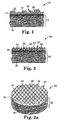
- Abrasive article 10 comprises rebulkable nonwoven web 12 having first major surface 14 and second major surface 16.
- first major surface 14 and second major surface 16 are planar and first major surface 14 is parallel to second major surface 16.
- Rebulkable nonwoven web 12 comprises a multiplicity of first fibers and a multiplicity of second bicomponent fibers which are melt-bonded together at points of mutual contact.
- rebulkable nonwoven web 12 retains a higher density (i.e., a higher number of fibers per unit volume) proximate first major surface 14 than throughout the bulk of nonwoven web 12. That is, abrasive coating 18, which is applied to nonwoven web 12 while in a densified form, results in the formation of fiber to fiber bonds which diminish or prevent total rebuking near major surface 14.
- Abrasive coating 18 comprises binder 20 and a plurality of abrasive particles 22.
- Abrasive coating 18 is in the form of a sheet or film adhered to the first major surface 14 of rebulkable nonwoven web 12.
- Abrasive coating 18 has working surface 19 which can have any desired surface topography. In FIG. 1, the working surface 19 of abrasive coating 18 has a textured topography comprising a plurality of irregularly shaped protuberances.
- the second major surface 16 of abrasive article 10 may be utilized for attachment to a back-up pad or sanding block.
- Abrasive article 30 comprises rebulkable nonwoven web 32 having first major surface 34 and second major surface 36.
- Rebulkable nonwoven web 32 comprises a multiplicity of first fibers and a multiplicity of second bicomponent fibers which are melt-bonded together at points of mutual contact.
- First major surface 34 has bonded thereto abrasive coating 42.
- Abrasive coating 42 composes binder 44 and a plurality of abrasive particles 46.
- Abrasive coating 42 has working surface 43 which may have any desired surface topography.
- working surface 43 has a structured topography comprising a plurality precisely-shaped pyramidal abrasive composites 48.
- Distal end 50 of abrasive composite 48 contacts the workpiece during abrading operations.
- a second row of abrasive composites is shown in which the second row is offset from the first row.
- FIG. 2a a perspective view of the embodiment of FIG. 2 is shown.
- Abrasive article 30 is in the form of a disc.
- Nonwoven webs useful in the present invention are rebulkable.
- Rebulkable nonwoven web may be converted (at least once) from a densified or compressed state (i.e., a high density, low loft state) to a rebulked or uncompressed state (i.e., a low density, high loft state).
- the process of converting the rebulkable web from, the densified to the rebulked state is referred to as "rebulking".
- the process of rebulking the web is accomplished by heating the web. Heating the web softens at least some of the bonds formed between fibers of the web. This allows at least some of the fibers to expand to their original length thereby restoring at least a portion of the original bulk to the nonwoven web.
- nonwoven webs useful in the present invention have at least one major surface which is preferably planar or flat. The major surface provides the surface upon which an abrasive slurry is applied and solidified to form an abrasive coating.
- a preferred rebulkable nonwoven web composition is reported in WO 94/04738 (Heyer et al.), the disclosure of which is incorporated herein by reference.
- Such rebulkable nonwoven webs comprise a multiplicity of a first fiber and a multiplicity of a second fiber which are entangled with one another and melt-bonded together.
- the first fibers are crimped, staple, thermoplastic organic fibers.
- the fibers may be stuffer-box crimped, gear crimped or helically crimped.
- a mixture of fibers having more than one crimp type is also within the scope of the invention.
- Suitable first fibers are made of polyester, polyamide, rayon or polyolefin.
- Suitable polyamides include, for example, polycaprolactam and poly(hexamethylene adipamide) (e.g., nylon 6 and nylon 6,6).
- Suitable polyolefins include, for example, polypropylene and polyethylene.
- the first fibers are made of polyester, most preferably polyethylene terephthalate.
- the second fibers making up the rebulkable nonwoven web are typically bicomponent fibers comprising a first higher heat stable component and a second lower heat stable component.
- the second component of the bicomponent fibers melts and adheres these fibers to the other fibers in the nonwoven web. It is important that the second component of the bicomponent fibers melts at a temperature lower than the melting or degradation temperature of the first component of the bicomponent fibers and at a temperature lower than the heat set temperature of the crimping process of the first fibers.
- the melting temperature of the second component is at least about 130°C in order to avoid excessive softening from exposure to temperatures of about 150°C, which are typically present during processing.
- the melting temperature of the second component is preferably at least about 30°C below the melting temperature of the first component of the bicomponent fibers.
- the first component of the bicomponent fibers is typically selected from polyesters (e.g., polyethylene terephthalate), poly(phenylene sulfides), polyamides (e.g., nylon), polyimide, polyetherimide or polyolefins (e.g., polypropylene).
- polyesters e.g., polyethylene terephthalate
- polyamides e.g., nylon
- polyimide e.g., polyetherimide
- polyolefins e.g., polypropylene
- the second component of the bicomponent fibers typically comprises a blend of a crystalline or partially crystalline polymer and an amorphous polymer.
- amorphous polymer refers to a melt extrudable polymer that does not exhibit a definite first order transition temperature, (i.e., a melting temperature).
- the ratio of crystalline to amorphous polymer has an effect both on the degree of shrinkage of the nonwoven webs and the degree of bonding between the first and second components of the bicomponent fibers.
- the weight ratio of amorphous to partially crystalline polymer in the second component of the bicomponent fibers typically ranges from about 15:85 to about 90:10.
- Suitable crystalline and amorphous polymers making up the second component of the bicomponent fibers must be compatible with one another (i.e., exist in a single phase) or must be capable of being rendered compatible. In addition, the second component must be capable of adhering to the first component.
- the blend of polymers making up the second component of the bicomponent fibers preferably comprise crystalline and amorphous polymers of the same general polymeric type. Use of polymers of the same type for both the first and second components may produce bicomponent fibers that are more resistant to separation during fiber spinning, stretching, crimping, and during formation of nonwoven webs.
- Polymers suitable for use as the second component include polyesters, polyolefins, and polyamides. Polyesters are typically preferred, because they provide better adhesion than do other classes of polymeric materials.
- Preferred second fibers useful in the present invention have a concentric core and a sheath construction and are stuffer box crimped with about 6 to about 12 crimps per 25 mm.
- the second fibers may be of a side-by-side construction or an eccentric core and sheath construction.
- the bicomponent fibers have a cut staple length of about 25 to about 100 mm and have a tenacity of about 2-3 grams/denier.
- Preferred bicomponent fibers are reported in U.S. Pat. No. 5,082,720 (Hayes).
- U.S. Pat. No. 3,595,738 discloses methods for the manufacture of reversing helically crimped bicomponent polyester fibers suitable for use in this invention. Fibers having a reversing helical crimp are preferred over fibers that are crimped in a coiled configuration, however, both types of fibers are suitable for this invention.
- U.S. Pat. Nos. 3,868,749 (Cate), 3,619,874 (Li., et al.) and 2,931,089 (Evans) disclose various methods of edge crimping synthetic organic fibers to produce helically crimped fibers.
- Helically crimped fibers typically and preferably have from about 1 to about 15 full cycle crimps per 25 mm fiber length, while stuffer box crimped fibers have about 3 to about 15 full cycle crimps per 25 mm fiber length.
- the helically crimped fibers preferably have fewer crimps per specified length than the stuffer box fibers.
- Crimp index which provides a measure of fiber elasticity, typically ranges from about 35 to about 70 percent for helically crimped and stuffer box crimped fibers. Crimp index can be determined by measuring the fiber length when fully extended ("extended length"), measuring the fiber length when the fiber is relaxed (“relaxed length"), subtracting the relaxed length from the extended length, dividing the resulting value by the extended length, and multiplying that value by 100. The values of the appropriate load used to extend the fiber depends on the fiber denier. For fibers having 50 to 100 denier, a load of about 0.1-0.2 gram may be used. For fibers having a higher denier, a load of about 5-10 grams is used. Preferably, the crimp index of a fiber should not significantly change due to exposure to temperatures of about 135°C to 175°C for 5 to 15 minutes.
- the length of the first and second fibers is dependent upon the limitations of the processing equipment upon which the nonwoven open web is formed. Fiber lengths suitable for helically crimped fibers typically range from about 60 mm to 150 mm. Fiber lengths suitable for stuffer box fibers range from about 25 to 70 mm.
- the fiber denier may be chosen to optimize the desired properties of the nonwoven web such as porosity and strength. Higher denier fibers will typically produce a more porous web with fewer entanglements and fewer fiber-to-fiber bonding points. Hence, the strength of the web may be low and it may be difficult to maintain the web in the densified state prior to coating. Lower denier fibers generally will produce a strong, dense web. Suitable fiber denier ranges from about 1 to 500, more preferably from about 1 to 200 and most preferably from about 1 to 70.
- the first and second fibers have a break strength of at least 1 gram per denier to provide the necessary degree of toughness for prolonged use of the abrasive article.
- Crimped staple fibers may be processed and entangled into nonwoven webs by web-forming machines such as that sold under the trade designation "RANDO-WEBBER” (commercially available from the Rando Machine Corporation, Ard, NY). Methods useful for making nonwoven webs suitable for use in the invention from crimped, staple, synthetic fibers are reported in U.S. Pat. Nos. 2,958,593 (Hoover, et al.) and 3,537,121 (McAvoy). Alternatively, crimped staple fibers can be processed and entangled into nonwoven webs by carding or garnetting, followed by crosslapping to form a web of appropriate thickness. Such a crosslapped structure is generally needletacked to reorient a portion of the component fibers to alignment in the "z" direction (i.e., the thickness direction), thereby further entangling and integrating the web.
- RANDO-WEBBER commercially available from the Rando Machine Corporation, Ard, NY.
- Rebulkable nonwoven webs useful in the present invention typically have a rebulked thickness of at least about 0.5 cm, more preferably ranging from about 2 cm to about 4 cm.
- the abrasive coating of an abrasive article of the present invention is formed by solidifying an abrasive slurry.
- An abrasive slurry comprises abrasive particles, a binder precursor and may optionally include other additives such as reactive siloxane polymers, initiators, curing agents, fillers, grinding aids, coupling agents and plasticizers.
- the components of an abrasive slurry may be mixed together using any suitable mixing technique such as low shear or high shear mixing. High shear mixing is typically preferred. Ultrasonic energy may be utilized in combination with the mixing step to lower the viscosity of the abrasive slurry.
- the abrasive particles are gradually added to the binder precursor. It is preferred that the abrasive slurry be a homogeneous mixture of binder precursor, abrasive particles and optional additives. If necessary, water or solvent may be added to reduce the viscosity. In some instances it is preferred to heat the abrasive slurry to reduce the viscosity.
- Useful abrasive particles have an average particle size ranging from about 0.01 to 1500 micrometers, preferably ranging from about 0.1 to 50 micrometers.
- abrasive particles also includes abrasive agglomerates.
- the abrasive particles in the agglomerate may be chemical bonded together by an agglomerate binder or may be bonded together by inter-particle forces.
- Suitable abrasive particles include fused aluminum oxide, heat treated aluminum oxide, white fused aluminum oxide, black silicon carbide, green silicon carbide, titanium diboride, boron carbide, silicon nitride, tungsten carbide, titanium carbide, monocrystalline or polycrystalline diamond, monocrystalline or polycrystalline cubic boron nitride, hexagonal boron nitride, garnet, iron oxide, zirconia, tin oxide, ceria, chromia, fused alumina zirconia, alumina-based sol gel derived abrasive particles, and the like.
- the alumina -based sol gel derived abrasive particle may optionally contain a metal oxide modifier.
- Alumina-based sol gel derived abrasive particles may be found in U.S. Patent Nos. 4,314,827 (Leitheiser et al.), 4,623,364 (Cottringer et al.), 4,744,802 (Schwabel), 4,770,671 (Monroe et al.), and 4,881,951 (Wood et al.).
- the abrasive article may also contain a mixture of two or more types and/or grades of abrasive particles.
- Binder/Binder Precursor
- the binder of an abrasive article of the present invention is formed from a binder precursor.
- the binder precursor has a phase that is capable of flowing sufficiently to be coatable and can be solidified. Solidification of the binder precursor may be achieved by curing (i.e., polymerizing and/or crosslinking), by drying (i.e., evaporating a liquid from a dissolved or dispersed solid), by cooling (i.e., for hot melt type binders), or by a combination of these processes.
- the binder precursor may be organic solvent-home, water-borne, or 100% solids (i.e., a substantially solvent-free). Both thermoplastic and thermosetting materials, as well as combinations thereof, may be suitable binder precursors.
- Preferred binder precursors are curable materials which polymerize and/or crosslink upon exposure to heat, e-beam, ultraviolet light, visible light or upon the addition of a chemical catalyst, moisture or a combination thereof.
- the binder precursor is exposed to the appropriate conditions to initiate the curing of the binder precursor. After curing, the binder precursor is converted into a non-flowable solid binder.
- binder precursors include epoxy resins, amino resins (e.g., aminoplast resins) such as alkylated urea-formaldehyde resins, melamine-formaldehyde resins, alkylated benzoguanamine-formaldehyde resin, acrylate resins (including acrylates and methacrylates), acrylated epoxies, acrylated urethanes, acrylated polyesters, acrylated polyethers, vinyl ethers, acrylated oils, and acrylated silicones, alkyd resins such as urethane alkyd resins, polyester resins, reactive urethane resins, phenolic resins such as resole and novolac resins, phenolic/latex resins, epoxy resins such as bisphenol epoxy resins, isocyanates, isocyanurates, polysiloxane resins (including alkylalkoxysilane resins), reactive vinyl resins, and the like.
- the resins may be in
- the preferred binder precursors cure via a free radical mechanism. These binder precursors are capable of polymerizing rapidly upon exposure to thermal and/or radiation energy.
- a preferred subset of free radical curable binder precursors include ethylenically unsaturated binder precursors. Examples of ethylenically unsaturated binder precursors include aminoplast monomers or oligomers having pendant alpha, beta unsaturated carbonyl groups, ethylenically unsaturated monomers or oligomers, acrylated isocyanurate monomers, acrylated urethane oligomers, acrylated epoxy monomers or oligomers, ethylenically unsaturated monomers or diluents, acrylate dispersions, and mixtures thereof.
- the term acrylate includes both acrylates and methacrylates.
- the aminoplast binder precursors have at least one pendant alpha, beta-unsaturated carbonyl group per molecule. These materials are reported in U.S. Patent Nos. 4,903,440 (Larson et al.) and 5,236,472 (Kirk et al.).
- Ethylenically unsaturated monomers may be monofunctional, difunctional, trifunctional, tetrafunctional or may a higher functionality, and include both acrylate and methacrylate-based monomers.
- Suitable ethylenically unsaturated compounds preferably have a molecular weight of less than about 4,000 and are preferably esters made from the reaction of compounds containing aliphatic hydroxyl groups and unsaturated carboxylic acids, such as acrylic acid, methacrylic acid, itaconic acid, crotonic acid, isocrotonic acid, and maleic acid.
- ethylenically unsaturated monomers include methyl methacrylate, ethyl methacrylate, styrene, divinylbenzene, hydroxy ethyl acrylate, hydroxy ethyl methacrylate, hydroxy propyl acrylate, hydroxy propyl methacrylate, hydroxy butyl acrylate, hydroxy butyl methacrylate, lauryl acrylate, octyl acrylate, 2 (2-ethoxyethoxy) ethylacrylate, tetrahydrofurfuryl methacrylate, cyclohexyl acrylate, stearyl acrylate, 2-phenoxyethyl acrylate, isooctyl acrylate, isobornyl acrylate, isodecyl acrylate, polyethylene glycol monoacrylate, polypropylene glycol monoacrylate., vinyl toluene, ethylene glycol diacrylate, polyethylene glycol mono
- ethylenically unsaturated materials include monoallyl, polyallyl, and polymethallyl esters and amides of carboxylic acids, such as diallyl phthalate, diallyl adipate, and N,N-diallyladipamide.
- Still other nitrogen containing compounds include tris(2-acryl-oxyethyl)isocyanurate, 1,3,5-tri(2-methyacryloxyethyl)-s-triazine, acrylamide, methylacrylamide, N-methyl-acrylamide, N,N-dimethylacrylamide, N-vinyl-pyrrolidone, and N-vinyl-piperidone.
- a preferred binder precursor comprises a blend of a multifunctional acrylate with a monofunctional acrylate, for example, a trifunctional acrylate resin and a mono functional acrylate resin.
- the binder precursor may comprise a blend of a tetrafunctional acrylate resin and a monofunctional acrylate resin.
- An example of one binder precursor is a blend of propoxylated trimethylol propane triacrylate and 2-(2-ethoxyethoxy) ethyl acrylate.
- a multifunctional acrylate/monofunctional acrylate blend typically comprises about 10 to 90 parts by weight multifunctional acrylate resin and about 10 to 90 parts by weight monofunctional acrylate resin.
- the binder precursor blend comprises about 30 to 70 parts by weight multifunctional acrylate resin and about 30 to about 70 parts by weight monofunctional acrylate resin, Most preferably, the binder precursor blend comprises about 40 to 60 parts by weight multifunctional acrylate resin and about 40 to 60 parts by weight monofunctional acrylate resin.
- binder precursor that comprises a mixture of an acrylate resin and an epoxy resin such as reported in U.S. Patent No. 4,751,138 (Tumey et al.).
- Isocyanurate derivatives having at least one pendant acrylate group and isocyanate derivatives having at least one pendant acrylate group are reported in U.S. Patent No. 4,652,274 (Boettcher et al.).
- a preferred isocyanurate is a triacrylate of tris(hydroxy ethyl) isocyanurate.
- Acrylated urethanes are multifunctional acrylate esters of hydroxy terminated isocyanate extended polyesters or polyethers.
- Examples of commercially available acrylated urethanes include those available under the trade designation "UVITHANE 782" (commercially available from Morton Chemical), "CMD 6600", “CMD 8400” and “CMD 8805”(commercially available from UCB Radcure Specialties, Smyrna, GA), "PHOTOMER 6010” (commercially available from Henkel Corp., Hoboken, NJ), "EBECRYL 220” (hexafunctional aromatic urethane acrylate of molecular weight 1000), “EBECRYL 284" (aliphatic urethane diacrylate of 1200 molecular weight diluted with 1,6-hexanediol diacrylate), “EBECRYL 4827” (aromatic urethane diacrylate of 1600 molecular weight), “EBECRYL 4830” (aliphatic urethane diacrylate
- Acrylated epoxies are diacrylate esters of epoxy resins, such as the diacrylate esters of bisphenol A epoxy resin.
- Examples of acrylated epoxies include those available under the trade designations "CMD 3500”, “CMD 3600” and “CMD 3700” (commercially available from UCB Radcure Specialties, Smyrna GA).
- Acrylated polyesters are the reaction products of acrylic acid with a dibasic acid/aliphatic diol-based polyester.
- Examples of commercially available acrylated polyesters include those available under the trade designations "PHOTOMER 5007” (hexafunctional acrylate of 2000 molecular weight) and “PHOTOMER 5018” (tetrafunctional acrylate of 1000 molecular weight) (commercially available from Henkel Corp.), "EBECRYL 80” (tetrafunctional modified polyester acrylate of 1000 molecular weight), “EBECRYL 450” (fatty acid modified polyester hexaacrylate) and “EBECRYL 830” (hexafunctional polyester acrylate of 1500 molecular weight) (commercially available from UCB Radcure Specialties, Smyrna GA).
- a preferred binder precursor comprises a blend of an acrylated oligomer resin and an acrylate monomer resin, for example, a blend of an acrylated urethane resin and an acrylate monomer resin.
- the acrylate monomer resin may be tetrafunctional, trifunctional, difunctional, monofunctional or a combination thereof.
- the binder precursor may contain a blend of an acrylated urethane resin and one or more monofunctional acrylate resins.
- ethylenically unsaturated diluents or monomers may be found in U.S. Patent Nos. 5,236,472 (Kirk et al.) and 5,580,647 (Larson et al.). In some instances these ethylenically unsaturated diluents are useful because they tend to be compatible with water. Additional reactive diluents are disclosed in U.S. Patent No. 5,178,646 (Barber et al.).
- the binder precursor may also be an acrylate dispersion such as described in U.S. Patent No. 5,378,252 (Follensbee).
- thermoplastic binders may also be suitable.
- thermoplastic binders include polyamides (i.e., nylon), polyethylene, polypropylene, polyesters, polyurethanes, polyetherimide, polysulfone, polystyrene, acrylonitrile-butadiene-styrene block copolymer, acetal polymers, polyvinyl chloride and combinations thereof.
- water-soluble binder precursor which may be further blended with a thermosetting resin.
- water-soluble binder precursors include polyvinyl alcohol, hide glue, and water-soluble cellulose ethers (e.g., hydroxypropylmethyl cellulose, methyl cellulose and hydroxyethylmethyl cellulose). Additional details on this type of chemistry may be found in U.S. Patent No. 4,255,164 (Butkze et al.).
- the abrasive coating may optionally include a siloxane polymer which is capable of reacting with the binder precursor.
- a siloxane polymer which is capable of reacting with the binder precursor.
- Suitable reactive siloxane polymers are reported in Patent Application No. 09/218,386 (Woo et al.) filed December 22,1998.
- reactive polysiloxane polymer or “polysiloxane polymer” refers to any of the polymers represented by formula (I), formula (II) or a mixture thereof.
- Formula (I) is: where n is 50 to 1000.
- R 1 is: or where n 1 is an integer from 3 to 12 and where n 2 is an integer from 3 to 10.
- R 2 is independently methyl, ethyl, or phenyl.
- R 3 is:
- X is: where n 3 is an integer from 5 to 500 and where the terminal oxygen atom of X is connected to the Si atom of formula (II).
- R 4 is independently methyl, ethyl, or phenyl.
- R 5 is independently: or where n 4 is an integer from 3 to 12 and where n 5 is an integer from 3 to 10.
- the reactive polysiloxane polymers represented by formulas (I) and (II) have at least one functional group that is capable of reacting with a binder precursor.
- Functional groups include alpha, beta-unsaturated carbonyl groups (i.e., acrylates, methacrylates, thioacrylates, thiomethacrylates) or vinyl ether groups.
- suitable binder precursors have functional groups which are capable of reacting with the reactive siloxane polymer.
- the preferred binder precursors are free radically curable materials such as acrylates or methacrylates.
- a particularly preferred siloxane polymer is poly(dimethylsiloxane) monomethacrylate having a number average molecular weight ranging from about 9,000 to 12,000 grams/mole (commercially available as catalog number 39,630-3 from Sigma-Aldrich Corp., St. Louis, MO).
- the adhesion between the abrasive coating and the production tool may be greater than the internal strength of the nonwoven backing and/or the bond between the abrasive coating and the nonwoven backing.
- the backing may split and/or the abrasive coating may separate from the backing.
- the adhesion between the abrasive coating and the production tool is reduced thereby allowing the abrasive coating to be more easily removed from the production tool. Release from the production tool is important not only to prevent damage to the abrasive article. If the abrasive coating sticks to the production tool this may reduce the number of times that the production tool can be reused since it becomes clogged with residual abrasive coating.
- Utilization of reactive siloxane polymers is a particularly advantageous way of providing release from a production tool in that these materials, which are chemically bonded to the binder, do not typically transfer to the surface of the workpiece during abrading.
- the transfer of any release promoting material to the surface of a workpiece by an abrasive article is generally disfavored since this may interfere with the adhesion and/or wetting of coatings which are subsequently applied over the abraded surface.
- the abrasive coating may optionally include a filler.
- a filler may be advantageous to alter the erodibility of the abrasive coating, reduce the cost of the abrasive article, alter the rheology of the abrasive slurry and/or to alter the abrading characteristics of the abrasive article.
- fillers include talc, glass particles, glass spheres, glass bubbles, bubble structures of other inorganic or organic materials, silica fume, talc, wood flour, wood particles, organic or inorganic fibers, very fine abrasive particles, thermoplastic particles, thermosetting particles, and the like.
- Other fillers include inorganic salts, sulfur, organic sulfur compounds, graphite, boron nitride, and metallic sulfides.
- the fillers may also be provided with a surface treatment such as described above for abrasive particles.
- the abrasive coating may optionally include a plasticizer.
- the addition of the plasticizer will soften the binder and may increase the erodibility of the abrasive coating.
- the plasticizer is preferably compatible with the binder to minimize phase separation.
- plasticizers include polyethylene glycol, polyvinyl chloride, dibutyl phthalate, alkyl benzyl phthalate, polyvinyl acetate, polyvinyl alcohol, cellulose esters, phthalate, silicone oils (e.g., as reported in U.S. Patent No.
- adipate and sebacate esters polyols, polyols derivatives, t-butylphenyl diphenyl phosphate, tricresyl phosphate, castor oil, combinations thereof and the like.
- the preferred plasticizers are phthalate derivatives.
- polymerization initiators may be used.
- initiators include organic peroxides, azo compounds, quinones, nitroso compounds, acyl halides, hydrazones, mercapto compounds, pyrylium compounds, imidazoles, chlorotriazines, benzoin, benzoin alkyl ethers, diketones, phenones, and mixtures thereof.
- Suitable ultraviolet light activated photoinitiators include those sold under the trade designations "IRGACURE 651” and “IRGACURE 184" (commercially available from Ciba Geigy Company, Tarrytown, NY) and “DAROCUR 1173” (commercially available from Merck & Co., Merck Chemicals Division, Rahway, NY). Examples of suitable visible light activated initiators may be found in U.S. Patent No. 4,735,632 (Larson et al.) and the initiator sold under the trade designation "IRGACURE 369" (available from Ciba Geigy Company).
- an initiator is used in an amount ranging from about 0.1% to 10% by weight, preferably 2% to 4% by weight, based on the weight of the binder precursor. It is preferred to uniformly disperse the initiator in the binder precursor prior to the addition of any particulate material, such as abrasive particles or filler particles.
- the abrasive slurry may optionally include a photosensitizer.
- photosensitizers include compounds having carbonyl groups or tertiary amino groups and mixtures thereof.
- preferred compounds having carbonyl groups are benzophenone, acetophenone, benzil, benzaldehyde, o-chlorobenzaldehyde, xanthone, thioxanthone, 9,10-anthraquinone, and other aromatic ketones which can act as photosensitizers.
- tertiary amines are methyldiethanolamine, ethyldiethanolamine, triethanolamine, phenylmethylethanolamine, and dimethylaminoethylbenzoate.
- Commercially available photosensitizers include those sold under the trade designations "QUANTICURE ITX”, “QUANTICURE QTX”, “QUANTICURE PTX”, “QUANTICURE EPD” (from Biddle Sawyer Corp., New York, NY).
- the amount of photosensitizer typically varies from about 0.01% to 10% by weight, more preferably from about 0.25% to 4.0% by weight, based on the weight of the binder precursor.
- the binder precursor be exposed to radiation energy, preferably ultraviolet light and/or visible light, to form the binder.
- radiation energy preferably ultraviolet light and/or visible light
- certain abrasive particles and/or certain additives will absorb ultraviolet and visible light, which makes it difficult to properly cure the binder precursor. This phenomenon occurs, for example, with ceria abrasive particles and silicon carbide abrasive particles. It has been found that the use of phosphate containing photoinitiators, in particular acylphosphine oxide containing photoinitiators, tend to overcome this problem.
- acylphosphine oxide containing photoinitiators include those sold under the trade designations "DAROCUR 4263” and “DAROCUR 4265” (commercially available from Merck & Co., Merck Chemicals Division, Rahway, NJ).
- cationic initiators may be used to initiate polymerization.
- examples include salts of onium cations (e.g., arylsulfonium salts) as well as organometallic salts such as ion arene systems.
- Examples of cationic initiators are reported in U.S. Patent Nos. 4,751,138 (Tumey et al.), 5, 256,170 (Harmer et al.), 4,985,340 (Palazotto), and 4,950,696 (Brown-Wensley et al.).
- Dual-cure and hybrid-cure systems may also be used.
- dual-cure systems curing occurs in two separate stages, via either the same or a' different reaction mechanism.
- hybrid-cure systems two different curing mechanisms occur at the same time upon exposure to ultraviolet/visible or electron beam.
- the abrasive coating may further comprise optional additives such as abrasive particle surface modification additives, coupling agents, expanding agents, fibers, antistatic agents, suspending agents, lubricants, wetting agents, surfactants, pigments, dyes, UV stabilizers, complexing agents, chain transfer agents, accelerators, catalysts, and activators.
- optional additives such as abrasive particle surface modification additives, coupling agents, expanding agents, fibers, antistatic agents, suspending agents, lubricants, wetting agents, surfactants, pigments, dyes, UV stabilizers, complexing agents, chain transfer agents, accelerators, catalysts, and activators.
- abrasive particle surface modification additives such as abrasive particle surface modification additives, coupling agents, expanding agents, fibers, antistatic agents, suspending agents, lubricants, wetting agents, surfactants, pigments, dyes, UV stabilizers, complexing agents, chain transfer agents, accelerators, catalysts, and activators.
- Water or organic solvent may also be incorporated into the abrasive slurry.
- the amount of water or organic solvent is selected to achieve the desired coating viscosity.
- the water or organic solvent should be compatible with the binder precursor.
- the water or solvent may be removed following polymerization of the precursor, or it may remain with the binder.
- Water soluble and/or water sensitive additives such as polyvinyl alcohol, polyvinyl acetate, cellulosic based particles and the like may also be included to increase the erodibility of the abrasive surface.
- the working surface of the abrasive coating may have a structured topography comprising a plurality of precisely-shaped shaped abrasive composites.
- the abrasive composites are preferably arranged on the backing in a predetermined pattern.
- the abrasive composites are formed or molded into a precise shape by a production tool which has a plurality of precisely-shaped cavities. Therefore, the predetermined pattern of the composites will correspond to the pattern of the cavities in the production tool. The pattern is thus reproducible from article to article.
- the predetermined pattern may be a regular or random array.
- Regular arrays include, for example, aligned rows and columns of abrasive composites and offset rows of abrasive composites. That is, one row of abrasive composites may be directly aligned in front of a second row of abrasive composites. Alternatively, one row of abrasive composites may be offset from the second row of abrasive composites. It is preferred that adjacent rows of abrasive composites are offset from one another.
- the predetermined pattern may comprise a random array.
- random it is meant that the composites are not in a regular array of rows and columns as described above.
- the abrasive composites may be arranged in a manner as described in WO 95/07797 (Hoopman et al.) and WO 95/22436 (Hoopman et al.). It is understood, however, that this random array is a predetermined pattern in that the location of the composites on the abrasive article is predetermined and corresponds to the location of the cavities in the production tool which is used to make the abrasive article.
- the shape of the abrasive composites is typically a geometric shape such as a cube, cylinder, prism, pyramid, truncated pyramid, cone, truncated cone, hemisphere, cross, or post-like with a flat top surface.
- Pyramidal composites may have four sides, five sides or six sides. A mixture of more than one shape of abrasive composite is also within the scope of the invention.
- the sides forming the abrasive composites may be perpendicular relative to the backing, or they may be tapered with diminishing width toward the distal end (i.e., the end spaced away from the nonwoven web) of the composites
- Abrasive composites having tapered sides are preferred since they release easier from the production tool.
- the angle forming the taper typically ranges from about 1° to 75°, preferably ranging from about 2° to 50°, more preferably ranging from about 3° to 35°, and most preferably ranging from about 5° to 15°. Lower angles are preferred because this results in a more uniform cross sectional area along the height of the abrasive composite. A uniform cross sectional area is preferred because this provides a more consistent working surface during abrading.
- the taper angle is a compromise between an angle large enough to promote easy release from the production tool and an angle small enough to provide a relatively uniform cross sectional area.
- the height of the abrasive composites is typically less than about 800 micrometers, more particularly ranging from about 25 to about 200 micrometers.
- the height of each abrasive composite on an abrasive article is the same. It is possible, however, to have composites of varying heights within the same abrasive article.
- the diameter or cross sectional width of the abrasive composites typically ranges from about 5 to about 500 micrometers, preferably ranging from about 10 to about 250 micrometers, and most preferably ranging from about 15 to about 150 micrometers.
- the spacing of the abrasive composites may vary from about 1 to 100 abrasive composites per linear centimeter, preferably ranging from about 5 to 80 abrasive composites per linear centimeter, more preferably ranging from about 10 to 60 abrasive composites per linear centimeter, and most preferably ranging from about 15 to 50 abrasive composites per linear centimeter.
- the spacing may be varied such that the concentration of abrasive composites is greater in one location than in another. For example, the concentration of abrasive composites may be greatest in the center of an abrasive article.
- the areal density of abrasive composites typically ranges from about 1 to 12,000 composites/cm 2 , preferably ranging from about 50 to 7,500 abrasive composites/cm 2 and most preferably ranging from about 50 to 5,000 abrasive composites/cm 2 .
- the abrasive composites may have substantially the same orientation or the orientation of individual abrasive composites may be different from one another.
- One potential advantage of having different orientations is to increase the packing density of abrasive composites.
- adjacent abrasive composites are rotated about 45 degrees from one another.
- adjacent abrasive composites are mirror images of one other.
- two composites are "adjacent composites" if no intervening composite is located on a direct imaginary line drawn between the centers of the composites.
- the base of the abrasive composites can abut one another or the bases of adjacent abrasive composites may be separated from one another by a distance.
- the physical contact between adjacent abrasive composites involves no more than 33% of the vertical height dimension of each contacting composite. More preferably, the amount of physical contact between the abutting composites is in the range of about 1 to about 25% of the vertical height of each contacting composite. It is to be understood that this definition of abutting also covers an arrangement where adjacent composites share a common land or bridge-like structure which contacts and extends between facing sidewalls of the composites.
- the land structure has a height of no greater than about 33% of the vertical height dimension of each adjacent composite.
- the land is formed from the same slurry used to form the abrasive composites. It is preferred that at least portions of the abrasive composites be separated from one another so as to provide the recessed areas between the raised portions of the composites as described above.
- the abrasive article also may have a variable abrasive coating composition.
- the center of an abrasive disc may contain an abrasive coating that is different (i.e., softer, harder, or more or less erodible) from the outer region of the abrasive disc.
- FIG. 3 illustrates a typical process and apparatus for making a preferred embodiment of an abrasive article of the present invention.
- a multiplicity of a first staple fiber 54 and a second (bicomponent) fiber 55 are combined together at web forming station 56 using the method described in U.S. Pat. No. 2,958,593 (Hoover et al.) or the method described in U.S. Pat. No. 3,537,121 (McAvoy) to form nonwoven web precursor 60.
- Web precursor 60 is optionally needle-tacked at needle-tacking station 61.
- web precursor 60 is preferably melt-bonded by passing through melt-bonding station 62 to form melt-bonded web 64.
- Melt-bonding station 62 is typically a heated air space, for example, an oven. While melt-bonded web 64 is at a temperature sufficient to melt the lower heat stable component of the second fibers, it is passed through opposing belts 66 and 68. Belts 66 and 68 compress and densify melt-bonded web 64. While being held in compression, melt-bonded web 64 is passed through opposing belts 67 and 69 which are driven by a series of rollers. While being held in compression between belts 67 and 69 the melt-bonded web 64 is cooled to room temperature or lower in order to "set" the web in its densified state. Cooling may be provided, for example, by a fan or water cooled plate(s) located behind belt(s) 67 and /or 69.
- the ratio of the density of densified web 80 to melt-bonded web 64 may vary considerably, however, it is preferred that the densification ratio (expressed as the thickness of the web prior to densification relative to the thickness of the web after densification) ranges from about 2:1 to 15:1, more preferably ranging from about 4:1 to 7:1.
- Densified web 80 may be uniformly or non-uniformly densified.
- a non-uniformly densified web may be produced, for example, by heating one surface of the web to a higher temperature than the bulk of the web during the compression step. This may be accomplished, for example, by contacting a major surface of the web with a heated surface such as a heated plate during densification. Since densification typically increases the stiffness of a nonwoven web, non-uniform densification may be preferred in order to provide a web having a densified major surface while retaining high flexibility. Flexibility of the densified web may be desirable to allow the web to readily conform to the production tool during application of the abrasive slurry. After the coating step, the web may optionally be processed through hot and cold compressing zones to improve its strength and dimensional stability before rebulking into the final desirable form.
- Densified nonwoven web 80 has major surface 81 which is relatively continuous and smooth.
- a relatively continuous and smooth major surface is preferred because recessed areas or voids in the densified major surface of the web (created by the random fiber alignment) may result in malformed abrasive composites. That is, the composites formed over areas of the nonwoven web having recesses or voids may not be precisely-shaped. Malformations are particularly likely to be observed when the desired abrasive coating has small (i.e., having a height less than about 0.17 mm) precisely- shaped abrasive composites.
- the major surface 81 of densified nonwoven web 80 may be made more continuous and/or smooth by flame treating major surface 81, applying a tie coating over major surface 81, or a combination thereof.
- flame treatment and/or tie coating may also provide increased adhesion between the abrasive coating and the nonwoven web. Treating the major surface 81 of the nonwoven web with a high intensity flame treatment melts at least some of the surface fibers which flow to provide a more continuous and/or smooth densified major surface.
- a thin, flexible tie coating may be applied over major surface 81 to fill the recessed areas and/or voids on the surface of the nonwoven web.
- tie coating refers to a coating which is applied between the abrasive coating and the nonwoven web in an abrasive article of the present invention.
- a preferred tie coating comprises a blend of 70% polyamide hot melt (commercially available under the trade designation “VESTAMELT 732" from Huls America) and 30% acrylate-functional epoxy oligomer (commercially available under the trade designation “EBECRYL 3720” from UCB Chemicals) cured with 1% free-radical photoinitiator (commercially available under the trade designation "IRGACURE 651” from Ciba Specialty Chemicals).
- device 70 represents a flame treatment device and/or a coating station for applying such a tie coating.
- the preferred density for applying a sheet-like abrasive coating to the densified nonwoven web 80 may depend upon factors such as the type and size of the fibers in the nonwoven web, the viscosity of the abrasive slurry, the use of a flame treatment or tie coating, whether the web is uniformly or non-uniformly densified, and process features such as the speed of the web, speed of cure of the abrasive slurry, the coating technique, and the like.
- an abrasive slurry is applied.
- the abrasive slurry may be applied in a process which is continuous with the manufacturing process of the nonwoven web (see, for example, FIG. 3) or the abrasive slurry may be applied in a separate process.
- the abrasive slurry is then solidified to form an abrasive coating.
- the abrasive coating has a working surface which may have a textured (see, FIG. 1) or structured (see, FIG. 2) topography.
- a preferred method for applying an abrasive coating having a structured topography is reported in U.S. Patent Nos. 5,152,917 (Pieper et al) and 5,435,816 (Spurgeon et al.). Other suitable methods may be found in U.S. Patent Nos.
- a preferred method for applying a structured abrasive coating comprises the steps of:
- abrasive slurry 82 (held in reservoir 82) is fed through feed line 85 to coating station 86.
- the precisely-shaped cavities 87 of production tool 84 are at least partially filled (preferably completely filled) with abrasive slurry 82.
- Production tool 84 contains a plurality of precisely-shaped cavities 87 distending as indentation from the major surface.
- the cavities are essentially the inverse shape of the abrasive composites and are responsible for generating the shape and placement of the abrasive composites on the abrasive article.
- cavities may have any geometric shape that is the inverse shape to the geometric shapes suitable for the abrasive composites.
- the dimensions of the cavities are selected to achieve the desired number areal density of abrasive composites.
- the production tool may be in the form of a belt, a sheet, a continuous sheet or web, a coating roll (i.e., a rotogravure roll), a sleeve mounted on a coating roll, or die.
- the production tool is in the form of a belt.
- the production tool may be composed of metal, (e.g., nickel), metal alloys or polymers.
- the production tool may be fabricated by any conventional technique, including photolithography, knurling, engraving, hobbing, electroforming or diamond turning. For example, a copper tool may be diamond turned and then a nickel metal tool may be electroplated off of the copper tool. In some instances, a photolithography process is desired because it creates patterns that cannot or are otherwise difficult and expensive to generate by other techniques such as diamond turning.
- a production tool made of a thermoplastic polymer may be replicated off a master tool.
- the master tool will have the inverse pattern desired for the production tool.
- the master tool is preferably made out of metal (e.g., nickel-plated aluminum, copper or bronze).
- a thermoplastic polymer sheet material may be heated along with the master tool such that the thermoplastic sheet material is embossed with the master tool pattern by pressing the two together.
- the thermoplastic polymer may be extruded or cast onto to the master tool.
- the thermoplastic material is then cooled to a non-flowable state and separated from the master tool to produce a thermoplastic production tool.
- the production tool may also contain a release coating to permit easier release of the abrasive article from the production tool. Examples of such release coatings include silicones and fluorochemicals.
- Coating station 86 may be any conventional coating means such as drop die coater, knife coater, curtain coater, vacuum die coater or a die coater.
- the preferred coating technique is a vacuum fluid bearing die, such as reported in U.S. Patent Nos. 3,594,865 (Erb), 4,959,265 (Wood), and 5,077,870 (Millage).
- the formation of air bubbles is preferably minimized. In some instances, however, it may be preferred to incorporate air into the slurry. Entrapped air may lead to porosity in the abrasive coating and may increase the erodibility of the abrasive coating.
- Nip roll 88 is preferably made from a metal, metal alloy, rubber or ceramic. The hardness of the nip roll may range from about 30 to about 120 durometer, typically ranging from about 60 to about 100 durometer, and preferably about 90 durometer.
- the binder precursor in the abrasive slurry is at least partially solidified (preferably fully solidified) by exposure to an energy source 90.
- Energy source 90 may be a source of thermal energy or radiation energy (e.g., electron beam, ultraviolet light or visible light).
- the amount of energy required is typically dependent upon the chemical nature of the reactive groups in the binder precursor, as well as upon the thickness and density of the binder precursor coating.
- an oven temperature ranging from about 50°C to about 250°C and a duration ranging from about 15 minutes to about 16 hours is generally sufficient.
- An electron beam may be used at an energy level ranging from about 0.1 to about 10 Mrad, preferably ranging from about 1 to about 10 Mrad.
- Ultraviolet radiation refers to radiation comprising wavelengths ranging from about 200 to about 400 nanometers, preferably ranging from about 250 to about 400 nanometers. It is preferred that 118 to 236 Watt/cm ultraviolet lamps are used as a source of ultraviolet light. Visible radiation refers to radiation comprising wavelengths ranging from about 400 to about 800 nanometers, preferably ranging from about 400 to about 550 nanometers.
- the energy source is radiation energy.
- the production tool is made from a material transparent to visible or ultraviolet radiation (e.g., polypropylene, polyethylene, polyester, polycarbonate, poly(ether sulfone), poly(methyl methacrylate), polyurethanes, polyvinylchloride, or combinations thereof) then visible or ultraviolet radiation may be transmitted through the production tool to cure the binder precursor.
- the energy source should be chosen so as not to appreciably degrade the production tool or backing.
- the abrasive coated densified nonwoven web 95 is separated from production tool 84.
- the production tool and abrasive article are separated at an angle to improve separation.
- the resulting abrasive coating comprises abrasive composites having the inverse pattern of the production tool.
- the working surface of the abrasive coating may have a textured topography (see, FIG. 1).
- textured refers to a topography comprising a plurality of non-straight, non-distinct, inexact or imperfectly shaped protuberances.
- the abrasive slurry is first coated into precisely-shaped cavities of a production tool.
- the abrasive slurry is removed from the production tool before the binder precursor is solidified sufficiently for it to retain its shape.
- the abrasive slurry flows and distorts upon removal from the production tool. It is generally preferred that the time between removal of the slurry-coated backing from the production tool to solidification of the binder precursor is relatively short. If this time is too long, the slurry will flow and the texture may disappear. Subsequent to removal from the production tool, the binder precursor is solidified.
- the slurry may be partially solidified while in contact with the production tool, provided that the slurry is removed before the binder precursor is solidified sufficiently to retain its shape. Subsequent to this, the binder precursor is cured or solidified by exposure to an energy source as described above. Additional details on how to make this type of abrasive article may be found, for example, in U.S. Patent Nos. 4,773,920 (Chasman et al.) and 5,014,468 (Ravipati et al.).
- the abrasive slurry is first coated onto the surface of a rotogravure roll.
- the densified nonwoven web then contacts the slurry-coated gravure roll causing at least part of the abrasive slurry to transfer to the densified nonwoven web.
- the rotogravure roll imparts a texture to the surface of the transferred abrasive slurry.
- Another method of making a textured topography comprises spraying or coating an abrasive slurry through a screen.
- the binder precursor is then solidified to form the abrasive coating having a textured working surface. This type of process is further described in U.S. Patent No. 3,605,349 (Anthon).
- Yet another technique for making a textured topography comprises imparting texture to the surface of the densified rebulkable nonwoven web. This may be accomplished, for example, by embossing the surface of the nonwoven web. Once embossed, the abrasive slurry is coated onto the embossed surface thereby providing a textured topography. The slurry may be applied over the textured backing by any suitable technique such as roll coating, spraying, die coating or knife coating. An example of an abrasive coating applied over an embossed backing may be found in U.S. Patent No. 5,015,266 (Yamamoto et al.).
- the abrasive coated densified web 92 is passed through a rebulking station 94 to effectuate rebulking of the densified web.
- rebulking station 94 is an oven.
- the web is heated to melt the lower melting component of the bicomponent fibers.
- the rebulking temperature depends, for example, on the composition of the fibers used to form the nonwoven web and the type of binder precursor. The temperature must be high enough to melt the lower heat stable component, but not high enough to decompose that component.
- the degree of rebulking may be controlled by factors such as the temperature of the rebulking station, the residence time in the rebulking station, the composition of the fibers in the web including the degree and type of crimp in the fibers.
- the abrasive coated rebulked web 96 may be converted into the desired form (i.e., size, shape, etc.) for use as an abrasive article.
- the abrasive coated densified web 92 may be first converted into the desired form followed by rebulking. In this case, a batch type rebulking process is preferred.
- Abrasive articles of the invention may take any of a variety of shapes and sizes.
- the article may be circular, elliptical, or quadrangular.
- a preferred article is circular and is of the proper size for use on a rotary abrading device.
- the circular pad is from about 2 to 16 cm in diameter, and from about 0.5 to about 30 cm in thickness.
- the most preferred embodiment of the present invention comprises a disc-shaped article having provision for mounting on electrically driven or pneumatically driven rotary hand tools.
- Such mounting provision includes, for example, pressure-sensitive adhesives or mechanically-interlocking fasteners that can secure the abrasive article to a back-up pad having a mandrel for mounting onto the hand tool.
- FIB-1 and 35% by weight FIB-2 were blended and processed through a carding and cross-lapping web processing line to form a nonwoven web having a weight of 450 g/m 2 .
- the nonwoven web was needle tacked at 110 strokes per minutes at a traverse speed of about 7 feet per minute (about 2.1 m/min).
- the needle-tacked web was then introduced into the nip between two belts.
- the belts were moving at a speed of 5 feet/min (about 1.5 m/min) and were separated by a distance of 1/16" (1.6 mm).
- the belts were supported on their back sides by rigid platens to ensure a uniform distance between the belts.
- the web While being advanced through the nip created between the belts, the web was heated by a hot plate on the top and hot air from the bottom at a temperature of 300° F (149°C). Upon exiting from the first set of belts, the web was introduced into a second nip between two similar belts. While being advanced through the nip created between the second set of belts, the web was cooled with room temperature air from the bottom and a tap cold water cooling plate on the top. This procedure densified and set the web at thickness of 1/8" (3.2 mm).
- An abrasive slurry having the composition shown in Table 1, was applied at a rate of 40 feet/min. (12.2 m/min.) to a continuous loop polypropylene production tool using a knife coater having a gap of 0.003 mils (0.076 mm).
- the major surface of the production tool had a uniform pattern of triangular-based pyramidal cavities having a depth of 2.5 mils (0.06 mm) and a density of 57,000 cavities/in 2 (8,835 cavities/cm 2 ).
- the densified nonwoven web was then placed in contact with the coated side of the production tool and the resulting structure was introduced into a nip between two rollers. To prevent stretching, the densified nonwoven web was supported by a carrier film prior to coating.
- the abrasive slurry was exposed to ultraviolet light from one type D bulb (commercially available from Fusion Systems Inc., Gaithersburgh, MD) operating at 600 watts/inch (236 watts/cm). The ultraviolet bulb was positioned such that the ultraviolet light passed through the production tool before entering the abrasive slurry.
- the web side of the structure was in contact with a transport mandrel heated to 54.4°C (130°F).
- the ultraviolet light initiated free radical polymerization of the binder precursor thereby solidifying the abrasive slurry. After solidification of the abrasive slurry, the nonwoven web having the abrasive coating bonded thereto was removed from the production tool.
- the nonwoven web was then cut into 6-inch (15.24 cm) circular discs.
- the discs were then placed in an oven set at 150°C for 2 minutes to rebulk the nonwoven web. After rebulking, the thickness of the discs measured approximately 3/8 inch (9.5 mm).
- Comp. Ex. A was a dry sanding disk commercially available under the trade designation "260L/1000" from Minnesota Mining and Manufacturing Company, St. Paul, MN.
- Example 1 A "3M Hookit Disc Pad #05725" backup pad (available from Minnesota Mining and Manufacturing Company, St. Paul, MN) was used for both Example 1 and Comp. Ex. A.
- a "3M Hookit Interface Pad # 5774" was used to secure the disc to the backup pad and to cushion the action of the abrasive article on the substrate.
- Example 1 was attached directly to the backup pad. During sanding, the back up pad was driven by a dual-action sander (commercially available under the trade designation "DAQ" from National Detroit, Rockford, IL) operating at 2,000 rev/min.
- Example 1 and Comp. Ex. A were tested side-by-side on a single test panel. Half of the test panel was abraded for 1 minute using Example 1.
- Example 1 was employed damp (i.e., following a light water spray applied over the sample panel). The second half of the test panel was abraded for 1 minute using Comp. Ex. A. Comp. Ex. A was employed dry in accordance with usual practice for this type of abrasive article. After abrading, the finish on each side of the test panel was evaluated visually and with a Perthometer (available from Feinpruf GmbH, Gottingen, Germany). The abrading results are summarized in Table 2.
- each panel was polished at 22,000 RPM with a 3M Perfect-It Foam Polishing Pad # 05725 mounted on a 3M #5717 backup pad and driven by a Snap-On 7/9 electric sander/polisher (available from Snap-On Tools, Kenosha, WI).
- the polishing pad was treated with 3M Perfect-It Foam Polishing Pad Glaze #05996. After polishing for 1.5 minutes, the surface finish on each side of the test panel was evaluated visually.
- the polishing results are summarized in Table 2.
Landscapes
- Engineering & Computer Science (AREA)
- Mechanical Engineering (AREA)
- Textile Engineering (AREA)
- Polishing Bodies And Polishing Tools (AREA)
- Manufacture Of Macromolecular Shaped Articles (AREA)
Applications Claiming Priority (3)
| Application Number | Priority Date | Filing Date | Title |
|---|---|---|---|
| US09/218,385 US6312484B1 (en) | 1998-12-22 | 1998-12-22 | Nonwoven abrasive articles and method of preparing same |
| US218385 | 1998-12-22 | ||
| PCT/US1999/029483 WO2000037218A1 (en) | 1998-12-22 | 1999-12-13 | Nonwoven abrasive articles and method of preparing same |
Publications (2)
| Publication Number | Publication Date |
|---|---|
| EP1140427A1 EP1140427A1 (en) | 2001-10-10 |
| EP1140427B1 true EP1140427B1 (en) | 2005-07-06 |
Family
ID=22814895
Family Applications (1)
| Application Number | Title | Priority Date | Filing Date |
|---|---|---|---|
| EP99966160A Expired - Lifetime EP1140427B1 (en) | 1998-12-22 | 1999-12-13 | Nonwoven abrasive articles and method of preparing same |
Country Status (6)
| Country | Link |
|---|---|
| US (1) | US6312484B1 (enExample) |
| EP (1) | EP1140427B1 (enExample) |
| JP (1) | JP4666765B2 (enExample) |
| AU (1) | AU2176900A (enExample) |
| DE (1) | DE69926077T2 (enExample) |
| WO (1) | WO2000037218A1 (enExample) |
Cited By (1)
| Publication number | Priority date | Publication date | Assignee | Title |
|---|---|---|---|---|
| WO2024105544A1 (en) * | 2022-11-17 | 2024-05-23 | 3M Innovative Properties Company | Cleaning article |
Families Citing this family (56)
| Publication number | Priority date | Publication date | Assignee | Title |
|---|---|---|---|---|
| US6423381B1 (en) | 1999-11-12 | 2002-07-23 | Martin Colton | Protective, transparent UV curable coating method |
| US20040071935A1 (en) * | 2000-06-05 | 2004-04-15 | Kia Hamid G. | Method of forming a composite article with a textured surface |
| US6699419B1 (en) * | 2000-06-05 | 2004-03-02 | General Motors Corporation | Method of forming a composite article with a textured surface and mold therefor |
| US20030124935A1 (en) * | 2000-07-06 | 2003-07-03 | Nicole Smith | Scrub pad with printed rigid plates and associated methods |
| US6477926B1 (en) * | 2000-09-15 | 2002-11-12 | Ppg Industries Ohio, Inc. | Polishing pad |
| US20030207659A1 (en) * | 2000-11-03 | 2003-11-06 | 3M Innovative Properties Company | Abrasive product and method of making and using the same |
| US6743086B2 (en) | 2001-08-10 | 2004-06-01 | 3M Innovative Properties Company | Abrasive article with universal hole pattern |
| MXPA04004594A (es) * | 2001-11-16 | 2004-08-13 | Procter & Gamble | Lienzo desechable para el cuidado de platos y la limpieza de superficies duras. |
| US20050106979A1 (en) * | 2001-12-19 | 2005-05-19 | Gerard Scheubel | Personal care and surface cleaning article |
| US20030114069A1 (en) * | 2001-12-19 | 2003-06-19 | Gerard Scheubel | Personal care and surface cleaning article |
| ITMI20021155A1 (it) * | 2002-05-28 | 2003-11-28 | Atex S R L | Procedimento per la realizzazione di un tessuto non tessuto in fibra sintetica con mezzi profumanti |
| US7670623B2 (en) | 2002-05-31 | 2010-03-02 | Materials Modification, Inc. | Hemostatic composition |
| US7044989B2 (en) * | 2002-07-26 | 2006-05-16 | 3M Innovative Properties Company | Abrasive product, method of making and using the same, and apparatus for making the same |
| US6833014B2 (en) | 2002-07-26 | 2004-12-21 | 3M Innovative Properties Company | Abrasive product, method of making and using the same, and apparatus for making the same |
| US7297170B2 (en) * | 2002-07-26 | 2007-11-20 | 3M Innovative Properties Company | Method of using abrasive product |
| US7560160B2 (en) * | 2002-11-25 | 2009-07-14 | Materials Modification, Inc. | Multifunctional particulate material, fluid, and composition |
| US6939492B2 (en) * | 2002-12-26 | 2005-09-06 | Kimberly-Clark Worldwide, Inc. | Method for making fibrous web materials |
| US7007972B1 (en) | 2003-03-10 | 2006-03-07 | Materials Modification, Inc. | Method and airbag inflation apparatus employing magnetic fluid |
| US6982501B1 (en) | 2003-05-19 | 2006-01-03 | Materials Modification, Inc. | Magnetic fluid power generator device and method for generating power |
| US7200956B1 (en) | 2003-07-23 | 2007-04-10 | Materials Modification, Inc. | Magnetic fluid cushioning device for a footwear or shoe |
| US20050079987A1 (en) * | 2003-10-10 | 2005-04-14 | Cartwright Brian K. | Two-sided antimicrobial wipe or pad |
| US7448389B1 (en) | 2003-10-10 | 2008-11-11 | Materials Modification, Inc. | Method and kit for inducing hypoxia in tumors through the use of a magnetic fluid |
| US20050210756A1 (en) * | 2004-03-25 | 2005-09-29 | Saint-Gobain Ceramics & Plastics, Inc. | Coated abrasive products and processes for forming same |
| JP5401311B2 (ja) * | 2006-07-14 | 2014-01-29 | サンーゴバン アブレイシブズ,インコーポレイティド | 裏当てなしの研磨物品 |
| EP2157875B1 (en) | 2007-06-06 | 2016-10-26 | Higher Dimension Medical, Inc. | Cut, abrasion and/or puncture resistant knitted gloves |
| US20090227188A1 (en) * | 2008-03-07 | 2009-09-10 | Ross Karl A | Vacuum Sander Having a Porous Pad |
| US8062453B2 (en) * | 2008-04-02 | 2011-11-22 | Bae Systems Land & Armaments, L.P. | Method for quasi-instantaneous polymerization of filament wound composite materials |
| JP5204226B2 (ja) * | 2008-06-13 | 2013-06-05 | 株式会社フジミインコーポレーテッド | アルミニウム酸化物粒子及びそれを含有する研磨用組成物 |
| US20100044909A1 (en) * | 2008-08-20 | 2010-02-25 | 3M Innovative Properties Company | Lofty, tackified nonwoven sheet and method of making |
| WO2010033799A1 (en) * | 2008-09-19 | 2010-03-25 | Acme United Corporation | Coatings for cutting implements |
| US8772184B2 (en) | 2009-03-31 | 2014-07-08 | Illinois Tool Works Inc. | Reversible color-changing sanitizer-indicating nonwoven wipe |
| AU2010343085A1 (en) * | 2009-12-29 | 2012-06-14 | Saint-Gobain Abrasifs | Method of cleaning a household surface |
| US8772185B2 (en) | 2010-10-15 | 2014-07-08 | Illinois Tool Works Inc. | Reversible color-changing ink formulations and nonwoven wipes |
| WO2012092388A2 (en) * | 2010-12-28 | 2012-07-05 | Saint-Gobain Abrasives, Inc. | Robust binder bonded grinding wheel |
| US9945480B2 (en) * | 2011-06-30 | 2018-04-17 | Federal-Mogul Llc | Piston assembly including a polymer coating with hard particles applied to sliding surfaces |
| WO2013003650A2 (en) * | 2011-06-30 | 2013-01-03 | Saint-Gobain Abrasives, Inc. | Non-woven abrasive article with extended life |
| KR20140045523A (ko) * | 2011-07-07 | 2014-04-16 | 쓰리엠 이노베이티브 프로퍼티즈 컴파니 | 다성분 섬유 및 입자를 포함하는 물품 및 그의 제조 및 사용 방법 |
| EA027965B1 (ru) | 2011-07-07 | 2017-09-29 | 3М Инновейтив Пропертиз Компани | Изделие, включающее многокомпонентные волокна и полые керамические микросферы, и способы их изготовления и использования |
| JP6143859B2 (ja) * | 2012-06-27 | 2017-06-07 | スリーエム イノベイティブ プロパティズ カンパニー | 研磨物品 |
| EP3105010B1 (en) * | 2014-02-14 | 2021-04-28 | 3M Innovative Properties Company | Abrasive article and method of using the same |
| MX363673B (es) * | 2014-02-17 | 2019-03-29 | 3M Innovative Properties Co | Artículo de restregado y métodos de fabricación y uso. |
| EP4733513A2 (en) * | 2014-03-31 | 2026-04-29 | Ceraloc Innovation AB | Method to produce composite boards and panels |
| TW201610261A (zh) * | 2014-05-20 | 2016-03-16 | 喬治亞太平洋消費者產品公司 | 非木材纖維之漂白及植物性雜質減量方法 |
| CA2961512A1 (en) * | 2014-09-17 | 2016-03-24 | Saint-Gobain Abrasives, Inc. | Polymer impregnated backing material, abrasive articles incorporating same, and processes of making and using |
| TWI603813B (zh) * | 2015-04-20 | 2017-11-01 | 中國砂輪企業股份有限公司 | 研磨工具及其製造方法 |
| TWI609742B (zh) * | 2015-04-20 | 2018-01-01 | 中國砂輪企業股份有限公司 | 研磨工具 |
| JP2019514535A (ja) | 2016-04-29 | 2019-06-06 | スリーエム イノベイティブ プロパティズ カンパニー | 印刷された指示を形成する擦り磨き体を含む清掃用物品 |
| WO2018005111A1 (en) * | 2016-07-01 | 2018-01-04 | 3M Innovative Properties Company | Nonwoven abrasive article including abrasive particles |
| CN109689298A (zh) * | 2016-07-08 | 2019-04-26 | 圣戈班磨料磨具有限公司 | 磨料制品和其形成方法 |
| EP3519137A4 (en) | 2016-09-30 | 2020-06-10 | 3M Innovative Properties Company | ABRASIVE ARTICLES AND METHOD FOR THE PRODUCTION THEREOF |
| EP3615724B1 (en) * | 2017-04-28 | 2024-02-28 | 3M Innovative Properties Company | Large denier nonwoven fiber webs |
| USD849067S1 (en) * | 2017-12-12 | 2019-05-21 | 3M Innovative Properties Company | Coated abrasive disc |
| USD879164S1 (en) * | 2017-12-12 | 2020-03-24 | 3M Innovative Properties Company | Coated abrasive disc |
| USD862538S1 (en) * | 2017-12-12 | 2019-10-08 | 3M Innovative Properties Company | Coated abrasive disc |
| USD870782S1 (en) * | 2017-12-12 | 2019-12-24 | 3M Innovative Properties Company | Coated abrasive disc |
| USD849066S1 (en) * | 2017-12-12 | 2019-05-21 | 3M Innovative Properties Company | Coated abrasive disc |
Family Cites Families (82)
| Publication number | Priority date | Publication date | Assignee | Title |
|---|---|---|---|---|
| US2881064A (en) | 1955-11-07 | 1959-04-07 | Minnesota Mining & Mfg | Fill-resistant abrasive articles |
| US2931089A (en) | 1956-05-02 | 1960-04-05 | Deering Milliken Res Corp | Methods and apparatus for producing yarn |
| DE1694594C3 (de) | 1960-01-11 | 1975-05-28 | Minnesota Mining And Manufacturing Co., Saint Paul, Minn. (V.St.A.) | Reinigungs- und Polierkörper |
| US3256075A (en) | 1961-10-20 | 1966-06-14 | Minnesota Mining & Mfg | Abrasive sponge |
| US3296022A (en) | 1962-08-13 | 1967-01-03 | Norton Co | Polymer saturated backing material |
| JPS4929612B1 (enExample) * | 1966-05-09 | 1974-08-06 | ||
| GB1179436A (en) | 1967-05-22 | 1970-01-28 | Ici Ltd | Helically Crimped Filamentary Materials |
| US3537121A (en) | 1968-01-17 | 1970-11-03 | Minnesota Mining & Mfg | Cleaning and buffing product |
| US3605349A (en) | 1969-05-08 | 1971-09-20 | Frederick B Anthon | Abrasive finishing article |
| US3594865A (en) | 1969-07-10 | 1971-07-27 | American Velcro Inc | Apparatus for molding plastic shapes in molding recesses formed in moving endless wire dies |
| US3619874A (en) | 1970-01-16 | 1971-11-16 | Allied Chem | Travelling-edge crimper and process |
| US3868749A (en) | 1974-02-06 | 1975-03-04 | American Cyanamid Co | Method of texturizing thermoplastic yarn |
| JPS5823616B2 (ja) | 1976-11-08 | 1983-05-16 | 東レ株式会社 | 感光性ポリマ組成物 |
| US4314824A (en) | 1977-02-16 | 1982-02-09 | Bifok Ab | Programmable, continuous flow analyzer |
| US4255164A (en) | 1979-04-30 | 1981-03-10 | Minnesota Mining And Manufacturing Company | Fining sheet and method of making and using the same |
| JPS56129212A (en) | 1980-03-13 | 1981-10-09 | Toray Ind Inc | Photosensitive polyamide resin composition |
| US4480009A (en) | 1980-12-15 | 1984-10-30 | M&T Chemicals Inc. | Siloxane-containing polymers |
| DE3248753A1 (de) | 1982-12-31 | 1984-07-12 | Akzo Gmbh, 5600 Wuppertal | Verfahren zum verdichten von faservliesen |
| US4623364A (en) | 1984-03-23 | 1986-11-18 | Norton Company | Abrasive material and method for preparing the same |
| CA1254238A (en) | 1985-04-30 | 1989-05-16 | Alvin P. Gerk | Process for durable sol-gel produced alumina-based ceramics, abrasive grain and abrasive products |
| US4728571A (en) | 1985-07-19 | 1988-03-01 | Minnesota Mining And Manufacturing Company | Polysiloxane-grafted copolymer release coating sheets and adhesive tapes |
| US4652274A (en) | 1985-08-07 | 1987-03-24 | Minnesota Mining And Manufacturing Company | Coated abrasive product having radiation curable binder |
| US4773920B1 (en) | 1985-12-16 | 1995-05-02 | Minnesota Mining & Mfg | Coated abrasive suitable for use as a lapping material. |
| US4770671A (en) | 1985-12-30 | 1988-09-13 | Minnesota Mining And Manufacturing Company | Abrasive grits formed of ceramic containing oxides of aluminum and yttrium, method of making and using the same and products made therewith |
| US4751138A (en) | 1986-08-11 | 1988-06-14 | Minnesota Mining And Manufacturing Company | Coated abrasive having radiation curable binder |
| US4735632A (en) | 1987-04-02 | 1988-04-05 | Minnesota Mining And Manufacturing Company | Coated abrasive binder containing ternary photoinitiator system |
| US4881951A (en) | 1987-05-27 | 1989-11-21 | Minnesota Mining And Manufacturing Co. | Abrasive grits formed of ceramic containing oxides of aluminum and rare earth metal, method of making and products made therewith |
| US4950696A (en) | 1987-08-28 | 1990-08-21 | Minnesota Mining And Manufacturing Company | Energy-induced dual curable compositions |
| US5053288A (en) | 1987-11-20 | 1991-10-01 | Teijin Limited | Optical recording medium |
| JP2707264B2 (ja) | 1987-12-28 | 1998-01-28 | ハイ・コントロール・リミテッド | 研磨シートおよびその製造方法 |
| US5082720A (en) | 1988-05-06 | 1992-01-21 | Minnesota Mining And Manufacturing Company | Melt-bondable fibers for use in nonwoven web |
| US4985340A (en) | 1988-06-01 | 1991-01-15 | Minnesota Mining And Manufacturing Company | Energy curable compositions: two component curing agents |
| JPS6442860U (enExample) * | 1988-09-08 | 1989-03-14 | ||
| US4903440A (en) | 1988-11-23 | 1990-02-27 | Minnesota Mining And Manufacturing Company | Abrasive product having binder comprising an aminoplast resin |
| US5198057A (en) | 1988-12-23 | 1993-03-30 | Fiberweb North America, Inc. | Rebulkable nonwoven fabric |
| US5143779A (en) | 1988-12-23 | 1992-09-01 | Fiberweb North America, Inc. | Rebulkable nonwoven fabric |
| US4967465A (en) | 1989-01-03 | 1990-11-06 | General Electric Company | Method of assembling and disassembling a rotor retaining ring system |
| US4959265A (en) | 1989-04-17 | 1990-09-25 | Minnesota Mining And Manufacturing Company | Pressure-sensitive adhesive tape fastener for releasably attaching an object to a fabric |
| US5014468A (en) | 1989-05-05 | 1991-05-14 | Norton Company | Patterned coated abrasive for fine surface finishing |
| US5368925A (en) | 1989-06-20 | 1994-11-29 | Japan Vilene Company, Ltd. | Bulk recoverable nonwoven fabric, process for producing the same and method for recovering the bulk thereof |
| US4973338A (en) | 1989-06-29 | 1990-11-27 | Carborundum Abrasives Company | Anti-static and loading abrasive coating |
| US5021477A (en) | 1989-08-07 | 1991-06-04 | Minnesota Mining And Manufacturing Company | Polysiloxane-grafted copolymer topical binder composition with novel hydrophilic monomers and method of coating therewith |
| US4972037A (en) | 1989-08-07 | 1990-11-20 | Minnesota Mining And Manufacturing Company | Polysiloxane-grafted copolymer topical binder composition with novel fluorochemical comonomer and method of coating therewith |
| US4981903A (en) | 1989-08-07 | 1991-01-01 | Minnesota Mining And Manufacturing Company | Polysiloxane-grafter copolymer topical binder composition with novel hydrophilic monomers and method of coating therewith |
| US5032460A (en) | 1989-08-14 | 1991-07-16 | Minnesota Mining And Manufacturing Company | Method of making vinyl-silicone copolymers using mercapto functional silicone chain-transfer agents and release coatings made therewith |
| US5077870A (en) | 1990-09-21 | 1992-01-07 | Minnesota Mining And Manufacturing Company | Mushroom-type hook strip for a mechanical fastener |
| US5152917B1 (en) | 1991-02-06 | 1998-01-13 | Minnesota Mining & Mfg | Structured abrasive article |
| US5236472A (en) | 1991-02-22 | 1993-08-17 | Minnesota Mining And Manufacturing Company | Abrasive product having a binder comprising an aminoplast binder |
| CA2080453C (en) | 1991-10-17 | 1999-02-09 | Randall E. Kozulla | High loft rebulkable non-woven fabric: tacker fiber approach |
| US5437754A (en) | 1992-01-13 | 1995-08-01 | Minnesota Mining And Manufacturing Company | Abrasive article having precise lateral spacing between abrasive composite members |
| US5256170A (en) | 1992-01-22 | 1993-10-26 | Minnesota Mining And Manufacturing Company | Coated abrasive article and method of making same |
| US5178646A (en) | 1992-01-22 | 1993-01-12 | Minnesota Mining And Manufacturing Company | Coatable thermally curable binder presursor solutions modified with a reactive diluent, abrasive articles incorporating same, and methods of making said abrasive articles |
| US5213589A (en) | 1992-02-07 | 1993-05-25 | Minnesota Mining And Manufacturing Company | Abrasive articles including a crosslinked siloxane, and methods of making and using same |
| US5271997A (en) | 1992-02-27 | 1993-12-21 | Kem-Wove, Incorporated | Laminated fabric material, nonwoven textile product |
| US5468477A (en) | 1992-05-12 | 1995-11-21 | Minnesota Mining And Manufacturing Company | Vinyl-silicone polymers in cosmetics and personal care products |
| KR950703093A (ko) | 1992-08-24 | 1995-08-23 | 테릴 켄트 퀄리 | 용융 결합된 부직 제품 및 이를 제조하는 방법(melt bonded nonwoven articles and methods of preparing) |
| US5435816A (en) | 1993-01-14 | 1995-07-25 | Minnesota Mining And Manufacturing Company | Method of making an abrasive article |
| US5501940A (en) | 1993-05-20 | 1996-03-26 | Polaroid Corporation | Process for protecting a binary image with a siloxane durable layer that is not removable by hexane, isopropanol or water |
| US5681612A (en) | 1993-06-17 | 1997-10-28 | Minnesota Mining And Manufacturing Company | Coated abrasives and methods of preparation |
| US5378252A (en) | 1993-09-03 | 1995-01-03 | Minnesota Mining And Manufacturing Company | Abrasive articles |
| US5489235A (en) | 1993-09-13 | 1996-02-06 | Minnesota Mining And Manufacturing Company | Abrasive article and method of making same |
| SG64333A1 (en) | 1993-09-13 | 1999-04-27 | Minnesota Mining & Mfg | Abrasive article method of manufacture of same method of using same for finishing and a production tool |
| JPH07100769A (ja) * | 1993-09-16 | 1995-04-18 | Nippon Micro Kooteingu Kk | 研磨シートおよびその製造方法 |
| US5453312A (en) | 1993-10-29 | 1995-09-26 | Minnesota Mining And Manufacturing Company | Abrasive article, a process for its manufacture, and a method of using it to reduce a workpiece surface |
| US5454844A (en) | 1993-10-29 | 1995-10-03 | Minnesota Mining And Manufacturing Company | Abrasive article, a process of making same, and a method of using same to finish a workpiece surface |
| US5580647A (en) | 1993-12-20 | 1996-12-03 | Minnesota Mining And Manufacturing Company | Abrasive articles incorporating addition polymerizable resins and reactive diluents |
| CA2182580A1 (en) | 1994-02-22 | 1995-08-24 | Timothy L. Hoopman | Abrasive article, a method of making same, and a method of using same for finishing |
| US5609513A (en) * | 1994-04-11 | 1997-03-11 | Minnesota Mining And Manufacturing Company | Cleaning and dressing fly lines |
| US5663211A (en) | 1994-06-27 | 1997-09-02 | Sony Chemicals Corporation | Ultraviolet curing resin having low primary irritation index for optical disk |
| US5637386A (en) | 1995-01-10 | 1997-06-10 | Norton Company | Fining abrasive materials |
| MX9708204A (es) | 1995-04-28 | 1997-12-31 | Minnesota Mining & Mfg | Articulo abrasivo que tiene un sistema de adhesion que comprende un polisiloxano. |
| EP0828871B1 (en) | 1995-05-25 | 2003-07-23 | Minnesota Mining And Manufacturing Company | Undrawn, tough, durably melt-bondable, macrodenier, thermoplastic, multicomponent filaments |
| US5578097A (en) | 1995-08-28 | 1996-11-26 | Norton Company | Washable coated abrasives |
| EP0856011A2 (en) | 1995-10-17 | 1998-08-05 | The University Of North Carolina At Chapel Hill | Heterogeneous polymerizations in carbon dioxide |
| US5700302A (en) * | 1996-03-15 | 1997-12-23 | Minnesota Mining And Manufacturing Company | Radiation curable abrasive article with tie coat and method |
| GB2314791B (en) | 1996-07-04 | 1999-09-01 | Evode Ltd | Polymeric coatings |
| US5624471A (en) | 1996-07-22 | 1997-04-29 | Norton Company | Waterproof paper-backed coated abrasives |
| US5766277A (en) | 1996-09-20 | 1998-06-16 | Minnesota Mining And Manufacturing Company | Coated abrasive article and method of making same |
| US5773120A (en) | 1997-02-28 | 1998-06-30 | Kimberly-Clark Worldwide, Inc. | Loop material for hook-and-loop fastening system |
| US5837745A (en) | 1997-04-10 | 1998-11-17 | Lilly Industries, Inc. | UV curable polish and method of use |
| US5942015A (en) * | 1997-09-16 | 1999-08-24 | 3M Innovative Properties Company | Abrasive slurries and abrasive articles comprising multiple abrasive particle grades |
| US6162522A (en) | 1998-06-19 | 2000-12-19 | Kimberly-Clark Worldwide, Inc. | Loop substrate for releasably attachable abrasive sheet material |
-
1998
- 1998-12-22 US US09/218,385 patent/US6312484B1/en not_active Expired - Lifetime
-
1999
- 1999-12-13 DE DE69926077T patent/DE69926077T2/de not_active Expired - Lifetime
- 1999-12-13 AU AU21769/00A patent/AU2176900A/en not_active Abandoned
- 1999-12-13 WO PCT/US1999/029483 patent/WO2000037218A1/en not_active Ceased
- 1999-12-13 EP EP99966160A patent/EP1140427B1/en not_active Expired - Lifetime
- 1999-12-13 JP JP2000589313A patent/JP4666765B2/ja not_active Expired - Fee Related
Cited By (1)
| Publication number | Priority date | Publication date | Assignee | Title |
|---|---|---|---|---|
| WO2024105544A1 (en) * | 2022-11-17 | 2024-05-23 | 3M Innovative Properties Company | Cleaning article |
Also Published As
| Publication number | Publication date |
|---|---|
| EP1140427A1 (en) | 2001-10-10 |
| US6312484B1 (en) | 2001-11-06 |
| DE69926077D1 (de) | 2005-08-11 |
| WO2000037218A1 (en) | 2000-06-29 |
| AU2176900A (en) | 2000-07-12 |
| JP4666765B2 (ja) | 2011-04-06 |
| DE69926077T2 (de) | 2006-05-11 |
| JP2002532274A (ja) | 2002-10-02 |
Similar Documents
| Publication | Publication Date | Title |
|---|---|---|
| US6312484B1 (en) | Nonwoven abrasive articles and method of preparing same | |
| KR100940953B1 (ko) | 연마 제품의 제조 방법 | |
| KR100810205B1 (ko) | 유리 그라인딩 방법 | |
| CN109789537B (zh) | 磨料制品及其制备方法 | |
| EP0605008B1 (en) | Abrasive composites having a controlled rate of erosion, articles incorporating same, and methods of making and using same | |
| US6475253B2 (en) | Abrasive article and method of making | |
| US5888119A (en) | Method for providing a clear surface finish on glass | |
| KR100494605B1 (ko) | 유리상에 투명한 표면 마무리 상태를 제공하기 위한 연마용품 | |
| US5910471A (en) | Abrasive article for providing a clear surface finish on glass | |
| EP0734309B1 (en) | Abrasive article | |
| US6231629B1 (en) | Abrasive article for providing a clear surface finish on glass | |
| EP0688257B1 (en) | Method and article for polishing stone | |
| EP1038637B1 (en) | Abrasive articles | |
| CA2569962C (en) | Abrasive article | |
| US20030022604A1 (en) | Abrasive product and method of making and using the same | |
| US20030207659A1 (en) | Abrasive product and method of making and using the same | |
| EP1372910B1 (en) | Dual cured abrasive articles | |
| CA2369617C (en) | Abrasive article suitable for abrading glass and glass ceramic workpieces | |
| KR20040068360A (ko) | 배킹 및 배킹으로 제조된 연마 제품 및 배킹 및 연마제품의 제조 및 이용 방법 | |
| AU9316898A (en) | Abrasive slurries and abrasive articles comprising multiple abrasive particle grades | |
| US20030024169A1 (en) | Abrasive articles with water soluble particles | |
| US20050020189A1 (en) | Flexible abrasive product and method of making and using the same |
Legal Events
| Date | Code | Title | Description |
|---|---|---|---|
| PUAI | Public reference made under article 153(3) epc to a published international application that has entered the european phase |
Free format text: ORIGINAL CODE: 0009012 |
|
| 17P | Request for examination filed |
Effective date: 20010720 |
|
| AK | Designated contracting states |
Kind code of ref document: A1 Designated state(s): AT BE CH CY DE DK ES FI FR GB GR IE IT LI LU MC NL PT SE |
|
| 17Q | First examination report despatched |
Effective date: 20020204 |
|
| RBV | Designated contracting states (corrected) |
Designated state(s): DE FR GB |
|
| GRAP | Despatch of communication of intention to grant a patent |
Free format text: ORIGINAL CODE: EPIDOSNIGR1 |
|
| GRAS | Grant fee paid |
Free format text: ORIGINAL CODE: EPIDOSNIGR3 |
|
| GRAA | (expected) grant |
Free format text: ORIGINAL CODE: 0009210 |
|
| AK | Designated contracting states |
Kind code of ref document: B1 Designated state(s): DE FR GB |
|
| REG | Reference to a national code |
Ref country code: GB Ref legal event code: FG4D |
|
| REF | Corresponds to: |
Ref document number: 69926077 Country of ref document: DE Date of ref document: 20050811 Kind code of ref document: P |
|
| ET | Fr: translation filed | ||
| PLBE | No opposition filed within time limit |
Free format text: ORIGINAL CODE: 0009261 |
|
| STAA | Information on the status of an ep patent application or granted ep patent |
Free format text: STATUS: NO OPPOSITION FILED WITHIN TIME LIMIT |
|
| 26N | No opposition filed |
Effective date: 20060407 |
|
| PGFP | Annual fee paid to national office [announced via postgrant information from national office to epo] |
Ref country code: GB Payment date: 20071227 Year of fee payment: 9 |
|
| PGFP | Annual fee paid to national office [announced via postgrant information from national office to epo] |
Ref country code: FR Payment date: 20071217 Year of fee payment: 9 |
|
| GBPC | Gb: european patent ceased through non-payment of renewal fee |
Effective date: 20081213 |
|
| REG | Reference to a national code |
Ref country code: FR Ref legal event code: ST Effective date: 20090831 |
|
| PG25 | Lapsed in a contracting state [announced via postgrant information from national office to epo] |
Ref country code: GB Free format text: LAPSE BECAUSE OF NON-PAYMENT OF DUE FEES Effective date: 20081213 |
|
| PG25 | Lapsed in a contracting state [announced via postgrant information from national office to epo] |
Ref country code: FR Free format text: LAPSE BECAUSE OF NON-PAYMENT OF DUE FEES Effective date: 20081231 |
|
| PGFP | Annual fee paid to national office [announced via postgrant information from national office to epo] |
Ref country code: DE Payment date: 20161206 Year of fee payment: 18 |
|
| REG | Reference to a national code |
Ref country code: DE Ref legal event code: R119 Ref document number: 69926077 Country of ref document: DE |
|
| PG25 | Lapsed in a contracting state [announced via postgrant information from national office to epo] |
Ref country code: DE Free format text: LAPSE BECAUSE OF NON-PAYMENT OF DUE FEES Effective date: 20180703 |