EP1138026B1 - Classification method and apparatus - Google Patents
Classification method and apparatus Download PDFInfo
- Publication number
- EP1138026B1 EP1138026B1 EP99958432A EP99958432A EP1138026B1 EP 1138026 B1 EP1138026 B1 EP 1138026B1 EP 99958432 A EP99958432 A EP 99958432A EP 99958432 A EP99958432 A EP 99958432A EP 1138026 B1 EP1138026 B1 EP 1138026B1
- Authority
- EP
- European Patent Office
- Prior art keywords
- space
- function
- feature vector
- classifying
- mapping
- Prior art date
- Legal status (The legal status is an assumption and is not a legal conclusion. Google has not performed a legal analysis and makes no representation as to the accuracy of the status listed.)
- Expired - Lifetime
Links
Images
Classifications
-
- G—PHYSICS
- G07—CHECKING-DEVICES
- G07D—HANDLING OF COINS OR VALUABLE PAPERS, e.g. TESTING, SORTING BY DENOMINATIONS, COUNTING, DISPENSING, CHANGING OR DEPOSITING
- G07D5/00—Testing specially adapted to determine the identity or genuineness of coins, e.g. for segregating coins which are unacceptable or alien to a currency
-
- G—PHYSICS
- G06—COMPUTING OR CALCULATING; COUNTING
- G06F—ELECTRIC DIGITAL DATA PROCESSING
- G06F18/00—Pattern recognition
- G06F18/20—Analysing
- G06F18/21—Design or setup of recognition systems or techniques; Extraction of features in feature space; Blind source separation
- G06F18/213—Feature extraction, e.g. by transforming the feature space; Summarisation; Mappings, e.g. subspace methods
- G06F18/2132—Feature extraction, e.g. by transforming the feature space; Summarisation; Mappings, e.g. subspace methods based on discrimination criteria, e.g. discriminant analysis
-
- G—PHYSICS
- G07—CHECKING-DEVICES
- G07D—HANDLING OF COINS OR VALUABLE PAPERS, e.g. TESTING, SORTING BY DENOMINATIONS, COUNTING, DISPENSING, CHANGING OR DEPOSITING
- G07D7/00—Testing specially adapted to determine the identity or genuineness of valuable papers or for segregating those which are unacceptable, e.g. banknotes that are alien to a currency
- G07D7/06—Testing specially adapted to determine the identity or genuineness of valuable papers or for segregating those which are unacceptable, e.g. banknotes that are alien to a currency using wave or particle radiation
- G07D7/12—Visible light, infrared or ultraviolet radiation
-
- G—PHYSICS
- G07—CHECKING-DEVICES
- G07D—HANDLING OF COINS OR VALUABLE PAPERS, e.g. TESTING, SORTING BY DENOMINATIONS, COUNTING, DISPENSING, CHANGING OR DEPOSITING
- G07D7/00—Testing specially adapted to determine the identity or genuineness of valuable papers or for segregating those which are unacceptable, e.g. banknotes that are alien to a currency
- G07D7/20—Testing patterns thereon
Definitions
- the invention relates to a method and apparatus for classifying items.
- the invention is concerned especially with the classification of coins or banknotes.
- Coins and banknotes inserted into mechanisms are classified, on the one hand according to value, and/or on the other hand, between originals and copies or counterfeits thereof.
- Various methods of performing such classifications are known. As one example, described in GB 2 238 152 A, the contents of which are incorporated herein by reference. For example, measurements are taken from an inserted coin which represent different features of the coin, such as material and the thickness. Those measurements are then compared with respective stored pairs of values, each set of pair of values corresponding to a respective acceptable denomination of coin. When each measured value falls within the respective range for a given denomination, the inserted coin is classified as belonging to that denomination.
- the measured values can be regarded as elements in a feature vector, and the acceptable measurements for different denominations correspond to regions in feature space, known as acceptance regions.
- the feature space is two-dimensional, and acceptance regions are rectangles, but the feature space can have any number of dimensions, with corresponding complexity in the acceptance regions.
- GB 2 254 949 A describes ellipsoidal acceptance regions in three-dimensional feature space.
- EP 0 067 898 A examples of methods and apparatus for classifying bills and coins are described in EP 0 067 898 A, EP 0 472 192 A, EP 0 165 734 A.
- Other methods of classification include the use of neural networks, as described, for example, in EP 0 553 402 A and EP 0 671 040 A.
- a significant problem in the classification of coins is the difficulty of separating different denominations.
- the population distributions of the different denominations of interest may be such that it is not possible easily to define appropriate acceptance boundaries with which adequately separate the denominations.
- Another problem is that in order to achieve adequate separation, it may be necessary to consider feature vectors having a large number of elements, which makes it more difficult to understand the various distributions and thus more difficult to obtain suitable acceptance boundaries.
- PCA principal component analysis
- the method of PCA involves finding the eigenvectors and eigenvalues of the covariance matrix of the variables.
- the eigenvectors are the axes in the new space, with the eigenvector having the highest eigenvalue being the first "principal component” and so on in decreasing size.
- LDA linear discriminant analysis
- the eigenvectors are the axes of the new space. As described in the paper, when there are N classes, the new space has N-1 dimensions.
- NCA non-linear component analysis
- NCA A problem with NCA is that the dimension of the non-linear space may be very large, and so the number of principal components is also very large. For a given problem, it is not known how many principal components are needed for a good classification.
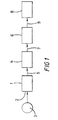
- box 1 designates a measuring system which includes an inlet 2, a transport system in a form of a coin inlet and coin transport path (not shown) for presenting a sample 3 and a sensor system (not shown) for measuring physical quantities of the sample.
- the measuring system 1 is connected to a processing system 4 by means of a data bus 5.
- Processing system 4 is connected to a classifier 6 by means of a data bus 7.
- the output of the classifier 6 is connected to a utilization system 8 by means of a data output bus 9.
- the utilization system 8 is in this example a vending machine, but may also be, for example, a money exchange machine.
- the measuring system 1 measures features of an inserted coin 3.
- the measured features are assembled into a feature vector having n elements, where each element corresponds to a measured feature by the processing system 4.
- the sensor system measures values representative of the material, thickness and diameter of an inserted coin, using known techniques (see, for example, GB 2 254 949 A) and those values are the three elements of the corresponding feature vector.
- each sensor comprises one or more coils in a self-oscillating circuit. In the case of the diameter and thickness sensors, a change in the inductance of each coil caused by the proximity of an inserted coin causes the frequency of the oscillator to alter, whereby a digital representation of the respective property of the coin can be derived.
- a change in the Q of the coil caused by the proximity of an inserted coin causes the voltage across the coil to alter, whereby a digital output representative of conductivity of the coin may be derived.
- the structure, positioning and orientation of each coil, and the frequency of the voltage applied thereto are so arranged that the coil provides an output predominantly dependent upon a particular one of the properties of conductivity, diameter and thickness, it will be appreciated that each measurement will be affected to some extent by other coin properties.
- the measured features can include, for example, the width of the note, the length of the note, and the intensity of reflected or transmitted light for the whole or part of the note.
- a measuring system can be arranged to scan a banknote along N lines using optical sensors. Each scan line contains L individual areas, which are scanned in succession. In each area, there are measurements of M different features. More specifically, for each area, measurements are made of the reflectance intensities of red, green and infra-red radiation. The total number of measurements for a banknote is therefore L x M x N.
- measurements form the components of a feature vector for the respective specimen, so that the feature vector has L x M x N components.
- the measurements can be processed in a different way to obtain a feature vector representative of the measured specimen.
- local feature vectors for each measured area can be formed made up of the M measurements for that area, so that each local feature vector has M components. The local feature vectors can then be summed over the area of the banknote to obtain an M dimensional feature vector representative of the entire specimen.
- the feature vector is then input to the classifier 6.
- the classifier 6 determines whether the sample belongs to any one of predetermined classes, using the feature vector and predetermined classification criteria including a separating function. If the sample is identified as belonging to an acceptable denomination of banknote, then it is accepted and the corresponding value of the note is credited. If the sample is identified as belonging to a known counterfeit group, it is rejected.
- the system is for classifying two denominations of coins and one known counterfeit.
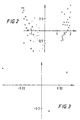
- a two-dimensional representation of the distribution in measurement space is shown in Fig. 2.
- the crosses represent samples of the first denomination, the dots represent counterfeits of the first denomination and the circles represent samples of the second denomination.
- a method for deriving a separating function maps the input space, that is the space of the measured feature vectors, using a non-linear map, into a higher dimensional space with linear properties. Separating hyperplanes are constructed in the mapped space using training data, using the equivalent of an LDA analysis in the mapped space.
- the population distribution of the denominations are analysed as discussed below.
- samples of each of the denominations of interest and each of the known counterfeit are measured and corresponding feature vectors are formed.
- the feature vectors from the samples when plotted, for example, on a n-dimensional scatter graph, (where n is the number of measured features) fall roughly into groups, known as clusters. These measured samples are then used to derive a separating function, as described below. In this example, 50 samples for each denomination and 50 samples of the counterfeit, are used.
- the input space that is, the space of feature vectors, is defined as X.
- N is the number of clusters.
- the cardinality of subspace X l is denoted by n l , and the number of elements in X is M.
- n l the number of elements in X is M.
- C is the covariance matrix
- the method of the invention uses a kernel function k defining a dot product in a mapped space.
- ⁇ is a non-linear function mapping X into a Hilbert space F.
- V is the covariance matrix
- B is the covariance matrix of the cluster centres, and where ⁇ l is the mean value of the cluster 1, that is where x lj is the element j of the cluster 1.
- B represents the inter-cluster inertia in F.
- V can also be expressed using the clusters as V represents total inertia in F.
- K be an (MxM) matrix defined on the cluster elements by where (K pq ) is the covariance matrix between cluster p and cluster q .
- the method essentially performs linear discriminant analysis in the mapped space F to maximise inter-cluster inertia and minimise the intra-cluster inertia. This is equivalent to eigenvalue resolution, as shown in Fukunaga. A suitable separating function can then be derived.
- Q is a Mxr matrix and R is a rxM matrix, where r is the rank of K. It is known that the QR decomposition always exists for a general rectangular matrix.
- Equation (18) is in the form of a standard eigenvector equation. As K is singular, the QR decomposition permits work on a subspace Q ⁇ , which simplifies the resolution.
- the number of eigenvectors N-1 where N is the number of clusters.
- the image of the clusters in the subspace spanned by the eigenvectors is found by projecting onto the eigenvectors. This is done using the following equation: for an eigenvector v, and a feature vector x.
- the calculation does not require knowledge of ⁇ , or the need to calculate a dot product in F.
- the images of the clusters in the eigenvector subspace are well-separated and, more specifically, may be linearly separable, that is they can be separated by lines, planes or hyperplanes.
- a suitable separating function can easily be derived for classifying measured articles, using a known technique, such as inspection, averaging, Malalanobis distance, comparison with k nearest neighbours.
- the feature vectors each have three elements, and there are three clusters, corresponding to each of the two denominations of interest and the known counterfeit respectively.
- the sensor systems measures samples to obtain values representative of the thickness, material and diameter in each case.
- Corresponding feature vectors are formed from the measured features for each sample.
- kernel function is then chosen.
- the kernel function is chosen on the basis of trial and error so as to choose whichever function gives the best separation results.
- the feature vectors of the remaining 13 samples for each cluster are projected onto the eigenvectors v (equation 21) and the results are plotted on a graph for easy inspection.
- v eigenvectors
- the clusters are well-separated. More specifically, each cluster is projected on one point, which is the gravity centre.
- the separation of the projection of the clusters with the eigenvectors is then analysed, and used to derive a separation function.
- a linear separating function can easily be derived by inspection.
- a suitable separating function is:
- Classification for coins of an unknown denomination is then performed as follows.
- the inserted coin is sensed, and measurements representative of the material, thickness and diameter are obtained, as for the samples.
- a feature vector is then derived from the measured values.
- the feature vector is then projected onto the calculated eigenvectors (using equation 21) and the coin is classified in accordance with the projection values and the separating function, as described above.
- the analysis of the sample values for the initial data analysis and the derivation of the separating function can be done, for example, using a microprocessor.
- the classifier 6 may be a microprocessor.
- the classifier 6 may be a neural network, such as a probabilistic neural network, or a perceptron.
- the neural network may include N-1 linear output neurones and M hidden neurones, where every kernel computation is a hidden neurone. Then the input weights are the values x pq , and the coefficients ⁇ are the weights between the hidden neurones and the output layer.
- the classifier may be a linear classifier, or a Support Vector Machine.
- mapping could be to a lower-dimensional space, or to a space of the same dimension as the feature vector space.
Landscapes
- Engineering & Computer Science (AREA)
- General Physics & Mathematics (AREA)
- Physics & Mathematics (AREA)
- Theoretical Computer Science (AREA)
- Computer Vision & Pattern Recognition (AREA)
- Data Mining & Analysis (AREA)
- Toxicology (AREA)
- General Health & Medical Sciences (AREA)
- Health & Medical Sciences (AREA)
- Life Sciences & Earth Sciences (AREA)
- Evolutionary Computation (AREA)
- General Engineering & Computer Science (AREA)
- Evolutionary Biology (AREA)
- Bioinformatics & Computational Biology (AREA)
- Bioinformatics & Cheminformatics (AREA)
- Artificial Intelligence (AREA)
- Testing Of Coins (AREA)
- Inspection Of Paper Currency And Valuable Securities (AREA)
- Image Analysis (AREA)
- Complex Calculations (AREA)
Priority Applications (1)
| Application Number | Priority Date | Filing Date | Title |
|---|---|---|---|
| EP04078239A EP1522970A1 (en) | 1998-12-02 | 1999-12-01 | Classification method and apparatus |
Applications Claiming Priority (3)
| Application Number | Priority Date | Filing Date | Title |
|---|---|---|---|
| GB9826494A GB2344446A (en) | 1998-12-02 | 1998-12-02 | Classifying currency items |
| GB9826494 | 1998-12-02 | ||
| PCT/IB1999/002012 WO2000033262A1 (en) | 1998-12-02 | 1999-12-01 | Classification method and apparatus |
Related Child Applications (1)
| Application Number | Title | Priority Date | Filing Date |
|---|---|---|---|
| EP04078239A Division EP1522970A1 (en) | 1998-12-02 | 1999-12-01 | Classification method and apparatus |
Publications (2)
| Publication Number | Publication Date |
|---|---|
| EP1138026A1 EP1138026A1 (en) | 2001-10-04 |
| EP1138026B1 true EP1138026B1 (en) | 2005-05-04 |
Family
ID=10843520
Family Applications (2)
| Application Number | Title | Priority Date | Filing Date |
|---|---|---|---|
| EP99958432A Expired - Lifetime EP1138026B1 (en) | 1998-12-02 | 1999-12-01 | Classification method and apparatus |
| EP04078239A Withdrawn EP1522970A1 (en) | 1998-12-02 | 1999-12-01 | Classification method and apparatus |
Family Applications After (1)
| Application Number | Title | Priority Date | Filing Date |
|---|---|---|---|
| EP04078239A Withdrawn EP1522970A1 (en) | 1998-12-02 | 1999-12-01 | Classification method and apparatus |
Country Status (9)
| Country | Link |
|---|---|
| US (2) | US6588571B1 (enExample) |
| EP (2) | EP1138026B1 (enExample) |
| JP (1) | JP4723724B2 (enExample) |
| CN (2) | CN100354897C (enExample) |
| AU (1) | AU1580100A (enExample) |
| DE (1) | DE69925155T2 (enExample) |
| ES (1) | ES2241342T4 (enExample) |
| GB (1) | GB2344446A (enExample) |
| WO (1) | WO2000033262A1 (enExample) |
Cited By (1)
| Publication number | Priority date | Publication date | Assignee | Title |
|---|---|---|---|---|
| WO2011126411A1 (ru) * | 2010-04-08 | 2011-10-13 | Общество С Ограниченной Ответственностью "Конструкторское Бюро "Дорс" (Ооо "Кб "Дорс") | Способ обработки банкнот (варианты) |
Families Citing this family (26)
| Publication number | Priority date | Publication date | Assignee | Title |
|---|---|---|---|---|
| EP1222625B1 (de) * | 1999-05-24 | 2006-04-05 | IPCentury AG | Neuronales netz zum computergestützten wissensmanagement |
| AUPQ136299A0 (en) * | 1999-07-02 | 1999-07-22 | Microsystem Controls Pty Ltd | Coin validation |
| DE10045360A1 (de) * | 2000-09-14 | 2002-03-28 | Giesecke & Devrient Gmbh | Verfahren zur Klassifizierung von Dokumenten |
| EP1217589B1 (en) | 2000-12-15 | 2007-02-21 | MEI, Inc. | Currency validator |
| ES2331066T3 (es) | 2002-06-19 | 2009-12-21 | Mei, Inc. | Dispositivo de validacion de moneda. |
| EP1434177B1 (en) * | 2002-12-27 | 2008-09-10 | MEI, Inc. | Banknote validator |
| EP1434176A1 (en) | 2002-12-27 | 2004-06-30 | Mars, Incorporated | Banknote validator |
| KR101333278B1 (ko) * | 2004-03-09 | 2013-12-02 | 카운슬 오브 사이언티픽 앤드 인더스트리얼 리서치 | 시각적인 반사 스펙트럼 반응을 이용한 향상된 위조 화폐 검출기 |
| DE102004024620A1 (de) * | 2004-05-18 | 2005-12-08 | Giesecke & Devrient Gmbh | Vorrichtung und Verfahren zur Prüfung von Banknoten |
| JP4536445B2 (ja) * | 2004-07-26 | 2010-09-01 | 三菱電機株式会社 | データ類別装置 |
| US7360686B2 (en) * | 2005-05-11 | 2008-04-22 | Jp Morgan Chase Bank | Method and system for discovering significant subsets in collection of documents |
| JP2009545049A (ja) * | 2006-07-28 | 2009-12-17 | エムイーアイ インコーポレーテッド | サポート・ベクタ・マシンおよび変数選択を使用する分類 |
| ES2619728T3 (es) * | 2008-10-03 | 2017-06-26 | Crane Payment Innovations, Inc. | Discriminación y evaluación de monedas |
| US8423596B2 (en) * | 2009-02-05 | 2013-04-16 | Sean Gifford | Methods of multivariate data cluster separation and visualization |
| DE102009058438A1 (de) * | 2009-12-16 | 2011-06-22 | Giesecke & Devrient GmbH, 81677 | Verfahren zur Prüfung von Wertdokumenten |
| DE102009058439A1 (de) * | 2009-12-16 | 2011-06-22 | Giesecke & Devrient GmbH, 81677 | Verfahren zur Prüfung von Wertdokumenten |
| RU2421818C1 (ru) * | 2010-04-08 | 2011-06-20 | Общество С Ограниченной Ответственностью "Конструкторское Бюро "Дорс" (Ооо "Кб "Дорс") | Способ классификации банкнот (варианты) |
| TWI423175B (zh) * | 2010-09-01 | 2014-01-11 | Univ Nat Sun Yat Sen | 基於多核心支援向量機之偽鈔辨識方法 |
| KR101232683B1 (ko) | 2011-01-21 | 2013-02-13 | 노틸러스효성 주식회사 | 베이시안 접근법을 이용한 권종 인식 방법 |
| WO2012099435A2 (ko) * | 2011-01-21 | 2012-07-26 | 노틸러스효성 주식회사 | 베이시안 접근법을 이용한 지폐 감별 방법 |
| KR101232684B1 (ko) | 2011-01-21 | 2013-02-13 | 노틸러스효성 주식회사 | 베이시안 접근법을 이용한 지폐 진위 감별 방법 |
| JP5933292B2 (ja) | 2012-02-27 | 2016-06-08 | グローリー株式会社 | 紙幣処理装置 |
| US9036890B2 (en) | 2012-06-05 | 2015-05-19 | Outerwall Inc. | Optical coin discrimination systems and methods for use with consumer-operated kiosks and the like |
| US8739955B1 (en) * | 2013-03-11 | 2014-06-03 | Outerwall Inc. | Discriminant verification systems and methods for use in coin discrimination |
| GB2514156A (en) * | 2013-05-15 | 2014-11-19 | Crane Payment Solutions Ltd | Money item dispensing |
| US9443367B2 (en) | 2014-01-17 | 2016-09-13 | Outerwall Inc. | Digital image coin discrimination for use with consumer-operated kiosks and the like |
Family Cites Families (10)
| Publication number | Priority date | Publication date | Assignee | Title |
|---|---|---|---|---|
| JPS5665291A (en) * | 1979-10-31 | 1981-06-02 | Tokyo Shibaura Electric Co | Discriminator for printed matter |
| CH676162A5 (enExample) * | 1988-11-07 | 1990-12-14 | Ascom Autelca Ag | |
| JPH0481988A (ja) * | 1990-07-24 | 1992-03-16 | Sharp Corp | クラスタリング方式 |
| CH684222A5 (de) * | 1992-03-10 | 1994-07-29 | Mars Inc | Einrichtung zur Klassifizierung eines Musters, insbesondere von einer Banknote oder von einer Münze. |
| JP3363655B2 (ja) * | 1995-04-25 | 2003-01-08 | 三洋電機株式会社 | 貨幣識別装置 |
| JP3741777B2 (ja) * | 1996-04-15 | 2006-02-01 | グローリー工業株式会社 | 紙葉類の識別方法 |
| US6058205A (en) * | 1997-01-09 | 2000-05-02 | International Business Machines Corporation | System and method for partitioning the feature space of a classifier in a pattern classification system |
| US6134344A (en) | 1997-06-26 | 2000-10-17 | Lucent Technologies Inc. | Method and apparatus for improving the efficiency of support vector machines |
| US6226408B1 (en) * | 1999-01-29 | 2001-05-01 | Hnc Software, Inc. | Unsupervised identification of nonlinear data cluster in multidimensional data |
| EP1217589B1 (en) * | 2000-12-15 | 2007-02-21 | MEI, Inc. | Currency validator |
-
1998
- 1998-12-02 GB GB9826494A patent/GB2344446A/en not_active Withdrawn
-
1999
- 1999-12-01 DE DE69925155T patent/DE69925155T2/de not_active Expired - Lifetime
- 1999-12-01 CN CNB998159891A patent/CN100354897C/zh not_active Expired - Fee Related
- 1999-12-01 WO PCT/IB1999/002012 patent/WO2000033262A1/en not_active Ceased
- 1999-12-01 CN CN200710181187XA patent/CN101154301B/zh not_active Expired - Fee Related
- 1999-12-01 US US09/857,009 patent/US6588571B1/en not_active Expired - Fee Related
- 1999-12-01 JP JP2000585834A patent/JP4723724B2/ja not_active Expired - Fee Related
- 1999-12-01 ES ES99958432T patent/ES2241342T4/es not_active Expired - Lifetime
- 1999-12-01 AU AU15801/00A patent/AU1580100A/en not_active Abandoned
- 1999-12-01 EP EP99958432A patent/EP1138026B1/en not_active Expired - Lifetime
- 1999-12-01 EP EP04078239A patent/EP1522970A1/en not_active Withdrawn
-
2003
- 2003-05-23 US US10/444,392 patent/US7073652B2/en not_active Expired - Fee Related
Non-Patent Citations (1)
| Title |
|---|
| BISHOP C.M.: "Neural Networks for Pattern Recognition", 1995, OXFORD UNIVERSITY PRESS, OXFORD * |
Cited By (2)
| Publication number | Priority date | Publication date | Assignee | Title |
|---|---|---|---|---|
| WO2011126411A1 (ru) * | 2010-04-08 | 2011-10-13 | Общество С Ограниченной Ответственностью "Конструкторское Бюро "Дорс" (Ооо "Кб "Дорс") | Способ обработки банкнот (варианты) |
| US8600145B2 (en) | 2010-04-08 | 2013-12-03 | Obshhestvo S Organichennoj Otvetstvennost′Ju ″Konstruktorskoe Bjuro ″Dors″ (OOO ″KB ″Dors″) | Method for processing banknotes |
Also Published As
| Publication number | Publication date |
|---|---|
| ES2241342T4 (es) | 2006-05-16 |
| CN1334944A (zh) | 2002-02-06 |
| US6588571B1 (en) | 2003-07-08 |
| DE69925155T2 (de) | 2006-01-12 |
| US7073652B2 (en) | 2006-07-11 |
| CN101154301A (zh) | 2008-04-02 |
| CN100354897C (zh) | 2007-12-12 |
| AU1580100A (en) | 2000-06-19 |
| WO2000033262A1 (en) | 2000-06-08 |
| EP1522970A1 (en) | 2005-04-13 |
| ES2241342T3 (es) | 2005-10-16 |
| JP2002531906A (ja) | 2002-09-24 |
| DE69925155D1 (de) | 2005-06-09 |
| GB2344446A (en) | 2000-06-07 |
| GB9826494D0 (en) | 1999-01-27 |
| EP1138026A1 (en) | 2001-10-04 |
| US20030192765A1 (en) | 2003-10-16 |
| CN101154301B (zh) | 2012-06-20 |
| JP4723724B2 (ja) | 2011-07-13 |
Similar Documents
| Publication | Publication Date | Title |
|---|---|---|
| EP1138026B1 (en) | Classification method and apparatus | |
| EP1217589B1 (en) | Currency validator | |
| EP0737946B1 (en) | Method and apparatus for the classification of an article | |
| CN104715240A (zh) | 基于灰度共生矩阵的港币纹理图像的分版方法 | |
| JPH0644377A (ja) | パターン、特に紙幣あるいは貨幣のパターンを分類する装置 | |
| CN102934146A (zh) | 钞票的分类方法 | |
| EP1516293B1 (en) | Currency validator | |
| EP0744716B1 (en) | Method and apparatus for authenticating documents | |
| US8474592B2 (en) | Currency discrimination | |
| HK1013709A (en) | Method and apparatus for the classification of an article | |
| HK1013708A (en) | Method and apparatus for the classification of an article | |
| HK1007020B (en) | Method and apparatus for the classification of an article |
Legal Events
| Date | Code | Title | Description |
|---|---|---|---|
| PUAI | Public reference made under article 153(3) epc to a published international application that has entered the european phase |
Free format text: ORIGINAL CODE: 0009012 |
|
| 17P | Request for examination filed |
Effective date: 20010626 |
|
| AK | Designated contracting states |
Kind code of ref document: A1 Designated state(s): AT BE CH CY DE DK ES FI FR GB GR IE IT LI LU MC NL PT SE |
|
| AX | Request for extension of the european patent |
Free format text: AL;LT;LV;MK;RO;SI |
|
| 17Q | First examination report despatched |
Effective date: 20011001 |
|
| GRAP | Despatch of communication of intention to grant a patent |
Free format text: ORIGINAL CODE: EPIDOSNIGR1 |
|
| RBV | Designated contracting states (corrected) |
Designated state(s): DE ES FR GB IT |
|
| GRAS | Grant fee paid |
Free format text: ORIGINAL CODE: EPIDOSNIGR3 |
|
| GRAA | (expected) grant |
Free format text: ORIGINAL CODE: 0009210 |
|
| AK | Designated contracting states |
Kind code of ref document: B1 Designated state(s): DE ES FR GB IT |
|
| REG | Reference to a national code |
Ref country code: GB Ref legal event code: FG4D |
|
| REG | Reference to a national code |
Ref country code: IE Ref legal event code: FG4D |
|
| REF | Corresponds to: |
Ref document number: 69925155 Country of ref document: DE Date of ref document: 20050609 Kind code of ref document: P |
|
| REG | Reference to a national code |
Ref country code: ES Ref legal event code: FG2A Ref document number: 2241342 Country of ref document: ES Kind code of ref document: T3 |
|
| PLBE | No opposition filed within time limit |
Free format text: ORIGINAL CODE: 0009261 |
|
| STAA | Information on the status of an ep patent application or granted ep patent |
Free format text: STATUS: NO OPPOSITION FILED WITHIN TIME LIMIT |
|
| 26N | No opposition filed |
Effective date: 20060207 |
|
| EN | Fr: translation not filed | ||
| REG | Reference to a national code |
Ref country code: GB Ref legal event code: 732E |
|
| REG | Reference to a national code |
Ref country code: GB Ref legal event code: 732E |
|
| PG25 | Lapsed in a contracting state [announced via postgrant information from national office to epo] |
Ref country code: FR Free format text: LAPSE BECAUSE OF NON-PAYMENT OF DUE FEES Effective date: 20051231 |
|
| PG25 | Lapsed in a contracting state [announced via postgrant information from national office to epo] |
Ref country code: FR Free format text: LAPSE BECAUSE OF NON-PAYMENT OF DUE FEES Effective date: 20050504 |
|
| PGFP | Annual fee paid to national office [announced via postgrant information from national office to epo] |
Ref country code: DE Payment date: 20131127 Year of fee payment: 15 Ref country code: GB Payment date: 20131127 Year of fee payment: 15 |
|
| PGFP | Annual fee paid to national office [announced via postgrant information from national office to epo] |
Ref country code: IT Payment date: 20131206 Year of fee payment: 15 Ref country code: ES Payment date: 20131112 Year of fee payment: 15 |
|
| REG | Reference to a national code |
Ref country code: DE Ref legal event code: R119 Ref document number: 69925155 Country of ref document: DE |
|
| GBPC | Gb: european patent ceased through non-payment of renewal fee |
Effective date: 20141201 |
|
| PG25 | Lapsed in a contracting state [announced via postgrant information from national office to epo] |
Ref country code: DE Free format text: LAPSE BECAUSE OF NON-PAYMENT OF DUE FEES Effective date: 20150701 Ref country code: GB Free format text: LAPSE BECAUSE OF NON-PAYMENT OF DUE FEES Effective date: 20141201 |
|
| PG25 | Lapsed in a contracting state [announced via postgrant information from national office to epo] |
Ref country code: IT Free format text: LAPSE BECAUSE OF NON-PAYMENT OF DUE FEES Effective date: 20141201 |
|
| REG | Reference to a national code |
Ref country code: ES Ref legal event code: FD2A Effective date: 20160126 |
|
| PG25 | Lapsed in a contracting state [announced via postgrant information from national office to epo] |
Ref country code: ES Free format text: LAPSE BECAUSE OF NON-PAYMENT OF DUE FEES Effective date: 20141202 |