EP1136507B1 - Cement dispersing polymers for high flow, high strength and selfcompacting concrete - Google Patents
Cement dispersing polymers for high flow, high strength and selfcompacting concrete Download PDFInfo
- Publication number
- EP1136507B1 EP1136507B1 EP20000105911 EP00105911A EP1136507B1 EP 1136507 B1 EP1136507 B1 EP 1136507B1 EP 20000105911 EP20000105911 EP 20000105911 EP 00105911 A EP00105911 A EP 00105911A EP 1136507 B1 EP1136507 B1 EP 1136507B1
- Authority
- EP
- European Patent Office
- Prior art keywords
- cement
- monomer
- concrete
- modified acrylic
- acrylic polymer
- Prior art date
- Legal status (The legal status is an assumption and is not a legal conclusion. Google has not performed a legal analysis and makes no representation as to the accuracy of the status listed.)
- Expired - Lifetime
Links
- 239000004568 cement Substances 0.000 title claims abstract description 52
- 229920000642 polymer Polymers 0.000 title abstract description 82
- 239000011376 self-consolidating concrete Substances 0.000 title description 7
- 239000011372 high-strength concrete Substances 0.000 title description 5
- 239000000178 monomer Substances 0.000 claims abstract description 71
- 239000004567 concrete Substances 0.000 claims abstract description 54
- NIXOWILDQLNWCW-UHFFFAOYSA-N acrylic acid group Chemical group C(C=C)(=O)O NIXOWILDQLNWCW-UHFFFAOYSA-N 0.000 claims abstract description 43
- 229920000058 polyacrylate Polymers 0.000 claims abstract description 16
- SMZOUWXMTYCWNB-UHFFFAOYSA-N 2-(2-methoxy-5-methylphenyl)ethanamine Chemical compound COC1=CC=C(C)C=C1CCN SMZOUWXMTYCWNB-UHFFFAOYSA-N 0.000 claims abstract description 15
- HRPVXLWXLXDGHG-UHFFFAOYSA-N Acrylamide Chemical compound NC(=O)C=C HRPVXLWXLXDGHG-UHFFFAOYSA-N 0.000 claims abstract description 9
- 238000007334 copolymerization reaction Methods 0.000 claims abstract description 5
- 125000001931 aliphatic group Chemical group 0.000 claims abstract description 3
- CERQOIWHTDAKMF-UHFFFAOYSA-N Methacrylic acid Chemical compound CC(=C)C(O)=O CERQOIWHTDAKMF-UHFFFAOYSA-N 0.000 claims abstract 2
- 239000000203 mixture Substances 0.000 claims description 43
- -1 acetoxyethyl Chemical group 0.000 claims description 17
- MHAJPDPJQMAIIY-UHFFFAOYSA-N Hydrogen peroxide Chemical compound OO MHAJPDPJQMAIIY-UHFFFAOYSA-N 0.000 claims description 15
- PJUIMOJAAPLTRJ-UHFFFAOYSA-N monothioglycerol Chemical compound OCC(O)CS PJUIMOJAAPLTRJ-UHFFFAOYSA-N 0.000 claims description 14
- 239000011230 binding agent Substances 0.000 claims description 13
- 239000000470 constituent Substances 0.000 claims description 12
- 229910000831 Steel Inorganic materials 0.000 claims description 11
- 239000004570 mortar (masonry) Substances 0.000 claims description 11
- 239000010959 steel Substances 0.000 claims description 11
- 239000000843 powder Substances 0.000 claims description 9
- 229910021487 silica fume Inorganic materials 0.000 claims description 8
- DPBJAVGHACCNRL-UHFFFAOYSA-N 2-(dimethylamino)ethyl prop-2-enoate Chemical compound CN(C)CCOC(=O)C=C DPBJAVGHACCNRL-UHFFFAOYSA-N 0.000 claims description 7
- 238000000034 method Methods 0.000 claims description 7
- VTYYLEPIZMXCLO-UHFFFAOYSA-L Calcium carbonate Chemical compound [Ca+2].[O-]C([O-])=O VTYYLEPIZMXCLO-UHFFFAOYSA-L 0.000 claims description 6
- 239000007787 solid Substances 0.000 claims description 6
- 239000011398 Portland cement Substances 0.000 claims description 5
- NIXOWILDQLNWCW-UHFFFAOYSA-M Acrylate Chemical compound [O-]C(=O)C=C NIXOWILDQLNWCW-UHFFFAOYSA-M 0.000 claims description 4
- YNAVUWVOSKDBBP-UHFFFAOYSA-N Morpholine Chemical group C1COCCN1 YNAVUWVOSKDBBP-UHFFFAOYSA-N 0.000 claims description 4
- 229920006243 acrylic copolymer Polymers 0.000 claims description 4
- 125000004435 hydrogen atom Chemical group [H]* 0.000 claims description 4
- 229910052757 nitrogen Inorganic materials 0.000 claims description 4
- 125000004433 nitrogen atom Chemical group N* 0.000 claims description 4
- 150000003839 salts Chemical class 0.000 claims description 4
- 229920003171 Poly (ethylene oxide) Polymers 0.000 claims description 3
- QGZKDVFQNNGYKY-UHFFFAOYSA-O ammonium group Chemical group [NH4+] QGZKDVFQNNGYKY-UHFFFAOYSA-O 0.000 claims description 3
- 229910000019 calcium carbonate Inorganic materials 0.000 claims description 3
- 239000012986 chain transfer agent Substances 0.000 claims description 3
- 239000003795 chemical substances by application Substances 0.000 claims description 3
- 239000010881 fly ash Substances 0.000 claims description 3
- 238000000227 grinding Methods 0.000 claims description 3
- 125000002496 methyl group Chemical group [H]C([H])([H])* 0.000 claims description 3
- 230000001603 reducing effect Effects 0.000 claims description 3
- 125000004178 (C1-C4) alkyl group Chemical group 0.000 claims description 2
- GAWIXWVDTYZWAW-UHFFFAOYSA-N C[CH]O Chemical group C[CH]O GAWIXWVDTYZWAW-UHFFFAOYSA-N 0.000 claims description 2
- 229910052782 aluminium Inorganic materials 0.000 claims description 2
- PNEYBMLMFCGWSK-UHFFFAOYSA-N aluminium oxide Inorganic materials [O-2].[O-2].[O-2].[Al+3].[Al+3] PNEYBMLMFCGWSK-UHFFFAOYSA-N 0.000 claims description 2
- 150000001412 amines Chemical class 0.000 claims description 2
- 125000003118 aryl group Chemical group 0.000 claims description 2
- 239000001257 hydrogen Substances 0.000 claims description 2
- 229910052739 hydrogen Inorganic materials 0.000 claims description 2
- 125000002883 imidazolyl group Chemical group 0.000 claims description 2
- 125000001449 isopropyl group Chemical group [H]C([H])([H])C([H])(*)C([H])([H])[H] 0.000 claims description 2
- NLYAJNPCOHFWQQ-UHFFFAOYSA-N kaolin Chemical compound O.O.O=[Al]O[Si](=O)O[Si](=O)O[Al]=O NLYAJNPCOHFWQQ-UHFFFAOYSA-N 0.000 claims description 2
- 239000007788 liquid Substances 0.000 claims description 2
- 150000002762 monocarboxylic acid derivatives Chemical class 0.000 claims description 2
- 239000004058 oil shale Substances 0.000 claims description 2
- 239000002893 slag Substances 0.000 claims description 2
- 239000002518 antifoaming agent Substances 0.000 claims 2
- 229910052602 gypsum Inorganic materials 0.000 claims 2
- 239000010440 gypsum Substances 0.000 claims 2
- 239000002002 slurry Substances 0.000 claims 2
- XBPCUCUWBYBCDP-UHFFFAOYSA-N Dicyclohexylamine Chemical compound C1CCCCC1NC1CCCCC1 XBPCUCUWBYBCDP-UHFFFAOYSA-N 0.000 claims 1
- WYNCHZVNFNFDNH-UHFFFAOYSA-N Oxazolidine Chemical compound C1COCN1 WYNCHZVNFNFDNH-UHFFFAOYSA-N 0.000 claims 1
- 229910001413 alkali metal ion Inorganic materials 0.000 claims 1
- 229910001420 alkaline earth metal ion Inorganic materials 0.000 claims 1
- 239000003999 initiator Substances 0.000 claims 1
- 150000003254 radicals Chemical class 0.000 claims 1
- 239000007864 aqueous solution Substances 0.000 abstract description 14
- 238000011161 development Methods 0.000 abstract description 5
- 125000004432 carbon atom Chemical group C* 0.000 abstract 2
- 125000005395 methacrylic acid group Chemical group 0.000 abstract 2
- 125000005702 oxyalkylene group Chemical group 0.000 abstract 2
- JHPBZFOKBAGZBL-UHFFFAOYSA-N (3-hydroxy-2,2,4-trimethylpentyl) 2-methylprop-2-enoate Chemical compound CC(C)C(O)C(C)(C)COC(=O)C(C)=C JHPBZFOKBAGZBL-UHFFFAOYSA-N 0.000 abstract 1
- 150000004982 aromatic amines Chemical class 0.000 abstract 1
- XLYOFNOQVPJJNP-UHFFFAOYSA-N water Substances O XLYOFNOQVPJJNP-UHFFFAOYSA-N 0.000 description 65
- HEMHJVSKTPXQMS-UHFFFAOYSA-M sodium hydroxide Inorganic materials [OH-].[Na+] HEMHJVSKTPXQMS-UHFFFAOYSA-M 0.000 description 40
- 239000000243 solution Substances 0.000 description 40
- 238000012360 testing method Methods 0.000 description 31
- 230000000052 comparative effect Effects 0.000 description 27
- CIWBSHSKHKDKBQ-JLAZNSOCSA-N Ascorbic acid Chemical compound OC[C@H](O)[C@H]1OC(=O)C(O)=C1O CIWBSHSKHKDKBQ-JLAZNSOCSA-N 0.000 description 22
- 238000002156 mixing Methods 0.000 description 17
- 229920001577 copolymer Polymers 0.000 description 13
- 238000003756 stirring Methods 0.000 description 13
- 230000000694 effects Effects 0.000 description 12
- 229940035024 thioglycerol Drugs 0.000 description 12
- IJGRMHOSHXDMSA-UHFFFAOYSA-N Atomic nitrogen Chemical compound N#N IJGRMHOSHXDMSA-UHFFFAOYSA-N 0.000 description 11
- 229960005070 ascorbic acid Drugs 0.000 description 11
- 235000010323 ascorbic acid Nutrition 0.000 description 11
- 239000011668 ascorbic acid Substances 0.000 description 11
- 238000006243 chemical reaction Methods 0.000 description 11
- 230000007797 corrosion Effects 0.000 description 11
- 238000005260 corrosion Methods 0.000 description 11
- 229910001873 dinitrogen Inorganic materials 0.000 description 11
- 239000011790 ferrous sulphate Substances 0.000 description 11
- 235000003891 ferrous sulphate Nutrition 0.000 description 11
- 239000011521 glass Substances 0.000 description 11
- BAUYGSIQEAFULO-UHFFFAOYSA-L iron(2+) sulfate (anhydrous) Chemical compound [Fe+2].[O-]S([O-])(=O)=O BAUYGSIQEAFULO-UHFFFAOYSA-L 0.000 description 11
- 229910000359 iron(II) sulfate Inorganic materials 0.000 description 11
- 238000010992 reflux Methods 0.000 description 11
- 229910001209 Low-carbon steel Inorganic materials 0.000 description 8
- VYPSYNLAJGMNEJ-UHFFFAOYSA-N Silicium dioxide Chemical compound O=[Si]=O VYPSYNLAJGMNEJ-UHFFFAOYSA-N 0.000 description 5
- 238000010276 construction Methods 0.000 description 5
- 238000005259 measurement Methods 0.000 description 5
- 239000004576 sand Substances 0.000 description 5
- 229920002125 Sokalan® Polymers 0.000 description 4
- 229920001515 polyalkylene glycol Polymers 0.000 description 4
- 238000002360 preparation method Methods 0.000 description 4
- 230000036962 time dependent Effects 0.000 description 4
- XEEYBQQBJWHFJM-UHFFFAOYSA-N Iron Chemical group [Fe] XEEYBQQBJWHFJM-UHFFFAOYSA-N 0.000 description 3
- 229910001294 Reinforcing steel Inorganic materials 0.000 description 3
- 229910052783 alkali metal Inorganic materials 0.000 description 3
- 239000002270 dispersing agent Substances 0.000 description 3
- 230000002401 inhibitory effect Effects 0.000 description 3
- 239000004584 polyacrylic acid Substances 0.000 description 3
- 239000000126 substance Substances 0.000 description 3
- SQAINHDHICKHLX-UHFFFAOYSA-N 1-naphthaldehyde Chemical compound C1=CC=C2C(C=O)=CC=CC2=C1 SQAINHDHICKHLX-UHFFFAOYSA-N 0.000 description 2
- 150000001340 alkali metals Chemical class 0.000 description 2
- 229910052784 alkaline earth metal Inorganic materials 0.000 description 2
- 238000005056 compaction Methods 0.000 description 2
- 238000002484 cyclic voltammetry Methods 0.000 description 2
- 230000001419 dependent effect Effects 0.000 description 2
- 150000002148 esters Chemical class 0.000 description 2
- 239000000945 filler Substances 0.000 description 2
- IVJISJACKSSFGE-UHFFFAOYSA-N formaldehyde;1,3,5-triazine-2,4,6-triamine Chemical class O=C.NC1=NC(N)=NC(N)=N1 IVJISJACKSSFGE-UHFFFAOYSA-N 0.000 description 2
- 239000011396 hydraulic cement Substances 0.000 description 2
- 239000003112 inhibitor Substances 0.000 description 2
- 230000005764 inhibitory process Effects 0.000 description 2
- 238000004519 manufacturing process Methods 0.000 description 2
- 229920003023 plastic Polymers 0.000 description 2
- 239000004033 plastic Substances 0.000 description 2
- 230000010287 polarization Effects 0.000 description 2
- 239000003505 polymerization initiator Substances 0.000 description 2
- 229920001451 polypropylene glycol Polymers 0.000 description 2
- 239000011178 precast concrete Substances 0.000 description 2
- 230000002787 reinforcement Effects 0.000 description 2
- 159000000000 sodium salts Chemical class 0.000 description 2
- 239000012085 test solution Substances 0.000 description 2
- CWERGRDVMFNCDR-UHFFFAOYSA-N thioglycolic acid Chemical compound OC(=O)CS CWERGRDVMFNCDR-UHFFFAOYSA-N 0.000 description 2
- PAYRUJLWNCNPSJ-UHFFFAOYSA-N Aniline Chemical compound NC1=CC=CC=C1 PAYRUJLWNCNPSJ-UHFFFAOYSA-N 0.000 description 1
- LSNNMFCWUKXFEE-UHFFFAOYSA-M Bisulfite Chemical compound OS([O-])=O LSNNMFCWUKXFEE-UHFFFAOYSA-M 0.000 description 1
- OYPRJOBELJOOCE-UHFFFAOYSA-N Calcium Chemical compound [Ca] OYPRJOBELJOOCE-UHFFFAOYSA-N 0.000 description 1
- UXVMQQNJUSDDNG-UHFFFAOYSA-L Calcium chloride Chemical compound [Cl-].[Cl-].[Ca+2] UXVMQQNJUSDDNG-UHFFFAOYSA-L 0.000 description 1
- VEXZGXHMUGYJMC-UHFFFAOYSA-M Chloride anion Chemical compound [Cl-] VEXZGXHMUGYJMC-UHFFFAOYSA-M 0.000 description 1
- 241000237858 Gastropoda Species 0.000 description 1
- 229920001732 Lignosulfonate Polymers 0.000 description 1
- 229920000877 Melamine resin Polymers 0.000 description 1
- CERQOIWHTDAKMF-UHFFFAOYSA-M Methacrylate Chemical compound CC(=C)C([O-])=O CERQOIWHTDAKMF-UHFFFAOYSA-M 0.000 description 1
- UFWIBTONFRDIAS-UHFFFAOYSA-N Naphthalene Chemical compound C1=CC=CC2=CC=CC=C21 UFWIBTONFRDIAS-UHFFFAOYSA-N 0.000 description 1
- LSNNMFCWUKXFEE-UHFFFAOYSA-N Sulfurous acid Chemical compound OS(O)=O LSNNMFCWUKXFEE-UHFFFAOYSA-N 0.000 description 1
- 239000002253 acid Substances 0.000 description 1
- 229920006222 acrylic ester polymer Polymers 0.000 description 1
- 239000003513 alkali Substances 0.000 description 1
- 150000001342 alkaline earth metals Chemical class 0.000 description 1
- 150000003973 alkyl amines Chemical class 0.000 description 1
- 125000000217 alkyl group Chemical group 0.000 description 1
- 125000003368 amide group Chemical group 0.000 description 1
- 150000001408 amides Chemical group 0.000 description 1
- 150000003863 ammonium salts Chemical class 0.000 description 1
- 239000003125 aqueous solvent Substances 0.000 description 1
- 239000002585 base Substances 0.000 description 1
- 230000000740 bleeding effect Effects 0.000 description 1
- 239000011575 calcium Substances 0.000 description 1
- 229910052791 calcium Inorganic materials 0.000 description 1
- 239000001110 calcium chloride Substances 0.000 description 1
- 229910001628 calcium chloride Inorganic materials 0.000 description 1
- AXCZMVOFGPJBDE-UHFFFAOYSA-L calcium dihydroxide Chemical class [OH-].[OH-].[Ca+2] AXCZMVOFGPJBDE-UHFFFAOYSA-L 0.000 description 1
- 150000007942 carboxylates Chemical group 0.000 description 1
- 239000003054 catalyst Substances 0.000 description 1
- 238000003776 cleavage reaction Methods 0.000 description 1
- 230000001143 conditioned effect Effects 0.000 description 1
- 230000003750 conditioning effect Effects 0.000 description 1
- 238000007796 conventional method Methods 0.000 description 1
- 230000002708 enhancing effect Effects 0.000 description 1
- 229920006334 epoxy coating Polymers 0.000 description 1
- 125000004185 ester group Chemical group 0.000 description 1
- DNJIEGIFACGWOD-UHFFFAOYSA-N ethyl mercaptane Natural products CCS DNJIEGIFACGWOD-UHFFFAOYSA-N 0.000 description 1
- 238000011156 evaluation Methods 0.000 description 1
- 238000001704 evaporation Methods 0.000 description 1
- 230000008020 evaporation Effects 0.000 description 1
- 238000002474 experimental method Methods 0.000 description 1
- 238000011049 filling Methods 0.000 description 1
- 238000005227 gel permeation chromatography Methods 0.000 description 1
- 150000004820 halides Chemical class 0.000 description 1
- 238000006703 hydration reaction Methods 0.000 description 1
- 229940079826 hydrogen sulfite Drugs 0.000 description 1
- 229910052742 iron Inorganic materials 0.000 description 1
- 230000005923 long-lasting effect Effects 0.000 description 1
- 239000000463 material Substances 0.000 description 1
- JDSHMPZPIAZGSV-UHFFFAOYSA-N melamine Chemical compound NC1=NC(N)=NC(N)=N1 JDSHMPZPIAZGSV-UHFFFAOYSA-N 0.000 description 1
- SAEXFKSTXQREHP-UHFFFAOYSA-N n,n-dicyclohexylprop-2-enamide Chemical compound C1CCCCC1N(C(=O)C=C)C1CCCCC1 SAEXFKSTXQREHP-UHFFFAOYSA-N 0.000 description 1
- FADPLDUHTSJRMX-UHFFFAOYSA-N naphthalene;1,3,5-triazine-2,4,6-triamine Chemical compound NC1=NC(N)=NC(N)=N1.C1=CC=CC2=CC=CC=C21 FADPLDUHTSJRMX-UHFFFAOYSA-N 0.000 description 1
- 150000002826 nitrites Chemical class 0.000 description 1
- 230000009972 noncorrosive effect Effects 0.000 description 1
- 150000004965 peroxy acids Chemical class 0.000 description 1
- 238000006116 polymerization reaction Methods 0.000 description 1
- 239000011513 prestressed concrete Substances 0.000 description 1
- 230000002035 prolonged effect Effects 0.000 description 1
- 239000002994 raw material Substances 0.000 description 1
- 230000007017 scission Effects 0.000 description 1
- 238000005204 segregation Methods 0.000 description 1
- 239000002904 solvent Substances 0.000 description 1
- 239000008030 superplasticizer Substances 0.000 description 1
- 230000002459 sustained effect Effects 0.000 description 1
- 239000008399 tap water Substances 0.000 description 1
- 235000020679 tap water Nutrition 0.000 description 1
- 150000003512 tertiary amines Chemical class 0.000 description 1
- DGVVWUTYPXICAM-UHFFFAOYSA-N β‐Mercaptoethanol Chemical compound OCCS DGVVWUTYPXICAM-UHFFFAOYSA-N 0.000 description 1
Classifications
-
- C—CHEMISTRY; METALLURGY
- C04—CEMENTS; CONCRETE; ARTIFICIAL STONE; CERAMICS; REFRACTORIES
- C04B—LIME, MAGNESIA; SLAG; CEMENTS; COMPOSITIONS THEREOF, e.g. MORTARS, CONCRETE OR LIKE BUILDING MATERIALS; ARTIFICIAL STONE; CERAMICS; REFRACTORIES; TREATMENT OF NATURAL STONE
- C04B24/00—Use of organic materials as active ingredients for mortars, concrete or artificial stone, e.g. plasticisers
- C04B24/24—Macromolecular compounds
- C04B24/26—Macromolecular compounds obtained by reactions only involving carbon-to-carbon unsaturated bonds
- C04B24/2652—Nitrogen containing polymers, e.g. polyacrylamides, polyacrylonitriles
- C04B24/2658—Nitrogen containing polymers, e.g. polyacrylamides, polyacrylonitriles containing polyether side chains
-
- C—CHEMISTRY; METALLURGY
- C04—CEMENTS; CONCRETE; ARTIFICIAL STONE; CERAMICS; REFRACTORIES
- C04B—LIME, MAGNESIA; SLAG; CEMENTS; COMPOSITIONS THEREOF, e.g. MORTARS, CONCRETE OR LIKE BUILDING MATERIALS; ARTIFICIAL STONE; CERAMICS; REFRACTORIES; TREATMENT OF NATURAL STONE
- C04B24/00—Use of organic materials as active ingredients for mortars, concrete or artificial stone, e.g. plasticisers
- C04B24/24—Macromolecular compounds
- C04B24/26—Macromolecular compounds obtained by reactions only involving carbon-to-carbon unsaturated bonds
- C04B24/2688—Copolymers containing at least three different monomers
- C04B24/2694—Copolymers containing at least three different monomers containing polyether side chains
-
- C—CHEMISTRY; METALLURGY
- C04—CEMENTS; CONCRETE; ARTIFICIAL STONE; CERAMICS; REFRACTORIES
- C04B—LIME, MAGNESIA; SLAG; CEMENTS; COMPOSITIONS THEREOF, e.g. MORTARS, CONCRETE OR LIKE BUILDING MATERIALS; ARTIFICIAL STONE; CERAMICS; REFRACTORIES; TREATMENT OF NATURAL STONE
- C04B28/00—Compositions of mortars, concrete or artificial stone, containing inorganic binders or the reaction product of an inorganic and an organic binder, e.g. polycarboxylate cements
- C04B28/02—Compositions of mortars, concrete or artificial stone, containing inorganic binders or the reaction product of an inorganic and an organic binder, e.g. polycarboxylate cements containing hydraulic cements other than calcium sulfates
-
- C—CHEMISTRY; METALLURGY
- C04—CEMENTS; CONCRETE; ARTIFICIAL STONE; CERAMICS; REFRACTORIES
- C04B—LIME, MAGNESIA; SLAG; CEMENTS; COMPOSITIONS THEREOF, e.g. MORTARS, CONCRETE OR LIKE BUILDING MATERIALS; ARTIFICIAL STONE; CERAMICS; REFRACTORIES; TREATMENT OF NATURAL STONE
- C04B40/00—Processes, in general, for influencing or modifying the properties of mortars, concrete or artificial stone compositions, e.g. their setting or hardening ability
- C04B40/0028—Aspects relating to the mixing step of the mortar preparation
- C04B40/0039—Premixtures of ingredients
-
- C—CHEMISTRY; METALLURGY
- C08—ORGANIC MACROMOLECULAR COMPOUNDS; THEIR PREPARATION OR CHEMICAL WORKING-UP; COMPOSITIONS BASED THEREON
- C08F—MACROMOLECULAR COMPOUNDS OBTAINED BY REACTIONS ONLY INVOLVING CARBON-TO-CARBON UNSATURATED BONDS
- C08F220/00—Copolymers of compounds having one or more unsaturated aliphatic radicals, each having only one carbon-to-carbon double bond, and only one being terminated by only one carboxyl radical or a salt, anhydride ester, amide, imide or nitrile thereof
- C08F220/02—Monocarboxylic acids having less than ten carbon atoms; Derivatives thereof
- C08F220/04—Acids; Metal salts or ammonium salts thereof
- C08F220/06—Acrylic acid; Methacrylic acid; Metal salts or ammonium salts thereof
-
- C—CHEMISTRY; METALLURGY
- C04—CEMENTS; CONCRETE; ARTIFICIAL STONE; CERAMICS; REFRACTORIES
- C04B—LIME, MAGNESIA; SLAG; CEMENTS; COMPOSITIONS THEREOF, e.g. MORTARS, CONCRETE OR LIKE BUILDING MATERIALS; ARTIFICIAL STONE; CERAMICS; REFRACTORIES; TREATMENT OF NATURAL STONE
- C04B2103/00—Function or property of ingredients for mortars, concrete or artificial stone
- C04B2103/10—Accelerators; Activators
- C04B2103/12—Set accelerators
-
- C—CHEMISTRY; METALLURGY
- C04—CEMENTS; CONCRETE; ARTIFICIAL STONE; CERAMICS; REFRACTORIES
- C04B—LIME, MAGNESIA; SLAG; CEMENTS; COMPOSITIONS THEREOF, e.g. MORTARS, CONCRETE OR LIKE BUILDING MATERIALS; ARTIFICIAL STONE; CERAMICS; REFRACTORIES; TREATMENT OF NATURAL STONE
- C04B2103/00—Function or property of ingredients for mortars, concrete or artificial stone
- C04B2103/40—Surface-active agents, dispersants
- C04B2103/408—Dispersants
-
- C—CHEMISTRY; METALLURGY
- C04—CEMENTS; CONCRETE; ARTIFICIAL STONE; CERAMICS; REFRACTORIES
- C04B—LIME, MAGNESIA; SLAG; CEMENTS; COMPOSITIONS THEREOF, e.g. MORTARS, CONCRETE OR LIKE BUILDING MATERIALS; ARTIFICIAL STONE; CERAMICS; REFRACTORIES; TREATMENT OF NATURAL STONE
- C04B2103/00—Function or property of ingredients for mortars, concrete or artificial stone
- C04B2103/60—Agents for protection against chemical, physical or biological attack
- C04B2103/61—Corrosion inhibitors
-
- C—CHEMISTRY; METALLURGY
- C04—CEMENTS; CONCRETE; ARTIFICIAL STONE; CERAMICS; REFRACTORIES
- C04B—LIME, MAGNESIA; SLAG; CEMENTS; COMPOSITIONS THEREOF, e.g. MORTARS, CONCRETE OR LIKE BUILDING MATERIALS; ARTIFICIAL STONE; CERAMICS; REFRACTORIES; TREATMENT OF NATURAL STONE
- C04B2111/00—Mortars, concrete or artificial stone or mixtures to prepare them, characterised by specific function, property or use
- C04B2111/00034—Physico-chemical characteristics of the mixtures
- C04B2111/00103—Self-compacting mixtures
-
- C—CHEMISTRY; METALLURGY
- C08—ORGANIC MACROMOLECULAR COMPOUNDS; THEIR PREPARATION OR CHEMICAL WORKING-UP; COMPOSITIONS BASED THEREON
- C08F—MACROMOLECULAR COMPOUNDS OBTAINED BY REACTIONS ONLY INVOLVING CARBON-TO-CARBON UNSATURATED BONDS
- C08F220/00—Copolymers of compounds having one or more unsaturated aliphatic radicals, each having only one carbon-to-carbon double bond, and only one being terminated by only one carboxyl radical or a salt, anhydride ester, amide, imide or nitrile thereof
- C08F220/02—Monocarboxylic acids having less than ten carbon atoms; Derivatives thereof
- C08F220/10—Esters
- C08F220/26—Esters containing oxygen in addition to the carboxy oxygen
- C08F220/28—Esters containing oxygen in addition to the carboxy oxygen containing no aromatic rings in the alcohol moiety
- C08F220/285—Esters containing oxygen in addition to the carboxy oxygen containing no aromatic rings in the alcohol moiety and containing a polyether chain in the alcohol moiety
- C08F220/286—Esters containing oxygen in addition to the carboxy oxygen containing no aromatic rings in the alcohol moiety and containing a polyether chain in the alcohol moiety and containing polyethylene oxide in the alcohol moiety, e.g. methoxy polyethylene glycol (meth)acrylate
-
- Y—GENERAL TAGGING OF NEW TECHNOLOGICAL DEVELOPMENTS; GENERAL TAGGING OF CROSS-SECTIONAL TECHNOLOGIES SPANNING OVER SEVERAL SECTIONS OF THE IPC; TECHNICAL SUBJECTS COVERED BY FORMER USPC CROSS-REFERENCE ART COLLECTIONS [XRACs] AND DIGESTS
- Y02—TECHNOLOGIES OR APPLICATIONS FOR MITIGATION OR ADAPTATION AGAINST CLIMATE CHANGE
- Y02W—CLIMATE CHANGE MITIGATION TECHNOLOGIES RELATED TO WASTEWATER TREATMENT OR WASTE MANAGEMENT
- Y02W30/00—Technologies for solid waste management
- Y02W30/50—Reuse, recycling or recovery technologies
- Y02W30/91—Use of waste materials as fillers for mortars or concrete
Definitions
- the quality of fresh concrete is determined by the ease and homogeneity with which it can be mixed, transported, compacted and finished. It can also be defined as the amount of internal work, necessary to achieve full compaction.
- the rheological behavior of concrete is related to rheological terms such as plasticity and viscoelasticity of its cement paste.
- cement compositions such as mortar or concrete, lose their flowability with the progression of time due to a fast stiffening effect caused by an early hydration reaction of cement and water. This loss of flow reduces its workability.
- a new production system for in situ-casted concrete is needed to improve significantly the cost situation as well as the health and safety aspects on the construction site.
- Increased fluidity defined e.g. as “flow-table spread”, “slump” and “slump-flow” can be effected by using large dosages of water in the concrete, but it is well known that the resulting cement-based structure exhibits insufficient compactness due to excessive bleeding and segregation and consequently will have poor final compressive strength.
- flowing concrete can be produced by the addition of so called superplasticizers or high range water-reducing admixtures (HRWRs) like sulfonated melamine-formaldehyde polycondensates or naphthalene-formaldehyde polycondensates or ligninsulfonate based admixtures.
- HRWRs high range water-reducing admixtures
- All of these well known polymers are not capable of causing the treated cement compositions to retain high flowability over a sustained period of time(known as "slump life") without imparting a significant delay in the initial set time and considerable retardation of early strengths.
- An additional disadvantage is the inconstant and very low flow rate of freshly prepared concrete containing high quantities(e.g. 500 to 700 kg/m 3 ) of cement and up to 20% of silica fume and fly ash, which flow rate cannot be improved by the use of conventional HRWRs.
- cementitious mixture has sufficient fluidity to flow through and around the reinforcement steel-structure to fill out the mold and level off at the top of the mold
- Enhancing early, i.e. 1 day, compressive strengths, is of high importance in the precast and prestressed concrete industry, and chemical accelerators such as tertiary alkanolamines, alkali metal and alkaline earth metal thiocyanates, nitrites and halides are known in the art for this purpose and can be added separately to the fresh concrete.
- the problem to be solved by the present invention is, that conventional cement dispersing polymers cannot be used as admixtures to produce simultaneously high flow- and high strength selfcompacting concrete.
- the present invention thus provides - as a result of extensive studies - acrylic copolymers, which can solve this problem.
- the invention is based on modified acrylic polymers having a) a poly(oxyalkylene)chain and b) a tertiary alkanolamine group which both are connected to the backbone of the polymer by ester bonds.
- Said polymers are obtainable by aqueous radicalic copolymerization of acrylic polyalkyleneglycol esters- and -amides with an acrylic acid and an acrylic ester of a tertiary alkanolamine.
- the accelerating and anticorrosive effect of tertiary alkanolamines in aqueous solutions is known for long time.
- the inventive polymers react in alkaline cementitious compositions and the alkanolamine group is released from the polymer which is partly adsorbed to the cement surface. Due in particular to their close proximity to the cement surface, the released alkanolamines prove a high set accelerating and shrinkage reducing effect.
- the polymers also are adsorbed on the reinforcing steel bars in the fresh concrete where they can act as corrosion inhibitors directly on the surface of the steel.
- a water-soluble acrylic copolymer with cement dispersing, set-accelerating and anticorrosive properties to steel, as well as an admixture comprising an amount of from 5 to 95 % of said water soluble acrylic copolymer, are described.
- Said polymer is obtainable by copolymerization of an ⁇ , ⁇ -olefinic monocarboxylic acid or its salt shown by formula 1 given below, a second acrylic monomer shown by formula 2 given below, optionally a third acrylic monomer shown by formula 3 given below, a fourth acrylic monomer shown by formula 4 given below and optionally a fifth acrylic monomer given by formula 5,
- a water soluble polymerization initiator such as ammonium salts, alkali metal salts of a peroxy acid or hydrogen peroxide is used as the polymerization initiator.
- a chain transfer agent such as alkali sulfite, hydrogensulfite, mercaptoethanol, thioglycolic acid or thioglycerol(3-mercapto-1,2-propanediol) may be used.
- the inventive polymer has a number- average molecular weight of 1000 to 100000, still more preferably 1000 to 30000.
- the resulting copolymer When the molecular weight is too large, the resulting copolymer will exhibit a poor dispersing effect, while, when it is too small, the resulting copolymer will exhibit not only poor dispersity but also a poor slump retaining effect. Moreover, a defined molar proportion of 1-5 to 1 of carboxylic-groups to methoxypolyalkyleneglykol ester side chains and methoxypolyalkyleneglycol amide side chains at the backbone of the copolymer is preferred.
- the average molecular weight is determined by gel permeation chromatography using a set of defined polyalkyleneglycols as standard reference
- inventive copolymers are employed for preparing a cement-dispersing, set accelerating admixture having shrinkage-reducing and anticorrosive properties to steel.
- said admixture preferably contains at least one defoaming and/or at least one air-controlling agent.
- Still a further aspect of the present invention is a mortar, concrete, cement or cementitious binder containing the modified acrylic polymer according to the present invention in an amount of 0.01 to 10% by weight of the binder, said mortar or concrete having a unit content of binder composed of cement or a mixture of cement and latent hydraulic or inert microscopic powder of 150 to 800 kg/m 3 , preferably of 250 to 650 kg/m 3 .
- the cement is Portland cement, white cement, high alumina cement, and cement blends wherein the latent hydraulic or inert microscopic powder is fly ash, slag, natural pozzolane, silica fume, burnt oil shale, metakaolin or calcium carbonate.
- the inventive admixture can be used in liquid form, e.g. by addition of water, in powder form and can be added before, during or after the grinding operation of the cement or the cementitious binder.
- test examples 4-6 the corrosion inhibiting effect of the inventive polymers on mild steel and on reinforcing steel is demonstrated and compared to comparative examples.
- Melment F-10 (Süd Weg Kalkstickstoffwerke,Trostberg, BRD), a commercial dispersing agent for hydraulic cement compositions, is the sodium salt of a sulfonated melamine formaldehyde polycondensate of molecular weight of about 15'000.
- MIGHTY-150 (KAO Corp.,Tokyo), a commercial dispersing agent for hydraulic cement masses, is the sodium salt of a sulfonated naphthalene-formaldehyde polycondensate of average molecular weight of about '5'000-6'000.
- inventive polymers E1 to E5 were tested as fluidizers in flowing concrete (test-example 1) and as admixtures to improve the flowability and slump life of high -strength concrete of low water-to-cement ratio and high binder(cement + silica-fume)content(test example 2).
- the consistency of freshly prepared concrete i.e. the mobility or viscosity
- the consistency of freshly prepared concrete i.e. the mobility or viscosity
- a "flow table spread" according to DIN 1048, part1 is used in industry.
- the flow table spread was determined by placing concrete in an iron form on a two-part table (70 x 70 cm).By removing the form, a concrete body having a truncated cone shape is prepared. Then, the are of the table is lifted on one side for 4cm, and allowed to fall. This procedure is carried out 15 times, and the concrete spreads. The average diameter of the formed cake corresponds to the flow table spread.
- slump test For the slump test, three layers of concrete are put into a mold having a shape of a truncated cone and having certain dimensions, and compressed with 25 pushes of an iron bar. At the top, the concrete is stripped off evenly, then, the form is vertically removed. The concrete body will sink in by itself. The slump is measured by determining the vertical difference between the top of the mold and the displaced original center of the top surface of the test sample.
- Fluidizers are used when specific construction applications are necessary.
- Flowing concrete is used when high inserting rates (e.g., from 50 to 150 m 3 /hour) are required, or when the form and reinforcement of a construction part do not allow a compacting of the concrete by vibration.
- Concretes having K2 or K3 consistencies may be prepared from a concrete of K1 consistency by adding fluidizers(also designated as superplasticizers) when increased mechanical strength at an equal remaining workability shall be obtained.
- fluidizers also designated as superplasticizers
- the fluidizing effect is dependent on the dosage of the superplasticizer.
- solid matter quantities(in dissolved form),referred to the weight of cement, are added.
- the effect is also dependent on the chemical structure and the molecular weight of the polymer, which forms the basis of the fluidizer.
- Table 3 Composition of the fresh concrete mixtures
- Components Quantity in kg Normal Portland Cement.Type1 7.5 Netstal filler (chalk filler) 1.5 Rhine sand "Epple” up to 1.2 mm.* 9.5 Rhine sand “Epple” 1.2 to 4.0 mm.* 8.0 Rhine sand “Epple” 4.0 to 8.0 mm.* 4.5 Mine gravel 8 to 16 mm.* 9.5 Mine gravel 16 to 32 mm.* 17.0 Total Water, including mixing water and water of the copolymer solution 3.45, Copolymer(solid) or comparative polymer, used as fluidizer 0.04, dissolved in the mixing water * washed and dried
- the cement and the aggregates were premixed for 15 seconds in a 50 liter forced circulation mixer for concrete.
- the mixing water, containing the fluidizer, was added slowly under stirring over 20 seconds.
- the batch was then mixed in a wet state for an additional 60 seconds.
- a part of the fresh concrete was then immediately filled into the mold for the determination of the flow table spread and the slump.
- test bodies having edges of 12 x 12 cm were prepared, and the compressive strength was measured after 1, 7, and 28 days in accordance with DIN 1048, Part 1.
- the determination of initial setting was carried out according to ASTM-C 403.
- copolymers of the present invention were compared to the comparative polymers C-1 to C-3.
- the flow table spread and slump was measured immediately after mixing, and remeasured at 60 and 120 minutes after mixing. A mixing up of the concrete for five seconds was carried out before each new measurement.
- W Mixing water, including water of the added fluidizer.
- the anticorrosive activity of the polymers was tested by the stacked steel test, as is known.
- Mild steel cylinders of 3.3 - 4.5 cm length and 2.5 cm in diameter were used as the test material. All surfaces except one end were coated with an epoxy coating.
- each slug was polished with a power grinding wheel, then was covered with about 1g of the 1.6%-polymer solution.
- the exposed end of the second steel slug was placed over the test end to spread the film and prevent evaporation.
- the stacked steel slugs were then placed in an equilibrated desiccator over water. Tests were carried out at 20°C.
- test results showed, that solutions containing the inventive polymers even at low concentrations were non corrosive whereas none of the comparative polymers did develop an anticorrosive activity.
- Table 7 Time-dependent corrosion of mild steel in water: Inhibition by inventive polymers Test No. Polymer designation Concentration of the aq.
- the examination was carried out by means of potentiodynamic polarization measurements, performed in aqueous, chloride containing solutions using a potentiostat/galvanostat with scan option and a Camec II station.
- test solution was neither stirred ,nor degassed.
- composition of the fresh mortar is Composition of the fresh mortar:
Landscapes
- Chemical & Material Sciences (AREA)
- Engineering & Computer Science (AREA)
- Ceramic Engineering (AREA)
- Organic Chemistry (AREA)
- Materials Engineering (AREA)
- Structural Engineering (AREA)
- Chemical Kinetics & Catalysis (AREA)
- Inorganic Chemistry (AREA)
- Health & Medical Sciences (AREA)
- Medicinal Chemistry (AREA)
- Polymers & Plastics (AREA)
- Curing Cements, Concrete, And Artificial Stone (AREA)
- Addition Polymer Or Copolymer, Post-Treatments, Or Chemical Modifications (AREA)
- Polymerisation Methods In General (AREA)
- Polymerization Catalysts (AREA)
- Macromonomer-Based Addition Polymer (AREA)
- Preventing Corrosion Or Incrustation Of Metals (AREA)
Abstract
Description
- The quality of fresh concrete is determined by the ease and homogeneity with which it can be mixed, transported, compacted and finished. It can also be defined as the amount of internal work, necessary to achieve full compaction.
- The rheological behavior of concrete is related to rheological terms such as plasticity and viscoelasticity of its cement paste.
- Cement compositions, such as mortar or concrete, lose their flowability with the progression of time due to a fast stiffening effect caused by an early hydration reaction of cement and water. This loss of flow reduces its workability.
- As the workability depends on the conditions of placement, the intended use will determine whether the concrete has the required workability.
- Concrete from ready mix plants or mixed on job sites, used in civil engineering constructions, e.g. anchorage of big bridges, base plates or side walls and box culverts, in building structures such as heavy reinforced structures, concrete filling pipe structures or other complicated structures, demands to be fully compacted to achieve its required strength and durability. The existing and conventional method for compaction is by vibration of the freshly placed concrete.
- A new production system for in situ-casted concrete is needed to improve significantly the cost situation as well as the health and safety aspects on the construction site.
- Additionally, self compacting concrete leads to a higher productivity, shorter building times and to an improved labor environment.
- Increased fluidity, defined e.g. as "flow-table spread", "slump" and "slump-flow", can be effected by using large dosages of water in the concrete, but it is well known that the resulting cement-based structure exhibits insufficient compactness due to excessive bleeding and segregation and consequently will have poor final compressive strength.
- In order to avoid excess amount of water, flowing concrete can be produced by the addition of so called superplasticizers or high range water-reducing admixtures (HRWRs) like sulfonated melamine-formaldehyde polycondensates or naphthalene-formaldehyde polycondensates or ligninsulfonate based admixtures. All of these well known polymers are not capable of causing the treated cement compositions to retain high flowability over a sustained period of time(known as "slump life") without imparting a significant delay in the initial set time and considerable retardation of early strengths. An additional disadvantage is the inconstant and very low flow rate of freshly prepared concrete containing high quantities(e.g. 500 to 700 kg/m3) of cement and up to 20% of silica fume and fly ash, which flow rate cannot be improved by the use of conventional HRWRs.
- For heavy reinforced fresh precast concrete it is desired that the cementitious mixture has sufficient fluidity to flow through and around the reinforcement steel-structure to fill out the mold and level off at the top of the mold
- In the past ten years various polymer-admixtures based on so called polycarboxylic acid salts, e.g. copolymers of acrylic acid with acrylic esters of polyalkylene glycols have been proposed for imparting high water reduction, high flow and prolonged slump life to concrete, but most of them do not lead to self compacting concrete without causing a too long retardation of the setting time and the early-strength development.
- Enhancing early, i.e. 1 day, compressive strengths, is of high importance in the precast and prestressed concrete industry, and chemical accelerators such as tertiary alkanolamines, alkali metal and alkaline earth metal thiocyanates, nitrites and halides are known in the art for this purpose and can be added separately to the fresh concrete.
- Since calcium chloride and other inorganic salts can initiate corrosion of reinforcing steel embedded in hardened concrete, tertiary alkanolamines which show both, accelerating and corrosion inhibiting properties are the most recommendable chemical accelerators.
- Unfortunately, tertiary amines are well known to act as powerful catalysts for the cleavage of esters and from this reason cannot be premixed with the acrylic ester polymers of the art and stored over longer periods thus causing strongly reduced shelf life of the blend.
- In order to improve the stability of such admixtures, a deactivated form of alkanolamines was demanded which is reactivated in an alkaline environment.
- With the introduction of a super high flow- or self compacting concrete, which is or contains a multipurpose polymer simultaneously acting 1) as a HRWR, 2) as set- and strength accelerator and 3) as corrosion inhibitor, these problems could be solved, particularly the need for vibration can be significantly reduced.
- The problem to be solved by the present invention is, that conventional cement dispersing polymers cannot be used as admixtures to produce simultaneously high flow- and high strength selfcompacting concrete.
- The present invention thus provides - as a result of extensive studies - acrylic copolymers, which can solve this problem.
- The invention is based on modified acrylic polymers having a) a poly(oxyalkylene)chain and b) a tertiary alkanolamine group which both are connected to the backbone of the polymer by ester bonds. Said polymers are obtainable by aqueous radicalic copolymerization of acrylic polyalkyleneglycol esters- and -amides with an acrylic acid and an acrylic ester of a tertiary alkanolamine.
- In particular it was found that the relationship between the molar ratio of the free carboxylate groups to the polyoxyethylene ester groups and the polyoxyethylene amide groups in the polymer as well as the length of the polyoxyethylene chain strictly determines the performance of the copolymer as a dispersing, water reducing and slump-keeping agent.
- The accelerating and anticorrosive effect of tertiary alkanolamines in aqueous solutions is known for long time. The inventive polymers react in alkaline cementitious compositions and the alkanolamine group is released from the polymer which is partly adsorbed to the cement surface. Due in particular to their close proximity to the cement surface, the released alkanolamines prove a high set accelerating and shrinkage reducing effect.
- Moreover, results suppose, that the polymers also are adsorbed on the reinforcing steel bars in the fresh concrete where they can act as corrosion inhibitors directly on the surface of the steel.
- A water-soluble acrylic copolymer with cement dispersing, set-accelerating and anticorrosive properties to steel, as well as an admixture comprising an amount of from 5 to 95 % of said water soluble acrylic copolymer, are described.
- Said polymer is obtainable by copolymerization of an α,β-olefinic monocarboxylic acid or its salt shown by formula 1 given below, a second acrylic monomer shown by formula 2 given below, optionally a third acrylic monomer shown by formula 3 given below, a fourth acrylic monomer shown by formula 4 given below and optionally a fifth acrylic monomer given by formula 5,
- such that the molar ratio of constituent monomer units 1, 2, 3, 4, 5 is
- a : b : c : d : e = (0.1-0.9) : (0.01-0.80) : (0-0.80) : (0.001-0.3) : (0-0.5),
and - a : ( b+c+d+e) = 0.1 : 0.9 to 0.9 : 0.1,
whereby
a designates the molar concentration range of constituent monomers 1,
b designates the molar concentration range of constituent monomers 2,
c designates the molar concentration range of constituent monomers 3,
d designates the molar concentration range of constituent monomers 4,
e designates the molar concentration range of constituent monomers 5 - said monomers having the structural formulas shown below:

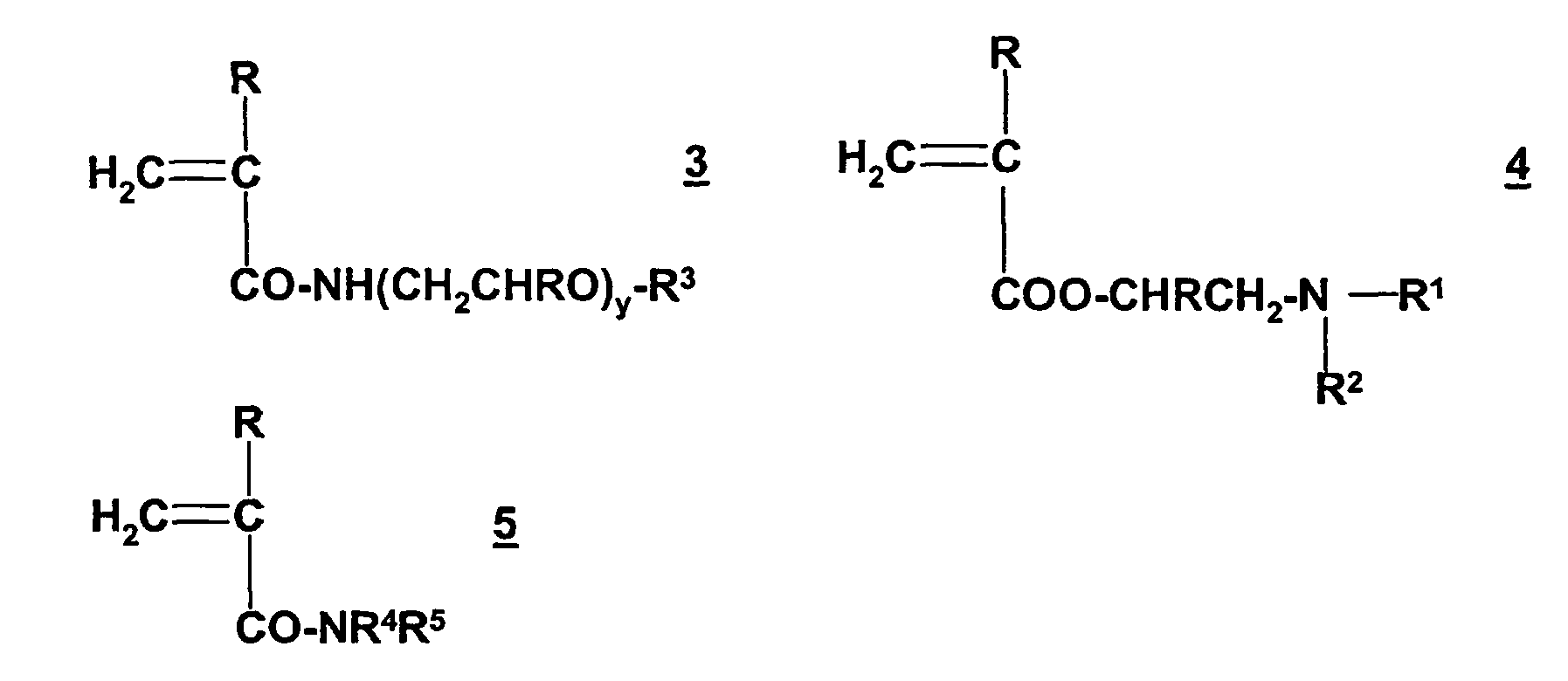
- wherein each R independently from each other represents a hydrogen atom or a methyl group,
- R1 and R2 independently from each other represent a C1 - C4- alkyl rest, a hydroxyethyl(CH2CH2OH) group, an acetoxyethyl group (CH2CH2OCOCH3) group, hydroxy-isopropyl(CH2-CHOH-CH3) group, an acetoxy-isopropyl (CH2-CHOCOCH3) group, or R1 and R2 may together with the nitrogen atom to which they are bound, form a morpholine ring;
- R3 is a C1-C4-alkyl rest,
- R4 and R5 independently represent an aliphatic, cycloaliphatic, araliphatic or aromatic rest or R4 and R5 may together with the nitrogen atom to which they are bond form a morpholine- or imidazole ring system,
- M represents hydrogen, an alkali metal, an alkaline earth metal, an aluminum ion, an ammonium- or organic ammonium group, such as an ammonium group derived from alkylamines or alkanolamines, in particular amines comprising C1 to C4 alkyl and/or C1 to C4 alkanol groups,
- x and y independently represent integers from 2-300.
- In the solvent polymerization using an aqueous solvent, a water soluble polymerization initiator such as ammonium salts, alkali metal salts of a peroxy acid or hydrogen peroxide is used as the polymerization initiator.
- Further, to control the molecular weight, a chain transfer agent such as alkali sulfite, hydrogensulfite, mercaptoethanol, thioglycolic acid or thioglycerol(3-mercapto-1,2-propanediol) may be used.
- It is preferable that the inventive polymer has a number- average molecular weight of 1000 to 100000, still more preferably 1000 to 30000.
- When the molecular weight is too large, the resulting copolymer will exhibit a poor dispersing effect, while, when it is too small, the resulting copolymer will exhibit not only poor dispersity but also a poor slump retaining effect. Moreover, a defined molar proportion of 1-5 to 1 of carboxylic-groups to methoxypolyalkyleneglykol ester side chains and methoxypolyalkyleneglycol amide side chains at the backbone of the copolymer is preferred.
- The average molecular weight is determined by gel permeation chromatography using a set of defined polyalkyleneglycols as standard reference
- Following a further aspect of the present invention the inventive copolymers are employed for preparing a cement-dispersing, set accelerating admixture having shrinkage-reducing and anticorrosive properties to steel. Hence, further to the invention, said admixture preferably contains at least one defoaming and/or at least one air-controlling agent.
- Still a further aspect of the present invention is a mortar, concrete, cement or cementitious binder containing the modified acrylic polymer according to the present invention in an amount of 0.01 to 10% by weight of the binder, said mortar or concrete having a unit content of binder composed of cement or a mixture of cement and latent hydraulic or inert microscopic powder of 150 to 800 kg/m3, preferably of 250 to 650 kg/m3.
- In a preferred embodiment, the cement is Portland cement, white cement, high alumina cement, and cement blends wherein the latent hydraulic or inert microscopic powder is fly ash, slag, natural pozzolane, silica fume, burnt oil shale, metakaolin or calcium carbonate.
- The inventive admixture can be used in liquid form, e.g. by addition of water, in powder form and can be added before, during or after the grinding operation of the cement or the cementitious binder.
- In the following, some copolymers of the present invention and cement dispersing admixtures comprising such polymers, the method for producing the same and the cement containing composition of the present invention are explained in more detail with the following examples E1 - E6 and comparative examples C1,C2, and C3. Moreover, for comparison, commercially available polymers C7, C8 and C9 are also used for the preparation and testing of flowing concrete (test example 1) and high-strength, self compacting concrete of low water-to-cement ratio (test examples 2 and 3).
- In test examples 4-6 the corrosion inhibiting effect of the inventive polymers on mild steel and on reinforcing steel is demonstrated and compared to comparative examples.
- However, it must be noted that all these examples are given for illustrative purposes only and are not supposed to limit the invention, as defined by the claims, appended hereto.
- The following polyalkyleneglycol-based acrylic esters and -amides have been used in the examples described below (table 1):
Table 1 
Acrylic ester monomers: Monomer 2-1: acrylate Methoxypolyoxyalkylene x=22 , y=0 Monomer 2-2: Methoxypolyoxyalkylene (meth)acrylate x=22 , y=0 Monomer 2-3: Methoxypolyoxyalkylene (meth)acrylate x=44, y=0 Monomer 2-4: Methoxypolyoxyalkylene(methacrylate x=16, y=5 
Acrylamide-Monomers: Monomer 3-1: Methoxypolyoxyalkylene acrylamide x=11; y=0 Monomer 3-2: Methoxypolyoxyalkylene acrylamide x=19; y=3 Monomer 3-3: Methoxypolyoxyalkylene acrylamide x=32; y=10 Monomer 3-4: Methoxypolyoxyalkylene acrylamide x=6; y=29 Monomer 3-5: Methoxypolyoxyalkylene acrylamide x=16, y=5 - Into a 2 liter-glass reactor, equipped with a stirrer, reflux condenser, N2 -inlet tube and automatic dosing mechanism, were placed 0.30 g of ferrous sulfate and 5 g of thioglycerol dissolved in 380 g water. The inside atmosphere of the flask was replaced with stirring by nitrogen gas and the solution heated to 60°C. Then simultaneously were added in 60 minutes a) an aqueous solution of 72 g (1 mol) of freshly distilled acrylic acid (monomer 1) 493 g (0.24 mol) of monomer 3-3, 82 g (0.04 mol) of monomer 3-4 and 6 g of 50%-sodium hydroxide in 180g water, b) a solution of 15 g of 35%-hydrogen peroxide and c) 4 g ascorbic acid in 25 g water. After the completion of the addition, in course of which the temperature raised to 75°C, the reaction system was maintained at that temperature for 15 minutes. Finally, the mixture was cooled to 25°C and 2 g of methoxy-polyoxyalkyleneamine of MW=2000 with a PO/EO mol. ratio of 29:6 were added. 35 g of 50%-sodium hydroxide were then added dropwise to adjust the pH-value to 5.0. Water was added to give a 40%-solution. A polymer of a number average molecular weight of Mn = 9300 g/mol was obtained.
- Into a 2 liter-glass reactor, equipped with a stirrer, reflux condenser, N2-inlet tube and automatic dosing mechanism, were placed 0.30 g of ferrous sulfate and 5 g of thioglycerol dissolved in 380 g water. The inside atmosphere of the flask was replaced with stirring by nitrogen gas and the solution heated to 60°C. Then simultaneously were added in 60 minutes a) an aqueous solution of 72 g (1 mol) of freshly distilled acrylic acid (monomer 1), 493 g (0.24 mol) of monomer 3-3, 82 g (0.04 mol) of monomer 3-4, 15 g (0.05 mol) dimethylaminoethyl acrylate and 6 g of 50%-sodium hydroxide in 180 g water, b) a solution of 15 g of 35%-hydrogen peroxide and c) 4 g ascorbic acid in 25 g water. After the completion of the addition, in course of which the temperature raised to 75°C, the reaction system was maintained at that temperature for 15 minutes. Finally, the mixture was cooled to 25°C and 2 g of methoxy-polyoxyalkyleneamine of MW=2000 with a PO/EO mol. ratio of 29:6 were added. 35 g of 50%-sodium hydroxide were then added dropwise to adjust the pH-value to 5.0. Water was added to give a 40%-solution. A polymer of a number average molecular weight of Mn=9900 g/mol was obtained.
- Into a 2 liter-glass reactor, equipped with a stirrer, reflux condenser,N2 -inlet tube and automatic dosing mechanism, were placed 0.30 g of ferrous sulfate and 5 g of thioglycerol dissolved in 380 g water. The inside atmosphere of the flask was replaced with stirring by nitrogen gas and the solution heated to 60°C. Then simultaneously were added in 60 minutes a) an aqueous solution of 72g (lmol) of freshly distilled acrylic acid (monomer 1), 513.5 g (0.25 mol) of monomer 2-2, 50 g of polypropyleneglycol of MW 4000 and 6 g of 50%-sodium hydroxide in 180 g Water, b) a solution of 15 g of 35%-hydrogen peroxide and c) 4 g ascorbic acid in 25 g water.
- After the completion of the addition, in course of which the temperature raised to 75°C, the reaction system was maintained at that temperature for 15 minutes. Finally, the mixture was cooled to 25°C and 2 g of methoxy-polyoxyalkyleneamine of MW=2000 with a PO/EO mol. ratio of 29:6 were added. 35 g of 50%-sodium hydroxide were then added dropwise to adjust the pH-value to 5.0. Water was added to give a 40%-solution. A polymer of a number average molecular weight of Mn =10100 g/mol was obtained.
- Into a 2 liter-glass reactor, equipped with a stirrer, reflux condenser, N2-inlet tube and automatic dosing mechanism, were placed 0.30 g of ferrous sulfate and 5 g of thioglycerol dissolved in 380 g water. The inside atmosphere of the flask was replaced with stirring by nitrogen gas and the solution heated to 60°C. Then simultaneously were added in 60 minutes a) an aqueous solution of 72 g (1 mol) of freshly distilled acrylic acid (monomer 1), 513.5 g of monomer 2-2, 59 g of polypropyleneglycol of MW 4000, 2.15 g (0.015 mol) of dimethylaminoethyl acrylate and 6 g of 50%-sodium hydroxide in 200 g water, b) a solution of 15 g of 35%-hydrogen peroxide and c) 4 g ascorbic acid in 25 g water. After the completion of the addition, in course of which the temperature raised to 75°C, the reaction system was maintained at that temperature for 15 minutes. Finally, the mixture was cooled to 25°C and 2 g of methoxy-polyoxyalkyleneamine of MW=2000 with a PO/EO mol. ratio of 29:6 were added. 35 g of 50%-sodium hydroxide were then added dropwise to adjust the pH-value to 5.0. Water was added to give a 40%-solution. A polymer of a number average molecular weight Mn=9900 g/mol was obtained.
- Into a 2 liter-glass reactor, equipped with a stirrer, reflux condenser,N2 -inlet tube and automatic dosing mechanism, were placed 0.30 g of ferrous sulfate and 5 g of thioglycerol dissolved in 380 g water. The inside atmosphere of the flask was replaced with stirring by nitrogen gas and the solution heated to 60°C. Then simultaneously were added in 60 minutes a) an aqueous solution of 72 g (1 mol) of freshly distilled acrylic acid (monomer 1), 685 g (0.65 mol) of monomer 2-1, 47 g (0.085 mol) of monomer 3-1, and 6g of 50%-sodium hydroxide in 250 g water, b) a solution of 15 g of 35%-hydrogen peroxide and c) 4 g ascorbic acid in 25 g water. After the completion of the addition, in course of which the temperature raised to 75°C, the reaction system was maintained at that temperature for 15 minutes. Finally, the mixture was cooled to 25°C and 2g of methoxy-polyoxyalkyleneamine of MW=2000 with a PO/EO mol. ratio of 29:6 were added. 35 g of 50%-sodium hydroxide were then added dropwise to adjust the pH-value to 5.0. Water was added to give a 40%-solution. A polymer of a number average molecular weight of Mn=11100 g/mol was obtained.
- Into a 2 liter-glass reactor, equipped with a stirrer, reflux condenser, N2 -inlet tube and automatic dosing mechanism, were placed 0.30 g of ferrous sulfate and 5 g of thioglycerol dissolved in 380 g water. The inside atmosphere of the flask was replaced with stirring by nitrogen gas and the solution heated to 60°C. Then simultaneously were added in 60 minutes a) an aqueous solution of 72 g (1 mol) of freshly distilled acrylic acid (monomer 1), 685 g (0.65 mol) of monomer 2-1, 47 g (0.085 mol) of dimethylaminoethyl acrylate and 6 g of 50%-sodium hydroxide in 250 g water, b) a solution of 15 g of 35%-hydrogen peroxide and c) 4 g ascorbic acid in 25 g water. After the completion of the addition, in course of which the temperature raised to 75°C, the reaction system was maintained at that temperature for 15 minutes. Finally, the mixture was cooled to 25°C and 2 g of methoxy-polyoxyalkyleneamine of MW=2000 with a PO/EO mol. ratio of 29:6 were added. 35 g of 50%-sodium hydroxide were then added dropwise to adjust the pH-value to 5.0. Water was added to give a 40%-solution. A polymer of a number average molecular weight of Mn =10700 g/mol was obtained.
- Into a 2 liter-glass reactor, equipped with a stirrer, reflux condenser,N2 -inlet tube and automatic dosing mechanism, were placed 0.30 g of ferrous sulfate and 5 g of thioglycerol dissolved in 380 g water. The inside atmosphere of the flask was replaced with stirring by nitrogen gas and the solution heated to 60°C. Then simultaneously were added in 60 minutes a) an aqueous solution of 72 g (1 mol) of freshly distilled acrylic acid (monomer 1) 516 g (0.49 mol) of monomer 2-1, 95 g (0.09 mol) of monomer 3-2 and 6g of 50%-sodium hydroxide in 200g Water, b) a solution of 15 g of 35%-hydrogen peroxide and c) 4 g ascorbic acid in 25 g water. After the completion of the addition, in course of which the temperature raised to 75°C, the reaction system was maintained at that temperature for 15 minutes. Finally, the mixture was cooled to 25°C and 2 g of methoxy-polyoxyalkyleneamine of MW=2000 with a PO/EO mol. ratio of 29:6 were added. 35 g of 50%-sodium hydroxide were then added dropwise to adjust the pH-value to 5.0. Water was added to give a 40%-solution. A polymer of a number average molecular weight of Mn=10200 g/mol was obtained.
- Into a 2 liter-glass reactor, equipped with a stirrer, reflux condenser, N2-inlet tube and automatic dosing mechanism, were placed 0.30 g of ferrous sulfate and 5 g of thioglycerol dissolved in 380 g water. The inside atmosphere of the flask was replaced with stirring by nitrogen gas and the solution heated to 60°C. Then simultaneously were added in 60 minutes a) an aqueous solution of 72 g (1 mol) of freshly distilled acrylic acid (monomer 1), 516 g (0.49 mol) of monomer 2-1, 95 g (0.09 mol) of monomer 3-2 and 2.86 g (0.02mol) of dimethylaminoethyl acrylate in 200g water, b) a solution of 15 g of 35%-hydrogen peroxide and c) 4 g ascorbic acid in 25 g water. After the completion of the addition, in course of which the temperature raised to 75°C, the reaction system was maintained at that temperature for 15 minutes. Finally, the mixture was cooled to 25°C and 2 g of methoxy-polyoxyalkyleneamine of MW=2000 with a PO/EO mol. ratio of 29:6 were added. 35 g of 50%-sodium hydroxide were then added dropwise to adjust the pH-value to 5.0. Water was added to give a 40%-solution. A polymer of a number average molecular weight Mn=9700 g/mol was obtained.
- Into a 2 liter-glass reactor, equipped with a stirrer, reflux condenser, N2-inlet tube and automatic dosing mechanism, were placed 0.30 g of ferrous sulfate and 5 g of thioglycerol dissolved in 380g water. The inside atmosphere of the flask was replaced with stirring by nitrogen gas and the solution heated to 60°C. Then simultaneously were added in 60 minutes a) an aqueous solution of 72 g (1 mol) of freshly distilled acrylic acid (monomer 1) 580 g (0.55 mol) of monomer 2-1, 28 g (0.12 mol) of N,N-dicyclohexyl acrylamide and 6 g of 50%-sodium hydroxide in 220 g water, b) a solution of 15 g of 35%-hydrogen peroxide and c) 4 g ascorbic acid in 25 g water. After the completion of the addition, in course of which the temperature raised to 75°C, the reaction system was maintained at that temperature for 15 minutes. Finally, the mixture was cooled to 25°C and 2 g of methoxy-polyoxyalkyleneamine of MW=2000 with a PO/EO mol. ratio of 29:6 were added. 35 g of 50%-sodium hydroxide were then added dropwise to adjust the pH-value to 5.0. Water was added to give a 40%-solution. A polymer of a number average molecular weight of Mn =10300 g/mol was obtained.
- Into a 2 liter-glass reactor, equipped with a stirrer, reflux condenser, N2-inlet tube and automatic dosing mechanism, were placed 0.30 g of ferrous sulfate and 5g of thioglycerol dissolved in 380 g water. The inside atmosphere of the flask was replaced with stirring by nitrogen gas and the solution heated to 60°C. Then simultaneously were added in 60 minutes, a) an aqueous solution of 72 g (1 mol) of freshly distilled acrylic acid (monomer 1), 580 g(0.55 mol) of monomer 2-1, 2.86 g (0.02 mol) of dimethylaminoethyl acrylate and 6g of 50%-sodium hydroxide in 220 g water, b) a solution of 15 g of 35%-hydrogen peroxide and c) 4g ascorbic acid in 25 g water. After the completion of the addition, in course of which the temperature raised to 75°C, the reaction system was maintained at that temperature for 15 minutes. Finally, the mixture was cooled to 25°C and 2 g of methoxy-polyoxyalkyleneamine of MW=2000 with a PO/EO mol. ratio of 29:6 were added. 35 g of 50%-sodium hydroxide were then added dropwise to adjust the pH-value to 5.0. Water was added to give a 40%-solution. A polymer of a number average molecular weight of Mn= 9500 g/mol was obtained.
- Into a 2 liter-glass reactor, equipped with a stirrer, reflux condenser, N2-inlet tube and automatic dosing mechanism, were placed 0.30 g of ferrous sulfate and 5 g of thioglycerol dissolved in 380 g water. The inside atmosphere of the flask was replaced with stirring by nitrogen gas and the solution heated to 60°C.
- Then simultaneously were added in 60 minutes a) an aqueous solution of 72 g (1 mol) of freshly distilled acrylic acid (monomer 1), 317 g(0.19 mol) of monomer 2-4,
- 317 g (0.19 mol) of monomer 3-5 and 2.15 g of of dimethylaminoethyl acrylate in 200g water,
b) a solution of 15 g of 35%-hydrogen peroxide and c) 4 g ascorbic acid in 25 g water. After the completion of the addition, in course of which the temperature raised to 75°C, the reaction system was maintained at that temperature for 15 minutes. Finally, the mixture was cooled to 25°C and 2 g of methoxy-polyoxyalkyleneamine of MW=2000 with a PO/EO mol. ratio of 29:6 were added. 35 g of 50%-sodium hydroxide were then added dropwise to adjust the pH-value to 5.0. Water was added to give a 40%-solution. A polymer of a number average molecular weight Mn=9900g/mol was obtained. - SOKALAN PA 25 CL PN (BASF, Badische Anilin& Sodafabrik) a 50% aq. solution of a partially neutralized polyacrylic acid of weight-average molecular weight 4000 was used as a comparative dispersant for concrete.
- Melment F-10 (Süddeutsche Kalkstickstoffwerke,Trostberg, BRD), a commercial dispersing agent for hydraulic cement compositions, is the sodium salt of a sulfonated melamine formaldehyde polycondensate of molecular weight of about 15'000.
- MIGHTY-150 (KAO Corp.,Tokyo), a commercial dispersing agent for hydraulic cement masses, is the sodium salt of a sulfonated naphthalene-formaldehyde polycondensate of average molecular weight of about '5'000-6'000.
- These examples were performed to demonstrate the improved fluidizing effects of the inventive polymers on fresh concrete and their accelerating action on the development of the early(1d) compressive strengths. The inventive polymers E1 to E5, were tested as fluidizers in flowing concrete (test-example 1) and as admixtures to improve the flowability and slump life of high -strength concrete of low water-to-cement ratio and high binder(cement + silica-fume)content(test example 2).
- Those comparative polymers(C1 to C8) described above were also tested and compared in this context.
- Use of inventive polymers and comparative polymers for flowing concrete.
- The consistency of freshly prepared concrete i.e. the mobility or viscosity , is the most important characteristic of workability. For measuring the consistency of concrete a "flow table spread" according to DIN 1048, part1 is used in industry.
- Sometimes the "slump test" according to ASTM C143 is additionally used.
- For purposes of this experiment the flow table spread was determined by placing concrete in an iron form on a two-part table (70 x 70 cm).By removing the form, a concrete body having a truncated cone shape is prepared. Then, the are of the table is lifted on one side for 4cm, and allowed to fall. This procedure is carried out 15 times, and the concrete spreads. The average diameter of the formed cake corresponds to the flow table spread.
- For the slump test, three layers of concrete are put into a mold having a shape of a truncated cone and having certain dimensions, and compressed with 25 pushes of an iron bar. At the top, the concrete is stripped off evenly, then, the form is vertically removed. The concrete body will sink in by itself. The slump is measured by determining the vertical difference between the top of the mold and the displaced original center of the top surface of the test sample.
- In order to compare the obtained test results and to bring them into a relation with the consistency, the freshly prepared concrete (see DIN 18555, Part2) may be divided into consistency ranges:
Table 2: Consistency Ranges of Freshly Prepared Concrete Denotation Flow Table Spread (cm) Slump (cm) K1= rigid < 30 < 1 K2= semi-plastic 30 to 40 1 to 9 K3= plastic 41 to 50 10 to 15 K4= flowing concr. > 50 > 15 - Fluidizers are used when specific construction applications are necessary. Flowing concrete is used when high inserting rates (e.g., from 50 to 150 m3/hour) are required, or when the form and reinforcement of a construction part do not allow a compacting of the concrete by vibration.
- Concretes having K2 or K3 consistencies may be prepared from a concrete of K1 consistency by adding fluidizers(also designated as superplasticizers) when increased mechanical strength at an equal remaining workability shall be obtained.
- For a freshly prepared concrete, the fluidizing effect is dependent on the dosage of the superplasticizer. Usually, from 0.2 to 1.5% solid matter quantities(in dissolved form),referred to the weight of cement, are added.
- To a high degree, the effect is also dependent on the chemical structure and the molecular weight of the polymer, which forms the basis of the fluidizer.
- In order to demonstrate the increased effectiveness of the inventive copolymers, the flow behavior of concrete mixtures containing the copolymers E1 to E5 was measured according to DIN 1048, part1, and ASTM C143. As a comparison, the polymers C-1 to C-8 were also tested with the same methods.
Table 3: Composition of the fresh concrete mixtures Components: Quantity in kg Normal Portland Cement.Type1 7.5 Netstal filler (chalk filler) 1.5 Rhine sand "Epple" up to 1.2 mm.* 9.5 Rhine sand "Epple" 1.2 to 4.0 mm.* 8.0 Rhine sand "Epple" 4.0 to 8.0 mm.* 4.5 Mine gravel 8 to 16 mm.* 9.5 Mine gravel 16 to 32 mm.* 17.0 Total Water, including mixing water and water of the copolymer solution 3.45, Copolymer(solid) or comparative polymer, used as fluidizer 0.04, dissolved in the mixing water * washed and dried - The cement and the aggregates were premixed for 15 seconds in a 50 liter forced circulation mixer for concrete. The mixing water, containing the fluidizer, was added slowly under stirring over 20 seconds. The batch was then mixed in a wet state for an additional 60 seconds. A part of the fresh concrete was then immediately filled into the mold for the determination of the flow table spread and the slump.
- Immediately after measuring the flow table spread, test bodies having edges of 12 x 12 cm were prepared, and the compressive strength was measured after 1, 7, and 28 days in accordance with DIN 1048, Part 1.The determination of initial setting was carried out according to ASTM-C 403.
- Additionally, the copolymers of the present invention were compared to the comparative polymers C-1 to C-3.
- As mentioned above, the flow table spread and slump was measured immediately after mixing, and remeasured at 60 and 120 minutes after mixing. A mixing up of the concrete for five seconds was carried out before each new measurement.
- Concrete test mixtures No 1 to 11 which were prepared under the same conditions, were then subjected to the above-described examination of flow table spread and slump depending on the time.
- The results are summarized in Table 4. They show a high water reduction and a surprisingly long lasting constancy of the flow table spread and the slump of up to 120 minutes in test mixtures nos. 2, 4, 6, 8, 10, 11 containing the copolymers according to the invention. From a comparison of these mixtures with comparative mixtures nos.1, 3, 5, 7 and 9 containing the alkanolamine-free polymers, it can be seen, that the comparative test mixtures show a strong retardation of the early strength development. Also, comparative mixtures no 12, 13 and 14 containing polyacrylic acid and melamine- and naphthalene polycondensate show a considerable stiffening tendency already 60 minutes after mixing.
Table 4 Time-dependent flow behavior and compressive strengths of flowing concrete of water-to-cement ratio W/C =0.46 using inventive and comparative polymers as fluidizers. Test-Mixture No Polymer example Dosage in % of cement weight Flow table spread /slump in cm, x minutes after mixing Compressive strength in Newton/mm2 y days after mixing %-Air con-tent after mix x=0 60 120 y=1 7 28 1 C1 0.3 61/24 60/24 50/19 14.0 42.8 47.9 1.9 2 E1 0.3 59/22 57/21 51/17 20.4 43.3 48.5 2.0 3 C2 0.3 52/19 53/20 50/18 17.5 39.7 48.0 2.0 4 E2 0.3 50/18 52/19 49/19 23.2 44.3 46.0 1.8 5 C3 0.3 56/21 54/22 50/20 14.9 39.0 47.1 1.9 6 E3 0.3 55/20 54/21 52/19 20.4 42.3 50.2 1.6 7 C4 0.3 54/20 52/20 50/20 15.6 41.2 50.0 2.7 8 E4 0.3 60/22 60/24 53/20 22.3 44.5 50.2 1.8 9 C5 0.3 56/22 55/19 48/18 17.0 45.0 50.3 2.5 10 E5 0.3 61/20 60/25 52/20 20.5 42.0 49.8 1.8 11 E6 0.3 60/21 61/23 61/22 21.9 43.0 51.2 2.0 12 C6 0.3 30/0 - - - 22.4 45 2.8 13 C7 0.3 42/12 - - 26.9 48.1 60.9 1.5 14 C8 0.3 45/14 33/1 - 21.0 43.5 50.0 1.9 - The measurement of flowing properties of fresh mixtures of high flowing -high strength concrete of very low water-to-cement ratio(W/C) is described in the next test-example.
- High flowing-high strength concrete of very low water-to-cement ratio and very high content of binder(cement + silicafume) is increasingly demanded by the building- and construction industry. Preparation and testing are prescribed in Japanese Industrial Standards(JIS-A).
- In a mixing ratio as shown in table 5, ordinary Portland cement, silica fume, fine aggregates and coarse aggregates (gravel) were sequentially placed inside a forced mixing-type mixer of 50 liters volume. The cement and the aggregates were premixed for 15 seconds, and then the mixing water, containing the fluidizer and 0.02 %(related to the weight of fluidizer) of a synthetic air detrainer, was added slowly under stirring over 20 seconds. The batch was then mixed in a wet state for 3 minutes. After mixing, the mixture was transferred to a mixing boat and retempering was conducted at a predetermined number of times every 60 minutes and the slump flow and slump with the progression of time was measured for up to 120 minutes according to JIS-A 1101. The procedures specified in JIS-A 1123 and JIS-A 6204 were employed to measure air content and time-dependent compressive strengths.
Table 5: Concrete Mix Proportion for Self Compacting Concrete UNIT CONTENT (kg/m3) W/B S/A Polymer-Dosage W C SF S G 22% 39% 1.6% 165 675 75 600 950 -
W = Mixing water, including water of the added fluidizer. C = Cement: Normal Portland Type 1 SF= Undensified Silicafume:, density:2.2-2.7, surface: 100.000-250.000 cm2/g S = Sand Epple: 0-1.2mm, 300kg 1.2-4mm, 300kg G: = Gravel Epple: 4-8mm, 280kg 8-16mm 670kg A = Aggregate: Sand + Gravel B = Cement + Silicafume
Results of the evaluation of the mixtures, containing inventive and comparative polymers, are shown in table 6.Table 6: Time-dependent flow behavior and compressive strengths of Flowing concrete of water-to-cement ratio W/C=0.22, using inventive and comparative polymers as fluidizers. Test-Mixture No Polymer designation Polymer dosage in % Slump-flow in cm x minutes after mixing Compressive strength in Newton/mm2 y days after mixing % Air content after mixing x=0 60 120 y=1 28 1 C1 1.6 51 58 60 11.7 97.9 2.1 2 E1 1.6 50 52 60 22.0 101.0 2.0 3 C2 1.6 51 55 59 13.7 102.0 2.4 4 E2 1.6 56 61 59 29.1 100.0 2.0 5 C3 1.6 54 53 51 8.8 103.4 1.9 6 E3 1.6 61 60 59 22.6 105.0 1.8 7 C4 1.6 60 61 60 14.6 100.0 2.1 8 E4 1.6 60 64 62 24.7 102.5 2.2 9 C5 1.6 54 58 60 16.0 101.1 2.4 10 E5 1.6 57 61 59 23.9 104.3 2.3 11 E6 1.6 60 62 62 24.0 105.0 2.4 12 C6 - <35 - - - 63.9 8.4 13 C7 1.6 43 - - 31.1 102.4 1.8 14 C8 1.6 48 19.3 93.2 3.8 - The anticorrosive activity of the polymers was tested by the stacked steel test, as is known.
- An aqueous solution containing 1.6% by weight of the polymers and having a water hardness of 177 ppm of calcium was prepared for use in the test.
- Mild steel cylinders of 3.3 - 4.5 cm length and 2.5 cm in diameter were used as the test material. All surfaces except one end were coated with an epoxy coating.
- The exposed test end of each slug was polished with a power grinding wheel, then was covered with about 1g of the 1.6%-polymer solution. The exposed end of the second steel slug was placed over the test end to spread the film and prevent evaporation. The stacked steel slugs were then placed in an equilibrated desiccator over water. Tests were carried out at 20°C.
- Tap water of 177 ppm hardness was used as a control in each test.
- The test results (table 7) showed, that solutions containing the inventive polymers even at low concentrations were non corrosive whereas none of the comparative polymers did develop an anticorrosive activity.
Table 7 Time-dependent corrosion of mild steel in water: Inhibition by inventive polymers Test No. Polymer designation Concentration of the aq. polymer solution Period of examination [days] Condition of steel after test 1 Control - 1d K 2 Control - 7d K-st 3 C1 1.6% 1d Inh 4 C1 1.6% 7d K 5 E1 1.6% 1d Inh 6 E1 1.6% 7d Inh 7 C2 1.6% 7d K 8 E2 1.6% 7d Inh 9 E3 1.6% 7d Inh 10 C3 1.6% 1d K 11 C4 1.6% 1d K 12 E4 1.6% 7d Inh 13 E4 1.6% 28d Inh 14 E5 1.6% 7d Inh 15 E6 1.6 7d Inh 16 C5 1.6% 1d K K: Distinct traces of corrosion visible on the steel
K-st: Strong corrosion visible
Inh: No corrosion visible - In this example, the influence of the inventive, alkanolamine-modified corrosion inhibiting polymers in comparison to non modified polymers C1,C2 and C3 on mild steel specimens was investigated.
- The examination was carried out by means of potentiodynamic polarization measurements, performed in aqueous, chloride containing solutions using a potentiostat/galvanostat with scan option and a Camec II station.
-
- Umax ± 5V, vu = 1-8350mV/min
- working electrodes: polished steel plates (mild steel ST37)
- v = 10mV/s
- concentration of inventive and comparative polymers:1.60% based on solids.
- The test solution was neither stirred ,nor degassed. The electrode was conditioned for one hour at ; i = 0.0mA/cm2, then polarization was started.
- Test period: 1 hour; imax = 0.5 mA/ m' j0 and ju depending on
currents (imax =30-50 mA) - After a further conditioning at i = 0.50 mA/cm2 for 30 minutes, the CV was performed in cathodic direction during 30 minutes.
- As can be seen from the data in table 8, all inventive polymers perform substantially better than the comparative polymers as well as the control, showing higher positive values of both, the pitting- and the repassivation potentials.
Table 8: Cyclic voltammetry at mild steel electrode in saturated Ca(OH)2 + 0.09M-Na(OH) Test No. Polymer designation Concentration of polymer in test solution [%] Pitting potential vs SCE Ø 3 scans [mV] Repassivation potential vs SCE Ø 3 scans [mV] 1 Control --- +275 -520 2 C1 1.6 +235 -575 3 E1 1.6 +1200 +990 4 C2 1.6 +375 -600 5 E2 1.6 +990 +720 6 C3 1.6 +405 -590 7 E3 1.6 +1180 +980 8 C4 1.6 +630 -410 9 E4 1.6 +1000 +720 - In the following, the influence of inventive tert.-alkanolamines containing polymers on the shrinkage behavior of a mortar of high cement content is demonstrated by the measurement of the strain of 4x4x16 cm3 prisms fitted with an inserted neck.
-
Portland cement type CEM I 42.5 0.750 kg Sand 0-8 mm 3.150 kg Water 0.350 kg Inventive or comparative polymer 0.012 kg - The test specimen were initially stored for 24 hours at 20°C and 95% RH, subsequently, at 23°C and 50% RH.
Table 9: Effect of inventive, shrinkage compensating polymers on the strain of mortar prisms. Test No. Polymer Designation Dosage of solid Polymer, calculated on cement weight(%) Strain after 28 d 1 Control 1.6 -0.057 2 C1 1.6 -0.045 3 E1 1.6 -0.019 4 C2 1.6 -0.045 5 E2 1.6 -0.024 6 C3 1.6 -0.049 7 E3 1.6 -0.036 8 C4 1.6 -0.047 9 E4 1.6 -0.022 10 C5 1.6 -0.044 11 E5 1.6 -0.022 - This example clearly demonstrates the shrinkage compensating effect of up to 50% of the inventive polymers on mortar pieces whereas comparative polymers show only poor reduction as compared to the control specimen.
- While there are shown and described presently preferred embodiments of the invention, it is to be distinctly understood that the invention is not limited thereto but may be otherwise variously embodied and practiced within the scope of the following claims.
Claims (21)
- A water-soluble acrylic copolymer with cement dispersing, set-accelerating and anticorrosive properties to steel,obtainable by copolymerization of an α,β-olefinic monocarboxylic acid or its salt shown by formula 1 given below,a second acrylic monomer shown by formula 2 given below, optionally a third-acrylic monomer shown by formula 3 given below, a fourth acrylic monomer shown by formula 4 given below and optionally a fifth acrylic monomer given by formula 5,such that the molar ratio of constituent monomer units 1, 2, 3, 4, and 5 isa : b : c : d : e = 1 : (0.01-0.80) : (0-0.80) : (0.001-0.3) : (0-0.5),
anda : ( b+c+d+e ) = 0.1 : 0.9 to 0.9 : 0.1,
wherein
a designates the molar concentration range of constituent monomers 1,
b designates the molar concentration range of constituent monomers 2,
c designates the molar concentration range of constituent monomers 3,
d designates the molar concentration range of constituent monomers 4,
e designates the molar concentration range of constituent monomers 5,said monomers having the structural formulas shown below:

 wherein each R independently from each other represents a hydrogen atom or a methyl group,R1 and R2 independently from each other represent a C1 - C4- alkyl rest, a hydroxyethyl(CH2CH2OH) group, an acetoxyethyl (CH2CH2OCOCH3) group, a hydroxy-isopropyl (CH2-CHOH-CH3) group, an acetoxy-isopropyl(CH2-CHOCOCH3) group, or R1 and R2 may together with the nitrogen atom to which they are bond, form a morpholine ring;R3 is a C1-C4-alkyl rest,R4 and R5 independently represent an aliphatic, cycloaliphatic, araliphatic or aromatic rest or R4 and R5 may together with the nitrogen atom to which they are bond form a morpholine or imidazole ring system,M represents hydrogen, an alkali metal ion, an alkaline earth metal ion, an aluminum ion, an ammonium- or organic ammonium group;x and y independently represent integers from 2-300.
 - A modified acrylic polymer according to claim 1,wherein the monomer 1 is acrylic acid or methacrylic acid.
- A modified acrylic polymer according to claim 1 or 2, wherein the monomer 2 is a methoxy-polyoxyethylene acrylate of a molecular weight of 350 to 5000g/mol.
- A modified acrylic polymer according to anyone of claims 1 to 3, wherein the monomer 3 is a methoxy-polyoxyalkylene acrylamide of a molecular weight of 500 to 5000g/mol.
- A modified acrylic polymer according to anyone of claims 1 to 4, wherein the monomer 4 is the acrylic ester of a tertiary alkanol amine.
- A modified acrylic polymer according to claim 4, wherein the monomer 4 is dimethylaminoethyl acrylate.
- A modified acrylic polymer according to anyone of claims 1 to 6, wherein the monomer 5 is the acrylamide of oxazolidine.
- A modified acrylic polymer according to anyone of claims 1 to 6, wherein the monomer 5 is the acrylamide of dicyclohexylamine.
- A modified acrylic polymer according to claims 1 to 8, having a number average molecular weight in the range of 5000 to 50.000.
- A method for preparing a modified acrylic polymer according to claim 1, wherein the monomers 1, 2, 3, 4, and 5 are reacted by aquous solution radical copolymerization in the presence of aqueous hydrogen peroxide as initiator.
- The method of claim 11, wherein an organic thiol compound is used as a chain-transfer agent.
- The method of claim 1, wherein thioglycerine is used as a chain-transfer agent.
- A modified acrylic polymer obtainable by the method of one of claims 10 to 12.
- A cement dispersing, set accelerating admixture having anticorrosive and preferably also shrinkage reducing properties to steel, that contains a modified acrylic polymer according to anyone of claims 1 to 9 and 13 in amounts of from 5 to 95 %, and that is in liquid or powder form.
- The cement admixture of claim 14, containing at least one defoaming or antifoaming agent.
- The cement admixture of claim 14 or 15, containing at least one air controlling agent.
- A mortar, concrete, cement or cementitious binder containing the modified acrylic polymer according to anyone of the claims 1 to 9 and 13 in an amount of 0.01 to 10% by weight of the binder, said mortar or concrete having a unit content of binder composed of cement or a mixture of cement and latent hydraulic or inert microscopic powder of 150 to 800 kg/m3, preferably of 250 to 650 kg/m3.
- A mortar, concrete, cement or cementituous binder according to claim 17, wherein the cement is Portland cement, white cement, high alumina cement, and wherein the latent hydraulic or inert microscopic powder is fly ash, slag, silica fume, burnt oil shale, metakaolin or calcium carbonate.
- A mortar, concrete, cement or cementitious binder according to claim 17, wherein an admixture of one of claims 14 to 16 is added before, during or after the grinding operation of the cement or the cementitious binder.
- An aqueous slurry of microscopic powders containing the modified acrylic polymers according to anyone of claims 1 to 9 and 13 in an amount of 0.01 to 10% by weight of the binder.
- An aqueous slurry of microscopic powders according to claim 20, characterized in that the microscopic powder is calcium carbonate, gypsum or gypsum based solids.
Priority Applications (8)
| Application Number | Priority Date | Filing Date | Title |
|---|---|---|---|
| AT00105911T ATE557046T1 (en) | 2000-03-22 | 2000-03-22 | CEMENT DISPERSING POLYMERS FOR SELF-COMPACTING CONCRETE WITH HIGH FLOWABILITY AND HIGH STRENGTH |
| EP20000105911 EP1136507B1 (en) | 2000-03-22 | 2000-03-22 | Cement dispersing polymers for high flow, high strength and selfcompacting concrete |
| DE1136507T DE1136507T1 (en) | 2000-03-22 | 2000-03-22 | Cement-dispersing polymers for self-compacting concrete with high flowability and high strength |
| ES00105911T ES2164619T3 (en) | 2000-03-22 | 2000-03-22 | Dispersing cement polymers for high fluidity, high strength and self compacting concrete |
| CA 2340515 CA2340515C (en) | 2000-03-22 | 2001-03-12 | Cement dispersing polymers for high flow, high strength and selfcompacting concrete |
| US09/813,886 US6548589B2 (en) | 2000-03-22 | 2001-03-22 | Cement dispersing polymers for high flow, high strength and selfcompacting concrete |
| JP2001082576A JP3740023B2 (en) | 2000-03-22 | 2001-03-22 | Cement dispersible polymer for high flow, high strength and self-bonding concrete |
| GR20010300068T GR20010300068T1 (en) | 2000-03-22 | 2001-12-31 | Cement dispersing polymers for high flow, high strength and selfcompacting concrete |
Applications Claiming Priority (1)
| Application Number | Priority Date | Filing Date | Title |
|---|---|---|---|
| EP20000105911 EP1136507B1 (en) | 2000-03-22 | 2000-03-22 | Cement dispersing polymers for high flow, high strength and selfcompacting concrete |
Publications (2)
| Publication Number | Publication Date |
|---|---|
| EP1136507A1 EP1136507A1 (en) | 2001-09-26 |
| EP1136507B1 true EP1136507B1 (en) | 2012-05-09 |
Family
ID=8168158
Family Applications (1)
| Application Number | Title | Priority Date | Filing Date |
|---|---|---|---|
| EP20000105911 Expired - Lifetime EP1136507B1 (en) | 2000-03-22 | 2000-03-22 | Cement dispersing polymers for high flow, high strength and selfcompacting concrete |
Country Status (8)
| Country | Link |
|---|---|
| US (1) | US6548589B2 (en) |
| EP (1) | EP1136507B1 (en) |
| JP (1) | JP3740023B2 (en) |
| AT (1) | ATE557046T1 (en) |
| CA (1) | CA2340515C (en) |
| DE (1) | DE1136507T1 (en) |
| ES (1) | ES2164619T3 (en) |
| GR (1) | GR20010300068T1 (en) |
Families Citing this family (45)
| Publication number | Priority date | Publication date | Assignee | Title |
|---|---|---|---|---|
| KR100406212B1 (en) * | 2000-10-23 | 2003-11-19 | 중앙방수기업주식회사 | Manufacturing method of aqueous acrylic compound for floor |
| WO2003040194A1 (en) * | 2001-11-06 | 2003-05-15 | Nippon Shokubai Co., Ltd. | (meth)acrylic acid (salt) polymer and process for production thereof |
| US6767399B2 (en) * | 2002-01-08 | 2004-07-27 | The Euclid Chemical Company | Admixture for producing cementitious compositions having good fluidity and high early compressive strength |
| WO2004005213A1 (en) * | 2002-07-04 | 2004-01-15 | Nof Corporation | Cement additive |
| DE10253045A1 (en) | 2002-11-14 | 2004-06-03 | Wacker Polymer Systems Gmbh & Co. Kg | Polymer powder compositions redispersible in water with setting accelerating effect |
| US7986002B2 (en) * | 2003-03-20 | 2011-07-26 | Panasonic Corporation | FINFET-type semiconductor device and method for fabricating the same |
| FR2853646B1 (en) * | 2003-04-11 | 2007-07-06 | Chryso Sas | USE OF DISPERSANTS TO ENHANCE THE MAINTENANCE OF CONCRETE FLUIDITY |
| DE10317882A1 (en) | 2003-04-17 | 2004-11-11 | Wacker Polymer Systems Gmbh & Co. Kg | Redispersion powder composition with setting accelerating effect |
| US6704230B1 (en) * | 2003-06-12 | 2004-03-09 | International Business Machines Corporation | Error detection and correction method and apparatus in a magnetoresistive random access memory |
| US6869998B2 (en) * | 2003-06-23 | 2005-03-22 | Geo Specialty Chemicals, Inc. | Concrete or cement dispersant and method of use |
| DE10332526A1 (en) * | 2003-07-17 | 2005-02-10 | Wacker Polymer Systems Gmbh & Co. Kg | Redispersion powder with pozzolanic components |
| US7619045B2 (en) * | 2004-11-09 | 2009-11-17 | Arkema France | Water-soluble or water-dispersible acrylic dispersants obtained by controlled radical polymerization |
| US8158213B2 (en) | 2004-12-01 | 2012-04-17 | Toppan Printing Co., Ltd. | Aqueous polymerizable monomer composition, gas barrier film and production process of the film |
| EP1749803A1 (en) * | 2005-07-28 | 2007-02-07 | Eerland Operations B.V. | Concrete composition |
| US7670426B2 (en) * | 2005-09-09 | 2010-03-02 | Jack B. Parson Companies | Concrete mixtures having aqueous foam admixtures |
| US20070056479A1 (en) * | 2005-09-09 | 2007-03-15 | Gray Lonnie J | Concrete mixtures incorporating high carbon pozzolans and foam admixtures |
| US7621995B2 (en) * | 2005-09-09 | 2009-11-24 | Jack B. Parson Companies | Concrete mixtures having high flowability |
| US8167997B2 (en) | 2005-09-09 | 2012-05-01 | Jack B. Parson Companies | Concrete mixtures having stabilized foam admixture |
| DE102005053019A1 (en) | 2005-11-07 | 2007-05-10 | Basf Ag | Comb polymers and their use as additives for preparations of mineral binders |
| EP1790625A1 (en) * | 2005-11-23 | 2007-05-30 | Sika Technology AG | Composition and its use for decreasing corrosion |
| EP1795511A1 (en) | 2005-12-08 | 2007-06-13 | Sika Technology AG | Composition and its utilisation to improve the processability of hydraulic setting compositions |
| KR100755424B1 (en) | 2006-08-08 | 2007-09-05 | 한국건설기술연구원 | Manufacturing method of fiber-reinforced cement composite of super-strength steel and composite manufactured therefrom |
| CN100457796C (en) * | 2006-10-11 | 2009-02-04 | 重庆大学 | Polycarboxylate superplasticizer and preparation method thereof |
| DE102008013768A1 (en) * | 2008-03-12 | 2009-09-17 | Johann Bartlechner Kg | Process for the production of concrete pipes and concrete piping system |
| US10427978B2 (en) * | 2008-04-22 | 2019-10-01 | United States Gypsum Company | Coated building panels and articles containing calcium sulfate hemihydrate |
| US8563139B2 (en) * | 2008-04-22 | 2013-10-22 | United States Gypsum Company | Non-hydrating plaster composition and method |
| KR100893585B1 (en) * | 2008-07-07 | 2009-04-17 | 명흥식 | Cement additives to improve grinding efficiency and early compressive strength |
| WO2010106182A1 (en) * | 2009-03-20 | 2010-09-23 | Sika Technology Ag | Method for producing chemically modified lignin decomposition products |
| FR2956663B1 (en) | 2010-02-24 | 2012-05-18 | Coatex Sas | AQUEOUS SOLUTION OF COMBINED (METH) ACRYLIC COMBINED POLYMER WITH A DRY EXTRACT OF MORE THAN 60%, PROCESS FOR PRODUCTION AND USE AS FLUIDIZING AGENT. |
| EP2687496A1 (en) * | 2012-07-20 | 2014-01-22 | BASF Construction Polymers GmbH | Synthesis and use of plaster seeding material |
| JP2014065665A (en) * | 2012-09-24 | 2014-04-17 | Nippon Shokubai Co Ltd | Unsaturated polyalkylene glycol derivatives, and production methods and intermediates thereof |
| CN104310601A (en) * | 2014-11-17 | 2015-01-28 | 宁夏中远天宇科技有限公司 | Production charge ratio of novel ester polymer corrosion and scale inhibitor |
| CN104891851B (en) * | 2015-05-25 | 2017-03-29 | 重庆市建筑科学研究院 | A kind of strength of high strength concrete exciting agent and preparation method thereof |
| CN105085802B (en) * | 2015-09-25 | 2017-07-14 | 四川大学 | The synthetic method of hydrophobically modified polyacrylamide |
| US11453613B2 (en) | 2017-11-07 | 2022-09-27 | United States Gypsum Company | Joint compounds, activators and methods for setting a joint compound and preventing seed setting |
| CN108793811B (en) * | 2018-08-16 | 2020-06-09 | 科之杰新材料集团有限公司 | Preparation method of durability-enhanced alkali-free liquid accelerator |
| CN109880020B (en) * | 2019-01-28 | 2021-05-25 | 中铁四局集团有限公司 | A kind of concrete workability regulator and preparation method thereof |
| CN110563377B (en) * | 2019-09-29 | 2021-11-02 | 中建商品混凝土有限公司 | Compound type wet-grinding concrete waste residue functional additive and application thereof |
| CN110845663A (en) * | 2019-12-06 | 2020-02-28 | 佛山市华轩新材料有限公司 | Concrete anti-mud agent |
| CN112110670B (en) * | 2020-09-23 | 2022-03-29 | 四川鼎德商品混凝土有限公司 | Preparation method of segregation-resisting agent for concrete and product thereof |
| CN113060969A (en) * | 2021-03-23 | 2021-07-02 | 厦门欣润岩新材料有限公司 | Special additive for self-compacting concrete and preparation method and application thereof |
| CN115010880A (en) * | 2022-05-06 | 2022-09-06 | 苏州市兴邦化学建材有限公司 | Anti-flocculation polycarboxylate superplasticizer and preparation method thereof |
| CN115716724B (en) * | 2022-11-21 | 2023-11-10 | 云南森博混凝土外加剂有限公司 | Concrete hydration synergist and preparation method thereof |
| CN116535147B (en) * | 2023-05-30 | 2024-11-01 | 上饶广天建筑构件有限公司 | Method for preparing self-compacting concrete by utilizing tailing sand and application |
| CN118580018B (en) * | 2024-08-07 | 2024-10-25 | 山东日启新材料有限公司 | Preparation method and application of double-liquid grouting material stabilizer |
Family Cites Families (3)
| Publication number | Priority date | Publication date | Assignee | Title |
|---|---|---|---|---|
| FR2655875B1 (en) * | 1989-12-20 | 1992-03-06 | Coatex Sa | DISPERSING AND / OR GRINDING AGENT FOR AQUEOUS SUSPENSIONS WITH ZERO POTENTIAL ZERO. |
| DE4213971A1 (en) * | 1992-04-29 | 1993-11-04 | Basf Ag | COPOLYMERISATES FROM CARBONIC ACIDS AND QUARTAINE AMMONIUM COMPOUNDS AND THEIR USE AS THICKENING OR DISPERSING AGENTS |
| TW419447B (en) * | 1996-02-22 | 2001-01-21 | Nippon Catalytic Chem Ind | Cement composition |
-
2000
- 2000-03-22 EP EP20000105911 patent/EP1136507B1/en not_active Expired - Lifetime
- 2000-03-22 ES ES00105911T patent/ES2164619T3/en not_active Expired - Lifetime
- 2000-03-22 AT AT00105911T patent/ATE557046T1/en active
- 2000-03-22 DE DE1136507T patent/DE1136507T1/en active Pending
-
2001
- 2001-03-12 CA CA 2340515 patent/CA2340515C/en not_active Expired - Fee Related
- 2001-03-22 JP JP2001082576A patent/JP3740023B2/en not_active Expired - Fee Related
- 2001-03-22 US US09/813,886 patent/US6548589B2/en not_active Expired - Lifetime
- 2001-12-31 GR GR20010300068T patent/GR20010300068T1/en unknown
Also Published As
| Publication number | Publication date |
|---|---|
| JP2002003256A (en) | 2002-01-09 |
| JP3740023B2 (en) | 2006-01-25 |
| ES2164619T3 (en) | 2012-06-26 |
| DE1136507T1 (en) | 2002-04-18 |
| CA2340515C (en) | 2005-10-11 |
| ATE557046T1 (en) | 2012-05-15 |
| US20010053804A1 (en) | 2001-12-20 |
| US6548589B2 (en) | 2003-04-15 |
| ES2164619T1 (en) | 2002-03-01 |
| EP1136507A1 (en) | 2001-09-26 |
| GR20010300068T1 (en) | 2001-12-31 |
| CA2340515A1 (en) | 2001-09-22 |
Similar Documents
| Publication | Publication Date | Title |
|---|---|---|
| US6548589B2 (en) | Cement dispersing polymers for high flow, high strength and selfcompacting concrete | |
| EP1061089B1 (en) | Multipurpose, cement dispersing polymers for high flow and high strength concrete | |
| EP1136508B1 (en) | Cement admixture for improved slump life | |
| JP5787753B2 (en) | Copolymer synthesis method | |
| CA2605186C (en) | Concrete and mortar admixture | |
| RU2613372C2 (en) | Hydraulic composition | |
| US8076396B2 (en) | Ultrarapid hardening cement composition and dispersant for ultrarapid hardening cement composition | |
| CA2601957A1 (en) | Method of cementing using polymeric retarder | |
| JP2000034151A (en) | Cement admixture | |
| US20240059892A1 (en) | Functionalized polyacrylate polymer compositions | |
| EP2873655A1 (en) | Air-entraining agent for hydraulic binders | |
| JP4470365B2 (en) | Additive composition for cement | |
| JPH10158045A (en) | Cement admixture | |
| JPH10167789A (en) | Cement admixing agent | |
| CN112105591A (en) | Method for plasticizing a cement containing belite-calcium sulphoaluminate-ferrite | |
| JPH0532338B2 (en) |
Legal Events
| Date | Code | Title | Description |
|---|---|---|---|
| PUAI | Public reference made under article 153(3) epc to a published international application that has entered the european phase |
Free format text: ORIGINAL CODE: 0009012 |
|
| AK | Designated contracting states |
Kind code of ref document: A1 Designated state(s): AT BE CH CY DE DK ES FI FR GB GR IE IT LI LU MC NL PT SE |
|
| AX | Request for extension of the european patent |
Free format text: AL;LT;LV;MK;RO;SI |
|
| 17P | Request for examination filed |
Effective date: 20010910 |
|
| TCAT | At: translation of patent claims filed | ||
| RIN1 | Information on inventor provided before grant (corrected) |
Inventor name: SCHOBER, IRENE, DR. Inventor name: WIDMER, JUERG, DR. Inventor name: BUERGE, THEODOR A. Inventor name: VELTEN, ULF, DR. Inventor name: SULSER, UELI |
|
| EL | Fr: translation of claims filed |
Inventor name: BUERGE, THEODOR A. Inventor name: VELTEN, ULF, DR. Inventor name: SULSER, UELI Inventor name: SCHOBER, IRENE, DR. |
|
| REG | Reference to a national code |
Ref country code: ES Ref legal event code: BA2A Ref document number: 2164619 Country of ref document: ES Kind code of ref document: T1 |
|
| TCNL | Nl: translation of patent claims filed | ||
| DET | De: translation of patent claims | ||
| AKX | Designation fees paid |
Free format text: AT BE CH CY DE DK ES FI FR GB GR IE IT LI LU MC NL PT SE |
|
| AXX | Extension fees paid |
Free format text: RO PAYMENT 20010910;SI PAYMENT 20010910 |
|
| RAP1 | Party data changed (applicant data changed or rights of an application transferred) |
Owner name: SIKA SCHWEIZ AG |
|
| RAP1 | Party data changed (applicant data changed or rights of an application transferred) |
Owner name: SIKA TECHNOLOGY AG |
|
| GRAP | Despatch of communication of intention to grant a patent |
Free format text: ORIGINAL CODE: EPIDOSNIGR1 |
|
| GRAS | Grant fee paid |
Free format text: ORIGINAL CODE: EPIDOSNIGR3 |
|
| GRAA | (expected) grant |
Free format text: ORIGINAL CODE: 0009210 |
|
| AK | Designated contracting states |
Kind code of ref document: B1 Designated state(s): AT BE CH CY DE DK ES FI FR GB GR IE IT LI LU MC NL PT SE |
|
| AX | Request for extension of the european patent |
Extension state: RO SI |
|
| REG | Reference to a national code |
Ref country code: GB Ref legal event code: FG4D |
|
| REG | Reference to a national code |
Ref country code: CH Ref legal event code: EP Ref country code: AT Ref legal event code: REF Ref document number: 557046 Country of ref document: AT Kind code of ref document: T Effective date: 20120515 |
|
| REG | Reference to a national code |
Ref country code: IE Ref legal event code: FG4D |
|
| REG | Reference to a national code |
Ref country code: ES Ref legal event code: FG2A Ref document number: 2164619 Country of ref document: ES Kind code of ref document: T3 Effective date: 20120626 |
|
| REG | Reference to a national code |
Ref country code: DE Ref legal event code: R096 Ref document number: 60047157 Country of ref document: DE Effective date: 20120705 |
|
| REG | Reference to a national code |
Ref country code: NL Ref legal event code: VDEP Effective date: 20120509 |
|
| PG25 | Lapsed in a contracting state [announced via postgrant information from national office to epo] |
Ref country code: SE Free format text: LAPSE BECAUSE OF FAILURE TO SUBMIT A TRANSLATION OF THE DESCRIPTION OR TO PAY THE FEE WITHIN THE PRESCRIBED TIME-LIMIT Effective date: 20120509 Ref country code: FI Free format text: LAPSE BECAUSE OF FAILURE TO SUBMIT A TRANSLATION OF THE DESCRIPTION OR TO PAY THE FEE WITHIN THE PRESCRIBED TIME-LIMIT Effective date: 20120509 Ref country code: CY Free format text: LAPSE BECAUSE OF FAILURE TO SUBMIT A TRANSLATION OF THE DESCRIPTION OR TO PAY THE FEE WITHIN THE PRESCRIBED TIME-LIMIT Effective date: 20120509 |
|
| REG | Reference to a national code |
Ref country code: AT Ref legal event code: MK05 Ref document number: 557046 Country of ref document: AT Kind code of ref document: T Effective date: 20120509 |
|
| PG25 | Lapsed in a contracting state [announced via postgrant information from national office to epo] |
Ref country code: PT Free format text: LAPSE BECAUSE OF FAILURE TO SUBMIT A TRANSLATION OF THE DESCRIPTION OR TO PAY THE FEE WITHIN THE PRESCRIBED TIME-LIMIT Effective date: 20120910 Ref country code: GR Free format text: LAPSE BECAUSE OF FAILURE TO SUBMIT A TRANSLATION OF THE DESCRIPTION OR TO PAY THE FEE WITHIN THE PRESCRIBED TIME-LIMIT Effective date: 20120810 |
|
| PG25 | Lapsed in a contracting state [announced via postgrant information from national office to epo] |
Ref country code: BE Free format text: LAPSE BECAUSE OF FAILURE TO SUBMIT A TRANSLATION OF THE DESCRIPTION OR TO PAY THE FEE WITHIN THE PRESCRIBED TIME-LIMIT Effective date: 20120509 |
|
| PG25 | Lapsed in a contracting state [announced via postgrant information from national office to epo] |
Ref country code: DK Free format text: LAPSE BECAUSE OF FAILURE TO SUBMIT A TRANSLATION OF THE DESCRIPTION OR TO PAY THE FEE WITHIN THE PRESCRIBED TIME-LIMIT Effective date: 20120509 Ref country code: NL Free format text: LAPSE BECAUSE OF FAILURE TO SUBMIT A TRANSLATION OF THE DESCRIPTION OR TO PAY THE FEE WITHIN THE PRESCRIBED TIME-LIMIT Effective date: 20120509 Ref country code: AT Free format text: LAPSE BECAUSE OF FAILURE TO SUBMIT A TRANSLATION OF THE DESCRIPTION OR TO PAY THE FEE WITHIN THE PRESCRIBED TIME-LIMIT Effective date: 20120509 |
|
| PLBE | No opposition filed within time limit |
Free format text: ORIGINAL CODE: 0009261 |
|
| STAA | Information on the status of an ep patent application or granted ep patent |
Free format text: STATUS: NO OPPOSITION FILED WITHIN TIME LIMIT |
|
| 26N | No opposition filed |
Effective date: 20130212 |
|
| REG | Reference to a national code |
Ref country code: DE Ref legal event code: R097 Ref document number: 60047157 Country of ref document: DE Effective date: 20130212 |
|
| PG25 | Lapsed in a contracting state [announced via postgrant information from national office to epo] |
Ref country code: MC Free format text: LAPSE BECAUSE OF NON-PAYMENT OF DUE FEES Effective date: 20130331 |
|
| GBPC | Gb: european patent ceased through non-payment of renewal fee |
Effective date: 20130322 |
|
| REG | Reference to a national code |
Ref country code: IE Ref legal event code: MM4A |
|
| PG25 | Lapsed in a contracting state [announced via postgrant information from national office to epo] |
Ref country code: IE Free format text: LAPSE BECAUSE OF NON-PAYMENT OF DUE FEES Effective date: 20130322 Ref country code: GB Free format text: LAPSE BECAUSE OF NON-PAYMENT OF DUE FEES Effective date: 20130322 |
|
| PG25 | Lapsed in a contracting state [announced via postgrant information from national office to epo] |
Ref country code: LU Free format text: LAPSE BECAUSE OF NON-PAYMENT OF DUE FEES Effective date: 20130322 |
|
| REG | Reference to a national code |
Ref country code: FR Ref legal event code: PLFP Year of fee payment: 17 |
|
| PGFP | Annual fee paid to national office [announced via postgrant information from national office to epo] |
Ref country code: CH Payment date: 20160324 Year of fee payment: 17 Ref country code: ES Payment date: 20160422 Year of fee payment: 17 |
|
| PG25 | Lapsed in a contracting state [announced via postgrant information from national office to epo] |
Ref country code: IT Free format text: LAPSE BECAUSE OF NON-PAYMENT OF DUE FEES Effective date: 20160322 |
|
| REG | Reference to a national code |
Ref country code: FR Ref legal event code: PLFP Year of fee payment: 18 |
|
| PG25 | Lapsed in a contracting state [announced via postgrant information from national office to epo] |
Ref country code: IT Free format text: LAPSE BECAUSE OF NON-PAYMENT OF DUE FEES Effective date: 20160322 |
|
| PGFP | Annual fee paid to national office [announced via postgrant information from national office to epo] |
Ref country code: IT Payment date: 20160325 Year of fee payment: 17 |
|
| PGRI | Patent reinstated in contracting state [announced from national office to epo] |
Ref country code: IT Effective date: 20170710 |
|
| REG | Reference to a national code |
Ref country code: CH Ref legal event code: PL |
|
| PG25 | Lapsed in a contracting state [announced via postgrant information from national office to epo] |
Ref country code: IT Free format text: LAPSE BECAUSE OF NON-PAYMENT OF DUE FEES Effective date: 20170322 Ref country code: LI Free format text: LAPSE BECAUSE OF NON-PAYMENT OF DUE FEES Effective date: 20170331 Ref country code: CH Free format text: LAPSE BECAUSE OF NON-PAYMENT OF DUE FEES Effective date: 20170331 |
|
| PGRI | Patent reinstated in contracting state [announced from national office to epo] |
Ref country code: IT Effective date: 20170710 |
|
| REG | Reference to a national code |
Ref country code: FR Ref legal event code: PLFP Year of fee payment: 19 |
|
| REG | Reference to a national code |
Ref country code: ES Ref legal event code: FD2A Effective date: 20180703 |
|
| PG25 | Lapsed in a contracting state [announced via postgrant information from national office to epo] |
Ref country code: ES Free format text: LAPSE BECAUSE OF NON-PAYMENT OF DUE FEES Effective date: 20170323 |
|
| PGFP | Annual fee paid to national office [announced via postgrant information from national office to epo] |
Ref country code: FR Payment date: 20190329 Year of fee payment: 20 Ref country code: DE Payment date: 20190328 Year of fee payment: 20 |
|
| REG | Reference to a national code |
Ref country code: DE Ref legal event code: R071 Ref document number: 60047157 Country of ref document: DE |