EP1136311A2 - Electric energy charging control apparatus and method for hybrid vehicle - Google Patents
Electric energy charging control apparatus and method for hybrid vehicle Download PDFInfo
- Publication number
- EP1136311A2 EP1136311A2 EP01106470A EP01106470A EP1136311A2 EP 1136311 A2 EP1136311 A2 EP 1136311A2 EP 01106470 A EP01106470 A EP 01106470A EP 01106470 A EP01106470 A EP 01106470A EP 1136311 A2 EP1136311 A2 EP 1136311A2
- Authority
- EP
- European Patent Office
- Prior art keywords
- charge
- electric energy
- vehicle
- storage device
- energy storage
- Prior art date
- Legal status (The legal status is an assumption and is not a legal conclusion. Google has not performed a legal analysis and makes no representation as to the accuracy of the status listed.)
- Granted
Links
Images



Classifications
-
- B—PERFORMING OPERATIONS; TRANSPORTING
- B60—VEHICLES IN GENERAL
- B60L—PROPULSION OF ELECTRICALLY-PROPELLED VEHICLES; SUPPLYING ELECTRIC POWER FOR AUXILIARY EQUIPMENT OF ELECTRICALLY-PROPELLED VEHICLES; ELECTRODYNAMIC BRAKE SYSTEMS FOR VEHICLES IN GENERAL; MAGNETIC SUSPENSION OR LEVITATION FOR VEHICLES; MONITORING OPERATING VARIABLES OF ELECTRICALLY-PROPELLED VEHICLES; ELECTRIC SAFETY DEVICES FOR ELECTRICALLY-PROPELLED VEHICLES
- B60L58/00—Methods or circuit arrangements for monitoring or controlling batteries or fuel cells, specially adapted for electric vehicles
- B60L58/10—Methods or circuit arrangements for monitoring or controlling batteries or fuel cells, specially adapted for electric vehicles for monitoring or controlling batteries
- B60L58/12—Methods or circuit arrangements for monitoring or controlling batteries or fuel cells, specially adapted for electric vehicles for monitoring or controlling batteries responding to state of charge [SoC]
-
- B—PERFORMING OPERATIONS; TRANSPORTING
- B60—VEHICLES IN GENERAL
- B60K—ARRANGEMENT OR MOUNTING OF PROPULSION UNITS OR OF TRANSMISSIONS IN VEHICLES; ARRANGEMENT OR MOUNTING OF PLURAL DIVERSE PRIME-MOVERS IN VEHICLES; AUXILIARY DRIVES FOR VEHICLES; INSTRUMENTATION OR DASHBOARDS FOR VEHICLES; ARRANGEMENTS IN CONNECTION WITH COOLING, AIR INTAKE, GAS EXHAUST OR FUEL SUPPLY OF PROPULSION UNITS IN VEHICLES
- B60K6/00—Arrangement or mounting of plural diverse prime-movers for mutual or common propulsion, e.g. hybrid propulsion systems comprising electric motors and internal combustion engines
- B60K6/20—Arrangement or mounting of plural diverse prime-movers for mutual or common propulsion, e.g. hybrid propulsion systems comprising electric motors and internal combustion engines the prime-movers consisting of electric motors and internal combustion engines, e.g. HEVs
- B60K6/42—Arrangement or mounting of plural diverse prime-movers for mutual or common propulsion, e.g. hybrid propulsion systems comprising electric motors and internal combustion engines the prime-movers consisting of electric motors and internal combustion engines, e.g. HEVs characterised by the architecture of the hybrid electric vehicle
- B60K6/48—Parallel type
-
- B—PERFORMING OPERATIONS; TRANSPORTING
- B60—VEHICLES IN GENERAL
- B60L—PROPULSION OF ELECTRICALLY-PROPELLED VEHICLES; SUPPLYING ELECTRIC POWER FOR AUXILIARY EQUIPMENT OF ELECTRICALLY-PROPELLED VEHICLES; ELECTRODYNAMIC BRAKE SYSTEMS FOR VEHICLES IN GENERAL; MAGNETIC SUSPENSION OR LEVITATION FOR VEHICLES; MONITORING OPERATING VARIABLES OF ELECTRICALLY-PROPELLED VEHICLES; ELECTRIC SAFETY DEVICES FOR ELECTRICALLY-PROPELLED VEHICLES
- B60L15/00—Methods, circuits, or devices for controlling the traction-motor speed of electrically-propelled vehicles
- B60L15/20—Methods, circuits, or devices for controlling the traction-motor speed of electrically-propelled vehicles for control of the vehicle or its driving motor to achieve a desired performance, e.g. speed, torque, programmed variation of speed
- B60L15/2045—Methods, circuits, or devices for controlling the traction-motor speed of electrically-propelled vehicles for control of the vehicle or its driving motor to achieve a desired performance, e.g. speed, torque, programmed variation of speed for optimising the use of energy
-
- B—PERFORMING OPERATIONS; TRANSPORTING
- B60—VEHICLES IN GENERAL
- B60L—PROPULSION OF ELECTRICALLY-PROPELLED VEHICLES; SUPPLYING ELECTRIC POWER FOR AUXILIARY EQUIPMENT OF ELECTRICALLY-PROPELLED VEHICLES; ELECTRODYNAMIC BRAKE SYSTEMS FOR VEHICLES IN GENERAL; MAGNETIC SUSPENSION OR LEVITATION FOR VEHICLES; MONITORING OPERATING VARIABLES OF ELECTRICALLY-PROPELLED VEHICLES; ELECTRIC SAFETY DEVICES FOR ELECTRICALLY-PROPELLED VEHICLES
- B60L50/00—Electric propulsion with power supplied within the vehicle
- B60L50/10—Electric propulsion with power supplied within the vehicle using propulsion power supplied by engine-driven generators, e.g. generators driven by combustion engines
- B60L50/16—Electric propulsion with power supplied within the vehicle using propulsion power supplied by engine-driven generators, e.g. generators driven by combustion engines with provision for separate direct mechanical propulsion
-
- B—PERFORMING OPERATIONS; TRANSPORTING
- B60—VEHICLES IN GENERAL
- B60L—PROPULSION OF ELECTRICALLY-PROPELLED VEHICLES; SUPPLYING ELECTRIC POWER FOR AUXILIARY EQUIPMENT OF ELECTRICALLY-PROPELLED VEHICLES; ELECTRODYNAMIC BRAKE SYSTEMS FOR VEHICLES IN GENERAL; MAGNETIC SUSPENSION OR LEVITATION FOR VEHICLES; MONITORING OPERATING VARIABLES OF ELECTRICALLY-PROPELLED VEHICLES; ELECTRIC SAFETY DEVICES FOR ELECTRICALLY-PROPELLED VEHICLES
- B60L50/00—Electric propulsion with power supplied within the vehicle
- B60L50/50—Electric propulsion with power supplied within the vehicle using propulsion power supplied by batteries or fuel cells
- B60L50/60—Electric propulsion with power supplied within the vehicle using propulsion power supplied by batteries or fuel cells using power supplied by batteries
- B60L50/61—Electric propulsion with power supplied within the vehicle using propulsion power supplied by batteries or fuel cells using power supplied by batteries by batteries charged by engine-driven generators, e.g. series hybrid electric vehicles
-
- B—PERFORMING OPERATIONS; TRANSPORTING
- B60—VEHICLES IN GENERAL
- B60W—CONJOINT CONTROL OF VEHICLE SUB-UNITS OF DIFFERENT TYPE OR DIFFERENT FUNCTION; CONTROL SYSTEMS SPECIALLY ADAPTED FOR HYBRID VEHICLES; ROAD VEHICLE DRIVE CONTROL SYSTEMS FOR PURPOSES NOT RELATED TO THE CONTROL OF A PARTICULAR SUB-UNIT
- B60W10/00—Conjoint control of vehicle sub-units of different type or different function
- B60W10/04—Conjoint control of vehicle sub-units of different type or different function including control of propulsion units
- B60W10/08—Conjoint control of vehicle sub-units of different type or different function including control of propulsion units including control of electric propulsion units, e.g. motors or generators
-
- B—PERFORMING OPERATIONS; TRANSPORTING
- B60—VEHICLES IN GENERAL
- B60W—CONJOINT CONTROL OF VEHICLE SUB-UNITS OF DIFFERENT TYPE OR DIFFERENT FUNCTION; CONTROL SYSTEMS SPECIALLY ADAPTED FOR HYBRID VEHICLES; ROAD VEHICLE DRIVE CONTROL SYSTEMS FOR PURPOSES NOT RELATED TO THE CONTROL OF A PARTICULAR SUB-UNIT
- B60W10/00—Conjoint control of vehicle sub-units of different type or different function
- B60W10/24—Conjoint control of vehicle sub-units of different type or different function including control of energy storage means
-
- B—PERFORMING OPERATIONS; TRANSPORTING
- B60—VEHICLES IN GENERAL
- B60W—CONJOINT CONTROL OF VEHICLE SUB-UNITS OF DIFFERENT TYPE OR DIFFERENT FUNCTION; CONTROL SYSTEMS SPECIALLY ADAPTED FOR HYBRID VEHICLES; ROAD VEHICLE DRIVE CONTROL SYSTEMS FOR PURPOSES NOT RELATED TO THE CONTROL OF A PARTICULAR SUB-UNIT
- B60W10/00—Conjoint control of vehicle sub-units of different type or different function
- B60W10/24—Conjoint control of vehicle sub-units of different type or different function including control of energy storage means
- B60W10/26—Conjoint control of vehicle sub-units of different type or different function including control of energy storage means for electrical energy, e.g. batteries or capacitors
-
- B—PERFORMING OPERATIONS; TRANSPORTING
- B60—VEHICLES IN GENERAL
- B60W—CONJOINT CONTROL OF VEHICLE SUB-UNITS OF DIFFERENT TYPE OR DIFFERENT FUNCTION; CONTROL SYSTEMS SPECIALLY ADAPTED FOR HYBRID VEHICLES; ROAD VEHICLE DRIVE CONTROL SYSTEMS FOR PURPOSES NOT RELATED TO THE CONTROL OF A PARTICULAR SUB-UNIT
- B60W20/00—Control systems specially adapted for hybrid vehicles
- B60W20/10—Controlling the power contribution of each of the prime movers to meet required power demand
-
- B—PERFORMING OPERATIONS; TRANSPORTING
- B60—VEHICLES IN GENERAL
- B60W—CONJOINT CONTROL OF VEHICLE SUB-UNITS OF DIFFERENT TYPE OR DIFFERENT FUNCTION; CONTROL SYSTEMS SPECIALLY ADAPTED FOR HYBRID VEHICLES; ROAD VEHICLE DRIVE CONTROL SYSTEMS FOR PURPOSES NOT RELATED TO THE CONTROL OF A PARTICULAR SUB-UNIT
- B60W50/00—Details of control systems for road vehicle drive control not related to the control of a particular sub-unit, e.g. process diagnostic or vehicle driver interfaces
- B60W50/0097—Predicting future conditions
-
- B—PERFORMING OPERATIONS; TRANSPORTING
- B60—VEHICLES IN GENERAL
- B60L—PROPULSION OF ELECTRICALLY-PROPELLED VEHICLES; SUPPLYING ELECTRIC POWER FOR AUXILIARY EQUIPMENT OF ELECTRICALLY-PROPELLED VEHICLES; ELECTRODYNAMIC BRAKE SYSTEMS FOR VEHICLES IN GENERAL; MAGNETIC SUSPENSION OR LEVITATION FOR VEHICLES; MONITORING OPERATING VARIABLES OF ELECTRICALLY-PROPELLED VEHICLES; ELECTRIC SAFETY DEVICES FOR ELECTRICALLY-PROPELLED VEHICLES
- B60L2240/00—Control parameters of input or output; Target parameters
- B60L2240/60—Navigation input
- B60L2240/66—Ambient conditions
- B60L2240/662—Temperature
-
- B—PERFORMING OPERATIONS; TRANSPORTING
- B60—VEHICLES IN GENERAL
- B60W—CONJOINT CONTROL OF VEHICLE SUB-UNITS OF DIFFERENT TYPE OR DIFFERENT FUNCTION; CONTROL SYSTEMS SPECIALLY ADAPTED FOR HYBRID VEHICLES; ROAD VEHICLE DRIVE CONTROL SYSTEMS FOR PURPOSES NOT RELATED TO THE CONTROL OF A PARTICULAR SUB-UNIT
- B60W20/00—Control systems specially adapted for hybrid vehicles
-
- B—PERFORMING OPERATIONS; TRANSPORTING
- B60—VEHICLES IN GENERAL
- B60W—CONJOINT CONTROL OF VEHICLE SUB-UNITS OF DIFFERENT TYPE OR DIFFERENT FUNCTION; CONTROL SYSTEMS SPECIALLY ADAPTED FOR HYBRID VEHICLES; ROAD VEHICLE DRIVE CONTROL SYSTEMS FOR PURPOSES NOT RELATED TO THE CONTROL OF A PARTICULAR SUB-UNIT
- B60W2510/00—Input parameters relating to a particular sub-units
- B60W2510/24—Energy storage means
- B60W2510/242—Energy storage means for electrical energy
- B60W2510/244—Charge state
-
- B—PERFORMING OPERATIONS; TRANSPORTING
- B60—VEHICLES IN GENERAL
- B60W—CONJOINT CONTROL OF VEHICLE SUB-UNITS OF DIFFERENT TYPE OR DIFFERENT FUNCTION; CONTROL SYSTEMS SPECIALLY ADAPTED FOR HYBRID VEHICLES; ROAD VEHICLE DRIVE CONTROL SYSTEMS FOR PURPOSES NOT RELATED TO THE CONTROL OF A PARTICULAR SUB-UNIT
- B60W2510/00—Input parameters relating to a particular sub-units
- B60W2510/30—Auxiliary equipments
- B60W2510/305—Power absorbed by auxiliaries
-
- B—PERFORMING OPERATIONS; TRANSPORTING
- B60—VEHICLES IN GENERAL
- B60W—CONJOINT CONTROL OF VEHICLE SUB-UNITS OF DIFFERENT TYPE OR DIFFERENT FUNCTION; CONTROL SYSTEMS SPECIALLY ADAPTED FOR HYBRID VEHICLES; ROAD VEHICLE DRIVE CONTROL SYSTEMS FOR PURPOSES NOT RELATED TO THE CONTROL OF A PARTICULAR SUB-UNIT
- B60W2520/00—Input parameters relating to overall vehicle dynamics
- B60W2520/10—Longitudinal speed
-
- B—PERFORMING OPERATIONS; TRANSPORTING
- B60—VEHICLES IN GENERAL
- B60W—CONJOINT CONTROL OF VEHICLE SUB-UNITS OF DIFFERENT TYPE OR DIFFERENT FUNCTION; CONTROL SYSTEMS SPECIALLY ADAPTED FOR HYBRID VEHICLES; ROAD VEHICLE DRIVE CONTROL SYSTEMS FOR PURPOSES NOT RELATED TO THE CONTROL OF A PARTICULAR SUB-UNIT
- B60W2530/00—Input parameters relating to vehicle conditions or values, not covered by groups B60W2510/00 or B60W2520/00
-
- B—PERFORMING OPERATIONS; TRANSPORTING
- B60—VEHICLES IN GENERAL
- B60W—CONJOINT CONTROL OF VEHICLE SUB-UNITS OF DIFFERENT TYPE OR DIFFERENT FUNCTION; CONTROL SYSTEMS SPECIALLY ADAPTED FOR HYBRID VEHICLES; ROAD VEHICLE DRIVE CONTROL SYSTEMS FOR PURPOSES NOT RELATED TO THE CONTROL OF A PARTICULAR SUB-UNIT
- B60W2555/00—Input parameters relating to exterior conditions, not covered by groups B60W2552/00, B60W2554/00
- B60W2555/20—Ambient conditions, e.g. wind or rain
-
- B—PERFORMING OPERATIONS; TRANSPORTING
- B60—VEHICLES IN GENERAL
- B60W—CONJOINT CONTROL OF VEHICLE SUB-UNITS OF DIFFERENT TYPE OR DIFFERENT FUNCTION; CONTROL SYSTEMS SPECIALLY ADAPTED FOR HYBRID VEHICLES; ROAD VEHICLE DRIVE CONTROL SYSTEMS FOR PURPOSES NOT RELATED TO THE CONTROL OF A PARTICULAR SUB-UNIT
- B60W2710/00—Output or target parameters relating to a particular sub-units
- B60W2710/24—Energy storage means
- B60W2710/242—Energy storage means for electrical energy
- B60W2710/244—Charge state
-
- Y—GENERAL TAGGING OF NEW TECHNOLOGICAL DEVELOPMENTS; GENERAL TAGGING OF CROSS-SECTIONAL TECHNOLOGIES SPANNING OVER SEVERAL SECTIONS OF THE IPC; TECHNICAL SUBJECTS COVERED BY FORMER USPC CROSS-REFERENCE ART COLLECTIONS [XRACs] AND DIGESTS
- Y02—TECHNOLOGIES OR APPLICATIONS FOR MITIGATION OR ADAPTATION AGAINST CLIMATE CHANGE
- Y02T—CLIMATE CHANGE MITIGATION TECHNOLOGIES RELATED TO TRANSPORTATION
- Y02T10/00—Road transport of goods or passengers
- Y02T10/60—Other road transportation technologies with climate change mitigation effect
- Y02T10/62—Hybrid vehicles
-
- Y—GENERAL TAGGING OF NEW TECHNOLOGICAL DEVELOPMENTS; GENERAL TAGGING OF CROSS-SECTIONAL TECHNOLOGIES SPANNING OVER SEVERAL SECTIONS OF THE IPC; TECHNICAL SUBJECTS COVERED BY FORMER USPC CROSS-REFERENCE ART COLLECTIONS [XRACs] AND DIGESTS
- Y02—TECHNOLOGIES OR APPLICATIONS FOR MITIGATION OR ADAPTATION AGAINST CLIMATE CHANGE
- Y02T—CLIMATE CHANGE MITIGATION TECHNOLOGIES RELATED TO TRANSPORTATION
- Y02T10/00—Road transport of goods or passengers
- Y02T10/60—Other road transportation technologies with climate change mitigation effect
- Y02T10/64—Electric machine technologies in electromobility
-
- Y—GENERAL TAGGING OF NEW TECHNOLOGICAL DEVELOPMENTS; GENERAL TAGGING OF CROSS-SECTIONAL TECHNOLOGIES SPANNING OVER SEVERAL SECTIONS OF THE IPC; TECHNICAL SUBJECTS COVERED BY FORMER USPC CROSS-REFERENCE ART COLLECTIONS [XRACs] AND DIGESTS
- Y02—TECHNOLOGIES OR APPLICATIONS FOR MITIGATION OR ADAPTATION AGAINST CLIMATE CHANGE
- Y02T—CLIMATE CHANGE MITIGATION TECHNOLOGIES RELATED TO TRANSPORTATION
- Y02T10/00—Road transport of goods or passengers
- Y02T10/60—Other road transportation technologies with climate change mitigation effect
- Y02T10/70—Energy storage systems for electromobility, e.g. batteries
-
- Y—GENERAL TAGGING OF NEW TECHNOLOGICAL DEVELOPMENTS; GENERAL TAGGING OF CROSS-SECTIONAL TECHNOLOGIES SPANNING OVER SEVERAL SECTIONS OF THE IPC; TECHNICAL SUBJECTS COVERED BY FORMER USPC CROSS-REFERENCE ART COLLECTIONS [XRACs] AND DIGESTS
- Y02—TECHNOLOGIES OR APPLICATIONS FOR MITIGATION OR ADAPTATION AGAINST CLIMATE CHANGE
- Y02T—CLIMATE CHANGE MITIGATION TECHNOLOGIES RELATED TO TRANSPORTATION
- Y02T10/00—Road transport of goods or passengers
- Y02T10/60—Other road transportation technologies with climate change mitigation effect
- Y02T10/7072—Electromobility specific charging systems or methods for batteries, ultracapacitors, supercapacitors or double-layer capacitors
-
- Y—GENERAL TAGGING OF NEW TECHNOLOGICAL DEVELOPMENTS; GENERAL TAGGING OF CROSS-SECTIONAL TECHNOLOGIES SPANNING OVER SEVERAL SECTIONS OF THE IPC; TECHNICAL SUBJECTS COVERED BY FORMER USPC CROSS-REFERENCE ART COLLECTIONS [XRACs] AND DIGESTS
- Y02—TECHNOLOGIES OR APPLICATIONS FOR MITIGATION OR ADAPTATION AGAINST CLIMATE CHANGE
- Y02T—CLIMATE CHANGE MITIGATION TECHNOLOGIES RELATED TO TRANSPORTATION
- Y02T10/00—Road transport of goods or passengers
- Y02T10/60—Other road transportation technologies with climate change mitigation effect
- Y02T10/72—Electric energy management in electromobility
-
- Y—GENERAL TAGGING OF NEW TECHNOLOGICAL DEVELOPMENTS; GENERAL TAGGING OF CROSS-SECTIONAL TECHNOLOGIES SPANNING OVER SEVERAL SECTIONS OF THE IPC; TECHNICAL SUBJECTS COVERED BY FORMER USPC CROSS-REFERENCE ART COLLECTIONS [XRACs] AND DIGESTS
- Y02—TECHNOLOGIES OR APPLICATIONS FOR MITIGATION OR ADAPTATION AGAINST CLIMATE CHANGE
- Y02T—CLIMATE CHANGE MITIGATION TECHNOLOGIES RELATED TO TRANSPORTATION
- Y02T90/00—Enabling technologies or technologies with a potential or indirect contribution to GHG emissions mitigation
- Y02T90/10—Technologies relating to charging of electric vehicles
- Y02T90/16—Information or communication technologies improving the operation of electric vehicles
-
- Y—GENERAL TAGGING OF NEW TECHNOLOGICAL DEVELOPMENTS; GENERAL TAGGING OF CROSS-SECTIONAL TECHNOLOGIES SPANNING OVER SEVERAL SECTIONS OF THE IPC; TECHNICAL SUBJECTS COVERED BY FORMER USPC CROSS-REFERENCE ART COLLECTIONS [XRACs] AND DIGESTS
- Y10—TECHNICAL SUBJECTS COVERED BY FORMER USPC
- Y10S—TECHNICAL SUBJECTS COVERED BY FORMER USPC CROSS-REFERENCE ART COLLECTIONS [XRACs] AND DIGESTS
- Y10S903/00—Hybrid electric vehicles, HEVS
- Y10S903/902—Prime movers comprising electrical and internal combustion motors
- Y10S903/903—Prime movers comprising electrical and internal combustion motors having energy storing means, e.g. battery, capacitor
Definitions
- the invention relates to electric energy charging control apparatus and method for a hybrid vehicle. More specifically, the invention relates to electric energy charging control apparatus and method for hybrid vehicle, that achieve efficient utilization of an electric energy storage device while allowing a size reduction of the electric energy storage device in a hybrid vehicle that needs a large amount of electric energy output in order to assist the running of the vehicle through the use of a motor-generator.
- Hybrid vehicles Vehicles equipped with hybrid vehicle (HV) systems that achieve great advantages in environmental protection and fuel economy improvement (hereinafter, referred to as "hybrid vehicles (HV)”) are being developed and commercialized.
- An HV system is a power train that uses a combination of two kinds of drive power sources, for example, an internal combustion engine (a gasoline engine, a diesel engine, etc.) and an electric motor.
- an internal combustion engine a gasoline engine, a diesel engine, etc.
- an electric motor By selectively using the engine and the electric motor in accordance with the driving condition, the system makes full use of the advantages of the two drive power sources, and supplements disadvantageous aspects of the two drive power sources with each other, so as to achieve smooth and highly responsive power performance. That is, by operating one of the engine and the electric motor alone or both of them in concert, the system is able to improve fuel economy and considerably reduce exhaust emissions.
- the engine is not started, but the electric motor alone is operated to drive the vehicle.
- the vehicle enters a speed region where the engine efficiency is high, the engine is started and the electric motor is stopped.
- the engine and the electric motor are simultaneously operated to perform torque assist using the electric motor so that a desired output can be obtained.
- the electric motor When the electric motor is used in this manner, electric power is supplied from a battery installed in the vehicle. Therefore, the hybrid vehicle needs to be equipped with a large-capacity battery. In order to realize good use of the electric motor as described above, the state of charge (SOC) of the battery must always be controlled.
- SOC state of charge
- a typical hybrid vehicle is equipped with a motor-generator (MG) that performs an electric motor function and a power generating function.
- the MG is controlled so as to generate electric power so that the amount of charge in the battery converges to a target value of charge of the battery (target SOC).
- target SOC a target value of charge of the battery
- Japanese Patent Application Laid-Open No. HEI 11-299004 discloses a control method for maintaining a targeted SOC by adjusting the engine output in accordance with the SOC.
- the target SOC of a hybrid vehicle is set to a fixed value (e.g., an amount of charge being 60% of the full amount) with such a good margin between an upper limit and a lower limit that a discharge request (an electric motor drive request) and a charge request (a request for power charging through regeneration) can be accepted.
- a discharge request an electric motor drive request
- a charge request a request for power charging through regeneration
- the chemical reactions that occur inside batteries become slow when the battery ambient temperature decreases. Therefore, at low temperatures, the charging/discharging efficiency decreases, and sufficient charging/discharging becomes impossible even when the state of charge has converged to a target SOC. Therefore, according to the conventional art, it is inevitable to provide large-capacity (large-size) batteries in preparation for low ambient temperatures. Thus, the conventional art cannot meet the demand for a battery size reduction.
- an object of the invention to provide an electric energy charging control apparatus of a hybrid vehicle that is capable of performing the requested charging/discharging at a high efficiency while allowing a size reduction of an electric energy storage device.
- an electric energy charging control apparatus of a hybrid vehicle includes an internal combustion engine, a motor-generator capable of assisting a run of the vehicle, an electric energy storage device connected to the motor-generator, controller that predicts a future state of charge/discharge of the electric energy storage device and changes a target value of charge of the electric energy storage device based on a result of prediction regarding charge/discharge of the electric energy storage device.
- the target amount of charge of the electric energy storage device is changed to an increased value to increase the amount of charge beforehand, so that when the discharging occurs, an increased amount of discharge from the electric energy storage device can be provided.
- the target amount of charge of the electric energy storage device can be changed to a reduced value to reduce the amount of charge beforehand, so that when the charging occurs, an increased amount of charge into the electric energy storage device can be achieved. Therefore, a substantial electric energy charging/discharging range can be expanded. As a result, it becomes possible to efficiently perform charging/discharging as requested while allowing a size reduction of the electric energy storage device.
- the controller may predict the future state of the charge/discharge of the electric energy storage device based on a state of the run of the vehicle, and may increase the target value of charge when the state of the run of the vehicle is a state where it is predicted that at least a predetermined amount is discharged from the electric energy storage device, and the target value changing means may reduce the target value of charge when the state of the run of the vehicle is a state where it is predicted that at least a predetermined amount will be charged into the electric energy storage device.
- the controller performs prediction regarding the charge/discharge of the electric energy storage device based on, for example, vehicle speed information. For example, if a low vehicle speed continues for a predetermined time, it is predicted that the vehicle will be stopped or greatly accelerated in the future. In association with a stop or a great acceleration, a large amount of electric energy will be consumed by the electric motor function of the motor-generator. Therefore, the target amount of charge of the electric energy storage device is increased to secure a sufficient amount of charge beforehand. Conversely, if a high vehicle speed continues for a predetermined time, it is predicted that the vehicle will be decelerated in the future.
- the controller may change the target value of charge of the electric energy storage device in accordance with a vehicle ambient temperature.
- the target value of charge is increased so as to compensate for a reduction in the charging/discharging efficiency of the electric energy storage device caused by low temperature. Therefore, it is possible to efficiently perform charging/discharging as requested while allowing a size reduction of the electric energy storage device.
- FIG. 1 shows a conceptual diagram of a construction of a hybrid vehicle (HV) 10 in accordance with the embodiment of the invention.
- the hybrid vehicle 10 includes, as drive power sources, an internal combustion engine (hereinafter, simply referred to as "engine"), for example, a gasoline engine, a diesel engine, etc., and a motor-generator (MG) 14.
- engine an internal combustion engine
- MG motor-generator
- FIG. 1 the MG 14 is illustrated as an electric motor 14A and a generator 14B for the sake of convenience in illustration.
- the electric motor 14A can function as a generator
- the generator 14B can function as an electric motor.
- the hybrid vehicle 10 further includes: a speed reducer 18 for transmitting power generated by the engine 12 or the MG 14 toward a wheel side 16 and transmitting the drive power from the wheel side 16 to the engine 12 or the MG 14; a power splitter mechanism (e.g., a planetary gear in FIG.
- the electric motor 14A of the MG 14 alone is used to drive the hybrid vehicle 10 when the efficiency of the engine 12 is low, for example, at the time of a vehicle start, a low-speed travel, etc.
- the power from the engine 12 is divided into the two paths by the power splitter mechanism 20, so as to directly drive the wheel side 16 on one hand and drive the generator 14B for electric power generation on the other hand.
- the electric power thus generated is used to drive the electric motor 14A so as to assist the driving of the wheel side 16.
- a control of increasing the amount of driving output of the engine 12 is performed if necessary, for example, when the charging of the HV battery 22 is needed, or when an accessory appliance, such as an air-conditioner or the like, is driven, or when the temperature of cooling water of the engine 12 is to be raised to a predetermined temperature.
- a feature of this embodiment is that even if the HV battery 22 is reduced in size and therefore is reduced in capacity, the efficient charging/discharging of the HV battery 22 is performed by predicting a future charge/discharge state of the HV battery 22 and appropriately changing a target state of charge (target SOC) of the HV battery 22.
- target SOC target state of charge
- FIG. 2 is a block diagram illustrating internal constructions of the ECUs shown in FIG. 1 separately for functions, to help describe the changing of the target SOC of the HV battery 22 in relation with the ECUs.
- the HVECU 32 while controlling the driving of the hybrid vehicle 10, generally manages the output of the engine 12 and the driven state of the MG 14 so that the SOC of the HV battery 22 converges to the target SOC.
- the target SOC is set to a default value of 60% or so in order to allow both the charging and the discharging to be performed to some extents.
- an accelerator operation recognizing portion 34 included in the HVECU 32 recognizes an amount of depression of an accelerator caused by a driving person through the use of a sensor 36a disposed on an accelerator pedal 36.
- a vehicle speed recognizing portion 38 recognizes a present vehicle speed of the hybrid vehicle 10 based on information from a vehicle speed sensor 40 and the like.
- An output shaft torque calculating portion 42 calculates an output shaft torque needed to achieve a traveling state requested by the driving person, based on the amount of accelerator operation and the vehicle speed.
- a needed vehicle power calculating portion 44 calculates an engine power needed to achieve the traveling state requested by the driving person.
- An accessory requested amount recognizing portion 46 calculates an energy needed to operate an accessory 48, such as an air-conditioner or the like, based on the operation state of the accessory 48.
- An SOC recognizing portion 50 included in the battery ECU 26 checks the state of charge of the HV battery 22.
- a target SOC is set in the battery ECU 26 in order to maintain an optimal SOC of the HV battery 22.
- a requested power generation amount calculating portion 52 calculates a requested amount of power generation that can be generated by the generator 14B such that the SOC converges to the target SOC (e.g., 60%). For example, if the present SOC of the HV battery 22 recognized by the SOC recognizing portion 50 is 50% when the target SOC has been set to 60%, the power generation of 4 kW is requested as indicated in FIG. 3. If the present SOC of the HV battery 22 is 70%, the power generation of -4 kW, that is, the discharge of 4 kW, is requested.
- a charge/discharge predicting portion (charge/discharge predicting means) 54 included in the HVECU 32 predicts what manner of running the hybrid vehicle 10 will undergo in the future, based on, for example, information from the vehicle speed recognizing portion 38.
- a target SOC changing portion (target value changing means) 56 included in the HVECU 32 changes the target SOC from the default value of 60%. For example, if a low vehicle speed continues for at least a predetermined time, it is predicted that the hybrid vehicle 10 will be stopped, or will be greatly accelerated in the future. If the hybrid vehicle 10 is stopped, the next action performed is a start. As mentioned above, at the time of starting, the engine revolution speed needs to be quickly raised. Therefore, it is predicted that discharge from the HV battery 22 will be performed. In particular, if the engine 12 is a diesel engine having a relatively great friction, it is predicted that a further increased amount of discharge will be caused.
- the target SOC is increased to secure a sufficient amount of charge.
- the hybrid vehicle 10 Conversely, if a high vehicle speed continues for at least a predetermined time, it is predicted that the hybrid vehicle 10 will be decelerated in the future. Since a great amount of regenerative energy will be obtained through the generator 14B during acceleration, the target SOC is reduced to increase the free capacity of the HV battery 22 so that the regenerative energy will be recovered without wastage. In order to increase the free capacity of the HV battery 22, it is necessary to discharge the HV battery 22 by using the electric motor 14A. By driving the electric motor 14A based on the discharge, the drive power for the hybrid vehicle 10 can be increased, so that the output of the engine 12 can be correspondingly reduced and the fuel economy can be improved.
- the target SOC changing portion 56 sets the target SOC to the default value of 60% (S100).
- the charge/discharge predicting portion 54 acquires vehicle speed information from the vehicle speed recognizing portion 38, and determines whether a high vehicle speed has continued for a predetermined time (S101). For example, if the hybrid vehicle 10 has been traveling at a high vehicle speed of at least 80 km/h (an average vehicle speed of 80 km/h) for at least 5 minutes, the charge/discharge predicting portion 54 predicts that the hybrid vehicle 10 will be decelerated at some future time.
- the generator 14B is driven by a drive power obtained from the wheel side 16, thereby performing regenerative power generation.
- the regenerated electric power increases with increases in deceleration. Therefore, in order to recover as much regenerative power as possible, a region for charging regenerative power is made ready in the HV battery 22 beforehand. That is, in order to reduce the present SOC of the HV battery 22, the target SOC is changed from the default value of 60% to, for example, 50% (S102).
- the charge/discharge predicting portion 54 determines whether a low vehicle speed has continued for a predetermined time (S103). For example, if the hybrid vehicle 10 has been traveling at a low vehicle speed of at most 20 km/h (an average vehicle speed of 20 km/h) for at least 5 minutes, the charge/discharge predicting portion 54 predicts that the hybrid vehicle 10 will be stopped or greatly accelerated at some future time. As described above, after the hybrid vehicle 10 is stopped, restarting will be performed, so that the driving of the electric motor 14A will be needed and a large amount of discharge from the HV battery 22 will be caused.
- the target SOC of the HV battery 22 is changed from the default value of 60% to, for example, 70% (S104) to increase the present SOC. If it is determined in S103 that the low vehicle speed has not continued for the predetermined time, the target SOC of 60% is maintained.
- the requested power generation amount calculating portion 52 determines a requested amount of power generation by comparing the target SOC with the present SOC of the HV battery 22 recognized by the SOC recognizing portion 50. That is, if the present SOC is 50% whereas the target SOC has been changed to 70%, power generation of 8 kW is requested as indicated by a broken line in FIG. 3. If the present SOC is 60% whereas the target SOC has been changed to 50%, power generation of -4 kW, that is, discharge of 4 kW, is requested as indicated by a one-dot chain line in FIG. 3. In short, it is determined how much the output of the engine 12 should be increased or reduced in order for the generator 14B to perform the power generation needed.
- an engine output determining portion 58 included in the HVECU 32 determines an engine output, that is, a total of an engine power needed to achieve a driving person-requested traveling state that is calculated by the needed vehicle power calculating portion 44, an engine power needed to obtain an amount of energy needed to operate the accessory 48 which is calculated by the accessory requested amount recognizing portion 46, and an engine power needed to obtain an amount of generated power needed to converge the SOC of the HV battery 22 to the target SOC determined through calculation by the requested power generation amount calculating portion 52.
- the HVECU 32 After an engine output is determined, the HVECU 32 operates as described below so that the hybrid vehicle 10 will run at a highest efficiency. That is, an engine revolution determining portion 62 included in the engine ECU 28 determines an engine revolution speed, and a fuel injection amount/ignition timing determining portion 64 determines an amount of fuel injected and an ignition timing, thereby controlling the running of the hybrid vehicle 10.
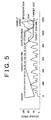
- FIG. 5 indicates changes in the SOC of the HV battery 22 (thick solid line), changes in the vehicle speed of the hybrid vehicle 10 (thin solid line), and changes in the target SOC (broken line).
- the target SOC has been increased to 70% as a result of a stop of the hybrid vehicle 10. Simultaneously with a starting operation, the SOC of the HV battery 22 considerably decreases. However, a sufficient and smooth start of the hybrid vehicle 10 is realized since the amount of charge of the HV battery 22 has been increased beforehand by increasing the target SOC.
- the average vehicle speed is 20 km/h
- the target SOC is maintained at 70% for a while, so that the SOC of the HV battery 22 is converged to 70% in preparation for a predicted future restart or great acceleration.
- acceleration is performed, and it is recognized that the average vehicle speed is 80 km/h.
- the target SOC is changed to 50%, so that the SOC of the HV battery 22 is converged to 50% in preparation for the recovery of regenerative power caused by a predicted future deceleration.
- the HV battery 22 is reduced in capacity (reduced in size), it is possible to perform smooth start or acceleration by predicting a future charge/discharge situation of the HV battery 22 of the hybrid vehicle 10 and securing a sufficient amount of charge prior to a request for a large amount of discharge. Furthermore, before a great regenerative power is obtained and a great charging request is outputted, a sufficient region for charging is secured such that the regenerative power can be recovered without wastage, and the electric motor 14A is actively used in order to secure a region for charging. As a result, the output of the engine 12 can be reduced, so that the fuel economy can be improved and the HV battery 22 can be used at a high efficiency as a whole.
- FIG. 6 shows a flowchart illustrating a procedure of changing the target SOC taking into consideration that the charging/discharging efficiency of the HV battery 22 decreases depending on the vehicle ambient temperature.
- the target SOC changing portion 56 sets the target SOC to the default value of 60% (S200).
- the charge/discharge predicting portion 54 acquires vehicle speed information from the vehicle speed recognizing portion 38, and determines whether a high vehicle speed has continued for a predetermined time (S201). For example, if the hybrid vehicle 10 has been traveling at a high vehicle speed of at least 80 km/h (an average vehicle speed of 80 km/h) for at least 5 minutes, the charge/discharge predicting portion 54 predicts that the hybrid vehicle 10 will be decelerated and regenerative power generation will be performed at some future time, and therefore predicts that an allowance for charging will be needed.
- the generator 14B is driven by drive power obtained from the wheel side 16, thereby performing regenerative power generation.
- the power regenerated increases with increases in deceleration. Therefore, in order to recover as much regenerative power as possible, a region for charging regenerative power is prepared in the HV battery 22 beforehand. That is, in order to reduce the present SOC of the HV battery 22, the target SOC changing portion 56 changes the target SOC from the default value of 60% to, for example, 50%(S202).
- the charge/discharge predicting portion 54 determines whether a low vehicle speed has continued for a predetermined time (S203). For example, if the engine 12 has been traveling at a low vehicle speed of at most 20 km/h (an average vehicle speed of 20 km/h) for at least 5 minutes, the charge/discharge predicting portion 54 predicts that a great amount of discharge will be requested in the future. In this case, the charge/discharge predicting portion 54 also determines whether the ambient temperature of the hybrid vehicle 10 is lower than a predetermined temperature, for example, 0°C, based on information from an external temperature sensor or the like (S204).
- a predetermined temperature for example, 0°C
- the charge/discharge predicting portion 54 outputs to the target SOC changing portion 56 a command to increase the target SOC to, for example, 70%, in order to increase the amount of charge in the HV battery 22 beforehand (S205), in preparation for a large discharge request under a situation of a low charging/discharging efficiency (in particular, a start of the electric motor 14A below a freezing point or the like).
- the charge/discharge predicting portion 54 determines in S204 that the external air temperature is not below the predetermined temperature, that is, if it can be determined that the external air temperature does not adversely affect the chemical reactions in the HV battery 22, the charge/discharge predicting portion 54 outputs to the target SOC changing portion 56 a command to change the target SOC to a slightly increased value, for example, 65%, in preparation for a large amount of discharge at the time of a normal start or acceleration (S206). If it is determined in S203 that the low vehicle speed has not continued for the predetermined time, it is considered that a request for extreme charging/discharging of the HV battery 22 will not be made, and the target SOC is maintained at 60%.
- the default value of the target SOC is set to 60%, and the increased values thereof are set to 65% and 70%, and the reduced value thereof is set to 50%.
- these set values are arbitrary. It is preferable to select suitable set values taking into consideration the capability of the HV battery 22, the performance of the hybrid vehicle 10, the environment of use, etc.
- the conditions for changing the target SOC such as the predetermined speed (average speed), the duration of continuation of the speed, the external air temperature, etc., are also arbitrary. That is, it is preferable to select suitable conditions.
- the HV battery 22 is used as an electric energy storage device.
- the electric energy storage device of the invention is not limited only to a battery.
- a condenser may also be used as an electric energy storage device of the invention.
- the controller (the HVECU 32) is implemented as a programmed general purpose computer. It will be appreciated by those skilled in the art that the controller can be implemented using a single special purpose integrated circuit (e.g., ASIC) having a main or central processor section for overall, system-level control, and separate sections dedicated to performing various different specific computations, functions and other processes under control of the central processor section.
- the controller can be a plurality of separate dedicated or programmable integrated or other electronic circuits or devices (e.g., hardwired electronic or logic circuits such as discrete element circuits, or programmable logic devices such as PLDs, PLAs, PALs or the like).
- the controller can be implemented using a suitably programmed general purpose computer, e.g., a microprocessor, microcontroller or other processor device (CPU or MPU), either alone or in conjunction with one or more peripheral (e.g., integrated circuit) data and signal processing devices.
- a suitably programmed general purpose computer e.g., a microprocessor, microcontroller or other processor device (CPU or MPU)
- CPU or MPU processor device
- peripheral e.g., integrated circuit
- a distributed processing architecture can be used for maximum data/signal processing capability and speed.
- a controller (32) predicts a requested state of charge/discharge corresponding to a future run of a hybrid vehicle. If it is predicted that the hybrid vehicle will be stopped and restarted, or will be greatly accelerated and therefore that a request for a great discharge will be outputted in the future, the controller (32) increases a target SOC of an HV battery (22) to increase the value to which the charge of the HV battery (22) will be converged in preparation for the great discharge. If it is predicted that a great regenerative electric power will be generated by a vehicle deceleration and therefore that a request for charging will be outputted, the target SOC is reduced, and the amount of charge in the HV battery (22) is reduced, so that the regenerative power generated can be efficiency recovered.
Landscapes
- Engineering & Computer Science (AREA)
- Transportation (AREA)
- Mechanical Engineering (AREA)
- Combustion & Propulsion (AREA)
- Chemical & Material Sciences (AREA)
- Power Engineering (AREA)
- Life Sciences & Earth Sciences (AREA)
- Sustainable Energy (AREA)
- Sustainable Development (AREA)
- Automation & Control Theory (AREA)
- Human Computer Interaction (AREA)
- Electric Propulsion And Braking For Vehicles (AREA)
- Hybrid Electric Vehicles (AREA)
- Charge And Discharge Circuits For Batteries Or The Like (AREA)
- Control Of Vehicle Engines Or Engines For Specific Uses (AREA)
- Control Of Charge By Means Of Generators (AREA)
- Secondary Cells (AREA)
Abstract
Description
Claims (10)
- A electric energy charging control apparatus of a hybrid vehicle having an internal combustion engine (12), a motor-generator (14) capable of assisting running of the vehicle and an electric energy storage device (22) connected to the motor-generator (14), the control apparatus characterized by comprising a controller (32) that:predicts a future state of a charge/discharge of the electric energy storage device (22); andchanges a target value of charge of the electric energy storage device (22) based on a result of the prediction regarding the future state of the charge/discharge of the electric energy storage device (22).
- The electric energy charging control apparatus according to claim 1, characterized in that the controller (32) predicts the future state based on a state of the run of the vehicle, and changes the target value by:increasing the target value of charge when the state of the run of the vehicle is a state in which at least a predetermined amount of the charge is predicted to be discharged from the electric energy storage device (22), and byreducing the target value of charge when the state of the run of the vehicle is a state in which at least a predetermined amount of the charge is predicted to be charged into the electric energy storage device (22).
- The electric energy charging control apparatus according to claim 1 or 2, characterized in that the controller (32) changes the target value of charge of the electric energy storage device (22) in accordance with a vehicle ambient temperature.
- The electric energy charging control apparatus according to claim 2, characterized in that the state of the run of the vehicle is a vehicle speed of the vehicle.
- The electric energy charging control apparatus according to claim 4, characterized in that
if the vehicle speed of the vehicle is a low vehicle speed for a predetermined time, the controller (32) increases the target value of charge of the electric energy storage device (22) to secure an amount of charge at least equal to an amount of charge that will be consumed by the motor-generator (14) in anticipation of the vehicle being stopped or greatly accelerated. - The electric energy charging control apparatus according to claim 4 or 5, characterized in that
if the vehicle speed of the vehicle speed is a high vehicle speed for a predetermined time, the controller (32) decreases the target value of charge of the electric energy storage device (22) to increase a region for recovery of a regenerative energy that is to be obtained through the motor-generator (14) in anticipation of a future state of the vehicle being decelerated. - The electric energy charging control apparatus according to claim 6, characterized in that:
a quantity of charge of the electric energy storage device (22) corresponding to the decrease in the target value of charge is used by the motor-generator (14) to assist in driving the vehicle, thereby reducing the output of the internal combustion engine and improving fuel economy. - The electric energy charging control apparatus according to claim 3, characterized in that
if the vehicle ambient temperature of the vehicle is lower than a predetermined temperature, the controller (32) increases the target value of charge of the electric energy storage device (22) to secure an amount of charge at least equal to an amount of charge that will be consumed by the motor-generator (14) in anticipation of a low charging/discharging efficiency. - The electric energy charging control apparatus according to claim 3 or 8, characterized in that
if the vehicle ambient temperature of the vehicle is at least equal to a predetermined temperature, the controller (32) only slightly increases the target value of charge of the electric energy storage device (22) to secure an amount of charge at least equal to an amount of charge that will be consumed by the motor-generator (14) in anticipation of a normal start or acceleration. - A electric energy charging control method for a hybrid vehicle including an internal combustion engine (12), a motor-generator (14) capable of assisting a run of the vehicle, and an electric energy storage device (22) connected to the motor-generator (14), the method characterized in that:predicting a future state of charge/discharge of the electric energy storage device (22); andchanging a target value of charge of the electric energy storage device (22) based on a result of the prediction regarding the future state of the charge/discharge of the electric energy storage device (22).
Applications Claiming Priority (2)
| Application Number | Priority Date | Filing Date | Title |
|---|---|---|---|
| JP2000082748A JP2001268719A (en) | 2000-03-23 | 2000-03-23 | Battery charging controller for hybrid vehicle |
| JP2000082748 | 2000-03-23 |
Publications (3)
| Publication Number | Publication Date |
|---|---|
| EP1136311A2 true EP1136311A2 (en) | 2001-09-26 |
| EP1136311A3 EP1136311A3 (en) | 2002-04-03 |
| EP1136311B1 EP1136311B1 (en) | 2008-08-27 |
Family
ID=18599509
Family Applications (1)
| Application Number | Title | Priority Date | Filing Date |
|---|---|---|---|
| EP01106470A Expired - Lifetime EP1136311B1 (en) | 2000-03-23 | 2001-03-22 | Electric energy charging control apparatus and method for hybrid vehicle |
Country Status (4)
| Country | Link |
|---|---|
| US (1) | US6344732B2 (en) |
| EP (1) | EP1136311B1 (en) |
| JP (1) | JP2001268719A (en) |
| DE (1) | DE60135516D1 (en) |
Cited By (29)
| Publication number | Priority date | Publication date | Assignee | Title |
|---|---|---|---|---|
| GB2370130A (en) * | 2000-10-11 | 2002-06-19 | Ford Motor Co | Control system for a hybrid electric vehicle |
| US6500089B2 (en) | 2000-10-31 | 2002-12-31 | Ford Global Technologies, Inc. | Method and arrangement in a hybrid vehicle for maximizing efficiency by operating the engine at sub-optimum conditions |
| EP1316457A1 (en) * | 2001-11-30 | 2003-06-04 | Ford Global Technologies, Inc. | Method and arrangement for controlling the take-off in a hybrid electric vehicle |
| EP1316458A1 (en) * | 2001-11-30 | 2003-06-04 | Ford Global Technologies, Inc. | A hybrid electric vehicle and a method therefor |
| EP1410935A1 (en) * | 2002-10-18 | 2004-04-21 | Ford Global Technologies, Inc., A subsidiary of Ford Motor Company | Method for reducing exhaust emission of an engine system |
| EP1254805A3 (en) * | 2001-05-03 | 2005-02-23 | Ford Global Technologies, Inc. | A system and strategy to control the state of charge of a battery based on vehicle velocity |
| WO2005044610A1 (en) * | 2003-10-06 | 2005-05-19 | Robert Bosch Gmbh | Method for regulation of the state of charge of an energy store on a vehicle with hybrid drive |
| WO2007028755A1 (en) * | 2005-09-08 | 2007-03-15 | Robert Bosch Gmbh | Hybrid motor vehicle energy supply device |
| WO2007074020A1 (en) | 2005-12-22 | 2007-07-05 | Robert Bosch Gmbh | Method for operating a hybrid vehicle |
| DE102007020196A1 (en) * | 2007-04-28 | 2008-10-30 | Voith Patent Gmbh | Method for controlling the state of charge of an energy store for a vehicle with hybrid drive |
| WO2008140359A1 (en) * | 2007-05-10 | 2008-11-20 | Volvo Construction Equipment Ab | A method and a control system for controlling a work machine |
| FR2929218A1 (en) * | 2008-03-28 | 2009-10-02 | Peugeot Citroen Automobiles Sa | METHOD AND DEVICE FOR CONTROLLING AN ELECTRICAL CHARGE |
| US20100087978A1 (en) * | 2008-10-08 | 2010-04-08 | Dr. Ing. H.C.F. Porsche Aktiengesellschaft | Method for operating a drive train |
| WO2012005655A1 (en) * | 2010-07-08 | 2012-01-12 | Scania Cv Ab | Energy control system and method for a hybrid vehicle |
| CN102381314A (en) * | 2011-10-10 | 2012-03-21 | 重庆长安汽车股份有限公司 | Charge-discharge control method for hybrid electric vehicle |
| FR2966412A1 (en) * | 2010-10-25 | 2012-04-27 | Mitsubishi Electric Corp | VEHICLE ENERGY PRODUCTION CONTROL APPARATUS |
| CN102593902A (en) * | 2012-02-22 | 2012-07-18 | 华北电力大学 | Energy-equivalence-based load forecasting system and method for electric automobile charging facility |
| CN103255801A (en) * | 2013-05-27 | 2013-08-21 | 上海华兴数字科技有限公司 | Energy control method for energy storing device of hybrid power machinery |
| WO2013167149A1 (en) * | 2012-05-08 | 2013-11-14 | Volvo Lastvagnar Ab | Energy management system and fuel saving method for a hybrid electric vehicle |
| CN103790205A (en) * | 2014-02-14 | 2014-05-14 | 上海华兴数字科技有限公司 | Hybrid power building machine and energy-conservation control method of hybrid power building machine |
| WO2014086643A1 (en) * | 2012-12-07 | 2014-06-12 | Continental Automotive Gmbh | Method and device for estimating the residual energy of an energy accumulator of a motor vehicle and method and device for operating a hybrid motor vehicle |
| WO2015011533A1 (en) * | 2013-07-22 | 2015-01-29 | Toyota Jidosha Kabushiki Kaisha | Vehicle and control method for vehicle |
| RU2588392C1 (en) * | 2012-05-08 | 2016-06-27 | Вольво Ластвагнар Аб | Power control system and method of fuel saving for hybrid electric vehicle |
| EP2918435A4 (en) * | 2012-11-07 | 2016-08-03 | Hitachi Construction Machinery | Work vehicle |
| EP2781721A4 (en) * | 2011-11-18 | 2017-03-08 | Toyota Jidosha Kabushiki Kaisha | Vehicle control device, vehicle, and vehicle control method |
| EP3086989A4 (en) * | 2013-12-23 | 2017-10-18 | Scania CV AB | A method of supplying electrical appliances of a vehicle |
| EP2527627A4 (en) * | 2010-01-22 | 2018-04-04 | Nissan Motor Co., Ltd | Vehicle control device and control method |
| CN109878499A (en) * | 2019-03-29 | 2019-06-14 | 辽宁工业大学 | Hybrid vehicle power control method |
| DE102004023505B4 (en) | 2004-05-10 | 2022-01-27 | Volkswagen Ag | Method for energy management in an electrical system of a hybrid vehicle and an electrical system |
Families Citing this family (115)
| Publication number | Priority date | Publication date | Assignee | Title |
|---|---|---|---|---|
| US6847189B2 (en) * | 1995-05-31 | 2005-01-25 | The Regents Of The University Of California | Method for controlling the operating characteristics of a hybrid electric vehicle |
| US6054844A (en) * | 1998-04-21 | 2000-04-25 | The Regents Of The University Of California | Control method and apparatus for internal combustion engine electric hybrid vehicles |
| CA2320003C (en) * | 1999-09-22 | 2006-03-21 | Honda Giken Kogyo Kabushiki Kaisha | Control apparatus for hybrid vehicles |
| CN100362722C (en) * | 2001-01-03 | 2008-01-16 | 加利福尼亚大学董事会 | Hybrid electric vehicle and method and device for controlling hybrid electric vehicle |
| US6622804B2 (en) * | 2001-01-19 | 2003-09-23 | Transportation Techniques, Llc. | Hybrid electric vehicle and method of selectively operating the hybrid electric vehicle |
| US20060005739A1 (en) * | 2001-03-27 | 2006-01-12 | Kumar Ajith K | Railroad system comprising railroad vehicle with energy regeneration |
| US20060005738A1 (en) * | 2001-03-27 | 2006-01-12 | Kumar Ajith K | Railroad vehicle with energy regeneration |
| JP3613216B2 (en) | 2001-09-18 | 2005-01-26 | 日産自動車株式会社 | Control device for hybrid vehicle |
| US6735511B2 (en) | 2002-01-15 | 2004-05-11 | Nissan Motor Co., Ltd. | Brake control system for vehicle |
| JP3750608B2 (en) | 2002-01-23 | 2006-03-01 | トヨタ自動車株式会社 | Control device for power storage device in vehicle |
| US7228925B2 (en) * | 2002-10-04 | 2007-06-12 | Tesla Capital, Llc | Electrical systems for electric powered vehicles |
| JP2004320946A (en) * | 2003-04-18 | 2004-11-11 | Toyota Motor Corp | Electric vehicle and control method thereof |
| JP3838233B2 (en) * | 2003-08-28 | 2006-10-25 | トヨタ自動車株式会社 | Storage device control device |
| US7073615B2 (en) * | 2003-09-19 | 2006-07-11 | Ford Global Technologies, Llc. | System and method for operating an electric motor by limiting performance |
| US6876098B1 (en) | 2003-09-25 | 2005-04-05 | The United States Of America As Represented By The Administrator Of The Environmental Protection Agency | Methods of operating a series hybrid vehicle |
| JP4039355B2 (en) | 2003-10-29 | 2008-01-30 | トヨタ自動車株式会社 | Secondary battery control device and control method |
| JP2005304179A (en) * | 2004-04-12 | 2005-10-27 | Toyota Motor Corp | Drive system and moving body equipped with the same |
| JP4678139B2 (en) * | 2004-05-10 | 2011-04-27 | トヨタ自動車株式会社 | Automotive heating control system |
| JP4063252B2 (en) * | 2004-06-07 | 2008-03-19 | 日産自動車株式会社 | Vehicle driving force control device |
| US7196493B2 (en) * | 2004-07-30 | 2007-03-27 | Ford Global Technologies, Llc | Closed loop control of battery power limits based on voltage |
| US7100362B2 (en) * | 2004-07-30 | 2006-09-05 | Ford Global Technologies, Llc | Vehicle and method for operating a vehicle to reduce exhaust emissions |
| CN100398369C (en) * | 2004-10-20 | 2008-07-02 | 丰田自动车株式会社 | Hybrid vehicle and its control method |
| JP2007018851A (en) * | 2005-07-07 | 2007-01-25 | Mazda Motor Corp | Boil-off gas treatment equipment for fuel cell vehicles |
| US7617893B2 (en) * | 2005-08-02 | 2009-11-17 | Ford Global Technologies, Llc | Method and system for determining final desired wheel power in a hybrid electric vehicle powertrain |
| JP4548289B2 (en) * | 2005-09-26 | 2010-09-22 | 日産自動車株式会社 | Battery pack capacity adjustment device |
| US10882399B2 (en) | 2005-11-17 | 2021-01-05 | Invently Automotive Inc. | Electric vehicle power management system |
| US11180025B2 (en) | 2005-11-17 | 2021-11-23 | Invently Automotive Inc. | Electric vehicle power management system |
| US11390165B2 (en) | 2005-11-17 | 2022-07-19 | Invently Automotive Inc. | Electric vehicle power management system |
| US11370302B2 (en) | 2005-11-17 | 2022-06-28 | Invently Automotive Inc. | Electric vehicle power management system |
| US11267338B2 (en) | 2005-11-17 | 2022-03-08 | Invently Automotive Inc. | Electric vehicle power management system |
| US11279233B2 (en) | 2005-11-17 | 2022-03-22 | Invently Automotive Inc. | Electric vehicle power management system |
| US11247564B2 (en) | 2005-11-17 | 2022-02-15 | Invently Automotive Inc. | Electric vehicle power management system |
| US11186173B2 (en) | 2005-11-17 | 2021-11-30 | Invently Automotive Inc. | Electric vehicle power management system |
| US11345236B2 (en) | 2005-11-17 | 2022-05-31 | Invently Automotive Inc. | Electric vehicle power management system |
| US11214144B2 (en) | 2005-11-17 | 2022-01-04 | Invently Automotive Inc. | Electric vehicle power management system |
| US11230190B2 (en) | 2005-11-17 | 2022-01-25 | Invently Automotive Inc. | Electric vehicle power management system |
| US11254211B2 (en) | 2005-11-17 | 2022-02-22 | Invently Automotive Inc. | Electric vehicle power management system |
| DE102006001201B4 (en) * | 2006-01-10 | 2008-01-31 | Ford Global Technologies, LLC, Dearborn | Method for controlling a battery charging operation |
| US7626892B2 (en) * | 2006-05-01 | 2009-12-01 | Tai-Her Yang | Timing device with power winder |
| KR100821776B1 (en) * | 2006-06-09 | 2008-04-11 | 현대자동차주식회사 | Charge / discharge control method of main battery provided in hybrid vehicle |
| JP4800142B2 (en) * | 2006-08-07 | 2011-10-26 | 本田技研工業株式会社 | Hybrid vehicle |
| JP4202379B2 (en) | 2006-10-11 | 2008-12-24 | トヨタ自動車株式会社 | HYBRID VEHICLE, HYBRID VEHICLE CONTROL METHOD, PROGRAM FOR CAUSING COMPUTER TO EXECUTE THE CONTROL METHOD, AND COMPUTER-READABLE RECORDING MEDIUM CONTAINING THE PROGRAM |
| JP4506741B2 (en) * | 2006-10-11 | 2010-07-21 | マツダ株式会社 | Control device for vehicle generator |
| JP4497150B2 (en) * | 2006-10-24 | 2010-07-07 | 株式会社デンソー | Charge control system |
| JP4321576B2 (en) * | 2006-10-24 | 2009-08-26 | トヨタ自動車株式会社 | Power supply device and vehicle including the same |
| US7746026B2 (en) * | 2006-12-22 | 2010-06-29 | Chrysler Group Llc | Controlling state of charge of a vehicle battery |
| KR100812426B1 (en) | 2007-02-06 | 2008-03-12 | 현대자동차주식회사 | Control method of a hybrid vehicle |
| US7660660B2 (en) * | 2007-02-09 | 2010-02-09 | Toyota Motor Engineering & Manufacturing North America, Inc. | Systems and methods for regulation of engine variables |
| JP4274257B2 (en) * | 2007-02-20 | 2009-06-03 | トヨタ自動車株式会社 | Hybrid vehicle |
| JP5003280B2 (en) * | 2007-05-21 | 2012-08-15 | トヨタ自動車株式会社 | Drive source control device |
| US8022674B2 (en) * | 2007-07-10 | 2011-09-20 | Toyota Motor Engineering & Manufacturing North America, Inc. | State of charge control method and systems for vehicles |
| US8847426B2 (en) * | 2007-11-02 | 2014-09-30 | GM Global Technology Operations LLC | Method for managing electric power in a powertrain system |
| US8360180B2 (en) * | 2007-12-31 | 2013-01-29 | Caterpillar Inc. | System for controlling a hybrid energy system |
| JP4715881B2 (en) | 2008-07-25 | 2011-07-06 | トヨタ自動車株式会社 | Power supply system and vehicle equipped with the same |
| US8024082B2 (en) * | 2009-03-11 | 2011-09-20 | General Electric Company | System and method for optimizing energy storage component usage |
| JP5379535B2 (en) * | 2009-03-30 | 2013-12-25 | プライムアースEvエナジー株式会社 | Secondary battery charge control method and charger |
| US8330412B2 (en) * | 2009-07-31 | 2012-12-11 | Thermo King Corporation | Monitoring and control system for an electrical storage system of a vehicle |
| US8297392B2 (en) * | 2009-09-25 | 2012-10-30 | Caterpillar Inc. | Hybrid energy management system |
| JP5094819B2 (en) * | 2009-11-18 | 2012-12-12 | シャープ株式会社 | Charge control method, charge control computer program, charge control device, secondary battery system, secondary battery power source, and battery application device |
| DE102009058091B4 (en) * | 2009-12-12 | 2020-08-06 | Bayerische Motoren Werke Aktiengesellschaft | Capacity management of an energy store in a hybrid vehicle with selectable all-wheel drive |
| US8536825B2 (en) * | 2009-12-31 | 2013-09-17 | Tesla Motors, Inc. | State of charge range |
| US8629657B2 (en) * | 2009-12-31 | 2014-01-14 | Tesla Motors, Inc. | State of charge range |
| JP2011142720A (en) * | 2010-01-06 | 2011-07-21 | Sony Corp | Battery pack, charging apparatus and charging system |
| JP5407945B2 (en) | 2010-03-05 | 2014-02-05 | 株式会社デンソー | Charge control system |
| DE102010030247A1 (en) * | 2010-06-17 | 2011-12-22 | Zf Friedrichshafen Ag | Method for operating a drive train |
| DE102010034672A1 (en) * | 2010-08-18 | 2012-02-23 | Volkswagen Ag | Method for managing power in electrical system of motor car, involves determining difference between maximum charging state and target charging state in response to kinetic and potential energies of motor car |
| DE102010042328A1 (en) * | 2010-10-12 | 2012-04-12 | Robert Bosch Gmbh | Method for monitoring the charging operation of an energy storage device in a vehicle and charging system for charging an energy storage device in a vehicle |
| JP5578014B2 (en) * | 2010-10-19 | 2014-08-27 | 株式会社デンソー | Battery system control device |
| JP5521998B2 (en) * | 2010-11-22 | 2014-06-18 | 株式会社デンソー | Vehicle control device |
| JP5707919B2 (en) * | 2010-12-15 | 2015-04-30 | 日産自動車株式会社 | Vehicle with internal combustion engine |
| US9030063B2 (en) | 2010-12-17 | 2015-05-12 | Tesla Motors, Inc. | Thermal management system for use with an integrated motor assembly |
| US9393876B2 (en) | 2010-12-27 | 2016-07-19 | Honda Motor Co., Ltd | Generation control apparatus and generation control method |
| RU2013135287A (en) * | 2010-12-27 | 2015-02-10 | Хонда Мотор Ко., Лтд. | DEVICE FOR MANAGEMENT OF GENERATION AND METHOD OF MANAGEMENT OF GENERATION |
| JP5429197B2 (en) * | 2011-01-11 | 2014-02-26 | トヨタ自動車株式会社 | Vehicle control device |
| US8655532B2 (en) * | 2011-06-30 | 2014-02-18 | GM Global Technology Operations LLC | System and method for operating a hybrid vehicle |
| JP5247899B1 (en) * | 2012-02-15 | 2013-07-24 | 株式会社小松製作所 | Capacitor charge / discharge control device, capacitor charge / discharge control method, and hybrid work machine equipped with capacitor charge / discharge control device |
| KR101371463B1 (en) * | 2012-09-06 | 2014-03-24 | 기아자동차주식회사 | Method and system for controlling recharging of a battery for hybrid vehicle |
| JP6013857B2 (en) * | 2012-09-28 | 2016-10-25 | 株式会社神戸製鋼所 | Secondary battery charge / discharge controller for construction machinery |
| JP5716779B2 (en) * | 2013-03-22 | 2015-05-13 | トヨタ自動車株式会社 | Hybrid car |
| WO2014168017A1 (en) * | 2013-04-11 | 2014-10-16 | 日産自動車株式会社 | Vehicle control device and vehicle control method |
| US9156358B2 (en) * | 2013-10-15 | 2015-10-13 | Ford Global Technologies, Llc | Regenerative braking in the presence of an antilock braking system control event |
| DE102013224349B3 (en) * | 2013-11-28 | 2015-03-26 | Continental Automotive Gmbh | Method for controlling a hybrid drive of a vehicle and computer program for controlling a hybrid drive of a vehicle |
| US9079505B1 (en) | 2014-02-25 | 2015-07-14 | Elwah LLC | System and method for management of a fleet of vehicles having an energy storage system |
| US9878631B2 (en) * | 2014-02-25 | 2018-01-30 | Elwha Llc | System and method for predictive control of an energy storage system for a vehicle |
| US9056556B1 (en) | 2014-02-25 | 2015-06-16 | Elwha Llc | System and method for configuration and management of an energy storage system for a vehicle |
| US9475398B2 (en) | 2014-05-08 | 2016-10-25 | Cummins, Inc. | Optimization-based predictive method for battery charging |
| US10026998B2 (en) * | 2014-05-15 | 2018-07-17 | Ford Global Technologies, Llc | Electric vehicle operation to manage battery capacity |
| JP6469969B2 (en) * | 2014-05-26 | 2019-02-13 | 株式会社デンソー | Control device |
| JP2016005425A (en) * | 2014-06-19 | 2016-01-12 | 古河電気工業株式会社 | Secondary battery charge / discharge control device and secondary battery charge / discharge control method |
| KR101601473B1 (en) * | 2014-08-25 | 2016-03-09 | 현대자동차주식회사 | Device and method for controlling battery SOC of hybrid vehicle |
| JP6264258B2 (en) * | 2014-10-23 | 2018-01-24 | 株式会社デンソー | Vehicle control device |
| US9758052B2 (en) * | 2014-11-13 | 2017-09-12 | Ford Global Technologies, Llc | Power spike mitigation |
| US9731617B2 (en) * | 2014-12-04 | 2017-08-15 | Ford Global Technologies, Llc | Pattern based charge scheduling |
| US9533674B2 (en) | 2015-02-23 | 2017-01-03 | Ford Global Technologies, Llc | Battery state of charge engine shut-off threshold based on predicted operation |
| US9815373B2 (en) * | 2015-02-23 | 2017-11-14 | Ford Global Technologies, Llc | Battery state of charge target based on predicted regenerative energy |
| JP6424731B2 (en) * | 2015-05-13 | 2018-11-21 | トヨタ自動車株式会社 | Vehicle control device |
| FR3041308B1 (en) * | 2015-09-17 | 2017-10-20 | Renault Sas | METHOD AND DEVICE FOR CONTROLLING THE ELECTRIC TORQUE OF A HYBRID MOTOR VEHICLE |
| JP6701708B2 (en) * | 2015-12-14 | 2020-05-27 | 三菱自動車工業株式会社 | Charge amount control device for electric vehicle |
| JP2017178083A (en) | 2016-03-30 | 2017-10-05 | トヨタ自動車株式会社 | Hybrid motorcar |
| JP6431204B2 (en) * | 2016-09-13 | 2018-11-28 | 株式会社日立情報通信エンジニアリング | State prediction apparatus and state prediction method |
| KR20190085554A (en) * | 2016-12-01 | 2019-07-18 | 볼보 트럭 코퍼레이션 | In-Vehicle Battery Control Method and Control System |
| US10196054B2 (en) | 2016-12-14 | 2019-02-05 | Bendix Commercial Vehicle Systems Llc | Driver break preparation system for a hybrid vehicle |
| DE102017203562A1 (en) * | 2017-03-06 | 2018-09-06 | Robert Bosch Gmbh | Method for charging an energy store of a vehicle |
| DE102017218903B4 (en) * | 2017-10-24 | 2025-06-05 | Hyundai Motor Company | Method for operating an energy management system and energy management system |
| JP6992459B2 (en) * | 2017-12-05 | 2022-01-13 | トヨタ自動車株式会社 | Hybrid vehicle and control device mounted on it |
| JP6649418B2 (en) * | 2018-02-26 | 2020-02-19 | ファナック株式会社 | Motor drive system having power storage device |
| US10946852B2 (en) * | 2018-09-26 | 2021-03-16 | Toyota Motor Engineering & Manufacturing North America, Inc. | Systems and methods for determining engine start time during predicted acceleration events |
| CN111251908B (en) * | 2018-11-30 | 2021-07-16 | 联合汽车电子有限公司 | Range-extending electric vehicle control system and method |
| US11981319B2 (en) * | 2019-05-13 | 2024-05-14 | Cummins Inc. | Method and system for improving fuel economy of a hybrid powertrain in a vehicle |
| US20200377072A1 (en) * | 2019-05-28 | 2020-12-03 | GM Global Technology Operations LLC | Method and apparatus to control operation of a vehicle |
| CN114537216A (en) * | 2020-11-27 | 2022-05-27 | 厦门雅迅网络股份有限公司 | Electric vehicle energy management method based on curve prediction, terminal device and storage medium |
| DE102021211053B4 (en) | 2021-09-30 | 2023-11-16 | Volkswagen Aktiengesellschaft | Optimization of driver assistance systems in electrically powered vehicles |
| CN113978448B (en) * | 2021-11-03 | 2023-07-04 | 东风汽车集团股份有限公司 | Control method and device for speed of hybrid electric vehicle |
| CN116424298B (en) * | 2022-01-04 | 2025-03-07 | 比亚迪股份有限公司 | Hybrid electric vehicle and power generation method and device thereof and vehicle control unit |
| CN114872686B (en) * | 2022-06-20 | 2024-09-20 | 东风汽车集团股份有限公司 | A method for controlling engine cooling water temperature |
Family Cites Families (9)
| Publication number | Priority date | Publication date | Assignee | Title |
|---|---|---|---|---|
| JP2970427B2 (en) | 1994-09-29 | 1999-11-02 | トヨタ自動車株式会社 | Control device for series parallel composite electric vehicle |
| JP3211699B2 (en) * | 1996-09-17 | 2001-09-25 | トヨタ自動車株式会社 | Power output device |
| JP3374721B2 (en) * | 1997-09-29 | 2003-02-10 | 日産自動車株式会社 | Power generation control device for hybrid vehicle |
| JP3812134B2 (en) | 1998-04-08 | 2006-08-23 | トヨタ自動車株式会社 | Charge control method for hybrid vehicle |
| JP3379444B2 (en) * | 1998-09-07 | 2003-02-24 | トヨタ自動車株式会社 | Hybrid vehicle charge / discharge state control device |
| CA2282050A1 (en) * | 1998-09-14 | 2000-03-14 | The Clorox Company | Toilet bowel cleaning tablet |
| US6209672B1 (en) * | 1998-09-14 | 2001-04-03 | Paice Corporation | Hybrid vehicle |
| DE19847648A1 (en) * | 1998-10-15 | 2000-04-20 | Vb Autobatterie Gmbh | Procedure for determining the state of charge and the high current carrying capacity of batteries |
| JP2000287302A (en) * | 1999-03-31 | 2000-10-13 | Toshiba Battery Co Ltd | Vehicle energy management device and vehicle |
-
2000
- 2000-03-23 JP JP2000082748A patent/JP2001268719A/en active Pending
-
2001
- 2001-03-13 US US09/803,914 patent/US6344732B2/en not_active Expired - Fee Related
- 2001-03-22 EP EP01106470A patent/EP1136311B1/en not_active Expired - Lifetime
- 2001-03-22 DE DE60135516T patent/DE60135516D1/en not_active Expired - Lifetime
Cited By (47)
| Publication number | Priority date | Publication date | Assignee | Title |
|---|---|---|---|---|
| US7753150B2 (en) | 2000-10-11 | 2010-07-13 | Ford Global Technologies, Llc | Control system for a hybrid electric vehicle to anticipate the need for a mode change |
| GB2370130B (en) * | 2000-10-11 | 2004-10-06 | Ford Motor Co | A control system for a hybrid electric vehicle |
| GB2370130A (en) * | 2000-10-11 | 2002-06-19 | Ford Motor Co | Control system for a hybrid electric vehicle |
| US7021409B2 (en) | 2000-10-11 | 2006-04-04 | Ford Global Technologies, Llc | Control system for a hybrid electric vehicle to anticipate the need for a mode change |
| US6500089B2 (en) | 2000-10-31 | 2002-12-31 | Ford Global Technologies, Inc. | Method and arrangement in a hybrid vehicle for maximizing efficiency by operating the engine at sub-optimum conditions |
| EP1254805A3 (en) * | 2001-05-03 | 2005-02-23 | Ford Global Technologies, Inc. | A system and strategy to control the state of charge of a battery based on vehicle velocity |
| EP1316457A1 (en) * | 2001-11-30 | 2003-06-04 | Ford Global Technologies, Inc. | Method and arrangement for controlling the take-off in a hybrid electric vehicle |
| EP1316458A1 (en) * | 2001-11-30 | 2003-06-04 | Ford Global Technologies, Inc. | A hybrid electric vehicle and a method therefor |
| EP1410935A1 (en) * | 2002-10-18 | 2004-04-21 | Ford Global Technologies, Inc., A subsidiary of Ford Motor Company | Method for reducing exhaust emission of an engine system |
| US7104044B2 (en) | 2002-10-18 | 2006-09-12 | Ford Global Technologies, Llc | Method for reducing the exhaust emissions from an engine system |
| US7934573B2 (en) | 2003-10-06 | 2011-05-03 | Robert Bosch Gmbh | Method for regulating the state of charge of an energy accumulator in a vehicle having a hybrid drive unit |
| WO2005044610A1 (en) * | 2003-10-06 | 2005-05-19 | Robert Bosch Gmbh | Method for regulation of the state of charge of an energy store on a vehicle with hybrid drive |
| DE102004023505B4 (en) | 2004-05-10 | 2022-01-27 | Volkswagen Ag | Method for energy management in an electrical system of a hybrid vehicle and an electrical system |
| WO2007028755A1 (en) * | 2005-09-08 | 2007-03-15 | Robert Bosch Gmbh | Hybrid motor vehicle energy supply device |
| WO2007074020A1 (en) | 2005-12-22 | 2007-07-05 | Robert Bosch Gmbh | Method for operating a hybrid vehicle |
| DE102007020196A1 (en) * | 2007-04-28 | 2008-10-30 | Voith Patent Gmbh | Method for controlling the state of charge of an energy store for a vehicle with hybrid drive |
| US8565947B2 (en) | 2007-04-28 | 2013-10-22 | Voith Patent Gmbh | Method for regulating the charging state of an energy accumulator for a vehicle comprising a hybrid drive |
| WO2008140359A1 (en) * | 2007-05-10 | 2008-11-20 | Volvo Construction Equipment Ab | A method and a control system for controlling a work machine |
| US9242633B2 (en) | 2007-05-10 | 2016-01-26 | Volvo Construction Equipment Ab | Method and a control system for controlling a work machine |
| FR2929218A1 (en) * | 2008-03-28 | 2009-10-02 | Peugeot Citroen Automobiles Sa | METHOD AND DEVICE FOR CONTROLLING AN ELECTRICAL CHARGE |
| EP2105366A3 (en) * | 2008-03-28 | 2016-07-27 | Peugeot Citroën Automobiles S.A. | Method and device for controlling an electric charge |
| US8554399B2 (en) | 2008-10-08 | 2013-10-08 | Dr. Ing. H.C. F. Porsche Aktiengesellschaft | Method for operating a drive train |
| US20100087978A1 (en) * | 2008-10-08 | 2010-04-08 | Dr. Ing. H.C.F. Porsche Aktiengesellschaft | Method for operating a drive train |
| EP2527627A4 (en) * | 2010-01-22 | 2018-04-04 | Nissan Motor Co., Ltd | Vehicle control device and control method |
| WO2012005655A1 (en) * | 2010-07-08 | 2012-01-12 | Scania Cv Ab | Energy control system and method for a hybrid vehicle |
| FR2966412A1 (en) * | 2010-10-25 | 2012-04-27 | Mitsubishi Electric Corp | VEHICLE ENERGY PRODUCTION CONTROL APPARATUS |
| CN102381314A (en) * | 2011-10-10 | 2012-03-21 | 重庆长安汽车股份有限公司 | Charge-discharge control method for hybrid electric vehicle |
| CN102381314B (en) * | 2011-10-10 | 2014-03-12 | 重庆长安汽车股份有限公司 | Charge-discharge control method for hybrid electric vehicle |
| EP2781721A4 (en) * | 2011-11-18 | 2017-03-08 | Toyota Jidosha Kabushiki Kaisha | Vehicle control device, vehicle, and vehicle control method |
| CN102593902A (en) * | 2012-02-22 | 2012-07-18 | 华北电力大学 | Energy-equivalence-based load forecasting system and method for electric automobile charging facility |
| CN104284823A (en) * | 2012-05-08 | 2015-01-14 | 沃尔沃拉斯特瓦格纳公司 | Energy management system and fuel saving method for hybrid electric vehicle |
| RU2588392C1 (en) * | 2012-05-08 | 2016-06-27 | Вольво Ластвагнар Аб | Power control system and method of fuel saving for hybrid electric vehicle |
| WO2013167149A1 (en) * | 2012-05-08 | 2013-11-14 | Volvo Lastvagnar Ab | Energy management system and fuel saving method for a hybrid electric vehicle |
| US9205839B2 (en) | 2012-05-08 | 2015-12-08 | Volvo Lastvagnar Ab | Energy management system and fuel saving method for a hybrid electric vehicle |
| EP2918435A4 (en) * | 2012-11-07 | 2016-08-03 | Hitachi Construction Machinery | Work vehicle |
| CN104968551A (en) * | 2012-12-07 | 2015-10-07 | 大陆汽车有限公司 | Method and device for estimating the residual energy of an energy accumulator of a motor vehicle and method and device for operating a hybrid motor vehicle |
| WO2014086643A1 (en) * | 2012-12-07 | 2014-06-12 | Continental Automotive Gmbh | Method and device for estimating the residual energy of an energy accumulator of a motor vehicle and method and device for operating a hybrid motor vehicle |
| US9663114B2 (en) | 2012-12-07 | 2017-05-30 | Continental Automotive Gmbh | Method and device for estimating the residual energy of an energy accumulator of a motor vehicle and a method and device for operating a hybrid motor vehicle |
| CN104968551B (en) * | 2012-12-07 | 2018-10-09 | 大陆汽车有限公司 | The method and apparatus of the dump energy of accumulator for estimating motor vehicles and method and apparatus for operating hybrid moto vehicle |
| CN103255801B (en) * | 2013-05-27 | 2015-08-26 | 上海华兴数字科技有限公司 | A kind of energy storage device energy control method of hybrid power machinery |
| WO2014190842A1 (en) * | 2013-05-27 | 2014-12-04 | 上海华兴数字科技有限公司 | Hybrid power machine, hybrid power system and energy control method therefor |
| CN103255801A (en) * | 2013-05-27 | 2013-08-21 | 上海华兴数字科技有限公司 | Energy control method for energy storing device of hybrid power machinery |
| WO2015011533A1 (en) * | 2013-07-22 | 2015-01-29 | Toyota Jidosha Kabushiki Kaisha | Vehicle and control method for vehicle |
| EP3086989A4 (en) * | 2013-12-23 | 2017-10-18 | Scania CV AB | A method of supplying electrical appliances of a vehicle |
| US10618509B2 (en) | 2013-12-23 | 2020-04-14 | Scania Cv Ab | Method of starting a vehicle with power balance |
| CN103790205A (en) * | 2014-02-14 | 2014-05-14 | 上海华兴数字科技有限公司 | Hybrid power building machine and energy-conservation control method of hybrid power building machine |
| CN109878499A (en) * | 2019-03-29 | 2019-06-14 | 辽宁工业大学 | Hybrid vehicle power control method |
Also Published As
| Publication number | Publication date |
|---|---|
| US20010024104A1 (en) | 2001-09-27 |
| EP1136311A3 (en) | 2002-04-03 |
| JP2001268719A (en) | 2001-09-28 |
| DE60135516D1 (en) | 2008-10-09 |
| EP1136311B1 (en) | 2008-08-27 |
| US6344732B2 (en) | 2002-02-05 |
Similar Documents
| Publication | Publication Date | Title |
|---|---|---|
| US6344732B2 (en) | Electric energy charging control apparatus and method for hybrid vehicle | |
| US11345347B2 (en) | Brake control device for vehicle | |
| JP3904192B2 (en) | Vehicle drive device | |
| US7503413B2 (en) | System and method for controlling stopping and starting of a vehicle engine | |
| US5786640A (en) | Generator control system for a hybrid vehicle driven by an electric motor and an internal combustion engine | |
| JP3750608B2 (en) | Control device for power storage device in vehicle | |
| JP4020646B2 (en) | Control method of hybrid electric vehicle | |
| US9678495B2 (en) | Control apparatus for plug-in hybrid vehicle, and control method for the same | |
| CN103702881B (en) | The control method of vehicle and vehicle | |
| US20110307132A1 (en) | Vehicle control apparatus and vehicle control method | |
| JP3951847B2 (en) | Vehicle control device, control method, program for realizing the control method, and recording medium recording the program | |
| WO2013072974A1 (en) | Vehicle control device, vehicle, and vehicle control method | |
| JPWO2012086061A1 (en) | Vehicle and vehicle control method | |
| JP5598555B2 (en) | Vehicle and vehicle control method | |
| CN113924238A (en) | Electric device control method and electric device | |
| CN103827467A (en) | Vehicle and method for controlling vehicle | |
| US12024156B2 (en) | Method for controlling hybrid vehicle and device for controlling hybrid vehicle | |
| US7098556B2 (en) | Control system of regeneration system and control method thereof | |
| JP3013764B2 (en) | Charge and discharge control device for hybrid electric vehicles | |
| JP2007230431A (en) | Vehicle drive control device | |
| JP3826295B2 (en) | Vehicle power supply control device | |
| JP2025069007A (en) | Hybrid vehicle control method and hybrid vehicle control device | |
| JP2023173679A (en) | Hybrid vehicle control device | |
| JP2006136131A (en) | Vehicle control device | |
| JP7056453B2 (en) | Power generation control device for series hybrid vehicles |
Legal Events
| Date | Code | Title | Description |
|---|---|---|---|
| PUAI | Public reference made under article 153(3) epc to a published international application that has entered the european phase |
Free format text: ORIGINAL CODE: 0009012 |
|
| 17P | Request for examination filed |
Effective date: 20010322 |
|
| AK | Designated contracting states |
Kind code of ref document: A2 Designated state(s): DE FR GB Kind code of ref document: A2 Designated state(s): AT BE CH CY DE DK ES FI FR GB GR IE IT LI LU MC NL PT SE TR |
|
| AX | Request for extension of the european patent |
Free format text: AL;LT;LV;MK;RO;SI |
|
| PUAL | Search report despatched |
Free format text: ORIGINAL CODE: 0009013 |
|
| AK | Designated contracting states |
Kind code of ref document: A3 Designated state(s): AT BE CH CY DE DK ES FI FR GB GR IE IT LI LU MC NL PT SE TR |
|
| AX | Request for extension of the european patent |
Free format text: AL;LT;LV;MK;RO;SI |
|
| 17Q | First examination report despatched |
Effective date: 20020830 |
|
| AKX | Designation fees paid |
Free format text: DE FR GB |
|
| GRAP | Despatch of communication of intention to grant a patent |
Free format text: ORIGINAL CODE: EPIDOSNIGR1 |
|
| GRAS | Grant fee paid |
Free format text: ORIGINAL CODE: EPIDOSNIGR3 |
|
| GRAA | (expected) grant |
Free format text: ORIGINAL CODE: 0009210 |
|
| AK | Designated contracting states |
Kind code of ref document: B1 Designated state(s): DE FR GB |
|
| REG | Reference to a national code |
Ref country code: GB Ref legal event code: FG4D |
|
| REF | Corresponds to: |
Ref document number: 60135516 Country of ref document: DE Date of ref document: 20081009 Kind code of ref document: P |
|
| PLBE | No opposition filed within time limit |
Free format text: ORIGINAL CODE: 0009261 |
|
| STAA | Information on the status of an ep patent application or granted ep patent |
Free format text: STATUS: NO OPPOSITION FILED WITHIN TIME LIMIT |
|
| 26N | No opposition filed |
Effective date: 20090528 |
|
| PGFP | Annual fee paid to national office [announced via postgrant information from national office to epo] |
Ref country code: FR Payment date: 20120319 Year of fee payment: 12 |
|
| PGFP | Annual fee paid to national office [announced via postgrant information from national office to epo] |
Ref country code: GB Payment date: 20120321 Year of fee payment: 12 |
|
| PGFP | Annual fee paid to national office [announced via postgrant information from national office to epo] |
Ref country code: DE Payment date: 20120411 Year of fee payment: 12 |
|
| REG | Reference to a national code |
Ref country code: GB Ref legal event code: 746 Effective date: 20121219 |
|
| REG | Reference to a national code |
Ref country code: DE Ref legal event code: R084 Ref document number: 60135516 Country of ref document: DE Effective date: 20121213 |
|
| GBPC | Gb: european patent ceased through non-payment of renewal fee |
Effective date: 20130322 |
|
| REG | Reference to a national code |
Ref country code: FR Ref legal event code: ST Effective date: 20131129 |
|
| REG | Reference to a national code |
Ref country code: DE Ref legal event code: R119 Ref document number: 60135516 Country of ref document: DE Effective date: 20131001 |
|
| PG25 | Lapsed in a contracting state [announced via postgrant information from national office to epo] |
Ref country code: DE Free format text: LAPSE BECAUSE OF NON-PAYMENT OF DUE FEES Effective date: 20131001 Ref country code: GB Free format text: LAPSE BECAUSE OF NON-PAYMENT OF DUE FEES Effective date: 20130322 Ref country code: FR Free format text: LAPSE BECAUSE OF NON-PAYMENT OF DUE FEES Effective date: 20130402 |