EP1130475A1 - Phthalocyanine crystal, production process therefor, and electrophotographic photosensitive member, process cartridge and apparatus using the crystal - Google Patents
Phthalocyanine crystal, production process therefor, and electrophotographic photosensitive member, process cartridge and apparatus using the crystal Download PDFInfo
- Publication number
- EP1130475A1 EP1130475A1 EP01102048A EP01102048A EP1130475A1 EP 1130475 A1 EP1130475 A1 EP 1130475A1 EP 01102048 A EP01102048 A EP 01102048A EP 01102048 A EP01102048 A EP 01102048A EP 1130475 A1 EP1130475 A1 EP 1130475A1
- Authority
- EP
- European Patent Office
- Prior art keywords
- phthalocyanine
- compound
- substituted
- condensed polycyclic
- crystal
- Prior art date
- Legal status (The legal status is an assumption and is not a legal conclusion. Google has not performed a legal analysis and makes no representation as to the accuracy of the status listed.)
- Granted
Links
Images




Classifications
-
- G—PHYSICS
- G03—PHOTOGRAPHY; CINEMATOGRAPHY; ANALOGOUS TECHNIQUES USING WAVES OTHER THAN OPTICAL WAVES; ELECTROGRAPHY; HOLOGRAPHY
- G03G—ELECTROGRAPHY; ELECTROPHOTOGRAPHY; MAGNETOGRAPHY
- G03G5/00—Recording-members for original recording by exposure, e.g. to light, to heat or to electrons; Manufacture thereof; Selection of materials therefor
- G03G5/02—Charge-receiving layers
- G03G5/04—Photoconductive layers; Charge-generation layers or charge-transporting layers; Additives therefor; Binders therefor
- G03G5/06—Photoconductive layers; Charge-generation layers or charge-transporting layers; Additives therefor; Binders therefor characterised by the photoconductive material being organic
- G03G5/0664—Dyes
- G03G5/0696—Phthalocyanines
-
- C—CHEMISTRY; METALLURGY
- C09—DYES; PAINTS; POLISHES; NATURAL RESINS; ADHESIVES; COMPOSITIONS NOT OTHERWISE PROVIDED FOR; APPLICATIONS OF MATERIALS NOT OTHERWISE PROVIDED FOR
- C09B—ORGANIC DYES OR CLOSELY-RELATED COMPOUNDS FOR PRODUCING DYES, e.g. PIGMENTS; MORDANTS; LAKES
- C09B67/00—Influencing the physical, e.g. the dyeing or printing properties of dyestuffs without chemical reactions, e.g. by treating with solvents grinding or grinding assistants, coating of pigments or dyes; Process features in the making of dyestuff preparations; Dyestuff preparations of a special physical nature, e.g. tablets, films
- C09B67/0001—Post-treatment of organic pigments or dyes
- C09B67/0017—Influencing the physical properties by treatment with an acid, H2SO4
- C09B67/0019—Influencing the physical properties by treatment with an acid, H2SO4 of phthalocyanines
-
- C—CHEMISTRY; METALLURGY
- C09—DYES; PAINTS; POLISHES; NATURAL RESINS; ADHESIVES; COMPOSITIONS NOT OTHERWISE PROVIDED FOR; APPLICATIONS OF MATERIALS NOT OTHERWISE PROVIDED FOR
- C09B—ORGANIC DYES OR CLOSELY-RELATED COMPOUNDS FOR PRODUCING DYES, e.g. PIGMENTS; MORDANTS; LAKES
- C09B67/00—Influencing the physical, e.g. the dyeing or printing properties of dyestuffs without chemical reactions, e.g. by treating with solvents grinding or grinding assistants, coating of pigments or dyes; Process features in the making of dyestuff preparations; Dyestuff preparations of a special physical nature, e.g. tablets, films
- C09B67/0001—Post-treatment of organic pigments or dyes
- C09B67/0022—Wet grinding of pigments
- C09B67/0023—Wet grinding of pigments of phthalocyanines
-
- C—CHEMISTRY; METALLURGY
- C09—DYES; PAINTS; POLISHES; NATURAL RESINS; ADHESIVES; COMPOSITIONS NOT OTHERWISE PROVIDED FOR; APPLICATIONS OF MATERIALS NOT OTHERWISE PROVIDED FOR
- C09B—ORGANIC DYES OR CLOSELY-RELATED COMPOUNDS FOR PRODUCING DYES, e.g. PIGMENTS; MORDANTS; LAKES
- C09B67/00—Influencing the physical, e.g. the dyeing or printing properties of dyestuffs without chemical reactions, e.g. by treating with solvents grinding or grinding assistants, coating of pigments or dyes; Process features in the making of dyestuff preparations; Dyestuff preparations of a special physical nature, e.g. tablets, films
- C09B67/0025—Crystal modifications; Special X-ray patterns
- C09B67/0026—Crystal modifications; Special X-ray patterns of phthalocyanine pigments
Definitions
- the present invention relates to a novel phthalocyanine crystal, a process for producing the phthalocyanine crystal, an electrophotographic photosensitive member using the phthalocyanine crystal, and a process cartridge and an electrophotographic apparatus including the photosensitive member.
- inorganic photoconductors such as cadmium sulfide, and zinc oxide
- organic photoconductors such as polyvinyl carbazole, oxadiazole, azo pigments and phthalocyanine
- advantages of non-pollution characteristic and high productivity compared with the inorganic photoconductors but generally have a low conductivity so that the commercialization thereof has been difficult.
- various sensitizing methods have been proposed, and among them, the use of a unction separation-type photosensitive member including a charge generation layer and a charge transport layer in a laminated state has become predominant and has been commercialized.
- non-impact-type printers utilizing electrophotography have come into wide in place of conventional impact-type printers as terminal printers.
- Such non-impact-type printers principally comprise laser beam printers using laser light as exposure light, and as the light source thereof, semiconductor lasers have been predominantly used, in view of the cost and apparatus size thereof.
- the semiconductor lasers principally used currently have an oscillating wavelength in a long wavelength region of 650 - 820 nm, so that electrophotographic photosensitive members having a sufficient sensitivity in such a long wavelength region have been developed.
- Phthalocyanine compounds are very effective charge generating materials having a sensitivity up to such a long wavelength region, and compared with conventional phthalocyanine compounds and polyvinyl carbazole, oxytitanium phthalocyanine and gallium phthalocyanine are known to have better sensitivities, and various crystal forms thereof have been disclosed, e.g., in Japanese Laid-Open Patent Application (JP-A) 61-239248, JP-A 61-217050, JP-A 62-67094, JP-A 63-218768, JP-A 64-17066, JP-A 5-98181, JP-A 5-263007 and JP-A 10-67946.
- JP-A Japanese Laid-Open Patent Application
- a phthalocyanine compound of even a similar crystal form can exhibit remarkably different electrophotographic performances, particularly in sensitivity and chargeability, when used in an electrophotographic photosensitive member depending on production process factors, such as starting materials and solvents, and production conditions, such as reaction temperatures and starting material charging ratios.
- JP-A 8-100134 JP-A 9-111148, JP-A 9-124967, JP-A 10-7927 and JP-A 10-17784.
- JP-A 7-331107 discloses a hydroxygallium phthalocyanine crystal containing a polar solvent, such as N,N-dimethylformamide. Electrophotographic photosensitive members using these gallium phthalocyanine crystals are liable to exhibit a fluctuation in electrophotographic performances depending on production lots and do not necessarily have satisfactory sensitivity, potential stability in repetitive use and changeability in view of requirements for higher speed and higher image quality in electrophotography in recent years.
- an electrophotographic photosensitive member using a phthalocyanine compound is accompanied with difficulties, such as fluctuation in electrophotographic performances depending on production lots and liability of image defect (sometimes called "black spots"), that is, black spotty fog occurring in a white background region in a reversal development system, due to local charge injection, particularly in a high temperature/high humidity environment.
- image defect sometimes called "black spots”
- the photosensitive member is accompanied with a difficulty that its light-part potential is liable to be fluctuated on repetitive use.
- a principal object of the-present invention is to provide an electrophotographic photosensitive member exhibiting a high-sensitivity characteristic particularly in a semiconductor wavelength region, exhibiting a stable potential characteristic on repetitive used and capable of reducing image defects, particularly backspots in a reversal development scheme.
- a further object of the present invention is to provide a novel phthalocyanine crystal capable of providing such a photosensitive member and a process for producing the phthalocyanine crystal.
- a still further object of the present invention is to provide a process cartridge and an electrophotographic apparatus including the photosensitive member.
- a phthalocyanine crystal comprising: a phthalocyanine compound and a substituted or unsubstituted condensed polycyclic hydrocarbon compound.
- the present invention further provides some processes for producing the above-mentioned phthalocyanine crystal.
- the present invention also provides an electrophotographic photosensitive member comprising a support, and a photosensitive layer disposed on the support and containing the above-mentioned phthalocyanine crystal.
- the present invention further provides a process cartridge and an electrophotographic apparatus respectively including the above-mentioned electrophotographic photosensitive member.
- Figure 1 is a schematic illustration of an electrophotographic apparatus including an electrophotographic photosensitive member according to the invention.
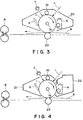
- FIGS 2 to 4 are schematic illustrations of electrophotographic apparatus including different types of process cartridges each including an electrophotographic photosensitive member according to the invention.
- Figure 5 is an X-ray diffraction chart of chlorogallium phthalocyanine obtained in Synthesis Example 1.
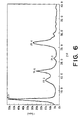
- Figure 6 is an X-ray diffraction chart of hydroxygallium phthalocyanine obtained in Synthesis Example 2.
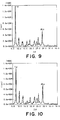
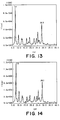
- Figures 7 - 14 are X-ray diffraction charts of hydrogallium phthalocyanine crystals obtained in Examples 1 - 8, respectively.
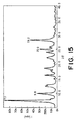
- Figure 15 is an X-ray diffraction chart of hydroxygallium phthalocyanine crystal obtained in Comparative Example 1.
- the phthalocyanine crystal of the present invention comprises a phthalocyanine compound and a minor amount of substituted or unsubstituted condensed polycyclic hydrocarbon compound.
- the hydrocarbon compound is not liberated from the phthalocyanine crystal.
- the phthalocyanine crystal of the present invention is analyzed by liquid chromatography, the presence of the hydrocarbon compound is not detected. From these facts, it is believed that the hydrocarbon compound is not merely attached to the phthalocyanine compound but is firmly held within the phthalocyanine crystal.
- Examples of the condensed polycyclic hydrocarbon compound constituting the phthalocyanine crystal of the present invention may include: pentalene, indene, naphthalene, azulene, heptalene, biphenylene, indacene, acenaphthylene, fluorene, phenalene, phenanthrene, anthracene, fluoroanthene, pyrene, naphthacene, picene and perylene.
- Naphthalene is particularly preferred.
- Examples of the substituent optionally possessed by the above condensed polycyclic hydrocarbon compound may include: alkyl groups, such as methyl and ethyl; alkoxy groups, such as methoxyl and ethoxyl; alkylamino groups, such as dimethylamino and diethylamino; nitro, cyano, haloalkyl groups such as trifluoromethyl; halogen atoms, such as chorine, fluorine and iodine. Halogen atoms are particularly preferred.
- ⁇ -chloronaphthalene and naphthalene are particularly preferred.
- the substituted or unsubstituted condensed polycyclic hydrocarbon compound may preferably be contained in a proportion of 100 - 50000 ppm based on the total weight of the phthalocyanine crystal. Outside this range, it becomes difficult to attain the remarkable effect of the present invention.
- the phthalocyanine compound constituting the phthalocyanine crystal of the present invention may comprise any forms of phthalocyanines inclusive of non-metallic phthalocyanine, metal phthalocyanines capable of having an axial ligand.
- the phthalocyanine compound can also have a substituent and can have any crystal form.
- the phthalocyanine compound may preferably comprise gallium phthalocyanine.
- the phthalocyanine crystal of the present invention may preferably comprise hydroxygallium phthalocyanine crystal having crystal forms characterized by strong peaks at Bragg angles 2 ⁇ of 7.4 deg. ⁇ 0.2 deg. and 28.2 deg. ⁇ 0.2 deg. (i.e., any crystal forms each characterized by an X-ray diffraction pattern showing a peaktop in a range of 7.2 - 7.6 deg. and a peaktop in a range of 28.0 - 28.4 deg.) according to CuK ⁇ characteristic X-ray diffractometry.
- the phthalocyanine crystal according to the present invention may be produced through various processes, inclusive of: a process comprising subjecting a phthalocyanine compound to an acid pasting step including dissolving or dispersing the phthalocyanine compound in an acid in mixture with a substituted or unsubstituted condensed polycyclic hydrocarbon compound; a process comprising subjecting a phthalocyanine compound to an acid pasting step including dissolving or dispersing a phthalocyanine compound in an acid to form a mixture, and adding the mixture into a solution containing a substituted or unsubstituted condensed polycyclic hydrocarbon compound; and a process comprising subjecting a crystal transformation step including milling a phthalocyanine compound within a solvent containing a substituted or unsubstituted condensed polycyclic hydrocarbon compound.
- the acid pasting step means a step of treating a phthalocyanine compound including dissolving or dispersing the phthalocyanine compound in an acid, adding the resultant solution or dispersion into an aqueous medium to re-precipitate a phthalocyanine solid, optionally washing the phthalocyanine solid with an alkaline aqueous solution and washing the phthalocyanine solid with de-ionized water.
- the washing with deionized water may preferably be repeated until the after-washing water is caused to have a conductivity of at most 20 ⁇ S.
- the acid used may for example be sulfuric acid, hydrochloric acid and trifluoroacetic acid, and conc. sulfuric acid is particularly preferred.
- the acid may preferably be used in an amount of 10 - 40 times the weight of the phthalocyanine compound.
- the phthalocyanine compound may preferably be dissolved or dispersed in the acid at a temperature of at most 50 °C so as to avoid the decomposition or reaction with the acid of the phthalocyanine compound.
- the substituted or unsubstituted condensed polycyclic hydrocarbon compound may preferably be used in an amount of 0.01 - 2 times the weight of the phthalocyanine compound in the case of dissolving or dispersing the phthalocyanine compound in the acid already mixed with the substituted or unsubstituted condensed polycyclic hydrocarbon compound, or 0.01 - 10 times the weight of the phthalocyanine compound in the case of adding the mixture of the phthalocyanine compound with the acid into an aqueous medium containing the substituted or unsubstituted condensed polycyclic hydrocarbon compound
- the phthalocyanine crystal according to the present invention can also be produced through a process comprising a step of milling a phthalocyanine compound within a solvent containing a substituted or unsubstituted condensed polycyclic hydrocarbon compound.
- the milling may be performed within a milling apparatus, such as a sand mill or a ball mill, wherein the phthalocyanine compound is milled together with dispersion media, such as glass beads, steel beads and alumina balls, in the presence of a solvent containing a substituted or unsubstituted condensed polycyclic hydrocarbon compound.
- the milling time can vary depending on the milling apparatus used but may preferably be on the order of 4 - 48 hours. It is preferred to check the crystal form by CuK ⁇ characteristic X-ray diffractometry for measuring the Bragg angles at an interval of 4 - 8 hours each during the milling.
- the dispersion medium may preferably be used in a weigh which is 10 - 50 times the phthalocyanine compound.
- Examples of the solvent used in the milling may include: amide solvents, such as N,N-dimethylformamide, N,N-dimethylacetamide, N-methylformamide, N-methylacetamide and N-methylpropioamide; halide solvents, such as chloroform; ether solvents, such as tetrahydrofuran; and sulfoxide solvents, such as dimethyl sulfoxide.
- the solvent may preferably be used in an amount of 10 - 30 times the weight of the phthalocyanine compound.
- the substituted or unsubstituted condensed polycyclic hydrocarbon compound may preferably be used in an amount of 0.01 - 3 times the weight of the phthalocyanine compound.
- the X-ray diffraction data referred to herein for determining the crystal form of phthalocyanine crystals are based on data measured by X-ray diffractometry using CuK ⁇ characteristic X-rays according to the following conditions:
- the electrophotographic photosensitive member according to the present invention may have a laminar structure including a single photosensitive layer containing both a charge-generating material and a charge-transporting material formed on an electroconductive support, or alternatively a laminar photosensitive layer including a charge generation layer containing a charge-generating material and a charge transport layer containing a charge-transporting material formed successively on an electroconductive support.
- a laminar photosensitive layer including a charge generation layer containing a charge-generating material and a charge transport layer containing a charge-transporting material formed successively on an electroconductive support.
- the order of lamination of the charge generation layer and the charge transport layer can be reversed. It is however preferred that the charge generation layer is disposed below the charge transport layer.
- the electroconductive support may comprise any material exhibiting electroconductivity, examples of which may include: metals, such as aluminum, aluminum alloys, copper, zinc, stainless steel, vanadium, molybdenum, chromium, titanium, nickel, indium, gold and platinum.
- metals such as aluminum, aluminum alloys, copper, zinc, stainless steel, vanadium, molybdenum, chromium, titanium, nickel, indium, gold and platinum.
- a support comprising a plastic substrate of, e.g., polyethylene, polypropylene, polyvinyl chloride, polyethylene terephthalate, acrylic resin or polyethylene fluoride, and a coating film formed thereon of a conductor such as aluminum, aluminum alloys, indium oxide, tin oxide or indium tin oxide, formed by vacuum deposition; a support comprising a plastic substrate or a support as mentioned above further coated with a conductive coating layer comprising electroconductive particles of, e.g., aluminum, titanium oxide, tin oxide, zinc oxide, carbon black or silver, together with an appropriate binder; a support comprising a plastic or paper impregnated with electroconductive particles, or a plastic support comprising an electroconductive polymer.
- a plastic substrate of, e.g., polyethylene, polypropylene, polyvinyl chloride, polyethylene terephthalate, acrylic resin or polyethylene fluoride, and a coating film formed thereon of a conductor such as aluminum, aluminum alloys,
- the undercoating layer may comprise a material, such as polyvinyl alcohol, polyethylene oxide, ethyl cellulose, methyl cellulose, casein, polyamide (e.g., nylon 6, nylon 66, nylon 610, copolymer nylon and N-alkoxymethylated nylon), polyurethane, glue, aluminum oxide or gelatine.
- the under coating layer may preferably have a thickness of 0.1 - 10 ⁇ m, particularly 0.5 - 5 ⁇ m.
- the single photosensitive layer may be formed by applying a coating liquid comprising a mixture of the phthalocyanine crystal according to the present invention as a charge-generating material and a charge-transporting material within a solution of a binder resin on the support optionally coated with the undercoating layer, etc., followed by drying of the coating liquid.
- the charge generation layer may be formed by application of a coating liquid formed by dispersing the phthalocyanine crystal according to the present invention in a solution of an appropriate binder, followed by drying of the coating liquid, but can also be formed by vacuum deposition of the phthalocyanine crystal.
- the charge transport layer may be formed by application of a coating liquid formed by dissolving a charge transporting material and a binder resin in a solvent, followed by drying of the coating liquid.
- the charge-transporting material may include: various triarylamine compounds, hydrazone compounds, stilbene compounds, pyrazoline compounds, oxazole compounds, thiazole compounds, and triarylmethane compounds.
- binder resin for providing the respective layers may include: polyester, acrylic resin, polyvinylcarbazole, phenoxy resin, polycarbonate, polyvinyl butyral, polystyrene, polyvinyl acetate, polysulfone, polyarylate, polyvinylidene chloride, arylonitrile copolymer and polyvinylbenzal.
- various coating methods may be adopted, inclusive of dipping, spray coating, spinner coating, bead coating, blade coating and beam coating.
- a photosensitive layer of a single-layer structure may preferably have a thickness of 5 - 40 ⁇ m, particularly 10 - 30 ⁇ m.
- the charge generation layer may preferably have a thickness of 0.01 - 10 ⁇ m, particularly 0.1 - 3 ⁇ m, and the charge transport layer may preferably have a thickness of 5 - 40 ⁇ m, particularly 10 - 30 ⁇ m.
- the charge-generating material may preferably be contained in 20 - 90 wt. %, more preferably 50 - 80 wt. %, of the charge generation layer.
- the charge-transporting material may preferably be contained in 20 - 80 wt. %, more preferably 30 - 70 wt. % of the charge transport layer.
- the charge-generating material may preferably contained in 3 - 30 wt. %, and the charge-transporting material may preferably be contained in 30 - 70 wt. %, respectively of the photosensitive layer.
- the phthalocyanine crystal of the present invention may be used as such a charge-generating material and can be used in mixture with another charge-generating material. In the latter case, the phthalocyanine crystal may preferably occupy at least 50 wt. % of the total charge generating materials.
- the photosensitive layer can be further coated with a protective layer as desired.
- a protective layer may be formed in a thickness of preferably 0.05 - 20 ⁇ m by application of a solution in an appropriate solvent of a resin, such as polyvinyl butyral, polyester, polycarbonate (polycarbonate Z, modified polycarbonate, etc.), nylon, polyimide, polyarylate, polyurethane, styrenebutadiene copolymer, ethylene-acrylic acid copolymer, styrene-acrylonitrile copolymer, or curable resin precursor, followed by drying and optional curing.
- the protective layer can further contain electroconductive particles of, e.g., metal oxides, such as tin oxide, an ultraviolet absorber, etc.
- a photosensitive member 1 in the form of a drum is rotated about an axis la at a prescribed peripheral speed in the direction of the arrow shown inside of the photosensitive member 1.
- the peripheral surface of the photosensitive member 1 is uniformly charged by means of a primary charger 2 to have a prescribed positive or negative potential.
- the photosensitive member 1 is imagewise exposed to light L (as by slit exposure or laser beam-scanning exposure) by using an image exposure means (not shown), whereby an electrostatic latent image is successively formed corresponding to the exposure pattern on the surface of the photosensitive member 1.
- the thus formed electrostatic latent image is developed by using a developing means 4 to form a toner image.
- the toner image is successively transferred to a transfer(-receiving) material 9 which is supplied from a supply part (not shown) to a position between the photosensitive member 1 and a transfer charger 5 in synchronism with the rotation speed of the photosensitive member 1, by means of a corona transfer charger 5.
- the transfer material 9 carrying the toner image thereon is separated from the photosensitive member 1 to be conveyed to a fixing device 8, followed by image fixing to print out the transfer material 9 as a copy outside the electrophotographic apparatus.
- Residual toner particles remaining on the surface of the photosensitive member 1 after the transfer operation are removed by a cleaning means 6 to provide a cleaned surface, and residual charge on the surface of the photosensitive member 1 is erased by a pre-exposure means 7 to prepare for the next cycle.
- Figure 2 shows an electrophotographic apparatus wherein an electrophotographic photosensitive member 1, a charging means 2 and a developing means 4 are integrally stored in a container 20 to form a process cartridge, which is detachably mountable to a main assembly of the electrophotographic apparatus by the medium of a guiding means, such as a rail of the main assembly.
- a cleaning means 6 may be disposed as shown or not disposed within the container 20.
- Figures 3 and 4 show other embodiments of the electrophotographic apparatus according to the present invention including different forms of process cartridges wherein a contact charging member 10 supplied with a voltage as a charging means is caused to contact a photosensitive member 1 to charge the photosensitive member 1.
- a contact charging member 10 supplied with a voltage as a charging means is caused to contact a photosensitive member 1 to charge the photosensitive member 1.
- toner images on the photosensitive member 1 are transferred onto a transfer material P also by means of a contact charging member 23. More specifically, a contact charging member 23 supplied with a voltage is caused to contact a transfer material, whereby a toner image on the photosensitive member 1 is transferred onto the transfer material 9.
- At least the photosensitive member 1 and the contact charging member 10 are stored within a first container 21 to form a first process cartridge, and at least the developing means 4 is stored within a second container 22 to form a second process cartridge; so that the first and second process cartridges are detachably mountable to the main assembly of the electrophotographic apparatus.
- a cleaning means 6 may be disposed as shown or not disposed within the container 21.
- the exposure light L may be provided as reflected light or transmitted light from an original, or alternatively provided as image-carrying illumination light formed by reading an original by a sensor, converting the read data into signals and driving a laser beam scanner, an LED array or a liquid crystal shutter array.
- the precipitate was washed in dispersion first within 2 % ammonia water and then four times within deionized water, and then dried in vacuum at 40 °C to obtain 13 parts of hydroxygallium phthalocyanine crystal, which exhibited a powdery X-ray diffraction pattern as shown in- Figure 7.
- Example 2 The hydroxygallium phthalocyanine prepared in Example 2 was subjected to milling and post-treatments similarly as in Example 3.
- the recovered hydroxygallium phthalocyanine crystal (as represented by C 32 H 17 GaN 8 O) exhibited an X-ray diffraction pattern as shown in Figure 10 and the following results of elementary analysis.
- the measured value of Cl content indicated that 7301 ppm of a-chloronaphthalene was contained in the crystal.
- Element Calculated (%) Measured (%) C 64.1 63.9 H 2.9 3.0 N 18.7 18.4 C1 0.0 0.160
- the hydroxygallium phthalocyanine prepared in Synthesis Example 1 was subjected to milling and post-treatments similarly as in Example 3.
- the recovered hydroxygallium phthalocyanine crystal represented by C 32 H 17 GaN 8 O
- the crystal exhibited an X-ray diffraction pattern as shown in Figure 15 and the following results of elementary analysis.
- the crystal exhibited 3.38 % of N,N-dimethylformamide. Element Calculated (%), Measured (%) C 64.1 63.6 H 2.9 3.0 N 18.7 18.9 Cl 0.0 0.0
- the aluminum cylinder was further coated by dipping within a solution of 5 parts of 6-66-610-12 quaternary polyamide copolymer resin in a solvent mixture of 70 parts of methanol and 25 parts of butanol, followed by drying, to form a 0.7 ⁇ m-thick undercoating layer.
- Example 3 2.5 part of the gallium phthalocyanine crystal prepared in Example 3 and 1 part of polyvinyl butyral resin ("S-LEC BX-1", available from Sekisui Kagaku Kogyo K.K.), were added to 70 parts of cyclohexanone, and the mixture was subjected to 3 hours of dispersion in a sand mill containing 1 mm-dia. glass beads and then diluted with 100 parts of ethyl acetate to obtain a paint. The paint was applied by dipping onto the undercoating layer and dried at 120 °C for 10 min. to form a 0.2 ⁇ m-thick charge generation layer.
- S-LEC BX-1 polyvinyl butyral resin
- Example 9 Five electrophotographic photosensitive members were prepared in the same manner as in Example 9 except that the gallium phthalocyanine crystal of Example 3 was replaced by the gallium phthalocyanine crystals of Examples 4 - 8, respectively.
- a comparative electrophotographic photosensitive member was prepared in the same manner as in Example 9 except that the gallium phthalocyanine crystal of Example 3 was replaced by the gallium phthalocyanine crystal of Comparative Example 1.
- Each of the electrophotographic photosensitive members prepared in Examples 9 - 14 and Comparative Example 2 was evaluated with respect to sensitivity and image defects of black spots and fog by incorporating it into a process cartridge of a commercially available laser beam printer ("LBP-1760", mfd. by Canon K.K.) and incorporating the process cartridge in the printer after remodeling for allowing light quantity change.
- the sensitivity measurement was performed by setting the charging condition so as to provide a dark-part potential of -600 volts and measuring a light quantity required for lowering the potential to -140 volts.
- the photosensitive member incorporated in the printer was subjected to evaluation of images formed at an initial stage in a high temperature/high humidity environment of 35 °C/80 %RH.
- the image evaluation was evaluated by the state of occurrence of image defects inclusive of black spots and fog due to charging failure according to the following standards.
- a phthalocyanine crystal formed by doping a phthalocyanine compound with a minor mount of a substituted or unsubstituted condensed polycyclic hydrocarbon compound is provided, and by incorporating the phthalocyanine crystal in a photosensitive layer, it is possible to provide an electrophotographic photosensitive member exhibiting a high sensitivity in a semiconductor wavelength region and a potential stability in repetitive use, and further providing images with less image defects, particularly less black spots in a reversal development scheme.
- the photosensitive member includes a support, and a phthalocyanine layer formed on the support and a novel phthalocyanine crystal, which comprises a phthalocyanine compound and a substituted or unsubstituted condensed polycyclic hydrocarbon compound.
Landscapes
- Chemical & Material Sciences (AREA)
- Chemical Kinetics & Catalysis (AREA)
- Organic Chemistry (AREA)
- Physics & Mathematics (AREA)
- General Physics & Mathematics (AREA)
- Photoreceptors In Electrophotography (AREA)
Abstract
Description
| Element | Calculated (%) | Measured (%) |
| C | 62.2 | 62.4 |
| H | 2.6 | 2.6 |
| N | 18.1 | 18.2 |
| Cl | 5.7 | 5.9 |
| Element | Calculated (%) | Measured (%) |
| C | 64.1 | 63.2 |
| H | 2.9 | 3.2 |
| N | 18.7 | 18.3 |
| Cl | 0.0 | 0.0 |
| Element | Calculated (%) | Measured (%) |
| C | 64.1 | 63.5 |
| H | 2.9 | 3.0 |
| N | 18.7 | 18.3 |
| Cl | 0.0 | 0.150 |
| Element | Calculated (%) | Measured (%) |
| C | 64.1 | 63.9 |
| H | 2.9 | 3.0 |
| N | 18.7 | 18.4 |
| C1 | 0.0 | 0.160 |
| Element | Calculated (%) | Measured (%) |
| C | 64.1 | 63.4 |
| H | 2.9 | 3.0 |
| N | 18.7 | 18.6 |
| Cl | 0.0 | 0.067 |
| Element | Calculated (%) | Measured (%) |
| C | 64.1 | 63.4 |
| H | 2.9 | 3.0 |
| N | 18.7 | 18.6 |
| Cl | 0.0 | 0.155 |
| Element | Calculated (%) | Measured (%) |
| C | 64.1 | 63.4 |
| H | 2.9 | 3.0 |
| N | 18.7 | 18.7 |
| Cl | 0.0 | 0.0 |
| Element | Calculated (%) | Measured (%) |
| C | 64.1 | 63.4 |
| H | 2.9 | 3.0 |
| N | 18.7 | 18.7 |
| C1 | 0.0 | 0.0 |
| Element | Calculated (%), | Measured (%) |
| C | 64.1 | 63.6 |
| H | 2.9 | 3.0 |
| N | 18.7 | 18.9 |
| Cl | 0.0 | 0.0 |
| Example | Sensitivity (µJ/cm2) | |
| 9 | 0.36 | A |
| 10 | 0.48 | A |
| 11 | 0.34 | A |
| 12 | 0.33 | A |
| 13 | 0.38 | A |
| 14 | 0.34 | A |
| Comp. 2 | 0.56 | C |
| Example | Initial Vl (volts) | Δ|Vl| (volts) |
| 11 | -180 | +10 |
| 12 | -170 | +5 |
| 14 | -180 | +10 |
| Comp. 2 | -270 | +40 |
Claims (14)
- A phthalocyanine crystal, comprising: a phthalocyanine compound and a substituted or unsubstituted condensed polycyclic hydrocarbon compound.
- A phthalocyanine crystal according to Claim 1, wherein said phthalocyanine compound is gallium phthalocyanine.
- A phthalocyanine crystal according to Claim 2, wherein said gallium phthalocyanine is hydroxygallium phthalocyanine.
- A phthalocyanine crystal according to Claim 3, having a crystal form characterized by strong peaks at Bragg angles 2 of 7.4 deg. ± 0.2 deg. and 28.2 deg. ± 0.2 deg.
- A phthalocyanine crystal according to Claim 1, wherein said substituted or unsubstituted condensed polycyclic hydrocarbon compound is a halo-substituted condensed polycyclic hydrocarbon compound.
- A phthalocyanine crystal according to Claim 5, wherein said halo-substituted condensed polycyclic hydrocarbon compound is α-chloronaphthalene.
- A phthalocyanine crystal according to Claim 1, wherein said substituted or unsubstituted condensed polycyclic hydrocarbon compound is naphthalene.
- A process for producing a phthalocyanine crystal comprising a phthalocyanine compound and a substituted or unsubstituted condensed polycyclic hydrocarbon compound, said process comprising subjecting a phthalocyanine compound to an acid pasting step including dissolving or dispersing the phthalocyanine compound in an acid which has been mixed with a substituted or unsubstituted condensed polycyclic hydrocarbon compound.
- A process for producing a phthalocyanine crystal comprising a phthalocyanine compound and a substituted or unsubstituted condensed polycyclic hydrocarbon compound, said process comprising subjecting a phthalocyanine compound to an acid pasting step including dissolving or dispersing a phthalocyanine compound in an acid to form a mixture, and adding the mixture into a solution containing a substituted or unsubstituted condensed polycyclic hydrocarbon compound.
- A process for producing a phthalocyanine crystal comprising a phthalocyanine compound and a substituted or unsubstituted condensed polycyclic hydrocarbon compound, said process comprising subjecting a crystal transformation step including milling a phthalocyanine compound within a solvent containing a substituted or unsubstituted condensed polycyclic hydrocarbon compound.
- An electrophotographic photosensitive member, comprising: an electroconductive support, and a photosensitive layer formed thereon, wherein said photosensitive layer contains a phthalocyanine crystal comprising a phthalocyanine compound and a substituted or unsubstituted condensed polycyclic hydrocarbon compound.
- An electrophotographic photosensitive member according to Claim 11. wherein the phthalocyanine layer is functionally divided into at least two layers including a charge generation layer comprising the phthalocyanine crystal, and a charge transport layer.
- A process cartridge, comprising: an electrophotographic photosensitive member and at least one means selected from the group consisting of charging means, developing means and cleaning means; said electrophotographic photosensitive member and said at least one means being integrally supported and detachably mountable to a main assembly of an electrophotographic apparatus,
wherein said electrophotographic photosensitive member comprises a support, and a photosensitive layer disposed on the support and containing a phthalocyanine compound which comprises a phthalocyanine compound and a substituted or unsubstituted condensed polycyclic hydrocarbon compound. - An electrophotographic apparatus, comprising: an electrophotographic photosensitive member, and charging means, developing means and transfer means respectively disposed opposite to the electrophotographic photosensitive member,
wherein said electrophotographic photosensitive member comprises a support, and a photosensitive layer disposed on the support and containing a phthalocyanine compound which comprises a phthalocyanine compound and a substituted or unsubstituted condensed polycyclic hydrocarbon compound.
Applications Claiming Priority (2)
| Application Number | Priority Date | Filing Date | Title |
|---|---|---|---|
| JP2000022611 | 2000-01-31 | ||
| JP2000022611 | 2000-01-31 |
Publications (2)
| Publication Number | Publication Date |
|---|---|
| EP1130475A1 true EP1130475A1 (en) | 2001-09-05 |
| EP1130475B1 EP1130475B1 (en) | 2010-04-14 |
Family
ID=18548888
Family Applications (1)
| Application Number | Title | Priority Date | Filing Date |
|---|---|---|---|
| EP01102048A Expired - Lifetime EP1130475B1 (en) | 2000-01-31 | 2001-01-30 | Production process for phthalocyanine crystals |
Country Status (3)
| Country | Link |
|---|---|
| US (2) | US6447967B2 (en) |
| EP (1) | EP1130475B1 (en) |
| DE (1) | DE60141786D1 (en) |
Cited By (1)
| Publication number | Priority date | Publication date | Assignee | Title |
|---|---|---|---|---|
| CN104854512A (en) * | 2012-12-14 | 2015-08-19 | 佳能株式会社 | Electrophotographic photosensitive member, process cartridge, and electrophotographic apparatus, and gallium phthalocyanine crystal |
Families Citing this family (7)
| Publication number | Priority date | Publication date | Assignee | Title |
|---|---|---|---|---|
| DE60300471T2 (en) | 2002-07-19 | 2006-02-23 | Ricoh Co., Ltd. | Toners containing zirconium-organometallic-based charge control agents and imaging methods |
| CN1313551C (en) * | 2005-10-18 | 2007-05-02 | 天津大学 | Process for preparing conductive paint of organic light conductor aluminium surface |
| WO2015005442A1 (en) | 2013-07-12 | 2015-01-15 | 三菱化学株式会社 | Electrophotographic photoreceptor, electrophotographic photoreceptor cartridge, image formation device, and polyarylate resin |
| JP2015210498A (en) * | 2014-04-30 | 2015-11-24 | キヤノン株式会社 | Electrophotographic photosensitive member, process cartridge and electrophotographic apparatus, and gallium phthalocyanine crystal |
| JP6452385B2 (en) * | 2014-06-13 | 2019-01-16 | キヤノン株式会社 | Electrophotographic photosensitive member, method for producing the same, electrophotographic apparatus, and process cartridge |
| JP6541447B2 (en) * | 2014-06-13 | 2019-07-10 | キヤノン株式会社 | Hydroxygallium phthalocyanine crystal, electrophotographic photosensitive member, process cartridge and electrophotographic apparatus |
| US10838313B2 (en) * | 2017-04-28 | 2020-11-17 | Canon Kabushiki Kaisha | Electrophotographic photosensitive member, process cartridge, and electrophotographic apparatus |
Citations (7)
| Publication number | Priority date | Publication date | Assignee | Title |
|---|---|---|---|---|
| JPH04159373A (en) * | 1990-10-24 | 1992-06-02 | Canon Inc | Oxytitanium phthalocyanine with novel crystalline form and electrophotographic photoreceptor containing the same |
| EP0654506A2 (en) * | 1993-11-22 | 1995-05-24 | Ciba-Geigy Ag | Process for the manufacture of synergetic mixtures of pigments |
| EP0803546A1 (en) | 1996-04-26 | 1997-10-29 | Canon Kabushiki Kaisha | Hydroxygallium phthalocyanine compound, production process therefor and electrophotographic photosensitive member using the compound |
| JPH1067946A (en) | 1996-04-26 | 1998-03-10 | Canon Inc | Hydroxygallium phthalocyanine, method for producing the same, electrophotographic photoreceptor using the hydroxygallium phthalocyanine, electrophotographic apparatus and process cartridge using the electrophotographic photoreceptor |
| EP0835912A1 (en) * | 1996-09-13 | 1998-04-15 | Orient Chemical Industries, Ltd. | My-oxo-gallium phthalocyanine dimer having novel polymorph and electrophotographic photoreceptor prepared by using the same |
| US5985505A (en) * | 1999-04-21 | 1999-11-16 | Xerox Corporation | Processes for the preparation of hydroxygallium phthalocyanine |
| JPH11349841A (en) * | 1998-06-04 | 1999-12-21 | Mitsubishi Paper Mills Ltd | Titanyloxyphthalocyanine, method for producing the same, and electrophotographic photoreceptor using the same |
Family Cites Families (19)
| Publication number | Priority date | Publication date | Assignee | Title |
|---|---|---|---|---|
| US5358813A (en) | 1902-01-13 | 1994-10-25 | Fuji Xerox Co., Ltd. | Crystals of chlorogallium phthalocyanine and method of preparing them |
| JP3123185B2 (en) | 1991-04-22 | 2001-01-09 | 富士ゼロックス株式会社 | Novel crystal of chlorogallium phthalocyanine, photoconductive material comprising the new crystal, and electrophotographic photoreceptor using the same |
| JPH0629976B2 (en) | 1985-03-22 | 1994-04-20 | 大日本インキ化学工業株式会社 | Single layer type electrophotographic photoreceptor |
| JPH0629975B2 (en) | 1985-04-16 | 1994-04-20 | 大日本インキ化学工業株式会社 | Multilayer type photoconductor for electrophotography |
| JPS6267094A (en) | 1985-09-18 | 1987-03-26 | Mitsubishi Chem Ind Ltd | Crystalline oxytitanium phthalocyanine and electrophotographic photoreceptor |
| JPH0797221B2 (en) | 1987-07-10 | 1995-10-18 | コニカ株式会社 | Image forming method |
| US4898799A (en) | 1987-07-10 | 1990-02-06 | Konica Corporation | Photoreceptor |
| JPS63218768A (en) | 1987-12-25 | 1988-09-12 | Asahi Chem Ind Co Ltd | Oxytitanium phthalocyanine |
| JPH02284146A (en) | 1989-04-25 | 1990-11-21 | Mitsubishi Paper Mills Ltd | Processing liquid composition for planographic printing plate |
| JPH02285146A (en) | 1989-04-26 | 1990-11-22 | Hideyo Okamoto | Protective handrail column for prefabricated scaffolding |
| JP3166293B2 (en) | 1991-04-26 | 2001-05-14 | 富士ゼロックス株式会社 | Novel hydroxygallium phthalocyanine crystal, photoconductive material comprising the new crystal, and electrophotographic photoreceptor using the same |
| JP3216426B2 (en) | 1994-06-06 | 2001-10-09 | 富士ゼロックス株式会社 | Hydroxygallium phthalocyanine crystal and electrophotographic photoreceptor using the same |
| JP3060199B2 (en) | 1994-09-30 | 2000-07-10 | 富士ゼロックス株式会社 | Method for producing hydroxygallium phthalocyanine crystal |
| JP3395484B2 (en) | 1995-10-13 | 2003-04-14 | 富士ゼロックス株式会社 | Hydroxygallium phthalocyanine crystal, method for producing the same, and electrophotographic photoreceptor using the same |
| JP3686141B2 (en) | 1995-11-02 | 2005-08-24 | 富士ゼロックス株式会社 | Electrophotographic photoreceptor using hydroxygallium phthalocyanine crystal |
| JPH107927A (en) | 1996-04-22 | 1998-01-13 | Fuji Xerox Co Ltd | Chlorogallium phthalocyanine crystal, its production, and electrophotographic photoreceptor containing the same |
| JPH1017784A (en) | 1996-07-04 | 1998-01-20 | Fuji Xerox Co Ltd | Chlorogallium phthalocyanine crystal and production of dispersion liquid of the crystal |
| JP2985941B2 (en) | 1996-11-29 | 1999-12-06 | 日清食品株式会社 | Instant noodles and method for producing the same |
| US6225015B1 (en) * | 1998-06-04 | 2001-05-01 | Mitsubishi Paper Mills Ltd. | Oxytitanium phthalocyanine process for the production thereof and electrophotographic photoreceptor to which the oxytitanium phthalocyanine is applied |
-
2001
- 2001-01-30 US US09/771,714 patent/US6447967B2/en not_active Expired - Lifetime
- 2001-01-30 EP EP01102048A patent/EP1130475B1/en not_active Expired - Lifetime
- 2001-01-30 DE DE60141786T patent/DE60141786D1/en not_active Expired - Lifetime
-
2002
- 2002-08-23 US US10/226,341 patent/US6768006B2/en not_active Expired - Fee Related
Patent Citations (7)
| Publication number | Priority date | Publication date | Assignee | Title |
|---|---|---|---|---|
| JPH04159373A (en) * | 1990-10-24 | 1992-06-02 | Canon Inc | Oxytitanium phthalocyanine with novel crystalline form and electrophotographic photoreceptor containing the same |
| EP0654506A2 (en) * | 1993-11-22 | 1995-05-24 | Ciba-Geigy Ag | Process for the manufacture of synergetic mixtures of pigments |
| EP0803546A1 (en) | 1996-04-26 | 1997-10-29 | Canon Kabushiki Kaisha | Hydroxygallium phthalocyanine compound, production process therefor and electrophotographic photosensitive member using the compound |
| JPH1067946A (en) | 1996-04-26 | 1998-03-10 | Canon Inc | Hydroxygallium phthalocyanine, method for producing the same, electrophotographic photoreceptor using the hydroxygallium phthalocyanine, electrophotographic apparatus and process cartridge using the electrophotographic photoreceptor |
| EP0835912A1 (en) * | 1996-09-13 | 1998-04-15 | Orient Chemical Industries, Ltd. | My-oxo-gallium phthalocyanine dimer having novel polymorph and electrophotographic photoreceptor prepared by using the same |
| JPH11349841A (en) * | 1998-06-04 | 1999-12-21 | Mitsubishi Paper Mills Ltd | Titanyloxyphthalocyanine, method for producing the same, and electrophotographic photoreceptor using the same |
| US5985505A (en) * | 1999-04-21 | 1999-11-16 | Xerox Corporation | Processes for the preparation of hydroxygallium phthalocyanine |
Non-Patent Citations (2)
| Title |
|---|
| PATENT ABSTRACTS OF JAPAN vol. 16, no. 455 22 September 1992 (1992-09-22) * |
| PATENT ABSTRACTS OF JAPAN vol. 2000, no. 03 30 March 2000 (2000-03-30) * |
Cited By (3)
| Publication number | Priority date | Publication date | Assignee | Title |
|---|---|---|---|---|
| CN104854512A (en) * | 2012-12-14 | 2015-08-19 | 佳能株式会社 | Electrophotographic photosensitive member, process cartridge, and electrophotographic apparatus, and gallium phthalocyanine crystal |
| EP2932333A4 (en) * | 2012-12-14 | 2016-08-03 | Canon Kk | Electrophotographic photosensitive member, process cartridge, and electrophotographic apparatus, and gallium phthalocyanine crystal |
| US9500965B2 (en) | 2012-12-14 | 2016-11-22 | Canon Kabushiki Kaisha | Electrophotographic photosensitive member, process cartridge, and electrophotographic apparatus, and gallium phthalocyanine crystal |
Also Published As
| Publication number | Publication date |
|---|---|
| US20020001765A1 (en) | 2002-01-03 |
| US20030054273A1 (en) | 2003-03-20 |
| US6768006B2 (en) | 2004-07-27 |
| EP1130475B1 (en) | 2010-04-14 |
| US6447967B2 (en) | 2002-09-10 |
| DE60141786D1 (en) | 2010-05-27 |
Similar Documents
| Publication | Publication Date | Title |
|---|---|---|
| JP2502404B2 (en) | Oxytitanium phthalocyanine, method for producing the same, electrophotographic photosensitive member using the same, apparatus unit having the electrophotographic photosensitive member, and electrophotographic apparatus | |
| JP4604106B2 (en) | Crystals of porphyrinato zinc compounds | |
| EP1063572B1 (en) | Electrophotographic photosensitve member, and process cartridge and electrophotographic apparatus including the photosensitive member | |
| JPH0598181A (en) | New crystal of chlorogallium phthalocyanine, photoconductive material composed of the same new crystal and electrophotographic photoreceptor using the same | |
| EP1721940B1 (en) | JGaPc compounds, process for production therefore and electrophotographic photosensitive member using the compounds | |
| KR0156755B1 (en) | Electrophotographic photosensitive member, electrophotographic apparatus including same and electrophotographic apparatus unit | |
| US5885737A (en) | Hydroxygallium phthalocyanine compound, production process therefor and electrophotographic photosensitive member using the compound | |
| JP5522128B2 (en) | Phthalocyanine composition, photoconductive material using the same, electrophotographic photosensitive member, electrophotographic photosensitive member cartridge, and image forming apparatus | |
| JP2882977B2 (en) | Method for producing hydroxygallium phthalocyanine crystal and electrophotographic photoreceptor using the same | |
| US5932722A (en) | Hydroxygallium phthalocyanine compound, production process therefor and electrophotographic photosensitive member using the compound | |
| US6447967B2 (en) | Phthalocyanine crystal, production process therefor, and electrophotographic photosensitive member, process cartridge and apparatus using the crystal | |
| JP4134200B2 (en) | Electrophotographic photoreceptor and image forming apparatus | |
| JP2003192933A (en) | Method for producing gallium phthalocyanine, method for producing chlorogallium phthalocyanine crystal, method for producing hydroxygallium phthalocyanine crystal, gallium phthalocyanine, chlorogallium phthalocyanine crystal, hydroxygallium phthalocyanine crystal, electrophotographic photosensitive member, process cartridge, and electrophotographic apparatus | |
| JP4109796B2 (en) | Method for producing chlorogallium phthalocyanine, method for producing chlorogallium phthalocyanine crystal, method for producing hydroxygallium phthalocyanine crystal, electrophotographic photosensitive member, process cartridge, and electrophotographic apparatus | |
| JP2879369B2 (en) | Electrophotographic photoreceptor, electrophotographic apparatus provided with the electrophotographic photoreceptor, and facsimile | |
| JP5181410B2 (en) | Phthalocyanine composition, photoconductive material using the same, electrophotographic photosensitive member, electrophotographic photosensitive member cartridge, and image forming apparatus | |
| JP2001288188A (en) | Phthalocyanine crystal, method for producing the phthalocyanine crystal, electrophotographic photosensitive member using the phthalocyanine crystal, process cartridge, and electrophotographic apparatus | |
| JP2000129155A (en) | Crystalline oxotitanyl phthalocyanine and electrophotographic photoreceptor | |
| JP2879370B2 (en) | Electrophotographic photoreceptor, electrophotographic apparatus provided with the electrophotographic photoreceptor, and facsimile | |
| JP5031134B2 (en) | Method for producing phthalocyanine crystals | |
| JP2931070B2 (en) | Novel crystal form of oxytitanium phthalocyanine and electrophotographic photoreceptor using the same | |
| JP2841242B2 (en) | Electrophotographic photoreceptor, electrophotographic apparatus provided with the electrophotographic photoreceptor, and facsimile | |
| JPH04182655A (en) | Electrophotographic photoreceptor, electrophotographic device equipped with the electrophotographic photoreceptor, and facsimile | |
| JP2814017B2 (en) | Electrophotographic photoreceptor, electrophotographic apparatus provided with the electrophotographic photoreceptor, and facsimile | |
| JPH04254862A (en) | Electrophotographic photosensitive body and electrophotographic device and facsimile with electrophotographic photosensitive body |
Legal Events
| Date | Code | Title | Description |
|---|---|---|---|
| PUAI | Public reference made under article 153(3) epc to a published international application that has entered the european phase |
Free format text: ORIGINAL CODE: 0009012 |
|
| 17P | Request for examination filed |
Effective date: 20010130 |
|
| AK | Designated contracting states |
Kind code of ref document: A1 Designated state(s): AT BE CH CY DE DK ES FI FR GB GR IE IT LI LU MC NL PT SE TR Kind code of ref document: A1 Designated state(s): DE FR GB IT |
|
| AX | Request for extension of the european patent |
Free format text: AL;LT;LV;MK;RO;SI |
|
| AKX | Designation fees paid |
Free format text: DE FR GB IT |
|
| 17Q | First examination report despatched |
Effective date: 20071023 |
|
| GRAP | Despatch of communication of intention to grant a patent |
Free format text: ORIGINAL CODE: EPIDOSNIGR1 |
|
| RTI1 | Title (correction) |
Free format text: PRODUCTION PROCESS FOR PHTHALOCYANINE CRYSTALS |
|
| GRAS | Grant fee paid |
Free format text: ORIGINAL CODE: EPIDOSNIGR3 |
|
| GRAA | (expected) grant |
Free format text: ORIGINAL CODE: 0009210 |
|
| AK | Designated contracting states |
Kind code of ref document: B1 Designated state(s): DE FR GB IT |
|
| REG | Reference to a national code |
Ref country code: GB Ref legal event code: FG4D |
|
| REF | Corresponds to: |
Ref document number: 60141786 Country of ref document: DE Date of ref document: 20100527 Kind code of ref document: P |
|
| PLBE | No opposition filed within time limit |
Free format text: ORIGINAL CODE: 0009261 |
|
| STAA | Information on the status of an ep patent application or granted ep patent |
Free format text: STATUS: NO OPPOSITION FILED WITHIN TIME LIMIT |
|
| 26N | No opposition filed |
Effective date: 20110117 |
|
| PGFP | Annual fee paid to national office [announced via postgrant information from national office to epo] |
Ref country code: DE Payment date: 20140131 Year of fee payment: 14 |
|
| PGFP | Annual fee paid to national office [announced via postgrant information from national office to epo] |
Ref country code: IT Payment date: 20140102 Year of fee payment: 14 Ref country code: FR Payment date: 20140124 Year of fee payment: 14 |
|
| PGFP | Annual fee paid to national office [announced via postgrant information from national office to epo] |
Ref country code: GB Payment date: 20140123 Year of fee payment: 14 |
|
| REG | Reference to a national code |
Ref country code: DE Ref legal event code: R119 Ref document number: 60141786 Country of ref document: DE |
|
| GBPC | Gb: european patent ceased through non-payment of renewal fee |
Effective date: 20150130 |
|
| PG25 | Lapsed in a contracting state [announced via postgrant information from national office to epo] |
Ref country code: GB Free format text: LAPSE BECAUSE OF NON-PAYMENT OF DUE FEES Effective date: 20150130 Ref country code: DE Free format text: LAPSE BECAUSE OF NON-PAYMENT OF DUE FEES Effective date: 20150801 |
|
| REG | Reference to a national code |
Ref country code: FR Ref legal event code: ST Effective date: 20150930 |
|
| PG25 | Lapsed in a contracting state [announced via postgrant information from national office to epo] |
Ref country code: FR Free format text: LAPSE BECAUSE OF NON-PAYMENT OF DUE FEES Effective date: 20150202 |
|
| PG25 | Lapsed in a contracting state [announced via postgrant information from national office to epo] |
Ref country code: IT Free format text: LAPSE BECAUSE OF NON-PAYMENT OF DUE FEES Effective date: 20150130 |