EP1128712A2 - Netzdimmer mit niedriger Verzerrung und dimmbares Vorschaltgerät - Google Patents
Netzdimmer mit niedriger Verzerrung und dimmbares Vorschaltgerät Download PDFInfo
- Publication number
- EP1128712A2 EP1128712A2 EP01100637A EP01100637A EP1128712A2 EP 1128712 A2 EP1128712 A2 EP 1128712A2 EP 01100637 A EP01100637 A EP 01100637A EP 01100637 A EP01100637 A EP 01100637A EP 1128712 A2 EP1128712 A2 EP 1128712A2
- Authority
- EP
- European Patent Office
- Prior art keywords
- value
- signal
- pulse width
- firing angle
- dimming
- Prior art date
- Legal status (The legal status is an assumption and is not a legal conclusion. Google has not performed a legal analysis and makes no representation as to the accuracy of the status listed.)
- Withdrawn
Links
Images




Classifications
-
- H—ELECTRICITY
- H05—ELECTRIC TECHNIQUES NOT OTHERWISE PROVIDED FOR
- H05B—ELECTRIC HEATING; ELECTRIC LIGHT SOURCES NOT OTHERWISE PROVIDED FOR; CIRCUIT ARRANGEMENTS FOR ELECTRIC LIGHT SOURCES, IN GENERAL
- H05B41/00—Circuit arrangements or apparatus for igniting or operating discharge lamps
- H05B41/14—Circuit arrangements
- H05B41/26—Circuit arrangements in which the lamp is fed by power derived from DC by means of a converter, e.g. by high-voltage DC
- H05B41/28—Circuit arrangements in which the lamp is fed by power derived from DC by means of a converter, e.g. by high-voltage DC using static converters
- H05B41/282—Circuit arrangements in which the lamp is fed by power derived from DC by means of a converter, e.g. by high-voltage DC using static converters with semiconductor devices
-
- H—ELECTRICITY
- H05—ELECTRIC TECHNIQUES NOT OTHERWISE PROVIDED FOR
- H05B—ELECTRIC HEATING; ELECTRIC LIGHT SOURCES NOT OTHERWISE PROVIDED FOR; CIRCUIT ARRANGEMENTS FOR ELECTRIC LIGHT SOURCES, IN GENERAL
- H05B41/00—Circuit arrangements or apparatus for igniting or operating discharge lamps
- H05B41/14—Circuit arrangements
- H05B41/36—Controlling
- H05B41/38—Controlling the intensity of light
- H05B41/39—Controlling the intensity of light continuously
- H05B41/392—Controlling the intensity of light continuously using semiconductor devices, e.g. thyristor
- H05B41/3921—Controlling the intensity of light continuously using semiconductor devices, e.g. thyristor with possibility of light intensity variations
- H05B41/3924—Controlling the intensity of light continuously using semiconductor devices, e.g. thyristor with possibility of light intensity variations by phase control, e.g. using a triac
-
- Y—GENERAL TAGGING OF NEW TECHNOLOGICAL DEVELOPMENTS; GENERAL TAGGING OF CROSS-SECTIONAL TECHNOLOGIES SPANNING OVER SEVERAL SECTIONS OF THE IPC; TECHNICAL SUBJECTS COVERED BY FORMER USPC CROSS-REFERENCE ART COLLECTIONS [XRACs] AND DIGESTS
- Y10—TECHNICAL SUBJECTS COVERED BY FORMER USPC
- Y10S—TECHNICAL SUBJECTS COVERED BY FORMER USPC CROSS-REFERENCE ART COLLECTIONS [XRACs] AND DIGESTS
- Y10S315/00—Electric lamp and discharge devices: systems
- Y10S315/04—Dimming circuit for fluorescent lamps
Definitions
- the present invention relates to dimmable ballast systems.
- dimming control In today's dimmable fluorescent lighting market, a number of different methods are used for dimming control.
- One popular method for dimming control employs a dimmer control interposed between a power line and an input of a dimming ballast.
- the dimming control comprises a phase-control device, such as a triac, to modify a firing phase angle of an alternating current (AC) powering signal.
- a dimming ballast circuit in turn, controllably dims a fluorescent lamp based on the firing phase angle.
- the aforementioned dimming control approach yields an undesirably-high total harmonic distortion (THD) and an undesirably-low power factor.
- THD total harmonic distortion
- the high THD is caused by the chopping action of the triac.
- U.S. Patent No. 5,872,429 discloses use of coded perturbations in the line signal to obtain a lower THD.
- An encoder encodes a command over a command period of several cycles in the line signal. The encoder encodes the command by selectively injecting perturbations near zero-crossings of specific cycles in the command period.
- a controller within a ballast detects the perturbations over the command period, and decodes the command. The perturbations may be injected only when a change of light level is needed.
- Embodiments of the present invention beneficially provide a low THD line dimmer and dimming ballast which require neither a multi-cycle command encoder within the line dimmer nor a multi-cycle command decoder within the ballast.
- the THD is reduced by limiting the maximum firing angle produced by the line dimmer.
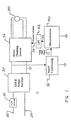
- FIG. 1 is a block diagram of an embodiment of a dimming system for dimming a lamp 20.
- the lamp 20 comprises a discharge lamp, such as a compact fluorescent lamp or another fluorescent lamp.
- the dimming system receives mains power from AC power lines 22 and 24.
- the AC power lines 22 and 24 may be referred to as either “HOT” and “NEUTRAL” respectively, or “SUPPLY” and “COMMON” respectively.
- a line dimmer 26 is coupled to the AC power line 22 to provide a power-line-type control for dimming the lamp 20.
- the line dimmer 26 varies a firing angle of a phase-cut powering signal to encode a dimming-control signal therein.
- the dimming system dims the lamp 20 based on the firing angle. An embodiment of the line dimmer 26 is subsequently described with reference to FIG. 2.
- An EMI (electromagnetic interference) filter and bridge rectifier stage 30 is coupled to an output of the line dimmer 26 and the AC power line 24.
- the EMI filter and bridge rectifier stage 30 provides a filtered and rectified AC signal to a boost, dimming inverter circuit 32 coupled thereto.
- the boost, dimming inverter circuit 32 is for controlling and powering the lamp 20 based upon power received from the EMI filter and bridge rectifier stage 30 and a dimming command signal received from an input 34.
- a signal conditioner 36 processes the filtered and rectified AC signal from the EMI filter and bridge rectifier stage 30 to generate a firing angle signal.
- a firing-angle-to-pulse-width-modulation (PWM) converter 40 generates a pulsed signal whose pulse width is modulated based on the firing angle of the firing angle signal.
- a filter 42 such as a low pass filter, is responsive to the firing-angle-to-PWM converter 40.
- the filter 42 produces a signal having a DC voltage level related to the pulse width of the pulsed signal generated by the firing-angle-to-PWM converter 40.
- the signal from the filter 42 is applied to the input 34 to provide a dimming command signal.
- the boost, dimming inverter circuit 32 dims the lamp 20 based on the dimming command signal. Therefore, the signal conditioner 36, the firing-angle-to-PWM converter 40, the filter 42 and the boost, dimming inverter 32 cooperate to dim the lamp 20 based on the firing angle produced by the line dimmer 26.
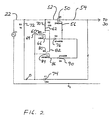
- FIG. 2 is a schematic diagram of an implementation of the line dimmer 26 of FIG. 1.
- a triac 50 has a first terminal 52 coupled to the AC power line 22 and a second terminal 54 coupled to the EMI and bridge rectifier stage 30.
- the triac 50 electrically couples the AC power line 22 with the EMI and bridge rectifier stage 30 for a first portion of an AC cycle, and substantially uncouples the AC power line 22 with the EMI and bridge rectifier stage 30 for a second portion of an AC cycle.
- the firing angle i.e. the angle of the second portion, is controllable via a gate 56 of the triac 50.
- a transistor 60 such as an n-channel MOSFET, has drain 62, a gate 64 and a source 66.
- the drain 62 is coupled to the first terminal 52 by a resistor 70.
- the gate 64 is coupled to the first terminal 52 by a resistor 72.
- the gate 64 is coupled to the second terminal 54 by a capacitor 74.
- the source 66 is coupled to the gate 56 of the triac 50 by a diode 76.
- the diode 76 has an anode coupled to the source 66 and a cathode coupled to the gate 56.
- a transistor 80 such as a p-channel MOSFET, has drain 82, a gate 84 and a source 86.
- the drain 82 is coupled to the first terminal 52 by the resistor 70.
- the gate 84 is coupled to the first terminal 52 by the resistor 72.
- the gate 84 is coupled to the second terminal 54 by the capacitor 74.
- the source 86 is coupled to the gate 56 of the triac 50 by a diode 90.
- the diode 90 has a cathode coupled to the source 86 and an anode coupled to the gate 56.
- the triac 50 turns off, i.e. substantially uncouples the first terminal 52 from the second terminal 54, near each zero crossing of an AC cycle.
- the capacitor 74 is charged based upon a voltage difference between the first terminal 52 and the second terminal 54.
- the transistor 60 supplies current from the source 66 to the gate 56 of the triac 50 via the diode 76. This current causes the triac 50 to turn on, i.e. to couple the first terminal 52 with the second terminal 54.
- the first terminal 52 and the second terminal 54 remain coupled until near a zero down-crossing.
- the triac 50 uncouples the first terminal 52 from the second terminal 54.
- the capacitor 74 is charged based upon a voltage difference between the first terminal 52 and the second terminal 54.
- the transistor 80 sinks current at the source 86.
- This current flows to the source 86 from the gate 56 of the triac 50 via the diode 90.
- This current causes the triac 50 to turn on, i.e. to couple the first terminal 52 with the second terminal 54.
- the aforementioned implementation of the line dimmer 26 varies a firing angle within a small range to limit a resulting line current distortion.
- the firing angle for a minimum load condition is less than or equal to about 30 degrees.
- the firing angle for a minimum load condition may be less than or equal to about 25 degrees.
- the firing angle for a minimum load condition may be less than or equal to about 20 degrees.
- the firing angle for a full load condition may be less than or equal to about 10 degrees.
- the firing angle for a full load condition may be less than or equal to about 5 degrees.
- the firing angle for a full load condition may be about 0 degrees.
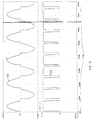
- FIG. 3 shows an example waveform 110 produced at the second terminal 54 for a full load condition.
- FIG. 4 shows an example waveform 112 produced at the second terminal 54 for a minimum load condition.
- FIG. 5 is a schematic diagram of an implementation of a dimming system for dimming the lamp 20.
- the EMI filter and bridge rectifier stage 30 comprises a series combination of an inductor 120 and a capacitor 122 which couples the line dimmer 26 to ground 124.
- a series combination of an inductor 126 and a capacitor 130 couples the AC power line 24 to ground 124.
- Diodes 132, 134, 136 and 140 are configured as a bridge rectifier.
- the bridge rectifier is coupled to a junction 142 of the inductor 120 and the capacitor 122 and to a junction 144 of the inductor 126 and the capacitor 130.
- the bridge rectifier has outputs 146 and 150.
- the output 150 is coupled to a ballast-side ground 152.
- the signal conditioner 36 comprises a resistor 154, a capacitor 156 and a Zener diode 160.
- the resistor 154 couples the output 146 to a juncture 162.
- a parallel combination of the capacitor 156 and the Zener diode couples the juncture 162 to the ballast-side ground 152.
- the signal conditioner 36 At the juncture 162, the signal conditioner 36 generates a pulsed signal having a high level when the triac 50 is on, and a low level when the triac 50 is off.
- FIG. 3 shows an example waveform 164 produced at the juncture 162 for a full load condition.
- FIG. 4 shows an example waveform 166 produced at the juncture 162 for a minimum load condition.
- the firing-angle-to-PWM converter 40 comprises a microcontroller 170.
- the microcontroller 170 has an input 172 coupled to the juncture 162.
- the microcontroller 170 is programmed to convert a firing angle received at the input 172 to a pulse width modulated signal provided at an output 174.
- the microcontroller 170 determines a duration of a low period of a pulsed signal at the input 172.
- the microcontroller 170 At the output 174, the microcontroller 170 generates a pulsed signal having a pulse width based on the duration.
- the pulse width is inversely related to the duration.
- the pulse width at the output 174 is based on a maximum pulse width value. If the duration of the low period is at an upper value, the pulse width at the output 174 is based on a minimum pulse width value. It is noted that in alternative embodiments, the microcontroller 170 may determine a duration of a high period of a pulsed signal at the input 172, and generate a pulsed signal having a pulse width directly related, i.e. non-inversely related, to the duration.
- Power is supplied to the microcontroller 170 by a voltage supply circuit comprising capacitors 176 and 180, Zener diodes 182 and 184, a diode 186 and a resistor 190.
- a series combination of the capacitor 176 and the Zener diode 182 couples the output 146 to the output 150.
- the junction of the capacitor 176 and the Zener diode 182 is coupled to a voltage supply input 192 of the microcontroller 170 by a series combination of the diode 186 and the resistor 190.
- a parallel combination of the capacitor 180 and the Zener diode 184 couples the voltage supply input 192 to the ballast-side ground 152.
- a ground input 194 of the microcontroller 170 is coupled to the ballast-side ground 152.
- the output 174 is coupled to an input of the filter 42.
- the filter 42 comprises a resistor 200 and a capacitor 202 which form a low-pass filter.
- the filter 42 outputs a signal having a DC level based on the pulse width of the signal generated by the firing-angle-to-PWM converter 40.
- the input 34 of the boost, dimming inverter circuit 32 is responsive to the filter 42 via a resistor 204.
- the boost, dimming inverter circuit 32 comprises a power factor correction (PFC) stage 206, an inverter and output stage 210, and a lamp current sensing circuit 212.
- the PFC stage 206 comprises an integrated circuit 214 such as one having part number MC33262, windings 216 and 220, resistors 222 and 224, a transistor 226, a diode 230, and a capacitor 232.
- the inverter and output stage 210 comprises an inverter controller driver integrated circuit 240, capacitors 242, 244, 246, 250, 252 and 254, resistors 256, 258, 260, 262, 264, 266, 268, 270 and 272, diodes 274 and 276, transistors 280 and 282, and inductors 284 and 286.
- the lamp current sensing circuit 212 comprises capacitors 300, 302 and 304, resistors 306, 310 and 312, diodes 314, 316 and 318, and inductor 320.
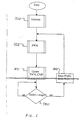
- FIG. 6 is a flow chart of a main routine performed by the microcontroller 170 to convert a pulsed signal at the input 172 to a pulse-width modulated signal at the output 174.
- the microcontroller 170 performs an initialization routine.
- the microcontroller 170 configures the input/output pins, sets an option register, sets a PWM_CMD variable to a maximum value such as 10, sets a PERIOD value to a value such as 31, sets a LENGTH value to a value such as 88, sets a CMD_COUNT variable to an initial value such as 0, sets a STEP_COUNT variable to an initial value such as 0, sets an INP_PRE variable to high (i.e. a logical "1"), and clears a timer value TMR0.
- the STEP_COUNT variable is used to count a number of steps in an output period.
- the PERIOD value is used to determine when to initiate a subsequent output period based on the STEP_COUNT variable.
- the LENGTH value is used to represent a number of instruction cycles, as determined by the timer value TMR0, per step.
- the PWM_CMD variable indicates a number of steps that a PWM output signal has a high value.
- the CMD_COUNT variable is used to count a number of steps that the input 172 has a low value.
- the INP_PRE variable indicates a state of the input 172 in a previous step.
- the microcontroller 170 performs a PWM routine.
- the microcontroller 170 determines a next value of a PWM output signal based on a present value of the PWM output signal, the STEP_COUNT value, the PWM_CMD value, and the PERIOD value.
- the state of the PWM output signal is herein denoted by a variable PWM_PIN.
- FIG. 7 is a flow chart of a preferred embodiment of a method of performing the PWM routine.
- the microcontroller 170 increments the STEP_COUNT value.
- the microcontroller 170 determines if the present PWM_PIN state is high (a logical "1") or low (a logical "0"). If the present PWM_PIN state is high, the microcontroller 170 determines if the STEP_COUNT value is greater than or equal to the PWM_CMD value (as indicated by block 340). If the STEP_COUNT value is greater than or equal to the PWM_CMD value, the PWM_PIN value is set to low (i.e. a logical "0"), as indicated by block 342.
- the acts indicated by blocks 334, 336, 340 and 342 cooperate to produce an output signal having a high value for a duration based on the PWM_CMD value.
- the microcontroller 170 determines if the STEP_COUNT value is greater than the PERIOD value (as indicated by block 344). If so, the microcontroller 170 sets the PWM_PIN state to high (i.e. a logical "1") and resets the STEP_COUNT value to an initial value such as zero, as indicated by block 346.
- the acts indicated by blocks 334, 336, 344 and 346 cooperate to produce an output signal having a period based on the PERIOD value.
- FIG. 8 is a flow chart of a preferred embodiment of a method of performing the PWM_CMD updating routine.
- the microcontroller 170 determines if the INP_PRE value is equal to 1, i.e. if the previous state of the input 172 is high. If so, the microcontroller 170 determines if the present state of the input 172, denoted by the variable INP_PIN, is equal to 0 (as indicated by block 354). If so, as indicated by block 356, the CMD_COUNT variable is reset to an initial value such as zero, and the INP_PRE value is set to 0.
- the microcontroller 170 increments the CMD_COUNT variable, as indicated by block 360. As indicated by block 362, the microcontroller 170 determines if the CMD_COUNT variable is less than a lower bound denoted by CMD_MIN. If so, the microcontroller 170 sets the CMD_COUNT variable to CMD_MIN, as indicated by block 364. Preferably, CMD_MIN is equal to zero.
- the microcontroller 170 determines if the CMD_COUNT variable is greater than an upper bound denoted by CMD_MAX. If so, the microcontroller 170 sets the CMD_COUNT variable to CMD_MAX, as indicated by block 370.
- CMD_MAX is equal to 53.
- the microcontroller 170 determines if the present state of the input 172, denoted by the variable INP_PIN, is equal to 1. If so, as indicated by block 374, the microcontroller 170 determines a value for PWM_CMD based on the CMD_COUNT value. Preferably, the value for PWM_CMD is determined using a lookup table.
- the value for PWM_CMD is constant for a lower range of CMD_COUNT values, linearly decreasing for an intermediate range of CMD_COUNT values, and constant for an upper range of CMD_COUNT values.
- the constant value for the lower range may be 31, the constant value for the upper range may be 0, and the values for the intermediate range may decrease (either linearly or logarithmically) from 31 to 0.
- the microcontroller 170 sets the INP_PRE value to 1, and returns to the main routine in FIG. 6.
- the microcontroller 170 determines if the timer value TMR0 has exceeded the LENGTH value, as indicated by block 380. If not, the act indicated by block 380 is repeated. After the timer value TMR0 has exceeded the LENGTH value, the timer value TMR0 is reset to an initial value such as zero and a watchdog timer (WDT) is reset, as indicated by block 382. Thereafter, flow of the routine is directed back to block 332.
- the acts indicated by blocks 380 and 382 cooperate to ensure that the PWM routine in block 332 is repeatedly performed at equal time intervals.
- the microcontroller 170 is capable of detecting a small change in firing angle, and generating a pulse-width modulated signal based thereupon.
- the pulse-width modulated signal is filtered by the filter 42 to produce an analog dimming command signal, which may range from 0.2 VDC to 4.8 VDC for example.
- the analog dimming command signal is usable by conventional dimming ballasts to dim the lamp 20. Since the firing angle is varied within a small range, the resulting THD is improved across a full lighting range of the lamp 20.
- the microcontroller 170 may provide an option pin to select between a low THD line dimmer such as one described herein, or a conventional line dimmer having a greater range of firing angles.
- the microcontroller 170 may perform an alternative method for a conventional line dimmer in contrast to the herein-described method for a low THD line dimmer.
- phase-control dimmers may be substituted for the herein-disclosed phase-cut triacs.
Landscapes
- Engineering & Computer Science (AREA)
- Power Engineering (AREA)
- Discharge-Lamp Control Circuits And Pulse- Feed Circuits (AREA)
Applications Claiming Priority (2)
| Application Number | Priority Date | Filing Date | Title |
|---|---|---|---|
| US512173 | 2000-02-24 | ||
| US09/512,173 US6229271B1 (en) | 2000-02-24 | 2000-02-24 | Low distortion line dimmer and dimming ballast |
Publications (2)
| Publication Number | Publication Date |
|---|---|
| EP1128712A2 true EP1128712A2 (de) | 2001-08-29 |
| EP1128712A3 EP1128712A3 (de) | 2005-05-25 |
Family
ID=24037999
Family Applications (1)
| Application Number | Title | Priority Date | Filing Date |
|---|---|---|---|
| EP01100637A Withdrawn EP1128712A3 (de) | 2000-02-24 | 2001-01-11 | Netzdimmer mit niedriger Verzerrung und dimmbares Vorschaltgerät |
Country Status (6)
| Country | Link |
|---|---|
| US (1) | US6229271B1 (de) |
| EP (1) | EP1128712A3 (de) |
| JP (1) | JP2001267092A (de) |
| KR (1) | KR20010085530A (de) |
| CN (1) | CN1326310A (de) |
| CA (1) | CA2328270C (de) |
Families Citing this family (91)
| Publication number | Priority date | Publication date | Assignee | Title |
|---|---|---|---|---|
| US6946806B1 (en) | 2000-06-22 | 2005-09-20 | Microsemi Corporation | Method and apparatus for controlling minimum brightness of a fluorescent lamp |
| US6486616B1 (en) * | 2000-02-25 | 2002-11-26 | Osram Sylvania Inc. | Dual control dimming ballast |
| US6307765B1 (en) * | 2000-06-22 | 2001-10-23 | Linfinity Microelectronics | Method and apparatus for controlling minimum brightness of a fluorescent lamp |
| US6400098B1 (en) | 2001-08-21 | 2002-06-04 | Sonlex Limited | Compact fluorescent lamp dimmers |
| US6583568B1 (en) * | 2001-12-19 | 2003-06-24 | Northrop Grumman | Method and apparatus for dimming high-intensity fluorescent lamps |
| US6979959B2 (en) | 2002-12-13 | 2005-12-27 | Microsemi Corporation | Apparatus and method for striking a fluorescent lamp |
| US7042170B2 (en) * | 2003-05-31 | 2006-05-09 | Lights Of America, Inc. | Digital ballast |
| DE10329683A1 (de) * | 2003-07-01 | 2005-02-03 | Tridonicatco Gmbh & Co. Kg | Digitale Schnittstelle mit Potentiometer |
| US7187139B2 (en) | 2003-09-09 | 2007-03-06 | Microsemi Corporation | Split phase inverters for CCFL backlight system |
| US7183727B2 (en) | 2003-09-23 | 2007-02-27 | Microsemi Corporation | Optical and temperature feedbacks to control display brightness |
| US7468722B2 (en) | 2004-02-09 | 2008-12-23 | Microsemi Corporation | Method and apparatus to control display brightness with ambient light correction |
| US7112929B2 (en) | 2004-04-01 | 2006-09-26 | Microsemi Corporation | Full-bridge and half-bridge compatible driver timing schedule for direct drive backlight system |
| US7755595B2 (en) | 2004-06-07 | 2010-07-13 | Microsemi Corporation | Dual-slope brightness control for transflective displays |
| GB2421367B (en) * | 2004-12-20 | 2008-09-03 | Stephen Bryce Hayes | Lighting apparatus and method |
| DE102005018792A1 (de) * | 2005-04-22 | 2006-10-26 | Patent-Treuhand-Gesellschaft für elektrische Glühlampen mbH | Elektronisches Vorschaltgerät mit Blindstromschwingungsreduzierung |
| US7414371B1 (en) | 2005-11-21 | 2008-08-19 | Microsemi Corporation | Voltage regulation loop with variable gain control for inverter circuit |
| US7843145B2 (en) * | 2006-01-13 | 2010-11-30 | Universal Lighting Technologies, Inc. | System and method for power line carrier communication using high frequency tone bursts |
| US8373547B2 (en) * | 2006-05-25 | 2013-02-12 | Nev Electronics Llc | Method and apparatus for using power-line phase-cut signaling to change energy usage |
| US7569998B2 (en) | 2006-07-06 | 2009-08-04 | Microsemi Corporation | Striking and open lamp regulation for CCFL controller |
| JP2010501978A (ja) * | 2006-08-22 | 2010-01-21 | コーニンクレッカ フィリップス エレクトロニクス エヌ ヴィ | 自動調光レンジ認識方法 |
| US7436128B2 (en) * | 2006-10-23 | 2008-10-14 | Zippy Technology Corp. | Driving circuit for hot cathode fluorescent lamps |
| US8362838B2 (en) * | 2007-01-19 | 2013-01-29 | Cirrus Logic, Inc. | Multi-stage amplifier with multiple sets of fixed and variable voltage rails |
| US7852017B1 (en) | 2007-03-12 | 2010-12-14 | Cirrus Logic, Inc. | Ballast for light emitting diode light sources |
| US8018171B1 (en) | 2007-03-12 | 2011-09-13 | Cirrus Logic, Inc. | Multi-function duty cycle modifier |
| US8076920B1 (en) | 2007-03-12 | 2011-12-13 | Cirrus Logic, Inc. | Switching power converter and control system |
| US7667408B2 (en) | 2007-03-12 | 2010-02-23 | Cirrus Logic, Inc. | Lighting system with lighting dimmer output mapping |
| US7554473B2 (en) * | 2007-05-02 | 2009-06-30 | Cirrus Logic, Inc. | Control system using a nonlinear delta-sigma modulator with nonlinear process modeling |
| US7696913B2 (en) | 2007-05-02 | 2010-04-13 | Cirrus Logic, Inc. | Signal processing system using delta-sigma modulation having an internal stabilizer path with direct output-to-integrator connection |
| US8102127B2 (en) | 2007-06-24 | 2012-01-24 | Cirrus Logic, Inc. | Hybrid gas discharge lamp-LED lighting system |
| CN101690414B (zh) * | 2007-07-25 | 2014-03-05 | 皇家飞利浦电子股份有限公司 | 通用的调光方法和系统 |
| KR100949880B1 (ko) * | 2007-10-31 | 2010-03-26 | 주식회사 하이닉스반도체 | 반도체 소자 및 그 제조 방법 |
| US7804697B2 (en) * | 2007-12-11 | 2010-09-28 | Cirrus Logic, Inc. | History-independent noise-immune modulated transformer-coupled gate control signaling method and apparatus |
| US8154221B2 (en) * | 2007-12-21 | 2012-04-10 | Cypress Semiconductor Corporation | Controlling a light emitting diode fixture |
| US8022683B2 (en) * | 2008-01-30 | 2011-09-20 | Cirrus Logic, Inc. | Powering a power supply integrated circuit with sense current |
| US7755525B2 (en) * | 2008-01-30 | 2010-07-13 | Cirrus Logic, Inc. | Delta sigma modulator with unavailable output values |
| US8008898B2 (en) * | 2008-01-30 | 2011-08-30 | Cirrus Logic, Inc. | Switching regulator with boosted auxiliary winding supply |
| US8576589B2 (en) * | 2008-01-30 | 2013-11-05 | Cirrus Logic, Inc. | Switch state controller with a sense current generated operating voltage |
| US20090200951A1 (en) * | 2008-02-08 | 2009-08-13 | Purespectrum, Inc. | Methods and Apparatus for Dimming Light Sources |
| US20090200952A1 (en) * | 2008-02-08 | 2009-08-13 | Purespectrum, Inc. | Methods and apparatus for dimming light sources |
| US20090200960A1 (en) * | 2008-02-08 | 2009-08-13 | Pure Spectrum, Inc. | Methods and Apparatus for Self-Starting Dimmable Ballasts With A High Power Factor |
| US20090295300A1 (en) * | 2008-02-08 | 2009-12-03 | Purespectrum, Inc | Methods and apparatus for a dimmable ballast for use with led based light sources |
| US8102167B2 (en) * | 2008-03-25 | 2012-01-24 | Microsemi Corporation | Phase-cut dimming circuit |
| US7759881B1 (en) | 2008-03-31 | 2010-07-20 | Cirrus Logic, Inc. | LED lighting system with a multiple mode current control dimming strategy |
| US8008902B2 (en) * | 2008-06-25 | 2011-08-30 | Cirrus Logic, Inc. | Hysteretic buck converter having dynamic thresholds |
| US8330434B2 (en) * | 2008-07-25 | 2012-12-11 | Cirrus Logic, Inc. | Power supply that determines energy consumption and outputs a signal indicative of energy consumption |
| US8212491B2 (en) * | 2008-07-25 | 2012-07-03 | Cirrus Logic, Inc. | Switching power converter control with triac-based leading edge dimmer compatibility |
| US8344707B2 (en) * | 2008-07-25 | 2013-01-01 | Cirrus Logic, Inc. | Current sensing in a switching power converter |
| US8487546B2 (en) * | 2008-08-29 | 2013-07-16 | Cirrus Logic, Inc. | LED lighting system with accurate current control |
| US8222872B1 (en) | 2008-09-30 | 2012-07-17 | Cirrus Logic, Inc. | Switching power converter with selectable mode auxiliary power supply |
| US8179110B2 (en) * | 2008-09-30 | 2012-05-15 | Cirrus Logic Inc. | Adjustable constant current source with continuous conduction mode (“CCM”) and discontinuous conduction mode (“DCM”) operation |
| US8093839B2 (en) | 2008-11-20 | 2012-01-10 | Microsemi Corporation | Method and apparatus for driving CCFL at low burst duty cycle rates |
| US8288954B2 (en) * | 2008-12-07 | 2012-10-16 | Cirrus Logic, Inc. | Primary-side based control of secondary-side current for a transformer |
| US8362707B2 (en) * | 2008-12-12 | 2013-01-29 | Cirrus Logic, Inc. | Light emitting diode based lighting system with time division ambient light feedback response |
| US8299722B2 (en) | 2008-12-12 | 2012-10-30 | Cirrus Logic, Inc. | Time division light output sensing and brightness adjustment for different spectra of light emitting diodes |
| US7994863B2 (en) * | 2008-12-31 | 2011-08-09 | Cirrus Logic, Inc. | Electronic system having common mode voltage range enhancement |
| US20100225239A1 (en) * | 2009-03-04 | 2010-09-09 | Purespectrum, Inc. | Methods and apparatus for a high power factor, high efficiency, dimmable, rapid starting cold cathode lighting ballast |
| US9006992B2 (en) * | 2009-04-11 | 2015-04-14 | Innosys, Inc. | Low current thyristor-based dimming |
| US8482223B2 (en) * | 2009-04-30 | 2013-07-09 | Cirrus Logic, Inc. | Calibration of lamps |
| US8248145B2 (en) * | 2009-06-30 | 2012-08-21 | Cirrus Logic, Inc. | Cascode configured switching using at least one low breakdown voltage internal, integrated circuit switch to control at least one high breakdown voltage external switch |
| US8198874B2 (en) * | 2009-06-30 | 2012-06-12 | Cirrus Logic, Inc. | Switching power converter with current sensing transformer auxiliary power supply |
| US8963535B1 (en) | 2009-06-30 | 2015-02-24 | Cirrus Logic, Inc. | Switch controlled current sensing using a hall effect sensor |
| US8212493B2 (en) | 2009-06-30 | 2012-07-03 | Cirrus Logic, Inc. | Low energy transfer mode for auxiliary power supply operation in a cascaded switching power converter |
| CN102036455A (zh) * | 2009-08-21 | 2011-04-27 | 南京吉山光电科技有限公司 | 拨码设置定时调节输出功率的电子镇流器 |
| US9155174B2 (en) | 2009-09-30 | 2015-10-06 | Cirrus Logic, Inc. | Phase control dimming compatible lighting systems |
| US8654483B2 (en) * | 2009-11-09 | 2014-02-18 | Cirrus Logic, Inc. | Power system having voltage-based monitoring for over current protection |
| US8664881B2 (en) * | 2009-11-25 | 2014-03-04 | Lutron Electronics Co., Inc. | Two-wire dimmer switch for low-power loads |
| US8436548B2 (en) | 2010-05-27 | 2013-05-07 | Osram Sylvania Inc. | Dimmer conduction angle detection circuit and system incorporating the same |
| US8410718B2 (en) | 2010-05-27 | 2013-04-02 | Osram Sylvania Inc. | Dimmer conduction angle detection circuit and system incorporating the same |
| EP2578064B1 (de) * | 2010-05-27 | 2018-11-14 | Osram Sylvania Inc. | Dimmer-leitungswinkelerkennungsschaltung und system damit |
| CN102791054B (zh) | 2011-04-22 | 2016-05-25 | 昂宝电子(上海)有限公司 | 用于电容性负载下的调光控制的系统和方法 |
| CN103428953B (zh) | 2012-05-17 | 2016-03-16 | 昂宝电子(上海)有限公司 | 用于利用系统控制器进行调光控制的系统和方法 |
| US8179058B1 (en) * | 2011-05-13 | 2012-05-15 | Lumenpulse Lighting, Inc. | Determine a setting of a TRIAC dimmer through induced relaxation oscillation |
| US8947015B1 (en) | 2011-12-16 | 2015-02-03 | Universal Lighting Technologies, Inc. | Indirect line voltage conduction angle sensing for a chopper dimmed ballast |
| TW201338615A (zh) * | 2012-03-03 | 2013-09-16 | Avid Electronics Corp | 透過串聯開關修剪電源波形進行編解碼之照明調光裝置 |
| CN103024994B (zh) | 2012-11-12 | 2016-06-01 | 昂宝电子(上海)有限公司 | 使用triac调光器的调光控制系统和方法 |
| CN103957634B (zh) | 2014-04-25 | 2017-07-07 | 广州昂宝电子有限公司 | 照明系统及其控制方法 |
| CN104066254B (zh) | 2014-07-08 | 2017-01-04 | 昂宝电子(上海)有限公司 | 使用triac调光器进行智能调光控制的系统和方法 |
| CN106413189B (zh) | 2016-10-17 | 2018-12-28 | 广州昂宝电子有限公司 | 使用调制信号的与triac调光器相关的智能控制系统和方法 |
| CN107645804A (zh) | 2017-07-10 | 2018-01-30 | 昂宝电子(上海)有限公司 | 用于led开关控制的系统 |
| CN107682953A (zh) | 2017-09-14 | 2018-02-09 | 昂宝电子(上海)有限公司 | Led照明系统及其控制方法 |
| CN107995730B (zh) | 2017-11-30 | 2020-01-07 | 昂宝电子(上海)有限公司 | 用于与triac调光器有关的基于阶段的控制的系统和方法 |
| CN108200685B (zh) | 2017-12-28 | 2020-01-07 | 昂宝电子(上海)有限公司 | 用于可控硅开关控制的led照明系统 |
| CA3105481A1 (en) | 2018-07-03 | 2020-01-09 | Glowgadget, Llc | Flexible lighting panel and lighting fixture |
| CN109587884A (zh) * | 2018-12-21 | 2019-04-05 | 肖志蓝 | 一种用于led灯色温和亮度调节的调节电路及其工作方法 |
| CN109922564B (zh) | 2019-02-19 | 2023-08-29 | 昂宝电子(上海)有限公司 | 用于triac驱动的电压转换系统和方法 |
| CN110493913B (zh) | 2019-08-06 | 2022-02-01 | 昂宝电子(上海)有限公司 | 用于可控硅调光的led照明系统的控制系统和方法 |
| CN110831295B (zh) | 2019-11-20 | 2022-02-25 | 昂宝电子(上海)有限公司 | 用于可调光led照明系统的调光控制方法和系统 |
| CN110831289B (zh) | 2019-12-19 | 2022-02-15 | 昂宝电子(上海)有限公司 | Led驱动电路及其操作方法和供电控制模块 |
| CN111031635B (zh) | 2019-12-27 | 2021-11-30 | 昂宝电子(上海)有限公司 | 用于led照明系统的调光系统及方法 |
| CN111432526B (zh) | 2020-04-13 | 2023-02-21 | 昂宝电子(上海)有限公司 | 用于led照明系统的功率因子优化的控制系统和方法 |
| US12490351B2 (en) * | 2022-11-15 | 2025-12-02 | Richtek Technology Corporation | Dimming circuit and method for use in dimming control |
Family Cites Families (13)
| Publication number | Priority date | Publication date | Assignee | Title |
|---|---|---|---|---|
| US5225765A (en) | 1984-08-15 | 1993-07-06 | Michael Callahan | Inductorless controlled transition and other light dimmers |
| US4797599A (en) * | 1987-04-21 | 1989-01-10 | Lutron Electronics Co., Inc. | Power control circuit with phase controlled signal input |
| US5404080A (en) * | 1989-09-21 | 1995-04-04 | Etta Industries, Inc. | Lamp brightness control circuit with ambient light compensation |
| US5107184A (en) | 1990-08-13 | 1992-04-21 | Electronic Ballast Technology, Inc. | Remote control of fluorescent lamp ballast using power flow interruption coding with means to maintain filament voltage substantially constant as the lamp voltage decreases |
| US5264823A (en) | 1990-09-28 | 1993-11-23 | Motorola Lighting, Inc. | Power line communication system |
| US5371439A (en) * | 1993-04-20 | 1994-12-06 | The Genlyte Group Incorporated | Electronic ballast with lamp power regulation and brownout accommodation |
| DE4340604A1 (de) * | 1993-08-25 | 1995-03-02 | Tridonic Bauelemente Ges Mbh | Elektronisches Vorschaltgerät zum Versorgen einer Last, beispielsweise einer Lampe |
| US5457360A (en) | 1994-03-10 | 1995-10-10 | Motorola, Inc. | Dimming circuit for powering gas discharge lamps |
| US5404094A (en) * | 1994-03-18 | 1995-04-04 | Holophane Lighting, Inc. | Wide input power supply and method of converting therefor |
| US5539281A (en) | 1994-06-28 | 1996-07-23 | Energy Savings, Inc. | Externally dimmable electronic ballast |
| US5691605A (en) * | 1995-03-31 | 1997-11-25 | Philips Electronics North America | Electronic ballast with interface circuitry for multiple dimming inputs |
| US5872429A (en) | 1995-03-31 | 1999-02-16 | Philips Electronics North America Corporation | Coded communication system and method for controlling an electric lamp |
| WO1999041953A1 (en) * | 1998-02-13 | 1999-08-19 | Lutron Electronics Co., Inc. | Electronic dimming ballast |
-
2000
- 2000-02-24 US US09/512,173 patent/US6229271B1/en not_active Expired - Lifetime
- 2000-12-11 CA CA2328270A patent/CA2328270C/en not_active Expired - Fee Related
-
2001
- 2001-01-11 EP EP01100637A patent/EP1128712A3/de not_active Withdrawn
- 2001-02-23 JP JP2001048841A patent/JP2001267092A/ja active Pending
- 2001-02-23 KR KR1020010009244A patent/KR20010085530A/ko not_active Withdrawn
- 2001-02-26 CN CN01104994A patent/CN1326310A/zh active Pending
Also Published As
| Publication number | Publication date |
|---|---|
| JP2001267092A (ja) | 2001-09-28 |
| EP1128712A3 (de) | 2005-05-25 |
| CN1326310A (zh) | 2001-12-12 |
| KR20010085530A (ko) | 2001-09-07 |
| CA2328270A1 (en) | 2001-08-24 |
| US6229271B1 (en) | 2001-05-08 |
| CA2328270C (en) | 2011-11-29 |
Similar Documents
| Publication | Publication Date | Title |
|---|---|---|
| US6229271B1 (en) | Low distortion line dimmer and dimming ballast | |
| EP1128711B1 (de) | Dimmbares Vorschaltgerät mit dualem Steuerungssignal | |
| US7528554B2 (en) | Electronic ballast having a boost converter with an improved range of output power | |
| US6603274B2 (en) | Dimming ballast for compact fluorescent lamps | |
| US5539281A (en) | Externally dimmable electronic ballast | |
| US9155174B2 (en) | Phase control dimming compatible lighting systems | |
| CN1161007C (zh) | 镇流器 | |
| US7843139B2 (en) | Apparatus and method for controlling the filament voltage in an electronic dimming ballast | |
| CN1147209C (zh) | 逆变器 | |
| US20080203934A1 (en) | Method and Circuit for Enabling Dimming Using Triac Dimmer | |
| US20020101193A1 (en) | Sensing and control for dimmable electronic ballast | |
| CN111225475B (zh) | 电流驱动电路、方法及应用其的led照明装置 | |
| CN1498055A (zh) | 用于电子镇流器的调光控制系统 | |
| CN107517520A (zh) | 一种通过单火线发送led灯亮度控制信号的壁控开关 | |
| EP1767067A1 (de) | Dimmen von lampen durch umgehung des phasenanschnitts | |
| CN114586471B (zh) | 用于替代高强度放电灯的led照明系统的led驱动器 | |
| CN102160468A (zh) | 用于对发光装置进行调光的电路和方法 | |
| CN1179607C (zh) | 用于使灯工作的系统 | |
| WO2013109560A2 (en) | Multi-level adaptive control circuitry for deep phase-cut dimming compact fluorescent lamp | |
| Tjokrorahardjo | Simple, Versatile Control IC Dims Fluorescent Ballasts | |
| JP2919046B2 (ja) | 放電灯点灯装置 | |
| WO2013109449A1 (en) | Dimmable instant start ballast | |
| HK1139275A (en) | Electronic ballast having a boost converter with an improved range of output power |
Legal Events
| Date | Code | Title | Description |
|---|---|---|---|
| PUAI | Public reference made under article 153(3) epc to a published international application that has entered the european phase |
Free format text: ORIGINAL CODE: 0009012 |
|
| AK | Designated contracting states |
Kind code of ref document: A2 Designated state(s): AT BE CH CY DE DK ES FI FR GB GR IE IT LI LU MC NL PT SE TR |
|
| AX | Request for extension of the european patent |
Free format text: AL;LT;LV;MK;RO;SI |
|
| PUAL | Search report despatched |
Free format text: ORIGINAL CODE: 0009013 |
|
| AK | Designated contracting states |
Kind code of ref document: A3 Designated state(s): AT BE CH CY DE DK ES FI FR GB GR IE IT LI LU MC NL PT SE TR |
|
| AX | Request for extension of the european patent |
Extension state: AL LT LV MK RO SI |
|
| AKX | Designation fees paid | ||
| STAA | Information on the status of an ep patent application or granted ep patent |
Free format text: STATUS: THE APPLICATION IS DEEMED TO BE WITHDRAWN |
|
| 18D | Application deemed to be withdrawn |
Effective date: 20051126 |
|
| REG | Reference to a national code |
Ref country code: DE Ref legal event code: 8566 |