EP1124672B1 - Holzspan und verfahren zur herstellung von zellstoff - Google Patents
Holzspan und verfahren zur herstellung von zellstoff Download PDFInfo
- Publication number
- EP1124672B1 EP1124672B1 EP99956758A EP99956758A EP1124672B1 EP 1124672 B1 EP1124672 B1 EP 1124672B1 EP 99956758 A EP99956758 A EP 99956758A EP 99956758 A EP99956758 A EP 99956758A EP 1124672 B1 EP1124672 B1 EP 1124672B1
- Authority
- EP
- European Patent Office
- Prior art keywords
- chip
- sides
- cutting
- pair
- wood
- Prior art date
- Legal status (The legal status is an assumption and is not a legal conclusion. Google has not performed a legal analysis and makes no representation as to the accuracy of the status listed.)
- Expired - Lifetime
Links
- 238000004519 manufacturing process Methods 0.000 title claims abstract description 15
- 229920001131 Pulp (paper) Polymers 0.000 title claims abstract description 9
- 238000000034 method Methods 0.000 title claims description 18
- 238000005520 cutting process Methods 0.000 claims abstract description 30
- 239000002023 wood Substances 0.000 claims description 38
- 229920002678 cellulose Polymers 0.000 claims description 8
- 239000001913 cellulose Substances 0.000 claims description 8
- 230000001788 irregular Effects 0.000 claims description 2
- 239000000835 fiber Substances 0.000 description 10
- 229920003043 Cellulose fiber Polymers 0.000 description 4
- HEMHJVSKTPXQMS-UHFFFAOYSA-M Sodium hydroxide Chemical compound [OH-].[Na+] HEMHJVSKTPXQMS-UHFFFAOYSA-M 0.000 description 3
- 229920002522 Wood fibre Polymers 0.000 description 3
- 230000001154 acute effect Effects 0.000 description 3
- 229920005610 lignin Polymers 0.000 description 3
- 238000004537 pulping Methods 0.000 description 3
- 239000002025 wood fiber Substances 0.000 description 3
- 238000003776 cleavage reaction Methods 0.000 description 2
- 238000009826 distribution Methods 0.000 description 2
- 230000014509 gene expression Effects 0.000 description 2
- 238000004806 packaging method and process Methods 0.000 description 2
- 238000012856 packing Methods 0.000 description 2
- 230000035515 penetration Effects 0.000 description 2
- 230000007017 scission Effects 0.000 description 2
- 208000034656 Contusions Diseases 0.000 description 1
- 239000011230 binding agent Substances 0.000 description 1
- 208000034526 bruise Diseases 0.000 description 1
- 238000006243 chemical reaction Methods 0.000 description 1
- 238000010411 cooking Methods 0.000 description 1
- 230000007423 decrease Effects 0.000 description 1
- IHYNKGRWCDKNEG-UHFFFAOYSA-N n-(4-bromophenyl)-2,6-dihydroxybenzamide Chemical compound OC1=CC=CC(O)=C1C(=O)NC1=CC=C(Br)C=C1 IHYNKGRWCDKNEG-UHFFFAOYSA-N 0.000 description 1
- 238000011144 upstream manufacturing Methods 0.000 description 1
- 235000012431 wafers Nutrition 0.000 description 1
Images

Classifications
-
- B—PERFORMING OPERATIONS; TRANSPORTING
- B27—WORKING OR PRESERVING WOOD OR SIMILAR MATERIAL; NAILING OR STAPLING MACHINES IN GENERAL
- B27L—REMOVING BARK OR VESTIGES OF BRANCHES; SPLITTING WOOD; MANUFACTURE OF VENEER, WOODEN STICKS, WOOD SHAVINGS, WOOD FIBRES OR WOOD POWDER
- B27L11/00—Manufacture of wood shavings, chips, powder, or the like; Tools therefor
- B27L11/02—Manufacture of wood shavings, chips, powder, or the like; Tools therefor of wood shavings or the like
-
- Y—GENERAL TAGGING OF NEW TECHNOLOGICAL DEVELOPMENTS; GENERAL TAGGING OF CROSS-SECTIONAL TECHNOLOGIES SPANNING OVER SEVERAL SECTIONS OF THE IPC; TECHNICAL SUBJECTS COVERED BY FORMER USPC CROSS-REFERENCE ART COLLECTIONS [XRACs] AND DIGESTS
- Y10—TECHNICAL SUBJECTS COVERED BY FORMER USPC
- Y10T—TECHNICAL SUBJECTS COVERED BY FORMER US CLASSIFICATION
- Y10T428/00—Stock material or miscellaneous articles
- Y10T428/24—Structurally defined web or sheet [e.g., overall dimension, etc.]
- Y10T428/24058—Structurally defined web or sheet [e.g., overall dimension, etc.] including grain, strips, or filamentary elements in respective layers or components in angular relation
- Y10T428/24074—Strand or strand-portions
-
- Y—GENERAL TAGGING OF NEW TECHNOLOGICAL DEVELOPMENTS; GENERAL TAGGING OF CROSS-SECTIONAL TECHNOLOGIES SPANNING OVER SEVERAL SECTIONS OF THE IPC; TECHNICAL SUBJECTS COVERED BY FORMER USPC CROSS-REFERENCE ART COLLECTIONS [XRACs] AND DIGESTS
- Y10—TECHNICAL SUBJECTS COVERED BY FORMER USPC
- Y10T—TECHNICAL SUBJECTS COVERED BY FORMER US CLASSIFICATION
- Y10T428/00—Stock material or miscellaneous articles
- Y10T428/24—Structurally defined web or sheet [e.g., overall dimension, etc.]
- Y10T428/24058—Structurally defined web or sheet [e.g., overall dimension, etc.] including grain, strips, or filamentary elements in respective layers or components in angular relation
- Y10T428/24124—Fibers
Definitions
- the present invention relates to a chip and method for the production of wood pulp, especially for the production of paper.
- Wood chips for the pulp and paper industry have been produced for years from equipment known in the art as “chippers” or, occasionally, “choppers.” This equipment employs a knife for cutting repeatedly into a log or other bulk piece of wood to produce chips having relatively small dimensions of length, width and thickness.
- the chips are processed by "cooking" them in a digester at temperatures of about 170 - 180 degrees centigrade in a sodium hydroxide or sodium bisulfide "liquor" to dissolve the lignins and other binders in the chips and leave behind the cellulose fibers.
- the liquor diffuses into the chips at a predetermined rate.
- the absolute shape and size of the chips are also important factors in the efficient conversion of wood chips to cellulose. It is desirable that the chips be thin to minimize the difference in time that fibers in the interior of the chip and fibers on the exterior of the chip are cooked. On the other hand, chipping the wood so as to produce very thin chips mechanically damages a greater percentage of the total fiber in the chips. Accordingly, there has been determined in the pulping industry an acceptable chip thickness lying within the range of about 1mm to about 8 - 10 mm, with the optimum chip thickness being about 4 - 5 mm.
- Chip shape is also an important contributor to efficient cellulose production.
- Conventional chip shapes result from forming processes that bruise and damage the wood fibers.
- Altosaar U.S. Patent No. 3,304,970 proposes a chip and process for forming the chip wherein the main or larger faces of the chip are produced by cutting substantially parallel to the grain while the two side edges are cut across and at an angle to the grain, with the remaining end surfaces being formed by splitting or cleaving along the grain.
- an increased cut surface area results.
- cutting the fibers damages the ends thereof, and cutting them at an angle exposes more of the fibers to such damage.
- the magnitude of and variation in the thicknesses of the chips is of primary importance to digester yield, while variation in the lengths of the chips is less important and the magnitude of and variation in the widths of the chips is generally considered to have minor or negligible importance.
- the defining characteristic of chipper equipment is that it is adapted to cut wood mainly across the grain.
- the chips so produced have a length that is relatively well controlled by the depth of penetration of the knife into the wood.
- they have a thickness and width that are not well controlled.
- the thickness particularly, depends on a number of factors, including the type of wood and its moisture content, whether the wood is frozen, and the cutting geometry.
- Chip thickness can be controlled somewhat by controlling chip length; however, the resulting chips are distributed about the desired mean chip thickness so that a large number of the chips exceed the tolerable range. Accordingly, an expensive and inefficient process of sorting reject chips and reworking them into an acceptable form is required.
- the waferizer is similar in principle to the chipper, except that it cuts the wood substantially parallel to the grain to produce flakes having a very small thickness, e.g., about 6mm (.025"), and relatively long lengths of about 102mm (4") to 127mm (5").
- the thickness corresponds to the amount the apparatus cuts into the wood. Since this is a relatively small amount in the waferizer in comparison with the chipper, the waferizer is provided with a relatively low power so that practical examples are inadequate for producing chips for pulp.
- a chip and method for producing wood pulp according to the present invention solves the aforementioned problems and meets the aforementioned needs by forming first, second and third pairs of substantially parallel sides by cleaving, cutting and cutting, respectively.
- the second pair of sides are cut by a first knife to be spaced substantially between 2 to 8 mm for consistency with industry standards.
- the third pair of sides are cut by a second knife so as to be spaced a greater distance apart than the first pair.
- the first pair of sides are cleaved substantially along the grain direction so as to be spaced also a greater distance apart than the first pair.
- the third pair of sides is cut so as to be substantially perpendicular to the first pair of sides.
- the chips so produced have a predetermined length determined by the spacing between pairs of scoring knives adapted for cutting the wood against the grain to form end surfaces that are perpendicular to main surfaces defined as having the largest area.
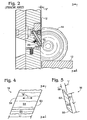
- prior art chipper cutting apparatus is shown in cross-section.
- the cutting apparatus includes a knife 10 that extends beyond a work surface 12 a predetermined amount "d".
- An bulk article of wood 14, such as a log, board or plank is placed against the work surface 12 and extends at a feed angle ⁇ from the work surface, typically about 30 - 40 degrees.
- the wood has a grain direction "g" running along the elongate axis thereof. The grain direction indicates the alignment direction of elongate cellulose fibers 15 in the wood which it is ultimately desired to extract intact.
- Cutting "parallel to the grain,” is defined hereinafter as cutting in a plane so as to substantially separate the fibers from one another without substantially cutting across the fibers, i.e, a plane that includes lines parallel to the grain direction "g". Cleaving is then, by definition, "parallel to the grain.”
- a sequence of chips 16 are cut from the wood.
- the chips have a thickness "t”and a length "1” with a width "w” (not shown) that extends perpendicular to the plane of the figure.
- the length “1” is primarily determined by the depth of penetration "d” of the knife into the wood. This is typically about 19mm (3/4") for chips employed for producing cellulose or wood pulp. Ends 18 of the chips are deformed and bruised during the cutting, so that they do not always return to their sharp angled configuration idealized at 16b. Even where the ends do return to their sharp angled configuration, they have greater susceptibility to damage during subsequent packaging, handling and processing than do square ends.
- the thickness "t" of the chips is determined primarily by the ratio of the shear strength to the cleavage strength of the wood. This is partially a function of the length of the chip, but also varies substantially depending on the type of wood and its condition, e.g, its moisture content and whether it is frozen. Typically, the length of the chip is adjusted so that the thickness "t" of a large number of the chips 16 varies in a bell-shaped or normal distribution about a mean of about 4 - 5 mm, which as has been mentioned is considered optimum. However, the standard deviation of the distribution is large enough so that only about 85 - 90% of the chips fall within the acceptable industry standard range of between about 2 to 8 mm.
- FIG 2 a prior art waferizer is shown.
- the waferizer is similar in principle to the chipper, except that the wood 14 is placed against the work surface 12 at a feed angle ⁇ of about 0 degrees, so that the knife 10 cuts the wood substantially parallel to the grain to produce flakes 20.
- This change in the feed angle of the wood provides for substantial and important differences in the dependencies of the length and thickness dimensions of the flake. Particularly, now the thickness "t,” instead of the length "l,” is determined by the distance that the knife extends beyond the work surface.
- Flakes produced in typical waferizers have a thickness of about 0.635mm (.025"). This corresponds as aforementioned to the amount the knife 10 cuts into the wood 14. As the desired pulp chip thickness is about 6 - 8 times larger, the power required to produce the flake is roughly about 6 - 8 times less than the power required to produce the pulp chip:
- the knife 10 is adapted to cut the wood 14 substantially parallel to the grain as described below. This is preferably accomplished by employing a waferizer, but may be accomplished using any other suitable apparatus.
- a number of the knives 10 are disposed radially on a chipper disc 11, extending out of the plane of the disc.
- the disc rotates about a center shaft 13.
- a feed trough 17 is disposed horizontally and extends along the center-line "c1" of the disc 11.
- the feed trough supports, typically, a vertical stack of the wood 14 wherein the grain direction "g" lies parallel to the trough.
- the knives 10 are rotated against and into the sides of the wood 14, making various angles with respect to the horizontal and the grain direction "g", depending on the elevation of the wood above the trough 17.
- the knives 10 always cut substantially parallel to the grain, i.e., as discussed above, so as to separate the parallel fibers 15 forming the grain rather than to cut across them. This cutting characteristic decreases damage to the fibers.
- An outstanding advantage of the invention is that it provides for exceptional control of the critical thickness dimension of the chips.
- the knife 10 is adapted to project beyond the work surface 12 a distance "d" about equal to the thickness "t" of the chip 16 produced thereby. This produces a cut in the wood that has a depth that is very closely equal to the thickness "t.” Thickness variation is, to a practical degree, virtually eliminated.
- the length dimension is, in addition to the thickness, also highly controlled by employing spaced serrations or scoring knives 22 either upstream or downstream of the knife 10.
- a distance “l” between the scoring knives establishes the length "1" of the flake.
- the scoring knives are adapted for cutting along lines perpendicular to the cut made by the knife 10 and are provided at "l" spaced intervals.
- FIG. 4 a chip 16 produced according to the present invention is shown.
- the shape of the chip varies from rhombohedral (as illustrated) to orthorhombic depending on the originating location of the chip within the wood 14. Referring back to Figure 3, this consideration is illustrated in one dimension where it will be understood that a similar consideration applies to the orthogonal dimension.
- two articles of wood shown as two logs, one on top of the other, rest on the work surface 12.
- the articles of wood are forced against the disc 11, as indicated in Figure 2.
- the knives 10 cut into the sides of the articles of wood.
- the chip 16 has six sides “s1" - “s6” which can be identified as three pairs of substantially parallel sides.
- the knife 10 cuts the large sides “s1 and “2” defined by the length and width dimensions “1” and “w” respectively.
- the scoring knives 22 cut the sides “s3” and “s4" across the width and thickness dimension "t.”
- the surface texture of the sides “s1” - “s4" may show some cleavage but, primarily, is relatively smooth as a result of the cutting or scoring.
- the sides "s3" and s4" are particularly smooth, as they are cut across the grain.
- the sides "s3" and “s4,” cut by the scoring knives 22, vary from being perpendicular to the grain direction "g” to being at an acute angle with respect to the grain direction "g".
- the sides "s3" and “s4" are of minimum area with respect to a given thickness "t", i.e. they are perpendicular to the sides "s1" and "s2.”
- This provides advantages over the chip geometry proposed in Altosaar, for example, where the corresponding sides form acute and obtuse angles.
- a first advantage is that the invention desirably minimizes the area over which damage to wood fibers by cutting can occur.
Landscapes
- Engineering & Computer Science (AREA)
- Life Sciences & Earth Sciences (AREA)
- Manufacturing & Machinery (AREA)
- Mechanical Engineering (AREA)
- Wood Science & Technology (AREA)
- Forests & Forestry (AREA)
- Paper (AREA)
- Noodles (AREA)
- Beans For Foods Or Fodder (AREA)
- Debarking, Splitting, And Disintegration Of Timber (AREA)
- Polysaccharides And Polysaccharide Derivatives (AREA)
Claims (7)
- Verfahren zur Bildung eines Holzspans zur Produktion eines Zellulosebreis, wobei der Span eine Faser enthält, die sich in Faserrichtung erstreckt, und der Span (16) erste (s5, s6), zweite (s1, s2) und dritte (s3, s4) Paare von parallelen Seiten aufweist, wobei das Verfahren Folgendes enthält:Spalten des Spans (16) entlang der Faserrichtung zur Ausbildung einer ersten Seite (s5),Schneiden des Spans (16) zur Ausbildung einer zweiten Seite (s1),Schneiden des Spans (16) zur Ausbildung einer dritten Seite (s3), so dass die dritte Seite (s3) im Wesentlichen rechtwinklig zur zweiten Seite (s1) verläuft,Schneiden des Spans (16) zur Ausbildung einer vierten Seite (s2), die im Wesentlichen parallel zur zweiten Seite (s1) verläuft und davon etwa zwischen 2 und 8 mm entfernt ist,Schneiden des Spans (16) zur Bildung einer fünften Seite (s4) im Wesentlichen parallel zur dritten Seite (s3) und davon in einem wesentlich größeren Abstand entfernt als die vierte Seite (s2) von der zweiten Seite (s1) entfernt ist, undSpalten des Spans (16) zur Bildung einer sechsten Seite (s6), die von der ersten Seite (s5) im wesentlich größeren Abstand entfernt ist als die vierte Seite (s2) von der zweiten Seite (s1) entfernt ist.
- Verfahren nach Anspruch 1, bei dem das Schneiden des Spans (16) zur Bildung der zweiten Seite (s1) durch ein erstes Messer (10) und zum Schneiden des Spans (16) zur Bildung der dritten Seite (s3) durch ein zweites Messer (22) erfolgt.
- Verfahren nach Anspruch 2, bei dem das Schneiden des Spans (16) zur Ausbildung der vierten Seite (s2) durch das erste Messer (10) erfolgt.
- Verfahren nach Anspruch 3, bei dem das Schneiden des Spans (16) zur Ausbildung der fünften Seite (s4) durch ein drittes Messer erfolgt, das vom zweiten Messer (22) beabstandet ist.
- Span zur Verwendung in der Herstellung von Holzbrei, wobei der Span (16) eine Faserrichtung aufweist, die sich entlang der Faserrichtung erstreckt und drei Paare von im Wesentlichen parallelen Seiten aufweist, wobei die Seiten eines ersten Seitenpaares (s1, s2) voneinander im Abstand von 2 - 8 mm liegen, die Seiten des zweiten (s5, s6) und dritten Paares (s3, s4) voneinander mit größeren Werten als die Seiten des ersten Paares (s1, s2) entfernt sind, und wobei die Seiten des ersten Paares (s1, s2) im Wesentlichen rechtwinklig zu den Seiten des dritten Paares (s3, s4) liegen.
- Span nach Anspruch 5, bei dem die Seiten (s5, s6) des zweiten Paares der Seiten relativ unregelmäßige Oberflächen aufweisen, die im Wesentlichen mit der Faserrichtung ausgerichtet sind, wobei die Seiten des ersten (s1, s2) und dritten (s3, s4) Paares der Seiten relativ glatt im Vergleich zu den Seiten des zweiten (s5, s6) sind.
- Span nach Anspruch 6, bei dem die Seiten (s3, s4) des dritten Paares von Seiten relativ glatt im Vergleich zu den Seiten (s1, s2) des ersten Paares sind.
Applications Claiming Priority (3)
| Application Number | Priority Date | Filing Date | Title |
|---|---|---|---|
| US181035 | 1980-08-25 | ||
| US09/181,035 US6267164B1 (en) | 1998-10-27 | 1998-10-27 | Chip and method for the production of wood pulp |
| PCT/US1999/025352 WO2000024555A1 (en) | 1998-10-27 | 1999-10-27 | Chip and method for the production of wood pulp |
Publications (2)
| Publication Number | Publication Date |
|---|---|
| EP1124672A1 EP1124672A1 (de) | 2001-08-22 |
| EP1124672B1 true EP1124672B1 (de) | 2005-08-03 |
Family
ID=22662631
Family Applications (1)
| Application Number | Title | Priority Date | Filing Date |
|---|---|---|---|
| EP99956758A Expired - Lifetime EP1124672B1 (de) | 1998-10-27 | 1999-10-27 | Holzspan und verfahren zur herstellung von zellstoff |
Country Status (12)
| Country | Link |
|---|---|
| US (1) | US6267164B1 (de) |
| EP (1) | EP1124672B1 (de) |
| AT (1) | ATE301027T1 (de) |
| AU (1) | AU771228C (de) |
| BR (1) | BR9914876A (de) |
| CA (1) | CA2349371C (de) |
| DE (1) | DE69926525T2 (de) |
| DK (1) | DK1124672T3 (de) |
| ES (1) | ES2244228T3 (de) |
| NZ (1) | NZ511621A (de) |
| PT (1) | PT1124672E (de) |
| WO (1) | WO2000024555A1 (de) |
Families Citing this family (10)
| Publication number | Priority date | Publication date | Assignee | Title |
|---|---|---|---|---|
| DE19829112C1 (de) * | 1998-06-30 | 2000-03-30 | Esterer Wd Gmbh & Co | Hackschnitzel, Verfahren und Vorrichtung zum Erzeugen eines Hackschnitzels sowie zum Profilieren eines Baumstammes und deren Verwendungen |
| SE535557C2 (sv) * | 2010-03-05 | 2012-09-25 | Torbjoern Carlberg | Förfarande för framställning av flis |
| US8497019B2 (en) | 2010-04-22 | 2013-07-30 | Forest Concepts, LLC | Engineered plant biomass particles coated with bioactive agents |
| US8497020B2 (en) * | 2010-04-22 | 2013-07-30 | Forest Concepts, LLC | Precision wood particle feedstocks |
| US9440237B2 (en) | 2010-04-22 | 2016-09-13 | Forest Concepts, LLC | Corn stover biomass feedstocks with uniform particle size distribution profiles at retained field moisture contents |
| US8034449B1 (en) | 2010-04-22 | 2011-10-11 | Forest Concepts, LLC | Engineered plant biomass feedstock particles |
| US8481160B2 (en) | 2010-04-22 | 2013-07-09 | Forest Concepts, LLC | Bimodal and multimodal plant biomass particle mixtures |
| US9604387B2 (en) | 2010-04-22 | 2017-03-28 | Forest Concepts, LLC | Comminution process to produce wood particles of uniform size and shape with disrupted grain structure from veneer |
| AT516510B1 (de) * | 2015-02-13 | 2016-06-15 | Christian Brandl | Vorrichtung und Verfahren zur Herstellung eines profilierten und in seiner Höhe definierten Holzspanes |
| USD1048070S1 (en) * | 2022-10-24 | 2024-10-22 | Deere & Company | Display screen with an animated graphical user interface |
Family Cites Families (23)
| Publication number | Priority date | Publication date | Assignee | Title |
|---|---|---|---|---|
| US2585673A (en) | 1949-09-20 | 1952-02-12 | Peter N Ottersland | Disk chipper with horizontally inclined rotary axes |
| US2776688A (en) * | 1953-03-23 | 1957-01-08 | Changewood Corp | Crosscut fiber and method for its preparation |
| US2811183A (en) * | 1953-06-15 | 1957-10-29 | Int Paper Co | Wood defibering apparatus |
| US2997082A (en) * | 1959-05-01 | 1961-08-22 | Ind Dev Co Inc | Rotary crossgrain wood flaker |
| FR1353274A (fr) * | 1963-04-01 | 1964-02-21 | Karlstad Mekaniska Ab | Coupeuse, en particulier pour la préparation de pâte à papier |
| SE349768B (de) | 1963-06-28 | 1972-10-09 | Kockums Ind Ab | |
| US3304970A (en) | 1964-03-03 | 1967-02-21 | Dominion Tar & Chemical Co | Axial feed waferizer |
| US3627005A (en) | 1969-04-15 | 1971-12-14 | David L Morton | Machine for cutting peeler cores or logs into studs and chips |
| US3670791A (en) * | 1970-07-13 | 1972-06-20 | Donald L Johnson | Method of jet breaking veneer to narrow wood flakes |
| GB1383209A (en) | 1971-08-14 | 1975-02-05 | Hawker Siddeley Canada Ltd | Machine for slabbing logs |
| US3777793A (en) | 1972-05-11 | 1973-12-11 | Chipper Machines And Eng Corp | Knife holder in log slabbing chipper |
| US4139034A (en) | 1977-02-15 | 1979-02-13 | Hawker Siddeley Canada Ltd. | Waferizer |
| US4082127A (en) | 1977-04-22 | 1978-04-04 | Miller Frederick L B | Knife holder in log slabbing chipper |
| US4346745A (en) | 1980-08-25 | 1982-08-31 | Cae Machinery Ltd. | Wafer slicing apparatus |
| US4346744A (en) | 1980-08-22 | 1982-08-31 | Cae Machinery Ltd. | Wood waferizing apparatus |
| US4569380A (en) * | 1983-09-16 | 1986-02-11 | Arasmith Stanley D | Wood chipping knife and apparatus using same |
| US4685497A (en) | 1986-05-29 | 1987-08-11 | Cae Machinery Ltd. | Knife arrangement for a waferizer |
| US4865094A (en) | 1988-10-24 | 1989-09-12 | Cae Machinery Ltd. | Long log waferizer |
| US5313696A (en) | 1993-09-17 | 1994-05-24 | Cae Machinery Ltd. | Method and apparatus for removing blade ring in a ring flaker |
| US5485873A (en) | 1994-08-09 | 1996-01-23 | Cae Machinery Ltd. | Knife clamping system |
| SE504417C2 (sv) | 1995-06-14 | 1997-02-03 | Disc Knife System I Sverige Ab | Blockformningsanordning |
| US5803143A (en) * | 1995-10-23 | 1998-09-08 | Willis; Bobby G. | Method and apparatus for producing wood wafers |
| US5711358A (en) * | 1995-12-26 | 1998-01-27 | Willis; Bobby G. | Method and apparatus for making vertical grain wood strands |
-
1998
- 1998-10-27 US US09/181,035 patent/US6267164B1/en not_active Expired - Fee Related
-
1999
- 1999-10-27 NZ NZ511621A patent/NZ511621A/xx unknown
- 1999-10-27 BR BR9914876-5A patent/BR9914876A/pt not_active IP Right Cessation
- 1999-10-27 AU AU13295/00A patent/AU771228C/en not_active Ceased
- 1999-10-27 WO PCT/US1999/025352 patent/WO2000024555A1/en not_active Ceased
- 1999-10-27 CA CA002349371A patent/CA2349371C/en not_active Expired - Fee Related
- 1999-10-27 EP EP99956758A patent/EP1124672B1/de not_active Expired - Lifetime
- 1999-10-27 DE DE69926525T patent/DE69926525T2/de not_active Expired - Fee Related
- 1999-10-27 PT PT99956758T patent/PT1124672E/pt unknown
- 1999-10-27 DK DK99956758T patent/DK1124672T3/da active
- 1999-10-27 AT AT99956758T patent/ATE301027T1/de not_active IP Right Cessation
- 1999-10-27 ES ES99956758T patent/ES2244228T3/es not_active Expired - Lifetime
Also Published As
| Publication number | Publication date |
|---|---|
| AU771228C (en) | 2005-09-15 |
| AU1329500A (en) | 2000-05-15 |
| ES2244228T3 (es) | 2005-12-01 |
| DE69926525T2 (de) | 2006-06-01 |
| DK1124672T3 (da) | 2005-12-12 |
| EP1124672A1 (de) | 2001-08-22 |
| AU771228B2 (en) | 2004-03-18 |
| WO2000024555A1 (en) | 2000-05-04 |
| BR9914876A (pt) | 2004-04-06 |
| CA2349371A1 (en) | 2000-05-04 |
| DE69926525D1 (de) | 2005-09-08 |
| ATE301027T1 (de) | 2005-08-15 |
| NZ511621A (en) | 2003-09-26 |
| PT1124672E (pt) | 2005-11-30 |
| US6267164B1 (en) | 2001-07-31 |
| CA2349371C (en) | 2006-09-19 |
Similar Documents
| Publication | Publication Date | Title |
|---|---|---|
| US5819826A (en) | Chip cutting knife with spaced deflector ridges | |
| US4681146A (en) | Method and apparatus for producing engineered wood flakes, wafers or strands | |
| EP1124672B1 (de) | Holzspan und verfahren zur herstellung von zellstoff | |
| EP0666155A1 (de) | Verbundholz aus gespaltenen und zerbrochenen Stücken, und Vorrichtung und Verfahren zu Herstellung | |
| US20090000730A1 (en) | Value extraction from harvested trees and related laminates and processes | |
| CA1098423A (en) | Process for preparation of long wood strands | |
| US4569380A (en) | Wood chipping knife and apparatus using same | |
| US5533684A (en) | Wood chip strand splitter | |
| FI107892B (fi) | Menetelmä ja laitteisto säikeiden valmistamiseksi | |
| CA1227961A (en) | Engineered wood flakes, wafers or strands and method of their production | |
| CA1091135A (en) | Three-step process for preparation of long wood strands | |
| CN101218076A (zh) | 切割的方法和设备 | |
| US6543497B2 (en) | Wood flake, method and apparatuses for producing a wood flake as well as for profiling a log, and use thereof | |
| US6026872A (en) | System for producing cants and wood chips | |
| WO2004094062A1 (en) | Chipper bed knife | |
| CN100371149C (zh) | 细木条生产方法 | |
| US20070079900A1 (en) | Conical chipper/canter head | |
| AU2013270595A1 (en) | Value extraction from harvested trees and related laminates and processes | |
| CA2202271C (en) | Wood chip strand splitter | |
| US6719022B2 (en) | Apparatus for producing a wood flake and apparatus for profiling a log | |
| EP1961536A1 (de) | Messerscheibe, Schneidgerät mit einer solchen Messerscheibe und Messersatz für eine solche Messerscheibe | |
| RU2047366C1 (ru) | Нож к измельчителю кормов | |
| NZ524672A (en) | laminate from logs using thin boards of uniform thickness or cross-sectional area, to maximise use of material | |
| NZ573488A (en) | 90x46mm lumber product laminated from ranked sticks with stronger sticks towards outside | |
| HK1165760A (en) | Value extraction from harvested trees and related laminates and processes |
Legal Events
| Date | Code | Title | Description |
|---|---|---|---|
| PUAI | Public reference made under article 153(3) epc to a published international application that has entered the european phase |
Free format text: ORIGINAL CODE: 0009012 |
|
| 17P | Request for examination filed |
Effective date: 20010518 |
|
| AK | Designated contracting states |
Kind code of ref document: A1 Designated state(s): AT BE CH CY DE DK ES FI FR GB GR IE IT LI LU MC NL PT SE |
|
| 17Q | First examination report despatched |
Effective date: 20040813 |
|
| GRAP | Despatch of communication of intention to grant a patent |
Free format text: ORIGINAL CODE: EPIDOSNIGR1 |
|
| GRAS | Grant fee paid |
Free format text: ORIGINAL CODE: EPIDOSNIGR3 |
|
| GRAA | (expected) grant |
Free format text: ORIGINAL CODE: 0009210 |
|
| AK | Designated contracting states |
Kind code of ref document: B1 Designated state(s): AT BE CH CY DE DK ES FI FR GB GR IE IT LI LU MC NL PT SE |
|
| REG | Reference to a national code |
Ref country code: GB Ref legal event code: FG4D |
|
| REG | Reference to a national code |
Ref country code: CH Ref legal event code: EP |
|
| REG | Reference to a national code |
Ref country code: IE Ref legal event code: FG4D |
|
| REF | Corresponds to: |
Ref document number: 69926525 Country of ref document: DE Date of ref document: 20050908 Kind code of ref document: P |
|
| PG25 | Lapsed in a contracting state [announced via postgrant information from national office to epo] |
Ref country code: CY Free format text: LAPSE BECAUSE OF FAILURE TO SUBMIT A TRANSLATION OF THE DESCRIPTION OR TO PAY THE FEE WITHIN THE PRESCRIBED TIME-LIMIT Effective date: 20051027 |
|
| PG25 | Lapsed in a contracting state [announced via postgrant information from national office to epo] |
Ref country code: MC Free format text: LAPSE BECAUSE OF NON-PAYMENT OF DUE FEES Effective date: 20051031 Ref country code: LU Free format text: LAPSE BECAUSE OF NON-PAYMENT OF DUE FEES Effective date: 20051031 |
|
| REG | Reference to a national code |
Ref country code: CH Ref legal event code: NV Representative=s name: E. BLUM & CO. PATENTANWAELTE |
|
| PG25 | Lapsed in a contracting state [announced via postgrant information from national office to epo] |
Ref country code: GR Free format text: LAPSE BECAUSE OF FAILURE TO SUBMIT A TRANSLATION OF THE DESCRIPTION OR TO PAY THE FEE WITHIN THE PRESCRIBED TIME-LIMIT Effective date: 20051103 |
|
| REG | Reference to a national code |
Ref country code: SE Ref legal event code: TRGR |
|
| REG | Reference to a national code |
Ref country code: ES Ref legal event code: FG2A Ref document number: 2244228 Country of ref document: ES Kind code of ref document: T3 |
|
| REG | Reference to a national code |
Ref country code: DK Ref legal event code: T3 |
|
| ET | Fr: translation filed | ||
| PLBE | No opposition filed within time limit |
Free format text: ORIGINAL CODE: 0009261 |
|
| STAA | Information on the status of an ep patent application or granted ep patent |
Free format text: STATUS: NO OPPOSITION FILED WITHIN TIME LIMIT |
|
| 26N | No opposition filed |
Effective date: 20060504 |
|
| REG | Reference to a national code |
Ref country code: CH Ref legal event code: PFA Owner name: KEY KNIFE, INC. Free format text: KEY KNIFE, INC.#19100 S.W. 125TH COURT#TUALATIN, OREGON 97062 (US) -TRANSFER TO- KEY KNIFE, INC.#19100 S.W. 125TH COURT#TUALATIN, OREGON 97062 (US) |
|
| PGFP | Annual fee paid to national office [announced via postgrant information from national office to epo] |
Ref country code: PT Payment date: 20080716 Year of fee payment: 10 Ref country code: ES Payment date: 20080820 Year of fee payment: 10 Ref country code: CH Payment date: 20080916 Year of fee payment: 10 |
|
| PGFP | Annual fee paid to national office [announced via postgrant information from national office to epo] |
Ref country code: NL Payment date: 20081021 Year of fee payment: 10 Ref country code: IT Payment date: 20080923 Year of fee payment: 10 Ref country code: IE Payment date: 20080714 Year of fee payment: 10 Ref country code: FR Payment date: 20080730 Year of fee payment: 10 |
|
| PGFP | Annual fee paid to national office [announced via postgrant information from national office to epo] |
Ref country code: DK Payment date: 20081027 Year of fee payment: 10 |
|
| PGFP | Annual fee paid to national office [announced via postgrant information from national office to epo] |
Ref country code: FI Payment date: 20081002 Year of fee payment: 10 Ref country code: BE Payment date: 20080801 Year of fee payment: 10 Ref country code: AT Payment date: 20080908 Year of fee payment: 10 |
|
| PGFP | Annual fee paid to national office [announced via postgrant information from national office to epo] |
Ref country code: SE Payment date: 20081022 Year of fee payment: 10 |
|
| PGFP | Annual fee paid to national office [announced via postgrant information from national office to epo] |
Ref country code: DE Payment date: 20081229 Year of fee payment: 10 |
|
| PGFP | Annual fee paid to national office [announced via postgrant information from national office to epo] |
Ref country code: GB Payment date: 20081009 Year of fee payment: 10 |
|
| BERE | Be: lapsed |
Owner name: *KEY KNIFE INC. Effective date: 20091031 |
|
| REG | Reference to a national code |
Ref country code: PT Ref legal event code: MM4A Free format text: LAPSE DUE TO NON-PAYMENT OF FEES Effective date: 20100427 |
|
| REG | Reference to a national code |
Ref country code: NL Ref legal event code: V1 Effective date: 20100501 |
|
| REG | Reference to a national code |
Ref country code: CH Ref legal event code: PL |
|
| EUG | Se: european patent has lapsed | ||
| REG | Reference to a national code |
Ref country code: DK Ref legal event code: EBP |
|
| REG | Reference to a national code |
Ref country code: IE Ref legal event code: MM4A |
|
| REG | Reference to a national code |
Ref country code: FR Ref legal event code: ST Effective date: 20100630 |
|
| PG25 | Lapsed in a contracting state [announced via postgrant information from national office to epo] |
Ref country code: PT Free format text: LAPSE BECAUSE OF NON-PAYMENT OF DUE FEES Effective date: 20100427 Ref country code: NL Free format text: LAPSE BECAUSE OF NON-PAYMENT OF DUE FEES Effective date: 20100501 Ref country code: FR Free format text: LAPSE BECAUSE OF NON-PAYMENT OF DUE FEES Effective date: 20091102 Ref country code: DE Free format text: LAPSE BECAUSE OF NON-PAYMENT OF DUE FEES Effective date: 20100501 |
|
| PG25 | Lapsed in a contracting state [announced via postgrant information from national office to epo] |
Ref country code: FI Free format text: LAPSE BECAUSE OF NON-PAYMENT OF DUE FEES Effective date: 20091027 Ref country code: AT Free format text: LAPSE BECAUSE OF NON-PAYMENT OF DUE FEES Effective date: 20091027 |
|
| PG25 | Lapsed in a contracting state [announced via postgrant information from national office to epo] |
Ref country code: LI Free format text: LAPSE BECAUSE OF NON-PAYMENT OF DUE FEES Effective date: 20091031 Ref country code: IE Free format text: LAPSE BECAUSE OF NON-PAYMENT OF DUE FEES Effective date: 20091027 Ref country code: CH Free format text: LAPSE BECAUSE OF NON-PAYMENT OF DUE FEES Effective date: 20091031 Ref country code: BE Free format text: LAPSE BECAUSE OF NON-PAYMENT OF DUE FEES Effective date: 20091031 |
|
| PG25 | Lapsed in a contracting state [announced via postgrant information from national office to epo] |
Ref country code: GB Free format text: LAPSE BECAUSE OF NON-PAYMENT OF DUE FEES Effective date: 20091027 |
|
| PG25 | Lapsed in a contracting state [announced via postgrant information from national office to epo] |
Ref country code: DK Free format text: LAPSE BECAUSE OF NON-PAYMENT OF DUE FEES Effective date: 20091031 |
|
| PG25 | Lapsed in a contracting state [announced via postgrant information from national office to epo] |
Ref country code: IT Free format text: LAPSE BECAUSE OF NON-PAYMENT OF DUE FEES Effective date: 20091027 |
|
| REG | Reference to a national code |
Ref country code: ES Ref legal event code: FD2A Effective date: 20110411 |
|
| PG25 | Lapsed in a contracting state [announced via postgrant information from national office to epo] |
Ref country code: SE Free format text: LAPSE BECAUSE OF NON-PAYMENT OF DUE FEES Effective date: 20091028 |
|
| PG25 | Lapsed in a contracting state [announced via postgrant information from national office to epo] |
Ref country code: ES Free format text: LAPSE BECAUSE OF NON-PAYMENT OF DUE FEES Effective date: 20110329 |
|
| PG25 | Lapsed in a contracting state [announced via postgrant information from national office to epo] |
Ref country code: ES Free format text: LAPSE BECAUSE OF NON-PAYMENT OF DUE FEES Effective date: 20091028 |