EP1123983A1 - Shape memory alloy - Google Patents
Shape memory alloy Download PDFInfo
- Publication number
- EP1123983A1 EP1123983A1 EP01301164A EP01301164A EP1123983A1 EP 1123983 A1 EP1123983 A1 EP 1123983A1 EP 01301164 A EP01301164 A EP 01301164A EP 01301164 A EP01301164 A EP 01301164A EP 1123983 A1 EP1123983 A1 EP 1123983A1
- Authority
- EP
- European Patent Office
- Prior art keywords
- shape memory
- alloy
- alloys
- niobium carbide
- percent
- Prior art date
- Legal status (The legal status is an assumption and is not a legal conclusion. Google has not performed a legal analysis and makes no representation as to the accuracy of the status listed.)
- Granted
Links
- 229910001285 shape-memory alloy Inorganic materials 0.000 title claims abstract description 27
- 229910045601 alloy Inorganic materials 0.000 claims abstract description 42
- 239000000956 alloy Substances 0.000 claims abstract description 42
- UNASZPQZIFZUSI-UHFFFAOYSA-N methylidyneniobium Chemical compound [Nb]#C UNASZPQZIFZUSI-UHFFFAOYSA-N 0.000 claims abstract description 24
- 229910018643 Mn—Si Inorganic materials 0.000 claims abstract description 13
- 229910052742 iron Inorganic materials 0.000 claims abstract description 5
- 229910052748 manganese Inorganic materials 0.000 claims abstract description 5
- 229910052710 silicon Inorganic materials 0.000 claims abstract description 5
- 239000010955 niobium Substances 0.000 claims description 14
- OKTJSMMVPCPJKN-UHFFFAOYSA-N Carbon Chemical compound [C] OKTJSMMVPCPJKN-UHFFFAOYSA-N 0.000 claims description 9
- 229910052799 carbon Inorganic materials 0.000 claims description 9
- 229910052758 niobium Inorganic materials 0.000 claims description 9
- GUCVJGMIXFAOAE-UHFFFAOYSA-N niobium atom Chemical group [Nb] GUCVJGMIXFAOAE-UHFFFAOYSA-N 0.000 claims description 9
- 230000032683 aging Effects 0.000 claims description 8
- 239000000470 constituent Substances 0.000 claims description 7
- 238000010438 heat treatment Methods 0.000 claims description 7
- 239000000203 mixture Substances 0.000 claims description 7
- 229910052804 chromium Inorganic materials 0.000 claims description 6
- 238000000034 method Methods 0.000 claims description 5
- 229910052759 nickel Inorganic materials 0.000 claims description 2
- 230000003446 memory effect Effects 0.000 abstract description 9
- 238000011084 recovery Methods 0.000 description 11
- 238000010586 diagram Methods 0.000 description 5
- 238000000265 homogenisation Methods 0.000 description 5
- 230000000052 comparative effect Effects 0.000 description 3
- 230000000694 effects Effects 0.000 description 3
- 230000007246 mechanism Effects 0.000 description 3
- 230000035882 stress Effects 0.000 description 3
- 239000000126 substance Substances 0.000 description 3
- 229910008458 Si—Cr Inorganic materials 0.000 description 2
- 238000002524 electron diffraction data Methods 0.000 description 2
- 230000006698 induction Effects 0.000 description 2
- 238000009864 tensile test Methods 0.000 description 2
- 230000000930 thermomechanical effect Effects 0.000 description 2
- 229910000846 In alloy Inorganic materials 0.000 description 1
- 229910001566 austenite Inorganic materials 0.000 description 1
- 238000005452 bending Methods 0.000 description 1
- 238000011109 contamination Methods 0.000 description 1
- 230000018109 developmental process Effects 0.000 description 1
- 230000002431 foraging effect Effects 0.000 description 1
- 239000012535 impurity Substances 0.000 description 1
- 239000008204 material by function Substances 0.000 description 1
- 239000002245 particle Substances 0.000 description 1
- 239000003208 petroleum Substances 0.000 description 1
- 239000002244 precipitate Substances 0.000 description 1
- 238000001556 precipitation Methods 0.000 description 1
- 238000002360 preparation method Methods 0.000 description 1
- 239000002994 raw material Substances 0.000 description 1
- 230000009466 transformation Effects 0.000 description 1
- XLYOFNOQVPJJNP-UHFFFAOYSA-N water Substances O XLYOFNOQVPJJNP-UHFFFAOYSA-N 0.000 description 1
- 230000003313 weakening effect Effects 0.000 description 1
- 238000003466 welding Methods 0.000 description 1
Images



Classifications
-
- C—CHEMISTRY; METALLURGY
- C22—METALLURGY; FERROUS OR NON-FERROUS ALLOYS; TREATMENT OF ALLOYS OR NON-FERROUS METALS
- C22C—ALLOYS
- C22C38/00—Ferrous alloys, e.g. steel alloys
- C22C38/18—Ferrous alloys, e.g. steel alloys containing chromium
- C22C38/40—Ferrous alloys, e.g. steel alloys containing chromium with nickel
- C22C38/58—Ferrous alloys, e.g. steel alloys containing chromium with nickel with more than 1.5% by weight of manganese
-
- C—CHEMISTRY; METALLURGY
- C21—METALLURGY OF IRON
- C21D—MODIFYING THE PHYSICAL STRUCTURE OF FERROUS METALS; GENERAL DEVICES FOR HEAT TREATMENT OF FERROUS OR NON-FERROUS METALS OR ALLOYS; MAKING METAL MALLEABLE, e.g. BY DECARBURISATION OR TEMPERING
- C21D6/00—Heat treatment of ferrous alloys
- C21D6/005—Heat treatment of ferrous alloys containing Mn
-
- C—CHEMISTRY; METALLURGY
- C22—METALLURGY; FERROUS OR NON-FERROUS ALLOYS; TREATMENT OF ALLOYS OR NON-FERROUS METALS
- C22C—ALLOYS
- C22C38/00—Ferrous alloys, e.g. steel alloys
- C22C38/18—Ferrous alloys, e.g. steel alloys containing chromium
- C22C38/26—Ferrous alloys, e.g. steel alloys containing chromium with niobium or tantalum
-
- C—CHEMISTRY; METALLURGY
- C22—METALLURGY; FERROUS OR NON-FERROUS ALLOYS; TREATMENT OF ALLOYS OR NON-FERROUS METALS
- C22C—ALLOYS
- C22C38/00—Ferrous alloys, e.g. steel alloys
- C22C38/18—Ferrous alloys, e.g. steel alloys containing chromium
- C22C38/34—Ferrous alloys, e.g. steel alloys containing chromium with more than 1.5% by weight of silicon
-
- C—CHEMISTRY; METALLURGY
- C22—METALLURGY; FERROUS OR NON-FERROUS ALLOYS; TREATMENT OF ALLOYS OR NON-FERROUS METALS
- C22C—ALLOYS
- C22C38/00—Ferrous alloys, e.g. steel alloys
- C22C38/18—Ferrous alloys, e.g. steel alloys containing chromium
- C22C38/38—Ferrous alloys, e.g. steel alloys containing chromium with more than 1.5% by weight of manganese
-
- C—CHEMISTRY; METALLURGY
- C22—METALLURGY; FERROUS OR NON-FERROUS ALLOYS; TREATMENT OF ALLOYS OR NON-FERROUS METALS
- C22C—ALLOYS
- C22C38/00—Ferrous alloys, e.g. steel alloys
- C22C38/18—Ferrous alloys, e.g. steel alloys containing chromium
- C22C38/40—Ferrous alloys, e.g. steel alloys containing chromium with nickel
- C22C38/48—Ferrous alloys, e.g. steel alloys containing chromium with nickel with niobium or tantalum
-
- C—CHEMISTRY; METALLURGY
- C22—METALLURGY; FERROUS OR NON-FERROUS ALLOYS; TREATMENT OF ALLOYS OR NON-FERROUS METALS
- C22F—CHANGING THE PHYSICAL STRUCTURE OF NON-FERROUS METALS AND NON-FERROUS ALLOYS
- C22F1/00—Changing the physical structure of non-ferrous metals or alloys by heat treatment or by hot or cold working
- C22F1/006—Resulting in heat recoverable alloys with a memory effect
-
- C—CHEMISTRY; METALLURGY
- C21—METALLURGY OF IRON
- C21D—MODIFYING THE PHYSICAL STRUCTURE OF FERROUS METALS; GENERAL DEVICES FOR HEAT TREATMENT OF FERROUS OR NON-FERROUS METALS OR ALLOYS; MAKING METAL MALLEABLE, e.g. BY DECARBURISATION OR TEMPERING
- C21D2201/00—Treatment for obtaining particular effects
- C21D2201/01—Shape memory effect
Definitions
- This invention relates to a shape memory alloy containing niobium carbide and a process for producing the same. More specifically, the invention relates to a novel shape memory alloy of Fe-Mn-Si system that contains niobium carbide and exhibits a sufficiently satisfactory shape memory effect without undergoing training and a process for producing the same.
- shape memory alloys in the fields of actuator mechanisms, joint mechanisms, and switch mechanisms or as functional materials having shape-restoring properties in a variety of fields.
- Application of the shape memory alloys to various fields has been proceeding in recent years.
- Shape memory alloys having various compositions have been examined so far.
- the shape memory alloys of Fe-Mn-Si system containing Fe, Mn, and Si as principal constituents Furthermore, including Fe-Mn-Si-Cr system and Fe-Mn-Si-Cr-Ni system
- Furthermore including Fe-Mn-Si-Cr system and Fe-Mn-Si-Cr-Ni system
- the alloys of Fe-Mn-Si system are not yet put to practical use.
- the main cause is that the alloys cannot exert a sufficient shape memory effect without undergoing a particular thermomechanical treatment termed training.
- shape memory alloys of Fe-Mn-Si system in the related art require such troublesome and burdensome training, failing to turn the alloys to practical use.
- the invention aims at solving the problem that the shape memory alloys of Fe-Mn-Si system in the related art encounters, and providing an novel shape memory alloy of Fe-Mn-Si system that exhibits a sufficiently satisfactory shape memory effect without undergoing the special treatment termed training.
- the invention provides a shape memory alloy characterized by containing niobium carbide in the structure in the shape memory alloys of Fe-Mn-Si system containing at least Fe, Mn, and Si as principal constituents.
- the invention provides, secondly, the aforesaid shape memory alloy containing further Cr or Cr and Ni as principal constituents, thirdly, the shape memory alloy where niobium carbide is contained in volume ratio of 0.1 to 1.5 percent, and fourthly, the shape memory alloy where the alloy composition of niobium and carbon Nb/C ⁇ 1 in atomic ratio.
- the invention provides, fifthly, a process for producing the shape memory alloy of any one of the aforesaid first to fourth inventions, the process characterized in that an alloy after making an ingot by adding niobium and carbon undergoes a heat treatment for homogenization at a temperature ranging from 1000°C to 1300°C and subsequently, an aging at a temperature ranging from 400°C to 1000°C to precipitate niobium carbide.
- the invention has the features as described above, and the embodiments of the invention are described below.
- the shape memory alloys of the invention are characterized in that niobium carbide is contained in the structure of the alloys.
- the shape memory alloys of the invention can develop a satisfactory shape memory effect without requiring troublesome, burdensome special treatment termed training in the related art because of the niobium carbide contained in the structure.
- niobium (Nb) and carbon (C) additives to the structure of the alloy alone cannot develop this effect of the invention.
- the presence of niobium carbide, that is, the presence thereof as precipitate in the parent phase (austenite) cannot be missed for developing the effect.
- the volume ratio of niobium carbide in the crystalline structure desirably ranges from 0.1 to 1.5 percent and more suitably from 0.3 to 1.0 percent.
- the volume ratio less than 0.1 percent needs the training in order to expect development of the effect of the invention. On the other hand, exceeding 1.5 percent causes cutting workability to deteriorate; such alloys are unpreferred in view of practical use.
- the chemical compositions (weight percent) of the shape memory alloys in general are considered as follows:
- compositions of the shape memory alloys of the invention containing niobium carbide are added with the following composition (weight percent) as a standard:
- the preparation of the shape memory alloys of Fe-Mn-Si system that contain niobium carbide as described above is suitably carried out as follows: trace amounts of niobium and carbon are mixed together with specified element raw materials to make an ingot, subjected to a heat treatment for homogenization at a temperature ranging from 1000°C to 1300°C and subsequently, an aging at a temperature ranging from 400°C to 1000°C to allow precipitation of niobium carbide.
- the heat treatment for homogenization is carried out at a temperature of 1150°C to 1250°C for 5 to 20 hours, and the aging is carried out at a temperature of 700 to 900°C for 0.1 to 5 hours.
- the alloys having the following three kinds of chemical compositions were produced by high frequency induction furnace.
- the treatment for homogenization was carried out at a temperature of 1200°C for 10 hours, and subsequently the aging was carried out at a temperature of 800°C for 2 hours.
- niobium carbide was confirmed in all alloys (1), (2), and (3) after undergoing the aging treatment.
- the volume ratios thereof were about 0.5 percent.
- Fig. 1 is an electron microscopic photograph showing the presence of niobium carbide in alloy (1) after undergoing the aging treatment.
- the niobium carbide appears as dark contrast in the photograph and has a particle size of about 20 nm.
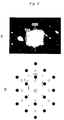
- Fig. 2(A) is an electron diffraction pattern proving this; diffraction spots with weak intensity shown by arrows are those produced from niobium carbide.
- Fig. 2 (B) shows a key diagram of the diffraction pattern.
- alloy (4) an Fe-28Mn-6Si-5Cr alloy [alloy (4)] was produced by high frequency induction furnace and subjected only to the homogenization treatment similar to that described above .
- alloy (4) containing no niobium and carbon as a matter of course, the presence of niobium carbide is not confirmed at all.
- Test pieces for the test were plates of 0.6 mm (in thickness) x 4 mm x 30 mm.
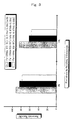
- Fig. 3 shows the results of the test; the shape recovery ratios in application of 4 and 6 percent of bending deformation are shown. The recovery ratios were found to be 60 percent or more in alloys (1), (2), and (3) and particularly, to be 90 percent or more in alloy (1).
- the recovery ratio of the reference alloy (4) was as low as 40 percent.
- Various comparative alloys having different structures were examined, but the recovery ratios thereof were 50 percent at highest.
- alloys (1) and (2) of the invention have a satisfactory shape memory effect.
- Fig. 5 reveals that alloys (1) and (2) of the invention acquire very large recovery forces as compared with comparative alloy (4) in the related art.
- the shape memory effect can be easily developed simply by the heat treatment for aging without carrying out a complicated thermomechanical treatment termed training as in the related art.
- the shape memory alloys of the invention can be applied to all alloy parts having various shapes, different from alloys in the related art that require the training treatment.
- the alloys of the invention can be used for clamping members (water pipes, gas pipes, petroleum transporting pipes, etc.) and require no clamping by weld. This can eliminate dangers such as weakening or corroding welding areas produced by weld.
- Fig. 1 is an electron microscopic photograph used in place of a drawing which shows the structure of the alloy of the invention in Example 1;
- Fig. 2 (A) is an electron diffraction pattern used in place of a drawing which shows the presence of niobium carbide corresponding to Fig. 1 and
- Fig. 2(B) is a key diagram;
- Fig. 3 is a diagram showing the results of the bend test;
- Fig. 4 is a diagram showing the results of the tensile test;
- Fig. 5 is a diagram showing the relation between the shape recovery stress and shape recovery strain.
Landscapes
- Chemical & Material Sciences (AREA)
- Engineering & Computer Science (AREA)
- Materials Engineering (AREA)
- Mechanical Engineering (AREA)
- Metallurgy (AREA)
- Organic Chemistry (AREA)
- Physics & Mathematics (AREA)
- Thermal Sciences (AREA)
- Crystallography & Structural Chemistry (AREA)
- Heat Treatment Of Steel (AREA)
- Materials For Medical Uses (AREA)
- Carbon And Carbon Compounds (AREA)
- Manufacture Of Alloys Or Alloy Compounds (AREA)
Abstract
Description
- This invention relates to a shape memory alloy containing niobium carbide and a process for producing the same. More specifically, the invention relates to a novel shape memory alloy of Fe-Mn-Si system that contains niobium carbide and exhibits a sufficiently satisfactory shape memory effect without undergoing training and a process for producing the same.
- Considerable attention has been directed to shape memory alloys in the fields of actuator mechanisms, joint mechanisms, and switch mechanisms or as functional materials having shape-restoring properties in a variety of fields. Application of the shape memory alloys to various fields has been proceeding in recent years.
- Shape memory alloys having various compositions have been examined so far. Of these alloys, the shape memory alloys of Fe-Mn-Si system containing Fe, Mn, and Si as principal constituents (furthermore, including Fe-Mn-Si-Cr system and Fe-Mn-Si-Cr-Ni system) have been developed in Japan.
- It is worth notice that the shape memory alloys of Fe-Mn-Si system are first discovered in Japan.
- However, it is a matter for regret that the alloys of Fe-Mn-Si system are not yet put to practical use. The main cause is that the alloys cannot exert a sufficient shape memory effect without undergoing a particular thermomechanical treatment termed training. The training means herein to repeat a heat treatment several times, which consists of 2-3% deformation and the subsequent heating above the reverse transformation temperature.
- Thus, the shape memory alloys of Fe-Mn-Si system in the related art require such troublesome and burdensome training, failing to turn the alloys to practical use.
- The invention aims at solving the problem that the shape memory alloys of Fe-Mn-Si system in the related art encounters, and providing an novel shape memory alloy of Fe-Mn-Si system that exhibits a sufficiently satisfactory shape memory effect without undergoing the special treatment termed training.
- In order to solve the aforesaid problems, first, the invention provides a shape memory alloy characterized by containing niobium carbide in the structure in the shape memory alloys of Fe-Mn-Si system containing at least Fe, Mn, and Si as principal constituents.
- The invention provides, secondly, the aforesaid shape memory alloy containing further Cr or Cr and Ni as principal constituents, thirdly, the shape memory alloy where niobium carbide is contained in volume ratio of 0.1 to 1.5 percent, and fourthly, the shape memory alloy where the alloy composition of niobium and carbon Nb/C ≥ 1 in atomic ratio.
- The invention provides, fifthly, a process for producing the shape memory alloy of any one of the aforesaid first to fourth inventions, the process characterized in that an alloy after making an ingot by adding niobium and carbon undergoes a heat treatment for homogenization at a temperature ranging from 1000°C to 1300°C and subsequently, an aging at a temperature ranging from 400°C to 1000°C to precipitate niobium carbide.
- The invention has the features as described above, and the embodiments of the invention are described below.
- In the shape memory alloys of Fe-Mn-Si system containing Fe, Mn, and Si as principal constituents and further Cr or Cr and Ni as needed as principal constituents, the shape memory alloys of the invention are characterized in that niobium carbide is contained in the structure of the alloys. The shape memory alloys of the invention can develop a satisfactory shape memory effect without requiring troublesome, burdensome special treatment termed training in the related art because of the niobium carbide contained in the structure.
- Addition of niobium (Nb) and carbon (C) to the structure of the alloy alone cannot develop this effect of the invention. The presence of niobium carbide, that is, the presence thereof as precipitate in the parent phase (austenite) cannot be missed for developing the effect.
- The volume ratio of niobium carbide in the crystalline structure desirably ranges from 0.1 to 1.5 percent and more suitably from 0.3 to 1.0 percent.
- The volume ratio less than 0.1 percent needs the training in order to expect development of the effect of the invention. On the other hand, exceeding 1.5 percent causes cutting workability to deteriorate; such alloys are unpreferred in view of practical use.
- The chemical compositions (weight percent) of the shape memory alloys in general are considered as follows:
- <Fe-Mn-Si>
- Mn: 15 to 40
- Si: 3 to 15
- Fe: the rest
- <Fe-Mn-Si-Cr>
- Mn: 5 to 40
- Si: 3 to 15
- Cr: 1 to 20
- Fe: the rest
- <Fe-Mn-Si-Cr-Ni>
- Mn: 5 to 40
- Si: 3 to 15
- Cr: 1 to 20
- Ni: 0.1 to 20
- Fe: the rest, and moreover,
- Cu: ≤ 3 (ppm)
- Mo: ≤ 2
- Al: ≤ 10
- Co: ≤ 30
- N: ≤ 5000
-
- Of course, unavoidable contamination of impurities is permitted.
- The chemical compositions of the shape memory alloys of the invention containing niobium carbide are added with the following composition (weight percent) as a standard:
- Nb: 0.1 to 1.5
- C: 0.01 to 0.2 In any case, the volume ratio of niobium carbide formed of niobium and carbon preferably ranges from 0.1 to 1.5 percent as described above, and the atomic ratio of niobium to carbon Nb/C is preferably 1 or more and more preferably ranges from 1.0 to 1.2.
-
- The preparation of the shape memory alloys of Fe-Mn-Si system that contain niobium carbide as described above is suitably carried out as follows: trace amounts of niobium and carbon are mixed together with specified element raw materials to make an ingot, subjected to a heat treatment for homogenization at a temperature ranging from 1000°C to 1300°C and subsequently, an aging at a temperature ranging from 400°C to 1000°C to allow precipitation of niobium carbide.
- More suitably, the heat treatment for homogenization is carried out at a temperature of 1150°C to 1250°C for 5 to 20 hours, and the aging is carried out at a temperature of 700 to 900°C for 0.1 to 5 hours.
- Examples are described below, illustrating the invention in more detail.
- The alloys having the following three kinds of chemical compositions were produced by high frequency induction furnace.
- (1) Fe-28Mn-6Si-5Cr-0.47Nb-0.06C
- (2) Fe-15Mn-5Si-9Cr-5Ni-0.47Nb-0.06C
- (3) Fe-14Mn-6Si-9Cr-5Ni-0.47Nb-0.06C
-
- For these three kinds of alloys (1), (2), and (3), the treatment for homogenization was carried out at a temperature of 1200°C for 10 hours, and subsequently the aging was carried out at a temperature of 800°C for 2 hours.
- The presence of niobium carbide was confirmed in all alloys (1), (2), and (3) after undergoing the aging treatment. The volume ratios thereof were about 0.5 percent.
- Fig. 1 is an electron microscopic photograph showing the presence of niobium carbide in alloy (1) after undergoing the aging treatment. The niobium carbide appears as dark contrast in the photograph and has a particle size of about 20 nm. Fig. 2(A) is an electron diffraction pattern proving this; diffraction spots with weak intensity shown by arrows are those produced from niobium carbide. Fig. 2 (B) shows a key diagram of the diffraction pattern.
- For comparison, an Fe-28Mn-6Si-5Cr alloy [alloy (4)] was produced by high frequency induction furnace and subjected only to the homogenization treatment similar to that described above . In alloy (4) containing no niobium and carbon, as a matter of course, the presence of niobium carbide is not confirmed at all.
- With alloys (1), (2), and (3) after undergoing the aging and alloy (4) for comparison, the shape memory effect thereof was evaluated through a bend test. Test pieces for the test were plates of 0.6 mm (in thickness) x 4 mm x 30 mm.
- Fig. 3 shows the results of the test; the shape recovery ratios in application of 4 and 6 percent of bending deformation are shown. The recovery ratios were found to be 60 percent or more in alloys (1), (2), and (3) and particularly, to be 90 percent or more in alloy (1).
- On the other hand, the recovery ratio of the reference alloy (4) was as low as 40 percent. Various comparative alloys having different structures were examined, but the recovery ratios thereof were 50 percent at highest.
- Similarly to Example 1, the following alloys of the invention were prepared:
- (1) Fe-28Mn-6Si-5Cr-NbC
(The volume ratio of NbC: 0.5 percent) - (2) Fe-15Mn-5Si-9Cr-5Ni-NbC
(The volume ratio of NbC: 0.5 percent) The following alloy for comparison was prepared: - (4) Fe-28Mn-6Si-5Cr
-
- For these alloys (1), (2), and (4), the shape memory effects of test pieces having the size of 0.4 - 0.6 mm x 4 mm x 15 mm were evaluated through a tensile test. Results are shown in Fig. 4. The tensile deformations are indicated on the abscissa axis, and the shape recovery ratios are indicated on the ordinate axis.
- It is confirmed that alloys (1) and (2) of the invention have a satisfactory shape memory effect.
- In Fig. 5, shape recovery stresses are plotted against shape recovery strains wherein the pre-strains are from two to five percent. In Fig. 5, the stresses (recovery forces) generated when the shapes are recovered by the strains indicated on the abscissa axis are indicated on the ordinate axis. Signs A to E used therein indicate the following.
- A: Alloy (1) of pre-strain 2.1 percent
- B: Alloy (1) of pre-strain 4.1 percent
- C: Alloy (1) of pre-strain 5.5 percent
- D: Alloy (2) of pre-strain 5.0 percent
- E: Alloy (4) of pre-strain 3.1 percent
-
- Fig. 5 reveals that alloys (1) and (2) of the invention acquire very large recovery forces as compared with comparative alloy (4) in the related art.
- As described above in detail, in the invention the shape memory effect can be easily developed simply by the heat treatment for aging without carrying out a complicated thermomechanical treatment termed training as in the related art. The shape memory alloys of the invention can be applied to all alloy parts having various shapes, different from alloys in the related art that require the training treatment. For example, the alloys of the invention can be used for clamping members (water pipes, gas pipes, petroleum transporting pipes, etc.) and require no clamping by weld. This can eliminate dangers such as weakening or corroding welding areas produced by weld.
- Fig. 1 is an electron microscopic photograph used in place of a drawing which shows the structure of the alloy of the invention in Example 1; Fig. 2 (A) is an electron diffraction pattern used in place of a drawing which shows the presence of niobium carbide corresponding to Fig. 1 and Fig. 2(B) is a key diagram; Fig. 3 is a diagram showing the results of the bend test; Fig. 4 is a diagram showing the results of the tensile test; and Fig. 5 is a diagram showing the relation between the shape recovery stress and shape recovery strain.
Claims (5)
- A shape memory alloy of Fe-Mn-Si system containing at least Fe, Mn, and Si as principal constituents wherein niobium carbide is contained in structure.
- An alloy according to claim 1 wherein Cr or Cr and Ni are contained as principal constituents.
- An alloy according to claims 1 or 2 wherein a volume ratio of niobium carbide to the structure is from 0.1 to 1.5 percent.
- An alloy according to any one of claims 1 to 3 wherein an alloy composition of niobium and carbon Nb/C ≥ 1 in atomic ratio.
- A process for producing the shape memory alloy containing niobium carbide according to any one of claims 1 to 4 wherein an alloy after adding niobium and carbon to make an ingot is subjected to a heat treatment for homgenization at a temperature ranging from 1000°C to 1300°C and subsequently, an aging at a temperature ranging from 400°C to 1000°C to precipitate niobium carbide.
Applications Claiming Priority (2)
| Application Number | Priority Date | Filing Date | Title |
|---|---|---|---|
| JP2000032478A JP3542754B2 (en) | 2000-02-09 | 2000-02-09 | Shape memory alloy |
| JP2000032478 | 2000-02-09 |
Publications (2)
| Publication Number | Publication Date |
|---|---|
| EP1123983A1 true EP1123983A1 (en) | 2001-08-16 |
| EP1123983B1 EP1123983B1 (en) | 2004-12-08 |
Family
ID=18557076
Family Applications (1)
| Application Number | Title | Priority Date | Filing Date |
|---|---|---|---|
| EP01301164A Expired - Lifetime EP1123983B1 (en) | 2000-02-09 | 2001-02-09 | Shape memory alloy |
Country Status (5)
| Country | Link |
|---|---|
| US (1) | US6524406B2 (en) |
| EP (1) | EP1123983B1 (en) |
| JP (1) | JP3542754B2 (en) |
| CN (1) | CN1180112C (en) |
| DE (1) | DE60107606T2 (en) |
Cited By (7)
| Publication number | Priority date | Publication date | Assignee | Title |
|---|---|---|---|---|
| EP1348772A1 (en) * | 2002-03-20 | 2003-10-01 | National Institute for Materials Science | Method of processing and heat-treating NbC-added Fe-Mn-Si-based shape memory alloy |
| EP1574587A4 (en) * | 2002-12-18 | 2006-02-01 | Nat Inst For Materials Science | THERMO-MECHANICAL TREATMENT PROCESS FOR NBC-DOPED MEMORY FE-MN-SI ALLOY |
| EP2141251A1 (en) | 2008-06-25 | 2010-01-06 | EMPA Dübendorf | Shape memory alloys based on iron, manganese and silicon |
| DE102013101378A1 (en) * | 2013-02-12 | 2014-08-28 | Thyssenkrupp Steel Europe Ag | Component and method for producing a component |
| WO2018219514A1 (en) | 2017-06-01 | 2018-12-06 | Thyssenkrupp Steel Europe Ag | Fe-mn-si shape memory alloy |
| DE102018119296A1 (en) * | 2018-08-08 | 2020-02-13 | Thyssenkrupp Ag | Inline stretching of shape memory alloys, especially flat steel |
| WO2020108754A1 (en) | 2018-11-29 | 2020-06-04 | Thyssenkrupp Steel Europe Ag | Flat product consisting of an iron-based shape memory material |
Families Citing this family (6)
| Publication number | Priority date | Publication date | Assignee | Title |
|---|---|---|---|---|
| DE102012113053A1 (en) * | 2012-12-21 | 2014-06-26 | Thyssenkrupp Steel Europe Ag | Lanyard with shape memory |
| DE102013102353A1 (en) * | 2013-03-08 | 2014-09-11 | Thyssenkrupp Steel Europe Ag | Temperature-controlled deflection |
| WO2015003755A1 (en) | 2013-07-10 | 2015-01-15 | Thyssenkrupp Steel Europe Ag | Method for producing a flat product from an iron-based shape memory alloy |
| CN103436761A (en) * | 2013-08-26 | 2013-12-11 | 苏州长盛机电有限公司 | Medical memory alloy |
| EP3511435B1 (en) | 2016-09-06 | 2021-04-07 | Tohoku University | Fe-based shape memory alloy material and method for producing same |
| DE102019121684A1 (en) * | 2019-08-12 | 2021-02-18 | Thyssenkrupp Steel Europe Ag | Multi-layer composite and use |
Citations (6)
| Publication number | Priority date | Publication date | Assignee | Title |
|---|---|---|---|---|
| GB1202479A (en) * | 1968-09-04 | 1970-08-19 | Tsnii Technologii Mashinistroe | Improvements in and relating to iron alloys |
| US4671929A (en) * | 1983-08-05 | 1987-06-09 | Sumitomo Metal Industries, Ltd. | Austenitic stainless steel with improved resistance to corrosion by nitric acid |
| JPH02301514A (en) * | 1989-05-15 | 1990-12-13 | Nisshin Steel Co Ltd | Method for allowing shape memory stainless steel to memorize shape |
| EP0480033A1 (en) * | 1989-06-26 | 1992-04-15 | Nisshin Steel Co., Ltd. | Pipe joint made of stainless steel and method of making the same |
| RU2009256C1 (en) * | 1992-06-01 | 1994-03-15 | Евгений Захарович Винтайкин | Iron based shape-metal alloy |
| WO1997003215A1 (en) * | 1995-07-11 | 1997-01-30 | Kari Martti Ullakko | Iron-based shape memory and vibration damping alloys containing nitrogen |
Family Cites Families (8)
| Publication number | Priority date | Publication date | Assignee | Title |
|---|---|---|---|---|
| US4448617A (en) * | 1980-08-05 | 1984-05-15 | Aichi Steel Works, Ltd. | Steel for a vehicle suspension spring having good sag-resistance |
| JPS62170457A (en) * | 1986-01-23 | 1987-07-27 | Nippon Steel Corp | Shape memory iron alloy |
| JPS6471595A (en) * | 1987-09-09 | 1989-03-16 | Kubota Ltd | Composite welding material for cladding by welding |
| DE3930340A1 (en) * | 1989-09-12 | 1991-03-14 | Hubert Dr Ing Drzeniek | Chromium-carbide-iron alloy - contains spheroidal vanadium and/or niobium carbide to improve high temp. stress resistance |
| JP2767169B2 (en) * | 1992-02-28 | 1998-06-18 | 三菱重工業株式会社 | Fe-Cr-Ni-Si based shape memory alloy with excellent intergranular corrosion resistance and stress corrosion cracking resistance |
| JPH05320818A (en) * | 1992-05-19 | 1993-12-07 | Kubota Corp | Abrasion resistant sleeve roll |
| JP2000017395A (en) * | 1998-07-02 | 2000-01-18 | Kiyohito Ishida | Fe SERIES SHAPE MEMORY ALLOY AND ITS PRODUCTION |
| KR100316342B1 (en) * | 1999-06-28 | 2001-12-20 | 황해웅 | high speed steel produced by powder metallurgy |
-
2000
- 2000-02-09 JP JP2000032478A patent/JP3542754B2/en not_active Expired - Lifetime
-
2001
- 2001-02-07 CN CNB011162414A patent/CN1180112C/en not_active Expired - Fee Related
- 2001-02-09 DE DE60107606T patent/DE60107606T2/en not_active Expired - Lifetime
- 2001-02-09 US US09/779,488 patent/US6524406B2/en not_active Expired - Fee Related
- 2001-02-09 EP EP01301164A patent/EP1123983B1/en not_active Expired - Lifetime
Patent Citations (6)
| Publication number | Priority date | Publication date | Assignee | Title |
|---|---|---|---|---|
| GB1202479A (en) * | 1968-09-04 | 1970-08-19 | Tsnii Technologii Mashinistroe | Improvements in and relating to iron alloys |
| US4671929A (en) * | 1983-08-05 | 1987-06-09 | Sumitomo Metal Industries, Ltd. | Austenitic stainless steel with improved resistance to corrosion by nitric acid |
| JPH02301514A (en) * | 1989-05-15 | 1990-12-13 | Nisshin Steel Co Ltd | Method for allowing shape memory stainless steel to memorize shape |
| EP0480033A1 (en) * | 1989-06-26 | 1992-04-15 | Nisshin Steel Co., Ltd. | Pipe joint made of stainless steel and method of making the same |
| RU2009256C1 (en) * | 1992-06-01 | 1994-03-15 | Евгений Захарович Винтайкин | Iron based shape-metal alloy |
| WO1997003215A1 (en) * | 1995-07-11 | 1997-01-30 | Kari Martti Ullakko | Iron-based shape memory and vibration damping alloys containing nitrogen |
Non-Patent Citations (3)
| Title |
|---|
| DATABASE WPI Section Ch Week 199435, Derwent World Patents Index; Class M27, AN 1994-284400, XP002168654 * |
| JIAN L ET AL: "SHAPE MEMORY EFFECT AND RELATED PHENOMENA IN A MICROALLOYED FE-MN-SI ALLOY", MATERIALS CHARACTERIZATION,ELSEVIER, NEW YORK, NY,US, vol. 32, no. 3, 1994, pages 215 - 227, XP000989417, ISSN: 1044-5803 * |
| PATENT ABSTRACTS OF JAPAN vol. 015, no. 076 (C - 0809) 21 February 1991 (1991-02-21) * |
Cited By (9)
| Publication number | Priority date | Publication date | Assignee | Title |
|---|---|---|---|---|
| EP1348772A1 (en) * | 2002-03-20 | 2003-10-01 | National Institute for Materials Science | Method of processing and heat-treating NbC-added Fe-Mn-Si-based shape memory alloy |
| EP1574587A4 (en) * | 2002-12-18 | 2006-02-01 | Nat Inst For Materials Science | THERMO-MECHANICAL TREATMENT PROCESS FOR NBC-DOPED MEMORY FE-MN-SI ALLOY |
| EP2141251A1 (en) | 2008-06-25 | 2010-01-06 | EMPA Dübendorf | Shape memory alloys based on iron, manganese and silicon |
| DE102013101378A1 (en) * | 2013-02-12 | 2014-08-28 | Thyssenkrupp Steel Europe Ag | Component and method for producing a component |
| WO2018219514A1 (en) | 2017-06-01 | 2018-12-06 | Thyssenkrupp Steel Europe Ag | Fe-mn-si shape memory alloy |
| WO2018219463A1 (en) | 2017-06-01 | 2018-12-06 | Thyssenkrupp Steel Europe Ag | Fe-mn-si shape-memory alloy |
| DE102018119296A1 (en) * | 2018-08-08 | 2020-02-13 | Thyssenkrupp Ag | Inline stretching of shape memory alloys, especially flat steel |
| WO2020030358A1 (en) | 2018-08-08 | 2020-02-13 | Thyssenkrupp Steel Europe Ag | Inline prestretching of shape memory alloys, in particular flat steel |
| WO2020108754A1 (en) | 2018-11-29 | 2020-06-04 | Thyssenkrupp Steel Europe Ag | Flat product consisting of an iron-based shape memory material |
Also Published As
| Publication number | Publication date |
|---|---|
| US20010023723A1 (en) | 2001-09-27 |
| US6524406B2 (en) | 2003-02-25 |
| JP3542754B2 (en) | 2004-07-14 |
| JP2001226747A (en) | 2001-08-21 |
| DE60107606D1 (en) | 2005-01-13 |
| CN1317595A (en) | 2001-10-17 |
| EP1123983B1 (en) | 2004-12-08 |
| DE60107606T2 (en) | 2005-05-19 |
| CN1180112C (en) | 2004-12-15 |
Similar Documents
| Publication | Publication Date | Title |
|---|---|---|
| EP1123983B1 (en) | Shape memory alloy | |
| KR920001633B1 (en) | Iron-based shape-memory alloy excellent in shape memory property and corrosion resistance | |
| RU2307876C2 (en) | High-strength martensite stainless steel with high corrosionproofness against gaseous carbon dioxide and high resistance against corrosion cracking under stress in hydrogen sulfide atmosphere | |
| AU687453B2 (en) | Precipitation hardened ferrous alloy with quasicrystalline precipitates | |
| US5945067A (en) | High strength corrosion resistant alloy | |
| CA3039043A1 (en) | Nicrfe alloy | |
| US4610734A (en) | Process for manufacturing corrosion resistant chromium steel | |
| EP0336175B1 (en) | Iron-based shape-memory alloy excellent in shape-memory property, corosion resistance and high-temperature oxidation resistance | |
| EP1446509B9 (en) | Duplex stainless steels | |
| WO2023176215A1 (en) | Austenitic stainless steel and method for manufacturing austenitic stainless steel | |
| JP2000256802A (en) | Stainless steel material for metal gasket excellent in setting resistance and its manufacture | |
| EP1348772B1 (en) | Method of processing and heat-treating NbC-added Fe-Mn-Si-based shape memory alloy | |
| US4486231A (en) | Dual phase stainless steel suitable for use in sour wells | |
| Horton et al. | Shape memory properties of a two-phase NiAl plus Fe alloy | |
| JPH0230734A (en) | Iron-base shape memory alloy having excellent shape memory characteristics and corrosion resistance | |
| CN113574198A (en) | Ferritic heat-resistant steel | |
| JPS59211552A (en) | Martensitic high cr steel with high toughness | |
| JP2767169B2 (en) | Fe-Cr-Ni-Si based shape memory alloy with excellent intergranular corrosion resistance and stress corrosion cracking resistance | |
| Biggs et al. | The effect of nitrogen on martensite formation in a Cr-Mn-Ni stainless steel | |
| JPS62243743A (en) | High temperature austenitic stainless steel | |
| JPH0277554A (en) | Iron-base shape memory alloy excellent in shape memory characteristic, corrosion resistance, and high-temperature oxidation resistance | |
| KR920001632B1 (en) | Iron-based shape memory alloy with excellent shape memory properties, corrosion resistance and high temperature oxidation resistance | |
| KR0144598B1 (en) | Ideal stainless steel with improved local corrosion resistance and embrittlement resistance and manufacturing method thereof | |
| JPH02115347A (en) | Ferritic precipitation hardening stainless steel | |
| JPH0579747B2 (en) |
Legal Events
| Date | Code | Title | Description |
|---|---|---|---|
| PUAI | Public reference made under article 153(3) epc to a published international application that has entered the european phase |
Free format text: ORIGINAL CODE: 0009012 |
|
| AK | Designated contracting states |
Kind code of ref document: A1 Designated state(s): DE FR GB |
|
| AX | Request for extension of the european patent |
Free format text: AL;LT;LV;MK;RO;SI |
|
| RIN1 | Information on inventor provided before grant (corrected) |
Inventor name: KIKUCHI, TAKEHIKO Inventor name: SHINYA, NORIO Inventor name: KAJIWARA, SETSUO Inventor name: RIU, DAOZHI Inventor name: OGAWA, KAZUYUKI |
|
| 17P | Request for examination filed |
Effective date: 20011102 |
|
| AKX | Designation fees paid |
Free format text: DE FR GB |
|
| 17Q | First examination report despatched |
Effective date: 20030708 |
|
| GRAP | Despatch of communication of intention to grant a patent |
Free format text: ORIGINAL CODE: EPIDOSNIGR1 |
|
| GRAS | Grant fee paid |
Free format text: ORIGINAL CODE: EPIDOSNIGR3 |
|
| GRAA | (expected) grant |
Free format text: ORIGINAL CODE: 0009210 |
|
| AK | Designated contracting states |
Kind code of ref document: B1 Designated state(s): DE FR GB |
|
| REG | Reference to a national code |
Ref country code: GB Ref legal event code: FG4D |
|
| REF | Corresponds to: |
Ref document number: 60107606 Country of ref document: DE Date of ref document: 20050113 Kind code of ref document: P |
|
| PLBE | No opposition filed within time limit |
Free format text: ORIGINAL CODE: 0009261 |
|
| STAA | Information on the status of an ep patent application or granted ep patent |
Free format text: STATUS: NO OPPOSITION FILED WITHIN TIME LIMIT |
|
| ET | Fr: translation filed | ||
| 26N | No opposition filed |
Effective date: 20050909 |
|
| PGFP | Annual fee paid to national office [announced via postgrant information from national office to epo] |
Ref country code: FR Payment date: 20110302 Year of fee payment: 11 Ref country code: DE Payment date: 20110218 Year of fee payment: 11 |
|
| PGFP | Annual fee paid to national office [announced via postgrant information from national office to epo] |
Ref country code: GB Payment date: 20110217 Year of fee payment: 11 |
|
| GBPC | Gb: european patent ceased through non-payment of renewal fee |
Effective date: 20120209 |
|
| REG | Reference to a national code |
Ref country code: FR Ref legal event code: ST Effective date: 20121031 |
|
| REG | Reference to a national code |
Ref country code: DE Ref legal event code: R119 Ref document number: 60107606 Country of ref document: DE Effective date: 20120901 |
|
| PG25 | Lapsed in a contracting state [announced via postgrant information from national office to epo] |
Ref country code: GB Free format text: LAPSE BECAUSE OF NON-PAYMENT OF DUE FEES Effective date: 20120209 Ref country code: FR Free format text: LAPSE BECAUSE OF NON-PAYMENT OF DUE FEES Effective date: 20120229 |
|
| PG25 | Lapsed in a contracting state [announced via postgrant information from national office to epo] |
Ref country code: DE Free format text: LAPSE BECAUSE OF NON-PAYMENT OF DUE FEES Effective date: 20120901 |