EP1122689A2 - Verfahren zur Verbesserung digitaler Bilder - Google Patents
Verfahren zur Verbesserung digitaler Bilder Download PDFInfo
- Publication number
- EP1122689A2 EP1122689A2 EP01102473A EP01102473A EP1122689A2 EP 1122689 A2 EP1122689 A2 EP 1122689A2 EP 01102473 A EP01102473 A EP 01102473A EP 01102473 A EP01102473 A EP 01102473A EP 1122689 A2 EP1122689 A2 EP 1122689A2
- Authority
- EP
- European Patent Office
- Prior art keywords
- image
- images
- determined
- granularity
- edge detection
- Prior art date
- Legal status (The legal status is an assumption and is not a legal conclusion. Google has not performed a legal analysis and makes no representation as to the accuracy of the status listed.)
- Withdrawn
Links
Images

Classifications
-
- G—PHYSICS
- G06—COMPUTING OR CALCULATING; COUNTING
- G06T—IMAGE DATA PROCESSING OR GENERATION, IN GENERAL
- G06T5/00—Image enhancement or restoration
- G06T5/73—Deblurring; Sharpening
- G06T5/75—Unsharp masking
-
- G—PHYSICS
- G06—COMPUTING OR CALCULATING; COUNTING
- G06T—IMAGE DATA PROCESSING OR GENERATION, IN GENERAL
- G06T2207/00—Indexing scheme for image analysis or image enhancement
- G06T2207/10—Image acquisition modality
- G06T2207/10004—Still image; Photographic image
- G06T2207/10008—Still image; Photographic image from scanner, fax or copier
-
- G—PHYSICS
- G06—COMPUTING OR CALCULATING; COUNTING
- G06T—IMAGE DATA PROCESSING OR GENERATION, IN GENERAL
- G06T2207/00—Indexing scheme for image analysis or image enhancement
- G06T2207/20—Special algorithmic details
- G06T2207/20004—Adaptive image processing
- G06T2207/20008—Globally adaptive
-
- G—PHYSICS
- G06—COMPUTING OR CALCULATING; COUNTING
- G06T—IMAGE DATA PROCESSING OR GENERATION, IN GENERAL
- G06T2207/00—Indexing scheme for image analysis or image enhancement
- G06T2207/20—Special algorithmic details
- G06T2207/20172—Image enhancement details
- G06T2207/20192—Edge enhancement; Edge preservation
Definitions
- the invention relates to image processing methods.
- Image processing methods are used to change digital image data, to improve or optimally on an output medium, such as to customize a screen or printer.
- the US 4,591,923 describes, for example, a method with which the sharpness impression of images that are printed on a color laser printer or Facsimile device to be output.
- a sharpness signal S and a blur signal U and a difference signal S-U is formed.
- the difference signal is with a Multiplied coefficient K, which is a function of the sharp signal S and Differential signal S-U is.
- the function for the value K is stored in a table.
- the difference signal multiplied by the coefficient K becomes then added to the sharp signal S. This will make it Sharpness signal S, which corresponds to the high-pass component of the image signal, intensified, there is a sharper image impression.
- EP-PS 0 153 167 Another method for image processing is described in EP-PS 0 153 167.
- To each Pixels within the window now become the standard deviation of the pixels formed from the mean.
- the standard deviation used as an edge detection filter can be interpreted is used to have a gain coefficient as a function of the standard deviation and the image signal. This gain coefficient is the difference between the density value of the central Pixels and mean value (image and low-pass signal) multiplied, with an amplified High pass signal arises. This then becomes the mean (low-pass signal) added.
- One method is to improve a digital image from medical technology in US 5,978,518.
- the image signal is low-pass filtered and subtract the low pass signal from the image signal to form the high pass signal.
- a tightening characteristic is then applied to the high-pass signal applied to highlight the image detail information.
- Various tightening can Tightening characteristic curves can be selected, which are previously formed and filed become.
- a preferred characteristic that serves to sharpen the picture without statistics are used to amplify the noise. To do this determines the noise associated with different brightnesses in the original image and the characteristic curve taking into account the results of an edge detector formed so that as little as possible with a low signal-to-noise ratio is tightened.
- the object of the invention was therefore to overcome the existing disadvantages and difficulties eliminate the common image processing methods and image processing methods to modify so that by editing the image no artifacts or interference occur.
- a method for processing digital images for example the color, the brightness, the contrast, the sharpness impression or something else should be improved by scanning the photographic Film-acquired image data filters and / or 1- or 3-dimensional characteristics be applied, advantageously modified, that in the context of this Procedure determines the graininess of scanned images and this graininess is taken into account when choosing or forming the filters and / or characteristic curves.
- the granularity of the images in the respective image processing method If the grains are included, it can be prevented the editing of the image stand out more than the unedited image.
- the film grains are primarily responsible for the pictures of photographic films for the noisy image impression perceived by the eye.
- DX code in connection with so-called PQI data, which in particular available with APS films can be used.
- DX code and data give a rough estimate for the completeness of the picture, since this is from Film type and the higher exposure conditions stored in the PQI data depends.
- the conditions are not taken into account at which the film was scanned, the exposure level at which the single picture was taken as well as the development conditions. Alles however, these sizes have a strong influence on what is effectively shown in the picture Grain size, which can therefore differ from the estimated.
- Advantageous What is opposed to this method of determining graininess is that it is not is very expensive.
- a more accurate method of determining the fluency that reflects the current exposure, Development and scanning conditions of the images takes into account in subjecting the scanned image data to a Fourier transformation and determine the completeness from the transformed frequency image. On this method is discussed in more detail in the context of the exemplary embodiments.
- the granularity i.e. the size and spacing of the grains, is characterized by the average amplitude of the density fluctuations caused by the grains in the picture as well as their distance is known, this granularity in the Processing of the image data are taken into account.
- the photo lover’s eye is used to a certain graininess in the image, so that images that have a certain graininess without this disturbing, appear more realistic and are preferred.
- the information about the granularity can be used particularly advantageously in image processing methods use which, like that described in DE-PS 38 240 96 Procedures that serve a gradation correction rather to make the fluffy image more contrasting.
- very strong contrast enhancement there is a risk that the graininess already present in the picture is amplified unpleasantly. To prevent this, it makes sense to be very grainy Don't put up pictures so strongly. It is therefore advisable to use the characteristic curve used for the Gradation correction is used depending on the granularity of the work to be done To make a picture. Only with pictures with low graininess should one very steep gradation curve can be used.
- the size of the window is advantageously around that to be processed Pixels selected depending on the grain size. Occurs within one such a window, which was chosen larger than the grain size, no density jump on, the standard deviation determined in this window is a measure for the fluctuations caused by the grains. That is, standard deviations, who remain within this framework are not a sign of one real density jump in the image content. As a result, only jumps that this Standard deviation, be tightened to avoid that the graininess of the image is increased.
- edge detection Another method that is part of many image processing methods is edge detection. It is used for so-called edges, i.e. leaps in density to detect in the image; so that this density jumps edited differently can be considered as the homogeneous parts of the picture. Examples of edge detection methods are detailed in “Two-Dimensional Signal and Image Processing” by Jae S. Lim, Prentice-Hall (1990), pages 476-495. A further treatment of edge detection methods can be found in “Fundamentals of Digital Image Processing "by A.K. Jain, Prentice-Hall (1989), pp 347-357, as can be seen from US 5,719,958.
- all of these edge detection methods serve the difference in density between pixels at a selected distance from each other determine and detect an edge between the pixels once this Density difference exceeds a certain threshold. Since the graininess If the image leads to differences in density, there is also the risk of this Detect film grains as edges. To avoid this, you could use the Set the threshold that defines an edge very high, but this leads to it may have smaller edges that are responsible for the detailed information of the image are not recognized.
- edges that are really dependent on the image content as such recognized and not incorrectly due to the granularity fluctuations in density can be detected as edges.
- edge detection in image processing like tightening is used.
- the Edge detection namely used to create a tightening characteristic to generate. Now incorrectly takes this tightening characteristic into account the graininess of the image instead of detailed information, this becomes graininess amplified when using the tightening characteristic.
- tightening procedures that include edge detection, so it's special advantageous to use an edge detection method, which is the graininess of the film to avoid this graininess in the Tightening is also reinforced.
- edge detection has proven itself in all of them Image processing methods as advantageous in which the edge detection to do so serves to divide the image into edge and non-edge areas to make these different Treat areas differently using image processing techniques. Because the non-edge areas are usually treated in this way that there is a uniform, homogeneous image impression, the edge areas, which contain the detailed information of the image, on the other hand so that this detailed information is reproduced better or more clearly it always negative if the graininess of the image is incorrectly considered as the edge region is detected and then highlighted. Whenever edge and non-edge region are treated differently, the invention can be use particularly advantageous.
- edges are detected in the image, so that the image in edge and non-edge regions can be divided.
- edge regions now used for density level conversion data using a smoothing algorithm were treated with a smaller filter.
- non-edge regions data are used which result from a combination of with result in a smaller and smoothed signal with a larger filter.
- This procedure can be accomplished be that in the non-edge regions, i.e. the homogeneous image areas very smooth signal is created, which improves the homogeneous image impression, while too much smoothing is avoided in the edge regions, so that the detailed information in the image is retained.
- Figure 1 is an idealized representation.
- the grains don't kick quite as regularly in the film and the picture is homogeneous in the least areas.
- a density curve from which one Grain spacing and amplitude can be read directly is not so easy.
- the density curve of the image signals overlaid.
- the density curve of the grains must be different from the density curve the image signals are separated to determine grain sizes.
- the density diagram is Fourier transformed.
- the grain size is known, it can Information to be used depending on image processing methods, to optimize the grain size so that when editing the image the Graininess is not reinforced.
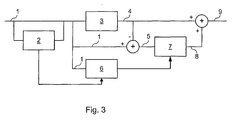
- FIG. 3 An image processing method in which this is particularly important is in FIG. 3 and the image sharpening method shown schematically in the flowchart.
- the granularity of the image in FIG. 2 is determined according to the invention.
- the low-pass signal 4 is formed.
- the low-pass signal is from the image signal 1 subtracted, so that the high-pass filter 5 results from the difference.
- the Image signal 1 using one of the known edge detection filters 6 edges in the image determined.
- the direct environment of each pixel is considered and the difference in density between spaced pixels by means of difference formation determined within the chosen environment. Once this difference in density an edge is detected in the image.
- the choice of the environment ie the extent of the Filters adapted to the grain size.
- the area is about the size of the Assumes grains corresponds to that to be expected from the grains Density fluctuation of the grain amplitude, that is, all density differences in of this order of magnitude or less indicate grain-related Noise and no edges yet.
- An edge is only detected when the Density difference in such an environment is greater than that Grain amplitude.
- This inventive method ensures that the Edge detection only edges that occur effectively in the image signal, which the Play detailed information in the picture, be determined.
- the result of Edge detection filter 6 is now used to, similar to that in FIG No. 5,978,518 describes generating a tightening characteristic curve 7.
- This Sharpening characteristic is on the previously formed high-pass signal 5th applied, so that a sharper high-pass signal 8 arises.
- This tightened high-pass signal 8 is finally added to the low-pass signal 4, so that finally there is a sharper image signal 9.
Landscapes
- Physics & Mathematics (AREA)
- General Physics & Mathematics (AREA)
- Engineering & Computer Science (AREA)
- Theoretical Computer Science (AREA)
- Facsimile Image Signal Circuits (AREA)
- Image Processing (AREA)
Abstract
Description
Claims (20)
- Verfahren zum Bearbeiten digitaler Bilder, wobeiwobei die Filter und/oder die Kennlinien in Abhängigkeit von der ermittelten Körnigkeit gebildet werden.die Bilder durch einscannen fotografischer Filme gewonnen werden,die Körnigkeit von Bildern ermittelt wird undFilter und/oder 1- bzw. 3-dimensionale Kennlinien auf die Bilddaten angewandt werden,
- Verfahren nach Anspruch 1, dadurch gekennzeichnet, dass die Körnigkeit der Bilder aus DX-Code und/oder APS-Daten ermittelt wird.
- Verfahren nach Anspruch 1, dadurch gekennzeichnet, dass die Körnigkeit der Bilder aus der Fouriertransformierten der Bilddaten ermittelt wird.
- Verfahren nach Anspruch 3, dadurch gekennzeichnet, dass die Kömigkeit der Bilder aus der Fouriertransformierten der Bilddaten und Information aus dem Ortsraum ermittelt wird.
- Verfahren nach Anspruch 1, dadurch gekennzeichnet, dass eine Gradationskennlinie auf die Bilddaten angewandt wird.
- Verfahren nach Anspruch 5, dadurch gekennzeichnet, dass die Form der Gradationskennlinie abhängig von der ermittelten Körnigkeit gewählt wird.
- Verfahren nach Anspruch 1, dadurch gekennzeichnet, dass Filter und Kennlinien auf die Bilddaten angewandt werden, um den Bildeindruck zu verschärfen.
- Verfahren nach Anspruch 7, dadurch gekennzeichnet, dass der Filter zur Aufspaltung des Bildsignals in Hoch- und Tiefpaßanteil vewendet wird.
- Verfahren nach Anspruch 8, dadurch gekennzeichnet, dass die den Hochpaß kurzwellig begrenzende Frequenz in Abhängigkeit von der ermittelten Körnigkeit gewählt wird.
- Verfahren nach Anspruch 7, dadurch gekennzeichnet, dass der Filter zur Detektion von Kanten verwendet wird.
- Verfahren nach Anspruch 10, dadurch gekennzeichnet, dass die Filterausdehnung in Abhängigkeit von der ermittelten Körnigkeit gewählt wird.
- Verfahren nach Anspruch 7, dadurch gekennzeichnet, dass die Kennlinie derart gebildet wird, dass erst oberhalb der der Korngröße entsprechenden Amplitude des Dichte- oder Hochpaßsignals eine Verstärkung auftritt.
- Verfahren zum Detektieren von Kanten in digitalen Bildern, wobeidie Bilder durch Einscannen fotografischer Filme gewonnen werden,die Körnigkeit von Bildern ermittelt wird unddie Korngröße und/oder die Kornstärke bei dem Kantendetektionsverfahren berücksichtigt wird.
- Verfahren nach Anspruch 13, dadurch gekennzeichnet, dass die Größe des Kantendetektionsfilters an den Kornabstand angepaßt wird.
- Verfahren nach Anspruch 13, dadurch gekennzeichnet, dass der Kantendetektionsschwellwert größer als die Kornstärke gewählt wird.
- Verfahren nach Anspruch 13, dadurch gekennzeichnet, dass das Kantendetektionsverfahren beim Verschärfen des digitalen Bildes verwendet wird.
- Verfahren nach Anspruch 16, dadurch gekennzeichnet, dass die Kantendetektion beim Generieren der Verschärfungskennlinie berücksichtigt wird.
- Verfahren nach Anspruch 13, dadurch gekennzeichnet, dass die Kantendetektion zur Objekterkennung benutzt wird.
- Verfahren nach Anspruch 13, dadurch gekennzeichnet, dass die Kantendetektion zur Einteilung des Bildes in "Kanten"- und "Nicht-Kanten-Regionen" benutzt wird.
- Verfahren nach Anspruch 19, dadurch gekennzeichnet, dass die Bilddaten in den "Kanten-Regionen" anders bearbeitet werden als in den "NichtKanten-Regionen".
Applications Claiming Priority (2)
| Application Number | Priority Date | Filing Date | Title |
|---|---|---|---|
| DE10004631 | 2000-02-03 | ||
| DE10004631A DE10004631A1 (de) | 2000-02-03 | 2000-02-03 | Verfahren zur Bearbeitung digitaler Bilder |
Publications (2)
| Publication Number | Publication Date |
|---|---|
| EP1122689A2 true EP1122689A2 (de) | 2001-08-08 |
| EP1122689A3 EP1122689A3 (de) | 2003-11-05 |
Family
ID=7629632
Family Applications (1)
| Application Number | Title | Priority Date | Filing Date |
|---|---|---|---|
| EP01102473A Withdrawn EP1122689A3 (de) | 2000-02-03 | 2001-02-03 | Verfahren zur Verbesserung digitaler Bilder |
Country Status (2)
| Country | Link |
|---|---|
| EP (1) | EP1122689A3 (de) |
| DE (1) | DE10004631A1 (de) |
Families Citing this family (1)
| Publication number | Priority date | Publication date | Assignee | Title |
|---|---|---|---|---|
| EP1404114A1 (de) | 2002-09-24 | 2004-03-31 | Agfa-Gevaert AG | Digitales Bildverarbeitungsverfahren zur automatischen Kontrastmodifikation |
Family Cites Families (3)
| Publication number | Priority date | Publication date | Assignee | Title |
|---|---|---|---|---|
| US5523849A (en) * | 1993-06-17 | 1996-06-04 | Eastman Kodak Company | Optimizing edge enhancement for electrographic color prints |
| JPH0922460A (ja) * | 1995-02-09 | 1997-01-21 | Fuji Photo Film Co Ltd | 画像処理方法および装置 |
| JPH11261821A (ja) * | 1998-03-12 | 1999-09-24 | Fuji Photo Film Co Ltd | 画像処理方法 |
-
2000
- 2000-02-03 DE DE10004631A patent/DE10004631A1/de not_active Ceased
-
2001
- 2001-02-03 EP EP01102473A patent/EP1122689A3/de not_active Withdrawn
Also Published As
| Publication number | Publication date |
|---|---|
| DE10004631A1 (de) | 2001-08-09 |
| EP1122689A3 (de) | 2003-11-05 |
Similar Documents
| Publication | Publication Date | Title |
|---|---|---|
| DE69111932T2 (de) | Tönungsskala-herstellungsverfahren und vorrichtung für digitale röntgenbilder. | |
| DE69419682T2 (de) | Raumfiltereinheit zur adaptiven Randverstärkung | |
| DE60026258T2 (de) | Bildverarbeitungsverfahren und Bildverarbeitungsvorrichtung | |
| DE60030456T2 (de) | Verfahren und system zur verbesserung von digitalbildern | |
| DE69028946T2 (de) | Verfahren zur adaptiven Schärfung elektronischer Bilder | |
| DE60111756T2 (de) | Verfahren zum verbessern der kompressionsfähigkeit und der bildqualität von abgetasteten dokumenten | |
| DE69318876T2 (de) | System und Verfahren zur Umwandlung von Halbtonbildern in Bilder mit kontinuierlichen Tönen | |
| DE69230629T2 (de) | Verfahren und Vorrichtung zur Bildverbesserung | |
| DE3546135C2 (de) | ||
| DE69633259T2 (de) | Bildverarbeitungsverfahren und -vorrichtung | |
| DE69620302T2 (de) | Verfahren und Vorrichtung zur Verbesserung eines digitalen Bildes | |
| DE60012464T2 (de) | Verfahren zur Verbesserung eines digitalbildes mit rauschabhängiger Steuerung der Textur | |
| DE60026925T2 (de) | Einstellung des Kontrasts eines Digitalbildes mit einem adaptiven, rekursiven Filter | |
| DE69806981T2 (de) | Verfahren zur Kontrastverbesserung von Bildsequenzen | |
| DE69229214T2 (de) | Verfahren und Vorrichtung zur automatischen Grauskalaerzeugung für numerische Strahlungsbilder | |
| DE69736938T2 (de) | Detektion und Wiedergabe von Text in gerasterten Bildbereichen | |
| DE69427324T2 (de) | Bildverarbeitungsgerät | |
| DE60315568T2 (de) | Verfahren zur Verbesserung der Schärfe eines Digitalbildes | |
| DE60300462T2 (de) | Verfahren zur schärfung eines digitalbildes mit signal-rausch-bewertung | |
| DE60033484T2 (de) | Umsetzung des Farbtonbereichs mit Erhaltung der lokalen Luminanzdifferenzen | |
| DE69732955T2 (de) | Adaptive Rauschverminderung von Videobildern | |
| DE69421867T2 (de) | Methode zur Verarbeitung von Energiesubtraktionsbildern | |
| DE60127016T2 (de) | Verfahren und Gerät zur Durchführung einer lokalen Farbkorrektur | |
| DE1039842B (de) | Verfahren zur kuenstlichen Kontraststeigerung an Tonwertspruengen und Konturen in mittels elektronischer Klischier-maschinen herzustellenden Klischees | |
| WO1996019778A1 (de) | Verfahren zur trennung einer vordergrundinformation von einer hintergrundinformation in einer vorlage |
Legal Events
| Date | Code | Title | Description |
|---|---|---|---|
| PUAI | Public reference made under article 153(3) epc to a published international application that has entered the european phase |
Free format text: ORIGINAL CODE: 0009012 |
|
| AK | Designated contracting states |
Kind code of ref document: A2 Designated state(s): AT BE CH CY DE DK ES FI FR GB GR IE IT LI LU MC NL PT SE TR |
|
| AX | Request for extension of the european patent |
Free format text: AL;LT;LV;MK;RO;SI |
|
| PUAL | Search report despatched |
Free format text: ORIGINAL CODE: 0009013 |
|
| RIC1 | Information provided on ipc code assigned before grant |
Ipc: 7H 04N 1/58 B Ipc: 7G 06T 5/20 B Ipc: 7G 06T 5/00 A |
|
| AK | Designated contracting states |
Kind code of ref document: A3 Designated state(s): AT BE CH CY DE DK ES FI FR GB GR IE IT LI LU MC NL PT SE TR |
|
| AX | Request for extension of the european patent |
Extension state: AL LT LV MK RO SI |
|
| 17P | Request for examination filed |
Effective date: 20040506 |
|
| AKX | Designation fees paid |
Designated state(s): AT BE CH CY DE DK ES FI FR GB GR IE IT LI LU MC NL PT SE TR |
|
| 17Q | First examination report despatched |
Effective date: 20040729 |
|
| RAP1 | Party data changed (applicant data changed or rights of an application transferred) |
Owner name: AGFAPHOTO GMBH |
|
| 19U | Interruption of proceedings before grant |
Effective date: 20060101 |
|
| 19W | Proceedings resumed before grant after interruption of proceedings |
Effective date: 20100401 |
|
| STAA | Information on the status of an ep patent application or granted ep patent |
Free format text: STATUS: THE APPLICATION IS DEEMED TO BE WITHDRAWN |
|
| 18D | Application deemed to be withdrawn |
Effective date: 20101002 |