EP1118275A1 - Production method for soybean processed food and heating-deaerating device for mashed soybean soup - Google Patents
Production method for soybean processed food and heating-deaerating device for mashed soybean soup Download PDFInfo
- Publication number
- EP1118275A1 EP1118275A1 EP00948341A EP00948341A EP1118275A1 EP 1118275 A1 EP1118275 A1 EP 1118275A1 EP 00948341 A EP00948341 A EP 00948341A EP 00948341 A EP00948341 A EP 00948341A EP 1118275 A1 EP1118275 A1 EP 1118275A1
- Authority
- EP
- European Patent Office
- Prior art keywords
- deaeration
- soybean slurry
- soybean
- heating
- slurry
- Prior art date
- Legal status (The legal status is an assumption and is not a legal conclusion. Google has not performed a legal analysis and makes no representation as to the accuracy of the status listed.)
- Granted
Links
Images


Classifications
-
- A—HUMAN NECESSITIES
- A23—FOODS OR FOODSTUFFS; TREATMENT THEREOF, NOT COVERED BY OTHER CLASSES
- A23C—DAIRY PRODUCTS, e.g. MILK, BUTTER OR CHEESE; MILK OR CHEESE SUBSTITUTES; PREPARATION THEREOF
- A23C11/00—Milk substitutes, e.g. coffee whitener compositions
- A23C11/02—Milk substitutes, e.g. coffee whitener compositions containing at least one non-milk component as source of fats or proteins
- A23C11/10—Milk substitutes, e.g. coffee whitener compositions containing at least one non-milk component as source of fats or proteins containing or not lactose but no other milk components as source of fats, carbohydrates or proteins
- A23C11/103—Milk substitutes, e.g. coffee whitener compositions containing at least one non-milk component as source of fats or proteins containing or not lactose but no other milk components as source of fats, carbohydrates or proteins containing only proteins from pulses, oilseeds or nuts, e.g. nut milk
-
- A—HUMAN NECESSITIES
- A23—FOODS OR FOODSTUFFS; TREATMENT THEREOF, NOT COVERED BY OTHER CLASSES
- A23L—FOODS, FOODSTUFFS OR NON-ALCOHOLIC BEVERAGES, NOT OTHERWISE PROVIDED FOR; PREPARATION OR TREATMENT THEREOF
- A23L11/00—Pulses, i.e. fruits of leguminous plants, for production of food; Products from legumes; Preparation or treatment thereof
- A23L11/05—Mashed or comminuted pulses or legumes; Products made therefrom
- A23L11/07—Soya beans, e.g. oil-extracted soya bean flakes
-
- A—HUMAN NECESSITIES
- A23—FOODS OR FOODSTUFFS; TREATMENT THEREOF, NOT COVERED BY OTHER CLASSES
- A23L—FOODS, FOODSTUFFS OR NON-ALCOHOLIC BEVERAGES, NOT OTHERWISE PROVIDED FOR; PREPARATION OR TREATMENT THEREOF
- A23L11/00—Pulses, i.e. fruits of leguminous plants, for production of food; Products from legumes; Preparation or treatment thereof
- A23L11/30—Removing undesirable substances, e.g. bitter substances
- A23L11/31—Removing undesirable substances, e.g. bitter substances by heating without chemical treatment, e.g. steam treatment, cooking
-
- A—HUMAN NECESSITIES
- A23—FOODS OR FOODSTUFFS; TREATMENT THEREOF, NOT COVERED BY OTHER CLASSES
- A23L—FOODS, FOODSTUFFS OR NON-ALCOHOLIC BEVERAGES, NOT OTHERWISE PROVIDED FOR; PREPARATION OR TREATMENT THEREOF
- A23L11/00—Pulses, i.e. fruits of leguminous plants, for production of food; Products from legumes; Preparation or treatment thereof
- A23L11/60—Drinks from legumes, e.g. lupine drinks
- A23L11/65—Soy drinks
-
- B—PERFORMING OPERATIONS; TRANSPORTING
- B01—PHYSICAL OR CHEMICAL PROCESSES OR APPARATUS IN GENERAL
- B01D—SEPARATION
- B01D19/00—Degasification of liquids
- B01D19/0068—General arrangements, e.g. flowsheets
Definitions
- the present invention relates to a method of producing processed soybean food products such as tofu, soymilk, and soybean casein (yuba) and to an apparatus for the thermal deaeration of a soybean slurry obtained by grinding soybeans, and is intended to enable the unpleasant raw odor that is characteristic of soybeans to be effectively removed.
- soybean products such as tofu, soymilk, and soybean casein (yuba)
- an operation to process raw soybeans and change them into a liquid form is performed.
- This operation comprises: an immersion step in which raw soybeans that have been thoroughly washed are immersed in water for approximately one night until they swell to approximately twice their size; a grinding step in which a slurry is obtained by rubbing and crushing the swollen raw soybeans while adding an appropriate amount of water; and a heating step in which the soybean slurry undergoes thermal denaturation by being heated to a predetermined temperature.
- a separation step in which solid pulp (okara) is separated may also be performed either before or after the heating step.
- processed soybean food products are produced.
- tofu can be obtained by adding a coagulant to the soybean slurry so as to coagulate it.
- the heating step renders harmless the harmful substances contained in the soybeans by the heating thereof and also simplifies the soybean protein and changes it into a state in which it can be easily digested.
- the heating step is thus particularly important (see page 121 of "Soymilk", by Kanji Tsuchiya, Food Research Institute, 1980).
- the heating step can be separated into a temperature raising step in which the soybean slurry is heated so as to raise the temperature thereof and a thermal denaturation step in which the soybean protein is thermally denatured by maintaining the heated soybean slurry at a raised temperature for a predetermined time.
- a temperature raising step in which the soybean slurry is heated so as to raise the temperature thereof
- a thermal denaturation step in which the soybean protein is thermally denatured by maintaining the heated soybean slurry at a raised temperature for a predetermined time.
- soybean protein is such that it is extremely susceptible to being permeated with air. Therefore, if the soybean slurry becomes permeated with a large amount of air in the grinding step and a large number of air bubbles become mixed in the soybean slurry, then this has a deleterious effect on the final product.
- tofu is produced using soybean slurry in which air bubbles have become mixed
- the finished tofu has insufficient hardness and the constituent elements of the soybeans are oxidized by the oxygen in the air bubbles resulting in the problem arising that an unpleasant raw odor is given off.
- the soybean slurry absorbs the odor already generated in the soybean protein in which the thermal denaturation is well advanced and this odor becomes fixed in the soybean slurry. Therefore, as is disclosed in Japanese Unexamined Patent Application, First Publication (Kokai), No. Sho 61-195660, the problem arises that the odor has already been generated in the soybean slurry even if the air bubbles are removed from the soybean slurry that has undergone the heating step. Namely, once the odor has been generated, there has not been much point to then performing the deaeration and a satisfactory effect as regards odor removal has not been obtained.
- the aim of the present invention is to provide a processed soybean food product of a higher quality than has been produced hitherto by removing air bubbles mixed in with the soybean slurry and effectively removing the unpleasant raw odor that is characteristic of soybeans.
- the soybean production method of the present invention includes a grinding step (A) in which raw soybeans are ground to provide a soybean slurry, and a heating step (B) in which the provided soybean slurry is heated and thermally denatured, and partway through the heating step (B), a deaeration step (C) for removing air bubbles mixed in with the soybean slurry is performed.
- Fig. 1 is a schematic structural view showing an example of the soybean slurry thermal deaeration apparatus of the present invention.
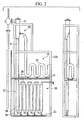
- Fig. 2 is a view showing the exterior appearance of another example of the soybean slurry thermal deaeration apparatus of the present invention.
- Fig. 3 is a view showing the exterior appearance of yet another example of the soybean slurry thermal deaeration apparatus of the present invention.
- the heating step (B) comprises a first heating step in which a temperature of the soybean slurry is raised to a predetermined intermediate temperature and a second heating step in which the soybean slurry is further heated, and if the deaeration step (C) is performed between the first heating step and the second heating step.
- the deaeration step (C) is performed at the point when the soybean slurry reaches a temperature range of 75 to 125°C in the heating step (B), and it is more preferable if the deaeration step (C) is performed at the point when the soybean slurry reaches a temperature range of 75 to 100°C.
- the deaeration step (C) is a method for removing air bubbles in which the soybean slurry is depressurized such that the temperature of the soybean slurry decreases by at least 3°C or more.
- the soybean slurry flows alternately through a large diameter pipe and a small diameter pipe.
- the soybean slurry flows alternately between a large diameter pipe arranged in a straight line and a small diameter pipe bent in a turning configuration.
- the soybean slurry is heated by steam being blown into the soybean slurry.
- the apparatus for thermal deaeration of a soybean slurry of the present invention comprises: a first heating apparatus that raises the temperature of the soybean slurry to a predetermined intermediate temperature; a deaeration apparatus that deaerates the soybean slurry that has reached the intermediate temperature in the first heating apparatus; and a second heating apparatus that completes thermal denaturation by further heating the soybean slurry that has been deaerated by the deaeration apparatus. It is preferable if the first heating apparatus and the second heating apparatus are provided with: a liquid feed pipe through which the soybean slurry is continuously circulated; a steam mixing apparatus that heats the soybean slurry circulating through the liquid feed pipe by mixing it with steam; and a liquid feed pump for feeding the soybean slurry into the liquid feed pipe.
- the liquid feed pipe comprises a continuous succession of large diameter pipes alternating with small diameter pipes, moreover, it is preferable if small diameter pipes that are bent in a turning configuration are interposed between a plurality of large diameter pipes arranged in straight lines. Furthermore, it is preferable if the steam mixing apparatus that blows steam into the soybean slurry is connected to a portion of the small diameter pipe that is bent in a turning configuration.
- the deaeration apparatus is provided with a deaeration chamber in which soybean slurry is stored and a suction apparatus for suctioning out air inside this deaeration chamber.
- the soybean production method of the present invention includes a grinding step (A) in which raw soybeans are ground to provide a soybean slurry and a heating step (B) in which the provided soybean slurry is heated and thermally denatured, and partway through the heating step (B), a deaeration step (C) for removing air bubbles mixed in with the soybean slurry is performed.
- the deaeration step (C) is performed partway through the heating step (B), it is possible to efficiently remove the odor from the soybean slurry. Accordingly, it is possible to obtain a high deodorization effect that is not obtainable in the conventional methods in which the deaeration process is performed either before or after the heating step. Moreover, the deaeration step (C) may be performed while the heating operation is being performed or after the heating operation has been stopped.
- partway through the heating step (B) means the period after heating of the soybean slurry has begun while it is higher than room temperature, and is not particularly restricted.
- the deaeration step (C) may be performed during the temperature raising step in which the temperature of the soybean slurry is raised by heat being applied thereto, or during the thermal denaturation step in which the soybean slurry is thermally denatured by being maintained at the raised temperature for a predetermined time.
- the deaeration step (C) may be performed between the temperature raising step and the thermal denaturation step.
- the deaeration step (C) is completed before the thermal denaturation progresses too far.
- the deaeration step (C) is completed before the thermal denaturation of the soybean slurry begins. Namely, in the case of this example, it is preferable if the deaeration step (C) is performed either partway through the temperature raising step or between the temperature raising step and the thermal denaturation step.
- the heating step (B) is formed from a first heating step in which a temperature of the soybean slurry is raised to a predetermined intermediate temperature and a second heating step in which the soybean slurry is further heated, and if the deaeration step (C) is performed between the first heating step and the second heating step.
- the soybean slurry is heated to an intermediate temperature in the first heating step and subsequently the deaeration step (C) for deaerating the soybean slurry is performed. Thereafter, either the soybean slurry is maintained by the second heating step at the temperature after the deaeration step, or the temperature of the soybean slurry is raised further to a predetermined final temperature. Alternatively, after the temperature of the soybean slurry has been raised to the predetermined final temperature, it is then kept at this temperature.
- the intermediate temperature is preferably set in a temperature range between 75 and 125°C, more preferably between 75 and 100°C, and even more preferably between 80 and 100°C. If the temperature of the soybean slurry is less than 75°C, the viscosity of the soybean slurry is too high and it is difficult to remove the minute air bubbles in the soybean slurry, resulting in cases arising in which effective deaeration is not possible. On the other hand, in order to deactivate the oxygen in the soybean slurry, it is sufficient if the temperature of the soybean slurry is raised to 125°C. If the intermediate temperature is set in excess of 125°C, then the energy costs increase.
- the intermediate temperature is set within the above temperature range within which the viscosity of the soybean slurry is low, the deaeration can be efficiently performed, the thermal denaturation of the soybean protein does not progress too far, and there is little waste of energy.
- the processed soybean food product being produced here is a coagulated food product such as tofu or the like
- the temperature of the soybean slurry is raised to in excess of 100°C, the ability of the soybean slurry to coagulate is reduced, therefore, it is particularly preferable that the intermediate temperature is set within the range of 75 to 100°C.
- the deaeration step (C) is a method for deaerating air bubbles in which the soybean slurry is depressurized such that the temperature of the soybean slurry decreases by at least 3°C or more. It is more preferable that the temperature of the soybean slurry decreases by 3 to 15°C. This lowering of the temperature of the soybean slurry occurs because, if the pressure of the deaeration chamber is reduced, the boiling point of the soybean slurry decreases so that the soybean slurry boils-more easily and the vaporization latent heat is lost in accordance with the amount of vapor generated by the soybean slurry while it is boiling.
- the pressure in the deaeration chamber is set such that the temperature of the soybean slurry after deaeration decreases by 3°C or more compared to before the deaeration, because it is then possible to make the pressure in the deaeration chamber a pressure at which the soybean slurry boils gently and to perform efficient deaeration.
- the temperature difference of the soybean slurry before and after the deaeration step (C) is less than 3°C, the boiling of the soybean slurry is less vigorous and a sufficient deaeration effect may not be obtained.
- the larger the temperature difference of the soybean slurry before and after the deaeration step (C) the greater the deaeration effect however, when the temperature difference increases to 15°C, then the deaeration effect is the same as when the temperature difference is below 15°C. Therefore, it is preferable in view of the deaeration affect as well as of conserving energy that the temperature difference of the soybean slurry before and after the deaeration step (C) is set to 3 to 15°C.
- the method used for the second heating step performed after the deaeration step (C) can be appropriately selected from one of: holding the soybean slurry at the temperature thereof after the deaeration step (C); raising the temperature of the soybean slurry further to a predetermined final temperature; or raising the temperature of the soybean slurry to a predetermined final temperature and then holding it at this temperature. It is preferable that the soybean slurry be ultimately heated to between 95 and 125°C as this causes the thermal denaturation to be completed.
- the intermediate temperature is set to the comparatively low temperature of less than 95°C and the thermal denaturation of the soybean slurry has not progressed sufficiently in the first heating step, then it is preferable that the temperature of the soybean slurry is further raised to the higher final temperature of 95 to 125°C in the second heating step so as to advance the thermal denaturation. If the intermediate temperature is set to the comparatively high temperature of approximately 125°C and the thermal denaturation of the soybean slurry has progressed sufficiently in the first heating step, then the temperature of the soybean slurry does not need to be raised further in the second heating step and may be held at the temperature at the completion of the deaeration step (C).
- a preferable method involves heating the soybean slurry to 105°C in the first heating step and then lowering the temperature to approximately 100°C in the deaeration step, and thereafter, heating the soybean slurry to 120°C in the second heating step and holding it there for approximately 3 to 15 minutes.
- the heating step (B) and the deaeration step (C) may be performed using a known heating apparatus and a known deaeration apparatus.
- the heating apparatus examples include indirect heating method heating apparatuses such as a surface heat exchanger, a plate heat exchanger, a double pipe heat exchanger, a multipipe heat exchanger, a coil heat exchanger, a flat heat exchanger, and a scraped surface heat exchanger; and direct heating method heating apparatuses that mix the soybean slurry together with steam and heat this mixture such as injection types and infusion types of heating apparatuses. It is preferable that a direct heating method heating apparatus is used, as the soybean slurry can be heated efficiently. In contrast, if an indirect heating method heating apparatus is used, care needs to be taken as regards the operating conditions and operating time, as soybean protein tends to become burned and stick to the heat transfer surface of the apparatus.
- a desirable heating apparatus is an injection method continuous heating apparatus that heats the soybean slurry by continuously blowing steam into the continuously circulating soybean slurry.
- this type of apparatus the apparatus described below, in particular, is the most desirable.
- the steam pipes it is possible for the steam pipes to simply be joined to the pipes through which the soybean slurry is circulating, however, it is also possible for the steam pipes to protrude into the inside of the pipes through which the soybean slurry is flowing and to provide the steam outlet at the distal end of the protruding steam pipe.
- the steam outlet opens facing the direction in which the soybean slurry is circulating (i.e. if the outlet opening faces the downstream direction of the flow of the soybean slurry).
- the dynamic pressure of the soybean slurry acts on the steam outlet and a phenomenon is generated in which the stem is suctioned towards the steam outlet and the steam is blown efficiently into the soybean slurry.
- the diameter (i.e. inner diameter) of the pipe through which the soybean slurry circulates is designed to be narrow at the portion where the steam is blown into the soybean slurry, as described above.
- the speed at which the soybean slurry circulates is increased resulting in the dynamic pressure of the soybean slurry increasing and thereby decreasing the static pressure. Therefore, the action of suctioning the steam in the steam outlet is strengthened and the efficiency of the steam blowing is improved providing an effect of stirring the soybean slurry.
- the pipes through which the soybean slurry circulates is formed with an appropriate turning structure, for example, it may be formed in a U shape (this is so as to reduce the area covered by the apparatus), and the heating apparatus of the present invention desirably is designed such that the diameter of the pipes through which the soybean slurry circulates is also made smaller in these locations where the pipes through which the soybean slurry circulates are made to turn.
- the flow speed of the circulating soybean slurry changes and an ideal mixing state is achieved in which the soybean slurry is thoroughly agitated. Therefore, the characteristic effect is obtained that the protein component contained in the circulating soybean slurry is uniformly mixed.
- the diameter of the turning portion is in the range of 3/4 to 1/5 of the diameter of the pipe through which the soybean slurry is circulating.
- the soybean slurry is normally made to circulate in a piston flow state inside the pipe through which the soybean slurry is circulating.
- the present invention is able to achieve a further remarkable effect.
- any apparatus may be used for the deaeration apparatus provided that it is able to remove air bubbles from the soybean slurry, however, it is preferable if an apparatus that is provided with a deaeration chamber and a suction apparatus for suctioning out air from inside this deaeration chamber is used, and in which soybean slurry is stored in the deaeration chamber and the pressure inside the deaeration chamber is reduced when the air-is suctioned out from the deaeration chamber, as this allows an excellent deaeration effect to be achieved using a simple structure.
- Additional examples include a fluid cyclone which circulates the liquid so as to generate centrifugal force and collect air bubbles in the center portion of the circulation due to the buoyancy opposing the centrifugal force, and then removes the air bubbles from this center portion; and a centrifugal separator which removes the air bubbles by circulating the liquid in the same way using mechanical power.
- the heating step (B) and the deaeration step (C) may be used for batch processing or may be performed continuously.
- one example thereof is a method in which the soybean slurry is placed and sealed inside a sealable container and the first heating step is performed by heating this sealed container, and then, at the point when the soybean slurry reaches a predetermined intermediate level temperature, the deaeration step (C) is performed by suctioning out the interior of the container, and thereafter the second heating step to further heat the soybean slurry is performed.
- the heating step (B) and the deaeration step (C) can be continuously performed by using a thermal deaeration apparatus in which a plurality of continuous type heating apparatuses are connected in series and a continuous type deaeration apparatus is provided between each heating apparatus, and by continuously circulating soybean slurry through this apparatus. It is not necessary that only one continuous type deaeration apparatus be provided between the heating apparatuses and it is possible to provide two or more between heating apparatuses. It is also preferable that other steps such as the separation step and the grinding step are also performed continuously if the heating step (B) and the deaeration step (C) are being performed continuously.
- Fig. 1 is a schematic structural view showing an embodiment of the thermal deaeration apparatus 1 of the present invention. It is preferable that this apparatus 1 is used as it enables the heating step (B) and the deaeration step (C) to be performed continuously and efficiently.
- the thermal deaeration apparatus 1 is provided with a first heating apparatus 10 for raising the temperature of the soybean slurry to a predetermined intermediate temperature; a deaeration apparatus 20 for deaerating the soybean slurry once it has reached the intermediate temperature in the first heating apparatus 10; and a second heating apparatus 30 for completing the thermal denaturation by further heating the soybean slurry once it has been deaerated in the deaeration apparatus 20.
- the thermal deaeration apparatus 1 is also provided with a soybean slurry storage tank 2 in which the soybeans slurry is stored before it is heated.
- the soybean slurry inside this soybean slurry storage tank 2 is fed into a feed pipe 12 of the first heating apparatus 10 by a metering feed pump 11. After being heated, the soybean slurry then circulates in turn through the deaeration apparatus 20 and the second heating apparatus 30.
- the first heating apparatus 10 and the second heating apparatus 30 are equipped with feed pipes 12 and 32 through which the soybean slurry continuously circulates; steam feed apparatuses 13 and 33 via which high temperature steam is fed into the soybean slurry circulating through the feed pipes 12 and 32; and feed pumps 11 and 31 for feeding the soybean slurry into the feed pipes 12 and 32. Therefore, it is possible to feed soybean slurry at an optional flow rate into the feed pipes 12 and 32 in the first heating apparatus 10 and the second heating apparatus 20, and to heat this soybean slurry circulating through the feed pipes 12 and 32 by directly mixing steam into it. Steam is supplied to the steam feed apparatuses 13 and 33 from a steam supply unit 100 via branch pipes 110 and 120.
- the steam feed apparatuses 13 and 33 are not limited provided they are capable of directly feeding steam to the feed pipes 12 and 32, and it is also possible for a check valve or the like to be provided so that the soybean slurry does not flow into the steam feed pipes 13 and 33.
- the steam supply rate can be controlled by pressure regulating valves 111 and 121.
- the deaeration apparatus 20 is equipped with a deaeration chamber 21 for temporarily holding the soybean slurry and a suction apparatus for suctioning out the air in the deaeration chamber 21.
- An ejector 23 that suctions out the air using the dynamic pressure of a water jet, or a commonly known vacuum pump, or the like may be used as the suction apparatus.
- the symbol 24 indicates a water pipe and the end 25 of the water pipe is connected to an unillustrated water source. Note that the single dot chain line shown here shows the flow of water used to drive the ejector 23.
- the soybean slurry that has been heated by the first heating apparatus 10 comes into as much contact with the air as possible when it is introduced into the deaeration chamber 21.
- the end of the feed pipe 3 that is connected to the deaeration chamber 21 from the first heating apparatus 10 is connected in a manner in which it runs along the inner wall surface of the deaeration chamber 21, the soybean slurry that flows into the deaeration chamber 21 is circulated inside the deaeration chamber 21 along the inner wall surface, resulting in a large area being in contact with the air.
- Other examples include a method in which the soybean slurry is made to flow from the top of the inside of the deaeration chamber 21 in a thin film along the inner wall surface of the deaeration chamber 21; a method in which the soybean slurry falls like a curtain from the top of the inside of the deaeration chamber 21; a method in which the soybean slurry falls in a plurality of lines from the top of the inside of the deaeration chamber 21; and a method in which the soybean slurry falls in droplets.
- the soybeans slurry stored in the soybean slurry storage tank 2 is circulated through the feed pipe 12 of the first heating apparatus 10 by the metering fuel pump 11. Steam used for heating is blown from the steam supply apparatus 13 into the soybean slurry inside the feed pipe 12 thereby heating the soybean slurry to an intermediate temperature.
- the temperature and pressure of the soybean slurry can each be confirmed using a temperature gauge 5 and pressure gauge 4, respectively.
- the temperature of the soybean slurry can be adjusted by increasing or decreasing the amount of steam by adjusting the amount of the opening of the pressure regulating valve 111 of the steam supply unit 100.
- the soybean slurry that has been heated to the intermediate temperature is fed to the deaeration apparatus 20 through the feed pipe 3 and flows into the deaeration chamber 21 of the deaeration apparatus 20.
- the air inside the deaeration chamber 21 is suctioned by the ejector 23 depressurizing the interior of the deaeration chamber 21 and deaerating the soybean slurry.
- the pressure inside the deaeration chamber 21 can be monitored using the pressure gauge 26 and, in addition, the pressure inside the deaeration chamber 21 can be controlled using the vacuum breaker 27 such that the pressure inside the deaeration chamber 21 does not become too low.
- the values shown by the temperature gauge 5 and the temperature gauge 7 are closely observed, and the extent of the suction is controlled such that the difference in temperature between the inlet side and the outlet side of the deaeration chamber 21, namely, the difference in temperature before and after deaeration is a predetermined value.
- the soybean slurry that has passed through the deaeration chamber 21 arrives at the second heating apparatus 30 via the feed pipe 6.
- the soybean slurry is fed to the feed pipe 32 by the feed pump 31 and steam used for heating is blown from the steam supply apparatus 33 into the soybean slurry inside the feed pipe 32, thereby further heating the soybean slurry.
- the temperature of the soybeans slurry at this point can be confirmed using the temperature gauge 8.
- the soybean slurry can also be controlled using the pressure gauge 9 and the back pressure regulating valve 9a so that it is heated to a point where it does not boil.
- the soybean slurry that has completed thermal denaturation in the second heating apparatus 30 can be used for various processed soybean food products such as silk tofu, cotton tofu, secondary tofu products such as fried tofu and dried tofu, various other types of processed tofu, drinks such as soy milk, soybean casein (yuba), freeze dried tofu, and the like.
- these processed soybean products are not limited to food products for human consumption, and the soybean slurry may be used in animal feed as well.
- FIG. 2 and 3 show exterior views of other embodiments of the soybean slurry thermal deaeration apparatus of the present invention.
- Fig. 2 or Fig. 3 the same descriptive symbols as used in Fig. 1 are used for elements that are common to Fig. 1 and a detailed description thereof is omitted. Note that, in Fig. 2 or Fig. 3, not all the elements shown in Fig. 1 are illustrated and the illustration of a portion of the elements has been omitted.
- the first heating apparatus 10, the deaeration apparatus 20, and the second deaeration apparatus 30 are each fixed to a common frame 200.
- the feed pipe 12 is formed from sanitary pipe made from 2 inch stainless steel. This type of feed pipe 12 is provided in the frame 200 in a configuration comprising a series of suitable turns with the aim of reducing the surface area of the installation and the pipe ultimately leads to the deaeration apparatus 20.
- the second heating apparatus 30 is connected downstream from the deaeration apparatus 20 and the structure of this second heating apparatus 30 is particularly distinctive.
- the feed pipe 32 is provided with rectilinear pipes 34 (2 inch pipe) and these rectilinear pipes (for example, 34) are provided in the frame 200 in a configuration that comprises a series of turns.
- the steam feed apparatus 33 is connected to a turning pipe 35 at the bottom end of the feed pipe 32 and the diameter of the turning pipes 35 is designed to be smaller than the diameter of the rectilinear pipes 34.
- the diameter of each turning pipe 35 is 10 mm.
- the diameter of the turning pipes (for example, 36) at the top end of the feed pipe 32 is designed to be smaller than the diameter of the rectilinear pipes 34 (i.e. 10 mm).
- the soybean slurry passes alternately through a large diameter rectilinear pipe (2 inch - for example, 36) and a small diameter turning pipe (10 mm, for example, 35, 36), the soybean slurry flows in a vigorously stirred state resulting in the protein contained in the soybean slurry being uniformly heated and having a beneficial effect on the finally obtained product.
- the soybean slurry is flowing in a piston flow.
- the first heating apparatus 10 in the case of Fig. 3 is designed in the same way as the second heating apparatus 30 as a combination of large diameter rectilinear pipes (2.5 inch) and small diameter turning pipes (1 inch).
- the deaeration step (C) for removing the air bubbles mixed into the soybean slurry is performed partway through the heating step (B)
- the soybean slurry is heated and therefore the viscosity is low and the air bubbles mixed into the soybean slurry can be easily removed.
- the thermal denaturation has not progressed too far and the odor of the soybean slurry has not been absorbed to any large extent by the soybean protein. Therefore, if the deaeration step (C) is performed partway through the heating step (B), it is possible to efficiently remove the odor from the soybean slurry. Accordingly, it is possible to obtain an excellent deodorizing effect that has been unobtainable in the conventional methods in which the deaeration step (C) is performed either before or after the heating step (B).
- the processed soybean food products can be produced more efficiently.
- the deaeration step (C) at the point in the gheating step (B) when the soybean slurry is in the temperature range of 75 to 125°C, and more preferably, in the temperature range of 75 to 100°C, it is possible to deaerate the soybean slurry while wasting very little energy.
- this type of thermal deaeration apparatus 1 is provided with a first heating apparatus 10 for raising the temperature of the soybean slurry to a predetermined intermediate temperature; a deaeration apparatus 20 for deaerating the soybean slurry once it has reached the intermediate temperature in the first heating apparatus 10; and a second heating apparatus 30 for completing the thermal denaturation by further heating the soybean slurry once it has been deaerated in the deaeration apparatus 20, the soybean slurry is heated to an appropriate degree and it is possible to deaerate the soybean slurry at an ideal time before the thermal denaturation and to obtain a soybean slurry in which the odor is suppressed.
- the deaeration apparatus 20 that is equipped with the deaeration chamber 21 for temporarily holding the soybean slurry and the suction apparatus for suctioning out the air in the deaeration chamber 21, it is possible to obtain an excellent deaeration effect using a simple apparatus.
- Soybean slurry was thermally deaerated using the soybean slurry thermal deaeration apparatus 1 shown in Figs. 1 and 2 to produce soymilk.
- the production method used is given below.
- the swollen soybeans obtained in the immersion step were supplied together with 170 kg of water to a grinder (manufactured by Nagasawa Kikai Seisakusho Co., Ltd.) and the soybeans were ground so that approximately 220 kg of soybean slurry (i.e. raw soy) was obtained.
- the soybean slurry (raw soy) obtained in the grinding step was circulated through the thermal deaeration apparatus 1 shown in Fig. 1, and a heating step and a deaeration step were performed under the operating conditions given below.
- Soybean slurry (raw soy) was stored in the soybean slurry storage tank 2 shown in Fig. 1 at a temperature of 11°C. It was then circulated through the first heating apparatus 10 and heated to an intermediate temperature of 70°C (the value of the temperature inside the first heating apparatus indicated by the temperature gauge 5) over a period of 4 minutes 30 seconds. Next, the heated soybean slurry was fed to the deaeration apparatus 20 and the ejector 23 of the deaeration apparatus was operated. The air inside the deaeration chamber 21 was then suctioned out so that the soybean slurry was deaerated.
- the value indicated by the temperature gauge 7 at this time namely, the temperature after deaeration was 65°C, giving a temperature difference before and after deaeration of 5°C.
- the pressure inside the deaeration chamber 21 (which value was indicated by the pressure gauge 26) at this time was -0.076 MPa.
- the soybean slurry was circulated at the second heating temperature and was heated to a final temperature of 100°C (the value of the temperature inside the second heating apparatus indicated by the temperature gauge 8) over a period of 5 minutes 30 seconds. It was then held at this temperature. The soybean slurry was thus deaerated and the thermal denaturation was completed.
- the soybean slurry (cooked soy) obtained in the thermal deaeration step was immediately separated into soymilk and solid pulp (okara) using a press (manufactured by Arai Tekkosho (Arai Iron Works Co., Ltd.)) and cooled so that approximately 190 kg of soymilk was obtained.
- the solid component of the obtained soymilk was 13.0% (by weight).
- the calculated evaluation points were then divided again into four levels indicated by X, ⁇ , ⁇ , and o ⁇ .
- the intermediate temperature i.e. the value indicated by the temperature gauge 5
- the temperature difference before and after deaeration and the pressure in the deaeration chamber i.e. the value indicated by the pressure gauge 26
- the final temperature i.e. the value indicated by the temperature gauge 8
- Table 1 the soymilk was produced and evaluated in the same way as in Example 1.
- the thermal deaeration apparatus As the thermal deaeration apparatus, the deaeration apparatus 20, the first heating apparatus 10, and the second heating apparatus 30 were connected in that sequence and, other than the connection sequence being different, the same substances as were used in Example 1 and the same thermal deaeration apparatus was used to produce soymilk.
- the obtained soymilk was evaluated in the same way as in Example 1. The evaluation results are shown in Table 2.
- the temperature of the soybean slurry before and after deaeration is also shown in Table 2.
- the thermal deaeration apparatus As the thermal deaeration apparatus, the first heating apparatus 10, the second heating apparatus 30, and the deaeration apparatus 20 were connected in that sequence and, other than the connection sequence being different, the same substances as were used in Example 1 and the same thermal deaeration apparatus was used to produce soymilk.
- the obtained soymilk was evaluated in the same way as in Example 1. The evaluation results are shown in Table 3.
- each test sample produced in the examples had a better taste than the test samples of the comparative examples.
- the test sample whose intermediate temperature was set to 75°C or more had a particularly good taste.
- the intermediate temperature was set within the range of 80°C or more, the evaluation was particularly high.
- soymilk of differing deaeration levels was produced in the same way as in Example 1.
- the obtained soymilk was evaluated in the same way as in Example 1.
- the evaluation results are shown in Table 4. Note that the pressure inside the deaeration chamber 21 (i.e. the value indicated by the pressure gauge 26) and the final temperature (i.e. the value indicated by the temperature gauge 8) are also shown in Table 4.
- the deaeration chamber is suctioned at a pressure at which the temperature of the soybean slurry after deaeration is at least 3°C or more, and preferably 4°C or more, lower than the temperature thereof before deaeration.
- Cotton tofu was produced using soybean slurry obtained using the soybean slurry thermal deaeration apparatus 1 shown in Figs. 1 and 3. The production method used is given below.
- the swollen soybeans obtained in the immersion step were supplied together with 570 kg of water to a grinder (manufactured by Nagasawa Kikai Seisakusho Co., Ltd.) and the soybeans were ground so that approximately 620 kg of soybean slurry (i.e. raw soy) was obtained.
- the soybean slurry (raw soy) obtained in the grinding step was circulated through the thermal deaeration apparatus 1 shown in Fig. 1, and a heating step and a deaeration step were performed under the operating conditions given below.
- Soybean slurry (raw soy) was stored in the soybean slurry storage tank 2 shown in Fig. 1 at a temperature of 11°C. It was then circulated through the first heating apparatus 10 and heated to an intermediate temperature of 94°C (i.e. the value indicated by the temperature gauge 5) over a period of 4 minutes 30 seconds.
- the ejector 23 of the deaeration apparatus 20 was then operated and the air inside the deaeration chamber 21 was suctioned out so that the soybean slurry was deaerated.
- the value indicated by the temperature gauge 7 at this time was 89°C giving a temperature difference before and after deaeration of 5°C.
- the pressure inside the deaeration chamber 21 i.e. the value indicated by the pressure gauge 26 at this time was -0.035 MPa.
- the soybean slurry was circulated in the second heating apparatus 30 and was heated from 89°C to a final temperature of 100°C (the value indicated by the temperature gauge 9) over a period of 5 minutes 30 seconds. It was then held at this temperature.
- the soybean slurry (cooked soy) obtained in the heating step was immediately separated into soymilk and solid pulp (okara) using a press (manufactured by Arai Tekkosho) and cooled so that approximately 600 kg of soymilk was obtained.
- the solid component of the obtained soymilk was 4.5% (by weight).
- the hardness of the obtained cotton tofu was excellent while the unpleasant raw odor characteristic of soybeans was completely absent giving the product an extremely fine taste.
- the deaeration step (C) for removing air bubbles mixed into the soybean slurry is performed partway through the heating step (B), because it is being heated, the viscosity of the soybean slurry is low and the removal of air bubbles mixed into the soybean slurry is easy. Moreover, partway through the heating step (B), the thermal denaturation has not progressed sufficiently for the odor of the soybean slurry to have been absorbed to any extent by the soybean protein. Therefore, if the deaeration step (C) is performed partway through the heating step (B), it is possible to efficiently remove the odor from the soybean slurry. Accordingly, it is possible to obtain a high deodorization effect that is not obtainable in the conventional methods in which the deaeration process is performed either before or after the heating step.
- processed soybean food products can be produced more efficiently.
- the deaeration step (C) at the point in the heating step (B) when the soybean slurry has reached a temperature range of 75 to 125°C, and preferably, a temperature range of 75 to 100°C, it is possible to deaerate the soybean slurry with little waste of energy.
- the soybean slurry In the heating process (B), by making the soybean slurry flow alternately through large diameter pipes and small diameter pipes, the soybean slurry can be vigorously mixed and stirred. Moreover, generally, if the soybean slurry is stirred too vigorously, it tends to become permeated with air bubbles, however, if the above structure is employed, because the soybean slurry can be constantly made to flow in a piston flow through the inside of the pipes, the appropriate stirring effect can be obtained.
- the heating step (B) by making the soybean slurry flow alternately through large diameter pipes arranged rectilinearly and small diameter pipes bent in a turning configuration, the flow rate of the circulating soybean slurry changes and an ideal vigorous mixing state of the soybean slurry is achieved. Therefore, the characteristic effect is achieved that the protein element contained in the soybean slurry is uniformly mixed.
- this type of thermal deaeration apparatus is provided with a first heating apparatus for raising the temperature of the soybean slurry to a predetermined intermediate temperature; a deaeration apparatus for deaerating the soybean slurry once it has reached the intermediate temperature in the first heating apparatus; and a second heating apparatus for completing the thermal denaturation by further heating the soybean slurry once it has been deaerated in the deaeration apparatus, the soybean slurry is heated to an appropriate degree and it is possible to deaerate the soybean slurry at an ideal time before the thermal denaturation and to obtain a soybean slurry in which the odor is suppressed.
- the soybean slurry By alternately connecting large diameter pipes and small diameter pipes to form the feed pipe, the soybean slurry can be vigorously mixed and stirred. Moreover, generally, if the soybean slurry is stirred too vigorously, air bubbles are generated, however, if this structure is employed, because the soybean slurry can be constantly made to flow in a piston flow through the inside of the pipes, the appropriate stirring effect can be obtained.
- the flow rate of the circulating soybean slurry changes and an ideal vigorous mixing state of the soybean slurry is achieved. Therefore, the characteristic effect is achieved that the protein element contained in the soybean slurry is uniformly mixed.
Landscapes
- Life Sciences & Earth Sciences (AREA)
- Chemical & Material Sciences (AREA)
- Engineering & Computer Science (AREA)
- Food Science & Technology (AREA)
- Polymers & Plastics (AREA)
- Agronomy & Crop Science (AREA)
- Botany (AREA)
- Health & Medical Sciences (AREA)
- Nutrition Science (AREA)
- Oil, Petroleum & Natural Gas (AREA)
- Chemical Kinetics & Catalysis (AREA)
- Beans For Foods Or Fodder (AREA)
Abstract
Description
- 0 points →
- good taste
- 1 point →
- reasonable taste (slight soybean odor)
- 2 points →
- somewhat unpleasant taste (strong soybean odor)
- 3 points →
- bad taste (soybean odor too strong for use as a drink)
- o○ →
- less than 0.5 points
- ○ →
- 0.5 points or more - less than 1.5 points
- Δ →
- 1.5 points or more - less than 2.5 points
- X →
- 2.5 points or more - less than 3.0 points
| Example Number | Intermediate temperature [°C] | Temperature after deaeration [°C] | Temperature difference before and after deaeration [°C] | Pressure in deaeration chamber [MPa] | Final temperature [°C] | Evaluation |
| Example 1 | 70 | 65 | 5 | -0.076 | 100 | Δ |
| Example 2 | 75 | 70 | 5 | -0.071 | 100 | ○ |
| Example 3 | 80 | 75 | 5 | -0.064 | 100 | o ○ |
| Example 4 | 85 | 80 | 5 | -0.055 | 100 | o ○ |
| Example 5 | 90 | 85 | 5 | -0.045 | 100 | o ○ |
| Example 6 | 94 | 89 | 5 | -0.035 | 100 | o ○ |
| Example 7 | 95 | 90 | 5 | -0.033 | 100 | o ○ |
| Example 8 | 100 | 92 | 8 | -0.028 | 100 | o ○ |
| Example 9 | 105 | 95 | 10 | -0.020 | 100 | o ○ |
| Comparaive Example Number | Temperature before after deaeration [°C] | Temperature deaeration [°C] | Pressure in deaeration chamber [MPa] | Intermediate temperature [°C] | Final temperature [°C] | Evaluation |
| Comparative Example 1 | 22 | 22 | -0.050 | 85 | 100 | X |
| Comparative Example Number | Intermediate temperature [°C] | Final temperature [°C] | Temperature before deaeration [°C] | Temperature after deaeration [°C] | Pressure in deaeration chamber [MPa] | Evaluation |
| Comparative Example 2 | 85 | 100 | 90 | 85 | -0.050 | X |
| Example Number | Intermediate temperature [°C] | Temperature after deaeration [°C] | Temperature difference before and after deaeration [°C] | Pressure in deaeration chamber [MPa] | Final temperature [°C] | Evaluation |
| Example 10 | 94 | 94 | 0 | -0.020 | 100 | Δ |
| Example 11 | 94 | 93 | 1 | -0.025 | 100 | Δ |
| Example 12 | 94 | 92 | 2 | -0.028 | 100 | Δ |
| Example 13 | 94 | 91 | 3 | -0.031 | 100 | ○ |
| Example 14 | 94 | 90 | 4 | -0.033 | 100 | o ○ |
| Example 15 | 94 | 89 | 5 | -0.036 | 100 | o ○ |
| Example 16 | 94 | 88 | 6 | -0.038 | 100 | o ○ |
| Example 17 | 94 | 87 | 7 | -0.041 | 100 | o ○ |
| Example 18 | 94 | 86 | 8 | -0.043 | 100 | o ○ |
Claims (15)
- A production method for processed soybean food products that includes a grinding step (A) in which raw soybeans are ground to provide a soybean slurry and a heating step (B) in which the provided soybean slurry is heated and thermally denatured, wherein
partway through the heating step (B), a deaeration step (C) for removing air bubbles mixed in with the soybean slurry is performed. - The production method for processed soybean food products according to claim 1, wherein the heating step (B) and the deaeration step (C) are performed continuously.
- The production method for processed soybean food products according to claim 1 or 2, wherein the heating step (B) comprises a first heating step in which a temperature of the soybean slurry is raised to a predetermined intermediate temperature and a second heating step in which the soybean slurry is further heated, and wherein the deaeration step (C) is performed between the first heating step and the second heating step.
- The production method for processed soybean food products according to any of claims 1 to 3, wherein the deaeration step (C) is performed at the point when the soybean slurry reaches a temperature range of 75 to 125°C in the heating step (B).
- The production method for processed soybean food products according to claim 4, wherein the deaeration step (C) is performed at the point when the soybean slurry reaches a temperature range of 75 to 100°C in the heating step (B)
- The production method for processed soybean food products according to any of claims 1 to 5, wherein the deaeration step (C) is a method for removing air bubbles in which the soybean slurry is depressurized such that the temperature of the soybean slurry decreases by at least 3°C or more.
- The production method for processed soybean food products according to any of claims 1 to 5, wherein in the heating step (B), the soybean slurry flows alternately through a large diameter pipe and a small diameter pipe.
- The production method for processed soybean food products according to claim 7, wherein, in the heating step (B), the soybean slurry flows alternately between a large diameter pipe arranged in a straight line and a small diameter pipe bent in a turning configuration.
- The production method for processed soybean food products according to claim 8, wherein, in the small diameter pipe that is bent in a turning configuration, the soybean slurry is heated by steam being blown into the soybean slurry.
- An apparatus for thermal deaeration of a soybean slurry comprising:a first heating apparatus that raises the temperature of the soybean slurry to a predetermined intermediate temperature;a deaeration apparatus that deaerates the soybean slurry that has reached the intermediate temperature in the first heating apparatus; anda second heating apparatus that completes thermal denaturation by further heating the soybean slurry that has been deaerated by the deaeration apparatus.
- The apparatus for thermal deaeration of a soybean slurry according to claim 10, wherein the first heating apparatus and the second heating apparatus are provided with: a liquid feed pipe through which the soybean slurry is continuously circulated; a steam mixing apparatus that heats the soybean slurry circulating through the liquid feed pipe by mixing it with steam; and a liquid feed pump for feeding the soybean slurry into the liquid feed pipe.
- The apparatus for thermal deaeration of a soybean slurry according to claim 11, wherein the liquid feed pipe comprises a continuous succession of large diameter pipes alternating with small diameter pipes.
- The apparatus for thermal deaeration of a soybean slurry according to claim 12, wherein small diameter pipes that are bent in a turning configuration are interposed between a plurality of large diameter pipes arranged in straight lines.
- The apparatus for thermal deaeration of a soybean slurry according to claim 13, wherein the steam mixing apparatus that blows steam into the soybean slurry is connected to a portion of the small diameter pipe that is bent in a turning configuration.
- The apparatus for thermal deaeration of a soybean slurry according to any of claims 10 to 14, wherein the deaeration apparatus is provided with a deaeration chamber in which soybean slurry is stored and a suction apparatus for suctioning out air inside this deaeration chamber.
Applications Claiming Priority (5)
| Application Number | Priority Date | Filing Date | Title |
|---|---|---|---|
| JP22057299 | 1999-08-03 | ||
| JP22057299 | 1999-08-03 | ||
| WOPCT/JP00/02451 | 2000-04-14 | ||
| JP0002451 | 2000-04-14 | ||
| PCT/JP2000/005140 WO2001010243A1 (en) | 1999-08-03 | 2000-07-31 | Production method for soybean processed food and heating-deaerating device for mashed soybean soup |
Publications (3)
| Publication Number | Publication Date |
|---|---|
| EP1118275A1 true EP1118275A1 (en) | 2001-07-25 |
| EP1118275A4 EP1118275A4 (en) | 2004-08-11 |
| EP1118275B1 EP1118275B1 (en) | 2006-05-17 |
Family
ID=16753096
Family Applications (1)
| Application Number | Title | Priority Date | Filing Date |
|---|---|---|---|
| EP00948341A Expired - Lifetime EP1118275B1 (en) | 1999-08-03 | 2000-07-31 | Production method for soybean processed food and heating-deaerating device for mashed soybean soup |
Country Status (7)
| Country | Link |
|---|---|
| US (2) | US6688214B1 (en) |
| EP (1) | EP1118275B1 (en) |
| AT (1) | ATE326147T1 (en) |
| CA (1) | CA2346100C (en) |
| DK (1) | DK1118275T3 (en) |
| SG (1) | SG111089A1 (en) |
| WO (1) | WO2001010243A1 (en) |
Families Citing this family (29)
| Publication number | Priority date | Publication date | Assignee | Title |
|---|---|---|---|---|
| CA2346100C (en) * | 1999-08-03 | 2004-08-24 | Morinaga Milk Industry Co., Ltd. | Production method for soybean processed food and heating-deaerating device for mashed soybean soup |
| US7017475B2 (en) * | 2002-12-05 | 2006-03-28 | School Juridical Person Of Fukuoka Kogyo Daigaku | Soy milk coagulating device |
| AU2003900614A0 (en) * | 2003-02-12 | 2003-02-27 | Eric Hsu | Continuous curding process |
| KR100499377B1 (en) * | 2003-05-27 | 2005-07-05 | 김홍배 | Steam provider for a soybean milk maker |
| EP1645191A4 (en) * | 2003-07-10 | 2011-05-04 | Morinaga Milk Industry Co Ltd | METHOD AND DEVICE FOR CONTINUOUSLY EMULSIFIING FADE OR SIMILAR CHEESE AND METHOD AND APPARATUS FOR CONTINUOUS PRODUCTION OF MELT OR SIMILAR CHEESE |
| KR200329861Y1 (en) * | 2003-07-24 | 2003-10-10 | 김홍배 | Device for preventing overheating of a soybean milk maker |
| KR200331665Y1 (en) * | 2003-08-06 | 2003-10-30 | 김홍배 | Heating controller of a soybean milk maker |
| KR200336989Y1 (en) * | 2003-09-17 | 2004-01-03 | 김홍배 | Reinforcing device for fixing a motor of a soybean milk maker |
| US20080053316A1 (en) * | 2003-10-08 | 2008-03-06 | Hong-Bae Kim | Household bean milk and bean curd maker closed by gravity |
| KR200338467Y1 (en) * | 2003-10-08 | 2004-01-16 | 김홍배 | Locking handle device of a soybean milk maker |
| KR200338470Y1 (en) * | 2003-10-08 | 2004-01-16 | 김홍배 | Soybean milk maker having function for exhausting steam |
| KR200338466Y1 (en) * | 2003-10-08 | 2004-01-16 | 김홍배 | Power supply using high current capacity switch of a soybean milk maker |
| KR200338468Y1 (en) * | 2003-10-08 | 2004-01-16 | 김홍배 | Air vent for a soybean milk maker |
| KR200338469Y1 (en) * | 2003-10-08 | 2004-01-16 | 김홍배 | Combining guider for a soybean milk maker |
| US20090000494A1 (en) * | 2003-10-08 | 2009-01-01 | Hong-Bae Kim | Household soybean milk and tofu maker |
| KR200338530Y1 (en) * | 2003-10-14 | 2004-01-16 | 김홍배 | Silicon packing for a soybean milk maker |
| KR100613248B1 (en) * | 2004-10-01 | 2006-08-21 | 주식회사 로닉 | Household porridge making machine and porridge manufacturing method using same |
| US8444898B2 (en) * | 2006-03-30 | 2013-05-21 | Honeywell International Inc | High molecular weight poly(alpha-olefin) solutions and articles made therefrom |
| US7642413B2 (en) * | 2008-03-05 | 2010-01-05 | Stine Seed Farm, Inc. | Soybean cultivar 7243182 |
| US7642415B2 (en) * | 2008-03-12 | 2010-01-05 | Mertec Llc | Soybean cultivar 7549450 |
| US7642416B2 (en) * | 2008-03-14 | 2010-01-05 | Mertec Llc | Soybean cultivar 7013345 |
| DE102009013579A1 (en) * | 2009-03-19 | 2010-09-23 | Gea Brewery Systems Gmbh | Brewery plant for the production and bottling of beer |
| US8714079B2 (en) | 2009-08-18 | 2014-05-06 | Rohde Brothers, Inc. | Energy-efficient apparatus for making cheese |
| US20130156931A1 (en) * | 2010-09-07 | 2013-06-20 | Koninklijke Philips Electronics N.V. | Coagulant control for producing tofu |
| JP5425052B2 (en) * | 2010-12-24 | 2014-02-26 | 丸井工業株式会社 | Continuous boiled kettle |
| US10478746B2 (en) * | 2012-03-07 | 2019-11-19 | Alfa Laval Corporate Ab | Process and plant for producing a solid product |
| US9320297B2 (en) | 2012-03-22 | 2016-04-26 | Lemniscate Innovations Llc | Spherification/reverse spherification automated and integrated system and method |
| JP2016149962A (en) * | 2015-02-17 | 2016-08-22 | 相模屋食料株式会社 | Feed for livestock and production method of feed for livestock |
| JP6410071B1 (en) * | 2018-04-12 | 2018-10-24 | 丸井工業株式会社 | Solid-liquid separator |
Family Cites Families (18)
| Publication number | Priority date | Publication date | Assignee | Title |
|---|---|---|---|---|
| JPS5824110B2 (en) | 1975-10-24 | 1983-05-19 | オオサカクジユウシヨウコウ カブシキガイシヤ | How do you know what to do? |
| US4514433A (en) * | 1982-10-22 | 1985-04-30 | Kikkoman Corporation | Process for producing an aseptic packed tofu |
| JPS59179045A (en) | 1983-03-31 | 1984-10-11 | Meiji Seika Kaisha Ltd | Preparation of deodorized soya milk |
| JPS60224462A (en) | 1984-04-20 | 1985-11-08 | Masuda Hideo | Production of bean curd and apparatus therefor |
| JPS61195660A (en) | 1985-02-27 | 1986-08-29 | Takai Seisakusho:Kk | Production process for 'tofu' using deaerator |
| JPS62262961A (en) | 1986-05-09 | 1987-11-16 | Asahi Kogyo Kk | Production of bean curd |
| JPH064709Y2 (en) * | 1987-01-29 | 1994-02-09 | 敏彦 大場 | Steaming equipment for tofu production |
| JPS6423870A (en) | 1987-07-17 | 1989-01-26 | Takai Sofu & Soymilk Equip | Boiling of 'go' juice |
| JPH062205Y2 (en) | 1987-07-31 | 1994-01-19 | 松下電器産業株式会社 | Battery pack |
| KR910000141B1 (en) * | 1987-09-07 | 1991-01-21 | 하우스쇼꾸힌 고오교오 가부시끼가이샤 | Continuous digesting apparatus |
| JPH01117755A (en) | 1987-10-31 | 1989-05-10 | Nkk Corp | Tofu production method and device |
| JPH0249556A (en) | 1988-08-09 | 1990-02-19 | Asahi Kogyo Kk | Method for heating 'go' liquid in producing bean curd and apparatus therefor |
| JP2733781B2 (en) | 1989-02-14 | 1998-03-30 | 株式会社ノリタケカンパニーリミテド | Method and apparatus for dissolving carbon dioxide |
| JPH04190044A (en) | 1990-11-01 | 1992-07-08 | Toshihiko Oba | Liquid heater device |
| JPH05179045A (en) | 1991-11-18 | 1993-07-20 | Daikin Ind Ltd | Foaming agent composed of fluorobutene and production of plastic foam |
| JPH08242801A (en) | 1995-03-07 | 1996-09-24 | Yamaki Jozo Kk | Production of soybean milk for hand made bean curd |
| US5972118A (en) * | 1995-10-27 | 1999-10-26 | Tennessee Valley Authority | Concentrated sulfuric acid hydrolysis of lignocellulosics |
| CA2346100C (en) * | 1999-08-03 | 2004-08-24 | Morinaga Milk Industry Co., Ltd. | Production method for soybean processed food and heating-deaerating device for mashed soybean soup |
-
2000
- 2000-07-31 CA CA002346100A patent/CA2346100C/en not_active Expired - Fee Related
- 2000-07-31 SG SG200206368A patent/SG111089A1/en unknown
- 2000-07-31 AT AT00948341T patent/ATE326147T1/en active
- 2000-07-31 WO PCT/JP2000/005140 patent/WO2001010243A1/en not_active Ceased
- 2000-07-31 US US09/806,804 patent/US6688214B1/en not_active Expired - Fee Related
- 2000-07-31 DK DK00948341T patent/DK1118275T3/en active
- 2000-07-31 EP EP00948341A patent/EP1118275B1/en not_active Expired - Lifetime
-
2003
- 2003-10-08 US US10/682,224 patent/US7147886B2/en not_active Expired - Fee Related
Also Published As
| Publication number | Publication date |
|---|---|
| SG111089A1 (en) | 2005-05-30 |
| ATE326147T1 (en) | 2006-06-15 |
| US6688214B1 (en) | 2004-02-10 |
| DK1118275T3 (en) | 2006-08-21 |
| WO2001010243A1 (en) | 2001-02-15 |
| CA2346100C (en) | 2004-08-24 |
| US20040071849A1 (en) | 2004-04-15 |
| EP1118275A4 (en) | 2004-08-11 |
| US7147886B2 (en) | 2006-12-12 |
| EP1118275B1 (en) | 2006-05-17 |
| CA2346100A1 (en) | 2001-02-15 |
Similar Documents
| Publication | Publication Date | Title |
|---|---|---|
| US7147886B2 (en) | Production method for processed soybean food products and apparatus for thermal deaeration of soybean slurry | |
| US9756867B2 (en) | Process for producing soymilk and apparatus for producing soymilk | |
| JP5818776B2 (en) | Soymilk production method and soymilk production apparatus | |
| KR101240372B1 (en) | Method for producing a soy milk | |
| US4915972A (en) | Food processing in oxygen-free environment | |
| JP6660639B2 (en) | Kure solution heating method and kure solution heating device | |
| EP1053688B1 (en) | Soybean curd puree, and process and apparatus for preparing the same | |
| JP5805171B2 (en) | Tofu with increased hardness and elasticity using high-concentration soymilk and method for producing the same | |
| JP2002262806A (en) | Method for producing soybean milk and bean curd | |
| CN115349603A (en) | Making method of ancient-method-flavor soybean milk | |
| GB2598528A (en) | A method of preparing a re-boiled soy milk | |
| JP4313530B2 (en) | Process for producing processed soybean food and heated deaerator | |
| KR100787490B1 (en) | Manufacturing method and apparatus for frontal tofu | |
| JP4743633B2 (en) | Soybean grinding heat treatment method and apparatus | |
| KR100354498B1 (en) | Method for manufacturing a soybean milk and apparatus thereof | |
| JP3600946B2 (en) | Method for producing deep-fried soybean milk | |
| JP3210867B2 (en) | Manufacturing method of tofu | |
| CN106973999A (en) | Mushroom rice soya-bean milk and preparation method thereof | |
| KR100903550B1 (en) | How to make germinated tofu | |
| JPH11169123A (en) | Sterilization method for soybean milk and production of sterile bean curd | |
| JPWO2001010243A1 (en) | Method for producing soybean processed food and heating and degassing device for gojiru | |
| KR102626545B1 (en) | Tofu Manufacturing Method | |
| WO2005067400A2 (en) | The method for producing highly “functional soy juice with dietary fiber” by using highly pure, functional, full-fat activated, raw soybean flour as its raw material, based on “natural quality-equalization method”; and the equipment for producing such soy juice | |
| JP2005046118A (en) | Method for producing soya milk and method for producing tofu | |
| KR20220027658A (en) | Tofu and its manufacturing methods with increased hardness and elasticity using high-concentration soy milk |
Legal Events
| Date | Code | Title | Description |
|---|---|---|---|
| PUAI | Public reference made under article 153(3) epc to a published international application that has entered the european phase |
Free format text: ORIGINAL CODE: 0009012 |
|
| 17P | Request for examination filed |
Effective date: 20010403 |
|
| AK | Designated contracting states |
Kind code of ref document: A1 Designated state(s): AT BE CH CY DE DK ES FI FR GB GR IE IT LI LU MC NL PT SE |
|
| A4 | Supplementary search report drawn up and despatched |
Effective date: 20040630 |
|
| RIC1 | Information provided on ipc code assigned before grant |
Ipc: 7A 23L 1/211 B Ipc: 7A 47J 27/00 B Ipc: 7B 01D 19/00 B Ipc: 7A 23C 11/10 B Ipc: 7A 23L 1/20 A |
|
| GRAP | Despatch of communication of intention to grant a patent |
Free format text: ORIGINAL CODE: EPIDOSNIGR1 |
|
| GRAS | Grant fee paid |
Free format text: ORIGINAL CODE: EPIDOSNIGR3 |
|
| GRAA | (expected) grant |
Free format text: ORIGINAL CODE: 0009210 |
|
| AK | Designated contracting states |
Kind code of ref document: B1 Designated state(s): AT BE CH CY DE DK ES FI FR GB GR IE IT LI LU MC NL PT SE |
|
| REG | Reference to a national code |
Ref country code: GB Ref legal event code: FG4D |
|
| REG | Reference to a national code |
Ref country code: CH Ref legal event code: EP |
|
| REG | Reference to a national code |
Ref country code: IE Ref legal event code: FG4D |
|
| REF | Corresponds to: |
Ref document number: 60027996 Country of ref document: DE Date of ref document: 20060622 Kind code of ref document: P |
|
| PG25 | Lapsed in a contracting state [announced via postgrant information from national office to epo] |
Ref country code: IE Free format text: LAPSE BECAUSE OF NON-PAYMENT OF DUE FEES Effective date: 20060731 Ref country code: MC Free format text: LAPSE BECAUSE OF NON-PAYMENT OF DUE FEES Effective date: 20060731 |
|
| REG | Reference to a national code |
Ref country code: CH Ref legal event code: NV Representative=s name: NOVAGRAAF INTERNATIONAL SA |
|
| REG | Reference to a national code |
Ref country code: SE Ref legal event code: TRGR |
|
| REG | Reference to a national code |
Ref country code: DK Ref legal event code: T3 |
|
| PG25 | Lapsed in a contracting state [announced via postgrant information from national office to epo] |
Ref country code: ES Free format text: LAPSE BECAUSE OF FAILURE TO SUBMIT A TRANSLATION OF THE DESCRIPTION OR TO PAY THE FEE WITHIN THE PRESCRIBED TIME-LIMIT Effective date: 20060828 |
|
| PG25 | Lapsed in a contracting state [announced via postgrant information from national office to epo] |
Ref country code: PT Free format text: LAPSE BECAUSE OF FAILURE TO SUBMIT A TRANSLATION OF THE DESCRIPTION OR TO PAY THE FEE WITHIN THE PRESCRIBED TIME-LIMIT Effective date: 20061017 |
|
| ET | Fr: translation filed | ||
| PLBE | No opposition filed within time limit |
Free format text: ORIGINAL CODE: 0009261 |
|
| STAA | Information on the status of an ep patent application or granted ep patent |
Free format text: STATUS: NO OPPOSITION FILED WITHIN TIME LIMIT |
|
| 26N | No opposition filed |
Effective date: 20070220 |
|
| PG25 | Lapsed in a contracting state [announced via postgrant information from national office to epo] |
Ref country code: GR Free format text: LAPSE BECAUSE OF FAILURE TO SUBMIT A TRANSLATION OF THE DESCRIPTION OR TO PAY THE FEE WITHIN THE PRESCRIBED TIME-LIMIT Effective date: 20060818 |
|
| PG25 | Lapsed in a contracting state [announced via postgrant information from national office to epo] |
Ref country code: LU Free format text: LAPSE BECAUSE OF NON-PAYMENT OF DUE FEES Effective date: 20060731 |
|
| PG25 | Lapsed in a contracting state [announced via postgrant information from national office to epo] |
Ref country code: CY Free format text: LAPSE BECAUSE OF FAILURE TO SUBMIT A TRANSLATION OF THE DESCRIPTION OR TO PAY THE FEE WITHIN THE PRESCRIBED TIME-LIMIT Effective date: 20060517 |
|
| PG25 | Lapsed in a contracting state [announced via postgrant information from national office to epo] |
Ref country code: IT Free format text: LAPSE BECAUSE OF NON-PAYMENT OF DUE FEES Effective date: 20100731 |
|
| REG | Reference to a national code |
Ref country code: CH Ref legal event code: PFA Owner name: MORINAGA MILK INDUSTRY CO., LTD. Free format text: MORINAGA MILK INDUSTRY CO., LTD.#33-1, SHIBA 5-CHOME#MINATO-KU, TOKYO 108-8384 (JP) -TRANSFER TO- MORINAGA MILK INDUSTRY CO., LTD.#33-1, SHIBA 5-CHOME#MINATO-KU, TOKYO 108-8384 (JP) |
|
| PGRI | Patent reinstated in contracting state [announced from national office to epo] |
Ref country code: IT Effective date: 20110616 |
|
| REG | Reference to a national code |
Ref country code: DE Ref legal event code: R079 Ref document number: 60027996 Country of ref document: DE Free format text: PREVIOUS MAIN CLASS: A23L0001200000 Ipc: A23L0011000000 |
|
| REG | Reference to a national code |
Ref country code: FR Ref legal event code: PLFP Year of fee payment: 17 |
|
| REG | Reference to a national code |
Ref country code: FR Ref legal event code: PLFP Year of fee payment: 18 |
|
| PGFP | Annual fee paid to national office [announced via postgrant information from national office to epo] |
Ref country code: SE Payment date: 20170630 Year of fee payment: 18 |
|
| PGFP | Annual fee paid to national office [announced via postgrant information from national office to epo] |
Ref country code: NL Payment date: 20170720 Year of fee payment: 18 |
|
| PGFP | Annual fee paid to national office [announced via postgrant information from national office to epo] |
Ref country code: FI Payment date: 20170718 Year of fee payment: 18 Ref country code: IT Payment date: 20170720 Year of fee payment: 18 Ref country code: FR Payment date: 20170726 Year of fee payment: 18 Ref country code: DE Payment date: 20170720 Year of fee payment: 18 Ref country code: CH Payment date: 20170720 Year of fee payment: 18 Ref country code: GB Payment date: 20170720 Year of fee payment: 18 |
|
| PGFP | Annual fee paid to national office [announced via postgrant information from national office to epo] |
Ref country code: BE Payment date: 20170720 Year of fee payment: 18 Ref country code: AT Payment date: 20170724 Year of fee payment: 18 Ref country code: DK Payment date: 20170705 Year of fee payment: 18 |
|
| REG | Reference to a national code |
Ref country code: DE Ref legal event code: R119 Ref document number: 60027996 Country of ref document: DE |
|
| REG | Reference to a national code |
Ref country code: DK Ref legal event code: EBP Effective date: 20180731 |
|
| REG | Reference to a national code |
Ref country code: CH Ref legal event code: PL |
|
| REG | Reference to a national code |
Ref country code: NL Ref legal event code: MM Effective date: 20180801 |
|
| REG | Reference to a national code |
Ref country code: AT Ref legal event code: MM01 Ref document number: 326147 Country of ref document: AT Kind code of ref document: T Effective date: 20180731 |
|
| GBPC | Gb: european patent ceased through non-payment of renewal fee |
Effective date: 20180731 |
|
| REG | Reference to a national code |
Ref country code: BE Ref legal event code: MM Effective date: 20180731 |
|
| REG | Reference to a national code |
Ref country code: SE Ref legal event code: EUG |
|
| PG25 | Lapsed in a contracting state [announced via postgrant information from national office to epo] |
Ref country code: LI Free format text: LAPSE BECAUSE OF NON-PAYMENT OF DUE FEES Effective date: 20180731 Ref country code: CH Free format text: LAPSE BECAUSE OF NON-PAYMENT OF DUE FEES Effective date: 20180731 Ref country code: FI Free format text: LAPSE BECAUSE OF NON-PAYMENT OF DUE FEES Effective date: 20180731 Ref country code: FR Free format text: LAPSE BECAUSE OF NON-PAYMENT OF DUE FEES Effective date: 20180731 Ref country code: GB Free format text: LAPSE BECAUSE OF NON-PAYMENT OF DUE FEES Effective date: 20180731 Ref country code: AT Free format text: LAPSE BECAUSE OF NON-PAYMENT OF DUE FEES Effective date: 20180731 Ref country code: DE Free format text: LAPSE BECAUSE OF NON-PAYMENT OF DUE FEES Effective date: 20190201 |
|
| PG25 | Lapsed in a contracting state [announced via postgrant information from national office to epo] |
Ref country code: SE Free format text: LAPSE BECAUSE OF NON-PAYMENT OF DUE FEES Effective date: 20180801 Ref country code: BE Free format text: LAPSE BECAUSE OF NON-PAYMENT OF DUE FEES Effective date: 20180731 Ref country code: NL Free format text: LAPSE BECAUSE OF NON-PAYMENT OF DUE FEES Effective date: 20180801 |
|
| PG25 | Lapsed in a contracting state [announced via postgrant information from national office to epo] |
Ref country code: DK Free format text: LAPSE BECAUSE OF NON-PAYMENT OF DUE FEES Effective date: 20180731 Ref country code: IT Free format text: LAPSE BECAUSE OF NON-PAYMENT OF DUE FEES Effective date: 20180731 |