EP1117618B1 - Procede et dispositif de production d'eau destinee a des applications de desodorisation et de nettoyage - Google Patents
Procede et dispositif de production d'eau destinee a des applications de desodorisation et de nettoyage Download PDFInfo
- Publication number
- EP1117618B1 EP1117618B1 EP99928226A EP99928226A EP1117618B1 EP 1117618 B1 EP1117618 B1 EP 1117618B1 EP 99928226 A EP99928226 A EP 99928226A EP 99928226 A EP99928226 A EP 99928226A EP 1117618 B1 EP1117618 B1 EP 1117618B1
- Authority
- EP
- European Patent Office
- Prior art keywords
- water
- anode
- cathode
- plate
- electrolyzer
- Prior art date
- Legal status (The legal status is an assumption and is not a legal conclusion. Google has not performed a legal analysis and makes no representation as to the accuracy of the status listed.)
- Expired - Lifetime
Links
- XLYOFNOQVPJJNP-UHFFFAOYSA-N water Substances O XLYOFNOQVPJJNP-UHFFFAOYSA-N 0.000 title claims abstract description 167
- 238000004332 deodorization Methods 0.000 title claims abstract description 28
- 238000000034 method Methods 0.000 title claims abstract description 23
- 238000004140 cleaning Methods 0.000 title claims abstract description 17
- 239000003014 ion exchange membrane Substances 0.000 claims abstract description 22
- 230000002378 acidificating effect Effects 0.000 claims description 30
- 238000006243 chemical reaction Methods 0.000 claims description 28
- 239000003054 catalyst Substances 0.000 claims description 11
- BASFCYQUMIYNBI-UHFFFAOYSA-N platinum Substances [Pt] BASFCYQUMIYNBI-UHFFFAOYSA-N 0.000 claims description 11
- 239000003792 electrolyte Substances 0.000 claims description 10
- 239000000356 contaminant Substances 0.000 claims description 9
- 230000001877 deodorizing effect Effects 0.000 claims description 9
- 239000000758 substrate Substances 0.000 claims description 9
- 239000001257 hydrogen Substances 0.000 claims description 7
- 229910052739 hydrogen Inorganic materials 0.000 claims description 7
- 239000001301 oxygen Substances 0.000 claims description 7
- 229910052760 oxygen Inorganic materials 0.000 claims description 7
- 230000002265 prevention Effects 0.000 claims description 7
- 150000003839 salts Chemical class 0.000 claims description 7
- 239000000052 vinegar Substances 0.000 claims description 7
- 235000021419 vinegar Nutrition 0.000 claims description 7
- PXHVJJICTQNCMI-UHFFFAOYSA-N Nickel Chemical compound [Ni] PXHVJJICTQNCMI-UHFFFAOYSA-N 0.000 claims description 6
- RTAQQCXQSZGOHL-UHFFFAOYSA-N Titanium Chemical compound [Ti] RTAQQCXQSZGOHL-UHFFFAOYSA-N 0.000 claims description 6
- 239000010936 titanium Substances 0.000 claims description 6
- 229910052719 titanium Inorganic materials 0.000 claims description 6
- QVGXLLKOCUKJST-UHFFFAOYSA-N atomic oxygen Chemical compound [O] QVGXLLKOCUKJST-UHFFFAOYSA-N 0.000 claims description 5
- UFHFLCQGNIYNRP-UHFFFAOYSA-N Hydrogen Chemical compound [H][H] UFHFLCQGNIYNRP-UHFFFAOYSA-N 0.000 claims description 4
- 238000004891 communication Methods 0.000 claims description 4
- 238000007789 sealing Methods 0.000 claims description 4
- 229910001209 Low-carbon steel Inorganic materials 0.000 claims description 3
- KJTLSVCANCCWHF-UHFFFAOYSA-N Ruthenium Chemical compound [Ru] KJTLSVCANCCWHF-UHFFFAOYSA-N 0.000 claims description 3
- 239000003513 alkali Substances 0.000 claims description 3
- 239000002131 composite material Substances 0.000 claims description 3
- 229910052741 iridium Inorganic materials 0.000 claims description 3
- GKOZUEZYRPOHIO-UHFFFAOYSA-N iridium atom Chemical compound [Ir] GKOZUEZYRPOHIO-UHFFFAOYSA-N 0.000 claims description 3
- 229910052759 nickel Inorganic materials 0.000 claims description 3
- 229910052697 platinum Inorganic materials 0.000 claims description 3
- 229910052707 ruthenium Inorganic materials 0.000 claims description 3
- 229910001220 stainless steel Inorganic materials 0.000 claims description 3
- 239000010935 stainless steel Substances 0.000 claims description 3
- 238000007254 oxidation reaction Methods 0.000 abstract description 7
- 230000003647 oxidation Effects 0.000 abstract description 5
- 238000012360 testing method Methods 0.000 description 13
- 238000005406 washing Methods 0.000 description 13
- QTBSBXVTEAMEQO-UHFFFAOYSA-N Acetic acid Chemical compound CC(O)=O QTBSBXVTEAMEQO-UHFFFAOYSA-N 0.000 description 12
- 239000007789 gas Substances 0.000 description 12
- 239000000126 substance Substances 0.000 description 9
- 239000003599 detergent Substances 0.000 description 8
- QGZKDVFQNNGYKY-UHFFFAOYSA-N Ammonia Chemical compound N QGZKDVFQNNGYKY-UHFFFAOYSA-N 0.000 description 7
- 230000000694 effects Effects 0.000 description 7
- 238000005868 electrolysis reaction Methods 0.000 description 7
- 239000004744 fabric Substances 0.000 description 6
- 238000006722 reduction reaction Methods 0.000 description 6
- 238000010521 absorption reaction Methods 0.000 description 5
- 238000003912 environmental pollution Methods 0.000 description 5
- 239000012528 membrane Substances 0.000 description 5
- 239000007788 liquid Substances 0.000 description 4
- GETQZCLCWQTVFV-UHFFFAOYSA-N trimethylamine Chemical compound CN(C)C GETQZCLCWQTVFV-UHFFFAOYSA-N 0.000 description 4
- 229910021529 ammonia Inorganic materials 0.000 description 3
- 230000001590 oxidative effect Effects 0.000 description 3
- -1 oxygen ions Chemical class 0.000 description 3
- 238000000053 physical method Methods 0.000 description 3
- 239000004094 surface-active agent Substances 0.000 description 3
- IKHGUXGNUITLKF-UHFFFAOYSA-N Acetaldehyde Chemical compound CC=O IKHGUXGNUITLKF-UHFFFAOYSA-N 0.000 description 2
- HEDRZPFGACZZDS-UHFFFAOYSA-N Chloroform Chemical compound ClC(Cl)Cl HEDRZPFGACZZDS-UHFFFAOYSA-N 0.000 description 2
- LSDPWZHWYPCBBB-UHFFFAOYSA-N Methanethiol Chemical compound SC LSDPWZHWYPCBBB-UHFFFAOYSA-N 0.000 description 2
- 238000010170 biological method Methods 0.000 description 2
- 238000005341 cation exchange Methods 0.000 description 2
- 239000003638 chemical reducing agent Substances 0.000 description 2
- 235000019000 fluorine Nutrition 0.000 description 2
- XLYOFNOQVPJJNP-ZSJDYOACSA-N heavy water Substances [2H]O[2H] XLYOFNOQVPJJNP-ZSJDYOACSA-N 0.000 description 2
- 229930195733 hydrocarbon Natural products 0.000 description 2
- 150000002430 hydrocarbons Chemical class 0.000 description 2
- 150000002500 ions Chemical class 0.000 description 2
- 239000003895 organic fertilizer Substances 0.000 description 2
- 229920006395 saturated elastomer Polymers 0.000 description 2
- 239000002904 solvent Substances 0.000 description 2
- 238000005507 spraying Methods 0.000 description 2
- 241000894006 Bacteria Species 0.000 description 1
- 102000004190 Enzymes Human genes 0.000 description 1
- 108090000790 Enzymes Proteins 0.000 description 1
- YCKRFDGAMUMZLT-UHFFFAOYSA-N Fluorine atom Chemical compound [F] YCKRFDGAMUMZLT-UHFFFAOYSA-N 0.000 description 1
- 229920000557 Nafion® Polymers 0.000 description 1
- VYPSYNLAJGMNEJ-UHFFFAOYSA-N Silicium dioxide Chemical compound O=[Si]=O VYPSYNLAJGMNEJ-UHFFFAOYSA-N 0.000 description 1
- 239000004809 Teflon Substances 0.000 description 1
- 229920006362 Teflon® Polymers 0.000 description 1
- 229910021536 Zeolite Inorganic materials 0.000 description 1
- 238000007792 addition Methods 0.000 description 1
- 239000012670 alkaline solution Substances 0.000 description 1
- 238000005349 anion exchange Methods 0.000 description 1
- 150000001450 anions Chemical class 0.000 description 1
- 239000003795 chemical substances by application Substances 0.000 description 1
- HNPSIPDUKPIQMN-UHFFFAOYSA-N dioxosilane;oxo(oxoalumanyloxy)alumane Chemical compound O=[Si]=O.O=[Al]O[Al]=O HNPSIPDUKPIQMN-UHFFFAOYSA-N 0.000 description 1
- 229920001971 elastomer Polymers 0.000 description 1
- 239000003337 fertilizer Substances 0.000 description 1
- 229910052731 fluorine Inorganic materials 0.000 description 1
- 239000011737 fluorine Substances 0.000 description 1
- 125000001153 fluoro group Chemical group F* 0.000 description 1
- 238000010438 heat treatment Methods 0.000 description 1
- 238000005342 ion exchange Methods 0.000 description 1
- 238000004519 manufacturing process Methods 0.000 description 1
- 239000000203 mixture Substances 0.000 description 1
- 238000012986 modification Methods 0.000 description 1
- 230000004048 modification Effects 0.000 description 1
- 239000011148 porous material Substances 0.000 description 1
- 229920005989 resin Polymers 0.000 description 1
- 239000011347 resin Substances 0.000 description 1
- 239000005060 rubber Substances 0.000 description 1
- 239000000741 silica gel Substances 0.000 description 1
- 229910002027 silica gel Inorganic materials 0.000 description 1
- 229910052710 silicon Inorganic materials 0.000 description 1
- 239000010703 silicon Substances 0.000 description 1
- 239000007787 solid Substances 0.000 description 1
- 230000001954 sterilising effect Effects 0.000 description 1
- 238000004659 sterilization and disinfection Methods 0.000 description 1
- 238000006467 substitution reaction Methods 0.000 description 1
- 239000000271 synthetic detergent Substances 0.000 description 1
- 229920003002 synthetic resin Polymers 0.000 description 1
- 239000000057 synthetic resin Substances 0.000 description 1
- 238000003911 water pollution Methods 0.000 description 1
- 239000010457 zeolite Substances 0.000 description 1
Images

Classifications
-
- C—CHEMISTRY; METALLURGY
- C02—TREATMENT OF WATER, WASTE WATER, SEWAGE, OR SLUDGE
- C02F—TREATMENT OF WATER, WASTE WATER, SEWAGE, OR SLUDGE
- C02F1/00—Treatment of water, waste water, or sewage
- C02F1/46—Treatment of water, waste water, or sewage by electrochemical methods
- C02F1/461—Treatment of water, waste water, or sewage by electrochemical methods by electrolysis
-
- C—CHEMISTRY; METALLURGY
- C02—TREATMENT OF WATER, WASTE WATER, SEWAGE, OR SLUDGE
- C02F—TREATMENT OF WATER, WASTE WATER, SEWAGE, OR SLUDGE
- C02F1/00—Treatment of water, waste water, or sewage
- C02F1/46—Treatment of water, waste water, or sewage by electrochemical methods
- C02F1/461—Treatment of water, waste water, or sewage by electrochemical methods by electrolysis
- C02F1/46104—Devices therefor; Their operating or servicing
- C02F1/4618—Devices therefor; Their operating or servicing for producing "ionised" acidic or basic water
-
- C—CHEMISTRY; METALLURGY
- C02—TREATMENT OF WATER, WASTE WATER, SEWAGE, OR SLUDGE
- C02F—TREATMENT OF WATER, WASTE WATER, SEWAGE, OR SLUDGE
- C02F1/00—Treatment of water, waste water, or sewage
- C02F1/46—Treatment of water, waste water, or sewage by electrochemical methods
- C02F1/461—Treatment of water, waste water, or sewage by electrochemical methods by electrolysis
- C02F1/46104—Devices therefor; Their operating or servicing
-
- C—CHEMISTRY; METALLURGY
- C02—TREATMENT OF WATER, WASTE WATER, SEWAGE, OR SLUDGE
- C02F—TREATMENT OF WATER, WASTE WATER, SEWAGE, OR SLUDGE
- C02F1/00—Treatment of water, waste water, or sewage
- C02F1/46—Treatment of water, waste water, or sewage by electrochemical methods
- C02F1/461—Treatment of water, waste water, or sewage by electrochemical methods by electrolysis
- C02F1/46104—Devices therefor; Their operating or servicing
- C02F1/46109—Electrodes
- C02F2001/46133—Electrodes characterised by the material
- C02F2001/46138—Electrodes comprising a substrate and a coating
- C02F2001/46142—Catalytic coating
-
- C—CHEMISTRY; METALLURGY
- C02—TREATMENT OF WATER, WASTE WATER, SEWAGE, OR SLUDGE
- C02F—TREATMENT OF WATER, WASTE WATER, SEWAGE, OR SLUDGE
- C02F1/00—Treatment of water, waste water, or sewage
- C02F1/46—Treatment of water, waste water, or sewage by electrochemical methods
- C02F1/461—Treatment of water, waste water, or sewage by electrochemical methods by electrolysis
- C02F1/46104—Devices therefor; Their operating or servicing
- C02F1/46109—Electrodes
- C02F2001/46152—Electrodes characterised by the shape or form
-
- C—CHEMISTRY; METALLURGY
- C02—TREATMENT OF WATER, WASTE WATER, SEWAGE, OR SLUDGE
- C02F—TREATMENT OF WATER, WASTE WATER, SEWAGE, OR SLUDGE
- C02F2201/00—Apparatus for treatment of water, waste water or sewage
- C02F2201/46—Apparatus for electrochemical processes
- C02F2201/461—Electrolysis apparatus
- C02F2201/46105—Details relating to the electrolytic devices
- C02F2201/4611—Fluid flow
-
- C—CHEMISTRY; METALLURGY
- C02—TREATMENT OF WATER, WASTE WATER, SEWAGE, OR SLUDGE
- C02F—TREATMENT OF WATER, WASTE WATER, SEWAGE, OR SLUDGE
- C02F2201/00—Apparatus for treatment of water, waste water or sewage
- C02F2201/46—Apparatus for electrochemical processes
- C02F2201/461—Electrolysis apparatus
- C02F2201/46105—Details relating to the electrolytic devices
- C02F2201/46115—Electrolytic cell with membranes or diaphragms
-
- C—CHEMISTRY; METALLURGY
- C02—TREATMENT OF WATER, WASTE WATER, SEWAGE, OR SLUDGE
- C02F—TREATMENT OF WATER, WASTE WATER, SEWAGE, OR SLUDGE
- C02F2201/00—Apparatus for treatment of water, waste water or sewage
- C02F2201/46—Apparatus for electrochemical processes
- C02F2201/461—Electrolysis apparatus
- C02F2201/46105—Details relating to the electrolytic devices
- C02F2201/4618—Supplying or removing reactants or electrolyte
-
- C—CHEMISTRY; METALLURGY
- C02—TREATMENT OF WATER, WASTE WATER, SEWAGE, OR SLUDGE
- C02F—TREATMENT OF WATER, WASTE WATER, SEWAGE, OR SLUDGE
- C02F2209/00—Controlling or monitoring parameters in water treatment
- C02F2209/04—Oxidation reduction potential [ORP]
-
- C—CHEMISTRY; METALLURGY
- C02—TREATMENT OF WATER, WASTE WATER, SEWAGE, OR SLUDGE
- C02F—TREATMENT OF WATER, WASTE WATER, SEWAGE, OR SLUDGE
- C02F2209/00—Controlling or monitoring parameters in water treatment
- C02F2209/06—Controlling or monitoring parameters in water treatment pH
Definitions
- the present invention relates, in general, to an apparatus and method of producing water for deodorization and cleaning and method of producing such water through an electrolysis capable of producing acidic and alkaline water, the acidic and alkaline water respectively having oxidizing power and reducing power, thus being effectively used for deodorizing and cleaning contaminants.
- deodorization is accomplished by several methods: chemical methods, physical methods and biological methods.
- the chemical methods for deodorization use acids-alkalis, oxidizing-reducing agents and ion exchange reactions.
- the physical methods for deodorization are performed with active carbons, zeolite, silica gel or surface active agents capable of deodorizing due to an absorption power of their perforated surfaces.
- the biological methods for deodorization are performed with enzymes or bacteria.
- the above chemical deodorizing methods using large-sized equipment and expensive chemicals, such as oxidizing-reducing agents and acidic, alkaline solution, are art apt to cause a secondary environmental pollution due to such chemicals.
- the absorption agent inside each tower is finally saturated with contaminants. It is thus necessary to remove the saturated contaminants from the absorption towers through a separate process while causing a secondary environmental pollution due to the contaminants.
- Solvent may be used for washing off or removing contaminants or dirt. However, such solvent may cause a harmful environment and/or a fire in working places.
- US 5,340,458 discloses an electrode configuration in which electroytic cell unit panels comprising a synthetic resin frame are layered and ion exchange membranes are interposed between them.
- US 4,605,482 discloses an anode compartment and a cathode compartment partitioned by a cation exchange membrane.
- an object of the present invention is to provide an apparatus and method of producing water for deodorization and cleaning applications, which effectively produces such water through an electrolysis capable of producing acidic and alkaline water, the acidic and alkaline water respectively having oxidizing power and reducing power, thus being effectively used for deodorizing and cleaning contaminants.
- the present invention provides apparatus for producing water for deodorization and cleaning applications, comprising:
- an electrolyzer comprising:
- the current for the apparatus is set to a level of not higher than 100 A, while the voltage for the apparatus is set to a level of not higher than 100 V.
- the finally processed water of this invention has an acidity (pH) ranged from 2.0 to 12 and an oxidation/reduction electric potential ranged from -900mV to +1180mV.
- Fig. 1 is an exploded perspective view of an electrolyzer included in an apparatus for producing water used for deodorization and cleaning applications in accordance with the preferred embodiment of this invention.
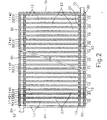
- Fig. 2 is a longitudinal sectioned view of the analyzer of Fig. 1, with the parts of the analyzer being assembled into a single body.
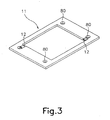
- Fig. 3. is a perspective view showing the structures of a gasket included in the analyzer of this invention.
- the apparatus of this invention comprises an electrolyzer with two types of units: a plurality of anode and cathode units 10 and 20 alternately arranged in the electrolyzer.
- the two types of units 10 and 20 are separated from each other by plurality of membranes or ion exchange membranes capable of isolating the cathodes from the anodes. That is, the anode and cathode units 10 and 20, individually forming a unit cell A, are alternately arranged while being brought into close contact with each other.
- An inlet end plate 60 having two water inlets 61 and 62, is attached to one end of the electrolyzer, while an outlet end plate 70, having two water outlets 71 and 72, is attached to the other end of the electrolyzer.
- the inlet end plate 60 has two water inlets 61 and 62, while the outlet end plate 70 has two water outlets 71 and 72.
- water, introduced into the anode units 10 through first inlet 61 becomes acidic water prior to being discharged from the apparatus through the first outlet 71.
- water, introduced into the cathode units 20 through the second inlet 62 becomes alkaline water prior to being discharged from the apparatus through the second outlet 72.
- Each of the anode units 10 forms a unit cell "A" which comprises an anode plate 11 sided with two gaskets: a gap adjusting gasket 30 and an electrolyte leakage prevention gasket 31, at its both sides.
- each of the cathode units 20 forms a unit cell "A” which comprises a cathode plate 21 sided with two gaskets: a gap adjusting gasket 30 and an electrolyte leakage prevention gasket 31, at its both sides.
- Each of the two types of gaskets 30 and 31 has an opening at its center portion.
- each gasket 30, 31 associated with each anode plate 11 two passages 12 are formed on the edge of the opening at diagonally opposite positions, thus communicating with an anode reaction chamber 13 defined between each anode plate 11 and each gasket 30, 31.
- two passages 22 are formed on the edge of the opening at diagonally opposite positions, thus communicating with a cathode reaction chamber 23 defined between each cathode plate 21 and each gasket 30, 31.
- Each of the plates 11 and 21 is holed at its four corners at positions corresponding to the inlets 61 and 62 and the outlet 71 and 72 of the two end plates 60 and 70, thus having four holes 80 at the four corners.
- each of the gaskets 30 and 31 has four holes 80 at positions corresponding to the four holes 80 of each plate 11, 21.
- the holes 80, provided on the plates 11 and 21 the gaskets 30 and 31, form passages for water introduced into the electrolyzer through the inlets 61 and 62 of the inlet end plate 60.
- two diagonally opposite passages 12 are formed on the edge of the opening of each gasket 30, 31 associated with each anode plate 11 so as to communicate with both the first inlet 61 and the anode reaction chamber 13.
- Two diagonally opposite passages 22 are formed on the edge of the opening of each gasket 30, 31 associated with each cathode plate 21.
- the two passages 22 communicate with both the second inlet 62 and the cathode reaction chamber 23. Therefore, water, introduced into the electrolyzer through the first inlet 61, flows through the holes 80 of the anode units 10 prior to being introduced into the anode reaction chambers 13 through the passages 12 of said units 10. However, since there is no passage 12 communicating with the second inlet 62, water, introduced into the electrolyzer through the second inlet 62, passes through the holes 80 of the anode units 10 without being introduced into the anode reaction chamber 13.
- water, introduced into the first anode unit 10 exclusively flows into the two anode reaction chambers 13 of said anode unit 10, thus being reacted in said reaction chamber 13. Thereafter, the water flows from the first anode unit 10 into the second anode unit 10 through the hole 80 of said second anode unit 10. Such a process is repeated until acidic water is discharged from the electrolyzer through the first outlet 71.
- the water is, thereafter, introduced into the two anode reaction chambers 13 of said first anode unit 10 through the upper passages 12 formed on the two gaskets 30 and 31 of the first anode unit 10.
- the water flows down while coming into contact with the anode plate 11 so that the water is electrolyzed.
- the water thus loses electrons and becomes primary acidic water.
- the primary acidic water is discharged from the first anode unit 10 through the lower passages 12 of said unit 10,prior to passing through the hole 80 of the first cathode unit 20.
- the water When the water reaches the hole 80 of the second anode unit 10, the water is introduced into the two anode reaction chambers 13 of said second anode unit 10 through the lower passages 12 formed on the two gaskets 30 and 31 of the second anode unit 10.
- the water flows upwardly while coming into contact with the anode plate 11 of said unit 10 so that the water is further electrolyzed. The water thus further loses electrons and becomes more powerful acidic water..
- the above process is repeated in the next anode units 10 until final acidic water is discharged from the electrolyzer through the first outlet 71.
- water introduced into the electrolyzer through the second inlet 62, passes through the hole 80 of the first anode unit 10.
- the water reaches the first cathode unit 20 where the water is introduced into the two cathode reaction chambers 23 of said first cathode unit 20 through the upper passages 22 formed on the two gaskets 30 and 31 of the first cathode unit 20.
- the water flows down while coming into contact with the cathode plate 21 so that the water is electrolyzed. The water thus receives a lot of electrons and becomes primary alkaline water.
- the primary alkaline water is, thereafter, discharged from the first cathode unit 20 through the lower passages 22 of said unit 20 prior to passing through the hole 80 of the second anode unit 10.
- the water is introduced into the two cathode reaction chambers 23 of said second cathode unit 20 through the lower passages 22 formed on the two gaskets 30 and 31 of the second cathode unit 20.
- the water flows upwardly while coming into contact with the cathode plate 21 of said unit 20 so that the water is further electrolyzed.
- the water thus further receives electrons and becomes more powerful alkaline water.
- The.above process is repeated in the nest cathode units 20 until final alkaline water is discharged from the electrolyzer through the second outlet 72.
- water, introduced into the electrolyzer through the first inlet 61 only flows into the anode reaction chambers 13 of the anode units 10 in the order of the first to last chambers 13, thus being repeatedly electrolyzed or losing electrons to become acidic water.
- water, introduced into the electrolyzer through the second inlet 62 only flows into the cathode reaction chambers 23 in the order of the first to last chambers 23, thus being repeatedly electrolyzed or receiving electrons to become alkaline water.
- the finally electrolyzed acidic water is discharged from the electrolyzer through the first outlet 71 of the outlet end plate 70, while the finally electrolyzed alkaline water is discharged from the electrolyzer through the second outlet 72 of said plats 70.
- water in each cathode unit 20 is processed through a reduction reaction that generates hydrogen ions, alkali ions and hydrogen radicals, thus allowing the water to become alkaline water.
- a reduction reaction for water in each cathode unit 20 is expressed by the following chemical formula (2). 2H 2 O + 2e - -> H 2 ⁇ + 2OH - (2)
- Electrolysis of water in an electrolyzer with anodes and cathodes for production of acidic and alkaline water is well known to those skilled in the art.
- the present invention provides and apparatus for effectively producing powerful water for deodorization and cleaning applications.
- the apparatus uses anodes and cathodes and effectively produces acidic and alkaline water.
- each of the anode and cathode plates 11 and 21 uses an appropriate catalyst.
- an dimensionally stable anode made of a titanium substrate plated with platinum or coated with oxygen generating catalysts or oxides of iridium (Ir) or ruthenium (Ru), as such an anode plate(11).
- a cathode plate (21) is preferably made of a stainless steel, nickel, mild steel or titanium substrate coated with hydrogen generating catalysts or oxides of iridium (Ir) or ruthenium (Ru).
- the ion exchange membranes 40 of this invention use ion exchange membranes made of fluorine resins or hydrocarbons. In the present invention, it is necessary to reduce the electrolyzing pressure by using Sn-Ir-Pt composite electrodes having a low hydrogen overpotential. It is preferable to set the thickness of each of the gap adjusting gaskets 30 to a level of not larger than 2 mm while considering the voltage between the anodes and the cathodes.
- both the gap adjusting gaskets 30 and the elecrolyte leakage prevention gaskets 31 are preferably made of EDPM rubber, silicon or teflon.
- the unit cells "A" of this invention are set in a housing frame and are tightly assembled with each other into a single body using nuts and bolts.
- the anodes and cathodes of the electrolyzer of this invention are electrically connected to the positive and negative terminals of a current supply source, while the outlets for the acidic and alkaline water are respectively provided with sensors for sensing an electric potential during an oxidation or reduction reaction. Therefore, it is possible to continuously sense the electric potential prior to controlling the electric potential of a rectifier using a controller or controlling the acidity and alkality using a flow controller.
- the current is set to a level of not higher than 100 A, while the voltage is set to a level of not higher than 100 V in accordance with the flow rate of water for the electrolyzer.
- V voltage
- PH acidity
- the acidity (pH) of the finally processed acidic or alkaline water of this invention is ranged from 2.0 to 12.
- the oxidative or reducibility of the finally processed water of this invention is expressed by the oxidation/reduction electric potential ranged from -900mV to +1180mV.
- the finally processed water of this invention is thus effectively used for deodorization and cleaning applications.
- the electrolyzer of this invention is provided with depolarized ion exchange membranes 40.
- the above electrolyzer thus prevents a movement of H + ions from the anode units 10 into the cathode units 20 and restricts a movement of OH - ions from the cathode units 20 into the anode units 10, thus maximizing productivity of the acidic and alkaline water.
- Such ion exchange membranes 40 can be easily obtained from market. That is, it is possible to use ion exchange membranes, made of fluorines or hydrocarbons and produced by Dupon Co. of U.S.A, Asahi Chemical Co. or Asahi Glass Co.
- salt or vinegar is used as an electrolyte.
- Such salt or vinegar thus allows water to be easily and effectively electrolyzed at low voltages, thus effectively producing acidic and alkaline water.
- City water was supplied to the electrolyzer of this invention at a flow rate of 10 l/min while fixing the current for the electrolyzer to 50 A.
- both the voltage and acidity (pH) were timely checked so as to measure the operational conditions of the electrolyzer during an electrolysis of water for producing acidic and alkaline water.
- the acidity of the anode units 10 is shown in table 1.
- Table 1. the acidity (pH) of anode units according to voltage as time passes time (min) current (A) voltage (V) acidity (pH) 10 50 16 3.0 20 50 15 3.1 30 50 15 3.1 40 50 15 3.0 50 50 15 3.0
- the finally processed water of example 1 was sprayed on an organic fertilizer produced by a fertilizer plant while repeatedly measuring the strength of smell at a point spaced apart from said plant by 100 m.
- the results are given as shown in table 7.
- the deodorization effect of the processed water of this invention is maximized when the water is used while being brought into contact with liquid to liquid, liquid to gas or liquid to solid.
- the washing effect of the processed water, produced by the electrolyzer of this invention was measured.
- the laundries of this test were dirty fabrics which individually have a size (1 X 1 m 2 ), designed reflection factor 80%, and dirty reflection factor (0 ⁇ 0 %) in accordance with the requirement of KS (Korean Standard).
- the dirty fabrics were washed in a washer filled with processed water of this invention without adding any detergent.
- such dirty fabrics were also washed in a washer (Model: DWF of DaeWoo Electronic Co.. of Korea) filled with 37 litters of underground water (hardness : 45 PPM as CaCO 1 ) added with 23g of synthetic detergent ("Hanspoon" of LG Chemical Co. of Korea) while heating the washing water to 44NC.
- the results are given as shown in table 8.
- Example Nos. 1-1 and 1-2 are washing tests with processed water of this invention free form any detergent, while example Nos. 2-1 and 2-2 are washing tests with underground water added with detergent.
- the processed water of this invention effectively and cleanly washes fabrics or clothes even when the washing is performed without adding any detergent into washing water. That is, the washing effect of the processed water of this invention without being added with any detergent is not lower than that expected by general water added with detergent. Furthermore, the average standard deviation of the processed water of this invention is remarkably lower than that of general water as shown in the table 8 so that the processed water of this invention more effectively washes dirty fabrics or clothes than general water added with detergent.
- the present invention provides and apparatus and method of producing water for deodorization and cleaning applications.
- the apparatus and method of this invention effectively produces acidic and alkaline water through an electrolysis.
- Such acidic and alkaline water of this invention is effectively used for deodorization and cleaning applications.
- the acidic and alkaline water of this invention is used for washing dirty clothes or fabrics without being added with any detergent so that the water is free from causing environmental pollution.
- the apparatus of this invention is small-sized so that it is effectively used with a washer, a bath tub, a refrigerator, a water purifier or a smell causing place. Therefore, the.apparatus and method of this invention does not need any large-sized equipment or cause any secondary environmental pollution, thus doing much for solving the environmental pollution.
Landscapes
- Chemical & Material Sciences (AREA)
- Chemical Kinetics & Catalysis (AREA)
- Electrochemistry (AREA)
- General Chemical & Material Sciences (AREA)
- Life Sciences & Earth Sciences (AREA)
- Hydrology & Water Resources (AREA)
- Engineering & Computer Science (AREA)
- Environmental & Geological Engineering (AREA)
- Water Supply & Treatment (AREA)
- Organic Chemistry (AREA)
- Water Treatment By Electricity Or Magnetism (AREA)
- Treating Waste Gases (AREA)
- Water Treatment By Sorption (AREA)
Claims (13)
- Appareil destiné à produire de l'eau pour des applications de désodorisation et d'épuration, comprenant :un électrolyseur qui comporte :dans lequel chacune des unités à anode comporte une plaque d'anode ayant sur le côté une première garniture (30) d'ajustement d'espace et une première garniture (31) destinée à empêcher les fuites d'électrolyte, à ses deux côtés, avec formation de cette manière de chambres de réaction anodique, et chacune des unités à cathode comporte une plaque de cathode ayant sur le côté une seconde garniture d'ajustement d'espace et une seconde garniture destinée à empêcher les fuites d'électrolyte, des deux côtés, avec ainsi formation de chambres de réaction cathodique,plusieurs unités (10, 20) à anode et cathode disposées en alternance tout en étant mises en contact intime mutuellement, les unités à anode et cathode étant séparées mutuellement par des membranes échangeuses d'ions et formant individuellement une cellule unitaire, etdes plaques (60, 70) d'extrémité d'entrée et de sortie fixées aux deux extrémités de l'électrolyseur, la plaque d'extrémité d'entrée ayant des première et seconde entrées d'eau (61, 62) et la plaque de sortie ayant des première et seconde sorties d'eau (71, 72),
dans lequel chacune des garnitures des unités d'anode et de cathode possède deux passages à des positions opposées en diagonale, et chacune des première et seconde entrées est raccordée par des passages formés sur deux garnitures disposées sur les côtés de la plaque d'anode (11) et de la plaque de cathode (21) respectivement, si bien que l'eau provenant de la première entrée de la plaque d'extrémité d'entrée peut être introduite exclusivement dans les chambres de réaction anodique et l'eau provenant de la seconde entrée peut être exclusivement introduite dans les chambres de réaction cathodique,
dans lequel la plaque de cathode est une électrode composite comprenant un substrat revêtu de Sn-Ir-Pt qui est un catalyseur pour la création d'hydrogène, et
dans lequel les plaques d'anode et de cathode comportent des trous (80) qui y sont formés et communiquent avec les passages contenus dans les garnitures des unités à anode et cathode afin que l'eau puisse circuler des entrées dans les chambres anodique et cathodique respectivement. - Appareil selon la revendication 1, dans lequel une anode dimensionnellement stable (DSA), formée d'un substrat de titane revêtu de platine ou revêtu d'un catalyseur générateur d'oxygène, est utilisée pour chacune des plaques d'anode.
- Appareil selon la revendication 1, dans lequel la plaque de cathode comprend un substrat qui est un substrat d'acier inoxydable, de nickel, d'acier doux ou de titane.
- Appareil selon la revendication 3, dans lequel le catalyseur de création d'oxygène est sélectionné parmi les oxydes d'iridium (Ir) et de ruthénium (Ru).
- Procédé de désodorisation et d' épuration de matières contaminantes, comprenant les étapes suivantes :l'électrolyse d'eau par circulation d'eau et de sel ou de vinaigre comme électrolyte dans une chambre de réaction anodique ou une chambre de réaction cathodique de l'appareil selon la revendication 1, pour l'obtention d'eau acide ou d'eau alcaline, etla désodorisation et l'épuration des matières contaminantes a l'aide de l'eau acide et de l'eau alcaline obtenue.
- Procédé selon la revendication 5, dans lequel l'électrolyte est ajouté en quantité comprise entre 0,0001 et 5,0 en poids par rapport à l'eau introduite.
- Electrolyseur, comprenant :une structure empilée de plusieurs cellules unitaires, la cellule unitaire comprenant une première garniture (i), une plaque d'anode, une première garniture (ii), une membrane échangeuse d'ions, une seconde garniture (i), une plaque de cathode, une seconde garniture (ii) et une membrane échangeuse d'ions disposées intimement en parallèle, la première garniture assurant l'étanchéité entre la plaque d'anode et la membrane échangeuse d'ions pour former une chambre anodique, la seconde garniture assurant l'étanchéité entre la plaque de cathode et la membrane échangeuse d'ions pour former une chambre cathodique,dans lequel des premiers passages sont formés à des positions opposées en diagonale à travers les premières garnitures de manière que plusieurs chambres anodiques puissent être interconnectées les unes avec les autres, et des seconds passages sont formés à des positions opposées en diagonale à travers les secondes garnitures de manière que plusieurs chambres cathodiques puissent être interconnectées les unes avec les autres, de sorte que de l'eau acide est collectée à partir de la chambre anodique et de l'eau basique est collectée à partir de la chambre cathodique,
dans lequel la plaque de cathode est revêtue d'un catalyseur comprenant Sn-Ir-Pt, et
dans lequel les plaques d'anode et de cathode ont des trous qui y sont formés et communiquent avec les passages contenus dans les garnitures des unités d'anode et de cathode afin que l'eau puisse circuler des entrées dans les chambres anodique et cathodique respectivement. - Electrolyseur selon la revendication 7, dans lequel une plaque d'extrémité d'entrée ayant des première et seconde entrées d'eau et une plaque d'extrémité de sortie ayant des première et seconde sorties d'eau sont combinées respectivement aux deux côtés de la structure empilée.
- Electrolyseur selon la revendication 7, dans lequel le substrat de la plaque de cathode est formé d'acier inoxydable, de nickel, d'acier doux ou de titane.
- Electrolyseur selon la revendication 7, dans lequel la plaque d'anode est constituée d'un substrat de titane revêtu de platine ou revêtu d'un catalyseur générateur d'oxygène.
- Electrolyseur selon la revendication 10, dans lequel le catalyseur générateur d'oxygène est de l'oxyde de Ir ou de l'oxyda de Ru.
- Appareil selon l'une quelconque des revendications 1 à 4, utilisé pour la production d'eau dans des applications de désodorisation et d'épuration.
- Electrolyseur selon l'une quelconque des revendications 7 à 11, lorsqu'il est utilisé dans un appareil selon la revendication 12.
Applications Claiming Priority (3)
| Application Number | Priority Date | Filing Date | Title |
|---|---|---|---|
| US09/154,833 US6132572A (en) | 1998-09-17 | 1998-09-17 | Apparatus and method of producing water for deodorization and cleaning applications |
| US154833 | 1998-09-17 | ||
| PCT/KR1999/000360 WO2000015561A1 (fr) | 1998-09-17 | 1999-07-06 | Procede et dispositif de production d'eau destinee a des applications de desodorisation et de nettoyage |
Publications (2)
| Publication Number | Publication Date |
|---|---|
| EP1117618A1 EP1117618A1 (fr) | 2001-07-25 |
| EP1117618B1 true EP1117618B1 (fr) | 2006-11-02 |
Family
ID=22552996
Family Applications (1)
| Application Number | Title | Priority Date | Filing Date |
|---|---|---|---|
| EP99928226A Expired - Lifetime EP1117618B1 (fr) | 1998-09-17 | 1999-07-06 | Procede et dispositif de production d'eau destinee a des applications de desodorisation et de nettoyage |
Country Status (9)
| Country | Link |
|---|---|
| US (1) | US6132572A (fr) |
| EP (1) | EP1117618B1 (fr) |
| JP (1) | JP3567138B2 (fr) |
| KR (1) | KR100406141B1 (fr) |
| CN (1) | CN1153735C (fr) |
| AT (1) | ATE344216T1 (fr) |
| AU (1) | AU750884B2 (fr) |
| DE (1) | DE69933882T2 (fr) |
| WO (1) | WO2000015561A1 (fr) |
Families Citing this family (39)
| Publication number | Priority date | Publication date | Assignee | Title |
|---|---|---|---|---|
| US6531047B1 (en) * | 1999-07-30 | 2003-03-11 | Mediken Inc. | Surface modification method for an aluminum substrate |
| US6638364B2 (en) * | 2000-09-08 | 2003-10-28 | Electric Aquagenics Unlimited | System to clean and disinfect carpets, fabrics, and hard surfaces using electrolyzed alkaline water produced from a solution of NaCl |
| JP4222786B2 (ja) * | 2001-12-28 | 2009-02-12 | 株式会社オメガ | 排気又は排煙の脱臭・浄化方法とその装置 |
| KR100494521B1 (ko) * | 2002-01-08 | 2005-06-13 | 이권철 | 전기분해 이온수를 이용한 섬유의 염색 방법 |
| KR100684064B1 (ko) * | 2002-04-02 | 2007-02-16 | 페르메렉덴꾜꾸가부시끼가이샤 | 기능수, 및 이의 제조방법 및 제조장치 |
| US6841058B2 (en) * | 2002-04-04 | 2005-01-11 | Brian G. Culvey | Redox bipolar cell fabric washer system |
| US20060266381A1 (en) * | 2005-05-27 | 2006-11-30 | Doherty James E | Commercial glassware dishwasher and related method |
| ITRM20050666A1 (it) * | 2005-12-30 | 2007-06-30 | E C A S S R L | Blocco di reattori elettrolitici a membrana con quattro camere. |
| US8025787B2 (en) | 2006-02-10 | 2011-09-27 | Tennant Company | Method and apparatus for generating, applying and neutralizing an electrochemically activated liquid |
| US8046867B2 (en) * | 2006-02-10 | 2011-11-01 | Tennant Company | Mobile surface cleaner having a sparging device |
| US8012340B2 (en) | 2006-02-10 | 2011-09-06 | Tennant Company | Method for generating electrochemically activated cleaning liquid |
| US7836543B2 (en) * | 2006-02-10 | 2010-11-23 | Tennant Company | Method and apparatus for producing humanly-perceptable indicator of electrochemical properties of an output cleaning liquid |
| US7891046B2 (en) * | 2006-02-10 | 2011-02-22 | Tennant Company | Apparatus for generating sparged, electrochemically activated liquid |
| US8025786B2 (en) | 2006-02-10 | 2011-09-27 | Tennant Company | Method of generating sparged, electrochemically activated liquid |
| US8016996B2 (en) | 2006-02-10 | 2011-09-13 | Tennant Company | Method of producing a sparged cleaning liquid onboard a mobile surface cleaner |
| US8156608B2 (en) | 2006-02-10 | 2012-04-17 | Tennant Company | Cleaning apparatus having a functional generator for producing electrochemically activated cleaning liquid |
| US8007654B2 (en) | 2006-02-10 | 2011-08-30 | Tennant Company | Electrochemically activated anolyte and catholyte liquid |
| IL184046A (en) * | 2007-06-19 | 2012-07-31 | Lev Gurevich | Method and systems with cycle |
| WO2009046279A2 (fr) | 2007-10-04 | 2009-04-09 | Tennant Company | Procédé et appareil pour neutraliser des liquides activés de façon électrochimique |
| CN101909503A (zh) * | 2007-11-09 | 2010-12-08 | 坦南特公司 | 使用电化学活化水的软地板预喷射装置和软地板清洁方法 |
| CN101468832A (zh) * | 2007-12-25 | 2009-07-01 | 通用电气公司 | 电解装置、方法及包括该电解装置的洗涤设备 |
| CN101570932B (zh) * | 2008-04-29 | 2012-06-27 | 海尔集团公司 | 一种具有改进水路的洗衣机 |
| EP2300374A2 (fr) * | 2008-05-05 | 2011-03-30 | Tennant Company | Détecteur de transfert de charge pour liquides activés électrochimiquement |
| WO2009149327A2 (fr) | 2008-06-05 | 2009-12-10 | Global Opportunities Investment Group, Llc | Procédé et système de combustion de carburant |
| KR20110053948A (ko) * | 2008-06-19 | 2011-05-24 | 텐난트 컴파니 | 동축 전극을 포함하는 튜브형 전기분해 전지 및 그 대응 방법 |
| WO2009155545A2 (fr) | 2008-06-19 | 2009-12-23 | Tennant Company | Cellule électrolytique d'un flacon de pulvérisation tenu à la main, et convertisseur cc-cc |
| JP5173683B2 (ja) * | 2008-09-03 | 2013-04-03 | 森永乳業株式会社 | 複極式電解槽及びこれに用いられるスペーサ |
| US8371315B2 (en) | 2008-12-17 | 2013-02-12 | Tennant Company | Washing systems incorporating charged activated liquids |
| JP4348405B1 (ja) * | 2009-03-05 | 2009-10-21 | 稔 菅野 | 洗浄装置および洗浄水の消臭方法 |
| US8764957B2 (en) | 2010-12-23 | 2014-07-01 | General Electric Company | Water treatment using a bipolar membrane |
| CN105198045A (zh) | 2014-06-18 | 2015-12-30 | Mag技术株式会社 | 酸性水电解槽及其酸性水的使用方法 |
| JP6413088B2 (ja) * | 2015-02-02 | 2018-10-31 | パナソニックIpマネジメント株式会社 | 空気浄化装置 |
| CN106745539A (zh) * | 2017-01-22 | 2017-05-31 | 无锡小天鹅股份有限公司 | 用于洗衣机进水系统的电解槽装置 |
| CN107157366A (zh) * | 2017-07-11 | 2017-09-15 | 福州金慧健康科技有限公司 | 一种自由基洗菜机 |
| JP6826170B1 (ja) | 2019-08-26 | 2021-02-03 | 株式会社日本トリム | 電解ユニット |
| EP4575063A1 (fr) | 2023-12-18 | 2025-06-25 | Miele & Cie. KG | Procédé de suivi de la santé d'un utilisateur par l'intermédiaire du linge |
| EP4574772A1 (fr) | 2023-12-18 | 2025-06-25 | Miele & Cie. KG | Procédé de traitement d'eau à base d'électrode à plusieurs étages |
| EP4574770A1 (fr) | 2023-12-18 | 2025-06-25 | Miele & Cie. KG | Recyclage d'eaux usées de lessive |
| EP4575062A1 (fr) | 2023-12-18 | 2025-06-25 | Miele & Cie. KG | Procédé de production de peroxyde d'hydrogène dans une cellule électrochimique multifonction |
Family Cites Families (3)
| Publication number | Priority date | Publication date | Assignee | Title |
|---|---|---|---|---|
| US4605482A (en) * | 1981-04-28 | 1986-08-12 | Asahi Glass Company, Ltd. | Filter press type electrolytic cell |
| US5340458A (en) * | 1992-12-08 | 1994-08-23 | Toho Technical Service Co., Ltd. | Electrolytic ion water generator |
| JP2652609B2 (ja) * | 1993-05-31 | 1997-09-10 | ミズ株式会社 | 電解水生成装置 |
-
1998
- 1998-09-17 US US09/154,833 patent/US6132572A/en not_active Expired - Lifetime
-
1999
- 1999-07-06 KR KR10-2000-7014260A patent/KR100406141B1/ko not_active Expired - Lifetime
- 1999-07-06 EP EP99928226A patent/EP1117618B1/fr not_active Expired - Lifetime
- 1999-07-06 JP JP2000570106A patent/JP3567138B2/ja not_active Expired - Fee Related
- 1999-07-06 CN CNB998110221A patent/CN1153735C/zh not_active Expired - Fee Related
- 1999-07-06 DE DE69933882T patent/DE69933882T2/de not_active Expired - Lifetime
- 1999-07-06 WO PCT/KR1999/000360 patent/WO2000015561A1/fr not_active Ceased
- 1999-07-06 AU AU45328/99A patent/AU750884B2/en not_active Ceased
- 1999-07-06 AT AT99928226T patent/ATE344216T1/de not_active IP Right Cessation
Also Published As
| Publication number | Publication date |
|---|---|
| KR100406141B1 (ko) | 2003-11-15 |
| KR20010052908A (ko) | 2001-06-25 |
| DE69933882T2 (de) | 2007-05-31 |
| US6132572A (en) | 2000-10-17 |
| WO2000015561A1 (fr) | 2000-03-23 |
| AU750884B2 (en) | 2002-08-01 |
| JP2002524256A (ja) | 2002-08-06 |
| JP3567138B2 (ja) | 2004-09-22 |
| DE69933882D1 (de) | 2006-12-14 |
| AU4532899A (en) | 2000-04-03 |
| EP1117618A1 (fr) | 2001-07-25 |
| CN1318035A (zh) | 2001-10-17 |
| ATE344216T1 (de) | 2006-11-15 |
| CN1153735C (zh) | 2004-06-16 |
Similar Documents
| Publication | Publication Date | Title |
|---|---|---|
| AU750884B2 (en) | Apparatus and method of producing water for deodorization and cleaning applications | |
| US4804449A (en) | Electrolytic cell | |
| US5460705A (en) | Method and apparatus for electrochemical production of ozone | |
| US7985327B2 (en) | Electrode, method of manufacture and use thereof | |
| US20040094406A1 (en) | Apparatus for production of strong alkali and acid electrolytic solution | |
| US20020074237A1 (en) | Method of producing electrolyzed water | |
| WO2010134717A2 (fr) | Synthèse électrolytique de peroxyde d'hydrogène directement à partir d'eau et application correspondante | |
| JP2003512918A5 (fr) | ||
| EP3929330A1 (fr) | Appareil d'électrolyse de l'eau, et procédé de stérilisation/nettoyage et procédé pour décomposer/éliminer une substance nocive utilisant chacun un appareil d'électrolyse de l'eau | |
| Yu et al. | Unraveling the role of F in electrochemical ozone generation on the F-doped PbO2 electrode | |
| KR20070117523A (ko) | 수도수 전해에 의한 오존수 및 차아염소산수 발생용 전해셀및 복합산화제 전극 | |
| US4139449A (en) | Electrolytic cell for producing alkali metal hypochlorites | |
| CN216006029U (zh) | 一种用于制作微酸性次氯酸的电解槽 | |
| CN118289896B (zh) | 一种用于电解脱硫废水的系统 | |
| KR101010330B1 (ko) | 이온수 제조용 전기분해장치 | |
| RU2042639C1 (ru) | Устройство для электрохимической обработки воды | |
| KR100930360B1 (ko) | 전기화학적 오존 발생용 막전극접합체 및 이를 구비한 전기화학 셀 | |
| KR100523982B1 (ko) | 전기화학적 살균제 발생기 | |
| CN220223738U (zh) | 一种废水治理的隔膜电解装置 | |
| KR101644275B1 (ko) | 전기분해장치 및 이를 이용한 수처리방법 | |
| CN220999357U (zh) | 一种超碱性电解离子发生器电解装置 | |
| KR102633348B1 (ko) | 무격막의 중성 살균수 생성장치 | |
| KR101187433B1 (ko) | 소독혼화제 발생장치 | |
| JPH09220573A (ja) | 2室型電解槽を使用する電解方法 | |
| WO2025166981A1 (fr) | Dispositif de réaction électrochimique mixte gaz-liquide pour traitement de lixiviat de décharge, et procédé de traitement de lixiviat de décharge l'utilisant |
Legal Events
| Date | Code | Title | Description |
|---|---|---|---|
| PUAI | Public reference made under article 153(3) epc to a published international application that has entered the european phase |
Free format text: ORIGINAL CODE: 0009012 |
|
| 17P | Request for examination filed |
Effective date: 20010406 |
|
| AK | Designated contracting states |
Kind code of ref document: A1 Designated state(s): AT BE CH CY DE DK ES FI FR GB GR IE IT LI LU MC NL PT SE |
|
| AX | Request for extension of the european patent |
Free format text: AL;LT;LV;MK;RO;SI |
|
| 17Q | First examination report despatched |
Effective date: 20030902 |
|
| GRAP | Despatch of communication of intention to grant a patent |
Free format text: ORIGINAL CODE: EPIDOSNIGR1 |
|
| RIN1 | Information on inventor provided before grant (corrected) |
Inventor name: KIM, HEE, JUNG |
|
| GRAS | Grant fee paid |
Free format text: ORIGINAL CODE: EPIDOSNIGR3 |
|
| GRAA | (expected) grant |
Free format text: ORIGINAL CODE: 0009210 |
|
| AK | Designated contracting states |
Kind code of ref document: B1 Designated state(s): AT BE CH CY DE DK ES FI FR GB GR IE IT LI LU MC NL PT SE |
|
| PG25 | Lapsed in a contracting state [announced via postgrant information from national office to epo] |
Ref country code: NL Free format text: LAPSE BECAUSE OF FAILURE TO SUBMIT A TRANSLATION OF THE DESCRIPTION OR TO PAY THE FEE WITHIN THE PRESCRIBED TIME-LIMIT Effective date: 20061102 Ref country code: LI Free format text: LAPSE BECAUSE OF FAILURE TO SUBMIT A TRANSLATION OF THE DESCRIPTION OR TO PAY THE FEE WITHIN THE PRESCRIBED TIME-LIMIT Effective date: 20061102 Ref country code: FI Free format text: LAPSE BECAUSE OF FAILURE TO SUBMIT A TRANSLATION OF THE DESCRIPTION OR TO PAY THE FEE WITHIN THE PRESCRIBED TIME-LIMIT Effective date: 20061102 Ref country code: CH Free format text: LAPSE BECAUSE OF FAILURE TO SUBMIT A TRANSLATION OF THE DESCRIPTION OR TO PAY THE FEE WITHIN THE PRESCRIBED TIME-LIMIT Effective date: 20061102 Ref country code: BE Free format text: LAPSE BECAUSE OF FAILURE TO SUBMIT A TRANSLATION OF THE DESCRIPTION OR TO PAY THE FEE WITHIN THE PRESCRIBED TIME-LIMIT Effective date: 20061102 Ref country code: AT Free format text: LAPSE BECAUSE OF FAILURE TO SUBMIT A TRANSLATION OF THE DESCRIPTION OR TO PAY THE FEE WITHIN THE PRESCRIBED TIME-LIMIT Effective date: 20061102 |
|
| RAP1 | Party data changed (applicant data changed or rights of an application transferred) |
Owner name: KIM, HEE JUNG |
|
| RIN1 | Information on inventor provided before grant (corrected) |
Inventor name: KIM, HEE JUNG |
|
| REG | Reference to a national code |
Ref country code: GB Ref legal event code: FG4D |
|
| REG | Reference to a national code |
Ref country code: IE Ref legal event code: FG4D |
|
| REG | Reference to a national code |
Ref country code: CH Ref legal event code: EP |
|
| REF | Corresponds to: |
Ref document number: 69933882 Country of ref document: DE Date of ref document: 20061214 Kind code of ref document: P |
|
| PG25 | Lapsed in a contracting state [announced via postgrant information from national office to epo] |
Ref country code: SE Free format text: LAPSE BECAUSE OF FAILURE TO SUBMIT A TRANSLATION OF THE DESCRIPTION OR TO PAY THE FEE WITHIN THE PRESCRIBED TIME-LIMIT Effective date: 20070202 Ref country code: DK Free format text: LAPSE BECAUSE OF FAILURE TO SUBMIT A TRANSLATION OF THE DESCRIPTION OR TO PAY THE FEE WITHIN THE PRESCRIBED TIME-LIMIT Effective date: 20070202 |
|
| PG25 | Lapsed in a contracting state [announced via postgrant information from national office to epo] |
Ref country code: ES Free format text: LAPSE BECAUSE OF FAILURE TO SUBMIT A TRANSLATION OF THE DESCRIPTION OR TO PAY THE FEE WITHIN THE PRESCRIBED TIME-LIMIT Effective date: 20070213 |
|
| PG25 | Lapsed in a contracting state [announced via postgrant information from national office to epo] |
Ref country code: PT Free format text: LAPSE BECAUSE OF FAILURE TO SUBMIT A TRANSLATION OF THE DESCRIPTION OR TO PAY THE FEE WITHIN THE PRESCRIBED TIME-LIMIT Effective date: 20070402 |
|
| NLV1 | Nl: lapsed or annulled due to failure to fulfill the requirements of art. 29p and 29m of the patents act | ||
| REG | Reference to a national code |
Ref country code: CH Ref legal event code: PL |
|
| ET | Fr: translation filed | ||
| PLBE | No opposition filed within time limit |
Free format text: ORIGINAL CODE: 0009261 |
|
| STAA | Information on the status of an ep patent application or granted ep patent |
Free format text: STATUS: NO OPPOSITION FILED WITHIN TIME LIMIT |
|
| 26N | No opposition filed |
Effective date: 20070803 |
|
| PG25 | Lapsed in a contracting state [announced via postgrant information from national office to epo] |
Ref country code: MC Free format text: LAPSE BECAUSE OF NON-PAYMENT OF DUE FEES Effective date: 20070731 Ref country code: GR Free format text: LAPSE BECAUSE OF FAILURE TO SUBMIT A TRANSLATION OF THE DESCRIPTION OR TO PAY THE FEE WITHIN THE PRESCRIBED TIME-LIMIT Effective date: 20070203 |
|
| PG25 | Lapsed in a contracting state [announced via postgrant information from national office to epo] |
Ref country code: IE Free format text: LAPSE BECAUSE OF NON-PAYMENT OF DUE FEES Effective date: 20070706 |
|
| PG25 | Lapsed in a contracting state [announced via postgrant information from national office to epo] |
Ref country code: LU Free format text: LAPSE BECAUSE OF NON-PAYMENT OF DUE FEES Effective date: 20070706 Ref country code: CY Free format text: LAPSE BECAUSE OF FAILURE TO SUBMIT A TRANSLATION OF THE DESCRIPTION OR TO PAY THE FEE WITHIN THE PRESCRIBED TIME-LIMIT Effective date: 20061102 |
|
| PGFP | Annual fee paid to national office [announced via postgrant information from national office to epo] |
Ref country code: GB Payment date: 20130709 Year of fee payment: 15 Ref country code: FR Payment date: 20130722 Year of fee payment: 15 |
|
| GBPC | Gb: european patent ceased through non-payment of renewal fee |
Effective date: 20140706 |
|
| REG | Reference to a national code |
Ref country code: FR Ref legal event code: ST Effective date: 20150331 |
|
| PG25 | Lapsed in a contracting state [announced via postgrant information from national office to epo] |
Ref country code: GB Free format text: LAPSE BECAUSE OF NON-PAYMENT OF DUE FEES Effective date: 20140706 Ref country code: FR Free format text: LAPSE BECAUSE OF NON-PAYMENT OF DUE FEES Effective date: 20140731 |
|
| PGFP | Annual fee paid to national office [announced via postgrant information from national office to epo] |
Ref country code: DE Payment date: 20170724 Year of fee payment: 19 Ref country code: IT Payment date: 20170724 Year of fee payment: 19 |
|
| REG | Reference to a national code |
Ref country code: DE Ref legal event code: R119 Ref document number: 69933882 Country of ref document: DE |
|
| PG25 | Lapsed in a contracting state [announced via postgrant information from national office to epo] |
Ref country code: DE Free format text: LAPSE BECAUSE OF NON-PAYMENT OF DUE FEES Effective date: 20190201 |
|
| PG25 | Lapsed in a contracting state [announced via postgrant information from national office to epo] |
Ref country code: IT Free format text: LAPSE BECAUSE OF NON-PAYMENT OF DUE FEES Effective date: 20180706 |