EP1117004A2 - Electron beam or x-ray negative-working resist composition - Google Patents
Electron beam or x-ray negative-working resist composition Download PDFInfo
- Publication number
- EP1117004A2 EP1117004A2 EP01100113A EP01100113A EP1117004A2 EP 1117004 A2 EP1117004 A2 EP 1117004A2 EP 01100113 A EP01100113 A EP 01100113A EP 01100113 A EP01100113 A EP 01100113A EP 1117004 A2 EP1117004 A2 EP 1117004A2
- Authority
- EP
- European Patent Office
- Prior art keywords
- group
- resin
- compound
- resist composition
- electron beams
- Prior art date
- Legal status (The legal status is an assumption and is not a legal conclusion. Google has not performed a legal analysis and makes no representation as to the accuracy of the status listed.)
- Withdrawn
Links
- 239000000203 mixture Substances 0.000 title claims abstract description 107
- 238000010894 electron beam technology Methods 0.000 title claims abstract description 72
- 229920005989 resin Polymers 0.000 claims abstract description 143
- 239000011347 resin Substances 0.000 claims abstract description 143
- 150000001875 compounds Chemical class 0.000 claims abstract description 127
- 239000002253 acid Substances 0.000 claims abstract description 66
- 150000003254 radicals Chemical class 0.000 claims abstract description 36
- 239000003431 cross linking reagent Substances 0.000 claims abstract description 34
- XLYOFNOQVPJJNP-UHFFFAOYSA-N water Substances O XLYOFNOQVPJJNP-UHFFFAOYSA-N 0.000 claims abstract description 30
- 239000007864 aqueous solution Substances 0.000 claims abstract description 14
- 239000003513 alkali Substances 0.000 claims abstract description 12
- 238000004132 cross linking Methods 0.000 claims abstract description 7
- 230000009471 action Effects 0.000 claims abstract description 6
- -1 sulfonic acid ester compound Chemical class 0.000 claims description 153
- 125000000217 alkyl group Chemical group 0.000 claims description 94
- 125000001424 substituent group Chemical group 0.000 claims description 68
- 125000003118 aryl group Chemical group 0.000 claims description 49
- 125000004435 hydrogen atom Chemical group [H]* 0.000 claims description 42
- 125000003710 aryl alkyl group Chemical group 0.000 claims description 29
- 125000000753 cycloalkyl group Chemical group 0.000 claims description 27
- 125000005843 halogen group Chemical group 0.000 claims description 25
- 125000003545 alkoxy group Chemical group 0.000 claims description 24
- 125000002947 alkylene group Chemical group 0.000 claims description 23
- 125000000732 arylene group Chemical group 0.000 claims description 23
- 125000002887 hydroxy group Chemical group [H]O* 0.000 claims description 20
- 125000002993 cycloalkylene group Chemical group 0.000 claims description 19
- 125000004093 cyano group Chemical group *C#N 0.000 claims description 18
- 125000002252 acyl group Chemical group 0.000 claims description 17
- 125000004450 alkenylene group Chemical group 0.000 claims description 17
- 125000001188 haloalkyl group Chemical group 0.000 claims description 14
- 125000004423 acyloxy group Chemical group 0.000 claims description 11
- 125000003342 alkenyl group Chemical group 0.000 claims description 11
- 150000007514 bases Chemical class 0.000 claims description 10
- 125000001951 carbamoylamino group Chemical group C(N)(=O)N* 0.000 claims description 8
- 150000002148 esters Chemical group 0.000 claims description 8
- 125000001033 ether group Chemical group 0.000 claims description 8
- JOYRKODLDBILNP-UHFFFAOYSA-N urethane group Chemical group NC(=O)OCC JOYRKODLDBILNP-UHFFFAOYSA-N 0.000 claims description 8
- 150000001408 amides Chemical group 0.000 claims description 6
- MGFYSGNNHQQTJW-UHFFFAOYSA-N iodonium Chemical compound [IH2+] MGFYSGNNHQQTJW-UHFFFAOYSA-N 0.000 claims description 5
- RWSOTUBLDIXVET-UHFFFAOYSA-O sulfonium Chemical compound [SH3+] RWSOTUBLDIXVET-UHFFFAOYSA-O 0.000 claims description 5
- 125000001273 sulfonato group Chemical class [O-]S(*)(=O)=O 0.000 claims 1
- 125000004432 carbon atom Chemical group C* 0.000 description 66
- 239000000243 solution Substances 0.000 description 36
- 239000000178 monomer Substances 0.000 description 29
- WGTYBPLFGIVFAS-UHFFFAOYSA-M tetramethylammonium hydroxide Chemical compound [OH-].C[N+](C)(C)C WGTYBPLFGIVFAS-UHFFFAOYSA-M 0.000 description 28
- 230000015572 biosynthetic process Effects 0.000 description 23
- 230000000052 comparative effect Effects 0.000 description 22
- 230000035945 sensitivity Effects 0.000 description 22
- 150000002989 phenols Chemical class 0.000 description 21
- 238000000034 method Methods 0.000 description 20
- 238000003756 stirring Methods 0.000 description 19
- 238000003786 synthesis reaction Methods 0.000 description 19
- 125000001153 fluoro group Chemical group F* 0.000 description 18
- 125000001997 phenyl group Chemical group [H]C1=C([H])C([H])=C(*)C([H])=C1[H] 0.000 description 18
- 238000006243 chemical reaction Methods 0.000 description 17
- 239000012295 chemical reaction liquid Substances 0.000 description 17
- OKKJLVBELUTLKV-UHFFFAOYSA-N Methanol Chemical compound OC OKKJLVBELUTLKV-UHFFFAOYSA-N 0.000 description 15
- 230000004304 visual acuity Effects 0.000 description 15
- 229910052731 fluorine Inorganic materials 0.000 description 14
- 239000000126 substance Substances 0.000 description 14
- 229940092714 benzenesulfonic acid Drugs 0.000 description 13
- 125000001495 ethyl group Chemical group [H]C([H])([H])C([H])([H])* 0.000 description 13
- YMWUJEATGCHHMB-UHFFFAOYSA-N Dichloromethane Chemical compound ClCCl YMWUJEATGCHHMB-UHFFFAOYSA-N 0.000 description 12
- XEKOWRVHYACXOJ-UHFFFAOYSA-N Ethyl acetate Chemical compound CCOC(C)=O XEKOWRVHYACXOJ-UHFFFAOYSA-N 0.000 description 12
- 125000004849 alkoxymethyl group Chemical group 0.000 description 12
- SRSXLGNVWSONIS-UHFFFAOYSA-N benzenesulfonic acid Chemical compound OS(=O)(=O)C1=CC=CC=C1 SRSXLGNVWSONIS-UHFFFAOYSA-N 0.000 description 12
- 125000004029 hydroxymethyl group Chemical group [H]OC([H])([H])* 0.000 description 12
- ISWSIDIOOBJBQZ-UHFFFAOYSA-N Phenol Chemical compound OC1=CC=CC=C1 ISWSIDIOOBJBQZ-UHFFFAOYSA-N 0.000 description 11
- 125000003178 carboxy group Chemical group [H]OC(*)=O 0.000 description 10
- 239000005011 phenolic resin Substances 0.000 description 10
- 239000004094 surface-active agent Substances 0.000 description 10
- 125000000391 vinyl group Chemical group [H]C([*])=C([H])[H] 0.000 description 10
- ARXJGSRGQADJSQ-UHFFFAOYSA-N 1-methoxypropan-2-ol Chemical compound COCC(C)O ARXJGSRGQADJSQ-UHFFFAOYSA-N 0.000 description 9
- 239000004793 Polystyrene Substances 0.000 description 9
- ZMANZCXQSJIPKH-UHFFFAOYSA-N Triethylamine Chemical compound CCN(CC)CC ZMANZCXQSJIPKH-UHFFFAOYSA-N 0.000 description 9
- 125000000113 cyclohexyl group Chemical group [H]C1([H])C([H])([H])C([H])([H])C([H])(*)C([H])([H])C1([H])[H] 0.000 description 9
- 239000006185 dispersion Substances 0.000 description 9
- 238000005227 gel permeation chromatography Methods 0.000 description 9
- 125000002496 methyl group Chemical group [H]C([H])([H])* 0.000 description 9
- 239000003921 oil Substances 0.000 description 9
- 229920000642 polymer Polymers 0.000 description 9
- 229920002223 polystyrene Polymers 0.000 description 9
- 125000003903 2-propenyl group Chemical group [H]C([*])([H])C([H])=C([H])[H] 0.000 description 8
- 229920001665 Poly-4-vinylphenol Polymers 0.000 description 8
- WYURNTSHIVDZCO-UHFFFAOYSA-N Tetrahydrofuran Chemical compound C1CCOC1 WYURNTSHIVDZCO-UHFFFAOYSA-N 0.000 description 8
- 239000011737 fluorine Substances 0.000 description 8
- 230000000379 polymerizing effect Effects 0.000 description 8
- 239000007787 solid Substances 0.000 description 8
- 238000005406 washing Methods 0.000 description 8
- 125000005396 acrylic acid ester group Chemical class 0.000 description 7
- 125000004453 alkoxycarbonyl group Chemical group 0.000 description 7
- 150000001450 anions Chemical class 0.000 description 7
- 239000002585 base Substances 0.000 description 7
- LDHQCZJRKDOVOX-NSCUHMNNSA-N crotonic acid Chemical class C\C=C\C(O)=O LDHQCZJRKDOVOX-NSCUHMNNSA-N 0.000 description 7
- 229920003986 novolac Polymers 0.000 description 7
- 125000001436 propyl group Chemical group [H]C([*])([H])C([H])([H])C([H])([H])[H] 0.000 description 7
- 239000002904 solvent Substances 0.000 description 7
- VZCYOOQTPOCHFL-UHFFFAOYSA-N trans-butenedioic acid Natural products OC(=O)C=CC(O)=O VZCYOOQTPOCHFL-UHFFFAOYSA-N 0.000 description 7
- 229920002554 vinyl polymer Polymers 0.000 description 7
- WFDIJRYMOXRFFG-UHFFFAOYSA-N Acetic anhydride Chemical compound CC(=O)OC(C)=O WFDIJRYMOXRFFG-UHFFFAOYSA-N 0.000 description 6
- NIXOWILDQLNWCW-UHFFFAOYSA-M Acrylate Chemical compound [O-]C(=O)C=C NIXOWILDQLNWCW-UHFFFAOYSA-M 0.000 description 6
- UHOVQNZJYSORNB-UHFFFAOYSA-N Benzene Chemical compound C1=CC=CC=C1 UHOVQNZJYSORNB-UHFFFAOYSA-N 0.000 description 6
- RWSOTUBLDIXVET-UHFFFAOYSA-N Dihydrogen sulfide Chemical class S RWSOTUBLDIXVET-UHFFFAOYSA-N 0.000 description 6
- PXGOKWXKJXAPGV-UHFFFAOYSA-N Fluorine Chemical compound FF PXGOKWXKJXAPGV-UHFFFAOYSA-N 0.000 description 6
- PPBRXRYQALVLMV-UHFFFAOYSA-N Styrene Chemical compound C=CC1=CC=CC=C1 PPBRXRYQALVLMV-UHFFFAOYSA-N 0.000 description 6
- 150000007513 acids Chemical class 0.000 description 6
- 125000003277 amino group Chemical group 0.000 description 6
- 230000003321 amplification Effects 0.000 description 6
- 125000000484 butyl group Chemical group [H]C([*])([H])C([H])([H])C([H])([H])C([H])([H])[H] 0.000 description 6
- 229910052799 carbon Inorganic materials 0.000 description 6
- 239000000460 chlorine Substances 0.000 description 6
- 229910052801 chlorine Inorganic materials 0.000 description 6
- 125000004122 cyclic group Chemical group 0.000 description 6
- 239000000975 dye Substances 0.000 description 6
- XMBWDFGMSWQBCA-UHFFFAOYSA-N hydrogen iodide Chemical class I XMBWDFGMSWQBCA-UHFFFAOYSA-N 0.000 description 6
- 238000003199 nucleic acid amplification method Methods 0.000 description 6
- OMIGHNLMNHATMP-UHFFFAOYSA-N 2-hydroxyethyl prop-2-enoate Chemical compound OCCOC(=O)C=C OMIGHNLMNHATMP-UHFFFAOYSA-N 0.000 description 5
- WSFSSNUMVMOOMR-UHFFFAOYSA-N Formaldehyde Chemical compound O=C WSFSSNUMVMOOMR-UHFFFAOYSA-N 0.000 description 5
- 150000001491 aromatic compounds Chemical group 0.000 description 5
- 229910052794 bromium Inorganic materials 0.000 description 5
- 238000001816 cooling Methods 0.000 description 5
- 238000009826 distribution Methods 0.000 description 5
- 238000001035 drying Methods 0.000 description 5
- 238000001914 filtration Methods 0.000 description 5
- 238000003384 imaging method Methods 0.000 description 5
- RAXXELZNTBOGNW-UHFFFAOYSA-N imidazole Natural products C1=CNC=N1 RAXXELZNTBOGNW-UHFFFAOYSA-N 0.000 description 5
- LVHBHZANLOWSRM-UHFFFAOYSA-N itaconic acid Chemical class OC(=O)CC(=C)C(O)=O LVHBHZANLOWSRM-UHFFFAOYSA-N 0.000 description 5
- VZCYOOQTPOCHFL-UPHRSURJSA-N maleic acid Chemical compound OC(=O)\C=C/C(O)=O VZCYOOQTPOCHFL-UPHRSURJSA-N 0.000 description 5
- FQPSGWSUVKBHSU-UHFFFAOYSA-N methacrylamide Chemical class CC(=C)C(N)=O FQPSGWSUVKBHSU-UHFFFAOYSA-N 0.000 description 5
- 125000001624 naphthyl group Chemical group 0.000 description 5
- 125000000449 nitro group Chemical group [O-][N+](*)=O 0.000 description 5
- 108010001861 pregnancy-associated glycoprotein 1 Proteins 0.000 description 5
- 238000010526 radical polymerization reaction Methods 0.000 description 5
- 239000000758 substrate Substances 0.000 description 5
- QAOWNCQODCNURD-UHFFFAOYSA-N sulfuric acid Substances OS(O)(=O)=O QAOWNCQODCNURD-UHFFFAOYSA-N 0.000 description 5
- 125000000999 tert-butyl group Chemical group [H]C([H])([H])C(*)(C([H])([H])[H])C([H])([H])[H] 0.000 description 5
- 125000003944 tolyl group Chemical group 0.000 description 5
- TVTKYCABKYGXTF-UHFFFAOYSA-M 2,3,4,5,6-pentafluorobenzenesulfonate;tetramethylazanium Chemical compound C[N+](C)(C)C.[O-]S(=O)(=O)C1=C(F)C(F)=C(F)C(F)=C1F TVTKYCABKYGXTF-UHFFFAOYSA-M 0.000 description 4
- OZAIFHULBGXAKX-UHFFFAOYSA-N 2-(2-cyanopropan-2-yldiazenyl)-2-methylpropanenitrile Chemical compound N#CC(C)(C)N=NC(C)(C)C#N OZAIFHULBGXAKX-UHFFFAOYSA-N 0.000 description 4
- JESXATFQYMPTNL-UHFFFAOYSA-N 2-ethenylphenol Chemical compound OC1=CC=CC=C1C=C JESXATFQYMPTNL-UHFFFAOYSA-N 0.000 description 4
- FUGYGGDSWSUORM-UHFFFAOYSA-N 4-hydroxystyrene Chemical compound OC1=CC=C(C=C)C=C1 FUGYGGDSWSUORM-UHFFFAOYSA-N 0.000 description 4
- NLHHRLWOUZZQLW-UHFFFAOYSA-N Acrylonitrile Chemical compound C=CC#N NLHHRLWOUZZQLW-UHFFFAOYSA-N 0.000 description 4
- IJGRMHOSHXDMSA-UHFFFAOYSA-N Atomic nitrogen Chemical compound N#N IJGRMHOSHXDMSA-UHFFFAOYSA-N 0.000 description 4
- GAWIXWVDTYZWAW-UHFFFAOYSA-N C[CH]O Chemical group C[CH]O GAWIXWVDTYZWAW-UHFFFAOYSA-N 0.000 description 4
- ZAMOUSCENKQFHK-UHFFFAOYSA-N Chlorine atom Chemical compound [Cl] ZAMOUSCENKQFHK-UHFFFAOYSA-N 0.000 description 4
- JJHHIJFTHRNPIK-UHFFFAOYSA-N Diphenyl sulfoxide Chemical compound C=1C=CC=CC=1S(=O)C1=CC=CC=C1 JJHHIJFTHRNPIK-UHFFFAOYSA-N 0.000 description 4
- 239000004593 Epoxy Chemical class 0.000 description 4
- VZCYOOQTPOCHFL-OWOJBTEDSA-N Fumaric acid Chemical compound OC(=O)\C=C\C(O)=O VZCYOOQTPOCHFL-OWOJBTEDSA-N 0.000 description 4
- PEEHTFAAVSWFBL-UHFFFAOYSA-N Maleimide Chemical compound O=C1NC(=O)C=C1 PEEHTFAAVSWFBL-UHFFFAOYSA-N 0.000 description 4
- BAPJBEWLBFYGME-UHFFFAOYSA-N Methyl acrylate Chemical compound COC(=O)C=C BAPJBEWLBFYGME-UHFFFAOYSA-N 0.000 description 4
- 229920003171 Poly (ethylene oxide) Polymers 0.000 description 4
- KWYUFKZDYYNOTN-UHFFFAOYSA-M Potassium hydroxide Chemical compound [OH-].[K+] KWYUFKZDYYNOTN-UHFFFAOYSA-M 0.000 description 4
- JUJWROOIHBZHMG-UHFFFAOYSA-N Pyridine Chemical compound C1=CC=NC=C1 JUJWROOIHBZHMG-UHFFFAOYSA-N 0.000 description 4
- QYKIQEUNHZKYBP-UHFFFAOYSA-N Vinyl ether Chemical class C=COC=C QYKIQEUNHZKYBP-UHFFFAOYSA-N 0.000 description 4
- 125000002777 acetyl group Chemical group [H]C([H])([H])C(*)=O 0.000 description 4
- 150000003926 acrylamides Chemical class 0.000 description 4
- VSCWAEJMTAWNJL-UHFFFAOYSA-K aluminium trichloride Chemical compound Cl[Al](Cl)Cl VSCWAEJMTAWNJL-UHFFFAOYSA-K 0.000 description 4
- ILFFFKFZHRGICY-UHFFFAOYSA-N anthracene-1-sulfonic acid Chemical compound C1=CC=C2C=C3C(S(=O)(=O)O)=CC=CC3=CC2=C1 ILFFFKFZHRGICY-UHFFFAOYSA-N 0.000 description 4
- 125000003236 benzoyl group Chemical group [H]C1=C([H])C([H])=C(C([H])=C1[H])C(*)=O 0.000 description 4
- 125000001797 benzyl group Chemical group [H]C1=C([H])C([H])=C(C([H])=C1[H])C([H])([H])* 0.000 description 4
- WBYWAXJHAXSJNI-UHFFFAOYSA-N cinnamic acid Chemical class OC(=O)C=CC1=CC=CC=C1 WBYWAXJHAXSJNI-UHFFFAOYSA-N 0.000 description 4
- 229920001577 copolymer Polymers 0.000 description 4
- SWSQBOPZIKWTGO-UHFFFAOYSA-N dimethylaminoamidine Natural products CN(C)C(N)=N SWSQBOPZIKWTGO-UHFFFAOYSA-N 0.000 description 4
- SUPCQIBBMFXVTL-UHFFFAOYSA-N ethyl 2-methylprop-2-enoate Chemical compound CCOC(=O)C(C)=C SUPCQIBBMFXVTL-UHFFFAOYSA-N 0.000 description 4
- 238000011156 evaluation Methods 0.000 description 4
- 238000010438 heat treatment Methods 0.000 description 4
- 239000001257 hydrogen Substances 0.000 description 4
- 229910052739 hydrogen Inorganic materials 0.000 description 4
- 239000003999 initiator Substances 0.000 description 4
- 239000007788 liquid Substances 0.000 description 4
- 238000004519 manufacturing process Methods 0.000 description 4
- 239000000463 material Substances 0.000 description 4
- 125000005397 methacrylic acid ester group Chemical class 0.000 description 4
- 125000005395 methacrylic acid group Chemical group 0.000 description 4
- 125000002950 monocyclic group Chemical group 0.000 description 4
- PSZYNBSKGUBXEH-UHFFFAOYSA-N naphthalene-1-sulfonic acid Chemical compound C1=CC=C2C(S(=O)(=O)O)=CC=CC2=C1 PSZYNBSKGUBXEH-UHFFFAOYSA-N 0.000 description 4
- 125000002347 octyl group Chemical group [H]C([*])([H])C([H])([H])C([H])([H])C([H])([H])C([H])([H])C([H])([H])C([H])([H])C([H])([H])[H] 0.000 description 4
- 239000012074 organic phase Substances 0.000 description 4
- 229920002120 photoresistant polymer Polymers 0.000 description 4
- 125000003367 polycyclic group Chemical group 0.000 description 4
- 125000001325 propanoyl group Chemical group O=C([*])C([H])([H])C([H])([H])[H] 0.000 description 4
- 230000005855 radiation Effects 0.000 description 4
- 239000004065 semiconductor Substances 0.000 description 4
- 238000001179 sorption measurement Methods 0.000 description 4
- 150000003440 styrenes Chemical class 0.000 description 4
- 229920001567 vinyl ester resin Chemical class 0.000 description 4
- JAMNSIXSLVPNLC-UHFFFAOYSA-N (4-ethenylphenyl) acetate Chemical compound CC(=O)OC1=CC=C(C=C)C=C1 JAMNSIXSLVPNLC-UHFFFAOYSA-N 0.000 description 3
- ZWEHNKRNPOVVGH-UHFFFAOYSA-N 2-Butanone Chemical compound CCC(C)=O ZWEHNKRNPOVVGH-UHFFFAOYSA-N 0.000 description 3
- GOXQRTZXKQZDDN-UHFFFAOYSA-N 2-Ethylhexyl acrylate Chemical compound CCCCC(CC)COC(=O)C=C GOXQRTZXKQZDDN-UHFFFAOYSA-N 0.000 description 3
- NIXOWILDQLNWCW-UHFFFAOYSA-N 2-Propenoic acid Natural products OC(=O)C=C NIXOWILDQLNWCW-UHFFFAOYSA-N 0.000 description 3
- IWTYTFSSTWXZFU-UHFFFAOYSA-N 3-chloroprop-1-enylbenzene Chemical compound ClCC=CC1=CC=CC=C1 IWTYTFSSTWXZFU-UHFFFAOYSA-N 0.000 description 3
- CSCPPACGZOOCGX-UHFFFAOYSA-N Acetone Chemical compound CC(C)=O CSCPPACGZOOCGX-UHFFFAOYSA-N 0.000 description 3
- WKBOTKDWSSQWDR-UHFFFAOYSA-N Bromine atom Chemical compound [Br] WKBOTKDWSSQWDR-UHFFFAOYSA-N 0.000 description 3
- KFZMGEQAYNKOFK-UHFFFAOYSA-N Isopropanol Chemical compound CC(C)O KFZMGEQAYNKOFK-UHFFFAOYSA-N 0.000 description 3
- CERQOIWHTDAKMF-UHFFFAOYSA-M Methacrylate Chemical compound CC(=C)C([O-])=O CERQOIWHTDAKMF-UHFFFAOYSA-M 0.000 description 3
- FXHOOIRPVKKKFG-UHFFFAOYSA-N N,N-Dimethylacetamide Chemical compound CN(C)C(C)=O FXHOOIRPVKKKFG-UHFFFAOYSA-N 0.000 description 3
- ZMXDDKWLCZADIW-UHFFFAOYSA-N N,N-Dimethylformamide Chemical compound CN(C)C=O ZMXDDKWLCZADIW-UHFFFAOYSA-N 0.000 description 3
- KYQCOXFCLRTKLS-UHFFFAOYSA-N Pyrazine Natural products C1=CN=CC=N1 KYQCOXFCLRTKLS-UHFFFAOYSA-N 0.000 description 3
- XUIMIQQOPSSXEZ-UHFFFAOYSA-N Silicon Chemical compound [Si] XUIMIQQOPSSXEZ-UHFFFAOYSA-N 0.000 description 3
- HEMHJVSKTPXQMS-UHFFFAOYSA-M Sodium hydroxide Chemical compound [OH-].[Na+] HEMHJVSKTPXQMS-UHFFFAOYSA-M 0.000 description 3
- YXFVVABEGXRONW-UHFFFAOYSA-N Toluene Chemical compound CC1=CC=CC=C1 YXFVVABEGXRONW-UHFFFAOYSA-N 0.000 description 3
- 239000003377 acid catalyst Substances 0.000 description 3
- ZRALSGWEFCBTJO-UHFFFAOYSA-N anhydrous guanidine Natural products NC(N)=N ZRALSGWEFCBTJO-UHFFFAOYSA-N 0.000 description 3
- GDTBXPJZTBHREO-UHFFFAOYSA-N bromine Substances BrBr GDTBXPJZTBHREO-UHFFFAOYSA-N 0.000 description 3
- 244000309464 bull Species 0.000 description 3
- 239000007859 condensation product Substances 0.000 description 3
- 125000006165 cyclic alkyl group Chemical group 0.000 description 3
- 125000001511 cyclopentyl group Chemical group [H]C1([H])C([H])([H])C([H])([H])C([H])(*)C1([H])[H] 0.000 description 3
- 125000001559 cyclopropyl group Chemical group [H]C1([H])C([H])([H])C1([H])* 0.000 description 3
- GLUUGHFHXGJENI-UHFFFAOYSA-N diethylenediamine Natural products C1CNCCN1 GLUUGHFHXGJENI-UHFFFAOYSA-N 0.000 description 3
- 125000004184 methoxymethyl group Chemical group [H]C([H])([H])OC([H])([H])* 0.000 description 3
- 125000004108 n-butyl group Chemical group [H]C([H])([H])C([H])([H])C([H])([H])C([H])([H])* 0.000 description 3
- 230000008569 process Effects 0.000 description 3
- 229940079877 pyrogallol Drugs 0.000 description 3
- 239000011342 resin composition Substances 0.000 description 3
- 150000003839 salts Chemical class 0.000 description 3
- 125000002914 sec-butyl group Chemical group [H]C([H])([H])C([H])([H])C([H])(*)C([H])([H])[H] 0.000 description 3
- 239000010703 silicon Substances 0.000 description 3
- 238000003860 storage Methods 0.000 description 3
- 125000006296 sulfonyl amino group Chemical group [H]N(*)S(*)(=O)=O 0.000 description 3
- 125000000472 sulfonyl group Chemical group *S(*)(=O)=O 0.000 description 3
- ONMLAAZEQUPQSE-UHFFFAOYSA-N (3-hydroxy-2,2-dimethylpropyl) 2-methylprop-2-enoate Chemical compound CC(=C)C(=O)OCC(C)(C)CO ONMLAAZEQUPQSE-UHFFFAOYSA-N 0.000 description 2
- SVHAMPNLOLKSFU-UHFFFAOYSA-N 1,2,2-trichloroethenylbenzene Chemical compound ClC(Cl)=C(Cl)C1=CC=CC=C1 SVHAMPNLOLKSFU-UHFFFAOYSA-N 0.000 description 2
- SUTQSIHGGHVXFK-UHFFFAOYSA-N 1,2,2-trifluoroethenylbenzene Chemical compound FC(F)=C(F)C1=CC=CC=C1 SUTQSIHGGHVXFK-UHFFFAOYSA-N 0.000 description 2
- AUHKVLIZXLBQSR-UHFFFAOYSA-N 1,2-dichloro-3-(1,2,2-trichloroethenyl)benzene Chemical compound ClC(Cl)=C(Cl)C1=CC=CC(Cl)=C1Cl AUHKVLIZXLBQSR-UHFFFAOYSA-N 0.000 description 2
- IRFHAESXJQAGRH-UHFFFAOYSA-N 1,3-dichloro-4-(2,4-dichloro-3-ethenylphenoxy)-2-ethenylbenzene Chemical compound ClC1=C(C=C)C(Cl)=CC=C1OC1=CC=C(Cl)C(C=C)=C1Cl IRFHAESXJQAGRH-UHFFFAOYSA-N 0.000 description 2
- IANQTJSKSUMEQM-UHFFFAOYSA-N 1-benzofuran Chemical group C1=CC=C2OC=CC2=C1 IANQTJSKSUMEQM-UHFFFAOYSA-N 0.000 description 2
- XPXMCUKPGZUFGR-UHFFFAOYSA-N 1-chloro-2-(1,2,2-trichloroethenyl)benzene Chemical compound ClC(Cl)=C(Cl)C1=CC=CC=C1Cl XPXMCUKPGZUFGR-UHFFFAOYSA-N 0.000 description 2
- RPWJXFPSRAUGLN-UHFFFAOYSA-N 1-chloro-2-ethenoxybenzene Chemical compound ClC1=CC=CC=C1OC=C RPWJXFPSRAUGLN-UHFFFAOYSA-N 0.000 description 2
- DNJRKFKAFWSXSE-UHFFFAOYSA-N 1-chloro-2-ethenoxyethane Chemical compound ClCCOC=C DNJRKFKAFWSXSE-UHFFFAOYSA-N 0.000 description 2
- HWCLMKDWXUGDKL-UHFFFAOYSA-N 1-ethenoxy-2-ethoxyethane Chemical compound CCOCCOC=C HWCLMKDWXUGDKL-UHFFFAOYSA-N 0.000 description 2
- GXZPMXGRNUXGHN-UHFFFAOYSA-N 1-ethenoxy-2-methoxyethane Chemical compound COCCOC=C GXZPMXGRNUXGHN-UHFFFAOYSA-N 0.000 description 2
- TWWWGBSUPNNTMJ-UHFFFAOYSA-N 1-ethenoxy-2-methylbenzene Chemical compound CC1=CC=CC=C1OC=C TWWWGBSUPNNTMJ-UHFFFAOYSA-N 0.000 description 2
- ZPGDWJYZCVCMOZ-UHFFFAOYSA-N 1-ethenoxyanthracene Chemical compound C1=CC=C2C=C3C(OC=C)=CC=CC3=CC2=C1 ZPGDWJYZCVCMOZ-UHFFFAOYSA-N 0.000 description 2
- NSOAQRMLVFRWIT-UHFFFAOYSA-N 1-ethenoxydecane Chemical compound CCCCCCCCCCOC=C NSOAQRMLVFRWIT-UHFFFAOYSA-N 0.000 description 2
- YAOJJEJGPZRYJF-UHFFFAOYSA-N 1-ethenoxyhexane Chemical compound CCCCCCOC=C YAOJJEJGPZRYJF-UHFFFAOYSA-N 0.000 description 2
- OHSFPBQPZFLOKE-UHFFFAOYSA-N 1-ethenoxynaphthalene Chemical compound C1=CC=C2C(OC=C)=CC=CC2=C1 OHSFPBQPZFLOKE-UHFFFAOYSA-N 0.000 description 2
- XXCVIFJHBFNFBO-UHFFFAOYSA-N 1-ethenoxyoctane Chemical compound CCCCCCCCOC=C XXCVIFJHBFNFBO-UHFFFAOYSA-N 0.000 description 2
- UAJRSHJHFRVGMG-UHFFFAOYSA-N 1-ethenyl-4-methoxybenzene Chemical compound COC1=CC=C(C=C)C=C1 UAJRSHJHFRVGMG-UHFFFAOYSA-N 0.000 description 2
- FCBZNZYQLJTCKR-UHFFFAOYSA-N 1-prop-2-enoxyethanol Chemical compound CC(O)OCC=C FCBZNZYQLJTCKR-UHFFFAOYSA-N 0.000 description 2
- HGOUNPXIJSDIKV-UHFFFAOYSA-N 2,2-bis(hydroxymethyl)butyl 2-methylprop-2-enoate Chemical compound CCC(CO)(CO)COC(=O)C(C)=C HGOUNPXIJSDIKV-UHFFFAOYSA-N 0.000 description 2
- CYLVUSZHVURAOY-UHFFFAOYSA-N 2,2-dibromoethenylbenzene Chemical compound BrC(Br)=CC1=CC=CC=C1 CYLVUSZHVURAOY-UHFFFAOYSA-N 0.000 description 2
- CISIJYCKDJSTMX-UHFFFAOYSA-N 2,2-dichloroethenylbenzene Chemical compound ClC(Cl)=CC1=CC=CC=C1 CISIJYCKDJSTMX-UHFFFAOYSA-N 0.000 description 2
- PWESSVUYESFKBH-UHFFFAOYSA-N 2,2-dimethoxyethenylbenzene Chemical compound COC(OC)=CC1=CC=CC=C1 PWESSVUYESFKBH-UHFFFAOYSA-N 0.000 description 2
- YQTCQNIPQMJNTI-UHFFFAOYSA-N 2,2-dimethylpropan-1-one Chemical group CC(C)(C)[C]=O YQTCQNIPQMJNTI-UHFFFAOYSA-N 0.000 description 2
- UTFMTSQCBMJRND-UHFFFAOYSA-M 2,3,4,5,6-pentafluorobenzenesulfonate;triphenylsulfanium Chemical compound [O-]S(=O)(=O)C1=C(F)C(F)=C(F)C(F)=C1F.C1=CC=CC=C1[S+](C=1C=CC=CC=1)C1=CC=CC=C1 UTFMTSQCBMJRND-UHFFFAOYSA-M 0.000 description 2
- YHCVYAHUIMOIGE-NSCUHMNNSA-N 2,3-dihydroxypropyl (e)-but-2-enoate Chemical compound C\C=C\C(=O)OCC(O)CO YHCVYAHUIMOIGE-NSCUHMNNSA-N 0.000 description 2
- BUZAXYQQRMDUTM-UHFFFAOYSA-N 2,4,4-trimethylpentan-2-yl prop-2-enoate Chemical compound CC(C)(C)CC(C)(C)OC(=O)C=C BUZAXYQQRMDUTM-UHFFFAOYSA-N 0.000 description 2
- WULAHPYSGCVQHM-UHFFFAOYSA-N 2-(2-ethenoxyethoxy)ethanol Chemical compound OCCOCCOC=C WULAHPYSGCVQHM-UHFFFAOYSA-N 0.000 description 2
- GHGCHYOFZGPCNY-UHFFFAOYSA-N 2-(2-methylprop-2-enoylamino)benzoic acid Chemical compound CC(=C)C(=O)NC1=CC=CC=C1C(O)=O GHGCHYOFZGPCNY-UHFFFAOYSA-N 0.000 description 2
- UIUSRIAANRCPGF-UHFFFAOYSA-N 2-(ethenoxymethyl)oxolane Chemical compound C=COCC1CCCO1 UIUSRIAANRCPGF-UHFFFAOYSA-N 0.000 description 2
- KJOLAZDWVDOTSF-UHFFFAOYSA-N 2-(prop-2-enoylamino)benzoic acid Chemical compound OC(=O)C1=CC=CC=C1NC(=O)C=C KJOLAZDWVDOTSF-UHFFFAOYSA-N 0.000 description 2
- RCSBILYQLVXLJG-UHFFFAOYSA-N 2-Propenyl hexanoate Chemical compound CCCCCC(=O)OCC=C RCSBILYQLVXLJG-UHFFFAOYSA-N 0.000 description 2
- PZGMUSDNQDCNAG-UHFFFAOYSA-N 2-Propenyl octanoate Chemical compound CCCCCCCC(=O)OCC=C PZGMUSDNQDCNAG-UHFFFAOYSA-N 0.000 description 2
- WYGWHHGCAGTUCH-UHFFFAOYSA-N 2-[(2-cyano-4-methylpentan-2-yl)diazenyl]-2,4-dimethylpentanenitrile Chemical compound CC(C)CC(C)(C#N)N=NC(C)(C#N)CC(C)C WYGWHHGCAGTUCH-UHFFFAOYSA-N 0.000 description 2
- HCLJOFJIQIJXHS-UHFFFAOYSA-N 2-[2-[2-(2-prop-2-enoyloxyethoxy)ethoxy]ethoxy]ethyl prop-2-enoate Chemical compound C=CC(=O)OCCOCCOCCOCCOC(=O)C=C HCLJOFJIQIJXHS-UHFFFAOYSA-N 0.000 description 2
- ICSNLGPSRYBMBD-UHFFFAOYSA-N 2-aminopyridine Chemical compound NC1=CC=CC=N1 ICSNLGPSRYBMBD-UHFFFAOYSA-N 0.000 description 2
- SBYMUDUGTIKLCR-UHFFFAOYSA-N 2-chloroethenylbenzene Chemical compound ClC=CC1=CC=CC=C1 SBYMUDUGTIKLCR-UHFFFAOYSA-N 0.000 description 2
- WHBAYNMEIXUTJV-UHFFFAOYSA-N 2-chloroethyl prop-2-enoate Chemical compound ClCCOC(=O)C=C WHBAYNMEIXUTJV-UHFFFAOYSA-N 0.000 description 2
- MENUHMSZHZBYMK-UHFFFAOYSA-N 2-cyclohexylethenylbenzene Chemical compound C1CCCCC1C=CC1=CC=CC=C1 MENUHMSZHZBYMK-UHFFFAOYSA-N 0.000 description 2
- PLWQJHWLGRXAMP-UHFFFAOYSA-N 2-ethenoxy-n,n-diethylethanamine Chemical compound CCN(CC)CCOC=C PLWQJHWLGRXAMP-UHFFFAOYSA-N 0.000 description 2
- JWCDUUFOAZFFMX-UHFFFAOYSA-N 2-ethenoxy-n,n-dimethylethanamine Chemical compound CN(C)CCOC=C JWCDUUFOAZFFMX-UHFFFAOYSA-N 0.000 description 2
- VUIWJRYTWUGOOF-UHFFFAOYSA-N 2-ethenoxyethanol Chemical compound OCCOC=C VUIWJRYTWUGOOF-UHFFFAOYSA-N 0.000 description 2
- DDBYLRWHHCWVID-UHFFFAOYSA-N 2-ethylbut-1-enylbenzene Chemical compound CCC(CC)=CC1=CC=CC=C1 DDBYLRWHHCWVID-UHFFFAOYSA-N 0.000 description 2
- KBKNKFIRGXQLDB-UHFFFAOYSA-N 2-fluoroethenylbenzene Chemical compound FC=CC1=CC=CC=C1 KBKNKFIRGXQLDB-UHFFFAOYSA-N 0.000 description 2
- OZPOYKXYJOHGCW-UHFFFAOYSA-N 2-iodoethenylbenzene Chemical compound IC=CC1=CC=CC=C1 OZPOYKXYJOHGCW-UHFFFAOYSA-N 0.000 description 2
- CTHJQRHPNQEPAB-UHFFFAOYSA-N 2-methoxyethenylbenzene Chemical compound COC=CC1=CC=CC=C1 CTHJQRHPNQEPAB-UHFFFAOYSA-N 0.000 description 2
- XLLIQLLCWZCATF-UHFFFAOYSA-N 2-methoxyethyl acetate Chemical compound COCCOC(C)=O XLLIQLLCWZCATF-UHFFFAOYSA-N 0.000 description 2
- BTOVVHWKPVSLBI-UHFFFAOYSA-N 2-methylprop-1-enylbenzene Chemical compound CC(C)=CC1=CC=CC=C1 BTOVVHWKPVSLBI-UHFFFAOYSA-N 0.000 description 2
- 125000000094 2-phenylethyl group Chemical group [H]C1=C([H])C([H])=C(C([H])=C1[H])C([H])([H])C([H])([H])* 0.000 description 2
- HKADMMFLLPJEAG-UHFFFAOYSA-N 3,3,3-trifluoroprop-1-enylbenzene Chemical compound FC(F)(F)C=CC1=CC=CC=C1 HKADMMFLLPJEAG-UHFFFAOYSA-N 0.000 description 2
- PYSRRFNXTXNWCD-UHFFFAOYSA-N 3-(2-phenylethenyl)furan-2,5-dione Chemical compound O=C1OC(=O)C(C=CC=2C=CC=CC=2)=C1 PYSRRFNXTXNWCD-UHFFFAOYSA-N 0.000 description 2
- WDGNEDMGRQQNNI-UHFFFAOYSA-N 3-(ethenoxymethyl)pentane Chemical compound CCC(CC)COC=C WDGNEDMGRQQNNI-UHFFFAOYSA-N 0.000 description 2
- JBTDFRNUVWFUGL-UHFFFAOYSA-N 3-aminopropyl carbamimidothioate;dihydrobromide Chemical compound Br.Br.NCCCSC(N)=N JBTDFRNUVWFUGL-UHFFFAOYSA-N 0.000 description 2
- CUYKNJBYIJFRCU-UHFFFAOYSA-N 3-aminopyridine Chemical compound NC1=CC=CN=C1 CUYKNJBYIJFRCU-UHFFFAOYSA-N 0.000 description 2
- FWLGYSGTHHKRMZ-UHFFFAOYSA-N 3-ethenoxy-2,2-dimethylbutane Chemical compound CC(C)(C)C(C)OC=C FWLGYSGTHHKRMZ-UHFFFAOYSA-N 0.000 description 2
- BJOWTLCTYPKRRU-UHFFFAOYSA-N 3-ethenoxyoctane Chemical compound CCCCCC(CC)OC=C BJOWTLCTYPKRRU-UHFFFAOYSA-N 0.000 description 2
- VCYDIDJFXXIUCY-UHFFFAOYSA-N 3-ethoxyprop-1-enylbenzene Chemical compound CCOCC=CC1=CC=CC=C1 VCYDIDJFXXIUCY-UHFFFAOYSA-N 0.000 description 2
- CEBRPXLXYCFYGU-UHFFFAOYSA-N 3-methylbut-1-enylbenzene Chemical compound CC(C)C=CC1=CC=CC=C1 CEBRPXLXYCFYGU-UHFFFAOYSA-N 0.000 description 2
- ZTHJQCDAHYOPIK-UHFFFAOYSA-N 3-methylbut-2-en-2-ylbenzene Chemical compound CC(C)=C(C)C1=CC=CC=C1 ZTHJQCDAHYOPIK-UHFFFAOYSA-N 0.000 description 2
- AIMDYNJRXHEXEL-UHFFFAOYSA-N 3-phenylprop-1-enylbenzene Chemical compound C=1C=CC=CC=1CC=CC1=CC=CC=C1 AIMDYNJRXHEXEL-UHFFFAOYSA-N 0.000 description 2
- YEJRWHAVMIAJKC-UHFFFAOYSA-N 4-Butyrolactone Chemical compound O=C1CCCO1 YEJRWHAVMIAJKC-UHFFFAOYSA-N 0.000 description 2
- VHYFNPMBLIVWCW-UHFFFAOYSA-N 4-Dimethylaminopyridine Chemical compound CN(C)C1=CC=NC=C1 VHYFNPMBLIVWCW-UHFFFAOYSA-N 0.000 description 2
- JLBJTVDPSNHSKJ-UHFFFAOYSA-N 4-Methylstyrene Chemical compound CC1=CC=C(C=C)C=C1 JLBJTVDPSNHSKJ-UHFFFAOYSA-N 0.000 description 2
- JMOIDWXRUSAWHV-UHFFFAOYSA-N 4-ethenyl-1-fluoro-2-(trifluoromethyl)benzene Chemical compound FC1=CC=C(C=C)C=C1C(F)(F)F JMOIDWXRUSAWHV-UHFFFAOYSA-N 0.000 description 2
- GVGQXTJQMNTHJX-UHFFFAOYSA-N 4-ethenyl-1-methoxy-2-methylbenzene Chemical compound COC1=CC=C(C=C)C=C1C GVGQXTJQMNTHJX-UHFFFAOYSA-N 0.000 description 2
- YKXAYLPDMSGWEV-UHFFFAOYSA-N 4-hydroxybutyl 2-methylprop-2-enoate Chemical compound CC(=C)C(=O)OCCCCO YKXAYLPDMSGWEV-UHFFFAOYSA-N 0.000 description 2
- XLSZMDLNRCVEIJ-UHFFFAOYSA-N 4-methylimidazole Chemical compound CC1=CNC=N1 XLSZMDLNRCVEIJ-UHFFFAOYSA-N 0.000 description 2
- YGTVWCBFJAVSMS-UHFFFAOYSA-N 5-hydroxypentyl 2-methylprop-2-enoate Chemical compound CC(=C)C(=O)OCCCCCO YGTVWCBFJAVSMS-UHFFFAOYSA-N 0.000 description 2
- INRQKLGGIVSJRR-UHFFFAOYSA-N 5-hydroxypentyl prop-2-enoate Chemical compound OCCCCCOC(=O)C=C INRQKLGGIVSJRR-UHFFFAOYSA-N 0.000 description 2
- ZCYVEMRRCGMTRW-UHFFFAOYSA-N 7553-56-2 Chemical compound [I] ZCYVEMRRCGMTRW-UHFFFAOYSA-N 0.000 description 2
- HRPVXLWXLXDGHG-UHFFFAOYSA-N Acrylamide Chemical compound NC(=O)C=C HRPVXLWXLXDGHG-UHFFFAOYSA-N 0.000 description 2
- LYJHVEDILOKZCG-UHFFFAOYSA-N Allyl benzoate Chemical compound C=CCOC(=O)C1=CC=CC=C1 LYJHVEDILOKZCG-UHFFFAOYSA-N 0.000 description 2
- 102100026291 Arf-GAP with SH3 domain, ANK repeat and PH domain-containing protein 2 Human genes 0.000 description 2
- 101710112065 Arf-GAP with SH3 domain, ANK repeat and PH domain-containing protein 2 Proteins 0.000 description 2
- 239000004342 Benzoyl peroxide Substances 0.000 description 2
- OMPJBNCRMGITSC-UHFFFAOYSA-N Benzoylperoxide Chemical compound C=1C=CC=CC=1C(=O)OOC(=O)C1=CC=CC=C1 OMPJBNCRMGITSC-UHFFFAOYSA-N 0.000 description 2
- IAZDPXIOMUYVGZ-UHFFFAOYSA-N Dimethylsulphoxide Chemical compound CS(C)=O IAZDPXIOMUYVGZ-UHFFFAOYSA-N 0.000 description 2
- BRLQWZUYTZBJKN-UHFFFAOYSA-N Epichlorohydrin Chemical compound ClCC1CO1 BRLQWZUYTZBJKN-UHFFFAOYSA-N 0.000 description 2
- LFQSCWFLJHTTHZ-UHFFFAOYSA-N Ethanol Chemical compound CCO LFQSCWFLJHTTHZ-UHFFFAOYSA-N 0.000 description 2
- JIGUQPWFLRLWPJ-UHFFFAOYSA-N Ethyl acrylate Chemical compound CCOC(=O)C=C JIGUQPWFLRLWPJ-UHFFFAOYSA-N 0.000 description 2
- QUSNBJAOOMFDIB-UHFFFAOYSA-N Ethylamine Chemical compound CCN QUSNBJAOOMFDIB-UHFFFAOYSA-N 0.000 description 2
- YLQBMQCUIZJEEH-UHFFFAOYSA-N Furan Chemical group C=1C=COC=1 YLQBMQCUIZJEEH-UHFFFAOYSA-N 0.000 description 2
- MZNHUHNWGVUEAT-XBXARRHUSA-N Hexyl crotonate Chemical compound CCCCCCOC(=O)\C=C\C MZNHUHNWGVUEAT-XBXARRHUSA-N 0.000 description 2
- VEXZGXHMUGYJMC-UHFFFAOYSA-N Hydrochloric acid Chemical compound Cl VEXZGXHMUGYJMC-UHFFFAOYSA-N 0.000 description 2
- WOBHKFSMXKNTIM-UHFFFAOYSA-N Hydroxyethyl methacrylate Chemical compound CC(=C)C(=O)OCCO WOBHKFSMXKNTIM-UHFFFAOYSA-N 0.000 description 2
- AFVFQIVMOAPDHO-UHFFFAOYSA-N Methanesulfonic acid Chemical compound CS(O)(=O)=O AFVFQIVMOAPDHO-UHFFFAOYSA-N 0.000 description 2
- VVQNEPGJFQJSBK-UHFFFAOYSA-N Methyl methacrylate Chemical compound COC(=O)C(C)=C VVQNEPGJFQJSBK-UHFFFAOYSA-N 0.000 description 2
- GYCMBHHDWRMZGG-UHFFFAOYSA-N Methylacrylonitrile Chemical compound CC(=C)C#N GYCMBHHDWRMZGG-UHFFFAOYSA-N 0.000 description 2
- CHJJGSNFBQVOTG-UHFFFAOYSA-N N-methyl-guanidine Natural products CNC(N)=N CHJJGSNFBQVOTG-UHFFFAOYSA-N 0.000 description 2
- PCNDJXKNXGMECE-UHFFFAOYSA-N Phenazine Natural products C1=CC=CC2=NC3=CC=CC=C3N=C21 PCNDJXKNXGMECE-UHFFFAOYSA-N 0.000 description 2
- NQRYJNQNLNOLGT-UHFFFAOYSA-N Piperidine Chemical compound C1CCNCC1 NQRYJNQNLNOLGT-UHFFFAOYSA-N 0.000 description 2
- 229920001214 Polysorbate 60 Polymers 0.000 description 2
- OFOBLEOULBTSOW-UHFFFAOYSA-N Propanedioic acid Natural products OC(=O)CC(O)=O OFOBLEOULBTSOW-UHFFFAOYSA-N 0.000 description 2
- VYPSYNLAJGMNEJ-UHFFFAOYSA-N Silicium dioxide Chemical compound O=[Si]=O VYPSYNLAJGMNEJ-UHFFFAOYSA-N 0.000 description 2
- CDBYLPFSWZWCQE-UHFFFAOYSA-L Sodium Carbonate Chemical compound [Na+].[Na+].[O-]C([O-])=O CDBYLPFSWZWCQE-UHFFFAOYSA-L 0.000 description 2
- 239000004115 Sodium Silicate Substances 0.000 description 2
- UIIMBOGNXHQVGW-UHFFFAOYSA-M Sodium bicarbonate Chemical compound [Na+].OC([O-])=O UIIMBOGNXHQVGW-UHFFFAOYSA-M 0.000 description 2
- 239000004147 Sorbitan trioleate Substances 0.000 description 2
- PRXRUNOAOLTIEF-ADSICKODSA-N Sorbitan trioleate Chemical compound CCCCCCCC\C=C/CCCCCCCC(=O)OC[C@@H](OC(=O)CCCCCCC\C=C/CCCCCCCC)[C@H]1OC[C@H](O)[C@H]1OC(=O)CCCCCCC\C=C/CCCCCCCC PRXRUNOAOLTIEF-ADSICKODSA-N 0.000 description 2
- 229920000147 Styrene maleic anhydride Polymers 0.000 description 2
- LCXXNKZQVOXMEH-UHFFFAOYSA-N Tetrahydrofurfuryl methacrylate Chemical compound CC(=C)C(=O)OCC1CCCO1 LCXXNKZQVOXMEH-UHFFFAOYSA-N 0.000 description 2
- WYGWHHGCAGTUCH-ISLYRVAYSA-N V-65 Substances CC(C)CC(C)(C#N)\N=N\C(C)(C#N)CC(C)C WYGWHHGCAGTUCH-ISLYRVAYSA-N 0.000 description 2
- YMOONIIMQBGTDU-VOTSOKGWSA-N [(e)-2-bromoethenyl]benzene Chemical compound Br\C=C\C1=CC=CC=C1 YMOONIIMQBGTDU-VOTSOKGWSA-N 0.000 description 2
- APZPSKFMSWZPKL-UHFFFAOYSA-N [3-hydroxy-2,2-bis(hydroxymethyl)propyl] 2-methylprop-2-enoate Chemical compound CC(=C)C(=O)OCC(CO)(CO)CO APZPSKFMSWZPKL-UHFFFAOYSA-N 0.000 description 2
- ZCZFEIZSYJAXKS-UHFFFAOYSA-N [3-hydroxy-2,2-bis(hydroxymethyl)propyl] prop-2-enoate Chemical compound OCC(CO)(CO)COC(=O)C=C ZCZFEIZSYJAXKS-UHFFFAOYSA-N 0.000 description 2
- MPIAGWXWVAHQBB-UHFFFAOYSA-N [3-prop-2-enoyloxy-2-[[3-prop-2-enoyloxy-2,2-bis(prop-2-enoyloxymethyl)propoxy]methyl]-2-(prop-2-enoyloxymethyl)propyl] prop-2-enoate Chemical compound C=CC(=O)OCC(COC(=O)C=C)(COC(=O)C=C)COCC(COC(=O)C=C)(COC(=O)C=C)COC(=O)C=C MPIAGWXWVAHQBB-UHFFFAOYSA-N 0.000 description 2
- DQVUUGHMHQPVSI-UHFFFAOYSA-N [chloro(phenyl)methyl] 2-methylprop-2-enoate Chemical compound CC(=C)C(=O)OC(Cl)C1=CC=CC=C1 DQVUUGHMHQPVSI-UHFFFAOYSA-N 0.000 description 2
- 230000001133 acceleration Effects 0.000 description 2
- 150000001252 acrylic acid derivatives Chemical class 0.000 description 2
- 125000005073 adamantyl group Chemical group C12(CC3CC(CC(C1)C3)C2)* 0.000 description 2
- 125000003282 alkyl amino group Chemical group 0.000 description 2
- 125000003368 amide group Chemical group 0.000 description 2
- 125000004103 aminoalkyl group Chemical group 0.000 description 2
- 238000010539 anionic addition polymerization reaction Methods 0.000 description 2
- 125000005428 anthryl group Chemical group [H]C1=C([H])C([H])=C2C([H])=C3C(*)=C([H])C([H])=C([H])C3=C([H])C2=C1[H] 0.000 description 2
- 235000019400 benzoyl peroxide Nutrition 0.000 description 2
- AOJOEFVRHOZDFN-UHFFFAOYSA-N benzyl 2-methylprop-2-enoate Chemical compound CC(=C)C(=O)OCC1=CC=CC=C1 AOJOEFVRHOZDFN-UHFFFAOYSA-N 0.000 description 2
- GCTPMLUUWLLESL-UHFFFAOYSA-N benzyl prop-2-enoate Chemical compound C=CC(=O)OCC1=CC=CC=C1 GCTPMLUUWLLESL-UHFFFAOYSA-N 0.000 description 2
- JOKYZUWYQFIXDD-UHFFFAOYSA-M bis[4-(2-methylbutan-2-yl)phenyl]iodanium;2,3,4,5,6-pentafluorobenzenesulfonate Chemical compound [O-]S(=O)(=O)C1=C(F)C(F)=C(F)C(F)=C1F.C1=CC(C(C)(C)CC)=CC=C1[I+]C1=CC=C(C(C)(C)CC)C=C1 JOKYZUWYQFIXDD-UHFFFAOYSA-M 0.000 description 2
- IISBACLAFKSPIT-UHFFFAOYSA-N bisphenol A Chemical compound C=1C=C(O)C=CC=1C(C)(C)C1=CC=C(O)C=C1 IISBACLAFKSPIT-UHFFFAOYSA-N 0.000 description 2
- 125000005998 bromoethyl group Chemical group 0.000 description 2
- 125000005997 bromomethyl group Chemical group 0.000 description 2
- MPMBRWOOISTHJV-UHFFFAOYSA-N but-1-enylbenzene Chemical compound CCC=CC1=CC=CC=C1 MPMBRWOOISTHJV-UHFFFAOYSA-N 0.000 description 2
- 125000004369 butenyl group Chemical group C(=CCC)* 0.000 description 2
- 125000004063 butyryl group Chemical group O=C([*])C([H])([H])C([H])([H])C([H])([H])[H] 0.000 description 2
- 125000005708 carbonyloxy group Chemical group [*:2]OC([*:1])=O 0.000 description 2
- 239000003054 catalyst Substances 0.000 description 2
- 239000007795 chemical reaction product Substances 0.000 description 2
- 239000003795 chemical substances by application Substances 0.000 description 2
- 229920005556 chlorobutyl Polymers 0.000 description 2
- 125000002603 chloroethyl group Chemical group [H]C([*])([H])C([H])([H])Cl 0.000 description 2
- 125000004218 chloromethyl group Chemical group [H]C([H])(Cl)* 0.000 description 2
- OEYIOHPDSNJKLS-UHFFFAOYSA-N choline Chemical compound C[N+](C)(C)CCO OEYIOHPDSNJKLS-UHFFFAOYSA-N 0.000 description 2
- 229960001231 choline Drugs 0.000 description 2
- WJSDHUCWMSHDCR-UHFFFAOYSA-N cinnamyl acetate Chemical compound CC(=O)OCC=CC1=CC=CC=C1 WJSDHUCWMSHDCR-UHFFFAOYSA-N 0.000 description 2
- FCSHDIVRCWTZOX-DVTGEIKXSA-N clobetasol Chemical compound C1CC2=CC(=O)C=C[C@]2(C)[C@]2(F)[C@@H]1[C@@H]1C[C@H](C)[C@@](C(=O)CCl)(O)[C@@]1(C)C[C@@H]2O FCSHDIVRCWTZOX-DVTGEIKXSA-N 0.000 description 2
- 239000011248 coating agent Substances 0.000 description 2
- 238000000576 coating method Methods 0.000 description 2
- 238000009833 condensation Methods 0.000 description 2
- 230000005494 condensation Effects 0.000 description 2
- ZXJXZNDDNMQXFV-UHFFFAOYSA-M crystal violet Chemical compound [Cl-].C1=CC(N(C)C)=CC=C1[C+](C=1C=CC(=CC=1)N(C)C)C1=CC=C(N(C)C)C=C1 ZXJXZNDDNMQXFV-UHFFFAOYSA-M 0.000 description 2
- JHIVVAPYMSGYDF-UHFFFAOYSA-N cyclohexanone Chemical compound O=C1CCCCC1 JHIVVAPYMSGYDF-UHFFFAOYSA-N 0.000 description 2
- 125000000596 cyclohexenyl group Chemical group C1(=CCCCC1)* 0.000 description 2
- OIWOHHBRDFKZNC-UHFFFAOYSA-N cyclohexyl 2-methylprop-2-enoate Chemical compound CC(=C)C(=O)OC1CCCCC1 OIWOHHBRDFKZNC-UHFFFAOYSA-N 0.000 description 2
- KBLWLMPSVYBVDK-UHFFFAOYSA-N cyclohexyl prop-2-enoate Chemical compound C=CC(=O)OC1CCCCC1 KBLWLMPSVYBVDK-UHFFFAOYSA-N 0.000 description 2
- 125000004956 cyclohexylene group Chemical group 0.000 description 2
- BGTOWKSIORTVQH-UHFFFAOYSA-N cyclopentanone Chemical compound O=C1CCCC1 BGTOWKSIORTVQH-UHFFFAOYSA-N 0.000 description 2
- MAWOHFOSAIXURX-UHFFFAOYSA-N cyclopentylcyclopentane Chemical group C1CCCC1C1CCCC1 MAWOHFOSAIXURX-UHFFFAOYSA-N 0.000 description 2
- 125000004979 cyclopentylene group Chemical group 0.000 description 2
- 238000000354 decomposition reaction Methods 0.000 description 2
- ZQMIGQNCOMNODD-UHFFFAOYSA-N diacetyl peroxide Chemical compound CC(=O)OOC(C)=O ZQMIGQNCOMNODD-UHFFFAOYSA-N 0.000 description 2
- 125000004386 diacrylate group Chemical group 0.000 description 2
- OGVXYCDTRMDYOG-UHFFFAOYSA-N dibutyl 2-methylidenebutanedioate Chemical compound CCCCOC(=O)CC(=C)C(=O)OCCCC OGVXYCDTRMDYOG-UHFFFAOYSA-N 0.000 description 2
- JQVDAXLFBXTEQA-UHFFFAOYSA-N dibutylamine Chemical compound CCCCNCCCC JQVDAXLFBXTEQA-UHFFFAOYSA-N 0.000 description 2
- 235000014113 dietary fatty acids Nutrition 0.000 description 2
- XSBSXJAYEPDGSF-UHFFFAOYSA-N diethyl 3,5-dimethyl-1h-pyrrole-2,4-dicarboxylate Chemical compound CCOC(=O)C=1NC(C)=C(C(=O)OCC)C=1C XSBSXJAYEPDGSF-UHFFFAOYSA-N 0.000 description 2
- ZWWQRMFIZFPUAA-UHFFFAOYSA-N dimethyl 2-methylidenebutanedioate Chemical compound COC(=O)CC(=C)C(=O)OC ZWWQRMFIZFPUAA-UHFFFAOYSA-N 0.000 description 2
- LDCRTTXIJACKKU-ARJAWSKDSA-N dimethyl maleate Chemical compound COC(=O)\C=C/C(=O)OC LDCRTTXIJACKKU-ARJAWSKDSA-N 0.000 description 2
- 229910001873 dinitrogen Inorganic materials 0.000 description 2
- 150000002019 disulfides Chemical class 0.000 description 2
- MSHALHDXRMDVAL-UHFFFAOYSA-N dodec-1-enylbenzene Chemical compound CCCCCCCCCCC=CC1=CC=CC=C1 MSHALHDXRMDVAL-UHFFFAOYSA-N 0.000 description 2
- 238000000609 electron-beam lithography Methods 0.000 description 2
- NHOGGUYTANYCGQ-UHFFFAOYSA-N ethenoxybenzene Chemical compound C=COC1=CC=CC=C1 NHOGGUYTANYCGQ-UHFFFAOYSA-N 0.000 description 2
- AZDCYKCDXXPQIK-UHFFFAOYSA-N ethenoxymethylbenzene Chemical compound C=COCC1=CC=CC=C1 AZDCYKCDXXPQIK-UHFFFAOYSA-N 0.000 description 2
- ZBCLTORTGNOIGM-UHFFFAOYSA-N ethenyl 2,2-dichloroacetate Chemical compound ClC(Cl)C(=O)OC=C ZBCLTORTGNOIGM-UHFFFAOYSA-N 0.000 description 2
- YCUBDDIKWLELPD-UHFFFAOYSA-N ethenyl 2,2-dimethylpropanoate Chemical compound CC(C)(C)C(=O)OC=C YCUBDDIKWLELPD-UHFFFAOYSA-N 0.000 description 2
- YMQHXFNDANLQTI-UHFFFAOYSA-N ethenyl 2,3,4,5-tetrachlorobenzoate Chemical compound ClC1=CC(C(=O)OC=C)=C(Cl)C(Cl)=C1Cl YMQHXFNDANLQTI-UHFFFAOYSA-N 0.000 description 2
- XJELOQYISYPGDX-UHFFFAOYSA-N ethenyl 2-chloroacetate Chemical compound ClCC(=O)OC=C XJELOQYISYPGDX-UHFFFAOYSA-N 0.000 description 2
- ZJIHUSWGELHYBJ-UHFFFAOYSA-N ethenyl 2-chlorobenzoate Chemical compound ClC1=CC=CC=C1C(=O)OC=C ZJIHUSWGELHYBJ-UHFFFAOYSA-N 0.000 description 2
- CMXXMZYAYIHTBU-UHFFFAOYSA-N ethenyl 2-hydroxybenzoate Chemical compound OC1=CC=CC=C1C(=O)OC=C CMXXMZYAYIHTBU-UHFFFAOYSA-N 0.000 description 2
- MPOGZNTVZCEKSW-UHFFFAOYSA-N ethenyl 2-hydroxypropanoate Chemical compound CC(O)C(=O)OC=C MPOGZNTVZCEKSW-UHFFFAOYSA-N 0.000 description 2
- AFIQVBFAKUPHOA-UHFFFAOYSA-N ethenyl 2-methoxyacetate Chemical compound COCC(=O)OC=C AFIQVBFAKUPHOA-UHFFFAOYSA-N 0.000 description 2
- WNMORWGTPVWAIB-UHFFFAOYSA-N ethenyl 2-methylpropanoate Chemical compound CC(C)C(=O)OC=C WNMORWGTPVWAIB-UHFFFAOYSA-N 0.000 description 2
- ZEYMDLYHRCTNEE-UHFFFAOYSA-N ethenyl 3-oxobutanoate Chemical compound CC(=O)CC(=O)OC=C ZEYMDLYHRCTNEE-UHFFFAOYSA-N 0.000 description 2
- MEGHWIAOTJPCHQ-UHFFFAOYSA-N ethenyl butanoate Chemical compound CCCC(=O)OC=C MEGHWIAOTJPCHQ-UHFFFAOYSA-N 0.000 description 2
- JZRGFKQYQJKGAK-UHFFFAOYSA-N ethenyl cyclohexanecarboxylate Chemical compound C=COC(=O)C1CCCCC1 JZRGFKQYQJKGAK-UHFFFAOYSA-N 0.000 description 2
- BGVWGPMAGMJLBU-UHFFFAOYSA-N ethenyl naphthalene-1-carboxylate Chemical compound C1=CC=C2C(C(=O)OC=C)=CC=CC2=C1 BGVWGPMAGMJLBU-UHFFFAOYSA-N 0.000 description 2
- 125000005678 ethenylene group Chemical group [H]C([*:1])=C([H])[*:2] 0.000 description 2
- 150000002170 ethers Chemical class 0.000 description 2
- 125000003754 ethoxycarbonyl group Chemical group C(=O)(OCC)* 0.000 description 2
- 125000005745 ethoxymethyl group Chemical group [H]C([H])([H])C([H])([H])OC([H])([H])* 0.000 description 2
- LZCLXQDLBQLTDK-UHFFFAOYSA-N ethyl 2-hydroxypropanoate Chemical compound CCOC(=O)C(C)O LZCLXQDLBQLTDK-UHFFFAOYSA-N 0.000 description 2
- 239000000194 fatty acid Substances 0.000 description 2
- 229930195729 fatty acid Natural products 0.000 description 2
- 125000002485 formyl group Chemical group [H]C(*)=O 0.000 description 2
- 239000001530 fumaric acid Substances 0.000 description 2
- DWXAVNJYFLGAEF-UHFFFAOYSA-N furan-2-ylmethyl 2-methylprop-2-enoate Chemical compound CC(=C)C(=O)OCC1=CC=CO1 DWXAVNJYFLGAEF-UHFFFAOYSA-N 0.000 description 2
- 238000001879 gelation Methods 0.000 description 2
- VOZRXNHHFUQHIL-UHFFFAOYSA-N glycidyl methacrylate Chemical compound CC(=C)C(=O)OCC1CO1 VOZRXNHHFUQHIL-UHFFFAOYSA-N 0.000 description 2
- CATSNJVOTSVZJV-UHFFFAOYSA-N heptan-2-one Chemical compound CCCCCC(C)=O CATSNJVOTSVZJV-UHFFFAOYSA-N 0.000 description 2
- 125000003187 heptyl group Chemical group [H]C([*])([H])C([H])([H])C([H])([H])C([H])([H])C([H])([H])C([H])([H])C([H])([H])[H] 0.000 description 2
- KETWBQOXTBGBBN-UHFFFAOYSA-N hex-1-enylbenzene Chemical compound CCCCC=CC1=CC=CC=C1 KETWBQOXTBGBBN-UHFFFAOYSA-N 0.000 description 2
- LNCPIMCVTKXXOY-UHFFFAOYSA-N hexyl 2-methylprop-2-enoate Chemical compound CCCCCCOC(=O)C(C)=C LNCPIMCVTKXXOY-UHFFFAOYSA-N 0.000 description 2
- 125000004051 hexyl group Chemical group [H]C([H])([H])C([H])([H])C([H])([H])C([H])([H])C([H])([H])C([H])([H])* 0.000 description 2
- 125000004464 hydroxyphenyl group Chemical group 0.000 description 2
- PNDPGZBMCMUPRI-UHFFFAOYSA-N iodine Chemical compound II PNDPGZBMCMUPRI-UHFFFAOYSA-N 0.000 description 2
- 229910052740 iodine Inorganic materials 0.000 description 2
- 239000011630 iodine Substances 0.000 description 2
- 238000005342 ion exchange Methods 0.000 description 2
- 125000000959 isobutyl group Chemical group [H]C([H])([H])C([H])(C([H])([H])[H])C([H])([H])* 0.000 description 2
- 238000004811 liquid chromatography Methods 0.000 description 2
- 229920002521 macromolecule Polymers 0.000 description 2
- FDZZZRQASAIRJF-UHFFFAOYSA-M malachite green Chemical compound [Cl-].C1=CC(N(C)C)=CC=C1C(C=1C=CC=CC=1)=C1C=CC(=[N+](C)C)C=C1 FDZZZRQASAIRJF-UHFFFAOYSA-M 0.000 description 2
- 239000011976 maleic acid Substances 0.000 description 2
- FPYJFEHAWHCUMM-UHFFFAOYSA-N maleic anhydride Chemical compound O=C1OC(=O)C=C1 FPYJFEHAWHCUMM-UHFFFAOYSA-N 0.000 description 2
- 150000002734 metacrylic acid derivatives Chemical class 0.000 description 2
- 239000000113 methacrylic resin Substances 0.000 description 2
- 125000001160 methoxycarbonyl group Chemical group [H]C([H])([H])OC(*)=O 0.000 description 2
- MKQLBNJQQZRQJU-UHFFFAOYSA-N morpholin-4-amine Chemical class NN1CCOCC1 MKQLBNJQQZRQJU-UHFFFAOYSA-N 0.000 description 2
- LGCYBCHJTSUDRE-UHFFFAOYSA-N n,2-dimethyl-n-phenylprop-2-enamide Chemical compound CC(=C)C(=O)N(C)C1=CC=CC=C1 LGCYBCHJTSUDRE-UHFFFAOYSA-N 0.000 description 2
- PSHKMPUSSFXUIA-UHFFFAOYSA-N n,n-dimethylpyridin-2-amine Chemical compound CN(C)C1=CC=CC=N1 PSHKMPUSSFXUIA-UHFFFAOYSA-N 0.000 description 2
- ICRMQJKSNVCQBG-UHFFFAOYSA-N n-(2-acetamidoethyl)-n-acetylprop-2-enamide Chemical compound CC(=O)NCCN(C(C)=O)C(=O)C=C ICRMQJKSNVCQBG-UHFFFAOYSA-N 0.000 description 2
- IPUPLVNNJOGFHX-UHFFFAOYSA-N n-(2-ethenoxyethyl)butan-1-amine Chemical compound CCCCNCCOC=C IPUPLVNNJOGFHX-UHFFFAOYSA-N 0.000 description 2
- KJWDFJXMZXZWTC-UHFFFAOYSA-N n-(2-hydroxyethyl)-n,2-dimethylprop-2-enamide Chemical compound OCCN(C)C(=O)C(C)=C KJWDFJXMZXZWTC-UHFFFAOYSA-N 0.000 description 2
- VYHUMZYFJVMWRC-UHFFFAOYSA-N n-(2-hydroxyethyl)-n-methylprop-2-enamide Chemical compound OCCN(C)C(=O)C=C VYHUMZYFJVMWRC-UHFFFAOYSA-N 0.000 description 2
- NIRIUIGSENVXCN-UHFFFAOYSA-N n-ethyl-2-methyl-n-phenylprop-2-enamide Chemical compound CC(=C)C(=O)N(CC)C1=CC=CC=C1 NIRIUIGSENVXCN-UHFFFAOYSA-N 0.000 description 2
- IZXGMKHVTNJFAA-UHFFFAOYSA-N n-methyl-n-phenylprop-2-enamide Chemical compound C=CC(=O)N(C)C1=CC=CC=C1 IZXGMKHVTNJFAA-UHFFFAOYSA-N 0.000 description 2
- HVYCQBKSRWZZGX-UHFFFAOYSA-N naphthalen-1-yl 2-methylprop-2-enoate Chemical compound C1=CC=C2C(OC(=O)C(=C)C)=CC=CC2=C1 HVYCQBKSRWZZGX-UHFFFAOYSA-N 0.000 description 2
- 125000004957 naphthylene group Chemical group 0.000 description 2
- 125000004923 naphthylmethyl group Chemical group C1(=CC=CC2=CC=CC=C12)C* 0.000 description 2
- 229910052757 nitrogen Inorganic materials 0.000 description 2
- 125000004433 nitrogen atom Chemical group N* 0.000 description 2
- 125000006501 nitrophenyl group Chemical group 0.000 description 2
- 125000002868 norbornyl group Chemical group C12(CCC(CC1)C2)* 0.000 description 2
- RCALDWJXTVCBAZ-UHFFFAOYSA-N oct-1-enylbenzene Chemical compound CCCCCCC=CC1=CC=CC=C1 RCALDWJXTVCBAZ-UHFFFAOYSA-N 0.000 description 2
- NZIDBRBFGPQCRY-UHFFFAOYSA-N octyl 2-methylprop-2-enoate Chemical compound CCCCCCCCOC(=O)C(C)=C NZIDBRBFGPQCRY-UHFFFAOYSA-N 0.000 description 2
- 229940065472 octyl acrylate Drugs 0.000 description 2
- ANISOHQJBAQUQP-UHFFFAOYSA-N octyl prop-2-enoate Chemical compound CCCCCCCCOC(=O)C=C ANISOHQJBAQUQP-UHFFFAOYSA-N 0.000 description 2
- 125000000962 organic group Chemical group 0.000 description 2
- 150000002896 organic halogen compounds Chemical class 0.000 description 2
- 150000001451 organic peroxides Chemical class 0.000 description 2
- RPQRDASANLAFCM-UHFFFAOYSA-N oxiran-2-ylmethyl prop-2-enoate Chemical compound C=CC(=O)OCC1CO1 RPQRDASANLAFCM-UHFFFAOYSA-N 0.000 description 2
- 125000004430 oxygen atom Chemical group O* 0.000 description 2
- HVAMZGADVCBITI-UHFFFAOYSA-M pent-4-enoate Chemical compound [O-]C(=O)CCC=C HVAMZGADVCBITI-UHFFFAOYSA-M 0.000 description 2
- GYDSPAVLTMAXHT-UHFFFAOYSA-N pentyl 2-methylprop-2-enoate Chemical compound CCCCCOC(=O)C(C)=C GYDSPAVLTMAXHT-UHFFFAOYSA-N 0.000 description 2
- ULDDEWDFUNBUCM-UHFFFAOYSA-N pentyl prop-2-enoate Chemical compound CCCCCOC(=O)C=C ULDDEWDFUNBUCM-UHFFFAOYSA-N 0.000 description 2
- PNJWIWWMYCMZRO-UHFFFAOYSA-N pent‐4‐en‐2‐one Natural products CC(=O)CC=C PNJWIWWMYCMZRO-UHFFFAOYSA-N 0.000 description 2
- QIWKUEJZZCOPFV-UHFFFAOYSA-N phenyl 2-methylprop-2-enoate Chemical compound CC(=C)C(=O)OC1=CC=CC=C1 QIWKUEJZZCOPFV-UHFFFAOYSA-N 0.000 description 2
- WRAQQYDMVSCOTE-UHFFFAOYSA-N phenyl prop-2-enoate Chemical compound C=CC(=O)OC1=CC=CC=C1 WRAQQYDMVSCOTE-UHFFFAOYSA-N 0.000 description 2
- 239000003505 polymerization initiator Substances 0.000 description 2
- BWHMMNNQKKPAPP-UHFFFAOYSA-L potassium carbonate Chemical compound [K+].[K+].[O-]C([O-])=O BWHMMNNQKKPAPP-UHFFFAOYSA-L 0.000 description 2
- 239000000843 powder Substances 0.000 description 2
- 239000002244 precipitate Substances 0.000 description 2
- 238000002360 preparation method Methods 0.000 description 2
- CYFIHPJVHCCGTF-UHFFFAOYSA-N prop-2-enyl 2-hydroxypropanoate Chemical compound CC(O)C(=O)OCC=C CYFIHPJVHCCGTF-UHFFFAOYSA-N 0.000 description 2
- AXLMPTNTPOWPLT-UHFFFAOYSA-N prop-2-enyl 3-oxobutanoate Chemical compound CC(=O)CC(=O)OCC=C AXLMPTNTPOWPLT-UHFFFAOYSA-N 0.000 description 2
- ZQMAPKVSTSACQB-UHFFFAOYSA-N prop-2-enyl dodecanoate Chemical compound CCCCCCCCCCCC(=O)OCC=C ZQMAPKVSTSACQB-UHFFFAOYSA-N 0.000 description 2
- HAFZJTKIBGEQKT-UHFFFAOYSA-N prop-2-enyl hexadecanoate Chemical compound CCCCCCCCCCCCCCCC(=O)OCC=C HAFZJTKIBGEQKT-UHFFFAOYSA-N 0.000 description 2
- HPCIWDZYMSZAEZ-UHFFFAOYSA-N prop-2-enyl octadecanoate Chemical compound CCCCCCCCCCCCCCCCCC(=O)OCC=C HPCIWDZYMSZAEZ-UHFFFAOYSA-N 0.000 description 2
- BOQSSGDQNWEFSX-UHFFFAOYSA-N propan-2-yl 2-methylprop-2-enoate Chemical compound CC(C)OC(=O)C(C)=C BOQSSGDQNWEFSX-UHFFFAOYSA-N 0.000 description 2
- NHARPDSAXCBDDR-UHFFFAOYSA-N propyl 2-methylprop-2-enoate Chemical compound CCCOC(=O)C(C)=C NHARPDSAXCBDDR-UHFFFAOYSA-N 0.000 description 2
- PNXMTCDJUBJHQJ-UHFFFAOYSA-N propyl prop-2-enoate Chemical compound CCCOC(=O)C=C PNXMTCDJUBJHQJ-UHFFFAOYSA-N 0.000 description 2
- WGYKZJWCGVVSQN-UHFFFAOYSA-N propylamine Chemical compound CCCN WGYKZJWCGVVSQN-UHFFFAOYSA-N 0.000 description 2
- 125000004742 propyloxycarbonyl group Chemical group 0.000 description 2
- UMJSCPRVCHMLSP-UHFFFAOYSA-N pyridine Natural products COC1=CC=CN=C1 UMJSCPRVCHMLSP-UHFFFAOYSA-N 0.000 description 2
- WQGWDDDVZFFDIG-UHFFFAOYSA-N pyrogallol Chemical compound OC1=CC=CC(O)=C1O WQGWDDDVZFFDIG-UHFFFAOYSA-N 0.000 description 2
- 150000003242 quaternary ammonium salts Chemical class 0.000 description 2
- 239000011541 reaction mixture Substances 0.000 description 2
- 239000000523 sample Substances 0.000 description 2
- 239000012488 sample solution Substances 0.000 description 2
- 229910052710 silicon Inorganic materials 0.000 description 2
- NDVLTYZPCACLMA-UHFFFAOYSA-N silver oxide Chemical compound [O-2].[Ag+].[Ag+] NDVLTYZPCACLMA-UHFFFAOYSA-N 0.000 description 2
- NTHWMYGWWRZVTN-UHFFFAOYSA-N sodium silicate Chemical compound [Na+].[Na+].[O-][Si]([O-])=O NTHWMYGWWRZVTN-UHFFFAOYSA-N 0.000 description 2
- 229910052911 sodium silicate Inorganic materials 0.000 description 2
- 235000019337 sorbitan trioleate Nutrition 0.000 description 2
- 229960000391 sorbitan trioleate Drugs 0.000 description 2
- 125000005504 styryl group Chemical group 0.000 description 2
- 150000003871 sulfonates Chemical class 0.000 description 2
- MUTNCGKQJGXKEM-UHFFFAOYSA-N tamibarotene Chemical compound C=1C=C2C(C)(C)CCC(C)(C)C2=CC=1NC(=O)C1=CC=C(C(O)=O)C=C1 MUTNCGKQJGXKEM-UHFFFAOYSA-N 0.000 description 2
- SJMYWORNLPSJQO-UHFFFAOYSA-N tert-butyl 2-methylprop-2-enoate Chemical compound CC(=C)C(=O)OC(C)(C)C SJMYWORNLPSJQO-UHFFFAOYSA-N 0.000 description 2
- ISXSCDLOGDJUNJ-UHFFFAOYSA-N tert-butyl prop-2-enoate Chemical compound CC(C)(C)OC(=O)C=C ISXSCDLOGDJUNJ-UHFFFAOYSA-N 0.000 description 2
- 125000000101 thioether group Chemical group 0.000 description 2
- CVJLQNNJZBCTLI-UHFFFAOYSA-M triphenylsulfanium;iodide Chemical compound [I-].C1=CC=CC=C1[S+](C=1C=CC=CC=1)C1=CC=CC=C1 CVJLQNNJZBCTLI-UHFFFAOYSA-M 0.000 description 2
- KOZCZZVUFDCZGG-UHFFFAOYSA-N vinyl benzoate Chemical compound C=COC(=O)C1=CC=CC=C1 KOZCZZVUFDCZGG-UHFFFAOYSA-N 0.000 description 2
- KDGNCLDCOVTOCS-UHFFFAOYSA-N (2-methylpropan-2-yl)oxy propan-2-yl carbonate Chemical compound CC(C)OC(=O)OOC(C)(C)C KDGNCLDCOVTOCS-UHFFFAOYSA-N 0.000 description 1
- YSWBUABBMRVQAC-UHFFFAOYSA-N (2-nitrophenyl)methanesulfonic acid Chemical class OS(=O)(=O)CC1=CC=CC=C1[N+]([O-])=O YSWBUABBMRVQAC-UHFFFAOYSA-N 0.000 description 1
- MRIKSZXJKCQQFT-UHFFFAOYSA-N (3-hydroxy-2,2-dimethylpropyl) prop-2-enoate Chemical compound OCC(C)(C)COC(=O)C=C MRIKSZXJKCQQFT-UHFFFAOYSA-N 0.000 description 1
- MPBCUCGKHDEUDD-UHFFFAOYSA-N (5-methylpyrazin-2-yl)methanamine Chemical compound CC1=CN=C(CN)C=N1 MPBCUCGKHDEUDD-UHFFFAOYSA-N 0.000 description 1
- FFJCNSLCJOQHKM-CLFAGFIQSA-N (z)-1-[(z)-octadec-9-enoxy]octadec-9-ene Chemical compound CCCCCCCC\C=C/CCCCCCCCOCCCCCCCC\C=C/CCCCCCCC FFJCNSLCJOQHKM-CLFAGFIQSA-N 0.000 description 1
- KYVBNYUBXIEUFW-UHFFFAOYSA-N 1,1,3,3-tetramethylguanidine Chemical compound CN(C)C(=N)N(C)C KYVBNYUBXIEUFW-UHFFFAOYSA-N 0.000 description 1
- ZORQXIQZAOLNGE-UHFFFAOYSA-N 1,1-difluorocyclohexane Chemical compound FC1(F)CCCCC1 ZORQXIQZAOLNGE-UHFFFAOYSA-N 0.000 description 1
- WSLDOOZREJYCGB-UHFFFAOYSA-N 1,2-Dichloroethane Chemical compound ClCCCl WSLDOOZREJYCGB-UHFFFAOYSA-N 0.000 description 1
- QDVBKXJMLILLLB-UHFFFAOYSA-N 1,4'-bipiperidine Chemical compound C1CCCCN1C1CCNCC1 QDVBKXJMLILLLB-UHFFFAOYSA-N 0.000 description 1
- MCTWTZJPVLRJOU-UHFFFAOYSA-N 1-methyl-1H-imidazole Chemical compound CN1C=CN=C1 MCTWTZJPVLRJOU-UHFFFAOYSA-N 0.000 description 1
- ZJIKTJCGLLUNIJ-UHFFFAOYSA-N 1-nitroso-1-phenylurea Chemical compound NC(=O)N(N=O)C1=CC=CC=C1 ZJIKTJCGLLUNIJ-UHFFFAOYSA-N 0.000 description 1
- 125000004206 2,2,2-trifluoroethyl group Chemical group [H]C([H])(*)C(F)(F)F 0.000 description 1
- FTVFPPFZRRKJIH-UHFFFAOYSA-N 2,2,6,6-tetramethylpiperidin-4-amine Chemical compound CC1(C)CC(N)CC(C)(C)N1 FTVFPPFZRRKJIH-UHFFFAOYSA-N 0.000 description 1
- SYENVBKSVVOOPS-UHFFFAOYSA-N 2,2-bis(hydroxymethyl)butyl prop-2-enoate Chemical compound CCC(CO)(CO)COC(=O)C=C SYENVBKSVVOOPS-UHFFFAOYSA-N 0.000 description 1
- IKMBXKGUMLSBOT-UHFFFAOYSA-N 2,3,4,5,6-pentafluorobenzenesulfonic acid Chemical compound OS(=O)(=O)C1=C(F)C(F)=C(F)C(F)=C1F IKMBXKGUMLSBOT-UHFFFAOYSA-N 0.000 description 1
- UOJCTEGNHXRPKO-UHFFFAOYSA-N 2,3,4,5,6-pentafluorobenzenesulfonyl chloride Chemical compound FC1=C(F)C(F)=C(S(Cl)(=O)=O)C(F)=C1F UOJCTEGNHXRPKO-UHFFFAOYSA-N 0.000 description 1
- DHGUMNJVFYRSIG-UHFFFAOYSA-N 2,3,4,5-tetrahydropyridin-6-amine Chemical compound NC1=NCCCC1 DHGUMNJVFYRSIG-UHFFFAOYSA-N 0.000 description 1
- KEQTWHPMSVAFDA-UHFFFAOYSA-N 2,3-dihydro-1h-pyrazole Chemical compound C1NNC=C1 KEQTWHPMSVAFDA-UHFFFAOYSA-N 0.000 description 1
- RNIPJYFZGXJSDD-UHFFFAOYSA-N 2,4,5-triphenyl-1h-imidazole Chemical compound C1=CC=CC=C1C1=NC(C=2C=CC=CC=2)=C(C=2C=CC=CC=2)N1 RNIPJYFZGXJSDD-UHFFFAOYSA-N 0.000 description 1
- 125000004215 2,4-difluorophenyl group Chemical group [H]C1=C([H])C(*)=C(F)C([H])=C1F 0.000 description 1
- LUIMSMUHYNOORM-UHFFFAOYSA-N 2-(1-cyanoethyldiazenyl)propanenitrile Chemical compound N#CC(C)N=NC(C)C#N LUIMSMUHYNOORM-UHFFFAOYSA-N 0.000 description 1
- SMZOUWXMTYCWNB-UHFFFAOYSA-N 2-(2-methoxy-5-methylphenyl)ethanamine Chemical compound COC1=CC=C(C)C=C1CCN SMZOUWXMTYCWNB-UHFFFAOYSA-N 0.000 description 1
- HIXDQWDOVZUNNA-UHFFFAOYSA-N 2-(3,4-dimethoxyphenyl)-5-hydroxy-7-methoxychromen-4-one Chemical compound C=1C(OC)=CC(O)=C(C(C=2)=O)C=1OC=2C1=CC=C(OC)C(OC)=C1 HIXDQWDOVZUNNA-UHFFFAOYSA-N 0.000 description 1
- XNWFRZJHXBZDAG-UHFFFAOYSA-N 2-METHOXYETHANOL Chemical compound COCCO XNWFRZJHXBZDAG-UHFFFAOYSA-N 0.000 description 1
- WOXFMYVTSLAQMO-UHFFFAOYSA-N 2-Pyridinemethanamine Chemical compound NCC1=CC=CC=N1 WOXFMYVTSLAQMO-UHFFFAOYSA-N 0.000 description 1
- XZXYQEHISUMZAT-UHFFFAOYSA-N 2-[(2-hydroxy-5-methylphenyl)methyl]-4-methylphenol Chemical compound CC1=CC=C(O)C(CC=2C(=CC=C(C)C=2)O)=C1 XZXYQEHISUMZAT-UHFFFAOYSA-N 0.000 description 1
- KNDAEDDIIQYRHY-UHFFFAOYSA-N 2-[4-[2-(2,3-dihydro-1H-inden-2-ylamino)pyrimidin-5-yl]-3-(piperazin-1-ylmethyl)pyrazol-1-yl]-1-(2,4,6,7-tetrahydrotriazolo[4,5-c]pyridin-5-yl)ethanone Chemical compound C1C(CC2=CC=CC=C12)NC1=NC=C(C=N1)C=1C(=NN(C=1)CC(=O)N1CC2=C(CC1)NN=N2)CN1CCNCC1 KNDAEDDIIQYRHY-UHFFFAOYSA-N 0.000 description 1
- FDSUVTROAWLVJA-UHFFFAOYSA-N 2-[[3-hydroxy-2,2-bis(hydroxymethyl)propoxy]methyl]-2-(hydroxymethyl)propane-1,3-diol;prop-2-enoic acid Chemical compound OC(=O)C=C.OC(=O)C=C.OC(=O)C=C.OC(=O)C=C.OC(=O)C=C.OCC(CO)(CO)COCC(CO)(CO)CO FDSUVTROAWLVJA-UHFFFAOYSA-N 0.000 description 1
- 125000000022 2-aminoethyl group Chemical group [H]C([*])([H])C([H])([H])N([H])[H] 0.000 description 1
- XIHNGTKOSAPCSP-UHFFFAOYSA-N 2-bromo-1-ethenyl-4-(trifluoromethyl)benzene Chemical compound FC(F)(F)C1=CC=C(C=C)C(Br)=C1 XIHNGTKOSAPCSP-UHFFFAOYSA-N 0.000 description 1
- ZNQVEEAIQZEUHB-UHFFFAOYSA-N 2-ethoxyethanol Chemical compound CCOCCO ZNQVEEAIQZEUHB-UHFFFAOYSA-N 0.000 description 1
- SVONRAPFKPVNKG-UHFFFAOYSA-N 2-ethoxyethyl acetate Chemical compound CCOCCOC(C)=O SVONRAPFKPVNKG-UHFFFAOYSA-N 0.000 description 1
- GWZMWHWAWHPNHN-UHFFFAOYSA-N 2-hydroxypropyl prop-2-enoate Chemical compound CC(O)COC(=O)C=C GWZMWHWAWHPNHN-UHFFFAOYSA-N 0.000 description 1
- KXGFMDJXCMQABM-UHFFFAOYSA-N 2-methoxy-6-methylphenol Chemical compound [CH]OC1=CC=CC([CH])=C1O KXGFMDJXCMQABM-UHFFFAOYSA-N 0.000 description 1
- LXBGSDVWAMZHDD-UHFFFAOYSA-N 2-methyl-1h-imidazole Chemical compound CC1=NC=CN1 LXBGSDVWAMZHDD-UHFFFAOYSA-N 0.000 description 1
- QHTJSSMHBLGUHV-UHFFFAOYSA-N 2-methylbutan-2-ylbenzene Chemical compound CCC(C)(C)C1=CC=CC=C1 QHTJSSMHBLGUHV-UHFFFAOYSA-N 0.000 description 1
- KFVIYKFKUYBKTP-UHFFFAOYSA-N 2-n-(methoxymethyl)-1,3,5-triazine-2,4,6-triamine Chemical class COCNC1=NC(N)=NC(N)=N1 KFVIYKFKUYBKTP-UHFFFAOYSA-N 0.000 description 1
- ZCUJYXPAKHMBAZ-UHFFFAOYSA-N 2-phenyl-1h-imidazole Chemical compound C1=CNC(C=2C=CC=CC=2)=N1 ZCUJYXPAKHMBAZ-UHFFFAOYSA-N 0.000 description 1
- CJNRGSHEMCMUOE-UHFFFAOYSA-N 2-piperidin-1-ylethanamine Chemical compound NCCN1CCCCC1 CJNRGSHEMCMUOE-UHFFFAOYSA-N 0.000 description 1
- NAHHNSMHYCLMON-UHFFFAOYSA-N 2-pyridin-3-ylethanamine Chemical compound NCCC1=CC=CN=C1 NAHHNSMHYCLMON-UHFFFAOYSA-N 0.000 description 1
- IDLHTECVNDEOIY-UHFFFAOYSA-N 2-pyridin-4-ylethanamine Chemical compound NCCC1=CC=NC=C1 IDLHTECVNDEOIY-UHFFFAOYSA-N 0.000 description 1
- RGDQRXPEZUNWHX-UHFFFAOYSA-N 3-methylpyridin-2-amine Chemical compound CC1=CC=CN=C1N RGDQRXPEZUNWHX-UHFFFAOYSA-N 0.000 description 1
- MCGBIXXDQFWVDW-UHFFFAOYSA-N 4,5-dihydro-1h-pyrazole Chemical compound C1CC=NN1 MCGBIXXDQFWVDW-UHFFFAOYSA-N 0.000 description 1
- CPHGOBGXZQKCKI-UHFFFAOYSA-N 4,5-diphenyl-1h-imidazole Chemical compound N1C=NC(C=2C=CC=CC=2)=C1C1=CC=CC=C1 CPHGOBGXZQKCKI-UHFFFAOYSA-N 0.000 description 1
- DUFGYCAXVIUXIP-UHFFFAOYSA-N 4,6-dihydroxypyrimidine Chemical compound OC1=CC(O)=NC=N1 DUFGYCAXVIUXIP-UHFFFAOYSA-N 0.000 description 1
- NUKYPUAOHBNCPY-UHFFFAOYSA-N 4-aminopyridine Chemical compound NC1=CC=NC=C1 NUKYPUAOHBNCPY-UHFFFAOYSA-N 0.000 description 1
- VHEKFTULOYIMSU-UHFFFAOYSA-N 4-ethenylbenzenesulfonyl chloride Chemical compound ClS(=O)(=O)C1=CC=C(C=C)C=C1 VHEKFTULOYIMSU-UHFFFAOYSA-N 0.000 description 1
- 125000001255 4-fluorophenyl group Chemical group [H]C1=C([H])C(*)=C([H])C([H])=C1F 0.000 description 1
- 125000004203 4-hydroxyphenyl group Chemical group [H]OC1=C([H])C([H])=C(*)C([H])=C1[H] 0.000 description 1
- ORLGLBZRQYOWNA-UHFFFAOYSA-N 4-methylpyridin-2-amine Chemical compound CC1=CC=NC(N)=C1 ORLGLBZRQYOWNA-UHFFFAOYSA-N 0.000 description 1
- ICMFHHGKLRTCBM-UHFFFAOYSA-N 4-nitrobenzenediazonium Chemical compound [O-][N+](=O)C1=CC=C([N+]#N)C=C1 ICMFHHGKLRTCBM-UHFFFAOYSA-N 0.000 description 1
- 125000004199 4-trifluoromethylphenyl group Chemical group [H]C1=C([H])C(=C([H])C([H])=C1*)C(F)(F)F 0.000 description 1
- FYTLHYRDGXRYEY-UHFFFAOYSA-N 5-Methyl-3-pyrazolamine Chemical compound CC=1C=C(N)NN=1 FYTLHYRDGXRYEY-UHFFFAOYSA-N 0.000 description 1
- WQUNBEPKWJLYJD-UHFFFAOYSA-N 5-methyl-2-(4-methylphenyl)pyrazol-3-amine Chemical compound N1=C(C)C=C(N)N1C1=CC=C(C)C=C1 WQUNBEPKWJLYJD-UHFFFAOYSA-N 0.000 description 1
- CMBSSVKZOPZBKW-UHFFFAOYSA-N 5-methylpyridin-2-amine Chemical compound CC1=CC=C(N)N=C1 CMBSSVKZOPZBKW-UHFFFAOYSA-N 0.000 description 1
- RNMDNPCBIKJCQP-UHFFFAOYSA-N 5-nonyl-7-oxabicyclo[4.1.0]hepta-1,3,5-trien-2-ol Chemical compound C(CCCCCCCC)C1=C2C(=C(C=C1)O)O2 RNMDNPCBIKJCQP-UHFFFAOYSA-N 0.000 description 1
- XZIIFPSPUDAGJM-UHFFFAOYSA-N 6-chloro-2-n,2-n-diethylpyrimidine-2,4-diamine Chemical compound CCN(CC)C1=NC(N)=CC(Cl)=N1 XZIIFPSPUDAGJM-UHFFFAOYSA-N 0.000 description 1
- QUXLCYFNVNNRBE-UHFFFAOYSA-N 6-methylpyridin-2-amine Chemical compound CC1=CC=CC(N)=N1 QUXLCYFNVNNRBE-UHFFFAOYSA-N 0.000 description 1
- LPEKGGXMPWTOCB-UHFFFAOYSA-N 8beta-(2,3-epoxy-2-methylbutyryloxy)-14-acetoxytithifolin Natural products COC(=O)C(C)O LPEKGGXMPWTOCB-UHFFFAOYSA-N 0.000 description 1
- VHUUQVKOLVNVRT-UHFFFAOYSA-N Ammonium hydroxide Chemical compound [NH4+].[OH-] VHUUQVKOLVNVRT-UHFFFAOYSA-N 0.000 description 1
- LSNNMFCWUKXFEE-UHFFFAOYSA-M Bisulfite Chemical compound OS([O-])=O LSNNMFCWUKXFEE-UHFFFAOYSA-M 0.000 description 1
- CPELXLSAUQHCOX-UHFFFAOYSA-M Bromide Chemical compound [Br-] CPELXLSAUQHCOX-UHFFFAOYSA-M 0.000 description 1
- OKTJSMMVPCPJKN-UHFFFAOYSA-N Carbon Chemical compound [C] OKTJSMMVPCPJKN-UHFFFAOYSA-N 0.000 description 1
- 101100379079 Emericella variicolor andA gene Proteins 0.000 description 1
- XXRCUYVCPSWGCC-UHFFFAOYSA-N Ethyl pyruvate Chemical compound CCOC(=O)C(C)=O XXRCUYVCPSWGCC-UHFFFAOYSA-N 0.000 description 1
- 239000007818 Grignard reagent Substances 0.000 description 1
- YIVJZNGAASQVEM-UHFFFAOYSA-N Lauroyl peroxide Chemical compound CCCCCCCCCCCC(=O)OOC(=O)CCCCCCCCCCC YIVJZNGAASQVEM-UHFFFAOYSA-N 0.000 description 1
- 229920000877 Melamine resin Polymers 0.000 description 1
- CERQOIWHTDAKMF-UHFFFAOYSA-N Methacrylic acid Chemical compound CC(=C)C(O)=O CERQOIWHTDAKMF-UHFFFAOYSA-N 0.000 description 1
- SECXISVLQFMRJM-UHFFFAOYSA-N N-Methylpyrrolidone Chemical compound CN1CCCC1=O SECXISVLQFMRJM-UHFFFAOYSA-N 0.000 description 1
- UEEJHVSXFDXPFK-UHFFFAOYSA-N N-dimethylaminoethanol Chemical compound CN(C)CCO UEEJHVSXFDXPFK-UHFFFAOYSA-N 0.000 description 1
- 229920001774 Perfluoroether Polymers 0.000 description 1
- 239000002202 Polyethylene glycol Substances 0.000 description 1
- 229920001213 Polysorbate 20 Polymers 0.000 description 1
- KDCGOANMDULRCW-UHFFFAOYSA-N Purine Natural products N1=CNC2=NC=NC2=C1 KDCGOANMDULRCW-UHFFFAOYSA-N 0.000 description 1
- WTKZEGDFNFYCGP-UHFFFAOYSA-N Pyrazole Chemical compound C=1C=NNC=1 WTKZEGDFNFYCGP-UHFFFAOYSA-N 0.000 description 1
- CZPWVGJYEJSRLH-UHFFFAOYSA-N Pyrimidine Chemical compound C1=CN=CN=C1 CZPWVGJYEJSRLH-UHFFFAOYSA-N 0.000 description 1
- RWRDLPDLKQPQOW-UHFFFAOYSA-N Pyrrolidine Chemical compound C1CCNC1 RWRDLPDLKQPQOW-UHFFFAOYSA-N 0.000 description 1
- PMZURENOXWZQFD-UHFFFAOYSA-L Sodium Sulfate Chemical compound [Na+].[Na+].[O-]S([O-])(=O)=O PMZURENOXWZQFD-UHFFFAOYSA-L 0.000 description 1
- IYFATESGLOUGBX-YVNJGZBMSA-N Sorbitan monopalmitate Chemical compound CCCCCCCCCCCCCCCC(=O)OC[C@@H](O)[C@H]1OC[C@H](O)[C@H]1O IYFATESGLOUGBX-YVNJGZBMSA-N 0.000 description 1
- HVUMOYIDDBPOLL-XWVZOOPGSA-N Sorbitan monostearate Chemical compound CCCCCCCCCCCCCCCCCC(=O)OC[C@@H](O)[C@H]1OC[C@H](O)[C@H]1O HVUMOYIDDBPOLL-XWVZOOPGSA-N 0.000 description 1
- QAOWNCQODCNURD-UHFFFAOYSA-L Sulfate Chemical compound [O-]S([O-])(=O)=O QAOWNCQODCNURD-UHFFFAOYSA-L 0.000 description 1
- NINIDFKCEFEMDL-UHFFFAOYSA-N Sulfur Chemical compound [S] NINIDFKCEFEMDL-UHFFFAOYSA-N 0.000 description 1
- LINDOXZENKYESA-UHFFFAOYSA-N TMG Natural products CNC(N)=NC LINDOXZENKYESA-UHFFFAOYSA-N 0.000 description 1
- YTPLMLYBLZKORZ-UHFFFAOYSA-N Thiophene Chemical group C=1C=CSC=1 YTPLMLYBLZKORZ-UHFFFAOYSA-N 0.000 description 1
- GSEJCLTVZPLZKY-UHFFFAOYSA-N Triethanolamine Chemical compound OCCN(CCO)CCO GSEJCLTVZPLZKY-UHFFFAOYSA-N 0.000 description 1
- ZJCCRDAZUWHFQH-UHFFFAOYSA-N Trimethylolpropane Chemical compound CCC(CO)(CO)CO ZJCCRDAZUWHFQH-UHFFFAOYSA-N 0.000 description 1
- DAKWPKUUDNSNPN-UHFFFAOYSA-N Trimethylolpropane triacrylate Chemical compound C=CC(=O)OCC(CC)(COC(=O)C=C)COC(=O)C=C DAKWPKUUDNSNPN-UHFFFAOYSA-N 0.000 description 1
- 229920001807 Urea-formaldehyde Polymers 0.000 description 1
- IJCWFDPJFXGQBN-RYNSOKOISA-N [(2R)-2-[(2R,3R,4S)-4-hydroxy-3-octadecanoyloxyoxolan-2-yl]-2-octadecanoyloxyethyl] octadecanoate Chemical compound CCCCCCCCCCCCCCCCCC(=O)OC[C@@H](OC(=O)CCCCCCCCCCCCCCCCC)[C@H]1OC[C@H](O)[C@H]1OC(=O)CCCCCCCCCCCCCCCCC IJCWFDPJFXGQBN-RYNSOKOISA-N 0.000 description 1
- CQHKDHVZYZUZMJ-UHFFFAOYSA-N [2,2-bis(hydroxymethyl)-3-prop-2-enoyloxypropyl] prop-2-enoate Chemical compound C=CC(=O)OCC(CO)(CO)COC(=O)C=C CQHKDHVZYZUZMJ-UHFFFAOYSA-N 0.000 description 1
- FHLPGTXWCFQMIU-UHFFFAOYSA-N [4-[2-(4-prop-2-enoyloxyphenyl)propan-2-yl]phenyl] prop-2-enoate Chemical compound C=1C=C(OC(=O)C=C)C=CC=1C(C)(C)C1=CC=C(OC(=O)C=C)C=C1 FHLPGTXWCFQMIU-UHFFFAOYSA-N 0.000 description 1
- 125000003668 acetyloxy group Chemical group [H]C([H])([H])C(=O)O[*] 0.000 description 1
- 230000004913 activation Effects 0.000 description 1
- 125000005042 acyloxymethyl group Chemical group 0.000 description 1
- 125000004183 alkoxy alkyl group Chemical group 0.000 description 1
- 150000001346 alkyl aryl ethers Chemical class 0.000 description 1
- 150000005215 alkyl ethers Chemical class 0.000 description 1
- 125000005001 aminoaryl group Chemical group 0.000 description 1
- IMUDHTPIFIBORV-UHFFFAOYSA-N aminoethylpiperazine Chemical compound NCCN1CCNCC1 IMUDHTPIFIBORV-UHFFFAOYSA-N 0.000 description 1
- 229950011175 aminopicoline Drugs 0.000 description 1
- 150000003927 aminopyridines Chemical class 0.000 description 1
- QGZKDVFQNNGYKY-UHFFFAOYSA-N ammonia Natural products N QGZKDVFQNNGYKY-UHFFFAOYSA-N 0.000 description 1
- 229940107816 ammonium iodide Drugs 0.000 description 1
- ROOXNKNUYICQNP-UHFFFAOYSA-N ammonium peroxydisulfate Substances [NH4+].[NH4+].[O-]S(=O)(=O)OOS([O-])(=O)=O ROOXNKNUYICQNP-UHFFFAOYSA-N 0.000 description 1
- VAZSKTXWXKYQJF-UHFFFAOYSA-N ammonium persulfate Chemical compound [NH4+].[NH4+].[O-]S(=O)OOS([O-])=O VAZSKTXWXKYQJF-UHFFFAOYSA-N 0.000 description 1
- 229910001870 ammonium persulfate Inorganic materials 0.000 description 1
- 125000001769 aryl amino group Chemical group 0.000 description 1
- 125000004104 aryloxy group Chemical group 0.000 description 1
- 125000004429 atom Chemical group 0.000 description 1
- QVGXLLKOCUKJST-UHFFFAOYSA-N atomic oxygen Chemical compound [O] QVGXLLKOCUKJST-UHFFFAOYSA-N 0.000 description 1
- 239000000981 basic dye Substances 0.000 description 1
- 150000008107 benzenesulfonic acids Chemical class 0.000 description 1
- 230000001588 bifunctional effect Effects 0.000 description 1
- MZEQSKIERLUBQT-UHFFFAOYSA-L bis[4-(2-methylbutan-2-yl)phenyl]iodanium;sulfate Chemical compound [O-]S([O-])(=O)=O.C1=CC(C(C)(C)CC)=CC=C1[I+]C1=CC=C(C(C)(C)CC)C=C1.C1=CC(C(C)(C)CC)=CC=C1[I+]C1=CC=C(C(C)(C)CC)C=C1 MZEQSKIERLUBQT-UHFFFAOYSA-L 0.000 description 1
- 229920001400 block copolymer Polymers 0.000 description 1
- 125000004106 butoxy group Chemical group [*]OC([H])([H])C([H])([H])C(C([H])([H])[H])([H])[H] 0.000 description 1
- JHRWWRDRBPCWTF-OLQVQODUSA-N captafol Chemical class C1C=CC[C@H]2C(=O)N(SC(Cl)(Cl)C(Cl)Cl)C(=O)[C@H]21 JHRWWRDRBPCWTF-OLQVQODUSA-N 0.000 description 1
- 150000004657 carbamic acid derivatives Chemical class 0.000 description 1
- 238000010538 cationic polymerization reaction Methods 0.000 description 1
- 238000013329 compounding Methods 0.000 description 1
- 239000000470 constituent Substances 0.000 description 1
- 238000010276 construction Methods 0.000 description 1
- 230000010485 coping Effects 0.000 description 1
- OPQARKPSCNTWTJ-UHFFFAOYSA-L copper(ii) acetate Chemical compound [Cu+2].CC([O-])=O.CC([O-])=O OPQARKPSCNTWTJ-UHFFFAOYSA-L 0.000 description 1
- 239000013078 crystal Substances 0.000 description 1
- YQHLDYVWEZKEOX-UHFFFAOYSA-N cumene hydroperoxide Chemical compound OOC(C)(C)C1=CC=CC=C1 YQHLDYVWEZKEOX-UHFFFAOYSA-N 0.000 description 1
- 125000002933 cyclohexyloxy group Chemical group C1(CCCCC1)O* 0.000 description 1
- 125000001887 cyclopentyloxy group Chemical group C1(CCCC1)O* 0.000 description 1
- 229960002887 deanol Drugs 0.000 description 1
- 238000011161 development Methods 0.000 description 1
- 230000018109 developmental process Effects 0.000 description 1
- LSXWFXONGKSEMY-UHFFFAOYSA-N di-tert-butyl peroxide Chemical compound CC(C)(C)OOC(C)(C)C LSXWFXONGKSEMY-UHFFFAOYSA-N 0.000 description 1
- 125000005520 diaryliodonium group Chemical group 0.000 description 1
- 239000012954 diazonium Substances 0.000 description 1
- 150000001989 diazonium salts Chemical class 0.000 description 1
- ZEFVHSWKYCYFFL-UHFFFAOYSA-N diethyl 2-methylidenebutanedioate Chemical compound CCOC(=O)CC(=C)C(=O)OCC ZEFVHSWKYCYFFL-UHFFFAOYSA-N 0.000 description 1
- 125000004177 diethyl group Chemical group [H]C([H])([H])C([H])([H])* 0.000 description 1
- HPNMFZURTQLUMO-UHFFFAOYSA-N diethylamine Chemical compound CCNCC HPNMFZURTQLUMO-UHFFFAOYSA-N 0.000 description 1
- 125000004852 dihydrofuranyl group Chemical group O1C(CC=C1)* 0.000 description 1
- 239000000539 dimer Substances 0.000 description 1
- 239000012972 dimethylethanolamine Substances 0.000 description 1
- OBISXEJSEGNNKL-UHFFFAOYSA-N dinitrogen-n-sulfide Chemical class [N-]=[N+]=S OBISXEJSEGNNKL-UHFFFAOYSA-N 0.000 description 1
- FOBPTJZYDGNHLR-UHFFFAOYSA-N diphosphorus Chemical compound P#P FOBPTJZYDGNHLR-UHFFFAOYSA-N 0.000 description 1
- AXZAYXJCENRGIM-UHFFFAOYSA-J dipotassium;tetrabromoplatinum(2-) Chemical compound [K+].[K+].[Br-].[Br-].[Br-].[Br-].[Pt+2] AXZAYXJCENRGIM-UHFFFAOYSA-J 0.000 description 1
- ODQWQRRAPPTVAG-GZTJUZNOSA-N doxepin Chemical compound C1OC2=CC=CC=C2C(=C/CCN(C)C)/C2=CC=CC=C21 ODQWQRRAPPTVAG-GZTJUZNOSA-N 0.000 description 1
- 230000000694 effects Effects 0.000 description 1
- 238000001227 electron beam curing Methods 0.000 description 1
- 238000001803 electron scattering Methods 0.000 description 1
- 125000003700 epoxy group Chemical group 0.000 description 1
- 239000003822 epoxy resin Substances 0.000 description 1
- LZWYWAIOTBEZFN-UHFFFAOYSA-N ethenyl hexanoate Chemical compound CCCCCC(=O)OC=C LZWYWAIOTBEZFN-UHFFFAOYSA-N 0.000 description 1
- RTZKZFJDLAIYFH-UHFFFAOYSA-N ether Substances CCOCC RTZKZFJDLAIYFH-UHFFFAOYSA-N 0.000 description 1
- UHKJHMOIRYZSTH-UHFFFAOYSA-N ethyl 2-ethoxypropanoate Chemical compound CCOC(C)C(=O)OCC UHKJHMOIRYZSTH-UHFFFAOYSA-N 0.000 description 1
- 229940093499 ethyl acetate Drugs 0.000 description 1
- 229940116333 ethyl lactate Drugs 0.000 description 1
- 229940117360 ethyl pyruvate Drugs 0.000 description 1
- 229960004979 fampridine Drugs 0.000 description 1
- 239000000706 filtrate Substances 0.000 description 1
- IVJISJACKSSFGE-UHFFFAOYSA-N formaldehyde;1,3,5-triazine-2,4,6-triamine Chemical class O=C.NC1=NC(N)=NC(N)=N1 IVJISJACKSSFGE-UHFFFAOYSA-N 0.000 description 1
- MSYLJRIXVZCQHW-UHFFFAOYSA-N formaldehyde;6-phenyl-1,3,5-triazine-2,4-diamine Chemical compound O=C.NC1=NC(N)=NC(C=2C=CC=CC=2)=N1 MSYLJRIXVZCQHW-UHFFFAOYSA-N 0.000 description 1
- 239000011521 glass Substances 0.000 description 1
- 239000003292 glue Substances 0.000 description 1
- 150000002357 guanidines Chemical class 0.000 description 1
- LNEPOXFFQSENCJ-UHFFFAOYSA-N haloperidol Chemical compound C1CC(O)(C=2C=CC(Cl)=CC=2)CCN1CCCC(=O)C1=CC=C(F)C=C1 LNEPOXFFQSENCJ-UHFFFAOYSA-N 0.000 description 1
- 125000006343 heptafluoro propyl group Chemical group 0.000 description 1
- 238000005984 hydrogenation reaction Methods 0.000 description 1
- 230000003301 hydrolyzing effect Effects 0.000 description 1
- 125000002768 hydroxyalkyl group Chemical group 0.000 description 1
- 150000002460 imidazoles Chemical class 0.000 description 1
- 150000002462 imidazolines Chemical class 0.000 description 1
- 230000006872 improvement Effects 0.000 description 1
- 125000003453 indazolyl group Chemical class N1N=C(C2=C1C=CC=C2)* 0.000 description 1
- 230000010354 integration Effects 0.000 description 1
- 238000011835 investigation Methods 0.000 description 1
- 230000001678 irradiating effect Effects 0.000 description 1
- 239000012948 isocyanate Substances 0.000 description 1
- 229940107698 malachite green Drugs 0.000 description 1
- 150000007974 melamines Chemical class 0.000 description 1
- DCUFMVPCXCSVNP-UHFFFAOYSA-N methacrylic anhydride Chemical compound CC(=C)C(=O)OC(=O)C(C)=C DCUFMVPCXCSVNP-UHFFFAOYSA-N 0.000 description 1
- 229940098779 methanesulfonic acid Drugs 0.000 description 1
- BDJSOPWXYLFTNW-UHFFFAOYSA-N methyl 3-methoxypropanoate Chemical compound COCCC(=O)OC BDJSOPWXYLFTNW-UHFFFAOYSA-N 0.000 description 1
- 229940057867 methyl lactate Drugs 0.000 description 1
- CWKLZLBVOJRSOM-UHFFFAOYSA-N methyl pyruvate Chemical compound COC(=O)C(C)=O CWKLZLBVOJRSOM-UHFFFAOYSA-N 0.000 description 1
- CXKWCBBOMKCUKX-UHFFFAOYSA-M methylene blue Chemical compound [Cl-].C1=CC(N(C)C)=CC2=[S+]C3=CC(N(C)C)=CC=C3N=C21 CXKWCBBOMKCUKX-UHFFFAOYSA-M 0.000 description 1
- 125000000325 methylidene group Chemical group [H]C([H])=* 0.000 description 1
- 238000012986 modification Methods 0.000 description 1
- 230000004048 modification Effects 0.000 description 1
- XRPITCBWOUOJTH-UHFFFAOYSA-N n,n-diethylpyridin-2-amine Chemical compound CCN(CC)C1=CC=CC=N1 XRPITCBWOUOJTH-UHFFFAOYSA-N 0.000 description 1
- RWIVICVCHVMHMU-UHFFFAOYSA-N n-aminoethylmorpholine Chemical compound NCCN1CCOCC1 RWIVICVCHVMHMU-UHFFFAOYSA-N 0.000 description 1
- GNVRJGIVDSQCOP-UHFFFAOYSA-N n-ethyl-n-methylethanamine Chemical compound CCN(C)CC GNVRJGIVDSQCOP-UHFFFAOYSA-N 0.000 description 1
- ALIFPGGMJDWMJH-UHFFFAOYSA-N n-phenyldiazenylaniline Chemical compound C=1C=CC=CC=1NN=NC1=CC=CC=C1 ALIFPGGMJDWMJH-UHFFFAOYSA-N 0.000 description 1
- 125000005447 octyloxy group Chemical group [H]C([H])([H])C([H])([H])C([H])([H])C([H])([H])C([H])([H])C([H])([H])C([H])([H])C([H])([H])O* 0.000 description 1
- 125000005375 organosiloxane group Chemical group 0.000 description 1
- 150000004893 oxazines Chemical class 0.000 description 1
- 229910052760 oxygen Inorganic materials 0.000 description 1
- 239000001301 oxygen Substances 0.000 description 1
- 125000006340 pentafluoro ethyl group Chemical group FC(F)(F)C(F)(F)* 0.000 description 1
- 125000000538 pentafluorophenyl group Chemical group FC1=C(F)C(F)=C(*)C(F)=C1F 0.000 description 1
- 125000005010 perfluoroalkyl group Chemical group 0.000 description 1
- 125000005003 perfluorobutyl group Chemical group FC(F)(F)C(F)(F)C(F)(F)C(F)(F)* 0.000 description 1
- 125000005459 perfluorocyclohexyl group Chemical group 0.000 description 1
- 125000005007 perfluorooctyl group Chemical group FC(C(C(C(C(C(C(C(F)(F)F)(F)F)(F)F)(F)F)(F)F)(F)F)(F)F)(F)* 0.000 description 1
- KHIWWQKSHDUIBK-UHFFFAOYSA-N periodic acid Chemical compound OI(=O)(=O)=O KHIWWQKSHDUIBK-UHFFFAOYSA-N 0.000 description 1
- 230000035699 permeability Effects 0.000 description 1
- 150000002978 peroxides Chemical class 0.000 description 1
- 150000004965 peroxy acids Chemical class 0.000 description 1
- 229920001568 phenolic resin Polymers 0.000 description 1
- NIXKBAZVOQAHGC-UHFFFAOYSA-N phenylmethanesulfonic acid Chemical class OS(=O)(=O)CC1=CC=CC=C1 NIXKBAZVOQAHGC-UHFFFAOYSA-N 0.000 description 1
- 150000004714 phosphonium salts Chemical class 0.000 description 1
- 238000000206 photolithography Methods 0.000 description 1
- 150000004885 piperazines Chemical class 0.000 description 1
- 229920000058 polyacrylate Polymers 0.000 description 1
- 229920000647 polyepoxide Polymers 0.000 description 1
- 229920001223 polyethylene glycol Polymers 0.000 description 1
- ODGAOXROABLFNM-UHFFFAOYSA-N polynoxylin Chemical compound O=C.NC(N)=O ODGAOXROABLFNM-UHFFFAOYSA-N 0.000 description 1
- 229920000259 polyoxyethylene lauryl ether Polymers 0.000 description 1
- 239000000256 polyoxyethylene sorbitan monolaurate Substances 0.000 description 1
- 235000010486 polyoxyethylene sorbitan monolaurate Nutrition 0.000 description 1
- 239000000249 polyoxyethylene sorbitan monopalmitate Substances 0.000 description 1
- 235000010483 polyoxyethylene sorbitan monopalmitate Nutrition 0.000 description 1
- 239000001818 polyoxyethylene sorbitan monostearate Substances 0.000 description 1
- 235000010989 polyoxyethylene sorbitan monostearate Nutrition 0.000 description 1
- 239000001816 polyoxyethylene sorbitan tristearate Substances 0.000 description 1
- 235000010988 polyoxyethylene sorbitan tristearate Nutrition 0.000 description 1
- 229920001451 polypropylene glycol Polymers 0.000 description 1
- 229920000915 polyvinyl chloride Polymers 0.000 description 1
- 229910000027 potassium carbonate Inorganic materials 0.000 description 1
- JLKDVMWYMMLWTI-UHFFFAOYSA-M potassium iodate Chemical compound [K+].[O-]I(=O)=O JLKDVMWYMMLWTI-UHFFFAOYSA-M 0.000 description 1
- 239000001230 potassium iodate Substances 0.000 description 1
- 235000006666 potassium iodate Nutrition 0.000 description 1
- 229940093930 potassium iodate Drugs 0.000 description 1
- 229910001487 potassium perchlorate Inorganic materials 0.000 description 1
- USHAGKDGDHPEEY-UHFFFAOYSA-L potassium persulfate Chemical compound [K+].[K+].[O-]S(=O)(=O)OOS([O-])(=O)=O USHAGKDGDHPEEY-UHFFFAOYSA-L 0.000 description 1
- 150000003141 primary amines Chemical class 0.000 description 1
- 239000000047 product Substances 0.000 description 1
- BWJUFXUULUEGMA-UHFFFAOYSA-N propan-2-yl propan-2-yloxycarbonyloxy carbonate Chemical compound CC(C)OC(=O)OOC(=O)OC(C)C BWJUFXUULUEGMA-UHFFFAOYSA-N 0.000 description 1
- ILPVOWZUBFRIAX-UHFFFAOYSA-N propyl 2-oxopropanoate Chemical compound CCCOC(=O)C(C)=O ILPVOWZUBFRIAX-UHFFFAOYSA-N 0.000 description 1
- LLHKCFNBLRBOGN-UHFFFAOYSA-N propylene glycol methyl ether acetate Chemical compound COCC(C)OC(C)=O LLHKCFNBLRBOGN-UHFFFAOYSA-N 0.000 description 1
- 125000006239 protecting group Chemical group 0.000 description 1
- 125000000561 purinyl group Chemical class N1=C(N=C2N=CNC2=C1)* 0.000 description 1
- 125000004309 pyranyl group Chemical group O1C(C=CC=C1)* 0.000 description 1
- 150000003216 pyrazines Chemical class 0.000 description 1
- 150000003217 pyrazoles Chemical class 0.000 description 1
- 150000003219 pyrazolines Chemical class 0.000 description 1
- YAAWASYJIRZXSZ-UHFFFAOYSA-N pyrimidine-2,4-diamine Chemical compound NC1=CC=NC(N)=N1 YAAWASYJIRZXSZ-UHFFFAOYSA-N 0.000 description 1
- 150000003230 pyrimidines Chemical class 0.000 description 1
- SBMSLRMNBSMKQC-UHFFFAOYSA-N pyrrolidin-1-amine Chemical class NN1CCCC1 SBMSLRMNBSMKQC-UHFFFAOYSA-N 0.000 description 1
- NGXSWUFDCSEIOO-UHFFFAOYSA-N pyrrolidin-3-amine Chemical compound NC1CCNC1 NGXSWUFDCSEIOO-UHFFFAOYSA-N 0.000 description 1
- 125000000168 pyrrolyl group Chemical group 0.000 description 1
- 239000007870 radical polymerization initiator Substances 0.000 description 1
- 239000002994 raw material Substances 0.000 description 1
- 230000007261 regionalization Effects 0.000 description 1
- PYWVYCXTNDRMGF-UHFFFAOYSA-N rhodamine B Chemical compound [Cl-].C=12C=CC(=[N+](CC)CC)C=C2OC2=CC(N(CC)CC)=CC=C2C=1C1=CC=CC=C1C(O)=O PYWVYCXTNDRMGF-UHFFFAOYSA-N 0.000 description 1
- 229940043267 rhodamine b Drugs 0.000 description 1
- YYWLHHUMIIIZDH-UHFFFAOYSA-N s-benzoylsulfanyl benzenecarbothioate Chemical compound C=1C=CC=CC=1C(=O)SSC(=O)C1=CC=CC=C1 YYWLHHUMIIIZDH-UHFFFAOYSA-N 0.000 description 1
- 150000003335 secondary amines Chemical class 0.000 description 1
- SPVXKVOXSXTJOY-UHFFFAOYSA-O selenonium Chemical class [SeH3+] SPVXKVOXSXTJOY-UHFFFAOYSA-O 0.000 description 1
- 239000000377 silicon dioxide Substances 0.000 description 1
- 235000012239 silicon dioxide Nutrition 0.000 description 1
- 229910052814 silicon oxide Inorganic materials 0.000 description 1
- 229910001923 silver oxide Inorganic materials 0.000 description 1
- 229910000030 sodium bicarbonate Inorganic materials 0.000 description 1
- 235000017557 sodium bicarbonate Nutrition 0.000 description 1
- 229910000029 sodium carbonate Inorganic materials 0.000 description 1
- 235000019795 sodium metasilicate Nutrition 0.000 description 1
- 229940035044 sorbitan monolaurate Drugs 0.000 description 1
- 239000001593 sorbitan monooleate Substances 0.000 description 1
- 235000011069 sorbitan monooleate Nutrition 0.000 description 1
- 229940035049 sorbitan monooleate Drugs 0.000 description 1
- 239000001570 sorbitan monopalmitate Substances 0.000 description 1
- 235000011071 sorbitan monopalmitate Nutrition 0.000 description 1
- 229940031953 sorbitan monopalmitate Drugs 0.000 description 1
- 239000001587 sorbitan monostearate Substances 0.000 description 1
- 235000011076 sorbitan monostearate Nutrition 0.000 description 1
- 229940035048 sorbitan monostearate Drugs 0.000 description 1
- 239000001589 sorbitan tristearate Substances 0.000 description 1
- 235000011078 sorbitan tristearate Nutrition 0.000 description 1
- 229960004129 sorbitan tristearate Drugs 0.000 description 1
- 229940124530 sulfonamide Drugs 0.000 description 1
- 150000003460 sulfonic acids Chemical class 0.000 description 1
- 229910052717 sulfur Inorganic materials 0.000 description 1
- 239000011593 sulfur Substances 0.000 description 1
- GJBRNHKUVLOCEB-UHFFFAOYSA-N tert-butyl benzenecarboperoxoate Chemical compound CC(C)(C)OOC(=O)C1=CC=CC=C1 GJBRNHKUVLOCEB-UHFFFAOYSA-N 0.000 description 1
- 150000003512 tertiary amines Chemical class 0.000 description 1
- 229940073455 tetraethylammonium hydroxide Drugs 0.000 description 1
- LRGJRHZIDJQFCL-UHFFFAOYSA-M tetraethylazanium;hydroxide Chemical compound [OH-].CC[N+](CC)(CC)CC LRGJRHZIDJQFCL-UHFFFAOYSA-M 0.000 description 1
- 125000003396 thiol group Chemical class [H]S* 0.000 description 1
- KUAZQDVKQLNFPE-UHFFFAOYSA-N thiram Chemical compound CN(C)C(=S)SSC(=S)N(C)C KUAZQDVKQLNFPE-UHFFFAOYSA-N 0.000 description 1
- 229960002447 thiram Drugs 0.000 description 1
- 125000004044 trifluoroacetyl group Chemical group FC(C(=O)*)(F)F 0.000 description 1
- 125000005951 trifluoromethanesulfonyloxy group Chemical group 0.000 description 1
- 125000000876 trifluoromethoxy group Chemical group FC(F)(F)O* 0.000 description 1
- 125000002023 trifluoromethyl group Chemical group FC(F)(F)* 0.000 description 1
- 125000001889 triflyl group Chemical group FC(F)(F)S(*)(=O)=O 0.000 description 1
- 150000004901 trioxanes Chemical class 0.000 description 1
- PAPBSGBWRJIAAV-UHFFFAOYSA-N ε-Caprolactone Chemical compound O=C1CCCCCO1 PAPBSGBWRJIAAV-UHFFFAOYSA-N 0.000 description 1
Classifications
-
- G—PHYSICS
- G03—PHOTOGRAPHY; CINEMATOGRAPHY; ANALOGOUS TECHNIQUES USING WAVES OTHER THAN OPTICAL WAVES; ELECTROGRAPHY; HOLOGRAPHY
- G03F—PHOTOMECHANICAL PRODUCTION OF TEXTURED OR PATTERNED SURFACES, e.g. FOR PRINTING, FOR PROCESSING OF SEMICONDUCTOR DEVICES; MATERIALS THEREFOR; ORIGINALS THEREFOR; APPARATUS SPECIALLY ADAPTED THEREFOR
- G03F7/00—Photomechanical, e.g. photolithographic, production of textured or patterned surfaces, e.g. printing surfaces; Materials therefor, e.g. comprising photoresists; Apparatus specially adapted therefor
- G03F7/004—Photosensitive materials
- G03F7/027—Non-macromolecular photopolymerisable compounds having carbon-to-carbon double bonds, e.g. ethylenic compounds
-
- G—PHYSICS
- G03—PHOTOGRAPHY; CINEMATOGRAPHY; ANALOGOUS TECHNIQUES USING WAVES OTHER THAN OPTICAL WAVES; ELECTROGRAPHY; HOLOGRAPHY
- G03F—PHOTOMECHANICAL PRODUCTION OF TEXTURED OR PATTERNED SURFACES, e.g. FOR PRINTING, FOR PROCESSING OF SEMICONDUCTOR DEVICES; MATERIALS THEREFOR; ORIGINALS THEREFOR; APPARATUS SPECIALLY ADAPTED THEREFOR
- G03F7/00—Photomechanical, e.g. photolithographic, production of textured or patterned surfaces, e.g. printing surfaces; Materials therefor, e.g. comprising photoresists; Apparatus specially adapted therefor
- G03F7/004—Photosensitive materials
- G03F7/0045—Photosensitive materials with organic non-macromolecular light-sensitive compounds not otherwise provided for, e.g. dissolution inhibitors
-
- G—PHYSICS
- G03—PHOTOGRAPHY; CINEMATOGRAPHY; ANALOGOUS TECHNIQUES USING WAVES OTHER THAN OPTICAL WAVES; ELECTROGRAPHY; HOLOGRAPHY
- G03F—PHOTOMECHANICAL PRODUCTION OF TEXTURED OR PATTERNED SURFACES, e.g. FOR PRINTING, FOR PROCESSING OF SEMICONDUCTOR DEVICES; MATERIALS THEREFOR; ORIGINALS THEREFOR; APPARATUS SPECIALLY ADAPTED THEREFOR
- G03F7/00—Photomechanical, e.g. photolithographic, production of textured or patterned surfaces, e.g. printing surfaces; Materials therefor, e.g. comprising photoresists; Apparatus specially adapted therefor
- G03F7/004—Photosensitive materials
- G03F7/038—Macromolecular compounds which are rendered insoluble or differentially wettable
Definitions
- the present invention relates to a negative-working resist composition suitably used for super-micro lithographic processes such as the productions of VLSI and high-capacity microchips, etc., and other photofabrication processes. More specifically, the invention relates to a negative-working photoresist composition capable of forming highly fined patterns using X-rays, electron beams, etc., and particularly to a negative-working resist composition which can be suitably used for fine working of semiconductor devices using a high energy such as electron beams, etc.
- the degree of integration is more and more increased and in the production of s semiconductor substrate of VLSI, etc., working of super-fine patters made of line width of finer than half micron has been required.
- the using wavelength of a light exposure apparatus used for a photolithography is more and more shortened and at present, the use if a far ultraviolet light and an excimer laser (XeCl, KrF, ArF, etc.) has been investigated.
- XeCl, KrF, ArF, etc. an excimer laser
- electron beams or X-rays have been positioned as the advanced pattern-forming technique or further advanced pattern-forming technique and the development of a negative-working resist having a high sensitivity, and capable of attaining a profile form of a high resolution and rectangular form has been desired.
- a chemical amplification type resist mainly utilizing an acid catalyst reaction is used and as a negative-working resist, a chemical amplification type composition made of an alkali-soluble resin, an acid generator, and an acid crosslinking agent as the main constituents is effectively used.
- JP-A-3-170554 discloses Japanese Patent No. 2505033, JP-A-3-170554 (the term "JP-A" as used herein means an "unexamined published Japanese patent application") and JP-A-6-118646 disclose novolac type phenol resins
- JP-A-7-311463 and JP-A-8-292559 disclose polyvinyl phenol resins having narrowed molecule weight distributions
- JP-A-3-87746 and JP-A-8-44061 disclose phenol resins a part of which is converted to a cyclic alcohol structure by a hydrogenation
- JP-A-7-295220 and JP-A-8-152717 disclose resins formed by protecting a part of the OH groups of polyvinyl phenol with an alkyl group
- JP-A-339086 discloses a polyvinyl phenol resin having a protective group inert to an acid, such as an acyl group
- JP-B-8-3635 discloses organic halogen compounds
- JP-A-2-52348 discloses aromatic compounds substituted with Br or Cl
- JP-A-4-367864 and JP-A-4-367865 disclose aromatic compounds having an alkyl group and alkoxy group substituted with Br or Cl
- JP-A-2-150848 and JP-A-6-199770 discloses iodonium compounds and sulfonium compounds
- JP-A-3-87746 discloses haloalkane sulfonate compounds
- JP-A-4-210960 and JP-A-4-217249 disclose diazodisulfone compounds or diazosulfone compounds
- JP-A-4-336454 discloses Br- or I-substituted alkyltriazine compounds
- JP-A-4-291258 discloses sulfonamide compounds and sulfonimide compounds
- JP-A-3-75652, JP-A-5-181277, and JP-A-7-146556 disclose methoxymethylmelamine compounds
- JP-A-4-281455, JP-A-5-232702, and JP-A-6-83055 disclose compounds having an alkoxymethyl ether group
- JP-A-5-281715 discloses oxazine compounds
- JP-A-5-134412 and JP-A-6-3825 disclose aromatic compounds having an alkoxyalkyl group
- JP-A-6-194838 discloses trioxane compounds
- JP-A-1-293339 discloses alkoxymethyluryl compounds, etc.
- an object of the present invention is to solve the problems of the technique of improving the performance in fine working of semiconductor devices using electron beams or X-rays, and to provide a negative-working chemical amplification type resist composition for electron beams or X-rays satisfying the sensitivity, the resolution, and the resist form for the use of electron beams or X-rays.
- further object of the invention is to provide an electron beam or X-ray negative-working chemical amplification type resist composition showing a high sensitivity, aiming at the improvement of the through put of an advanced EB irradiation apparatus suitable of the mass production of semiconductor devices and capable of coping with an EB block irradiating machine or an EB stepper (successively reducing projector).
- the is, the present invention provides the following constructions.
- Alkali-soluble resin (B) in the invention (1) Alkali-soluble resin (B) in the invention:
- alkali-soluble resin in the invention polymers having aphenol skeleton such as phenol novolac resins, polyvinyl phenol resins, copolymers having a structural unit originated in vinyl phenol, and a resin obtained by protecting or modifying a part of a polyvinyl resin, etc., which have hitherto been disclosed for negative chemical amplification type resists, can be widely used.
- phenol resin containing a repeating structural unit shown by the above-described formula (a) is a phenol resin containing a repeating structural unit shown by the above-described formula (a) .
- R 1 represents a hydrogenatom, a halogen atom, a cyano group, or an alkyl or haloalkyl group which may have a substituent.
- R 2 represents a hydrogen atom, or an alkyl, cycloalkyl, aryl, aralkyl, or acyl group which may have a substituent.
- R 3 and R 4 which may be the same or different, each represents a hydrogen atom, a halogen atom, a cyano group, or an alkyl, cycloalkyl, alkenyl, aralkyl, or aryl group which may have a substituent.
- A represents a single bond, or a divalent alkylene, alkenylene, cycloalkylene, or arylene group which may have a substituent, or -O-, -SO 2 -, -O-CO-R 5 -, -CO-O-R 6 -, or -CO-N(R 7 )-R 8 -.
- R 5 , R 6 , and R 8 which may be the same or different, each represents a single bond, or an alkylene, alkenylene, cycloalkylene, or arylene group, which may have a substituent, singly or a divalent group formed by combining the above-described group and at least one kind selected from an ether structure, an ester structure, an amide structure, a urethane structure, and a ureido structure.
- R 7 represents a hydrogen atom, or an alkyl, cycloalkyl, aralkyl, or aryl group which may have a substituent.
- n represents an integer of from 1 to 3; and also plural R 2 s, or R 2 and R 3 or R 4 may combine with each other to form a ring.
- alkyl group of R 1 to R 4 , and R 7 for example there are alkyl groups having from 1 to 8 carbon atoms, and practically, there are preferably methyl, ethyl, propyl, n-butyl, sec-butyl, hexyl, 2-ethylhexyl, and octyl.
- the cycloalkyl group of R2 to R 4 , and R 7 may be a monocyclic type or a polycyclic type.
- the monocyclic type there are cycloalkyl groups having from 3 to 8 carbon atoms, and there are preferably cyclopropyl, cyclopentyl, and cyclohexyl.
- polycyclic type there are preferably adamantyl, norbornyl, isoboronyl, dicyclopentyl, ⁇ -pinel, tricyclodecanyl, etc.
- alkenyl of R 3 and R 4 there are, for example, alkenyl groups having from 2 to 8 carbon atoms, and practically, there are preferably vinyl, allyl, butenyl, and cyclohexenyl.
- aryl group of R 2 to R 4 , and R 7 there are, for example, aryl groups having from 6 to 15 carbon atoms, and practically, there are preferably phenyl, tolyl, dimethylphenyl, 2,4,6-trimethylphenyl, naphthyl, anthryl, etc.
- aralkyl group of R 2 to R 4 , and R 7 there are, for example, aralkyl groups having from 7 to 12 carbon atoms, and practically, there are preferably benzyl, phenethyl, naphthylmethyl, etc.
- haloalkyl group of R 1 there are, for example, haloalkyl groups having from 1 to 4 carbon atoms, and practically, there are preferably chloromethyl, chloroethyl, chloropropyl, chlorobutyl, bromomethyl, bromoethyl, etc.
- acyl group of R 2 there are, for example, acyl groups having from 1 to 8 carbon atoms, and practically, there are preferably formyl, acetyl, propanoyl, butanoyl, pivaloyl, benzoyl, etc.
- alkylene group of A, R 5 , R 6 , and R 8 there are preferably alkylene groups having from 1 to 8 carbon atoms, such as methylene, ethylene, propylene, butylene, hexylene, octylene, etc., which may have a substituent.
- alkenylene group of A, R 5 , R 6 , and R 8 there are preferably alkenylene groups having from 2 to 6 carbon atoms, such as ethenylene, propenylene, butenylene. etc., which may have a substituent.
- cycloalkylene group of A R 5 , R 6 , and R 8 , there are preferably cycloalkylene groups having from 5 to 8 carbon atoms, such as cyclopentylene, cyclohexylene, etc., which may have a substituent.
- arylene group of A, R 5 , R 6 , and R 8 there are arylene groups having from 6 to 12 carbon atoms, such as phenylene, tolylene, naphthylene, etc.
- Examples of the substituent which is substituted to these groups includes a group having an active hydrogen, such as an amino group, an amide group, a ureido group, a urethane group, a hydroxyl group, a carboxyl group, etc.; a halogen atom (such as fluorine, chlorine, bromine, iodine, etc.), an alkoxy group (such as, methoxy, ethoxy, propoxy, butoxy, etc.), a thioether group, an acyl group (such as, acetyl, propanoyl, benzoyl, etc.) , an acyloxy group (such as, acetoxy, propanoyloxy, benzoyloxy, etc.), an alkoxycarbonyl group (such as, methoxycarbonyl, ethoxycarbonyl, propoxycarbonyl, etc.), a cyano group, a nitro group, etc.
- the groups having an active hydrogen such as an amino
- the ring formed by combining plural R 2 s, or R 2 and R 3 or R 4 with each other there are 4- to 7-membered rings containing an oxygen atom, such as a benzofuran ring, a benzodioxonol ring, a penzpyran ring, etc.
- the resin (B) in the invention may be a resin composed of the repeating structural unit only shown by the formula (a) but for the purpose of further improving the performance of the negative-working resist composition of the invention, the resin may be copolymerized with other polymerizable monomer,
- the copolymerizable monomer which can be used in the invention the following monomers are included.
- a compound having one addition polymerizing unsaturated bond selected from acrylic acid esters, acrylamides, methacrylic acid esters, methacrylamides, allyl compounds, vinyl ether compounds, vinyl ester compounds, styrenes, crotonic acid esters, etc., other than the above-described monomers.
- acrylicacidesters include alkyl (the carbon atom number of the alkyl group is preferably from 1 to 10) acrylates (e.g., methyl acrylate, ethyl acrylate, propyl acrylate, tert-butyl acrylate, amyl acrylate, cyclohexyl acrylate, ethylhexyl acrylate, octyl acrylate, tert-octyl acrylate, chloroethyl acrylate, 2-hydroxyethyl acrylate, 2 ,2-dimethylbydroxypropyl acrylate, 5-hydroxypentyl acrylate, trimethylolpropane monoacrylate, pentaerythritol monoacrylate, glycidyl acrylate, benzyl acrylate, furfuryl acrylate, and tetrahydrofurfuryl acrylate) and aryl acrylates (e.g., methyl acryl
- methacrylic acid esters include alkyl (the carbon atom number of the alkyl group is preferably from 1 to 10) methacrylates (e,g., methyl methacrylate, ethyl methacrylate, propyl methacrylate, isopropyl methacrylate, tert-butyl methacrylate, amyl methacrylate, hexyl methacrylate, cyclohexyl methacrylate, benzyl methacrylate, chlorobenzyl methacrylate, octyl methacrylate, 2-hydroxyethyl methacrylate, 4-hydroxybutyl methacrylate, 5-hydroxypentyl methacrylate, 2,2-dimethyl-3-hydroxypropyl methacrylate, trimethylolpropane monomethacrylate, pentaerythritol monomethacrylate, glycidyl methacrylate, furfuryl methacrylate, and tetrahydro
- acrylamides include acrylamide, N-alkylacrylamides (as the alkyl group, there are alkyl groups having from 1 to 10 carbon atoms, such as methyl, ethyl, propyl, butyl, tert-butyl, heptyl, octyl, cyclohexyl, benzyl, hydroxyethyl, etc.), N-arylacrylamides (as the aryl group, there are, for example, phenyl, tolyl, nitrophenyl, naphthyl, cyanonaphthyl, hydroxyphenyl, and carboxyphenyl), N,N-diaalkylacrylamides (as the alkyl group, there are alkyl groups having from 1 to 10 carbon atoms, such as methyl, ethyl, butyl, isobutyl, ethylhexyl, cyclohexyl, etc.),
- methacrylamides include methacrylamide, N-alkylmethacrylamides (as the alkyl group, there are alkyl groups having from 1 to 10 carbon atoms, such as methyl, ethyl, tert-butyl, ethylhexyl, hydroxyethyl, cyclohexyl, etc.), N-arylmethacrylamides (as the aryl group, there are phenyl, etc.), N,N-dialkylmethacrylamides (as the alkyl group, there are ethyl, propyl, butyl, etc.), N,N-diarylmethacrylamides (as the aryl group, there are phenyl, etc.), N-hydroxyethyl-N-methylmethacrylamide, N-methyl-N-phenyl-methacrylamide, and N-ethyl-N-phenylmethacrylamide.
- N-alkylmethacrylamides
- allyl compounds include allyl esters (e.g., allyl acetate, allyl caproate, allyl caprylate, allyl laurate, allyl palmitate, allyl stearate, allyl benzoate, allyl acetoacetate, and allyl lactate), and allyloxy ethanol.
- allyl esters e.g., allyl acetate, allyl caproate, allyl caprylate, allyl laurate, allyl palmitate, allyl stearate, allyl benzoate, allyl acetoacetate, and allyl lactate
- allyloxy ethanol e.g., allyl esters (e.g., allyl acetate, allyl caproate, allyl caprylate, allyl laurate, allyl palmitate, allyl stearate, allyl benzoate, allyl acetoacetate, and allyl lac
- vinyl ethers include alkyl vinyl ethers (e.g., hexyl vinyl ether, octyl vinyl ether, decyl vinyl ether, ethylhexyl vinyl ether, methoxyethyl vinyl ether, ethoxyethyl vinyl ether, chloroethyl vinyl ether, 1-methyl-2,2-dimethylpropyl vinyl ether, 2-ethylbutyl vinyl ether, hydroxyethyl vinyl ether, diethylene glycol vinyl ether, dimethylaminoethyl vinyl ether, diethylaminoethyl vinyl ether, butylaminoethyl vinyl ether, benzyl vinyl ether, and tetrahydrofurfuryl vinyl ether), and vinylaryl ethers (e.g., vinylphenyl ether, vinyltolyl ether, vinyl chlorophenyl ether, vinyl-2,4-dichlorophenyl ether, vinyl
- vinyl esters include vinyl butyrate, vinyl isobutyrate, vinyl trimethyl acetate, vinyl diethyl acetate, vinyl valate, vinyl caplroate, vinyl chloroacetate, vinyl dichloroacetate, vinyl methoxy acetate, vinyl butoxy acetate, vinyl phenyl acetate, vinyl acetoacetate, vinyl lactate, vinyl- ⁇ -phenyl butyrate, vinylcyclohexyl carboxylate, vinyl benzoate, vinyl salicylate, vinyl chlorobenzoate, vinyl tetrachlorobenzoate, and vinyl naphthoate.
- styrenes include styrene, alkylstyrenes (e.g., methylstyrene, dimethylstyrene, trimethylstyrene, ethylstyrene; diethylstyrene, isopropylstyrene, butylstyrene, hexylstyrene, cyclohexylstyrene, decylstyrene, benzylstyrene, chloromethylstyrene, trifluoromethylstyrene, ethoxymethylstyrene, and acetoxymethylstyrene), alkoxystyrenes (e.g., methoxystyrene, 4-methoxy-3-methylstyrene, and dimethoxystyrene), halogenstyrenes (e.g., chlorostyrene, dichlorostyrene,
- crotonic acid esters include alkyl crotonates (e.g., butyl crotonate, hexyl crotonate, and glycerol monocrotonate).
- alkyl crotonates e.g., butyl crotonate, hexyl crotonate, and glycerol monocrotonate.
- dialkyl itaconates e.g., dimethyl itaconate, diethyl and dibutyl itaconate
- maleic acid or fumaric acid dialkyl esters e.g., dimethyl maleate and dubutyl fumalate
- maleic anhydride e.g., maleimide
- acrylonitrile methacrylonitrile
- maleironitrile etc.
- the monomers improving the alkali-solubility such as the monomers having a carboxyl group, such as carboxystyrene, N-(carboxyphenyl) acrylamide, N- (carboxyphenyl)methacrylamide, etc., and maleimide, etc., are preferred as the copolymer component.
- the content of other monomer in the resin in the invention is preferably not more than 50 mol%, and more preferably not more than 30 mol% to the total repeating units.
- n a positive integer.
- the molecular weight of the resin (B) preferably the resin having the repeating unit shown by the formula (a) is preferably from 1,000 to 200,000, and more preferably from 3,000 to 50,000 as a weight average molecular weight.
- the molecular weight distribution of the resin used in the invention is in the range of from 1 to 10, preferably from 1 to 3, and more preferably from 1 to 1.5. As the molecular weight distribution is smaller, the resolution is higher, the resist form is better, the side walls of the resist patters are more smooth, and the resist composition is excellent in the roughness property.
- the content of the repeating unit shown by the formula (a) is from 5 to 100 mol%, and preferably from 10 to 90 mol% to the total resins.
- the alkali-soluble resin containing the structural unit shown by the formula (a) used in the invention can be synthesized by the methods described in "Macromolecules” 28(11), 3787 to 3789 (1995), “Polym. Bull.” (Berlin) , 24 (4) , 385 to 389 (1990), and JP-A-8-286375. That is, the desired alkali-soluble resin can be obtained by a radical polymerization method or a living anion polymerization method.
- These resins may be used singly or as a mixture of plural kinds of the resins.
- the weight average molecular weight is defined as the polystyrene converted value of a gel permeation chromatography.
- the alkali-dissolving rate of the alkali-soluble resin is preferably at least 20 ⁇ (angstroms) /second, and particularly preferably at least 200 ⁇ /second by measuring with 0.261 N tetramethylammonium hydroxide (TMAH).
- TMAH tetramethylammonium hydroxide
- the alkali-soluble resin in the invention may be used singly but can be used together with other alkali-soluble resin.
- the other alkali-soluble resin can be used at most 100 parts by weight. Then, other alkali-soluble resins which can be used together with the alkali-soluble resin in the invention are illustrated below.
- a novolac resin for example, a novolac resin, a hydrogenated novolac resin, an acetone-pyrogallol resin, a styrene-maleic anhydride copolymer, a carboxyl group-containing methacrylic resin and the derivatives thereof but the invention is not limited to them.
- the addition amount of the resin (B) is in the range of from 30 to 95% by weight, preferably from 40 to 90% by weight, and more preferably from 50 to 80% by weight to the whole solid components of the resist composition.
- the resin (B') in the invention is a resin having at least one unsaturated bond polymerizable by an acid and/or a radical, which is insoluble in water but soluble in an alkali aqueous solution, and preferably phenol novolac resins polyvinyl phenol resins, copolymers having a structural unit originated in vinyl phenol, a resin obtained by protecting or modifying a part of a polyvinyl phenol resin, etc., or a resin obtained by replacing a part or the whole of the phenol groups of a (meth)acrylate polymer, etc., having a phenol skeleton with a group having an unsaturated bond polymerizable with an acid and/or a radical can be widely used.
- phenol-base resin having the repeating unit shown by the formula (a') described above.
- R 1 ' represents a hydrogen atom, a halogen atom, a cyano group, or an alkyl or haloalkyl group which may have a substituent.
- R 2 ' to R 4 ' represents a hydrogen atom, a group shown by the formula (b), (c), or (d) described above, or an alkyl, cycloalkyl, aryl, aralkyl, or acyl group which may have a substituent.
- R 5 ' and R 6 ' which may be the same or different, each represents a hydrogen atom, a hydroxyl group, a halogen atom, a cyano group, or an alkyl, cycloalkyl, alkenyl, aralkyl, or aryl group which may have a substituent.
- R 7 ' to R 12 ' , R 16 ', and R 17 ' represents a hydrogen atom, a halogen atom, a cyano group, or an alkyl or haloalkyl group which may have a substituent.
- R 13 ' and R 14 ' each represents a hydrogen atom, a halogen atom, a hydroxy group, or an alkyl, alkoxy, or acyloxy group which may have a substituent.
- R 15 ' represents a hydrogen atom or an alkyl, cycloalkyl, aralkyl, or aryl group which may have a substituent
- a 1 represents a single bond, or a divalent alkylene, alkenylene, cycloalkylene, or arylene group which may have a substituent, or -O-, -SO 2 -, -O-CO-R 20 -, -CO-O-R 21 -, or -CO-N(R 22 )-R 23 -.
- R 20 , R 21 , and R 23 which may be the same or different, each represents a single bond, or a divalent alkylene, alkenylene, cycloalkylene, or arylene group which may have an ether structure, an ester structure, an amide structure, a urethane structure, or a ureido structure or may have a substituent.
- R 22 represents a hydrogen atom, or an alkyl, cycloalkyl, aralkyl, or aryl group which may have a substituent.
- a 2 represents a single bond, -O-R 21 -, or -N(R 22 )-R 23 -.
- a 3 represents a single bond, -SO 2 -, or an arylene group which may have an alkylene structure or may have a substituent.
- a 4 represents a single bond, a divalent alkylene, cycloalkylene, or arylene group which may have a substituent, or -O-. -SO 2 -, -CO-. or -CO-O-R 21 -.
- x, y, and z in the formula (a') each represents 0 or 1 and m and n in the formula (c) each represents 0 or an integer of at least 1.
- At least one repeating unit has the group of the formula (b), (c), or (d); and two of R 2 ' to R 4 ' , or one of R 2 ' to R 4 ' and R 5 ' or R 6 ' may combine with each other to form a ring.
- alkyl group of R 1 ' to R 17 ' and R 22 there are, for example, the alkyl groups having from 1 to 8 carbon atoms, and practically, there are, preferably, methyl, ethyl, propyl, n-butyl, sec-butyl, hexyl, 2-ethylhexyl, and octyl.
- the cycloalkyl group of R 2 ' to R 6 ' , R 15 ' and R 22 may be a monocyclic type or a polycyclic type.
- the monocyclic type there are cycloalkyl groups having from 3 to 8 carbon atoms, and there are preferably cyclopropyl, cyclopentyl, and cyclohexyl.
- the polycyclic type there are preferably adamantyl, norbornyl, isoboronyl, dicyclopentyl, ⁇ -pinel, tricyclodecanyl, etc.
- alkenyl group of R 5 ' and R 6 ' there are, for example, alkenyl groups having from 2 to 8 carbon atoms, and practically, there are preferably vinyl, allyl, butenyl, and cyclohexenyl.
- aryl group of R 2 ' to R6' , R 15 ' , and R 22 there are, for example, aryl groups having from 6 to 15 carbon atoms, and practically, there are preferably phenyl, tolyl, dimethylphenyl, 2,4,6-trimethylphenyl, naphthyl, anthryl, etc.
- aralkyl group of R 2 ' to R 6 ' , R 15 ', and R 22 there are, for example, aralkyl groups having from 7 to 12 carbon atoms, and practically, there are preferably benzyl, phenethyl, naphthylmethyl, etc.
- haloalkyl group of R 1 ' , R 7 ' to R 12 ' , R 16 ' , and R 17 ' there are, for example, haloalkyl groups having from 1 to 4 carbon atoms, and practically, there are preferably chloromethyl, chloroethyl, chloropropyl, chlorobutyl, bromomethyl, bromoethyl, etc.
- acyl group of R 2 ' to R 4 ' there are, for example, acyl groups having from 1 to 10 carbon atoms, and practically, there are preferably formyl, acetyl, propanoyl, butanoyl, pivaloyl, benzoyl, etc.
- alkoxy group of R 13 ' and R 14 ' there are, for example, alkoxy groups having from 1 to 8 carbon atoms, and practically, there are, preferably, methoxy, ethoxy, propoxy, and butoxy.
- acyloxy group there are , for example, acyloxy groups having from 1 to 10 carbon atoms, and practically, there are, preferably, acetoxy, propanoyloxy, benzoyloxy, etc.
- alkylene group of A 1 , A 4 , R 20 . R 21 , and R 23 there are preferably alkylene groups having from 1 to 8 carbon atoms, such as methylene, ethylene, propylene, butylene, hexylene, octylene, etc.
- alkenylene group of A 1 , R 20 , R 21 , and R 23 there are preferably alkenylene groups having from 2 to 6 carbon atoms, such as ethenylene, propenylene, butenylene, etc.
- cycloalkylene group of A 1 , A 4 , R 20 , R 21 , and R 23 there are preferably cycloalkylene groups having from 5 to 8 carbon atoms, such as cyclopentylene, cyclohexylene, etc.
- arylene group of A 1 , A 3 , A 4 , R 20 , R 21 , and R 23 there are arylene groups having from 6 to 12 carbon atoms, and there are preferably phenylene, tolylene, xylylene, naphthylene, etc.
- the substituent which is substituted to these groups includes a group having an active hydrogen, such as an amino group, an amide group, a ureido group, a urethane group, a hydroxyl group, a carboxyl group, etc.; a halogen atom (such as fluorine, chlorine, bromine, iodine, etc.), an alkoxy group (such as, methoxy, ethoxy, propoxy, butoxy, etc.), a thioether group, an acyl group (such as, acetyl, propanoyl, benzoyl, etc.) , an acyloxy group (such as, acetoxy, propanoyloxy, benzoyloxy, etc.), an alkoxycarbonyl group (such as, methoxycarbonyl, ethoxycarbonyl, propoxycarbonyl, etc.), a cyano group, a nitro group, etc.
- an active hydrogen such as an amino group, an amide
- the groups having active hydrogen such as an amino group, a hydroxyl group, a carboxyl group, etc., are preferred.
- the ring formed by combining two of R 2 ' to R 4 ' , or one of R 2 ' to R 4 ' and R 5 ' or R 6 ' with each other there are 4- to 7-membered rings containing an oxygen atom, such as a benzofuran ring, a benzodioxonol ring, a penzpyran ring, etc.
- the resin (B') in the invention may be a resin composed of the repeating structural unit only shown by the formula (a') but for the purpose of further improving the performance of the negative-working resist composition of the invention, the resin may be copolymerized with other polymerizable monomer.
- the copolymerizable monomer which can be used in the invention the following monomers are included.
- a compound having one addition polymerizing unsaturated bond selected from acrylic acid esters, acrylamides, methacrylic acid esters, methacrylamides, allyl compounds, vinyl ethers, vinyl esters, styrenes, crotonic acid esters, etc., other than the above-described monomers.
- acrylic acid esters include alkyl (the carbon atom number of the alkyl group is preferably from 1 to 10) acrylates (e.g., methyl acrylate, ethyl acrylate, propyl acrylate, tert-butyl acrylate, amyl acrylate, cyclohexyl acrylate, ethylhexyl acrylate, octyl acrylate, tert-octyl acrylate, chloroethyl acrylate, 2-hydroxyethyl acrylate, 2 ,2-dimethylhydroxypropyl acrylate, 5-hydroxypentyl acrylate, trimethlolpropane monoacrylate, pentaerythritol monoacrylate, glycidyl acrylate, benzyl acrylate, furfuryl acrylate, and tetrahydrofurfuryl acrylate) and aryl acrylates (e.g., phenyl
- methacrylic acid esters include alkyl (the carbon atom number of the alkyl group is preferably from 1 to 10) methacrylates (e.g., methyl methacrylate, ethyl methacrylate, propyl methacrylate, isopropyl methacrylate, tert-butyl methacrylate, amyl methacrylate, hexyl methacrylate, cyclohexyl methacrylate, benzyl methacrylate, chlorobenzyl methacrylate, octyl methacrylate, 2-hydroxyethyl methacrylate, 4-hydroxybutyl methacrylate, 5-hydroxypentyl methacrylate, 2,2-dimethyl-3-hydroxypropyl methacrylate, trimethylolpropane monomethacrylate, pentaerythritol monomethacrylate, glycidyl methacrylate, furfuryl methacrylate, and tetrahydro
- acrylamides include acrylamide, N-alkylacrylamides (as the alkyl group, there are alkyl groups having from 1 to 10 carbon atoms, such as methyl, ethyl, propyl, butyl, tert-butyl, heptyl, octyl, cyclohexyl, benzyl, hydroxyethyl, etc.) , N-arylacrylamides (as the aryl group, there are, for example, phenyl, tolyl, nitrophenyl, naphthyl, cyanonaphthyl, hydroxyphenyl, and carboxyphenyl), N,N-diaalkylacrylamides (as the alkyl group, there are alkyl groups having from 1 to 10 carbon atoms, such as methyl, ethyl, butyl, isobutyl, ethylhexyl, cyclohexyl, etc.
- the methacrylamides include N-alkylmethacrylamides (as the alkyl group, there are alkyl groups having from 1 to 10 carbon atoms, such as methyl, ethyl, tert-butyl, ethylhexyl, hydroxyethyl, cyclohexyl, etc.), N-arylmethacrylamides (as the aryl group, there are phenyl, etc.), N,N-dialkylmethacrylamides (as the alkyl group, there are ethyl, propyl, butyl, etc.), N,N-diarylmethacrylamides (as the aryl group, there are phenyl, etc.), N-hydroxyethyl-N-methylmethacrylamide, N-methyl-N-phenyl-methacrylamide, and N-ethyl-N-phenylmethacrylamide.
- N-alkylmethacrylamides as the alky
- allyl compounds include allyl esters (e.g., allyl acetate, allyl caproate, allyl caprylate, allyl laurate, allyl palmitate, allyl stearate, allyl benzoate, allyl acetoacetate, and allyl lactate), and allyloxy ethanol.
- allyl esters e.g., allyl acetate, allyl caproate, allyl caprylate, allyl laurate, allyl palmitate, allyl stearate, allyl benzoate, allyl acetoacetate, and allyl lactate
- allyloxy ethanol e.g., allyl esters (e.g., allyl acetate, allyl caproate, allyl caprylate, allyl laurate, allyl palmitate, allyl stearate, allyl benzoate, allyl acetoacetate, and allyl lac
- vinyl ethers include alkyl vinyl ethers (e.g., hexyl vinyl ether, octyl vinyl ether, decyl vinyl ether, ethylhexyl vinyl ether, methoxyethyl vinyl ether, ethoxyethyl vinyl ether, chloroethyl vinyl ether, 1-methyl-2,2-dimethylpropyl vinyl ether, 2-ethylbutyl vinyl ether, hydroxyethyl vinyl ether, diethylene glycol vinyl ether, dimethylaminoethyl vinyl ether, diethylaminoethyl vinyl ether, butylaminoethyl vinyl ether, benzyl vinyl ether, and tetrahydrofurfuryl vinyl ether), and vinylaryl ethers (e.g., vinylphenyl ether, vinyltolyl ether, vinyl chlorophenyl ether, vinyl-2,4-dichlorophenyl ether, vinyl
- vinyl esters include vinyl butyrate, vinyl isobutyrate, vinyl trimethyl acetate, vinyl diethyl acetate, vinyl valate, vinyl caproate, vinyl chloroacetate, vinyl dichloroacetate, vinyl methoxy acetate, vinyl butoxy acetate, vinyl phenyl acetate, vinyl acetoacetate, vinyl lactate, vinyl- ⁇ -phenyl butyrate, vinylcyclohexyl carboxylate, vinyl benzoate, vinyl salicylate, vinyl chlorobenzoate, vinyl tetrachlorobenzoate, and vinyl naphthoate.
- styrenes include styrene, alkylstyrenes (e.g., methylstyrene, dimethylstyrene, trimethylstyrene, ethylstyrene, diethylstyrene, isopropylstyrene, butylstyrene, hexylstyrene, cyclohexylstyrene, decylstyrene, benzylstyrene, chloromethylstyrene, trifluoromethylstyrene, ethoxymethylstyrene, and acetoxymethylstyrene), alkoxystyrenes (e.g., methoxystyrene, 4-methoxy-3-methylstyrene, and dimethoxystyrene), halogenstyrenes (e.g., chlorostyrene, dichlorostyrene,
- crotonic acid esters include alkyl crotonates (e.g., butyl crotonate, hexyl crotonate, and glycerol monocrotonate).
- alkyl crotonates e.g., butyl crotonate, hexyl crotonate, and glycerol monocrotonate.
- Other copolymerizable monomers used in the invention there are dialkyl itaconates (e.g., dimethyl itaconate, diethyl itaconate and dibutyl itaconate), maleic acid or fumaric acid dialkyl esters (e.g., dimethyl maleate and dubutyl fumalate), maleic anhydride, maleimide, acrylonitrile, methacrylonitrile, maleironitrile, etc.
- dialkyl itaconates e.g., dimethyl itaconate, diethyl itaconate and dibutyl
- the monomers improving the alkali-solubility such as the monomers having a carboxyl group, such as carboxystyrene, N-(carboxyphenyl) acrylamide, N-(carboxyphenyl)methacrylamide, etc., and maleimide, etc., are preferred as the copolymer component.
- the content of other polymerizable monomer in the resin in the invention is preferably not more than 50 mol%, and more preferably not more than 30 mol% to the whole repeating units.
- m, n, and o each represents a mol ratio of the resin compositions
- the molecular weight of the resin (B'), preferably the resin having the repeating unit shown by the formula (a') is preferably from 1,000 to 200,000, and more preferably from 3,000 to 50,000 as a weight average molecular weight.
- the molecular weight distribution of the resin used in the invention is in the range of from 1 to 10, preferably from 1 to 3, and more preferably from 1 to 1.5. As the molecular weight distribution is smaller, the resolution is higher, the resist form is better, the side walls of the resist patters are more smooth, and the resist composition is excellent in the roughness property.
- the content of the repeating unit shown by the formula (a') is from 5 to 100 mol%, and preferably from 10 to 90 mol$ to the total resins.
- the alkali-soluble resin containing the structural unit shown by the formula (a') used in the invention can be synthesized by the methods described in "Macromolecules" 28(11), 3787 to 3789 (1995), “Polym. Bull.” (Berlin), 24(4), 395 to 389 (1990), and JP-A-8-286375. That is, the desired alkali-soluble resin can be obtained by a radical polymerization method or a living anion polymerization method.
- These resins may be used singly or as a mixture of plural kinds of the resins.
- the weight average molecular weight is defined as the polystyrene converted value of a gel permeation chromatography.
- the alkali-dissolving rate of the alkali-soluble resin is preferably at least 20 ⁇ /second, and particularly preferably at least 200 ⁇ /second by measuring with 0.261 N tetramethylammonium hydroxide (TMAH).
- TMAH tetramethylammonium hydroxide
- the alkali-soluble resin in the invention may be used singly but can be used together with other alkali-soluble resin.
- the other alkali-soluble resin can be used at most 100 parts by weight. Then, other alkali-soluble resins which can be used together with the alkali-soluble resin in the invention are illustrated below.
- a novolac resin for example, a novolac resin, a hydrogenated novolac resin, an acetone-pyrogallol resin, a styrene-maleic anhydride copolymer, a carboxyl group-containing methacrylic resin and the derivatives thereof but the invention is not limited to them.
- the addition amount of the resin (B') is in the range of from 30 to 95% by weight, preferably from 40 to 90% by weight, and more preferably from 50 to 80% by weight to the whole solid components of the resist composition.
- any compounds each generating an acid and/or radical species by the irradiation of electron beams or X-rays can be used.
- the compound generating an acid and/or radical species shows a compound generating an acid, a compounds generating an acid and radical species, or a compound generating radical species.
- a photo initiator for a photo cationic polymerization As the compound generating an acid and/or radical species by the irradiation of electron beams or X-rays, a photo initiator for a photo cationic polymerization, a photo initiator for a photo radical polymerization, a photo achromatic agent of dyes, a photo discoloring agent, or a known compound of generating an acid by light used for a microresist, etc., or a compound of these compounds can be suitably selectively used.
- a compound having introduced into the main chain or a side chain of the polymer a group or a compound generating an acid and/or radical species by the irradiation of electron beams or X-rays for example, the compounds described in JP-A-63-26653, JP-A-55-164824, JP-A-62-69263, JP-A-63-146038, JP-A-63-163452, JP-A-62-153853, JP-A-63-146029, etc., can be used.
- onium salts such as diazonium salts, phosphonium salts, iodonium salts, sulfonium salts, selenonium salts, etc.; organichalogen compounds, o-nitrobenzyl sulfonate compounds, N-iminosulfonate compounds, N-imidosulfonate compounds, diazosulfonium compounds, disulfone compounds, etc.
- the sulfonate compounds of sulfonium or iodonium there are the sulfonate compounds of sulfonium or iodonium, the sulfonic acid ester compounds of N-hydroxyimide, and disulfonyldiazomethane compounds.
- the imidosulfonate compounds described in JP-A-10-7653 and JP-A-11-2901, the diazodisulfone compounds described in JP-A-4-210960, European Patent 417,557, etc., and further the sulfonium salts and iodonium salts shown by following formulae (I) to (III) can be particularly preferably used, but the sulfonium salts and iodonium salts shown by following formulae (I) to (III) are most preferred.
- R 1 to R 37 each represents a hydrogen atom, an alkyl group, an alkoxy group, a hydroxyl group, a halogen atom, or -S-R 38 .
- the alkyl group shown by R 1 to R 37 may be straight chain, branched, or cyclic.
- straight chain or branched alkyl group there are alkyl groups having from 1 to 4 carbon atoms, such as methyl, ethyl, propyl, n-butyl, sec-butyl, and tert-butyl.
- cyclic alkyl group there are, for example, cyclic alkyl groups having from 3 to 8 carbon atoms such as cyclopropyl, cyclopentyl, cyclohexyl, etc.
- the alkoxy group shown by R 1 to R 37 may be straight chain, branched, or cyclic alkoxy group.
- the straight chain or branched alkoxy group there are alkoxy groups having from 1 to 8 carbon atoms, such as methoxy, ethoxy, hydroxyethoxy, propoxy, n-butoxy, iso-butoxy, sec-butoxy, tert-butoxy, and octyloxy.
- cyclic alkoxy group there are, for example, cyclopentyloxy and cyclohexyloxy.
- halogen atom shown by R 1 to R 37 there are, for example, fluorine, chlorine, bromine, and iodine.
- R 33 in -S-R 33 shown by R 1 to R 37 represents an alkyl group or an aryl group.
- R 38 there are, for example, the alkyl groups already described above as the alkyl groups shown by R 1 to R 37 .
- aryl group shown by R 38 there are aryl groups having from 6 to 14 carbon atoms, such as phenyl, tolyl, methoxyphenyl, naphthyl, etc.
- the alkyl group, the aryl group, and other groups shown by R 1 to R 38 each may further have a substituent at a part of the groups to increase the carbon atoms or may not have substituent.
- substituents which are bonded to the groups shown by R 1 to R 37 there are alkoxy groups having from 1 to 4 carbon atoms, aryl groups having from 6 to 10 carbon atoms, and alkenyl groups having from 2 to 6 carbon atoms.
- substituent there are halogen atoms, such as fluorine, chlorine, and iodine.
- the ring may be formed by directly combining the terminals of the groups shown by R 1 to R 15 . Furthermore, the ring may be formed by indirectly combining via one or two or more elements selected from carbon, oxygen, sulfur, and nitrogen.
- the ring structure formed by combining two or more groups shown by R 1 to R 15 there are structures having the ring structure same as a furan ring, a dihydrofuran ring, a pyran ring, a trihydropyran ring, a thiophene ring, a pyrrole ring, etc.
- the above-descriptions are almost same as those of R 16 to R 27 of the formula (II), and two or more groups of R 16 to R 27 may combine directly or indirectly to form rings. These are same as R 28 to R 37 of the formula (III).
- Each of the formulae (I) to (III) has X - .
- X - of the formulae (I) to (III) is an anion of acid.
- the acid forming the anion is the acid selected from benzenesulfonic acid, naphthalenesulfonic acid, and anthracenesulfonic acid.
- the acid has at least one fluorine atom as a substituent.
- the acid has at least one organic group selected from an alkyl group, an alkoxy group, an acyl group, an acyloxy group, a sulfonyl group, a sulfonyloxy group, a sulfonylamino group, an aryl group, an aralkyl group, and an alkoxycarbonyl group together with a fluorine atom or in place of a fluorine atom, and further, the organic group has at least one fluorine atom as a substituent.
- benzenesulfonic acid, naphthalenesulfonic acid, or anthracenesulfonic acid described above may be substituted with a halogen atom other than fluorine, or a hydroxyl group, a nitro group, etc.
- the alkyl group bonding to benzenesulfonic acid, etc., forming the anion of X - is, for example, an alkyl group having from 1 to 12 carbon atoms.
- the alkyl group may be a straight chain form, a branched form, or a cyclic form.
- the alkyl group is substituted with at least one fluorine atom, and preferably substituted with not more than 25 fluorine atoms.
- the alkoxy group bonding to above-described benzenesulfonic acid, etc., singly or together with an alkyl group is an alkoxy group having from 1 to 12 carbon atoms.
- the alkoxy group may be a straight chain form, a branched form, or a cyclic form.
- the alkoxy group is substituted with at least one fluorine atom, and preferably substituted with not more than 25 fluorine atoms.
- the acyl group bonding to above-describedbenzenesulfonic acid, etc., singly or together with an alkyl group is preferably an acyl group having from 2 to 12 carbon atoms and substituted with from 1 to 23 fluorine atoms. Practically, there are a trifluoroacetyl group, a fluoroacetyl group, a pentafluoropropionyl group, a pentafluorobenzoyl group, etc.
- the acyloxy group bonding to above-described benzenesulfonic acid, etc., singly or together with an alkyl group is preferably an acyloxy group having from 2 to 12 carbon atoms and substituted with from 1 to 23 fluorine atoms. Practically, there are a trifluoroacetoxy group, a fluoroacetoxy group, a pentafluoropropionyloxy group, a pentafluorobenzoyloxy group, etc.
- the sulfonyl group bonding to above-described benzenesulfonic acid, etc., singly or together with an alkyl group is preferably a sulfonyl group having from 1 to 12 carbon atoms and substituted with from 1 to 25 fluorine atoms.
- a trifluoromethanesulfonyl group a pentafluoroethanesulfonyl group, a perfluorobutanesulfonyl group, a perfluorooctanesulfonyl group, pentafluoro-benzenesulfonyl group, a 4-trifluoromethylbenzenesulfonyl group, etc.
- the above-described sulfonyloxy group bonding to above-described benzenesulfonic acid, etc., singly or together with an alkyl group is preferably a sulfonyloxy group having from 1 to 12 carbon atoms substituted with from 1 to 25 fluorine atoms. Practically, there are a trifluoromethanesulfonyloxy group, a perfluorobutane-sulfonyloxy group, a 4-trifluoromethylbenzenesulfonyloxy group, etc.
- the above-described sulfonylamino group bonding to above-described benzenesulfonic acid, etc., singly or together with an alkyl group is preferably a sulfonylamino group having from 1 to 12 carbon atoms and substituted with from 1 to 25 fluorine atoms.
- a trifluoromethanesulfonylamino group a perfluoro-butanesulfonylamino group, a perfluorooctanesulfonylamino group, a pentachlorobenzenesulfonylamino group, etc.
- the above-described aryl group bonding to above-described benzenesulfonic acid, etc., singly or together with an alkyl group is preferably an aryl group having from 6 to 14 carbon atoms and substituted with from 1 to 9 fluorine atoms.
- an alkyl group having from 6 to 14 carbon atoms and substituted with from 1 to 9 fluorine atoms.
- the above-described aralkyl group bonding to above-described benzenesulfonic acid, etc., singly or together with an alkyl group is preferably an aralkyl group having from 7 to 10 carbon atoms and substituted with from 1 to 15 fluorine atoms.
- an alkyl group having from 7 to 10 carbon atoms and substituted with from 1 to 15 fluorine atoms.
- the above-described alkoxycarbonyl group bonding to above-described benzenesulfonic acid, etc., singly or together with an alkyl group is preferably an alkoxycarbonyl group having from 2 to 13 carbon atoms and substituted with from 1 to 25 fluorine atoms. Practically, a trifluoromethoxycarbonyl group, a pentafluoroethoxycarbonyl group, a pentafluorophenoxycarbonyl group, a perfluorobutoxycarbonyl group, a perfluorooctyloxycarbonyl group, etc.
- the most preferred X - is fluorine-substituted benzenesulfonic acid anions and in these anions, a pentafluorobenzenesulfonic acid anion is particularly preferred.
- benzenesulfonic acid, naphthalenesulfonic acid, or anthracenesulfonic acid may be further substituted with a straight chain, branched, or cyclic alkoxy group, an acyl group, an acyloxy group, a sulfonyl group, a sulfonyloxy group, a sulfonylamino group, an aryl group, an aralkyl group, an alkoxycarbonyl group (the carbon atom number ranges of these groups are same as those of the above-described groups) , a halogen atom (excluding fluorine) , a hydroxyl group, a nitro group, etc.
- the compounds of the formula (I) and the formula (II) can be synthesized by the following methods. For example, by reacting an aryl Grignard reagent such as arylmagnesium bromide, etc., and phenyl sulfoxide and triarylsulfonium halide obtained is salt-exchanged with a corresponding sulfonic acid.
- the compound can be synthesized by other method. For example, there is a method of carrying out a condensation of phenyl sulfoxide and a corresponding aromatic compound using an acid catalyst such as methanesulfonic acid/diphosphorus pentaoxide or aluminum chloride and a salt-exchange.
- the compound can be synthesized by a method of carrying out a condensation of a diaryliodonium salt and diaryl sulfide using a catalyst such as copper acetate and a salt exchange.
- a catalyst such as copper acetate and a salt exchange.
- phenyl sulfoxide may have a substituent at the benzene ring or may not have such a substituent.
- the compounds of the formula (III) described above can be synthesized by reacting aromatic compounds using a periodate.
- Preferred examples of the substituents include alkyl, haloalkyl, cycloalkyl, aryl, alkoxyl, nitro, carboxyl, alkoxycarbonyl, hydroxyl, mercapto and halogen atoms.
- R 203 , R 204 and R 205 each independently represents a substituted or unsubstituted alkyl or aryl group, and preferably an aryl group having from 6 to 14 carbon atoms, an alkyl group having from 1 to 8 carbon atoms or a substituted derivative thereof.
- Preferred examples of the substituents for aryl include alkoxyl of from 1 to 8 carbon atoms, alkyl of from 1 to 8 carbon atoms, cycloalkyl, nitro, carboxyl, mercapto, hydroxyl and halogen atoms, and preferred examples thereof for alkyl include alkoxyl of from 1 to 8 carbon atoms, carboxyl and alkoxycarbonyl.
- Z - represents an anion.
- the anions include substituted or unsubstituted alkylsulfonic acids, cycloalkylsulfonic acids, perfluoroalkylslufonic acids and arylslufonic acids (for example, substituted or unsubstituted benzenesulfonic acid, naphthalenesulfonic acid and anthracenesulfonic acid).
- R 203 , R 204 and R 205 , and Ar 1 and Ar 2 may each combine together through each single bond or substituent.
- onium salts represented by general formulas (PAG3) and (PAG4) are known, and can be synthesized, for example, by methods described in J. W. Knapczyk et al., J. Am. Chem. Soc. , 91, 145 (1969), A. L. Maycok et al., J. Org. Chem. , 35 , 2532 (1970) , E. Goethas et al., Bull. Soc. Chem. Belg. , 73 , 546 (1964), H. M. Leicester, J. Am. Chem. Soc. , 51 , 3587 (1929), J. V. Crivello et al., J. Polymer Chem. Ed., 18 , 2677 (1980), U.S. Patents 2,807,648 and 4,247,473, and JP-A-53-101331.
- PAG5 Disulfone derivatives represented by the following general formula (PAG5) or iminosulfonate derivatives represented by the following general formula (PAG6): wherein Ar 3 and Ar 4 each independently represents a substituted or unsubstituted aryl group; R 206 represents a substituted or unsubstituted alkyl or aryl group; andA represents a substituted or unsubstituted alkylene, alkenylene or arylene group.
- the ratio of other compound generating an acid and/or radical species by being decomposed by the irradiation of a radiation is from 100/0 to 20/80, preferably from 90/10 to 40/60, and more preferably from 80/20 to 50/50 by mol ratio.
- the content of the component (A) used in the invention is properly from O.1 to 20% by weight, preferably from 0.5 to 10% by weight, and more preferably from 1 to 7% by weight to the whole solid components of the negative-working resist composition of the invention.
- a compound causing crosslinking with an acid (hereinafter, is referred to as properly acid crosslinking agent or simply crosslinking agent) is used.
- properly acid crosslinking agent or simply crosslinking agent
- a known acid crosslinking agent can be effectively used.
- alkoxymethylated or acyloxymethylated melamine compounds or resins there are alkoxymethylated or acyloxymethylated melamine compounds or resins, alkoxymethylated or acyloxymethylatedurea compounds or resins, hydroxymethylated or alkoxymethylated phenol compounds or resins, and alkoxymethyl etherifidephenol compounds and resins.
- phenol derivatives can be used as the crosslinking agent.
- phenol derivatives each having a molecular eight of not more than 1200, containing from 3 to 5 benzene rings in the molecule, furthermore having at least two groups of a hydroxymethyl group and an alkoxymethyl group together, andbonding the hydroxymethyl group and the alkoxymethyl group concentrated in at least one of the benzene rings or distributed in the benzene rings.
- an alkoxymethyl group having not more than 6 carbon atoms is preferred. Practically, there are, preferably, methoxymethyl, ethoxymethyl, n-propoxymethyl, i-propoxymethyl, n-butoxymethyl, i-butoxymethyl, sec-butoxymethyl, and tert-butoxymethyl. Furthermore, an alkoxy-substituted alkoxy group such as 2-methoxyethoxy and 2-methoxy-1-propyl is also preferred.
- L 1 to L 8 which may be the same or different, each represents a hydroxymethyl group, a methoxymethyl group, or an ethoxymethyl group.
- the phenol derivative having a hydroxymethyl group can be obtained by reacting the corresponding phenol compound without having a hydroxymethyl group (the compound wherein each of L 1 to L 8 is a hydrogen atom) and formaldehyde in the presence of a basic catalyst.
- a basic catalyst to prevent the formation of resin or the occurrence of gelation, it is preferred to carry out the reaction at a temperature of not higher than 60°C.
- the phenol derivatives can be synthesized by the methods described in JP-A-6-282067, JP-A-7-64285, etc.
- the phenol derivative having an alkoxymethyl group can be obtained by reacting a corresponding phenol derivative having a hydroxymethyl group and an alcohol in the presence of an acid catalyst. In this case, to prevent the formation of resin or the occurrence of gelation, it is preferred to carry out the reaction at a temperature of not higher than 100°C. Practically, the phenol derivatives can be synthesized by the methods described in European Patent (EP) 632003A1, etc.
- the phenol derivatives each having a hydroxymethyl group or an alkoxymethyl group synthesized as described above are preferred in the point of the storage stability, and the phenol derivatives each having an alkoxymethyl group are particularly preferred from the view point of the storage stability.
- the phenol derivatives having at least two groups of a hydroxymethyl group and an alkoxymethyl group together, and bonding the hydroxymethyl group and the alkoxymethyl group concentrated in at least one of the benzene rings or distributed in the benzene rings may be used singly or as a combination of two or more kinds thereof.
- crosslinking agents than the above-described phenol derivatives
- the compounds of following (i) and (ii) can be also used as the crosslinking agent.
- the addition amount of the crosslinking agent used is from 3 to 65% by weight, and preferably from 5 to 50% by weight to the whole solid components of the resist composition of the invention.
- the addition amount of the crosslinking agent is less than 3% by weight, the film remaining ratio of the resist is lowered, and also when the addition amount exceeds 65% by weight, the resolving power is lowered and further, it is undesirable in the point of the storage stability of the resist liquid.
- crosslinking agent (i) or (ii) described above in addition to the above-described phenol derivative(s), for example, the crosslinking agent (i) or (ii) described above can be used together.
- the ratio of other crosslinking agent which can be used together with the above-described phenol derivative is from 100/0 to 20/80, preferably 90/10 to 40/60, and more preferably from 80/20 to 50/50 by mol ratio.
- crosslinking agents are described in more detail below.
- these monomers include monofunctional acrylic acid esters and the derivatives thereof, such as 2-ethylhexyl acrylate, 2-hydroxyethyl acrylate, 2-hydroxypropyl acrylate, etc.; and the compounds of changing the acrylate to a methacrylate, an itaconate, a crotonate, a maleate, etc.;
- a so-called prepolymer provided with a photopolymerizablility obtained by introducing acrylic acid or methacrylic acid into an oligomer having a proper molecular weight can be suitably used.
- the compounds described in JP-A-58-212994, JP-A-61-6649, JP-A-62-46688, JP-A-62-48589, JP-A-62-173295, JP-A-62-187092, JP-A-63-67189, JP-A-1-244891, etc. can be used, and further, the compounds described in "Kagaku Shohin (Chemical goods) of 11290", pages 286 to 294, published by Kagaku Kogyo Nippo Sha, and "UV ⁇ EB Curing Handbook (Raw Material Chapter)", pages 11 to 65, published by Kobunshi Kanko Kai can be suitably used.
- the compounds having at least two acrylic groups or methacrylic groups in the molecule are preferred in the invention, and further, the compounds having a molecular weight of not more than 10,000, and preferably not more than 5,000 are desirable.
- the polymerizing compound in the monomers and prepolymers each having the polymerizing group including the compounds illustrated above can be used singly or as a combination of two or more kinds if there is no problem in the compatibility and the affinity.
- the addition amount of the compound having an unsaturated group is from 2 to 50% by weight, preferably from 5 to 40% by weight, and more preferably from 10 to 30% by weight to the whole solid components of the resist composition of the invention.
- the negative-working resist composition of the invention can, if necessary, further contain a radical generator, an organic basic compound, a dye, a surface active agent, etc.
- oily dyes and basic dyes there are oily dyes and basic dyes. Practically, there are Oil Yellow #101, Oil Yellow #103, Oil Pink #312, Oil Green BG, Oil Blue BOS, Oil Blue #603, Oil Black BY, Oil Black BS, Oil Black T-505 (all dyes described above manufactured by Orient Kagaku Kogyo K.K.), Crystal Violet (CI 42555), Methyl Violet (CI 42535), Rhodamine B (CI 45170B), Malachite Green (CI 42000), Methylene Glue (CI 52015), etc.
- the preferred organic basic compounds which can be used in the invention are compounds having a stronger basic property than phenol and in these compounds, nitrogen-containing basic compounds are preferred.
- R 250 , R 251 , and R 253 which may be the same or different, each represents a hydrogen atom, an alkyl group having from 1 to 6 carbon atoms, an aminoalkyl group having from 1 to 6 carbon atoms, a hydroxyalkyl group having from 1 to 6 carbon atoms, or a substituted or unsubstituted aryl group having from 6 to 20 carbon atoms;
- R 251 and R 252 may combine with each other to form a ring;
- R 253 , R 254 , R 255 , and R 256 which may be the same or different, each represents an alkyl group having from 1 to 6 carbon atoms.
- the more preferable compounds are nitrogen-containing basic compounds each having at least two nitrogen atoms of different chemical environments, and the particularly preferable compoundis a compound containing both the substituted or unsubstituted amino group and the ring structure containing a nitrogen atom, or a compound containing an alkylamino group.
- Preferred practical examples include a substituted or unsubstituted guanidine, a substituted or unsubstituted aminopyridine, a substituted or unsubstituted aminoalkylpyridine, a substituted or unsubstituted aminopyrrolidine, a substituted or unsubstituted indazole, a substituted or unsubstituted imidazole, a substituted or unsubstituted pyrazole, a substituted or unsubstituted pyrazine, a substituted or unsubstituted pyrimidine, a substituted or unsubstituted purine, a substituted or unsubstituted imidazoline, a substituted or unsubstituted pyrazoline, a substituted or unsubstituted piperazine, a substituted or unsubstituted aminomorpholine, a substituted or unsubstituted aminoalkylmorpholine, etc.
- the preferred substituents are an amino group, an aminoalkyl group, an alkylamino group, an aminoaryl group, an arylamino group, an alkyl group, an alkoxy group, an acyl group, an acyloxy group, an aryl group, an aryloxy group, a nitro group, a hydroxyl group, and a cyano group.
- the particularly preferable compounds include guanidine, 1,1-dimethylguanidine, 1,1,3,3-tetramethylguanidine, imidazole, 2-methylimidazole, 4-methylimidazole, N-methylimidazole, 2-phenylimidazole, 4,5-diphenylimidazole, 2,4,5-triphenylimidazole, 2-aminopyridine, 3-aminopyridine, 4-aminopyridine, 2-dimethylaminopyridine, 4-dimethylaminopyridine, 2-diethylaminopyridine, 2-(aminomethyl)pyridine, 2-amino-3-methylpyridine, 2-amino-4-methylpyridine, 2-amino-5-methylpyridine, 2-amino-6-methylpyridine, 3-aminoethylpyridine, 4-aminoethylpyridine, 3-aminopyrrolidine, piperazine, N-(2-aminoethyl)piperazine, N-(2-aminoeth
- nitrogen-containing basic compounds are used singly or as a combination o two or more kinds thereof.
- the ratio of (acid generator) / (organic basic compound) is preferably from 5.0 to 200, and more preferably from 7.0 to 150 by mol ratio.
- the negative-working resist composition of the invention can, if necessary, use a radical generator for accelerating the reaction of the polymerizing compound (D).
- a radical generator known radical polymerization initiators generally usedfor apolymer synthetic reaction by a radical polymerization can be used without particular restriction.
- radical generator examples include azobisnitrile-base compounds such as 2,2' -azobis-isobutyronitrile, 2,2' -azobispropionitrile, etc.; organic peroxides such as benzoyl peroxide, lauroyl peroxide, acetyl peroxide, tert-butyl perbenzoate, ⁇ -cumylhydro peroxide, di-tert-butyl peroxide, diisopropyl peroxy dicarbonate, tert-butylperoxy-isopropyl carbonate, peracids, alkylperoxy carbamates, nitrosoarylacylamines, etc.; inorganic peroxides such as potassium persulfate, ammonium persulfate, potassium perchlorate, etc.; azo- or diazo-base compounds such as diazoaminobenzene, p-nitrobenzene diazonium, azobis-substitutedalkanes, do
- the activation energy of the radical generator for radical generation is preferably at least 30 Kcal/mol, and as such a radical generator, there are azobisnitrile-base compounds and organic peroxides.
- the compound which is excellent in the stability at normal temperature, shows a high decomposition rate at heating, and becomes colorless at decomposition is preferred, and as such a compound, there are benzoyl peroxide, 2,2'-azobisisobutyronitrile, etc.
- radical generators may be used singly or as a combination of two or more kinds of them, and the using amount thereof is from about 0.5 to 30% by weight, and preferably from 2 to 10% by weight to the whole solid components of the radical polymerization layer.
- the resist composition of the invention is dissolved in a solvent dissolving the components described above and coated on a support.
- the preferable solvent used in the case includes ethylene dichloride, cyclohexanone, cyclopentanone, 2-heptanone, ⁇ -butyrolactone, methyl ethyl ketone, ethylene glycol monomethyl ether, ethylene glycol monoethyl ether, 2-methoxyethyl acetate, ethylene glycol monoethyl ether acetate, propylene glycol monomethyl ether, propylene glycol monomethyl ether acetate, toluene, ethyl acetate, methyl lactate, ethyl lactate, methyl methoxypropionate, ethyl ethoxypropionate, methyl pyruvate, ethyl pyruvate, propyl pyruvate, N,N-dimethylformamide, dimethyl sulfoxide, N-
- a surface active agent can be added to the above-described solvent(s).
- the surface active agents used in the invention include nonionic surface active agents, for example, polyoxyethylene alkyl ethers such as polyoxyethylene lauryl ether, polyoxyethylene stearyl ether, polyoxyethylene cetyl ether, polyoxyethylene oleyl ether, etc.; polyoxyethylene alkylaryl ethers such as polyoxyethylene octylphenol ether, polyoxyethylene nonylphenol ether, etc.; polyoxyethylene•polyoxypropylene block copolymers; sorbitan fatty acid esters such as sorbitan monolaurate, sorbitan monopalmitate, sorbitan monostearate, sorbitan monooleate, sorbitan trioleate, sorbitan tristearate, etc.; polyoxyethylene sorbitan fatty acid esters such as polyoxyethylene sorbitanmonolaurate, polyoxyethylene sorbitan monopalmitate, polyoxyethylene sorb
- the compounding amount of the surface active agent is usually not more than 2 parts by weight, and preferably not more than 1 part by weight per 100 parts by weight of the solid components of the resist composition of the invention.
- These surface active agents may be used singly or as a combination of two or more kinds of them.
- the negative-working photoresist composition of the invention is coated on a substrate (e.g., silicon/silicon dioxide film, and a transparent substrate such as a glass substrate, an ITO substrate, etc.), the coated layer is irradiated using electron beam (under the condition of an accelerating voltage of at least 75 KeV) or X-ray imaging apparatus, and by heating, developing, rinsing, and drying, a good resist pattern can be formed.
- a substrate e.g., silicon/silicon dioxide film, and a transparent substrate such as a glass substrate, an ITO substrate, etc.
- an aqueous solution of an alkali for example, inorganic alkalis such as sodium hydroxide, potassium hydroxide, sodium carbonate, sodium silicate, sodium metasilicate, aqueous ammonia, etc.; primary amines such as ethylamine, n-propylamine, etc.; secondary amines such as diethylamine, di-n-butylamine, etc.; tertiary amines such as triethylamine, methyldiethylamine, etc.; alcoholamines such as dimethylethanolamine, triethanolamine, etc,; quaternary ammonium salts such as tetramethylammonium hydroxide, tetraethylammonium hydroxide, choline, etc.; cyclic amines such aspyrrole, piperidine, etc., can be used. Furthermore, proper amounts of an alcohol such as isopropyl alcohol, etc.,
- quaternary ammonium salts are preferred and tetramethylammonium hydroxide and choline are more preferred.
- the resin was washed with ion-exchanged water and dried under a reduced pressure to obtain 11.6 g of the resin a-(29) in the invention.
- Mw weight average molecular weight
- Mn dispersion degree
- the resin obtained was dried under a reduced pressure to obtain 13.1 g of the resin a' - (2) of the invention was obtained.
- the content of the unsaturated group was measured by NMR, the introduced amount of a methacrylic group into the OH groups of the polyhydroxystyrene was 18 mol%.
- the molecular weight was measured by GPC, the weight average molecular weight was 16,700 (polystyrene conversion) and the dispersion degree was 1.2.
- the introduced amount of a methacrylic group into the OH groups of the polyhydroxystyrene was 16 mol%.
- the molecular weight was measured by GPC, the weight average molecular weight was 9,100 (polystyrene conversion) and the dispersion degree was 1.2.
- the reaction liquid was filtered and by adding the filtrate to 1 liter of ion-exchange water with stirring vigorously, a white resin was precipitated. After washing with ion-exchanged water, the resin obtained was dried under a reduced pressure to obtained 15.0 g of the resin a'-(7) of the invention.
- the content of the unsaturated group was measured by NMR, the introduced amount of a styryl group into the OH groups of the polyhydroxystyrene was 18 mol%.
- the molecular weight was measured by GPC, the weight average molecular weight was 9,200 (polystyrene conversion) and the dispersion degree was 1.2.
- N,N-dimethylacetamide 100 ml of N,N-dimethylacetamide was dissolved 12.1 g (0.10 mol) of poly(4-hydroxystyrene) (trade name, VP-8000, manufactured by Nippon Soda Co., Ltd.), and 3.4 g (0.022 mol) of chloromethylstyrene was added to the solution. Furthermore, 20 ml of an N,N-dimethylacetamide solution of 2.3 g (0.022 mol) of triethylamine was added dropwise to the solution with stirring at room temperature. Thereafter, the reaction liquid was stirred for 5 hours at 60°C.
- the reaction liquid After allowing to cool the reaction liquid, by adding the reaction liquid into ion-exchanged water with stirring vigorously, a white resin was precipitated. After washing with ion-exchanged water, the resin obtained was dried under a reduced pressure to obtained 13.9 g of the resin a'-(8) of the invention.
- the content of the unsaturated group was measured by NMR, the introduced amount of a styryl group into the OH groups of the polyhydroxystyrene was 17 mol%.
- the molecular weight was measured by GPC, the weight average molecular weight was 9,300 (polystyrene conversion) and the dispersion degree was 1.2.
- triphenylsulfonium iodide In 1000 ml of methanol was dissolved 30.5 g of triphenylsulfonium iodide and after adding 19.1 g of silver oxide to the solution, and the mixture was stirred for 4 hours at room temperature. The solution was filtered and an excessive amount of a solution of a pentafluorobenzenesulfonic acid tetramethylammonium salt was added. The reaction liquid was concentrated, the residue was dissolved in 500 ml of dichloromethane, and the solution was washed with an aqueous solution of 5% tetramethylammonium hydroxide and water. After drying the organic phase formed with anhydrous sodium sulfate, the organic phase was concentrated to obtained triphenylsulfoniumpentafluorobenzene sulfonate (I-1).
- the sulfate was added to an excessive amount of a solution of a pentafluorobenzenesulfonic acid tetramethylammonium salt.
- a solution of a pentafluorobenzenesulfonic acid tetramethylammonium salt was added 500 ml of water, the solution was extracted with dichloromethane, and after washing the organic phase with an aqueous solution of 5% tetramethylammonium hydroxide and water, the liquid was concentrated to obtain di (4-tert-amylphenyl)iodoniumpentafluorobenzene sulfonate (III-1).
- Precipitates formed were collected by filtration and after sufficiently washing with water, the precipitates were recrystallized from 30 ml of methanol to obtain 20 g of the white powder of the phenol derivative [HM-1] having a hydroxymethyl group of the following structure. The purity was 92% (liquid Chromatography).
- the solution was coated on a silicon wafer using a spin coater and dried by a vacuum-adsorption type hot plate for 90 seconds at 110°C to form a resist film having a film thickness of 0.3 ⁇ m.
- the resist film was irradiated using an electron beam imaging apparatus (acceleration voltage 50 Kev). After the irradiation, each rest film was heated by a vacuum adsorption type hot plate of 110°C for 60 seconds, the support having the resist film was dipped in an aqueous 2.38% tetramethylammonium hydroxide (TMAH) for 60 seconds, rinsedwith water for 30 seconds, and dried. The cross-sectional form of the pattern obtained was observed by a scanning type electron microscope.
- TMAH tetramethylammonium hydroxide
- the irradiated performance evaluation results at the time are shown in Table 2 below.
- each resist film was formed by the same manner as described above and was irradiated using the electron beam imaging apparatus in the condition of an accelerated voltage of 75 KeV (Examples 13 to 16, Comparative Example 3). After the irradiation, each film was heated, developed, and rinsed as in the above-described examples, and the pattern obtained was observed by a scanning type electron microscope. The evaluation results are shown in Table 3. Sensitivity ( ⁇ C/cm 2 ) Resolving power ( ⁇ m) Profile Example 13 12 0.09 rectangle Example 14 8 0.08 rectangle Example 15 9 0.09 rectangle Example 16 16 0.11 slightly taper Comparative Example 3 42 42 0.23 0.23 slightly taper
- the negative-working resist compositions of the invention show good sensitivity and resolution even by the electron beam irradiation of the accelerated voltage as compared with the composition of the comparative example.
- the solution was coated on a silicon wafer using a spin coater and dried by a vacuum-adsorption type hot plate for 90 seconds at 110°C to form a resist film having a film thickness of 0.3 ⁇ m.
- the resist film was irradiated using an electron beam imaging apparatus (acceleration voltage 50 Kev). After the irradiation, each rest film was heated by a vacuum adsorption type hot plate of 110°C for 60 seconds, the support having the resist film was dipped in an aqueous 2.38% tetramethylammonium hydroxide (TMAH) for 60 seconds, rinsed with water for 30 seconds, and dried. The cross-sectional form of the pattern obtained was observed by a scanning type electron microscope.
- TMAH tetramethylammonium hydroxide
- the limiting resolving power was defined as the resolving power and the irradiation energy at that time was defined as the sensitivity.
- each resist film was formed by the same manner as described above and was irradiated using the electron beam imaging apparatus in the condition of an accelerated voltage of 75 KeV (Examples 29 to 32, Comparative Example 6). After the irradiation, each film was heated, developed, and rinsed as in the above-described examples, and the pattern obtained was observed by a scanning type electron microscope. The evaluation results are shown in Table 6. Sensitivity ( ⁇ c/cm 2 ) Resolving power ( ⁇ m) Profile Example 29 10 0.08 rectangle Example 30 7 0.08 rectangle Example 31 8 0.08 rectangle Example 32 17 0.10 rectangle Comparative Example 6 45 0.20 slightly taper
- the negative-working resist compositions of the invention show good sensitivity and resolution even by the electron irradiation of the accelerated voltage as compared with the composition of the comparative example.
- a negative-working resist composition for electron beams and X-rays excellent in the sensitivity and the resolution and having a rectangular profile even under the high-accelerated voltage condition can be provided.
Landscapes
- Physics & Mathematics (AREA)
- Spectroscopy & Molecular Physics (AREA)
- General Physics & Mathematics (AREA)
- Materials For Photolithography (AREA)
Abstract
Description
- The present invention relates to a negative-working resist composition suitably used for super-micro lithographic processes such as the productions of VLSI and high-capacity microchips, etc., and other photofabrication processes. More specifically, the invention relates to a negative-working photoresist composition capable of forming highly fined patterns using X-rays, electron beams, etc., and particularly to a negative-working resist composition which can be suitably used for fine working of semiconductor devices using a high energy such as electron beams, etc.
- In integrated circuits, the degree of integration is more and more increased and in the production of s semiconductor substrate of VLSI, etc., working of super-fine patters made of line width of finer than half micron has been required. For satisfying the requirement, the using wavelength of a light exposure apparatus used for a photolithography is more and more shortened and at present, the use if a far ultraviolet light and an excimer laser (XeCl, KrF, ArF, etc.) has been investigated. Furthermore, the formation of finer patterns by electron beams or X-rays has been investigated.
- Particularly, electron beams or X-rays have been positioned as the advanced pattern-forming technique or further advanced pattern-forming technique and the development of a negative-working resist having a high sensitivity, and capable of attaining a profile form of a high resolution and rectangular form has been desired.
- In the electron beam lithography, in the course that accelerated electron beams cause collision and scattering to the atoms constituting the resist material, an energy is supplied to the compound to cause the reaction of the resist material, whereby images are formed. By using a highly accelerated electron beams, the straight going property is increased, the influence of electron scattering becomes less, and the formation of patterns of a high-resolution and a rectangular form becomes possible but on the other hand, the permeability of electron beams is increased and the sensitivity is lowered. As described above, in an electron beam lithography, the sensitivity is in the relation of trade off with the resolution•resist form and it is a problem how they can be coexisted.
- As the resist material for these problems, for the purpose of improving the sensitivity, a chemical amplification type resist mainly utilizing an acid catalyst reaction is used and as a negative-working resist, a chemical amplification type composition made of an alkali-soluble resin, an acid generator, and an acid crosslinking agent as the main constituents is effectively used.
- Hitherto, for a negative-working chemical amplification type resist, various alkali-soluble resins are proposed. For example, Japanese Patent No. 2505033, JP-A-3-170554 (the term "JP-A" as used herein means an "unexamined published Japanese patent application") and JP-A-6-118646 disclose novolac type phenol resins, JP-A-7-311463 and JP-A-8-292559 disclose polyvinyl phenol resins having narrowed molecule weight distributions, JP-A-3-87746 and JP-A-8-44061 disclose phenol resins a part of which is converted to a cyclic alcohol structure by a hydrogenation, JP-A-7-295220 and JP-A-8-152717 disclose resins formed by protecting a part of the OH groups of polyvinyl phenol with an alkyl group, JP-A-339086 discloses a polyvinyl phenol resin having a protective group inert to an acid, such as an acyl group, JP-A-6-67431 and JP-A-10-10733 discloses polyvinyl phenol resins each copolymerized with styrene, JP-A-9-166870 discloses a polyvinyl phenol resin copolymerized with a (meth) acrylate monomer, and further JP-A- 8-240911 discloses a resin having a carboxyl group.
- Also, as the acid generator, JP-B-8-3635 (the term "JP-B" as used herein means an "examined Japanese patent publication") discloses organic halogen compounds, JP-A-2-52348 discloses aromatic compounds substituted with Br or Cl, JP-A-4-367864 and JP-A-4-367865 disclose aromatic compounds having an alkyl group and alkoxy group substituted with Br or Cl, JP-A-2-150848 and JP-A-6-199770 discloses iodonium compounds and sulfonium compounds, JP-A-3-87746 discloses haloalkane sulfonate compounds, JP-A-4-210960 and JP-A-4-217249 disclose diazodisulfone compounds or diazosulfone compounds, JP-A-4-336454 discloses Br- or I-substituted alkyltriazine compounds, JP-A-4-291258 discloses sulfonamide compounds and sulfonimide compounds, JP-A-4-291259 discloses sulfonic acid compounds of polyhydric phenols, JP-A-4-291260 , JP-A-4-291261, and JP-A-6-202320 disclose naphthoquinonediazido-4-sulfonate compounds, JP-A-5-210239 discloses disulfone compounds, JP-A-6-236024 discloses N-oxyimidosulfonate compounds, and U.S. Patent 5,344,742 discloses benzylsulfonate compounds, etc.
- Furthermore, as the acid crosslinking agent, JP-A-3-75652, JP-A-5-181277, and JP-A-7-146556 disclose methoxymethylmelamine compounds, JP-A-4-281455, JP-A-5-232702, and JP-A-6-83055 disclose compounds having an alkoxymethyl ether group, JP-A-5-281715 discloses oxazine compounds, JP-A-5-134412 and JP-A-6-3825 disclose aromatic compounds having an alkoxyalkyl group, JP-A-6-194838 discloses trioxane compounds, JP-A-1-293339 discloses alkoxymethyluryl compounds, etc.
- However, in any combinations of these compounds, it is difficult to obtain a sufficiently high sensitivity under an electron beam irradiation or X-ray irradiation in a high-accelerated voltage condition, and also it becomes aproblem to coexist the sensitivity, the resolution, and the resist form in the level capable of satisfying.
- Accordingly, an object of the present invention is to solve the problems of the technique of improving the performance in fine working of semiconductor devices using electron beams or X-rays, and to provide a negative-working chemical amplification type resist composition for electron beams or X-rays satisfying the sensitivity, the resolution, and the resist form for the use of electron beams or X-rays.
- Furthermore, further object of the invention is to provide an electron beam or X-ray negative-working chemical amplification type resist composition showing a high sensitivity, aiming at the improvement of the through put of an advanced EB irradiation apparatus suitable of the mass production of semiconductor devices and capable of coping with an EB block irradiating machine or an EB stepper (successively reducing projector).
- As the result of various investigations taking care of the above-described various characteristics, the present inventors have found that the objects of the invention can be fairly attained by using the following specific compositions and have accomplished the present invention.
- The is, the present invention provides the following constructions.
- (1) A negative-working resist composition for electron beams or X-rays comprising (A) a compound generating an acid and/or radical species by the irradiation of electron beams or X-rays, (B) a resin which is insoluble in water and soluble in an alkali aqueous solution, (C) a crosslinking agent causing crosslinking with the resin of component (B) by the action of an acid, and (D) a compound having at least one unsaturated bond capable of being polymerized by an acid and/or a radical.
- (2) The negative-working resist composition for electron beams or X-rays described in the above item (1), wherein the resist composition further contains (E) an organic basic compound.
- (3) The negative-working resist composition for
electron beams or X-rays described in the above item (1) or (2),
wherein the resin of component (B) is the resin having a
repeating unit shown by the following formula (a):
wherein R1 represents a hydrogen atom, a halogen atom, a cyano group, or an alkyl or haloalkyl group which may have a substituent; R2 represents a hydrogen atom, or an alkyl, cycloalkyl, aryl, aralkyl, or acyl group which may have a substituent; R3 and R4, which may be the same or different, each represents a hydrogen atom, a halogen atom, a cyano group, or an alkyl, cycloalkyl, alkenyl, aralkyl, or aryl group which may have a substituent; A represents a single bond, or a divalent alkylene, alkenylene, cycloalkylene, or arylene group which may have a substituent, or -O-, -SO2-, -O-CO-R5-, -CO-O-R6-, or -CO-N(R7)-R8-; R5, R6, and R8, which may be the same or different, each represents a single bond, or an alkylene, alkenylene, cycloalkylene, or arylene group, which may have a substituent, singly or a divalent group formed by combining the above-described group and at least one kind selected from an ether structure, an ester structure, an amide structure, a urethane structure, and a ureido structure; R7 represents a hydrogen atom, or an alkyl, cycloalkyl, aralkyl, or aryl group which may have a substituent; and n represents an integer of from 1 to 3; and also plural R2s, or R2 and R3 or R4 may combine with each other to form a ring.

- (4) The negative-working resist composition for electron beams or X-rays described in any of the above items (1) to (3), wherein the compound of component (A) is selected from the sulfonate compounds of sulfonium or iodonium.
- (5) The negative-working resist composition for electron beams or X-rays described in any of the above items (1) to (3) , wherein the compound of component (A) is the sulfonic acid ester compound of N-hydroxyimide or a disulfonyldiazomethane compound.
- (6) The negative-working resist composition for electron beams or X-rays described in any of the above items (1) to (5), wherein the crosslinking agent of component (C) is a hydroxymethylated, alkoxymethylated, or acyloxymethylated phenol compound.
- (7) The negative-working resist composition for electron beams or X-rays described in any of the above items (1) to (5), wherein the crosslinking agent of component (C) is an alkoxymethylated or acyloxymethylated melamine compound or resin, or an alkoxymethylated or acyloxymethylated urea compound or resin.
- (8) The negative-working resist composition for electron beams or X-rays described in any of the above items (1) to (6), suitable for electron beam irradiation under the accelerated voltage condition of at least 75 KeV.
- (9) A negative-working resist composition for electron
beams or X-rays comprising
- (A) a compound generating an acid and/or radical species by the irradiation of electron beams or X-rays,
- (B') a resin having at least one unsaturated bond polymerizable by an acid and/or an alkali, which is insoluble in water but soluble in an alkali aqueous solution, and
- (C) a crosslinking agent causing crosslinking with the resin (B') by the action of an acid.
- (10) The negative-working resist composition for
electron beams or X-rays described in the above item (9) , wherein
the resin of component (B') is a resin containing the repeating
unit shown by following formula (a') ;

- wherein R1' represents a hydrogen atom, a cyano group, or an alkyl or haloalkyl group which may have a substituent;
- R2' to R4' each represents a hydrogen atom, a group shown by the formula (b), (c), or (d) described below, or an alkyl, cycloalkyl, aryl, aralkyl, or acyl group which may have a substituent; and
- R5' and R5' , which may be the same or different, each represents
a hydrogen atom, a hydroxyl group, a halogen atom, a cyano group,
or an alkyl, cycloalkyl, alkenyl, aralkyl, or arylgroup which
may have a substituent.


- wherein R7' to R12', R16' , and R17' each represents a hydrogen atom, a halogen atom, a cyano group, or an alkyl or haloalkyl group which may have a substituent;
- R13' and R14' each represents a hydrogen atom, a halogen atom, a hydroxy group, or an alkyl, alkoxy, or acyloxy group which may have a substituent;
- R15' represents a hydrogen atom or an alkyl, cycloalkyl, aralkyl, or aryl group which may have a substituent;
- A1 represents a single bond, or a divalent alkylene, alkenylene, cycloalkylene, or arylene group which may have a substituent, or -O-, -SO2-, -O-CO-R20' -, -CO-O-R21' - , or -CO-N (R22' )-R23'-;
- R20' , R21' , and R23' , which may be the same or different, each represents a single bond, or a divalent alkylene, alkenylene, cycloalkylene, or arylene group which may have an ether structure, an ester structure, an amide structure, a urethane structure, or a ureido structure or may have a substituent; R22' represents a hydrogen atom, or an alkyl, cycloalkyl, aralkyl, or aryl group which may have a substituent;
- A2 represents a single bond, -O-R21'-, or -N(R22')-R23'-;
- A3 represents a single bond, -SO2-, or an arylene group which may have an alkylene structure or may have a substituent;
- A4 represents a single bond, a divalent alkylene, cycloalkylene, or arylene group which may have a substituent, or -O-. -SO2-, -CO-. or -CO-O-R21' -;
- x, y, and z in the formula (a') each represents 0 or 1 and m and n in the formula (c) each represents 0 or an integer of at least 1, provided that in the formula (a'), at least one repeating unit has the group of the formula (b), (c), or (d); and two of R2' to R4' , or one of R2' to R4' and R5' or R6' may combine with each other to form a ring.
- (11) The negative-working resist composition for electron beams or X-rays described in the above item (9) or (10), wherein the resist composition further contains (D) a compound having at least one unsaturated bond polymerizable by an acid and/or a radical.
- (12) The negative-working resist composition for electron beams or X-rays described in any of the above items (9) to (11), wherein resist the composition further contains (E) an organic basic compound.
- (13) The negative-working resist composition for electron beams or X-rays described in any of the above items (9) to (12), wherein the compound of component (A) is selected from the sulfonate compound of sulfonium or iodonium.
- (14) The negative-working resist composition for electron beams or X-rays described in any of the above items (9) to (12) , wherein the compound of component (A) is the sulfonic acid ester compound of N-hydroxyimide or a disulfonyldiazomethane compound.
- (15) The negative-working resist composition for electron beams or X-rays described in any of the above items (9) to (12), wherein the compound of component (A) is a disulfone compound.
- (16) The negative-working resist composition for electron beams or X-rays described in any of the above items (9) to (15), wherein the crosslinking agent of component (C) is a hydroxymethylated, alkoxymethylated, or acyloxymethylated phenol compound.
- (17) The negative-working resist composition for electron beams or X-rays described in any of the above items (9) to (15), wherein the crosslinking agent of component (C) is an alkoxymethylated or acyloxymethylated melamine compound or resin or an alkoxymethylated or acyloxymethylated urea compound or resin.
- (18) The negative-working resist composition for electron beams or X-rays described in any of the above items (9) to (17), suitable for electron beam irradiation under the accelerated voltage condition of at least 75 KeV.
-
- Then, the present invention is described in more detail.
- First, the compounds used in the invention are explained in detail.
- As the alkali-soluble resin in the invention, polymers having aphenol skeleton such as phenol novolac resins, polyvinyl phenol resins, copolymers having a structural unit originated in vinyl phenol, and a resin obtained by protecting or modifying a part of a polyvinyl resin, etc., which have hitherto been disclosed for negative chemical amplification type resists, can be widely used. Preferably, there is a phenol resin containing a repeating structural unit shown by the above-described formula (a) .
- In the formula (a), R1 represents a hydrogenatom, a halogen atom, a cyano group, or an alkyl or haloalkyl group which may have a substituent. R2 represents a hydrogen atom, or an alkyl, cycloalkyl, aryl, aralkyl, or acyl group which may have a substituent. R3 and R4, which may be the same or different, each represents a hydrogen atom, a halogen atom, a cyano group, or an alkyl, cycloalkyl, alkenyl, aralkyl, or aryl group which may have a substituent. A represents a single bond, or a divalent alkylene, alkenylene, cycloalkylene, or arylene group which may have a substituent, or -O-, -SO2-, -O-CO-R5-, -CO-O-R6-, or -CO-N(R7)-R8-.
- R5, R6, and R8, which may be the same or different, each represents a single bond, or an alkylene, alkenylene, cycloalkylene, or arylene group, which may have a substituent, singly or a divalent group formed by combining the above-described group and at least one kind selected from an ether structure, an ester structure, an amide structure, a urethane structure, and a ureido structure.
- R7 represents a hydrogen atom, or an alkyl, cycloalkyl, aralkyl, or aryl group which may have a substituent.
- Also, n represents an integer of from 1 to 3; and also plural R2s, or R2 and R3 or R4 may combine with each other to form a ring.
- Also, as the alkyl group of R1 to R4, and R7, for example there are alkyl groups having from 1 to 8 carbon atoms, and practically, there are preferably methyl, ethyl, propyl, n-butyl, sec-butyl, hexyl, 2-ethylhexyl, and octyl. The cycloalkyl group of R2 to R4, and R7 may be a monocyclic type or a polycyclic type. As the monocyclic type, there are cycloalkyl groups having from 3 to 8 carbon atoms, and there are preferably cyclopropyl, cyclopentyl, and cyclohexyl. As the polycyclic type, there are preferably adamantyl, norbornyl, isoboronyl, dicyclopentyl, α-pinel, tricyclodecanyl, etc.
- As the alkenyl of R3 and R4, there are, for example, alkenyl groups having from 2 to 8 carbon atoms, and practically, there are preferably vinyl, allyl, butenyl, and cyclohexenyl.
- As the aryl group of R2 to R4, and R7, there are, for example, aryl groups having from 6 to 15 carbon atoms, and practically, there are preferably phenyl, tolyl, dimethylphenyl, 2,4,6-trimethylphenyl, naphthyl, anthryl, etc.
- As the aralkyl group of R2 to R4, and R7, there are, for example, aralkyl groups having from 7 to 12 carbon atoms, and practically, there are preferably benzyl, phenethyl, naphthylmethyl, etc.
- As the haloalkyl group of R1, there are, for example, haloalkyl groups having from 1 to 4 carbon atoms, and practically, there are preferably chloromethyl, chloroethyl, chloropropyl, chlorobutyl, bromomethyl, bromoethyl, etc.
- As the acyl group of R2, there are, for example, acyl groups having from 1 to 8 carbon atoms, and practically, there are preferably formyl, acetyl, propanoyl, butanoyl, pivaloyl, benzoyl, etc.
- As the alkylene group of A, R5, R6, and R8, there are preferably alkylene groups having from 1 to 8 carbon atoms, such as methylene, ethylene, propylene, butylene, hexylene, octylene, etc., which may have a substituent.
- As the alkenylene group of A, R5, R6, and R8, there are preferably alkenylene groups having from 2 to 6 carbon atoms, such as ethenylene, propenylene, butenylene. etc., which may have a substituent.
- As the cycloalkylene group of A, R5, R6, and R8, there are preferably cycloalkylene groups having from 5 to 8 carbon atoms, such as cyclopentylene, cyclohexylene, etc., which may have a substituent.
- As the arylene group of A, R5, R6, and R8, there are arylene groups having from 6 to 12 carbon atoms, such as phenylene, tolylene, naphthylene, etc.
- Examples of the substituent which is substituted to these groups includes a group having an active hydrogen, such as an amino group, an amide group, a ureido group, a urethane group, a hydroxyl group, a carboxyl group, etc.; a halogen atom (such as fluorine, chlorine, bromine, iodine, etc.), an alkoxy group (such as, methoxy, ethoxy, propoxy, butoxy, etc.), a thioether group, an acyl group (such as, acetyl, propanoyl, benzoyl, etc.) , an acyloxy group (such as, acetoxy, propanoyloxy, benzoyloxy, etc.), an alkoxycarbonyl group (such as, methoxycarbonyl, ethoxycarbonyl, propoxycarbonyl, etc.), a cyano group, a nitro group, etc. Particularly, the groups having an active hydrogen, such as an amino group, a hydroxyl group, a carboxyl group, etc., are preferred.
- As the ring formed by combining plural R2s, or R2 and R3 or R4 with each other, there are 4- to 7-membered rings containing an oxygen atom, such as a benzofuran ring, a benzodioxonol ring, a penzpyran ring, etc.
- The resin (B) in the invention may be a resin composed of the repeating structural unit only shown by the formula (a) but for the purpose of further improving the performance of the negative-working resist composition of the invention, the resin may be copolymerized with other polymerizable monomer,
- As the copolymerizable monomer which can be used in the invention, the following monomers are included. For example, there is a compound having one addition polymerizing unsaturated bond selected from acrylic acid esters, acrylamides, methacrylic acid esters, methacrylamides, allyl compounds, vinyl ether compounds, vinyl ester compounds, styrenes, crotonic acid esters, etc., other than the above-described monomers.
- Practical examples of the acrylicacidesters include alkyl (the carbon atom number of the alkyl group is preferably from 1 to 10) acrylates (e.g., methyl acrylate, ethyl acrylate, propyl acrylate, tert-butyl acrylate, amyl acrylate, cyclohexyl acrylate, ethylhexyl acrylate, octyl acrylate, tert-octyl acrylate, chloroethyl acrylate, 2-hydroxyethyl acrylate, 2 ,2-dimethylbydroxypropyl acrylate, 5-hydroxypentyl acrylate, trimethylolpropane monoacrylate, pentaerythritol monoacrylate, glycidyl acrylate, benzyl acrylate, furfuryl acrylate, and tetrahydrofurfuryl acrylate) and aryl acrylates (e.g., phenyl acrylate).
- Practical examples of the methacrylic acid esters include alkyl (the carbon atom number of the alkyl group is preferably from 1 to 10) methacrylates (e,g., methyl methacrylate, ethyl methacrylate, propyl methacrylate, isopropyl methacrylate, tert-butyl methacrylate, amyl methacrylate, hexyl methacrylate, cyclohexyl methacrylate, benzyl methacrylate, chlorobenzyl methacrylate, octyl methacrylate, 2-hydroxyethyl methacrylate, 4-hydroxybutyl methacrylate, 5-hydroxypentyl methacrylate, 2,2-dimethyl-3-hydroxypropyl methacrylate, trimethylolpropane monomethacrylate, pentaerythritol monomethacrylate, glycidyl methacrylate, furfuryl methacrylate, and tetrahydrofurfuryl methacrylate) and aryl methacrylates (e.g., phenyl methacrylate, cresyl methacrylate, and naphthyl methacrylate).
- Practical examples of the acrylamides include acrylamide, N-alkylacrylamides (as the alkyl group, there are alkyl groups having from 1 to 10 carbon atoms, such as methyl, ethyl, propyl, butyl, tert-butyl, heptyl, octyl, cyclohexyl, benzyl, hydroxyethyl, etc.), N-arylacrylamides (as the aryl group, there are, for example, phenyl, tolyl, nitrophenyl, naphthyl, cyanonaphthyl, hydroxyphenyl, and carboxyphenyl), N,N-diaalkylacrylamides (as the alkyl group, there are alkyl groups having from 1 to 10 carbon atoms, such as methyl, ethyl, butyl, isobutyl, ethylhexyl, cyclohexyl, etc.), N,N-diarylacrylamides (as thearyl group, thereare, forexample, phenyl), N-methyl-N-phenylacrylamide, N-hydroxyethyl-N-methylacrylamide, and N-2-acetamidoethyl-N-acetylacrylamide.
- Practical examples of the methacrylamides include methacrylamide, N-alkylmethacrylamides (as the alkyl group, there are alkyl groups having from 1 to 10 carbon atoms, such as methyl, ethyl, tert-butyl, ethylhexyl, hydroxyethyl, cyclohexyl, etc.), N-arylmethacrylamides (as the aryl group, there are phenyl, etc.), N,N-dialkylmethacrylamides (as the alkyl group, there are ethyl, propyl, butyl, etc.), N,N-diarylmethacrylamides (as the aryl group, there are phenyl, etc.), N-hydroxyethyl-N-methylmethacrylamide, N-methyl-N-phenyl-methacrylamide, and N-ethyl-N-phenylmethacrylamide.
- Practical examples of the allyl compounds include allyl esters (e.g., allyl acetate, allyl caproate, allyl caprylate, allyl laurate, allyl palmitate, allyl stearate, allyl benzoate, allyl acetoacetate, and allyl lactate), and allyloxy ethanol.
- Practical examples of the vinyl ethers include alkyl vinyl ethers (e.g., hexyl vinyl ether, octyl vinyl ether, decyl vinyl ether, ethylhexyl vinyl ether, methoxyethyl vinyl ether, ethoxyethyl vinyl ether, chloroethyl vinyl ether, 1-methyl-2,2-dimethylpropyl vinyl ether, 2-ethylbutyl vinyl ether, hydroxyethyl vinyl ether, diethylene glycol vinyl ether, dimethylaminoethyl vinyl ether, diethylaminoethyl vinyl ether, butylaminoethyl vinyl ether, benzyl vinyl ether, and tetrahydrofurfuryl vinyl ether), and vinylaryl ethers (e.g., vinylphenyl ether, vinyltolyl ether, vinyl chlorophenyl ether, vinyl-2,4-dichlorophenyl ether, vinylnaphthyl ether, and vinyl anthranyl ether).
- Practical examples of the vinyl esters include vinyl butyrate, vinyl isobutyrate, vinyl trimethyl acetate, vinyl diethyl acetate, vinyl valate, vinyl caplroate, vinyl chloroacetate, vinyl dichloroacetate, vinyl methoxy acetate, vinyl butoxy acetate, vinyl phenyl acetate, vinyl acetoacetate, vinyl lactate, vinyl-β-phenyl butyrate, vinylcyclohexyl carboxylate, vinyl benzoate, vinyl salicylate, vinyl chlorobenzoate, vinyl tetrachlorobenzoate, and vinyl naphthoate.
- Practical examples of the styrenes include styrene, alkylstyrenes (e.g., methylstyrene, dimethylstyrene, trimethylstyrene, ethylstyrene; diethylstyrene, isopropylstyrene, butylstyrene, hexylstyrene, cyclohexylstyrene, decylstyrene, benzylstyrene, chloromethylstyrene, trifluoromethylstyrene, ethoxymethylstyrene, and acetoxymethylstyrene), alkoxystyrenes (e.g., methoxystyrene, 4-methoxy-3-methylstyrene, and dimethoxystyrene), halogenstyrenes (e.g., chlorostyrene, dichlorostyrene, trichlorostyrene, tetrachlorostyrene, pentachlorostyrene, bromostyrene, dibromostyrene, iodostyrene, fluorostyrene, trifluorostyrene, 2-bromo-4-trifluorostyrene, and 4-fluoro-3-trifluoromethylstyrene), and carboxystyrenes.
- Practical examples of the crotonic acid esters include alkyl crotonates (e.g., butyl crotonate, hexyl crotonate, and glycerol monocrotonate).
- Other copolymerizable monomers used in the invention, there are dialkyl itaconates (e.g., dimethyl itaconate, diethyl and dibutyl itaconate), maleic acid or fumaric acid dialkyl esters (e.g., dimethyl maleate and dubutyl fumalate), maleic anhydride, maleimide, acrylonitrile, methacrylonitrile, maleironitrile, etc.
- Also, other copolymerizable addition polymerizing unsaturated compounds can be generally used in the invention.
- In these monomers, the monomers improving the alkali-solubility such as the monomers having a carboxyl group, such as carboxystyrene, N-(carboxyphenyl) acrylamide, N- (carboxyphenyl)methacrylamide, etc., and maleimide, etc., are preferred as the copolymer component.
- The content of other monomer in the resin in the invention is preferably not more than 50 mol%, and more preferably not more than 30 mol% to the total repeating units.
- Then, practical examples of the resin having the repeating structural unit shown by the formula (a) are shown below but the invention is not limited to these compounds.
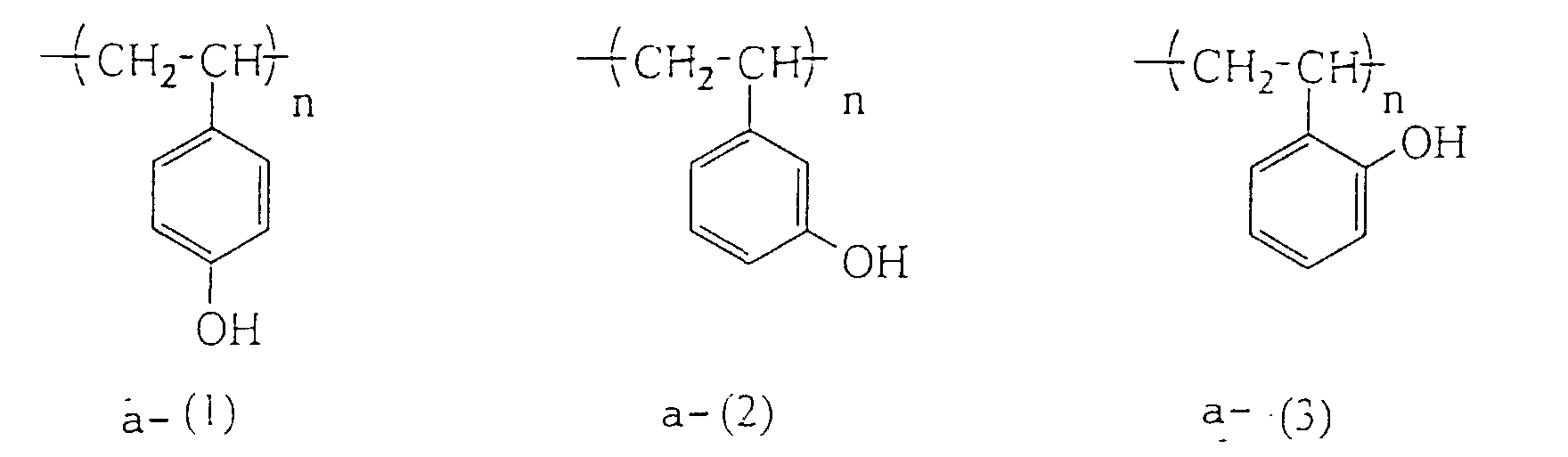

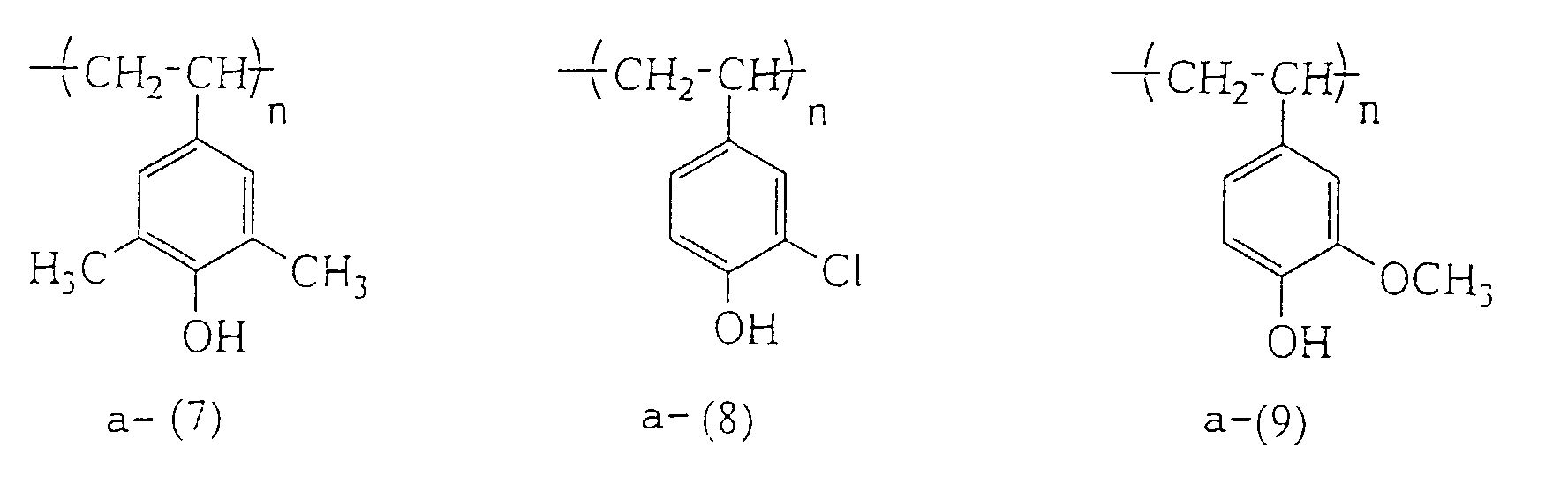
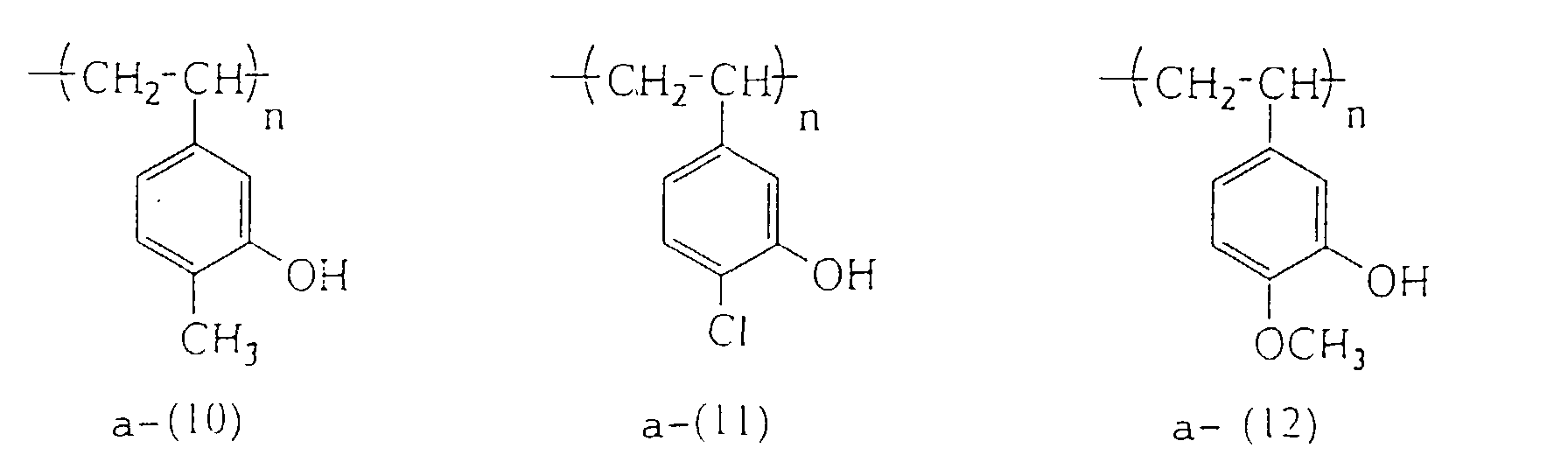
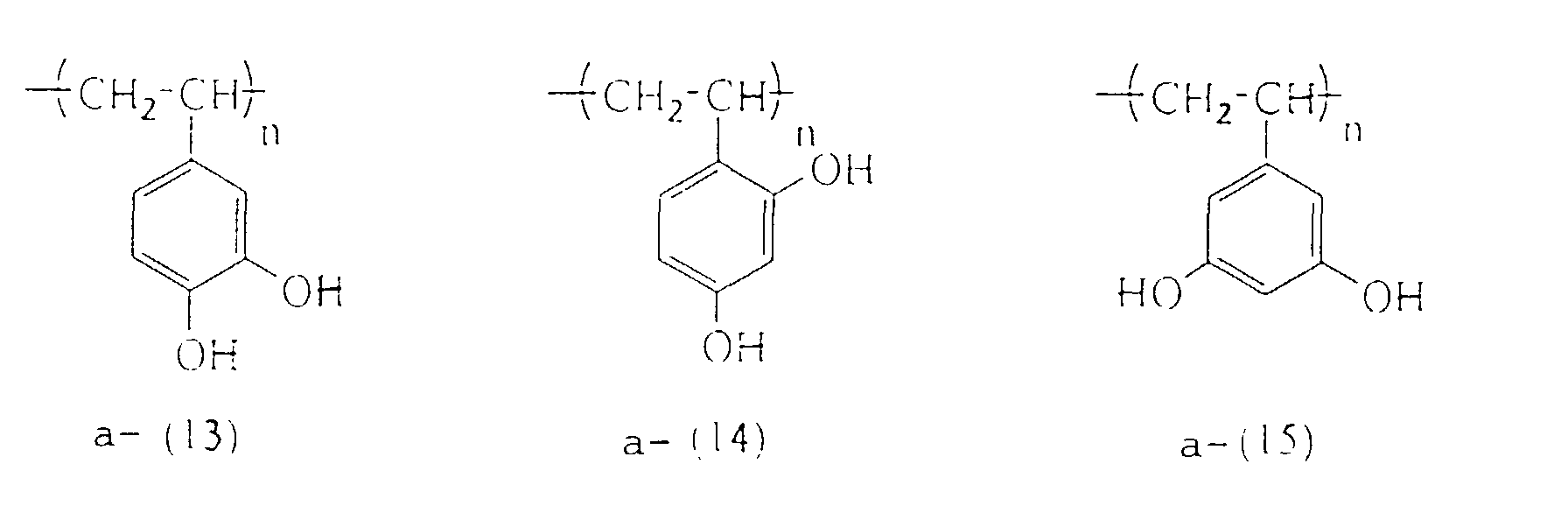

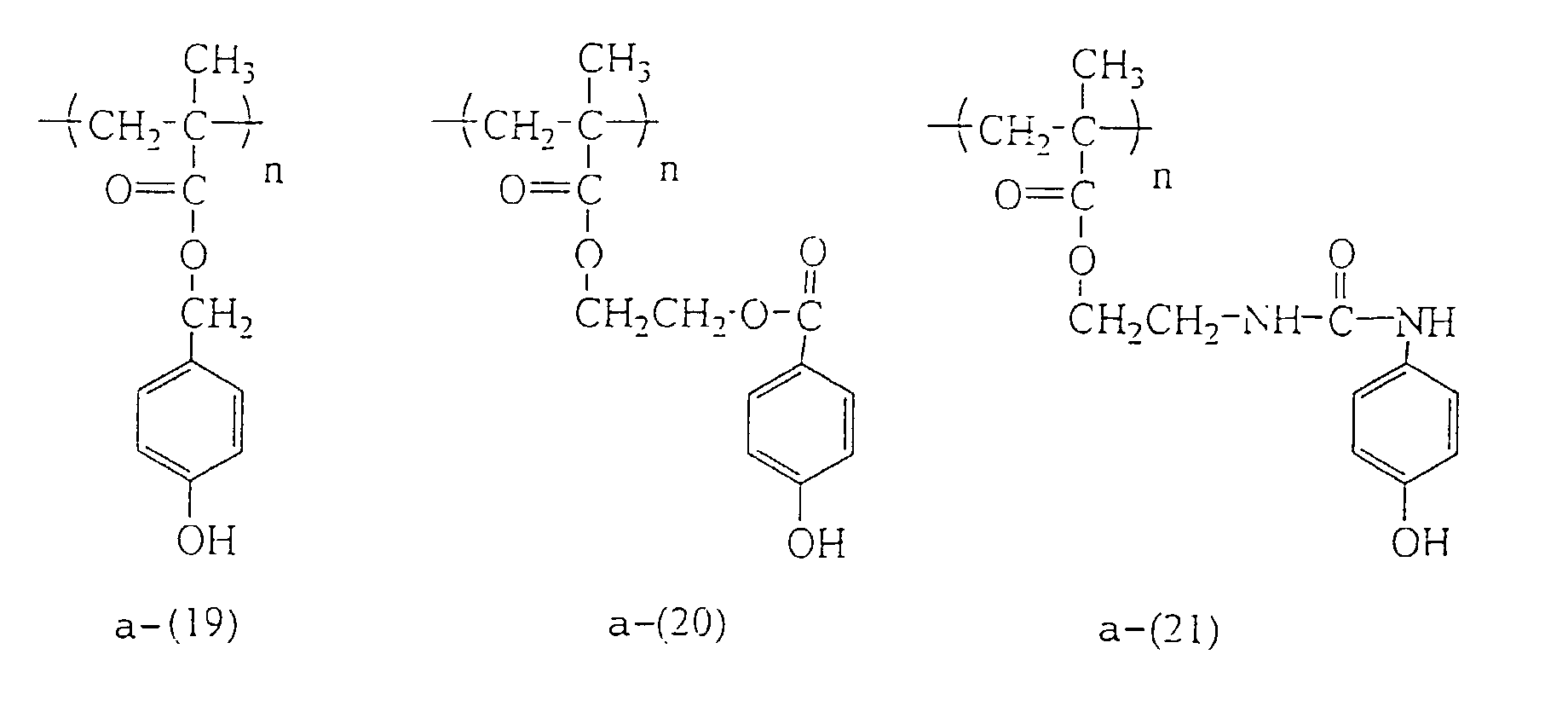


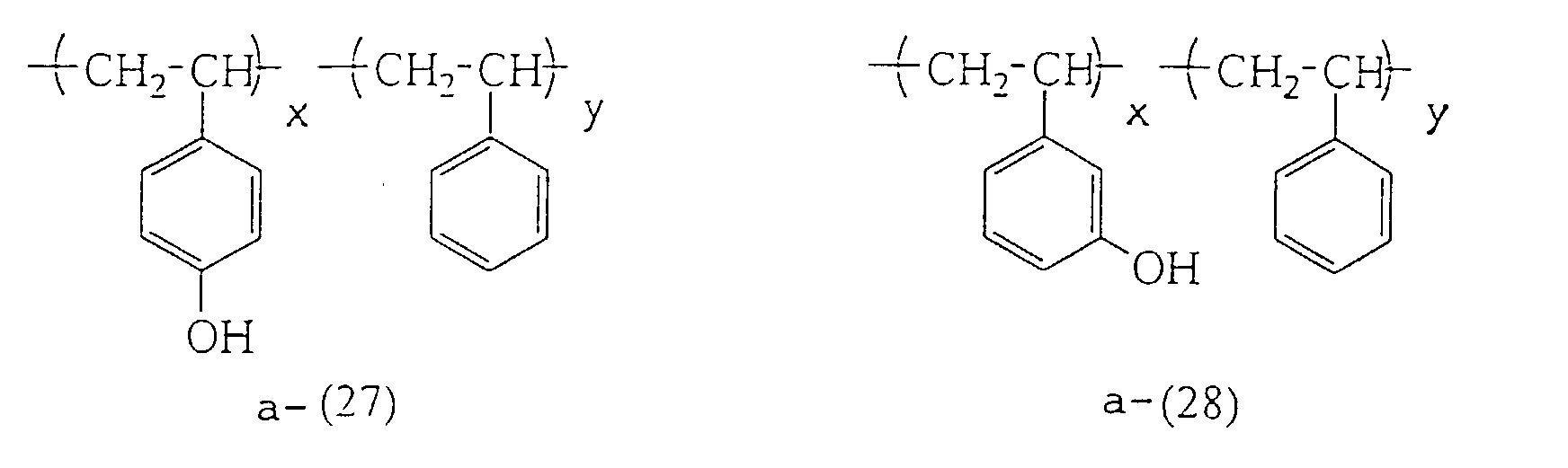

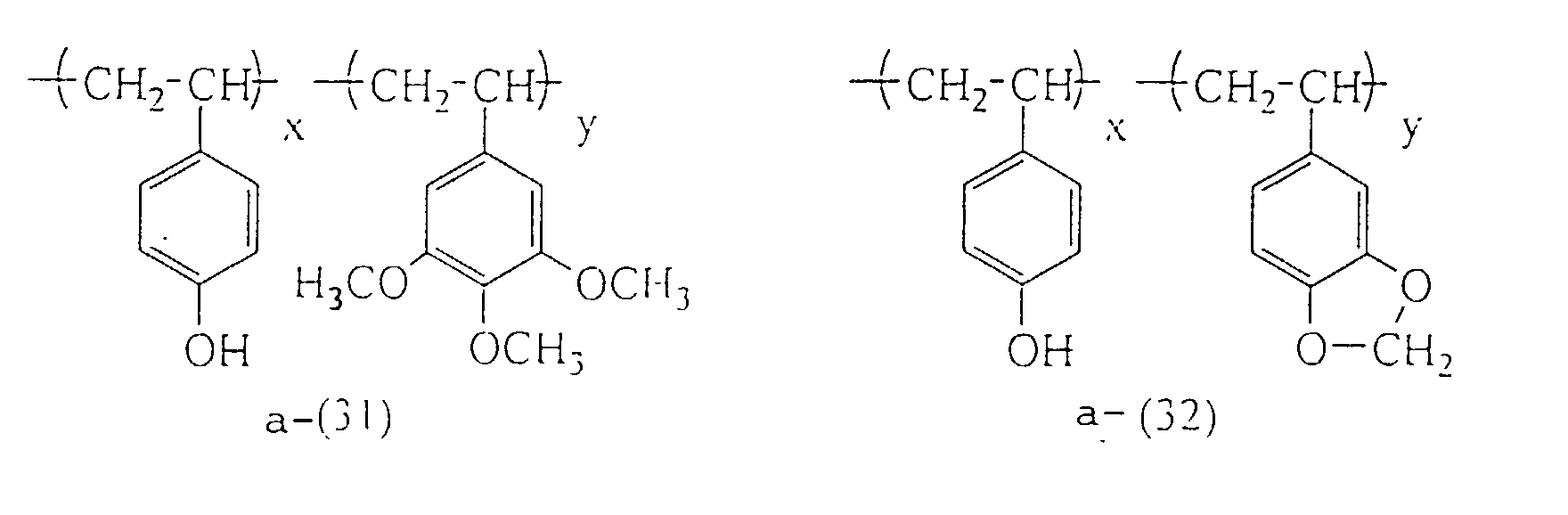


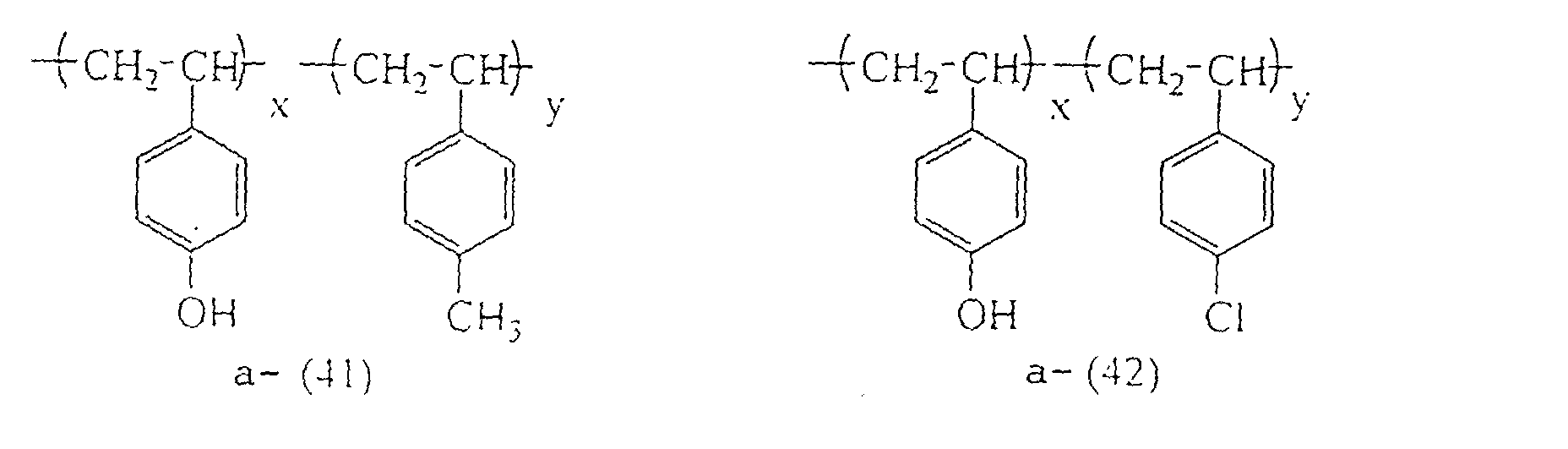
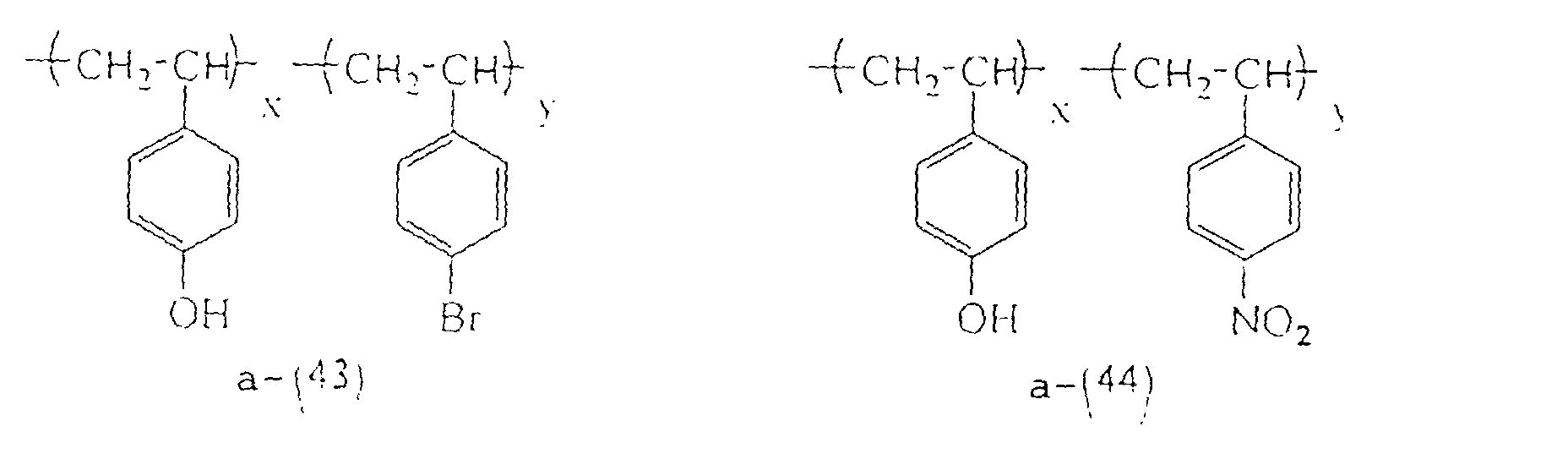

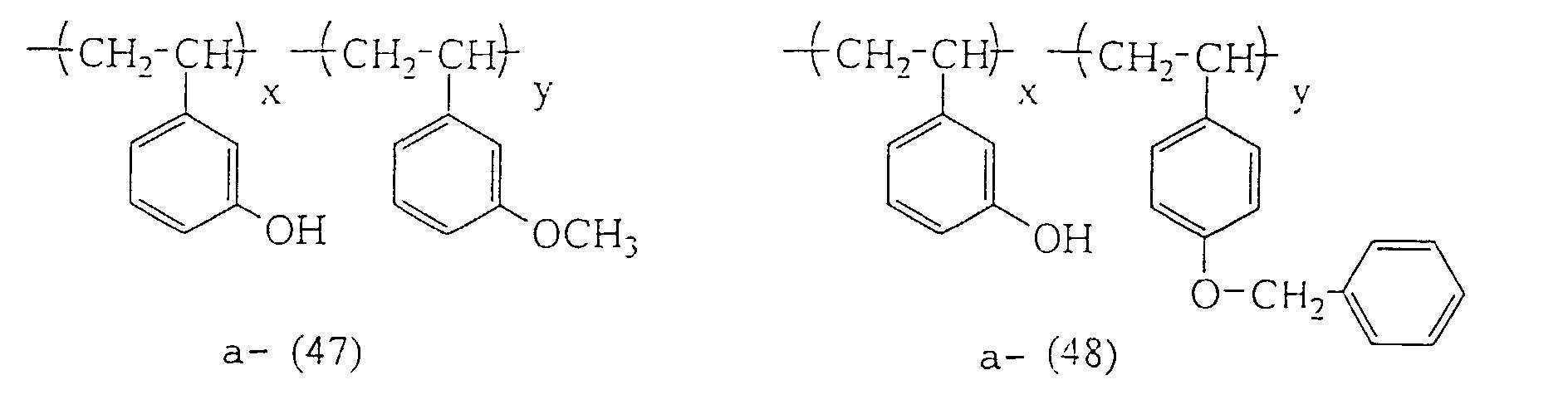


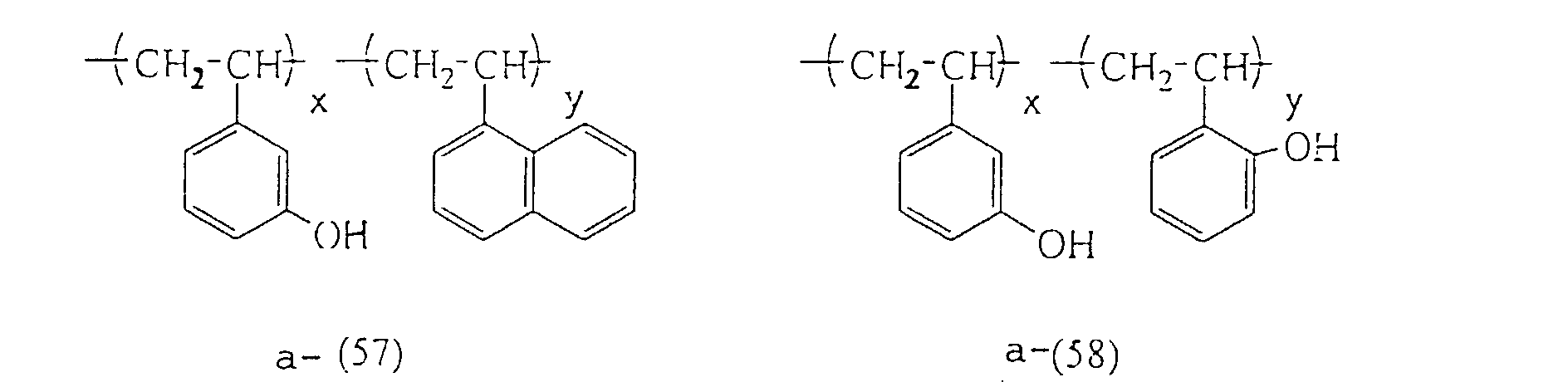
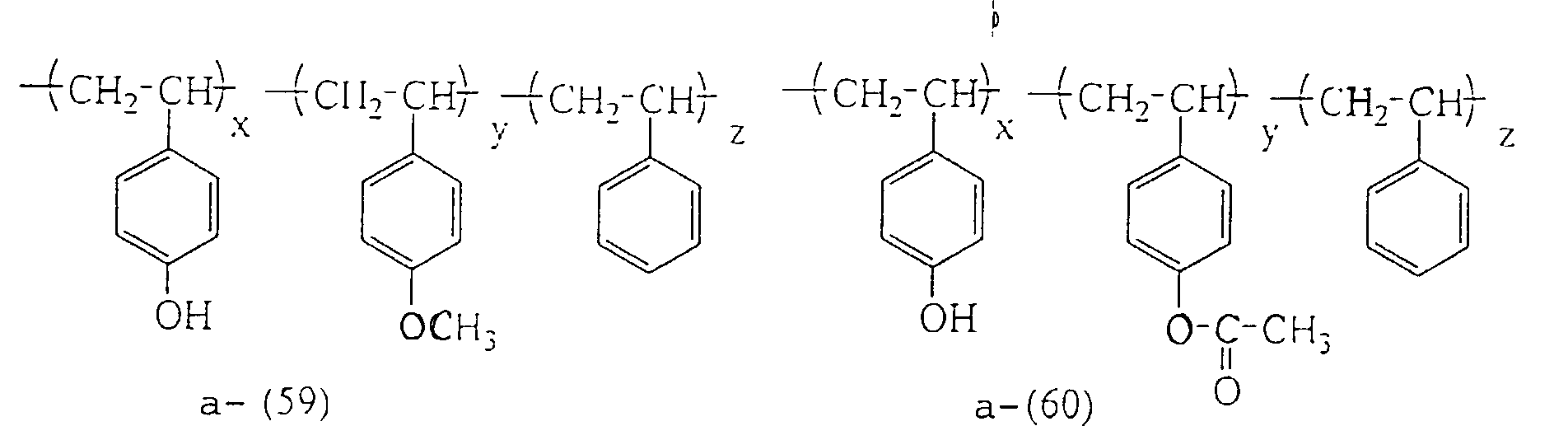
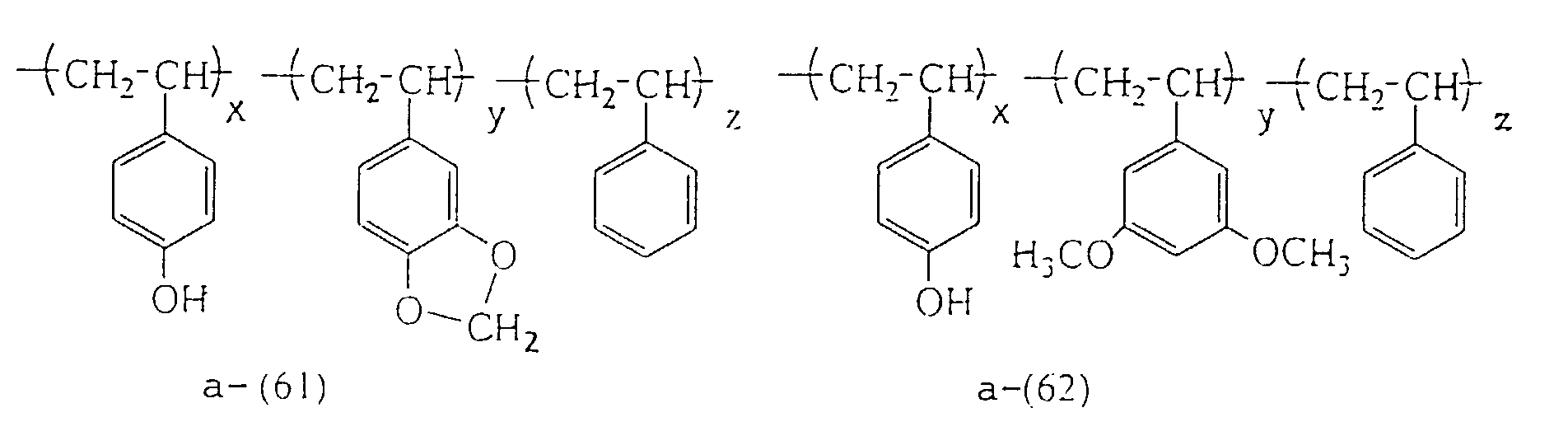


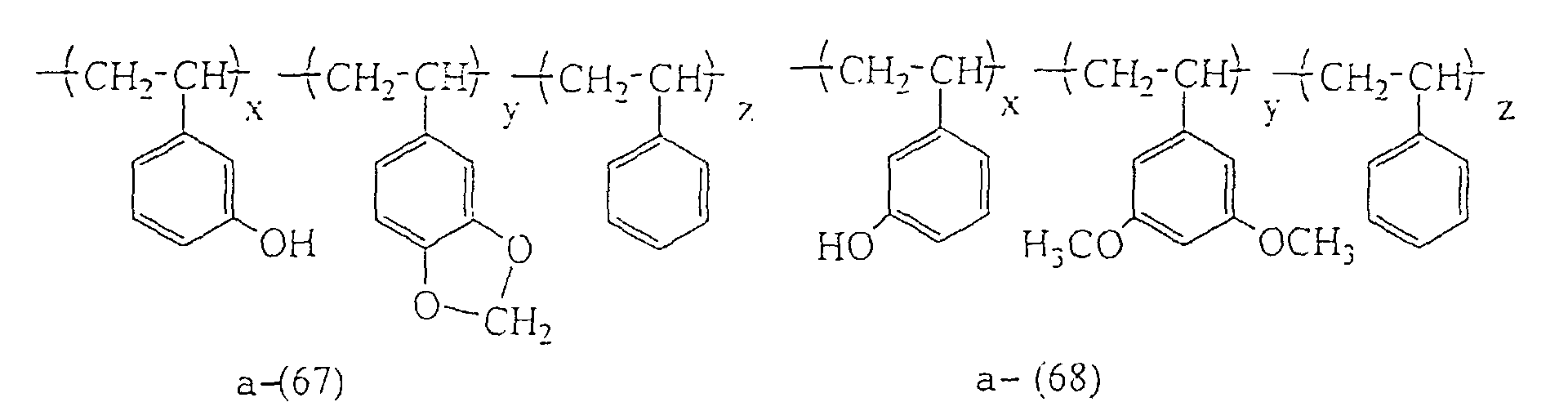

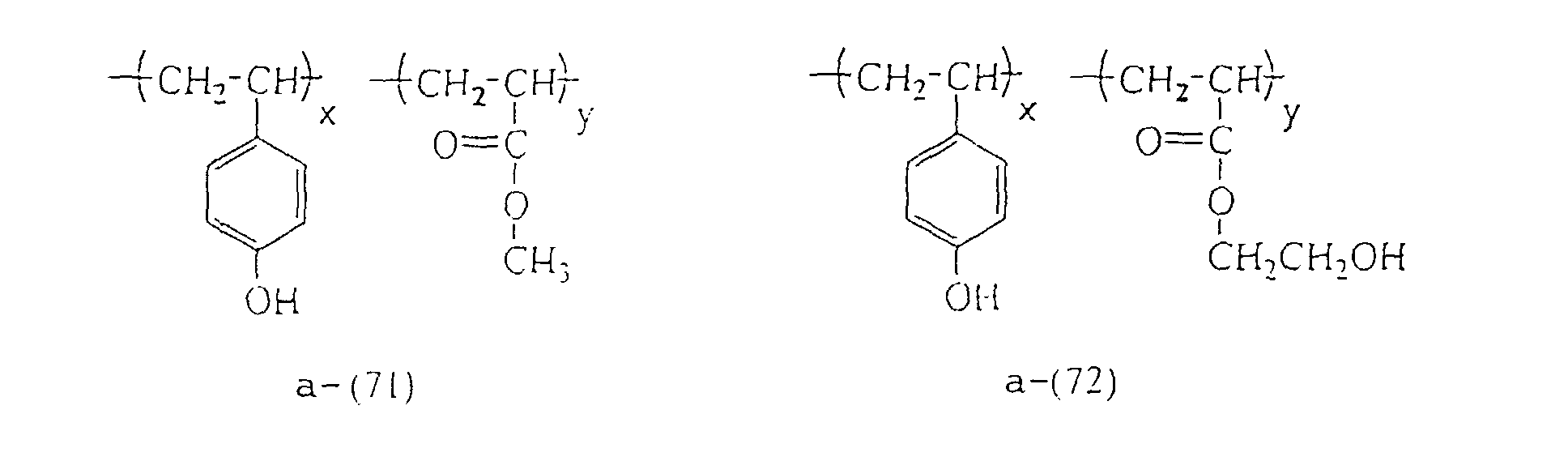


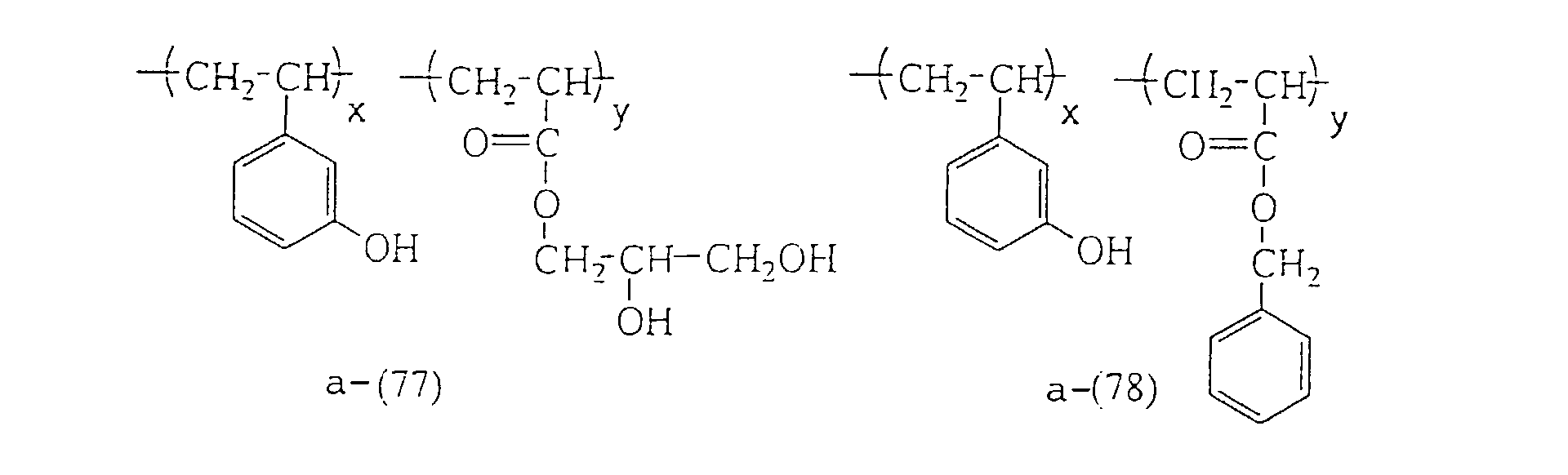

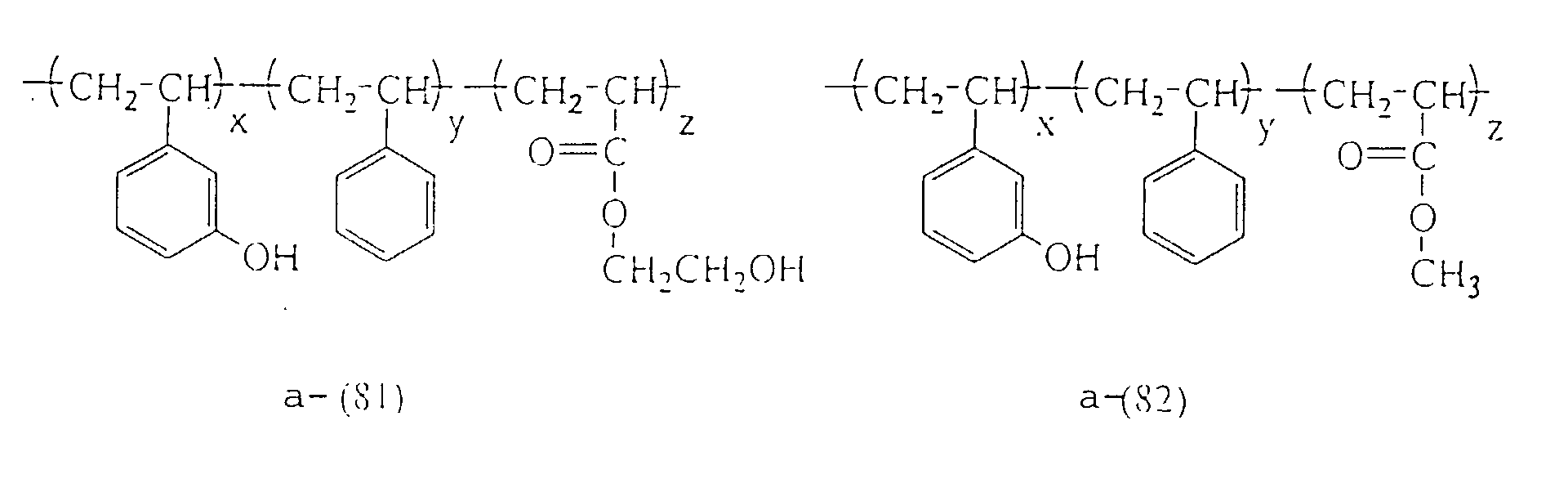
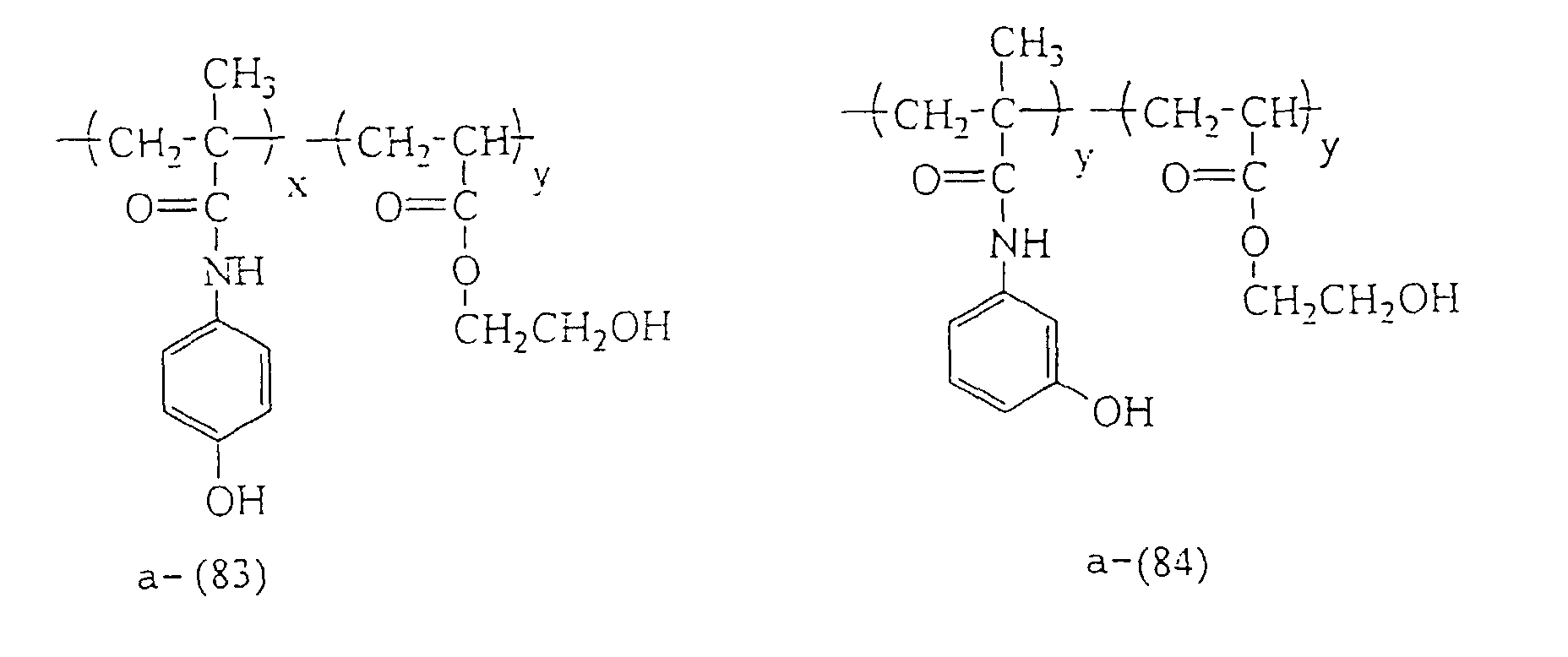

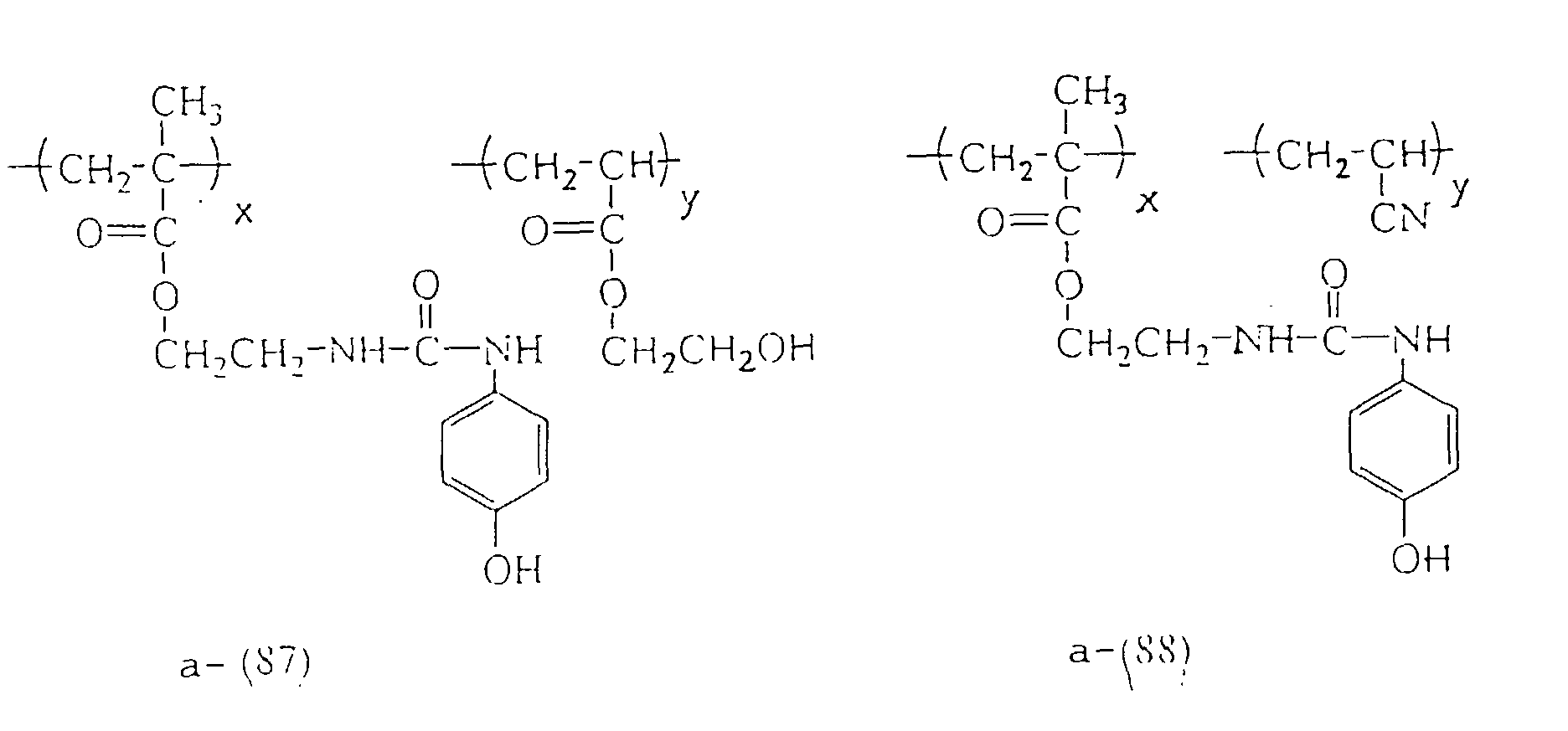
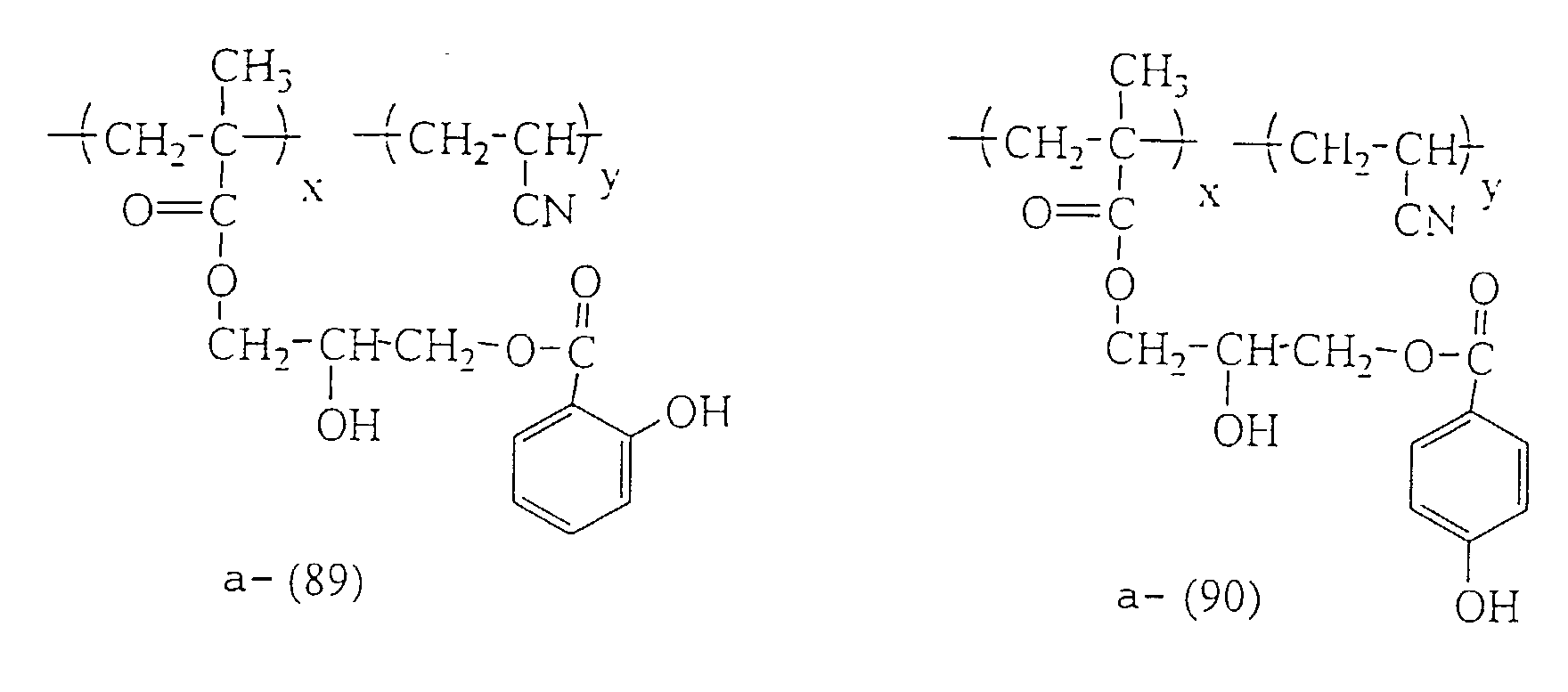
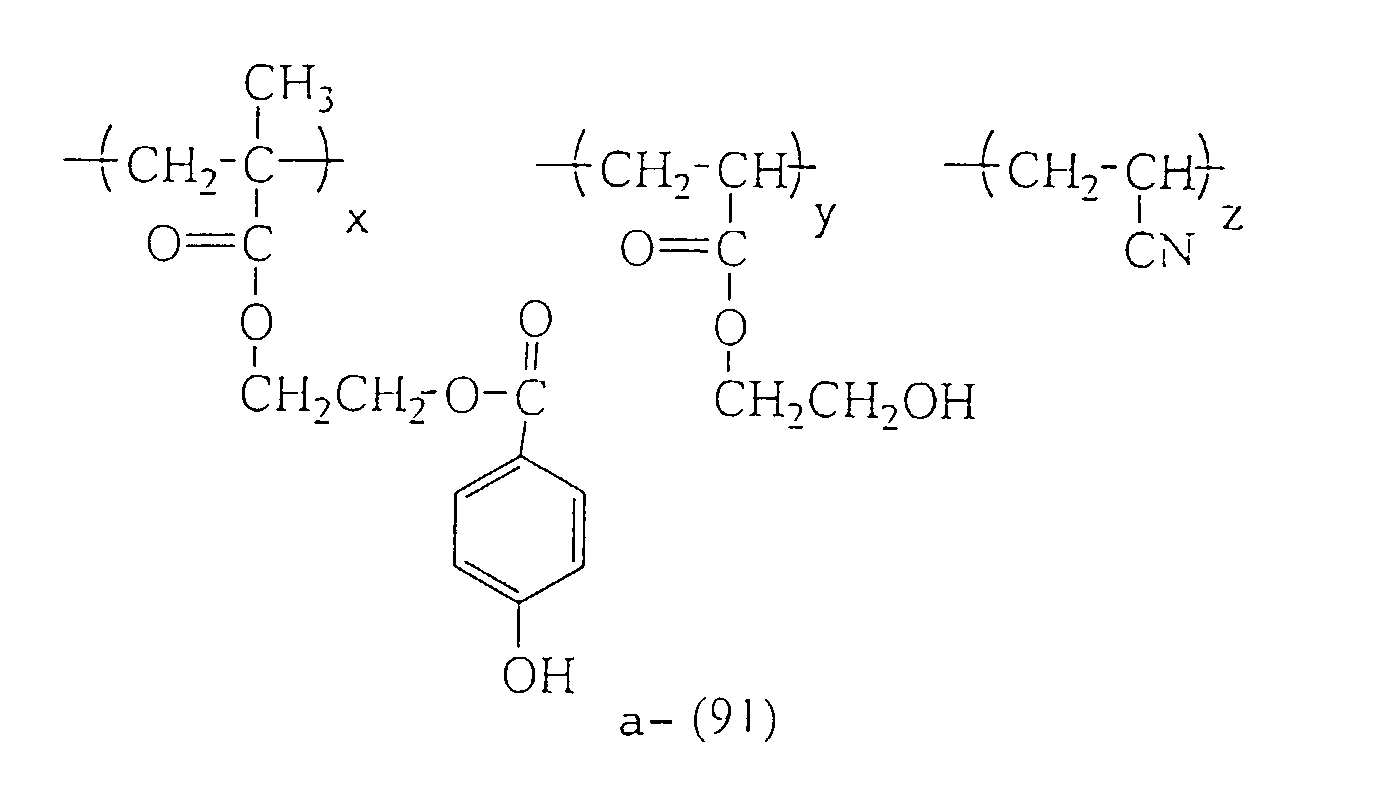
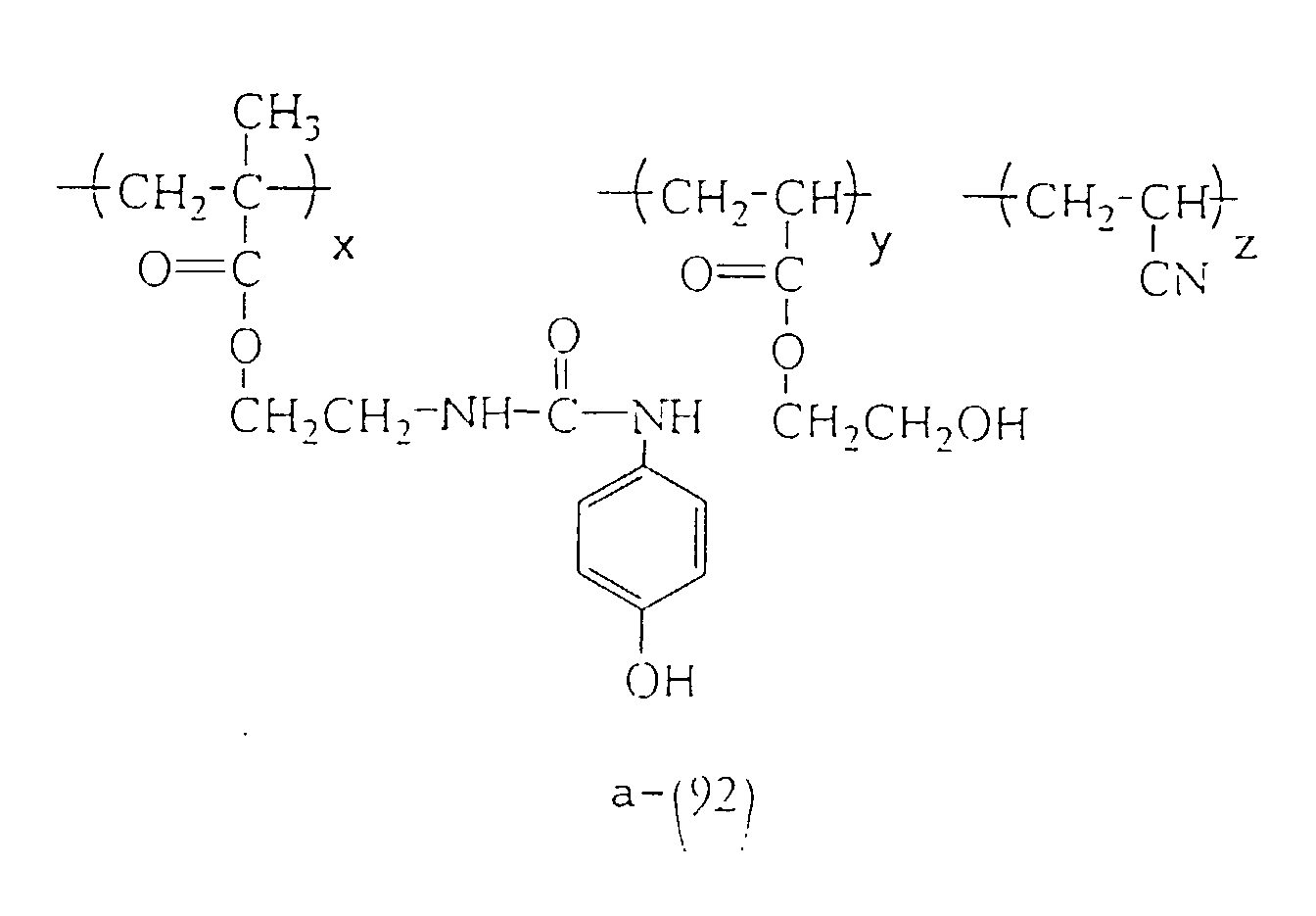
- In the practical examples described above, n represents a positive integer. Also, x, y, and z each represents mol ratio of the resin composition, in the resin made of 2 components, x and y are used in the range of x = 10 to 95 and y = 5 to 90, and preferably x = 40 to 90 and y = 10 to 60, in the resin made of 3 components, x, y, and z are used in the range of x = 10 to 90, y = 5 to 85, and z = 5 to 85, and preferably x = 40 to 80, y = 10 to 50, and z = 10 to 50.
- The molecular weight of the resin (B) , preferably the resin having the repeating unit shown by the formula (a) is preferably from 1,000 to 200,000, and more preferably from 3,000 to 50,000 as a weight average molecular weight. The molecular weight distribution of the resin used in the invention is in the range of from 1 to 10, preferably from 1 to 3, and more preferably from 1 to 1.5. As the molecular weight distribution is smaller, the resolution is higher, the resist form is better, the side walls of the resist patters are more smooth, and the resist composition is excellent in the roughness property.
- The content of the repeating unit shown by the formula (a) is from 5 to 100 mol%, and preferably from 10 to 90 mol% to the total resins.
- The alkali-soluble resin containing the structural unit shown by the formula (a) used in the invention can be synthesized by the methods described in "Macromolecules" 28(11), 3787 to 3789 (1995), "Polym. Bull." (Berlin) , 24 (4) , 385 to 389 (1990), and JP-A-8-286375. That is, the desired alkali-soluble resin can be obtained by a radical polymerization method or a living anion polymerization method.
- These resins may be used singly or as a mixture of plural kinds of the resins.
- In this case, the weight average molecular weight is defined as the polystyrene converted value of a gel permeation chromatography.
- The alkali-dissolving rate of the alkali-soluble resin is preferably at least 20 Å (angstroms) /second, and particularly preferably at least 200 Å/second by measuring with 0.261 N tetramethylammonium hydroxide (TMAH).
- The alkali-soluble resin in the invention may be used singly but can be used together with other alkali-soluble resin. As the using ratio, to 100 parts by weight of the alkali-soluble resin in the invention, the other alkali-soluble resin can be used at most 100 parts by weight. Then, other alkali-soluble resins which can be used together with the alkali-soluble resin in the invention are illustrated below.
- That is, there are, for example, a novolac resin, a hydrogenated novolac resin, an acetone-pyrogallol resin, a styrene-maleic anhydride copolymer, a carboxyl group-containing methacrylic resin and the derivatives thereof but the invention is not limited to them.
- The addition amount of the resin (B) is in the range of from 30 to 95% by weight, preferably from 40 to 90% by weight, and more preferably from 50 to 80% by weight to the whole solid components of the resist composition.
- The resin (B') in the invention is a resin having at least one unsaturated bond polymerizable by an acid and/or a radical, which is insoluble in water but soluble in an alkali aqueous solution, and preferably phenol novolac resins polyvinyl phenol resins, copolymers having a structural unit originated in vinyl phenol, a resin obtained by protecting or modifying a part of a polyvinyl phenol resin, etc., or a resin obtained by replacing a part or the whole of the phenol groups of a (meth)acrylate polymer, etc., having a phenol skeleton with a group having an unsaturated bond polymerizable with an acid and/or a radical can be widely used.
- Preferably, there is a phenol-base resin having the repeating unit shown by the formula (a') described above.
- In the formula (a'), R1' represents a hydrogen atom, a halogen atom, a cyano group, or an alkyl or haloalkyl group which may have a substituent.
- R2' to R4' represents a hydrogen atom, a group shown by the formula (b), (c), or (d) described above, or an alkyl, cycloalkyl, aryl, aralkyl, or acyl group which may have a substituent.
- R5' and R6' , which may be the same or different, each represents a hydrogen atom, a hydroxyl group, a halogen atom, a cyano group, or an alkyl, cycloalkyl, alkenyl, aralkyl, or aryl group which may have a substituent.
- R7' to R12' , R16', and R17' represents a hydrogen atom, a halogen atom, a cyano group, or an alkyl or haloalkyl group which may have a substituent.
- R13' and R14' each represents a hydrogen atom, a halogen atom, a hydroxy group, or an alkyl, alkoxy, or acyloxy group which may have a substituent.
- R15' represents a hydrogen atom or an alkyl, cycloalkyl, aralkyl, or aryl group which may have a substituent;
- A1 represents a single bond, or a divalent alkylene, alkenylene, cycloalkylene, or arylene group which may have a substituent, or -O-, -SO2-, -O-CO-R20-, -CO-O-R21-, or -CO-N(R22)-R23-.
- R20, R21, and R23, which may be the same or different, each represents a single bond, or a divalent alkylene, alkenylene, cycloalkylene, or arylene group which may have an ether structure, an ester structure, an amide structure, a urethane structure, or a ureido structure or may have a substituent.
- R22 represents a hydrogen atom, or an alkyl, cycloalkyl, aralkyl, or aryl group which may have a substituent.
- A2 represents a single bond, -O-R21-, or -N(R22)-R23-.
- A3 represents a single bond, -SO2-, or an arylene group which may have an alkylene structure or may have a substituent.
- A4 represents a single bond, a divalent alkylene, cycloalkylene, or arylene group which may have a substituent, or -O-. -SO2-, -CO-. or -CO-O-R21-.
- x, y, and z in the formula (a') each represents 0 or 1 and m and n in the formula (c) each represents 0 or an integer of at least 1.
- However, in the formula (a'), at least one repeating unit has the group of the formula (b), (c), or (d); and two of R2' to R4' , or one of R2' to R4' and R5' or R6' may combine with each other to form a ring.
- Also, as the alkyl group of R1' to R17' and R22, there are, for example, the alkyl groups having from 1 to 8 carbon atoms, and practically, there are, preferably, methyl, ethyl, propyl, n-butyl, sec-butyl, hexyl, 2-ethylhexyl, and octyl.
- The cycloalkyl group of R2' to R6' , R15' and R22 may be a monocyclic type or a polycyclic type. As the monocyclic type, there are cycloalkyl groups having from 3 to 8 carbon atoms, and there are preferably cyclopropyl, cyclopentyl, and cyclohexyl. As the polycyclic type, there are preferably adamantyl, norbornyl, isoboronyl, dicyclopentyl, α-pinel, tricyclodecanyl, etc.
- As the alkenyl group of R5' and R6' , there are, for example, alkenyl groups having from 2 to 8 carbon atoms, and practically, there are preferably vinyl, allyl, butenyl, and cyclohexenyl.
- As the aryl group of R2' to R6' , R15' , and R22 , there are, for example, aryl groups having from 6 to 15 carbon atoms, and practically, there are preferably phenyl, tolyl, dimethylphenyl, 2,4,6-trimethylphenyl, naphthyl, anthryl, etc.
- As the aralkyl group of R2' to R6' , R15', and R22, there are, for example, aralkyl groups having from 7 to 12 carbon atoms, and practically, there are preferably benzyl, phenethyl, naphthylmethyl, etc.
- As the haloalkyl group of R1' , R7' to R12' , R16' , and R17' . there are, for example, haloalkyl groups having from 1 to 4 carbon atoms, and practically, there are preferably chloromethyl, chloroethyl, chloropropyl, chlorobutyl, bromomethyl, bromoethyl, etc.
- As the acyl group of R2' to R4' , there are, for example, acyl groups having from 1 to 10 carbon atoms, and practically, there are preferably formyl, acetyl, propanoyl, butanoyl, pivaloyl, benzoyl, etc.
- As the alkoxy group of R13' and R14' , there are, for example, alkoxy groups having from 1 to 8 carbon atoms, and practically, there are, preferably, methoxy, ethoxy, propoxy, and butoxy. Also, as the acyloxy group, there are , for example, acyloxy groups having from 1 to 10 carbon atoms, and practically, there are, preferably, acetoxy, propanoyloxy, benzoyloxy, etc.
- As the alkylene group of A1, A4, R20. R21, and R23, there are preferably alkylene groups having from 1 to 8 carbon atoms, such as methylene, ethylene, propylene, butylene, hexylene, octylene, etc.
- As the alkenylene group of A1, R20, R21, and R23, there are preferably alkenylene groups having from 2 to 6 carbon atoms, such as ethenylene, propenylene, butenylene, etc.
- As the cycloalkylene group of A1, A4, R20, R21, and R23, there are preferably cycloalkylene groups having from 5 to 8 carbon atoms, such as cyclopentylene, cyclohexylene, etc.
- As the arylene group of A1, A3, A4, R20, R21, and R23, there are arylene groups having from 6 to 12 carbon atoms, and there are preferably phenylene, tolylene, xylylene, naphthylene, etc.
- Furthermore, the substituent which is substituted to these groups includes a group having an active hydrogen, such as an amino group, an amide group, a ureido group, a urethane group, a hydroxyl group, a carboxyl group, etc.; a halogen atom (such as fluorine, chlorine, bromine, iodine, etc.), an alkoxy group (such as, methoxy, ethoxy, propoxy, butoxy, etc.), a thioether group, an acyl group (such as, acetyl, propanoyl, benzoyl, etc.) , an acyloxy group (such as, acetoxy, propanoyloxy, benzoyloxy, etc.), an alkoxycarbonyl group (such as, methoxycarbonyl, ethoxycarbonyl, propoxycarbonyl, etc.), a cyano group, a nitro group, etc.
- Particularly, the groups having active hydrogen, such as an amino group, a hydroxyl group, a carboxyl group, etc., are preferred.
- Also, as the ring formed by combining two of R2' to R4' , or one of R2' to R4' and R5' or R6' with each other, there are 4- to 7-membered rings containing an oxygen atom, such as a benzofuran ring, a benzodioxonol ring, a penzpyran ring, etc.
- The resin (B') in the invention may be a resin composed of the repeating structural unit only shown by the formula (a') but for the purpose of further improving the performance of the negative-working resist composition of the invention, the resin may be copolymerized with other polymerizable monomer.
- As the copolymerizable monomer which can be used in the invention, the following monomers are included. For example, there is a compound having one addition polymerizing unsaturated bond selected from acrylic acid esters, acrylamides, methacrylic acid esters, methacrylamides, allyl compounds, vinyl ethers, vinyl esters, styrenes, crotonic acid esters, etc., other than the above-described monomers.
- Practical examples of the acrylic acid esters include alkyl (the carbon atom number of the alkyl group is preferably from 1 to 10) acrylates (e.g., methyl acrylate, ethyl acrylate, propyl acrylate, tert-butyl acrylate, amyl acrylate, cyclohexyl acrylate, ethylhexyl acrylate, octyl acrylate, tert-octyl acrylate, chloroethyl acrylate, 2-hydroxyethyl acrylate, 2 ,2-dimethylhydroxypropyl acrylate, 5-hydroxypentyl acrylate, trimethlolpropane monoacrylate, pentaerythritol monoacrylate, glycidyl acrylate, benzyl acrylate, furfuryl acrylate, and tetrahydrofurfuryl acrylate) and aryl acrylates (e.g., phenyl acrylate).
- Practical examples of the methacrylic acid esters include alkyl (the carbon atom number of the alkyl group is preferably from 1 to 10) methacrylates (e.g., methyl methacrylate, ethyl methacrylate, propyl methacrylate, isopropyl methacrylate, tert-butyl methacrylate, amyl methacrylate, hexyl methacrylate, cyclohexyl methacrylate, benzyl methacrylate, chlorobenzyl methacrylate, octyl methacrylate, 2-hydroxyethyl methacrylate, 4-hydroxybutyl methacrylate, 5-hydroxypentyl methacrylate, 2,2-dimethyl-3-hydroxypropyl methacrylate, trimethylolpropane monomethacrylate, pentaerythritol monomethacrylate, glycidyl methacrylate, furfuryl methacrylate, and tetrahydrofurfuryl methacrylate) and aryl methacrylates (e.g., phenyl methacrylate, cresyl methacrylate; and naphthyl methacrylate).
- Practical examples of the acrylamides include acrylamide, N-alkylacrylamides (as the alkyl group, there are alkyl groups having from 1 to 10 carbon atoms, such as methyl, ethyl, propyl, butyl, tert-butyl, heptyl, octyl, cyclohexyl, benzyl, hydroxyethyl, etc.) , N-arylacrylamides (as the aryl group, there are, for example, phenyl, tolyl, nitrophenyl, naphthyl, cyanonaphthyl, hydroxyphenyl, and carboxyphenyl), N,N-diaalkylacrylamides (as the alkyl group, there are alkyl groups having from 1 to 10 carbon atoms, such as methyl, ethyl, butyl, isobutyl, ethylhexyl, cyclohexyl, etc.), N,N-diarylacrylamides (as thearylgroup, thereare, forexample, phenyl), N-methyl-N-phenylacrylamide, N-hydroxyethyl-N-methylacrylamide, and N-2-acetamidoethyl-N-acetylacrylamide.
- practical examples of the methacrylamides include N-alkylmethacrylamides (as the alkyl group, there are alkyl groups having from 1 to 10 carbon atoms, such as methyl, ethyl, tert-butyl, ethylhexyl, hydroxyethyl, cyclohexyl, etc.), N-arylmethacrylamides (as the aryl group, there are phenyl, etc.), N,N-dialkylmethacrylamides (as the alkyl group, there are ethyl, propyl, butyl, etc.), N,N-diarylmethacrylamides (as the aryl group, there are phenyl, etc.), N-hydroxyethyl-N-methylmethacrylamide, N-methyl-N-phenyl-methacrylamide, and N-ethyl-N-phenylmethacrylamide.
- Practical examples of the allyl compounds include allyl esters (e.g., allyl acetate, allyl caproate, allyl caprylate, allyl laurate, allyl palmitate, allyl stearate, allyl benzoate, allyl acetoacetate, and allyl lactate), and allyloxy ethanol.
- Practical examples of the vinyl ethers include alkyl vinyl ethers (e.g., hexyl vinyl ether, octyl vinyl ether, decyl vinyl ether, ethylhexyl vinyl ether, methoxyethyl vinyl ether, ethoxyethyl vinyl ether, chloroethyl vinyl ether, 1-methyl-2,2-dimethylpropyl vinyl ether, 2-ethylbutyl vinyl ether, hydroxyethyl vinyl ether, diethylene glycol vinyl ether, dimethylaminoethyl vinyl ether, diethylaminoethyl vinyl ether, butylaminoethyl vinyl ether, benzyl vinyl ether, and tetrahydrofurfuryl vinyl ether), and vinylaryl ethers (e.g., vinylphenyl ether, vinyltolyl ether, vinyl chlorophenyl ether, vinyl-2,4-dichlorophenyl ether, vinylnaphthyl ether, and vinyl anthranyl ether).
- Practical examples of the vinyl esters include vinyl butyrate, vinyl isobutyrate, vinyl trimethyl acetate, vinyl diethyl acetate, vinyl valate, vinyl caproate, vinyl chloroacetate, vinyl dichloroacetate, vinyl methoxy acetate, vinyl butoxy acetate, vinyl phenyl acetate, vinyl acetoacetate, vinyl lactate, vinyl-β-phenyl butyrate, vinylcyclohexyl carboxylate, vinyl benzoate, vinyl salicylate, vinyl chlorobenzoate, vinyl tetrachlorobenzoate, and vinyl naphthoate.
- Practical examples of the styrenes include styrene, alkylstyrenes (e.g., methylstyrene, dimethylstyrene, trimethylstyrene, ethylstyrene, diethylstyrene, isopropylstyrene, butylstyrene, hexylstyrene, cyclohexylstyrene, decylstyrene, benzylstyrene, chloromethylstyrene, trifluoromethylstyrene, ethoxymethylstyrene, and acetoxymethylstyrene), alkoxystyrenes (e.g., methoxystyrene, 4-methoxy-3-methylstyrene, and dimethoxystyrene), halogenstyrenes (e.g., chlorostyrene, dichlorostyrene, trichlorostyrene, tetrachlorostyrene, pentachlorostyrene, bromostyrene, dibromostyrene, iodostyrene, fluorostyrene, trifluorostyrene, 2-bromo-4-trifluoromethylstyrene, and 4-fluoro-3-trifluoromethylstyrene), and carboxystyrenes.
- Practical examples of the crotonic acid esters include alkyl crotonates (e.g., butyl crotonate, hexyl crotonate, and glycerol monocrotonate). Other copolymerizable monomers used in the invention, there are dialkyl itaconates (e.g., dimethyl itaconate, diethyl itaconate and dibutyl itaconate), maleic acid or fumaric acid dialkyl esters (e.g., dimethyl maleate and dubutyl fumalate), maleic anhydride, maleimide, acrylonitrile, methacrylonitrile, maleironitrile, etc.
- Also, other copolymerizable addition polymerizing unsaturated compounds can be generally used in the invention.
- In these monomers, the monomers improving the alkali-solubility such as the monomers having a carboxyl group, such as carboxystyrene, N-(carboxyphenyl) acrylamide, N-(carboxyphenyl)methacrylamide, etc., and maleimide, etc., are preferred as the copolymer component.
- The content of other polymerizable monomer in the resin in the invention is preferably not more than 50 mol%, and more preferably not more than 30 mol% to the whole repeating units.
- Then, practical examples of the resin having the repeating structural unit shown by the formula (a') are shown below but the invention is not limited to these compounds.


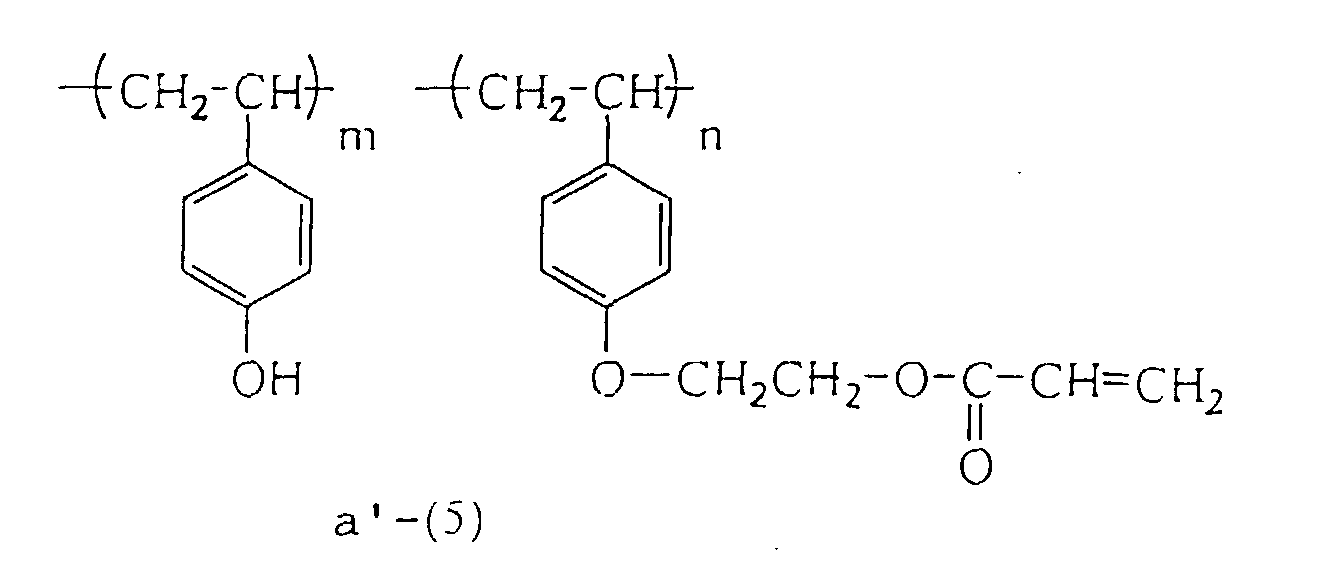


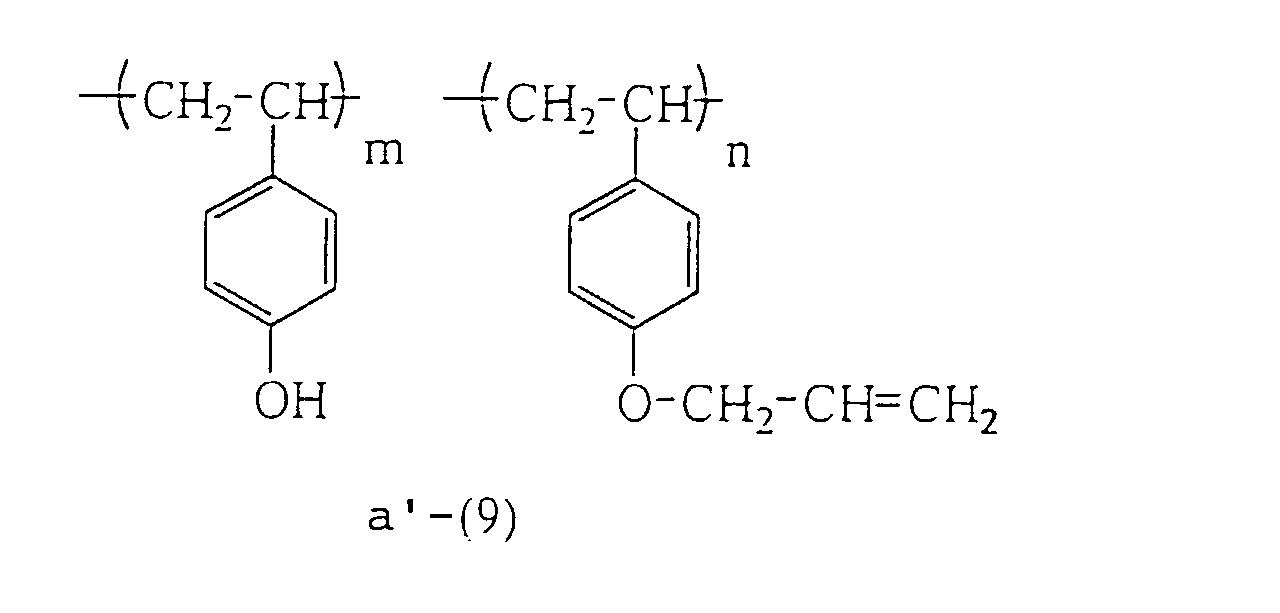
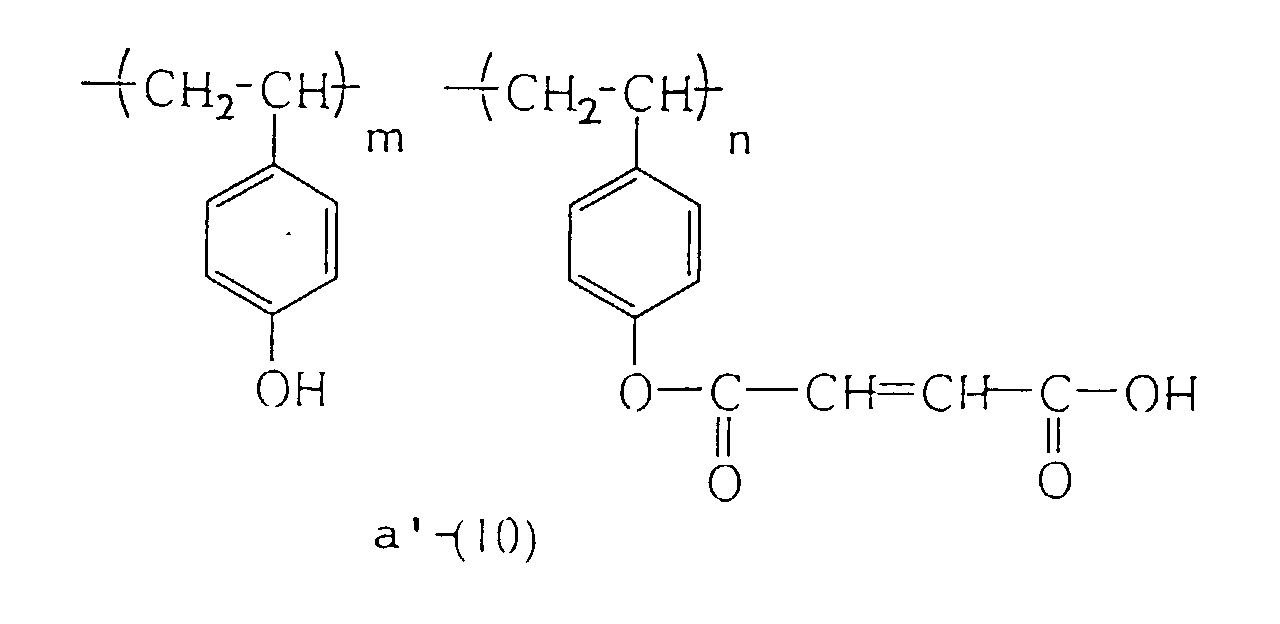

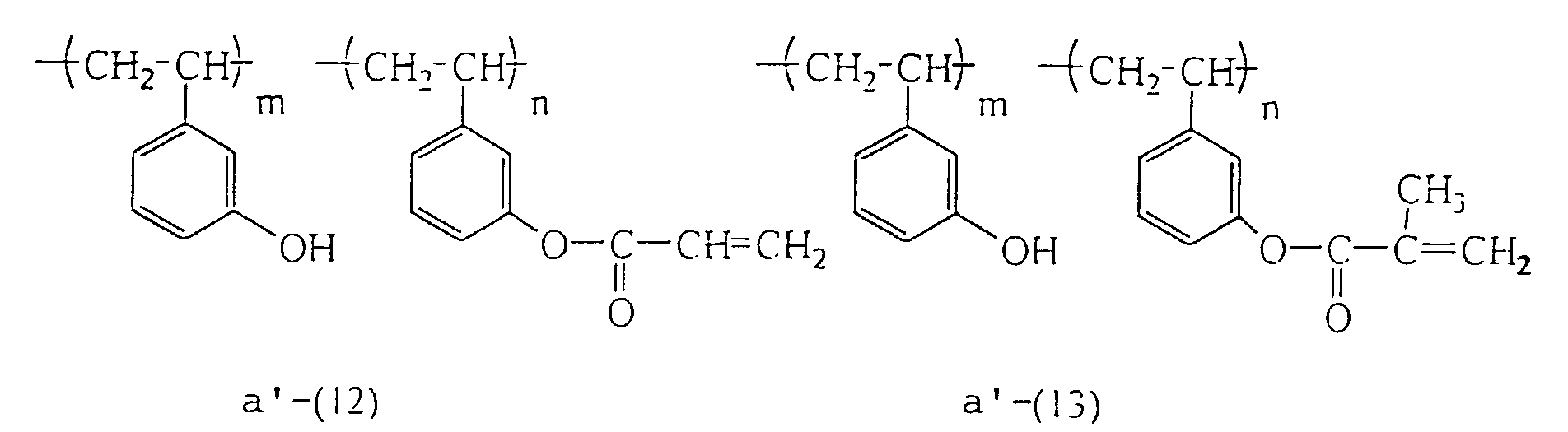
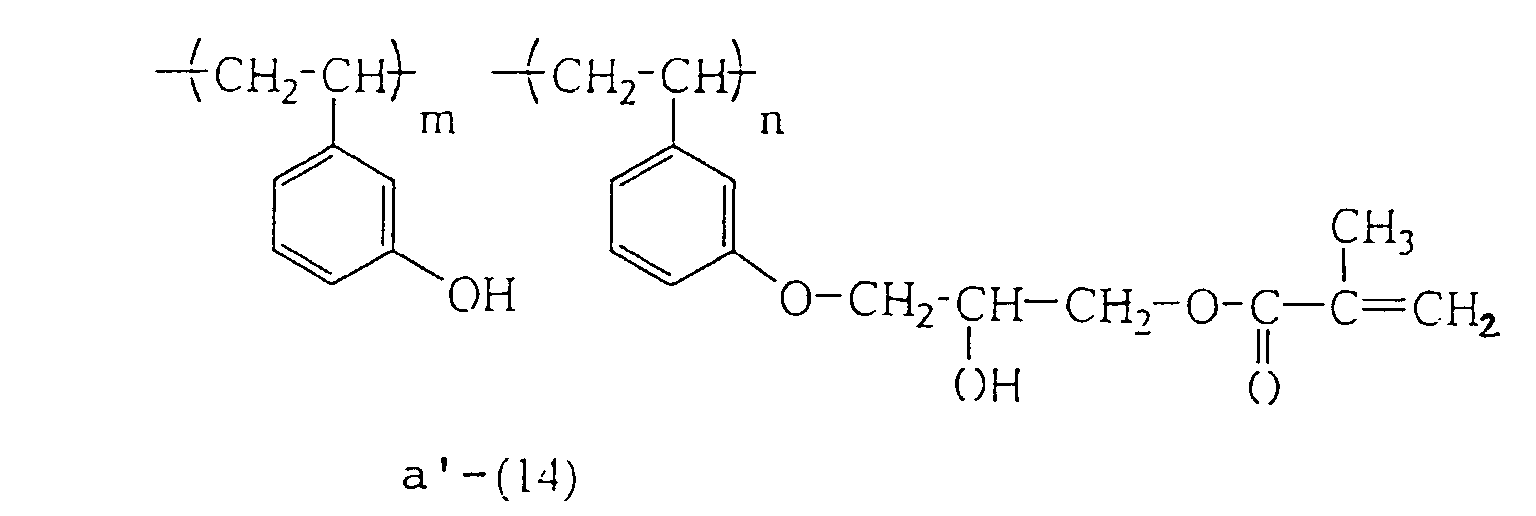


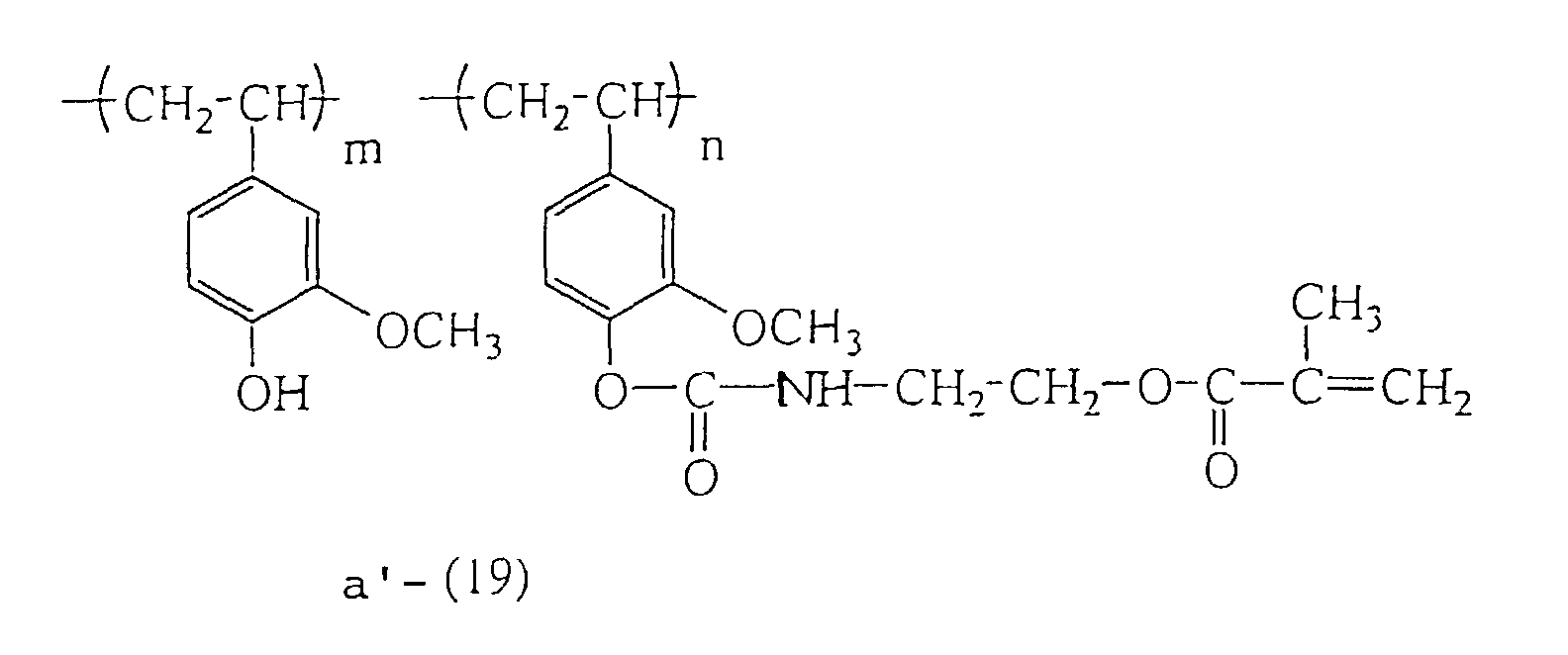
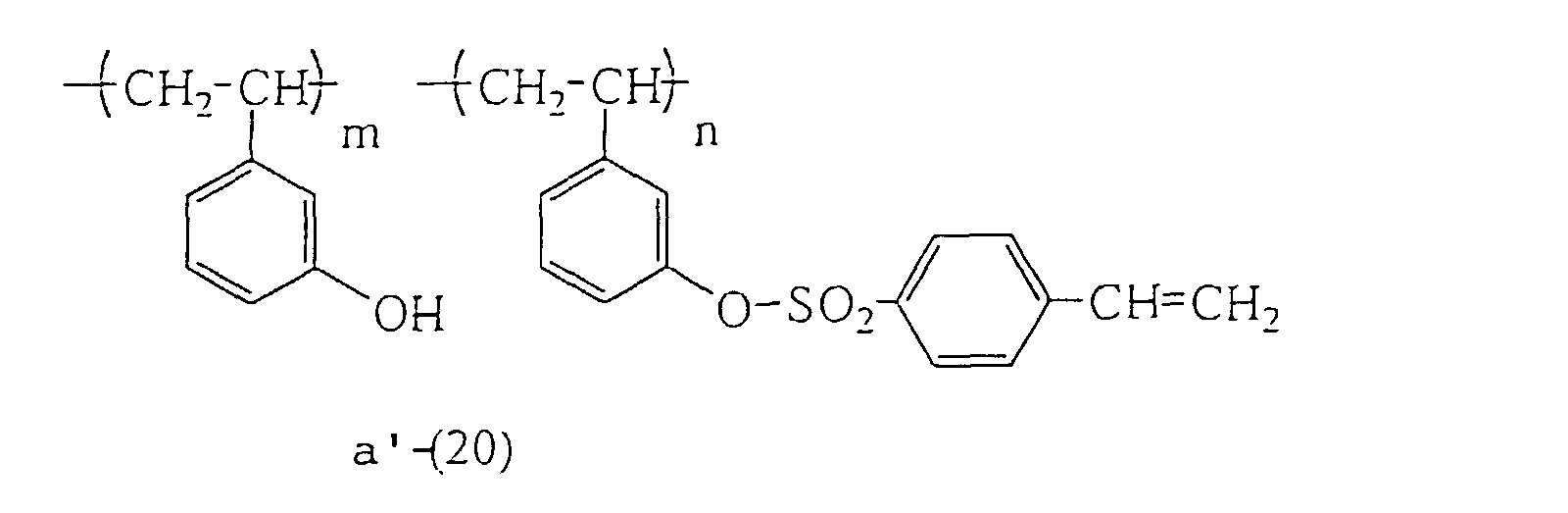

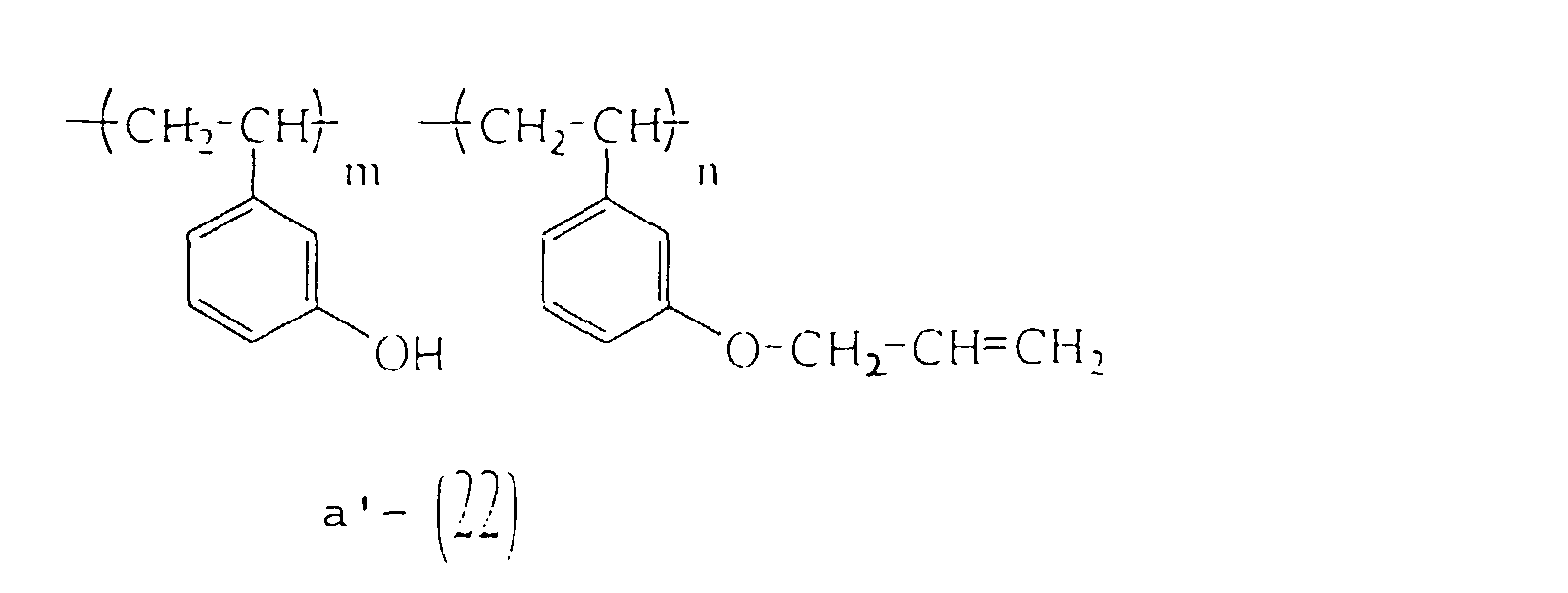
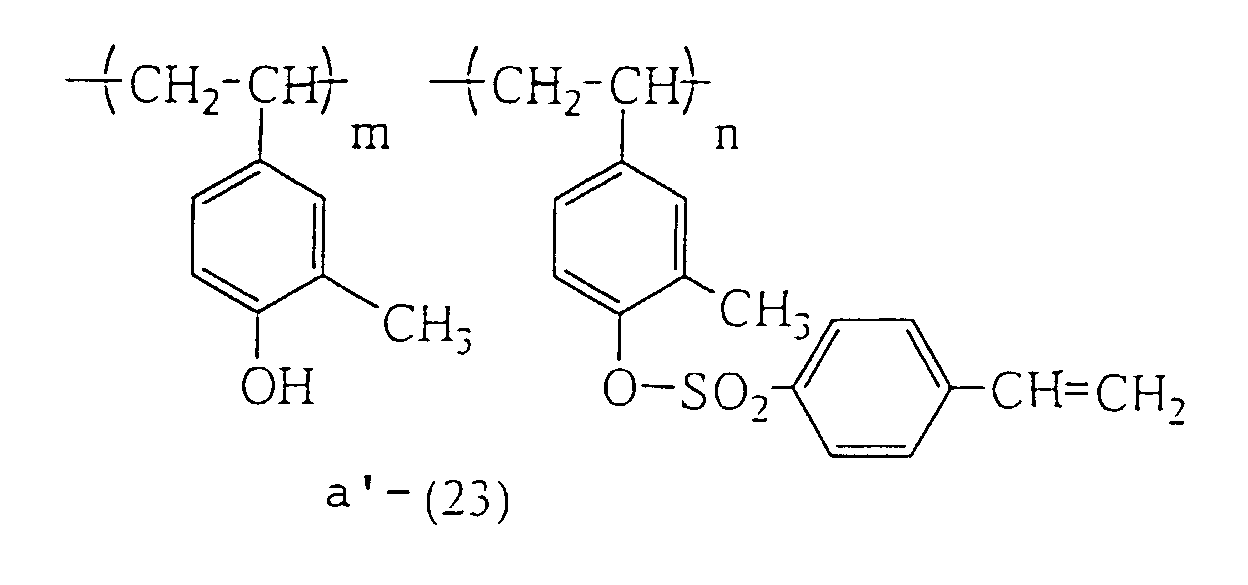
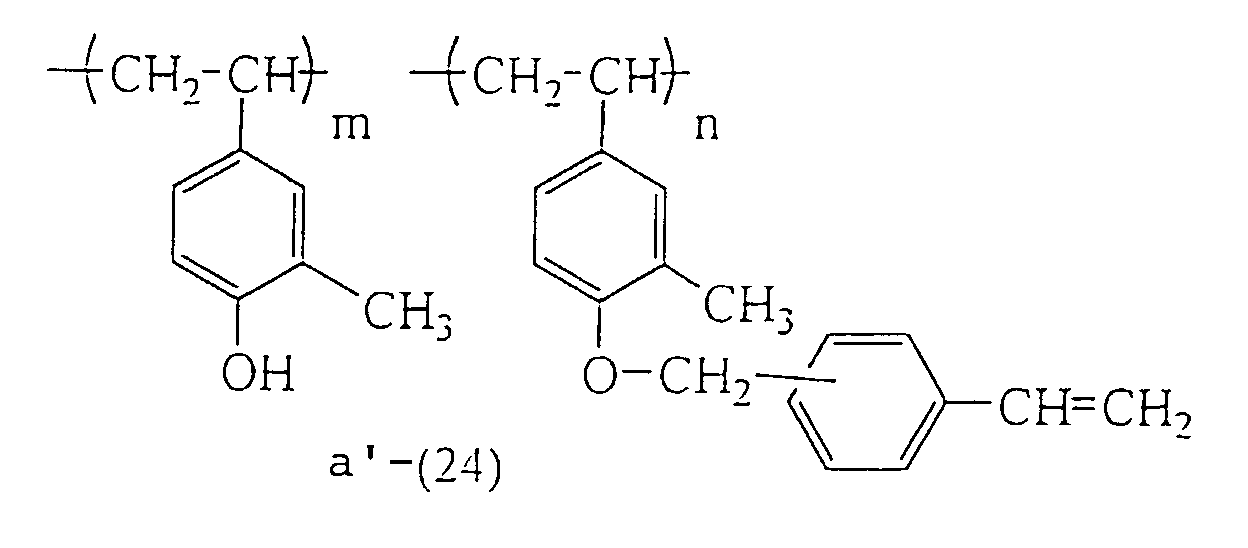


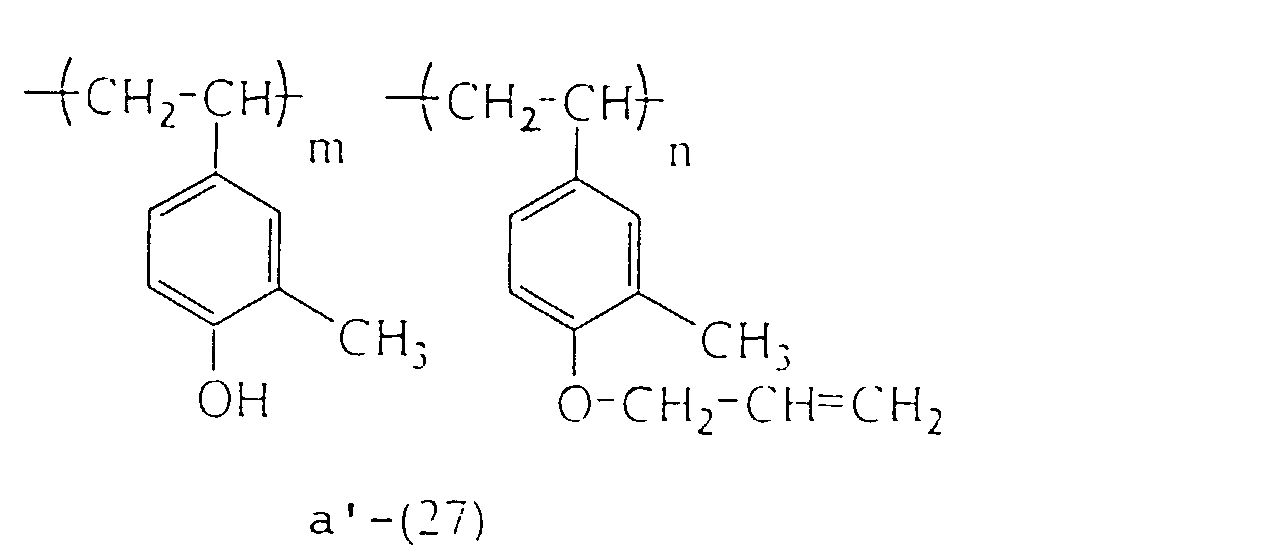
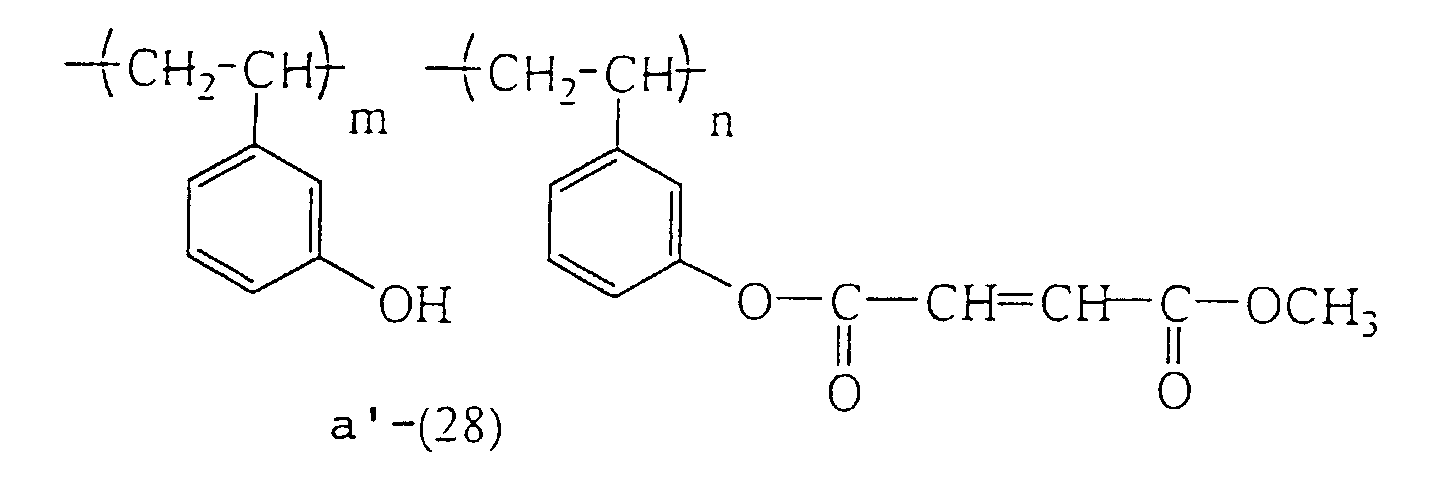
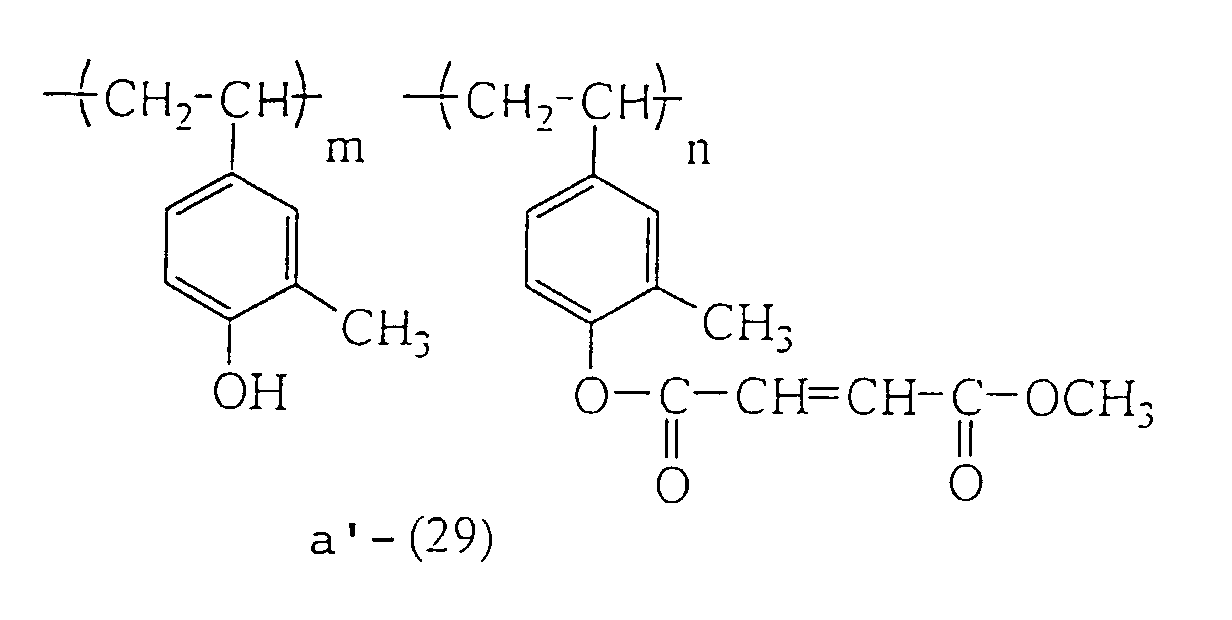

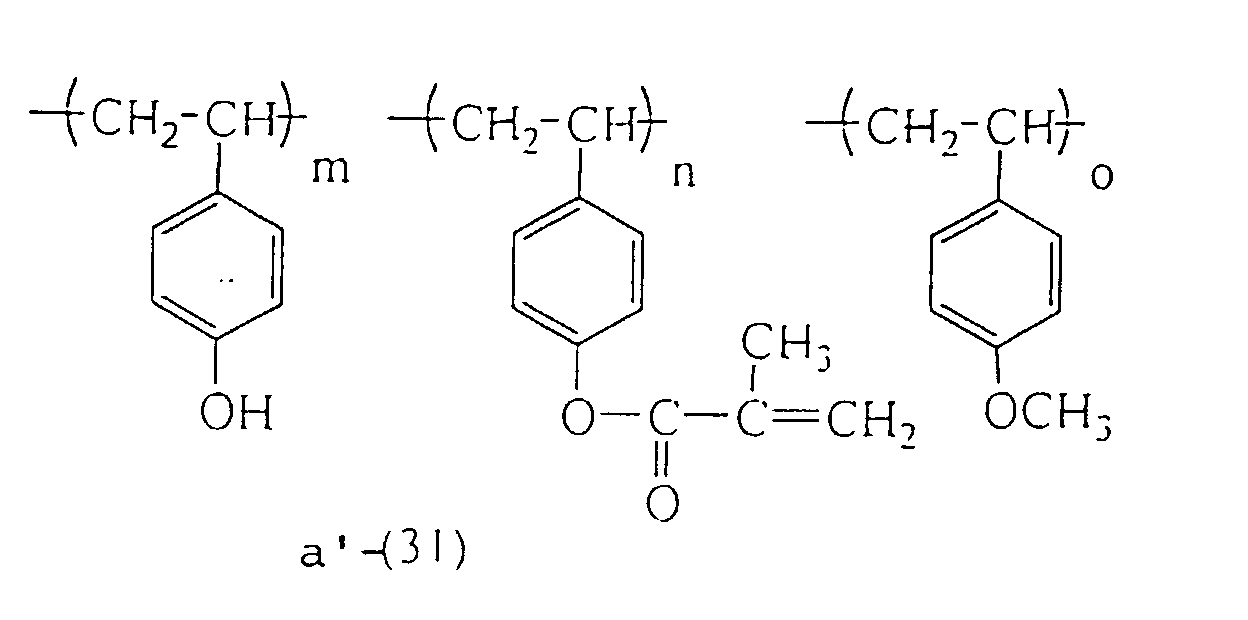

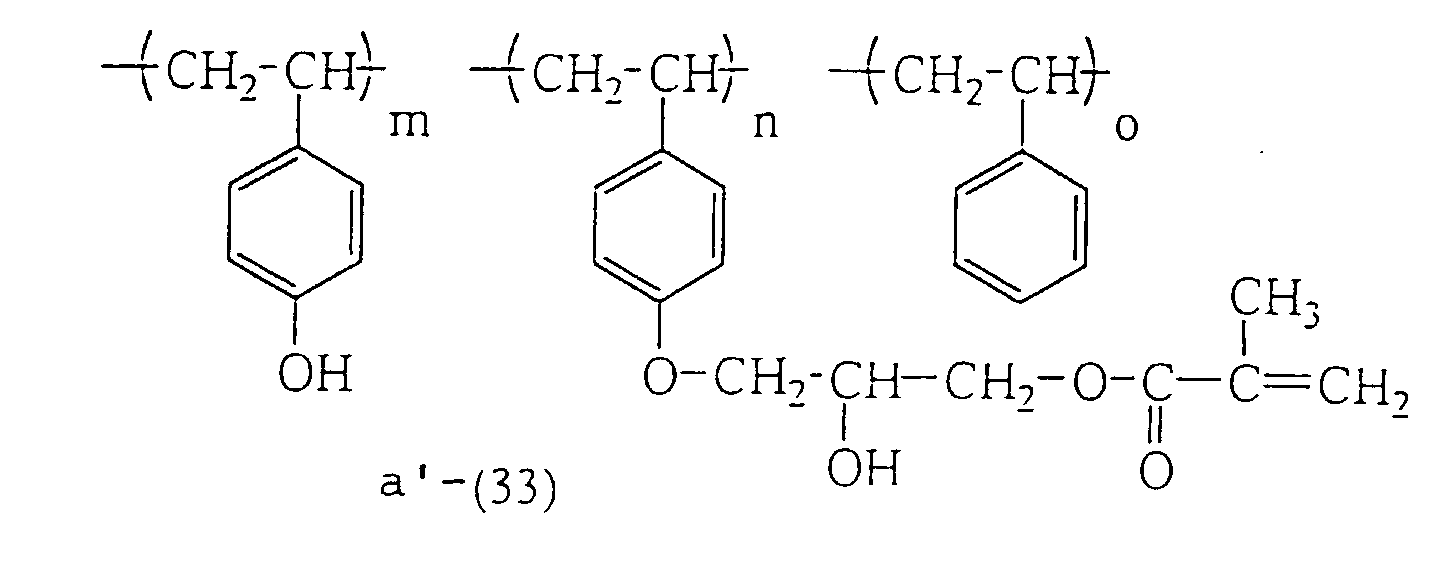
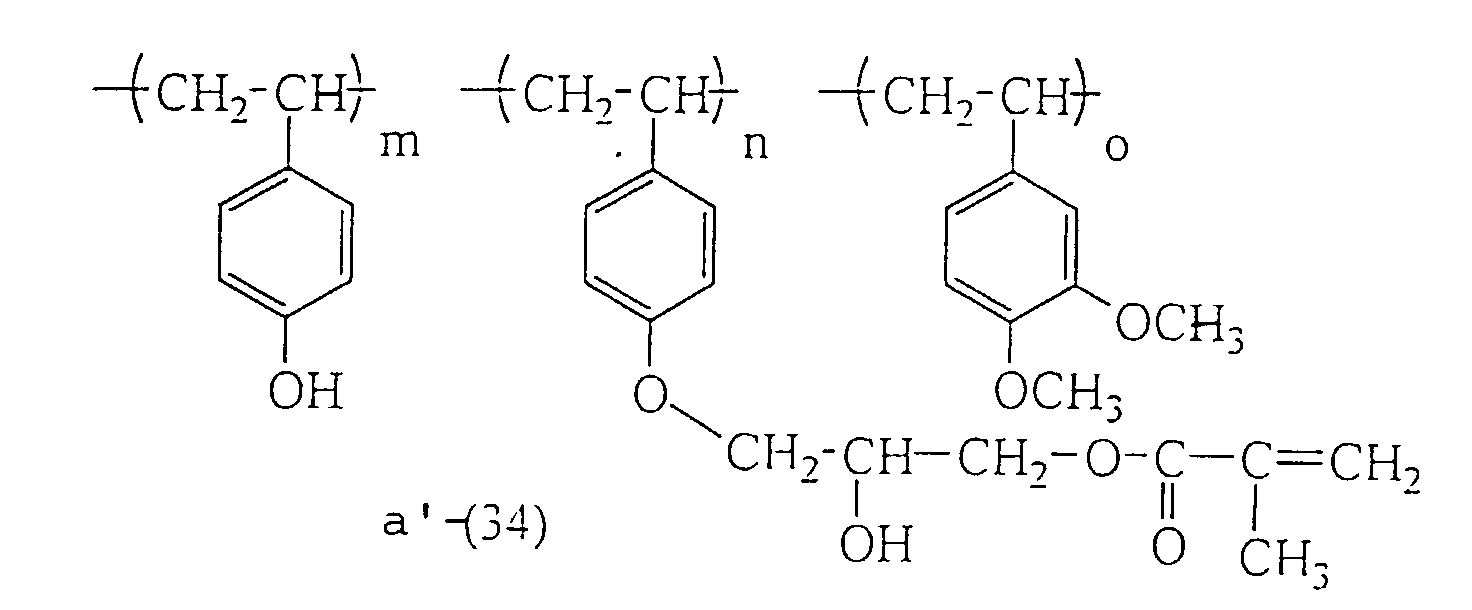

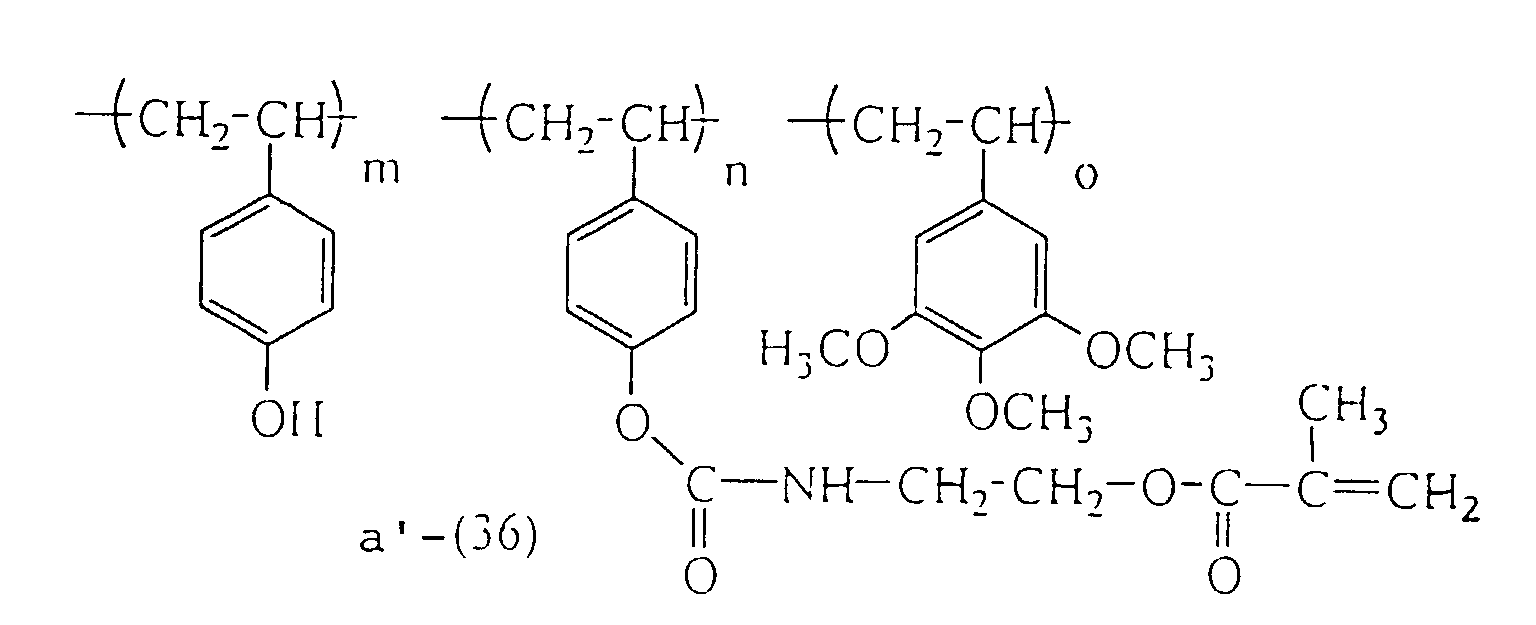


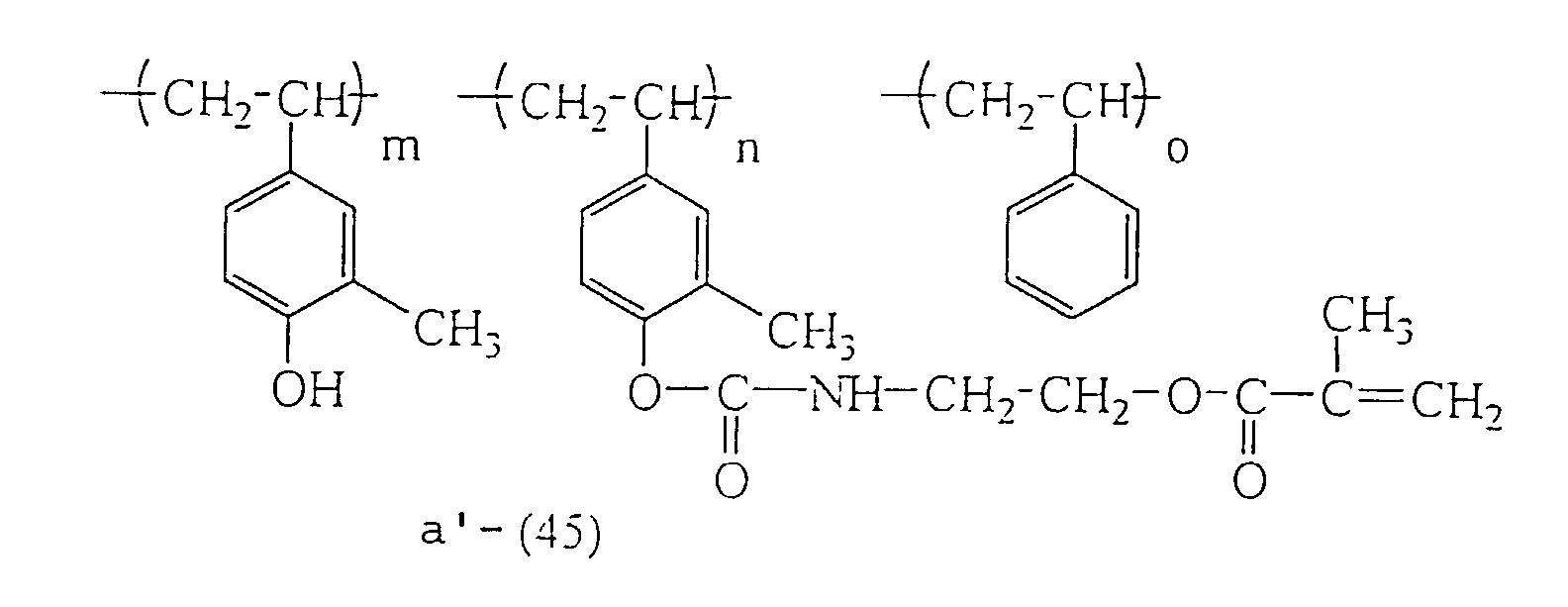
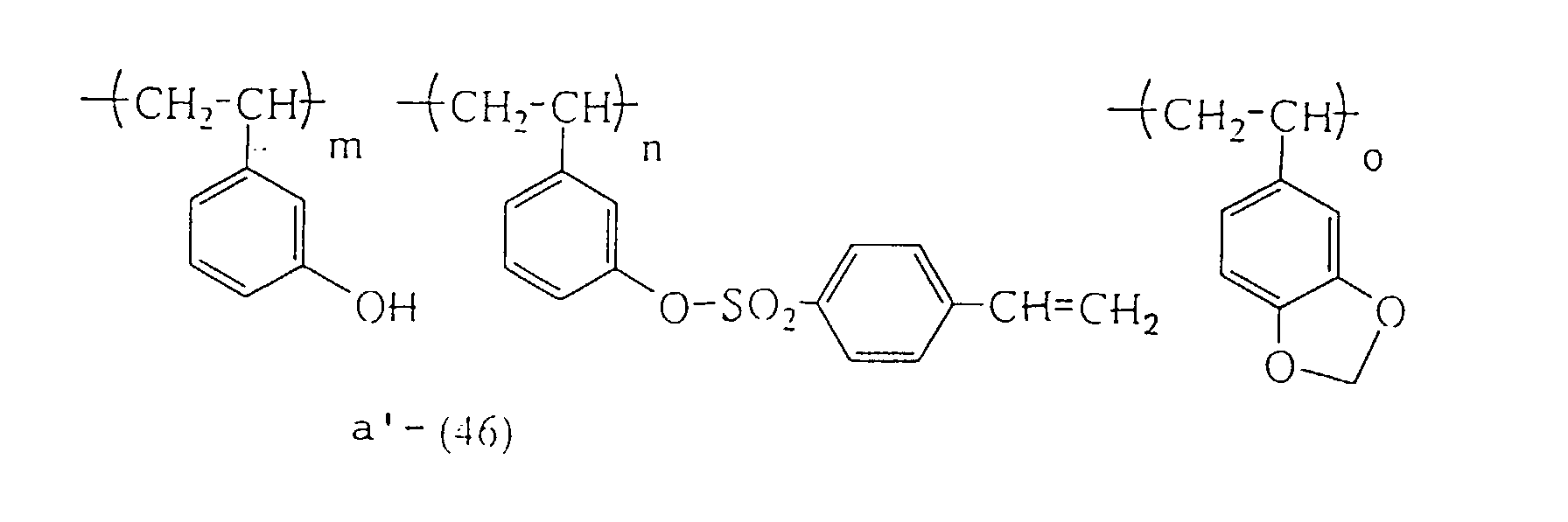
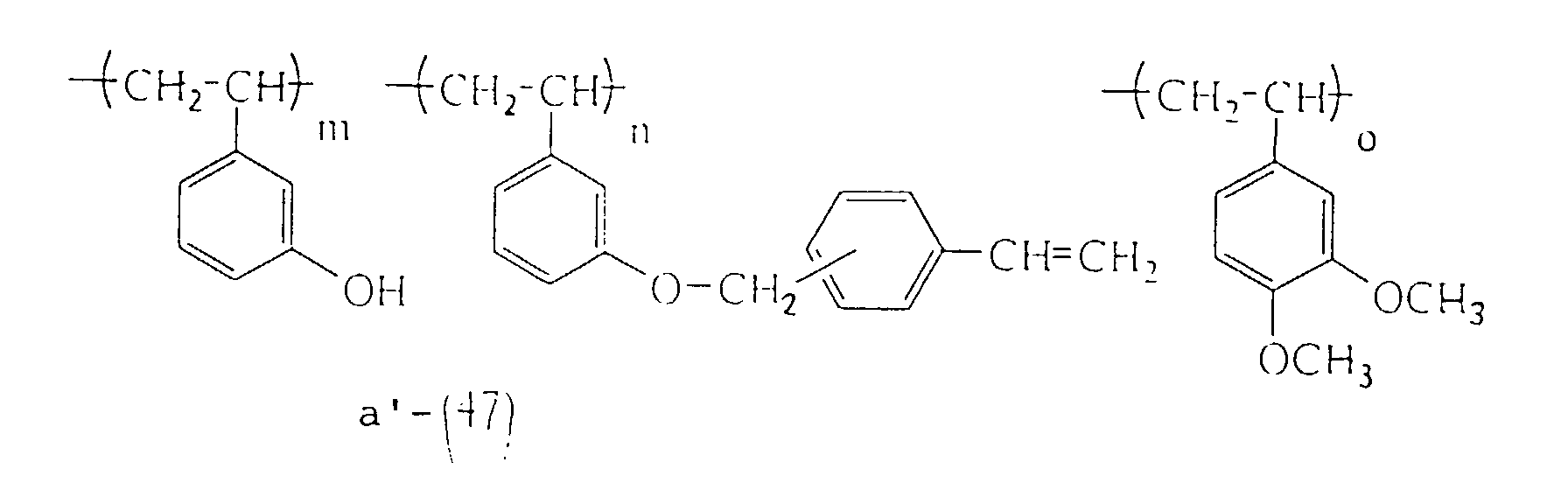
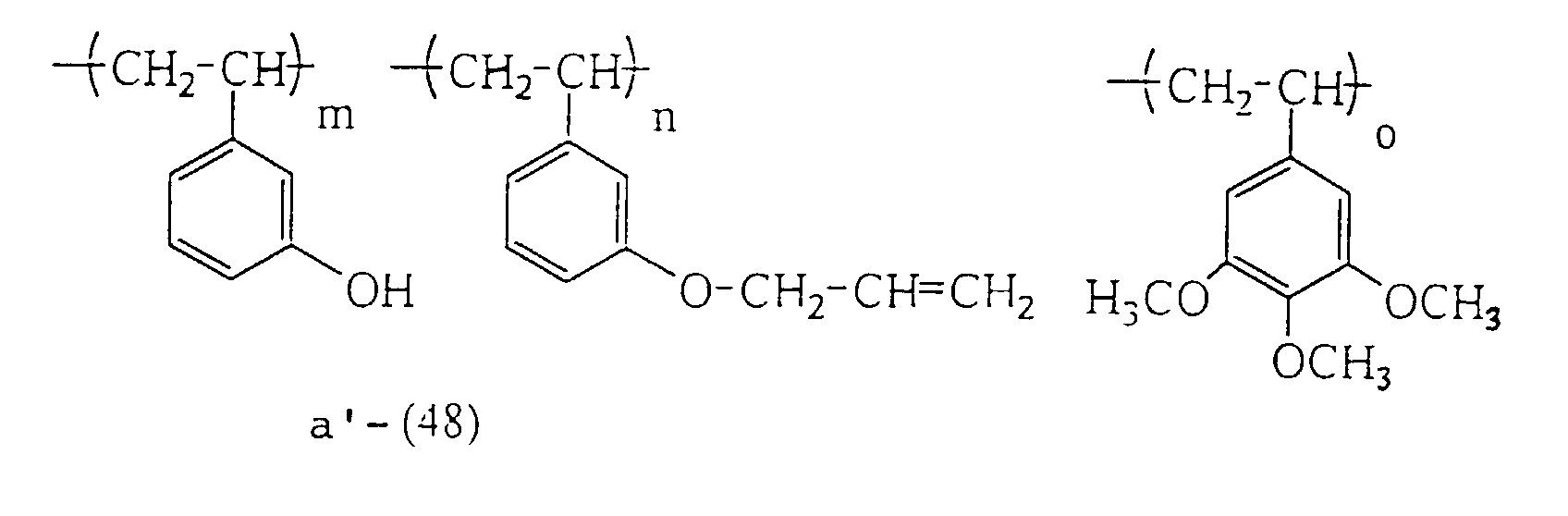
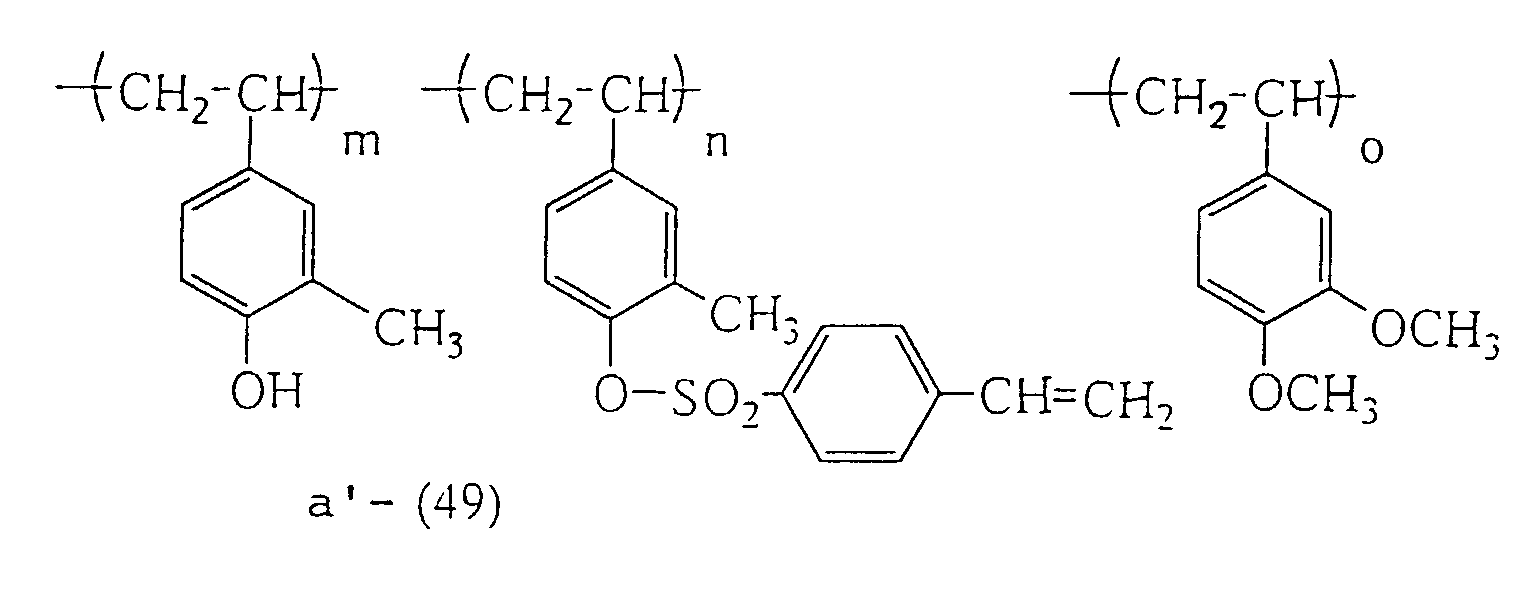
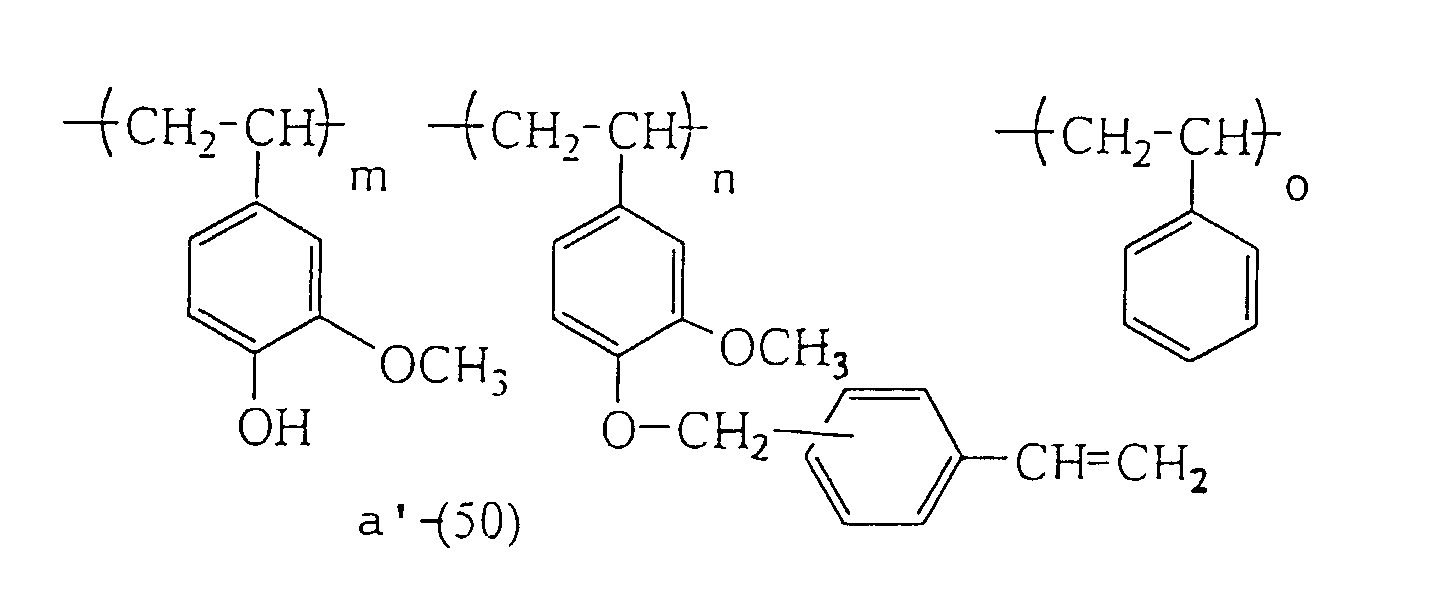

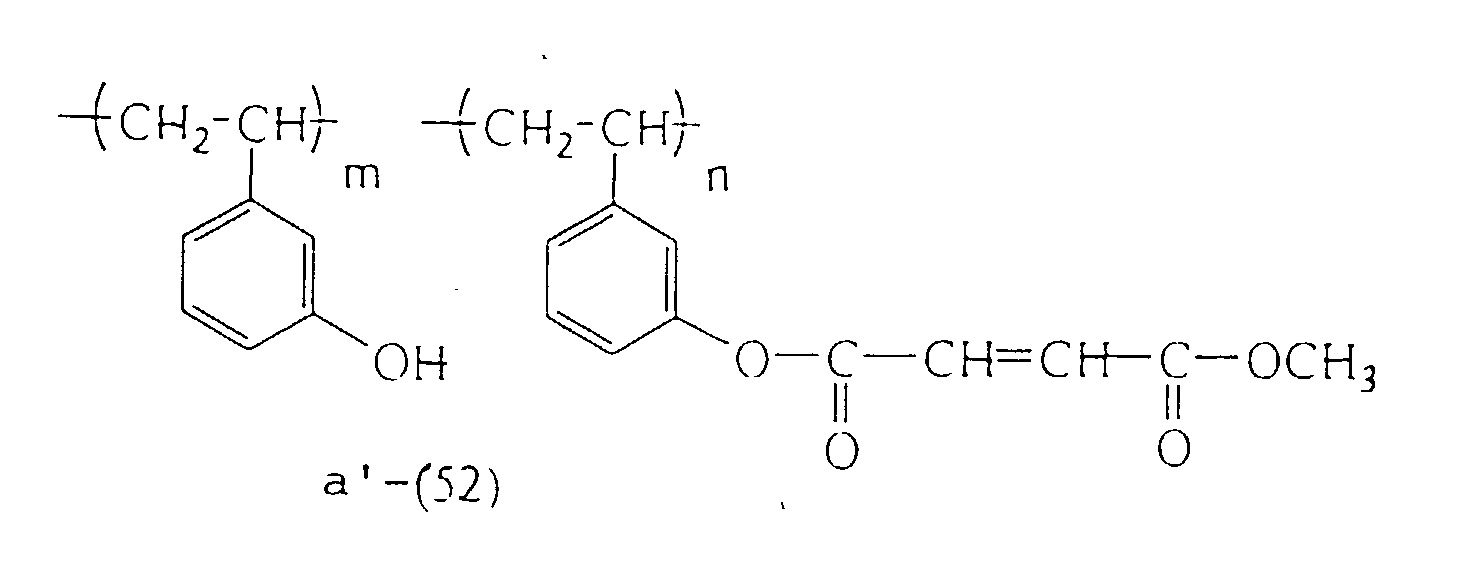


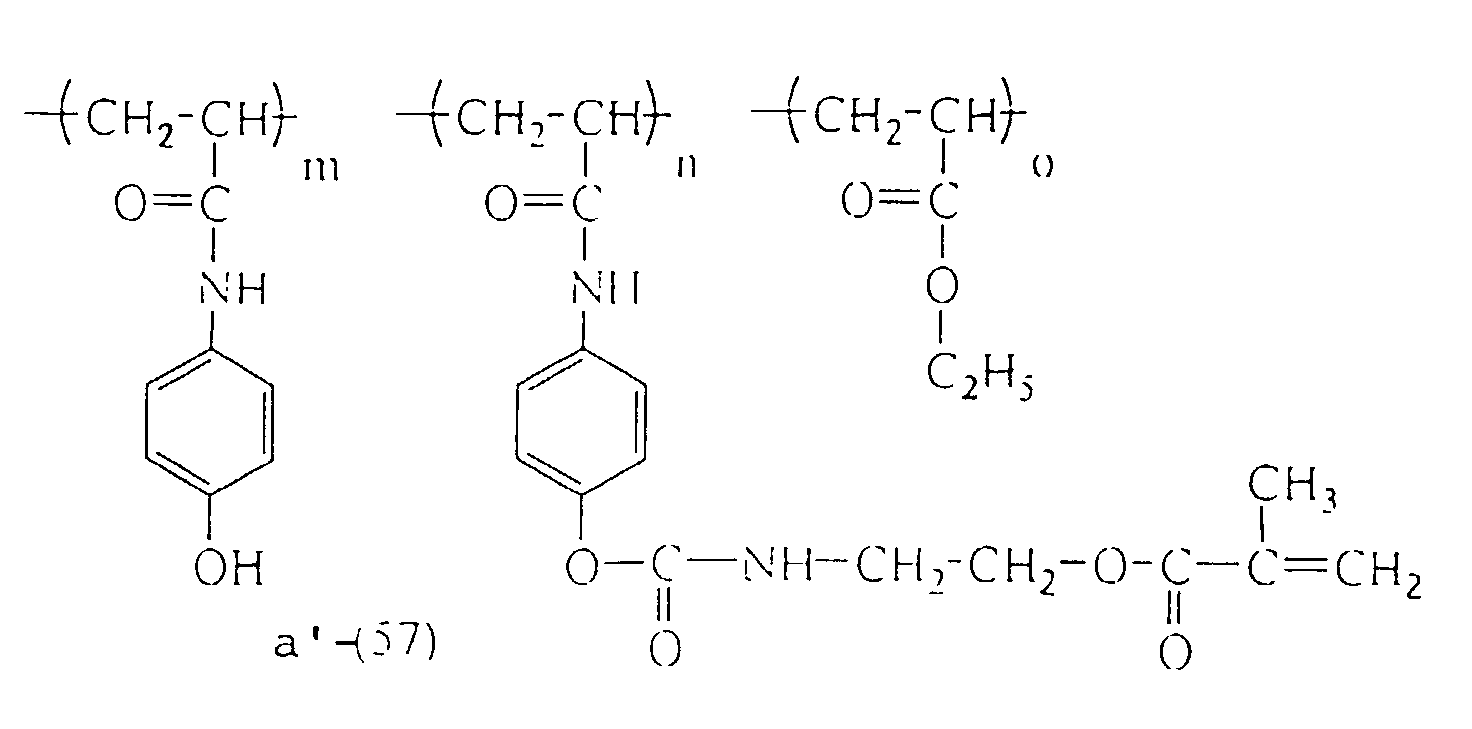

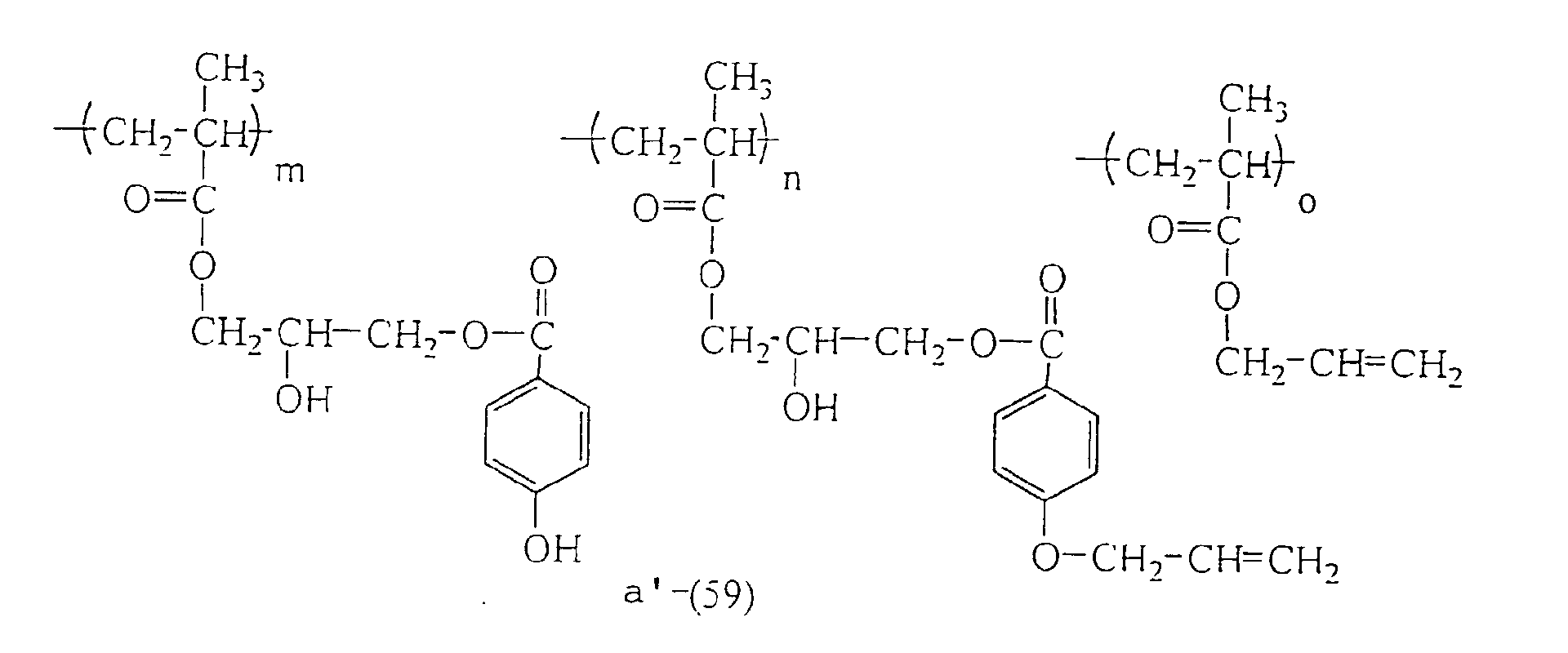

- In the above examples (formulae), m, n, and o each represents a mol ratio of the resin compositions, in the resin made of 2 components, m and n are used in the range of m = 1 to 95 and n = 5 to 90, and preferably m = 40 to 90 and n = 10 to 60, and in the resin made of 3 components, m, n, and o are used in the range of m = 10 to 90, n = 5 to 85, and o = 5 to 85, and preferably m = 40 to 80, n = 10 to 50, and o = 10 to 50.
- The molecular weight of the resin (B'), preferably the resin having the repeating unit shown by the formula (a') is preferably from 1,000 to 200,000, and more preferably from 3,000 to 50,000 as a weight average molecular weight. The molecular weight distribution of the resin used in the invention is in the range of from 1 to 10, preferably from 1 to 3, and more preferably from 1 to 1.5. As the molecular weight distribution is smaller, the resolution is higher, the resist form is better, the side walls of the resist patters are more smooth, and the resist composition is excellent in the roughness property.
- The content of the repeating unit shown by the formula (a') is from 5 to 100 mol%, and preferably from 10 to 90 mol$ to the total resins.
- The alkali-soluble resin containing the structural unit shown by the formula (a') used in the invention can be synthesized by the methods described in "Macromolecules" 28(11), 3787 to 3789 (1995), "Polym. Bull." (Berlin), 24(4), 395 to 389 (1990), and JP-A-8-286375. That is, the desired alkali-soluble resin can be obtained by a radical polymerization method or a living anion polymerization method.
- These resins may be used singly or as a mixture of plural kinds of the resins.
- In this case, the weight average molecular weight is defined as the polystyrene converted value of a gel permeation chromatography.
- The alkali-dissolving rate of the alkali-soluble resin is preferably at least 20 Å/second, and particularly preferably at least 200 Å/second by measuring with 0.261 N tetramethylammonium hydroxide (TMAH).
- The alkali-soluble resin in the invention may be used singly but can be used together with other alkali-soluble resin. As the using ratio, to 100 parts by weight of the alkali-soluble resin in the invention, the other alkali-soluble resin can be used at most 100 parts by weight. Then, other alkali-soluble resins which can be used together with the alkali-soluble resin in the invention are illustrated below.
- That is, there are, for example, a novolac resin, a hydrogenated novolac resin, an acetone-pyrogallol resin, a styrene-maleic anhydride copolymer, a carboxyl group-containing methacrylic resin and the derivatives thereof but the invention is not limited to them.
- The addition amount of the resin (B') is in the range of from 30 to 95% by weight, preferably from 40 to 90% by weight, and more preferably from 50 to 80% by weight to the whole solid components of the resist composition.
- (3) Compound (A) in the invention generating an acid and/or radical species by irradiation of electron beams or X-rays:
- As the component (A) used in the invention, any compounds each generating an acid and/or radical species by the irradiation of electron beams or X-rays can be used.
- In this case, the compound generating an acid and/or radical species shows a compound generating an acid, a compounds generating an acid and radical species, or a compound generating radical species.
- As the compound generating an acid and/or radical species by the irradiation of electron beams or X-rays, a photo initiator for a photo cationic polymerization, a photo initiator for a photo radical polymerization, a photo achromatic agent of dyes, a photo discoloring agent, or a known compound of generating an acid by light used for a microresist, etc., or a compound of these compounds can be suitably selectively used.
- Also, a compound having introduced into the main chain or a side chain of the polymer a group or a compound generating an acid and/or radical species by the irradiation of electron beams or X-rays, for example, the compounds described in JP-A-63-26653, JP-A-55-164824, JP-A-62-69263, JP-A-63-146038, JP-A-63-163452, JP-A-62-153853, JP-A-63-146029, etc., can be used.
- Furthermore, the compounds generating an acid described in U.S. Patent 3,779,778, European Patent 126,712, etc., can be also used.
- Also, there are known onium salts such as diazonium salts, phosphonium salts, iodonium salts, sulfonium salts, selenonium salts, etc.; organichalogen compounds, o-nitrobenzyl sulfonate compounds, N-iminosulfonate compounds, N-imidosulfonate compounds, diazosulfonium compounds, disulfone compounds, etc.
- Preferably, there are the sulfonate compounds of sulfonium or iodonium, the sulfonic acid ester compounds of N-hydroxyimide, and disulfonyldiazomethane compounds.
- In these compounds, the imidosulfonate compounds described in JP-A-10-7653 and JP-A-11-2901, the diazodisulfone compounds described in JP-A-4-210960, European Patent 417,557, etc., and further the sulfonium salts and iodonium salts shown by following formulae (I) to (III) can be particularly preferably used, but the sulfonium salts and iodonium salts shown by following formulae (I) to (III) are most preferred.

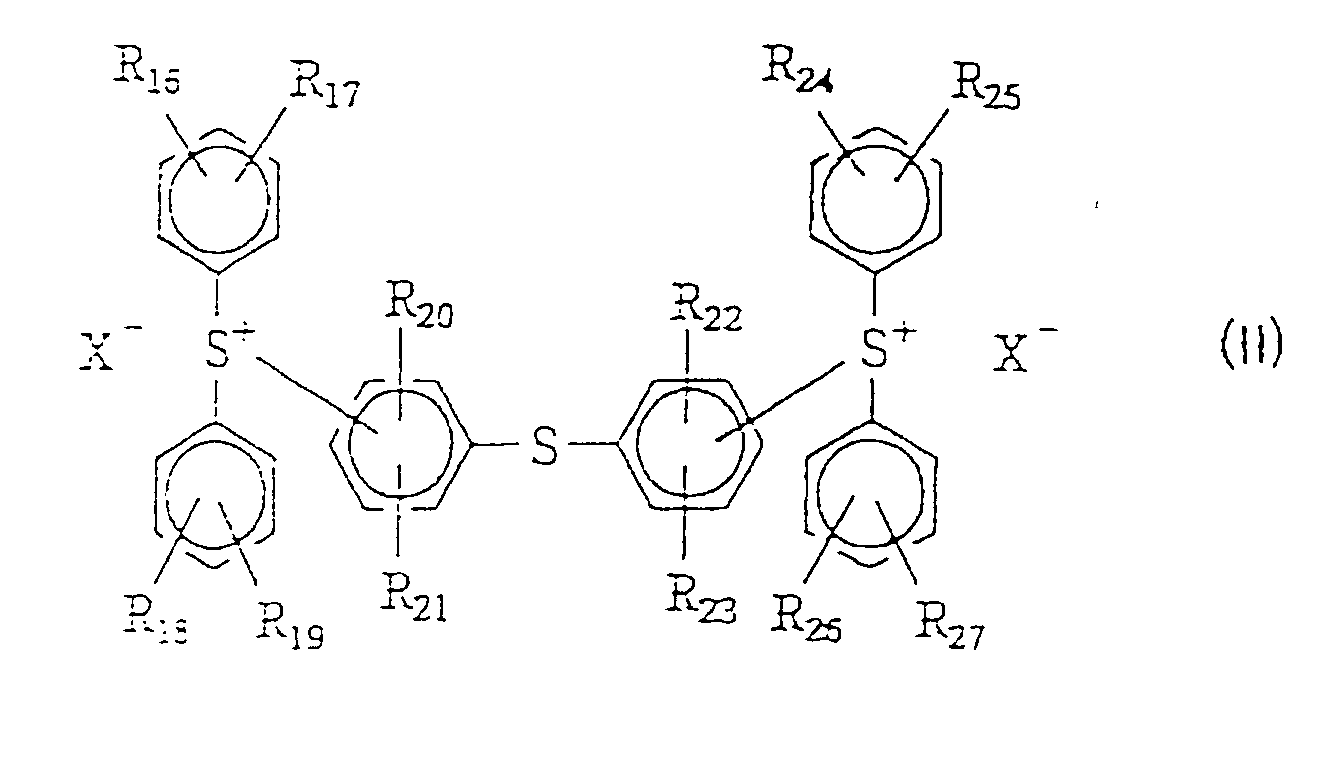

- In the formulae (I) to (III), R1 to R37 each represents a hydrogen atom, an alkyl group, an alkoxy group, a hydroxyl group, a halogen atom, or -S-R38.
- The alkyl group shown by R1 to R37 may be straight chain, branched, or cyclic. As the straight chain or branched alkyl group, there are alkyl groups having from 1 to 4 carbon atoms, such as methyl, ethyl, propyl, n-butyl, sec-butyl, and tert-butyl. As the cyclic alkyl group, there are, for example, cyclic alkyl groups having from 3 to 8 carbon atoms such as cyclopropyl, cyclopentyl, cyclohexyl, etc.
- The alkoxy group shown by R1 to R37 may be straight chain, branched, or cyclic alkoxy group. As the straight chain or branched alkoxy group, there are alkoxy groups having from 1 to 8 carbon atoms, such as methoxy, ethoxy, hydroxyethoxy, propoxy, n-butoxy, iso-butoxy, sec-butoxy, tert-butoxy, and octyloxy.
- As the cyclic alkoxy group, there are, for example, cyclopentyloxy and cyclohexyloxy.
- As the halogen atom shown by R1 to R37, there are, for example, fluorine, chlorine, bromine, and iodine.
- Also, R33 in -S-R33 shown by R1 to R37 represents an alkyl group or an aryl group. As the alkyl group shown by R38, there are, for example, the alkyl groups already described above as the alkyl groups shown by R1 to R37.
- As the aryl group shown by R38, there are aryl groups having from 6 to 14 carbon atoms, such as phenyl, tolyl, methoxyphenyl, naphthyl, etc.
- The alkyl group, the aryl group, and other groups shown by R1 to R38 each may further have a substituent at a part of the groups to increase the carbon atoms or may not have substituent. As the preferred substituents which are bonded to the groups shown by R1 to R37, there are alkoxy groups having from 1 to 4 carbon atoms, aryl groups having from 6 to 10 carbon atoms, and alkenyl groups having from 2 to 6 carbon atoms. As other substituent, there are halogen atoms, such as fluorine, chlorine, and iodine.
- In the groups shown by R1 to R15 of the formula (I) described above, at least two groups of them may combine with each other to form a ring. The ring may be formed by directly combining the terminals of the groups shown by R1 to R15. Furthermore, the ring may be formed by indirectly combining via one or two or more elements selected from carbon, oxygen, sulfur, and nitrogen. As the ring structure formed by combining two or more groups shown by R1 to R15, there are structures having the ring structure same as a furan ring, a dihydrofuran ring, a pyran ring, a trihydropyran ring, a thiophene ring, a pyrrole ring, etc. The above-descriptions are almost same as those of R16 to R27 of the formula (II), and two or more groups of R16 to R27 may combine directly or indirectly to form rings. These are same as R28 to R37 of the formula (III).
- Each of the formulae (I) to (III) has X-. X- of the formulae (I) to (III) is an anion of acid. The acid forming the anion is the acid selected from benzenesulfonic acid, naphthalenesulfonic acid, and anthracenesulfonic acid. The acid has at least one fluorine atom as a substituent. Or, the acid has at least one organic group selected from an alkyl group, an alkoxy group, an acyl group, an acyloxy group, a sulfonyl group, a sulfonyloxy group, a sulfonylamino group, an aryl group, an aralkyl group, and an alkoxycarbonyl group together with a fluorine atom or in place of a fluorine atom, and further, the organic group has at least one fluorine atom as a substituent. Also, the benzenesulfonic acid, naphthalenesulfonic acid, or anthracenesulfonic acid described above may be substituted with a halogen atom other than fluorine, or a hydroxyl group, a nitro group, etc.
- The alkyl group bonding to benzenesulfonic acid, etc., forming the anion of X- is, for example, an alkyl group having from 1 to 12 carbon atoms. The alkyl group may be a straight chain form, a branched form, or a cyclic form. The alkyl group is substituted with at least one fluorine atom, and preferably substituted with not more than 25 fluorine atoms. Practically, there are a trifluoromethyl group, a pentafluoroethyl group, a 2,2,2-trifluoroethyl group, a heptafluoropropyl group, a heptafluoroisopropyl group, a perfluorobutyl group, a perfluorooctyl group, a perfluorododecyl group, a perfluorocyclohexyl group, etc. In these groups, the perfluoroalkyl group having from 1 to 4 carbon atoms all the hydrogen atoms of which are substituted with fluorine is preferred.
- The alkoxy group bonding to above-described benzenesulfonic acid, etc., singly or together with an alkyl group is an alkoxy group having from 1 to 12 carbon atoms. The alkoxy group may be a straight chain form, a branched form, or a cyclic form. The alkoxy group is substituted with at least one fluorine atom, and preferably substituted with not more than 25 fluorine atoms. Practically, there are a trifluoromethoxy group, a pentafluoroethoxy group, a heptafluoroisopropyloxy group, a perfluorobutoxy group, a perfluorooctyloxy group, a perfluorododecyloxy group, a perfluorocyclohexyloxy group, etc. In these groups, the perfluoroalkoxy group having from 1 to 4 carbon atoms all the hydrogen atoms of which are substituted with fluorine is preferred.
- The acyl group bonding to above-describedbenzenesulfonic acid, etc., singly or together with an alkyl group is preferably an acyl group having from 2 to 12 carbon atoms and substituted with from 1 to 23 fluorine atoms. Practically, there are a trifluoroacetyl group, a fluoroacetyl group, a pentafluoropropionyl group, a pentafluorobenzoyl group, etc.
- The acyloxy group bonding to above-described benzenesulfonic acid, etc., singly or together with an alkyl group is preferably an acyloxy group having from 2 to 12 carbon atoms and substituted with from 1 to 23 fluorine atoms. Practically, there are a trifluoroacetoxy group, a fluoroacetoxy group, a pentafluoropropionyloxy group, a pentafluorobenzoyloxy group, etc.
- The sulfonyl group bonding to above-described benzenesulfonic acid, etc., singly or together with an alkyl group is preferably a sulfonyl group having from 1 to 12 carbon atoms and substituted with from 1 to 25 fluorine atoms. Practically, there are a trifluoromethanesulfonyl group, a pentafluoroethanesulfonyl group, a perfluorobutanesulfonyl group, a perfluorooctanesulfonyl group, pentafluoro-benzenesulfonyl group, a 4-trifluoromethylbenzenesulfonyl group, etc.
- The above-described sulfonyloxy group bonding to above-described benzenesulfonic acid, etc., singly or together with an alkyl group is preferably a sulfonyloxy group having from 1 to 12 carbon atoms substituted with from 1 to 25 fluorine atoms. Practically, there are a trifluoromethanesulfonyloxy group, a perfluorobutane-sulfonyloxy group, a 4-trifluoromethylbenzenesulfonyloxy group, etc.
- The above-described sulfonylamino group bonding to above-described benzenesulfonic acid, etc., singly or together with an alkyl group is preferably a sulfonylamino group having from 1 to 12 carbon atoms and substituted with from 1 to 25 fluorine atoms. Practically, there are a trifluoromethanesulfonylamino group, a perfluoro-butanesulfonylamino group, a perfluorooctanesulfonylamino group, a pentachlorobenzenesulfonylamino group, etc.
- The above-described aryl group bonding to above-described benzenesulfonic acid, etc., singly or together with an alkyl group is preferably an aryl group having from 6 to 14 carbon atoms and substituted with from 1 to 9 fluorine atoms. Practically, there are a pentafluorophenyl group, a 4-trifluoromethylphenyl group, a heptafluoronaphthyl group, a nonafluoroanthranyl group, a 4-fluorophenyl group, a 2,4-difluorophenyl group, etc.
- The above-described aralkyl group bonding to above-described benzenesulfonic acid, etc., singly or together with an alkyl group is preferably an aralkyl group having from 7 to 10 carbon atoms and substituted with from 1 to 15 fluorine atoms. Practically, there are a pentafluorophenylmethyl group, a pentafluorophenylethyl group, a perfluorobenzyl group, a perfluorophenthyl group, etc.
- The above-described alkoxycarbonyl group bonding to above-described benzenesulfonic acid, etc., singly or together with an alkyl group is preferably an alkoxycarbonyl group having from 2 to 13 carbon atoms and substituted with from 1 to 25 fluorine atoms. Practically, a trifluoromethoxycarbonyl group, a pentafluoroethoxycarbonyl group, a pentafluorophenoxycarbonyl group, a perfluorobutoxycarbonyl group, a perfluorooctyloxycarbonyl group, etc.
- In these anions, the most preferred X- is fluorine-substituted benzenesulfonic acid anions and in these anions, a pentafluorobenzenesulfonic acid anion is particularly preferred.
- Also, above-described benzenesulfonic acid, naphthalenesulfonic acid, or anthracenesulfonic acid may be further substituted with a straight chain, branched, or cyclic alkoxy group, an acyl group, an acyloxy group, a sulfonyl group, a sulfonyloxy group, a sulfonylamino group, an aryl group, an aralkyl group, an alkoxycarbonyl group (the carbon atom number ranges of these groups are same as those of the above-described groups) , a halogen atom (excluding fluorine) , a hydroxyl group, a nitro group, etc.
- Then, practical examples of the compounds shown by the formulae (I) to (III) described above are illustrated below but the invention is not limited to these compounds.
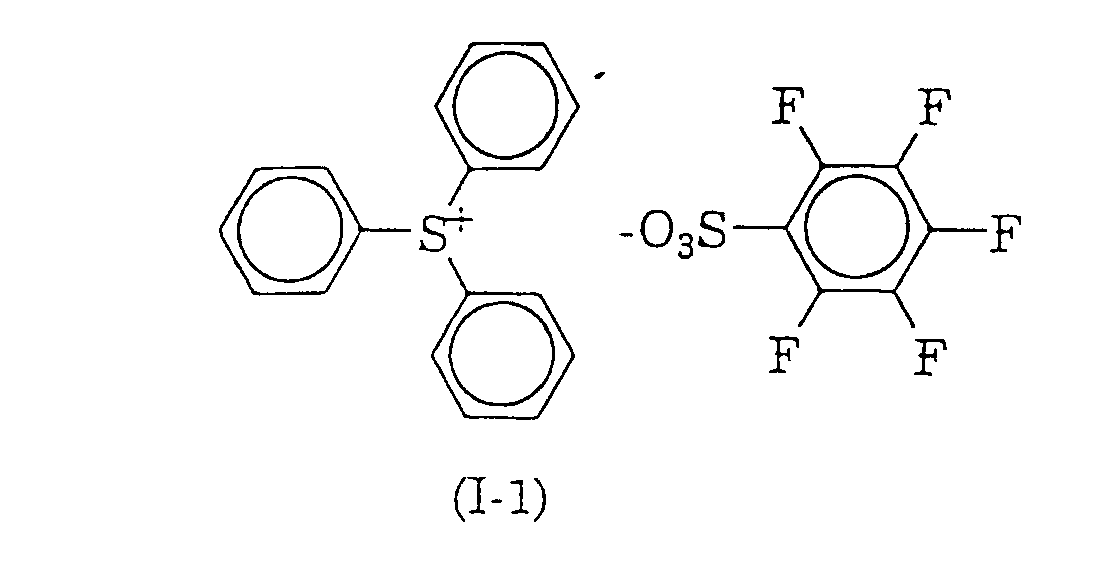

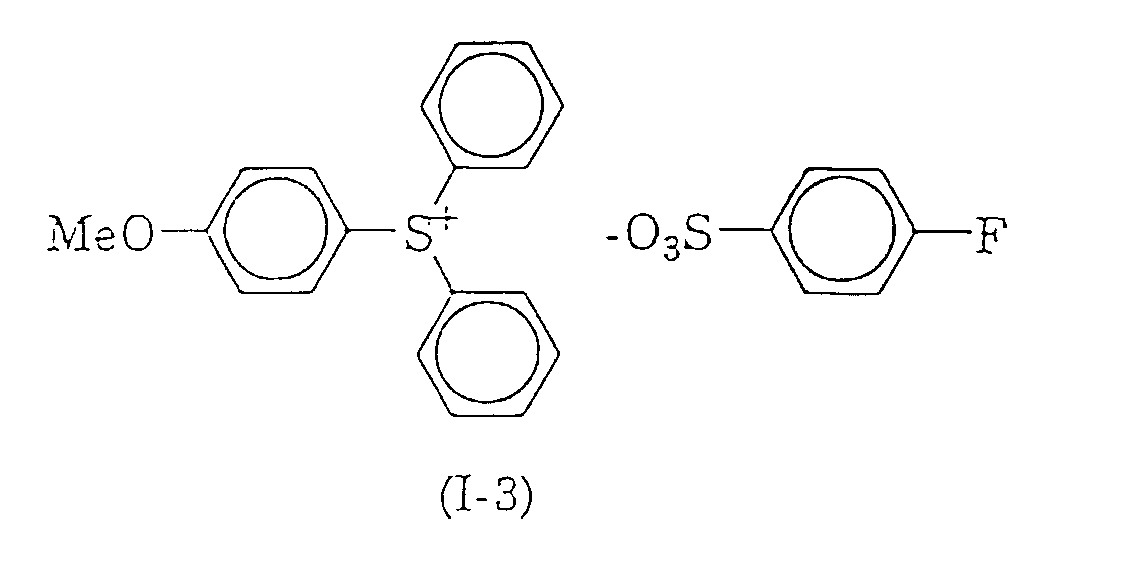
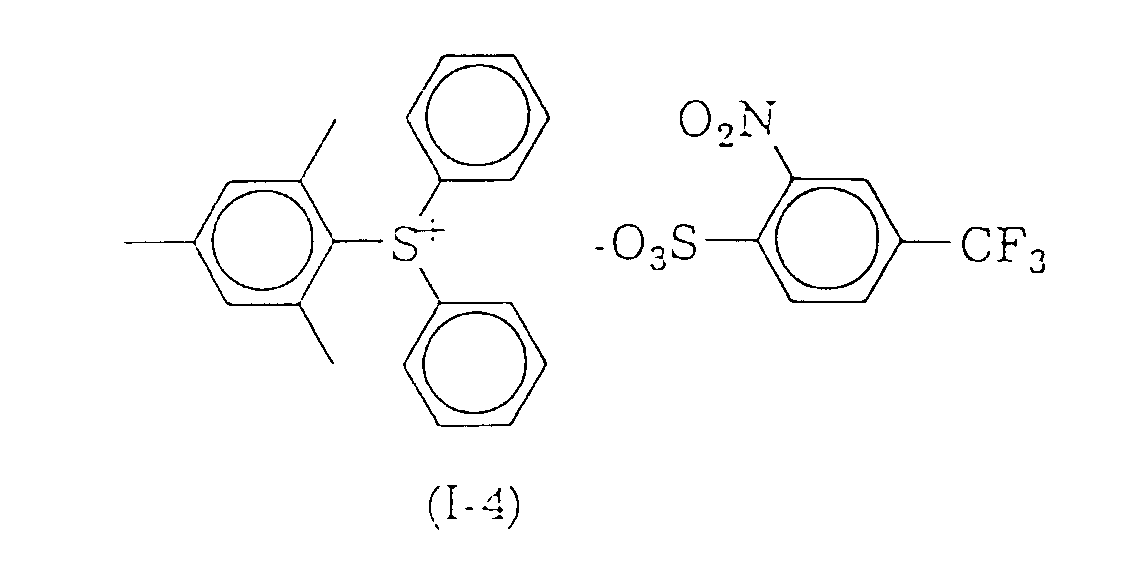
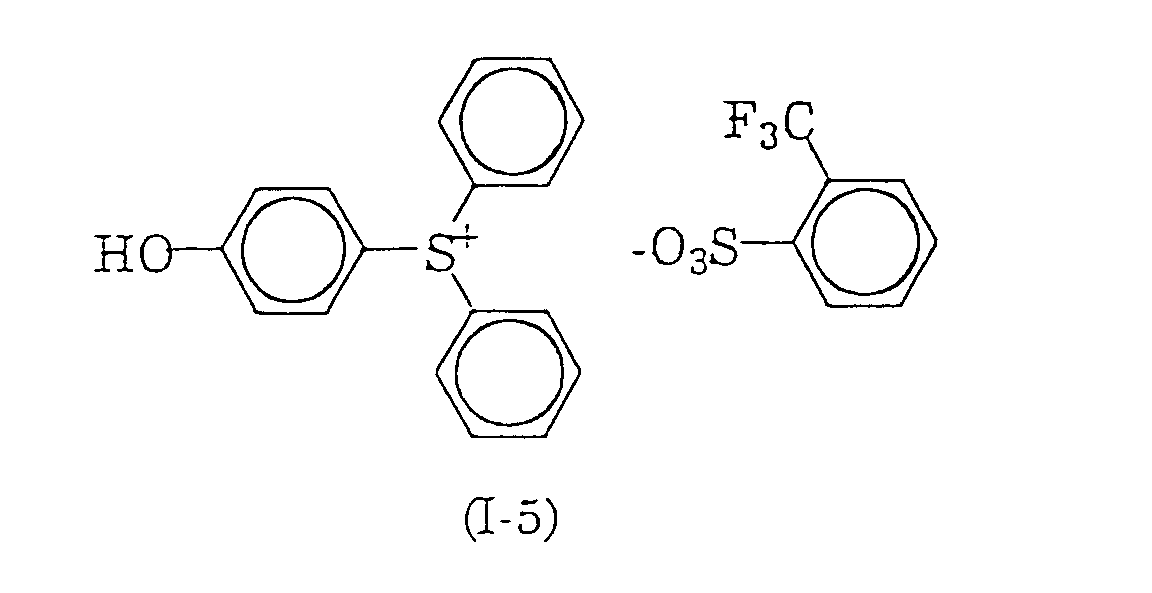


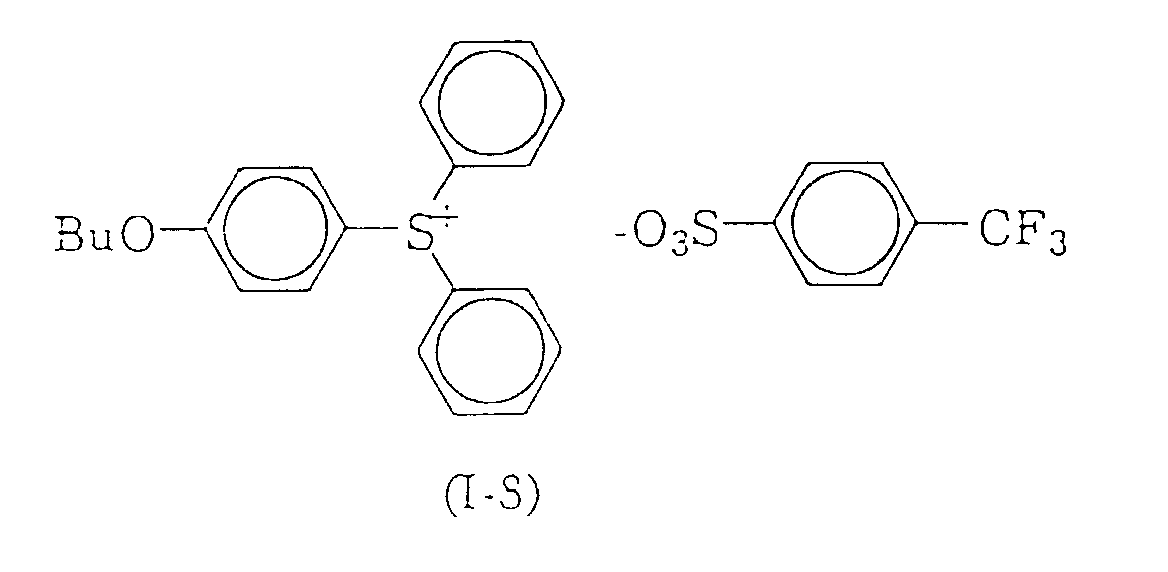
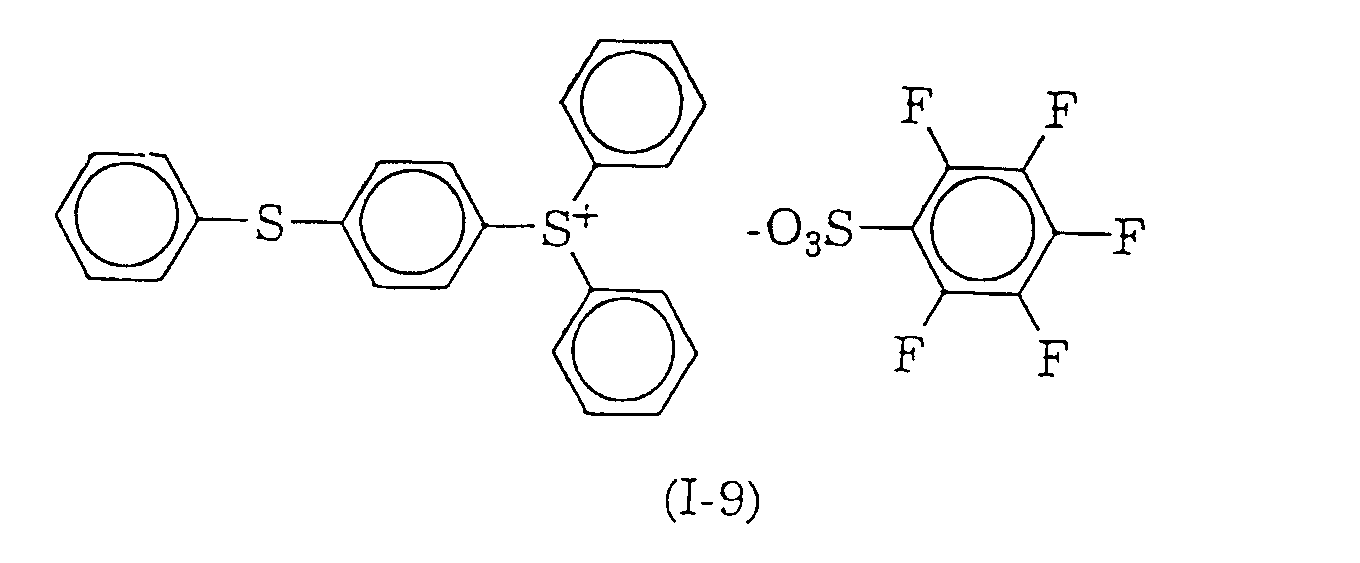
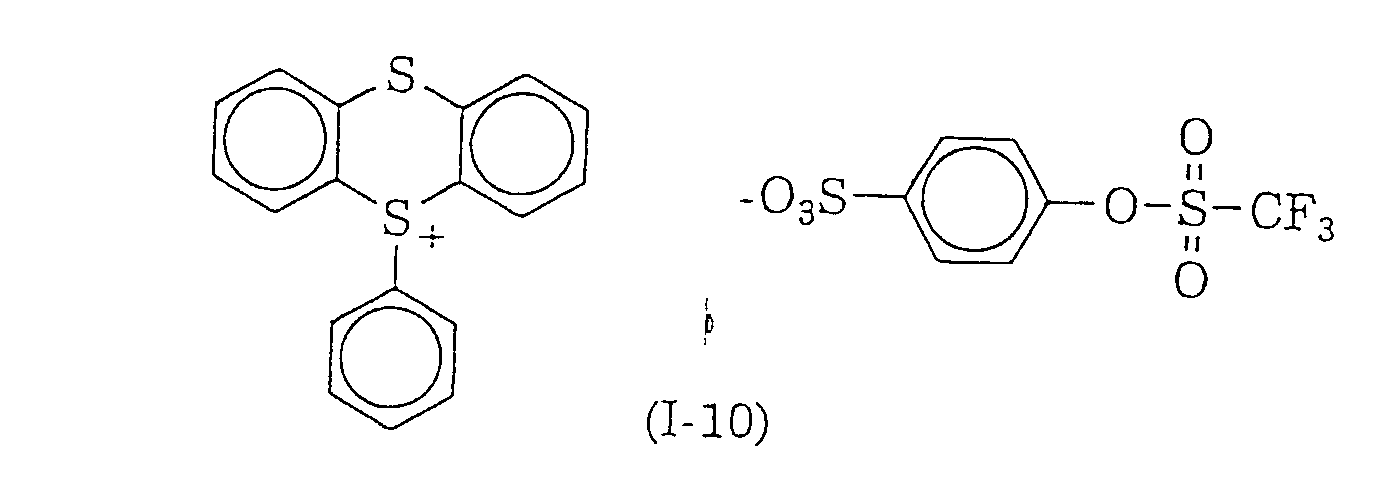
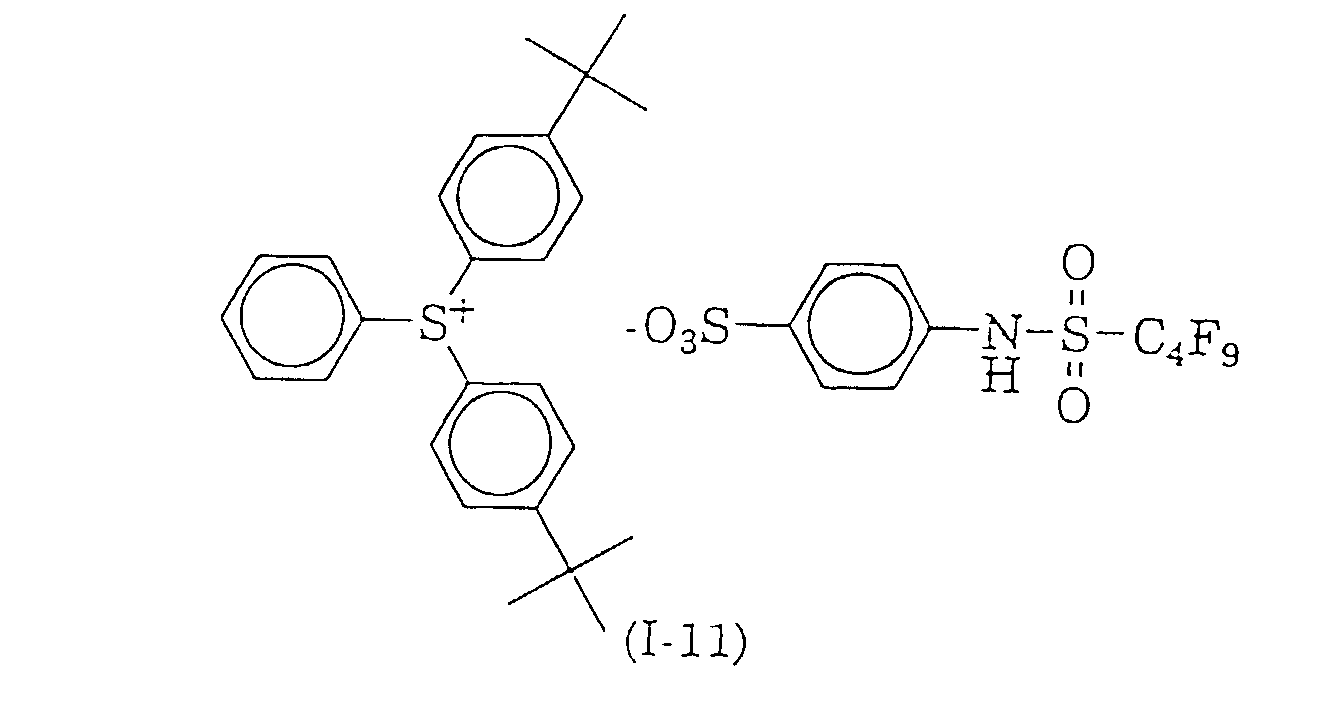


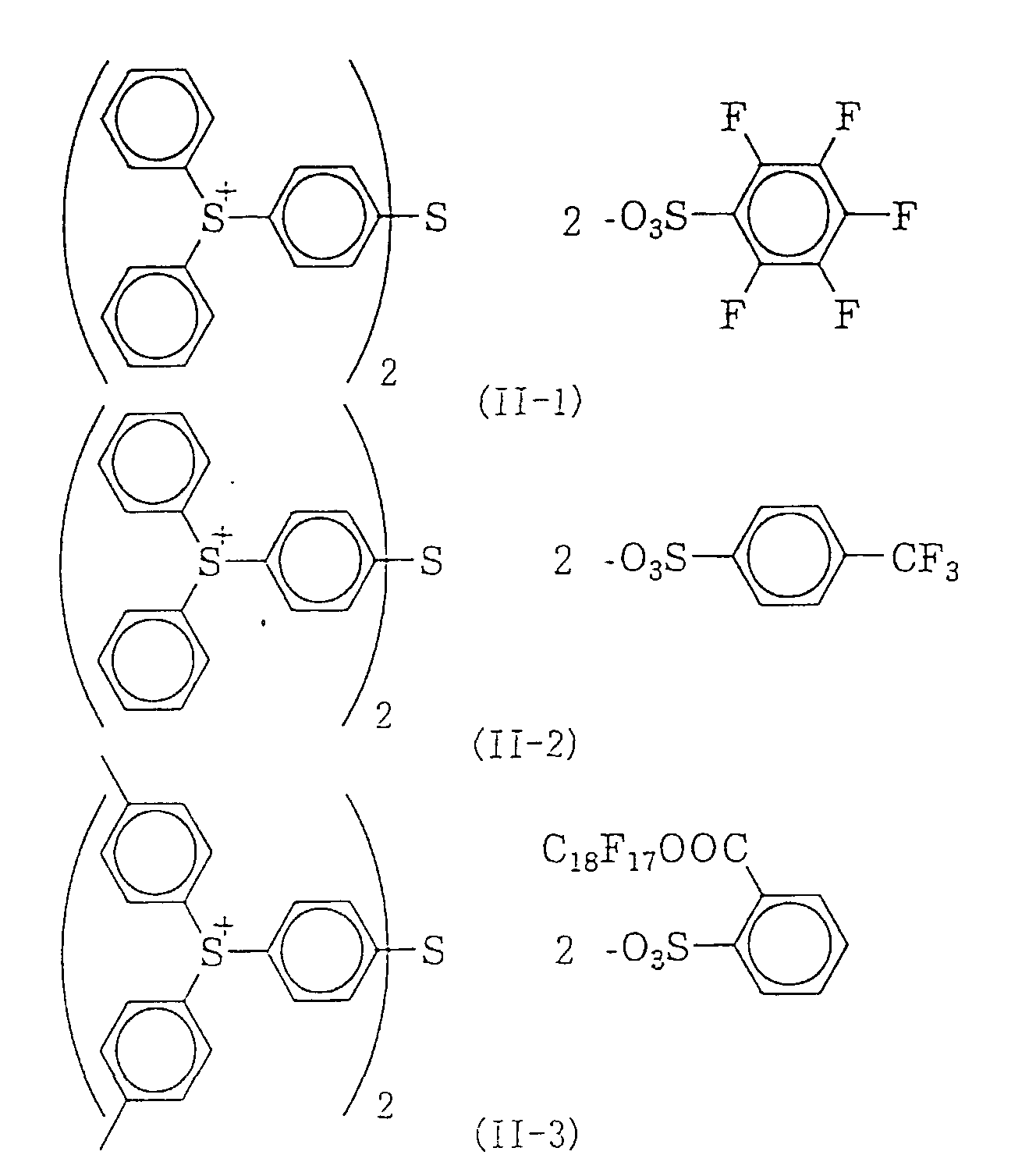
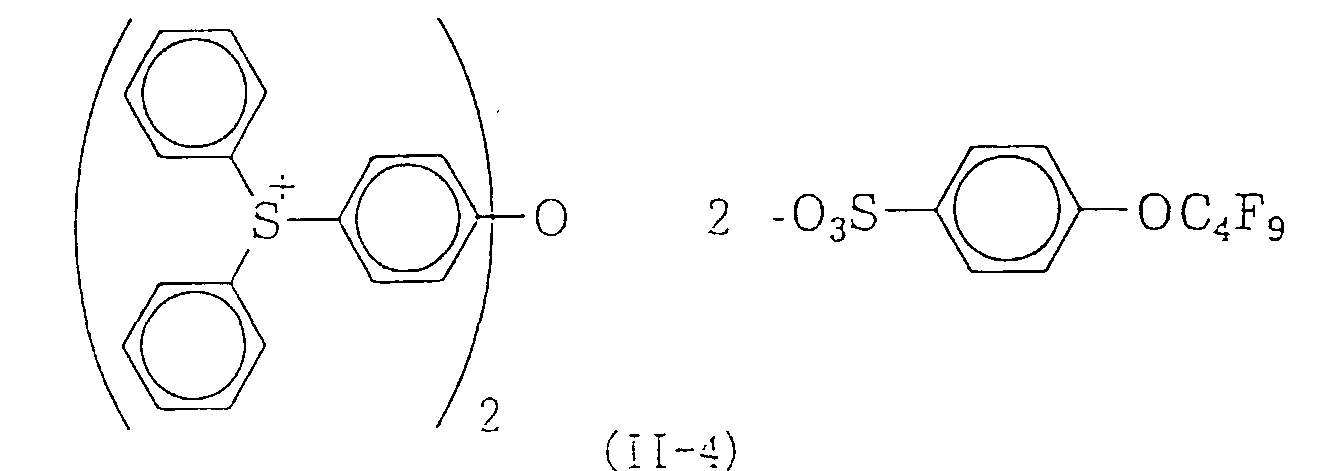
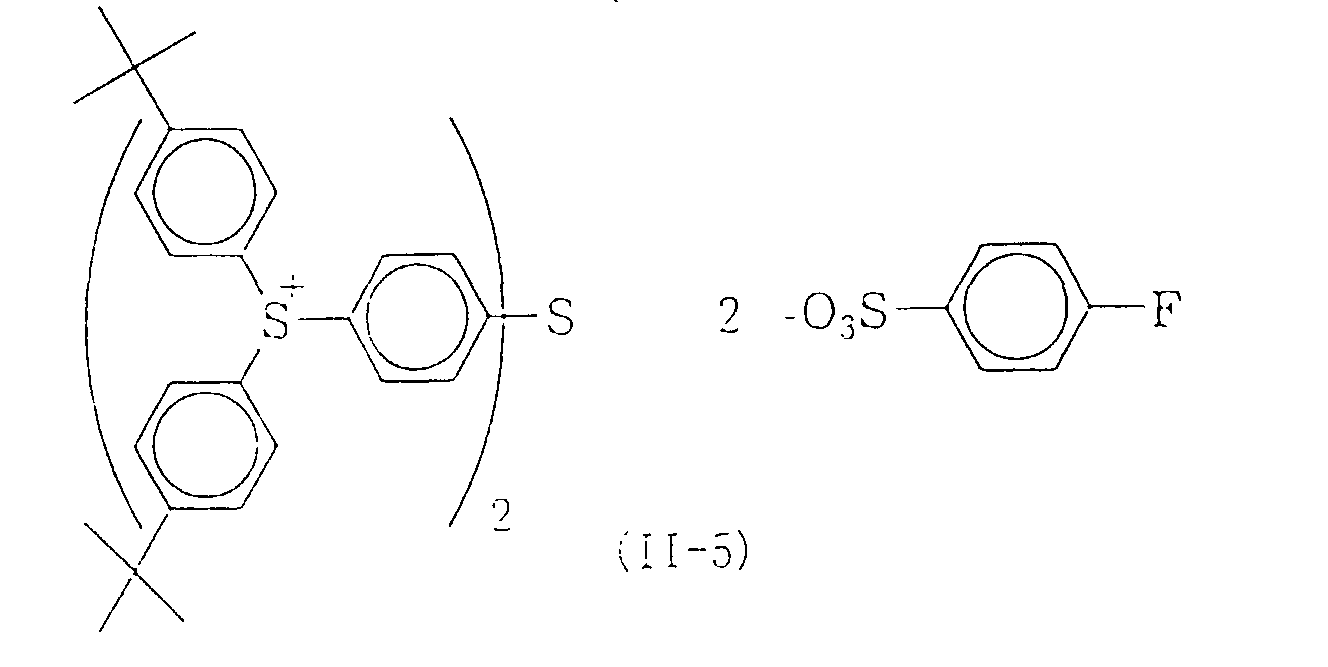

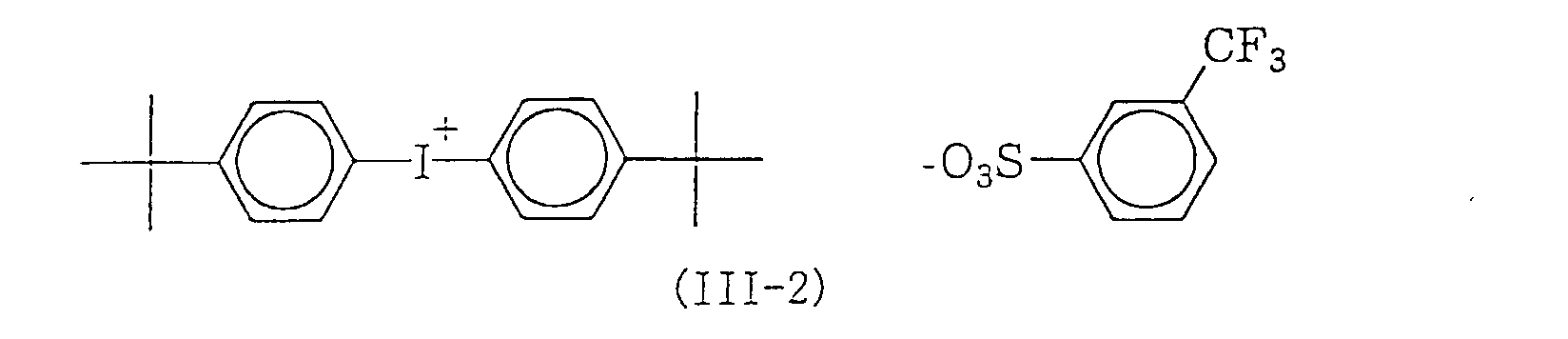





- The compounds of the formula (I) and the formula (II) can be synthesized by the following methods. For example, by reacting an aryl Grignard reagent such as arylmagnesium bromide, etc., and phenyl sulfoxide and triarylsulfonium halide obtained is salt-exchanged with a corresponding sulfonic acid. The compound can be synthesized by other method. For example, there is a method of carrying out a condensation of phenyl sulfoxide and a corresponding aromatic compound using an acid catalyst such as methanesulfonic acid/diphosphorus pentaoxide or aluminum chloride and a salt-exchange. Also, the compound can be synthesized by a method of carrying out a condensation of a diaryliodonium salt and diaryl sulfide using a catalyst such as copper acetate and a salt exchange. In any one of the above-describedmethods, phenyl sulfoxide may have a substituent at the benzene ring or may not have such a substituent.
- The compounds of the formula (III) described above can be synthesized by reacting aromatic compounds using a periodate.
- In the invention, in place of or together with the compound shown by the above-describedformula (I) to (III), other compound generating an acid and/or radical species by being decomposed by the irradiation of a radiation can be used.
- Of the above-described compounds generating an acid and/or radical species by being decomposed by the irradiation of a radiation other than those represented by formulae (I) to (III), particularly effective compounds will be explained below.
- (1) Iodonium salts represented by the following general formula (PAG3) or sulfonium salts represented by the following general formula (PAG4) :wherein Ar1 and Ar2 each independently represents a substituted or unsubstituted aryl group. Preferred examples of the substituents include alkyl, haloalkyl, cycloalkyl, aryl, alkoxyl, nitro, carboxyl, alkoxycarbonyl, hydroxyl, mercapto and halogen atoms.
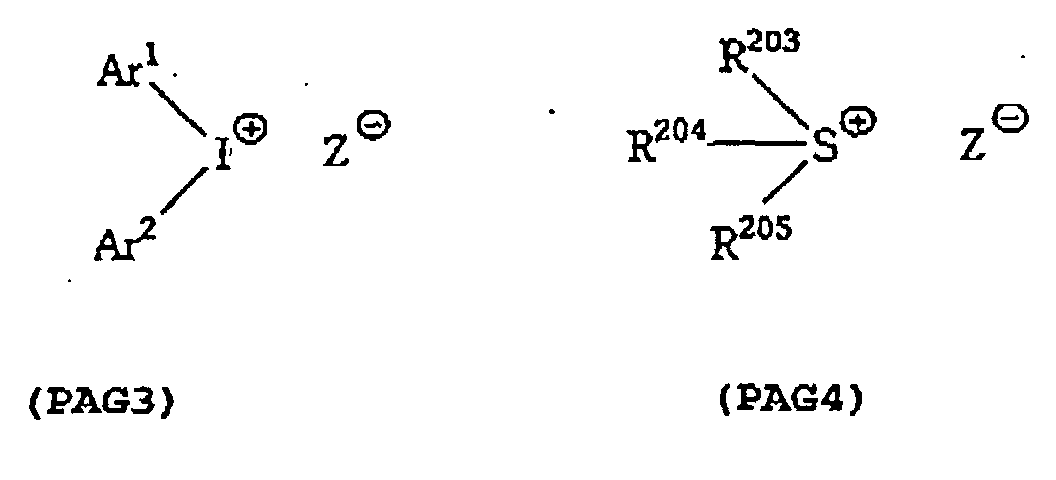
- R203, R204 and R205 each independently represents a substituted or unsubstituted alkyl or aryl group, and preferably an aryl group having from 6 to 14 carbon atoms, an alkyl group having from 1 to 8 carbon atoms or a substituted derivative thereof. Preferred examples of the substituents for aryl include alkoxyl of from 1 to 8 carbon atoms, alkyl of from 1 to 8 carbon atoms, cycloalkyl, nitro, carboxyl, mercapto, hydroxyl and halogen atoms, and preferred examples thereof for alkyl include alkoxyl of from 1 to 8 carbon atoms, carboxyl and alkoxycarbonyl.
- Z- represents an anion. Specific examples of the anions include substituted or unsubstituted alkylsulfonic acids, cycloalkylsulfonic acids, perfluoroalkylslufonic acids and arylslufonic acids (for example, substituted or unsubstituted benzenesulfonic acid, naphthalenesulfonic acid and anthracenesulfonic acid).
- Two of R203, R204 and R205, and Ar1 and Ar2 may each combine together through each single bond or substituent.
- Specific examples thereof include but are not limited to the following compounds:







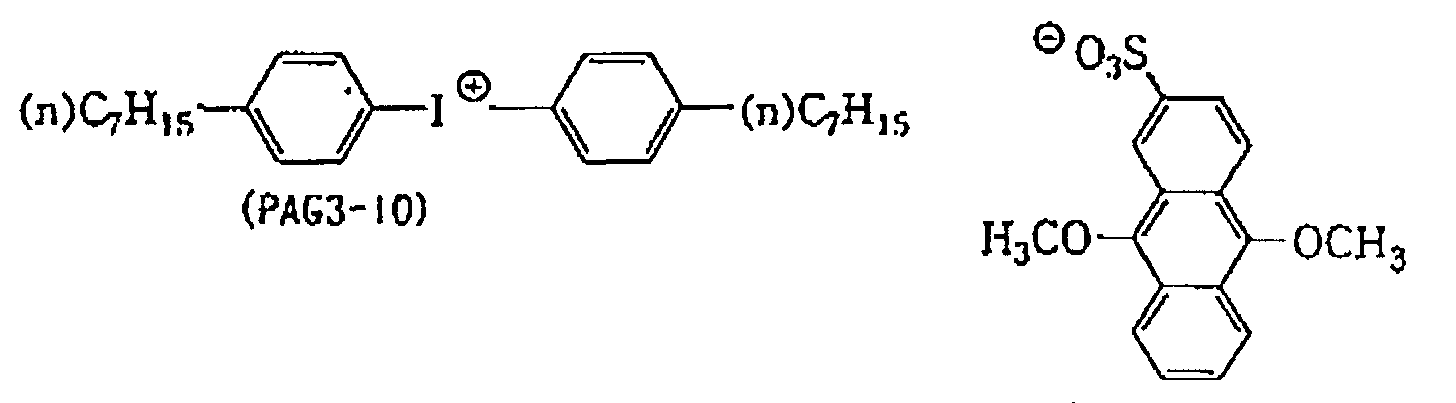


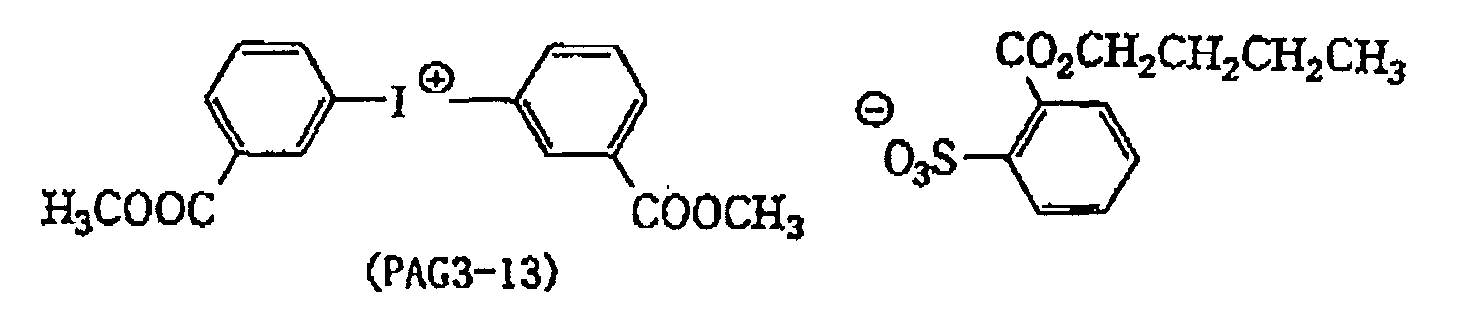




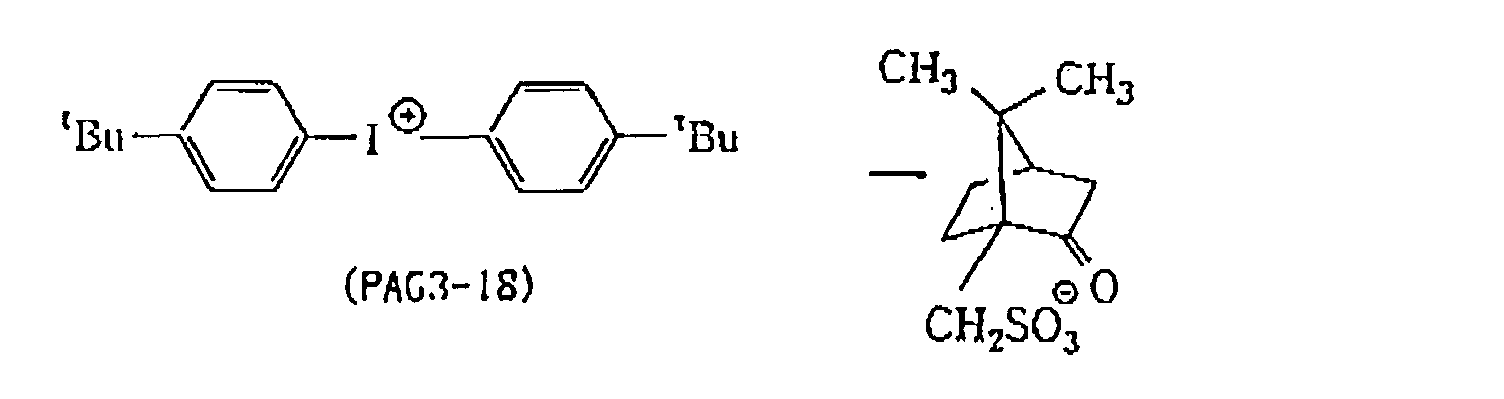


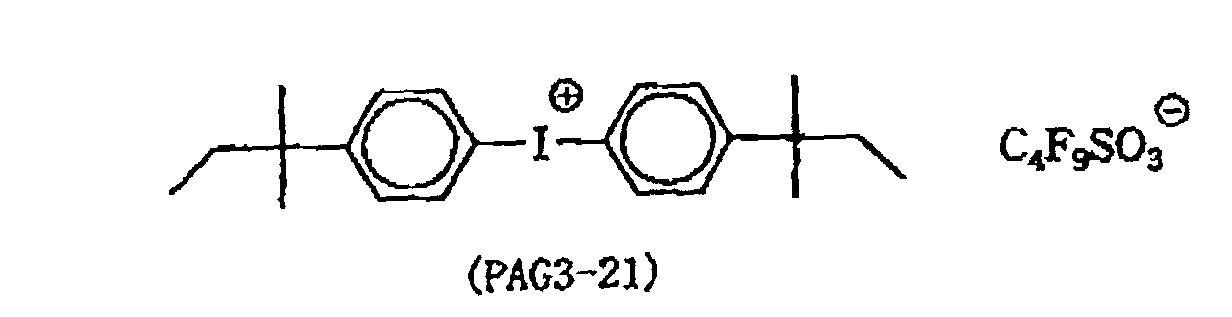
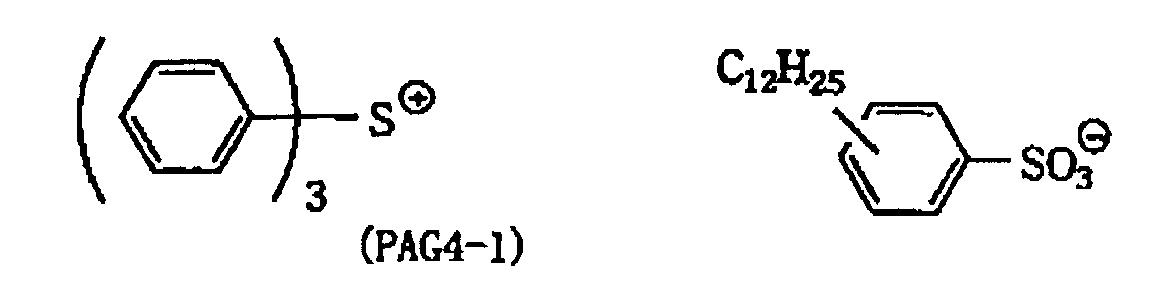

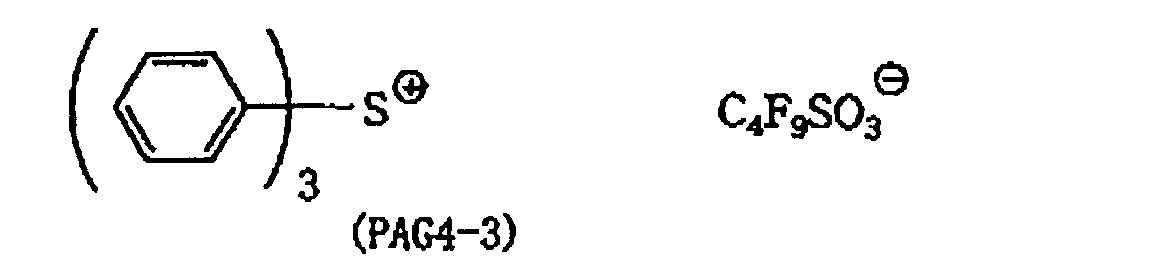
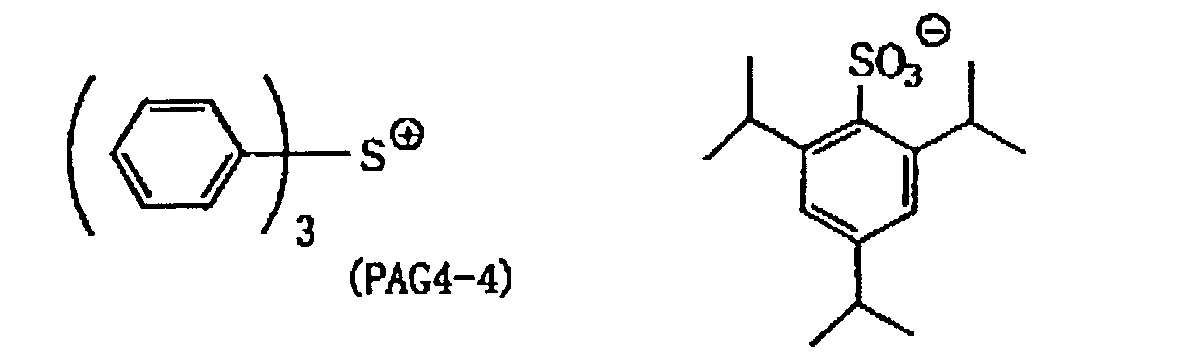
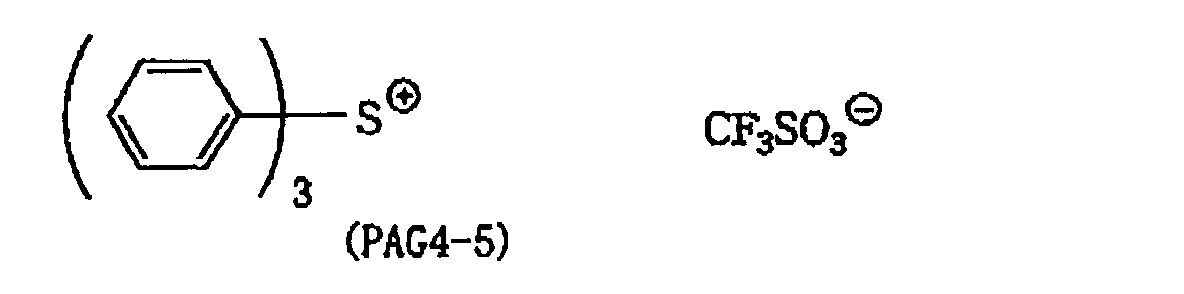

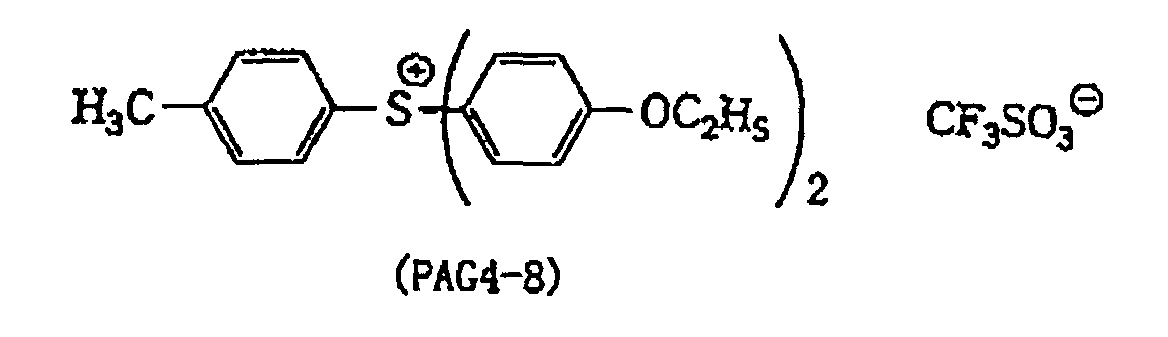

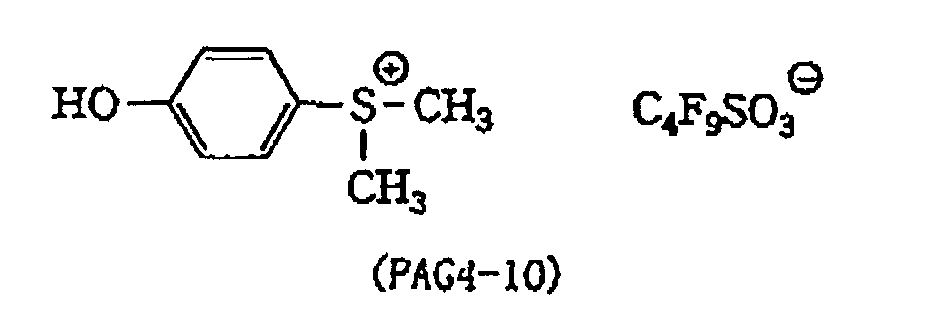
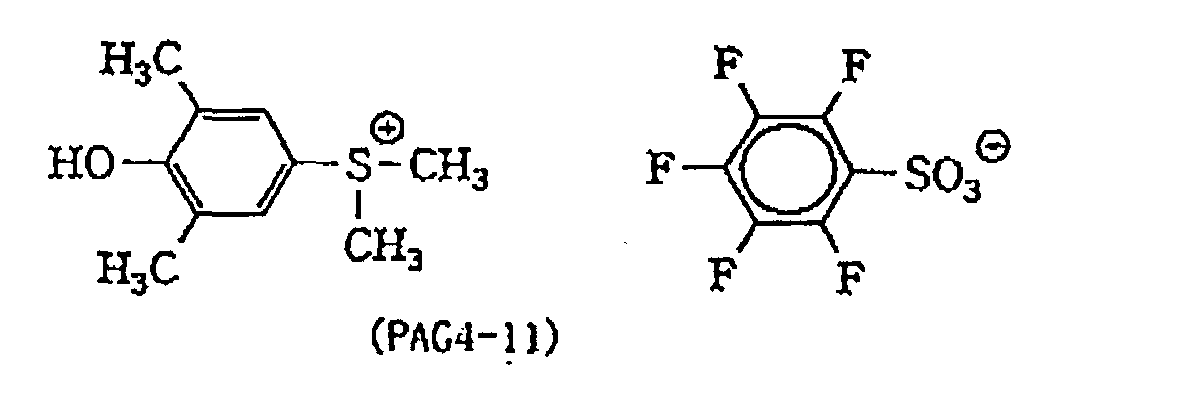

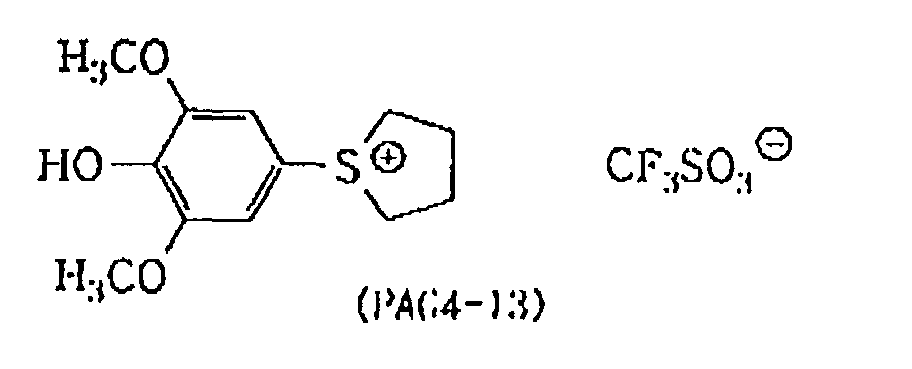
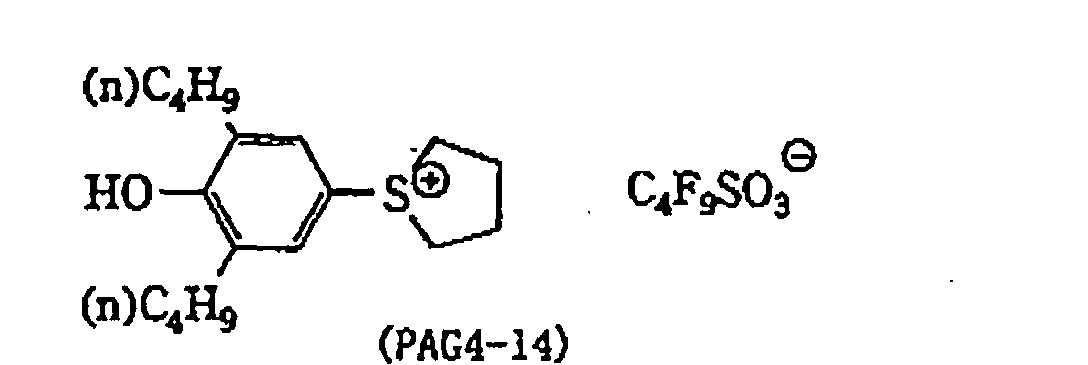
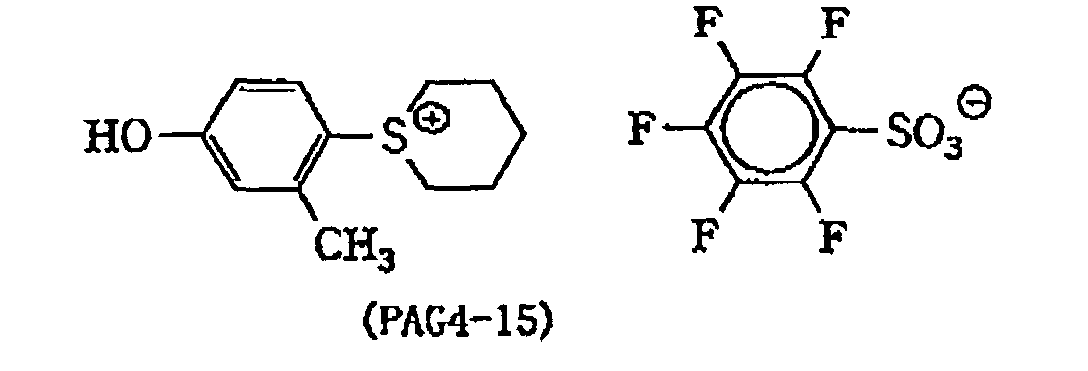

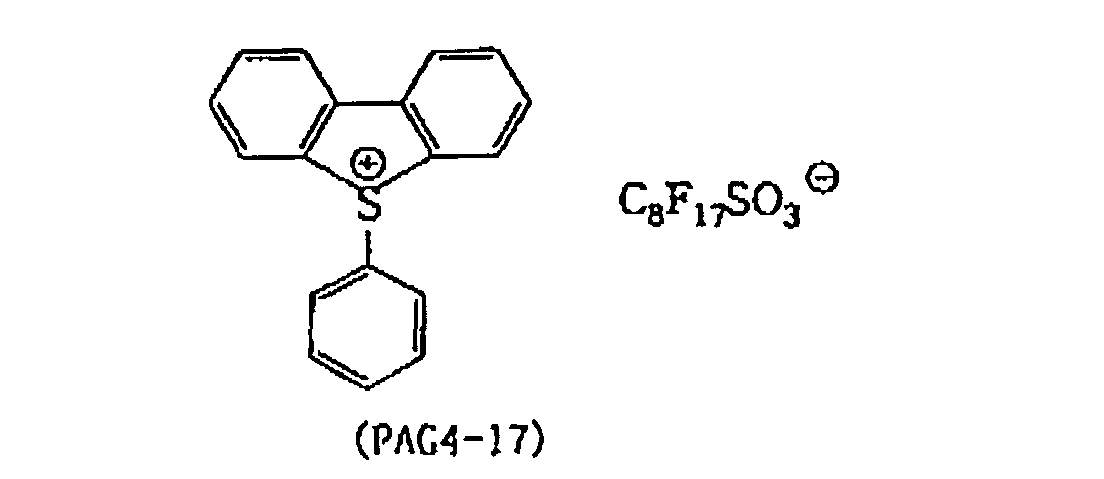

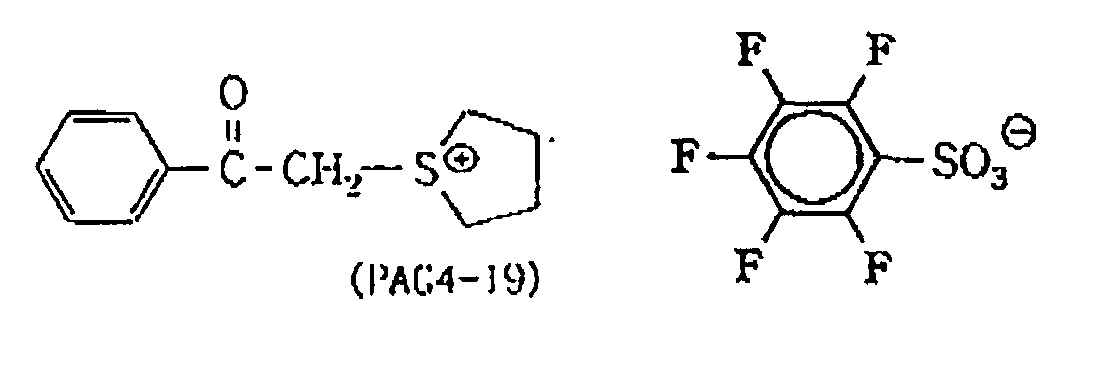
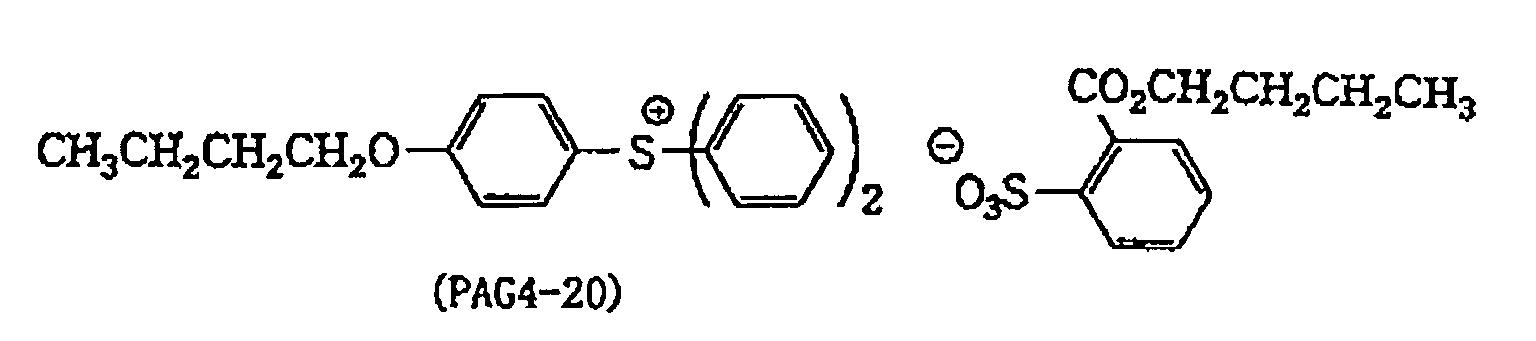


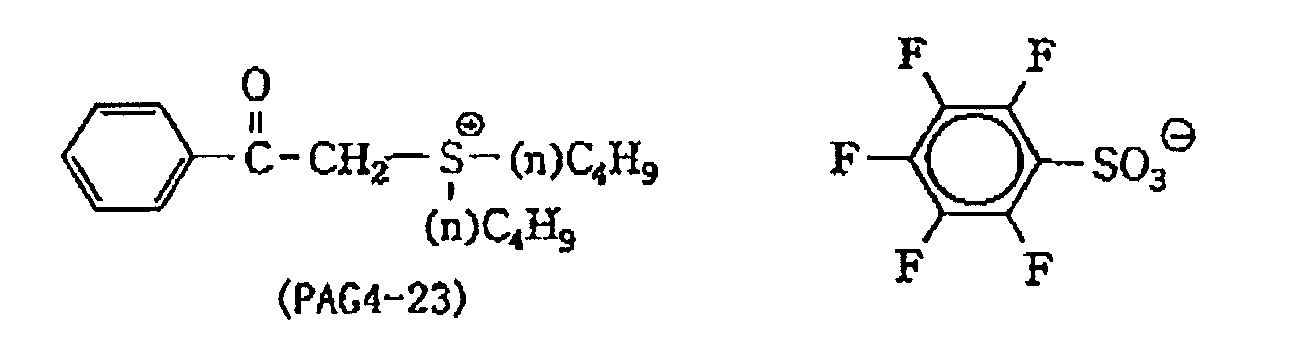

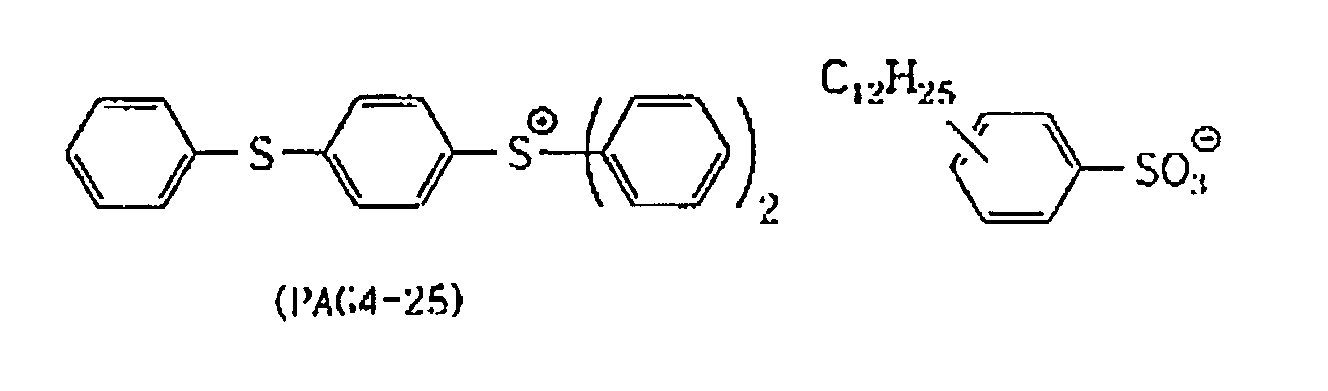
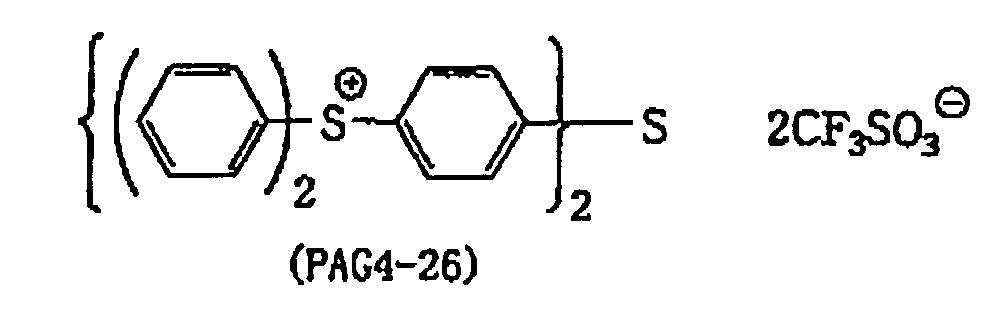
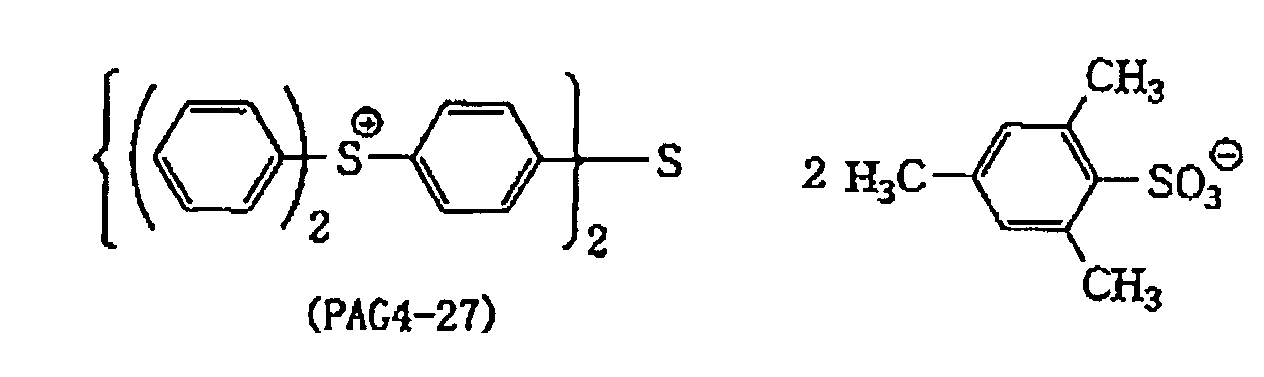
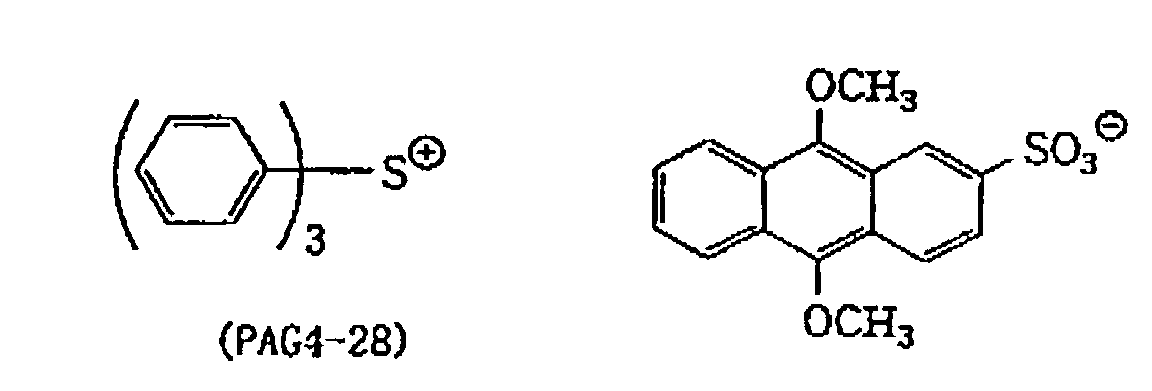


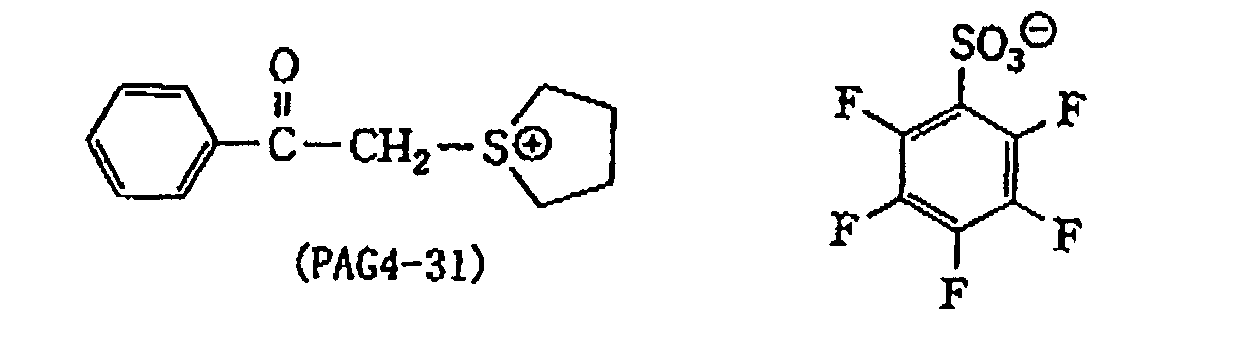
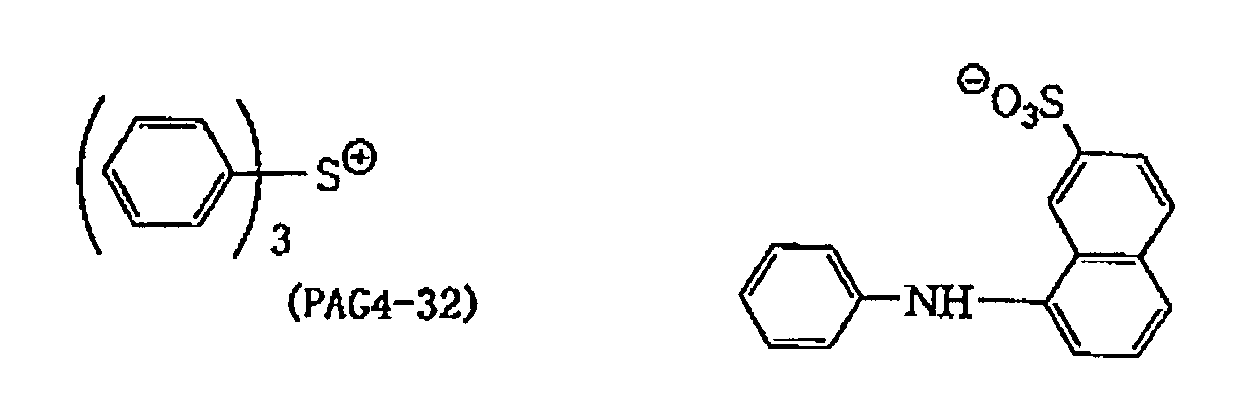
- The above-mentioned onium salts represented by general formulas (PAG3) and (PAG4) are known, and can be synthesized, for example, by methods described in J. W. Knapczyk et al., J. Am. Chem. Soc., 91, 145 (1969), A. L. Maycok et al., J. Org. Chem., 35, 2532 (1970) , E. Goethas et al., Bull. Soc. Chem. Belg., 73, 546 (1964), H. M. Leicester, J. Am. Chem. Soc., 51, 3587 (1929), J. V. Crivello et al., J. Polymer Chem. Ed., 18, 2677 (1980), U.S. Patents 2,807,648 and 4,247,473, and JP-A-53-101331.
- (2) Disulfone derivatives represented by the following general formula (PAG5) or iminosulfonate derivatives represented by the following general formula (PAG6):wherein Ar3 and Ar4 each independently represents a substituted or unsubstituted aryl group; R206 represents a substituted or unsubstituted alkyl or aryl group; andA represents a substituted or unsubstituted alkylene, alkenylene or arylene group.

- Specific examples thereof include but are not limited to the following compounds
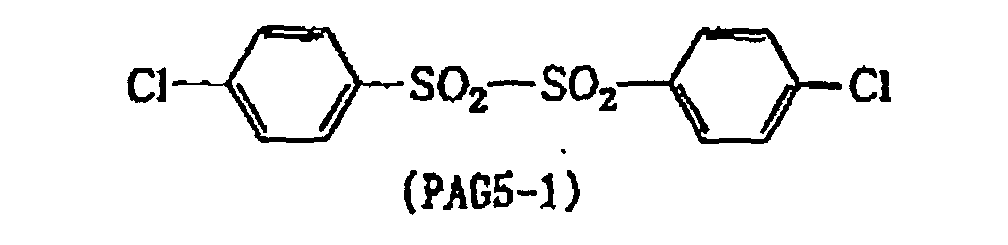
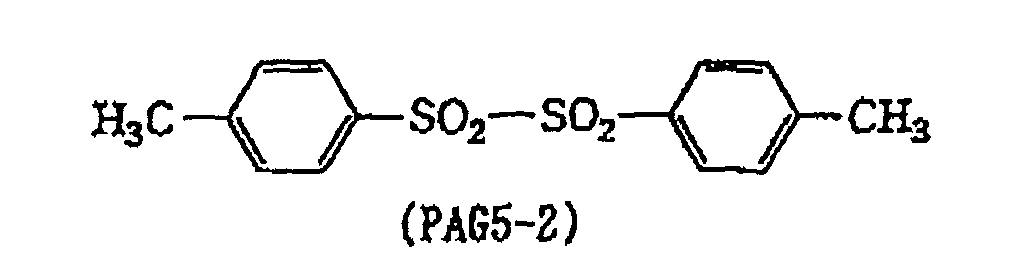
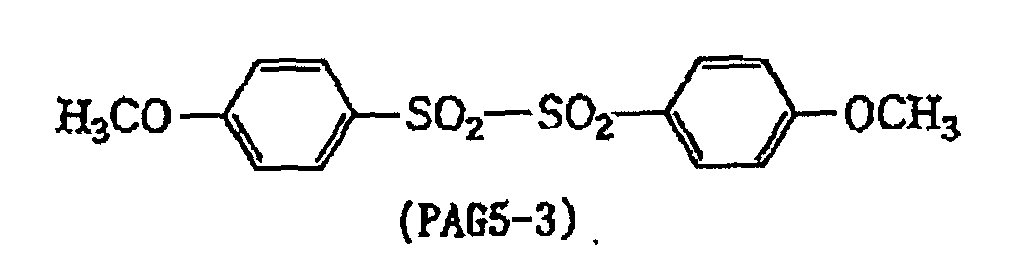


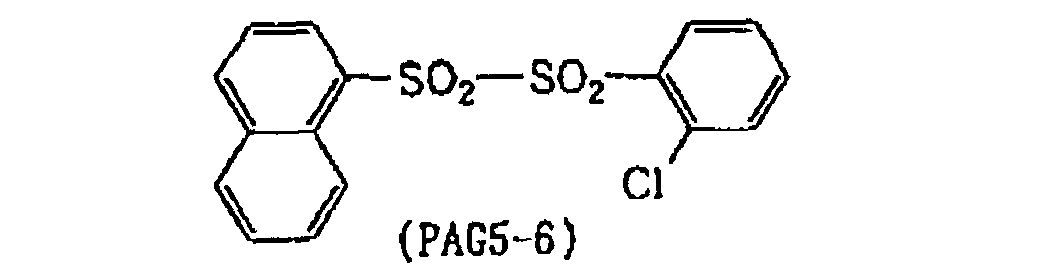
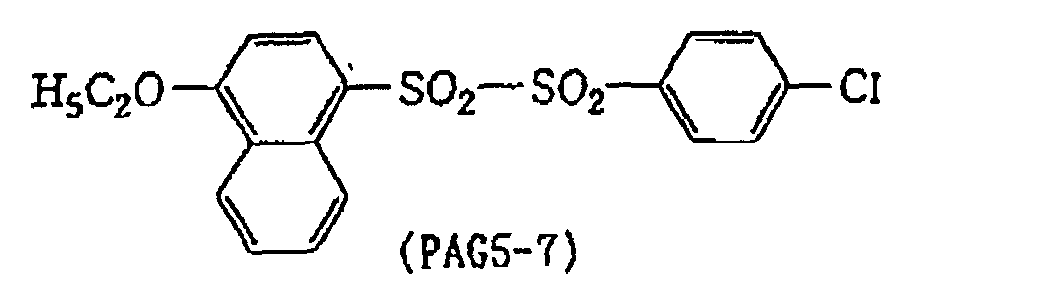
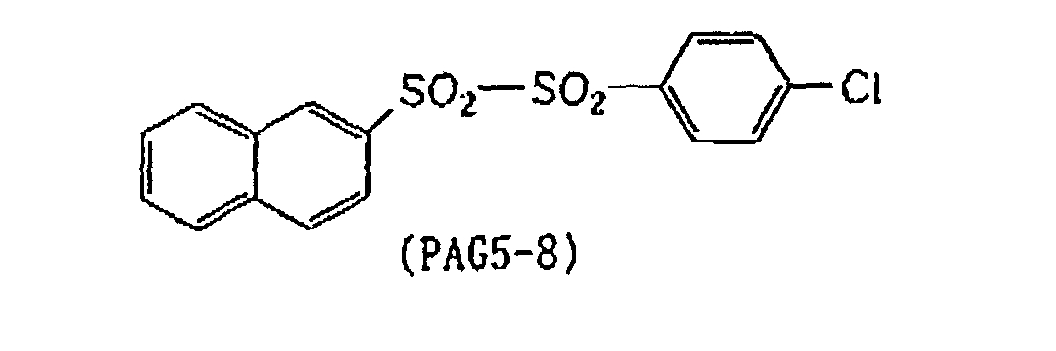
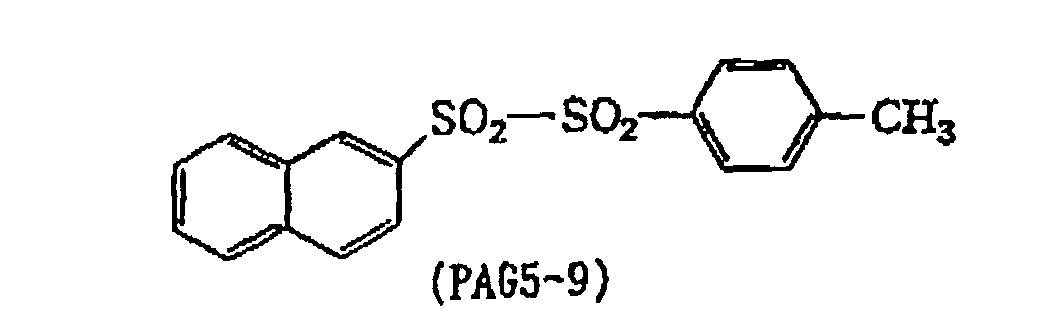

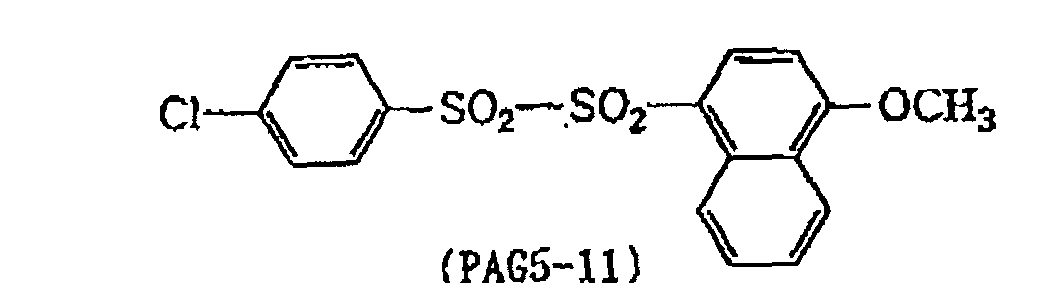
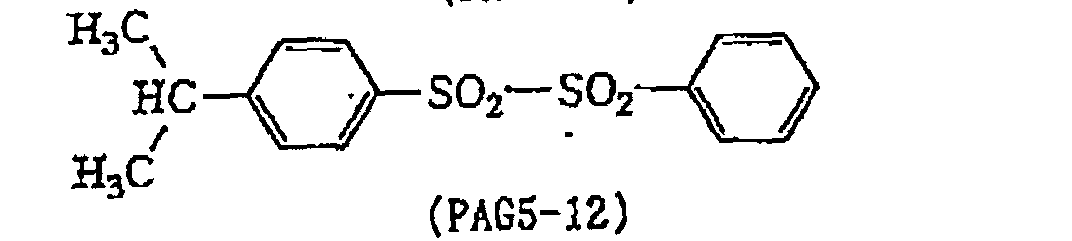
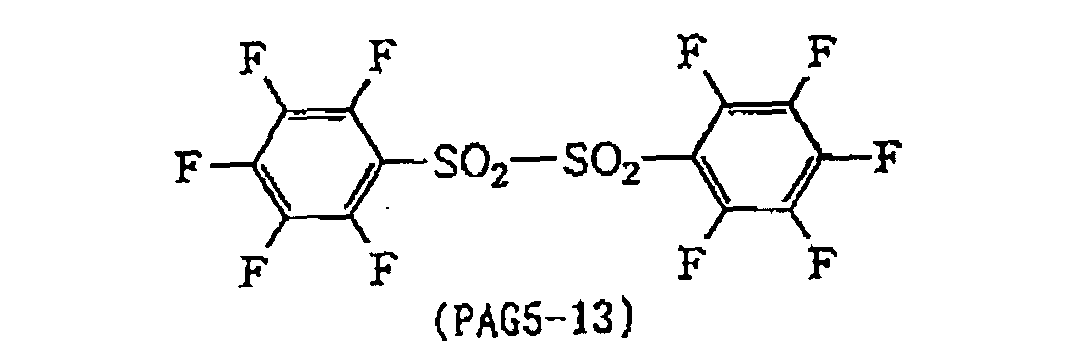


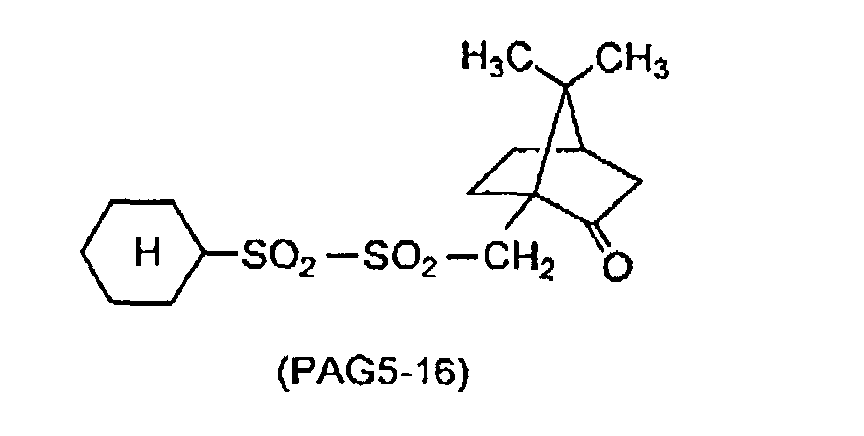


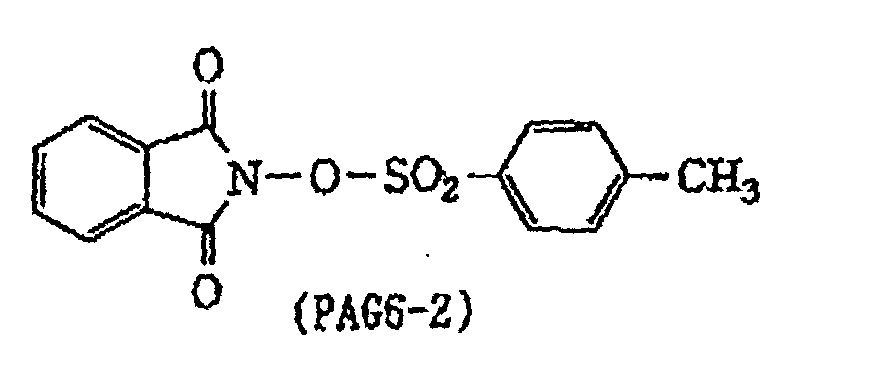
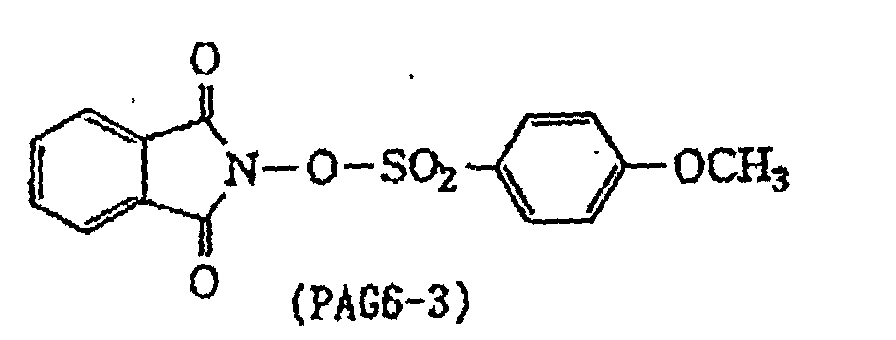
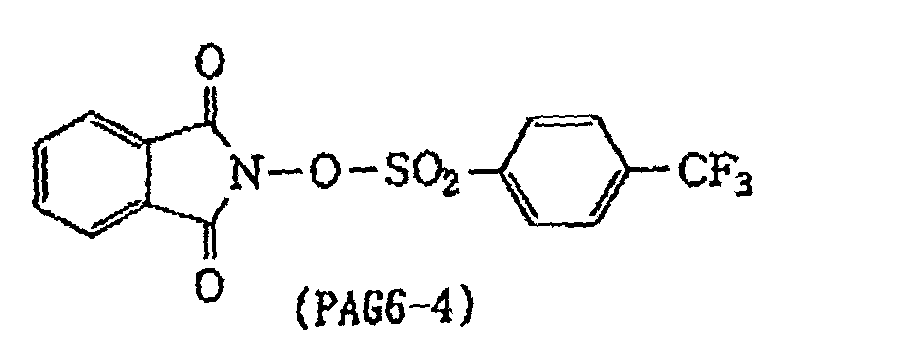
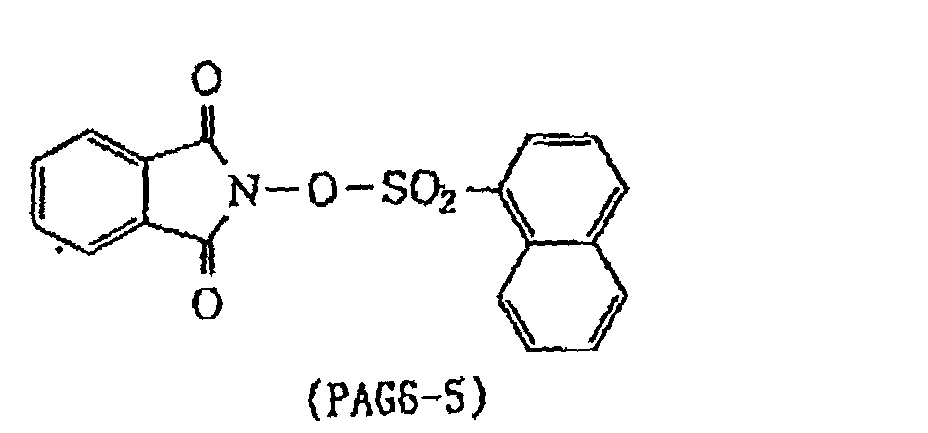


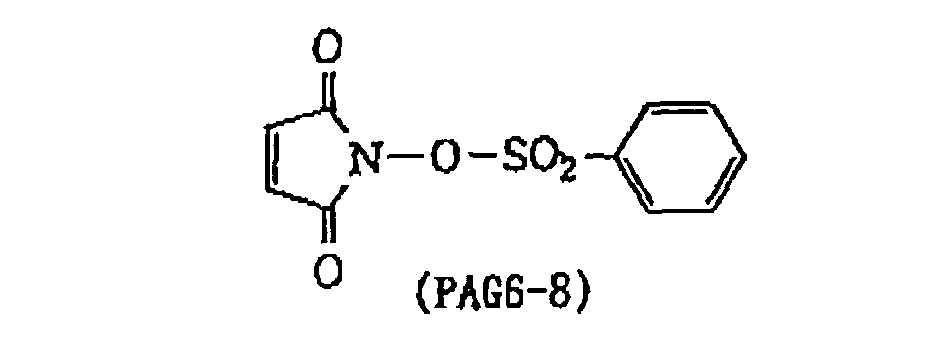

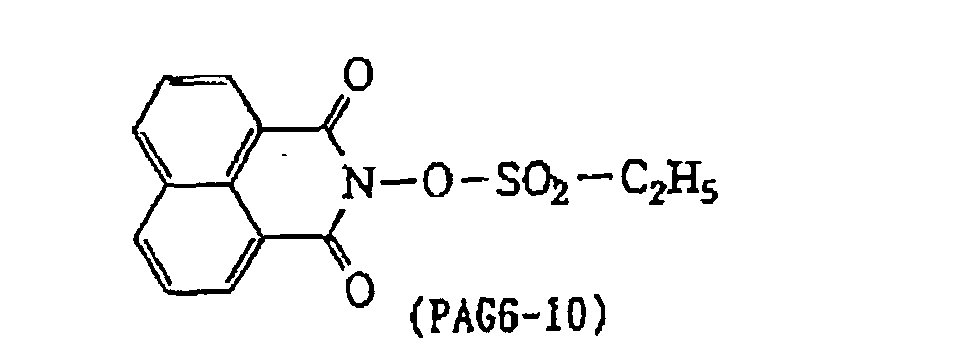


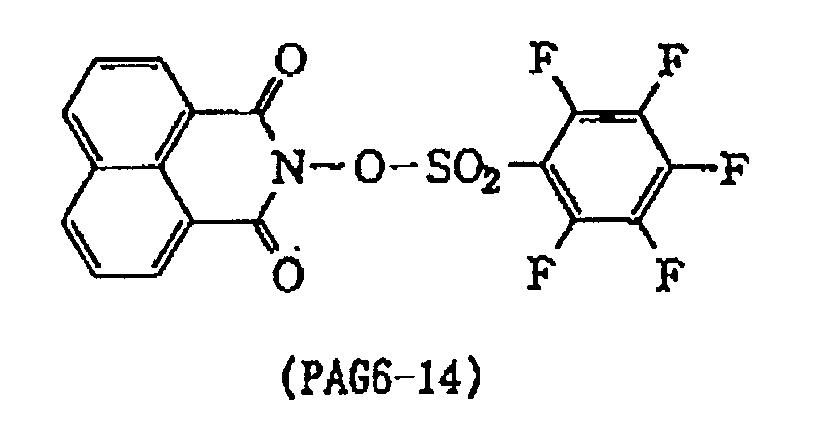


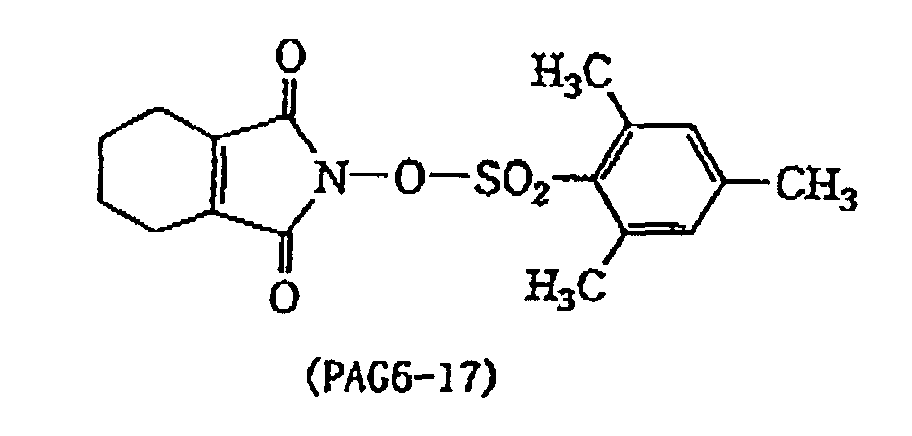
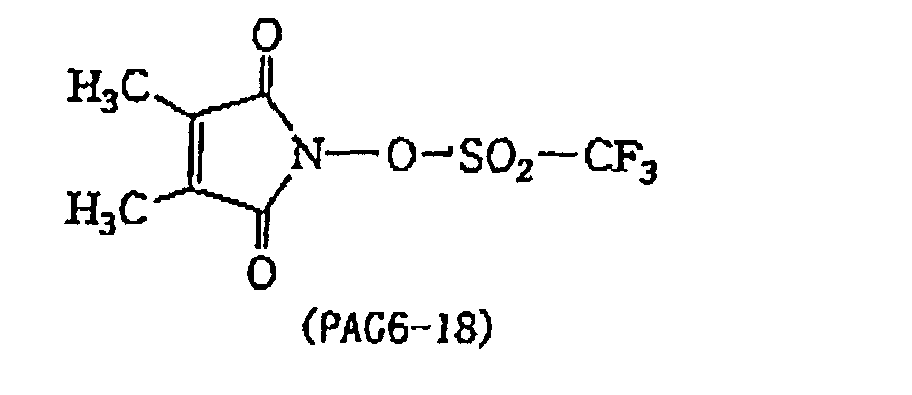
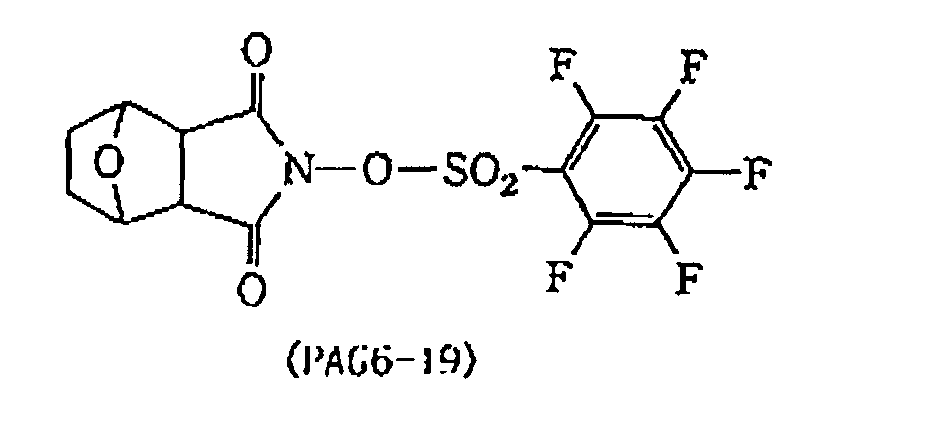

- (3) Diazodisulfone derivatives represented by the following general formula (PAG7):wherein R represents a straight-chain, branched or cyclic alkyl group, or an aryl group which may be substituted.
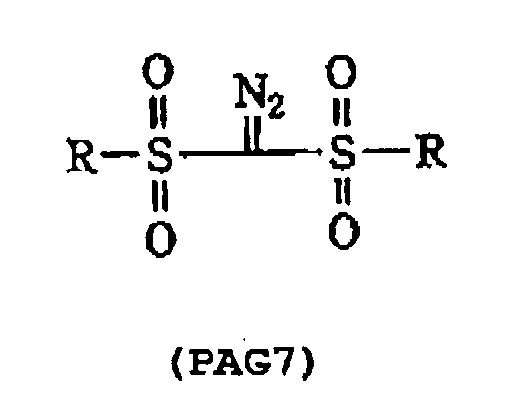
- Specific examples thereof include but are not limited to the following compounds:

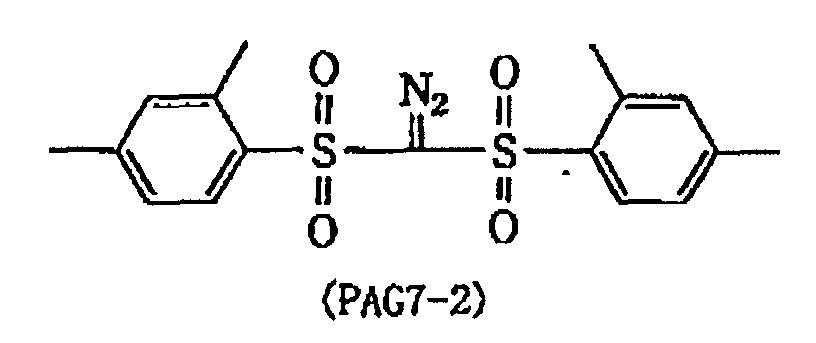

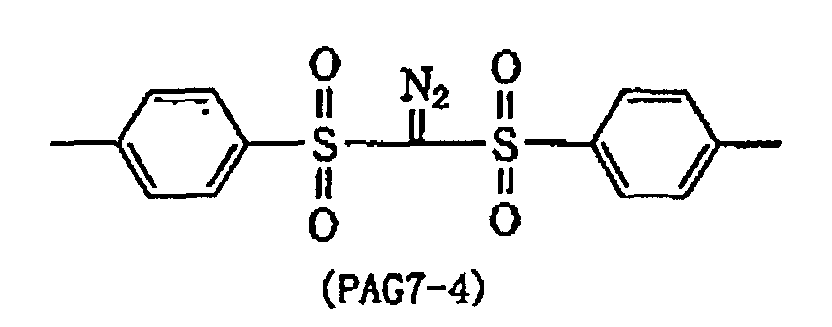
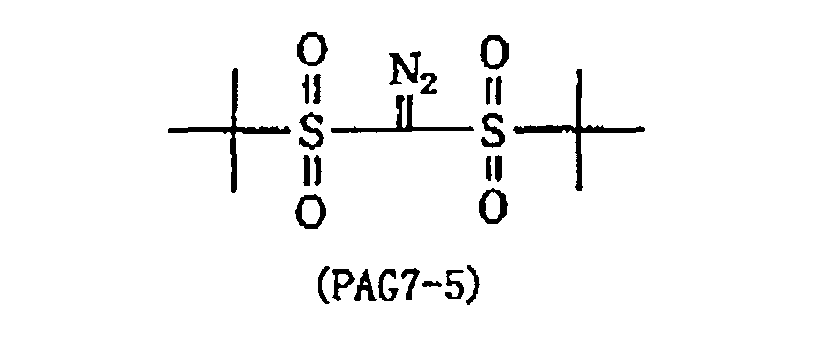
- In the case of using other compound generating an acid and/or radical species by being decomposed by the irradiation of a radiation together with the compound shown by the formula (I) to (III), the ratio of other compound generating an acid and/or radical species by being decomposed by the irradiation of a radiation is from 100/0 to 20/80, preferably from 90/10 to 40/60, and more preferably from 80/20 to 50/50 by mol ratio.
- The content of the component (A) used in the invention is properly from O.1 to 20% by weight, preferably from 0.5 to 10% by weight, and more preferably from 1 to 7% by weight to the whole solid components of the negative-working resist composition of the invention.
- (4) Acid crosslinking agent (C) in the invention:
- In the present invention, together with the alkali-soluble resin and an acid and/or radical generator, a compound causing crosslinking with an acid (hereinafter, is referred to as properly acid crosslinking agent or simply crosslinking agent) is used. In the invention, a known acid crosslinking agent can be effectively used.
- Preferably, there are compounds or resins having at least two of a hydroxymethyl group, an alkoxymethyl group, an acyloxymethyl group, and an alkoxymethyl ether group, or epoxy compounds.
- More preferably, there are alkoxymethylated or acyloxymethylated melamine compounds or resins, alkoxymethylated or acyloxymethylatedurea compounds or resins, hydroxymethylated or alkoxymethylated phenol compounds or resins, and alkoxymethyl etherifidephenol compounds and resins.
- Practically, as the crosslinking agent, phenol derivatives can be used. Preferably, there are phenol derivatives each having a molecular eight of not more than 1200, containing from 3 to 5 benzene rings in the molecule, furthermore having at least two groups of a hydroxymethyl group and an alkoxymethyl group together, andbonding the hydroxymethyl group and the alkoxymethyl group concentrated in at least one of the benzene rings or distributed in the benzene rings. By using such a phenol derivative, the effects of the invention can be more remarkably obtained.
- As the alkoxymethyl group bonding to the benzene ring, an alkoxymethyl group having not more than 6 carbon atoms is preferred. Practically, there are, preferably, methoxymethyl, ethoxymethyl, n-propoxymethyl, i-propoxymethyl, n-butoxymethyl, i-butoxymethyl, sec-butoxymethyl, and tert-butoxymethyl. Furthermore, an alkoxy-substituted alkoxy group such as 2-methoxyethoxy and 2-methoxy-1-propyl is also preferred.
- In these phenol derivatives, the particularly preferred phenol derivatives are shown below.
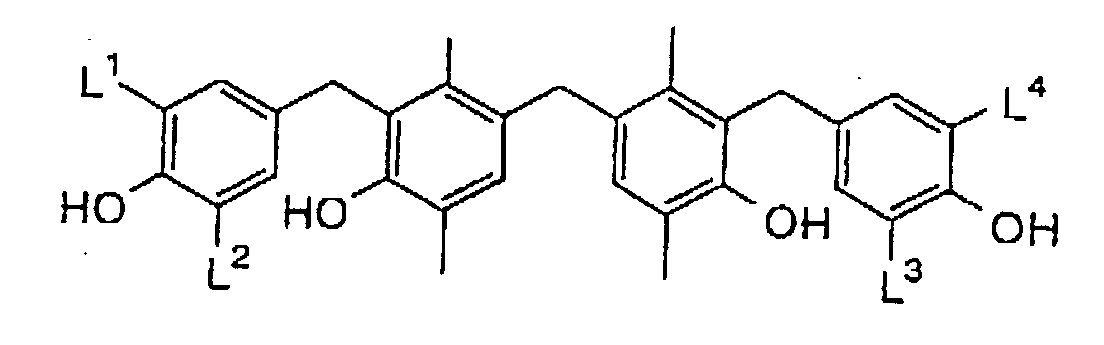


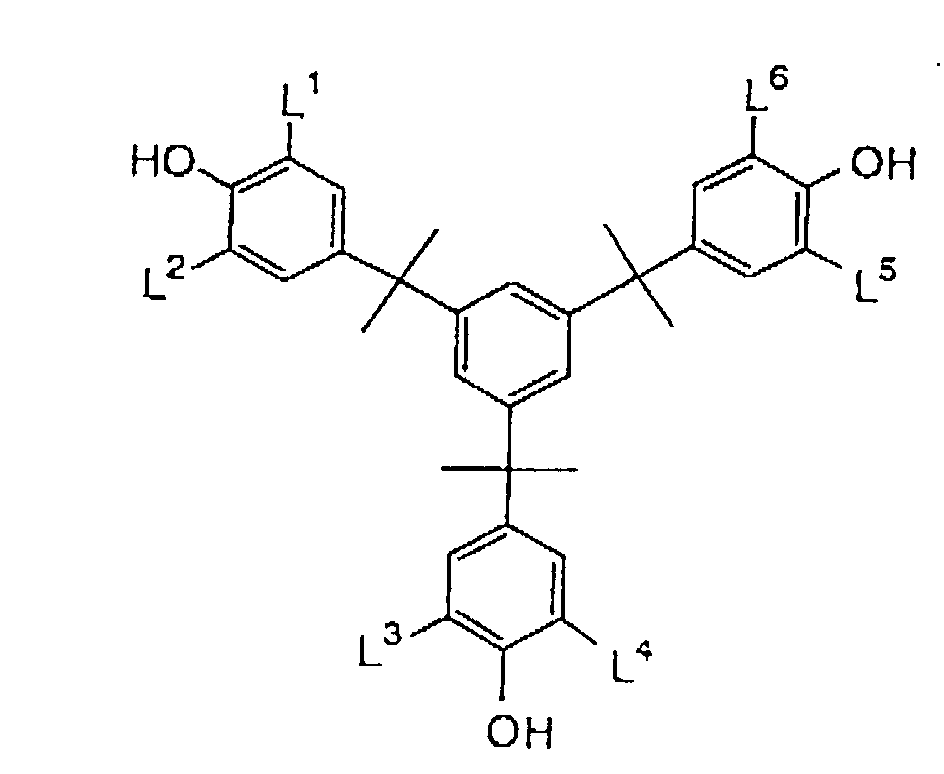
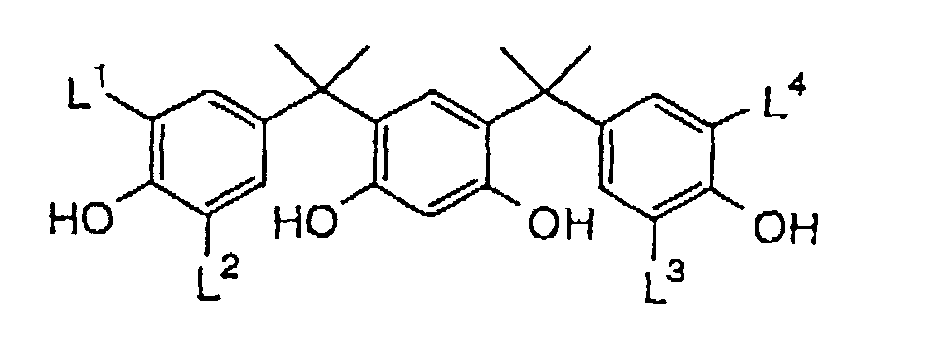
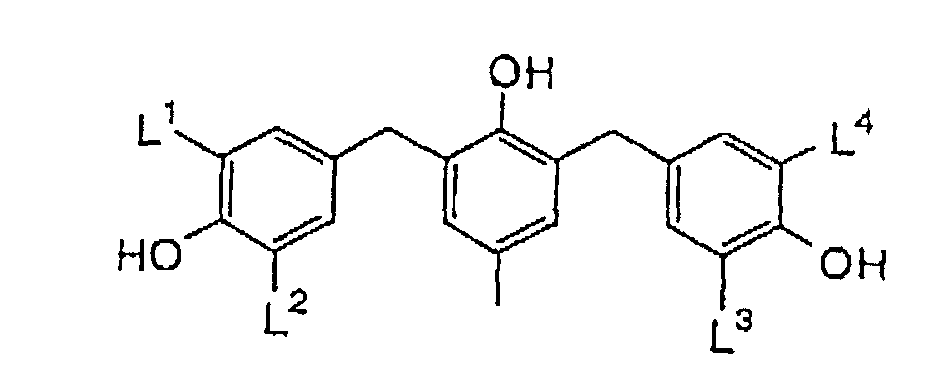
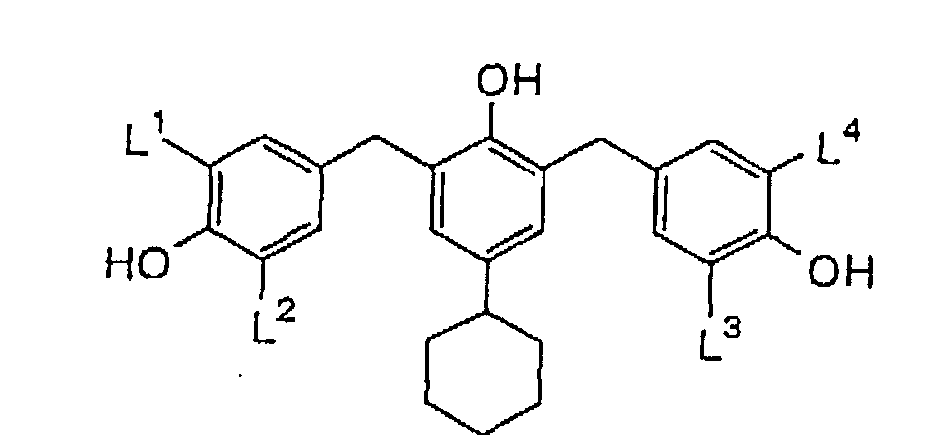
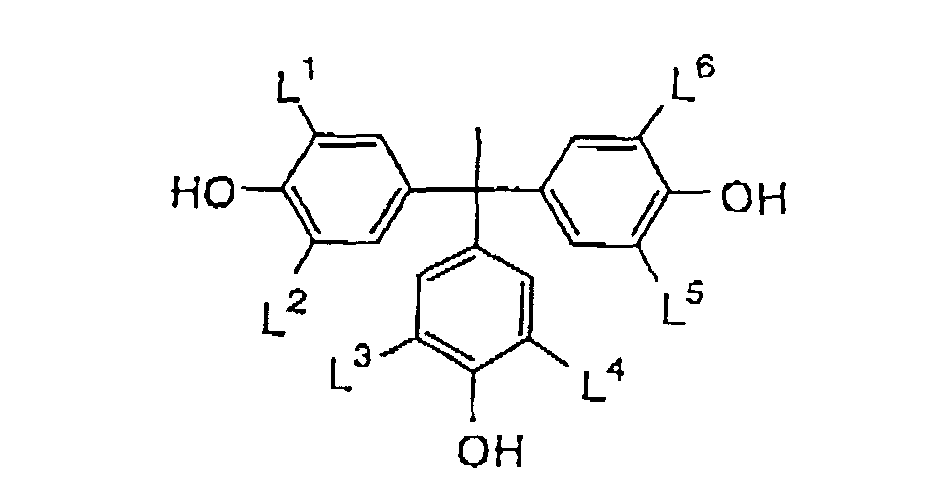


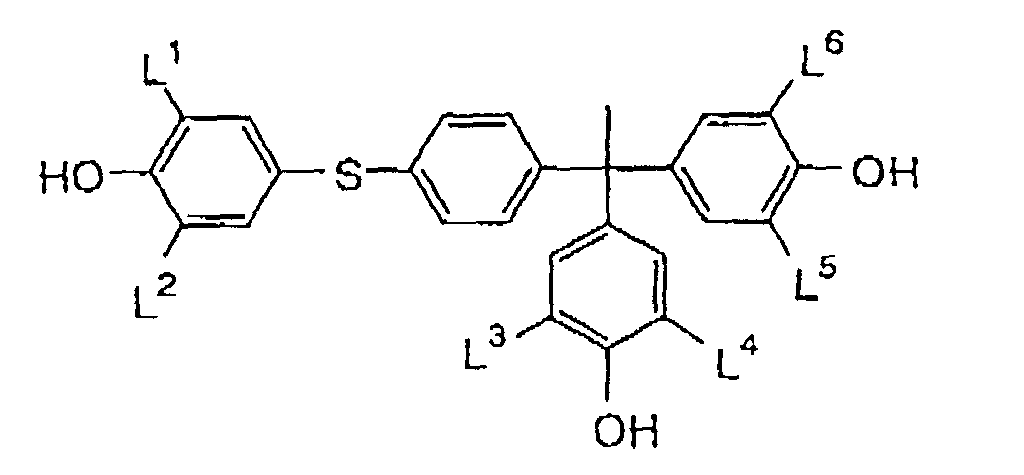
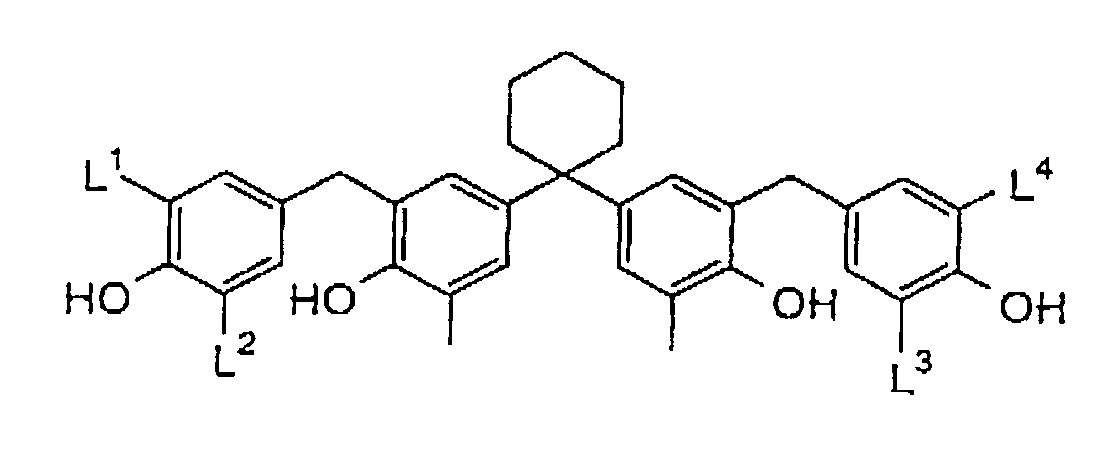
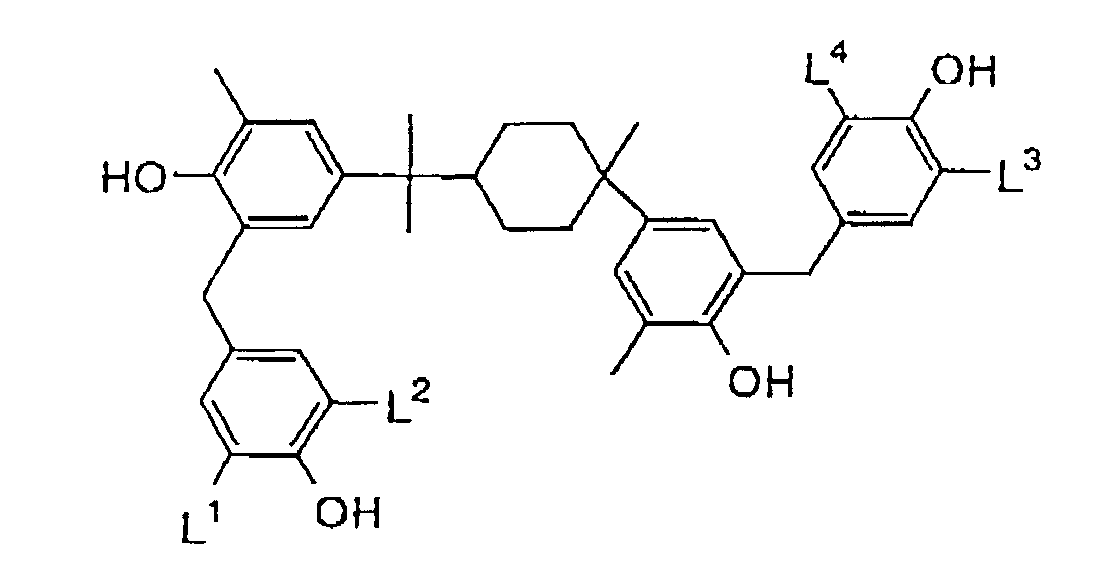
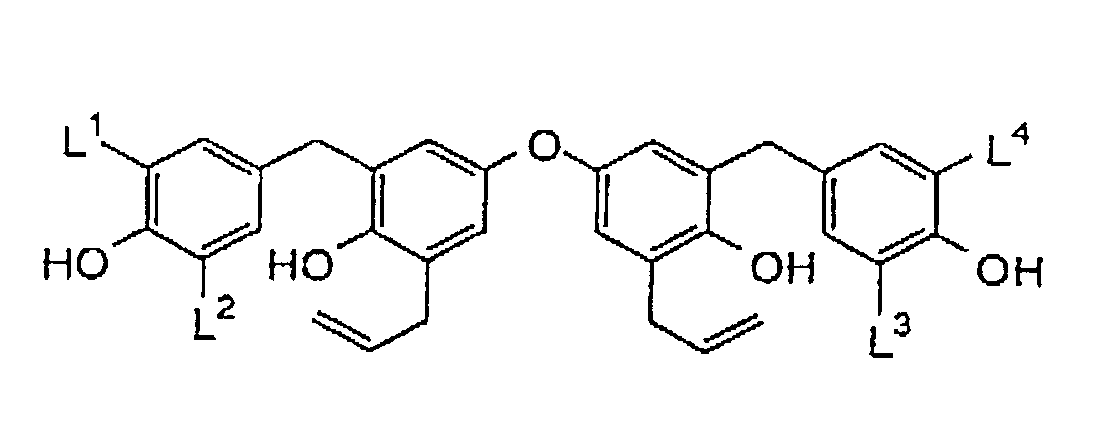

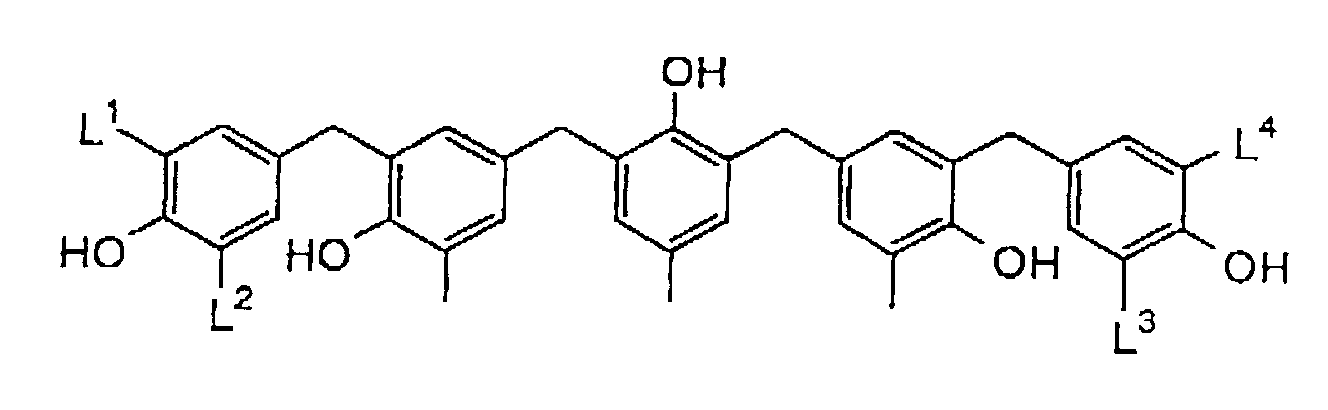
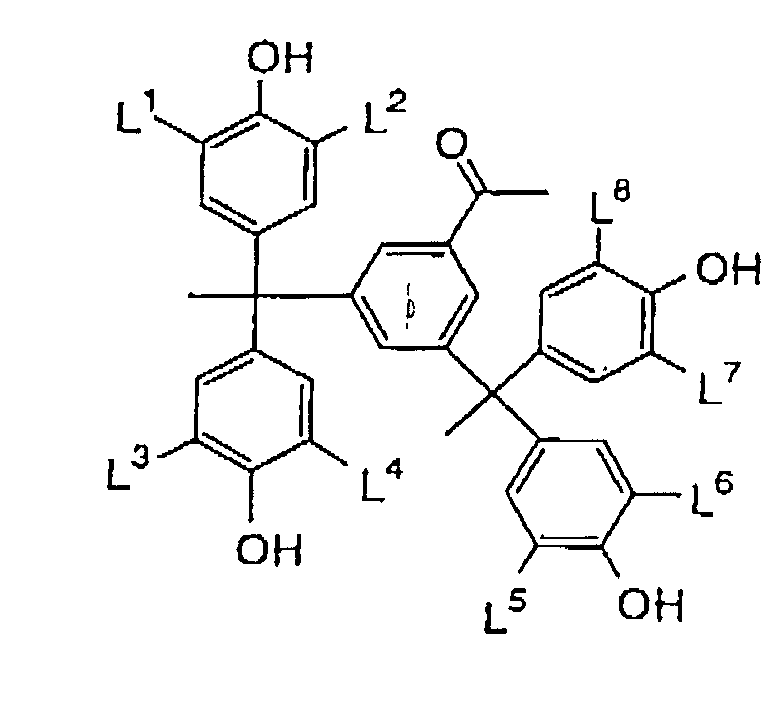 (In the above-described formulae, L1 to L8, which may be the same or different, each represents a hydroxymethyl group, a methoxymethyl group, or an ethoxymethyl group.)
- The phenol derivative having a hydroxymethyl group can be obtained by reacting the corresponding phenol compound without having a hydroxymethyl group (the compound wherein each of L1 to L8 is a hydrogen atom) and formaldehyde in the presence of a basic catalyst. In this case, to prevent the formation of resin or the occurrence of gelation, it is preferred to carry out the reaction at a temperature of not higher than 60°C. Practically, the phenol derivatives can be synthesized by the methods described in JP-A-6-282067, JP-A-7-64285, etc.
- The phenol derivative having an alkoxymethyl group can be obtained by reacting a corresponding phenol derivative having a hydroxymethyl group and an alcohol in the presence of an acid catalyst. In this case, to prevent the formation of resin or the occurrence of gelation, it is preferred to carry out the reaction at a temperature of not higher than 100°C. Practically, the phenol derivatives can be synthesized by the methods described in European Patent (EP) 632003A1, etc.
- The phenol derivatives each having a hydroxymethyl group or an alkoxymethyl group synthesized as described above are preferred in the point of the storage stability, and the phenol derivatives each having an alkoxymethyl group are particularly preferred from the view point of the storage stability.
- The phenol derivatives having at least two groups of a hydroxymethyl group and an alkoxymethyl group together, and bonding the hydroxymethyl group and the alkoxymethyl group concentrated in at least one of the benzene rings or distributed in the benzene rings may be used singly or as a combination of two or more kinds thereof.
- As other crosslinking agents than the above-described phenol derivatives, the compounds of following (i) and (ii) can be also used as the crosslinking agent.
- (i) Compounds each having an N-hydroxymethyl group, an N-alkoxymethyl group, or an N-acyloxymethyl group.
- (ii) Epoxy compounds.
-
- The addition amount of the crosslinking agent used is from 3 to 65% by weight, and preferably from 5 to 50% by weight to the whole solid components of the resist composition of the invention. When the addition amount of the crosslinking agent is less than 3% by weight, the film remaining ratio of the resist is lowered, and also when the addition amount exceeds 65% by weight, the resolving power is lowered and further, it is undesirable in the point of the storage stability of the resist liquid.
- In the present invention, in addition to the above-described phenol derivative(s), for example, the crosslinking agent (i) or (ii) described above can be used together.
- The ratio of other crosslinking agent which can be used together with the above-described phenol derivative is from 100/0 to 20/80, preferably 90/10 to 40/60, and more preferably from 80/20 to 50/50 by mol ratio.
- These crosslinking agents are described in more detail below.
- (i) The compounds each having an N-hydroxymethyl group, an N-alkoxymethyl group, or an N-acyloxymethyl group include the monomers, the oligomer-melamine-formaldehyde condensation products, and urea-formaldehyde condensation products disclosed in European Patent unexamined publication (hereinafter, is referred to as "EP-A") No. 0,133,216, West German Patents 3,634,671 and 3,711,264; and the alkoxy-substituted compounds disclosed in EP-A No. 0,212,483; and the benzoguanamine-formaldehyde condensation products disclosed in JP-A-8-109314, etc. As more preferred examples, there are melamine-formaldehyde derivatives each having at least two free N-hydroxymethyl groups, N-alkoxymethyl groups, or N-acyloxymethyl groups and in these derivatives, the N-alkoxymethyl derivatives are particularly preferred.
- (ii) As the epoxy compounds, there are monomer, dimer, oligomer, or polymer form epoxy compounds each containing at least one epoxy group. For example, there are a reaction product of bisphenol A and epichlorohydrin, a reaction product of a low-molecular weight phenol-formaldehyde resin and epichlorohydrin, etc. As other compounds, there are the epoxy resins disclosed in U.S. Patent 4,026,705 and British Patent 1,539,192.
-
- (5) Compound (D) having unsaturated bond polymerizable by an acid and/or radical in the invention:
- For the compound (D) having an unsaturated bond capable of being polymerized by an acid and/or a radical generated from the compound (A) in the invention, known monomers each having a polymerizing group can be used without particular restriction.
- Practical examples of these monomers include monofunctional acrylic acid esters and the derivatives thereof, such as 2-ethylhexyl acrylate, 2-hydroxyethyl acrylate, 2-hydroxypropyl acrylate, etc.; and the compounds of changing the acrylate to a methacrylate, an itaconate, a crotonate, a maleate, etc.;
- bifunctional acrylic acid esters and the derivatives thereof, such as polyethylene glycol diacrylate, pentaerythritol diacrylate, bisphenol A diacrylate, the diacrylate of the ε-caprolacton addition product of hydrxypivalicacidneopentylglycol, or the compounds of changing the acrylate to a methacrylate, an itaconate, a crotonate, a maleate, etc.; and
- multifunctional acrylic acid esters and the derivatives thereof, such as trimethylolpropane tri(meth)acrylate, dipentaerythritol pentaacrylate, dipentaerythritol hexaacrylate, pyrogallol triacrylate, etc., or the compounds of changing the acrylate to a methacrylate, an itaconate, a crotonate, a maleate, etc.
-
- Also, a so-called prepolymer provided with a photopolymerizablility obtained by introducing acrylic acid or methacrylic acid into an oligomer having a proper molecular weight can be suitably used.
- As other monomers, the compounds described in JP-A-58-212994, JP-A-61-6649, JP-A-62-46688, JP-A-62-48589, JP-A-62-173295, JP-A-62-187092, JP-A-63-67189, JP-A-1-244891, etc., can be used, and further, the compounds described in "Kagaku Shohin (Chemical goods) of 11290", pages 286 to 294, published by Kagaku Kogyo Nippo Sha, and "UV · EB Curing Handbook (Raw Material Chapter)", pages 11 to 65, published by Kobunshi Kanko Kai can be suitably used.
- In these compounds, the compounds having at least two acrylic groups or methacrylic groups in the molecule are preferred in the invention, and further, the compounds having a molecular weight of not more than 10,000, and preferably not more than 5,000 are desirable. In the invention, as the polymerizing compound, in the monomers and prepolymers each having the polymerizing group including the compounds illustrated above can be used singly or as a combination of two or more kinds if there is no problem in the compatibility and the affinity.
- The addition amount of the compound having an unsaturated group is from 2 to 50% by weight, preferably from 5 to 40% by weight, and more preferably from 10 to 30% by weight to the whole solid components of the resist composition of the invention.
- (6) Other components used for the composition of the invention:
- The negative-working resist composition of the invention can, if necessary, further contain a radical generator, an organic basic compound, a dye, a surface active agent, etc.
- As suitable dyes, there are oily dyes and basic dyes. Practically, there are Oil Yellow #101, Oil Yellow #103, Oil Pink #312, Oil Green BG, Oil Blue BOS, Oil Blue #603, Oil Black BY, Oil Black BS, Oil Black T-505 (all dyes described above manufactured by Orient Kagaku Kogyo K.K.), Crystal Violet (CI 42555), Methyl Violet (CI 42535), Rhodamine B (CI 45170B), Malachite Green (CI 42000), Methylene Glue (CI 52015), etc.
- The preferred organic basic compounds which can be used in the invention are compounds having a stronger basic property than phenol and in these compounds, nitrogen-containing basic compounds are preferred.
- As the preferred chemical environment, there are the structures of following formulae (A) to (E),


 wherein R250, R251, and R253, which may be the same or different, each represents a hydrogen atom, an alkyl group having from 1 to 6 carbon atoms, an aminoalkyl group having from 1 to 6 carbon atoms, a hydroxyalkyl group having from 1 to 6 carbon atoms, or a substituted or unsubstituted aryl group having from 6 to 20 carbon atoms; R251 and R252 may combine with each other to form a ring; and R253, R254, R255, and R256, which may be the same or different, each represents an alkyl group having from 1 to 6 carbon atoms.
- The more preferable compounds are nitrogen-containing basic compounds each having at least two nitrogen atoms of different chemical environments, and the particularly preferable compoundis a compound containing both the substituted or unsubstituted amino group and the ring structure containing a nitrogen atom, or a compound containing an alkylamino group.
- Preferred practical examples include a substituted or unsubstituted guanidine, a substituted or unsubstituted aminopyridine, a substituted or unsubstituted aminoalkylpyridine, a substituted or unsubstituted aminopyrrolidine, a substituted or unsubstituted indazole, a substituted or unsubstituted imidazole, a substituted or unsubstituted pyrazole, a substituted or unsubstituted pyrazine, a substituted or unsubstituted pyrimidine, a substituted or unsubstituted purine, a substituted or unsubstituted imidazoline, a substituted or unsubstituted pyrazoline, a substituted or unsubstituted piperazine, a substituted or unsubstituted aminomorpholine, a substituted or unsubstituted aminoalkylmorpholine, etc. The preferred substituents are an amino group, an aminoalkyl group, an alkylamino group, an aminoaryl group, an arylamino group, an alkyl group, an alkoxy group, an acyl group, an acyloxy group, an aryl group, an aryloxy group, a nitro group, a hydroxyl group, and a cyano group.
- The particularly preferable compounds include guanidine, 1,1-dimethylguanidine, 1,1,3,3-tetramethylguanidine, imidazole, 2-methylimidazole, 4-methylimidazole, N-methylimidazole, 2-phenylimidazole, 4,5-diphenylimidazole, 2,4,5-triphenylimidazole, 2-aminopyridine, 3-aminopyridine, 4-aminopyridine, 2-dimethylaminopyridine, 4-dimethylaminopyridine, 2-diethylaminopyridine, 2-(aminomethyl)pyridine, 2-amino-3-methylpyridine, 2-amino-4-methylpyridine, 2-amino-5-methylpyridine, 2-amino-6-methylpyridine, 3-aminoethylpyridine, 4-aminoethylpyridine, 3-aminopyrrolidine, piperazine, N-(2-aminoethyl)piperazine, N-(2-aminoethyl)piperidine, 4-amino-2,2,6,6-tetramethyl-piperidine, 4-piperidinopiperidine, 2-iminopiperidine, 1- (2-aminoethyl)pyrolidine, pyrazole, 3-amino-5-methylpyrazole, 5-amino-3-methyl-1-p-tolylpyrazole, pyrazine, 2- (aminomethyl)-5-methylpyrazine, pyrimidine, 2,4-diaminopyrimidine, 4,6-dihydroxypyrimidine, 2-pyrazoline, 3-pyrazoline, N-aminomorpholine, and N-(2-aminoethyl)morpholine. However, the invention is not limited to these compounds.
- These nitrogen-containing basic compounds are used singly or as a combination o two or more kinds thereof.
- It is preferred that the using ratio of the acid generator and the organic basic compound in the resin composition of the invention is (acid generator)/(organic basic compound) = 2.5 to 300 by mol ratio. When the mol ratio is less than 2.5, the sensitivity is lowered and the resolving power is sometimes lowered. Also, when the mol ratio exceeds 300, the thickness of the resist patterns becomes large with the passage of time after the light exposure to the heat treatment, and the resolving power is sometimes lowered. The ratio of (acid generator) / (organic basic compound) is preferably from 5.0 to 200, and more preferably from 7.0 to 150 by mol ratio.
- The negative-working resist composition of the invention can, if necessary, use a radical generator for accelerating the reaction of the polymerizing compound (D). As the radical generator, known radical polymerization initiators generally usedfor apolymer synthetic reaction by a radical polymerization can be used without particular restriction. Examples of the radical generator include azobisnitrile-base compounds such as 2,2' -azobis-isobutyronitrile, 2,2' -azobispropionitrile, etc.; organic peroxides such as benzoyl peroxide, lauroyl peroxide, acetyl peroxide, tert-butyl perbenzoate, α-cumylhydro peroxide, di-tert-butyl peroxide, diisopropyl peroxy dicarbonate, tert-butylperoxy-isopropyl carbonate, peracids, alkylperoxy carbamates, nitrosoarylacylamines, etc.; inorganic peroxides such as potassium persulfate, ammonium persulfate, potassium perchlorate, etc.; azo- or diazo-base compounds such as diazoaminobenzene, p-nitrobenzene diazonium, azobis-substitutedalkanes, doazothioethers, arylazosulfones, etc.; nitrosophenylurea; tetraalkylthiuram disulfides such as tetramethylthiuram disulfide, etc.; diaryl disulfides such as dibenzoyl disulfide, etc.; dialkyl xanthic acid disulfides, arylsulfinic acids, arylalkylsulfones, 1-alkanesulfinic acids, etc.
- The activation energy of the radical generator for radical generation is preferably at least 30 Kcal/mol, and as such a radical generator, there are azobisnitrile-base compounds and organic peroxides. In these compounds, the compound which is excellent in the stability at normal temperature, shows a high decomposition rate at heating, and becomes colorless at decomposition is preferred, and as such a compound, there are benzoyl peroxide, 2,2'-azobisisobutyronitrile, etc.
- The above-described radical generators may be used singly or as a combination of two or more kinds of them, and the using amount thereof is from about 0.5 to 30% by weight, and preferably from 2 to 10% by weight to the whole solid components of the radical polymerization layer.
- The resist composition of the invention is dissolved in a solvent dissolving the components described above and coated on a support. The preferable solvent used in the case includes ethylene dichloride, cyclohexanone, cyclopentanone, 2-heptanone, γ-butyrolactone, methyl ethyl ketone, ethylene glycol monomethyl ether, ethylene glycol monoethyl ether, 2-methoxyethyl acetate, ethylene glycol monoethyl ether acetate, propylene glycol monomethyl ether, propylene glycol monomethyl ether acetate, toluene, ethyl acetate, methyl lactate, ethyl lactate, methyl methoxypropionate, ethyl ethoxypropionate, methyl pyruvate, ethyl pyruvate, propyl pyruvate, N,N-dimethylformamide, dimethyl sulfoxide, N-methylpyrrolidone, tetrahydrofuran, etc. These solvents are used singly or as a mixture of them.
- A surface active agent can be added to the above-described solvent(s). Practically, the surface active agents used in the invention include nonionic surface active agents, for example, polyoxyethylene alkyl ethers such as polyoxyethylene lauryl ether, polyoxyethylene stearyl ether, polyoxyethylene cetyl ether, polyoxyethylene oleyl ether, etc.; polyoxyethylene alkylaryl ethers such as polyoxyethylene octylphenol ether, polyoxyethylene nonylphenol ether, etc.; polyoxyethylene•polyoxypropylene block copolymers; sorbitan fatty acid esters such as sorbitan monolaurate, sorbitan monopalmitate, sorbitan monostearate, sorbitan monooleate, sorbitan trioleate, sorbitan tristearate, etc.; polyoxyethylene sorbitan fatty acid esters such as polyoxyethylene sorbitanmonolaurate, polyoxyethylene sorbitan monopalmitate, polyoxyethylene sorbitan monostearate, polyoxyethylene sorbitan trioleate, polyoxyethylene sorbitan tristearate, etc.; fluorine-base surface active agents such as Eftop EF 301, EF 303 and EF 352 (manufactured by Shin Akita Kasei K.K.), Megafac F171 and F173 (manufactured by DAIMIPPON INK & CHEMICALS, INC.), Florad FC430, and FC431 (manufactured by SUMITOMO 3M LIMITED), Asahiguard AG710, Surflon S-382, SC101, SC102, SC103, SC104, SC105, and SC106 (manufactured by Asahi Glass Company Ltd.), Troysol S-366 (manufactured by Troy Chemical Corporation) , etc.; Organosiloxane polymer KP341 (manufactured by Shin-Etsu Chemical Co., Ltd.), acrylic acid-base or methacrylic acid-base (co)polymerized Polyflow No. 75 and No. 95 (manufactured by Kyoeisha Yushi Kagaku Kogyo K.K.), etc.
- The compounding amount of the surface active agent is usually not more than 2 parts by weight, and preferably not more than 1 part by weight per 100 parts by weight of the solid components of the resist composition of the invention.
- These surface active agents may be used singly or as a combination of two or more kinds of them.
- In the pattern formation process on a resist film in the production, etc., of a precise integrated circuit element, the negative-working photoresist composition of the invention is coated on a substrate (e.g., silicon/silicon dioxide film, and a transparent substrate such as a glass substrate, an ITO substrate, etc.), the coated layer is irradiated using electron beam (under the condition of an accelerating voltage of at least 75 KeV) or X-ray imaging apparatus, and by heating, developing, rinsing, and drying, a good resist pattern can be formed.
- As the developer for the negative-working photoresist composition of the invention, an aqueous solution of an alkali, for example, inorganic alkalis such as sodium hydroxide, potassium hydroxide, sodium carbonate, sodium silicate, sodium metasilicate, aqueous ammonia, etc.; primary amines such as ethylamine, n-propylamine, etc.; secondary amines such as diethylamine, di-n-butylamine, etc.; tertiary amines such as triethylamine, methyldiethylamine, etc.; alcoholamines such as dimethylethanolamine, triethanolamine, etc,; quaternary ammonium salts such as tetramethylammonium hydroxide, tetraethylammonium hydroxide, choline, etc.; cyclic amines such aspyrrole, piperidine, etc., can be used. Furthermore, proper amounts of an alcohol such as isopropyl alcohol, etc., and a surface active agent such as nonionic surface active agent, etc., can be used to the aqueous solution of the above-described alkali.
- In these developers, quaternary ammonium salts are preferred and tetramethylammonium hydroxide and choline are more preferred.
- Then, the present invention is explained in more detail by the following examples but the contents of the invention are not limited by the inventions.
- In 30 ml of 1-methoxy-2-propanol were dissolved 3.9 g (0.024 mol) of 4-acetoxystyrene and 0.8 g (0.006 mol) of 4-methoxystyrene, and while stirring the mixture under a nitrogen gas stream, 70 ml of a 1-methoxy-2-propanol solution of 50 mg of a polymerization initiator, 2,2' -azobis (2,4-dimethylvaleronitrile) (trade name, V-65, manufactured by Wako Pure Chemical Industries, Ltd.), 9.1 g (0.0056 mol) of 4-acetoxystyrene, and 1.9 g (0.014 mol) of 4-methoxystyrene was added dropwise to the solution at 70°c over a period of 2 hours. After 2 hours since then, 50 mg of the initiator was additionally added thereto and the reaction was further carried out for 2 hours. Thereafter, the temperature was raised to 90°C and the reaction mixture was stirred for one hour. After allowing to cool the reaction liquid, by adding the reaction liquid to 1 liter of ion-exchanged water with stirring vigorously, a white resin was precipitated. The resin precipitated was collected followed by drying, dissolved in 100 ml of methanol, 25% tetramethylammonium hydroxide was added to the solution, and after hydrolyzing the acetoxy group in the resin, the solution was neutralized with an aqueous solution of hydrochloric acid to precipitate a white resin. The resin was washed with ion-exchanged water and dried under a reduced pressure to obtain 11.6 g of the resin a-(29) in the invention. When the molecular weight of the resin was measured by GPC, the weight average molecular weight (Mw: polystyrene conversion) was 9,200 and the dispersion degree (Mw/Mn) was 2.2.
- In 100 ml of acetone was dissolved 12.0 g of poly(4-hydroxystyrene) (Mw = 10,500, Mw/Mn = 1.2), 2.0 g of pyridine was added and then 1.3 g of acetic anhydride was added to the solution, and the reaction was carried out at 50°C with stirring for 3 hours. By adding the reaction liquid to 1 liter of ion-exchange water with stirring vigorously, a white resin was precipitated. By drying the resin obtained under a reduced pressure, 12.2 g of the resin a-(39) in the invention was obtained. When the molecular weight of the resin was measured by GPC, the weight average molecular weight (Mw: polystyrene conversion) was 11,400 and the dispersion degree (Mw/Mn) was 1.2. Also, when the composition ratio was measured by NMR, x/y (4-hydroxystyrene/4-acetoxystyrene) was 88/12.
- In 30 ml of 1-methoxy-2-propanol were dissolved 3.8 g (0.015 mol) of 2-[(4'-hydroxyphenyl) carbonyloxy]ethyl methacrylate, 1.0 g (0.009 mol) of 2-hydroxyethyl acrylate, and 0.3 g (0.006 mol) of acrylonitrile, and while stirring under a nitrogen gas stream, 70 ml of a 1-methoxy-2-propanol solution of 50 mg of a polymerization initiator, 2,2' -azobis (2,4-dimethylvaleronitrile) (trade name, V-65, manufactured by Wako Pure Chemical Industries, Ltd.), 8.8 g (0.035 mol) of 2-[(4'-hydroxyphenyl)carbonyloxy]ethyl methacrylate, 2.4 g (0.021 mol) of 2-hydroxyethyl acrylate, and 0.7 g (0.014 mol) of acrylonitrile was added dropwise to he solution at 70°C over a period of 2 hours. After 2 hours, 50 mg of the initiator was additionally added and the reaction was further carried out for 2 hours. Thereafter, the temperature was raised to 90°C, and the reaction mixture was stirred for one hour. After allowing to cool the reaction liquid, by adding the reaction liquid to 1 liter of ion-exchanged water with stirring vigorously, a white resin was precipitated. By drying the resin obtained under a reduced pressure, 15.8 g of the resin a-(91) in the invention was obtained. When the molecular weigh was measured by GPC, the weight average molecular weight (Mw; polystyrene conversion) was 15,200 and the dispersion degree (Mw/Mn) was 2.2.
- Then, the resins (B) of the invention were synthesized by the similar manners.
- In 100 ml of THF was dissolved 12.1 g (0.10 mol) of poly (4-hydroxystyrene) (trade name, VP-15000, manufactured by Nippon Soda Co., Ltd.), and 3.7 g (0.024 mol) of methacrylic anhydride was added to the solution. Furthermore, after adding thereto 2.4 g (0.030 mol) of pyridine, the mixture was refluxed with stirring for 5 hours. After allowing to cool the reaction liquid, by adding the reaction liquid to 1 liter of ion-exchanged water with stirring vigorously, a white resin was precipitated. After washing with ion-exchanged water, the resin obtained was dried under a reduced pressure to obtain 13.1 g of the resin a' - (2) of the invention was obtained. When the content of the unsaturated group was measured by NMR, the introduced amount of a methacrylic group into the OH groups of the polyhydroxystyrene was 18 mol%. Also, when the molecular weight was measured by GPC, the weight average molecular weight was 16,700 (polystyrene conversion) and the dispersion degree was 1.2.
- In 100 ml of N,N-dimethylacetamide was dissolved 12.1 g (0.10 mol) of poly(4-hydroxystyrene) (trade name, VP-8000, manufactured by Nippon Soda Co., Ltd.), and after adding thereto 3.1g (0.020 mol) of 2-isocyanate ethyl methacrylate, the mixture was heated to 90°C for 7 hours with stirring. After allowing to cool the reaction liquid, by adding the reaction liquid to 1 liter of ion-exchanged water with stirring vigorously, a white resin was precipitated. After washing with ion-exchanged water, the resin obtained was dried under a reduced pressure to obtain 14.4 g of the resin a' - (4) of the invention was obtained. When the content of the unsaturated group was measured by NMR, the introduced amount of a methacrylic group into the OH groups of the polyhydroxystyrene was 16 mol%. Also, when the molecular weight was measured by GPC, the weight average molecular weight was 9,100 (polystyrene conversion) and the dispersion degree was 1.2.
- In 100 ml of THF was dissolved 12.1 g (0.10 mol) of poly(4-hydroxystyrene) (trade name, VP-8000, manufactured by Nippon Soda Co., Ltd.), and 4.7 g (0.023mol) of 4-styrenesulfonyl chloride was added thereto. Furthermore, 20 ml of a THF solution of 0.37 g (0.003 mol) of N,N-dimethylaminopyridine/2.1 g (0.020 mol) of triethylamine was added dropwise to the solution with stirring under ice-cooling. Furthermore, the mixture was stirred for 5 hours at room temperature. The reaction liquid was filtered and by adding the filtrate to 1 liter of ion-exchange water with stirring vigorously, a white resin was precipitated. After washing with ion-exchanged water, the resin obtained was dried under a reduced pressure to obtained 15.0 g of the resin a'-(7) of the invention. When the content of the unsaturated group was measured by NMR, the introduced amount of a styryl group into the OH groups of the polyhydroxystyrene was 18 mol%. Also, when the molecular weight was measured by GPC, the weight average molecular weight was 9,200 (polystyrene conversion) and the dispersion degree was 1.2.
- In 100 ml of N,N-dimethylacetamide was dissolved 12.1 g (0.10 mol) of poly(4-hydroxystyrene) (trade name, VP-8000, manufactured by Nippon Soda Co., Ltd.), and 3.4 g (0.022 mol) of chloromethylstyrene was added to the solution. Furthermore, 20 ml of an N,N-dimethylacetamide solution of 2.3 g (0.022 mol) of triethylamine was added dropwise to the solution with stirring at room temperature. Thereafter, the reaction liquid was stirred for 5 hours at 60°C. After allowing to cool the reaction liquid, by adding the reaction liquid into ion-exchanged water with stirring vigorously, a white resin was precipitated. After washing with ion-exchanged water, the resin obtained was dried under a reduced pressure to obtained 13.9 g of the resin a'-(8) of the invention. When the content of the unsaturated group was measured by NMR, the introduced amount of a styryl group into the OH groups of the polyhydroxystyrene was 17 mol%. Also, when the molecular weight was measured by GPC, the weight average molecular weight was 9,300 (polystyrene conversion) and the dispersion degree was 1.2.
- Then, the resins (B') of the invention were synthesized by following the similar manners.
- In 100 ml of methanol was dissolved 25 g of pentafluorobenzenesulfonyl chloride under ice-cooling and 10 g of an aqueous solution of 25% tetramethylammonium hydroxide was slowly added to the solution. When the mixture was stirred for 3 hours at room temperature, a solution of a pentafluorobenzenesulfonic acid tetramethylammonium salt was obtained. The solution was used for the salt-exchange of a sulfonium salt and an iodonium salt.
- In 800ml of benzene was dissolved 50 g of diphenyl sulfoxide and after adding thereto 200 g of aluminum chloride, the mixture was refluxed for 24 hours. The reaction liquid was slowly poured to 2 liters of ice and after adding thereto 400 ml of concentrated sulfuric acid, the mixture was heated to 70°C for 10 minutes. The aqueous solution was washed with 500 ml of ethyl acetate and after filtration, a solution of 200 g of ammonium iodide dissolved in 400 ml of water was added. Powders precipitated were collected by filtration, washed with water and then with ethyl acetate, and dried to obtain 70 g of triphenylsulfonium iodide.
- In 1000 ml of methanol was dissolved 30.5 g of triphenylsulfonium iodide and after adding 19.1 g of silver oxide to the solution, and the mixture was stirred for 4 hours at room temperature. The solution was filtered and an excessive amount of a solution of a pentafluorobenzenesulfonic acid tetramethylammonium salt was added. The reaction liquid was concentrated, the residue was dissolved in 500 ml of dichloromethane, and the solution was washed with an aqueous solution of 5% tetramethylammonium hydroxide and water. After drying the organic phase formed with anhydrous sodium sulfate, the organic phase was concentrated to obtained triphenylsulfoniumpentafluorobenzene sulfonate (I-1).
- To a mixture of 60 g of tert-amylbenzene, 39. 5 g of potassium iodate, 81 g of acetic anhydride, and 170 ml of dichloromethane was slowly added dropwise 66.8 g of concentrated sulfuric acid under ice-cooling. After stirring the mixture for 2 hours under ice-cooling, the mixture was stirred for 10 hours at room temperature. To the reaction liquid was added 500 ml of water under ice-cooling, the liquid was extracted with dichloromethane, and after washing the organic phase with sodium hydrogencarbonate and water, the liquid was concentrated to obtain di (4-tert-amylphenyl) iodonium sulfate. The sulfate was added to an excessive amount of a solution of a pentafluorobenzenesulfonic acid tetramethylammonium salt. To the solution was added 500 ml of water, the solution was extracted with dichloromethane, and after washing the organic phase with an aqueous solution of 5% tetramethylammonium hydroxide and water, the liquid was concentrated to obtain di (4-tert-amylphenyl)iodoniumpentafluorobenzene sulfonate (III-1).
- Other compounds can be synthesized by using the similar methods.
- In an aqueous 10% potassium hydroxide solution was dissolved 20 g of 1-[α-methyl-α-(4-hydroxyphenyl)ethyl]-4-[α,α-bis(4-hydroxy phenyl) ethyl] benzene (Trisp-PA, trade name, manufactured by Honshu Chemical Industry Co., Ltd.) with stirring. While stirring the solution, 60 ml of an aqueous 37% formalin solution was gradually added to the solution at room temperature over a period of one hour. After further stirring the mixture for 6 hours at room temperature, the solution was added to a diluted aqueous sulfuric acid solution. Precipitates formed were collected by filtration and after sufficiently washing with water, the precipitates were recrystallized from 30 ml of methanol to obtain 20 g of the white powder of the phenol derivative [HM-1] having a hydroxymethyl group of the following structure. The purity was 92% (liquid Chromatography).
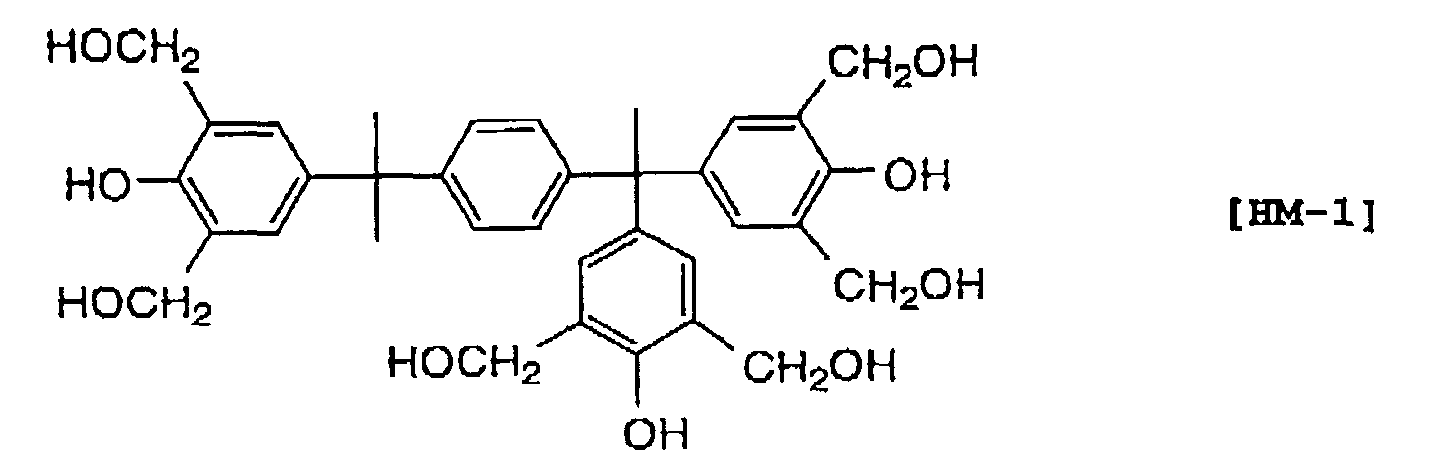
- In one liter of methanol was dissolved 20 g of the phenol derivative [HM-1] having a hydroxymethyl group obtained in the above-described synthesis Example with stirring by heating. Then, to the solution was added 1 ml of concentrated sulfuric acid and the mixture was refluxed for 12 hours. After the reaction was over, the reaction liquid was cooled and 2 g of potassium carbonate was added thereto. After sufficiently concentrating the mixture, 300 ml of ethyl acetate was added. After washing the solution with water, the solution of concentrated to dryness to obtained 22 g of the white solids of the phenol derivative [MM-1] having a methoxymethyl group of the following structure. The purity was 90% (liquid chromatography).

- Furthermore, the phenol derivatives shown below were synthesized by the similar manners to above.


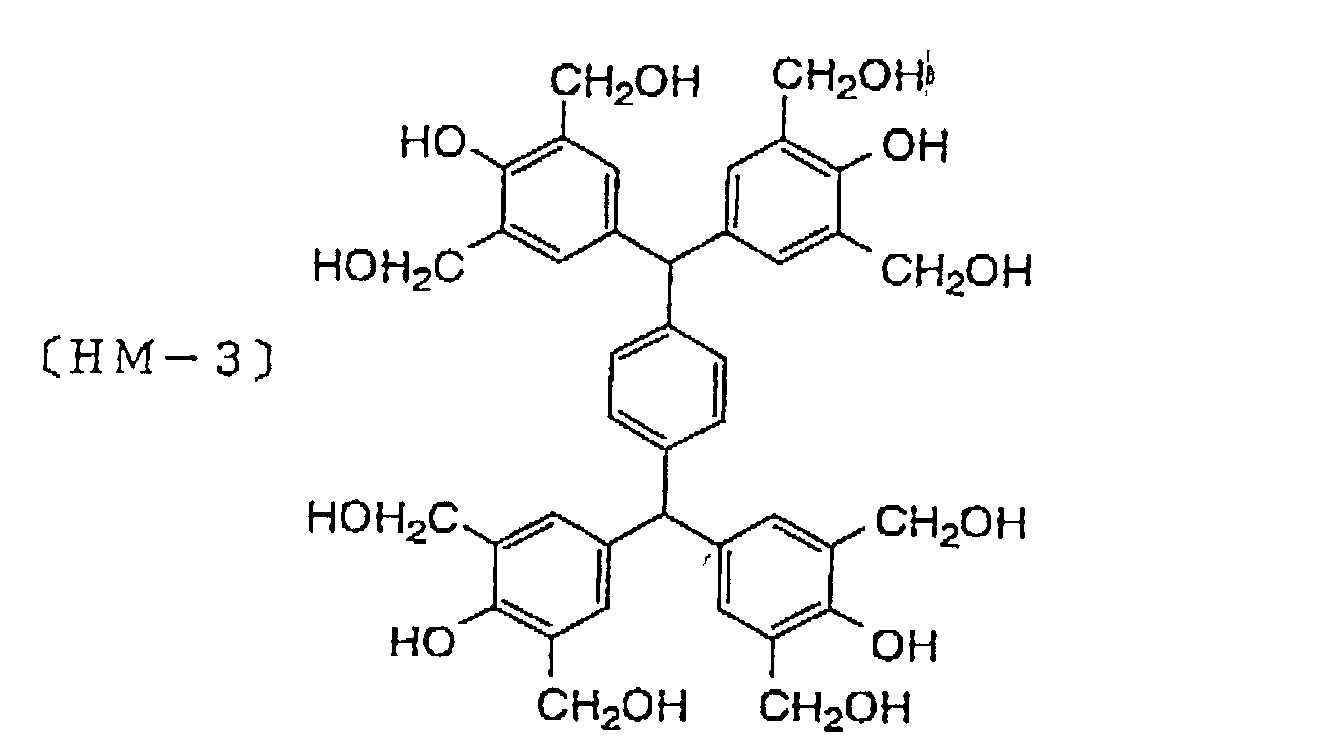


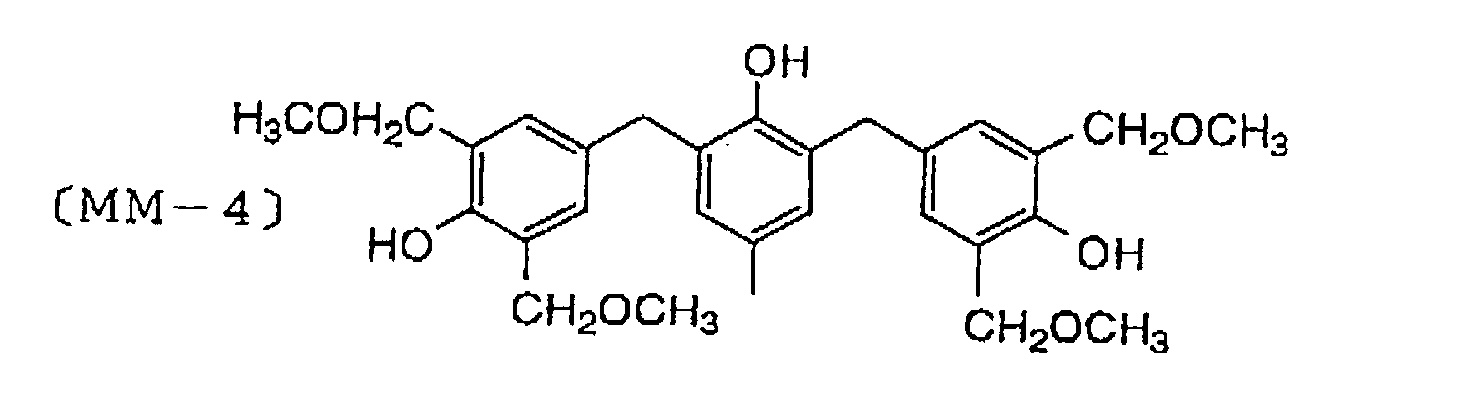
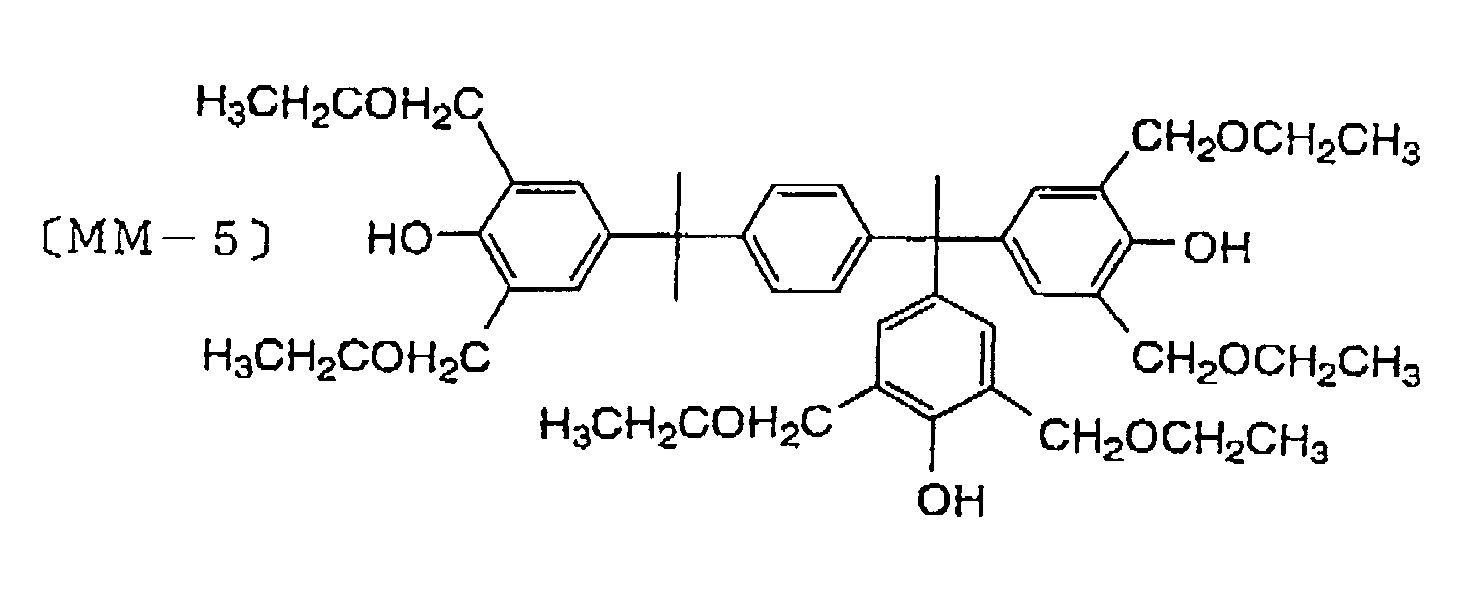
- Using the compounds constituting the resist compositions of the invention selected from the synthesis examples described above and comparative compounds, the solutions of the photoresist compositions having the compositions shown in Table 1 below were prepared.
- After filtering each sample solution with a filter of 0.1 µm, the solution was coated on a silicon wafer using a spin coater and dried by a vacuum-adsorption type hot plate for 90 seconds at 110°C to form a resist film having a film thickness of 0.3 µm.
Resin (g) Acid generator (g) Crosslinking agent )g) Solvent (g) Polymerizable monomer (g) Example 1 a-(28)
(1.05)I-1
(0.07)MM-1
(0.18)PGMMEA
(8.5)RM-1
(0.12)Example 2 a-(29)
(1.05)I-8
(0.07)MM-3
(0.18)PGMMEA
(8.5)RM-2
(0.12)Example 3 a-(32)
(1.05)I-9
(0.07)MM-4
(0.18)PGMMEA
(8.5)RM-3
(0.12)Example 4 a-(34)
(1.05)II-1
(0.07)MM-2
(0.18)PGMMEA
(8.5)RM-1
(0.12)Example 5 a-(39)
(1.05)II-4
(0.07)CL-1
(0.18)PGMMEA*
(8.5)RM-1
(0.12)Example 6 a-(50)
(1.05)III-1
(0.07)MM-1
(0.18)PGMMEA*
(8.5)RM-2
(0.12)Example 7 a- (67)
(1.05)III-2
(0.07)MM-2
(0.18)PGMMEA*
(8.5)RM-3
(0.12)Example 8 a-(72)
(1.05)I-1
(0.07)MM-3
(0.18)PGMMEA*
(8.5)RM-1
(0.12)Example 9 a-(81)
(1.05)II-1
(0.07)CL-2
(0.18)PGMMEA*
(8.5)RM-3
(0.12)Example 10 a-(83)
(1.05)III-2
(0.07)MM-1
(0.18)PGMMEA*
(8.5)RM-2
(0.12)Example 11 a-(87)
(1.05)I-9
(0.07)CL-1
(0.18)PGMMEA*
(8.5)BM-2
(0.12)Example 12 a-(91)
(1.05)PAG-1
(0.07)MM-1
(0.18)PGMMEA*
(8.5)RM-3
(0.12)Comparative Example 1 a-(1)
(1.05)PAG-1
(0.07)CL-1
(0.28)PGMMEA*
(8.5)none Comparative Example 2 a-(28)
(1.05)I-1
(0.07)MM-1
(0.30)PGMMEA*
(8.5)none - In table 1, in the composition of resin a-(67), x/y/z = 85/8/7, in the composition resin a-(81), x/y/z = 70/10/20, in the composition resin a- (91), x/y/z = 50/30/20, in other resins, x/y = 85/15, and the weight average molecular weights were in the range from 8,000 t0 16,000 (dispersion degrees 1.2 to 2.4).
- In Table 1;
- (Photo-acid-generator)
PAG-1: Ph3S+ CF3SO3- - (Crosslinking agent)
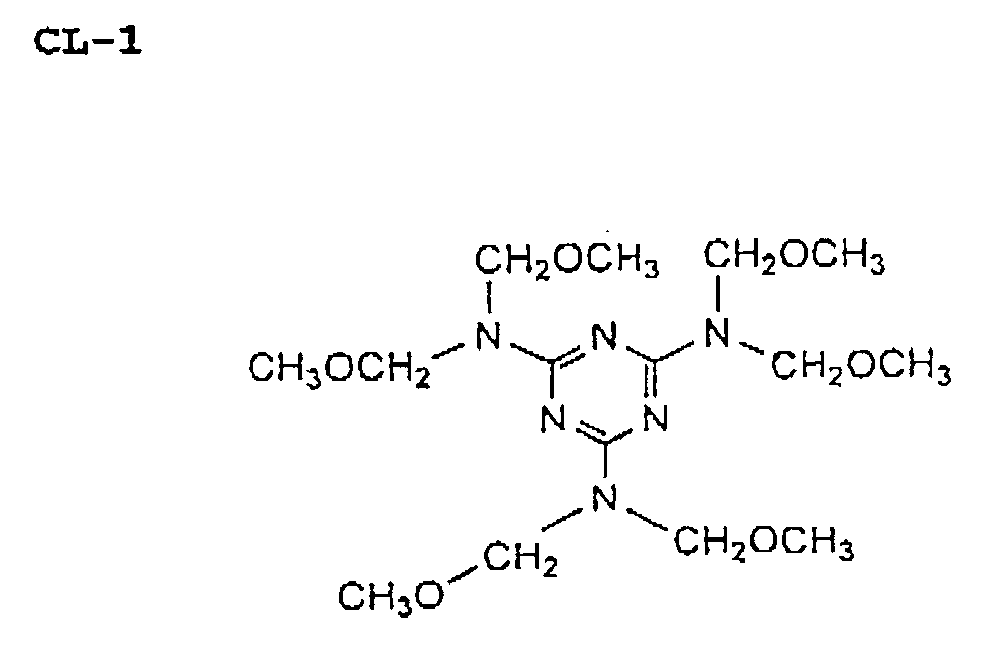
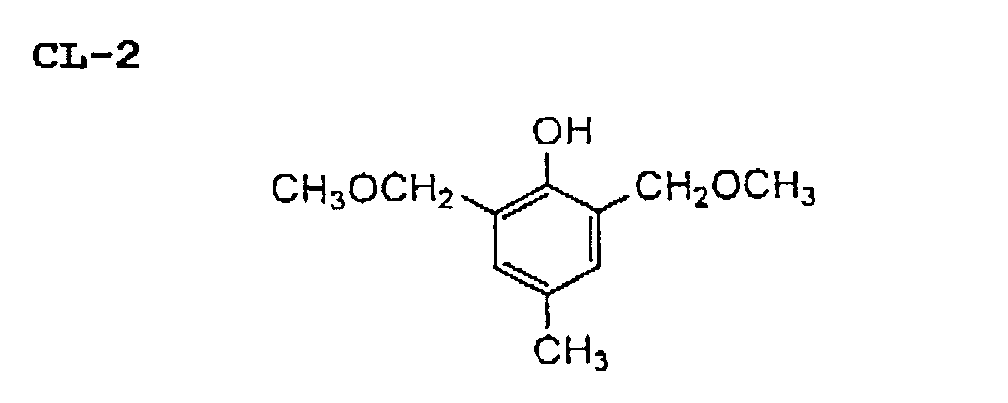
-
- As the polymerizable monomers:
- RM-1:
- Tetraethylene glycol diacrylate (manufactured by NIPPON KAYAKU CO., LTD.)
- RM-2:
- Trimethylolpropane triacrylate (manufactured by NIPPON KAYAKU CO., LTD.)
- RM-3:
- dipentaerythritol hexaacrylate (manufactured by NIPPON KAYAKU CO., LTD.)
- The resist film was irradiated using an electron beam imaging apparatus (acceleration voltage 50 Kev). After the irradiation, each rest film was heated by a vacuum adsorption type hot plate of 110°C for 60 seconds, the support having the resist film was dipped in an aqueous 2.38% tetramethylammonium hydroxide (TMAH) for 60 seconds, rinsedwith water for 30 seconds, and dried. The cross-sectional form of the pattern obtained was observed by a scanning type electron microscope.
- Also, the sensitivity is defined to be the minimum irradiation energy at resolving a line (line : space = 1 : 1) of 0.20 µm and the limiting resolving power (line and space being separately resolved) at the irradiation amount is defined as the resolving power. About a sample the line (line : space = 1 : 1) of 0.20 µm, the limiting resolving power was defined as the resolving power and the irradiation energy at that time was defined as the sensitivity. The irradiated performance evaluation results at the time are shown in Table 2 below.
Sensitivity (µC/cm2) Resolving power (µm) Profile Example 1 7 0.10 rectangle Example 2 9 0.09 rectangle Example 3 7 0.08 rectangle Example 4 5 0.09 rectangle Example 5 10 0.08 rectangle Example 6 8 0.10 rectangle Example 7 5 0.10 rectangle Example 8 11 0.08 rectangle Example 9 10 0.10 rectangle Example 10 12 0.12 slightly taper Example 11 15 0.11 slightly taper Example 12 10 0.12 slightly taper Comparative Example 1 24 0.25 taper Comparative Example 2 35 0.22 taper - From the results of Table 2, it can be seen that in the negative-working resist compositions of the invention made of the combination of the polymerizable monomers, the sensitivity and the resolution are large improved as compared with the comparative examples containing the components.
- Using the compositions of examples 1, 4, 7, and 12 and Comparative Example 1 described above, each resist film was formed by the same manner as described above and was irradiated using the electron beam imaging apparatus in the condition of an accelerated voltage of 75 KeV (Examples 13 to 16, Comparative Example 3). After the irradiation, each film was heated, developed, and rinsed as in the above-described examples, and the pattern obtained was observed by a scanning type electron microscope. The evaluation results are shown in Table 3.
Sensitivity (µC/cm2) Resolving power (µm) Profile Example 13 12 0.09 rectangle Example 14 8 0.08 rectangle Example 15 9 0.09 rectangle Example 16 16 0.11 slightly taper Comparative Example 3 42 42 0.23 0.23 slightly taper - From the results, it can be seen that the negative-working resist compositions of the invention show good sensitivity and resolution even by the electron beam irradiation of the accelerated voltage as compared with the composition of the comparative example.
- Using the compounds constituting the resist compositions of the invention selected from the synthesis examples described above and comparative compounds, the solutions of thephotoresist compositions having the compositions shown in Table 4 below were prepared.
- After filtering each sample solution with a filter of 0.1 µm, the solution was coated on a silicon wafer using a spin coater and dried by a vacuum-adsorption type hot plate for 90 seconds at 110°C to form a resist film having a film thickness of 0.3 µm.
Resin (g) Acid generator (g) Crosslinking agent )g) Solvent (g) Polymerizable monomer (g) Example 17 a'-(2)
(1.05)I-1
(0.07)MM-1
(0.18)PGMMEA
(8.5)none Example 18 a'-(4)
(1.05)I-8
(0.07)MM-3
(0.18)PGMMEA*
(8.5)none Example 19 a'-(7)
(1.05)I-9
(0.07)MM-4
(0.16)PGMMEA*
(8.5)none Example 20 a'-(8)
(1.05)II-1
(0.07)MM-2
(0.18)PGMMEA*
(8.5)none Example 21 a'-(15)
(1.05)II-4
(0.07)CL-1
(0.18)PGMMEA*
(8.5)none Example 22 a'-(20)
(1.05)III-1
(0.07)MM-1
(0.18)PGMMEA*
(8.5)none Example 23 Example 23 a'-(26)
(1.05)III-2
(0.07)MM-2
(0.18)PGMMEA*
(8.5)RM-1
(0.12)Example 24 a'-(28)
(1.05)I-1
(0.07)MM-3
(0.18)PGMMEA*
(8.5)RM-2
(0.12)Example 25 a'-(40)
(1.05)II-1
(0.07)CL-2
(0.18)PGMMEA*
(8.5)RM-3
(0.12)Example 26 a'-(47)
(1.05)III-2
(0.07)MM-1
(0.18)PGMMEA*
(8.5)none Example 27 a'-(58)
(1.05)I-9
(0.07)CL-1
(0.18)PGMMEA*
(8.5)BM-1
(0.12)Example 28 a'-(59)
(1.05)PAG-1
(0.07)MM-1
(0.18)PGMMEA*
(8-5)RM-3
(0.12)Comparative Example 4 Polymer 1
(1.05)PAG-1
(0.07)CL-1
(0.28)PGMMEA*
(8.5)none Comparative Example 5 Polymer 2
(1.05)I-1
(0.07)MM-1
(0.30)PGMMEA*
(8.5)none - In Table 4, in the composition of resin a'-(40), x/y/z = 82/13/5, in the composition of resin a' - (47) , x/y/z = 78/15/7, in the composition resin a'- (58) and a' - (59) , x/y/z = 65/20/15, in other resins, x/y = 80/20 to 85/15, and the weight average molecular weights were in the range from 8,000 t0 16,000 (dispersion degrees 1.2 to 2.4).
-
- Polymer 1:
- Poly(4-hydroxystyrene) (manufactured by Nippon Soda Co., Ltd., VP-8000)
- Polymer 2:
- Poly(3-hydroxystyrene) (manufactured by Maruzen Petrochemical Company Limited, Mw = 9700, Mw/Mn = 2.2)
- The resist film was irradiated using an electron beam imaging apparatus (acceleration voltage 50 Kev). After the irradiation, each rest film was heated by a vacuum adsorption type hot plate of 110°C for 60 seconds, the support having the resist film was dipped in an aqueous 2.38% tetramethylammonium hydroxide (TMAH) for 60 seconds, rinsed with water for 30 seconds, and dried. The cross-sectional form of the pattern obtained was observed by a scanning type electron microscope.
- Also, the sensitivity is defined to be the minimum irradiation energy at resolving a line (line : space = 1 : 1) of 0.20 µm and the limiting resolving power (line and space being separately resolved) at the irradiation amount is defined as the resolving power. About a sample the line (line : space = 1 : 1) of 0.20 µm, the limiting resolving power was defined as the resolving power and the irradiation energy at that time was defined as the sensitivity.
- The performance evaluation results are shown in Table 5.
Sensitivity (µC/cm2) Resolving power (µm) Profile Example 17 6 0.09 rectangle Example 18 7 0.09 rectangle Example 19 9 0.08 rectangle Example 20 5 0.09 rectangle Example 21 6 0.08 rectangle Example 22 7 0.09 rectangle Example 23 5 0.10 rectangle Example 24 10 0.08 rectangle Example 25 7 0.10 rectangle Example 26 5 0.09 rectangle Example 27 11 0.10 rectangle Example 28 10 0.11 rectangle Comparative Example 4 26 0.22 slightly taper Comparative Example 5 20 0.20 slightly taper - From the results of Table 5, it can be seen that the negative-working resist compositions of the invention show good sensitivity and resolution even by the electron beam irradiation of the accelerated voltage as compared with the composition of the comparative example.
- Using the compositions of examples 17, 20, 23 and 28 and Comparative Example 4 described above, each resist film was formed by the same manner as described above and was irradiated using the electron beam imaging apparatus in the condition of an accelerated voltage of 75 KeV (Examples 29 to 32, Comparative Example 6). After the irradiation, each film was heated, developed, and rinsed as in the above-described examples, and the pattern obtained was observed by a scanning type electron microscope. The evaluation results are shown in Table 6.
Sensitivity (µc/cm2) Resolving power (µm) Profile Example 29 10 0.08 rectangle Example 30 7 0.08 rectangle Example 31 8 0.08 rectangle Example 32 17 0.10 rectangle Comparative Example 6 45 0.20 slightly taper - From the results, it can be seen that the negative-working resist compositions of the invention show good sensitivity and resolution even by the electron irradiation of the accelerated voltage as compared with the composition of the comparative example.
- As described above in detail, according to the present invention, a negative-working resist composition for electron beams and X-rays excellent in the sensitivity and the resolution and having a rectangular profile even under the high-accelerated voltage condition can be provided.
- While the invention has been described in detail and with reference to specific embodiments thereof, it will be apparent to one skilled in the art that various changes and modifications can be made therein without departing from the spirit and scope thereof.
- This application is based on Japanese patent applications No. 2000-4766 filed on January 13, 2000 and No. 2000-84469 filed on March 24, 2000, the entire contents of which incorporated herein by reference.
Claims (17)
- A negative-working resist composition for electron beams or X-rays comprising (A) a compound generating an acid and/or radical species by the irradiation of electron beams or x-rays, (B) a resin which is insoluble in water and soluble in an alkali aqueous solution, (C) a crosslinking agent causing crosslinking with the resin of component (B) by the action of an acid, and (D) a compound having at least one unsaturated bond capable of being polymerized by an acid and/or a radical.
- The negative-working resist composition for electron beams or X-rays according to claim 1, wherein the resist composition further contains (E) an organic basic compound.
- The negative-working resist composition for electron beams or X-rays according to claim 1, wherein the resin of component (B) is the resin having a repeating unit shown by the following formula (a) ;wherein R1 represents a hydrogen atom, a halogen atom, a cyano group, or an alkyl or haloalkyl group which may have a substituent; R2 represents a hydrogen atom, or an alkyl, cycloalkyl, aryl, aralkyl, or acyl group which may have a substituent; R3 and R4, which may be the same or different, each represents a hydrogen atom, a halogen atom, a cyano group, or an alkyl, cycloalkyl, alkenyl, aralkyl, or aryl group which may have a substituent; A represents a single bond, or a divalent alkylene, alkenylene, cycloalkylene, or arylene group which may have a substituent, or -O-, -SO2-, -O-CO-R5-, -CO-O-R6-, or -CO-N(R7)-R8-; R5, R6, and R8, which may be the same or different, each represents a single bond, or an alkylene, alkenylene, cycloalkylene, or arylene group, which may have a substituent, singly or a divalent group formed by combining the above-described group and at least one kind selected from an ether structure, an ester structure, an amide structure, a urethane structure, and a ureido structure; R7 represents a hydrogen atom, or an alkyl, cycloalkyl, aralkyl, or aryl group which may have a substituent; and n represents an integer of from 1 to 3; and also plural R2s, or R2 and R3 or R4 may combine with each other to form a ring.
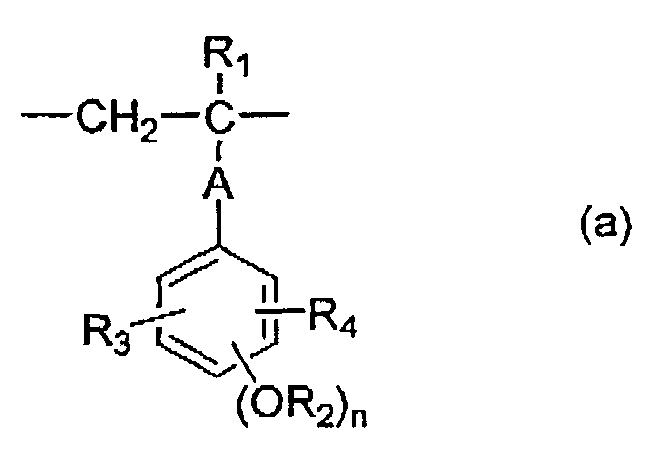
- The negative-working resist composition for electron beams or X-rays according to claim 1, wherein the compound of component (A) is selected from the sulfonate compounds of sulfonium or iodonium.
- The negative-working resist composition for electron beams or X-rays according to claim 1, wherein the compound of component (A) is the sulfonic acid ester compound of N-hydroxyimide or a disulfonyldiazomethane compound.
- The negative-working resist composition for electron beams or X-rays according to claim 1, wherein the crosslinking agent of component (C) is a hydroxymethylated, alkoxymethylated, or acyloxymethylated phenol compound.
- The negative-working resist composition for electron beams or X-rays according to claim 1, wherein the crosslinking agent of component (C) is an alkoxymethylated or acyloxymethylated melamine compound or resin, or an alkoxymethylated or acyloxymethylated urea compound or resin.
- The negative-working resist composition for electron beams or x-rays according to claim 1, suitable for electron beam irradiation under the accelerated voltage condition of at least 75 KeV.
- A negative-working resist composition for electron beams or X-rays comprising(A) a compound generating an acid and/or radical species by the irradiation of electron beams or X-rays,(B') a resin having at least one unsaturated bond polymerizable by an acid and/or an alkali, which is insoluble in water but soluble in an alkali aqueous solution, and(C) a crosslinking agent causing crosslinking with the resin (B') by the action of an acid.
- Thenegative-working resist composition for electron beams or X-rays according to claim 9, wherein the resin of component (B') is a resin containing the repeating unit shown by following formula (a');
 wherein R1' represents a hydrogen atom, a cyano group, or an alkyl or haloalkyl group which may have a substituent;R2' to R4' each represents a hydrogen atom, a group shown by the formula (b), (c), or (d) described below, or an alkyl, cycloalkyl, aryl, aralkyl, or acyl group which may have a substituent; andR5' and R6' , which may be the same or different, each represents a hydrogen atom, a hydroxyl group, a halogen atom, a cyano group, or an alkyl, cycloalkyl, alkenyl, aralkyl, or aryl group which may have a substituent.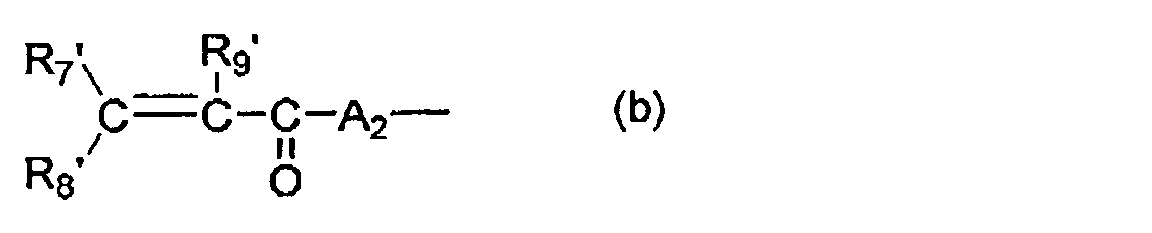
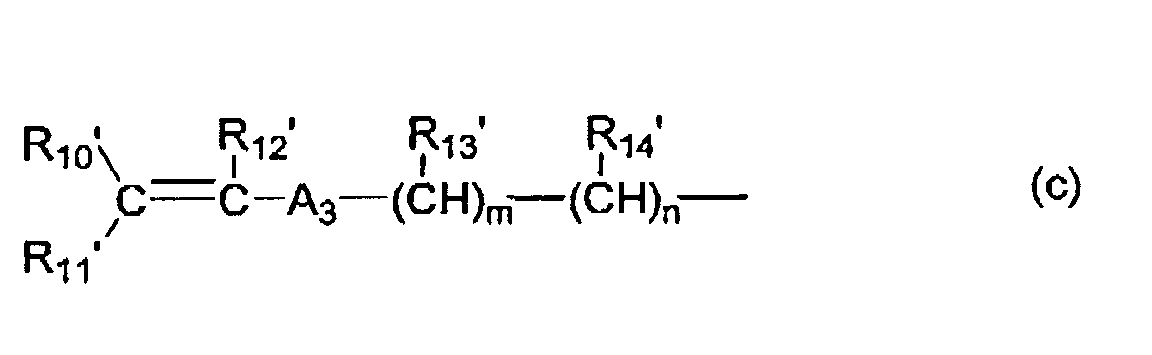
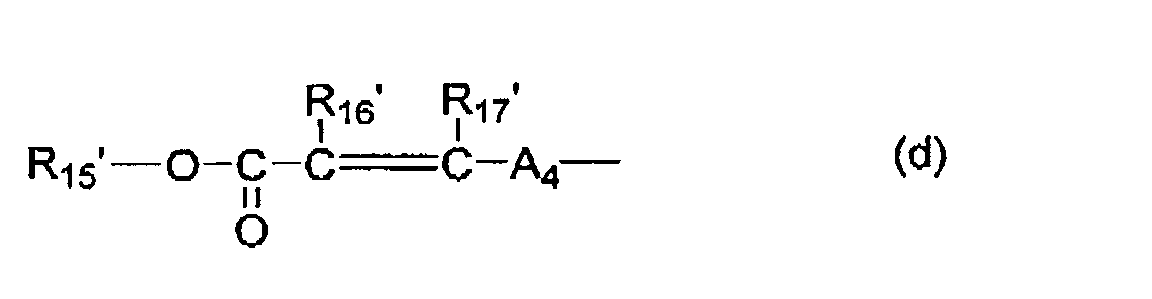 wherein R7' to R12', R16', and R17' each represents a hydrogen atom, a halogen atom, a cyano group, or an alkyl or haloalkyl group which may have a substituent;R13' and R14' each represents a hydrogen atom, a halogen atom, a hydroxy group, or an alkyl, alkoxy, or acyloxy group which may have a substituent;R15' represents a hydrogen atom or an alkyl, cycloalkyl, aralkyl, or aryl group which may have a substituent;A1 represents a single bond, or a divalent alkylene, alkenylene, cycloalkylene, or arylene group which may have a substituent, or -O-, -SO2-, -O-CO-R20' -, -CO-O-R21'-, or -CO-N (R22')-R23'-;R20', R21', and R23', which may be the same or different, each represents a single bond, or a divalent alkylene, alkenylene, cycloalkylene, or arylene group which may have an ether structure, an ester structure, an amide structure, a urethane structure, or a ureido structure or may have a substituent;R22' represents a hydrogen atom, or an alkyl , cycloalkyl, aralkyl, or aryl group which may have a substituent;A2 represents a single bond, -O-R21'-, or -N(R22')-R23'-;A3 represents a single bond, -SO2-, or an arylene group which may have an alkylene structure or may have a substituent;A4 represents a single bond, a divalent alkylene, cycloalkylene, or arylene group which may have a substituent, or -O-. -SO2-, -CO-. or -CO-O-R21'-;x, y, and z in the formula (a') each represents 0 or 1 and m and n in the formula (c) each represents 0 or an integer of at least 1, provided that in the formula (a'), at least one repeating unit has the group of the formula (b), (c), or (d); and two of R2' to R4', or one of R2' to R4' and R5' or R6' may combine with each other to form a ring.
 - The negative-working resist composition for electron beams or X-rays according to claim 9, wherein the resist composition further contains (D) a compound having at least one unsaturated bond polymerizable by an acid and/or a radical.
- The negative-working resist composition for electron beams or X-rays according to claim 9, wherein resist the composition further contains (E) an organic basic compound.
- The negative-working resist composition for electron beams or X-rays according to claim 9, wherein the compound of component (A) is selected from the sulfonate compound of sulfonium or iodonium.
- The negative-working resist composition for electron beams or X-rays according to claim 9, wherein the compound of component (A) is the sulfonic acid ester compound of N-hydroxyimide or a disulfonyldiazomethane compound.
- The negative-working resist composition for electron beams or X-rays according to claim 9, wherein the crosslinking agent of component (C) is a hydroxymethylated, alkoxymethylated, or acyloxymethylated phenol compound.
- The negative-working resist composition for electron beams or X-rays according to claim 9, wherein the crosslinking agent of component (C) is an alkoxymethylated or acyloxymethylated melamine compound or resin or an alkoxymethylated or acyloxymethylated urea compound or resin.
- The negative-working resist composition for electron beams or X-rays according to claim 9, suitable for electron beam irradiation under the accelerated voltage condition of at least 75 KeV.
Applications Claiming Priority (4)
| Application Number | Priority Date | Filing Date | Title |
|---|---|---|---|
| JP2000004766 | 2000-01-13 | ||
| JP2000004766 | 2000-01-13 | ||
| JP2000084469 | 2000-03-24 | ||
| JP2000084469 | 2000-03-24 |
Publications (2)
| Publication Number | Publication Date |
|---|---|
| EP1117004A2 true EP1117004A2 (en) | 2001-07-18 |
| EP1117004A3 EP1117004A3 (en) | 2003-08-13 |
Family
ID=26583449
Family Applications (1)
| Application Number | Title | Priority Date | Filing Date |
|---|---|---|---|
| EP01100113A Withdrawn EP1117004A3 (en) | 2000-01-13 | 2001-01-12 | Electron beam or x-ray negative-working resist composition |
Country Status (4)
| Country | Link |
|---|---|
| US (1) | US6824948B1 (en) |
| EP (1) | EP1117004A3 (en) |
| KR (1) | KR100733847B1 (en) |
| TW (1) | TWI289238B (en) |
Cited By (4)
| Publication number | Priority date | Publication date | Assignee | Title |
|---|---|---|---|---|
| WO2006001515A1 (en) | 2004-06-28 | 2006-01-05 | Canon Kabushiki Kaisha | Photosensitive resin composition, ink jet head using photosensitive resin composition, and process for manufacturing ink jet head |
| EP1391784A3 (en) * | 2002-08-22 | 2006-08-09 | Fuji Photo Film Co., Ltd. | Polymerizable composition and negative-working planographic printing plate precursor using the same |
| US9469941B2 (en) | 2011-07-01 | 2016-10-18 | Empire Technology Development Llc | Paraben derivatives for preserving cellulosic materials |
| US20170261852A1 (en) * | 2014-11-26 | 2017-09-14 | Hitachi Chemical Company, Ltd. | Photosensitive resin composition, photosensitive element, cured product, semiconductor device, method for forming resist pattern, and method for producing circuit substrate |
Families Citing this family (9)
| Publication number | Priority date | Publication date | Assignee | Title |
|---|---|---|---|---|
| US7022455B2 (en) * | 2001-12-28 | 2006-04-04 | Shipley Company, L.L.C. | Photoacid-labile polymers and photoresists comprising same |
| US7083892B2 (en) * | 2002-06-28 | 2006-08-01 | Fuji Photo Film Co., Ltd. | Resist composition |
| TWI400568B (en) | 2004-12-24 | 2013-07-01 | Mitsubishi Gas Chemical Co | Radiation-sensitive composition, amorphous film and method for forming resist pattern |
| KR100904068B1 (en) | 2007-09-04 | 2009-06-23 | 제일모직주식회사 | Photosensitive resin composition for color filters and color filter using same |
| CN103874731B (en) | 2011-09-07 | 2017-02-15 | 微量化学公司 | Epoxy formulations and methods for producing relief patterns on low surface energy substrates |
| US11635688B2 (en) * | 2012-03-08 | 2023-04-25 | Kayaku Advanced Materials, Inc. | Photoimageable compositions and processes for fabrication of relief patterns on low surface energy substrates |
| JP5850873B2 (en) * | 2012-07-27 | 2016-02-03 | 富士フイルム株式会社 | Actinic ray-sensitive or radiation-sensitive resin composition, resist film using the same, pattern formation method, and electronic device manufacturing method |
| JP6438645B2 (en) * | 2013-09-26 | 2018-12-19 | 富士フイルム株式会社 | Actinic ray-sensitive or radiation-sensitive composition, and resist film, pattern forming method, resist-coated mask blank, photomask manufacturing method, and electronic device manufacturing method using the same |
| CN112558409B (en) * | 2019-09-25 | 2022-05-20 | 常州强力先端电子材料有限公司 | Sulfonylimide photoacid generators capable of highly generating acid on line I |
Citations (5)
| Publication number | Priority date | Publication date | Assignee | Title |
|---|---|---|---|---|
| US4621043A (en) | 1983-01-31 | 1986-11-04 | E. I. Du Pont De Nemours And Company | Storage stable photopolymerizable composition |
| JPH01168723A (en) | 1987-12-24 | 1989-07-04 | Hitachi Chem Co Ltd | Photosensitive resin composition |
| EP0403170A2 (en) | 1989-06-09 | 1990-12-19 | Morton International, Inc. | Photoimageable compositions |
| EP0509512A1 (en) | 1991-04-17 | 1992-10-21 | Nippon Paint Co., Ltd. | Photosensitive composition for volume hologram recording |
| US5858618A (en) | 1996-12-02 | 1999-01-12 | Nan Ya Plastics Corporation | Photopolymerizable resinous composition |
Family Cites Families (16)
| Publication number | Priority date | Publication date | Assignee | Title |
|---|---|---|---|---|
| US4857437A (en) * | 1986-12-17 | 1989-08-15 | Ciba-Geigy Corporation | Process for the formation of an image |
| JP2505033B2 (en) * | 1988-11-28 | 1996-06-05 | 東京応化工業株式会社 | Electron beam resist composition and method for forming fine pattern using the same |
| US5180653A (en) * | 1988-11-28 | 1993-01-19 | Tokyo Ohka Kogyo Co., Ltd. | Electron beam-curable resist composition and method for fine patterning using the same |
| JP2554276B2 (en) * | 1989-01-20 | 1996-11-13 | 富士写真フイルム株式会社 | Liquid photosensitive resin composition |
| US5124234A (en) * | 1989-01-20 | 1992-06-23 | Fuji Photo Film Co., Ltd. | Liquid light-sensitive resin composition |
| DE69402232T2 (en) * | 1993-02-26 | 1997-09-18 | Ibm | Universal negative working photoresist |
| JP3279059B2 (en) | 1993-06-02 | 2002-04-30 | 住友化学工業株式会社 | Photoresist composition |
| JP3424357B2 (en) | 1994-11-29 | 2003-07-07 | 住友化学工業株式会社 | Chemically amplified negative resist composition for electron beam |
| EP0732626B1 (en) | 1995-03-16 | 2004-03-03 | Shipley Company LLC | Radiation sensitive composition comprising polymer having inert blocking groups |
| JP3506817B2 (en) * | 1995-07-26 | 2004-03-15 | クラリアント インターナショナル リミテッド | Radiation sensitive composition |
| JP3520643B2 (en) | 1995-12-14 | 2004-04-19 | Jsr株式会社 | Negative radiation-sensitive resin composition |
| JP3780569B2 (en) | 1996-06-20 | 2006-05-31 | Jsr株式会社 | Chemically amplified negative resist for KrF excimer laser irradiation |
| EP1033625A1 (en) * | 1997-07-24 | 2000-09-06 | JSR Corporation | Radiation sensitive composition |
| JP4282783B2 (en) * | 1997-12-16 | 2009-06-24 | Jsr株式会社 | Radiation sensitive composition for color filter |
| US6338936B1 (en) * | 1998-02-02 | 2002-01-15 | Taiyo Ink Manufacturing Co., Ltd. | Photosensitive resin composition and method for formation of resist pattern by use thereof |
| US6630285B2 (en) * | 1998-10-15 | 2003-10-07 | Mitsui Chemicals, Inc. | Positive sensitive resin composition and a process for forming a resist pattern therewith |
-
2001
- 2001-01-09 TW TW090100434A patent/TWI289238B/en not_active IP Right Cessation
- 2001-01-12 KR KR1020010001762A patent/KR100733847B1/en not_active Expired - Fee Related
- 2001-01-12 EP EP01100113A patent/EP1117004A3/en not_active Withdrawn
- 2001-01-16 US US09/759,362 patent/US6824948B1/en not_active Expired - Lifetime
Patent Citations (6)
| Publication number | Priority date | Publication date | Assignee | Title |
|---|---|---|---|---|
| US4621043A (en) | 1983-01-31 | 1986-11-04 | E. I. Du Pont De Nemours And Company | Storage stable photopolymerizable composition |
| US4621043B1 (en) | 1983-01-31 | 1988-06-28 | ||
| JPH01168723A (en) | 1987-12-24 | 1989-07-04 | Hitachi Chem Co Ltd | Photosensitive resin composition |
| EP0403170A2 (en) | 1989-06-09 | 1990-12-19 | Morton International, Inc. | Photoimageable compositions |
| EP0509512A1 (en) | 1991-04-17 | 1992-10-21 | Nippon Paint Co., Ltd. | Photosensitive composition for volume hologram recording |
| US5858618A (en) | 1996-12-02 | 1999-01-12 | Nan Ya Plastics Corporation | Photopolymerizable resinous composition |
Non-Patent Citations (3)
| Title |
|---|
| MACROMOLECULES, vol. 28, no. 11, 1995, pages 3787 - 3789 |
| POLYM. BULL.'' (BERLIN, vol. 24, no. 4, 1990, pages 385 - 389 |
| POLYM. BULL.'' (BERLIN, vol. 24, no. 4, 1990, pages 395 - 389 |
Cited By (7)
| Publication number | Priority date | Publication date | Assignee | Title |
|---|---|---|---|---|
| EP1391784A3 (en) * | 2002-08-22 | 2006-08-09 | Fuji Photo Film Co., Ltd. | Polymerizable composition and negative-working planographic printing plate precursor using the same |
| US7232644B2 (en) | 2002-08-22 | 2007-06-19 | Fujifilm Corporation | Polymerizable composition and negative-working planographic printing plate precursor using the same |
| WO2006001515A1 (en) | 2004-06-28 | 2006-01-05 | Canon Kabushiki Kaisha | Photosensitive resin composition, ink jet head using photosensitive resin composition, and process for manufacturing ink jet head |
| US7611827B2 (en) | 2004-06-28 | 2009-11-03 | Canon Kabushiki Kaisha | Photosensitive resin composition, ink jet head using photosensitive resin composition, and process for manufacturing ink jet head |
| US9469941B2 (en) | 2011-07-01 | 2016-10-18 | Empire Technology Development Llc | Paraben derivatives for preserving cellulosic materials |
| US20170261852A1 (en) * | 2014-11-26 | 2017-09-14 | Hitachi Chemical Company, Ltd. | Photosensitive resin composition, photosensitive element, cured product, semiconductor device, method for forming resist pattern, and method for producing circuit substrate |
| US10656521B2 (en) * | 2014-11-26 | 2020-05-19 | Hitachi Chemical Company, Ltd. | Photosensitive resin composition, photosensitive element, cured product, semiconductor device, method for forming resist pattern, and method for producing circuit substrate |
Also Published As
| Publication number | Publication date |
|---|---|
| US6824948B1 (en) | 2004-11-30 |
| KR100733847B1 (en) | 2007-06-29 |
| KR20010088315A (en) | 2001-09-26 |
| TWI289238B (en) | 2007-11-01 |
| EP1117004A3 (en) | 2003-08-13 |
Similar Documents
| Publication | Publication Date | Title |
|---|---|---|
| US6673512B1 (en) | Negative-working resist composition | |
| JP3909818B2 (en) | Positive resist composition | |
| KR20030080195A (en) | Resist composition for electron beam, euv or x-ray | |
| JP3790960B2 (en) | Negative resist composition | |
| US6824948B1 (en) | Electron beam or X-ray negative-working resist composition | |
| KR100891133B1 (en) | Negative-working resist composition for electron beams or x-rays | |
| JP2004101818A (en) | Negative resist composition | |
| JP2002372783A (en) | Negative type resist composition | |
| JP3856290B2 (en) | Negative resist composition | |
| JP4276773B2 (en) | Negative resist composition for electron beam or X-ray | |
| US20030054287A1 (en) | Resist composition | |
| JP4208418B2 (en) | Negative resist composition for electron beam or X-ray | |
| JP2006215271A (en) | Resist composition and pattern forming method using the same | |
| JP4079729B2 (en) | Negative resist composition | |
| JP2004198724A (en) | Negative resist composition | |
| JP2002049150A (en) | Negative type resist composition for electron beam or x-ray | |
| JP2002333714A (en) | Resist composition | |
| JP4149122B2 (en) | Negative resist composition for electron beam or X-ray | |
| JP2002014470A (en) | Negative type resist composition for electron beam or x-ray | |
| JP2002049149A (en) | Negative type resist composition for electron beam or x-ray | |
| JP2006215202A (en) | Resist composition and pattern forming method using the same | |
| JP2002202601A (en) | Negative type resist composition for electron beam or x-ray | |
| JP2004334106A (en) | Negative resist composition | |
| JP4070538B2 (en) | Negative resist composition | |
| JP2003066596A (en) | Negative resist composition |
Legal Events
| Date | Code | Title | Description |
|---|---|---|---|
| PUAI | Public reference made under article 153(3) epc to a published international application that has entered the european phase |
Free format text: ORIGINAL CODE: 0009012 |
|
| AK | Designated contracting states |
Kind code of ref document: A2 Designated state(s): AT BE CH CY DE DK ES FI FR GB GR IE IT LI LU MC NL PT SE TR |
|
| AX | Request for extension of the european patent |
Free format text: AL;LT;LV;MK;RO;SI |
|
| PUAL | Search report despatched |
Free format text: ORIGINAL CODE: 0009013 |
|
| AK | Designated contracting states |
Designated state(s): AT BE CH CY DE DK ES FI FR GB GR IE IT LI LU MC NL PT SE TR |
|
| AX | Request for extension of the european patent |
Extension state: AL LT LV MK RO SI |
|
| 17P | Request for examination filed |
Effective date: 20031001 |
|
| AKX | Designation fees paid |
Designated state(s): BE DE |
|
| RAP1 | Party data changed (applicant data changed or rights of an application transferred) |
Owner name: FUJIFILM CORPORATION |
|
| 17Q | First examination report despatched |
Effective date: 20090415 |
|
| GRAP | Despatch of communication of intention to grant a patent |
Free format text: ORIGINAL CODE: EPIDOSNIGR1 |
|
| INTG | Intention to grant announced |
Effective date: 20141006 |
|
| STAA | Information on the status of an ep patent application or granted ep patent |
Free format text: STATUS: THE APPLICATION IS DEEMED TO BE WITHDRAWN |
|
| 18D | Application deemed to be withdrawn |
Effective date: 20150217 |