EP1111863B1 - Method and apparatus for shortening the critical path of reduced complexity sequence estimation techniques - Google Patents
Method and apparatus for shortening the critical path of reduced complexity sequence estimation techniques Download PDFInfo
- Publication number
- EP1111863B1 EP1111863B1 EP00310939.4A EP00310939A EP1111863B1 EP 1111863 B1 EP1111863 B1 EP 1111863B1 EP 00310939 A EP00310939 A EP 00310939A EP 1111863 B1 EP1111863 B1 EP 1111863B1
- Authority
- EP
- European Patent Office
- Prior art keywords
- dimensional
- branch metrics
- channel
- state
- branch
- Prior art date
- Legal status (The legal status is an assumption and is not a legal conclusion. Google has not performed a legal analysis and makes no representation as to the accuracy of the status listed.)
- Expired - Lifetime
Links
- 238000000034 method Methods 0.000 title claims description 77
- 238000004904 shortening Methods 0.000 title description 4
- 230000015654 memory Effects 0.000 claims description 47
- 238000012545 processing Methods 0.000 claims description 22
- 238000011045 prefiltration Methods 0.000 claims description 11
- 230000007704 transition Effects 0.000 claims description 9
- 230000004044 response Effects 0.000 claims description 8
- 230000003111 delayed effect Effects 0.000 claims description 3
- 230000014509 gene expression Effects 0.000 claims description 3
- 108091006146 Channels Proteins 0.000 claims 27
- 238000009825 accumulation Methods 0.000 claims 1
- 238000007476 Maximum Likelihood Methods 0.000 description 9
- 238000004891 communication Methods 0.000 description 5
- 230000006870 function Effects 0.000 description 5
- 238000005516 engineering process Methods 0.000 description 3
- RYGMFSIKBFXOCR-UHFFFAOYSA-N Copper Chemical compound [Cu] RYGMFSIKBFXOCR-UHFFFAOYSA-N 0.000 description 2
- 238000007792 addition Methods 0.000 description 2
- 230000005540 biological transmission Effects 0.000 description 2
- 238000004364 calculation method Methods 0.000 description 2
- 229910052802 copper Inorganic materials 0.000 description 2
- 239000010949 copper Substances 0.000 description 2
- 230000001419 dependent effect Effects 0.000 description 2
- 238000005192 partition Methods 0.000 description 2
- 230000002040 relaxant effect Effects 0.000 description 2
- 238000000638 solvent extraction Methods 0.000 description 2
- 230000003044 adaptive effect Effects 0.000 description 1
- 238000013459 approach Methods 0.000 description 1
- 239000004020 conductor Substances 0.000 description 1
- 238000013461 design Methods 0.000 description 1
- 238000001514 detection method Methods 0.000 description 1
- 238000011156 evaluation Methods 0.000 description 1
- 230000002349 favourable effect Effects 0.000 description 1
- 230000010354 integration Effects 0.000 description 1
- 238000010606 normalization Methods 0.000 description 1
Images

Classifications
-
- H—ELECTRICITY
- H04—ELECTRIC COMMUNICATION TECHNIQUE
- H04L—TRANSMISSION OF DIGITAL INFORMATION, e.g. TELEGRAPHIC COMMUNICATION
- H04L27/00—Modulated-carrier systems
- H04L27/01—Equalisers
-
- H—ELECTRICITY
- H04—ELECTRIC COMMUNICATION TECHNIQUE
- H04L—TRANSMISSION OF DIGITAL INFORMATION, e.g. TELEGRAPHIC COMMUNICATION
- H04L25/00—Baseband systems
- H04L25/02—Details ; arrangements for supplying electrical power along data transmission lines
- H04L25/03—Shaping networks in transmitter or receiver, e.g. adaptive shaping networks
- H04L25/03006—Arrangements for removing intersymbol interference
- H04L25/03178—Arrangements involving sequence estimation techniques
- H04L25/03184—Details concerning the metric
- H04L25/03197—Details concerning the metric methods of calculation involving metrics
-
- H—ELECTRICITY
- H04—ELECTRIC COMMUNICATION TECHNIQUE
- H04L—TRANSMISSION OF DIGITAL INFORMATION, e.g. TELEGRAPHIC COMMUNICATION
- H04L25/00—Baseband systems
- H04L25/02—Details ; arrangements for supplying electrical power along data transmission lines
- H04L25/03—Shaping networks in transmitter or receiver, e.g. adaptive shaping networks
- H04L25/03006—Arrangements for removing intersymbol interference
- H04L25/03178—Arrangements involving sequence estimation techniques
- H04L25/03203—Trellis search techniques
- H04L25/03235—Trellis search techniques with state-reduction using feedback filtering
-
- H—ELECTRICITY
- H04—ELECTRIC COMMUNICATION TECHNIQUE
- H04L—TRANSMISSION OF DIGITAL INFORMATION, e.g. TELEGRAPHIC COMMUNICATION
- H04L25/00—Baseband systems
- H04L25/02—Details ; arrangements for supplying electrical power along data transmission lines
- H04L25/03—Shaping networks in transmitter or receiver, e.g. adaptive shaping networks
- H04L25/03006—Arrangements for removing intersymbol interference
- H04L25/03178—Arrangements involving sequence estimation techniques
- H04L25/03248—Arrangements for operating in conjunction with other apparatus
- H04L25/03299—Arrangements for operating in conjunction with other apparatus with noise-whitening circuitry
Definitions
- the present invention relates generally to channel equalization and decoding techniques, and more particularly, to sequence estimation techniques with shorter critical paths.
- the transmission rates for local area networks (LANs) that use twisted pair conductors have progressively increased from 10 Megabits-per-second (Mbps) to 1 Gigabit-per-second (Gbps).
- the Gigabit Ethernet 1000 Base-T standard for example, operates at a clock rate of 125 MHz and uses category 5 cabling with four copper pairs to transmit 1 Gbps.
- Trellis-coded modulation (TCM) is employed by the transmitter, in a known manner, to achieve coding gain.
- the signals arriving at the receiver are typically corrupted by intersymbol interference (ISI), crosstalk, echo, and noise.
- ISI intersymbol interference
- a major challenge for 1000 Base-T receivers is to jointly equalize the channel and decode the corrupted trellis-coded signals at the demanded clock rate of 125 MHz, as the algorithms for joint equalization and decoding incorporate non-linear feedback loops that cannot be pipelined.
- a maximum likelihood sequence estimator (MLSE) considers all possible sequences and determines which sequence was actually transmitted, in a known manner.
- the maximum likelihood sequence estimator (MLSE) is the optimum decoder and applies the well-known Viterbi algorithm to perform joint equalization and decoding.
- RSSE reduced state sequence estimation
- DFSE decision-feedback sequence estimation
- PDFE parallel decision-feedback equalization
- RSSE reduced state sequence estimation
- United States Patent Number 5,910,968 discloses a digital communication system having a transmitter and a receiver.
- the receiver transmits a radio-frequency (RF) signal that is continuous phase modulated by digital data.
- the receiver having a converter, a differential detector, and a sequential decoder.
- the receiver receives the RF signal.
- the RF signal is converted into a baseband signal by the converter.
- the baseband signal is received by the differential detector wherein the continuous phase modulation of the baseband signal is detected.
- the detected signal is received and the digital data is decoded by the sequential decoder.
- the sequential decoder has a Viterbi decoder to compensate for intersymbol interference caused by the differential detector.
- the Viterbi decoder performs reduced Viterbi decoding utilizing a feedback loop (FB) for reducing computing inaccuracies due to the reduction of the number of trellis states.
- FB feedback loop
- a method and apparatus are disclosed for improving the processing time of the reduced complexity sequence estimation techniques, such as the RSSE technique, for a given number of states.
- the possible values for the branch metrics in the reduced state sequence estimation (RSSE) technique are precomputed in a look-ahead fashion to permit pipelining and the shortening of the critical path.
- the present invention provides a delay that is similar to a traditional optimum Viterbi decoder. Precomputing the branch metrics for all possible symbol combinations in the channel memory in accordance with the present invention makes it possible to remove the branch metrics unit (BMU) and decision-feedback unit (DFU) from the feedback loop, thereby reducing the critical path.
- BMU branch metrics unit
- DFU decision-feedback unit
- branch metrics unit BMU
- DFU decision-feedback unit
- LABMU look-ahead branch metrics unit
- ISIC intersymbol interference canceller
- a reduced state sequence estimator (RSSE) is disclosed that provides a look-ahead branch metrics unit (LABMU) to precompute the branch metrics for all possible values for the channel memory.
- LABMU look-ahead branch metrics unit
- MUXs multiplexers
- SPCs survivor path cells
- ACSU add-compare-select unit
- the critical path now comprises one MUX, ACSC and SPC.
- the disclosed RSSE can be utilized for both one-dimensional and multi-dimensional trellis codes.
- a modified RSSE is disclosed to reduce the computational load.
- the metrics for each dimension of the multi-dimensional trellis code are precomputed separately.
- the appropriate one-dimensional branch metrics are then selected based on the corresponding survivor symbols in the corresponding survivor path cell (SPC) for that dimension.
- SPC survivor path cell
- a multi-dimensional branch metrics unit then combines the selected one-dimensional branch metrics to form the multi-dimensional branch metrics.
- prefiltering techniques are used to reduce the computational complexity by shortening the channel memory. An example is provided of a specific implementation for a 1000 Base-T Gigabit Ethernet implementation that truncates the postcursor channel memory length to one.
- a novel memory-partitioned survivor memory architecture for the survivor memory units in the survivor path cell is also disclosed.
- a hybrid survivor memory arrangement is disclosed for reduced state sequence estimation (RSSE).
- RSSE reduced state sequence estimation
- the survivor symbols corresponding to the L past decoding cycles are utilized (i) for intersymbol interference cancellation in the decision-feedback units (DFU) of a conventional RSSE, and (ii) for the selection of branch metrics in the multiplexers (MUXU) in an RSSE according to the present invention.
- the present invention stores the survivors corresponding to the L past decoding cycles in a register exchange architecture (REA), and survivors corresponding to later decoding cycles are stored in a trace-back architecture (TBA) or register exchange architecture (REA). Before symbols are moved from the register exchange architecture (REA) to the trace-back architecture (TBA), they are mapped to information bits to reduce the word size.
- the register exchange architecture (REA) is used for the entire survivor memory, as the latency introduced by the trace-back architecture (TBA) in the second memory partition would lead to a violation of the tight latency budget specified for the receiver in the 1000 Base-T standard.
- the processing speed for reduced complexity sequence estimation techniques is limited by a recursive feedback loop.
- the processing speed for such reduced state sequence estimation (RSSE) techniques is improved by precomputing the branch metrics in a look-ahead fashion.
- the precomputation of the branch metrics shortens the critical path, such that the delay is of the same order as in a traditional Viterbi decoder.
- the computational load of the precomputations is significantly reduced for multi-dimensional trellis codes. Prefiltering can reduce the computational complexity by shortening the channel memory.
- the RSSE techniques of the present invention allow the implementation of RSSE for high-speed communications systems, such as the Gigabit Ethernet 1000 Base-T standard.
- RSSE techniques reduce the computational complexity of the Viterbi algorithm, when the RSSE techniques are used to equalize uncoded signals or jointly decode and equalize signals, which have been coded, using trellis-coded modulation (TCM). While the present invention is illustrated herein using decoding and equalization of trellis coded signals, the present invention also applies to the equalization of uncoded signals, as would be apparent to a person of ordinary skill in the art.
- TCM is a combined coding and modulation scheme for band-limited channels. For a more detailed discussion of TCM, see, for example, G. Ungerboeck, "Trellis-Coded Modulation With Redundant Signal Sets," IEEE Comm., Vol. 25, No. 2, 5-21 (Feb. 1987 ).
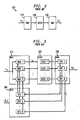
- FIG. 1 illustrates the equivalent discrete time model of a trellis coded communications system.
- information symbols X n consisting of m bits are fed into a TCM encoder 110.
- the rate m '/( m '+1) encoder 110 operates on m' input bits and produces m '+1 encoded bits, which are used to select one of the 2 m' +1 subsets (each of size 2 m - m ' ) from the employed signal constellation of size 2 m +1 , while the uncoded bits are used to select one symbol a n within the chosen subset.
- Z -level pulse amplitude modulation Z -PAM is used as the modulation scheme for the symbols a n .
- the techniques of the present invention can be applied to other modulation schemes such as PSK or QAM, as would be apparent to a person of ordinary skill in the art.
- the selected symbol a n is sent over the equivalent discrete-time channel.
- the optimum decoder for the received signal is the maximum likelihood sequence estimator (MLSE) that applies the Viterbi algorithm to the super trellis defined by the combined code and channel state.
- the computation and storage requirements of the Viterbi algorithm are proportional to the number of states.
- the Viterbi algorithm searches for the most likely data sequence by efficiently accumulating the path metrics for all states.
- ACS add-compare-select
- the Viterbi implementation 200 shown in FIG. 2 comprises of a main components branch metric unit (BMU) 210, an add-compare-select unit (ACSU) 220 and a survivor memory unit (SMU) 230.
- the branch metric unit (BMU) 210 calculates the metrics for the state transitions according to equation (4).
- the ACS unit (ACSU) 220 evaluates equation (5) for each state, and the survivor memory unit (SMU) 230 keeps track of the surviving paths.
- the data flow in the BMU 210 and SMU 230 is strictly feed-forward and can be pipelined at any level to increase throughput.
- the bottleneck for high-speed processing is the ACSU 220, as the recursion in the ACS operation in equation (5) demands that a decision is made before the next step of the trellis is decoded.
- RSSE techniques reduce the complexity of the maximum likelihood sequence estimator (MLSE) by truncating the channel memory such that only the first K of the L channel coefficients ⁇ f i ⁇ , i ⁇ [1,.., L ], are taken into account for the trellis.
- MSE maximum likelihood sequence estimator
- ⁇ n ( ⁇ n ) ( â n - L ( ⁇ n ),.., â n -1 ( ⁇ n )) is the survivor sequence leading to the reduced state ⁇ n and â n-i ( ⁇ n ) is the associated survivor symbol at time instant n-i .
- an ISI estimate u ( ⁇ n ) is calculated for state ⁇ n by taking the data symbols associated with the path history of state ⁇ n as tentative decisions.
- RSSE can be viewed as a sub-optimum trellis decoding algorithm where each state uses decision-feedback from its own survivor path to account for the ISI not considered in the reduced trellis.
- FIG. 3 illustrates the architecture for the implementation of RSSE.
- the decision-feedback cells (DFC) in the decision-feedback unit (DFU) 340 calculate R ISI estimates by considering the survivors in the corresponding survivor path cell (SPC) of the SMU 330 according to equation (10).
- the DFC, BMC, and SPC cells are in the critical loop in addition to the ACSC cell.
- the branch metric computation in equation (9) depends on the decision of the ACSC in the ACSU 320, which evaluates equation (11), in the previous symbol period, as the surviving symbols in the SPC of the SMU 330 are needed for the decision-feedback computations in equation (10).
- the block processing techniques described in G. Fettweis and H. Meyr, referenced above cannot be applied to speed up the processing of RSSE.
- the critical path in RSSE involves more operations than in the Viterbi algorithm.
- the branch metric computations in the BMC can be very expensive in terms of processing time, as euclidean distances have to be obtained by either squaring or performing a table-lookup to achieve good coding gain performance.
- the evaluation of equation (10) in the DFC 340-n may have a significant contribution to the critical path. Precomputing all branch metrics for all possible symbol combinations in the channel memory in accordance with the present invention makes it possible to remove the BMU 310 and DFU 340 from the feedback loop. This potentially allows for a significant reduction of the critical path in RSSE.
- equation (12) does not depend on the time n and is thus a constant for a particular channel assignment ⁇ .
- the trellis coder shown in FIG. 1 may not allow all symbol combinations in the channel memory ⁇ n . Therefore, the number of branch metrics which have to be precomputed might be less than M . The actual number of branch metrics which have to be precomputed should be determined from the reduced super trellis.
- ⁇ n ( z n , a n , ⁇ n ) is a vector containing the 2 mL branch metrics ⁇ n ( z n , a n , ⁇ n ), which can occur for a transition from state ⁇ n under input a n for different channel assignments ⁇ .
- the selector function in equation (14) can be implemented with a 2 mL to 1 multiplexer.
- equations (12) and (13) are both independent from the decision in the recursive ACS function in equation (11).
- the precomputations in equations (12) and (13) are strictly feed-forward and can be pipelined at any level.
- Only the selection function in equation (14) lies in the critical path in addition to the add-compare-select cell (ACSC) and survivor path cell (SPC).
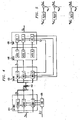
- the architecture of an RSSE 400 with precomputation of branch metrics in accordance with the present invention is shown in FIG. 4 .
- LABMC look-ahead BMC
- MUXU MUX unit
- each multiplexer (MUX) 430-n in the MUX unit (MUXU) 430 selects the appropriate branch metrics based on the survivor symbols in the corresponding SPC 450-n, which are then sent to the ACSU 440.
- Each multiplexer (MUX) 430-n in the MUX unit (MUXU) 430 takes L past symbols from the corresponding survivor path cell (SPC) 450-n.
- the ACSU 440 and SMU 450 may be embodied as in the conventional RSSE 300 of FIG. 3 .
- the output of the LABMU 410 is placed in a pipeline register 460.
- the critical path now comprises of just the MUX 430, ACSC 440-n, and SPC 450-n.
- the MUX 430 selects a branch metric in accordance with equation (14) dependent on the symbols in the SPC 450-n.
- the number of precomputed branch metrics increases exponentially with the channel memory L and the number of information bits m , this technique is feasible for small m (corresponding to small symbol constellation sizes) and short L.
- FIG. 5 illustrates the use of multi-dimensional trellis coded modulation for a multidimensional channel.
- V Z L possible 1-dimensional channel assignments ⁇ j .
- C inputs a n,j have to be considered to calculate all possible 1-dimensional branch metrics ⁇ n , j ( z n,j , a n , j , ⁇ j ), where c, C ⁇ Z is the number of 1-dimensional subsets.
- Each of these C inputs a n,j corresponds to the point in the corresponding subset to which ( z n , j ) has been sliced to after the cancellation of the intersymbol interference according to equations (16) and (17).
- ⁇ n , j z n , j a n , j ⁇ n sel ⁇ n , j z n , j a n , j , ⁇ ⁇ n , j ⁇ n
- ⁇ n , j ( z n,j , a n,j ) is the vector containing all v possible 1-dimensional branch metrics ⁇ n , j ( z n , j , a n , j , ⁇ j ) under input a n , j for different one-dimensional channel assignments ⁇ j and ⁇ n,j ( ⁇ n ) is the survivor sequence in dimension j leading to state ⁇ n .
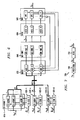
- FIG. 6 illustrates the architecture 600 for 1-dimensional precomputation for multi-dimensional RSSE.
- Each 1D-ISIC 620-n calculates the V ISI cancellation terms ⁇ j ( ⁇ j ). For each of these ⁇ j ( ⁇ j ), the corresponding 1D-LABMC 610-n precomputes C one-dimensional branch metrics per channel assignment and dimension in the 1D-LABMU 610.
- the MUXU 630 selects for each state the appropriate one-dimensional branch metrics dependent on the survivor symbols in the SPC 660-n.
- Each multi-dimensional BMC (MD-BMC) 640-n calculates the multi-dimensional branch metrics by using the selected 1-dimensional branch metrics.
- the critical path now comprises one MUX 630, MD-BMC 640, ACSC 650 and SPC 660.
- the MD-BMC 640 performs B- 1 additions and consequently has a minor contribution to the overall critical path, as the number of dimensions B is typically low.
- the channel memory can be truncated with a decision feedback prefilter (DFP) to low values of L without significant performance loss for RSSE, as described in E. F. Haratsch, "High-Speed VLSI Implementation of Reduced Complexity Sequence Estimation Algorithms With Application to Gigabit Ethernet 1000 Base-T,” Int'l Symposium on VLSI Technology, Systems, and Applications, Taipei (Jun.
- DFP decision feedback prefilter
- the prefilter 710 could be implemented as a linear filter, such as those described in D.D. Falconer and F.R. Magee, "Adaptive Channel Memory Truncation for Maximum-Likelihood Sequence Estimation," The Bell Systems Technical Journal, Vol. 52, No. 9, 1541-62 (Nov. 1973 ).
- a prefilter could be used to truncate the channel memory such that precomputation becomes feasible.
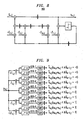
- FIG. 8 A decision-feedback prefilter for the 1000 Base-T Gigabit Ethernet implementation is shown in FIG. 8 .
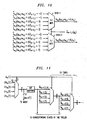
- FIG. 10 illustrates the selection of the 1D branch metrics by the multiplexer of FIG. 6 for the 1000 Base-T Gigabit Ethernet implementation.
- FIG. 11 illustrates the register exchange network (SPC n) for state one for the 1000 Base-T Gigabit Ethernet implementation, where an illustrative merge depth of 14 is utilized for the SMU.
- SPC n register exchange network
- a decision-feedback prefilter 800 that truncates the postcursor memory length on wire pair j from fourteen to one is shown in FIG. 8 .
- the decision-feedback prefilter 800 resembles the structure of a decision-feedback equalizer (DFE) as it uses tentative decisions obtained by its own slicer to remove the tail of the postcursor channel impulse response.
- DFE decision-feedback equalizer
- the computational complexity for look-ahead precomputations of 1D branch metrics on each wire pair is modest.
- the MUXU 630 selects for each wire pair j and code state ⁇ n the appropriate 1D branch metrics corresponding to subsets A and B based on the past survivor symbol ⁇ n - 1 , j ( ⁇ n ). This is done with 5:1 MUXs 1010 as shown in FIG. 10 . In total, 64 such multiplexers are needed.
- the 4D-BMU 640 adds up the 1D branch metrics to calculate the 4D branch metrics corresponding to state transitions in the trellis.
- the 4D-BMU 640 is in the critical loop. Bringing the 4D-BMU 640 out of the critical loop by look-ahead precomputations of 4D branch metrics would be impractical in terms of computational complexity, as shown in the example discussed above in the section entitled "Precomputation of Multi-Dimensional Trellis Codes.” It can be easily seen that there are too many possibilities, which must be considered.
- the trace-back architecture (TBA) is the preferred architecture for the survivor memory as it has considerably less power consumption than the register exchange architecture (REA).
- REA register exchange architecture
- TAA trace-back architecture
- RSSE reduced state sequence estimation
- the survivors corresponding to the L past decoding cycles are stored in a register exchange architecture (REA), and survivors corresponding to later decoding cycles in a trace-back architecture (TBA).
- REA register exchange architecture
- TAA trace-back architecture
- REA register exchange architecture
- TSA trace-back architecture
- symbols moved from the register exchange architecture (REA) to the trace-back architecture (TBA) are mapped to information bits to reduce the word size.
- SX n ( ⁇ n ) denotes the decision for 4D subset SX for a transition from state ⁇ n (for definition of 4D subsets see, Hatamian et al.)
- b ⁇ n-i ( ⁇ n ) are the 8 information bits which correspond to the 4D survivor symbol â n-i ( ⁇ n )
- d n (1) is the 2-bit decision of the ACS for state one.
- RSSE reduced state sequence estimation
- the survivor symbols are mapped to information bits and then stored as 8 bits.
- this architecture needs 928 REGs compared to 1344 REGs in an SMU which does not apply the hybrid memory partition, where all decisions are stored as 12 bit 4D symbols.
Landscapes
- Engineering & Computer Science (AREA)
- Computer Networks & Wireless Communication (AREA)
- Signal Processing (AREA)
- Power Engineering (AREA)
- Error Detection And Correction (AREA)
- Detection And Correction Of Errors (AREA)
Applications Claiming Priority (2)
| Application Number | Priority Date | Filing Date | Title |
|---|---|---|---|
| US09/471,920 US6999521B1 (en) | 1999-12-23 | 1999-12-23 | Method and apparatus for shortening the critical path of reduced complexity sequence estimation techniques |
| US471920 | 1999-12-23 |
Publications (3)
| Publication Number | Publication Date |
|---|---|
| EP1111863A2 EP1111863A2 (en) | 2001-06-27 |
| EP1111863A3 EP1111863A3 (en) | 2004-04-14 |
| EP1111863B1 true EP1111863B1 (en) | 2015-09-02 |
Family
ID=23873508
Family Applications (1)
| Application Number | Title | Priority Date | Filing Date |
|---|---|---|---|
| EP00310939.4A Expired - Lifetime EP1111863B1 (en) | 1999-12-23 | 2000-12-08 | Method and apparatus for shortening the critical path of reduced complexity sequence estimation techniques |
Country Status (7)
| Country | Link |
|---|---|
| US (2) | US6999521B1 (enExample) |
| EP (1) | EP1111863B1 (enExample) |
| JP (1) | JP3720258B2 (enExample) |
| KR (2) | KR100783852B1 (enExample) |
| AU (1) | AU7237100A (enExample) |
| CA (1) | CA2327910A1 (enExample) |
| TW (1) | TW507431B (enExample) |
Families Citing this family (22)
| Publication number | Priority date | Publication date | Assignee | Title |
|---|---|---|---|---|
| US7656959B2 (en) * | 2001-04-13 | 2010-02-02 | Agere Systems Inc. | Pipelined decision-feedback unit in a reduced-state viterbi detector with local feedback |
| US20050264906A1 (en) * | 2004-05-25 | 2005-12-01 | Haratsch Erich F | Method and apparatus for reduced-state Viterbi detection in a read channel of a magnetic recording system |
| US7170947B2 (en) * | 2001-07-18 | 2007-01-30 | Massana Research Limited | Data receiver |
| AU2004241602B2 (en) | 2003-05-20 | 2008-05-08 | Syndiant, Inc. | Digital backplane |
| US7380199B2 (en) * | 2004-05-25 | 2008-05-27 | Agere Systems Inc. | Method and apparatus for precomputation and pipelined selection of branch metrics in a reduced-state Viterbi detector |
| GB0417292D0 (en) * | 2004-08-03 | 2004-09-08 | Ttp Communications Ltd | Method of and apparatus for improving computational efficiency in sequence estimation |
| US7555040B2 (en) * | 2004-11-05 | 2009-06-30 | Interdigital Technology Corporation | Method and apparatus for generating equalizer filter tap coefficients |
| US7900124B2 (en) * | 2004-11-08 | 2011-03-01 | Koninklijke Philips Electronics N.V. | Bit detection for multitrack digital data storage |
| KR100725931B1 (ko) | 2004-12-17 | 2007-06-11 | 한국전자통신연구원 | 하이브리드 역추적 장치 및 그를 이용한 고속 비터비 복호시스템 |
| KR100689039B1 (ko) * | 2005-02-01 | 2007-03-09 | 삼성전자주식회사 | 순환형 디코딩부를 병렬 연결하여 사용하는 아날로그비터비 디코더 |
| KR100659777B1 (ko) | 2005-12-21 | 2006-12-20 | 고려대학교 산학협력단 | 시스톨릭 패스 메모리, 이를 이용한 비터비 디코더의 패스메모리 및 비터비 디코더 |
| US20070266303A1 (en) * | 2006-04-27 | 2007-11-15 | Qualcomm Incorporated | Viterbi decoding apparatus and techniques |
| JP4666646B2 (ja) * | 2006-08-24 | 2011-04-06 | ルネサスエレクトロニクス株式会社 | 軟判定ビタビ復号装置および方法、復号装置および方法 |
| US7903727B2 (en) * | 2006-11-24 | 2011-03-08 | Via Technologies, Inc. | Channel memory length selection method and apparatus for wireless communication systems |
| US7831893B2 (en) * | 2007-01-20 | 2010-11-09 | Harris Corporation | Reduced state trellis decoder using programmable trellis parameters |
| US7831892B2 (en) * | 2007-01-20 | 2010-11-09 | Harris Corporation | Generic, reduced state, maximum likelihood decoder |
| KR101466694B1 (ko) * | 2007-08-28 | 2014-11-28 | 삼성전자주식회사 | Ecc 회로, ecc 회로를 구비하는 메모리 시스템 및그의 오류 정정 방법 |
| KR20090083110A (ko) * | 2008-01-29 | 2009-08-03 | 삼성전자주식회사 | 비터비 디코더 및 비터비 디코딩 방법 |
| US8831063B2 (en) * | 2008-03-18 | 2014-09-09 | Qualcomm Incorporated | Single carrier burst structure for decision feedback equalization and tracking |
| US10243591B2 (en) * | 2016-08-30 | 2019-03-26 | International Business Machines Corporation | Sequence detectors |
| TWI729755B (zh) * | 2020-04-01 | 2021-06-01 | 智原科技股份有限公司 | 接收器與應用在接收器中的交織碼調變解碼器及相關的解碼方法 |
| CN111624964B (zh) * | 2020-05-27 | 2021-08-06 | 甬矽电子(宁波)股份有限公司 | 权限动态管控方法、装置、服务端和可读存储介质 |
Family Cites Families (20)
| Publication number | Priority date | Publication date | Assignee | Title |
|---|---|---|---|---|
| US5136593A (en) | 1989-10-30 | 1992-08-04 | Carnegie-Mellon University | Apparatus and method for fixed delay tree search |
| US5220570A (en) | 1990-11-30 | 1993-06-15 | The Board Of Trustees Of The Leland Stanford Junior University | Programmable viterbi signal processor |
| US5537424A (en) * | 1994-08-12 | 1996-07-16 | International Business Machines Corporation | Matched spectral null codes with partitioned systolic trellis structures |
| FR2724273B1 (fr) * | 1994-09-05 | 1997-01-03 | Sgs Thomson Microelectronics | Circuit de traitement de signal pour mettre en oeuvre un algorithme de viterbi |
| JP3171772B2 (ja) * | 1995-08-23 | 2001-06-04 | 沖電気工業株式会社 | ビタビ復号方法及びビタビ復号装置 |
| FR2738427B1 (fr) * | 1995-08-31 | 1997-11-21 | Sgs Thomson Microelectronics | Decodeur convolutif utilisant l'algorithme de viterbi |
| JP3674111B2 (ja) * | 1995-10-25 | 2005-07-20 | 三菱電機株式会社 | データ伝送装置 |
| DE19545473C2 (de) | 1995-12-06 | 1998-03-12 | Kommunikations Elektronik | Verfahren zur digitalen Nachrichtenübertragung über ein elektrisches Kabel |
| KR0157121B1 (ko) * | 1995-12-15 | 1999-02-18 | 김광호 | 비터비 디코더의 경로 메트릭 계산회로 |
| KR0169681B1 (ko) * | 1995-12-30 | 1999-03-20 | 배순훈 | 비터비 복호기 |
| FR2745139A1 (fr) | 1996-02-21 | 1997-08-22 | Philips Electronics Nv | Systeme de transmissions numeriques a modulation a phase continue |
| JP3293742B2 (ja) | 1996-06-28 | 2002-06-17 | 日本電気株式会社 | 判定帰還型信号推定器 |
| US5970104A (en) * | 1997-03-19 | 1999-10-19 | Cadence Design Systems, Inc. | Method and apparatus for generating branch metrics and branch indices for convolutional code Viterbi decoders |
| KR19980079114A (ko) * | 1997-04-30 | 1998-11-25 | 배순훈 | 트렐리스 코드 데이터의 디코딩방법 및 장치 |
| US5931966A (en) | 1997-05-19 | 1999-08-03 | Carnegie Mellon University | Viterbi detector with a pipelined look-up table of squared errors |
| JP3747604B2 (ja) * | 1997-12-19 | 2006-02-22 | ソニー株式会社 | ビタビ復号装置 |
| US6738949B2 (en) * | 1998-05-13 | 2004-05-18 | Matsushita Electric Industrial Co., Ltd. | Error correction circuit and error correction method |
| US6201831B1 (en) | 1998-11-13 | 2001-03-13 | Broadcom Corporation | Demodulator for a multi-pair gigabit transceiver |
| US6553541B1 (en) * | 1999-04-14 | 2003-04-22 | Texas Instruments Incorporated | Reduced-complexity sequence detection |
| US7000175B2 (en) * | 2000-11-03 | 2006-02-14 | Agere Systems Inc. | Method and apparatus for pipelined joint equalization and decoding for gigabit communications |
-
1999
- 1999-12-23 US US09/471,920 patent/US6999521B1/en not_active Expired - Lifetime
-
2000
- 2000-12-08 EP EP00310939.4A patent/EP1111863B1/en not_active Expired - Lifetime
- 2000-12-08 CA CA002327910A patent/CA2327910A1/en not_active Abandoned
- 2000-12-18 TW TW089127124A patent/TW507431B/zh not_active IP Right Cessation
- 2000-12-19 AU AU72371/00A patent/AU7237100A/en not_active Abandoned
- 2000-12-22 JP JP2000389807A patent/JP3720258B2/ja not_active Expired - Fee Related
- 2000-12-22 KR KR1020000080431A patent/KR100783852B1/ko not_active Expired - Fee Related
-
2005
- 2005-10-21 US US11/256,182 patent/US7499498B2/en not_active Expired - Fee Related
-
2007
- 2007-06-27 KR KR1020070063921A patent/KR100785410B1/ko not_active Expired - Fee Related
Non-Patent Citations (1)
| Title |
|---|
| SIMMONS S J ED - INSTITUTE OF ELECTRICAL AND ELECTRONICS ENGINEERS: "A BITONIC-SORTER BASED VLSI IMPLEMENTATION OF THE M-ALGORITHM", PROCEEDINGS OF THE PACIFIC RIM CONFERENCE ON COMMUNICATIONS, COMPUTERS AND SIGNAL PROCESSING. VICTORIA, JUNE 1 - 2, 1989; [PROCEEDINGS OF THE PACIFIC RIM CONFERENCE ON COMMUNICATIONS, COMPUTERS AND SIGNAL PROCESSING], NEW YORK, IEEE, US, vol. -, 1 June 1989 (1989-06-01), pages 337 - 340, XP000077497 * |
Also Published As
| Publication number | Publication date |
|---|---|
| KR100785410B1 (ko) | 2007-12-13 |
| AU7237100A (en) | 2001-06-28 |
| US7499498B2 (en) | 2009-03-03 |
| TW507431B (en) | 2002-10-21 |
| US20060039492A1 (en) | 2006-02-23 |
| KR20070080246A (ko) | 2007-08-09 |
| CA2327910A1 (en) | 2001-06-23 |
| EP1111863A2 (en) | 2001-06-27 |
| JP3720258B2 (ja) | 2005-11-24 |
| KR100783852B1 (ko) | 2007-12-10 |
| JP2001230682A (ja) | 2001-08-24 |
| EP1111863A3 (en) | 2004-04-14 |
| KR20010062638A (ko) | 2001-07-07 |
| US6999521B1 (en) | 2006-02-14 |
Similar Documents
| Publication | Publication Date | Title |
|---|---|---|
| KR100785410B1 (ko) | 하이브리드 서바이버 메모리 구조체 | |
| US7000175B2 (en) | Method and apparatus for pipelined joint equalization and decoding for gigabit communications | |
| US8699557B2 (en) | Pipelined decision-feedback unit in a reduced-state Viterbi detector with local feedback | |
| US6690754B1 (en) | Method and apparatus for reducing the computational complexity and relaxing the critical path of reduced state sequence estimation (RSSE) techniques | |
| US8635516B2 (en) | Method and apparatus for joint equalization and decoding of multidimensional codes transmitted over multiple symbol durations | |
| US7042938B2 (en) | Soft bit computation for a reduced state equalizer | |
| Haratsch et al. | A 1-Gb/s joint equalizer and trellis decoder for 1000BASE-T Gigabit Ethernet | |
| Raheli et al. | Per-survivor processing and tentative decisions: What is in between? | |
| US6118816A (en) | Digital transmission system with a trellis-based, reduced-state estimation method | |
| Haratsch et al. | High-speed reduced-state sequence estimation | |
| US6693568B2 (en) | Apparatus, and an associated method, for detecting digital data using MLSE detection with a dynamically-sized trellis | |
| Haratsch et al. | A pipelined 14-tap parallel decision-feedback decoder for 1000BASE-T Gigabit Ethernet | |
| McGinty et al. | Reduced-state sequence estimator with reverse-time structure | |
| Haratsch et al. | A low complexity joint equalizer and decoder for 1000Base-T Gigabit Ethernet | |
| Brushe et al. | A reduced-complexity online state sequence and parameter estimator for superimposed convolutional coded signals | |
| Sexton et al. | Systolic equalizer structures |
Legal Events
| Date | Code | Title | Description |
|---|---|---|---|
| PUAI | Public reference made under article 153(3) epc to a published international application that has entered the european phase |
Free format text: ORIGINAL CODE: 0009012 |
|
| AK | Designated contracting states |
Kind code of ref document: A2 Designated state(s): AT BE CH CY DE DK ES FI FR GB GR IE IT LI LU MC NL PT SE TR |
|
| AX | Request for extension of the european patent |
Free format text: AL;LT;LV;MK;RO;SI |
|
| RIC1 | Information provided on ipc code assigned before grant |
Ipc: 7H 04L 27/34 B Ipc: 7H 04L 25/03 A |
|
| PUAL | Search report despatched |
Free format text: ORIGINAL CODE: 0009013 |
|
| AK | Designated contracting states |
Kind code of ref document: A3 Designated state(s): AT BE CH CY DE DK ES FI FR GB GR IE IT LI LU MC NL PT SE TR |
|
| AX | Request for extension of the european patent |
Extension state: AL LT LV MK RO SI |
|
| 17P | Request for examination filed |
Effective date: 20040927 |
|
| AKX | Designation fees paid |
Designated state(s): AT BE CH CY DE DK ES FI FR GB GR IE IT LI LU MC NL PT SE TR |
|
| 17Q | First examination report despatched |
Effective date: 20061109 |
|
| RAP3 | Party data changed (applicant data changed or rights of an application transferred) |
Owner name: LUCENT TECHNOLOGIES INC. |
|
| APBK | Appeal reference recorded |
Free format text: ORIGINAL CODE: EPIDOSNREFNE |
|
| APBN | Date of receipt of notice of appeal recorded |
Free format text: ORIGINAL CODE: EPIDOSNNOA2E |
|
| APBR | Date of receipt of statement of grounds of appeal recorded |
Free format text: ORIGINAL CODE: EPIDOSNNOA3E |
|
| APAF | Appeal reference modified |
Free format text: ORIGINAL CODE: EPIDOSCREFNE |
|
| RAP1 | Party data changed (applicant data changed or rights of an application transferred) |
Owner name: ALCATEL-LUCENT USA INC. |
|
| 111Z | Information provided on other rights and legal means of execution |
Free format text: AT BE CH CY DE DK ES FI FR GB GR IE IT LI LU MC NL PT SE TR Effective date: 20130410 |
|
| APBX | Invitation to file observations in appeal sent |
Free format text: ORIGINAL CODE: EPIDOSNOBA2E |
|
| APBZ | Receipt of observations in appeal recorded |
Free format text: ORIGINAL CODE: EPIDOSNOBA4E |
|
| APBT | Appeal procedure closed |
Free format text: ORIGINAL CODE: EPIDOSNNOA9E |
|
| D11X | Information provided on other rights and legal means of execution (deleted) | ||
| GRAP | Despatch of communication of intention to grant a patent |
Free format text: ORIGINAL CODE: EPIDOSNIGR1 |
|
| INTG | Intention to grant announced |
Effective date: 20150401 |
|
| RAP1 | Party data changed (applicant data changed or rights of an application transferred) |
Owner name: ALCATEL LUCENT |
|
| GRAS | Grant fee paid |
Free format text: ORIGINAL CODE: EPIDOSNIGR3 |
|
| GRAA | (expected) grant |
Free format text: ORIGINAL CODE: 0009210 |
|
| AK | Designated contracting states |
Kind code of ref document: B1 Designated state(s): AT BE CH CY DE DK ES FI FR GB GR IE IT LI LU MC NL PT SE TR |
|
| REG | Reference to a national code |
Ref country code: GB Ref legal event code: FG4D |
|
| REG | Reference to a national code |
Ref country code: AT Ref legal event code: REF Ref document number: 747210 Country of ref document: AT Kind code of ref document: T Effective date: 20150915 Ref country code: CH Ref legal event code: EP |
|
| REG | Reference to a national code |
Ref country code: IE Ref legal event code: FG4D |
|
| REG | Reference to a national code |
Ref country code: DE Ref legal event code: R096 Ref document number: 60049063 Country of ref document: DE |
|
| REG | Reference to a national code |
Ref country code: FR Ref legal event code: PLFP Year of fee payment: 16 |
|
| REG | Reference to a national code |
Ref country code: AT Ref legal event code: MK05 Ref document number: 747210 Country of ref document: AT Kind code of ref document: T Effective date: 20150902 |
|
| PG25 | Lapsed in a contracting state [announced via postgrant information from national office to epo] |
Ref country code: GR Free format text: LAPSE BECAUSE OF FAILURE TO SUBMIT A TRANSLATION OF THE DESCRIPTION OR TO PAY THE FEE WITHIN THE PRESCRIBED TIME-LIMIT Effective date: 20151203 Ref country code: FI Free format text: LAPSE BECAUSE OF FAILURE TO SUBMIT A TRANSLATION OF THE DESCRIPTION OR TO PAY THE FEE WITHIN THE PRESCRIBED TIME-LIMIT Effective date: 20150902 |
|
| PGFP | Annual fee paid to national office [announced via postgrant information from national office to epo] |
Ref country code: GB Payment date: 20151221 Year of fee payment: 16 Ref country code: DE Payment date: 20151211 Year of fee payment: 16 |
|
| REG | Reference to a national code |
Ref country code: NL Ref legal event code: MP Effective date: 20150902 |
|
| PG25 | Lapsed in a contracting state [announced via postgrant information from national office to epo] |
Ref country code: AT Free format text: LAPSE BECAUSE OF FAILURE TO SUBMIT A TRANSLATION OF THE DESCRIPTION OR TO PAY THE FEE WITHIN THE PRESCRIBED TIME-LIMIT Effective date: 20150902 Ref country code: ES Free format text: LAPSE BECAUSE OF FAILURE TO SUBMIT A TRANSLATION OF THE DESCRIPTION OR TO PAY THE FEE WITHIN THE PRESCRIBED TIME-LIMIT Effective date: 20150902 Ref country code: SE Free format text: LAPSE BECAUSE OF FAILURE TO SUBMIT A TRANSLATION OF THE DESCRIPTION OR TO PAY THE FEE WITHIN THE PRESCRIBED TIME-LIMIT Effective date: 20150902 |
|
| PGFP | Annual fee paid to national office [announced via postgrant information from national office to epo] |
Ref country code: FR Payment date: 20151221 Year of fee payment: 16 |
|
| PG25 | Lapsed in a contracting state [announced via postgrant information from national office to epo] |
Ref country code: IT Free format text: LAPSE BECAUSE OF FAILURE TO SUBMIT A TRANSLATION OF THE DESCRIPTION OR TO PAY THE FEE WITHIN THE PRESCRIBED TIME-LIMIT Effective date: 20150902 Ref country code: NL Free format text: LAPSE BECAUSE OF FAILURE TO SUBMIT A TRANSLATION OF THE DESCRIPTION OR TO PAY THE FEE WITHIN THE PRESCRIBED TIME-LIMIT Effective date: 20150902 |
|
| PG25 | Lapsed in a contracting state [announced via postgrant information from national office to epo] |
Ref country code: PT Free format text: LAPSE BECAUSE OF FAILURE TO SUBMIT A TRANSLATION OF THE DESCRIPTION OR TO PAY THE FEE WITHIN THE PRESCRIBED TIME-LIMIT Effective date: 20160104 Ref country code: BE Free format text: LAPSE BECAUSE OF NON-PAYMENT OF DUE FEES Effective date: 20151231 |
|
| REG | Reference to a national code |
Ref country code: DE Ref legal event code: R097 Ref document number: 60049063 Country of ref document: DE |
|
| PLBE | No opposition filed within time limit |
Free format text: ORIGINAL CODE: 0009261 |
|
| STAA | Information on the status of an ep patent application or granted ep patent |
Free format text: STATUS: NO OPPOSITION FILED WITHIN TIME LIMIT |
|
| PG25 | Lapsed in a contracting state [announced via postgrant information from national office to epo] |
Ref country code: LU Free format text: LAPSE BECAUSE OF FAILURE TO SUBMIT A TRANSLATION OF THE DESCRIPTION OR TO PAY THE FEE WITHIN THE PRESCRIBED TIME-LIMIT Effective date: 20151208 Ref country code: MC Free format text: LAPSE BECAUSE OF FAILURE TO SUBMIT A TRANSLATION OF THE DESCRIPTION OR TO PAY THE FEE WITHIN THE PRESCRIBED TIME-LIMIT Effective date: 20150902 |
|
| REG | Reference to a national code |
Ref country code: CH Ref legal event code: PL |
|
| 26N | No opposition filed |
Effective date: 20160603 |
|
| PG25 | Lapsed in a contracting state [announced via postgrant information from national office to epo] |
Ref country code: DK Free format text: LAPSE BECAUSE OF FAILURE TO SUBMIT A TRANSLATION OF THE DESCRIPTION OR TO PAY THE FEE WITHIN THE PRESCRIBED TIME-LIMIT Effective date: 20150902 |
|
| REG | Reference to a national code |
Ref country code: IE Ref legal event code: MM4A |
|
| PG25 | Lapsed in a contracting state [announced via postgrant information from national office to epo] |
Ref country code: CH Free format text: LAPSE BECAUSE OF NON-PAYMENT OF DUE FEES Effective date: 20151231 Ref country code: LI Free format text: LAPSE BECAUSE OF NON-PAYMENT OF DUE FEES Effective date: 20151231 Ref country code: IE Free format text: LAPSE BECAUSE OF NON-PAYMENT OF DUE FEES Effective date: 20151208 |
|
| PG25 | Lapsed in a contracting state [announced via postgrant information from national office to epo] |
Ref country code: BE Free format text: LAPSE BECAUSE OF FAILURE TO SUBMIT A TRANSLATION OF THE DESCRIPTION OR TO PAY THE FEE WITHIN THE PRESCRIBED TIME-LIMIT Effective date: 20150902 |
|
| PG25 | Lapsed in a contracting state [announced via postgrant information from national office to epo] |
Ref country code: CY Free format text: LAPSE BECAUSE OF FAILURE TO SUBMIT A TRANSLATION OF THE DESCRIPTION OR TO PAY THE FEE WITHIN THE PRESCRIBED TIME-LIMIT Effective date: 20150902 |
|
| REG | Reference to a national code |
Ref country code: DE Ref legal event code: R119 Ref document number: 60049063 Country of ref document: DE |
|
| GBPC | Gb: european patent ceased through non-payment of renewal fee |
Effective date: 20161208 |
|
| PG25 | Lapsed in a contracting state [announced via postgrant information from national office to epo] |
Ref country code: TR Free format text: LAPSE BECAUSE OF FAILURE TO SUBMIT A TRANSLATION OF THE DESCRIPTION OR TO PAY THE FEE WITHIN THE PRESCRIBED TIME-LIMIT Effective date: 20150902 |
|
| REG | Reference to a national code |
Ref country code: FR Ref legal event code: ST Effective date: 20170831 |
|
| PG25 | Lapsed in a contracting state [announced via postgrant information from national office to epo] |
Ref country code: FR Free format text: LAPSE BECAUSE OF NON-PAYMENT OF DUE FEES Effective date: 20170102 |
|
| PG25 | Lapsed in a contracting state [announced via postgrant information from national office to epo] |
Ref country code: GB Free format text: LAPSE BECAUSE OF NON-PAYMENT OF DUE FEES Effective date: 20161208 Ref country code: DE Free format text: LAPSE BECAUSE OF NON-PAYMENT OF DUE FEES Effective date: 20170701 |