The present invention relates to a production method of a
formed article made from a high performance polymer, particularly
a polymer superior in mechanical strength and heat resistance.
Polymers having rigid units, such as a para bonds of
aromatic rings, in the main chain have high heat
resistance and are superior in dynamic properties. Of such
polymers, polybenzazole has extremely high heat resistance. It is
known that these polymers are polymerized and formed into articles
in the presence of polyphosphoric acid as a solvent (Wolfe et al.,
Macromolecules, 1981, pp. 909 and 915). These polymers obtained
by using such a polyphosphoric acid solvent have been evaluated as
to the performance at a laboratory level, but have not been
produced industrially until recently. Therefore, problems
associated with the industrial practice of these polymers have not
found much attention.
In a reactor where a shear force is applied during
polymerization and processing of these high performance polymers
into e.g. fibers or films, in a pump that delivers a polymer
solution, and in a pump that discharges a given amount of the
polymer solution from a spinneret, the temperature is often raised
beyond 160°C during the step to reduce the viscosity coefficient
of the polymer solution to a level sufficient to facilitate the
processing. In addition, the temperature may become still higher
due to the heat generated by the shear force applied in the
apparatus. In this event, conventional corrosion-resistant
materials, such as SUS 316 L and Stellite (MITSUBISHI MATERIALS
CORPORATION), are defective in that a part of an apparatus elutes
out due to the corrosion of a metal by the action of
polyphosphoric acid, which in turn makes the solvent nonrecyclable,
and the service life of the apparatus is shortened.
It is therefore an object of the present invention to
improve a material of conventional apparatuses used for
polymerizing and processing high performance polymers in a
polyphosphoric acid solvent, thereby to elongate the service life
of reactors and pumps and to reduce the metal ion concentration of
the solvent to be recycled.
That is, the present invention provides a method for
producing a formed article from a dope comprising a polyphosphoric
acid solvent and a polymer soluble in polyphosphoric acid, which
comprises using a production apparatus comprising an apparatus for
stirring and uniformly dispersing or homogenizing a dope and a
pump apparatus for delivering the uniformly dispersed or
homogeneous dope, wherein at least one of the apparatus and the
pump apparatus has a part that comes into contact with the dope,
which part is made of a corrosion-resistant material having a
material elution rate of not more than 1 (mm/year) in a 116%
polyphosphoric acid at 210°C.
Preferably, the present invention provides a method for
producing a formed article from a polyphosphoric acid solution,
wherein a corrosion-resistant material has a hardness of not less
than HRC 20.
The present invention also provides a method for producing
a formed article from a dope comprising a polyphosphoric acid
solvent and a polymer soluble in polyphosphoric acid, which
comprises using a filter made of a corrosion-resistant material
having a material elution rate of not more than 0.1 (mm/year) in
116% polyphosphoric acid at a filtering temperature, before
discharge of the dope from a spinneret.
The present invention is described in detail in the
following.
The polymer to be used in the present invention is, for
example, PBO (polybenzazole), PBT (polybenzothiazole) and PBI
(polybenzoimidazole) homopolymers, their random, sequential and
block copolymers, derivatives thereof and polymers comprising a part
thereof as a main chain, such as those described in
Wolfe et al., Liquid Crystalline Polymer Compositions, Process and
Products, U.S. Patent 4,703,103 (October 27, 1987); Wolfe et al.,
Liquid Crystalline Polymer Compositions, Process and Products, U.S.
Patent 4,533,692 (August 6, 1985); Wolfe et al., Liquid
Crystalline Poly(2,6-Benzothiazole) Compositions, Process and
Products, U.S. Patent 4,533,724 (August 6, 1985); Wolfe et al.,
Liquid Crystalline Polymer Compositions, Process and Products, U.S.
Patent 4,533,693 (August 6, 1985); Evers, Thermoxdatively Stable
Articulated p-Benzobisoxazole p-Benzobisthiazole Polymers, U.S.
Patent 4,359,567 (November 16, 1982); Tsai et al., Method for
Making Heterocyclic Block Copolymer Compositions, Process and
Products, U.S. Patent 4,578,432 (March 25, 1986); 11 Ency. Poly.
Sci. & Eng., Polybenzothiazoles and Polybenzoxazoles, 601 (J.
Wiley & Sons 1988) and W.W. Adams et al., The Materials Science
and Engineering of Rigid-Rod Polymers, (Materials Research Society
1989). The present invention particularly relates to a production
method for processing these polymers by the use of a
polyphosphoric acid solvent.
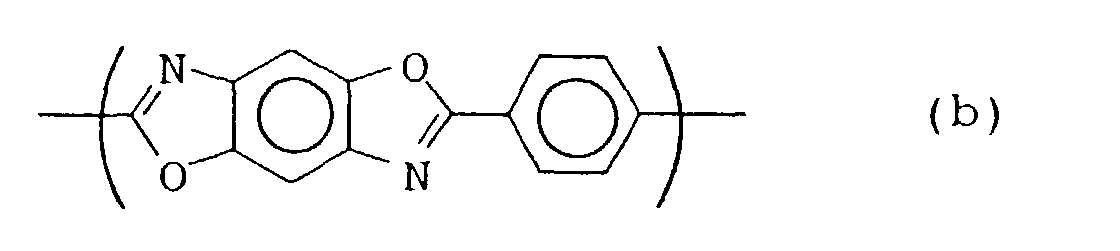
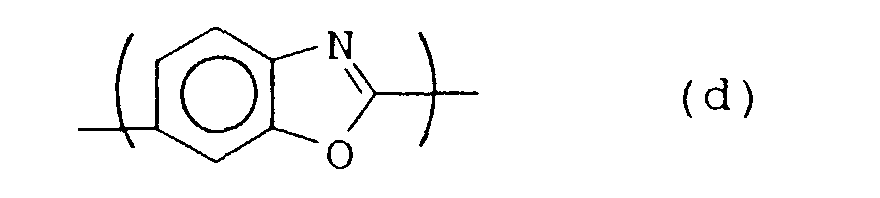
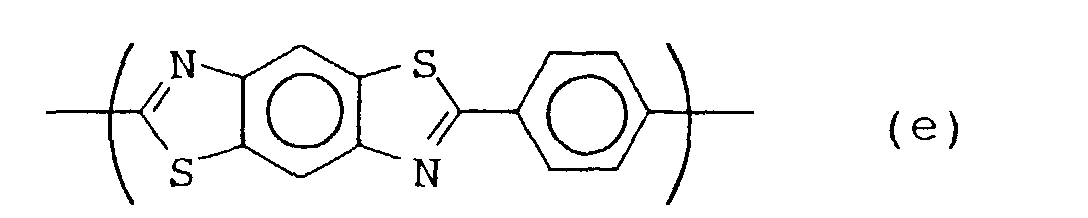
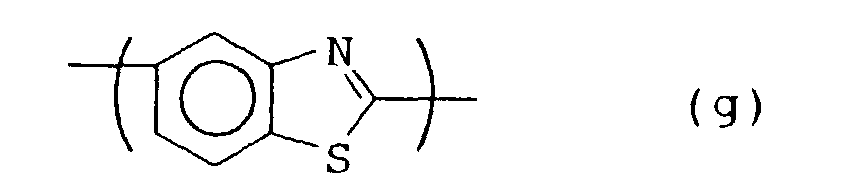
The polymer can be of an AB type represented by chemical
formulas (c) and (d) and/or an AA/BB type represented by chemical
formulas (a) and (b) mentioned below.
The aromatic group can be a hetero ring such as a
pyridinylene group, wherein the ring is preferably formed by
carbon. The aromatic group can be either a polycyclic condensed
ring or a polycyclic non-condensed ring. Preferred is a 6-membered
ring. While the size of the ring is not subject to any
particular limitation, the aromatic group preferably contains not
more than 18 carbon atoms, more preferably not more than 12 carbon
atoms, still more preferably not more than 6 carbon atoms. The
AA/BB type unit preferably has a 1,2,4,5-phenylene structure or an
analog thereof. The AB type unit preferably has a 1,3,4-phenylene
structure or an analog thereof.
The azole ring of the AA/BB type unit can be either of a
cis type or trans type as shown in 11 Ency. Poly. Sci. & Eng.,
Polybenzothiazoles and Polybenzoxazoles, 601 (J. Wiley & Sons
1988).
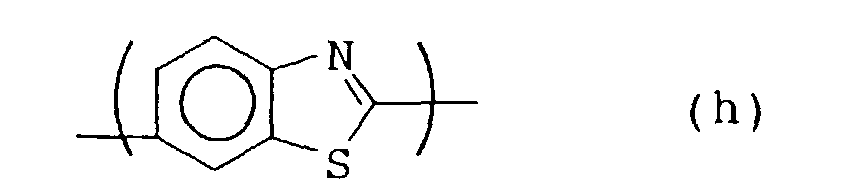
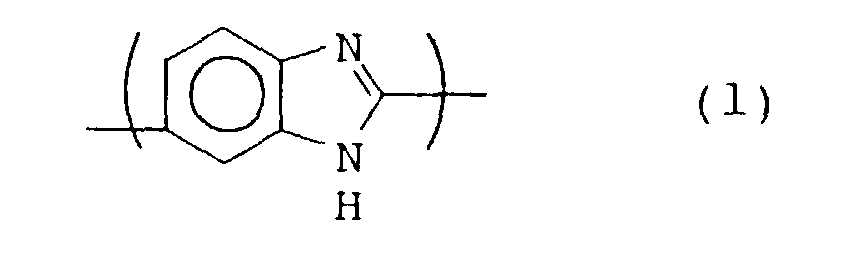
The repeating units used in the present invention
preferably have the structures shown in (a)-(h), more preferably
the structures shown in (a)-(f), still more preferably the
structures shown in (a)-(d).
The PBZ polymer preferably has not less than about 25
repeating units on average. More preferably it preferably has not
less than about 50 repeating units, and still more preferably
repeating units of not less than about 100. The AA/BB-PBZ rigid
chain preferably has an intrinsic viscosity as measured in
methanesulfonic acid at 25°C of about not less than 10 dl/g, more
preferably not less than about 15 dl/g, still more preferably
about not less than 20 dl/g. For a certain use, the intrinsic
viscosity is most preferably about 25-30 dl/g. The intrinsic
viscosity can be up to 60 dl/g, but preferably not more than 40
dl/g. A semi-rigid AB-PBZ polymer preferably has an intrinsic
viscosity of not less than about 5 dl/g, more preferably not less
than about 10 dl/g, and still more preferably not less than about
15 dl/g.
This polymer and a copolymer are obtained by reacting a
monomer or oligomer in a polyphosphoric acid solvent to achieve a
desired number of repeating units.
To overcome the defects of a formed article and stabilize
its quality, it is extremely important to eliminate inconsistent
density of a polymer to be formed in a polyphosphoric acid solvent
and to use a homogeneous solution. As used herein, by the
solution is meant a nematic crystalline liquid having small
polydomain. The reactor usable in the present invention includes
a twin screw kneader, a single screw reactor, a single screw
extruder combined with a dispersing element, and a twin screw
extruder. It is particularly preferable to use a reactor capable
of handling a highly viscous material.
The concentration of polyphosphoric acid to be used as a
solvent is not subject to any particular limitation, but it is
preferably 112 - 120 %, more preferably 114 - 117 %.
In addition, the concentration of a polymer to be dissolved
in the polyphosphoric acid solvent is not subject to any
particular limitation, either, but it is preferably 4 - 22 wt%,
more preferably 5 - 20 wt%.
The pump usable in the present invention includes e.g. a gear
pump, Mohno pump and a screw feeder. A gear pump that
can stand a high discharge pressure is particularly useful. A
particularly large equipment should have a pressure raising
capability corresponding to the viscous resistance during delivery
in a long polymer production line.
To reduce the amount of a metal dissolved in phosphoric
acid from an apparatus, a sliding part of the apparatus, which is
lubricated with the polyphosphoric acid solution, should be made
of a material having high resistance to phosphoric acid corrosion,
and high hardness and high abrasion resistance. A formed article
may be processed from a base material or from a coated material
(e.g., detonation process). It is preferable to employ a flame
spraying method capable of affording a formed article having a
desired composition and pore free texture.
Examples of the phosphoric acid corrosion-resistant
material include nickel alloy (e.g., Hastelloy), tantalum-niobium
alloys, cobalt alloys (e.g., Stellite), stainless steel (e.g.,
US317) and ceramics (e.g., graphite and alumina). Of these, nickel
alloys are particularly superior. In addition, a nickel based
tungsten carbide alloy and a nickel alloy base material treated
with HIP (Hot Isostatic Pressing), which are superior in abrasion
resistance, are preferable. While coating with cermet or carbon
nitride is useful, the corrosion resistance of the base material
and the thickness of the coating should be appropriately set to
prevent degradation in the property due to pinholes. When
different kinds of materials are used in combination, thermal
expansion and residual stress at the joint should be taken into
consideration.
The polyphosphoric acid solution processed in the present
invention can dissolve a corrosion resistant metal, such as a
stainless steel, at a temperature exceeding 160°C. As a result,
the clearance of a reactor and a pump varies, which in turn lowers
the dispersing or homogenizing capability and delivery capability
with the lapse of time. In addition, because metal ion elutes out
in a phosphoric acid solvent, the solvent inevitably changes in
quality when used for recycling. It is extremely difficult to
adsorb the metal ion once eluted out in a solvent and purify the
solvent. Thus, the metal elution during the forming process of a
polymer should be made as small as possible.
To effectively decrease corrosion of apparatuses and pipes
due to polyphosphoric acid, the temperature during the step should
be lowered. When the polymerization degree of a polymer to be
formed is high, the polyphosphoric acid solution comes to have a
high viscosity coefficient, which imposes the lower limit of the
temperature. When the temperature in a reactor is high, the
reaction time can be shortened and an apparatus can be made
smaller, which in turn results in the reduction of facility costs.
Thus, a reactor is desired to be operable at high temperatures.
The present invention is explained by taking
polybenzbisoxazole as an example of a high performance polymer
material processed using a polyphosphoric acid solvent. The
preferable temperature for producing a fiber from an about 14 wt%
polyphosphoric acid solution containing a polybenzbisoxazole
polymer having a polymerization degree of about 200 is not less
than 165°C, more preferably not less than 170°C. This solution has
a high viscosity at 170°C of 1000 Pa·s (shear rate 10 · 1/second,
reciprocal second). Therefore, the heat from shear energy in a
reactor and a pump is largely lost and the temperature of the
solution rises remarkably. When a typical corrosion-resistant
material is used, the corrosion advances, and abrasion of an
apparatus and unpreferable elution of metal ion into a solvent
proceed. This has a consequence that the apparatus parts need to
be replaced sooner in several months and a solution may have a
higher metal ion concentration.
The material of an apparatus to be used for processing a
polyphosphoric acid solution at a high temperature needs to be
particularly superior in corrosion resistance to phosphoric acid.
The corrosion resistance to phosphoric acid can be easily
evaluated at a high temperature. The evaluation may be made at a
temperature higher than the actual processing temperature. The
use of a material superior in corrosion resistance leads to stable
industrial production. The evaluation in the present invention
includes measurement of a decrease in weight after immersing a
material in a 116% polyphosphoric acid at 210°C or a given
temperature for 40 hours. When the evaluation temperature is
lower than 210°C, the material elutes out in a small amount which
is difficult to measure. When it is not less than 230°C, the
glass of the evaluation vessel may elute out to the degree that
the evaluation is not available. While the polyphosphoric acid is
not subject to any particular limitation as regards its
concentration, a 116% polyphosphoric acid easily obtainable from
the market is conveniently used. The immersion time is generally
40 hours, and the obtained value is converted to the amount of
elution for 24 hours. A material having high corrosion resistance
may be subjected to the evaluation for about 100 hours and a
material having insufficient corrosion resistance may be subjected
to the evaluation for about a shortened period of 4 hours. As
long as the evaluation results enable judgement of whether or not
a decrease rate to be mentioned later would exceed 1 (mm/year),
the evaluation time does not count much here.
A corrosion-resistant material used in the present
invention, for instance, for processing a 14 wt% solution of
polybenzbisoxazole having a polymerization degree of 200 at 180°C,
must show corrosion resistance (elution rate) of not more than 1
(mm/year), preferably not more than 0.5 (mm/year), more preferably
not more than 0.1 (mm/year).
A reactor and a pump in which to process a polyphosphoric
acid solution is lubricated with a polyphosphoric acid solution.
Nevertheless, abrasion due to rubbing of parts and dissolution in
phosphoric acid occur simultaneously. It is therefore essential
to increase hardness of the material to achieve a prolonged
service life of a twin screw extruder and a gear pump. As a
material suitable for such use, Stellite has been used. However,
its corrosion resistance to phosphoric acid is insufficient to
stand a long term use. The materials suitable for the present
invention are nickel alloy such as Plasthard (MITSUBISHI MATERIALS
CORPORATION), tungsten carbide-containing nickel alloy, and the
like. A material sufficient in resistance to abrasion by sliding
has a hardness of preferably not less than HRC 20, more preferably
not less than HRC 40, still more preferably not less than HRC 50.
A material superior in corrosion resistance and having high
hardness is exemplified by the aforementioned WC-containing
material and a nickel alloy.
From the aspect of metal elution during production, the use
of a corrosion-resistant material as a filtering member can
provide a high effect, since it comes into contact with the liquid
in a large area. In general, a filtering member consists of thin
wires having a size of not more than 100 µm. Even SUS 316 loses
the strength of the filtering member in a short time, thus failing
to function as a filter. The elution rate of SUS 316 L in 116%
polyphosphoric acid at 170°C is 0.09 (mm/year). It doubles at
180°C into 0.19 (mm/year). When a 100×800 mesh twilled woven SUS
316 L metal net was actually used, it was usable at 170°C for 1
month. When it was used at 180°C, however, pieces of the metal
net flew out in 2 weeks and the filter became useless. The
elution rate is preferably lower, because a short period of
continuous use means inconveniently greater amounts of polymer
wasted due to replacement. Particularly preferable filtering
materials include SUS 316, SUS 317, superstainless steel NAS354N
(NIPPON YAKIN KOGYO CO., LTD.) and Hastelloy C-22.
A polymer solution is filtered to prevent contamination of
the formed article. The necessary filtering precision varies
depending on the kind of the formed article. The filter traps
anything having a size greater than that of a foreign material
when in use for films. In case of a fiber, a solid material
having a size that may be influential to the thread breakage
during spinning needs to be trapped. A filter should be exchanged
before it becomes rough and fails to maintain desired filtering
accuracy due to the elution of the filter. In case a non-woven
fabric made of thin wire is used, the wire itself gets broken,
flows out and is contained in a product along with the progress of
the elution. To prevent such inconvenience, a filter may be
exchanged sooner. However, this increases the loss inevitably
associated with the exchange and the amount of metal ion dissolved
in a solvent. A preferable filter has corrosion resistance as
expressed by material elution rate in 116% polyphosphoric acid at
a filtering temperature of not more than 0.1 (mm/year), more
preferably not more than 0.05 (mm/year), still more preferably
0.02 (mm/year).
The present invention is explained in detail in the
following by referring to illustrative reference examples and
examples. The present invention is not limited by these examples
in any way. Unless specified, the amounts and % are in weight.
<Evaluation of elution rate of material in phosphoric acid
solvent>
A material (thickness 2 mm, width 10 mm, length 30 mm) was
washed with methyl alcohol and dried with air. It was weighed by
an electric balance and placed in a Pyrex beaker having a diameter
of 50 mm at room temperature together with 150 cc of 116%
polyphosphoric acid. It was placed in hot-air circulation dryer
(DS-64, Yamato Scientific Instruments) at 210°C or a filtering
temperature, and the beaker was taken out 40 hours later including
the time (ca. 10 min) necessary for reaching a given temperature.
It was slowly cooled at room temperature and phosphoric acid
attached to the sample was wiped. The beaker was washed with
running water for 5 min, immersed in purified water for 1 hour and
air dried. The sample was weighed by an electric balance and a
decrease rate was determined based on the decrease in weight,
surface area of the sample and material density. In consideration
of the nature of the solution to be handled, the corrosion
resistance was not evaluated with regard to polyphosphoric acid in
a flowing state, but otherwise (natural convection alone), as
mentioned above, from which the elution rate of the material in
phosphoric acid was calculated.
Decrease rate (mm/year) = lost mass (g) density (g/cc) × 8760 (hr/year)heating time (hr) × 1000 (mm3/cc) surface area (mm2)
<hardness>
Expressed by the Rockwell hardness, C scale value as
defined in JIS Z 2245 (1998).
Example 1
A 14% polyphosphoric acid solution containing cis-polybezoxazole
polymer having an intrinsic viscosity of 30 dl/g
was kneaded in a twin screw extruder having a nominal diameter of
90 mm and L/D=30 at 200°C. The pressure was raised to 20 MPa with
a 150 cc/rev gear pump set on the tip thereof and the polymer was
supplied at a flow rate of 400 kg/hr. The polymer dope
temperature at the discharge end of the twin screw extruder then
was 205°C, wherein the material of the apparatus was Hastelloy C-276
for the screws and barrel of the twin screw extruder and
Igetalloy M23S manufactured by Sumitomo Electric Industries, Ltd.
for a liquid contact part of the gear pump. The apparatus was
continuously run for 5 months. The gear pump showed no decrease
in the discharge efficiency, and the production was stably
continued.
The elution rate of Hastelloy C-276 and Igetalloy M23S at
210°C in 116% phosphoric acid was 0.07 mm/year and 0.08 mm/year,
respectively.
Comparative Example 1
In Example 1, a gear pump was produced using Stellite #3.
As a result, the delivery efficiency from the gear pump at a
polymer solution temperature of 205°C decreased from 95% to 76% in
3 months. Thus, the gear pump had to be changed to a new one.
The elution rate of Stellite #3 at 210°C into 116%
phosphoric acid was 4.1 mm/year.
Example 2
In Example 1, cylinders were all made from MA Plasthard-S
manufactured by MITSUBISHI MATERIALS CORPORATION. Even after 6
months' operation, the inner wall of the cylinders was free of
scratches of not less than 0.05 mm in size.
The elution rate of MA Plasthard-S at 210°C in 116%
phosphoric acid was 0.16 mm/year. The hardness was HRC 40.
Comparative Example 2
A 14% polyphosphoric acid solution containing cis-polybezoxazole
polymer having an intrinsic viscosity of 30 dl/g
was kneaded in a twin screw extruder having a nominal diameter of
30 mm and L/D=35 at 197°C. The pressure was raised to 13 MPa with
a 10 cc/rev gear pump set on the tip thereof and the polymer was
supplied at a flow rate of 20 kg/hr. The polymer dope temperature
at the discharge end of the twin screw extruder then was 200°C,
wherein the material of the apparatus was Stellite #6 for both the
screws and barrel of the twin screw extruder, and a liquid contact
part of the gear pump. The apparatus was intermittently run for a
total of 3 months, and the production was stably continued.
The clearance expanded from 0.3 mm to 1.1 mm due to the
elution of the material of the extruder, and the discharge
efficiency of the gear pump decreased from 95% to 77%. The metal
ion concentration of the 10% aqueous orthophosphoric acid solution
recovered during the operation was measured, as a result of which
chromium ion was detected by 10 ppm.
The elution rate of Stellite #6 at 210°C in 116% phosphoric
acid was 3.5 mm/year and the hardness was HRC 44. It was found
that poor corrosion resistance prevented utilization thereof in a
production facility.
Example 3, Comparative Example 3
A spinning dope containing polybezoxazole (14.0%) obtained
by the method described in US patent No. 4533693 and having an
intrinsic viscosity in a methanesulfonic acid solution at 30°C of
28.4 dL/g, and polyphosphoric acid having a phosphorus pentaoxide
content of 83.2% was spun. The dope was kneaded and defoamed in a
twin screw kneader and the pressure was raised with a gear pump to
deliver the polymer solution to a spin pack set in a spinning head
through a pipe kept at 175°C. The inside of the spin pack had a
structure that made the solution pass a 800X100 twilled woven
metal net made of Hastelloy C-22 (wire diameters 0.065 mm and 0.1
mm). The polymer solution was spun from a spinneret having 664
holes at 175°C, and the spun yarn was cooled with cooling air at
60°C and introduced into a coagulation bath. The yarn was taken
up at a spinning rate of 350 m/min and continuously spun,
coagulated, washed with water (neutralization) and dried on line
to give a highly strong polybenzbisoxazole fiber having a strength
of 38 cN/decitex and 1112 decitex, both on average. This spin
pack was continuously used for one month. As a result, thread
breakage occurred 0.07 time/day (Example 3) on average. When the
polymer solution was spun from a spinneret having 664 holes at
175°C by a spin pack equipped with a 800X100 mesh twilled woven
metal net (wire diameters 0.065 mm and 0.1 mm) made of SUS 316 L
instead of Hastelloy C-22 set alongside in the spinning head, a
highly strong polybenzbisoxazole fiber having a strength of
38cN/decitex and 1115 decitex, both on average, was obtained.
While there occurred no thread breakage for the initial 10 days of
operation using this spin pack, the thread breakage occurred once
a day thereafter. On day 13, the spin pack was dismantled, and the
metal thin wire was found to have become thinner to the point it
could be seen through, with frequent breakage of the wire.
The elution rates of Hastelloy C-22 and SUS 316 L at 175°C
in 116% phosphoric acid were 0.01 mm/year and 0.13 mm/year,
respectively. It was found that SUS 316 L could not be used as a
filter for a polybezazole solution at 175°C.
When a highly metal-corrosive solvent such as
polyphosphoric acid is used for processing a high performance
polymer, a material having high corrosion resistance should be
used to prevent the problems of possible corrosion of an apparatus
and elution of metal in a recovered solvent. According to the
present invention, maintenance frequency of production facility
due to the corrosion and elution of metal in a recovered solvent
can be reduced, which in turn decreases the production cost.