EP1108298B1 - Telekommunikationssystem sowie verfahren zum betreiben desselben - Google Patents
Telekommunikationssystem sowie verfahren zum betreiben desselben Download PDFInfo
- Publication number
- EP1108298B1 EP1108298B1 EP99944528A EP99944528A EP1108298B1 EP 1108298 B1 EP1108298 B1 EP 1108298B1 EP 99944528 A EP99944528 A EP 99944528A EP 99944528 A EP99944528 A EP 99944528A EP 1108298 B1 EP1108298 B1 EP 1108298B1
- Authority
- EP
- European Patent Office
- Prior art keywords
- redundancy
- telecommunications system
- setting
- redundancies
- units
- Prior art date
- Legal status (The legal status is an assumption and is not a legal conclusion. Google has not performed a legal analysis and makes no representation as to the accuracy of the status listed.)
- Expired - Lifetime
Links
- 238000000034 method Methods 0.000 title claims description 30
- 230000000712 assembly Effects 0.000 claims description 5
- 238000000429 assembly Methods 0.000 claims description 5
- 230000005540 biological transmission Effects 0.000 description 25
- 238000004891 communication Methods 0.000 description 13
- 238000005516 engineering process Methods 0.000 description 8
- 238000012545 processing Methods 0.000 description 7
- 230000001360 synchronised effect Effects 0.000 description 7
- 238000012546 transfer Methods 0.000 description 7
- 230000001419 dependent effect Effects 0.000 description 2
- 239000000835 fiber Substances 0.000 description 2
- 230000008569 process Effects 0.000 description 2
- 230000009467 reduction Effects 0.000 description 2
- 241001620634 Roger Species 0.000 description 1
- 239000000969 carrier Substances 0.000 description 1
- 230000008859 change Effects 0.000 description 1
- 230000009365 direct transmission Effects 0.000 description 1
- 238000011156 evaluation Methods 0.000 description 1
- 239000003550 marker Substances 0.000 description 1
- 230000004048 modification Effects 0.000 description 1
- 238000012986 modification Methods 0.000 description 1
- 230000003287 optical effect Effects 0.000 description 1
- 230000008520 organization Effects 0.000 description 1
- 230000002093 peripheral effect Effects 0.000 description 1
- 230000001960 triggered effect Effects 0.000 description 1
Images
Classifications
-
- H—ELECTRICITY
- H04—ELECTRIC COMMUNICATION TECHNIQUE
- H04J—MULTIPLEX COMMUNICATION
- H04J3/00—Time-division multiplex systems
- H04J3/02—Details
- H04J3/06—Synchronising arrangements
- H04J3/0635—Clock or time synchronisation in a network
- H04J3/0685—Clock or time synchronisation in a node; Intranode synchronisation
- H04J3/0688—Change of the master or reference, e.g. take-over or failure of the master
-
- H—ELECTRICITY
- H04—ELECTRIC COMMUNICATION TECHNIQUE
- H04J—MULTIPLEX COMMUNICATION
- H04J3/00—Time-division multiplex systems
- H04J3/02—Details
- H04J3/06—Synchronising arrangements
- H04J3/0635—Clock or time synchronisation in a network
- H04J3/0685—Clock or time synchronisation in a node; Intranode synchronisation
- H04J3/0691—Synchronisation in a TDM node
-
- H—ELECTRICITY
- H04—ELECTRIC COMMUNICATION TECHNIQUE
- H04J—MULTIPLEX COMMUNICATION
- H04J3/00—Time-division multiplex systems
- H04J3/16—Time-division multiplex systems in which the time allocation to individual channels within a transmission cycle is variable, e.g. to accommodate varying complexity of signals, to vary number of channels transmitted
- H04J3/1605—Fixed allocated frame structures
- H04J3/1611—Synchronous digital hierarchy [SDH] or SONET
- H04J3/1617—Synchronous digital hierarchy [SDH] or SONET carrying packets or ATM cells
Definitions
- the invention relates to a method for operating a telecommunications system according to the preamble of the claim 1 and a telecommunications system according to the preamble of claim 17.
- the invention relates to a telecommunications system and corresponding procedure in which existing redundancies of traffic units and clock handling units advantageous be set up.
- Telecommunications is a collective name for all communication technology transmission methods through diverse Long distance communication services between human-human, human-machine and machine-machine.
- Telecommunications is through the transmission technology with cable transmission technology, voice and data radio, Satellite technology, fiber optic technology, modems, digital switching systems and switching technology and local networks.
- OSI reference model Open Systems Interconnection
- ISO International in 1983 Standardization organization
- the OSI model only represents principles of Message transmission and therefore only defines the logic the flow of information between participants. Because the OSI standard no stipulations about physical transmission of communication, it is manufacturer-independent, however needs to implement a communication system additional protocols for more detailed definition based on others, e.g. proprietary standards.
- asynchronous of the synchronous communication be distinguished.
- Under asynchronous communication is generally the completely decoupled exchange of messages between a sending and a receiving instance Roger that. It is unpredictable when a broadcast and the associated receive operation is triggered.
- the exchange takes place under synchronous communication of messages between a sending and a receiving instance understood if this exchange in a fixed Time grid happens.
- a broadcast and the associated receive operations are always performed at the same time.
- Telecommunication networks are through the possibility of bi- and multidirectional data exchange between the Marked participants. This assumes that everyone involved Participants with everyone else on the same medium can communicate. The simplest realization of this is the communication of all participants in the baseband. Due to the Many parallel active participants come here primarily Procedures to be used to give participants the available Statically allocate bandwidth in time multiplex.
- TDM Time Division Multiplexing
- ATM is fundamentally based on a packet transmission technique. Similar to the OSI reference model ATM is also divided vertically into several layers. It also has a horizontal outline according to aspects of data exchange between users, aspects communication control and management aspects. An illustration of the individual ATM layers on the Layers of the OSI reference model are not easy possible, because the functions of the ATM layers are partly over different OSI layers are distributed. In OSI terminology would be located at the physical level, offers ATM in addition, however, also some functions of the security level.
- ATM uses only packets with a fixed one for transmission Length of 53 bytes. This rigid transmission unit is called an ATM cell and consists of a five Bytes long header as well as 48 bytes of payload. Depending on the assignment of bits 5-8 of the first header byte UNI cells are distinguished from NNI cells.
- the physical layer is therefore structured into a media-dependent sub-layer (PM) and one from Transmission medium independent sub-layer (TC).
- PM media-dependent sub-layer
- TC Transmission medium independent sub-layer
- the transfer one cell happens in a continuous one Cell stream.
- a fixed assignment between virtual ATM channels and time slots of the medium do not exist. Much more every virtual channel depending on the required bandwidth several time slots dynamically assigned in succession.
- the Asynchrony in ATM therefore does not exist in one time asynchronous access to the transmission medium, but in dynamic allocation of the usable for a virtual channel Bandwidth based on the number of time slots required.
- the transmission via SDH is based on the nesting of several ATM cells in the synchronous transport modules of the SDH hierarchy.
- the transfer of ATM cells via SDH is so far specified for SDH transmission rates of 155 Mbps and 622 Mbps (STM-1 and STM-4). It is also planned the use of the STM-16 hierarchy level with 2.5 Gbps.
- Usage is just like ATM transmission via SDH existing PDH networks provided by the ITU. Was standardized an ATM transmission over PDH hierarchy levels between 1.5 Mbps and 139 Mbps.
- Circuits used for transmission, evaluation, formatting, Treatment and processing of user and additional data provided are to be distinguished from such circuits that the reception, generation, modification, synchronization and Forwarding clock signals.
- the telecommunications system has a central one for this Database, in addition to information about the condition of individual Assemblies, alarm messages about failed units and the number of reference clocks also includes data regarding each individual reference clock are created.
- These clock-specific Data includes the specification of the interface card from which the reference clock and the user data are taken, the priority, the current quality and the availability of the reference clock as well as alarm messages about failed reference clocks.
- the telecommunications system has also via decentralized (local) databases to which the individual units have access.
- decentralized databases are images of the central database however only such data that are relevant for the respective unit are needed. If data is changed in the central database, the telecommunications system also updates the decentralized databases.
- Such a change in the central database takes place, for example, if a peripheral processor disk shape (one Interface card, a clock generator) or another unit fails, the quality of a reference clock changes or a new reference clock is set up.
- a peripheral processor disk shape one Interface card, a clock generator
- the invention is therefore based on the object of a method for operating a telecommunications system and a telecommunications system to be specified with increased operational safety.
- the invention also advantageously provides a method to operate a telecommunications system and created a telecommunications system in which the operator when setting up the reference clock its redundancy is not must specify what leads to a reduction in labor leads.
- all information is set up Redundancies at the earliest possible time via central and decentralized databases available.
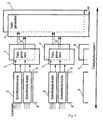
- the lines, interface cards 5 shown in FIG. 1 and clock generators 3, 4 can be operated redundantly. In addition, further clock processing units can have redundancies exhibit. Finally, they also do not point in FIG. 1 shown data traffic units and lines redundancies on.
- the operator judges of the telecommunication system a 1 + 1, 1: N or 1: 1 redundancy of a line or a module, the data traffic serves one.
- This redundancy is in a database stored.
- automatically by means of a Software control determines the redundancy of the data traffic and applied to the clock treatment.
- a corresponding Redundancy of the clock processing devices is hardware-controlled set.
- the process according to the invention is preferably carried out in a process according to the invention Telecommunications system for setting up a Clock source applied that has 1 + 1 line redundancy.
Landscapes
- Engineering & Computer Science (AREA)
- Computer Networks & Wireless Communication (AREA)
- Signal Processing (AREA)
- Data Exchanges In Wide-Area Networks (AREA)
Description
- Fig. 1
- eine Übersicht über Taktbehandlungseinheiten eines ATM-Knotens.
Claims (33)
- Verfahren zum Betreiben eines Telekommunikationssystems, das Datenverkehrseinheiten (5) und Taktbehandlungseinheiten (1 - 4) enthält, die sowohl Leitungen als auch Baugruppen umfassen können, von denen jeweils wenigstens ein Teil redundant betrieben werden kann, wobei das Verfahren die folgenden Schritte umfaßt:Festlegen einer Redundanz entweder für den wenigstens einen Teil der Datenverkehrseinheit (5) oder für den wenigstens einen Teil der Taktbehandlungseinheiten (1 - 4), undEinrichten der festgelegten Redundanz für den wenigstens einen Teil, für den die Redundanz festgelegt worden ist, gekennzeichnet durch den Schritt:Einrichten einer der festgelegten Redundanz entsprechenden Redundanz für den anderen wenigstens einen Teil, für den die Redundanz nicht festgelegt worden ist.
- Verfahren nach Anspruch 1,
dadurch gekennzeichnet, daß das Telekommunikationssystem ein ATM-Telekommunikationssystem ist. - Verfahren nach Anspruch 1 oder 2,
dadurch gekennzeichnet, daß einer der Schritte des Einrichtens einen Schritt des Schreibens wenigstens einer Datenbank enthält, die eine zentrale oder eine lokale Datenbank sein kann. - Verfahren nach einem der Ansprüche 1 bis 3,
dadurch gekennzeichnet, daß der Schritt des Einrichtens einer der festgelegten Redundanz entsprechenden Redundanz einen Schritt des Ermittelns der festgelegten Redundanz enthält. - Verfahren nach Anspruch 4,
dadurch gekennzeichnet, daß der Schritt des Ermittelns der festgelegten Redundanz softwaregesteuert ist. - Verfahren nach einem der Ansprüche 1 bis 5,
dadurch gekennzeichnet, daß der Schritt des Einrichtens der der festgelegten Redundanz entsprechenden Redundanz diese Redundanz hardwaregesteuert einstellt. - Verfahren nach einem der Ansprüche 1 bis 6,
dadurch gekennzeichnet, daß das Verfahren ferner einen Schritt des Auswählens einer der redundanten Datenverkehrseinheiten und Taktbehandlungseinheiten umfaßt. - Verfahren nach einem der Ansprüche 1 bis 7,
dadurch gekennzeichnet, daß der Schritt des Festlegens der Redundanz für wenigstens einen Teil der Datenverkehrseinheiten erfolgt und die ihr entsprechende Redundanz für wenigstens einen Teil der Taktbehandlungseinheiten eingerichtet wird. - Verfahren nach einem der Ansprüche 1 bis 8,
dadurch gekennzeichnet, daß wenigstens eine der festgelegten oder ihr entsprechenden Redundanzen eine Boardredundanz ist. - Verfahren nach einem der Ansprüche 1 bis 9,
dadurch gekennzeichnet, daß wenigstens eine der festgelegten oder ihr entsprechenden Redundanzen eine Lineredundanz ist. - Verfahren nach einem der Ansprüche 1 bis 10,
dadurch gekennzeichnet, daß wenigstens eine der festgelegten oder ihr entsprechenden Redundanzen eine 1:N-Redundanz ist. - Verfahren nach Anspruch 11,
dadurch gekennzeichnet, daß die 1:N-Redundanz eine 1:1-Redundanz ist. - Verfahren nach einem der Ansprüche 1 bis 12,
dadurch gekennzeichnet, daß wenigstens eine der festgelegten oder ihr entsprechenden Redundanzen eine 1+1-Redundanz ist. - Verfahren nach einem der Ansprüche 1 bis 13,
dadurch gekennzeichnet, daß der wenigstens eine Teil der Datenverkehrseinheiten wenigstens eine Schnittstellenkarte (5) umfaßt. - Verfahren nach einem der Ansprüche 1 bis 14,
dadurch gekennzeichnet, daß der wenigstens ein Teil der Taktbehandlungseinheiten wenigstens eine Schnittstellenkarte (5) umfaßt. - Verfahren nach einem der Ansprüche 1 bis 15,
dadurch gekennzeichnet, daß der wenigstens eine Teil der Taktbehandlungseinheiten einen Taktgenerator (1 - 4) umfaßt. - Telekommunikationssystem, umfassend:dadurch gekennzeichnet, daß die Mittel zum Einrichten so miteinander verbunden sind, daß sie die Einrichtung der Redundanz einer der Mittel zum Einrichten durch die Übernahme einer der Redundanz der anderen Mittel zum Einrichten entsprechenden Redundanz ermöglichen.Datenverkehrseinheiten (5) zum Durchführen eines Datenverkehrs, wobei die Datenverkehrseinheiten Leitungen und Baugruppen umfassen können und redundant betrieben werden können,Taktbehandlungseinheiten (1 - 4) zur Taktbehandlung, wobei die Taktbehandlungseinheiten Leitungen und Baugruppen umfassen können und redundant betrieben werden können,Mittel zum Einrichten einer Redundanz wenigstens eines Teils der Datenverkehrseinheiten (5), undMittel zum Einrichten einer Redundanz wenigstens eines Teils der Taktbehandlungseinheiten (1 - 4),
- Telekommunikationssystem nach Anspruch 17,
dadurch gekennzeichnet, daß die Datenverkehrseinheiten wenigstens eine Schnittstellenkarte (5) umfassen. - Telekommunikationssystem nach Anspruch 17 oder 18,
dadurch gekennzeichnet, daß die Taktbehandlungseinheiten wenigstens eine Schnittstellenkarte (5) umfassen. - Telekommunikationssystem nach einem der Ansprüche 17 bis 19,
dadurch gekennzeichnet, daß das Telekommunikationssystem ein ATM-Telekommunikationssystem ist. - Telekommunikationssystem nach Anspruch 20,
dadurch gekennzeichnet, daß die Taktbehandlungseinheiten wenigstens einen Taktgenerator (1-4) umfassen. - Telekommunikationssystem nach einem der Ansprüche 17 bis 21,
dadurch gekennzeichnet, daß wenigstens eines der Mittel zum Einrichten so ausgebildet ist, daß es Zugriff auf eine zentrale Datenbank hat. - Telekommunikationssystem nach einem der Ansprüche 17 bis 22,
dadurch gekennzeichnet, daß wenigstens eines der Mittel zum Einrichten so ausgebildet ist, daß es Zugriff auf wenigstens eine lokale Datenbank hat. - Telekommunikationssystem nach einem der Ansprüche 17 bis 23,
dadurch gekennzeichnet, daß wenigstens eines der Mittel zum Einrichten Mittel zum Ermitteln einer Redundanz umfaßt. - Telekommunikationssystem nach Anspruch 24,
dadurch gekennzeichnet, daß die Mittel zum Ermitteln softwaregesteuert sind. - Telekommunikationssystem nach einem der Ansprüche 17 bis 25,
dadurch gekennzeichnet, daß die Mittel zum Einrichten so ausgebildet sind, daß sie die Redundanzen hardwaregesteuert einstellen. - Telekommunikationssystem nach einem der Ansprüche 17 bis 26,
dadurch gekennzeichnet, daß die Mittel zum Einrichten Mittel zum Auswählen einer der redundanten Einheiten umfassen. - Telekommunikationssystem nach einem der Ansprüche 17 bis 27,
dadurch gekennzeichnet, daß die Mittel zum Einrichten der Redundanz wenigstens eines Teils der Taktbehandlungseinheiten eine der der Redundanz der Datenverkehrseinheiten entsprechende Redundanz einrichten. - Telekommunikationssystem nach einem der Ansprüche 17 bis 28,
dadurch gekennzeichnet, daß wenigstens eine der Redundanzen eine Boardredundanz ist. - Telekommunikationssystem nach einem der Ansprüche 17 bis 29,
dadurch gekennzeichnet, daß wenigstens eine der Redundanzen eine Lineredundanz ist. - Telekommunikationssystem nach einem der Ansprüche 17 bis 30,
dadurch gekennzeichnet, daß wenigstens eine der Redundanzen eine 1:N-Redundanz ist. - Telekommunikationssystem nach Anspruch 31,
dadurch gekennzeichnet, daß die 1:N-Redundanz eine 1:1-Redundanz ist. - Telekommunikationssystem nach einem der Ansprüche 17 bis 32,
dadurch gekennzeichnet, daß wenigstens eine der Redundanzen eine 1+1-Redundanz ist.
Priority Applications (1)
| Application Number | Priority Date | Filing Date | Title |
|---|---|---|---|
| EP99944528A EP1108298B1 (de) | 1998-08-28 | 1999-08-26 | Telekommunikationssystem sowie verfahren zum betreiben desselben |
Applications Claiming Priority (4)
| Application Number | Priority Date | Filing Date | Title |
|---|---|---|---|
| EP98116321A EP0984573A1 (de) | 1998-08-28 | 1998-08-28 | Telekommunikationssystem sowie Verfahren zum Betreiben desselben |
| EP98116321 | 1998-08-28 | ||
| EP99944528A EP1108298B1 (de) | 1998-08-28 | 1999-08-26 | Telekommunikationssystem sowie verfahren zum betreiben desselben |
| PCT/EP1999/006285 WO2000013353A1 (de) | 1998-08-28 | 1999-08-26 | Telekommunikationssystem sowie verfahren zum betreiben desselben |
Publications (2)
| Publication Number | Publication Date |
|---|---|
| EP1108298A1 EP1108298A1 (de) | 2001-06-20 |
| EP1108298B1 true EP1108298B1 (de) | 2003-10-22 |
Family
ID=8232535
Family Applications (2)
| Application Number | Title | Priority Date | Filing Date |
|---|---|---|---|
| EP98116321A Withdrawn EP0984573A1 (de) | 1998-08-28 | 1998-08-28 | Telekommunikationssystem sowie Verfahren zum Betreiben desselben |
| EP99944528A Expired - Lifetime EP1108298B1 (de) | 1998-08-28 | 1999-08-26 | Telekommunikationssystem sowie verfahren zum betreiben desselben |
Family Applications Before (1)
| Application Number | Title | Priority Date | Filing Date |
|---|---|---|---|
| EP98116321A Withdrawn EP0984573A1 (de) | 1998-08-28 | 1998-08-28 | Telekommunikationssystem sowie Verfahren zum Betreiben desselben |
Country Status (3)
| Country | Link |
|---|---|
| EP (2) | EP0984573A1 (de) |
| DE (1) | DE59907474D1 (de) |
| WO (1) | WO2000013353A1 (de) |
-
1998
- 1998-08-28 EP EP98116321A patent/EP0984573A1/de not_active Withdrawn
-
1999
- 1999-08-26 DE DE59907474T patent/DE59907474D1/de not_active Expired - Fee Related
- 1999-08-26 WO PCT/EP1999/006285 patent/WO2000013353A1/de not_active Ceased
- 1999-08-26 EP EP99944528A patent/EP1108298B1/de not_active Expired - Lifetime
Also Published As
| Publication number | Publication date |
|---|---|
| WO2000013353A1 (de) | 2000-03-09 |
| DE59907474D1 (de) | 2003-11-27 |
| EP1108298A1 (de) | 2001-06-20 |
| EP0984573A1 (de) | 2000-03-08 |
Similar Documents
| Publication | Publication Date | Title |
|---|---|---|
| DE69329162T2 (de) | Netzwerkelement mit Querverbindungsmatrix und Server | |
| DE69534623T2 (de) | Integrierte kommunikationsverbindungen für einen verteilten digitalen querverbinder mit merhfachen koppelfeldern | |
| DE60218284T2 (de) | Verfahren und vorrichtung zum tunneln von daten in einem netzwerk | |
| DE69329433T2 (de) | Vorrichtung und Verfahren zur Übertragung SONET-Zusatzsignalinformation | |
| DE69637295T2 (de) | Vorrichtung zur anpassung von smallband-sprach-verkehr eines lokalen zugangsnetzwerkes zum übertragen über ein breitband-netzwerk mit asynchronem transfermodus | |
| DE69925548T2 (de) | Übertragung von rahmenbasierten Daten über ein synchrones hierarchisches digitales Netzwerk | |
| DE69025979T2 (de) | Synchrones optisches Übertragungssystem | |
| DE69330323T2 (de) | Duale Knotenverbindung in einem bidirektionalen leitungsgeschalteten Ringübertragungssystem | |
| DE60116879T2 (de) | Apparat und verfahren zum optischen kommunkationsschutz | |
| DE69834861T2 (de) | Transparente Übertragung in einem Nachrichtenübertragungssystem | |
| EP0723344B1 (de) | Synchrones digitales Nachrichtenübertragungssystem mit hierarchischem Synchronisierungsnetz | |
| DE69224751T2 (de) | Querverbindung eines kommunikationsnetzes | |
| EP1021009B1 (de) | Synchronisation eines Netzelementes in einem synchronen digitalen Nachrichtenübertragungsnetz | |
| DE60317867T2 (de) | Verkehrsbearbeitung in einem geschützten synchronen Kommunikationsnetzwerk | |
| DE60008734T2 (de) | Verfahren und Knoten zur Leitweglenkung von Hochgeschwindigkeitsrahmen in einem maschenartigen Netzwerk sowie zugehörige Sende-Endstation | |
| DE10118295A1 (de) | Optischer Crossconnect | |
| DE69118954T2 (de) | Terminaleinrichtung für asynchrones Netzwerk | |
| DE69322291T2 (de) | Verfahren zur bildung einer netzschnittstelle und netzschnittstelle für ein digitales übertragungsnetz | |
| DE60037957T2 (de) | Transportsystem und -verfahren | |
| DE60133330T2 (de) | 10 Gigabit Ethernet-Darstellung für eine gemeinsamen LAN/WAN PMD Schnitstelle | |
| DE60203690T2 (de) | Verfahren und Vorrichtung zur Übertragung eines SDH/SONET Client-Signals als Dienstleistung | |
| DE69228370T2 (de) | Verfahren zur synchronisierung eines synchronen datenkommunikationsnetzwerkes und kommunikationsvorrichtung zum gebrauch im synchronen datenkommunikationsnetzwerk | |
| EP0982890A1 (de) | Telekommunikationssystem sowie Verfahren zum Erzeugen eines Haupttaktes in demselben | |
| DE60025316T2 (de) | Detektion von Fehlern in der vorigen Sektion für eine transparente Untersystemseinheit | |
| DE19959813B4 (de) | Synchrones digitales Nachrichtenübertragungssystem |
Legal Events
| Date | Code | Title | Description |
|---|---|---|---|
| PUAI | Public reference made under article 153(3) epc to a published international application that has entered the european phase |
Free format text: ORIGINAL CODE: 0009012 |
|
| 17P | Request for examination filed |
Effective date: 20010214 |
|
| AK | Designated contracting states |
Kind code of ref document: A1 Designated state(s): AT BE CH CY DE DK ES FI FR GB GR IE IT LI LU MC NL PT SE |
|
| GRAH | Despatch of communication of intention to grant a patent |
Free format text: ORIGINAL CODE: EPIDOS IGRA |
|
| GRAH | Despatch of communication of intention to grant a patent |
Free format text: ORIGINAL CODE: EPIDOS IGRA |
|
| GRAA | (expected) grant |
Free format text: ORIGINAL CODE: 0009210 |
|
| AK | Designated contracting states |
Kind code of ref document: B1 Designated state(s): CH DE LI |
|
| REG | Reference to a national code |
Ref country code: CH Ref legal event code: NV Representative=s name: SIEMENS SCHWEIZ AG Ref country code: CH Ref legal event code: EP |
|
| REG | Reference to a national code |
Ref country code: IE Ref legal event code: FG4D Free format text: GERMAN |
|
| REF | Corresponds to: |
Ref document number: 59907474 Country of ref document: DE Date of ref document: 20031127 Kind code of ref document: P |
|
| REG | Reference to a national code |
Ref country code: IE Ref legal event code: FD4D |
|
| PLBE | No opposition filed within time limit |
Free format text: ORIGINAL CODE: 0009261 |
|
| STAA | Information on the status of an ep patent application or granted ep patent |
Free format text: STATUS: NO OPPOSITION FILED WITHIN TIME LIMIT |
|
| 26N | No opposition filed |
Effective date: 20040723 |
|
| PGFP | Annual fee paid to national office [announced via postgrant information from national office to epo] |
Ref country code: CH Payment date: 20051108 Year of fee payment: 7 |
|
| PG25 | Lapsed in a contracting state [announced via postgrant information from national office to epo] |
Ref country code: LI Free format text: LAPSE BECAUSE OF NON-PAYMENT OF DUE FEES Effective date: 20060831 Ref country code: CH Free format text: LAPSE BECAUSE OF NON-PAYMENT OF DUE FEES Effective date: 20060831 |
|
| REG | Reference to a national code |
Ref country code: CH Ref legal event code: PL |
|
| PGFP | Annual fee paid to national office [announced via postgrant information from national office to epo] |
Ref country code: DE Payment date: 20070831 Year of fee payment: 9 |
|
| PG25 | Lapsed in a contracting state [announced via postgrant information from national office to epo] |
Ref country code: DE Free format text: LAPSE BECAUSE OF NON-PAYMENT OF DUE FEES Effective date: 20090303 |