EP1107343A2 - Electrode, secondary battery and method of producing the same - Google Patents
Electrode, secondary battery and method of producing the same Download PDFInfo
- Publication number
- EP1107343A2 EP1107343A2 EP00126188A EP00126188A EP1107343A2 EP 1107343 A2 EP1107343 A2 EP 1107343A2 EP 00126188 A EP00126188 A EP 00126188A EP 00126188 A EP00126188 A EP 00126188A EP 1107343 A2 EP1107343 A2 EP 1107343A2
- Authority
- EP
- European Patent Office
- Prior art keywords
- collector
- oxide film
- electrode
- secondary battery
- film
- Prior art date
- Legal status (The legal status is an assumption and is not a legal conclusion. Google has not performed a legal analysis and makes no representation as to the accuracy of the status listed.)
- Withdrawn
Links
Images
Classifications
-
- H—ELECTRICITY
- H01—ELECTRIC ELEMENTS
- H01M—PROCESSES OR MEANS, e.g. BATTERIES, FOR THE DIRECT CONVERSION OF CHEMICAL ENERGY INTO ELECTRICAL ENERGY
- H01M4/00—Electrodes
- H01M4/02—Electrodes composed of, or comprising, active material
- H01M4/64—Carriers or collectors
-
- H—ELECTRICITY
- H01—ELECTRIC ELEMENTS
- H01M—PROCESSES OR MEANS, e.g. BATTERIES, FOR THE DIRECT CONVERSION OF CHEMICAL ENERGY INTO ELECTRICAL ENERGY
- H01M10/00—Secondary cells; Manufacture thereof
- H01M10/36—Accumulators not provided for in groups H01M10/05-H01M10/34
-
- H—ELECTRICITY
- H01—ELECTRIC ELEMENTS
- H01M—PROCESSES OR MEANS, e.g. BATTERIES, FOR THE DIRECT CONVERSION OF CHEMICAL ENERGY INTO ELECTRICAL ENERGY
- H01M4/00—Electrodes
- H01M4/02—Electrodes composed of, or comprising, active material
- H01M4/13—Electrodes for accumulators with non-aqueous electrolyte, e.g. for lithium-accumulators; Processes of manufacture thereof
- H01M4/137—Electrodes based on electro-active polymers
-
- H—ELECTRICITY
- H01—ELECTRIC ELEMENTS
- H01M—PROCESSES OR MEANS, e.g. BATTERIES, FOR THE DIRECT CONVERSION OF CHEMICAL ENERGY INTO ELECTRICAL ENERGY
- H01M4/00—Electrodes
- H01M4/02—Electrodes composed of, or comprising, active material
- H01M4/36—Selection of substances as active materials, active masses, active liquids
- H01M4/60—Selection of substances as active materials, active masses, active liquids of organic compounds
-
- H—ELECTRICITY
- H01—ELECTRIC ELEMENTS
- H01M—PROCESSES OR MEANS, e.g. BATTERIES, FOR THE DIRECT CONVERSION OF CHEMICAL ENERGY INTO ELECTRICAL ENERGY
- H01M4/00—Electrodes
- H01M4/02—Electrodes composed of, or comprising, active material
- H01M4/64—Carriers or collectors
- H01M4/66—Selection of materials
- H01M4/661—Metal or alloys, e.g. alloy coatings
-
- H—ELECTRICITY
- H01—ELECTRIC ELEMENTS
- H01M—PROCESSES OR MEANS, e.g. BATTERIES, FOR THE DIRECT CONVERSION OF CHEMICAL ENERGY INTO ELECTRICAL ENERGY
- H01M4/00—Electrodes
- H01M4/02—Electrodes composed of, or comprising, active material
- H01M4/64—Carriers or collectors
- H01M4/66—Selection of materials
- H01M4/665—Composites
- H01M4/667—Composites in the form of layers, e.g. coatings
-
- H—ELECTRICITY
- H01—ELECTRIC ELEMENTS
- H01M—PROCESSES OR MEANS, e.g. BATTERIES, FOR THE DIRECT CONVERSION OF CHEMICAL ENERGY INTO ELECTRICAL ENERGY
- H01M4/00—Electrodes
- H01M4/02—Electrodes composed of, or comprising, active material
- H01M4/62—Selection of inactive substances as ingredients for active masses, e.g. binders, fillers
- H01M4/624—Electric conductive fillers
- H01M4/625—Carbon or graphite
-
- Y—GENERAL TAGGING OF NEW TECHNOLOGICAL DEVELOPMENTS; GENERAL TAGGING OF CROSS-SECTIONAL TECHNOLOGIES SPANNING OVER SEVERAL SECTIONS OF THE IPC; TECHNICAL SUBJECTS COVERED BY FORMER USPC CROSS-REFERENCE ART COLLECTIONS [XRACs] AND DIGESTS
- Y02—TECHNOLOGIES OR APPLICATIONS FOR MITIGATION OR ADAPTATION AGAINST CLIMATE CHANGE
- Y02E—REDUCTION OF GREENHOUSE GAS [GHG] EMISSIONS, RELATED TO ENERGY GENERATION, TRANSMISSION OR DISTRIBUTION
- Y02E60/00—Enabling technologies; Technologies with a potential or indirect contribution to GHG emissions mitigation
- Y02E60/10—Energy storage using batteries
-
- Y—GENERAL TAGGING OF NEW TECHNOLOGICAL DEVELOPMENTS; GENERAL TAGGING OF CROSS-SECTIONAL TECHNOLOGIES SPANNING OVER SEVERAL SECTIONS OF THE IPC; TECHNICAL SUBJECTS COVERED BY FORMER USPC CROSS-REFERENCE ART COLLECTIONS [XRACs] AND DIGESTS
- Y02—TECHNOLOGIES OR APPLICATIONS FOR MITIGATION OR ADAPTATION AGAINST CLIMATE CHANGE
- Y02P—CLIMATE CHANGE MITIGATION TECHNOLOGIES IN THE PRODUCTION OR PROCESSING OF GOODS
- Y02P70/00—Climate change mitigation technologies in the production process for final industrial or consumer products
- Y02P70/50—Manufacturing or production processes characterised by the final manufactured product
-
- Y—GENERAL TAGGING OF NEW TECHNOLOGICAL DEVELOPMENTS; GENERAL TAGGING OF CROSS-SECTIONAL TECHNOLOGIES SPANNING OVER SEVERAL SECTIONS OF THE IPC; TECHNICAL SUBJECTS COVERED BY FORMER USPC CROSS-REFERENCE ART COLLECTIONS [XRACs] AND DIGESTS
- Y10—TECHNICAL SUBJECTS COVERED BY FORMER USPC
- Y10T—TECHNICAL SUBJECTS COVERED BY FORMER US CLASSIFICATION
- Y10T29/00—Metal working
- Y10T29/49—Method of mechanical manufacture
- Y10T29/49002—Electrical device making
- Y10T29/49108—Electric battery cell making
- Y10T29/49115—Electric battery cell making including coating or impregnating
Definitions
- the present invention relates to an electrode, a secondary battery and a method of producing the same. More particularly it relates to an electrode, a secondary battery and a method of using a valve action metal for a collector to produce the same with an excellent cyclic property and a film forming property.
- An electrode structure for configuring the battery or electric double-layered condenser can be produced by applying onto a collector an electrode composite consisting of an active substance powder (activated carbon powder in the electric double-layered condenser), a conductive auxiliary and an organic binder.
- an electrode composite consisting of an active substance powder (activated carbon powder in the electric double-layered condenser), a conductive auxiliary and an organic binder.
- the collector and the electrode are required to tightly contact with each other in order to allow the electrode to function sufficiently.
- a collector made of a valve action metal such as Ta, Nb, Al, W, Mo, Ti, and Sr
- an aqueous electrolytic solution are employed in a battery, a DC current flows into the collector and causes a formation reaction in the surface of the valve action metal to produce an oxide film.
- JP 5-182670A discloses a method for roughening the surface of a collector to adhere an electrode to the collector. This method, however, simply increases the physical adherence of the electrode to the collector using an active substance and therefore gradually causes a peel due to repeated expanding and retracting of the active substance.
- an anchor layer having a composition near that of the film is provided between a substrate and a film. The anchor layer is required, however, to be conductive in order to transfer electrons between a collector and an electrode and thus suffers many restrictions. In addition, a peel occurs when a thick film cracks.
- a secondary battery comprising:
- a method of producing an electrode structure and a secondary battery such as a storage device according to the present invention is described hereunder.
- a secondary battery such as a storage device (battery, electrochemical capacitor or electric double-layered condenser), which includes electrodes opposed to each other and formed on collectors made of a valve action metal, and of producing an electrode thereof
- a several nm thick oxide film is formed on the collector.
- the oxide film is an insulator. Nevertheless, as an extremely thin oxide film with a thickness of several nm is used, a tunnel current flows through the film, and the film is not insulated to form the collector.
- the process is characterized in that it includes the step of forming the electrode in the form of a film on the collector.
- a collector made of a valve action metal is employed along with an aqueous electrolytic solution, an oxide film previously formed thereon prevents a formation reaction from proceeding in the surface of the collector in order to allow the oxide film to further grow when a DC current flows into the collector.
- the adherent property of the electrode to the collector does not worsen and the cyclic property improves.
- the oxide film formed on the valve action metal is wet with an aqueous electrolytic solution because it is more hydrophilic than the valve action metal.
- a valve action metal for example, Ta, Nb, Al, W, Mo, Ti and Sr
- An oxide film can be formed on the surface of the collector according to two methods:
- the DC voltage applied thereon is in the order of several volts.
- a suitable voltage may be determined in accordance with the nature of the collector and is such a formation voltage in a certain range that allows a current to flow into the oxide film.
- the collector may have a shape, either in the form of a cutout sheet or an elongated sheet, which is not limited specially.
- oxidizing conditions to form a several nm thick oxide film are determined for use in air at 400 °C to room temperature for 1 hour, and in an oxidative ambient at 200 °C to room temperature for 1 hour.
- the anodization and the gas-phase oxidization give the same property to the oxide film, and thus any one of them may be freely employed. It is easier for the anodization, however, to control the oxide film to have a designated thickness.
- the working voltage of the secondary battery applied to the collector is equal to 1 V or higher.
- a tantalum plate a tantalum pentoxide film with a thickness of 1.7 nm is produced at a formation voltage of 1 V.
- a niobium pentoxide film with a thickness of 2.4 nm is produced at a formation voltage of 1 V. Therefore, preferably a formation voltage equal to or higher than the working voltage (1-3 V) is previously applied to form the oxide film on the collector so as not to cause a formation reaction during the operation of the secondary battery. For this reason, an oxide film having a thickness of 1.7 nm or more is preferred.
- the oxide film is originally an insulator, the oxide film is extremely thin, is not insulated and allows a collector to function. To the contrary, if the oxide film has a thickness over 10 nm, it is possibly insulated, and possibly prevents a collector from functioning. Accordingly, the oxide film preferably has a thickness within a range of 1.7-10 nm.
- the oxide film is formed in a range of from 30% by area or more to less than 100% by area relative to the surface area of the collector. If the oxide film is formed in a range of less than 30% by area relative to the surface area of the collector, the adherent property of the electrode to the collector lowers and the cyclic property easily reduces. If it is formed in a range of 100% by area, the conductivity is possibly lost to exhibit insulation.
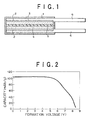
- Fig. 1 schematically illustrates the inner structure of a battery according to Example 1 of the present invention.
- a tantalum plate 6 is employed for a collector and a tantalum pentoxide film 2 formed by formation reaction is disposed on the surface of the tantalum plate. Electrodes formed on collectors are arranged as opposed to each other via an insulating, ion-permeable micro-porous separator 5.
- a laminated material 1 surrounds the peripheral portions of the electrodes to hold the electrodes.
- the separator 5 lies between a mixture containing a positive electrode active material and carbon powder 3 and a mixture containing a negative electrode active material and carbon powder 4.
- a process for producing a battery according to Example 1 has three steps: (1) formation of tantalum collectors; (2) forming of electrodes; and (3) production of a battery,
- FIG. 2 shows the relation between the capacity of an electrode, which has a film of polyphenylquinoxaline (PPQx) formed on the tantalum collector, and the formation voltage of a tantalum plate. When the formation voltage exceeds 5 V, the capacity sharply reduces.
- PPQx polyphenylquinoxaline
- the thickness of the tantalum pentoxide film increases at a formation voltage of 5 V or higher and the film is insulated.
- the formation voltage is determined to 3 V when a tantalum plate is employed.
- the formed tantalum pentoxide film had a thickness of 5 nm and had no formation color.
- the oxide film was formed in the range of 30% by area relative to the surface area of the collector.
- a mixed powder of PPQx and carbon powder (in a weight ratio of 75:25) for a cathode and a mixed powder of polycyanoindole (PCI) and carbon powder (in a weight ratio of 75:25) for an anode were each mixed with a 20% by weight sulfuric acid aqueous solution to be a paste. They were used to form electrodes in the form of a film on the collectors.
- the thus-formed electrodes are arranged as opposed to each other via a micro-porous separator and their peripheral portions are surrounded by a laminated material to complete a battery.
- a charge/discharge cyclic test was performed to check its cyclic property of the battery of Example 1.
- a set of the steps of charging at 500 mAh up to 1.2 V followed by resting for 1 hour, then discharging at 500 mAh down to a final discharge voltage of 1.0 V followed by resting for 1 hour is defined as 1 cycle.
- the test results demonstrate that the capacity reduced to 80% of the initial capacity after 1,000 cycles.
- the oxide film was already formed on the surface of the collector at the time of forming the electrode and the voltage at the time of charge/discharge was lower than the formation voltage, the oxide film was inhibited from further growing in the collector surface. Accordingly, there is no variation in volume of the collector within the charging voltage range. Thus, the adherent property of the electrode to the collector does not reduce and the cyclic property improves.
- Comparative Example 1 refers to a method for forming an electrode film without formation of a tantalum plate.
- Comparative Example 1 is a battery producing process having two steps: (1) forming of electrodes; and (2) production of a battery.
- a charge/discharge cyclic test was performed to check its cyclic property of the battery of Comparative Example 1.
- the test results demonstrate that the capacity reduced to 80% of the initial capacity after 500 cycles. It was also observed that the electrode was peeled off the collector.
- a tantalum plate is employed for a collector and a formed tantalum pentoxide film is disposed on the surface of the tantalum plate. Electrodes formed on collectors are arranged as opposed to each other via an insulating, ion-permeable micro-porous separator. A laminated material surrounds the peripheral portions of the electrodes to hold the electrodes.
- a process for producing a battery according to Example 2 has three steps: (1) formation of tantalum collectors; (2) forming of electrodes; and (3) production of a battery.
- a 5-cm square tantalum plate and a SUS plate used for the opposed electrode were immersed into a 0.05-0.6% by weight phosphoric acid (nitric acid or sulfuric acid) solution, and a current of 100 mA/cm 2 was supplied thereto.
- the formation voltage was determined to 3 V.
- the formed tantalum pentoxide film had a thickness of 5 nm and had no transformation color.
- the oxide film was formed in the range of 70% by area relative to the surface area of the collector.
- a mixed powder of PPQx and carbon powder (in a weight ratio of 75:25) for a cathode and a mixed powder of PCI and carbon powder (in a weight ratio of 75:25) for an anode were each mixed with a 20% by weight sulfuric acid aqueous solution to be a paste. They were used to form electrodes in the form of a film on the collectors.
- the thus-formed electrodes were arranged as opposed to each other via a micro-porous separator and their peripheral portions were surrounded by a laminated material to complete a battery.
- a charge/discharge cyclic test was performed to check its cyclic property of the battery of Example 2.
- a set of the steps of charging at 500 mAh up to 1.2 V followed by resting for 1 hour, then discharging at 500 mAh down to a final discharge voltage of 1.0 V followed by resting for 1 hour is defined as 1 cycle.
- the test results demonstrate that the capacity reduced to 80% of the initial capacity after 2,000 cycles.
- Example 2 While the capacity reduced to 80% of the initial capacity after 1,000 cycles in Example 1, the capacity reduced to 80% of the initial capacity after 2,000 cycles in Example 2.
- a tantalum plate was employed for a collector and a tantalum pentoxide film formed by gas-phase oxidization was disposed on the surface of the tantalum plate. Electrodes formed on collectors were arranged as opposed to each other via an insulating, ion-permeable micro-porous separator. A laminated material surrounded the peripheral portions of the electrodes to hold the electrodes.
- a process for producing a battery according to Example 3 has three steps: (1) gas-phase oxidization of tantalum collectors; (2) forming of electrodes; and (3) production of a battery.
- a 5-cm square tantalum plate was heated to form a tantalum pentoxide film in air at 400 °C to room temperature for 1 hour or in an oxidative ambient at 200 °C to room temperature for 1 hour.
- Conditions for the gas-phase oxidization were determined in the following manner.
- a tantalum plate was heated in air at 400 °C for 1 hour and then in an oxidative ambient at 200 °C for 1 hour to form a tantalum pentoxide film on the tantalum plate.
- the thickness of the tantalum pentoxide film was measured by a polarization analysis method. The thickness of the tantalum pentoxide film was equal to 5 nm.
- the heating conditions were determined as in air at 400 °C to room temperature for 1 hour and in an oxidative ambient at 200 °C to room temperature for 1 hour. No formation color could be observed.
- the oxide film was formed in the range of 40% by area relative to the surface area of the collector.
- a mixed powder of PPQx and carbon powder (in a weight ratio of 75:25) for a cathode and a mixed powder of PCI and carbon powder (in a weight ratio of 75:25) for an anode were each mixed with a 20% by weight sulfuric acid aqueous solution to be a paste. They were used to form electrodes in the form of a film on the collectors.
- the thus-formed electrodes were arranged as opposed to each other via a micro-porous separator and their peripheral portions were surrounded by a laminated material to complete a battery.
- a charge/discharge cyclic test was performed to check its cyclic property of the battery of Example 3.
- a set of the steps of charging at 500 mAh up to 1.2 V followed by resting for 1 hour, then discharging at 500 mAh down to a final discharge voltage of 1.0 V followed by resting for 1 hour is defined as 1 cycle.
- the test results demonstrate that the capacity reduced to 80% of the initial capacity after 2,000 cycles.
- the collector oxidized in a gas phase in Example 3 also exhibited 2,000 cycles similar to that of a collector treated by formation.
- the cyclic property improved. This means that the gas-phase oxidization of the collector increased the ratio of the oxide film to the surface area of the collector and improved the adherent property of the electrode to the collector.
- Tantalum plates once immersed into a hydrofluoric acid solution and then rinsed in water, were oxidized in a gas phase to form electrodes.
- the electrodes were arranged as opposed to each other via an insulating, ion-permeable micro-porous separator.
- a laminated material surrounded the peripheral portions of the electrodes to hold the electrodes.
- a process for producing a battery according to Example 4 has four steps: (1) etching of tantalum plates, (2) gas-phase oxidization of tantalum collectors; (3) forming of electrodes; and (4) production of a battery.
- a 5-cm square tantalum plate was immersed into a hydrofluoric acid solution for 10 minutes and then rinsed in water.
- the etched tantalum plate was heated to form an oxide film in air at 400 °C or below for 1 hour or in an oxidative ambient at 200 °C or below for 1 hour.
- the thickness of the oxide film formed on the surface was equal to 5 nm and no formation color could be observed.
- the oxide film was formed in the range of 40% by area relative to the surface area of the collector.
- a mixed powder of PPQx and carbon powder (in a weight ratio of 75:25) for a cathode and a mixed powder of PCI and carbon powder (in a weight ratio of 75:25) for an anode were each mixed with a 20% by weight sulfuric acid aqueous solution to be a paste. They were used to form electrodes in the form of a film on the collectors.
- the thus-formed electrodes were arranged as opposed to each other via a micro-porous separator and their peripheral portions were surrounded by a laminated material to complete a battery.
- a charge/discharge cyclic test was performed to check its cyclic property of the battery of Example 4.
- a set of the steps of charging at 500 mAh up to 1.2 V followed by resting for 1 hour, then discharging at 500 mAh down to a final discharge voltage of 1.0 V followed by resting for 1 hour is defined as 1 cycle.
- the test results demonstrate that the capacity reduced to 80% of the initial capacity after 4,000 cycles.
- Example 4 While the capacity reduced to 80% of the initial capacity after 600 cycles in Comparative Example 2 as described later, the capacity reduced to 80% of the initial capacity after 4,000 cycles in Example 4. This means that the adherent property of the electrode to the collector did not reduce in Example 4. Because the oxide film was already formed on the surface of the collector at the time of forming the electrode and the voltage at the time of charge/discharge was lower than the formation voltage, the oxide film was inhibited from further growing on the collector surface. Accordingly, there is no variation in volume of the collector within the charging voltage range. Thus, the adherent property of the electrode to the collector does not reduce and the cyclic property improves.
- Comparative Example 2 refers to a method for forming an electrode in the form of a film without oxidizing a tantalum plate in a gas phase as described in Example 4.
- a process for producing a battery according to Comparative Example 2 has three steps: (1) etching of tantalum plates; (2) forming of electrodes; and (3) production of a battery.
- a charge/discharge cyclic test was performed to check its cyclic property of the battery of Comparative Example 2.
- the test results demonstrate that the capacity reduced to 80% of the initial capacity after 600 cycles. It was also observed that the electrode was peeled off the collector.
- a niobium plate was employed for a collector and a niobium pentoxide film formed by formation was disposed on the surface of the niobium plate. Electrodes formed on the collectors were arranged as opposed to each other via an insulating, ion-permeable micro-porous separator. A laminated material surrounded the peripheral portions of the electrodes to hold the electrodes.
- a process for producing a battery according to Example 5 has three steps: (1) formation of niobium collectors; (2) forming of electrodes; and (3) production of a battery.
- a 5-cm square niobium plate and a SUS plate used for the opposed electrode were immersed into a 0.05-0.6% by weight phosphoric acid (nitric acid or sulfuric acid) solution, and a current of 10 mA/cm 2 was supplied thereto. When the voltage reached up to 3 V, it was held during a holding time of 1 hour.
- the niobium pentoxide film formed on the surface had a thickness of 7.2 nm and had no formation color.
- the oxide film was formed in the range of 50% by area relative to the surface area of the collector.
- a mixed powder of PPQx and carbon powder (in a weight ratio of 75:25) for a cathode and a mixed powder of PCI and carbon powder (in a weight ratio of 75:25) for an anode were each mixed with a 20% by weight sulfuric acid aqueous solution to be a paste. They were used to form electrodes in the form of a film on the collectors.
- the thus-formed electrodes were arranged as opposed to each other via a micro-porous separator and their peripheral portions were surrounded by a laminated material to complete a battery.
- a charge/discharge cyclic test was performed to check its cyclic property of the battery of Example 5.
- a set of the steps of charging at 500 mAh up to 1.2 V followed by resting for 1 hour, then discharging at 500 mAh down to a final discharge voltage of 1.0 V followed by resting for 1 hour is defined as 1 cycle.
- the test results demonstrate that the capacity reduced to 80% of the initial capacity after 1,000 cycles.
- Example 5 While the capacity reduced to 80% of the initial capacity after 350 cycles in Comparative Example 3 as described later, the capacity reduced to 80% of the initial capacity after 600 cycles in Example 5. This means that the adherent property of the electrode to the collector did not reduce in Example 5. Because the oxide film was already formed on the surface of the collector at the time of forming the electrode and the voltage at the time of charge/discharge was lower than the formation voltage, the oxide film was inhibited from further growing on the collector surface. Accordingly, there is no variation in volume of the collector within the charging voltage range. Thus, the adherent property of the electrode to the collector does not reduce and the cyclic property improves.
- Comparative Example 3 refers to a method for forming an electrode in the form of a film without formation of a niobium plate.
- a process for producing a battery according to Comparative Example 3 has two steps: (1) forming of electrodes; and (2) production of a battery.
- an oxide film of a thickness of 1.7-10 nm is formed on the surface of a collector made of a valve action metal.
- the oxide film is formed in a range of from 30% by area or more to less than 100% by area relative to the surface area of the collector.
- An electrode is formed in the form of a film on the collector. The electrode is used for a secondary battery. The electrode and battery are excellent in cyclic property and film-forming property.
Landscapes
- Chemical & Material Sciences (AREA)
- Chemical Kinetics & Catalysis (AREA)
- Electrochemistry (AREA)
- General Chemical & Material Sciences (AREA)
- Engineering & Computer Science (AREA)
- Materials Engineering (AREA)
- Composite Materials (AREA)
- Manufacturing & Machinery (AREA)
- Battery Electrode And Active Subsutance (AREA)
- Secondary Cells (AREA)
- Cell Electrode Carriers And Collectors (AREA)
Abstract
Description
wherein said collector is covered with an oxide film of a thickness of 1.7-10 nm, said oxide film being formed in a range of from 30% by area or more to less than 100% by area relative to the surface area of said collector.
| The number of cycles down to 80% of the initial capacity | |
| Example 1 | 1000 |
| Example 2 | 2000 |
| Example 3 | 2000 |
| Example 4 | 4000 |
| Example 5 | 1000 |
| Comparative Example 1 | 500 |
| Comparative Example 2 | 600 |
| Comparative Example 3 | 350 |
Claims (32)
- A secondary battery comprising:a first collector made of a first valve action metal;a second collector made of a second valve action metal;a first electrode;a second electrode;a separator; andan outer can,wherein said first collector is covered with a first oxide film of a thickness of 1.7-10 nm, said first oxide film being formed in a range of from 30% by area or more to less than 100% by area relative to the surface area of said first collector, said first collector having said first electrode disposed thereon;said second collector is covered with a second oxide film of a thickness of 1.7-10 nm, said second oxide film being formed in a range of from 30% by area or more to less than 100% by area relative to the surface area of said second collector, said second collector having said second electrode disposed thereon.
- The secondary battery of claim 1, wherein said first valve action metal is Ta or Nb.
- The secondary battery of claim 1, wherein said second valve action metal is Ta or Nb.
- The secondary battery of claim 1, wherein said first electrode is a mixture comprising polyphenylquinoxaline, carbon powder and a sulfuric acid aqueous solution.
- The secondary battery of claim 1, wherein said second electrode is a mixture comprising polycyanoindole, carbon powder and a sulfuric acid aqueous solution.
- The secondary battery of claim 1, wherein said separator is a micro-porous separator.
- The secondary battery of claim 1, wherein said first oxide film is made of tantalum pentoxide or niobium pentoxide.
- The secondary battery of claim 1, wherein said second oxide film is made of tantalum pentoxide or niobium pentoxide.
- An electrode for a secondary battery which comprises a collector made of a valve action metal and a paste film formed on said collector,
wherein said collector is covered with an oxide film of a thickness of 1.7-10 nm, said oxide film being formed in a range of from 30% by area or more to less than 100% by area relative to the surface area of said collector. - The electrode of claim 9, wherein said paste film is a mixture comprising polyphenylquinoxaline, carbon powder and a sulfuric acid aqueous solution.
- The electrode of claim 9, wherein said paste film is a mixture comprising polycyanoindole, carbon powder and a sulfuric acid aqueous solution.
- The electrode of claim 9, wherein said valve action metal is Ta or Nb.
- The electrode of claim 9, wherein said oxide film is made of tantalum pentoxide or niobium pentoxide.
- A method of producing a secondary battery comprising a first collector made of a first valve action metal, a second collector made of a second valve action metal, a first electrode, a second electrode, a separator and an outer can, wherein said method comprises:forming a first oxide film of a thickness of 1.7-10 nm on said first collector, said first oxide film being formed in a range of from 30% by area or more to less than 100% by area relative to the surface area of said first collector;forming a second oxide film of a thickness of 1.7-10 nm on said second collector, said second oxide film being formed in a range of 30% or more to less than 100% by area relative to the surface area of said second collector;forming said first electrode on said first collector; andforming said second electrode on said second collector.
- The method of claim 14, wherein said first valve action metal is Ta or Nb.
- The method of claim 14, wherein said second valve action metal is Ta or Nb.
- The method of claim 14, wherein said first electrode is a mixture comprising polyphenylquinoxaline, carbon powder and a sulfuric acid aqueous solution.
- The method of claim 14, wherein said second electrode is a mixture comprising polycyanoindole, carbon powder and a sulfuric acid aqueous solution.
- The method of claim 14, wherein said separator is a micro-porous separator.
- The method of claim 14, wherein said first oxide film is made of tantalum pentoxide or niobium pentoxide.
- The method of claim 14, wherein said second oxide film is made of tantalum pentoxide or niobium pentoxide.
- The method of claim 14, wherein a formation voltage higher than the working voltage of said secondary battery is applied to said first collector to form said first oxide film.
- The method of claim 22, wherein said formation voltage is 3 V.
- The method of claim 14, wherein a formation voltage higher than the working voltage of said secondary battery is applied to said second collector to form said second oxide film.
- The method of claim 24, wherein said formation voltage is 3 V.
- A method of producing an electrode for a secondary battery which comprises:forming an oxide film of a thickness of 1.7-10 nm on a collector made of a valve action metal, said oxide film being formed in a range of from 30% by area or more to less than 100% by area relative to the surface area of said collector; andforming a paste film on said collector.
- The method of claim 26, wherein said paste film is a mixture comprising polyphenylquinoxaline, carbon powder and a sulfuric acid aqueous solution.
- The method of claim 26, wherein said paste film is a mixture comprising polycyanoindole, carbon powder and a sulfuric acid aqueous solution.
- The method of claim 26, wherein said valve action metal is Ta or Nb.
- The method of claim 26, wherein said oxide film is made of tantalum pentoxide or niobium pentoxide.
- The method of claim 26, wherein a formation voltage higher than the working voltage of said secondary battery is applied to said collector to form said oxide film.
- The method of claim 31, wherein said formation voltage is 3 V.
Applications Claiming Priority (2)
| Application Number | Priority Date | Filing Date | Title |
|---|---|---|---|
| JP34207599A JP3407130B2 (en) | 1999-12-01 | 1999-12-01 | Electrode, secondary battery and manufacturing method thereof |
| JP34207599 | 1999-12-01 |
Publications (2)
| Publication Number | Publication Date |
|---|---|
| EP1107343A2 true EP1107343A2 (en) | 2001-06-13 |
| EP1107343A3 EP1107343A3 (en) | 2007-07-18 |
Family
ID=18350976
Family Applications (1)
| Application Number | Title | Priority Date | Filing Date |
|---|---|---|---|
| EP00126188A Withdrawn EP1107343A3 (en) | 1999-12-01 | 2000-11-30 | Electrode, secondary battery and method of producing the same |
Country Status (4)
| Country | Link |
|---|---|
| US (1) | US6569571B2 (en) |
| EP (1) | EP1107343A3 (en) |
| JP (1) | JP3407130B2 (en) |
| KR (1) | KR100379999B1 (en) |
Cited By (1)
| Publication number | Priority date | Publication date | Assignee | Title |
|---|---|---|---|---|
| EP1071148A3 (en) * | 1999-07-22 | 2003-12-03 | Nec Tokin Corporation | Secondary battery and capacitor using indole polymeric compound |
Families Citing this family (9)
| Publication number | Priority date | Publication date | Assignee | Title |
|---|---|---|---|---|
| US6737195B2 (en) * | 2000-03-13 | 2004-05-18 | Samsung Sdi Co., Ltd. | Positive active material for rechargeable lithium battery and method of preparing same |
| US6576524B1 (en) * | 2001-07-20 | 2003-06-10 | Evans Capacitor Company Incorporated | Method of making a prismatic capacitor |
| JP4466673B2 (en) * | 2007-03-29 | 2010-05-26 | Tdk株式会社 | Method for producing positive electrode for lithium ion secondary battery |
| JP4786581B2 (en) * | 2007-03-29 | 2011-10-05 | Tdk株式会社 | Electrode for lithium ion secondary battery or electrochemical capacitor, and lithium ion secondary battery or electrochemical capacitor provided with the electrode |
| JP4711151B2 (en) * | 2008-11-13 | 2011-06-29 | トヨタ自動車株式会社 | Positive electrode current collector and manufacturing method thereof |
| JP5299710B2 (en) * | 2010-12-13 | 2013-09-25 | トヨタ自動車株式会社 | Positive electrode current collector and manufacturing method thereof |
| US20170237127A1 (en) * | 2014-10-24 | 2017-08-17 | Semiconductor Energy Laboratory Co., Ltd. | Electrode, manufacturing method thereof, negative electrode, manufacturing method thereof, power storage device, and electronic device |
| KR102028597B1 (en) * | 2016-03-25 | 2019-10-04 | 비나텍 주식회사 | Current collector for Electrochemical energy storage device and Manufacturing method thereof |
| WO2022044624A1 (en) * | 2020-08-25 | 2022-03-03 | 富士フイルム株式会社 | Aluminum member for collectors, lithium ion capacitor, electric double layer capacitor, semi-solid battery, solid-state battery and secondary battery using nonaqueous electrolyte solution |
Family Cites Families (14)
| Publication number | Priority date | Publication date | Assignee | Title |
|---|---|---|---|---|
| US3644145A (en) * | 1969-10-02 | 1972-02-22 | American Cyanamid Co | Incorporation of valve metals into current-producing cell constructions |
| JPS52138661A (en) * | 1976-05-14 | 1977-11-18 | Matsushita Electric Industrial Co Ltd | Solid state electrolytic capacitor and method of manufacture thereof |
| JPS60184690A (en) * | 1984-03-02 | 1985-09-20 | Permelec Electrode Ltd | Durable electrode and its manufacture |
| US4585715A (en) * | 1984-06-29 | 1986-04-29 | Union Carbide Corporation | Metal cathode collector having a protective surface layer of a metal oxide |
| JPH03230475A (en) * | 1990-02-01 | 1991-10-14 | Tokai Carbon Co Ltd | Lithium battery |
| JPH04206920A (en) | 1990-11-30 | 1992-07-28 | Mitsui Petrochem Ind Ltd | Electrode and electric double layer capacitor |
| JPH05182670A (en) | 1991-12-27 | 1993-07-23 | Sanyo Electric Co Ltd | Electrode for battery |
| US6174623B1 (en) * | 1994-03-08 | 2001-01-16 | Valence Technology, Inc. | Conductive-polymer-coated electrode particles |
| US5521029A (en) * | 1995-02-22 | 1996-05-28 | At&T Corp. | Current collecting elements |
| JPH09213339A (en) | 1996-02-05 | 1997-08-15 | Fuji Photo Film Co Ltd | Non-aqueous secondary battery |
| US5616437A (en) * | 1996-06-14 | 1997-04-01 | Valence Technology, Inc. | Conductive metal oxide coated current collector for improved adhesion to composite electrode |
| US5846675A (en) * | 1997-02-21 | 1998-12-08 | Samsung Display Devices Co., Ltd. | Current collector for lithium ion batteries |
| JP3658506B2 (en) | 1997-09-19 | 2005-06-08 | 三菱化学株式会社 | Non-aqueous electrolyte battery |
| JP3560119B2 (en) | 1997-10-13 | 2004-09-02 | 三菱化学株式会社 | Non-aqueous electrolyte secondary battery |
-
1999
- 1999-12-01 JP JP34207599A patent/JP3407130B2/en not_active Expired - Lifetime
-
2000
- 2000-11-30 US US09/725,872 patent/US6569571B2/en not_active Expired - Lifetime
- 2000-11-30 KR KR10-2000-0071932A patent/KR100379999B1/en not_active Expired - Fee Related
- 2000-11-30 EP EP00126188A patent/EP1107343A3/en not_active Withdrawn
Cited By (2)
| Publication number | Priority date | Publication date | Assignee | Title |
|---|---|---|---|---|
| EP1071148A3 (en) * | 1999-07-22 | 2003-12-03 | Nec Tokin Corporation | Secondary battery and capacitor using indole polymeric compound |
| US7035084B2 (en) | 1999-07-22 | 2006-04-25 | Nec Corporation | Secondary battery and capacitor using indole polymeric compound |
Also Published As
| Publication number | Publication date |
|---|---|
| JP2001160396A (en) | 2001-06-12 |
| KR100379999B1 (en) | 2003-04-16 |
| KR20010062017A (en) | 2001-07-07 |
| JP3407130B2 (en) | 2003-05-19 |
| US6569571B2 (en) | 2003-05-27 |
| US20020132168A1 (en) | 2002-09-19 |
| EP1107343A3 (en) | 2007-07-18 |
Similar Documents
| Publication | Publication Date | Title |
|---|---|---|
| US9418796B2 (en) | Electrode foil, current collector, electrode, and electric energy storage element using same | |
| JP5563091B2 (en) | Structured silicon battery anode | |
| US8852294B2 (en) | Power storage device and method for manufacturing the same | |
| EP3416220B1 (en) | Secondary battery anode comprising lithium metal layer having micropattern and protective layer thereof, and method for producing same | |
| US6569571B2 (en) | Electrode, secondary battery and method of producing the same | |
| US11245113B2 (en) | Secondary battery | |
| EP0797846A1 (en) | Electrolytic cell and electrolytic process | |
| JP2001176757A (en) | Electric double layer capacitor | |
| JPH10135080A (en) | Solid electrolytic capacitor and method of manufacturing the same | |
| JP2000150005A (en) | Method for producing dye-sensitized solar cell | |
| US20040106042A1 (en) | Energy accumulating device and its fabrication method | |
| CN116314585A (en) | Negative pole piece of sodium ion battery and dry method preparation method thereof | |
| JPH11283871A (en) | Current collector for electric double layer capacitor and electric double layer capacitor having the current collector | |
| KR102763859B1 (en) | Electrode materials for electrochmicl device | |
| JP3030149B2 (en) | Non-aqueous electrolyte battery | |
| JPH10177935A (en) | Electric double-layered capacitor and its manufacture | |
| JPH06151258A (en) | Solid electrolytic capacitor | |
| CN115036143A (en) | An integrated Zn nanosheet electrode material and its preparation method and application | |
| JP2024162748A (en) | BATTERY, METHOD FOR MANUFACTURING BATTERY, AND METHOD FOR USING BATTERY | |
| JP4145061B2 (en) | Method for producing electrode for lithium secondary battery | |
| JPH0362456A (en) | Battery | |
| CN120319785A (en) | A negative electrode material with improved cycle performance, a preparation method thereof, a negative electrode sheet and a battery | |
| JPH06151255A (en) | Solid electrolytic capacitor | |
| HK1242044A1 (en) | Electrode foil, current collector, electrode, and energy storage element using same | |
| JPH0374030B2 (en) |
Legal Events
| Date | Code | Title | Description |
|---|---|---|---|
| PUAI | Public reference made under article 153(3) epc to a published international application that has entered the european phase |
Free format text: ORIGINAL CODE: 0009012 |
|
| AK | Designated contracting states |
Kind code of ref document: A2 Designated state(s): AT BE CH CY DE DK ES FI FR GB GR IE IT LI LU MC NL PT SE TR |
|
| AX | Request for extension of the european patent |
Free format text: AL;LT;LV;MK;RO;SI |
|
| RAP1 | Party data changed (applicant data changed or rights of an application transferred) |
Owner name: NEC TOKIN CORPORATION |
|
| PUAL | Search report despatched |
Free format text: ORIGINAL CODE: 0009013 |
|
| AK | Designated contracting states |
Kind code of ref document: A3 Designated state(s): AT BE CH CY DE DK ES FI FR GB GR IE IT LI LU MC NL PT SE TR |
|
| AX | Request for extension of the european patent |
Extension state: AL LT LV MK RO SI |
|
| 17P | Request for examination filed |
Effective date: 20070621 |
|
| 17Q | First examination report despatched |
Effective date: 20071105 |
|
| STAA | Information on the status of an ep patent application or granted ep patent |
Free format text: STATUS: THE APPLICATION HAS BEEN WITHDRAWN |
|
| AKX | Designation fees paid |
Designated state(s): DE GB |
|
| 18W | Application withdrawn |
Effective date: 20070225 |
|
| R18W | Application withdrawn (corrected) |
Effective date: 20080225 |