EP1105008B1 - Adult-infant bonding garment - Google Patents
Adult-infant bonding garment Download PDFInfo
- Publication number
- EP1105008B1 EP1105008B1 EP99937317A EP99937317A EP1105008B1 EP 1105008 B1 EP1105008 B1 EP 1105008B1 EP 99937317 A EP99937317 A EP 99937317A EP 99937317 A EP99937317 A EP 99937317A EP 1105008 B1 EP1105008 B1 EP 1105008B1
- Authority
- EP
- European Patent Office
- Prior art keywords
- pouch
- article
- infant
- placket
- issued
- Prior art date
- Legal status (The legal status is an assumption and is not a legal conclusion. Google has not performed a legal analysis and makes no representation as to the accuracy of the status listed.)
- Expired - Lifetime
Links
- 241000289581 Macropus sp. Species 0.000 claims abstract description 9
- 239000000463 material Substances 0.000 claims description 14
- 239000004744 fabric Substances 0.000 claims description 2
- 230000007246 mechanism Effects 0.000 description 20
- 230000009977 dual effect Effects 0.000 description 13
- 210000000038 chest Anatomy 0.000 description 9
- 208000018773 low birth weight Diseases 0.000 description 6
- 231100000533 low birth weight Toxicity 0.000 description 6
- QVGXLLKOCUKJST-UHFFFAOYSA-N atomic oxygen Chemical compound [O] QVGXLLKOCUKJST-UHFFFAOYSA-N 0.000 description 4
- 229910052760 oxygen Inorganic materials 0.000 description 4
- 239000001301 oxygen Substances 0.000 description 4
- 239000000969 carrier Substances 0.000 description 3
- 238000012544 monitoring process Methods 0.000 description 3
- 230000002028 premature Effects 0.000 description 3
- 230000002441 reversible effect Effects 0.000 description 3
- 206010067508 Low birth weight baby Diseases 0.000 description 2
- 230000001419 dependent effect Effects 0.000 description 2
- 230000000694 effects Effects 0.000 description 2
- 238000000034 method Methods 0.000 description 2
- 230000000474 nursing effect Effects 0.000 description 2
- 230000008667 sleep stage Effects 0.000 description 2
- 102000018997 Growth Hormone Human genes 0.000 description 1
- 108010051696 Growth Hormone Proteins 0.000 description 1
- 241000544076 Whipplea modesta Species 0.000 description 1
- 210000000481 breast Anatomy 0.000 description 1
- 238000010276 construction Methods 0.000 description 1
- 229920001971 elastomer Polymers 0.000 description 1
- 239000000806 elastomer Substances 0.000 description 1
- 230000002996 emotional effect Effects 0.000 description 1
- 230000001605 fetal effect Effects 0.000 description 1
- 239000000122 growth hormone Substances 0.000 description 1
- 230000035876 healing Effects 0.000 description 1
- 208000015181 infectious disease Diseases 0.000 description 1
- 238000001990 intravenous administration Methods 0.000 description 1
- 230000008774 maternal effect Effects 0.000 description 1
- 230000007472 neurodevelopment Effects 0.000 description 1
- 230000002035 prolonged effect Effects 0.000 description 1
- 230000001681 protective effect Effects 0.000 description 1
- 230000000284 resting effect Effects 0.000 description 1
- 238000004513 sizing Methods 0.000 description 1
- 230000009469 supplementation Effects 0.000 description 1
- 230000003319 supportive effect Effects 0.000 description 1
- 238000010792 warming Methods 0.000 description 1
Images





Classifications
-
- A—HUMAN NECESSITIES
- A47—FURNITURE; DOMESTIC ARTICLES OR APPLIANCES; COFFEE MILLS; SPICE MILLS; SUCTION CLEANERS IN GENERAL
- A47D—FURNITURE SPECIALLY ADAPTED FOR CHILDREN
- A47D13/00—Other nursery furniture
- A47D13/02—Baby-carriers; Carry-cots
- A47D13/025—Baby-carriers; Carry-cots for carrying children in seated position
-
- A—HUMAN NECESSITIES
- A41—WEARING APPAREL
- A41D—OUTERWEAR; PROTECTIVE GARMENTS; ACCESSORIES
- A41D1/00—Garments
- A41D1/21—Maternity clothing; Clothing specially adapted for persons caring for infants
- A41D1/215—Nursing clothing, e.g. for breastfeeding
-
- A—HUMAN NECESSITIES
- A41—WEARING APPAREL
- A41D—OUTERWEAR; PROTECTIVE GARMENTS; ACCESSORIES
- A41D2400/00—Functions or special features of garments
- A41D2400/48—Carrying facilities
- A41D2400/482—Carrying facilities for babies
Definitions
- the invention relates generally to a article of clothing, and more particularly to a upper body garment which is worn by an adult for skin to skin bonding with a newborn.
- the upper body garment features a dual pouching mechanism.
- the invention relates particularly to an article of upper body clothing for an upper part of a body in the form of a shirt or blouse which comprises a front and a rear portion of said article connected together having neck, waist and arm openings.
- the portions being made of cloth material.
- the front portion of said article having an interior area and an exterior area with the interior area being positioned adjacent to a person's body.
- a pouch is centrally positioned on the interior area of said front portion of said article and fixed to the interior area.
- Kangaroo Maternal Care or Kangaroo Care was developed secondarily to increased morbidity and mortality caused by infection, a dearth of materials and services and overcrowding in the newborn intensive care units in Bogota, Columbia.
- new mothers were encouraged to exclusively hold their infants on their chest, skin to skin.
- Sicker oxygen dependent infants weaned off oxygen sooner.
- the goals are to allow the infant to be comfortable, feel the adult heartbeat and descend into a deep sleep stage.
- One proposed theory is that in deep sleep, growth hormone is produced and the infant should grow better.
- Such a kangaroo care is known from the document XP-002230141, which discloses a form of skin-to-skin contact between a parent and their preterm baby, wherein the baby is wearing only diaper and is held in an upright position against the parents bare chest.
- US-A-4,535,478 discloses an article of body armour.
- This article comprises an undershirt-type carrier garment, with front and rear pockets receiving armour panel inserts of layered bullet-resistant sheet material.
- the inserts may be interchanged between pockets and used in different carrier garments.
- a protective garment for athletes and the like comprises a shirt-like garment of a conventional type which has a pocket-like receptacle.
- This pocket-like receptacle can be filled with a deformable, an elastomer or a sponge-like pad to protect athletes and the like.
- U.S. Pat. No. 5,333,768 issued Krentz 8/1994; U.S. Pat. No. 5,454,119 issued Thomm 10/1995; U.S. Pat. No. 5,611,083 issued Arnold 3/1997 are all associated with pouch mechanisms.
- U.S. Pat. No. 5,333,768 is a separate unit to be worn with straps attached only to the pouching mechanism under a garment.
- U.S. Pat. No. 5,454,119 has a front opening and a front pouch it is not designed or capable for use as an infant holder.
- U.S. Pat. No. 5,611,083 has a front pouch attached to the inside of the front panel. It's design does not allow for ready access to front load an infant into the pouch nor does allow for larger infants to fit comfortably for extended periods of time.
- the pouch is singular not dual.
- the object of the invention is to provide a garment which is designed to help parents create that familial bond as early as possible by providing a safe, cosy, comfortable environment.
- the present invention pertains to a upper body garment made of a flexible material to be used both as a adequate comfortable garment and as a newborn supportive device via a dual pouching mechanism comprising of a first part with reinforced sides and crotch seam and a second part secured to the first of a three sided enclosed pocket.
- a dual pouching mechanism comprising of a first part with reinforced sides and crotch seam and a second part secured to the first of a three sided enclosed pocket.
- a front and back panel with space allotted for sleeve openings and sleeves which are integrally formed in continuation with one another. On the reverse side of the front panel the dual pouching mechanism is attached.
- the front panel is designed for better access for placing the infant within the pouching mechanism by a longer than routine blouse center front placket, longer than normal lateral front placket or longer than normal dual side plackets.
- the extension of the neckline in all of the configurations allow for easy access for placing and removing any size infant with any oxygen or monitoring support.
- the front panel is generous in material to allow for comfortable enclosure of the infant.
- Both the pocket pouch and the larger seater pouch have an adjustable elastic band to accommodate for size. This is an important element secondarily to the growth of premature and term infants. Low birth weight and very low birth weight infants would be placed utilizing the smaller pocket pouch which is enclosed on three sides. This allows the very small newborns to stretch and curl up at will. The growing premature infant would graduate to the larger seater pouch which has two reinforced sides and space for a leg on either side of a reinforced crotch seam.
- the Neonatal Intensive Care Unit staff will be less apprehensive of their charges when secured in the garment.
- the garment allows for continued monitoring and ability to easily check the infant. Any parent concerned with the emotional and neurodevelopment of newborns as currently advocates in the scientific and popular media would feel less apprehensive in participating with the infant's care.
- FIG. 1 shows, in an oblique frontal view, an upper body garment 10 preferably formed of a soft, breathable, flexible material. In this view an adult is shown using the pocket pouches 44, 46, 48 of various configurations of the inner dual pouching mechanism 42.
- the upper body garment 10 also includes a pair of sleeves 18 secured to the front panel 14 of the body portion 20 at the shoulder seam 12, as by stitching.
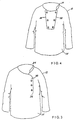
- FIGS. 2, 3 and 4 illustrate the front view of the general configuration of an upper body garment 10 constructed according to the invention when employed as a pullover-type, hip length garment.
- Front 14 and back 16 panels of the garment are sewn together to form a side seam 28 from shoulder to hip hem 30 leaving space for a sleeve 18 on each side.
- the neckline 24 converges to a center placket 22 extending at or near midline or end of placket 26 of the full upper garment 10 length centered from each lateral side 32 and is secured with a series of buttons 34 and buttonholes 36 equally spaced.
- FIG. 3 has the neckline 24 converge off side with a side placket 38 extending near or at midline 26 as in FIG. 2.
- FIG. 4 has the neckline 24 meet at two side plackets 38 both extending near or at the midline 26 of the upper body garment 10.
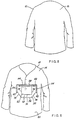
- FIG. 5 is a rear view showing the back panel 16 of the upper body garment 10 that extends to hip length.
- FIGS. 6-8 illustrate the reverse view 80 of the front panel 14 showing the inner dual pouching mechanism 42 with three possible alternate pocket pouch configurations 44 which is somewhat rectangular in shape, 46 which is shaped in the shape of an upside down flower pot, 48 which is shaped as a right side up flower pot each of which may be secured to one of two possible larger seater pouch arrangements 50 or 52.
- the pocket pouches 44, 46, 48 are secured to the seater pouches 50 or 52 by securing, preferably by reinforced stitching, two side seams 74 and a bottom seam 76.
- the large central seater pouches 50 which is a polygon in shape, or alternatively, 52 which is larger and more rounded, is formed in the upper portion of the upper garment 10.
- the preferred construction of the large seater pouches 50 or 52 has reinforced seams 40 on the two lateral seater pouch sides 54, two leg openings 78 and at the crotch 56, a seam reinforced with material such as twill tape, securing it to the interior of the front panel 14.
- a centered casing mechanism 58 is also shown.
- both the pocket pouches 44, 46, 48 and seater pouches 50 and 52 have a gathering of material on the dorsal side 60 pocket pouch and 62 seat pouch, allow for more room for the infant to rest comfortably.
- FIG. 9 illustrate the preferred embodiment of the reverse view or interior side 80 of the front panel 14 showing the inner dual pouching mechanism 42 with an enlarged view of center casing mechanism 58 attached to the inner dual pouching mechanism 42 for adjustment to accommodate for the size of the infant.
- the material 64 preferably an elastic type material, which is covered by a narrow layer of a flexible material 66, via buttonhole 68 to a stationary button 70 on either side of the casing mechanism opening 72, side differential can be made.
- buttons may be utilized such as Velcro fasteners if they are secure enough to be suitable for purpose.
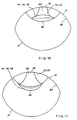
- FIG. 10 is a cross section at mid chest and shows the preferred sequence of attachment of pocket pouches 44, 46, 48 to seater pouches 50 or 52 on the interior side of the panel close the adult's chest 82 which is secured to the interior 80 of the front panel 14. Also noted is the crotch area 84 of the seater pouches 50 and 52 which is also shown.
- FIG. 11 in a preferred embodiment cross section at mid chest, shows an alternate of pocket pouches 44, 46, 48 to seater pouches 50 or 52 on the exterior side of the panel close the adult's chest 82 which is secured to the interior 80 of the front panel 14. Also, the crotch of the seater pouches 50 and 52 is shown.
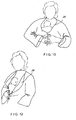
- FIGS. 12 and 13 show the same infant as in FIG. 1 with the neckline 24 adjusted for the fully enclosed position and partially enclosed position respectively.
- FIG. 14 shows the use of the seater pouches 50 and 52 for a full term infant as the adult maintains a sitting position.
- the neckline 24 is partially enclosed demonstrating the freedom of movement allowed the infant.
- FIG. 15 illustrates the use of the neckline 24 fully enclosed with a full term infant.
- FIG. 16 shows another feature in a preferred embodiment as the adult stands with an open neckline 24 to show how the present invention provides for ready access to the seater pouches 50 or 52.
- sizing of the upper body garment may be for the average medium, large and extra large sized post-partum female. Though size is based on the need to breast feed, adult males can used appropriate size for their weight. From the foregoing description, it will be seen that an upper body garment constructed according to the invention is capable of providing secure contact between a human and infant of varying size.
Landscapes
- Nursing (AREA)
- Health & Medical Sciences (AREA)
- Engineering & Computer Science (AREA)
- Public Health (AREA)
- General Health & Medical Sciences (AREA)
- Pediatric Medicine (AREA)
- Epidemiology (AREA)
- Textile Engineering (AREA)
- Details Of Garments (AREA)
- Gloves (AREA)
- Acyclic And Carbocyclic Compounds In Medicinal Compositions (AREA)
- Outer Garments And Coats (AREA)
- Ceramic Products (AREA)
- Undergarments, Swaddling Clothes, Handkerchiefs Or Underwear Materials (AREA)
Abstract
Description
- The invention relates generally to a article of clothing, and more particularly to a upper body garment which is worn by an adult for skin to skin bonding with a newborn. The upper body garment features a dual pouching mechanism.
- The invention relates particularly to an article of upper body clothing for an upper part of a body in the form of a shirt or blouse which comprises a front and a rear portion of said article connected together having neck, waist and arm openings. The portions being made of cloth material. The front portion of said article having an interior area and an exterior area with the interior area being positioned adjacent to a person's body. A pouch is centrally positioned on the interior area of said front portion of said article and fixed to the interior area.
- The concept of Kangaroo Maternal Care or Kangaroo Care was developed secondarily to increased morbidity and mortality caused by infection, a dearth of materials and services and overcrowding in the newborn intensive care units in Bogota, Columbia. To combat the unfavorable conditions, new mothers were encouraged to exclusively hold their infants on their chest, skin to skin. Studies later determined that by doing this infants were gaining weight better and were discharged home sooner at weights less than standard United States protocols. Sicker oxygen dependent infants weaned off oxygen sooner. Further studies in the United States documented Kangaroo Care as helpful to newborns in the well equipped Neonatal Intensive Care Units even for the small low birth weight premature infants. The goals are to allow the infant to be comfortable, feel the adult heartbeat and descend into a deep sleep stage. One proposed theory is that in deep sleep, growth hormone is produced and the infant should grow better.
- Such a kangaroo care is known from the document XP-002230141, which discloses a form of skin-to-skin contact between a parent and their preterm baby, wherein the baby is wearing only diaper and is held in an upright position against the parents bare chest.
- Infants on their mothers chest will attempt to nurse, which for the breast-feeding mother is another encouraging goal. However, at this time, there is not a convenient method to manage this care, in addition to the other aspects of Kangaroo Care. Prior art nursing garments such as 4,567,611 issued Kendrick 2/1986; U.S. Pat. No. 4,663,782 issued Knox 5/1987; U.S. Pat No. 5,005,217 issued Bern 4/1991; U.S. Pat. No. 5,182,813 issued Booze 2/1993; U.S. Pat. No. 5,544,364 issued Weber 8/1996 show various manners for nursing either through or under the blouse. None of the above mentioned art provides for developmental bonding or for allowing the newborn to be maintained in a comfortable sleeping position before or after breast-feeding while leaving the mother's hands relatively free for other activities.
- Blouses currently in fashion are inconvenient in that there is either poor access to place the baby on the chest or not enough material to close around parent and infant. The other alternative to remove the blouse/shirt and cover baby with a blanket for modesty and additional warmth is awkward and embarrassing. Various infant blanket or warming devices such as U.S. Pat. No. 2,968,044 issued Dudley 7/1957; U.S. Pat. No. 3,034,132 issued Landsberger 5/1962; U.S. Pat. No. 4,172,300 issued Miller 10/1979; U.S. Pat. No. 5,243,724 issued Barnes 9/1993; U.S. Pat. No. 5,722,094 issued Ruefer 3/1998; could be used to help adults hold their newborns warmly but they do not provide a securing mechanism to the holder. The purpose of Kangaroo Care is to provide skin to skin contact using the holder as the heat source or incubator. By swaddling the newborn, the primary purpose of skin to skin contact is not being met.
- With the current fashions, the adult must have both hands available to keep the infant securely in position. It is very difficult to hold infants with intravenous support, monitoring equipment and oxygen supplementation. There is a constant fear of dropping the baby. This uncomfortable feeling can be transmitted to the baby preventing the newborn from entering a deep sleep stage. Without something to keep the parent occupied, sitting for hours can be boring and again prevent the deep sleep needed for healing and growth.
- While front loading Infant/baby Carriers so allow both hands to be free such as U.S. Pat. No. 416,970 issued Taylor 12/1889; U.S. Pat. No. 484,065 issued Taylor 10/1892; U.S. Pat. No. 2,376,657 issued Chamberlain 5/1945; U.S. Pat. No. 2,599,474 issued Mills 6/1952; U.S. Pat. No. 3,229,873 issued Hershman 1 /1966; 4,402,440 issued Purtzer 9/1983; 4,428,514 issued Elf 1/1984; U.S. Pat. No. 4,434,920 issued Moore 3/1984; U.S. Pat. No. 4,467,945 issued Schaapveld 8/1984; U.S. Pat. No. 4,492,326 issued Storm 1/1985; U.S. Pat. No. 4,903,873 issued Poole 2/1990; U.S. Pat. No. 5,071,047 issued Cordisco 12/91; U.S. Pat. No. 5,246,152 issued Dotseth 9/1993; U.S. Pat. No. 5,570,823 issued Lindy 11/1996; U.S. Pat. No. 5,632,425 issued Hull 5/1997; U.S. Pat. No.5,690,258 issued Kataoka 11/1997 and pet carrier U.S. Pat. No. D370,090 issued Coggins 5/1996 free the hands for other activities, none of them provide for the primary purpose of Kangaroo Care. They do not allow for comfortable breast-feeding or for skin to skin contact with attached covering. To a new mother it is not a very modest or comfortable way of holding their baby for a prolonged inactive time when the goal is to allow the baby to progress to a deep sleep.
- Prior art for infant carriers or infant supporters made primarily for transportation did not consider this more passive and gentle modality. The carriers are slings or papoose like structures that do not allow for skin to skin contact if desired. They would be uncomfortable for the adult to wear for extended periods of immobile time. While several prior art demonstrate flexible pouches and have ready access for changing diapers, they are still quite restricting and certainly are not made for the low or very low birth weight newborns. None of the prior art has a pocket pouch for low or very low birth weight babies attached to the large pouch which in turn is attached to the inner aspect of the front panel of the garment. This pocket pouch allows the infant to curl into the more normal fetal position while resting on their adult holder's chest.
- U.S. Pat. No. 4,079,467 issued Baldwin 3/1978 and U.S. Pat. No. 4,606,078 issued Tkacsik 9/1986 while encompassing the overall cover and front loading goals are made for use outside the home as protection from the elements not for the intimate use of quiet inactive time.
- Front opening blouses U.S. Pat. No. 2,010,903 issued Swanson 8/1935; U.S. Pat. No. 4,797,954 issued Williams 1/1989; U.S. Pat. No. 5,097,536 issued Cohen 3/1992 are without a pouching mechanism. They do not serve as a developmental holding unit regardless of the flexibility of a frontal opening.
- From document US-A-5,611,083 a robe-like garment for use in changing clothes is known. This robe-like garment has a large neck opening. In front of the changing robe is a large central pocket which is accessible from the outside front of the garment and is also accessible from the inside of the garment.
- US-A-4,535,478 discloses an article of body armour. This article comprises an undershirt-type carrier garment, with front and rear pockets receiving armour panel inserts of layered bullet-resistant sheet material. The inserts may be interchanged between pockets and used in different carrier garments.
- From US-A-3,135,961 a protective garment for athletes and the like is known. It comprises a shirt-like garment of a conventional type which has a pocket-like receptacle. This pocket-like receptacle can be filled with a deformable, an elastomer or a sponge-like pad to protect athletes and the like.
- U.S. Pat. No. 5,333,768 issued Krentz 8/1994; U.S. Pat. No. 5,454,119 issued
Thomm 10/1995; U.S. Pat. No. 5,611,083 issued Arnold 3/1997 are all associated with pouch mechanisms. However, U.S. Pat. No. 5,333,768 is a separate unit to be worn with straps attached only to the pouching mechanism under a garment. While U.S. Pat. No. 5,454,119 has a front opening and a front pouch it is not designed or capable for use as an infant holder. U.S. Pat. No. 5,611,083 has a front pouch attached to the inside of the front panel. It's design does not allow for ready access to front load an infant into the pouch nor does allow for larger infants to fit comfortably for extended periods of time. The pouch is singular not dual. - Many new mothers are apprehensive about holding their infants especially when they are sick or fragile. When in the Neonatal Intensive Care Unit, ill infants are not routinely held preventing bonding between mother, father and baby.
- The object of the invention is to provide a garment which is designed to help parents create that familial bond as early as possible by providing a safe, cosy, comfortable environment.
- This object is achieved, by the subject matter of claim 1. Features of advantageous embodiments are defined by dependent claims.
- The present invention pertains to a upper body garment made of a flexible material to be used both as a adequate comfortable garment and as a newborn supportive device via a dual pouching mechanism comprising of a first part with reinforced sides and crotch seam and a second part secured to the first of a three sided enclosed pocket. According to the invention there is a front and back panel with space allotted for sleeve openings and sleeves which are integrally formed in continuation with one another. On the reverse side of the front panel the dual pouching mechanism is attached.
- The front panel is designed for better access for placing the infant within the pouching mechanism by a longer than routine blouse center front placket, longer than normal lateral front placket or longer than normal dual side plackets. The extension of the neckline in all of the configurations allow for easy access for placing and removing any size infant with any oxygen or monitoring support. The front panel is generous in material to allow for comfortable enclosure of the infant.
- Both the pocket pouch and the larger seater pouch have an adjustable elastic band to accommodate for size. This is an important element secondarily to the growth of premature and term infants. Low birth weight and very low birth weight infants would be placed utilizing the smaller pocket pouch which is enclosed on three sides. This allows the very small newborns to stretch and curl up at will. The growing premature infant would graduate to the larger seater pouch which has two reinforced sides and space for a leg on either side of a reinforced crotch seam.
- The Neonatal Intensive Care Unit staff will be less apprehensive of their charges when secured in the garment. The garment allows for continued monitoring and ability to easily check the infant. Any parent concerned with the emotional and neurodevelopment of newborns as currently advocates in the scientific and popular media would feel less apprehensive in participating with the infant's care.
- The above and other objects, advantages and features will be apparent from the following description of a preferred embodiment, considered along with the accompanying drawings wherein;
- FIG. 1 is an oblique front view of a upper body garment according to the invention as employed for providing contact between a human and an infant;
- FIG. 2 is a front perspective view of a upper body garment of FIG 1 with a centered placket;
- FIG. 3 is a front perspective view of a upper body garment of FIG. 1 with a side placket;
- FIG. 4 is a front perspective view of a upper body garment of FIG. 1 with two side plackets;
- FIG. 5 is a rear perspective view of the upper body garment of FIG. 1;
- FIG. 6 Is a view of the front perspective of the upper body garment of FIG. 1 with the dual pouching mechanism highlighted;
- FIG. 7 is a view of the front perspective of the upper body garment of FIG. 1 with an alternate shaped pocket pouch with the dual pouching mechanism highlighted;
- FIG. 8 is a view of the front perspective of the upper body garment of FIG. 1 with a second alternate shaped pocket pouch with the dual pouching mechanism highlighted;
- FIG. 9 is an enlarged view of the flexible material pouching mechanism and the casing method that could be used to adjust for size of the infant;
- FIG. 10 is a cross section view of the torso section of the upper body garment at an intermediate level;
- FIG. 11 is a cross section view of the torso section of the upper body garment at an intermediate level with an alternate order of the dual pouching mechanism;
- FIG. 12 is a front view of a very low birth weight infant in the pocket couch with the outer placket of the upper body garment opened with the adult standing;
- FIG. 13 is a front view of a very low birth weight infant in the pocket pouch with a partially enclosed neckline of the upper body garment with the adult sitting;
- FIG. 14 is a front view of a full term infant sitting in the seater pouch with a partially enclosed neckline of the upper body garment with the adult sitting and a young child sitting next to the adult;
- FIG. is is a front view of a full term infant sitting in the seater pouch with a fully enclosed neckline and with the adult sitting; and
- FIG. 16 is a front view of a full term infant sitting in the seater pouch with an open neckline and with the adult standing.
- FIG. 1 shows, in an oblique frontal view, an
upper body garment 10 preferably formed of a soft, breathable, flexible material. In this view an adult is shown using thepocket pouches dual pouching mechanism 42. Theupper body garment 10 also includes a pair ofsleeves 18 secured to thefront panel 14 of thebody portion 20 at theshoulder seam 12, as by stitching. - FIGS. 2, 3 and 4 illustrate the front view of the general configuration of an
upper body garment 10 constructed according to the invention when employed as a pullover-type, hip length garment.Front 14 and back 16 panels of the garment, are sewn together to form aside seam 28 from shoulder tohip hem 30 leaving space for asleeve 18 on each side. In FIG. 2 theneckline 24 converges to acenter placket 22 extending at or near midline or end ofplacket 26 of the fullupper garment 10 length centered from eachlateral side 32 and is secured with a series ofbuttons 34 and buttonholes 36 equally spaced. FIG. 3 has theneckline 24 converge off side with aside placket 38 extending near or atmidline 26 as in FIG. 2. FIG. 4 has theneckline 24 meet at twoside plackets 38 both extending near or at themidline 26 of theupper body garment 10. - FIG. 5 is a rear view showing the
back panel 16 of theupper body garment 10 that extends to hip length. FIGS. 6-8 illustrate thereverse view 80 of thefront panel 14 showing the innerdual pouching mechanism 42 with three possible alternatepocket pouch configurations 44 which is somewhat rectangular in shape, 46 which is shaped in the shape of an upside down flower pot, 48 which is shaped as a right side up flower pot each of which may be secured to one of two possible largerseater pouch arrangements pocket pouches seater pouches side seams 74 and abottom seam 76. The largecentral seater pouches 50 which is a polygon in shape, or alternatively, 52 which is larger and more rounded, is formed in the upper portion of theupper garment 10. The preferred construction of thelarge seater pouches seams 40 on the two lateral seater pouch sides 54, twoleg openings 78 and at thecrotch 56, a seam reinforced with material such as twill tape, securing it to the interior of thefront panel 14. Acentered casing mechanism 58 is also shown. Preferably both thepocket pouches seater pouches dorsal side 60 pocket pouch and 62 seat pouch, allow for more room for the infant to rest comfortably. - FIG. 9 illustrate the preferred embodiment of the reverse view or
interior side 80 of thefront panel 14 showing the innerdual pouching mechanism 42 with an enlarged view ofcenter casing mechanism 58 attached to the innerdual pouching mechanism 42 for adjustment to accommodate for the size of the infant. By attaching thematerial 64, preferably an elastic type material, which is covered by a narrow layer of aflexible material 66, viabuttonhole 68 to astationary button 70 on either side of thecasing mechanism opening 72, side differential can be made. Of course other securing means in lieu of buttons may be utilized such as Velcro fasteners if they are secure enough to be suitable for purpose. - FIG. 10 is a cross section at mid chest and shows the preferred sequence of attachment of
pocket pouches seater pouches chest 82 which is secured to the interior 80 of thefront panel 14. Also noted is thecrotch area 84 of theseater pouches - FIG. 11 in a preferred embodiment cross section at mid chest, shows an alternate of
pocket pouches seater pouches chest 82 which is secured to the interior 80 of thefront panel 14. Also, the crotch of theseater pouches - FIGS. 12 and 13 show the same infant as in FIG. 1 with the
neckline 24 adjusted for the fully enclosed position and partially enclosed position respectively. - FIG. 14 shows the use of the
seater pouches neckline 24 is partially enclosed demonstrating the freedom of movement allowed the infant. - FIG. 15 illustrates the use of the
neckline 24 fully enclosed with a full term infant. - FIG. 16 shows another feature in a preferred embodiment as the adult stands with an
open neckline 24 to show how the present invention provides for ready access to theseater pouches - In a preferred embodiment sizing of the upper body garment may be for the average medium, large and extra large sized post-partum female. Though size is based on the need to breast feed, adult males can used appropriate size for their weight. From the foregoing description, it will be seen that an upper body garment constructed according to the invention is capable of providing secure contact between a human and infant of varying size.
- The above described preferred embodiments are intended to illustrate the principles of the invention, but not to limit its scope. Other embodiments and variations to this preferred embodiment will be apparent to those skilled in the art the scope of the invention being defined in the following claims.
Claims (9)
- An article of upper body clothing (10) for an upper part of a body in the form of a shirt or blouse comprising:a front and a rear portion (14, 16) of said article(10) connected together having neck, waist and arm openings, said portions (14, 16) being made of cloth material,said front portion (14) of said article(10) having an interior area (80) and an exterior area with the interior area being positioned adjacent to a person's body, anda pouch (50, 52) centrally positioned on the interior area of said front portion (14) of said article (10) and fixed to the interior area (80),characterized in that
the article (10) further comprises a placket (22, 38) which extends from said neck opening down said front portion (14) through which an infant may be placed in said pouch (50, 52), said pouch (50, 52) has an upper opening in which the infant may be placed in an upright position whilst being supported by said pouch (50, 52) for providing skin-to-skin contact according to kangaroo care between a person and the infant. - The article (10) according to claim 1, wherein said pouch (50, 52) is a second pouch (50, 52), said article (10) further comprising a first pouch (44, 46, 48), said second pouch (50, 52) being larger than said first pouch (44, 46, 48), said first pouch (44, 46, 48) being affixed to said second pouch (50, 52), said pouches (44, 46, 48, 50, 52) having a respective upper opening in which the infant may be placed in an upright position whilst being supported by one of said pouches (44, 46, 48, 50, 52).
- The article (10) according to claims 1 or 2 wherein the neck opening is of sufficient size so as to place the infant in one pouch (44, 46, 48, 50, 52) of the person wearing the article (10).
- The article (10) according to claims 1 or 2 wherein the placket (22, 38) may be opened or securely closed a desired amount.
- The article (10) according to claims 1 or 2 wherein said at least one pouch (44, 46, 48, 50, 52) include two side portions and a bottom portion, said side portions of said at least one pouch (44, 46, 48, 50, 52) being positioned in opposite sides of the placket (22) and said bottom portion being positioned below said placket (22).
- The article (10) according to claim 5 wherein the upper opening of said at least one pouch (44, 46, 48, 50, 52) is adjustable so as to accommodate infants of varying sizes.
- The article (10) according to claim 6 which includes elastic means extending across the upper opening of said at least one pouch (44, 46, 48, 50, 52) and affixed on either side of the placket (22) which allows for adjustment of the upper opening of said at least one pouch (44, 46, 48, 50, 52).
- The article (10) according to claim 2 wherein the infant may be placed through said placket (22) in either the first or second pouch (44, 46, 48, 50, 52).
- The article (10) according to claims 1 or 2 wherein said pouch (50, 52) having two side portions and a bottom portion, with said side portions being positioned on opposite sides of the placket (22) and with said bottom portion being positioned below said placket(22), comprises a bottom portion including leg openings (78) for the infant's legs.
Applications Claiming Priority (3)
| Application Number | Priority Date | Filing Date | Title |
|---|---|---|---|
| US09/120,785 US5946725A (en) | 1998-07-22 | 1998-07-22 | Adult infant bonding garment |
| US120785 | 1998-07-22 | ||
| PCT/US1999/016307 WO2000004797A1 (en) | 1998-07-22 | 1999-07-19 | Adult-infant bonding garment |
Publications (3)
| Publication Number | Publication Date |
|---|---|
| EP1105008A1 EP1105008A1 (en) | 2001-06-13 |
| EP1105008A4 EP1105008A4 (en) | 2003-04-16 |
| EP1105008B1 true EP1105008B1 (en) | 2005-09-21 |
Family
ID=22392548
Family Applications (1)
| Application Number | Title | Priority Date | Filing Date |
|---|---|---|---|
| EP99937317A Expired - Lifetime EP1105008B1 (en) | 1998-07-22 | 1999-07-19 | Adult-infant bonding garment |
Country Status (8)
| Country | Link |
|---|---|
| US (1) | US5946725A (en) |
| EP (1) | EP1105008B1 (en) |
| AT (1) | ATE304803T1 (en) |
| AU (1) | AU747170B2 (en) |
| DE (1) | DE69927389D1 (en) |
| NO (1) | NO318577B1 (en) |
| NZ (1) | NZ510072A (en) |
| WO (1) | WO2000004797A1 (en) |
Cited By (2)
| Publication number | Priority date | Publication date | Assignee | Title |
|---|---|---|---|---|
| USD752855S1 (en) | 2014-03-20 | 2016-04-05 | Hudlo Llc | Infant carrier garment |
| US9380815B2 (en) | 2012-07-03 | 2016-07-05 | Maria Carolina Toro-Gerstein | Privacy cover |
Families Citing this family (50)
| Publication number | Priority date | Publication date | Assignee | Title |
|---|---|---|---|---|
| US6343727B1 (en) * | 2000-06-21 | 2002-02-05 | Jamie S. Leach | One piece baby carrier |
| CN1592587A (en) * | 2002-04-01 | 2005-03-09 | 阿普丽佳葛西株式会社 | Adult garment, child garment, and parent and child garment |
| US6918770B2 (en) * | 2002-08-19 | 2005-07-19 | Brightwave Enterprises, Llc | Infant nurturing medical device |
| US20040177429A1 (en) * | 2003-03-13 | 2004-09-16 | Catherine Sanders | Nursing garment |
| FR2859613A1 (en) * | 2003-09-16 | 2005-03-18 | Anne Juliette Bercy | Shirt with two flaps forming a pouch for carrying a new-born baby close to its mother |
| US7114206B2 (en) | 2004-06-17 | 2006-10-03 | Leach Jamie S | Multiple position symmetrically contoured body pillow |
| US20060005782A1 (en) * | 2004-07-01 | 2006-01-12 | Fugazzi Joan C | Pet carrier sweatshirt-known at the pet sweat |
| US20060005294A1 (en) * | 2004-07-01 | 2006-01-12 | Fugazzi Joan C | Pet sweat |
| USD539509S1 (en) * | 2005-01-11 | 2007-04-03 | Fugazzi Joan C | Pet carrier sweatshirt |
| US20060206978A1 (en) * | 2005-03-16 | 2006-09-21 | Shadin Hilton | Medical garments for assisting in skin-to-skin holding of infants in neonatal intensive care units |
| US7296303B1 (en) * | 2005-04-25 | 2007-11-20 | Donna Samet | Garment with pet carrying pouch |
| US7810172B2 (en) * | 2005-05-13 | 2010-10-12 | Williams Jody D | Garment for accomodating medical devices |
| US8555429B2 (en) | 2005-08-01 | 2013-10-15 | Jamie S. Leach | Adjustable contoured baby bathing or pet cushion |
| US7708342B2 (en) | 2005-08-31 | 2010-05-04 | Leach Jamie S | Non-slip body-conforming booster cushion seat |
| US8468627B2 (en) | 2006-01-04 | 2013-06-25 | Jamie S. Leach | Elongated angular multiple position body pillow |
| US7500278B2 (en) | 2006-06-05 | 2009-03-10 | Leach Jamie S | Infant pad assembly with multiple configurations |
| US7913321B2 (en) * | 2006-08-03 | 2011-03-29 | David Hamilton Radcliffe | Child carrier cover |
| US7793371B1 (en) | 2006-08-28 | 2010-09-14 | Leach Jamie S | Apparatus and method for question mark-shaped body pillow and support system |
| US7494300B2 (en) * | 2006-11-09 | 2009-02-24 | Blank Michael F | Ice anchor |
| US20120234877A1 (en) * | 2006-12-22 | 2012-09-20 | Hiniduma-Lokuge Prasanga D | Infant Carrier |
| US20080149674A1 (en) * | 2006-12-22 | 2008-06-26 | Hiniduma-Lokuge Prasanga D | Infant carrier |
| USD574579S1 (en) | 2007-01-17 | 2008-08-12 | Paul Kang | Shirt |
| US20080169324A1 (en) * | 2007-01-17 | 2008-07-17 | Paul Kang | Shirt for simplified child carrying |
| US8661587B1 (en) | 2007-05-03 | 2014-03-04 | Jamie S. Leach | Infant support pillow |
| US7513001B1 (en) | 2007-06-18 | 2009-04-07 | Leach Jamie S | Multi-purpose pillow with attached blanket |
| FR2919153B1 (en) * | 2007-07-26 | 2009-09-18 | Monique Loussier | CLOTHING FOR A PERSON WISHING TO WEAR A NEW-NE. |
| US20090159628A1 (en) * | 2007-12-21 | 2009-06-25 | Mcmullen Joseph Edwad | Pet carrier |
| US20090158494A1 (en) * | 2007-12-21 | 2009-06-25 | Mcmullen Joseph E | Pet carrier |
| IL188336A0 (en) * | 2007-12-23 | 2008-11-03 | Anat Reshef Gilad | Garment |
| US7926448B2 (en) * | 2008-02-11 | 2011-04-19 | Donna Fox | Pet carrier garment |
| US20100064411A1 (en) * | 2008-09-12 | 2010-03-18 | Anita Price | Arm-securing garment |
| US20110108594A1 (en) * | 2009-11-11 | 2011-05-12 | Davis Amanda Marie | Medical garment for skin-to-skin care and methods of use |
| US8418268B2 (en) * | 2009-12-04 | 2013-04-16 | Global Trademarks, Llc | Garment having support |
| FR2986952A1 (en) * | 2012-02-21 | 2013-08-23 | Julie Fandi | CLOTHING FOR AN ADULT TO WEAR A NEWBORN OR A BABY AGAINST HIS SKIN TORSO |
| US20130284783A1 (en) * | 2012-04-04 | 2013-10-31 | David Blake Burpee | Baby Carrier |
| US9402430B2 (en) * | 2012-05-04 | 2016-08-02 | Brownmed, Inc. | Garment for carrying a baby to provide skin-to-skin contact |
| USD691791S1 (en) * | 2012-09-13 | 2013-10-22 | Valerie L. Rondone | Tri-loop baby carrier |
| US9398816B2 (en) * | 2013-01-11 | 2016-07-26 | Lalabu LLC | Upper body garment with infant pouch |
| USD700433S1 (en) | 2013-03-14 | 2014-03-04 | Bout de Chou, LLC | Adjustable baby carrier cover |
| USD775815S1 (en) * | 2014-10-01 | 2017-01-10 | Hudlo Llc | Skin-to-skin care garment |
| US20150089710A1 (en) * | 2013-10-02 | 2015-04-02 | Hudlo Llc | Skin-to-skin care garment |
| USD778029S1 (en) | 2014-01-10 | 2017-02-07 | Lalabu LLC | Upper body garment with infant pouch |
| GB2533840B (en) | 2014-10-23 | 2019-01-16 | Talon Tech Inc | Garment with multilayer internal abdominal support panels |
| CA2896575C (en) * | 2015-07-10 | 2017-07-25 | Vivianne Brault | Skin-on-skin baby carrier undergarment |
| US9986775B2 (en) | 2016-01-09 | 2018-06-05 | Momme Top Llc | Convertible garment for carrying and feeding infants |
| US10405672B2 (en) * | 2017-05-10 | 2019-09-10 | Saplacor, LLC | Neonate medical wraps for a baby and parent, and related methdos |
| US11051560B2 (en) | 2017-05-16 | 2021-07-06 | Jessica Spratt | Clothing selectively enabling skin-to-skin contact |
| US10477904B2 (en) | 2018-02-27 | 2019-11-19 | Fashion Institute Of Technology | Infant-nursing safety garment |
| US11406145B2 (en) | 2019-11-15 | 2022-08-09 | Angel Wraps Baby, LLC | Rear access labor, delivery, and postpartum gown with security bonding panel |
| USD1059739S1 (en) * | 2023-04-05 | 2025-02-04 | Arlene Tenorio | Skin-to-skin nursing cover |
Family Cites Families (45)
| Publication number | Priority date | Publication date | Assignee | Title |
|---|---|---|---|---|
| US484065A (en) * | 1892-10-11 | Charles c | ||
| US416970A (en) * | 1889-12-10 | Charles c | ||
| US399436A (en) * | 1889-03-12 | Combined coat and vest | ||
| US2010903A (en) * | 1933-04-06 | 1935-08-13 | E R Moore Company | Garment |
| US2051482A (en) * | 1934-02-07 | 1936-08-18 | Hyman Sam Bernard | Convertible garment |
| US2069579A (en) * | 1934-11-02 | 1937-02-02 | Epstein Charles | Garment |
| US2301527A (en) * | 1940-11-06 | 1942-11-10 | Congress Shirt Company | Garment |
| US2376657A (en) * | 1943-12-04 | 1945-05-22 | Warren Featherbone Co | Infant carrier |
| US2599474A (en) * | 1950-02-01 | 1952-06-03 | Verna S Mills | Child carrier |
| US2968044A (en) * | 1957-07-03 | 1961-01-17 | Bettye S Dudley | Sleeping garment for infants |
| US3034132A (en) * | 1958-09-26 | 1962-05-15 | Landsberger Bernard | Infant's blanket |
| US3135961A (en) * | 1962-08-08 | 1964-06-09 | Marshall E Roderick | Protective garment for athletes |
| US3229873A (en) * | 1963-10-23 | 1966-01-18 | Dorothy J Hershman | Child carrier |
| US4079467A (en) * | 1976-07-06 | 1978-03-21 | Baldwin Robert O | Parent-child coat |
| US4172300A (en) * | 1976-12-01 | 1979-10-30 | Miller Dolores M | Pouch zipper blanket and methods of constructing and utilizing same |
| US4402440A (en) * | 1981-05-22 | 1983-09-06 | Patricia K. Purtzer | Infant carrier |
| US4428514A (en) * | 1981-12-14 | 1984-01-31 | Elf Jennifer L | Infant carrier |
| US4497071A (en) * | 1982-02-18 | 1985-02-05 | Mighty-Mac, Inc. | Exercise garment |
| US4434920A (en) * | 1982-02-22 | 1984-03-06 | Snugli, Inc. | Soft orthopedic pouch-type infant carrier |
| US4492326A (en) * | 1983-03-28 | 1985-01-08 | Babies By Storm, Inc. | Sling-type infant carrier |
| US4535478A (en) * | 1983-05-20 | 1985-08-20 | Zuefle Tim T | Body armor |
| US4467945A (en) * | 1983-12-23 | 1984-08-28 | Schaapveld Junice A | Baby carrier |
| US4606078A (en) * | 1985-03-22 | 1986-08-19 | Tkacsik Mary C L | Maternity coat and baby carrier |
| US4567611A (en) * | 1985-04-19 | 1986-02-04 | Stephen Kendrick | Vest for a nursing mother |
| US4663782A (en) * | 1986-03-03 | 1987-05-12 | Knox William G | Blouse |
| US4797954A (en) * | 1987-10-05 | 1989-01-17 | Williams Ruth L | Shirt with security cloth |
| US4903873A (en) * | 1989-04-07 | 1990-02-27 | Poole Allison S | Infant carrier for use in an aqueous environment |
| US5005217A (en) * | 1990-03-15 | 1991-04-09 | Bern Barbara J | Nursing bib |
| US5071047A (en) * | 1990-06-04 | 1991-12-10 | Claire Cordisco | Baby carrier |
| US5243724A (en) * | 1991-04-25 | 1993-09-14 | Barnes Evelyn R | Multi-purpose baby wrap |
| US5097536A (en) * | 1991-06-13 | 1992-03-24 | Dignity Wear, Inc. | Medical examination garment |
| US5182813A (en) * | 1992-01-27 | 1993-02-02 | Booze Janice E | Nursing garment |
| US5259068A (en) * | 1992-03-18 | 1993-11-09 | Carroll Teresa P | Nursing cover |
| US5246152A (en) * | 1992-07-10 | 1993-09-21 | Dotseth Junice A | Baby carrier with head support |
| US5333768A (en) * | 1993-01-19 | 1994-08-02 | Krentz Douglas J | Adjustable chest pouch |
| US5267352A (en) * | 1993-02-02 | 1993-12-07 | Rodarmel Pamlea A | Upper torso restraining device |
| US5454119A (en) * | 1994-02-07 | 1995-10-03 | Thomm; Joyce M. | Bed jacket |
| US5570823A (en) * | 1994-02-18 | 1996-11-05 | Lindy; Elaine | Baby carrier |
| US5544364A (en) * | 1995-03-02 | 1996-08-13 | Weber; Joan | Nursing apron |
| USD370090S (en) | 1995-03-28 | 1996-05-21 | Coggins Victoria H | Pet carrier bag |
| US5632425A (en) * | 1995-07-17 | 1997-05-27 | Hull; Julie | Infant carrier |
| US5611083A (en) * | 1995-08-25 | 1997-03-18 | Arnold; Barbara A. | Changing robe |
| JP3523387B2 (en) * | 1995-09-13 | 2004-04-26 | アップリカ▲葛▼西株式会社 | Infant carrier |
| US5678739A (en) * | 1995-09-21 | 1997-10-21 | Fisher-Price, Inc. | Infant carrier with harness and detachable shell |
| US5722094A (en) * | 1996-11-12 | 1998-03-03 | Ruefer; Rebecca U. | Infant swaddling apparatus |
-
1998
- 1998-07-22 US US09/120,785 patent/US5946725A/en not_active Expired - Lifetime
-
1999
- 1999-07-19 AT AT99937317T patent/ATE304803T1/en not_active IP Right Cessation
- 1999-07-19 NZ NZ510072A patent/NZ510072A/en not_active IP Right Cessation
- 1999-07-19 EP EP99937317A patent/EP1105008B1/en not_active Expired - Lifetime
- 1999-07-19 WO PCT/US1999/016307 patent/WO2000004797A1/en not_active Ceased
- 1999-07-19 AU AU52178/99A patent/AU747170B2/en not_active Ceased
- 1999-07-19 DE DE69927389T patent/DE69927389D1/en not_active Expired - Lifetime
-
2001
- 2001-01-19 NO NO20010337A patent/NO318577B1/en not_active IP Right Cessation
Cited By (2)
| Publication number | Priority date | Publication date | Assignee | Title |
|---|---|---|---|---|
| US9380815B2 (en) | 2012-07-03 | 2016-07-05 | Maria Carolina Toro-Gerstein | Privacy cover |
| USD752855S1 (en) | 2014-03-20 | 2016-04-05 | Hudlo Llc | Infant carrier garment |
Also Published As
| Publication number | Publication date |
|---|---|
| AU5217899A (en) | 2000-02-14 |
| EP1105008A4 (en) | 2003-04-16 |
| ATE304803T1 (en) | 2005-10-15 |
| NO318577B1 (en) | 2005-04-11 |
| US5946725A (en) | 1999-09-07 |
| NZ510072A (en) | 2002-09-27 |
| DE69927389D1 (en) | 2005-10-27 |
| EP1105008A1 (en) | 2001-06-13 |
| WO2000004797A1 (en) | 2000-02-03 |
| AU747170B2 (en) | 2002-05-09 |
| NO20010337D0 (en) | 2001-01-19 |
| NO20010337L (en) | 2001-03-14 |
Similar Documents
| Publication | Publication Date | Title |
|---|---|---|
| US5946725A (en) | Adult infant bonding garment | |
| US20190254355A1 (en) | One piece infant garment with hand restraint | |
| US4759082A (en) | Garment for small children | |
| US7810172B2 (en) | Garment for accomodating medical devices | |
| US5206957A (en) | Body core warming vest | |
| US7640598B1 (en) | Infant caregiver padded pillow garment | |
| US6000664A (en) | Baby bottle support bib | |
| US20120234877A1 (en) | Infant Carrier | |
| US4713842A (en) | Protective multiple feeding means garment | |
| US20080149674A1 (en) | Infant carrier | |
| US11672283B2 (en) | Clothing selectively enabling skin-to-skin contact | |
| US20090031471A1 (en) | Garment With Thoracic Access | |
| WO2009081400A2 (en) | Garment | |
| US6015331A (en) | Nighttime nursing tube bra | |
| US20140283277A1 (en) | Medical wrap for neonatal kangaroo care | |
| US20100282808A1 (en) | Personal carrier harness | |
| US4412542A (en) | Robe garment for mastectomy patient | |
| US12610993B2 (en) | Patient clothing system with integrated lifting features | |
| US5241708A (en) | Restraining device | |
| US20070094764A1 (en) | Nursing shawl | |
| CA1332928C (en) | Baby carrier | |
| US20160235216A1 (en) | Multi-Function Infant Pillow and Mat | |
| EP0437365A1 (en) | Infant carrier | |
| US4541425A (en) | Head and torso restraint | |
| CN212678393U (en) | Novel hospital kangaroo type nursing clothes |
Legal Events
| Date | Code | Title | Description |
|---|---|---|---|
| PUAI | Public reference made under article 153(3) epc to a published international application that has entered the european phase |
Free format text: ORIGINAL CODE: 0009012 |
|
| 17P | Request for examination filed |
Effective date: 20010221 |
|
| AK | Designated contracting states |
Kind code of ref document: A1 Designated state(s): AT BE CH CY DE DK ES FI FR GB GR IE IT LI LU MC NL PT SE |
|
| AX | Request for extension of the european patent |
Free format text: AL;LT;LV;MK;RO;SI |
|
| A4 | Supplementary search report drawn up and despatched |
Effective date: 20030227 |
|
| 17Q | First examination report despatched |
Effective date: 20030701 |
|
| GRAP | Despatch of communication of intention to grant a patent |
Free format text: ORIGINAL CODE: EPIDOSNIGR1 |
|
| GRAS | Grant fee paid |
Free format text: ORIGINAL CODE: EPIDOSNIGR3 |
|
| GRAA | (expected) grant |
Free format text: ORIGINAL CODE: 0009210 |
|
| AK | Designated contracting states |
Kind code of ref document: B1 Designated state(s): AT BE CH CY DE DK ES FI FR GB GR IE IT LI LU MC NL PT SE |
|
| PG25 | Lapsed in a contracting state [announced via postgrant information from national office to epo] |
Ref country code: NL Free format text: LAPSE BECAUSE OF FAILURE TO SUBMIT A TRANSLATION OF THE DESCRIPTION OR TO PAY THE FEE WITHIN THE PRESCRIBED TIME-LIMIT Effective date: 20050921 Ref country code: LI Free format text: LAPSE BECAUSE OF FAILURE TO SUBMIT A TRANSLATION OF THE DESCRIPTION OR TO PAY THE FEE WITHIN THE PRESCRIBED TIME-LIMIT Effective date: 20050921 Ref country code: IT Free format text: LAPSE BECAUSE OF FAILURE TO SUBMIT A TRANSLATION OF THE DESCRIPTION OR TO PAY THE FEE WITHIN THE PRESCRIBED TIME-LIMIT;WARNING: LAPSES OF ITALIAN PATENTS WITH EFFECTIVE DATE BEFORE 2007 MAY HAVE OCCURRED AT ANY TIME BEFORE 2007. THE CORRECT EFFECTIVE DATE MAY BE DIFFERENT FROM THE ONE RECORDED. Effective date: 20050921 Ref country code: FI Free format text: LAPSE BECAUSE OF FAILURE TO SUBMIT A TRANSLATION OF THE DESCRIPTION OR TO PAY THE FEE WITHIN THE PRESCRIBED TIME-LIMIT Effective date: 20050921 Ref country code: CH Free format text: LAPSE BECAUSE OF FAILURE TO SUBMIT A TRANSLATION OF THE DESCRIPTION OR TO PAY THE FEE WITHIN THE PRESCRIBED TIME-LIMIT Effective date: 20050921 Ref country code: BE Free format text: LAPSE BECAUSE OF FAILURE TO SUBMIT A TRANSLATION OF THE DESCRIPTION OR TO PAY THE FEE WITHIN THE PRESCRIBED TIME-LIMIT Effective date: 20050921 Ref country code: AT Free format text: LAPSE BECAUSE OF FAILURE TO SUBMIT A TRANSLATION OF THE DESCRIPTION OR TO PAY THE FEE WITHIN THE PRESCRIBED TIME-LIMIT Effective date: 20050921 |
|
| REG | Reference to a national code |
Ref country code: GB Ref legal event code: FG4D |
|
| REG | Reference to a national code |
Ref country code: CH Ref legal event code: EP |
|
| REG | Reference to a national code |
Ref country code: IE Ref legal event code: FG4D |
|
| REF | Corresponds to: |
Ref document number: 69927389 Country of ref document: DE Date of ref document: 20051027 Kind code of ref document: P |
|
| PG25 | Lapsed in a contracting state [announced via postgrant information from national office to epo] |
Ref country code: SE Free format text: LAPSE BECAUSE OF FAILURE TO SUBMIT A TRANSLATION OF THE DESCRIPTION OR TO PAY THE FEE WITHIN THE PRESCRIBED TIME-LIMIT Effective date: 20051221 Ref country code: GR Free format text: LAPSE BECAUSE OF FAILURE TO SUBMIT A TRANSLATION OF THE DESCRIPTION OR TO PAY THE FEE WITHIN THE PRESCRIBED TIME-LIMIT Effective date: 20051221 Ref country code: DK Free format text: LAPSE BECAUSE OF FAILURE TO SUBMIT A TRANSLATION OF THE DESCRIPTION OR TO PAY THE FEE WITHIN THE PRESCRIBED TIME-LIMIT Effective date: 20051221 |
|
| PG25 | Lapsed in a contracting state [announced via postgrant information from national office to epo] |
Ref country code: DE Free format text: LAPSE BECAUSE OF FAILURE TO SUBMIT A TRANSLATION OF THE DESCRIPTION OR TO PAY THE FEE WITHIN THE PRESCRIBED TIME-LIMIT Effective date: 20051222 |
|
| PG25 | Lapsed in a contracting state [announced via postgrant information from national office to epo] |
Ref country code: ES Free format text: LAPSE BECAUSE OF FAILURE TO SUBMIT A TRANSLATION OF THE DESCRIPTION OR TO PAY THE FEE WITHIN THE PRESCRIBED TIME-LIMIT Effective date: 20060101 |
|
| PG25 | Lapsed in a contracting state [announced via postgrant information from national office to epo] |
Ref country code: PT Free format text: LAPSE BECAUSE OF FAILURE TO SUBMIT A TRANSLATION OF THE DESCRIPTION OR TO PAY THE FEE WITHIN THE PRESCRIBED TIME-LIMIT Effective date: 20060221 |
|
| NLV1 | Nl: lapsed or annulled due to failure to fulfill the requirements of art. 29p and 29m of the patents act | ||
| REG | Reference to a national code |
Ref country code: CH Ref legal event code: PL |
|
| PLBE | No opposition filed within time limit |
Free format text: ORIGINAL CODE: 0009261 |
|
| STAA | Information on the status of an ep patent application or granted ep patent |
Free format text: STATUS: NO OPPOSITION FILED WITHIN TIME LIMIT |
|
| 26N | No opposition filed |
Effective date: 20060622 |
|
| PG25 | Lapsed in a contracting state [announced via postgrant information from national office to epo] |
Ref country code: FR Free format text: LAPSE BECAUSE OF FAILURE TO SUBMIT A TRANSLATION OF THE DESCRIPTION OR TO PAY THE FEE WITHIN THE PRESCRIBED TIME-LIMIT Effective date: 20061020 |
|
| EN | Fr: translation not filed | ||
| PG25 | Lapsed in a contracting state [announced via postgrant information from national office to epo] |
Ref country code: FR Free format text: LAPSE BECAUSE OF FAILURE TO SUBMIT A TRANSLATION OF THE DESCRIPTION OR TO PAY THE FEE WITHIN THE PRESCRIBED TIME-LIMIT Effective date: 20050921 Ref country code: CY Free format text: LAPSE BECAUSE OF FAILURE TO SUBMIT A TRANSLATION OF THE DESCRIPTION OR TO PAY THE FEE WITHIN THE PRESCRIBED TIME-LIMIT Effective date: 20050921 |
|
| PGFP | Annual fee paid to national office [announced via postgrant information from national office to epo] |
Ref country code: LU Payment date: 20130730 Year of fee payment: 15 |
|
| PGFP | Annual fee paid to national office [announced via postgrant information from national office to epo] |
Ref country code: IE Payment date: 20130725 Year of fee payment: 15 Ref country code: MC Payment date: 20130709 Year of fee payment: 15 |
|
| PGFP | Annual fee paid to national office [announced via postgrant information from national office to epo] |
Ref country code: GB Payment date: 20130729 Year of fee payment: 15 |
|
| PG25 | Lapsed in a contracting state [announced via postgrant information from national office to epo] |
Ref country code: LU Free format text: LAPSE BECAUSE OF NON-PAYMENT OF DUE FEES Effective date: 20140719 |
|
| GBPC | Gb: european patent ceased through non-payment of renewal fee |
Effective date: 20140719 |
|
| REG | Reference to a national code |
Ref country code: IE Ref legal event code: MM4A |
|
| PG25 | Lapsed in a contracting state [announced via postgrant information from national office to epo] |
Ref country code: GB Free format text: LAPSE BECAUSE OF NON-PAYMENT OF DUE FEES Effective date: 20140719 |
|
| PG25 | Lapsed in a contracting state [announced via postgrant information from national office to epo] |
Ref country code: IE Free format text: LAPSE BECAUSE OF NON-PAYMENT OF DUE FEES Effective date: 20140719 |
|
| PG25 | Lapsed in a contracting state [announced via postgrant information from national office to epo] |
Ref country code: MC Free format text: LAPSE BECAUSE OF NON-PAYMENT OF DUE FEES Effective date: 20140731 |