EP1101783B1 - Process for the fabrication of resin molds - Google Patents
Process for the fabrication of resin molds Download PDFInfo
- Publication number
- EP1101783B1 EP1101783B1 EP00811073A EP00811073A EP1101783B1 EP 1101783 B1 EP1101783 B1 EP 1101783B1 EP 00811073 A EP00811073 A EP 00811073A EP 00811073 A EP00811073 A EP 00811073A EP 1101783 B1 EP1101783 B1 EP 1101783B1
- Authority
- EP
- European Patent Office
- Prior art keywords
- resin
- process according
- mold
- diisocyanate
- component
- Prior art date
- Legal status (The legal status is an assumption and is not a legal conclusion. Google has not performed a legal analysis and makes no representation as to the accuracy of the status listed.)
- Expired - Lifetime
Links
- 229920005989 resin Polymers 0.000 title claims abstract description 51
- 239000011347 resin Substances 0.000 title claims abstract description 51
- 238000000034 method Methods 0.000 title claims abstract description 25
- 238000004519 manufacturing process Methods 0.000 title claims abstract description 13
- 239000000203 mixture Substances 0.000 claims abstract description 37
- 239000000945 filler Substances 0.000 claims abstract description 21
- 239000005056 polyisocyanate Substances 0.000 claims abstract description 19
- 229920001228 polyisocyanate Polymers 0.000 claims abstract description 19
- 229920000647 polyepoxide Polymers 0.000 claims abstract description 15
- 239000004411 aluminium Substances 0.000 claims description 13
- 229910052782 aluminium Inorganic materials 0.000 claims description 13
- XAGFODPZIPBFFR-UHFFFAOYSA-N aluminium Chemical compound [Al] XAGFODPZIPBFFR-UHFFFAOYSA-N 0.000 claims description 13
- 238000003754 machining Methods 0.000 claims description 11
- 229920006327 polystyrene foam Polymers 0.000 claims description 6
- 125000005442 diisocyanate group Chemical group 0.000 claims description 5
- UPMLOUAZCHDJJD-UHFFFAOYSA-N 4,4'-Diphenylmethane Diisocyanate Chemical compound C1=CC(N=C=O)=CC=C1CC1=CC=C(N=C=O)C=C1 UPMLOUAZCHDJJD-UHFFFAOYSA-N 0.000 claims description 4
- 125000003118 aryl group Chemical group 0.000 claims description 4
- IISBACLAFKSPIT-UHFFFAOYSA-N bisphenol A Chemical compound C=1C=C(O)C=CC=1C(C)(C)C1=CC=C(O)C=C1 IISBACLAFKSPIT-UHFFFAOYSA-N 0.000 claims description 4
- PXKLMJQFEQBVLD-UHFFFAOYSA-N bisphenol F Chemical compound C1=CC(O)=CC=C1CC1=CC=C(O)C=C1 PXKLMJQFEQBVLD-UHFFFAOYSA-N 0.000 claims description 4
- 239000003795 chemical substances by application Substances 0.000 claims description 4
- GYZLOYUZLJXAJU-UHFFFAOYSA-N diglycidyl ether Chemical compound C1OC1COCC1CO1 GYZLOYUZLJXAJU-UHFFFAOYSA-N 0.000 claims description 4
- MTZUIIAIAKMWLI-UHFFFAOYSA-N 1,2-diisocyanatobenzene Chemical group O=C=NC1=CC=CC=C1N=C=O MTZUIIAIAKMWLI-UHFFFAOYSA-N 0.000 claims description 3
- PGKVHYTTXBKQQT-UHFFFAOYSA-N 1-isocyanato-4-[2-(4-isocyanatophenyl)propan-2-yl]benzene Chemical compound C=1C=C(N=C=O)C=CC=1C(C)(C)C1=CC=C(N=C=O)C=C1 PGKVHYTTXBKQQT-UHFFFAOYSA-N 0.000 claims description 3
- 239000005058 Isophorone diisocyanate Substances 0.000 claims description 3
- 239000004793 Polystyrene Substances 0.000 claims description 3
- 229920002396 Polyurea Polymers 0.000 claims description 3
- 239000006260 foam Substances 0.000 claims description 3
- IQPQWNKOIGAROB-UHFFFAOYSA-N isocyanate group Chemical group [N-]=C=O IQPQWNKOIGAROB-UHFFFAOYSA-N 0.000 claims description 3
- NIMLQBUJDJZYEJ-UHFFFAOYSA-N isophorone diisocyanate Chemical compound CC1(C)CC(N=C=O)CC(C)(CN=C=O)C1 NIMLQBUJDJZYEJ-UHFFFAOYSA-N 0.000 claims description 3
- 239000002904 solvent Substances 0.000 claims description 3
- DVKJHBMWWAPEIU-UHFFFAOYSA-N toluene 2,4-diisocyanate Chemical compound CC1=CC=C(N=C=O)C=C1N=C=O DVKJHBMWWAPEIU-UHFFFAOYSA-N 0.000 claims description 3
- LUYHWJKHJNFYGV-UHFFFAOYSA-N 1,2-diisocyanato-3-phenylbenzene Chemical compound O=C=NC1=CC=CC(C=2C=CC=CC=2)=C1N=C=O LUYHWJKHJNFYGV-UHFFFAOYSA-N 0.000 claims description 2
- 239000011248 coating agent Substances 0.000 claims description 2
- 238000000576 coating method Methods 0.000 claims description 2
- 125000003700 epoxy group Chemical group 0.000 claims description 2
- 238000011049 filling Methods 0.000 claims description 2
- 238000007493 shaping process Methods 0.000 claims description 2
- 238000000465 moulding Methods 0.000 abstract description 11
- 238000005187 foaming Methods 0.000 abstract description 4
- 238000001746 injection moulding Methods 0.000 abstract description 4
- BLRPTPMANUNPDV-UHFFFAOYSA-N Silane Chemical compound [SiH4] BLRPTPMANUNPDV-UHFFFAOYSA-N 0.000 abstract 1
- 229910000077 silane Inorganic materials 0.000 abstract 1
- -1 aromatic epoxides Chemical class 0.000 description 43
- 238000011960 computer-aided design Methods 0.000 description 10
- 229910052751 metal Inorganic materials 0.000 description 8
- 239000002184 metal Substances 0.000 description 8
- 238000005266 casting Methods 0.000 description 7
- 239000003054 catalyst Substances 0.000 description 5
- 229920000642 polymer Polymers 0.000 description 5
- 239000012948 isocyanate Substances 0.000 description 4
- ZFSLODLOARCGLH-UHFFFAOYSA-N isocyanuric acid Chemical group OC1=NC(O)=NC(O)=N1 ZFSLODLOARCGLH-UHFFFAOYSA-N 0.000 description 4
- 239000000463 material Substances 0.000 description 4
- 125000002496 methyl group Chemical group [H]C([H])([H])* 0.000 description 4
- IZXIZTKNFFYFOF-UHFFFAOYSA-N 2-Oxazolidone Chemical compound O=C1NCCO1 IZXIZTKNFFYFOF-UHFFFAOYSA-N 0.000 description 3
- LCFVJGUPQDGYKZ-UHFFFAOYSA-N Bisphenol A diglycidyl ether Chemical compound C=1C=C(OCC2OC2)C=CC=1C(C)(C)C(C=C1)=CC=C1OCC1CO1 LCFVJGUPQDGYKZ-UHFFFAOYSA-N 0.000 description 3
- SJRJJKPEHAURKC-UHFFFAOYSA-N N-Methylmorpholine Chemical compound CN1CCOCC1 SJRJJKPEHAURKC-UHFFFAOYSA-N 0.000 description 3
- 229920002302 Nylon 6,6 Polymers 0.000 description 3
- 239000004743 Polypropylene Substances 0.000 description 3
- 230000015572 biosynthetic process Effects 0.000 description 3
- 230000005587 bubbling Effects 0.000 description 3
- 125000004432 carbon atom Chemical group C* 0.000 description 3
- 230000007547 defect Effects 0.000 description 3
- 239000003822 epoxy resin Substances 0.000 description 3
- 125000001495 ethyl group Chemical group [H]C([H])([H])C([H])([H])* 0.000 description 3
- 239000004794 expanded polystyrene Substances 0.000 description 3
- 239000008240 homogeneous mixture Substances 0.000 description 3
- 239000002245 particle Substances 0.000 description 3
- 239000000843 powder Substances 0.000 description 3
- 238000002360 preparation method Methods 0.000 description 3
- WGYKZJWCGVVSQN-UHFFFAOYSA-N propylamine Chemical group CCCN WGYKZJWCGVVSQN-UHFFFAOYSA-N 0.000 description 3
- 150000003512 tertiary amines Chemical class 0.000 description 3
- RXYPXQSKLGGKOL-UHFFFAOYSA-N 1,4-dimethylpiperazine Chemical compound CN1CCN(C)CC1 RXYPXQSKLGGKOL-UHFFFAOYSA-N 0.000 description 2
- PAMIQIKDUOTOBW-UHFFFAOYSA-N 1-methylpiperidine Chemical compound CN1CCCCC1 PAMIQIKDUOTOBW-UHFFFAOYSA-N 0.000 description 2
- 125000004200 2-methoxyethyl group Chemical group [H]C([H])([H])OC([H])([H])C([H])([H])* 0.000 description 2
- UUEWCQRISZBELL-UHFFFAOYSA-N 3-trimethoxysilylpropane-1-thiol Chemical compound CO[Si](OC)(OC)CCCS UUEWCQRISZBELL-UHFFFAOYSA-N 0.000 description 2
- XDLMVUHYZWKMMD-UHFFFAOYSA-N 3-trimethoxysilylpropyl 2-methylprop-2-enoate Chemical compound CO[Si](OC)(OC)CCCOC(=O)C(C)=C XDLMVUHYZWKMMD-UHFFFAOYSA-N 0.000 description 2
- KKEYFWRCBNTPAC-UHFFFAOYSA-N Terephthalic acid Chemical compound OC(=O)C1=CC=C(C(O)=O)C=C1 KKEYFWRCBNTPAC-UHFFFAOYSA-N 0.000 description 2
- 229910001297 Zn alloy Inorganic materials 0.000 description 2
- XECAHXYUAAWDEL-UHFFFAOYSA-N acrylonitrile butadiene styrene Chemical compound C=CC=C.C=CC#N.C=CC1=CC=CC=C1 XECAHXYUAAWDEL-UHFFFAOYSA-N 0.000 description 2
- 229920000122 acrylonitrile butadiene styrene Polymers 0.000 description 2
- 239000004676 acrylonitrile butadiene styrene Substances 0.000 description 2
- 125000001931 aliphatic group Chemical group 0.000 description 2
- 125000000217 alkyl group Chemical group 0.000 description 2
- XUCHXOAWJMEFLF-UHFFFAOYSA-N bisphenol F diglycidyl ether Chemical compound C1OC1COC(C=C1)=CC=C1CC(C=C1)=CC=C1OCC1CO1 XUCHXOAWJMEFLF-UHFFFAOYSA-N 0.000 description 2
- 239000002131 composite material Substances 0.000 description 2
- 238000005538 encapsulation Methods 0.000 description 2
- WOXXJEVNDJOOLV-UHFFFAOYSA-N ethenyl-tris(2-methoxyethoxy)silane Chemical compound COCCO[Si](OCCOC)(OCCOC)C=C WOXXJEVNDJOOLV-UHFFFAOYSA-N 0.000 description 2
- 238000009472 formulation Methods 0.000 description 2
- 239000008187 granular material Substances 0.000 description 2
- 238000010438 heat treatment Methods 0.000 description 2
- 150000002460 imidazoles Chemical class 0.000 description 2
- 238000005470 impregnation Methods 0.000 description 2
- 238000002347 injection Methods 0.000 description 2
- 239000007924 injection Substances 0.000 description 2
- 150000002513 isocyanates Chemical class 0.000 description 2
- QQVIHTHCMHWDBS-UHFFFAOYSA-N isophthalic acid Chemical compound OC(=O)C1=CC=CC(C(O)=O)=C1 QQVIHTHCMHWDBS-UHFFFAOYSA-N 0.000 description 2
- PHQOGHDTIVQXHL-UHFFFAOYSA-N n'-(3-trimethoxysilylpropyl)ethane-1,2-diamine Chemical compound CO[Si](OC)(OC)CCCNCCN PHQOGHDTIVQXHL-UHFFFAOYSA-N 0.000 description 2
- 229920003986 novolac Polymers 0.000 description 2
- XNGIFLGASWRNHJ-UHFFFAOYSA-N phthalic acid Chemical compound OC(=O)C1=CC=CC=C1C(O)=O XNGIFLGASWRNHJ-UHFFFAOYSA-N 0.000 description 2
- 239000004033 plastic Substances 0.000 description 2
- 229920003023 plastic Polymers 0.000 description 2
- 239000011342 resin composition Substances 0.000 description 2
- 150000004756 silanes Chemical class 0.000 description 2
- 239000007921 spray Substances 0.000 description 2
- 239000000126 substance Substances 0.000 description 2
- 125000000391 vinyl group Chemical group [H]C([*])=C([H])[H] 0.000 description 2
- 229920002554 vinyl polymer Polymers 0.000 description 2
- WYTZZXDRDKSJID-UHFFFAOYSA-N (3-aminopropyl)triethoxysilane Chemical compound CCO[Si](OCC)(OCC)CCCN WYTZZXDRDKSJID-UHFFFAOYSA-N 0.000 description 1
- 125000006734 (C2-C20) alkoxyalkyl group Chemical group 0.000 description 1
- WLUJHMKCLOIRSK-UHFFFAOYSA-N 1,2,4,5-tetramethylimidazole Chemical compound CC=1N=C(C)N(C)C=1C WLUJHMKCLOIRSK-UHFFFAOYSA-N 0.000 description 1
- GIWQSPITLQVMSG-UHFFFAOYSA-N 1,2-dimethylimidazole Chemical compound CC1=NC=CN1C GIWQSPITLQVMSG-UHFFFAOYSA-N 0.000 description 1
- QWOVEJBDMKHZQK-UHFFFAOYSA-N 1,3,5-tris(3-trimethoxysilylpropyl)-1,3,5-triazinane-2,4,6-trione Chemical compound CO[Si](OC)(OC)CCCN1C(=O)N(CCC[Si](OC)(OC)OC)C(=O)N(CCC[Si](OC)(OC)OC)C1=O QWOVEJBDMKHZQK-UHFFFAOYSA-N 0.000 description 1
- OUPZKGBUJRBPGC-UHFFFAOYSA-N 1,3,5-tris(oxiran-2-ylmethyl)-1,3,5-triazinane-2,4,6-trione Chemical compound O=C1N(CC2OC2)C(=O)N(CC2OC2)C(=O)N1CC1CO1 OUPZKGBUJRBPGC-UHFFFAOYSA-N 0.000 description 1
- PCHXZXKMYCGVFA-UHFFFAOYSA-N 1,3-diazetidine-2,4-dione Chemical compound O=C1NC(=O)N1 PCHXZXKMYCGVFA-UHFFFAOYSA-N 0.000 description 1
- CDMDQYCEEKCBGR-UHFFFAOYSA-N 1,4-diisocyanatocyclohexane Chemical compound O=C=NC1CCC(N=C=O)CC1 CDMDQYCEEKCBGR-UHFFFAOYSA-N 0.000 description 1
- SIZPGZFVROGOIR-UHFFFAOYSA-N 1,4-diisocyanatonaphthalene Chemical compound C1=CC=C2C(N=C=O)=CC=C(N=C=O)C2=C1 SIZPGZFVROGOIR-UHFFFAOYSA-N 0.000 description 1
- XZKLXPPYISZJCV-UHFFFAOYSA-N 1-benzyl-2-phenylimidazole Chemical compound C1=CN=C(C=2C=CC=CC=2)N1CC1=CC=CC=C1 XZKLXPPYISZJCV-UHFFFAOYSA-N 0.000 description 1
- ONQBOTKLCMXPOF-UHFFFAOYSA-N 1-ethylpyrrolidine Chemical compound CCN1CCCC1 ONQBOTKLCMXPOF-UHFFFAOYSA-N 0.000 description 1
- LFSYUSUFCBOHGU-UHFFFAOYSA-N 1-isocyanato-2-[(4-isocyanatophenyl)methyl]benzene Chemical compound C1=CC(N=C=O)=CC=C1CC1=CC=CC=C1N=C=O LFSYUSUFCBOHGU-UHFFFAOYSA-N 0.000 description 1
- MCTWTZJPVLRJOU-UHFFFAOYSA-N 1-methyl-1H-imidazole Chemical compound CN1C=CN=C1 MCTWTZJPVLRJOU-UHFFFAOYSA-N 0.000 description 1
- YBYIRNPNPLQARY-UHFFFAOYSA-N 1H-indene Natural products C1=CC=C2CC=CC2=C1 YBYIRNPNPLQARY-UHFFFAOYSA-N 0.000 description 1
- AHDSRXYHVZECER-UHFFFAOYSA-N 2,4,6-tris[(dimethylamino)methyl]phenol Chemical compound CN(C)CC1=CC(CN(C)C)=C(O)C(CN(C)C)=C1 AHDSRXYHVZECER-UHFFFAOYSA-N 0.000 description 1
- ZXUZCXVFPLSUAU-UHFFFAOYSA-N 2-[[4-[1,1,2-tris[4-(oxiran-2-ylmethoxy)phenyl]ethyl]phenoxy]methyl]oxirane Chemical compound C1OC1COC(C=C1)=CC=C1CC(C=1C=CC(OCC2OC2)=CC=1)(C=1C=CC(OCC2OC2)=CC=1)C(C=C1)=CC=C1OCC1CO1 ZXUZCXVFPLSUAU-UHFFFAOYSA-N 0.000 description 1
- 125000000022 2-aminoethyl group Chemical group [H]C([*])([H])C([H])([H])N([H])[H] 0.000 description 1
- 125000004974 2-butenyl group Chemical group C(C=CC)* 0.000 description 1
- YTWBFUCJVWKCCK-UHFFFAOYSA-N 2-heptadecyl-1h-imidazole Chemical compound CCCCCCCCCCCCCCCCCC1=NC=CN1 YTWBFUCJVWKCCK-UHFFFAOYSA-N 0.000 description 1
- LXBGSDVWAMZHDD-UHFFFAOYSA-N 2-methyl-1h-imidazole Chemical compound CC1=NC=CN1 LXBGSDVWAMZHDD-UHFFFAOYSA-N 0.000 description 1
- 125000000094 2-phenylethyl group Chemical group [H]C1=C([H])C([H])=C(C([H])=C1[H])C([H])([H])C([H])([H])* 0.000 description 1
- LLEASVZEQBICSN-UHFFFAOYSA-N 2-undecyl-1h-imidazole Chemical compound CCCCCCCCCCCC1=NC=CN1 LLEASVZEQBICSN-UHFFFAOYSA-N 0.000 description 1
- UIDDPPKZYZTEGS-UHFFFAOYSA-N 3-(2-ethyl-4-methylimidazol-1-yl)propanenitrile Chemical compound CCC1=NC(C)=CN1CCC#N UIDDPPKZYZTEGS-UHFFFAOYSA-N 0.000 description 1
- BVYPJEBKDLFIDL-UHFFFAOYSA-N 3-(2-phenylimidazol-1-yl)propanenitrile Chemical compound N#CCCN1C=CN=C1C1=CC=CC=C1 BVYPJEBKDLFIDL-UHFFFAOYSA-N 0.000 description 1
- GXDMUOPCQNLBCZ-UHFFFAOYSA-N 3-(3-triethoxysilylpropyl)oxolane-2,5-dione Chemical compound CCO[Si](OCC)(OCC)CCCC1CC(=O)OC1=O GXDMUOPCQNLBCZ-UHFFFAOYSA-N 0.000 description 1
- 125000004975 3-butenyl group Chemical group C(CC=C)* 0.000 description 1
- OXYZDRAJMHGSMW-UHFFFAOYSA-N 3-chloropropyl(trimethoxy)silane Chemical compound CO[Si](OC)(OC)CCCCl OXYZDRAJMHGSMW-UHFFFAOYSA-N 0.000 description 1
- 125000006201 3-phenylpropyl group Chemical group [H]C1=C([H])C([H])=C(C([H])=C1[H])C([H])([H])C([H])([H])C([H])([H])* 0.000 description 1
- TZZGHGKTHXIOMN-UHFFFAOYSA-N 3-trimethoxysilyl-n-(3-trimethoxysilylpropyl)propan-1-amine Chemical compound CO[Si](OC)(OC)CCCNCCC[Si](OC)(OC)OC TZZGHGKTHXIOMN-UHFFFAOYSA-N 0.000 description 1
- SJECZPVISLOESU-UHFFFAOYSA-N 3-trimethoxysilylpropan-1-amine Chemical compound CO[Si](OC)(OC)CCCN SJECZPVISLOESU-UHFFFAOYSA-N 0.000 description 1
- LVACOMKKELLCHJ-UHFFFAOYSA-N 3-trimethoxysilylpropylurea Chemical compound CO[Si](OC)(OC)CCCNC(N)=O LVACOMKKELLCHJ-UHFFFAOYSA-N 0.000 description 1
- JNRLEMMIVRBKJE-UHFFFAOYSA-N 4,4'-Methylenebis(N,N-dimethylaniline) Chemical compound C1=CC(N(C)C)=CC=C1CC1=CC=C(N(C)C)C=C1 JNRLEMMIVRBKJE-UHFFFAOYSA-N 0.000 description 1
- CXXSQMDHHYTRKY-UHFFFAOYSA-N 4-amino-2,3,5-tris(oxiran-2-ylmethyl)phenol Chemical compound C1=C(O)C(CC2OC2)=C(CC2OC2)C(N)=C1CC1CO1 CXXSQMDHHYTRKY-UHFFFAOYSA-N 0.000 description 1
- 125000004042 4-aminobutyl group Chemical group [H]C([*])([H])C([H])([H])C([H])([H])C([H])([H])N([H])[H] 0.000 description 1
- ULKLGIFJWFIQFF-UHFFFAOYSA-N 5K8XI641G3 Chemical compound CCC1=NC=C(C)N1 ULKLGIFJWFIQFF-UHFFFAOYSA-N 0.000 description 1
- WWAHJQHDOHXANX-UHFFFAOYSA-N 6-[1-(2-phenylimidazol-1-yl)ethyl]-1,3,5-triazine-2,4-diamine Chemical compound C1=CN=C(C=2C=CC=CC=2)N1C(C)C1=NC(N)=NC(N)=N1 WWAHJQHDOHXANX-UHFFFAOYSA-N 0.000 description 1
- YXALYBMHAYZKAP-UHFFFAOYSA-N 7-oxabicyclo[4.1.0]heptan-4-ylmethyl 7-oxabicyclo[4.1.0]heptane-4-carboxylate Chemical compound C1CC2OC2CC1C(=O)OCC1CC2OC2CC1 YXALYBMHAYZKAP-UHFFFAOYSA-N 0.000 description 1
- 125000003358 C2-C20 alkenyl group Chemical group 0.000 description 1
- SNRUBQQJIBEYMU-UHFFFAOYSA-N Dodecane Chemical group CCCCCCCCCCCC SNRUBQQJIBEYMU-UHFFFAOYSA-N 0.000 description 1
- 239000004593 Epoxy Substances 0.000 description 1
- JOYRKODLDBILNP-UHFFFAOYSA-N Ethyl urethane Chemical compound CCOC(N)=O JOYRKODLDBILNP-UHFFFAOYSA-N 0.000 description 1
- WSFSSNUMVMOOMR-UHFFFAOYSA-N Formaldehyde Chemical compound O=C WSFSSNUMVMOOMR-UHFFFAOYSA-N 0.000 description 1
- KWYHDKDOAIKMQN-UHFFFAOYSA-N N,N,N',N'-tetramethylethylenediamine Chemical compound CN(C)CCN(C)C KWYHDKDOAIKMQN-UHFFFAOYSA-N 0.000 description 1
- UEEJHVSXFDXPFK-UHFFFAOYSA-N N-dimethylaminoethanol Chemical compound CN(C)CCO UEEJHVSXFDXPFK-UHFFFAOYSA-N 0.000 description 1
- ISWSIDIOOBJBQZ-UHFFFAOYSA-N Phenol Chemical compound OC1=CC=CC=C1 ISWSIDIOOBJBQZ-UHFFFAOYSA-N 0.000 description 1
- 229920003536 Ultramid® A3K Polymers 0.000 description 1
- NOZAQBYNLKNDRT-UHFFFAOYSA-N [diacetyloxy(ethenyl)silyl] acetate Chemical compound CC(=O)O[Si](OC(C)=O)(OC(C)=O)C=C NOZAQBYNLKNDRT-UHFFFAOYSA-N 0.000 description 1
- LNWBFIVSTXCJJG-UHFFFAOYSA-N [diisocyanato(phenyl)methyl]benzene Chemical compound C=1C=CC=CC=1C(N=C=O)(N=C=O)C1=CC=CC=C1 LNWBFIVSTXCJJG-UHFFFAOYSA-N 0.000 description 1
- 125000002777 acetyl group Chemical group [H]C([H])([H])C(*)=O 0.000 description 1
- 125000003342 alkenyl group Chemical group 0.000 description 1
- 125000004183 alkoxy alkyl group Chemical group 0.000 description 1
- 125000004103 aminoalkyl group Chemical group 0.000 description 1
- 125000005428 anthryl group Chemical group [H]C1=C([H])C([H])=C2C([H])=C3C(*)=C([H])C([H])=C([H])C3=C([H])C2=C1[H] 0.000 description 1
- 229940111121 antirheumatic drug quinolines Drugs 0.000 description 1
- 125000001204 arachidyl group Chemical group [H]C([*])([H])C([H])([H])C([H])([H])C([H])([H])C([H])([H])C([H])([H])C([H])([H])C([H])([H])C([H])([H])C([H])([H])C([H])([H])C([H])([H])C([H])([H])C([H])([H])C([H])([H])C([H])([H])C([H])([H])C([H])([H])C([H])([H])C([H])([H])[H] 0.000 description 1
- 125000003710 aryl alkyl group Chemical group 0.000 description 1
- 125000001797 benzyl group Chemical group [H]C1=C([H])C([H])=C(C([H])=C1[H])C([H])([H])* 0.000 description 1
- 150000001718 carbodiimides Chemical class 0.000 description 1
- 229940118056 cresol / formaldehyde Drugs 0.000 description 1
- 238000013036 cure process Methods 0.000 description 1
- 125000000753 cycloalkyl group Chemical group 0.000 description 1
- 125000001995 cyclobutyl group Chemical group [H]C1([H])C([H])([H])C([H])(*)C1([H])[H] 0.000 description 1
- 125000000582 cycloheptyl group Chemical group [H]C1([H])C([H])([H])C([H])([H])C([H])([H])C([H])(*)C([H])([H])C1([H])[H] 0.000 description 1
- 125000000113 cyclohexyl group Chemical group [H]C1([H])C([H])([H])C([H])([H])C([H])(*)C([H])([H])C1([H])[H] 0.000 description 1
- 125000000640 cyclooctyl group Chemical group [H]C1([H])C([H])([H])C([H])([H])C([H])([H])C([H])(*)C([H])([H])C([H])([H])C1([H])[H] 0.000 description 1
- 125000001511 cyclopentyl group Chemical group [H]C1([H])C([H])([H])C([H])([H])C([H])(*)C1([H])[H] 0.000 description 1
- 125000001559 cyclopropyl group Chemical group [H]C1([H])C([H])([H])C1([H])* 0.000 description 1
- 229960002887 deanol Drugs 0.000 description 1
- 125000002704 decyl group Chemical group [H]C([H])([H])C([H])([H])C([H])([H])C([H])([H])C([H])([H])C([H])([H])C([H])([H])C([H])([H])C([H])([H])C([H])([H])* 0.000 description 1
- 239000002274 desiccant Substances 0.000 description 1
- 239000000539 dimer Substances 0.000 description 1
- 239000004205 dimethyl polysiloxane Substances 0.000 description 1
- XXBDWLFCJWSEKW-UHFFFAOYSA-N dimethylbenzylamine Chemical compound CN(C)CC1=CC=CC=C1 XXBDWLFCJWSEKW-UHFFFAOYSA-N 0.000 description 1
- USIUVYZYUHIAEV-UHFFFAOYSA-N diphenyl ether Natural products C=1C=CC=CC=1OC1=CC=CC=C1 USIUVYZYUHIAEV-UHFFFAOYSA-N 0.000 description 1
- 125000003438 dodecyl group Chemical group [H]C([H])([H])C([H])([H])C([H])([H])C([H])([H])C([H])([H])C([H])([H])C([H])([H])C([H])([H])C([H])([H])C([H])([H])C([H])([H])C([H])([H])* 0.000 description 1
- 238000001035 drying Methods 0.000 description 1
- 150000002118 epoxides Chemical class 0.000 description 1
- 150000002148 esters Chemical class 0.000 description 1
- FWDBOZPQNFPOLF-UHFFFAOYSA-N ethenyl(triethoxy)silane Chemical compound CCO[Si](OCC)(OCC)C=C FWDBOZPQNFPOLF-UHFFFAOYSA-N 0.000 description 1
- NKSJNEHGWDZZQF-UHFFFAOYSA-N ethenyl(trimethoxy)silane Chemical compound CO[Si](OC)(OC)C=C NKSJNEHGWDZZQF-UHFFFAOYSA-N 0.000 description 1
- 239000003365 glass fiber Substances 0.000 description 1
- LNEPOXFFQSENCJ-UHFFFAOYSA-N haloperidol Chemical compound C1CC(O)(C=2C=CC(Cl)=CC=2)CCN1CCCC(=O)C1=CC=C(F)C=C1 LNEPOXFFQSENCJ-UHFFFAOYSA-N 0.000 description 1
- 125000003187 heptyl group Chemical group [H]C([*])([H])C([H])([H])C([H])([H])C([H])([H])C([H])([H])C([H])([H])C([H])([H])[H] 0.000 description 1
- RRAMGCGOFNQTLD-UHFFFAOYSA-N hexamethylene diisocyanate Chemical compound O=C=NCCCCCCN=C=O RRAMGCGOFNQTLD-UHFFFAOYSA-N 0.000 description 1
- 125000004051 hexyl group Chemical group [H]C([H])([H])C([H])([H])C([H])([H])C([H])([H])C([H])([H])C([H])([H])* 0.000 description 1
- 238000007731 hot pressing Methods 0.000 description 1
- WJRBRSLFGCUECM-UHFFFAOYSA-N hydantoin Chemical compound O=C1CNC(=O)N1 WJRBRSLFGCUECM-UHFFFAOYSA-N 0.000 description 1
- 229940091173 hydantoin Drugs 0.000 description 1
- 125000003454 indenyl group Chemical group C1(C=CC2=CC=CC=C12)* 0.000 description 1
- 238000009413 insulation Methods 0.000 description 1
- 125000000959 isobutyl group Chemical group [H]C([H])([H])C([H])(C([H])([H])[H])C([H])([H])* 0.000 description 1
- DLMVDBDHOIWEJZ-UHFFFAOYSA-N isocyanatooxyimino(oxo)methane Chemical compound O=C=NON=C=O DLMVDBDHOIWEJZ-UHFFFAOYSA-N 0.000 description 1
- 125000000555 isopropenyl group Chemical group [H]\C([H])=C(\*)C([H])([H])[H] 0.000 description 1
- 125000001449 isopropyl group Chemical group [H]C([H])([H])C([H])(*)C([H])([H])[H] 0.000 description 1
- 239000007788 liquid Substances 0.000 description 1
- 125000002960 margaryl group Chemical group [H]C([*])([H])C([H])([H])C([H])([H])C([H])([H])C([H])([H])C([H])([H])C([H])([H])C([H])([H])C([H])([H])C([H])([H])C([H])([H])C([H])([H])C([H])([H])C([H])([H])C([H])([H])C([H])([H])C([H])([H])[H] 0.000 description 1
- GRVDJDISBSALJP-UHFFFAOYSA-N methyloxidanyl Chemical compound [O]C GRVDJDISBSALJP-UHFFFAOYSA-N 0.000 description 1
- BFXIKLCIZHOAAZ-UHFFFAOYSA-N methyltrimethoxysilane Chemical compound CO[Si](C)(OC)OC BFXIKLCIZHOAAZ-UHFFFAOYSA-N 0.000 description 1
- 239000002808 molecular sieve Substances 0.000 description 1
- 125000001421 myristyl group Chemical group [H]C([*])([H])C([H])([H])C([H])([H])C([H])([H])C([H])([H])C([H])([H])C([H])([H])C([H])([H])C([H])([H])C([H])([H])C([H])([H])C([H])([H])C([H])([H])C([H])([H])[H] 0.000 description 1
- MQWFLKHKWJMCEN-UHFFFAOYSA-N n'-[3-[dimethoxy(methyl)silyl]propyl]ethane-1,2-diamine Chemical compound CO[Si](C)(OC)CCCNCCN MQWFLKHKWJMCEN-UHFFFAOYSA-N 0.000 description 1
- UQKAOOAFEFCDGT-UHFFFAOYSA-N n,n-dimethyloctan-1-amine Chemical compound CCCCCCCCN(C)C UQKAOOAFEFCDGT-UHFFFAOYSA-N 0.000 description 1
- 125000004108 n-butyl group Chemical group [H]C([H])([H])C([H])([H])C([H])([H])C([H])([H])* 0.000 description 1
- 125000004123 n-propyl group Chemical group [H]C([H])([H])C([H])([H])C([H])([H])* 0.000 description 1
- 125000001624 naphthyl group Chemical group 0.000 description 1
- 125000001196 nonadecyl group Chemical group [H]C([*])([H])C([H])([H])C([H])([H])C([H])([H])C([H])([H])C([H])([H])C([H])([H])C([H])([H])C([H])([H])C([H])([H])C([H])([H])C([H])([H])C([H])([H])C([H])([H])C([H])([H])C([H])([H])C([H])([H])C([H])([H])C([H])([H])[H] 0.000 description 1
- 125000001400 nonyl group Chemical group [H]C([*])([H])C([H])([H])C([H])([H])C([H])([H])C([H])([H])C([H])([H])C([H])([H])C([H])([H])C([H])([H])[H] 0.000 description 1
- 125000002347 octyl group Chemical group [H]C([*])([H])C([H])([H])C([H])([H])C([H])([H])C([H])([H])C([H])([H])C([H])([H])C([H])([H])[H] 0.000 description 1
- MSRJTTSHWYDFIU-UHFFFAOYSA-N octyltriethoxysilane Chemical compound CCCCCCCC[Si](OCC)(OCC)OCC MSRJTTSHWYDFIU-UHFFFAOYSA-N 0.000 description 1
- 229960003493 octyltriethoxysilane Drugs 0.000 description 1
- 125000000913 palmityl group Chemical group [H]C([*])([H])C([H])([H])C([H])([H])C([H])([H])C([H])([H])C([H])([H])C([H])([H])C([H])([H])C([H])([H])C([H])([H])C([H])([H])C([H])([H])C([H])([H])C([H])([H])C([H])([H])C([H])([H])[H] 0.000 description 1
- 125000002958 pentadecyl group Chemical group [H]C([*])([H])C([H])([H])C([H])([H])C([H])([H])C([H])([H])C([H])([H])C([H])([H])C([H])([H])C([H])([H])C([H])([H])C([H])([H])C([H])([H])C([H])([H])C([H])([H])C([H])([H])[H] 0.000 description 1
- 125000001147 pentyl group Chemical group C(CCCC)* 0.000 description 1
- 125000001997 phenyl group Chemical group [H]C1=C([H])C([H])=C(*)C([H])=C1[H] 0.000 description 1
- IGALFTFNPPBUDN-UHFFFAOYSA-N phenyl-[2,3,4,5-tetrakis(oxiran-2-ylmethyl)phenyl]methanediamine Chemical compound C=1C(CC2OC2)=C(CC2OC2)C(CC2OC2)=C(CC2OC2)C=1C(N)(N)C1=CC=CC=C1 IGALFTFNPPBUDN-UHFFFAOYSA-N 0.000 description 1
- 229920000435 poly(dimethylsiloxane) Polymers 0.000 description 1
- 239000002952 polymeric resin Substances 0.000 description 1
- 229920005862 polyol Polymers 0.000 description 1
- 150000003077 polyols Chemical class 0.000 description 1
- 229920001155 polypropylene Polymers 0.000 description 1
- 229920001296 polysiloxane Polymers 0.000 description 1
- 229920002223 polystyrene Polymers 0.000 description 1
- 239000004814 polyurethane Substances 0.000 description 1
- 229920002635 polyurethane Polymers 0.000 description 1
- 125000004368 propenyl group Chemical group C(=CC)* 0.000 description 1
- 239000003223 protective agent Substances 0.000 description 1
- 150000003248 quinolines Chemical class 0.000 description 1
- 125000002914 sec-butyl group Chemical group [H]C([H])([H])C([H])([H])C([H])(*)C([H])([H])[H] 0.000 description 1
- URGAHOPLAPQHLN-UHFFFAOYSA-N sodium aluminosilicate Chemical compound [Na+].[Al+3].[O-][Si]([O-])=O.[O-][Si]([O-])=O URGAHOPLAPQHLN-UHFFFAOYSA-N 0.000 description 1
- 239000012798 spherical particle Substances 0.000 description 1
- 125000004079 stearyl group Chemical group [H]C([*])([H])C([H])([H])C([H])([H])C([H])([H])C([H])([H])C([H])([H])C([H])([H])C([H])([H])C([H])([H])C([H])([H])C([H])([H])C([H])([H])C([H])([H])C([H])([H])C([H])([H])C([H])([H])C([H])([H])C([H])([H])[H] 0.000 description 1
- 238000003756 stirring Methods 0.000 description 1
- 238000003860 storage Methods 0.000 description 1
- 238000004381 surface treatment Methods 0.000 description 1
- 229920003002 synthetic resin Polymers 0.000 description 1
- 125000000999 tert-butyl group Chemical group [H]C([H])([H])C(*)(C([H])([H])[H])C([H])([H])[H] 0.000 description 1
- 239000012815 thermoplastic material Substances 0.000 description 1
- RUELTTOHQODFPA-UHFFFAOYSA-N toluene 2,6-diisocyanate Chemical compound CC1=C(N=C=O)C=CC=C1N=C=O RUELTTOHQODFPA-UHFFFAOYSA-N 0.000 description 1
- 125000002889 tridecyl group Chemical group [H]C([*])([H])C([H])([H])C([H])([H])C([H])([H])C([H])([H])C([H])([H])C([H])([H])C([H])([H])C([H])([H])C([H])([H])C([H])([H])C([H])([H])C([H])([H])[H] 0.000 description 1
- FRGPKMWIYVTFIQ-UHFFFAOYSA-N triethoxy(3-isocyanatopropyl)silane Chemical compound CCO[Si](OCC)(OCC)CCCN=C=O FRGPKMWIYVTFIQ-UHFFFAOYSA-N 0.000 description 1
- CPUDPFPXCZDNGI-UHFFFAOYSA-N triethoxy(methyl)silane Chemical compound CCO[Si](C)(OCC)OCC CPUDPFPXCZDNGI-UHFFFAOYSA-N 0.000 description 1
- JXUKBNICSRJFAP-UHFFFAOYSA-N triethoxy-[3-(oxiran-2-ylmethoxy)propyl]silane Chemical compound CCO[Si](OCC)(OCC)CCCOCC1CO1 JXUKBNICSRJFAP-UHFFFAOYSA-N 0.000 description 1
- IMNIMPAHZVJRPE-UHFFFAOYSA-N triethylenediamine Chemical compound C1CN2CCN1CC2 IMNIMPAHZVJRPE-UHFFFAOYSA-N 0.000 description 1
- 239000013638 trimer Substances 0.000 description 1
- DQZNLOXENNXVAD-UHFFFAOYSA-N trimethoxy-[2-(7-oxabicyclo[4.1.0]heptan-4-yl)ethyl]silane Chemical compound C1C(CC[Si](OC)(OC)OC)CCC2OC21 DQZNLOXENNXVAD-UHFFFAOYSA-N 0.000 description 1
- BPSIOYPQMFLKFR-UHFFFAOYSA-N trimethoxy-[3-(oxiran-2-ylmethoxy)propyl]silane Chemical compound CO[Si](OC)(OC)CCCOCC1CO1 BPSIOYPQMFLKFR-UHFFFAOYSA-N 0.000 description 1
- 125000002948 undecyl group Chemical group [H]C([*])([H])C([H])([H])C([H])([H])C([H])([H])C([H])([H])C([H])([H])C([H])([H])C([H])([H])C([H])([H])C([H])([H])C([H])([H])[H] 0.000 description 1
- 238000007666 vacuum forming Methods 0.000 description 1
- 239000002699 waste material Substances 0.000 description 1
- 238000004804 winding Methods 0.000 description 1
- 239000002023 wood Substances 0.000 description 1
- 239000008096 xylene Substances 0.000 description 1
Classifications
-
- C—CHEMISTRY; METALLURGY
- C08—ORGANIC MACROMOLECULAR COMPOUNDS; THEIR PREPARATION OR CHEMICAL WORKING-UP; COMPOSITIONS BASED THEREON
- C08L—COMPOSITIONS OF MACROMOLECULAR COMPOUNDS
- C08L63/00—Compositions of epoxy resins; Compositions of derivatives of epoxy resins
-
- C—CHEMISTRY; METALLURGY
- C08—ORGANIC MACROMOLECULAR COMPOUNDS; THEIR PREPARATION OR CHEMICAL WORKING-UP; COMPOSITIONS BASED THEREON
- C08G—MACROMOLECULAR COMPOUNDS OBTAINED OTHERWISE THAN BY REACTIONS ONLY INVOLVING UNSATURATED CARBON-TO-CARBON BONDS
- C08G18/00—Polymeric products of isocyanates or isothiocyanates
- C08G18/003—Polymeric products of isocyanates or isothiocyanates with epoxy compounds having no active hydrogen
-
- B—PERFORMING OPERATIONS; TRANSPORTING
- B29—WORKING OF PLASTICS; WORKING OF SUBSTANCES IN A PLASTIC STATE IN GENERAL
- B29C—SHAPING OR JOINING OF PLASTICS; SHAPING OF MATERIAL IN A PLASTIC STATE, NOT OTHERWISE PROVIDED FOR; AFTER-TREATMENT OF THE SHAPED PRODUCTS, e.g. REPAIRING
- B29C33/00—Moulds or cores; Details thereof or accessories therefor
- B29C33/38—Moulds or cores; Details thereof or accessories therefor characterised by the material or the manufacturing process
- B29C33/3842—Manufacturing moulds, e.g. shaping the mould surface by machining
- B29C33/3857—Manufacturing moulds, e.g. shaping the mould surface by machining by making impressions of one or more parts of models, e.g. shaped articles and including possible subsequent assembly of the parts
-
- B—PERFORMING OPERATIONS; TRANSPORTING
- B29—WORKING OF PLASTICS; WORKING OF SUBSTANCES IN A PLASTIC STATE IN GENERAL
- B29C—SHAPING OR JOINING OF PLASTICS; SHAPING OF MATERIAL IN A PLASTIC STATE, NOT OTHERWISE PROVIDED FOR; AFTER-TREATMENT OF THE SHAPED PRODUCTS, e.g. REPAIRING
- B29C33/00—Moulds or cores; Details thereof or accessories therefor
- B29C33/38—Moulds or cores; Details thereof or accessories therefor characterised by the material or the manufacturing process
- B29C33/3842—Manufacturing moulds, e.g. shaping the mould surface by machining
- B29C33/3857—Manufacturing moulds, e.g. shaping the mould surface by machining by making impressions of one or more parts of models, e.g. shaped articles and including possible subsequent assembly of the parts
- B29C33/3892—Preparation of the model, e.g. by assembling parts
-
- B—PERFORMING OPERATIONS; TRANSPORTING
- B29—WORKING OF PLASTICS; WORKING OF SUBSTANCES IN A PLASTIC STATE IN GENERAL
- B29C—SHAPING OR JOINING OF PLASTICS; SHAPING OF MATERIAL IN A PLASTIC STATE, NOT OTHERWISE PROVIDED FOR; AFTER-TREATMENT OF THE SHAPED PRODUCTS, e.g. REPAIRING
- B29C33/00—Moulds or cores; Details thereof or accessories therefor
- B29C33/38—Moulds or cores; Details thereof or accessories therefor characterised by the material or the manufacturing process
- B29C33/40—Plastics, e.g. foam or rubber
-
- C—CHEMISTRY; METALLURGY
- C08—ORGANIC MACROMOLECULAR COMPOUNDS; THEIR PREPARATION OR CHEMICAL WORKING-UP; COMPOSITIONS BASED THEREON
- C08G—MACROMOLECULAR COMPOUNDS OBTAINED OTHERWISE THAN BY REACTIONS ONLY INVOLVING UNSATURATED CARBON-TO-CARBON BONDS
- C08G18/00—Polymeric products of isocyanates or isothiocyanates
- C08G18/06—Polymeric products of isocyanates or isothiocyanates with compounds having active hydrogen
- C08G18/28—Polymeric products of isocyanates or isothiocyanates with compounds having active hydrogen characterised by the compounds used containing active hydrogen
- C08G18/40—High-molecular-weight compounds
- C08G18/58—Epoxy resins
-
- C—CHEMISTRY; METALLURGY
- C08—ORGANIC MACROMOLECULAR COMPOUNDS; THEIR PREPARATION OR CHEMICAL WORKING-UP; COMPOSITIONS BASED THEREON
- C08G—MACROMOLECULAR COMPOUNDS OBTAINED OTHERWISE THAN BY REACTIONS ONLY INVOLVING UNSATURATED CARBON-TO-CARBON BONDS
- C08G18/00—Polymeric products of isocyanates or isothiocyanates
- C08G18/06—Polymeric products of isocyanates or isothiocyanates with compounds having active hydrogen
- C08G18/70—Polymeric products of isocyanates or isothiocyanates with compounds having active hydrogen characterised by the isocyanates or isothiocyanates used
- C08G18/72—Polyisocyanates or polyisothiocyanates
- C08G18/74—Polyisocyanates or polyisothiocyanates cyclic
- C08G18/76—Polyisocyanates or polyisothiocyanates cyclic aromatic
-
- C—CHEMISTRY; METALLURGY
- C08—ORGANIC MACROMOLECULAR COMPOUNDS; THEIR PREPARATION OR CHEMICAL WORKING-UP; COMPOSITIONS BASED THEREON
- C08K—Use of inorganic or non-macromolecular organic substances as compounding ingredients
- C08K3/00—Use of inorganic substances as compounding ingredients
- C08K3/02—Elements
- C08K3/08—Metals
-
- C—CHEMISTRY; METALLURGY
- C08—ORGANIC MACROMOLECULAR COMPOUNDS; THEIR PREPARATION OR CHEMICAL WORKING-UP; COMPOSITIONS BASED THEREON
- C08K—Use of inorganic or non-macromolecular organic substances as compounding ingredients
- C08K9/00—Use of pretreated ingredients
- C08K9/04—Ingredients treated with organic substances
- C08K9/06—Ingredients treated with organic substances with silicon-containing compounds
Definitions
- This invention relates to a curable composition based on epoxide/isocyanate mixtures containing specific fillers and to a process for the fabrication of a resin mold.
- molds to produce molded parts have been made laboriously from wood (by carving), metal (for example machining aluminium) and metalised epoxy/concrete, amongst others. Because of the lengthy procedure involved with these mold making techniques, which also result in much waste material, the resultant methods are used primarily for cost effective long run applications, i.e. for 1000 or more parts being formed from these molds.
- a mold having a dense and voidless structure prepared from an epoxy resin and metal powder dispersed therein is disclosed in U.S. Patent No. 5,156,754.
- This epoxy resin mold which is particularly suitable for use in an injection molding which subjects the mold to very high injection pressure, exhibits a high heat resistance but has not turned out satisfactory with respect to brittleness and machinability.
- U.S. Patent No. 4,564,651 describes reaction resin molded materials containing oxazolidinone and isocyanurate rings prepared from mixtures of polyepoxides and polyisocyanates, which have good mechanical properties and are suitable for the impregnation of electrical windings and for the casting-in and encapsulation of electrical and electronic components.
- WO 93/12170 discloses resin compositions containing a epoxide-isocyanate resin and a metallic filler. These compositions are used as casting resins which are resistant to shrinkage during heating and yield single use products of high heat resistance and hardness.
- mixtures of resins containing oxazolidinone and isocyanurate rings prepared from mixtures of polyepoxides and polyisocyanates are suitable materials for the manufacture of high performance molds, provided suitably treated fillers are used.
- the present invention relates to a process as defined in the accompanying claims. Because of their good castability at ambient temperature and the good mechanical properties of the cured products, EPIC resins have hitherto been used as casting resins, in particular for the impregnation and encapsulation of electrical and electronic components.
- Polyepoxides which can be used for the preparation of EPIC resins are relatively low-viscosity aliphatic, cycloaliphatic or aromatic epoxides as well as mixtures thereof.
- suitable polyepoxides are bisphenol-A-diglycidylether, bisphenol-F-diglycidylether, hydrogenated bisphenol-A-diglycidylether, hydrogenated bisphenol-F-diglycidylether, 3,4-epoxycyclohexylmethyl-3',4'-epoxycyclohexanecarboxylate, polyglycidylether of phenol/formaldhyde novolak or cresol/formaldehyde novolak, diglycidyl esters of phthalic, isophthalic or terephthalic acid, hydantoin epoxy resins, triglycidylisocyanurate, triglycidyl-p-aminophenol, tetraglycidyldia
- compositions according to the invention contain as component (a) a resin wherein the polyepoxide is a diglycidylether or a diglycidylester.
- Particularly preferred polyepoxides are the diglycidylethers of bisphenol A and bisphenol F.
- Polyisocyanates useful in the compositions according to the invention include low-viscosity aliphatic, cycloaliphatic or aromatic isocyanates and mixtures thereof.
- Diisocyanates are preferred, in particular diisocyanates of the formula OCN-X-NCO, wherein X denotes a bivalent aromatic, cycloaliphatic or aliphatic-cycloaliphatic radical.
- polyisocyanates examples include 2,4-diphenylmethane diisocyanate, 4,4-diphenylmethane diisocyanate, hexane-1,6-diisocyanate, cyclohexane-1,2-diisocyanate, cyclohexane-1,3-diisocyanate, cyclohexane-1,4-diisocyanate, 4,4'-dicyclohexylmethane diisocyanate, isophorone diisocyanate, phenylenediisocyanate, xylene diisocyanate, toluene-2,4-diisocyanate, toluene-2,6-diisocyanate, naphthalene-1,4-diisocyanate, 4,4'-diphenylether diisocyanate, 4,4'-diphenylsulfone diisocyanate, 2,2-bis(4-isocyanatophen
- polyisocyanates and mixtures of liquid polyisocyanates with higher molecular polyisocyanates or carbodiimide polyisocyanates can also be applied.
- Further suitable polyisocyanates are dimers and trimers of the above-mentioned multivalent isocyanates; such polyisocyanates have end-position free isocyanate groups and contain one or more uretdione and/or isocyanurate rings.
- Particularly preferred polyisocyanates are phenylenediisocyanate, toluene diisocyanate, biphenyl diisocyanate, isophorone diisocyanate, 2,2-bis(4-isocyanatophenyl)propane and diphenylmethane diisocyanate.
- Diphenylmethane 2,4'-diisocyanate and diphenylmethane 4,4'-diisocyanate are the most preferred polyisocyanates.
- a mixture of low-viscosity EPIC resins with special polyol formulations is used, thus obtaining casting resins with short curing and demolding times.
- Such compositions are commercially available, e.g. Blendur® I supplied by Bayer.
- the composition comprising a polyepoxide and a polyisocyanate further contains as component (c) a catalyst which promotes the formation of oxazolidinone and isocyanurate rings.
- Suitable catalysts are, for instance, tertiary amines and imidazoles.
- Preferable tertiary amines include tetramethylethylene diamine, dimethyloctylamine, dimethylamino ethanol, dimethylbenzylamine, 2,4,6-tris(dimethylaminomethyl)phenol, N,N'-tetramethyldiaminodiphenyl methane, N,N'-dimethylpiperazine, N-methylmorpholine, N-methylpiperidine, N-ethylpyrrolidine, 1,4-diazabicyclo-(2,2,2)-octane and quinolines.
- Preferable imidazoles include 1-methylimidazole, 2-methylimidazole, 1,2-dimethylimidazole, 1,2,4,5-tetramethylimidazole, 1-benzyl-2-phenylimidazole, 2-undecylimidazole, 2-heptadecylimidazole, 2-ethyl-4-methylimidazole, 1-cyanoethyl-2-ethyl-4-methylimidazole, 1-cyanoethyl-2-phenylimidazole and 1-(4,6-diamino-s-triazinyl-2-ethyl)-2-phenylimidazole.
- the polyepoxide and polyisocyanate are preferably applied in such amounts that the ratio of epoxy groups to isocyanate groups is in the range of 1.0 : 1.5 to 1.0 : 4.0.
- the amount of the catalyst (c) is advantageously 0.01 parts by weight to 5.0 parts by weight, preferably 0.25 parts by weight to 2.5 parts by weight, per 100 parts by weight of component (a).
- Fillers are important to impart greater strength, and impact resistance as well as for economic reasons. Within the scope of the invention special treatment of the fillers is very necessary. Simply drying of the filler is not sufficient.
- atomised fillers The preparation of atomised fillers is described in, for example, "Handbook of Fillers for Plastics", page 248, ISBN 0-442-26024-5.
- the filler is decomposed ("atomised") by high-velocity air into small spherical particles. These particles can then further be reduced in a ball mill until the desired fineness is obtained. This produces a surface which does not interact with the epoxy-isocyanate mixtures, thus avoiding bubbling and foaming problems.
- Atomised aluminium particles are found to be very effective in providing treated surface compatible with the polyepoxy-polylsocyanate mixture. Untreated aluminium causes bubbling and foaming problems resulting in formation of voids and non-homogeneity.
- Alu ⁇ 63/96% (Eckart), Alu 350TL (Pechiney), Alu 250TV (Pechiney), Alu 416 (Alcan Toyo) and Alu 415N (Alcan Toyo).
- Alu 415N Alcan Toyo
- the filler preferably has an average particle diameter of 1-75 ⁇ m, in particular 3-40 ⁇ m.
- Alkyl defined as R, Y 1 , Y 2 or Y 3 typically includes methyl, ethyl, isopropyl, n-propyl, n-butyl, isobutyl, sec-butyl, tert-butyl as well as the different isomeric pentyl, hexyl, heptyl, octyl, nonyl, decyl, undecyl, dodecyl, tridecyl, tetradecyl, pentadecyl, hexadecyl, heptadecyl, octadecyl, nonadecyl and eicosyl groups.
- Aryl defined as R, Y 1 , Y 2 or Y 3 preferably contains 6 to 10 carbon atoms and can be, for example, phenyl, pentalinyl, indenyl, naphtyl, azulinyl and anthryl.
- Aralkyl defined as R, Y 1 , Y 2 or Y 3 preferably contains 7 to 12 carbon atoms and, particularly preferably, 7 to 10 carbon atoms and is, for example, benzyl, phenethyl, 3-phenylpropyl, ⁇ -methylbenzyl, 4-phenylbutyl and ⁇ , ⁇ -dimethylbenzyl.
- Cycloalkyl defined as R, Y 1 , Y 2 or Y 3 is preferably C 5 -C 8 cycloalkyl, particularly preferably C 5 cycloalkyl or C 6 cycloalkyl. Some examples are cyclopropyl, dimethylcyclopropyl, cyclobutyl, cyclopentyl, methylcyclopentyl, cyclohexyl, cycloheptyl and cyclooctyl.
- alkoxyalkyl defined as R, Y 1 , Y 2 or Y 3 are 2-methoxyethyl, 2-ethoxyethyl, 2-methoxypropyl, 3-methoxypropyl, 2-ethoxypropyl and 3-ethoxypropyl.
- Alkenyl defined as R typically includes propenyl, isopropenyl, 2-butenyl, 3-butenyl, isobutenyl, n-penta-2,4-dienyl, 3-methyl-but-2-enyl, n-oct-2-enyl, n-dodec-2-enyl, isododecenyl, n-octadec-2-enyl and n-octadec-4-enyl.
- Typical examples of acryloxyalkyl and methacryloxyalkyl are 2-acryloxyethyl, 2-methacryloxyethyl, 3-acryloxypropyl and 3-methacryloxypropyl.
- Suitable aminoalkyl groups are, for example, 2-aminoethyl, 3-aminopropyl, 3-aminobutyl and 4-aminobutyl.
- Suitable glycidyloxyalkyl groups can be, for example, 2-glycidylethyl, 3-glycidylpropyl, 3-glycidylbutyl and 4-glycidylbutyl.
- Epoxycyclohexylalkyl is preferably ⁇ -(3,4-epoxycyclohexyl)ethyl
- R in formula I is preferably methyl, ethyl, n-octyl, vinyl, 3-mercaptopropyl, 3-aminopropyl, 3-glycidyloxypropyl, 3-acryloxypropyl, 3-methacryloxypropyl, ⁇ -(3,4-epoxycyclohexyl)ethyl, N-( ⁇ -aminoethyl)-3-aminopropyl, 3-ureidopropyl, 3-isocyanatopropyl, H 2 N-CH 2 CH 2 NH-CH 2 CH 2 NH-CH 2 CH 2 CH 2 -, (CH 3 O) 3 Si-CH 2 CH 2 CH 2 NH-CH 2 CH 2 CH 2 - or a group of formula
- silanes of formula I wherein R is methyl, vinyl, 3-mercaptopropyl or 3-aminopropyl.
- Y 1 , Y 2 and Y 3 in formula I are preferably methyl, ethyl, acetyl or 2-methoxyethyl.
- silanes of formula I are octyltriethoxysilane, methyltriethoxysilane, methyltrimethoxysilane, tris[3-(trimethoxysilyl)propyl]isocyanurate, vinyltriethoxysilane, vinyltrimethoxysilane, vinyl-tris(2-methoxyethoxy)silane, ⁇ -methacryloxypropyltri-methoxysilane, ⁇ -(3,4-epoxycyclohexyl)ethyltrimethoxysilane, ⁇ -glycidyloxypropyltrimethoxysilane, ⁇ -mercaptopropyltrimethoxysilane, ⁇ -aminopropyltriethoxysilane, ⁇ -aminopropyltrimethoxysilane, N-( ⁇ -aminoethyl)- ⁇ -aminopropyltrimethoxysilane
- the amount of aluminium filler in the compositions according to the invention is advantageously 30 to 400 parts by weight, preferably 50 to 300 parts by weight, per 100 parts by weight of component (a).
- the filler mixes very well with the EPIC resins to form homogeneous mixtures without voids or defects. These mixtures then can be cured at low temperatures without exotherming. And hence the low temperature needed for the polymer net-work cure process enables the use of low cost starting moulds made from thermoplastic materials, such as expanded polystyrene foam, which material imparts the additional benefits of quick and complete removal at demoulding time.
- the density of the polystyrene foam is preferably 0,01 -0,05 g/cm 3 )
- a further object of the invention is a process for the fabrication of a resin mold which comprises
- the cured product obtained by this process may be a mold directly, which excels in high temperature tolerance, high chemical resistance and mechanical strength in combination with low brittleness.
- the CAD machining process generally requires that the filled resins have few voids or any other defects. Also the CAD machining itself should not introduce fracture defects which may limit the useful life-time of the final resin mold. Further the machined resin mold itself has to withstand, without fracturing, repeated cycles of hot pressing and demoulding readily with polymer or metal sheeting materials. It has been found that the filled resins according to the invention perform exceptionally well under the CAD machining environment to produce high resolution molds which yield required repeatable molding action.
- the invention therefore further relates to the above-described process for the fabrication of a resin mold which further comprises (G) CAD machining the cured cast into a final mold.
- the intermediate disposable mold prepared in step (A) of the claimed process may or may not contain a master model. In case a master model is applied, CAD machining of cured cast is not necessary.
- step (C) the disposable mold which may or may not contain a master model is coated with a release agent.
- cured polyurethane gel-coats act as very efficient protective agents which are not reacted with the curing EPIC mold resin.
- the invention further relates to the mold obtained by the process described above.
- Casting Resin C305 EPIC resin based on bisphenol A diglycidylether and diisocyanatodiphenylmethane, filled with atomised aluminium 415N from ALCAN TOYO
- Catalyst D973 tertiary amine
- the homogenous mixture is then ready to cast.
- the unfilled EPIC S 301 is put in a high speed or planetary mixer, drying agent (molecular sieves) and aluminium powder are added, then the mixture is stirred until 40°C is reached (self heating by stirring power). Subsequently, D 970 catalyst is added. The homogenous mixture is then ready to cast.
- a piece of EPS (expanded polystyrene) foam (density 0,01-0,05 g/cm3) is shaped in an oversized cavity .
- the cavity is protected with a solvent laden polyurea gelcoat (Ureol 6118 A/B or Ureol 6435 A/B) and cured at ambient temperature.
- a wax release agent QZ 5111 or QV 5110) is applied on the dry protection film (1-2mm thick)
- the prepared resin mixture is poured into the urethane coated and wax released cavity and cured over night at ambient temperature.
- the precured cast piece is demolded the day after and put into an oven at 40-60°C and cured fully under the following conditions: 2h/80°C; 2h/120°C; 2h/160°C; 4h/200°C.
- the net size cast piece is now ready for machining with CAD control to the required final mold design. An excellent resolution of 400 mm (casting layer) is achieved without any voids.
- Example 1 is repeated, but with an additional metal spray (Zn alloy, 3 mm thick) on the mold.
- Example 1 is repeated, but an EPIC resin without any filler (Example 3) and with untreated aluminium granules (Example 4) is used.
- the treated aluminium filled mold performs remarkably well, without needing any additional metal surface treatment to aid de-molding .
Landscapes
- Engineering & Computer Science (AREA)
- Chemical & Material Sciences (AREA)
- Mechanical Engineering (AREA)
- Manufacturing & Machinery (AREA)
- Polymers & Plastics (AREA)
- Organic Chemistry (AREA)
- Health & Medical Sciences (AREA)
- Medicinal Chemistry (AREA)
- Chemical Kinetics & Catalysis (AREA)
- Compositions Of Macromolecular Compounds (AREA)
- Polyurethanes Or Polyureas (AREA)
- Moulds For Moulding Plastics Or The Like (AREA)
- Mold Materials And Core Materials (AREA)
- Epoxy Resins (AREA)
- Heating, Cooling, Or Curing Plastics Or The Like In General (AREA)
- Polyoxymethylene Polymers And Polymers With Carbon-To-Carbon Bonds (AREA)
Abstract
Description
- This invention relates to a curable composition based on epoxide/isocyanate mixtures containing specific fillers and to a process for the fabrication of a resin mold.
- There is a growing and increasing need for high performance resins for a variety of applications in the home, auto, marine, aero and space industries where molded parts made from strong, light weight polymer resins and composites are required to replace expensive metal parts.
Concommitantly, there is the growing need to utilise the digital design capabilities offered by CAD systems for more rapid turnarounds and short volume (speciality) production of molded parts. - Traditionally, molds to produce molded parts have been made laboriously from wood (by carving), metal (for example machining aluminium) and metalised epoxy/concrete, amongst others. Because of the lengthy procedure involved with these mold making techniques, which also result in much waste material, the resultant methods are used primarily for cost effective long run applications, i.e. for 1000 or more parts being formed from these molds.
- The prospect of achieving high performance resins capable of high temperature tolerance, high chemical resistance and mechanical strength combined with low brittleness is receiving great attention because of the possibility of machining these resins under CAD control to manufacture resin molds in a more streamlined work flow.
These resin parts (netsize cast in a polystyrene foam cavity) can then be used -after machining to the needed shape for various molding methods such as injection molding, press molding, metal-forming, vacuum forming, high pressure molding or molds to make foam parts but also oversized shapes for design and modelling.
Industry movement is towards short run, rapid turn round production of molded parts. The prospect described above of fabricating molds from high performance resins is thus highly sought after.
For resins to be made into effective molds, it is very important that the resin or composite is able to withstand cycled high temperatures and high pressures necessary for repeated molding operations. Although there are reports of resin compositions able to be molded to produce a molded part which has good impact strength and high temperature stability, there is limited art regarding the actual production of resin molds which can usefully serve as molds particularly to produce 200-500 parts. - A mold having a dense and voidless structure prepared from an epoxy resin and metal powder dispersed therein is disclosed in U.S. Patent No. 5,156,754. This epoxy resin mold, which is particularly suitable for use in an injection molding which subjects the mold to very high injection pressure, exhibits a high heat resistance but has not turned out satisfactory with respect to brittleness and machinability.
- U.S. Patent No. 4,564,651 describes reaction resin molded materials containing oxazolidinone and isocyanurate rings prepared from mixtures of polyepoxides and polyisocyanates, which have good mechanical properties and are suitable for the impregnation of electrical windings and for the casting-in and encapsulation of electrical and electronic components.
- WO 93/12170 discloses resin compositions containing a epoxide-isocyanate resin and a metallic filler. These compositions are used as casting resins which are resistant to shrinkage during heating and yield single use products of high heat resistance and hardness.
- It has now been found that mixtures of resins containing oxazolidinone and isocyanurate rings prepared from mixtures of polyepoxides and polyisocyanates (EPIC resins) are suitable materials for the manufacture of high performance molds, provided suitably treated fillers are used.
- Accordingly in one aspect, the present invention relates to a process as defined in the accompanying claims.
Because of their good castability at ambient temperature and the good mechanical properties of the cured products, EPIC resins have hitherto been used as casting resins, in particular for the impregnation and encapsulation of electrical and electronic components. - Polyepoxides which can be used for the preparation of EPIC resins are relatively low-viscosity aliphatic, cycloaliphatic or aromatic epoxides as well as mixtures thereof. Examples for suitable polyepoxides are bisphenol-A-diglycidylether, bisphenol-F-diglycidylether, hydrogenated bisphenol-A-diglycidylether, hydrogenated bisphenol-F-diglycidylether, 3,4-epoxycyclohexylmethyl-3',4'-epoxycyclohexanecarboxylate, polyglycidylether of phenol/formaldhyde novolak or cresol/formaldehyde novolak, diglycidyl esters of phthalic, isophthalic or terephthalic acid, hydantoin epoxy resins, triglycidylisocyanurate, triglycidyl-p-aminophenol, tetraglycidyldiaminodiphenylmethane, tetraglycidyldiaminodiphenylether and tetrakis(4-glycidyloxyphenyl)-ethane.
- Preferably, the compositions according to the invention contain as component (a) a resin wherein the polyepoxide is a diglycidylether or a diglycidylester.
- Particularly preferred polyepoxides are the diglycidylethers of bisphenol A and bisphenol F.
- Polyisocyanates useful in the compositions according to the invention include low-viscosity aliphatic, cycloaliphatic or aromatic isocyanates and mixtures thereof.
- Diisocyanates are preferred, in particular diisocyanates of the formula OCN-X-NCO, wherein X denotes a bivalent aromatic, cycloaliphatic or aliphatic-cycloaliphatic radical.
- Examples for suitable polyisocyanates are 2,4-diphenylmethane diisocyanate, 4,4-diphenylmethane diisocyanate, hexane-1,6-diisocyanate, cyclohexane-1,2-diisocyanate, cyclohexane-1,3-diisocyanate, cyclohexane-1,4-diisocyanate, 4,4'-dicyclohexylmethane diisocyanate, isophorone diisocyanate, phenylenediisocyanate, xylene diisocyanate, toluene-2,4-diisocyanate, toluene-2,6-diisocyanate, naphthalene-1,4-diisocyanate, 4,4'-diphenylether diisocyanate, 4,4'-diphenylsulfone diisocyanate, 2,2-bis(4-isocyanatophenyl)propane and 3,3',4,4'-diphenylmethane tetraisocyanate.
Polyol-modified polyisocyanates and mixtures of liquid polyisocyanates with higher molecular polyisocyanates or carbodiimide polyisocyanates can also be applied.
Further suitable polyisocyanates are dimers and trimers of the above-mentioned multivalent isocyanates; such polyisocyanates have end-position free isocyanate groups and contain one or more uretdione and/or isocyanurate rings. - Particularly preferred polyisocyanates are phenylenediisocyanate, toluene diisocyanate, biphenyl diisocyanate, isophorone diisocyanate, 2,2-bis(4-isocyanatophenyl)propane and diphenylmethane diisocyanate.
- Diphenylmethane 2,4'-diisocyanate and diphenylmethane 4,4'-diisocyanate are the most preferred polyisocyanates.
- In a preferred embodiment of the invention, a mixture of low-viscosity EPIC resins with special polyol formulations is used, thus obtaining casting resins with short curing and demolding times. Such compositions are commercially available, e.g. Blendur® I supplied by Bayer.
- Purposively, the composition comprising a polyepoxide and a polyisocyanate further contains as component (c) a catalyst which promotes the formation of oxazolidinone and isocyanurate rings.
Suitable catalysts are, for instance, tertiary amines and imidazoles.
Preferable tertiary amines include tetramethylethylene diamine, dimethyloctylamine, dimethylamino ethanol, dimethylbenzylamine, 2,4,6-tris(dimethylaminomethyl)phenol, N,N'-tetramethyldiaminodiphenyl methane, N,N'-dimethylpiperazine, N-methylmorpholine, N-methylpiperidine, N-ethylpyrrolidine, 1,4-diazabicyclo-(2,2,2)-octane and quinolines. Preferable imidazoles include 1-methylimidazole, 2-methylimidazole, 1,2-dimethylimidazole, 1,2,4,5-tetramethylimidazole, 1-benzyl-2-phenylimidazole, 2-undecylimidazole, 2-heptadecylimidazole, 2-ethyl-4-methylimidazole, 1-cyanoethyl-2-ethyl-4-methylimidazole, 1-cyanoethyl-2-phenylimidazole and 1-(4,6-diamino-s-triazinyl-2-ethyl)-2-phenylimidazole. - In the resin according to component (a) the polyepoxide and polyisocyanate are preferably applied in such amounts that the ratio of epoxy groups to isocyanate groups is in the range of 1.0 : 1.5 to 1.0 : 4.0.
- The amount of the catalyst (c) is advantageously 0.01 parts by weight to 5.0 parts by weight, preferably 0.25 parts by weight to 2.5 parts by weight, per 100 parts by weight of component (a).
- Fillers are important to impart greater strength, and impact resistance as well as for economic reasons. Within the scope of the invention special treatment of the fillers is very necessary. Simply drying of the filler is not sufficient.
- The preparation of atomised fillers is described in, for example, "Handbook of Fillers for Plastics", page 248, ISBN 0-442-26024-5. According to this technique, which is especially useful for metallic fillers, the filler is decomposed ("atomised") by high-velocity air into small spherical particles. These particles can then further be reduced in a ball mill until the desired fineness is obtained. This produces a surface which does not interact with the epoxy-isocyanate mixtures, thus avoiding bubbling and foaming problems.
- Atomised aluminium particles, are found to be very effective in providing treated surface compatible with the polyepoxy-polylsocyanate mixture. Untreated aluminium causes bubbling and foaming problems resulting in formation of voids and non-homogeneity.
- Several suitable aluminium powders are commercially available for example Alu <63/96% (Eckart), Alu 350TL (Pechiney), Alu 250TV (Pechiney), Alu 416 (Alcan Toyo) and Alu 415N (Alcan Toyo).
- In pre-filled EPIC systems which require a good storage stability, it is preferred to use Alu 415N (Alcan Toyo).
- The filler preferably has an average particle diameter of 1-75 µm, in particular 3-40 µm.
- C2-C20-alkoxyalkyl, C2-C20alkenyl, C4-C25acryloxyalkyl, C4-C25methacryloxyalkyl, C2-C20-aminoalkyl, C4-C25glycidyloxyalkyl, C7-C25epoxycyclohexylalkyl or the radical of a polysiloxane.
- Alkyl defined as R, Y1, Y2 or Y3 typically includes methyl, ethyl, isopropyl, n-propyl, n-butyl, isobutyl, sec-butyl, tert-butyl as well as the different isomeric pentyl, hexyl, heptyl, octyl, nonyl, decyl, undecyl, dodecyl, tridecyl, tetradecyl, pentadecyl, hexadecyl, heptadecyl, octadecyl, nonadecyl and eicosyl groups.
- Aryl defined as R, Y1, Y2 or Y3 preferably contains 6 to 10 carbon atoms and can be, for example, phenyl, pentalinyl, indenyl, naphtyl, azulinyl and anthryl.
- Aralkyl defined as R, Y1, Y2 or Y3 preferably contains 7 to 12 carbon atoms and, particularly preferably, 7 to 10 carbon atoms and is, for example, benzyl, phenethyl, 3-phenylpropyl, α-methylbenzyl, 4-phenylbutyl and α,α-dimethylbenzyl.
- Cycloalkyl defined as R, Y1, Y2 or Y3 is preferably C5-C8cycloalkyl, particularly preferably C5cycloalkyl or C6cycloalkyl. Some examples are cyclopropyl, dimethylcyclopropyl, cyclobutyl, cyclopentyl, methylcyclopentyl, cyclohexyl, cycloheptyl and cyclooctyl.
- Typical examples of alkoxyalkyl defined as R, Y1, Y2 or Y3 are 2-methoxyethyl, 2-ethoxyethyl, 2-methoxypropyl, 3-methoxypropyl, 2-ethoxypropyl and 3-ethoxypropyl.
- Alkenyl defined as R typically includes propenyl, isopropenyl, 2-butenyl, 3-butenyl, isobutenyl, n-penta-2,4-dienyl, 3-methyl-but-2-enyl, n-oct-2-enyl, n-dodec-2-enyl, isododecenyl, n-octadec-2-enyl and n-octadec-4-enyl.
- Typical examples of acryloxyalkyl and methacryloxyalkyl are 2-acryloxyethyl, 2-methacryloxyethyl, 3-acryloxypropyl and 3-methacryloxypropyl.
- Suitable aminoalkyl groups are, for example, 2-aminoethyl, 3-aminopropyl, 3-aminobutyl and 4-aminobutyl.
- Suitable glycidyloxyalkyl groups can be, for example, 2-glycidylethyl, 3-glycidylpropyl, 3-glycidylbutyl and 4-glycidylbutyl.
- Epoxycyclohexylalkyl is preferably β-(3,4-epoxycyclohexyl)ethyl
- R in formula I is preferably methyl, ethyl, n-octyl, vinyl, 3-mercaptopropyl, 3-aminopropyl, 3-glycidyloxypropyl, 3-acryloxypropyl, 3-methacryloxypropyl, β-(3,4-epoxycyclohexyl)ethyl, N-(β-aminoethyl)-3-aminopropyl, 3-ureidopropyl, 3-isocyanatopropyl, H2N-CH2CH2NH-CH2CH2NH-CH2CH2CH2-, (CH3O)3Si-CH2CH2CH2NH-CH2CH2CH2- or a group of formula
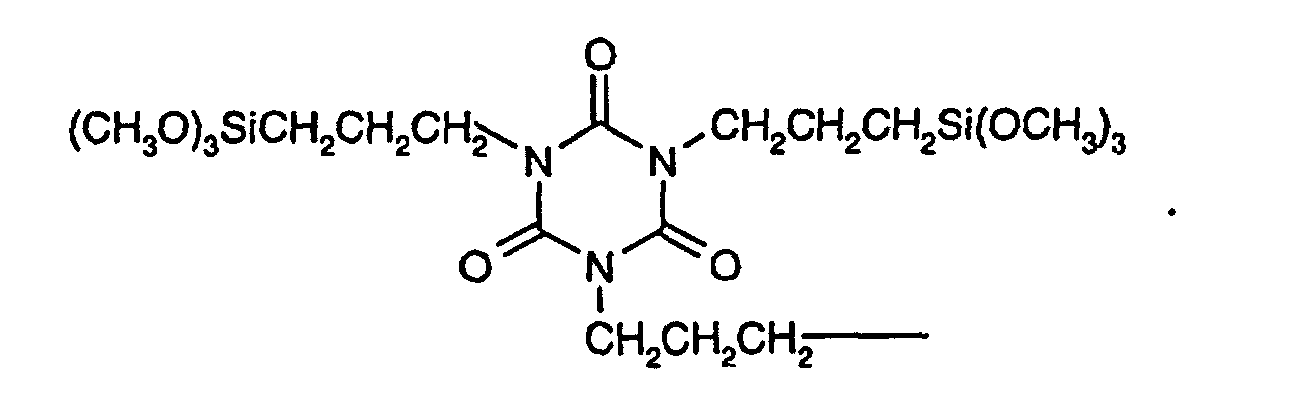
- Particularly preferred are silanes of formula I, wherein R is methyl, vinyl, 3-mercaptopropyl or 3-aminopropyl.
Y1, Y2 and Y3 in formula I are preferably methyl, ethyl, acetyl or 2-methoxyethyl. - Illustrative examples of suitable silanes of formula I are octyltriethoxysilane, methyltriethoxysilane, methyltrimethoxysilane, tris[3-(trimethoxysilyl)propyl]isocyanurate, vinyltriethoxysilane, vinyltrimethoxysilane, vinyl-tris(2-methoxyethoxy)silane, γ-methacryloxypropyltri-methoxysilane, β-(3,4-epoxycyclohexyl)ethyltrimethoxysilane, γ-glycidyloxypropyltrimethoxysilane, γ-mercaptopropyltrimethoxysilane, γ-aminopropyltriethoxysilane, γ-aminopropyltrimethoxysilane, N-(β-aminoethyl)-γ-aminopropyltrimethoxysilane, H2NCH2CH2NHCH2CH2NHCH2CH2CH2Si(OCH3)3, bis[γ-(trimethoxysilyl)propyl]amine, organically modified polydimethylsiloxane of formulawhere R and R' are alkyl or aryl, γ-ureidopropyltrimethoxysilane, γ-isocyanatopropyltriethoxysilane, 3-chloropropyltrimethoxysilane, 3-triethoxysilylpropyl succinic anhydride, 3-methacryloxypropyltrimethoxysilane, vinyltris(2-methoxyethoxy)silane, vinyltriacetoxysilane, 3-mercaptopropyltrimethoxysilane, 3-glycidyloxypropyltriethoxysilane, 3-(2-aminoethylamino)propyltrimethoxysilane and 3-(2-aminoethylamino)propylmethyldimethoxysilane.

- The amount of aluminium filler in the compositions according to the invention is advantageously 30 to 400 parts by weight, preferably 50 to 300 parts by weight, per 100 parts by weight of component (a).
- The filler mixes very well with the EPIC resins to form homogeneous mixtures without voids or defects. These mixtures then can be cured at low temperatures without exotherming. And hence the low temperature needed for the polymer net-work cure process enables the use of low cost starting moulds made from thermoplastic materials, such as expanded polystyrene foam, which material imparts the additional benefits of quick and complete removal at demoulding time. The density of the polystyrene foam is preferably 0,01 -0,05 g/cm3)
- Accordingly, a further object of the invention is a process for the fabrication of a resin mold which comprises
- (A) shaping an intermediate oversized model-cavity into a polystyrene foam,
- (B) coating this cavity with a polyurea gelcoat or another solvent free coat which does not feed the PS foam,
- (C) curing at ambient temperature and applying a wax release agent on the cured film,
- (D) filling the protected cavity with a composition containing an EPIC resin and a treated filler as defined above,
- (E) curing at ambient temperature,
- (F) demolding the cast resin piece and curing at progressively higher temperatures to the fully crosslinked state.
-
- The cured product obtained by this process may be a mold directly, which excels in high temperature tolerance, high chemical resistance and mechanical strength in combination with low brittleness.
- These outstanding properties further establish the possibility of machining these cured resins under CAD (Computer Aided Design) control to manufacture resin molds in a streamlined work flow.
- The CAD machining process generally requires that the filled resins have few voids or any other defects. Also the CAD machining itself should not introduce fracture defects which may limit the useful life-time of the final resin mold.
Further the machined resin mold itself has to withstand, without fracturing, repeated cycles of hot pressing and demoulding readily with polymer or metal sheeting materials.
It has been found that the filled resins according to the invention perform exceptionally well under the CAD machining environment to produce high resolution molds which yield required repeatable molding action. - The invention therefore further relates to the above-described process for the fabrication of a resin mold which further comprises
(G) CAD machining the cured cast into a final mold. - Previously it has not been possible to produce high performance plastics molds using low cost disposable starting moulds. Aluminium has tended to be used to produce the mold, with the consequent associated difficulties and greater cost involved in preparing a starting mould which has to withstand >600 °C.
The process according to the invention allows the application of the cheap and easily processible polystyrene. - The intermediate disposable mold prepared in step (A) of the claimed process may or may not contain a master model.
In case a master model is applied, CAD machining of cured cast is not necessary. - Prior to step (C), the disposable mold which may or may not contain a master model is coated with a release agent.
With the resin mixtures according to the invention, it has been particularly found that for step (B) cured polyurethane gel-coats act as very efficient protective agents which are not reacted with the curing EPIC mold resin. - The invention further relates to the mold obtained by the process described above.
- The following examples are illustrative of the present invention and are therefore not intended as a limitation of the scope thereof.
- 25 kg of Casting Resin C305 (EPIC resin based on bisphenol A diglycidylether and diisocyanatodiphenylmethane, filled with atomised aluminium 415N from ALCAN TOYO) is heated to 30°C and mixed with 0.275kg of Catalyst D973 (tertiary amine) with an electrical stirrer. The homogenous mixture is then ready to cast.
Alternatively, the unfilled EPIC S 301 is put in a high speed or planetary mixer, drying agent (molecular sieves) and aluminium powder are added, then the mixture is stirred until 40°C is reached (self heating by stirring power). Subsequently, D 970 catalyst is added. The homogenous mixture is then ready to cast. - A piece of EPS (expanded polystyrene) foam (density 0,01-0,05 g/cm3) is shaped in an oversized cavity . The cavity is protected with a solvent flexibel polyurea gelcoat (Ureol 6118 A/B or Ureol 6435 A/B) and cured at ambient temperature. On the dry protection film (1-2mm thick) a wax release agent (QZ 5111 or QV 5110) is applied.
- The prepared resin mixture is poured into the urethane coated and wax released cavity and cured over night at ambient temperature. The precured cast piece is demolded the day after and put into an oven at 40-60°C and cured fully under the following conditions: 2h/80°C; 2h/120°C; 2h/160°C; 4h/200°C.
The net size cast piece is now ready for machining with CAD control to the required final mold design.
An excellent resolution of 400 mm (casting layer) is achieved without any voids. - Example 1 is repeated, but with an additional metal spray (Zn alloy, 3 mm thick) on the mold.
- Example 1 is repeated, but an EPIC resin without any filler (Example 3) and with untreated aluminium granules (Example 4) is used.
- The results of the injection molding process using the molds prepared in Examples 1-4 and different types of polymers are summarised in Table 1.
Ex. Filler Comment on Formulation G1c (J/m2) Ambient K1c (MPa m½) Ambient Mold Result Polymer type:Tool Temp:No of parts: Surface Finish of Parts 1 Atomised Aluminium 5-75 µm Homogeneous
Casting
Mixture700+/-40 2.7+/-0.1 A: 65C: 500:excellent B:55C : 500: Very good C: 68C: 500:- D: 95C: 300: Slightly rough surface E: 88C: 265: Slightly rough surface 2 As Example 1, but with metal spray on mold. HEK-MCP400 Zn Alloy 3mm Thick As Example 1 (700+/-40) (2.7+/-0.1) A: 40C: 100: rough surface B: 53C: 500:--- C: 54C: 500:--- D: 56C: 75: (metal surface damage) E: >90C :--- cracks in surface 3 None Homogeneous resin mixture 63+/-7 0.52+/-0.05 Fractures 4 Untreated Aluminium Granules Bubbling and foaming
Inhomogeneo us- - (Brittle, friable) INJECTION MOLD POLYMER TYPE A: polypropylene PP lowmpt: Hostalen PPW 1780S2A B: PP+30%GlassFibres(PPGF30): Hostalen PPW 1780 S2A + Hostacom G2U02 C: Acrylonitrile-butadiene-styrene ABS: Terluran 958 I, low mpt D: Polyamide66: PA66 Ultramid A3K, high mpt E: Polyamide66+30%GlassFibresPPGF30 - As clearly seen, the treated aluminium filled mold performs remarkably well, without needing any additional metal surface treatment to aid de-molding .
Claims (10)
- A process for the fabrication of a resin mold which comprises(A) shaping an intermediate oversized model-cavity into a polystyrene foam,(B) coating this cavity with a polyurea gelcoat or another solvent free coat which does not feed the PS foam,(C) curing at ambient temperature and applying a wax release agent on the cured film, filling the protected cavity with a composition comprising:(a) a resin containing a polyepoxide and a polyisocyanate, and(b) a treated filler which is an atomised aluminium filler,,(D) curing at ambient temperature, and(E) demolding the cast resin piece and curing at progressively higher temperatures to the fully crosslinked state.
- A process according to claim 1 which further comprises
CAD machining the cured cast into a final mold. - A process according to claim 1 wherein disposable mold contains a master model.
- A process according to any of claims 1 to 3, wherein the ratio of epoxy groups to isocyanate groups in the composition is in range of 1 : 1 to 1 : 5, preferably 1.0 : 1.5 to 1.0 : 4.0.
- A process according to claim 1, wherein the composition contains as component (a) a resin wherein the polyepoxide is a diglycidylether or a diglycidylester.
- A process according to claim 1, wherein the composition contains as component (a) a resin wherein the polyepoxide is a diglycidylether of bisphenol A or bisphenol F.
- A process according to claim 1, wherein the composition containisas component (a) a resin wherein the polyisocyanate is a diisocyanate.
- A process according to claim 1, wherein the composition contains as component (a) a resin wherein the polyisocyanate is a diisocyanate of the formula OCN-X-NCO, wherein X denotes a bivalent aromatic, cycloaliphatic or aliphatic-cycloaliphatic radical.
- A process according to claim 1, wherein the composition contains as component (a) a resin wherein the polyisocyanate is phenylenediisocyanate, toluenediisocyanate, biphenyldiisocyanate, isophoronediisocyanate, 2,2-bis(4-isocyanatophenyl)propane or diphenylmethane diisocyanate.
- A mold obtained by the process according to any of claims 1 to 9.
Applications Claiming Priority (2)
| Application Number | Priority Date | Filing Date | Title |
|---|---|---|---|
| GBGB9927431.8A GB9927431D0 (en) | 1999-11-22 | 1999-11-22 | Casting resin and process for the fabrication of resin molds |
| GB9927431 | 1999-11-22 |
Publications (3)
| Publication Number | Publication Date |
|---|---|
| EP1101783A2 EP1101783A2 (en) | 2001-05-23 |
| EP1101783A3 EP1101783A3 (en) | 2001-09-19 |
| EP1101783B1 true EP1101783B1 (en) | 2004-12-22 |
Family
ID=10864832
Family Applications (1)
| Application Number | Title | Priority Date | Filing Date |
|---|---|---|---|
| EP00811073A Expired - Lifetime EP1101783B1 (en) | 1999-11-22 | 2000-11-14 | Process for the fabrication of resin molds |
Country Status (11)
| Country | Link |
|---|---|
| US (1) | US6602936B1 (en) |
| EP (1) | EP1101783B1 (en) |
| JP (1) | JP2001187813A (en) |
| KR (1) | KR20010051852A (en) |
| CN (1) | CN1160410C (en) |
| AT (1) | ATE285425T1 (en) |
| AU (1) | AU7146000A (en) |
| CA (1) | CA2326462A1 (en) |
| DE (1) | DE60016879T2 (en) |
| GB (1) | GB9927431D0 (en) |
| ZA (1) | ZA200006760B (en) |
Families Citing this family (17)
| Publication number | Priority date | Publication date | Assignee | Title |
|---|---|---|---|---|
| ITMI20012724A1 (en) * | 2001-12-20 | 2003-06-20 | Angelo Negri | COMPOSITION AND PROCEDURE FOR THE MOLDING OF OBJECTS OF VARIOUS SHAPES SUCH AS FORMS FOR FOOTWEAR AND SIMILAR |
| KR100700435B1 (en) | 2005-06-14 | 2007-03-27 | 한국기계연구원 | Organofluorinated silicon fluoride compound for mold production used for pattern replication, organic-inorganic hybrid mold for pattern replication using the same, pattern replication method using the mold and pattern replicated by the method |
| US7498662B2 (en) * | 2005-11-18 | 2009-03-03 | 3M Innovative Properties Company | Dielectric media including surface-treated metal oxide particles |
| DE602006013160D1 (en) * | 2006-12-01 | 2010-05-06 | Dow Global Technologies Inc | Metal-filled polyurethane composition and molds made therefrom |
| BRPI0909427A2 (en) | 2008-03-28 | 2015-11-03 | 3M Innovative Proferties Company | loaded resins and method for the production of loaded resins |
| US8551280B2 (en) * | 2010-03-17 | 2013-10-08 | Jesse Villarreal, JR. | Solid-core panel incorporating decorative and/or functional material |
| CN102416677B (en) * | 2011-07-27 | 2014-10-29 | 南京能益节能科技有限公司 | Die for building materials products and preparation method thereof |
| DE102013205117A1 (en) * | 2013-03-22 | 2014-09-25 | Siemens Aktiengesellschaft | Potting compound, use of potting compound, thermally cured composite available from the potting compound and electrical machine with the potting compound |
| EP2801585A1 (en) * | 2013-05-06 | 2014-11-12 | Hüther Ulrich | Compressed porous moulded part based on epoxide-isocyanate resin |
| CN104031323B (en) * | 2014-05-19 | 2016-09-14 | 滁州迪蒙德模具制造有限公司 | A kind of manufacture method of mould of plastics |
| WO2016058644A1 (en) * | 2014-10-16 | 2016-04-21 | European Space Agency | Method of manufacturing bulk metallic glass components |
| DE202015100825U1 (en) | 2015-02-20 | 2015-03-02 | Ulrich Hüther | Compacted porous body |
| KR102802243B1 (en) | 2018-03-16 | 2025-05-07 | 훈츠만 어드밴스트 머티리얼스 라이센싱 (스위처랜드) 게엠베하 | Storage stability composition and curable resin composition |
| BR112020018720A2 (en) * | 2018-03-16 | 2020-12-29 | Huntsman Advanced Materials Licensing (Switzerland) Gmbh | CURABLE MIXTURE, PAPER BUSHING, AND USE OF A CURABLE MIXTURE. |
| CN110591000B (en) * | 2019-09-28 | 2022-04-22 | 广东聚航新材料研究院有限公司 | High-temperature-resistant die material of poly-dicyclopentadienyl and preparation method thereof |
| CN111303615A (en) * | 2020-03-23 | 2020-06-19 | 东莞线宝电子科技有限公司 | Data line cladding material and preparation method thereof |
| TR2021021194A2 (en) * | 2021-12-27 | 2023-07-21 | Tusas Tuerk Havacilik Ve Uzay Sanayii Anonim Sirketi | A production system. |
Family Cites Families (13)
| Publication number | Priority date | Publication date | Assignee | Title |
|---|---|---|---|---|
| GB830250A (en) | 1957-06-03 | 1960-03-16 | Ford Motor Co | Moulded mould, low temperature plastic injection process |
| CA960793A (en) | 1970-06-22 | 1975-01-07 | James A. Clarke | Oxazolidinone-modified epoxy novolac resin molding compositions |
| US4218360A (en) | 1978-12-04 | 1980-08-19 | Union Carbide Corporation | Epoxy resins filled with dual-silane treated hydrated alumina |
| US4382803A (en) | 1980-07-31 | 1983-05-10 | Rowland, Incorporated | Tools for optical lenses |
| JPS6039698B2 (en) | 1983-05-09 | 1985-09-07 | 旭硝子株式会社 | Silicate filler for polyurethane |
| DE3323122A1 (en) | 1983-06-27 | 1985-05-23 | Siemens AG, 1000 Berlin und 8000 München | METHOD FOR PRODUCING REACTION RESIN MOLDINGS |
| US4775600A (en) | 1986-03-27 | 1988-10-04 | Nippon Kokan Kabushiki Kaisha | Highly corrosion-resistant surface-treated steel plate |
| US4847122A (en) * | 1987-05-27 | 1989-07-11 | Palmer International, Inc. | Cavitation-resistant polymer and coating |
| JPH01242655A (en) | 1988-03-23 | 1989-09-27 | Toshiba Corp | Epoxy resin composition |
| DE69027819T2 (en) | 1989-08-07 | 1997-02-27 | Asahi Chemical Ind | Mold made of metal powder-filled epoxy resin and process for its production |
| DE4141963C2 (en) | 1991-12-19 | 1997-03-20 | Hans Dipl Ing Dammer | Resin composition, especially cast resin |
| DE4416323A1 (en) | 1994-05-09 | 1995-11-16 | Bayer Ag | Thermosetting reactive resin mixtures and their use |
| DE4419234A1 (en) * | 1994-06-01 | 1995-12-07 | Wacker Chemie Gmbh | Process for the silylation of inorganic oxides |
-
1999
- 1999-11-22 GB GBGB9927431.8A patent/GB9927431D0/en not_active Ceased
-
2000
- 2000-11-01 US US09/703,787 patent/US6602936B1/en not_active Expired - Fee Related
- 2000-11-08 AU AU71460/00A patent/AU7146000A/en not_active Abandoned
- 2000-11-14 EP EP00811073A patent/EP1101783B1/en not_active Expired - Lifetime
- 2000-11-14 DE DE60016879T patent/DE60016879T2/en not_active Expired - Lifetime
- 2000-11-14 AT AT00811073T patent/ATE285425T1/en not_active IP Right Cessation
- 2000-11-20 CA CA002326462A patent/CA2326462A1/en not_active Abandoned
- 2000-11-20 ZA ZA200006760A patent/ZA200006760B/en unknown
- 2000-11-21 CN CNB001283162A patent/CN1160410C/en not_active Expired - Fee Related
- 2000-11-21 KR KR1020000069261A patent/KR20010051852A/en not_active Withdrawn
- 2000-11-22 JP JP2000355744A patent/JP2001187813A/en active Pending
Also Published As
| Publication number | Publication date |
|---|---|
| US6602936B1 (en) | 2003-08-05 |
| EP1101783A2 (en) | 2001-05-23 |
| CN1296994A (en) | 2001-05-30 |
| CA2326462A1 (en) | 2001-05-22 |
| DE60016879D1 (en) | 2005-01-27 |
| DE60016879T2 (en) | 2006-01-05 |
| ATE285425T1 (en) | 2005-01-15 |
| CN1160410C (en) | 2004-08-04 |
| EP1101783A3 (en) | 2001-09-19 |
| AU7146000A (en) | 2001-05-24 |
| KR20010051852A (en) | 2001-06-25 |
| JP2001187813A (en) | 2001-07-10 |
| GB9927431D0 (en) | 2000-01-19 |
| ZA200006760B (en) | 2001-05-22 |
Similar Documents
| Publication | Publication Date | Title |
|---|---|---|
| US6602936B1 (en) | Casting resin and process for the fabrication of resin molds | |
| EP0190317B1 (en) | Internal mold release compositions, active hydrogen-containing compositions containing the internal mold release compositions and a process for preparing molded polyurethane and/or polyurea and like polymers | |
| US6020387A (en) | Low density polymers and methods of making and using same | |
| US4732962A (en) | High temperature epoxy tooling composition of bisphenol-A epoxy, trifunctional epoxy, anhydride curing agent and an imidazole catalyst | |
| TW201333083A (en) | Prepreg, fiber reinforced composite material and method for manufacturing the same, epoxy resin composition | |
| CN103619900A (en) | Curable epoxy resin systems containing mixtures of amine hardeners and an excess of epoxide groups | |
| US4925886A (en) | High temperature epoxy tooling composition of bifunctional epoxy, trifunctional epoxy, anhydride, imidazole and interstitially matched filler | |
| JP2019070139A (en) | Isocyanate-epoxide hybrid resin | |
| EP1817148B1 (en) | Method of making high temperature resistant models or tools and compositon therefor | |
| US20060159869A1 (en) | Reactive materials systems and methods for solid freeform fabrication of three-dimensional objects | |
| EP0107104B1 (en) | A process for fabricating thermoset resin articles | |
| JPH06505529A (en) | Resin compositions, especially casting resins | |
| US3655861A (en) | Method for the manufacture of molded solid plastics articles | |
| EP3169716B1 (en) | Epoxy systems employing triethylaminetetraamine and tin catalysts | |
| CN108162567B (en) | Preparation method of packaging material | |
| EP0348210A2 (en) | High strength epoxy tooling compositions | |
| CA2207782A1 (en) | Preparation of mouldings by the automatic pressure gelation technique using a one-component composition | |
| EP4388028B1 (en) | A heat-curable-reaction-resin mixture | |
| EP0784640A1 (en) | Polyurethane composition | |
| JPH0350244A (en) | Epoxy resin composition for reaction injection molding | |
| JP4861719B2 (en) | Inorganic organic binder powder and pump parts and pump equipment for sintering and molding | |
| JP2658406B2 (en) | Manufacturing method of electrical equipment | |
| JPH0425560A (en) | Production of conductive thermosetting polyurethane resin | |
| JPS61176623A (en) | Molding of polyisocyanurate-based heat-resistant resin | |
| JPH02245018A (en) | Epoxy resin composition for resin mold and resin mold made thereform |
Legal Events
| Date | Code | Title | Description |
|---|---|---|---|
| PUAI | Public reference made under article 153(3) epc to a published international application that has entered the european phase |
Free format text: ORIGINAL CODE: 0009012 |
|
| AK | Designated contracting states |
Kind code of ref document: A2 Designated state(s): AT BE CH CY DE DK ES FI FR GB GR IE IT LI LU MC NL PT SE TR |
|
| AX | Request for extension of the european patent |
Free format text: AL;LT;LV;MK;RO;SI |
|
| PUAL | Search report despatched |
Free format text: ORIGINAL CODE: 0009013 |
|
| RIC1 | Information provided on ipc code assigned before grant |
Free format text: 7C 08G 18/58 A, 7B 29C 33/40 B, 7C 08G 18/00 B, 7C 08K 9/06 B |
|
| AK | Designated contracting states |
Kind code of ref document: A3 Designated state(s): AT BE CH CY DE DK ES FI FR GB GR IE IT LI LU MC NL PT SE TR |
|
| AX | Request for extension of the european patent |
Free format text: AL;LT;LV;MK;RO;SI |
|
| 17P | Request for examination filed |
Effective date: 20011023 |
|
| AKX | Designation fees paid |
Free format text: AT BE CH CY DE DK ES FI FR GB GR IE IT LI LU MC NL PT SE TR |
|
| 17Q | First examination report despatched |
Effective date: 20030704 |
|
| RAP1 | Party data changed (applicant data changed or rights of an application transferred) |
Owner name: VANTICO GMBH |
|
| GRAP | Despatch of communication of intention to grant a patent |
Free format text: ORIGINAL CODE: EPIDOSNIGR1 |
|
| RTI1 | Title (correction) |
Free format text: PROCESS FOR THE FABRICATION OF RESIN MOLDS |
|
| RAP1 | Party data changed (applicant data changed or rights of an application transferred) |
Owner name: HUNTSMAN ADVANCED MATERIALS (SWITERLAND) GMBH |
|
| GRAS | Grant fee paid |
Free format text: ORIGINAL CODE: EPIDOSNIGR3 |
|
| GRAA | (expected) grant |
Free format text: ORIGINAL CODE: 0009210 |
|
| AK | Designated contracting states |
Kind code of ref document: B1 Designated state(s): AT BE CH CY DE DK ES FI FR GB GR IE IT LI LU MC NL PT SE TR |
|
| PG25 | Lapsed in a contracting state [announced via postgrant information from national office to epo] |
Ref country code: BE Free format text: LAPSE BECAUSE OF FAILURE TO SUBMIT A TRANSLATION OF THE DESCRIPTION OR TO PAY THE FEE WITHIN THE PRESCRIBED TIME-LIMIT Effective date: 20041222 Ref country code: AT Free format text: LAPSE BECAUSE OF FAILURE TO SUBMIT A TRANSLATION OF THE DESCRIPTION OR TO PAY THE FEE WITHIN THE PRESCRIBED TIME-LIMIT Effective date: 20041222 Ref country code: CH Free format text: LAPSE BECAUSE OF FAILURE TO SUBMIT A TRANSLATION OF THE DESCRIPTION OR TO PAY THE FEE WITHIN THE PRESCRIBED TIME-LIMIT Effective date: 20041222 Ref country code: LI Free format text: LAPSE BECAUSE OF FAILURE TO SUBMIT A TRANSLATION OF THE DESCRIPTION OR TO PAY THE FEE WITHIN THE PRESCRIBED TIME-LIMIT Effective date: 20041222 Ref country code: TR Free format text: LAPSE BECAUSE OF FAILURE TO SUBMIT A TRANSLATION OF THE DESCRIPTION OR TO PAY THE FEE WITHIN THE PRESCRIBED TIME-LIMIT Effective date: 20041222 Ref country code: ES Free format text: LAPSE BECAUSE OF FAILURE TO SUBMIT A TRANSLATION OF THE DESCRIPTION OR TO PAY THE FEE WITHIN THE PRESCRIBED TIME-LIMIT Effective date: 20041222 Ref country code: NL Free format text: LAPSE BECAUSE OF FAILURE TO SUBMIT A TRANSLATION OF THE DESCRIPTION OR TO PAY THE FEE WITHIN THE PRESCRIBED TIME-LIMIT Effective date: 20041222 Ref country code: FI Free format text: LAPSE BECAUSE OF FAILURE TO SUBMIT A TRANSLATION OF THE DESCRIPTION OR TO PAY THE FEE WITHIN THE PRESCRIBED TIME-LIMIT Effective date: 20041222 |
|
| REG | Reference to a national code |
Ref country code: GB Ref legal event code: FG4D |
|
| REG | Reference to a national code |
Ref country code: CH Ref legal event code: EP |
|
| REG | Reference to a national code |
Ref country code: IE Ref legal event code: FG4D |
|
| REF | Corresponds to: |
Ref document number: 60016879 Country of ref document: DE Date of ref document: 20050127 Kind code of ref document: P |
|
| PG25 | Lapsed in a contracting state [announced via postgrant information from national office to epo] |
Ref country code: SE Free format text: LAPSE BECAUSE OF FAILURE TO SUBMIT A TRANSLATION OF THE DESCRIPTION OR TO PAY THE FEE WITHIN THE PRESCRIBED TIME-LIMIT Effective date: 20050322 Ref country code: DK Free format text: LAPSE BECAUSE OF FAILURE TO SUBMIT A TRANSLATION OF THE DESCRIPTION OR TO PAY THE FEE WITHIN THE PRESCRIBED TIME-LIMIT Effective date: 20050322 Ref country code: GR Free format text: LAPSE BECAUSE OF FAILURE TO SUBMIT A TRANSLATION OF THE DESCRIPTION OR TO PAY THE FEE WITHIN THE PRESCRIBED TIME-LIMIT Effective date: 20050322 |
|
| REG | Reference to a national code |
Ref country code: GB Ref legal event code: 727 |
|
| NLV1 | Nl: lapsed or annulled due to failure to fulfill the requirements of art. 29p and 29m of the patents act | ||
| REG | Reference to a national code |
Ref country code: CH Ref legal event code: PL |
|
| REG | Reference to a national code |
Ref country code: GB Ref legal event code: 727G |
|
| REG | Reference to a national code |
Ref country code: GB Ref legal event code: 727B |
|
| PLBE | No opposition filed within time limit |
Free format text: ORIGINAL CODE: 0009261 |
|
| STAA | Information on the status of an ep patent application or granted ep patent |
Free format text: STATUS: NO OPPOSITION FILED WITHIN TIME LIMIT |
|
| PG25 | Lapsed in a contracting state [announced via postgrant information from national office to epo] |
Ref country code: IE Free format text: LAPSE BECAUSE OF NON-PAYMENT OF DUE FEES Effective date: 20051114 Ref country code: CY Free format text: LAPSE BECAUSE OF FAILURE TO SUBMIT A TRANSLATION OF THE DESCRIPTION OR TO PAY THE FEE WITHIN THE PRESCRIBED TIME-LIMIT Effective date: 20051114 |
|
| PG25 | Lapsed in a contracting state [announced via postgrant information from national office to epo] |
Ref country code: LU Free format text: LAPSE BECAUSE OF NON-PAYMENT OF DUE FEES Effective date: 20051130 Ref country code: MC Free format text: LAPSE BECAUSE OF NON-PAYMENT OF DUE FEES Effective date: 20051130 |
|
| 26N | No opposition filed |
Effective date: 20050923 |
|
| ET | Fr: translation filed | ||
| REG | Reference to a national code |
Ref country code: IE Ref legal event code: MM4A |
|
| PG25 | Lapsed in a contracting state [announced via postgrant information from national office to epo] |
Ref country code: PT Free format text: LAPSE BECAUSE OF NON-PAYMENT OF DUE FEES Effective date: 20050522 |
|
| PGFP | Annual fee paid to national office [announced via postgrant information from national office to epo] |
Ref country code: DE Payment date: 20121130 Year of fee payment: 13 Ref country code: FR Payment date: 20121113 Year of fee payment: 13 |
|
| PGFP | Annual fee paid to national office [announced via postgrant information from national office to epo] |
Ref country code: IT Payment date: 20121119 Year of fee payment: 13 Ref country code: GB Payment date: 20121025 Year of fee payment: 13 |
|
| GBPC | Gb: european patent ceased through non-payment of renewal fee |
Effective date: 20131114 |
|
| REG | Reference to a national code |
Ref country code: FR Ref legal event code: ST Effective date: 20140731 |
|
| REG | Reference to a national code |
Ref country code: DE Ref legal event code: R119 Ref document number: 60016879 Country of ref document: DE Effective date: 20140603 |
|
| PG25 | Lapsed in a contracting state [announced via postgrant information from national office to epo] |
Ref country code: IT Free format text: LAPSE BECAUSE OF NON-PAYMENT OF DUE FEES Effective date: 20131114 Ref country code: DE Free format text: LAPSE BECAUSE OF NON-PAYMENT OF DUE FEES Effective date: 20140603 |
|
| PG25 | Lapsed in a contracting state [announced via postgrant information from national office to epo] |
Ref country code: GB Free format text: LAPSE BECAUSE OF NON-PAYMENT OF DUE FEES Effective date: 20131114 Ref country code: FR Free format text: LAPSE BECAUSE OF NON-PAYMENT OF DUE FEES Effective date: 20131202 |