EP1099744A2 - Organic electroluminescent device - Google Patents
Organic electroluminescent device Download PDFInfo
- Publication number
- EP1099744A2 EP1099744A2 EP00309954A EP00309954A EP1099744A2 EP 1099744 A2 EP1099744 A2 EP 1099744A2 EP 00309954 A EP00309954 A EP 00309954A EP 00309954 A EP00309954 A EP 00309954A EP 1099744 A2 EP1099744 A2 EP 1099744A2
- Authority
- EP
- European Patent Office
- Prior art keywords
- group
- substituted
- layer
- unsubstituted
- organic
- Prior art date
- Legal status (The legal status is an assumption and is not a legal conclusion. Google has not performed a legal analysis and makes no representation as to the accuracy of the status listed.)
- Granted
Links
- 0 c(cc1)cc2c1-c(cccc1)c1/N=C(/C1=*/c(cccc3)c3-c3ccccc3/N=C1/C1=N\c(cccc3)c3-c(cccc3)c3/N=C11)\C1=*2 Chemical compound c(cc1)cc2c1-c(cccc1)c1/N=C(/C1=*/c(cccc3)c3-c3ccccc3/N=C1/C1=N\c(cccc3)c3-c(cccc3)c3/N=C11)\C1=*2 0.000 description 2
- SXPUXKBTLVMIEZ-UHFFFAOYSA-N c(cc1)ccc1-c(cc1)cc2c1nc(c1nc(cc(cc3)-c4ccccc4)c3nc1c1nc(cc(cc3)-c4ccccc4)c3nc11)c1n2 Chemical compound c(cc1)ccc1-c(cc1)cc2c1nc(c1nc(cc(cc3)-c4ccccc4)c3nc1c1nc(cc(cc3)-c4ccccc4)c3nc11)c1n2 SXPUXKBTLVMIEZ-UHFFFAOYSA-N 0.000 description 1
Images


Classifications
-
- H—ELECTRICITY
- H10—SEMICONDUCTOR DEVICES; ELECTRIC SOLID-STATE DEVICES NOT OTHERWISE PROVIDED FOR
- H10K—ORGANIC ELECTRIC SOLID-STATE DEVICES
- H10K85/00—Organic materials used in the body or electrodes of devices covered by this subclass
- H10K85/60—Organic compounds having low molecular weight
- H10K85/649—Aromatic compounds comprising a hetero atom
- H10K85/657—Polycyclic condensed heteroaromatic hydrocarbons
- H10K85/6572—Polycyclic condensed heteroaromatic hydrocarbons comprising only nitrogen in the heteroaromatic polycondensed ring system, e.g. phenanthroline or carbazole
-
- H—ELECTRICITY
- H10—SEMICONDUCTOR DEVICES; ELECTRIC SOLID-STATE DEVICES NOT OTHERWISE PROVIDED FOR
- H10K—ORGANIC ELECTRIC SOLID-STATE DEVICES
- H10K2102/00—Constructional details relating to the organic devices covered by this subclass
- H10K2102/10—Transparent electrodes, e.g. using graphene
- H10K2102/101—Transparent electrodes, e.g. using graphene comprising transparent conductive oxides [TCO]
- H10K2102/103—Transparent electrodes, e.g. using graphene comprising transparent conductive oxides [TCO] comprising indium oxides, e.g. ITO
-
- H—ELECTRICITY
- H10—SEMICONDUCTOR DEVICES; ELECTRIC SOLID-STATE DEVICES NOT OTHERWISE PROVIDED FOR
- H10K—ORGANIC ELECTRIC SOLID-STATE DEVICES
- H10K50/00—Organic light-emitting devices
- H10K50/10—OLEDs or polymer light-emitting diodes [PLED]
- H10K50/11—OLEDs or polymer light-emitting diodes [PLED] characterised by the electroluminescent [EL] layers
-
- H—ELECTRICITY
- H10—SEMICONDUCTOR DEVICES; ELECTRIC SOLID-STATE DEVICES NOT OTHERWISE PROVIDED FOR
- H10K—ORGANIC ELECTRIC SOLID-STATE DEVICES
- H10K85/00—Organic materials used in the body or electrodes of devices covered by this subclass
- H10K85/10—Organic polymers or oligomers
- H10K85/111—Organic polymers or oligomers comprising aromatic, heteroaromatic, or aryl chains, e.g. polyaniline, polyphenylene or polyphenylene vinylene
- H10K85/114—Poly-phenylenevinylene; Derivatives thereof
-
- H—ELECTRICITY
- H10—SEMICONDUCTOR DEVICES; ELECTRIC SOLID-STATE DEVICES NOT OTHERWISE PROVIDED FOR
- H10K—ORGANIC ELECTRIC SOLID-STATE DEVICES
- H10K85/00—Organic materials used in the body or electrodes of devices covered by this subclass
- H10K85/10—Organic polymers or oligomers
- H10K85/141—Organic polymers or oligomers comprising aliphatic or olefinic chains, e.g. poly N-vinylcarbazol, PVC or PTFE
-
- H—ELECTRICITY
- H10—SEMICONDUCTOR DEVICES; ELECTRIC SOLID-STATE DEVICES NOT OTHERWISE PROVIDED FOR
- H10K—ORGANIC ELECTRIC SOLID-STATE DEVICES
- H10K85/00—Organic materials used in the body or electrodes of devices covered by this subclass
- H10K85/10—Organic polymers or oligomers
- H10K85/141—Organic polymers or oligomers comprising aliphatic or olefinic chains, e.g. poly N-vinylcarbazol, PVC or PTFE
- H10K85/146—Organic polymers or oligomers comprising aliphatic or olefinic chains, e.g. poly N-vinylcarbazol, PVC or PTFE poly N-vinylcarbazol; Derivatives thereof
-
- H—ELECTRICITY
- H10—SEMICONDUCTOR DEVICES; ELECTRIC SOLID-STATE DEVICES NOT OTHERWISE PROVIDED FOR
- H10K—ORGANIC ELECTRIC SOLID-STATE DEVICES
- H10K85/00—Organic materials used in the body or electrodes of devices covered by this subclass
- H10K85/30—Coordination compounds
- H10K85/321—Metal complexes comprising a group IIIA element, e.g. Tris (8-hydroxyquinoline) gallium [Gaq3]
- H10K85/324—Metal complexes comprising a group IIIA element, e.g. Tris (8-hydroxyquinoline) gallium [Gaq3] comprising aluminium, e.g. Alq3
-
- H—ELECTRICITY
- H10—SEMICONDUCTOR DEVICES; ELECTRIC SOLID-STATE DEVICES NOT OTHERWISE PROVIDED FOR
- H10K—ORGANIC ELECTRIC SOLID-STATE DEVICES
- H10K85/00—Organic materials used in the body or electrodes of devices covered by this subclass
- H10K85/60—Organic compounds having low molecular weight
- H10K85/615—Polycyclic condensed aromatic hydrocarbons, e.g. anthracene
-
- H—ELECTRICITY
- H10—SEMICONDUCTOR DEVICES; ELECTRIC SOLID-STATE DEVICES NOT OTHERWISE PROVIDED FOR
- H10K—ORGANIC ELECTRIC SOLID-STATE DEVICES
- H10K85/00—Organic materials used in the body or electrodes of devices covered by this subclass
- H10K85/60—Organic compounds having low molecular weight
- H10K85/631—Amine compounds having at least two aryl rest on at least one amine-nitrogen atom, e.g. triphenylamine
-
- Y—GENERAL TAGGING OF NEW TECHNOLOGICAL DEVELOPMENTS; GENERAL TAGGING OF CROSS-SECTIONAL TECHNOLOGIES SPANNING OVER SEVERAL SECTIONS OF THE IPC; TECHNICAL SUBJECTS COVERED BY FORMER USPC CROSS-REFERENCE ART COLLECTIONS [XRACs] AND DIGESTS
- Y10—TECHNICAL SUBJECTS COVERED BY FORMER USPC
- Y10S—TECHNICAL SUBJECTS COVERED BY FORMER USPC CROSS-REFERENCE ART COLLECTIONS [XRACs] AND DIGESTS
- Y10S428/00—Stock material or miscellaneous articles
- Y10S428/917—Electroluminescent
-
- Y—GENERAL TAGGING OF NEW TECHNOLOGICAL DEVELOPMENTS; GENERAL TAGGING OF CROSS-SECTIONAL TECHNOLOGIES SPANNING OVER SEVERAL SECTIONS OF THE IPC; TECHNICAL SUBJECTS COVERED BY FORMER USPC CROSS-REFERENCE ART COLLECTIONS [XRACs] AND DIGESTS
- Y10—TECHNICAL SUBJECTS COVERED BY FORMER USPC
- Y10T—TECHNICAL SUBJECTS COVERED BY FORMER US CLASSIFICATION
- Y10T428/00—Stock material or miscellaneous articles
- Y10T428/24—Structurally defined web or sheet [e.g., overall dimension, etc.]
- Y10T428/24942—Structurally defined web or sheet [e.g., overall dimension, etc.] including components having same physical characteristic in differing degree
-
- Y—GENERAL TAGGING OF NEW TECHNOLOGICAL DEVELOPMENTS; GENERAL TAGGING OF CROSS-SECTIONAL TECHNOLOGIES SPANNING OVER SEVERAL SECTIONS OF THE IPC; TECHNICAL SUBJECTS COVERED BY FORMER USPC CROSS-REFERENCE ART COLLECTIONS [XRACs] AND DIGESTS
- Y10—TECHNICAL SUBJECTS COVERED BY FORMER USPC
- Y10T—TECHNICAL SUBJECTS COVERED BY FORMER US CLASSIFICATION
- Y10T428/00—Stock material or miscellaneous articles
- Y10T428/24—Structurally defined web or sheet [e.g., overall dimension, etc.]
- Y10T428/24942—Structurally defined web or sheet [e.g., overall dimension, etc.] including components having same physical characteristic in differing degree
- Y10T428/2495—Thickness [relative or absolute]
- Y10T428/24967—Absolute thicknesses specified
- Y10T428/24975—No layer or component greater than 5 mils thick
Definitions
- the present invention relates to an organic (electro-)luminescence device and particularly to an organic luminescence device for emitting light by applying an electric field to a film of an organic compound (organic compound layer).
- An organic luminescence device generally comprises a pair of electrodes (comprising an anode and cathode) and a film comprising a fluorescent organic compound.
- a pair of electrodes comprising an anode and cathode
- a film comprising a fluorescent organic compound.
- holes and electrons are injected from the anode and the cathode, respectively, thus forming excitons of the fluorescent organic compound.
- the organic luminescence device emits light or causes luminescence.
- organic luminescence devices are still required to effect light output (emission) at a higher luminance and/or a higher conversion efficiency in the present state.
- These organic luminescence devices are also still insufficient in terms of durability such that the devices are liable to be changed in their properties with time when used for a long period or liable to be deteriorated by the influence of ambient air containing oxygen or of humidity.
- such light emission has not been realized satisfactorily.
- oxadiazole derivatives e.g., JP-A 2-216791 and JP-A 4-363891
- triazine derivatives e.g., JP-A 7-41759 and JP-A 7-90260
- organic luminescence devices using such compounds are not sufficient in stability of film and electron injection efficiency, thus resulting in lower luminance (of emitted light) and the shorter life of the device.
- a generic object of the present invention is to provide improvements to problems mentioned above encountered in organic luminescence devices proposed heretofore.
- a more specific object of the present invention is to provide an organic (electro-) luminescence device capable of effecting light output (emission) at high efficiency and luminance while realizing the prolonged life.
- Another object of the present invention is to provide an organic luminescence device capable of providing a wide variety of emission wavelengths and emission hues and a good durability.
- a further object of the present invention is to provide an organic luminescence device which can easily be prepared relatively inexpensively.
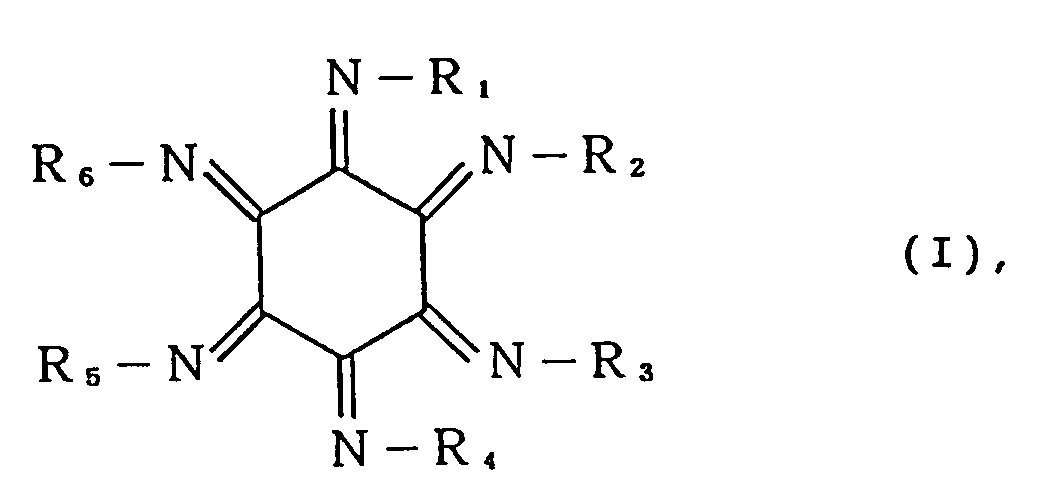
- an organic luminescence device comprising: a pair of electrodes comprising an anode and a cathode, and an organic compound layer disposed between the pair of electrodes, wherein the organic compound layer comprises a compound represented by the following formula (I): wherein R 1 to R 6 independently denote a substituted or unsubstituted alkyl group, a substituted or unsubstituted aryl group, a substituted or unsubstituted aralkyl group, or a substituted or unsubstituted heterocyclic group, with the proviso that each pair of R 1 and R 2 , R 3 and R 4 , an R 5 and R 6 or of R 1 and R 6 , R 2 and R 3 , and R 4 and R 5 may be connected to each other to form a fused ring structure.
- R 1 to R 6 independently denote a substituted or unsubstituted alkyl group, a substituted or unsubstituted aryl group, a substituted or un
- the invention also relates to a luminescent compound of the formula (1), wherein R 1 to R 6 have the definition give above.
- the organic compound layer comprising the compound of the formula (1) used in the present invention is useful as an electron injection layer.
- the resultant organic compound layer can be prepared through vacuum deposition. casting, wet-coating, etc., thus readily realizing a larger size thereof relatively inexpensively.
- Figures 1 to 3 are schematic sectional views for illustrating a basic structure of an organic luminescence device according to an embodiment of the present invention, respectively.
- Figures 4 to 6 are graphs showing a voltage-luminance (brightness) characteristic of the organic luminescence device of Example 1, the organic luminescence devices of Example 2 and Comparative Example 1 and the organic luminescence device of Example 3, respectively.
- the organic luminescence device is characterized in that the organic compound layer disposed between the pair of electrodes (anode and cathode) comprises a compound represented by the above-mentioned formula (I).
- the organic compound layer may be formed in a single layer or a plurality of layers wherein at least one of the layers comprises the compound of the formula (I).
- the alkyl group is a C 1 to C 10 alkyl group and may include a linear alkyl group selected from the group consisting of methyl group, ethyl group, propyl group, and hexyl group; or a branched alkyl group, such as isopropyl group or tert-butyl group.
- the aryl group for the formula (I) may include a moncyclic aromatic ring, such as phenyl group; and the polycyclic aromatic ring, such as naphthyl group, anthryl group or phenanthryl group.
- the aralkyl group for the formula (I) is an aryl group as defined above in combination with an alkyl group as defined above and may be selected from the group consisting of benzyl group, phenylpropyl group, and naphthylmethyl.
- the heterocyclic group for the formula (I) may include a monocyclic structure selected from the group consisting of pyrrolyl, furan, thiophene, imidazole, oxazole, thiazole, pyrazole, pyrrolidine, pyridine, pyrimidine, purine, quinoline, isoquinoline or carbazole groups, and a condensed heterocyclic structure such as phenazinyl group or acrydinyl group.
- the substituted alkyl, aryl, aralkyl and heterocyclic groups may independently have a substituent selected from the group consisting of halogen atom, nitryl group, nitro group, formyl group, acetyl group, benzoyl group, amide group, styryl group, ethynyl group, phenyl group, naphthyl group, anthryl group, pyridyl group, pyridazinyl group, phenazinyl group, pytrolyi group, imidazolyl group, quinolyl group, and acridinyl group.
- the fused ring structure for each pair of R 1 and R 2 , R 3 and R 4 , and R 5 and R 6 may comprise benzene ring, naphthalene ring or pyridine ring.
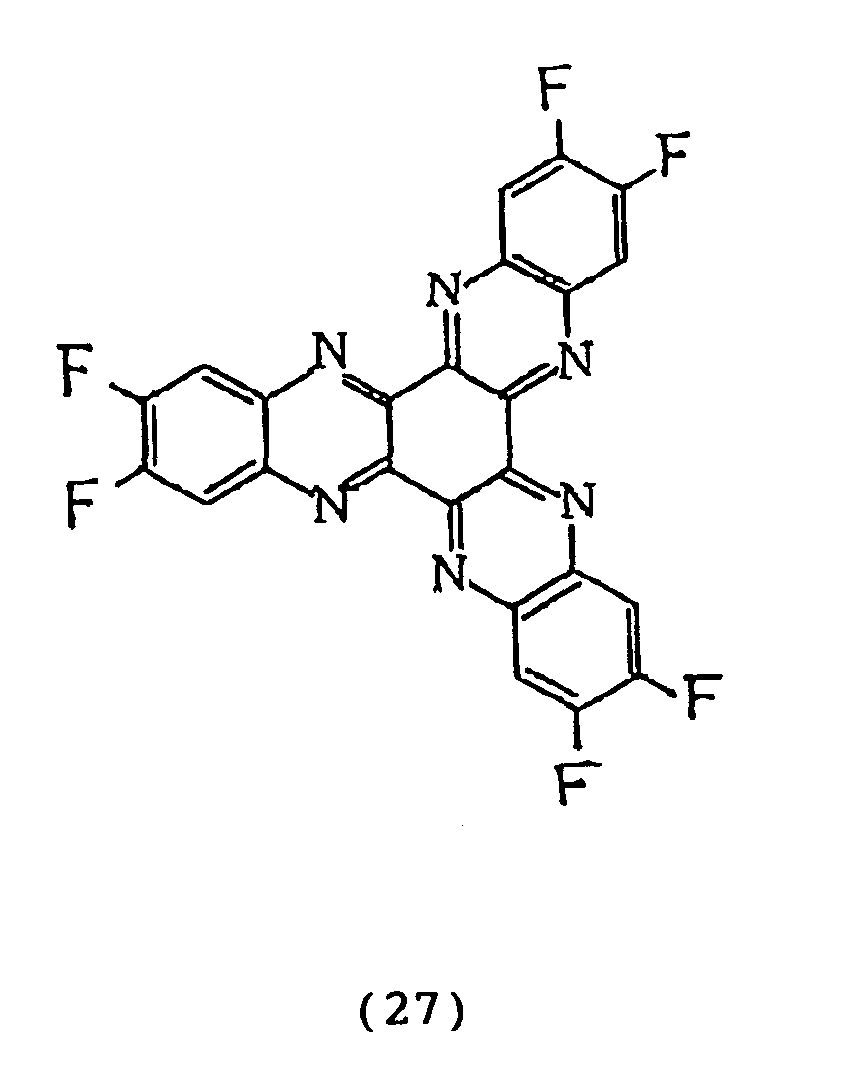
- the compound bf the formula (I) used in the present invention may preferably have a tripyrazinocyclohexane skeleton ahd may more preferably be a tripyrazinocyclohexane derivative represented by the following formula (Ia): wherein R 7 to R 12 have the same definitions (meanings) as R 1 to R 6 in the above-mentioned formula (I).
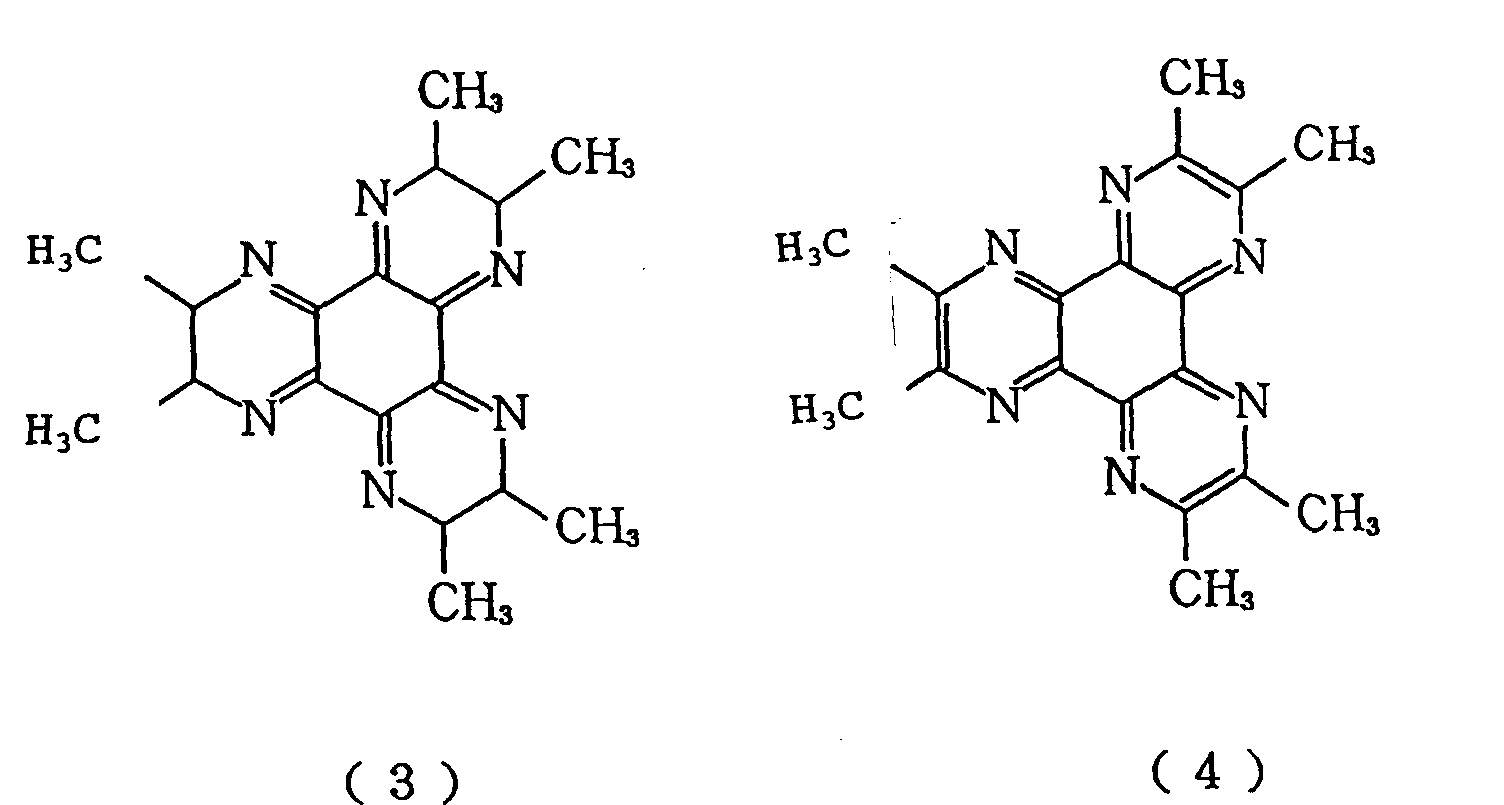
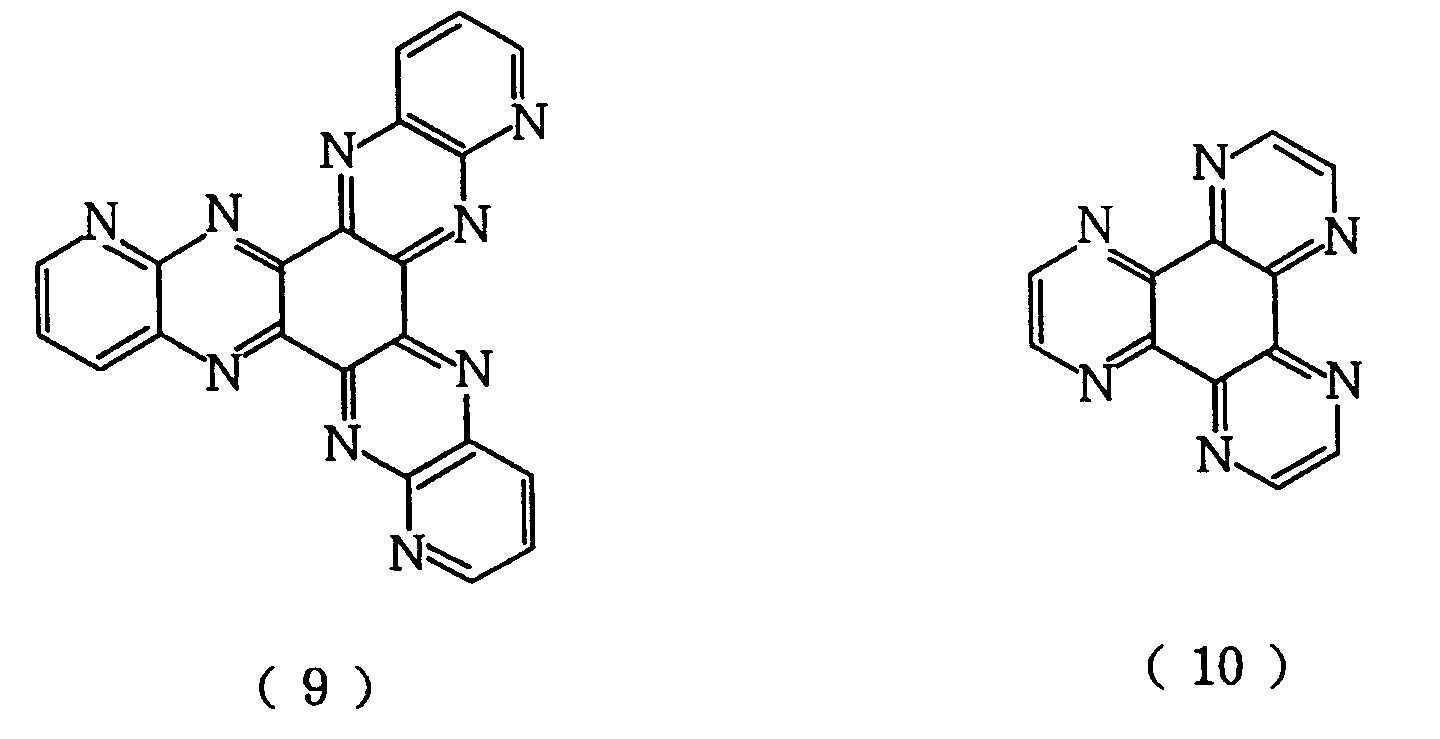
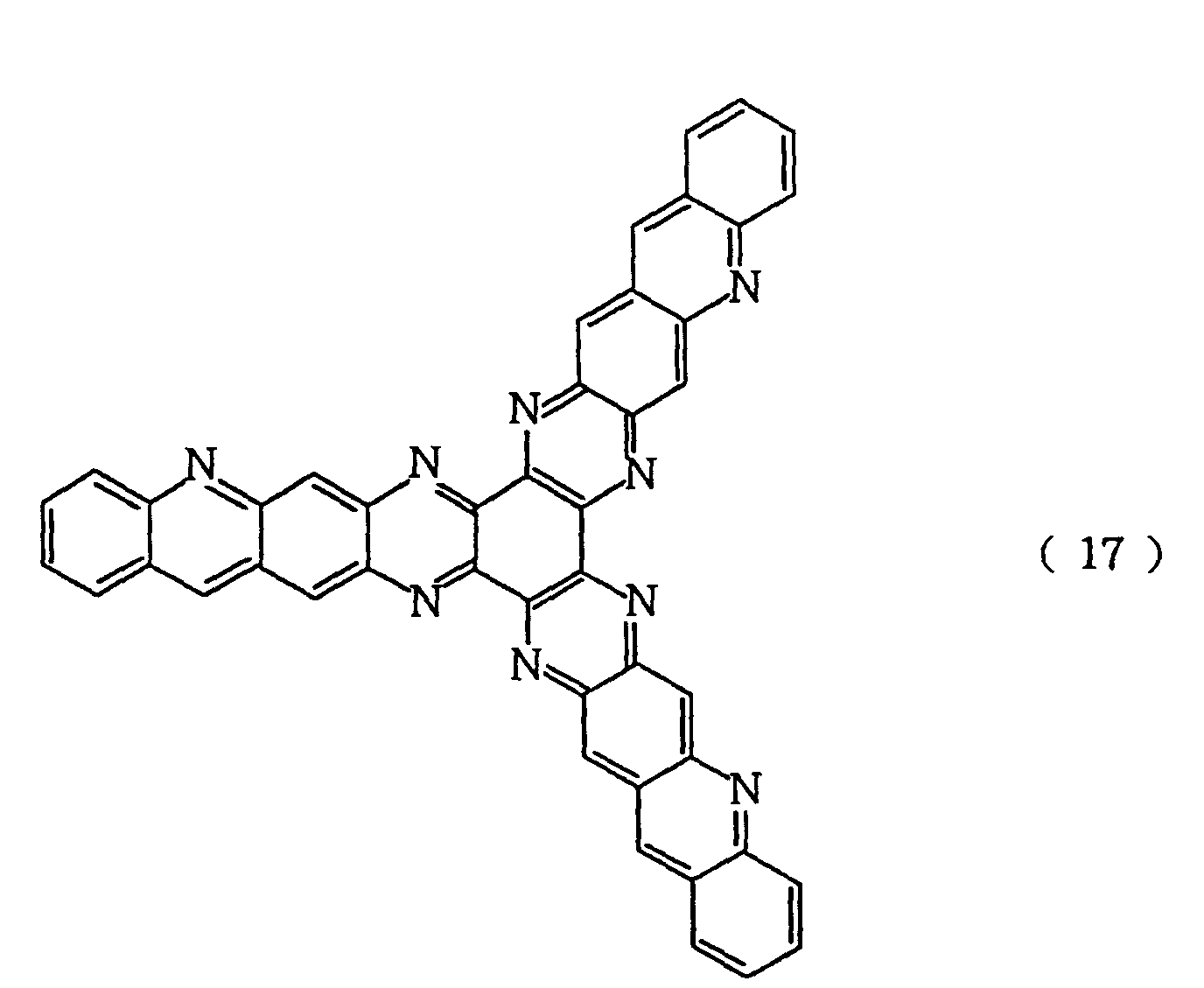
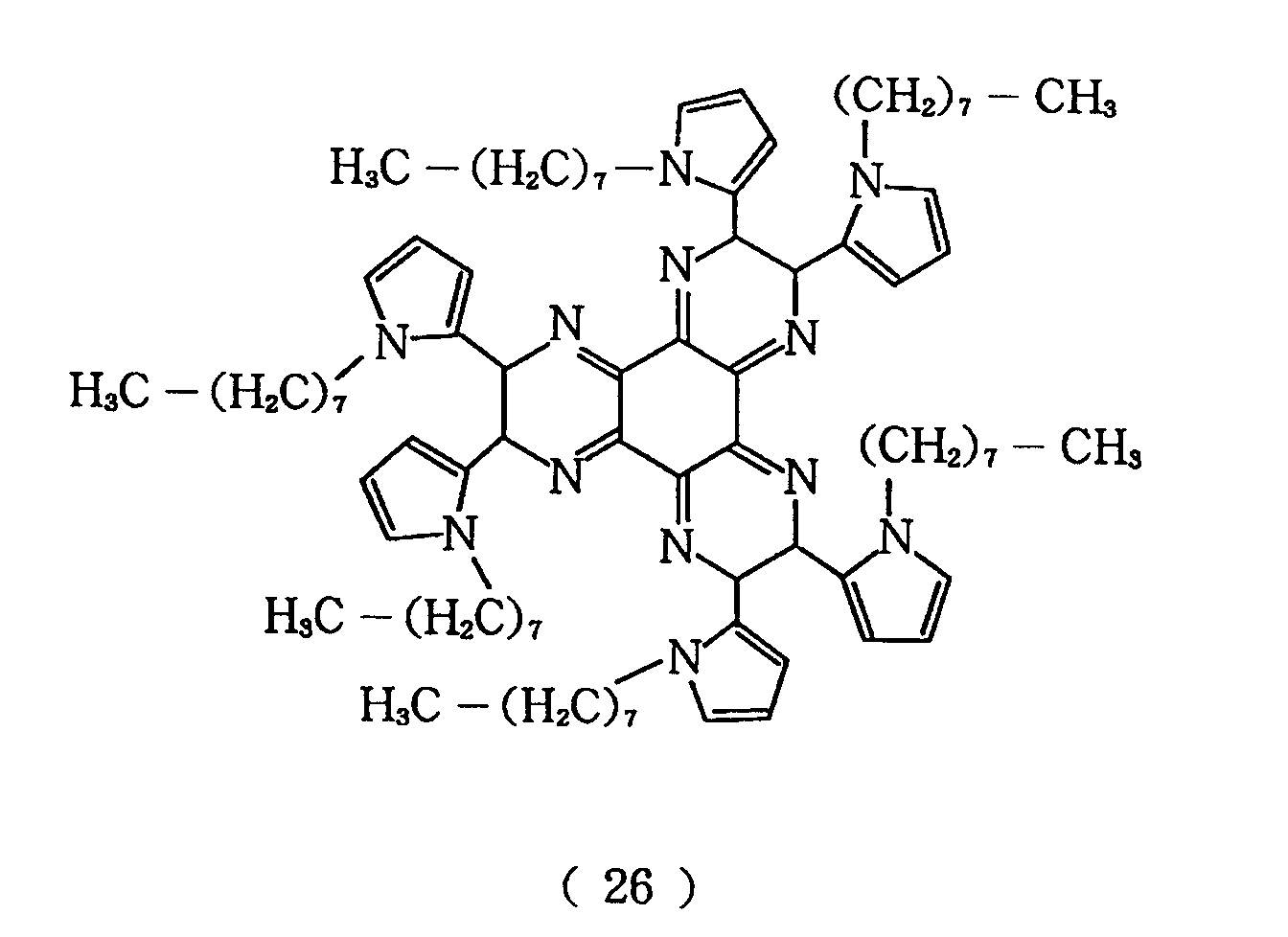
- Specific examples of the compound represented by the formula (I) may include compounds (Example Compound Nos. (1) to (26)) shown below but are, however, not restricted to these compounds.
- Hexaminobenzene and a corresponding carbonyl compound were subjected to heat-refluxing with an appropriate solvent (e.g., toluene or xylene). After the heat-refluxing, the solvent was distilled off and the resultant residue was subjected to silica gel column chromatography (column: Wako-gel 300"; eluent: chloroform) to obtain an objective product.
- an appropriate solvent e.g., toluene or xylene
- the organic compound layer comprising the above-mentioned compound of the formula (I) (preferably formula (Ia)) may be formed between the (pair of) anode and cathode (electrodes) through vacuum deposition or wet-coating process.
- the organic compound layer may preferably be formed in a thickness of at most 10 ⁇ m, more preferably at most 0.5 ⁇ m, further preferably 0.01 - 0.5 ⁇ m.
- the organic compound layer constituting the organic luminescence device of the present invention may have a single-layer structure as shown in Figure 1 and a lamination-layer structure of two or more layers as shown in Figures 2 and 3.
- Figure 1 is a schematic sectional view illustrating an embodiment of the organic luminescence device of the present invention.
- the organic luminescence device includes a substrate 1, an anode 2 disposed on the substrate 1, a luminescence layer 3 disposed on the anode 2, and a cathode 4 disposed on the luminescence layer 3.
- the luminescence layer 3 constitutes a single layer-type organic compound layer and may exhibit hole transporting performance, electron transporting performance and luminescence performance in combination by itself or may contain a plural species of compounds exhibiting the performances, respectively, in mixture.
- the luminescence layer 3 may preferably have a thickness of 5 nm to 1 ⁇ m, more preferably 10 - 50 nm.
- Figure 2 shows another embodiment of the organic luminescence device of the present invention including a lamination layer-type organic compound layer comprising a hole transporting layer 5 and an electron transporting layer 6.
- the organic luminescence device includes a substrate 1, an anode 2 disposed on the substrate 1, the hole transporting layer 5 disposed on the anode 2, the electron transporting layer 6 disposed on the hole transporting layer 5, and a cathode 4 disposed on the electron transporting layer 6.
- either one or both of the hole transporting layer 5 and the electron transporting layer 6 may contain a luminescent compound (material) for constituting a luminescence layer 3.
- the hole transporting layer and the electron transporting layer 6 may comprise a nonluminescent hole transporting compound and a nonluminescent electron transporting compound, respectively, or a nonluminescent compound having both a hole transporting function and an electron transporting function, respectively.
- each of the hole transporting layer 5 and the electron transporting layer 6 may preferably have a thickness of 5 nm to 1 ⁇ m, more preferably 10 - 50 nm.
- Figure 3 shows another embodiment of the organic luminescence device of the present invention including a lamination layer-type organic compound layer comprising a hole transporting layer 5, a luminescence layer 3 and an electron transporting layer 6.
- the organic luminescence device includes a substrate 1, an anode 2 disposed on the substrate 1, the hole transporting layer 5 disposed on the anode 2, the luminescence layer 3 disposed on the hole transporting layer 5, the electron transporting layer 6 disposed on the luminescence layer 3, and a cathode 4 disposed on the electron transporting layer 6.
- a (charge) carrier transporting function and a luminescence function are separated into the hole transporting and electron transporting layers 5 and 6 and the luminescence layer 3.
- each of a hole transporting compound, an electron transporting compound and a luminescent compound may be used singly or in mixture of two or more species, respectively.
- each of the hole transporting layer 5, the luminescence layer 3; and the electron transporting layer 6 may preferably have a thickness of 5 nm - 1 ⁇ m, more preferably 10 - 50 nm.
- each of the anode 2, and the cathode 4 may generally have a thickness of 1000 - 2000 A.
- the layer structures of the organic compound layer shown in Figures 1 - 3 are merely a basic structure, respectively, and may be appropriately modified by forming at least one additional layer and/or by separating each layer into two or more layers.
- the electrode anode or cathode
- the organic compound layer it is possible to dispose an electron injection layer (on the cathode side), a hole injection layer (on the anode side), an insulating layer, an adhesive layer or an interference layer.
- the hole transporting layer 5 may be separated into two layers different in ionization potential.
- a layer comprising the compound of the formula (I) may be formed as any of the hole transporting layer 5, the electron transporting layer 5 and the luminescence layer 3, and an additional layer since the compound of the formula (I) has not only an electron injection (and transport) function but also a hole blocking function.
- the layer comprising the compound of the formula (I) may be formed as an (additional) electron injection layer disposed in the proximity of the cathode (e.g., between the cathode 4 and the electron transporting layer 6 shown in Figure 2).
- the electron injection layer may preferably have a thickness of 1 nm to 1 ⁇ m, more preferably 1 - 50 nm.
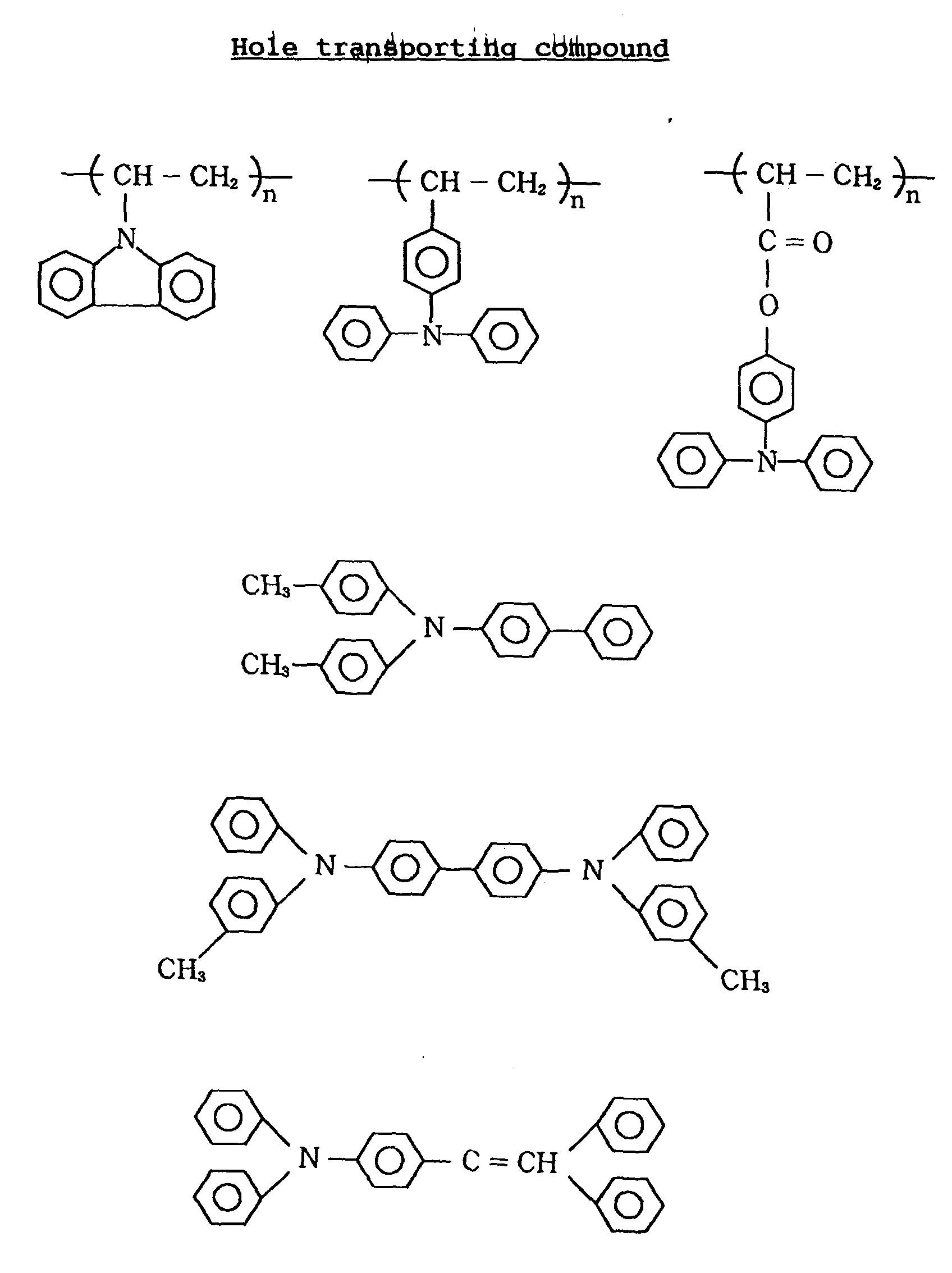
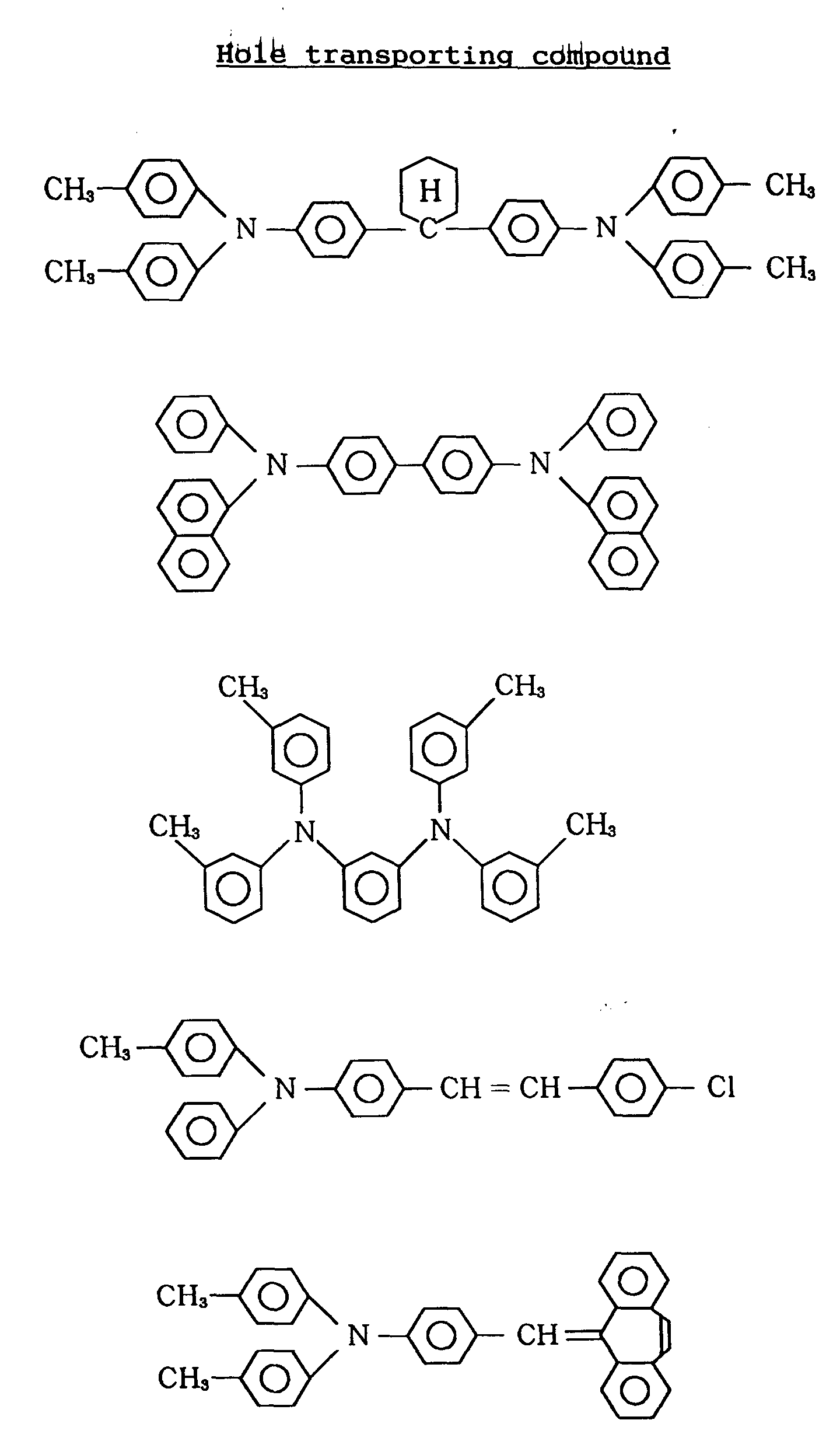
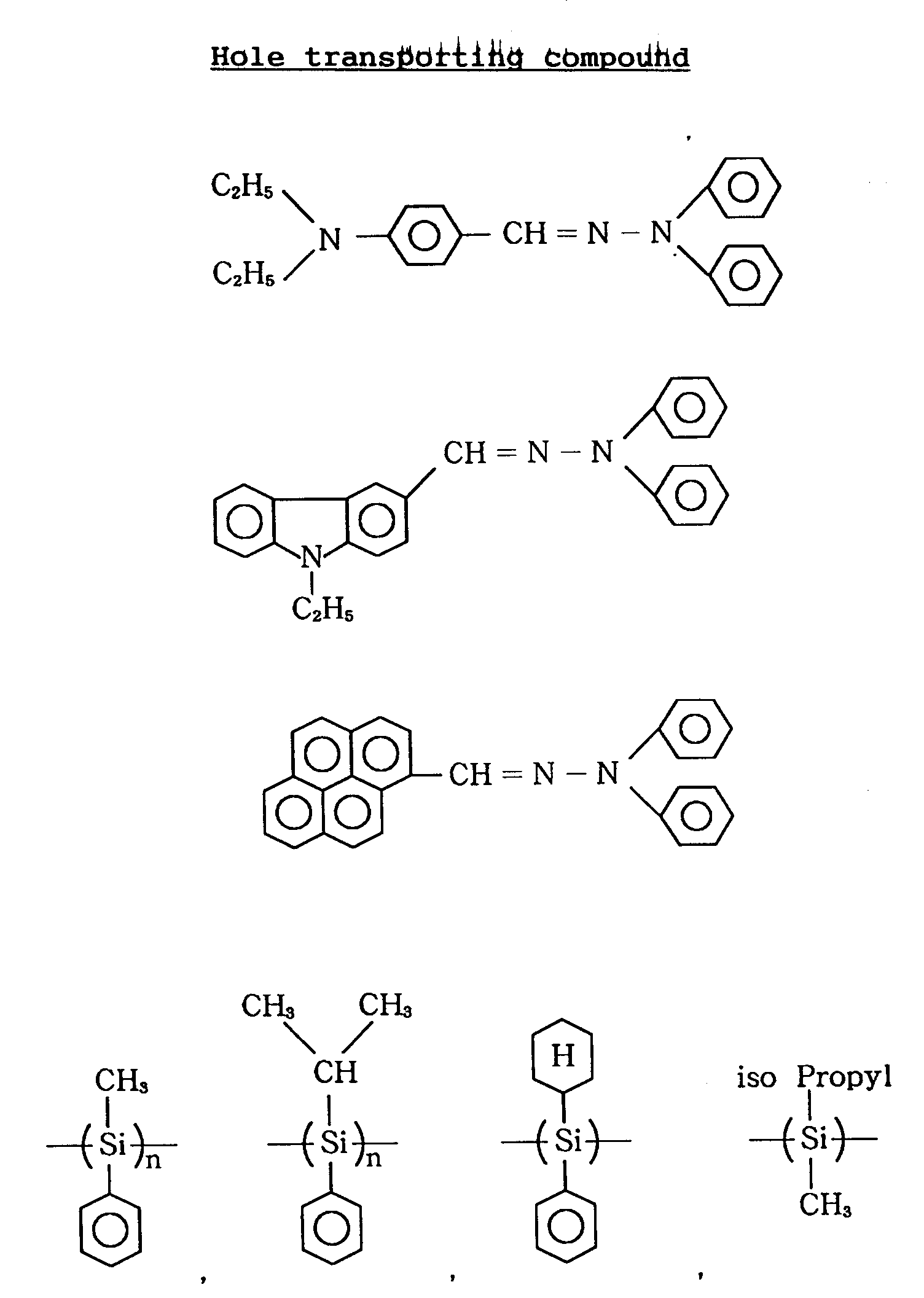
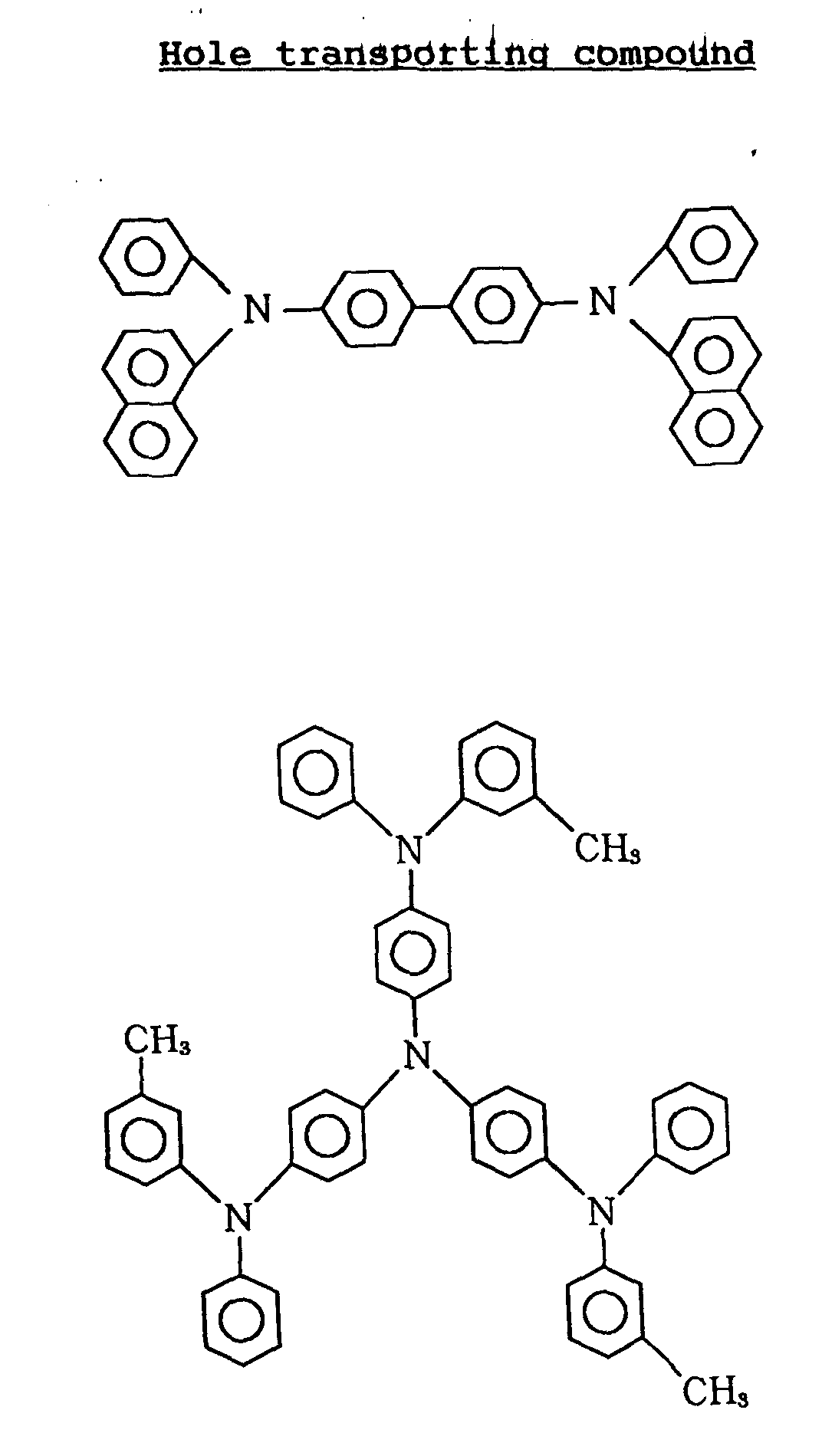
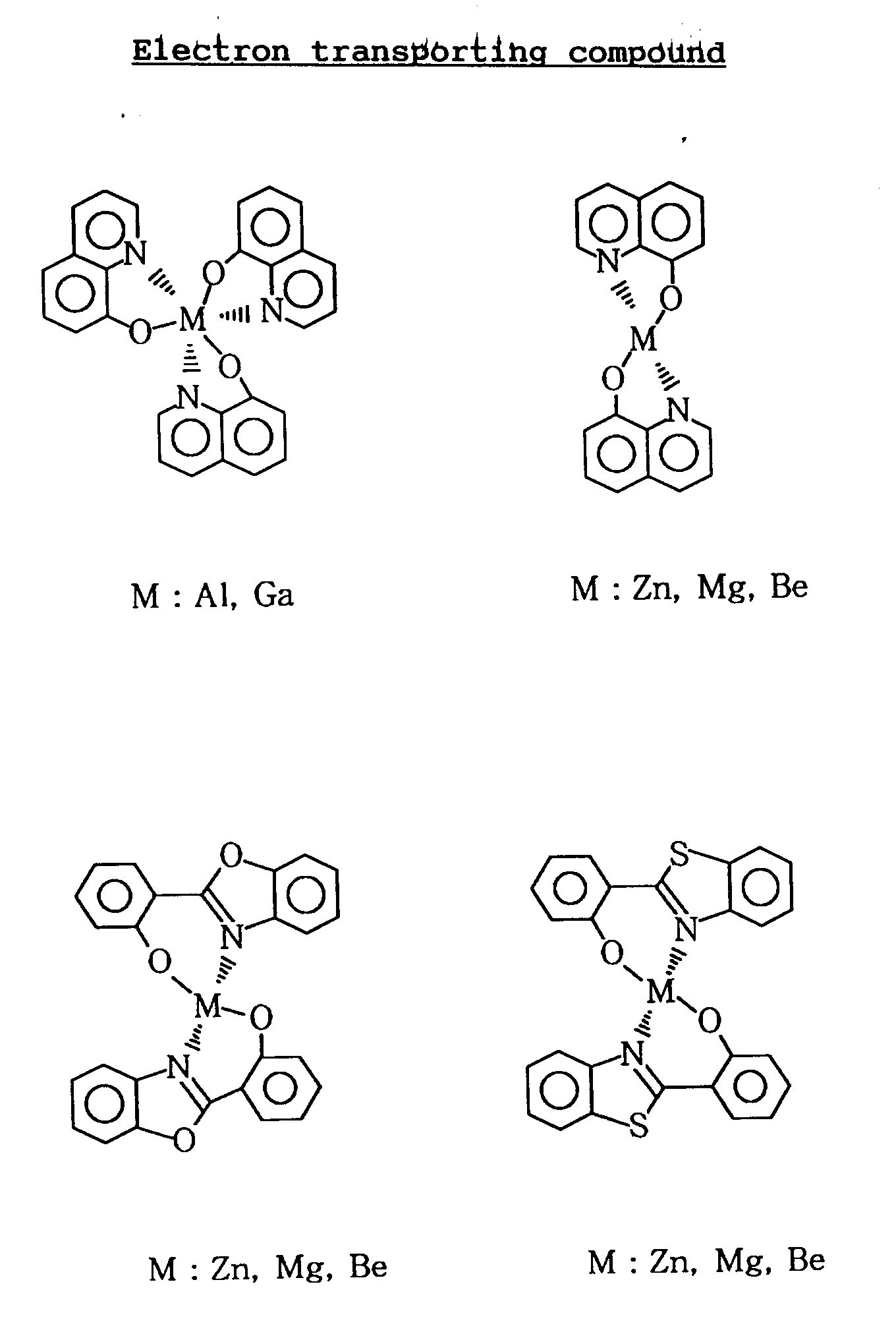
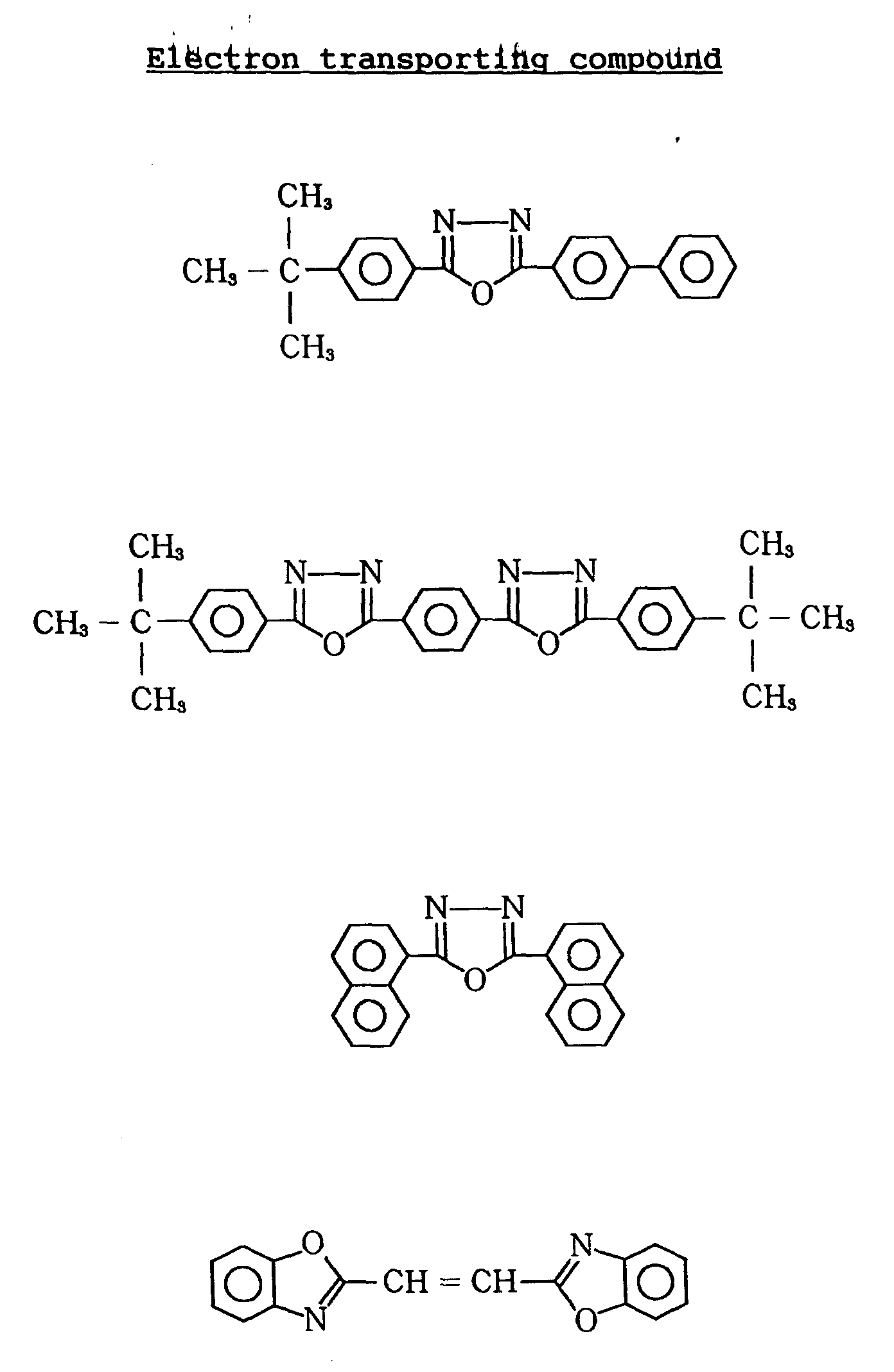
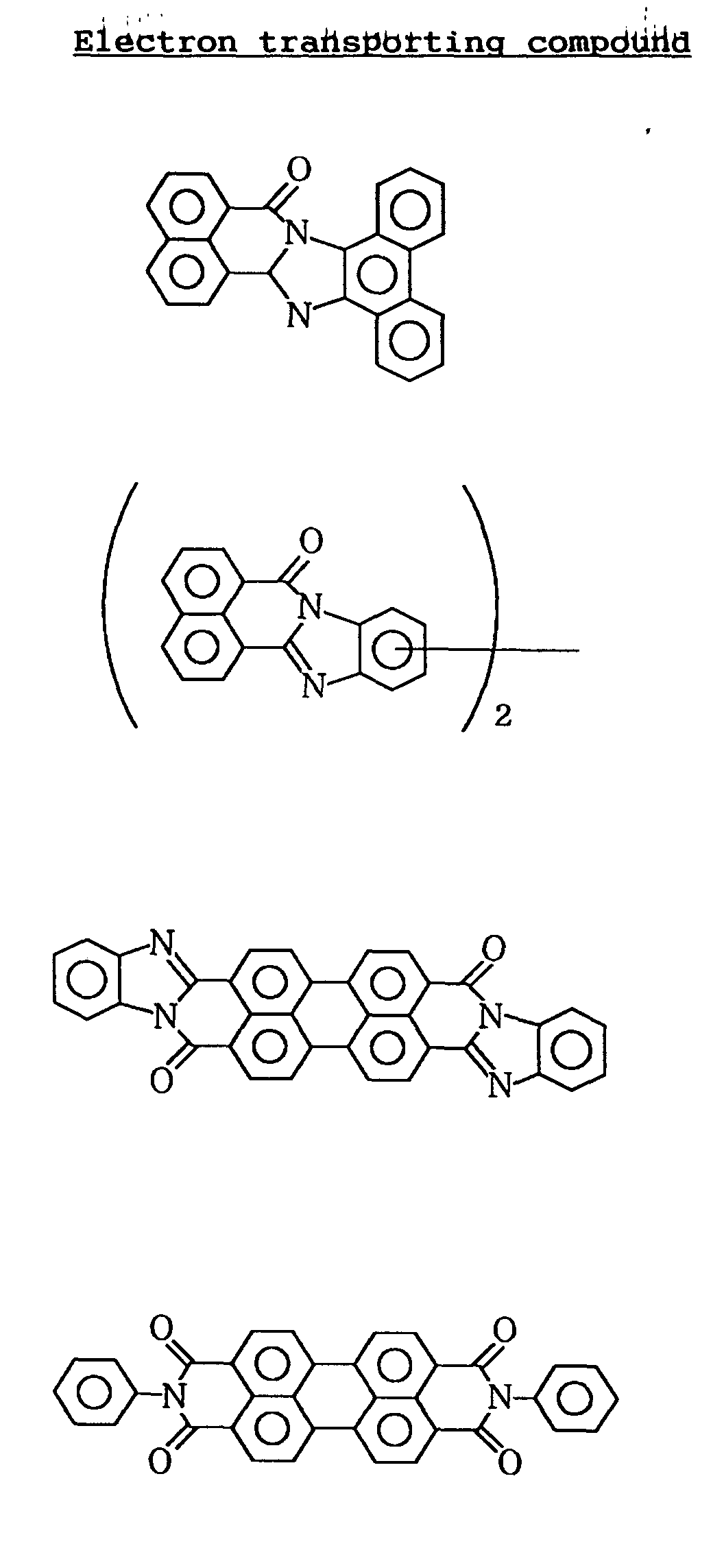
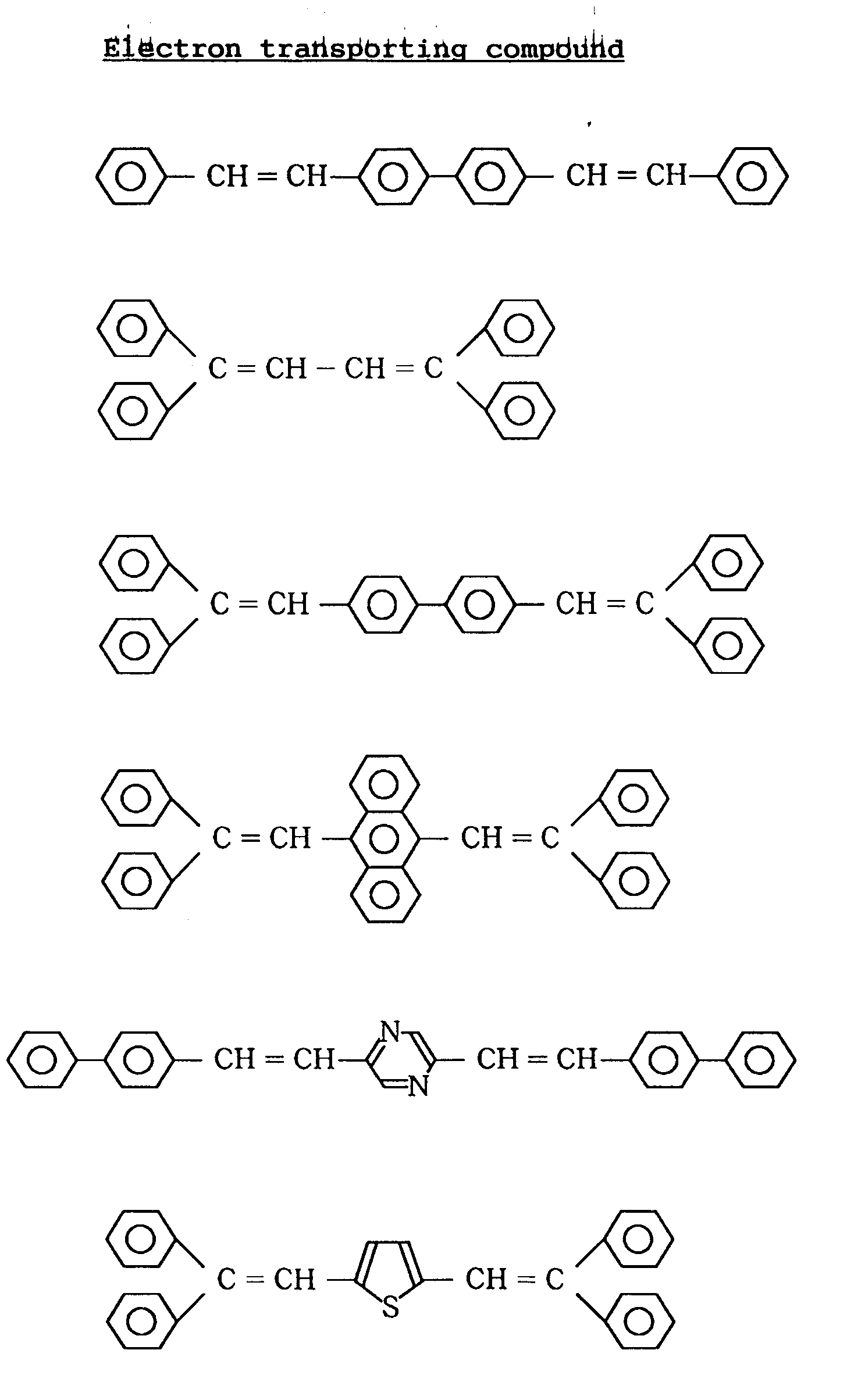
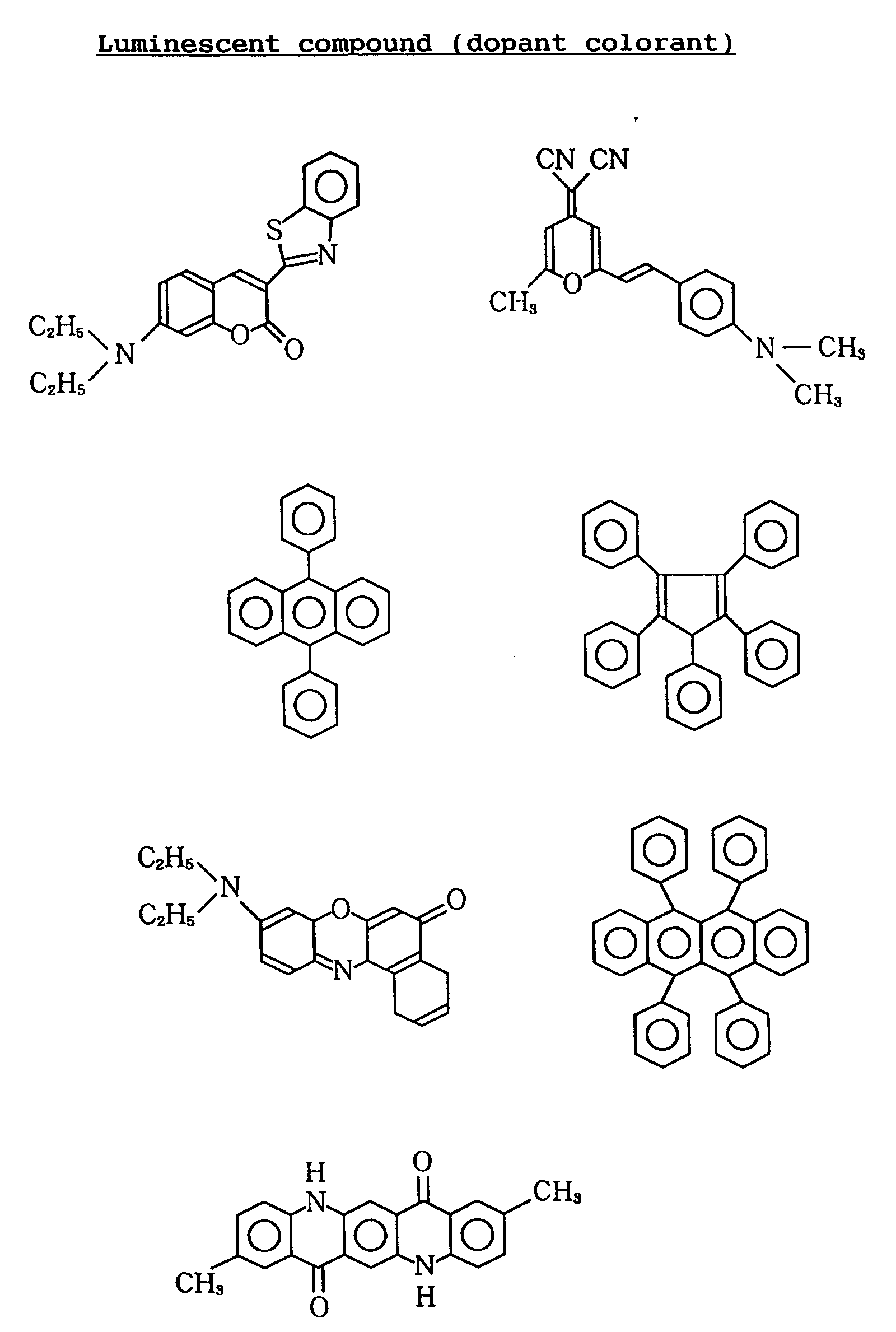
- the compound of the formula (I) may be used in combination with the hole transporting compound, the electron transporting compound and/or the luminescent compound, as desired, examples of which may include those shown below.
- the organic compound layer (comprising the compound of the formula (I)) used in the organic luminescence device of the present invention may be formed between the anode and the cathode through vacuum deposition or wet-coating process.
- the wet-coating process is one wherein the compound of the formula (I) is dissolved in an appropriate solvent optionally in combination with an appropriate binder resin.
- the compound of the formula (I) may preferably be added in an amount of 0.1 - 10 wt. parts per 100 wt. parts of the binder resin.
- binder resin may include various resins, such as polyvinyl carbazole resin, polycarbonate resin, polyester resin, polyarylate resin, polystyrene resin, acrylic resin, methacrylic resin, butyral resin, polyvinyl acetal resin, diallyl phthalate resin, phenolic resin, epoxy resin, silicone resin, polysulfone resin, polyacrylate resin, and urea resin. These resins may be used singly or in combination of two or more species or in the form of copolymer.
- resins such as polyvinyl carbazole resin, polycarbonate resin, polyester resin, polyarylate resin, polystyrene resin, acrylic resin, methacrylic resin, butyral resin, polyvinyl acetal resin, diallyl phthalate resin, phenolic resin, epoxy resin, silicone resin, polysulfone resin, polyacrylate resin, and urea resin. These resins may be used singly or in combination of two or more species or in the form of copolymer.
- the anode As a material for the anode (e.g., 2 shown in Figures 1 - 3), it is preferred to use one having a work function as large as possible, examples of which may include: metals, such as gold, platinum, nickel, palladium, cobalt, selenium and vanadium, and their alloys; metal oxides, such as tin oxide, zinc oxide, indium tin oxide (ITO), and indium zinc oxide; and electroconductive polymers, such as polyaniline, polypyrrole, polythiophene, and polyphenylene sulfide. These compounds may be used singly or in combination of two or more species.
- metals such as gold, platinum, nickel, palladium, cobalt, selenium and vanadium, and their alloys
- metal oxides such as tin oxide, zinc oxide, indium tin oxide (ITO), and indium zinc oxide
- electroconductive polymers such as polyaniline, polypyrrole, polythiophene, and polyphenylene
- the cathode As a material for the cathode (e.g., 4 shown in Figures 1 - 3), it is preferred to use one having a work function as small as possible, examples of which may include: metals, such as lithium, sodium, potassium, calcium, magnesium, aluminum, indium, silver, lead, tin and chromium, and their alloys. It is also possible to use metal oxide, such as indium tin oxide (ITO).
- ITO indium tin oxide
- the cathode may be formed in a single layer or a lamination layer of plural layers.
- the substrate (e.g., 1 shown in Figures 1 - 3) for the organic luminescence device of the present invention may include an opaque substrate of metal, ceramics, etc., and a transparent substrate of glass, quartz, plastics, etc. It is possible to form the substrate with a color filter film, a fluorescent color conversion film, a dielectric reflection film, etc., thus controlling emitted luminescent light.
- the organic luminescence device of the present invention may further include a protective layer or a sealing layer.
- the protective layer may include: an inorganic film of diamond, metal oxide, metal nitride, etc.; a polymer film of fluorine-containing resin, polyparaxylene, polyethylene, silicone resin, polystyrene, etc., and a film of light-curable resin. It is also possible to effect packaging of the organic luminescence device per se with a sealing resin while covering the organic luminescence device with glass, gas-impermeable film, metal, etc.
- An electroluminescence device was prepared in the following manner.
- ITO indium tin oxide
- TPD N,N'-bis-(3-methylphenyl)-1,1'-biphenyl-4,4'-diamine
- the organic luminescence device showed a voltage-luminance characteristic as shown in
- the voltage-luminance characteristic was measured in the following manner.
- the above-prepared organic luminescence device was supplied with a prescribed voltage (from 0 volt at an increment of 1 volt) from a power supply ("R6161", mfd. by Adventest Co.). At each prescribed voltage, a luminance after 1 sec. of voltage application was measured by using a luminance meter ("BM-7PAST", mfd. by Topcon Co.).
- An electroluminescence device was prepared and evaluated in the same manner as in Example 1 except that the compound of formula (I) (Ex. Comp. No. (5)) was changed to a compound of formula (I) (Ex. Comp. No. (7)).
- the thus-prepared organic luminescence device provided green electroluminescence and a voltage-luminance characteristic as shown in Figure 5.
- An electroluminescence device was prepared and evaluated in the same manner as in Example 2 except that the film of compound of formula (I) (Ex. Comp. No. (7)) was not formed.
- the thus-prepared organic luminescence device provided a voltage-luminance characteristic as shown in Figure 5 together with that of the organic luminescence device prepared in Example 2.
- An electroluminescence device was prepared and evaluated in the same manner as in Example 1 except that the 500 ⁇ -thick film of tris(8-quinolinolato)aluminum complex was changed to a 150 ⁇ -thick film of tris(8-quinolinolato)aluminum complex doped with 5 wt. %-Nile Red (as a luminescence layer) and a 350 ⁇ -thick film of tris(8-quinolinolato)aluminum complex (a an electron transporting layer) (formed in this order on the film of TPD).
- the thus-prepared organic luminescence device provided orange electroluminescence and a voltage-luminance characteristic as shown in Figure 6.
Landscapes
- Physics & Mathematics (AREA)
- Spectroscopy & Molecular Physics (AREA)
- Chemical & Material Sciences (AREA)
- Engineering & Computer Science (AREA)
- Materials Engineering (AREA)
- Electroluminescent Light Sources (AREA)
- Luminescent Compositions (AREA)
Abstract

Description










Claims (20)
- An organic luminescence device, comprising: a pair of electrodes comprising an anode and a cathode, and an organic compound layer disposed between the pair of electrodes, wherein
the organic compound layer comprises a compound represented by the following formula (I):wherein R1 to R6 independently denote a substituted or unsubstituted alkyl group, a substituted or unsubstituted aryl group, a substituted or unsubstituted aralkyl group, or a substituted or unsubstituted heterocyclic group, with the proviso that each pair of R1 and R2, R3 and R4, an R5 and R6 or of R1 and R6, R2 and R3, and R4 and R5 may be connected to each other to form a fused ring structure.
- A device according to Claim 1, wherein the alkyl group is a linear alkyl group.
- A device according to Claim 2, wherein the linear alkyl group is selected from the group consisting of methyl group, ethyl group, propyl group, and hexyl group.
- A device according to Claim 1, wherein the alkyl group is a branched alkyl group.
- A device according to Claim 4, wherein the branched alkyl group is isopropyl group or tert-butyl group.
- A device according to Claim 1, wherein the aryl group has a monocyclic aromatic ring.
- A device according to Claim 6, wherein the aryl group is phenyl group.
- A device according to Claim 1, wherein the aryl group has a polycyclic aromatic ring.
- A device according to Claim 8, wherein the aryl group is naphthyl group or anthryl group.
- A device according to Claim 1, wherein the aralkyl group is selected from the group consisting of benzyl group, phenylpropyl group, and naphthylmethyl.
- A device according to Claim 1, wherein the heterocyclic group has a monocyclic structure.
- A device according to Claim 11, wherein the heterocyclic group is selected from the group consisting of pyrrolyl group, thienyl group, pyridyl group, and pyridazinyl group.
- A device according to Claim 1, wherein the heterocyclic group has a fused ring structure.
- A device according to Claim 1, wherein the substituted alkyl, aryl, aralkyl and heterocyclic groups independently have a substituent selected from the group consisting of halogen atom, nitryl group, nitro group, formyl group, acetyl group, benzoyl group, amide group, styryl group, ethynyl group, phenyl group, naphthyl group, anthryl group, pyridyl group, pyridazinyl group, phenazinyl group, pyrrolyl group, imidazolyl group, quinolyl group, and acridinyl group.
- A device according to Claim 1, wherein the fused ring structure comprises benzene ring, naphthalene ring or pyridine ring.
- A device according to Claim 1, wherein the organic compound of the formula (I) has a tripyrazinocyclohexane skeleton.
- A device according to claim 1, wherein the organic compound layer has a thickness of at most 10 µm.
- A device according to claim 17, wherein the thickness is at most 5 µm.
- A device according to claim 18, wherein the thickness is in the range of 0.01 - 0.5 µm.
- A luminescent compound of the formula (I):wherein R1 to R6 independently denote a substituted or unsubstituted alkyl group, a substituted or unsubstituted aryl group, a substituted or unsubstituted aralkyl group or a substituted or unsubstituted heterocyclic group, with the proviso that each pair of R1 and R2, R3 and R4, and R5 and R6 or of R1 and R6, R2 and R3, and R4 and R5 may be connected to each other to form a fused ring structure.
Applications Claiming Priority (2)
| Application Number | Priority Date | Filing Date | Title |
|---|---|---|---|
| JP32282099A JP3571977B2 (en) | 1999-11-12 | 1999-11-12 | Organic light emitting device |
| JP32282099 | 1999-11-12 |
Publications (3)
| Publication Number | Publication Date |
|---|---|
| EP1099744A2 true EP1099744A2 (en) | 2001-05-16 |
| EP1099744A3 EP1099744A3 (en) | 2002-01-02 |
| EP1099744B1 EP1099744B1 (en) | 2006-05-24 |
Family
ID=18147988
Family Applications (1)
| Application Number | Title | Priority Date | Filing Date |
|---|---|---|---|
| EP00309954A Expired - Lifetime EP1099744B1 (en) | 1999-11-12 | 2000-11-09 | Organic electroluminescent device |
Country Status (4)
| Country | Link |
|---|---|
| US (1) | US6436559B1 (en) |
| EP (1) | EP1099744B1 (en) |
| JP (1) | JP3571977B2 (en) |
| DE (1) | DE60028159D1 (en) |
Cited By (10)
| Publication number | Priority date | Publication date | Assignee | Title |
|---|---|---|---|---|
| WO2004054326A3 (en) * | 2002-12-11 | 2004-09-16 | Lg Chemical Ltd | Electroluminescent devices with low work function anode |
| WO2007130047A1 (en) | 2006-05-08 | 2007-11-15 | Eastman Kodak Company | Oled electron-injecting layer |
| EP1175470A4 (en) * | 1999-12-31 | 2009-02-11 | Lg Chemical Ltd | ELECTRONIC DEVICE COMPRISING AN ORGANIC COMPOUND HAVING THE SEMICONDUCTOR CHARACTERISTICS OF DOPING P |
| WO2009051684A1 (en) * | 2007-10-16 | 2009-04-23 | Eastman Kodak Company | Inverted oled device with improved efficiency |
| US7629741B2 (en) | 2005-05-06 | 2009-12-08 | Eastman Kodak Company | OLED electron-injecting layer |
| EP1943322A4 (en) * | 2005-11-01 | 2010-02-24 | Lg Chemical Ltd | ORGANIC ELECTRONIC DEVICE |
| US7763882B2 (en) | 1999-12-31 | 2010-07-27 | Lg Chem, Ltd. | Organic light-emitting device comprising buffer layer and method for fabricating the same |
| EP2014137A4 (en) * | 2006-05-04 | 2011-01-12 | Lg Chemical Ltd | ORGANIC ELECTROLUMINESCENCE DEVICE HAVING ELECTROLUMINESCENT PATTERN, METHOD AND APPARATUS FOR PREPARING THE SAME |
| CN102659790A (en) * | 2012-05-16 | 2012-09-12 | 吉林奥来德光电材料股份有限公司 | Organic luminescent material and preparation method and application thereof |
| US8680693B2 (en) | 2006-01-18 | 2014-03-25 | Lg Chem. Ltd. | OLED having stacked organic light-emitting units |
Families Citing this family (58)
| Publication number | Priority date | Publication date | Assignee | Title |
|---|---|---|---|---|
| US6953947B2 (en) * | 1999-12-31 | 2005-10-11 | Lg Chem, Ltd. | Organic thin film transistor |
| WO2001096492A1 (en) * | 2000-06-13 | 2001-12-20 | Matsushita Electric Industrial Co.,Ltd. | Exciton forming substance, luminescent material using the substance, method for light emission and luminescent element, and device using the element |
| US20060146515A1 (en) * | 2003-02-10 | 2006-07-06 | Kwanghyun Hwang | Light emitting decoration apparatus |
| CN100508238C (en) * | 2004-05-11 | 2009-07-01 | Lg化学株式会社 | Organic electronic device |
| WO2005123737A2 (en) * | 2004-06-14 | 2005-12-29 | Arizona Board Of Regents On Behalf Of The University Of Arizona | Charge-transport materials, methods of fabrication thereof, and methods of use thereof |
| JP2006135145A (en) * | 2004-11-08 | 2006-05-25 | Sony Corp | Organic material for display element and display element |
| JP4867169B2 (en) * | 2005-01-11 | 2012-02-01 | セイコーエプソン株式会社 | Conductive polymer, conductive layer, electronic device and electronic equipment |
| US8906517B2 (en) * | 2005-04-04 | 2014-12-09 | Sony Corporation | Organic electroluminescence device |
| JP4715329B2 (en) * | 2005-06-22 | 2011-07-06 | セイコーエプソン株式会社 | Manufacturing method of substrate for electronic device |
| WO2007007553A1 (en) | 2005-07-14 | 2007-01-18 | Idemitsu Kosan Co., Ltd. | Biphenyl derivatives, organic electroluminescent materials, and organic electroluminescent devices made by using the same |
| US20090015150A1 (en) * | 2005-07-15 | 2009-01-15 | Lg Chem, Ltd. | Organic light emitting device and method for manufacturing the same |
| TWI321968B (en) * | 2005-07-15 | 2010-03-11 | Lg Chemical Ltd | Organic light meitting device and method for manufacturing the same |
| JP4848152B2 (en) | 2005-08-08 | 2011-12-28 | 出光興産株式会社 | Aromatic amine derivative and organic electroluminescence device using the same |
| TW200724534A (en) | 2005-09-09 | 2007-07-01 | Idemitsu Kosan Co | Azaaromatic compounds having azafluoranthene skeletons and organic electroluminescent devices made by using the same |
| WO2007032161A1 (en) | 2005-09-15 | 2007-03-22 | Idemitsu Kosan Co., Ltd. | Asymmetric fluorene derivative and organic electroluminescent element containing the same |
| CN101268167A (en) | 2005-09-16 | 2008-09-17 | 出光兴产株式会社 | Pyrene derivative and organic electroluminescent device using the same |
| KR100890862B1 (en) * | 2005-11-07 | 2009-03-27 | 주식회사 엘지화학 | Organic electroluminescent device and method for preparing the same |
| JP4972938B2 (en) * | 2006-01-12 | 2012-07-11 | コニカミノルタホールディングス株式会社 | ORGANIC ELECTROLUMINESCENT ELEMENT MATERIAL, ORGANIC ELECTROLUMINESCENT ELEMENT, DISPLAY DEVICE AND LIGHTING DEVICE |
| US20080007160A1 (en) | 2006-02-28 | 2008-01-10 | Idemitsu Kosan Co., Ltd. | Organic electroluminescent device using fluoranthene derivative and indenoperylene derivative |
| US9028974B2 (en) * | 2006-03-07 | 2015-05-12 | Lg Chem, Ltd. | OLED and fabricating method of the same |
| WO2007102361A1 (en) | 2006-03-07 | 2007-09-13 | Idemitsu Kosan Co., Ltd. | Aromatic amine derivative and organic electroluminescent device using same |
| WO2007125714A1 (en) | 2006-04-26 | 2007-11-08 | Idemitsu Kosan Co., Ltd. | Aromatic amine derivative, and organic electroluminescence element using the same |
| TW200815446A (en) | 2006-06-05 | 2008-04-01 | Idemitsu Kosan Co | Organic electroluminescent device and material for organic electroluminescent device |
| WO2007148660A1 (en) | 2006-06-22 | 2007-12-27 | Idemitsu Kosan Co., Ltd. | Organic electroluminescent device employing heterocycle-containing arylamine derivative |
| KR20090040896A (en) | 2006-08-23 | 2009-04-27 | 이데미쓰 고산 가부시키가이샤 | Aromatic amine derivatives and organic electroluminescent devices using them |
| JP5133259B2 (en) | 2006-11-24 | 2013-01-30 | 出光興産株式会社 | Aromatic amine derivative and organic electroluminescence device using the same |
| US8278819B2 (en) | 2007-03-09 | 2012-10-02 | Idemitsu Kosan Co., Ltd. | Organic electroluminescence device and display |
| CN101542769B (en) | 2007-04-06 | 2012-04-25 | 出光兴产株式会社 | organic electroluminescent element |
| CN101687837A (en) | 2007-08-06 | 2010-03-31 | 出光兴产株式会社 | Aromatic amine derivative and organic electroluminescent element using the same |
| US20090091242A1 (en) * | 2007-10-05 | 2009-04-09 | Liang-Sheng Liao | Hole-injecting layer in oleds |
| EP2221897A4 (en) | 2007-11-22 | 2012-08-08 | Idemitsu Kosan Co | ORGANIC EL ELEMENT AND SOLUTION CONTAINING EL ORGANIC MATERIAL |
| CN101868868A (en) | 2007-11-22 | 2010-10-20 | 出光兴产株式会社 | Organic EL element |
| GB0804469D0 (en) * | 2008-03-11 | 2008-04-16 | Oled T Ltd | Compounds having electroluminescent or electron transport properties |
| WO2009139607A2 (en) | 2008-05-16 | 2009-11-19 | 주식회사 엘지화학 | Stacked organic light-emitting diode |
| WO2009145016A1 (en) | 2008-05-29 | 2009-12-03 | 出光興産株式会社 | Aromatic amine derivative and organic electroluminescent device using the same |
| US20120280214A1 (en) * | 2008-12-25 | 2012-11-08 | Fuji Electric Holdings Co., Ltd. | Organic el element having cathode buffer layer |
| EP2372803A4 (en) | 2008-12-26 | 2012-07-04 | Idemitsu Kosan Co | MATERIAL FOR ORGANIC ELECTROLUMINESCENT ELEMENT, AND ORGANIC ELECTROLUMINESCENT ELEMENT |
| EP2372804B1 (en) | 2008-12-26 | 2014-04-02 | Idemitsu Kosan Co., Ltd. | Organic electroluminescence element and compound |
| CN102272969A (en) | 2009-01-05 | 2011-12-07 | 出光兴产株式会社 | Material for organic electroluminescence element and organic electroluminescence element using same |
| US8039127B2 (en) | 2009-04-06 | 2011-10-18 | Idemitsu Kosan Co., Ltd. | Organic electroluminescence device and material for organic electroluminescence device |
| WO2011040607A1 (en) | 2009-10-02 | 2011-04-07 | 出光興産株式会社 | Aromatic amine derivative, and organic electroluminescent element |
| EP2489664A4 (en) | 2009-10-16 | 2013-04-03 | Idemitsu Kosan Co | AROMATIC COMPOUND CONTAINING FLUORENE, MATERIAL FOR ORGANIC ELECTROLUMINESCENCE ELEMENT, AND ORGANIC ELECTROLUMINESCENT ELEMENT USING SUCH MATERIAL |
| US8586206B2 (en) | 2010-06-30 | 2013-11-19 | Idemitsu Kosan Co., Ltd. | Aromatic amine derivative and organic electroluminescence device using the same |
| US20120199820A1 (en) | 2010-08-05 | 2012-08-09 | Idemitsu Kosan Co., Ltd. | Monoamine derivative and organic electroluminescent element using same |
| KR20120104086A (en) | 2010-08-31 | 2012-09-20 | 이데미쓰 고산 가부시키가이샤 | Nitrogen-containing aromatic heterocyclic derivative and organic electroluminescent element using the same |
| JPWO2012049828A1 (en) | 2010-10-12 | 2014-02-24 | 出光興産株式会社 | Aromatic heterocyclic derivatives and organic electroluminescent devices using them |
| CN102005540A (en) * | 2010-10-12 | 2011-04-06 | 西安文景光电科技有限公司 | Organic electroluminescent device taking metal and P-type disc-shaped compound as composite anode |
| WO2012051667A1 (en) | 2010-10-22 | 2012-04-26 | Commonwealth Scientific And Industrial Research Organisation | Organic electroluminescent device |
| CN102157703B (en) * | 2011-03-03 | 2013-04-24 | 西安文景光电科技有限公司 | OLED (Organic Light Emitting Diode) device for increasing brightness |
| KR20130135184A (en) | 2012-05-31 | 2013-12-10 | 주식회사 엘지화학 | Organic light emitting device and method for preparing the same |
| US9281490B2 (en) * | 2012-05-31 | 2016-03-08 | Lg Chem, Ltd. | Organic electroluminescent device |
| CN104321896B (en) | 2012-05-31 | 2017-07-14 | 乐金显示有限公司 | Stack-based organic light emitting diode |
| EP2752908B1 (en) | 2012-05-31 | 2024-08-14 | LG Display Co., Ltd. | Organic light emitting diode |
| CN104335379B (en) | 2012-05-31 | 2016-12-21 | 乐金显示有限公司 | Organic electroluminescence device, the display comprising this organic electroluminescence device and luminaire |
| TWI599083B (en) | 2012-05-31 | 2017-09-11 | 樂金顯示科技股份有限公司 | Organic electroluminescent device |
| GB201306365D0 (en) | 2013-04-09 | 2013-05-22 | Kathirgamanathan Poopathy | Heterocyclic compounds and their use in electro-optical or opto-electronic devices |
| CN104854724B (en) | 2013-06-07 | 2018-09-28 | 乐金显示有限公司 | Organic light emitting diode |
| JP6503363B2 (en) | 2013-09-17 | 2019-04-17 | エルジー ディスプレイ カンパニー リミテッド | Organic light emitting device |
Family Cites Families (26)
| Publication number | Priority date | Publication date | Assignee | Title |
|---|---|---|---|---|
| US4539507A (en) | 1983-03-25 | 1985-09-03 | Eastman Kodak Company | Organic electroluminescent devices having improved power conversion efficiencies |
| US4885211A (en) | 1987-02-11 | 1989-12-05 | Eastman Kodak Company | Electroluminescent device with improved cathode |
| US4720432A (en) | 1987-02-11 | 1988-01-19 | Eastman Kodak Company | Electroluminescent device with organic luminescent medium |
| JP2922212B2 (en) | 1989-02-17 | 1999-07-19 | パイオニア株式会社 | EL device |
| JPH07119407B2 (en) | 1989-03-20 | 1995-12-20 | 出光興産株式会社 | Electroluminescent device |
| US5130603A (en) | 1989-03-20 | 1992-07-14 | Idemitsu Kosan Co., Ltd. | Organic electroluminescence device |
| GB8909011D0 (en) | 1989-04-20 | 1989-06-07 | Friend Richard H | Electroluminescent devices |
| JP2815472B2 (en) | 1990-01-22 | 1998-10-27 | パイオニア株式会社 | EL device |
| JP2998187B2 (en) | 1990-10-04 | 2000-01-11 | 住友化学工業株式会社 | Organic electroluminescence device |
| DE69110922T2 (en) | 1990-02-23 | 1995-12-07 | Sumitomo Chemical Co | Organic electroluminescent device. |
| GB9018698D0 (en) | 1990-08-24 | 1990-10-10 | Lynxvale Ltd | Semiconductive copolymers for use in electroluminescent devices |
| JP2721441B2 (en) | 1991-02-27 | 1998-03-04 | 株式会社リコー | EL device |
| US5382477A (en) | 1991-02-27 | 1995-01-17 | Sanyo Electric Co., Ltd. | Organic electroluminescent element and process for producing the same |
| US5151629A (en) | 1991-08-01 | 1992-09-29 | Eastman Kodak Company | Blue emitting internal junction organic electroluminescent device (I) |
| JPH05202356A (en) | 1991-09-11 | 1993-08-10 | Pioneer Electron Corp | Organic electroluminescent device |
| JP3255190B2 (en) | 1991-12-03 | 2002-02-12 | 日本電気株式会社 | Speech coding apparatus and its analyzer and synthesizer |
| JP3328731B2 (en) | 1991-12-05 | 2002-09-30 | 住友化学工業株式会社 | Organic electroluminescence device |
| JP2734341B2 (en) | 1993-03-26 | 1998-03-30 | 住友電気工業株式会社 | Organic electroluminescence device |
| EP0647694B1 (en) | 1993-03-26 | 1999-09-15 | Sumitomo Electric Industries, Ltd. | Organic electroluminescent elements |
| US5514878A (en) | 1994-03-18 | 1996-05-07 | Holmes; Andrew B. | Polymers for electroluminescent devices |
| JP2937015B2 (en) | 1993-07-28 | 1999-08-23 | 住友電気工業株式会社 | Organic electroluminescence device |
| US5409783A (en) | 1994-02-24 | 1995-04-25 | Eastman Kodak Company | Red-emitting organic electroluminescent device |
| JPH09202878A (en) | 1996-01-25 | 1997-08-05 | Nippon Telegr & Teleph Corp <Ntt> | Near-ultraviolet / ultraviolet wavelength band light emitting device |
| JPH09227576A (en) | 1996-02-23 | 1997-09-02 | Sony Corp | Metal dinuclear complex, method for producing the same, and optical element |
| AU7336298A (en) * | 1997-04-25 | 1998-11-24 | Akzo Nobel N.V. | Complex comprising a rare-earth metal ion and a complexing moiety |
| JP3498533B2 (en) * | 1997-04-30 | 2004-02-16 | 東洋インキ製造株式会社 | Light emitting material for organic electroluminescent device and organic electroluminescent device using the same |
-
1999
- 1999-11-12 JP JP32282099A patent/JP3571977B2/en not_active Expired - Lifetime
-
2000
- 2000-11-09 DE DE60028159T patent/DE60028159D1/en not_active Expired - Lifetime
- 2000-11-09 EP EP00309954A patent/EP1099744B1/en not_active Expired - Lifetime
- 2000-11-09 US US09/708,479 patent/US6436559B1/en not_active Expired - Lifetime
Cited By (21)
| Publication number | Priority date | Publication date | Assignee | Title |
|---|---|---|---|---|
| US7648780B2 (en) | 1999-12-31 | 2010-01-19 | Lg Chem, Ltd. | Electroluminescent devices with low work function anode |
| US7648779B2 (en) | 1999-12-31 | 2010-01-19 | Lg Chem, Ltd. | Electroluminescent devices with low work function anode |
| US7763882B2 (en) | 1999-12-31 | 2010-07-27 | Lg Chem, Ltd. | Organic light-emitting device comprising buffer layer and method for fabricating the same |
| US8253126B2 (en) | 1999-12-31 | 2012-08-28 | Lg Chem. Ltd. | Organic electronic device |
| EP1175470A4 (en) * | 1999-12-31 | 2009-02-11 | Lg Chemical Ltd | ELECTRONIC DEVICE COMPRISING AN ORGANIC COMPOUND HAVING THE SEMICONDUCTOR CHARACTERISTICS OF DOPING P |
| US7560175B2 (en) | 1999-12-31 | 2009-07-14 | Lg Chem, Ltd. | Electroluminescent devices with low work function anode |
| US7538341B2 (en) | 1999-12-31 | 2009-05-26 | Lg Chem, Ltd. | Electronic device comprising organic compound having p-type semiconducting characteristics |
| EP1842891A1 (en) * | 2002-12-11 | 2007-10-10 | LG Chem, Ltd. | Electroluminescent devices with low work function anode |
| WO2004054326A3 (en) * | 2002-12-11 | 2004-09-16 | Lg Chemical Ltd | Electroluminescent devices with low work function anode |
| EP1842890A1 (en) * | 2002-12-11 | 2007-10-10 | LG Chem, Ltd. | Electroluminescent devices with low work function anode |
| US7629741B2 (en) | 2005-05-06 | 2009-12-08 | Eastman Kodak Company | OLED electron-injecting layer |
| EP1943322A4 (en) * | 2005-11-01 | 2010-02-24 | Lg Chemical Ltd | ORGANIC ELECTRONIC DEVICE |
| US8680693B2 (en) | 2006-01-18 | 2014-03-25 | Lg Chem. Ltd. | OLED having stacked organic light-emitting units |
| US9028975B2 (en) | 2006-05-04 | 2015-05-12 | Lg Chem, Ltd. | Organic light-emitting device having light-emitting pattern, method and apparatus for preparing the same |
| EP2014137A4 (en) * | 2006-05-04 | 2011-01-12 | Lg Chemical Ltd | ORGANIC ELECTROLUMINESCENCE DEVICE HAVING ELECTROLUMINESCENT PATTERN, METHOD AND APPARATUS FOR PREPARING THE SAME |
| EP2355198A1 (en) * | 2006-05-08 | 2011-08-10 | Global OLED Technology LLC | OLED electron-injecting layer |
| WO2007130047A1 (en) | 2006-05-08 | 2007-11-15 | Eastman Kodak Company | Oled electron-injecting layer |
| US7719180B2 (en) | 2007-10-16 | 2010-05-18 | Global Oled Technology Llc | Inverted OLED device with improved efficiency |
| WO2009051684A1 (en) * | 2007-10-16 | 2009-04-23 | Eastman Kodak Company | Inverted oled device with improved efficiency |
| CN102659790A (en) * | 2012-05-16 | 2012-09-12 | 吉林奥来德光电材料股份有限公司 | Organic luminescent material and preparation method and application thereof |
| CN102659790B (en) * | 2012-05-16 | 2015-02-04 | 吉林奥来德光电材料股份有限公司 | Organic luminescent material and preparation method and application thereof |
Also Published As
| Publication number | Publication date |
|---|---|
| DE60028159D1 (en) | 2006-06-29 |
| JP2001143871A (en) | 2001-05-25 |
| US6436559B1 (en) | 2002-08-20 |
| EP1099744A3 (en) | 2002-01-02 |
| JP3571977B2 (en) | 2004-09-29 |
| EP1099744B1 (en) | 2006-05-24 |
Similar Documents
| Publication | Publication Date | Title |
|---|---|---|
| EP1099744B1 (en) | Organic electroluminescent device | |
| Noda et al. | A Blue‐Emitting Organic Electroluminescent Device Using a Novel Emitting Amorphous Molecular Material, 5, 5'‐Bis (dimesitylboryl)‐2, 2'‐bithiophene | |
| JP3712760B2 (en) | Organic EL device | |
| US6652997B2 (en) | Organic luminescence device | |
| KR100904070B1 (en) | Compound for organic photoelectric device and organic photoelectric device using same | |
| KR100516684B1 (en) | triphenylamine derivative and organic electroluminescence element using the same | |
| US5093210A (en) | Electroluminescent device | |
| JPH10255985A (en) | Oragnic el device | |
| JP2003138251A (en) | Organic light emitting device | |
| KR20090008736A (en) | Azaboraphenanthrin or oxaborafenins derivatives and organic electronic devices using the same | |
| JP4224252B2 (en) | Compound for organic EL element, organic EL element | |
| EP0953624B1 (en) | Triarylamine compound and luminescent device | |
| JP2000016973A (en) | Novel triarylamine compound and light emitting device using the compound | |
| JP2003109763A (en) | Organic light emitting device | |
| JPH0665569A (en) | Electroluminescent device | |
| JPH06145658A (en) | Electroluminescent element | |
| JP2003109760A (en) | Organic light emitting device | |
| JP3700916B2 (en) | Organic electroluminescence device | |
| JP2003109764A (en) | Organic light emitting device | |
| JP3482448B2 (en) | EL device | |
| JPH06240245A (en) | Electroluminescent device | |
| JP2003077671A (en) | Organic light emitting device | |
| JPH07157754A (en) | Electroluminescent device | |
| US6461749B2 (en) | Organic boron compound, process for producing the compound and organic luminescence device using the compound | |
| JP3368390B2 (en) | EL device |
Legal Events
| Date | Code | Title | Description |
|---|---|---|---|
| PUAI | Public reference made under article 153(3) epc to a published international application that has entered the european phase |
Free format text: ORIGINAL CODE: 0009012 |
|
| AK | Designated contracting states |
Kind code of ref document: A2 Designated state(s): AT BE CH CY DE DK ES FI FR GB GR IE IT LI LU MC NL PT SE TR Kind code of ref document: A2 Designated state(s): DE FR GB |
|
| AX | Request for extension of the european patent |
Free format text: AL;LT;LV;MK;RO;SI |
|
| PUAL | Search report despatched |
Free format text: ORIGINAL CODE: 0009013 |
|
| AK | Designated contracting states |
Kind code of ref document: A3 Designated state(s): AT BE CH CY DE DK ES FI FR GB GR IE IT LI LU MC NL PT SE TR |
|
| AX | Request for extension of the european patent |
Free format text: AL;LT;LV;MK;RO;SI |
|
| RIC1 | Information provided on ipc code assigned before grant |
Free format text: 7C 09K 11/06 A, 7H 05B 33/12 B, 7H 05B 33/14 B, 7H 01L 51/20 B, 7H 01L 51/30 B, 7C 07D 487/04 B, 7C 07D 241/24 B, 7C 07D 241/12 B, 7C 07D 471/00 B, 7C 07D 487/02 B |
|
| 17P | Request for examination filed |
Effective date: 20020527 |
|
| AKX | Designation fees paid |
Free format text: DE FR GB |
|
| 17Q | First examination report despatched |
Effective date: 20040329 |
|
| GRAP | Despatch of communication of intention to grant a patent |
Free format text: ORIGINAL CODE: EPIDOSNIGR1 |
|
| GRAS | Grant fee paid |
Free format text: ORIGINAL CODE: EPIDOSNIGR3 |
|
| GRAA | (expected) grant |
Free format text: ORIGINAL CODE: 0009210 |
|
| RIC1 | Information provided on ipc code assigned before grant |
Ipc: C07D 487/04 20060101ALI20060330BHEP Ipc: C07D 241/24 20060101ALI20060330BHEP Ipc: H05B 33/14 20060101ALI20060330BHEP Ipc: H05B 33/12 20060101ALI20060330BHEP Ipc: C07D 241/12 20060101ALI20060330BHEP Ipc: C07D 471/00 20060101ALI20060330BHEP Ipc: H01L 51/50 20060101ALI20060330BHEP Ipc: C07D 487/02 20060101ALI20060330BHEP Ipc: H01L 51/30 20060101ALI20060330BHEP Ipc: C09K 11/06 20060101AFI20060330BHEP |
|
| AK | Designated contracting states |
Kind code of ref document: B1 Designated state(s): DE FR GB |
|
| REG | Reference to a national code |
Ref country code: GB Ref legal event code: FG4D |
|
| REF | Corresponds to: |
Ref document number: 60028159 Country of ref document: DE Date of ref document: 20060629 Kind code of ref document: P |
|
| PG25 | Lapsed in a contracting state [announced via postgrant information from national office to epo] |
Ref country code: DE Free format text: LAPSE BECAUSE OF FAILURE TO SUBMIT A TRANSLATION OF THE DESCRIPTION OR TO PAY THE FEE WITHIN THE PRESCRIBED TIME-LIMIT Effective date: 20060825 |
|
| PLBE | No opposition filed within time limit |
Free format text: ORIGINAL CODE: 0009261 |
|
| STAA | Information on the status of an ep patent application or granted ep patent |
Free format text: STATUS: NO OPPOSITION FILED WITHIN TIME LIMIT |
|
| 26N | No opposition filed |
Effective date: 20070227 |
|
| EN | Fr: translation not filed | ||
| PG25 | Lapsed in a contracting state [announced via postgrant information from national office to epo] |
Ref country code: FR Free format text: LAPSE BECAUSE OF FAILURE TO SUBMIT A TRANSLATION OF THE DESCRIPTION OR TO PAY THE FEE WITHIN THE PRESCRIBED TIME-LIMIT Effective date: 20070309 |
|
| PG25 | Lapsed in a contracting state [announced via postgrant information from national office to epo] |
Ref country code: FR Free format text: LAPSE BECAUSE OF FAILURE TO SUBMIT A TRANSLATION OF THE DESCRIPTION OR TO PAY THE FEE WITHIN THE PRESCRIBED TIME-LIMIT Effective date: 20060524 |
|
| PGFP | Annual fee paid to national office [announced via postgrant information from national office to epo] |
Ref country code: GB Payment date: 20191128 Year of fee payment: 20 |
|
| REG | Reference to a national code |
Ref country code: GB Ref legal event code: PE20 Expiry date: 20201108 |
|
| PG25 | Lapsed in a contracting state [announced via postgrant information from national office to epo] |
Ref country code: GB Free format text: LAPSE BECAUSE OF EXPIRATION OF PROTECTION Effective date: 20201108 |