EP1098879B1 - Processes for producing highly pure nicotinamide - Google Patents
Processes for producing highly pure nicotinamide Download PDFInfo
- Publication number
- EP1098879B1 EP1098879B1 EP99935809A EP99935809A EP1098879B1 EP 1098879 B1 EP1098879 B1 EP 1098879B1 EP 99935809 A EP99935809 A EP 99935809A EP 99935809 A EP99935809 A EP 99935809A EP 1098879 B1 EP1098879 B1 EP 1098879B1
- Authority
- EP
- European Patent Office
- Prior art keywords
- nicotinamide
- medium
- nicotinic acid
- aqueous
- depleted
- Prior art date
- Legal status (The legal status is an assumption and is not a legal conclusion. Google has not performed a legal analysis and makes no representation as to the accuracy of the status listed.)
- Expired - Lifetime
Links
- DFPAKSUCGFBDDF-UHFFFAOYSA-N Nicotinamide Chemical compound NC(=O)C1=CC=CN=C1 DFPAKSUCGFBDDF-UHFFFAOYSA-N 0.000 title claims abstract description 267
- 239000011570 nicotinamide Substances 0.000 title claims abstract description 135
- 235000005152 nicotinamide Nutrition 0.000 title claims abstract description 135
- 229960003966 nicotinamide Drugs 0.000 title claims abstract description 135
- 238000000034 method Methods 0.000 title claims abstract description 62
- 230000008569 process Effects 0.000 title claims abstract description 57
- 229920005989 resin Polymers 0.000 claims abstract description 64
- 239000011347 resin Substances 0.000 claims abstract description 64
- 238000002425 crystallisation Methods 0.000 claims abstract description 25
- 230000008025 crystallization Effects 0.000 claims abstract description 25
- DFPAKSUCGFBDDF-ZQBYOMGUSA-N [14c]-nicotinamide Chemical compound N[14C](=O)C1=CC=CN=C1 DFPAKSUCGFBDDF-ZQBYOMGUSA-N 0.000 claims abstract description 19
- 238000001704 evaporation Methods 0.000 claims abstract description 15
- 238000004519 manufacturing process Methods 0.000 claims abstract description 15
- PVNIIMVLHYAWGP-UHFFFAOYSA-N Niacin Chemical class OC(=O)C1=CC=CN=C1 PVNIIMVLHYAWGP-UHFFFAOYSA-N 0.000 claims description 139
- 239000002585 base Substances 0.000 claims description 70
- 239000011664 nicotinic acid Substances 0.000 claims description 63
- 235000001968 nicotinic acid Nutrition 0.000 claims description 63
- 239000002609 medium Substances 0.000 claims description 57
- 229960003512 nicotinic acid Drugs 0.000 claims description 55
- 239000000047 product Substances 0.000 claims description 39
- GZPHSAQLYPIAIN-UHFFFAOYSA-N 3-pyridinecarbonitrile Chemical compound N#CC1=CC=CN=C1 GZPHSAQLYPIAIN-UHFFFAOYSA-N 0.000 claims description 36
- XLYOFNOQVPJJNP-UHFFFAOYSA-N water Substances O XLYOFNOQVPJJNP-UHFFFAOYSA-N 0.000 claims description 33
- 150000001768 cations Chemical class 0.000 claims description 28
- 229910001868 water Inorganic materials 0.000 claims description 28
- NWUYHJFMYQTDRP-UHFFFAOYSA-N 1,2-bis(ethenyl)benzene;1-ethenyl-2-ethylbenzene;styrene Chemical compound C=CC1=CC=CC=C1.CCC1=CC=CC=C1C=C.C=CC1=CC=CC=C1C=C NWUYHJFMYQTDRP-UHFFFAOYSA-N 0.000 claims description 24
- 239000012736 aqueous medium Substances 0.000 claims description 23
- 239000003729 cation exchange resin Substances 0.000 claims description 23
- HEMHJVSKTPXQMS-UHFFFAOYSA-M Sodium hydroxide Chemical compound [OH-].[Na+] HEMHJVSKTPXQMS-UHFFFAOYSA-M 0.000 claims description 19
- 239000000706 filtrate Substances 0.000 claims description 16
- 238000001914 filtration Methods 0.000 claims description 15
- 230000002378 acidificating effect Effects 0.000 claims description 11
- 150000008044 alkali metal hydroxides Chemical class 0.000 claims description 9
- 239000002253 acid Substances 0.000 claims description 8
- 150000006636 nicotinic acid Chemical class 0.000 claims description 8
- 238000001816 cooling Methods 0.000 claims description 7
- 239000012429 reaction media Substances 0.000 claims description 7
- QAOWNCQODCNURD-UHFFFAOYSA-N Sulfuric acid Chemical compound OS(O)(=O)=O QAOWNCQODCNURD-UHFFFAOYSA-N 0.000 claims description 6
- 125000003277 amino group Chemical group 0.000 claims description 6
- 229910001860 alkaline earth metal hydroxide Inorganic materials 0.000 claims description 3
- 125000001931 aliphatic group Chemical group 0.000 claims description 2
- 238000010979 pH adjustment Methods 0.000 claims description 2
- VEXZGXHMUGYJMC-UHFFFAOYSA-N Hydrochloric acid Chemical compound Cl VEXZGXHMUGYJMC-UHFFFAOYSA-N 0.000 claims 2
- 150000001450 anions Chemical class 0.000 claims 1
- 239000011248 coating agent Substances 0.000 claims 1
- 238000000576 coating method Methods 0.000 claims 1
- 239000011552 falling film Substances 0.000 claims 1
- 230000003301 hydrolyzing effect Effects 0.000 claims 1
- 239000000155 melt Substances 0.000 claims 1
- 238000006243 chemical reaction Methods 0.000 abstract description 23
- 238000011084 recovery Methods 0.000 abstract description 12
- 238000012545 processing Methods 0.000 abstract description 9
- 238000005341 cation exchange Methods 0.000 abstract description 8
- 230000008020 evaporation Effects 0.000 abstract description 5
- 239000002699 waste material Substances 0.000 abstract description 3
- 238000006460 hydrolysis reaction Methods 0.000 description 13
- 230000007062 hydrolysis Effects 0.000 description 12
- DGAQECJNVWCQMB-PUAWFVPOSA-M Ilexoside XXIX Chemical compound C[C@@H]1CC[C@@]2(CC[C@@]3(C(=CC[C@H]4[C@]3(CC[C@@H]5[C@@]4(CC[C@@H](C5(C)C)OS(=O)(=O)[O-])C)C)[C@@H]2[C@]1(C)O)C)C(=O)O[C@H]6[C@@H]([C@H]([C@@H]([C@H](O6)CO)O)O)O.[Na+] DGAQECJNVWCQMB-PUAWFVPOSA-M 0.000 description 11
- -1 sulfonic acid cation Chemical class 0.000 description 11
- KWYUFKZDYYNOTN-UHFFFAOYSA-M Potassium hydroxide Chemical compound [OH-].[K+] KWYUFKZDYYNOTN-UHFFFAOYSA-M 0.000 description 9
- 229920001467 poly(styrenesulfonates) Polymers 0.000 description 9
- 239000011734 sodium Substances 0.000 description 9
- 229910052708 sodium Inorganic materials 0.000 description 9
- MYRTYDVEIRVNKP-UHFFFAOYSA-N 1,2-Divinylbenzene Chemical compound C=CC1=CC=CC=C1C=C MYRTYDVEIRVNKP-UHFFFAOYSA-N 0.000 description 8
- PPBRXRYQALVLMV-UHFFFAOYSA-N Styrene Chemical compound C=CC1=CC=CC=C1 PPBRXRYQALVLMV-UHFFFAOYSA-N 0.000 description 8
- 229920001429 chelating resin Polymers 0.000 description 8
- QGZKDVFQNNGYKY-UHFFFAOYSA-N Ammonia Chemical compound N QGZKDVFQNNGYKY-UHFFFAOYSA-N 0.000 description 7
- 229920001577 copolymer Polymers 0.000 description 7
- 238000000746 purification Methods 0.000 description 7
- 239000012535 impurity Substances 0.000 description 6
- KFLRWGSAMLBHBV-UHFFFAOYSA-M sodium;pyridine-3-carboxylate Chemical compound [Na+].[O-]C(=O)C1=CC=CN=C1 KFLRWGSAMLBHBV-UHFFFAOYSA-M 0.000 description 6
- 239000000243 solution Substances 0.000 description 6
- 238000010924 continuous production Methods 0.000 description 5
- 239000008367 deionised water Substances 0.000 description 5
- 229910021641 deionized water Inorganic materials 0.000 description 5
- 150000001408 amides Chemical class 0.000 description 4
- 238000010960 commercial process Methods 0.000 description 4
- 239000000126 substance Substances 0.000 description 4
- 239000011708 vitamin B3 Substances 0.000 description 4
- 230000004075 alteration Effects 0.000 description 3
- 229910021529 ammonia Inorganic materials 0.000 description 3
- 238000010923 batch production Methods 0.000 description 3
- 229920006037 cross link polymer Polymers 0.000 description 3
- 239000003480 eluent Substances 0.000 description 3
- 239000003456 ion exchange resin Substances 0.000 description 3
- 229920003303 ion-exchange polymer Polymers 0.000 description 3
- 239000000203 mixture Substances 0.000 description 3
- 238000012986 modification Methods 0.000 description 3
- 230000004048 modification Effects 0.000 description 3
- 150000003839 salts Chemical class 0.000 description 3
- FFNVQNRYTPFDDP-UHFFFAOYSA-N 2-cyanopyridine Chemical compound N#CC1=CC=CC=N1 FFNVQNRYTPFDDP-UHFFFAOYSA-N 0.000 description 2
- OKTJSMMVPCPJKN-UHFFFAOYSA-N Carbon Chemical compound [C] OKTJSMMVPCPJKN-UHFFFAOYSA-N 0.000 description 2
- 241001465754 Metazoa Species 0.000 description 2
- 238000004458 analytical method Methods 0.000 description 2
- 238000003556 assay Methods 0.000 description 2
- 239000003054 catalyst Substances 0.000 description 2
- 229940023913 cation exchange resins Drugs 0.000 description 2
- 150000001875 compounds Chemical class 0.000 description 2
- 239000013078 crystal Substances 0.000 description 2
- 238000010586 diagram Methods 0.000 description 2
- 235000005911 diet Nutrition 0.000 description 2
- 230000037213 diet Effects 0.000 description 2
- 238000001035 drying Methods 0.000 description 2
- 238000005516 engineering process Methods 0.000 description 2
- 235000013373 food additive Nutrition 0.000 description 2
- 239000002778 food additive Substances 0.000 description 2
- 238000010438 heat treatment Methods 0.000 description 2
- 238000004128 high performance liquid chromatography Methods 0.000 description 2
- 230000036571 hydration Effects 0.000 description 2
- 238000006703 hydration reaction Methods 0.000 description 2
- 239000007788 liquid Substances 0.000 description 2
- WCZVUZYEOJQHNJ-UHFFFAOYSA-M potassium;pyridine-3-carboxylate Chemical compound [K+].[O-]C(=O)C1=CC=CN=C1 WCZVUZYEOJQHNJ-UHFFFAOYSA-M 0.000 description 2
- 238000001556 precipitation Methods 0.000 description 2
- 238000002360 preparation method Methods 0.000 description 2
- 230000001737 promoting effect Effects 0.000 description 2
- 125000001453 quaternary ammonium group Chemical group 0.000 description 2
- 238000005406 washing Methods 0.000 description 2
- DPEYHNFHDIXMNV-UHFFFAOYSA-N (9-amino-3-bicyclo[3.3.1]nonanyl)-(4-benzyl-5-methyl-1,4-diazepan-1-yl)methanone dihydrochloride Chemical compound Cl.Cl.CC1CCN(CCN1Cc1ccccc1)C(=O)C1CC2CCCC(C1)C2N DPEYHNFHDIXMNV-UHFFFAOYSA-N 0.000 description 1
- 241000589158 Agrobacterium Species 0.000 description 1
- VHUUQVKOLVNVRT-UHFFFAOYSA-N Ammonium hydroxide Chemical compound [NH4+].[OH-] VHUUQVKOLVNVRT-UHFFFAOYSA-N 0.000 description 1
- 244000118350 Andrographis paniculata Species 0.000 description 1
- LSNNMFCWUKXFEE-UHFFFAOYSA-M Bisulfite Chemical compound OS([O-])=O LSNNMFCWUKXFEE-UHFFFAOYSA-M 0.000 description 1
- 241000186216 Corynebacterium Species 0.000 description 1
- GRYLNZFGIOXLOG-UHFFFAOYSA-N Nitric acid Chemical compound O[N+]([O-])=O GRYLNZFGIOXLOG-UHFFFAOYSA-N 0.000 description 1
- 241000187654 Nocardia Species 0.000 description 1
- ZLMJMSJWJFRBEC-UHFFFAOYSA-N Potassium Chemical compound [K] ZLMJMSJWJFRBEC-UHFFFAOYSA-N 0.000 description 1
- 241000282849 Ruminantia Species 0.000 description 1
- PMZURENOXWZQFD-UHFFFAOYSA-L Sodium Sulfate Chemical compound [Na+].[Na+].[O-]S([O-])(=O)=O PMZURENOXWZQFD-UHFFFAOYSA-L 0.000 description 1
- 230000009471 action Effects 0.000 description 1
- 239000003513 alkali Substances 0.000 description 1
- 229910052783 alkali metal Inorganic materials 0.000 description 1
- 125000000217 alkyl group Chemical group 0.000 description 1
- 239000007864 aqueous solution Substances 0.000 description 1
- 238000000429 assembly Methods 0.000 description 1
- 230000000712 assembly Effects 0.000 description 1
- ONJIBHRZSUEBDS-UHFFFAOYSA-N azane;pyridine-3-carboxylic acid Chemical compound [NH4+].[O-]C(=O)C1=CC=CN=C1 ONJIBHRZSUEBDS-UHFFFAOYSA-N 0.000 description 1
- 230000001580 bacterial effect Effects 0.000 description 1
- 239000003637 basic solution Substances 0.000 description 1
- 230000015572 biosynthetic process Effects 0.000 description 1
- 235000010633 broth Nutrition 0.000 description 1
- 239000006227 byproduct Substances 0.000 description 1
- 125000004432 carbon atom Chemical group C* 0.000 description 1
- 230000003197 catalytic effect Effects 0.000 description 1
- 239000005515 coenzyme Substances 0.000 description 1
- 230000034994 death Effects 0.000 description 1
- 231100000517 death Toxicity 0.000 description 1
- 230000007812 deficiency Effects 0.000 description 1
- 238000013461 design Methods 0.000 description 1
- 125000004663 dialkyl amino group Chemical group 0.000 description 1
- 238000007865 diluting Methods 0.000 description 1
- 238000010790 dilution Methods 0.000 description 1
- 239000012895 dilution Substances 0.000 description 1
- 238000004821 distillation Methods 0.000 description 1
- 238000009826 distribution Methods 0.000 description 1
- 229940126534 drug product Drugs 0.000 description 1
- 230000009977 dual effect Effects 0.000 description 1
- 238000010828 elution Methods 0.000 description 1
- 230000007071 enzymatic hydrolysis Effects 0.000 description 1
- 238000006047 enzymatic hydrolysis reaction Methods 0.000 description 1
- 238000002474 experimental method Methods 0.000 description 1
- 230000006870 function Effects 0.000 description 1
- 125000000524 functional group Chemical group 0.000 description 1
- 229910001385 heavy metal Inorganic materials 0.000 description 1
- XLYOFNOQVPJJNP-UHFFFAOYSA-M hydroxide Chemical group [OH-] XLYOFNOQVPJJNP-UHFFFAOYSA-M 0.000 description 1
- 125000002887 hydroxy group Chemical group [H]O* 0.000 description 1
- 238000005342 ion exchange Methods 0.000 description 1
- ZXEKIIBDNHEJCQ-UHFFFAOYSA-N isobutanol Chemical compound CC(C)CO ZXEKIIBDNHEJCQ-UHFFFAOYSA-N 0.000 description 1
- 238000002955 isolation Methods 0.000 description 1
- 238000011031 large-scale manufacturing process Methods 0.000 description 1
- 239000000463 material Substances 0.000 description 1
- 238000002844 melting Methods 0.000 description 1
- 230000008018 melting Effects 0.000 description 1
- 239000008267 milk Substances 0.000 description 1
- 210000004080 milk Anatomy 0.000 description 1
- 235000013336 milk Nutrition 0.000 description 1
- 238000002156 mixing Methods 0.000 description 1
- 239000012452 mother liquor Substances 0.000 description 1
- 229910017604 nitric acid Inorganic materials 0.000 description 1
- 231100000252 nontoxic Toxicity 0.000 description 1
- 230000003000 nontoxic effect Effects 0.000 description 1
- 239000000825 pharmaceutical preparation Substances 0.000 description 1
- 238000009428 plumbing Methods 0.000 description 1
- 229920005990 polystyrene resin Polymers 0.000 description 1
- 229910052700 potassium Inorganic materials 0.000 description 1
- 239000011591 potassium Substances 0.000 description 1
- 239000002243 precursor Substances 0.000 description 1
- 239000011541 reaction mixture Substances 0.000 description 1
- 238000004064 recycling Methods 0.000 description 1
- 238000000926 separation method Methods 0.000 description 1
- 229910052938 sodium sulfate Inorganic materials 0.000 description 1
- 235000011152 sodium sulphate Nutrition 0.000 description 1
- 239000007787 solid Substances 0.000 description 1
- 238000001179 sorption measurement Methods 0.000 description 1
- 239000013589 supplement Substances 0.000 description 1
- 230000009967 tasteless effect Effects 0.000 description 1
- 238000013519 translation Methods 0.000 description 1
- 229940088594 vitamin Drugs 0.000 description 1
- 229930003231 vitamin Natural products 0.000 description 1
- 235000013343 vitamin Nutrition 0.000 description 1
- 239000011782 vitamin Substances 0.000 description 1
- 239000011720 vitamin B Substances 0.000 description 1
- 235000019156 vitamin B Nutrition 0.000 description 1
- 238000010626 work up procedure Methods 0.000 description 1
Images
Classifications
-
- C—CHEMISTRY; METALLURGY
- C07—ORGANIC CHEMISTRY
- C07D—HETEROCYCLIC COMPOUNDS
- C07D213/00—Heterocyclic compounds containing six-membered rings, not condensed with other rings, with one nitrogen atom as the only ring hetero atom and three or more double bonds between ring members or between ring members and non-ring members
- C07D213/02—Heterocyclic compounds containing six-membered rings, not condensed with other rings, with one nitrogen atom as the only ring hetero atom and three or more double bonds between ring members or between ring members and non-ring members having three double bonds between ring members or between ring members and non-ring members
- C07D213/04—Heterocyclic compounds containing six-membered rings, not condensed with other rings, with one nitrogen atom as the only ring hetero atom and three or more double bonds between ring members or between ring members and non-ring members having three double bonds between ring members or between ring members and non-ring members having no bond between the ring nitrogen atom and a non-ring member or having only hydrogen or carbon atoms directly attached to the ring nitrogen atom
- C07D213/60—Heterocyclic compounds containing six-membered rings, not condensed with other rings, with one nitrogen atom as the only ring hetero atom and three or more double bonds between ring members or between ring members and non-ring members having three double bonds between ring members or between ring members and non-ring members having no bond between the ring nitrogen atom and a non-ring member or having only hydrogen or carbon atoms directly attached to the ring nitrogen atom with hetero atoms or with carbon atoms having three bonds to hetero atoms with at the most one bond to halogen, e.g. ester or nitrile radicals, directly attached to ring carbon atoms
- C07D213/78—Carbon atoms having three bonds to hetero atoms, with at the most one bond to halogen, e.g. ester or nitrile radicals
- C07D213/81—Amides; Imides
- C07D213/82—Amides; Imides in position 3
-
- C—CHEMISTRY; METALLURGY
- C07—ORGANIC CHEMISTRY
- C07D—HETEROCYCLIC COMPOUNDS
- C07D213/00—Heterocyclic compounds containing six-membered rings, not condensed with other rings, with one nitrogen atom as the only ring hetero atom and three or more double bonds between ring members or between ring members and non-ring members
- C07D213/02—Heterocyclic compounds containing six-membered rings, not condensed with other rings, with one nitrogen atom as the only ring hetero atom and three or more double bonds between ring members or between ring members and non-ring members having three double bonds between ring members or between ring members and non-ring members
- C07D213/04—Heterocyclic compounds containing six-membered rings, not condensed with other rings, with one nitrogen atom as the only ring hetero atom and three or more double bonds between ring members or between ring members and non-ring members having three double bonds between ring members or between ring members and non-ring members having no bond between the ring nitrogen atom and a non-ring member or having only hydrogen or carbon atoms directly attached to the ring nitrogen atom
- C07D213/60—Heterocyclic compounds containing six-membered rings, not condensed with other rings, with one nitrogen atom as the only ring hetero atom and three or more double bonds between ring members or between ring members and non-ring members having three double bonds between ring members or between ring members and non-ring members having no bond between the ring nitrogen atom and a non-ring member or having only hydrogen or carbon atoms directly attached to the ring nitrogen atom with hetero atoms or with carbon atoms having three bonds to hetero atoms with at the most one bond to halogen, e.g. ester or nitrile radicals, directly attached to ring carbon atoms
- C07D213/78—Carbon atoms having three bonds to hetero atoms, with at the most one bond to halogen, e.g. ester or nitrile radicals
- C07D213/79—Acids; Esters
- C07D213/803—Processes of preparation
-
- C—CHEMISTRY; METALLURGY
- C07—ORGANIC CHEMISTRY
- C07D—HETEROCYCLIC COMPOUNDS
- C07D213/00—Heterocyclic compounds containing six-membered rings, not condensed with other rings, with one nitrogen atom as the only ring hetero atom and three or more double bonds between ring members or between ring members and non-ring members
- C07D213/02—Heterocyclic compounds containing six-membered rings, not condensed with other rings, with one nitrogen atom as the only ring hetero atom and three or more double bonds between ring members or between ring members and non-ring members having three double bonds between ring members or between ring members and non-ring members
- C07D213/04—Heterocyclic compounds containing six-membered rings, not condensed with other rings, with one nitrogen atom as the only ring hetero atom and three or more double bonds between ring members or between ring members and non-ring members having three double bonds between ring members or between ring members and non-ring members having no bond between the ring nitrogen atom and a non-ring member or having only hydrogen or carbon atoms directly attached to the ring nitrogen atom
- C07D213/60—Heterocyclic compounds containing six-membered rings, not condensed with other rings, with one nitrogen atom as the only ring hetero atom and three or more double bonds between ring members or between ring members and non-ring members having three double bonds between ring members or between ring members and non-ring members having no bond between the ring nitrogen atom and a non-ring member or having only hydrogen or carbon atoms directly attached to the ring nitrogen atom with hetero atoms or with carbon atoms having three bonds to hetero atoms with at the most one bond to halogen, e.g. ester or nitrile radicals, directly attached to ring carbon atoms
- C07D213/78—Carbon atoms having three bonds to hetero atoms, with at the most one bond to halogen, e.g. ester or nitrile radicals
- C07D213/84—Nitriles
Definitions
- the present invention relates generally to the preparation of nicotinamide. More particularly, the present invention relates to processes for the effective, economic, large-scale production of USP grade nicotinamide from crude nicotinamide employing both-cation exchange and weak base resin treatment-.
- nicotinamide also known as niacinamide and 3-pyridine carboxamide
- nicotinic acid also known as niacin and 3-pyridine carboxylic acid
- Patent No. 4314064 describes the continuous hydrolysis of 3-cyanopyridine with 0.3 to 3.0 moles of an alkali metal hydroxide for each 100 moles of cyanopyridine at pressures of between 3 to 20 bars and with heating or cooling to maintain the prescribed reaction temperature.
- 3-cyanopyridine is reported to react in a continuous process with aqueous ammonia at a molar ratio of 1:0.5 and a contact time of 40-50 minutes at 200°-260°C to give nicotinamide. See Journal of Applied Chemistry of the USSR (English Translation: 45:2716-2718 (1972).
- nicotinamide is commercially produced in very large scale, the recovery of the nicotinamide product, once formed, is a critical component of the overall process. This is especially true in the production of USP grade nicotinamide for human consumption, where the product must be recovered in highly pure form while nonetheless minimizing cost and technical difficulty in the workup.
- commercial scale production of nicotinamide has involved its crystallization from crude nicotinamide product mediums. While crystallization has been demonstrated as a classic method for effectively recovering USP grade nicotinamide on a large scale, it does have drawbacks. First, crystallizations are generally time consuming, involve the use of large crystallization vessels, and necessitate a filtration step.
- the filtrate from the filtration step often contains significant amounts of unrecovered nicotinamide.
- This product either has to go to waste, or the filtrate must be recycled to subsequent crystallizations to generate additional isolated product.
- Such recycle process when repeated several times, lead to a buildup of impurities in the filtrate, which makes subsequent recycles more and more difficult and eventually impracticable.
- a highly impure spent filtrate is eventually generated containing substantial nicotinamide, which must be stored or disposed as waste.
- Japanese Kokai 72 18875 describes the purification of nicotinamide containing sodium or potassium nicotinate by passage through a strongly basic ion exchange resin such as Amberlite IRA 410 or IRC 50.
- Japanese Kokai 72 31983 describes heating 3-cyanopyridine with sodium or potassium hydroxide and water to prepare nicotinamide, diluting the resulting mixture with water to bring the nicotinamide concentration to less than 25%, and then passing the solution over a column of a strongly basic ion exchange resin.
- the mother liquor from this crystallization is recycled and is treated from time to time either by distillation or by a sulfonated styrene-divinylbenzene copolymer and/or a strongly basic styrene-divinylbenzene copolymer quaternary ammonium resin.
- a sulfonated styrene-divinylbenzene copolymer and/or a strongly basic styrene-divinylbenzene copolymer quaternary ammonium resin Atsuaki et al., Kogyo Kagaku Zasshi 60, 875-9 (1957), describe the treatment of a crude 30% nicotinamide solution with activated carbon for three hours, dilution with water to a final concentration of 10%, and passage through a double-bed column containing Amberlite IRA-410 and Amberlite IRC-50 at a rate of 1.8 cc/min. at 15°C.
- the present invention provides a process for preparing a USP grade nicotinamide product, comprising:
- a feature of the present invention is the discovery of improved processes for producing nicotinamide which avoid relatively expensive recovery steps practiced in prior processes, and/or which enable maximal recovery of the produced nicotinamide and also of other useful substances such as nicotinic acid produced as byproducts. Accordingly, one preferred embodiment of the present invention provides a commercial process for producing nicotinamide which includes first reacting 3-cyanopyridine in an aqueous basic medium at a 3-cyanopyridine concentration of about 20 to about 85 weight percent nicotinamide and a nicotinic acid salt.
- the reacted medium is treated with a cation exchange resin to remove cations and thereby convert the nicotinic acid salt to nicotinic acid, resulting in a cation-depleted aqueous medium containing about 20 to about 85 weight percent nicotinamide and nicotinic acid.
- the cation-depleted medium is treated with a weak base resin to remove nicotinic acid, resulting in a nicotinic acid-depleted aqueous medium containing about 20 to about 85 weight percent nicotinamide.
- USP grade nicotinamide is then recovered by evaporation.In this manner, USP grade nicotinamide is produced without the need for crystallization and filtration, the latter steps representing a relatively expensive and time-consuming process.
- a further preferred embodiment of the present invention relates to a commercial process for producing USP grade nicotinamide, which involves a crystallization and filtration step, recycle of the resulting filtrate to recover nicotinamide therein, all coupled with ion exchange processing to mitigate the buildup of nicotinic acid salts in the recycled filtrate.
- the process includes the steps of:
- a still further preferred embodiment of the invention provides a process for producing nicotinamide and nicotinic acid.
- This process includes first reacting 3-cyanopyridine with an aqueous base to form a reacted medium containing nicotinamide and a nicotinic acid salt.
- the reacted medium is treated with a cation exchange resin to bind cations to the resin and thereby convert the nicotinic acid salt to nicotinic acid, resulting in a cation-depleted aqueous medium containing nicotinamide, and nicotinic acid.
- An acidic eluent is then passed over the cation exchange resin to result in an acidic effluent.
- the cation-depleted medium is treated with a weak base resin to bind nicotinic acid to the resin, resulting in a nicotinic acid-depleted aqueous medium containing nicotinamide.
- a basic eluent is passed over the weak base resin to result in a basic effluent containing a nicotinic acid salt.
- the acidic effluent is combined with the basic effluent to convert the nicotinic acid salt to nicotinic acid.
- the production and recovery of the major product, nicotinamide is efficiently coupled to the production and recovery of nicotinic acid.
- the acidity of the acidic effluent, and the basicity of the basic effluent are effectively neutralized, as would be required in any event for disposal.
- the present invention provides improved processes for producing USP grade nicotinamide with reduced recovery costs and/or more effective recovery of nicotinamide and useful co-products such as nicotinic acid.
- the preferred processes employ efficient, economic techniques utilizing cation-exchange and weak base resins, which can either completely eliminate the need for crystallization/filtration to yield USP grade nicotinamide, facilitate repeated recycling of filtrate from the filtration step, or take the filtrate nicotinamide to USP grade material without the need for subsequent crystallization.
- USP grade nicotinamide
- USP grade refers to a nicotinamide product which meets the drug product standards published in the United States Pharmacopeia Volume XXIII (1995).
- said United States Pharmacopeia provides following standards for a USP grade nicotinamide product; Assay Requirement Identification A-IR Pass Identification B-UV (FCC) Pass (0.63-0.67) Assay by UV (JP) 98.5 minimum Melting Range (FCC) 128-131°C Loss on Drying (FCC) 0.5% maximum final Residue on Ignition (FCC) 0.1% maximum Heavy Metals (FCC) 0.002% maximum Nicotinamide by HPLC 98.5-101.5%
- a USP grade nicotinamide product can be obtained without any crystallization following production of the nicotinamide in crude form.
- the crude nicotinamide can be formed by reacting 3-cyanopyridine, at least one base, and water to provide a reacted medium containing nicotinamide.
- the reacted medium will typically also contain impurities including nicotinic acid salt and/or nicotinic acid and/or 3-cyanopyridine.
- the hydrolysis reaction to form the nicotinamide can be conducted in any suitable fashion, including for example batch or continuous modes. Suitable hydrolysis processes are described, for example, in U.S. Patent Nos. 5756750 and 4314064.
- At least one mole of water will generally be used per mole of 3-cyanopyridine, and more typically at least a slight molar excess of water will be used relative to 3-cyanopyridine.
- This can be conveniently achieved by charging 3-cyanopyridine to an aqueous medium to a level of about 20% to about 85% by weight 3-cyanopyridine.
- the 3-cyanopyridine is charged to a level of about 30% to about 60% of the reaction medium.
- the base its choice and the level of its use are parameters that are well within the purview of those of ordinary skill in the art.
- the base may be soluble or insoluble in the reaction medium.
- ammonia or watersoluble alkali metal hydroxides or alkaline earth metal hydroxides are often used, especially sodium hydroxide and potassium hydroxide.
- Heterogeneous base catalysts may also be used.
- a particulate, basic resin such as a resin containing basic amino groups, may be slurried into the reaction medium to catalyze the hydrolysis of 3-cyanopyridine to nicotinamide.
- stronger bases such as sodium and potassium hydroxide, smaller quantities of base are adequate, while with weaker bases such as ammonia, larger quantities of base are required. Control of these parameters to achieve the desired products or product mixtures will be well within the purview of one skilled in the art given the teachings herein.
- the number of equivalents of base will be determined in the usual fashion, taking into account whether the base is monobasic, dibasic, etc. Thus, the number of equivalents of base will be determined by multiplying the number of moles of a base by the number of protons that a mole of that base will react with.
- an alkali metal hydroxide employed as the base
- about 0.3 to 5 moles of alkali metal hydroxide will be used per 100 moles of 3-cyanopyridine, more preferably about 0.5 to 3.0 moles of alkali metal hydroxide per 100 moles of 3-cyanopyridine.
- the hydrolysis process can be carried out in a 1% to 20% aqueous alkali metal hydroxide solution, more typically about 1% to about 10%.
- the alkali metal hydroxide can be added all at the beginning of the reaction, or in portions over the course of the reaction.
- Such reactions yield a crude nicotinamide product containing an alkali metal nicotinate (e.g. sodium or potassium nicotinate), nicotinic acid, and 3-cyanopyridine.
- the temperature and duration of the reaction may vary so long as the conditions utilized are sufficient to drive the hydrolysis of 3-cyanopyridine to substantial completion, e.g. achieving a conversion greater than about 80%, more preferably greater than about 95%.
- the reaction temperature will usually be in the range of about 100°C to about 250°C, more typically about 120°C to about 200°C.
- the reaction can be run continuously under controlled temperature and pressure conditions, for example as described in U.S. Patent No. 4314064, or under adiabatic temperature conditions as described for instance in U.S. Patent No. 5756750.
- the duration of the reaction will vary with the temperature, the strength of the base catalyst and other similar factors, but typically will be in the range of about 1 to about 30 minutes and preferably in the range of about 1 to 15 minutes for continuous processes, and about 1 to about 60 minutes for large batch processes.
- nicotinamide formation by hydrolysis of 3-cyanopyridine production rates ranging from between about 200 to several thousand kg per hour per liter of reactor volume can be obtained, more about 200 to about 1000 kg per hour per liter and most often about 400 to about 900 kg per hour per liter. Given the scale of commercial processes, this results in the production of at least about 150 kg of nicotinamide per hour, typically in the range of about 150 kg to about 1000 kg, in a crude reaction medium that totals at least about 100 liters per hour, typically in the range of about 100 to about 1000 liters per hour.
- the yields of nicotinamide in preferred continuous processes have typically ranged between about 95% to about 99.5%.
- the above-described hydrolysis processes generally result in reacted mediums containing nicotinamide and impurities, the impurities including nicotinate salts, nicotinic acid, and 3-cyanopyridine.
- the nicotinate salts are usually present in a range of about 0.05% to about 5.0% by weight of the reacted medium, the nicotinic acid about 0.1% to about 5% by weight, and the 3-cyanopyridine about 0.05% to about 0.5% by weight.
- Such crude reaction mediums in past commercial processes, have been subjected to concentration, pH adjustment with base, crystallization and filtration to isolate USP grade nicotinamide products.
- One feature of the present invention is the discovery that USP grade nicotinamide can be commercially produced without any crystallization of the nicotinamide, if the reaction crude is processed and the nicotinamide isolated as described herein.
- an inventive process involves treatment of the reaction crude with both a cation exchange resin and a weak base resin.
- Treatment with a cation exchange resin effectively removes counter cations of nicotinate salts, e.g. sodium, potassium or ammonium ions, while treatment with the weak base resin effectively removes nicotinate ions.
- the cation exchange resin may be selected from those available both commercially and through known preparative techniques.
- Preferred cation exchange resins have functional groups selected from sulfonic acid or other strongly acidic functionalities incorporated in a crosslinked copolymer structure.
- the crosslinked polymer structure is desirably a copolymer of styrene and divinylbenzene.
- Illustrative commercially-available cation exchange resins include, for instance, Dowex Marathon C, Dowex 50WX2, Dowex 50WX4, Dowex 50WX8, Amberlite IR-122, and Amberlite 200.
- the weak base resin can likewise be selected from among those available commercially or through known preparative techniques.
- the preferred weak base resins will include amino groups incorporated in a crosslinked polymer structure, in base form.
- strong base resins particularly those incorporating quaternary ammonium functions, tend to deleteriously catalyze hydrolysis of the nicotinamide product to nicotinic acid.
- a weaker base resin will be employed which avoids the occurrence of such hydrolysis to any significant extent.
- the amino groups of these weak base resins are preferably aliphatic amino groups, for example including for instance monoalkylamino or dialkylamino groups, especially wherein the alkyl groups contain from 1 to about 5 carbon atoms.
- illustrative amino groups will include dimethylamino, methylethylamino, diethylamino, dipropylamino, dibutylamino, etc.
- the crosslinked polymer structure of the resin is advantageously a copolymer of styrene and divinylbenzene.
- Suitable commercially available weak base resins which can be used in the invention include Amberlyst A21, Dowex Marathon C, Dowex WGR-2, Amberlite TRA-93, and Amberlite IRA-68.
- the treatment over the resins is desirably conducted in a continuous fashion, in a contacting unit equipped to creat the solutions at a rate of at least about 6.8 x 10 -3 m/s (0.1 gallon per minute per foot squared) typically falling generally in the range of about 6.8 x 10 -4 m/s (1 gallon per minute per foot squared) to about 6.8 x 10 -3 m/s (10 gallons per minute per foot squared).
- Linear flow rates of about 6.8 x 10 -3 m/s (1 gallon per minute per foot squared) to about 2.72 x 10 -3 m/s (4 gallons per minute per foot squared) are preferred.
- USP nicotinamide isolation processes of the invention are conducted using one or more preparative-scale contacting apparatuses including a plurality of resin columns and means for passing the streams to be treated and eluent streams through the columns.
- a more preferred such apparatus is a continuous contacting apparatus ("CCA").
- continuous contacting apparatuses which are useful in the invention include those such as the ISEP or CSEP Continuous Contactors available from Advanced Separations Technology, Inc. (AST, Inc.), Lakeland, Florida, and are also generally described in U-S- Patent Nos. 4,764,276 issued August 16, 1988, 4,808,317 issued February 28, 1999 and 4,522,726 issued June 11, 1985.
- the preferred CCA for use in the present invention will be a liquid-solid contacting apparatus including a plurality of chambers which are adapted to receive ion exchange resin and which taken together or separately may provide a contacting zone for processes of the invention.
- the chambers have respective inlet and outlet ports, and are mounted for rotation about a central axis so as to advance the chambers past supply and discharge ports which cooperate with the inlet and outlet ports.
- liquid is supplied individually to inlet ports at the top of these chambers through conduits connected with a valve assembly above the chambers, which valve assembly provides a plurality of supply ports which cooperate with inlet ports of the chambers as they are advanced.
- conduits connect the outlet port at the lower end of each chamber with a valve assembly below the chambers which provides discharge ports which cooperate with the outlet ports as the chambers are advanced.
- the valve assemblies include movable plates with slots that cover and uncover inlet ports as the plate rotates with the carousel. By varying the size of the slots in the plate and the location of the slots, the flow from the supply conduits into the chamber and flow from the chamber to the exhaust conduits can be controlled in a predetermined manner.
- the motion of one plate over the other can be continuous or as an indexed motion.
- the time during which liquid flows into and out of the chambers is a function of the speed of rotation of the chambers about the central axis.
- Two such CCA apparatuses are preferably used in processing in accordance with the invention.
- a first such apparatus is loaded with the cation exchange resin, and a second with the weak base resin, and the reaction crude is fed from one to the other for successive processing over the resins.
- the feed stream is preferably divided for simultaneous feed through a plurality of resin columns, for example five columns, and then recombined for feed to the adjoining contacting unit. In this fashion, large, commercial scale volumes of reaction crude can be relatively rapidly processed, while nonetheless achieving effective removal of sodium and nicotinate ions.
- the reaction crude is passed successively over a cation exchange, a weak base, a cation exchange and then a weak base resin, followed by evaporation, to produce a USP grade niacinamide product.
- a cation exchange a weak base
- a cation exchange a weak base resin
- evaporation a weak base resin
- this can be achieved by passing the reacted medium and intermediately-treated mediums back and forth among the two continuous contacting apparatuses.
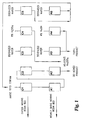
- Figure 1 is a schematic diagram representing the plumbing and flow pattern of a dual-CCA setup-
- the upper block row including C1 through C5 represents a first CCA loaded with cation exchange resin
- the lower block row including A1 through A5 represents a second CCA loaded with weak base resin.
- the crude amide feed stream is passed downflow through resin bed C1, which could represent a single resin column or container but preferably represents a plurality of containers of resin.
- resin bed C1 After exiting C1, the first-cation-treated stream, depleted of cations, is passed to resin bed A1 of the second CCA.
- Resin bed A1 also could be a single resin container but is preferably multiple containers through which the stream is passed upflow or downflow, desirably upflow.
- the first-base-treated medium exiting A1, now depleted of nicotinate ions, is conveyed back to the first CCA unit, where it is passed again through a similar resin bed C2 composed of one or multiple resin-filled containers.
- the second-cation-treated stream now further depleted of cations, is conveyed to the second CCA.
- the stream is passed through resin bed A2, comprised of one or multiple resin-filled containers.
- the resin bed A2 completes the resin purification of the product, which can then simply be evaporated to recover a USP grade nicotinamide.
- the streams can be conveyed downflow or upflow through the beds. Downflow processing is preferred for the cation exchange resin in this setup, whereas upflow is preferred for the weak base resin.
- the cation exchange resin beds are washed with deionized water, e.g. at C5, stripped with a strong acid solution such as sulfuric acid, e.g. at C4, and then washed again with deionized water.
- the stream resulting from the first wash will contain some residual nicotinamide and is combined with the amide feed stream to the system.
- the stream resulting from the acid strip, containing the salt of the cation and acid, for example sodium sulfate, is combined with the stream from the second water wash to form an acid salt stream.
- the weak base resin is washed with deionized water, e.g. at A5.
- the exit stream from the first water wash is fed to and combined with the crude nicotinamide feed stream.
- the weak base resin bed is stripped with a basic solution, for example sodium hydroxide, to remove the nicotinate ions.
- the exit stream from this strip will thus contain a nicotinate salt such as sodium nicotinate.
- This exit stream is combined with the exit stream from a subsequent wash with deionized water, e.g. at A3, to form a nicotinate salt (e.g. sodium nicotinate) stream.
- the basic nicotinate salt stream can be combined with the acidic acid salt stream to convert the sodium nicotinate to nicotinic acid.
- An additional amount of strong acid may be added, if necessary, to facilitate precipitation of nicotinic acid from this combined medium. In this fashion, the economics of the overall process are improved, as it produces both nicotinamide and nicotinic acid, the latter also representing a valuable food additive.
- the crude nicotinamide and intermediately-processed streams are maintained at a temperature that prevents precipitation of the nicotinamide and any nicotinic acid in the medium.
- the stream temperature will be maintained at a temperature above about 35°C and usually in the range of about 35°C to 100°C, more preferably in the range of about 40°C to about 80°C.
- Processing as described above can be used not only to efficiently and economically isolate USP grade nicotinamide directly from a crude nicotinamide reaction medium, but also other crude nicotinamide mediums.
- nicotinamide is recovered from a crude reaction medium by processes including cooling to cause crystallization of the nicotinamide, and subsequent filtration.
- the filtrate from this step often contains significant amounts of unrecovered nicotinamide (for example about 20% to about 80% by weight), along with sodium nicotinate (about 0.1% to 5% by weight), nicotinic acid (about 1% to 15% by weight), and 3-cyanopyridine (about 0.05% to 1% by weight).
- Such filtrate mediums can also be treated in accordance with the invention to isolate a highly purified (e.g. USP) nicotinamide product without the need for further crystallization steps.
- resin purification is used in combination with crystallization/filtration to recover USP nicotinamide.
- the resin purification is applied as described above prior to the crystallization, .to effectively minimize buildup of impurities, especially nicotinate salts and nicotinic acid, in the filtrate as it is repeatedly recycled to isolate more unrecovered nicotinamide.
- the buildup of nicotinic acid can be particularly problematic. It is less soluble in water than nicotinamide, and thus tends to crystallize first from aqueous solution. This in turn seeds the crystallization of the nicotinamide in a fashion that dramatically reduces the size of the nicotinamide crystals.
- the small nicotiniamide crystals are less advantageously handled and utilized than larger ones, and thus avoidance of their occurrence is desirable.
- the use of the above-described resin purification with a nicotinamide reaction crude prior to the crystallization step can eliminate or at least reduce the need to adjust the pH of the crude with base, thus eliminating or minimizing this complicating and costly step from the manufacturing process. More preferred processes thus occur where the resin purification is applied, and no pH-adjusting base .is added, prior to a crystallization/filtration step to yield USP grade nicotinamide.
- Nicotinamide products produced in accordance with the present invention may be conventionally used as food additives.
- the preferred processes are conducted so as to achieve nicotinamide of high purity, e.g. 99.5% or greater, and most preferably so as to yield USP grade nicotinamide.
- nicotinamide product was recovered from a crude nicotinamide product medium.
- the crude contained 39.7% nicotinamide, 2.15% sodium nicotinate and.0.14% 3-cyanopyridine. These and all other percentages given in this Example are percentages by weight unless indicated otherwise.
- the total sodium content of the medium was 0.38%.
- the reaction crude contained 93.7% nicotinamide, 5.07% sodium nicotinate, 0.33% 3-cyanopyridine, and 0.9% total sodium. Cation and weak base resins were utilized in the recovery process.
- the cation exchange resin was Dowex Marathon C, a sulfonated copolymer of styrene and divinylbenzene (gel form).
- the weak base resin. was Dowex Marathon WBA, a dimethylamine-functionalized chloromethylated copolymer of styrene and divinylbenzene (macroporous form with a monodisperse size distribution). After washing with deionized water, these resins were loaded into columns each having an inner diameter of 15 mm and a height of 30 cm, leaving about 3.8 cm (1.5 inches) head space at the top of the columns.
- the reaction crude was then successively treated over the cation-exchange resin (at 28 ml/min), the weak base resin (20 ml/min), the cation-exchange resin (28 ml/min), and the weak base resin (20 ml/min).
- the cation-exchange resin was regenerated after every ten bed volumes of reaction crude, by a cycle that included a water wash (20 ml/min, 1.25 bed volumes), a 12% sulfuric acid strip (7 ml/min, 1 bed volume), and another water wash (20 ml/min, 1.25 bed volumes).
- the weak base resin was regenerated after every five bed volumes of reaction crude, by a cycle including a water wash (20 ml/min, 1.6 bed volumes), a 4% sodium hydroxide strip (20 ml/min, 1 bed volume), and another water wash (2.6 bed volumes).
- the feeds were analyzed by HPLC after the first pass cation-exchange and weak base, and second pass cation-exchange and weak base. Typical results from such experiments are presented in Table 1 below, top.
- the lower section of Table 1 gives a typical product analysis on a water free basis.
- the extreme right hand column of Table. 1 sets out the results of an analysis of the product after recovery by evaporation (no crystallization performed).
- this processing reduced the 0.9% initial sodium to an undetectable level, and the initial 5.07% nicotinate to 0.13% (as nicotinic acid) on a dry weight basis, providing a USP grade nicotinamide.
Landscapes
- Chemical & Material Sciences (AREA)
- Organic Chemistry (AREA)
- Pyridine Compounds (AREA)
- Low-Molecular Organic Synthesis Reactions Using Catalysts (AREA)
- Saccharide Compounds (AREA)
- Pharmaceuticals Containing Other Organic And Inorganic Compounds (AREA)
Abstract
Description
- The present invention relates generally to the preparation of nicotinamide. More particularly, the present invention relates to processes for the effective, economic, large-scale production of USP grade nicotinamide from crude nicotinamide employing both-cation exchange and weak base resin treatment-.
- As further background, nicotinamide (also known as niacinamide and 3-pyridine carboxamide) and nicotinic acid (also known as niacin and 3-pyridine carboxylic acid), both commonly referred to as vitamin B3, are members of the B-vitamin complex and precursors of coenzymes I and II. As such, these compounds are important supplements to the diet of humans and.animals. Pellegra related deaths in the United States caused by vitamin B3 deficiency dropped, from 7, 358 in 1929, to 70 in 1956, primarily as a result of increased availability of vitamin B3. Higher growth rates occur in animals having diets supplemented with vitamin B3 and in the case of ruminants, higher milk production also occurs.
- In 1985, the U.S. market for niacinamide and niacin was estimated at 6,700 metric tons. See Kirk-Othmer, Encyclopedia of Chemical Technology, Third Edition, Vol. 24, pages 59-93 for a general discussion of the B3 Vitamins.
- These compounds have been prepared by hydrolysis of 3-cyanopyridine in batch and continuous processes with catalytic to stoichiometric excesses of a base. A majority of the methods reported have been batch processes. For example, the hydrolysis of 3-cyanopyridine with excess ammonia at 107°-109°C for 12 hours was reported to give mixtures of nicotinamide and niacin. See J. Am Chem. Soc. 65, at pages 2256-7 (1943). In still another variation, the hydrolysis of 3-cyanopyridine has been reported with a polymeric base, Dowex 1X4 (in the hydroxide form), to yield nicotinamide. See Dutch Patent Application No. 7706612-A; CA:90:186814e. U.S. Patent No. 4314064 describes the continuous hydrolysis of 3-cyanopyridine with 0.3 to 3.0 moles of an alkali metal hydroxide for each 100 moles of cyanopyridine at pressures of between 3 to 20 bars and with heating or cooling to maintain the prescribed reaction temperature. Similarly, 3-cyanopyridine is reported to react in a continuous process with aqueous ammonia at a molar ratio of 1:0.5 and a contact time of 40-50 minutes at 200°-260°C to give nicotinamide. See Journal of Applied Chemistry of the USSR (English Translation: 45:2716-2718 (1972).
- As an alternative to the hydration of cyanopyridines in the presence of bases, bacterial and enzymatic hydrolysis processes have been studied. U.S. Patent No. 5,395,758, assigned to Sumitomo Chemical Company Ltd., describes the conversion of 3-cyanopyridine to nicotinamide using cultured broths of an Agrobacterium bacteria. Japanese Patent No. 9300770000, assigned to Nitto Chemical Ind. Co. Ltd., describes the hydration of 3-cyanopyridine using the action of Corynebacterium or Nocardia bacteria to selectively yield nicotinamide.
- Because nicotinamide is commercially produced in very large scale, the recovery of the nicotinamide product, once formed, is a critical component of the overall process. This is especially true in the production of USP grade nicotinamide for human consumption, where the product must be recovered in highly pure form while nonetheless minimizing cost and technical difficulty in the workup. To date, commercial scale production of nicotinamide has involved its crystallization from crude nicotinamide product mediums. While crystallization has been demonstrated as a classic method for effectively recovering USP grade nicotinamide on a large scale, it does have drawbacks. First, crystallizations are generally time consuming, involve the use of large crystallization vessels, and necessitate a filtration step. In addition, the filtrate from the filtration step often contains significant amounts of unrecovered nicotinamide. This product either has to go to waste, or the filtrate must be recycled to subsequent crystallizations to generate additional isolated product. Such recycle process, when repeated several times, lead to a buildup of impurities in the filtrate, which makes subsequent recycles more and more difficult and eventually impracticable. Thus, a highly impure spent filtrate is eventually generated containing substantial nicotinamide, which must be stored or disposed as waste. These drawbacks are amplified when one considers the scale at which nicotinamide is produced. Nonetheless, alternative, commercially-practicable recovery strategies for USP grade nicotinamide remain to be discovered.
- There are a few reports in the literature of attempts to treat certain crude nicotinamide mediums in other ways to recover nicotinamide. For example, British Patent Application 879,551 describes separating nicotinamide from a solution also containing ammonium nicotinate by passage over a column containing Amberlite IRA-400 resin, water wash, and elution with 2% nitric acid. French Patent No. 1335502 describes preparing a tasteless nicotinamide product by dissolving nicotinamide in water, mixing this medium with a non-toxic cation exchange resin to adsorb the nicotinamide onto the resin, and then washing and drying the resin. U.S. Patent No. 3143965 describes the preparation of a similar style product by adsorbing nicotinamide and potentially other products onto polystyrene resins containing P(O)OH groups.
- Japanese Kokai 72 18875 describes the purification of nicotinamide containing sodium or potassium nicotinate by passage through a strongly basic ion exchange resin such as Amberlite IRA 410 or IRC 50. Japanese Kokai 72 31983 describes heating 3-cyanopyridine with sodium or potassium hydroxide and water to prepare nicotinamide, diluting the resulting mixture with water to bring the nicotinamide concentration to less than 25%, and then passing the solution over a column of a strongly basic ion exchange resin. Ratajczak et al., Przem. Chem. 1981, 60(6), 335-7, report the use of a sulfonic acid cation exchanger, Wofatit KS-10, for the purification of the mother liquors resulting from the crystallization of nicotinamide. U.S. Patent Nos. 4447614 and 4447615 describe a nicotinamide recovery process which involves adjusting the pH of a crude nicotinamide reaction mixture by adding acid or alkali and crystallizing the nicotinamide from 2-methylpropanol-1. The mother liquor from this crystallization is recycled and is treated from time to time either by distillation or by a sulfonated styrene-divinylbenzene copolymer and/or a strongly basic styrene-divinylbenzene copolymer quaternary ammonium resin. Atsuaki et al., Kogyo Kagaku Zasshi 60, 875-9 (1957), describe the treatment of a crude 30% nicotinamide solution with activated carbon for three hours, dilution with water to a final concentration of 10%, and passage through a double-bed column containing Amberlite IRA-410 and Amberlite IRC-50 at a rate of 1.8 cc/min. at 15°C.
- In light of the above background there remain needs in the field of commercial nicotinamide production for efficient and economic processes for recovering highly pure forms of nicotinamide such as USP grade nicotinamide. The present invention addresses these needs.
- The present invention provides a process for preparing a USP grade nicotinamide product, comprising:
- providing an aqueous medium containing nicotinamide and a nicotinic acid salt;
- removing cations from the medium by passing the medium over a cation exchange resin to form a cation-depleted medium and convert the nicotinic acid salt to nicotinic acid in the medium;
- removing the nicotinic acid from the medium by passing the cation-depleted medium over a weak base resin; and
- evaporating water from the medium to obtain a USP grade nicotinamide.
- A feature of the present invention is the discovery of improved processes for producing nicotinamide which avoid relatively expensive recovery steps practiced in prior processes, and/or which enable maximal recovery of the produced nicotinamide and also of other useful substances such as nicotinic acid produced as byproducts. Accordingly, one preferred embodiment of the present invention provides a commercial process for producing nicotinamide which includes first reacting 3-cyanopyridine in an aqueous basic medium at a 3-cyanopyridine concentration of about 20 to about 85 weight percent nicotinamide and a nicotinic acid salt. The reacted medium is treated with a cation exchange resin to remove cations and thereby convert the nicotinic acid salt to nicotinic acid, resulting in a cation-depleted aqueous medium containing about 20 to about 85 weight percent nicotinamide and nicotinic acid. The cation-depleted medium is treated with a weak base resin to remove nicotinic acid, resulting in a nicotinic acid-depleted aqueous medium containing about 20 to about 85 weight percent nicotinamide. USP grade nicotinamide is then recovered by evaporation.In this manner, USP grade nicotinamide is produced without the need for crystallization and filtration, the latter steps representing a relatively expensive and time-consuming process.
- A further preferred embodiment of the present invention relates to a commercial process for producing USP grade nicotinamide, which involves a crystallization and filtration step, recycle of the resulting filtrate to recover nicotinamide therein, all coupled with ion exchange processing to mitigate the buildup of nicotinic acid salts in the recycled filtrate. The process includes the steps of:
- (a) reacting 3-cyanopyridine in an aqueous base at a 3-cyanopyridine concentration of about 20 to about 85 weight percent to form a reacted medium containing about 20 to about 85 weight percent nicotinamide, and a nicotinic acid salt;
- (b) treating the reacted medium with a cation exchange resin to remove cations and thereby convert the nicotinic acid salt to nicotinic acid, resulting in a cation-depleted aqueous medium containing about 20 to about 85 weight percent nicotinamide, and nicotinic acid;
- (c) treating the cation-depleted medium with a weak base resin to remove nicotinic acid, resulting in a nicotinic acid-depleted aqueous medium containing about 20 to about 85 weight percent nicotinamide;
- (d) concentrating the nicotinic acid-depleted medium by evaporating water under heated conditions;
- (e) cooling the nicotinic acid-depleted medium after step (d) so as to crystallize nicotinamide;
- (f) filtering the product of step e) to recover crystalline nicotinamide and form a filtrate containing unrecovered nicotinamide;
- (g) repeating steps (a)-(c);
- (h) combining the filtrate from step (f) with the nicotinic acid-depleted aqueous medium obtained in step (g);
- (i) concentrating the product of step (h) by evaporating water under heated conditions;
- (j) cooling the product of step (i) so as to crystallize nicotinamide; and
- (k) filtering the product of step (j) to recover crystalline nicotinamide.
- A still further preferred embodiment of the invention provides a process for producing nicotinamide and nicotinic acid. This process includes first reacting 3-cyanopyridine with an aqueous base to form a reacted medium containing nicotinamide and a nicotinic acid salt. The reacted medium is treated with a cation exchange resin to bind cations to the resin and thereby convert the nicotinic acid salt to nicotinic acid, resulting in a cation-depleted aqueous medium containing nicotinamide, and nicotinic acid. An acidic eluent is then passed over the cation exchange resin to result in an acidic effluent. The cation-depleted medium is treated with a weak base resin to bind nicotinic acid to the resin, resulting in a nicotinic acid-depleted aqueous medium containing nicotinamide. A basic eluent is passed over the weak base resin to result in a basic effluent containing a nicotinic acid salt. The acidic effluent is combined with the basic effluent to convert the nicotinic acid salt to nicotinic acid. In this fashion, the production and recovery of the major product, nicotinamide, is efficiently coupled to the production and recovery of nicotinic acid. At the same time, the acidity of the acidic effluent, and the basicity of the basic effluent, are effectively neutralized, as would be required in any event for disposal.
- In its several embodiments, the present invention provides improved processes for producing USP grade nicotinamide with reduced recovery costs and/or more effective recovery of nicotinamide and useful co-products such as nicotinic acid. The preferred processes employ efficient, economic techniques utilizing cation-exchange and weak base resins, which can either completely eliminate the need for crystallization/filtration to yield USP grade nicotinamide, facilitate repeated recycling of filtrate from the filtration step, or take the filtrate nicotinamide to USP grade material without the need for subsequent crystallization. These and other features and advantages of the invention will be readily apparent to the skilled artisan upon reviewing the descriptions herein.
-
- Figure 1 provides a schematic diagram of a preferred USP nicotinamide production process of the invention employing a dual continuous contacting apparatus setup to treat an impurity-containing nicotinamide product medium with cation-exchange and weak base resins.
- For the purposes of promoting an understanding of the principles of the invention, reference will now be made to certain of its embodiments and specific language will be used to describe the same. It will nevertheless be understood that no limitation of the scope of the invention is thereby intended, such alterations, further modifications and applications of the principles of the invention as described herein being contemplated as would normally occur to one skilled in the art to which the invention relates.
- As disclosed above, features of the present invention involve improved processes for producing "USP grade" nicotinamide, which refers to a nicotinamide product which meets the drug product standards published in the United States Pharmacopeia Volume XXIII (1995). In this regard, said United States Pharmacopeia provides following standards for a USP grade nicotinamide product;
Assay Requirement Identification A-IR Pass Identification B-UV (FCC) Pass (0.63-0.67) Assay by UV (JP) 98.5 minimum Melting Range (FCC) 128-131°C Loss on Drying (FCC) 0.5% maximum final Residue on Ignition (FCC) 0.1% maximum Heavy Metals (FCC) 0.002% maximum Nicotinamide by HPLC 98.5-101.5% - In accordance with one aspect of the invention, a USP grade nicotinamide product can be obtained without any crystallization following production of the nicotinamide in crude form. In particular, the crude nicotinamide can be formed by reacting 3-cyanopyridine, at least one base, and water to provide a reacted medium containing nicotinamide. The reacted medium will typically also contain impurities including nicotinic acid salt and/or nicotinic acid and/or 3-cyanopyridine. The hydrolysis reaction to form the nicotinamide can be conducted in any suitable fashion, including for example batch or continuous modes. Suitable hydrolysis processes are described, for example, in U.S. Patent Nos. 5756750 and 4314064.
- In such processes, at least one mole of water will generally be used per mole of 3-cyanopyridine, and more typically at least a slight molar excess of water will be used relative to 3-cyanopyridine. This can be conveniently achieved by charging 3-cyanopyridine to an aqueous medium to a level of about 20% to about 85% by weight 3-cyanopyridine. In preferred process forms, the 3-cyanopyridine is charged to a level of about 30% to about 60% of the reaction medium. As to the base, its choice and the level of its use are parameters that are well within the purview of those of ordinary skill in the art. The base may be soluble or insoluble in the reaction medium. For example, ammonia or watersoluble alkali metal hydroxides or alkaline earth metal hydroxides are often used, especially sodium hydroxide and potassium hydroxide. Heterogeneous base catalysts may also be used. For example, a particulate, basic resin, such as a resin containing basic amino groups, may be slurried into the reaction medium to catalyze the hydrolysis of 3-cyanopyridine to nicotinamide. With stronger bases such as sodium and potassium hydroxide, smaller quantities of base are adequate, while with weaker bases such as ammonia, larger quantities of base are required. Control of these parameters to achieve the desired products or product mixtures will be well within the purview of one skilled in the art given the teachings herein.
- Generally, about 0.01 to about 50 equivalents of base will be used per 100 moles of 3-cyanopyridine. In this regard, the number of equivalents of base will be determined in the usual fashion, taking into account whether the base is monobasic, dibasic, etc. Thus, the number of equivalents of base will be determined by multiplying the number of moles of a base by the number of protons that a mole of that base will react with. In preferred forms of the invention wherein an alkali metal hydroxide is employed as the base, about 0.3 to 5 moles of alkali metal hydroxide will be used per 100 moles of 3-cyanopyridine, more preferably about 0.5 to 3.0 moles of alkali metal hydroxide per 100 moles of 3-cyanopyridine.
- In one convenient form, the hydrolysis process can be carried out in a 1% to 20% aqueous alkali metal hydroxide solution, more typically about 1% to about 10%. The alkali metal hydroxide can be added all at the beginning of the reaction, or in portions over the course of the reaction. Such reactions yield a crude nicotinamide product containing an alkali metal nicotinate (e.g. sodium or potassium nicotinate), nicotinic acid, and 3-cyanopyridine.
- The temperature and duration of the reaction may vary so long as the conditions utilized are sufficient to drive the hydrolysis of 3-cyanopyridine to substantial completion, e.g. achieving a conversion greater than about 80%, more preferably greater than about 95%. The reaction temperature will usually be in the range of about 100°C to about 250°C, more typically about 120°C to about 200°C. The reaction can be run continuously under controlled temperature and pressure conditions, for example as described in U.S. Patent No. 4314064, or under adiabatic temperature conditions as described for instance in U.S. Patent No. 5756750. The duration of the reaction will vary with the temperature, the strength of the base catalyst and other similar factors, but typically will be in the range of about 1 to about 30 minutes and preferably in the range of about 1 to 15 minutes for continuous processes, and about 1 to about 60 minutes for large batch processes.
- For the preferred continuous processes, high production rates, selectivities, and yields are typically obtained. For instance, for nicotinamide formation by hydrolysis of 3-cyanopyridine, production rates ranging from between about 200 to several thousand kg per hour per liter of reactor volume can be obtained, more about 200 to about 1000 kg per hour per liter and most often about 400 to about 900 kg per hour per liter. Given the scale of commercial processes, this results in the production of at least about 150 kg of nicotinamide per hour, typically in the range of about 150 kg to about 1000 kg, in a crude reaction medium that totals at least about 100 liters per hour, typically in the range of about 100 to about 1000 liters per hour. The yields of nicotinamide in preferred continuous processes have typically ranged between about 95% to about 99.5%.
- The above-described hydrolysis processes generally result in reacted mediums containing nicotinamide and impurities, the impurities including nicotinate salts, nicotinic acid, and 3-cyanopyridine. The nicotinate salts are usually present in a range of about 0.05% to about 5.0% by weight of the reacted medium, the nicotinic acid about 0.1% to about 5% by weight, and the 3-cyanopyridine about 0.05% to about 0.5% by weight. Such crude reaction mediums, in past commercial processes, have been subjected to concentration, pH adjustment with base, crystallization and filtration to isolate USP grade nicotinamide products.
- One feature of the present invention is the discovery that USP grade nicotinamide can be commercially produced without any crystallization of the nicotinamide, if the reaction crude is processed and the nicotinamide isolated as described herein. In particular, an inventive process involves treatment of the reaction crude with both a cation exchange resin and a weak base resin. Treatment with a cation exchange resin effectively removes counter cations of nicotinate salts, e.g. sodium, potassium or ammonium ions, while treatment with the weak base resin effectively removes nicotinate ions.
- The cation exchange resin may be selected from those available both commercially and through known preparative techniques. Preferred cation exchange resins have functional groups selected from sulfonic acid or other strongly acidic functionalities incorporated in a crosslinked copolymer structure. The crosslinked polymer structure is desirably a copolymer of styrene and divinylbenzene. Illustrative commercially-available cation exchange resins include, for instance, Dowex Marathon C, Dowex 50WX2, Dowex 50WX4, Dowex 50WX8, Amberlite IR-122, and Amberlite 200.
- The weak base resin can likewise be selected from among those available commercially or through known preparative techniques. The preferred weak base resins will include amino groups incorporated in a crosslinked polymer structure, in base form. In this regard, it has been found that strong base resins, particularly those incorporating quaternary ammonium functions, tend to deleteriously catalyze hydrolysis of the nicotinamide product to nicotinic acid. Thus, in the present invention, a weaker base resin will be employed which avoids the occurrence of such hydrolysis to any significant extent. The amino groups of these weak base resins are preferably aliphatic amino groups, for example including for instance monoalkylamino or dialkylamino groups, especially wherein the alkyl groups contain from 1 to about 5 carbon atoms. Thus, illustrative amino groups will include dimethylamino, methylethylamino, diethylamino, dipropylamino, dibutylamino, etc. The crosslinked polymer structure of the resin is advantageously a copolymer of styrene and divinylbenzene. Suitable commercially available weak base resins which can be used in the invention include Amberlyst A21, Dowex Marathon C, Dowex WGR-2, Amberlite TRA-93, and Amberlite IRA-68.
- The treatment over the resins is desirably conducted in a continuous fashion, in a contacting unit equipped to creat the solutions at a rate of at least about 6.8 x 10⁻³ m/s (0.1 gallon per minute per foot squared) typically falling generally in the range of about 6.8 x 10⁻⁴ m/s (1 gallon per minute per foot squared) to about 6.8 x 10⁻³ m/s (10 gallons per minute per foot squared). Linear flow rates of about 6.8 x 10⁻³ m/s (1 gallon per minute per foot squared) to about 2.72 x 10⁻³ m/s (4 gallons per minute per foot squared) are preferred.
- Favored USP nicotinamide isolation processes of the invention are conducted using one or more preparative-scale contacting apparatuses including a plurality of resin columns and means for passing the streams to be treated and eluent streams through the columns. A more preferred such apparatus is a continuous contacting apparatus ("CCA"). For example, continuous contacting apparatuses which are useful in the invention include those such as the ISEP or CSEP Continuous Contactors available from Advanced Separations Technology, Inc. (AST, Inc.), Lakeland, Florida, and are also generally described in U-S- Patent Nos. 4,764,276 issued August 16, 1988, 4,808,317 issued February 28, 1999 and 4,522,726 issued June 11, 1985. A brief description of such a CCA device as described in these patents is set forth below. For further details as to the design and operation of CCA's suitable for use in the invention, reference can be made to literature available from AST, Inc. including "The ISEP™ Principle Of Continuous Adsorption", and as well to the above-cited U.S. patents.
- The preferred CCA for use in the present invention will be a liquid-solid contacting apparatus including a plurality of chambers which are adapted to receive ion exchange resin and which taken together or separately may provide a contacting zone for processes of the invention. The chambers have respective inlet and outlet ports, and are mounted for rotation about a central axis so as to advance the chambers past supply and discharge ports which cooperate with the inlet and outlet ports. In particular, liquid is supplied individually to inlet ports at the top of these chambers through conduits connected with a valve assembly above the chambers, which valve assembly provides a plurality of supply ports which cooperate with inlet ports of the chambers as they are advanced. Similarly, conduits connect the outlet port at the lower end of each chamber with a valve assembly below the chambers which provides discharge ports which cooperate with the outlet ports as the chambers are advanced. The valve assemblies include movable plates with slots that cover and uncover inlet ports as the plate rotates with the carousel. By varying the size of the slots in the plate and the location of the slots, the flow from the supply conduits into the chamber and flow from the chamber to the exhaust conduits can be controlled in a predetermined manner. The motion of one plate over the other can be continuous or as an indexed motion. The time during which liquid flows into and out of the chambers is a function of the speed of rotation of the chambers about the central axis.
- Two such CCA apparatuses are preferably used in processing in accordance with the invention. A first such apparatus is loaded with the cation exchange resin, and a second with the weak base resin, and the reaction crude is fed from one to the other for successive processing over the resins. The feed stream is preferably divided for simultaneous feed through a plurality of resin columns, for example five columns, and then recombined for feed to the adjoining contacting unit. In this fashion, large, commercial scale volumes of reaction crude can be relatively rapidly processed, while nonetheless achieving effective removal of sodium and nicotinate ions.
- In a most preferred embodiment, the reaction crude is passed successively over a cation exchange, a weak base, a cation exchange and then a weak base resin, followed by evaporation, to produce a USP grade niacinamide product. Using two contacting units, as illustrated in Figure 1, this can be achieved by passing the reacted medium and intermediately-treated mediums back and forth among the two continuous contacting apparatuses. Figure 1 is a schematic diagram representing the plumbing and flow pattern of a dual-CCA setup- In Figure 1, the upper block row including C1 through C5 represents a first CCA loaded with cation exchange resin, and the lower block row including A1 through A5 represents a second CCA loaded with weak base resin. The crude amide feed stream is passed downflow through resin bed C1, which could represent a single resin column or container but preferably represents a plurality of containers of resin. After exiting C1, the first-cation-treated stream, depleted of cations, is passed to resin bed A1 of the second CCA. Resin bed A1 also could be a single resin container but is preferably multiple containers through which the stream is passed upflow or downflow, desirably upflow. The first-base-treated medium exiting A1, now depleted of nicotinate ions, is conveyed back to the first CCA unit, where it is passed again through a similar resin bed C2 composed of one or multiple resin-filled containers. Exiting C2, the second-cation-treated stream, now further depleted of cations, is conveyed to the second CCA. There, the stream is passed through resin bed A2, comprised of one or multiple resin-filled containers. The resin bed A2 completes the resin purification of the product, which can then simply be evaporated to recover a USP grade nicotinamide. In this illustrated system, the streams can be conveyed downflow or upflow through the beds. Downflow processing is preferred for the cation exchange resin in this setup, whereas upflow is preferred for the weak base resin.
- As shown, after successively treating the first-base-treated stream and then the reaction crude in their travel path, the cation exchange resin beds are washed with deionized water, e.g. at C5, stripped with a strong acid solution such as sulfuric acid, e.g. at C4, and then washed again with deionized water. The stream resulting from the first wash will contain some residual nicotinamide and is combined with the amide feed stream to the system. The stream resulting from the acid strip, containing the salt of the cation and acid, for example sodium sulfate, is combined with the stream from the second water wash to form an acid salt stream.
- In the second CCA unit, after successively processing the second-cation-treated stream and then first-cation-treated stream, the weak base resin is washed with deionized water, e.g. at A5. The exit stream from the first water wash is fed to and combined with the crude nicotinamide feed stream. After the first wash, the weak base resin bed is stripped with a basic solution, for example sodium hydroxide, to remove the nicotinate ions. The exit stream from this strip will thus contain a nicotinate salt such as sodium nicotinate. This exit stream is combined with the exit stream from a subsequent wash with deionized water, e.g. at A3, to form a nicotinate salt (e.g. sodium nicotinate) stream.
- In another aspect of the present invention, the basic nicotinate salt stream can be combined with the acidic acid salt stream to convert the sodium nicotinate to nicotinic acid. An additional amount of strong acid may be added, if necessary, to facilitate precipitation of nicotinic acid from this combined medium. In this fashion, the economics of the overall process are improved, as it produces both nicotinamide and nicotinic acid, the latter also representing a valuable food additive.
- During processing over the resin, the crude nicotinamide and intermediately-processed streams are maintained at a temperature that prevents precipitation of the nicotinamide and any nicotinic acid in the medium. Typically the stream temperature will be maintained at a temperature above about 35°C and usually in the range of about 35°C to 100°C, more preferably in the range of about 40°C to about 80°C.
- Processing as described above can be used not only to efficiently and economically isolate USP grade nicotinamide directly from a crude nicotinamide reaction medium, but also other crude nicotinamide mediums. For example, in some processes nicotinamide is recovered from a crude reaction medium by processes including cooling to cause crystallization of the nicotinamide, and subsequent filtration. The filtrate from this step often contains significant amounts of unrecovered nicotinamide (for example about 20% to about 80% by weight), along with sodium nicotinate (about 0.1% to 5% by weight), nicotinic acid (about 1% to 15% by weight), and 3-cyanopyridine (about 0.05% to 1% by weight). Such filtrate mediums can also be treated in accordance with the invention to isolate a highly purified (e.g. USP) nicotinamide product without the need for further crystallization steps.
- In a still further example, resin purification is used in combination with crystallization/filtration to recover USP nicotinamide. In this process, the resin purification is applied as described above prior to the crystallization, .to effectively minimize buildup of impurities, especially nicotinate salts and nicotinic acid, in the filtrate as it is repeatedly recycled to isolate more unrecovered nicotinamide. The buildup of nicotinic acid can be particularly problematic. It is less soluble in water than nicotinamide, and thus tends to crystallize first from aqueous solution. This in turn seeds the crystallization of the nicotinamide in a fashion that dramatically reduces the size of the nicotinamide crystals. The small nicotiniamide crystals are less advantageously handled and utilized than larger ones, and thus avoidance of their occurrence is desirable. In addition, the use of the above-described resin purification with a nicotinamide reaction crude prior to the crystallization step can eliminate or at least reduce the need to adjust the pH of the crude with base, thus eliminating or minimizing this complicating and costly step from the manufacturing process. More preferred processes thus occur where the resin purification is applied, and no pH-adjusting base .is added, prior to a crystallization/filtration step to yield USP grade nicotinamide.
- Nicotinamide products produced in accordance with the present invention, isolated by evaporation, may be conventionally used as food additives. The preferred processes are conducted so as to achieve nicotinamide of high purity, e.g. 99.5% or greater, and most preferably so as to yield USP grade nicotinamide.
- For the purposes of promoting a further understanding of the present invention and its preferred features and embodiments, the following examples are being provided. It will be understood, however, that these examples are illustrative, and not limiting, in nature.
- In this Example a USP grade nicotinamide product was recovered from a crude nicotinamide product medium. The crude contained 39.7% nicotinamide, 2.15% sodium nicotinate and.0.14% 3-cyanopyridine. These and all other percentages given in this Example are percentages by weight unless indicated otherwise. The total sodium content of the medium was 0.38%. On a dry basis, the reaction crude contained 93.7% nicotinamide, 5.07% sodium nicotinate, 0.33% 3-cyanopyridine, and 0.9% total sodium. Cation and weak base resins were utilized in the recovery process. The cation exchange resin was Dowex Marathon C, a sulfonated copolymer of styrene and divinylbenzene (gel form). The weak base resin.was Dowex Marathon WBA, a dimethylamine-functionalized chloromethylated copolymer of styrene and divinylbenzene (macroporous form with a monodisperse size distribution). After washing with deionized water, these resins were loaded into columns each having an inner diameter of 15 mm and a height of 30 cm, leaving about 3.8 cm (1.5 inches) head space at the top of the columns. The reaction crude was then successively treated over the cation-exchange resin (at 28 ml/min), the weak base resin (20 ml/min), the cation-exchange resin (28 ml/min), and the weak base resin (20 ml/min). The cation-exchange resin was regenerated after every ten bed volumes of reaction crude, by a cycle that included a water wash (20 ml/min, 1.25 bed volumes), a 12% sulfuric acid strip (7 ml/min, 1 bed volume), and another water wash (20 ml/min, 1.25 bed volumes). The weak base resin was regenerated after every five bed volumes of reaction crude, by a cycle including a water wash (20 ml/min, 1.6 bed volumes), a 4% sodium hydroxide strip (20 ml/min, 1 bed volume), and another water wash (2.6 bed volumes). The feeds were analyzed by HPLC after the first pass cation-exchange and weak base, and second pass cation-exchange and weak base. Typical results from such experiments are presented in Table 1 below, top. The lower section of Table 1 gives a typical product analysis on a water free basis. The extreme right hand column of Table. 1 sets out the results of an analysis of the product after recovery by evaporation (no crystallization performed). As can be seen, this processing reduced the 0.9% initial sodium to an undetectable level, and the initial 5.07% nicotinate to 0.13% (as nicotinic acid) on a dry weight basis, providing a USP grade nicotinamide.
TABLE 1 Component Feed Cation Pass 1 Base Pass 1 Cation Pass 2 Base Pass 2 Dry Product Amide 39.7 37.4 30.2 28.8 20.8 100.8 Nicotinate 2.2 2.1 0.5 0.9 0.04 0.13 3-CyP 0.14 0.12 0.1 0.06 0.06 0 Sodium 0.4 0.05 0.03 0 0 0 Dry Weight Amide 93.7 94.4 97.1 96.2 99.5 Nicotinate 5.1 5.2 1.7 3.0 0.2 3-CyP 0.3 0.3 0.2 0.2 0.3 Sodium 0.9 0.1 0.1 0 0 - While the invention has been described in detail above with reference to specific embodiments, it will be understood that modifications and alterations in the embodiments disclosed may be made by those practiced in the art without departing from the spirit and scope of the invention. All such modifications and alterations are intended to be covered. In addition, all publications cited herein are indicative of the level of skill in the art and are hereby incorporated by reference in their entirety as if each had been individually incorporated by reference and fully set forth.
Claims (27)
- A process for preparing a USP grade nicotinamide product as defined in "United States Pharmacopeia Volume XXIII (1995)", comprising:providing an aqueous medium containing nicotinamide and a nicotinic acid salt;removing cations from the medium by passing the medium over a cation exchange resin to form a cation-depleted medium and convert the nicotinic acid salt to nicotinic acid in the medium;removing the nicotinic acid from the medium by passing the cation-depleted medium over a weak base resin; andevaporating water from the medium to obtain a USP grade nicotinamide.
- The process of claim 1, wherein said passing steps are conducted in a continuous contacting apparatus.
- The process of claim 2, wherein said weak base resin has aliphatic amino groups.
- The process of claim 3, wherein said aqueous medium comprises a filtrate from a nicotinamide crystallization and filtration.
- The process of claim 3, wherein said aqueous medium comprises a crude reaction medium obtained by hydrolyzing 3-cyamopyridine to nicotinamide in the presence of water and a base.
- The process of claim 5, wherein said aqueous medium comprises 0.05 to 5 weight percent nicotinic acid salt.
- The process of claim 1, wherein
said providing an aqueous medium containing nicotinamide and a nicotinic acid salt comprises reacting 3-cyanopyridine with water in the presence of a base at a 3-cyanopyridine concentration of 20 to 85 weight percent to form a reacted medium containing 20 to 85 weight percent nicotinamide, and the nicotinic acid salt;
said cation-depleted aqueous medium comprises 20 to 85 weight percent nicotinamide, and nicotinic acid; and
said removing the nicotinic acid from said medium results in a nicotinic acid-depleted aqueous medium containing 20 to 85 weight percent nicotinamide. - The process of claim 7, wherein said aqueous basic medium contains said 3-cyanopyridine in a concentration of 30 to 60 weight percent.
- The process of claim 8, wherein said nicotinic acid salt is present in said reacted medium at a concentration of .05 to 5 weight percent.
- The process of claim 9, wherein said passing steps are conducted in a continuous contacting apparatus.
- The process of claim 9, wherein said evaporating comprises passing said nicotinic acid-depleted aqueous medium over a falling film evaporator.
- The process of claim 7, also comprising:providing a melt of said USP grade nicotinamide;causing said melt to solidify to a mass; andreducing said mass to a particulate nicotinamide product.
- The process of claim 12, wherein said causing includes coating said melt onto a cooled surface to form a solidified layer of substantially pure nicotinamide, and said reducing includes flaking said solidified layer.
- The process of claim 7, wherein said evaporating water from said medium to obtain a USP grade nicotinamide comprises concentrating the nicotinic acid-depleted medium by evaporating water under heated conditions; and further comprising:(a) cooling the concentrated, nicotinic acid-depleted medium so as to crystallize nicotinamide;(b) filtering the product of step (a) to recover crystalline nicotinamide and form a filtrate containing unrecovered nicotinamide;(c) producing additional nicotinic acid-depleted aqueous medium as claimed in claim 7;(d) combining the filtrate from step (b) with the nicotinic acid-depleted aqueous medium obtained in step (c);(e) concentrating the product of step (d) by evaporating water under heated conditions;(f) cooling the product of step (e) so as to crystallize nicotinamide; and(g) filtering the product of step (f) to recover crystalline nicotinamide.
- The process of claim 14, wherein said passing steps are conducted with a continuous contacting apparatus.
- The process of claim 15. wherein said reacted medium comprises at least 0.05 weight percent nicotinic acid salt.
- The process of claim 16, wherein said reacted medium comprises from about 0.05 to about 5 weight percent nicotinic acid salt.
- The process of claim 16, wherein said aqueous base is an aqueous alkaline earth metal hydroxide or an aqueous alkali metal hydroxide.
- The process of claim 18, wherein said aqueous base is aqueous sodium hydroxide.
- The process of claim 1, wherein said providing an aqueous medium containing nicotinamide and a nicotinic acid salt comprises reacting 3-cyanopyridine with water in an aqueous base; and further comprising:(a) passing an acidic effluent over the cation exchange resin after cation binding to result in an acidic effluent;(b) passing a basic effluent over the weak base resin after anion binding to result in a basic effluent containing a nicotinic acid salt; and(c) combining the acidic effluent from step (a) with the basic effluent from step (b) to convert the nicotinic acid salt to nicotinic acid.
- The process of claim 20, wherein said acidic effluent is an aqueous strong acid.
- The process of claim 21, wherein said acidic effluent is aqueous hydrochloric acid or aqueous sulfuric acid.
- The process of claim 21, wherein said basic effluent is an aqueous alkali metal hydroxide or an aqueous alkaline earth metal hydroxide.
- The process of claim 23, wherein said basic effluent is aqueous sodium hydroxide.
- The process of claim 1, wherein said providing an aqueous medium containing nicotinamde and a nicotinic acid salt comprises providing a crude nicotinamide medium containing 20% to 85% aqueous nicotinamide, .05% to 5% nicotinate salt, and 0.1% to 5% nicotinic acid; said removing cations from said medium by passing said medium over a cation exchange resin to form a eation-depteted medium comprises treating the medium at a temperature of 35°C to 100°C with a cation exchange resin to result in a cation-depleted medium containing 30% to 60% nicotinamide; and said removing the nicotinic acid from said medium by passing the cation-depleted medium over a weak base resin comprises treating the cation-depleted medium at a temperature of 35°C to 100°C with a weak base resin to result in a nicotinate-ion-depleted aqueous medium containing 30% to 60% nicotinamide.
- The process of claim 25, wherein said isolated nicotinamide is USP grade nicotinamide.
- The process of claim 7, wherein said evaporating water from said medium to obtain a USP grade nicotinamide comprises concentrating the nicotinic acid-depleted medium by evaporating water under heated conditions; and further comprising: cooling the concentrated, nicotinic acid-depleted medium so as to crystallize nicotinamide; and wherein all steps other than said providing an aqueous medium containing nicotinamide and a nicotinic acid salt are conducted without the addition of any base for pH adjustment.
Applications Claiming Priority (3)
| Application Number | Priority Date | Filing Date | Title |
|---|---|---|---|
| US9355398P | 1998-07-21 | 1998-07-21 | |
| US93553P | 1998-07-21 | ||
| PCT/US1999/016536 WO2000005211A1 (en) | 1998-07-21 | 1999-07-21 | Processes for producing highly pure nicotinamide |
Publications (3)
| Publication Number | Publication Date |
|---|---|
| EP1098879A1 EP1098879A1 (en) | 2001-05-16 |
| EP1098879A4 EP1098879A4 (en) | 2003-01-02 |
| EP1098879B1 true EP1098879B1 (en) | 2007-05-02 |
Family
ID=22239561
Family Applications (1)
| Application Number | Title | Priority Date | Filing Date |
|---|---|---|---|
| EP99935809A Expired - Lifetime EP1098879B1 (en) | 1998-07-21 | 1999-07-21 | Processes for producing highly pure nicotinamide |
Country Status (10)
| Country | Link |
|---|---|
| US (1) | US6218543B1 (en) |
| EP (1) | EP1098879B1 (en) |
| JP (1) | JP4901002B2 (en) |
| KR (1) | KR20010072009A (en) |
| CN (1) | CN1310710A (en) |
| AT (1) | ATE361280T1 (en) |
| AU (1) | AU5121199A (en) |
| DE (1) | DE69935985T2 (en) |
| TW (1) | TW539670B (en) |
| WO (1) | WO2000005211A1 (en) |
Families Citing this family (7)
| Publication number | Priority date | Publication date | Assignee | Title |
|---|---|---|---|---|
| CN102249994B (en) * | 2011-05-10 | 2014-05-07 | 浙江爱迪亚营养科技开发有限公司 | Preparation method of nicotinic acid |
| CN102219734B (en) * | 2011-05-10 | 2013-08-07 | 浙江爱迪亚营养科技开发有限公司 | Preparation method for nicotinamide |
| EP3469913A1 (en) * | 2017-10-12 | 2019-04-17 | Wolfgang Zwickenpflug | Process for producing nicotinic acid |
| JP7126437B2 (en) | 2018-12-11 | 2022-08-26 | 川崎重工業株式会社 | Lid member mounting device |
| JP7530750B2 (en) * | 2020-06-10 | 2024-08-08 | 花王株式会社 | Gingival recession inhibitor |
| CN114634269B (en) * | 2020-12-15 | 2022-12-02 | 山东潍坊润丰化工股份有限公司 | Method for recovering nicotinamide from wastewater |
| CN118925271B (en) * | 2024-10-12 | 2024-12-17 | 安徽瑞邦生物科技有限公司 | Nicotinamide hydration liquid purification equipment and purification process thereof |
Family Cites Families (18)
| Publication number | Priority date | Publication date | Assignee | Title |
|---|---|---|---|---|
| GB879551A (en) | 1957-10-28 | 1961-10-11 | Merck & Co Inc | Ion-exchange purification of nicotinamide |
| FR1335502A (en) | 1960-06-02 | 1963-08-23 | Merck & Co Inc | New nicotinamide adsorption compounds |
| US3143465A (en) | 1961-06-19 | 1964-08-04 | Wallace & Tiernan Inc | Pharmaceutical preparations comprising phosphorus containing cation exchange resins having a basic drug adsorbed thereon; and treatment therewith |
| DE2517053A1 (en) * | 1975-04-17 | 1976-10-28 | Degussa | PROCESS FOR THE PRODUCTION OF NICOTIC ACID AMIDE |
| DE2517054C2 (en) | 1975-04-17 | 1985-04-25 | Degussa Ag, 6000 Frankfurt | Process for the preparation of nicotinic acid amide |
| NL7706612A (en) | 1977-06-16 | 1978-12-19 | Stamicarbon | Nicotinamide prepn. from aq. 3-cyano-pyridine soln. - by hydrolysis with anion exchanger and extraction with organic solvent |
| DE3028904A1 (en) | 1980-07-30 | 1982-02-25 | Degussa Ag, 6000 Frankfurt | METHOD FOR PURIFYING NICOTINIC ACID I. |
| DE3028791A1 (en) | 1980-07-30 | 1982-02-25 | Degussa Ag, 6000 Frankfurt | METHOD FOR PURIFYING NICOTINIC ACID II. |
| US4764276A (en) | 1984-07-30 | 1988-08-16 | Advanced Separation Technologies Incorporated | Device for continuous contacting of fluids and solids |
| US4522726A (en) | 1984-07-30 | 1985-06-11 | Progress Equities Incorporated | Advanced separation device and method |
| SU1288183A1 (en) | 1985-03-11 | 1987-02-07 | Институт химических наук АН КазССР | Method of producing isonicotinic acid |
| US4808317A (en) | 1985-03-19 | 1989-02-28 | Advanced Separation Technologies Incorporated | Process for continuous contacting of fluids and solids |
| SU1553531A1 (en) | 1988-02-10 | 1990-03-30 | Институт химических наук АН КазССР | Method of producing pyridine-4-carboxamide |
| JPH057000A (en) | 1991-06-28 | 1993-01-14 | Nippon Sheet Glass Co Ltd | Film transistor using a-si |
| JP3409353B2 (en) | 1992-04-30 | 2003-05-26 | 住友化学工業株式会社 | Method for producing amide compound and microorganism used |
| JP3483156B2 (en) | 1994-02-08 | 2004-01-06 | 株式会社マルマンプロダクツ | Hinges for glasses |
| JP2836473B2 (en) | 1994-02-23 | 1998-12-14 | 株式会社セガ・エンタープライゼス | Prize game machine |
| CN1173949C (en) | 1996-02-09 | 2004-11-03 | 莱利工业公司 | Continuous mode for hydrolysis of cyanopyridines under substantially adiabatic conditions |
-
1999
- 1999-07-20 TW TW088112320A patent/TW539670B/en not_active IP Right Cessation
- 1999-07-21 DE DE69935985T patent/DE69935985T2/en not_active Expired - Lifetime
- 1999-07-21 JP JP2000561167A patent/JP4901002B2/en not_active Expired - Lifetime
- 1999-07-21 EP EP99935809A patent/EP1098879B1/en not_active Expired - Lifetime
- 1999-07-21 WO PCT/US1999/016536 patent/WO2000005211A1/en not_active Ceased
- 1999-07-21 AT AT99935809T patent/ATE361280T1/en active
- 1999-07-21 US US09/358,201 patent/US6218543B1/en not_active Expired - Lifetime
- 1999-07-21 KR KR1020017000877A patent/KR20010072009A/en not_active Withdrawn
- 1999-07-21 CN CN99808993A patent/CN1310710A/en active Pending
- 1999-07-21 AU AU51211/99A patent/AU5121199A/en not_active Abandoned
Also Published As
| Publication number | Publication date |
|---|---|
| EP1098879A4 (en) | 2003-01-02 |
| KR20010072009A (en) | 2001-07-31 |
| US6218543B1 (en) | 2001-04-17 |
| JP4901002B2 (en) | 2012-03-21 |
| ATE361280T1 (en) | 2007-05-15 |
| AU5121199A (en) | 2000-02-14 |
| DE69935985T2 (en) | 2008-01-10 |
| DE69935985D1 (en) | 2007-06-14 |
| TW539670B (en) | 2003-07-01 |
| JP2002521365A (en) | 2002-07-16 |
| CN1310710A (en) | 2001-08-29 |
| WO2000005211A1 (en) | 2000-02-03 |
| EP1098879A1 (en) | 2001-05-16 |
Similar Documents
| Publication | Publication Date | Title |
|---|---|---|
| US6218543B1 (en) | Processes for producing highly pure nicotinamide | |
| JPH0767671A (en) | Method of recovering citric acid from crude product mixture of low purity by adding strong acid and its salts | |
| EP1330533B1 (en) | Method of preparing a modified corn steep liquor product | |
| EP2881382B1 (en) | Method for producing basic amino acid or basic amino acid salt | |
| CN101627017A (en) | Process for the manufacture of vitamin B1 precursor | |
| EP0459803B1 (en) | Method for purifying glycine | |
| KR101257943B1 (en) | Method for recovering a basic amino acid from a fermentation liquor | |
| US5907059A (en) | Process for the preparation of monosodium glutamate | |
| EP0020124B1 (en) | Decationisation of aqueous sugar solutions | |
| CA1136147A (en) | Process for the purification of nicotinic acid amide ii | |
| US3173949A (en) | Recovery of glutamic acid from a fermentation broth using cation exchange resins | |
| US2834711A (en) | Production of bacitracin | |
| JP2003212829A (en) | Glycine purification method | |
| CN120904069A (en) | Preparation method of L-ornithine hydrochloride | |
| US6982234B2 (en) | Methods and apparatus for removing catalyst from oxidation reactor effluent | |
| US20020045534A1 (en) | Methods and apparatus for removing catalyst from oxidation reactor effluent | |
| JPS6251145B2 (en) | ||
| JP4662419B2 (en) | Method for separating and producing organic acids | |
| CN119977789A (en) | A method for preparing high-purity calcium α-ketoglutarate using ion exchange resin | |
| CN117964672A (en) | Macroporous adsorption resin separation and purification method for beta-nicotinamide mononucleotide | |
| CN120574269A (en) | A preparation method of lactulose concentrated solution | |
| KR20080003803A (en) | Recovery of Basic Amino Acids from Fermentation Broth II | |
| JPH01320987A (en) | Method for separating and recovering erythritol from erythritol-containing culture solution | |
| JPS59225155A (en) | Separation and recovery of unreacted raw material from solution for preparing folic acid | |
| GB2217714A (en) | Purification of 2-keto-L-gulonic acid |
Legal Events
| Date | Code | Title | Description |
|---|---|---|---|
| PUAI | Public reference made under article 153(3) epc to a published international application that has entered the european phase |
Free format text: ORIGINAL CODE: 0009012 |
|
| 17P | Request for examination filed |
Effective date: 20010105 |
|
| AK | Designated contracting states |
Kind code of ref document: A1 Designated state(s): AT BE CH CY DE DK ES FI FR GB GR IE IT LI LU MC NL PT SE |
|
| AX | Request for extension of the european patent |
Free format text: AL;LT;LV;MK;RO;SI |
|
| RIC1 | Information provided on ipc code assigned before grant |
Free format text: 7C 07D 213/56 A, 7C 07D 213/82 B |
|
| A4 | Supplementary search report drawn up and despatched |
Effective date: 20021108 |
|
| AK | Designated contracting states |
Kind code of ref document: A4 Designated state(s): AT BE CH CY DE DK ES FI FR GB GR IE IT LI LU MC NL PT SE |
|
| 17Q | First examination report despatched |
Effective date: 20040414 |
|
| GRAP | Despatch of communication of intention to grant a patent |
Free format text: ORIGINAL CODE: EPIDOSNIGR1 |
|
| DAX | Request for extension of the european patent (deleted) | ||
| GRAS | Grant fee paid |
Free format text: ORIGINAL CODE: EPIDOSNIGR3 |
|
| GRAA | (expected) grant |
Free format text: ORIGINAL CODE: 0009210 |
|
| AK | Designated contracting states |
Kind code of ref document: B1 Designated state(s): AT BE CH CY DE DK ES FI FR GB GR IE IT LI LU MC NL PT SE |
|
| PG25 | Lapsed in a contracting state [announced via postgrant information from national office to epo] |
Ref country code: FI Free format text: LAPSE BECAUSE OF FAILURE TO SUBMIT A TRANSLATION OF THE DESCRIPTION OR TO PAY THE FEE WITHIN THE PRESCRIBED TIME-LIMIT Effective date: 20070502 |
|
| REG | Reference to a national code |
Ref country code: GB Ref legal event code: FG4D |
|
| REG | Reference to a national code |
Ref country code: CH Ref legal event code: EP |
|
| REG | Reference to a national code |
Ref country code: IE Ref legal event code: FG4D |
|
| REF | Corresponds to: |
Ref document number: 69935985 Country of ref document: DE Date of ref document: 20070614 Kind code of ref document: P |
|
| PG25 | Lapsed in a contracting state [announced via postgrant information from national office to epo] |
Ref country code: SE Free format text: LAPSE BECAUSE OF FAILURE TO SUBMIT A TRANSLATION OF THE DESCRIPTION OR TO PAY THE FEE WITHIN THE PRESCRIBED TIME-LIMIT Effective date: 20070802 |
|
| PG25 | Lapsed in a contracting state [announced via postgrant information from national office to epo] |
Ref country code: ES Free format text: LAPSE BECAUSE OF FAILURE TO SUBMIT A TRANSLATION OF THE DESCRIPTION OR TO PAY THE FEE WITHIN THE PRESCRIBED TIME-LIMIT Effective date: 20070813 |
|
| REG | Reference to a national code |
Ref country code: CH Ref legal event code: NV Representative=s name: RITSCHER & PARTNER AG |
|
| NLV1 | Nl: lapsed or annulled due to failure to fulfill the requirements of art. 29p and 29m of the patents act | ||
| ET | Fr: translation filed | ||
| PG25 | Lapsed in a contracting state [announced via postgrant information from national office to epo] |
Ref country code: PT Free format text: LAPSE BECAUSE OF FAILURE TO SUBMIT A TRANSLATION OF THE DESCRIPTION OR TO PAY THE FEE WITHIN THE PRESCRIBED TIME-LIMIT Effective date: 20071002 Ref country code: NL Free format text: LAPSE BECAUSE OF FAILURE TO SUBMIT A TRANSLATION OF THE DESCRIPTION OR TO PAY THE FEE WITHIN THE PRESCRIBED TIME-LIMIT Effective date: 20070502 Ref country code: DK Free format text: LAPSE BECAUSE OF FAILURE TO SUBMIT A TRANSLATION OF THE DESCRIPTION OR TO PAY THE FEE WITHIN THE PRESCRIBED TIME-LIMIT Effective date: 20070502 |
|
| PLBE | No opposition filed within time limit |
Free format text: ORIGINAL CODE: 0009261 |
|
| STAA | Information on the status of an ep patent application or granted ep patent |
Free format text: STATUS: NO OPPOSITION FILED WITHIN TIME LIMIT |
|
| REG | Reference to a national code |
Ref country code: CH Ref legal event code: PCAR Free format text: RITSCHER & PARTNER AG;RESIRAIN 1;8125 ZOLLIKERBERG (CH) |
|
| 26N | No opposition filed |
Effective date: 20080205 |
|
| PG25 | Lapsed in a contracting state [announced via postgrant information from national office to epo] |
Ref country code: MC Free format text: LAPSE BECAUSE OF NON-PAYMENT OF DUE FEES Effective date: 20070731 Ref country code: GR Free format text: LAPSE BECAUSE OF FAILURE TO SUBMIT A TRANSLATION OF THE DESCRIPTION OR TO PAY THE FEE WITHIN THE PRESCRIBED TIME-LIMIT Effective date: 20070803 |
|
| PG25 | Lapsed in a contracting state [announced via postgrant information from national office to epo] |
Ref country code: CY Free format text: LAPSE BECAUSE OF FAILURE TO SUBMIT A TRANSLATION OF THE DESCRIPTION OR TO PAY THE FEE WITHIN THE PRESCRIBED TIME-LIMIT Effective date: 20070502 |
|
| PG25 | Lapsed in a contracting state [announced via postgrant information from national office to epo] |
Ref country code: LU Free format text: LAPSE BECAUSE OF NON-PAYMENT OF DUE FEES Effective date: 20070721 |
|
| REG | Reference to a national code |
Ref country code: CH Ref legal event code: PFA Owner name: VERTELLUS SPECIALTIES INC., US Free format text: FORMER OWNER: VERTELLUS SPECIALTIES INC., US |
|
| REG | Reference to a national code |
Ref country code: FR Ref legal event code: PLFP Year of fee payment: 18 |
|
| REG | Reference to a national code |
Ref country code: FR Ref legal event code: PLFP Year of fee payment: 19 |
|
| PGFP | Annual fee paid to national office [announced via postgrant information from national office to epo] |
Ref country code: DE Payment date: 20170727 Year of fee payment: 19 Ref country code: GB Payment date: 20170727 Year of fee payment: 19 Ref country code: IT Payment date: 20170725 Year of fee payment: 19 Ref country code: FR Payment date: 20170726 Year of fee payment: 19 |
|
| PGFP | Annual fee paid to national office [announced via postgrant information from national office to epo] |
Ref country code: AT Payment date: 20170705 Year of fee payment: 19 Ref country code: IE Payment date: 20170728 Year of fee payment: 19 Ref country code: BE Payment date: 20170727 Year of fee payment: 19 |
|
| PGFP | Annual fee paid to national office [announced via postgrant information from national office to epo] |
Ref country code: CH Payment date: 20180801 Year of fee payment: 20 |
|
| REG | Reference to a national code |
Ref country code: DE Ref legal event code: R119 Ref document number: 69935985 Country of ref document: DE |
|
| REG | Reference to a national code |
Ref country code: AT Ref legal event code: MM01 Ref document number: 361280 Country of ref document: AT Kind code of ref document: T Effective date: 20180721 |
|
| GBPC | Gb: european patent ceased through non-payment of renewal fee |
Effective date: 20180721 |
|
| REG | Reference to a national code |
Ref country code: BE Ref legal event code: MM Effective date: 20180731 |
|
| REG | Reference to a national code |
Ref country code: IE Ref legal event code: MM4A |
|
| PG25 | Lapsed in a contracting state [announced via postgrant information from national office to epo] |
Ref country code: FR Free format text: LAPSE BECAUSE OF NON-PAYMENT OF DUE FEES Effective date: 20180731 Ref country code: IE Free format text: LAPSE BECAUSE OF NON-PAYMENT OF DUE FEES Effective date: 20180721 Ref country code: GB Free format text: LAPSE BECAUSE OF NON-PAYMENT OF DUE FEES Effective date: 20180721 Ref country code: DE Free format text: LAPSE BECAUSE OF NON-PAYMENT OF DUE FEES Effective date: 20190201 Ref country code: AT Free format text: LAPSE BECAUSE OF NON-PAYMENT OF DUE FEES Effective date: 20180721 |
|
| PG25 | Lapsed in a contracting state [announced via postgrant information from national office to epo] |
Ref country code: BE Free format text: LAPSE BECAUSE OF NON-PAYMENT OF DUE FEES Effective date: 20180731 |
|
| PG25 | Lapsed in a contracting state [announced via postgrant information from national office to epo] |
Ref country code: IT Free format text: LAPSE BECAUSE OF NON-PAYMENT OF DUE FEES Effective date: 20180721 |
|
| REG | Reference to a national code |
Ref country code: CH Ref legal event code: PL |