EP1098829B1 - Improved agricultural belting material - Google Patents
Improved agricultural belting material Download PDFInfo
- Publication number
- EP1098829B1 EP1098829B1 EP98936857A EP98936857A EP1098829B1 EP 1098829 B1 EP1098829 B1 EP 1098829B1 EP 98936857 A EP98936857 A EP 98936857A EP 98936857 A EP98936857 A EP 98936857A EP 1098829 B1 EP1098829 B1 EP 1098829B1
- Authority
- EP
- European Patent Office
- Prior art keywords
- fill
- fabric
- monofilament
- ply
- cords
- Prior art date
- Legal status (The legal status is an assumption and is not a legal conclusion. Google has not performed a legal analysis and makes no representation as to the accuracy of the status listed.)
- Expired - Lifetime
Links
- 239000000463 material Substances 0.000 title claims description 36
- 239000004744 fabric Substances 0.000 claims description 46
- 239000011248 coating agent Substances 0.000 claims 1
- 238000000576 coating method Methods 0.000 claims 1
- 239000004677 Nylon Substances 0.000 description 11
- 229920001778 nylon Polymers 0.000 description 11
- 229920000728 polyester Polymers 0.000 description 8
- 230000000704 physical effect Effects 0.000 description 7
- 239000011521 glass Substances 0.000 description 5
- 238000012360 testing method Methods 0.000 description 5
- 239000002759 woven fabric Substances 0.000 description 4
- 230000014759 maintenance of location Effects 0.000 description 3
- 208000019300 CLIPPERS Diseases 0.000 description 2
- 230000002411 adverse Effects 0.000 description 2
- 208000021930 chronic lymphocytic inflammation with pontine perivascular enhancement responsive to steroids Diseases 0.000 description 2
- 238000010276 construction Methods 0.000 description 2
- 238000013461 design Methods 0.000 description 2
- 239000000835 fiber Substances 0.000 description 2
- 235000006810 Caesalpinia ciliata Nutrition 0.000 description 1
- 241000059739 Caesalpinia ciliata Species 0.000 description 1
- 239000000853 adhesive Substances 0.000 description 1
- 230000001070 adhesive effect Effects 0.000 description 1
- 238000013459 approach Methods 0.000 description 1
- 238000007796 conventional method Methods 0.000 description 1
- 235000004879 dioscorea Nutrition 0.000 description 1
- 238000007598 dipping method Methods 0.000 description 1
- 238000005516 engineering process Methods 0.000 description 1
- 238000000034 method Methods 0.000 description 1
- 239000011435 rock Substances 0.000 description 1
- 238000000926 separation method Methods 0.000 description 1
- 238000004904 shortening Methods 0.000 description 1
- 230000003068 static effect Effects 0.000 description 1
- 229920002994 synthetic fiber Polymers 0.000 description 1
- 239000004753 textile Substances 0.000 description 1
Images
Classifications
-
- B—PERFORMING OPERATIONS; TRANSPORTING
- B65—CONVEYING; PACKING; STORING; HANDLING THIN OR FILAMENTARY MATERIAL
- B65G—TRANSPORT OR STORAGE DEVICES, e.g. CONVEYORS FOR LOADING OR TIPPING, SHOP CONVEYOR SYSTEMS OR PNEUMATIC TUBE CONVEYORS
- B65G15/00—Conveyors having endless load-conveying surfaces, i.e. belts and like continuous members, to which tractive effort is transmitted by means other than endless driving elements of similar configuration
- B65G15/30—Belts or like endless load-carriers
- B65G15/32—Belts or like endless load-carriers made of rubber or plastics
- B65G15/34—Belts or like endless load-carriers made of rubber or plastics with reinforcing layers, e.g. of fabric
- B65G15/36—Belts or like endless load-carriers made of rubber or plastics with reinforcing layers, e.g. of fabric the layers incorporating ropes, chains, or rolled steel sections
-
- B—PERFORMING OPERATIONS; TRANSPORTING
- B65—CONVEYING; PACKING; STORING; HANDLING THIN OR FILAMENTARY MATERIAL
- B65G—TRANSPORT OR STORAGE DEVICES, e.g. CONVEYORS FOR LOADING OR TIPPING, SHOP CONVEYOR SYSTEMS OR PNEUMATIC TUBE CONVEYORS
- B65G2201/00—Indexing codes relating to handling devices, e.g. conveyors, characterised by the type of product or load being conveyed or handled
- B65G2201/02—Articles
Definitions
- the disclosed invention is directed toward bale forming belts on round hay balers. More specifically, the invention is a bale forming belting material with an improved transverse stiffness and excellent fastener retention.
- This invention addresses the need to make the bale forming belts on round hay balers stiffer in the transverse direction.
- the increase in transverse stiffness counteracts the tendency of the belts to roll over on itself causing damage to the belt and shortening the service life of the belt.
- transversely stiff belts maintain their position on the machine when slack, i.e. very low tension, conditions occur during baler operations.
- Increased transverse stiffness has long been recognized as a desirable feature in belts used on round hay balers. Manufacturers of these balers have historically advised belt producers of their desire for improved transverse stiffness to enhance the operation of round balers.
- the belts must have excellent fastener holding properties, both as measured by static pull tests and by dynamic tests.
- the fastened ends of the belt represent the critical point for maintaining service life of the belt.
- the increased transverse stiffness ideally should also be achieved in combination with optimized longitudinal flexibility.
- the hay baling belts should have sufficient flexibility to enable the belts to run around the relatively small pulleys of the hay baling machines.
- the most effective method of increasing transverse stiffness is to use extruded monofilament cords of polyester, nylon, glass, or other material in the outside plies of these multi-ply belts.
- the monofilament cords are oriented in the transverse direction.
- Monofilament cords have lower tensile strength than comparable sized twisted multifilament cords. While a belt with 100% monofilament fill cords has dramatically high transverse stiffness, the tensile strength of the belt is reduced. In addition, due to the extremely smooth outer surface of the monofilament, the cord has a limited adhesive dip pick up.
- the disclosed belt construction has optimized properties of transverse stiffness and tensile strength.
- the fastener holding capabilities, as well as other physical properties, are maintained at a desired level.
- the inventive construction also keeps the cost increase, due to the use of monofilament cords, proportionate to the benefit gained in increased transverse stiffness, producing a more cost efficient product.
- a belting material which has optimized transverse stiffness and improved fastener holding capabilities.
- a multi-ply belting material wherein at least one woven ply has at most a fifty percent fill rate in the weft, or fill, direction of monofilament cords.
- the belting material is disclosed with a minimum of five percent monofilament cords in the fill direction of the woven belting ply material.
- the belting material is disclosed wherein at least one woven ply has between five to fifty percent extruded monofilament cords in the fill direction.
- a three ply belting material wherein the outermost woven plies have, in the fill direction, at most fifty percent monofilament cords.
- belting material which has optimized transverse stiffness, improved fastener holding capabilities, and improved longitudinal flexibility.
- a two-ply belting material wherein both woven plies have at most, in the fill direction, fifty percent monofilament cords.
- the two ply belting material has a monofilament fill frequency of fifty to five percent.
- Fabric denotes a network of essentially unidirectionally extending cords/yarns, which may be twisted, and which may in turn be composed of a plurality of a multiplicity of filaments (which may also be twisted).
- the fabric is woven and flexible.
- Frill refers to the cord/yarn woven at right angles to the warp cord/yarn or warp direction of the fabric.
- Warp refers to a network of essentially unidirectional extending cords/yarns, which extend in the longitudinal direction of the belt.
- Weight (filling) refers to the cord/yarn placed at right angles to the warp cords/yams.
- Yarn a generic term for a continuous strand of textile fibers or filaments. Yarn occurs in the following forms:
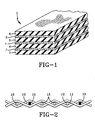
- FIG. 1 illustrates a three ply belting material 1 within the scope of the present invention.
- the belting material has a first outer fabric ply 2, a second outer fabric ply 3, and an inner fabric ply 4.
- the inner fabric ply 4 is substantially centered in the belting 1.
- the fabric ply 4 is a woven synthetic fabric.
- the selected materials are those conventionally used in belting, such as polyester, nylon, and glass.
- the material is selected such that the center fabric ply has a modulus and flex fatigue life less than the modulus and flex fatigue life of the outer fabric plies.
- Interposed between the fabric plies are rubber skim layers 5, 6.
- Outward of each outer fabric ply is an additional rubber cover layer 7, 8.
- the length of the belting material extends in the longitudinal direction of the belt, while the width of the belting material extends in the transverse direction.
- the outer plies 2,3 are made of a woven fabric.
- the fabric is illustrated in FIG. 2.
- Longitudinally extending warp yarns 10 are interwoven with transverse fill yarns 11.
- the fill yarns 11 are a predetermined combination of multi-filament cords 12 and monofilament cords 13. Illustrated is a monofilament cord fill frequency of one cord at every fourth fill location, yielding a woven fabric with a twenty-five percent fill rate of the monofilament cords.
- the frequency of the monofilament cords is varied to achieve a measured amount of transverse stiffness increase without adversely affecting the physical properties of the belt.
- the fill frequency of the monofilament cord is within the range of fifty percent to five percent of the fill yarns.
- the minimum fill ratio of the monofilament cord is limited by the desired transverse stiffness.
- the maximum fill ratio of the monofilament cord is limited by maintaining a desired rubber adhesion characteristic and tensile strength of the fabric.
- the monofilament fill locations may also be a repeating series of adjacent monofilament with a repeating series of multifilament fill cords.
- two adjacent monofilaments cords are next to three adjacent multifilament cords wherein for each length of belting fabric, the total fill frequency of the monofilament cords is not more than fifty percent.
- the belting material retains the needed fastener retention properties.
- the monofilament fill frequency is varied to achieve a measured amount of transverse stiffness increase without adversely affecting the physical properties of the current belt design. To achieve a desired physical effect, the fill frequency in the plies may even differ.
- the monofilament cord may be formed from extruded monofilament cords of polyester, nylon, or glass.
- the diameter of the monofilament cord is selected to approximate the diameter of the multifilament yarn in order to produce an even fabric.
- the monofilament cord ideally has a diameter of .5 mm.
- Other monofilament diameters such as .9 mm and .7 mm may also be employed.
- the multifilament yarns in the fill direction are polyester, nylon, or glass yarns.
- the yarns in the warp direction of the fabric are conventional belting materials such as polyester, nylon, or glass.
- the fabric is treated for improved rubber adhesion in accordance with conventional techniques, such as RFL dipping.
- the present invention is also applicable for two ply belting material.
- One embodiment of a two ply belt in accordance with the present invention provides for both plies to be of the disclosed inventive fabric.
- An alternative embodiment of the two ply belting material incorporates only one ply of the monofilament reinforced fabric.
- the fabric plies whether of the inventive fabric or conventional woven fabric of lower modulus, are each provided with a skim layer 5 or 6 positioned between the fabric plies upon final assembly. Outward of each fabric ply is a rubber cover layer 7, 8. If the belting material is formed of a combination of conventional woven fabric and the inventive fabric, the skim gauge on the conventional ply may be reduced to accommodate a required total thickness of the belt.
- Breaking Strength Greater breaking strength is preferred for hay baling belts. Higher breaking strengths aid in resisting damage from any abusive service conditions.
- the breaking strength for the inventive belt is greater than for the conventional 2 or 3 ply belts.
- Transverse Tear When belts "break" or come apart during service, the usual mode of failure is transverse tear.
- the exemplary inventive use of nylon yarns in the warp direction and the combination of nylon yarns and monofilament cords result in transverse tear resistance more than double that for the conventional belting material.
- the disclosed belt exhibits higher pullout values than the conventional 3-ply belt, and values comparable to a conventional 2-ply belt.
- the inventive belt has longitudinal stiffness half that of the conventional 3-ply belt. This longitudinal flexibility, i.e. lower longitudinal stiffness, is an important characteristic that has been identified as essential for belt movement around the relatively small pulleys of the haybaling machines.
- the inventive belt has a transverse stiffness 54% greater than the conventional 2-ply belt. While the inventive belt has a transverse stiffness less than that of the 3-ply belt, the greater tear properties compensate for the stiffness.
- the disclosed inventive belting material achieves the objective of increasing transverse properties while maintaining other necessary physical properties for good belt performance.
Landscapes
- Engineering & Computer Science (AREA)
- Mechanical Engineering (AREA)
- Woven Fabrics (AREA)
- Belt Conveyors (AREA)
- Package Frames And Binding Bands (AREA)
Applications Claiming Priority (1)
| Application Number | Priority Date | Filing Date | Title |
|---|---|---|---|
| PCT/US1998/014663 WO2000005158A1 (en) | 1998-07-21 | 1998-07-21 | Improved agricultural belting |
Publications (2)
| Publication Number | Publication Date |
|---|---|
| EP1098829A1 EP1098829A1 (en) | 2001-05-16 |
| EP1098829B1 true EP1098829B1 (en) | 2003-05-28 |
Family
ID=22267486
Family Applications (1)
| Application Number | Title | Priority Date | Filing Date |
|---|---|---|---|
| EP98936857A Expired - Lifetime EP1098829B1 (en) | 1998-07-21 | 1998-07-21 | Improved agricultural belting material |
Country Status (6)
| Country | Link |
|---|---|
| EP (1) | EP1098829B1 (enExample) |
| JP (1) | JP4247866B2 (enExample) |
| AR (1) | AR019447A1 (enExample) |
| AU (1) | AU8571398A (enExample) |
| DE (1) | DE69815160T2 (enExample) |
| WO (1) | WO2000005158A1 (enExample) |
Families Citing this family (1)
| Publication number | Priority date | Publication date | Assignee | Title |
|---|---|---|---|---|
| CN111038037A (zh) * | 2019-12-13 | 2020-04-21 | 上海米莜凯自动化装备有限公司 | 一种耐高温不粘附输送带及其制备方法 |
Family Cites Families (4)
| Publication number | Priority date | Publication date | Assignee | Title |
|---|---|---|---|---|
| GB1386795A (en) * | 1971-05-05 | 1975-03-12 | Bba Group Ltd | Conveyor belting materials |
| DE2519448B1 (de) * | 1975-04-30 | 1976-08-05 | Scholtz Ag Conrad | Gewebeeinlage für quersteife fördergurte |
| US4518647A (en) | 1984-06-11 | 1985-05-21 | Morrison Company, Inc. | Agricultural belting material |
| CH680435A5 (enExample) * | 1990-12-05 | 1992-08-31 | Habasit Ag |
-
1998
- 1998-07-21 AU AU85713/98A patent/AU8571398A/en not_active Abandoned
- 1998-07-21 EP EP98936857A patent/EP1098829B1/en not_active Expired - Lifetime
- 1998-07-21 DE DE69815160T patent/DE69815160T2/de not_active Expired - Lifetime
- 1998-07-21 JP JP2000561120A patent/JP4247866B2/ja not_active Expired - Fee Related
- 1998-07-21 WO PCT/US1998/014663 patent/WO2000005158A1/en not_active Ceased
-
1999
- 1999-07-21 AR ARP990103597A patent/AR019447A1/es active IP Right Grant
Also Published As
| Publication number | Publication date |
|---|---|
| EP1098829A1 (en) | 2001-05-16 |
| JP4247866B2 (ja) | 2009-04-02 |
| WO2000005158A1 (en) | 2000-02-03 |
| DE69815160D1 (de) | 2003-07-03 |
| DE69815160T2 (de) | 2004-04-01 |
| AR019447A1 (es) | 2002-02-20 |
| JP2002521281A (ja) | 2002-07-16 |
| AU8571398A (en) | 2000-02-14 |
Similar Documents
| Publication | Publication Date | Title |
|---|---|---|
| US4518647A (en) | Agricultural belting material | |
| US6427728B1 (en) | Conveyor belting with reinforcing fabric formed from three interlaced layers | |
| US7759266B2 (en) | Dual crimped warp fabric for conveyor belt applications | |
| KR102568578B1 (ko) | 밴드 피복식 마찰 전동 벨트 | |
| KR0131283B1 (ko) | 톱니형 동력전달벨트 | |
| JPH071054B2 (ja) | 歯付ベルト | |
| JPH09158989A (ja) | 接着処理繊維コード及びこれを用いた動力伝動用ベルト | |
| US4900609A (en) | Two-ply belting material | |
| JP4332682B2 (ja) | 繊維強化成形体 | |
| US5275858A (en) | Woven conveyor belt splice fabric and conveyor belt splice formed therewith | |
| US6159121A (en) | Toothed belt | |
| EP0049131A1 (en) | Power transmission belt manufacture | |
| US6518207B1 (en) | Agricultural belting | |
| EP1098829B1 (en) | Improved agricultural belting material | |
| JP2872581B2 (ja) | 歯付ベルト | |
| CA2354020C (en) | Conveyor belting with reinforcing fabric formed from three interlaced layers | |
| AU677075B2 (en) | Rubberline belting | |
| JPH10338008A (ja) | タイヤ滑り止め装置の締付用ベルト | |
| CN110418863B (zh) | 织物以及含有它的用于剪切应力应用的皮带 | |
| GB2245525A (en) | Sheet reinforcing material | |
| EP4000960A1 (en) | Fabric layer and tire comprising such a fabric layer | |
| MXPA01005563A (en) | Conveyor belting with reinforcing fabric formed from three interlaced layers | |
| JPH04132930U (ja) | タイヤ滑り止め具用ベルト |
Legal Events
| Date | Code | Title | Description |
|---|---|---|---|
| PUAI | Public reference made under article 153(3) epc to a published international application that has entered the european phase |
Free format text: ORIGINAL CODE: 0009012 |
|
| 17P | Request for examination filed |
Effective date: 20010221 |
|
| AK | Designated contracting states |
Kind code of ref document: A1 Designated state(s): DE FR GB |
|
| RTI1 | Title (correction) |
Free format text: IMPROVED AGRICULTURAL BELTING MATERIAL |
|
| RTI1 | Title (correction) |
Free format text: IMPROVED AGRICULTURAL BELTING MATERIAL |
|
| GRAH | Despatch of communication of intention to grant a patent |
Free format text: ORIGINAL CODE: EPIDOS IGRA |
|
| GRAH | Despatch of communication of intention to grant a patent |
Free format text: ORIGINAL CODE: EPIDOS IGRA |
|
| GRAA | (expected) grant |
Free format text: ORIGINAL CODE: 0009210 |
|
| AK | Designated contracting states |
Designated state(s): DE FR GB |
|
| REG | Reference to a national code |
Ref country code: GB Ref legal event code: FG4D |
|
| REF | Corresponds to: |
Ref document number: 69815160 Country of ref document: DE Date of ref document: 20030703 Kind code of ref document: P |
|
| ET | Fr: translation filed | ||
| PG25 | Lapsed in a contracting state [announced via postgrant information from national office to epo] |
Ref country code: FR Free format text: LAPSE BECAUSE OF NON-PAYMENT OF DUE FEES Effective date: 20040331 |
|
| PLBE | No opposition filed within time limit |
Free format text: ORIGINAL CODE: 0009261 |
|
| STAA | Information on the status of an ep patent application or granted ep patent |
Free format text: STATUS: NO OPPOSITION FILED WITHIN TIME LIMIT |
|
| REG | Reference to a national code |
Ref country code: FR Ref legal event code: ST |
|
| 26N | No opposition filed |
Effective date: 20040302 |
|
| REG | Reference to a national code |
Ref country code: GB Ref legal event code: 732E |
|
| PGFP | Annual fee paid to national office [announced via postgrant information from national office to epo] |
Ref country code: DE Payment date: 20170731 Year of fee payment: 20 Ref country code: GB Payment date: 20170719 Year of fee payment: 20 |
|
| REG | Reference to a national code |
Ref country code: DE Ref legal event code: R071 Ref document number: 69815160 Country of ref document: DE |
|
| REG | Reference to a national code |
Ref country code: GB Ref legal event code: PE20 Expiry date: 20180720 |
|
| PG25 | Lapsed in a contracting state [announced via postgrant information from national office to epo] |
Ref country code: GB Free format text: LAPSE BECAUSE OF EXPIRATION OF PROTECTION Effective date: 20180720 |