EP1098379A1 - Electrode for nonaqueous electrolyte battery - Google Patents
Electrode for nonaqueous electrolyte battery Download PDFInfo
- Publication number
- EP1098379A1 EP1098379A1 EP99926952A EP99926952A EP1098379A1 EP 1098379 A1 EP1098379 A1 EP 1098379A1 EP 99926952 A EP99926952 A EP 99926952A EP 99926952 A EP99926952 A EP 99926952A EP 1098379 A1 EP1098379 A1 EP 1098379A1
- Authority
- EP
- European Patent Office
- Prior art keywords
- electrode
- active material
- conductive agent
- graphite
- nonaqueous electrolyte
- Prior art date
- Legal status (The legal status is an assumption and is not a legal conclusion. Google has not performed a legal analysis and makes no representation as to the accuracy of the status listed.)
- Granted
Links
Images
Classifications
-
- H—ELECTRICITY
- H01—ELECTRIC ELEMENTS
- H01M—PROCESSES OR MEANS, e.g. BATTERIES, FOR THE DIRECT CONVERSION OF CHEMICAL ENERGY INTO ELECTRICAL ENERGY
- H01M4/00—Electrodes
- H01M4/02—Electrodes composed of, or comprising, active material
- H01M4/13—Electrodes for accumulators with non-aqueous electrolyte, e.g. for lithium-accumulators; Processes of manufacture thereof
- H01M4/133—Electrodes based on carbonaceous material, e.g. graphite-intercalation compounds or CFx
-
- H—ELECTRICITY
- H01—ELECTRIC ELEMENTS
- H01M—PROCESSES OR MEANS, e.g. BATTERIES, FOR THE DIRECT CONVERSION OF CHEMICAL ENERGY INTO ELECTRICAL ENERGY
- H01M4/00—Electrodes
- H01M4/02—Electrodes composed of, or comprising, active material
- H01M4/13—Electrodes for accumulators with non-aqueous electrolyte, e.g. for lithium-accumulators; Processes of manufacture thereof
- H01M4/131—Electrodes based on mixed oxides or hydroxides, or on mixtures of oxides or hydroxides, e.g. LiCoOx
-
- H—ELECTRICITY
- H01—ELECTRIC ELEMENTS
- H01M—PROCESSES OR MEANS, e.g. BATTERIES, FOR THE DIRECT CONVERSION OF CHEMICAL ENERGY INTO ELECTRICAL ENERGY
- H01M4/00—Electrodes
- H01M4/02—Electrodes composed of, or comprising, active material
- H01M4/04—Processes of manufacture in general
-
- H—ELECTRICITY
- H01—ELECTRIC ELEMENTS
- H01M—PROCESSES OR MEANS, e.g. BATTERIES, FOR THE DIRECT CONVERSION OF CHEMICAL ENERGY INTO ELECTRICAL ENERGY
- H01M4/00—Electrodes
- H01M4/02—Electrodes composed of, or comprising, active material
- H01M4/62—Selection of inactive substances as ingredients for active masses, e.g. binders, fillers
- H01M4/624—Electric conductive fillers
- H01M4/625—Carbon or graphite
-
- H—ELECTRICITY
- H01—ELECTRIC ELEMENTS
- H01M—PROCESSES OR MEANS, e.g. BATTERIES, FOR THE DIRECT CONVERSION OF CHEMICAL ENERGY INTO ELECTRICAL ENERGY
- H01M10/00—Secondary cells; Manufacture thereof
- H01M10/05—Accumulators with non-aqueous electrolyte
- H01M10/052—Li-accumulators
-
- Y—GENERAL TAGGING OF NEW TECHNOLOGICAL DEVELOPMENTS; GENERAL TAGGING OF CROSS-SECTIONAL TECHNOLOGIES SPANNING OVER SEVERAL SECTIONS OF THE IPC; TECHNICAL SUBJECTS COVERED BY FORMER USPC CROSS-REFERENCE ART COLLECTIONS [XRACs] AND DIGESTS
- Y02—TECHNOLOGIES OR APPLICATIONS FOR MITIGATION OR ADAPTATION AGAINST CLIMATE CHANGE
- Y02E—REDUCTION OF GREENHOUSE GAS [GHG] EMISSIONS, RELATED TO ENERGY GENERATION, TRANSMISSION OR DISTRIBUTION
- Y02E60/00—Enabling technologies; Technologies with a potential or indirect contribution to GHG emissions mitigation
- Y02E60/10—Energy storage using batteries
-
- Y—GENERAL TAGGING OF NEW TECHNOLOGICAL DEVELOPMENTS; GENERAL TAGGING OF CROSS-SECTIONAL TECHNOLOGIES SPANNING OVER SEVERAL SECTIONS OF THE IPC; TECHNICAL SUBJECTS COVERED BY FORMER USPC CROSS-REFERENCE ART COLLECTIONS [XRACs] AND DIGESTS
- Y10—TECHNICAL SUBJECTS COVERED BY FORMER USPC
- Y10T—TECHNICAL SUBJECTS COVERED BY FORMER US CLASSIFICATION
- Y10T29/00—Metal working
- Y10T29/49—Method of mechanical manufacture
- Y10T29/49002—Electrical device making
- Y10T29/49108—Electric battery cell making
- Y10T29/49112—Electric battery cell making including laminating of indefinite length material
Definitions
- the present invention relates to an electrode for a nonaqueous electrolyte battery having an electrode active material layer including a positive electrode active material, a conductive agent and a binder. More particularly, it relates to an electrode for a nonaqueous electrolyte battery having improved change/discharge characteristics such as discharge capacity and charge/discharge cycle life and the like.
- lithium nickel composite oxide LiNiO 2 is proposed as a positive electrode active material.
- a conductive agent is used because of poor electric conductivity of active materials except for some of these.
- Japanese Laid-open Patent Publication No. Sho 62-15761/1987 discloses a nonaqueous electrolyte secondary battery using acetylene black as a conductive agent.
- acetylene black is liable to assume an assembled state, so that the contact property between acetylene black and a positive electrode active material seems to be poor.
- decrease in capacity is large by repeated charge/discharge operations.
- Hei 1-105459/1989 discloses a nonagueous electrolyte secondary battery comprising a positive electrode mainly made of LiMn 2 O 4 and graphite, a negative electrode and a nonaqueous electrolyte, wherein the amount of graphite in the total amount of LiMn 2 O 4 and graphite is 8 to 22 % by weight. This means that, in order to use graphite as a conductive agent, the effect will not be exhibited unless graphite is added in a large amount.
- Japanese Laid-open Patent Publication No. Hei 4-215252/1992 discloses use of a scaly graphite as a conductive agent for a positive electrode in a nonaqueous electrolyte secondary battery.
- the mass of active material per unit volume decreases, thereby leading to decrease in the capacity as a battery.
- nonaqueous electrolyte secondary batteries decreases with repeated use.
- One of the factors for this deterioration of the secondary batteries seems to be due to the fact that electricity cannot be taken out to the outside because contact property between the active material and the conductive agent in the electrode becomes poor.
- an object of the present invention is to provide an electrode for a nonaqueous electrolyte battery with improved charge/discharge characteristics such as discharge capacity and charge/discharge cycle life and the like.
- the present inventors have made eager studies and found out that, with the use of crushed expanded graphite as a conductive agent, the performance of the active material can be drawn out with a smaller amount of the conductive agent, thereby completing the present invention.
- the present invention is an electrode for a nonaqueous electrolyte battery, having an electrode active material layer including at least a positive electrode active material, a conductive agent and a binder, wherein at least a part of said conductive agent is a crushed expanded graphite.
- the crushed expanded graphite preferably has a median particle diameter of 0.1 to 40 ⁇ m.
- the quantity of the conductive agent to be used in the electrode active material layer is preferably 0.1 to 15 % by weight.
- the positive electrode active material is, for example, a lithium composite oxide selected from the group consisting of LiCoO 2 , LiNiO 2 , LiMn 2 O 4 and Li x Ni y M z O 2 (where x satisfies 0.8 ⁇ x ⁇ 1.5, y + z satisfies 0.8 ⁇ y + z ⁇ 1.2, and z satisfies 0 ⁇ z ⁇ 0.35; and M represents at least one kind of an element selected from Co, Mg, Ca, Sr, Al, Mn and Fe).
- An electrode for a nonaqueous electrolyte battery of the present invention has an electrode active material layer including at least a positive electrode active material, a conductive agent and a binder.
- crushed expanded graphite is used as the conductive agent.
- the present invention has an advantage in that the effect is exhibited with a small amount of the conductive agent.
- An example of a method for producing expanded graphite is a method shown in "Graphite Intercalation Compound" (ed. Nobuatsu Watanabe, Kindai Henshuu Sha), or the like.
- the aforesaid book mentions that the expanded graphite is produced through a process of treating powder of natural scaly graphite, thermally decomposed graphite, Kisch graphite, or the like with an inorganic acid such as concentrated sulfuric acid, nitric acid or selenic acid, and a strong oxidizing agent such as concentrated nitric acid, perchloric acid, perchlorate, permanganate, dichromate or hydrogen peroxide to produce a graphite intercalation compound, followed by washing with water, drying, a rapid heating treatment above several hundred °C, and other steps.
- the expanded graphite powder is expanded considerably by the rapid heating treatment, thereby to show a honeycomb structure.
- Japanese Laid-open Patent Publication No. Sho 61-127612/1986 proposes a method of crushing in a state in which the voids in the expanded graphite are filled with liquid, or in a state in which the liquid is frozen.
- Japanese Laid-open Patent Publication No. Hei 2-153810/1990 proposes a method of crushing expanded graphite by dispersing the expanded graphite into liquid and allowing a supersonic wave to act on the inside of the liquid.
- Hel 6-254422/1994 proposes a method of crushing expanded graphite by dispersing the expanded graphite into liquid and allowing spherical or rod-like medium to act on the inside of the liquid.
- Japanese Laid-open Patent Publication No. Hei 8-217434/1996 proposes a method of crushing expanded graphite by immersing the expanded graphite into liquid, then coarsely crushing the expanded graphite to obtain a graphite slurry, and crushing the slurry by means of a grinder having a rotary disk-like grindstone.
- Japanese Laid-open Patent Publication No Hei 9-35719/1997 gives a description on the use of expanded graphite, which has been subjected to wet grinding treatment, for an alkali manganese battery.
- the expanded graphite is allowed to serve both as a conductive agent and as a binder. Also, the effect of the expanded graphite as a binder is shown.
- the crushed expanded graphite is allowed to serve as a conductive agent, and a different binder is used.
- primary batteries only discharging is carried out; however, in secondary batteries, charging and discharging must be carried out. It has been found out that, in such a battery subjected to a repeated charging and discharging process, the relationship of the particle diameters between the active material and the conductive agent affects the cycle life.
- Japanese Laid-open Patent Publication No. Sho 63-301460/1988 discloses that, with regard to conductive agents, the larger effect is produced according as the particle diameter is smaller. Those having a small particle diameter have a large specific surface area and can produce a larger capacity, but has a poor cycle life. This seems to be because the contact between the conductive agents is deteriorated by a repeated charging and discharging process.
- the crushed expanded graphite preferably has a median particle diameter of 0.1 to 40 ⁇ m, more preferably 0.1 to 20 ⁇ m.
- the median particle diameter is measured with the use of a laser particle size analyzer such as Microtrack manufactured by Nikkiso Co., Ltd., and refers to the accumulated percent diameter at 50%.
- the blending amount of the conductive agent is preferably 0.1 to 15 % by weight, more preferably 1 to 10 % by weight, in a dried coating layer, though it depends on the powder physical properties of the active material. If the amount is less than 0.1 % by weight, the conductivity will be insufficient and liable to cause decrease of capacity. On the other hand, if it exceeds 15 % by weight, the mass of the active material that is substantially acting will decrease, so that the capacity is liable to decrease as well.
- the positive electrode active material for use in the present invention is not particularly limited. Specifically, however, lithium composite oxide such as LiCoO 2 , LiNiO 2 , LiMn 2 O 4 and Li x Ni y M z O 2 (where x satisfies 0.8 ⁇ x ⁇ 1.5, y + z satisfies 0.8 ⁇ y + z ⁇ 1.2, and z satisfies 0 ⁇ z ⁇ 0.35; and M represents at least one kind of an element selected from Co, Mg, Ca, Sr. Al, Mn and Fe), may be mentioned.
- the pH of the active material is preferably not smaller than 9. Among these, LiNiO 2 and Li x Ni y M z O 2 have a powder pH of strongly alkaline, and can get along well with the strong acidity of expanded graphite.
- the median particle diameter of these lithium composite oxides is preferably 1.0 to 30.0 ⁇ m, more preferably 2.0 to 20.0 ⁇ m.
- the half-value width at the median particle diameter of the particle size distribution is preferably 2.0 to 10.0 ⁇ m.
- the ratio of the median particle diameter of the conductive agent to the median particle diameter of the active material is preferably 1/10 to 3.
- the binder to be used in the present invention is one or a mixture of two or more of thermoplastic resins or polymers having a rubber elasticity.
- the binders to be used include fluorine-type polymers, polyvinyl alcohol, carboxymethyl cellulose, hydroxypropyl cellulose, regenerated cellulose, diacetyl cellulose, polyvinyl chloride, polyvinyl pyrrolidone, polyethylene, polypropylene, EPDM, sulfonated EPDM, SBR, polybutadiene, polyethylene oxide, and the like.
- the fluorine-containing polymer preferably has an atomic ratio of fluorine atoms/carbon atoms in the range of 0.75 to 1.5, more preferably in the range of 0.75 to 1.3. If this value is larger than 1.5, it tends to be difficult to obtain a sufficient capacity of the battery. On the other hand, if it is smaller than 0.75, the binder is likely to be dissolved in the electrolytic solution.
- fluorine-containing polymers examples include polytetrafluoro-ethylene, polyvinylidene fluoride, vinylidene fluoride-ethylene trifluoride copolymers, ethylene-tetrafluoroethylene copolymers, propylene-tetrafluoroethylene copolymers, and the like.
- a fluorine-containing polymer with its hydrogen in the main chain substituted by an alkyl group(s) may be used as well.
- vinylidene fluoride-type polymers are only slightly soluble in a carbonate-type solvent that is used as the electrolytic solution or the like, but are soluble in a solvent such as N,N-dimethylformamide or N-methylpyrrolidone.
- the amount of the binder to be blended is preferably 2 to 20 % by weight, more preferably 3 to 15 % by weight in a dried coating layer, although it depends on the specific surface areas and the particle size distributions of the active material and the conductive agent, the strength of the intended electrode, and the like.
- the solvent for the electrode active material mixture-coating material is not particularly limited, and general organic solvents can be used.
- the organic solvents include saturated hydrocarbons such as hexane, aromatic hydrocarbons such as toluene and xylene, alcohols such as methanol, ethanol, propanol and butanol, ketones such as acetone, methyl ethyl ketone, methyl isobutyl ketone, diisobutyl ketone and cyclohexanone, esters such as ethyl acetate and butyl acetate, ethers such as tetrahydrofuran, dioxane and diethyl ether, amides such as N,N-dimethylformamide, N-methylpyrrolidone and N, N-dimethylacetamide, halogenated hydrocarbons such as ethylene chloride and chlorobenzene, and the like.
- amide-type solvents are preferable because they can be saturated hydro
- the electrode active material mixture-coating material can be fabricated by mixing an active material, a conductive agent, a binder, a solvent, and others by means of a hypermixer or the like. Further, the coating material may be subjected to a supersonic treatment for dispersion. In order that the active material and the conductive agent are uniformly mixed, the active material and the conductive agent may be subjected to a drying treatment in advance with the use of an angmill or the like. Further, the active material and the conductive agent may be mixed with a binder solution and kneaded with the use of a pressure-kneader or the like to prepare a coating material.
- the collector for the electrode may be any electron conducting substance that does not undergo a chemical change in a constructed battery.
- aluminum foil, stainless steel foil, nickel foil, and others having a thickness of 5 to 40 ⁇ m can be used.
- the electrode active material mixture-coating material is applied onto the collector by a generally well-known application method such as the reverse roll method, direct roll method, blade method, knife method, extrusion method, curtain method, gravure roll method, bar coat method, dipping method, kiss coat method, squeeze method, and the like.
- the extrusion method is preferable, whereby a good surface state of a coating layer can be obtained by selecting the solvent composition of the coating material and the drying condition so that the coating material may be applied onto the collector at a speed of 5 to 100 m/min.
- the thickness, length, and width of the coating layer is determined by the final size of the battery to be obtained.
- the thickness of the coating layer is preferably adjusted by the ordinarily-adopted calendering-processing after the coating step.
- the processing pressure is preferably 0.2 to 10 t/cm, and the processing temperature is preferably 10 to 150°C.
- An active material layer was fabricated as follows.
- the obtained coating material was applied onto one surface of a collector made of aluminum foil by means of a blade coater, and dried. Then, the same coating material was applied onto the rear surface and dried, followed by compression-molding with a roller press, and cutting into a predetermined size to obtain an electrode of Example 1.
- Example 2 An electrode of Example 2 was obtained by the same operations as in Example 1 except that specially treated graphite (crushed expanded graphite manufactured by Chuetsu Graphite Works Co., Ltd.) having a median particle diameter of 5 ⁇ m was used instead of the specially treated graphite (manufactured by Chuetsu Graphite Works Co., Ltd.) having a median particle diameter of 10 ⁇ m, as a conductive agent.
- specially treated graphite crushed expanded graphite manufactured by Chuetsu Graphite Works Co., Ltd.
- specially treated graphite manufactured by Chuetsu Graphite Works Co., Ltd.
- Example 3 An electrode of Example 3 was obtained by the same operations as in Example 1 except that specially treated graphite (crushed expanded graphite manufactured by Chuetsu Graphite Works Co., Ltd.) having a median particle diameter of 20 ⁇ m was used instead of the specially treated graphite (manufactured by Chuetsu Graphite Works Co., Ltd.) having a median particle diameter of 10 ⁇ m, as a conductive agent.
- specially treated graphite crushed expanded graphite manufactured by Chuetsu Graphite Works Co., Ltd.
- specially treated graphite manufactured by Chuetsu Graphite Works Co., Ltd.
- An electrode of Comparative Example 1 was obtained by the same operations as in Example 1 except that artificial scaly graphite KS25 (manufactured by LONZA Co., Ltd.) having a median particle diameter of 11 ⁇ m was used instead of the specially treated graphite (manufactured by Chuetsu Graphite Works Co., Ltd.) having a median particle diameter of 10 ⁇ m, as a conductive agent.
- artificial scaly graphite KS25 manufactured by LONZA Co., Ltd.
- specially treated graphite manufactured by Chuetsu Graphite Works Co., Ltd.
- Each of the samples of Examples 1 to 3 and Comparative Example 1 was cut into a rectangular shape of 25 mm ⁇ 20 mm. Then, an upper portion of the electrode layer was removed by a width of 5 mm to leave an electrode layer of 20 mm square. A stainless steel wire was spot-welded as a lead wire onto the upper portion of the electrode where the electrode layer was removed, thus preparing this electrode (working electrode).
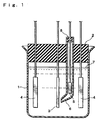
- a cell for measuring the charge/discharge capacities was prepared as shown in Fig. 1, and the charge/discharge operations were carried out in the following manner.
- a beaker (1) in a beaker (1) were disposed a pair of counter electrodes (4) made of a lithium plate and connected to a stainless steel wire, a Capillary tube (6) having a similar reference electrode (5), and the electrode (working electrode) (3) as prepared above.
- the working electrode (3) was disposed in the middle of the two counter electrodes (4).
- An electrolytic solution (7) was prepared by dissolving 1 mol/L of lithium perchlorate as an electrolyte salt in a mixture solvent containing ethylene carbonate and diethyl carbonate at 1:1 (volume ratio).
- the beaker (1) and the Capillary tube (6) were sealed with silicon plugs (2) and (8), respectively, to prepare the cell for measurement.
- crushed expanded graphite is used as a conductive agent, an electrode for a nonaqueous electrolyte battery with improved charge/discharge characteristics such as discharge capacity and charge/discharge cycle life and the like can be obtained.
Landscapes
- Chemical & Material Sciences (AREA)
- Chemical Kinetics & Catalysis (AREA)
- Electrochemistry (AREA)
- General Chemical & Material Sciences (AREA)
- Engineering & Computer Science (AREA)
- Materials Engineering (AREA)
- Manufacturing & Machinery (AREA)
- Battery Electrode And Active Subsutance (AREA)
- Secondary Cells (AREA)
Abstract
Description
| Material | Parts by weight |
| Active material: LiCoO2 (median particle diameter of 7.5 µm) C-010 manufactured by Seimi Chemical Co., Ltd. | 90 |
| Conductive agent: specially treated graphite (median particle diameter of 10 µm) crushed expanded graphite manufactured by Chuetsu Graphite Works Co., Ltd. | 6 |
| Binder: polyvinylidene fluoride (PVDF) | 4 |
| Solvent: N-methyl-2-pyrrolidone (NMP) | 45 |
| Charging capacity (mAh/g) | Discharging capacity (mAh/g) | Discharging capacity at the fifth time (mAh/g) | |
| Example 1 | 141 | 135 | 130 |
| Example 2 | 144 | 137 | 133 |
| Example 3 | 137 | 130 | 125 |
| Comparative Example 1 | 118 | 110 | 100 |
Claims (5)
- An electrode for a nonaqueous electrolyte battery, having an electrode active material layer including at least a positive electrode active material, a conductive agent and a binder, wherein at least a part of said conductive agent is a crushed expanded graphite.
- The electrode for a nonaqueous electrolyte battery according to claim 1, wherein the crushed expanded graphite has a median particle diameter of 0.1 to 40 µm.
- The electrode for a nonaqueous electrolyte battery according to claim 1, wherein the quantity of the conductive agent in the electrode active material layer is 0.1 to 15 % by weight.
- The electrode for a nonaqueous electrolyte battery according to claim 1, wherein the positive electrode active material is selected from the group consisting of LiCoO2, LiNiO2, LiMn2O4 and LixNiyMzO2 (where x satisfies 0.8 < x < 1.5, y + z satisfies 0.8 < y + z < 1.2, and z satisfies 0 ≤ z < 0.35; and M represents at least one kind of an element selected from Co, Mg, Ca, Sr, Al, Mn and Fe).
- An electrode for a nonaqueous electrolyte secondary battery according to any one of claims 1 to 4.
Applications Claiming Priority (3)
| Application Number | Priority Date | Filing Date | Title |
|---|---|---|---|
| JP20720898 | 1998-07-06 | ||
| JP20720898 | 1998-07-06 | ||
| PCT/JP1999/003640 WO2000002280A1 (en) | 1998-07-06 | 1999-07-05 | Electrode for nonaqueous electrolyte battery |
Publications (3)
| Publication Number | Publication Date |
|---|---|
| EP1098379A1 true EP1098379A1 (en) | 2001-05-09 |
| EP1098379A4 EP1098379A4 (en) | 2007-05-30 |
| EP1098379B1 EP1098379B1 (en) | 2011-11-23 |
Family
ID=16536037
Family Applications (1)
| Application Number | Title | Priority Date | Filing Date |
|---|---|---|---|
| EP99926952A Expired - Lifetime EP1098379B1 (en) | 1998-07-06 | 1999-07-05 | Electrode for nonaqueous electrolyte battery |
Country Status (6)
| Country | Link |
|---|---|
| US (1) | US6824924B1 (en) |
| EP (1) | EP1098379B1 (en) |
| JP (1) | JP4529288B2 (en) |
| KR (1) | KR100600632B1 (en) |
| CN (1) | CN1194433C (en) |
| WO (1) | WO2000002280A1 (en) |
Cited By (4)
| Publication number | Priority date | Publication date | Assignee | Title |
|---|---|---|---|---|
| WO2003032415A3 (en) * | 2001-10-08 | 2004-03-18 | Timcal Ag | Electrochemical cell |
| WO2004097961A3 (en) * | 2003-04-30 | 2005-07-07 | Univ Montreal | Polymeric binder for fused salts electrolytes based batteries |
| EP2017910A1 (en) * | 2007-07-20 | 2009-01-21 | BIOTRONIK CRM Patent AG | Active element and battery and method for production of same |
| US8722248B2 (en) | 2008-08-26 | 2014-05-13 | Biotronik Crm Patent Ag | Active element and battery as well as method for the production thereof |
Families Citing this family (10)
| Publication number | Priority date | Publication date | Assignee | Title |
|---|---|---|---|---|
| JP3632686B2 (en) * | 2002-08-27 | 2005-03-23 | ソニー株式会社 | Positive electrode active material and non-aqueous electrolyte secondary battery |
| US20050241137A1 (en) * | 2004-04-28 | 2005-11-03 | Tdk Corporation | Electrode, electrochemical device, and method of making electrode |
| US7381496B2 (en) * | 2004-05-21 | 2008-06-03 | Tiax Llc | Lithium metal oxide materials and methods of synthesis and use |
| CN100341179C (en) * | 2004-08-17 | 2007-10-03 | 中国电子科技集团公司第十八研究所 | Positive electrode for zinc-air battery and its manufacturing method |
| JP2006228704A (en) * | 2005-01-18 | 2006-08-31 | Nissan Motor Co Ltd | Secondary battery electrode and non-aqueous electrolyte secondary battery using the same |
| DE102006021158A1 (en) * | 2006-05-06 | 2007-11-08 | Biotronik Crm Patent Ag | Electrode for a lithium battery and method of making the same |
| CN102077392B (en) * | 2009-01-26 | 2013-08-28 | 丰田自动车株式会社 | Positive electrode for lithium secondary battery and use thereof |
| JP5561559B2 (en) * | 2011-10-06 | 2014-07-30 | トヨタ自動車株式会社 | Method for manufacturing lithium secondary battery |
| JP5826653B2 (en) * | 2012-02-01 | 2015-12-02 | 株式会社Gsユアサ | Positive electrode active material for non-aqueous electrolyte secondary battery and non-aqueous electrolyte secondary battery using the same |
| US10159548B2 (en) | 2014-09-17 | 2018-12-25 | Garrison Dental Solutions, L.L.C. | Dental curing light |
Family Cites Families (30)
| Publication number | Priority date | Publication date | Assignee | Title |
|---|---|---|---|---|
| JPS61127612A (en) | 1984-11-26 | 1986-06-14 | Agency Of Ind Science & Technol | Method for manufacturing conductive graphite material |
| JPS6215761A (en) | 1985-07-12 | 1987-01-24 | Matsushita Electric Ind Co Ltd | Nonaqueous electrolyte secondary cell |
| JPS63301460A (en) | 1987-05-30 | 1988-12-08 | Kanebo Ltd | Manufacture of electrode for battery |
| JPS63307662A (en) | 1987-06-09 | 1988-12-15 | Toshiba Battery Co Ltd | Organic electrolyte battery |
| JP2611265B2 (en) | 1987-10-17 | 1997-05-21 | ソニー株式会社 | Non-aqueous electrolyte secondary battery |
| JPH064482B2 (en) | 1988-06-08 | 1994-01-19 | 三井鉱山株式会社 | Flake graphite powder and method for producing the same |
| JPH02252760A (en) | 1989-03-27 | 1990-10-11 | Sumitomo Chem Co Ltd | Polyaniline composition and secondary battery using same as positive electrode material |
| JP3162695B2 (en) | 1990-05-22 | 2001-05-08 | 三洋電機株式会社 | Rechargeable battery |
| JP3132008B2 (en) | 1990-12-13 | 2001-02-05 | ソニー株式会社 | Non-aqueous electrolyte secondary battery |
| JP3300454B2 (en) | 1993-03-04 | 2002-07-08 | 日本黒鉛工業株式会社 | Method for producing highly oriented graphite powder and highly oriented graphite powder produced by the method |
| JP3450894B2 (en) * | 1994-03-28 | 2003-09-29 | 松下電器産業株式会社 | Alkaline manganese battery |
| JP3216451B2 (en) * | 1994-12-12 | 2001-10-09 | 松下電器産業株式会社 | Non-aqueous electrolyte battery |
| JPH08217434A (en) | 1995-02-13 | 1996-08-27 | Mitsui Kozan Kasei Kk | Method for producing flaky graphite fine powder |
| WO1996027910A1 (en) * | 1995-03-06 | 1996-09-12 | Fuji Photo Film Co., Ltd. | Nonaqueous secondary cell |
| DE69603116T2 (en) | 1995-04-04 | 2000-03-09 | Dainippon Printing Co Ltd | Non-aqueous electrolyte secondary battery electrode and manufacturing method |
| JPH08339796A (en) * | 1995-04-04 | 1996-12-24 | Dainippon Printing Co Ltd | Electrode plate for non-aqueous electrolyte secondary battery and manufacturing method thereof |
| JPH0935719A (en) | 1995-07-20 | 1997-02-07 | Matsushita Electric Ind Co Ltd | Alkaline manganese battery |
| JPH09129239A (en) | 1995-10-31 | 1997-05-16 | Matsushita Electric Ind Co Ltd | Organic electrolyte battery |
| JPH09129216A (en) | 1995-11-01 | 1997-05-16 | Fuji Photo Film Co Ltd | Nonaqueous secondary battery |
| JPH09180720A (en) | 1995-12-27 | 1997-07-11 | Murata Mfg Co Ltd | Nonaqueous electrolyte secondary battery |
| US5772930A (en) * | 1995-12-27 | 1998-06-30 | Matsushita Electric Industrial Co., Ltd. | Method of producing cathode mixture for batteries |
| JPH09180724A (en) | 1995-12-27 | 1997-07-11 | Matsushita Electric Ind Co Ltd | Battery |
| JPH09237624A (en) | 1996-02-27 | 1997-09-09 | Sanyo Electric Co Ltd | Lithium battery |
| JPH1021910A (en) * | 1996-06-28 | 1998-01-23 | Sony Corp | Non-aqueous electrolyte secondary battery |
| JP3311597B2 (en) | 1996-09-12 | 2002-08-05 | 株式会社日立製作所 | Secondary battery and its positive electrode |
| JPH10188993A (en) * | 1996-12-24 | 1998-07-21 | Ricoh Co Ltd | Non-aqueous electrolyte secondary battery |
| JP3223824B2 (en) * | 1996-12-26 | 2001-10-29 | 三菱電機株式会社 | Lithium ion secondary battery |
| JPH10233205A (en) | 1997-02-19 | 1998-09-02 | Fuji Elelctrochem Co Ltd | Non-aqueous electrolyte secondary battery |
| JP3702568B2 (en) | 1997-03-06 | 2005-10-05 | 松下電器産業株式会社 | Organic electrolyte secondary battery |
| JP3115256B2 (en) | 1997-07-01 | 2000-12-04 | 富士電気化学株式会社 | Non-aqueous electrolyte secondary battery |
-
1999
- 1999-07-05 EP EP99926952A patent/EP1098379B1/en not_active Expired - Lifetime
- 1999-07-05 JP JP2000558582A patent/JP4529288B2/en not_active Expired - Fee Related
- 1999-07-05 US US09/719,575 patent/US6824924B1/en not_active Expired - Lifetime
- 1999-07-05 CN CNB998082988A patent/CN1194433C/en not_active Expired - Fee Related
- 1999-07-05 WO PCT/JP1999/003640 patent/WO2000002280A1/en not_active Ceased
- 1999-07-05 KR KR1020017000074A patent/KR100600632B1/en not_active Expired - Fee Related
Cited By (4)
| Publication number | Priority date | Publication date | Assignee | Title |
|---|---|---|---|---|
| WO2003032415A3 (en) * | 2001-10-08 | 2004-03-18 | Timcal Ag | Electrochemical cell |
| WO2004097961A3 (en) * | 2003-04-30 | 2005-07-07 | Univ Montreal | Polymeric binder for fused salts electrolytes based batteries |
| EP2017910A1 (en) * | 2007-07-20 | 2009-01-21 | BIOTRONIK CRM Patent AG | Active element and battery and method for production of same |
| US8722248B2 (en) | 2008-08-26 | 2014-05-13 | Biotronik Crm Patent Ag | Active element and battery as well as method for the production thereof |
Also Published As
| Publication number | Publication date |
|---|---|
| EP1098379B1 (en) | 2011-11-23 |
| KR100600632B1 (en) | 2006-07-13 |
| EP1098379A4 (en) | 2007-05-30 |
| CN1194433C (en) | 2005-03-23 |
| JP4529288B2 (en) | 2010-08-25 |
| KR20010071724A (en) | 2001-07-31 |
| WO2000002280A1 (en) | 2000-01-13 |
| US6824924B1 (en) | 2004-11-30 |
| CN1308779A (en) | 2001-08-15 |
Similar Documents
| Publication | Publication Date | Title |
|---|---|---|
| EP3660956B1 (en) | Negative electrode for lithium secondary battery and lithium secondary battery comprising the same | |
| EP4220760A1 (en) | Sodium metal battery and electrochemical device | |
| EP2717377A1 (en) | Battery | |
| JP2000348730A (en) | Nonaqueous electrolyte secondary battery | |
| EP2113957B1 (en) | Positive electrode for lithium secondary cell and lithium secondary cell using the same | |
| KR102256479B1 (en) | Negative electrode active material for lithium secondary battery, and preparing method therof | |
| EP2424014A2 (en) | Electrode for nonaqueous electrolyte secondary battery, nonaqueous electrolyte secondary battery, and method for manufacturing electrode for nonaqueous electrolyte secondary battery | |
| EP3683872B1 (en) | Silicon-carbon composite and lithium secondary battery comprising same | |
| US6824924B1 (en) | Electrode for nonaqueous electrolyte battery | |
| JP7807137B2 (en) | Negative electrode and secondary battery including the same | |
| CN101243565B (en) | Electrochemical device having high capacity and method for manufacturing the same | |
| JPH09171814A (en) | Negative electrode for lithium secondary battery and lithium secondary battery using the negative electrode | |
| JP3157079B2 (en) | Manufacturing method of lithium secondary battery | |
| JPWO2000002280A1 (en) | Electrodes for non-aqueous electrolyte batteries | |
| EP0986121B1 (en) | Electrode for non-aqueous electrolyte battery | |
| KR20180028797A (en) | Anode with improved swelling phenomenon and Lithium secondary battery comprising the anode | |
| JP2005025991A (en) | Nonaqueous electrolyte secondary battery | |
| JP3501113B2 (en) | Non-aqueous secondary battery and method of manufacturing the same | |
| US6300008B1 (en) | Method for producing electrode for non-aqueous electrolyte battery | |
| EP0986115B1 (en) | Electrode for non-aqueous electrolytic cells | |
| JPH09289022A (en) | Nonaqueous electrolyte secondary battery | |
| EP2631973A1 (en) | Electrode for lithium secondary battery, manufacturing method thereof and lithium secondary battery comprising the same | |
| JP4833276B2 (en) | Carbon material for lithium battery and lithium battery | |
| JPH05144471A (en) | Non-aqueous electrolyte secondary battery | |
| JP3884550B2 (en) | Method for producing electrode for non-aqueous electrolyte battery |
Legal Events
| Date | Code | Title | Description |
|---|---|---|---|
| PUAI | Public reference made under article 153(3) epc to a published international application that has entered the european phase |
Free format text: ORIGINAL CODE: 0009012 |
|
| 17P | Request for examination filed |
Effective date: 20010130 |
|
| AK | Designated contracting states |
Kind code of ref document: A1 Designated state(s): AT BE CH CY DE DK ES FI FR GB GR IE IT LI LU MC NL PT SE |
|
| A4 | Supplementary search report drawn up and despatched |
Effective date: 20070503 |
|
| 17Q | First examination report despatched |
Effective date: 20071112 |
|
| REG | Reference to a national code |
Ref country code: DE Ref legal event code: R079 Ref document number: 69943876 Country of ref document: DE Free format text: PREVIOUS MAIN CLASS: H01M0004620000 Ipc: H01M0010050000 |
|
| GRAP | Despatch of communication of intention to grant a patent |
Free format text: ORIGINAL CODE: EPIDOSNIGR1 |
|
| RIC1 | Information provided on ipc code assigned before grant |
Ipc: H01M 4/13 20100101ALI20110520BHEP Ipc: H01M 4/04 20060101ALI20110520BHEP Ipc: H01M 4/62 20060101ALI20110520BHEP Ipc: H01M 10/05 20100101AFI20110520BHEP |
|
| RBV | Designated contracting states (corrected) |
Designated state(s): DE FR GB |
|
| GRAS | Grant fee paid |
Free format text: ORIGINAL CODE: EPIDOSNIGR3 |
|
| GRAA | (expected) grant |
Free format text: ORIGINAL CODE: 0009210 |
|
| AK | Designated contracting states |
Kind code of ref document: B1 Designated state(s): DE FR GB |
|
| REG | Reference to a national code |
Ref country code: GB Ref legal event code: FG4D |
|
| REG | Reference to a national code |
Ref country code: DE Ref legal event code: R096 Ref document number: 69943876 Country of ref document: DE Effective date: 20120202 |
|
| PLBE | No opposition filed within time limit |
Free format text: ORIGINAL CODE: 0009261 |
|
| STAA | Information on the status of an ep patent application or granted ep patent |
Free format text: STATUS: NO OPPOSITION FILED WITHIN TIME LIMIT |
|
| 26N | No opposition filed |
Effective date: 20120824 |
|
| REG | Reference to a national code |
Ref country code: DE Ref legal event code: R097 Ref document number: 69943876 Country of ref document: DE Effective date: 20120824 |
|
| REG | Reference to a national code |
Ref country code: DE Ref legal event code: R082 Ref document number: 69943876 Country of ref document: DE Representative=s name: KILIAN KILIAN & PARTNER MBB PATENTANWAELTE, DE Ref country code: DE Ref legal event code: R082 Ref document number: 69943876 Country of ref document: DE Representative=s name: KILIAN KILIAN & PARTNER, DE |
|
| REG | Reference to a national code |
Ref country code: FR Ref legal event code: PLFP Year of fee payment: 18 |
|
| REG | Reference to a national code |
Ref country code: FR Ref legal event code: PLFP Year of fee payment: 19 |
|
| PGFP | Annual fee paid to national office [announced via postgrant information from national office to epo] |
Ref country code: FR Payment date: 20170613 Year of fee payment: 19 |
|
| PGFP | Annual fee paid to national office [announced via postgrant information from national office to epo] |
Ref country code: DE Payment date: 20170627 Year of fee payment: 19 Ref country code: GB Payment date: 20170705 Year of fee payment: 19 |
|
| REG | Reference to a national code |
Ref country code: DE Ref legal event code: R119 Ref document number: 69943876 Country of ref document: DE |
|
| GBPC | Gb: european patent ceased through non-payment of renewal fee |
Effective date: 20180705 |
|
| PG25 | Lapsed in a contracting state [announced via postgrant information from national office to epo] |
Ref country code: FR Free format text: LAPSE BECAUSE OF NON-PAYMENT OF DUE FEES Effective date: 20180731 Ref country code: GB Free format text: LAPSE BECAUSE OF NON-PAYMENT OF DUE FEES Effective date: 20180705 Ref country code: DE Free format text: LAPSE BECAUSE OF NON-PAYMENT OF DUE FEES Effective date: 20190201 |