EP1096119A2 - Schalteinheit - Google Patents
Schalteinheit Download PDFInfo
- Publication number
- EP1096119A2 EP1096119A2 EP00121262A EP00121262A EP1096119A2 EP 1096119 A2 EP1096119 A2 EP 1096119A2 EP 00121262 A EP00121262 A EP 00121262A EP 00121262 A EP00121262 A EP 00121262A EP 1096119 A2 EP1096119 A2 EP 1096119A2
- Authority
- EP
- European Patent Office
- Prior art keywords
- flap
- flow cross
- switching unit
- switched
- section
- Prior art date
- Legal status (The legal status is an assumption and is not a legal conclusion. Google has not performed a legal analysis and makes no representation as to the accuracy of the status listed.)
- Granted
Links
- 238000002485 combustion reaction Methods 0.000 claims abstract description 7
- 238000007789 sealing Methods 0.000 claims description 11
- 238000001746 injection moulding Methods 0.000 claims description 3
- 238000005516 engineering process Methods 0.000 description 3
- 230000008878 coupling Effects 0.000 description 2
- 238000010168 coupling process Methods 0.000 description 2
- 238000005859 coupling reaction Methods 0.000 description 2
- 238000004519 manufacturing process Methods 0.000 description 2
- 238000003860 storage Methods 0.000 description 2
- 230000001360 synchronised effect Effects 0.000 description 2
- 238000011144 upstream manufacturing Methods 0.000 description 2
- XAGFODPZIPBFFR-UHFFFAOYSA-N aluminium Chemical compound [Al] XAGFODPZIPBFFR-UHFFFAOYSA-N 0.000 description 1
- 229910052782 aluminium Inorganic materials 0.000 description 1
- 230000005540 biological transmission Effects 0.000 description 1
- 238000005266 casting Methods 0.000 description 1
- 238000005520 cutting process Methods 0.000 description 1
- 238000011161 development Methods 0.000 description 1
- 230000018109 developmental process Effects 0.000 description 1
- 230000000694 effects Effects 0.000 description 1
- 230000002452 interceptive effect Effects 0.000 description 1
- 239000000463 material Substances 0.000 description 1
- 230000002093 peripheral effect Effects 0.000 description 1
- 239000003566 sealing material Substances 0.000 description 1
- 230000007704 transition Effects 0.000 description 1
- 238000003466 welding Methods 0.000 description 1
Images


Classifications
-
- F—MECHANICAL ENGINEERING; LIGHTING; HEATING; WEAPONS; BLASTING
- F02—COMBUSTION ENGINES; HOT-GAS OR COMBUSTION-PRODUCT ENGINE PLANTS
- F02D—CONTROLLING COMBUSTION ENGINES
- F02D9/00—Controlling engines by throttling air or fuel-and-air induction conduits or exhaust conduits
- F02D9/08—Throttle valves specially adapted therefor; Arrangements of such valves in conduits
- F02D9/10—Throttle valves specially adapted therefor; Arrangements of such valves in conduits having pivotally-mounted flaps
- F02D9/1005—Details of the flap
- F02D9/1025—Details of the flap the rotation axis of the flap being off-set from the flap center axis
- F02D9/103—Details of the flap the rotation axis of the flap being off-set from the flap center axis the rotation axis being located at an edge
-
- F—MECHANICAL ENGINEERING; LIGHTING; HEATING; WEAPONS; BLASTING
- F02—COMBUSTION ENGINES; HOT-GAS OR COMBUSTION-PRODUCT ENGINE PLANTS
- F02B—INTERNAL-COMBUSTION PISTON ENGINES; COMBUSTION ENGINES IN GENERAL
- F02B27/00—Use of kinetic or wave energy of charge in induction systems, or of combustion residues in exhaust systems, for improving quantity of charge or for increasing removal of combustion residues
- F02B27/02—Use of kinetic or wave energy of charge in induction systems, or of combustion residues in exhaust systems, for improving quantity of charge or for increasing removal of combustion residues the systems having variable, i.e. adjustable, cross-sectional areas, chambers of variable volume, or like variable means
-
- F—MECHANICAL ENGINEERING; LIGHTING; HEATING; WEAPONS; BLASTING
- F02—COMBUSTION ENGINES; HOT-GAS OR COMBUSTION-PRODUCT ENGINE PLANTS
- F02B—INTERNAL-COMBUSTION PISTON ENGINES; COMBUSTION ENGINES IN GENERAL
- F02B27/00—Use of kinetic or wave energy of charge in induction systems, or of combustion residues in exhaust systems, for improving quantity of charge or for increasing removal of combustion residues
- F02B27/02—Use of kinetic or wave energy of charge in induction systems, or of combustion residues in exhaust systems, for improving quantity of charge or for increasing removal of combustion residues the systems having variable, i.e. adjustable, cross-sectional areas, chambers of variable volume, or like variable means
- F02B27/0205—Use of kinetic or wave energy of charge in induction systems, or of combustion residues in exhaust systems, for improving quantity of charge or for increasing removal of combustion residues the systems having variable, i.e. adjustable, cross-sectional areas, chambers of variable volume, or like variable means characterised by the charging effect
- F02B27/0215—Oscillating pipe charging, i.e. variable intake pipe length charging
-
- F—MECHANICAL ENGINEERING; LIGHTING; HEATING; WEAPONS; BLASTING
- F02—COMBUSTION ENGINES; HOT-GAS OR COMBUSTION-PRODUCT ENGINE PLANTS
- F02B—INTERNAL-COMBUSTION PISTON ENGINES; COMBUSTION ENGINES IN GENERAL
- F02B27/00—Use of kinetic or wave energy of charge in induction systems, or of combustion residues in exhaust systems, for improving quantity of charge or for increasing removal of combustion residues
- F02B27/02—Use of kinetic or wave energy of charge in induction systems, or of combustion residues in exhaust systems, for improving quantity of charge or for increasing removal of combustion residues the systems having variable, i.e. adjustable, cross-sectional areas, chambers of variable volume, or like variable means
- F02B27/0226—Use of kinetic or wave energy of charge in induction systems, or of combustion residues in exhaust systems, for improving quantity of charge or for increasing removal of combustion residues the systems having variable, i.e. adjustable, cross-sectional areas, chambers of variable volume, or like variable means characterised by the means generating the charging effect
- F02B27/0268—Valves
- F02B27/0273—Flap valves
-
- F—MECHANICAL ENGINEERING; LIGHTING; HEATING; WEAPONS; BLASTING
- F02—COMBUSTION ENGINES; HOT-GAS OR COMBUSTION-PRODUCT ENGINE PLANTS
- F02B—INTERNAL-COMBUSTION PISTON ENGINES; COMBUSTION ENGINES IN GENERAL
- F02B31/00—Modifying induction systems for imparting a rotation to the charge in the cylinder
- F02B31/08—Modifying induction systems for imparting a rotation to the charge in the cylinder having multiple air inlets
-
- F—MECHANICAL ENGINEERING; LIGHTING; HEATING; WEAPONS; BLASTING
- F02—COMBUSTION ENGINES; HOT-GAS OR COMBUSTION-PRODUCT ENGINE PLANTS
- F02D—CONTROLLING COMBUSTION ENGINES
- F02D9/00—Controlling engines by throttling air or fuel-and-air induction conduits or exhaust conduits
- F02D9/08—Throttle valves specially adapted therefor; Arrangements of such valves in conduits
- F02D9/10—Throttle valves specially adapted therefor; Arrangements of such valves in conduits having pivotally-mounted flaps
- F02D9/1035—Details of the valve housing
- F02D9/104—Shaping of the flow path in the vicinity of the flap, e.g. having inserts in the housing
-
- F—MECHANICAL ENGINEERING; LIGHTING; HEATING; WEAPONS; BLASTING
- F02—COMBUSTION ENGINES; HOT-GAS OR COMBUSTION-PRODUCT ENGINE PLANTS
- F02D—CONTROLLING COMBUSTION ENGINES
- F02D9/00—Controlling engines by throttling air or fuel-and-air induction conduits or exhaust conduits
- F02D9/08—Throttle valves specially adapted therefor; Arrangements of such valves in conduits
- F02D9/10—Throttle valves specially adapted therefor; Arrangements of such valves in conduits having pivotally-mounted flaps
- F02D9/109—Throttle valves specially adapted therefor; Arrangements of such valves in conduits having pivotally-mounted flaps having two or more flaps
-
- F—MECHANICAL ENGINEERING; LIGHTING; HEATING; WEAPONS; BLASTING
- F02—COMBUSTION ENGINES; HOT-GAS OR COMBUSTION-PRODUCT ENGINE PLANTS
- F02D—CONTROLLING COMBUSTION ENGINES
- F02D9/00—Controlling engines by throttling air or fuel-and-air induction conduits or exhaust conduits
- F02D9/08—Throttle valves specially adapted therefor; Arrangements of such valves in conduits
- F02D9/10—Throttle valves specially adapted therefor; Arrangements of such valves in conduits having pivotally-mounted flaps
- F02D9/109—Throttle valves specially adapted therefor; Arrangements of such valves in conduits having pivotally-mounted flaps having two or more flaps
- F02D9/1095—Rotating on a common axis, e.g. having a common shaft
-
- F—MECHANICAL ENGINEERING; LIGHTING; HEATING; WEAPONS; BLASTING
- F05—INDEXING SCHEMES RELATING TO ENGINES OR PUMPS IN VARIOUS SUBCLASSES OF CLASSES F01-F04
- F05C—INDEXING SCHEME RELATING TO MATERIALS, MATERIAL PROPERTIES OR MATERIAL CHARACTERISTICS FOR MACHINES, ENGINES OR PUMPS OTHER THAN NON-POSITIVE-DISPLACEMENT MACHINES OR ENGINES
- F05C2201/00—Metals
- F05C2201/02—Light metals
- F05C2201/021—Aluminium
-
- Y—GENERAL TAGGING OF NEW TECHNOLOGICAL DEVELOPMENTS; GENERAL TAGGING OF CROSS-SECTIONAL TECHNOLOGIES SPANNING OVER SEVERAL SECTIONS OF THE IPC; TECHNICAL SUBJECTS COVERED BY FORMER USPC CROSS-REFERENCE ART COLLECTIONS [XRACs] AND DIGESTS
- Y02—TECHNOLOGIES OR APPLICATIONS FOR MITIGATION OR ADAPTATION AGAINST CLIMATE CHANGE
- Y02T—CLIMATE CHANGE MITIGATION TECHNOLOGIES RELATED TO TRANSPORTATION
- Y02T10/00—Road transport of goods or passengers
- Y02T10/10—Internal combustion engine [ICE] based vehicles
- Y02T10/12—Improving ICE efficiencies
Definitions
- the invention relates to a switching element for an intake system of an internal combustion engine according to the preamble of claim 1.
- From DE 195 04 382 is a switching unit for an intake system with several side by side arranged inlet channels of an internal combustion engine known, the two inlet channels for each cylinder, with a channel closed with a flap the other channel is always open.
- the flaps of the closable Inlet channels are mounted on a shaft which can be moved by a drive. All flaps of the switching unit are mounted on the same shaft, which means the shaft cuts every inlet duct, even the non-switched ducts. This can cause leakage currents occur between the switched and the non-switched inlet channels, which disrupt the charging effect by the vacuum wave.
- Another disadvantage this arrangement is that the shaft in the non-switched channels an interference contour forms, which disrupts the air flow and creates turbulence that the Reduce the degree of filling of the cylinders.
- the object of the invention is to provide a switching unit for switching off the channel
- the switching unit according to the invention is advantageously suitable for several flow cross sections in an intake system with several arranged side by side To close inlet ducts of an internal combustion engine and to open them if necessary, wherein in the closed state there is no leakage between the side by side Flow cross sections occurs, and the non-switched flow cross sections none, have interference contours caused by the movement unit.
- the inlet channels of the Intake systems can be made in one piece or composed of several housing parts his. In the multi-part version, the housing parts can e.g. together welded or screwed.
- the switching unit is an area of the intake system that has at least two switched and non-switched flow cross sections, flaps and a movement unit disposes.
- the switched flow cross sections are the areas of the inlet channels, in which are flaps and the non-switched flow cross-sections are the Areas of the inlet channels which are at the level of the switched flow cross sections but have no flaps.
- a single movement unit is used to move all flaps. This movement unit can e.g. through a single wave or more Valve shafts are formed with a drive. The parts of the movement unit always led out of the switched flow cross section and moved outside of these flow cross sections.
- the non-switched flow cross sections have no contact with the movement unit at any point, whereby no connection between the switched and the non-switched flow cross sections there is no leakage.
- To leak between To prevent the switched flow cross-sections are in these connection points to seal what e.g. can be done with a seal.
- an advantageous embodiment of the invention is the multi-part design of the flap
- the flap has at least two separate flap parts, which are each applied to a separate valve shaft.
- the valve shaft can doing e.g. lie in an edge region of the flap parts, or be arranged centrally.
- the valve shaft and the valve parts are located in a central arrangement of the valve shaft in the closed and open state in the switched flow cross section.
- the Flap parts can be advantageously designed in terms of flow, so that the flap parts, that remain in the switched flow cross-section, the least possible air turbulence cause. Possible variants here are curvatures that cover the switched flow cross-section narrow and expand again without the streamlines be changed significantly, or tear off.
- a special embodiment of the invention provides a coupling of the valve shafts with each other.
- the coupling of the valve shafts can be done by a mechanical gear take place, which is connected directly to the valve shafts, or by an electronic Control of motors that drive the valve shafts.
- the valve shafts can be moved in the same or opposite direction. With a counter-rotating movement the valve shafts, are only in one area of the intake duct for the recordings To provide flap parts, which simplifies the manufacture of the intake duct.
- the synchronous rotary movement of the valve shafts is a compensation for the occurring Forces achieved as one flap part down and the other flap part down pivots above.
- a special embodiment consists of the flap parts and their movement units to be removed from the flow cross-section in the open state in order to thereby to achieve a better flow behavior.
- the flap parts can from the The flow channel can be pulled out or turned. When pulling out the flap parts from the switched flow cross-section, make sure that none Leakage occurs. This can be achieved through exact tolerances.
- Another One way to remove the flap from the flow cross-section is to turn the Flap parts in receptacles provided for this purpose in the flow channel. This will Interference contours in, and leakage flows between the switched flow cross sections avoided.
- sealing surfaces are provided on the flap.
- the sealing surfaces can both the valve against the flow cross-section, as well as seal the flap parts from each other. They can be smooth or geometric offset surfaces a seal such as create a labyrinth seal.
- a Another way to create sealing surfaces is to use sealing material to apply the flap.
- the sealing surfaces are designed so that they the flow channel seal according to the respective condition. In the closed state it seals Fold the flow cross-section and in the open state the wall of the inlet duct from.
- the use of seals on the sealing surfaces is another possibility To create tightness of the flap in the flow cross-section.
- a special embodiment of the invention provides an offset arrangement of the switched to the non-switched flow cross sections.
- everyone can switched flow cross-sections lie on one axis, causing the flaps to open a continuous shaft can be attached and thus all flaps synchronously be moved.
- a torsionally rigid material such as e.g. aluminum to choose.
- the non-switched flow cross sections can also on a Axis, but at a sufficient distance from the channel wall of the Movement unit is to be observed in order to avoid any interference contours in the not switched To maintain the channel or weaken the channel wall too much, so that the channel wall in operation breaks through.
- the intake ports on the cylinder head are usually arranged in a row it is advantageous to have a switched and a non-switched flow cross section to be provided for a cylinder and this in front of the cylinder in an axis Merge row.
- the merging of the two flow cross sections in a row in front of the cylinder head is a space-optimized variant, the one allow simple switching of the flaps with a shaft without the air flow in the non-switched flow cross-sections is affected by interference contours.
- An advantageous embodiment of the inventive concept is the movement of the flap with a gearbox.
- the gearbox is then part of the movement unit.
- the shaft can be moved with the gearbox, causing special flap positions or movements be achieved.
- the individual flap parts are connected by the gearbox.
- the flap parts can be connected to the gearbox be moved by a single drive.
- the valve shafts can be specified in a Transmission ratio operated. Unequal due to a gear ratio Flow variants can be generated 1: 1 by making a flap part faster or opens further than the other flap part.
- gears are also conceivable which translationally move the flaps, thereby removing the flaps from the flow cross-section be removed. Toothed or lever gear can be used.
- the flap can be in a nozzle be introduced, which encloses the switched flow cross section.
- This Stub is designed so that it is introduced as a pre-assembled unit in the intake system can, and thus close the flap as a valve the flow channel or can open.
- the nozzle it can do the whole Form switching element, which is inserted as a pre-assembled module in the intake system becomes.
- a particular embodiment of the invention provides the use of the switching unit in a substantially rectangular flow channel.
- the storage the flaps by integrally formed bearing journals or by an axis brought in the peripheral areas.
- the flap parts can go into the intended recordings are rotated on the wall of the flow channel.
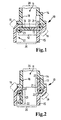
- a switching unit 10 is shown in section through an inlet channel 11, wherein in a suction system several inlet channels 11 are arranged side by side (not shown here).
- This switching unit 10 essentially has a rectangular shape Inlet ducts 11, flaps 12, flap shafts 23 and a movement unit 13 (not shown, see Figure 4).
- the inlet duct 11 is made up of an upper and a lower one Channel piece 14, 15 formed.
- the flap 12 is replaced by a first and a second Flap part 16, 17 formed, which are introduced into the inlet channel 11. At this The illustration shows the closed state.
- the channel pieces 14, 15 each have a, on the circumference one-piece wall 18, the bearing and sealing points 19 for the valve parts 16, 17 and which encloses a rectangular flow cross section 20, which is closed or released by the flap 12.
- the wall 18 of the inlet channel 11 has receptacles 21 into which the flap parts 16, 17 are pivoted can be, so as not to represent interference contours in the flow cross section 20.
- the switching unit 10 is designed so that the flap parts 16, 17 in the inlet channel 11 sealingly touch when closed, for this purpose the flap parts 16, 17 beveled sealing surfaces 22.
- the flap parts 16, 17 are in the Lagerund Sealing points 19 of the channel pieces 14, 15 introduced that none in these areas Leakage currents occur.
- the switching unit 10 according to Figure 1 is shown in section with the open position.
- the flap parts 16, 17 are in the receptacles 21 provided therefor rotated in by a co-rotation and lie against the wall 18. Thereby there are no interfering contours in the flow cross section 20, which are the course of the streamlines affect.
- a movement unit 13 is shown in half section, the one against each other running movement of the flap parts 16, 17, through the same direction of rotation the valve shafts, caused (similar to Figure 2).
- the flap parts 16, 17 are in the storage and Sealing points 19 rotatably mounted and connected with levers 24, 25, 26.
- the movement unit 13 includes a short left lever arm 24, a long lever arm 25 and a short right lever arm 26.
- the left lever arm 24 is with the first folding part 16 and the right lever arm 26 is connected to the second flap part 17.
- the two Lever arms 24, 26 are connected by the long lever arm 25.
- the connection of the Lever arms 24, 25, 26 are designed so that they can move rotationally to each other.
- Turn the movement unit 13 counterclockwise the first and second flap parts 16, 17 counterclockwise. Through this Movement, the flap parts 16, 17 can either close the flow channel 11 or by placing it on the wall 18 to release the flow channel 11. Since the Flap parts 16, 17 move towards or away from each other, by the rotation arising forces compensated.
- FIG. 5 shows a section of an intake system that is offset has mutually arranged flow cross sections 20.
- the flaps 12 of the switched Flow cross sections 20 are on a single, continuous shaft 27 attached.
- the shaft 27 is in the bearings 19 'of a one-piece housing 28, e.g. is manufactured using casting technology.
- the flaps 12 by e.g. Laser welding attached to the shaft 27.
- the flaps 12 can also be attached to the shaft 27 by rivets or screws.
- the non-switched flow cross sections 20 have no interference contours generated by the shaft 27 or flaps 12.
- the staggered flow cross sections 20 can be in the staggered version be led to the cylinders without merging. Then there is an adjustment of the cylinder head flange to the intake system.
- the switching unit is shown in section along the section line A-A according to Figure 5.
- the section runs along an inlet channel 11 with staggered arrangement switched flow cross-sections 20.
- the first split parallel inlet channels 11 in the region of the flaps 12 in a staggered arrangement on.
- the offset 29 of the Flow cross sections 20 is chosen so large that the shaft 27 does not switched flow cross section 20 is passed without cutting it, however, a sufficient wall thickness 30 must be observed in order to Avoid breaking the shaft 27 during operation.
- the inlet channels 11 are after the area of the flaps 12 merged again in parallel, with no adjustment of the cylinder head flange is required.
- the transition from the parallel Inlet channels 11 to the staggered arrangement take place in flow-optimized arches, whereby the streamlines of the air are almost unaffected.
Landscapes
- Engineering & Computer Science (AREA)
- Chemical & Material Sciences (AREA)
- Combustion & Propulsion (AREA)
- Mechanical Engineering (AREA)
- General Engineering & Computer Science (AREA)
- Characterised By The Charging Evacuation (AREA)
- Exhaust Gas After Treatment (AREA)
- Multiple-Way Valves (AREA)
- Oscillators With Electromechanical Resonators (AREA)
- Vehicle Body Suspensions (AREA)
- Control Of Stepping Motors (AREA)
Abstract
Description
- Figur 1
- eine geschlossene gegenläufige Schalteinheit in Schnitt,
- Figur 2
- eine geöffnete gegenläufige Schalteinheit im Schnitt,
- Figur 3
- eine geschlossene gleichläufige Schalteinheit im Schnitt,
- Figur 4
- eine schematisch dargestellte Bewegungseinheit,
- Figur 5
- eine Schalteinheit im Schnitt mit versetzt angeordneten Kanälen und
- Figur 6
- eine Schalteinheit im Schnitt.
Claims (11)
- Schalteinheit (10), zur Kanalabschaltung von Einlaßkanälen (11) in einem Ansaugsystem mit mehreren nebeneinander angeordneten Einlaßkanälen (11) einer Brennkraftmaschine, welche mindestens über zwei geschaltete und einen nicht geschalteten Strömungsquerschnitt (20) verfügt und wobei die geschalteten Strömungsquerschnitte (20) mit jeweils einer Klappe (12) versehen sind und durch eine einzige Bewegungseinheit öffen- und schließbar sind, dadurch gekennzeichnet, daß die Bewegungseinheit außerhalb des nicht geschalteten Strömungsquerschnittes (20) verläuft.
- Schalteinheit (10) nach Anspruch 1, dadurch gekennzeichnet, daß die Klappe (12) mindestens zwei voneinander getrennte Klappenteile (16, 17) aufweist, die auf je einer Klappenwelle (23) aufgebracht sind.
- Schalteinheit (10) nach Anspruch 2 dadurch gekennzeichnet, daß die Klappenwellen (23) hinsichtlich der Klappenstellung miteinander gekoppelt sind.
- Schalteinheit (10) nach einem der vorangehenden Ansprüche, dadurch gekennzeichnet, daß sich die Klappe (12) im geöffneten Zustand außerhalb des Strömungsquerschnittes (20) befindet.
- Schalteinheit (10) nach einem der vorangehenden Ansprüche, dadurch gekennzeichnet, daß die Klappe (12) Dichtflächen (22) aufweist
- Schalteinheit (10) nach einem der vorangehenden Ansprüche, dadurch gekennzeichnet, daß die geschalteten Strömungsquerschnitte (20) zu den nicht geschalteten Strömungsquerschnitten (20) versetzt angeordnet sind.
- Schalteinheit (10) nach Anspruch 6, dadurch gekennzeichnet, daß je ein geschalteter und ein nicht geschalteter Strömungsquerschnitt (20) für je einen Zylinder vorgesehen sind.
- Schalteinheit (10) nach einem der vorangehenden Ansprüche, dadurch gekennzeichnet, daß die Klappe (12) durch ein Getriebe, welches Teil der Bewegungseinheit ist, bewegbar ist.
- Schalteinheit (10) nach einem der vorangehenden Ansprüche, dadurch gekennzeichnet, daß die Klappe (12) in einen Stutzen eingebracht ist, wobei der Stutzen den Strömungsquerschnitt (20) umschließt und in das Ansaugsystem einbringbar ist.
- Schalteinheit (10) nach einem der vorangehenden Ansprüche, dadurch gekennzeichnet, daß die Klappe (12) und der Stutzen in Montagespritzguß hergestellt ist.
- Schalteinheit (10) nach einem der vorangehenden Ansprüche, dadurch gekennzeichnet, daß die Klappe (12) in einen, im wesentlichen rechteckförmigen, Strömungsquerschnitt (20) eingebracht ist.
Applications Claiming Priority (2)
| Application Number | Priority Date | Filing Date | Title |
|---|---|---|---|
| DE19951412 | 1999-10-26 | ||
| DE19951412A DE19951412A1 (de) | 1999-10-26 | 1999-10-26 | Schalteinheit |
Publications (3)
| Publication Number | Publication Date |
|---|---|
| EP1096119A2 true EP1096119A2 (de) | 2001-05-02 |
| EP1096119A3 EP1096119A3 (de) | 2002-02-06 |
| EP1096119B1 EP1096119B1 (de) | 2003-12-10 |
Family
ID=7926840
Family Applications (1)
| Application Number | Title | Priority Date | Filing Date |
|---|---|---|---|
| EP00121262A Expired - Lifetime EP1096119B1 (de) | 1999-10-26 | 2000-10-05 | Schalteinheit |
Country Status (5)
| Country | Link |
|---|---|
| US (1) | US6341589B1 (de) |
| EP (1) | EP1096119B1 (de) |
| JP (1) | JP2001152989A (de) |
| AT (1) | ATE256249T1 (de) |
| DE (2) | DE19951412A1 (de) |
Families Citing this family (6)
| Publication number | Priority date | Publication date | Assignee | Title |
|---|---|---|---|---|
| DE19918777A1 (de) * | 1999-04-24 | 2000-10-26 | Mann & Hummel Filter | Schaltklappenverband aus montagegespritzten Schaltklappen oder Klappenmodulen |
| DE10215667A1 (de) * | 2002-04-10 | 2003-11-06 | Pierburg Gmbh | Aufladesystem für Brennkraftmaschinen |
| DE10220340A1 (de) * | 2002-05-07 | 2003-11-27 | Siemens Ag | Klappenventil für Luftansaugkanal einer Brennkraftmaschine |
| DE10336976B4 (de) * | 2003-08-12 | 2005-08-18 | Pierburg Gmbh | Ventilvorrichtung für eine Verbrennungskraftmaschine |
| US8028677B2 (en) * | 2008-09-09 | 2011-10-04 | Mark Iv Systemes Moteurs Usa, Inc. | Assembly and method for controlling an air intake runner |
| DE102011008599A1 (de) * | 2011-01-14 | 2012-07-19 | GM Global Technology Operations LLC (n. d. Gesetzen des Staates Delaware) | Ventilanordnung im Abgastrakt einer Verbrennungskraftmaschine |
Citations (1)
| Publication number | Priority date | Publication date | Assignee | Title |
|---|---|---|---|---|
| DE19504382A1 (de) | 1995-02-10 | 1996-08-14 | Mann & Hummel Filter | Ansaugsystem |
Family Cites Families (21)
| Publication number | Priority date | Publication date | Assignee | Title |
|---|---|---|---|---|
| JPS53133026U (de) * | 1977-03-30 | 1978-10-21 | ||
| IT1163075B (it) * | 1983-02-02 | 1987-04-08 | Alfa Romeo Auto Spa | Impianto di aspirazione per un motore a c.i.dotato di piu' valvole di aspirazione |
| US4703734A (en) * | 1985-03-06 | 1987-11-03 | Nissan Motor Co., Ltd. | Multi-valve internal combustion engine |
| DE3704717A1 (de) * | 1986-02-25 | 1987-08-27 | Volkswagen Ag | Mehrzylinder-brennkraftmaschine mit mitteln zur drallerhoehung |
| DE3633509A1 (de) * | 1986-10-02 | 1988-04-14 | Porsche Ag | Brennkraftmaschine mit wenigstens zwei einlassventilen pro zylinder |
| JPS63111227A (ja) * | 1986-10-30 | 1988-05-16 | Mazda Motor Corp | エンジンの吸気装置 |
| JPS63183329U (de) * | 1987-05-20 | 1988-11-25 | ||
| WO1989003473A1 (en) * | 1987-10-07 | 1989-04-20 | Keith Gordon Hall | Engine intake system |
| US4850796A (en) * | 1988-05-25 | 1989-07-25 | Sundstrand Corporation | Centrifugal pump with splitter vane/shut-off valve system |
| JPH0228530U (de) * | 1988-08-16 | 1990-02-23 | ||
| DE3843509C2 (de) * | 1988-12-23 | 1993-11-18 | Daimler Benz Ag | Ansaugsystem für eine Brennkraftmaschine |
| DE3909837A1 (de) * | 1989-03-25 | 1990-09-27 | Audi Ag | Saugrohranlage fuer eine mehrzylinder-brennkraftmaschine |
| DE4018612C2 (de) * | 1990-06-11 | 2003-04-30 | Audi Ag | Ansaugsystem für eine Mehrzylinder-Brennkraftmaschine |
| US5239960A (en) * | 1991-07-30 | 1993-08-31 | Mazda Motor Corporation | Engine induction system provided with a mechanical supercharger |
| FR2724418B1 (fr) * | 1994-09-09 | 1997-01-17 | Magneti Marelli France | Tubulure d'admission d'air a volets pivotants pour moteur a combustion interne |
| DE19503771A1 (de) * | 1995-02-04 | 1996-08-08 | Mann & Hummel Filter | Saugmodul |
| JPH08277717A (ja) * | 1995-04-06 | 1996-10-22 | Du Pont Kk | 吸気制御バルブを備えた樹脂吸気系 |
| US5711261A (en) * | 1995-05-31 | 1998-01-27 | Gambardella; C. Bruce | Intake system for V-type engine |
| US6009849A (en) * | 1996-08-12 | 2000-01-04 | Mazda Motor Corporation | Direct fuel injection engine |
| DE19800207A1 (de) * | 1997-03-20 | 1998-09-24 | Mann & Hummel Filter | Saugmodul |
| DE19754736C1 (de) * | 1997-12-10 | 1999-04-15 | Porsche Ag | Saugkanal für eine Brennkraftmaschine |
-
1999
- 1999-10-26 DE DE19951412A patent/DE19951412A1/de not_active Ceased
-
2000
- 2000-10-05 DE DE50004711T patent/DE50004711D1/de not_active Expired - Lifetime
- 2000-10-05 AT AT00121262T patent/ATE256249T1/de active
- 2000-10-05 EP EP00121262A patent/EP1096119B1/de not_active Expired - Lifetime
- 2000-10-24 JP JP2000324316A patent/JP2001152989A/ja active Pending
- 2000-10-26 US US09/696,678 patent/US6341589B1/en not_active Expired - Fee Related
Patent Citations (1)
| Publication number | Priority date | Publication date | Assignee | Title |
|---|---|---|---|---|
| DE19504382A1 (de) | 1995-02-10 | 1996-08-14 | Mann & Hummel Filter | Ansaugsystem |
Also Published As
| Publication number | Publication date |
|---|---|
| US6341589B1 (en) | 2002-01-29 |
| EP1096119B1 (de) | 2003-12-10 |
| DE50004711D1 (de) | 2004-01-22 |
| JP2001152989A (ja) | 2001-06-05 |
| DE19951412A1 (de) | 2001-05-03 |
| EP1096119A3 (de) | 2002-02-06 |
| ATE256249T1 (de) | 2003-12-15 |
Similar Documents
| Publication | Publication Date | Title |
|---|---|---|
| EP1200718B1 (de) | Saugrohranlage | |
| DE19918777A1 (de) | Schaltklappenverband aus montagegespritzten Schaltklappen oder Klappenmodulen | |
| DE3008691A1 (de) | Verstellduese fuer gasturbinentriebwerke | |
| EP1108892B1 (de) | Flügelzellenvakuumpumpe | |
| EP1316716A2 (de) | Ansaugvorrichtung für eine Brennkraftmaschine mit Impulsaufladung | |
| EP1096119B1 (de) | Schalteinheit | |
| EP0276773A1 (de) | Ansauganlage mit einer Steuervorrichtung, insbesondere für Brennkraftmaschinen | |
| DE4039992C2 (de) | ||
| DE10014282A1 (de) | Ansaugvorrichtung mit Schwingrohren und längenverstellbaren Resonanzrohren | |
| DE2134242B2 (de) | Vorrichtung zur Verstellung einer im Ansaugkanal eines Kreiselverdichters angeordneten Drossel | |
| EP0954686B1 (de) | Saugrohr zur steuerung des luftaufwandes im ansaugtrakt einer brennkraftmaschine | |
| EP0778919B1 (de) | Variable luftansaugvorrichtung | |
| DE69002207T2 (de) | Ablenkungsklappe. | |
| DE19955906A1 (de) | Saugrohr mit selektiver Kanalabschaltung | |
| DE10330225B4 (de) | Klappenvorrichtung für eine Verbrennungskraftmaschine | |
| DE19858626C1 (de) | Abgasklappenmechanismus für eine Brennkraftmaschine | |
| EP1025349A2 (de) | Schaltwalze | |
| EP1251253A2 (de) | Schaltverband zum Verschluss von Saugkanälen einer Ansaugvorrichtung | |
| DE10346763A1 (de) | Saugmodul insbesondere für Brennkraftmaschinen | |
| WO2018114020A1 (de) | Leiteinrichtung für einen verdichter einer aufladeeinrichtung, sowie verdichter für eine aufladeeinrichtung | |
| DE19820245A1 (de) | Ansaugsystem für eine Brennkraftmaschine | |
| EP1091105A1 (de) | Ansaugvorrichtung | |
| DE19612036B4 (de) | Saugrohranlage für eine mehrzylindrige Brennkraftmaschine in V-Anordnung | |
| DE3942055A1 (de) | Im ansaugrohr einer brennkraftmaschine angeordnete drosselklappe | |
| DE19861217B4 (de) | Twin Plenum-Sauganlage |
Legal Events
| Date | Code | Title | Description |
|---|---|---|---|
| PUAI | Public reference made under article 153(3) epc to a published international application that has entered the european phase |
Free format text: ORIGINAL CODE: 0009012 |
|
| AK | Designated contracting states |
Kind code of ref document: A2 Designated state(s): AT BE CH CY DE DK ES FI FR GB GR IE IT LI LU MC NL PT SE |
|
| AX | Request for extension of the european patent |
Free format text: AL;LT;LV;MK;RO;SI |
|
| PUAL | Search report despatched |
Free format text: ORIGINAL CODE: 0009013 |
|
| AK | Designated contracting states |
Kind code of ref document: A3 Designated state(s): AT BE CH CY DE DK ES FI FR GB GR IE IT LI LU MC NL PT SE |
|
| AX | Request for extension of the european patent |
Free format text: AL;LT;LV;MK;RO;SI |
|
| RIC1 | Information provided on ipc code assigned before grant |
Free format text: 7F 02B 27/02 A, 7F 02B 31/08 B, 7F 02D 9/10 B |
|
| 17P | Request for examination filed |
Effective date: 20020305 |
|
| 17Q | First examination report despatched |
Effective date: 20020422 |
|
| AKX | Designation fees paid |
Free format text: AT BE CH CY DE DK ES FI FR GB GR IE IT LI LU MC NL PT SE |
|
| GRAH | Despatch of communication of intention to grant a patent |
Free format text: ORIGINAL CODE: EPIDOS IGRA |
|
| GRAS | Grant fee paid |
Free format text: ORIGINAL CODE: EPIDOSNIGR3 |
|
| GRAA | (expected) grant |
Free format text: ORIGINAL CODE: 0009210 |
|
| AK | Designated contracting states |
Kind code of ref document: B1 Designated state(s): AT BE CH CY DE DK ES FI FR GB GR IE IT LI LU MC NL PT SE |
|
| PG25 | Lapsed in a contracting state [announced via postgrant information from national office to epo] |
Ref country code: IE Free format text: LAPSE BECAUSE OF FAILURE TO SUBMIT A TRANSLATION OF THE DESCRIPTION OR TO PAY THE FEE WITHIN THE PRESCRIBED TIME-LIMIT Effective date: 20031210 Ref country code: NL Free format text: LAPSE BECAUSE OF FAILURE TO SUBMIT A TRANSLATION OF THE DESCRIPTION OR TO PAY THE FEE WITHIN THE PRESCRIBED TIME-LIMIT Effective date: 20031210 Ref country code: FI Free format text: LAPSE BECAUSE OF FAILURE TO SUBMIT A TRANSLATION OF THE DESCRIPTION OR TO PAY THE FEE WITHIN THE PRESCRIBED TIME-LIMIT Effective date: 20031210 Ref country code: CY Free format text: LAPSE BECAUSE OF FAILURE TO SUBMIT A TRANSLATION OF THE DESCRIPTION OR TO PAY THE FEE WITHIN THE PRESCRIBED TIME-LIMIT Effective date: 20031210 |
|
| REG | Reference to a national code |
Ref country code: GB Ref legal event code: FG4D Free format text: NOT ENGLISH |
|
| REG | Reference to a national code |
Ref country code: CH Ref legal event code: EP |
|
| RAP2 | Party data changed (patent owner data changed or rights of a patent transferred) |
Owner name: MANN + HUMMEL GMBH |
|
| REG | Reference to a national code |
Ref country code: IE Ref legal event code: FG4D Free format text: GERMAN |
|
| REF | Corresponds to: |
Ref document number: 50004711 Country of ref document: DE Date of ref document: 20040122 Kind code of ref document: P |
|
| NLT2 | Nl: modifications (of names), taken from the european patent patent bulletin |
Owner name: MANN + HUMMEL GMBH |
|
| PG25 | Lapsed in a contracting state [announced via postgrant information from national office to epo] |
Ref country code: SE Free format text: LAPSE BECAUSE OF FAILURE TO SUBMIT A TRANSLATION OF THE DESCRIPTION OR TO PAY THE FEE WITHIN THE PRESCRIBED TIME-LIMIT Effective date: 20040310 Ref country code: DK Free format text: LAPSE BECAUSE OF FAILURE TO SUBMIT A TRANSLATION OF THE DESCRIPTION OR TO PAY THE FEE WITHIN THE PRESCRIBED TIME-LIMIT Effective date: 20040310 Ref country code: GR Free format text: LAPSE BECAUSE OF FAILURE TO SUBMIT A TRANSLATION OF THE DESCRIPTION OR TO PAY THE FEE WITHIN THE PRESCRIBED TIME-LIMIT Effective date: 20040310 |
|
| PG25 | Lapsed in a contracting state [announced via postgrant information from national office to epo] |
Ref country code: ES Free format text: LAPSE BECAUSE OF FAILURE TO SUBMIT A TRANSLATION OF THE DESCRIPTION OR TO PAY THE FEE WITHIN THE PRESCRIBED TIME-LIMIT Effective date: 20040321 |
|
| GBT | Gb: translation of ep patent filed (gb section 77(6)(a)/1977) | ||
| NLV1 | Nl: lapsed or annulled due to failure to fulfill the requirements of art. 29p and 29m of the patents act | ||
| REG | Reference to a national code |
Ref country code: IE Ref legal event code: FD4D |
|
| ET | Fr: translation filed | ||
| PG25 | Lapsed in a contracting state [announced via postgrant information from national office to epo] |
Ref country code: LU Free format text: LAPSE BECAUSE OF NON-PAYMENT OF DUE FEES Effective date: 20041005 |
|
| PLBE | No opposition filed within time limit |
Free format text: ORIGINAL CODE: 0009261 |
|
| STAA | Information on the status of an ep patent application or granted ep patent |
Free format text: STATUS: NO OPPOSITION FILED WITHIN TIME LIMIT |
|
| PG25 | Lapsed in a contracting state [announced via postgrant information from national office to epo] |
Ref country code: CH Free format text: LAPSE BECAUSE OF NON-PAYMENT OF DUE FEES Effective date: 20041031 Ref country code: BE Free format text: LAPSE BECAUSE OF NON-PAYMENT OF DUE FEES Effective date: 20041031 Ref country code: LI Free format text: LAPSE BECAUSE OF NON-PAYMENT OF DUE FEES Effective date: 20041031 |
|
| 26N | No opposition filed |
Effective date: 20040913 |
|
| BERE | Be: lapsed |
Owner name: FILTERWERK *MANN + HUMMEL G.M.B.H. Effective date: 20041031 |
|
| REG | Reference to a national code |
Ref country code: CH Ref legal event code: PL |
|
| BERE | Be: lapsed |
Owner name: FILTERWERK *MANN + HUMMEL G.M.B.H. Effective date: 20041031 |
|
| PG25 | Lapsed in a contracting state [announced via postgrant information from national office to epo] |
Ref country code: PT Free format text: LAPSE BECAUSE OF NON-PAYMENT OF DUE FEES Effective date: 20040510 |
|
| PGFP | Annual fee paid to national office [announced via postgrant information from national office to epo] |
Ref country code: AT Payment date: 20101014 Year of fee payment: 11 Ref country code: MC Payment date: 20101014 Year of fee payment: 11 |
|
| PGFP | Annual fee paid to national office [announced via postgrant information from national office to epo] |
Ref country code: DE Payment date: 20101022 Year of fee payment: 11 |
|
| PGFP | Annual fee paid to national office [announced via postgrant information from national office to epo] |
Ref country code: GB Payment date: 20101021 Year of fee payment: 11 Ref country code: IT Payment date: 20101025 Year of fee payment: 11 |
|
| PGFP | Annual fee paid to national office [announced via postgrant information from national office to epo] |
Ref country code: FR Payment date: 20111103 Year of fee payment: 12 |
|
| PG25 | Lapsed in a contracting state [announced via postgrant information from national office to epo] |
Ref country code: MC Free format text: LAPSE BECAUSE OF NON-PAYMENT OF DUE FEES Effective date: 20111031 |
|
| PG25 | Lapsed in a contracting state [announced via postgrant information from national office to epo] |
Ref country code: IT Free format text: LAPSE BECAUSE OF NON-PAYMENT OF DUE FEES Effective date: 20111005 |
|
| REG | Reference to a national code |
Ref country code: AT Ref legal event code: MM01 Ref document number: 256249 Country of ref document: AT Kind code of ref document: T Effective date: 20111005 |
|
| PG25 | Lapsed in a contracting state [announced via postgrant information from national office to epo] |
Ref country code: AT Free format text: LAPSE BECAUSE OF NON-PAYMENT OF DUE FEES Effective date: 20111005 |
|
| GBPC | Gb: european patent ceased through non-payment of renewal fee |
Effective date: 20121005 |
|
| REG | Reference to a national code |
Ref country code: FR Ref legal event code: ST Effective date: 20130628 |
|
| PG25 | Lapsed in a contracting state [announced via postgrant information from national office to epo] |
Ref country code: GB Free format text: LAPSE BECAUSE OF NON-PAYMENT OF DUE FEES Effective date: 20121005 Ref country code: DE Free format text: LAPSE BECAUSE OF NON-PAYMENT OF DUE FEES Effective date: 20130501 |
|
| REG | Reference to a national code |
Ref country code: DE Ref legal event code: R119 Ref document number: 50004711 Country of ref document: DE Effective date: 20130501 |
|
| PG25 | Lapsed in a contracting state [announced via postgrant information from national office to epo] |
Ref country code: FR Free format text: LAPSE BECAUSE OF NON-PAYMENT OF DUE FEES Effective date: 20121031 |