EP1094537A2 - Lithium secondary battery - Google Patents
Lithium secondary battery Download PDFInfo
- Publication number
- EP1094537A2 EP1094537A2 EP00122720A EP00122720A EP1094537A2 EP 1094537 A2 EP1094537 A2 EP 1094537A2 EP 00122720 A EP00122720 A EP 00122720A EP 00122720 A EP00122720 A EP 00122720A EP 1094537 A2 EP1094537 A2 EP 1094537A2
- Authority
- EP
- European Patent Office
- Prior art keywords
- battery
- electrolytic solution
- aqueous electrolytic
- water
- lithium
- Prior art date
- Legal status (The legal status is an assumption and is not a legal conclusion. Google has not performed a legal analysis and makes no representation as to the accuracy of the status listed.)
- Withdrawn
Links
- 229910052744 lithium Inorganic materials 0.000 title claims abstract description 40
- WHXSMMKQMYFTQS-UHFFFAOYSA-N Lithium Chemical compound [Li] WHXSMMKQMYFTQS-UHFFFAOYSA-N 0.000 title claims abstract description 36
- XLYOFNOQVPJJNP-UHFFFAOYSA-N water Substances O XLYOFNOQVPJJNP-UHFFFAOYSA-N 0.000 claims abstract description 72
- 239000008151 electrolyte solution Substances 0.000 claims abstract description 69
- KRHYYFGTRYWZRS-UHFFFAOYSA-N Fluorane Chemical compound F KRHYYFGTRYWZRS-UHFFFAOYSA-N 0.000 claims abstract description 52
- QPJSUIGXIBEQAC-UHFFFAOYSA-N n-(2,4-dichloro-5-propan-2-yloxyphenyl)acetamide Chemical compound CC(C)OC1=CC(NC(C)=O)=C(Cl)C=C1Cl QPJSUIGXIBEQAC-UHFFFAOYSA-N 0.000 claims abstract description 27
- 239000003792 electrolyte Substances 0.000 claims abstract description 15
- 150000002642 lithium compounds Chemical class 0.000 claims abstract description 9
- 238000010030 laminating Methods 0.000 claims abstract description 7
- 238000004804 winding Methods 0.000 claims abstract description 7
- 239000013543 active substance Substances 0.000 claims description 34
- -1 lithium hexafluorophosphate Chemical compound 0.000 claims description 9
- 229910002102 lithium manganese oxide Inorganic materials 0.000 claims description 7
- VLXXBCXTUVRROQ-UHFFFAOYSA-N lithium;oxido-oxo-(oxomanganiooxy)manganese Chemical compound [Li+].[O-][Mn](=O)O[Mn]=O VLXXBCXTUVRROQ-UHFFFAOYSA-N 0.000 claims description 7
- 229910052596 spinel Inorganic materials 0.000 claims description 7
- 239000011029 spinel Substances 0.000 claims description 7
- 239000011572 manganese Substances 0.000 claims description 6
- 229910052748 manganese Inorganic materials 0.000 claims description 4
- PWHULOQIROXLJO-UHFFFAOYSA-N Manganese Chemical compound [Mn] PWHULOQIROXLJO-UHFFFAOYSA-N 0.000 claims description 2
- 239000011357 graphitized carbon fiber Substances 0.000 claims description 2
- 230000006866 deterioration Effects 0.000 abstract description 9
- 238000004519 manufacturing process Methods 0.000 description 15
- 238000012360 testing method Methods 0.000 description 13
- 238000001035 drying Methods 0.000 description 12
- 238000000034 method Methods 0.000 description 12
- 239000003960 organic solvent Substances 0.000 description 12
- 239000000463 material Substances 0.000 description 11
- 239000002002 slurry Substances 0.000 description 10
- 239000000758 substrate Substances 0.000 description 9
- 239000002904 solvent Substances 0.000 description 8
- 239000011248 coating agent Substances 0.000 description 7
- 238000000576 coating method Methods 0.000 description 7
- 230000000052 comparative effect Effects 0.000 description 7
- OKTJSMMVPCPJKN-UHFFFAOYSA-N Carbon Chemical compound [C] OKTJSMMVPCPJKN-UHFFFAOYSA-N 0.000 description 6
- OKKJLVBELUTLKV-UHFFFAOYSA-N Methanol Chemical compound OC OKKJLVBELUTLKV-UHFFFAOYSA-N 0.000 description 6
- HEMHJVSKTPXQMS-UHFFFAOYSA-M Sodium hydroxide Chemical compound [OH-].[Na+] HEMHJVSKTPXQMS-UHFFFAOYSA-M 0.000 description 6
- 239000012298 atmosphere Substances 0.000 description 6
- 239000011888 foil Substances 0.000 description 6
- 229910001416 lithium ion Inorganic materials 0.000 description 6
- 239000004698 Polyethylene Substances 0.000 description 5
- 238000005259 measurement Methods 0.000 description 5
- 229910052751 metal Inorganic materials 0.000 description 5
- 239000002184 metal Substances 0.000 description 5
- 230000009467 reduction Effects 0.000 description 5
- 238000006467 substitution reaction Methods 0.000 description 5
- 239000004743 Polypropylene Substances 0.000 description 4
- RAHZWNYVWXNFOC-UHFFFAOYSA-N Sulphur dioxide Chemical compound O=S=O RAHZWNYVWXNFOC-UHFFFAOYSA-N 0.000 description 4
- 229910052782 aluminium Inorganic materials 0.000 description 4
- 239000003795 chemical substances by application Substances 0.000 description 4
- 238000003475 lamination Methods 0.000 description 4
- 238000003860 storage Methods 0.000 description 4
- WEVYAHXRMPXWCK-UHFFFAOYSA-N Acetonitrile Chemical compound CC#N WEVYAHXRMPXWCK-UHFFFAOYSA-N 0.000 description 3
- OIFBSDVPJOWBCH-UHFFFAOYSA-N Diethyl carbonate Chemical compound CCOC(=O)OCC OIFBSDVPJOWBCH-UHFFFAOYSA-N 0.000 description 3
- KMTRUDSVKNLOMY-UHFFFAOYSA-N Ethylene carbonate Chemical compound O=C1OCCO1 KMTRUDSVKNLOMY-UHFFFAOYSA-N 0.000 description 3
- HBBGRARXTFLTSG-UHFFFAOYSA-N Lithium ion Chemical compound [Li+] HBBGRARXTFLTSG-UHFFFAOYSA-N 0.000 description 3
- 239000011230 binding agent Substances 0.000 description 3
- 230000015572 biosynthetic process Effects 0.000 description 3
- 238000006243 chemical reaction Methods 0.000 description 3
- 230000007797 corrosion Effects 0.000 description 3
- 238000005260 corrosion Methods 0.000 description 3
- 230000005611 electricity Effects 0.000 description 3
- 239000000203 mixture Substances 0.000 description 3
- PXHVJJICTQNCMI-UHFFFAOYSA-N nickel Substances [Ni] PXHVJJICTQNCMI-UHFFFAOYSA-N 0.000 description 3
- 230000002265 prevention Effects 0.000 description 3
- 239000000243 solution Substances 0.000 description 3
- 229910052718 tin Inorganic materials 0.000 description 3
- 239000010936 titanium Substances 0.000 description 3
- 229910052719 titanium Inorganic materials 0.000 description 3
- 238000004448 titration Methods 0.000 description 3
- YEJRWHAVMIAJKC-UHFFFAOYSA-N 4-Butyrolactone Chemical compound O=C1CCCO1 YEJRWHAVMIAJKC-UHFFFAOYSA-N 0.000 description 2
- RYGMFSIKBFXOCR-UHFFFAOYSA-N Copper Chemical compound [Cu] RYGMFSIKBFXOCR-UHFFFAOYSA-N 0.000 description 2
- JUJWROOIHBZHMG-UHFFFAOYSA-N Pyridine Chemical compound C1=CC=NC=C1 JUJWROOIHBZHMG-UHFFFAOYSA-N 0.000 description 2
- WYURNTSHIVDZCO-UHFFFAOYSA-N Tetrahydrofuran Chemical compound C1CCOC1 WYURNTSHIVDZCO-UHFFFAOYSA-N 0.000 description 2
- 239000006230 acetylene black Substances 0.000 description 2
- XAGFODPZIPBFFR-UHFFFAOYSA-N aluminium Chemical compound [Al] XAGFODPZIPBFFR-UHFFFAOYSA-N 0.000 description 2
- 229910052787 antimony Inorganic materials 0.000 description 2
- 229910052796 boron Inorganic materials 0.000 description 2
- 230000008859 change Effects 0.000 description 2
- 229910052804 chromium Inorganic materials 0.000 description 2
- 239000011889 copper foil Substances 0.000 description 2
- 238000004090 dissolution Methods 0.000 description 2
- 230000000694 effects Effects 0.000 description 2
- 238000003487 electrochemical reaction Methods 0.000 description 2
- 239000007789 gas Substances 0.000 description 2
- 229910021385 hard carbon Inorganic materials 0.000 description 2
- 230000006872 improvement Effects 0.000 description 2
- XEEYBQQBJWHFJM-UHFFFAOYSA-N iron Substances [Fe] XEEYBQQBJWHFJM-UHFFFAOYSA-N 0.000 description 2
- 229910000625 lithium cobalt oxide Inorganic materials 0.000 description 2
- BFZPBUKRYWOWDV-UHFFFAOYSA-N lithium;oxido(oxo)cobalt Chemical compound [Li+].[O-][Co]=O BFZPBUKRYWOWDV-UHFFFAOYSA-N 0.000 description 2
- 229910052749 magnesium Inorganic materials 0.000 description 2
- 239000011777 magnesium Substances 0.000 description 2
- 239000007769 metal material Substances 0.000 description 2
- 239000002808 molecular sieve Substances 0.000 description 2
- 229910052750 molybdenum Inorganic materials 0.000 description 2
- 238000006386 neutralization reaction Methods 0.000 description 2
- 229910052759 nickel Inorganic materials 0.000 description 2
- 229910052758 niobium Inorganic materials 0.000 description 2
- 230000035515 penetration Effects 0.000 description 2
- 229910052698 phosphorus Inorganic materials 0.000 description 2
- 239000000843 powder Substances 0.000 description 2
- RUOJZAUFBMNUDX-UHFFFAOYSA-N propylene carbonate Chemical compound CC1COC(=O)O1 RUOJZAUFBMNUDX-UHFFFAOYSA-N 0.000 description 2
- 239000012488 sample solution Substances 0.000 description 2
- 238000007789 sealing Methods 0.000 description 2
- 229910052710 silicon Inorganic materials 0.000 description 2
- URGAHOPLAPQHLN-UHFFFAOYSA-N sodium aluminosilicate Chemical compound [Na+].[Al+3].[O-][Si]([O-])=O.[O-][Si]([O-])=O URGAHOPLAPQHLN-UHFFFAOYSA-N 0.000 description 2
- 230000001629 suppression Effects 0.000 description 2
- 229910052715 tantalum Inorganic materials 0.000 description 2
- 229910052721 tungsten Inorganic materials 0.000 description 2
- 229910052720 vanadium Inorganic materials 0.000 description 2
- 238000003466 welding Methods 0.000 description 2
- 229910052725 zinc Inorganic materials 0.000 description 2
- 239000011701 zinc Substances 0.000 description 2
- XVMSFILGAMDHEY-UHFFFAOYSA-N 6-(4-aminophenyl)sulfonylpyridin-3-amine Chemical compound C1=CC(N)=CC=C1S(=O)(=O)C1=CC=C(N)C=N1 XVMSFILGAMDHEY-UHFFFAOYSA-N 0.000 description 1
- LFQSCWFLJHTTHZ-UHFFFAOYSA-N Ethanol Chemical compound CCO LFQSCWFLJHTTHZ-UHFFFAOYSA-N 0.000 description 1
- 229910013068 LiMxMn2-xO4 Inorganic materials 0.000 description 1
- 229910013064 LiMxMn2−xO4 Inorganic materials 0.000 description 1
- RTAQQCXQSZGOHL-UHFFFAOYSA-N Titanium Chemical compound [Ti] RTAQQCXQSZGOHL-UHFFFAOYSA-N 0.000 description 1
- 230000002378 acidificating effect Effects 0.000 description 1
- 230000009471 action Effects 0.000 description 1
- 239000002194 amorphous carbon material Substances 0.000 description 1
- 238000004082 amperometric method Methods 0.000 description 1
- 239000007864 aqueous solution Substances 0.000 description 1
- 229910021383 artificial graphite Inorganic materials 0.000 description 1
- QVGXLLKOCUKJST-UHFFFAOYSA-N atomic oxygen Chemical compound [O] QVGXLLKOCUKJST-UHFFFAOYSA-N 0.000 description 1
- 239000003575 carbonaceous material Substances 0.000 description 1
- 150000004651 carbonic acid esters Chemical class 0.000 description 1
- 239000003153 chemical reaction reagent Substances 0.000 description 1
- 238000004737 colorimetric analysis Methods 0.000 description 1
- 238000004891 communication Methods 0.000 description 1
- 150000001875 compounds Chemical class 0.000 description 1
- 239000000356 contaminant Substances 0.000 description 1
- 239000013078 crystal Substances 0.000 description 1
- 125000004122 cyclic group Chemical group 0.000 description 1
- 238000000354 decomposition reaction Methods 0.000 description 1
- 230000007547 defect Effects 0.000 description 1
- 239000012024 dehydrating agents Substances 0.000 description 1
- IEJIGPNLZYLLBP-UHFFFAOYSA-N dimethyl carbonate Chemical compound COC(=O)OC IEJIGPNLZYLLBP-UHFFFAOYSA-N 0.000 description 1
- 238000007599 discharging Methods 0.000 description 1
- 238000011156 evaluation Methods 0.000 description 1
- 150000002222 fluorine compounds Chemical class 0.000 description 1
- 229910002804 graphite Inorganic materials 0.000 description 1
- 239000010439 graphite Substances 0.000 description 1
- 229910052736 halogen Inorganic materials 0.000 description 1
- 150000002367 halogens Chemical class 0.000 description 1
- PNDPGZBMCMUPRI-UHFFFAOYSA-N iodine Chemical compound II PNDPGZBMCMUPRI-UHFFFAOYSA-N 0.000 description 1
- 150000002500 ions Chemical class 0.000 description 1
- 229910052742 iron Inorganic materials 0.000 description 1
- MHCFAGZWMAWTNR-UHFFFAOYSA-M lithium perchlorate Chemical compound [Li+].[O-]Cl(=O)(=O)=O MHCFAGZWMAWTNR-UHFFFAOYSA-M 0.000 description 1
- CJYZTOPVWURGAI-UHFFFAOYSA-N lithium;manganese;manganese(3+);oxygen(2-) Chemical compound [Li+].[O-2].[O-2].[O-2].[O-2].[Mn].[Mn+3] CJYZTOPVWURGAI-UHFFFAOYSA-N 0.000 description 1
- VROAXDSNYPAOBJ-UHFFFAOYSA-N lithium;oxido(oxo)nickel Chemical compound [Li+].[O-][Ni]=O VROAXDSNYPAOBJ-UHFFFAOYSA-N 0.000 description 1
- 230000007246 mechanism Effects 0.000 description 1
- 239000012046 mixed solvent Substances 0.000 description 1
- 238000000465 moulding Methods 0.000 description 1
- 229910021382 natural graphite Inorganic materials 0.000 description 1
- 150000007530 organic bases Chemical class 0.000 description 1
- 150000002903 organophosphorus compounds Chemical class 0.000 description 1
- 238000006864 oxidative decomposition reaction Methods 0.000 description 1
- 229910052760 oxygen Inorganic materials 0.000 description 1
- 239000001301 oxygen Substances 0.000 description 1
- 229920000573 polyethylene Polymers 0.000 description 1
- 229920000642 polymer Polymers 0.000 description 1
- 229920001155 polypropylene Polymers 0.000 description 1
- 238000004313 potentiometry Methods 0.000 description 1
- 238000003825 pressing Methods 0.000 description 1
- UMJSCPRVCHMLSP-UHFFFAOYSA-N pyridine Natural products COC1=CC=CN=C1 UMJSCPRVCHMLSP-UHFFFAOYSA-N 0.000 description 1
- 238000005070 sampling Methods 0.000 description 1
- 150000003377 silicon compounds Chemical class 0.000 description 1
- 229910021384 soft carbon Inorganic materials 0.000 description 1
- 239000007784 solid electrolyte Substances 0.000 description 1
- 238000001179 sorption measurement Methods 0.000 description 1
- 239000000126 substance Substances 0.000 description 1
- 230000002195 synergetic effect Effects 0.000 description 1
- YLQBMQCUIZJEEH-UHFFFAOYSA-N tetrahydrofuran Natural products C=1C=COC=1 YLQBMQCUIZJEEH-UHFFFAOYSA-N 0.000 description 1
- 229910052723 transition metal Inorganic materials 0.000 description 1
- 150000003624 transition metals Chemical class 0.000 description 1
- 238000011282 treatment Methods 0.000 description 1
Images

Classifications
-
- H—ELECTRICITY
- H01—ELECTRIC ELEMENTS
- H01M—PROCESSES OR MEANS, e.g. BATTERIES, FOR THE DIRECT CONVERSION OF CHEMICAL ENERGY INTO ELECTRICAL ENERGY
- H01M10/00—Secondary cells; Manufacture thereof
- H01M10/05—Accumulators with non-aqueous electrolyte
- H01M10/056—Accumulators with non-aqueous electrolyte characterised by the materials used as electrolytes, e.g. mixed inorganic/organic electrolytes
- H01M10/0564—Accumulators with non-aqueous electrolyte characterised by the materials used as electrolytes, e.g. mixed inorganic/organic electrolytes the electrolyte being constituted of organic materials only
- H01M10/0566—Liquid materials
-
- H—ELECTRICITY
- H01—ELECTRIC ELEMENTS
- H01M—PROCESSES OR MEANS, e.g. BATTERIES, FOR THE DIRECT CONVERSION OF CHEMICAL ENERGY INTO ELECTRICAL ENERGY
- H01M10/00—Secondary cells; Manufacture thereof
- H01M10/05—Accumulators with non-aqueous electrolyte
- H01M10/056—Accumulators with non-aqueous electrolyte characterised by the materials used as electrolytes, e.g. mixed inorganic/organic electrolytes
- H01M10/0564—Accumulators with non-aqueous electrolyte characterised by the materials used as electrolytes, e.g. mixed inorganic/organic electrolytes the electrolyte being constituted of organic materials only
- H01M10/0566—Liquid materials
- H01M10/0567—Liquid materials characterised by the additives
-
- H—ELECTRICITY
- H01—ELECTRIC ELEMENTS
- H01M—PROCESSES OR MEANS, e.g. BATTERIES, FOR THE DIRECT CONVERSION OF CHEMICAL ENERGY INTO ELECTRICAL ENERGY
- H01M10/00—Secondary cells; Manufacture thereof
- H01M10/05—Accumulators with non-aqueous electrolyte
- H01M10/052—Li-accumulators
- H01M10/0525—Rocking-chair batteries, i.e. batteries with lithium insertion or intercalation in both electrodes; Lithium-ion batteries
-
- H—ELECTRICITY
- H01—ELECTRIC ELEMENTS
- H01M—PROCESSES OR MEANS, e.g. BATTERIES, FOR THE DIRECT CONVERSION OF CHEMICAL ENERGY INTO ELECTRICAL ENERGY
- H01M10/00—Secondary cells; Manufacture thereof
- H01M10/05—Accumulators with non-aqueous electrolyte
- H01M10/058—Construction or manufacture
- H01M10/0587—Construction or manufacture of accumulators having only wound construction elements, i.e. wound positive electrodes, wound negative electrodes and wound separators
-
- H—ELECTRICITY
- H01—ELECTRIC ELEMENTS
- H01M—PROCESSES OR MEANS, e.g. BATTERIES, FOR THE DIRECT CONVERSION OF CHEMICAL ENERGY INTO ELECTRICAL ENERGY
- H01M10/00—Secondary cells; Manufacture thereof
- H01M10/42—Methods or arrangements for servicing or maintenance of secondary cells or secondary half-cells
- H01M10/4228—Leak testing of cells or batteries
-
- H—ELECTRICITY
- H01—ELECTRIC ELEMENTS
- H01M—PROCESSES OR MEANS, e.g. BATTERIES, FOR THE DIRECT CONVERSION OF CHEMICAL ENERGY INTO ELECTRICAL ENERGY
- H01M4/00—Electrodes
- H01M4/02—Electrodes composed of, or comprising, active material
- H01M4/13—Electrodes for accumulators with non-aqueous electrolyte, e.g. for lithium-accumulators; Processes of manufacture thereof
- H01M4/131—Electrodes based on mixed oxides or hydroxides, or on mixtures of oxides or hydroxides, e.g. LiCoOx
-
- H—ELECTRICITY
- H01—ELECTRIC ELEMENTS
- H01M—PROCESSES OR MEANS, e.g. BATTERIES, FOR THE DIRECT CONVERSION OF CHEMICAL ENERGY INTO ELECTRICAL ENERGY
- H01M4/00—Electrodes
- H01M4/02—Electrodes composed of, or comprising, active material
- H01M4/13—Electrodes for accumulators with non-aqueous electrolyte, e.g. for lithium-accumulators; Processes of manufacture thereof
- H01M4/133—Electrodes based on carbonaceous material, e.g. graphite-intercalation compounds or CFx
-
- H—ELECTRICITY
- H01—ELECTRIC ELEMENTS
- H01M—PROCESSES OR MEANS, e.g. BATTERIES, FOR THE DIRECT CONVERSION OF CHEMICAL ENERGY INTO ELECTRICAL ENERGY
- H01M4/00—Electrodes
- H01M4/02—Electrodes composed of, or comprising, active material
- H01M4/36—Selection of substances as active materials, active masses, active liquids
- H01M4/48—Selection of substances as active materials, active masses, active liquids of inorganic oxides or hydroxides
- H01M4/50—Selection of substances as active materials, active masses, active liquids of inorganic oxides or hydroxides of manganese
- H01M4/505—Selection of substances as active materials, active masses, active liquids of inorganic oxides or hydroxides of manganese of mixed oxides or hydroxides containing manganese for inserting or intercalating light metals, e.g. LiMn2O4 or LiMn2OxFy
-
- H—ELECTRICITY
- H01—ELECTRIC ELEMENTS
- H01M—PROCESSES OR MEANS, e.g. BATTERIES, FOR THE DIRECT CONVERSION OF CHEMICAL ENERGY INTO ELECTRICAL ENERGY
- H01M4/00—Electrodes
- H01M4/02—Electrodes composed of, or comprising, active material
- H01M4/36—Selection of substances as active materials, active masses, active liquids
- H01M4/58—Selection of substances as active materials, active masses, active liquids of inorganic compounds other than oxides or hydroxides, e.g. sulfides, selenides, tellurides, halogenides or LiCoFy; of polyanionic structures, e.g. phosphates, silicates or borates
- H01M4/583—Carbonaceous material, e.g. graphite-intercalation compounds or CFx
- H01M4/587—Carbonaceous material, e.g. graphite-intercalation compounds or CFx for inserting or intercalating light metals
-
- H—ELECTRICITY
- H01—ELECTRIC ELEMENTS
- H01M—PROCESSES OR MEANS, e.g. BATTERIES, FOR THE DIRECT CONVERSION OF CHEMICAL ENERGY INTO ELECTRICAL ENERGY
- H01M6/00—Primary cells; Manufacture thereof
- H01M6/04—Cells with aqueous electrolyte
- H01M6/06—Dry cells, i.e. cells wherein the electrolyte is rendered non-fluid
- H01M6/10—Dry cells, i.e. cells wherein the electrolyte is rendered non-fluid with wound or folded electrodes
-
- Y—GENERAL TAGGING OF NEW TECHNOLOGICAL DEVELOPMENTS; GENERAL TAGGING OF CROSS-SECTIONAL TECHNOLOGIES SPANNING OVER SEVERAL SECTIONS OF THE IPC; TECHNICAL SUBJECTS COVERED BY FORMER USPC CROSS-REFERENCE ART COLLECTIONS [XRACs] AND DIGESTS
- Y02—TECHNOLOGIES OR APPLICATIONS FOR MITIGATION OR ADAPTATION AGAINST CLIMATE CHANGE
- Y02E—REDUCTION OF GREENHOUSE GAS [GHG] EMISSIONS, RELATED TO ENERGY GENERATION, TRANSMISSION OR DISTRIBUTION
- Y02E60/00—Enabling technologies; Technologies with a potential or indirect contribution to GHG emissions mitigation
- Y02E60/10—Energy storage using batteries
-
- Y—GENERAL TAGGING OF NEW TECHNOLOGICAL DEVELOPMENTS; GENERAL TAGGING OF CROSS-SECTIONAL TECHNOLOGIES SPANNING OVER SEVERAL SECTIONS OF THE IPC; TECHNICAL SUBJECTS COVERED BY FORMER USPC CROSS-REFERENCE ART COLLECTIONS [XRACs] AND DIGESTS
- Y02—TECHNOLOGIES OR APPLICATIONS FOR MITIGATION OR ADAPTATION AGAINST CLIMATE CHANGE
- Y02P—CLIMATE CHANGE MITIGATION TECHNOLOGIES IN THE PRODUCTION OR PROCESSING OF GOODS
- Y02P70/00—Climate change mitigation technologies in the production process for final industrial or consumer products
- Y02P70/50—Manufacturing or production processes characterised by the final manufactured product
-
- Y—GENERAL TAGGING OF NEW TECHNOLOGICAL DEVELOPMENTS; GENERAL TAGGING OF CROSS-SECTIONAL TECHNOLOGIES SPANNING OVER SEVERAL SECTIONS OF THE IPC; TECHNICAL SUBJECTS COVERED BY FORMER USPC CROSS-REFERENCE ART COLLECTIONS [XRACs] AND DIGESTS
- Y10—TECHNICAL SUBJECTS COVERED BY FORMER USPC
- Y10T—TECHNICAL SUBJECTS COVERED BY FORMER US CLASSIFICATION
- Y10T29/00—Metal working
- Y10T29/49—Method of mechanical manufacture
- Y10T29/49002—Electrical device making
- Y10T29/49108—Electric battery cell making
-
- Y—GENERAL TAGGING OF NEW TECHNOLOGICAL DEVELOPMENTS; GENERAL TAGGING OF CROSS-SECTIONAL TECHNOLOGIES SPANNING OVER SEVERAL SECTIONS OF THE IPC; TECHNICAL SUBJECTS COVERED BY FORMER USPC CROSS-REFERENCE ART COLLECTIONS [XRACs] AND DIGESTS
- Y10—TECHNICAL SUBJECTS COVERED BY FORMER USPC
- Y10T—TECHNICAL SUBJECTS COVERED BY FORMER US CLASSIFICATION
- Y10T29/00—Metal working
- Y10T29/49—Method of mechanical manufacture
- Y10T29/49002—Electrical device making
- Y10T29/49108—Electric battery cell making
- Y10T29/49112—Electric battery cell making including laminating of indefinite length material
Definitions
- the present invention relates to a lithium secondary battery wherein the deterioration of battery properties caused by water and HF present in the non-aqueous electrolytic solution filled in the battery is suppressed and which has excellent cycle property and reliability.
- lithium secondary battery has been found wide applications as a secondary battery of charge and discharge type, small in size and high in energy density which can function as an electric source of electronic appliances such as portable communication appliance, notebook type personal computer and the like. Further, in a situation where resource saving and energy saving are internationally drawing people's attention for the protection of global environment, lithium secondary battery is expected to be used, in the automobile industry, as a battery for driving the motor of electric automobile or hybrid electric automobile and, in the electric power industry, as a means for night storage of electricity for the effective use of electricity. Therefore, it is an urgent task to develop a practical large-capacity lithium secondary battery suitable for the above applications.
- lithium secondary battery there are used, as the positive electrode active substance, a lithium transition metal compound oxide or the like and, as the negative electrode active substance, a carbon material such as hard carbon, graphite or the like.
- the lithium secondary battery employing such materials has a high reaction potential of about 4.1 V, making it impossible to use therein the same aqueous electrolytic solution as used in conventional secondary batteries.
- the non-aqueous electrolytic solution for lithium secondary battery a non-aqueous electrolytic solution comprising an organic solvent and a lithium compound dissolved therein as a lithium ion (Li + ) electrolyte.
- the organic solvent used as a material for the non-aqueous electrolytic solution of lithium secondary battery ordinarily contains a very small amount of water as a contaminant present already in the production stage.
- various materials and parts constituting the battery for example, the electrode active substance powders, the collection substrates (metal foils), the metal terminals and the battery case contain adsorbed water at the surfaces because they are ordinarily stored in atmosphere; and the water may move into the non-aqueous electrolytic solution when assembling of battery is over.
- LiPF 6 Lithium hexafluorophosphate
- LiPF 6 shows a high conductivity when dissolved in an organic solvent, and is drawing the highest attention as electrolyte.
- hydrofluoric acid HF
- This HF dissolves or corrodes the metal materials used in the case, collector, etc. of battery and further dissolves the positive electrode active substance (transition metal) of battery.
- the HF forms a solid electrolyte interface (SEI) layer on the negative electrode active substance and hinders the action of Li + .
- SEI solid electrolyte interface
- the HF is known to cause the deterioration of battery properties.
- Such deterioration of battery properties is striking in the cyclic operation of battery wherein charge and discharge are repeated, and is a decisive defect of secondary battery.
- JP-A-5-226004 it is disclosed that the cycle property and property stability during storage, of lithium secondary battery are improved by controlling the water concentration in non-aqueous electrolytic solution at 5 to 450 ppm.
- a non-aqueous electrolytic solution is prepared by dissolving an electrolyte in an organic solvent, the water contained in the organic solvent reacts with the electrolyte; thereby, HF is generated; and an equilibrium is reached. Therefore, even if water removal is made for the prepared non-aqueous electrolytic solution, the HF remains at a high probability.
- the present inventors prepared a non-aqueous electrolytic solution in which the water concentration was controlled by using a molecular sieve as disclosed in the above literature (JP-A-5-226004) and then assembled a plurality of same lithium secondary batteries using the solution.
- the batteries showed a variation in cycle property.
- the present inventors considered the reason for the above variation as follows. That is, the above result appears because (1) the invention disclosed in JP-A-5-226004 focuses only on the water contained in the non-aqueous electrolytic solution filled in a secondary battery and pays no attention to the HF generating when an electrolyte is dissolved in an organic solvent to prepare a non-aqueous electrolytic solution and (2) it is considered in the invention that the other battery members such as positive electrode and the like need only preliminary drying, or a drying step in battery assembling but before filling of non-aqueous electrolytic solution and do not need very severe drying.
- each electrode active substance is coated on a collection substrate using an organic binder and the resulting material is molded into a desired shape such as tape or the like, as described later.
- the electrode active substance is mixed with an organic solvent or water and is used as a slurry or a paste.
- the electrode active substance is not sufficiently dried or the water content in the organic solvent is not appropriately controlled and, as a result, the water content in the slurry or the like is not appropriately controlled, the probability at which the electrode active substance contains adsorbed water, is very high.
- each electrode particularly by each electrode active substance moves into a non-aqueous electrolytic solution when a battery is assembled, and reacts with the electrolyte of the electrolytic solution to generate HF.
- the water contained in each electrode, etc. and moving into the non-aqueous electrolytic solution has a large disadvantageous effect on battery properties; therefore, no good cycle property is obtained only by control of the water content in non-aqueous electrolytic solution filled in battery.
- control of the water concentration and HF concentration in non-aqueous electrolytic solution after battery assembling is important and necessary.
- the battery members other than electrodes even if they are dried before battery assembling, if the assembling is conducted in an ordinary atmosphere, are influenced by the humidity in atmosphere, etc. and may readsorb water on the surfaces. Further, assembling with drying is not preferred in view of the operability and the equipment cost required.
- the present inventors made a study in order to alleviate the above-mentioned problems of the prior art. As a result, the present inventors found out that good cycle property is obtained when the total concentration of water and HF contained in the non-aqueous electrolytic solution of an assembled battery is a predetermined value or less.
- a lithium secondary battery comprising:
- the lithium compound preferably used in the lithium secondary battery of the present invention is lithium hexafluorophosphate.
- the kind of the electrode active substances used in the present invention there is no particular restriction; however, lithium manganese oxide of cubic system spinel structure containing lithium and manganese as the main components is preferably used as the positive electrode active substance because the internal resistance of battery can be suppressed at a low level and improvement of cycle property is also obtained owing to the synergistic effect with the suppression of deterioration of non-aqueous electrolytic solution.
- As the negative electrode active substance a highly graphitized carbon fiber is used suitably.
- the present invention is employed suitably in a large battery having a capacity of 2 Ah or more.
- the lithium secondary battery of the present invention is suitably used, for example, as a power source for driving the motor of an electric automobile or a hybrid electric automobile, in both of which discharging at a large current is conducted frequently.
- the lithium secondary battery of the present invention uses a non-aqueous electrolytic solution containing, as the electrolyte, a lithium compound generating lithium ion (Li + ) when dissolved. Therefore, the present lithium secondary battery has no restriction as to the other materials or the battery structure. First, description is made on the main members constituting the battery as well as on their structures.
- One structure of the electrode body (which can be said the heart) of lithium secondary battery is a single cell structure comprising a positive electrode, a negative electrode (the two electrodes have a disc shape) and a separator interposed between the two electrodes, which structure is used by a coin battery of small capacity.
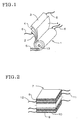
- a wound type electrode body 1 is constituted by winding, round a core 13, a positive electrode 2 and a negative electrode 3 via a separator 4 made of a porous polymer so that the positive electrode 2 and the negative electrode 3 make no direct contact with each other.
- a electrode lead 5 or 6 attached to the positive electrode 2 or the negative electrode 3 (hereinafter referred to as the electrode 2 or 3) may be at least one (in number); and it is easy to provide a plurality of the electrode leads 5 or 6 for smaller collection resistance.
- the electrode body includes a lamination type obtained by laminating a plurality of single cell type electrode bodies employed in a coin battery. As shown in Fig. 2, a lamination type electrode body 7 is obtained by laminating a given number of positive electrodes 8 and a given number of negative electrodes 9 in such a way that a separator 10 is interposed between one positive electrode and one negative electrode. At least one electrode lead 11 or 12 is fitted to each one electrode 8 or 9.
- the materials for the electrode 8 or 9, the production method therefor, etc. are the same as for the electrode 2 or 3 of the wound type electrode body 1.
- the positive electrode 2 is produced by coating a positive electrode active substance on both sides of a collection substrate.
- a metal foil having good corrosion resistance to electrochemical reaction of positive electrode such as aluminum foil, titanium foil or the like.
- the positive electrode active substance there is preferably used a lithium transition metal compound oxide such as lithium manganese oxide (LiMn 2 O 4 ), lithium cobalt oxide (LiCoO 2 ), lithium nickel oxide (LiNiO 2 ) or the like.
- a fine carbon powder such as acetylene black or the like is added as a conductivity-improving agent.
- LiMn 2 O 4 spinel lithium manganese oxide having a cubic system spinel structure
- the LiMn 2 O 4 spinel is not restricted to such a stoichiometric composition alone; and a spinel represented by a general formula LiM x Mn 2-x O 4 (M is a substitution element and X is a substitution amount) obtained by substituting part of Mn of the stoichiometric composition with other element, may also be used preferably.
- substitution element M there can be mentioned Li, Fe, Mn, Ni, Mg, Zn, B, Al, Co, Cr, Si, Ti, Sn, P, V, Sb, Nb, Ta, Mo and W.
- the substitution element M is occluded in LiMn 2 O 4 theoretically in the form of monovalent (Li), bivalent (Fe, Mn, Ni, Mg or Zn), trivalent (B, Al, Co or Cr), tetravalent (Si, Ti or Sn), pentavalent (P, V, Sb, Nb or Ta) or hexavalent (Mo or W) plus ion.
- Co and Sn may also be bivalent; Fe, Sb and Ti may also be trivalent; Mn may also be trivalent or tetravalent; and Cr may also be tetravalent or hexavalent. Therefore, the substitution element M may be present in a mixed valency state depending upon the kind.
- the amount of oxygen need not be 4 as in the case of stoichiometric composition and may be partly short or excessive as long as the required crystal structure is maintained.
- the coating of the positive electrode active substance is conducted by adding a solvent, a binder, etc. to a positive electrode active substance powder, to prepare a slurry or a paste, coating the slurry or the paste on a collection substrate using a roll coater or the like, and drying the resulting material. Then, pressing, etc. are conducted as necessary.
- the negative electrode 3 can be produced in the same manner as for the positive electrode 2.
- a metal foil having good corrosion resistance to electrochemical reaction of negative electrode such as copper foil, nickel foil or the like.
- an amorphous carbon material e.g. soft carbon or hard carbon
- a highly graphitized carbon powder e.g. artificial graphite or natural graphite.
- the separator 4 there is preferably used a three-layer separator obtained by interposing a microporous, lithium ion-transmittable polyethylene film (PE film) between porous, lithium ion-transmittable polypropylene films (PP films).
- PE film lithium ion-transmittable polyethylene film
- PP films porous, lithium ion-transmittable polypropylene films
- the PP films By interposing the PE film between the PP films of higher softening point, the PP films retain the shape even when the PE film softens, whereby the contact and short-circuiting between the positive electrode 2 and the negative electrode 3 is prevented, battery reaction is prevented reliably, and safety is secured.
- an electrode lead 5 or 6 is fitted to the area of the electrode 2 or 3 at which no electrode active substance is coated and where the collection substrate is exposed.
- the electrode lead 5 or 6 there is preferably used a foil made of the same material as for the collection substrate of the electrode 2 or 3.
- the fitting of the electrode lead 5 or 6 to the electrode 2 or 3 can be conducted by ultrasonic welding, spot welding or the like.
- one electrode lead 5 or 6 is fitted to one end of the electrode body 1 and the other electrode lead is fitted to other end of the electrode body 1, as shown in Fig. 1, because contact between the electrode lead 5 and the electrode lead 6 is avoidable.
- the produced electrode body 1 is placed in a battery case in a stale that the electrode lead 5 or 6 is connected to a terminal for taking out the electricity generated, to outside and is held in a stable position; then, the electrode body 1 is impregnated with a non-aqueous electrolytic solution; thereafter, the battery case is sealed; thus, a battery is produced.
- the non-aqueous electrolytic solution used in the lithium secondary battery of the present invention there are preferably used carbonic acid esters such as ethylene carbonate (EC), diethyl carbonate (DEC), dimethyl carbonate (DMC), propylene carbonate (PC) and the like; ⁇ -butyrolactone; tetrahydrofuran; acetonitrile; and so forth. These can be used singly or in admixture of two or more kinds.
- carbonic acid esters such as ethylene carbonate (EC), diethyl carbonate (DEC), dimethyl carbonate (DMC), propylene carbonate (PC) and the like
- ⁇ -butyrolactone tetrahydrofuran
- acetonitrile acetonitrile
- lithium complex fluoride compounds such as lithium hexafluorophosphate (LiPF 6 ), lithium borofluoride (LiBF 4 ) and the like; lithium halides such as lithium perchlorate (LiClO 4 ) and the like; and so forth.
- LiPF 6 lithium hexafluorophosphate
- LiBF 4 lithium borofluoride
- lithium halides lithium perchlorate
- LiClO 4 lithium perchlorate
- the non-aqueous electrolytic solution In production of the non-aqueous electrolytic solution, the presence of a very small amount of water in produced electrolytic solution is inevitable although strict control for water is made in the steps of production and storage of solvent and electrolyte. Further, the probability of water adsorption by the electrode active substance is very high in view of the conditions for production of electrode active substance slurry and the environment during production of electrode. Furthermore, in the step of assembling of battery, the parts other than the non-aqueous electrolytic solution are ordinarily stored in atmosphere; therefore, it is highly probable that these parts contain a very small amount of adsorbed water.
- a battery was produced using an organic solvent containing water in an amount of about 100 ppm (for prevention of HF generation); the battery was stored for about 1 week in a dry gas; then, part of the organic solvent was taken out from inside the battery and analyzed for water content. As a result, the water concentration was found to be higher than the level possessed by the organic solvent filled in the battery. The increased amount of water generates HF and an equilibrium is reached. This fact suggests that, as mentioned previously, the water adsorbed by the parts, etc. are not easily removed by mild treatments such as drying before or during battery assembling.
- the total concentration of water (H 2 O) and hydrofluoric acid (HF) contained in the non-aqueous electrolytic solution (hereinafter referred to as "total concentration") is specified at 10,000 ppm or less.
- This total concentration does not refer to the total concentration in the non-aqueous electrolytic solution before filling in battery, but to the total concentration in the non-aqueous electrolytic solution after filling in battery.
- the above total concentration level must be satisfied from battery assembling through battery use.
- total concentration has been employed in view of (1) the water contained in the non-aqueous electrolytic solution used as a battery material, (2) the water adsorbed by various battery members (e.g. electrodes) (this water dissolves in the electrolytic solution after battery assembling), and (3) the HF generating from the above two kinds of water.
- the total concentration is controlled at 10,000 ppm or less.
- the method for controlling the total concentration at 10,000 ppm or less there are various suitable methods such as (1) a method disclosed in Japanese Patent Application No. 11-62332 by the present inventors, which comprises adding a halogen, sulfur dioxide, an organic base, an alcohol, etc.; (2) a method disclosed in the above literature, which comprises adding pyridine, etc.; (3) a method disclosed in Japanese Patent Application No. 11-236524 by the present inventors, which comprises using a water-extracting agent such as organic phosphorus compound or the like; and (4) a method which comprises adding a hydrofluoric acid-extracting agent such as organic silicon compound or the like.
- a method which comprises using a dehydrating agent such as molecular sieve or the like comprises using a dehydrating agent such as molecular sieve or the like.
- a solvent is dehydrated to a minimum water level before an electrolyte is dissolved in the solvent.
- a non-aqueous electrolytic solution is filled in excess in a battery, then the electrolytic solution is removed as fully as possible, and a fresh non-aqueous electrolytic solution is filled (thereby, the water dissolving into the non-aqueous electrolytic solution from battery members and the HF generating from the water are reduced).
- the total concentration in non-aqueous electrolytic solution after battery assembling can be reduced.
- the battery members containing adsorbed water are sufficiently dried in preliminary drying or in the drying step after battery assembling and that the battery assembling is conducted in an environment of minimum moisture.
- the measurement of the water concentration is preferably conducted by the Karl Fischer's method, and the measurement of the HF concentration is preferably conducted by the neutralization titration method.
- the non-aqueous electrolytic solution used for the measurement can be collected by a necessary amount by making a hole for sampling, in the battery or by opening the inlet for non-aqueous electrolytic solution, provided in the battery.
- a non-aqueous electrolytic solution is dissolved or dispersed in methanol, and the resulting sample solution is titrated with a reddish brown Karl Fischer's reagent obtained by dissolving iodine, sulfur dioxide and pyridine in methanol ordinarily at a molar ratio of 1:3:10.
- the completion of the titration can be determined by colorimetry, potentiometry or amperometry.
- a sample solution is dissolved in an excess of cold water of 5°C or lower; thereto is dropwise added an aqueous solution containing an appropriate concentration of sodium hydroxide (NaOH) until the color of BTB indicator turns green from yellow; the concentration of HF is determined from the amount of dropped solution.
- NaOH sodium hydroxide
- the batteries of Examples 1 to 3 and Comparative Examples 1 to 2 were each produced as follows.
- a LiMn 2 O 4 spinel was used as the positive electrode active substance; thereto was added 4% by weight, based on the active substance, of acetylene black as a conductivity-improving agent; a solvent and a binder were added, to produce a material slurry for positive electrode; the slurry was coated on the both sides of an aluminum foil of 20 ⁇ m in thickness so that the slurry thickness became about 100 ⁇ m on each side, to produce a positive electrode; similarly, a negative electrode was produced by using a carbon powder as a negative electrode active substance and coating the both sides of a copper foil of 10 ⁇ m in thickness so that the coating thickness became about 80 ⁇ m on each side; using the positive electrode and the negative electrode, a wound type electrode body was produced; the electrode body was placed in a case; then, a non-aqueous electrolytic solution was filled.
- non-aqueous electrolytic solution a solution obtained by dissolving LiPF 6 in a 50/50 mixed solvent of EC and DEC in a concentration of 1 mole/liter. Each battery had a capacity of about 10 Ah after initial charge.
- the cycle test was conducted by repeating one cycle of charge and discharge shown in Fig. 4.
- the current value in second charge at 18 A was finely adjusted, whereby the variation in discharge depth of each cycle was minimized.
- the present invention has been described mainly on a case using a wound type electrode body.
- the present invention is applicable independently of the structure of battery and can be employed suitably in a large-capacity battery in which water control during production steps is not easy.
- the present invention is suitably employed specifically in a battery using a wound type or lamination type electrode body and having a capacity of 2 Ah or more.
- the lithium secondary battery of the present invention is suitably used particularly as a battery for driving the motor of electric automobile or hybrid electric automobile, which battery requires a low internal resistance and an excellent cycle property.
- the present invention there are specified the total concentration of water and hydrofluoric acid present in the non-aqueous electrolytic solution of assembled battery (water and hydrofluoric acid are contained in the non-aqueous electrolytic solution because water in atmosphere is absorbed by the non-aqueous electrolytic solution during battery assembling or the water adsorbed by the parts of battery dissolves, after battery assembling, into the non-aqueous electrolytic and such water generates hydrofluoric acid).
- the present invention is effective for prevention of dissolution of positive electrode active substance, suppression of SEI layer formation on negative electrode active substance, prevention of corrosion of metal material, etc.; as a result, improved cycle property and longer battery life are obtained.
- a lithium secondary battery includes an electrode body obtained by winding or laminating a positive electrode and a negative electrode via a separator, and a non-aqueous electrolytic solution containing a lithium compound as the electrolyte.
- the non-aqueous electrolytic solution contains water (H 2 O) and hydrofluoric acid (HF) in a total concentration of 10,000 ppm or less. Owing to the restriction of the total concentration of water and hydrofluoric acid contained in the non-aqueous electrolytic solution, the lithium secondary battery can suppress the deterioration of battery properties caused by water and hydrofluoric acid and has excellent cycle property and reliability.
Landscapes
- Chemical & Material Sciences (AREA)
- Physics & Mathematics (AREA)
- Condensed Matter Physics & Semiconductors (AREA)
- General Physics & Mathematics (AREA)
- Inorganic Chemistry (AREA)
- Engineering & Computer Science (AREA)
- Manufacturing & Machinery (AREA)
- Chemical Kinetics & Catalysis (AREA)
- Electrochemistry (AREA)
- General Chemical & Material Sciences (AREA)
- Secondary Cells (AREA)
- Battery Electrode And Active Subsutance (AREA)
Abstract
Description
wherein the non-aqueous electrolytic solution contains water (H2O) and hydrofluoric acid (HF) In a total concentration of 10,000 ppm or less.
| H2O Concentration (ppm) | HF concentration (ppm) | Total concentration (ppm) | ||
| Example 1 | After | 5 | 105 | 110 |
| After 20,000 | 20 | 378 | 398 | |
| Example 2 | After | 20 | 1520 | 1540 |
| After 20,000 cycles | 33 | 1668 | 1701 | |
| Example 3 | After | 50 | 8500 | 8550 |
| After 20,000 cycles | 67 | 8750 | 8817 | |
| Comparative Example 1 | After battery production | 90 | 9100 | 9190 |
| After 20,000 cycles | 110 | 10120 | 10230 | |
| Comparative Example 2 | After battery production | 400 | 12180 | 12580 |
| After 20,000 cycles | 460 | 15600 | 16060 |
Claims (6)
- A lithium secondary battery comprising:an electrode body obtained by winding or laminating a positive electrode and a negative electrode via a separator, and a non-aqueous electrolytic solution containing alithium compound as the electrolyte, wherein the non-aqueous electrolytic solution contains water (H2O) and hydrofluoric acid (HF) in a total concentration of 10,000 ppm or less.
- A lithium secondary battery according to Claim 1, wherein the lithium compound is lithium hexafluorophosphate.
- A lithium secondary battery according to Claim 1 or 2, wherein lithium manganese oxide of cubic system spinel structure containing lithium and manganese as the main components is used as the positive electrode active substance.
- A lithium secondary battery according to any of Claims 1 to 3, wherein a highly graphitized carbon fiber is used as the negative electrode active substance.
- A lithium secondary battery according to any of Claims 1 to 4, which has a battery capacity of 2 Ah or more.
- A lithium secondary battery according to any of Claims 1 to 5, which is used in an electric automobile or a hybrid electric automobile.
Applications Claiming Priority (2)
| Application Number | Priority Date | Filing Date | Title |
|---|---|---|---|
| JP29681499 | 1999-10-19 | ||
| JP29681499A JP3594521B2 (en) | 1999-10-19 | 1999-10-19 | Evaluation method of lithium secondary battery |
Publications (2)
| Publication Number | Publication Date |
|---|---|
| EP1094537A2 true EP1094537A2 (en) | 2001-04-25 |
| EP1094537A3 EP1094537A3 (en) | 2004-03-24 |
Family
ID=17838504
Family Applications (1)
| Application Number | Title | Priority Date | Filing Date |
|---|---|---|---|
| EP00122720A Withdrawn EP1094537A3 (en) | 1999-10-19 | 2000-10-18 | Lithium secondary battery |
Country Status (4)
| Country | Link |
|---|---|
| US (1) | US20050022369A1 (en) |
| EP (1) | EP1094537A3 (en) |
| JP (1) | JP3594521B2 (en) |
| CA (1) | CA2323220C (en) |
Families Citing this family (9)
| Publication number | Priority date | Publication date | Assignee | Title |
|---|---|---|---|---|
| US20080078405A1 (en) * | 2006-09-29 | 2008-04-03 | Crumback Gary L | Self-sizing adjustable endotracheal tube |
| JP5003695B2 (en) * | 2009-02-04 | 2012-08-15 | トヨタ自動車株式会社 | Electrode slurry manufacturing method and electrode slurry manufacturing apparatus |
| US9466431B2 (en) | 2011-01-21 | 2016-10-11 | Nippon Shokubai Co., Ltd. | Ionic compound and process for production thereof, and electrolytic solution and electrical storage device each utilizing the ionic compound |
| JP5798509B2 (en) * | 2011-04-20 | 2015-10-21 | 株式会社日本触媒 | Electrolyte material and method for producing the same |
| JP5532023B2 (en) * | 2011-07-25 | 2014-06-25 | トヨタ自動車株式会社 | Electrode slurry manufacturing method and electrode slurry manufacturing apparatus |
| JP5945405B2 (en) * | 2011-12-05 | 2016-07-05 | オートモーティブエナジーサプライ株式会社 | Method for producing lithium ion secondary battery |
| JP6745587B2 (en) * | 2014-05-29 | 2020-08-26 | 株式会社半導体エネルギー研究所 | Electrode manufacturing method |
| KR101894131B1 (en) * | 2015-12-18 | 2018-08-31 | 주식회사 엘지화학 | Method for testing cycle life of positive electrode active material for secondary battery |
| JP2021170525A (en) * | 2020-04-14 | 2021-10-28 | オルガノ株式会社 | Refining method of electrolyte solution for lithium ion secondary battery, and lithium ion secondary battery |
Family Cites Families (9)
| Publication number | Priority date | Publication date | Assignee | Title |
|---|---|---|---|---|
| CA2106066C (en) * | 1991-09-13 | 1997-08-12 | Akira Yoshino | Secondary battery |
| JPH05315006A (en) * | 1992-05-11 | 1993-11-26 | Sony Corp | Non-aqueous electrolyte battery and manufacturing method thereof |
| JP3756232B2 (en) * | 1996-01-17 | 2006-03-15 | 宇部興産株式会社 | Nonaqueous electrolyte secondary battery |
| US6001325A (en) * | 1996-11-26 | 1999-12-14 | Fmc Corporation | Process for removing acids from lithium salt solutions |
| US5869207A (en) * | 1996-12-09 | 1999-02-09 | Valence Technology, Inc. | Stabilized electrochemical cell |
| US6045945A (en) * | 1997-03-25 | 2000-04-04 | Ube Industries, Ltd. | Electrolyte solution for lithium secondary battery |
| JP3348343B2 (en) * | 1997-04-21 | 2002-11-20 | 株式会社豊田中央研究所 | Non-aqueous electrolyte for battery and non-aqueous electrolyte battery |
| JPH11260416A (en) * | 1998-03-11 | 1999-09-24 | Ngk Insulators Ltd | Lithium secondary battery |
| JP2001068153A (en) * | 1999-08-24 | 2001-03-16 | Ngk Insulators Ltd | Lithium secondary battery |
-
1999
- 1999-10-19 JP JP29681499A patent/JP3594521B2/en not_active Expired - Fee Related
-
2000
- 2000-10-12 CA CA002323220A patent/CA2323220C/en not_active Expired - Fee Related
- 2000-10-18 EP EP00122720A patent/EP1094537A3/en not_active Withdrawn
-
2004
- 2004-08-26 US US10/926,768 patent/US20050022369A1/en not_active Abandoned
Also Published As
| Publication number | Publication date |
|---|---|
| JP3594521B2 (en) | 2004-12-02 |
| US20050022369A1 (en) | 2005-02-03 |
| JP2001118600A (en) | 2001-04-27 |
| CA2323220C (en) | 2005-06-28 |
| CA2323220A1 (en) | 2001-04-19 |
| EP1094537A3 (en) | 2004-03-24 |
Similar Documents
| Publication | Publication Date | Title |
|---|---|---|
| US9437902B2 (en) | Method of manufacturing nonaqueous electrolyte secondary battery | |
| JP5622525B2 (en) | Lithium ion secondary battery | |
| JP2019520687A (en) | Additive for non-aqueous electrolyte, non-aqueous electrolyte for lithium secondary battery containing the same, and lithium secondary battery | |
| US7135253B2 (en) | High discharge current lithium secondary battery and method of manufacture | |
| JP2011054516A (en) | Lithium ion secondary battery | |
| KR20150139780A (en) | Nonaqueous electrolyte secondary battery and manufacturing method of the same | |
| JP2001273927A (en) | Lithium secondary battery | |
| CN103022563B (en) | Lithium rechargeable battery | |
| US20010016291A1 (en) | Lithim secondary battery | |
| JPWO2020194439A1 (en) | Electrode group, battery, and battery pack | |
| CN106797050A (en) | Rechargeable nonaqueous electrolytic battery | |
| RU2330354C1 (en) | Non-aquatic electrolyte containing oxyanions, and lithium battery using it | |
| CA2323220C (en) | Lithium secondary battery | |
| KR20150014897A (en) | Compound Particle Having Liquid Electrolyte and Secondary Battery Comprising the Same | |
| JP2005285545A (en) | Lithium secondary battery | |
| CN115249845B (en) | Method for manufacturing secondary battery and secondary battery | |
| JP6903683B2 (en) | Non-aqueous electrolyte batteries and battery packs | |
| JP2001118578A (en) | Lithium secondary cell and method for manufacturing the same | |
| JP2003123836A (en) | Lithium secondary battery | |
| JP2002352862A (en) | Method for evaluating electrode body, lithium secondary battery using the method and manufacturing method of the battery | |
| JP2000260469A (en) | Lithium secondary battery | |
| WO2003067688A1 (en) | Nonaqueous electrolyte secondary cell | |
| JP4040264B2 (en) | Electrode body evaluation method | |
| JP4313982B2 (en) | Nonaqueous electrolyte secondary battery | |
| JP2003178812A (en) | Evaluation method of lithium secondary battery and lithium secondary battery using the same |
Legal Events
| Date | Code | Title | Description |
|---|---|---|---|
| PUAI | Public reference made under article 153(3) epc to a published international application that has entered the european phase |
Free format text: ORIGINAL CODE: 0009012 |
|
| AK | Designated contracting states |
Kind code of ref document: A2 Designated state(s): AT BE CH CY DE DK ES FI FR GB GR IE IT LI LU MC NL PT SE |
|
| AX | Request for extension of the european patent |
Free format text: AL;LT;LV;MK;RO;SI |
|
| PUAL | Search report despatched |
Free format text: ORIGINAL CODE: 0009013 |
|
| AK | Designated contracting states |
Kind code of ref document: A3 Designated state(s): AT BE CH CY DE DK ES FI FR GB GR IE IT LI LU MC NL PT SE |
|
| AX | Request for extension of the european patent |
Extension state: AL LT LV MK RO SI |
|
| 17P | Request for examination filed |
Effective date: 20040809 |
|
| AKX | Designation fees paid |
Designated state(s): AT BE CH CY DE DK ES FI FR GB GR IE IT LI LU MC NL PT SE |
|
| 17Q | First examination report despatched |
Effective date: 20071123 |
|
| STAA | Information on the status of an ep patent application or granted ep patent |
Free format text: STATUS: THE APPLICATION IS DEEMED TO BE WITHDRAWN |
|
| 18D | Application deemed to be withdrawn |
Effective date: 20080404 |