EP1094052A2 - Process for preparing trichloroacetic acid and apparatus for use in such process - Google Patents
Process for preparing trichloroacetic acid and apparatus for use in such process Download PDFInfo
- Publication number
- EP1094052A2 EP1094052A2 EP00122084A EP00122084A EP1094052A2 EP 1094052 A2 EP1094052 A2 EP 1094052A2 EP 00122084 A EP00122084 A EP 00122084A EP 00122084 A EP00122084 A EP 00122084A EP 1094052 A2 EP1094052 A2 EP 1094052A2
- Authority
- EP
- European Patent Office
- Prior art keywords
- functional water
- trichloroacetic acid
- acid according
- preparing
- aqueous solution
- Prior art date
- Legal status (The legal status is an assumption and is not a legal conclusion. Google has not performed a legal analysis and makes no representation as to the accuracy of the status listed.)
- Granted
Links
Images
Classifications
-
- C—CHEMISTRY; METALLURGY
- C02—TREATMENT OF WATER, WASTE WATER, SEWAGE, OR SLUDGE
- C02F—TREATMENT OF WATER, WASTE WATER, SEWAGE, OR SLUDGE
- C02F1/00—Treatment of water, waste water, or sewage
- C02F1/46—Treatment of water, waste water, or sewage by electrochemical methods
- C02F1/461—Treatment of water, waste water, or sewage by electrochemical methods by electrolysis
- C02F1/46104—Devices therefor; Their operating or servicing
- C02F1/4618—Devices therefor; Their operating or servicing for producing "ionised" acidic or basic water
-
- B—PERFORMING OPERATIONS; TRANSPORTING
- B01—PHYSICAL OR CHEMICAL PROCESSES OR APPARATUS IN GENERAL
- B01J—CHEMICAL OR PHYSICAL PROCESSES, e.g. CATALYSIS OR COLLOID CHEMISTRY; THEIR RELEVANT APPARATUS
- B01J19/00—Chemical, physical or physico-chemical processes in general; Their relevant apparatus
- B01J19/08—Processes employing the direct application of electric or wave energy, or particle radiation; Apparatus therefor
- B01J19/12—Processes employing the direct application of electric or wave energy, or particle radiation; Apparatus therefor employing electromagnetic waves
- B01J19/122—Incoherent waves
- B01J19/123—Ultraviolet light
-
- B—PERFORMING OPERATIONS; TRANSPORTING
- B01—PHYSICAL OR CHEMICAL PROCESSES OR APPARATUS IN GENERAL
- B01J—CHEMICAL OR PHYSICAL PROCESSES, e.g. CATALYSIS OR COLLOID CHEMISTRY; THEIR RELEVANT APPARATUS
- B01J19/00—Chemical, physical or physico-chemical processes in general; Their relevant apparatus
- B01J19/08—Processes employing the direct application of electric or wave energy, or particle radiation; Apparatus therefor
- B01J19/12—Processes employing the direct application of electric or wave energy, or particle radiation; Apparatus therefor employing electromagnetic waves
- B01J19/122—Incoherent waves
- B01J19/127—Sunlight; Visible light
-
- C—CHEMISTRY; METALLURGY
- C07—ORGANIC CHEMISTRY
- C07C—ACYCLIC OR CARBOCYCLIC COMPOUNDS
- C07C51/00—Preparation of carboxylic acids or their salts, halides or anhydrides
- C07C51/16—Preparation of carboxylic acids or their salts, halides or anhydrides by oxidation
-
- C—CHEMISTRY; METALLURGY
- C02—TREATMENT OF WATER, WASTE WATER, SEWAGE, OR SLUDGE
- C02F—TREATMENT OF WATER, WASTE WATER, SEWAGE, OR SLUDGE
- C02F2209/00—Controlling or monitoring parameters in water treatment
- C02F2209/04—Oxidation reduction potential [ORP]
-
- C—CHEMISTRY; METALLURGY
- C02—TREATMENT OF WATER, WASTE WATER, SEWAGE, OR SLUDGE
- C02F—TREATMENT OF WATER, WASTE WATER, SEWAGE, OR SLUDGE
- C02F2209/00—Controlling or monitoring parameters in water treatment
- C02F2209/06—Controlling or monitoring parameters in water treatment pH
Definitions
- the present invention relates to a process for preparing trichloroacetic acid from tetrachloroethylene using functional water under irradiation with light and an apparatus for use in such process.
- Trichloroacetic acid is a useful compound which is not only used as a raw material for pharmaceuticals, herbicides, caustics, paint removers and deproteinizing agents, but also used for extracting ATP and AMP and separating DNA from protein.
- chlorinating dichloroacetic acid which is produced as a by-product in manufacturing monochloroacetic acid and oxidizing chloral with nitric acid are adopted.
- Tetrachloroethylene used in the present invention as a raw material was once widely and abundantly used in various industries as cleaning solvents for metal parts, semiconductor devices, clothing, etc. and as reactive solvents as well, just like trichloroethylene.
- Tetrachloroethylene used in the present invention as a raw material was once widely and abundantly used in various industries as cleaning solvents for metal parts, semiconductor devices, clothing, etc. and as reactive solvents as well, just like trichloroethylene.
- the present invention is considered to be of great significance.
- the present invention is a process for preparing trichloroacetic acid comprising the step of bringing functional water capable of partial oxidizing tetrachloroethylene under irradiation with light or aerated functional water gas which is produced by aerating the above functional water and has a capability similar to that of the above functional water into contact with tetrachloroethylene under irradiation with light.
- the present invention is an apparatus for preparing trichloroacetic acid comprising a closable container as a means for bringing functional water capable of partial oxidizing tetrachloroethylene under irradiation with light or aerated functional water gas which is produced by aerating the above functional water and has the capability similar to that of the above functional water into contact with tetrachloroethylene; and means for irradiating the above contact mixture with light.
- trichloroacetic acid can be prepared by the process in which tetrachloroethylene, which is one of the causes of groundwater contamination and soil contamination, is brought into contact with aerated functional water gas at ordinary room temperature and normal pressure under irradiation with light, instead of the prior art processes such as chlorinating dichloroacetic acid at a high temperature for a long period of time and oxidizing chloral with nitric acid in which a number of processes and a large amount of chemical agents are required for detoxifying a large amount of NO 2 and NO gases produced.
- trichloroacetic acid which is used for the preparation of pharmaceuticals, chemical agents, etc., can be prepared using the compounds which was once contaminants of no utility value as raw materials.
- the present invention is a process for preparing trichloroacetic acid comprising the step of bringing functional water capable of partial oxidizing tetrachloroethylene under irradiation with light or aerated functional water gas which is produced by aerating the above functional water and has the capability similar to that of the above functional water into contact with tetrachloroethylene under irradiation with light.
- the present invention is an apparatus for preparing trichloroacetic acid comprising a closable container as a means for bringing functional water capable of partial oxidizing tetrachloroethylene under irradiation with light or aerated functional water gas which is produced by aerating the above functional water and has a capability similar to that of the above functional water into contact with tetrachloroethylene; and means for irradiating the above contact mixture with light.
- the functional water produced by electrolyzing water means, for example, water which can be obtained near an anode by dissolving an electrolyte (such as sodium chloride and potassium chloride) in raw water and electrolyzing the water in a water bath with a pair of electrodes and which has the following properties: a hydrogen ion concentration (pH value) ranging from 1 to 4, an oxidation-reduction potential ranging from 800 mV to 1500 mV when the working electrode is a platinum electrode and a reference electrode is a silver - silver chloride electrode, and a chlorine concentration ranging from 5 mg/L to 150 mg/L.
- an electrolyte such as sodium chloride and potassium chloride
- the concentration of the electrolyte in the raw water is desirably 20 mg/L to 2000 mg/L before electrolysis and the electrolytic current value is desirably 2 A to 20 A.
- commercially available strong acid electrolytic ionized water production equipment for example, trade name: Oasis Bio Half; manufactured by Asahi Glass Engineering Co., Ltd., trade name: Strong Electrolytic Ionized Water Production Equipment Model FW-200; manufactured by Amano Corporation
- strong acid electrolytic ionized water production equipment for example, trade name: Oasis Bio Half; manufactured by Asahi Glass Engineering Co., Ltd., trade name: Strong Electrolytic Ionized Water Production Equipment Model FW-200; manufactured by Amano Corporation
- arranging a diaphragm between a pair of electrodes allows the prevention of acidic water produced near an anode and alkaline water produced near a cathode from mixing with each other, thereby acidic water can be obtained which ensures more efficient preparation of trichloroacetic acid.
- an ion-exchange membrane, a micro-porous membrane or the like is suitably used as the diaphragm as described above.
- the mixed electrolytic ionized water which is obtained by mixing acidic water and alkaline water obtained near a cathode in the electrolysis to produce the acid electrolytic ionized water, in the ratio of 1 : 1 or less and which has the following properties: the hydrogen ion concentration (pH value) ranging from 4.0 to 10, the oxidation-reduction potential ranging from 300 mV to 1100 mV when the working electrode is a platinum electrode and the reference electrode is a silver - silver chloride electrode, and the chlorine concentration ranging from 2 mg/L to 100 mg/L has the same synthesis power as the acid electrolytic ionized water.
- the hydrogen ion concentration ranging from 4.0 to 10
- the oxidation-reduction potential ranging from 300 mV to 1100 mV when the working electrode is a platinum electrode and the reference electrode is a silver - silver chloride electrode
- the chlorine concentration ranging from 2 mg/L to 100 mg/L has the same synthesis power as the acid electrolytic ionized water.
- the functional water having almost the same tetrachloroethylene-decomposition power as the above-described functional water produced by electrolysis can also be prepared not only by electrolysis, but also by dissolving various reagents in raw water.
- such functional water can be obtained by dissolving in raw water 0.001 to 0.1 N hydrochloric acid, 0.005 to 0.02 N sodium chloride and 0.0001 to 0.01 M sodium hypochlorite.
- the functional water having a pH value ranging from 4.0 to 10 can also be obtained not only by the electrolysis, but also by dissolving various reagents in raw water.
- such functional water can be obtained with hydrochloric acid at a concentration of 0.001 to 0.1 N, sodium hydroxide at a concentration of 0.001 to 0.1 N and sodium hypochlorite at a concentration of 0.0001 to 0.01 M, or with hypochlorite alone, for example with sodium hypochlorite at a concentration of 0.0001 to 0.01 M, alone.
- the functional water having a pH value of 4.0 or less and a chlorine concentration of 2 mg/L can be prepared with hydrochloric acid and hypochlorite.
- hydrochloric acid instead of hydrochloric acid as described above, some other inorganic acid or organic acid can also be used.
- the inorganic acids applicable include, for example, hydrofluoric acid, sulfuric acid, phosphoric acid and boric acid.
- the organic acids applicable include, for example, acetic acid, formic acid, malic acid, citric acid and oxalic acid.
- functional water can also be produced with a weak acidic water producing powdered agent (for example, N 3 C 3 O 3 NaCl 2 commercially available under the trade name of Kinosan 21X; manufacture by Clean Chemical Co., Ltd.).
- the functional water prepared by the above-described chemical compounding also has the capability of synthesizing trichloroacetic acid when irradiated with light, like the functional water prepared by the electrolysis, though there is a difference in the synthesis power between the two, as seen from the examples described later.
- the raw water herein used include, for example, tap water, river water and seawater. These types of water usually have a pH value ranging from 6 to 8 and a chlorine concentration less than 1 mg/L at the most. It goes without saying that these types of raw water have neither tetrachloroethylene-decomposition power nor trichloroacetic acid-synthesis power.
- the aerated functional water gas means the gas obtained by aerating the above-described acid electrolytic ionized water, mixed electrolytic ionized water and synthesized functional water in oxygen gas or a gaseous mixture of oxygen gas and an inert gas.
- the gaseous mixture of oxygen gas and an inert gas is not limited to a specific one, and even when using air as a gaseous mixture, trichloroacetic acid of quality adequate for use in the ordinary applications can be obtained.
- oxygen gas should be used solely, or when using a gaseous mixture of oxygen gas and an inert gas, any one of the rare gases such as helium, neon and argon should be used as an inert gas. In this case, the higher the purity of the oxygen gas used is, the more preferable the product is.
- the aerated functional water gas contains chlorine gas, steam and oxygen.
- the chlorine concentration is preferably 5 to 1000 ppm V, particularly preferably 20 to 500 ppm V.
- the steam is the moisture mixed with the gas when aerating the functional water. Its concentration does not need to be controlled; rather, it should not be controlled, because, if the temperature of the functional water is raised intentionally to a temperature higher than room temperature, so as to increase the steam amount, the purity of the trichloroacetic acid prepared is lowered due to the moisture condensation occurring within the tetrachloroethylene reactor.
- oxygen concentration not less than 10 % is enough, and it does not need to be raised to a concentration higher than that of air.
- the tetrachloroethylene used as a raw material for trichloroacetic acid may be that prepared solely for industrial use. However the tetrachloroethylene may also be used such that it was once used at factories etc. for, for example, cleaning metal parts, semiconductor devices, clothing, etc., leaked in nature, contaminated river water, underground water and soil, and recovered therefrom afterward by the vacuum suction of soil or the aeration of underground water. The higher the purity of tetrachloroethylene is, the more preferable the product is.
- the light used in the preparation of trichloroacetic acid with functional water for irradiating purpose its wavelength is preferably 300 to 500 nm, particularly preferably 350 to 450 nm.
- the intensity of the light irradiating various types of functional water or aerated functional water gas and tetrachloroethylene as a raw material is preferably 10 ⁇ W/cm 2 to 10 mW/cm 2 , particularly preferably 50 ⁇ W/cm 2 to 5 mW/cm 2 , in terms of synthetic efficiency.
- a good enough amount of synthesis progresses with the intensity of several hundreds ⁇ W/cm 2 (measured at the wave lengths between 300 nm to 400 nm).
- natural light such as sunlight
- artificial light such as white lamp, black light, color fluorescent lamp, etc.
- light irradiation is conducted preferably at the time various types of functional water or aerated functional water gas and tetrachloroethylene are allowed to come in contact with each other.
- functional water it is not necessary to use ultraviolet light with a wavelength of 250 nm which affects the human body significantly.
- the functional water produced by, for example, the electrolysis of the water containing an electrolyte such as sodium chloride contains hypochlorous acid or hypochlorous acid ions. And it is considered that these hypochlorous acid or hypochlorous acid ions induce chlorine radicals, hydroxyl radicals and superoxide anions with the aid of the light action, leading to accelerating the reaction of producing trichloroacetic acid.
- the amount of the hypochlorous acid, which is considered to contribute to the production of trichloroacetic acid, in the functional water produced near an anode by the electrolysis thereof can be obtained based on the PH value and the chlorine concentration of the functional water.
- the water obtained by diluting the functional water with deionized water etc. can also be used for the production of trichloroacetic acid.
- a process of preparing trichloroacetic acid with functional water will be described below.
- the process of allowing tetrachloroethylene and functional water or aerated functional water gas to come in contact with each under light irradiation can be carried out at the ordinary room temperature and normal pressure. Accordingly there is no need for special facilities and environment.
- the processes in which functional water itself is allowed to contact with tetrachloroethylene include, for example, directly mixing the above two; and conducting electrolysis in an electrolytic bath containing an aqueous electrolyte with tetrachloroethylene added thereto.
- Preparing trichloroacetic acid by these processes is simple and easy, but on the other hand, there may be cases where water, electrolyte in functional water, etc. mix with the trichloroacetic acid prepared as impurities.
- the process is more preferable in which functional water itself is not allowed to contact with tetrachloroethylene, but the functional water gas, which is obtained by aerating the functional water previously prepared or the functional water being prepared in the electrolysis with oxygen gas or a gaseous mixture of oxygen gas and an inert gas, is allowed to contact with tetrachloroethylene.
- the process of the present invention may be carried out in accordance with any one of the batch method and the continuous method.
- tetrachloroethylene and functional water or aerated functional water gas may be filled into a glass container at a time and irradiated with light.
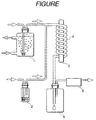
- an apparatus for example, shown in Figure may be used.
- the aerated functional water gas is supplied by aerating the functional water in a functional water aerating bath 1 with compressed air.
- This functional water aerating bath may also be allowed to serve as an electrolytic bath by providing the bath with electrodes and a diaphragm for separating the electrolysis solution between the electrodes and arranging a bubbler for the aeration near the anode.
- Tetrachloroethylene as the raw material, is vaporized by being aerated with oxygen gas or a gaseous mixture of oxygen gas and an inert gas, such as air, sent to a bubbler arranged in a tetrachloroethylene vaporizing bath 2.
- the aerated functional water gas and the vaporized tetrachloroethylene are mixed with each other and allowed to pass through a reaction coil 4 made of glass tube which goes down in the direction of gravity while winding around a light irradiating means 3, so as to produce trichloroacetic acid.
- the trichloroacetic acid produced within the reaction coil 4, which is in the liquid state, is pushed by the gas within the glass tube coil due to the heat of the light irradiating means 3 and allowed to drop into a recovery bath 5. In the recovery bath, the trichloroacetic acid is cooled, condensed, and finally crystallized.
- a heater for heating the reaction coil 4 may be prepared specially or the entire reaction apparatus may be heated so as to raise the temperature within the reaction coil 4 to about 60°C.
- the gas discharged from the coil is introduced into a trap 6 and the excess chlorine gas and hydrogen chloride gas are adsorbed therein, after that, the trap is exhausted.
- Hydrogen chloride is considered to be produced during the reaction.
- the batch method it is easily volatilized by raising the temperature of the water in a glass bottle which is used in the reaction.
- the trichloroacetic acid produced is easy to separate, since it is cooled at room temperature after discharged from the reaction coil, condensed and finally solidified.
- the liquid obtained after the reaction should be refined by, for example, the vacuum distillation, the solvent extraction and the adsorption separation.
- functional water was prepared with strong acid functional water production equipment (trade name: Strong Electrolytic Ionized Water Production Equipment; manufactured by Amano Corporation, Model FW-200).
- strong acid functional water production equipment trade name: Strong Electrolytic Ionized Water Production Equipment; manufactured by Amano Corporation, Model FW-200.
- a diaphragm was arranged between the anode and the cathode.
- the pH value, the oxidation-reduction potential and the chlorine concentration of this functional water varied from 1.0 to 4.0, from 800 mV to 1500 mV and from 5 mg/L to 150 mg/L, respectively, with the concentration of sodium chloride as the electrolyte (a standard concentration is 1000 mg/L), the electrolytic current value and the electrolysis time.
- functional water with a pH value of 2.6, an oxidation-reduction potential of 1000 mV and a residual chlorine concentration of 75 mg/L was prepared as functional water used for an experiment of the production of trichloroacetic acid.
- the fluorescent lamp was turned off, the gas in the glass vial was sampled with a gas tight syringe and measured with a gas chromatography (GC-14B with a Fire Ionized Detector; manufactured by Shimadzu Corporation, The column used was DB-624 manufactured by J&W). As a result, no tetrachloroethylene was detected. Then the liquid in the glass vial was sampled and measured with a high pressure liquid chromatography (manufactured by Waters), as a result of which it was found that trichloroacetic acid was produced at a concentration of 4500 mg/L.
- Example 2 The same experiment as in Example 1 was conducted, except that the black light fluorescent lamp was not turned on. Sixty minutes after mixing the functional water and tetrachloroethylene stock solution, the gas in the glass vial was measured, and 56000 ppm V of tetrachloroethylene was detected. Then the liquid in the glass vial was measured, but no trichloroacetic acid was detected.
- Electrolysis was conducted with the same electrolytic ionized water production equipment as in Example 1 using sodium chloride with a concentration of 1000 mg/L as the electrolyte, so as to prepare acid functional water with a pH value of 2.6, an oxidation-reduction potential of 1000 mV and a residual chlorine concentration of 70 mg/L on the anode side and alkaline functional water with a pH value of 11.5, an oxidation-reduction potential of 850 mV and a residual chlorine concentration of 10 mg/L on the anode side.
- the acid functional water and the alkaline functional water were mixed in the ratio of 1 : 1, so as to prepare mixed functional water a with a pH value of 7.1, an oxidation-reduction potential of 400 mV and a residual chlorine concentration of 42 mg/L. Further, the acid functional water and the alkaline functional water were mixed in the ratio of 1 : 0.5, so as to prepare mixed functional water b with a pH value of 6.5, an oxidation-reduction potential of 480 mV and a residual chlorine concentration of 47 mg/L. And the same experiment as in Example 1 was conducted, except that these types of functional water were used.
- the fluorescent lamp was turned off and the gas in the glass vial was measured. As a result, no tetrachloroethylene was detected for both the functional water a and b. Then the liquid in the glass vial was measured, and it was found that trichloroacetic acid was produced at a concentration of 4100 mg/L for the mixed functional water a and at a concentration of 4200 mg/L for the mixed functional water b.
- the pH value, the oxidation-reduction potential and the chlorine concentration were measured for the aqueous solution prepared to have a hydrochloric acid concentration of 0.001 to 0.1 N, a sodium chloride concentration of 0.005 to 0.02 N and a sodium hypochlorite concentration of 0.0001 to 0.01M.
- the pH value varied in the range of 1.0 to 4.0, the oxidation-reduction potential in the range of 800 mV to 1500 mV and the chlorine concentration in the range of 5 mg/L to 150 mg/L.
- the aqueous solution was prepared in a glass vial to have a hydrochloric acid concentration of 0.006 N, a sodium chloride concentration of 0.014 N and a sodium hypochlorite concentration of 0.002M, and functional water with a pH value of 2.3, an oxidation-reduction potential of 1180 mV and a residual chlorine concentration of 105 mg/L.
- a hydrochloric acid concentration of 0.006 N a sodium chloride concentration of 0.014 N and a sodium hypochlorite concentration of 0.002M
- functional water with a pH value of 2.3, an oxidation-reduction potential of 1180 mV and a residual chlorine concentration of 105 mg/L.
- the fluorescent lamp was turned off and the gas in the glass vial was measured. As a result, no tetrachloroethylene was detected. Then the liquid in the glass vial was measured, and it was found that trichloroacetic acid was produced at a concentration of 4400 mg/L.
- the fluorescent lamp was turned off and the gas in the glass vial was measured; however no tetrachloroethylene was detected. Then water was put in the glass vial, so as to dissolve in the whole water the white crystal attached on its wall surface. The liquid was measured with a high pressure liquid chromatography; as a result, it was found that trichloroacetic acid was produced in an amount of 13 mg.
- Trichloroacetic acid was produced continuously with an apparatus shown in Figure.
- 1000 mg/L of sodium chloride aqueous solution was put in a vial for electrolytic water provided for a strong acid electrolytic functional water production equipment (trade name: Oasis Bio Half; manufactured by Asahi Glass Engineering Co., Ltd.) and started to operate it, so as to produce electrolytic functional water continuously.
- the functional water obtained was measured in the same manner as in Example 1, and it was found that the functional water had a pH value of 2.4, an oxidation-reduction potential of 1000 mV and a residual chlorine concentration of 70 mg/L.
- This functional water was supplied continuously to a functional water aerating bath 1, so as to produce aerated functional water gas.
- the black light fluorescent lamp (trade name: FL10BLB; manufactured by Toshiba Corporation, 10 W), as the light irradiating means, which had been installed in the middle of the reaction coil made of the glass tube 20 mm in diameter and 1 m in length, was turned on previously, and after confirming the temperature of the reaction coil reached 60°C or higher, compressed air was sent to the functional water aerating bath 1 and the tetrachloroethylene vaporizing bath 2, respectively, at a flow rate of 10 mL/min so as to aerate the functional water and the tetrachloroethylene via the respective bubblers.
- the chlorine concentration of the aerated functional water gas measured at this point was about 100 ppm V.
- the tetrachloroethylene concentration measured with a gas chromatography was 900 ppm V.
- the aerated functional water gas and the gaseous tetrachloroethylene each obtained by the aeration were mixed with each other, then allowed to enter the reaction coil 4 from the upper end portion thereof, allowed to flow down while being subjected to light irradiation over about 30 minutes, and discharged from the lower end portion of the reaction coil 4.
- the liquid matter and solid matter were stored in the recovering bath 5 and the gas was discharged through a trap 6.
- the gas discharged form the recovering bath 5 was sampled with a gas tight syringe and measured with a gas chromatography. As a result, no tetrachloroethylene was detected.
Landscapes
- Chemical & Material Sciences (AREA)
- Organic Chemistry (AREA)
- Chemical Kinetics & Catalysis (AREA)
- Toxicology (AREA)
- General Health & Medical Sciences (AREA)
- Health & Medical Sciences (AREA)
- Engineering & Computer Science (AREA)
- Electromagnetism (AREA)
- Physics & Mathematics (AREA)
- Life Sciences & Earth Sciences (AREA)
- Water Supply & Treatment (AREA)
- Environmental & Geological Engineering (AREA)
- Hydrology & Water Resources (AREA)
- General Chemical & Material Sciences (AREA)
- Electrochemistry (AREA)
- Oil, Petroleum & Natural Gas (AREA)
- Organic Low-Molecular-Weight Compounds And Preparation Thereof (AREA)
- Physical Water Treatments (AREA)
- Physical Or Chemical Processes And Apparatus (AREA)
Abstract
Description
Claims (49)
- A process for preparing trichloroacetic acid comprising the step of bringing functional water capable of partial oxidizing tetrachloroethylene under irradiation with light or aerated functional water gas which is produced by aerating the functional water and has a capability similar to that of the functional water into contact with tetrachloroethylene under irradiation with light.
- The process for preparing trichloroacetic acid according to claim 1, wherein the aeration is conducted with oxygen gas or a gaseous mixture of oxygen gas and an inert gas.
- The process for preparing trichloroacetic acid according to claim 1, wherein the gaseous mixture of oxygen gas and an inert gas is air.
- The process for preparing trichloroacetic acid according to claim 1, wherein the aerated functional water gas contains chlorine gas at a concentration of 5 to 1000 ppmV.
- The process for preparing trichloroacetic acid according to claim 4, wherein the aerated functional water gas contains chlorine gas at a concentration of 20 to 500 ppmV.
- The process for preparing trichloroacetic acid according to claim 1, wherein the aerated functional water gas contains steam.
- The process for preparing trichloroacetic acid according to claim 1, wherein the functional water is an acidic aqueous solution produced near an anode by the electrolysis of an aqueous solution containing an electrolyte.
- The process for preparing trichloroacetic acid according to claim 1, wherein the functional water is a mixed aqueous solution of the acidic aqueous solution produced near an anode and an alkaline aqueous solution produced near a cathode by electrolysis of an aqueous solution containing an electrolyte.
- The process for preparing trichloroacetic acid according to claim 8, wherein the mixed aqueous solution is obtained by mixing the acidic aqueous solution and the alkaline aqueous solution in a ratio of 1 : 1 or less.
- The process for preparing trichloroacetic acid according to claim 7, wherein the electrolysis is conducted in an electrolytic bath having a diaphragm for avoiding mixing the acidic aqueous solution produced near the anode with the alkaline aqueous solution produced near the cathode provided between the two electrodes.
- The process for preparing trichloroacetic acid according to claim 10, wherein the diaphragm is an ion-exchange membrane or a micro-porous membrane.
- The process for preparing trichloroacetic acid according to claim 7, wherein the electrolyte is at least any one of sodium chloride and potassium chloride.
- The process for preparing trichloroacetic acid according to claim 1, wherein the functional water is a hypochlorite aqueous solution.
- The process for preparing trichloroacetic acid according to claim 13, wherein the hypochlorite is at least any one of sodium hypochlorite and potassium hypochlorite.
- The process for preparing trichloroacetic acid according to claim 1, wherein the functional water further comprises inorganic acid or organic acid.
- The process for preparing trichloroacetic acid according to claim 15, wherein the inorganic acid or the organic acid is at least one selected from the group consisting of hydrochloric acid, hydrofluoric acid, sulfuric acid, phosphoric acid, boric acid, acetic acid, formic acid, malic acid, citric acid and oxalic acid.
- The process for preparing trichloroacetic acid according to claim 1, wherein the functional water has a hydrogen ion concentration (pH value) of 1 to 4, an oxidation-reduction potential (working electrode: platinum electrode, reference electrode: silver - silver chloride electrode) of 800 to 1500 mV, and a chlorine concentration of 5 to 150 mg/L.
- The process for preparing trichloroacetic acid according to claim 1, wherein the functional water has a hydrogen ion concentration (pH value) of 4 to 10, an oxidation-reduction potential (working electrode: platinum electrode, reference electrode: silver - silver chloride electrode) of 300 to 1100 mV, and a chlorine concentration of 2 to 100 mg/L.
- The process for preparing trichloroacetic acid according to claim 1, wherein the light comprises light having a wavelength range of 300 to 500 nm.
- The process for preparing trichloroacetic acid according to claim 19, wherein the light has a wavelength range of 350 to 450 nm.
- The process for preparing trichloroacetic acid according to claim 1, wherein an irradiation dose of the light is in a range of 10 µW/cm2 to 10 mW/cm2.
- The process for preparing trichloroacetic acid according to claim 21, wherein the irradiation dose of the light is in a range of 50 µW/cm2 to 5 mW/cm2.
- The process for preparing trichloroacetic acid according to claim 1, wherein the functional water is the acid electrolytic aqueous solution, the place of the functional water coming into contact with tetrachloroethylene under light irradiation is near the anode of the electrolytic bath provided with a pair of electrodes where the acid electrolytic aqueous solution is produced, and the light irradiation is conducted in such a state in which tetrachloroethylene is allowed to exist near the anode.
- The process for preparing trichloroacetic acid according to claim 1, comprising the steps of:supplying the functional water to produce the aerated functional water gas by aeration;mixing the aerated functional water gas with tetrachloroethylene; andrecovering the trichloroacetic acid produced.
- An apparatus for preparing trichloroacetic acid comprising:a closable container as means for bringing functional water capable of partial oxidizing tetrachloroethylene under irradiation with light or aerated functional water gas which is produced by aerating the functional water and has the capability similar to that of the above functional water into contact with tetrachloroethylene; andmeans for irradiating the contact mixture with light.
- The apparatus for preparing trichloroacetic acid according to claim 25, wherein the light irradiated from the light irradiating means comprises light having a wavelength range of 300 to 500 nm.
- The apparatus for preparing trichloroacetic acid according to claim 26, wherein the light irradiated from the light irradiating means has a wavelength range of 350 to 450 nm.
- The apparatus for preparing trichloroacetic acid according to claim 25, wherein an irradiation dose of the light is in a range of 10 µW/cm2 to 10 mW/cm2.
- The apparatus for preparing trichloroacetic acid according to claim 28, wherein the irradiation dose of the light is in a range of 50 µW/cm2 to 5 mW/cm2.
- The apparatus for preparing trichloroacetic acid according to claim 25, wherein the aeration is conducted with oxygen gas or a gaseous mixture of oxygen gas and an inert gas.
- The apparatus for preparing trichloroacetic acid according to claim 30, wherein the gaseous mixture of oxygen gas and an inert gas is air.
- The apparatus for preparing trichloroacetic acid according to claim 25, wherein the aerated functional water gas contains chlorine gas at a concentration of 5 to 1000 ppmV.
- The apparatus for preparing trichloroacetic acid according to claim 32, wherein the aerated functional water gas contains chlorine gas at a concentration of 20 to 500 ppmV.
- The apparatus for preparing trichloroacetic acid according to claim 25, wherein the aerated functional water gas contains steam.
- The apparatus for preparing trichloroacetic acid according to claim 25 which comprises an equipment for producing functional water, the equipment comprising a pair of electrodes, a power source for applying a voltage between the electrodes and a container storing an electrolyte aqueous solution therein, wherein and the functional water is produced by applying a voltage between the electrodes so as to electrolyze the electrolyte aqueous solution.
- The apparatus for preparing trichloroacetic acid according to 35, wherein the functional water is an acidic aqueous solution produced near the anode by electrolysis of an aqueous solution containing an electrolyte.
- The apparatus for preparing trichloroacetic acid according to 35, wherein the functional water is a mixed aqueous solution of the acidic aqueous solution produced near the anode and the alkaline aqueous solution produced near the cathode by the electrolysis of an aqueous solution containing an electrolyte.
- The apparatus for preparing trichloroacetic acid according to claim 37, wherein the mixed aqueous solution is obtained by mixing the acidic aqueous solution and the alkaline aqueous solution in the ratio of 1 : 1 or less.
- The apparatus for preparing trichloroacetic acid according to claim 36, wherein the electrolytic bath in which the electrolysis is conducted has a diaphragm for avoiding mixing the acidic aqueous solution produced near the anode with the alkaline aqueous solution produced near the cathode provided between the two electrodes.
- The apparatus for preparing trichloroacetic acid according to claim 39, wherein the diaphragm is an ion-exchange membrane or a micro-porous membrane.
- The apparatus for preparing trichloroacetic acid according to claim 35, wherein the electrolyte is at least any one of sodium chloride and potassium chloride.
- The apparatus for preparing trichloroacetic acid according to claim 35, wherein the electrolytic bath also serves as a closable container as means of bringing the functional water into contact with tetrachloroethylene, the place of the functional water coming in contact with tetrachloroethylene is near the anode where the acidic aqueous solution is produced, means for supplying tetrachloroethylene directly near the anode is provided, and the light irradiating means irradiates near the anode with light.
- The apparatus for preparing trichloroacetic acid according to claim 25, wherein the functional water is a hypochlorite aqueous solution.
- The apparatus for preparing trichloroacetic acid according to claim 43, wherein the hypochlorite is at least any one of sodium hypochlorite and potassium hypochlorite.
- The apparatus for preparing trichloroacetic acid according to claim 25, wherein the functional water further comprises inorganic acid or organic acid.
- The apparatus for preparing trichloroacetic acid according to claim 45, wherein the inorganic acid or the organic acid is at least one selected from the group consisting of hydrochloric acid, hydrofluoric acid, sulfuric acid, phosphoric acid, boric acid, acetic acid, formic acid, malic acid, citric acid and oxalic acid.
- The apparatus for preparing trichloroacetic acid according to claim 25, wherein the functional water has a hydrogen ion concentration (pH value) of 1 to 4, an oxidation-reduction potential (working electrode: platinum electrode, reference electrode: silver - silver chloride electrode) of 800 to 1500 mV, and a chlorine concentration of 5 to 150 mg/L.
- The apparatus for preparing trichloroacetic acid according to claim 25, wherein the functional water has a hydrogen ion concentration (pH value) of 4 to 10, an oxidation-reduction potential (working electrode: platinum electrode, reference electrode: silver - silver chloride electrode) of 300 to 1100 mV, and a chlorine concentration of 2 to 100 mg/L.
- The apparatus for preparing trichloroacetic acid according to claim 25, comprising:means for supplying the functional water to produce the aerated functional water gas by aeration;means for supplying tetrachloroethylene;means for mixing the aerated functional water gas with tetrachloroethylene;means for irradiating the gaseous mixture with light; andmeans for recovering the trichloroacetic acid produced.
Applications Claiming Priority (2)
| Application Number | Priority Date | Filing Date | Title |
|---|---|---|---|
| JP28977099 | 1999-10-12 | ||
| JP28977099A JP2001114727A (en) | 1999-10-12 | 1999-10-12 | Method and apparatus for producing trichloroacetic acid |
Publications (3)
| Publication Number | Publication Date |
|---|---|
| EP1094052A2 true EP1094052A2 (en) | 2001-04-25 |
| EP1094052A3 EP1094052A3 (en) | 2003-01-15 |
| EP1094052B1 EP1094052B1 (en) | 2006-12-13 |
Family
ID=17747548
Family Applications (1)
| Application Number | Title | Priority Date | Filing Date |
|---|---|---|---|
| EP00122084A Expired - Lifetime EP1094052B1 (en) | 1999-10-12 | 2000-10-11 | Process for preparing trichloroacetic acid |
Country Status (4)
| Country | Link |
|---|---|
| US (1) | US6800257B1 (en) |
| EP (1) | EP1094052B1 (en) |
| JP (1) | JP2001114727A (en) |
| DE (1) | DE60032308T8 (en) |
Families Citing this family (6)
| Publication number | Priority date | Publication date | Assignee | Title |
|---|---|---|---|---|
| JP3825959B2 (en) * | 2000-06-16 | 2006-09-27 | キヤノン株式会社 | Pollutant decomposition method and apparatus |
| JP2003205221A (en) * | 2001-11-12 | 2003-07-22 | Canon Inc | Method for treating organochlorine compound and apparatus used therefor, method for repairing soil and apparatus used therefor |
| ITMI20071863A1 (en) * | 2007-09-28 | 2009-03-29 | Industrie De Nora Spa | ELECTROCHEMICAL DEVICE FOR BIOCIDAL TREATMENT IN AGRICULTURAL APPLICATIONS |
| KR101007418B1 (en) * | 2008-05-28 | 2011-01-12 | 순천향대학교 산학협력단 | Method for recovering amines from amine containing wastewater |
| US8876087B1 (en) * | 2011-10-13 | 2014-11-04 | William M. Lake | Water tank system |
| CN110146346B (en) * | 2019-06-18 | 2021-07-06 | 青岛科技大学 | A sampling assembly for the detection of hydrogen produced by electrocatalytic decomposition of water |
Family Cites Families (17)
| Publication number | Priority date | Publication date | Assignee | Title |
|---|---|---|---|---|
| US4144162A (en) * | 1977-09-01 | 1979-03-13 | Mid-Florida Mining Co. | Method for the containment of oils and oil sludges |
| US4144152A (en) * | 1978-03-27 | 1979-03-13 | Atlantic Research Corporation | Dehalogenation of halogenated compounds |
| FR2524875A1 (en) * | 1982-04-07 | 1983-10-14 | Elf Aquitaine | PROCESS AND APPARATUS FOR PHOTOCHEMICAL PRODUCTION OF HALOGENO-ALKANES AND CYCLO-ALKANES |
| US4761208A (en) * | 1986-09-29 | 1988-08-02 | Los Alamos Technical Associates, Inc. | Electrolytic method and cell for sterilizing water |
| JP2626778B2 (en) | 1988-01-13 | 1997-07-02 | 三浦電子株式会社 | Electrolytically generated sterilizing water |
| US5094815A (en) * | 1988-05-18 | 1992-03-10 | Cornell Research Foundation, Inc. | Photolytic interface for HPLC-chemiluminescence detection of non volatile N-nitroso compounds |
| JPH07119186B2 (en) | 1991-12-27 | 1995-12-20 | 呉羽化学工業株式会社 | Method for producing trichloroacetic acid |
| US5308507A (en) * | 1992-08-04 | 1994-05-03 | Los Alamos Technical Associates, Inc. | Method and apparatus for removing organic contaminants |
| JP2581403B2 (en) | 1993-08-10 | 1997-02-12 | 日本電気株式会社 | Wet processing method and processing apparatus |
| DE69306542T2 (en) * | 1993-01-08 | 1997-05-15 | Nippon Electric Co | Method and device for wet treatment of solid surfaces |
| DE4330518A1 (en) * | 1993-09-06 | 1995-03-09 | Manfred Dr Rer Nat Blaschke | Apparatus and process for treating waters and wastewaters |
| JPH0788489A (en) * | 1993-09-21 | 1995-04-04 | Nec Environment Eng Ltd | Method and apparatus for treating contaminated water |
| DE4400308A1 (en) * | 1994-01-03 | 1995-07-06 | Manfred Dr Rer Nat Blaschke | Toxic liquid wastes treated by combined electrolysis and UV radiation |
| US5779912A (en) * | 1997-01-31 | 1998-07-14 | Lynntech, Inc. | Photocatalytic oxidation of organics using a porous titanium dioxide membrane and an efficient oxidant |
| DE69942497D1 (en) * | 1998-06-22 | 2010-07-29 | Canon Kk | Process for the decomposition of halogenated aliphatic and aromatic compounds |
| JP2000084357A (en) * | 1998-09-14 | 2000-03-28 | Ataka Construction & Engineering Co Ltd | Treatment of organic chlorine compound and device therefor |
| EP1005881B1 (en) | 1998-11-30 | 2005-01-19 | Canon Kabushiki Kaisha | Method and apparatus for decomposing halogenated aliphatic hydrocarbon compounds or aromatic compounds |
-
1999
- 1999-10-12 JP JP28977099A patent/JP2001114727A/en not_active Withdrawn
-
2000
- 2000-10-11 US US09/685,740 patent/US6800257B1/en not_active Expired - Fee Related
- 2000-10-11 EP EP00122084A patent/EP1094052B1/en not_active Expired - Lifetime
- 2000-10-11 DE DE60032308T patent/DE60032308T8/en active Active
Also Published As
| Publication number | Publication date |
|---|---|
| DE60032308D1 (en) | 2007-01-25 |
| DE60032308T2 (en) | 2007-04-05 |
| DE60032308T8 (en) | 2007-07-12 |
| US6800257B1 (en) | 2004-10-05 |
| EP1094052A3 (en) | 2003-01-15 |
| EP1094052B1 (en) | 2006-12-13 |
| JP2001114727A (en) | 2001-04-24 |
Similar Documents
| Publication | Publication Date | Title |
|---|---|---|
| Brillas et al. | Iron (II) catalysis of the mineralization of aniline using a Carbon‐PTFE O 2‐Fed cathode | |
| US5616234A (en) | Method for producing chlorine or hypochlorite product | |
| US6699370B2 (en) | Process and system for decomposing pollutants | |
| EP1110629B1 (en) | Method and apparatus for purifying polluted soil and for decomposing polluted gas | |
| EP1094052B1 (en) | Process for preparing trichloroacetic acid | |
| EP1010453B1 (en) | Method and apparatus for decomposing gaseous aliphatic or aromatic hydrocarbon halide compound | |
| KR20030079726A (en) | Functional water, the process and the apparatus for preparing the same, and the process and the apparatus for cleansing the electronic part using the functional water | |
| US6599431B2 (en) | Purifying apparatus for contaminated water and ground water and method thereof | |
| JP2001240559A (en) | Decomposition method of organic chlorine compound and decomposition apparatus used for the method | |
| JP2001000975A (en) | Pollutant decomposition method and apparatus | |
| JP4053805B2 (en) | Functional water, production method and production apparatus thereof | |
| Mogyoródy | Influence of chlorine-water equilibria on the electrochemical destruction of thiocarbamate herbicides in NaCl solutions | |
| JP2000354642A (en) | Dioxin decomposition method and dioxin decomposition apparatus | |
| KR100429611B1 (en) | method and system for processing sewage and waste water by atomic oxygen | |
| US7018514B2 (en) | Method and apparatus for processing substances to be decomposed | |
| JP2001170666A (en) | Decomposition method of organic chlorine compound and decomposition apparatus used for the method | |
| JP2001062288A (en) | Pollutant decomposition method and apparatus | |
| JP2001137697A (en) | Decomposition method and decomposition apparatus for gaseous halogenated aliphatic hydrocarbon compounds | |
| JP3981424B2 (en) | Decomposition method of halogenated ethylene | |
| WO2008152117A2 (en) | Process and apparatus for reducing arsenic in an acidic liquid1 | |
| JP2001113128A (en) | Decomposition method and decomposition apparatus for gaseous halogenated aliphatic hydrocarbon compounds | |
| JP2000197815A (en) | Ozone dissolved water production equipment | |
| Xiao-yu et al. | Studies of several systems with air electrode electro-synthesizing H2O2 on the spot for degrading aniline in aqueous | |
| JP2002153731A (en) | Pollutant decomposition apparatus and decomposition method | |
| JP2001000576A (en) | Method and apparatus for decomposing pollutants |
Legal Events
| Date | Code | Title | Description |
|---|---|---|---|
| PUAI | Public reference made under article 153(3) epc to a published international application that has entered the european phase |
Free format text: ORIGINAL CODE: 0009012 |
|
| AK | Designated contracting states |
Kind code of ref document: A2 Designated state(s): AT BE CH CY DE DK ES FI FR GB GR IE IT LI LU MC NL PT SE |
|
| AX | Request for extension of the european patent |
Free format text: AL;LT;LV;MK;RO;SI |
|
| PUAL | Search report despatched |
Free format text: ORIGINAL CODE: 0009013 |
|
| RIC1 | Information provided on ipc code assigned before grant |
Free format text: 7C 07C 51/16 A, 7C 07C 53/16 B, 7C 02F 1/461 B, 7B 01J 19/12 B, 7B 01J 19/08 B, 7C 07C 51/29 B, 7C 07C 51/25 B |
|
| AK | Designated contracting states |
Kind code of ref document: A3 Designated state(s): AT BE CH CY DE DK ES FI FR GB GR IE IT LI LU MC NL PT SE |
|
| AX | Request for extension of the european patent |
Free format text: AL;LT;LV;MK;RO;SI |
|
| 17P | Request for examination filed |
Effective date: 20030528 |
|
| AKX | Designation fees paid |
Designated state(s): DE FR GB |
|
| 17Q | First examination report despatched |
Effective date: 20040107 |
|
| GRAP | Despatch of communication of intention to grant a patent |
Free format text: ORIGINAL CODE: EPIDOSNIGR1 |
|
| RTI1 | Title (correction) |
Free format text: PROCESS FOR PREPARING TRICHLOROACETIC ACID |
|
| GRAS | Grant fee paid |
Free format text: ORIGINAL CODE: EPIDOSNIGR3 |
|
| GRAA | (expected) grant |
Free format text: ORIGINAL CODE: 0009210 |
|
| AK | Designated contracting states |
Kind code of ref document: B1 Designated state(s): DE FR GB |
|
| REG | Reference to a national code |
Ref country code: GB Ref legal event code: FG4D |
|
| REF | Corresponds to: |
Ref document number: 60032308 Country of ref document: DE Date of ref document: 20070125 Kind code of ref document: P |
|
| EN | Fr: translation not filed | ||
| PLBE | No opposition filed within time limit |
Free format text: ORIGINAL CODE: 0009261 |
|
| STAA | Information on the status of an ep patent application or granted ep patent |
Free format text: STATUS: NO OPPOSITION FILED WITHIN TIME LIMIT |
|
| 26N | No opposition filed |
Effective date: 20070914 |
|
| PG25 | Lapsed in a contracting state [announced via postgrant information from national office to epo] |
Ref country code: FR Free format text: LAPSE BECAUSE OF FAILURE TO SUBMIT A TRANSLATION OF THE DESCRIPTION OR TO PAY THE FEE WITHIN THE PRESCRIBED TIME-LIMIT Effective date: 20070803 |
|
| GBPC | Gb: european patent ceased through non-payment of renewal fee |
Effective date: 20071011 |
|
| PG25 | Lapsed in a contracting state [announced via postgrant information from national office to epo] |
Ref country code: FR Free format text: LAPSE BECAUSE OF FAILURE TO SUBMIT A TRANSLATION OF THE DESCRIPTION OR TO PAY THE FEE WITHIN THE PRESCRIBED TIME-LIMIT Effective date: 20061213 Ref country code: GB Free format text: LAPSE BECAUSE OF NON-PAYMENT OF DUE FEES Effective date: 20071011 |
|
| PGFP | Annual fee paid to national office [announced via postgrant information from national office to epo] |
Ref country code: DE Payment date: 20101031 Year of fee payment: 11 |
|
| PG25 | Lapsed in a contracting state [announced via postgrant information from national office to epo] |
Ref country code: DE Free format text: LAPSE BECAUSE OF NON-PAYMENT OF DUE FEES Effective date: 20130501 |
|
| REG | Reference to a national code |
Ref country code: DE Ref legal event code: R119 Ref document number: 60032308 Country of ref document: DE Effective date: 20130501 |