EP1093787A1 - Composition de traitement antipelliculaire des cheveux et du cuir chevelu, à base d'un sel de pyridinethione, d'un agent de conditionnement insoluble et d'un terpolymère acrylique - Google Patents
Composition de traitement antipelliculaire des cheveux et du cuir chevelu, à base d'un sel de pyridinethione, d'un agent de conditionnement insoluble et d'un terpolymère acrylique Download PDFInfo
- Publication number
- EP1093787A1 EP1093787A1 EP00402660A EP00402660A EP1093787A1 EP 1093787 A1 EP1093787 A1 EP 1093787A1 EP 00402660 A EP00402660 A EP 00402660A EP 00402660 A EP00402660 A EP 00402660A EP 1093787 A1 EP1093787 A1 EP 1093787A1
- Authority
- EP
- European Patent Office
- Prior art keywords
- alkyl
- chosen
- composition according
- weight
- monomer
- Prior art date
- Legal status (The legal status is an assumption and is not a legal conclusion. Google has not performed a legal analysis and makes no representation as to the accuracy of the status listed.)
- Granted
Links
Classifications
-
- A—HUMAN NECESSITIES
- A61—MEDICAL OR VETERINARY SCIENCE; HYGIENE
- A61Q—SPECIFIC USE OF COSMETICS OR SIMILAR TOILETRY PREPARATIONS
- A61Q5/00—Preparations for care of the hair
- A61Q5/02—Preparations for cleaning the hair
-
- A—HUMAN NECESSITIES
- A61—MEDICAL OR VETERINARY SCIENCE; HYGIENE
- A61K—PREPARATIONS FOR MEDICAL, DENTAL OR TOILETRY PURPOSES
- A61K8/00—Cosmetics or similar toiletry preparations
- A61K8/18—Cosmetics or similar toiletry preparations characterised by the composition
- A61K8/19—Cosmetics or similar toiletry preparations characterised by the composition containing inorganic ingredients
- A61K8/27—Zinc; Compounds thereof
-
- A—HUMAN NECESSITIES
- A61—MEDICAL OR VETERINARY SCIENCE; HYGIENE
- A61K—PREPARATIONS FOR MEDICAL, DENTAL OR TOILETRY PURPOSES
- A61K8/00—Cosmetics or similar toiletry preparations
- A61K8/18—Cosmetics or similar toiletry preparations characterised by the composition
- A61K8/30—Cosmetics or similar toiletry preparations characterised by the composition containing organic compounds
- A61K8/49—Cosmetics or similar toiletry preparations characterised by the composition containing organic compounds containing heterocyclic compounds
- A61K8/4906—Cosmetics or similar toiletry preparations characterised by the composition containing organic compounds containing heterocyclic compounds with one nitrogen as the only hetero atom
- A61K8/4933—Cosmetics or similar toiletry preparations characterised by the composition containing organic compounds containing heterocyclic compounds with one nitrogen as the only hetero atom having sulfur as an exocyclic substituent, e.g. pyridinethione
-
- A—HUMAN NECESSITIES
- A61—MEDICAL OR VETERINARY SCIENCE; HYGIENE
- A61K—PREPARATIONS FOR MEDICAL, DENTAL OR TOILETRY PURPOSES
- A61K8/00—Cosmetics or similar toiletry preparations
- A61K8/18—Cosmetics or similar toiletry preparations characterised by the composition
- A61K8/30—Cosmetics or similar toiletry preparations characterised by the composition containing organic compounds
- A61K8/68—Sphingolipids, e.g. ceramides, cerebrosides, gangliosides
-
- A—HUMAN NECESSITIES
- A61—MEDICAL OR VETERINARY SCIENCE; HYGIENE
- A61K—PREPARATIONS FOR MEDICAL, DENTAL OR TOILETRY PURPOSES
- A61K8/00—Cosmetics or similar toiletry preparations
- A61K8/18—Cosmetics or similar toiletry preparations characterised by the composition
- A61K8/72—Cosmetics or similar toiletry preparations characterised by the composition containing organic macromolecular compounds
- A61K8/73—Polysaccharides
- A61K8/731—Cellulose; Quaternized cellulose derivatives
-
- A—HUMAN NECESSITIES
- A61—MEDICAL OR VETERINARY SCIENCE; HYGIENE
- A61K—PREPARATIONS FOR MEDICAL, DENTAL OR TOILETRY PURPOSES
- A61K8/00—Cosmetics or similar toiletry preparations
- A61K8/18—Cosmetics or similar toiletry preparations characterised by the composition
- A61K8/72—Cosmetics or similar toiletry preparations characterised by the composition containing organic macromolecular compounds
- A61K8/81—Cosmetics or similar toiletry preparations characterised by the composition containing organic macromolecular compounds obtained by reactions involving only carbon-to-carbon unsaturated bonds
- A61K8/8141—Compositions of homopolymers or copolymers of compounds having one or more unsaturated aliphatic radicals, each having only one carbon-to-carbon double bond, and at least one being terminated by only one carboxyl radical, or of salts, anhydrides, esters, amides, imides or nitriles thereof; Compositions of derivatives of such polymers
- A61K8/8152—Homopolymers or copolymers of esters, e.g. (meth)acrylic acid esters; Compositions of derivatives of such polymers
-
- A—HUMAN NECESSITIES
- A61—MEDICAL OR VETERINARY SCIENCE; HYGIENE
- A61K—PREPARATIONS FOR MEDICAL, DENTAL OR TOILETRY PURPOSES
- A61K8/00—Cosmetics or similar toiletry preparations
- A61K8/18—Cosmetics or similar toiletry preparations characterised by the composition
- A61K8/72—Cosmetics or similar toiletry preparations characterised by the composition containing organic macromolecular compounds
- A61K8/84—Cosmetics or similar toiletry preparations characterised by the composition containing organic macromolecular compounds obtained by reactions otherwise than those involving only carbon-carbon unsaturated bonds
- A61K8/86—Polyethers
-
- A—HUMAN NECESSITIES
- A61—MEDICAL OR VETERINARY SCIENCE; HYGIENE
- A61K—PREPARATIONS FOR MEDICAL, DENTAL OR TOILETRY PURPOSES
- A61K8/00—Cosmetics or similar toiletry preparations
- A61K8/18—Cosmetics or similar toiletry preparations characterised by the composition
- A61K8/72—Cosmetics or similar toiletry preparations characterised by the composition containing organic macromolecular compounds
- A61K8/84—Cosmetics or similar toiletry preparations characterised by the composition containing organic macromolecular compounds obtained by reactions otherwise than those involving only carbon-carbon unsaturated bonds
- A61K8/89—Polysiloxanes
- A61K8/891—Polysiloxanes saturated, e.g. dimethicone, phenyl trimethicone, C24-C28 methicone or stearyl dimethicone
-
- A—HUMAN NECESSITIES
- A61—MEDICAL OR VETERINARY SCIENCE; HYGIENE
- A61Q—SPECIFIC USE OF COSMETICS OR SIMILAR TOILETRY PREPARATIONS
- A61Q5/00—Preparations for care of the hair
- A61Q5/006—Antidandruff preparations
-
- Y—GENERAL TAGGING OF NEW TECHNOLOGICAL DEVELOPMENTS; GENERAL TAGGING OF CROSS-SECTIONAL TECHNOLOGIES SPANNING OVER SEVERAL SECTIONS OF THE IPC; TECHNICAL SUBJECTS COVERED BY FORMER USPC CROSS-REFERENCE ART COLLECTIONS [XRACs] AND DIGESTS
- Y10—TECHNICAL SUBJECTS COVERED BY FORMER USPC
- Y10S—TECHNICAL SUBJECTS COVERED BY FORMER USPC CROSS-REFERENCE ART COLLECTIONS [XRACs] AND DIGESTS
- Y10S424/00—Drug, bio-affecting and body treating compositions
- Y10S424/04—Dandruff
Definitions
- the present invention relates generally to dandruff treatment compositions for hair and leather haired, based on a pyridinethione salt, a conditioning agent insoluble and an acrylic terpolymer, as well as a treatment process using these compositions.
- Desquamative disorders of the scalp such as dandruff is linked to the presence of a characteristic yeast called the Malassezia ovalis, yeast formerly known as Pityrosporum (P. oval and P. orbiculare).
- the usual treatment of dandruff involves the use of dandruff agents, such as pyridinethione salts in a medium, in particular a shampoo, a gel or a lotion, which is able to distribute these agents and deposit them on the integuments.
- the present invention relates to compositions of anti-dandruff treatment of hair and scalp based on salts of pyridinethione giving the hair the same cosmetic properties than those obtained when using a dandruff composition not comprising pyridinethione salts.
- compositions of the present invention allowed improve the cosmetic properties of hair and scalp, especially by bringing more softness and suppleness to the hair sensitized wet and bringing more softness, smoothing to dry hair.
- the use of the compositions of the invention allows also to obtain hair with a smoother appearance.
- the terpolymer acrylic is present at 0.01 to 20% by weight of active material (M.A.), preferably 0.1 to 10% by weight relative to the total weight of the composition.
- active material M.A.
- Preferred acrylate monomers (a) especially include C 2 -C 6 alkyl acrylates. Ethyl acrylate is most particularly preferred.
- N N-dimethylaminoethyl methacrylate
- DMAEMA N-dimethylaminoethyl methacrylate
- the N, N-dimethylaminoethyl methacrylate is particularly prefer.
- the preferred monomers (c) are the copolymerizable ethylenic unsaturated surfactant monomers obtained by condensation of a nonionic surfactant with an ⁇ , ⁇ -ethylenic unsaturated carboxylic acid or its anhydride, preferably C 3 mono or dicarboxylic acids - C 4 or their anhydrides and more particularly acrylic acid, methacrylic acid, crotonic acid, maleic acid, maleic anhydride and very particularly itaconic acid and itaconic anhydride.
- the particularly preferred monomers (c) correspond to the copolymerizable ethylenic unsaturated surfactant monomers obtained by condensation of a nonionic surfactant with itaconic acid.
- nonionic surfactants there may be mentioned in particular fatty alcohols C 10 -C 30 alkoxylated with 2 to 100, and preferably from 5 to 50 moles of alkylene oxide, such as, for example, polyethylene glycol ethers and C 10 -C 30 fatty alcohols and more particularly polyethylene glycol and cetyl alcohol ethers, called CETETH in the CTFA dictionary, 7th edition, 1997.
- terpolymers it is preferable to use in particular the polymer "STRUCTURE® PLUS" sold by the company NATIONAL STARCH, which consists of acrylates, amino (meth) acrylates and C 10 -C 30 alkyl itaconate polyoxyethylenated with 20 moles of ethylene oxide in the form of an aqueous dispersion containing 20% of MA.
- STRUCTURE® PLUS sold by the company NATIONAL STARCH
- the terpolymer may contain other monomers which make it possible to crosslink said terpolymer. These monomers are used in fairly small proportions, up to 2% by weight per relative to the total weight of the monomers used to prepare the terpolymer.
- Such crosslinking monomers include aromatic monomers bearing several vinyl substituents, alicyclic monomers carrying several vinyl substituents, esters bi-functional phthalic acid, bi-functional acid esters methacrylic, multifunctional esters of acrylic acid, N-methylene-bis-acrylamide and aliphatic monomers bearing several vinyl substituents such as dienes, trienes and tetraenes.
- crosslinking monomers can in particular be divinyl-benzenes, trivinyl-benzenes, 1,2,4-trivinylcyclohexene, 1,5-hexadiene, 1,5,9-decatriene, 1,9-decadiene, 1,5-heptadiene, di-allyl phthalates, ethylene glycol dimethacrylate, polyethylene glycol dimethacrylates, penta- and tetra-acrylates, triallyl pentaerythritols, octaallyl sucroses, cycloparaffins, cycloolefins and N-methylene-bis-acrylamide.
- the pyridinethione salts are in particular the calcium salts, magnesium, barium, strontium, zinc, cadmium, tin and of zirconium.
- the zinc salt of pyridinethione is particularly prefer.
- the zinc salt of pyridinethione is especially marketed under the name Omadine zinc by the company ARCH CHEMICALS.
- the pyridinethione salts are present in proportions in particular between 0.001% and 10% by weight relative to the weight total of the composition and preferably in proportions between 0.01% and 5% by weight relative to the total weight of the composition.
- compositions according to the invention preferably contain in in addition to at least one surfactant, in particular chosen from surfactants anionic, amphoteric, non-ionic, cationic and their mixtures.
- the alkyl or acyl radical of these various compounds is generally constituted by a carbon chain comprising from 8 to 30 carbon atoms.
- anionic surfactants it is also possible cite the salts of fatty acids such as the salts of oleic acids, ricinoleic, palmitic, stearic; coconut oil or oil acids hydrogenated copra; acyl lactylates, the acyl radical of which comprises from 8 to 30 carbon atoms.
- surfactants considered as weakly anionic such as alkyl or alkylaryl ethers polyoxyalkylenated carboxylic acids or their salts, alkylamido acids polyoxyalkylenated carboxylic ethers or their salts, alkyl D-galactoside acids uronic or their salts.
- Non-ionic surfactants are more particularly chosen from alcohols or alkylphenols or fatty acids polyethoxylated, polypropoxylated or polyglycerolated, with fatty chain having 8 to 30 carbon atoms, the number of oxide groups ethylene or propylene oxide being between 2 and 50 and the number of glycerol groups being between 2 and 30.
- the preferred amphoteric surfactants are derivatives of aliphatic secondary or tertiary amines, in which the aliphatic radical is a linear or branched chain containing 8 to 22 carbon atoms and which contains at least one anionic water-solubilizing group, carboxylate, sulfonate, sulfate, phosphate or phosphonate; (C 8 -C 20 ) alkyl betaines, sulfobetaines, (C 8 -C 20 ) alkyl amidoalkyl (C 1 -C 6 ) betaines or (C 8 -C 20 ) alkyl amidoalkyl (C 1 -C 6 ) sulfobetaines.
- MIRANOL Disodium Cocoamphodiacetate
- Disodium Lauroamphodiacetate Disodium Capryloamphodiacetate
- Disodium Caproamphodiacetate Disodium Cocoamphodipropionate
- Disodium Lauroamphodipropionate Disodium Lauroamphodipropionate
- Disodium Caproamphodipropionate Disodium Capryloamphodipropionate
- Lauroamphodipropionate acid Cocoamphodipropionate acid.
- the cationic surfactants are especially chosen among the salts of primary, secondary or tertiary fatty amines, optionally polyoxyalkylenated; quaternary ammonium salts; the imidazoline derivatives; or cationic amine oxides.
- the preferred quaternary ammonium salts are the halides (e.g. chlorides) of tetraalkylammonium such as for example dialkyldimethylammonium or alkyltrimethylammonium chlorides, in which the alkyl radical contains approximately 12 to 22 atoms of carbon, in particular behenyltrimethylammonium chlorides, distearldimethylammonium, cetyltrimethylammonium, benzyl dimethyl stearyl ammonium or chloride of marketed stearamidopropyldimethyl (myristyl acetate) ammonium under the name "CEPHARYL 70" by the company VAN DYK.
- halides e.g. chlorides
- tetraalkylammonium such as for example dialkyldimethylammonium or alkyltrimethylammonium chlorides, in which the alkyl radical contains approximately 12 to 22 atoms of carbon
- behenyltrimethylammonium chlorides dis
- acyl radicals preferably have 14 to 18 carbon atoms and more particularly come from a vegetable oil such as palm or sunflower.
- At least one detergent surfactant is used, especially if you want to get dandruff shampoos.
- compositions in accordance with the invention are optionally used in compositions in accordance with the invention in proportions of 0.01 to 50% by weight relative to the total weight of the composition.
- compositions are in the form of shampoos they are usually used at a rate of at least 4% by weight, preferably between 5 and 50% by weight relative to the total weight of the composition, and in particular between 8 and 35%.
- the insoluble conditioning agent can be defined as a agent insoluble in aqueous solution making it possible to improve at least one cosmetic property of the hair fiber such as for example the detangling, smoothness, smoothing or volume.
- the ceramide-type compounds are in particular ceramides and / or glycoceramides and / or pseudoceramides and / or neoceramides, natural or synthetic.
- Ceramide-type compounds are for example described in patent applications DE4424530, DE4424533, DE4402929, DE4420736, WO95 / 23807, W094 / 07844, EP-A-0646572, WO95 / 16665, FR-2 673,179, EP-A-0227994 and WO 94/07844, WO94 / 24097, WO94 / 10131 whose lessons are included here for reference.
- ceramides are preferred and / or glycoceramides, the structure of which is described by DOWNING in Journal of Lipid Research Vol. 35, 2060-2068, 1994, or those described in French patent application FR-2 673 179, the lessons of which are here included for reference.
- the ceramide type compounds more particularly preferred according to the invention are the compounds of formula (I) for which R 1 denotes a saturated or unsaturated alkyl derived from C 14 -C 22 fatty acids optionally hydroxylated; R 2 denotes a hydrogen atom; and R 3 denotes a saturated or unsaturated linear C 12 -C 18 alkyl radical optionally hydroxylated and preferably denotes a saturated or unsaturated C 16 ⁇ -hydroxyalkyl radical.
- R 1 denotes a saturated or unsaturated alkyl derived from C 14 -C 22 fatty acids optionally hydroxylated
- R 2 denotes a hydrogen atom
- R 3 denotes a saturated or unsaturated linear C 12 -C 18 alkyl radical optionally hydroxylated and preferably denotes a saturated or unsaturated C 16 ⁇ -hydroxyalkyl radical.
- R 1 denotes a saturated or unsaturated alkyl radical derived from C 12 -C 22 fatty acids
- R 2 denotes a galactosyl or sulfogalactosyl radical
- Such compounds are for example QUESTAMIDE H (bis- (N-hydroxyethyl N-cetyl) malonamide) sold by the company QUEST and the N- (2-hydroxyethyl) -N- (3-ketyloxy-2-hydroxypropyl) amide acid cetyl.
- QUESTAMIDE H bis- (N-hydroxyethyl N-cetyl) malonamide
- QUESTAMIDE H bis- (N-hydroxyethyl N-cetyl) malonamide
- waxes animal vegetable waxes, mineral waxes and synthetic waxes.
- the waxes can be fluorinated or perfluorinated.
- Candellila wax wax of Carnauba, sunflower wax
- Ouricuri wax cane wax sugar, polyethylene waxes, beeswax, lanolin waxes, paraffin waxes, cerasin waxes, microcrystalline waxes, ozokerites, spermaceti, and hydrogenated jojoba waxes.
- insoluble silicones are modified or unmodified polyorganosiloxanes, namely oils of polyorganosiloxanes or gums or resins polyorganosiloxanes, as such or in the form of solutions in organic solvents or in the form of emulsions or microemulsions.
- the preferred polyorganosiloxanes to be used according to the invention are the non-volatile polyorganopolysiloxanes and preferably amino polydimethylsiloxane oils or gums, arylated or alkylarylated.
- non-silicone oils used in accordance with the invention are synthetic oils, mineral, vegetable, preferably natural, or animal oils, unsaturated fatty alcohols, esters of fatty acids and of lower C or polyalcohols 2 -C 4 .
- the isobutylene oligomers of weight are preferably used molecular lower than 1000 and their mixture with polyisobutylenes of molecular weight greater than 1000 and preferably between 1000 and 150,000.
- Another class of synthetic oils consists of mono, di and triglycerides of C 6 -C 22 fatty acids.
- the mineral oils that can be used are chosen from preferably among hydrocarbons, such as hexadecane and paraffin or petroleum jelly oil.
- natural essential oils such as, for example, eucalyptus, lavandin, lavender oils, mint, vetiver, litsea cubeba, lemon, sandalwood, rosemary, chamomile, savory, nutmeg, cinnamon, hyssop, carbi, orange, geraniol, cade and bergamot.
- Animal oils can be chosen from oils naturally or chemically saturated such as squalane, whale, seal, menhaden, halibut liver, cod liver, tuna, tallow, beef, horse, mutton, mink and otter.
- oils can be used as a mixture in the compositions according to the invention.
- the conditioning agent is used in the proportions known to those skilled in the art. Thus, it can be present in proportions from 0.001% to 60% by weight, and preferably from 0.01 to 40% by weight relative to the total weight of the composition.
- Ceramides are more particularly used in proportions of 0.005% and 5% by weight, and preferably between 0.01 and 3% by weight relative to the total weight of the composition.
- the waxes are preferably used in proportions from 0.1 to 20% and more preferably from 0.5 to 10% by weight relative to the total weight of the composition.
- Polyorganosiloxanes are preferably used in the compositions of the invention in proportions of between 0.01 and 20% by weight and even more preferably between 0.1 and 10% by weight relative to the total weight of the composition.
- Non-silicone oils are used in particular in proportions from 0.01% to 20% and preferably from 0.5% to 10% by weight relative to the total weight of the composition.
- compositions according to the invention have a pH generally between 3 and 12, and more particularly between 4 and 8.
- the cosmetically acceptable medium of the compositions is consisting of water or one or more solvents or a mixture water and at least one cosmetically acceptable solvent chosen from lower alcohols, alkylene glycols and polyol ethers.
- compositions of the invention further contain at least one selected cationic polymer among all those already known per se, in particular those described in the patent application EP-A-0 337 354 and in patent applications French FR-A-2 270 846, 2 383 660, 2 598 611, 2 470 596 and 2 519 863.
- the cationic polymers used generally have a molecular mass of between 500 and 5.10 6 approximately, and preferably between 10 3 and 3.10 6 approximately.
- cationic polymers mention may be made of proteins (or quaternized protein hydrolysates and polymers of the type polyamine, polyaminoamide and quaternary polyammonium. Those are known products.
- quaternized proteins or hydrolysates are for example those sold by the INOLEX Company, under the name "LEXEIN QX 3000 ".
- Crop proteins such as than wheat, corn or soy protein: as wheat protein quaternized, we can cite those called in the CTFA dictionary "COCODIMONIUM HYDROLYSED WHEAT PROTEIN”, “LAURIDIMONIUM HYDROLYSED WHEAT PROTEIN”, or “STEARDIMONIUM HYDROLYSED WHEAT PROTEIN”.
- cationic polymers which can be used in the context of the invention are polyalkyleneimines, in particular polyethyleneimines, polymers containing vinylpyridine units or vinylpyridinium, polyamine and epichlorohydrin condensates, quaternary polyuretylenes and chitin derivatives.
- the ether derivatives of cellulose comprising quaternary ammonium groups, the polysaccharides and in particular cationic guar gum and cyclopolymers of methyl diallyl amine or dimethyl diallyl ammonium.
- Cationic polymers are used in the compositions of the invention in proportions of between 0.001 and 20% by weight and preferably between 0.05 and 5% by weight relative to the total weight of the composition.
- compositions according to the invention can also contain in addition at least one adjuvant chosen from the adjuvants usually used in cosmetics, such as perfumes, preservatives, sequestering agents, humectants, sugars, amphoteric polymers, menthol, nicotinate derivatives, hair loss agents, foam stabilizers, propellants, dyes, vitamins or provitamins, acidifying or basifying agents or other well known cosmetic adjuvants.
- adjuvants usually used in cosmetics such as perfumes, preservatives, sequestering agents, humectants, sugars, amphoteric polymers, menthol, nicotinate derivatives, hair loss agents, foam stabilizers, propellants, dyes, vitamins or provitamins, acidifying or basifying agents or other well known cosmetic adjuvants.
- compositions according to the invention are used as shampoos for the washing and treatment of hair and scalp. They can also be used as dandruff lotions or conditioner anti-dandruff.
- the hair treatment process involves applying a composition as defined above on damp or dry hair in effective quantities, this application being followed optionally rinsing after an optional exposure time.
- EXAMPLE I ANTI-DANDRUFF SHAMPOO Glycol distearate 2 g N-cocoyl amidoethyl, N-ethoxycarboxymethyl sodium glycinate at 38% MA sold under the name MIRANOL C2M CONC by the company RHODIA CHIMIE 2 g Cocoyl betaine in 30% aqueous solution sold under the name DEHYTON AB 30 by the company HENKEL 4 g Zinc pyrithione in aqueous suspension at 48% Hydroxyethyl cellulose crosslinked with epichlorohydrin, quaternized by trimethylamine sold under the name JR400 by the company 2 g UNION CARBIDE CORPORATION 0.25 g N-oleyl dihydrosphingosine 0.1g Lauryl ether sodium sulfate (2.2 EO) at 70% AD 18g Terpolymer of polyoxyethylenated C 10 -C 30 alkyl acrylates,
- the pH is adjusted to 5.5 with sodium hydroxide.
- the pH is adjusted to 6.5 with sodium hydroxide.
- the sensitized wet hair is soft and the dried hair is soft and smooth to the touch and disentangles easily.
- the general appearance of the hairstyle is smooth.
Landscapes
- Life Sciences & Earth Sciences (AREA)
- Health & Medical Sciences (AREA)
- Animal Behavior & Ethology (AREA)
- Veterinary Medicine (AREA)
- Public Health (AREA)
- General Health & Medical Sciences (AREA)
- Birds (AREA)
- Epidemiology (AREA)
- Molecular Biology (AREA)
- Biophysics (AREA)
- Chemical & Material Sciences (AREA)
- Inorganic Chemistry (AREA)
- Cosmetics (AREA)
- Pharmaceuticals Containing Other Organic And Inorganic Compounds (AREA)
- Acyclic And Carbocyclic Compounds In Medicinal Compositions (AREA)
- Detergent Compositions (AREA)
- Addition Polymer Or Copolymer, Post-Treatments, Or Chemical Modifications (AREA)
Abstract
Description
- de 5 à 80% en poids, préférentiellement de 15 à 70% en poids et plus préférentiellement de 40 à 70% en poids, d'un monomère acrylate (a) choisi parmi un acrylate d'alkyle en C1-C6 et un méthacrylate d'alkyle en C1-C6;
- de 5 à 80% en poids, préférentiellement de 10 à 70% en poids et plus préférentiellement de 20 à 60% en poids, d'un monomère (b) choisi parmi un composé vinylique héterocyclique contenant au moins un atome d'azote ou de soufre, un (méth)acrylamide, un (méth)acrylate de mono- ou di-(C1-C4)alkylamino(C1-C4)alkyle et un mono ou di-(C1-C4)alkylamino (C1-C4) alkyl (méth)acrylamide;
- de 0,1 à 30% en poids, préférentiellement de 0,1 à 10% en poids
d'un monomère (c) choisi parmi :
- un uréthane produit par réaction entre un isocyanate insaturé monoéthylénique et un agent tensioactif non ionique englobant un copolymère séquencé d'oxyde de 1,2-butylène et d'oxyde d'éthylène à extrémité alcoxy en C1-4 ;
- un monomère tensioactif insaturé éthylénique copolymérisable obtenu par condensation d'un tensioactif non-ionique avec un acide carboxylique insaturé α,β-éthylénique ou son anhydride;
- un monomère tensioactif choisi parmi les produits de réaction de type urée d'un monoisocyanate insaturé monoéthylénique avec un tensioactif non-ionique présentant une fonction amine;
- un éther de (méth)allyle de formule CH2=CR1CH2OAmBnApR2 dans lequel R1 désigne un atome d'hydrogène ou un groupe méthyle, A désigne un groupement propylèneoxy ou butylèneoxy, B désigne éthylèneoxy, n est égal à zéro ou désigne un nombre entier inférieur ou égal à 200 et préférentiellement inférieur ou égal à 100, m et p désignent zéro ou un nombre entier inférieur à n et R2 est un groupe hydrophobe d'au moins 8 atomes de carbone et préférentiellement en C8-C30; et
- un monomère non-ionique de type uréthane produit par réaction d'un tensioactif non ionique monohydrique avec un isocyanate insaturé monoéthylénique;
- les pourcentages en poids de monomères étant basés sur le poids total des monomères constituant le terpolymère.

- R1 désigne :
- soit un radical hydrocarboné, linéaire ou ramifié, saturé ou insaturé, en C1-C50, de préférence en C5-C50, ce radical pouvant être substitué par un ou plusieurs groupements hydroxyle éventuellement estérifié(s) par un acide R7COOH, R7 étant un radical hydrocarboné, saturé ou insaturé, linéaire ou ramifié, éventuellement mono ou polyhydroxylé, en C1-C35, le ou les hydroxyles du radical R7 pouvant être estérifié(s) par un acide gras saturé ou insaturé, linéaire ou ramifié, éventuellement mono ou polyhydroxylé, en C1-C35;
- soit un radical R"-(NR-CO)-R', dans lequel R désigne un atome d'hydrogène ou un radical hydrocarboné C1-C20 mono ou polyhydroxylé, préférentiellement monohydroxylé, R' et R" sont des radicaux hydrocarbonés dont la somme des atomes de carbone est comprise entre 9 et 30, R' étant un radical divalent.
- soit un radical R8-O-CO-(CH2)p, R8 désignant un radical hydrocarboné en C1-C20, p étant un entier variant de 1 à 12.
- R2 est choisi parmi un atome d'hydrogène, un radical de type saccharidique, en particulier un radical (glycosyle)n, (galactosyle)m ou sulfogalactosyle, un résidu de sulfate ou de phosphate, un radical phosphoryléthylamine et un radical phosphoryléthylammonium, dans lesquels n est un entier variant de 1 à 4 et m est un entier variant de 1 à 8 ;
- R3 désigne un atome d'hydrogène ou un radical hydrocarboné
en C1-C33, saturé ou insaturé, hydroxylé ou non, le ou les hydroxyles
pouvant être estérifiés par un acide minéral ou un acide R7COOH, R7 ayant
les mêmes significations que ci-dessus, le ou les hydroxyles pouvant être
éthérifiés par un radical (glycosyle)n, (galactosyle)m, sulfogalactosyle,
phosphoryléthylamine ou phosphoryléthylammonium, R3 pouvant
également être substitué par un ou plusieurs radicaux alkyle en C1-C14 ;
de préférence, R3 désigne un radical α-hydroxyalkyle saturé ou insaturé en C12-C26, le groupement hydroxyle étant éventuellement estérifié par un α-hydroxyacide en C16-C30 ; - R4 désigne un atome d'hydrogène, un radical méthyle, éthyle, un radical hydrocarboné en C3-C50, saturé ou insaturé, linéaire ou ramifié, éventuellement hydroxylé ou un radical -CH2-CHOH-CH2-O-R6 dans lequel R6 désigne un radical hydrocarboné en C10-C26 ou un radical R8-O-CO-(CH2)p, R8 désigne un radical hydrocarboné en C1-C20, p est un entier variant de 1 à 12,
- R5 désigne un atome d'hydrogène ou un radical hydrocarboné en C1-C30 saturé ou insaturé, linéaire ou ramifié, éventuellement mono ou polyhydroxylé, le ou les hydroxyles pouvant être éthérifiés par un radical (glycosyle)n, (galactosyle)m, sulfogalactosyle, phosphoryléthylamine ou phosphoryléthylammonium,
- le 2-N-linoléoylamino-octadécane-1,3-diol,
- le 2-N-oléoylamino-octadécane-1,3-diol,
- le 2-N-palmitoylamino-octadécane-1,3-diol,
- le 2-N-stéaroylamino-octadécane-1,3-diol,
- le 2-N-béhénoylamino-octadécane-1,3-diol,
- le 2-N-[2-hydroxy-palmitoyl]-amino-octadécane-1,3-diol,
- le 2-N-stéaroyl amino-octadécane-1,3,4 triol et en particulier la N-stéaroyl phytosphingosine,
- le 2-N-palmitoylamino-hexadécane-1,3-diol
Des composés de type céramides particulièrement préférés selon l'invention sont par exemple :
- le 2-N-linoléoylamino-octadécane-1,3-diol,
- le 2-N-oléoylamino-octadécane-1,3-diol,
- le 2-N-palmitoylamino-octadécane-1,3-diol,
- le 2-N-stéaroylamino-octadécane-1,3-diol,
- le 2-N-béhénoylamino-octadécane-1,3-diol,
- le 2-N-[2-hydroxy-palmitoyl]-amino-octadécane-1,3-diol,
- le 2-N-stéaroyl amino-octadécane-1,3,4 triol et en particulier la N-stéaroyl phytosphingosine,
- le 2-N-palmitoylamino-hexadécane-1,3-diol
- le (bis-(N-hydroxyéthyl N-cétyl) malonamide),
- le N-(2-hydroxyéthyl)-N-(3-cétyloxy-2-hydroxypropyl)amide d'acide cétylique.
- le N-docosanoyl N-méthyl-D-glucamine ou les mélanges de ces composés.
- polydiméthylsiloxane,
- poly[(diméthylsiloxane)/(méthylvinylsiloxane)],
- poly[(diméthylsiloxane)/(diphénylsiloxane)],
- poly[(diméthylsiloxane))(phénylméthylsiloxane)],
- poly[(diméthylsiloxane)/(diphénylsiloxane)/(méthylvinylsiloxane)];
- de type polybutène, hydrogéné ou non, et de préférence polyisobutène, hydrogéné ou non.

et ceux répondant à la formule(III) :
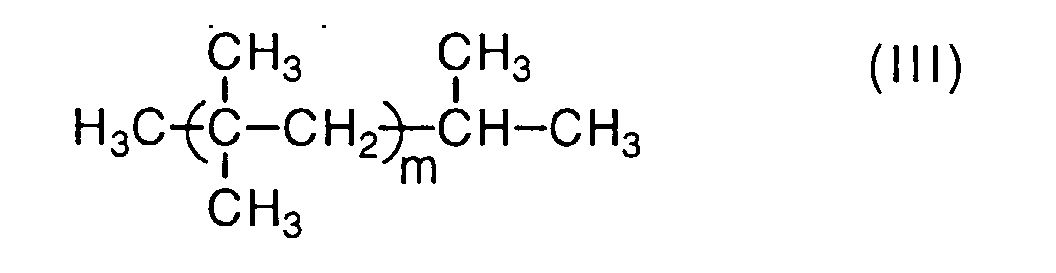
- de type polydécène, hydrogéné ou non.
- les hydrolysats de collagène portant des groupements triéthylammonium tels que les produits dénommés dans le dictionnaire CTFA "TRIETHONIUM HYDROLYZED COLLAGEN ETHOSULFATE" ;
- les hydrolysats de collagène portant des groupements chlorure de triméthylammonium et de triméthylstéarylammonium, dénommés dans le dictionnaire CTFA "STEARTRIMONIUM HYDROLYZED COLLAGEN" ;
- les hydrolysats de protéines portant sur la chaíne polypeptidique des groupements ammonium quaternaire comportant au moins un radical alkyle ayant de 1 à 18 atomes de carbone.
dans lesquels les groupements Ra désignent indépendamment H ou CH3, les groupements A1 désignent indépendamment un groupe alcoyle linéaire ou ramifié de 1 à 6 atomes de carbone ou un groupe hydroxyalcoyle de 1 à 4 atomes de carbone, les groupements Rb, Rc, Rd, identiques ou différents, désignent indépendamment un groupe alcoyle de 1 à 18 atomes de carbone ou un radical benzyle, les groupements Re et Rf représentent un atome d'hydrogène ou un groupement alcoyle de 1 à 6 atomes de carbone, X- désigne un anion, par exemple méthosulfate ou halogénure, tel que chlorure ou bromure,
| EXEMPLE I : SHAMPOOING ANTIPELLICULAIRE | |
| Distéarate de glycol | 2 g |
| N-cocoyl amidoéthyl, N-éthoxycarboxyméthyl glycinate de sodium à 38% M.A. vendu sous la dénomination MIRANOL C2M CONC par la société RHODIA CHIMIE | 2 g |
| Cocoyl bétaïne en solution aqueuse à 30% vendue sous la dénomination DEHYTON AB 30 par la société HENKEL | 4 g |
| Pyrithione de zinc en suspension aqueuse à 48% Hydroxyéthyl cellulose réticulée à l'épichlorhydrine, quaternisée par la triméthylamine vendue sous la dénomination JR400 par la société | 2 g |
| UNION CARBIDE CORPORATION | 0,25 g |
| N-oléyl dihydrosphingosine | 0,1 g |
| Lauryl éther sulfate de sodium (2,2 OE) à 70% de M.A. | 18 g |
| Terpolymère d'acrylates, d'amino(méth)acrylates et d'itaconate d'alkyle en C10-C30 polyoxyéthyléné à 20 moles d'oxyde d'éthylène en dispersion aqueuse à 20% M.A. vendus sous la dénomination "STRUCTURE® PLUS" par la Société National Starch | 1,5 g |
| Acide citrique | 3 g |
| Parfum, conservateur qs | |
| Eau déminéralisée stérilisée qsp | 100 g |
L'aspect général de la coiffure est lisse.
| EXEMPLE II : SHAMPOOING ANTIPELLICULAIRE | |
| Propylène glycol | 0,1 g |
| Cocoyl betaïne en solution aqueuse à 30% | 6 g |
| Pyrithione de zinc en suspension aqueuse à 48% | 2 g |
| Hydroxyéthyl cellulose réticulée à l'épichlorhydrine, quaternisée par la triméthylamine vendue sous la dénomination JR 400 par la société UNION CARBIDE CORPORATION | 0,4 g |
| Polydiméthylsiloxane commercialisé sous la dénomination "MIRASIL DM 500.000" par la société RHODIA CHIMIE | 1,5 g |
| Mélange 1-(hexadécyloxy)-2-octadécanol/ alcool cétylique | 2,5 g |
| Monoisopropanolamide d'acides de coprah | 0,5 g |
| Lauryl éther sulfate de sodium (2,2 OE) à 70% de M.A. | 16,8 g |
| Terpolymère d'acrylates, d'amino(méth)acrylates et d'itaconate d'alkyle en C10-C30 polyoxyéthyléné à 20 moles d'oxyde d'éthylène en dispersion aqueuse à 20% M.A. vendus sous la dénomination "STRUCTURE® PLUS" par la Société National Starch | 1,5 g |
| Parfums, Conservateurs qs | |
| Eau déminéralisée stérilisée qsp | 100 g |
L'aspect général de la coiffure est lisse.
Claims (29)
- Composition de traitement antipelliculaire des cheveux et du cuir chevelu, comprenant dans un milieu cosmétiquement acceptable au moins un sel de pyridinethione et au moins un agent de conditionnement insoluble, caractérisée par le fait qu'elle comprend en outre au moins un terpolymère acrylique constitué:de 5 à 80% en poids, préférentiellement de 15 à 70% en poids et plus préférentiellement de 40 à 70% en poids, d'un monomère acrylate (a) choisi parmi un acrylate d'alkyle en C1-C6 et un méthacrylate d'alkyle en C1-C6;de 5 à 80% en poids, préférentiellement de 10 à 70% en poids et plus préférentiellement de 20 à 60% en poids, d'un monomère (b) choisi parmi un composé vinylique héterocyclique contenant au moins un atome d'azote ou de soufre, un (méth)acrylamide, un (méth)acrylate de mono- ou di-(C1-C4)alkylamino(C1-C4)alkyle et un mono ou di (C1-C4)alkylamino (C1-C4) alkyl (méth)acrylamide;de 0,1 à 30% en poids, préférentiellement de 0,1 à 10% en poids d'un monomère (c) choisi parmi :un uréthane produit par réaction entre un isocyanate insaturé monoéthylénique et un agent tensioactif non ionique englobant un copolymère séquencé d'oxyde de 1,2-butylène et d'oxyde d'éthylène à extrémité alcoxy en C1-4 ;un monomère tensioactif insaturé éthylénique copolymérisable obtenu par condensation d'un tensioactif non-ionique avec un acide carboxylique insaturé α,β-éthylénique ou son anhydride;un monomère tensioactif choisi parmi les produits de réaction de type urée d'un monoisocyanate insaturé monoéthylénique avec un tensioactif non ionique présentant une fonctionalité amine;un éther de (méth)allyle de formule CH2=CR1CH2OAmBnApR2 dans lequel R1 désigne un atome d'hydrogène ou un groupe méthyle, A désigne un groupement propylèneoxy ou butylèneoxy, B désigne éthylèneoxy, n est égal à zéro ou désigne un nombre entier inférieur ou égal à 200, m et p désignent zéro ou un nombre entier inférieur à n et R2 est un groupe hydrophobe d'au moins 8 atomes de carbone; etun monomère non-ionique de type uréthane produit par réaction d'un tensioactif non ionique monohydrique avec un isocyanate insaturé monoéthylénique;les pourcentages en poids de monomères étant basés sur le poids total des monomères constituant le terpolymère.
- Composition selon la revendication 1, caractérisée en ce que le terpolymère est présent à raison de 0,01 à 20% en poids de matière active, de préférence 0,1 à 10 % en poids par rapport au poids total de la composition.
- Composition selon la revendication 1 ou 2, caractérisée en ce que le monomère (a) est choisi parmi les acrylates d'alkyle en C2-C6, et est préférentiellement l'acrylate d'éthyle.
- Composition selon l'une quelconque des revendications 1 à 3, caractérisée en ce que le monomère (b) est choisi parmi le méthacrylate de N,N-diméthylaminoéthyle, l'acrylate de N,N-diéthylaminoéthyle, le méthacrylate de N,N-diéthylaminoéthyle, l'acrylate de N-t-butylaminoéthyle, le méthacrylate de N-t-butylaminoéthyle, le N,N-diméthylaminopropyl-acrylamide, le N,N-diméthylaminopropyl-méthacrylamide, le N,N-diéthylaminopropyl-acrylamide et le N,N-diéthylaminopropyl-méthacrylamide, et est préférentiellement le méthacrylate de N,N-diméthylaminoéthyle.
- Composition selon l'une quelconque des revendications 1 à 4, caractérisée en ce que le monomère (c) est un monomère tensioactif insaturé éthylénique copolymérisable obtenu par condensation d'un tensioactif non-ionique avec l'acide itaconique.
- Composition selon l'une quelconque des revendications 1 à 5, caractérisée en ce que le terpolymère acrylique est constitué d'acrylates, d'amino(méth)acrylates et d'itaconate d'alkyle en C10-C30 polyoxyéthyléné à 20 moles d'oxyde d'éthylène.
- Composition selon l'une quelconque des revendications 1 à 6, caractérisée en ce que le terpolymère acrylique contient en outre un monomère de réticulation.
- Composition selon l'une quelconque des revendications 1 à 7, caractérisée par le fait que le sel de pyridinethione est choisi parmi les sels de calcium, de magnésium, de barium, de strontium, de zinc, de cadmium, d'étain et de zirconium, et préférentiellement le sel de zinc.
- Composition selon l'une quelconque des revendications 1 à 8, caractérisée par le fait que le sel de pyridinethione est présent à raison de 0,001 à 10% en poids, de préférence de 0,01 à 5% en poids par rapport au poids total de la composition.
- Composition selon l'une quelconque des revendications 1 à 9, caractérisée en ce qu'elle contient en outre au moins un agent tensio-actif choisi parmi les agents tensio-actifs anioniques, amphotères, non-ioniques, cationiques et leurs mélanges.
- Composition selon la revendication 10, caractérisée par le fait que les agents tensio-actifs anioniques sont choisis parmi les sels alcalins, les sels de magnésium, les sels d'ammonium, les sels d'amines ou les sels d'aminoalcools des composés suivants : les alkylsulfates, alkyléthersulfates, alkylamidoéthersulfates, alkylarylpolyéthersulfates, monoglycérides sulfates; les alkylsulfonates, alkylamides sulfonates, alkylaryl-sulfonates, oléfines sulfonates, paraffines sulfonates; les alkylsulfosuccinates, les alkyléthersulfosuccinates, les alkylamides sulfosuccinates; les alkylsulfosuccinamates; les alkylsulfoacétates; les alkylphosphates, alkyléther phosphates; les acylsarcosinates, les acyliséthionates, N-acyltaurates; le radical alkyle ou acyle de ces différents composés étant constitué par une chaíne carbonée comportant de 8 à 30 atomes de carbone; les sels d'acides gras des acides oléique, ricinoléique, palmitique, stéarique; les acides d'huile de coprah ou d'huile de coprah hydrogénée; les acyl lactylates, dont le radical acyle comporte de 8 à 30 atomes de carbone; les acides d'alkyl D-galactoside uroniques et leurs sels, les acides alkyl ou alkylaryl éthers carboxyliques polyoxyalkylénés ou leurs sels, les acides alkylamido éthers carboxyliques polyoxyalkylénés ou leurs sels.
- Composition selon la revendication 10, caractérisée par le fait que les agents tensio-actifs non-ioniques sont choisis parmi les alcools ou les alkylphénols ou les acides gras polyéthoxylés, polyoxypropylénés ou polyglycérolés, à chaíne grasse comportant 8 à 30 atomes de carbone, le nombre de groupements oxyde d'éthylène, oxyde de propylène étant compris entre 2 et 50 et le nombre de groupements glycérol étant compris entre 2 et 30; les copolymères d'oxyde d'éthylène et de propylène; les condensats d'oxyde d'éthylène et de propylène sur des alcools gras; les amides gras polyéthoxylés; les amides gras polyglycérolés; les amines grasses polyéthoxylées; les esters d'acides gras du sorbitan oxyéthylénés; les esters d'acides gras de sucrose ou du polyéthylèneglycol; les alkylpolyglycosides; les dérivés amides ou carbamates de N-alkylglucamines, les aldobionamides et les oxydes d'amines.
- Composition selon la revendication 10, caractérisée par le fait que les agents tensio-actifs amphotères sont choisis parmi les dérivés d'amines secondaires ou tertiaires aliphatiques, dans lesquels le radical aliphatique est une chaíne linéaire ou ramifiée comportant de 8 à 22 atomes de carbone et qui contient au moins un groupe anionique hydrosolubilisant, carboxylate, sulfonate, sulfate, phosphate, phosphonate; les alkyl(C8-C20)bétaïnes, les sulfobétaïnes, les alkyl(C8-C20)amidoalkyl(C1-C6) bétaïnes ou les alkyl(C8-C20)amidoalkyl(C1-C6)sulfobétaïnes.
- Composition selon la revendication 10, caractérisée par le fait que les agents tensio-actifs cationiques sont choisis parmi les sels d'amines grasses primaires, secondaires ou tertiaires, éventuellement polyoxyalkylénées; les sels d'ammonium quaternaire; les dérivés d'imidazoline; ou les oxydes d'amines à caractère cationique.
- Composition selon l'une quelconque des revendications 10 à 14, caractérisée en ce que l'agent tensio-actif est présent à raison de 0,01% à 50% en poids par rapport au poids total de la composition.
- Composition selon la revendication 15, caractérisée en ce que l'agent tensioactif est présent à raison d'au moins 4% en poids, de préférence de 5 à 50% en poids, et encore plus préférentiellement de 8 à 35% en poids par rapport au poids total de la composition.
- Composition selon l'une quelconque des revendications 1 à 16, caractérisée en ce que l'agent de conditionnement insoluble est choisi parmi les céramides, les cires, les silicones insolubles et les huiles non siliconées.
- Composition selon la revendication 17 , caractérisée par le fait que les céramides sont choisis parmi les les céramides et/ou les glycocéramides et/ou les pseudocéramides et/ou les néocéramides, naturels ou synthétiques.
- Composition selon la revendication 17, caractérisée par le fait que les cires sont choisies parmi les cires animales, les cires végétales, les cires minérales et les cires synthétiques.
- Composition selon la revendication 17, caractérisée par le fait que les silicones insolubles sont choisies parmi les silicones volatiles et les silicones non-volatiles et notamment parmi:(i) les polyalkylsiloxanes ;(ii) les polyarylsiloxanes ;(iii) les polyalkylarylsiloxanes ;(iv) les gommes de silicone ;(v) les résines de silicone ;(vi) les polyorganosiloxanes organomodifiés ;(vii) les copolymères blocs ayant un bloc linéaire polysiloxane-polyalkylène comme unité répétitive ;(viii) les polymères siliconés greffés, à squelette organique non siliconé;(ix) les polymères siliconés greffés, à squelette polysiloxanique greffé par des monomères organiques non siliconés;(x) et leurs mélanges.
- Composition selon la revendication 17, caractérisée en ce que les huiles non siliconées sont choisies parmi les huiles de synthèse, les huiles minérales, végétales ou animales, les alcools gras insaturés et les esters d'acides gras et de mono-ou polyalcools inférieurs en C2-C4.
- Composition selon l'une quelconque des revendications 1 à 21, caractérisée par le fait que l'agent de conditionnement insoluble est utilisé dans des proportions de 0,001 à 60% en poids et de préférence de 0,01 à 40% en poids par rapport au poids total de la composition.
- Composition selon l'une quelconque des revendications 1 à 22, caractérisée en ce qu'elle présente un pH compris entre 3 et 12, et plus particulièrement entre 4 et 8.
- Composition selon l'une quelconque des revendications 1 à 23, caractérisée par le fait que le milieu cosmétiquement acceptable est constitué par de l'eau ou par un ou plusieurs solvants ou par un mélange d'eau et d'au moins un solvant cosmétiquement acceptable choisi parmi les alcools inférieurs, les alkylèneglycols et les éthers de polyol.
- Composition selon l'une quelconque des revendications 1 à 24, caractérisée par le fait qu'elle contient en outre au moins un polymère cationique choisi parmi :les protéines ou hydrolysats de protéines, en particulier les hydrolysats de collagène portant des groupements triéthylammonium, les hydrolysats de collagène portant des groupements chlorure de triméthylammonium et de triméthylstéarylammonium, les hydrolysats de protéines portant sur la chaíne polypeptidique des groupements ammonium quaternaire comportant au moins un radical alkyle ayant de 1 à 18 atomes de carbone, les protéines végétales quaternisées telles que les protéines de blé, de maïs ou de soja;les polymères du type polyamine, polyaminoamide, polyammonium quaternaire, en particulieri) les copolymères vinylpyrrolidone-acrylate ou méthacrylate de dialkylaminoalkyle quaternisés ou non,ii) les dérivés d'éthers de cellulose comportant des groupements ammonium quaternaires,iii) les dérivés de cellulose cationiques tels que les copolymères de cellulose ou les dérivés de cellulose greffés avec un monomère hydrosoluble d'ammonium quaternaire,iv) les polysaccharides et notamment gommes de guar cationiques,v) les polymères constitués de motifs pipérazinyle et de radicaux divalents alkylène ou hydroxyalkylène à chaínes droites ou ramifiées, éventuellement interrompues par des atomes d'oxygène, de soufre, d'azote ou par des cycles aromatiques ou hétérocycliques, ainsi que les produits d'oxydation et/ou de quaternisation de ces polymères,vi) les polyaminoamides solubles dans l'eau préparés en particulier par polycondensation d'un composé acide avec une polyamine,vii) les dérivés de polyaminoamides résultant de la condensation de polyalcoylène polyamines avec des acides polycarboxyliques suivie d'une alcoylation par des agents bifonctionnels,viii) les polymères obtenus par réaction d'une polyalkylène polyamine comportant deux groupements amine primaire et au moins un groupement amine secondaire avec un acide dicarboxylique choisi parmi l'acide diglycolique et les acides dicarboxyliques aliphatiques saturés ayant de 3 à 8 atomes de carbone,ix) les cyclopolymères de méthyl diallyl amine ou de diméthyl diallyl ammonium,x) les polymères de diammonium quaternaire,xi) les polymères de polyammonium quaternaire,xii) les homopolymères ou copolymères dérivés des acides acrylique ou méthacrylique et comportant des motifs
CH2-CHRa-CO-O-A1-NReRf, CH2-CHRa-CO-O-A1-N+RbRcRd, X- et/ou CH2-CHRa-CO-NH-A1-N+RbRcRd, X-
dans lesquels les groupements Ra désignent indépendamment H ou CH3, les groupements A1 désignent indépendamment un groupe alcoyle linéaire ou ramifié de 1 à 6 atomes de carbone ou un groupe hydroxyalcoyle de 1 à 4 atomes de carbone, les groupements Rb, Rc, Rd, identiques ou différents, désignent indépendamment un groupe alcoyle de 1 à 18 atomes de carbone ou un radical benzyle, les groupements Re et Rf représentent un atome d'hydrogène ou un groupement alcoyle de 1 à 6 atomes de carbone, X- désigne un anion, par exemple méthosulfate ou halogénure, tel que chlorure ou bromure,xiii) les polymères quaternaires de vinylpyrrolidone et de vinylimidazole,xiv) les polyamines référencé sous le nom de « POLYETHYLENEGLYCOL TALLOW POLYAMINE » dans le dictionnaire CTFA,xv) les polymères réticulés de sels de méthacryloyloxyéthyl triméthylammonium,les polyalkylèneimines, les polymères contenant des motifs vinylpyridine ou vinylpyridinium, les condensats de polyamines et d'épichlorhydrine, les polyuréylènes quaternaires et les dérivés de la chitine. - Composition selon la revendication 25, caractérisée par le fait qu'elle contient un polymère cationique dans des proportions comprises entre 0,001 et 20% en poids et de préférence entre 0,05 et 5% en poids par rapport au poids total de la composition.
- Composition selon l'une quelconque des revendications 1 à 26, caractérisée par le fait qu'elle contient en outre au moins un adjuvant cosmétiquement acceptable choisi parmi les parfums, les conservateurs, les séquestrants, les humectants, les sucres, les polymères amphotères, le menthol, les filtres, les dérivés de nicotinates, les agents antichute des cheveux, les stabilisateurs de mousse, les agents propulseurs, les colorants, les vitamines ou provitamines et les agents acidifiants ou alcalinisants.
- Utilisation comme shampooing, lotion ou après-shampooing d'une composition telle que définie dans l'une quelconque des revendications 1 à 27.
- Procédé de lavage des matières kératiniques, caractérisé par le fait que l'on applique sur ces matières au moins une composition telle que définie dans l'une quelconque des revendications 1 à 27, et facultativement, après un temps de pose facultatif, on les rince à l'eau.
Applications Claiming Priority (2)
| Application Number | Priority Date | Filing Date | Title |
|---|---|---|---|
| FR9912166A FR2798848B1 (fr) | 1999-09-29 | 1999-09-29 | Composition de traitement antipelliculaire des cheveux et du cuir chevelu, a base d'un sel de pyridinethione, d'un agent de conditionnement insoluble et d'un terpolymere acrylique |
| FR9912166 | 1999-09-29 |
Publications (2)
| Publication Number | Publication Date |
|---|---|
| EP1093787A1 true EP1093787A1 (fr) | 2001-04-25 |
| EP1093787B1 EP1093787B1 (fr) | 2007-03-14 |
Family
ID=9550390
Family Applications (1)
| Application Number | Title | Priority Date | Filing Date |
|---|---|---|---|
| EP00402660A Revoked EP1093787B1 (fr) | 1999-09-29 | 2000-09-26 | Composition de traitement antipelliculaire à base d'un sel de pyridinethione, d'un agent de conditionnement insoluble et d'un terpolymère acrylique |
Country Status (9)
| Country | Link |
|---|---|
| US (1) | US6926900B1 (fr) |
| EP (1) | EP1093787B1 (fr) |
| JP (1) | JP2001199847A (fr) |
| CN (1) | CN1292259A (fr) |
| AT (1) | ATE356650T1 (fr) |
| BR (1) | BR0004513A (fr) |
| CA (1) | CA2321272A1 (fr) |
| DE (1) | DE60033902T2 (fr) |
| FR (1) | FR2798848B1 (fr) |
Cited By (1)
| Publication number | Priority date | Publication date | Assignee | Title |
|---|---|---|---|---|
| WO2003059297A3 (fr) * | 2002-01-21 | 2003-12-18 | Slovakofarma As | Compositions dermatologiques topiques et procede pour leur preparation |
Families Citing this family (12)
| Publication number | Priority date | Publication date | Assignee | Title |
|---|---|---|---|---|
| ATE272388T1 (de) * | 2001-04-30 | 2004-08-15 | Cognis Iberia Sl | Verwendung von kationischen zubereitungen |
| FR2833185B1 (fr) * | 2001-12-11 | 2004-01-23 | Rhodia Chimie Sa | Emulsions multiples comprenant une phase huile interne gelifiee |
| EP2234592B1 (fr) * | 2007-12-20 | 2013-06-26 | Basf Se | Composition cosmetique comprenant des terpolymeres cationiques reticules |
| US20110048446A1 (en) * | 2009-05-12 | 2011-03-03 | Peter Marte Torgerson | Method of Delivering a Hair-Care Benefit and a Fragrance |
| US20130156715A1 (en) * | 2010-08-18 | 2013-06-20 | Caroline Alexandra Hall | Anti-dandruff shampoo |
| EA023762B1 (ru) | 2010-08-18 | 2016-07-29 | Юнилевер Н.В. | Шампунь против перхоти |
| US8623151B2 (en) | 2012-03-23 | 2014-01-07 | Ecolab Usa Inc. | Terpolymer containing maleic acid, vinyl acetate, and alkyl acrylate monomers for aluminum protection |
| US8740993B2 (en) | 2012-03-23 | 2014-06-03 | Ecolab Usa Inc. | Method for reduced encrustation of textiles using a polymer comprising maleic acid, vinyl acetate, and alkyl acrylate |
| US8574561B1 (en) * | 2012-12-21 | 2013-11-05 | L'oreal | Compositions containing anti-dandruff agents |
| CN104250416B (zh) * | 2013-06-28 | 2016-03-30 | 中国石油化工股份有限公司 | 一种聚合物组合物及其应用和聚丙烯酰胺型聚合物的水解方法 |
| CN104095766A (zh) * | 2014-07-14 | 2014-10-15 | 拉芳家化股份有限公司 | 一种槐糖脂增效的去屑组合物及其应用 |
| CN113832484B (zh) * | 2021-10-09 | 2023-12-08 | 广州唯我美日用品有限公司 | 一种洗发水去屑止痒剂的制备方法 |
Citations (5)
| Publication number | Priority date | Publication date | Assignee | Title |
|---|---|---|---|---|
| US5661118A (en) * | 1994-04-22 | 1997-08-26 | L'oreal | Hair and skin washing and treatment compositions based on ceramide and/or glycoceramide and on polymers containing cationic groups |
| EP0824914A1 (fr) * | 1996-08-16 | 1998-02-25 | National Starch and Chemical Investment Holding Corporation | Composition de soin corporel épaissie |
| EP0825200A1 (fr) * | 1996-08-16 | 1998-02-25 | National Starch and Chemical Investment Holding Corporation | Modificateurs rhéologiques polymériques |
| EP0878186A1 (fr) * | 1997-04-07 | 1998-11-18 | L'oreal | Compositions cosmétiques détergentes et utilisation |
| EP0915081A1 (fr) * | 1997-11-04 | 1999-05-12 | L'oreal | Composé de type céramide, procédé de préparation et utilisation |
Family Cites Families (10)
| Publication number | Priority date | Publication date | Assignee | Title |
|---|---|---|---|---|
| US5104645A (en) * | 1990-02-02 | 1992-04-14 | The Proctor & Gamble Company | Antidandruff shampoo compositions |
| DE69201303T2 (de) * | 1991-04-05 | 1995-07-20 | Procter & Gamble | Haarpflegeshampoo, das als bestandteil ein silikon enthält. |
| CA2165055C (fr) * | 1993-07-12 | 1999-12-28 | Philip Earl Cothran | Shampoing produisant beaucoup de mousse et a effet de conditionnement des cheveux ameliore |
| US5624666A (en) * | 1995-01-20 | 1997-04-29 | The Procter & Gamble Company | Anti-dandruff shampoos with particulate active agent and cationic polymer |
| EP0821579B1 (fr) * | 1995-04-21 | 2001-08-29 | The Procter & Gamble Company | Shampooings comportant un agent d'apres-shampooing de silicone insoluble et un polymere cationique |
| FR2779640B1 (fr) * | 1998-06-15 | 2000-08-04 | Oreal | Composition cosmetique contenant un polymere cationique et un terpolymere acrylique et utilisation de cette composition pour le traitement des matieres keratiniques |
| FR2779638B1 (fr) * | 1998-06-15 | 2000-08-04 | Oreal | Composition cosmetique contenant un polysaccharide et un terpolymere acrylique et utilisation de cette composition pour le traitement des matieres keratiniques |
| FR2779637B1 (fr) * | 1998-06-15 | 2000-09-01 | Oreal | Compositions cosmetiques photoprotectrices, contenant un nanopigment d'oxyde metallique et un terpolymere acrylique et utilisation de ces compositions pour proteger les matieres keratiniques contre le rayonnement ultraviolet |
| FR2790951B1 (fr) * | 1999-03-17 | 2003-08-08 | Oreal | Composition fluide sous forme d'emulsion huile-dans-eau contenant un terpolymere acrylique et ses utilisations notamment cosmetiques |
| FR2790952B1 (fr) * | 1999-03-17 | 2003-05-02 | Oreal | Composition sous forme d'emulsion huile-dans-eau contenant un terpolymere acrylique et ses utilisations notamment cosmetiques |
-
1999
- 1999-09-29 FR FR9912166A patent/FR2798848B1/fr not_active Expired - Fee Related
-
2000
- 2000-09-26 AT AT00402660T patent/ATE356650T1/de not_active IP Right Cessation
- 2000-09-26 DE DE60033902T patent/DE60033902T2/de not_active Expired - Lifetime
- 2000-09-26 EP EP00402660A patent/EP1093787B1/fr not_active Revoked
- 2000-09-27 CN CN00124963.0A patent/CN1292259A/zh active Pending
- 2000-09-28 US US09/671,188 patent/US6926900B1/en not_active Expired - Fee Related
- 2000-09-28 BR BR0004513-6A patent/BR0004513A/pt not_active IP Right Cessation
- 2000-09-29 CA CA002321272A patent/CA2321272A1/fr not_active Abandoned
- 2000-09-29 JP JP2000336702A patent/JP2001199847A/ja active Pending
Patent Citations (5)
| Publication number | Priority date | Publication date | Assignee | Title |
|---|---|---|---|---|
| US5661118A (en) * | 1994-04-22 | 1997-08-26 | L'oreal | Hair and skin washing and treatment compositions based on ceramide and/or glycoceramide and on polymers containing cationic groups |
| EP0824914A1 (fr) * | 1996-08-16 | 1998-02-25 | National Starch and Chemical Investment Holding Corporation | Composition de soin corporel épaissie |
| EP0825200A1 (fr) * | 1996-08-16 | 1998-02-25 | National Starch and Chemical Investment Holding Corporation | Modificateurs rhéologiques polymériques |
| EP0878186A1 (fr) * | 1997-04-07 | 1998-11-18 | L'oreal | Compositions cosmétiques détergentes et utilisation |
| EP0915081A1 (fr) * | 1997-11-04 | 1999-05-12 | L'oreal | Composé de type céramide, procédé de préparation et utilisation |
Cited By (1)
| Publication number | Priority date | Publication date | Assignee | Title |
|---|---|---|---|---|
| WO2003059297A3 (fr) * | 2002-01-21 | 2003-12-18 | Slovakofarma As | Compositions dermatologiques topiques et procede pour leur preparation |
Also Published As
| Publication number | Publication date |
|---|---|
| CA2321272A1 (fr) | 2001-03-29 |
| DE60033902T2 (de) | 2007-09-06 |
| EP1093787B1 (fr) | 2007-03-14 |
| FR2798848B1 (fr) | 2001-12-28 |
| CN1292259A (zh) | 2001-04-25 |
| FR2798848A1 (fr) | 2001-03-30 |
| ATE356650T1 (de) | 2007-04-15 |
| US6926900B1 (en) | 2005-08-09 |
| JP2001199847A (ja) | 2001-07-24 |
| BR0004513A (pt) | 2001-04-10 |
| DE60033902D1 (de) | 2007-04-26 |
Similar Documents
| Publication | Publication Date | Title |
|---|---|---|
| EP1088546B1 (fr) | Composition de traitement antipelliculaire des cheveux et du cuir chevelu, à base d'un agent antipelliculaire et d'un terpolymère acrylique | |
| EP1337230B1 (fr) | Composition de traitement des matieres keratiniques comprenant un polymere polyurethane associatif cationique et un agent conditionneur | |
| EP1291001B1 (fr) | Compositions cosmétiques contenant un copolymère d'acide méthacrylique, une huile et leurs utilisations | |
| EP1093808B1 (fr) | Compositions cosmétiques contenant un copolymére vinyldiméthicone/diméthicone et un polymère cationique et leurs utilisations | |
| CA2321290A1 (fr) | Composition de lavage des matieres keratiniques, a base d'un agent tensio-actif detergent, d'un homopolymere de dialkyl diallyl ammonium et d'un terpolymere acrylique | |
| FR2798851A1 (fr) | Composition de lavage des matieres keratiniques, a base d'un agent tensio-actif detergent, d'un agent nacrant et ou opacifiant et d'un terpolymere acrylique | |
| EP1090632B1 (fr) | Composition de lavage des matières kératiniques, à base d'un agent tensio-actif détergent, d'un polyorganosiloxane, d'un polymère cationique et d'un terpolymère acrylique | |
| EP1029533A1 (fr) | Compositions cosmétiques contenant un tensioactif hydroxyalkylether anionique et un polymère cationique et leurs utilisations | |
| EP1092419B1 (fr) | Composition de lavage des matières kératiniques, à base d'un agent tensio-actif détergent, d'un polyorganosiloxane et d'un terpolymère acrylique | |
| EP1093787B1 (fr) | Composition de traitement antipelliculaire à base d'un sel de pyridinethione, d'un agent de conditionnement insoluble et d'un terpolymère acrylique | |
| EP1092420B1 (fr) | Composition de lavage des matières kératiniques, à base d'un agent tensio-actif détergent, d'un polymère cationique de vinyllactame et d'un terpolymère acrylique | |
| EP1380284B1 (fr) | Compositions cosmétiques détergentes contenant un tensioactif anionique, un tensioactif amphotère ou non ionique et un polysaccharide et utilisation | |
| EP1090622B1 (fr) | Composition de lavage des matières kératiniques, à base d'un agent tensio-actif détergent, d'une silicone fonctionnalisée et d'un terpolymère acrylique | |
| CA2321280A1 (fr) | Composition de lavage des matieres keratiniques, a base d'un agent tensio-actif detergent, d'une gomme de galactomannane cationique et d'un terpolymere acrylique | |
| FR2795953A1 (fr) | Compositions cosmetiques contenant un fructane cationique et un agent conditionneur et leurs utilisations | |
| WO1994027575A1 (fr) | Compositions cosmetiques contenant au moins un tensio-actif anionique du type alkylgalactoside uronate et au moins un polymere cationique, et leurs utilisations pour le traitement des matieres keratiniques | |
| EP1047403B1 (fr) | Compositions cosmetiques contenant un tensioactif ester d'alkylpolyglycoside anionique et un polymere cationique et leurs utilisations | |
| WO2000045780A1 (fr) | Compositions cosmetiques contenant une huile cationique et un agent conditionneur et leurs utilisations | |
| EP1430886A1 (fr) | Composition de lavage des matières kératiniques à base de tensioactif amphotère et de PEG modifié par un groupe hydrophobe |
Legal Events
| Date | Code | Title | Description |
|---|---|---|---|
| PUAI | Public reference made under article 153(3) epc to a published international application that has entered the european phase |
Free format text: ORIGINAL CODE: 0009012 |
|
| 17P | Request for examination filed |
Effective date: 20001012 |
|
| AK | Designated contracting states |
Kind code of ref document: A1 Designated state(s): AT BE CH CY DE DK ES FI FR GB GR IE IT LI LU MC NL PT SE |
|
| AX | Request for extension of the european patent |
Free format text: AL;LT;LV;MK;RO;SI |
|
| AKX | Designation fees paid |
Free format text: AT BE CH CY DE DK ES FI FR GB GR IE IT LI LU MC NL PT SE |
|
| 17Q | First examination report despatched |
Effective date: 20040102 |
|
| GRAP | Despatch of communication of intention to grant a patent |
Free format text: ORIGINAL CODE: EPIDOSNIGR1 |
|
| RIC1 | Information provided on ipc code assigned before grant |
Ipc: A61K 8/68 20060101ALI20060822BHEP Ipc: A61K 8/27 20060101ALI20060822BHEP Ipc: A61Q 5/02 20060101AFI20060822BHEP Ipc: A61K 8/81 20060101ALI20060822BHEP Ipc: A61K 8/49 20060101ALI20060822BHEP Ipc: A61Q 5/12 20060101ALI20060822BHEP Ipc: A61K 8/891 20060101ALI20060822BHEP |
|
| RTI1 | Title (correction) |
Free format text: COMPOSITION FOR TREATING DANDRUFF BASED ON A PYRIDINETHIONE SALT, AN INSOLUBLE CONDITIONING AGENT AND AN ACRYLIC TERPOLYMER |
|
| GRAS | Grant fee paid |
Free format text: ORIGINAL CODE: EPIDOSNIGR3 |
|
| GRAA | (expected) grant |
Free format text: ORIGINAL CODE: 0009210 |
|
| AK | Designated contracting states |
Kind code of ref document: B1 Designated state(s): AT BE CH CY DE DK ES FI FR GB GR IE IT LI LU MC NL PT SE |
|
| PG25 | Lapsed in a contracting state [announced via postgrant information from national office to epo] |
Ref country code: FI Free format text: LAPSE BECAUSE OF FAILURE TO SUBMIT A TRANSLATION OF THE DESCRIPTION OR TO PAY THE FEE WITHIN THE PRESCRIBED TIME-LIMIT Effective date: 20070314 Ref country code: AT Free format text: LAPSE BECAUSE OF FAILURE TO SUBMIT A TRANSLATION OF THE DESCRIPTION OR TO PAY THE FEE WITHIN THE PRESCRIBED TIME-LIMIT Effective date: 20070314 Ref country code: NL Free format text: LAPSE BECAUSE OF FAILURE TO SUBMIT A TRANSLATION OF THE DESCRIPTION OR TO PAY THE FEE WITHIN THE PRESCRIBED TIME-LIMIT Effective date: 20070314 |
|
| REG | Reference to a national code |
Ref country code: GB Ref legal event code: FG4D Free format text: NOT ENGLISH |
|
| GBT | Gb: translation of ep patent filed (gb section 77(6)(a)/1977) |
Effective date: 20070314 |
|
| REG | Reference to a national code |
Ref country code: CH Ref legal event code: EP |
|
| REF | Corresponds to: |
Ref document number: 60033902 Country of ref document: DE Date of ref document: 20070426 Kind code of ref document: P |
|
| REG | Reference to a national code |
Ref country code: IE Ref legal event code: FG4D Free format text: LANGUAGE OF EP DOCUMENT: FRENCH |
|
| PG25 | Lapsed in a contracting state [announced via postgrant information from national office to epo] |
Ref country code: SE Free format text: LAPSE BECAUSE OF FAILURE TO SUBMIT A TRANSLATION OF THE DESCRIPTION OR TO PAY THE FEE WITHIN THE PRESCRIBED TIME-LIMIT Effective date: 20070614 |
|
| PG25 | Lapsed in a contracting state [announced via postgrant information from national office to epo] |
Ref country code: ES Free format text: LAPSE BECAUSE OF FAILURE TO SUBMIT A TRANSLATION OF THE DESCRIPTION OR TO PAY THE FEE WITHIN THE PRESCRIBED TIME-LIMIT Effective date: 20070625 |
|
| PG25 | Lapsed in a contracting state [announced via postgrant information from national office to epo] |
Ref country code: PT Free format text: LAPSE BECAUSE OF FAILURE TO SUBMIT A TRANSLATION OF THE DESCRIPTION OR TO PAY THE FEE WITHIN THE PRESCRIBED TIME-LIMIT Effective date: 20070814 |
|
| NLV1 | Nl: lapsed or annulled due to failure to fulfill the requirements of art. 29p and 29m of the patents act | ||
| REG | Reference to a national code |
Ref country code: IE Ref legal event code: FD4D |
|
| PLBI | Opposition filed |
Free format text: ORIGINAL CODE: 0009260 |
|
| 26 | Opposition filed |
Opponent name: KPSS-KAO PROFESSIONAL SALON SERVICES GMBH Effective date: 20071211 |
|
| PLAX | Notice of opposition and request to file observation + time limit sent |
Free format text: ORIGINAL CODE: EPIDOSNOBS2 |
|
| PG25 | Lapsed in a contracting state [announced via postgrant information from national office to epo] |
Ref country code: DK Free format text: LAPSE BECAUSE OF FAILURE TO SUBMIT A TRANSLATION OF THE DESCRIPTION OR TO PAY THE FEE WITHIN THE PRESCRIBED TIME-LIMIT Effective date: 20070314 Ref country code: IE Free format text: LAPSE BECAUSE OF FAILURE TO SUBMIT A TRANSLATION OF THE DESCRIPTION OR TO PAY THE FEE WITHIN THE PRESCRIBED TIME-LIMIT Effective date: 20070314 |
|
| BERE | Be: lapsed |
Owner name: L'OREAL Effective date: 20070930 |
|
| PG25 | Lapsed in a contracting state [announced via postgrant information from national office to epo] |
Ref country code: IT Free format text: LAPSE BECAUSE OF FAILURE TO SUBMIT A TRANSLATION OF THE DESCRIPTION OR TO PAY THE FEE WITHIN THE PRESCRIBED TIME-LIMIT Effective date: 20070314 Ref country code: GR Free format text: LAPSE BECAUSE OF FAILURE TO SUBMIT A TRANSLATION OF THE DESCRIPTION OR TO PAY THE FEE WITHIN THE PRESCRIBED TIME-LIMIT Effective date: 20070615 Ref country code: MC Free format text: LAPSE BECAUSE OF NON-PAYMENT OF DUE FEES Effective date: 20070930 |
|
| REG | Reference to a national code |
Ref country code: CH Ref legal event code: PL |
|
| PLAF | Information modified related to communication of a notice of opposition and request to file observations + time limit |
Free format text: ORIGINAL CODE: EPIDOSCOBS2 |
|
| PLAF | Information modified related to communication of a notice of opposition and request to file observations + time limit |
Free format text: ORIGINAL CODE: EPIDOSCOBS2 |
|
| PG25 | Lapsed in a contracting state [announced via postgrant information from national office to epo] |
Ref country code: LI Free format text: LAPSE BECAUSE OF NON-PAYMENT OF DUE FEES Effective date: 20070930 Ref country code: CH Free format text: LAPSE BECAUSE OF NON-PAYMENT OF DUE FEES Effective date: 20070930 |
|
| PG25 | Lapsed in a contracting state [announced via postgrant information from national office to epo] |
Ref country code: BE Free format text: LAPSE BECAUSE OF NON-PAYMENT OF DUE FEES Effective date: 20070930 |
|
| PLBB | Reply of patent proprietor to notice(s) of opposition received |
Free format text: ORIGINAL CODE: EPIDOSNOBS3 |
|
| PLAB | Opposition data, opponent's data or that of the opponent's representative modified |
Free format text: ORIGINAL CODE: 0009299OPPO |
|
| PG25 | Lapsed in a contracting state [announced via postgrant information from national office to epo] |
Ref country code: CY Free format text: LAPSE BECAUSE OF FAILURE TO SUBMIT A TRANSLATION OF THE DESCRIPTION OR TO PAY THE FEE WITHIN THE PRESCRIBED TIME-LIMIT Effective date: 20070314 |
|
| R26 | Opposition filed (corrected) |
Opponent name: KPSS-KAO PROFESSIONAL SALON SERVICES GMBH Effective date: 20071211 |
|
| PG25 | Lapsed in a contracting state [announced via postgrant information from national office to epo] |
Ref country code: LU Free format text: LAPSE BECAUSE OF NON-PAYMENT OF DUE FEES Effective date: 20070926 |
|
| PLAB | Opposition data, opponent's data or that of the opponent's representative modified |
Free format text: ORIGINAL CODE: 0009299OPPO |
|
| PLAB | Opposition data, opponent's data or that of the opponent's representative modified |
Free format text: ORIGINAL CODE: 0009299OPPO |
|
| APAH | Appeal reference modified |
Free format text: ORIGINAL CODE: EPIDOSCREFNO |
|
| APAW | Appeal reference deleted |
Free format text: ORIGINAL CODE: EPIDOSDREFNO |
|
| APBM | Appeal reference recorded |
Free format text: ORIGINAL CODE: EPIDOSNREFNO |
|
| APBP | Date of receipt of notice of appeal recorded |
Free format text: ORIGINAL CODE: EPIDOSNNOA2O |
|
| R26 | Opposition filed (corrected) |
Opponent name: KPSS-KAO PROFESSIONAL SALON SERVICES GMBH Effective date: 20071211 |
|
| APBQ | Date of receipt of statement of grounds of appeal recorded |
Free format text: ORIGINAL CODE: EPIDOSNNOA3O |
|
| PGFP | Annual fee paid to national office [announced via postgrant information from national office to epo] |
Ref country code: FR Payment date: 20100921 Year of fee payment: 11 |
|
| PGFP | Annual fee paid to national office [announced via postgrant information from national office to epo] |
Ref country code: GB Payment date: 20100922 Year of fee payment: 11 |
|
| PGFP | Annual fee paid to national office [announced via postgrant information from national office to epo] |
Ref country code: DE Payment date: 20100922 Year of fee payment: 11 |
|
| PLAB | Opposition data, opponent's data or that of the opponent's representative modified |
Free format text: ORIGINAL CODE: 0009299OPPO |
|
| GBPC | Gb: european patent ceased through non-payment of renewal fee |
Effective date: 20110926 |
|
| R26 | Opposition filed (corrected) |
Opponent name: KAO GERMANY GMBH Effective date: 20071211 |
|
| REG | Reference to a national code |
Ref country code: FR Ref legal event code: ST Effective date: 20120531 |
|
| REG | Reference to a national code |
Ref country code: DE Ref legal event code: R119 Ref document number: 60033902 Country of ref document: DE Effective date: 20120403 |
|
| PG25 | Lapsed in a contracting state [announced via postgrant information from national office to epo] |
Ref country code: DE Free format text: LAPSE BECAUSE OF NON-PAYMENT OF DUE FEES Effective date: 20120403 |
|
| PG25 | Lapsed in a contracting state [announced via postgrant information from national office to epo] |
Ref country code: GB Free format text: LAPSE BECAUSE OF NON-PAYMENT OF DUE FEES Effective date: 20110926 Ref country code: FR Free format text: LAPSE BECAUSE OF NON-PAYMENT OF DUE FEES Effective date: 20110930 |
|
| APBU | Appeal procedure closed |
Free format text: ORIGINAL CODE: EPIDOSNNOA9O |
|
| APBC | Information on closure of appeal procedure deleted |
Free format text: ORIGINAL CODE: EPIDOSDNOA9O |
|
| APBU | Appeal procedure closed |
Free format text: ORIGINAL CODE: EPIDOSNNOA9O |
|
| RDAF | Communication despatched that patent is revoked |
Free format text: ORIGINAL CODE: EPIDOSNREV1 |
|
| RDAG | Patent revoked |
Free format text: ORIGINAL CODE: 0009271 |
|
| STAA | Information on the status of an ep patent application or granted ep patent |
Free format text: STATUS: PATENT REVOKED |
|
| 27W | Patent revoked |
Effective date: 20120911 |