EP1091272A2 - Methods for error proofing - Google Patents
Methods for error proofing Download PDFInfo
- Publication number
- EP1091272A2 EP1091272A2 EP00308753A EP00308753A EP1091272A2 EP 1091272 A2 EP1091272 A2 EP 1091272A2 EP 00308753 A EP00308753 A EP 00308753A EP 00308753 A EP00308753 A EP 00308753A EP 1091272 A2 EP1091272 A2 EP 1091272A2
- Authority
- EP
- European Patent Office
- Prior art keywords
- identified
- scrap
- determining whether
- nonconformance
- error
- Prior art date
- Legal status (The legal status is an assumption and is not a legal conclusion. Google has not performed a legal analysis and makes no representation as to the accuracy of the status listed.)
- Withdrawn
Links
Images

Classifications
-
- G—PHYSICS
- G05—CONTROLLING; REGULATING
- G05B—CONTROL OR REGULATING SYSTEMS IN GENERAL; FUNCTIONAL ELEMENTS OF SUCH SYSTEMS; MONITORING OR TESTING ARRANGEMENTS FOR SUCH SYSTEMS OR ELEMENTS
- G05B19/00—Program-control systems
- G05B19/02—Program-control systems electric
- G05B19/418—Total factory control, i.e. centrally controlling a plurality of machines, e.g. direct or distributed numerical control [DNC], flexible manufacturing systems [FMS], integrated manufacturing systems [IMS] or computer integrated manufacturing [CIM]
- G05B19/41875—Total factory control, i.e. centrally controlling a plurality of machines, e.g. direct or distributed numerical control [DNC], flexible manufacturing systems [FMS], integrated manufacturing systems [IMS] or computer integrated manufacturing [CIM] characterised by quality surveillance of production
-
- Y—GENERAL TAGGING OF NEW TECHNOLOGICAL DEVELOPMENTS; GENERAL TAGGING OF CROSS-SECTIONAL TECHNOLOGIES SPANNING OVER SEVERAL SECTIONS OF THE IPC; TECHNICAL SUBJECTS COVERED BY FORMER USPC CROSS-REFERENCE ART COLLECTIONS [XRACs] AND DIGESTS
- Y02—TECHNOLOGIES OR APPLICATIONS FOR MITIGATION OR ADAPTATION AGAINST CLIMATE CHANGE
- Y02P—CLIMATE CHANGE MITIGATION TECHNOLOGIES IN THE PRODUCTION OR PROCESSING OF GOODS
- Y02P90/00—Enabling technologies with a potential contribution to greenhouse gas [GHG] emissions mitigation
- Y02P90/02—Total factory control, e.g. smart factories, flexible manufacturing systems [FMS] or integrated manufacturing systems [IMS]
Definitions
- Errors in manufacturing processes can result in increasing costs, as well as delivery and production delays. Errors can also occur in other types of processes such as in industrial, financial, design, assembly, and transactional processes.
- error refers to performance of an undesirable or incorrect action, or a misinterpretation of instructions essential to correct execution of an action. Errors occur, for example, due to special cause events which are difficult to address by reducing normal process variation.
- Error proofing methodologies typically are utilized to reduce scrap and rework. Such methodologies typically focus on a step or point in the process to eliminate errors at that step or point and do not look at removing errors by process razing, substituting a different process, eliminating the process step, or simplifying the process step.
- a method of error proofing comprises the steps of identifying a process responsible for at least one error; process mapping the identified process; identifying at least one step in the identified process at which at least one of scrap and nonconformance occurred; razing the identified process by performing at least one of: determining whether the identified step can be eliminated, and if the step can be eliminated, then eliminating the step; and determining whether the identified step can be simplified, and if the step can be simplified, then simplifying the step; and determining whether a different process can be substituted for the identified process; and verifying that the at least one of scrap and nonconformance has been reduced in the razed process.
- the method may further comprise the step of error proofing the razed process before verifying that the at least one of scrap and nonconformance has been reduced.
- Identifying a process responsible for at least one error may comprise the steps of collecting at least one of scrap, rework and nonconformance data.
- razing the identified process may be performed by first determining whether a different process can be substituted for the identified process.
- razing the identified process may further comprises at least one of: determining whether the identified step can be eliminated, and if the step can be eliminated, then eliminating the step; and determining whether the identified step can be simplified, and if the step can be simplified, then simplifying the step.
- razing the identified process may be performed by determining whether the identified step can be simplified, and if the step can be simplified, then simplifying the step.
- a method of error proofing comprises the steps of: identifying a process responsible for at least one error; process mapping the identified process; identifying at least one step in the identified process at which at least one of scrap and nonconformance occurred; razing the identified process by performing at least one of: determining whether the identified step can be eliminated, and if the step can be eliminated, then eliminating the step; and if the step cannot be eliminated, then determining whether the identified step can be simplified, and if the step can be simplified, then simplifying the step; and if the step cannot be eliminated and if the step cannot be simplified, then determining whether a different process can be substituted for the identified process; and verifying that the at least one of scrap and nonconformance has been reduced in the razed process.
- the method may further comprise the step of error proofing the razed process before verifying that the at least one of scrap and nonconformance has been reduce.
- Identifying a process responsible for at least one error may comprise the steps of collecting at least one of scrap, rework and nonconformance data.
- razing the identified process may be performed by first determining whether a different process can be substituted for the identified process.
- a method of error proofing comprises the steps of: identifying a process responsible for at least one error; process mapping the identified process; identifying at least one step in the identified process at which at least one of scrap and nonconformance occurred; razing the identified process by performing at least one of: determining whether a plurality of errors throughout the identified process; if a plurality of errors are identified throughout the identified process, then determining whether a different process can be substituted for the identified process; if the different process can be substituted for the identified process, then substituting the different process for the identified process; if the different process cannot be substituted for the identified process, then determining whether the identified step can be eliminated, and if the step can be eliminated, then eliminating the step; and if the step cannot be eliminated, then determining whether the identified step can be simplified, and if the step can be simplified, then simplifying the step; and verifying that the at least one of scrap and nonconformance has been reduced in the razed process.
- the method may further comprise the step of error proofing the razed process before verifying that the at least one of scrap and nonconformance has been reduced.
- Identifying a process responsible for at least one error may comprise the steps of collecting at least one of scrap, rework and nonconformance data.
- the method includes the steps of identifying a process responsible for at least one error, process mapping the identified process, identifying at least one step in the identified process at which scrap and/or non-conformances occurred, and razing the identified process.
- the step of razing in the one embodiment, is performed by determining whether a plurality of errors occurred throughout the identified process, and if a plurality of errors are identified throughout the identified process, determining whether a different process can be substituted for the identified process, and if the different process can be substituted for the identified process, then substituting the different process for the identified process.
- the process further includes performing the steps of determining whether the identified step can be eliminated, and if the step can be eliminated, then eliminating the step. If the step cannot be eliminated, then the process further includes performing the steps of determining whether the identified step can be simplified, and if the step can be simplified, then simplifying the step.
- the razed process is error proofed, and then the error proofed razed process is analyzed to verify that scrap and/or nonconformance has been reduced.
- the above described error proofing methodology facilitates reducing opportunities for errors, and therefore facilitates improving flow of material or information through a process. In addition, such an approach frequently reduces cycle times.
- Figure 1 is a flow diagram 10 illustrating process steps in accordance with one embodiment of the present invention.
- prework 12 is performed to gather and analyze data.
- the data includes scrap, rework and non-conformances data.
- the prework step is performed in order to identify the process responsible for the error and to provide further clues as to the root cause of the error, for example, one machine or operator may show a higher error rate than another.
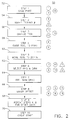
- a process map 14 of the identified process is generated. More specifically, the process is mapped to identify how a part moves, how information flows, and how much operator intervention is necessary. With the process map and prework data, the steps at which the nonconforming / scrap occurred are identified 16. This step is performed, in one embodiment, by superimposing the scrap and nonconformance data on process map. Further details regarding the process map and superimposing the prework data on the process map are provided below in connection with Figure 2.
- a process raze 18 is performed.
- the process razing is performed by at least one of the following steps.
- the process razing is determined based on whether a plurality of errors are identified throughout the process. If a plurality of errors are identified throughout the process, then it is first determined whether a different process can be used in place of the identified process. If a different process cannot be substituted for the identified process, then razing continues by determining whether the identified step can be eliminated, and if the step can be eliminated, then eliminating the step. If the step cannot be eliminated, then it is determining whether the identified step can be simplified, and if the step can be simplified, then simplifying the step.
- the particular error proofing technique selected depends on the particular process, as is well known in the art.
- the nonconformance and scrap issues are reviewed to ensure that all such issues have been addressed 22. If all the issues have not been addressed, then the methodology can be reexecuted by returning to step 12. If all the issues have been addressed, then the defined process is identified as a possible process to implement.
- FIG. 2 illustrates an exemplary process map 50. More specifically, map 50 is a toolset process map for use in connection with manufacture of an aircraft engine component. Ten (10) steps 52 - 70 are identified in process map 50. Superimposed on map 50 is scrap and nonconformance data. Particularly, scrap data points are indicated by triangles, and are associated with respective steps by being located to the right of the respective step. For example, scrap points 1 and 2 occurred in connection with Step 6 of the toolset process. In addition, nonconforming data points are indicated by circles, and are associated with respective steps by being located to the right of the respective step. For example, nonconforming data point 1 occurred in connection with Step 1 of the toolset process. The process razing is facilitated by superimposing the scrap and nonconformance data on the process map as shown in Figure 2.
- the above described methodology provides the advantage that all nonconformance and scrap issues are addressed in error proofing. Therefore, in addition, the error proofing not only facilitates reducing error opportunities and scrap, but also facilitates the reduction of cycle times.
Landscapes
- Engineering & Computer Science (AREA)
- General Engineering & Computer Science (AREA)
- Manufacturing & Machinery (AREA)
- Quality & Reliability (AREA)
- Physics & Mathematics (AREA)
- General Physics & Mathematics (AREA)
- Automation & Control Theory (AREA)
- General Factory Administration (AREA)
- Management, Administration, Business Operations System, And Electronic Commerce (AREA)
- Testing And Monitoring For Control Systems (AREA)
Abstract

Description
Claims (10)
- A method comprising the steps of:identifying a process responsible for at least one error;process mapping (14) the identified process;identifying (16) at least one step (52-70) in the identified process at which at least one of scrap and nonconformance occurred;razing (18) the identified process by performing at least one of:determining whether the identified step can be eliminated, and if the step can be eliminated, then eliminating the step; anddetermining whether the identified step can be simplified, and if the step can be simplified, then simplifying the step; anddetermining whether a different process can be substituted for the identified process; andverifying that the at least one of scrap and nonconformance has been reduced in the razed process.
- A method in accordance with Claim 1 further comprising the step of error proofing (20) the razed process (18) before verifying that the at least one of scrap and nonconformance has been reduced.
- A method in accordance with Claim 1 or 2 wherein identifying a process responsible for at least one error comprises the steps of collecting at least one of scrap, rework and nonconformance data.
- A method in accordance with Claim 1, 2 or 3 wherein if a plurality of errors are identified throughout the identified process, then razing (18) the identified process is performed by first determining whether a different process can be substituted for the identified process.
- A method comprising the steps of:identifying a process responsible for at least one error;process mapping (14) the identified process;identifying (16) at least one step (52-70) in the identified process at which at least one of scrap and nonconformance occurred;razing (18) the identified process by performing at least one of:determining whether the identified step can be eliminated, and if the step can be eliminated, then eliminating the step; andcan be simplified, and if the step can be simplified, then simplifying the step; andif the step cannot be eliminated and if the step cannot be simplified, then determining whether a different process can be substituted for the identified process; andverifying that the at least one of scrap and nonconformance has been reduced in the razed process.
- A method in accordance with Claim 5 further comprising the step of error proofing (20) the razed process (18) before verifying that the at least one of scrap and nonconformance has been reduced
- A method in accordance with Claim 5 or 6 wherein identifying a process responsible for at least one error comprises the steps of collecting at least one of scrap, rework and nonconformance data.
- A method comprising the steps of:identifying a process responsible for at least one error;process mapping (14) the identified process;identifying (16) at least one step (52-70) in the identified process at which at least one of scrap and nonconformance occurred;razing (18) the identified process by performing at least one of:determining whether a plurality of errors throughout the identified process;if a plurality of errors are identified throughout the identified process, then determining whether a different process can be substituted for the identified process;if the different process can be substituted for the identified process, then substituting the different process for the identified process;if the different process cannot be substituted for the identified process, then determining whether the identified step can be eliminated, and if the step can be eliminated, then eliminating the step; andif the step cannot be eliminated, then determining whether the identified step can be simplified, and if the step can be simplified, then simplifying the step; andverifying that the at least one of scrap and nonconformance has been reduced in the razed process.
- A method in accordance with Claim 8 further comprising the step of error proofing (20) the razed process (18) before verifying that the at least one of scrap and nonconformance has been reduced.
- A method in accordance with Claim 8 or 9 wherein identifying a process responsible for at least one error comprises the steps of collecting at least one of scrap, rework and nonconformance data.
Applications Claiming Priority (4)
| Application Number | Priority Date | Filing Date | Title |
|---|---|---|---|
| US15750299P | 1999-10-04 | 1999-10-04 | |
| US157502P | 1999-10-04 | ||
| US09/442,572 US6654650B1 (en) | 1999-10-04 | 1999-11-18 | Methods for error proofing |
| US442572 | 1999-11-18 |
Publications (2)
| Publication Number | Publication Date |
|---|---|
| EP1091272A2 true EP1091272A2 (en) | 2001-04-11 |
| EP1091272A3 EP1091272A3 (en) | 2009-05-13 |
Family
ID=26854190
Family Applications (1)
| Application Number | Title | Priority Date | Filing Date |
|---|---|---|---|
| EP00308753A Withdrawn EP1091272A3 (en) | 1999-10-04 | 2000-10-04 | Methods for error proofing |
Country Status (5)
| Country | Link |
|---|---|
| US (1) | US6654650B1 (en) |
| EP (1) | EP1091272A3 (en) |
| JP (1) | JP2001222310A (en) |
| BR (1) | BR0004647A (en) |
| CA (1) | CA2321385C (en) |
Families Citing this family (2)
| Publication number | Priority date | Publication date | Assignee | Title |
|---|---|---|---|---|
| US7250750B2 (en) * | 2005-01-28 | 2007-07-31 | Apps Leonard D | System and method for testing and orientation of components for assembly |
| CN106919158A (en) * | 2017-03-15 | 2017-07-04 | 郑州风神物流有限公司 | A kind of logistics collection for being applied to the engine synchronization supply of material matches somebody with somebody fool proof system |
Family Cites Families (10)
| Publication number | Priority date | Publication date | Assignee | Title |
|---|---|---|---|---|
| JPH087765B2 (en) * | 1989-03-07 | 1996-01-29 | 日本電気株式会社 | Work alternative method of LAN integrated production system |
| JPH03229303A (en) * | 1990-02-05 | 1991-10-11 | Hitachi Ltd | Quality/process control system |
| FR2671305B1 (en) * | 1991-01-09 | 1995-04-07 | Commissariat Energie Atomique | METHOD FOR DRIVING A ROBOT ARM BY DEFINING SUBSTITUTION PATHS. |
| FR2675971B1 (en) * | 1991-04-23 | 1993-08-06 | France Telecom | CORRECTIVE ERROR CODING METHOD WITH AT LEAST TWO SYSTEMIC CONVOLUTIVE CODES IN PARALLEL, ITERATIVE DECODING METHOD, CORRESPONDING DECODING MODULE AND DECODER. |
| US6125196A (en) * | 1992-10-02 | 2000-09-26 | Unisys Corporation | Method for identifying suspect items in an out-of-balance transaction |
| US5737494A (en) * | 1994-12-08 | 1998-04-07 | Tech-Metrics International, Inc. | Assessment methods and apparatus for an organizational process or system |
| US6161101A (en) | 1994-12-08 | 2000-12-12 | Tech-Metrics International, Inc. | Computer-aided methods and apparatus for assessing an organization process or system |
| JP3264117B2 (en) * | 1994-12-28 | 2002-03-11 | 日産自動車株式会社 | Production management device |
| JPH09186056A (en) * | 1995-12-28 | 1997-07-15 | Sony Corp | Production process management method |
| US5923014A (en) | 1997-08-29 | 1999-07-13 | Electronic Data Systems Corporation | Computerized shipment error proofing system and method |
-
1999
- 1999-11-18 US US09/442,572 patent/US6654650B1/en not_active Expired - Fee Related
-
2000
- 2000-09-28 CA CA002321385A patent/CA2321385C/en not_active Expired - Fee Related
- 2000-10-03 JP JP2000303213A patent/JP2001222310A/en active Pending
- 2000-10-04 BR BR0004647-7A patent/BR0004647A/en not_active IP Right Cessation
- 2000-10-04 EP EP00308753A patent/EP1091272A3/en not_active Withdrawn
Also Published As
| Publication number | Publication date |
|---|---|
| CA2321385C (en) | 2007-11-27 |
| BR0004647A (en) | 2001-10-02 |
| US6654650B1 (en) | 2003-11-25 |
| EP1091272A3 (en) | 2009-05-13 |
| JP2001222310A (en) | 2001-08-17 |
| CA2321385A1 (en) | 2001-04-04 |
Similar Documents
| Publication | Publication Date | Title |
|---|---|---|
| CN109507955B (en) | Cutter path offset path method based on numerical control system | |
| US11314230B2 (en) | Machining program generation support device | |
| CN113191671B (en) | Engineering amount calculating method and device and electronic equipment | |
| CN115146381B (en) | Smart 3D-based ship piping system drawing and making system | |
| US7035752B2 (en) | Semiconductor test data analysis system | |
| EP0859315A2 (en) | Graphical distributed make tool methods, apparatus and computer program products | |
| EP1091272A2 (en) | Methods for error proofing | |
| CN104907932A (en) | Method for achieving machining program processing through conversational parameters in computer numerical control grinding machine system | |
| CN110704318B (en) | Map data automatic testing method, terminal device and storage medium | |
| CN107590303B (en) | Method for quickly searching and correcting abnormal graph in layout data | |
| US20040068340A1 (en) | Method of providing improved performance of software tools | |
| CN113095568B (en) | Intelligent assembly method and platform | |
| CN117094136A (en) | Speed reducer VR (virtual reality) auxiliary method, system, glasses and storage medium | |
| CN115964788A (en) | Building structure collision correction method and device based on BIM model | |
| JPH08190575A (en) | Inspection teaching apparatus and method | |
| KR100737018B1 (en) | Manufacturing method of car body welding jig | |
| CN111931259A (en) | Revit-based method for linking drawings in batches | |
| JP2706266B2 (en) | How to create bending data | |
| WO2020241676A1 (en) | Three-dimensional model recovery system, three-dimensional model recovery method, inspection device, and program | |
| CN115186315B (en) | Method and system for accurately positioning equipment in factory diagram for configuration software | |
| JP2842293B2 (en) | Automatic setting of actual data recording date | |
| JPH04114204A (en) | Rounding deformation operating method for three-dimensional shape | |
| CN121093534A (en) | Configuration method and system of primary wiring diagram for relay protection control device | |
| KR20240071067A (en) | Gusset Plate 3D Modeling Automation Program | |
| JP3085005B2 (en) | How to prevent self-intersection of fillet material |
Legal Events
| Date | Code | Title | Description |
|---|---|---|---|
| PUAI | Public reference made under article 153(3) epc to a published international application that has entered the european phase |
Free format text: ORIGINAL CODE: 0009012 |
|
| AK | Designated contracting states |
Kind code of ref document: A2 Designated state(s): AT BE CH CY DE DK ES FI FR GB GR IE IT LI LU MC NL PT SE |
|
| AX | Request for extension of the european patent |
Free format text: AL;LT;LV;MK;RO;SI |
|
| PUAL | Search report despatched |
Free format text: ORIGINAL CODE: 0009013 |
|
| AK | Designated contracting states |
Kind code of ref document: A3 Designated state(s): AT BE CH CY DE DK ES FI FR GB GR IE IT LI LU MC NL PT SE |
|
| AX | Request for extension of the european patent |
Extension state: AL LT LV MK RO SI |
|
| 17P | Request for examination filed |
Effective date: 20091113 |
|
| AKX | Designation fees paid |
Designated state(s): DE FR GB IT SE |
|
| 17Q | First examination report despatched |
Effective date: 20101014 |
|
| STAA | Information on the status of an ep patent application or granted ep patent |
Free format text: STATUS: THE APPLICATION IS DEEMED TO BE WITHDRAWN |
|
| 18D | Application deemed to be withdrawn |
Effective date: 20110427 |