EP1091062A2 - Anti-Pinch door lock - Google Patents
Anti-Pinch door lock Download PDFInfo
- Publication number
- EP1091062A2 EP1091062A2 EP00121302A EP00121302A EP1091062A2 EP 1091062 A2 EP1091062 A2 EP 1091062A2 EP 00121302 A EP00121302 A EP 00121302A EP 00121302 A EP00121302 A EP 00121302A EP 1091062 A2 EP1091062 A2 EP 1091062A2
- Authority
- EP
- European Patent Office
- Prior art keywords
- door
- set forth
- claw
- path
- obstruction
- Prior art date
- Legal status (The legal status is an assumption and is not a legal conclusion. Google has not performed a legal analysis and makes no representation as to the accuracy of the status listed.)
- Granted
Links
- 230000007246 mechanism Effects 0.000 claims abstract description 34
- 238000000034 method Methods 0.000 claims abstract description 10
- 210000000078 claw Anatomy 0.000 claims description 22
- 230000000903 blocking effect Effects 0.000 claims description 11
- 238000001514 detection method Methods 0.000 claims description 7
- 238000013459 approach Methods 0.000 description 1
- 238000012986 modification Methods 0.000 description 1
- 230000004048 modification Effects 0.000 description 1
- 230000002265 prevention Effects 0.000 description 1
Images


Classifications
-
- E—FIXED CONSTRUCTIONS
- E05—LOCKS; KEYS; WINDOW OR DOOR FITTINGS; SAFES
- E05F—DEVICES FOR MOVING WINGS INTO OPEN OR CLOSED POSITION; CHECKS FOR WINGS; WING FITTINGS NOT OTHERWISE PROVIDED FOR, CONCERNED WITH THE FUNCTIONING OF THE WING
- E05F5/00—Braking devices, e.g. checks; Stops; Buffers
- E05F5/02—Braking devices, e.g. checks; Stops; Buffers specially for preventing the slamming of swinging wings during final closing movement, e.g. jamb stops
- E05F5/022—Braking devices, e.g. checks; Stops; Buffers specially for preventing the slamming of swinging wings during final closing movement, e.g. jamb stops specially adapted for vehicles, e.g. for hoods or trunks
- E05F5/025—Braking devices, e.g. checks; Stops; Buffers specially for preventing the slamming of swinging wings during final closing movement, e.g. jamb stops specially adapted for vehicles, e.g. for hoods or trunks specially adapted for vehicle doors
-
- E—FIXED CONSTRUCTIONS
- E05—LOCKS; KEYS; WINDOW OR DOOR FITTINGS; SAFES
- E05F—DEVICES FOR MOVING WINGS INTO OPEN OR CLOSED POSITION; CHECKS FOR WINGS; WING FITTINGS NOT OTHERWISE PROVIDED FOR, CONCERNED WITH THE FUNCTIONING OF THE WING
- E05F15/00—Power-operated mechanisms for wings
- E05F15/40—Safety devices, e.g. detection of obstructions or end positions
- E05F15/42—Detection using safety edges
- E05F15/43—Detection using safety edges responsive to disruption of energy beams, e.g. light or sound
-
- E—FIXED CONSTRUCTIONS
- E05—LOCKS; KEYS; WINDOW OR DOOR FITTINGS; SAFES
- E05B—LOCKS; ACCESSORIES THEREFOR; HANDCUFFS
- E05B77/00—Vehicle locks characterised by special functions or purposes
- E05B77/14—Specially controlled locking actions in case of open doors or in case of doors moved from an open to a closed position, e.g. lock-out prevention or self-cancelling
-
- E—FIXED CONSTRUCTIONS
- E05—LOCKS; KEYS; WINDOW OR DOOR FITTINGS; SAFES
- E05C—BOLTS OR FASTENING DEVICES FOR WINGS, SPECIALLY FOR DOORS OR WINDOWS
- E05C17/00—Devices for holding wings open; Devices for limiting opening of wings or for holding wings open by a movable member extending between frame and wing; Braking devices, stops or buffers, combined therewith
- E05C17/003—Power-actuated devices for limiting the opening of vehicle doors
- E05C17/006—Power-actuated devices for limiting the opening of vehicle doors with means for detecting obstacles outside the doors
-
- E—FIXED CONSTRUCTIONS
- E05—LOCKS; KEYS; WINDOW OR DOOR FITTINGS; SAFES
- E05F—DEVICES FOR MOVING WINGS INTO OPEN OR CLOSED POSITION; CHECKS FOR WINGS; WING FITTINGS NOT OTHERWISE PROVIDED FOR, CONCERNED WITH THE FUNCTIONING OF THE WING
- E05F15/00—Power-operated mechanisms for wings
-
- E—FIXED CONSTRUCTIONS
- E05—LOCKS; KEYS; WINDOW OR DOOR FITTINGS; SAFES
- E05Y—INDEXING SCHEME ASSOCIATED WITH SUBCLASSES E05D AND E05F, RELATING TO CONSTRUCTION ELEMENTS, ELECTRIC CONTROL, POWER SUPPLY, POWER SIGNAL OR TRANSMISSION, USER INTERFACES, MOUNTING OR COUPLING, DETAILS, ACCESSORIES, AUXILIARY OPERATIONS NOT OTHERWISE PROVIDED FOR, APPLICATION THEREOF
- E05Y2201/00—Constructional elements; Accessories therefor
- E05Y2201/20—Brakes; Disengaging means; Holders; Stops; Valves; Accessories therefor
- E05Y2201/224—Stops
-
- E—FIXED CONSTRUCTIONS
- E05—LOCKS; KEYS; WINDOW OR DOOR FITTINGS; SAFES
- E05Y—INDEXING SCHEME ASSOCIATED WITH SUBCLASSES E05D AND E05F, RELATING TO CONSTRUCTION ELEMENTS, ELECTRIC CONTROL, POWER SUPPLY, POWER SIGNAL OR TRANSMISSION, USER INTERFACES, MOUNTING OR COUPLING, DETAILS, ACCESSORIES, AUXILIARY OPERATIONS NOT OTHERWISE PROVIDED FOR, APPLICATION THEREOF
- E05Y2201/00—Constructional elements; Accessories therefor
- E05Y2201/20—Brakes; Disengaging means; Holders; Stops; Valves; Accessories therefor
- E05Y2201/23—Actuation thereof
- E05Y2201/246—Actuation thereof by auxiliary motors, magnets, springs or weights
-
- E—FIXED CONSTRUCTIONS
- E05—LOCKS; KEYS; WINDOW OR DOOR FITTINGS; SAFES
- E05Y—INDEXING SCHEME ASSOCIATED WITH SUBCLASSES E05D AND E05F, RELATING TO CONSTRUCTION ELEMENTS, ELECTRIC CONTROL, POWER SUPPLY, POWER SIGNAL OR TRANSMISSION, USER INTERFACES, MOUNTING OR COUPLING, DETAILS, ACCESSORIES, AUXILIARY OPERATIONS NOT OTHERWISE PROVIDED FOR, APPLICATION THEREOF
- E05Y2201/00—Constructional elements; Accessories therefor
- E05Y2201/40—Motors; Magnets; Springs; Weights; Accessories therefor
- E05Y2201/46—Magnets
- E05Y2201/462—Electromagnets
-
- E—FIXED CONSTRUCTIONS
- E05—LOCKS; KEYS; WINDOW OR DOOR FITTINGS; SAFES
- E05Y—INDEXING SCHEME ASSOCIATED WITH SUBCLASSES E05D AND E05F, RELATING TO CONSTRUCTION ELEMENTS, ELECTRIC CONTROL, POWER SUPPLY, POWER SIGNAL OR TRANSMISSION, USER INTERFACES, MOUNTING OR COUPLING, DETAILS, ACCESSORIES, AUXILIARY OPERATIONS NOT OTHERWISE PROVIDED FOR, APPLICATION THEREOF
- E05Y2400/00—Electronic control; Electrical power; Power supply; Power or signal transmission; User interfaces
- E05Y2400/80—User interfaces
- E05Y2400/81—Feedback to user, e.g. tactile
- E05Y2400/818—Visual
- E05Y2400/822—Light emitters, e.g. light emitting diodes [LED]
-
- E—FIXED CONSTRUCTIONS
- E05—LOCKS; KEYS; WINDOW OR DOOR FITTINGS; SAFES
- E05Y—INDEXING SCHEME ASSOCIATED WITH SUBCLASSES E05D AND E05F, RELATING TO CONSTRUCTION ELEMENTS, ELECTRIC CONTROL, POWER SUPPLY, POWER SIGNAL OR TRANSMISSION, USER INTERFACES, MOUNTING OR COUPLING, DETAILS, ACCESSORIES, AUXILIARY OPERATIONS NOT OTHERWISE PROVIDED FOR, APPLICATION THEREOF
- E05Y2800/00—Details, accessories and auxiliary operations not otherwise provided for
- E05Y2800/25—Emergency conditions
- E05Y2800/252—Emergency conditions the elements functioning only in case of emergency
-
- E—FIXED CONSTRUCTIONS
- E05—LOCKS; KEYS; WINDOW OR DOOR FITTINGS; SAFES
- E05Y—INDEXING SCHEME ASSOCIATED WITH SUBCLASSES E05D AND E05F, RELATING TO CONSTRUCTION ELEMENTS, ELECTRIC CONTROL, POWER SUPPLY, POWER SIGNAL OR TRANSMISSION, USER INTERFACES, MOUNTING OR COUPLING, DETAILS, ACCESSORIES, AUXILIARY OPERATIONS NOT OTHERWISE PROVIDED FOR, APPLICATION THEREOF
- E05Y2900/00—Application of doors, windows, wings or fittings thereof
- E05Y2900/50—Application of doors, windows, wings or fittings thereof for vehicles
- E05Y2900/53—Type of wing
- E05Y2900/531—Doors
Definitions
- This invention relates to a method and apparatus for preventing the capture of an object in the path of a moving door, and subsequent latching of the door.
- Vehicle doors typically include a latch mechanism which holds the door at a latched position when the door is closed.
- a claw pivots between a latched and unlatched position.
- An element on the vehicle frame drives the claw to the latched position as the door is closed into the frame.
- an obstruction such as the arm or fingers of a person, may sometimes be in the path of the door when the door is closed. When such an obstruction is found, the door is sometimes closed on this person, "pinching" an arm or finger.
- a sensor is provided on the door which seeks to detect an obstruction in the closing path of the door. If an obstruction is detected, then a mechanism is actuated which prevents the door from latching, and thus minimizes pinching.
- the senor is a laser which provides a "laser curtain" in the path of the door sensing the presence of an obstruction.
- the laser curtain sends out a signal, and receives reflected signals.
- the reflected signals should come from the frame, and a control has an indication of whether a reflective signal is from the vehicle frame, or is from an obstruction which is closer to the door than the vehicle frame. The presence of this obstruction can then be used to indicate the potential need for stopping latching of the door.
- a mechanism when an obstruction is identified a mechanism is actuated which prevents actuation of the latch mechanism to latch the door to the door frame.
- this mechanism may drive the claw, to a position where it will no longer allow an element from the frame to move to the latched position. In this way, the door frame is stopped inches from the latched position, and any pinching of the person in the path of the door will be minimized.
- a separate mechanism moves into the path of the element, again blocking movement of the claw to its latched position.
- a signal such as a warning light, sound, etc. may also be actuated.
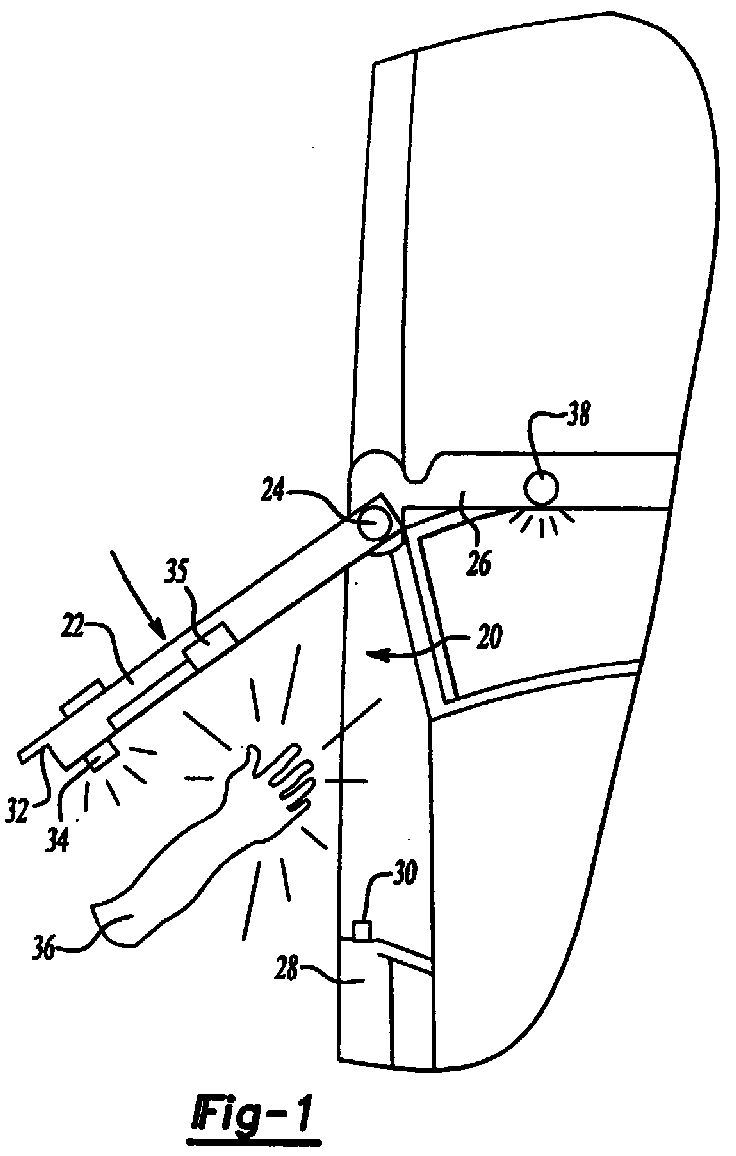
- a door assembly 20 is illustrated in Figure 1 for blocking latching of a vehicle door 22 which is hinged at 24 to a front portion of a vehicle frame 26. As known, the door closes relative to a rear portion of the frame 28.
- a latch element 30 is typically placed on the frame 28, and a door latch mechanism 32 is typically found in the inner edge of the door 22.
- a sensor 34 which is preferably a laser curtain, looks inwardly from the door edge toward the door frame 28 as the door 22 is closed.
- a movement sensor and control 35 is preferably incorporated into the element 34 to determine when the door is moving.
- the laser could be activated whenever the door is opened.
- a sensor 38 could easily be designed to determine if the door is opened.
- the control for the sensor 34 actuates the sensor 34 when the door is open or moving.
- the sensor 34 includes a transmitter, and a receiver.
- the transmitter and receiver may be similar to those typically used to provide a laser curtain in various industrial applications. That is the laser transmitter and reciever are known and form no portion of this invention.
- the sensor detects reflected waves, and the control 35 is programmed to have an expectation of the distance the reflective wave should travel prior to reflection based upon the distance between the door 22 and the frame 28. An obstruction results in a reflection from a closer distance. Thus, the presence of an object or obstruction, such as an arm 36, would be detected by the sensor 34.
- the control 35 then detects the presence of the arm 36. Upon detection, control 35 initially actuates a warning light, alarm, etc. 38. This would provide some indication to the person 36 in the door path that the door is closing.
- a person closing the door during this time may also be given a warning to stop the closing due to the presence of the obstruction 36.
- the invention would detect any obstruction, not just a user's arm. A non-human obstruction might also damage the door, and thus the detection of the obstruction is also valuable.
- the present invention preferably blocks latching of the door when an obstruction is detected. Various types of mechanisms may be utilized to prevent such latching. One particular location for the prevention mechanism would be at the latch 32 itself.
- Figure 2 shows one known prior art latch 32.
- a pivot pin 40 mounted in a fixed frame portion 41 carries a pivoting claw 42.
- the claw 42 is preferably biased to one of two positions, at which the door is either latched or unlatched. The claw moves with movement of the door handle, as known to move to the unlatching position.
- a lower portion 44 of the claw is spaced from an upper portion 46 about the pivot point 40.
- a channel 48 between the upper and lower portions 44 and 46 selectively receives the lock element 30 from the door frame 28.
- the element 30 strikes the lower portion 44 causing the claw 42 to pivot to its latched position.
- the portion 46 is received to the right of the element 30 in the orientation as shown in Figure 2. In this location, the door is latched.
- a blocking mechanism 50 is illustrated in Figure 3 is intended to prevent the pinching.
- the sensor 35 is active to determine whether the door is open or in motion. If an obstruction is not detected, then the mechanism 50 is at the illustrated position where it does not block movement to the latched position. Element 30 moves claw 42 to the latched position.
- the mechanism 50 is actuated by driving pin 52 outwardly against the upper end 46 of the claw. This causes the claw to pivot to a position which approximates its latched position without the element 30 as shown in Figure 4. In the latched position, element 30 can no longer move into the recess 48. Thus, the door is stopped from being latched inches from the fully latched position. In this way, the person 36 or other obstruction, will not be pinched, or at least not pinched as hard as with the prior art.
- a second embodiment mechanism 60 is illustrated in Figure 5.
- a mechanism 62 has a pin 64 that operates much like the pin 52 in the Figure 3 and 4 embodiment.
- the pin 64 itself blocks the path of the element 30, rather than driving the claw 42. Again, this prevents the movement of the door to its fully latched position, and provides inches of clearance.
- the disclosed blocking mechanisms block movement to the fully latched position
- other mechanisms which simply block movement to a fully closed position may also be utilized.
- the term "closed" position of the door will refer to the position at which the door is received within the doorframe, and latched.
- the present invention would extend to any mechanism which prevents movement to this fully closed position.
Landscapes
- Power-Operated Mechanisms For Wings (AREA)
- Lock And Its Accessories (AREA)
Abstract
Description
Claims (18)
- A method of protecting an object in the path of the door, comprising the steps of:1) providing a sensor for determining the presence of an object in the path of a door, and providing an apparatus which is selectively actuated to prevent complete closing of said door;2) sensing the presence of an object in the path of said vehicle door; and3) preventing complete closing of said door when an object is detected at step 2.
- A method as set forth in Claim 1, wherein said sensing is determined by sending a signal into the path, and sensing reflected signals to determine the presence of an obstruction.
- A method as set forth in Claim 2, wherein said door includes a latch which is selectively driven to lock by an element on a vehicle frame, and preventing movement of said latch to a latched position upon the detection of an object in step 2.
- A method as set forth in Claim 3, wherein said element is an element extending outwardly of a vehicle frame which contacts a claw on a door, and said claw pivoting to a latched position to capture said element, said preventing of step 3) including stopping movement of said element to said latched position.
- A method as set forth in Claim 4, wherein said claw is moved to a latched position prior to said element contacting said claw.
- A method as set forth in Claim 5, wherein a separate blocking member moves into the path of said element, preventing said element from contacting said latch and moving said latch to said latched position.
- A method is set forth in Claim 1, wherein said sensing of step 2) occurs when the door is moving.
- A method is set forth in Claim 1, wherein the sensing of step 2) occurs whenever the door is open.
- A door anti-pinch apparatus comprising:a sensor for sensing an obstruction in the path of a vehicle door; and a structure for preventing said vehicle door from being fully closed when said sensor determines that an object is in the path of said door.
- An apparatus as set in forth in Claim 10, wherein a latching mechanism latches said vehicle door within a frame of a vehicle, and said structure preventing latching of said latching mechanism upon the detection of an object.
- An apparatus as set forth in Claim 11, wherein said latch includes a claw member which pivots to capture a locking element on a vehicle frame, said claw member being prevented from pivoting to a latched position upon the detection of an obstruction.
- An apparatus as set forth in Claim 12, wherein a mechanism drives said claw to a blocking position when an obstruction is detected, and said element on said frame not being able to drive said claw to pivot to its latched position.
- An apparatus as set forth in Claim 12 wherein a separate mechanism is driven into the path of said element such that said element cannot drive said claw to a latched position upon the detection of an obstruction.
- An apparatus as set forth in Claim 10, wherein said sensing mechanism is an element which sends a signal outwardly into the path of said door and receives the reflected signals to determine the presence of an obstruction.
- An apparatus as set forth in Claim 14, wherein said sensor is a laser.
- An apparatus as set forth in Claim 10, wherein a warning signal is provided which is actuated upon the detection of an obstruction.
- An apparatus as set forth in Claim 10, wherein a control senses when a vehicle door is opened, and actuates said sensor when said vehicle door is open.
- An apparatus as set forth in Claim 10, wherein a control detects when said vehicle door is moving, and actuates said sensor when said vehicle door is moving to a closed position.
Applications Claiming Priority (2)
| Application Number | Priority Date | Filing Date | Title |
|---|---|---|---|
| US415411 | 1999-10-08 | ||
| US09/415,411 US6145918A (en) | 1999-10-08 | 1999-10-08 | Anti-pinch door lock |
Publications (3)
| Publication Number | Publication Date |
|---|---|
| EP1091062A2 true EP1091062A2 (en) | 2001-04-11 |
| EP1091062A3 EP1091062A3 (en) | 2003-07-02 |
| EP1091062B1 EP1091062B1 (en) | 2006-08-30 |
Family
ID=23645594
Family Applications (1)
| Application Number | Title | Priority Date | Filing Date |
|---|---|---|---|
| EP00121302A Expired - Lifetime EP1091062B1 (en) | 1999-10-08 | 2000-10-06 | Anti-Pinch door lock |
Country Status (3)
| Country | Link |
|---|---|
| US (1) | US6145918A (en) |
| EP (1) | EP1091062B1 (en) |
| DE (1) | DE60030381T2 (en) |
Cited By (4)
| Publication number | Priority date | Publication date | Assignee | Title |
|---|---|---|---|---|
| WO2006001002A1 (en) * | 2004-06-28 | 2006-01-05 | Brian Owen Kelly | Door jamb finger guard |
| US8493081B2 (en) | 2009-12-08 | 2013-07-23 | Magna Closures Inc. | Wide activation angle pinch sensor section and sensor hook-on attachment principle |
| US9234979B2 (en) | 2009-12-08 | 2016-01-12 | Magna Closures Inc. | Wide activation angle pinch sensor section |
| US20240358171A1 (en) * | 2014-10-24 | 2024-10-31 | Leer, Inc. | Merchandiser with sensing capabilities |
Families Citing this family (29)
| Publication number | Priority date | Publication date | Assignee | Title |
|---|---|---|---|---|
| US6744365B2 (en) * | 2000-01-21 | 2004-06-01 | Rosario G. Sicuranza | Vehicle door stop safety system |
| AUPR691101A0 (en) * | 2001-08-09 | 2001-08-30 | Francis De La Coeur, Neil | Safety device |
| US7226112B2 (en) * | 2003-10-02 | 2007-06-05 | Nicholas Plastics Incorporated | Pinch warning and illumination system |
| DE102004062235A1 (en) * | 2004-12-23 | 2006-07-13 | BSH Bosch und Siemens Hausgeräte GmbH | Built-in domestic appliance |
| US7156454B1 (en) * | 2005-06-10 | 2007-01-02 | Ford Global Technologies, Llc | Mechanism for preventing closure of automobile doors |
| US7219945B1 (en) * | 2005-10-26 | 2007-05-22 | Ford Global Technologies, Llc | Power lift gate for automotive vehicle |
| TR200504721A2 (en) * | 2005-11-28 | 2006-08-21 | Temsa Sanayi̇ Ve Ti̇caret A Ş | Ensuring the safety of passengers or service personnel on the door steps. |
| FR2898631B1 (en) * | 2006-03-16 | 2010-08-13 | Peugeot Citroen Automobiles Sa | ANTI-PINCH DEVICE FOR A SWING DOOR OF A MOTOR VEHICLE AND A MOTOR VEHICLE COMPRISING AT LEAST ONE SWING DOOR EQUIPPED WITH SUCH A DEVICE. |
| FR2898632B1 (en) * | 2006-03-16 | 2010-08-13 | Peugeot Citroen Automobiles Sa | ANTI-PINCH DEVICE FOR A SWING DOOR OF A MOTOR VEHICLE AND A MOTOR VEHICLE COMPRISING AT LEAST ONE DOOR EQUIPPED WITH SUCH AN ANTI-PINCH DEVICE. |
| US8700267B2 (en) * | 2008-05-19 | 2014-04-15 | GM Global Technology Operations LLC | System and method for receiving and recording a closure panel release request |
| US9260882B2 (en) | 2009-03-12 | 2016-02-16 | Ford Global Technologies, Llc | Universal global latch system |
| US9551166B2 (en) | 2011-11-02 | 2017-01-24 | Ford Global Technologies, Llc | Electronic interior door release system |
| US10323442B2 (en) | 2014-05-13 | 2019-06-18 | Ford Global Technologies, Llc | Electronic safe door unlatching operations |
| US10119308B2 (en) | 2014-05-13 | 2018-11-06 | Ford Global Technologies, Llc | Powered latch system for vehicle doors and control system therefor |
| US10273725B2 (en) | 2014-05-13 | 2019-04-30 | Ford Global Technologies, Llc | Customer coaching method for location of E-latch backup handles |
| US9903142B2 (en) | 2014-05-13 | 2018-02-27 | Ford Global Technologies, Llc | Vehicle door handle and powered latch system |
| US20160047147A1 (en) * | 2014-08-13 | 2016-02-18 | Aaron D. James | Automotive door hinge safety lock |
| US9909344B2 (en) | 2014-08-26 | 2018-03-06 | Ford Global Technologies, Llc | Keyless vehicle door latch system with powered backup unlock feature |
| EP3106255A1 (en) * | 2015-06-18 | 2016-12-21 | Haas Food Equipment GmbH | Device for detecting the breakage of a cutting element |
| US9725069B2 (en) | 2015-10-12 | 2017-08-08 | Ford Global Technologies, Llc | Keyless vehicle systems |
| US10227810B2 (en) | 2016-08-03 | 2019-03-12 | Ford Global Technologies, Llc | Priority driven power side door open/close operations |
| US10087671B2 (en) | 2016-08-04 | 2018-10-02 | Ford Global Technologies, Llc | Powered driven door presenter for vehicle doors |
| US10329823B2 (en) | 2016-08-24 | 2019-06-25 | Ford Global Technologies, Llc | Anti-pinch control system for powered vehicle doors |
| US10458171B2 (en) | 2016-09-19 | 2019-10-29 | Ford Global Technologies, Llc | Anti-pinch logic for door opening actuator |
| US10604970B2 (en) | 2017-05-04 | 2020-03-31 | Ford Global Technologies, Llc | Method to detect end-of-life in latches |
| US10907386B2 (en) | 2018-06-07 | 2021-02-02 | Ford Global Technologies, Llc | Side door pushbutton releases |
| CN110443917A (en) | 2019-07-12 | 2019-11-12 | 阿里巴巴集团控股有限公司 | Electronic door switch device and detection method, device and equipment for electronic door switch |
| CN112943004B (en) * | 2021-02-01 | 2022-05-31 | 青岛天辰佳创汽车配件有限公司 | Control method and device for suction force of self-priming vehicle door |
| DE102024209850B3 (en) * | 2024-10-10 | 2026-01-22 | Volkswagen Aktiengesellschaft | Anti-pinch device for motor vehicle doors |
Family Cites Families (16)
| Publication number | Priority date | Publication date | Assignee | Title |
|---|---|---|---|---|
| US3231880A (en) * | 1962-06-18 | 1966-01-25 | Stefan M Stein | Detection response mechanism |
| JPS57191123A (en) * | 1981-05-20 | 1982-11-24 | Nissan Motor Co Ltd | Safety device in auto door |
| JPS57191122A (en) * | 1981-05-20 | 1982-11-24 | Nissan Motor Co Ltd | Safety device in auto door |
| US4835449A (en) * | 1987-05-07 | 1989-05-30 | Asc Incorporated | Sliding roof panel control apparatus |
| DE4031552C2 (en) * | 1990-10-05 | 1994-04-28 | Daimler Benz Ag | Safety device for vehicles, in particular for motor vehicles |
| US5074073A (en) * | 1990-10-17 | 1991-12-24 | Zwebner Ascher Z | Car door safety device |
| DE4119579A1 (en) * | 1991-06-14 | 1992-12-17 | Bayerische Motoren Werke Ag | Object detector for vehicle blind spot - prevents opening of door by activating door brake when approaching object is detected |
| US5955854A (en) * | 1992-09-29 | 1999-09-21 | Prospects Corporation | Power driven venting of a vehicle |
| US5746475A (en) * | 1995-06-07 | 1998-05-05 | Asc Incorprated | Drive mechanism for an automotive vehicle sunroof assembly |
| US5602526A (en) * | 1994-11-21 | 1997-02-11 | Read; Robert M. | Vehicle open door warning system |
| US5654615A (en) * | 1994-12-15 | 1997-08-05 | Asc Incorporated | Storage compartment sensor system for use with an automotive vehicle convertible roof |
| DE19537619C2 (en) * | 1995-10-09 | 1997-09-18 | Rolf Dipl Ing Schiller | Monitoring device for opening (motor vehicle) doors |
| DE29617413U1 (en) * | 1996-10-07 | 1996-11-21 | Mekra Lang Gmbh & Co Kg | Monitoring device for difficult or invisible zones around motor vehicles |
| US6014601A (en) * | 1997-01-07 | 2000-01-11 | J. Martin Gustafson | Driver alert system |
| US6005958A (en) * | 1997-04-23 | 1999-12-21 | Automotive Systems Laboratory, Inc. | Occupant type and position detection system |
| US6012008A (en) * | 1997-08-26 | 2000-01-04 | Scully; Robert L. | Method and apparatus for predicting a crash and reacting thereto |
-
1999
- 1999-10-08 US US09/415,411 patent/US6145918A/en not_active Expired - Fee Related
-
2000
- 2000-10-06 EP EP00121302A patent/EP1091062B1/en not_active Expired - Lifetime
- 2000-10-06 DE DE60030381T patent/DE60030381T2/en not_active Expired - Fee Related
Cited By (8)
| Publication number | Priority date | Publication date | Assignee | Title |
|---|---|---|---|---|
| WO2006001002A1 (en) * | 2004-06-28 | 2006-01-05 | Brian Owen Kelly | Door jamb finger guard |
| GB2430703A (en) * | 2004-06-28 | 2007-04-04 | Brian Owen Kelly | Door jamb finger guard |
| GB2430703B (en) * | 2004-06-28 | 2009-02-04 | Brian Owen Kelly | Door jamb finger guard |
| US8128134B2 (en) | 2004-06-28 | 2012-03-06 | Brian Owen Kelly | Door jamb finger guard |
| US8493081B2 (en) | 2009-12-08 | 2013-07-23 | Magna Closures Inc. | Wide activation angle pinch sensor section and sensor hook-on attachment principle |
| US9234979B2 (en) | 2009-12-08 | 2016-01-12 | Magna Closures Inc. | Wide activation angle pinch sensor section |
| US9417099B2 (en) | 2009-12-08 | 2016-08-16 | Magna Closures Inc. | Wide activation angle pinch sensor section |
| US20240358171A1 (en) * | 2014-10-24 | 2024-10-31 | Leer, Inc. | Merchandiser with sensing capabilities |
Also Published As
| Publication number | Publication date |
|---|---|
| US6145918A (en) | 2000-11-14 |
| EP1091062A3 (en) | 2003-07-02 |
| DE60030381T2 (en) | 2007-08-30 |
| EP1091062B1 (en) | 2006-08-30 |
| DE60030381D1 (en) | 2006-10-12 |
Similar Documents
| Publication | Publication Date | Title |
|---|---|---|
| US6145918A (en) | Anti-pinch door lock | |
| US9484914B2 (en) | Anti-trapping method and apparatus for an adjustable vehicle door | |
| US20010042820A1 (en) | Optoelectronic system for an automatic vehicle door closure | |
| US7175227B2 (en) | Sensor system for vehicle door | |
| US10329823B2 (en) | Anti-pinch control system for powered vehicle doors | |
| US7210731B2 (en) | Door apparatus | |
| US11365579B2 (en) | Automatic door opening and closing system | |
| US5661385A (en) | Window-closing safety system | |
| US6925755B1 (en) | Object detection by signal field mapping | |
| DE10320987A1 (en) | Crush prevention and intrusion alarm for a window | |
| KR20040058518A (en) | Door checker device which preventing door damage | |
| JP2007009456A (en) | Vehicle door pinching prevention device | |
| EP1096093A2 (en) | Obstruction detection for a window | |
| GB2340178A (en) | Motor vehicle : door control | |
| KR20250117896A (en) | Soft door closing system for universal vehicles | |
| US20250381974A1 (en) | Method and device for detecting a risk of collision when a door of a motor vehicle is opened | |
| JPH01187278A (en) | Automatic closer for automobile door | |
| KR20250062112A (en) | Soft Door Closing System to prevent car door closing accidents | |
| FR3123085A1 (en) | PROCEDURE FOR OPENING A MOTORIZED MOTOR VEHICLE OPENING Sash | |
| CN222253511U (en) | Half-closed door device and door lock | |
| US20250382831A1 (en) | Method and device for controlling a door lock device of a motor vehicle | |
| EP1096091A2 (en) | Obstruction detection for a window | |
| KR102448136B1 (en) | Safe with active locking control | |
| JP3220036B2 (en) | Power window device with safety device | |
| TWI288086B (en) | Power sliding door and window with anti-jam functionality |
Legal Events
| Date | Code | Title | Description |
|---|---|---|---|
| PUAI | Public reference made under article 153(3) epc to a published international application that has entered the european phase |
Free format text: ORIGINAL CODE: 0009012 |
|
| AK | Designated contracting states |
Kind code of ref document: A2 Designated state(s): AT BE CH CY DE DK ES FI FR GB GR IE IT LI LU MC NL PT SE |
|
| AX | Request for extension of the european patent |
Free format text: AL;LT;LV;MK;RO;SI |
|
| PUAL | Search report despatched |
Free format text: ORIGINAL CODE: 0009013 |
|
| AK | Designated contracting states |
Designated state(s): AT BE CH CY DE DK ES FI FR GB GR IE IT LI LU MC NL PT SE |
|
| AX | Request for extension of the european patent |
Extension state: AL LT LV MK RO SI |
|
| RIC1 | Information provided on ipc code assigned before grant |
Ipc: 7E 05F 15/20 B Ipc: 7E 05B 17/22 B Ipc: 7E 05B 65/32 A Ipc: 7E 05F 15/00 B |
|
| 17P | Request for examination filed |
Effective date: 20030925 |
|
| AKX | Designation fees paid |
Designated state(s): DE FR GB |
|
| 17Q | First examination report despatched |
Effective date: 20040511 |
|
| RAP1 | Party data changed (applicant data changed or rights of an application transferred) |
Owner name: ARVINMERITOR TECHNOLOGY, LLC |
|
| GRAP | Despatch of communication of intention to grant a patent |
Free format text: ORIGINAL CODE: EPIDOSNIGR1 |
|
| GRAS | Grant fee paid |
Free format text: ORIGINAL CODE: EPIDOSNIGR3 |
|
| GRAA | (expected) grant |
Free format text: ORIGINAL CODE: 0009210 |
|
| AK | Designated contracting states |
Kind code of ref document: B1 Designated state(s): DE FR GB |
|
| REG | Reference to a national code |
Ref country code: GB Ref legal event code: FG4D |
|
| REF | Corresponds to: |
Ref document number: 60030381 Country of ref document: DE Date of ref document: 20061012 Kind code of ref document: P |
|
| PGFP | Annual fee paid to national office [announced via postgrant information from national office to epo] |
Ref country code: GB Payment date: 20061206 Year of fee payment: 7 |
|
| PGFP | Annual fee paid to national office [announced via postgrant information from national office to epo] |
Ref country code: DE Payment date: 20061207 Year of fee payment: 7 |
|
| PGFP | Annual fee paid to national office [announced via postgrant information from national office to epo] |
Ref country code: FR Payment date: 20061208 Year of fee payment: 7 |
|
| ET | Fr: translation filed | ||
| PLBE | No opposition filed within time limit |
Free format text: ORIGINAL CODE: 0009261 |
|
| STAA | Information on the status of an ep patent application or granted ep patent |
Free format text: STATUS: NO OPPOSITION FILED WITHIN TIME LIMIT |
|
| 26N | No opposition filed |
Effective date: 20070531 |
|
| GBPC | Gb: european patent ceased through non-payment of renewal fee |
Effective date: 20071006 |
|
| PG25 | Lapsed in a contracting state [announced via postgrant information from national office to epo] |
Ref country code: DE Free format text: LAPSE BECAUSE OF NON-PAYMENT OF DUE FEES Effective date: 20080501 |
|
| REG | Reference to a national code |
Ref country code: FR Ref legal event code: ST Effective date: 20080630 |
|
| PG25 | Lapsed in a contracting state [announced via postgrant information from national office to epo] |
Ref country code: GB Free format text: LAPSE BECAUSE OF NON-PAYMENT OF DUE FEES Effective date: 20071006 |
|
| PG25 | Lapsed in a contracting state [announced via postgrant information from national office to epo] |
Ref country code: FR Free format text: LAPSE BECAUSE OF NON-PAYMENT OF DUE FEES Effective date: 20071031 |