EP1088870A1 - Thermosetting adhesive composition and adhered structure - Google Patents
Thermosetting adhesive composition and adhered structure Download PDFInfo
- Publication number
- EP1088870A1 EP1088870A1 EP00121146A EP00121146A EP1088870A1 EP 1088870 A1 EP1088870 A1 EP 1088870A1 EP 00121146 A EP00121146 A EP 00121146A EP 00121146 A EP00121146 A EP 00121146A EP 1088870 A1 EP1088870 A1 EP 1088870A1
- Authority
- EP
- European Patent Office
- Prior art keywords
- meth
- thermosetting adhesive
- acrylate
- electron beam
- ethylene
- Prior art date
- Legal status (The legal status is an assumption and is not a legal conclusion. Google has not performed a legal analysis and makes no representation as to the accuracy of the status listed.)
- Ceased
Links
- 230000001070 adhesive effect Effects 0.000 title claims abstract description 121
- 239000000853 adhesive Substances 0.000 title claims abstract description 120
- 229920001187 thermosetting polymer Polymers 0.000 title claims abstract description 116
- 239000000203 mixture Substances 0.000 title claims description 53
- NIXOWILDQLNWCW-UHFFFAOYSA-M Acrylate Chemical compound [O-]C(=O)C=C NIXOWILDQLNWCW-UHFFFAOYSA-M 0.000 claims abstract description 37
- 125000003178 carboxy group Chemical group [H]OC(*)=O 0.000 claims abstract description 36
- 229920001577 copolymer Polymers 0.000 claims abstract description 32
- RSWGJHLUYNHPMX-UHFFFAOYSA-N Abietic-Saeure Natural products C12CCC(C(C)C)=CC2=CCC2C1(C)CCCC2(C)C(O)=O RSWGJHLUYNHPMX-UHFFFAOYSA-N 0.000 claims abstract description 31
- KHPCPRHQVVSZAH-HUOMCSJISA-N Rosin Natural products O(C/C=C/c1ccccc1)[C@H]1[C@H](O)[C@@H](O)[C@@H](O)[C@@H](CO)O1 KHPCPRHQVVSZAH-HUOMCSJISA-N 0.000 claims abstract description 30
- KHPCPRHQVVSZAH-UHFFFAOYSA-N trans-cinnamyl beta-D-glucopyranoside Natural products OC1C(O)C(O)C(CO)OC1OCC=CC1=CC=CC=C1 KHPCPRHQVVSZAH-UHFFFAOYSA-N 0.000 claims abstract description 30
- 238000004132 cross linking Methods 0.000 claims description 11
- VGGSQFUCUMXWEO-UHFFFAOYSA-N Ethene Chemical compound C=C VGGSQFUCUMXWEO-UHFFFAOYSA-N 0.000 claims description 9
- 239000005977 Ethylene Substances 0.000 claims description 9
- 230000001464 adherent effect Effects 0.000 claims description 9
- IAYPIBMASNFSPL-UHFFFAOYSA-N Ethylene oxide Chemical compound C1CO1 IAYPIBMASNFSPL-UHFFFAOYSA-N 0.000 claims description 6
- XNGIFLGASWRNHJ-UHFFFAOYSA-L phthalate(2-) Chemical compound [O-]C(=O)C1=CC=CC=C1C([O-])=O XNGIFLGASWRNHJ-UHFFFAOYSA-L 0.000 claims description 6
- 239000000758 substrate Substances 0.000 claims description 6
- 150000001252 acrylic acid derivatives Chemical class 0.000 claims description 4
- ARCGXLSVLAOJQL-UHFFFAOYSA-N trimellitic acid Chemical compound OC(=O)C1=CC=C(C(O)=O)C(C(O)=O)=C1 ARCGXLSVLAOJQL-UHFFFAOYSA-N 0.000 claims description 4
- OFOBLEOULBTSOW-UHFFFAOYSA-L Malonate Chemical compound [O-]C(=O)CC([O-])=O OFOBLEOULBTSOW-UHFFFAOYSA-L 0.000 claims description 2
- CERQOIWHTDAKMF-UHFFFAOYSA-N Methacrylic acid Chemical compound CC(=C)C(O)=O CERQOIWHTDAKMF-UHFFFAOYSA-N 0.000 claims description 2
- WNLRTRBMVRJNCN-UHFFFAOYSA-L adipate(2-) Chemical compound [O-]C(=O)CCCCC([O-])=O WNLRTRBMVRJNCN-UHFFFAOYSA-L 0.000 claims description 2
- 229920001610 polycaprolactone Polymers 0.000 claims description 2
- 239000004632 polycaprolactone Substances 0.000 claims description 2
- KDYFGRWQOYBRFD-UHFFFAOYSA-L succinate(2-) Chemical compound [O-]C(=O)CCC([O-])=O KDYFGRWQOYBRFD-UHFFFAOYSA-L 0.000 claims description 2
- SRPWOOOHEPICQU-UHFFFAOYSA-N trimellitic anhydride Chemical compound OC(=O)C1=CC=C2C(=O)OC(=O)C2=C1 SRPWOOOHEPICQU-UHFFFAOYSA-N 0.000 claims description 2
- 238000010894 electron beam technology Methods 0.000 abstract description 69
- 230000005855 radiation Effects 0.000 abstract description 11
- 230000008859 change Effects 0.000 description 21
- 230000000052 comparative effect Effects 0.000 description 20
- 238000005259 measurement Methods 0.000 description 17
- 230000006870 function Effects 0.000 description 16
- 239000000178 monomer Substances 0.000 description 13
- 238000000034 method Methods 0.000 description 12
- 238000007731 hot pressing Methods 0.000 description 10
- 239000002243 precursor Substances 0.000 description 10
- 239000002253 acid Substances 0.000 description 9
- 238000006243 chemical reaction Methods 0.000 description 9
- 230000008569 process Effects 0.000 description 9
- 238000011156 evaluation Methods 0.000 description 8
- 238000010438 heat treatment Methods 0.000 description 8
- 238000002156 mixing Methods 0.000 description 8
- OKKRPWIIYQTPQF-UHFFFAOYSA-N Trimethylolpropane trimethacrylate Chemical compound CC(=C)C(=O)OCC(CC)(COC(=O)C(C)=C)COC(=O)C(C)=C OKKRPWIIYQTPQF-UHFFFAOYSA-N 0.000 description 7
- 239000012943 hotmelt Substances 0.000 description 7
- 238000010943 off-gassing Methods 0.000 description 7
- -1 polyethylene Polymers 0.000 description 7
- 238000011417 postcuring Methods 0.000 description 7
- BJELTSYBAHKXRW-UHFFFAOYSA-N 2,4,6-triallyloxy-1,3,5-triazine Chemical compound C=CCOC1=NC(OCC=C)=NC(OCC=C)=N1 BJELTSYBAHKXRW-UHFFFAOYSA-N 0.000 description 6
- RYGMFSIKBFXOCR-UHFFFAOYSA-N Copper Chemical compound [Cu] RYGMFSIKBFXOCR-UHFFFAOYSA-N 0.000 description 6
- 150000008065 acid anhydrides Chemical class 0.000 description 6
- 239000002313 adhesive film Substances 0.000 description 6
- 239000010949 copper Substances 0.000 description 6
- 229910052802 copper Inorganic materials 0.000 description 6
- 238000004898 kneading Methods 0.000 description 6
- 229920006267 polyester film Polymers 0.000 description 6
- 238000000576 coating method Methods 0.000 description 5
- 125000003700 epoxy group Chemical group 0.000 description 5
- 125000003055 glycidyl group Chemical group C(C1CO1)* 0.000 description 5
- 239000010410 layer Substances 0.000 description 5
- 239000004698 Polyethylene Substances 0.000 description 4
- 239000011248 coating agent Substances 0.000 description 4
- 238000004519 manufacturing process Methods 0.000 description 4
- 229920000573 polyethylene Polymers 0.000 description 4
- 238000003860 storage Methods 0.000 description 4
- 239000000126 substance Substances 0.000 description 4
- 239000004642 Polyimide Substances 0.000 description 3
- KWYUFKZDYYNOTN-UHFFFAOYSA-M Potassium hydroxide Chemical compound [OH-].[K+] KWYUFKZDYYNOTN-UHFFFAOYSA-M 0.000 description 3
- 239000000654 additive Substances 0.000 description 3
- 125000000217 alkyl group Chemical group 0.000 description 3
- 238000005187 foaming Methods 0.000 description 3
- 238000003475 lamination Methods 0.000 description 3
- 229910052751 metal Inorganic materials 0.000 description 3
- 239000002184 metal Substances 0.000 description 3
- 229920001721 polyimide Polymers 0.000 description 3
- 229920000098 polyolefin Polymers 0.000 description 3
- 229920001169 thermoplastic Polymers 0.000 description 3
- KOMNUTZXSVSERR-UHFFFAOYSA-N 1,3,5-tris(prop-2-enyl)-1,3,5-triazinane-2,4,6-trione Chemical compound C=CCN1C(=O)N(CC=C)C(=O)N(CC=C)C1=O KOMNUTZXSVSERR-UHFFFAOYSA-N 0.000 description 2
- LFQSCWFLJHTTHZ-UHFFFAOYSA-N Ethanol Chemical compound CCO LFQSCWFLJHTTHZ-UHFFFAOYSA-N 0.000 description 2
- VZCYOOQTPOCHFL-OWOJBTEDSA-N Fumaric acid Chemical compound OC(=O)\C=C\C(O)=O VZCYOOQTPOCHFL-OWOJBTEDSA-N 0.000 description 2
- 239000004831 Hot glue Substances 0.000 description 2
- XEEYBQQBJWHFJM-UHFFFAOYSA-N Iron Chemical compound [Fe] XEEYBQQBJWHFJM-UHFFFAOYSA-N 0.000 description 2
- PXHVJJICTQNCMI-UHFFFAOYSA-N Nickel Chemical compound [Ni] PXHVJJICTQNCMI-UHFFFAOYSA-N 0.000 description 2
- 239000012790 adhesive layer Substances 0.000 description 2
- 230000000694 effects Effects 0.000 description 2
- 239000000835 fiber Substances 0.000 description 2
- 239000000945 filler Substances 0.000 description 2
- 239000011521 glass Substances 0.000 description 2
- 239000003999 initiator Substances 0.000 description 2
- 150000002500 ions Chemical class 0.000 description 2
- 238000010030 laminating Methods 0.000 description 2
- 239000000155 melt Substances 0.000 description 2
- 238000000465 moulding Methods 0.000 description 2
- 239000003504 photosensitizing agent Substances 0.000 description 2
- 239000000047 product Substances 0.000 description 2
- 125000000391 vinyl group Chemical group [H]C([*])=C([H])[H] 0.000 description 2
- SMZOUWXMTYCWNB-UHFFFAOYSA-N 2-(2-methoxy-5-methylphenyl)ethanamine Chemical compound COC1=CC=C(C)C=C1CCN SMZOUWXMTYCWNB-UHFFFAOYSA-N 0.000 description 1
- MSEAWMZWKCITPP-UHFFFAOYSA-N 2-(2-prop-2-enoyloxypropan-2-yloxycarbonyl)benzoic acid Chemical compound C=CC(=O)OC(C)(C)OC(=O)C1=CC=CC=C1C(O)=O MSEAWMZWKCITPP-UHFFFAOYSA-N 0.000 description 1
- NIXOWILDQLNWCW-UHFFFAOYSA-N 2-Propenoic acid Natural products OC(=O)C=C NIXOWILDQLNWCW-UHFFFAOYSA-N 0.000 description 1
- CYUZOYPRAQASLN-UHFFFAOYSA-N 3-prop-2-enoyloxypropanoic acid Chemical compound OC(=O)CCOC(=O)C=C CYUZOYPRAQASLN-UHFFFAOYSA-N 0.000 description 1
- BTXXTMOWISPQSJ-UHFFFAOYSA-N 4,4,4-trifluorobutan-2-one Chemical compound CC(=O)CC(F)(F)F BTXXTMOWISPQSJ-UHFFFAOYSA-N 0.000 description 1
- BQACOLQNOUYJCE-FYZZASKESA-N Abietic acid Natural products CC(C)C1=CC2=CC[C@]3(C)[C@](C)(CCC[C@@]3(C)C(=O)O)[C@H]2CC1 BQACOLQNOUYJCE-FYZZASKESA-N 0.000 description 1
- 238000005698 Diels-Alder reaction Methods 0.000 description 1
- 239000004593 Epoxy Substances 0.000 description 1
- ZOKXTWBITQBERF-UHFFFAOYSA-N Molybdenum Chemical compound [Mo] ZOKXTWBITQBERF-UHFFFAOYSA-N 0.000 description 1
- 239000004952 Polyamide Substances 0.000 description 1
- 239000004697 Polyetherimide Substances 0.000 description 1
- 239000004743 Polypropylene Substances 0.000 description 1
- BQCADISMDOOEFD-UHFFFAOYSA-N Silver Chemical compound [Ag] BQCADISMDOOEFD-UHFFFAOYSA-N 0.000 description 1
- XTXRWKRVRITETP-UHFFFAOYSA-N Vinyl acetate Chemical compound CC(=O)OC=C XTXRWKRVRITETP-UHFFFAOYSA-N 0.000 description 1
- 239000002250 absorbent Substances 0.000 description 1
- 230000002745 absorbent Effects 0.000 description 1
- 238000010521 absorption reaction Methods 0.000 description 1
- 230000002411 adverse Effects 0.000 description 1
- 229910052782 aluminium Inorganic materials 0.000 description 1
- XAGFODPZIPBFFR-UHFFFAOYSA-N aluminium Chemical compound [Al] XAGFODPZIPBFFR-UHFFFAOYSA-N 0.000 description 1
- 239000003963 antioxidant agent Substances 0.000 description 1
- 238000009835 boiling Methods 0.000 description 1
- 239000006227 byproduct Substances 0.000 description 1
- 125000004432 carbon atom Chemical group C* 0.000 description 1
- 239000000919 ceramic Substances 0.000 description 1
- 239000003795 chemical substances by application Substances 0.000 description 1
- 239000004020 conductor Substances 0.000 description 1
- 230000007797 corrosion Effects 0.000 description 1
- 238000005260 corrosion Methods 0.000 description 1
- 239000003431 cross linking reagent Substances 0.000 description 1
- 238000000354 decomposition reaction Methods 0.000 description 1
- 238000007607 die coating method Methods 0.000 description 1
- 239000006185 dispersion Substances 0.000 description 1
- 229920001971 elastomer Polymers 0.000 description 1
- 229920006244 ethylene-ethyl acrylate Polymers 0.000 description 1
- 238000001704 evaporation Methods 0.000 description 1
- 238000001125 extrusion Methods 0.000 description 1
- 239000004744 fabric Substances 0.000 description 1
- 239000006260 foam Substances 0.000 description 1
- 239000011888 foil Substances 0.000 description 1
- 239000001530 fumaric acid Substances 0.000 description 1
- 125000000524 functional group Chemical group 0.000 description 1
- PCHJSUWPFVWCPO-UHFFFAOYSA-N gold Chemical compound [Au] PCHJSUWPFVWCPO-UHFFFAOYSA-N 0.000 description 1
- 239000010931 gold Substances 0.000 description 1
- 229910052737 gold Inorganic materials 0.000 description 1
- 125000002887 hydroxy group Chemical group [H]O* 0.000 description 1
- 239000004615 ingredient Substances 0.000 description 1
- 229910052742 iron Inorganic materials 0.000 description 1
- 239000000314 lubricant Substances 0.000 description 1
- FPYJFEHAWHCUMM-UHFFFAOYSA-N maleic anhydride Chemical compound O=C1OC(=O)C=C1 FPYJFEHAWHCUMM-UHFFFAOYSA-N 0.000 description 1
- 239000000463 material Substances 0.000 description 1
- 150000002739 metals Chemical class 0.000 description 1
- 238000012986 modification Methods 0.000 description 1
- 230000004048 modification Effects 0.000 description 1
- 229910052750 molybdenum Inorganic materials 0.000 description 1
- 239000011733 molybdenum Substances 0.000 description 1
- 230000003472 neutralizing effect Effects 0.000 description 1
- 229910052759 nickel Inorganic materials 0.000 description 1
- 239000000615 nonconductor Substances 0.000 description 1
- 238000004806 packaging method and process Methods 0.000 description 1
- 239000000049 pigment Substances 0.000 description 1
- 229920003023 plastic Polymers 0.000 description 1
- 239000004033 plastic Substances 0.000 description 1
- 239000002985 plastic film Substances 0.000 description 1
- 229920006255 plastic film Polymers 0.000 description 1
- 229920002647 polyamide Polymers 0.000 description 1
- 239000004417 polycarbonate Substances 0.000 description 1
- 229920000515 polycarbonate Polymers 0.000 description 1
- 229920000728 polyester Polymers 0.000 description 1
- 229920001601 polyetherimide Polymers 0.000 description 1
- 238000006116 polymerization reaction Methods 0.000 description 1
- 229920001155 polypropylene Polymers 0.000 description 1
- 238000003825 pressing Methods 0.000 description 1
- 230000002265 prevention Effects 0.000 description 1
- QQONPFPTGQHPMA-UHFFFAOYSA-N propylene Natural products CC=C QQONPFPTGQHPMA-UHFFFAOYSA-N 0.000 description 1
- 125000004805 propylene group Chemical group [H]C([H])([H])C([H])([*:1])C([H])([H])[*:2] 0.000 description 1
- 230000009467 reduction Effects 0.000 description 1
- 230000004044 response Effects 0.000 description 1
- 239000005060 rubber Substances 0.000 description 1
- 239000003566 sealing material Substances 0.000 description 1
- 239000004065 semiconductor Substances 0.000 description 1
- 239000010703 silicon Substances 0.000 description 1
- 229910052710 silicon Inorganic materials 0.000 description 1
- 229910052709 silver Inorganic materials 0.000 description 1
- 239000004332 silver Substances 0.000 description 1
- 239000007787 solid Substances 0.000 description 1
- 239000002904 solvent Substances 0.000 description 1
- 238000010345 tape casting Methods 0.000 description 1
- 239000002641 tar oil Substances 0.000 description 1
- 238000012360 testing method Methods 0.000 description 1
- VZCYOOQTPOCHFL-UHFFFAOYSA-N trans-butenedioic acid Natural products OC(=O)C=CC(O)=O VZCYOOQTPOCHFL-UHFFFAOYSA-N 0.000 description 1
- WFKWXMTUELFFGS-UHFFFAOYSA-N tungsten Chemical compound [W] WFKWXMTUELFFGS-UHFFFAOYSA-N 0.000 description 1
- 229910052721 tungsten Inorganic materials 0.000 description 1
- 239000010937 tungsten Substances 0.000 description 1
- 229920002554 vinyl polymer Polymers 0.000 description 1
- 238000009736 wetting Methods 0.000 description 1
- 229910000832 white gold Inorganic materials 0.000 description 1
- 239000010938 white gold Substances 0.000 description 1
- 239000002023 wood Substances 0.000 description 1
Images


Classifications
-
- C—CHEMISTRY; METALLURGY
- C09—DYES; PAINTS; POLISHES; NATURAL RESINS; ADHESIVES; COMPOSITIONS NOT OTHERWISE PROVIDED FOR; APPLICATIONS OF MATERIALS NOT OTHERWISE PROVIDED FOR
- C09J—ADHESIVES; NON-MECHANICAL ASPECTS OF ADHESIVE PROCESSES IN GENERAL; ADHESIVE PROCESSES NOT PROVIDED FOR ELSEWHERE; USE OF MATERIALS AS ADHESIVES
- C09J4/00—Adhesives based on organic non-macromolecular compounds having at least one polymerisable carbon-to-carbon unsaturated bond ; adhesives, based on monomers of macromolecular compounds of groups C09J183/00 - C09J183/16
- C09J4/06—Organic non-macromolecular compounds having at least one polymerisable carbon-to-carbon unsaturated bond in combination with a macromolecular compound other than an unsaturated polymer of groups C09J159/00 - C09J187/00
-
- C—CHEMISTRY; METALLURGY
- C08—ORGANIC MACROMOLECULAR COMPOUNDS; THEIR PREPARATION OR CHEMICAL WORKING-UP; COMPOSITIONS BASED THEREON
- C08F—MACROMOLECULAR COMPOUNDS OBTAINED BY REACTIONS ONLY INVOLVING CARBON-TO-CARBON UNSATURATED BONDS
- C08F289/00—Macromolecular compounds obtained by polymerising monomers on to macromolecular compounds not provided for in groups C08F251/00 - C08F287/00
-
- C—CHEMISTRY; METALLURGY
- C08—ORGANIC MACROMOLECULAR COMPOUNDS; THEIR PREPARATION OR CHEMICAL WORKING-UP; COMPOSITIONS BASED THEREON
- C08F—MACROMOLECULAR COMPOUNDS OBTAINED BY REACTIONS ONLY INVOLVING CARBON-TO-CARBON UNSATURATED BONDS
- C08F4/00—Polymerisation catalysts
- C08F4/06—Metallic compounds other than hydrides and other than metallo-organic compounds; Boron halide or aluminium halide complexes with organic compounds containing oxygen
-
- C—CHEMISTRY; METALLURGY
- C08—ORGANIC MACROMOLECULAR COMPOUNDS; THEIR PREPARATION OR CHEMICAL WORKING-UP; COMPOSITIONS BASED THEREON
- C08F—MACROMOLECULAR COMPOUNDS OBTAINED BY REACTIONS ONLY INVOLVING CARBON-TO-CARBON UNSATURATED BONDS
- C08F8/00—Chemical modification by after-treatment
- C08F8/14—Esterification
-
- C—CHEMISTRY; METALLURGY
- C09—DYES; PAINTS; POLISHES; NATURAL RESINS; ADHESIVES; COMPOSITIONS NOT OTHERWISE PROVIDED FOR; APPLICATIONS OF MATERIALS NOT OTHERWISE PROVIDED FOR
- C09J—ADHESIVES; NON-MECHANICAL ASPECTS OF ADHESIVE PROCESSES IN GENERAL; ADHESIVE PROCESSES NOT PROVIDED FOR ELSEWHERE; USE OF MATERIALS AS ADHESIVES
- C09J123/00—Adhesives based on homopolymers or copolymers of unsaturated aliphatic hydrocarbons having only one carbon-to-carbon double bond; Adhesives based on derivatives of such polymers
- C09J123/02—Adhesives based on homopolymers or copolymers of unsaturated aliphatic hydrocarbons having only one carbon-to-carbon double bond; Adhesives based on derivatives of such polymers not modified by chemical after-treatment
- C09J123/04—Homopolymers or copolymers of ethene
- C09J123/08—Copolymers of ethene
-
- C—CHEMISTRY; METALLURGY
- C08—ORGANIC MACROMOLECULAR COMPOUNDS; THEIR PREPARATION OR CHEMICAL WORKING-UP; COMPOSITIONS BASED THEREON
- C08L—COMPOSITIONS OF MACROMOLECULAR COMPOUNDS
- C08L2666/00—Composition of polymers characterized by a further compound in the blend, being organic macromolecular compounds, natural resins, waxes or and bituminous materials, non-macromolecular organic substances, inorganic substances or characterized by their function in the composition
- C08L2666/02—Organic macromolecular compounds, natural resins, waxes or and bituminous materials
-
- C—CHEMISTRY; METALLURGY
- C08—ORGANIC MACROMOLECULAR COMPOUNDS; THEIR PREPARATION OR CHEMICAL WORKING-UP; COMPOSITIONS BASED THEREON
- C08L—COMPOSITIONS OF MACROMOLECULAR COMPOUNDS
- C08L2666/00—Composition of polymers characterized by a further compound in the blend, being organic macromolecular compounds, natural resins, waxes or and bituminous materials, non-macromolecular organic substances, inorganic substances or characterized by their function in the composition
- C08L2666/28—Non-macromolecular organic substances
-
- Y—GENERAL TAGGING OF NEW TECHNOLOGICAL DEVELOPMENTS; GENERAL TAGGING OF CROSS-SECTIONAL TECHNOLOGIES SPANNING OVER SEVERAL SECTIONS OF THE IPC; TECHNICAL SUBJECTS COVERED BY FORMER USPC CROSS-REFERENCE ART COLLECTIONS [XRACs] AND DIGESTS
- Y10—TECHNICAL SUBJECTS COVERED BY FORMER USPC
- Y10T—TECHNICAL SUBJECTS COVERED BY FORMER US CLASSIFICATION
- Y10T428/00—Stock material or miscellaneous articles
- Y10T428/31504—Composite [nonstructural laminate]
- Y10T428/31855—Of addition polymer from unsaturated monomers
-
- Y—GENERAL TAGGING OF NEW TECHNOLOGICAL DEVELOPMENTS; GENERAL TAGGING OF CROSS-SECTIONAL TECHNOLOGIES SPANNING OVER SEVERAL SECTIONS OF THE IPC; TECHNICAL SUBJECTS COVERED BY FORMER USPC CROSS-REFERENCE ART COLLECTIONS [XRACs] AND DIGESTS
- Y10—TECHNICAL SUBJECTS COVERED BY FORMER USPC
- Y10T—TECHNICAL SUBJECTS COVERED BY FORMER US CLASSIFICATION
- Y10T428/00—Stock material or miscellaneous articles
- Y10T428/31504—Composite [nonstructural laminate]
- Y10T428/31855—Of addition polymer from unsaturated monomers
- Y10T428/31931—Polyene monomer-containing
Definitions
- This invention relates to a thermosetting adhesive composition and a structural adhesive which uses the same.
- thermosetting adhesive compositions are often used for bonding the electronic parts.
- These thermosetting adhesive compositions can be a reactive hot-melt adhesive composition or just a reactive hot-melt composition.
- Such adhesive compositions form bonds that have superior heat resistance due to a crosslinking reaction (curing) which is initiated by heating or irradiation after applying pressure.
- the reactive hot-melt adhesive includes polyethylene or another polyolefin
- conductivity is reduced, outgassing increases, and humidity-absorption is worse.
- humidity-absorption is worse.
- it controls mixing of impure ions.
- Japan Patent No. H 9-137028 describes a reactive hot-melt composition which includes: (a) a thermo plastic polymer which includes polyolefin which has epoxy groups; and (b) a copolymer obtained from irradiation-polymerization of a monomer that consists of acryl compounds which include aliphatic alkyl (meth)acrylate and functional groups that reacted with thee epoxy groups.
- This reactive hot-melt composition has features such as: (1) it controls the generation of reaction byproducts; (2) it does not require solvent when it is molded into film; (3) it can be stored at room temperature with high stability; and also (4) it does not need to be exposed to radiation when pressure is applied and can be used for parts where radiation can not reach.
- the relative amount of this monomer component which forms copolymer (b) in this reactive hot-melt composition is high compared to the whole composition.
- the monomer component comprises 15 to 60 weight percent of the precursor, which includes this monomer component and a thermoplastic polymer. It is hard to mix with the thermoplastic polymer. Accordingly, the monomer component has a tendency to bleed out before the precursor is exposed to radiation.
- part of the monomer component above is volatile and causes out gassing and bad odor. It is especially not preferred for bonding electronic parts. Therefore, in such case, the precursor is generally cured using high levels of radiation in order to avoid out gassing and bad odor of the unreacted monomer component due to bleed out.
- Japan Patent No. H 10-316955 describes a thermo-setting adhesive which includes: (a) ethylene-glycidyl (meth)acrylate copolymer; (b) ethylene-alkyl (meth)acrylate copolymer; and (c) rosin which has a carboxyl group.
- This thermosetting adhesive differs from the reactive hot-melt composition in Japan Patent No. H 9-137028, and it does not include a volatile and reactive monomer component. Therefore, high levels of radiation are not thought to be necessary in order to avoid bad odor and out gassing.
- thermosetting adhesive in order to obtain the desired fluidity for hot pressing the hot-melt and thermo-setting adhesive above, it is necessary to use high levels of radiation (for example, electron beam).
- high levels of radiation for example, electron beam
- Japan Patent No. H 10-316955 describes a relatively powerful electron beam (150 kGy) which is used to irradiate the thermosetting adhesive.
- improved crosslinking of the polyethylene is expected, but the main or side chains of each component are partially cut, and there is a tendency to generate volatile products or ions with low boiling points which can cause bad odor and out gassing.
- thermosetting adhesive when the thermosetting adhesive is used with films set on a liner, there is tendency to foam due to the high levels of radiation which are transformed into heat energy. Foaming could occur during hot pressing or post curing. In any case, it not only causes bad appearance of the film, but it also may reduce the bond strength.
- using electron beam at high power levels with thermosetting adhesives is not generally effective.
- Typical electron beam sensitizers for use with polyethylene are triallyl cyanurate (TAC), triallyl isocyanurate (TAIC), or trimethylol propane trimethacrylate (TMPTMA). All of these electron beam sensitizers usually have vinyl groups or (meth)acrylate groups that react easily in response to electron beam. They contribute to improved crosslinking in the thermosetting adhesive. As a result, it is expected that electron beam power can be reduced and still obtain the required fluidity.
- thermosetting adhesive composition listed in, for example. Japan Patent No. H 10-316955 (compared to the case where electron beam sensitizer is not added), there are cases when the amount cannot be reduced in order to obtain the desired fluidity. Even if it could be reduced, bond strength is lowered in accordance with it, and the adhesive properties could be degraded.
- the object of this invention is to offer a thermosetting adhesive composition with the desired features which is useful for bonding electronic parts that may be cured by a low-power electron beam.
- thermosetting adhesive composition comprising:
- the invention is an article or structure comprising a first adherent, a second adherent, and a layer of the thermosetting adhesive of invention between the first adherent and the second adherent bonding the first and second adherents together.
- these layers are bonded by hot pressing or laminating.
- thermosetting adhesive of this invention has properties that make it desirable for bonding electronic parts even if the thermosetting adhesive is cured by a low-power electron beam.
- thermosetting adhesive composition of this invention is basically a mixture which comprises:
- the ethylene-glycidyl (meth)acrylate copolymer is prepared from a mixture including, for example, (1) a glycidyl (meth)acrylate monomer, and (2) an ethylene monomer.
- This ethylene-glycidyl (meth)acrylate copolymer can be cured and reacted with rosin.
- This thermosetting reaction usually occurs when the adhesive composition is heated to a predetermined temperature.
- the thermosetting adhesive has higher cohesive energy after the reaction.
- the amount of ethylene-glycidyl (meth)acrylate copolymer is usually 20 to 99.89 weight percent, preferably 40 to 96 weight percent. With such ratios, the cohesive energy of thermosetting adhesive can be improved remarkably. High cohesive energy is advantageous for improving bonding performance such as the release-bonding strength (may also be called "release strength" herein) of the thermosetting adhesive. In addition, if the amount of ethylene-glycidyl (meth)acrylate copolymer is less than approximately 20 weight percent or higher than approximately 99.89 weight percent, there is a possibility that the cured thermosetting adhesive will not have the desired cohesive energy.
- the ethylene-glycidyl (meth)acrylate copolymer adhesive composition melts at relatively low temperature.
- the melt flow rate (MFR) of this copolymer measured according to Japan Industrial Standard K6760 should be at least 1 or more at 190 °C. That is necessary to facilitate melt coating of the adhesive.
- MFR value is high, it causes a drop in cohesive energy of the cured adhesive, so the MFR is preferably in the range of 1 to 1,000.
- the weight average molecular weight of the ethylene-glycidyl (meth)acrylate copolymer is selected appropriately to attain the proper MFR.
- the ethylene-glycidyl (meth)acrylate copolymer can form crosslinking structure either directly or through the (meth)acrylate which contains a carboxyl group as stated above.
- Such crosslinking structure is generally formed by irradiation using electron beam.
- the crosslinking structure can add elastic modules which are advantageous for hot pressing or laminating the thermosetting adhesive.
- a three-dimensional or multi-dimensional copolymer can be formed by adding, for example, propylene, alkyl (meth)acrylate, or vinyl acetate as the third monomer to (1) glycidyl (meth)acrylate monomer, and (2) ethylene monomer.
- the number of carbon atoms in the alkyl group of the alkyl (meth)acrylate is in the range of 1 to 8.
- this copolymer includes repeating units coming from ethylene and glycidyl (meth)acrylate normally with approximately 50 weight percent or higher, preferably approximately 75 weight percent or higher. Furthermore, in this repealing unit, the weight ratio of components originating from the glycidyl (meth)acrylate and ethylene is in a predetermined range. If the amount of ethylene is too small, it may cause a drop in conductivity or an increase in the humidity-absorbing rate. On the other hand, if the amount of ethylene is too great, there is possibility that bonding performance is reduced. Therefore, the weight ratio (G:E) of glycidyl (meth)acrylate (G) and ethylene (E) is preferably in the range of 50:50 to 1:99, or 30:70 to 5:95 at best.
- thermosetting adhesive composition rosin with at least one carboxyl group is included. As stated above, rosin with a carboxyl group is cured and reacts with the ethylene-glycidyl (meth)acrylate copolymer in order to achieve the desired cohesive energy of the thermosetting adhesive.
- the amount of rosin with a carboxyl group is usually 0.1 to 30 weight percent of thermosetting adhesive composition.
- the amount of rosin with the carboxyl group is less than approximately 0.1 percent, the thermosetting adhesive composition will not cure sufficiently, causing a tendency toward low cohesive energy. If the amount of rosin having a carboxyl group exceeds approximately 30 percent, there is a danger of gelling during film manufacturing using the thermosetting adhesive. Considering these facts, the amount of rosin with a carboxyl group should be 1 to 25 weight percent of the thermosetting adhesive.
- Rosin with a carboxyl group can improve bonding performance of the thermosetting adhesive.
- This rosin can be gum rosin, wood rosin, or tar oil rosin.
- the rosin should be chemically denatured (transformed).
- the carboxyl group includes one which are produced from acid anhydride by adding heat or moisture, etc.
- Rosins which are denatured with acid include, for example, rosins made by adding acrylic acid, fumaric acid, or maleic anhydride to lepipomal acid which has isomerized abietic acid which is a component of rosin formed by the Diels-Alder reaction.
- the acid value of the rosin with the carboxyl group is in the range of 100 to 350.
- An acid value which is lower than approximately 100 reduces the reaction with ethylene-glycidyl (meth)acrylate copolymer, and this tends to adversely affect the curing nature of the adhesive composition.
- an acid value higher than approximately 350 may cause gelling of the thermosetting adhesive composition during manufacturing of the adhesive film using this composition.
- the acid value is expressed in mg (milligram) of potassium hydroxide necessary for neutralizing 1 g of sample.
- the softening point of the rosin with a carboxyl group should be approximately 200 °C or lower. That is because rosin with a softening point which is higher than 200 °C does not react as easily with ethylene-glycidyl (meth)acrylate copolymer, and this may reduce the curing property of this composition.
- thermosetting adhesive compositions of the invention at least one kind of (meth)acrylate is also included as an electron beam sensitizer.
- the (meth)acrylate used in this invention includes at least one carboxyl group. In the present invention, as stated above, this carboxyl group is produced from acid anhydride due to the influence of heat or moisture. Also, the (meth)acrylate has at least one (meth)acryl group. In this (meth)acrylate, the carboxyl group has a high affinity for the epoxy group in the ethylene-glycidyl (meth)acrylate copolymer in the adhesive composition. It can be dispersed more uniformly in the thermosetting adhesive than other vinyl or (meth)acrylate compounds. This case of dispersion is very advantageous for kneading each component.
- this (meth)acrylate is added to adhesive composition as an electron beam sensitizer. If it is added in large amounts, there is a tendency to lower bond strength. Furthermore, it may cause bleed out or outgassing before it is cured by electron beam.
- a typical amount of(meth)acrylate is in the range of 0.01 to 10 weight percent. If it is less than 0.01 weight percent, it will not be an effective electron beam sensitizer. On the other hand, if it exceeds 10 weight percent, as stated above, it may cause a drop in bond strength or bleed out or outgassing before curing by an energy source such as electron beam.
- a suitable amount is in the range or 0.05 to 5 weight percent.
- thermosetting adhesive is very sensitive to electron beam.
- (meth)acrylate is very sensitive to electron beam.
- this electron beam sensitizer promotes crosslinking of the thermosetting adhesive.
- the electron beam dose required will be sufficient at approximately 50 kGy. Accordingly, when the amount of radiation is reduced, decomposition caused by radiation is also reduced. As a result, when radiation is transformed into heat, the energy dissipates and foaming is controlled. Because of this, this thermosetting adhesive has an improved appearance.
- fluidity is defined by the stored elastic modulus (G') at 150 °C measured as described in the following.
- the adhesive composition before hot pressing and before application to the object to be bonded is used as the sample.
- the temperature of the sample is raised from 80 °C to 280 °C at 5 °C/min., and the modulus is measured at a shear rate of 6.28 rad/sec.
- the obtained chart shows the value storage modulus at 150 °C which is then adopted as the "storage modulus of the adhesive composition".
- the storage modulus (G') as defined above is preferably in the range of 10 2 to 10 6 Pa. If the elastic modulus exceeds approximately 10 6 Pa, there is a danger of reduced bond strength due to insufficient wetting of the object to be bonded. If it is less than approximately 10 2 Pa, it flows excessively. Furthermore, there is also a possibility of a related reduction in bond strength.
- the desired fluidity of the adhesive during hot pressing does not depend on the amount of irradiation by electron beam. As a result, even if the mount of irradiation is changed slightly due to machine reasons, the fluidity is not influenced much. In other words, the electron beam sensitizer enlarges the process window of the adhesive composition, which is much desired for manufacturing reasons.
- the (meth)acrylate with a carboxyl group or acid anhydride structure above includes (meth)acrylic acid, (meth)acryloxyethyl phthalate, (meth)acryloxyisopropyl phthalate, ethylene oxide denatured succinate (meth)acrylate, ethylene oxide denatured malonate (meth)acrylate, ⁇ -caroboxy-polycaprolactone monoacrylate, ethylene oxide denature adipate (meth)acrylate, (meth)acrylate dimer, 4-(meh)acryloxyethyl trimellitic anhydride, or 4-(meth)acryloxyethyl trimellitic acid.
- (meth)acrylate (meth)acryloxyethyl phthalate (meth)acryloxyisopropyl phthalate or (meth)acrylate dimer are preferred. That is because these do not irritate the skin very much and are easy to handle. Since they do not evaporate easily, bad odor or corrosion of the kneading machine can be prevented. In addition, reduced pressure processes for removal of moisture or other volatile component in kneading device or prevention of foaming can be performed easily without evaporating these components.
- thermosetting adhesive composition of this invention in addition to the above components.
- Such additives include ethylene-alkyl (meth)acrylate or polyolefin or their copolymers, tackifiers, rubber components, antioxidants, UV absorbents, lubricants such as wax, crosslinking agents, curing promoters, photo initiators, photo sensitizers, or fillers.
- the type of filler is not limited specifically, and it can consist of an organic or inorganic substance, metal, or pigment; it can also be an electrical insulator or conductor.
- the photo initiator or photo sensitizer is added for controlling further bleed out of the electron beam sensitizer due to irradiation by light such as UV rays after the film is formed.
- thermosetting adhesive composition of the invention is solid at room temperature.
- This thermosetting adhesive composition is used by forming it into a stick or film.
- a film made from this thermosetting adhesive (adhesive layer) can be put between objects to bonded without applying it to one object beforehand.
- a lamination can be pre-assembled by sandwiching a thermosetting adhesive film between the two objects to be bonded.
- hot pressing is done to this laminated body. Suitable process conditions for hot pressing this laminate are 1 to 1,000 N/cm 2 at 80 to 300 °C which is a relatively low temperature. Hot pressing should be done for 0.1 to 30 seconds. As a result, the thermosetting adhesive forms a bond with sufficient strength.
- the hot pressed lamination can be post cured to improve bond strength.
- Post cure means heating the hot pressed lamination to further cure the thermosetting adhesive.
- thermosetting property of the adhesive in this invention is thought to be due to bonding between the epoxy group in the ethylene-glycidyl (meth)acrylate copolymer and the carboxyl group in the rosin (or a carboxyl group produced from the rosin with an acid anhydride structure by heat or moisture) or a carboxyl group in the ethylene-glycidyl (meth)acrylate copolymer and (meth)acrylate (or a carboxyl group produced by heat or moisture). Or it may be due in part to the reaction between hydroxyl groups generated from the above reaction and remaining epoxy group.
- the thermosetting temperature is normally 100 °C or higher, preferably 110 to 200 °C.
- the thermosetting time is normally 1 minute to 24 hours. To reduce the post curing required, the thermosetting process parameters should be 120 to 180 °C and 30 minutes to 2 hours.
- thermosetting adhesive in this invention is not limited to these; it can be used for polyether imide, polyamide, polyimide, polycarbonate, polyethylene, polypropylene, polyester, epoxy, or other plastic, copper, iron, nickel, gold, silver, aluminum, tungsten, molybdenum, white gold, other metals, or semiconductors such as fiber, silicon, ceramic, glass, etc.
- bonding tape that can be hot pressed can be manufactured by forming a layer of the thermosetting adhesive of this invention on plastic film, fiber cloth, metal foil, or other substrates.
- the adhesive of this invention can be used as a sealing material in addition to the bonding applications described above.
- thermosetting adhesive films can be manufactured as follows:
- a predetermined amount of each component (a) ethylene-glycidyl (meth)acrylate copolymer, (b) rosin with a carboxyl group (or acid anhydride structure), and (c) (meth)acrylate with a carboxyl group (or acid anhydride structure) is put into a mixing device.
- a mixing device examples include kneader, roll mill, extruder, planetary mixer, or homo-mixer can be used. Also, above additives could be put into the mixing device if necessary.
- the mixing device is started, the above ingredients are mixed, and a mixture is obtained.
- This mixture has fluidity suitable for mixing, and each component is easily dispersed uniformly.
- Temperature and time of mixing are selected so that the components will essentially not have time to react with each other. Normally, temperature is in the range of 60 to 150 °C; time is in the range of 1 minute to 1 hour.
- the substrate can be either a liner or one of the objects to be bonded.
- Conventional liners such as release paper or release film can be used.
- coating is done using conventional processes such as knife coating or die coating in the temperature range of preferably 60 to 150 °C.
- the precursor film can also be formed by extrusion. In this case, a substrate is not required.
- Its complex viscosity ⁇ * should be 1,200 to 10,000 poise (120 - 1,000 Pas) when measured at 120 °C and 6.28 rad/sec. If the complex viscosity ⁇ * is lower than approximately 1,200 poise (120 Pas), it may be difficult to coat at a predetermined thickness. On the contrary, if it is higher than 10,000 poise (1,000 Pas), it may be difficult to obtain a continuous coating.
- the thickness of the precursor film is not limited specifically, preferably it is in the range of 0.005 to 5 mm. If it is thinner than approximately 0.005 mm, handling becomes difficult. On the other hand, if it is thicker than approximately 5 mm, crosslinking is not uniform in the direction of thickness, and reliability of the thermosetting adhesive will be lowered.
- fluidity causes leakage of the material during the thermo setting process that may cause, for example, a loss in bond strength.
- Irradiation by electron beam is normally done at 150 keV to 500 keV accelerating voltage, or if necessary 10 to 500 kGy or up to 250 kGy for a thermosetting adhesive with high fluidity.
- an accelerating voltage higher than 500 keV, or a I' beam may be used.
- I' beam is especially effective when the precursor film is wound into a roll. After that, if necessary, one or both sides may be protected by a liner which is removed when the product is used.
- M5600 acrylic acid dimer manufactured by Toa Gosei #2100: acryloxyisopropyl phthalate manufactured by Osaka Yuki Kagaku
- TMPTMA trimethylol propane trimethacrylate manufactured by Nippon Kayaku TAC: triallyl cyanurate manufactured by Nippon Kasei BS101: rosin acrylate manufactured by Arakawa Chemical
- the mixture was inserted between two 100 ⁇ m thick polyester films, and it was passed through a knife coater heated to 150 °C and formed into a film with approximately 100 ⁇ m thickness.
- the polyester film was removed from one side, and the web was irradiated from the adhesive side by a 200 keV electron beam until the total dose was 50 kGy, and a sample was manufactured.
- Samples were also manufactured at dose levels of 50 kGy, 100 kGy, and 150 kGy.
- thermosetting adhesive in the Examples before or after irradiation by the electron beam. This was true of the Comparative Examples and Reference Examples as well, and bad odor was essentially eliminated.
- thermosetting adhesive film was cut into 1 cm x 3 cm rectangles, and it was inserted between a 0.3 mm thick copper plates and a 50 ⁇ m thick layer of polyimide. After that, 50 N/cm 2 pressure was applied for 10 seconds while heating it to 200°C, and the bond was formed.
- the sample was molded into a 6 mm diameter disc.
- the polyester film was removed, exposing the thermosetting adhesive film.
- This disc shaped thermosetting adhesive was inserted between a 1.1 mm thick glass plate and a 0.3 mm thick copper plate. After that, it was heated to 180°C, and 1050 N/cm 2 pressure was applied for 10 seconds. Following the formula below, the ratio of diameters was calculated, and fluidity was evaluated. The reported result was the average value of two samples.
- the viscoelasticity was measured by measuring the elastic modulus (G' or E') at temperature as described in the following three methods:
- Example 1 and Example 5 were irradiated by an electron beam until the total dose was 50 kGy. These samples were molded into 25 mm diameter discs, and the polyester film was removed. The thermosetting adhesive was taken out. Next, eight thermosetting adhesive layers were stacked up to a total thickness of approximately 1 mm. This assembly was attached to a 25 mm diameter plate on the measurement tool. The temperature was raised 5 °C at one minute intervals over a range of 100 to 300 °C. The change in elastic modulus at 6.28 rad/sec was measured using a dynamic viscoelasticity measurement device (RDAII) manufactured by LeoMetrix Co. Ltd. The same measurement was done to the sample from Reference Example 1 and Reference Example 2 which had been irradiated by electron beam until the total dose was 150 kGy.
- RDAII dynamic viscoelasticity measurement device
- thermosetting adhesive was taken out.
- the temperature of this thermosetting adhesive was raised in 10 °C steps in the range of -70 to 250 °C. While doing that, the change in elastic modulus at 6.28 rad/sec was measured using a dynamic viscoelasticity measurement device (RSAII) manufactured by LeoMetrix Co. Ltd. This measurement was also done to the sample from Reference Example 2 which had been irradiated until the total dose was 150 kGy.
- Example 6 the remaining samples from Example 6 and Reference Example 2 were prepared.
- Measurement of viscoelasticity was done by the same method as in 1 above, except that the temperature was maintained at 120°C by adding heat, and the gel time was measured. This gel time is defined as the time when temperature of thermosetting adhesive reached 120 °C till the time when the elastic modulus exceeded the last elastic modulus.
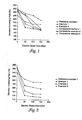
- Figure 1 shows the increase in diameter of the thermosetting adhesive from Example 1 and Example 4, and Comparative Examples 1, 4, and 6 as shown in Table 1 as a function of the total dose of electron beam.
- the change in increasing rate for the thermosetting adhesive from Reference Example 1 is also listed on the graph in Figure 1.
- thermosetting adhesive of Example 1 and Example 4 had lower increase rates compared to the thermosetting adhesive from Comparative Examples 1, 4, and 6 when the total electron beam dose was up to 150 kGy. It is also apparent that the increase rate of diameter of the thermosetting adhesive of Example 1 and Example 4 is independent of the total electron beam dose. Therefore, the thermosetting adhesive of this invention has a wide process window and the desired fluidity can be obtained by using only a small electron beam dose.
- Figure 6 shows the change in increase rate of the thermosetting adhesive from Example 6 and Reference Example 2 as a function of the total electron beam dose.
- the thermosetting adhesive of Reference Example 2 which did not use an electron beam sensitizer, required 150 kGy to attain the required increase rate of diameter.
- the thermosetting adhesive of Example 6 attains increase rate with only 50 kGy. Therefore, the thermosetting adhesive composition of this invention can obtain the desired fluidity at low electron beam doses.
- Figure 2 shows the change in the diameter increase ratio for the thermosetting adhesive from Examples 1 to 3 as a function of the electron beam dose.
- Figure 3 shows the change in diameter increase ratio for the thermosetting adhesive composition from Examples 4 and 5 as a function of the electron beam dose.
- the change in increase rate for the thermosetting adhesive from Reference Example 1 is also listed in Figure 2 and Figure 3.
- thermosetting adhesive changes with the electron beam dose sensitizer. It is also apparent that the diameter increase ratio for the thermosetting adhesive from Examples 2 to 5 is independent of the electron beam dose, as was the case in Example 1. Accordingly, the thermosetting adhesive of this invention can obtain the desired fluidity by appropriate adjustment of the electron beam close sensitizer, not only the electron beam dose.
- Figure 4 shows the change in diameter increase ratio for the thermosetting adhesive from Comparative Examples 1 to 3 and Reference Example 1 as a function of the electron beam dose.
- Figure 5 shows the change in diameter increase ratio for the thermosetting adhesive from Comparative Examples 4 and 5 as a function of electron beam dose.
- the change in diameter increase ratio for the thermosetting adhesive from Reference Example 1 is also listed on the graphs in Figure 4 and Figure 5.
- thermosetting adhesive from Comparative Examples 1 to 3 could lower the diameter increase ratio compared to Reference Example 1 if an electron beam with at least 100 kGy or higher is used. Especially, it is found that the thermosetting adhesive from Comparative Examples 2 and 3 can lower the increased rate compared to Reference Example 1 even if the electron beam dose is only about 50 kGy or so. According to Figure 5, if the electron beam dose is approximately 150 kGy, it is apparent that the thermosetting adhesive from Comparative Example 4 can lower the increase rate compared to Reference Example 1. However, in all cases, it is understood that the diameter increase ratio increases with increasing electron beam dose.
- the diameter increase ratio is a lot lower compared to Reference Example 1 which was not irradiated (see Figure 5), and there is a danger of gelling during kneading. Therefore, it is understood that the fluidity of the thermosetting adhesive from Comparative Examples 1 to 5 cannot be controlled effectively by changing the dose or the ratio of components.
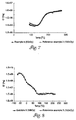
- Figure 7 shows the change in elastic modulus for the thermosetting adhesive from Example 6 and Reference Example 2 as a function of heating temperature in accordance with the above measurement of viscoelasticity 1.
- Figure 8 shows the change in elastic modulus for the thermosetting adhesive from Example 6 and Reference example 2 as a function of heating temperature in accordance with the above measurement of viscoelasticity 2.
- thermosetting adhesive of this invention can be controlled without influencing the thermosetting reaction (post curing) even if the electron beam dose can be reduced by adding electron beam sensitizer.
- thermosetting adhesive of this invention has lower bonding strength than Reference Example 1, it has sufficient bonding strength for actual use.
- thermosetting adhesive of this invention can be controlled without influencing the thermosetting reaction (post curing) even if the electron beam dose is reduced by addition of electron beam sensitizer.
- thermosetting adhesive from Example 6 uses an electron beam sensitizer, its gel time is the same as for Reference Example 2 which is stable in the film molding process. Accordingly, the thermosetting adhesive from Example 6 will be stable in the film molding process also.
- thermosetting adhesive of this invention has properties which are advantageous for bonding using electron beam, such as controlled fluidity, viscoelasticity, etc., even if it is cured at reduced electron beam doses.
Landscapes
- Chemical & Material Sciences (AREA)
- Organic Chemistry (AREA)
- Health & Medical Sciences (AREA)
- Chemical Kinetics & Catalysis (AREA)
- Medicinal Chemistry (AREA)
- Polymers & Plastics (AREA)
- General Chemical & Material Sciences (AREA)
- Engineering & Computer Science (AREA)
- Materials Engineering (AREA)
- Adhesives Or Adhesive Processes (AREA)
Abstract
This invention provides thermosetting adhesives which have properties advantageous for
bonding electronic parts that are capable of being cured using a low dose of radiation such
as electron beam. The thermosetting adhesive of the invention comprises (a) ethylene-glycidyl
(meth)acrylate copolymer; (b) rosin having a carboxyl group; and (c)
(meth)acrylate having a carboxyl group.
Description
- This invention relates to a thermosetting adhesive composition and a structural adhesive which uses the same.
- In packaging integrated circuits (IC), thermosetting adhesive compositions are often used for bonding the electronic parts. These thermosetting adhesive compositions can be a reactive hot-melt adhesive composition or just a reactive hot-melt composition. Such adhesive compositions form bonds that have superior heat resistance due to a crosslinking reaction (curing) which is initiated by heating or irradiation after applying pressure.
- As shown in Japan Patent No. H 9-137028 or No. H 10-316925, when the reactive hot-melt adhesive includes polyethylene or another polyolefin, conductivity is reduced, outgassing increases, and humidity-absorption is worse. At the same time, it controls mixing of impure ions.
- In detail, Japan Patent No. H 9-137028 describes a reactive hot-melt composition which includes: (a) a thermo plastic polymer which includes polyolefin which has epoxy groups; and (b) a copolymer obtained from irradiation-polymerization of a monomer that consists of acryl compounds which include aliphatic alkyl (meth)acrylate and functional groups that reacted with thee epoxy groups. This reactive hot-melt composition has features such as: (1) it controls the generation of reaction byproducts; (2) it does not require solvent when it is molded into film; (3) it can be stored at room temperature with high stability; and also (4) it does not need to be exposed to radiation when pressure is applied and can be used for parts where radiation can not reach.
- The relative amount of this monomer component which forms copolymer (b) in this reactive hot-melt composition is high compared to the whole composition. Typically, the monomer component comprises 15 to 60 weight percent of the precursor, which includes this monomer component and a thermoplastic polymer. It is hard to mix with the thermoplastic polymer. Accordingly, the monomer component has a tendency to bleed out before the precursor is exposed to radiation. In addition, part of the monomer component above is volatile and causes out gassing and bad odor. It is especially not preferred for bonding electronic parts. Therefore, in such case, the precursor is generally cured using high levels of radiation in order to avoid out gassing and bad odor of the unreacted monomer component due to bleed out.
- Japan Patent No. H 10-316955 describes a thermo-setting adhesive which includes: (a) ethylene-glycidyl (meth)acrylate copolymer; (b) ethylene-alkyl (meth)acrylate copolymer; and (c) rosin which has a carboxyl group. This thermosetting adhesive differs from the reactive hot-melt composition in Japan Patent No. H 9-137028, and it does not include a volatile and reactive monomer component. Therefore, high levels of radiation are not thought to be necessary in order to avoid bad odor and out gassing.
- However, in order to obtain the desired fluidity for hot pressing the hot-melt and thermo-setting adhesive above, it is necessary to use high levels of radiation (for example, electron beam). For example, Japan Patent No. H 10-316955 describes a relatively powerful electron beam (150 kGy) which is used to irradiate the thermosetting adhesive. In this case, improved crosslinking of the polyethylene is expected, but the main or side chains of each component are partially cut, and there is a tendency to generate volatile products or ions with low boiling points which can cause bad odor and out gassing. In addition, when the thermosetting adhesive is used with films set on a liner, there is tendency to foam due to the high levels of radiation which are transformed into heat energy. Foaming could occur during hot pressing or post curing. In any case, it not only causes bad appearance of the film, but it also may reduce the bond strength. Furthermore, using electron beam at high power levels with thermosetting adhesives is not generally effective.
- In order to reduce the power level of the electron beam required, addition of electron beam sensitizers has been well known. Typical electron beam sensitizers for use with polyethylene are triallyl cyanurate (TAC), triallyl isocyanurate (TAIC), or trimethylol propane trimethacrylate (TMPTMA). All of these electron beam sensitizers usually have vinyl groups or (meth)acrylate groups that react easily in response to electron beam. They contribute to improved crosslinking in the thermosetting adhesive. As a result, it is expected that electron beam power can be reduced and still obtain the required fluidity.
- However, in the case when this electron beam sensitizer is added to thermosetting adhesive composition listed in, for example. Japan Patent No. H 10-316955 (compared to the case where electron beam sensitizer is not added), there are cases when the amount cannot be reduced in order to obtain the desired fluidity. Even if it could be reduced, bond strength is lowered in accordance with it, and the adhesive properties could be degraded.
- Therefore, the object of this invention is to offer a thermosetting adhesive composition with the desired features which is useful for bonding electronic parts that may be cured by a low-power electron beam.
- In one aspect, the invention provides a thermosetting adhesive composition comprising:
- (a) ethylene-glycidyl (meth)acrylate copolymer;
- (b) rosin with a carboxyl group; and
- (c) (meth)acrylate with a carboxyl group.
-
- In another aspect, the invention is an article or structure comprising a first adherent, a second adherent, and a layer of the thermosetting adhesive of invention between the first adherent and the second adherent bonding the first and second adherents together. Preferably, these layers are bonded by hot pressing or laminating.
- Figure 1 shows the change in diameter increase ratio for the thermosetting adhesive from Example 1 and Example 4, and Comparative Examples 1, 4, and 6 as a function of electron beam dose,
- Figure 2 shows the change in diameter increase ratio for the thermosetting adhesive from Examples 1 to 3 as a function of electron beam dose.
- Figure 3 shows the change in diameter increase ratio for the thermosetting adhesive from Examples 4 and 5 as a function of electron beam dose.
- Figure 4 shows the change in diameter increase ratio for the thermosetting adhesive from Comparative Examples 1 to 3, and Reference Example 1 as a function of electron beam dose.
- Figure 5 shows the change in diameter increase ratio for the thermosetting adhesive from Comparative Examples 4 and 5 as a function of electron beam dose.
- Figure 6 shows the change in diameter increase ratio for the thermosetting adhesive from Comparative Example 6 and Reference Example 2 as a function of electron beam dose.
- Figure 7 shows the change in elastic modulus for the thermosetting adhesive from
Example 6 and Reference Example 2 as a function of heating temperature in accordance
with measurement of
viscoelasticity 1. - Figure 8 shows the change in elastic modulus for the thermosetting adhesive from Example 6 and Reference Example 2 as a function of hearing temperature in accordance with the measurement of viscoelasticity 2.
-
- The thermosetting adhesive of this invention has properties that make it desirable for bonding electronic parts even if the thermosetting adhesive is cured by a low-power electron beam.
- The thermosetting adhesive composition of this invention is basically a mixture which comprises:
- (a) ethylene-glycidyl (meth)acrylate copolymer;
- (b) rosin with a carboxyl group; and
- (c) (meth)acrylate with a carboxyl group.
-
- Basically, the ethylene-glycidyl (meth)acrylate copolymer is prepared from a mixture including, for example, (1) a glycidyl (meth)acrylate monomer, and (2) an ethylene monomer.
- This ethylene-glycidyl (meth)acrylate copolymer can be cured and reacted with rosin. This thermosetting reaction usually occurs when the adhesive composition is heated to a predetermined temperature. The thermosetting adhesive has higher cohesive energy after the reaction.
- In this invention, the amount of ethylene-glycidyl (meth)acrylate copolymer is usually 20 to 99.89 weight percent, preferably 40 to 96 weight percent. With such ratios, the cohesive energy of thermosetting adhesive can be improved remarkably. High cohesive energy is advantageous for improving bonding performance such as the release-bonding strength (may also be called "release strength" herein) of the thermosetting adhesive. In addition, if the amount of ethylene-glycidyl (meth)acrylate copolymer is less than approximately 20 weight percent or higher than approximately 99.89 weight percent, there is a possibility that the cured thermosetting adhesive will not have the desired cohesive energy.
- The ethylene-glycidyl (meth)acrylate copolymer adhesive composition melts at relatively low temperature.
- The melt flow rate (MFR) of this copolymer measured according to Japan Industrial Standard K6760 should be at least 1 or more at 190 °C. That is necessary to facilitate melt coating of the adhesive. When the MFR value is high, it causes a drop in cohesive energy of the cured adhesive, so the MFR is preferably in the range of 1 to 1,000. The weight average molecular weight of the ethylene-glycidyl (meth)acrylate copolymer is selected appropriately to attain the proper MFR.
- The ethylene-glycidyl (meth)acrylate copolymer can form crosslinking structure either directly or through the (meth)acrylate which contains a carboxyl group as stated above. Such crosslinking structure is generally formed by irradiation using electron beam. The crosslinking structure can add elastic modules which are advantageous for hot pressing or laminating the thermosetting adhesive.
- As long as it does not damage the effects of this invention, a three-dimensional or multi-dimensional copolymer can be formed by adding, for example, propylene, alkyl (meth)acrylate, or vinyl acetate as the third monomer to (1) glycidyl (meth)acrylate monomer, and (2) ethylene monomer.
- Generally, the number of carbon atoms in the alkyl group of the alkyl (meth)acrylate is in the range of 1 to 8.
- Also, this copolymer includes repeating units coming from ethylene and glycidyl (meth)acrylate normally with approximately 50 weight percent or higher, preferably approximately 75 weight percent or higher. Furthermore, in this repealing unit, the weight ratio of components originating from the glycidyl (meth)acrylate and ethylene is in a predetermined range. If the amount of ethylene is too small, it may cause a drop in conductivity or an increase in the humidity-absorbing rate. On the other hand, if the amount of ethylene is too great, there is possibility that bonding performance is reduced. Therefore, the weight ratio (G:E) of glycidyl (meth)acrylate (G) and ethylene (E) is preferably in the range of 50:50 to 1:99, or 30:70 to 5:95 at best.
- In the thermosetting adhesive composition, rosin with at least one carboxyl group is included. As stated above, rosin with a carboxyl group is cured and reacts with the ethylene-glycidyl (meth)acrylate copolymer in order to achieve the desired cohesive energy of the thermosetting adhesive.
- In this invention, the amount of rosin with a carboxyl group is usually 0.1 to 30 weight percent of thermosetting adhesive composition. When the amount of rosin with the carboxyl group is less than approximately 0.1 percent, the thermosetting adhesive composition will not cure sufficiently, causing a tendency toward low cohesive energy. If the amount of rosin having a carboxyl group exceeds approximately 30 percent, there is a danger of gelling during film manufacturing using the thermosetting adhesive. Considering these facts, the amount of rosin with a carboxyl group should be 1 to 25 weight percent of the thermosetting adhesive.
- Rosin with a carboxyl group can improve bonding performance of the thermosetting adhesive. This rosin can be gum rosin, wood rosin, or tar oil rosin. The rosin should be chemically denatured (transformed). Especially when a carboxyl group is added by denaturing the rosin with acid using various methods, denaturing is very effective for improving the acid value which will be explained later. In the present invention, the carboxyl group includes one which are produced from acid anhydride by adding heat or moisture, etc. Rosins which are denatured with acid include, for example, rosins made by adding acrylic acid, fumaric acid, or maleic anhydride to lepipomal acid which has isomerized abietic acid which is a component of rosin formed by the Diels-Alder reaction.
- It is preferred that the acid value of the rosin with the carboxyl group is in the range of 100 to 350. An acid value which is lower than approximately 100 reduces the reaction with ethylene-glycidyl (meth)acrylate copolymer, and this tends to adversely affect the curing nature of the adhesive composition. On the contrary, an acid value higher than approximately 350 may cause gelling of the thermosetting adhesive composition during manufacturing of the adhesive film using this composition. The acid value is expressed in mg (milligram) of potassium hydroxide necessary for neutralizing 1 g of sample.
- The softening point of the rosin with a carboxyl group should be approximately 200 °C or lower. That is because rosin with a softening point which is higher than 200 °C does not react as easily with ethylene-glycidyl (meth)acrylate copolymer, and this may reduce the curing property of this composition.
- In the thermosetting adhesive compositions of the invention, at least one kind of (meth)acrylate is also included as an electron beam sensitizer. The (meth)acrylate used in this invention includes at least one carboxyl group. In the present invention, as stated above, this carboxyl group is produced from acid anhydride due to the influence of heat or moisture. Also, the (meth)acrylate has at least one (meth)acryl group. In this (meth)acrylate, the carboxyl group has a high affinity for the epoxy group in the ethylene-glycidyl (meth)acrylate copolymer in the adhesive composition. It can be dispersed more uniformly in the thermosetting adhesive than other vinyl or (meth)acrylate compounds. This case of dispersion is very advantageous for kneading each component.
- Normally, a small amount of this (meth)acrylate is added to adhesive composition as an electron beam sensitizer. If it is added in large amounts, there is a tendency to lower bond strength. Furthermore, it may cause bleed out or outgassing before it is cured by electron beam.
- A typical amount of(meth)acrylate is in the range of 0.01 to 10 weight percent. If it is less than 0.01 weight percent, it will not be an effective electron beam sensitizer. On the other hand, if it exceeds 10 weight percent, as stated above, it may cause a drop in bond strength or bleed out or outgassing before curing by an energy source such as electron beam. A suitable amount is in the range or 0.05 to 5 weight percent.
- Generally, (meth)acrylate is very sensitive to electron beam. When only a small amount of (meth)acrylate is added as stated above, instead of forming a network by itself, it will be an agent for crosslinking of the ethylene-glycidyl (meth)acrylate copolymer. As a result, this electron beam sensitizer promotes crosslinking of the thermosetting adhesive. The electron beam dose required will be sufficient at approximately 50 kGy. Accordingly, when the amount of radiation is reduced, decomposition caused by radiation is also reduced. As a result, when radiation is transformed into heat, the energy dissipates and foaming is controlled. Because of this, this thermosetting adhesive has an improved appearance.
- Crosslinking enables control of the fluidity of the thermosetting adhesive composition. In the present invention, fluidity is defined by the stored elastic modulus (G') at 150 °C measured as described in the following.
- The adhesive composition before hot pressing and before application to the object to be bonded is used as the sample. Using a dynamic viscosity and modulus of elasticity measurement device, the temperature of the sample is raised from 80 °C to 280 °C at 5 °C/min., and the modulus is measured at a shear rate of 6.28 rad/sec. The obtained chart (temperature verse storage modulus) shows the value storage modulus at 150 °C which is then adopted as the "storage modulus of the adhesive composition".
- The storage modulus (G') as defined above is preferably in the range of 102 to 106 Pa. If the elastic modulus exceeds approximately 106 Pa, there is a danger of reduced bond strength due to insufficient wetting of the object to be bonded. If it is less than approximately 102 Pa, it flows excessively. Furthermore, there is also a possibility of a related reduction in bond strength.
- When the electron beam sensitizer is used according to this invention, the desired fluidity of the adhesive during hot pressing does not depend on the amount of irradiation by electron beam. As a result, even if the mount of irradiation is changed slightly due to machine reasons, the fluidity is not influenced much. In other words, the electron beam sensitizer enlarges the process window of the adhesive composition, which is much desired for manufacturing reasons.
- The (meth)acrylate with a carboxyl group or acid anhydride structure above includes (meth)acrylic acid, (meth)acryloxyethyl phthalate, (meth)acryloxyisopropyl phthalate, ethylene oxide denatured succinate (meth)acrylate, ethylene oxide denatured malonate (meth)acrylate, ω-caroboxy-polycaprolactone monoacrylate, ethylene oxide denature adipate (meth)acrylate, (meth)acrylate dimer, 4-(meh)acryloxyethyl trimellitic anhydride, or 4-(meth)acryloxyethyl trimellitic acid. Among these (meth)acrylate, (meth)acryloxyethyl phthalate (meth)acryloxyisopropyl phthalate or (meth)acrylate dimer are preferred. That is because these do not irritate the skin very much and are easy to handle. Since they do not evaporate easily, bad odor or corrosion of the kneading machine can be prevented. In addition, reduced pressure processes for removal of moisture or other volatile component in kneading device or prevention of foaming can be performed easily without evaporating these components.
- As long as it does not damage the effects of this invention, various additives can be used with the thermosetting adhesive composition of this invention in addition to the above components.
- Examples of such additives are described in Japan Patent No. H 10-316955. They include ethylene-alkyl (meth)acrylate or polyolefin or their copolymers, tackifiers, rubber components, antioxidants, UV absorbents, lubricants such as wax, crosslinking agents, curing promoters, photo initiators, photo sensitizers, or fillers. The type of filler is not limited specifically, and it can consist of an organic or inorganic substance, metal, or pigment; it can also be an electrical insulator or conductor. The photo initiator or photo sensitizer is added for controlling further bleed out of the electron beam sensitizer due to irradiation by light such as UV rays after the film is formed.
- The thermosetting adhesive composition of the invention explained above is solid at room temperature. This thermosetting adhesive composition is used by forming it into a stick or film. Especially, a film made from this thermosetting adhesive (adhesive layer) can be put between objects to bonded without applying it to one object beforehand. In other words, a lamination can be pre-assembled by sandwiching a thermosetting adhesive film between the two objects to be bonded. Normally, hot pressing is done to this laminated body. Suitable process conditions for hot pressing this laminate are 1 to 1,000 N/cm2 at 80 to 300 °C which is a relatively low temperature. Hot pressing should be done for 0.1 to 30 seconds. As a result, the thermosetting adhesive forms a bond with sufficient strength.
- Also, if necessary, the hot pressed lamination can be post cured to improve bond strength. Post cure means heating the hot pressed lamination to further cure the thermosetting adhesive.
- This thermosetting property of the adhesive in this invention is thought to be due to bonding between the epoxy group in the ethylene-glycidyl (meth)acrylate copolymer and the carboxyl group in the rosin (or a carboxyl group produced from the rosin with an acid anhydride structure by heat or moisture) or a carboxyl group in the ethylene-glycidyl (meth)acrylate copolymer and (meth)acrylate (or a carboxyl group produced by heat or moisture). Or it may be due in part to the reaction between hydroxyl groups generated from the above reaction and remaining epoxy group. The thermosetting temperature is normally 100 °C or higher, preferably 110 to 200 °C. The thermosetting time is normally 1 minute to 24 hours. To reduce the post curing required, the thermosetting process parameters should be 120 to 180 °C and 30 minutes to 2 hours.
- Such relatively low temperature hot pressing and post curing at relatively low temperature and short time are suitable for bonding objects such as IC part with relatively low heat resistance or printed circuit substrates or other electronic parts. However, the application of the thermosetting adhesive in this invention is not limited to these; it can be used for polyether imide, polyamide, polyimide, polycarbonate, polyethylene, polypropylene, polyester, epoxy, or other plastic, copper, iron, nickel, gold, silver, aluminum, tungsten, molybdenum, white gold, other metals, or semiconductors such as fiber, silicon, ceramic, glass, etc.
- Also, bonding tape that can be hot pressed can be manufactured by forming a layer of the thermosetting adhesive of this invention on plastic film, fiber cloth, metal foil, or other substrates. In addition, the adhesive of this invention can be used as a sealing material in addition to the bonding applications described above.
- For example, thermosetting adhesive films can be manufactured as follows:
- First, a predetermined amount of each component (a) ethylene-glycidyl (meth)acrylate copolymer, (b) rosin with a carboxyl group (or acid anhydride structure), and (c) (meth)acrylate with a carboxyl group (or acid anhydride structure) is put into a mixing device. Examples of useful mixing devices include kneader, roll mill, extruder, planetary mixer, or homo-mixer can be used. Also, above additives could be put into the mixing device if necessary.
- The mixing device is started, the above ingredients are mixed, and a mixture is obtained. This mixture has fluidity suitable for mixing, and each component is easily dispersed uniformly. Temperature and time of mixing are selected so that the components will essentially not have time to react with each other. Normally, temperature is in the range of 60 to 150 °C; time is in the range of 1 minute to 1 hour.
- Next, this mixture is hot melt coated on the substrate, and a precursor film is formed. The fluidity of the above mixture is suitable for this coating process. Therefore, a precursor film with a uniform thickness can be obtained. The substrate can be either a liner or one of the objects to be bonded. Conventional liners such as release paper or release film can be used. Also, coating is done using conventional processes such as knife coating or die coating in the temperature range of preferably 60 to 150 °C. The precursor film can also be formed by extrusion. In this case, a substrate is not required. Its complex viscosity η* should be 1,200 to 10,000 poise (120 - 1,000 Pas) when measured at 120 °C and 6.28 rad/sec. If the complex viscosity η* is lower than approximately 1,200 poise (120 Pas), it may be difficult to coat at a predetermined thickness. On the contrary, if it is higher than 10,000 poise (1,000 Pas), it may be difficult to obtain a continuous coating.
- Although the thickness of the precursor film is not limited specifically, preferably it is in the range of 0.005 to 5 mm. If it is thinner than approximately 0.005 mm, handling becomes difficult. On the other hand, if it is thicker than approximately 5 mm, crosslinking is not uniform in the direction of thickness, and reliability of the thermosetting adhesive will be lowered.
- While a certain amount of fluidity in the above mixture is advantageous for mixing or coating, fluidity causes leakage of the material during the thermo setting process that may cause, for example, a loss in bond strength.
- Therefore, electron beam is applied continuously to the precursor film, and a crosslinked structure is formed between molecules of copolymer. This occurs between ethylene units, and a thermosetting adhesive film with a suitable fluidity is obtained.
- Irradiation by electron beam is normally done at 150 keV to 500 keV accelerating voltage, or if necessary 10 to 500 kGy or up to 250 kGy for a thermosetting adhesive with high fluidity. When the electron beam is applied to a precursor film thicker than described above, an accelerating voltage higher than 500 keV, or a I' beam may be used. I' beam is especially effective when the precursor film is wound into a roll. After that, if necessary, one or both sides may be protected by a liner which is removed when the product is used.
- In the following, this invention is going to be explained using the following examples. However, this invention is not limited to only these examples.
- First, (a) ethylene-glycidyl (meth)acrylate copolymer, (b) rosin with a carboxyl group, and (c) (meth)acrylate with a carboxyl group are combined in the predetermined ratios (weight ratio) shown in Table 1. They were put into a kneading machine (Leocord 90, manufactured by Harke). Next, this kneading machine was run for 10 minutes at 60 rpm at 120°C, and a uniform block shaped mixture of the components above was prepared.
Composition Example 1 CG5001/KR85/M5600 = 100/7/1 Example 2 CG5001/KR85/M5600 = 100/7/2 Example 3 CG5001/KR85/M5600 = 100/7/3 Example 4 CG5001/KR85/#2100 = 100/7/1 Example 5 CG5001/KR85/#2100 = 100/7/3 Example 6 CG5001/6070/KR85/M5600 = 70/25/5/1 Reference Example 1 CG5001/KR85 = 100/7 Reference Example 2 CG5001/6070/KR85 = 70/25/5 Comparative Example 1 CG5001/KR85/TMPTMA = 100/7/1 Comparative Example 2 CG5001/KR85/TMPTMA = 100/7/3 Comparative Example 3 CG5001/KR85/TMPTMA = 100/7/5 Comparative Example 4 CG5001/KR85/TAC = 100/7/1 Comparative Example 5 CG5001/KR85/TAC = 100/7/3 Comparative Example 6 CG5001/KR85/BS101 = 100/7/1 Note:
CG5001: ethylene-glycidyl methacrylate copolymer manufactured by Sumitomo Chemical K.K.
6070: ethylene ethyl acrylate copolymer manufactured by Nippon Unicar
KR85: rosin manufactured by Arakawa Chemical (acid value = 170 mgKOH/g)
M5600: acrylic acid dimer manufactured by Toa Gosei
#2100: acryloxyisopropyl phthalate manufactured by Osaka Yuki Kagaku
TMPTMA: trimethylol propane trimethacrylate manufactured by Nippon Kayaku
TAC: triallyl cyanurate manufactured by Nippon Kasei
BS101: rosin acrylate manufactured by Arakawa Chemical - Next, the mixture was inserted between two 100 µm thick polyester films, and it was passed through a knife coater heated to 150 °C and formed into a film with approximately 100 µm thickness. Next, the polyester film was removed from one side, and the web was irradiated from the adhesive side by a 200 keV electron beam until the total dose was 50 kGy, and a sample was manufactured.
- Samples were also manufactured at dose levels of 50 kGy, 100 kGy, and 150 kGy.
- One sample was not irradiated by electron beam at all.
- When the above samples were manufactured, bleed out was not observed in the thermosetting adhesive in the Examples before or after irradiation by the electron beam. This was true of the Comparative Examples and Reference Examples as well, and bad odor was essentially eliminated.
- First, polyester film was removed from the sample, and the thermosetting adhesive was exposed. Next, the thermosetting adhesive film was cut into 1 cm x 3 cm rectangles, and it was inserted between a 0.3 mm thick copper plates and a 50 µm thick layer of polyimide. After that, 50 N/cm2 pressure was applied for 10 seconds while heating it to 200°C, and the bond was formed.
- After that, a peel test was performed by pulling the edge of the polyimide layer at 50mm/min. Bond strength at a peel angle of 90° was adopted as the bond strength. The reported result was an average value of two samples. Post curing was done by heating each sample for 2 hours at 150 °C in an oven.
- First, the sample was molded into a 6 mm diameter disc. Next, the polyester film was removed, exposing the thermosetting adhesive film. This disc shaped thermosetting adhesive was inserted between a 1.1 mm thick glass plate and a 0.3 mm thick copper plate. After that, it was heated to 180°C, and 1050 N/cm2 pressure was applied for 10 seconds. Following the formula below, the ratio of diameters was calculated, and fluidity was evaluated. The reported result was the average value of two samples.

- A copper plate washed with ethanol was bonded at room temperature using the sample. The copper plate was removed from the sample and the residue remaining on the copper plate was observed by the naked eye. Existence of bad odor was also evaluated.
- The samples from Example 1 and Example 5 were irradiated by an electron beam until the total dose was 50 kGy. These samples were molded into 25 mm diameter discs, and the polyester film was removed. The thermosetting adhesive was taken out. Next, eight thermosetting adhesive layers were stacked up to a total thickness of approximately 1 mm. This assembly was attached to a 25 mm diameter plate on the measurement tool. The temperature was raised 5 °C at one minute intervals over a range of 100 to 300 °C. The change in elastic modulus at 6.28 rad/sec was measured using a dynamic viscoelasticity measurement device (RDAII) manufactured by LeoMetrix Co. Ltd. The same measurement was done to the sample from Reference Example 1 and Reference Example 2 which had been irradiated by electron beam until the total dose was 150 kGy.
- The sample from Example 6 which had been irradiated by electron beam until the total dose was 50 kGy was post cured for 2 hours at 150°C. After that, it was cut into 35 x 10 mm rectangles. The polyester film was removed, and the thermosetting adhesive was taken out. Next, the temperature of this thermosetting adhesive was raised in 10 °C steps in the range of -70 to 250 °C. While doing that, the change in elastic modulus at 6.28 rad/sec was measured using a dynamic viscoelasticity measurement device (RSAII) manufactured by LeoMetrix Co. Ltd. This measurement was also done to the sample from Reference Example 2 which had been irradiated until the total dose was 150 kGy.
- In this measurement, the remaining samples from Example 6 and Reference Example 2 were prepared. Measurement of viscoelasticity was done by the same method as in 1 above, except that the temperature was maintained at 120°C by adding heat, and the gel time was measured. This gel time is defined as the time when temperature of thermosetting adhesive reached 120 °C till the time when the elastic modulus exceeded the last elastic modulus.
- Figure 1 shows the increase in diameter of the thermosetting adhesive from Example 1 and Example 4, and Comparative Examples 1, 4, and 6 as shown in Table 1 as a function of the total dose of electron beam. The change in increasing rate for the thermosetting adhesive from Reference Example 1 is also listed on the graph in Figure 1.
- According to Figure 1, it was found that thermosetting adhesive of Example 1 and Example 4 had lower increase rates compared to the thermosetting adhesive from Comparative Examples 1, 4, and 6 when the total electron beam dose was up to 150 kGy. It is also apparent that the increase rate of diameter of the thermosetting adhesive of Example 1 and Example 4 is independent of the total electron beam dose. Therefore, the thermosetting adhesive of this invention has a wide process window and the desired fluidity can be obtained by using only a small electron beam dose.
- Figure 6 shows the change in increase rate of the thermosetting adhesive from Example 6 and Reference Example 2 as a function of the total electron beam dose. According to Figure 6, the thermosetting adhesive of Reference Example 2 which did not use an electron beam sensitizer, required 150 kGy to attain the required increase rate of diameter. However, the thermosetting adhesive of Example 6 attains increase rate with only 50 kGy. Therefore, the thermosetting adhesive composition of this invention can obtain the desired fluidity at low electron beam doses.
- Figure 2 shows the change in the diameter increase ratio for the thermosetting adhesive from Examples 1 to 3 as a function of the electron beam dose. Also, Figure 3 shows the change in diameter increase ratio for the thermosetting adhesive composition from Examples 4 and 5 as a function of the electron beam dose. The change in increase rate for the thermosetting adhesive from Reference Example 1 is also listed in Figure 2 and Figure 3.
- According to Figure 2 and Figure 3, the diameter increase ratio of the thermosetting adhesive changes with the electron beam dose sensitizer. It is also apparent that the diameter increase ratio for the thermosetting adhesive from Examples 2 to 5 is independent of the electron beam dose, as was the case in Example 1. Accordingly, the thermosetting adhesive of this invention can obtain the desired fluidity by appropriate adjustment of the electron beam close sensitizer, not only the electron beam dose.
- Figure 4 shows the change in diameter increase ratio for the thermosetting adhesive from Comparative Examples 1 to 3 and Reference Example 1 as a function of the electron beam dose. Also, Figure 5 shows the change in diameter increase ratio for the thermosetting adhesive from Comparative Examples 4 and 5 as a function of electron beam dose. The change in diameter increase ratio for the thermosetting adhesive from Reference Example 1 is also listed on the graphs in Figure 4 and Figure 5.
- According to Figure 4, the thermosetting adhesive from Comparative Examples 1 to 3 could lower the diameter increase ratio compared to Reference Example 1 if an electron beam with at least 100 kGy or higher is used. Especially, it is found that the thermosetting adhesive from Comparative Examples 2 and 3 can lower the increased rate compared to Reference Example 1 even if the electron beam dose is only about 50 kGy or so. According to Figure 5, if the electron beam dose is approximately 150 kGy, it is apparent that the thermosetting adhesive from Comparative Example 4 can lower the increase rate compared to Reference Example 1. However, in all cases, it is understood that the diameter increase ratio increases with increasing electron beam dose. Especially for the sample from Comparative Example 5 which was not irradiated, the diameter increase ratio is a lot lower compared to Reference Example 1 which was not irradiated (see Figure 5), and there is a danger of gelling during kneading. Therefore, it is understood that the fluidity of the thermosetting adhesive from Comparative Examples 1 to 5 cannot be controlled effectively by changing the dose or the ratio of components.
- Figure 7 shows the change in elastic modulus for the thermosetting adhesive from Example 6 and Reference Example 2 as a function of heating temperature in accordance with the above measurement of
viscoelasticity 1. Figure 8 shows the change in elastic modulus for the thermosetting adhesive from Example 6 and Reference example 2 as a function of heating temperature in accordance with the above measurement of viscoelasticity 2. - According to Figure 7 and Figure 8, when 1 weight part of electron beam sensitizer is added, there is no change in the elastic modulus compared to the case when a sensitizer is not used. Accordingly, it is understood that the fluidity of the thermosetting adhesive of this invention can be controlled without influencing the thermosetting reaction (post curing) even if the electron beam dose can be reduced by adding electron beam sensitizer.
- In Table 2 below, the bond strength before and after heat treatment (post curing) of the thermosetting adhesive from Example 1 and Reference Example 1 are shown.
Dose Bond Strength Before Curing Bond Strength After Curing Example 1 50 Kilo Gray 27.4 14.4 Reference Example 1 150 Kilo Gray 37.1 23.0 - According to Table 2, although the thermosetting adhesive of this invention has lower bonding strength than Reference Example 1, it has sufficient bonding strength for actual use.
- In Table 3, the elastic modulus at 250 °C for the thermosetting adhesive from Example 1 and Reference Example 1 is shown,
Dose Modulus G' @ 250 °C (Pa) Example 1 5 mrad 1.1x10⁶ Reference Example 1 15 mrad 1.2x10⁶ - According to Table 3, the elastic moduli are almost equal. Therefore, it is found that the fluidity of the thermosetting adhesive of this invention can be controlled without influencing the thermosetting reaction (post curing) even if the electron beam dose is reduced by addition of electron beam sensitizer.
- In Table 4, gel time for the thermosetting adhesive from Example 6 and Reference Example 2 according to the measurement of
viscoelasticity 3 above is shown.Gel Time (minutes) Example 6 27 Reference Example 2 31 - According to Table 4, even though the thermosetting adhesive from Example 6 uses an electron beam sensitizer, its gel time is the same as for Reference Example 2 which is stable in the film molding process. Accordingly, the thermosetting adhesive from Example 6 will be stable in the film molding process also.
- The thermosetting adhesive of this invention has properties which are advantageous for bonding using electron beam, such as controlled fluidity, viscoelasticity, etc., even if it is cured at reduced electron beam doses.
- Various changes and modifications can be made in the invention without departing from the scope or spirit of the invention.
Claims (7)
- A thermosetting adhesive composition comprising;(a) ethylene-glycidyl (meth)acrylate copolymer;(b) rosin having a carboxyl group; and(c) (meth)acrylate having a carboxyl group.
- The thermosetting adhesive composition of claim 1 wherein a crosslinking structure is formed between the molecules of the ethylene-glycidyl (meth)acrylate copolymer, linking ethylene repeating units.
- The thermosetting adhesive composition of claim 1 wherein the ethylene-glycidyl (meth)acrylate copolymer is present in an amount of from 20 to 99.89 weight percent.
- The thermosetting adhesive composition of claim 1 wherein the rosin having a carboxyl group is present in an amount of from 0.1 to 30 weight percent.
- The thermosetting adhesive composition of claim 1 wherein the (meth)acrylate having a carboxyl group is present in an amount of from 0.01 to 10 weight percent.
- The thermosetting adhesive composition of claim 1 wherein the (meth)acrylate having a carboxyl group is selected from the group consisting of(meth)acrylic acid, (meth)acryloxyethyl phthalate, (meth)acryloxyisopropyl phthalate, ethylene oxide denatured succinate (meth)acrylate, ethylene oxide denatured malonate (meth)acrylate, ω-caroboxy-polycaprolactone monoacrylate, ethylene oxide denature adipate (meth)acrylate, (meth)acrylate dimer, 4-(meh)acryloxyethyl trimellitic anhydride, and 4-(meth)acryloxyethyl trimellitic acid.
- An adhered structure comprising a first adherent, a second adherent, and a layer of the thermosetting adhesive of claim 1 between the first adherent and the second adherent bonding the first and second substrates together.
Applications Claiming Priority (2)
| Application Number | Priority Date | Filing Date | Title |
|---|---|---|---|
| JP27913199A JP2001107009A (en) | 1999-09-30 | 1999-09-30 | Thermosetting adhesive composition and bonded structure using same |
| JP27913199 | 1999-09-30 |
Publications (1)
| Publication Number | Publication Date |
|---|---|
| EP1088870A1 true EP1088870A1 (en) | 2001-04-04 |
Family
ID=17606876
Family Applications (1)
| Application Number | Title | Priority Date | Filing Date |
|---|---|---|---|
| EP00121146A Ceased EP1088870A1 (en) | 1999-09-30 | 2000-09-28 | Thermosetting adhesive composition and adhered structure |
Country Status (3)
| Country | Link |
|---|---|
| US (1) | US6590070B1 (en) |
| EP (1) | EP1088870A1 (en) |
| JP (1) | JP2001107009A (en) |
Cited By (5)
| Publication number | Priority date | Publication date | Assignee | Title |
|---|---|---|---|---|
| WO2003035744A1 (en) * | 2001-10-24 | 2003-05-01 | Sumitomo Chemical Company, Limited | Thermosetting resin composition |
| WO2003085733A1 (en) * | 2002-04-02 | 2003-10-16 | 3M Innovative Properties Company | Thermosetting adhesive sheet with electroconductive and thermoconductive properties |
| EP1783828A4 (en) * | 2004-05-27 | 2009-09-23 | Lintec Corp | SEMICONDUCTOR SEALING RESIN SHEET AND METHOD FOR MANUFACTURING SEMICONDUCTOR DEVICE USING SAME |
| EP1763070A4 (en) * | 2004-05-12 | 2009-09-23 | Sharp Kk | ADHESIVE SHEET BOTH FOR CUTTING CHIPS AND MATRIX BONDING AND METHOD FOR MANUFACTURING SEMICONDUCTOR DEVICE USING THE ADHESIVE SHEET |
| CN110372260A (en) * | 2019-06-26 | 2019-10-25 | 嘉兴嘉合电力设备有限公司 | A kind of fire-proof sealing material |
Families Citing this family (15)
| Publication number | Priority date | Publication date | Assignee | Title |
|---|---|---|---|---|
| JP2000144082A (en) * | 1998-11-16 | 2000-05-26 | Minnesota Mining & Mfg Co <3M> | Thermosetting adhesive composition, adhesive and preparation of adhesive |
| US20040063804A1 (en) * | 2001-03-30 | 2004-04-01 | Masaaki Takeda | Thermosetting adhesive |
| US20050233161A1 (en) * | 2002-04-02 | 2005-10-20 | Masaaki Takeda | Thermosetting adhesive sheet with electroconductive and thermoconductive properties |
| US7358289B2 (en) * | 2002-10-22 | 2008-04-15 | 3M Innovative Properties Company | Heat-curable adhesive composition |
| JP4383768B2 (en) * | 2003-04-23 | 2009-12-16 | スリーエム イノベイティブ プロパティズ カンパニー | Film adhesive for sealing, film laminate for sealing, and sealing method |
| JP2005217369A (en) * | 2004-02-02 | 2005-08-11 | Three M Innovative Properties Co | Adhesive sheet for light emitting diode device and light emitting diode device |
| JP2006024751A (en) * | 2004-07-08 | 2006-01-26 | Three M Innovative Properties Co | Method of connecting flat surface multiple conductor and electric electronic part including part connected by method of connection |
| US20070036902A1 (en) * | 2005-08-12 | 2007-02-15 | O'neal Hubert R | Method for applying chemical coatings |
| WO2007092250A2 (en) * | 2006-02-02 | 2007-08-16 | Hexion Specialty Chemicals Inc. | Rosin ester with low color and process for preparing same |
| US20110034669A1 (en) * | 2006-02-02 | 2011-02-10 | Dallavia Anthony J | Rosin Ester with Low Color and Process for Preparing Same |
| JP5976716B2 (en) * | 2008-12-24 | 2016-08-24 | 日東電工株式会社 | Thermosetting die bond film |
| JP5349432B2 (en) * | 2010-09-06 | 2013-11-20 | 日東電工株式会社 | Manufacturing method of electronic component device and resin composition sheet for sealing electronic component used therefor |
| CN102174718B (en) * | 2011-01-21 | 2013-01-02 | 武汉纺织大学 | Method for preparing anti-dripping polyester fibers |
| JP6010352B2 (en) | 2012-06-07 | 2016-10-19 | 株式会社オートネットワーク技術研究所 | Curing sensitizer, photocuring material, cured product and wire harness material |
| WO2014010431A1 (en) * | 2012-07-10 | 2014-01-16 | 株式会社トクヤマデンタル | Dental adhesive composition, dental adhesive primer, dental adhesive bonding material, dental adhesive composite resin, and dental adhesive resin cement |
Citations (3)
| Publication number | Priority date | Publication date | Assignee | Title |
|---|---|---|---|---|
| US4895567A (en) * | 1986-03-17 | 1990-01-23 | The International Group, Inc. | Wetness indicating hot-melt adhesives |
| WO1997016500A1 (en) * | 1995-10-31 | 1997-05-09 | Minnesota Mining And Manufacturing Company | Reactive hot melt composition, composition for preparation of reactive hot melt composition, and film-form hot melt adhesive |
| JPH10316955A (en) * | 1997-05-13 | 1998-12-02 | Minnesota Mining & Mfg Co <3M> | Thermosetting adhesive composition, production thereof, and adhesion structure |
Family Cites Families (2)
| Publication number | Priority date | Publication date | Assignee | Title |
|---|---|---|---|---|
| US6051652A (en) | 1995-10-31 | 2000-04-18 | 3M Innovative Properties Company | Reactive hot melt composition, composition for preparation of reactive hot melt composition, and film-form hot melt adhesive |
| JPH09272844A (en) * | 1996-04-04 | 1997-10-21 | Nitto Denko Corp | Photopolymerizable composition, pressure-sensitive flame-retardant adhesive, and adhesive sheets |
-
1999
- 1999-09-30 JP JP27913199A patent/JP2001107009A/en active Pending
-
2000
- 2000-09-19 US US09/664,686 patent/US6590070B1/en not_active Expired - Fee Related
- 2000-09-28 EP EP00121146A patent/EP1088870A1/en not_active Ceased
Patent Citations (3)
| Publication number | Priority date | Publication date | Assignee | Title |
|---|---|---|---|---|
| US4895567A (en) * | 1986-03-17 | 1990-01-23 | The International Group, Inc. | Wetness indicating hot-melt adhesives |
| WO1997016500A1 (en) * | 1995-10-31 | 1997-05-09 | Minnesota Mining And Manufacturing Company | Reactive hot melt composition, composition for preparation of reactive hot melt composition, and film-form hot melt adhesive |
| JPH10316955A (en) * | 1997-05-13 | 1998-12-02 | Minnesota Mining & Mfg Co <3M> | Thermosetting adhesive composition, production thereof, and adhesion structure |
Non-Patent Citations (1)
| Title |
|---|
| PATENT ABSTRACTS OF JAPAN vol. 1999, no. 03 31 March 1999 (1999-03-31) * |
Cited By (6)
| Publication number | Priority date | Publication date | Assignee | Title |
|---|---|---|---|---|
| WO2003035744A1 (en) * | 2001-10-24 | 2003-05-01 | Sumitomo Chemical Company, Limited | Thermosetting resin composition |
| WO2003085733A1 (en) * | 2002-04-02 | 2003-10-16 | 3M Innovative Properties Company | Thermosetting adhesive sheet with electroconductive and thermoconductive properties |
| EP1763070A4 (en) * | 2004-05-12 | 2009-09-23 | Sharp Kk | ADHESIVE SHEET BOTH FOR CUTTING CHIPS AND MATRIX BONDING AND METHOD FOR MANUFACTURING SEMICONDUCTOR DEVICE USING THE ADHESIVE SHEET |
| EP1783828A4 (en) * | 2004-05-27 | 2009-09-23 | Lintec Corp | SEMICONDUCTOR SEALING RESIN SHEET AND METHOD FOR MANUFACTURING SEMICONDUCTOR DEVICE USING SAME |
| US8034667B2 (en) | 2004-05-27 | 2011-10-11 | Lintec Corporation | Semiconductor sealing resin sheet and semiconductor device manufacturing method using the same |
| CN110372260A (en) * | 2019-06-26 | 2019-10-25 | 嘉兴嘉合电力设备有限公司 | A kind of fire-proof sealing material |
Also Published As
| Publication number | Publication date |
|---|---|
| US6590070B1 (en) | 2003-07-08 |
| JP2001107009A (en) | 2001-04-17 |
Similar Documents
| Publication | Publication Date | Title |
|---|---|---|
| US6590070B1 (en) | Thermosetting adhesive composition and adhered structure | |
| JP4383768B2 (en) | Film adhesive for sealing, film laminate for sealing, and sealing method | |
| CN114762085B (en) | Sheet for semiconductor device manufacture, method for manufacturing the same, and method for manufacturing semiconductor chip with film-like adhesive | |
| US6265460B1 (en) | Hot-melt adhesive composition, heat-bonding film adhesive and adhering method using hot-melt adhesive composition | |
| JP2009057397A (en) | Hot-melt adhesive for hardly adhesive substrate | |
| JP5247199B2 (en) | Laminated film | |
| WO2000000566A1 (en) | Hot-melt adhesive composition, heat-bonding film adhesive and adhering method using hot-melt adhesive composition | |
| US6051652A (en) | Reactive hot melt composition, composition for preparation of reactive hot melt composition, and film-form hot melt adhesive | |
| JP3754475B2 (en) | Reactive hot melt composition, reactive hot melt composition preparation, film hot melt adhesive | |
| EP0821717B1 (en) | Amine cross-linkable hot-melt adhesive and adhesive film | |
| JP4422232B2 (en) | Thermosetting adhesive composition, adhesive and method for producing adhesive | |
| US20060014871A1 (en) | Heat-curable adhesive composition | |
| JP4201858B2 (en) | Thermosetting adhesive composition, production method thereof, and adhesive structure | |
| EP1554355B1 (en) | Heat-curable adhesive composition | |
| CN213583751U (en) | Chip packaging structure | |
| EP1373427A2 (en) | Thermosetting adhesive | |
| JP2000144082A (en) | Thermosetting adhesive composition, adhesive and preparation of adhesive | |
| JP2591599B2 (en) | Flexible circuit board | |
| JP7333766B2 (en) | Resin composition for bonding electrolyte membrane, resin film for bonding electrolyte membrane, and method for producing resin film for bonding electrolyte membrane | |
| JP2002332465A (en) | Thermosetting adhesive composition | |
| JPH0372691A (en) | Manufacturing method of flexible circuit board | |
| CN111440564A (en) | Thermosetting material with heat and electric conductivity and manufacturing method thereof | |
| JP2002536460A (en) | Thermosetting adhesive composition, adhesive, and method for producing adhesive | |
| JPH0794641B2 (en) | Adhesive resin composition | |
| TW202532603A (en) | Anisotoropic conductive film, connection structure body, and method for manufacturing connection structure body |
Legal Events
| Date | Code | Title | Description |
|---|---|---|---|
| PUAI | Public reference made under article 153(3) epc to a published international application that has entered the european phase |
Free format text: ORIGINAL CODE: 0009012 |
|
| AK | Designated contracting states |
Kind code of ref document: A1 Designated state(s): DE FR GB |
|
| AX | Request for extension of the european patent |
Free format text: AL;LT;LV;MK;RO;SI |
|
| 17P | Request for examination filed |
Effective date: 20011004 |
|
| AKX | Designation fees paid |
Free format text: DE FR GB |
|
| 17Q | First examination report despatched |
Effective date: 20011227 |
|
| STAA | Information on the status of an ep patent application or granted ep patent |
Free format text: STATUS: THE APPLICATION HAS BEEN REFUSED |
|
| 18R | Application refused |
Effective date: 20050516 |