EP1088598A2 - Verfahren zur Herstellung eines polymeren Filmes auf einer Metalloberfläche sowie Konzentrat und Behandlungsflüssigkeit hierfür - Google Patents
Verfahren zur Herstellung eines polymeren Filmes auf einer Metalloberfläche sowie Konzentrat und Behandlungsflüssigkeit hierfür Download PDFInfo
- Publication number
- EP1088598A2 EP1088598A2 EP00120052A EP00120052A EP1088598A2 EP 1088598 A2 EP1088598 A2 EP 1088598A2 EP 00120052 A EP00120052 A EP 00120052A EP 00120052 A EP00120052 A EP 00120052A EP 1088598 A2 EP1088598 A2 EP 1088598A2
- Authority
- EP
- European Patent Office
- Prior art keywords
- treatment liquid
- film
- temperature
- water
- substrate
- Prior art date
- Legal status (The legal status is an assumption and is not a legal conclusion. Google has not performed a legal analysis and makes no representation as to the accuracy of the status listed.)
- Granted
Links
Classifications
-
- B—PERFORMING OPERATIONS; TRANSPORTING
- B05—SPRAYING OR ATOMISING IN GENERAL; APPLYING FLUENT MATERIALS TO SURFACES, IN GENERAL
- B05D—PROCESSES FOR APPLYING FLUENT MATERIALS TO SURFACES, IN GENERAL
- B05D7/00—Processes, other than flocking, specially adapted for applying liquids or other fluent materials to particular surfaces or for applying particular liquids or other fluent materials
- B05D7/14—Processes, other than flocking, specially adapted for applying liquids or other fluent materials to particular surfaces or for applying particular liquids or other fluent materials to metal, e.g. car bodies
Definitions
- the invention relates to a method for producing a film from plastic or a plastic-containing material on a metal surface and a concentrate for Production of a treatment liquid and a treatment liquid for the Production of the polymeric film.
- Polymer films on metal surfaces are used in a variety of ways. There are also the most diverse large-scale processes for metallic coatings Workpieces or of workpieces with a metallic surface with a polymeric film. Depending on the type of metal surface or workpieces, the Application of a polymeric film can be carried out without difficulty or with considerable disadvantages. Through the appropriate chemical and physical adjustment of the polymer solution or dispersion to be applied can be a polymer layer of the desired thickness can be generated. For example, it is with one Roller application processes such as roll coating are of particular importance Concentration of the plastic-containing treatment solution and the roller pressure of the Application device, the roller speed and the direction of the rollers to match the substrate. It is also comparatively simple the treatment of small or relatively large, rounded workpieces, usually be coated by electro-dipping or spraying.
- DE-A-197 25 780 describes a method for applying plastic or plastic-containing layers on metallic parts at about room temperature and its use as pretreatment of the individual parts for the subsequent Powder coating.
- the double Dip treatment will make drop-like bumps and larger thickenings avoided.
- the layer thickness at the trailing edge is often by a factor of 2 to 3 larger than on the other surfaces of the individual part.
- the layer thickness at the drain edge would be about 30 to 53 times thicker than on the other surfaces of the item.
- WO 94/10244 describes several compositions for pretreating substrates with polymeric solutions or dispersions and a method for coating substrates with such treatment liquids. This mainly addresses treatment liquids that are applied in the immersion process, in which a polymeric solution or dispersion with a so-called compatible dispersion and mixed with water and the bath is heated to a temperature in the range of about 27 to 71 ° C and at which the parts to be coated are heated to a temperature in the range of about 104 to 927 ° C.
- the so-called compatible dispersion contains, for example, graphite, aluminum, titanium oxide or a black pigment
- the mixtures with a compatible dispersion according to the examples indicating that there are pigment dispersions for coloring protective films and for improving the lubricity of the substrate surface treated therewith (lubricating lacquer ) are.
- the examples each describe two synthetic resins with a pigment addition, but no content of corrosion inhibitors to improve the corrosion protection properties.
- the synthetic resins used are acid-functional, physically drying acrylic resins that are not resistant to alkaline media (pH 6 - 14). For this reason, only a low level of corrosion protection can be expected.
- the dry film resulting from this formulation is not resistant to alkaline liquids that are used for further processing of the coated parts, such as drilling oils, lubricants for metal-cutting deformation or alkaline water-based paints for painting over.
- the object is achieved with a method for producing a plastic film or a plastic-containing film on a metal surface, in which a Treatment liquid, which at the beginning of wetting with the treatment liquid 0.1 to 50% by weight of a non-volatile containing one or more resins film-forming mixture and 99.9 to 50 wt .-% of a water-miscible or / and contains water-soluble solvent and / or water, on the metal surface Forms film, the volatile portion escapes at least partially, the Treatment liquid at the beginning of wetting with the treatment liquid Has temperature in the range of 10 to 100 ° C, the metal surface to Start wetting with the treatment liquid at a temperature of at least 20 ° C higher temperature than the treatment liquid and a temperature in the range from 30 to 700 ° C and wherein the film of the treatment of the metal surface serves.
- the temperature difference between the metal surface and the treatment liquid at the start of wetting with the treatment liquid advantageously at least 25 ° C, preferably at least 32 ° C, particularly preferably at least 45 ° C, very particularly preferably at least 55 ° C.
- the temperature of the substrate can also advantageously be at least 70 ° C., at least 100 ° C or in many cases at least 150 ° C above the temperature of the Treatment liquid.
- the selected temperature difference can vary significantly from the type of heating of the substrates and, if necessary, also of the integration into a Series production depend not only on the chemical and physical Conditions of film formation.
- the treatment of the metal surface means the application of a passivation layer on the surface of a metallic material (alloy or metal), which prevents the corrosion of metal surfaces.
- a passivation layer on the surface of a metallic material (alloy or metal), which prevents the corrosion of metal surfaces.
- the term treatment in the sense of this application, the term is also intended Pretreatment include - unless otherwise stated at the respective text passage, in which a layer that is usually only temporarily protective is applied, which is later overlaid by at least one further protective layer, in particular a lacquer layer. For the purposes of this application, however, this term is not intended to include the formation of an adhesion promoter layer.
- Harden For the purposes of this application, it is intended to encompass both chemical crosslinking and physical curing.
- water miscible is intended in the sense of this application as a generic term of the term water dispersible be understood.
- the substrate can essentially consist of aluminum, iron, copper, magnesium, zinc, Tin and / or at least one of their alloys can be made if necessary additionally metallic, in particular with aluminum, lead, copper, zinc, tin or their Alloys.
- the metallic coating can in particular by hot dipping, thermal spraying or by physical, chemical or electrodeposition. Preferably that was metallic substrate and others produced by casting or / and rolling.
- the metal surface is wetted with the film-forming treatment liquid is provided with an adhesion promoter layer - either with an inorganic adhesion promoter layer, in particular with a Phosphate, a silicate or a zirconium and / or titanium-containing Adhesion promoter layer, and / or with an organic adhesion promoter layer, in particular with a phosphonate, polyvinyl butyral cross-linked with acids (more classic Wash primer) or / and containing at least one butyl titanate and / or silane Adhesion promoter layer.
- a combination of a zirconium and Titanium compound can be selected with a silane.
- Adhesion promoter layer a stronger thermal load on the substrate and afterwards the treatment with the polymeric layer is essentially unaffected in many cases is an inorganic adhesive layer to select. With short-term exposure at temperatures up to 250 ° C can often still be worked with organic bonding agent layers.
- a Temperature of the substrate at the start of wetting with the treatment liquid in the range of 200 to 450 ° C for hot-dip galvanizing with zinc or a Zinc alloy and in the range of 200 to 700 ° C for hot dip in a Melt of aluminum or an aluminum alloy such as an alloy Basis AlSi, Galvalume® (55% Al-Zn), Galfan® or Crack-Free-Steel® can be selected.
- the temperature is preferably at the level as that to be coated Have substrates immediately or shortly after leaving an oven.
- the temperature is below Consideration of the volume of the substrates to be coated, the bath volume, the bath composition and the intended layer thickness advantageously so select that the treatment liquid after wetting and pulling out of the substrate dries at least partially and that the film formed at least partially cures.
- the organic polymers in most cases synthetic resins, are common, however by no means in all cases, with molecular weights on the order of about 800 to about 2000 at room temperature in the solid state and generally good soluble. However, the solubility decreases with increasing molecular weight. Polymers with molecular weights in the range below about 1000 are often inherently liquid. Both groups of substances are sometimes depending on the composition or partly. depending on the Number of neutralizable groups water-miscible and / or water-soluble. The Adding a special organic solvent to the water can increase the solubility of the Increase polymers significantly.
- the resin or the resins can be synthetic resins, in particular acrylates, polyesters, Polyurethanes, silicone polyesters, epoxies, phenols, styrenes, resins on the basis Urea-formaldehyde, their mixtures or / and their copolymers, preferably hexamethoxymethylmelamine (HMMM) resins or / and their Mixtures or / and copolymers of several substances of the above Be groups of substances.
- HMMM hexamethoxymethylmelamine
- natural resins can also be used.
- the resin or the resins can as a solution or dispersion, in particular as Emulsion or suspension present; a solution is preferably used.
- a solution is preferably used for deposition of a film according to the invention on a metal surface elevated temperatures are particularly suitable for synthetic resins used in the Treatment liquid is in the form of a solution, e.g. neutralized acid functional acrylic resins with an acid number of at least 50, mostly in Range from 150 to 250.
- the treatment liquid contains synthetic resins that contain a sufficient number of neutralized or neutralizable groups.
- Synthetic resins with almost 100% neutralizable or neutralized Groups or better synthetic resins with the addition of neutralizing agents in the Excess are usually readily soluble in water. This can cause coagulation slightly above 40 ° C can be avoided.
- neutralizing agents can, for example, in a mixing ratio of 1: 1: 1 be used. Such a mixture is at the same time for optimal solubility or Dispersibility of the resins in the treatment liquid and thus optimal Bath stability in the temperature range up to 100 ° C as well as optimal water resistance and weather resistance after drying.
- Dispersions behave differently with so-called internal emulsifiers. This one No foreign substances are added to dispersions and they behave excellent, since no uncontrolled hydrophilicity effects can occur.
- At least one water-miscible and / or water-soluble alcohol, a glycol ether or N-methylpyrrolidone and / or water can be used in the case of Use of a solvent mixture, in particular a mixture of at least a long chain alcohol, e.g. Propylene glycol, an ester alcohol, a glycol ether or / and butanediol with water, preferably only water.
- a solvent mixture in particular a mixture of at least a long chain alcohol, e.g. Propylene glycol, an ester alcohol, a glycol ether or / and butanediol with water, preferably only water.
- the water used can determine the quality e.g. of city water, well water or Have recycled water. In many cases, however, it is beneficial or for one Series production is advisable to use partially or fully demineralized water quality, to the undesired salting of the treatment liquids by the Limit salt loads in the water used.
- the treatment liquid can be at least one volatile and / or non-volatile Additive to adjust defoaming, adhesion, preservation especially against fungal and bacterial attack, neutralization, the Surface wetting, the rheology and / or the course included.
- volatile and / or non-volatile Additive to adjust defoaming, adhesion, preservation especially against fungal and bacterial attack, neutralization, the Surface wetting, the rheology and / or the course included.
- the A person skilled in the field of polymers knows when and how much one or several of these additives are used to make stable solutions or dispersions adjust. If in the process of the invention corrosion inhibitors as Pigments and / or in dissolved form are added, e.g.
- At least one Phosphate, titanate and / or zirconate, in particular dicalcium phosphate, Dimagnesium phosphate, iron III phosphate, modified alkali phosphate, Aluminum triphosphate or at least one zirconium complex compound can improved corrosion protection of the entire layer can be achieved. Also through the Adding an N-ethylmorpholine complex can have the anti-corrosive effect the resins can be increased significantly. This is especially true for the lifespan of the treating components advantageous. Especially for the parts of a substrate, e.g. a body with corners, folds and cavities that differ from the following Spray painting are insufficiently covered, it is particularly advantageous if the parts that were not adequately painted afterwards were high Have corrosion resistance due to the content of corrosion inhibitors in the Movie.
- the treatment liquid can contain at least one neutralizing agent such as e.g. on Amine, in particular at least one alkanolamine, ammonia and / or sodium hydroxide solution contain.
- at least one neutralizing agent such as e.g. on Amine, in particular at least one alkanolamine, ammonia and / or sodium hydroxide solution contain.
- the pH of the treatment liquid can advantageously be in a range of 1 to 11 are kept, preferably in the range of 4 to 10, particularly preferably in the range from 7 to 9.5.
- the polymeric film on the metal surface can be immersed in the substrate the treatment liquid and then applied by drying, the substrate being wetted with the treatment liquid preferably has a temperature in the range of 100 to 200 ° C.
- the polymer film can be flooded on the metal surface a surface of the substrate with the treatment liquid, and subsequent Drying are applied, the substrate at the beginning of wetting with the Treatment liquid preferably a temperature in the range of 12 to 150 ° C, in particular at at least 32 ° C, preferably at least 45 ° C.
- the polymeric film can be applied to the metal surface by spraying the substrate the treatment liquid and subsequent drying are applied, wherein the substrate at the beginning of the wetting with the treatment liquid advantageously a temperature in the range of 12 to 70 ° C, especially at at least 32 ° C, preferably at least 45 ° C. Spraying can in particular by air or airless atomization.
- the polymeric film can be applied to the metal surface by wetting the substrate the treatment liquid by doctoring, spreading or rolling and subsequent drying are applied, the substrate at the beginning of the Wetting with the treatment liquid preferably a temperature in the range from 12 to 70 ° C, especially at least 32 ° C, preferably at least 45 ° C.
- Rinsing after application of the polymeric film is not necessary and usually makes no sense, because this means that the deposited film is partially again could be removed.
- the method according to the invention is particularly advantageous if the substrate is at a previous temperature treatment such as a glow, anneal, Hot dip coating (such as hot dip galvanizing) or a hardening treatment the temperature required for the coating is brought.
- a previous temperature treatment such as a glow, anneal, Hot dip coating (such as hot dip galvanizing) or a hardening treatment the temperature required for the coating is brought.
- the substrate is in most cases at the beginning of the wetting with the Treatment liquid a temperature of at least 50 ° C above the Have temperature of the treatment liquid. It is recommended, in particular for hot-dip galvanized general cargo that the substrate to be treated by the Treatment is cooled down or even quenched.
- polymeric resin particles After the deposition of polymeric resin particles, they physically film or / and crosslink in the presence of suitable chemical reactants chemically into a closed, even film.
- the polymeric film can also by physical filming, i.e. Moving particles together e.g. due to the van der Waals forces when water escapes.
- the filming is particularly favored when synthetic resins with low Glass transition temperatures are used or if appropriate film formers (e.g. long-chain alcohols) to temporarily soften the polymers become. It is particularly favorable to use solutions containing carboxyl groups To use acrylates in combination with melamine formaldehyde, since then one chemical crosslinking is possible. Networking makes it particularly high chemical resistance and high resistance to weathering.
- a film is preferably formed which has a layer thickness after drying from 0.01 to 50 ⁇ m, in particular from 0.1 to 20 ⁇ m, particularly preferably from 0.5 to 7.5 ⁇ m. In many cases, films in the range from 0.6 to 1.8 ⁇ m are preferred, in some other cases films in the range from 2.0 to 18 ⁇ m.
- the residence time of the substrate in the immersion bath is preferably chosen so that the Reactions in the treatment liquid during the wetting of the substrate of the treatment liquid are essentially or completely terminated. On vigorous or certain bubbling of gas bubbles in the area of the contacted Substrates can be seen as an indication of the reactions.
- the dwell time can be 1 to 120 seconds. In many cases, however, it only becomes 2 to 60 Seconds, advantageously only 3 to 30 seconds, often only 4 to 20 seconds be. As a rule, the thinner or less hot the substrate at the first The contact time with the treatment liquid is shorter become.
- Thicker films are produced in the process according to the invention without thicker ones Increase the concentration of the non-volatile components in the treatment liquid especially on thick-walled substrates. Because of their greater heat content thick-walled substrates tend to form thicker films, these Network layers more strongly due to the greater heat supply or can harden.
- the high temperature or the high heat content of the Treating parts allow the volatile to escape faster Components of the applied wet film and therefore enable faster Concentrate the dry matter contained in the treatment liquid. The latter can help make films faster due to the higher degree of drying can be processed further.
- Thicker films can also be made using a higher concentration of the non-volatile Portions in the treatment liquid applied to thin-walled substrates become.
- the partially dried polymeric film can be used for the final chemical Crosslinking or physical curing can be thermally treated.
- temperatures in the range from 100 to 400 ° C. are particularly preferred at 120 to 200 ° C, particularly preferably from 140 to 180 ° C.
- the temperature is here based on the surface temperature of the substrate.
- the time of thermal aftertreatment can last from 2 seconds to 2.5 hours, preferably 2 minutes to 1 hour, particularly preferably 10 to 30 minutes. The higher the Temperature is selected, the shorter the thermal aftertreatment fail and vice versa. Treatment can include done with IR radiation.
- the film to be crosslinked is exposed to UV radiation hardened. This avoids heat and the treatment time is usually a fraction of a second to a few seconds. This however, usually requires a certain composition of the Treatment liquid and the previous complete or almost complete Expulsion of the solvent or solvent mixture.
- the substrate coated with the film is preferably first painted and then the polymers are simultaneously used in the thermal aftertreatment Film and the lacquer applied to it are finally chemically cross-linked or / and physically hardened.
- the method according to the invention is also particularly advantageous for workpieces Aluminum alloys, especially for those with an adhesion promoter layer Motor vehicle bodies. If this at a temperature with a polymer Film to be coated after leaving a heat treatment plant Process-related, e.g. at temperatures in the range of 260 to 130 ° C, preferably from 220 to 160 ° C, so that can be coated in the The energy content present in substrates can be used meaningfully without the substrates to have to heat up again.
- the method according to the invention can therefore be Integrate inexpensively into series production.
- the method according to the invention can also be used for hot-dip galvanized Insert workpieces.
- a formulation of 28 parts by weight acid functional acrylic resins especially with an acid number of about 135 and with a glass transition temperature of about 28 ° C, from 71 parts by weight acid functional acrylic resins, especially with an acid number of about 215 and with a glass transition temperature of about 95 ° C, and from 1 part by weight of an N-ethylmorpholine complex well proven after using the synthetic resins Ammonia, 2-dimethylaminoethanol and 2-amino-2-methyl-1-propanol in the ratio of 1: 1: 1 were neutralized.
- the inventive method offers the possibility that in addition to the Substrate a lacquer layer, a film, a foam or / and an adhesive applied is, the substrate optionally with a further shaped body or with a film is glued.
- thicker films can have a film thickness in the range of 5 to 25 microns. These films can serve as a single-layer coating.
- concentration the treatment liquid increased in order to be able to apply thicker films, preferably to a content of 5 to 25 wt .-% dry matter in the Treatment liquid.
- color or opaque Components such as pigments or dissolved dyes in the treatment liquid add to a colored or / and colored glaze lacquer layer to train.
- effect and metallic paintwork can also be used apply.
- the non-volatile, film-forming mixture can contain at least one inorganic additive in dissolved form and / or as a finely divided powder such as a carbonate, chromate, oxide, silicate such as e.g. Layered silicate, containing sulfate.
- This Additive can be used as a transparent or opaque dye or as a transparent Filler or / and to extend the diffusion path of attacking media in the Dry film to be used on the substrate surface.
- scale-like particles are an advantage.
- Such a single-stage coating can be significantly cheaper are applied as an at least two-stage painting process according to the State of the art. Also, by avoiding over-spray work largely without loss. The drying time of the wet film is significantly reduced. In some cases - such as for galvanized Construction parts for houses, bridges etc. or for traffic safety Facilities, especially traffic lights, lamps and crash barriers - on one physical or / and chemical drying can be transferred so that no additional thermal drying step is required. Therefore, it is one stage applied coating also cheaper than related one-stage applied lacquer coatings according to the prior art.
- a film can also be used for decoration and / or special protection against mechanical influences. This is especially for small ones Household appliances such as Toasters and jugs or for machine covers interesting.
- Decorative foils such as printed PVC films are state of the art Technology.
- the films can be self-adhesive or with a separately applied one Glue to be glued.
- the object is further achieved with a treatment liquid for producing a Plastic film or plastic-containing film on a metal surface during the wetting of the metal surface with the treatment liquid, the Treatment liquid 0.1 to 50 wt .-% of one or more resins containing non-volatile film-forming mixture and 99.9 to 50 wt .-% of one contains water-miscible or water-soluble solvent and / or water and on a temperature of 10 to 100 ° C is maintained, the treatment liquid is set so that its components during the operating time, during the Service life and at the temperature of film formation not or almost not coagulate, do not sediment or do not sediment significantly and do not or do not do so significantly be decomposed, the molecular weight distribution and the viscosity of the Do not change the treatment liquid significantly during use.
- the task is finally solved with a concentrate for the production of a Treatment liquid according to the invention
- the concentrate after dilution gives the treatment liquid
- the concentrate being 1 to 90% by weight or several resins containing non-volatile film-forming mixture and 99 to 10% by weight of a water-miscible and / or water-soluble solvent or / and Contains water
- the concentrate or the treatment liquid being adjusted in this way are that their components during the storage period, during the operating time, during the service life and at the temperature of the film formation not or almost do not coagulate, do not sediment or do not sediment significantly and do not or do not be significantly decomposed and where the molecular weight distribution and Viscosity of the concentrate and treatment liquid during the Storage time and in use do not change significantly.
- Treatment liquid understood, in which hotter parts with the Treatment liquid can be brought into contact to form a polymeric film to train.
- the stability of the concentrate and the treatment liquid should insofar as it can be ensured that no serious disruption to operations as a result of Instability.
- the treatment liquid preferably contains 0.1 to 15% by weight of the non-volatile film-forming mixture and 99.9 to 85 wt .-% one water-miscible and / or water-soluble solvent or / and water.
- the treatment liquid particularly preferably contains 0.1 to 5% by weight of the non-volatile film-forming mixture and 99.9 to 95 wt .-% of one water-miscible and / or water-soluble solvent or / and water.
- the preferred content of the non-volatile film-forming mixture in the Treatment liquid can also, depending on the composition of the Treatment liquid and the desired layer vary.
- the content of the non-volatile film-forming mixture in the treatment liquid advantageously at least 0.8% by weight or at most 3% by weight, in make cases at least 1 wt .-% or up to 2.5 wt .-%.
- the content of then at least one solvent in the treatment liquid is at most 99.2% by weight or at least 97% by weight or at most 99% by weight or at most 97.5% by weight.
- Treatment fluids containing non-volatile film-forming Mixtures in the range from 0.5 to 5% by weight, preferably 1 to 3% by weight, and 99.5 have up to 95% by weight of at least one solvent.
- Treatment fluids containing non-volatile film-forming Mixtures in the range from 0.5 to 5% by weight, preferably 1 to 3% by weight, and 99.5 have up to 95% by weight of at least one solvent.
- the concentrate preferably contains 5 to 80% by weight of one or more resins containing non-volatile film-forming mixture and 95 to 20 wt .-% of one water-miscible and / or water-soluble solvent or / and water, particularly preferably 10 to 70 or 90 to 30% by weight.
- the temperature of the treatment liquid is preferably at least 35 ° C, particularly preferably at least 40 ° C, very particularly at 50 to 70 ° C held.
- the preferred temperature ranges may vary depending on the The composition of the treatment liquid and the desired layer vary and also shifted, for example, to temperatures in the range from 75 to 95 ° C his.
- Treatment fluid is preferably stable for at least a month over at least 6 months, particularly preferably over at least two years, wherein the treatment liquid is supplemented accordingly during this period the working conditions are adjusted: the components of the treatment liquid should be during the operating time, during the service life and at the temperature of the Film formation not or almost not coagulate, not or not significantly sediment and not or not significantly decomposed, and their Molecular weight distribution and viscosity should not be significant in use change. A certain amount of coagulation, decomposition, sedimentation can occur or / and change in molecular weight or viscosity not entirely be excluded because the balance of the treatment liquid by the Immersion of hot parts and through the entry of foreign substances (contamination) can be loaded more heavily.
- the treatment liquid advantageously has a viscosity like that of water or only a slightly increased viscosity, as it is difficult to achieve Areas of the parts to be treated, e.g. Bores, threads and cavities reached.
- the treatment liquid is preferably obtained by diluting a concentrate made with water and / or a water-containing solvent mixture. If necessary, a defoamer, a leveling agent and / or a Wetting agents are added. When adjusting the treatment liquid is too note that this is sufficiently neutralized. On the share of an organic Solvents can be dispensed with in particular if the The volatility of neutralizing agents are adjusted so that they are sufficient Bath stability is guaranteed at elevated working temperatures.
- the crosslinked polymeric dry film according to the invention is usually water-resistant, mechanically resistant, weather-resistant and more flexible than a filmed dry film, e.g. made by physical drying has been.
- the crosslinked dry film of the invention sometimes also gives one higher gloss than films according to the prior art, which are produced by physical Drying were formed.
- the films according to the invention are surprising evenly and closed.
- the cured according to the invention polymeric film shows an optimal barrier effect against weather influences, against e.g. Chemicals used in automobiles such as fuels, oils, battery acids, Brake fluids etc. This high quality film is made with a dry film according to the prior art, which consists of a dispersion by physical drying is normally not achieved.
- the method according to the invention has compared to that in the prior art known method for applying a polymeric film the advantage that polymeric film from a treatment liquid applied by immersion that contains only a small concentration of the non-volatile components and is therefore comparatively inexpensive.
- the immersion process according to the invention has the advantage of getting along without complex plant technology, and still leads to uniformly distributed dry film thicknesses on geometrically simple or complicated parts.
- the inventive method immediately after Use hot dip galvanizing, whereby instead of slow cooling the hot-dip galvanized parts under the influence of air at room temperature by immersion a significant reduction in the treatment liquid according to the invention subsequent cooling time can be achieved.
- the invention is basically also for so-called. Endless workpieces such as wires, profiles and metal bands - narrow band, medium band and broad band - suitable.
- the substrates coated with a film according to the invention can be used are used for the production of metal sheets, bodies, bumpers, frames, Profiles, guardrail elements, shelf elements, fence elements, radiator elements, Moldings of complicated geometry or small parts.
- You can in particular are used for pre-assembled bodies and their parts during manufacture of vehicles, trailers, mobile homes or missiles, for covers, Housing, lamps, lights, traffic light elements, glasses frames, screws, nuts, Springs, flanges, furniture such as Garden furniture or furniture elements.
- the invention is also particularly advantageous for parts with cavities such as divide made of or with pipes and / or profiles that only limit one painting are accessible, in particular window and door frames, car bodies, bicycle frames, Pipe constructions for the protection of electrical lines or of Household appliances such as Pitchers and toasters.
- the method according to the invention can be used advantageously for parts that may by forming such as Cold-, Cold massive, warm, forming, drawing, pressing, extrusion, etc. or by Casting were molded.
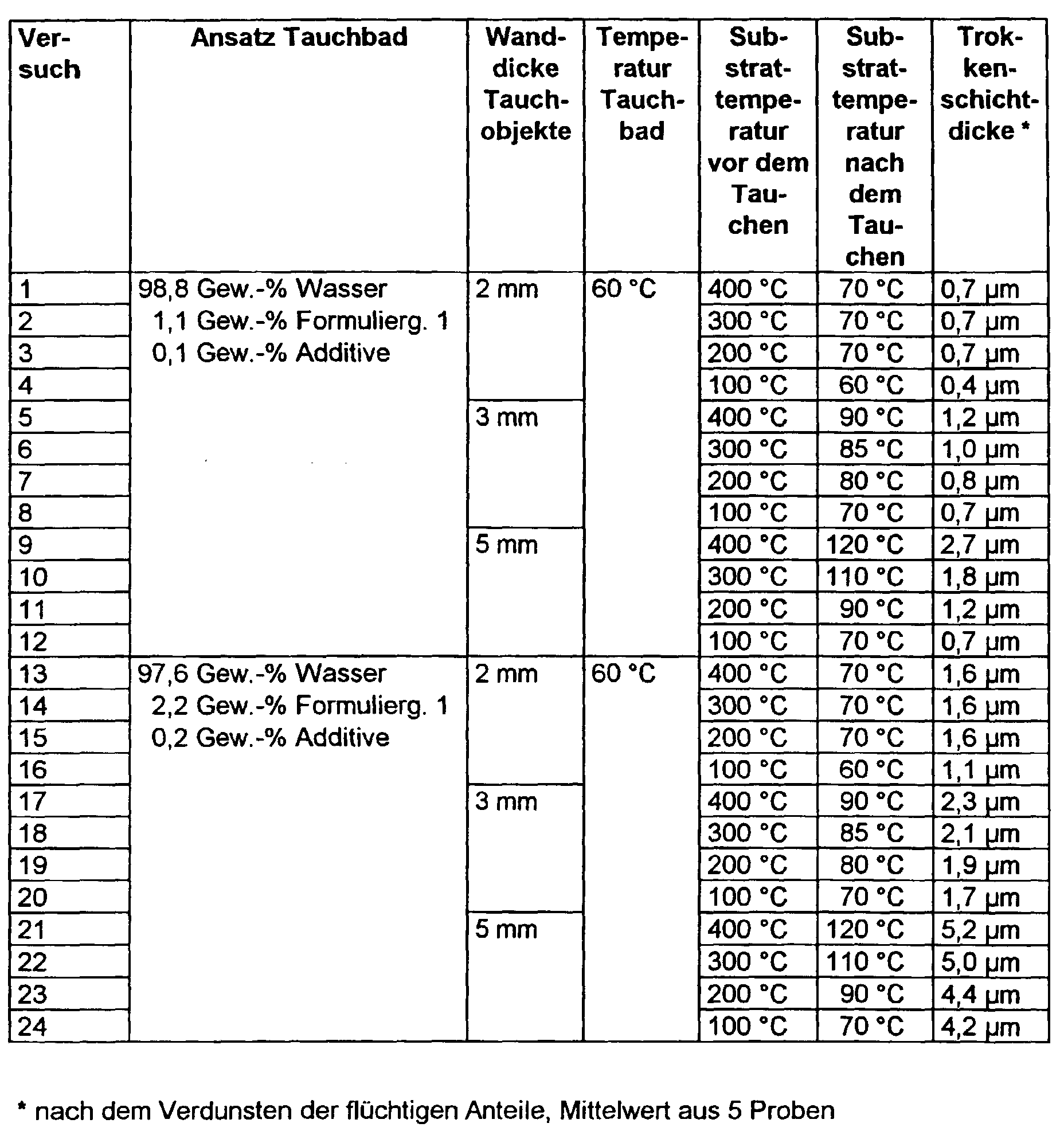
- Sheets were about 100 x 100 mm in size and 2, 3 and 5 thick mm made from a standard hot-dip galvanized steel.
- the zinc content of the zinc layer was more than 98%.
- the zinc melt had one when the plates were removed Temperature in the range of 445 to 455 ° C.
- the plates were removed from the Hot-dip galvanizing bath immersed in the treatment liquid with a time delay.
- the Treatment liquid had a temperature of about 60 ° C, because the bath in this was kept essentially constant at this temperature. That is how it came about spontaneous cooling of the hot plates.
- the temperature of the plates e.g. at the Immersion in the treatment liquid was started with a temperature sensor measured on the plate surface. Five plates each were placed under the same Conditions coated. The residence time was 5 to 10 seconds and was so chosen that the reactions in the liquid were almost complete when removed.
- the non-volatile content in the treatment liquid was 1 in Examples and 2 1.2 and 2.4% by weight, respectively.
- the treatment liquid of Example 1 contained the air-drying, transparent one Formulation 1 based on 30% by weight of an acid-functional acrylate resin of pure acrylate and methacrylate and 70% by weight of an acid-functional styrene-acrylate resin.
- This treatment liquid was for chrome-free preservation of general cargo galvanized surfaces.
- Additives for the Defoaming, surface wetting and flow adjustment used. Ammonia, 2-dimethylaminoethanol were used to neutralize the acid groups of the resins and 2-amino-2-methyl-1-propanol in a ratio of 1: 1: 1 and Deionized water is used as the solvent.
- the resin mixture was therefore in Temperature range from 15 to 100 ° C over long process times well soluble in water and was particularly well suited for the treatment of about 400 to 430 ° C Parts that were hot-dip galvanized immediately before. Despite the high temperatures of the immersed parts, the treatment liquid was stable over the long term.
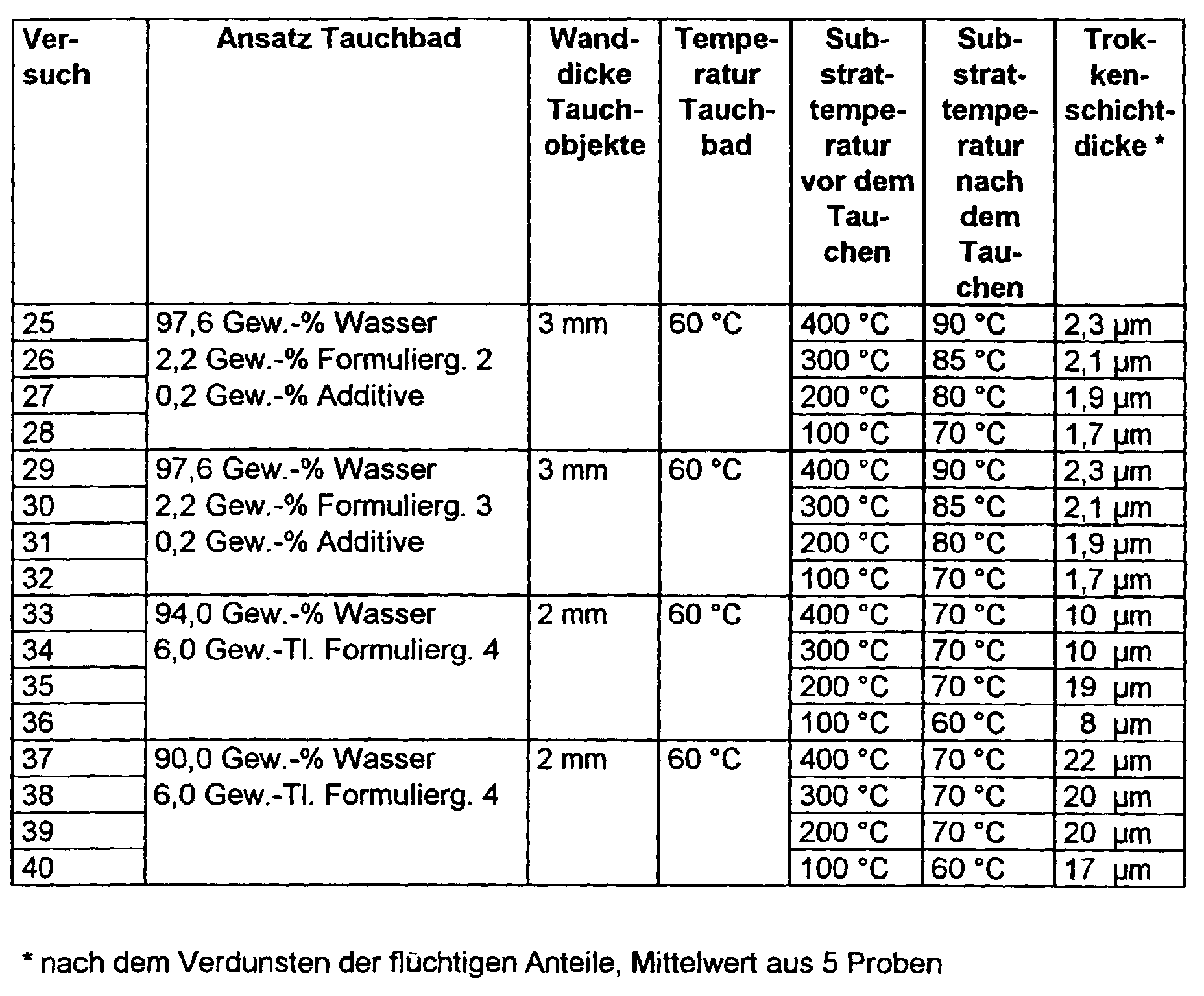
- the treatment liquid of Example 2 instead contained 90% by weight of one Formulation 2 based on polyurethane, acrylate and polyester and 10% by weight a melamine-formaldehyde resin. The remaining conditions were as for Example 1 selected.
- This treatment liquid was for the oven drying, at elevated temperature cross-linking transparent chrome-free pretreatment or / and Treatment of general cargo galvanized surfaces or the surfaces of aluminum or aluminum alloys.
- the films produced with formulation 2 had to be at temperatures in the range of 140 to 200 ° C for 30 to 10 minutes treated for the final curing of the film.
- This Treatment liquid was used to treat galvanized surfaces in the Automotive engineering is particularly well suited because it can withstand high temperatures was permanently stable.
- the polymer films were checked optically.
- the layer weight of the polymeric film could only be determined approximately.
- a layer weight of 1 g / m 2 corresponds approximately to a layer thickness of 1 ⁇ m.
- the layer coverage in the range from 0.5 to 5 ⁇ m was determined gravimetrically and averaged over 5 values.
- the layer coverage larger than 5 ⁇ m was determined with the aid of a Permascope from Fischer and averaged over 10 values.
- Table 1 indicates a strong dependence of the film thickness depending on the Plate thickness and thus from the heat content of the substrates.
- the films on the 5th mm thick sheets were not only thicker due to the high heat content trained, but also offered a much better corrosion protection than thinner films.
- All films on the galvanized steel plates were optically perfect: The transparent films were closed. The layer thickness distribution fluctuated only slightly on each plate. There was none on the drain edges substantial thickening of the protective films.
- Hot-dip galvanized and then cooled steel sheets were used for comparative examples 1 to 6.
- the hot-dip galvanized plate was not further coated.
- the residence time was 5 to 10 seconds and was therefore chosen approximately as in the examples according to the invention, although no bubbling occurred as a sign of a reaction.
- the residence time also had no significant influence on the formation of the layer thicknesses.
- the coated panels were air dried. The other working conditions were otherwise the same as in example 1.
- Experiments on comparative examples 1 to 5 on hot-dip galvanized steel plates treatment liquid and parts at room temperature (approx.
- Comparative Examples 1 to 5 showed that the immersion treatment of surfaces with a temperature of around 20 ° C in one Treatment liquid of about 20 ° C a thinner by a factor of 7 Dry layer with the same concentration of the non-volatile film-forming components in of the treatment liquid as if the treatment liquid were at 60 ° C warmed and the substrates to be treated previously a temperature in the range of Have 200 to 400 ° C. That means the concentration of the non-volatile film-forming portion in the treatment liquid increased by about a factor of 7 would have to be to achieve similar layer thicknesses at room temperature, what would have a very negative impact on investment costs. Particularly disadvantageous is that at room temperatures on the drain edges and in the area of bores and threads overcoating occurs and the parts due to lack Dimensional accuracy are unusable.
- Comparative Example 1 Outdoor weathering tests in an industrial atmosphere and Condensation water constant climate tests according to DIN 50 017 KK. This resulted in due to the strongly fluctuating on a single plate Layer thickness distributions in Comparative Examples 1 and 2 are thinner coated areas insufficient corrosion protection. Comparative Example 1 showed so bad results that the corrosion protection was no better than without the supposedly anti-corrosion coating, as in Comparative Example 6 busy.
- the drain edges showed much thicker coatings than the rest Surfaces. In some cases, layer thicknesses of more than 50 ⁇ m occurred at the run-off edges.
- Example 3 according to the invention: Formulation 2 for aluminum alloys
- the results show that the same layer thicknesses can be produced with the same concentrations of chemically very different formulations and with the same immersion bath parameters.
- the coatings were optically flawless: the layers were closed, the layer thickness distribution was even and there were no significant thickening at the drainage edges.
- Example 4 Film Formation on an Aluminum Alloy and then applied car top coat
- Example 4 substrates from a common in vehicle construction Aluminum alloy used.
- the substrates were previously passivated with a Cr-free Coating from at least one Zr / Ti compound.
- the records were made in Connection to heat treatment during tempering - if necessary with a time delay for slow cooling or for the completeness of the experimental range heated a little higher - and submerged at about the specified target temperature (Table 4).
- the treatment liquid of Example 4 contained 95% by weight of one Formulation 3 based on polyurethane and acrylate and 5% by weight of one Melamine formaldehyde resin. It was done with a concentration of worked non-volatile components of the treatment liquid of 2.4 wt .-%. The remaining conditions were maintained as in Example 2.
- This Treatment liquid was for the drying in the oven at elevated temperature, transparent, chrome-free treatment and / or pretreatment of the surfaces of Aluminum or aluminum alloys thought.
- This treatment liquid was just as well suited as the treatment liquid of Examples 2 and 3.
- the with Formulation 3 films still had to be produced at temperatures in the range of Aftertreated 140 to 200 ° C for 30 to 10 minutes for final curing become.
- the quality of the polymeric film was without applied topcoat tested.
- the coatings were optically perfect: the layers were closed, the layer thickness distribution was even and on the drain edges no significant thickening occurred. After applying the top coat carried out all tests to determine the adhesion Cross-cut method flawless results. The entire shift sequence fulfilled that physical-technical tests of automotive painting.
- Example 5 Film formation on an aluminum alloy as Single-layer paint treatment
- the treatment liquid of Example 5 contained 54.7% by weight of one Formulation 4 based on acrylate, methacrylate, styrene and polyester and 30 % By weight of a rutile white pigment, 0.3% by weight of a black carbon black pigment, 9.0 % By weight of silicate and 6.0% by weight of other additives for defoaming, leveling, wetting, neutralization and adjustment of the rheology. It was here with a concentration of the non-volatile components of the treatment liquid of 6 or 10 wt .-% worked to produce thicker colored protective films. The coated panels were then air dried. This Treatment liquid was for air drying, gray, chrome free preservation Various small parts made of steel, galvanized steel, aluminum, cast aluminum, cast zinc or cast iron thought.
- the treatment liquid was for aluminum castings excellent as it was permanently stable.
- the coatings were optical flawless: the layers were closed, the layer thickness distribution was uniformly and no significant thickening occurred at the drain edges.
- the quality of the coating corresponded to the quality level with the usual ones Process applied one-coat spray painting.
- Example 3 Test 27 in the salt spray test and in the alternate test one compared to the conversion layers of the highest quality conventional ones Procedure (VB 7 and 8) results equivalent to one Zinc phosphate layer, however, superior corrosion resistance. Against that is Coating according to the invention in terms of outdoor exposure far better than that highest quality conventional coatings. It should be noted that only example 3, experiment 27, had previously been passivated with Ti / Zr fluorine, but not that Substrates of comparative examples 7 to 9, since the latter with such Passivation cannot be coated according to the invention. The layer thickness in the area the run-off edge was only slightly larger than in the case of example 3, experiment 27 larger areas.
Landscapes
- Life Sciences & Earth Sciences (AREA)
- Engineering & Computer Science (AREA)
- Wood Science & Technology (AREA)
- Application Of Or Painting With Fluid Materials (AREA)
- Chemically Coating (AREA)
- Treatments Of Macromolecular Shaped Articles (AREA)
- Processing And Handling Of Plastics And Other Materials For Molding In General (AREA)
Abstract
Description


| Versuche zu den Vergleichsbeispielen 1 bis 5 an feuerverzinkten Stahlplatten: Behandlungsflüssigkeit und Teile bei Raumtemperatur (ca. 20 °C) | ||||||
| Vergleichsbeispiel | Ansatz Tauchbad | Wanddicke Tauchobjekte | Temperatur Tauchbad | Substrattemperatur vor dem Tauchen | Substrattemperatur nach dem Tauchen | Trockenschichtdicke |
| VB 1 | 98,8 Gew.-% Wasser | 2 mm | 20 °C | 20 °C | 20 °C | 0,1 µm |
| 1,1 Gew.-% Formulierg. 1 | ||||||
| 0,1 Gew.-% Additive | ||||||
| VB 2 | 92,5 Gew.-% Wasser | 2 mm | 20 °C | 20°C | 20 °C | 1,0 µm |
| 6,9 Gew.-% Formulierg. 1 | ||||||
| 0,6 Gew.-% Additive | ||||||
| VB3 | 87,5 Gew.-% Wasser | 2 mm | 20 °C | 20 °C | 20 °C | 1,5 µm |
| 11,5 Gew.-% Formulierg. 1 | ||||||
| 1,0 Gew.-% Additive | ||||||
| VB 4 | 94,0 Gew.-% Wasser | 2 mm | 20 °C | 20 °C | 20 °C | 1,0 µm |
| 6,0 Gew.-Tl. Formulierg. 4 | ||||||
| VB 5 | 90,0 Gew.-% Wasser | 2 mm | 20 °C | 20 °C | 20 °C | 2,1 µm |
| 10,0 Gew.-Tl. Formulierg. 4 |
| Qualitative Beurteilung der Schichtqualität bezüglich der Weißrostbildung bei Beispiel 1 im Vergleich zu den Vergleichsbeispielen 1, 2 und 6 an feuerverzinkten Stahlplatten | ||||
| Beispiel bzw. Vergleichsbeispiel | Freibewitterung nach 4 Wochen % Weißrost auf der Oberfläche | Freibewitterung nach 6 Monaten % Weißrost auf der Oberfläche | Freibewitterung nach 12 Monaten % Weißrost auf der Oberfläche | DIN 50 017 KK nach 360 h % Weißrost auf der Oberfläche |
| Versuch 1 | 0 | 2 | 10 | 10 |
| Versuch 4 | 1 | 20 | 40 | 60 |
| Versuch 5 | 0 | 0 | 2 | 0 |
| Versuch 8 | 1 | 10 | 15 | 5 |
| Versuch 17 | 0 | 0 | 0 | 0 |
| VB 1 | 100 | 100 | 100 | 100 |
| VB 2 | 5 | 20 | 40 | 60 |
| VB 6: Substrat un-behandelt | 100 | 100 | 100 | 100 |

| Beurteilung der Schichtqualität ohne Nachfolgelackierung bezüglich der Qualität des Korrosionschutzes auf Aluminiumlegierungen | |||
| Beispiel bzw. Vergleichsbeispiel | Salzsprühtest nach DIN 50 021 SS: % korrodierte Oberfläche | Wechseltest nach VDA 621-415: % korrodierte Oberfläche | Freibewitterung nach VDA 621-414: % korrodierte Oberfläche |
| Beispiel 3, | nach 720 h | nach 5 Runden | nach 6 Monaten |
| Versuch 27 | 0 % Korrosion | 0 % Korrosion | 0 % Korrosion |
| - | nach 10 Runden | - | |
| - | < 5 % Korrosion | - | |
| VB 7: Gelbchromatierung | nach 720 h | nach 5 Runden | nach 6 Monaten |
| 0 % Korrosion | 0 % Korrosion | 20 % Korrosion | |
| VB 8: Grünchromatierung | nach 720 h | nach 5 Runden | nach 6 Monaten |
| 0 % Korrosion | < 5 % Korrosion | 30 % Korrosion | |
| VB 9: Zinkphosphat | nach 24 h | nach 5 Runden | nach 1 Monat |
| 0 % Korrosion | 40 % Korrosion | 60 % Korrosion | |
| nach 168 h | - | nach 6 Monaten | |
| 20 % Korrosion | - | 100 % Korrosion |
Claims (27)
- Verfahren zur Herstellung eines Kunststofffilmes oder eines kunststoffhaltigen Filmes auf einer Metalloberfläche, bei dem eine Behandlungsflüssigkeit, die zu Beginn der Benetzung mit der Behandlungsflüssigkeit 0,1 bis 50 Gew.-% eines ein oder mehrere Harze enthaltenden nichtflüchtigen filmbildenden Gemisches und 99,9 bis 50 Gew.-% eines wassermischbaren oder/und wasserlöslichen Lösemittels oder/und Wasser enthalt, auf der Metalloberfläche einen Film ausbildet, wobei der flüchtige Anteil zumindest teilweise entweicht, dadurch gekennzeichnet, daß die Behandlungsflüssigkeit zu Beginn der Benetzung mit der Behandlungsflüssigkeit eine Temperatur im Bereich von 10 bis 100 °C aufweist, daß die Metalloberfläche zu Beginn der Benetzung mit der Behandlungsflüssigkeit eine um mindestens 20 °C höhere Temperatur als die Behandlungsflüssigkeit und eine Temperatur im Bereich von 30 bis 700 °C aufweist und daß der Film der Behandlung der Metalloberfläche dient.
- Verfahren nach Anspruch 1, dadurch gekennzeichnet, daß die Metalloberfläche vor dem Benetzen mit der filmbildenden Behandlungsflüssigkeit mit einer Haftvermittlerschicht, vorzugsweise mit einer Phosphat, einer Silicat bzw. einer Zirkonium oder/und Titan, einer Phosphonat oder/und einer Silan enthaltenden Haftvermittlerschicht, versehen wird.
- Verfahren nach Anspruch 1 oder 2, dadurch gekennzeichnet, daß das Harz oder die Harze Kunstharze sind, insbesondere Acrylate, Polyester, Polyurethane, Siliconpolyester, Epoxide, Phenole, Styrole, Harze auf der Basis Harnstoff-Formaldehyd, deren Mischungen oder/und deren Mischpolymerisaten.
- Verfahren nach einem der vorstehenden Ansprüche, dadurch gekennzeichnet, daß die Harze als Lösung oder Dispersion, insbesondere als Emulsion oder/und Suspension vorliegen, vorzugsweise als Lösung.
- Verfahren nach einem der vorstehenden Ansprüche, dadurch gekennzeichnet, daß das nichtflüchtige, filmbildende Gemisch neben Harz(en) mindestens einen anorganischen Zusatz in gelöster Form oder/und als feinverteiltes Pulver wie z.B. ein Carbonat, Chromat, Oxid, Silicate, Sulfat enthält.
- Verfahren nach einem der vorstehenden Ansprüche, dadurch gekennzeichnet, daß als Lösemittel für die organischen Polymere mindestens ein wassermischbarer oder/und wasserlöslicher Alkohol, ein Glykolether bzw. N-Methylpyrrolidon oder/und Wasser verwendet wird, im Falle der Verwendung eines Lösemittelgemisches insbesondere eine Mischung aus mindestens einem langkettigen Alkohol, wie z.B. Propylenglykol, ein Esteralkohol, ein Glykolether oder/und Butandiol mit Wasser, vorzugsweise nur Wasser.
- Verfahren nach einem der vorstehenden Ansprüche, dadurch gekennzeichnet, daß die Behandlungsflüssigkeit mindestens ein flüchtiges oder/und nichtflüchtiges Additiv zur Einstellung der Entschäumung, der Haftung, der Konservierung, der Neutralisation, der Oberflächenbenetzung, der Rheologie oder/und des Verlaufs enthält.
- Verfahren nach einem der vorstehenden Ansprüche, dadurch gekennzeichnet, daß die Behandlungsflüssigkeit mindestens ein Neutralisationsmittel wie z.B. ein Amin, Ammoniak oder/und Natronlauge enthält, vorzugsweise mindestens zwei der Neutralisationsmittel aus der Gruppe von einem langflüchtigen Neutralisationsmittel wie z.B. 2-Amino-1-Methyl-1-Propanol, einem mittelflüchtigen Neutralisationsmittel wie z.B. 2-Dimethylaminoethanol und einem kurzflüchtigen Neutralisationsmittel wie z.B. Ammoniak oder Triethylamin.
- Verfahren nach einem der vorstehenden Ansprüche, dadurch gekennzeichnet, daß der pH-Wert der Behandlungsflüssigkeit in einem Bereich von 1 bis 11 gehalten wird.
- Verfahren nach einem der vorstehenden Ansprüche, dadurch gekennzeichnet, daß der Film auch durch physikalisches Verfilmen gebildet wird.
- Verfahren nach einem der vorstehenden Ansprüche, dadurch gekennzeichnet, daß der Film auf der Metalloberfläche durch Eintauchen des Substrates in die Behandlungsflüssigkeit und durch anschließende Trocknung aufgebracht wird, wobei das Substrat zu Beginn der Benetzung mit der Behandlungsflüssigkeit vorzugsweise eine Temperatur im Bereich von 100 bis 200 °C aufweist.
- Verfahren nach einem der vorstehenden Ansprüche, dadurch gekennzeichnet, daß der Film auf der Metalloberfläche durch Fluten des Substrates mit der Behandlungsflüssigkeit und durch anschließende Trocknung aufgebracht wird, wobei das Substrat zu Beginn der Benetzung mit der Behandlungsflüssigkeit vorzugsweise eine Temperatur im Bereich von 12 bis 150 °C aufweist.
- Verfahren nach einem der vorstehenden Ansprüche, dadurch gekennzeichnet, daß der Film auf der Metalloberfläche durch Besprühen des Substrates mit der Behandlungsflüssigkeit und durch anschließende Trocknung aufgebracht wird, wobei das Substrat zu Beginn der Benetzung mit der Behandlungsflüssigkeit vorzugsweise eine Temperatur im Bereich von 12 bis 70 °C aufweist.
- Verfahren nach einem der vorstehenden Ansprüche, dadurch gekennzeichnet, daß der Film auf der Metalloberfläche durch Benetzen des Substrates mit der Behandlungsflüssigkeit durch Aufrakeln, Aufstreichen oder Aufwalzen und durch anschließende Trocknung aufgebracht wird, wobei das Substrat zu Beginn der Benetzung mit der Behandlungsflüssigkeit vorzugsweise eine Temperatur im Bereich von 12 bis 70 °C aufweist.
- Verfahren nach einem der vorstehenden Ansprüche, dadurch gekennzeichnet, daß das Substrat bei einem vorhergehenden Temperaturbehandlung wie z.B. einem Glühen, Schmelztauchbeschichten oder Tempern auf der für die Beschichtung erforderlichen Temperatur gebracht wird.
- Verfahren nach einem der vorstehenden Ansprüche, dadurch gekennzeichnet, daß das Substrat stärker abgekühlt oder abgeschreckt wird, wobei die Temperatur des Substrates vorzugsweise mindestens 80 °C, besonders bevorzugt mindestens 100 °C oberhalb der Temperatur der Behandlungsflüssigkeit liegt.
- Verfahren nach einem der vorstehenden Ansprüche, dadurch gekennzeichnet, daß eine Schichtdicke des Films nach dem Trocknen von 0,01 bis 50 µm, insbesondere von 0,1 bis 20 µm, besonders bevorzugt von 0,5 bis 5 µm ausgebildet wird.
- Verfahren nach einem der vorstehenden Ansprüche, dadurch gekennzeichnet, daß der teilweise getrocknete Film zur endgültigen chemischen Vernetzung bzw. physikalischen Aushärtung thermisch nachbehandelt wird, insbesondere bei Temperaturen im Bereich von 100 bis 400 °C und insbesondere über eine Zeit von 2 Sekunden bis 2,5 Stunden.
- Verfahren nach einem der Ansprüche 1 bis 17, dadurch gekennzeichnet, daß der zu vernetzende Film mit UV-Strahlung ausgehärtet wird.
- Verfahren nach einem der Ansprüche 1 bis 18, dadurch gekennzeichnet, daß das Substrat erst lackiert wird, wenn die thermische Nachbehandlung für die endgültige chemische Vernetzung bzw. physikalische Aushärtung des Films durchgeführt wird, die gleichzeitig der Aushärtung der Lackschicht dienen kann.
- Verfahren nach einem der vorstehenden Ansprüche, dadurch gekennzeichnet, daß Aluminiumlegierungskomponenten, insbesondere von mit einer Haftvermittlerschicht versehenen Kraftfahrzeugkarossen bei der Temperatur mit einem Film beschichtet werden, die nach dem Verlassen einer Wärmebehandlungsanlage vorliegt, z.B. bei Temperaturen im Bereich von 260 bis 130 °C, vorzugsweise von 220 bis 160 °C.
- Verfahren nach einem der vorstehenden Ansprüche, dadurch gekennzeichnet, daß Korrosionsinhibitoren als Pigmente oder/und in gelöster Form zugesetzt werden wie z.B. mindestens ein Phosphat, Titanat oder/und Zirkonat, insbesondere Dicalciumphosphat, Dimagnesiumphosphat, Eisen-III-phosphat, modifiziertes Alkaliphosphat, Aluminiumtriphosphat bzw. eine Zirkoniumkomplexverbindung.
- Verfahren nach einem der vorstehenden Ansprüche, dadurch gekennzeichnet, daß zusätzlich auf dem Substrat eine Lackschicht, eine Folie, ein Schaum oder/und ein Kleber aufgebracht wird, wobei das Substrat ggfs. mit einem weiteren Formkörper oder mit einer Folie verklebt wird.
- Verfahren nach einem der vorstehenden Ansprüche, dadurch gekennzeichnet, daß das zu beschichtende Substrat ein Blech, eine Karosserie oder ein Teil einer Karosserie, ein Teil eines Fahrzeugs, Anhängers, Wohnmobils oder Flugkörpers, eine Abdeckung, ein Gehäuse, eine Lampe, eine Leuchte, ein Ampelelement, ein Möbelstück oder Möbelelement, ein Element eines Haushaltsgeräts, ein Gestell, ein Profil, ein Formteil komplizierter Geometrie, ein Leitplanken-, Heizkörper- oder Zaunelement, eine Stoßstange, ein Teil aus oder mit mindestens einem Rohr oder/und einem Profil, ein Fenster-, Tür- oder Fahrradrahmen oder ein Kleinteil wie z.B. eine Schraube, Mutter, Flansch, Feder oder ein Brillengestell ist.
- Verfahren nach einem der vorstehenden Ansprüche, dadurch gekennzeichnet, daß das Substrat durch Gießen oder/und Walzen hergestellt wurde und vorzugsweise im wesentlichen aus Aluminium, Eisen, Kupfer, Magnesium, Zink, Zinn oder deren Legierungen besteht und zusätzlich metallisch, insbesondere mit Aluminium, Kupfer, Zink, Zinn oder deren Legierungen, beschichtet sein kann.
- Behandlungsflüssigkeit zur Herstellung eines Kunststofffilmes oder kunststoffhaltigen Filmes auf einer Metalloberflache während der Benetzung der Metalloberfläche mit der Behandlungsflüssigkeit, wobei die Behandlungsflüssigkeit 0,1 bis 50 Gew.-% eines ein oder mehrere Harze enthaltenden nichtflüchtigen filmbildenden Gemisches und 99,9 bis 50 Gew.-% eines wassermischbaren oder wasserlöslichen Lösemittels oder/und Wasser enthält, dadurch gekennzeichnet, daß die Temperatur der Behandlungsflüssigkeit im Bereich von 10 bis 100 °C liegt, daß die Behandlungsflüssigkeit so eingestellt ist, daß ihre Bestandteile während der Betriebszeit, während der Standzeit und bei der Temperatur der Filmbildung nicht oder nahezu nicht koagulieren, nicht oder nicht wesentlich sedimentieren und nicht oder nicht wesentlich zersetzt werden und daß sich die Molekulargewichtsverteilung und die Viskosität der Behandlungsflüssigkeit im Einsatz nicht wesentlich verändern.
- Konzentrat zur Herstellung einer Behandlungsflüssigkeit nach Anspruch 26, wobei das Konzentrat nach Verdünnen die Behandlungsflüssigkeit ergibt, dadurch gekennzeichnet, daß das Konzentrat 1 bis 90 Gew.-% eines ein oder mehrere Harze enthaltenden nichtflüchtigen filmbildenden Gemisches und 99 bis 10 Gew.-% eines wassermischbaren oder/und wasserlöslichen Lösemittels oder/und Wasser enthält, daß das Konzentrat bzw. die Behandlungsflüssigkeit so eingestellt sind, daß ihre Bestandteile während der Lagerungszeit, während der Betriebszeit, während der Standzeit und bei der Temperatur der Filmbildung nicht oder nahezu nicht koagulieren, nicht oder nicht wesentlich sedimentieren und nicht oder nicht wesentlich zersetzt werden und daß sich die Molekulargewichtsverteilung und die Viskosität des Konzentrats und der Behandlungsflüssigkeit während der Lagerungszeit und im Einsatz nicht wesentlich verändern.
Applications Claiming Priority (2)
| Application Number | Priority Date | Filing Date | Title |
|---|---|---|---|
| DE19947233A DE19947233A1 (de) | 1999-09-30 | 1999-09-30 | Verfahren zur Herstellung eines polymeren Filmes auf einer Metalloberfläche sowie Konzentrat und Behandlungsflüssigkeit hierfür |
| DE19947233 | 1999-09-30 |
Publications (3)
| Publication Number | Publication Date |
|---|---|
| EP1088598A2 true EP1088598A2 (de) | 2001-04-04 |
| EP1088598A3 EP1088598A3 (de) | 2003-09-17 |
| EP1088598B1 EP1088598B1 (de) | 2006-03-15 |
Family
ID=7924099
Family Applications (1)
| Application Number | Title | Priority Date | Filing Date |
|---|---|---|---|
| EP00120052A Expired - Lifetime EP1088598B1 (de) | 1999-09-30 | 2000-09-15 | Verfahren zur Herstellung eines polymeren Filmes auf einer Metalloberfläche sowie Konzentrat und Behandlungsflüssigkeit hierfür |
Country Status (4)
| Country | Link |
|---|---|
| US (1) | US6468597B1 (de) |
| EP (1) | EP1088598B1 (de) |
| AT (1) | ATE320321T1 (de) |
| DE (2) | DE19947233A1 (de) |
Cited By (4)
| Publication number | Priority date | Publication date | Assignee | Title |
|---|---|---|---|---|
| CN101543814B (zh) * | 2009-04-21 | 2012-03-28 | 黑龙江科技学院 | 钢铁表面的复合有机保护膜的制备方法 |
| CN101293244B (zh) * | 2008-05-27 | 2012-05-30 | 王树成 | 钢铁表面耐酸耐碱的复合有机保护膜的制备方法 |
| EP3162862B1 (de) | 2008-09-04 | 2018-10-17 | Eisenmann SE | Verfahren zum abscheiden von lack-overspray |
| EP4628602A1 (de) * | 2024-04-05 | 2025-10-08 | "Gama Metal" Spólka z ograniczona odpowiedzialnoscia | Verfahren zum auftragen einer beschichtung auf die oberfläche eines metallproduktes |
Families Citing this family (8)
| Publication number | Priority date | Publication date | Assignee | Title |
|---|---|---|---|---|
| CA2492936C (en) | 2002-07-24 | 2011-02-15 | University Of Cincinnati | Superprimer |
| JP2004176092A (ja) * | 2002-11-25 | 2004-06-24 | Kobe Steel Ltd | 溶接性および耐食性に優れた樹脂被覆溶融亜鉛系めっき鋼板並びにその製造方法 |
| DK2158095T3 (en) * | 2007-05-27 | 2017-07-31 | Thomas Schneider | FLAT ELEMENT AND PROCEDURE FOR PREPARING THIS |
| CN102049375A (zh) * | 2010-10-26 | 2011-05-11 | 上海富臣化工有限公司 | 一种防止聚氨酯透明漆漆膜发白的施工方法 |
| CN102179356B (zh) * | 2011-03-31 | 2013-10-30 | 上海富臣化工有限公司 | 一种家具装饰方法及装饰获得的家具 |
| AT514126A1 (de) * | 2013-05-27 | 2014-10-15 | Berndorf Band Gmbh | Verfahren zum Versehen eines Metallbands mit einem Transportschutz |
| CN105542579B (zh) * | 2016-02-26 | 2018-01-30 | 攀枝花学院 | 钛材表面用耐高温涂料及其应用以及钛材的生产方法 |
| CN111229572A (zh) * | 2020-01-08 | 2020-06-05 | 佛山市高明基业冷轧钢板有限公司 | 一种免涂油预涂钢板生产工艺 |
Family Cites Families (7)
| Publication number | Priority date | Publication date | Assignee | Title |
|---|---|---|---|---|
| GB1057384A (en) * | 1962-12-21 | 1967-02-01 | Philip Morris Inc | Improvements relating to cutting blades |
| JPS5314746A (en) * | 1976-07-26 | 1978-02-09 | Nippon Grease Kk | Method of treating metal surface |
| GB8402191D0 (en) * | 1984-01-27 | 1984-02-29 | Ici Plc | Coating process |
| FR2692912B1 (fr) * | 1992-06-30 | 1995-06-30 | Lorraine Laminage | Procede de protection contre la corrosion de pieces metalliques et pieces metalliques obtenues par ce procede. |
| US5283280A (en) * | 1992-11-05 | 1994-02-01 | Tech One, Inc. | Composition and method for coating an object of interest |
| US5714093A (en) * | 1994-10-21 | 1998-02-03 | Elisha Technologies Co. L.L.C. | Corrosion resistant buffer system for metal products |
| DE19725780A1 (de) * | 1997-06-18 | 1998-12-24 | Metallgesellschaft Ag | Aufbringen von Kunststoff auf metallische Einzelteile |
-
1999
- 1999-09-30 DE DE19947233A patent/DE19947233A1/de not_active Withdrawn
-
2000
- 2000-09-15 AT AT00120052T patent/ATE320321T1/de not_active IP Right Cessation
- 2000-09-15 DE DE50012397T patent/DE50012397D1/de not_active Expired - Lifetime
- 2000-09-15 EP EP00120052A patent/EP1088598B1/de not_active Expired - Lifetime
- 2000-09-28 US US09/672,578 patent/US6468597B1/en not_active Expired - Lifetime
Cited By (4)
| Publication number | Priority date | Publication date | Assignee | Title |
|---|---|---|---|---|
| CN101293244B (zh) * | 2008-05-27 | 2012-05-30 | 王树成 | 钢铁表面耐酸耐碱的复合有机保护膜的制备方法 |
| EP3162862B1 (de) | 2008-09-04 | 2018-10-17 | Eisenmann SE | Verfahren zum abscheiden von lack-overspray |
| CN101543814B (zh) * | 2009-04-21 | 2012-03-28 | 黑龙江科技学院 | 钢铁表面的复合有机保护膜的制备方法 |
| EP4628602A1 (de) * | 2024-04-05 | 2025-10-08 | "Gama Metal" Spólka z ograniczona odpowiedzialnoscia | Verfahren zum auftragen einer beschichtung auf die oberfläche eines metallproduktes |
Also Published As
| Publication number | Publication date |
|---|---|
| US6468597B1 (en) | 2002-10-22 |
| ATE320321T1 (de) | 2006-04-15 |
| DE50012397D1 (de) | 2006-05-11 |
| EP1088598A3 (de) | 2003-09-17 |
| EP1088598B1 (de) | 2006-03-15 |
| DE19947233A1 (de) | 2001-11-22 |
Similar Documents
| Publication | Publication Date | Title |
|---|---|---|
| DE10149148B4 (de) | Verfahren zur Beschichtung von metallischen Oberflächen mit einer wässerigen, Polymere enthaltenden Zusammensetzung, die wässerige Zusammensetzung und Verwendung der beschichteten Substrate | |
| EP1642939B1 (de) | Verfahren zur Beschichtung von metallischen Oberflächen vor der Umformung mit einem lackähnlichen Überzug und Verwendung der derart beschichteten Substrate | |
| EP1599615B1 (de) | Verfahren zur beschichtung von metallischen oberflächen mit einer silan-reichen zusammensetzung | |
| DE10308237B4 (de) | Verfahren zur Beschichtung von metallischen Oberflächen, zugehörige Zusammensetzung und ihre Verwendung | |
| WO2008110480A1 (de) | Verfahren zur beschichtung von metallischen oberflächen mit einer wässerigen, polymere enthaltenden zusammensetzung, die wässerige zusammensetzung und verwendung der beschichteten substrate | |
| EP1812621B1 (de) | Verfahren zur beschichtung von metallischen oberflächen mit einer wässerigen silan/ silanol/ siloxan/ polysiloxan enthaltenden zusammensetzung | |
| EP2616190B1 (de) | Verfahren zur beschichtung von oberflächen und verwendung der nach diesem verfahren beschichteten gegenstände | |
| EP1325090A2 (de) | Verfahren zur beschichtung von metallischen oberflächen und verwendung der derart beschichteten substrate bzw. der derart hergestellten beschichtungen | |
| EP2771499B1 (de) | Verfahren zur beschichtung von metallischen oberflächen mit einer wässerigen zusammensetzung aus vielen komponenten | |
| EP1088598B1 (de) | Verfahren zur Herstellung eines polymeren Filmes auf einer Metalloberfläche sowie Konzentrat und Behandlungsflüssigkeit hierfür | |
| EP1325089A2 (de) | Verfahren zur vorbehandlung und beschichtung von metallischen oberflächen vor der umformung mit einem lackähnlichen überzug und verwendung der derart beschichteten substrate | |
| EP2106299A1 (de) | Mittel und verfahren zum beschichten von metalloberflächen | |
| EP1570109B1 (de) | Verfahren zur beschichtung von metallsubstraten mit einem radikalisch polymerisierbaren berzugsmittel und beschichtete subst rate | |
| DE69430743T2 (de) | Korrosionsschutz-Zusammensetzung kein sechswertiger Chrom enthaltend | |
| DE102005015576C5 (de) | Verfahren zur Beschichtung von metallischen Oberflächen mit einer wässerigen Zusammensetzung und Verwendung der nach den Verfahren beschichteten Substrate | |
| DE10332744A1 (de) | Verfahren zur Beschichtung von metallischen Oberflächen | |
| EP2966118A1 (de) | Verfahren zur Beschichtung von Kunststoffsubstraten | |
| DE10146446B4 (de) | Verfahren zur Beschichtung von metallischen Oberflächen und Verwendung der derart beschichteten Substrate und der derart hergestellten Beschichtungen | |
| WO2006027007A1 (de) | Verfahren zur herstellung umgeformter aluminium-blechteile mit dekorativer oberfläche | |
| DE2352150A1 (de) | Verfahren zur herstellung von ueberzugsmitteln fuer voranstriche | |
| DE2654580A1 (de) | Verfahren zum aufbringen eines schutzueberzuges auf zink oder zinklegierungen | |
| DE10159552A1 (de) | Polymeres Beschichtungsgemisch, Verfahren zum Aufbringen dieses Beschichtungsgemisches auf einer metallischen Unterlage zum Schutz einer Kante oder einer Naht, Überzug, derart beschichtete Unterlage und deren Verwendung |
Legal Events
| Date | Code | Title | Description |
|---|---|---|---|
| PUAI | Public reference made under article 153(3) epc to a published international application that has entered the european phase |
Free format text: ORIGINAL CODE: 0009012 |
|
| AK | Designated contracting states |
Kind code of ref document: A2 Designated state(s): AT BE CH CY DE DK ES FI FR GB GR IE IT LI LU MC NL PT SE |
|
| AX | Request for extension of the european patent |
Free format text: AL;LT;LV;MK;RO;SI |
|
| PUAL | Search report despatched |
Free format text: ORIGINAL CODE: 0009013 |
|
| RIC1 | Information provided on ipc code assigned before grant |
Ipc: 7B 05D 7/14 A Ipc: 7B 05D 5/00 B |
|
| AK | Designated contracting states |
Kind code of ref document: A3 Designated state(s): AT BE CH CY DE DK ES FI FR GB GR IE IT LI LU MC NL PT SE |
|
| AX | Request for extension of the european patent |
Extension state: AL LT LV MK RO SI |
|
| 17P | Request for examination filed |
Effective date: 20040317 |
|
| AKX | Designation fees paid |
Designated state(s): AT BE CH CY DE DK ES FI FR GB GR IE IT LI LU MC NL PT SE |
|
| 17Q | First examination report despatched |
Effective date: 20040923 |
|
| GRAP | Despatch of communication of intention to grant a patent |
Free format text: ORIGINAL CODE: EPIDOSNIGR1 |
|
| GRAS | Grant fee paid |
Free format text: ORIGINAL CODE: EPIDOSNIGR3 |
|
| GRAA | (expected) grant |
Free format text: ORIGINAL CODE: 0009210 |
|
| AK | Designated contracting states |
Kind code of ref document: B1 Designated state(s): AT BE CH CY DE DK ES FI FR GB GR IE IT LI LU MC NL PT SE |
|
| PG25 | Lapsed in a contracting state [announced via postgrant information from national office to epo] |
Ref country code: FI Free format text: LAPSE BECAUSE OF FAILURE TO SUBMIT A TRANSLATION OF THE DESCRIPTION OR TO PAY THE FEE WITHIN THE PRESCRIBED TIME-LIMIT Effective date: 20060315 Ref country code: IE Free format text: LAPSE BECAUSE OF FAILURE TO SUBMIT A TRANSLATION OF THE DESCRIPTION OR TO PAY THE FEE WITHIN THE PRESCRIBED TIME-LIMIT Effective date: 20060315 Ref country code: NL Free format text: LAPSE BECAUSE OF FAILURE TO SUBMIT A TRANSLATION OF THE DESCRIPTION OR TO PAY THE FEE WITHIN THE PRESCRIBED TIME-LIMIT Effective date: 20060315 |
|
| REG | Reference to a national code |
Ref country code: GB Ref legal event code: FG4D Free format text: NOT ENGLISH Ref country code: CH Ref legal event code: EP |
|
| REG | Reference to a national code |
Ref country code: IE Ref legal event code: FG4D Free format text: LANGUAGE OF EP DOCUMENT: GERMAN |
|
| REF | Corresponds to: |
Ref document number: 50012397 Country of ref document: DE Date of ref document: 20060511 Kind code of ref document: P |
|
| PG25 | Lapsed in a contracting state [announced via postgrant information from national office to epo] |
Ref country code: SE Free format text: LAPSE BECAUSE OF FAILURE TO SUBMIT A TRANSLATION OF THE DESCRIPTION OR TO PAY THE FEE WITHIN THE PRESCRIBED TIME-LIMIT Effective date: 20060615 Ref country code: DK Free format text: LAPSE BECAUSE OF FAILURE TO SUBMIT A TRANSLATION OF THE DESCRIPTION OR TO PAY THE FEE WITHIN THE PRESCRIBED TIME-LIMIT Effective date: 20060615 |
|
| PG25 | Lapsed in a contracting state [announced via postgrant information from national office to epo] |
Ref country code: ES Free format text: LAPSE BECAUSE OF FAILURE TO SUBMIT A TRANSLATION OF THE DESCRIPTION OR TO PAY THE FEE WITHIN THE PRESCRIBED TIME-LIMIT Effective date: 20060626 |
|
| GBT | Gb: translation of ep patent filed (gb section 77(6)(a)/1977) |
Effective date: 20060627 |
|
| PG25 | Lapsed in a contracting state [announced via postgrant information from national office to epo] |
Ref country code: PT Free format text: LAPSE BECAUSE OF FAILURE TO SUBMIT A TRANSLATION OF THE DESCRIPTION OR TO PAY THE FEE WITHIN THE PRESCRIBED TIME-LIMIT Effective date: 20060816 |
|
| NLV1 | Nl: lapsed or annulled due to failure to fulfill the requirements of art. 29p and 29m of the patents act | ||
| PG25 | Lapsed in a contracting state [announced via postgrant information from national office to epo] |
Ref country code: LI Free format text: LAPSE BECAUSE OF NON-PAYMENT OF DUE FEES Effective date: 20060930 Ref country code: MC Free format text: LAPSE BECAUSE OF NON-PAYMENT OF DUE FEES Effective date: 20060930 Ref country code: CH Free format text: LAPSE BECAUSE OF NON-PAYMENT OF DUE FEES Effective date: 20060930 Ref country code: BE Free format text: LAPSE BECAUSE OF NON-PAYMENT OF DUE FEES Effective date: 20060930 |
|
| ET | Fr: translation filed | ||
| REG | Reference to a national code |
Ref country code: IE Ref legal event code: FD4D |
|
| PLBE | No opposition filed within time limit |
Free format text: ORIGINAL CODE: 0009261 |
|
| STAA | Information on the status of an ep patent application or granted ep patent |
Free format text: STATUS: NO OPPOSITION FILED WITHIN TIME LIMIT |
|
| 26N | No opposition filed |
Effective date: 20061218 |
|
| REG | Reference to a national code |
Ref country code: CH Ref legal event code: PL |
|
| PG25 | Lapsed in a contracting state [announced via postgrant information from national office to epo] |
Ref country code: AT Free format text: LAPSE BECAUSE OF NON-PAYMENT OF DUE FEES Effective date: 20060915 |
|
| BERE | Be: lapsed |
Owner name: CHEMETALL G.M.B.H. Effective date: 20060930 |
|
| PG25 | Lapsed in a contracting state [announced via postgrant information from national office to epo] |
Ref country code: GR Free format text: LAPSE BECAUSE OF FAILURE TO SUBMIT A TRANSLATION OF THE DESCRIPTION OR TO PAY THE FEE WITHIN THE PRESCRIBED TIME-LIMIT Effective date: 20060616 |
|
| PG25 | Lapsed in a contracting state [announced via postgrant information from national office to epo] |
Ref country code: LU Free format text: LAPSE BECAUSE OF NON-PAYMENT OF DUE FEES Effective date: 20060915 |
|
| PG25 | Lapsed in a contracting state [announced via postgrant information from national office to epo] |
Ref country code: CY Free format text: LAPSE BECAUSE OF FAILURE TO SUBMIT A TRANSLATION OF THE DESCRIPTION OR TO PAY THE FEE WITHIN THE PRESCRIBED TIME-LIMIT Effective date: 20060315 |
|
| PGFP | Annual fee paid to national office [announced via postgrant information from national office to epo] |
Ref country code: FR Payment date: 20140919 Year of fee payment: 15 Ref country code: GB Payment date: 20140919 Year of fee payment: 15 |
|
| PGFP | Annual fee paid to national office [announced via postgrant information from national office to epo] |
Ref country code: DE Payment date: 20141128 Year of fee payment: 15 |
|
| PGFP | Annual fee paid to national office [announced via postgrant information from national office to epo] |
Ref country code: IT Payment date: 20140929 Year of fee payment: 15 |
|
| REG | Reference to a national code |
Ref country code: DE Ref legal event code: R119 Ref document number: 50012397 Country of ref document: DE |
|
| PG25 | Lapsed in a contracting state [announced via postgrant information from national office to epo] |
Ref country code: IT Free format text: LAPSE BECAUSE OF NON-PAYMENT OF DUE FEES Effective date: 20150915 |
|
| GBPC | Gb: european patent ceased through non-payment of renewal fee |
Effective date: 20150915 |
|
| REG | Reference to a national code |
Ref country code: FR Ref legal event code: ST Effective date: 20160531 |
|
| PG25 | Lapsed in a contracting state [announced via postgrant information from national office to epo] |
Ref country code: DE Free format text: LAPSE BECAUSE OF NON-PAYMENT OF DUE FEES Effective date: 20160401 Ref country code: GB Free format text: LAPSE BECAUSE OF NON-PAYMENT OF DUE FEES Effective date: 20150915 |
|
| PG25 | Lapsed in a contracting state [announced via postgrant information from national office to epo] |
Ref country code: FR Free format text: LAPSE BECAUSE OF NON-PAYMENT OF DUE FEES Effective date: 20150930 |