EP1086938A2 - Oxidation of alcohols mediated by nitroxyl derivatives - Google Patents
Oxidation of alcohols mediated by nitroxyl derivatives Download PDFInfo
- Publication number
- EP1086938A2 EP1086938A2 EP00111244A EP00111244A EP1086938A2 EP 1086938 A2 EP1086938 A2 EP 1086938A2 EP 00111244 A EP00111244 A EP 00111244A EP 00111244 A EP00111244 A EP 00111244A EP 1086938 A2 EP1086938 A2 EP 1086938A2
- Authority
- EP
- European Patent Office
- Prior art keywords
- process according
- alkyl
- oxidation
- catalyst
- mol
- Prior art date
- Legal status (The legal status is an assumption and is not a legal conclusion. Google has not performed a legal analysis and makes no representation as to the accuracy of the status listed.)
- Granted
Links
- 238000007254 oxidation reaction Methods 0.000 title claims abstract description 40
- 230000003647 oxidation Effects 0.000 title claims abstract description 38
- 150000001298 alcohols Chemical class 0.000 title claims abstract description 12
- 230000001404 mediated effect Effects 0.000 title description 3
- ODUCDPQEXGNKDN-UHFFFAOYSA-N nitroxyl Chemical class O=N ODUCDPQEXGNKDN-UHFFFAOYSA-N 0.000 title description 3
- 238000000034 method Methods 0.000 claims abstract description 49
- 230000008569 process Effects 0.000 claims abstract description 34
- 239000007800 oxidant agent Substances 0.000 claims abstract description 19
- 125000004209 (C1-C8) alkyl group Chemical group 0.000 claims abstract description 11
- 125000006273 (C1-C3) alkyl group Chemical group 0.000 claims abstract description 6
- 150000002825 nitriles Chemical class 0.000 claims abstract description 5
- 229920000642 polymer Polymers 0.000 claims abstract description 5
- 125000006552 (C3-C8) cycloalkyl group Chemical group 0.000 claims abstract description 4
- 239000003054 catalyst Substances 0.000 claims description 52
- 238000006243 chemical reaction Methods 0.000 claims description 38
- 239000000203 mixture Substances 0.000 claims description 19
- XLYOFNOQVPJJNP-UHFFFAOYSA-N water Substances O XLYOFNOQVPJJNP-UHFFFAOYSA-N 0.000 claims description 19
- VYPSYNLAJGMNEJ-UHFFFAOYSA-N Silicium dioxide Chemical compound O=[Si]=O VYPSYNLAJGMNEJ-UHFFFAOYSA-N 0.000 claims description 18
- BQCADISMDOOEFD-UHFFFAOYSA-N Silver Chemical compound [Ag] BQCADISMDOOEFD-UHFFFAOYSA-N 0.000 claims description 17
- 229910052709 silver Inorganic materials 0.000 claims description 17
- 239000004332 silver Substances 0.000 claims description 17
- 229910052751 metal Inorganic materials 0.000 claims description 15
- 239000002184 metal Substances 0.000 claims description 15
- -1 oxone Chemical compound 0.000 claims description 12
- 239000000758 substrate Substances 0.000 claims description 12
- XEEYBQQBJWHFJM-UHFFFAOYSA-N Iron Chemical compound [Fe] XEEYBQQBJWHFJM-UHFFFAOYSA-N 0.000 claims description 10
- PNEYBMLMFCGWSK-UHFFFAOYSA-N aluminium oxide Inorganic materials [O-2].[O-2].[O-2].[Al+3].[Al+3] PNEYBMLMFCGWSK-UHFFFAOYSA-N 0.000 claims description 10
- WEVYAHXRMPXWCK-UHFFFAOYSA-N Acetonitrile Chemical compound CC#N WEVYAHXRMPXWCK-UHFFFAOYSA-N 0.000 claims description 9
- PXHVJJICTQNCMI-UHFFFAOYSA-N Nickel Chemical compound [Ni] PXHVJJICTQNCMI-UHFFFAOYSA-N 0.000 claims description 9
- KDLHZDBZIXYQEI-UHFFFAOYSA-N Palladium Chemical compound [Pd] KDLHZDBZIXYQEI-UHFFFAOYSA-N 0.000 claims description 9
- 125000005385 peroxodisulfate group Chemical group 0.000 claims description 9
- LFQSCWFLJHTTHZ-UHFFFAOYSA-N Ethanol Chemical compound CCO LFQSCWFLJHTTHZ-UHFFFAOYSA-N 0.000 claims description 7
- CSCPPACGZOOCGX-UHFFFAOYSA-N Acetone Chemical compound CC(C)=O CSCPPACGZOOCGX-UHFFFAOYSA-N 0.000 claims description 6
- UHOVQNZJYSORNB-UHFFFAOYSA-N Benzene Chemical compound C1=CC=CC=C1 UHOVQNZJYSORNB-UHFFFAOYSA-N 0.000 claims description 6
- MHAJPDPJQMAIIY-UHFFFAOYSA-N Hydrogen peroxide Chemical compound OO MHAJPDPJQMAIIY-UHFFFAOYSA-N 0.000 claims description 6
- 239000010949 copper Substances 0.000 claims description 6
- 230000001476 alcoholic effect Effects 0.000 claims description 5
- 229910052802 copper Inorganic materials 0.000 claims description 5
- 229910052742 iron Inorganic materials 0.000 claims description 5
- 239000000463 material Substances 0.000 claims description 5
- 239000013335 mesoporous material Substances 0.000 claims description 5
- 229910052759 nickel Inorganic materials 0.000 claims description 5
- 229910052760 oxygen Inorganic materials 0.000 claims description 5
- 229910052720 vanadium Inorganic materials 0.000 claims description 5
- VYZAMTAEIAYCRO-UHFFFAOYSA-N Chromium Chemical compound [Cr] VYZAMTAEIAYCRO-UHFFFAOYSA-N 0.000 claims description 4
- RYGMFSIKBFXOCR-UHFFFAOYSA-N Copper Chemical compound [Cu] RYGMFSIKBFXOCR-UHFFFAOYSA-N 0.000 claims description 4
- ZOKXTWBITQBERF-UHFFFAOYSA-N Molybdenum Chemical compound [Mo] ZOKXTWBITQBERF-UHFFFAOYSA-N 0.000 claims description 4
- KJTLSVCANCCWHF-UHFFFAOYSA-N Ruthenium Chemical compound [Ru] KJTLSVCANCCWHF-UHFFFAOYSA-N 0.000 claims description 4
- 229910052797 bismuth Inorganic materials 0.000 claims description 4
- JCXGWMGPZLAOME-UHFFFAOYSA-N bismuth atom Chemical compound [Bi] JCXGWMGPZLAOME-UHFFFAOYSA-N 0.000 claims description 4
- 229910052804 chromium Inorganic materials 0.000 claims description 4
- 239000011651 chromium Substances 0.000 claims description 4
- 229910017052 cobalt Inorganic materials 0.000 claims description 4
- 239000010941 cobalt Substances 0.000 claims description 4
- GUTLYIVDDKVIGB-UHFFFAOYSA-N cobalt atom Chemical compound [Co] GUTLYIVDDKVIGB-UHFFFAOYSA-N 0.000 claims description 4
- WPBNNNQJVZRUHP-UHFFFAOYSA-L manganese(2+);methyl n-[[2-(methoxycarbonylcarbamothioylamino)phenyl]carbamothioyl]carbamate;n-[2-(sulfidocarbothioylamino)ethyl]carbamodithioate Chemical compound [Mn+2].[S-]C(=S)NCCNC([S-])=S.COC(=O)NC(=S)NC1=CC=CC=C1NC(=S)NC(=O)OC WPBNNNQJVZRUHP-UHFFFAOYSA-L 0.000 claims description 4
- 229910044991 metal oxide Inorganic materials 0.000 claims description 4
- 150000004706 metal oxides Chemical class 0.000 claims description 4
- 150000002739 metals Chemical class 0.000 claims description 4
- 239000012229 microporous material Substances 0.000 claims description 4
- 229910052750 molybdenum Inorganic materials 0.000 claims description 4
- 239000011733 molybdenum Substances 0.000 claims description 4
- 229910052762 osmium Inorganic materials 0.000 claims description 4
- SYQBFIAQOQZEGI-UHFFFAOYSA-N osmium atom Chemical compound [Os] SYQBFIAQOQZEGI-UHFFFAOYSA-N 0.000 claims description 4
- 239000001301 oxygen Substances 0.000 claims description 4
- 229910052763 palladium Inorganic materials 0.000 claims description 4
- 229910052707 ruthenium Inorganic materials 0.000 claims description 4
- 239000002904 solvent Substances 0.000 claims description 4
- LEONUFNNVUYDNQ-UHFFFAOYSA-N vanadium atom Chemical compound [V] LEONUFNNVUYDNQ-UHFFFAOYSA-N 0.000 claims description 4
- GWEVSGVZZGPLCZ-UHFFFAOYSA-N Titan oxide Chemical compound O=[Ti]=O GWEVSGVZZGPLCZ-UHFFFAOYSA-N 0.000 claims description 3
- 125000002496 methyl group Chemical group [H]C([H])([H])* 0.000 claims description 3
- 239000000377 silicon dioxide Substances 0.000 claims description 3
- OGIDPMRJRNCKJF-UHFFFAOYSA-N titanium oxide Inorganic materials [Ti]=O OGIDPMRJRNCKJF-UHFFFAOYSA-N 0.000 claims description 3
- RYHBNJHYFVUHQT-UHFFFAOYSA-N 1,4-Dioxane Chemical compound C1COCCO1 RYHBNJHYFVUHQT-UHFFFAOYSA-N 0.000 claims description 2
- OKTJSMMVPCPJKN-UHFFFAOYSA-N Carbon Chemical compound [C] OKTJSMMVPCPJKN-UHFFFAOYSA-N 0.000 claims description 2
- LFTLOKWAGJYHHR-UHFFFAOYSA-N N-methylmorpholine N-oxide Chemical compound CN1(=O)CCOCC1 LFTLOKWAGJYHHR-UHFFFAOYSA-N 0.000 claims description 2
- CBENFWSGALASAD-UHFFFAOYSA-N Ozone Chemical compound [O-][O+]=O CBENFWSGALASAD-UHFFFAOYSA-N 0.000 claims description 2
- 229910019142 PO4 Inorganic materials 0.000 claims description 2
- WYURNTSHIVDZCO-UHFFFAOYSA-N Tetrahydrofuran Chemical compound C1CCOC1 WYURNTSHIVDZCO-UHFFFAOYSA-N 0.000 claims description 2
- 229910045601 alloy Inorganic materials 0.000 claims description 2
- 239000000956 alloy Substances 0.000 claims description 2
- 239000011959 amorphous silica alumina Substances 0.000 claims description 2
- QVGXLLKOCUKJST-UHFFFAOYSA-N atomic oxygen Chemical compound [O] QVGXLLKOCUKJST-UHFFFAOYSA-N 0.000 claims description 2
- 229910052799 carbon Inorganic materials 0.000 claims description 2
- SBZXBUIDTXKZTM-UHFFFAOYSA-N diglyme Chemical compound COCCOCCOC SBZXBUIDTXKZTM-UHFFFAOYSA-N 0.000 claims description 2
- 229910003455 mixed metal oxide Inorganic materials 0.000 claims description 2
- 239000003960 organic solvent Substances 0.000 claims description 2
- 239000010452 phosphate Substances 0.000 claims description 2
- NBIIXXVUZAFLBC-UHFFFAOYSA-K phosphate Chemical compound [O-]P([O-])([O-])=O NBIIXXVUZAFLBC-UHFFFAOYSA-K 0.000 claims description 2
- MWNQXXOSWHCCOZ-UHFFFAOYSA-L sodium;oxido carbonate Chemical compound [Na+].[O-]OC([O-])=O MWNQXXOSWHCCOZ-UHFFFAOYSA-L 0.000 claims description 2
- 150000001732 carboxylic acid derivatives Chemical class 0.000 claims 1
- YLFIGGHWWPSIEG-UHFFFAOYSA-N aminoxyl Chemical compound [O]N YLFIGGHWWPSIEG-UHFFFAOYSA-N 0.000 abstract description 9
- 150000003138 primary alcohols Chemical class 0.000 abstract description 8
- HOVAGTYPODGVJG-ZFYZTMLRSA-N methyl alpha-D-glucopyranoside Chemical compound CO[C@H]1O[C@H](CO)[C@@H](O)[C@H](O)[C@H]1O HOVAGTYPODGVJG-ZFYZTMLRSA-N 0.000 description 19
- GDOPTJXRTPNYNR-UHFFFAOYSA-N methyl-cyclopentane Natural products CC1CCCC1 GDOPTJXRTPNYNR-UHFFFAOYSA-N 0.000 description 15
- VEXZGXHMUGYJMC-UHFFFAOYSA-N Hydrochloric acid Chemical compound Cl VEXZGXHMUGYJMC-UHFFFAOYSA-N 0.000 description 12
- HOVAGTYPODGVJG-UHFFFAOYSA-N methyl beta-galactoside Natural products COC1OC(CO)C(O)C(O)C1O HOVAGTYPODGVJG-UHFFFAOYSA-N 0.000 description 11
- JVTAAEKCZFNVCJ-UHFFFAOYSA-N lactic acid Chemical compound CC(O)C(O)=O JVTAAEKCZFNVCJ-UHFFFAOYSA-N 0.000 description 10
- QGZKDVFQNNGYKY-UHFFFAOYSA-N Ammonia Chemical compound N QGZKDVFQNNGYKY-UHFFFAOYSA-N 0.000 description 8
- LRHPLDYGYMQRHN-UHFFFAOYSA-N N-Butanol Chemical compound CCCCO LRHPLDYGYMQRHN-UHFFFAOYSA-N 0.000 description 8
- 230000003197 catalytic effect Effects 0.000 description 8
- 125000002887 hydroxy group Chemical group [H]O* 0.000 description 8
- WQYVRQLZKVEZGA-UHFFFAOYSA-N hypochlorite Chemical compound Cl[O-] WQYVRQLZKVEZGA-UHFFFAOYSA-N 0.000 description 8
- 239000000047 product Substances 0.000 description 8
- SQGYOTSLMSWVJD-UHFFFAOYSA-N silver(1+) nitrate Chemical compound [Ag+].[O-]N(=O)=O SQGYOTSLMSWVJD-UHFFFAOYSA-N 0.000 description 8
- DNIAPMSPPWPWGF-UHFFFAOYSA-N Propylene glycol Chemical compound CC(O)CO DNIAPMSPPWPWGF-UHFFFAOYSA-N 0.000 description 7
- 150000001299 aldehydes Chemical class 0.000 description 7
- 229910052593 corundum Inorganic materials 0.000 description 7
- LKZMBDSASOBTPN-UHFFFAOYSA-L silver carbonate Substances [Ag].[O-]C([O-])=O LKZMBDSASOBTPN-UHFFFAOYSA-L 0.000 description 7
- 229910001845 yogo sapphire Inorganic materials 0.000 description 7
- YMWUJEATGCHHMB-UHFFFAOYSA-N Dichloromethane Chemical compound ClCCl YMWUJEATGCHHMB-UHFFFAOYSA-N 0.000 description 6
- 239000002253 acid Substances 0.000 description 6
- ROOXNKNUYICQNP-UHFFFAOYSA-N ammonium persulfate Chemical compound [NH4+].[NH4+].[O-]S(=O)(=O)OOS([O-])(=O)=O ROOXNKNUYICQNP-UHFFFAOYSA-N 0.000 description 6
- 239000012935 ammoniumperoxodisulfate Substances 0.000 description 6
- 150000001720 carbohydrates Chemical class 0.000 description 5
- 235000014633 carbohydrates Nutrition 0.000 description 5
- 238000001914 filtration Methods 0.000 description 5
- 238000004817 gas chromatography Methods 0.000 description 5
- 239000004310 lactic acid Substances 0.000 description 5
- 235000014655 lactic acid Nutrition 0.000 description 5
- 150000003839 salts Chemical class 0.000 description 5
- 238000006884 silylation reaction Methods 0.000 description 5
- KBPLFHHGFOOTCA-UHFFFAOYSA-N 1-Octanol Chemical compound CCCCCCCCO KBPLFHHGFOOTCA-UHFFFAOYSA-N 0.000 description 4
- IJGRMHOSHXDMSA-UHFFFAOYSA-N Atomic nitrogen Chemical compound N#N IJGRMHOSHXDMSA-UHFFFAOYSA-N 0.000 description 4
- GLZPCOQZEFWAFX-UHFFFAOYSA-N Geraniol Chemical compound CC(C)=CCCC(C)=CCO GLZPCOQZEFWAFX-UHFFFAOYSA-N 0.000 description 4
- AVXURJPOCDRRFD-UHFFFAOYSA-N Hydroxylamine Chemical compound ON AVXURJPOCDRRFD-UHFFFAOYSA-N 0.000 description 4
- JUJWROOIHBZHMG-UHFFFAOYSA-N Pyridine Chemical compound C1=CC=NC=C1 JUJWROOIHBZHMG-UHFFFAOYSA-N 0.000 description 4
- UIIMBOGNXHQVGW-UHFFFAOYSA-M Sodium bicarbonate Chemical compound [Na+].OC([O-])=O UIIMBOGNXHQVGW-UHFFFAOYSA-M 0.000 description 4
- 229910021529 ammonia Inorganic materials 0.000 description 4
- WIKQEUJFZPCFNJ-UHFFFAOYSA-N carbonic acid;silver Chemical compound [Ag].[Ag].OC(O)=O WIKQEUJFZPCFNJ-UHFFFAOYSA-N 0.000 description 4
- ZSIAUFGUXNUGDI-UHFFFAOYSA-N hexan-1-ol Chemical compound CCCCCCO ZSIAUFGUXNUGDI-UHFFFAOYSA-N 0.000 description 4
- 230000001590 oxidative effect Effects 0.000 description 4
- KQTXIZHBFFWWFW-UHFFFAOYSA-L silver(I) carbonate Inorganic materials [Ag]OC(=O)O[Ag] KQTXIZHBFFWWFW-UHFFFAOYSA-L 0.000 description 4
- 238000003756 stirring Methods 0.000 description 4
- 238000004448 titration Methods 0.000 description 4
- SFXHWRCRQNGVLJ-UHFFFAOYSA-N 4-methoxy-TEMPO Chemical compound COC1CC(C)(C)N([O])C(C)(C)C1 SFXHWRCRQNGVLJ-UHFFFAOYSA-N 0.000 description 3
- 229910017933 Ag—Al2O3 Inorganic materials 0.000 description 3
- WVDDGKGOMKODPV-UHFFFAOYSA-N Benzyl alcohol Chemical compound OCC1=CC=CC=C1 WVDDGKGOMKODPV-UHFFFAOYSA-N 0.000 description 3
- CPELXLSAUQHCOX-UHFFFAOYSA-M Bromide Chemical compound [Br-] CPELXLSAUQHCOX-UHFFFAOYSA-M 0.000 description 3
- OKKJLVBELUTLKV-UHFFFAOYSA-N Methanol Chemical compound OC OKKJLVBELUTLKV-UHFFFAOYSA-N 0.000 description 3
- KEJOCWOXCDWNID-UHFFFAOYSA-N Nitrilooxonium Chemical compound [O+]#N KEJOCWOXCDWNID-UHFFFAOYSA-N 0.000 description 3
- 239000008346 aqueous phase Substances 0.000 description 3
- 238000004090 dissolution Methods 0.000 description 3
- 239000012153 distilled water Substances 0.000 description 3
- 230000000694 effects Effects 0.000 description 3
- 230000001939 inductive effect Effects 0.000 description 3
- 239000012071 phase Substances 0.000 description 3
- 238000000746 purification Methods 0.000 description 3
- 239000007787 solid Substances 0.000 description 3
- OOCCDEMITAIZTP-QPJJXVBHSA-N (E)-cinnamyl alcohol Chemical compound OC\C=C\C1=CC=CC=C1 OOCCDEMITAIZTP-QPJJXVBHSA-N 0.000 description 2
- ZXSQEZNORDWBGZ-UHFFFAOYSA-N 1,3-dihydropyrrolo[2,3-b]pyridin-2-one Chemical compound C1=CN=C2NC(=O)CC2=C1 ZXSQEZNORDWBGZ-UHFFFAOYSA-N 0.000 description 2
- HTSABYAWKQAHBT-UHFFFAOYSA-N 3-methylcyclohexanol Chemical compound CC1CCCC(O)C1 HTSABYAWKQAHBT-UHFFFAOYSA-N 0.000 description 2
- BVKZGUZCCUSVTD-UHFFFAOYSA-L Carbonate Chemical compound [O-]C([O-])=O BVKZGUZCCUSVTD-UHFFFAOYSA-L 0.000 description 2
- JJLJMEJHUUYSSY-UHFFFAOYSA-L Copper hydroxide Chemical compound [OH-].[OH-].[Cu+2] JJLJMEJHUUYSSY-UHFFFAOYSA-L 0.000 description 2
- VTLYFUHAOXGGBS-UHFFFAOYSA-N Fe3+ Chemical compound [Fe+3] VTLYFUHAOXGGBS-UHFFFAOYSA-N 0.000 description 2
- TWRXJAOTZQYOKJ-UHFFFAOYSA-L Magnesium chloride Chemical compound [Mg+2].[Cl-].[Cl-] TWRXJAOTZQYOKJ-UHFFFAOYSA-L 0.000 description 2
- 239000005708 Sodium hypochlorite Substances 0.000 description 2
- CZMRCDWAGMRECN-UGDNZRGBSA-N Sucrose Chemical compound O[C@H]1[C@H](O)[C@@H](CO)O[C@@]1(CO)O[C@@H]1[C@H](O)[C@@H](O)[C@H](O)[C@@H](CO)O1 CZMRCDWAGMRECN-UGDNZRGBSA-N 0.000 description 2
- 229930006000 Sucrose Natural products 0.000 description 2
- DTQVDTLACAAQTR-UHFFFAOYSA-N Trifluoroacetic acid Chemical compound OC(=O)C(F)(F)F DTQVDTLACAAQTR-UHFFFAOYSA-N 0.000 description 2
- 229910000147 aluminium phosphate Inorganic materials 0.000 description 2
- 125000003178 carboxy group Chemical group [H]OC(*)=O 0.000 description 2
- 150000001735 carboxylic acids Chemical class 0.000 description 2
- DIOQZVSQGTUSAI-UHFFFAOYSA-N decane Chemical compound CCCCCCCCCC DIOQZVSQGTUSAI-UHFFFAOYSA-N 0.000 description 2
- 238000003795 desorption Methods 0.000 description 2
- LQZZUXJYWNFBMV-UHFFFAOYSA-N dodecan-1-ol Chemical compound CCCCCCCCCCCCO LQZZUXJYWNFBMV-UHFFFAOYSA-N 0.000 description 2
- FFUAGWLWBBFQJT-UHFFFAOYSA-N hexamethyldisilazane Chemical compound C[Si](C)(C)N[Si](C)(C)C FFUAGWLWBBFQJT-UHFFFAOYSA-N 0.000 description 2
- JGJLWPGRMCADHB-UHFFFAOYSA-N hypobromite Chemical compound Br[O-] JGJLWPGRMCADHB-UHFFFAOYSA-N 0.000 description 2
- 238000005470 impregnation Methods 0.000 description 2
- 229910052757 nitrogen Inorganic materials 0.000 description 2
- 229920005862 polyol Polymers 0.000 description 2
- 150000003077 polyols Chemical class 0.000 description 2
- 239000011148 porous material Substances 0.000 description 2
- 238000002360 preparation method Methods 0.000 description 2
- UMJSCPRVCHMLSP-UHFFFAOYSA-N pyridine Natural products COC1=CC=CN=C1 UMJSCPRVCHMLSP-UHFFFAOYSA-N 0.000 description 2
- 150000003254 radicals Chemical class 0.000 description 2
- 229910001958 silver carbonate Inorganic materials 0.000 description 2
- 229910001961 silver nitrate Inorganic materials 0.000 description 2
- NDVLTYZPCACLMA-UHFFFAOYSA-N silver oxide Chemical compound [O-2].[Ag+].[Ag+] NDVLTYZPCACLMA-UHFFFAOYSA-N 0.000 description 2
- 229910000030 sodium bicarbonate Inorganic materials 0.000 description 2
- SUKJFIGYRHOWBL-UHFFFAOYSA-N sodium hypochlorite Chemical compound [Na+].Cl[O-] SUKJFIGYRHOWBL-UHFFFAOYSA-N 0.000 description 2
- 238000001179 sorption measurement Methods 0.000 description 2
- 239000005720 sucrose Substances 0.000 description 2
- JOXIMZWYDAKGHI-UHFFFAOYSA-N toluene-4-sulfonic acid Chemical compound CC1=CC=C(S(O)(=O)=O)C=C1 JOXIMZWYDAKGHI-UHFFFAOYSA-N 0.000 description 2
- 239000002699 waste material Substances 0.000 description 2
- ROKSAUSPJGWCSM-UWVGGRQHSA-N (-)-Nopol Chemical compound C1[C@@H]2C(C)(C)[C@H]1CC=C2CCO ROKSAUSPJGWCSM-UWVGGRQHSA-N 0.000 description 1
- BOFXVYGDIRCHEQ-KLGNZTTKSA-N (2s,3s,4s,5r,6s)-3,4,5-trihydroxy-6-methoxyoxane-2-carboxylic acid Chemical compound CO[C@H]1O[C@H](C(O)=O)[C@@H](O)[C@H](O)[C@H]1O BOFXVYGDIRCHEQ-KLGNZTTKSA-N 0.000 description 1
- PYIDGJJWBIBVIA-IHAUNJBESA-N (3r,4s,5s,6r)-2-dodecoxy-6-(hydroxymethyl)oxane-3,4,5-triol Chemical compound CCCCCCCCCCCCOC1O[C@H](CO)[C@@H](O)[C@H](O)[C@H]1O PYIDGJJWBIBVIA-IHAUNJBESA-N 0.000 description 1
- NDVWOBYBJYUSMF-UHFFFAOYSA-N 2-methylcyclohexan-1-ol Chemical compound CC1CCCCC1O NDVWOBYBJYUSMF-UHFFFAOYSA-N 0.000 description 1
- LWHKUVOYICRGGR-UHFFFAOYSA-N 3-bicyclo[2.2.1]heptanylmethanol Chemical compound C1CC2C(CO)CC1C2 LWHKUVOYICRGGR-UHFFFAOYSA-N 0.000 description 1
- ZCYVEMRRCGMTRW-UHFFFAOYSA-N 7553-56-2 Chemical compound [I] ZCYVEMRRCGMTRW-UHFFFAOYSA-N 0.000 description 1
- 229910002701 Ag-Co Inorganic materials 0.000 description 1
- 229910017944 Ag—Cu Inorganic materials 0.000 description 1
- LSNNMFCWUKXFEE-UHFFFAOYSA-M Bisulfite Chemical compound OS([O-])=O LSNNMFCWUKXFEE-UHFFFAOYSA-M 0.000 description 1
- WKBOTKDWSSQWDR-UHFFFAOYSA-N Bromine atom Chemical compound [Br] WKBOTKDWSSQWDR-UHFFFAOYSA-N 0.000 description 1
- ZKQDCIXGCQPQNV-UHFFFAOYSA-N Calcium hypochlorite Chemical compound [Ca+2].Cl[O-].Cl[O-] ZKQDCIXGCQPQNV-UHFFFAOYSA-N 0.000 description 1
- KZBUYRJDOAKODT-UHFFFAOYSA-N Chlorine Chemical compound ClCl KZBUYRJDOAKODT-UHFFFAOYSA-N 0.000 description 1
- ZAMOUSCENKQFHK-UHFFFAOYSA-N Chlorine atom Chemical compound [Cl] ZAMOUSCENKQFHK-UHFFFAOYSA-N 0.000 description 1
- 229910020514 Co—Y Inorganic materials 0.000 description 1
- 229910002530 Cu-Y Inorganic materials 0.000 description 1
- PXGOKWXKJXAPGV-UHFFFAOYSA-N Fluorine Chemical compound FF PXGOKWXKJXAPGV-UHFFFAOYSA-N 0.000 description 1
- GLZPCOQZEFWAFX-YFHOEESVSA-N Geraniol Natural products CC(C)=CCC\C(C)=C/CO GLZPCOQZEFWAFX-YFHOEESVSA-N 0.000 description 1
- 239000005792 Geraniol Substances 0.000 description 1
- 239000002841 Lewis acid Substances 0.000 description 1
- GLZPCOQZEFWAFX-JXMROGBWSA-N Nerol Natural products CC(C)=CCC\C(C)=C\CO GLZPCOQZEFWAFX-JXMROGBWSA-N 0.000 description 1
- BHUIUXNAPJIDOG-UHFFFAOYSA-N Piperonol Chemical compound OCC1=CC=C2OCOC2=C1 BHUIUXNAPJIDOG-UHFFFAOYSA-N 0.000 description 1
- 229910019841 Ru—Al2O3 Inorganic materials 0.000 description 1
- QYTDEUPAUMOIOP-UHFFFAOYSA-N TEMPO Chemical group CC1(C)CCCC(C)(C)N1[O] QYTDEUPAUMOIOP-UHFFFAOYSA-N 0.000 description 1
- 238000002441 X-ray diffraction Methods 0.000 description 1
- 238000009825 accumulation Methods 0.000 description 1
- 230000002378 acidificating effect Effects 0.000 description 1
- 125000003158 alcohol group Chemical group 0.000 description 1
- OOCCDEMITAIZTP-UHFFFAOYSA-N allylic benzylic alcohol Natural products OCC=CC1=CC=CC=C1 OOCCDEMITAIZTP-UHFFFAOYSA-N 0.000 description 1
- 125000003368 amide group Chemical group 0.000 description 1
- 150000003863 ammonium salts Chemical class 0.000 description 1
- 235000019445 benzyl alcohol Nutrition 0.000 description 1
- GDTBXPJZTBHREO-UHFFFAOYSA-N bromine Substances BrBr GDTBXPJZTBHREO-UHFFFAOYSA-N 0.000 description 1
- 229910052794 bromium Inorganic materials 0.000 description 1
- 230000003139 buffering effect Effects 0.000 description 1
- 125000004432 carbon atom Chemical group C* 0.000 description 1
- 125000002915 carbonyl group Chemical group [*:2]C([*:1])=O 0.000 description 1
- 150000001734 carboxylic acid salts Chemical class 0.000 description 1
- 238000006555 catalytic reaction Methods 0.000 description 1
- 238000012512 characterization method Methods 0.000 description 1
- 239000003153 chemical reaction reagent Substances 0.000 description 1
- 239000007810 chemical reaction solvent Substances 0.000 description 1
- 239000003795 chemical substances by application Substances 0.000 description 1
- 239000000460 chlorine Substances 0.000 description 1
- 229910052801 chlorine Inorganic materials 0.000 description 1
- 125000001995 cyclobutyl group Chemical group [H]C1([H])C([H])([H])C([H])(*)C1([H])[H] 0.000 description 1
- HPXRVTGHNJAIIH-UHFFFAOYSA-N cyclohexanol Chemical compound OC1CCCCC1 HPXRVTGHNJAIIH-UHFFFAOYSA-N 0.000 description 1
- 125000000113 cyclohexyl group Chemical group [H]C1([H])C([H])([H])C([H])([H])C([H])(*)C([H])([H])C1([H])[H] 0.000 description 1
- XCIXKGXIYUWCLL-UHFFFAOYSA-N cyclopentanol Chemical compound OC1CCCC1 XCIXKGXIYUWCLL-UHFFFAOYSA-N 0.000 description 1
- 125000001511 cyclopentyl group Chemical group [H]C1([H])C([H])([H])C([H])([H])C([H])(*)C1([H])[H] 0.000 description 1
- 125000001559 cyclopropyl group Chemical group [H]C1([H])C([H])([H])C1([H])* 0.000 description 1
- 230000007423 decrease Effects 0.000 description 1
- 230000003292 diminished effect Effects 0.000 description 1
- 229910000397 disodium phosphate Inorganic materials 0.000 description 1
- 235000019800 disodium phosphate Nutrition 0.000 description 1
- 238000003912 environmental pollution Methods 0.000 description 1
- 125000001495 ethyl group Chemical group [H]C([H])([H])C([H])([H])* 0.000 description 1
- 238000002474 experimental method Methods 0.000 description 1
- 239000011737 fluorine Substances 0.000 description 1
- 229910052731 fluorine Inorganic materials 0.000 description 1
- 125000002541 furyl group Chemical group 0.000 description 1
- 229940113087 geraniol Drugs 0.000 description 1
- 239000006066 glass batch Substances 0.000 description 1
- 150000004676 glycans Chemical class 0.000 description 1
- 239000001307 helium Substances 0.000 description 1
- 229910052734 helium Inorganic materials 0.000 description 1
- SWQJXJOGLNCZEY-UHFFFAOYSA-N helium atom Chemical compound [He] SWQJXJOGLNCZEY-UHFFFAOYSA-N 0.000 description 1
- 125000003187 heptyl group Chemical group [H]C([*])([H])C([H])([H])C([H])([H])C([H])([H])C([H])([H])C([H])([H])C([H])([H])[H] 0.000 description 1
- 125000005842 heteroatom Chemical group 0.000 description 1
- 125000004051 hexyl group Chemical group [H]C([H])([H])C([H])([H])C([H])([H])C([H])([H])C([H])([H])C([H])([H])* 0.000 description 1
- 125000002883 imidazolyl group Chemical group 0.000 description 1
- 239000011630 iodine Substances 0.000 description 1
- 229910052740 iodine Inorganic materials 0.000 description 1
- 125000000959 isobutyl group Chemical group [H]C([H])([H])C([H])(C([H])([H])[H])C([H])([H])* 0.000 description 1
- 125000001449 isopropyl group Chemical group [H]C([H])([H])C([H])(*)C([H])([H])[H] 0.000 description 1
- 150000002576 ketones Chemical class 0.000 description 1
- 150000007517 lewis acids Chemical class 0.000 description 1
- LWXVCCOAQYNXNX-UHFFFAOYSA-N lithium hypochlorite Chemical compound [Li+].Cl[O-] LWXVCCOAQYNXNX-UHFFFAOYSA-N 0.000 description 1
- 229910052748 manganese Inorganic materials 0.000 description 1
- 239000011572 manganese Substances 0.000 description 1
- 230000007246 mechanism Effects 0.000 description 1
- HOVAGTYPODGVJG-XUUWZHRGSA-N methyl beta-D-glucopyranoside Chemical compound CO[C@@H]1O[C@H](CO)[C@@H](O)[C@H](O)[C@H]1O HOVAGTYPODGVJG-XUUWZHRGSA-N 0.000 description 1
- 125000000325 methylidene group Chemical group [H]C([H])=* 0.000 description 1
- 150000002772 monosaccharides Chemical group 0.000 description 1
- 229910052680 mordenite Inorganic materials 0.000 description 1
- 239000012452 mother liquor Substances 0.000 description 1
- 125000004108 n-butyl group Chemical group [H]C([H])([H])C([H])([H])C([H])([H])C([H])([H])* 0.000 description 1
- HEGSGKPQLMEBJL-UHFFFAOYSA-N n-octyl beta-D-glucopyranoside Natural products CCCCCCCCOC1OC(CO)C(O)C(O)C1O HEGSGKPQLMEBJL-UHFFFAOYSA-N 0.000 description 1
- 125000004123 n-propyl group Chemical group [H]C([H])([H])C([H])([H])C([H])([H])* 0.000 description 1
- 125000001624 naphthyl group Chemical group 0.000 description 1
- 230000007935 neutral effect Effects 0.000 description 1
- HEGSGKPQLMEBJL-RKQHYHRCSA-N octyl beta-D-glucopyranoside Chemical compound CCCCCCCCO[C@@H]1O[C@H](CO)[C@@H](O)[C@H](O)[C@H]1O HEGSGKPQLMEBJL-RKQHYHRCSA-N 0.000 description 1
- 125000002347 octyl group Chemical group [H]C([*])([H])C([H])([H])C([H])([H])C([H])([H])C([H])([H])C([H])([H])C([H])([H])C([H])([H])[H] 0.000 description 1
- 125000004430 oxygen atom Chemical group O* 0.000 description 1
- RVTZCBVAJQQJTK-UHFFFAOYSA-N oxygen(2-);zirconium(4+) Chemical compound [O-2].[O-2].[Zr+4] RVTZCBVAJQQJTK-UHFFFAOYSA-N 0.000 description 1
- 125000001147 pentyl group Chemical group C(CCCC)* 0.000 description 1
- 125000005561 phenanthryl group Chemical group 0.000 description 1
- 125000001997 phenyl group Chemical group [H]C1=C([H])C([H])=C(*)C([H])=C1[H] 0.000 description 1
- 229910052698 phosphorus Inorganic materials 0.000 description 1
- 229920001282 polysaccharide Polymers 0.000 description 1
- 239000005017 polysaccharide Substances 0.000 description 1
- 229910000028 potassium bicarbonate Inorganic materials 0.000 description 1
- 235000015497 potassium bicarbonate Nutrition 0.000 description 1
- 239000011736 potassium bicarbonate Substances 0.000 description 1
- TYJJADVDDVDEDZ-UHFFFAOYSA-M potassium hydrogencarbonate Chemical compound [K+].OC([O-])=O TYJJADVDDVDEDZ-UHFFFAOYSA-M 0.000 description 1
- 229940086066 potassium hydrogencarbonate Drugs 0.000 description 1
- SATVIFGJTRRDQU-UHFFFAOYSA-N potassium hypochlorite Chemical compound [K+].Cl[O-] SATVIFGJTRRDQU-UHFFFAOYSA-N 0.000 description 1
- 239000002244 precipitate Substances 0.000 description 1
- 125000004076 pyridyl group Chemical group 0.000 description 1
- 238000004445 quantitative analysis Methods 0.000 description 1
- 125000002943 quinolinyl group Chemical group N1=C(C=CC2=CC=CC=C12)* 0.000 description 1
- 230000035484 reaction time Effects 0.000 description 1
- 230000009257 reactivity Effects 0.000 description 1
- 230000001172 regenerating effect Effects 0.000 description 1
- 150000003333 secondary alcohols Chemical class 0.000 description 1
- 238000007086 side reaction Methods 0.000 description 1
- 229910001923 silver oxide Inorganic materials 0.000 description 1
- 229910000108 silver(I,III) oxide Inorganic materials 0.000 description 1
- 239000001488 sodium phosphate Substances 0.000 description 1
- 238000001228 spectrum Methods 0.000 description 1
- 239000000126 substance Substances 0.000 description 1
- 229910052717 sulfur Inorganic materials 0.000 description 1
- 239000000725 suspension Substances 0.000 description 1
- 238000003786 synthesis reaction Methods 0.000 description 1
- 230000009466 transformation Effects 0.000 description 1
- 238000000844 transformation Methods 0.000 description 1
- 238000005406 washing Methods 0.000 description 1
- 229910052727 yttrium Inorganic materials 0.000 description 1
- 239000010457 zeolite Substances 0.000 description 1
- 229910001928 zirconium oxide Inorganic materials 0.000 description 1
- 229910000859 α-Fe Inorganic materials 0.000 description 1
- 229910003158 γ-Al2O3 Inorganic materials 0.000 description 1
Images

Classifications
-
- C—CHEMISTRY; METALLURGY
- C07—ORGANIC CHEMISTRY
- C07C—ACYCLIC OR CARBOCYCLIC COMPOUNDS
- C07C51/00—Preparation of carboxylic acids or their salts, halides or anhydrides
- C07C51/16—Preparation of carboxylic acids or their salts, halides or anhydrides by oxidation
- C07C51/305—Preparation of carboxylic acids or their salts, halides or anhydrides by oxidation with sulfur or sulfur-containing compounds
-
- C—CHEMISTRY; METALLURGY
- C07—ORGANIC CHEMISTRY
- C07B—GENERAL METHODS OF ORGANIC CHEMISTRY; APPARATUS THEREFOR
- C07B41/00—Formation or introduction of functional groups containing oxygen
-
- C—CHEMISTRY; METALLURGY
- C07—ORGANIC CHEMISTRY
- C07H—SUGARS; DERIVATIVES THEREOF; NUCLEOSIDES; NUCLEOTIDES; NUCLEIC ACIDS
- C07H7/00—Compounds containing non-saccharide radicals linked to saccharide radicals by a carbon-to-carbon bond
- C07H7/02—Acyclic radicals
- C07H7/033—Uronic acids
-
- C—CHEMISTRY; METALLURGY
- C07—ORGANIC CHEMISTRY
- C07B—GENERAL METHODS OF ORGANIC CHEMISTRY; APPARATUS THEREFOR
- C07B2200/00—Indexing scheme relating to specific properties of organic compounds
- C07B2200/11—Compounds covalently bound to a solid support
Definitions
- the present invention is directed to a method for the oxidation of alcohols by the aid of a nitroxyl radical in the presence of a supported metal catalyst and a co-oxidant.
- This oxidation can advantageously be conducted in a catalytic manner.
- TEMPO 2,2,6,6-tetramethylpiperidine-1-oxyl
- the authors used the stable organic nitroxyl radical 2,2,6,6-tetramethylpiperidine-1-oxyl (TEMPO) as a mediator.
- TEMPO 2,2,6,6-tetramethylpiperidine-1-oxyl
- the actual oxidant is the nitrosonium ion, which can be synthesised from TEMPO by several methods.
- soluable Fe(III)-ions oxidise MeO-TEMPO to immonium oxide, which shows good activity for the oxidation of benzyl alcohol in two phase system (aqueous phase/acetonitrile or methylene chloride).
- immonium oxide which is a kind of ammonium salt, accelerates the reaction by acting as an anion-transport.
- the disadvantage of this method is that the Fe(III) was used in stoichiometric conditions, which is not feasible for industrial purpose in view of pollution and costs (Miyazawa, T. Endo., J. Molec. Catal., 31 (1985) 217-220).
- the nitroxyl radical can be oxidised by cupric salt to the oxo ammonium salt, which oxidises alcohols to the corresponding aldehydes, the hydroxylamine and a protonic acid.
- the hydroxylamine was in turn easily oxidised by cupric salts to give a nitroxyl radical. But it was necessary to trap the acid because it inhibits the catalytic oxidation system. Therefore, cupric hydroxide or pyridine were used as acid-trapping agents, again in stoichiometric amounts (M. F. Semmelhack, C. R. Schmid, D. A. Cortes, C. S. Chou., J. Am. Chem. Soc., 106 (1984) 3374-3376; T. Miyazawa, T. Endo., J. Molec. Catal., 32 (1985) 357-360).
- hypobromite is used as the regenerating oxidant, which in turn is regenerated by hypohalite as oxidant, preferably in the form of a salt, such as: lithium hypochlorite, sodium hypochlorite, potassium hypochlorite or calcium hypochlorite
- a salt such as: lithium hypochlorite, sodium hypochlorite, potassium hypochlorite or calcium hypochlorite
- the present invention's task is to show another way to catalytically oxidise alcohols by the aid of an nitroxyl radical without showing the disadvantages involved in the oxidation procedures mentioned above.
- a polymer e.g. T. Miyazawa, T. Endo., J. Polym. Scien., 23 (1985) 2487-2494.
- R 1 to R 4 are methyl and R 5 and R 6 are bonded via a C 3 -alkyl chain.
- the amount of derivative of formula (I) applied is not critical. It should be used in an amount related to the cost-effectiveness of the process. Preferred is a process wherein the derivative of the general formula (I) is used within the range of 0.01 mol% to 10 mol%, more preferably between 0.1 mol% and 4 mol%, based on the substrate.
- the process can be conducted with primary and secondary alcohols. According to their reactivity primary alcohols are oxidised much faster than secondary ones, which helps the skilled man to discriminate between both groups in a manner that primary alcoholic functions can be oxidised selectively in the presence of secondary alcoholic groups within the same molecule.
- the alcohol used in the process of the invention preferably comprises a primary alcoholic function.
- the supported metal catalyst comprises metals in an oxidation stage ⁇ 0 or metal oxides.
- metals in an oxidation stage ⁇ 0 or metal oxides.
- elementary metals Silver, Chromium, Palladium , Bismuth, Iron, Vanadium, Copper, Cobalt, Nickel, Molybdenum, Manganese, Ruthenium or Osmium or alloys of the same.
- the support itself is advantageously made out of micro or mesoporous materials.
- the micro porous material can be derived from zeolitic material and the mesoporous material can be silica, alumina, alumino phosphate, titanium oxide or celite or carbon.
- the zeolitic material used may be zeolites such as X, L, Y, mordenite, mesoporous materials as of the M41-S family (MCM-41, MCM-48, MCM-50) or silica, alumina, amorphous silica-alumina, aluminophosphate, titanium oxide, zirconium oxide and celite.
- the ratio of metal to support lies within the range of 0.01 wt% to 60 wt%, preferably between 0.05 wt% to 50 wt% and more preferably between 0.1 wt% to 30 wt%.
- the co-oxidant used in this invention has to be strong enough to oxidise the corresponding hydroxylamin of formula (I) to the nitrosonium ion in the presence of the catalyst.
- the co-oxidant is selected from a group consisting of hydrogen peroxide, oxone, ozone, perborate, percarbonate, oxygen, N-methyl morpholine-4-oxid, peroxodisulfate or caroate.
- the ratio of co-oxidant to substrate is not critical but shall be kept as low as possible for economic and ecological reasons. Normally, it lies within the range of 1 to 20, preferably between 1-10, more preferably between 1-2, equivalents.
- the process of the invention is preferably conducted within a solvent. More preferably it is carried out in water or an organic solvent, most preferably acetone, acetonitrile, benzene, dioxane, diglyme, tetrahydrofurane or water or mixtures thereof.
- the pH shall lie within the range of 2 to 12, preferably between 8.5 to 10.
- the temperature of the reaction may be selected according to the molecules or reaction conditions applied and is not critical. Normally, it lies within the range of -30 °C to 100 °C, preferably between -10 °C to 50 °C.
- the catalyst can be recovered after and can be reused for subsequent oxidation reactions.
- the catalyst reoxidises the hydroxyl amine, formed during the oxidation of the alcohol, to the corresponding nitroxyl radical or the corresponding nitrosonium ion, which subsequently is again able to oxidise an alcohol function.
- a primary co-oxidant to reoxidise the reduced metal (or its equivalent).
- the method according to the invention can be used for oxidising primary alcohols of very large range.
- Polyols are readily oxidised at the primary hydroxyl groups in preference to the secondary and/or tertiary hydroxyl groups.
- the method is suitable for the oxidation of water soluble polyols.
- the method according to the present invention can advantageously be employed for the oxidation of primary alcohols.
- Preferred alcohols are such as: n-butanol, cyclohexanol, cyclopentanol, 3-methylcyclohexanol, 2-methylcyclohexanol, 1-hexanol, 1-butanol, octanol, dodecanol, octanol, ( ⁇ )-2-norbornane-methanol, (1R)-(-)-nopol, piperonyl alcohol, cinnamyl alcohol, famesol, nerol, geraniol.
- the more preferred substrates for the present oxidation reaction are: 1-butanol and 1-hexanol.
- the method according to the present invention can be used for the regioselective oxidation of a wide range of carbohydrates, if they have primary hydroxyl groups.
- carbohydrates include: methyl- ⁇ -D-glucopyranoside, methyl- ⁇ -D-glucopyranoside, octyl- ⁇ -D-glucopyranoside, sucrose, dodecyl-D-glucopyranoside, ⁇ -D-glucopyranoside-1-(disodium phosphate), ⁇ - ⁇ -trehalose.
- the preferred substrates for the present oxidation are: methyl- ⁇ -D-glucopyranoside and sucrose and, especially, methyl- ⁇ -D-glucopyranoside.
- the process of the present invention has the following merits:
- (C 1 -C 8 )-alkyl radicals linear or branched methyl, ethyl, n-propyl, isopropyl, n-butyl, isobutyl, sec.-butyl, tert.-butyl, pentyl, hexyl, heptyl or octyl, including all their possible isomers.
- the radical (C 1 -C 8 )-alkoxy corresponds to the radical (C 1 -C 8 )-alkyl, with the proviso that it is bonded to the ring via an oxygen atom.
- (C 3 -C 8 )-cycloalkyl is to be understood as being cyclopropyl, cyclobutyl, cyclopentyl, cyclohexyl or cycloheptyl radicals.
- Hal means fluorine, chlorine, bromine and iodine.
- (C 6 -C 18 )-Aryl denotes arylic species with 6 to 18-C-atoms, like phenyl, naphthyl, phenanthryl.
- (C 7 -C 19 )-aralkyl are arylic radicals connected via a (C 1 -C 8 )-alkyl radikal with the molecule of respect.
- (C 3 -C 18 )-heteroaryl are arylic molecules in which at least one C-atom is substituted by a heteroatom like N, O, P, S. Molecules, which come into consideration, are pyrolyl, furyl, pyridyl, imidazolyl, chinolinyl, etc.
- (C 4 -C 19 )-heteroaralkyl are heteroarylic species bonded via a (C 1 -C 8 )-alkyl radical with the molecule of respect.
- (C 1 -C 3 )-alkyl chain represents groups like methenyl, 1,2-ethenyl, 1,3-propenyl.
- (C 1 -C 8 )-alkoxy carboxyl is a (C 1 -C 8 )-alkoxy-group bonded via a carboxyl function to the molecule of respect.
- (C 6 -C 18 )-aryloxy carboxyl is a (C 6 -C 18 )-aryl-group bonded via a carboxyl function to the molecule of respect (C 1 -C 8 )-amido represents a (C 1 -C 8 )-alkyl radical, which is linked to the molecule in question via a amido group.
- oxidised sugar e.g. 10 mg was introduced in a gas chromatography tube and 600 mL of pyridine was added. The solution was stirred until the mixture was totally solubilised. Then 600 mL of hexamethyldisilazane and 150 mL of trifluoroacetic acid were introduced. The mixture was placed in an oven at 363 K for 30 min. Then n-decane was added as the internal standard for quantitative analysis. The products were analyzed by GC SIEMENS equipped with capillary column ultra chromapack 25 m length and a flame ionization detector (FID).
- FID flame ionization detector
- Ag-Na-Y, Ag-AlPO 4 and Ag-Al 2 O 3 were prepared by incipient wetness impregnation.
- a solution containing the support (10 g) silver nitrate was added. The mixture was stirred during 15 h and then filtrated, washed and dried overnight at 373 K. Then, the catalyst was calcined under air at 773 K during 6 h.
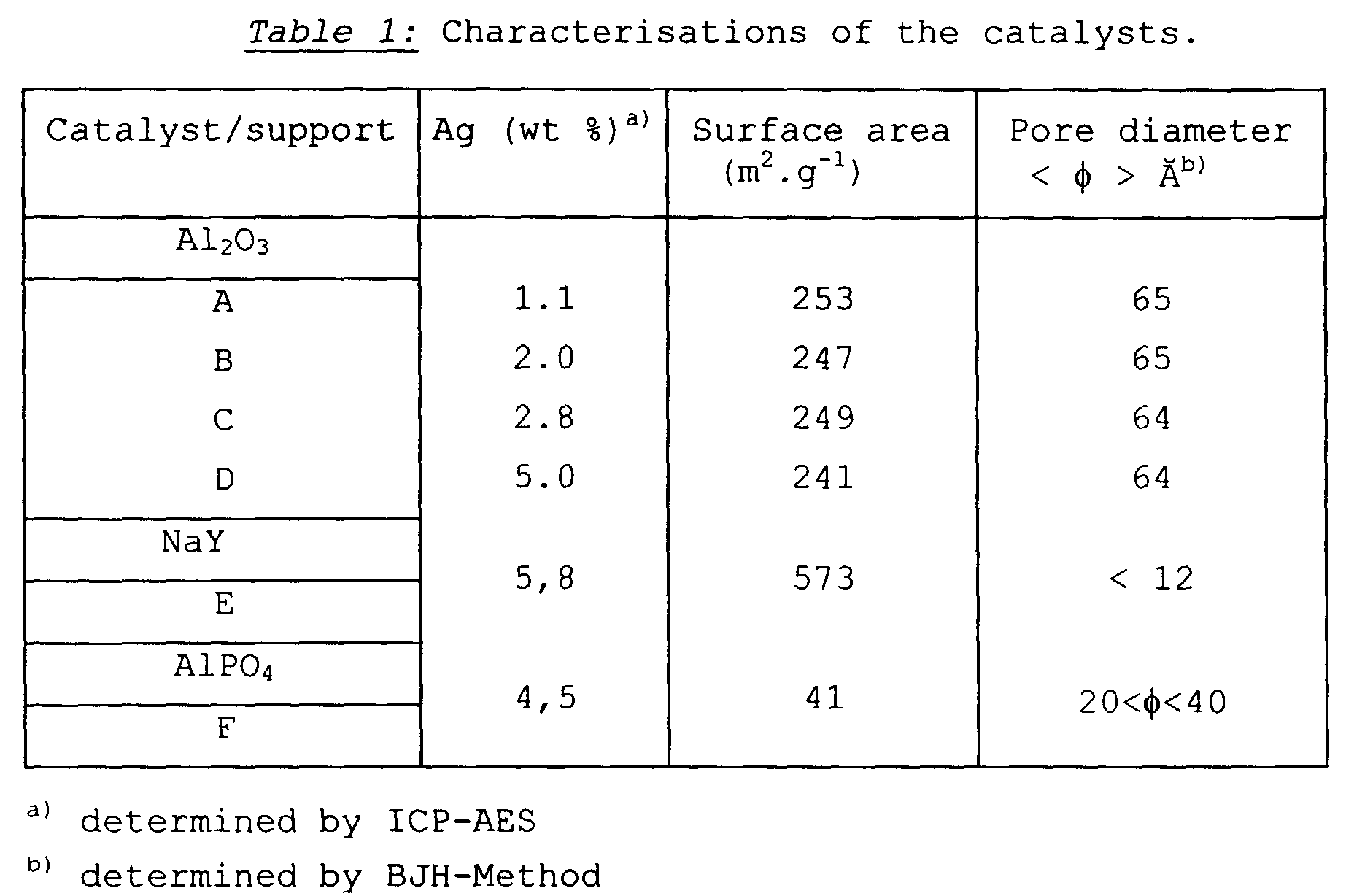
- the composition of the catalysts was determined by Inductive Coupled Plasma (ICP) after dissolution of the solids. The specific BET surface and average pore diameter were obtained from the adsorption isotherms of nitrogen at 77 K, using micromeritrics automatic volumeter. The samples were first evacuated at 473 K for 16h. The results are reported in Table 1.
- ICP Inductive Coupled Plasma
- the supporting material celite is purified by washing with methanol containing 10 % concentrated hydrochloric acid, and then with distilled water until the mother liquor was neutral. Then the material was dried at 393 K.
- Bimetallic catalysts Ag-Cu and Ag-Co were also prepared.
- the composition of the catalysts was determined by Inductive Coupled Plasma (ICP) after dissolution of the solids. The results are reported in Table 3.
- ICP Inductive Coupled Plasma
- Catalysts Name Metal (wt.%) Surface area (m 2 .g -1 ) Ag 2 O I - Cu-Y J 1.5 495 Co-Y K 1.5 620 V-Y L 3.0 293 Mn-Y M 1.5 460 Cu-Al 2 O 3 N 5.0 203 Ni-Al 2 O 3 O 3.8 228 Mn-Al 2 O 3 P 3.3 218 Co-Al 2 O 3 R 3.2 209 Co- ⁇ -Al 2 O 3 S 4.2 - ⁇ -Fe/Bi-Al 2 O 3 T 0.9 and 5.3 126 Pd/Ag-Al 2 O 3 U - Ru-Al 2 O 3 V 1.2 243 [AgCu]O W 54 - [AgCo]O X 59 -
- the composition of the catalysts was determined by Inductive Coupled Plasma (I.C.P) after dissolution of the solids.
- I.C.P Inductive Coupled Plasma
- the specific BET surface and average pore diameter were obtained from the adsorption isotherms of nitrogen at 77 K, using micromeritrics automatic volumeter.
- the samples were first evacuated at 473 K for 16 h.
- the amount of acidic sites was determined by programmed temperature desorption TPD of ammonia. On samples previously calcined at 673 K under Helium flow (over night). The ammonia was adsorbed during 15 min at 373 K. The temperature was increased using a ramp of 10 °C/mins to 1073 K. The desorbed ammonia was titrated by HCl (0.025 M) using a special titrometer coupled to a pH control unit and an automatic burette containing the acid. During the desorption, temperature, pH and HCl consumption were recorded.
- Methyl- ⁇ -D-glucopyranoside (0,97 g, 5 mmol) was dissolved in 100 ml water. Then 30 mg (0,19 mmol) of TEMPO and 2,28 g (10 mmol) of ammonium peroxodisulfate were added. The system was equilibrated at 298 K and pH 9,5 under vigorous stirring (1000 rpm). Then 500 mg of catalyst A was added to the mixture (time zero). The pH of the reaction was kept constant at 9,5 by automatic titration with 1M KOH solution.
- catalyst A and ammonium peroxodisulfate were replaced by catalyst I (10 mmol, 2,31 g).
- the pH-value was adjusted to 8 by adding hydrochloric acid.
- the selectivity of the catalyst for the oxidation of methyl- ⁇ -D-glucopyranoside to methyl- ⁇ -D-glucopyranosiduronic acid is very good.
- the oxidation was found to be stoichiometric, when catalyst I is used in absence of peroxodisulfate.
- the silver oxide was reduced to metallic silver.
- Example 1 was repeated, except that the ratio of peroxodisulfate to ⁇ -MDG was varied.
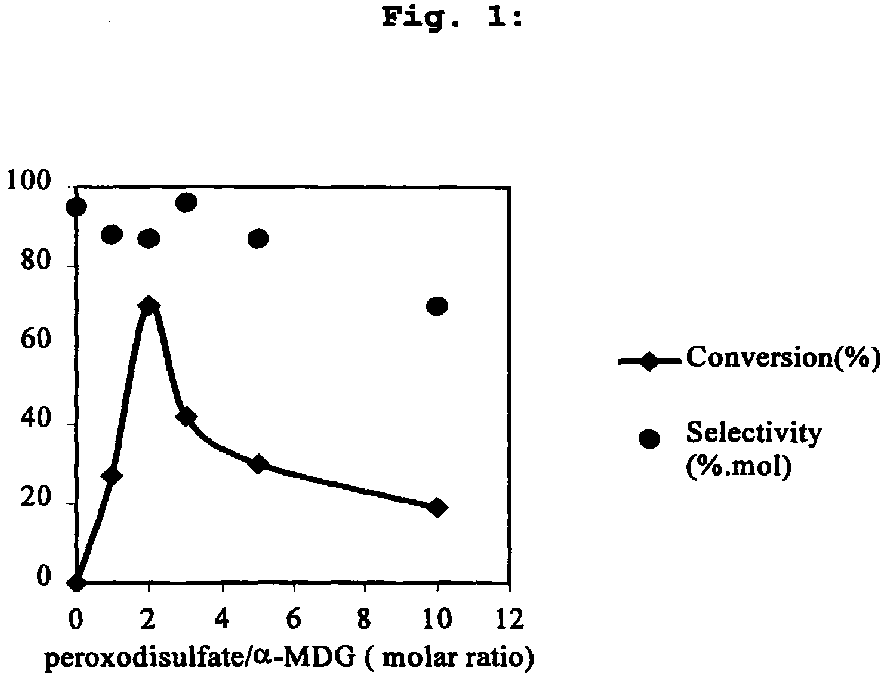
- the effect of the amount of peroxodisulfate on the catalytic properties of Ag-Al 2 O 3 is shown in Figure 1. With a molar ratio of peroxodisulfate: ⁇ -MDG close to 2, a selectivity of 99 % at a conversion of approximately 80 mol.% is obtained.
- Example 1 was repeated except that the percentage of silver was varied: 1, 2, 3, and 5 wt%, respectively. Applying a molar ratio of ⁇ -MDG:peroxodisulfate:TEMPO of 1:2:0,1. The result is shown in Figure 2.
- ⁇ -MDG oxidation is very low in absence of silver around 7% conversion. Whereas, the conversion increases with silver percentages and reaches a plateau at 78 % conversion with a selectivity of 99 % to methyl- ⁇ -D-glucopyrasiduronic acid.
- Example 1 was repeated, except that the catalyst A was treated with carbonate, using a molar ratio of carbonate-silver of 0,5.
- Figure 3 the conversion as a function of reaction time is demonstrated for the parent catalyst A and for catalyst A-CO 3 .
- the initial rate increases by a factor of 10 in the case of catalyst A-CO 3 .
- This result can be interpreted by the fact that in presence of carbonate, the charge density on silver decreases and more Lewis acid sites are created. This hypothesis was verified by TPD of ammonia ( Figure 4).
- ⁇ -MDG was oxidized in the presence of 500 mg of catalyst E (containing 5.8 wt% of silver) in the same manner as in example 1.
- the ⁇ -MDG conversion was 74 % with a selectivity of 99 mol.% to methyl- ⁇ -D-glucopyrasiduronic acid.
- methyl- ⁇ -D-glucopyranoside (0,97 g, 5 mmol) was dissolved in 100 ml water. Then 30 mg of TEMPO and (2,28 g, 10 mmol) of ammonium peroxodisulfate were added. The system was equilibrated at 298 K and pH 9,5 under vigorous stirring (1000 rpm). Then 500 mg of supported metal catalysts and/or mixed oxides were added to the mixture (time zero). The pH of the reaction was kept constant at 9,5 by automatic titration with 1M KOH solution.
- the catalyst W with 54wt% silver was used in two successive oxidation runs with a fresh charge of methyl- ⁇ -D-glucopyranoside, peroxodisulfate and TEMPO solution.
- the reaction was carried out in the same conditions as described in the example 7. The results are shown in Table 7. Number of repetition Conversion (%) Selectivity (mol.%) 1 60 95 2 60 95
- 1,2-propandiol (0,38 g, 5 mmol) was dissolved in 100 ml water. Then 30 mg of TEMPO and (2,28 g, 10 mmol) of ammonium peroxodisulfate were added. The system was equilibrated at 298 K and pH 9,5 under vigorous stirring (1000 rpm). Then 500 mg of catalyst D was added to the mixture (time zero). The pH of the reaction was kept constant at 9,5 by automatic titration with 1M KOH solution.
- the pH-value was adjusted to 8 by adding hydrochloric acid. Then the catalyst was recovered by filtration, water and TEMPO were removed under vacuum at 313 K. The product mixture was dried overnight under vacuum at room temperature. The oxidation degree was determined by gas chromatography after silylation.
- the selectivity of the lactic acid is 75 mol.% at 90 % conversion of 1,2-propandiol.
- Example 9 was repeated except that the catalyst D was replaced by Ag-carbonate on celite, catalyst H, containing 1mmol Ag 2 CO 3 /g celite. At the end of the reaction, the selectivity of the lactic acid is 60 mol.% at 75 % conversion of the 1,2-propandiol.
- Example 10 was repeated except that the ammonium peroxodisulfate was replaced by oxone (10 mmol, 3g). At the end of the reaction, the selectivity of the lactic acid is 99 mol.% at 8 % conversion of the 1,2-propandiol.
- Example 9 was repeated except that the catalyst D was replaced by catalyst E containing 5.8 wt % silver.
- the selectivity of the lactic acid is 64 mol.% at 60 % conversion of the 1,2-propandiol.
- Example 12 was repeated except that the ammonium peroxodisulfate was replaced by oxone (10 mmol, 3g). At the end of the reaction, the selectivity of the lactic acid is 55 mol.% at 18 % conversion of the 1,2-propandiol.
Landscapes
- Chemical & Material Sciences (AREA)
- Organic Chemistry (AREA)
- Engineering & Computer Science (AREA)
- Health & Medical Sciences (AREA)
- Biochemistry (AREA)
- Biotechnology (AREA)
- General Health & Medical Sciences (AREA)
- Genetics & Genomics (AREA)
- Molecular Biology (AREA)
- Life Sciences & Earth Sciences (AREA)
- Oil, Petroleum & Natural Gas (AREA)
- Organic Low-Molecular-Weight Compounds And Preparation Thereof (AREA)
- Catalysts (AREA)
Abstract

or R5 and R6 are bonded together via a (C1-C3)-alkyl chain, which can be substituted by one or more R1, N[(C1-C8)-alkyl]2, (C1-C8)-amido, (C1-C8)-alkyloxy carboxyl, (C6-C18)-aryloxy carboxyl, nitrile, Hal, =O, part of a polymer, and a co-oxidant. Primary alcohols are oxidised preferably compared to secondary ones.
Description
- The present invention is directed to a method for the oxidation of alcohols by the aid of a nitroxyl radical in the presence of a supported metal catalyst and a co-oxidant.
- The oxidation of alcohols is very common among organic chemical reactions and is well established in many processes in industry. Especially, this holds true for the oxidation of primary alcohols to aldehydes or carboxylic acids.
- This oxidation can advantageously be conducted in a catalytic manner. Among known catalytic methods the oxidation of alcohols with TEMPO and a co-oxidant became a very attractive tool for organic synthesis (Semmelhack et al. J. Am. Chem. Soc., 105 (1983) 4492-4494). The authors used the stable
organic nitroxyl radical - For example, soluable Fe(III)-ions oxidise MeO-TEMPO to immonium oxide, which shows good activity for the oxidation of benzyl alcohol in two phase system (aqueous phase/acetonitrile or methylene chloride). In this case, immonium oxide, which is a kind of ammonium salt, accelerates the reaction by acting as an anion-transport. The disadvantage of this method is that the Fe(III) was used in stoichiometric conditions, which is not feasible for industrial purpose in view of pollution and costs (Miyazawa, T. Endo., J. Molec. Catal., 31 (1985) 217-220).
- Additionally, the nitroxyl radical can be oxidised by cupric salt to the oxo ammonium salt, which oxidises alcohols to the corresponding aldehydes, the hydroxylamine and a protonic acid. The hydroxylamine was in turn easily oxidised by cupric salts to give a nitroxyl radical. But it was necessary to trap the acid because it inhibits the catalytic oxidation system. Therefore, cupric hydroxide or pyridine were used as acid-trapping agents, again in stoichiometric amounts (M. F. Semmelhack, C. R. Schmid, D. A. Cortes, C. S. Chou., J. Am. Chem. Soc., 106 (1984) 3374-3376; T. Miyazawa, T. Endo., J. Molec. Catal., 32 (1985) 357-360).
- Sulfonic acid, p-toluene sulfonic acid or 1(S)-(+)-camphor-10-sulfonic acid were used to generate the oxoammonium salt in methylene chloride as solvent. Thus, a large range of alcohols could be oxidised to the corresponding aldehydes or ketones. However, alcohols having a β-oxygen are not oxidised by oxo ammonium salts and those with a δ-oxygen react slowly. The drawback of this method is the use of an excess of nitroxyl radical and p-sulfonic acid (2 moles of nitroxyl radical per mole of alcohol was used) and results in many steps for the purification of the products (Z. H. Ma, J. M. Bobbitt, J. Org. Chem., 56 n°21 (1991) 6111-6114; J. A. Cella, J. A. Kelly, E. F. Kenehan., J. Org. Chem., 40 n°62 (1975) 1860). Again this process is disadvantage on industrial scale.
- Primary alcohols are quantitatively oxidised to aldehydes under two phase conditions (methylene chloride-aqueous sodium hypochlorite) in the presence of catalytic amounts of 4-methoxy-2,2,6,6-tetramethylpiperidine-1-oxyl (MeO-TEMPO). Co-catalysis by bromide and buffering of pH at 8,6 with NaHCO3 are also required (P. L. Anelli, C. Biffi, F. Montanari, S. Quici., J. Org. Chem., 52 (1987) 2259-2562; T. Inokuchi, S. Matsumoto, T. Nishigama, S. Torii., J. Org. Chem., 55 (1990) 462-466).
- Many authors described a method for the oxidation of primary hydroxyl functions in an aqueous phase. The reaction is mediated by TEMPO and hypobromite is used as the regenerating oxidant, which in turn is regenerated by hypohalite as oxidant, preferably in the form of a salt, such as: lithium hypochlorite, sodium hypochlorite, potassium hypochlorite or calcium hypochlorite (A. E. J. de Nooy, A. C. Besemer, H. Van Bekkum., Recl. Trav. Chim. Pays-Bas., 113 (1994) 165-166; A. E. J. de Nooy, A. C. Besemer, Tetrahedron, 51 n° 29 (1995) 8023-8032; P. S. Chang, J. F. Robyt, J. Carbohydr. Chem., 15(7)(1996) 819-830).
- More recently, the oxidation of primary hydroxyl groups of polysaccharide mediated by 2,2,6,6-tetramethylpiperidine-1-oxyl in water is disclosed in the specification of WO 95/07303 which relates to a process for producing completely carboxylated carbohydrates. In this process, carbohydrates having a carbonyl content of at least 75 % were oxidised using hypochlorite/bromide system. The amount of hypochlorite solution used was 2-2,4 moles per mole of monosaccharide unit. This clearly shows that the process produces a lot of halogenated salts, which cause some environmental pollution (AOX-waste).
- The catalytic oxidation process of primary hydroxyl groups cited above has the following disadvantages:
-
- (i) the oxidation of alcohol leads to the aldehyde only.
- (ii) the nitroxyl radical and the co-oxidant were used in stoichiometric amount.
- (iii) many steps for the purification of the products are required.
-
- (i) a large excess of co-oxidant was employed (2 moles and more of hypochlorite solution per mole of substrate).
- (ii) problems associated with this method are sooner or later, loss of the oxidizing power of the N-oxoammonium salts due to the concurrently generated hydrogen peroxide and molecular chlorine (T. Endo, T. Miyazawa, S. Shiihashi, M. Okawara, J. Am. Chem. Soc., 106 (1984) 3877-3878) and an accumulation of halogenated salts and AOX.
- The present invention's task is to show another way to catalytically oxidise alcohols by the aid of an nitroxyl radical without showing the disadvantages involved in the oxidation procedures mentioned above.
- This aim is reached by applying a process mentioned in
claim 1.Further claims 2 to 18 are directed to preferable embodiments of the instant invention. - Through oxidation of alcohols by derivatives of the general formula (I)wherein R1, R2, R3, R4, R5, R6 are independent of each other (C1-C8)-alkyl, (C1-C8)-alkoxy, (C6-C18)-aryl, (C7-C19)-aralkyl, (C6-C18)-aryl-(C1-C8)-alkyl, (C3-C18)-heteroaryl, (C4-C19)-heteroaralkyl, (C3-C18)-heteroaryl-(C1-C8)-alkyl, (C3-C8)-cycloalkyl, (C3-C8)-cycloalkyl-(C1-C8)-alkyl, (C1-C8)-alkyl-(C3-C8)-cycloalkyl,

or R5 and R6 are bonded together via a (C1-C3)-alkyl chain, which can be substituted by one or more R1, N[(C1-C8)-alkyl]2, (C1-C8)-amido, (C1-C8)-alkyloxy carboxyl, (C6-C18)-aryloxy carboxyl, nitrile, Hal, =O, part of a polymer, in the presence of a supported metal catalyst and a co-oxidant, one is able to gain oxidation products without having the drawbacks accompanied with the transformations known from the state of the art. Especially, the halogenated waste (AOX) and the hyperstoichiometric use of cost-effective and hardly disposable co-oxidants (Fe3+/2+) can be omitted. - Preferably, a process is applied, wherein R1 to R4 of formula (I) are (C1-C8)-alkyl and R5 and R6 are bonded via a (C1-C3)-alkyl chain, which can be substituted by one or more R1, N[(C1-C8)-alkyl]2, (C1-C8)-amido, (C6-C18)-aryloxy, (C1-C8)-alkyloxy carbonyl, (C6-C18)-aryloxy carbonyl, nitrile, Hal, =O, part of a polymer (e.g. T. Miyazawa, T. Endo., J. Polym. Scien., 23 (1985) 2487-2494).
- Most preferably R1 to R4 are methyl and R5 and R6 are bonded via a C3-alkyl chain.
- The amount of derivative of formula (I) applied is not critical. It should be used in an amount related to the cost-effectiveness of the process. Preferred is a process wherein the derivative of the general formula (I) is used within the range of 0.01 mol% to 10 mol%, more preferably between 0.1 mol% and 4 mol%, based on the substrate.
- The process can be conducted with primary and secondary alcohols. According to their reactivity primary alcohols are oxidised much faster than secondary ones, which helps the skilled man to discriminate between both groups in a manner that primary alcoholic functions can be oxidised selectively in the presence of secondary alcoholic groups within the same molecule. However, the alcohol used in the process of the invention preferably comprises a primary alcoholic function.
- Primary alcoholic residues are normally oxidised to the corresponding carboxylic acids or aldehyde depending on if water is used as reaction solvent or an organic medium (A. E. J. de Nony et al., Tetrahedron 1993, 51, 8023f). [What about synthesising aldehydes?]
- In a preferred embodiment of the invention the supported metal catalyst comprises metals in an oxidation stage ±0 or metal oxides. Preferably, as elementary metals are used Silver, Chromium, Palladium , Bismuth, Iron, Vanadium, Copper, Cobalt, Nickel, Molybdenum, Manganese, Ruthenium or Osmium or alloys of the same. In addition, the metal oxides used can be MOx with M = Silver, Chromium, Palladium, Bismuth, Iron, Vanadium, Copper, Cobalt, Nickel, Molybdenum, Manganese, Ruthenium or Osmium or mixtures of the same or mixed metal oxides of the same.
- The support itself is advantageously made out of micro or mesoporous materials. The micro porous material can be derived from zeolitic material and the mesoporous material can be silica, alumina, alumino phosphate, titanium oxide or celite or carbon. The zeolitic material used may be zeolites such as X, L, Y, mordenite, mesoporous materials as of the M41-S family (MCM-41, MCM-48, MCM-50) or silica, alumina, amorphous silica-alumina, aluminophosphate, titanium oxide, zirconium oxide and celite.
- The ratio of metal to support lies within the range of 0.01 wt% to 60 wt%, preferably between 0.05 wt% to 50 wt% and more preferably between 0.1 wt% to 30 wt%.
- The co-oxidant used in this invention has to be strong enough to oxidise the corresponding hydroxylamin of formula (I) to the nitrosonium ion in the presence of the catalyst.
- On the other hand it has to be mild enough not to destroy the alcohol to be oxidised. All oxidants with an Eo of > 0,3 and less than 2,5 are feasible. Preferably, the co-oxidant is selected from a group consisting of hydrogen peroxide, oxone, ozone, perborate, percarbonate, oxygen, N-methyl morpholine-4-oxid, peroxodisulfate or caroate.
- The ratio of co-oxidant to substrate is not critical but shall be kept as low as possible for economic and ecological reasons. Normally, it lies within the range of 1 to 20, preferably between 1-10, more preferably between 1-2, equivalents.
- The process of the invention is preferably conducted within a solvent. More preferably it is carried out in water or an organic solvent, most preferably acetone, acetonitrile, benzene, dioxane, diglyme, tetrahydrofurane or water or mixtures thereof.
- If water is part of the solvent the pH shall lie within the range of 2 to 12, preferably between 8.5 to 10.
- The temperature of the reaction may be selected according to the molecules or reaction conditions applied and is not critical. Normally, it lies within the range of -30 °C to 100 °C, preferably between -10 °C to 50 °C.
- The catalyst can be recovered after and can be reused for subsequent oxidation reactions.
- In proposed mechanism the catalytic system works as exemplified in the following scheme:
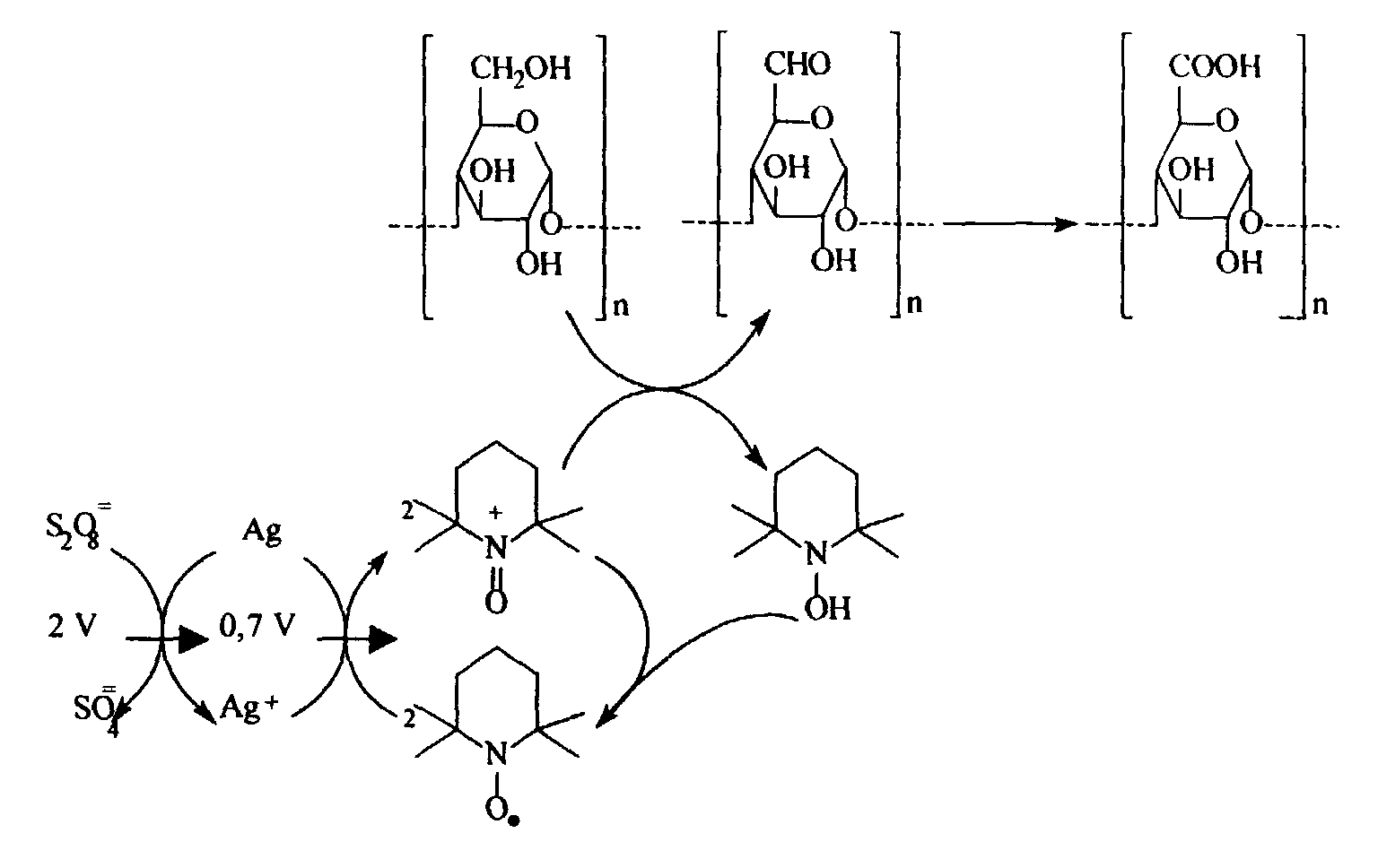
- The catalyst reoxidises the hydroxyl amine, formed during the oxidation of the alcohol, to the corresponding nitroxyl radical or the corresponding nitrosonium ion, which subsequently is again able to oxidise an alcohol function. In order to close the cycle, it is important to use a primary co-oxidant to reoxidise the reduced metal (or its equivalent).
- The method according to the invention can be used for oxidising primary alcohols of very large range. Polyols are readily oxidised at the primary hydroxyl groups in preference to the secondary and/or tertiary hydroxyl groups.

- In particular, the method is suitable for the oxidation of water soluble polyols. The preferred substrate for the present oxidation is 1,2-propandiol (R' = Me and R'' = H).
- The method according to the present invention can advantageously be employed for the oxidation of primary alcohols. Preferred alcohols are such as: n-butanol, cyclohexanol, cyclopentanol, 3-methylcyclohexanol, 2-methylcyclohexanol, 1-hexanol, 1-butanol, octanol, dodecanol, octanol, (±)-2-norbornane-methanol, (1R)-(-)-nopol, piperonyl alcohol, cinnamyl alcohol, famesol, nerol, geraniol. The more preferred substrates for the present oxidation reaction are: 1-butanol and 1-hexanol.
- The method according to the present invention can be used for the regioselective oxidation of a wide range of carbohydrates, if they have primary hydroxyl groups. Examples of carbohydrates include: methyl-α-D-glucopyranoside, methyl-β-D-glucopyranoside, octyl-β-D-glucopyranoside, sucrose, dodecyl-D-glucopyranoside, α-D-glucopyranoside-1-(disodium phosphate), α-α-trehalose. The preferred substrates for the present oxidation are: methyl-α-D-glucopyranoside and sucrose and, especially, methyl-α-D-glucopyranoside.
- As compared with the conventional processes, the process of the present invention has the following merits:
- extremely high activity and selectivity are obtained in the oxidation of primary alcohol or primary hydroxyl groups e.g. in the case of carbohydrates. More particularly, primary hydroxyl groups of methyl-α-D-glucopyranoside are oxidised regioselectively in presence of secondary ones, side reactions are diminished,
- small amounts of nitroxide radical are used (0.1-4 mol% per mol of substrate),
- the hypochlorite/bromide system used before was replaced by a an environmentally benign catalytic system,
- the carboxylic acid salts obtained have a high purity, which requires no further purification.
- There come into consideration as (C1-C8)-alkyl radicals linear or branched methyl, ethyl, n-propyl, isopropyl, n-butyl, isobutyl, sec.-butyl, tert.-butyl, pentyl, hexyl, heptyl or octyl, including all their possible isomers. The radical (C1-C8)-alkoxy corresponds to the radical (C1-C8)-alkyl, with the proviso that it is bonded to the ring via an oxygen atom.
(C3-C8)-cycloalkyl is to be understood as being cyclopropyl, cyclobutyl, cyclopentyl, cyclohexyl or cycloheptyl radicals. - Hal means fluorine, chlorine, bromine and iodine.
- (C6-C18)-Aryl denotes arylic species with 6 to 18-C-atoms, like phenyl, naphthyl, phenanthryl.
(C7-C19)-aralkyl are arylic radicals connected via a (C1-C8)-alkyl radikal with the molecule of respect.
(C3-C18)-heteroaryl are arylic molecules in which at least one C-atom is substituted by a heteroatom like N, O, P, S.
Molecules, which come into consideration, are pyrolyl, furyl, pyridyl, imidazolyl, chinolinyl, etc.
(C4-C19)-heteroaralkyl are heteroarylic species bonded via a (C1-C8)-alkyl radical with the molecule of respect.
(C1-C3)-alkyl chain represents groups like methenyl, 1,2-ethenyl, 1,3-propenyl.
(C1-C8)-alkoxy carboxyl is a (C1-C8)-alkoxy-group bonded via a carboxyl function to the molecule of respect.
(C6-C18)-aryloxy carboxyl is a (C6-C18)-aryl-group bonded via a carboxyl function to the molecule of respect
(C1-C8)-amido represents a (C1-C8)-alkyl radical, which is linked to the molecule in question via a amido group. - The following examples will further illustrate the present invention.
- Experiments were performed in a thermostated glass batch reactor of 250 ml volume, equipped with a condenser, a thermometer and a magnetic stirrer. The pH was kept constant using a pH-meter (titroline alpha) coupled to a pH control unit and an automatic burette (
Metrohm 655, 20 ml piston) containing 1M KOH. - A defined amount of substrate (5 mmol) was dissolved in 100 ml of water. Then 30 mg (0,19 mmol) of TEMPO and 10 mmol of co-oxidant were added. The system was equilibrated at 298 K and pH 9.5. The catalyst was instantaneously added to the mixture. The pH of the solution during the reaction was kept constant at 9.5 by automatic titration with 1M KOH solution. At the end of the reaction, the pH-value was adjusted at pH = 8 by adding hydrochloric acid to pH 8. Then the catalyst was recovered by filtration, water and TEMPO were removed under vacuum at 313 K. The product mixture was dried overnight under vacuum at room temperature. The oxidation degree of the substrate was determined by gas chromatography after silylation.
- For silylation, e.g. 10 mg of the oxidised sugar was introduced in a gas chromatography tube and 600 mL of pyridine was added. The solution was stirred until the mixture was totally solubilised. Then 600 mL of hexamethyldisilazane and 150 mL of trifluoroacetic acid were introduced. The mixture was placed in an oven at 363 K for 30 min. Then n-decane was added as the internal standard for quantitative analysis. The products were analyzed by GC SIEMENS equipped with capillary column ultra chromapack 25 m length and a flame ionization detector (FID).
- Ag-Na-Y, Ag-AlPO4 and Ag-Al2O3 were prepared by incipient wetness impregnation. To a solution containing the support (10 g), silver nitrate was added. The mixture was stirred during 15 h and then filtrated, washed and dried overnight at 373 K. Then, the catalyst was calcined under air at 773 K during 6 h. The composition of the catalysts was determined by Inductive Coupled Plasma (ICP) after dissolution of the solids. The specific BET surface and average pore diameter were obtained from the adsorption isotherms of nitrogen at 77 K, using micromeritrics automatic volumeter. The samples were first evacuated at 473 K for 16h. The results are reported in Table 1.
- The supporting material celite is purified by washing with methanol containing 10 % concentrated hydrochloric acid, and then with distilled water until the mother liquor was neutral. Then the material was dried at 393 K.
- To a mechanically stirred solution of silver nitrate (1,85 mmol, 0,31 g) in distilled water (100 ml) purified celite (10 g) is added. To the stirred suspension, a solution of potassium hydrogen carbonate (0,15 g) in distilled water (100 ml) is slowly added. After complete addition, stirring is continued for a further 10 min. A yellow-green precipitate formed is collected by filtration and dried under reduced pressure on a rotary evaporator for several hours. The catalyst contains 0,17 mmol of silver per gram of celite (0,088 mmol of Ag2CO3 per gram of reagent). The same procedure was repeated for another percentage of silver (See Table 2).
Catalyst G Catalyst H AgNO3 (g) 0,31 11,34 NaHCO3 (g) 0,15 5,6 mmol Ag2CO3/ g celite 0,088 1 Ag (wt.%) 2 32 - M-Na-Y or M-Al2O3 catalysts with M = Cu, Co, V, Mn, Ni, Fe, Bi, Pd, and/or Ru were prepared by impregnation at room temperature. Bimetallic catalysts Ag-Cu and Ag-Co were also prepared. The composition of the catalysts was determined by Inductive Coupled Plasma (ICP) after dissolution of the solids. The results are reported in Table 3.
Catalysts Name Metal (wt.%) Surface area (m2.g-1) Ag2O I - Cu-Y J 1.5 495 Co-Y K 1.5 620 V-Y L 3.0 293 Mn-Y M 1.5 460 Cu-Al2O3 N 5.0 203 Ni-Al2O3 O 3.8 228 Mn-Al2O3 P 3.3 218 Co-Al2O3 R 3.2 209 Co-γ-Al2O3 S 4.2 - α-Fe/Bi-Al2O3 T 0.9 and 5.3 126 Pd/Ag-Al2O3 U - Ru-Al2O3 V 1.2 243 [AgCu]O W 54 - [AgCo]O X 59 - - The composition of the catalysts was determined by Inductive Coupled Plasma (I.C.P) after dissolution of the solids. The specific BET surface and average pore diameter were obtained from the adsorption isotherms of nitrogen at 77 K, using micromeritrics automatic volumeter. The samples were first evacuated at 473 K for 16 h. X-Ray diffraction study was performed on SIEMENS 5000 instrument equipped with Cu lamp (λ cu = 1.54 Å). The spectra were recorded from 2 = 5° to 2 = 100°.
- The amount of acidic sites was determined by programmed temperature desorption TPD of ammonia. On samples previously calcined at 673 K under Helium flow (over night). The ammonia was adsorbed during 15 min at 373 K. The temperature was increased using a ramp of 10 °C/mins to 1073 K. The desorbed ammonia was titrated by HCl (0.025 M) using a special titrometer coupled to a pH control unit and an automatic burette containing the acid. During the desorption, temperature, pH and HCl consumption were recorded.
- Methyl-α-D-glucopyranoside (0,97 g, 5 mmol) was dissolved in 100 ml water. Then 30 mg (0,19 mmol) of TEMPO and 2,28 g (10 mmol) of ammonium peroxodisulfate were added. The system was equilibrated at 298 K and
pH 9,5 under vigorous stirring (1000 rpm). Then 500 mg of catalyst A was added to the mixture (time zero). The pH of the reaction was kept constant at 9,5 by automatic titration with 1M KOH solution. - For comparison, catalyst A and ammonium peroxodisulfate were replaced by catalyst I (10 mmol, 2,31 g). At the end of the reaction, the pH-value was adjusted to 8 by adding hydrochloric acid.
- Then the catalyst was recovered by filtration, water and TEMPO were removed under vacuum at 313 K. The product mixture was dried overnight under vacuum at room temperature. The oxidation degree was determined by gas chromatography after silylation. The results are reported in table 4.
Oxidation of methyl-α-D-glucopyranoside over silver catalysts. Catalyst Conversion (%) Selectivity (%.mol) catalyst I (0.5) 49 95 catalyst A (108) 70 97 pH= 9,5, 298 K, α-MDG/TEMPO= 26 (mol),
( ):is the molar ratio between the substrate and silver - The selectivity of the catalyst for the oxidation of methyl-α-D-glucopyranoside to methyl-α-D-glucopyranosiduronic acid is very good. The oxidation was found to be stoichiometric, when catalyst I is used in absence of peroxodisulfate. The silver oxide was reduced to metallic silver.
- Using catalyst A in combination with peroxodisulfate, with a molar ratio α-MDG to Ag of 108, a very high selectivity to methyl-α-D-glucopyrasiduronic acid 97 % is obtained at a conversion of 70 %. In this new procedure the silver works as a catalyst.
- Example 1 was repeated, except that the ratio of peroxodisulfate to α-MDG was varied. The effect of the amount of peroxodisulfate on the catalytic properties of Ag-Al2O3 is shown in Figure 1. With a molar ratio of peroxodisulfate:α-MDG close to 2, a selectivity of 99 % at a conversion of approximately 80 mol.% is obtained.
- Example 1 was repeated except that the percentage of silver was varied: 1, 2, 3, and 5 wt%, respectively. Applying a molar ratio of α-MDG:peroxodisulfate:TEMPO of 1:2:0,1. The result is shown in Figure 2.
- α-MDG oxidation is very low in absence of silver around 7% conversion. Whereas, the conversion increases with silver percentages and reaches a plateau at 78 % conversion with a selectivity of 99 % to methyl-α-D-glucopyrasiduronic acid.
- Example 1 was repeated, except that the catalyst A was treated with carbonate, using a molar ratio of carbonate-silver of 0,5. In Figure 3, the conversion as a function of reaction time is demonstrated for the parent catalyst A and for catalyst A-CO3. The initial rate increases by a factor of 10 in the case of catalyst A-CO3 .This result can be interpreted by the fact that in presence of carbonate, the charge density on silver decreases and more Lewis acid sites are created. This hypothesis was verified by TPD of ammonia (Figure 4).
- α-MDG was oxidized in the presence of 500 mg of catalyst E (containing 5.8 wt% of silver) in the same manner as in example 1. The α-MDG conversion was 74 % with a selectivity of 99 mol.% to methyl-α-D-glucopyrasiduronic acid.
- α-MDG was oxidized in the presence of 500 mg of freshly prepared catalysts G and H containing different amounts of silver carbonate. The reaction was carried out in the same manner as described in example 1. The results are shown in Table 5.
Catalyst G Catalyst H mmol Ag2CO3/ g celite 0,088 1 Conversion (%) 51 90 Selectivity (mol.%) 99 99 - Various supported metal catalysts were used for the oxidation of methyl-α-D-glucopyranoside using the following conditions: methyl-α-D-glucopyranoside (0,97 g, 5 mmol) was dissolved in 100 ml water. Then 30 mg of TEMPO and (2,28 g, 10 mmol) of ammonium peroxodisulfate were added. The system was equilibrated at 298 K and
pH 9,5 under vigorous stirring (1000 rpm). Then 500 mg of supported metal catalysts and/or mixed oxides were added to the mixture (time zero). The pH of the reaction was kept constant at 9,5 by automatic titration with 1M KOH solution. At the end of the reaction, the mixture was neutralised by adding hydrochloric acid to a pH 8. Then the catalyst was recovered by filtration, water and TEMPO were removed under vacuum at 313 K. The product mixture was dried overnight under vacuum at room temperature. The oxidation degree was determined by gas chromatography after silylation. The results are shown in Table 6.Catalysts Conversion (%) Selectivity (mol.%) B 78 99 E 74 99 F 24 86 J 28 99 K 60 99 L 15 99 M 10 99 N 24 99 O O - P 19 99 R 21.5 99 S 12 97 T 18.7 97 U 62 80 V 5 97 W 60 95 X 65 96 - The catalyst W with 54wt% silver was used in two successive oxidation runs with a fresh charge of methyl-α-D-glucopyranoside, peroxodisulfate and TEMPO solution. The reaction was carried out in the same conditions as described in the example 7. The results are shown in Table 7.
Number of repetition Conversion (%) Selectivity (mol.%) 1 60 95 2 60 95 - 1,2-propandiol (0,38 g, 5 mmol) was dissolved in 100 ml water. Then 30 mg of TEMPO and (2,28 g, 10 mmol) of ammonium peroxodisulfate were added. The system was equilibrated at 298 K and
pH 9,5 under vigorous stirring (1000 rpm). Then 500 mg of catalyst D was added to the mixture (time zero). The pH of the reaction was kept constant at 9,5 by automatic titration with 1M KOH solution. - At the end of the reaction, the pH-value was adjusted to 8 by adding hydrochloric acid. Then the catalyst was recovered by filtration, water and TEMPO were removed under vacuum at 313 K. The product mixture was dried overnight under vacuum at room temperature. The oxidation degree was determined by gas chromatography after silylation.
- At the end of the reaction, the selectivity of the lactic acid is 75 mol.% at 90 % conversion of 1,2-propandiol.
- Example 9 was repeated except that the catalyst D was replaced by Ag-carbonate on celite, catalyst H, containing 1mmol Ag2CO3/g celite. At the end of the reaction, the selectivity of the lactic acid is 60 mol.% at 75 % conversion of the 1,2-propandiol.
- Example 10 was repeated except that the ammonium peroxodisulfate was replaced by oxone (10 mmol, 3g). At the end of the reaction, the selectivity of the lactic acid is 99 mol.% at 8 % conversion of the 1,2-propandiol.
- Example 9 was repeated except that the catalyst D was replaced by catalyst E containing 5.8 wt % silver. At the end of the reaction, the selectivity of the lactic acid is 64 mol.% at 60 % conversion of the 1,2-propandiol.
- Example 12 was repeated except that the ammonium peroxodisulfate was replaced by oxone (10 mmol, 3g). At the end of the reaction, the selectivity of the lactic acid is 55 mol.% at 18 % conversion of the 1,2-propandiol.
Claims (18)
- Process for the oxidation of alcohols by derivatives of the general formula (I)wherein R1, R2, R3, R4, R5, R6 are independent of each other (C1-C8)-alkyl, (C1-C8)-alkoxy, (C6-C18)-aryl, (C7-C19)-aralkyl, (C6-C18)-aryl-(C1-C8)-alkyl, (C3-C18)-heteroaryl, (C4-C19)-heteroaralkyl, (C3-C18)-heteroaryl-(C1-C8)-alkyl, (C3-C8)-cycloalkyl, (C3-C8)-cycloalkyl-(C1-C8)-alkyl, (C1-C8)-alkyl-(C3-C8)-cycloalkyl, or R5 and R6 are bonded together via a (C1-C3)-alkyl chain, which can be substituted by one or more R1, N[(C1-C8)-alkyl]2, (C1-C8)-amido, (C1-C8)-alkyloxy carboxyl, (C6-C18)-aryloxy carboxyl, nitrile, Hal, =O, part of a polymer,
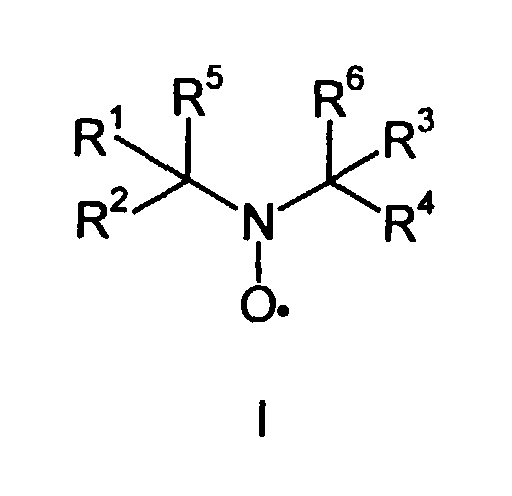
in the presence of a supported metal catalyst and a co-oxidant. - Process according to claim 1,
wherein R1 to R4 are (C1-C8)-alkyl and R5 and R6 are bonded via a (C1-C3)-alkyl chain, which can be substituted by one or more R1, N[(C1-C8)-alkyl]2, (C1-C8)-amido, (C1-C8)-alkyloxy carboxyl, (C6-C18)-aryloxy carboxyl, nitrile, Hal, =O, part of a polymer. - Process according to claim 1 and/or 2,
wherein R1 to R4 are methyl, R5 and R6 are bonded via a C3-alkyl chain. - Process according to one or more of claims 1 to 3,
wherein the derivative of the general formula (I) is used within the range of 0.01 mol% to 10 mol%, preferably between 0.1 mol% and 4 mol%, based on the substrate - Process according to one or more of claims 1 to 4,
wherein the alcohol used comprises a primary alcoholic function. - Process according to claim 5,
wherein the alcohol is oxidised to the corresponding carboxylic acid. - Process according to claim 1,
wherein the supported metal catalyst comprises metals in an oxidation stage ±0 or metal oxides. - Process according to claim 7,
wherein the metals used are Silver, Chromium, Palladium , Bismuth, Iron, Vanadium, Copper, Cobalt, Nickel, Molybdenum, Manganese, Ruthenium or Osmium or alloys of the same. - Process according to claim 7,
wherein the metal oxides used are MOx with M = Silver, Chromium, Palladium, Bismuth , Iron, Vanadium, Copper, Cobalt, Nickel, Molybdenum, Manganese, Ruthenium or Osmium or mixtures of the same or mixed metal oxides of the same. - Process according to one or more of claims 1 to 9,
wherein the support used is micro or mesoporous materials. - Process according to claim 10,
wherein the micro porous material can be derived from zeolitic material and the mesoporous material can be silica, alumina, amorphous silica-alumina, alumino phosphate, titanium oxide or celite or carbon. - Process according to one or more of claims 1 to 11,
wherein the ratio of metal to support lies within the range of 0.05 wt% to 50 wt%. - Process according to one or more of claims 1 to 12,
wherein the co-oxidant is selected from the group consisting of hydrogen peroxide, oxone, ozone, perborate, percarbonate, oxygen, N-methyl morpholine-4-oxid, peroxodisulfate or caroate. - Process according to one or more of claims 1 to 13,
wherein the ratio of co-oxidant to substrate lies within the range of 1 to 20, preferably between 1-10, equivalents. - Process according to one or more of claims 1 to 14,
wherein the reaction is carried out in water or an organic solvent, preferably acetone, acetonitrile, benzene, dioxane, diglyme, tetrahydrofurane or mixtures thereof. - Process according to claim 15,
wherein if water is part of the solvent the pH lies within the range of 2 to 12, preferably between 8.5 to 10. - Process according to one or more of claims 1 to 16,
wherein the temperature of the reaction lies within the range of -30 °C to 100 °C, preferably between -10 °C to 50 °C. - Process according to one or more of the preceding claims,
wherein the catalyst is recovered after and is reused for subsequent oxidations.
Priority Applications (1)
| Application Number | Priority Date | Filing Date | Title |
|---|---|---|---|
| EP20000111244 EP1086938B1 (en) | 1999-09-21 | 2000-05-25 | Oxidation of alcohols mediated by nitroxyl derivatives |
Applications Claiming Priority (3)
| Application Number | Priority Date | Filing Date | Title |
|---|---|---|---|
| EP99118600 | 1999-09-21 | ||
| EP99118600 | 1999-09-21 | ||
| EP20000111244 EP1086938B1 (en) | 1999-09-21 | 2000-05-25 | Oxidation of alcohols mediated by nitroxyl derivatives |
Publications (3)
| Publication Number | Publication Date |
|---|---|
| EP1086938A2 true EP1086938A2 (en) | 2001-03-28 |
| EP1086938A3 EP1086938A3 (en) | 2001-04-11 |
| EP1086938B1 EP1086938B1 (en) | 2003-10-22 |
Family
ID=26070986
Family Applications (1)
| Application Number | Title | Priority Date | Filing Date |
|---|---|---|---|
| EP20000111244 Expired - Lifetime EP1086938B1 (en) | 1999-09-21 | 2000-05-25 | Oxidation of alcohols mediated by nitroxyl derivatives |
Country Status (1)
| Country | Link |
|---|---|
| EP (1) | EP1086938B1 (en) |
Cited By (3)
| Publication number | Priority date | Publication date | Assignee | Title |
|---|---|---|---|---|
| WO2002048197A1 (en) * | 2000-12-13 | 2002-06-20 | Sca Hygiene Products Zeist B.V. | Process for oxidising primary alcohols |
| WO2002059064A1 (en) * | 2001-01-26 | 2002-08-01 | Sca Hygiene Products Ab | A recovery method |
| CN108704665A (en) * | 2018-06-20 | 2018-10-26 | 海南师范大学 | Application of chlorination three (2,2`- bipyridyls) ruthenium (II) hexahydrate as catalyst |
-
2000
- 2000-05-25 EP EP20000111244 patent/EP1086938B1/en not_active Expired - Lifetime
Non-Patent Citations (3)
| Title |
|---|
| B. HINZEN ET AL.: "Polymer supported perruthenate (PSP): Clean oxidation of primary alcohols to carbonyl compounds using oxygen as cooxidant" SYNTHESIS, 1998, pages 977-979, XP002156866 * |
| NOOY DE A E J ET AL: "ON THE USE OF STABLE ORGANIC NITROXYL RADICALS FOR THE OXIDATION OFPRIMARY AND SECONDARY ALCOHOLS" SYNTHESIS,DE,GEORG THIEME VERLAG. STUTTGART, 1 October 1996 (1996-10-01), pages 1153-1174, XP002072173 ISSN: 0039-7881 * |
| SEMMELHACK M F ET AL: "Oxidation of alcohols to aldehydes with oxygen and cupric ion, mediated by nitrosonium ion" JOURNAL OF THE AMERICAN CHEMICAL SOCIETY,AMERICAN CHEMICAL SOCIETY, WASHINGTON, DC,US, vol. 106, no. 11, 1984, pages 3374-3376, XP002114880 ISSN: 0002-7863 * |
Cited By (4)
| Publication number | Priority date | Publication date | Assignee | Title |
|---|---|---|---|---|
| WO2002048197A1 (en) * | 2000-12-13 | 2002-06-20 | Sca Hygiene Products Zeist B.V. | Process for oxidising primary alcohols |
| US6936710B2 (en) | 2000-12-13 | 2005-08-30 | Sca Hygiene Products Zeist B.V. | Process for oxidizing primary alcohols |
| WO2002059064A1 (en) * | 2001-01-26 | 2002-08-01 | Sca Hygiene Products Ab | A recovery method |
| CN108704665A (en) * | 2018-06-20 | 2018-10-26 | 海南师范大学 | Application of chlorination three (2,2`- bipyridyls) ruthenium (II) hexahydrate as catalyst |
Also Published As
| Publication number | Publication date |
|---|---|
| EP1086938B1 (en) | 2003-10-22 |
| EP1086938A3 (en) | 2001-04-11 |
Similar Documents
| Publication | Publication Date | Title |
|---|---|---|
| Mallat et al. | Oxidation of alcohols with molecular oxygen on solid catalysts | |
| Spannring et al. | Transition metal-catalyzed oxidative double bond cleavage of simple and bio-derived alkenes and unsaturated fatty acids | |
| Bhattacharjee et al. | Solvothermal synthesis of Fe-MOF-74 and its catalytic properties in phenol hydroxylation | |
| Dimitratos et al. | Selective liquid phase oxidation with supported metal nanoparticles | |
| Kochkar et al. | Regioselective oxidation of hydroxyl groups of sugar and its derivatives using silver catalysts mediated by TEMPO and peroxodisulfate in water | |
| JP5265123B2 (en) | Method for producing carbonyl compound | |
| EP2671861B1 (en) | Selective oxidation of hydrocarbons using heterogeneous catalysts | |
| Hayashi et al. | Environmentally benign oxidation using a palladium catalyst system | |
| Arends et al. | Modern oxidation of alcohols using environmentally benign oxidants | |
| JP3074540B2 (en) | Oxidation of paraffinic compounds | |
| EP2038242A2 (en) | Oxidation catalyst | |
| EP1086938B1 (en) | Oxidation of alcohols mediated by nitroxyl derivatives | |
| US20030097025A1 (en) | Method for producing alcohol/ketone mixtures | |
| Navarro et al. | Copper-complexed dipyridyl-pyridazine functionalized periodic mesoporous organosilica as a heterogeneous catalyst for styrene epoxidation | |
| WO2019232715A1 (en) | Selective oxidation of alcohols | |
| CN1267426C (en) | Direct epoxidation process using pre-treated titanium zeolite | |
| DE60006049T2 (en) | Oxidation of alcohols mediated by nitroxyl derivatives | |
| EP2586765A1 (en) | Selective oxidation of hydrocarbons using heterogeneous catalysts | |
| Zsigmond et al. | Aerobic oxidations on metal macrocycles encapsulated in zeolites | |
| Surendra et al. | A simple biomimetic protocol for the oxidation of alcohols with sodium hypochlorite in the presence of β-cyclodextrin in water | |
| JP2001246262A (en) | Highly selective catalyst for oxidation reaction | |
| RU2790246C1 (en) | Catalyst and method for obtaining higher 2-ketones c5-c10 | |
| Sheldon et al. | Catalytic oxidative dehydrogenation of cyclohexene | |
| Deng | Selective oxidation of alcohols under mild and base-free conditions | |
| RU2278106C1 (en) | Method for preparing 2-methyl-1,4-naphthoquinone |
Legal Events
| Date | Code | Title | Description |
|---|---|---|---|
| PUAI | Public reference made under article 153(3) epc to a published international application that has entered the european phase |
Free format text: ORIGINAL CODE: 0009012 |
|
| PUAL | Search report despatched |
Free format text: ORIGINAL CODE: 0009013 |
|
| AK | Designated contracting states |
Kind code of ref document: A2 Designated state(s): AT BE CH CY DE DK ES FI FR GB GR IE IT LI LU MC NL PT SE |
|
| AX | Request for extension of the european patent |
Free format text: AL;LT;LV;MK;RO;SI |
|
| AK | Designated contracting states |
Kind code of ref document: A3 Designated state(s): AT BE CH CY DE DK ES FI FR GB GR IE IT LI LU MC NL PT SE |
|
| AX | Request for extension of the european patent |
Free format text: AL;LT;LV;MK;RO;SI |
|
| RAP1 | Party data changed (applicant data changed or rights of an application transferred) |
Owner name: DEGUSSA AG |
|
| AKX | Designation fees paid | ||
| 17P | Request for examination filed |
Effective date: 20011215 |
|
| RBV | Designated contracting states (corrected) |
Designated state(s): AT BE CH CY DE DK ES FI FR GB GR IE IT LI LU MC NL PT SE |
|
| REG | Reference to a national code |
Ref country code: DE Ref legal event code: 8566 |
|
| GRAH | Despatch of communication of intention to grant a patent |
Free format text: ORIGINAL CODE: EPIDOS IGRA |
|
| GRAS | Grant fee paid |
Free format text: ORIGINAL CODE: EPIDOSNIGR3 |
|
| GRAA | (expected) grant |
Free format text: ORIGINAL CODE: 0009210 |
|
| AK | Designated contracting states |
Kind code of ref document: B1 Designated state(s): AT BE CH CY DE DK ES FI FR GB GR IE IT LI LU MC NL PT SE |
|
| PG25 | Lapsed in a contracting state [announced via postgrant information from national office to epo] |
Ref country code: AT Free format text: LAPSE BECAUSE OF FAILURE TO SUBMIT A TRANSLATION OF THE DESCRIPTION OR TO PAY THE FEE WITHIN THE PRESCRIBED TIME-LIMIT Effective date: 20031022 Ref country code: CY Free format text: LAPSE BECAUSE OF FAILURE TO SUBMIT A TRANSLATION OF THE DESCRIPTION OR TO PAY THE FEE WITHIN THE PRESCRIBED TIME-LIMIT Effective date: 20031022 Ref country code: FI Free format text: LAPSE BECAUSE OF FAILURE TO SUBMIT A TRANSLATION OF THE DESCRIPTION OR TO PAY THE FEE WITHIN THE PRESCRIBED TIME-LIMIT Effective date: 20031022 |
|
| REG | Reference to a national code |
Ref country code: GB Ref legal event code: FG4D |
|
| REG | Reference to a national code |
Ref country code: CH Ref legal event code: EP |
|
| REG | Reference to a national code |
Ref country code: IE Ref legal event code: FG4D |
|
| REF | Corresponds to: |
Ref document number: 60006049 Country of ref document: DE Date of ref document: 20031127 Kind code of ref document: P |
|
| PG25 | Lapsed in a contracting state [announced via postgrant information from national office to epo] |
Ref country code: SE Free format text: LAPSE BECAUSE OF FAILURE TO SUBMIT A TRANSLATION OF THE DESCRIPTION OR TO PAY THE FEE WITHIN THE PRESCRIBED TIME-LIMIT Effective date: 20040122 Ref country code: GR Free format text: LAPSE BECAUSE OF FAILURE TO SUBMIT A TRANSLATION OF THE DESCRIPTION OR TO PAY THE FEE WITHIN THE PRESCRIBED TIME-LIMIT Effective date: 20040122 Ref country code: DK Free format text: LAPSE BECAUSE OF FAILURE TO SUBMIT A TRANSLATION OF THE DESCRIPTION OR TO PAY THE FEE WITHIN THE PRESCRIBED TIME-LIMIT Effective date: 20040122 |
|
| PG25 | Lapsed in a contracting state [announced via postgrant information from national office to epo] |
Ref country code: ES Free format text: LAPSE BECAUSE OF FAILURE TO SUBMIT A TRANSLATION OF THE DESCRIPTION OR TO PAY THE FEE WITHIN THE PRESCRIBED TIME-LIMIT Effective date: 20040202 |
|
| REG | Reference to a national code |
Ref country code: CH Ref legal event code: NV Representative=s name: BOVARD AG PATENTANWAELTE |
|
| PG25 | Lapsed in a contracting state [announced via postgrant information from national office to epo] |
Ref country code: LU Free format text: LAPSE BECAUSE OF NON-PAYMENT OF DUE FEES Effective date: 20040525 Ref country code: IE Free format text: LAPSE BECAUSE OF NON-PAYMENT OF DUE FEES Effective date: 20040525 |
|
| PG25 | Lapsed in a contracting state [announced via postgrant information from national office to epo] |
Ref country code: MC Free format text: LAPSE BECAUSE OF NON-PAYMENT OF DUE FEES Effective date: 20040531 |
|
| ET | Fr: translation filed | ||
| PLBE | No opposition filed within time limit |
Free format text: ORIGINAL CODE: 0009261 |
|
| STAA | Information on the status of an ep patent application or granted ep patent |
Free format text: STATUS: NO OPPOSITION FILED WITHIN TIME LIMIT |
|
| 26N | No opposition filed |
Effective date: 20040723 |
|
| REG | Reference to a national code |
Ref country code: IE Ref legal event code: MM4A |
|
| PG25 | Lapsed in a contracting state [announced via postgrant information from national office to epo] |
Ref country code: PT Free format text: LAPSE BECAUSE OF NON-PAYMENT OF DUE FEES Effective date: 20040322 |
|
| REG | Reference to a national code |
Ref country code: CH Ref legal event code: PFA Owner name: EVONIK DEGUSSA GMBH Free format text: DEGUSSA AG#BENNIGSENPLATZ 1#40474 DUESSELDORF (DE) -TRANSFER TO- EVONIK DEGUSSA GMBH#RELLINGHAUSER STRASSE 1-11#45128 ESSEN (DE) |
|
| REG | Reference to a national code |
Ref country code: FR Ref legal event code: CJ Ref country code: FR Ref legal event code: CA Ref country code: FR Ref legal event code: CD |
|
| REG | Reference to a national code |
Ref country code: NL Ref legal event code: SD Effective date: 20100223 Ref country code: NL Ref legal event code: TD Effective date: 20100223 |
|
| PGFP | Annual fee paid to national office [announced via postgrant information from national office to epo] |
Ref country code: FR Payment date: 20100611 Year of fee payment: 11 |
|
| PGFP | Annual fee paid to national office [announced via postgrant information from national office to epo] |
Ref country code: DE Payment date: 20100521 Year of fee payment: 11 Ref country code: NL Payment date: 20100514 Year of fee payment: 11 Ref country code: IT Payment date: 20100522 Year of fee payment: 11 |
|
| PGFP | Annual fee paid to national office [announced via postgrant information from national office to epo] |
Ref country code: CH Payment date: 20100525 Year of fee payment: 11 Ref country code: BE Payment date: 20100517 Year of fee payment: 11 |
|
| PGFP | Annual fee paid to national office [announced via postgrant information from national office to epo] |
Ref country code: GB Payment date: 20100519 Year of fee payment: 11 |
|
| REG | Reference to a national code |
Ref country code: CH Ref legal event code: PFA Owner name: EVONIK DEGUSSA GMBH Free format text: EVONIK DEGUSSA GMBH#RELLINGHAUSER STRASSE 1-11#45128 ESSEN (DE) -TRANSFER TO- EVONIK DEGUSSA GMBH#RELLINGHAUSER STRASSE 1-11#45128 ESSEN (DE) |
|
| BERE | Be: lapsed |
Owner name: EVONIK *DEGUSSA G.M.B.H. Effective date: 20110531 |
|
| REG | Reference to a national code |
Ref country code: DE Ref legal event code: R119 Ref document number: 60006049 Country of ref document: DE |
|
| REG | Reference to a national code |
Ref country code: DE Ref legal event code: R119 Ref document number: 60006049 Country of ref document: DE |
|
| REG | Reference to a national code |
Ref country code: NL Ref legal event code: V1 Effective date: 20111201 |
|
| REG | Reference to a national code |
Ref country code: CH Ref legal event code: PL |
|
| GBPC | Gb: european patent ceased through non-payment of renewal fee |
Effective date: 20110525 |
|
| PG25 | Lapsed in a contracting state [announced via postgrant information from national office to epo] |
Ref country code: CH Free format text: LAPSE BECAUSE OF NON-PAYMENT OF DUE FEES Effective date: 20110531 Ref country code: LI Free format text: LAPSE BECAUSE OF NON-PAYMENT OF DUE FEES Effective date: 20110531 Ref country code: NL Free format text: LAPSE BECAUSE OF NON-PAYMENT OF DUE FEES Effective date: 20111201 |
|
| REG | Reference to a national code |
Ref country code: FR Ref legal event code: ST Effective date: 20120131 |
|
| PG25 | Lapsed in a contracting state [announced via postgrant information from national office to epo] |
Ref country code: IT Free format text: LAPSE BECAUSE OF NON-PAYMENT OF DUE FEES Effective date: 20110525 |
|
| PG25 | Lapsed in a contracting state [announced via postgrant information from national office to epo] |
Ref country code: BE Free format text: LAPSE BECAUSE OF NON-PAYMENT OF DUE FEES Effective date: 20110531 |
|
| PG25 | Lapsed in a contracting state [announced via postgrant information from national office to epo] |
Ref country code: FR Free format text: LAPSE BECAUSE OF NON-PAYMENT OF DUE FEES Effective date: 20110531 |
|
| PG25 | Lapsed in a contracting state [announced via postgrant information from national office to epo] |
Ref country code: GB Free format text: LAPSE BECAUSE OF NON-PAYMENT OF DUE FEES Effective date: 20110525 |
|
| PG25 | Lapsed in a contracting state [announced via postgrant information from national office to epo] |
Ref country code: DE Free format text: LAPSE BECAUSE OF NON-PAYMENT OF DUE FEES Effective date: 20111130 |