EP1085779B1 - Verfahren und System zum Weiterreichen im Paketmodus - Google Patents
Verfahren und System zum Weiterreichen im Paketmodus Download PDFInfo
- Publication number
- EP1085779B1 EP1085779B1 EP99403020A EP99403020A EP1085779B1 EP 1085779 B1 EP1085779 B1 EP 1085779B1 EP 99403020 A EP99403020 A EP 99403020A EP 99403020 A EP99403020 A EP 99403020A EP 1085779 B1 EP1085779 B1 EP 1085779B1
- Authority
- EP
- European Patent Office
- Prior art keywords
- path
- cells
- packets
- buffers
- transmission
- Prior art date
- Legal status (The legal status is an assumption and is not a legal conclusion. Google has not performed a legal analysis and makes no representation as to the accuracy of the status listed.)
- Expired - Lifetime
Links
- 238000000034 method Methods 0.000 title claims abstract description 42
- 230000005540 biological transmission Effects 0.000 claims abstract description 74
- 230000003111 delayed effect Effects 0.000 claims abstract description 11
- 239000000872 buffer Substances 0.000 claims description 154
- 230000001413 cellular effect Effects 0.000 claims description 4
- 230000002401 inhibitory effect Effects 0.000 claims description 2
- 230000011664 signaling Effects 0.000 abstract description 9
- 238000010586 diagram Methods 0.000 description 12
- 230000007246 mechanism Effects 0.000 description 10
- 230000001360 synchronised effect Effects 0.000 description 5
- 230000007704 transition Effects 0.000 description 4
- 230000006870 function Effects 0.000 description 3
- 230000015654 memory Effects 0.000 description 3
- 238000011144 upstream manufacturing Methods 0.000 description 3
- 230000009286 beneficial effect Effects 0.000 description 2
- 230000008901 benefit Effects 0.000 description 2
- 230000001934 delay Effects 0.000 description 2
- 230000003466 anti-cipated effect Effects 0.000 description 1
- 238000010420 art technique Methods 0.000 description 1
- 238000001514 detection method Methods 0.000 description 1
- 239000011159 matrix material Substances 0.000 description 1
- 238000002360 preparation method Methods 0.000 description 1
- 230000008569 process Effects 0.000 description 1
- 238000010926 purge Methods 0.000 description 1
Images
Classifications
-
- H—ELECTRICITY
- H04—ELECTRIC COMMUNICATION TECHNIQUE
- H04W—WIRELESS COMMUNICATION NETWORKS
- H04W36/00—Hand-off or reselection arrangements
- H04W36/02—Buffering or recovering information during reselection ; Modification of the traffic flow during hand-off
-
- H—ELECTRICITY
- H04—ELECTRIC COMMUNICATION TECHNIQUE
- H04B—TRANSMISSION
- H04B7/00—Radio transmission systems, i.e. using radiation field
- H04B7/14—Relay systems
- H04B7/15—Active relay systems
- H04B7/185—Space-based or airborne stations; Stations for satellite systems
- H04B7/1853—Satellite systems for providing telephony service to a mobile station, i.e. mobile satellite service
- H04B7/18539—Arrangements for managing radio, resources, i.e. for establishing or releasing a connection
- H04B7/18541—Arrangements for managing radio, resources, i.e. for establishing or releasing a connection for handover of resources
Definitions
- the invention concerns a telecommunications method and system, in particular ones using packet mode, in which it is necessary to transfer calls simultaneously from one path to another.
- a first example of this is a mobile telephone system currently under development, usually referred to as the Universal Mobile Telephone System (UMTS) and in which each mobile station is connected to the network by a fixed base transceiver station radiating in a particular geographical area. The call must be handled by another base transceiver station when the mobile station moves away from that area. The two base transceiver stations are connected on their upstream side to the same switch. Accordingly, in this case, a call between a terminal and a switch must be handed over from a first path via a first base transceiver station to a second path via a second base transceiver station.
- UMTS Universal Mobile Telephone System
- a second example is a telecommunications system using a constellation of non-geostationary satellites in low or medium orbit.
- the orbits are chosen so that practically all of the surface of the Earth is covered, in other words so that at least one satellite can be seen at any time from any point on the Earth (sometimes with the exception of polar areas). Because the satellites are not geostationary satellites, each point on the Earth sees the same satellite for only a limited time, in the order of 15 minutes at most.
- the telecommunications system is therefore organized so that, from the point of view of a terrestrial user, when one satellite leaves the area of visibility there is another satellite ready to take over the call.
- a connection station connects each terminal to the network, and the station and the terminal communicate via a satellite.
- the call between a terminal and the connection station is effected initially via a first satellite (first path) and subsequently via a second satellite (second path).
- the cells comprise a particular number of bits, for example, as in the ATM (Asynchronous Transfer Mode) standard.
- the packet length can vary.
- a cell or packet on the second path can arrive before an earlier cell or packet on the first path, and it is necessary to retransmit the packets or cells in the correct order. Also, handover must not cause any cells or packets to be lost.
- each cell or packet corresponds to a given (dated) section of the transmission medium.
- This dating solution entails transmitting additional data. Also, it cannot be applied in packet mode because, in this case, the data can belong to different streams of information which are asynchronous and may not correspond to dates of the transmission medium. For example, the same transmission may convey information of different kinds with different bit rates and possibly different priorities.
- the last cell on the first path can be transmitted with a mark, and two receivers can be provided, one for each path, each having a demodulator and a buffer.
- the buffer of the second path receiver delays the cells received until the last cell of the first path, which is identified by a mark, has been received and processed. Once the last cell has been received, the buffer of the second path receiver is released.
- That prior art technique has the drawback of necessitating a receiver with two demodulators and two buffers, one for each path. That disadvantage is particularly serious in the case of a terminal for consumer applications, which must be of low cost. Also, marking the last cell on the first path constitutes signaling that mobilizes limited communications resources.
- the document D1 Karagiannis G. et al. : "Handover Mechanisms in ATM-based Mobile Systems", IEEE Global Telecommunications Conference, New York 1998, pages 2572-2579, presents two prior art handover mechanisms that can be used in the access part of an ATM-based mobile system such as UMTS.
- the first handover mechanism called “handover synchronised switching" is relatively simple, as it assumes that there is sufficient time available such that all data and history information of the old path can be transferred to the Mobile Terminal (MT) before the actual handover to the new path takes place.
- the second handover mechanism addresses the problems which arise if the time between a handover decision and the actual handover is too short to end the transmission on the old path gracefully (e.g. ending the interleaving matrix, ending transcoder functions, emptying intermediate buffers).
- multicast connections to all possible second paths are used in the core network, such that the history is present on the second path no matter when the actual handover occcurs.
- the invention addresses the drawbacks of the prior art methods.
- the cells or packets on the second path arrive after those on the first path, and it is therefore unnecessary to provide two demodulators. A single demodulator is sufficient.
- the transmission times on the first and second paths are made equal.
- buffers in the transmitter and/or the receiver delay the cells or packets for long enough to obtain equal transmission times, for example.
- the buffers are the same as those used to construct queues, for example. They can equally well be separate from those queue memories.
- the invention concerns not only a telecommunications method and system but also a transmitter and a receiver for implementing the method.
- the transmitter includes two buffers, one for each path, and is characterized in that it includes means for preventing transmission of data at the output of the second buffer and said means are inhibited after transmission of the last cell or packet on the first path.
- transmitting the last cell or packet on the first path unblocks transmission of cells or packets from the second buffer.
- the transmission of cells or packets from the second buffer is blocked for a particular time period following the handover command sufficient for the first buffer allocated to the first path to be emptied by transmitting all the cells or packets on the first path.
- a receiver in accordance with the invention is characterized in that it includes only one demodulator.
- the method, the transmitter, and the receiver of the invention can be applied equally well to handing over a single connection or a plurality of connections.
- the invention has additional particular features that address the drawbacks of prior art solutions.
- the cells or packets to be transmitted are held in buffers and there is a buffer for each particular type of waiting data.
- one buffer queue
- cells or packets corresponding to telephone conversations another for electronic mail, and another for image data.
- the various queues generally have different rates or speeds. Because the command to hand over or transfer cells or packets is executed on the upstream side of the buffers, the time to transmit the cells or packets to the output of the buffers varies from one buffer to another, i.e. from one connection to another. The time at which each cell or packet is transmitted cannot be predicted, because it depends on the content of each of the buffers and the grade of service each of them is allocated.
- the invention therefore also provides a method of transmitting non-dated or non-numbered digital data in packet mode between a remote transmitter and a remote receiver in which the data can take at least two different paths between the transmitter and the receiver and handover from a first path to a second path occurs during transmission, a set of buffers temporarily stores the data to be transmitted, and each buffer corresponds to a particular type of data to be transmitted.
- the method is characterized in that handover from the first path to the second path is practically synchronous for the various buffers of the system, and in that the data on the first and/or the second path is delayed in the transmitter and/or in the receiver so that the data intended for the second path reaches the receiver after the data transmitted on the first path.
- the receiver can include a single demodulator.
- the time of handover is clearly defined and can be independent of the transit times of the cells or packets in the buffers.
- the handover mechanism is simple to implement because the multiplexing systems are independent of each other and there are therefore no constraints on allocating powers and communications resources.
- the solution whereby handover is commanded a particular time after the start of duplication has the advantage that the handover time is clearly defined and so handover is easy to synchronize for all the buffers corresponding to various grades of service.
- This embodiment can be used in particular when the handover time is known in advance, as is the case in a telecommunications system using satellites in low or medium orbit.
- cells or packets are transferred from each buffer of the first set (corresponding to the first path) to the corresponding buffer of the second set just before handover from the first path to the second path.
- this embodiment of the invention is more complex than the others.
- the other embodiments do not necessitate any transfer of data from one buffer to another.
- the invention therefore provides a method of transmitting non-dated or non-numbered digital data in packet mode between a remote transmitter and a remote receiver in which the data can take at least two different paths between the transmitter and the receiver and handover from a first path to a second path occurs during transmission.
- the method is characterized in that in the transmitter cells or packets intended for the second path are transmitted only after the last cell or packet intended for the first path has been transmitted and in that in the transmitter and/or in the receiver cells or packets on the first or second path are delayed so that cells or packets on the second path reach the receiver after cells or packets on the first path.
- a first buffer temporarily stores data to be transmitted on the first path
- a second buffer temporarily stores data to be transmitted on the second path and transmission of data from the second buffer is blocked until the last cell or packet has been transmitted on the first path.
- the last cell or packet on the first path can be marked in the transmitter, in which case the mark is used to unblock transmission on the second path and is eliminated for transmission to the receiver.
- transmission on the second path is blocked for a predetermined time period from the start of the command to hand over from the first path to the second path.
- the cells or packets on the first or second path are delayed long enough for the transmission times on the two paths to be equal.
- the transmission times can be made equal using transmit and/or receive equalization buffers.
- a set of buffers temporarily stores data to be transmitted, each buffer corresponds to a particular type of data to be transmitted, for example a particular grade of service and/or a particular flow, and handover from the first path to the second path occurs in a practically synchronous manner for the various buffers of the set.
- the cells or packets can be delayed long enough for the transmission times on the first and second paths to be the same.
- the buffers for temporarily storing data to be transmitted and/or received can be used to delay the cells.
- handover occurs at the output of the buffers before multiplexing the cells or packets for transmission.
- the two paths can be multiplexed independently of each other for this purpose.
- the two sets of buffers can be filled with the same cells or packets, handover occurring after the contents of the buffers are identical.
- handover can be effected a predetermined time from the start of filling the buffers with the same cells or packets.
- Handover can also occur when it is established that the contents of the buffers are identical. This is established when the first duplicated cell or packet of the last of the connections has been transmitted on the first path, for example.
- the cells or packets already transmitted on the first path are preferably eliminated from the second set of buffers between transmission of the last cell or packet on the first path and the start of transmission on the second path.
- the invention also concerns a receiver adapted to receive digital data transmitted by the above method and characterized in that it includes only one demodulator.
- the invention also provides a transmitter for implementing the above method which includes two buffers, the first of which is for temporarily storing non-dated or non-numbered cells or packets intended to be transmitted on a first path and the second of which is for temporarily storing non-dated or non-numbered cells or packets intended to be transmitted on a second path, and means for preventing transmission of data at the output of the second buffer which are inhibited after transmission of the last cell or packet on the first path.
- the transmitter includes means for marking the last cell on the first path with a mark which is used to command inhibiting of the means preventing transmission of data on the second path. In this case, it is preferable if the mark is eliminated before transmitting the last cell or packet on the first path.
- the means for preventing transmission of data at the output of the second buffer comprise time-delay means such that the means preventing transmission of data from the second buffer remain active for a particular time period after the command to hand over from the first path to the second path.
- At least one equalization buffer delays cells or packets on the first or second path long enough for the transmission times on the two paths to be equal.
- the temporary storage buffers can also be used for equalization.
- the invention also provides an application of the method to a telecommunications system using a constellation of satellites in low or medium orbit in which all the terminals communicate with a connection station via a satellite and another satellite takes over the call, in particular when the first satellite begins to leave the area of visibility of the terminal(s) concerned.
- the invention also provides an application of the method to a cellular telecommunications system in which each cellular area includes a base transceiver station for connecting the terminals to the network via a switch, the terminals communicate via a base transceiver station and a call is handed over from a first path via a first base transceiver station to a second path via a second base transceiver station.
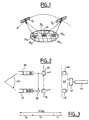
- Each area 20 i ( Figure 1) contains a control station 22, centrally located in the area, for example, and a plurality of terminals 24 1 , 24 2 , 24 3 , 24 4 , etc.
- the control station 22 is connected to a terrestrial or other type of communications network (not shown).
- All calls transmitted or received by a terminal 24 i pass through the control station 22 and calls between each terminal and the station 22 pass through a satellite S 1 or S 2 .
- a call between a terminal 24 i and a user of the network to which the station 22 is connected passes through a satellite S 1 or S 2 and the control station 22.
- a call between a terminal 24 1 and another terminal 24 3 or 24 4 remote from the terminal 24 1 passes through the satellite S 1 , the station 22 and the satellite S 2 or S 1 .
- each satellite has control means for "illuminating" a plurality of terrestrial areas at the same time and such that, as it moves, the satellite modifies the beam so that it always impinges on the area in question during its active passage over the area.
- the maximum duration of its passage is approximately 15 minutes.
- the constellation of satellites must be arranged so that when a satellite is near the end of its period of visibility another satellite can take over the call. Because the telecommunications system is generally intended for high quality calls, the quality of calls must not be affected by the calls being handed over from one satellite to another. In other words, the system must be organized so that, at least when a satellite handling a call is close to leaving its area of visibility, another satellite is simultaneously in its area of visibility and remains there when the first satellite is no longer visible.
- two sets of transmit buffers 30 and 32 are provided in each terminal and/or in the connection station in the Figure 2 example.
- the buffers 30 are for the first path, i.e. the one that is to be abandoned, and the buffers 32 are for the new path.
- the first path uses equipment on satellite S 1 to connect terminal 24 1 to station 22 and the second path uses satellite S 2 to connect terminal 24 1 to station 22.
- each set 30, 32 includes a plurality of buffers, for example one per grade of service or per flow.
- a flow is a volume of traffic data characterized by its destination and/or its grade of service.
- a flow is a connection, a virtual path or a virtual channel.
- the handover time is determined by measuring the quality of transmission, for example by measuring the signal-to-noise ratio, and the second path replaces the first path if its transmission quality is better than the quality on the first path.
- the deterministic nature of the position of the satellites can be used to pre-program the handover times, which can be simultaneous for several terminals.
- the buffers 30 Prior to the handover command (HO), the buffers 30 are filled with cells to be transmitted and after handover the buffers 32 are filled with cells to be transmitted on the second path.
- the cells in the memory 30 are therefore cells N-1, N-2, N and the cells in the buffer 32 are cells N+1, N+2, etc.
- Transmission is in packet mode and the cells are therefore not dated because they can be transmitted at variable, non-deterministic times.
- the transmission of some cells can be delayed because cells of higher priority reach other buffers or because of the arrival of a larger flow of data.
- a transmitter 36 is authorized to transmit cells from the buffer 32 (the one assigned to the second path) only after a transmitter 34 has transmitted the last cell N from the buffer 30 on the first path.
- a gate 38 is provided between the output of the buffer 32 and the input of the transmitter 36.
- the gate is controlled by the output signal of the buffer 30.
- the gate 38 remains closed until cell N has left the buffer 30.
- the gate opens when cell N has left the buffer 30 and has been transmitted on the first path by the transmitter 34.
- the marking of the last cell in the buffer 30 can be reduced to one bit. It is most important to note that this marking is transmitted only within the transmitter (terminal or connection station) and is not transmitted via the satellite. In other words, this handover mechanism limits signaling and is therefore beneficial from the point of view of maximizing call capacity.
- the last cell in the buffer 30 is not marked and instead cells are blocked at the output of the buffer 32 for a particular time after the handover command HO sufficient for cells to be transmitted from the buffer 32 only after the last cell has been transmitted from the buffer 30.
- the cells are received by the receiver 40 in the correct order only if the transmission time from the transmitter to the receiver is the same for both paths. It is generally sufficient for cells or packets on the second path to arrive after cells or packets on the first path. In this way cells or packets do not arrive at the receiver simultaneously, and the transition therefore occurs without losses and the receiver can include a single demodulator 42 and a single buffer 44 ( Figure 2).
- Figure 2 shows that the demodulator 42 can receive signals on the first and second paths via respective antennas 46 and 48 connected to the same input of the demodulator 42.
- the propagation time from the transmitter to the receiver via the first path is proportional to the distance from the transmitter to the satellite S 1 plus the distance from that satellite to the receiver.
- the propagation time is proportional to the distance from the transmitter to the second satellite plus the distance from the second satellite to the receiver.
- the transmitter and/or the receiver include(s) equalization buffers (not shown) and control means such that the time for which the cells remain in each of the buffers is adjusted so that the time spent in the transmitter's equalization buffers plus the time T a for the signals to travel from the transmitter to the receiver plus the time spent in the receiver's equalization buffers is constant and equal to 25 ms, for example.
- Figure 3 shows this property and represents three segments.
- the first segment T g is the time spent in the transmitter's (for example the connection station's) equalization buffers
- the segment T a is the time corresponding to the propagation of the signals at the speed of light from the transmitter to the receiver via a satellite
- the third segment T t is the time the cells spend in the receiver's equalization buffers, i.e. those of a terminal in this example.
- handover applies to transmission between a terminal of a mobile telephone system and a switch upstream of the base transceiver stations.
- a call between the switch and the terminal can be handed over from a first path through a first base transceiver station to a second path through a second base transceiver station.
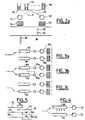
- each terminal or connection station has a set of buffers 60, 62, ..., 66 for storing ATM cells and each buffer corresponds to a particular grade of service.
- the buffer 60 corresponds to electronic mail transmission
- the buffer 62 corresponds to telephone calls
- the buffer 66 corresponds to transmission of program data.
- the memories are assigned variable priorities. Electronic mail has a lower priority than telephone calls, for example.
- the rates of filling and emptying each buffer also depend on the corresponding grade of service and the bit rate of the information in the other buffers.
- the handover 70 from one path to another occurs at the Medium Access Control (MAC) level, i.e. downstream of the buffers 62, 66, but before the cells are multiplexed.
- the cells leaving the buffers must be multiplexed (at 72, 72' in Figure 2a) by distributing the cells in accordance with a grid 74, 74' assigning each cell a particular time slot and/or a particular code (if the CDMA technique is used) as a function of the available resources.
- MAC Medium Access Control
- Each multiplexing system includes its own power control function.
- the receiver 80 receives cells or packets in the correct order only if the transmission time from the transmitter to the receiver is the same on both paths. More generally, it is sufficient for cells or packets on the second path to arrive after cells or packets on the first path. Thus cells or packets therefore do not arrive simultaneously at the receiver and the transition therefore occurs without loss and the receiver can include a single demodulator and a single set of buffers.
- the handover mechanism shown in Figures 2a and 3 does not require any purge cell as used in the prior art, i.e. any marking of the last cell on the first path.
- the transmission times of the cells 76', 78' on the second path are chosen so that the first cell 76' reaches the receiver 80 after the last cell 82 on the first path.
- This embodiment is particularly simple to implement because the multiplexing systems 72 and 72' are independent of each other and there is therefore no constraint on the assignment of powers and resources.
- each buffer corresponding to a grade of service, as in the embodiment described with reference to Figure 2a.
- these figures show only one buffer of the set.
- the time of transmission of the cells on the second path is also chosen so that the first cell reaches the receiver after the last cell on the first path. The facility described with reference to Figure 3 can be used for this purpose.
- Each set 84, 86 of buffers is associated with a respective multiplexing system 84 1 and 86 1 , as in the Figure 2 example.
- the unit 84 1 transmits on a first path and the unit 86 1 transmits on a second path.
- each path corresponds to an antenna pointed at a satellite.
- Figure 3b shows the situation of transmission on the first path before preparing transmission on the second path. Under these conditions, only the set 84 of buffers is fed with cells to be transmitted, the set 86 of buffers remaining empty.
- Figure 3b shows a step of preparing for handover, transmission on the first path, i.e. via the transmitter 84 1 , continuing but filling of the set 86 assigned to the second path beginning.
- the two sets of buffers 84, 86 are filled with identical cells in a preparation step, before handing over transmission from the first path to the second path.
- the cells of each connection are therefore duplicated. Accordingly, in the situation shown in Figure 3b, the initially empty set 86 is filled.
- the set 84 continues to be filled, but also continues to be emptied because of the transmission of cells on the first path.
- the gate 84 2 is opened to enable transmission and the gate 86 2 is closed to prevent transmission.
- the two sets 84, 86 of buffers have identical contents after a particular time which depends on the transmission of cells on the first path. Handover from the first path to the second path can occur from that time. It entails closing the gate 84 2 and opening the gate 86 2 .
- the cells are stored in the buffers of the sets 84 and 86 with a number, an indication of the flow (the buffer or queue) to which they belong and an indication of the receiver they are to reach.
- the buffers of the set 84 pass onto the buffers of the set 86 this number and the other information for cells transmitted on the first path.
- the contents of the buffers of the sets 84 and 86 are considered to be identical when all the duplicated first cells of all the flows addressed to all the terminals have been transmitted on the first path. In this case, all subsequent cells are necessarily in set 86.
- the information supplied by the set 84 to the set 86 on the cells that have been transmitted enables cells already transmitted on the first path to be eliminated from the buffers of the set 86 at the time of handover, i.e. at the start of transmission by the transmitter 86 1 .
- the time between the start of duplication of the cells and handover can be minimized.
- this can be relatively complex because determining the time from which the contents of the two sets of buffers are identical requires the set 84 to supply information to the set 86.
- handover occurs a predetermined time after the start of duplication.
- This latter feature can easily be implemented in a telecommunications system using non-geostationary satellites because the positions of the satellites are known in advance and handover times can be predetermined and therefore anticipated.
- the time between starting cell duplication and handover is in the order of 2 seconds.
- the set 86 contains cells that have already been transmitted by means of the set 84, the cells that have already been transmitted on the first path are eliminated from the set 86. As in the embodiment previously described, it is therefore necessary to compare the contents of the sets 84 to 86 of buffers. However, less signaling is required than in the embodiment for which handover from the first path to the second path occurs as soon as the contents of the buffers are identical.
- handover consists in transferring data from the set 88 of buffers to the set 90 of buffers. This occurs after the last cell is transmitted on the first path.
- the transfer of data from the set 88 to the set 90 can be either serial or parallel. Note that the transfer of data is not of the same nature as the transfer of information described with reference to Figures 3a to 3c, since here it is a question of data as such, not information data such as numbers or identifiers of connections or flows to which the cells belong.
- Data can be transferred from one path to another at any time and the transfers for the various buffers can therefore be synchronized.
- the Figure 5 diagram shows the evolution with time of data reaching a receiver.
- Diagram a) in Figure 5 corresponds to the operation of a receiver using the prior art process in which the receiver re-orders the cells from both paths.
- the first line 92 of this part a) of the diagram corresponds to the arrival time of cells on the first path and the line 94 corresponds to the arrival times of cells on the second path.
- Diagrams b) in Figure 5 correspond to the results obtained with systems of the invention in which there is a plurality of flows or connections, i.e. of buffers. These diagrams show that data from the first buffers arrives in a period 98 on the first path and then in a period 100 on the second path. The two periods 98 and 100 do not overlap and can join instantaneously, as shown. Similarly, for the second buffers, cells on the first path arrive in a period 98 1 and cells on the second path arrive in a period 100 1 , with no overlap, and the transition 99 from the period 98 to the period 100 is simultaneous with the transition 99 1 from the period 98 1 to the period 100 1 .
Landscapes
- Engineering & Computer Science (AREA)
- Computer Networks & Wireless Communication (AREA)
- Signal Processing (AREA)
- Physics & Mathematics (AREA)
- Astronomy & Astrophysics (AREA)
- Aviation & Aerospace Engineering (AREA)
- General Physics & Mathematics (AREA)
- Mobile Radio Communication Systems (AREA)
- Data Exchanges In Wide-Area Networks (AREA)
- Communication Control (AREA)
Claims (28)
- Verfahren zur Übertragung von nicht datierten oder nicht nummerierten digitalen Daten im Paketmodus zwischen einem entfernten Sender und einem entfernten Empfänger, bei dem die Daten auf mindestens zwei verschiedenen Übertragungswegen zwischen dem Sender und dem Empfänger übertragen werden können und eine Übergabe vom ersten zum zweiten Übertragungsweg während der Übertragung erfolgt, dadurch gekennzeichnet, dass in dem Sender Zellen oder Pakete, die für den zweiten Übertragungsweg (36) bestimmt sind, erst dann übertragen werden, nachdem die letzte Zelle oder das letzte Paket, die für den ersten Übertragungsweg (34) bestimmt sind, übertragen worden sind, und dass in deme Sender und/oder in dem Empfänger Zellen oder Pakete auf dem ersten und/oder zweiten Übertragungsweg in der Weise verzögert werden, dass die Zellen oder Pakete auf dem zweiten Übertragungsweg nach den Zellen oder Paketen auf dem ersten Übertragungsweg ankommen.
- Verfahren nach Anspruch 1, dadurch gekennzeichnet, dass ein erster Puffer (30) vorübergehend Daten speichert, die auf dem ersten Übertragungsweg übertragen werden sollen, und ein zweiter Puffer (32) vorübergehend Daten speichert, die auf dem zweiten Übertragungsweg übertragen werden sollen, und dass die Übertragung von Daten von dem zweiten Puffer (32) gesperrt ist, bis die letzte Zelle oder das letzte Paket auf dem ersten Übertragungsweg übertragen ist.
- Verfahren nach Anspruch 2, dadurch gekennzeichnet, dass die letzte Zelle oder das letzte Paket auf dem ersten Übertragungsweg im Sender markiert wird, wobei die Markierung zum Entsperren (38) der Übertragung auf dem zweiten Übertragungsweg dient und die Markierung für die Übertragung zum Empfänger wieder entfernt wird.
- Verfahren nach Anspruch 2, dadurch gekennzeichnet, dass die Übertragung auf dem zweiten Übertragungsweg für eine vorgegebene Zeit gesperrt wird, welche auf den Befehl (HO) zur Übergabe vom ersten Übertragungsweg auf den zweiten Übertragungsweg folgt.
- Verfahren nach einem der Ansprüche 1 bis 4, dadurch gekennzeichnet, dass für einen Empfang von Zellen oder Pakten auf dem ersten Übertragungsweg nach einem Empfang von Zellen oder Pakten auf dem ersten Übertragungsweg Zellen oder Pakete auf dem ersten oder zweiten Übertragungsweg um eine Zeitspanne verzögert werden, die es ermöglicht, dass die Übertragungszeiten auf den beiden Übertragungswegen aufeinander angeglichen werden.
- Verfahren nach Anspruch 5, dadurch gekennzeichnet, dass Ausgleichspuffer im Sender und/oder im Empfänger verwendet werden,um gleiche Übertragungszeiten zu erzielen.
- Verfahren nach Anspruch 1, dadurch gekennzeichnet, dass eine Gruppe (60, 62, 66, 84, 86, 88, 90) von Puffern Daten, die übertragen werden sollen, vorübergehend speichern, wobei jeder Puffer einem bestimmten zu übertragenden Datentyp entspricht und die Übergabe vom ersten Übertragungsweg zum zweiten Übertragungsweg bei den verschiedenen Puffern der Gruppe praktisch synchron erfolgt.
- Verfahren nach Anspruch 7, dadurch gekennzeichnet, dass die Zellen oder Pakete ausreichend lange für eine Angleichung der Übertragungszeit auf den ersten und zweiten Übertragungswegen verzögert werden.
- Verfahren nach Anspruch 7 oder 8, dadurch gekennzeichnet, dass die Puffer zur vorübergehenden Speicherung von zu übertragenden und/oder zu empfangenden Daten zum Verzögern der Zellen verwendet werden.
- Verfahren nach Anspruch 7, 8 oder 9, dadurch gekennzeichnet, dass die Übergabe am Ausgang der Puffer stattfindet, bevor die Zellen oder Pakete für die Übertragung gemultiplext werden.
- Verfahren nach Anspruch 10, dadurch gekennzeichnet, dass die beiden Übertragungswege unabhängig voneinander gemultiplext werden.
- Verfahren nach Anspruch 7, 8 oder 9, gekennzeichnet durch zwei Gruppen von Puffern (84, 86), wovon jeweils eine Gruppe für einen Übertragungsweg vorgesehen ist.
- Verfahren nach Anspruch 12, dadurch gekennzeichnet, dass die beiden Gruppen von Puffern vor der Übergabe vom ersten Übertragungsweg auf den zweiten Übertragungsweg mit denselben Zellen oder Paketen gefüllt werden, wobei die Übergabe durchgeführt wird, wenn die Inhalt der Puffer identisch sind.
- Verfahren nach Anspruch 13, dadurch gekennzeichnet, dass die Übergabe zu einer bestimmten Zeit nach Beginn des Füllens der Puffer mit denselben Zellen oder Paketen erfolgt.
- Verfahren nach Anspruch 13, dadurch gekennzeichnet, dass die Übertragung erfolgt, wenn festgestellt wird, dass die Inhalte der Puffer übereinstimmen.
- Verfahren nach Anspruch 15, dadurch gekennzeichnet, dass die Inhalte der Puffer als identisch erachtet werden, wenn die erste verdoppelte Zelle oder das erste verdoppelte Paket der letzten Verbindung auf dem ersten Übertragungsweg übertragen ist.
- Verfahren nach einem der Ansprüche 13 bis 16, dadurch gekennzeichnet, dass Zellen oder Pakete, die bereits auf dem ersten Übertragungsweg übertragen sind, aus der zweiten Gruppe von Puffern gelöscht werden, und zwar zwischen der Übertragung der letzten Zelle oder des letzten Pakets auf dem ersten Übertragungsweg und dem Beginn der Übertragung auf dem zweiten Übertragungsweg.
- Verfahren nach einem der Ansprüche 7 bis 17, dadurch gekennzeichnet, dass jeder Puffer für eine bestimmte Betriebssstufe und/oder einen bestimmten Datenfluss vorgesehen ist.
- Empfänger zum Empfang von nicht datierten oder nicht nummerierten digitalen Daten im Paketmodus von einem entfernten Sender, wobei die Daten über zwei verschiedene Übertragungswege übertragen werden können und die Übergabe von einem ersten Übertragungsweg zu einem zweiten Übertragungsweg während der Übertragung stattfinden kann, dadurch gekennzeichnet, dass in dem Sender Zellen oder Pakete, die für den zweiten Übertragungsweg (36) bestimmt sind, erst dann übertragen werden, wenn die letzte Zelle oder das letzte Paket, die für den ersten Übertragungsweg bestimmt sind, übertragen worden sind, und dass in dem Empfänger die Zellen oder Pakete auf dem zweiten Übertragungsweg erst ankommen, nachdem die Zellen oder Pakete auf dem ersten Übertragungsweg angekommen sind, wobei der Empfänger einen einzigen Demodulator (42) aufweist.
- Empfänger nach Anspruch 19, gekennzeichnet durch einen einzigen Puffer (44).
- Sender zur Durchführung des Verfahrens nach einem der Ansprüche 2 bis 4, mit zwei Puffern (30, 32), wobei der erste Puffer (30) für die vorübergehende Speicherung von nicht datierten oder nicht nummerierten Zellen oder Paketen bestimmt ist, die auf dem ersten Übertragungsweg übertragen werden sollen, während der zweite Puffer (32) für die vorübergehende Speicherung von nicht datierten oder nicht nummerierten Zellen oder Paketen bestimmt ist, die auf dem zweiten Übertragungsweg übertragen werden sollen, gekennzeichnet durch eine Einrichtung (38) zum Verhindern der Übertragung von Daten am Ausgang des zweiten Puffers (32), wobei diese Einrichtung nach der Übertragung der letzten Zelle oder des letzten Pakets auf dem ersten Übertragungsweg deaktiviert wird.
- Sender nach Anspruch 21, gekennzeichnet durch eine Einrichtung zum Markieren der letzten Zelle auf dem ersten Übertragungsweg mit einer Kennung, die verwendet wird, um die Deaktivierung der Einrichtung zum Verhindern der Datenübertragung auf dem zweiten Übertragungsweg zu befehlen.
- Sender nach Anspruch 21, dadurch gekennzeichnet, dass die Kennung beseitigt wird, bevor die letze Zelle oder das letzte Paket auf dem ersten Übertragungsweg übertragen wird.
- Empfänger nach Anspruch 21, dadurch gekennzeichnet, dass die Einrichtung zum Verhindern der Datenübertragung am Ausgang des zweiten Puffers eine Zeitverzögerungseinrichtung aufweist, derart, dass die Einrichtung zum Verhindern der Datenübertragung vom zweiten Puffer eine bestimmte Zeit nach dem Befehl zur Übergabe von dem ersten Übertragungsweg zu dem zweiten Übertragungsweg aktiv bleibt.
- Empfänger nach einem der Ansprüche 21 bis 24, gekennzeichnet durch mindestens einen Ausgleichspuffer zum Verzögern von Zellen oder Paketen auf dem ersten Übertragungsweg oder dem zweiten Übertragungsweg ausreichend lange für eine Angleichung der Übertragungszeiten auf den beiden Übertragungswegen.
- Empfänger nach Anspruch 25, dadurch gekennzeichnet, dass die Puffer für die vorübergehende Speicherung auch zum Angleichen verwendet werden.
- Verwendung des Verfahrens nach einem der Ansprüche 1 bis 18 für ein Telekommunikationssystem, das eine Konstellation von Satelliten in niedrigen oder mittleren Umlaufbahnen verwendet, bei dem alle Terminals mit einer Anschlussstation über Satellit kommunizieren und ein anderer Satellit den Anruf übernimmt, insbesondere wenn der erste Satellit den Sichtbereich des/der betreffenden Terminals verlässt.
- Verwendung des Verfahrens nach einem der Ansprüche 1 bis 18 für ein mobiles Kommunikationssystem, bei dem jeder Mobiltelefonbereich eine Basis-Sende-/Empfangsstation für die Verbindung der Terminals mit dem Netzwerk über einen Schalter aufweist, wobei die Terminals über eine Basis-Sende-/Empfangsstation kommunizieren und ein Anruf von einem ersten Übertragungsweg über eine erste Basis-Sende-/Empfangsstation zu einem zweiten Übertragungsweg über eine zweite Basis-Sende-/Empfangsstation übergeben werden kann.
Applications Claiming Priority (2)
| Application Number | Priority Date | Filing Date | Title |
|---|---|---|---|
| FR9911576A FR2798810B1 (fr) | 1999-09-16 | 1999-09-16 | Procede et systeme de telecommunication en mode paquets dans lequel plusieurs communications sont transferables d'un chemin vers un autre |
| FR9911576 | 1999-09-16 |
Publications (2)
| Publication Number | Publication Date |
|---|---|
| EP1085779A1 EP1085779A1 (de) | 2001-03-21 |
| EP1085779B1 true EP1085779B1 (de) | 2003-04-16 |
Family
ID=9549908
Family Applications (1)
| Application Number | Title | Priority Date | Filing Date |
|---|---|---|---|
| EP99403020A Expired - Lifetime EP1085779B1 (de) | 1999-09-16 | 1999-12-03 | Verfahren und System zum Weiterreichen im Paketmodus |
Country Status (9)
| Country | Link |
|---|---|
| US (1) | US6690935B1 (de) |
| EP (1) | EP1085779B1 (de) |
| JP (1) | JP2001148879A (de) |
| KR (1) | KR20010030390A (de) |
| CN (1) | CN1167283C (de) |
| AT (1) | ATE237914T1 (de) |
| AU (1) | AU5938900A (de) |
| DE (1) | DE69906968D1 (de) |
| FR (1) | FR2798810B1 (de) |
Families Citing this family (27)
| Publication number | Priority date | Publication date | Assignee | Title |
|---|---|---|---|---|
| US20020128032A1 (en) * | 2000-06-16 | 2002-09-12 | Akito Fukui | Radio communication system |
| US6717927B2 (en) | 2002-04-05 | 2004-04-06 | Interdigital Technology Corporation | System for efficient recovery of node B buffered data following serving high speed downlink shared channel cell change |
| EP1383292B1 (de) * | 2002-07-16 | 2005-06-29 | Lucent Technologies Inc. | Verfahren und Vorrichtung zur Paketsortierung in einem mobilen Kommunikationsnetzwerk |
| KR20040012016A (ko) * | 2002-07-31 | 2004-02-11 | 엘지전자 주식회사 | 이동 통신 시스템의 핸드오버 처리 장치 및 방법 |
| US7706405B2 (en) | 2002-09-12 | 2010-04-27 | Interdigital Technology Corporation | System for efficient recovery of Node-B buffered data following MAC layer reset |
| EP1453327A1 (de) * | 2003-02-27 | 2004-09-01 | Siemens Aktiengesellschaft | Verfahren zur paketvermittelten Datenübertragung in einem Funkkommunikationssytem |
| JP4755550B2 (ja) * | 2005-08-25 | 2011-08-24 | 株式会社エヌ・ティ・ティ・ドコモ | 基地局、制御局、及び、無線通信制御方法 |
| US8411662B1 (en) | 2005-10-04 | 2013-04-02 | Pico Mobile Networks, Inc. | Beacon based proximity services |
| US8257177B1 (en) | 2005-10-04 | 2012-09-04 | PICO Mobile Networks, Inc | Proximity based games for mobile communication devices |
| US8619623B2 (en) * | 2006-08-08 | 2013-12-31 | Marvell World Trade Ltd. | Ad-hoc simple configuration |
| US8233456B1 (en) | 2006-10-16 | 2012-07-31 | Marvell International Ltd. | Power save mechanisms for dynamic ad-hoc networks |
| US8732315B2 (en) | 2006-10-16 | 2014-05-20 | Marvell International Ltd. | Automatic ad-hoc network creation and coalescing using WiFi protected setup |
| US9308455B1 (en) | 2006-10-25 | 2016-04-12 | Marvell International Ltd. | System and method for gaming in an ad-hoc network |
| US8279884B1 (en) | 2006-11-21 | 2012-10-02 | Pico Mobile Networks, Inc. | Integrated adaptive jitter buffer |
| US7961756B1 (en) | 2006-11-21 | 2011-06-14 | Picomobile Networks, Inc. | Integrated multimedia system |
| US7970384B1 (en) | 2006-11-21 | 2011-06-28 | Picomobile Networks, Inc. | Active phone book enhancements |
| US7889686B1 (en) | 2006-11-21 | 2011-02-15 | Picomobile Networks, Inc. | Seamless switching of media streams between different networks |
| US7978699B1 (en) | 2006-11-21 | 2011-07-12 | Picomobile Networks, Inc. | Protocol compression with synchronized sequence numbers |
| US8918051B1 (en) | 2007-06-18 | 2014-12-23 | Marvell International Ltd. | Method and apparatus for performing a handoff of a data communication session from one network to another network |
| WO2009006585A1 (en) * | 2007-07-03 | 2009-01-08 | Marvell Semiconductor, Inc. | Location aware ad-hoc gaming |
| EP2076068A1 (de) * | 2007-12-26 | 2009-07-01 | Alcatel Lucent | Verfahren und Vorrichtung zum Handover in einem drahtlosen Telekommunikationsnetz |
| JP4535179B2 (ja) * | 2008-08-14 | 2010-09-01 | ソニー株式会社 | 無線通信装置、通信システム、および通信制御方法、並びにプログラム |
| JP4609547B2 (ja) * | 2008-08-14 | 2011-01-12 | ソニー株式会社 | 無線通信装置、通信システム、および通信制御方法、並びにプログラム |
| US20110105126A1 (en) * | 2009-06-15 | 2011-05-05 | The Aerospace Corportion | Terminal initiated intrasatellite antenna handover method |
| US9380401B1 (en) | 2010-02-03 | 2016-06-28 | Marvell International Ltd. | Signaling schemes allowing discovery of network devices capable of operating in multiple network modes |
| US9961008B2 (en) * | 2015-11-19 | 2018-05-01 | Ayecka Communication Systems | Method and system of handling over routing of communication protocol data between two satellite communication transponders |
| JP7616357B2 (ja) * | 2021-04-16 | 2025-01-17 | 日本電信電話株式会社 | 無線通信システム、無線通信方法、及び通信経路決定装置 |
Family Cites Families (11)
| Publication number | Priority date | Publication date | Assignee | Title |
|---|---|---|---|---|
| FR2586150B1 (fr) * | 1985-08-07 | 1987-10-23 | Thomson Csf Mat Tel | Dispositif de transmission de paquets dans un reseau temporel asynchrone, et procede de codage des silences |
| US5181200A (en) * | 1990-10-29 | 1993-01-19 | International Business Machines Corporation | Handoff method and apparatus for mobile wireless workstation |
| GB2252020A (en) * | 1990-12-04 | 1992-07-22 | Ibm | Flow control in data communication systems. |
| US5530693A (en) * | 1995-06-06 | 1996-06-25 | Averbuch; Rod | Method and apparatus for performing handoff in a packet data communication system |
| NL1002030C2 (nl) * | 1996-01-05 | 1997-07-09 | Nederland Ptt | Telecommunicatiesysteem, alsmede datapakketten-schakelaar, alsmede werkwijze. |
| US5940381A (en) * | 1996-03-14 | 1999-08-17 | Motorola, Inc. | Asynchronous transfer mode radio communications system with handoff and method of operation |
| JP3200403B2 (ja) * | 1996-10-14 | 2001-08-20 | 日本電信電話株式会社 | データ送信方法、データ送受信方法およびデータ送信装置 |
| FI109503B (fi) * | 1997-04-15 | 2002-08-15 | Nokia Corp | Pakettien menetyksen estäminen pakettipohjaisen tietoliikenneverkon handoverissa sekä handovermenetelmä |
| US6105064A (en) * | 1997-05-30 | 2000-08-15 | Novell, Inc. | System for placing packets on network for transmission from sending endnode to receiving endnode at times which are determined by window size and metering interval |
| US6021124A (en) * | 1997-08-19 | 2000-02-01 | Telefonaktiebolaget Lm Ericsson | Multi-channel automatic retransmission query (ARQ) method |
| US6496481B1 (en) * | 1998-07-16 | 2002-12-17 | Industrial Technology Research Institute | Data transfer method for wire real-time communications |
-
1999
- 1999-09-16 FR FR9911576A patent/FR2798810B1/fr not_active Expired - Fee Related
- 1999-12-03 DE DE69906968T patent/DE69906968D1/de not_active Expired - Lifetime
- 1999-12-03 AT AT99403020T patent/ATE237914T1/de not_active IP Right Cessation
- 1999-12-03 EP EP99403020A patent/EP1085779B1/de not_active Expired - Lifetime
- 1999-12-10 US US09/458,072 patent/US6690935B1/en not_active Expired - Fee Related
-
2000
- 2000-09-12 AU AU59389/00A patent/AU5938900A/en not_active Abandoned
- 2000-09-12 JP JP2000276332A patent/JP2001148879A/ja not_active Withdrawn
- 2000-09-15 CN CNB001270699A patent/CN1167283C/zh not_active Expired - Fee Related
- 2000-09-15 KR KR1020000054156A patent/KR20010030390A/ko not_active Withdrawn
Also Published As
| Publication number | Publication date |
|---|---|
| US6690935B1 (en) | 2004-02-10 |
| CN1289215A (zh) | 2001-03-28 |
| JP2001148879A (ja) | 2001-05-29 |
| FR2798810A1 (fr) | 2001-03-23 |
| CN1167283C (zh) | 2004-09-15 |
| FR2798810B1 (fr) | 2002-05-31 |
| ATE237914T1 (de) | 2003-05-15 |
| KR20010030390A (ko) | 2001-04-16 |
| EP1085779A1 (de) | 2001-03-21 |
| DE69906968D1 (de) | 2003-05-22 |
| AU5938900A (en) | 2001-03-22 |
Similar Documents
| Publication | Publication Date | Title |
|---|---|---|
| US6690935B1 (en) | Packet mode telecommunications method and system in which calls can be handed over from one path to another | |
| US6377561B1 (en) | Data communication satellite system and method of carrying multi-media traffic | |
| EP1032986B1 (de) | Übertragungsverfahren für leitungsvermittelte daten, paket daten und atm zell daten in einem satelliten/funk- tdma- system | |
| EP0616480B1 (de) | Kommunikationssystem zwischen ATM Netz und Mobilfunksystem | |
| US5434854A (en) | System for communicating digital cellular data between a cell site and a switching system or another cell site | |
| US5434853A (en) | System and method for providing soft handoff of a cellular mobile-to-mobile call | |
| US5896373A (en) | Method for executing handover in a radio extension of an ATM network | |
| US20020067706A1 (en) | Method and system for performing an optimised handover | |
| US6163547A (en) | In-band signaling for a hand-over operation in a mobile telecommunication system | |
| US5097466A (en) | Method and circuitry for transmission of communications signals in a broad-band communications network | |
| IE53245B1 (en) | Loop communication system | |
| US6839329B1 (en) | Cell flow synchronization establishing system of wireless ATM access system | |
| US6597669B1 (en) | Queue segmentation and addressing method and apparatus for a cell switch in a processing communications satellite | |
| US5884173A (en) | Mobile radio system with improved handover facility | |
| US6167028A (en) | Methods and apparatus for facilitating transmission of cells having multiple priorities in a cell relay network | |
| AU703430B2 (en) | A method and apparatus for communicating between nodes in a communications network | |
| US6975605B2 (en) | Radio communication system | |
| US8265082B2 (en) | Relay including a mass memory for temporarily storing differed-time information streams | |
| EP1089462B1 (de) | Verarbeitungsverfahren für Satellitenmehrfachübertragungen | |
| CA2291192C (en) | System and method for equalizing delay in a dynamic packet switching network | |
| EP0516374B1 (de) | Übertragungskanäle mit veränderlicher Datenrate für digitale Netzwerke | |
| Marchent et al. | Handover and macro diversity for 3rd generation mobile systems within atm fixed networks | |
| JP2001069056A (ja) | 移動衛星を使用する伝送システムでディジタルパケットを送受信するための方法および装置 | |
| Stern et al. | Next generation communications satellites: Multiple access and network studies |
Legal Events
| Date | Code | Title | Description |
|---|---|---|---|
| PUAI | Public reference made under article 153(3) epc to a published international application that has entered the european phase |
Free format text: ORIGINAL CODE: 0009012 |
|
| 17P | Request for examination filed |
Effective date: 19991217 |
|
| AK | Designated contracting states |
Kind code of ref document: A1 Designated state(s): AT BE CH CY DE DK ES FI FR GB GR IE IT LI LU MC NL PT SE |
|
| AX | Request for extension of the european patent |
Free format text: AL;LT;LV;MK;RO;SI |
|
| 17Q | First examination report despatched |
Effective date: 20010822 |
|
| AKX | Designation fees paid |
Free format text: AT BE CH CY DE DK ES FI FR GB GR IE IT LI LU MC NL PT SE |
|
| GRAH | Despatch of communication of intention to grant a patent |
Free format text: ORIGINAL CODE: EPIDOS IGRA |
|
| GRAH | Despatch of communication of intention to grant a patent |
Free format text: ORIGINAL CODE: EPIDOS IGRA |
|
| GRAA | (expected) grant |
Free format text: ORIGINAL CODE: 0009210 |
|
| AK | Designated contracting states |
Designated state(s): AT BE CH CY DE DK ES FI FR GB GR IE IT LI LU MC NL PT SE |
|
| PG25 | Lapsed in a contracting state [announced via postgrant information from national office to epo] |
Ref country code: NL Free format text: LAPSE BECAUSE OF FAILURE TO SUBMIT A TRANSLATION OF THE DESCRIPTION OR TO PAY THE FEE WITHIN THE PRESCRIBED TIME-LIMIT Effective date: 20030416 Ref country code: LI Free format text: LAPSE BECAUSE OF FAILURE TO SUBMIT A TRANSLATION OF THE DESCRIPTION OR TO PAY THE FEE WITHIN THE PRESCRIBED TIME-LIMIT Effective date: 20030416 Ref country code: IT Free format text: LAPSE BECAUSE OF FAILURE TO SUBMIT A TRANSLATION OF THE DESCRIPTION OR TO PAY THE FEE WITHIN THE PRESCRIBED TIME-LIMIT;WARNING: LAPSES OF ITALIAN PATENTS WITH EFFECTIVE DATE BEFORE 2007 MAY HAVE OCCURRED AT ANY TIME BEFORE 2007. THE CORRECT EFFECTIVE DATE MAY BE DIFFERENT FROM THE ONE RECORDED. Effective date: 20030416 Ref country code: FI Free format text: LAPSE BECAUSE OF FAILURE TO SUBMIT A TRANSLATION OF THE DESCRIPTION OR TO PAY THE FEE WITHIN THE PRESCRIBED TIME-LIMIT Effective date: 20030416 Ref country code: CH Free format text: LAPSE BECAUSE OF FAILURE TO SUBMIT A TRANSLATION OF THE DESCRIPTION OR TO PAY THE FEE WITHIN THE PRESCRIBED TIME-LIMIT Effective date: 20030416 Ref country code: AT Free format text: LAPSE BECAUSE OF FAILURE TO SUBMIT A TRANSLATION OF THE DESCRIPTION OR TO PAY THE FEE WITHIN THE PRESCRIBED TIME-LIMIT Effective date: 20030416 |
|
| REG | Reference to a national code |
Ref country code: GB Ref legal event code: FG4D |
|
| REG | Reference to a national code |
Ref country code: CH Ref legal event code: EP |
|
| REF | Corresponds to: |
Ref document number: 69906968 Country of ref document: DE Date of ref document: 20030522 Kind code of ref document: P |
|
| REG | Reference to a national code |
Ref country code: IE Ref legal event code: FG4D |
|
| PG25 | Lapsed in a contracting state [announced via postgrant information from national office to epo] |
Ref country code: SE Free format text: LAPSE BECAUSE OF FAILURE TO SUBMIT A TRANSLATION OF THE DESCRIPTION OR TO PAY THE FEE WITHIN THE PRESCRIBED TIME-LIMIT Effective date: 20030716 Ref country code: PT Free format text: LAPSE BECAUSE OF FAILURE TO SUBMIT A TRANSLATION OF THE DESCRIPTION OR TO PAY THE FEE WITHIN THE PRESCRIBED TIME-LIMIT Effective date: 20030716 Ref country code: GR Free format text: LAPSE BECAUSE OF FAILURE TO SUBMIT A TRANSLATION OF THE DESCRIPTION OR TO PAY THE FEE WITHIN THE PRESCRIBED TIME-LIMIT Effective date: 20030716 Ref country code: DK Free format text: LAPSE BECAUSE OF FAILURE TO SUBMIT A TRANSLATION OF THE DESCRIPTION OR TO PAY THE FEE WITHIN THE PRESCRIBED TIME-LIMIT Effective date: 20030716 |
|
| PG25 | Lapsed in a contracting state [announced via postgrant information from national office to epo] |
Ref country code: DE Free format text: LAPSE BECAUSE OF FAILURE TO SUBMIT A TRANSLATION OF THE DESCRIPTION OR TO PAY THE FEE WITHIN THE PRESCRIBED TIME-LIMIT Effective date: 20030717 |
|
| NLV1 | Nl: lapsed or annulled due to failure to fulfill the requirements of art. 29p and 29m of the patents act | ||
| PG25 | Lapsed in a contracting state [announced via postgrant information from national office to epo] |
Ref country code: ES Free format text: LAPSE BECAUSE OF FAILURE TO SUBMIT A TRANSLATION OF THE DESCRIPTION OR TO PAY THE FEE WITHIN THE PRESCRIBED TIME-LIMIT Effective date: 20031030 |
|
| REG | Reference to a national code |
Ref country code: CH Ref legal event code: PL |
|
| PG25 | Lapsed in a contracting state [announced via postgrant information from national office to epo] |
Ref country code: IE Free format text: LAPSE BECAUSE OF NON-PAYMENT OF DUE FEES Effective date: 20031203 Ref country code: CY Free format text: LAPSE BECAUSE OF FAILURE TO SUBMIT A TRANSLATION OF THE DESCRIPTION OR TO PAY THE FEE WITHIN THE PRESCRIBED TIME-LIMIT Effective date: 20031203 |
|
| PG25 | Lapsed in a contracting state [announced via postgrant information from national office to epo] |
Ref country code: MC Free format text: LAPSE BECAUSE OF NON-PAYMENT OF DUE FEES Effective date: 20031231 |
|
| ET | Fr: translation filed | ||
| PLBE | No opposition filed within time limit |
Free format text: ORIGINAL CODE: 0009261 |
|
| STAA | Information on the status of an ep patent application or granted ep patent |
Free format text: STATUS: NO OPPOSITION FILED WITHIN TIME LIMIT |
|
| 26N | No opposition filed |
Effective date: 20040119 |
|
| REG | Reference to a national code |
Ref country code: IE Ref legal event code: MM4A |
|
| PGFP | Annual fee paid to national office [announced via postgrant information from national office to epo] |
Ref country code: FR Payment date: 20051110 Year of fee payment: 7 |
|
| PGFP | Annual fee paid to national office [announced via postgrant information from national office to epo] |
Ref country code: LU Payment date: 20051124 Year of fee payment: 7 |
|
| PGFP | Annual fee paid to national office [announced via postgrant information from national office to epo] |
Ref country code: GB Payment date: 20051125 Year of fee payment: 7 Ref country code: BE Payment date: 20051125 Year of fee payment: 7 |
|
| PG25 | Lapsed in a contracting state [announced via postgrant information from national office to epo] |
Ref country code: BE Free format text: LAPSE BECAUSE OF NON-PAYMENT OF DUE FEES Effective date: 20061231 |
|
| GBPC | Gb: european patent ceased through non-payment of renewal fee |
Effective date: 20061203 |
|
| REG | Reference to a national code |
Ref country code: FR Ref legal event code: ST Effective date: 20070831 |
|
| PG25 | Lapsed in a contracting state [announced via postgrant information from national office to epo] |
Ref country code: GB Free format text: LAPSE BECAUSE OF NON-PAYMENT OF DUE FEES Effective date: 20061203 |
|
| BERE | Be: lapsed |
Owner name: *ALCATEL Effective date: 20061231 |
|
| PG25 | Lapsed in a contracting state [announced via postgrant information from national office to epo] |
Ref country code: FR Free format text: LAPSE BECAUSE OF NON-PAYMENT OF DUE FEES Effective date: 20070102 |
|
| PG25 | Lapsed in a contracting state [announced via postgrant information from national office to epo] |
Ref country code: LU Free format text: LAPSE BECAUSE OF NON-PAYMENT OF DUE FEES Effective date: 20061203 |