EP1085005A2 - Process for producing aromatic carboxylic acid - Google Patents
Process for producing aromatic carboxylic acid Download PDFInfo
- Publication number
- EP1085005A2 EP1085005A2 EP00119596A EP00119596A EP1085005A2 EP 1085005 A2 EP1085005 A2 EP 1085005A2 EP 00119596 A EP00119596 A EP 00119596A EP 00119596 A EP00119596 A EP 00119596A EP 1085005 A2 EP1085005 A2 EP 1085005A2
- Authority
- EP
- European Patent Office
- Prior art keywords
- hydrogen gas
- carboxylic acid
- oxidation
- catalyst
- aromatic carboxylic
- Prior art date
- Legal status (The legal status is an assumption and is not a legal conclusion. Google has not performed a legal analysis and makes no representation as to the accuracy of the status listed.)
- Withdrawn
Links
- WPYMKLBDIGXBTP-UHFFFAOYSA-N benzoic acid Chemical compound OC(=O)C1=CC=CC=C1 WPYMKLBDIGXBTP-UHFFFAOYSA-N 0.000 title claims abstract description 29
- 238000000034 method Methods 0.000 title claims abstract description 29
- UFHFLCQGNIYNRP-UHFFFAOYSA-N Hydrogen Chemical compound [H][H] UFHFLCQGNIYNRP-UHFFFAOYSA-N 0.000 claims abstract description 84
- 238000007254 oxidation reaction Methods 0.000 claims abstract description 67
- 230000003647 oxidation Effects 0.000 claims abstract description 46
- 239000003054 catalyst Substances 0.000 claims abstract description 43
- 239000007788 liquid Substances 0.000 claims abstract description 37
- 239000007810 chemical reaction solvent Substances 0.000 claims abstract description 34
- 150000001875 compounds Chemical class 0.000 claims abstract description 20
- MYMOFIZGZYHOMD-UHFFFAOYSA-N Dioxygen Chemical compound O=O MYMOFIZGZYHOMD-UHFFFAOYSA-N 0.000 claims abstract description 14
- 229910001882 dioxygen Inorganic materials 0.000 claims abstract description 13
- 150000007933 aliphatic carboxylic acids Chemical class 0.000 claims abstract description 12
- 239000007791 liquid phase Substances 0.000 claims abstract description 11
- KKEYFWRCBNTPAC-UHFFFAOYSA-N Terephthalic acid Chemical compound OC(=O)C1=CC=C(C(O)=O)C=C1 KKEYFWRCBNTPAC-UHFFFAOYSA-N 0.000 claims description 80
- -1 bromine compound Chemical class 0.000 claims description 12
- 229910001385 heavy metal Inorganic materials 0.000 claims description 11
- GDTBXPJZTBHREO-UHFFFAOYSA-N bromine Substances BrBr GDTBXPJZTBHREO-UHFFFAOYSA-N 0.000 claims description 9
- 229910052794 bromium Inorganic materials 0.000 claims description 8
- 150000002736 metal compounds Chemical class 0.000 claims description 6
- 239000007864 aqueous solution Substances 0.000 abstract description 13
- 239000000047 product Substances 0.000 abstract description 12
- 238000002834 transmittance Methods 0.000 abstract description 12
- 239000000543 intermediate Substances 0.000 abstract description 4
- 238000007086 side reaction Methods 0.000 abstract description 3
- 238000011109 contamination Methods 0.000 abstract description 2
- 230000001747 exhibiting effect Effects 0.000 abstract description 2
- 239000006227 byproduct Substances 0.000 abstract 1
- QTBSBXVTEAMEQO-UHFFFAOYSA-N Acetic acid Chemical compound CC(O)=O QTBSBXVTEAMEQO-UHFFFAOYSA-N 0.000 description 39
- URLKBWYHVLBVBO-UHFFFAOYSA-N Para-Xylene Chemical group CC1=CC=C(C)C=C1 URLKBWYHVLBVBO-UHFFFAOYSA-N 0.000 description 30
- GOUHYARYYWKXHS-UHFFFAOYSA-N 4-formylbenzoic acid Chemical compound OC(=O)C1=CC=C(C=O)C=C1 GOUHYARYYWKXHS-UHFFFAOYSA-N 0.000 description 28
- 238000005406 washing Methods 0.000 description 17
- 239000012452 mother liquor Substances 0.000 description 15
- 239000007789 gas Substances 0.000 description 14
- 239000000203 mixture Substances 0.000 description 14
- 239000002994 raw material Substances 0.000 description 13
- 125000000217 alkyl group Chemical group 0.000 description 12
- IJGRMHOSHXDMSA-UHFFFAOYSA-N Atomic nitrogen Chemical compound N#N IJGRMHOSHXDMSA-UHFFFAOYSA-N 0.000 description 11
- 239000000243 solution Substances 0.000 description 11
- 238000004519 manufacturing process Methods 0.000 description 10
- 238000006243 chemical reaction Methods 0.000 description 9
- 239000013078 crystal Substances 0.000 description 9
- 229910001873 dinitrogen Inorganic materials 0.000 description 9
- 230000005587 bubbling Effects 0.000 description 7
- 125000004432 carbon atom Chemical group C* 0.000 description 6
- 230000000694 effects Effects 0.000 description 6
- 239000012535 impurity Substances 0.000 description 6
- 239000002904 solvent Substances 0.000 description 6
- XLYOFNOQVPJJNP-UHFFFAOYSA-N water Substances O XLYOFNOQVPJJNP-UHFFFAOYSA-N 0.000 description 6
- 230000000052 comparative effect Effects 0.000 description 5
- 239000001257 hydrogen Substances 0.000 description 5
- 229910052739 hydrogen Inorganic materials 0.000 description 5
- 125000001424 substituent group Chemical group 0.000 description 5
- CPELXLSAUQHCOX-UHFFFAOYSA-N Hydrogen bromide Chemical compound Br CPELXLSAUQHCOX-UHFFFAOYSA-N 0.000 description 4
- 239000007787 solid Substances 0.000 description 4
- 239000002912 waste gas Substances 0.000 description 4
- BMYNFMYTOJXKLE-UHFFFAOYSA-N 3-azaniumyl-2-hydroxypropanoate Chemical compound NCC(O)C(O)=O BMYNFMYTOJXKLE-UHFFFAOYSA-N 0.000 description 3
- WKBOTKDWSSQWDR-UHFFFAOYSA-N Bromine atom Chemical class [Br] WKBOTKDWSSQWDR-UHFFFAOYSA-N 0.000 description 3
- KWYUFKZDYYNOTN-UHFFFAOYSA-M Potassium hydroxide Chemical compound [OH-].[K+] KWYUFKZDYYNOTN-UHFFFAOYSA-M 0.000 description 3
- 239000002253 acid Substances 0.000 description 3
- 150000001491 aromatic compounds Chemical class 0.000 description 3
- QVGXLLKOCUKJST-UHFFFAOYSA-N atomic oxygen Chemical compound [O] QVGXLLKOCUKJST-UHFFFAOYSA-N 0.000 description 3
- 239000007795 chemical reaction product Substances 0.000 description 3
- 229940011182 cobalt acetate Drugs 0.000 description 3
- QAHREYKOYSIQPH-UHFFFAOYSA-L cobalt(II) acetate Chemical compound [Co+2].CC([O-])=O.CC([O-])=O QAHREYKOYSIQPH-UHFFFAOYSA-L 0.000 description 3
- 238000004821 distillation Methods 0.000 description 3
- 230000001590 oxidative effect Effects 0.000 description 3
- 239000001301 oxygen Substances 0.000 description 3
- 229910052760 oxygen Inorganic materials 0.000 description 3
- 239000011541 reaction mixture Substances 0.000 description 3
- 239000002002 slurry Substances 0.000 description 3
- XCYJPXQACVEIOS-UHFFFAOYSA-N 1-isopropyl-3-methylbenzene Chemical compound CC(C)C1=CC=CC(C)=C1 XCYJPXQACVEIOS-UHFFFAOYSA-N 0.000 description 2
- 239000001431 2-methylbenzaldehyde Substances 0.000 description 2
- XKRFYHLGVUSROY-UHFFFAOYSA-N Argon Chemical compound [Ar] XKRFYHLGVUSROY-UHFFFAOYSA-N 0.000 description 2
- FERIUCNNQQJTOY-UHFFFAOYSA-N Butyric acid Chemical compound CCCC(O)=O FERIUCNNQQJTOY-UHFFFAOYSA-N 0.000 description 2
- PCLIMKBDDGJMGD-UHFFFAOYSA-N N-bromosuccinimide Chemical compound BrN1C(=O)CCC1=O PCLIMKBDDGJMGD-UHFFFAOYSA-N 0.000 description 2
- PXHVJJICTQNCMI-UHFFFAOYSA-N Nickel Chemical compound [Ni] PXHVJJICTQNCMI-UHFFFAOYSA-N 0.000 description 2
- 150000001242 acetic acid derivatives Chemical class 0.000 description 2
- 238000013019 agitation Methods 0.000 description 2
- 125000003118 aryl group Chemical group 0.000 description 2
- QMKYBPDZANOJGF-UHFFFAOYSA-N benzene-1,3,5-tricarboxylic acid Chemical compound OC(=O)C1=CC(C(O)=O)=CC(C(O)=O)=C1 QMKYBPDZANOJGF-UHFFFAOYSA-N 0.000 description 2
- 150000001649 bromium compounds Chemical class 0.000 description 2
- DIKBFYAXUHHXCS-UHFFFAOYSA-N bromoform Chemical compound BrC(Br)Br DIKBFYAXUHHXCS-UHFFFAOYSA-N 0.000 description 2
- 229910017052 cobalt Inorganic materials 0.000 description 2
- 239000010941 cobalt Substances 0.000 description 2
- GUTLYIVDDKVIGB-UHFFFAOYSA-N cobalt atom Chemical compound [Co] GUTLYIVDDKVIGB-UHFFFAOYSA-N 0.000 description 2
- ZBYYWKJVSFHYJL-UHFFFAOYSA-L cobalt(2+);diacetate;tetrahydrate Chemical compound O.O.O.O.[Co+2].CC([O-])=O.CC([O-])=O ZBYYWKJVSFHYJL-UHFFFAOYSA-L 0.000 description 2
- 238000010586 diagram Methods 0.000 description 2
- XBDQKXXYIPTUBI-UHFFFAOYSA-N dimethylselenoniopropionate Natural products CCC(O)=O XBDQKXXYIPTUBI-UHFFFAOYSA-N 0.000 description 2
- 238000001914 filtration Methods 0.000 description 2
- 125000000524 functional group Chemical group 0.000 description 2
- 229910000042 hydrogen bromide Inorganic materials 0.000 description 2
- 239000011261 inert gas Substances 0.000 description 2
- KQNPFQTWMSNSAP-UHFFFAOYSA-N isobutyric acid Chemical compound CC(C)C(O)=O KQNPFQTWMSNSAP-UHFFFAOYSA-N 0.000 description 2
- QQVIHTHCMHWDBS-UHFFFAOYSA-N isophthalic acid Chemical compound OC(=O)C1=CC=CC(C(O)=O)=C1 QQVIHTHCMHWDBS-UHFFFAOYSA-N 0.000 description 2
- GPSDUZXPYCFOSQ-UHFFFAOYSA-N m-toluic acid Chemical compound CC1=CC=CC(C(O)=O)=C1 GPSDUZXPYCFOSQ-UHFFFAOYSA-N 0.000 description 2
- IVSZLXZYQVIEFR-UHFFFAOYSA-N m-xylene Chemical group CC1=CC=CC(C)=C1 IVSZLXZYQVIEFR-UHFFFAOYSA-N 0.000 description 2
- 229940082328 manganese acetate tetrahydrate Drugs 0.000 description 2
- CESXSDZNZGSWSP-UHFFFAOYSA-L manganese(2+);diacetate;tetrahydrate Chemical compound O.O.O.O.[Mn+2].CC([O-])=O.CC([O-])=O CESXSDZNZGSWSP-UHFFFAOYSA-L 0.000 description 2
- HFPZCAJZSCWRBC-UHFFFAOYSA-N p-cymene Chemical compound CC(C)C1=CC=C(C)C=C1 HFPZCAJZSCWRBC-UHFFFAOYSA-N 0.000 description 2
- FXLOVSHXALFLKQ-UHFFFAOYSA-N p-tolualdehyde Chemical compound CC1=CC=C(C=O)C=C1 FXLOVSHXALFLKQ-UHFFFAOYSA-N 0.000 description 2
- LPNBBFKOUUSUDB-UHFFFAOYSA-N p-toluic acid Chemical compound CC1=CC=C(C(O)=O)C=C1 LPNBBFKOUUSUDB-UHFFFAOYSA-N 0.000 description 2
- IOLCXVTUBQKXJR-UHFFFAOYSA-M potassium bromide Chemical compound [K+].[Br-] IOLCXVTUBQKXJR-UHFFFAOYSA-M 0.000 description 2
- UOHMMEJUHBCKEE-UHFFFAOYSA-N prehnitene Chemical compound CC1=CC=C(C)C(C)=C1C UOHMMEJUHBCKEE-UHFFFAOYSA-N 0.000 description 2
- CYIDZMCFTVVTJO-UHFFFAOYSA-N pyromellitic acid Chemical compound OC(=O)C1=CC(C(O)=O)=C(C(O)=O)C=C1C(O)=O CYIDZMCFTVVTJO-UHFFFAOYSA-N 0.000 description 2
- 238000000926 separation method Methods 0.000 description 2
- JHJLBTNAGRQEKS-UHFFFAOYSA-M sodium bromide Chemical compound [Na+].[Br-] JHJLBTNAGRQEKS-UHFFFAOYSA-M 0.000 description 2
- HJUGFYREWKUQJT-UHFFFAOYSA-N tetrabromomethane Chemical compound BrC(Br)(Br)Br HJUGFYREWKUQJT-UHFFFAOYSA-N 0.000 description 2
- ARCGXLSVLAOJQL-UHFFFAOYSA-N trimellitic acid Chemical compound OC(=O)C1=CC=C(C(O)=O)C(C(O)=O)=C1 ARCGXLSVLAOJQL-UHFFFAOYSA-N 0.000 description 2
- RVHSTXJKKZWWDQ-UHFFFAOYSA-N 1,1,1,2-tetrabromoethane Chemical compound BrCC(Br)(Br)Br RVHSTXJKKZWWDQ-UHFFFAOYSA-N 0.000 description 1
- ZDUOUNIIAGIPSD-UHFFFAOYSA-N 1,1,1-tribromoethane Chemical compound CC(Br)(Br)Br ZDUOUNIIAGIPSD-UHFFFAOYSA-N 0.000 description 1
- APQIUTYORBAGEZ-UHFFFAOYSA-N 1,1-dibromoethane Chemical compound CC(Br)Br APQIUTYORBAGEZ-UHFFFAOYSA-N 0.000 description 1
- IAUKWGFWINVWKS-UHFFFAOYSA-N 1,2-di(propan-2-yl)naphthalene Chemical class C1=CC=CC2=C(C(C)C)C(C(C)C)=CC=C21 IAUKWGFWINVWKS-UHFFFAOYSA-N 0.000 description 1
- UUCHLIAGHZJJER-UHFFFAOYSA-N 1,2-diethylnaphthalene Chemical class C1=CC=CC2=C(CC)C(CC)=CC=C21 UUCHLIAGHZJJER-UHFFFAOYSA-N 0.000 description 1
- QNLZIZAQLLYXTC-UHFFFAOYSA-N 1,2-dimethylnaphthalene Chemical class C1=CC=CC2=C(C)C(C)=CC=C21 QNLZIZAQLLYXTC-UHFFFAOYSA-N 0.000 description 1
- UNEATYXSUBPPKP-UHFFFAOYSA-N 1,3-Diisopropylbenzene Chemical compound CC(C)C1=CC=CC(C(C)C)=C1 UNEATYXSUBPPKP-UHFFFAOYSA-N 0.000 description 1
- SPPWGCYEYAMHDT-UHFFFAOYSA-N 1,4-di(propan-2-yl)benzene Chemical compound CC(C)C1=CC=C(C(C)C)C=C1 SPPWGCYEYAMHDT-UHFFFAOYSA-N 0.000 description 1
- WMPPDTMATNBGJN-UHFFFAOYSA-N 2-phenylethylbromide Chemical compound BrCCC1=CC=CC=C1 WMPPDTMATNBGJN-UHFFFAOYSA-N 0.000 description 1
- UHDNUPHSDMOGCR-UHFFFAOYSA-N 3-Formylbenzoic acid Chemical compound OC(=O)C1=CC=CC(C=O)=C1 UHDNUPHSDMOGCR-UHFFFAOYSA-N 0.000 description 1
- BJGKVCKGUBYULR-UHFFFAOYSA-N 3-bromo-2-methylbenzoic acid Chemical compound CC1=C(Br)C=CC=C1C(O)=O BJGKVCKGUBYULR-UHFFFAOYSA-N 0.000 description 1
- NEQFBGHQPUXOFH-UHFFFAOYSA-N 4-(4-carboxyphenyl)benzoic acid Chemical compound C1=CC(C(=O)O)=CC=C1C1=CC=C(C(O)=O)C=C1 NEQFBGHQPUXOFH-UHFFFAOYSA-N 0.000 description 1
- WWIKFXPBGKBXLZ-UHFFFAOYSA-N 6-methylnaphthalene-2-carbaldehyde Chemical compound C1=C(C=O)C=CC2=CC(C)=CC=C21 WWIKFXPBGKBXLZ-UHFFFAOYSA-N 0.000 description 1
- 229910052684 Cerium Inorganic materials 0.000 description 1
- VYZAMTAEIAYCRO-UHFFFAOYSA-N Chromium Chemical compound [Cr] VYZAMTAEIAYCRO-UHFFFAOYSA-N 0.000 description 1
- RYGMFSIKBFXOCR-UHFFFAOYSA-N Copper Chemical compound [Cu] RYGMFSIKBFXOCR-UHFFFAOYSA-N 0.000 description 1
- PWHULOQIROXLJO-UHFFFAOYSA-N Manganese Chemical compound [Mn] PWHULOQIROXLJO-UHFFFAOYSA-N 0.000 description 1
- AFCARXCZXQIEQB-UHFFFAOYSA-N N-[3-oxo-3-(2,4,6,7-tetrahydrotriazolo[4,5-c]pyridin-5-yl)propyl]-2-[[3-(trifluoromethoxy)phenyl]methylamino]pyrimidine-5-carboxamide Chemical compound O=C(CCNC(=O)C=1C=NC(=NC=1)NCC1=CC(=CC=C1)OC(F)(F)F)N1CC2=C(CC1)NN=N2 AFCARXCZXQIEQB-UHFFFAOYSA-N 0.000 description 1
- RTAQQCXQSZGOHL-UHFFFAOYSA-N Titanium Chemical compound [Ti] RTAQQCXQSZGOHL-UHFFFAOYSA-N 0.000 description 1
- QCWXUUIWCKQGHC-UHFFFAOYSA-N Zirconium Chemical compound [Zr] QCWXUUIWCKQGHC-UHFFFAOYSA-N 0.000 description 1
- 125000005595 acetylacetonate group Chemical group 0.000 description 1
- 150000007513 acids Chemical class 0.000 description 1
- 125000002252 acyl group Chemical group 0.000 description 1
- 150000004996 alkyl benzenes Chemical class 0.000 description 1
- SWLVFNYSXGMGBS-UHFFFAOYSA-N ammonium bromide Chemical compound [NH4+].[Br-] SWLVFNYSXGMGBS-UHFFFAOYSA-N 0.000 description 1
- 229910052786 argon Inorganic materials 0.000 description 1
- 125000004429 atom Chemical group 0.000 description 1
- 150000001558 benzoic acid derivatives Chemical class 0.000 description 1
- AGEZXYOZHKGVCM-UHFFFAOYSA-N benzyl bromide Chemical compound BrCC1=CC=CC=C1 AGEZXYOZHKGVCM-UHFFFAOYSA-N 0.000 description 1
- 229950005228 bromoform Drugs 0.000 description 1
- CJZGTCYPCWQAJB-UHFFFAOYSA-L calcium stearate Chemical class [Ca+2].CCCCCCCCCCCCCCCCCC([O-])=O.CCCCCCCCCCCCCCCCCC([O-])=O CJZGTCYPCWQAJB-UHFFFAOYSA-L 0.000 description 1
- 125000003178 carboxy group Chemical group [H]OC(*)=O 0.000 description 1
- 238000005119 centrifugation Methods 0.000 description 1
- ZMIGMASIKSOYAM-UHFFFAOYSA-N cerium Chemical compound [Ce][Ce][Ce][Ce][Ce][Ce][Ce][Ce][Ce][Ce][Ce][Ce][Ce][Ce][Ce][Ce][Ce][Ce][Ce][Ce][Ce][Ce][Ce][Ce][Ce][Ce][Ce][Ce][Ce][Ce][Ce][Ce][Ce][Ce][Ce][Ce][Ce][Ce] ZMIGMASIKSOYAM-UHFFFAOYSA-N 0.000 description 1
- 229910052804 chromium Inorganic materials 0.000 description 1
- 239000011651 chromium Substances 0.000 description 1
- 150000001869 cobalt compounds Chemical class 0.000 description 1
- BZRRQSJJPUGBAA-UHFFFAOYSA-L cobalt(ii) bromide Chemical compound Br[Co]Br BZRRQSJJPUGBAA-UHFFFAOYSA-L 0.000 description 1
- 238000007796 conventional method Methods 0.000 description 1
- 229910052802 copper Inorganic materials 0.000 description 1
- 239000010949 copper Substances 0.000 description 1
- RJYMRRJVDRJMJW-UHFFFAOYSA-L dibromomanganese Chemical compound Br[Mn]Br RJYMRRJVDRJMJW-UHFFFAOYSA-L 0.000 description 1
- FJBFPHVGVWTDIP-UHFFFAOYSA-N dibromomethane Chemical compound BrCBr FJBFPHVGVWTDIP-UHFFFAOYSA-N 0.000 description 1
- 239000006185 dispersion Substances 0.000 description 1
- 125000001495 ethyl group Chemical group [H]C([H])([H])C([H])([H])* 0.000 description 1
- 125000002485 formyl group Chemical group [H]C(*)=O 0.000 description 1
- 229910052735 hafnium Inorganic materials 0.000 description 1
- VBJZVLUMGGDVMO-UHFFFAOYSA-N hafnium atom Chemical compound [Hf] VBJZVLUMGGDVMO-UHFFFAOYSA-N 0.000 description 1
- 238000010438 heat treatment Methods 0.000 description 1
- 125000002768 hydroxyalkyl group Chemical group 0.000 description 1
- 125000001449 isopropyl group Chemical group [H]C([H])([H])C([H])(*)C([H])([H])[H] 0.000 description 1
- OVWYEQOVUDKZNU-UHFFFAOYSA-N m-tolualdehyde Chemical compound CC1=CC=CC(C=O)=C1 OVWYEQOVUDKZNU-UHFFFAOYSA-N 0.000 description 1
- 229910052748 manganese Inorganic materials 0.000 description 1
- 239000011572 manganese Substances 0.000 description 1
- 229940071125 manganese acetate Drugs 0.000 description 1
- 150000002697 manganese compounds Chemical class 0.000 description 1
- UOGMEBQRZBEZQT-UHFFFAOYSA-L manganese(2+);diacetate Chemical compound [Mn+2].CC([O-])=O.CC([O-])=O UOGMEBQRZBEZQT-UHFFFAOYSA-L 0.000 description 1
- WPBNNNQJVZRUHP-UHFFFAOYSA-L manganese(2+);methyl n-[[2-(methoxycarbonylcarbamothioylamino)phenyl]carbamothioyl]carbamate;n-[2-(sulfidocarbothioylamino)ethyl]carbamodithioate Chemical compound [Mn+2].[S-]C(=S)NCCNC([S-])=S.COC(=O)NC(=S)NC1=CC=CC=C1NC(=S)NC(=O)OC WPBNNNQJVZRUHP-UHFFFAOYSA-L 0.000 description 1
- 229910052751 metal Inorganic materials 0.000 description 1
- 239000002184 metal Substances 0.000 description 1
- 125000002496 methyl group Chemical group [H]C([H])([H])* 0.000 description 1
- 238000002156 mixing Methods 0.000 description 1
- 125000002950 monocyclic group Chemical group 0.000 description 1
- 125000004123 n-propyl group Chemical group [H]C([H])([H])C([H])([H])C([H])([H])* 0.000 description 1
- RXOHFPCZGPKIRD-UHFFFAOYSA-N naphthalene-2,6-dicarboxylic acid Chemical compound C1=C(C(O)=O)C=CC2=CC(C(=O)O)=CC=C21 RXOHFPCZGPKIRD-UHFFFAOYSA-N 0.000 description 1
- 125000005609 naphthenate group Chemical group 0.000 description 1
- 229910052759 nickel Inorganic materials 0.000 description 1
- 150000002823 nitrates Chemical class 0.000 description 1
- 229910052757 nitrogen Inorganic materials 0.000 description 1
- 150000005526 organic bromine compounds Chemical class 0.000 description 1
- 125000003367 polycyclic group Chemical group 0.000 description 1
- 235000019260 propionic acid Nutrition 0.000 description 1
- 238000000746 purification Methods 0.000 description 1
- IUVKMZGDUIUOCP-BTNSXGMBSA-N quinbolone Chemical compound O([C@H]1CC[C@H]2[C@H]3[C@@H]([C@]4(C=CC(=O)C=C4CC3)C)CC[C@@]21C)C1=CCCC1 IUVKMZGDUIUOCP-BTNSXGMBSA-N 0.000 description 1
- 230000003134 recirculating effect Effects 0.000 description 1
- 238000010992 reflux Methods 0.000 description 1
- 239000000126 substance Substances 0.000 description 1
- 239000010936 titanium Substances 0.000 description 1
- 229910052719 titanium Inorganic materials 0.000 description 1
- 150000005199 trimethylbenzenes Chemical class 0.000 description 1
- 230000002747 voluntary effect Effects 0.000 description 1
- 229910052726 zirconium Inorganic materials 0.000 description 1
Images
Classifications
-
- C—CHEMISTRY; METALLURGY
- C07—ORGANIC CHEMISTRY
- C07C—ACYCLIC OR CARBOCYCLIC COMPOUNDS
- C07C51/00—Preparation of carboxylic acids or their salts, halides or anhydrides
- C07C51/16—Preparation of carboxylic acids or their salts, halides or anhydrides by oxidation
- C07C51/21—Preparation of carboxylic acids or their salts, halides or anhydrides by oxidation with molecular oxygen
- C07C51/255—Preparation of carboxylic acids or their salts, halides or anhydrides by oxidation with molecular oxygen of compounds containing six-membered aromatic rings without ring-splitting
- C07C51/265—Preparation of carboxylic acids or their salts, halides or anhydrides by oxidation with molecular oxygen of compounds containing six-membered aromatic rings without ring-splitting having alkyl side chains which are oxidised to carboxyl groups
Definitions
- the present invention relates to a process for producing an aromatic carboxylic acid, which is suitable especially for producing terephthalic acid, by subjecting an alkylaromatic compound to a liquid phase oxidation with molecular oxygen.
- an aromatic carboxylic acid such as terephthalic acid
- a process comprising subjecting an alkylbenzene, such as paraxylene, to a liquid phase oxidation in a reaction solvent containing a lower aliphatic carboxylic acid, such as acetic acid, with molecular oxygen in the presence of a catalyst constituted of a combination composed of a compound of a heavy metal, such as cobalt, manganese or the like, and a bromine compound.
- the quality of the resulting aromatic carboxylic acid is debased due to inclusion of the intermediates and contamination by impurities formed by side reactions and, in particular, large debasements occur in the hue of the powdery product thereof and in the light transmittance when it is dissolved in an aqueous solution of a base.
- the object of the present invention is to provide a process for producing an aromatic carboxylic acid, in which an aromatic carboxylic acid having a low content of 4-carboxybenzaldehyde (4-CBA) and an improved hue of the powdery product thereof and exhibiting an improved light transmittance when dissolved in an aqueous solution of a base can be produced efficiently in a simple manner.
- an aromatic carboxylic acid having a low content of 4-carboxybenzaldehyde (4-CBA) and an improved hue of the powdery product thereof and exhibiting an improved light transmittance when dissolved in an aqueous solution of a base can be produced efficiently in a simple manner.
- the present invention resides in the following process for producing an aromatic carboxylic acid:
- the alkylaromatic compound (in the following, referred to sometimes simply as "the raw material") used for producing the aromatic carboxylic acid according to the present invention is an aromatic compound having one or more substituent alkyl groups, wherein part of the occasionally existing two or more functional groups may be an oxidized alkyl group.
- Such alkylaromatic compounds may be monocyclic or polycyclic. While the compound may have one single such alkyl-containing functional group, it may preferably have two or more such substituent groups.
- substituent alkyl group there may be mentioned, for example, alkyl groups having 1 - 4 carbon atoms, such as methyl, ethyl, n-propyl and isopropyl.
- oxidized alkyl group there may be mentioned, for example, formyl, acyls, carboxyl and hydroxyalkyls.
- di- and polyalkylbenzenes having 2 - 4 alkyl groups of 1 - 4 carbon atoms, such as m-diisopropylbenzene, p-diisopropylbenzene, m-cymene, p-cymene, m-xylene, p-xylene, trimethylbenzenes and tetramethylbenzene; di- and polyalkylnaphthalenes having 2 - 4 alkyl groups of 1 - 4 carbon atoms, such as dimethylnaphthalenes, diethylnaphthalenes and diisopropylnaphthalenes; and polyalkylbiphenyls, having 2 - 4 alkyl groups of 1 - 4 carbon atoms, such as dimethylbiphenyls. They may be employed either alone or in a combination of two or more of them.
- alkylaromatic compound having partly oxidized substituent alkyl group there may be mentioned 3-methylbenzaldehyde, 4-methylbenzaldehyde, m-toluic acid, p-toluic acid, 3-formylbenzoic acid, 4-formylbenzoic acid, 2-methyl-6-formylnaphthalene and formylnaphthalenecarboxylic acid. They may be employed either alone or in a combination of two or more of them.
- the aromatic compound having alkyl substituent group may be combined with the aromatic compound having partially oxidized alkyl group to use as the production raw material.
- the reaction solvent to be used in the process according to the present invention comprises a lower aliphatic carboxylic acid.
- the lower aliphatic carboxylic acid those having 6 or less carbon atoms may favorably be employed with preference to those having 2 - 3 carbon atoms.
- acetic acid, propionic acid, butyric acid and isobutyric acid there may be mentioned acetic acid, propionic acid, butyric acid and isobutyric acid.
- the reaction solvent may consist of individual lower aliphatic carboxylic acid alone or of a mixture with one or more other lower aliphatic carboxylic acids or with water. Above all, acetic acid alone or a mixture of acetic acid with water is preferred.
- the water content may preferably be not higher than 20 % by weight.
- the reaction solvent comprising the lower aliphatic carboxylic acid may favorably be used in a proportion of 1 - 20 parts by weight, preferably 2 - 10 parts by weight, per one part by weight of the alkylaromatic compound to be used as the production raw material.
- the oxidation reaction in the process according to the present invention is carried out in the presence of an oxydation catalyst.
- an oxydation catalyst any one constituted of combination of a heavy metal compound and a bromine compound soluble both in the raction solvent may favorably be used, though there is no special restriction.
- the heavy metal for the heavy metal compound there may be mentioned, for example, cobalt, manganese, nickel, chromium, zirconium, copper, lead, hafnium and cerium. They may be used either alone or in combination.
- the heavy metal compound there may be mentioned, for example, bromides, acetates, nitrates, acetylacetonato complexes, naphthenates, stearates and benzoates of these heavy metals, with special preference to the acetates and bromides.
- bromine compound there may be mentioned, for example, inorganic bromine compounds, such as molecular bromine, hydrogen bromide, sodium bromide, potassium bromide, ammonium bromide, cobalt bromide and manganese bromide; and organic bromine compounds, such as methylene bromide, bromoform, tetrabromomethane, benzyl bromide, bromomethyltoluene, bromomethylbenzoic acid, dibromoethane, tribromoethane, tetrabromoethane and N-bromosuccinimide. They also may be used either alone or in a combination of two or more of them.
- inorganic bromine compounds such as molecular bromine, hydrogen bromide, sodium bromide, potassium bromide, ammonium bromide, cobalt bromide and manganese bromide
- organic bromine compounds such as methylene bromide, bromoform, tetrabromomethane
- the oxidation catalyst constituted of combination of the heavy metal compound and the bromine compound may favorably be in an atomic proportion in the range from 0.05 to 10 gram-atoms of bromine per one gram-atom of the heavy metal, preferably in the range from 0.1 to 2 gram-atoms per one gram-atom of the heavy metal.
- the catalyst may usually be employed, as metal atom concentration in the reaction solvent, in an amount in the range from 10 to 5,000 ppm, preferably from 100 to 5,000 ppm, and, as bromine atom concentration in the reaction solvent, in the range from 10 to 10,000 ppm, preferably from 100 to 5,000 ppm.
- molecular oxygen for effecting the liquid phase oxidation of the alkylaromatic compound as the raw material in the reaction solvent, there may be employed a molecular oxygen-containing gas, such as pure oxygen, atmospheric air, oxygen-enriched air or a mixture of oxygen with an inert gas.
- the oxidation reaction is performed while supplying molecular oxygen in excess of the stoichiometry of oxidation of the alkylaromatic compound into the aromatic carboxylic acid.
- the molecular oxygen-containing gas may be supplied to the oxidation reaction in such an amount that 0.1 - 3 Nm 3 (converted into the volume at 0 °C, 1 atm.) of oxygen is supplied thereto per 1 kg of paraxylene.
- atmospheric air as the molecular oxygen-containing gas
- It is supplied to the oxidation reactor preferably in an amount of 0.5 - 15 Nm 3 per 1 kg of paraxylene.
- the oxidation reaction is carried out in the presence of a hydrogen gas-treated liquid containing the catalyst, in order to improve the hue of the resulting powdery product of the aromatic carboxylic acid crystals and to improve the light transmittance of a solution of the aromatic carboxylic acid dissolved in an aqueous solution of a base.
- the liquid to be subjected to the hydrogen gas-treatment there may be mentioned a liquid mixture composed of the reaction solvent with the catalyst and/or the raw material admixed thereto, the reaction solvent as such, the mother liquor of the reaction mixture freed from the aromatic carboxylic acid formed and even the raw material itself.
- the liquid to be hydrogen gas-treated may favorably be subjected to the hydrogen gas-treatment before being introduced into the oxidation reaction. It may be hydrogen gas-treated together with the catalyst contained therein. When the liquid without the catalyst is hydrogen gas-treated, the so-treated liquid may be introduced into the oxidation reaction together with the catalyst admixed thereto.
- the hydrogen gas-treatment is effected by contacting the liquid to be hydrogen gas-treated with gaseous hydrogen.
- the catalyst may be present therein in a state of solid, liquid or dispersion. It is possible to contact only the reaction solvent with hydrogen gas, while it is also possible to contact a liquid containing the catalyst in a dissolved or dispersed form or even a mixture of such a liquid and the raw material with hydrogen gas.
- the hydrogen gas-treatment may be effected for the mother liquor containing the spent catalyst or for the mixture of the mother liquor with freshly added catalyst.
- the hydrogen gas-treatment may be effected for the recovered solvent or for the spent washing liquor resulting from washing of the crude aromatic carboxylic acid crystals with the recovered solvent.
- a practical method for effecting the hydrogen gas-treatment may consist in bubbling of hydrogen gas or hydrogen-containing gas mixture into the liquid to be hydrogen gas-treated, such as the reaction solvent or the catalyst-containing liquid or slurry.
- the bubbling may be effected in a vessel or in a liquid line by pure hydrogen gas, by a gas mixture of hydrogen gas with an inert gas, such as nitrogen or argon, or even by a gas mixture of hydrogen gas with air.
- the amount of the hydrogen gas to be used may favorably be 0.000001 - 0.05 N liter, preferably 0.000005 to 0.02 N liter, per one gram of the total sum of the reaction solvent plus the catalyst to be introduced into the oxidation reaction step.
- the hydrogen gas contact may be effected at a temperature In the range of 25 - 250 °C, preferably 25 - 200 °C, under a pressure in the range from the atmospheric pressure to the pressure of the oxidation reaction, wherein the contacting treatment may usually be attained enough at normal temperature under the atmospheric pressure.
- the oxidation reactor is supplied with the alkylaromatic compound as the raw material, the reaction solvent consisting of or comprising a lower aliphatic carboxylic acid and the catalyst, while supplying thereto molecular oxygen-containing gas, to effect the oxidation reaction.
- the hydrogen gas-treatment of the raw material, the reaction solvent and the catalyst solution may be carried out either before or after they are introduced into the reactor.
- the oxidation reaction may favorably be realized at a temperature in the range from 160 to 260 °C, preferably from 170 to 220 °C, under a pressure in the range from 0.4 to 5 MPa (gauge), preferably from 0.5 to 2 MPa (gauge), for a reaction duration in the range from 10 to 200 minutes, preferably from 30 to 120 minutes.
- the reaction may be effected in any voluntary way, such as in a continuous, batch-wise or other way.
- the molecular oxygen-containing gas may be supplied in a once-through principle, though the oxidation reaction may also be realized by recirculating a large proportion of the oxidation exhaust gas while discarding some of it.
- the alkylaromatic compound used as the raw material is oxidized into an aromatic carboxylic acid corresponding to each specific raw material used.
- the aromatic carboxylic acid include aromatic dicarboxylic acids, such as terephthalic acid, isophthalic acid, 2,6-naphthalene dicarboxylic acid and 4,4'-biphenyl dicarboxylic acid; aromatic tricarboxylic acid, such as trimellitic acid and trimesic acid; and aromatic polycarboxylic acids, such as pyromellitic acid.
- the production process according to the present invention may favorably be applied for producing an aromatic carboxylic acid insoluble or difficultly soluble in the reaction solvent, in particular, for producing terephthalic acid.
- the reaction liquor containing the aromatic carboxylic acid formed by the oxidation reaction is withdrawn from the oxidation reactor and is subjected to a solid/liquid separation by a conventional technique, such as filtration or centrifugation.
- the so-separated aromatic carboxylic acid is then washed and dried, followed by, if necessary, a purification by a known practice.
- the separated mother liquor can be reused for the oxidation reaction as the catalyst-containing reaction solvent, while it is also possible to subject the mother liquor to the hydrogen gas-treatment for preparing the hydrogen gas-treated liquid containing the catalyst which can be supplied to the oxidation reactor.
- the hydrogen gas-treated liquid containing the catalyst may be prepared also by subjecting the recovered reaction solvent, or the spent washing liquor resulting from washing the crude aromatic carboxylic acid crystals with the recovered reaction solvent, to the hydrogen gas-treatment and mixing the resulting hydrogen gas-treated liquor with the mother liquor.
- the content of the intermediate, 4-CBA, in the resulting product is reduced and the by-production of substances formed by side-reactions are suppressed, since the conversion of the intermediate into the aromatic carboxylic acid is facilitated by the liquid phase oxidation of an alkylaromatic compound in the presence of a hydrogen gas-treated liquid containing the oxidation catalyst, whereby an aromatic carboxylic acid of which the hue of the powdery produt is improved and the light transmittance when dissolved in an aqueous solution of a base is improved can be produced in a simple and efficient manner.
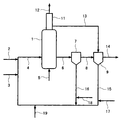
- Fig. 1 a flow diagram for one embodiment of the process is shown, in which the process according to the present invention is applied for producing terephthalic acid.
- the oxidation reactor 1 is supplied with paraxylene as the raw material via a line 2, with the catalyst constituted of a cobalt compound, a manganese compound and a bromine compound via a line 3 and with acetic acid as the reaction solvent via a line 4, while supplying thereto atmospheric air via a line 5, to effet the oxidation in order to form terephthalic acid.
- the slurry containing the resulting terephthalic acid crystals in the oxidation reactor 1 is taken out via a line 6 into a solid/liquid separator 7, where it is subjected to a solid/liquid separation, wherein the crystals separated are transferred via a line 8 to a washing vessel 9.
- the oxidation exhaust gas from the oxidation reactor 1 is subjected to a distillation in a distillation column 11, from which the residual gas is discharged out via a line 12 and the recovered acetic acid is sent to the washing vessel 9 via a line 13 and is used, together with a make-up solvent, for washing the crude crystals.
- the washing vessel 9 the crude crystals are washed with the reaction solvent to remove the catalyst residue and other impurities adhering on the crystal surfaces and the so-washed terephthalic acid crystals are taken out of the washing vessel 9 via a line 14 as a primary product.
- the spent washing liquor is discharged out of the washing vessel 9 via a line 15 and is mixed with the mother liquor drawn via a line 16 and the mixture is supplied to the oxidation reactor 1 through the line 4 to use as the reaction solvent.
- the oxidation reaction is carried out in the presence of a hydrogen gas-treated liquid containing the catalyst, wherein the hydrogen gas-treatment may favorably be effected by introducing hydrogen gas into a line, such as a line 17, 18 or 19.
- a line such as a line 17, 18 or 19.
- the hydrogen gas-treatment may be effected for the spent washing liquor consisting predominatly of the raction solvent and the resulting hydrogen gas-treated liquid is supplied to the oxidation reactor 1 as the hydrogen gas-treated liquid containing the catalyst, after being mixed with the mother liquor containing the catalyst, in order to carry out the oxidation reaction.
- the hydrogen gas-treatment is realized for the mother liquor containing the catalyst and the reaction solvent and the resulting hydrogen gas-treated liquid is supplied to the oxidizing reactor 1 after being mixed with the spent washing liquor containing the reaction solvent, in order to carry out the oxidation reaction.
- the hydrogen gas-treatment is effected for the mixed liquid of the mother liquor and the spent washing liquor and the resulting hydrogen gas-treated liquid is supplied to the oxidation reactor 1, in order to carry out the oxidation.
- the hydrogen gas may be supplied to the system at other portion and may be introduced into the system not in a line but at any other location, such as vessels or the like.
- the hydrogen gas-treament may also be realized by introducing hydrogen gas into the oxidation reactor 1 when the operation of the system begins.
- Hydrogen gas was supplied thereto at a rate of 0.2 N liter per minute for 10 minutes at a temperature of the oxidation catalyst solution of 25 °C, while passing nitrogen gas thereto. Then, the supply of hydrogen gas was stopped and the contents was heated at 170 °C. Then, paraxylene was introduced thereinto at a feed rate of 40.3 grams per hour, while supplying thereto atmospheric air at a supply rate of 0.168 N m 3 per hour, to effect the reaction at a temperature of 190 °C for an hour to produce terephthalic acid.
- the hue of the resulting terephthalic acid powdery product, the light transmittance value and the content of the impurity, 4-carboxybenzaldehyde (4-CBA), are recited in Table 1.
- Terephthalic acid was produced in the same manner as in Example 7, except that 0.54 gram of cobalt acetate and 0.26 gram of manganese acetate were charged in the reactor. The results are recited in Table 1.
- Terephthalic acid was produced in the same manner as in Example 7, except that 0.54 gram of cobalt acetate and 0.34 gram of hydrobromic acid (47 % aqueous solution) were charged in the reactor. The results are recited in Table 1.
- Terephthalic acid was produced in the same manner as in Example 7, except that 0.34 gram of hydrobromic acid (47 % aqueous solution) was charged in the reactor. The results are recited in Table 1.
- Terephthalic acid was produced in the same manner as in Example 1, except that hydrogen gas was not supplied. The results are recited in Table 1.
- Terephthalic acid was produced in the same manner as in Example 6, except that hydrogen gas was not supplied and atmospheric air was supplied at a feed rate of 0.168 N m 3 per hour to effect the reaction at a temperature of 190 °C.
- the results are recited in Table 1.
- Example or Compar. Example Hydrogen gas treatment 4-CBA content (ppm) Hue b-value Light transmit. T-340 (%) CO x conc. in waste gas (%) H 2 fed (Nl) Temp. (°C) Press. (Mpa) Example 1 2 R.T. 1.3 2520 8.3 5.7 1.72 2 2 150 1.3 2440 7.6 9.9 1.75 3 0.4 R.T. 1.3 2250 6.5 23.8 1.80 4 0.4 R.T. N.P.
- the nitrogen gas bubbling was stopped and paraxylene was supplied to the reactor at a rate of 40.3 grams per hour, while passing atmospheric air thereto at a feed rate of 0.168 N m 3 per hour, to effect the reaction at a temperature of 186 °C for one hour to produce terephthalic acid.
- the hue of the resulting terephthalic acid product, the light transmittance value and the content of the impurity, 4-CBA, are recited in Table 2.
- Terephthalic acid was produced in the same manner as in Example 11, except that the amount of hydrogen gas supplied was changed to 0.2 N liter per minute for 30 seconds and the dissolved amount of hydrogen gas in the liquid to be treated was found to be 1.4 volume %. The results are recited in Table 2.
- Terephthalic acid was produced in the same manner as in Example 11, except that the amount of hydrogen gas supplied was changed to 0.2 N liter per minute for 40 seconds and the dissolved amount of hydrogen gas in the liquid to be treated was found to be 2.0 volume %. The results are recited in Table 2.
- Terephthalic acid was produced in the same amnner as in Example 11, except that the amount of hydrogen gas supplied was changed to 0.2 N liter per minute for 1 minute and the dissolved amount of hydrogen gas in the liquid to be treated was found to be 3.5 volume %. The results are recited in Table 2.
- Example 11 The procedures of Example 11 were pursued, except that hydrogen gas was not supplied. The results are recited in Table 2.
- Example or Compar. Example H 2 fed (Nl ) 4-CBA cont. (ppm) Hue (b-value) Light transm. T-340 (%) Waste gas CO x conc. (%)
- Example 11 0.02 3,000 6.4 11.2 1.90 12 0.10 2,900 7.0 18.5 1.90 13 0.13 3,100 6.4 13.3 1.90 14 0.20 3,600 6.9 12.8 1.90 C. Exam. 3 0 3,700 7.2 2.2 1.90
- a hydrogen gas-treated liquid obtained by passing, with agitation, hydrogen gas to 250 ml of acetic acid containing 4.9 % by weight of water at a feed rate of 0.2 N liter per minute for 10 seconds and a catalyst solution obtained from 2.89 grams of an aqueous solution containing 18.7 % by weight of cobalt acetate tetrahydrate and 9.3 % by weight of manganese acetate tetrahydrate and from 0.44 grams of a 47 % conc. aqueous solution of HBr and the contents of the reactor were heated up to 170 °C while bubbling nitrogen gas thereinto.
- the nitrogen gas bubbling was stopped and paraxylene was introduced into the reactor at a feed rate of 40.3 grams per hour, while at the same time introducing atmospheric air thereinto at a feed rate of 0.168 N m 3 per hour, to effect the oxidation at 186 °C for one hour to produce terephthalic acid.
- the hue of the resulting terephthalic acid product, the light transmittance value and the content of the impurity, 4-CBA, are recited in Table 3.
- Terephthalic acid was produced in the same manner as in Example 15, except that hydrogen gas was not supplied to the acetic acid solution. The results are recited in Table 3.
- Example or Compar. Example H 2 fed (Nl ) 4-CBA cont. (ppm) Hue (b-value) Light transm. T-340 (%) Waste gas CO x conc. (%) Example 15 0.033 3,000 8.5 2.0 1.70 C. Ex. 4 0 3,400 9.2 1.3 1.68
- Terephthalic acid was produced in the same manner as in Example 16, except that hydrogen gas was not supplied to the spent washing liquor. The results are recited in Table 4.
- Example or Compar. Example H 2 fed (Nl ) 4-CBA cont. (ppm) Hue (b-value) Light transm. T-340 (%) Waste gas CO x conc. (%) Example 16 0.033 4,100 5.8 15.1 1.70 C. Ex. 5 0 4,500 6.2 19.7 1.70
Landscapes
- Chemical & Material Sciences (AREA)
- Organic Chemistry (AREA)
- Engineering & Computer Science (AREA)
- Oil, Petroleum & Natural Gas (AREA)
- Organic Low-Molecular-Weight Compounds And Preparation Thereof (AREA)
- Low-Molecular Organic Synthesis Reactions Using Catalysts (AREA)
Abstract
Description
| Example or Compar. Example | Hydrogen gas treatment | 4-CBA content (ppm) | Hue b-value | Light transmit. T-340 (%) | COx conc. in waste gas (%) | ||
| H2 fed (Nℓ) | Temp. (°C) | Press. (Mpa) | |||||
| Example | |||||||
| 1 | 2 | R.T. | 1.3 | 2520 | 8.3 | 5.7 | 1.72 |
| 2 | 2 | 150 | 1.3 | 2440 | 7.6 | 9.9 | 1.75 |
| 3 | 0.4 | R.T. | 1.3 | 2250 | 6.5 | 23.8 | 1.80 |
| 4 | 0.4 | R.T. | N.P. | 2010 | 6.3 | 24.2 | 1.80 |
| 5 | 0.1 | R.T. | N.P. | 2330 | 7.1 | 11.3 | 1.75 |
| 6 | 0.2 | R.T. | N.P. | 2400 | 8.7 | 7.8 | 2.05 |
| 7 | 0.4 | R.T. | N.P. | 2600 | 8.6 | 3.5 | 1.75 |
| 8 | 0.4 | R.T. | N.P. | 2570 | 8.3 | 4.1 | 1.85 |
| 9 | 0.4 | R.T. | N.P. | 2410 | 6.9 | 11.5 | 1.80 |
| 10 | 0.4 | R.T. | N.P. | 2310 | 5.5 | 23.3 | 1.75 |
| Comp. Ex. | |||||||
| 1 | - | - | - | 3120 | 10.2 | 1.0 | 1.70 |
| 2 | - | - | - | 3160 | 9.9 | 1.2 | 2.05 |
| Example or Compar. Example | H2 fed (Nℓ ) | 4-CBA cont. (ppm) | Hue (b-value) | Light transm. T-340 (%) | Waste gas COx conc. (%) |
| Example | |||||
| 11 | 0.02 | 3,000 | 6.4 | 11.2 | 1.90 |
| 12 | 0.10 | 2,900 | 7.0 | 18.5 | 1.90 |
| 13 | 0.13 | 3,100 | 6.4 | 13.3 | 1.90 |
| 14 | 0.20 | 3,600 | 6.9 | 12.8 | 1.90 |
| C. Exam. | |||||
| 3 | 0 | 3,700 | 7.2 | 2.2 | 1.90 |
| Example or Compar. Example | H2 fed (Nℓ ) | 4-CBA cont. (ppm) | Hue (b-value) | Light transm. T-340 (%) | Waste gas COx conc. (%) |
| Example | |||||
| 15 | 0.033 | 3,000 | 8.5 | 2.0 | 1.70 |
| C. Ex. | |||||
| 4 | 0 | 3,400 | 9.2 | 1.3 | 1.68 |
| Example or Compar. Example | H2 fed (Nℓ ) | 4-CBA cont. (ppm) | Hue (b-value) | Light transm. T-340 (%) | Waste gas COx conc. (%) |
| Example | |||||
| 16 | 0.033 | 4,100 | 5.8 | 15.1 | 1.70 |
| C. Ex. | |||||
| 5 | 0 | 4,500 | 6.2 | 19.7 | 1.70 |
Claims (5)
- A process for producing an aromatic carboxylic acid by a liquid phase oxidation of an alkylaromatic compound with molecular oxygen in a reaction solvent comprising a lower aliphatic carboxylic acid in the presence of an oxidation catalyst, comprisingperforming the liquid phase oxidation of the alkylaromatic compound in the presence of a hydrogen gas-treated liquid containing the catalyst.
- The process as claimed in claim 1, wherein the oxidation catalyst is constituted of a combination of a heavy metal compound and a bromine compound.
- The process as claimed in claim 1 or 2, wherein the hydrogen gas-treated liquid is one, in which the reaction solvent containing the catalyst held in a state dissolved or dispersed therein is treated with hydrogen gas.
- The process as claimed in any one of claims 1 to 3, wherein the amount of the hydrogen gas to be used in the treatment with hydrogen gas is 0.000001 - 0.05 N liter per one gram of the total sum of the reaction solvent plus the catalyst to be introduced into the oxidation reaction step.
- The process as claimed in any one of claims 1 to 4, wherein the aromatic carboxylic acid is terephthalic acid.
Applications Claiming Priority (2)
| Application Number | Priority Date | Filing Date | Title |
|---|---|---|---|
| JP25294199 | 1999-09-07 | ||
| JP25294199 | 1999-09-07 |
Publications (2)
| Publication Number | Publication Date |
|---|---|
| EP1085005A2 true EP1085005A2 (en) | 2001-03-21 |
| EP1085005A3 EP1085005A3 (en) | 2003-01-08 |
Family
ID=17244297
Family Applications (1)
| Application Number | Title | Priority Date | Filing Date |
|---|---|---|---|
| EP00119596A Withdrawn EP1085005A3 (en) | 1999-09-07 | 2000-09-07 | Process for producing aromatic carboxylic acid |
Country Status (7)
| Country | Link |
|---|---|
| US (1) | US6506931B1 (en) |
| EP (1) | EP1085005A3 (en) |
| KR (1) | KR100398160B1 (en) |
| CN (1) | CN1142900C (en) |
| BR (1) | BR0003996A (en) |
| ID (1) | ID28064A (en) |
| TW (1) | TW538032B (en) |
Families Citing this family (1)
| Publication number | Priority date | Publication date | Assignee | Title |
|---|---|---|---|---|
| CN115925539B (en) * | 2021-08-27 | 2025-10-31 | 中国石油化工股份有限公司 | Method for recycling oxidation mother liquor of 2, 6-naphthalene dicarboxylic acid |
Family Cites Families (8)
| Publication number | Priority date | Publication date | Assignee | Title |
|---|---|---|---|---|
| US3354202A (en) * | 1963-04-30 | 1967-11-21 | Standard Oil Co | Oxidation of polymethylbenzenes to benzene polycarboxylic acids |
| US4345089A (en) * | 1977-01-24 | 1982-08-17 | Hercofina | Recovery of aromatic carboxylic acid or ester thereof from residue fraction of oxidation or esterification reaction mixture |
| US4675438A (en) * | 1978-11-17 | 1987-06-23 | Amoco Corporation | Direct continuous flow integration of production and purification of high purity iso- or terephthalic acid |
| JPS5911573B2 (en) * | 1979-12-03 | 1984-03-16 | 三菱瓦斯化学株式会社 | Terephthalic acid purification method |
| JPS5935907B2 (en) | 1982-01-14 | 1984-08-31 | 三菱瓦斯化学株式会社 | Production method of aromatic polycarboxylic acid |
| US4850859A (en) * | 1988-09-30 | 1989-07-25 | United Technologies Corporation | Liquid fueled hydrogen heater |
| JP2893860B2 (en) * | 1990-05-17 | 1999-05-24 | 三菱瓦斯化学株式会社 | Production method of high purity isophthalic acid |
| JPH08157415A (en) * | 1994-12-05 | 1996-06-18 | Mitsubishi Gas Chem Co Inc | Method for producing high-purity terephthalic acid |
-
2000
- 2000-09-04 KR KR10-2000-0052084A patent/KR100398160B1/en not_active Expired - Fee Related
- 2000-09-05 TW TW089118106A patent/TW538032B/en not_active IP Right Cessation
- 2000-09-05 BR BR0003996-9A patent/BR0003996A/en not_active IP Right Cessation
- 2000-09-07 ID IDP20000764D patent/ID28064A/en unknown
- 2000-09-07 US US09/656,997 patent/US6506931B1/en not_active Expired - Fee Related
- 2000-09-07 CN CNB001263390A patent/CN1142900C/en not_active Expired - Fee Related
- 2000-09-07 EP EP00119596A patent/EP1085005A3/en not_active Withdrawn
Also Published As
| Publication number | Publication date |
|---|---|
| ID28064A (en) | 2001-05-03 |
| US6506931B1 (en) | 2003-01-14 |
| CN1142900C (en) | 2004-03-24 |
| TW538032B (en) | 2003-06-21 |
| KR100398160B1 (en) | 2003-09-19 |
| CN1287111A (en) | 2001-03-14 |
| EP1085005A3 (en) | 2003-01-08 |
| KR20010050329A (en) | 2001-06-15 |
| BR0003996A (en) | 2001-04-17 |
Similar Documents
| Publication | Publication Date | Title |
|---|---|---|
| EP1140765B1 (en) | A production method of aromatic carboxylic acids | |
| US6175038B1 (en) | Method of producing aromatic carboxylic acids by oxidizing alkyl aromatic compounds or partially oxidized intermediates thereof with oxygen-enriched gas | |
| JP3875134B2 (en) | Process for producing aromatic carboxylic acids by liquid phase oxidation of alkylaromatic compounds | |
| SK280582B6 (en) | Process for producing highly purified benzenedicarboxylic acid isomers | |
| KR100549107B1 (en) | Method of producing aromatic polycarboxylic acid | |
| JPH09278709A (en) | Method for producing aromatic carboxylic acid | |
| US9382184B2 (en) | Processes for producing terephthalic acid | |
| US6506931B1 (en) | Process for producing aromatic carboxylic acid | |
| EP1856019B1 (en) | Processes for producing aromatic dicarboxylic acids | |
| JP2001019658A (en) | Production of aromatic carboxylic acid | |
| US9199906B2 (en) | Processes for producing isophthalic acid | |
| JP3187212B2 (en) | Continuous production method of naphthalenedicarboxylic acid | |
| JP2001151723A (en) | Method for producing aromatic carboxylic acid | |
| US20060205974A1 (en) | Processes for producing aromatic dicarboxylic acids | |
| KR100508684B1 (en) | The preparation method of aromatic carboxylic acids | |
| JP2000103762A (en) | Production of aromatic carboxylic acid | |
| JPS623139B2 (en) | ||
| KR20050068565A (en) | The preparation method of aromatic carboxylic acids from alkylaromatics by liquid-phase oxidation | |
| JPH02240047A (en) | Production of naphthalenecarboxylic acid | |
| TH42267A3 (en) | Methods of producing aromatic carboxylic acids By oxidizing alkyl aromatic hydrocarbons or intermediation of this partially oxidized substance. | |
| JP2000290219A (en) | Production of aromatic carboxylic acid | |
| TH42268A3 (en) | A method for producing aromatic carboxylic acids by oxidizing alkyl aromatic compounds or intermediates of these compounds that are partially oxidized with carbon dioxide. |
Legal Events
| Date | Code | Title | Description |
|---|---|---|---|
| PUAI | Public reference made under article 153(3) epc to a published international application that has entered the european phase |
Free format text: ORIGINAL CODE: 0009012 |
|
| AK | Designated contracting states |
Kind code of ref document: A2 Designated state(s): AT BE CH CY DE DK ES FI FR GB GR IE IT LI LU MC NL PT SE |
|
| AX | Request for extension of the european patent |
Free format text: AL;LT;LV;MK;RO;SI |
|
| PUAL | Search report despatched |
Free format text: ORIGINAL CODE: 0009013 |
|
| AK | Designated contracting states |
Kind code of ref document: A3 Designated state(s): AT BE CH CY DE DK ES FI FR GB GR IE IT LI LU MC NL PT SE |
|
| AX | Request for extension of the european patent |
Free format text: AL;LT;LV;MK;RO;SI |
|
| 17P | Request for examination filed |
Effective date: 20030203 |
|
| AKX | Designation fees paid |
Designated state(s): BE DE GB |
|
| GRAP | Despatch of communication of intention to grant a patent |
Free format text: ORIGINAL CODE: EPIDOSNIGR1 |
|
| RAP1 | Party data changed (applicant data changed or rights of an application transferred) |
Owner name: MITSUI CHEMICALS, INC. |
|
| RAP1 | Party data changed (applicant data changed or rights of an application transferred) |
Owner name: MITSUI CHEMICALS, INC. |
|
| STAA | Information on the status of an ep patent application or granted ep patent |
Free format text: STATUS: THE APPLICATION IS DEEMED TO BE WITHDRAWN |
|
| 18D | Application deemed to be withdrawn |
Effective date: 20040806 |