EP1081194A1 - Thermoplastic resin composition and use thereof - Google Patents
Thermoplastic resin composition and use thereof Download PDFInfo
- Publication number
- EP1081194A1 EP1081194A1 EP00906625A EP00906625A EP1081194A1 EP 1081194 A1 EP1081194 A1 EP 1081194A1 EP 00906625 A EP00906625 A EP 00906625A EP 00906625 A EP00906625 A EP 00906625A EP 1081194 A1 EP1081194 A1 EP 1081194A1
- Authority
- EP
- European Patent Office
- Prior art keywords
- thermoplastic resin
- cyclic olefin
- resin composition
- group
- ring
- Prior art date
- Legal status (The legal status is an assumption and is not a legal conclusion. Google has not performed a legal analysis and makes no representation as to the accuracy of the status listed.)
- Withdrawn
Links
- 229920005992 thermoplastic resin Polymers 0.000 title claims abstract description 88
- 239000011342 resin composition Substances 0.000 title claims abstract description 45
- -1 cyclic olefin Chemical class 0.000 claims abstract description 114
- 229920000642 polymer Polymers 0.000 claims abstract description 92
- JRZJOMJEPLMPRA-UHFFFAOYSA-N olefin Natural products CCCCCCCC=C JRZJOMJEPLMPRA-UHFFFAOYSA-N 0.000 claims abstract description 85
- 125000004432 carbon atom Chemical group C* 0.000 claims abstract description 62
- 229920005989 resin Polymers 0.000 claims abstract description 48
- 239000011347 resin Substances 0.000 claims abstract description 48
- LFQSCWFLJHTTHZ-UHFFFAOYSA-N Ethanol Chemical compound CCO LFQSCWFLJHTTHZ-UHFFFAOYSA-N 0.000 claims abstract description 45
- WSSSPWUEQFSQQG-UHFFFAOYSA-N 4-methyl-1-pentene Chemical compound CC(C)CC=C WSSSPWUEQFSQQG-UHFFFAOYSA-N 0.000 claims abstract description 35
- XLYOFNOQVPJJNP-UHFFFAOYSA-N water Substances O XLYOFNOQVPJJNP-UHFFFAOYSA-N 0.000 claims abstract description 33
- 229910052799 carbon Inorganic materials 0.000 claims abstract description 27
- 238000010521 absorption reaction Methods 0.000 claims abstract description 23
- 125000003118 aryl group Chemical group 0.000 claims abstract description 20
- 238000002834 transmittance Methods 0.000 claims abstract description 18
- 230000003287 optical effect Effects 0.000 claims abstract description 16
- 230000009477 glass transition Effects 0.000 claims abstract description 12
- 125000002887 hydroxy group Chemical group [H]O* 0.000 claims abstract description 10
- 229920003023 plastic Polymers 0.000 claims abstract description 6
- 239000004033 plastic Substances 0.000 claims abstract description 6
- 238000007654 immersion Methods 0.000 claims abstract description 3
- 229920001577 copolymer Polymers 0.000 claims description 44
- 239000004711 α-olefin Substances 0.000 claims description 27
- 229920005604 random copolymer Polymers 0.000 claims description 20
- 150000001875 compounds Chemical class 0.000 claims description 18
- 150000002430 hydrocarbons Chemical group 0.000 claims description 17
- 125000002950 monocyclic group Chemical group 0.000 claims description 14
- 125000003367 polycyclic group Chemical group 0.000 claims description 14
- 125000002029 aromatic hydrocarbon group Chemical group 0.000 claims description 12
- 125000005843 halogen group Chemical group 0.000 claims description 11
- 125000004435 hydrogen atom Chemical group [H]* 0.000 claims description 11
- 125000002723 alicyclic group Chemical group 0.000 claims description 8
- 229910052705 radium Inorganic materials 0.000 claims description 8
- 125000002947 alkylene group Chemical group 0.000 claims description 7
- 125000001118 alkylidene group Chemical group 0.000 claims description 7
- RTZKZFJDLAIYFH-UHFFFAOYSA-N ether Substances CCOCC RTZKZFJDLAIYFH-UHFFFAOYSA-N 0.000 claims description 7
- 125000003545 alkoxy group Chemical group 0.000 claims description 6
- 125000001931 aliphatic group Chemical group 0.000 claims description 5
- 125000003158 alcohol group Chemical group 0.000 claims 1
- 230000008859 change Effects 0.000 abstract description 16
- 230000007613 environmental effect Effects 0.000 abstract description 8
- 239000000203 mixture Substances 0.000 abstract description 7
- 238000000034 method Methods 0.000 description 18
- 239000002904 solvent Substances 0.000 description 11
- 239000000126 substance Substances 0.000 description 9
- PPBRXRYQALVLMV-UHFFFAOYSA-N Styrene Chemical compound C=CC1=CC=CC=C1 PPBRXRYQALVLMV-UHFFFAOYSA-N 0.000 description 8
- 239000000470 constituent Substances 0.000 description 8
- 239000003607 modifier Substances 0.000 description 8
- 239000000178 monomer Substances 0.000 description 8
- 239000003381 stabilizer Substances 0.000 description 8
- 238000012360 testing method Methods 0.000 description 8
- 229920002554 vinyl polymer Polymers 0.000 description 8
- 239000004215 Carbon black (E152) Substances 0.000 description 7
- 125000000217 alkyl group Chemical group 0.000 description 7
- 229910052782 aluminium Inorganic materials 0.000 description 7
- 239000003054 catalyst Substances 0.000 description 7
- 229930195733 hydrocarbon Natural products 0.000 description 7
- 230000001954 sterilising effect Effects 0.000 description 7
- 238000004659 sterilization and disinfection Methods 0.000 description 7
- 239000002253 acid Substances 0.000 description 6
- 238000001746 injection moulding Methods 0.000 description 6
- 230000003595 spectral effect Effects 0.000 description 6
- VGGSQFUCUMXWEO-UHFFFAOYSA-N Ethene Chemical compound C=C VGGSQFUCUMXWEO-UHFFFAOYSA-N 0.000 description 5
- 239000005977 Ethylene Substances 0.000 description 5
- OFOBLEOULBTSOW-UHFFFAOYSA-N Propanedioic acid Natural products OC(=O)CC(O)=O OFOBLEOULBTSOW-UHFFFAOYSA-N 0.000 description 5
- 239000004305 biphenyl Substances 0.000 description 5
- 238000006243 chemical reaction Methods 0.000 description 5
- 230000000052 comparative effect Effects 0.000 description 5
- 125000000753 cycloalkyl group Chemical group 0.000 description 5
- MGNZXYYWBUKAII-UHFFFAOYSA-N cyclohexa-1,3-diene Chemical compound C1CC=CC=C1 MGNZXYYWBUKAII-UHFFFAOYSA-N 0.000 description 5
- 125000000058 cyclopentadienyl group Chemical group C1(=CC=CC1)* 0.000 description 5
- 238000005984 hydrogenation reaction Methods 0.000 description 5
- 125000001449 isopropyl group Chemical group [H]C([H])([H])C([H])(*)C([H])([H])[H] 0.000 description 5
- 239000003446 ligand Substances 0.000 description 5
- 230000008569 process Effects 0.000 description 5
- 238000003878 thermal aging Methods 0.000 description 5
- VZCYOOQTPOCHFL-UHFFFAOYSA-N trans-butenedioic acid Natural products OC(=O)C=CC(O)=O VZCYOOQTPOCHFL-UHFFFAOYSA-N 0.000 description 5
- AFFLGGQVNFXPEV-UHFFFAOYSA-N 1-decene Chemical compound CCCCCCCCC=C AFFLGGQVNFXPEV-UHFFFAOYSA-N 0.000 description 4
- LIKMAJRDDDTEIG-UHFFFAOYSA-N 1-hexene Chemical compound CCCCC=C LIKMAJRDDDTEIG-UHFFFAOYSA-N 0.000 description 4
- KWKAKUADMBZCLK-UHFFFAOYSA-N 1-octene Chemical compound CCCCCCC=C KWKAKUADMBZCLK-UHFFFAOYSA-N 0.000 description 4
- HFDVRLIODXPAHB-UHFFFAOYSA-N 1-tetradecene Chemical compound CCCCCCCCCCCCC=C HFDVRLIODXPAHB-UHFFFAOYSA-N 0.000 description 4
- KDLHZDBZIXYQEI-UHFFFAOYSA-N Palladium Chemical compound [Pd] KDLHZDBZIXYQEI-UHFFFAOYSA-N 0.000 description 4
- VYPSYNLAJGMNEJ-UHFFFAOYSA-N Silicium dioxide Chemical compound O=[Si]=O VYPSYNLAJGMNEJ-UHFFFAOYSA-N 0.000 description 4
- 150000001732 carboxylic acid derivatives Chemical class 0.000 description 4
- HGCIXCUEYOPUTN-UHFFFAOYSA-N cyclohexene Chemical compound C1CCC=CC1 HGCIXCUEYOPUTN-UHFFFAOYSA-N 0.000 description 4
- NNBZCPXTIHJBJL-UHFFFAOYSA-N decalin Chemical compound C1CCCC2CCCCC21 NNBZCPXTIHJBJL-UHFFFAOYSA-N 0.000 description 4
- 239000003814 drug Substances 0.000 description 4
- VZCYOOQTPOCHFL-UPHRSURJSA-N maleic acid Chemical compound OC(=O)\C=C/C(O)=O VZCYOOQTPOCHFL-UPHRSURJSA-N 0.000 description 4
- 238000000465 moulding Methods 0.000 description 4
- CCCMONHAUSKTEQ-UHFFFAOYSA-N octadec-1-ene Chemical compound CCCCCCCCCCCCCCCCC=C CCCMONHAUSKTEQ-UHFFFAOYSA-N 0.000 description 4
- CGIHFIDULQUVJG-VNTMZGSJSA-N phytantriol Natural products CC(C)CCC[C@H](C)CCC[C@H](C)CCC[C@@](C)(O)[C@H](O)CO CGIHFIDULQUVJG-VNTMZGSJSA-N 0.000 description 4
- 239000004417 polycarbonate Substances 0.000 description 4
- 229920000515 polycarbonate Polymers 0.000 description 4
- 229920002223 polystyrene Polymers 0.000 description 4
- ROHFBIREHKPELA-UHFFFAOYSA-N 2-[(3,5-ditert-butyl-4-hydroxyphenyl)methyl]prop-2-enoic acid;methane Chemical compound C.CC(C)(C)C1=CC(CC(=C)C(O)=O)=CC(C(C)(C)C)=C1O.CC(C)(C)C1=CC(CC(=C)C(O)=O)=CC(C(C)(C)C)=C1O.CC(C)(C)C1=CC(CC(=C)C(O)=O)=CC(C(C)(C)C)=C1O.CC(C)(C)C1=CC(CC(=C)C(O)=O)=CC(C(C)(C)C)=C1O ROHFBIREHKPELA-UHFFFAOYSA-N 0.000 description 3
- 229920000089 Cyclic olefin copolymer Polymers 0.000 description 3
- 229920000877 Melamine resin Polymers 0.000 description 3
- 239000004793 Polystyrene Substances 0.000 description 3
- 239000000654 additive Substances 0.000 description 3
- 150000001298 alcohols Chemical class 0.000 description 3
- 150000001336 alkenes Chemical class 0.000 description 3
- 238000004132 cross linking Methods 0.000 description 3
- 230000006866 deterioration Effects 0.000 description 3
- 150000001990 dicarboxylic acid derivatives Chemical class 0.000 description 3
- 150000001993 dienes Chemical class 0.000 description 3
- 229910052736 halogen Inorganic materials 0.000 description 3
- 150000002367 halogens Chemical class 0.000 description 3
- 238000002347 injection Methods 0.000 description 3
- 239000007924 injection Substances 0.000 description 3
- 239000011976 maleic acid Substances 0.000 description 3
- 229910052751 metal Inorganic materials 0.000 description 3
- 239000002184 metal Substances 0.000 description 3
- 239000012968 metallocene catalyst Substances 0.000 description 3
- 230000004048 modification Effects 0.000 description 3
- 238000012986 modification Methods 0.000 description 3
- 230000000704 physical effect Effects 0.000 description 3
- 239000005020 polyethylene terephthalate Substances 0.000 description 3
- 229920000139 polyethylene terephthalate Polymers 0.000 description 3
- 229920000098 polyolefin Polymers 0.000 description 3
- 239000000843 powder Substances 0.000 description 3
- 239000007787 solid Substances 0.000 description 3
- 239000000243 solution Substances 0.000 description 3
- 125000001424 substituent group Chemical group 0.000 description 3
- 238000006467 substitution reaction Methods 0.000 description 3
- XWJBRBSPAODJER-UHFFFAOYSA-N 1,7-octadiene Chemical compound C=CCCCCC=C XWJBRBSPAODJER-UHFFFAOYSA-N 0.000 description 2
- CRSBERNSMYQZNG-UHFFFAOYSA-N 1-dodecene Chemical compound CCCCCCCCCCC=C CRSBERNSMYQZNG-UHFFFAOYSA-N 0.000 description 2
- GQEZCXVZFLOKMC-UHFFFAOYSA-N 1-hexadecene Chemical compound CCCCCCCCCCCCCCC=C GQEZCXVZFLOKMC-UHFFFAOYSA-N 0.000 description 2
- 238000001644 13C nuclear magnetic resonance spectroscopy Methods 0.000 description 2
- ZCYVEMRRCGMTRW-UHFFFAOYSA-N 7553-56-2 Chemical group [I] ZCYVEMRRCGMTRW-UHFFFAOYSA-N 0.000 description 2
- KAKZBPTYRLMSJV-UHFFFAOYSA-N Butadiene Chemical compound C=CC=C KAKZBPTYRLMSJV-UHFFFAOYSA-N 0.000 description 2
- SNRUBQQJIBEYMU-UHFFFAOYSA-N Dodecane Natural products CCCCCCCCCCCC SNRUBQQJIBEYMU-UHFFFAOYSA-N 0.000 description 2
- VZCYOOQTPOCHFL-OWOJBTEDSA-N Fumaric acid Chemical compound OC(=O)\C=C\C(O)=O VZCYOOQTPOCHFL-OWOJBTEDSA-N 0.000 description 2
- VQTUBCCKSQIDNK-UHFFFAOYSA-N Isobutene Chemical group CC(C)=C VQTUBCCKSQIDNK-UHFFFAOYSA-N 0.000 description 2
- FDBMBOYIVUGUSL-UHFFFAOYSA-N OP(O)OP(O)O.C(C)(C)(C)C1=C(C(=CC(=C1)C)C(C)(C)C)C(O)(C(CO)(CO)CO)C1=C(C=C(C=C1C(C)(C)C)C)C(C)(C)C Chemical compound OP(O)OP(O)O.C(C)(C)(C)C1=C(C(=CC(=C1)C)C(C)(C)C)C(O)(C(CO)(CO)CO)C1=C(C=C(C=C1C(C)(C)C)C)C(C)(C)C FDBMBOYIVUGUSL-UHFFFAOYSA-N 0.000 description 2
- 229920003171 Poly (ethylene oxide) Polymers 0.000 description 2
- RTAQQCXQSZGOHL-UHFFFAOYSA-N Titanium Chemical compound [Ti] RTAQQCXQSZGOHL-UHFFFAOYSA-N 0.000 description 2
- 229920001807 Urea-formaldehyde Polymers 0.000 description 2
- 238000002441 X-ray diffraction Methods 0.000 description 2
- QCWXUUIWCKQGHC-UHFFFAOYSA-N Zirconium Chemical compound [Zr] QCWXUUIWCKQGHC-UHFFFAOYSA-N 0.000 description 2
- YRKCREAYFQTBPV-UHFFFAOYSA-N acetylacetone Natural products CC(=O)CC(C)=O YRKCREAYFQTBPV-UHFFFAOYSA-N 0.000 description 2
- 229920000180 alkyd Polymers 0.000 description 2
- 150000001412 amines Chemical class 0.000 description 2
- 125000003710 aryl alkyl group Chemical group 0.000 description 2
- TZCXTZWJZNENPQ-UHFFFAOYSA-L barium sulfate Chemical compound [Ba+2].[O-]S([O-])(=O)=O TZCXTZWJZNENPQ-UHFFFAOYSA-L 0.000 description 2
- 235000010290 biphenyl Nutrition 0.000 description 2
- GDTBXPJZTBHREO-UHFFFAOYSA-N bromine Chemical compound BrBr GDTBXPJZTBHREO-UHFFFAOYSA-N 0.000 description 2
- CJZGTCYPCWQAJB-UHFFFAOYSA-L calcium stearate Chemical compound [Ca+2].CCCCCCCCCCCCCCCCCC([O-])=O.CCCCCCCCCCCCCCCCCC([O-])=O CJZGTCYPCWQAJB-UHFFFAOYSA-L 0.000 description 2
- 239000008116 calcium stearate Substances 0.000 description 2
- 235000013539 calcium stearate Nutrition 0.000 description 2
- OSGAYBCDTDRGGQ-UHFFFAOYSA-L calcium sulfate Chemical compound [Ca+2].[O-]S([O-])(=O)=O OSGAYBCDTDRGGQ-UHFFFAOYSA-L 0.000 description 2
- 229910052801 chlorine Inorganic materials 0.000 description 2
- 238000007796 conventional method Methods 0.000 description 2
- 238000007334 copolymerization reaction Methods 0.000 description 2
- 239000003431 cross linking reagent Substances 0.000 description 2
- 125000000113 cyclohexyl group Chemical group [H]C1([H])C([H])([H])C([H])([H])C([H])(*)C([H])([H])C1([H])[H] 0.000 description 2
- ZSWFCLXCOIISFI-UHFFFAOYSA-N cyclopentadiene Chemical compound C1C=CC=C1 ZSWFCLXCOIISFI-UHFFFAOYSA-N 0.000 description 2
- LPIQUOYDBNQMRZ-UHFFFAOYSA-N cyclopentene Chemical compound C1CC=CC1 LPIQUOYDBNQMRZ-UHFFFAOYSA-N 0.000 description 2
- 125000002704 decyl group Chemical group [H]C([H])([H])C([H])([H])C([H])([H])C([H])([H])C([H])([H])C([H])([H])C([H])([H])C([H])([H])C([H])([H])C([H])([H])* 0.000 description 2
- 125000003438 dodecyl group Chemical group [H]C([H])([H])C([H])([H])C([H])([H])C([H])([H])C([H])([H])C([H])([H])C([H])([H])C([H])([H])C([H])([H])C([H])([H])C([H])([H])C([H])([H])* 0.000 description 2
- 229920001971 elastomer Polymers 0.000 description 2
- 125000004185 ester group Chemical group 0.000 description 2
- 125000001495 ethyl group Chemical group [H]C([H])([H])C([H])([H])* 0.000 description 2
- 229910052731 fluorine Inorganic materials 0.000 description 2
- 238000005187 foaming Methods 0.000 description 2
- 235000013305 food Nutrition 0.000 description 2
- 125000000524 functional group Chemical group 0.000 description 2
- 239000011521 glass Substances 0.000 description 2
- 238000010559 graft polymerization reaction Methods 0.000 description 2
- 150000004820 halides Chemical class 0.000 description 2
- 125000004051 hexyl group Chemical group [H]C([H])([H])C([H])([H])C([H])([H])C([H])([H])C([H])([H])C([H])([H])* 0.000 description 2
- 229920001519 homopolymer Polymers 0.000 description 2
- 239000003999 initiator Substances 0.000 description 2
- 239000011256 inorganic filler Substances 0.000 description 2
- 229910003475 inorganic filler Inorganic materials 0.000 description 2
- 229910052740 iodine Inorganic materials 0.000 description 2
- 238000004898 kneading Methods 0.000 description 2
- JDSHMPZPIAZGSV-UHFFFAOYSA-N melamine Chemical compound NC1=NC(N)=NC(N)=N1 JDSHMPZPIAZGSV-UHFFFAOYSA-N 0.000 description 2
- 125000002496 methyl group Chemical group [H]C([H])([H])* 0.000 description 2
- TVMXDCGIABBOFY-UHFFFAOYSA-N n-Octanol Natural products CCCCCCCC TVMXDCGIABBOFY-UHFFFAOYSA-N 0.000 description 2
- VAMFXQBUQXONLZ-UHFFFAOYSA-N n-alpha-eicosene Natural products CCCCCCCCCCCCCCCCCCC=C VAMFXQBUQXONLZ-UHFFFAOYSA-N 0.000 description 2
- 125000000740 n-pentyl group Chemical group [H]C([H])([H])C([H])([H])C([H])([H])C([H])([H])C([H])([H])* 0.000 description 2
- 125000001624 naphthyl group Chemical group 0.000 description 2
- JFNLZVQOOSMTJK-UHFFFAOYSA-N norbornene Chemical compound C1C2CCC1C=C2 JFNLZVQOOSMTJK-UHFFFAOYSA-N 0.000 description 2
- JFNLZVQOOSMTJK-KNVOCYPGSA-N norbornene Chemical compound C1[C@@H]2CC[C@H]1C=C2 JFNLZVQOOSMTJK-KNVOCYPGSA-N 0.000 description 2
- 125000002347 octyl group Chemical group [H]C([*])([H])C([H])([H])C([H])([H])C([H])([H])C([H])([H])C([H])([H])C([H])([H])C([H])([H])[H] 0.000 description 2
- 239000003921 oil Substances 0.000 description 2
- 239000012766 organic filler Substances 0.000 description 2
- 229910052763 palladium Inorganic materials 0.000 description 2
- 239000008188 pellet Substances 0.000 description 2
- YWAKXRMUMFPDSH-UHFFFAOYSA-N pentene Chemical compound CCCC=C YWAKXRMUMFPDSH-UHFFFAOYSA-N 0.000 description 2
- 125000001997 phenyl group Chemical group [H]C1=C([H])C([H])=C(*)C([H])=C1[H] 0.000 description 2
- ZUOUZKKEUPVFJK-UHFFFAOYSA-N phenylbenzene Natural products C1=CC=CC=C1C1=CC=CC=C1 ZUOUZKKEUPVFJK-UHFFFAOYSA-N 0.000 description 2
- BASFCYQUMIYNBI-UHFFFAOYSA-N platinum Chemical compound [Pt] BASFCYQUMIYNBI-UHFFFAOYSA-N 0.000 description 2
- 229920003229 poly(methyl methacrylate) Polymers 0.000 description 2
- 230000000379 polymerizing effect Effects 0.000 description 2
- 239000004926 polymethyl methacrylate Substances 0.000 description 2
- 229920005672 polyolefin resin Polymers 0.000 description 2
- 229920006324 polyoxymethylene Polymers 0.000 description 2
- 125000001436 propyl group Chemical group [H]C([*])([H])C([H])([H])C([H])([H])[H] 0.000 description 2
- 239000008262 pumice Substances 0.000 description 2
- 230000000306 recurrent effect Effects 0.000 description 2
- 230000009467 reduction Effects 0.000 description 2
- 238000007151 ring opening polymerisation reaction Methods 0.000 description 2
- 239000005060 rubber Substances 0.000 description 2
- 125000004079 stearyl group Chemical group [H]C([*])([H])C([H])([H])C([H])([H])C([H])([H])C([H])([H])C([H])([H])C([H])([H])C([H])([H])C([H])([H])C([H])([H])C([H])([H])C([H])([H])C([H])([H])C([H])([H])C([H])([H])C([H])([H])C([H])([H])C([H])([H])[H] 0.000 description 2
- KKEYFWRCBNTPAC-UHFFFAOYSA-L terephthalate(2-) Chemical compound [O-]C(=O)C1=CC=C(C([O-])=O)C=C1 KKEYFWRCBNTPAC-UHFFFAOYSA-L 0.000 description 2
- XBFJAVXCNXDMBH-UHFFFAOYSA-N tetracyclo[6.2.1.1(3,6).0(2,7)]dodec-4-ene Chemical compound C1C(C23)C=CC1C3C1CC2CC1 XBFJAVXCNXDMBH-UHFFFAOYSA-N 0.000 description 2
- 229910052719 titanium Inorganic materials 0.000 description 2
- 239000010936 titanium Substances 0.000 description 2
- LDHQCZJRKDOVOX-UHFFFAOYSA-N trans-crotonic acid Natural products CC=CC(O)=O LDHQCZJRKDOVOX-UHFFFAOYSA-N 0.000 description 2
- 229910052723 transition metal Inorganic materials 0.000 description 2
- 150000003624 transition metals Chemical class 0.000 description 2
- PXXNTAGJWPJAGM-UHFFFAOYSA-N vertaline Natural products C1C2C=3C=C(OC)C(OC)=CC=3OC(C=C3)=CC=C3CCC(=O)OC1CC1N2CCCC1 PXXNTAGJWPJAGM-UHFFFAOYSA-N 0.000 description 2
- XOOUIPVCVHRTMJ-UHFFFAOYSA-L zinc stearate Chemical compound [Zn+2].CCCCCCCCCCCCCCCCCC([O-])=O.CCCCCCCCCCCCCCCCCC([O-])=O XOOUIPVCVHRTMJ-UHFFFAOYSA-L 0.000 description 2
- 229910052726 zirconium Inorganic materials 0.000 description 2
- JBVMSEMQJGGOFR-FNORWQNLSA-N (4e)-4-methylhexa-1,4-diene Chemical compound C\C=C(/C)CC=C JBVMSEMQJGGOFR-FNORWQNLSA-N 0.000 description 1
- PRBHEGAFLDMLAL-GQCTYLIASA-N (4e)-hexa-1,4-diene Chemical compound C\C=C\CC=C PRBHEGAFLDMLAL-GQCTYLIASA-N 0.000 description 1
- WLQXEFXDBYHMRG-UPHRSURJSA-N (z)-4-(oxiran-2-ylmethoxy)-4-oxobut-2-enoic acid Chemical compound OC(=O)\C=C/C(=O)OCC1CO1 WLQXEFXDBYHMRG-UPHRSURJSA-N 0.000 description 1
- RGASRBUYZODJTG-UHFFFAOYSA-N 1,1-bis(2,4-ditert-butylphenyl)-2,2-bis(hydroxymethyl)propane-1,3-diol dihydroxyphosphanyl dihydrogen phosphite Chemical compound OP(O)OP(O)O.C(C)(C)(C)C1=C(C=CC(=C1)C(C)(C)C)C(O)(C(CO)(CO)CO)C1=C(C=C(C=C1)C(C)(C)C)C(C)(C)C RGASRBUYZODJTG-UHFFFAOYSA-N 0.000 description 1
- YZFOQJOYMTZTRH-UHFFFAOYSA-N 1-(2-methylbutyl)cyclohexene Chemical compound CCC(C)CC1=CCCCC1 YZFOQJOYMTZTRH-UHFFFAOYSA-N 0.000 description 1
- 229940106006 1-eicosene Drugs 0.000 description 1
- FIKTURVKRGQNQD-UHFFFAOYSA-N 1-eicosene Natural products CCCCCCCCCCCCCCCCCC=CC(O)=O FIKTURVKRGQNQD-UHFFFAOYSA-N 0.000 description 1
- HECLRDQVFMWTQS-RGOKHQFPSA-N 1755-01-7 Chemical compound C1[C@H]2[C@@H]3CC=C[C@@H]3[C@@H]1C=C2 HECLRDQVFMWTQS-RGOKHQFPSA-N 0.000 description 1
- 238000005160 1H NMR spectroscopy Methods 0.000 description 1
- JAHNSTQSQJOJLO-UHFFFAOYSA-N 2-(3-fluorophenyl)-1h-imidazole Chemical compound FC1=CC=CC(C=2NC=CN=2)=C1 JAHNSTQSQJOJLO-UHFFFAOYSA-N 0.000 description 1
- WUMAAEAEKPYOSF-UHFFFAOYSA-N 2-(benzotriazol-2-yl)-4-butyl-6-tert-butylphenol Chemical compound CC(C)(C)C1=CC(CCCC)=CC(N2N=C3C=CC=CC3=N2)=C1O WUMAAEAEKPYOSF-UHFFFAOYSA-N 0.000 description 1
- BPZIYBJCZRUDEG-UHFFFAOYSA-N 2-[3-(1-hydroxy-2-methylpropan-2-yl)-2,4,8,10-tetraoxaspiro[5.5]undecan-9-yl]-2-methylpropan-1-ol Chemical compound C1OC(C(C)(CO)C)OCC21COC(C(C)(C)CO)OC2 BPZIYBJCZRUDEG-UHFFFAOYSA-N 0.000 description 1
- KIHBGTRZFAVZRV-UHFFFAOYSA-M 2-hydroxyoctadecanoate Chemical compound CCCCCCCCCCCCCCCCC(O)C([O-])=O KIHBGTRZFAVZRV-UHFFFAOYSA-M 0.000 description 1
- KXGFMDJXCMQABM-UHFFFAOYSA-N 2-methoxy-6-methylphenol Chemical compound [CH]OC1=CC=CC([CH])=C1O KXGFMDJXCMQABM-UHFFFAOYSA-N 0.000 description 1
- JOVGLRSLWFSVNB-UHFFFAOYSA-N 3,4-dimethylcyclopentene Chemical compound CC1CC=CC1C JOVGLRSLWFSVNB-UHFFFAOYSA-N 0.000 description 1
- PZRWFKGUFWPFID-UHFFFAOYSA-N 3,9-dioctadecoxy-2,4,8,10-tetraoxa-3,9-diphosphaspiro[5.5]undecane Chemical compound C1OP(OCCCCCCCCCCCCCCCCCC)OCC21COP(OCCCCCCCCCCCCCCCCCC)OC2 PZRWFKGUFWPFID-UHFFFAOYSA-N 0.000 description 1
- OLGHJTHQWQKJQQ-UHFFFAOYSA-N 3-ethylhex-1-ene Chemical compound CCCC(CC)C=C OLGHJTHQWQKJQQ-UHFFFAOYSA-N 0.000 description 1
- YPVPQMCSLFDIKA-UHFFFAOYSA-N 3-ethylpent-1-ene Chemical compound CCC(CC)C=C YPVPQMCSLFDIKA-UHFFFAOYSA-N 0.000 description 1
- YHQXBTXEYZIYOV-UHFFFAOYSA-N 3-methylbut-1-ene Chemical compound CC(C)C=C YHQXBTXEYZIYOV-UHFFFAOYSA-N 0.000 description 1
- UZPWKTCMUADILM-UHFFFAOYSA-N 3-methylcyclohexene Chemical compound CC1CCCC=C1 UZPWKTCMUADILM-UHFFFAOYSA-N 0.000 description 1
- AYKYXWQEBUNJCN-UHFFFAOYSA-N 3-methylfuran-2,5-dione Chemical compound CC1=CC(=O)OC1=O AYKYXWQEBUNJCN-UHFFFAOYSA-N 0.000 description 1
- LDTAOIUHUHHCMU-UHFFFAOYSA-N 3-methylpent-1-ene Chemical compound CCC(C)C=C LDTAOIUHUHHCMU-UHFFFAOYSA-N 0.000 description 1
- SUJVAMIXNUAJEY-UHFFFAOYSA-N 4,4-dimethylhex-1-ene Chemical compound CCC(C)(C)CC=C SUJVAMIXNUAJEY-UHFFFAOYSA-N 0.000 description 1
- KLCNJIQZXOQYTE-UHFFFAOYSA-N 4,4-dimethylpent-1-ene Chemical compound CC(C)(C)CC=C KLCNJIQZXOQYTE-UHFFFAOYSA-N 0.000 description 1
- XUFPYLQWLKKGDQ-UHFFFAOYSA-N 4,4a,9,9a-tetrahydro-1,4-methano-1h-fluorene Chemical compound C12CC3=CC=CC=C3C1C1C=CC2C1 XUFPYLQWLKKGDQ-UHFFFAOYSA-N 0.000 description 1
- QROGOPRRETUDKB-UHFFFAOYSA-N 4-butyl-2-tert-butyl-6-(5-chlorobenzotriazol-2-yl)phenol Chemical compound CC(C)(C)C1=CC(CCCC)=CC(N2N=C3C=C(Cl)C=CC3=N2)=C1O QROGOPRRETUDKB-UHFFFAOYSA-N 0.000 description 1
- OPMUAJRVOWSBTP-UHFFFAOYSA-N 4-ethyl-1-hexene Chemical compound CCC(CC)CC=C OPMUAJRVOWSBTP-UHFFFAOYSA-N 0.000 description 1
- SUWJESCICIOQHO-UHFFFAOYSA-N 4-methylhex-1-ene Chemical compound CCC(C)CC=C SUWJESCICIOQHO-UHFFFAOYSA-N 0.000 description 1
- INYHZQLKOKTDAI-UHFFFAOYSA-N 5-ethenylbicyclo[2.2.1]hept-2-ene Chemical compound C1C2C(C=C)CC1C=C2 INYHZQLKOKTDAI-UHFFFAOYSA-N 0.000 description 1
- OJOWICOBYCXEKR-UHFFFAOYSA-N 5-ethylidenebicyclo[2.2.1]hept-2-ene Chemical compound C1C2C(=CC)CC1C=C2 OJOWICOBYCXEKR-UHFFFAOYSA-N 0.000 description 1
- VSQLAQKFRFTMNS-UHFFFAOYSA-N 5-methylhexa-1,4-diene Chemical compound CC(C)=CCC=C VSQLAQKFRFTMNS-UHFFFAOYSA-N 0.000 description 1
- JRLTTZUODKEYDH-UHFFFAOYSA-N 8-methylquinoline Chemical group C1=CN=C2C(C)=CC=CC2=C1 JRLTTZUODKEYDH-UHFFFAOYSA-N 0.000 description 1
- WKBOTKDWSSQWDR-UHFFFAOYSA-N Bromine atom Chemical group [Br] WKBOTKDWSSQWDR-UHFFFAOYSA-N 0.000 description 1
- NMIVHSDHQOAROH-UHFFFAOYSA-N C12C3C=CC(CCC4C5C2CC(C4C1)C5)C3 Chemical compound C12C3C=CC(CCC4C5C2CC(C4C1)C5)C3 NMIVHSDHQOAROH-UHFFFAOYSA-N 0.000 description 1
- CGHIGJHJDBOSPE-UHFFFAOYSA-N C1CC23CC1C1C2CCC2CC(C=C2)C31 Chemical compound C1CC23CC1C1C2CCC2CC(C=C2)C31 CGHIGJHJDBOSPE-UHFFFAOYSA-N 0.000 description 1
- YAAQEISEHDUIFO-UHFFFAOYSA-N C=CC#N.OC(=O)C=CC=CC1=CC=CC=C1 Chemical compound C=CC#N.OC(=O)C=CC=CC1=CC=CC=C1 YAAQEISEHDUIFO-UHFFFAOYSA-N 0.000 description 1
- OYPRJOBELJOOCE-UHFFFAOYSA-N Calcium Chemical compound [Ca] OYPRJOBELJOOCE-UHFFFAOYSA-N 0.000 description 1
- KXDHJXZQYSOELW-UHFFFAOYSA-N Carbamic acid Chemical compound NC(O)=O KXDHJXZQYSOELW-UHFFFAOYSA-N 0.000 description 1
- OKTJSMMVPCPJKN-UHFFFAOYSA-N Carbon Chemical compound [C] OKTJSMMVPCPJKN-UHFFFAOYSA-N 0.000 description 1
- DQEFEBPAPFSJLV-UHFFFAOYSA-N Cellulose propionate Chemical compound CCC(=O)OCC1OC(OC(=O)CC)C(OC(=O)CC)C(OC(=O)CC)C1OC1C(OC(=O)CC)C(OC(=O)CC)C(OC(=O)CC)C(COC(=O)CC)O1 DQEFEBPAPFSJLV-UHFFFAOYSA-N 0.000 description 1
- KZBUYRJDOAKODT-UHFFFAOYSA-N Chlorine Chemical compound ClCl KZBUYRJDOAKODT-UHFFFAOYSA-N 0.000 description 1
- 229920001634 Copolyester Polymers 0.000 description 1
- 239000004713 Cyclic olefin copolymer Substances 0.000 description 1
- XDTMQSROBMDMFD-UHFFFAOYSA-N Cyclohexane Chemical compound C1CCCCC1 XDTMQSROBMDMFD-UHFFFAOYSA-N 0.000 description 1
- 238000005698 Diels-Alder reaction Methods 0.000 description 1
- IAYPIBMASNFSPL-UHFFFAOYSA-N Ethylene oxide Chemical compound C1CO1 IAYPIBMASNFSPL-UHFFFAOYSA-N 0.000 description 1
- PXGOKWXKJXAPGV-UHFFFAOYSA-N Fluorine Chemical compound FF PXGOKWXKJXAPGV-UHFFFAOYSA-N 0.000 description 1
- 239000005909 Kieselgur Substances 0.000 description 1
- JHWNWJKBPDFINM-UHFFFAOYSA-N Laurolactam Chemical compound O=C1CCCCCCCCCCCN1 JHWNWJKBPDFINM-UHFFFAOYSA-N 0.000 description 1
- PEEHTFAAVSWFBL-UHFFFAOYSA-N Maleimide Chemical compound O=C1NC(=O)C=C1 PEEHTFAAVSWFBL-UHFFFAOYSA-N 0.000 description 1
- CERQOIWHTDAKMF-UHFFFAOYSA-N Methacrylic acid Chemical compound CC(=C)C(O)=O CERQOIWHTDAKMF-UHFFFAOYSA-N 0.000 description 1
- ZOKXTWBITQBERF-UHFFFAOYSA-N Molybdenum Chemical compound [Mo] ZOKXTWBITQBERF-UHFFFAOYSA-N 0.000 description 1
- 229910002651 NO3 Inorganic materials 0.000 description 1
- NHNBFGGVMKEFGY-UHFFFAOYSA-N Nitrate Chemical compound [O-][N+]([O-])=O NHNBFGGVMKEFGY-UHFFFAOYSA-N 0.000 description 1
- 229920000571 Nylon 11 Polymers 0.000 description 1
- 229920000299 Nylon 12 Polymers 0.000 description 1
- 229920002292 Nylon 6 Polymers 0.000 description 1
- 229920002302 Nylon 6,6 Polymers 0.000 description 1
- QAEPIAHUOVJOOM-UHFFFAOYSA-N OP(O)OP(O)O.C(CCCCCCCC)C1=C(C=CC=C1)C(O)(C(CO)(CO)CO)C1=C(C=CC=C1)CCCCCCCCC Chemical compound OP(O)OP(O)O.C(CCCCCCCC)C1=C(C=CC=C1)C(O)(C(CO)(CO)CO)C1=C(C=CC=C1)CCCCCCCCC QAEPIAHUOVJOOM-UHFFFAOYSA-N 0.000 description 1
- PWZDGWCRBINXHV-UHFFFAOYSA-N OP(O)OP(O)O.OCC(CO)(CO)CO.C=1C=C(O)C(C=2C=CC=CC=2)=CC=1C(C)(C)C1=CC=C(O)C=C1 Chemical compound OP(O)OP(O)O.OCC(CO)(CO)CO.C=1C=C(O)C(C=2C=CC=CC=2)=CC=1C(C)(C)C1=CC=C(O)C=C1 PWZDGWCRBINXHV-UHFFFAOYSA-N 0.000 description 1
- 229930040373 Paraformaldehyde Natural products 0.000 description 1
- ISWSIDIOOBJBQZ-UHFFFAOYSA-N Phenol Chemical compound OC1=CC=CC=C1 ISWSIDIOOBJBQZ-UHFFFAOYSA-N 0.000 description 1
- JKIJEFPNVSHHEI-UHFFFAOYSA-N Phenol, 2,4-bis(1,1-dimethylethyl)-, phosphite (3:1) Chemical compound CC(C)(C)C1=CC(C(C)(C)C)=CC=C1OP(OC=1C(=CC(=CC=1)C(C)(C)C)C(C)(C)C)OC1=CC=C(C(C)(C)C)C=C1C(C)(C)C JKIJEFPNVSHHEI-UHFFFAOYSA-N 0.000 description 1
- OAICVXFJPJFONN-UHFFFAOYSA-N Phosphorus Chemical compound [P] OAICVXFJPJFONN-UHFFFAOYSA-N 0.000 description 1
- 229930182556 Polyacetal Natural products 0.000 description 1
- 239000004952 Polyamide Substances 0.000 description 1
- 239000004698 Polyethylene Substances 0.000 description 1
- 239000004721 Polyphenylene oxide Substances 0.000 description 1
- 239000004743 Polypropylene Substances 0.000 description 1
- 239000004372 Polyvinyl alcohol Substances 0.000 description 1
- 229920001328 Polyvinylidene chloride Polymers 0.000 description 1
- XBDQKXXYIPTUBI-UHFFFAOYSA-M Propionate Chemical compound CCC([O-])=O XBDQKXXYIPTUBI-UHFFFAOYSA-M 0.000 description 1
- KJTLSVCANCCWHF-UHFFFAOYSA-N Ruthenium Chemical compound [Ru] KJTLSVCANCCWHF-UHFFFAOYSA-N 0.000 description 1
- 229910000831 Steel Inorganic materials 0.000 description 1
- GWEVSGVZZGPLCZ-UHFFFAOYSA-N Titan oxide Chemical compound O=[Ti]=O GWEVSGVZZGPLCZ-UHFFFAOYSA-N 0.000 description 1
- ACIAHEMYLLBZOI-ZZXKWVIFSA-N Unsaturated alcohol Chemical compound CC\C(CO)=C/C ACIAHEMYLLBZOI-ZZXKWVIFSA-N 0.000 description 1
- XSQUKJJJFZCRTK-UHFFFAOYSA-N Urea Chemical compound NC(N)=O XSQUKJJJFZCRTK-UHFFFAOYSA-N 0.000 description 1
- YIMQCDZDWXUDCA-UHFFFAOYSA-N [4-(hydroxymethyl)cyclohexyl]methanol Chemical compound OCC1CCC(CO)CC1 YIMQCDZDWXUDCA-UHFFFAOYSA-N 0.000 description 1
- FUCGLOJSPSEIKX-UHFFFAOYSA-N ac1l3qlx Chemical compound C1C(C23)C=CC1C3C(C13)CC2C3C2CC1CC2 FUCGLOJSPSEIKX-UHFFFAOYSA-N 0.000 description 1
- BTCUMMXRRUIJHU-UHFFFAOYSA-N acenaphthylene cyclopenta-1,3-diene Chemical group C1C=CC=C1.C1=CC(C=C2)=C3C2=CC=CC3=C1 BTCUMMXRRUIJHU-UHFFFAOYSA-N 0.000 description 1
- DHKHKXVYLBGOIT-UHFFFAOYSA-N acetaldehyde Diethyl Acetal Natural products CCOC(C)OCC DHKHKXVYLBGOIT-UHFFFAOYSA-N 0.000 description 1
- 150000001241 acetals Chemical class 0.000 description 1
- 150000008065 acid anhydrides Chemical class 0.000 description 1
- 150000007513 acids Chemical class 0.000 description 1
- 229920002877 acrylic styrene acrylonitrile Polymers 0.000 description 1
- XECAHXYUAAWDEL-UHFFFAOYSA-N acrylonitrile butadiene styrene Chemical compound C=CC=C.C=CC#N.C=CC1=CC=CC=C1 XECAHXYUAAWDEL-UHFFFAOYSA-N 0.000 description 1
- 229920000122 acrylonitrile butadiene styrene Polymers 0.000 description 1
- 239000004676 acrylonitrile butadiene styrene Substances 0.000 description 1
- 229920001893 acrylonitrile styrene Polymers 0.000 description 1
- 125000002252 acyl group Chemical group 0.000 description 1
- 230000002411 adverse Effects 0.000 description 1
- 230000002776 aggregation Effects 0.000 description 1
- 238000004220 aggregation Methods 0.000 description 1
- 150000001299 aldehydes Chemical class 0.000 description 1
- GZCGUPFRVQAUEE-SLPGGIOYSA-N aldehydo-D-glucose Chemical compound OC[C@@H](O)[C@@H](O)[C@H](O)[C@@H](O)C=O GZCGUPFRVQAUEE-SLPGGIOYSA-N 0.000 description 1
- 239000003513 alkali Substances 0.000 description 1
- XAGFODPZIPBFFR-UHFFFAOYSA-N aluminium Chemical compound [Al] XAGFODPZIPBFFR-UHFFFAOYSA-N 0.000 description 1
- WNROFYMDJYEPJX-UHFFFAOYSA-K aluminium hydroxide Chemical compound [OH-].[OH-].[OH-].[Al+3] WNROFYMDJYEPJX-UHFFFAOYSA-K 0.000 description 1
- PNEYBMLMFCGWSK-UHFFFAOYSA-N aluminium oxide Inorganic materials [O-2].[O-2].[O-2].[Al+3].[Al+3] PNEYBMLMFCGWSK-UHFFFAOYSA-N 0.000 description 1
- 125000003368 amide group Chemical group 0.000 description 1
- 239000003708 ampul Substances 0.000 description 1
- 150000008064 anhydrides Chemical class 0.000 description 1
- 239000002216 antistatic agent Substances 0.000 description 1
- 239000010425 asbestos Substances 0.000 description 1
- 125000004429 atom Chemical group 0.000 description 1
- 239000011324 bead Substances 0.000 description 1
- 230000008901 benefit Effects 0.000 description 1
- 239000000440 bentonite Substances 0.000 description 1
- 229910000278 bentonite Inorganic materials 0.000 description 1
- SVPXDRXYRYOSEX-UHFFFAOYSA-N bentoquatam Chemical compound O.O=[Si]=O.O=[Al]O[Al]=O SVPXDRXYRYOSEX-UHFFFAOYSA-N 0.000 description 1
- WPYMKLBDIGXBTP-UHFFFAOYSA-N benzoic acid Chemical compound OC(=O)C1=CC=CC=C1 WPYMKLBDIGXBTP-UHFFFAOYSA-N 0.000 description 1
- 239000012965 benzophenone Substances 0.000 description 1
- 239000012964 benzotriazole Substances 0.000 description 1
- 125000001797 benzyl group Chemical group [H]C1=C([H])C([H])=C(C([H])=C1[H])C([H])([H])* 0.000 description 1
- 235000013361 beverage Nutrition 0.000 description 1
- WXNRYSGJLQFHBR-UHFFFAOYSA-N bis(2,4-dihydroxyphenyl)methanone Chemical compound OC1=CC(O)=CC=C1C(=O)C1=CC=C(O)C=C1O WXNRYSGJLQFHBR-UHFFFAOYSA-N 0.000 description 1
- 229920001400 block copolymer Polymers 0.000 description 1
- 239000002981 blocking agent Substances 0.000 description 1
- 239000008280 blood Substances 0.000 description 1
- 210000004369 blood Anatomy 0.000 description 1
- 238000000071 blow moulding Methods 0.000 description 1
- 229910052794 bromium Inorganic materials 0.000 description 1
- 239000011575 calcium Substances 0.000 description 1
- 229910052791 calcium Inorganic materials 0.000 description 1
- 239000000378 calcium silicate Substances 0.000 description 1
- 229910052918 calcium silicate Inorganic materials 0.000 description 1
- GBAOBIBJACZTNA-UHFFFAOYSA-L calcium sulfite Chemical compound [Ca+2].[O-]S([O-])=O GBAOBIBJACZTNA-UHFFFAOYSA-L 0.000 description 1
- 235000010261 calcium sulphite Nutrition 0.000 description 1
- OYACROKNLOSFPA-UHFFFAOYSA-N calcium;dioxido(oxo)silane Chemical compound [Ca+2].[O-][Si]([O-])=O OYACROKNLOSFPA-UHFFFAOYSA-N 0.000 description 1
- 239000004202 carbamide Substances 0.000 description 1
- 125000002915 carbonyl group Chemical group [*:2]C([*:1])=O 0.000 description 1
- 150000001244 carboxylic acid anhydrides Chemical class 0.000 description 1
- 150000001733 carboxylic acid esters Chemical class 0.000 description 1
- 150000001735 carboxylic acids Chemical class 0.000 description 1
- 239000001913 cellulose Substances 0.000 description 1
- 229920002678 cellulose Polymers 0.000 description 1
- 229920002301 cellulose acetate Polymers 0.000 description 1
- 229920003086 cellulose ether Polymers 0.000 description 1
- 229920006218 cellulose propionate Polymers 0.000 description 1
- 239000003638 chemical reducing agent Substances 0.000 description 1
- 239000003795 chemical substances by application Substances 0.000 description 1
- 239000000460 chlorine Substances 0.000 description 1
- 125000001309 chloro group Chemical group Cl* 0.000 description 1
- HNEGQIOMVPPMNR-IHWYPQMZSA-N citraconic acid Chemical compound OC(=O)C(/C)=C\C(O)=O HNEGQIOMVPPMNR-IHWYPQMZSA-N 0.000 description 1
- 229940018557 citraconic acid Drugs 0.000 description 1
- 239000004927 clay Substances 0.000 description 1
- 229910052570 clay Inorganic materials 0.000 description 1
- 238000000748 compression moulding Methods 0.000 description 1
- LDHQCZJRKDOVOX-NSCUHMNNSA-N crotonic acid Chemical compound C\C=C\C(O)=O LDHQCZJRKDOVOX-NSCUHMNNSA-N 0.000 description 1
- 150000001925 cycloalkenes Chemical class 0.000 description 1
- CFBGXYDUODCMNS-UHFFFAOYSA-N cyclobutene Chemical compound C1CC=C1 CFBGXYDUODCMNS-UHFFFAOYSA-N 0.000 description 1
- IFDVQVHZEKPUSC-UHFFFAOYSA-N cyclohex-3-ene-1,2-dicarboxylic acid Chemical compound OC(=O)C1CCC=CC1C(O)=O IFDVQVHZEKPUSC-UHFFFAOYSA-N 0.000 description 1
- URYYVOIYTNXXBN-UPHRSURJSA-N cyclooctene Chemical compound C1CCC\C=C/CC1 URYYVOIYTNXXBN-UPHRSURJSA-N 0.000 description 1
- 239000004913 cyclooctene Substances 0.000 description 1
- 230000003247 decreasing effect Effects 0.000 description 1
- 239000008367 deionised water Substances 0.000 description 1
- 229910021641 deionized water Inorganic materials 0.000 description 1
- 230000002542 deteriorative effect Effects 0.000 description 1
- GUJOJGAPFQRJSV-UHFFFAOYSA-N dialuminum;dioxosilane;oxygen(2-);hydrate Chemical compound O.[O-2].[O-2].[O-2].[Al+3].[Al+3].O=[Si]=O.O=[Si]=O.O=[Si]=O.O=[Si]=O GUJOJGAPFQRJSV-UHFFFAOYSA-N 0.000 description 1
- 150000004985 diamines Chemical class 0.000 description 1
- 235000014113 dietary fatty acids Nutrition 0.000 description 1
- HANKSFAYJLDDKP-UHFFFAOYSA-N dihydrodicyclopentadiene Chemical compound C12CC=CC2C2CCC1C2 HANKSFAYJLDDKP-UHFFFAOYSA-N 0.000 description 1
- ZJIPHXXDPROMEF-UHFFFAOYSA-N dihydroxyphosphanyl dihydrogen phosphite Chemical compound OP(O)OP(O)O ZJIPHXXDPROMEF-UHFFFAOYSA-N 0.000 description 1
- LDCRTTXIJACKKU-ARJAWSKDSA-N dimethyl maleate Chemical compound COC(=O)\C=C/C(=O)OC LDCRTTXIJACKKU-ARJAWSKDSA-N 0.000 description 1
- NJLLQSBAHIKGKF-UHFFFAOYSA-N dipotassium dioxido(oxo)titanium Chemical compound [K+].[K+].[O-][Ti]([O-])=O NJLLQSBAHIKGKF-UHFFFAOYSA-N 0.000 description 1
- 229940069096 dodecene Drugs 0.000 description 1
- 239000010459 dolomite Substances 0.000 description 1
- 229910000514 dolomite Inorganic materials 0.000 description 1
- 230000003028 elevating effect Effects 0.000 description 1
- 125000000816 ethylene group Chemical group [H]C([H])([*:1])C([H])([H])[*:2] 0.000 description 1
- 239000005038 ethylene vinyl acetate Substances 0.000 description 1
- 238000001125 extrusion Methods 0.000 description 1
- 238000010101 extrusion blow moulding Methods 0.000 description 1
- 239000000194 fatty acid Substances 0.000 description 1
- 229930195729 fatty acid Natural products 0.000 description 1
- 150000004665 fatty acids Chemical class 0.000 description 1
- 239000003063 flame retardant Substances 0.000 description 1
- 125000003983 fluorenyl group Chemical group C1(=CC=CC=2C3=CC=CC=C3CC12)* 0.000 description 1
- 239000011737 fluorine Substances 0.000 description 1
- 125000001153 fluoro group Chemical group F* 0.000 description 1
- 235000011194 food seasoning agent Nutrition 0.000 description 1
- 239000001530 fumaric acid Substances 0.000 description 1
- NKHAVTQWNUWKEO-UHFFFAOYSA-N fumaric acid monomethyl ester Natural products COC(=O)C=CC(O)=O NKHAVTQWNUWKEO-UHFFFAOYSA-N 0.000 description 1
- 239000010439 graphite Substances 0.000 description 1
- 229910002804 graphite Inorganic materials 0.000 description 1
- 229910052735 hafnium Inorganic materials 0.000 description 1
- VBJZVLUMGGDVMO-UHFFFAOYSA-N hafnium atom Chemical compound [Hf] VBJZVLUMGGDVMO-UHFFFAOYSA-N 0.000 description 1
- 239000012760 heat stabilizer Substances 0.000 description 1
- YOIHSSKORSGRKJ-UHFFFAOYSA-N heptacyclo[11.6.1.115,18.02,4.02,12.05,10.014,19]henicos-16-ene Chemical compound C123C4C5C6C=CC(C5C(C2CC2CCCCC2C1C3)C4)C6 YOIHSSKORSGRKJ-UHFFFAOYSA-N 0.000 description 1
- 230000007062 hydrolysis Effects 0.000 description 1
- 238000006460 hydrolysis reaction Methods 0.000 description 1
- 125000003454 indenyl group Chemical group C1(C=CC2=CC=CC=C12)* 0.000 description 1
- 229910052738 indium Inorganic materials 0.000 description 1
- APFVFJFRJDLVQX-UHFFFAOYSA-N indium atom Chemical compound [In] APFVFJFRJDLVQX-UHFFFAOYSA-N 0.000 description 1
- 238000010102 injection blow moulding Methods 0.000 description 1
- 238000011835 investigation Methods 0.000 description 1
- LDHQCZJRKDOVOX-IHWYPQMZSA-N isocrotonic acid Chemical compound C\C=C/C(O)=O LDHQCZJRKDOVOX-IHWYPQMZSA-N 0.000 description 1
- 125000000654 isopropylidene group Chemical group C(C)(C)=* 0.000 description 1
- 150000003951 lactams Chemical class 0.000 description 1
- 150000002596 lactones Chemical class 0.000 description 1
- 229910052744 lithium Inorganic materials 0.000 description 1
- 239000000314 lubricant Substances 0.000 description 1
- ZLNQQNXFFQJAID-UHFFFAOYSA-L magnesium carbonate Chemical compound [Mg+2].[O-]C([O-])=O ZLNQQNXFFQJAID-UHFFFAOYSA-L 0.000 description 1
- 239000001095 magnesium carbonate Substances 0.000 description 1
- 229910000021 magnesium carbonate Inorganic materials 0.000 description 1
- VTHJTEIRLNZDEV-UHFFFAOYSA-L magnesium dihydroxide Chemical compound [OH-].[OH-].[Mg+2] VTHJTEIRLNZDEV-UHFFFAOYSA-L 0.000 description 1
- 239000000347 magnesium hydroxide Substances 0.000 description 1
- 229910001862 magnesium hydroxide Inorganic materials 0.000 description 1
- 239000000395 magnesium oxide Substances 0.000 description 1
- CPLXHLVBOLITMK-UHFFFAOYSA-N magnesium oxide Inorganic materials [Mg]=O CPLXHLVBOLITMK-UHFFFAOYSA-N 0.000 description 1
- AXZKOIWUVFPNLO-UHFFFAOYSA-N magnesium;oxygen(2-) Chemical compound [O-2].[Mg+2] AXZKOIWUVFPNLO-UHFFFAOYSA-N 0.000 description 1
- FPYJFEHAWHCUMM-UHFFFAOYSA-N maleic anhydride Chemical compound O=C1OC(=O)C=C1 FPYJFEHAWHCUMM-UHFFFAOYSA-N 0.000 description 1
- 238000004519 manufacturing process Methods 0.000 description 1
- 239000000463 material Substances 0.000 description 1
- 238000005259 measurement Methods 0.000 description 1
- 239000000155 melt Substances 0.000 description 1
- NKHAVTQWNUWKEO-IHWYPQMZSA-N methyl hydrogen fumarate Chemical compound COC(=O)\C=C/C(O)=O NKHAVTQWNUWKEO-IHWYPQMZSA-N 0.000 description 1
- 125000001570 methylene group Chemical group [H]C([H])([*:1])[*:2] 0.000 description 1
- LVHBHZANLOWSRM-UHFFFAOYSA-N methylenebutanedioic acid Natural products OC(=O)CC(=C)C(O)=O LVHBHZANLOWSRM-UHFFFAOYSA-N 0.000 description 1
- 239000010445 mica Substances 0.000 description 1
- 229910052618 mica group Inorganic materials 0.000 description 1
- 239000002480 mineral oil Substances 0.000 description 1
- 235000010446 mineral oil Nutrition 0.000 description 1
- 229910052750 molybdenum Inorganic materials 0.000 description 1
- 239000011733 molybdenum Substances 0.000 description 1
- CWQXQMHSOZUFJS-UHFFFAOYSA-N molybdenum disulfide Chemical compound S=[Mo]=S CWQXQMHSOZUFJS-UHFFFAOYSA-N 0.000 description 1
- 229910052901 montmorillonite Inorganic materials 0.000 description 1
- 150000002815 nickel Chemical class 0.000 description 1
- 150000002816 nickel compounds Chemical class 0.000 description 1
- BMGNSKKZFQMGDH-FDGPNNRMSA-L nickel(2+);(z)-4-oxopent-2-en-2-olate Chemical compound [Ni+2].C\C([O-])=C\C(C)=O.C\C([O-])=C\C(C)=O BMGNSKKZFQMGDH-FDGPNNRMSA-L 0.000 description 1
- VRDNRISTDRYBNR-UHFFFAOYSA-N nonane-1,1,1,2,2-pentol Chemical compound CCCCCCCC(O)(O)C(O)(O)O VRDNRISTDRYBNR-UHFFFAOYSA-N 0.000 description 1
- KDJJAVRBAROFBC-UHFFFAOYSA-N nonane-1,1,1,2-tetrol Chemical compound CCCCCCCC(O)C(O)(O)O KDJJAVRBAROFBC-UHFFFAOYSA-N 0.000 description 1
- LGKVOQGSATZQMP-UHFFFAOYSA-N nonane-1,1,1,9,9,9-hexol Chemical compound OC(CCCCCCCC(O)(O)O)(O)O LGKVOQGSATZQMP-UHFFFAOYSA-N 0.000 description 1
- QPCCFOGFUGARRV-UHFFFAOYSA-N nonane-1,1,1-triol Chemical compound CCCCCCCCC(O)(O)O QPCCFOGFUGARRV-UHFFFAOYSA-N 0.000 description 1
- LICCYLXXTLNVRT-UHFFFAOYSA-N nonane-5,5-diol Chemical compound CCCCC(O)(O)CCCC LICCYLXXTLNVRT-UHFFFAOYSA-N 0.000 description 1
- QIQXTHQIDYTFRH-UHFFFAOYSA-N octadecanoic acid Chemical compound CCCCCCCCCCCCCCCCCC(O)=O QIQXTHQIDYTFRH-UHFFFAOYSA-N 0.000 description 1
- SRMRRDRRYRCFRO-UHFFFAOYSA-N octane-1,1,1,2-tetrol Chemical compound CCCCCCC(O)C(O)(O)O SRMRRDRRYRCFRO-UHFFFAOYSA-N 0.000 description 1
- XRENWZZZPGOSQE-UHFFFAOYSA-N octane-1,1,1-triol Chemical compound CCCCCCCC(O)(O)O XRENWZZZPGOSQE-UHFFFAOYSA-N 0.000 description 1
- QYPUTBKHHRIDGS-UHFFFAOYSA-N octane-1,1-diol Chemical compound CCCCCCCC(O)O QYPUTBKHHRIDGS-UHFFFAOYSA-N 0.000 description 1
- 239000013307 optical fiber Substances 0.000 description 1
- 150000001451 organic peroxides Chemical class 0.000 description 1
- 239000003960 organic solvent Substances 0.000 description 1
- 229910052762 osmium Inorganic materials 0.000 description 1
- SYQBFIAQOQZEGI-UHFFFAOYSA-N osmium atom Chemical compound [Os] SYQBFIAQOQZEGI-UHFFFAOYSA-N 0.000 description 1
- 150000002924 oxiranes Chemical class 0.000 description 1
- 239000005022 packaging material Substances 0.000 description 1
- 238000012856 packing Methods 0.000 description 1
- NFHFRUOZVGFOOS-UHFFFAOYSA-N palladium;triphenylphosphane Chemical compound [Pd].C1=CC=CC=C1P(C=1C=CC=CC=1)C1=CC=CC=C1.C1=CC=CC=C1P(C=1C=CC=CC=1)C1=CC=CC=C1.C1=CC=CC=C1P(C=1C=CC=CC=1)C1=CC=CC=C1.C1=CC=CC=C1P(C=1C=CC=CC=1)C1=CC=CC=C1 NFHFRUOZVGFOOS-UHFFFAOYSA-N 0.000 description 1
- VGXOXHRUFVBLBN-UHFFFAOYSA-N pentacyclo[6.5.1.13,6.02,7.09,13]pentadec-4-ene Chemical compound C1C2C3C(C=C4)CC4C3C1C1C2CCC1 VGXOXHRUFVBLBN-UHFFFAOYSA-N 0.000 description 1
- FXNMNFAQKCFGGN-UHFFFAOYSA-N pentacyclo[6.6.1.13,6.02,7.09,14]hexadec-4-ene Chemical compound C1C(C23)C4CCCCC4C1C3C1C=CC2C1 FXNMNFAQKCFGGN-UHFFFAOYSA-N 0.000 description 1
- WXZMFSXDPGVJKK-UHFFFAOYSA-N pentaerythritol Chemical compound OCC(CO)(CO)CO WXZMFSXDPGVJKK-UHFFFAOYSA-N 0.000 description 1
- RGSFGYAAUTVSQA-UHFFFAOYSA-N pentamethylene Natural products C1CCCC1 RGSFGYAAUTVSQA-UHFFFAOYSA-N 0.000 description 1
- 230000000737 periodic effect Effects 0.000 description 1
- 239000003208 petroleum Substances 0.000 description 1
- 239000002530 phenolic antioxidant Substances 0.000 description 1
- 229920001568 phenolic resin Polymers 0.000 description 1
- 125000000286 phenylethyl group Chemical group [H]C1=C([H])C([H])=C(C([H])=C1[H])C([H])([H])C([H])([H])* 0.000 description 1
- XNGIFLGASWRNHJ-UHFFFAOYSA-L phthalate(2-) Chemical compound [O-]C(=O)C1=CC=CC=C1C([O-])=O XNGIFLGASWRNHJ-UHFFFAOYSA-L 0.000 description 1
- ZDCHZHDOCCIZIY-UHFFFAOYSA-N phthalic acid;propane-1,2,3-triol Chemical compound OCC(O)CO.OC(=O)C1=CC=CC=C1C(O)=O ZDCHZHDOCCIZIY-UHFFFAOYSA-N 0.000 description 1
- 239000000049 pigment Substances 0.000 description 1
- 229910052697 platinum Inorganic materials 0.000 description 1
- 229920001084 poly(chloroprene) Polymers 0.000 description 1
- 229920001200 poly(ethylene-vinyl acetate) Polymers 0.000 description 1
- 229920002492 poly(sulfone) Polymers 0.000 description 1
- 229920002037 poly(vinyl butyral) polymer Polymers 0.000 description 1
- 229920002401 polyacrylamide Polymers 0.000 description 1
- 229920000058 polyacrylate Polymers 0.000 description 1
- 229920002647 polyamide Polymers 0.000 description 1
- 229920001748 polybutylene Polymers 0.000 description 1
- 229920000728 polyester Polymers 0.000 description 1
- 229920000573 polyethylene Polymers 0.000 description 1
- 239000002685 polymerization catalyst Substances 0.000 description 1
- 229920000193 polymethacrylate Polymers 0.000 description 1
- 229920006380 polyphenylene oxide Polymers 0.000 description 1
- 229920001155 polypropylene Polymers 0.000 description 1
- 239000004814 polyurethane Substances 0.000 description 1
- 229920005749 polyurethane resin Polymers 0.000 description 1
- 229920002689 polyvinyl acetate Polymers 0.000 description 1
- 239000011118 polyvinyl acetate Substances 0.000 description 1
- 229920002451 polyvinyl alcohol Polymers 0.000 description 1
- 239000004800 polyvinyl chloride Substances 0.000 description 1
- 229920000915 polyvinyl chloride Polymers 0.000 description 1
- 229920002620 polyvinyl fluoride Polymers 0.000 description 1
- 239000005033 polyvinylidene chloride Substances 0.000 description 1
- 229940071643 prefilled syringe Drugs 0.000 description 1
- 238000002360 preparation method Methods 0.000 description 1
- SCUZVMOVTVSBLE-UHFFFAOYSA-N prop-2-enenitrile;styrene Chemical compound C=CC#N.C=CC1=CC=CC=C1 SCUZVMOVTVSBLE-UHFFFAOYSA-N 0.000 description 1
- 125000002572 propoxy group Chemical group [*]OC([H])([H])C(C([H])([H])[H])([H])[H] 0.000 description 1
- 125000004805 propylene group Chemical group [H]C([H])([H])C([H])([*:1])C([H])([H])[*:2] 0.000 description 1
- 102000004169 proteins and genes Human genes 0.000 description 1
- 108090000623 proteins and genes Proteins 0.000 description 1
- 239000010453 quartz Substances 0.000 description 1
- 150000003254 radicals Chemical class 0.000 description 1
- 230000000717 retained effect Effects 0.000 description 1
- 229910052703 rhodium Inorganic materials 0.000 description 1
- 239000010948 rhodium Substances 0.000 description 1
- MHOVAHRLVXNVSD-UHFFFAOYSA-N rhodium atom Chemical compound [Rh] MHOVAHRLVXNVSD-UHFFFAOYSA-N 0.000 description 1
- 229910052895 riebeckite Inorganic materials 0.000 description 1
- 230000000630 rising effect Effects 0.000 description 1
- 229910052707 ruthenium Inorganic materials 0.000 description 1
- 150000003839 salts Chemical class 0.000 description 1
- 229920006395 saturated elastomer Polymers 0.000 description 1
- 229940116351 sebacate Drugs 0.000 description 1
- CXMXRPHRNRROMY-UHFFFAOYSA-L sebacate(2-) Chemical compound [O-]C(=O)CCCCCCCCC([O-])=O CXMXRPHRNRROMY-UHFFFAOYSA-L 0.000 description 1
- 239000002453 shampoo Substances 0.000 description 1
- 239000000377 silicon dioxide Substances 0.000 description 1
- 239000012748 slip agent Substances 0.000 description 1
- 239000010959 steel Substances 0.000 description 1
- 238000003756 stirring Methods 0.000 description 1
- 239000000758 substrate Substances 0.000 description 1
- 239000000454 talc Substances 0.000 description 1
- 229910052623 talc Inorganic materials 0.000 description 1
- PMTPAGVGEXGVNI-UHFFFAOYSA-N tetracyclo[10.2.1.02,11.04,9]pentadeca-2,4,6,13-tetraene Chemical compound C12=CC3=CC=CCC3CC2C2CC1C=C2 PMTPAGVGEXGVNI-UHFFFAOYSA-N 0.000 description 1
- UFDHBDMSHIXOKF-UHFFFAOYSA-N tetrahydrophthalic acid Natural products OC(=O)C1=C(C(O)=O)CCCC1 UFDHBDMSHIXOKF-UHFFFAOYSA-N 0.000 description 1
- 230000000930 thermomechanical effect Effects 0.000 description 1
- OGIDPMRJRNCKJF-UHFFFAOYSA-N titanium oxide Inorganic materials [Ti]=O OGIDPMRJRNCKJF-UHFFFAOYSA-N 0.000 description 1
- 125000003944 tolyl group Chemical group 0.000 description 1
- 150000003623 transition metal compounds Chemical class 0.000 description 1
- APWGXXSHLFENEP-UHFFFAOYSA-N triacontane-1,1,1-triol Chemical compound CCCCCCCCCCCCCCCCCCCCCCCCCCCCCC(O)(O)O APWGXXSHLFENEP-UHFFFAOYSA-N 0.000 description 1
- YSRGUFACXHZRMY-UHFFFAOYSA-N triacontane-1,1-diol Chemical compound CCCCCCCCCCCCCCCCCCCCCCCCCCCCCC(O)O YSRGUFACXHZRMY-UHFFFAOYSA-N 0.000 description 1
- MCULRUJILOGHCJ-UHFFFAOYSA-N triisobutylaluminium Chemical compound CC(C)C[Al](CC(C)C)CC(C)C MCULRUJILOGHCJ-UHFFFAOYSA-N 0.000 description 1
- WGKLOLBTFWFKOD-UHFFFAOYSA-N tris(2-nonylphenyl) phosphite Chemical compound CCCCCCCCCC1=CC=CC=C1OP(OC=1C(=CC=CC=1)CCCCCCCCC)OC1=CC=CC=C1CCCCCCCCC WGKLOLBTFWFKOD-UHFFFAOYSA-N 0.000 description 1
- 229920006337 unsaturated polyester resin Polymers 0.000 description 1
- 150000003682 vanadium compounds Chemical class 0.000 description 1
- 238000005406 washing Methods 0.000 description 1
- 238000004078 waterproofing Methods 0.000 description 1
Classifications
-
- C—CHEMISTRY; METALLURGY
- C08—ORGANIC MACROMOLECULAR COMPOUNDS; THEIR PREPARATION OR CHEMICAL WORKING-UP; COMPOSITIONS BASED THEREON
- C08L—COMPOSITIONS OF MACROMOLECULAR COMPOUNDS
- C08L45/00—Compositions of homopolymers or copolymers of compounds having no unsaturated aliphatic radicals in side chain, and having one or more carbon-to-carbon double bonds in a carbocyclic or in a heterocyclic ring system; Compositions of derivatives of such polymers
-
- C—CHEMISTRY; METALLURGY
- C08—ORGANIC MACROMOLECULAR COMPOUNDS; THEIR PREPARATION OR CHEMICAL WORKING-UP; COMPOSITIONS BASED THEREON
- C08L—COMPOSITIONS OF MACROMOLECULAR COMPOUNDS
- C08L65/00—Compositions of macromolecular compounds obtained by reactions forming a carbon-to-carbon link in the main chain; Compositions of derivatives of such polymers
-
- C—CHEMISTRY; METALLURGY
- C08—ORGANIC MACROMOLECULAR COMPOUNDS; THEIR PREPARATION OR CHEMICAL WORKING-UP; COMPOSITIONS BASED THEREON
- C08K—Use of inorganic or non-macromolecular organic substances as compounding ingredients
- C08K5/00—Use of organic ingredients
- C08K5/04—Oxygen-containing compounds
- C08K5/05—Alcohols; Metal alcoholates
- C08K5/053—Polyhydroxylic alcohols
-
- G—PHYSICS
- G02—OPTICS
- G02B—OPTICAL ELEMENTS, SYSTEMS OR APPARATUS
- G02B1/00—Optical elements characterised by the material of which they are made; Optical coatings for optical elements
- G02B1/04—Optical elements characterised by the material of which they are made; Optical coatings for optical elements made of organic materials, e.g. plastics
-
- C—CHEMISTRY; METALLURGY
- C08—ORGANIC MACROMOLECULAR COMPOUNDS; THEIR PREPARATION OR CHEMICAL WORKING-UP; COMPOSITIONS BASED THEREON
- C08J—WORKING-UP; GENERAL PROCESSES OF COMPOUNDING; AFTER-TREATMENT NOT COVERED BY SUBCLASSES C08B, C08C, C08F, C08G or C08H
- C08J2300/00—Characterised by the use of unspecified polymers
- C08J2300/22—Thermoplastic resins
-
- C—CHEMISTRY; METALLURGY
- C08—ORGANIC MACROMOLECULAR COMPOUNDS; THEIR PREPARATION OR CHEMICAL WORKING-UP; COMPOSITIONS BASED THEREON
- C08L—COMPOSITIONS OF MACROMOLECULAR COMPOUNDS
- C08L2201/00—Properties
- C08L2201/02—Flame or fire retardant/resistant
-
- C—CHEMISTRY; METALLURGY
- C08—ORGANIC MACROMOLECULAR COMPOUNDS; THEIR PREPARATION OR CHEMICAL WORKING-UP; COMPOSITIONS BASED THEREON
- C08L—COMPOSITIONS OF MACROMOLECULAR COMPOUNDS
- C08L2201/00—Properties
- C08L2201/10—Transparent films; Clear coatings; Transparent materials
Definitions
- the present invention relates to a thermoplastic resin composition having excellent transparency and low water absorption and capable of retaining the transparency even with a change in environmental conditions. More particularly, the present invention relates to a thermoplastic resin composition having a less reduction in transparency especially at a high temperature and a high humidity, and to use thereof.
- transparent resins have been used for a wide variety of applications not only for industrial or home use applications but also for medical and pharmaceutical applications, foodstuffs, experimental devices and optical applications, taking advantage of the characteristic properties of excellent light transmittance of the resins, which makes it easy to verify the contents when molded into containers or packing materials, and convenience to carry as well as easy moldability.
- transparent resins are advantageously used as transparent packages for foodstuffs and medicaments, and also for optical applications such as lenses of spectacles, pick-up lenses, f ⁇ lenses, etc. as well as for optical recording media such as MO, DVD, CD or the like.
- resins are sometimes exposed to conditions of high temperature and high humidity.
- the packages are usually subjected to a washing treatment with hot water or steam for sterilization of the packages.
- the packages for medicaments are usually sterilized with steam.
- these resins are employed for optical products such as lenses for optical devices, optical recording media and packaging materials for foodstuffs or medicaments, these products are often compelled to be put under severe conditions of high temperature and high humidity during transportation of the products. Under such conditions, even a trace amount of the permeated water might aggregate at a decreased ambient temperature and minute cracks or voids that are believed to be caused by the aggregation might occur. The cracks or voids make the external appearance of the products opaque, often resulting in deterioration of transparency.
- Polycarbonate, polymethyl methacrylate, polyethylene terephthalate, etc. are hitherto known as resins having excellent transparency.
- Polycarbonate has excellent rigidity, heat resistance, thermal aging resistance and impact resistance but its chemical resistance is poor.
- polycarbonate encounters such problems that birefringence is large and water absorption rate is not sufficiently low (poor waterproofing).
- polymethyl methacrylate is excellent in mechanical properties, its chemical resistance, heat resistance and weather resistance are poor.
- Polyethylene terephthalate is excellent in heat resistance and mechanical properties but involves problems that it is susceptible to hydrolysis because of unstable nature against a strong acid or an alkali.
- polyolefin resin this resin is also known as a resin having excellent transparency.
- cyclic olefin-based polymers derived from bulky cyclic olefins are proposed as polyolefin resins having well-balanced physical properties in both rigidity and transparency.
- a random copolymer of the ethylene and the cyclic olefin for instance, a copolymer of ethylene and 2,3-dihydroxydicyclopentadiene (U.S. Patent No. 2,883,312) or a copolymer of ethylene and 5-ethylidenenorbornene has been proposed.
- cyclic olefin-based polymers such as an ethylene-cyclic olefin copolymer are excellent, as compared to ⁇ -olefin (co)polymers, in various properties, e.g., transparency, low birefringence, moisture resistance (low water absorption), heat resistance, chemical resistance, solvent resistance, precision moldability, electric properties such as dielectric properties, etc., mechanical properties such as rigidity (see, e.g., Japanese Patent Laid-Open Publication Nos. 60(1985)-168708, 61(1986)-115916 and 61(1986)-120816).
- cyclic olefin-based polymers have been considered for use in a wide variety of applications. Especially by making efficient use of their excellent transparency, it is considered to utilize these resins for optical devices, medical and pharmaceutical containers, food containers, etc.
- poly-4-methyl-1-pentene resin has been used for medical and pharmaceutical containers which require steam sterilization because of its excellent transparency, heat resistance, rigidity and moisture resistance, but under some steam sterilization conditions, the transparency is ruined occasionally.
- thermoplastic resin that causes no deterioration in transparency accompanied by an environmental change, can stably keep the excellent transparency and can be advantageously used for the foregoing applications.
- the present invention provides a thermoplastic resin composition having excellent properties in transparency, low birefringence, heat resistance, thermal aging resistance, chemical resistance, solvent resistance, dielectric properties, various mechanical properties, precision moldability, and moisture resistance (low water absorption), etc., especially capable of stably maintaining the excellent transparency even if environmental conditions change, and use thereof.
- thermoplastic resin composition in accordance with the present invention comprises:
- thermoplastic resin composition in accordance with the present invention comprises:
- the polyvalent alcohol is preferably the one in the molecule of which at least one hydroxyl group is bonded to the primary carbon atom.
- thermoplastic resin composition plastic lenses, containers, transparent sheets or boards and optical recording media prepared from the thermoplastic resin composition are provided as preferred applications of the thermoplastic resin composition.
- the resin composition in accordance with the present invention comprises the thermoplastic resin having an excellent transparency and a low water absorption rate and the specific polyvalent alcohol.
- thermoplastic resin having an excellent transparency and a low water absorption rate and the specific polyvalent alcohol.
- the thermoplastic resin [A] used in the present invention comprises carbon atoms and hydrogen atoms as major constituents.
- the resin has a transparency in terms of a HAZE value of preferably 10% or less, more preferably 5% or less, and has whole light transmittance of generally 80% or higher, preferably 85% or higher, when measured in a thickness of 3 mm in accordance with ASTM-D1003.
- the thermoplastic resin also has a low water absorption rate of 0.1% or less, when measured by immersing the resin in water at 23°C for 100 hours.
- the thermoplastic resin preferably has a glass transition temperature (Tg) of 10°C or higher when measured with a differential scanning calorimeter (DSC). Furthermore, the thermoplastic resin preferably contains an aromatic ring of 20 wt% or less in the molecule making up the resin.
- Tg glass transition temperature
- DSC differential scanning calorimeter
- thermoplastic resins include a cyclic olefin-based polymer, a poly-4-methyl-1-pentene resin and a polycyclohexane-type resin.
- the resins further include such thermoplastic resins that have the transparency, glass transition temperature and aromatic ring content defined above and have the skeletal structure mainly composed of carbon atoms and hydrogen atoms with hydrophilic functional groups such as a hydroxyl group, an ester group, a carbonyl group or an amido group, so long as the content of such functional groups is low enough to impart to the resins the water absorption rate lower than the upper limit defined above.
- examples of such resins are resins obtained by modifying a cyclic olefin-based polymer with an anhydride of acid represented by maleic acid.
- thermoplastic resins will be described below more specifically.
- the cyclic olefin-based polymers preferably used in the present invention are at least one selected from the group consisting of:
- the cyclic olefin used in the present invention is represented by formula (I) or (II) below.
- each of R a and R b is independently an atom or a hydrocarbon group, shown below; and when q is 0, there is no bond binding R a and R b but instead, the carbon atoms at the both sides are combined together to form a 5-membered ring.
- R 1 through R 18 as well as R a and R b is independently a hydrogen atom, a halogen atom or a hydrocarbon group.
- halogen atom refers to a fluorine atom, a chlorine atom, a bromine atom or an iodine atom.
- the hydrocarbon group for each of R 1 to R 18 as well as R a and R b independently represents generally an alkyl group of 1 to 20 carbon atoms, a cycloalkyl group of 3 to 15 carbon atoms or an aromatic hydrocarbon group.
- the alkyl group include methyl, ethyl, propyl, isopropyl, amyl, hexyl, octyl, decyl, dodecyl and octadecyl.
- a typical example of the cycloalkyl group is cyclohexyl.
- Specific examples of the aromatic hydrocarbon group include phenyl and naphthyl. These hydrocarbon groups may optionally be substitution products with a halogen atom(s) as a replacement of a hydrogen atom(s).
- R 15 through R 18 may be combined (together with each other) to form a monocyclic or polycyclic ring.
- the monocyclic or polycyclic ring thus formed may contain a double bond(s). Specific examples of the monocyclic or polycyclic ring formed are shown below.
- the carbon atom marked with 1 or 2 indicates the carbon atom to which R 15 (R 16 ) or R 17 (R 18 ) is bound, respectively, in formula (I). Furthermore, R 15 and R 16 or R 17 and R 18 may be combined together to form an alkylidene group.
- such an alkylidene group refers to an alkylidene group having 2 to 20 carbon atoms. Specific examples of such an alkylidene group are ethylidene, propylidene and isopropylidene.
- each of R 1 through R 19 is independently a hydrogen atom, a halogen atom, a hydrocarbon group or an alkoxy group.
- the halogen atom has the same significance as defined for that in the formula (I) above.
- the hydrocarbon group is independently an alkyl group of 1 to 20 carbon atoms, a halogenated alkyl group of 1 to 20 carbon atoms, a cycloalkyl group of 3 to 15 carbon atoms or an aromatic hydrocarbon group.
- alkyl group examples include methyl, ethyl, propyl, isopropyl, amyl, hexyl, octyl, decyl, dodecyl and octadecyl.
- a typical example of the cycloalkyl group is cyclohexyl.
- the aromatic hydrocarbon group examples include an aryl group and an aralkyl group, specifically, phenyl, tolyl, naphthyl, benzyl and phenylethyl.
- alkoxy group examples include methoxy, ethoxy and propoxy. These hydrocarbon and alkoxy groups may optionally be substituted with a fluorine, chlorine, bromine or iodine atom(s).
- the carbon atom to which R 9 and R 10 are bound may be linked to the carbon atom to which R 13 or R 11 is bound, directly or indirectly via an alkylene group of 1 to 3 carbon atoms. That is, when the two carbon atoms described above are bound to each other via an alkylene group, the groups shown by R 9 and R 13 or the groups shown by R 10 and R 11 are combined together to form an alkylene group selected from a methylene group (-CH 2 -), an ethylene group (-CH 2 CH 2 -) and a propylene group (-CH 2 CH 2 CH 2 -).
- R 15 and R 12 or R 15 and R 19 may be combined together to form a monocyclic or polycyclic aromatic ring.
- the monocyclic or polycyclic aromatic ring includes groups in which R 15 and R 12 form an additional aromatic ring(s) shown below: wherein q has the same significance as defined for q in the formula (II).
- cyclic olefin represented by formula (I) or (II) will be described more specifically.
- One example includes a bicyclo[2.2.1]-2-heptene (also termed norbornene): wherein numerical figures of 1 to 7 indicate the position of carbons, and derivatives thereof obtained by substitution of the norbornene with a hydrocarbon group(s).
- hydrocarbon group as the substituent examples include 5-methyl, 5,6-dimethyl, 1-methyl, 5-ethyl, 5-n-butyl, 5-isobutyl, 7-methyl, 5-phenyl, 5-methyl-5-phenyl, 5-benzyl, 5-tolyl, 5-(ethylphenyl), 5-(isopropylphenyl), 5-(biphenyl), 5-( ⁇ -naphthyl), 5-( ⁇ -naphthyl), 5-(anthracenyl) and 5,6-diphenyl.
- bicyclo[2.2.1]-2-heptene derivatives such as cyclopentadiene-acenaphtbylene adduct, 1,4-methano-1,4,4a,9a-tetrahydrofluorene, 1,4-methano-1,4,4a,5,10,10a-hexahydroanthracene, etc.
- a tricyclo[4.3.0.1 2 ' 5 ]-3-clecene derivative such as tricyclo[4.3.0.1 2 ' 5 ]-3-decene, 2-methyltricyclo[4.3.0.1 2 ' 5 ]-3-decene and 5-methyltricyclo[4.3.0.1 2 ' 5 ]-3-decene
- a tricyclo[4.4.0.1 2,5 ]-3-undecene derivative such as tricyclo[4.4.0.1 2 ' 5 ]-3-undecene and 10-methyltricyclo[4.4.0.1 2 ' 5 ]-3-undecene, tetracyclo[4.4.0.1 2 ' 5 .1 7,10 ]-3-dodecene shown by the following formula: (hereinafter merely referred to as tetracyclododecene; in the formula above, numerals of 1 to 12 indicate the positions of carbon atoms), and derivatives thereof obtained by substitution of this compound with a
- hydrocarbon group as the substituent examples include 8-methyl, 8-ethyl, 8-propyl, 8-butyl, 8-isobutyl, 8-hexyl, 8-cyclohexyl, 8-stearyl, 5,10-dimethyl, 2,10-dimethyl, 8,9-dimethyl, 8-ethyl-9-methyl, 11,12-dimethyl, 2,7,9-trimethyl, 2,7-dimethyl-9-ethyl, 9-isobutyl-2,7-dimethyl, 9,11,12-trimethyl, 9-ethyl-11,12-dimethyl, 9-isobutyl-11,12-dimethyl, 5,8,9,10-tetramethyl, 8-ethylidene, 8-ethylidene-9-methyl, 8-ethylidene-9-ethyl, 8-ethylidene-9-isopropyl, 8-ethylidene-9-butyl, 8-
- An additional derivative is the adduct of (cyclopentadiene-acenaphthylene adduct) and cyclopentadiene.
- Further examples include a tetracyclo[4.4.0.1 2,5 .1 7,10 ]-3-dodecene derivative, pentacyclo[6.5.1.1 3,6 .0 2,7 .0 9,13 ]-4-pentadecene and derivatives thereof, pentacyclo[7.4.0.1 2,5 .1 9,12 .0 8,13 ]-3-pentadecene and derivatives thereof, a pentacyclo[6.5.1.1.
- the cyclic olefins shown by formula (I) or (II) may be prepared by, e.g., a Diels-Alder reaction between cyclopentadine and olefins having the corresponding structure.
- cyclic olefins may be employed alone or in combination of two or more.
- the cyclic olefin-based polymers (a) used in the present invention may be produced using the cyclic olefins of formula (I) or (II) described above, in accordance with the processes disclosed in, e.g., Japanese Patent Laid-Open Publication Nos. 60(1985)-168708, 61(1986)-120816, 61(1986)-115912, 61(1986)-115916, 61(1986)-271308, 61(1986)-272216, 62(1987)-252406 and 62(1987)-252407, whereby reaction conditions are appropriately chosen.
- the random copolymer [A-1] of the ⁇ -olefin having 2 to 20 carbon atoms and the cyclic olefin contains constituent units derived from ⁇ -olefin generally in an amount of 5 to 95% by mol, preferably 20 to 80% by mol, and constituent units derived from the cyclic olefin generally in an amount of 5 to 95% by mol, preferably 20 to 80% by mol.
- the component ratio of the ⁇ -olefin to the cyclic olefin in the composition is determined by 13 C-NMR.
- the ⁇ -olefin having 2 to 20 carbon atoms which makes up the ⁇ -olefin-cyclic olefin random copolymer [A-1] is explained.
- the ⁇ -olefin may be either linear or branched.
- ⁇ -olefins having 2 to 20 carbon atoms such as ethylene, propylene, 1-butene, 1-pentene, 1-hexene, 1-octene, 1-decene, 1-dodecene, 1-tetradecene, 1-hexadecene, 1-octadecene and 1-eicosene; and branched ⁇ -olefins having 4 to 20 carbon atoms such as 3-methyl-1-butene, 3-methyl-1-pentene, 3-ethyl-1-pentene, 4-methyl-1-pentene, 4-methyl-1-hexene, 4,4-dimethyl-1-hexene, 4,4-dimethyl-1-pentene, 4-ethyl-1-hexene and 3-ethyl-1-hexene. among these olefins, linear ⁇ -olefins having 2 to 4 carbon atoms are preferred, with more preferred
- the constituent units derived from the ⁇ -olefin having 2 to 20 carbon atoms and the constituent units derived from the cyclic olefin are arranged at random to bind and form substantially a linear structure.
- the resulting copolymer is substantially of a linear structure and substantially free of a gel like cross-linking structure.
- Such a structure can be confirmed by the absence of any insoluble matter in a solution when the copolymer is dissolved in an organic solvent. For instance, it can be verified by the fact that the copolymer is completely dissolved in decalin at 135°C, when the intrinsic viscosity [ ⁇ ] is measured.
- n, m, q, R 1 through R 18 as well as R a and R b have the same significance as defined in formula (I).
- n, m, p, q and R 1 through R 19 have the same significance as defined in formula (II).
- the ⁇ -olefin-cyclic olefin random copolymer [A-1] employed in the present invention may contain constituent units from other copolymerizable monomers, if necessary and desired, within such a range that does not damage the objects of the present invention.
- olefins other than the ⁇ -olefins having 2 to 20 carbon atoms and the cyclic olefins described above.
- specific examples of these monomers include cycloolefins such as cyclobutene, cyclopentene, cyclohexene, 3,4-dimethylcyclopentene, 3-methylcyclohexene, 2-(2-methylbutyl)-1-cyclohexene and cyclooctene, 3a,5,6,7a-tetrahydro-4,7-methano-1H-indene, etc.; and non-conjugated dienes such as 1,4-hexadiene, 4-methyl-1,4-hexadiene, 5-methyl-1,4-hexadiene, 1,7-octadiene, dicyclopentadiene and 5-vinyl-2-norbornene. These other monomers may be used alone or in combination.
- the constituent units derived from the other monomers described above may be contained generally in an amount of 20% by mol or less, preferably 10% by mol or less.
- the ⁇ -olefin-cyclic olefin random copolymer [A-1] used in the present invention can be prepared by the processes disclosed in the Japanese Laid-Open Publications supra, using the ⁇ -olefin having 2 to 20 carbon atoms and the cyclic olefin of formula (I) or (II).
- a preferred process comprises copolymerization in a hydrocarbon solvent using a catalyst made up from a vanadium compound soluble in the hydrocarbon solvent and an organic aluminum compound.
- a solid metallocene catalyst of Group IV in the periodic table may also be used.
- the solid metallocene catalyst of Group IV is a catalyst comprising a transition metal compound containing a ligand with a cyclopentadienyl structure and an organic aluminum oxy compound and, if necessary, an additional organic aluminum compound.
- Examples of the transition metal of Group IV include zirconium, titanium and hafnium. These transition metals each has a ligand containing at least one cyclopentadienyl structure.
- Examples of the cyclopentadienyl structure-containing ligand include a cyclopentadienyl group which may optionally have an alkyl group(s) as the substituent, indenyl group, tetrahydroindenyl group and fluorenyl group. These groups may be bound each other via other groups such as an alkylene group.
- Examples of the ligands other than the cyclopentadienyl structure-containing ligands are an alkyl group, a cycloalkyl group, an aryl group and an aralkyl group.
- organic aluminum oxy compound and the organic aluminum compound there may be employed those conventionally used for preparation of polyolefins.
- Such solid Group IV metallocene catalysts of Group IV as described in, e.g., Japanese Patent Laid-Open Publication Nos. 61(1986)-221206, 64(1989)-106 and 2(1990)-173112 may be used for the present invention.
- the ring-opened polymer or copolymer of the cyclic olefin [A-2] is a ring-opened polymer of the cyclic olefin shown by formula (I) or (II) described above, or a copolymer containing ring-opened polymerizatin units derived from the cyclic olefin shown by formula (I) and/or (II) described above.
- the copolymer two or more different cyclic olefins are used in combination.
- n, m, q, R 1 through R 18 as well as R a and R b have the same significance as defined in formula (I).
- n, m, p, q and R 1 through R 19 have the same significance as defined in formula (II).
- the ring-opened polymer or copolymer can be produced by the processes disclosed in the Japanese Patent Laid-Open Publications supra.
- the ring-opened polymer or copolymer may be prepared by polymerizing or copolymerizing the cyclic olefin of formula (II) above in the presence of a ring opening polymerization catalyst.
- a catalyst for ring opening polymerization there may be employed a catalyst comprising the halide, nitrate or acetylacetone compound of a metal selected from ruthenium, rhodium, palladium, osmium, indium, platinum, etc. and a reducing agent; and a catalyst comprising the halide or acetylacetone compound of a metal selected from titanium, palladium, zirconium and molybdenum and an organic aluminum compound.
- the hydrogenated ring-opened polymer or copolymer [A-3] is prepared by hydrogenation of the ring-opened polymer or copolymer [A-2] obtained as described above in the presence of a known hydrogenation catalyst.
- n, m, q, R 1 through R 18 as well as R a and R b have the same significance as defined in formula (I).
- n, m, p, q and R 1 through R 19 have the same significance as defined in formula (II).
- the graft modified compound of the cyclic olefin-based polymer [A-4] is a graft modified product of the ethylene-cyclic olefin random copolymer [A-1], the ring-opened polymer or copolymer [A-2] or the hydrogenated ring-opened polymer or copolymer [A-3], all described hereinabove.
- the graft modifier used in the present invention is generally an unsaturated carboxylic acid.
- Typical examples of the modifier include an unsaturated carboxylic acid such as (meth)acrylic acid, maleic acid, fumaric acid, tetrahydrophthalic acid, itaconic acid, citraconic acid, crotonic acid, isocrotonic acid, endo-cis-bicyclo[2.2.1]hept-5-ene-2,3-dicarboxilic acid (Nadic AcidTM), etc.; and derivatives of these unsaturated carboxylic acids such as an unsaturated carboxylic acid anhydride, an unsaturated carboxylic acid halide, an unsaturated carboxylic acid amide, an unsaturated carboxylic acid imide, an unsaturated carboxylic acid ester, etc.
- an unsaturated carboxylic acid such as (meth)acrylic acid, maleic acid, fumaric acid, tetrahydrophthalic acid, itaconic acid, citraconic acid,
- unsaturated carboxylic acid derivatives include maleic anhydride, citraconic anhydride, maleyl chloride, maleimide, monomethyl maleate, dimethyl maleate and glycidyl maleate.
- modifiers preferably employed are an ⁇ , ⁇ -unsaturated dicarboxylic acid and an ⁇ , ⁇ -unsaturated dicarboxylic acid anhydride, e.g., maleic acid, Nadic AcidTM and acid anhydrides of these acids. These modifiers may also be used in combination of two or more.
- the graft modified compound of the cyclic olefin-based polymer may be prepared by graft polymerization of the cyclic olefin-based polymer in the presence of such a modifier incorporated to achieve a desired modification level.
- a highly graft modified compound may be prepared previously and the resulting compound is blended with an unmodified cyclic olefin-based polymer so as to obtain the graft modified compound of a desired modification level.
- the graft modified compound may be prepared through graft polymerization (reaction) by adding a modifier to the cyclic olefin-based polymer in a melt state, or a method for graft reaction by adding a modifier to a solution of the cyclic olefin-based polymer in a solvent.
- Such a graft reaction is carried out generally at a temperature of 60 to 350°C.
- the graft reaction may be performed in the presence of a radical initiator such as an organic peroxide or an azo compound.
- any one of [A-1], [A-2], [A-3] and [A-4] described above may be used alone as the cyclic olefin-based polymer (a), or these compounds may be used in combination within the same group or from two or more different groups.
- the cyclic olefin-based polymer (a) described above has a glass transition temperature (Tg) of preferably 60 to 230°C, more preferably 70 to 120°C, as measured by DSC.
- Tg glass transition temperature
- the cyclic olefin-based polymer (a) is non-crystalline or low crystalline and has crystallinity of usually 20% or less, preferably 10% or less, more preferably 2% or less, as measured by X ray diffraction technique.
- the intrinsic viscosity [ ⁇ ] determined in decalin at 135°C is preferably 0.01 to 20 dl/g, more preferably 0.05 to 10 dl/g, most preferably 0.08 to 5 dl/g.
- Melt flow rate (MFR) measured at 260°C under a load of 2,16 kg in accordance with ASTM-D1238 is generally ranging from 0.1 to 200 g/10 minutes, preferably 1 to 100 g/10 minutes, more preferably 3 to 60 g/10 minutes.
- the softening point is usually 30°C or higher, preferably 70°C or higher, more preferably 80°C or higher, much more preferably 90 to 250°C, most preferably 100 to 200°C, as a softening point (TMA) when measured by a thermal mechanical analyzer.
- TMA softening point
- the content of the aromatic ring is preferably 20 wt% or less, more preferably 15 wt% or less.
- cyclic olefin-based polymer (a) described above preferred is the compound selected from the group consisting of the ⁇ -olefin-cyclic olefin random copolymer [A-1], the ring-opened polymer or copolymer of the cyclic olefin [A-2] and the hydrogenated product of the ring-opened polymer or copolymer of the cyclic olefin [A-3], having a softening point (TMA) of 80°C or higher and an intrinsic viscosity [ ⁇ ] of 0.05 to 10 dl/g.
- TMA softening point
- the ⁇ -olefin-cyclic olefin random copolymer [A-1] is more preferred, especially preferred are the ethylene-tetracyclododecene copolymer and the ethylene-norbornene copolymer.
- the polycyclohexane-type resin (b) used in the present invention includes a polycyclohexane obtained by polymerizing 1,3-cyclohexadiene using an alkyl lithium and an amine as an initiator and hydrogenating the double bonds in the polymer chain of the resulting poly-1,3-cyclohexadiene, a hydrogenated copolymer of 1,3-cyclohexadiene and an ⁇ -olefin or styrene, a hydrogenated block copolymer of the these monomer and butadiene as a soft segment for the purpose of improving impact strength, a hydrogenated copolymer of an aromatic vinyl compound such as styrene or an ⁇ -alkylstyrene, etc.
- the hydrogenation rate of the aromatic ring is preferably 60% or more, more preferably 90% or more.
- the ratio (Mw/Mn) of weight-average molecular weight (Mw) to number-average molecular weight (Mn) is generally 6 or less, preferably 5 or less, more preferably 3 or less, most preferably 2.5 or less.
- the weight-average molecular weight is preferably in the range of 10,000 to 1,000,000, more preferably 20,000 to 700,000, much more preferably 50,000 to 500,000.
- Most preferred is polycyclohexylethylene having a weight average molecular weight of 70,000 to 300,000, since strength and moldability are well balanced.
- the glass transition temperature is generally in the range of 50 to 300°C, preferably 60 to 280°C, more preferably 70 to 250°C.
- the crystallinity is generally in the range of 0 to 20%, preferably 0 to 10%, more preferably 0 to 5%.
- the density is in the range of 0.80 to 1.50 g/cm 3 , preferably 0.85 to 1.0 g/cm 3 , more preferably 0.90 to 0.95 g/cm 3 .
- the polycyclohexylethylene can be obtained by hydrogenating the aromatic rings of a polystyrene, etc by known methods, which are described in, e.g., Japanese Patent Laid-Open Publication No. 7(1995)-247321, U.S. Patent No. 5,612,422, etc.
- the hydrogenation degree of the aromatic ring(s) is preferably at least 60%, more preferably 90% or more.
- the 4-methyl-1-pentene-based polymer (c) used in the present invention includes a homopolymer of 4-methyl-1-pentene alone or a copolymer of 4-methyl-1-pentene with other ⁇ -olefin, e.g., a copolymer with ⁇ -olefin having 2 to 20 carbon atoms, such as ethylene, propylene, 1-butene, 1-hexene, 1-octene, 1-decene, 1-tetradecene, 1-octadecene, etc.
- the 4-methyl-1-pentene homopolymer or the copolymer of 4-methyl-1-pentene and the aforesaid ⁇ -olefin containing at least 50% by mol, preferably at least 70% by mol, of the 4-methyl-1-pentene constituent units.
- the MFR of the 4-methyl-1-pentene-baed polymer (c) is preferably within the range of 1 to 400 g/10 mins., more preferably 10 to 300 g/10 mins., as measured at 260°C under a load of 5 kg in accordance with ASTM-D1238.
- thermoplastic resin [A] preferred is the cyclic olefin-based polymer selected from [A-1], [A-2] and [A-3] above, having a softening point (TMA) of 80°C or higher and an intrinsic viscosity [ ⁇ ] of 0.05 to 10 dl/g.
- TMA softening point
- ⁇ intrinsic viscosity
- thermoplastic resin further containing other resins
- other resins are incorporated in such an amount that the objects of the invention are not marred.
- thermoplastic resin examples include acrylic resin, polystyrene resin, polystyrene resin, polystyrene resin, polystyrene resin, polystyrene resin, polystyrene resin, polystyrene resin, polystyrene resin, polystyrene resin, polystyrene resin, polystyrene resin, polystyrene resin, polystyrene resin, polystyrene-styrene-styrene resin, polystyrene resin, polystyrene resin, polystyrene resin, polystyrene resin, polystyrene resin, polystyrene resin, polystyrene resin, polystyrene resin, polystyrene resin, polystyrene resin, polystyrene resin, polystyrene resin, polystyrene resin, polystyrene resin, polystyrene resin, poly
- thermoplastic resin used in the present invention with other resin components or additives, conventionally known methods are applicable. For example, all the components are blended together at the same time.
- the polyvalent alcohol [B] used in the present invention has a molecular weight of not greater than 2000, and a ratio of the carbon atom number to the hydroxy group number in the same molecule between 1.5 to 30, inclusive, preferably 3 to 20, more preferably 6 to 20, and has not less than 6 carbon atoms. So long as the polyvalent alcohol within the ratio range and the carbon atom number range is used, good compatibility with the thermoplastic resin [A] is achieved so that foaming to adversely affect the transparency does not occur during melt kneading.
- a preferred range of the carbon atom number is between 6 and 100, more preferably between 6 and 60, inclusive.
- polyvalent alcohol [B] preferably at least one hydroxyl group in the molecule thereof is bonded to the primary carbon atom.
- the polyvalent alcohol [B] of the present invention may contain an ether bond, a thioether bond, an alicyclic hydrocarbon group or an aromatic hydrocarbon group in the molecule.
- a preferred example of the polyvalent alcohol is an aliphatic polyvalent alcohol.
- Polyvalent alcohols containing an ester group are outside the invention.
- polyvalent alcohols include 3,7,11,15-tetramethyl-1,2,3-trihydroxyhexadecane, dihydroxyoctane, trihydroxyoctane, tetrahydroxyoctane, dihydroxynonane, trihydroxynonane, tetrahydroxynonane, pentahydroxynonane, hexahydroxynonane, dihydroxytriacontane, trihydroxytriacontane, eicosahydroxytriacontane, etc.
- thermoplastic resin composition in accordance with the present invention comprises the thermoplastic resin [A] and the polyvalent alcohol [B], in which the polyvalent alcohol [B] is contained in an amount of 0.01 to 10 parts by weight, preferably 0.05 to 10 parts by weight, more preferably 0.05 to 7 parts by weight, much more preferably 0.1 to 5 parts by weight, based on 100 parts by weight of the thermoplastic resin [A].
- the polyvalent alcohol [B] is contained in an amount of 0.01 to 10 parts by weight, preferably 0.05 to 10 parts by weight, more preferably 0.05 to 7 parts by weight, much more preferably 0.1 to 5 parts by weight, based on 100 parts by weight of the thermoplastic resin [A].
- thermoplastic resin composition in accordance with the present invention is excellent in transparency, low birefringence, heat resistance, thermal aging resistance, chemical resistance, solvent resistance, dielectric properties, various mechanical properties, precision moldability and moisture resistance (low water absorption).
- thermoplastic resin [A] and the polyvalent alcohol [B] having such a particular structure are contained in a specified proportion, its excellent transparency can be retained, without affecting the transparency and water absorption of the thermoplastic resin, even when the environment changes from high temperature and high humidity conditions to normal temperature and normal humidity conditions.
- thermoplastic resin composition described above may optionally contain various other additives, for example, a stabilizer such as a weathering stabilizer or a heat stabilizer, a cross-linking agent, a cross-linking aid, an antistatic agent, a fire retardant, an anti-slip agent, an anti-blocking agent, an anti-fogging agent, a lubricant, a dye, a pigment, a mineral oil-based softener, a petroleum resin, naturally occurring oil, synthetic oil, a wax, an organic or inorganic filler, etc., provided that the objects of the invention are not marred.
- a stabilizer such as a weathering stabilizer or a heat stabilizer
- a cross-linking agent such as a weathering stabilizer or a heat stabilizer
- a cross-linking agent such as a weathering stabilizer or a heat stabilizer
- an antistatic agent such as a fire retardant, an anti-slip agent, an anti-blocking agent, an anti-fogging
- Typical weathering stabilizers optionally contained are UV absorbants including a benzophenone compound, a benzotriazole compound, a nickel compound and a hindered amine compound.
- UV absorbants include 2,2',4,4'-tetrahydroxybenzophenone, 2-(2'-hydroxy-3'-t-butyl-5'-butylphenyl)-5-chlorobenzotriazole, 2-(2'-hydroxy-3'-t-butyl-5'-butylphenyl)benzotriazole, nickel salt of bis(3,5-di-t-butyl-4-hydroxybenzoylphosphoric acid ethyl ester and bis(2,2',6,6'-tetramethyl-4-piperidine)sebacate.
- the stabilizer which may be optionally contained includes a phenolic antioxidant such as tetrakis[methylene-3-(3,5-di-t-butyl-4-hydroxyphenyl)propionate]methane, an alkyl ⁇ -(3,5-di-t-butyl-4-hydroxyphenyl)propionate, 2,2'-oxamidobis[ethyl-3-(3,5-di-t-butyl-4-hydroxyphenyl)propionate, etc.; a fatty acid metal salt such as zinc stearate, calcium stearate, calcium 1,2-hydroxystearate, etc.
- a phenolic antioxidant such as tetrakis[methylene-3-(3,5-di-t-butyl-4-hydroxyphenyl)propionate]methane, an alkyl ⁇ -(3,5-di-t-butyl-4-hydroxyphenyl)propionate, 2,2'-oxamidobis[ethyl-3
- stabilizers may be used in combination; for example, tetrakis[methylene-3-(3,5-di-t-butyl-4-hydroxyphenyl)propionate]methane may be used in combination with zinc stearate or calcium stearate.
- Phosphor-based stabilizers such as distearyl pentaerythritol diphosphite, di(nonylphenyl)pentaerythritol diphosphite, phenyl-4,4'-isopropylidenediphenolpentaerythritol diphosphite, bis(2,4-di-t-butylphenyl)pentaerythritol diphosphite, bis(2,6-di-t-butyl-4-methylphenyl)pentaerythritol diphosphite, phenylbisphenol-A-pentaerythritol diphosphite, tris(2,4-di-t-butylphenyl) phosphite, tris(nonylphenyl)phosphite, tetrakis(2,4-di-t-butylphenyl)-4,4'-biphenylenediphosphi
- These stabilizers may be used alone or in combination of two or more.
- organic or inorganic fillers examples include silica, diatomaceous earth, alumina, titanium oxide, magnesium oxide, pumice powders, pumice balloon, aluminum hydroxide, magnesium hydroxide, basic magnesium carbonate, dolomite, calcium sulfate, potassium titanate, barium sulfate, calcium sulfite, talc, clay, mica, asbestos, glass flakes, glass beads, calcium silicate, montmorillonite, bentonite, graphite, aluminum powders, molybdenum sulfide, etc.
- thermoplastic resin composition of the present invention can be produced by optionally adopting any one of conventional methods.
- a predetermined amount of the polyvalent alcohol is fed into the extruder and kneaded to form pellets.
- the thermoplastic resin composition may be directly formed into a sheet, film or blow molded article through the extruder.
- the composition may be prepared by adding a predetermined amount of the polyvalent alcohol to a solution of the thermoplastic resin in a solvent, stirring the mixture and then volatilizing the solvent.
- the polyvalent alcohol may also be added prior to the step in which the resin passes through an extruder, provided that resin production is not disturbed.
- thermoplastic resin composition which contains the polyvalent alcohol in accordance with the present invention, a molded article having an excellent transparency which hardly deteriorates the transparency upon steam sterilization or under high temperature and high humidity conditions and thus causes no turbidity in external appearance, notwithstanding that the thermoplastic resin having low water absorption rate is used.
- thermoplastic resin composition comprising the thermoplastic resin and the polyvalent alcohol and, if necessary, other additives, obtained as above may be molded into a variety of molded articles such as a lens-like, container-like, tray-like, sheet-like or film-like mold, by subjecting the resin composition to extrusion molding, injection molding, injection compression molding, inflation molding, blow molding, extrusion blow molding, injection blow molding, press molding, vacuum molding or calendar molding.
- the molded articles of the thermoplastic resin composition in accordance with the present invention are excellent in transparency, low birefringence, heat resistance, thermal aging resistance, chemical resistance, solvent resistance, dielectric properties, mechanical properties such as rigidity, precision moldability and moisture resistance.
- the mold from the composition of the present invention finds specific applications for optical parts, e.g., a plastic lens such as a spherical lens, a non-spherical lens, a Fresnél lens, etc., a prism, a light guiding board, a reflector, optical fibers, etc.; optical recording media such as CD, MD, DVD, MO, PD, etc.; a transparent board; medical or pharmaceutical containers such as a testing tube, a vial bottle, an ampoule, a tablet bottle, a pre-filled syringe, a disposable syringe, an analyzer cell, a transfusion bag, a blood collection tube, etc.; a wide mouth bottle; containers used in miscellaneous daily goods and for
- thermoplastic resin [A] a random copolymer of ethylene and tetracyclododecene having whole light transmittance of 90%, HAZE of 3%, water absorption rate of 0.01% or less, softening point (TMA) of 150°C, intrinsic viscosity [ ⁇ ] of 0.6 dl/g and a glass transition temperature (Tg) of 138°C was used.
- TEX-44 manufactured by The Japan Steel Works, Ltd.
- thermoplastic resin composition thus obtained was injection molded using an injection molding machine (IS-55EPN manufactured by Toshiba Machine Co., Ltd.) to prepare a square board of 3 mm thick.
- the square board was allowed to stand for 48 hours at 80°C under relative humidity of 90% and then taken out into the ambient environment under normal temperature and normal humidity.
- the transparency was evaluated both in terms of a change in spectral transmittance ( ⁇ Tr (600 nm)) obtained by subtracting the spectral transmittance at a wavelength of 600 nm after the testing from the spectral transmittance at 600 nm before the testing and in terms of a change in HAZE ( ⁇ HAZE) obtained by subtracting HAZE before the testing from HAZE after the testing.
- ⁇ Tr 600 nm
- ⁇ HAZE a change in HAZE
- a square board was prepared to evaluate the transparency in a manner similar to EXAMPLE 1 except for adding no polyvalent alcohol to the resin. The results are shown in Table 1.
- thermoplastic resin [A] The procedure of EXAMPLE 1 was repeated except that poly-4-methyl-1-pentene (TPX RT-18 manufactured by Mitsui Chemicals, Inc., MFR[260°C under a load of 5 kg]: 23 g/10 mins., glass transition temperature (Tg): 24°C) having whole light transmittance of 94%, HAZE of 3% and water absorption rate of 0.01% or less was used as the thermoplastic resin [A].
- the thermoplastic resin composition thus obtained was injection molded using an injection molding machine (IS-55EPN manufactured by Toshiba Machine Co., Ltd.) to prepare a square board of 3 mm thick. After the external appearance of the square board was visually observed, the board was subjected to steam sterilization at 121°C for 20 minutes. The transparency was evaluated in terms of the change in spectral transmittance ( ⁇ Tr (600 nm)) and the change in HAZE ( ⁇ HAZE) before and after the testing. The results are shown in Table 1.
- a transparent resin composition was prepared in a manner similar to EXAMPLE 2 except that poly-4-methyl-1-pentene (TPX RT-18 manufactured by Mitsui Chemicals, Inc., MFR [260°C under a load of 5 kg]: 23 g/10 mins., glass transition temperature (Tg): 24°C) having whole light transmittance of 94%, HAZE of 3% and water absorption rate of 0.01% or less was used as the thermoplastic resin [A].
- the transparent resin composition thus prepared was evaluated as in EXAMPLE 5. The results are shown in Table 1.
- Polycyclohexylethylene (whole light transmittance: 91%, HAZE: 3%, water absorption rate: 0.01% or less, glass transition temperature (Tg); 146°C, aromatic ring content: 2 wt% or less) was prepared by hydrogenating 100 g of polystyrene (manufactured by Nihon Polystyrene Co., Ltd ., G590, MFR [200°C under a 5 kg load]: 3 g/10 mins.) having whole light transmittance of 89%, a HAZE value of 2% and water absorption rate of 0.05% in a cyclohexane solvent at 100°C for 2 hours under 40 kg/cm 2 in the presence of Ni(acac) 2 and triisobutyl aluminum as catalyst.
- thermoplastic resin [A] The thus obtained transparent resin was used as the thermoplastic resin [A]. After 2 parts by weight of 3,7,11,15-tetramethyl-1,2,3-trihydroxybexadecane was kneaded in 100 parts of the thus obtained transparent resin with a Labo Plastomill to mold into a press sheet of 30 mm x 30 mm x 3 mm (thickness) at a temperature of 280°C. The square board was treated in a manner similar to EXAMPLE 1. The results are shown in Table 1.
- thermoplastic resin composition in accordance with the present invention provides excellent transparency, low birefringence, heat resistance, thermal aging resistance, chemical resistance, solvent resistance, dielectric properties, various mechanical properties, precision moldability, moisture resistance (low water absorption), etc.
- thermoplastic resin composition can stably maintain the excellent transparency even with any environmental change. Therefore the thermoplastic resin composition is greatly advantageous especially for use in optical molded articles such as a plastic lens, various contains for medical, pharmaceutical and food applications, a transparent sheet and board, and optical recording media such as CD, MD, DVD, MO, PD or the like.
Landscapes
- Chemical & Material Sciences (AREA)
- Health & Medical Sciences (AREA)
- Chemical Kinetics & Catalysis (AREA)
- Medicinal Chemistry (AREA)
- Polymers & Plastics (AREA)
- Organic Chemistry (AREA)
- Physics & Mathematics (AREA)
- General Physics & Mathematics (AREA)
- Optics & Photonics (AREA)
- Compositions Of Macromolecular Compounds (AREA)
- Addition Polymer Or Copolymer, Post-Treatments, Or Chemical Modifications (AREA)
Abstract
Description
- The present invention relates to a thermoplastic resin composition having excellent transparency and low water absorption and capable of retaining the transparency even with a change in environmental conditions. More particularly, the present invention relates to a thermoplastic resin composition having a less reduction in transparency especially at a high temperature and a high humidity, and to use thereof.
- In general, transparent resins have been used for a wide variety of applications not only for industrial or home use applications but also for medical and pharmaceutical applications, foodstuffs, experimental devices and optical applications, taking advantage of the characteristic properties of excellent light transmittance of the resins, which makes it easy to verify the contents when molded into containers or packing materials, and convenience to carry as well as easy moldability. Specifically, transparent resins are advantageously used as transparent packages for foodstuffs and medicaments, and also for optical applications such as lenses of spectacles, pick-up lenses, f lenses, etc. as well as for optical recording media such as MO, DVD, CD or the like.
- In these applications, resins are sometimes exposed to conditions of high temperature and high humidity. Where resins are used for packages of foodstuffs or medicaments, the packages are usually subjected to a washing treatment with hot water or steam for sterilization of the packages. Especially the packages for medicaments are usually sterilized with steam. Furthermore, where these resins are employed for optical products such as lenses for optical devices, optical recording media and packaging materials for foodstuffs or medicaments, these products are often compelled to be put under severe conditions of high temperature and high humidity during transportation of the products. Under such conditions, even a trace amount of the permeated water might aggregate at a decreased ambient temperature and minute cracks or voids that are believed to be caused by the aggregation might occur. The cracks or voids make the external appearance of the products opaque, often resulting in deterioration of transparency.
- Polycarbonate, polymethyl methacrylate, polyethylene terephthalate, etc. are hitherto known as resins having excellent transparency. Polycarbonate has excellent rigidity, heat resistance, thermal aging resistance and impact resistance but its chemical resistance is poor. When molded into an optical substrate or the like, polycarbonate encounters such problems that birefringence is large and water absorption rate is not sufficiently low (poor waterproofing). Although polymethyl methacrylate is excellent in mechanical properties, its chemical resistance, heat resistance and weather resistance are poor. Polyethylene terephthalate is excellent in heat resistance and mechanical properties but involves problems that it is susceptible to hydrolysis because of unstable nature against a strong acid or an alkali.
- Turning to polyolefin resin, this resin is also known as a resin having excellent transparency. In particular, cyclic olefin-based polymers derived from bulky cyclic olefins are proposed as polyolefin resins having well-balanced physical properties in both rigidity and transparency. As a random copolymer of the ethylene and the cyclic olefin, for instance, a copolymer of ethylene and 2,3-dihydroxydicyclopentadiene (U.S. Patent No. 2,883,312) or a copolymer of ethylene and 5-ethylidenenorbornene has been proposed.
- Through investigations on such cyclic olefin-based polymers, the applicant has also found that especially non-crystalline cyclic olefin-based polymers such as an ethylene-cyclic olefin copolymer are excellent, as compared to α-olefin (co)polymers, in various properties, e.g., transparency, low birefringence, moisture resistance (low water absorption), heat resistance, chemical resistance, solvent resistance, precision moldability, electric properties such as dielectric properties, etc., mechanical properties such as rigidity (see, e.g., Japanese Patent Laid-Open Publication Nos. 60(1985)-168708, 61(1986)-115916 and 61(1986)-120816). For these reasons, cyclic olefin-based polymers have been considered for use in a wide variety of applications. Especially by making efficient use of their excellent transparency, it is considered to utilize these resins for optical devices, medical and pharmaceutical containers, food containers, etc.
- However, studies on applications of such cyclic olefin-based polymers have revealed problems that these cyclic olefin-based polymers become clouded when environmental conditions change, e.g., when the environmental conditions change from a high temperature and high humidity to ambient or normal temperature and humidity, which results in deteriorating the transparency or lowering the light transmittance.
- Furthermore, poly-4-methyl-1-pentene resin has been used for medical and pharmaceutical containers which require steam sterilization because of its excellent transparency, heat resistance, rigidity and moisture resistance, but under some steam sterilization conditions, the transparency is ruined occasionally.
- Such a deterioration in transparency under the conditions of high temperature and high humidity tends to be caused with a transparent resin having low water absorption rate. This phenomenon has also been observed with styrene polymers, polycyclohexadiene, etc.
- For the reasons above, it has been desired to develop a thermoplastic resin that causes no deterioration in transparency accompanied by an environmental change, can stably keep the excellent transparency and can be advantageously used for the foregoing applications.
- In order to achieve the objects described above, the present invention provides a thermoplastic resin composition having excellent properties in transparency, low birefringence, heat resistance, thermal aging resistance, chemical resistance, solvent resistance, dielectric properties, various mechanical properties, precision moldability, and moisture resistance (low water absorption), etc., especially capable of stably maintaining the excellent transparency even if environmental conditions change, and use thereof.
- The thermoplastic resin composition in accordance with the present invention comprises:
- [A] a thermoplastic resin having a HAZE value of not greater than 10% and whole light transmittance of not less than 80%, when measured with a molded article in a thickness of 3 mm according to ASTM-D1003; water absorption rate of not greater than 0.1% as measured by immersion in water at 23°C for 100 hours; a glass transition temperature of not lower than 10°C; and an aromatic ring content of not greater than 20 wt%; and,
- [B] a polyvalent alcohol having at least 6 carbon atoms
and having a molecular weight of not greater than 2000, wherein
a ratio of the carbon atom number to the hydroxy group number
in the same molecule is between 1.5 and 30, inclusive (in which
the polyvalent alcohol may optionally contain, in the molecule
thereof, an ether bond, a thioether bond, an alicyclic
hydrocarbon group or an aromatic hydrocarbon group);
in which the polyvalent alcohol [B] is contained in an amount
of 0.01 to 10 parts by weight based on 100 parts by weight of
the thermoplastic resin [A].
The thermoplastic resin described above is preferably at
least one resin selected from (a), (b) and (C) below:
- (a) a cyclic olefin-based polymer selected from the group consisting of [A-1], [A-2], [A-3] and [A-4] below;
- (b) a polycyclohexane-type resin; and,
- (C) a 4-methyl-1-pentene-based polymer;
- [A-1] an α-olefin-cyclic olefin random copolymer
obtained by copolymerizing an α-olefin having 2 to 20 carbon
atoms with a cyclic olefin represented by formula (I) or (II)
below:
wherein n is 0 or 1; m is 0 or an integer of at least 1; q is 0 or 1; each of R1 through R18 and Ra and Rb independently represents a hydrogen atom, a halogen atom or a hydrocarbon group; R15 through R18 may be combined with each other to form a monocyclic or polycyclic ring, which monocyclic or polycyclic ring may contain a double bond(s) and, R15 and R16 or R17 and R18 may be combined together to form an alkylidene group; and,
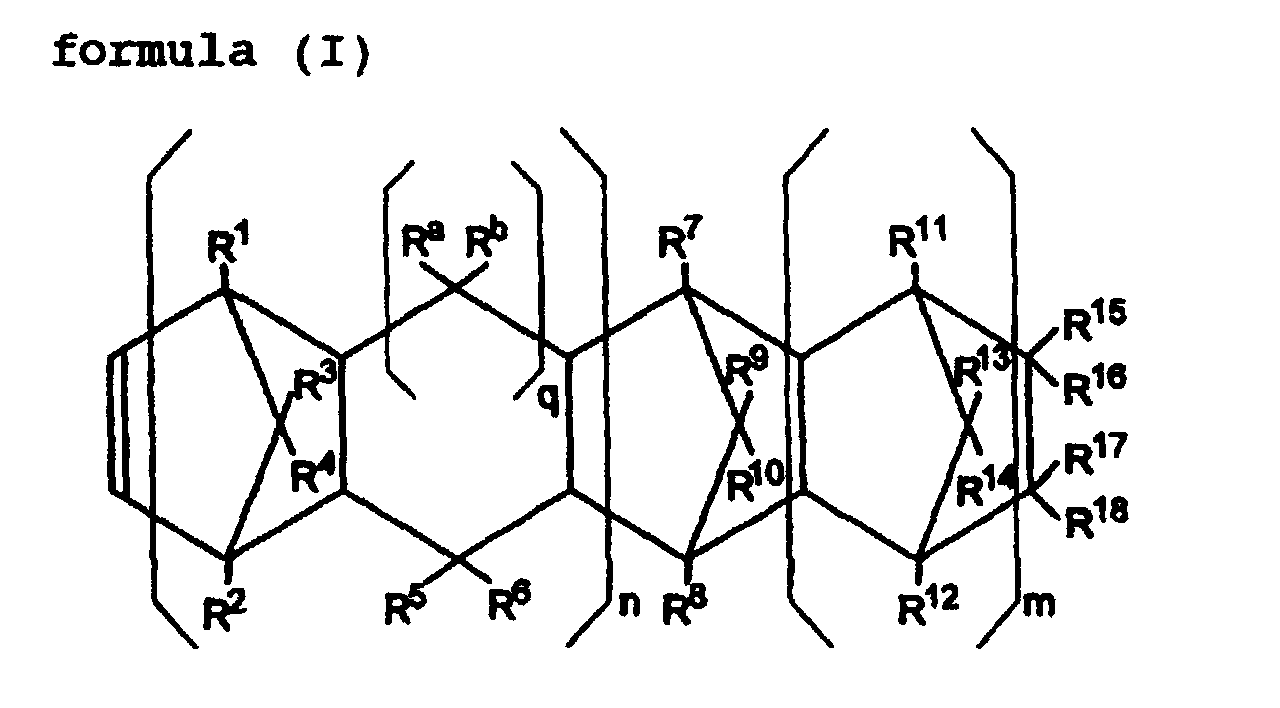 wherein p and q each are 0 or an integer of at least 1; m and n each are 0, 1 or 2; each of R1 through R19 independently represents a hydrogen atom, a halogen atom, an aliphatic hydrocarbon group, an alicyclic hydrocarbon group, an aromatic hydrocarbon group or an alkoxy group; the carbon atom to which R9 and R10 are bound may be bonded to the carbon atom to which R13 or R11 are bound, directly or via an alkylene group having 1 to 3 carbon atoms; or when n and m are 0, R15 and R12 or R15 and R19 may be combined together to form a monocyclic or polycyclic aromatic ring.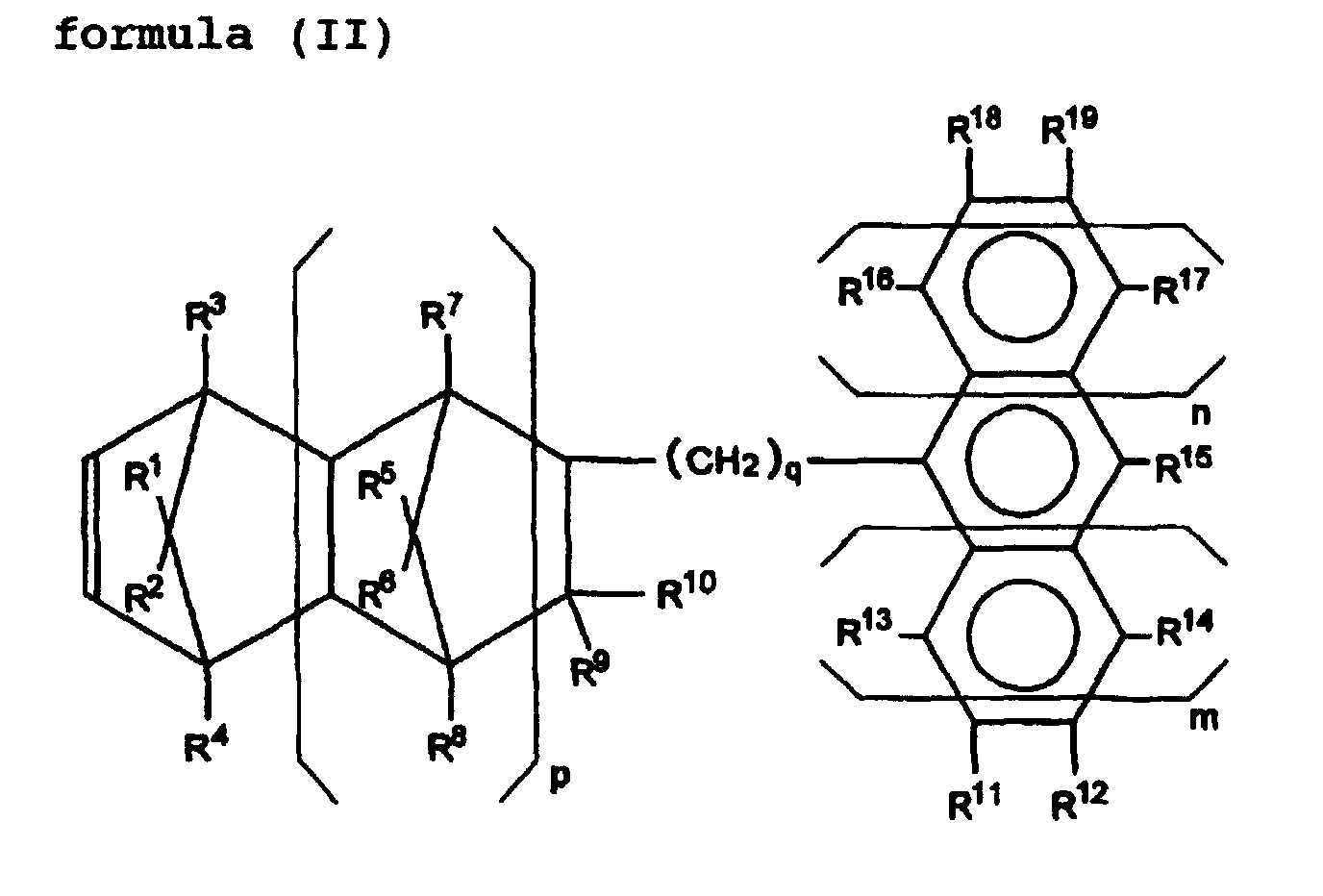
- [A-2] a ring-opened polymer or copolymer of the cyclic olefin represented by formula (I) or (II) above;
- [A-3] a hydrogenated product of the ring-opened polymer or copolymer [A-2] described above; and,
- [A-4] a graft-modified compound of [A-1], [A-2] or [A-3] described above.
-
- Furthermore, the thermoplastic resin composition in accordance with the present invention comprises:
- [A] at least one thermoplastic resin selected from (a)
through (C) below:
- (a) a cyclic olefin-based polymer selected from the group consisting of [A-1], [A-2], [A-3] and [A-4] below;
- (b) a polycyclohexane-type resin; and,
- (C) a 4-methyl-1-pentene-based polymer; and,
- [B] a polyvalent alcohol having at least 6 carbon atoms and having a molecular weight of not greater than 2000, wherein a ratio of the carbon atom number to the hydroxy group number in the same molecule is between 1.5 and 30, inclusive (in which the polyvalent alcohol may optionally contain in the molecule thereof an ether bond, a thioether bond, an alicyclic hydrocarbon group or an aromatic hydrocarbon groups); in which the polyvalent alcohol [B] is contained in an amount of 0.01 to 10 parts by weight based on 100 parts by weight of the thermoplastic resin [A];
- [A-1] an α-olefin-cyclic olefin random copolymer obtained by copolymerizing an α-olefin having 2 to 20 carbon atoms with a cyclic olefin represented by formula (I) or (II) described above;
- [A-2] a ring-opened polymer or copolymer of the cyclic olefin represented by formula (I) or (II) above;
- [A-3] a hydrogenated product of the ring-opened polymer or copolymer [A-2] described above; and,
- [A-4] a graft-modified compound of [A-1], [A-2] or [A-3] described above.
-
- The polyvalent alcohol is preferably the one in the molecule of which at least one hydroxyl group is bonded to the primary carbon atom.
- According to the present invention, plastic lenses, containers, transparent sheets or boards and optical recording media prepared from the thermoplastic resin composition are provided as preferred applications of the thermoplastic resin composition.
- The resin composition in accordance with the present invention comprises the thermoplastic resin having an excellent transparency and a low water absorption rate and the specific polyvalent alcohol. First, the following description turns on thermoplastic resin.
- The thermoplastic resin [A] used in the present invention comprises carbon atoms and hydrogen atoms as major constituents. The resin has a transparency in terms of a HAZE value of preferably 10% or less, more preferably 5% or less, and has whole light transmittance of generally 80% or higher, preferably 85% or higher, when measured in a thickness of 3 mm in accordance with ASTM-D1003. The thermoplastic resin also has a low water absorption rate of 0.1% or less, when measured by immersing the resin in water at 23°C for 100 hours.
- The thermoplastic resin preferably has a glass transition temperature (Tg) of 10°C or higher when measured with a differential scanning calorimeter (DSC). Furthermore, the thermoplastic resin preferably contains an aromatic ring of 20 wt% or less in the molecule making up the resin.
- Such thermoplastic resins include a cyclic olefin-based polymer, a poly-4-methyl-1-pentene resin and a polycyclohexane-type resin. In addition to these resins, the resins further include such thermoplastic resins that have the transparency, glass transition temperature and aromatic ring content defined above and have the skeletal structure mainly composed of carbon atoms and hydrogen atoms with hydrophilic functional groups such as a hydroxyl group, an ester group, a carbonyl group or an amido group, so long as the content of such functional groups is low enough to impart to the resins the water absorption rate lower than the upper limit defined above. Examples of such resins are resins obtained by modifying a cyclic olefin-based polymer with an anhydride of acid represented by maleic acid.
- Among these resins, preferred is at least one resin selected from:
- (a) a cyclic olefin-based polymer selected from the group consisting of [A-1], [A-2], [A-3] and [A-4] later described;
- (b) a polycyclohexane-type resin; and,
- (c) 4-methyl-1-pentene-based polymer.
-
- According to the present invention, at least one selected from:
- (a) a cyclic olefin-based polymer selected from the group consisting of [A-1], [A-2], [A-3] and [A-4] later described;
- (b) a polycyclohexane-type resin; and,
- (c) 4-methyl-1-pentene-based polymer may also be used as the thermoplastic resin [A], without any restriction to the physical property ranges defined above.
-
- Each of the thermoplastic resins will be described below more specifically.
- According to the present invention, the cyclic olefin-based polymers preferably used in the present invention are at least one selected from the group consisting of:
- [A-1] an α-olefin-cyclic olefin random copolymer obtained by copolymerizing an α-olefin having 2 to 20 carbon atoms with the cyclic olefin represented by formula (I) or (II) below;
- [A-2] a ring-opened polymer or copolymer of the cyclic olefin represented by formula (I) or (II) described below;
- [A-3] a hydrogenated product of the ring-opened polymer or copolymer [A-2] described above; and,
- [A-4] a graft-modified compound of [A-1], [A-2] or [A-3] described above.
-
- Now, the cyclic olefin shown by formula (I) or (II) as making up the cyclic olefin-based polymer (a) is described below.
- The cyclic olefin used in the present invention is represented by formula (I) or (II) below.

- In the formula (I) above, n is 0 or 1; m is 0 or an integer of 1 or larger; and q is 0 or 1. When q is 1, each of Ra and Rb is independently an atom or a hydrocarbon group, shown below; and when q is 0, there is no bond binding Ra and Rb but instead, the carbon atoms at the both sides are combined together to form a 5-membered ring.
- Each of R1 through R18 as well as Ra and Rb is independently a hydrogen atom, a halogen atom or a hydrocarbon group. Throughout the specification the halogen atom refers to a fluorine atom, a chlorine atom, a bromine atom or an iodine atom.
- The hydrocarbon group for each of R1 to R18 as well as Ra and Rb independently represents generally an alkyl group of 1 to 20 carbon atoms, a cycloalkyl group of 3 to 15 carbon atoms or an aromatic hydrocarbon group. Specific examples of the alkyl group include methyl, ethyl, propyl, isopropyl, amyl, hexyl, octyl, decyl, dodecyl and octadecyl. A typical example of the cycloalkyl group is cyclohexyl. Specific examples of the aromatic hydrocarbon group include phenyl and naphthyl. These hydrocarbon groups may optionally be substitution products with a halogen atom(s) as a replacement of a hydrogen atom(s).
- In the formula (I) above, R15 through R18 may be combined (together with each other) to form a monocyclic or polycyclic ring. The monocyclic or polycyclic ring thus formed may contain a double bond(s). Specific examples of the monocyclic or polycyclic ring formed are shown below.

- In the formulas exemplified above, the carbon atom marked with 1 or 2 indicates the carbon atom to which R15(R16) or R17(R18) is bound, respectively, in formula (I). Furthermore, R15 and R16 or R17 and R18 may be combined together to form an alkylidene group. In general, such an alkylidene group refers to an alkylidene group having 2 to 20 carbon atoms. Specific examples of such an alkylidene group are ethylidene, propylidene and isopropylidene.
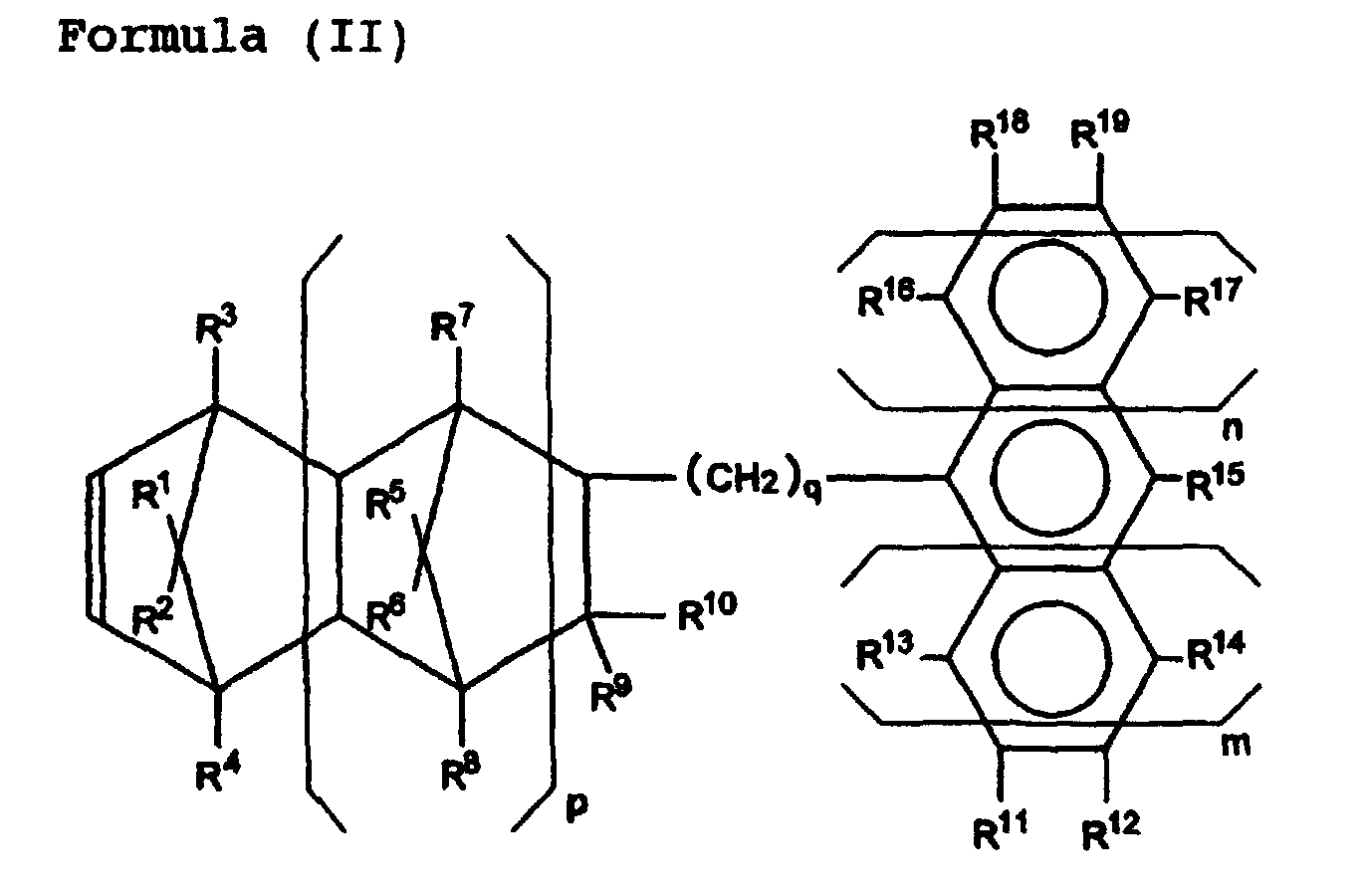
- In the formula (II) above, p and q each are 0 or an integer of 1 or larger; m and n each are 0, 1 or 2; and each of R1 through R19 is independently a hydrogen atom, a halogen atom, a hydrocarbon group or an alkoxy group.
- The halogen atom has the same significance as defined for that in the formula (I) above.
- The hydrocarbon group is independently an alkyl group of 1 to 20 carbon atoms, a halogenated alkyl group of 1 to 20 carbon atoms, a cycloalkyl group of 3 to 15 carbon atoms or an aromatic hydrocarbon group.
- Specific examples of the alkyl group include methyl, ethyl, propyl, isopropyl, amyl, hexyl, octyl, decyl, dodecyl and octadecyl. A typical example of the cycloalkyl group is cyclohexyl. Examples of the aromatic hydrocarbon group include an aryl group and an aralkyl group, specifically, phenyl, tolyl, naphthyl, benzyl and phenylethyl.
- Specific examples of the alkoxy group include methoxy, ethoxy and propoxy. These hydrocarbon and alkoxy groups may optionally be substituted with a fluorine, chlorine, bromine or iodine atom(s).
- The carbon atom to which R9 and R10 are bound may be linked to the carbon atom to which R13 or R11 is bound, directly or indirectly via an alkylene group of 1 to 3 carbon atoms. That is, when the two carbon atoms described above are bound to each other via an alkylene group, the groups shown by R9 and R13 or the groups shown by R10 and R11 are combined together to form an alkylene group selected from a methylene group (-CH2-), an ethylene group (-CH2CH2-) and a propylene group (-CH2CH2CH2-).
- Furthermore, when n and m are both 0, R15 and R12 or R15 and R19 may be combined together to form a monocyclic or polycyclic aromatic ring. In this case, for example, the monocyclic or polycyclic aromatic ring includes groups in which R15 and R12 form an additional aromatic ring(s) shown below:wherein q has the same significance as defined for q in the formula (II).
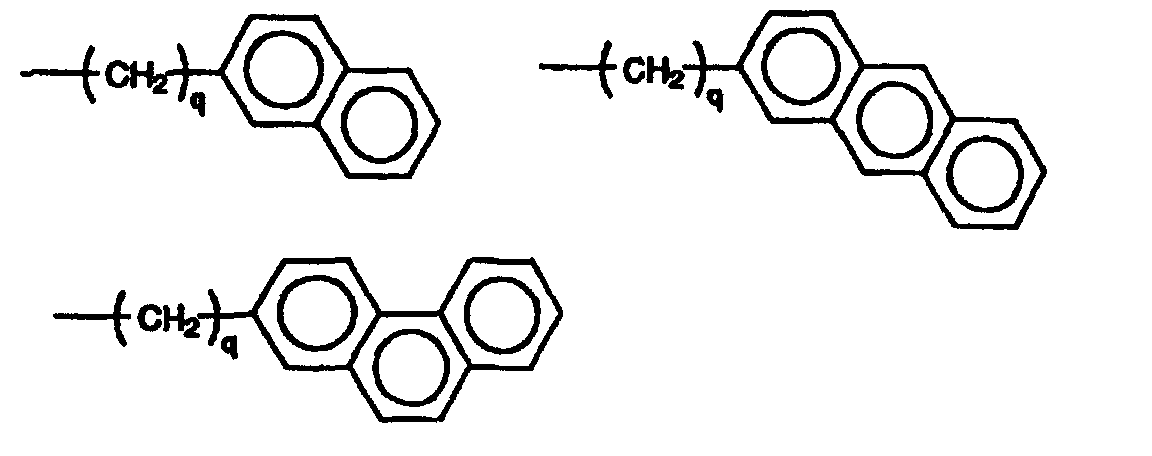
- The cyclic olefin represented by formula (I) or (II) will be described more specifically. One example includes a bicyclo[2.2.1]-2-heptene (also termed norbornene):wherein numerical figures of 1 to 7 indicate the position of carbons, and derivatives thereof obtained by substitution of the norbornene with a hydrocarbon group(s).

- Examples of the hydrocarbon group as the substituent include 5-methyl, 5,6-dimethyl, 1-methyl, 5-ethyl, 5-n-butyl, 5-isobutyl, 7-methyl, 5-phenyl, 5-methyl-5-phenyl, 5-benzyl, 5-tolyl, 5-(ethylphenyl), 5-(isopropylphenyl), 5-(biphenyl), 5-(β-naphthyl), 5-(α-naphthyl), 5-(anthracenyl) and 5,6-diphenyl.
- As the other derivatives, there are bicyclo[2.2.1]-2-heptene derivatives such as cyclopentadiene-acenaphtbylene adduct, 1,4-methano-1,4,4a,9a-tetrahydrofluorene, 1,4-methano-1,4,4a,5,10,10a-hexahydroanthracene, etc.
- Additional examples of the other derivatives include a tricyclo[4.3.0.12'5]-3-clecene derivative such as tricyclo[4.3.0.12'5]-3-decene, 2-methyltricyclo[4.3.0.12'5]-3-decene and 5-methyltricyclo[4.3.0.12'5]-3-decene; a tricyclo[4.4.0.12,5]-3-undecene derivative such as tricyclo[4.4.0.12'5]-3-undecene and 10-methyltricyclo[4.4.0.12'5]-3-undecene, tetracyclo[4.4.0.12'5.17,10]-3-dodecene shown by the following formula:(hereinafter merely referred to as tetracyclododecene; in the formula above, numerals of 1 to 12 indicate the positions of carbon atoms), and derivatives thereof obtained by substitution of this compound with a hydrocarbon group(s).
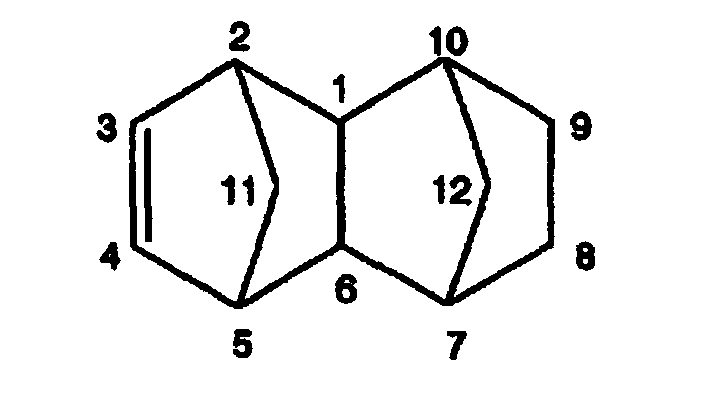
- Specific examples of the hydrocarbon group as the substituent include 8-methyl, 8-ethyl, 8-propyl, 8-butyl, 8-isobutyl, 8-hexyl, 8-cyclohexyl, 8-stearyl, 5,10-dimethyl, 2,10-dimethyl, 8,9-dimethyl, 8-ethyl-9-methyl, 11,12-dimethyl, 2,7,9-trimethyl, 2,7-dimethyl-9-ethyl, 9-isobutyl-2,7-dimethyl, 9,11,12-trimethyl, 9-ethyl-11,12-dimethyl, 9-isobutyl-11,12-dimethyl, 5,8,9,10-tetramethyl, 8-ethylidene, 8-ethylidene-9-methyl, 8-ethylidene-9-ethyl, 8-ethylidene-9-isopropyl, 8-ethylidene-9-butyl, 8-n-propylidene, 8-n-propylidene-9-methyl, 8-n-propylidene-9-ethyl, 8-n-propylidene-9-isopropyl, 8-n-propylidene-9-butyl, 8-isopropylidene, 8-isopropylidene-9-methyl, 8-isopropylidene-9-ethyl, 8-isopropylidene-9-isopropyl, 8-isopropylidene-9-butyl, 8-chloro, 8-bromo, 8-fluoro, 8,9-dichloro, 8-phenyl, 8-methyl-8-phenyl, 8-benzyl, 8-tolyl, 8-(ethylphenyl), 8-(isopropylphenyl), 8,9-diphenyl, 8-(biphenyl), 8-(β-naphthyl), 8-(α-naphthyl), 8-(anthracenyl) and 5,6-diphenyl.
- An additional derivative is the adduct of (cyclopentadiene-acenaphthylene adduct) and cyclopentadiene.
- Further examples include a tetracyclo[4.4.0.12,5.17,10]-3-dodecene derivative, pentacyclo[6.5.1.13,6.02,7.09,13]-4-pentadecene and derivatives thereof, pentacyclo[7.4.0.12,5.19,12.08,13]-3-pentadecene and derivatives thereof, a pentacyclo[6.5.1.1.3,6.02,7.09,13]-4,10-pentadecadiene compound, pentacyclo[8.4.0.12,5.19,12.08,13]-3-hexadecene and derivatives thereof, pentacyclo[6.6.1.13,6.02,7.09,14]-4-hexadecene and derivatives thereof, hexacyclo[6.6.1.13,6.110,13.02,7.09,14]-4-heptadecene and derivatives thereof, heptacyclo[8.7.0.12,9.14'7.111,17.03,8.012,16]-5-eicosene and derivatives thereof, heptacyclo[8.7.0.13,6.110,17.112,15.02,7.011,16]-4-eicosene and derivatives thereof, heptacyclo[8.8.0.12,9.14,7.11,18.03,8.012,17]-5-heneicosene and derivatives thereof, octacyclo[8.8.0.12,9.14,7.111,18.113,16.03,8.012,17]-5-docosene and derivatives thereof, nonacyclo[10.9.1.14,7.113'20.115,18.02,10.03,8.012,21.014'19]-5-pentacosene and derivatives thereof, nonacyclo[10.10.1.15,8.114,21.116,19.02,11.04,9.013,22.015,20]-6-hexacosene and derivatives thereof, etc.
- Specific examples of the cyclic olefin shown by formula (I) or (II) which can be used in the present invention are those described above. More detailed structures of these compounds are described in Japanese Patent Laid-Open Publication No. 7(1995)-145213, paragraph numbers [0032] through [0054]. The compounds disclosed therein can also be employed as the cyclic olefins of the present invention.
- The cyclic olefins shown by formula (I) or (II) may be prepared by, e.g., a Diels-Alder reaction between cyclopentadine and olefins having the corresponding structure.
- These cyclic olefins may be employed alone or in combination of two or more.
- The cyclic olefin-based polymers (a) used in the present invention may be produced using the cyclic olefins of formula (I) or (II) described above, in accordance with the processes disclosed in, e.g., Japanese Patent Laid-Open Publication Nos. 60(1985)-168708, 61(1986)-120816, 61(1986)-115912, 61(1986)-115916, 61(1986)-271308, 61(1986)-272216, 62(1987)-252406 and 62(1987)-252407, whereby reaction conditions are appropriately chosen.
- The random copolymer [A-1] of the α-olefin having 2 to 20 carbon atoms and the cyclic olefin contains constituent units derived from α-olefin generally in an amount of 5 to 95% by mol, preferably 20 to 80% by mol, and constituent units derived from the cyclic olefin generally in an amount of 5 to 95% by mol, preferably 20 to 80% by mol. The component ratio of the α-olefin to the cyclic olefin in the composition is determined by 13C-NMR.
- Hereinafter, the α-olefin having 2 to 20 carbon atoms which makes up the α-olefin-cyclic olefin random copolymer [A-1] is explained. The α-olefin may be either linear or branched. Specific examples of the α-olefin include linear α-olefins having 2 to 20 carbon atoms such as ethylene, propylene, 1-butene, 1-pentene, 1-hexene, 1-octene, 1-decene, 1-dodecene, 1-tetradecene, 1-hexadecene, 1-octadecene and 1-eicosene; and branched α-olefins having 4 to 20 carbon atoms such as 3-methyl-1-butene, 3-methyl-1-pentene, 3-ethyl-1-pentene, 4-methyl-1-pentene, 4-methyl-1-hexene, 4,4-dimethyl-1-hexene, 4,4-dimethyl-1-pentene, 4-ethyl-1-hexene and 3-ethyl-1-hexene. among these olefins, linear α-olefins having 2 to 4 carbon atoms are preferred, with more preferred being ethylene. These linear or branched α-olefins may be used alone or in combination of two or more.
- In the α-olefin-cyclic olefin random copolymer [A-1], the constituent units derived from the α-olefin having 2 to 20 carbon atoms and the constituent units derived from the cyclic olefin are arranged at random to bind and form substantially a linear structure. The resulting copolymer is substantially of a linear structure and substantially free of a gel like cross-linking structure. Such a structure can be confirmed by the absence of any insoluble matter in a solution when the copolymer is dissolved in an organic solvent. For instance, it can be verified by the fact that the copolymer is completely dissolved in decalin at 135°C, when the intrinsic viscosity [η] is measured.
- In the α-olefin-cyclic olefin random copolymer [A-1] used in the present invention, it is believed that at least a part of the cyclic olefin represented by formula (I) or (II) above would make up the following recurring unit shown by formula (III) or (IV) below.

- In formula (III), n, m, q, R1 through R18 as well as Ra and Rb have the same significance as defined in formula (I).

- In formula (IV), n, m, p, q and R1 through R19 have the same significance as defined in formula (II).
- The α-olefin-cyclic olefin random copolymer [A-1] employed in the present invention may contain constituent units from other copolymerizable monomers, if necessary and desired, within such a range that does not damage the objects of the present invention.
- As the other monomers of such purpose there are olefins other than the α-olefins having 2 to 20 carbon atoms and the cyclic olefins described above. Specific examples of these monomers include cycloolefins such as cyclobutene, cyclopentene, cyclohexene, 3,4-dimethylcyclopentene, 3-methylcyclohexene, 2-(2-methylbutyl)-1-cyclohexene and cyclooctene, 3a,5,6,7a-tetrahydro-4,7-methano-1H-indene, etc.; and non-conjugated dienes such as 1,4-hexadiene, 4-methyl-1,4-hexadiene, 5-methyl-1,4-hexadiene, 1,7-octadiene, dicyclopentadiene and 5-vinyl-2-norbornene. These other monomers may be used alone or in combination.
- In the α-olefin-cyclic olefin random copolymer [A-1], the constituent units derived from the other monomers described above may be contained generally in an amount of 20% by mol or less, preferably 10% by mol or less.
- The α-olefin-cyclic olefin random copolymer [A-1] used in the present invention can be prepared by the processes disclosed in the Japanese Laid-Open Publications supra, using the α-olefin having 2 to 20 carbon atoms and the cyclic olefin of formula (I) or (II). Among those processes, a preferred process comprises copolymerization in a hydrocarbon solvent using a catalyst made up from a vanadium compound soluble in the hydrocarbon solvent and an organic aluminum compound.
- In this copolymerization, a solid metallocene catalyst of Group IV in the periodic table may also be used. The solid metallocene catalyst of Group IV is a catalyst comprising a transition metal compound containing a ligand with a cyclopentadienyl structure and an organic aluminum oxy compound and, if necessary, an additional organic aluminum compound. Examples of the transition metal of Group IV include zirconium, titanium and hafnium. These transition metals each has a ligand containing at least one cyclopentadienyl structure. Examples of the cyclopentadienyl structure-containing ligand include a cyclopentadienyl group which may optionally have an alkyl group(s) as the substituent, indenyl group, tetrahydroindenyl group and fluorenyl group. These groups may be bound each other via other groups such as an alkylene group. Examples of the ligands other than the cyclopentadienyl structure-containing ligands are an alkyl group, a cycloalkyl group, an aryl group and an aralkyl group.
- As the organic aluminum oxy compound and the organic aluminum compound, there may be employed those conventionally used for preparation of polyolefins. Such solid Group IV metallocene catalysts of Group IV as described in, e.g., Japanese Patent Laid-Open Publication Nos. 61(1986)-221206, 64(1989)-106 and 2(1990)-173112 may be used for the present invention.
- The ring-opened polymer or copolymer of the cyclic olefin [A-2] is a ring-opened polymer of the cyclic olefin shown by formula (I) or (II) described above, or a copolymer containing ring-opened polymerizatin units derived from the cyclic olefin shown by formula (I) and/or (II) described above. In the case of the copolymer, two or more different cyclic olefins are used in combination.
- In the ring-opened polymer or copolymer of the cyclic olefin [A-2], it is believed that at least a part of the cyclic olefin shown by formula (I) or (II) above would make up a recurrent unit represented by formula (V) or (VI) below.

- In formula (V) above, n, m, q, R1 through R18 as well as Ra and Rb have the same significance as defined in formula (I).

- In formula (VI), n, m, p, q and R1 through R19 have the same significance as defined in formula (II).
- The ring-opened polymer or copolymer can be produced by the processes disclosed in the Japanese Patent Laid-Open Publications supra. For example, the ring-opened polymer or copolymer may be prepared by polymerizing or copolymerizing the cyclic olefin of formula (II) above in the presence of a ring opening polymerization catalyst. As the catalyst for ring opening polymerization, there may be employed a catalyst comprising the halide, nitrate or acetylacetone compound of a metal selected from ruthenium, rhodium, palladium, osmium, indium, platinum, etc. and a reducing agent; and a catalyst comprising the halide or acetylacetone compound of a metal selected from titanium, palladium, zirconium and molybdenum and an organic aluminum compound.
- The hydrogenated ring-opened polymer or copolymer [A-3] is prepared by hydrogenation of the ring-opened polymer or copolymer [A-2] obtained as described above in the presence of a known hydrogenation catalyst.
- In the hydrogenated ring-opened polymer or copolymer [A-3] it is believed that at least a part of the cyclic olefin shown by formula (I) or (II) above would make up a recurrent unit represented by formula (VII) or (VIII) below.

- In formula (VII) above, n, m, q, R1 through R18 as well as Ra and Rb have the same significance as defined in formula (I).
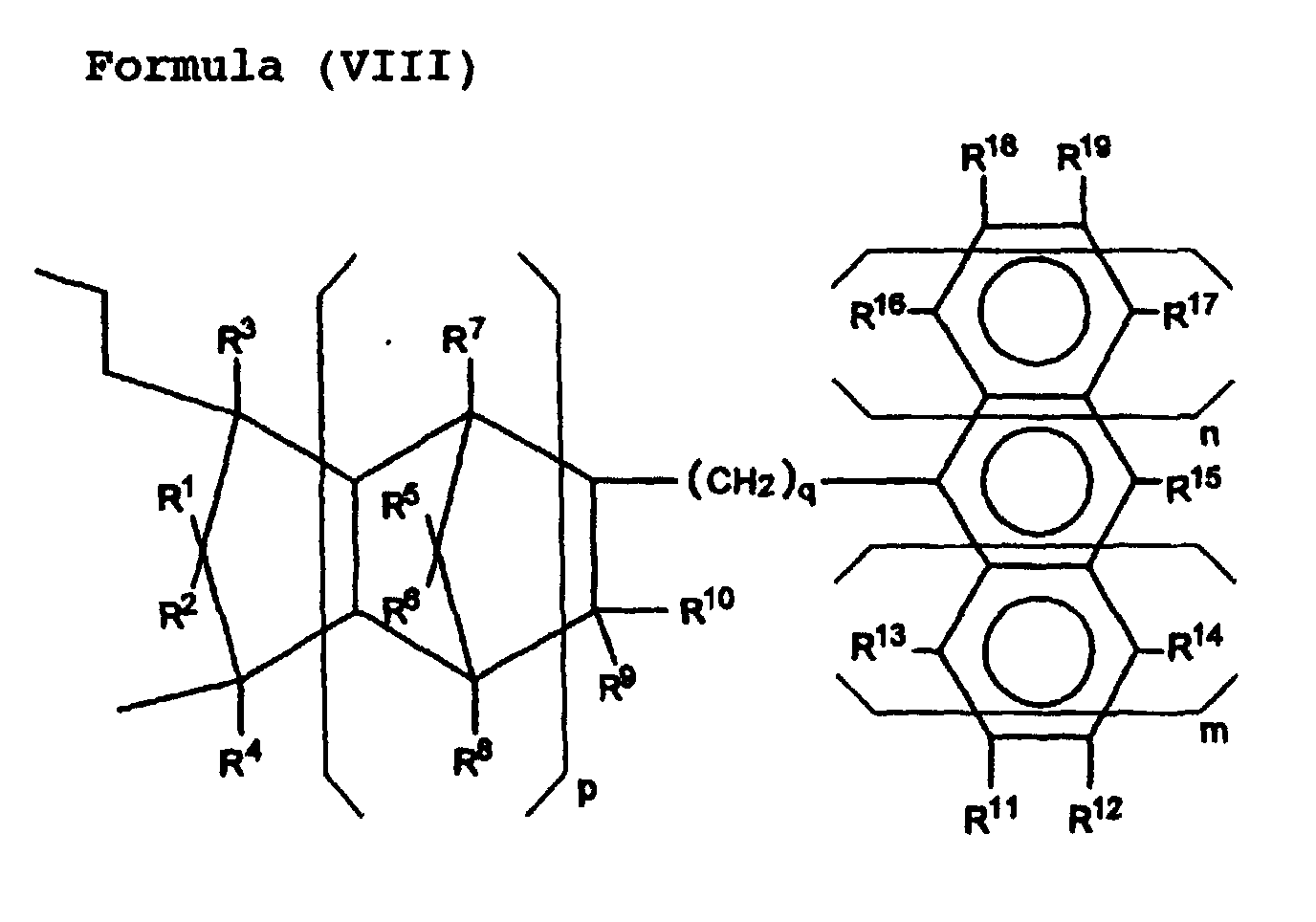
- In formula (VIII), n, m, p, q and R1 through R19 have the same significance as defined in formula (II).
- The graft modified compound of the cyclic olefin-based polymer [A-4] is a graft modified product of the ethylene-cyclic olefin random copolymer [A-1], the ring-opened polymer or copolymer [A-2] or the hydrogenated ring-opened polymer or copolymer [A-3], all described hereinabove.
- The graft modifier used in the present invention is generally an unsaturated carboxylic acid. Typical examples of the modifier include an unsaturated carboxylic acid such as (meth)acrylic acid, maleic acid, fumaric acid, tetrahydrophthalic acid, itaconic acid, citraconic acid, crotonic acid, isocrotonic acid, endo-cis-bicyclo[2.2.1]hept-5-ene-2,3-dicarboxilic acid (Nadic Acid™), etc.; and derivatives of these unsaturated carboxylic acids such as an unsaturated carboxylic acid anhydride, an unsaturated carboxylic acid halide, an unsaturated carboxylic acid amide, an unsaturated carboxylic acid imide, an unsaturated carboxylic acid ester, etc.
- Specific examples of the unsaturated carboxylic acid derivatives include maleic anhydride, citraconic anhydride, maleyl chloride, maleimide, monomethyl maleate, dimethyl maleate and glycidyl maleate.
- Of these modifiers, preferably employed are an α,β-unsaturated dicarboxylic acid and an α,β-unsaturated dicarboxylic acid anhydride, e.g., maleic acid, Nadic Acid™ and acid anhydrides of these acids. These modifiers may also be used in combination of two or more.
- The graft modified compound of the cyclic olefin-based polymer may be prepared by graft polymerization of the cyclic olefin-based polymer in the presence of such a modifier incorporated to achieve a desired modification level. Alternatively, a highly graft modified compound may be prepared previously and the resulting compound is blended with an unmodified cyclic olefin-based polymer so as to obtain the graft modified compound of a desired modification level.
- For preparing the graft modified compound of the cyclic olefin-based polymer from the cyclic olefin-based polymer and the graft modifier, a variety of conventional methods for modification of polymer are applicable to the present invention. For example, the graft modified compound may be prepared through graft polymerization (reaction) by adding a modifier to the cyclic olefin-based polymer in a melt state, or a method for graft reaction by adding a modifier to a solution of the cyclic olefin-based polymer in a solvent.
- Such a graft reaction is carried out generally at a temperature of 60 to 350°C. The graft reaction may be performed in the presence of a radical initiator such as an organic peroxide or an azo compound.
- According to the present invention, any one of [A-1], [A-2], [A-3] and [A-4] described above may be used alone as the cyclic olefin-based polymer (a), or these compounds may be used in combination within the same group or from two or more different groups.
- The cyclic olefin-based polymer (a) described above has a glass transition temperature (Tg) of preferably 60 to 230°C, more preferably 70 to 120°C, as measured by DSC.
- Furthermore, the cyclic olefin-based polymer (a) is non-crystalline or low crystalline and has crystallinity of usually 20% or less, preferably 10% or less, more preferably 2% or less, as measured by X ray diffraction technique.
- The intrinsic viscosity [η] determined in decalin at 135°C is preferably 0.01 to 20 dl/g, more preferably 0.05 to 10 dl/g, most preferably 0.08 to 5 dl/g.
- Melt flow rate (MFR) measured at 260°C under a load of 2,16 kg in accordance with ASTM-D1238 is generally ranging from 0.1 to 200 g/10 minutes, preferably 1 to 100 g/10 minutes, more preferably 3 to 60 g/10 minutes.
- The softening point is usually 30°C or higher, preferably 70°C or higher, more preferably 80°C or higher, much more preferably 90 to 250°C, most preferably 100 to 200°C, as a softening point (TMA) when measured by a thermal mechanical analyzer.
- Where an aromatic ring is contained in the molecule making up the resin, the content of the aromatic ring is preferably 20 wt% or less, more preferably 15 wt% or less.
- Of the cyclic olefin-based polymer (a) described above, preferred is the compound selected from the group consisting of the α-olefin-cyclic olefin random copolymer [A-1], the ring-opened polymer or copolymer of the cyclic olefin [A-2] and the hydrogenated product of the ring-opened polymer or copolymer of the cyclic olefin [A-3], having a softening point (TMA) of 80°C or higher and an intrinsic viscosity [η] of 0.05 to 10 dl/g.
- Among these compounds, the α-olefin-cyclic olefin random copolymer [A-1] is more preferred, especially preferred are the ethylene-tetracyclododecene copolymer and the ethylene-norbornene copolymer.
- Next, the polycyclobexane-type resin (b) will be described below. The polycyclohexane-type resin (b) used in the present invention includes a polycyclohexane obtained by polymerizing 1,3-cyclohexadiene using an alkyl lithium and an amine as an initiator and hydrogenating the double bonds in the polymer chain of the resulting poly-1,3-cyclohexadiene, a hydrogenated copolymer of 1,3-cyclohexadiene and an α-olefin or styrene, a hydrogenated block copolymer of the these monomer and butadiene as a soft segment for the purpose of improving impact strength, a hydrogenated copolymer of an aromatic vinyl compound such as styrene or an α-alkylstyrene, etc. and an α-olefin having 3 to 20 carbon atoms, and a polycyclohexylethylene obtained by hydrogenation of a styrenic polymer of styrene or an α-alkylstyrene. In thise case, the hydrogenation rate of the aromatic ring is preferably 60% or more, more preferably 90% or more.
- In the polycyclohexylethylene advantageously used in the present invention, the ratio (Mw/Mn) of weight-average molecular weight (Mw) to number-average molecular weight (Mn) is generally 6 or less, preferably 5 or less, more preferably 3 or less, most preferably 2.5 or less. The weight-average molecular weight is preferably in the range of 10,000 to 1,000,000, more preferably 20,000 to 700,000, much more preferably 50,000 to 500,000. Most preferred is polycyclohexylethylene having a weight average molecular weight of 70,000 to 300,000, since strength and moldability are well balanced.
- The glass transition temperature is generally in the range of 50 to 300°C, preferably 60 to 280°C, more preferably 70 to 250°C. The crystallinity is generally in the range of 0 to 20%, preferably 0 to 10%, more preferably 0 to 5%. The density is in the range of 0.80 to 1.50 g/cm3, preferably 0.85 to 1.0 g/cm3, more preferably 0.90 to 0.95 g/cm3.
- The polycyclohexylethylene can be obtained by hydrogenating the aromatic rings of a polystyrene, etc by known methods, which are described in, e.g., Japanese Patent Laid-Open Publication No. 7(1995)-247321, U.S. Patent No. 5,612,422, etc. The hydrogenation degree of the aromatic ring(s) is preferably at least 60%, more preferably 90% or more.
- Subsequent description is made on the 4-methyl-1-pentene-based polymer (c). The 4-methyl-1-pentene-based polymer (c) used in the present invention includes a homopolymer of 4-methyl-1-pentene alone or a copolymer of 4-methyl-1-pentene with other α-olefin, e.g., a copolymer with α-olefin having 2 to 20 carbon atoms, such as ethylene, propylene, 1-butene, 1-hexene, 1-octene, 1-decene, 1-tetradecene, 1-octadecene, etc. In view of heat stability upon steam sterilization, it is particularly preferred to use the 4-methyl-1-pentene homopolymer or the copolymer of 4-methyl-1-pentene and the aforesaid α-olefin containing at least 50% by mol, preferably at least 70% by mol, of the 4-methyl-1-pentene constituent units.
- The MFR of the 4-methyl-1-pentene-baed polymer (c) is preferably within the range of 1 to 400 g/10 mins., more preferably 10 to 300 g/10 mins., as measured at 260°C under a load of 5 kg in accordance with ASTM-D1238.
- Among the thermoplastic resin [A] described above, preferred is the cyclic olefin-based polymer selected from [A-1], [A-2] and [A-3] above, having a softening point (TMA) of 80°C or higher and an intrinsic viscosity [η] of 0.05 to 10 dl/g.
- In the present invention, if necessary, a resin composition comprising the thermoplastic resin further containing other resins may be used. These other resins are incorporated in such an amount that the objects of the invention are not marred.
- Examples of such resin components that may be incorporated in the thermoplastic resin are shown below.
- (1) Polymer derived from a hydrocarbon having one or two unsaturated bonds: Specific examples of such a polymer include a polyolefin such as polyethylene, polypropylene, polymethylbutene-1, poly-4-methylpentene-1, polybutene-1 and polystyrene. These polyolefins may be crosslinked.
- (2) Halogen-containing vinyl polymer: Specific examples of the halogen-containing vinyl polymer are polyvinyl chloride, polyvinylidene chloride, polyvinyl fluoride, polychloroprene and chlorinated rubber.
- (3) Polymer derived from an α,β-unsaturated acid and its derivatives: Specific examples of such a polymer include polyacrylate, polymethacrylate, polyacrylamide and polyacrylonitirle; and a copolymer of monomers making up the polymers above, such as acrylonitrile-butadiene-styrene copolymer, acrylonitrile-styrene copolymer, acrylonitrile-styrene-acrylate copolymer, etc.
- (4) Polymer derived from an unsaturated alcohol and an amine, or an acyl derivative of the alcohol or its acetal: Specific examples of such a polymer are polyvinyl alcohol, polyvinyl acetate, polyvinyl stearate, polyvinyl benzoate, polyvinyl maleate, polyvinyl butyral, polyallyl phthalate, polyallyl melamine, and a copolymer of monomers making up these polymers above, e.g., ethylene-vinyl acetate copolymer.
- (5) Polymer derived from an epoxide: Specific examples of such polymers are polyethylene oxide and a polymer derived from bisglycidyl ether.
- (6) Polyacetal: Specific examples include polyoxymethylene, polyoxyethylene and a polyolxymethylene containing ethylene oxide as a comonomer.
- (7) Polyphenylene oxide:
- (8) Polycarbonate:
- (9) Polysulfone:
- (10) Polyurethane and urea resin:
- (11) Polyamide and copolyamide derived from a diamine and a dicarboxylic acid and/or an aminocarboxylic acid, or the corresponding lactam: Specific examples include nylon 6, nylon 66, nylon 11 and nylon 12.
- (12) Polyester derived from a dicarboxylic acid and a dialcohol and/or an oxycarboxylic acid, or the corresponding lactone: Specific examples include polyethylene terephthalate, polybutyrene terephthalate and poly-1,4-dimethylol-cyclohexane terephthalate.
- (13) Polymer with a crosslinking structure derived from an aldehyde and phenol, urea or melamine: Specific examples include a phenol-formaldehyde resin, a urea-formaldehyde resin and a melamine-formaldehyde resin.
- (14) Alkyd resin: The alkyd resin is specifically a glycerine-phthalic acid resin.
- (15) Unsaturated polyester resin and halogen-containing modified resin obtained from a copolyester of a saturated or unsaturated dicarboxylic acid and a polyvalent alcohol, using a vinyl compound as a crosslinking agent:
- (16) Naturally occurring polymer: The naturally occurring polymer includes cellulose, rubber, protein or a derivative thereof, with specific examples of cellulose acetate, cellulose propionate and a cellulose ether.
- (17) Soft polymer: Typical examples of the soft polymer include a soft polymer containing a cyclic olefin component, an α-olefin-based copolymer, an α-olefin-diene-based copolymer, an aromatic vinyl hydrocarbon-conjugated diene soft copolymer, a soft polymer or copolymer composed of isobutylene or isobutylene-conjugated diene, etc.
-
- To blend the thermoplastic resin used in the present invention with other resin components or additives, conventionally known methods are applicable. For example, all the components are blended together at the same time.
- The polyvalent alcohol [B] used in the present invention has a molecular weight of not greater than 2000, and a ratio of the carbon atom number to the hydroxy group number in the same molecule between 1.5 to 30, inclusive, preferably 3 to 20, more preferably 6 to 20, and has not less than 6 carbon atoms. So long as the polyvalent alcohol within the ratio range and the carbon atom number range is used, good compatibility with the thermoplastic resin [A] is achieved so that foaming to adversely affect the transparency does not occur during melt kneading. A preferred range of the carbon atom number is between 6 and 100, more preferably between 6 and 60, inclusive.
- As the polyvalent alcohol [B], preferably at least one hydroxyl group in the molecule thereof is bonded to the primary carbon atom.
- The polyvalent alcohol [B] of the present invention may contain an ether bond, a thioether bond, an alicyclic hydrocarbon group or an aromatic hydrocarbon group in the molecule. A preferred example of the polyvalent alcohol is an aliphatic polyvalent alcohol. Polyvalent alcohols containing an ester group are outside the invention.
- Specific examples of the polyvalent alcohols include 3,7,11,15-tetramethyl-1,2,3-trihydroxyhexadecane, dihydroxyoctane, trihydroxyoctane, tetrahydroxyoctane, dihydroxynonane, trihydroxynonane, tetrahydroxynonane, pentahydroxynonane, hexahydroxynonane, dihydroxytriacontane, trihydroxytriacontane, eicosahydroxytriacontane, etc.
- Of these polyvalent alcohols, preferred is 3,7,11,15-tetramethyl-1,2,3-trihydroxyhexadecane used in EXAMPLES later described.
- The thermoplastic resin composition in accordance with the present invention comprises the thermoplastic resin [A] and the polyvalent alcohol [B], in which the polyvalent alcohol [B] is contained in an amount of 0.01 to 10 parts by weight, preferably 0.05 to 10 parts by weight, more preferably 0.05 to 7 parts by weight, much more preferably 0.1 to 5 parts by weight, based on 100 parts by weight of the thermoplastic resin [A]. Within the range set forth for the polyvalent alcohol, reduction in the transparency accompanied by an environmental change can be minimized without affecting the transparency or water absorption of the thermoplastic resin [A].
- The thermoplastic resin composition in accordance with the present invention is excellent in transparency, low birefringence, heat resistance, thermal aging resistance, chemical resistance, solvent resistance, dielectric properties, various mechanical properties, precision moldability and moisture resistance (low water absorption). Particularly because the thermoplastic resin [A] and the polyvalent alcohol [B] having such a particular structure are contained in a specified proportion, its excellent transparency can be retained, without affecting the transparency and water absorption of the thermoplastic resin, even when the environment changes from high temperature and high humidity conditions to normal temperature and normal humidity conditions.
- In addition to the thermoplastic resin [A] and the polyvalent alcohol [B], the thermoplastic resin composition described above may optionally contain various other additives, for example, a stabilizer such as a weathering stabilizer or a heat stabilizer, a cross-linking agent, a cross-linking aid, an antistatic agent, a fire retardant, an anti-slip agent, an anti-blocking agent, an anti-fogging agent, a lubricant, a dye, a pigment, a mineral oil-based softener, a petroleum resin, naturally occurring oil, synthetic oil, a wax, an organic or inorganic filler, etc., provided that the objects of the invention are not marred.
- Typical weathering stabilizers optionally contained are UV absorbants including a benzophenone compound, a benzotriazole compound, a nickel compound and a hindered amine compound. Specific examples of the UV absorbants include 2,2',4,4'-tetrahydroxybenzophenone, 2-(2'-hydroxy-3'-t-butyl-5'-butylphenyl)-5-chlorobenzotriazole, 2-(2'-hydroxy-3'-t-butyl-5'-butylphenyl)benzotriazole, nickel salt of bis(3,5-di-t-butyl-4-hydroxybenzoylphosphoric acid ethyl ester and bis(2,2',6,6'-tetramethyl-4-piperidine)sebacate.
- The stabilizer which may be optionally contained includes a phenolic antioxidant such as tetrakis[methylene-3-(3,5-di-t-butyl-4-hydroxyphenyl)propionate]methane, an alkyl β-(3,5-di-t-butyl-4-hydroxyphenyl)propionate, 2,2'-oxamidobis[ethyl-3-(3,5-di-t-butyl-4-hydroxyphenyl)propionate, etc.; a fatty acid metal salt such as zinc stearate, calcium stearate, calcium 1,2-hydroxystearate, etc. These stabilizers may be used in combination; for example, tetrakis[methylene-3-(3,5-di-t-butyl-4-hydroxyphenyl)propionate]methane may be used in combination with zinc stearate or calcium stearate.
- Phosphor-based stabilizers such as distearyl pentaerythritol diphosphite, di(nonylphenyl)pentaerythritol diphosphite, phenyl-4,4'-isopropylidenediphenolpentaerythritol diphosphite, bis(2,4-di-t-butylphenyl)pentaerythritol diphosphite, bis(2,6-di-t-butyl-4-methylphenyl)pentaerythritol diphosphite, phenylbisphenol-A-pentaerythritol diphosphite, tris(2,4-di-t-butylphenyl) phosphite, tris(nonylphenyl)phosphite, tetrakis(2,4-di-t-butylphenyl)-4,4'-biphenylenediphosphite, bis(2,6-di-t-butyl-4-methylphenyl)pentaerythritol diphosphite, etc. may also be used as the stabilizers.
- These stabilizers may be used alone or in combination of two or more.
- Examples of the organic or inorganic fillers include silica, diatomaceous earth, alumina, titanium oxide, magnesium oxide, pumice powders, pumice balloon, aluminum hydroxide, magnesium hydroxide, basic magnesium carbonate, dolomite, calcium sulfate, potassium titanate, barium sulfate, calcium sulfite, talc, clay, mica, asbestos, glass flakes, glass beads, calcium silicate, montmorillonite, bentonite, graphite, aluminum powders, molybdenum sulfide, etc.
- The thermoplastic resin composition of the present invention can be produced by optionally adopting any one of conventional methods. In more detail, for example, when the thermoplastic resin is melted using an extruder or when the thermoplastic resin already melted is passed through an extruder, a predetermined amount of the polyvalent alcohol is fed into the extruder and kneaded to form pellets. Or, the thermoplastic resin composition may be directly formed into a sheet, film or blow molded article through the extruder.
- When no extruder is employed, the composition may be prepared by adding a predetermined amount of the polyvalent alcohol to a solution of the thermoplastic resin in a solvent, stirring the mixture and then volatilizing the solvent. The polyvalent alcohol may also be added prior to the step in which the resin passes through an extruder, provided that resin production is not disturbed.
- Furthermore, there may be used a method for impregnating the polyvalent alcohol into powders or pellets of the thermoplastic resin added in the alcohol by rising temperature and pressure. These methods may be used in combination.
- By use of the thermoplastic resin composition thus produced which contains the polyvalent alcohol in accordance with the present invention, a molded article having an excellent transparency which hardly deteriorates the transparency upon steam sterilization or under high temperature and high humidity conditions and thus causes no turbidity in external appearance, notwithstanding that the thermoplastic resin having low water absorption rate is used.
- To produce the thermoplastic resin molded article of the present invention, any conventional known method may be used. For example, the thermoplastic resin composition comprising the thermoplastic resin and the polyvalent alcohol and, if necessary, other additives, obtained as above may be molded into a variety of molded articles such as a lens-like, container-like, tray-like, sheet-like or film-like mold, by subjecting the resin composition to extrusion molding, injection molding, injection compression molding, inflation molding, blow molding, extrusion blow molding, injection blow molding, press molding, vacuum molding or calendar molding.
- The molded articles of the thermoplastic resin composition in accordance with the present invention are excellent in transparency, low birefringence, heat resistance, thermal aging resistance, chemical resistance, solvent resistance, dielectric properties, mechanical properties such as rigidity, precision moldability and moisture resistance. Thus, the mold from the composition of the present invention finds specific applications for optical parts, e.g., a plastic lens such as a spherical lens, a non-spherical lens, a Fresnél lens, etc., a prism, a light guiding board, a reflector, optical fibers, etc.; optical recording media such as CD, MD, DVD, MO, PD, etc.; a transparent board; medical or pharmaceutical containers such as a testing tube, a vial bottle, an ampoule, a tablet bottle, a pre-filled syringe, a disposable syringe, an analyzer cell, a transfusion bag, a blood collection tube, etc.; a wide mouth bottle; containers used in miscellaneous daily goods and for foodstuffs such as a shampoo bottle, a container for coffee, a seasoning bottle, a beverage container, etc.; a transparent sheet, etc. In these products, a plastic lens, a container, a transparent sheet and board, optical recording media are more preferable applications.
- Next, the present invention will be described in more detail but is not deemed to be limited to the following EXAMPLES.
- Methods for determining the physical properties in the following EXAMPLES are shown below.
- (1) Softening point (TMA) The softening point was determined by deformation behavior of a 1 mm thick sheet under heat, using Thermo Mechanical Analyzer manufactured by Du Pont. A quartz needle under a load of 49 g was put on the sheet. While elevating a temperature at a rate of 5°C/min., a temperature at which the needle sank into the sheet in a depth of 0.635 mm was made its softening point (TMA).
- (2) Light transmittance and HAZE: Measured in accordance with ASTM-D1003. A specimen of a square board cut into 130 mm x 120 mm x 3 mm (thickness) was molded at a mold temperature of 115°C and a cylinder temperature of 270°C using an injection molding machine (IS-50 available from Toshiba Machine Co., Ltd.) and provided for the measurement.
- (3) Water absorption rate: The square board molded as in (2) above was dried at 80°C for 24 hrs. under vacuum of 1 torr. and then immersed in deionized water of 23°C for 100 hours. The square board was removed from water. The water on the surface of the square board was then wiped off and 2 g of the board was cut out. The water content of the 2 g of the board was measured by the Karl-Fischer method to determine the water absorption rate (wt%).
- (4) Melt flow rate (MFR): Measured at 260°C or 200°C under a load of 2.16 kg or 5 kg in accordance with ASTM-D1238.
- (5) Glass transition temperature (Tg): Measured at an elevation temperature of 10°C/min. using DSC-20 manufactured by Seiko Denshi Kogyo Co., Ltd.
- (6) Crystallinity: Measured by X-ray diffraction technique.
- (7) Content of aromatic rings: Measured by 1H-NMR and 13C-NMR techniques.
-
- As the thermoplastic resin [A], a random copolymer of ethylene and tetracyclododecene having whole light transmittance of 90%, HAZE of 3%, water absorption rate of 0.01% or less, softening point (TMA) of 150°C, intrinsic viscosity [η] of 0.6 dl/g and a glass transition temperature (Tg) of 138°C was used. To 100 parts by weight of the random copolymer above 2 parts by weight of 3,7,11,15-tetramethyl-1,2,3-trihydroxyhexadecane (molecular weight, 331; carbon atom number, 20; C number/OH number = 6,7) was added as the polyvalent alcohol [B] and further 0.6 part by weight of tetrakis[methylene-3-(3,5-di-t-butyl-4-hydroxyphenyl)propionate]methane was added to the mixture. The resulting mixture was fed into a twin-screw extruder (TEX-44 manufactured by The Japan Steel Works, Ltd.) at a cylinder temperature of 250°C and melt kneaded to give the thermoplastic resin composition.
- The thermoplastic resin composition thus obtained was injection molded using an injection molding machine (IS-55EPN manufactured by Toshiba Machine Co., Ltd.) to prepare a square board of 3 mm thick. The square board was allowed to stand for 48 hours at 80°C under relative humidity of 90% and then taken out into the ambient environment under normal temperature and normal humidity. The transparency was evaluated both in terms of a change in spectral transmittance (ΔTr (600 nm)) obtained by subtracting the spectral transmittance at a wavelength of 600 nm after the testing from the spectral transmittance at 600 nm before the testing and in terms of a change in HAZE (ΔHAZE) obtained by subtracting HAZE before the testing from HAZE after the testing. The results are given in Table 1.
- The procedure of Example 1 was repeated except that 3,9-bis(1,1-dimethyl-2-hydroxyethyl)-2,4,8,10-tetraoxaspiro[5.5]undecane (molecular weight, 304; carbon atom number, 15; C number/OH number = 7.5) was used as the polyvalent alcohol [B] instead of 3,7,11,15-tetramethyl-1,2,3-trihydroxyhexadecane. Thus, a square board was prepared to evaluate the transparency. The results are shown in Table 1.
- A square board was prepared to evaluate the transparency in a manner similar to EXAMPLE 1 except for adding no polyvalent alcohol to the resin. The results are shown in Table 1.
- Using pentaerythritol (molecular weight, 136; carbon atom number, 5; C number/OH number = 1.25) as the polyvalent alcohol [B], it was attempted to prepare a transparent resin composition by melt kneading in a manner similar to EXAMPLE 1. However, it was impossible to mold due to foaming generated.
- After the external appearance of the square board of 3 mm thick obtained by injection molding in EXAMPLE 1 was visually observed, the board was subjected to steam sterilization at 121°C for 20 minutes. The transparency was evaluated in terms of the change in spectral transmittance (ΔTr (600 nm)) and the change in RAZE (ΔHAZE) before and after the testing. The results are shown in Table 1.
- After the external appearance of the square board of 3 mm thick obtained by injection molding in EXAMPLE 2 was visually observed, the board was treated as in EXAMPLE 3. The transparency was evaluated in terms of the change in spectral transmittance (ΔTr (600 nm)) and the change in HAZE (ΔHAZE) before and after the testing. The results are shown in Table 1.
- The procedure of EXAMPLE 1 was repeated except that poly-4-methyl-1-pentene (TPX RT-18 manufactured by Mitsui Chemicals, Inc., MFR[260°C under a load of 5 kg]: 23 g/10 mins., glass transition temperature (Tg): 24°C) having whole light transmittance of 94%, HAZE of 3% and water absorption rate of 0.01% or less was used as the thermoplastic resin [A]. The thermoplastic resin composition thus obtained was injection molded using an injection molding machine (IS-55EPN manufactured by Toshiba Machine Co., Ltd.) to prepare a square board of 3 mm thick. After the external appearance of the square board was visually observed, the board was subjected to steam sterilization at 121°C for 20 minutes. The transparency was evaluated in terms of the change in spectral transmittance (Δ Tr (600 nm)) and the change in HAZE (ΔHAZE) before and after the testing. The results are shown in Table 1.
- A transparent resin composition was prepared in a manner similar to EXAMPLE 2 except that poly-4-methyl-1-pentene (TPX RT-18 manufactured by Mitsui Chemicals, Inc., MFR [260°C under a load of 5 kg]: 23 g/10 mins., glass transition temperature (Tg): 24°C) having whole light transmittance of 94%, HAZE of 3% and water absorption rate of 0.01% or less was used as the thermoplastic resin [A]. The transparent resin composition thus prepared was evaluated as in EXAMPLE 5. The results are shown in Table 1.
- The transparency was evaluated as in EXAMPLE 3, except that the square board was prepared without adding any polyvalent alcohol. The results are shown in Table 1.
- The transparency was evaluated as in EXAMPLE 5, except that the square board was prepared without adding any polyvalent alcohol. The results are shown in Table 1.
- Polycyclohexylethylene (whole light transmittance: 91%, HAZE: 3%, water absorption rate: 0.01% or less, glass transition temperature (Tg); 146°C, aromatic ring content: 2 wt% or less) was prepared by hydrogenating 100 g of polystyrene (manufactured by Nihon Polystyrene Co., Ltd ., G590, MFR [200°C under a 5 kg load]: 3 g/10 mins.) having whole light transmittance of 89%, a HAZE value of 2% and water absorption rate of 0.05% in a cyclohexane solvent at 100°C for 2 hours under 40 kg/cm2 in the presence of Ni(acac)2 and triisobutyl aluminum as catalyst. The thus obtained transparent resin was used as the thermoplastic resin [A]. After 2 parts by weight of 3,7,11,15-tetramethyl-1,2,3-trihydroxybexadecane was kneaded in 100 parts of the thus obtained transparent resin with a Labo Plastomill to mold into a press sheet of 30 mm x 30 mm x 3 mm (thickness) at a temperature of 280°C. The square board was treated in a manner similar to EXAMPLE 1. The results are shown in Table 1.
- The transparency was evaluated as in EXAMPLE 7, except that the square board was prepared without adding any polyvalent alcohol. The results are shown in Table 1.

- The thermoplastic resin composition in accordance with the present invention provides excellent transparency, low birefringence, heat resistance, thermal aging resistance, chemical resistance, solvent resistance, dielectric properties, various mechanical properties, precision moldability, moisture resistance (low water absorption), etc. In particular, the thermoplastic resin composition can stably maintain the excellent transparency even with any environmental change. Therefore the thermoplastic resin composition is greatly advantageous especially for use in optical molded articles such as a plastic lens, various contains for medical, pharmaceutical and food applications, a transparent sheet and board, and optical recording media such as CD, MD, DVD, MO, PD or the like.
Claims (13)
- A thermoplastic resin composition comprising:[A] a thermoplastic resin having a HAZE value of not greater than 10% and whole light transmittance of not less than 80%, when measured with a molded article in a thickness of 3 mm according to ASTM-D1003; water absorption rate of not greater than 0.1% as measured by immersion in water at 23°C for 100 hours; a glass transition temperature of not lower than 10°C; and an aromatic ring content of not greater than 20 wt%; and,[B] a polyvalent alcohol having at least 6 carbon atoms and having a molecular weight of not greater than 2000, wherein a ratio of the carbon atom number to the hydroxy group number in the same molecule is between 1.5 and 30, inclusive (in which the polyvalent alcohol may optionally contain, in the molecule thereof, an ether bond, a thioether bond, an alicyclic hydrocarbon group or an aromatic hydrocarbon group);in which the polyvalent alcohol [B] is contained in an amount of 0.01 to 10 parts by weight based on 100 parts by weight of the thermoplastic resin [A].
- The thermoplastic resin composition according to claim 1, wherein the thermoplastic resin [A] is at least one resin selected from:(a) a cyclic olefin-based polymer selected from the group consisting of [A-1], [A-2], [A-3] and [A-4] below;(b) a polycyclohexane-type resin; and,(c) a 4-methyl-1-pentene-based polymer;[A-1] an α-olefin-cyclic olefin random copolymer obtained by copolymerizing an α-olefin having 2 to 20 carbon atoms with a cyclic olefin represented by formula (I) or (II) below:wherein n is 0 or 1; m is 0 or an integer of at least 1; q is 0 or 1; each of R1 through R18 and Ra and Rb independently represents a hydrogen atom, a halogen atom or a hydrocarbon group; R15 through R18 may be combined with each other to form a monocyclic or polycyclic ring, which monocyclic or polycyclic ring may contain a double bond(s) and, R15 and R16 or R17 and R18 may be combined together to form an alkylidene group; and,
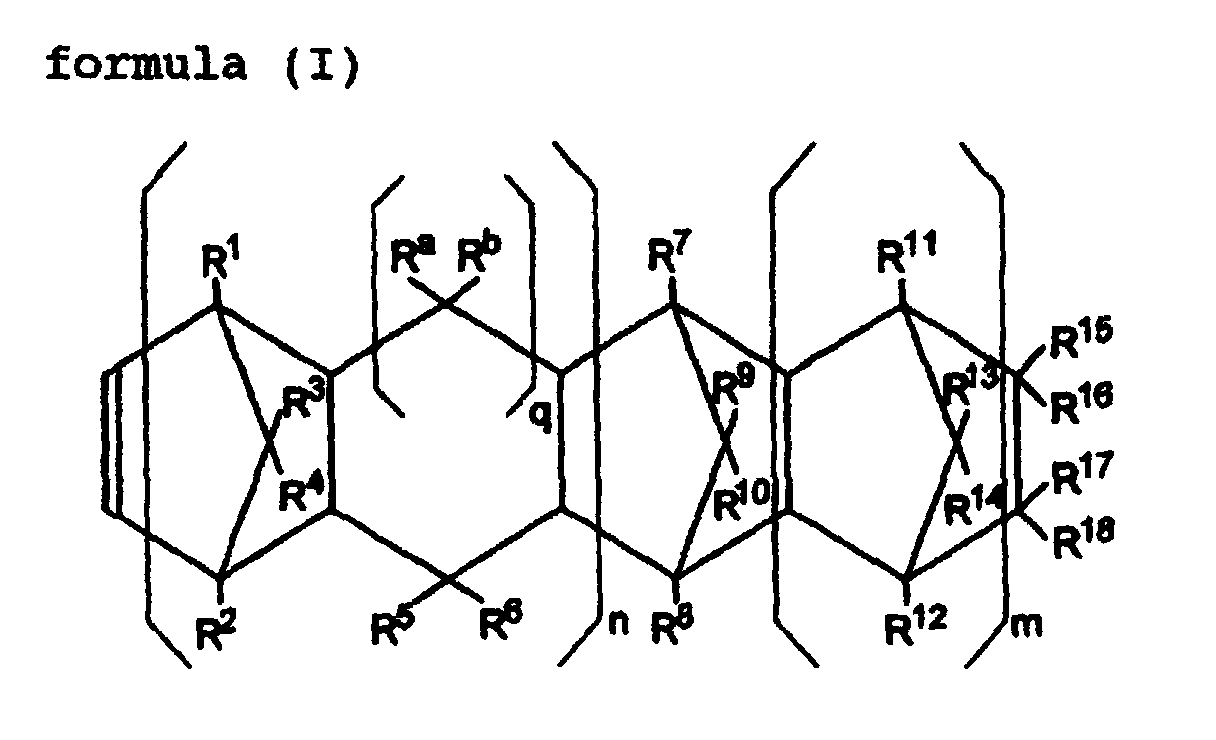 wherein p and q each are 0 or an integer of at least 1; m and n each are 0, 1 or 2; each of R1 through R19 independently represents a hydrogen atom, a halogen atom, an aliphatic hydrocarbon group, an alicyclic hydrocarbon group, an aromatic hydrocarbon group or an alkoxy group; the carbon atom to which R9 and R10 are bound may be bonded to the carbon atom to which R13 or R11 are bound, directly or via an alkylene group having 1 to 3 carbon atoms; or when n and m are 0, R15 and R12 or R15 and R19 may be combined together to form a monocyclic or polycyclic aromatic ring.
 [A-2] a ring-opened polymer or copolymer of the cyclic olefin represented by formula (I) or (II) above;[A-3] a hydrogenated product of the ring-opened polymer or copolymer [A-2] defined above; and,[A-4] a graft-modified compound of [A-1], [A-2] or [A-3] defined above.
 - The thermoplastic resin composition according to claim 2, wherein the cyclic olefin-based polymer (a) is selected from the group consisting of [A-1], [A-2] and [A-3] defined below, has a softening point (TMA) of not lower than 80°C and an intrinsic viscosity [η] of 0.05 to 10 dl/g;[A-1] an α-olefin-cyclic olefin random copolymer obtained by copolymerizing an α-olefin having 2 to 20 carbon atoms with the cyclic olefin represented by formula (I) or (II) above;[A-2] a ring-opened polymer or copolymer of the cyclic olefin represented by formula (I) or (II) above;[A-3] a hydrogenated product of the ring-opened polymer or copolymer [A-2] described above.
- A thermoplastic resin composition comprising:[A] at least one thermoplastic resin selected from (a) through (c) below:(a) a cyclic olefin-based polymer selected from the group consisting of [A-1], [A-2], [A-3] and [A-4] below;(b) a polycyclohexane-type resin; and,(c) a 4-methyl-1-pentene-based polymer; and,[B] a polyvalent alcohol having at least 6 carbon atoms and having a molecular weight of not greater than 2000, wherein a ratio of the carbon atom number to the hydroxy group number in the same molecule is between 1.5 and 30, inclusive (in which the polyvalent alcohol may optionally contain in the molecule thereof an ether bond, a thioether bond, an alicyclic hydrocarbon group or an aromatic hydrocarbon group); in which the polyvalent alcohol [B] is contained in an amount of 0.01 to 10 parts by weight based on 100 parts by weight of the thermoplastic resin [A];[A-1] an α-olefin-cyclic olefin random copolymer obtained by copolymerizing an α-olefin having 2 to 20 carbon atoms with a cyclic olefin represented by formula (I) or (II) below:wherein n is 0 or 1; m is 0 or an integer of at least 1; q is 0 or 1; each of R1 through R18 and Ra and Rb independently represents a hydrogen atom, a halogen atom or a hydrocarbon group; R15 through R18 may be combined with each other to form a monocyclic or polycyclic ring, which monocyclic or polycyclic ring may contain a double bond(s) and, R15 and R16 or R17 and R18 may be combined together to form an alkylidene group; and,
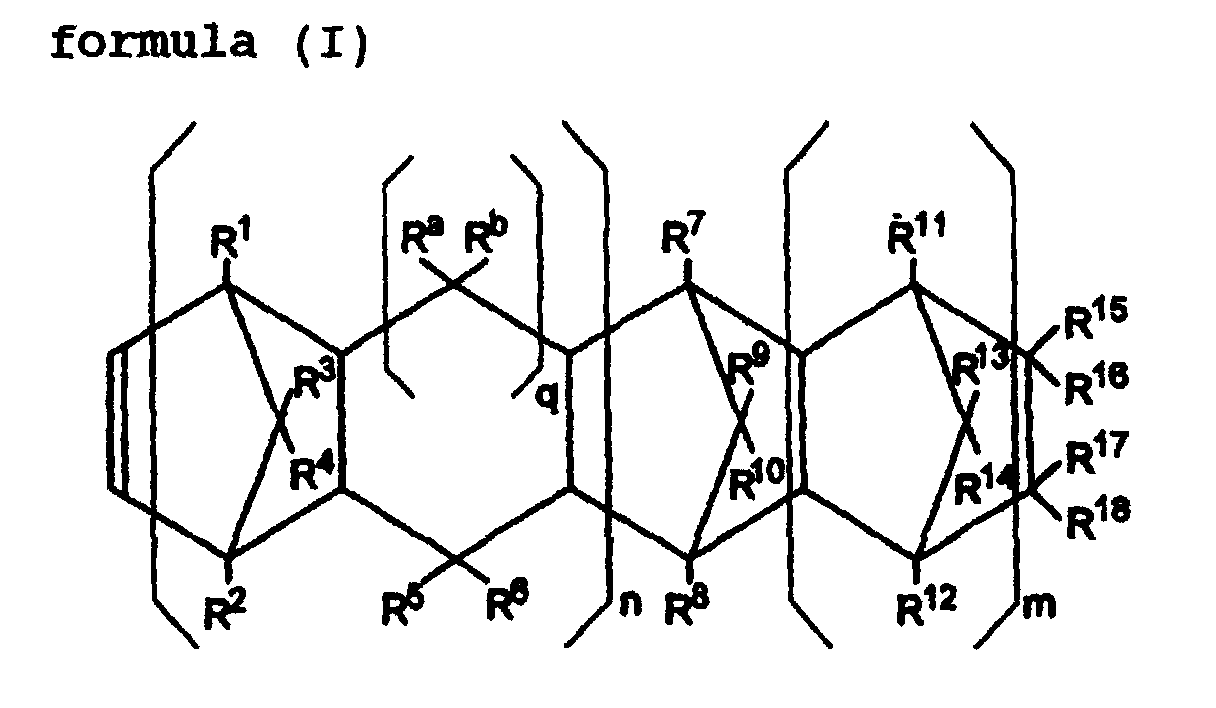 wherein p and q each are 0 or an integer of at least 1; m and n each are 0, 1 or 2; each of R1 through R19 independently represents a hydrogen atom, a halogen atom, an aliphatic hydrocarbon group, an alicyclic hydrocarbon group, an aromatic hydrocarbon group or an alkoxy group; the carbon atom to which R9 and R10 are bound may be bonded to the carbon atom to which R13 or R11 are bound, directly or via an alkylene group having 1 to 3 carbon atoms; or when n and m are 0, R15 and R12 or R15 and R19 may be combined together to form a monocyclic or polycyclic aromatic ring.
 [A-2] a ring-opened polymer or copolymer of the cyclic olefin represented by formula (I) or (II) above;[A-3] a hydrogenated product of the ring-opened polymer or copolymer [A-2] defined above; and,[A-4] a graft-modified compound of [A-1], [A-2] or [A-3] defined above.
 - The thermoplastic resin composition according to claim 4, wherein the thermoplastic resin [A] is a cyclic olefin-based polymer selected from the group consisting of [A-1], [A-2] and [A-3] defined below, has a softening point (TMA) of not lower than 80°C and an intrinsic viscosity [η] of 0.05 to 10 dl/g;[A-1] an α-olefin-cyclic olefin random copolymer obtained by copolymerizing an α-olefin having 2 to 20 carbon atoms with the cyclic olefin represented by formula (I) or (II) above;[A-2] a ring-opened polymer or copolymer of the cyclic olefin represented by formula (I) or (II) above;[A-3] a hydrogenated product of the ring-opened polymer or copolymer [A-2] described above.
- The thermoplastic resin composition according to any one of claims 1 to 5, wherein at least one hydroxyl group of the polyvalent alcohol is bonded to the primary carbon atom.
- The thermoplastic resin composition according to any one of claims 1 to 6, wherein the polyvalent alcohol is an aliphatic polyvalent alcohol.
- The thermoplastic resin composition molded from the thermoplastic resin composition according to any one of claim 1 to 7, wherein a HAZE value is not greater than 10%, when measured with a molded article in a thickness of 3 mm according to ASTM-D1003.
- A thermoplastic resin molded product from the thermoplastic resin composition according to any one of claims 1 to 8.
- A plastic lens comprising the thermoplastic resin composition according to any one of claims 1 to 8.
- A container comprising the thermoplastic resin composition according to any one of claims 1 to 8.
- A transparent sheet or transparent board comprising the thermoplastic resin composition according to any one of claims 1 to 8.
- Optical recording media comprising the thermoplastic resin composition according to any one of claims 1 to 8.
Applications Claiming Priority (5)
| Application Number | Priority Date | Filing Date | Title |
|---|---|---|---|
| JP5772599 | 1999-03-04 | ||
| JP5772599 | 1999-03-04 | ||
| JP13231799 | 1999-05-13 | ||
| JP13231799 | 1999-05-13 | ||
| PCT/JP2000/001226 WO2000052098A1 (en) | 1999-03-04 | 2000-03-02 | Thermoplastic resin composition and use thereof |
Publications (2)
| Publication Number | Publication Date |
|---|---|
| EP1081194A1 true EP1081194A1 (en) | 2001-03-07 |
| EP1081194A4 EP1081194A4 (en) | 2002-01-23 |
Family
ID=26398789
Family Applications (1)
| Application Number | Title | Priority Date | Filing Date |
|---|---|---|---|
| EP00906625A Withdrawn EP1081194A4 (en) | 1999-03-04 | 2000-03-02 | Thermoplastic resin composition and use thereof |
Country Status (3)
| Country | Link |
|---|---|
| EP (1) | EP1081194A4 (en) |
| KR (1) | KR20010042631A (en) |
| WO (1) | WO2000052098A1 (en) |
Cited By (1)
| Publication number | Priority date | Publication date | Assignee | Title |
|---|---|---|---|---|
| US7028840B2 (en) | 2001-12-19 | 2006-04-18 | Kimberly-Clark Worldwide, Inc. | Package and method for storing and dispensing wet wipes in a pop-up format |
Families Citing this family (1)
| Publication number | Priority date | Publication date | Assignee | Title |
|---|---|---|---|---|
| DE102009052363A1 (en) | 2009-11-07 | 2011-05-12 | Bayer Materialscience Ag | Polycarbonates with improved transmission |
Family Cites Families (5)
| Publication number | Priority date | Publication date | Assignee | Title |
|---|---|---|---|---|
| US4614778A (en) * | 1984-02-03 | 1986-09-30 | Hirokazu Kajiura | Random copolymer |
| JPH05239284A (en) * | 1992-03-02 | 1993-09-17 | Mitsui Petrochem Ind Ltd | Flame-retardant cycloolefinic resin composition |
| JPH09241484A (en) * | 1996-03-04 | 1997-09-16 | Nippon Zeon Co Ltd | Thermoplastic norbornene resin composition |
| JP4099870B2 (en) * | 1998-07-30 | 2008-06-11 | 日本ゼオン株式会社 | Vehicle lighting lens |
| JP2000119474A (en) * | 1998-10-16 | 2000-04-25 | Mitsui Chemicals Inc | Cycloolefin resin composition and its use |
-
2000
- 2000-03-02 EP EP00906625A patent/EP1081194A4/en not_active Withdrawn
- 2000-03-02 KR KR1020007011320A patent/KR20010042631A/en not_active Ceased
- 2000-03-02 WO PCT/JP2000/001226 patent/WO2000052098A1/en not_active Ceased
Non-Patent Citations (2)
| Title |
|---|
| No further relevant documents disclosed * |
| See also references of WO0052098A1 * |
Cited By (1)
| Publication number | Priority date | Publication date | Assignee | Title |
|---|---|---|---|---|
| US7028840B2 (en) | 2001-12-19 | 2006-04-18 | Kimberly-Clark Worldwide, Inc. | Package and method for storing and dispensing wet wipes in a pop-up format |
Also Published As
| Publication number | Publication date |
|---|---|
| KR20010042631A (en) | 2001-05-25 |
| WO2000052098A1 (en) | 2000-09-08 |
| EP1081194A4 (en) | 2002-01-23 |
Similar Documents
| Publication | Publication Date | Title |
|---|---|---|
| JP3723616B2 (en) | Cyclic olefin resin composition and use thereof | |
| CA2168927A1 (en) | Cycloolefin resin composition | |
| JP2001026718A (en) | Thermoplastic resin composition and use thereof | |
| EP1002833B1 (en) | Polyolefin-based resin compositions and fabricated products produced therefrom | |
| JP3798202B2 (en) | Polyolefin resin composition and molded article obtained therefrom | |
| JP2002105131A (en) | Cyclic olefinic polymer | |
| WO2005073321A1 (en) | Resin composition | |
| JP2001074915A (en) | Toric lens | |
| JP3683631B2 (en) | Cyclic olefin resin composition and use thereof | |
| JP3633672B2 (en) | Cyclic olefin-based resin composition molded body | |
| JP2007154074A (en) | Cycloolefin-based resin composition for film or sheet and use thereof | |
| JP2002114827A (en) | Cycloolefin polymer film or sheet | |
| JP7074517B2 (en) | Cyclic olefin resin composition for gamma ray or electron beam irradiation, molded body and gamma ray or electron beam irradiated product of the molded body | |
| KR20010042631A (en) | Thermoplastic resin composition and use thereof | |
| JPH08165357A (en) | Heat shrinkable sheet or film | |
| JPH09176398A (en) | CYCLIC OLEFIN RESIN COMPOSITION AND USE THEREOF | |
| JPH0919494A (en) | Medical / medical molding | |
| JPH1087752A (en) | Cyclic olefin resin pellets | |
| JP3559360B2 (en) | Method for producing molded article made of cyclic olefin resin | |
| JP3843289B2 (en) | Method for producing cyclic olefin-based resin molding | |
| JP2000119474A (en) | Cycloolefin resin composition and its use | |
| JP4979155B2 (en) | Cyclic olefin resin sheet or film and method for producing the same | |
| JP5102461B2 (en) | Packaging material | |
| JP2002114820A (en) | Cyclic olefin resin pellet and method of manufacturing the same | |
| JPH08277353A (en) | Cyclic olefin resin composition |
Legal Events
| Date | Code | Title | Description |
|---|---|---|---|
| PUAI | Public reference made under article 153(3) epc to a published international application that has entered the european phase |
Free format text: ORIGINAL CODE: 0009012 |
|
| 17P | Request for examination filed |
Effective date: 20001115 |
|
| AK | Designated contracting states |
Kind code of ref document: A1 Designated state(s): AT BE CH CY DE DK ES FI FR GB GR IE IT LI LU MC NL PT SE |
|
| STAA | Information on the status of an ep patent application or granted ep patent |
Free format text: STATUS: THE APPLICATION HAS BEEN WITHDRAWN |
|
| A4 | Supplementary search report drawn up and despatched |
Effective date: 20011206 |
|
| AK | Designated contracting states |
Kind code of ref document: A4 Designated state(s): AT BE CH CY DE DK ES FI FR GB GR IE IT LI LU MC NL PT SE |
|
| 18W | Application withdrawn |
Withdrawal date: 20011227 |