EP1079733B1 - Implantierbare medizinische vorrichtung zum beobachten des status eines patienten - Google Patents
Implantierbare medizinische vorrichtung zum beobachten des status eines patienten Download PDFInfo
- Publication number
- EP1079733B1 EP1079733B1 EP99924176A EP99924176A EP1079733B1 EP 1079733 B1 EP1079733 B1 EP 1079733B1 EP 99924176 A EP99924176 A EP 99924176A EP 99924176 A EP99924176 A EP 99924176A EP 1079733 B1 EP1079733 B1 EP 1079733B1
- Authority
- EP
- European Patent Office
- Prior art keywords
- display
- activity
- patient
- values
- value
- Prior art date
- Legal status (The legal status is an assumption and is not a legal conclusion. Google has not performed a legal analysis and makes no representation as to the accuracy of the status listed.)
- Expired - Lifetime
Links
Images



Classifications
-
- A—HUMAN NECESSITIES
- A61—MEDICAL OR VETERINARY SCIENCE; HYGIENE
- A61B—DIAGNOSIS; SURGERY; IDENTIFICATION
- A61B5/00—Measuring for diagnostic purposes; Identification of persons
- A61B5/0002—Remote monitoring of patients using telemetry, e.g. transmission of vital signals via a communication network
- A61B5/0031—Implanted circuitry
-
- A—HUMAN NECESSITIES
- A61—MEDICAL OR VETERINARY SCIENCE; HYGIENE
- A61B—DIAGNOSIS; SURGERY; IDENTIFICATION
- A61B5/00—Measuring for diagnostic purposes; Identification of persons
- A61B5/103—Measuring devices for testing the shape, pattern, colour, size or movement of the body or parts thereof, for diagnostic purposes
- A61B5/11—Measuring movement of the entire body or parts thereof, e.g. head or hand tremor or mobility of a limb
- A61B5/1118—Determining activity level
-
- G—PHYSICS
- G16—INFORMATION AND COMMUNICATION TECHNOLOGY [ICT] SPECIALLY ADAPTED FOR SPECIFIC APPLICATION FIELDS
- G16H—HEALTHCARE INFORMATICS, i.e. INFORMATION AND COMMUNICATION TECHNOLOGY [ICT] SPECIALLY ADAPTED FOR THE HANDLING OR PROCESSING OF MEDICAL OR HEALTHCARE DATA
- G16H40/00—ICT specially adapted for the management or administration of healthcare resources or facilities; ICT specially adapted for the management or operation of medical equipment or devices
- G16H40/60—ICT specially adapted for the management or administration of healthcare resources or facilities; ICT specially adapted for the management or operation of medical equipment or devices for the operation of medical equipment or devices
- G16H40/63—ICT specially adapted for the management or administration of healthcare resources or facilities; ICT specially adapted for the management or operation of medical equipment or devices for the operation of medical equipment or devices for local operation
-
- G—PHYSICS
- G16—INFORMATION AND COMMUNICATION TECHNOLOGY [ICT] SPECIALLY ADAPTED FOR SPECIFIC APPLICATION FIELDS
- G16H—HEALTHCARE INFORMATICS, i.e. INFORMATION AND COMMUNICATION TECHNOLOGY [ICT] SPECIALLY ADAPTED FOR THE HANDLING OR PROCESSING OF MEDICAL OR HEALTHCARE DATA
- G16H40/00—ICT specially adapted for the management or administration of healthcare resources or facilities; ICT specially adapted for the management or operation of medical equipment or devices
- G16H40/60—ICT specially adapted for the management or administration of healthcare resources or facilities; ICT specially adapted for the management or operation of medical equipment or devices for the operation of medical equipment or devices
- G16H40/67—ICT specially adapted for the management or administration of healthcare resources or facilities; ICT specially adapted for the management or operation of medical equipment or devices for the operation of medical equipment or devices for remote operation
-
- G—PHYSICS
- G16—INFORMATION AND COMMUNICATION TECHNOLOGY [ICT] SPECIALLY ADAPTED FOR SPECIFIC APPLICATION FIELDS
- G16H—HEALTHCARE INFORMATICS, i.e. INFORMATION AND COMMUNICATION TECHNOLOGY [ICT] SPECIALLY ADAPTED FOR THE HANDLING OR PROCESSING OF MEDICAL OR HEALTHCARE DATA
- G16H50/00—ICT specially adapted for medical diagnosis, medical simulation or medical data mining; ICT specially adapted for detecting, monitoring or modelling epidemics or pandemics
- G16H50/30—ICT specially adapted for medical diagnosis, medical simulation or medical data mining; ICT specially adapted for detecting, monitoring or modelling epidemics or pandemics for calculating health indices; for individual health risk assessment
-
- A—HUMAN NECESSITIES
- A61—MEDICAL OR VETERINARY SCIENCE; HYGIENE
- A61B—DIAGNOSIS; SURGERY; IDENTIFICATION
- A61B5/00—Measuring for diagnostic purposes; Identification of persons
- A61B5/72—Signal processing specially adapted for physiological signals or for diagnostic purposes
- A61B5/7232—Signal processing specially adapted for physiological signals or for diagnostic purposes involving compression of the physiological signal, e.g. to extend the signal recording period
Definitions
- a motion detection system for use in evaluating the movement of domestic animals is disclosed in WO 97/24027 .
- This system is attached externally to an animal, and detects movement by tracking voltage state changes occurring over time within an external motion sensor.
- this system does not include means to compensate for extraneous activity readings.
- this type of filtering mechanism is desirable to remove motion that may be detected when riding in an automobile for example. Specific information uses:
- Impairment of functional status can be seen in changes in the ability to perform exercises and ADL. This can be affected by many physiological factors such as progressive decompensation in the setting of left ventricular cardiac (LV) dysfunction, beta blocker treatment, symptomatic arrhythmias, and depression. These changes may take place over a long period of time and may be too subtle to be discerned by patients.
- LV left ventricular cardiac
- Class I is defined as "Patients with cardiac disease but without resulting limitation of physical activity. Ordinary physical activity does not cause undue fatigue, palpitation, dyspnea or anginal pain.”
- NYHA Class II is "Patients with cardiac disease resulting in slight limitation of physical activity. They are comfortable at rest. Ordinary physical activity results in fatigue, palpitation, dyspnea or anginal pain.”
- Class III is defined: "Patients with marked limitation of physical activity. They are comfortable at rest. Less than ordinary activity causes fatigue, palpitation, dyspnea, or anginal pain.
- Class IV is "Patients with cardiac disease resulting in inability to carry on any physical activity without discomfort. Symptoms of heart failure or of the anginal syndrome may be present even at rest. If any physical activity is undertaken, discomfort is increased.”
- an objective measure of patient activity stored in the device may help the clinician to decide an appropriate course of action. For example, if a patient complains vaguely of fatigue and shortness of breath and is not able to describe the limitations to his/her daily activities, a trend of activities may help the clinician. If the activity data could show a considerable decrease in patient activities, then the clinician may take the next step such as the evaluation of cardiac profile, pulmonary dysfunction, or existing drug therapy. On the other hand, if the long term trend of activity in this patient is consistently regular, (i.e., no decrease in patient activity), the clinician may take alternative steps to understand the difference between patient symptoms and device indicated activity data.
- Clinicians may also encounter situations when patients are reluctant to discuss their symptoms. In situations such as these, a trend of activity data may help the clinician to question the patient or the patient's spouse and enable the patient to come forward with their symptoms
- Heart Failure is a syndrome characterized by the coexistence of left ventricular dysfunction (low EF), arrhythmias, pulmonary and peripheral congestion, and symptoms of fatigue and shortness breath.
- low EF left ventricular dysfunction
- arrhythmias arrhythmias
- pulmonary and peripheral congestion symptoms of fatigue and shortness breath.
- a majority of ICD patients have low EF ( ⁇ 40%) and decreased functional capacity (NYHA Class II, III and IV), and are at risk of developing heart failure.
- Clinical heart failure is a progressive disease; hence early identification and timely therapy may prevent hospitalizations, reduce the cost of care and improve patient lives.
- patients may not be able to perform strenuous activities and in the later stages, may not be able to perform even routine activities such as walking up a flight of stairs.
- beta-blocking agents are known to blunt the heart rate response, which may affect the patient's ability to perform certain activities.
- the optimal dosage of beta-blocking agents is difficult to predict and may require trial and error methods. Further, there is usually a 30-60 day time period immediately after initiation of drug therapy during which the patient may not be very active. Most patients acclimate to the therapy after this period, but some don't. By having an objective measurement of patient activities, the titration and adjustment to beta blockers and other drugs could be enhanced.
- Arrhythmias may cause symptoms such as palpitations, fatigue, or presyncope. Some patients may spend a significant amount of time in arrhythmias such as atrial fibrillation and may not be able to perform daily activities. Such issues can be coordinated with measurements of activity for increased diagnostic value.
- implantable medical devices exist that have various accelerometers and piezocrystal activity sensors and the like which count the movement of the crystal or sensor with respect to a resting state.
- Medtronic brand implantable medical devices with piezoelectric crystal or accelerometer based activity sensors have the ability to convert a raw activity signal into 2 second activity counts. In other words, the number of times the accelerometer or sensor moves in a two second period is called a 2 second activity count.
- nothing in the art describes a method or apparatus for succinctly and effectively compiling such data as activity counts to make that data effective to solve the problems in diagnosis and patient tracking described above.
- the raw activity signal and hence the processed activity counts is a result of vibrations due to body movement. Activities such as walking and running cause body movement and vibration; the faster or longer the walk, more the vibrations, and larger the activity signal. Even though the raw activity signal is a good measure of activities such as walking and running, these raw counts, without our invention do not provide an accurate assessment of patient physical exertion. This is for three classes of reasons.
- a medical device adapted to be implanted in or affixed to a patient for tracking patient functional status by displaying values upon which an evaluation of said functional status can be made
- said medical device comprising a housing having an activity sensor (76a) and circuitry therein for recording output from said activity sensor; and processing means (77a), constructed to operate a procedure to iteratively sum, using a summation means, a number of activity counts sensed for each of a number of first size time intervals, over a second size time interval, to produce a sum for each first size time interval, and if said first sum is greater than a predetermined value, storing a count value for each first size time interval representing the result of comparing said sum to said predetermined value; wherein the summation procedure is repeated for subsequent ones of said first size time intervals and a count value is stored for said first size time intervals until the second size time interval is reached; and further comprising computation means adapted to determine a first display value for a representation of
- This invention thus provides a patient activity monitor for chronic implant which provides well correlated evidence of the functional status of the patient with the implant. It does so by monitoring an activity signal related to the movement of the patient, and from this monitored movement determining a level of activity indication signal value.
- any currently implanted medical devices could be adapted to employ the features of this invention provided only that such a device maintains either a direct and constant link with a memory device or has its own memory device and its own activity sensor, and that there is provided an appropriate processing circuit or program to enable the invention activity.
- Activity sensors are well known and have been employed in pacemaker type implantable medical devices for many years. A typical such device is seen in Strandberg's US patent No. 4,886,064 , and it is now common to see the basic activity sensor combined with alternative means for sensing activity such as minute ventilation as in US Patent No. 5,562,711 .
- FIG. 7 in which a set of alternative implantable devices 71a-c are illustrated inside of a patient body, (the edge of which is here illustrated as line BL,) the typical application of this invention will be to provide data for a display 82 on an external device such as a programmer P external to the patient body, via a communications channel such as is here represented by double headed arrow C.
- the data may be shown in the form of a bar chart or line graph or similar display which indicates the total amount of some algorithmically derived measure of activity over a given period of time, such as a day or an hour.
- Device 71a is a pacemaker having a memory 75a which stores the data measured by the sensor 76a.
- the storage can be in a raw form if there is sufficient memory or it can be compressed in various advantageous forms by a program or other circuit device running a process such as processor 77a.
- the microprocessor 77a runs a program stored in memory to convert sensed activity counts processed through an analog to digital converter 79 as they appear on a bus 78, and then returns the processed data to the program for temporary storage in the memory circuit 75a.
- the microprocessor converts a representation of the total to a value and stores the representation in the memory.
- an external device such as a programmer P requests a dump of these stored representations of value indicating the amount of patient activity over time
- it is formatted and sent over the communications channel by a communications circuit 83 to the external device so that it can be displayed in a human readable form.
- the data can be sent via communications here simply represented by arrow C2 and arrow L1 to be stored in a temporary device TD for later relaying to other devices by phone or other telemetry, here represented simply by line L2, for later or contemporaneous but distant display. Only the simplest construction required for operative use of the invention is shown here. It is a simple matter to resend data over modern communications systems once it is retrieved in a machine readable format.
- the Medtronic device REVEAL ® for example is fully implantable and similar to the device illustrated as device 71c, with a memory and processing circuitry for storing electrocardiograms, taken across two electrodes 79 and 72c.
- the addition of an additional circuit for sensing activity and appropriate circuitry to implement the storage of the relevant activity data in an appropriate manner would make this type of device another good candidate for the inventive features herein described.
- a drug pump such as device 71b when outfitted with the appropriate memory, processing and sensing circuits could do the same, as could other currently implantable devices.
- a device with nothing but an activity sensor, memory, a processor and some form of communications circuit would also be sufficient to perform the tasks required of this invention's implantable device.
- a kinetic power source By using a kinetic power source, the dependence on a battery could be eliminated too and the device could be extremely small and unobtrusive, permitting the clinician to easily obtain patient consent to accept the implant.
- any communications system could be employed to get the information to the doctor, or to update the patient file. Any such uses of the information provided by this invention are contemplated.
- Fig. 1 is a prototype illustration (using simulated data) over a 14 month period of patient activity data. Note that the patient can be seen over a very long period and any changes in the activity amount will be readily visible. Also, as illustrated here, even fairly large variations in daily activity will not influence the overall impression of health.
- the graph 10 displays hours in which the activity count was in the active range per day 12 versus time 13 on the line 11. In Fig. 2 , the activity line 15 begins trending downward in late September confirming that the patient should be seen at the time shown 16.
- Figure 3 illustrates a long term trend of patient activity data. This situation may be that of a post myocardial infarction (MI), sudden cardiac death survivor with EF ⁇ 40%.
- MI myocardial infarction
- FIGs. 4a-c are prototypical illustrated activity trends for patients with a drug therapy intervention.
- Fig 4a graph 20a
- line 21a shows little or no effect of the drug regimen.
- the patient report at the time he is seen will probably indicate no change in status, based on the height of curve 21a.
- the drug administration has an apparent effect by the time the patient is seen, while in graph 20c, the line 21c shows an effect of the Beta blocker administration.
- Figure 4a is a scenario where activities are not decreased.
- Fig. 4b illustrates a temporary decrease in patient activities followed by an increase to the original level.
- Fig. 4c shows that patient activities decreased and stay decreased, and may require the modification to the drug dosage.
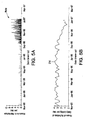
- Figs 5 a and 5b show how the activity data can be coordinated with a display of other patient related data, here hours in atrial fibrillation per day. Note the apparent correlation with the height of the line 21d and the increased occurrence of Atrial Fibrillation as would be expected.
- a device such as 71c which could track both fibrillations and activity could be used to produce such a paired graph display.
- the ability to correlate the duration of arrhythmia episodes with patient activity as shown in Figure 5 may help the physician in treating the arrhythmias.
- the physician can learn immediately whether the arrhythmia occurs with activity, an important piece of diagnostic information.
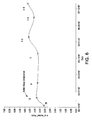
- Figure 6 illustrates correspondence with physician determined NYHA Class level of a CHF patient over a relatively short time period with his activity level in hours along the vertical axis.
- This chart shows the NYHA Classification and activities per day for the 7 follow-ups. As can be seen in the figure, activities per day appear to be increasing over time in correlation with the improvement in NYHA functional Classification from Class III to Class I/II.
- These signals can be collected from pacemakers which have been using piezoelectric crystals and accelerometers mounted inside the pacemaker can as an indicator of patient activity to control the rate of the pacemaker.
- the raw accelerometer/crystal signal is first filtered using a bandpass filter and the total number of crossings above and below a fixed threshold is calculated every 2 seconds.
- the rate of the pacemaker is then calculated based on these 2 second activity counts.
- These 2 second activity counts can also be used to acquire information regarding patient activity.
- HRV Heart Rate Variability
- ADL1 First, the average activity count over 80seconds is calculated by adding 40 consecutive 2 second counts. The average is then compared with a threshold of 1.5. If the average is greater than or equal to 1.5, then the 80s period is considered as activity (ADL), and the average for the next 80s time period is calculated. At the end of the 24 hour data, total activity duration is calculated by adding the number of 80 second windows that were detected as ADL, and multiplying with 80.
- ADL2 This algorithm is similar to ADL1 except for the choice of threshold (2.0). This choice was made to evaluate the trade-off between detecting true ADL and driving, a lower threshold will detect most ADL as well as driving while a higher threshold will detect less driving and true ADL.
- ADL3 This algorithm is similar to ADL2 except for the choice of window. Since we do not have any a priori knowledge of the typical duration of activities of daily living, a choice of 40 seconds was made in order to study the difference in performance between the 80 second and the 40 second windows.
- ADL4 As described above, ADL1, ADL2 and ADL3 are threshold algorithms and do not attempt to separate out non-activities from activities based on variability (only amplitude information is used). In the ADL4 algorithm, the 80 second average is first calculated. The number of 2 second counts that are greater than 0 are also noted. If the 80 second average is greater than 1.0 and at least 16/40 2 second counts in the 80 second window are greater than 0, then the 80 second window is detected as ADL.
- ADL5 This algorithm is another way to use the variability information.
- the 80 second window is separated into 20 second sub-windows and the average for the 80 second window as well as the 4 sub-windows are calculated. If the average of the 80 second window is greater than 1.0 and 3/4 sub-window averages are greater than 0.3 3 *(average of 80 second window), then the 80 second window is detected as ADL.
- the 24 hour data set we used was collected from 10 normal subjects and separated into two groups, a Development data set and a Validation data set.
- Three performance measures P1, P2 and P3 were calculated for each data set in the Development data set. Algorithm parameters were adjusted to achieve the highest P1 and P2, and lowest P3. Since these performance measures are different from the traditional sensitivity and specificity measures used to evaluate algorithms, each of these measures is defined and explained below.
- P ⁇ 1 Duration of marked ADL that is detected by algorithm Duration of marked ADL as marked by subject gold standard
- P2D is calculated as the number of 80 second activity windows detected as ADL by the algorithm.
- P2N the heart rate in the 80 second window corresponding to the 80 second activity window that is detected as an ADL is calculated first. If the heart rate in this window is above (rest heart rate + 10 bpm), then the 80 second activity window is said to be appropriately detected.
- the ratio of P2N and P2D is the performance measure P2.
- P3 is calculated as the ratio of P3N and P3D, where P3D is the total duration of marked driving by the normal subject and P3N is the duration during which marked driving was detected as ADL. Clearly, the lower P3 is, the better the algorithm.
- P ⁇ 3 Total driving time that is detected as ADL P ⁇ 3 ⁇ N Total marked driving time P ⁇ 3 ⁇ D
- ECG data 24 hour surface ECG data stored in a Holter Monitor system were downloaded and analyzed using "Holter for Windows" (TM) software (available through Rozin Electronics, Glendale NY). Every beat of the ECG data (each beat corresponds to the detection of a QRS complex) was classified as a Normal beat, Ventricular beat, Supra-ventricular beat or an Artifact. Only intervals between normal (sinus) beats (referred to as NN intervals) were used to compute heart rates during the entire 24 hour period.
- TM Holter for Windows
- the accelerometer signal is processed and a raw count is calculated every 2 seconds (ACTCNT) for pacemaker rate response.
- An algorithm to calculate minutes of ADL from ACTCNT is as follows:
- each of the 5 candidate algorithms were applied to each of the 5 data sets in the Development data set and the three performance measures P1, P2 and P3 calculated.
- the algorithm parameters were changed to maximize P1 and P2 and minimize P3.
- the values and brief descriptions of P1, P2 and P3 for each of these 5 normals is shown in Table 2.
- the algorithms were applied to the Validation data set and the process repeated.
- Table 3 shows the performance measures for the Validation data set. It is important to note that the utility of the performance measures is limited to the comparison of the different algorithms only and is not meant to be used as an absolute measure of sensitivity and specificity.
- each of the 5 candidate algorithms were applied to each of the 5 data sets in the Development data set and the three performance measures P1, P2 and P3 calculated.
- the algorithm parameters were changed to maximize P1 and P2 and minimize P3.
- the values and brief descriptions of P1, P2 and P3 for each of these 5 normals is shown in Table 2.
- the algorithms were applied to the Validation data set and the process repeated.
- Table 3 shows the performance measures for the Validation data set. It is important to note that the utility of the performance measures is limited to the comparison of the different algorithms only and is not meant to be used as an absolute measure of sensitivity and specificity. Table 2.
- ADL1 and ADL2 best meet the criteria.
- the only difference between ADL1 and ADL2 is the threshold parameter, ADL1 had a threshold of 1.5 and ADL2 had a threshold of 2.0. It is to be expected that a higher threshold (ADL2) would lead to a decreased sensitivity (P1 is lower for ADL2) and but increased specificity (P2 is higher for ADL2).
- the only difference between ADL2 and ADL3 is the choice of window (ADL2 used a 80s window while ADL3 used a 40s window).
- ADL1 (essentially same as ADL2) algorithm was chosen as the algorithm of choice since this algorithm has the highest sensitivity for maked ADL activities.
- this algorithm is associated with the least implementation complexity.
- 24 hour activity and heart rate data were collected from 10 heart failure patients as part of the EXACT study in addition to the 10 normal subjects as part of the Normal study. Such data were collected 7 times from each patient over a period of 16 weeks. However, detailed diary data were not collected from the patients as was from the normal subjects. Even though the 24 hour EXACT data from the patients do not lend themselves to the type of analysis performed on the data from normal subjects, these data were used to study algorithm performance in two different ways.
- Another way of using the 24 hour data from heart failure patients is to compare the total ADL per day from the heart failure patients with the normal subjects.
- the daily activities hours:minutes
- ADL/day 4 hours 51 minutes.
- This is significantly greater than ADL/day of 2 hours and 10 minutes for a typical heart failure patient.
- this result is not unexpected (one would expect the normal subjects to be more active than the heart failure patients) and the normal subjects are not age matched, it does provide a "reality check" of the algorithm.
- the ability to separate out normal subjects from heart failure subjects based on their activities is a desired attribute of an algorithm.
- the algorithm accepts the filtered activity count for a two second interval.
- this is bandpassed data from a sensor such as an accelerometer that measures a count every time it moves.
- a sensor such as an accelerometer that measures a count every time it moves.
- Various forms of activity sensor could be used which would require different pre processing. For example, if a three axis accelerometer were used, one could filter out or ignore the activity occurring outside of a particular plane of acceptable motion, such that a patient moving up and down would register a count, but one moving sideways may not. Alternatively only large excursions in signal output indicating a movement or shock of a sufficient size could be employed, thereby removing small movements form the calculation. If motion is detected from changes in a resonant microbeam sensor due to stress or pressure, different pre filtering schema must likewise be adopted.
- the period larger than the first larger period is a day, in our preferred embodiments.
- the number of active first larger periods in a day can easily be tallied and displayed as a percentage or number of hours in the day period.
- cs counts / 2 ⁇ sec . period If cs is an element of the set containing the count values for each 2 second period in a minute, i.e., ⁇ 0,0,0,0,1,0,0,15,30,32,10,2,0,0,1,0,0,0,0,0,0,0,0,01,0,2, 1,0,0,0 ⁇ , then the average value (the sum of the elements values divided by the number 30) for that minute is approximately 2.7, which is greater than the 1.5 we are using for the cut-off point, so a positive activity value gets recorded for this minute.
- a display of the amount of activity in a day, averaged over a week will be displayed for a number of months in a display similar to the graphs illustrated in Figs. 1-5 . Additionally, this data can be printed out for storage and later use by reference to a patient's file.
- a patient alarm may be sounded to incent the patient to comply with an exercise regimen or to call his doctor.
- Today small and low power piezo speakers with small speech producing circuitry are plentiful and inexpensive.
- the data here if it shows a failure or inability of the patient to comply with an exercise regimen could actually speak to the patient and say things like, 'time to get on the treadmill' or 'time to go to the doctor' or something similar, based on the severity of the failure of the patient to achieve the activity goals set with his physician and programmed into the device. Additional patient signals like a buzzer, shaker, or even electric shock could be provided to get the patient's attention.
- the drugs the patient is receiving could be adjusted based on his activity level, the angle of its downward or upward slope, or other characteristics determinable based on this activity data set.
- Arrhythmia monitoring background art includes US patents numbered 5,113,869; 5,313,953; and 5,086,772. Also of relevance are the following patents on triggering recordings of arrhythmic events, both automatically and by patient activation; 4,086,916; 5,404,877 and 5,012,814.
- Another less preferred embodiment would be to use an external device strapped or otherwise affixed to a patient's body to collect the activity data, (requiring of course some adjusment to the prederemined value for deciding whether a minute period qualified to be called active), but considering the difficulty in gaining patient compliance or comfort, we feel the implantable versions will be most efficatious.
Landscapes
- Health & Medical Sciences (AREA)
- Engineering & Computer Science (AREA)
- Life Sciences & Earth Sciences (AREA)
- Biomedical Technology (AREA)
- Public Health (AREA)
- Medical Informatics (AREA)
- General Health & Medical Sciences (AREA)
- Pathology (AREA)
- Physics & Mathematics (AREA)
- Veterinary Medicine (AREA)
- Animal Behavior & Ethology (AREA)
- Surgery (AREA)
- Molecular Biology (AREA)
- Heart & Thoracic Surgery (AREA)
- Biophysics (AREA)
- Primary Health Care (AREA)
- Epidemiology (AREA)
- General Business, Economics & Management (AREA)
- Computer Networks & Wireless Communication (AREA)
- Business, Economics & Management (AREA)
- Physiology (AREA)
- Dentistry (AREA)
- Oral & Maxillofacial Surgery (AREA)
- Databases & Information Systems (AREA)
- Data Mining & Analysis (AREA)
- Electrotherapy Devices (AREA)
- Measurement And Recording Of Electrical Phenomena And Electrical Characteristics Of The Living Body (AREA)
- Measuring And Recording Apparatus For Diagnosis (AREA)
Claims (11)
- Medizinische Vorrichtung (71a), die dafür eingerichtet ist, in einem Patienten implantiert oder an ihm angebracht zu werden, um einen funktionalen Status des Patienten durch Anzeigen von Werten, aufgrund welcher eine Einschätzung des funktionalen Status getroffen werden kann, nachzuverfolgen bzw. zu überwachen, wobei die medizinische Vorrichtung ein Gehäuse mit einem Aktivitätssensor (76a) und einer Schaltung darin zum Aufzeichnen von Ausgaben des Aktivitätssensors aufweist; und Verarbeitungsmittel (77a) aufweist, die dafür konstruiert sind, eine Prozedur zum iterativen Summieren einer Anzahl für jedes aus einer Anzahl von Zeitintervallen einer ersten Größe erfasster Aktivitätszähler mittels Summierungsmitteln über ein Zeitintervall zweiter Größe auszuführen, um eine Summe für jedes Zeitintervall erster Größe zu bilden, und einen Zählerwert für jedes Zeitintervall erster Größe zu speichern, das dem Ergebnis eines Vergleichs der Summe mit dem vorbestimmten Wert entspricht, wenn die erste Summe größer als ein vorbestimmter Wert ist; wobei der Summierungsvorgang für nachfolgende Zeitintervalle der Zeitintervalle erster Größe wiederholt und ein Zählerwert für die Zeitintervalle erster Größe gespeichert wird, bis das Zeitintervall zweiter Größe erreicht ist; und ferner mit Berechnungsmitteln, die dafür eingerichtet sind, einen ersten Anzeigewert für eine Darstellung der gespeicherten Zeitintervallzählerwerte erster Größe zu bestimmen, und um den ersten Anzeigewert, der einen Gesamtwert der Zählerwerte der Zeitintervalle erster Größe für das Zeitintervall zweiter Größe repräsentiert, zu speichern; und wobei das Gehäuse ferner zusätzliche Sensormittel zum Messen von Werten zusätzlicher physiologischer Parameter des Patienten und zur Erzeugung von Messausgaben hieraus aufweist, und wobei die Verarbeitungsmittel dafür eingerichtet sind, zeitlich mit den ersten Anzeigewerten in Beziehung stehend zusätzlich physiologische Messwerte, die den zusätzlichen Sensormittelausgaben entnommen bzw. von diesen abgeleitet sind, zu verarbeiten und zu speichern.
- Vorrichtung nach Anspruch 1, ferner mit Mitteln zum Bereitstellen der ersten Anzeigewerte an Anzeigemittel (82) zum Anzeigen eines zweiten Anzeigewertes, wobei der zweite Anzeigewert eine Summe der ersten Anzeigewerte darstellt.
- Vorrichtung nach Anspruch 1, bei der die Verarbeitungsmittel (77a) dafür eingerichtet sind, eine Prozedur auszuführen, um weiter iterativ zu bestimmen, ob der erste Anzeigewert eine vorbestimmte Funktion eines vorbestimmten Alarmwertes darstellt, und zum Speichern eines Ergebnisses der Bestimmung, und zum Einstellen eines Alarmmarkierungswertes, der das Ergebnis der Bestimmung repräsentiert.
- Vorrichtung nach Anspruch 1, bei der der Alarmmarkierungswert dafür eingerichtet ist, einen Patientenalarm zur Inkenntnissetzung des Patienten zu aktivieren.
- Vorrichtung nach Anspruch 4, bei der der Patientenalarm ein Tongenerator für einen hörbaren Ton ist.
- Vorrichtung nach Anspruch 5, bei der der Tongenerator für einen hörbaren Ton dafür eingerichtet ist, verständliche Sprache zu erzeugen.
- Vorrichtung nach Anspruch 1, bei der die Verarbeitungsschaltung dafür eingerichtet ist, weiter zu bestimmen, ob Aktivitätswerte, die durch die ersten Anzeigewerte repräsentiert werden, auf ein vorbestimmtes Muster eines Aktivitätsniveaus passen, um einen Markierungswert, der eine solche Veränderung anzeigt, zu setzen.
- Medizinisches Informationsanzeigesystem mit einer Vorrichtung nach einem der Ansprüche 1 oder 3 bis 7 und ferner mit Mitteln zum Empfangen von Daten des Speichers der implantierbaren medizinischen Vorrichtung und Verarbeitungsmitteln zum Erzeugen einer Anzeige und zum Bewirken, dass die Anzeige eine Darstellung bzw. Repräsentation der ersten Anzeigewerte derart anzeigt, dass die ersten Anzeigewerte der Höhe auf einer Achse parallel zu einem Patientenstatus entsprechen, und wobei die Anzeige eine rechtwinklige Achse zum Anzeigen eines Fortschreitens von Höhen der ersten Anzeigewerte für eine erste Zeiteinheit, die sich zeitlich über einen aus mehreren Zeitabschnitten zusammengesetzten Zeitabschnitt ändert, aufweist.
- Medizinische Informationsanzeige nach Anspruch 8, bei der die Verarbeitungsschaltung der Anzeigemittel ferner dafür eingerichtet ist, alle ersten Anzeigewerte über einen zeitlichen Zwischenabschnitt zu mitteln, so dass die Anzeige der ersten Anzeigewerte durch einen einzigen Wert bezüglich der Zwischenzeit repräsentiert wird.
- Medizinische Informationsanzeige nach Anspruch 8, ferner mit einer Empfangsvorrichtung zum Empfangen von Patientendaten von dem Implantat mit einer Darstellung bzw. Repräsentation der ersten Anzeigewerte, mit einer Kommunikationsverbindung an ein Kommunikationssystem zum Ermöglichen der Kommunikation bzw. Weitergabe der Repräsentation der ersten Anzeigewerte an eine entfernte Vorrichtung zur nachfolgenden Anzeige.
- Vorrichtung nach Anspruch 1, wobei die zusätzlichen Sensormittel geeignet dafür eingerichtet sind, physiologische Signale zu erfassen, die der Menge möglicher Sensorsignale entnommen sind, beinhaltend: Arrhythmien, Arrhythmien während Ruhephasen, Atemfrequenz während Ruhephasen, Atemfrequenz, Auftreten abnormaler Atemepisoden während der Ruhe, Veränderung der Sinusfrequenz während der Ruhe, Herzfrequenzvariabilität Blutdruck, ST-Segmentvariation, Blutsauerstoffsättigung und Temperatur.
Applications Claiming Priority (3)
| Application Number | Priority Date | Filing Date | Title |
|---|---|---|---|
| US78221 | 1998-05-13 | ||
| US09/078,221 US6045513A (en) | 1998-05-13 | 1998-05-13 | Implantable medical device for tracking patient functional status |
| PCT/US1999/010282 WO1999058056A1 (en) | 1998-05-13 | 1999-05-11 | Implantable medical device for tracking patient functional status |
Publications (2)
| Publication Number | Publication Date |
|---|---|
| EP1079733A1 EP1079733A1 (de) | 2001-03-07 |
| EP1079733B1 true EP1079733B1 (de) | 2009-09-02 |
Family
ID=22142698
Family Applications (1)
| Application Number | Title | Priority Date | Filing Date |
|---|---|---|---|
| EP99924176A Expired - Lifetime EP1079733B1 (de) | 1998-05-13 | 1999-05-11 | Implantierbare medizinische vorrichtung zum beobachten des status eines patienten |
Country Status (6)
| Country | Link |
|---|---|
| US (3) | US6045513A (de) |
| EP (1) | EP1079733B1 (de) |
| JP (1) | JP2002514454A (de) |
| CA (1) | CA2331500A1 (de) |
| DE (1) | DE69941356D1 (de) |
| WO (1) | WO1999058056A1 (de) |
Cited By (2)
| Publication number | Priority date | Publication date | Assignee | Title |
|---|---|---|---|---|
| US10098584B2 (en) | 2011-02-08 | 2018-10-16 | Cardiac Pacemakers, Inc. | Patient health improvement monitor |
| EP4210572A1 (de) * | 2020-09-08 | 2023-07-19 | Medtronic, Inc. | Erkennung von änderungen der patientengesundheit auf basis von spitzen- und nichtspitzen-patientenaktivitätsdaten |
Families Citing this family (300)
| Publication number | Priority date | Publication date | Assignee | Title |
|---|---|---|---|---|
| US6129744A (en) * | 1997-12-04 | 2000-10-10 | Vitatron Medical, B.V. | Cardiac treatment system and method for sensing and responding to heart failure |
| US6821249B2 (en) * | 1999-03-08 | 2004-11-23 | Board Of Regents, The University Of Texas | Temperature monitoring of congestive heart failure patients as an indicator of worsening condition |
| US6290646B1 (en) | 1999-04-16 | 2001-09-18 | Cardiocom | Apparatus and method for monitoring and communicating wellness parameters of ambulatory patients |
| US7945451B2 (en) * | 1999-04-16 | 2011-05-17 | Cardiocom, Llc | Remote monitoring system for ambulatory patients |
| US20070021979A1 (en) * | 1999-04-16 | 2007-01-25 | Cosentino Daniel L | Multiuser wellness parameter monitoring system |
| US7577475B2 (en) * | 1999-04-16 | 2009-08-18 | Cardiocom | System, method, and apparatus for combining information from an implanted device with information from a patient monitoring apparatus |
| US20060030890A1 (en) * | 1999-04-16 | 2006-02-09 | Cosentino Daniel L | System, method, and apparatus for automated interactive verification of an alert generated by a patient monitoring device |
| US8419650B2 (en) | 1999-04-16 | 2013-04-16 | Cariocom, LLC | Downloadable datasets for a patient monitoring system |
| US8438038B2 (en) * | 1999-04-16 | 2013-05-07 | Cardiocom, Llc | Weight loss or weight management system |
| US6294993B1 (en) * | 1999-07-06 | 2001-09-25 | Gregory A. Calaman | System for providing personal security via event detection |
| CA2314517A1 (en) | 1999-07-26 | 2001-01-26 | Gust H. Bardy | System and method for determining a reference baseline of individual patient status for use in an automated collection and analysis patient care system |
| US6289248B1 (en) | 1999-08-20 | 2001-09-11 | Cardiac Pacemakers, Inc. | System and method for detecting and displaying parameter interactions |
| US6493579B1 (en) | 1999-08-20 | 2002-12-10 | Cardiac Pacemakers, Inc. | System and method for detection enhancement programming |
| US6454705B1 (en) | 1999-09-21 | 2002-09-24 | Cardiocom | Medical wellness parameters management system, apparatus and method |
| EP1217942A1 (de) | 1999-09-24 | 2002-07-03 | Healthetech, Inc. | Physiologisches überwachungsgerät und damit verbundener computer, anzeigegerät und kommunikationseinheit |
| US7127290B2 (en) | 1999-10-01 | 2006-10-24 | Cardiac Pacemakers, Inc. | Cardiac rhythm management systems and methods predicting congestive heart failure status |
| AU8007600A (en) | 1999-10-08 | 2001-04-23 | Healthetech, Inc. | Monitoring caloric expenditure rate and caloric diet |
| US6453201B1 (en) | 1999-10-20 | 2002-09-17 | Cardiac Pacemakers, Inc. | Implantable medical device with voice responding and recording capacity |
| US6409675B1 (en) * | 1999-11-10 | 2002-06-25 | Pacesetter, Inc. | Extravascular hemodynamic monitor |
| US6336903B1 (en) * | 1999-11-16 | 2002-01-08 | Cardiac Intelligence Corp. | Automated collection and analysis patient care system and method for diagnosing and monitoring congestive heart failure and outcomes thereof |
| US6752765B1 (en) | 1999-12-01 | 2004-06-22 | Medtronic, Inc. | Method and apparatus for monitoring heart rate and abnormal respiration |
| US6513532B2 (en) * | 2000-01-19 | 2003-02-04 | Healthetech, Inc. | Diet and activity-monitoring device |
| DE60131041T2 (de) | 2000-01-19 | 2008-07-31 | Pacesetter, Inc., Sylmar | Implantierbare Herzvorrichtung zur Überwachung der Verschlechterung oder Verbesserung von Herzerkrankungen |
| US6438407B1 (en) | 2000-03-20 | 2002-08-20 | Medtronic, Inc. | Method and apparatus for monitoring physiologic parameters conjunction with a treatment |
| US6482158B2 (en) | 2000-05-19 | 2002-11-19 | Healthetech, Inc. | System and method of ultrasonic mammography |
| US6659968B1 (en) * | 2000-06-01 | 2003-12-09 | Advanced Bionics Corporation | Activity monitor for pain management efficacy measurement |
| JP2004503887A (ja) | 2000-06-16 | 2004-02-05 | ヘルセテック インコーポレイテッド | 携帯情報端末用音声認識装置 |
| EP1358745B1 (de) * | 2000-08-22 | 2008-12-10 | Medtronic, Inc. | Netzwerkimplementierte medizinische anlagesysteme für fernpatientenverwaltung |
| US6607387B2 (en) | 2000-10-30 | 2003-08-19 | Healthetech, Inc. | Sensor system for diagnosing dental conditions |
| US20020055857A1 (en) * | 2000-10-31 | 2002-05-09 | Mault James R. | Method of assisting individuals in lifestyle control programs conducive to good health |
| WO2002040096A1 (en) | 2000-11-17 | 2002-05-23 | Medtronic, Inc. | Method and apparatus for monitoring heart rate and abnormal respiration |
| US6741885B1 (en) | 2000-12-07 | 2004-05-25 | Pacesetter, Inc. | Implantable cardiac device for managing the progression of heart disease and method |
| US7181285B2 (en) | 2000-12-26 | 2007-02-20 | Cardiac Pacemakers, Inc. | Expert system and method |
| US7052466B2 (en) | 2001-04-11 | 2006-05-30 | Cardiac Pacemakers, Inc. | Apparatus and method for outputting heart sounds |
| US6636762B2 (en) | 2001-04-30 | 2003-10-21 | Medtronic, Inc. | Method and system for monitoring heart failure using rate change dynamics |
| EP1256316A1 (de) * | 2001-05-07 | 2002-11-13 | Move2Health B.V. | Tragbare Vorrichtung mit einem Beschleunigungssensor und ein Verfahren zur Erzeugung von Befehlen oder Ratschläge |
| US6675044B2 (en) * | 2001-05-07 | 2004-01-06 | Medtronic, Inc. | Software-based record management system with access to time-line ordered clinical data acquired by an implanted device |
| US20030050566A1 (en) * | 2001-09-07 | 2003-03-13 | Medtronic, Inc. | Arrhythmia notification |
| US8224663B2 (en) * | 2002-05-24 | 2012-07-17 | Becton, Dickinson And Company | System and method for assessment and corrective action based on guidelines |
| US7383088B2 (en) * | 2001-11-07 | 2008-06-03 | Cardiac Pacemakers, Inc. | Centralized management system for programmable medical devices |
| NO20016385L (no) * | 2001-12-27 | 2003-06-30 | Medinnova Sf | System for å overvåke pulsendringer, fortrinnsvis en hjertemuskel |
| US20030125662A1 (en) * | 2002-01-03 | 2003-07-03 | Tuan Bui | Method and apparatus for providing medical treatment therapy based on calculated demand |
| US6980112B2 (en) * | 2002-01-08 | 2005-12-27 | International Business Machines Corporation | Emergency call patient locating system for implanted automatic defibrillators |
| US20040122296A1 (en) * | 2002-12-18 | 2004-06-24 | John Hatlestad | Advanced patient management for triaging health-related data |
| US8043213B2 (en) * | 2002-12-18 | 2011-10-25 | Cardiac Pacemakers, Inc. | Advanced patient management for triaging health-related data using color codes |
| US8391989B2 (en) * | 2002-12-18 | 2013-03-05 | Cardiac Pacemakers, Inc. | Advanced patient management for defining, identifying and using predetermined health-related events |
| US7468032B2 (en) * | 2002-12-18 | 2008-12-23 | Cardiac Pacemakers, Inc. | Advanced patient management for identifying, displaying and assisting with correlating health-related data |
| US20040122294A1 (en) | 2002-12-18 | 2004-06-24 | John Hatlestad | Advanced patient management with environmental data |
| US7983759B2 (en) | 2002-12-18 | 2011-07-19 | Cardiac Pacemakers, Inc. | Advanced patient management for reporting multiple health-related parameters |
| US20040122486A1 (en) * | 2002-12-18 | 2004-06-24 | Stahmann Jeffrey E. | Advanced patient management for acquiring, trending and displaying health-related parameters |
| US20040122487A1 (en) | 2002-12-18 | 2004-06-24 | John Hatlestad | Advanced patient management with composite parameter indices |
| US7043305B2 (en) * | 2002-03-06 | 2006-05-09 | Cardiac Pacemakers, Inc. | Method and apparatus for establishing context among events and optimizing implanted medical device performance |
| US7039462B2 (en) * | 2002-06-14 | 2006-05-02 | Cardiac Pacemakers, Inc. | Method and apparatus for detecting oscillations in cardiac rhythm |
| US7113825B2 (en) | 2002-05-03 | 2006-09-26 | Cardiac Pacemakers, Inc. | Method and apparatus for detecting acoustic oscillations in cardiac rhythm |
| US7110823B2 (en) * | 2002-06-11 | 2006-09-19 | Advanced Bionics Corporation | RF telemetry link for establishment and maintenance of communications with an implantable device |
| US20030126593A1 (en) * | 2002-11-04 | 2003-07-03 | Mault James R. | Interactive physiological monitoring system |
| US7072711B2 (en) | 2002-11-12 | 2006-07-04 | Cardiac Pacemakers, Inc. | Implantable device for delivering cardiac drug therapy |
| US7986994B2 (en) * | 2002-12-04 | 2011-07-26 | Medtronic, Inc. | Method and apparatus for detecting change in intrathoracic electrical impedance |
| US7191006B2 (en) * | 2002-12-05 | 2007-03-13 | Cardiac Pacemakers, Inc. | Cardiac rhythm management systems and methods for rule-illustrative parameter entry |
| CN1722979A (zh) * | 2002-12-10 | 2006-01-18 | 皇家飞利浦电子股份有限公司 | 活动监视 |
| WO2004052202A1 (en) * | 2002-12-10 | 2004-06-24 | Koninklijke Philips Electronics N.V. | Activity monitoring |
| US20050080348A1 (en) * | 2003-09-18 | 2005-04-14 | Stahmann Jeffrey E. | Medical event logbook system and method |
| US7972275B2 (en) * | 2002-12-30 | 2011-07-05 | Cardiac Pacemakers, Inc. | Method and apparatus for monitoring of diastolic hemodynamics |
| US8951205B2 (en) | 2002-12-30 | 2015-02-10 | Cardiac Pacemakers, Inc. | Method and apparatus for detecting atrial filling pressure |
| US7378955B2 (en) | 2003-01-03 | 2008-05-27 | Cardiac Pacemakers, Inc. | System and method for correlating biometric trends with a related temporal event |
| US7136707B2 (en) | 2003-01-21 | 2006-11-14 | Cardiac Pacemakers, Inc. | Recordable macros for pacemaker follow-up |
| US6915157B2 (en) * | 2003-02-18 | 2005-07-05 | Medtronic, Inc. | Implantable medical device for assessing heart failure state from Mechanical Pulsus Alternans |
| US6887207B2 (en) | 2003-02-26 | 2005-05-03 | Medtronic, Inc. | Methods and apparatus for estimation of ventricular afterload based on ventricular pressure measurements |
| US20040199056A1 (en) * | 2003-04-03 | 2004-10-07 | International Business Machines Corporation | Body monitoring using local area wireless interfaces |
| US20040230456A1 (en) * | 2003-05-14 | 2004-11-18 | Lozier Luke R. | System for identifying candidates for ICD implantation |
| US7477932B2 (en) | 2003-05-28 | 2009-01-13 | Cardiac Pacemakers, Inc. | Cardiac waveform template creation, maintenance and use |
| US7539803B2 (en) * | 2003-06-13 | 2009-05-26 | Agere Systems Inc. | Bi-directional interface for low data rate application |
| US7177684B1 (en) | 2003-07-03 | 2007-02-13 | Pacesetter, Inc. | Activity monitor and six-minute walk test for depression and CHF patients |
| US8251061B2 (en) * | 2003-09-18 | 2012-08-28 | Cardiac Pacemakers, Inc. | Methods and systems for control of gas therapy |
| US8002553B2 (en) | 2003-08-18 | 2011-08-23 | Cardiac Pacemakers, Inc. | Sleep quality data collection and evaluation |
| US7662101B2 (en) * | 2003-09-18 | 2010-02-16 | Cardiac Pacemakers, Inc. | Therapy control based on cardiopulmonary status |
| US7396333B2 (en) | 2003-08-18 | 2008-07-08 | Cardiac Pacemakers, Inc. | Prediction of disordered breathing |
| US7668591B2 (en) * | 2003-09-18 | 2010-02-23 | Cardiac Pacemakers, Inc. | Automatic activation of medical processes |
| US7678061B2 (en) | 2003-09-18 | 2010-03-16 | Cardiac Pacemakers, Inc. | System and method for characterizing patient respiration |
| US20050142070A1 (en) * | 2003-09-18 | 2005-06-30 | Hartley Jesse W. | Methods and systems for assessing pulmonary disease with drug therapy control |
| US7887493B2 (en) | 2003-09-18 | 2011-02-15 | Cardiac Pacemakers, Inc. | Implantable device employing movement sensing for detecting sleep-related disorders |
| US7572225B2 (en) * | 2003-09-18 | 2009-08-11 | Cardiac Pacemakers, Inc. | Sleep logbook |
| US7610094B2 (en) * | 2003-09-18 | 2009-10-27 | Cardiac Pacemakers, Inc. | Synergistic use of medical devices for detecting medical disorders |
| US7967756B2 (en) * | 2003-09-18 | 2011-06-28 | Cardiac Pacemakers, Inc. | Respiratory therapy control based on cardiac cycle |
| US7575553B2 (en) * | 2003-09-18 | 2009-08-18 | Cardiac Pacemakers, Inc. | Methods and systems for assessing pulmonary disease |
| EP2008581B1 (de) | 2003-08-18 | 2011-08-17 | Cardiac Pacemakers, Inc. | Patientenüberwachungs-, Diagnose- und/oder Therapiesysteme und -verfahren |
| US8396565B2 (en) * | 2003-09-15 | 2013-03-12 | Medtronic, Inc. | Automatic therapy adjustments |
| US7286872B2 (en) * | 2003-10-07 | 2007-10-23 | Cardiac Pacemakers, Inc. | Method and apparatus for managing data from multiple sensing channels |
| US7937149B2 (en) * | 2003-12-03 | 2011-05-03 | Medtronic, Inc. | Method and apparatus for detecting change in physiologic parameters |
| US20050137629A1 (en) * | 2003-12-08 | 2005-06-23 | Dyjach John A. | Trended measurement of cardiac resynchronization therapy |
| US7319900B2 (en) * | 2003-12-11 | 2008-01-15 | Cardiac Pacemakers, Inc. | Cardiac response classification using multiple classification windows |
| US20060247693A1 (en) | 2005-04-28 | 2006-11-02 | Yanting Dong | Non-captured intrinsic discrimination in cardiac pacing response classification |
| US8521284B2 (en) | 2003-12-12 | 2013-08-27 | Cardiac Pacemakers, Inc. | Cardiac response classification using multisite sensing and pacing |
| US7774064B2 (en) * | 2003-12-12 | 2010-08-10 | Cardiac Pacemakers, Inc. | Cardiac response classification using retriggerable classification windows |
| US8589174B2 (en) * | 2003-12-16 | 2013-11-19 | Adventium Enterprises | Activity monitoring |
| US7471980B2 (en) * | 2003-12-22 | 2008-12-30 | Cardiac Pacemakers, Inc. | Synchronizing continuous signals and discrete events for an implantable medical device |
| US7115096B2 (en) | 2003-12-24 | 2006-10-03 | Cardiac Pacemakers, Inc. | Third heart sound activity index for heart failure monitoring |
| CN100553555C (zh) * | 2004-01-15 | 2009-10-28 | 皇家飞利浦电子股份有限公司 | 自适应生理监视系统及其使用方法 |
| US7232435B2 (en) * | 2004-02-06 | 2007-06-19 | Medtronic, Inc. | Delivery of a sympatholytic cardiovascular agent to the central nervous system to counter heart failure and pathologies associated with heart failure |
| US20050192487A1 (en) * | 2004-02-27 | 2005-09-01 | Cosentino Louis C. | System for collection, manipulation, and analysis of data from remote health care devices |
| US8894576B2 (en) * | 2004-03-10 | 2014-11-25 | University Of Virginia Patent Foundation | System and method for the inference of activities of daily living and instrumental activities of daily living automatically |
| US7717848B2 (en) * | 2004-03-16 | 2010-05-18 | Medtronic, Inc. | Collecting sleep quality information via a medical device |
| US7330760B2 (en) * | 2004-03-16 | 2008-02-12 | Medtronic, Inc. | Collecting posture information to evaluate therapy |
| US20070276439A1 (en) * | 2004-03-16 | 2007-11-29 | Medtronic, Inc. | Collecting sleep quality information via a medical device |
| US8725244B2 (en) | 2004-03-16 | 2014-05-13 | Medtronic, Inc. | Determination of sleep quality for neurological disorders |
| US7366572B2 (en) * | 2004-03-16 | 2008-04-29 | Medtronic, Inc. | Controlling therapy based on sleep quality |
| US7805196B2 (en) | 2004-03-16 | 2010-09-28 | Medtronic, Inc. | Collecting activity information to evaluate therapy |
| US7542803B2 (en) * | 2004-03-16 | 2009-06-02 | Medtronic, Inc. | Sensitivity analysis for selecting therapy parameter sets |
| US7881798B2 (en) | 2004-03-16 | 2011-02-01 | Medtronic Inc. | Controlling therapy based on sleep quality |
| US20050209512A1 (en) * | 2004-03-16 | 2005-09-22 | Heruth Kenneth T | Detecting sleep |
| US7491181B2 (en) * | 2004-03-16 | 2009-02-17 | Medtronic, Inc. | Collecting activity and sleep quality information via a medical device |
| US7792583B2 (en) | 2004-03-16 | 2010-09-07 | Medtronic, Inc. | Collecting posture information to evaluate therapy |
| US8055348B2 (en) * | 2004-03-16 | 2011-11-08 | Medtronic, Inc. | Detecting sleep to evaluate therapy |
| US7395113B2 (en) | 2004-03-16 | 2008-07-01 | Medtronic, Inc. | Collecting activity information to evaluate therapy |
| EP1849412B1 (de) * | 2004-03-16 | 2009-03-04 | Medtronic, Inc. | Sammlung von Aktivitätsdaten zur Bewertung einer Therapie |
| US8308661B2 (en) | 2004-03-16 | 2012-11-13 | Medtronic, Inc. | Collecting activity and sleep quality information via a medical device |
| US8135473B2 (en) | 2004-04-14 | 2012-03-13 | Medtronic, Inc. | Collecting posture and activity information to evaluate therapy |
| US7313440B2 (en) * | 2004-04-14 | 2007-12-25 | Medtronic, Inc. | Collecting posture and activity information to evaluate therapy |
| US7043294B1 (en) | 2004-04-20 | 2006-05-09 | Pacesetter, Inc. | Methods and devices for determining heart rate recovery |
| US7031766B1 (en) | 2004-04-20 | 2006-04-18 | Pacesetter, Inc. | Methods and devices for determining exercise diagnostic parameters |
| US7676262B1 (en) | 2004-04-20 | 2010-03-09 | Pacesetter, Inc. | Methods and devices for determining exercise compliance diagnostics |
| US7171271B2 (en) * | 2004-05-11 | 2007-01-30 | Pacesetter, Inc. | System and method for evaluating heart failure using an implantable medical device based on heart rate during patient activity |
| US7548785B2 (en) * | 2004-06-10 | 2009-06-16 | Pacesetter, Inc. | Collecting and analyzing sensed information as a trend of heart failure progression or regression |
| US7559901B2 (en) | 2004-07-28 | 2009-07-14 | Cardiac Pacemakers, Inc. | Determining a patient's posture from mechanical vibrations of the heart |
| US7269458B2 (en) | 2004-08-09 | 2007-09-11 | Cardiac Pacemakers, Inc. | Cardiopulmonary functional status assessment via heart rate response detection by implantable cardiac device |
| US7389143B2 (en) | 2004-08-12 | 2008-06-17 | Cardiac Pacemakers, Inc. | Cardiopulmonary functional status assessment via metabolic response detection by implantable cardiac device |
| WO2006052765A2 (en) * | 2004-11-04 | 2006-05-18 | Smith & Nephew, Inc. | Cycle and load measurement device |
| US7373820B1 (en) | 2004-11-23 | 2008-05-20 | James Terry L | Accelerometer for data collection and communication |
| US7662104B2 (en) | 2005-01-18 | 2010-02-16 | Cardiac Pacemakers, Inc. | Method for correction of posture dependence on heart sounds |
| US7367951B2 (en) | 2005-01-27 | 2008-05-06 | Medtronic, Inc. | System and method for detecting cardiovascular health conditions using hemodynamic pressure waveforms |
| US7386345B2 (en) * | 2005-01-27 | 2008-06-10 | Cardiac Pacemakers, Inc. | Apparatus and method for temporary treatment of acute heart failure decompensation |
| US7708693B2 (en) * | 2005-01-27 | 2010-05-04 | Medtronic, Inc. | System and method for detecting artifactual hemodynamic waveform data |
| US7680534B2 (en) * | 2005-02-28 | 2010-03-16 | Cardiac Pacemakers, Inc. | Implantable cardiac device with dyspnea measurement |
| US7526335B2 (en) * | 2005-03-10 | 2009-04-28 | Medtronic, Inc. | Communications system for an implantable device and a drug dispenser |
| US7392086B2 (en) | 2005-04-26 | 2008-06-24 | Cardiac Pacemakers, Inc. | Implantable cardiac device and method for reduced phrenic nerve stimulation |
| US7499751B2 (en) * | 2005-04-28 | 2009-03-03 | Cardiac Pacemakers, Inc. | Cardiac signal template generation using waveform clustering |
| EP1877981A4 (de) * | 2005-05-02 | 2009-12-16 | Univ Virginia | Systeme, einrichtungen und verfahren zum interpretieren von bewegung |
| US7404802B2 (en) * | 2005-05-05 | 2008-07-29 | Cardiac Pacemakers, Inc. | Trending of systolic murmur intensity for monitoring cardiac disease with implantable device |
| US8972002B2 (en) | 2005-06-01 | 2015-03-03 | Cardiac Pacemakers, Inc. | Remote closed-loop titration of decongestive therapy for the treatment of advanced heart failure |
| WO2006130268A1 (en) * | 2005-06-01 | 2006-12-07 | Medtronic, Inc. | Correlating a non-polysomnographic physiological parameter set with sleep states |
| US7670298B2 (en) | 2005-06-01 | 2010-03-02 | Cardiac Pacemakers, Inc. | Sensing rate of change of pressure in the left ventricle with an implanted device |
| US7922669B2 (en) | 2005-06-08 | 2011-04-12 | Cardiac Pacemakers, Inc. | Ischemia detection using a heart sound sensor |
| US20070021678A1 (en) * | 2005-07-19 | 2007-01-25 | Cardiac Pacemakers, Inc. | Methods and apparatus for monitoring physiological responses to steady state activity |
| US7585279B2 (en) | 2005-07-26 | 2009-09-08 | Cardiac Pacemakers, Inc. | Managing preload reserve by tracking the ventricular operating point with heart sounds |
| US7634309B2 (en) * | 2005-08-19 | 2009-12-15 | Cardiac Pacemakers, Inc. | Tracking progression of congestive heart failure via a force-frequency relationship |
| US20070073590A1 (en) * | 2005-08-22 | 2007-03-29 | Cosentino Louis C | Remote monitor for physiological parameters and durable medical supplies |
| EP1924211B1 (de) | 2005-08-23 | 2019-12-18 | Smith & Nephew, Inc. | Telemetrisches orthopädisches implantat |
| US20070055115A1 (en) * | 2005-09-08 | 2007-03-08 | Jonathan Kwok | Characterization of sleep disorders using composite patient data |
| EP2471450A1 (de) | 2005-10-14 | 2012-07-04 | Nanostim, Inc. | Leitungsloser Herzschrittmacher und System |
| US9168383B2 (en) | 2005-10-14 | 2015-10-27 | Pacesetter, Inc. | Leadless cardiac pacemaker with conducted communication |
| AT502921B1 (de) * | 2005-10-21 | 2012-01-15 | Falko Dr Skrabal | Gerät zur messung von herz- und gefässfunktion (function) und körperräumen (spaces) mit hilfe der impedanzmessung |
| US7574255B1 (en) * | 2005-11-07 | 2009-08-11 | Pacesetter, Inc. | Criteria for monitoring intrathoracic impedance |
| US7774055B1 (en) | 2005-11-07 | 2010-08-10 | Pacesetter, Inc. | Left atrial pressure-based criteria for monitoring intrathoracic impedance |
| US8108034B2 (en) | 2005-11-28 | 2012-01-31 | Cardiac Pacemakers, Inc. | Systems and methods for valvular regurgitation detection |
| US7957809B2 (en) | 2005-12-02 | 2011-06-07 | Medtronic, Inc. | Closed-loop therapy adjustment |
| US8016776B2 (en) | 2005-12-02 | 2011-09-13 | Medtronic, Inc. | Wearable ambulatory data recorder |
| US7785256B1 (en) | 2006-01-11 | 2010-08-31 | Pacesetter, Inc. | Method and system for displaying patient activity data using Poincaré and intensity plot |
| US7925344B2 (en) | 2006-01-20 | 2011-04-12 | Medtronic, Inc. | System and method of using AV conduction timing |
| US7671733B2 (en) * | 2006-03-17 | 2010-03-02 | Koninklijke Philips Electronics N.V. | Method and system for medical alarm monitoring, reporting and normalization |
| WO2007112092A2 (en) | 2006-03-24 | 2007-10-04 | Medtronic, Inc. | Collecting gait information for evaluation and control of therapy |
| US7780606B2 (en) * | 2006-03-29 | 2010-08-24 | Cardiac Pacemakers, Inc. | Hemodynamic stability assessment based on heart sounds |
| US7613672B2 (en) | 2006-04-27 | 2009-11-03 | Cardiac Pacemakers, Inc. | Medical device user interface automatically resolving interaction between programmable parameters |
| JP2009537224A (ja) * | 2006-05-17 | 2009-10-29 | 24エイト エルエルシー | リアルタイム加速度データを使用する、モビリティ分析用の方法及び装置 |
| JP5597393B2 (ja) * | 2006-05-31 | 2014-10-01 | コーニンクレッカ フィリップス エヌ ヴェ | 傾向と緩和から予測される傾向との表示 |
| US8000780B2 (en) | 2006-06-27 | 2011-08-16 | Cardiac Pacemakers, Inc. | Detection of myocardial ischemia from the time sequence of implanted sensor measurements |
| US20080071185A1 (en) * | 2006-08-08 | 2008-03-20 | Cardiac Pacemakers, Inc. | Periodic breathing during activity |
| US8226570B2 (en) | 2006-08-08 | 2012-07-24 | Cardiac Pacemakers, Inc. | Respiration monitoring for heart failure using implantable device |
| US8209013B2 (en) | 2006-09-14 | 2012-06-26 | Cardiac Pacemakers, Inc. | Therapeutic electrical stimulation that avoids undesirable activation |
| US20080119749A1 (en) * | 2006-11-20 | 2008-05-22 | Cardiac Pacemakers, Inc. | Respiration-synchronized heart sound trending |
| US8096954B2 (en) | 2006-11-29 | 2012-01-17 | Cardiac Pacemakers, Inc. | Adaptive sampling of heart sounds |
| US20080161651A1 (en) * | 2006-12-27 | 2008-07-03 | Cardiac Pacemakers, Inc. | Surrogate measure of patient compliance |
| US8014863B2 (en) * | 2007-01-19 | 2011-09-06 | Cardiac Pacemakers, Inc. | Heart attack or ischemia detector |
| US7736319B2 (en) * | 2007-01-19 | 2010-06-15 | Cardiac Pacemakers, Inc. | Ischemia detection using heart sound timing |
| US9445720B2 (en) | 2007-02-23 | 2016-09-20 | Smith & Nephew, Inc. | Processing sensed accelerometer data for determination of bone healing |
| US8068918B2 (en) | 2007-03-09 | 2011-11-29 | Enteromedics Inc. | Remote monitoring and control of implantable devices |
| US20080228093A1 (en) * | 2007-03-13 | 2008-09-18 | Yanting Dong | Systems and methods for enhancing cardiac signal features used in morphology discrimination |
| US7844336B2 (en) | 2007-04-10 | 2010-11-30 | Cardiac Pacemakers, Inc. | Implantable medical device configured as a pedometer |
| US7853327B2 (en) | 2007-04-17 | 2010-12-14 | Cardiac Pacemakers, Inc. | Heart sound tracking system and method |
| US8831714B2 (en) * | 2007-05-07 | 2014-09-09 | Cardiac Pacemakers, Inc. | Apparatus and method for heart failure indication based on heart rate, onset and tachyarrhythmia |
| US20080281165A1 (en) * | 2007-05-09 | 2008-11-13 | Raghu Rai | system and method for acquiring and transferring data to a remote server |
| US8140167B2 (en) * | 2007-05-31 | 2012-03-20 | Enteromedics, Inc. | Implantable therapy system with external component having multiple operating modes |
| US20080306762A1 (en) * | 2007-06-08 | 2008-12-11 | James Terry L | System and Method for Managing Absenteeism in an Employee Environment |
| US7530956B2 (en) | 2007-06-15 | 2009-05-12 | Cardiac Pacemakers, Inc. | Daytime/nighttime respiration rate monitoring |
| US9743859B2 (en) | 2007-06-15 | 2017-08-29 | Cardiac Pacemakers, Inc. | Daytime/nighttime respiration rate monitoring |
| US20090018404A1 (en) * | 2007-07-12 | 2009-01-15 | Cardiac Pacemakers, Inc. | Cardiovascular Autonomic Neuropathy Testing Utilizing an Implantable Medical Device |
| DE102007034042A1 (de) * | 2007-07-20 | 2009-01-22 | Biotronik Crm Patent Ag | Implantierbares medizinisches Gerät |
| US9037239B2 (en) | 2007-08-07 | 2015-05-19 | Cardiac Pacemakers, Inc. | Method and apparatus to perform electrode combination selection |
| US8265736B2 (en) | 2007-08-07 | 2012-09-11 | Cardiac Pacemakers, Inc. | Method and apparatus to perform electrode combination selection |
| US8043215B2 (en) * | 2007-08-07 | 2011-10-25 | Cardiac Pacemakers, Inc. | Drug titration utilizing an implantable medical device |
| US20090048493A1 (en) * | 2007-08-17 | 2009-02-19 | James Terry L | Health and Entertainment Device for Collecting, Converting, Displaying and Communicating Data |
| ES2611597T3 (es) | 2007-09-06 | 2017-05-09 | Smith & Nephew, Inc. | Sistema y método para comunicar con un implante telemétrico |
| US9254100B2 (en) * | 2007-09-12 | 2016-02-09 | Cardiac Pacemakers, Inc. | Logging daily average metabolic activity using a motion sensor |
| WO2009036306A1 (en) | 2007-09-14 | 2009-03-19 | Corventis, Inc. | Adherent cardiac monitor with advanced sensing capabilities |
| EP2194864B1 (de) | 2007-09-14 | 2018-08-29 | Medtronic Monitoring, Inc. | System und verfahren für die drahtlose überwachung von körperflüssigkeiten |
| WO2009036333A1 (en) | 2007-09-14 | 2009-03-19 | Corventis, Inc. | Dynamic pairing of patients to data collection gateways |
| US8591430B2 (en) | 2007-09-14 | 2013-11-26 | Corventis, Inc. | Adherent device for respiratory monitoring |
| WO2009036256A1 (en) | 2007-09-14 | 2009-03-19 | Corventis, Inc. | Injectable physiological monitoring system |
| US8897868B2 (en) | 2007-09-14 | 2014-11-25 | Medtronic, Inc. | Medical device automatic start-up upon contact to patient tissue |
| US8116841B2 (en) | 2007-09-14 | 2012-02-14 | Corventis, Inc. | Adherent device with multiple physiological sensors |
| US8121689B2 (en) | 2007-10-01 | 2012-02-21 | Cardiac Pacemakers, Inc. | Proactive interactive limits override for implantable medical device user interface |
| WO2009049276A1 (en) * | 2007-10-12 | 2009-04-16 | Patientslikeme, Inc. | Personalized management and monitoring of medical conditions |
| US7676332B2 (en) * | 2007-12-27 | 2010-03-09 | Kersh Risk Management, Inc. | System and method for processing raw activity energy expenditure data |
| US9020780B2 (en) * | 2007-12-31 | 2015-04-28 | The Nielsen Company (Us), Llc | Motion detector module |
| US8915866B2 (en) * | 2008-01-18 | 2014-12-23 | Warsaw Orthopedic, Inc. | Implantable sensor and associated methods |
| US8986253B2 (en) | 2008-01-25 | 2015-03-24 | Tandem Diabetes Care, Inc. | Two chamber pumps and related methods |
| CN101981821B (zh) * | 2008-02-01 | 2015-06-03 | 史密夫和内修有限公司 | 用于与植入物通信的系统及方法 |
| US20090204422A1 (en) * | 2008-02-12 | 2009-08-13 | James Terry L | System and Method for Remotely Updating a Health Station |
| US8649866B2 (en) | 2008-02-14 | 2014-02-11 | Cardiac Pacemakers, Inc. | Method and apparatus for phrenic stimulation detection |
| WO2009110996A1 (en) * | 2008-03-05 | 2009-09-11 | Cardiac Pacemakers, Inc. | Automated heart function classification to standardized classes |
| EP2257216B1 (de) | 2008-03-12 | 2021-04-28 | Medtronic Monitoring, Inc. | Auf herzrhythmus basierende vorhersage von herzinsuffizienzdekompensation |
| CN101969848B (zh) * | 2008-03-14 | 2012-11-28 | 皇家飞利浦电子股份有限公司 | 对外部运动因素引起的加速度不敏感的活动监视系统 |
| US9320448B2 (en) | 2008-04-18 | 2016-04-26 | Pacesetter, Inc. | Systems and methods for improved atrial fibrillation (AF) monitoring |
| WO2009146214A1 (en) | 2008-04-18 | 2009-12-03 | Corventis, Inc. | Method and apparatus to measure bioelectric impedance of patient tissue |
| US8165840B2 (en) | 2008-06-12 | 2012-04-24 | Cardiac Pacemakers, Inc. | Posture sensor automatic calibration |
| US9545518B2 (en) | 2008-07-11 | 2017-01-17 | Medtronic, Inc. | Posture state classification for a medical device |
| US8708934B2 (en) * | 2008-07-11 | 2014-04-29 | Medtronic, Inc. | Reorientation of patient posture states for posture-responsive therapy |
| US9050471B2 (en) | 2008-07-11 | 2015-06-09 | Medtronic, Inc. | Posture state display on medical device user interface |
| US8231556B2 (en) | 2008-07-11 | 2012-07-31 | Medtronic, Inc. | Obtaining baseline patient information |
| US8644945B2 (en) | 2008-07-11 | 2014-02-04 | Medtronic, Inc. | Patient interaction with posture-responsive therapy |
| US8504150B2 (en) | 2008-07-11 | 2013-08-06 | Medtronic, Inc. | Associating therapy adjustments with posture states using a stability timer |
| US8515550B2 (en) | 2008-07-11 | 2013-08-20 | Medtronic, Inc. | Assignment of therapy parameter to multiple posture states |
| US8200340B2 (en) * | 2008-07-11 | 2012-06-12 | Medtronic, Inc. | Guided programming for posture-state responsive therapy |
| US8401666B2 (en) | 2008-07-11 | 2013-03-19 | Medtronic, Inc. | Modification profiles for posture-responsive therapy |
| US20100016742A1 (en) * | 2008-07-19 | 2010-01-21 | James Terry L | System and Method for Monitoring, Measuring, and Addressing Stress |
| WO2010011678A1 (en) * | 2008-07-21 | 2010-01-28 | Seattle Information Systems, Inc. | Person reported outcome report generation |
| US8712509B2 (en) * | 2008-07-25 | 2014-04-29 | Medtronic, Inc. | Virtual physician acute myocardial infarction detection system and method |
| US8255046B2 (en) * | 2008-07-31 | 2012-08-28 | Medtronic, Inc. | Detecting worsening heart failure based on impedance measurements |
| US9713701B2 (en) | 2008-07-31 | 2017-07-25 | Medtronic, Inc. | Using multiple diagnostic parameters for predicting heart failure events |
| CA2737461A1 (en) | 2008-09-19 | 2010-03-25 | Tandem Diabetes Care, Inc. | Solute concentration measurement device and related methods |
| US8280517B2 (en) | 2008-09-19 | 2012-10-02 | Medtronic, Inc. | Automatic validation techniques for validating operation of medical devices |
| US8632473B2 (en) * | 2009-01-30 | 2014-01-21 | Medtronic, Inc. | Detecting worsening heart failure based on fluid accumulation with respiratory confirmation |
| US8527068B2 (en) | 2009-02-02 | 2013-09-03 | Nanostim, Inc. | Leadless cardiac pacemaker with secondary fixation capability |
| US8152694B2 (en) * | 2009-03-16 | 2012-04-10 | Robert Bosch Gmbh | Activity monitoring device and method |
| US8326426B2 (en) * | 2009-04-03 | 2012-12-04 | Enteromedics, Inc. | Implantable device with heat storage |
| US9327070B2 (en) * | 2009-04-30 | 2016-05-03 | Medtronic, Inc. | Medical device therapy based on posture and timing |
| US9026223B2 (en) | 2009-04-30 | 2015-05-05 | Medtronic, Inc. | Therapy system including multiple posture sensors |
| US8175720B2 (en) | 2009-04-30 | 2012-05-08 | Medtronic, Inc. | Posture-responsive therapy control based on patient input |
| JP5501445B2 (ja) | 2009-04-30 | 2014-05-21 | ペイシェンツライクミー, インコーポレイテッド | オンラインコミュニティ内のデータ提出を促進するシステムおよび方法 |
| EP2437655A1 (de) * | 2009-06-03 | 2012-04-11 | Cardiac Pacemakers, Inc. | System und verfahren zur überwachung des kardiovaskulären drucks |
| CA2957078C (en) * | 2009-06-30 | 2019-04-30 | Lifescan, Inc | Analyte testing methods and device for calculating basal insulin therapy |
| CN102483776A (zh) * | 2009-06-30 | 2012-05-30 | 生命扫描苏格兰有限公司 | 用于糖尿病管理的系统和方法 |
| EP2724739B1 (de) | 2009-07-30 | 2015-07-01 | Tandem Diabetes Care, Inc. | Tragbares Infusionspumpensystem |
| IN2012DN02710A (de) * | 2009-09-29 | 2015-09-11 | Lifescan Scotland Ltd | |
| US8790259B2 (en) | 2009-10-22 | 2014-07-29 | Corventis, Inc. | Method and apparatus for remote detection and monitoring of functional chronotropic incompetence |
| US8271072B2 (en) * | 2009-10-30 | 2012-09-18 | Medtronic, Inc. | Detecting worsening heart failure |
| US20110106201A1 (en) * | 2009-10-30 | 2011-05-05 | Sourav Bhunia | Implantable heart failure monitor |
| US9451897B2 (en) | 2009-12-14 | 2016-09-27 | Medtronic Monitoring, Inc. | Body adherent patch with electronics for physiologic monitoring |
| US8758274B2 (en) * | 2010-01-08 | 2014-06-24 | Medtronic, Inc. | Automated adjustment of posture state definitions for a medical device |
| US9357949B2 (en) | 2010-01-08 | 2016-06-07 | Medtronic, Inc. | User interface that displays medical therapy and posture data |
| US9956418B2 (en) | 2010-01-08 | 2018-05-01 | Medtronic, Inc. | Graphical manipulation of posture zones for posture-responsive therapy |
| US8579834B2 (en) * | 2010-01-08 | 2013-11-12 | Medtronic, Inc. | Display of detected patient posture state |
| US8257289B2 (en) * | 2010-02-03 | 2012-09-04 | Tyco Healthcare Group Lp | Fitting of compression garment |
| JP5588020B2 (ja) * | 2010-02-16 | 2014-09-10 | カーディアック ペースメイカーズ, インコーポレイテッド | 日常生活動作における動作に対する生理的反応の動態 |
| EP2590098B1 (de) * | 2010-02-25 | 2014-11-05 | Lifescan Scotland Limited | Analyttestverfahren und System mit Meldung von hohen und niedrigen Blutzuckertrends |
| US8965498B2 (en) | 2010-04-05 | 2015-02-24 | Corventis, Inc. | Method and apparatus for personalized physiologic parameters |
| US9566441B2 (en) | 2010-04-30 | 2017-02-14 | Medtronic, Inc. | Detecting posture sensor signal shift or drift in medical devices |
| US20120083712A1 (en) | 2010-09-30 | 2012-04-05 | Tyco Healthcare Group Lp | Monitoring Compliance Using Venous Refill Detection |
| WO2012051237A1 (en) | 2010-10-12 | 2012-04-19 | Nanostim, Inc. | Temperature sensor for a leadless cardiac pacemaker |
| US9060692B2 (en) | 2010-10-12 | 2015-06-23 | Pacesetter, Inc. | Temperature sensor for a leadless cardiac pacemaker |
| CN103249454A (zh) | 2010-10-13 | 2013-08-14 | 内诺斯蒂姆股份有限公司 | 带有防旋出构造的无引线心脏起搏器 |
| US8585604B2 (en) | 2010-10-29 | 2013-11-19 | Medtronic, Inc. | Integrated patient care |
| EP2651494B1 (de) | 2010-12-13 | 2017-02-15 | Pacesetter, Inc. | Implantationskatheter |
| EP2651502B1 (de) | 2010-12-13 | 2016-11-09 | Pacesetter, Inc. | Herzschrittmacher-rückholsysteme |
| WO2012088118A1 (en) | 2010-12-20 | 2012-06-28 | Nanostim, Inc. | Leadless pacemaker with radial fixation mechanism |
| US9069380B2 (en) | 2011-06-10 | 2015-06-30 | Aliphcom | Media device, application, and content management using sensory input |
| US8818505B2 (en) | 2011-09-28 | 2014-08-26 | Medtronic, Inc. | Physiological perturbations for measuring heart failure |
| US9511236B2 (en) | 2011-11-04 | 2016-12-06 | Pacesetter, Inc. | Leadless cardiac pacemaker with integral battery and redundant welds |
| US9907959B2 (en) | 2012-04-12 | 2018-03-06 | Medtronic, Inc. | Velocity detection for posture-responsive therapy |
| US9737719B2 (en) | 2012-04-26 | 2017-08-22 | Medtronic, Inc. | Adjustment of therapy based on acceleration |
| US9180242B2 (en) | 2012-05-17 | 2015-11-10 | Tandem Diabetes Care, Inc. | Methods and devices for multiple fluid transfer |
| US9555186B2 (en) | 2012-06-05 | 2017-01-31 | Tandem Diabetes Care, Inc. | Infusion pump system with disposable cartridge having pressure venting and pressure feedback |
| EP2879758B1 (de) | 2012-08-01 | 2018-04-18 | Pacesetter, Inc. | Biostimulatorschaltung mit fliegender zelle |
| US8761717B1 (en) | 2012-08-07 | 2014-06-24 | Brian K. Buchheit | Safety feature to disable an electronic device when a wireless implantable medical device (IMD) is proximate |
| US9395234B2 (en) | 2012-12-05 | 2016-07-19 | Cardiocom, Llc | Stabilizing base for scale |
| US9173998B2 (en) | 2013-03-14 | 2015-11-03 | Tandem Diabetes Care, Inc. | System and method for detecting occlusions in an infusion pump |
| FR3006575B1 (fr) * | 2013-06-05 | 2018-02-02 | L.3 Medical | Dispositif de suivi a distance d'au moins un dispositif medical |
| US9830424B2 (en) | 2013-09-18 | 2017-11-28 | Hill-Rom Services, Inc. | Bed/room/patient association systems and methods |
| US10127361B2 (en) | 2014-03-31 | 2018-11-13 | Elwha Llc | Quantified-self machines and circuits reflexively related to kiosk systems and associated food-and-nutrition machines and circuits |
| US9922307B2 (en) | 2014-03-31 | 2018-03-20 | Elwha Llc | Quantified-self machines, circuits and interfaces reflexively related to food |
| US20150277397A1 (en) * | 2014-03-31 | 2015-10-01 | Elwha LLC, a limited liability company of the State of Delaware | Quantified-Self Machines and Circuits Reflexively Related to Food Fabricator Machines and Circuits |
| US10318123B2 (en) | 2014-03-31 | 2019-06-11 | Elwha Llc | Quantified-self machines, circuits and interfaces reflexively related to food fabricator machines and circuits |
| US10058708B2 (en) | 2015-06-30 | 2018-08-28 | Cardiac Pacemakers, Inc. | Heart failure event detection using minimum heart rate |
| CA3001061A1 (en) | 2015-10-09 | 2017-04-13 | Kpr U.S., Llc | Compression garment compliance |
| US10610132B2 (en) | 2016-08-02 | 2020-04-07 | Medtronic, Inc. | Step detection using accelerometer axis |
| US10952686B2 (en) | 2016-08-02 | 2021-03-23 | Medtronic, Inc. | Mobile application to prompt physical action to measure physiologic response in implantable device |
| US12478285B2 (en) | 2016-08-02 | 2025-11-25 | Medtronic, Inc. | Accelerometer signal change as a measure of patient functional status |
| CN106551691B (zh) * | 2016-12-02 | 2020-01-21 | 清华大学 | 一种心率变异性分析方法、装置及用途 |
| US11596795B2 (en) | 2017-07-31 | 2023-03-07 | Medtronic, Inc. | Therapeutic electrical stimulation therapy for patient gait freeze |
| US12417825B2 (en) | 2017-09-15 | 2025-09-16 | Alden Scientific, Inc. | Systems and methods for collecting and analyzing comprehensive medical information |
| US11894139B1 (en) | 2018-12-03 | 2024-02-06 | Patientslikeme Llc | Disease spectrum classification |
| US11911325B2 (en) | 2019-02-26 | 2024-02-27 | Hill-Rom Services, Inc. | Bed interface for manual location |
| US10504496B1 (en) | 2019-04-23 | 2019-12-10 | Sensoplex, Inc. | Music tempo adjustment apparatus and method based on gait analysis |
| US11642035B2 (en) | 2019-06-28 | 2023-05-09 | Medtronic, Inc. | Heart rate recovery assessment |
| US11717186B2 (en) | 2019-08-27 | 2023-08-08 | Medtronic, Inc. | Body stability measurement |
| US12611115B2 (en) | 2019-09-27 | 2026-04-28 | Medtronic, Inc. | Determining likelihood of an adverse health event based on various physiological diagnostic states |
| US12575755B2 (en) | 2019-09-27 | 2026-03-17 | Medtronic, Inc. | Determining health condition statuses using subcutaneous impedance measurements |
| EP3906843B1 (de) | 2020-05-08 | 2022-12-14 | Pacesetter, Inc. | System zur verifizierung einer pathologischen episode unter verwendung eines beschleunigungsmessers |
| US11602313B2 (en) | 2020-07-28 | 2023-03-14 | Medtronic, Inc. | Determining a fall risk responsive to detecting body position movements |
| US12453859B2 (en) | 2021-02-24 | 2025-10-28 | Medtronic, Inc. | Posture state definition calibration |
| CN116269417B (zh) * | 2023-03-30 | 2025-05-16 | 中山大学孙逸仙纪念医院 | 建立scd风险预测模型的方法、装置、电子设备及介质 |
Family Cites Families (17)
| Publication number | Priority date | Publication date | Assignee | Title |
|---|---|---|---|---|
| US4086916A (en) | 1975-09-19 | 1978-05-02 | Joseph J. Cayre | Cardiac monitor wristwatch |
| US4112936A (en) * | 1976-09-27 | 1978-09-12 | Blachly Paul H | Bite block assembly adapted for adjustable mounting and holding of oral airways and method of using same |
| US4353375A (en) * | 1977-04-26 | 1982-10-12 | The United States Of America As Represented By The Department Of Health & Human Services | Activity monitor for ambulatory subjects |
| US4731051A (en) * | 1979-04-27 | 1988-03-15 | The Johns Hopkins University | Programmable control means for providing safe and controlled medication infusion |
| US4275727A (en) * | 1980-01-07 | 1981-06-30 | Keeri Szanto Michael | Device for monitoring and controlling self-administered intravenous drug dosage |
| US5101814A (en) * | 1989-08-11 | 1992-04-07 | Palti Yoram Prof | System for monitoring and controlling blood glucose |
| US5012814A (en) | 1989-11-09 | 1991-05-07 | Instromedix, Inc. | Implantable-defibrillator pulse detection-triggered ECG monitoring method and apparatus |
| US5086772A (en) | 1990-07-30 | 1992-02-11 | Telectronics Pacing Systems, Inc. | Arrhythmia control system employing arrhythmia recognition algorithm |
| US5113869A (en) * | 1990-08-21 | 1992-05-19 | Telectronics Pacing Systems, Inc. | Implantable ambulatory electrocardiogram monitor |
| US5293879A (en) * | 1991-09-23 | 1994-03-15 | Vitatron Medical, B.V. | System an method for detecting tremors such as those which result from parkinson's disease |
| US5313953A (en) | 1992-01-14 | 1994-05-24 | Incontrol, Inc. | Implantable cardiac patient monitor |
| US5312446A (en) * | 1992-08-26 | 1994-05-17 | Medtronic, Inc. | Compressed storage of data in cardiac pacemakers |
| US5404877A (en) | 1993-06-04 | 1995-04-11 | Telectronics Pacing Systems, Inc. | Leadless implantable sensor assembly and a cardiac emergency warning alarm |
| US5404887A (en) | 1993-11-04 | 1995-04-11 | Scimed Life Systems, Inc. | Guide wire having an unsmooth exterior surface |
| US5411031A (en) | 1993-11-24 | 1995-05-02 | Incontrol, Inc. | Implantable cardiac patient monitor |
| US5520637A (en) * | 1995-01-31 | 1996-05-28 | Pager; David | Closed-loop system for infusing oxytocin |
| SE9504707L (sv) * | 1995-12-29 | 1997-06-30 | Alfa Laval Agri Ab | Aktivitetsmätning |
-
1998
- 1998-05-13 US US09/078,221 patent/US6045513A/en not_active Expired - Lifetime
-
1999
- 1999-05-11 EP EP99924176A patent/EP1079733B1/de not_active Expired - Lifetime
- 1999-05-11 JP JP2000547910A patent/JP2002514454A/ja active Pending
- 1999-05-11 WO PCT/US1999/010282 patent/WO1999058056A1/en not_active Ceased
- 1999-05-11 CA CA002331500A patent/CA2331500A1/en not_active Abandoned
- 1999-05-11 DE DE69941356T patent/DE69941356D1/de not_active Expired - Lifetime
- 1999-09-28 US US09/408,469 patent/US6280409B1/en not_active Expired - Lifetime
-
2000
- 2000-01-19 US US09/487,561 patent/US6102874A/en not_active Expired - Lifetime
Cited By (2)
| Publication number | Priority date | Publication date | Assignee | Title |
|---|---|---|---|---|
| US10098584B2 (en) | 2011-02-08 | 2018-10-16 | Cardiac Pacemakers, Inc. | Patient health improvement monitor |
| EP4210572A1 (de) * | 2020-09-08 | 2023-07-19 | Medtronic, Inc. | Erkennung von änderungen der patientengesundheit auf basis von spitzen- und nichtspitzen-patientenaktivitätsdaten |
Also Published As
| Publication number | Publication date |
|---|---|
| US6280409B1 (en) | 2001-08-28 |
| EP1079733A1 (de) | 2001-03-07 |
| CA2331500A1 (en) | 1999-11-18 |
| US6045513A (en) | 2000-04-04 |
| US6102874A (en) | 2000-08-15 |
| DE69941356D1 (de) | 2009-10-15 |
| WO1999058056A1 (en) | 1999-11-18 |
| JP2002514454A (ja) | 2002-05-21 |
Similar Documents
| Publication | Publication Date | Title |
|---|---|---|
| US6045513A (en) | Implantable medical device for tracking patient functional status | |
| US6190324B1 (en) | Implantable medical device for tracking patient cardiac status | |
| EP2654560B1 (de) | Erkennung von herzinsuffizienz mit einem sequenziellen klassierer | |
| US9232900B2 (en) | System and method for analyzing a patient status for congestive heart failure for use in automated patient care | |
| US8951203B2 (en) | Measures of cardiac contractility variability during ischemia | |
| EP3678539B1 (de) | Differenzierung von herzinsuffizienzrisikowerten für die überwachung von herzinsuffizienz | |
| US9968266B2 (en) | Risk stratification based heart failure detection algorithm | |
| US8660638B2 (en) | Syncope logbook and method of using same | |
| US7155281B1 (en) | Complimentary activity sensor network for disease monitoring and therapy modulation in an implantable device | |
| US20090287103A1 (en) | Systems and methods for monitoring patient activity and/or exercise and displaying information about the same | |
| US20110166463A1 (en) | Methods and systems for optimizing exercise compliance diagnostic parameters | |
| EP1533741A2 (de) | Ansammlung und Analyse von Verfahrensinformationen | |
| US8285378B1 (en) | System and method for determining patient-specific implantable medical device programming parameters |
Legal Events
| Date | Code | Title | Description |
|---|---|---|---|
| PUAI | Public reference made under article 153(3) epc to a published international application that has entered the european phase |
Free format text: ORIGINAL CODE: 0009012 |
|
| 17P | Request for examination filed |
Effective date: 20001211 |
|
| AK | Designated contracting states |
Kind code of ref document: A1 Designated state(s): DE FR |
|
| RAP1 | Party data changed (applicant data changed or rights of an application transferred) |
Owner name: MEDTRONIC INC. |
|
| RAP1 | Party data changed (applicant data changed or rights of an application transferred) |
Owner name: MEDTRONIC, INC. |
|
| 17Q | First examination report despatched |
Effective date: 20041028 |
|
| GRAP | Despatch of communication of intention to grant a patent |
Free format text: ORIGINAL CODE: EPIDOSNIGR1 |
|
| GRAS | Grant fee paid |
Free format text: ORIGINAL CODE: EPIDOSNIGR3 |
|
| GRAA | (expected) grant |
Free format text: ORIGINAL CODE: 0009210 |
|
| AK | Designated contracting states |
Kind code of ref document: B1 Designated state(s): DE FR |
|
| REF | Corresponds to: |
Ref document number: 69941356 Country of ref document: DE Date of ref document: 20091015 Kind code of ref document: P |
|
| PLBE | No opposition filed within time limit |
Free format text: ORIGINAL CODE: 0009261 |
|
| STAA | Information on the status of an ep patent application or granted ep patent |
Free format text: STATUS: NO OPPOSITION FILED WITHIN TIME LIMIT |
|
| 26N | No opposition filed |
Effective date: 20100603 |
|
| REG | Reference to a national code |
Ref country code: DE Ref legal event code: R082 Ref document number: 69941356 Country of ref document: DE Representative=s name: DEHNS, DE |
|
| REG | Reference to a national code |
Ref country code: FR Ref legal event code: PLFP Year of fee payment: 18 |
|
| REG | Reference to a national code |
Ref country code: FR Ref legal event code: PLFP Year of fee payment: 19 |
|
| REG | Reference to a national code |
Ref country code: FR Ref legal event code: PLFP Year of fee payment: 20 |
|
| PGFP | Annual fee paid to national office [announced via postgrant information from national office to epo] |
Ref country code: DE Payment date: 20180419 Year of fee payment: 20 |
|
| PGFP | Annual fee paid to national office [announced via postgrant information from national office to epo] |
Ref country code: FR Payment date: 20180423 Year of fee payment: 20 |
|
| REG | Reference to a national code |
Ref country code: DE Ref legal event code: R071 Ref document number: 69941356 Country of ref document: DE |