BACKGROUND OF THE INVENTION
Field of the Invention
The present invention relates to methods for
producing L-amino acids by fermentation. L-amino acids
are widely used for drugs, feed, foodstuffs and so forth.
Related Art
As methods for producing amino acids from
saccharides as a carbon source by utilizing
microorganisms, there are known a method utilizing
microorganisms of the genus Brevibacterium (Japanese
Patent Publication (Kokoku) No. 51-19186/1976), a method
utilizing microorganisms of the genus Escherichia
(Japanese Patent Application No. 7-516087/1995) and so
forth. Further, as methods for producing amino acids
from methanol as a carbon source by utilizing
microorganisms, there are known a method utilizing
microorganisms of the genus Achromobacter, Pseudomonas
or the like (Japanese Patent Publication No. 45-25273/1970)
and so forth.
So far, however, no method has been known for
producing L-amino acids from methane as a carbon source
by utilizing microorganisms.
SUMMARY OF THE INVENTION
An object of the present invention is to provide
methods for producing L-amino acids, which are useful as
drugs, feed, foodstuffs and so forth, by using methane
as a main carbon source.
The inventors of the present invention found that
methane-utilizing bacteria, in particular, those
bacteria belonging to type I, type X or type II in the
phylogenetic classification, can produce L-amino acids
by utilizing methane as a main carbon source. Thus, the
present invention was accomplished.
That is, the present invention provides the
followings.
In the present invention, the "L-amino acid
producing ability" means an ability of the microorganism
used for the present invention to produce and accumulate
an L-amino acid in a medium, when the microorganism is
cultured in the medium.
According to the present invention, it is enabled
to efficiently produce L-amino acids from methane, which
is inexpensive raw material.
BRIEF DESCRIPTION OF DRAWINGS
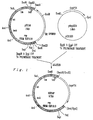
Fig. 1 shows the construction process of the
plasmid RSF24P which has a mutant dapA. "dapA*24"
represents a mutant dapA which codes for a mutant DDPS
in which the 118th histidine residue was replaced with a
tyrosine residue.
PREFERRED EMBODIMENTS OF THE INVENTION
Hereafter, the present invention will be explained
in detail.
The microorganism used for the method for
producing L-amino acid of present invention is a
microorganism that has methane assimilating ability and
L-amino acid producing ability.
The microorganism having methane assimilating
ability is not particularly limited so long as it
originally has L-amino acid producing ability or it can
be imparted with L-amino acid producing ability.
Specific examples of such a microorganism include those
belonging to type I, type X or type II defined in the
phylogenetic systematics of methane-utilizing
microorganism. The nomenclatural classification of
methane-utilizing bacteria is not currently considered
well established, and they are roughly classified into
three types on the basis of the main carbon assimilation
pathway, arrangement of the intracytoplasmic membranes
and autotrophic carbon dioxide fixation ability (Peter N.
Green, "Taxonomy of Methylotrophic Bacteria" in Methane
and Methanol Utilizers, Edited by J. Colin Murrell and
Howard Dalton, p.25-27, p.48-49, Plenum Publishing
Corporation, 233 Spring Street, New York, New York
10013-1578, USA). The inventors of the present
invention studied bacteria belonging to these three
types, i.e., type I, type X and type II, and found that
all of them were suitable for producing L-amino acids
from methane. Therefore, the present invention is
considered to be widely applicable to methane-utilizing
bacteria. As methane-utilizing bacteria belonging to
type I, type X or type II, there can be specifically
mentioned bacteria belonging to the genera Methylomonas,
Methylococcus and Methylosinus, respectively. More
specifically, there can be mentioned Methylomonas albus,
Methylococcus capsulatus and Methylosinus trichosporium.
The microorganism having methane assimilating
ability may also be isolated from nature. In order to
isolate microorganisms having methane assimilating
ability from nature, a sample can be collected from
water of river, lake, sea and so forth, mud, ground,
rock, portions of organisms such as animals and plants,
cadavers and excrement of organisms, air or the like,
mixed with a liquid medium or plated on a solid medium,
and cultured by using methane as a sole carbon source,
and microorganisms that can grow can be selected.
The microorganism used for the present invention
is such a methane-utilizing bacterium as mentioned above,
and is a microorganism which has L-amino acid producing
ability at the same time. The microorganism of the
present invention may be a wild type strain which
originally has L-amino acid producing ability, or may be
a mutant strain obtained by breeding or recombinant
strain, in which L-amino acid producing ability is
enhanced or to which L-amino acid producing ability is
imparted. As the L-amino acids for which the present
invention can be used, there can be mentioned L-aspartic
acid, L-threonine, L-serine, L-glutamic acid, L-proline,
L-glycine, L-alanine, L-cysteine, L-valine, L-methionine,
L-isoleucine, L-leucine, L-tyrosine, L-phenylalanine, L-lysine,
L-histidine, L-arginine, L-tryptophan (hereafter,
these may be abbreviated as, respectively in the above
order, L-Asp, L-Thr, L-Ser, L-Glu, L-Pro, L-Gly, L-Ala,
L-Cys, L-Val, L-Met, L-Ile, L-Leu, L-Tyr, L-Phe, L-Lys,
L-His, L-Arg and L-Trp). The amino acid produced by the
present invention may consist of a single kind of amino
acid, or arbitrary two or more kinds of amino acids may
be produced simultaneously.
In order to impart L-amino acid producing ability
to a wild type strain of methane-utilizing bacterium,
there can be used methods conventionally used for
breeding of coryneform bacteria, bacteria belonging to
the genus Escherichia etc., for example, for acquisition
of auxotrophic mutant strains, L-amino acid analog
resistant strains or metabolic regulation mutant strains,
and creation of recombinant strains in which genes for
enzymes of L-amino acid biosynthesis pathway are
enhanced (see "Amino Acid Fermentation", the Japan
Scientific Societies Press [Gakkai Shuppan Center], 1st
Edition, published on May 30, 1986, pp.77 to 100).
For example, L-lysine producing bacteria are bred
as mutants exhibiting auxotrophy for L-homoserine or L-threonine
and L-methionine (Japanese Patent Publication
(Kokoku) Nos. 48-28078/1973 and 56-6499/1981), mutants
exhibiting auxotrophy for inositol or acetic acid
(Japanese Patent Laid-open (Kokai) Nos. 55-9784/1980 and
56-8692/1981), or mutants that are resistant to
oxalysine, lysine hydroxamate, S-(2-aminoethyl)-cysteine,
γ-methyllysine, α-chlorocaprolactam, DL-α-amino-ε-caprolactam,
α-amino-lauryllactam, aspartic acid
analogue, sulfa drug, quinoid or N-lauroylleucine.
Further, L-glutamic acid producing bacteria can be
bred as mutants exhibiting auxotrophy for oleic acid or
the like. L-Threonine producing bacteria can be bred as
mutants resistant to α-amino-β-hydroxyvaleric acid. L-Homoserine
producing bacteria can be bred as mutants
exhibiting auxotrophy for L-threonine or mutant
resistant to L-phenylalanine analogues. L-Phenylalanine
producing bacteria can be bred as mutants exhibiting
auxotrophy for L-tyrosine. L-Isoleucine producing
bacteria can be bred as mutants exhibiting auxotrophy
for L-leucine. L-Proline producing bacteria can be bred
as mutants exhibiting auxotrophy for L-isoleucine.
The mutagenesis treatment for obtaining a mutant
strain may be UV irradiation or a treatment with mutagen
used for conventional mutagenesis treatment such as N-methyl-N'-nitro-N-nitrosoguanidine
(NTG) and nitrous
acid. A methane-utilizing bacterium that has L-amino
acid producing ability can also be obtained by selecting
a spontaneous mutant of a methane-utilizing bacterium.
A target mutant strain can be obtained by
inoculating a methane-utilizing bacterium, mutagenized
or not mutagenized, to a medium containing an L-amino
acid or an analog thereof at a concentration at which a
wild type strain cannot grow, and isolating a mutant
strain which can grow on the medium.
Obtained mutant strains may include those having
L-amino acid producing ability comparable to a parent
strain or even reduced L-amino acid producing ability
compared with the parent strains. Therefore, it is
preferable to select strains having increased L-amino
acid producing ability compared with the parent strains.
Now, methods for imparting or enhancing L-amino
acid producing ability by enhancing the expression of
gene(s) coding for enzyme(s) of an L-amino acid
biosynthetic pathway will be exemplified below.
[L-Lysine]
L-lysine producing ability can be imparted by, for
example, enhancing activities of dihydrodipicolinate
synthase and aspartokinase, and by further enhancing
activities of dihydrodipicolinate reductase and
diaminopimelate dehydrogenase, if necessary.
Activities of dihydrodipicolinate synthase and
aspartokinase in methane-utilizing bacteria can be
enhanced by transforming a methane-utilizing bacterium
through introduction of a recombinant DNA prepared by
ligating a gene fragment coding for dihydrodipicolinate
synthase and a gene fragment coding for aspartokinase
with a vector that functions in Methane-utilizing
bacteria, preferably a multiple copy type vector. As a
result of the increase in the copy numbers of the gene
coding for dihydrodipicolinate synthase and the gene
coding for aspartokinase in cells of the transformant
strain, activities of these enzymes are enhanced.
Hereafter, dihydrodipicolinate synthase, aspartokinase,
aspartokinase III, dihydrodipicolinate reductase and
diaminopimelate dehydrogenase are also referred to with
abbreviations of DDPS, AK, AKIII, DDPR and DDH,
respectively.
As a microorganism providing genes that code for
above enzymes, any microorganisms can be used so long as
the genes express and activity of corresponding eznymes
increase in methane-utilizing bacteria. Such
microorganisms may be wild type strains or mutant
strains derived therefrom. Specifically, examples of
such microorganisms include E. coli (Escherichia coli)
K-12 strain, Brevibacterium lactofermentum and so forth.
Since nucleotide sequences have been revealed for a gene
coding for DDPS (dapA, Richaud, F. et al., J. Bacteriol.,
297, (1986)), a gene coding for AKIII (lysC, Cassan, M.,
Parsot, C., Cohen, G.N. and Patte, J.C., J. Biol. Chem.,
261, 1052 (1986)), a gene coding for DDPR (dapB, Bouvier,
J. et al., J. Biol. Chem., 259, 14829 (1984)), which
were derived from Escherichia bacteria, and a gene
coding for DDH derived from Corynebacterium glutamicum
(Ishino, S. et al., Nucleic Acids Res., 15, and 3917
(1987)), these genes can be obtained by PCR using
primers synthesized based on the nucleotide sequences of
these genes and chromosome DNA of microorganism such as
E. coli K-12, Brevibacterium lactofermentum ATCC13869 or
the like as a template. As specific examples, dapA and
lysC derived from E. coli will be explained below.
However, genes used for the present invention are not
limited to them.
It is preferred that DDPS and AK used for the
present invention do not suffer feedback inhibition by
L-lysine. It is known that wild-type DDPS derived from
E. coli suffers feedback inhibition by L-lysine, and
that wild-type AKIII derived from E. coli suffers
suppression and feedback inhibition by L-lysine.
Therefore, dapA and lysC to be introduced into methane-utilizing
bacteria preferably code for DDPS and AKIII
having a mutation that desensitizes the feedback
inhibition by L-lysine. Hereafter, DDPS having a
mutation that eliminates the feedback inhibition by L-lysine
is also referred to as "mutant DDPS", and DNA
coding for the mutant DDPS is also referred to as
"mutant dapA" or "dapA*". AKIII derived from E. coli
having a mutation that eliminates the feedback
inhibition by L-lysine is also referred to as "mutant
AKIII", and DNA coding for the mutant AKIII is also
referred to as "mutant lysC".
According to the present invention, DDPS and AK
are not necessarily required to be a mutant. It has
been known that, for example, DDPS derived from
Corynebacterium bacteria originally does not suffer
feedback inhibition by L-lysine.
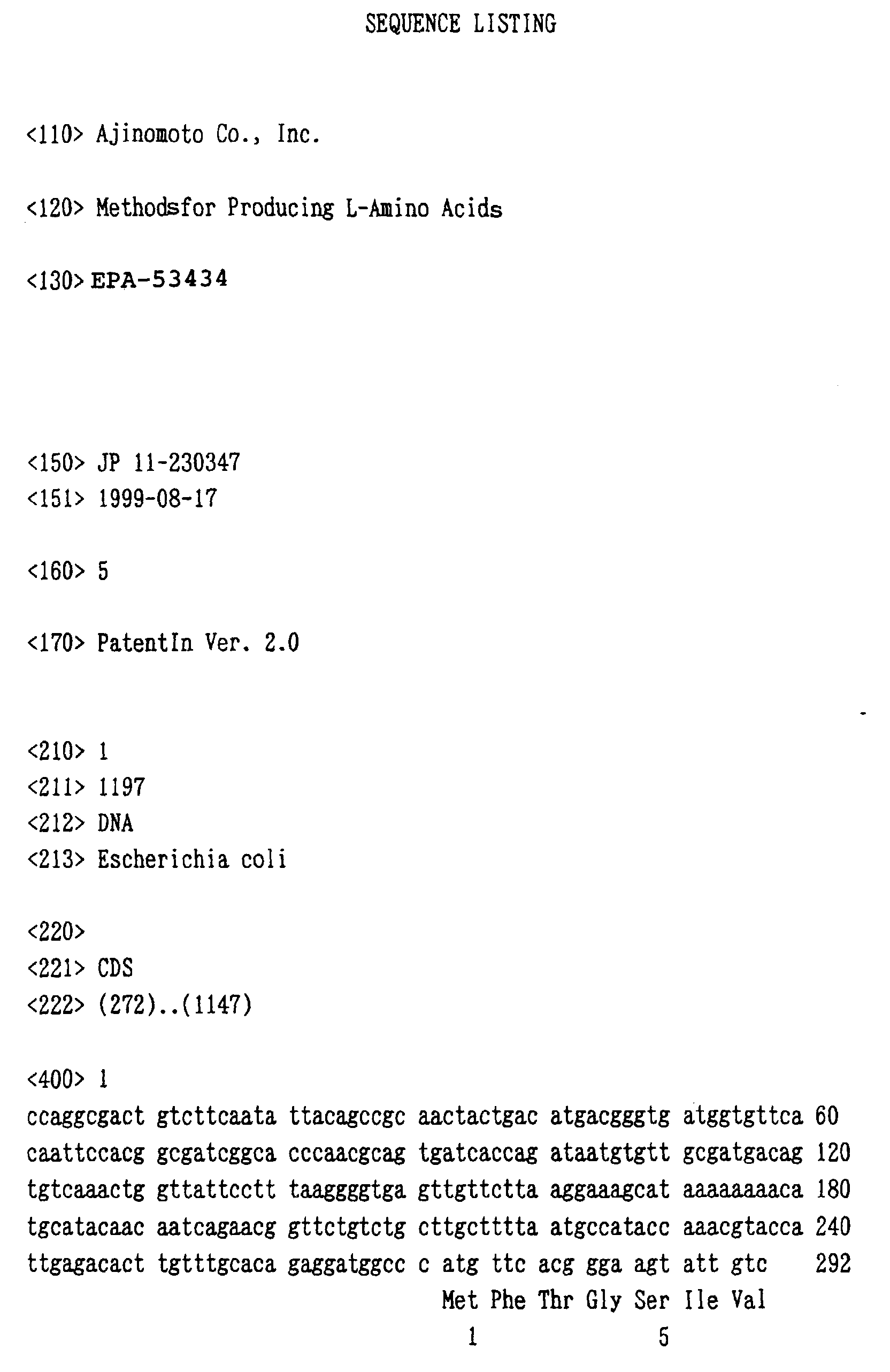
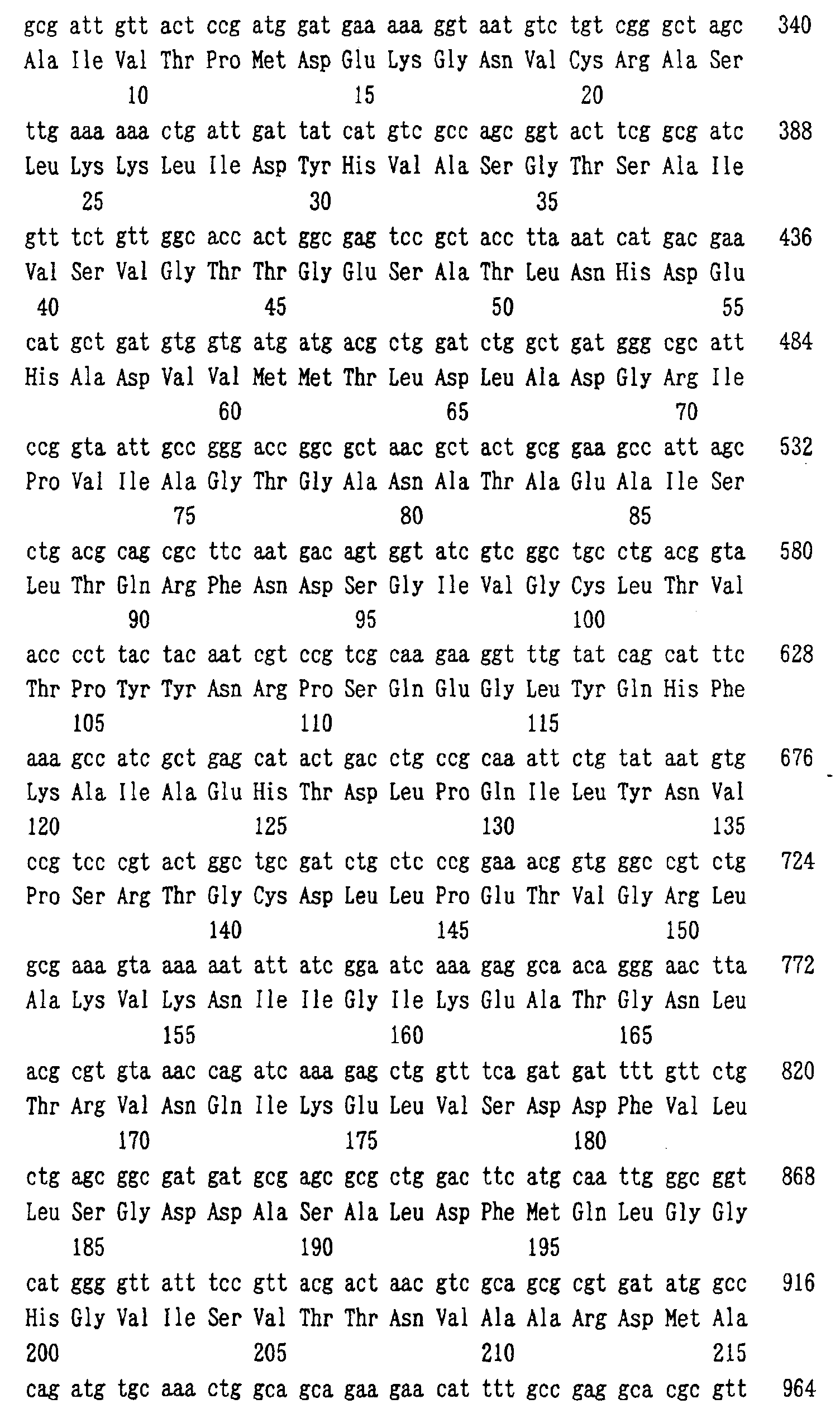
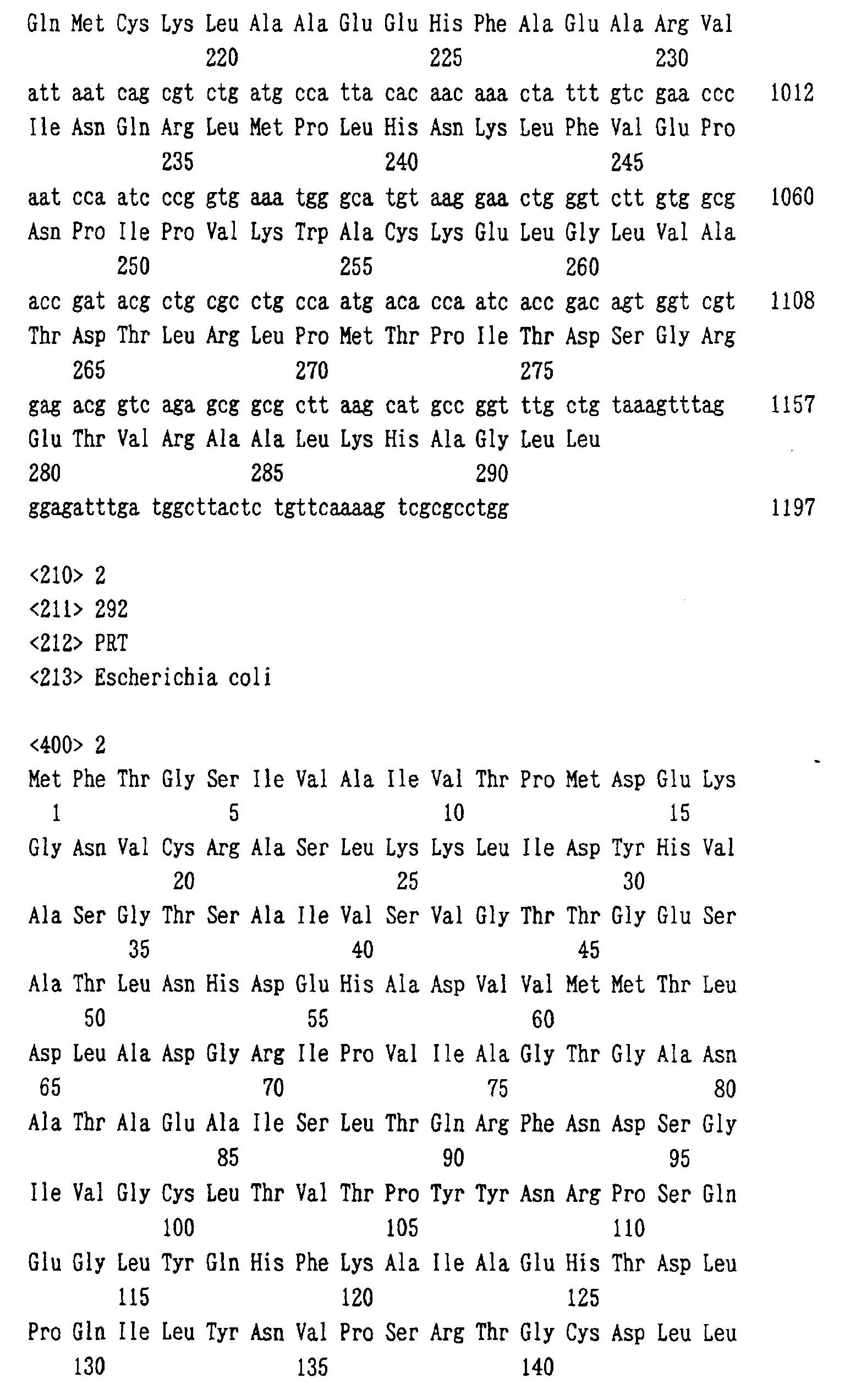
A nucleotide sequence of wild-type dapA derived
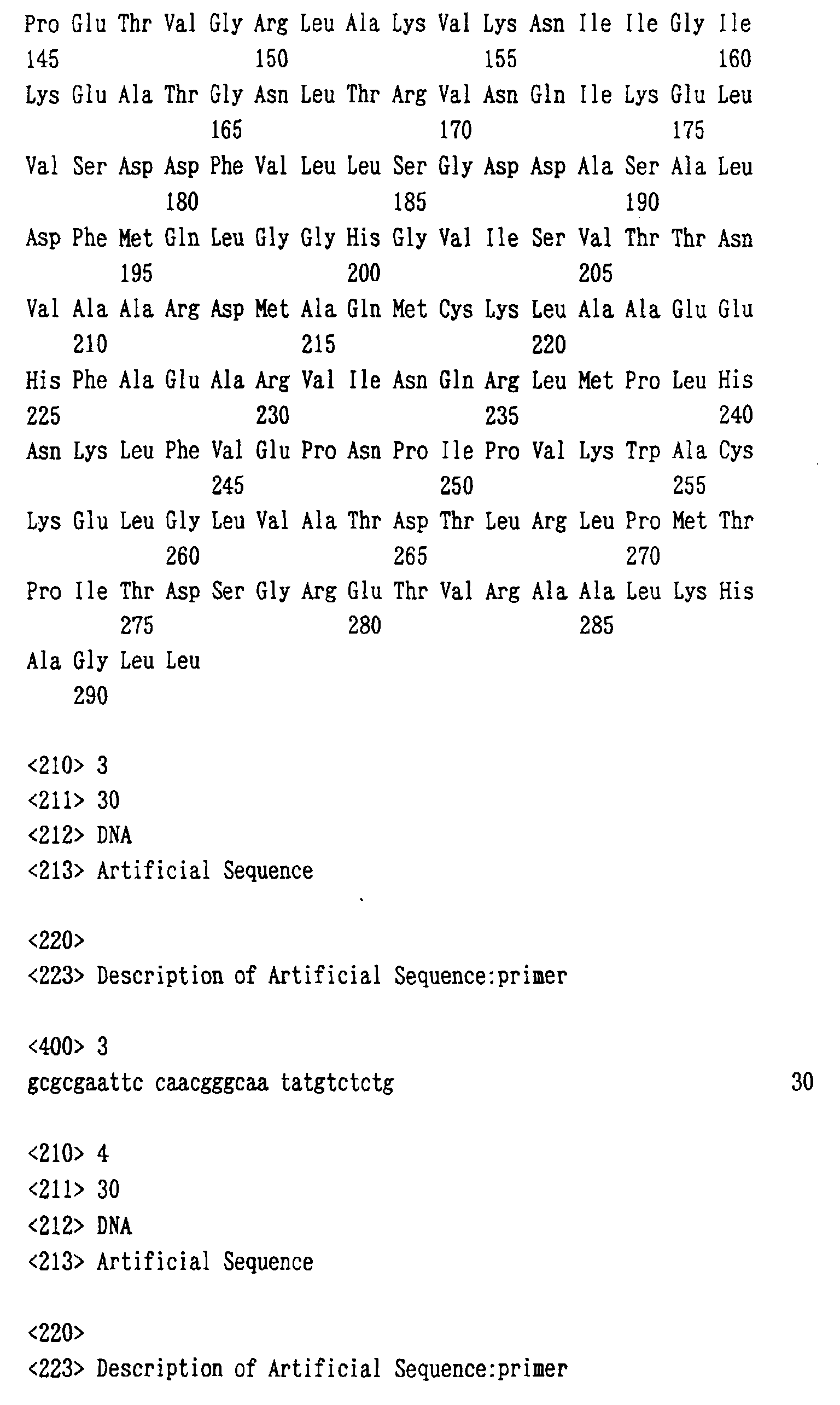
from E. coli is exemplified in SEQ ID NO: 1. The amino
acid sequence of wild-type DDPS encoded by the
nucleotide sequence is exemplified in SEQ ID NO: 2.
DNA coding for mutant DDPS that does not suffer
feedback inhibition by L-lysine includes DNA coding for
DDPS having the amino acid sequence shown in SEQ ID NO:
2 wherein the 118-histidine residue is replaced with a
tyrosine residue.
The plasmid used for gene cloning may be any
plasmid so long as it can replicate in microorganisms
such as Escherichia bacteria, and specifically include
pBR322, pTWV228, pMW119, pUC19 and so forth.
The vector that functions in methane-utilizing
bacteria is, for example, a plasmid that can
autonomously replicate in methane-utilizing bacteria.
Specifically, there can be mentioned RSF1010, which is a
broad host range vector, and derivatives thereof, for
example, pAYC32 (Chistorerdov, A.Y, Tsygankov, Y.D.
Plasmid, 16, 161-167, (1986)), pMFY42 (Gene, 44, 53,
(1990)), pRP301, pTB70 (Nature, 287, 396, (1980)), pRS,
which is used in the examples hereinafter, and so forth.
In order to prepare a recombinant DNA by ligating
dapA and/or lysC to a vector that functions in methane-utilizing
bacteria, the vector is digested with a
restriction enzyme that corresponds to the termini of
DNA fragment containing dapA and/or lysC. Ligation is
usually preformed by using ligase such as T4 DNA ligase.
dapA and lysC may be individually incorporated into
separate vectors or into a single vector.
As a plasmid containing a mutant dapA coding for
mutant DDPS, a broad host range plasmid RSF24P is known
(WO95/16042). E. coli JM109 strain transformed with
this plasmid was designated as AJ12395, and deposited at
National Institute of Bioscience and Human-Technology,
Agency of Industrial Science and Technology, Ministry of
International Trade and Industry (postal code 305-8566,
1-3 Higashi 1-chome, Tsukuba-shi, Ibaraki-ken, Japan) on
October 28, 1993 and received an accession number of
FERM P-13935. Then, it was transferred to an
international deposition based on Budapest Treaty on
November 1, 1994, and received an accession number of
FERM BP-4858.
As a plasmid containing a mutant dapA coding for
mutant DDPS and a mutant lysC coding for mutant AKIII, a
broad host spectrum plasmid RSFD80 is known (WO95/16042).
E. coli JM109 strain transformed with this plasmid was
designated as AJ12396, and deposited at National
Institute of Bioscience and Human-Technology, Agency of
Industrial Science and Technology, Ministry of
International Trade and Industry on October 28, 1993 and
received an accession number of FERM P-13936. Then, it
was transferred to an international deposition based on
Budapest Treaty on November 1, 1994, and received an
accession number of FERM BP-4859. RSF24P and RSFD80 can
be obtained in a known manner from the AJ12395 and
AJ12396 strains, respectively.
The mutant dapA contained in RSFD80 has a
nucleotide sequence of wild-type dapA shown in SEQ ID
NO: 1 including replacement of C at the nucleotide
number 597 with T. The mutant DDPS encoded thereby has
an amino acid sequence of SEQ ID NO: 2 including
replacement of the 118-histidine residue with a tyrosine
residue.
In order to introduce a recombinant DNA prepared
as described above into methane-utilizing bacteria, any
method can be used so long as it provides sufficient
transformation efficiency. For example, electroporation
can be used (Canadian Journal of Microbiology, 43, 197
(1997)). Further, there can also be used a method
comprising mixing E. coli S17-1 strain which harbors a
recombinant vector and recipient bacteria (methane-utilizing
bacteria), and allowing their conjugation on a
filter placed on an agar plate to introduce the
recombinant vector into the recipient bacteria (FEMS
Microbiology Letters 41, p.185-188 (1987)).
Transformants containing the recombinant vector
can easily be identified by using the drug selectivity
of the vector. Furthermore, the target transformant
vector can also be introduced into recipient bacteria by
the triparental conjugal transfer using Escherichia coli
which harbors a self-transmissible plasmid, Escherichia
coli which harbors the target recombinant vector and
recipient bacteria (methane-utilizing bacteria) (Snyder,
L and Champness, W., Molecular Genetics of Bacteria, ASM
Press, Washington, D.C.).
Examples of the Escherichia coli which harbors a
self-transmissible plasmid include Escherichia coli
HB101/pRK2013 (Ditta, G., Stanfield, S., Corbin, D., and
Helinski, D.R., Proc. Natl. Acad. Sci. USA, 77, 7347
(1980)).
DDPS activity and/or AK activity can also be
enhanced by the presence of multiple copies of dapA
and/or lysC on chromosome DNA of methane-utilizing
bacteria. In order to introduce multiple copies of dapA
and lysC into chromosome DNA of methane-utilizing
bacteria, homologous recombination is performed by using,
as a target, a sequence that is present on chromosome
DNA of methane-utilizing bacteria in a multiple copy
number. As a sequence present on chromosome DNA in a
multiple copy number, a repetitive DNA or inverted
repeats present at the end of a transposable element can
be used. Alternatively, as disclosed in Japanese Patent
Laid-open (Kokai) No. 2-109985/1990, multiple copies of
dapA and/or lysC can be introduced into chromosome DNA
by mounting them on a transposon to transfer them. In
both of the methods, as a result of increased copy
number of dapA and lysC in transformed strains,
activities of DDPS and AK should be amplified.
Besides the above gene amplification, DDPS
activity and/or AK activity can be amplified by
replacing an expression control sequence such as
promoters of dapA or lysC with stronger ones (Japanese
Patent Laid-open (Kokai) No. 1-215280/1989). As such
strong promoters, there are known, for example, lac
promoter, trp promoter, trc promoter, tac promoter, PR
promoter and PL promoter of lambda phage, tet promoter,
amyE promoter, spac promoter and so forth. Substitution
of these promoters enhances expression of dapA and/or
lysC, and thus DDPS activity and/or AK activity are
amplified. Enhancement of expression control sequences
can be combined with increase of the copy numbers of
dapA and/or lysC.
In order to prepare a recombinant DNA by ligating
a gene fragment and a vector, the vector is digested
with a restriction enzyme corresponding to the terminus
of the gene fragment. Ligation is usually performed by
ligase such as T4 DNA ligase. As methods for digestion,
ligation and others of DNA, preparation of chromosome
DNA, PCR, preparation of plasmid DNA, transformation,
design of oligonucleotides used as primers and so forth,
conventional methods well known to those skilled in the
art can be used. Such methods are described in Sambrook,
J., Fritsch, E. F., and Maniatis, T., "Molecular
Cloning: A Laboratory Manual, 2nd Edition", Cold Spring
Harbor Laboratory Press, (1989) and so forth.
In addition to the enhancement of DDPS and AK,
other enzymes involved in the L-lysine biosynthesis may
also be enhanced. Such enzymes include
phosphoenolpyruvate carboxylase (Japanese Patent Laid-open
(Kokai) No. 60-87788/1985), aspartate
aminotransferase (Japanese Patent Publication (Kokoku)
No. 6-102028/1994), diaminopimelate pathway enzymes such
as DDPR, DDH, diaminopimelate decarboxylase (see
WO96/40934), diaminopimelate epimerase and so forth, or
aminoadipate pathway enzymes such as homoaconitate
hydratase and so forth.
Further, the microorganisms of the present
invention may have decreased activity of one or more
enzymes that catalyze reaction(s) for generating
compound(s) other than L-lysine by branching off from
the biosynthetic pathway of L-lysine, or may be
deficient in such an enzyme. Illustrative examples of
the enzyme that catalyzes a reaction for generating a
compound other than L-lysine by branching off from the
biosynthetic pathway of L-lysine include homoserine
dehydrogenase (see WO95/23864).
The aforementioned techniques for enhancing
activities of enzymes involved in the L-lysine
biosynthesis can be similarly used for other amino acids
mentioned below.
[L-Glutamic acid]
L-Glutamic acid producing ability can be imparted
to methane-utilizing bacteria by, for example,
introducing DNA that codes for any one of enzymes
including glutamate dehydrogenase (Japanese Patent Laid-open
(Kokai) 61-268185/1986), glutamine synthetase,
glutamate synthase, isocitrate dehydrogenase (Japanese
Patent Laid-open (Kokai) Nos. 62-166890/1987 and 63-214189/1988),
aconitate hydratase (Japanese Patent Laid-open
(Kokai) Nos. 62-294086/1987 and 63-119688/1988),
citrate synthase (Japanese Patent Laid-open (Kokai) Nos.
62-201585/1987 and 63-119688/1988), phosphoenolpyruvate
carboxylase (Japanese Patent Laid-open (Kokai) Nos. 60-87788/1985
and 62-55089/1987), pyruvate dehydrogenase,
pyruvate kinase, phosphoenolpyruvate synthase, enolase,
phosphoglyceromutase, phosphoglycerate kinase,
glyceraldehyde-3-phosphate dehydrogenase, triose
phosphate isomerase, fructose bisphosphate aldolase,
phosphofructokinase (Japanese Patent Laid-open (Kokai)
No. 63-102692/1988), glucose phosphate isomerase,
glutamate-oxoglutarate aminotransferase (WO99/07853) and
so forth.
Further, the microorganism of the present
invention may have decreased activity of an enzyme that
catalyzes a reaction for generating a compound other
than L-glutamic acid by branching off from the
biosynthetic pathway of L-glutamic acid, or may be
deficient in such an enzyme. Illustrative examples of
the enzyme that catalyzes a reaction for generating a
compound other than L-glutamic acid by branching off
from the biosynthetic pathway of L-glutamic acid include
α-ketoglutarate dehydrogenase (αKGDH), isocitrate lyase,
phosphate acetyltransferase, acetate kinase,
acetohydroxy acid synthase, acetolactate synthase,
formate acetyltransferase, lactate dehydrogenase,
glutamate decarboxylase, 1-pyrophosphate dehydrogenase
and so forth.
[L-Threonine]
L-Threonine producing ability can be imparted or
enhanced by, for example, transforming methane-utilizing
bacteria using a recombinant plasmid containing a
threonine operon (see Japanese Patent Laid-open (Kokai)
Nos. 55-131397/1980, 59-31691/1984, 56-15696/1981 and
International Patent Publication in Japanese (Kohyo) No.
3-501682/1991).
The production ability can also be imparted or
enhanced by enhancing a threonine operon having a gene
coding for aspartokinase whose feedback inhibition by L-threonine
is desensitized (Japanese Patent Publication
(Kokoku) No. 1-29559/1989), a gene coding for homoserine
dehydrogenase (Japanese Patent Laid-open (Kokai) No. 60-012995/1985)
or a gene coding for homoserine kinase and
homoserine dehydrogenase (Japanese Patent Laid-open
(Kokai) No. 61-195695/1986).
Further, L-threonine producing ability can be
improved by introducing DNA coding for a mutant
phosphoenolpyruvate carboxylase having a mutation for
desensitizing feedback inhibition by aspartic acid.
[L-Valine]
L-Valine producing ability can be imparted by, for
example, introducing an L-valine biosynthesis gene whose
control mechanism has been substantially eliminated into
methane-utilizing bacteria. There may also be
introduced a mutation that substantially eliminates a
control mechanism of an L-valine biosynthesis gene
carried by a microorganism belonging to the genus
Escherichia.
Examples of the L-valine biosynthesis gene include,
for example, the ilvGMEDA operon of E. coli. Threonine
deaminase encoded by an ilvA gene catalyzes the
deamination reaction converting L-threonine into 2-ketobutyric
acid, which is the rate-determining step of
L-isoleucine biosynthesis. Therefore, in order to
attain efficient progression of the L-valine synthesis
reactions, it is preferable to use an operon that does
not express threonine deaminase activity. Examples of
the ilvGMEDA operon that does not express such threonine
deaminase activity include an ilvGMEDA operon wherein a
mutation for eliminating threonine deaminase activity is
introduced into ilvA, an ilvGMEDA operon wherein ilvA is
disrupted and an ilvGMED operon wherein ilvA is deleted.
Since the ilvGMEDA operon suffers expression
control of operon (attenuation) by L-valine and/or L-isoleucine
and/or L-leucine, the region required for the
attenuation is preferably removed or mutated to
eliminate the suppression of expression by L-valine to
be produced.
An ilvGMEDA operon which does not express
threonine deaminase activity and in which attenuation is
eliminated as described above can be obtained by
subjecting a wild-type ilvGMEDA operon to a mutagenesis
treatment or modifying it by means of gene recombination
techniques (see WO96/06926).
Escherichia coli strain B-3996 which harbors
plasmid pVIC40 containing the threonine operon
(WO90/04636, International Patent Publication in
Japanese (Kohyo) No. 3-501682/1991) was deposited at the
All-Union Scientific Centre of Antibiotis (VNIIA,
Address: Nagatinskaya Street 3-a, Moscow 113105, Russian
Federation) from November 19, 1987 with a registration
number of RIA 1867. This strain is also deposited at
the Russian National Collection of Industrial
Microorganisms (VKPM, Address: Dorozhny proezd.1, Moscow
113545, Russian Federation) with an accession number of
B-3996.
[L-Leucine]
L-Leucine producing ability is imparted or
enhanced by, for example, introducing, into methane-utilizing
bacteria, an genes L-leucine biosynthesis gene
whose control mechanism has been substantially
eliminated, in addition to having the above
characteristics required for the production of L-valine.
It is also possible to introduce such a mutation that
the control mechanism of an L-leucine biosynthesis gene
should be substantially desensitized. Examples of such
a gene include, for example, an leuA gene which provides
an enzyme in which inhibition by L-leucine is
substantially desensitized.
[L-Isoleucine]
L-Isoleucine producing ability can be imparted by,
for example, introducing a thrABC operon containing a
thrA gene coding for aspartokinase I/homoserine
dehydrogenase I derived from E. coli wherein inhibition
by L-threonine has been substantially desensitized and
an ilvGMEDA operon which contains an ilvA gene coding
for threonine deaminase wherein inhibition by L-isoleucine
is substantially desensitized and whose
region required for attenuation is removed (Japanese
Patent Laid-open (Kokai) No. 8-47397/1996).
[Other amino acids]
Biosyntheses of L-tryptophan, L-phenylalanine, L-tyrosine,
L-threonine and L-isoleucine can be enhanced
by increasing phosphoenolpyruvate producing ability of
methane-utilizing bacteria (WO97/08333).
The production abilities for L-phenylalanine and
L-tyrosine are improved by enhancing a desensitized
chorismate mutase-prephenate dehydratase (CM-PDT) gene
(Japanese Patent Laid-open (Kokai) Nos. 5-236947/1993
and 62-130693/1987) and a desensitized DS (3-deoxy-D-arabinoheptulonate-7-phosphate
synthase) gene (Japanese
Patent Laid-open (Kokai) Nos. 5-236947/1993 and 61-124375/1986).
The producing ability of L-tryptophan is improved
by enhancing a tryptophan operon containing a gene
coding for desensitized anthranilate synthetase
(Japanese Patent Laid-open (Kokai) Nos. 57-71397/1982,
62-244382/1987 and US Patent No. 4,371,614).
L-amino acids can be produced by cultivating
methane-utilizing bacteria having L-amino acid producing
ability obtained as described above in a medium in the
presence of methane utilized as a main carbon source to
produce and accumulate L-amino acids in the culture, and
collecting the L-amino acids from the culture. The
medium used for the present invention may be a natural
or synthetic medium so long as it contains nitrogen
source, inorganic ions and other trace amount organic
components as required.
The culture may be performed by methods usually
used for cultivating methane-utilizing bacteria.
As the main carbon source, methane is used. When
the culture is performed in a closed system with shaking
or as standing culture, for example, methane is injected
into the culture vessel so that medium in the vessel is
in contact with mixure of air and methane of which
methane consists of 1-70%. When the culture is
performed in an open system as aerobic culture, methane
gas is bubbled into the medium to a concentration of
0.001-10 VVM.
As the nitrogen source, potassium nitrate, sodium
nitrate, nitric acid, ammonia gas, aqueous ammonia,
ammonium chloride, ammonium sulfate, ammonium nitrate,
ammonium acetate, ammonium phosphate, urea and so forth
are added to the medium in an amount of 0.01-10%. In
addition to these, small amount of the components such
as potassium phosphate, sodium phosphate, magnesium
sulfate, calcium chloride, iron-EDTA, copper sulfate and
so forth are usually added.
The culture is performed with shaking, or as
standing culture or culture with babbling and stirring,
and all of these cultures are performed under an aerobic
condition. The culture is performed at a temperature of
15-80°C and pH of the medium at pH 4-9, and it is
usually completed within 16-200 hours.
Collection of L-amino acids from culture is
attained by a combination of known methods such as those
using ion exchange resin, precipitation and others.
EXAMPLES
Hereafter, the present invention will be further
specifically explained with reference to the following
examples.
Example 1: Acquisition of L-amino acid producing strain
derived from Methylomonas albus
(1) Acquisition of L-lysine resistant strain of
Methylomonas albus
The NCIMB 11123 strain, a wild type strain of
Methylomonas albus, was cultured at 30°C for 48 hours in
NMS medium mentioned below in the presense of methane,
and the obtained bacterial cells were subjected to
mutagenesis treatment with NTG in a conventional manner
(NTG 50 µg/ml, 30°C, 30 minutes). The NCIMB 11123
strain can be obtained from The National Collections of
Industrial and Marine Bacteria Ltd. (Address: NCIMB Lts.,
Torry Research Station 135 Abbey Road, Aberdeen AB98DG,
United Kingdom).
[Composition of NMS medium]
Potassium nitrate: 1 g/L, magnesium sulfate: 1 g/L,
calcium chloride: 0.2 g/L, iron-EDTA: 3.8 mg/L, sodium
molybdate: 0.26 mg/L, copper sulfate: 0.2 mg/L, iron
sulfate: 0.5 mg/L, zinc sulfate: 0.4 mg/L boric acid:
0.015 mg/L, cobalt chloride: 0.05 mg/L, sodium EDTA:
0.25 mg/L, manganese chloride: 0.02 mg/L, nickel
chloride: 0.01 mg/L, disodium phosphate 0.716 g/L,
potassium phosphate: 0.26 g/L (pH 6.8)
The aforementioned cells subjected to the
mutagenesis treatment were plated on NMS agar medium
containing 10 mM of L-lysine, and cultured at 30°C for
3-40 days while 50% of methane was added to the gaseous
phase which was in contact with the medium (henceforth
referred to as "in the presence of 50% methane"). The
emerged colonies were isolated, inoculated to NMS agar
medium, and cultured at 30°C for 3-30 days in the
presence of 50% methane. 1/10 platinum loop of cells of
the lysine resistant strain obtained as described above
were inoculated to 3 ml of NMS medium in 30-ml volume
pressure-proof test tube and 15 ml of methane was
injected into each tube and cultured at 30°C for 14 days
with shaking.
After the culture was completed, the cells were
removed by centrifugation and amino acids contained in
the obtained culture supernatant was analyzed by an
amino acid analyzer (Hitachi L-8500). A strain that
exhibited increased accumulated amounts of, in
particular, L-valine and L-leucine was selected, and
designated as No. 107-4 strain. The No. 107-4 strain
was given with a private number of AJ13630, and
deposited at National Institute of Bioscience and Human-Technology,
Agency of Industrial Science and Technology,
Ministry of International Trade and Industry (postal
code 305-8566, 1-3 Higashi 1-chome, Tsukuba-shi,
Ibaraki-ken, Japan) on August 6, 1999 with an accession
number of FERM P-17507, and transferred from the
original deposit to international deposit based on
Budapest Treaty on July 27,2000, and has been deposited
as an accession number of FERM BP-7250.
(2) Acquisition of AEC resistant strain derived from
Methylomonas albus
An AEC resistant strain was obtained from the wild
type strain of
Methylomonas albus in the same manner as
in (1) except that 1, 3 or 4.5 mM of AEC was used
instead of 10 mM of L-lysine. The obtained 74 AEC
resistant strains were each cultured in a test tube in
the same manner as the above (1). Distribution of L-lysine
accumulation of these strains is shown in Table 1.
| Distribution of L-lysine accumulation of AEC
resistant strains derived from Methylomonas albus |
| Strain | L-Lys (mg/L) |
| | 0 | ∼0.50 | ∼1.00 |
| Wild type strain | 1 | 0 | 0 |
| 1 mM AEC resistant strain | 34 | 2 | 0 |
| 3 mM AEC resistant strain | 2 | 16 | 16 |
| 4.5 mM AEC resistant strain | 0 | 1 | 1 |
Although accumulation of L-lysine was not observed
for the wild type strain, accumulation of L-lysine was
observed for two strains of the 1 mM AEC resistant
strains among 36 strains. Accumulation of lysine was
observed for 32 strains of 3 mM AEC resistant strains
out of 34 strains, and 16 strains among them showed
accumulation of L-lysine higher than 0.50 mg/L. As for
the 4.5 mM AEC resistant strains, accumulation of lysine
was observed for both of the two strains, and one strain
showed accumulation of L-lysine higher than 0.50 mg/L.
Among these AEC resistant strains, the strain that
exhibited the highest L-lysine accumulation was
designated as No. 135-3-63 strain. The No. 135-3-63
strain was given with a private number of AJ13631, and
deposited at National Institute of Bioscience and Human-Technology,
Agency of Industrial Science and Technology,
Ministry of International Trade and Industry (postal
code 305-8566, 1-3 Higashi 1-chome, Tsukuba-shi,
Ibaraki-ken, Japan) on August 6, 1999 as an accession
number of FERM P-17508, and transferred from the
original deposit to international deposit based on
Budapest Treaty on July 27, 2000, and has been deposited
as an accession number of FERM BP-7251.
Example 2: Production of L-amino acids using L-lysine
resistant strain of Methylomonas albus
A wild type strain and the No.107-4 strain of
Methylomonas albus were each inoculated in an amount of
2 platinum loops to NMS medium containing 1.5% of agar,
and cultured at 30°C for 7 days in the presence of 50%
methane. The whole amount of the obtained cells were
inoculated to 500 ml of AMS medium supplemented with 4
µM CuSO4 contained in a 1-L volume fermentation vessel
(produced by Biott), and cultured at 30°C under the
conditions of stirring at 400 rpm or above, dissolved
oxygen concentration of not less than 5 ppm, with supply
of air and methane at 200 ml/minute and 100 ml/minute,
respectively. AMS medium is a medium that is identical
to NMS medium except that KNO3 is replaced with an
equivalent amount of NH4Cl in terms of nitrogen. During
the culture, pH of the medium was automatically
controlled to be 6.5 with ammonia gas. 10 ml of 1 mM
CUSOs4 was added 39 hours and 65 hours after the culture
was started.
After the culture was completed, the cells were
removed by centrifugation and amino acids contained in
the obtained culture supernatant were analyzed by an
amino acid analyzer. The results are shown in Table 2.
L-Amino acids contained in the culture supernatant of
the No. 107-4 strain were increased by 13 times for L-Val,
4 times for L-Leu, 3 times for L-Tyr, 2 times for
L-Phe and 1.7 times for L-Ile, compared with the wild
type strain. Further, although L-Lys was not detected
for the wild type strain, 3.9 mg/L of L-Lys was
accumulated by the No. 107-4 strain.
| Amino acid accumulation by L-lysine resistant
strain derived from Methylomonas albus |
| | Amino acid accumulation by L-lysine resistant strain |
| | L-amino acid (mg/L) |
| | Wild type strain | 107-4 |
| L-Thr | 6.2 | 8.8 |
| L-Glu | 79.2 | 102.8 |
| L-Ala | 25.8 | 25.6 |
| L-Val | 25.0 | 330.3 |
| L-Ile | 15.6 | 27.2 |
| L-Leu | 55.9 | 250.4 |
| L-Tyr | 7.2 | 23.9 |
| L-Phe | 24.0 | 56.6 |
| L-Lys | 0.0 | 3.9 |
| L-His | 2.7 | 3.5 |
| L-Arg | 1.0 | 1.3 |
A wild type strain of
Methylomonas albus and the
AEC resistant strain No. 135-3-63 were inoculated each
in an amount of one colony to NMS medium containing
1.5% of agar, and cultured at 30°C for 7 days in the
presence of 50% methane. 1/10 Platinum loop of each of
the obtained seed culture was inoculated to 3 ml of NMS
medium in a 30-ml volume pressure-proof test tube and 15
ml of methane was injected and cultured at 30°C for 72
hours with shaking. After the culture was completed,
the cells were removed by centrifugation and amino acids
contained in the obtained culture supernatant was
analyzed by an amino acid analyzer. The results are
shown in Table 3. While L-Lys was not detected in the
culture supernatant of the wild type strain, 0.86 mg/L
of L-Lys was accumulated by the No.135-3-63 strain.
| L-lysine accumulation by AEC resistant strain
derived from Methylomonas albus |
| Strain | L-Lys (mg/L) |
| Wild type strain | 0.00 |
| No.135-3-63 | 0.86 |
The NCIMB 11132 strain, a wild type strain of
Methylococcus capsulatus Bath, was cultured at 37°C for
48 hours in NMS medium in the presense of methane, and
the obtained bacterial cells were subjected to
mutagenesis treatment with NTG in a conventional manner
(NTG 25 µg/ml, 30°C, 30 minutes). The NCIMB 11132
strain can be obtained from The National Collections of
Industrial and Marine Bacteria Ltd. (Address: NCIMB Lts.,
Torry Research Station 135 Abbey Road, Aberdeen AB98DG,
United Kingdom).
The aforementioned cells subjected to the
mutagenesis treatment were plated on NMS agar medium
containing 3 mM of AEC, and cultured at 37°C for 3-30
days in the presence of 50% methane. The emerged
colonies were isolated, inoculated to NMS agar medium,
and cultured at 37°C for 3-30 days in the presence of
50% methane. 1/10 Platinum loop of the AEC resistant
strain obtained as described above was inoculated to 3
ml of NMS medium in a 30-ml volume pressure-proof test
tube and 15 ml of methane was injected and cultured at
37°C for 3 days with shaking.
After the culture was completed, the cells were
removed by centrifugation and amino acids contained in
the obtained culture supernatant were analyzed by an
amino acid analyzer (Hitachi L-8500). Strains that
exhibited increased accumulated amounts of L-amino acids
compared with the wild type strain as the parent strain
were selected, and designated as No. 167-22 strain and
No. 167-87 strain. The No. 167-22 strain was given with
a private number of AJ13618, and deposited at National
Institute of Bioscience and Human-Technology, Agency of
Industrial Science and Technology, Ministry of
International Trade and Industry (postal code 305-8566,
1-3 Higashi 1-chome, Tsukuba-shi, Ibaraki-ken, Japan) on
August 6, 1999 as an accession number of FERM P-17506 ,
and transferred from the original deposit to
international deposit based on Budapest Treaty on July
27, 2000, and has been deposited as deposition number of
FERM BP-7249.
Example 5: Production of L-amino acids utilizing AEC
resistant strain of Methylococcus capsulatus Bath
A wild type strain and the AEC resistant strains
No. 167-22 and No. 167-87 of Methylococcus capsulatus
Bath were inoculated each in an amount of one colony to
NMS medium containing 1.5% of agar, and cultured at 37°C
for 7 days in the presence of 50% methane. 1/10
Platinum loop of each obtained seed culture was
inoculated to 3 ml of NMS medium in a 30-ml volume
pressure-proof test tube and 15 ml of methane was
injected and cultured at 37°C for 72 hours with shaking.
After the culture was completed, the cells were removed
by centrifugation and amino acids contained in the
obtained culture supernatant were analyzed by an amino
acid analyzer. The results are shown in Table 4.
As for the No. 167-22 strain, L-amino acids
contained in the culture supernatant were increased by 2
times for L-Asp, 2 times for L-Thr, 3 times for L-Ser, 2
times for L-Glu, 10 times for L-Val, 17 times for L-Ile,
69 times for L-Leu, 2 times for L-Tyr and 13 times for
L-Phe, compared with the wild type strain. As for the
No. 167-87 strain, L-amino acids contained in the
culture supernatant were increased by 6 times for L-Asp,
3 times for L-Thr, 4 times for L-Ser, 3 times for L-Glu,
3 times for L-Ile, 7 times for L-Leu, 4 times for L-Phe,
2 times for L-Lys, 2 times for L-His and 4 times for L-Arg,
compared with the wild type strain. Further,
although L-Ala was not detected for the wild type strain,
1.73 mg/L and 1.74 mg/L of L-Ala was accumulated by the
No. 167-22 strain and No. 167-87 strain, respectively.
| Amino acid accumulation by wild type strain and
AEC resistant strains of Methylococcus capsulatus Bath |
| | L-amino acid (mg/L) |
| | Wild type strain | No. 167-22 | No. 167-87 |
| L-Asp | 0.22 | 0.56 | 1.33 |
| L-Thr | 0.52 | 1.25 | 1.97 |
| L-Ser | 0.17 | 0.57 | 0.82 |
| L-Glu | 2.47 | 7.03 | 9.65 |
| L-Gly | 0.78 | - | 1.51 |
| L-Ala | 0.00 | 1.73 | 1.74 |
| L-Val | 1.60 | 17.07 | 3.13 |
| L-Met | 0.98 | - | 1.61 |
| L-Ile | 0.29 | 5.10 | 1.12 |
| L-Leu | 0.28 | 19.56 | 1.99 |
| L-Tyr | 0.96 | 2.01 | 1.85 |
| L-Phe | 0.54 | 7.14 | 2.64 |
| L-Lys | 0.46 | - | 1.33 |
| L-His | 0.55 | - | 1.10 |
| L-Arg | 0.42 | - | 1.76 |
The NCIMB 11131 strain, a wild type strain of
Methylosinus trichosporium OB3b, was cultured at 30°C
for 48 hours in NMS medium in the presense of methane,
and the obtained bacterial cells were subjected to
mutagenesis treatment with NTG in a conventional manner
(NTG 30 µg/ml, 30°C, 30 minutes).
The NCIMB 11131 strain can be obtained from The
National Collections of Industrial and Marine Bacteria
Ltd. (Address: NCIMB Lts., Torry Research Station 135
Abbey Road, Aberdeen AB98DG, United Kingdom).
The aforementioned cells subjected to the
mutagenesis treatment were plated on NMS agar medium
containing 3 mM of AEC, and cultured at 37°C for 7-30
days in the presence of 50% methane. The emerged
colonies were isolated, inoculated to NMS agar medium,
and cultured for at 37°C for 7-30 days in the presence
of 50% methane. 1/10 Platinum loop of the AEC resistant
strain obtained as described above was inoculated to 3
ml of NMS medium in a 30-ml volume pressure-proof test
tube and 15ml of methane was injected and cultured at
30°C for 5 days with shaking.
After the culture was completed, the cells were
removed by centrifugation and amino acids contained in
the obtained culture supernatant was analyzed by an
amino acid analyzer (Hitachi L-8500). Strains that
exhibited increased accumulated amounts of L-amino acids
compared with the wild type strain were selected, and
designated as No. 171-15 strain and No. 171-35 strain.
The No. 171-15 strain was given with a private number of
AJ13677, and deposited at National Institute of
Bioscience and Human-Technology, Agency of Industrial
Science and Technology, Ministry of International Trade
and Industry (postal code 305-8566, 1-3 Higashi 1-chome,
Tsukuba-shi, Ibaraki-ken, Japan) on May 15, 2000 as an
international deposition and received an accession
number of FERM BP-7159.
Example 7: Production of L-amino acids using AEC
resistant strains of Methylosinus trichosporium OB3b
strain
A wild type strain, and the AEC resistant strains
No. 171-15 and No. 171-35 of Methylosinus trichosporium
OB3b were each inoculated in an amount of one colony to
NMS medium containing 1.5% of agar, and cultured at 37°C
for 14 days in the presence of 50% methane. 1/10
Platinum loop of each obtained seed culture was
inoculated to 3 ml of NMS medium in a 30-ml volume
pressure-proof test tube and 15 ml of of methane was
injected and cultured at 30°C for 120 hours with shaking.
After the culture was completed, the cells were removed
by centrifugation and amino acids contained in the
obtained culture supernatant was analyzed by an amino
acid analyzer. The results are shown in Table 5.
As for the No. 171-15 strain, L-amino acids
contained in the culture supernatant were increased by 3
times for L-Thr, 3 times for L-Ala, 10 times for L-Val,
3 times for L-Ile, 11 times for L-Leu and 3 times for L-Phe,
compared with the wild type strain. As for the No.
171-35 strain, L-amino acids contained in the culture
supernatant were increased by 2 times for L-Ala, 39
times for L-Leu and 2 times for L-Phe, compared with the
wild type strain. Further, although L-Lys was not
detected for the wild type strain, 0.19 mg/L and 0.27
mg/L of L-Lys was accumulated by the No. 171-15 strain
and No. 171-35 strain, respectively.
| Amino acid accumulation by wild type strain and
AEC resistant strains of Methylosinus trichosporium OB3b |
| | L-amino acid (mg/L) |
| | Wild type strain | No. 171-15 | No. 171-35 |
| L-Thr | 0.29 | 0.93 | 0.50 |
| L-Gly | 0.32 | 0.59 | 0.46 |
| L-Ala | 0.80 | 3.01 | 1.70 |
| L-Val | 1.01 | 10.02 | 1.35 |
| L-Ile | 0.67 | 2.03 | 0.97 |
| L-Leu | 0.60 | 6.98 | 23.47 |
| L-Tyr | 0.62 | 0.84 | 0.95 |
| L-Phe | 0.70 | 2.58 | 1.46 |
| L-Lys | 0.00 | 0.19 | 0.27 |
In order to introduce dapA* into Methylomonas
albus or Methylococcus capsulatus Bath strain, plasmid
RSF24P was used. This plasmid contains DNA (dapA*)
coding for mutant dihydrodipicolinate synthase (DDPS) of
Escherichia coli desensitized to the feedback inhibition
by L-lysine, which was disclosed in WO95/16042. RSF24P
is a plasmid which was constructed by inserting dapA*,
which coded for a mutant DDPS in which the 118th
histidine residue was replaced by a tyrosine residue,
into the plasmid pVIC40 containing the threonine operon
(WO90/04636, International Patent Publication in
Japanese (Kohyo) No. 3-501682/1991) at a site downstream
of the promoter for the tetracycline resistance gene
(see Fig. 1). The threonine operon was deleted from
pVIC40 during the process of the insertion of dapA*.
The Escherichia coli JM109 strain harboring the
RSF24P plasmid was designated as AJ12395, and deposited
at National Institute of Bioscience and Human-Technology,
Agency of Industrial Science and Technology, Ministry of
International Trade and Industry (postal code 305-8566,
1-3 Higashi 1-chome, Tsukuba-shi, Ibaraki-ken, Japan) on
October 28, 1993 and received an accession number of
FERM P-13935. Then, it was transferred to an
international deposition based on Budapest Treaty on
November 1, 1994, and received an accession number of
FERM BP-4858.
As a control, plasmid pRS (WO90/04636,
International Patent Publication in Japanese (Kohyo) No.
3-501682/1991) was used. This plasmid was produced by
deleting the DNA region coding for the threonine operon
from the pVIC40 plasmid and hence had only the vector
region. pRS was produced as follows. pVIC40 was
digested with EcoRI to remove a fragment of about 6.5 kb
containing the threonine operon. The promoter for the
streptomycin resistance gene was deleted by this
operation and hence expression of the gene became
unstable. Therefore, promoter of a threonine operon
whose attenuator had been removed was inserted into the
EcoRI site of the above digested plasmid in the correct
direction with respect to the streptomycin resistance
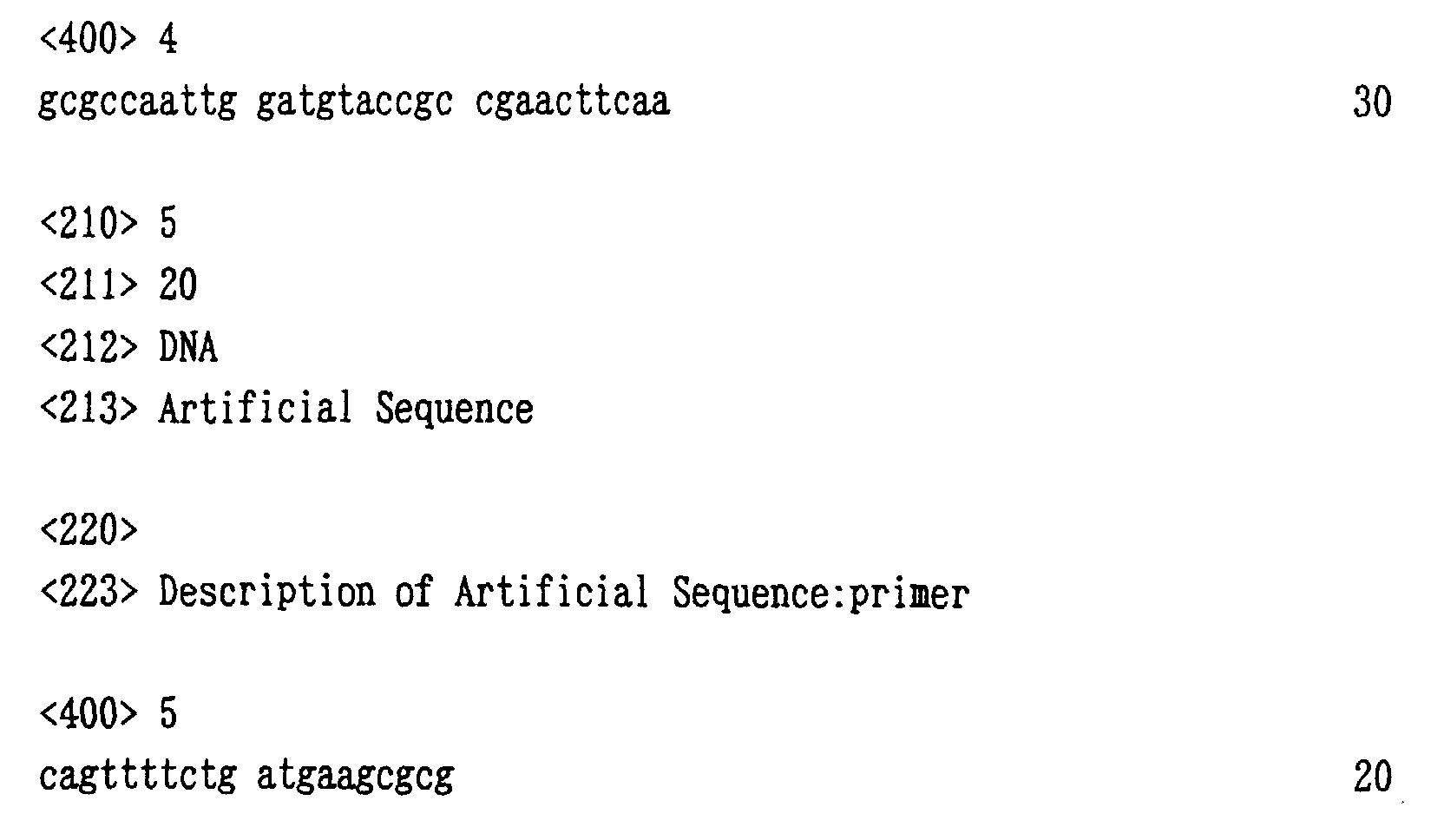
gene. A 224bps fragment containing the threonine operon
promoter was prepared in a conventional manner by PCR
using the following oligonucleotides PT-4 and PT-5 as
primers and pVIC40 as template. The 224bps fragment was
digested with EcoRI and MunI and ligated to pVIC40
digested with EcoRI to introduce the threonine operon
promoter into the plasmid. Escherichia coli JM109 was
transformed with the obtained plasmid, and PCR was
performed for each transformant strain by using PT-4 and
the following primer SM-1. A transformant for which a
band was detected at about 270 bps was selected as one
in which the promoter was inserted in collect direction
with respect to the streptomycin resistance gene.
[Primers]
- PT-4:
- GCGCGAATTCCAACGGGCAATATGTCTCTG (SEQ ID NO: 3)
- PT-5:
- GCGCCAATTGGATGTACCGCCGAACTTCAA (SEQ ID NO: 4)
- SM-1:
- CAGTTTTCTGATGAAGCGCG (SEQ ID NO: 5)
pRS and RSF24P obtained as described above were
each introduced into Escherichia coli S17-1 in a
conventional manner to obtain S17-1/pRS and S17-1/RSF24P,
respectively.
Each of S17-1/pRS and S17-1/RSF24P was inoculated
into 3 ml of LB medium containing 20 µg/L of
streptomycin in a 30-ml volume test tube, and cultured
at 37°C for 18 hours with shaking. On the other hand,
wild type strains of Methylomonas albus and
Methylococcus capsulatus Bath were each inoculated to 3
ml of NMS media contained in a 30-ml volume pressure-proof
test tube, in which 15 ml of methane was then
enclosed, and cultured at 30°C for Methylomonas albus or
at 37°C for Methylococcus capsulatus Bath strain for two
days with shaking.
0.1 ml of the culture bloth of donor strain (S17-1/pRS
or S17-1/RSF24P) and 1.4 ml of the culture bloth
of recipient strain (Methylomonas albus and
Methylococcus capsulatus Bath strain) were mixed in a
1.5 ml-volume microtube, and centrifuged to remove the
supernatant. The pellet of the cells obtained for each
case was subjected to heat shock at 50°C for 1 minute,
then suspended in a small amount of NMS medium and
transferred onto a membrane filter. This membrane
filter was placed on NMS medium containing 1.5% of agar,
and left stand at 30°C for Methylomonas albus or at 37°C
for Methylococcus capsulatus Bath. Four hours later,
the membrane filter was washed with a small amount of
NMS medium, and the cells were collected into a
microtube. These cells were plated on NMS medium
containing 10 µg/ml of streptomycin and 1.5% of agar,
and cultured at 30°C for Methylomonas albus or at 37°C
for Methylococcus capsulatus Bath for 3-14 days. The
emerged colonies were inoculated into 3 ml of NMS medium
containing 10 µg/L of streptomycin in a 30-ml volume
pressure-proof test tube, in which 15 ml of methane was
then enclosed, and cultured at 30°C for Methylomonas
albus or at 37°C for Methylococcus capsulatus Bath for
10 days with shaking.
After the culture was completed, the cells were
separated from the culture by centrifugation, and the
presence of each plasmid was confirmed in a conventional
manner. Hereafter, Methylomonas albus strains which
harbor each of pRS and RSF24P are referred to as
Methylomonas albus/pRS and Methylomonas albus/RSF24P,
respectively. Methylococcus capsulatus Bath strains
which harbor each of pRS and RSF24P are referred to as
Methylococcus capsulatus Bath/pRS and Methylococcus
capsulatus Bath/RSF24P, respectively.
Example 9: Effect of dapA* gene amplification in
Methylomonas albus
A wild type strain of
Methylomonas albus,
Methylomonas albus/pRS (comprising only the vector) and
Methylomonas albus/RSF24P (comprising
dapA*) were
cultured in the same manner as in Example 3 except that
NMS medium containing 10 µg/ml of streptomycin was used
instead of NMS medium for the strains harboring the
plasmids, and the amino acid contained in each culture
supernatant were quantified. The results are shown in
Table 6. Increase in L-Lys accumulation was observed in
the
dapA* amplified strain.
| Effect of dapA* gene amplification in
Methylomonas albus |
| Strain | L-Lys accumulation (mg/L) |
| Methylomonas albus | 0.00 |
| Methylomonas albus/pRS | 0.00 |
| Methylomonas albus/RSF24P | 0.48 |
A wild type strain of
Methylococcus capsulatus
Bath,
Methylococcus capsulatus Bath/pRS (comprising only
the vector) and
Methylococcus capsulatus Bath/RSF24P
(comprising
dapA*) were cultured in the same manner as
in Example 9 except that they were cultured at 37°C
instead of at 30°C, and the amino acid contained in each
culture supernatant were quantified. The results are
shown in Table 7. Increase in L-Lys accumulation was
observed in the
dapA* amplified strain.
| Effect of dapA* amplification in Methylococcus
capsulatus Bath |
| Strain | L-Lys accumulation (mg/L) |
| Methylococcus capsulatus Bath | 0.23 |
| Methylococcus capsulatus Bath/pRS | 0.25 |
| Methylococcus capsulatus Bath/RSF24P | 3.07 |
A wild type strain of Methylococcus capsulatus
Bath, Methylococcus capsulatus Bath/pRS and
Methylococcus capsulatus Bath/RSF24P were cultured in
the same manner as in Example 2 except that they were
cultured at 37°C instead of at 30°C. 10 µg/ml of
streptomycin was added to the medium for cultivating the
strains harboring the plasmids. Further, 10 ml of 1 mM
CuSO4 was added 19 hours and 65 hours after the start of
the culture.
After the culture was completed, the cells were
separated by centrifugation and amino acids contained in
the obtained culture supernatant was analyzed by an
amino acid analyzer. The results are shown in Table 8.
Methylococcus capsulatus Bath/RSF24P accumulated 223
mg/L of L-Lys. The wild type strain of
Methylococcus
capsulatus Bath and
Methylococcus capsulatus Bath/pRS
accumulated 122 mg/L and 220 mg/L of L-Glu, respectively.
| Amino acid accumulation of wild type strain and
dapA* amplified strain of Methylococcus capsulatus Bath |
| | L-amino acid (mg/L) |
| | Wild type strain | /pRS | /RSF24P |
| L-Glu | 122.8 | 220.9 | 32.9 |
| L-Lys | 10.6 | 23.3 | 223.6 |
For introduction of dapA*, lysC*, dapB and ddh
into a wild type strain of Methylococcus capsulatus Bath,
there was used plasmid pCABD2, which was disclosed in
WO95/16042, containing DNA which coded for
dihydrodipicolinate synthase (DDPS) of Escherichia coli
having a mutation for desensitizing the feedback
inhibition by L-lysine (dapA*24), DNA which coded for
aspartokinase III of Escherichia coli having a mutation
for desensitizing the feedback inhibition by L-lysine
(lysC*80), DNA which coded for dihydrodipicolinate
reductase of Escherichia coli (dapB) and DNA which coded
for diaminopimelate dehydrogenase of Brevibacterium
lactofermentum (ddh).
The aforementioned pCABD2 was introduced into
Escherichia coli JM109 in a conventional manner to
obtain JM109/pCABD2.
JM109/pCABD2 was inoculated into 3 ml of LB medium
containing 20 µg/L of streptomycin, which was contained
in a 30-ml volume test tube, and cultured at 37°C for 18
hours with shaking. The Escherichia coli HB101/pRK2013
disclosed in reference (Ditta, G., Stanfield, S., Corbin,
D., and Helinski, D.R., Proc. Natl. Acad. Sci. USA, 77,
7347 (1980)) was similarly inoculated to LB medium
containing 50 µg/L of kanamycin, which was contained in
a 30-ml volume test tube, and cultured at 37°C for 18
hours with shaking. Further, a wild type strain of
Methylococcus capsulatus Bath was inoculated to 3 ml of
NMS medium contained in a 30-ml volume test tube, in
which 15 ml of methane was then enclosed, and cultured
at 37°C for 24 hours with shaking.
Each of cultures of JM109/pCABD2 and HB101/pRK2013
(0.5 ml) was washed twice with 50 mM phosphate buffer
(pH 7.0) and suspended in 0.5 ml of the same buffer.
1.3 ml of the culture of the wild type strain of
Methylococcus capsulatus Bath was mixed with 0.1 ml of
the cell suspension of JM109/pCABD2 and 0.1 ml of the
cell suspension of HB101/pRK2013, and centrifuged to
remove the supernatant.
The obtained cells were mixed with 10 µl of NMS
medium, then transferred on an NMS plate, and cultured
at 37°C in the presence of 50% methane. The cells were
collected from the plate 48 hours later, then inoculated
on an NMS plate containing 10 µg/ml of streptomycin, and
cultured at 37°C for 1 month in the presence of 50%
methane.
The emerged colonies were inoculated on an NMS
plate containing 10 µg/ml of streptomycin, and cultured
at 37°C for 6 days in the presence of 50% methane. The
cells were inoculated into 3 ml of NMS medium containing
10 µg/ml of streptomycin in a 30-ml volume test tube, in
which 15 ml of methane was then enclosed, and cultured
at 37°C for 41 hours with shaking.
After the culture was completed, the cells were
separated from the culture by centrifugation, and the
presence of each plasmid was confirmed in a conventional
manner. Hereafter, Methylococcus capsulatus Bath strain
which harbors pCABD2 is referred to as Methylococcus
capsulatus Bath/pCABD2.
Example 13: Effect of amplification of dapA*, lysC*,
dapB and ddh genes in Methylococcus capsulatus Bath
Methylococcus capsulatus Bath/pRS (comprising only
the vector), Methylococcus capsulatus Bath/RSF24P
(comprising dapA*) and Methylococcus capsulatus
Bath/pCABD2 (comprising dapA*, lysC*, dapB and ddh) were
each inoculated into 3 ml of NMS medium contained in a
30-ml volume test tube, in which 15 ml of methane was
then enclosed, and cultured at 37°C for 65 hours with
shaking. As for the strains harboring the plasmids, NMS
medium containing 10 µg/ml of streptomycin was used
instead of NMS medium. Twenty-two hours and 42 hours
after the culture was started, the gaseous phase in the
test tube was replaced with air, and 15 ml of methane
was newly enclosed. Amino acids contained in the
culture supernatant after the culture were quantified in
the same manner as in Example 3.
The results are shown in Table 9. The
dapA*,
lysC*,
dapB, and ddh amplified strain (
Methylococcus
capsulatus Bath/pCABD2) accumulated about twice as much
L-lysine as the strain in which only
dapA* was amplified
(
Methylococcus capsulatus Bath/RSF24P).
| Effect of amplification of dapA*, lysC*, dapB
and ddh in Methylococcus capsulatus Bath |
| Strain | L-Lys accumulation (mg/L) |
| Methylococcus capsulatus Bath/pRS | 0.75 |
| Methylococcus capsulatus Bath/RSF24P | 4.32 |
| Methylococcus capsulatus Bath/pCABD2 | 9.37 |