EP1073047A1 - Fluorinated alcohol for manufacturing optical recording medium and optical recording medium produced by using the same - Google Patents
Fluorinated alcohol for manufacturing optical recording medium and optical recording medium produced by using the same Download PDFInfo
- Publication number
- EP1073047A1 EP1073047A1 EP00115793A EP00115793A EP1073047A1 EP 1073047 A1 EP1073047 A1 EP 1073047A1 EP 00115793 A EP00115793 A EP 00115793A EP 00115793 A EP00115793 A EP 00115793A EP 1073047 A1 EP1073047 A1 EP 1073047A1
- Authority
- EP
- European Patent Office
- Prior art keywords
- fluorinated alcohol
- optical recording
- recording medium
- boiling
- organic dye
- Prior art date
- Legal status (The legal status is an assumption and is not a legal conclusion. Google has not performed a legal analysis and makes no representation as to the accuracy of the status listed.)
- Granted
Links
- 150000001298 alcohols Chemical class 0.000 title claims abstract description 62
- 230000003287 optical effect Effects 0.000 title claims abstract description 47
- 238000004519 manufacturing process Methods 0.000 title claims abstract description 14
- 239000000758 substrate Substances 0.000 claims abstract description 17
- 238000009835 boiling Methods 0.000 claims abstract description 11
- 239000002904 solvent Substances 0.000 claims description 11
- 239000000975 dye Substances 0.000 description 47
- 239000010410 layer Substances 0.000 description 43
- 238000000034 method Methods 0.000 description 18
- 239000011241 protective layer Substances 0.000 description 15
- 239000000243 solution Substances 0.000 description 11
- 230000000052 comparative effect Effects 0.000 description 10
- 239000000463 material Substances 0.000 description 8
- 238000004528 spin coating Methods 0.000 description 8
- LFQSCWFLJHTTHZ-UHFFFAOYSA-N Ethanol Chemical compound CCO LFQSCWFLJHTTHZ-UHFFFAOYSA-N 0.000 description 7
- KFZMGEQAYNKOFK-UHFFFAOYSA-N Isopropanol Chemical compound CC(C)O KFZMGEQAYNKOFK-UHFFFAOYSA-N 0.000 description 6
- OKKJLVBELUTLKV-UHFFFAOYSA-N Methanol Chemical compound OC OKKJLVBELUTLKV-UHFFFAOYSA-N 0.000 description 6
- 239000011248 coating agent Substances 0.000 description 5
- 238000000576 coating method Methods 0.000 description 5
- ANRHNWWPFJCPAZ-UHFFFAOYSA-M thionine Chemical compound [Cl-].C1=CC(N)=CC2=[S+]C3=CC(N)=CC=C3N=C21 ANRHNWWPFJCPAZ-UHFFFAOYSA-M 0.000 description 5
- 239000012790 adhesive layer Substances 0.000 description 4
- 230000015572 biosynthetic process Effects 0.000 description 4
- JHIVVAPYMSGYDF-UHFFFAOYSA-N cyclohexanone Chemical compound O=C1CCCCC1 JHIVVAPYMSGYDF-UHFFFAOYSA-N 0.000 description 4
- SWXVUIWOUIDPGS-UHFFFAOYSA-N diacetone alcohol Chemical compound CC(=O)CC(C)(C)O SWXVUIWOUIDPGS-UHFFFAOYSA-N 0.000 description 4
- 239000004925 Acrylic resin Substances 0.000 description 3
- 229920000178 Acrylic resin Polymers 0.000 description 3
- MYMOFIZGZYHOMD-UHFFFAOYSA-N Dioxygen Chemical compound O=O MYMOFIZGZYHOMD-UHFFFAOYSA-N 0.000 description 3
- 239000003960 organic solvent Substances 0.000 description 3
- 239000011347 resin Substances 0.000 description 3
- 229920005989 resin Polymers 0.000 description 3
- MSXVQELLSMPBFD-UHFFFAOYSA-N 2,2,3,3,4,4,5,5,6,6,7,7,8,8,9,9-hexadecafluorononan-1-ol Chemical compound OCC(F)(F)C(F)(F)C(F)(F)C(F)(F)C(F)(F)C(F)(F)C(F)(F)C(F)F MSXVQELLSMPBFD-UHFFFAOYSA-N 0.000 description 2
- BYKNGMLDSIEFFG-UHFFFAOYSA-N 2,2,3,3,4,4,5,5,6,6,7,7-dodecafluoroheptan-1-ol Chemical compound OCC(F)(F)C(F)(F)C(F)(F)C(F)(F)C(F)(F)C(F)F BYKNGMLDSIEFFG-UHFFFAOYSA-N 0.000 description 2
- JUGSKHLZINSXPQ-UHFFFAOYSA-N 2,2,3,3,4,4,5,5-octafluoropentan-1-ol Chemical compound OCC(F)(F)C(F)(F)C(F)(F)C(F)F JUGSKHLZINSXPQ-UHFFFAOYSA-N 0.000 description 2
- NBUKAOOFKZFCGD-UHFFFAOYSA-N 2,2,3,3-tetrafluoropropan-1-ol Chemical compound OCC(F)(F)C(F)F NBUKAOOFKZFCGD-UHFFFAOYSA-N 0.000 description 2
- XNWFRZJHXBZDAG-UHFFFAOYSA-N 2-METHOXYETHANOL Chemical compound COCCO XNWFRZJHXBZDAG-UHFFFAOYSA-N 0.000 description 2
- ZNQVEEAIQZEUHB-UHFFFAOYSA-N 2-ethoxyethanol Chemical compound CCOCCO ZNQVEEAIQZEUHB-UHFFFAOYSA-N 0.000 description 2
- DKPFZGUDAPQIHT-UHFFFAOYSA-N Butyl acetate Natural products CCCCOC(C)=O DKPFZGUDAPQIHT-UHFFFAOYSA-N 0.000 description 2
- XDTMQSROBMDMFD-UHFFFAOYSA-N Cyclohexane Chemical compound C1CCCCC1 XDTMQSROBMDMFD-UHFFFAOYSA-N 0.000 description 2
- VYPSYNLAJGMNEJ-UHFFFAOYSA-N Silicium dioxide Chemical compound O=[Si]=O VYPSYNLAJGMNEJ-UHFFFAOYSA-N 0.000 description 2
- BZHJMEDXRYGGRV-UHFFFAOYSA-N Vinyl chloride Chemical compound ClC=C BZHJMEDXRYGGRV-UHFFFAOYSA-N 0.000 description 2
- 238000010521 absorption reaction Methods 0.000 description 2
- 238000007598 dipping method Methods 0.000 description 2
- 238000004821 distillation Methods 0.000 description 2
- 239000003822 epoxy resin Substances 0.000 description 2
- 239000011521 glass Substances 0.000 description 2
- FUZZWVXGSFPDMH-UHFFFAOYSA-N hexanoic acid Chemical compound CCCCCC(O)=O FUZZWVXGSFPDMH-UHFFFAOYSA-N 0.000 description 2
- 238000001746 injection moulding Methods 0.000 description 2
- 229910010272 inorganic material Inorganic materials 0.000 description 2
- 239000011147 inorganic material Substances 0.000 description 2
- 239000000203 mixture Substances 0.000 description 2
- 229920000647 polyepoxide Polymers 0.000 description 2
- 229920001225 polyester resin Polymers 0.000 description 2
- 239000004645 polyester resin Substances 0.000 description 2
- 238000007650 screen-printing Methods 0.000 description 2
- 238000004544 sputter deposition Methods 0.000 description 2
- 239000000126 substance Substances 0.000 description 2
- DNIAPMSPPWPWGF-GSVOUGTGSA-N (R)-(-)-Propylene glycol Chemical compound C[C@@H](O)CO DNIAPMSPPWPWGF-GSVOUGTGSA-N 0.000 description 1
- 206010067482 No adverse event Diseases 0.000 description 1
- 235000010724 Wisteria floribunda Nutrition 0.000 description 1
- 239000006096 absorbing agent Substances 0.000 description 1
- 230000002411 adverse Effects 0.000 description 1
- 229910052782 aluminium Inorganic materials 0.000 description 1
- 150000001450 anions Chemical class 0.000 description 1
- 239000000987 azo dye Substances 0.000 description 1
- 239000011230 binding agent Substances 0.000 description 1
- 230000015556 catabolic process Effects 0.000 description 1
- 150000001768 cations Chemical class 0.000 description 1
- 229910052804 chromium Inorganic materials 0.000 description 1
- 229910052681 coesite Inorganic materials 0.000 description 1
- 229910052802 copper Inorganic materials 0.000 description 1
- 229910052906 cristobalite Inorganic materials 0.000 description 1
- 238000006731 degradation reaction Methods 0.000 description 1
- 238000001514 detection method Methods 0.000 description 1
- 230000000694 effects Effects 0.000 description 1
- 125000001153 fluoro group Chemical group F* 0.000 description 1
- 238000004817 gas chromatography Methods 0.000 description 1
- 229910052732 germanium Inorganic materials 0.000 description 1
- 238000010030 laminating Methods 0.000 description 1
- 239000002184 metal Substances 0.000 description 1
- 229910052751 metal Inorganic materials 0.000 description 1
- 229910052759 nickel Inorganic materials 0.000 description 1
- 239000011368 organic material Substances 0.000 description 1
- IEQIEDJGQAUEQZ-UHFFFAOYSA-N phthalocyanine Chemical compound N1C(N=C2C3=CC=CC=C3C(N=C3C4=CC=CC=C4C(=N4)N3)=N2)=C(C=CC=C2)C2=C1N=C1C2=CC=CC=C2C4=N1 IEQIEDJGQAUEQZ-UHFFFAOYSA-N 0.000 description 1
- 239000001007 phthalocyanine dye Substances 0.000 description 1
- 229920000515 polycarbonate Polymers 0.000 description 1
- 239000004417 polycarbonate Substances 0.000 description 1
- 229920005668 polycarbonate resin Polymers 0.000 description 1
- 239000004431 polycarbonate resin Substances 0.000 description 1
- 239000002861 polymer material Substances 0.000 description 1
- 229920005672 polyolefin resin Polymers 0.000 description 1
- 229920005990 polystyrene resin Polymers 0.000 description 1
- 238000002360 preparation method Methods 0.000 description 1
- 238000007639 printing Methods 0.000 description 1
- 238000011160 research Methods 0.000 description 1
- 239000004065 semiconductor Substances 0.000 description 1
- 229910052710 silicon Inorganic materials 0.000 description 1
- 239000000377 silicon dioxide Substances 0.000 description 1
- 229910052709 silver Inorganic materials 0.000 description 1
- 238000005507 spraying Methods 0.000 description 1
- 229910052682 stishovite Inorganic materials 0.000 description 1
- 229910052905 tridymite Inorganic materials 0.000 description 1
- 238000007740 vapor deposition Methods 0.000 description 1
Classifications
-
- C—CHEMISTRY; METALLURGY
- C07—ORGANIC CHEMISTRY
- C07C—ACYCLIC OR CARBOCYCLIC COMPOUNDS
- C07C31/00—Saturated compounds having hydroxy or O-metal groups bound to acyclic carbon atoms
- C07C31/34—Halogenated alcohols
- C07C31/38—Halogenated alcohols containing only fluorine as halogen
-
- G—PHYSICS
- G11—INFORMATION STORAGE
- G11B—INFORMATION STORAGE BASED ON RELATIVE MOVEMENT BETWEEN RECORD CARRIER AND TRANSDUCER
- G11B7/00—Recording or reproducing by optical means, e.g. recording using a thermal beam of optical radiation by modifying optical properties or the physical structure, reproducing using an optical beam at lower power by sensing optical properties; Record carriers therefor
- G11B7/24—Record carriers characterised by shape, structure or physical properties, or by the selection of the material
- G11B7/241—Record carriers characterised by shape, structure or physical properties, or by the selection of the material characterised by the selection of the material
- G11B7/242—Record carriers characterised by shape, structure or physical properties, or by the selection of the material characterised by the selection of the material of recording layers
- G11B7/244—Record carriers characterised by shape, structure or physical properties, or by the selection of the material characterised by the selection of the material of recording layers comprising organic materials only
- G11B7/246—Record carriers characterised by shape, structure or physical properties, or by the selection of the material characterised by the selection of the material of recording layers comprising organic materials only containing dyes
- G11B7/247—Record carriers characterised by shape, structure or physical properties, or by the selection of the material characterised by the selection of the material of recording layers comprising organic materials only containing dyes methine or polymethine dyes
- G11B7/2472—Record carriers characterised by shape, structure or physical properties, or by the selection of the material characterised by the selection of the material of recording layers comprising organic materials only containing dyes methine or polymethine dyes cyanine
-
- G—PHYSICS
- G11—INFORMATION STORAGE
- G11B—INFORMATION STORAGE BASED ON RELATIVE MOVEMENT BETWEEN RECORD CARRIER AND TRANSDUCER
- G11B7/00—Recording or reproducing by optical means, e.g. recording using a thermal beam of optical radiation by modifying optical properties or the physical structure, reproducing using an optical beam at lower power by sensing optical properties; Record carriers therefor
- G11B7/24—Record carriers characterised by shape, structure or physical properties, or by the selection of the material
- G11B7/241—Record carriers characterised by shape, structure or physical properties, or by the selection of the material characterised by the selection of the material
- G11B7/252—Record carriers characterised by shape, structure or physical properties, or by the selection of the material characterised by the selection of the material of layers other than recording layers
- G11B7/253—Record carriers characterised by shape, structure or physical properties, or by the selection of the material characterised by the selection of the material of layers other than recording layers of substrates
- G11B7/2533—Record carriers characterised by shape, structure or physical properties, or by the selection of the material characterised by the selection of the material of layers other than recording layers of substrates comprising resins
- G11B7/2534—Record carriers characterised by shape, structure or physical properties, or by the selection of the material characterised by the selection of the material of layers other than recording layers of substrates comprising resins polycarbonates [PC]
-
- G—PHYSICS
- G11—INFORMATION STORAGE
- G11B—INFORMATION STORAGE BASED ON RELATIVE MOVEMENT BETWEEN RECORD CARRIER AND TRANSDUCER
- G11B7/00—Recording or reproducing by optical means, e.g. recording using a thermal beam of optical radiation by modifying optical properties or the physical structure, reproducing using an optical beam at lower power by sensing optical properties; Record carriers therefor
- G11B7/24—Record carriers characterised by shape, structure or physical properties, or by the selection of the material
- G11B7/241—Record carriers characterised by shape, structure or physical properties, or by the selection of the material characterised by the selection of the material
- G11B7/252—Record carriers characterised by shape, structure or physical properties, or by the selection of the material characterised by the selection of the material of layers other than recording layers
- G11B7/254—Record carriers characterised by shape, structure or physical properties, or by the selection of the material characterised by the selection of the material of layers other than recording layers of protective topcoat layers
- G11B7/2542—Record carriers characterised by shape, structure or physical properties, or by the selection of the material characterised by the selection of the material of layers other than recording layers of protective topcoat layers consisting essentially of organic resins
-
- G—PHYSICS
- G11—INFORMATION STORAGE
- G11B—INFORMATION STORAGE BASED ON RELATIVE MOVEMENT BETWEEN RECORD CARRIER AND TRANSDUCER
- G11B7/00—Recording or reproducing by optical means, e.g. recording using a thermal beam of optical radiation by modifying optical properties or the physical structure, reproducing using an optical beam at lower power by sensing optical properties; Record carriers therefor
- G11B7/24—Record carriers characterised by shape, structure or physical properties, or by the selection of the material
- G11B7/241—Record carriers characterised by shape, structure or physical properties, or by the selection of the material characterised by the selection of the material
- G11B7/252—Record carriers characterised by shape, structure or physical properties, or by the selection of the material characterised by the selection of the material of layers other than recording layers
- G11B7/258—Record carriers characterised by shape, structure or physical properties, or by the selection of the material characterised by the selection of the material of layers other than recording layers of reflective layers
- G11B7/259—Record carriers characterised by shape, structure or physical properties, or by the selection of the material characterised by the selection of the material of layers other than recording layers of reflective layers based on silver
-
- Y—GENERAL TAGGING OF NEW TECHNOLOGICAL DEVELOPMENTS; GENERAL TAGGING OF CROSS-SECTIONAL TECHNOLOGIES SPANNING OVER SEVERAL SECTIONS OF THE IPC; TECHNICAL SUBJECTS COVERED BY FORMER USPC CROSS-REFERENCE ART COLLECTIONS [XRACs] AND DIGESTS
- Y10—TECHNICAL SUBJECTS COVERED BY FORMER USPC
- Y10S—TECHNICAL SUBJECTS COVERED BY FORMER USPC CROSS-REFERENCE ART COLLECTIONS [XRACs] AND DIGESTS
- Y10S430/00—Radiation imagery chemistry: process, composition, or product thereof
- Y10S430/146—Laser beam
Definitions
- the present invention relates to a fluorinated alcohol which, upon manufacturing an optical recording medium having an organic dye layer, is used for forming the organic dye layer, and also concerns an optical recording medium having an organic dye layer formed by using the fluorinated alcohol.
- an organic dye recording layer is carried out as follows: To an organic solvent containing, alone or in combination, such as cyclohexane, cyclohexanone, methanol, ethanol, isopropyl alcohol, diacetone alcohol, methyl cellosolve, ethyl cellosolve, butyl acetate or fluorinated alcohol, a dye as aforementioned is added and dissolved to prepare a dye solution, and this dye solution is applied onto a substrate by a spin coating method.
- an organic solvent containing such as cyclohexane, cyclohexanone, methanol, ethanol, isopropyl alcohol, diacetone alcohol, methyl cellosolve, ethyl cellosolve, butyl acetate or fluorinated alcohol.
- Japanese Examined Patent Publication No. 7-96333/1995 discloses the use of fluorinated alcohol.
- Japanese Laid-Open Patent Publication No. 4-8585/1992 discloses the use of fluorinated alcohol having a purity of not less than 99 % by weight.
- Japanese Laid-Open Patent Publication No. 7-137448/1995 discloses the use of 2,2,3,3-tetrafluoro-1-pronanol having a pH of not less than 6.0.
- an optical recording medium needs to have superior weatherability by taking into consideration various working environments. Thus, it is a prerequisite for a solvent for dissolving an organic dye not to give adverse effects to the weatherability of the optical recording medium.
- the inventors of the present invention have studied extensively about the weatherability required for the optical recording medium, and have found that, among optical recording media manufactured by using fluorinated alcohol as an organic dye applying solvent, some of them are inferior in the characteristics and weatherability, as compared with the other media.
- those optical recording media that are inferior in the weatherability have further degradation in the characteristics and weatherability, when the fluorinated alcohol to be used contains a high-boiling-point fluorinated alcohol with a boiling point of not less than 120° C in an amount of not less than a certain amount, when the high-boiling-point fluorinated alcohol has a molecular weight in the range of 150 to 500, and when the high-boiling-point fluorinated alcohol is fluorinated alcohol represented by a general formula: A-CH 2 OH, where A represents H(CF 2 -CF 2 )n and n is in the range of 2 to 4.
- the fluorinated alcohol to be used contains such a high-boiling-point fluoric alcohol, if the content thereof is 0.001 % by weight or less, the resulting optical recording medium are superior in the characteristics and weatherability.
- An object of the present invention is to provide an ultra-high purity fluorinated alcohol for manufacturing an optical recording medium that is superior in the characteristics and weatherability. Moreover, another object of the present invention is to provide an optical recording medium that is superior in the characteristics and weatherability and that has an organic dye layer formed by using the ultra-high purity fluorinated alcohol.
- the present invention is a fluorinated alcohol for manufacturing an optical recording medium having an organic dye layer and a reflecting layer in this order on a light-transmittable substrate, wherein a content of a high-boiling-point fluorinated alcohol with a boiling point of not less than 120° C is 0.001 % by weight or less.
- the molecular weight of the high-boiling-point fluorinated alcohol is, for example, 150 to 500.
- the high-boiling-point fluorinated alcohol is mainly represented by, for example, general formula (1): H(CF 2 -CF 2 )n-CH 2 OH (where n is an integer of 2 to 4).
- the present invention is an optical recording medium having an organic dye layer and a reflecting layer in this order on a light-transmittable substrate, wherein said organic dye layer is formed by using a solvent containing a fluorinated alcohol in which a content of a high-boiling-point fluorinated alcohol with a boiling point of not less than 120° C is 0.001 % by weight or less.
- an ultra-high purity fluorinated alcohol in which the content of a high-boiling-point fluorinated alcohol with a boiling point of not less than 120° C is 0.001 % by weight or less is used as a manufacturing solvent of an optical recording medium having an organic dye layer. Therefore, it is possible to provide an optical recording medium that is superior in the electric characteristics and reliability.
- the structure of the optical recording medium of the present invention is fundamentally the same as those of current Recordable type optical recording media.
- an organic dye recording layer which serves to record and reproduce using laser light is formed on a light-transmittable substrate formed with a pregroove, a reflecting layer increasing light-reflectance is formed on the organic dye recording layer and further a protective layer which protects the organic dye recording layer and the reflecting layer is formed on the reflecting layer.
- an optical recording medium obtained by using the optical recording medium having such a layer structure as at least one party and by laminating it to the other through an adhesive layer is also included in the present invention.
- an optical recording medium in which the adhesive layer doubles as a protective layer on the reflective layer is also included in the present invention.
- an organic protective layer may be formed on the opposite surface of the substrate with respect to the organic dye layer.
- a polymer material typified by a polycarbonate resin, acrylic resin, polystyrene resin, epoxy resin, polyester resin, vinyl chloride resin or polyolefin resin or an inorganic material such as glass may be used.
- a pregroove of stamper is transferred by primarily injection molding in the case of using a resin material and by primarily a 2P method in the case of using glass, thereby preparing the substrate.
- the organic dye layer including an organic dye as its major component is formed on the substrate.
- the organic dye layer may be any one of those which can read a variation, in shape or optical properties, which is made due to a physical and/or chemical change caused by the absorption of recording laser light, by using reproducing laser light.
- a phthalocyanine dye, cyanine dye or azo dye which has an absorption area in the wavelength range of a semiconductor laser is used very often.
- These dyes may be used either singly or in combinations of two or more, to which a singlet oxygen quencher, a UV-ray absorber or the like may be added as required. It is also preferable to use an ionic bonding material of a dye cation and an anion of singlet oxygen quencher as the organic dye.
- a coating solution is prepared by dissolving an organic dye in an organic solvent and the coating solution is applied onto the substrate by a spin coating method to form the organic dye layer. It is desirable to control the concentration of an organic dye component in the coating solution and the thickness of the organic dye layer to be formed so that sufficient reflectance can be obtained after the reflecting layer is formed.
- TFP 2,2,3,3-tetrafluoro-1-propanol
- a solvent other than the fluorinated alcohol may be mixed therewith, if necessary.
- examples thereof include: cyclohexane, cyclohexanone, methanol, ethanol, isopropyl alcohol, diacetone alcohol, methyl cellosolve, ethyl cellosolve, butyl acetate, etc.
- the amount thereof is preferably approximately less than 10 % by weight with respect to the amount of the fluorinated alcohol.
- the main feature of the present invention is that fluorinated alcohol is further distilled up to a purity level where the content of a high-boiling-point fluorinated alcohol having a boiling point of not less than 120° C and a molecular weight of 150 to 500, and represented by the above-mentioned general formula (1) where n is an integer from 2 to 4, is 0.001 % by weight or less, and resulting ultra-high purity fluorinated alcohol is used.
- the content may be any content as long as it is not more than 0.001 % by weight, and may be 0 % by weight.
- the organic dye layer is formed by a spin coating method in the same manner as the conventional process. That is, a dye and, if necessary, singlet oxygen quencher and a binder are dissolved in ultra high-purity fluorinated alcohol to prepare an coating solution, and this solution is applied on a substrate by a spin coating method, and then the coat layer is dried, if necessary.
- a spin coating method such as a screen printing method and a dipping method, may be used.
- the thickness of the organic dye layer is generally in the range of 10 to 500 nm at groove portions, and more preferably, 50 to 300 nm.
- This reflecting layer is formed by using elements, such as Au, Ag, Al, Cu, Cr, Ni, Si and Ge, alone or with another element being contained, through a formation method such as a sputtering method and a vacuum vapor deposition method.
- a protective layer with a thickness of, for example, 1 to 50 ⁇ m is formed on the reflecting layer.
- Layers which can protect the organic dye recording layer and the reflecting layer suffice for the protective layer, and there is no particular limitation to the structural material of the protective layer.
- a UV-ray curable type acrylic resin is usually used from, for example, the reason that the protective layer can be formed with ease.
- the material of the protective layer may also be an organic material such as a vinyl chloride resin, epoxy resin or polyester resin or an inorganic material such as SiO 2 or AlN. These materials may be either singly or as a mixture.
- the protective layer may comprise multiple layers in which different materials are laminated.
- a label printing layer may be further formed.
- the adhesive layer may double as the protective layer.
- the protective layer is formed by a spin coating method in order to avoid damages to the reflecting layer.
- the protective layer may be formed by a screen printing method, dipping method or spray coating method etc.
- ultra high-purity fluorinated alcohol is used so that the resulting optical recording medium has superior characteristics and weatherability.
- a mixture dye consisting of a cyanine dye NK3721 (manufactured by Hayashibara Biochemical Laboratories, Inc.) and a cyanine dye OM-57 (manufactured by Fuji Photo Film Co., LTD.) in a ratio (by weight) of 6:4 was used.
- the initial rotating speed was set to 300 rpm when the dye solution was dripped on the substrate, gradually increased and finally set to 5000 rpm.
- an Ag layer with a thickness of 100 nm was formed on the dye layer by a sputtering method.
- an ultraviolet-rays curable type acrylic resin DAICURE CLEAR SD318 manufactured by Dainippon Ink and Chemicals, Inc. was applied onto the Ag layer by a spin coating method to form a protective layer with a thickness of 5 ⁇ m.
- the thickness of the organic dye layer was about 250 nm at the groove portion and about 150 nm at the land portion.
- Table 2 shows the jitter value before and after the weatherability test.
- the jitter value is an average value of the measured values of 10 samples, and the measuring position is set at a radius of the center of the medium.
- Table 3 shows an average value and a maximum value of the block error rates of the measured 10 samples before and after the weatherability test.
- the content of the high-boiling-point fluorinated alcohol in TFP was determined by using a gas chromatography (GC14B manufactured by Shimadzu Corporation). The same is true in Comparative Examples.
- Example 2 The same processes as Example 1 were carried out except that 100 g of TFP, which respectively contained 0.0019 % (Comparative Example 1) and 0.0013 % (Comparative Example 2) by weight of fluorinated alcohol (2,2,3,3,4,4,5,5-octafluoro-1-pentanol) represented by the general formula (1) where n is a value of 2, was used to obtain 10 samples of optical recording media.
- TFP was respectively prepared by adding 2,2,3,3,4,4,5,5-octafluoro-1-pentanol to an ultra-high purity TFP used in Example 1.
- the characteristics of the optical recording media were measured and evaluated in the same manner as Example 1, and as shown in Table 2 and Table 3, the results showed that, although no difference was seen from Example 1 with respect to the initial value of the block error rate, the initial value of the jitter was inferior as compared with Example 1, and after the weatherability test, both the block error rate and jitter deteriorated. In particular, the block error rate deteriorated extremely.
- Example 3 The same processes as Example 1 were carried out except that 100 g of TFP, which respectively contained 0.0018 % (Comparative Example 3) and 0.0015 % (Comparative Example 4) by weight of fluorinated alcohol (2,2,3,3,4,4,5,5,6,6,7,7-dodecafluoro-1-heptanol) represented by the general formula (1) where n is a value of 3, was used to obtain 10 samples of optical recording media.
- These TFP was respectively prepared by adding 2,2,3,3,4,4,5,5,6,6,7,7-dodecafluoro-1-heptanol to an ultra-high purity TFP used in Example 1.
- the characteristics of the optical recording media were measured and evaluated in the same manner as Example 1, and as shown in Table 2 and Table 3, the results showed that, although no difference was seen from Example 1 with respect to the initial value of the block error rate, the initial value of the jitter was inferior as compared with Example 1, and after the weatherability test, both the block error rate and jitter deteriorated. In particular, the block error rate deteriorated extremely.
- Example 2 The same processes as Example 1 were carried out except that 100 g of TFP, which respectively contained 0.0019 % (Comparative Example 5) and 0.0014 % (Comparative Example 6) by weight of fluorinated alcohol (2,2,3,3,4,4,5,5,6,6,7,7,8,8,9,9-hexadecafluoro-1-nonanol) represented by the general formula (1) where n is a value of 4, was used to obtain 10 samples of optical recording media.
- TFP was respectively prepared by adding 2,2,3,3,4,4,5,5,6,6,7,7,8,8,9,9-hexadecafluoro-1-nonanol to an ultra-high purity TFP used in Example 1.
- the characteristics of the optical recording media were measured and evaluated in the same manner as Example 1, and as shown in Table 2 and Table 3, the results showed that, although no difference was seen from Example 1 with respect to the initial value of the block error rate, the initial value of the jitter was inferior as compared with Example 1, and after the weatherability test, both the block error rate and jitter deteriorated. In particular, the block error rate deteriorated extremely.
Landscapes
- Chemical & Material Sciences (AREA)
- Organic Chemistry (AREA)
- Optical Record Carriers And Manufacture Thereof (AREA)
- Thermal Transfer Or Thermal Recording In General (AREA)
- Manufacturing Optical Record Carriers (AREA)
Abstract
Description
- The present invention relates to a fluorinated alcohol which, upon manufacturing an optical recording medium having an organic dye layer, is used for forming the organic dye layer, and also concerns an optical recording medium having an organic dye layer formed by using the fluorinated alcohol.
- That an organic dye such as a cyanine type, phthalocyanine type or azo type is used for recording layers of writable so-called recordable type optical recording media as represented by CD-R and DVD-R has been known.
- In general, the formation of such an organic dye recording layer is carried out as follows: To an organic solvent containing, alone or in combination, such as cyclohexane, cyclohexanone, methanol, ethanol, isopropyl alcohol, diacetone alcohol, methyl cellosolve, ethyl cellosolve, butyl acetate or fluorinated alcohol, a dye as aforementioned is added and dissolved to prepare a dye solution, and this dye solution is applied onto a substrate by a spin coating method.
- In recent years, fluorinated alcohol has come to be used for a dye-applying solvent, and many patent applications have been filed concerning this technique. For example, Japanese Examined Patent Publication No. 7-96333/1995 discloses the use of fluorinated alcohol. Japanese Laid-Open Patent Publication No. 4-8585/1992 discloses the use of fluorinated alcohol having a purity of not less than 99 % by weight. Moreover, Japanese Laid-Open Patent Publication No. 7-137448/1995 discloses the use of 2,2,3,3-tetrafluoro-1-pronanol having a pH of not less than 6.0.
- Here, an optical recording medium needs to have superior weatherability by taking into consideration various working environments. Thus, it is a prerequisite for a solvent for dissolving an organic dye not to give adverse effects to the weatherability of the optical recording medium.
- The inventors of the present invention have studied extensively about the weatherability required for the optical recording medium, and have found that, among optical recording media manufactured by using fluorinated alcohol as an organic dye applying solvent, some of them are inferior in the characteristics and weatherability, as compared with the other media.
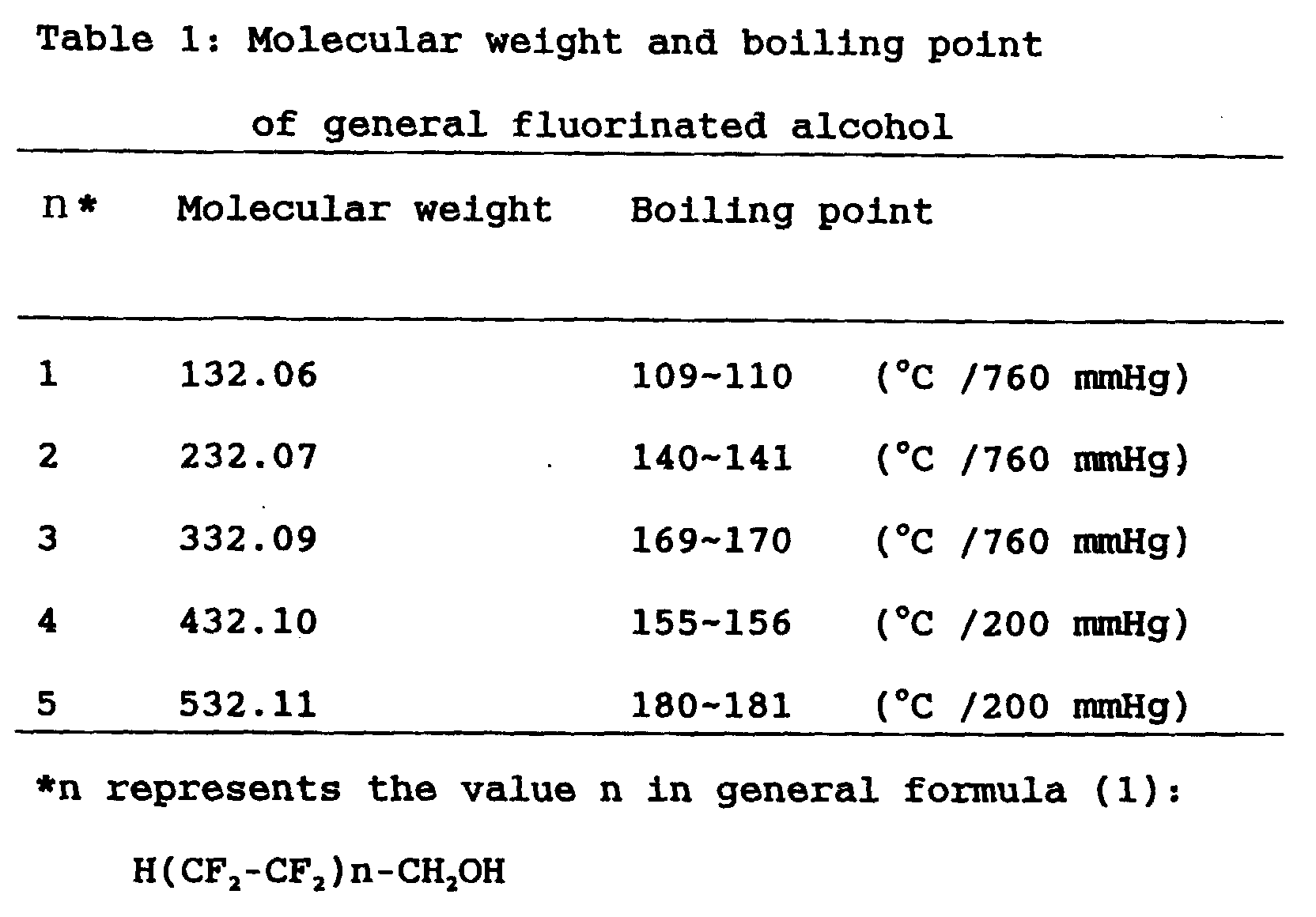
- In general, fluorinated alcohol has been known as aliphatic alcohol containing fluorine atoms, and represented by a general formula: A-CH2OH (where A represents CF3 or H(CF2-CF2)n, and n is a positive integer), and among these, those having a molecular weight in the range of 132 to 332 (n = 1 to 3) and a boiling point in the range of 109 to 170° C have been well known.
- As a result of further researches, it has been found that those optical recording media that are inferior in the weatherability have further degradation in the characteristics and weatherability, when the fluorinated alcohol to be used contains a high-boiling-point fluorinated alcohol with a boiling point of not less than 120° C in an amount of not less than a certain amount, when the high-boiling-point fluorinated alcohol has a molecular weight in the range of 150 to 500, and when the high-boiling-point fluorinated alcohol is fluorinated alcohol represented by a general formula: A-CH2OH, where A represents H(CF2-CF2)n and n is in the range of 2 to 4. Here, even in the case when the fluorinated alcohol to be used contains such a high-boiling-point fluoric alcohol, if the content thereof is 0.001 % by weight or less, the resulting optical recording medium are superior in the characteristics and weatherability.
- An object of the present invention is to provide an ultra-high purity fluorinated alcohol for manufacturing an optical recording medium that is superior in the characteristics and weatherability. Moreover, another object of the present invention is to provide an optical recording medium that is superior in the characteristics and weatherability and that has an organic dye layer formed by using the ultra-high purity fluorinated alcohol.
- The present invention is a fluorinated alcohol for manufacturing an optical recording medium having an organic dye layer and a reflecting layer in this order on a light-transmittable substrate, wherein a content of a high-boiling-point fluorinated alcohol with a boiling point of not less than 120° C is 0.001 % by weight or less.
- The molecular weight of the high-boiling-point fluorinated alcohol is, for example, 150 to 500. Moreover, the high-boiling-point fluorinated alcohol is mainly represented by, for example, general formula (1):
- The present invention is an optical recording medium having an organic dye layer and a reflecting layer in this order on a light-transmittable substrate, wherein said organic dye layer is formed by using a solvent containing a fluorinated alcohol in which a content of a high-boiling-point fluorinated alcohol with a boiling point of not less than 120° C is 0.001 % by weight or less.
- In accordance with the present invention, an ultra-high purity fluorinated alcohol in which the content of a high-boiling-point fluorinated alcohol with a boiling point of not less than 120° C is 0.001 % by weight or less is used as a manufacturing solvent of an optical recording medium having an organic dye layer. Therefore, it is possible to provide an optical recording medium that is superior in the electric characteristics and reliability.
- The structure of the optical recording medium of the present invention is fundamentally the same as those of current Recordable type optical recording media. In the structure, an organic dye recording layer which serves to record and reproduce using laser light is formed on a light-transmittable substrate formed with a pregroove, a reflecting layer increasing light-reflectance is formed on the organic dye recording layer and further a protective layer which protects the organic dye recording layer and the reflecting layer is formed on the reflecting layer.
- An optical recording medium obtained by using the optical recording medium having such a layer structure as at least one party and by laminating it to the other through an adhesive layer is also included in the present invention. Alternatively, an optical recording medium in which the adhesive layer doubles as a protective layer on the reflective layer is also included in the present invention. Further, in order to arise the scuff resistance of the light-transmittable substrate, an organic protective layer may be formed on the opposite surface of the substrate with respect to the organic dye layer.
- As materials of the light-transmittable substrate, for example, a polymer material typified by a polycarbonate resin, acrylic resin, polystyrene resin, epoxy resin, polyester resin, vinyl chloride resin or polyolefin resin or an inorganic material such as glass may be used. A pregroove of stamper is transferred by primarily injection molding in the case of using a resin material and by primarily a 2P method in the case of using glass, thereby preparing the substrate.
- Then, the organic dye layer including an organic dye as its major component is formed on the substrate.
- The organic dye layer may be any one of those which can read a variation, in shape or optical properties, which is made due to a physical and/or chemical change caused by the absorption of recording laser light, by using reproducing laser light. For the formation of a locally denatured portion, for instance, a phthalocyanine dye, cyanine dye or azo dye which has an absorption area in the wavelength range of a semiconductor laser is used very often. These dyes may be used either singly or in combinations of two or more, to which a singlet oxygen quencher, a UV-ray absorber or the like may be added as required. It is also preferable to use an ionic bonding material of a dye cation and an anion of singlet oxygen quencher as the organic dye.
- In the present invention, a coating solution is prepared by dissolving an organic dye in an organic solvent and the coating solution is applied onto the substrate by a spin coating method to form the organic dye layer. It is desirable to control the concentration of an organic dye component in the coating solution and the thickness of the organic dye layer to be formed so that sufficient reflectance can be obtained after the reflecting layer is formed.
- With respect to the organic solvent used for the preparation of the coating solution, 2,2,3,3-tetrafluoro-1-propanol (TFP) may be used alone as an ultra-high purity fluorinated alcohol, or a solvent other than the fluorinated alcohol may be mixed therewith, if necessary. Here, upon selection of the other solvent to be mixed, it is necessary to select such a solvent that not only dissolves the organic dye, but also gives no adverse effects on the light-transmittable substrate to be used. With respect to the other solvent, examples thereof include: cyclohexane, cyclohexanone, methanol, ethanol, isopropyl alcohol, diacetone alcohol, methyl cellosolve, ethyl cellosolve, butyl acetate, etc. In the case when a solvent other than the fluorinated alcohol is added, the amount thereof is preferably approximately less than 10 % by weight with respect to the amount of the fluorinated alcohol.
- The main feature of the present invention is that fluorinated alcohol is further distilled up to a purity level where the content of a high-boiling-point fluorinated alcohol having a boiling point of not less than 120° C and a molecular weight of 150 to 500, and represented by the above-mentioned general formula (1) where n is an integer from 2 to 4, is 0.001 % by weight or less, and resulting ultra-high purity fluorinated alcohol is used. The content may be any content as long as it is not more than 0.001 % by weight, and may be 0 % by weight. Fluorinated alcohol tends to include those having high molecular weights (n = 2, 3, 4) due to its inherent manufacturing process. Such an ultra-high purity fluorinated alcohol has not been used in the manufacturing process of an optical recording medium.
- As indicated by the relationship between the value of n in the general formula (1) and the molecular weight or the boiling point shown in Table 1, as the value n increases, the boiling point also rises in order; therefore, it is possible to increase the purity through distillation.
- The organic dye layer is formed by a spin coating method in the same manner as the conventional process. That is, a dye and, if necessary, singlet oxygen quencher and a binder are dissolved in ultra high-purity fluorinated alcohol to prepare an coating solution, and this solution is applied on a substrate by a spin coating method, and then the coat layer is dried, if necessary. Here, another application method, such as a screen printing method and a dipping method, may be used. The thickness of the organic dye layer is generally in the range of 10 to 500 nm at groove portions, and more preferably, 50 to 300 nm.
- A reflecting layer having a thickness of about 10 to 500 nm, made of metal, is directly formed on the organic dye layer. This reflecting layer is formed by using elements, such as Au, Ag, Al, Cu, Cr, Ni, Si and Ge, alone or with another element being contained, through a formation method such as a sputtering method and a vacuum vapor deposition method.
- A protective layer with a thickness of, for example, 1 to 50 µm is formed on the reflecting layer. Layers which can protect the organic dye recording layer and the reflecting layer suffice for the protective layer, and there is no particular limitation to the structural material of the protective layer. As the material of the protective layer, a UV-ray curable type acrylic resin is usually used from, for example, the reason that the protective layer can be formed with ease. The material of the protective layer may also be an organic material such as a vinyl chloride resin, epoxy resin or polyester resin or an inorganic material such as SiO2 or AlN. These materials may be either singly or as a mixture. The protective layer may comprise multiple layers in which different materials are laminated.
- On the protective layer, a label printing layer may be further formed.
- Moreover, when such an optical recording medium is laminated with an adhesive layer being provided on the side opposite to a plane of incidence of light, the adhesive layer may double as the protective layer.
- Preferably the protective layer is formed by a spin coating method in order to avoid damages to the reflecting layer. However, the protective layer may be formed by a screen printing method, dipping method or spray coating method etc.
- In the present invention, upon formation of the organic dye layer, ultra high-purity fluorinated alcohol is used so that the resulting optical recording medium has superior characteristics and weatherability.
- Next, the present invention will be explained in more detail by way of examples, which are not intended to be limiting of the present invention.
- As an organic dye, a mixture dye consisting of a cyanine dye NK3721 (manufactured by Hayashibara Biochemical Laboratories, Inc.) and a cyanine dye OM-57 (manufactured by Fuji Photo Film Co., LTD.) in a ratio (by weight) of 6:4 was used.
- To 100 g of 2,2,3,3-tetrafluoro-1-propanol (TFP) which had been increased in its purity through distillation to a level in which the content of the high-boiling-point fluorinated alcohol, represented by the general formula (1): H(CF2-CF2)n-CH2OH where n is an integer of 2 to 4, came to 0.001 % by weight or less (not more than detection limit) was added 2 g of the above cyanine mixed dye to prepare a dye solution. The dye solution was applied onto a polycarbonate substrate with a diameter of 120 mm and a thickness of 1.2 mm having pregroove, produced by injection molding, by a spin coating method. In the spin coating, the initial rotating speed was set to 300 rpm when the dye solution was dripped on the substrate, gradually increased and finally set to 5000 rpm. After having been dried (at 60°C, for 3 hours), an Ag layer with a thickness of 100 nm was formed on the dye layer by a sputtering method. Further, an ultraviolet-rays curable type acrylic resin DAICURE CLEAR SD318 (manufactured by Dainippon Ink and Chemicals, Inc.) was applied onto the Ag layer by a spin coating method to form a protective layer with a thickness of 5 µm. Thus 10 optical recording media according to the present invention were made. The thickness of the organic dye layer was about 250 nm at the groove portion and about 150 nm at the land portion.
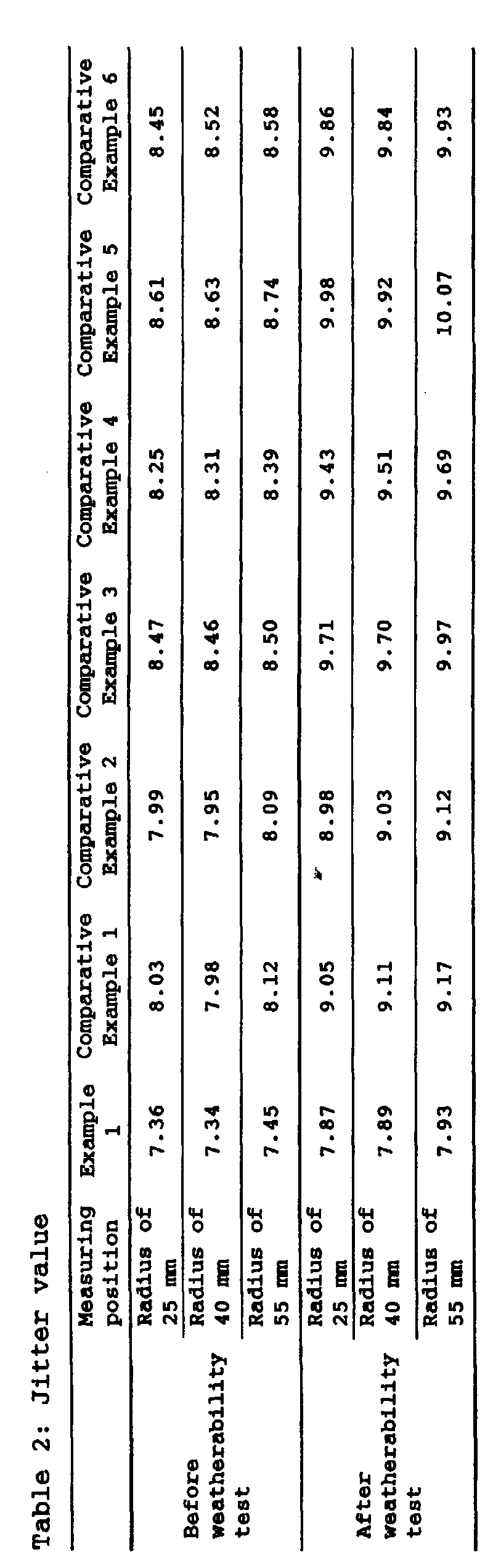
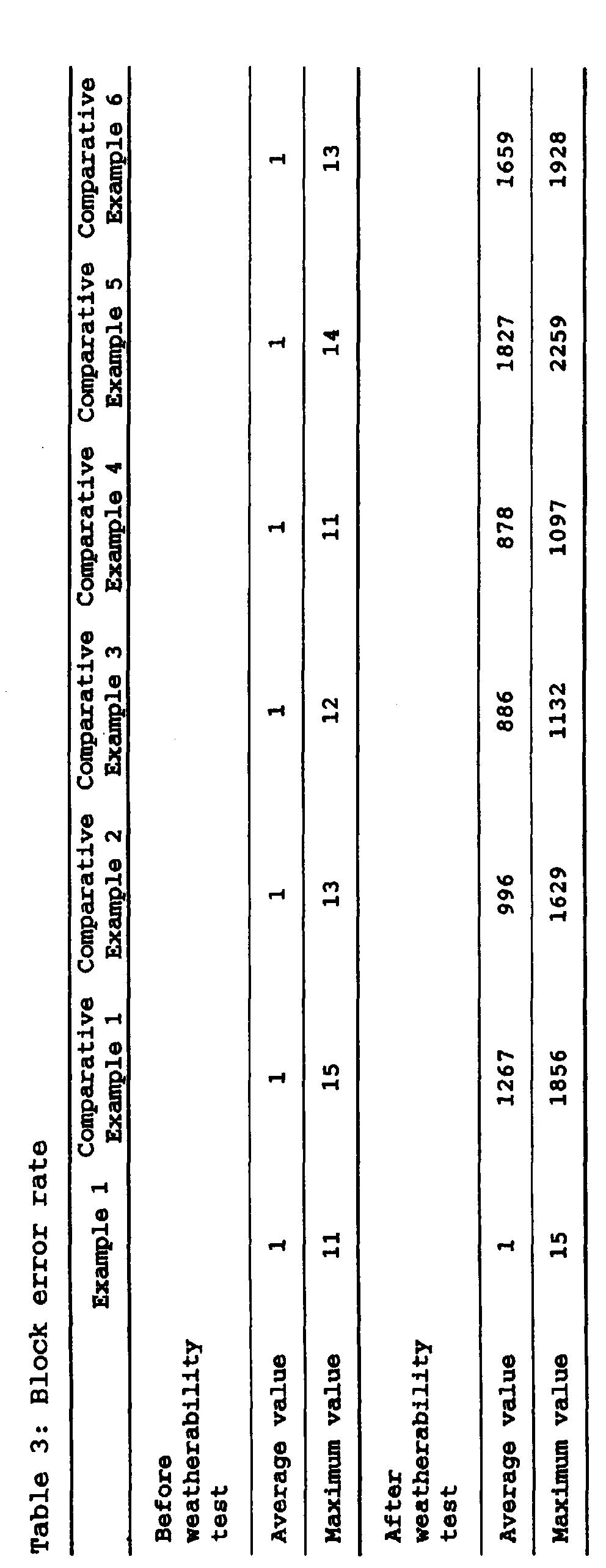
- Recordings were made in the resulting optical recording media by using a commercially available CD-R drive and the optical recording media were then subjected to a weatherability test performed in a thermo-hygrostat kept at a temperature of 80°C and a humidity of 80% for 200 hours. The characteristics (jitter value, block error rate) before and after the weatherability test was measured and evaluated by using a CD-CATS-SA3 manufactured by Audio Development. As shown in Tables 2 and 3, any of the media showed superior initial (before the weatherability test) characteristics as compared with a conventional CD-R, and these characteristics did not deteriorate even after the weatherability test.
- Table 2 shows the jitter value before and after the weatherability test. In Table 2, the jitter value is an average value of the measured values of 10 samples, and the measuring position is set at a radius of the center of the medium. Table 3 shows an average value and a maximum value of the block error rates of the measured 10 samples before and after the weatherability test.
- The content of the high-boiling-point fluorinated alcohol in TFP was determined by using a gas chromatography (GC14B manufactured by Shimadzu Corporation). The same is true in Comparative Examples.
- The same processes as Example 1 were carried out except that 100 g of TFP, which respectively contained 0.0019 % (Comparative Example 1) and 0.0013 % (Comparative Example 2) by weight of fluorinated alcohol (2,2,3,3,4,4,5,5-octafluoro-1-pentanol) represented by the general formula (1) where n is a value of 2, was used to obtain 10 samples of optical recording media. These TFP was respectively prepared by adding 2,2,3,3,4,4,5,5-octafluoro-1-pentanol to an ultra-high purity TFP used in Example 1.
- The characteristics of the optical recording media were measured and evaluated in the same manner as Example 1, and as shown in Table 2 and Table 3, the results showed that, although no difference was seen from Example 1 with respect to the initial value of the block error rate, the initial value of the jitter was inferior as compared with Example 1, and after the weatherability test, both the block error rate and jitter deteriorated. In particular, the block error rate deteriorated extremely.
- The same processes as Example 1 were carried out except that 100 g of TFP, which respectively contained 0.0018 % (Comparative Example 3) and 0.0015 % (Comparative Example 4) by weight of fluorinated alcohol (2,2,3,3,4,4,5,5,6,6,7,7-dodecafluoro-1-heptanol) represented by the general formula (1) where n is a value of 3, was used to obtain 10 samples of optical recording media. These TFP was respectively prepared by adding 2,2,3,3,4,4,5,5,6,6,7,7-dodecafluoro-1-heptanol to an ultra-high purity TFP used in Example 1.
- The characteristics of the optical recording media were measured and evaluated in the same manner as Example 1, and as shown in Table 2 and Table 3, the results showed that, although no difference was seen from Example 1 with respect to the initial value of the block error rate, the initial value of the jitter was inferior as compared with Example 1, and after the weatherability test, both the block error rate and jitter deteriorated. In particular, the block error rate deteriorated extremely.
- The same processes as Example 1 were carried out except that 100 g of TFP, which respectively contained 0.0019 % (Comparative Example 5) and 0.0014 % (Comparative Example 6) by weight of fluorinated alcohol (2,2,3,3,4,4,5,5,6,6,7,7,8,8,9,9-hexadecafluoro-1-nonanol) represented by the general formula (1) where n is a value of 4, was used to obtain 10 samples of optical recording media. These TFP was respectively prepared by adding 2,2,3,3,4,4,5,5,6,6,7,7,8,8,9,9-hexadecafluoro-1-nonanol to an ultra-high purity TFP used in Example 1.
- The characteristics of the optical recording media were measured and evaluated in the same manner as Example 1, and as shown in Table 2 and Table 3, the results showed that, although no difference was seen from Example 1 with respect to the initial value of the block error rate, the initial value of the jitter was inferior as compared with Example 1, and after the weatherability test, both the block error rate and jitter deteriorated. In particular, the block error rate deteriorated extremely.
Claims (8)
- A fluorinated alcohol for manufacturing an optical recording medium having an organic dye layer and a reflecting layer in this order on a light-transmittable substrate, wherein a content of a high-boiling-point fluorinated alcohol with a boiling point of not less than 120° C is 0.001 % by weight or less.
- The fluorinated alcohol for manufacturing an optical recording medium according to claim 1, wherein a molecular weight of the high-boiling-point fluorinated alcohol is 150 to 500.
- The fluorinated alcohol for manufacturing an optical recording medium according to claim 1 or 2, wherein the high-boiling-point fluorinated alcohol is mainly represented by general formula (1):
- The fluorinated alcohol for manufacturing an optical recording medium according to claim 1, wherein the high-boiling-point fluorinated alcohol is not detected.
- The fluorinated alcohol for manufacturing an optical recording medium according to claim 1, wherein the high-boiling-point fluorinated alcohol is not included.
- An optical recording medium having an organic dye layer and a reflecting layer in this order on a light-transmittable substrate, wherein said organic dye layer is formed by using a solvent containing a fluorinated alcohol in which a content of a high-boiling-point fluorinated alcohol with a boiling point of not less than 120° C is 0.001 % by weight or less.
- The optical recording medium according to claim 6, wherein in said fluorinated alcohol, the content of the high-boiling-point fluorinated alcohol with a molecular weight of 150 to 500 is 0.001% by weight or less.
- The optical recording medium according to claim 6 or 7, wherein in said fluorinated alcohol, the content of the high-boiling-point fluorinated alcohol, which is mainly represented by general formula (1):
Applications Claiming Priority (2)
| Application Number | Priority Date | Filing Date | Title |
|---|---|---|---|
| JP21423299 | 1999-07-28 | ||
| JP21423299 | 1999-07-28 |
Publications (2)
| Publication Number | Publication Date |
|---|---|
| EP1073047A1 true EP1073047A1 (en) | 2001-01-31 |
| EP1073047B1 EP1073047B1 (en) | 2006-11-22 |
Family
ID=16652386
Family Applications (1)
| Application Number | Title | Priority Date | Filing Date |
|---|---|---|---|
| EP00115793A Expired - Lifetime EP1073047B1 (en) | 1999-07-28 | 2000-07-21 | Fluorinated alcohol for manufacturing optical recording medium and optical recording medium produced by using the same |
Country Status (4)
| Country | Link |
|---|---|
| US (1) | US6485888B1 (en) |
| EP (1) | EP1073047B1 (en) |
| DE (1) | DE60031919T8 (en) |
| TW (1) | TW492002B (en) |
Families Citing this family (1)
| Publication number | Priority date | Publication date | Assignee | Title |
|---|---|---|---|---|
| JP2001047746A (en) * | 1999-08-13 | 2001-02-20 | Sony Corp | Optical recording medium |
Citations (4)
| Publication number | Priority date | Publication date | Assignee | Title |
|---|---|---|---|---|
| GB2109270A (en) * | 1981-10-09 | 1983-06-02 | Pioneer Electronic Corp | Information recording disc and process of producing the disc |
| JPH03120635A (en) * | 1989-10-04 | 1991-05-22 | Fuji Photo Film Co Ltd | Read-only data recording medium and its production |
| JPH03219445A (en) * | 1990-01-25 | 1991-09-26 | Fuji Photo Film Co Ltd | Production of optical information recording medium |
| JPH048585A (en) * | 1990-04-26 | 1992-01-13 | Fuji Photo Film Co Ltd | Manufacture of information recording medium |
Family Cites Families (9)
| Publication number | Priority date | Publication date | Assignee | Title |
|---|---|---|---|---|
| JPS54154707A (en) * | 1978-04-21 | 1979-12-06 | Daikin Ind Ltd | Telomerization of tetrafluoroethylene |
| JPH0796333B2 (en) | 1986-12-23 | 1995-10-18 | 富士写真フイルム株式会社 | Method of manufacturing information recording medium |
| DE3915759A1 (en) * | 1989-05-13 | 1990-11-15 | Hoechst Ag | METHOD FOR PRODUCING TELOMERAL ALCOHOLS |
| JP3219445B2 (en) | 1992-02-12 | 2001-10-15 | 旭化成株式会社 | Drying method for hollow fiber bundles |
| JP3120635B2 (en) | 1993-09-24 | 2000-12-25 | トヨタ自動車株式会社 | Undercar body structure |
| JPH07137448A (en) | 1993-11-15 | 1995-05-30 | Pioneer Electron Corp | Optical recording medium and manufacturing method thereof |
| US5902698A (en) * | 1995-04-14 | 1999-05-11 | Hitachi Maxell, Ltd. | Ion conductive material and electrochemical device comprising the same |
| JP3029618B1 (en) * | 1998-12-28 | 2000-04-04 | ダイキン工業株式会社 | Manufacturing method of fluorine alcohol |
| JP3026804B1 (en) * | 1999-03-15 | 2000-03-27 | ダイキン工業株式会社 | Manufacturing method of fluorine alcohol |
-
2000
- 2000-07-21 DE DE60031919T patent/DE60031919T8/en active Active
- 2000-07-21 EP EP00115793A patent/EP1073047B1/en not_active Expired - Lifetime
- 2000-07-25 TW TW089114857A patent/TW492002B/en not_active IP Right Cessation
- 2000-07-27 US US09/627,149 patent/US6485888B1/en not_active Expired - Lifetime
Patent Citations (4)
| Publication number | Priority date | Publication date | Assignee | Title |
|---|---|---|---|---|
| GB2109270A (en) * | 1981-10-09 | 1983-06-02 | Pioneer Electronic Corp | Information recording disc and process of producing the disc |
| JPH03120635A (en) * | 1989-10-04 | 1991-05-22 | Fuji Photo Film Co Ltd | Read-only data recording medium and its production |
| JPH03219445A (en) * | 1990-01-25 | 1991-09-26 | Fuji Photo Film Co Ltd | Production of optical information recording medium |
| JPH048585A (en) * | 1990-04-26 | 1992-01-13 | Fuji Photo Film Co Ltd | Manufacture of information recording medium |
Non-Patent Citations (3)
| Title |
|---|
| DATABASE WPI Section Ch Week 199127, Derwent World Patents Index; Class E25, AN 1991-196574, XP002149484 * |
| DATABASE WPI Section Ch Week 199145, Derwent World Patents Index; Class A12, AN 1991-328792, XP002149485 * |
| DATABASE WPI Section Ch Week 199208, Derwent World Patents Index; Class E10, AN 1992-061783, XP002149483 * |
Also Published As
| Publication number | Publication date |
|---|---|
| US6485888B1 (en) | 2002-11-26 |
| DE60031919T8 (en) | 2007-08-02 |
| EP1073047B1 (en) | 2006-11-22 |
| DE60031919D1 (en) | 2007-01-04 |
| DE60031919T2 (en) | 2007-04-26 |
| TW492002B (en) | 2002-06-21 |
Similar Documents
| Publication | Publication Date | Title |
|---|---|---|
| EP0676751B1 (en) | Optical recording media | |
| US5161150A (en) | Optical recording medium | |
| JPS60163245A (en) | Optical information recording medium | |
| JP2000057627A (en) | Light-reflecting film and optical recording medium using the same | |
| CA2006808C (en) | Optical recording media | |
| EP1041548A1 (en) | Recordable optical media with a silver-gold reflective layer | |
| JP2686841B2 (en) | Information recording medium and optical information recording method | |
| US6485888B1 (en) | Fluorinated alcohol for manufacturing optical recording medium and optical recording medium using the same | |
| US6858279B1 (en) | Process for producing optical recording medium and optical recording medium | |
| JPS60234886A (en) | Optical recording medium | |
| JPH06199045A (en) | Optical recording medium | |
| JP3476421B2 (en) | Fluorinated alcohol for producing optical recording medium and optical recording medium using the same | |
| US20030235783A1 (en) | Optical recording medium and method for making the same | |
| JP3556564B2 (en) | Method of manufacturing optical recording medium and optical recording medium | |
| JP3742507B2 (en) | Optical recording medium | |
| JP3435481B2 (en) | Optical recording medium and manufacturing method thereof | |
| JPH08339573A (en) | Optical recording medium | |
| US5274624A (en) | Optical recording medium | |
| US20030161987A1 (en) | Optical recording medium | |
| US5196231A (en) | Optical recording media | |
| JPH07137448A (en) | Optical recording medium and manufacturing method thereof | |
| JP3470157B2 (en) | Optical recording medium and manufacturing method thereof | |
| JPH06143821A (en) | Optical recording medium | |
| JPH05274715A (en) | Draw type optical recording medium | |
| JPH08263872A (en) | Optical recording medium |
Legal Events
| Date | Code | Title | Description |
|---|---|---|---|
| PUAI | Public reference made under article 153(3) epc to a published international application that has entered the european phase |
Free format text: ORIGINAL CODE: 0009012 |
|
| AK | Designated contracting states |
Kind code of ref document: A1 Designated state(s): DE LU |
|
| AX | Request for extension of the european patent |
Free format text: AL;LT;LV;MK;RO;SI |
|
| 17P | Request for examination filed |
Effective date: 20010305 |
|
| AKX | Designation fees paid |
Free format text: DE LU |
|
| GRAP | Despatch of communication of intention to grant a patent |
Free format text: ORIGINAL CODE: EPIDOSNIGR1 |
|
| GRAS | Grant fee paid |
Free format text: ORIGINAL CODE: EPIDOSNIGR3 |
|
| GRAA | (expected) grant |
Free format text: ORIGINAL CODE: 0009210 |
|
| AK | Designated contracting states |
Kind code of ref document: B1 Designated state(s): DE LU |
|
| REF | Corresponds to: |
Ref document number: 60031919 Country of ref document: DE Date of ref document: 20070104 Kind code of ref document: P |
|
| PLBE | No opposition filed within time limit |
Free format text: ORIGINAL CODE: 0009261 |
|
| STAA | Information on the status of an ep patent application or granted ep patent |
Free format text: STATUS: NO OPPOSITION FILED WITHIN TIME LIMIT |
|
| 26N | No opposition filed |
Effective date: 20070823 |
|
| PG25 | Lapsed in a contracting state [announced via postgrant information from national office to epo] |
Ref country code: LU Free format text: LAPSE BECAUSE OF NON-PAYMENT OF DUE FEES Effective date: 20070721 |
|
| PGFP | Annual fee paid to national office [announced via postgrant information from national office to epo] |
Ref country code: DE Payment date: 20100714 Year of fee payment: 11 |
|
| PG25 | Lapsed in a contracting state [announced via postgrant information from national office to epo] |
Ref country code: DE Free format text: LAPSE BECAUSE OF NON-PAYMENT OF DUE FEES Effective date: 20120201 |
|
| REG | Reference to a national code |
Ref country code: DE Ref legal event code: R119 Ref document number: 60031919 Country of ref document: DE Effective date: 20120201 |
|
| REG | Reference to a national code |
Ref country code: DE Ref legal event code: R082 Ref document number: 60031919 Country of ref document: DE Representative=s name: KILIAN KILIAN & PARTNER, DE Ref country code: DE Ref legal event code: R082 Ref document number: 60031919 Country of ref document: DE Representative=s name: KILIAN KILIAN & PARTNER MBB PATENTANWAELTE, DE |