EP1070325B1 - Dispositif d'activation conductrice pour structures poreuses - Google Patents
Dispositif d'activation conductrice pour structures poreuses Download PDFInfo
- Publication number
- EP1070325B1 EP1070325B1 EP99910601A EP99910601A EP1070325B1 EP 1070325 B1 EP1070325 B1 EP 1070325B1 EP 99910601 A EP99910601 A EP 99910601A EP 99910601 A EP99910601 A EP 99910601A EP 1070325 B1 EP1070325 B1 EP 1070325B1
- Authority
- EP
- European Patent Office
- Prior art keywords
- treatment
- block
- reactor
- solutions
- structures
- Prior art date
- Legal status (The legal status is an assumption and is not a legal conclusion. Google has not performed a legal analysis and makes no representation as to the accuracy of the status listed.)
- Expired - Lifetime
Links
Images

Classifications
-
- H—ELECTRICITY
- H01—ELECTRIC ELEMENTS
- H01B—CABLES; CONDUCTORS; INSULATORS; SELECTION OF MATERIALS FOR THEIR CONDUCTIVE, INSULATING OR DIELECTRIC PROPERTIES
- H01B1/00—Conductors or conductive bodies characterised by the conductive materials; Selection of materials as conductors
- H01B1/06—Conductors or conductive bodies characterised by the conductive materials; Selection of materials as conductors mainly consisting of other non-metallic substances
- H01B1/12—Conductors or conductive bodies characterised by the conductive materials; Selection of materials as conductors mainly consisting of other non-metallic substances organic substances
-
- C—CHEMISTRY; METALLURGY
- C25—ELECTROLYTIC OR ELECTROPHORETIC PROCESSES; APPARATUS THEREFOR
- C25D—PROCESSES FOR THE ELECTROLYTIC OR ELECTROPHORETIC PRODUCTION OF COATINGS; ELECTROFORMING; APPARATUS THEREFOR
- C25D5/00—Electroplating characterised by the process; Pretreatment or after-treatment of workpieces
- C25D5/54—Electroplating of non-metallic surfaces
- C25D5/56—Electroplating of non-metallic surfaces of plastics
Definitions
- the invention relates, in its general form, to the field of treatment of porous structures to make them electrically conductive.
- the invention relates more particularly to the field of preparation complex structures with high porosity, possibly metallized or metallic for application as electrodes for electrolysis of liquid effluents, detector and trap of organic or biological molecules, of electrode supports for electrochemical generators, catalysis supports, filter media, insulators phonic, electromagnetic and nuclear protection structures, and antistatic, heat exchangers, or others.
- the structures according to the invention are of foam, felt or woven type. high level of open porosity, offering the appearance of a dense network of fibers or meshes with a three-dimensional frame, defining a plurality of open spaces in communication with each other and with the exterior of the structures.
- Foams are cross-linked cellular structures of high porosity (greater than 80%, and up to approximately 98%) and with open porosity by uncapping, in which the meshes of the network communicate with each other in all, or at least in significant proportions.
- Felts are random tangles of nonwoven fibers (however for the main part of them positioned substantially in the plane of the "Tablecloth” constituted), defining between them inter-fiber spaces of shapes and variable dimensions, communicating with each other. Their fibers may or may not be bonded by a binding agent.
- Woven fabrics are structures formed by assembling threads or fibers intertwined textiles, either woven or knitted. They can be in the form of thick and complex structures, especially when made up of two faces external woven fabrics linked by knitting of threads which keep them spaced and interconnected at the same time, as for example those that allow Raschel type looms.
- foams these are organic or mineral, natural materials or synthetic, and in particular of polymers such as polyamide, polyurethane (polyester or polyether), or polypropylene.
- these are also organic materials or mineral, such as the aforementioned polymers, glass fibers, rock fibers or carbon, or natural fibers such as cotton, wool or the like.
- these thin layers are limited to thicknesses of the order of millimeter or a few millimeters, depending on the porosity of the product treated, the dimension of its pores or interstices, and the penetrating power of the activation process.
- quality foam called "100 ppI" (100 pores per inch linear), i.e. having about 40 pores per linear centimeter at the surface, does not can be satisfactorily activated industrially only in thicknesses less than about 5 millimeters by vacuum deposition, in thicknesses less about 3 millimeters per deposit of carbon or graphite powder.
- roller means a cylinder formed by a coiled strip of porous structure.
- the subject of the present invention is a type of device designed for putting in practical implementation of the method described in the document 98.03375 mentioned above.
- the device according to the invention is specially intended for the treatment of rolls and blocks of crosslinked foam, and rolls of woven and nonwoven fabrics.
- the intermediate stages of draining, rinsing, drying are also made through the entire roll (without unwinding) or the block.
- the preparatory pre-treatment can naturally vary with the material constitutive of the structure, its density, the type of porous structure treated, and the nature of the monomer which it is intended to deposit.
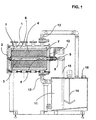
- Figure 1 presents a partial profile view of a device according to the invention, where the reactor appears in (1).
- Figure 2 provides a diagram of layout plan of the various main components of the device, in a view of above.
- the treatment installation is organized around a chemical reactor (1) into which the structure (2) is introduced porous that we want to make electrically conductive.
- the structure to be treated is either in the form of a roll or coil produced by winding on itself a strip of crosslinked foam, felt or woven, either in the form of a block of crosslinked foam.
- the blocks can have various shapes, depending in particular on the shapes wishes to obtain after activation or possibly after metallization.
- the blocks treated are of substantially cylindrical shape.
- the predominant type of subsequent shaping is indeed the cutting of the block into strips of various thicknesses, the operation can be easily made by peeling a cylindrical block which is rotated around its axis.
- blocks or rollers (4) are prepared so that present a hollow central axis or hub passing right through, through which introduces a mandrel (3), an integral part of the reactor.
- rollers or blocks of porous structure to be activated are introduced into the reactor around the mandrel, as shown in Figure 1. They can be maintained in a complementary manner by a basket (6) placed around the block or roller and adopting substantially the external shape, as well as by flanges (7), which also join together the basket (6) and the mandrel (3).
- the basket (6) will appear itself in the form of a hollow cylinder or tube, within which is placed the porous structure (4) to be treated, fitted onto the mandrel.
- the basket (6) is advantageously constituted by a perforated plate, a deployed, or a mesh.
- the flanges (7) of the ends of the basket (6) may be in perforated form, but also be full.
- the mandrel (3) is connected, by at least one of its ends, to an axis hollow (8) by which the treatment solutions will be caused to circulate under the effect an injection and / or suction pump (9).
- This pump connects the axis (8) and the mandrel (3) to pipes (10) leading to storage tanks (11) treatment.
- the axis (8) can also be rotated on itself by a motor (12).
- the motor (12) sets in motion the axis (8), the latter drives the mandrel (3) and the block or roller (4) in the same movement. According to stages of the treatment, it is advantageous to provoke or not a movement of rotation, the speed of the latter also being able to vary within wide proportions.
- the reactor (1) is provided on its wall with pipes and (13) inlet and / or disposal of treatment solutions.
- the fluids are introduced through the block or roller (4) through the perforated mandrel (3).
- the pipes (13) are used to return the solutions to the tanks (11).
- the pipes (13) located on the upper part of the reactor (1) are kept open to allow evacuation by overflow, while the pipes (13) connected to the lower part of the reactor are closed by valve or solenoid valve, so that the reactor is filled with solution and the block or roller (4) is largely or totally submerged.
- the device according to the invention is designed for an optimized implementation of the conductive activation process by deposition of conductive polymer, as described in document 98.03375.
- the device according to the invention provides varied responses and great flexibility of use, as we have already attached to show it. Additional comments allow the demonstrate more fully.
- the solutions are injected at through the block or roller, from the inside to the outside of it, and / or vice versa according to the direction adopted for the circulation of fluids. It is advantageous to print at block or roller, - especially when the injection is made from the mandrel -, a rotational movement, for example at the rate of 60 revolutions per minute approximately, so that the centrifugal force thus exerted comes to reinforce the injection force liquid coming out of the mandrel, and contributes to rapid diffusion within the block or roller.
- the reactor is emptied by the pipes (13) opening onto the bottom of the reactor, or more precisely by that of these pipes which connects the bottom of the reactor to the specific storage tank of the solution which has just been used.
- This emptying can be done by simple gravitation, or driven by a pump, not shown in Figures 1 and 2, which is preferably specific to each circuit of emptying and therefore at each storage tank.
- the emptying of the reactor means that there must also be elimination of the part of the solution which fills the free volume located within the porous structure to treat. It will be recalled here that these structures can reach porosity levels very high for crosslinked foams or certain complex woven fabrics (around 98% for quality foam called "100 ppI" or 100 pores per linear inch, this is say having about 40 pores per linear centimeter at the surface); such foams have a strong liquid retention capacity.
- the device according to the invention makes it possible to respond satisfactorily to these constraints, by carrying out a "slow" emptying of the reactor, made so that the porous structure does not have to support its liquid volume, but the liquid level drops almost homogeneous in the reactor around and within the block or roller of porous structure.
- the structure is then largely emptied of solution within it, by gravitational effect. There is a limited amount of liquid in the structure, largely retained by capillary action.
- This residual quantity can then advantageously be removed by centrifugation of the block or roller, the mandrel being set in motion by the motor (12). It appears interesting, always in order to avoid deformation of the structure, gradually increase in speed of rotation as the solution is ejected from the structure by centrifugation. Excellent elimination of residual solution contained in the block or roller can be obtained in a few tens of seconds or a few minutes, depending on the density of the structure, the thickness of the block or roller and the speed of centrifugation.
- the reactor can be permanently positioned in this way, or only during the centrifugation phases. In the latter case, the axis of the reactor is then tiltable between horizontal and vertical on a frame which allows it to swing.
- Such a variant if it complicates the production of the device, can be considered interesting for reducing the duration of the operating cycle while avoiding creating risks of heterogeneity of treatment: these risks may appear in the case a permanently vertical axis (possible irregularity of treatment between the parts block and roller).
- the basic configuration of the device according to the invention makes it possible to perform cleaning and rinsing, whether with tap water, with water demineralized, or with any solution adapted to needs, by injection and evacuation as described for active treatment solutions. It is notably possible perform, before the operating cycle described in document 98.03375, a rinsing or even a preliminary cleaning of the structure, which can for example allow to remove manufacturing impurities from polyurethane foams, polymerization catalysts, cutting greases, ..., and in general all volatile products, undesirable liquids or residual solids.
- the injection and evacuation routes for fluids can notably be air used to complete the elimination of all liquid traces within the structure.
- the air or the blowing gas can advantageously be brought to a temperature which does not harms neither the basic structure nor the treatments carried out and products deposited, and generally a few tens of degrees centigrade, to participate quick drying of the structure.
- porous structures to be activated may have a natural tendency to distort. This may be the case of crosslinked foams of polyurethane.
- the device according to the present invention makes it possible to resolve this possible difficulty: maintaining the block or roller is therefore of great importance.
- the basket (6) and the flanges (7) are designed to perform this function.
- Prohibiting any external expansion of the block or roller can be achieved using baskets and flanges, but is not always an optimal solution. Because the deformation, if it is contained in the initial volume, can develop however inside it, risking causing structural irregularities (density and porosity differences) and a "crumpling" of the pore meshes. The foam can then lose its isotropic character, and / or some of its characteristics mechanical.
- the device according to the invention proposes, for the resolution of this problem, not to prohibit, but to cushion the increase in volume of the blocks or rolls of cross-linked foam susceptible to swelling.
- This action can be carried out within the reactor using a basket (6) whose inside diameter is somewhat greater than the outside diameter of the block or roller; the intermediate space is then filled with a structure which is itself porous, but compressible, which will partially contain and homogenize the swelling of the processed product. It must be porous, just like the basket is perforated, so as not to significantly increase the pressure losses undergone by the fluids from the center to the reactor walls (and vice versa). It must be compressible, and not be subject swelling during treatment as the structure to be activated, so that cushion, therefore limit, the volume gain of the block or roller.
- the material used for fulfilling this function of "buffer mattress” can in particular be a structure cross-linked alveolar inert or almost inert to the overall process of deposit of conductive polymer, and showing no swelling phenomenon at during the operating cycle.
- the blocks or rollers of some of the porous structures to be activated susceptible to swelling may be slightly marked on their surface surface, and in particular during the centrifugation phases, by the surface appearance internal basket (perforations, forms of spread or grids, ).
- the presence of a This flexible "buffer mattress” advantageously avoids this risk.
- the device according to the invention is intended for application process for the chemical deposition of polymers, and in particular of polymers conductors such as polypyrrole, according to the process described in document 98.03375.
- the device according to the invention comprises a reactor whose shape and dimensions are preferably adapted to the blocks and rollers to be treated, so that the internal volume of said reactor is only slightly greater than the volume defined by the basket (6) and the flanges (7). So it is most often advantageous that the reactor is of substantially cylindrical shape, and an inner diameter approximately 4 to 10 centimeters greater than the outer diameter of the basket (6).
- the device according to the invention can be produced in dimensions varied, ranging from laboratory pilot to high-capacity industrial equipment. he can therefore, depending on the variant, be controlled manually or see its operating cycle partially or fully automated.
- the constituent materials of the reactors are preferably chosen so as not to react on contact with the treatment solutions. It is therefore appropriate that these materials are not sensitive to the initial stage of oxidative pre-treatment of the structure, give little or no grip to the deposition of the monomer, and finally resist to the oxidizing solution of polymerization of the monomer.
- the device may include, by way of annexes to the reactor, storage tanks (10) for treatment solutions, possibly equipped with agitators (14), thermal regulators, vents (15), as well as all equipment allowing dosing and / or readjustment, continuously or intermittently, the concentrations of the solutions.
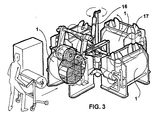
- Such an assembly can be automated by means of a transfer (16) of the blocks or rollers, placed between the reactors, as shown in FIG. 3, or capable of ensuring the transfer of the blocks or rollers from one reactor to another, the latter being placed online.
- FIG. 3 a particular type of door or hood is shown.
- advantageous design for robotic handling of blocks or rollers it these are rotary covers opening onto the upper part of the reactors, and capable of also integrate hooking parts (17) of the block carrying mandrel or roller.
- Said equipment corresponds to the type of mounting shown in Figures 1 and 2.
- the reactor built in "Uranus B6" has an internal length of 1200 mm for an internal diameter of 700 mm.
- the outer diameter of the basket (6) is 620 mm, its thickness being 5 mm.
- the block where the roller to be treated is a cylinder with a length of 1000 mm and outside diameter 500 mm.
- Steps Duration: 1.- Loading of the structure to be treated 05 minutes 2.- Oxidizing pre-treatment 13 minutes 3.- Draining and centrifugation 05 minutes 4.- Rinsing and centrifugation 08 minutes 5.- Deposition / fixation of the monomer 08 minutes 6.- Draining and centrifugation 05 minutes 7.- Polymerization by oxidation-doping 15 minutes 8.- Draining and centrifugation 10 minutes 9.- Rinsing and centrifugation 08 minutes 10.- Drying 05 minutes 11.- Unloading and cleaning 10 minutes Or a complete cycle of: 92 minutes
- the oxidizing pretreatment was carried out using an aqueous solution potassium permanganate, precipitation of the monomer in a solution of pyrrole in a water-potash mixture, oxidation-doping by bringing into play a solution aqueous ferric chloride and fluoroboric acid.
- the rolls treated consisted of a winding of a thick strip 1.7 mm, and 100 meters long. They therefore represented an apparent surface of structure to be activated of 100 square meters. After activation, the tape could be unwound without difficulty, i.e. without significant adhesion problem between surfaces attached to the roll tape.
- the deposited conductive polymer, the polypyrrole had given an electrical conductivity at any point on the strip less than 30 Ohms-square.
- the treated blocks were peeled into strips with a final thickness of 1.7 mm, of which the electrical conductivity at any point was also less than 30 Ohms-square.
- rollers of various woven and non-woven fabrics were activated by continuous polymer deposition conductor on the surface of each of their yarns or fibers, without clogging of their porosity.
- Devices according to the invention can be produced in dimensions higher or lower than those indicated above. It is for example possible to make reactors allowing to treat blocks or rolls of 2 meters of length and one meter in diameter.
Landscapes
- Physics & Mathematics (AREA)
- Spectroscopy & Molecular Physics (AREA)
- Manufacture Of Porous Articles, And Recovery And Treatment Of Waste Products (AREA)
- Treatment Of Fiber Materials (AREA)
- Physical Or Chemical Processes And Apparatus (AREA)
- Treatments For Attaching Organic Compounds To Fibrous Goods (AREA)
Description
- dépôt chimique de métal, suivi d'un ou plusieurs dépôts électrochimiques,
- dépôt de particules de carbone ou graphite, notamment sous forme de laque ou peinture conductrice, suivi d'un ou plusieurs dépôts électrochimiques,
- dépôt métallique sous vide, notamment par pulvérisation cathodique, diffusion gazeuse ou dépôt ionique, suivi d'un ou plusieurs dépôts électrochimiques,
- dépôt par décomposition thermique d'un sel ou composé métallique en phase vapeur,
- dépôt chimique de polymère conducteur, suivi d'un ou plusieurs dépôts électrochimiques de métal.
- le pré-traitement de préparation de la structure poreuse, notamment par oxydation,
- le dépôt ou fixation de monomère,
- l'oxydation conduisant à la polymérisation et simultanément au dopage du monomère.
- mode de fixation du rouleau ou bloc dans le réacteur,
- axe-support de mise en rotation du bloc ou rouleau,
- voie d'injection des solutions de traitement,
- voie d'aspiration des solutions de traitement.
- grande homogénéité de traitement lors de chacune des étapes principales (pré-traitement préparatoire des surfaces, dépôt ou fixation de monomère, polymérisation du monomère par oxydation-dopage), par diffusion des solutions au travers de la totalité de la masse de structure à traiter, au contact de tout point de sa surface développée ;
- élimination efficace des solutions de traitement (et récupération de celles-ci) afin de minimiser les consommations en produits actifs, et de ne pas engorger la structure et risquer de la colmater;
- rinçages efficaces au sein de l'ensemble de la structure poreuse à activer ;
- séparation des solutions, que l'on doit éviter de mélanger entre elles ;
- maintien des blocs ou rouleaux afin de limiter ou d'éviter leur déformation lors des étapes du procédé ;
- compacité du réacteur, afin de limiter les volumes de solutions de traitement ;
- simplicité de fonctionnement, simplicité d'entretien, et possibilité d'automatisation ;
- possibilité de séchage de la structure poreuse ;
- réalisation compacte de l'ensemble du dispositif, et conception économique ;
- rapidité d'enchaínement des opérations, afin de réaliser un cycle complet de traitement dans le temps le plus court possible, pour des raisons d'économie de procédé à l'échelle industrielle.
- de limiter, pour chaque réacteur et ses composants, les contraintes de nature de matériaux constitutifs, à celles propres à la seule étape concernée ;
- d'accroítre la productivité de l'équipement, chaque réacteur n'étant immobilisé par un même bloc ou rouleau que pendant la durée d'une étape et non durant l'ensemble du cycle; il est ainsi possible de traiter simultanément plusieurs blocs et/ou rouleaux, chacun se situant à un moment donné à un stade différent du cycle complet.
| Étapes : | Durée : |
| 1.- Chargement de la structure à traiter | 05 minutes |
| 2.- Pré-traitement oxydant | 13 minutes |
| 3.- Vidange et centrifugation | 05 minutes |
| 4.- Rinçage et centrifugation | 08 minutes |
| 5.- Dépôt / fixation du monomère | 08 minutes |
| 6.- Vidange et centrifugation | 05 minutes |
| 7.- Polymérisation par oxydation-dopage | 15 minutes |
| 8.- Vidange et centrifugation | 10 minutes |
| 9.- Rinçage et centrifugation | 08 minutes |
| 10.- Séchage | 05 minutes |
| 11.- Déchargement et nettoyage | 10 minutes |
| Soit un cycle complet de : | 92 minutes |
Claims (8)
- Dispositif chimique de dépôt de polymère conducteur sur des structures poreuses complexes de type mousse réticulée, feutre ou tissé, permettant de conférer aux dites structures une conductivité électrique, caractérisé en ce qu'il comprend un ou plusieurs réacteurs où sont effectuées les diverses étapes du traitement d'activation conductrice au sein desdites structures, dans toute l'épaisseur de celles-ci, en surface de chacune de leurs fibres ou mailles, sans colmater leur porosité, pour leur conférer une conductivité électrique continue sur l'ensemble de leur surface développée, et qu'il permet de traiter des structures pouvant se présenter en épaisseurs et formes variées, notamment sous forme de blocs ou rouleaux (cylindres formés par une bande enroulée), à travers leur volume - sans opération de déroulement -, les diverses solutions de traitement étant conduites à traverser lesdits blocs ou rouleaux, ce dispositif comportant au moins un réacteur, équipé d'un mandrin creux, perforé et rotatif, sur lequel est emmanché le bloc ou rouleau de structure poreuse à traiter, ce mandrin servant à injecter au sein du bloc ou rouleau et/ou à aspirer à partir de celui-ci les solutions de traitement utilisées, et/ou à mettre le bloc ou rouleau en mouvement de rotation sur lui-même, afin d'homogénéiser la diffusion des fluides en son sein et/ou de chasser ces fluides par centrifugation.
- Dispositif selon la revendication 1, caractérisé en ce qu'il comprend des moyens pour réaliser les étapes suivantes de traitement d'activation conductrice des blocs ou rouleaux :ces diverses étapes étant réalisées les unes après les autres à travers le volume entier de la structure à traiter, les divers fluides de traitement étant conduits à traverser lesdits blocs ou rouleaux.éventuels nettoyage et/ou rinçage de la structure de base,éventuels égouttage, essorage, centrifugation et/ou séchage,pré-traitement de préparation de surface,éventuels rinçage, égouttage, essorage, centrifugation et/ou séchage,dépôt d'un monomère,éventuels rinçage, égouttage, essorage, centrifugation et/ou séchage,oxydation du monomère, conduisant à sa polymérisation en un polymère électriquement conducteur, et au dopage de celui-ci,éventuels rinçage, égouttage, essorage, centrifugation et/ou séchage,
- Dispositif selon la revendication 1, caractérisé en ce que des flasques et un panier perforé fixés au mandrin contribuent au maintien du bloc ou rouleau autour de ce mandrin.
- Dispositif selon l'une des revendications précédentes, caractérisé en ce qu'un matériau poreux et compressible est disposé entre le bloc ou rouleau de structure à traiter d'une part, et le panier et/ou les flasques d'autre part.
- Dispositif selon l'une des revendications précédentes, caractérisé en ce qu'il comporte des cuves de stockage des solutions utilisées pour le traitement, cuves reliées au réacteur par des canalisations permettant d'assurer le transfert de chaque solution vers le réacteur et son retour vers sa cuve spécifique.
- Dispositif selon la revendication 5, caractérisé en ce que les cuves de stockage, ou certaines d'entre elles, sont équipées de systèmes d'agitation, et/ou de régulation de température, et/ou de dosage et/ou maintien continu ou non des concentrations en composés des solutions.
- Dispositif selon l'une des revendications précédentes, caractérisé en ce que les circuits d'amenée et d'évacuation des fluides peuvent être utilisés pour le passage forcé de gaz ou mélanges gazeux de traitement, et notamment pour le passage d'air.
- Dispositif selon l'une des revendications précédentes, caractérisé en ce que le panier et/ou les flasques peuvent être utilisés pour compresser le bloc ou rouleau de structure à traiter à des fins d'essorage.
Applications Claiming Priority (3)
| Application Number | Priority Date | Filing Date | Title |
|---|---|---|---|
| FR9804547 | 1998-04-10 | ||
| FR9804547A FR2777210A1 (fr) | 1998-04-10 | 1998-04-10 | Dispositif d'activation conductrice pour structures poreuses |
| PCT/IB1999/000618 WO1999053503A1 (fr) | 1998-04-10 | 1999-04-08 | Dispositif d'activation conductrice pour structures poreuses |
Publications (2)
| Publication Number | Publication Date |
|---|---|
| EP1070325A1 EP1070325A1 (fr) | 2001-01-24 |
| EP1070325B1 true EP1070325B1 (fr) | 2004-06-30 |
Family
ID=9525144
Family Applications (1)
| Application Number | Title | Priority Date | Filing Date |
|---|---|---|---|
| EP99910601A Expired - Lifetime EP1070325B1 (fr) | 1998-04-10 | 1999-04-08 | Dispositif d'activation conductrice pour structures poreuses |
Country Status (7)
| Country | Link |
|---|---|
| US (1) | US6878355B1 (fr) |
| EP (1) | EP1070325B1 (fr) |
| JP (1) | JP4393704B2 (fr) |
| DE (1) | DE69918423T2 (fr) |
| ES (1) | ES2223166T3 (fr) |
| FR (1) | FR2777210A1 (fr) |
| WO (1) | WO1999053503A1 (fr) |
Families Citing this family (6)
| Publication number | Priority date | Publication date | Assignee | Title |
|---|---|---|---|---|
| JP4552420B2 (ja) * | 2003-11-13 | 2010-09-29 | 日東紡績株式会社 | ガラス繊維織物の表面処理方法 |
| DE102005053262B4 (de) * | 2005-11-08 | 2008-09-04 | Weinert, Hilmar, Dipl.-Ing. | Träger mit poröser Vakuumbeschichtung und Verfahren zu seiner Herstellung |
| US20090278647A1 (en) * | 2006-01-18 | 2009-11-12 | Buswell Harrie R | Inductive devices and methods of making the same |
| US20110151118A1 (en) * | 2009-12-21 | 2011-06-23 | General Electric Company | Treatment system using a fluid capable of phase change |
| CN106298079B (zh) * | 2016-10-07 | 2018-03-13 | 徐月苗 | 一种通讯及工业用电缆去湿装置 |
| CN107742553B (zh) * | 2016-10-07 | 2019-09-10 | 温州启真信息技术有限公司 | 一种工业及通讯用电缆除湿除尘器 |
Family Cites Families (12)
| Publication number | Priority date | Publication date | Assignee | Title |
|---|---|---|---|---|
| US1729057A (en) * | 1929-09-24 | Daniel abmand lttcien texier | ||
| US3693587A (en) * | 1969-04-10 | 1972-09-26 | Roger Anderson | Apparatus for treating woven plastic bandages used in orthopedic casts |
| FR2558485B1 (fr) * | 1984-01-25 | 1990-07-13 | Rech Applic Electrochimique | Structure metallique poreuse, son procede de fabrication et applications |
| US4722295A (en) * | 1985-04-29 | 1988-02-02 | Ultraseal International Limited | Article treating apparatus |
| US5183552A (en) * | 1989-09-14 | 1993-02-02 | Schering Aktiengesellschaft | Process for metallization of a nonconductor surface, especially on a circuit board having preexisting copper surfaces |
| FR2654366B1 (fr) * | 1989-11-16 | 1992-02-14 | Sorapec | Procede et dispositif d'empatage d'une structure alveolaire en forme de plaque. |
| JP3299598B2 (ja) * | 1993-02-17 | 2002-07-08 | 株式会社イノアックコーポレーション | 導電性ポリウレタンフォーム及びその製造方法 |
| FR2704567B1 (fr) * | 1993-04-30 | 1995-06-23 | Commissariat Energie Atomique | Procede de preparation d'une nappe de materiau poreux revetue d'un polymere conducteur electronique et produit obtenu par ce procede. |
| US5431998A (en) * | 1993-05-14 | 1995-07-11 | Lockheed Corporation | Dimensionally graded conductive foam |
| ES2144135T3 (es) * | 1994-08-24 | 2000-06-01 | Vits Maschinenbau Gmbh | Dispositivo para impregnar bandas de material poroso. |
| DE19549488C2 (de) * | 1995-01-05 | 2001-08-02 | Steag Micro Tech Gmbh | Anlage zur chemischen Naßbehandlung |
| FR2737507B1 (fr) * | 1995-08-04 | 1997-09-26 | Scps | Structures poreuses complexes metallisees ou metalliques, premetallisees par depot d'un polymere conducteur |
-
1998
- 1998-04-10 FR FR9804547A patent/FR2777210A1/fr active Pending
-
1999
- 1999-04-08 DE DE69918423T patent/DE69918423T2/de not_active Expired - Lifetime
- 1999-04-08 WO PCT/IB1999/000618 patent/WO1999053503A1/fr not_active Ceased
- 1999-04-08 ES ES99910601T patent/ES2223166T3/es not_active Expired - Lifetime
- 1999-04-08 EP EP99910601A patent/EP1070325B1/fr not_active Expired - Lifetime
- 1999-04-08 JP JP2000543974A patent/JP4393704B2/ja not_active Expired - Fee Related
-
2000
- 2000-10-10 US US09/685,780 patent/US6878355B1/en not_active Expired - Lifetime
Also Published As
| Publication number | Publication date |
|---|---|
| DE69918423T2 (de) | 2005-07-14 |
| JP4393704B2 (ja) | 2010-01-06 |
| WO1999053503A1 (fr) | 1999-10-21 |
| JP2002511635A (ja) | 2002-04-16 |
| US6878355B1 (en) | 2005-04-12 |
| HK1034352A1 (en) | 2001-10-19 |
| DE69918423D1 (de) | 2004-08-05 |
| ES2223166T3 (es) | 2005-02-16 |
| FR2777210A1 (fr) | 1999-10-15 |
| EP1070325A1 (fr) | 2001-01-24 |
Similar Documents
| Publication | Publication Date | Title |
|---|---|---|
| EP0119126B1 (fr) | Procédé et dispositif pour la réalisation de couches monomoléculaires alternées | |
| EP0761710B1 (fr) | Structures poreuses prémétallisées par dépôt d'un polymère conducteur et procédé de fabrication | |
| EP0696378B1 (fr) | Procede de prepatation d'une nappe de materiau poreux revetue d'un polymere conducteur electrique | |
| FR2520767A1 (fr) | Etoffe non tissee, a fibres implantees dans une feuille de mousse, et procede de fabrication | |
| CA2059779A1 (fr) | Membrane pour un dispositif de filtration, de separation de gaz ou de liquide, de pervaporation et procede de fabrication d'une telle membrane | |
| WO1999053503A1 (fr) | Dispositif d'activation conductrice pour structures poreuses | |
| EP0495735A1 (fr) | Procédé de fabrication de tubes poreux, de perméabilité élevée, en matériau composite carbone-carbone et leurs applications | |
| EP0964737A1 (fr) | Membranes creuses a tubes capillaires, modules de traitement de fluide les utilisant et leurs procedes de fabrication | |
| EP0222777B1 (fr) | Ensemble destine a redonner les conditions initiales de proprete dans un tube de quartz utilise comme chambre de reaction pour la fabrication des circuits integres | |
| EP1064656B1 (fr) | Structures poreuses complexes epaisses rendues electriquement conductrices, et procede d'activation conductrice correspondant | |
| FR2509738A1 (fr) | Organe a electrolyte polymere solide et son procede de fabrication | |
| FR2638768A1 (fr) | Procede pour l'impregnation continue d'une bande de matiere nappee ou de feutre aiguillete avec une solution d'activation | |
| EP1749048B1 (fr) | Procede de traitement d'un film d'electrode de supercapacite en vue de creer une pororsite et machine associee | |
| HK1034352B (en) | Device for activating conductivity in porous structures | |
| CA2108854A1 (fr) | Dispositif de stockage et installation de detoxication de boues | |
| KR0178364B1 (ko) | 타이어제조 정련공정 중의 고무시트 이형제액도포장치 | |
| EP4117812A1 (fr) | Reacteur dissolveur avec panier amovible | |
| BE648656A (fr) | ||
| JPH0713124B2 (ja) | 放射線グラフト重合装置 | |
| JPH0217666B2 (fr) | ||
| FR2696953A1 (fr) | Dispositif de stockage et installation de détoxication de boues. | |
| BE642435A (fr) | ||
| BE542582A (fr) | ||
| BE424348A (fr) | ||
| FR2551461A1 (fr) | Procede pour l'electrodeposition de revetements composites |
Legal Events
| Date | Code | Title | Description |
|---|---|---|---|
| PUAI | Public reference made under article 153(3) epc to a published international application that has entered the european phase |
Free format text: ORIGINAL CODE: 0009012 |
|
| 17P | Request for examination filed |
Effective date: 20001002 |
|
| AK | Designated contracting states |
Kind code of ref document: A1 Designated state(s): BE CH DE ES FR GB IE IT LI LU NL SE |
|
| 17Q | First examination report despatched |
Effective date: 20030221 |
|
| GRAP | Despatch of communication of intention to grant a patent |
Free format text: ORIGINAL CODE: EPIDOSNIGR1 |
|
| GRAS | Grant fee paid |
Free format text: ORIGINAL CODE: EPIDOSNIGR3 |
|
| GRAA | (expected) grant |
Free format text: ORIGINAL CODE: 0009210 |
|
| AK | Designated contracting states |
Kind code of ref document: B1 Designated state(s): BE CH DE ES FR GB IE IT LI LU NL SE |
|
| REG | Reference to a national code |
Ref country code: GB Ref legal event code: FG4D Free format text: NOT ENGLISH Ref country code: CH Ref legal event code: EP |
|
| REG | Reference to a national code |
Ref country code: IE Ref legal event code: FG4D Free format text: FRENCH |
|
| REF | Corresponds to: |
Ref document number: 69918423 Country of ref document: DE Date of ref document: 20040805 Kind code of ref document: P |
|
| REG | Reference to a national code |
Ref country code: SE Ref legal event code: TRGR |
|
| GBT | Gb: translation of ep patent filed (gb section 77(6)(a)/1977) |
Effective date: 20041013 |
|
| REG | Reference to a national code |
Ref country code: ES Ref legal event code: FG2A Ref document number: 2223166 Country of ref document: ES Kind code of ref document: T3 |
|
| REG | Reference to a national code |
Ref country code: HK Ref legal event code: GR Ref document number: 1034352 Country of ref document: HK |
|
| PG25 | Lapsed in a contracting state [announced via postgrant information from national office to epo] |
Ref country code: LU Free format text: LAPSE BECAUSE OF NON-PAYMENT OF DUE FEES Effective date: 20050408 |
|
| PG25 | Lapsed in a contracting state [announced via postgrant information from national office to epo] |
Ref country code: LI Free format text: LAPSE BECAUSE OF NON-PAYMENT OF DUE FEES Effective date: 20050430 |
|
| PLBE | No opposition filed within time limit |
Free format text: ORIGINAL CODE: 0009261 |
|
| STAA | Information on the status of an ep patent application or granted ep patent |
Free format text: STATUS: NO OPPOSITION FILED WITHIN TIME LIMIT |
|
| 26N | No opposition filed |
Effective date: 20050331 |
|
| REG | Reference to a national code |
Ref country code: CH Ref legal event code: PL |
|
| REG | Reference to a national code |
Ref country code: CH Ref legal event code: NV Representative=s name: MOINAS & SAVOYE SA Ref country code: CH Ref legal event code: AEN Free format text: LE BREVET A ETE REACTIVE SELON LA DEMANDE DE POURSUITE DE LA PROCEDURE DU 06.01.2006. |
|
| PGFP | Annual fee paid to national office [announced via postgrant information from national office to epo] |
Ref country code: CH Payment date: 20100324 Year of fee payment: 12 |
|
| PGFP | Annual fee paid to national office [announced via postgrant information from national office to epo] |
Ref country code: GB Payment date: 20100329 Year of fee payment: 12 |
|
| PGFP | Annual fee paid to national office [announced via postgrant information from national office to epo] |
Ref country code: IE Payment date: 20100428 Year of fee payment: 12 Ref country code: FR Payment date: 20100506 Year of fee payment: 12 Ref country code: ES Payment date: 20100412 Year of fee payment: 12 |
|
| PGFP | Annual fee paid to national office [announced via postgrant information from national office to epo] |
Ref country code: NL Payment date: 20100326 Year of fee payment: 12 Ref country code: IT Payment date: 20100408 Year of fee payment: 12 Ref country code: DE Payment date: 20100407 Year of fee payment: 12 Ref country code: BE Payment date: 20100325 Year of fee payment: 12 |
|
| PGFP | Annual fee paid to national office [announced via postgrant information from national office to epo] |
Ref country code: SE Payment date: 20100325 Year of fee payment: 12 |
|
| BERE | Be: lapsed |
Owner name: SOC. DE CONSEIL ET DE PROSPECTIVE SCIENTIFIQUE S.A Effective date: 20110430 |
|
| REG | Reference to a national code |
Ref country code: DE Ref legal event code: R119 Ref document number: 69918423 Country of ref document: DE |
|
| REG | Reference to a national code |
Ref country code: DE Ref legal event code: R119 Ref document number: 69918423 Country of ref document: DE |
|
| REG | Reference to a national code |
Ref country code: NL Ref legal event code: V1 Effective date: 20111101 |
|
| REG | Reference to a national code |
Ref country code: SE Ref legal event code: EUG |
|
| REG | Reference to a national code |
Ref country code: CH Ref legal event code: PL |
|
| GBPC | Gb: european patent ceased through non-payment of renewal fee |
Effective date: 20110408 |
|
| REG | Reference to a national code |
Ref country code: FR Ref legal event code: ST Effective date: 20111230 |
|
| PG25 | Lapsed in a contracting state [announced via postgrant information from national office to epo] |
Ref country code: CH Free format text: LAPSE BECAUSE OF NON-PAYMENT OF DUE FEES Effective date: 20110430 Ref country code: FR Free format text: LAPSE BECAUSE OF NON-PAYMENT OF DUE FEES Effective date: 20110502 Ref country code: BE Free format text: LAPSE BECAUSE OF NON-PAYMENT OF DUE FEES Effective date: 20110430 Ref country code: LI Free format text: LAPSE BECAUSE OF NON-PAYMENT OF DUE FEES Effective date: 20110430 Ref country code: NL Free format text: LAPSE BECAUSE OF NON-PAYMENT OF DUE FEES Effective date: 20111101 |
|
| REG | Reference to a national code |
Ref country code: IE Ref legal event code: MM4A |
|
| PG25 | Lapsed in a contracting state [announced via postgrant information from national office to epo] |
Ref country code: GB Free format text: LAPSE BECAUSE OF NON-PAYMENT OF DUE FEES Effective date: 20110408 Ref country code: IT Free format text: LAPSE BECAUSE OF NON-PAYMENT OF DUE FEES Effective date: 20110408 |
|
| PG25 | Lapsed in a contracting state [announced via postgrant information from national office to epo] |
Ref country code: IE Free format text: LAPSE BECAUSE OF NON-PAYMENT OF DUE FEES Effective date: 20110408 |
|
| REG | Reference to a national code |
Ref country code: ES Ref legal event code: FD2A Effective date: 20120524 |
|
| PG25 | Lapsed in a contracting state [announced via postgrant information from national office to epo] |
Ref country code: ES Free format text: LAPSE BECAUSE OF NON-PAYMENT OF DUE FEES Effective date: 20110409 |
|
| PG25 | Lapsed in a contracting state [announced via postgrant information from national office to epo] |
Ref country code: SE Free format text: LAPSE BECAUSE OF NON-PAYMENT OF DUE FEES Effective date: 20110409 |
|
| PG25 | Lapsed in a contracting state [announced via postgrant information from national office to epo] |
Ref country code: DE Free format text: LAPSE BECAUSE OF NON-PAYMENT OF DUE FEES Effective date: 20111031 |