EP1069889B1 - Partikulärer wirkstoffträger für die pulmonale applikation - Google Patents
Partikulärer wirkstoffträger für die pulmonale applikation Download PDFInfo
- Publication number
- EP1069889B1 EP1069889B1 EP99915750A EP99915750A EP1069889B1 EP 1069889 B1 EP1069889 B1 EP 1069889B1 EP 99915750 A EP99915750 A EP 99915750A EP 99915750 A EP99915750 A EP 99915750A EP 1069889 B1 EP1069889 B1 EP 1069889B1
- Authority
- EP
- European Patent Office
- Prior art keywords
- water
- particulate
- insoluble
- particulate excipient
- linear
- Prior art date
- Legal status (The legal status is an assumption and is not a legal conclusion. Google has not performed a legal analysis and makes no representation as to the accuracy of the status listed.)
- Expired - Lifetime
Links
- 150000004676 glycans Chemical class 0.000 claims abstract description 44
- 229920001282 polysaccharide Polymers 0.000 claims abstract description 44
- 239000005017 polysaccharide Substances 0.000 claims abstract description 44
- 239000000843 powder Substances 0.000 claims abstract description 26
- 239000013543 active substance Substances 0.000 claims abstract description 23
- 238000000034 method Methods 0.000 claims abstract description 21
- 230000008569 process Effects 0.000 claims abstract description 15
- -1 poly(1,4- alpha -D-glucan) Polymers 0.000 claims abstract description 9
- 239000008194 pharmaceutical composition Substances 0.000 claims abstract description 5
- 239000000203 mixture Substances 0.000 claims description 27
- XLYOFNOQVPJJNP-UHFFFAOYSA-N water Substances O XLYOFNOQVPJJNP-UHFFFAOYSA-N 0.000 claims description 21
- 238000009472 formulation Methods 0.000 claims description 20
- 239000000546 pharmaceutical excipient Substances 0.000 claims description 14
- 238000004519 manufacturing process Methods 0.000 claims description 13
- 230000002685 pulmonary effect Effects 0.000 claims description 13
- 210000004072 lung Anatomy 0.000 claims description 9
- 238000009826 distribution Methods 0.000 claims description 5
- 239000000654 additive Substances 0.000 claims description 3
- 230000002210 biocatalytic effect Effects 0.000 claims description 3
- 238000013270 controlled release Methods 0.000 claims description 3
- 229940112141 dry powder inhaler Drugs 0.000 claims description 3
- 238000000855 fermentation Methods 0.000 claims description 3
- 230000004151 fermentation Effects 0.000 claims description 3
- 230000035515 penetration Effects 0.000 claims description 3
- 238000011138 biotechnological process Methods 0.000 claims 1
- 239000000825 pharmaceutical preparation Substances 0.000 claims 1
- 230000000694 effects Effects 0.000 abstract description 11
- 230000008901 benefit Effects 0.000 abstract description 3
- 238000002360 preparation method Methods 0.000 abstract description 3
- 239000002245 particle Substances 0.000 description 49
- 239000011859 microparticle Substances 0.000 description 32
- 239000004480 active ingredient Substances 0.000 description 30
- WQZGKKKJIJFFOK-DVKNGEFBSA-N alpha-D-glucose Chemical compound OC[C@H]1O[C@H](O)[C@H](O)[C@@H](O)[C@@H]1O WQZGKKKJIJFFOK-DVKNGEFBSA-N 0.000 description 24
- 239000000725 suspension Substances 0.000 description 20
- IAZDPXIOMUYVGZ-UHFFFAOYSA-N Dimethylsulphoxide Chemical compound CS(C)=O IAZDPXIOMUYVGZ-UHFFFAOYSA-N 0.000 description 17
- 239000007787 solid Substances 0.000 description 13
- 239000000126 substance Substances 0.000 description 12
- 239000007921 spray Substances 0.000 description 11
- 230000001225 therapeutic effect Effects 0.000 description 10
- 238000011068 loading method Methods 0.000 description 9
- IJGRMHOSHXDMSA-UHFFFAOYSA-N Atomic nitrogen Chemical compound N#N IJGRMHOSHXDMSA-UHFFFAOYSA-N 0.000 description 8
- 238000001816 cooling Methods 0.000 description 8
- 239000002904 solvent Substances 0.000 description 8
- 102000004190 Enzymes Human genes 0.000 description 7
- 108090000790 Enzymes Proteins 0.000 description 7
- 229920001503 Glucan Polymers 0.000 description 7
- 150000001720 carbohydrates Chemical group 0.000 description 7
- 150000001875 compounds Chemical class 0.000 description 7
- 239000003814 drug Substances 0.000 description 7
- 125000002887 hydroxy group Chemical group [H]O* 0.000 description 7
- 239000000463 material Substances 0.000 description 7
- 229920000642 polymer Polymers 0.000 description 7
- 238000000926 separation method Methods 0.000 description 7
- 239000000243 solution Substances 0.000 description 7
- 229940088598 enzyme Drugs 0.000 description 6
- ZFXYFBGIUFBOJW-UHFFFAOYSA-N theophylline Chemical compound O=C1N(C)C(=O)N(C)C2=C1NC=N2 ZFXYFBGIUFBOJW-UHFFFAOYSA-N 0.000 description 6
- 239000005557 antagonist Substances 0.000 description 5
- 230000006399 behavior Effects 0.000 description 5
- 238000006243 chemical reaction Methods 0.000 description 5
- 230000000052 comparative effect Effects 0.000 description 5
- IMZMKUWMOSJXDT-UHFFFAOYSA-N cromoglycic acid Chemical compound O1C(C(O)=O)=CC(=O)C2=C1C=CC=C2OCC(O)COC1=CC=CC2=C1C(=O)C=C(C(O)=O)O2 IMZMKUWMOSJXDT-UHFFFAOYSA-N 0.000 description 5
- 102000004169 proteins and genes Human genes 0.000 description 5
- 108090000623 proteins and genes Proteins 0.000 description 5
- 238000001694 spray drying Methods 0.000 description 5
- 238000012360 testing method Methods 0.000 description 5
- 108010033764 Amylosucrase Proteins 0.000 description 4
- 102100039619 Granulocyte colony-stimulating factor Human genes 0.000 description 4
- 239000000969 carrier Substances 0.000 description 4
- 239000012876 carrier material Substances 0.000 description 4
- 229960000265 cromoglicic acid Drugs 0.000 description 4
- 239000008367 deionised water Substances 0.000 description 4
- 229910021641 deionized water Inorganic materials 0.000 description 4
- 239000012154 double-distilled water Substances 0.000 description 4
- 229940079593 drug Drugs 0.000 description 4
- 238000005516 engineering process Methods 0.000 description 4
- 238000010353 genetic engineering Methods 0.000 description 4
- NOESYZHRGYRDHS-UHFFFAOYSA-N insulin Chemical compound N1C(=O)C(NC(=O)C(CCC(N)=O)NC(=O)C(CCC(O)=O)NC(=O)C(C(C)C)NC(=O)C(NC(=O)CN)C(C)CC)CSSCC(C(NC(CO)C(=O)NC(CC(C)C)C(=O)NC(CC=2C=CC(O)=CC=2)C(=O)NC(CCC(N)=O)C(=O)NC(CC(C)C)C(=O)NC(CCC(O)=O)C(=O)NC(CC(N)=O)C(=O)NC(CC=2C=CC(O)=CC=2)C(=O)NC(CSSCC(NC(=O)C(C(C)C)NC(=O)C(CC(C)C)NC(=O)C(CC=2C=CC(O)=CC=2)NC(=O)C(CC(C)C)NC(=O)C(C)NC(=O)C(CCC(O)=O)NC(=O)C(C(C)C)NC(=O)C(CC(C)C)NC(=O)C(CC=2NC=NC=2)NC(=O)C(CO)NC(=O)CNC2=O)C(=O)NCC(=O)NC(CCC(O)=O)C(=O)NC(CCCNC(N)=N)C(=O)NCC(=O)NC(CC=3C=CC=CC=3)C(=O)NC(CC=3C=CC=CC=3)C(=O)NC(CC=3C=CC(O)=CC=3)C(=O)NC(C(C)O)C(=O)N3C(CCC3)C(=O)NC(CCCCN)C(=O)NC(C)C(O)=O)C(=O)NC(CC(N)=O)C(O)=O)=O)NC(=O)C(C(C)CC)NC(=O)C(CO)NC(=O)C(C(C)O)NC(=O)C1CSSCC2NC(=O)C(CC(C)C)NC(=O)C(NC(=O)C(CCC(N)=O)NC(=O)C(CC(N)=O)NC(=O)C(NC(=O)C(N)CC=1C=CC=CC=1)C(C)C)CC1=CN=CN1 NOESYZHRGYRDHS-UHFFFAOYSA-N 0.000 description 4
- 229910052757 nitrogen Inorganic materials 0.000 description 4
- 102000004196 processed proteins & peptides Human genes 0.000 description 4
- 108090000765 processed proteins & peptides Proteins 0.000 description 4
- 239000000047 product Substances 0.000 description 4
- 239000012798 spherical particle Substances 0.000 description 4
- 238000003756 stirring Methods 0.000 description 4
- 230000003746 surface roughness Effects 0.000 description 4
- 108010037003 Buserelin Proteins 0.000 description 3
- 108700012941 GNRH1 Proteins 0.000 description 3
- 239000000579 Gonadotropin-Releasing Hormone Substances 0.000 description 3
- 108010000817 Leuprolide Proteins 0.000 description 3
- CZMRCDWAGMRECN-UGDNZRGBSA-N Sucrose Chemical compound O[C@H]1[C@H](O)[C@@H](CO)O[C@@]1(CO)O[C@@H]1[C@H](O)[C@@H](O)[C@H](O)[C@@H](CO)O1 CZMRCDWAGMRECN-UGDNZRGBSA-N 0.000 description 3
- 229930006000 Sucrose Natural products 0.000 description 3
- NINIDFKCEFEMDL-UHFFFAOYSA-N Sulfur Chemical compound [S] NINIDFKCEFEMDL-UHFFFAOYSA-N 0.000 description 3
- 238000010521 absorption reaction Methods 0.000 description 3
- 238000009825 accumulation Methods 0.000 description 3
- 150000001413 amino acids Chemical class 0.000 description 3
- 239000003963 antioxidant agent Substances 0.000 description 3
- 235000006708 antioxidants Nutrition 0.000 description 3
- CUWODFFVMXJOKD-UVLQAERKSA-N buserelin Chemical compound CCNC(=O)[C@@H]1CCCN1C(=O)[C@H](CCCN=C(N)N)NC(=O)[C@H](CC(C)C)NC(=O)[C@@H](COC(C)(C)C)NC(=O)[C@@H](NC(=O)[C@H](CO)NC(=O)[C@H](CC=1C2=CC=CC=C2NC=1)NC(=O)[C@H](CC=1NC=NC=1)NC(=O)[C@H]1NC(=O)CC1)CC1=CC=C(O)C=C1 CUWODFFVMXJOKD-UVLQAERKSA-N 0.000 description 3
- 229960002719 buserelin Drugs 0.000 description 3
- 238000012512 characterization method Methods 0.000 description 3
- 238000011156 evaluation Methods 0.000 description 3
- 208000002672 hepatitis B Diseases 0.000 description 3
- 229940088597 hormone Drugs 0.000 description 3
- 239000005556 hormone Substances 0.000 description 3
- 238000011835 investigation Methods 0.000 description 3
- RGLRXNKKBLIBQS-XNHQSDQCSA-N leuprolide acetate Chemical compound CC(O)=O.CCNC(=O)[C@@H]1CCCN1C(=O)[C@H](CCCNC(N)=N)NC(=O)[C@H](CC(C)C)NC(=O)[C@@H](CC(C)C)NC(=O)[C@@H](NC(=O)[C@H](CO)NC(=O)[C@H](CC=1C2=CC=CC=C2NC=1)NC(=O)[C@H](CC=1N=CNC=1)NC(=O)[C@H]1NC(=O)CC1)CC1=CC=C(O)C=C1 RGLRXNKKBLIBQS-XNHQSDQCSA-N 0.000 description 3
- 238000005259 measurement Methods 0.000 description 3
- 238000001000 micrograph Methods 0.000 description 3
- 239000000178 monomer Substances 0.000 description 3
- OXCMYAYHXIHQOA-UHFFFAOYSA-N potassium;[2-butyl-5-chloro-3-[[4-[2-(1,2,4-triaza-3-azanidacyclopenta-1,4-dien-5-yl)phenyl]phenyl]methyl]imidazol-4-yl]methanol Chemical compound [K+].CCCCC1=NC(Cl)=C(CO)N1CC1=CC=C(C=2C(=CC=CC=2)C2=N[N-]N=N2)C=C1 OXCMYAYHXIHQOA-UHFFFAOYSA-N 0.000 description 3
- 230000000069 prophylactic effect Effects 0.000 description 3
- 230000001105 regulatory effect Effects 0.000 description 3
- 230000004936 stimulating effect Effects 0.000 description 3
- 239000005720 sucrose Substances 0.000 description 3
- 229910052717 sulfur Inorganic materials 0.000 description 3
- 239000011593 sulfur Substances 0.000 description 3
- 229960000278 theophylline Drugs 0.000 description 3
- CSCPPACGZOOCGX-UHFFFAOYSA-N Acetone Chemical compound CC(C)=O CSCPPACGZOOCGX-UHFFFAOYSA-N 0.000 description 2
- 102100022712 Alpha-1-antitrypsin Human genes 0.000 description 2
- 239000004382 Amylase Substances 0.000 description 2
- 108010065511 Amylases Proteins 0.000 description 2
- 102000013142 Amylases Human genes 0.000 description 2
- 241000195493 Cryptophyta Species 0.000 description 2
- 201000003883 Cystic fibrosis Diseases 0.000 description 2
- 102000003951 Erythropoietin Human genes 0.000 description 2
- 108090000394 Erythropoietin Proteins 0.000 description 2
- LFQSCWFLJHTTHZ-UHFFFAOYSA-N Ethanol Chemical compound CCO LFQSCWFLJHTTHZ-UHFFFAOYSA-N 0.000 description 2
- 102000003972 Fibroblast growth factor 7 Human genes 0.000 description 2
- 108090000385 Fibroblast growth factor 7 Proteins 0.000 description 2
- 241000233866 Fungi Species 0.000 description 2
- 102100039620 Granulocyte-macrophage colony-stimulating factor Human genes 0.000 description 2
- 206010062506 Heparin-induced thrombocytopenia Diseases 0.000 description 2
- 102000002265 Human Growth Hormone Human genes 0.000 description 2
- 108010000521 Human Growth Hormone Proteins 0.000 description 2
- 239000000854 Human Growth Hormone Substances 0.000 description 2
- 108090001061 Insulin Proteins 0.000 description 2
- 102000004877 Insulin Human genes 0.000 description 2
- 208000019693 Lung disease Diseases 0.000 description 2
- 102100033342 Lysosomal acid glucosylceramidase Human genes 0.000 description 2
- 206010028980 Neoplasm Diseases 0.000 description 2
- GIIZNNXWQWCKIB-UHFFFAOYSA-N Serevent Chemical compound C1=C(O)C(CO)=CC(C(O)CNCCCCCCOCCCCC=2C=CC=CC=2)=C1 GIIZNNXWQWCKIB-UHFFFAOYSA-N 0.000 description 2
- 102100022831 Somatoliberin Human genes 0.000 description 2
- 101710142969 Somatoliberin Proteins 0.000 description 2
- 108090000373 Tissue Plasminogen Activator Proteins 0.000 description 2
- 102000003978 Tissue Plasminogen Activator Human genes 0.000 description 2
- 239000002253 acid Substances 0.000 description 2
- NDAUXUAQIAJITI-UHFFFAOYSA-N albuterol Chemical compound CC(C)(C)NCC(O)C1=CC=C(O)C(CO)=C1 NDAUXUAQIAJITI-UHFFFAOYSA-N 0.000 description 2
- 108010050122 alpha 1-Antitrypsin Proteins 0.000 description 2
- 229940024142 alpha 1-antitrypsin Drugs 0.000 description 2
- 229960003318 alteplase Drugs 0.000 description 2
- 235000019418 amylase Nutrition 0.000 description 2
- 229940035676 analgesics Drugs 0.000 description 2
- 239000000730 antalgic agent Substances 0.000 description 2
- 239000001961 anticonvulsive agent Substances 0.000 description 2
- 208000006673 asthma Diseases 0.000 description 2
- 229920002988 biodegradable polymer Polymers 0.000 description 2
- 239000004621 biodegradable polymer Substances 0.000 description 2
- 230000036983 biotransformation Effects 0.000 description 2
- 238000004364 calculation method Methods 0.000 description 2
- 230000015556 catabolic process Effects 0.000 description 2
- 108700008462 cetrorelix Proteins 0.000 description 2
- SBNPWPIBESPSIF-MHWMIDJBSA-N cetrorelix Chemical compound C([C@@H](C(=O)N[C@H](CCCNC(N)=O)C(=O)N[C@@H](CC(C)C)C(=O)N[C@@H](CCCNC(N)=N)C(=O)N1[C@@H](CCC1)C(=O)N[C@H](C)C(N)=O)NC(=O)[C@H](CO)NC(=O)[C@@H](CC=1C=NC=CC=1)NC(=O)[C@@H](CC=1C=CC(Cl)=CC=1)NC(=O)[C@@H](CC=1C=C2C=CC=CC2=CC=1)NC(C)=O)C1=CC=C(O)C=C1 SBNPWPIBESPSIF-MHWMIDJBSA-N 0.000 description 2
- 229960003230 cetrorelix Drugs 0.000 description 2
- OROGSEYTTFOCAN-DNJOTXNNSA-N codeine Chemical compound C([C@H]1[C@H](N(CC[C@@]112)C)C3)=C[C@H](O)[C@@H]1OC1=C2C3=CC=C1OC OROGSEYTTFOCAN-DNJOTXNNSA-N 0.000 description 2
- 238000010276 construction Methods 0.000 description 2
- 230000006378 damage Effects 0.000 description 2
- 230000007423 decrease Effects 0.000 description 2
- 238000006731 degradation reaction Methods 0.000 description 2
- 150000002016 disaccharides Chemical class 0.000 description 2
- 239000006185 dispersion Substances 0.000 description 2
- 239000012153 distilled water Substances 0.000 description 2
- 238000001035 drying Methods 0.000 description 2
- 229940105423 erythropoietin Drugs 0.000 description 2
- 230000024703 flight behavior Effects 0.000 description 2
- 238000005227 gel permeation chromatography Methods 0.000 description 2
- 239000003112 inhibitor Substances 0.000 description 2
- 229940125396 insulin Drugs 0.000 description 2
- 230000003993 interaction Effects 0.000 description 2
- 229960004338 leuprorelin Drugs 0.000 description 2
- 239000002207 metabolite Substances 0.000 description 2
- 244000005700 microbiome Species 0.000 description 2
- 150000002772 monosaccharides Chemical class 0.000 description 2
- BQJCRHHNABKAKU-KBQPJGBKSA-N morphine Chemical compound O([C@H]1[C@H](C=C[C@H]23)O)C4=C5[C@@]12CCN(C)[C@@H]3CC5=CC=C4O BQJCRHHNABKAKU-KBQPJGBKSA-N 0.000 description 2
- 238000012856 packing Methods 0.000 description 2
- 229920001606 poly(lactic acid-co-glycolic acid) Polymers 0.000 description 2
- 239000002244 precipitate Substances 0.000 description 2
- 239000003380 propellant Substances 0.000 description 2
- 108010051412 reteplase Proteins 0.000 description 2
- 229960002917 reteplase Drugs 0.000 description 2
- 229960004017 salmeterol Drugs 0.000 description 2
- 239000013049 sediment Substances 0.000 description 2
- 230000000638 stimulation Effects 0.000 description 2
- 239000006228 supernatant Substances 0.000 description 2
- 229920001059 synthetic polymer Polymers 0.000 description 2
- 229960005486 vaccine Drugs 0.000 description 2
- 239000013603 viral vector Substances 0.000 description 2
- JWZZKOKVBUJMES-UHFFFAOYSA-N (+-)-Isoprenaline Chemical compound CC(C)NCC(O)C1=CC=C(O)C(O)=C1 JWZZKOKVBUJMES-UHFFFAOYSA-N 0.000 description 1
- XWTYSIMOBUGWOL-UHFFFAOYSA-N (+-)-Terbutaline Chemical compound CC(C)(C)NCC(O)C1=CC(O)=CC(O)=C1 XWTYSIMOBUGWOL-UHFFFAOYSA-N 0.000 description 1
- AKNNEGZIBPJZJG-MSOLQXFVSA-N (-)-noscapine Chemical compound CN1CCC2=CC=3OCOC=3C(OC)=C2[C@@H]1[C@@H]1C2=CC=C(OC)C(OC)=C2C(=O)O1 AKNNEGZIBPJZJG-MSOLQXFVSA-N 0.000 description 1
- WDYSQADGBBEGRQ-APSDYLPASA-N (2s)-2-[[(2r)-2-[[(2s)-2-[[(2s)-2-[[(2r)-2-[[(2r)-2-[[(2r)-2-acetamido-3-naphthalen-2-ylpropanoyl]amino]-3-(4-chlorophenyl)propanoyl]amino]-3-(1h-indol-3-yl)propanoyl]amino]-3-hydroxypropanoyl]amino]-3-(4-hydroxyphenyl)propanoyl]amino]-3-[(2r,3r,4r,5r,6s) Chemical compound C([C@H](C(=O)N[C@@H](CC(C)C)C(=O)N[C@@H](CCCN=C(N)N)C(=O)N1[C@@H](CCC1)C(=O)NNC(N)=O)NC(=O)[C@H](CC=1C=CC(O)=CC=1)NC(=O)[C@H](CO)NC(=O)[C@@H](CC=1C2=CC=CC=C2NC=1)NC(=O)[C@@H](CC=1C=CC(Cl)=CC=1)NC(=O)[C@@H](CC=1C=C2C=CC=CC2=CC=1)NC(C)=O)O[C@@H]1O[C@@H](C)[C@H](O)[C@@H](O)[C@H]1O WDYSQADGBBEGRQ-APSDYLPASA-N 0.000 description 1
- FUFLCEKSBBHCMO-UHFFFAOYSA-N 11-dehydrocorticosterone Natural products O=C1CCC2(C)C3C(=O)CC(C)(C(CC4)C(=O)CO)C4C3CCC2=C1 FUFLCEKSBBHCMO-UHFFFAOYSA-N 0.000 description 1
- 101710169336 5'-deoxyadenosine deaminase Proteins 0.000 description 1
- LRFVTYWOQMYALW-UHFFFAOYSA-N 9H-xanthine Chemical class O=C1NC(=O)NC2=C1NC=N2 LRFVTYWOQMYALW-UHFFFAOYSA-N 0.000 description 1
- 102000055025 Adenosine deaminases Human genes 0.000 description 1
- 102000009027 Albumins Human genes 0.000 description 1
- 108010088751 Albumins Proteins 0.000 description 1
- 229920000856 Amylose Polymers 0.000 description 1
- 229920002498 Beta-glucan Polymers 0.000 description 1
- 206010006261 Breast infections Diseases 0.000 description 1
- QWOJMRHUQHTCJG-UHFFFAOYSA-N CC([CH2-])=O Chemical compound CC([CH2-])=O QWOJMRHUQHTCJG-UHFFFAOYSA-N 0.000 description 1
- 102000055006 Calcitonin Human genes 0.000 description 1
- 108060001064 Calcitonin Proteins 0.000 description 1
- 229930186147 Cephalosporin Natural products 0.000 description 1
- 208000014085 Chronic respiratory disease Diseases 0.000 description 1
- 102100023804 Coagulation factor VII Human genes 0.000 description 1
- 101800000414 Corticotropin Proteins 0.000 description 1
- 239000000055 Corticotropin-Releasing Hormone Substances 0.000 description 1
- MFYSYFVPBJMHGN-ZPOLXVRWSA-N Cortisone Chemical compound O=C1CC[C@]2(C)[C@H]3C(=O)C[C@](C)([C@@](CC4)(O)C(=O)CO)[C@@H]4[C@@H]3CCC2=C1 MFYSYFVPBJMHGN-ZPOLXVRWSA-N 0.000 description 1
- MFYSYFVPBJMHGN-UHFFFAOYSA-N Cortisone Natural products O=C1CCC2(C)C3C(=O)CC(C)(C(CC4)(O)C(=O)CO)C4C3CCC2=C1 MFYSYFVPBJMHGN-UHFFFAOYSA-N 0.000 description 1
- 102100025621 Cytochrome b-245 heavy chain Human genes 0.000 description 1
- 102000004127 Cytokines Human genes 0.000 description 1
- 108090000695 Cytokines Proteins 0.000 description 1
- 108010000437 Deamino Arginine Vasopressin Proteins 0.000 description 1
- BXZVVICBKDXVGW-NKWVEPMBSA-N Didanosine Chemical compound O1[C@H](CO)CC[C@@H]1N1C(NC=NC2=O)=C2N=C1 BXZVVICBKDXVGW-NKWVEPMBSA-N 0.000 description 1
- QXNVGIXVLWOKEQ-UHFFFAOYSA-N Disodium Chemical compound [Na][Na] QXNVGIXVLWOKEQ-UHFFFAOYSA-N 0.000 description 1
- 241001269524 Dura Species 0.000 description 1
- 206010013883 Dwarfism Diseases 0.000 description 1
- 241000196324 Embryophyta Species 0.000 description 1
- 108010042407 Endonucleases Proteins 0.000 description 1
- 102000004533 Endonucleases Human genes 0.000 description 1
- 108010023321 Factor VII Proteins 0.000 description 1
- 108010054218 Factor VIII Proteins 0.000 description 1
- 102000001690 Factor VIII Human genes 0.000 description 1
- 108010029961 Filgrastim Proteins 0.000 description 1
- 108010079345 Follicle Stimulating Hormone Proteins 0.000 description 1
- 102000012673 Follicle Stimulating Hormone Human genes 0.000 description 1
- 208000015872 Gaucher disease Diseases 0.000 description 1
- 102000051325 Glucagon Human genes 0.000 description 1
- 108060003199 Glucagon Proteins 0.000 description 1
- 108010017544 Glucosylceramidase Proteins 0.000 description 1
- 108010001483 Glycogen Synthase Proteins 0.000 description 1
- 108700023372 Glycosyltransferases Proteins 0.000 description 1
- 108010017080 Granulocyte Colony-Stimulating Factor Proteins 0.000 description 1
- 108010017213 Granulocyte-Macrophage Colony-Stimulating Factor Proteins 0.000 description 1
- 208000031220 Hemophilia Diseases 0.000 description 1
- 208000009292 Hemophilia A Diseases 0.000 description 1
- 102000007625 Hirudins Human genes 0.000 description 1
- 108010007267 Hirudins Proteins 0.000 description 1
- 101000746367 Homo sapiens Granulocyte colony-stimulating factor Proteins 0.000 description 1
- 101000976075 Homo sapiens Insulin Proteins 0.000 description 1
- 101000904173 Homo sapiens Progonadoliberin-1 Proteins 0.000 description 1
- 208000013016 Hypoglycemia Diseases 0.000 description 1
- 108010065920 Insulin Lispro Proteins 0.000 description 1
- 102100040018 Interferon alpha-2 Human genes 0.000 description 1
- 108010005714 Interferon beta-1b Proteins 0.000 description 1
- 108010079944 Interferon-alpha2b Proteins 0.000 description 1
- 108010050904 Interferons Proteins 0.000 description 1
- 102000014150 Interferons Human genes 0.000 description 1
- 108010002350 Interleukin-2 Proteins 0.000 description 1
- OWYWGLHRNBIFJP-UHFFFAOYSA-N Ipazine Chemical compound CCN(CC)C1=NC(Cl)=NC(NC(C)C)=N1 OWYWGLHRNBIFJP-UHFFFAOYSA-N 0.000 description 1
- ZCVMWBYGMWKGHF-UHFFFAOYSA-N Ketotifene Chemical compound C1CN(C)CCC1=C1C2=CC=CC=C2CC(=O)C2=C1C=CS2 ZCVMWBYGMWKGHF-UHFFFAOYSA-N 0.000 description 1
- 108010062867 Lenograstim Proteins 0.000 description 1
- 241001082241 Lythrum hyssopifolia Species 0.000 description 1
- 108010021717 Nafarelin Proteins 0.000 description 1
- 206010058116 Nephrogenic anaemia Diseases 0.000 description 1
- 108091034117 Oligonucleotide Proteins 0.000 description 1
- 102400000050 Oxytocin Human genes 0.000 description 1
- XNOPRXBHLZRZKH-UHFFFAOYSA-N Oxytocin Natural products N1C(=O)C(N)CSSCC(C(=O)N2C(CCC2)C(=O)NC(CC(C)C)C(=O)NCC(N)=O)NC(=O)C(CC(N)=O)NC(=O)C(CCC(N)=O)NC(=O)C(C(C)CC)NC(=O)C1CC1=CC=C(O)C=C1 XNOPRXBHLZRZKH-UHFFFAOYSA-N 0.000 description 1
- 101800000989 Oxytocin Proteins 0.000 description 1
- CBENFWSGALASAD-UHFFFAOYSA-N Ozone Chemical compound [O-][O+]=O CBENFWSGALASAD-UHFFFAOYSA-N 0.000 description 1
- 108010073135 Phosphorylases Proteins 0.000 description 1
- 102000009097 Phosphorylases Human genes 0.000 description 1
- 102100024028 Progonadoliberin-1 Human genes 0.000 description 1
- 235000011034 Rubus glaucus Nutrition 0.000 description 1
- 244000235659 Rubus idaeus Species 0.000 description 1
- 235000009122 Rubus idaeus Nutrition 0.000 description 1
- 102100037505 Secretin Human genes 0.000 description 1
- 102000005157 Somatostatin Human genes 0.000 description 1
- 108010056088 Somatostatin Proteins 0.000 description 1
- 229920002472 Starch Polymers 0.000 description 1
- 108010039811 Starch synthase Proteins 0.000 description 1
- 101000874347 Streptococcus agalactiae IgA FC receptor Proteins 0.000 description 1
- 208000007536 Thrombosis Diseases 0.000 description 1
- 102000011923 Thyrotropin Human genes 0.000 description 1
- 108010061174 Thyrotropin Proteins 0.000 description 1
- 108090000992 Transferases Proteins 0.000 description 1
- 102000004357 Transferases Human genes 0.000 description 1
- 238000005411 Van der Waals force Methods 0.000 description 1
- MKFFGUZYVNDHIH-UHFFFAOYSA-N [2-(3,5-dihydroxyphenyl)-2-hydroxyethyl]-propan-2-ylazanium;sulfate Chemical compound OS(O)(=O)=O.CC(C)NCC(O)C1=CC(O)=CC(O)=C1.CC(C)NCC(O)C1=CC(O)=CC(O)=C1 MKFFGUZYVNDHIH-UHFFFAOYSA-N 0.000 description 1
- JLCPHMBAVCMARE-UHFFFAOYSA-N [3-[[3-[[3-[[3-[[3-[[3-[[3-[[3-[[3-[[3-[[3-[[5-(2-amino-6-oxo-1H-purin-9-yl)-3-[[3-[[3-[[3-[[3-[[3-[[5-(2-amino-6-oxo-1H-purin-9-yl)-3-[[5-(2-amino-6-oxo-1H-purin-9-yl)-3-hydroxyoxolan-2-yl]methoxy-hydroxyphosphoryl]oxyoxolan-2-yl]methoxy-hydroxyphosphoryl]oxy-5-(5-methyl-2,4-dioxopyrimidin-1-yl)oxolan-2-yl]methoxy-hydroxyphosphoryl]oxy-5-(6-aminopurin-9-yl)oxolan-2-yl]methoxy-hydroxyphosphoryl]oxy-5-(6-aminopurin-9-yl)oxolan-2-yl]methoxy-hydroxyphosphoryl]oxy-5-(6-aminopurin-9-yl)oxolan-2-yl]methoxy-hydroxyphosphoryl]oxy-5-(6-aminopurin-9-yl)oxolan-2-yl]methoxy-hydroxyphosphoryl]oxyoxolan-2-yl]methoxy-hydroxyphosphoryl]oxy-5-(5-methyl-2,4-dioxopyrimidin-1-yl)oxolan-2-yl]methoxy-hydroxyphosphoryl]oxy-5-(4-amino-2-oxopyrimidin-1-yl)oxolan-2-yl]methoxy-hydroxyphosphoryl]oxy-5-(5-methyl-2,4-dioxopyrimidin-1-yl)oxolan-2-yl]methoxy-hydroxyphosphoryl]oxy-5-(5-methyl-2,4-dioxopyrimidin-1-yl)oxolan-2-yl]methoxy-hydroxyphosphoryl]oxy-5-(6-aminopurin-9-yl)oxolan-2-yl]methoxy-hydroxyphosphoryl]oxy-5-(6-aminopurin-9-yl)oxolan-2-yl]methoxy-hydroxyphosphoryl]oxy-5-(4-amino-2-oxopyrimidin-1-yl)oxolan-2-yl]methoxy-hydroxyphosphoryl]oxy-5-(4-amino-2-oxopyrimidin-1-yl)oxolan-2-yl]methoxy-hydroxyphosphoryl]oxy-5-(4-amino-2-oxopyrimidin-1-yl)oxolan-2-yl]methoxy-hydroxyphosphoryl]oxy-5-(6-aminopurin-9-yl)oxolan-2-yl]methoxy-hydroxyphosphoryl]oxy-5-(4-amino-2-oxopyrimidin-1-yl)oxolan-2-yl]methyl [5-(6-aminopurin-9-yl)-2-(hydroxymethyl)oxolan-3-yl] hydrogen phosphate Polymers Cc1cn(C2CC(OP(O)(=O)OCC3OC(CC3OP(O)(=O)OCC3OC(CC3O)n3cnc4c3nc(N)[nH]c4=O)n3cnc4c3nc(N)[nH]c4=O)C(COP(O)(=O)OC3CC(OC3COP(O)(=O)OC3CC(OC3COP(O)(=O)OC3CC(OC3COP(O)(=O)OC3CC(OC3COP(O)(=O)OC3CC(OC3COP(O)(=O)OC3CC(OC3COP(O)(=O)OC3CC(OC3COP(O)(=O)OC3CC(OC3COP(O)(=O)OC3CC(OC3COP(O)(=O)OC3CC(OC3COP(O)(=O)OC3CC(OC3COP(O)(=O)OC3CC(OC3COP(O)(=O)OC3CC(OC3COP(O)(=O)OC3CC(OC3COP(O)(=O)OC3CC(OC3COP(O)(=O)OC3CC(OC3COP(O)(=O)OC3CC(OC3CO)n3cnc4c(N)ncnc34)n3ccc(N)nc3=O)n3cnc4c(N)ncnc34)n3ccc(N)nc3=O)n3ccc(N)nc3=O)n3ccc(N)nc3=O)n3cnc4c(N)ncnc34)n3cnc4c(N)ncnc34)n3cc(C)c(=O)[nH]c3=O)n3cc(C)c(=O)[nH]c3=O)n3ccc(N)nc3=O)n3cc(C)c(=O)[nH]c3=O)n3cnc4c3nc(N)[nH]c4=O)n3cnc4c(N)ncnc34)n3cnc4c(N)ncnc34)n3cnc4c(N)ncnc34)n3cnc4c(N)ncnc34)O2)c(=O)[nH]c1=O JLCPHMBAVCMARE-UHFFFAOYSA-N 0.000 description 1
- 150000007513 acids Chemical class 0.000 description 1
- 230000001464 adherent effect Effects 0.000 description 1
- 230000002411 adverse Effects 0.000 description 1
- 239000000556 agonist Substances 0.000 description 1
- 229940057282 albuterol sulfate Drugs 0.000 description 1
- BNPSSFBOAGDEEL-UHFFFAOYSA-N albuterol sulfate Chemical compound OS(O)(=O)=O.CC(C)(C)NCC(O)C1=CC=C(O)C(CO)=C1.CC(C)(C)NCC(O)C1=CC=C(O)C(CO)=C1 BNPSSFBOAGDEEL-UHFFFAOYSA-N 0.000 description 1
- 150000001298 alcohols Chemical class 0.000 description 1
- 108700025316 aldesleukin Proteins 0.000 description 1
- 229960005310 aldesleukin Drugs 0.000 description 1
- 108010060162 alglucerase Proteins 0.000 description 1
- 229960003122 alglucerase Drugs 0.000 description 1
- 108090000637 alpha-Amylases Proteins 0.000 description 1
- AKNNEGZIBPJZJG-UHFFFAOYSA-N alpha-noscapine Natural products CN1CCC2=CC=3OCOC=3C(OC)=C2C1C1C2=CC=C(OC)C(OC)=C2C(=O)O1 AKNNEGZIBPJZJG-UHFFFAOYSA-N 0.000 description 1
- XSDQTOBWRPYKKA-UHFFFAOYSA-N amiloride Chemical compound NC(=N)NC(=O)C1=NC(Cl)=C(N)N=C1N XSDQTOBWRPYKKA-UHFFFAOYSA-N 0.000 description 1
- 229960002576 amiloride Drugs 0.000 description 1
- 239000002269 analeptic agent Substances 0.000 description 1
- 230000003555 analeptic effect Effects 0.000 description 1
- 238000004458 analytical method Methods 0.000 description 1
- 229940035674 anesthetics Drugs 0.000 description 1
- 239000003242 anti bacterial agent Substances 0.000 description 1
- 230000003266 anti-allergic effect Effects 0.000 description 1
- 230000003474 anti-emetic effect Effects 0.000 description 1
- 230000003556 anti-epileptic effect Effects 0.000 description 1
- 230000002924 anti-infective effect Effects 0.000 description 1
- 229940121363 anti-inflammatory agent Drugs 0.000 description 1
- 239000002260 anti-inflammatory agent Substances 0.000 description 1
- 230000003110 anti-inflammatory effect Effects 0.000 description 1
- 230000000340 anti-metabolite Effects 0.000 description 1
- 229940035678 anti-parkinson drug Drugs 0.000 description 1
- 239000000043 antiallergic agent Substances 0.000 description 1
- 229940088710 antibiotic agent Drugs 0.000 description 1
- 229940065524 anticholinergics inhalants for obstructive airway diseases Drugs 0.000 description 1
- 229940125681 anticonvulsant agent Drugs 0.000 description 1
- 239000002111 antiemetic agent Substances 0.000 description 1
- 229940125683 antiemetic agent Drugs 0.000 description 1
- 229960003965 antiepileptics Drugs 0.000 description 1
- 229940125715 antihistaminic agent Drugs 0.000 description 1
- 239000000739 antihistaminic agent Substances 0.000 description 1
- 229960005475 antiinfective agent Drugs 0.000 description 1
- 229940100197 antimetabolite Drugs 0.000 description 1
- 239000002256 antimetabolite Substances 0.000 description 1
- 239000007864 aqueous solution Substances 0.000 description 1
- 229960003856 argatroban Drugs 0.000 description 1
- KXNPVXPOPUZYGB-XYVMCAHJSA-N argatroban Chemical compound OC(=O)[C@H]1C[C@H](C)CCN1C(=O)[C@H](CCCN=C(N)N)NS(=O)(=O)C1=CC=CC2=C1NC[C@H](C)C2 KXNPVXPOPUZYGB-XYVMCAHJSA-N 0.000 description 1
- WZPBZJONDBGPKJ-VEHQQRBSSA-N aztreonam Chemical compound O=C1N(S([O-])(=O)=O)[C@@H](C)[C@@H]1NC(=O)C(=N/OC(C)(C)C(O)=O)\C1=CSC([NH3+])=N1 WZPBZJONDBGPKJ-VEHQQRBSSA-N 0.000 description 1
- 229960003060 bambuterol Drugs 0.000 description 1
- ANZXOIAKUNOVQU-UHFFFAOYSA-N bambuterol Chemical compound CN(C)C(=O)OC1=CC(OC(=O)N(C)C)=CC(C(O)CNC(C)(C)C)=C1 ANZXOIAKUNOVQU-UHFFFAOYSA-N 0.000 description 1
- WQZGKKKJIJFFOK-VFUOTHLCSA-N beta-D-glucose Chemical compound OC[C@H]1O[C@@H](O)[C@H](O)[C@@H](O)[C@@H]1O WQZGKKKJIJFFOK-VFUOTHLCSA-N 0.000 description 1
- 239000011942 biocatalyst Substances 0.000 description 1
- 238000006065 biodegradation reaction Methods 0.000 description 1
- 230000015572 biosynthetic process Effects 0.000 description 1
- 230000008499 blood brain barrier function Effects 0.000 description 1
- 210000001218 blood-brain barrier Anatomy 0.000 description 1
- 210000000621 bronchi Anatomy 0.000 description 1
- 206010006451 bronchitis Diseases 0.000 description 1
- 229940124630 bronchodilator Drugs 0.000 description 1
- 239000000168 bronchodilator agent Substances 0.000 description 1
- 230000000572 bronchospasmolytic effect Effects 0.000 description 1
- 229960004015 calcitonin Drugs 0.000 description 1
- BBBFJLBPOGFECG-VJVYQDLKSA-N calcitonin Chemical compound N([C@H](C(=O)N[C@@H](CC(C)C)C(=O)NCC(=O)N[C@@H](CCCCN)C(=O)N[C@@H](CC(C)C)C(=O)N[C@@H](CO)C(=O)N[C@@H](CCC(N)=O)C(=O)N[C@@H](CCC(O)=O)C(=O)N[C@@H](CC(C)C)C(=O)N[C@@H](CC=1NC=NC=1)C(=O)N[C@@H](CCCCN)C(=O)N[C@@H](CC(C)C)C(=O)N[C@@H](CCC(N)=O)C(=O)N[C@@H]([C@@H](C)O)C(=O)N[C@@H](CC=1C=CC(O)=CC=1)C(=O)N1[C@@H](CCC1)C(=O)N[C@@H](CCCNC(N)=N)C(=O)N[C@@H]([C@@H](C)O)C(=O)N[C@@H](CC(N)=O)C(=O)N[C@@H]([C@@H](C)O)C(=O)NCC(=O)N[C@@H](CO)C(=O)NCC(=O)N[C@@H]([C@@H](C)O)C(=O)N1[C@@H](CCC1)C(N)=O)C(C)C)C(=O)[C@@H]1CSSC[C@H](N)C(=O)N[C@@H](CO)C(=O)N[C@@H](CC(N)=O)C(=O)N[C@@H](CC(C)C)C(=O)N[C@@H](CO)C(=O)N[C@@H]([C@@H](C)O)C(=O)N1 BBBFJLBPOGFECG-VJVYQDLKSA-N 0.000 description 1
- 238000011088 calibration curve Methods 0.000 description 1
- 201000011510 cancer Diseases 0.000 description 1
- 210000000748 cardiovascular system Anatomy 0.000 description 1
- 238000006555 catalytic reaction Methods 0.000 description 1
- 230000001413 cellular effect Effects 0.000 description 1
- 238000005119 centrifugation Methods 0.000 description 1
- 229940124587 cephalosporin Drugs 0.000 description 1
- 150000001780 cephalosporins Chemical class 0.000 description 1
- 239000000812 cholinergic antagonist Substances 0.000 description 1
- 208000016532 chronic granulomatous disease Diseases 0.000 description 1
- 238000003776 cleavage reaction Methods 0.000 description 1
- 229960004126 codeine Drugs 0.000 description 1
- 229940001442 combination vaccine Drugs 0.000 description 1
- 238000002485 combustion reaction Methods 0.000 description 1
- 238000007796 conventional method Methods 0.000 description 1
- IDLFZVILOHSSID-OVLDLUHVSA-N corticotropin Chemical compound C([C@@H](C(=O)N[C@@H](CO)C(=O)N[C@@H](CCSC)C(=O)N[C@@H](CCC(O)=O)C(=O)N[C@@H](CC=1NC=NC=1)C(=O)N[C@@H](CC=1C=CC=CC=1)C(=O)N[C@@H](CCCNC(N)=N)C(=O)N[C@@H](CC=1C2=CC=CC=C2NC=1)C(=O)NCC(=O)N[C@@H](CCCCN)C(=O)N1[C@@H](CCC1)C(=O)N[C@@H](C(C)C)C(=O)NCC(=O)N[C@@H](CCCCN)C(=O)N[C@@H](CCCCN)C(=O)N[C@@H](CCCNC(N)=N)C(=O)N[C@@H](CCCNC(N)=N)C(=O)N1[C@@H](CCC1)C(=O)N[C@@H](C(C)C)C(=O)N[C@@H](CCCCN)C(=O)N[C@@H](C(C)C)C(=O)N[C@@H](CC=1C=CC(O)=CC=1)C(=O)N1[C@@H](CCC1)C(=O)N[C@@H](CC(N)=O)C(=O)NCC(=O)N[C@@H](C)C(=O)N[C@@H](CCC(O)=O)C(=O)N[C@@H](CC(O)=O)C(=O)N[C@@H](CCC(O)=O)C(=O)N[C@@H](CO)C(=O)N[C@@H](C)C(=O)N[C@@H](CCC(O)=O)C(=O)N[C@@H](C)C(=O)N[C@@H](CC=1C=CC=CC=1)C(=O)N1[C@@H](CCC1)C(=O)N[C@@H](CC(C)C)C(=O)N[C@@H](CCC(O)=O)C(=O)N[C@@H](CC=1C=CC=CC=1)C(O)=O)NC(=O)[C@@H](N)CO)C1=CC=C(O)C=C1 IDLFZVILOHSSID-OVLDLUHVSA-N 0.000 description 1
- 229960000258 corticotropin Drugs 0.000 description 1
- 229960004544 cortisone Drugs 0.000 description 1
- 229940109248 cromoglycate Drugs 0.000 description 1
- 238000010908 decantation Methods 0.000 description 1
- 230000006735 deficit Effects 0.000 description 1
- 239000007857 degradation product Substances 0.000 description 1
- 230000003111 delayed effect Effects 0.000 description 1
- 230000008021 deposition Effects 0.000 description 1
- 229960004281 desmopressin Drugs 0.000 description 1
- NFLWUMRGJYTJIN-NXBWRCJVSA-N desmopressin Chemical compound C([C@H]1C(=O)N[C@H](C(N[C@@H](CC(N)=O)C(=O)N[C@@H](CSSCCC(=O)N[C@@H](CC=2C=CC(O)=CC=2)C(=O)N1)C(=O)N1[C@@H](CCC1)C(=O)N[C@@H](CCCNC(N)=N)C(=O)NCC(N)=O)=O)CCC(=O)N)C1=CC=CC=C1 NFLWUMRGJYTJIN-NXBWRCJVSA-N 0.000 description 1
- 238000006477 desulfuration reaction Methods 0.000 description 1
- 230000023556 desulfurization Effects 0.000 description 1
- 238000001514 detection method Methods 0.000 description 1
- 206010012601 diabetes mellitus Diseases 0.000 description 1
- HSUGRBWQSSZJOP-RTWAWAEBSA-N diltiazem Chemical compound C1=CC(OC)=CC=C1[C@H]1[C@@H](OC(C)=O)C(=O)N(CCN(C)C)C2=CC=CC=C2S1 HSUGRBWQSSZJOP-RTWAWAEBSA-N 0.000 description 1
- 229960004166 diltiazem Drugs 0.000 description 1
- 239000003085 diluting agent Substances 0.000 description 1
- IZEKFCXSFNUWAM-UHFFFAOYSA-N dipyridamole Chemical compound C=12N=C(N(CCO)CCO)N=C(N3CCCCC3)C2=NC(N(CCO)CCO)=NC=1N1CCCCC1 IZEKFCXSFNUWAM-UHFFFAOYSA-N 0.000 description 1
- 208000037265 diseases, disorders, signs and symptoms Diseases 0.000 description 1
- 239000002934 diuretic Substances 0.000 description 1
- 229940030606 diuretics Drugs 0.000 description 1
- 108010067396 dornase alfa Proteins 0.000 description 1
- 238000012377 drug delivery Methods 0.000 description 1
- 239000002706 dry binder Substances 0.000 description 1
- 238000001493 electron microscopy Methods 0.000 description 1
- 238000000921 elemental analysis Methods 0.000 description 1
- 239000003480 eluent Substances 0.000 description 1
- 230000006862 enzymatic digestion Effects 0.000 description 1
- 230000002255 enzymatic effect Effects 0.000 description 1
- 108010002601 epoetin beta Proteins 0.000 description 1
- 229960004579 epoetin beta Drugs 0.000 description 1
- 238000002474 experimental method Methods 0.000 description 1
- 238000000605 extraction Methods 0.000 description 1
- 229940012413 factor vii Drugs 0.000 description 1
- 229960000301 factor viii Drugs 0.000 description 1
- WKGXYQFOCVYPAC-UHFFFAOYSA-N felbamate Chemical compound NC(=O)OCC(COC(N)=O)C1=CC=CC=C1 WKGXYQFOCVYPAC-UHFFFAOYSA-N 0.000 description 1
- 229960003472 felbamate Drugs 0.000 description 1
- 229960004177 filgrastim Drugs 0.000 description 1
- 229960002714 fluticasone Drugs 0.000 description 1
- MGNNYOODZCAHBA-GQKYHHCASA-N fluticasone Chemical compound C1([C@@H](F)C2)=CC(=O)C=C[C@]1(C)[C@]1(F)[C@@H]2[C@@H]2C[C@@H](C)[C@@](C(=O)SCF)(O)[C@@]2(C)C[C@@H]1O MGNNYOODZCAHBA-GQKYHHCASA-N 0.000 description 1
- WMWTYOKRWGGJOA-CENSZEJFSA-N fluticasone propionate Chemical compound C1([C@@H](F)C2)=CC(=O)C=C[C@]1(C)[C@]1(F)[C@@H]2[C@@H]2C[C@@H](C)[C@@](C(=O)SCF)(OC(=O)CC)[C@@]2(C)C[C@@H]1O WMWTYOKRWGGJOA-CENSZEJFSA-N 0.000 description 1
- 108010081934 follitropin beta Proteins 0.000 description 1
- 229960002907 follitropin beta Drugs 0.000 description 1
- 239000012634 fragment Substances 0.000 description 1
- 238000004108 freeze drying Methods 0.000 description 1
- 125000000524 functional group Chemical group 0.000 description 1
- 239000007789 gas Substances 0.000 description 1
- 239000003193 general anesthetic agent Substances 0.000 description 1
- MASNOZXLGMXCHN-ZLPAWPGGSA-N glucagon Chemical compound C([C@@H](C(=O)N[C@H](C(=O)N[C@@H](CCC(N)=O)C(=O)N[C@@H](CC=1C2=CC=CC=C2NC=1)C(=O)N[C@@H](CC(C)C)C(=O)N[C@@H](CCSC)C(=O)N[C@@H](CC(N)=O)C(=O)N[C@@H]([C@@H](C)O)C(O)=O)C(C)C)NC(=O)[C@H](CC(O)=O)NC(=O)[C@H](CCC(N)=O)NC(=O)[C@H](C)NC(=O)[C@H](CCCNC(N)=N)NC(=O)[C@H](CCCNC(N)=N)NC(=O)[C@H](CO)NC(=O)[C@H](CC(O)=O)NC(=O)[C@H](CC(C)C)NC(=O)[C@H](CC=1C=CC(O)=CC=1)NC(=O)[C@H](CCCCN)NC(=O)[C@H](CO)NC(=O)[C@H](CC=1C=CC(O)=CC=1)NC(=O)[C@H](CC(O)=O)NC(=O)[C@H](CO)NC(=O)[C@@H](NC(=O)[C@H](CC=1C=CC=CC=1)NC(=O)[C@@H](NC(=O)CNC(=O)[C@H](CCC(N)=O)NC(=O)[C@H](CO)NC(=O)[C@@H](N)CC=1NC=NC=1)[C@@H](C)O)[C@@H](C)O)C1=CC=CC=C1 MASNOZXLGMXCHN-ZLPAWPGGSA-N 0.000 description 1
- 229960004666 glucagon Drugs 0.000 description 1
- 102000045442 glycosyltransferase activity proteins Human genes 0.000 description 1
- 108700014210 glycosyltransferase activity proteins Proteins 0.000 description 1
- XLXSAKCOAKORKW-AQJXLSMYSA-N gonadorelin Chemical compound C([C@@H](C(=O)NCC(=O)N[C@@H](CC(C)C)C(=O)N[C@@H](CCCNC(N)=N)C(=O)N1[C@@H](CCC1)C(=O)NCC(N)=O)NC(=O)[C@H](CO)NC(=O)[C@H](CC=1C2=CC=CC=C2NC=1)NC(=O)[C@H](CC=1N=CNC=1)NC(=O)[C@H]1NC(=O)CC1)C1=CC=C(O)C=C1 XLXSAKCOAKORKW-AQJXLSMYSA-N 0.000 description 1
- 239000003102 growth factor Substances 0.000 description 1
- 239000000122 growth hormone Substances 0.000 description 1
- 201000009277 hairy cell leukemia Diseases 0.000 description 1
- 208000005252 hepatitis A Diseases 0.000 description 1
- WQPDUTSPKFMPDP-OUMQNGNKSA-N hirudin Chemical compound C([C@@H](C(=O)N[C@@H](CCC(O)=O)C(=O)N[C@@H](CCC(O)=O)C(=O)N[C@@H]([C@@H](C)CC)C(=O)N1[C@@H](CCC1)C(=O)N[C@@H](CCC(O)=O)C(=O)N[C@@H](CCC(O)=O)C(=O)N[C@@H](CC=1C=CC(OS(O)(=O)=O)=CC=1)C(=O)N[C@@H](CC(C)C)C(=O)N[C@@H](CCC(N)=O)C(O)=O)NC(=O)[C@H](CC(O)=O)NC(=O)CNC(=O)[C@H](CC(O)=O)NC(=O)[C@H](CC(N)=O)NC(=O)[C@H](CC=1NC=NC=1)NC(=O)[C@H](CO)NC(=O)[C@H](CCC(N)=O)NC(=O)[C@H]1N(CCC1)C(=O)[C@H](CCCCN)NC(=O)[C@H]1N(CCC1)C(=O)[C@@H](NC(=O)CNC(=O)[C@H](CCC(O)=O)NC(=O)CNC(=O)[C@@H](NC(=O)[C@@H](NC(=O)[C@H]1NC(=O)[C@H](CCC(N)=O)NC(=O)[C@H](CC(N)=O)NC(=O)[C@H](CCCCN)NC(=O)[C@H](CCC(O)=O)NC(=O)CNC(=O)[C@H](CC(O)=O)NC(=O)[C@H](CO)NC(=O)CNC(=O)[C@H](CC(C)C)NC(=O)[C@H]([C@@H](C)CC)NC(=O)[C@@H]2CSSC[C@@H](C(=O)N[C@@H](CCC(O)=O)C(=O)NCC(=O)N[C@@H](CO)C(=O)N[C@@H](CC(N)=O)C(=O)N[C@H](C(=O)N[C@H](C(NCC(=O)N[C@@H](CCC(N)=O)C(=O)NCC(=O)N[C@@H](CC(N)=O)C(=O)N[C@@H](CCCCN)C(=O)N2)=O)CSSC1)C(C)C)NC(=O)[C@H](CC(C)C)NC(=O)[C@H]1NC(=O)[C@H](CC(C)C)NC(=O)[C@H](CC(N)=O)NC(=O)[C@H](CCC(N)=O)NC(=O)CNC(=O)[C@H](CO)NC(=O)[C@H](CCC(O)=O)NC(=O)[C@H]([C@@H](C)O)NC(=O)[C@@H](NC(=O)[C@H](CC(O)=O)NC(=O)[C@@H](NC(=O)[C@H](CC=2C=CC(O)=CC=2)NC(=O)[C@@H](NC(=O)[C@@H](N)C(C)C)C(C)C)[C@@H](C)O)CSSC1)C(C)C)[C@@H](C)O)[C@@H](C)O)C1=CC=CC=C1 WQPDUTSPKFMPDP-OUMQNGNKSA-N 0.000 description 1
- 229940006607 hirudin Drugs 0.000 description 1
- WNRQPCUGRUFHED-DETKDSODSA-N humalog Chemical compound C([C@H](NC(=O)[C@H](CC(C)C)NC(=O)[C@H](CO)NC(=O)[C@H](CS)NC(=O)[C@H]([C@@H](C)CC)NC(=O)[C@H](CO)NC(=O)[C@H]([C@@H](C)O)NC(=O)[C@H](CS)NC(=O)[C@H](CS)NC(=O)[C@H](CCC(N)=O)NC(=O)[C@H](CCC(O)=O)NC(=O)[C@H](C(C)C)NC(=O)[C@@H](NC(=O)CN)[C@@H](C)CC)C(=O)N[C@@H](CCC(N)=O)C(=O)N[C@@H](CC(C)C)C(=O)N[C@@H](CCC(O)=O)C(=O)N[C@@H](CC(N)=O)C(=O)N[C@@H](CC=1C=CC(O)=CC=1)C(=O)N[C@@H](CS)C(=O)N[C@@H](CC(N)=O)C(O)=O)C1=CC=C(O)C=C1.C([C@@H](C(=O)N[C@@H](CC(C)C)C(=O)N[C@H](C(=O)N[C@@H](CCC(O)=O)C(=O)N[C@@H](C)C(=O)N[C@@H](CC(C)C)C(=O)N[C@@H](CC=1C=CC(O)=CC=1)C(=O)N[C@@H](CC(C)C)C(=O)N[C@@H](C(C)C)C(=O)N[C@@H](CS)C(=O)NCC(=O)N[C@@H](CCC(O)=O)C(=O)N[C@@H](CCCNC(N)=N)C(=O)NCC(=O)N[C@@H](CC=1C=CC=CC=1)C(=O)N[C@@H](CC=1C=CC=CC=1)C(=O)N[C@@H](CC=1C=CC(O)=CC=1)C(=O)N[C@@H]([C@@H](C)O)C(=O)N[C@@H](CCCCN)C(=O)N1[C@@H](CCC1)C(=O)N[C@@H]([C@@H](C)O)C(O)=O)C(C)C)NC(=O)[C@H](CO)NC(=O)CNC(=O)[C@H](CS)NC(=O)[C@H](CC(C)C)NC(=O)[C@H](CC=1NC=NC=1)NC(=O)[C@H](CCC(N)=O)NC(=O)[C@H](CC(N)=O)NC(=O)[C@@H](NC(=O)[C@@H](N)CC=1C=CC=CC=1)C(C)C)C1=CN=CN1 WNRQPCUGRUFHED-DETKDSODSA-N 0.000 description 1
- OROGSEYTTFOCAN-UHFFFAOYSA-N hydrocodone Natural products C1C(N(CCC234)C)C2C=CC(O)C3OC2=C4C1=CC=C2OC OROGSEYTTFOCAN-UHFFFAOYSA-N 0.000 description 1
- 229910052739 hydrogen Inorganic materials 0.000 description 1
- 239000001257 hydrogen Substances 0.000 description 1
- 230000003301 hydrolyzing effect Effects 0.000 description 1
- 239000002955 immunomodulating agent Substances 0.000 description 1
- 229940121354 immunomodulator Drugs 0.000 description 1
- 229960003444 immunosuppressant agent Drugs 0.000 description 1
- 239000003018 immunosuppressive agent Substances 0.000 description 1
- 238000000338 in vitro Methods 0.000 description 1
- 238000001727 in vivo Methods 0.000 description 1
- 238000002347 injection Methods 0.000 description 1
- 239000007924 injection Substances 0.000 description 1
- PBGKTOXHQIOBKM-FHFVDXKLSA-N insulin (human) Chemical compound C([C@@H](C(=O)N[C@@H](CC(C)C)C(=O)N[C@H]1CSSC[C@H]2C(=O)N[C@H](C(=O)N[C@@H](CO)C(=O)N[C@H](C(=O)N[C@H](C(N[C@@H](CO)C(=O)N[C@@H](CC(C)C)C(=O)N[C@@H](CC=3C=CC(O)=CC=3)C(=O)N[C@@H](CCC(N)=O)C(=O)N[C@@H](CC(C)C)C(=O)N[C@@H](CCC(O)=O)C(=O)N[C@@H](CC(N)=O)C(=O)N[C@@H](CC=3C=CC(O)=CC=3)C(=O)N[C@@H](CSSC[C@H](NC(=O)[C@H](C(C)C)NC(=O)[C@H](CC(C)C)NC(=O)[C@H](CC=3C=CC(O)=CC=3)NC(=O)[C@H](CC(C)C)NC(=O)[C@H](C)NC(=O)[C@H](CCC(O)=O)NC(=O)[C@H](C(C)C)NC(=O)[C@H](CC(C)C)NC(=O)[C@H](CC=3NC=NC=3)NC(=O)[C@H](CO)NC(=O)CNC1=O)C(=O)NCC(=O)N[C@@H](CCC(O)=O)C(=O)N[C@@H](CCCNC(N)=N)C(=O)NCC(=O)N[C@@H](CC=1C=CC=CC=1)C(=O)N[C@@H](CC=1C=CC=CC=1)C(=O)N[C@@H](CC=1C=CC(O)=CC=1)C(=O)N[C@@H]([C@@H](C)O)C(=O)N1[C@@H](CCC1)C(=O)N[C@@H](CCCCN)C(=O)N[C@@H]([C@@H](C)O)C(O)=O)C(=O)N[C@@H](CC(N)=O)C(O)=O)=O)CSSC[C@@H](C(N2)=O)NC(=O)[C@H](CCC(N)=O)NC(=O)[C@H](CCC(O)=O)NC(=O)[C@H](C(C)C)NC(=O)[C@@H](NC(=O)CN)[C@@H](C)CC)[C@@H](C)CC)[C@@H](C)O)NC(=O)[C@H](CCC(N)=O)NC(=O)[C@H](CC(N)=O)NC(=O)[C@@H](NC(=O)[C@@H](N)CC=1C=CC=CC=1)C(C)C)C1=CN=CN1 PBGKTOXHQIOBKM-FHFVDXKLSA-N 0.000 description 1
- 229960002068 insulin lispro Drugs 0.000 description 1
- 229940079322 interferon Drugs 0.000 description 1
- 229960003161 interferon beta-1b Drugs 0.000 description 1
- 108010042414 interferon gamma-1b Proteins 0.000 description 1
- 229940028862 interferon gamma-1b Drugs 0.000 description 1
- 229960001888 ipratropium Drugs 0.000 description 1
- OEXHQOGQTVQTAT-JRNQLAHRSA-N ipratropium Chemical compound O([C@H]1C[C@H]2CC[C@@H](C1)[N@@+]2(C)C(C)C)C(=O)C(CO)C1=CC=CC=C1 OEXHQOGQTVQTAT-JRNQLAHRSA-N 0.000 description 1
- 229940039009 isoproterenol Drugs 0.000 description 1
- 229960004958 ketotifen Drugs 0.000 description 1
- 229960001848 lamotrigine Drugs 0.000 description 1
- PYZRQGJRPPTADH-UHFFFAOYSA-N lamotrigine Chemical compound NC1=NC(N)=NN=C1C1=CC=CC(Cl)=C1Cl PYZRQGJRPPTADH-UHFFFAOYSA-N 0.000 description 1
- 229960002618 lenograstim Drugs 0.000 description 1
- GFIJNRVAKGFPGQ-LIJARHBVSA-N leuprolide Chemical compound CCNC(=O)[C@@H]1CCCN1C(=O)[C@H](CCCNC(N)=N)NC(=O)[C@H](CC(C)C)NC(=O)[C@@H](CC(C)C)NC(=O)[C@@H](NC(=O)[C@H](CO)NC(=O)[C@H](CC=1C2=CC=CC=C2NC=1)NC(=O)[C@H](CC=1N=CNC=1)NC(=O)[C@H]1NC(=O)CC1)CC1=CC=C(O)C=C1 GFIJNRVAKGFPGQ-LIJARHBVSA-N 0.000 description 1
- 239000007788 liquid Substances 0.000 description 1
- 239000003589 local anesthetic agent Substances 0.000 description 1
- 229960005015 local anesthetics Drugs 0.000 description 1
- 230000007774 longterm Effects 0.000 description 1
- 229940087857 lupron Drugs 0.000 description 1
- 230000007246 mechanism Effects 0.000 description 1
- 239000012528 membrane Substances 0.000 description 1
- 229940042006 metaproterenol sulfate Drugs 0.000 description 1
- PGXWDLGWMQIXDT-UHFFFAOYSA-N methylsulfinylmethane;hydrate Chemical compound O.CS(C)=O PGXWDLGWMQIXDT-UHFFFAOYSA-N 0.000 description 1
- 238000005065 mining Methods 0.000 description 1
- 238000012986 modification Methods 0.000 description 1
- 230000004048 modification Effects 0.000 description 1
- 108010032806 molgramostim Proteins 0.000 description 1
- 229960003063 molgramostim Drugs 0.000 description 1
- 229960005181 morphine Drugs 0.000 description 1
- 201000006417 multiple sclerosis Diseases 0.000 description 1
- 208000010125 myocardial infarction Diseases 0.000 description 1
- RWHUEXWOYVBUCI-ITQXDASVSA-N nafarelin Chemical compound C([C@@H](C(=O)N[C@H](CC=1C=C2C=CC=CC2=CC=1)C(=O)N[C@@H](CC(C)C)C(=O)N[C@@H](CCCN=C(N)N)C(=O)N1[C@@H](CCC1)C(=O)NCC(N)=O)NC(=O)[C@H](CO)NC(=O)[C@H](CC=1C2=CC=CC=C2NC=1)NC(=O)[C@H](CC=1NC=NC=1)NC(=O)[C@H]1NC(=O)CC1)C1=CC=C(O)C=C1 RWHUEXWOYVBUCI-ITQXDASVSA-N 0.000 description 1
- 229960002333 nafarelin Drugs 0.000 description 1
- PLPRGLOFPNJOTN-UHFFFAOYSA-N narcotine Natural products COc1ccc2C(OC(=O)c2c1OC)C3Cc4c(CN3C)cc5OCOc5c4OC PLPRGLOFPNJOTN-UHFFFAOYSA-N 0.000 description 1
- RQTOOFIXOKYGAN-UHFFFAOYSA-N nedocromil Chemical compound CCN1C(C(O)=O)=CC(=O)C2=C1C(CCC)=C1OC(C(O)=O)=CC(=O)C1=C2 RQTOOFIXOKYGAN-UHFFFAOYSA-N 0.000 description 1
- 229960004398 nedocromil Drugs 0.000 description 1
- 239000002858 neurotransmitter agent Substances 0.000 description 1
- 208000004235 neutropenia Diseases 0.000 description 1
- 229960004708 noscapine Drugs 0.000 description 1
- 108020004707 nucleic acids Proteins 0.000 description 1
- 102000039446 nucleic acids Human genes 0.000 description 1
- 150000007523 nucleic acids Chemical class 0.000 description 1
- 238000005457 optimization Methods 0.000 description 1
- 230000016087 ovulation Effects 0.000 description 1
- 229960000797 oxitropium Drugs 0.000 description 1
- NVOYVOBDTVTBDX-PMEUIYRNSA-N oxitropium Chemical compound CC[N+]1(C)[C@H]2C[C@@H](C[C@@H]1[C@H]1O[C@@H]21)OC(=O)[C@H](CO)C1=CC=CC=C1 NVOYVOBDTVTBDX-PMEUIYRNSA-N 0.000 description 1
- 229960001723 oxytocin Drugs 0.000 description 1
- XNOPRXBHLZRZKH-DSZYJQQASA-N oxytocin Chemical compound C([C@H]1C(=O)N[C@H](C(N[C@@H](CCC(N)=O)C(=O)N[C@@H](CC(N)=O)C(=O)N[C@@H](CSSC[C@H](N)C(=O)N1)C(=O)N1[C@@H](CCC1)C(=O)N[C@@H](CC(C)C)C(=O)NCC(N)=O)=O)[C@@H](C)CC)C1=CC=C(O)C=C1 XNOPRXBHLZRZKH-DSZYJQQASA-N 0.000 description 1
- XDRYMKDFEDOLFX-UHFFFAOYSA-N pentamidine Chemical compound C1=CC(C(=N)N)=CC=C1OCCCCCOC1=CC=C(C(N)=N)C=C1 XDRYMKDFEDOLFX-UHFFFAOYSA-N 0.000 description 1
- 229960004448 pentamidine Drugs 0.000 description 1
- 230000004962 physiological condition Effects 0.000 description 1
- 208000003068 pituitary dwarfism Diseases 0.000 description 1
- 229920000747 poly(lactic acid) Polymers 0.000 description 1
- 239000004626 polylactic acid Substances 0.000 description 1
- 239000011148 porous material Substances 0.000 description 1
- 230000008092 positive effect Effects 0.000 description 1
- 229920001592 potato starch Polymers 0.000 description 1
- 238000001556 precipitation Methods 0.000 description 1
- 229960005205 prednisolone Drugs 0.000 description 1
- OIGNJSKKLXVSLS-VWUMJDOOSA-N prednisolone Chemical compound O=C1C=C[C@]2(C)[C@H]3[C@@H](O)C[C@](C)([C@@](CC4)(O)C(=O)CO)[C@@H]4[C@@H]3CCC2=C1 OIGNJSKKLXVSLS-VWUMJDOOSA-N 0.000 description 1
- 230000002265 prevention Effects 0.000 description 1
- 238000012545 processing Methods 0.000 description 1
- 230000002035 prolonged effect Effects 0.000 description 1
- 238000000746 purification Methods 0.000 description 1
- 108010092834 ramorelix Proteins 0.000 description 1
- 229950000277 ramorelix Drugs 0.000 description 1
- 230000009467 reduction Effects 0.000 description 1
- 230000011514 reflex Effects 0.000 description 1
- 239000003488 releasing hormone Substances 0.000 description 1
- 230000000241 respiratory effect Effects 0.000 description 1
- 230000029058 respiratory gaseous exchange Effects 0.000 description 1
- 210000002345 respiratory system Anatomy 0.000 description 1
- 229940100486 rice starch Drugs 0.000 description 1
- 229960002052 salbutamol Drugs 0.000 description 1
- 150000003839 salts Chemical class 0.000 description 1
- 230000007017 scission Effects 0.000 description 1
- 210000002966 serum Anatomy 0.000 description 1
- NHXLMOGPVYXJNR-ATOGVRKGSA-N somatostatin Chemical compound C([C@H]1C(=O)N[C@H](C(N[C@@H](CO)C(=O)N[C@@H](CSSC[C@@H](C(=O)N[C@@H](CCCCN)C(=O)N[C@@H](CC(N)=O)C(=O)N[C@@H](CC=2C=CC=CC=2)C(=O)N[C@@H](CC=2C=CC=CC=2)C(=O)N[C@@H](CC=2C3=CC=CC=C3NC=2)C(=O)N[C@@H](CCCCN)C(=O)N[C@H](C(=O)N1)[C@@H](C)O)NC(=O)CNC(=O)[C@H](C)N)C(O)=O)=O)[C@H](O)C)C1=CC=CC=C1 NHXLMOGPVYXJNR-ATOGVRKGSA-N 0.000 description 1
- 229960000553 somatostatin Drugs 0.000 description 1
- 229960004532 somatropin Drugs 0.000 description 1
- 230000002269 spontaneous effect Effects 0.000 description 1
- 235000019698 starch Nutrition 0.000 description 1
- 239000008107 starch Substances 0.000 description 1
- 230000001954 sterilising effect Effects 0.000 description 1
- 238000004659 sterilization and disinfection Methods 0.000 description 1
- 150000003431 steroids Chemical class 0.000 description 1
- 210000002784 stomach Anatomy 0.000 description 1
- 238000010254 subcutaneous injection Methods 0.000 description 1
- 239000007929 subcutaneous injection Substances 0.000 description 1
- 239000013589 supplement Substances 0.000 description 1
- 238000003786 synthesis reaction Methods 0.000 description 1
- 230000009885 systemic effect Effects 0.000 description 1
- 229940065721 systemic for obstructive airway disease xanthines Drugs 0.000 description 1
- 229960000195 terbutaline Drugs 0.000 description 1
- 238000010998 test method Methods 0.000 description 1
- 238000002560 therapeutic procedure Methods 0.000 description 1
- 238000007669 thermal treatment Methods 0.000 description 1
- 239000011573 trace mineral Substances 0.000 description 1
- 235000013619 trace mineral Nutrition 0.000 description 1
- 238000012546 transfer Methods 0.000 description 1
- 229960005294 triamcinolone Drugs 0.000 description 1
- GFNANZIMVAIWHM-OBYCQNJPSA-N triamcinolone Chemical compound O=C1C=C[C@]2(C)[C@@]3(F)[C@@H](O)C[C@](C)([C@@]([C@H](O)C4)(O)C(=O)CO)[C@@H]4[C@@H]3CCC2=C1 GFNANZIMVAIWHM-OBYCQNJPSA-N 0.000 description 1
- 238000002255 vaccination Methods 0.000 description 1
- 239000011782 vitamin Substances 0.000 description 1
- 229940088594 vitamin Drugs 0.000 description 1
- 229930003231 vitamin Natural products 0.000 description 1
- 235000013343 vitamin Nutrition 0.000 description 1
- 229960002555 zidovudine Drugs 0.000 description 1
Images

Classifications
-
- A—HUMAN NECESSITIES
- A61—MEDICAL OR VETERINARY SCIENCE; HYGIENE
- A61K—PREPARATIONS FOR MEDICAL, DENTAL OR TOILETRY PURPOSES
- A61K9/00—Medicinal preparations characterised by special physical form
- A61K9/0012—Galenical forms characterised by the site of application
- A61K9/007—Pulmonary tract; Aromatherapy
- A61K9/0073—Sprays or powders for inhalation; Aerolised or nebulised preparations generated by other means than thermal energy
- A61K9/0075—Sprays or powders for inhalation; Aerolised or nebulised preparations generated by other means than thermal energy for inhalation via a dry powder inhaler [DPI], e.g. comprising micronized drug mixed with lactose carrier particles
-
- A—HUMAN NECESSITIES
- A61—MEDICAL OR VETERINARY SCIENCE; HYGIENE
- A61K—PREPARATIONS FOR MEDICAL, DENTAL OR TOILETRY PURPOSES
- A61K9/00—Medicinal preparations characterised by special physical form
- A61K9/14—Particulate form, e.g. powders, Processes for size reducing of pure drugs or the resulting products, Pure drug nanoparticles
- A61K9/16—Agglomerates; Granulates; Microbeadlets ; Microspheres; Pellets; Solid products obtained by spray drying, spray freeze drying, spray congealing,(multiple) emulsion solvent evaporation or extraction
-
- A—HUMAN NECESSITIES
- A61—MEDICAL OR VETERINARY SCIENCE; HYGIENE
- A61K—PREPARATIONS FOR MEDICAL, DENTAL OR TOILETRY PURPOSES
- A61K9/00—Medicinal preparations characterised by special physical form
- A61K9/14—Particulate form, e.g. powders, Processes for size reducing of pure drugs or the resulting products, Pure drug nanoparticles
- A61K9/16—Agglomerates; Granulates; Microbeadlets ; Microspheres; Pellets; Solid products obtained by spray drying, spray freeze drying, spray congealing,(multiple) emulsion solvent evaporation or extraction
- A61K9/1605—Excipients; Inactive ingredients
- A61K9/1629—Organic macromolecular compounds
- A61K9/1652—Polysaccharides, e.g. alginate, cellulose derivatives; Cyclodextrin
Definitions
- the invention relates to a dry-formulated particulate active ingredient carrier is produced from linear water-insoluble polysaccharides, process to its manufacture and its use.
- formulations are desirable whose application form can be applied in a gentle manner and specifically Influence on biodistribution, bioavailability or absorption of a drug to take.
- microparticles which are generally one Particle size in the range less than 100 microns have Application forms and "drug delivery systems" of high quality have been proven and used for the provision of active ingredients, in particular pharmaceuticals, in biological Organism.
- Microparticles have a size range from 1 to 100 ⁇ m especially for parenteral use, e.g. B. proven subcutaneous injection, in which long-term release of the active ingredient can take place over weeks. Much smaller microparticles in the range of less than 0.5 ⁇ m become intense studied to cross the blood-brain barrier.
- Therapeutic substances require an application form that is physiological Conditions (e.g. therapeutic proteins, among others, the for example, administered orally, can denature in the stomach or are subject to enzymatic digestion, and are therefore mostly used only as an injection or otherwise administered invasively).
- physiological Conditions e.g. therapeutic proteins, among others, the for example, administered orally, can denature in the stomach or are subject to enzymatic digestion, and are therefore mostly used only as an injection or otherwise administered invasively).
- a special form of non-invasive administration offers the possibility of resorbing therapeutic substances via the lungs while maintaining the therapeutic, diagnostic or prophylactic properties (Patton, Chemtech 1997, 27 (12), 34-38). and enables systemic and local treatment and thus leads to higher patient compliance.
- the pulmonary form of application based on propellant-driven metered dose inhalers, which is already available on the market and which is almost completely used for the therapy of asthmatic diseases, is known to date.
- WO 97/35562 describes drug-laden microparticles for pulmonary application described, which are made from aqueous solution and disadvantageous only can absorb water-soluble active ingredients.
- porous particles made of poly-milk-coglycolic acid which have a diameter of 5 to 30 microns.
- WO 96/32116 describes microparticles in the order of magnitude of 0.5 to 50 ⁇ m which consist of nucleic acids or viral vectors and can be obtained from a suspension by means of hydrophilic oligomeric polysaccharides with drying, in particular spray drying.
- WO 96/32152 describes particles consisting of the active ingredient ⁇ -1-antitrypsin in the size of 1-50 ⁇ m, diluents also being permitted.
- the publication WO 97/36574 describes hollow particles with a smooth surface, the size is 0.5-7.0 microns.
- the depot effect of the particles is relative is limited. Furthermore, it is water-soluble, mostly from one chemical synthesis resulting products, their biocompatibility restricted (solvent residues, foreign material, etc.). Likewise, in size, Surface and composition get uneven, inhomogeneous particles limits bioavailability, especially in pulmonary administration, e.g. B. Loss due to deposits outside the place of success and impairment of the Dispersibility. Furthermore, problems arise in the prior art with regard to the loadability of the carrier.
- Another object is to provide the simplest and most advantageous method for producing dry formulations, which can preferably be used in the context of pulmonary administration.
- the optimization of the active ingredient carrier in size, surface and morphology with regard to the use for inhalation is also a task.
- the object is achieved in that particulate active substance carriers for pulmonary application are provided which contain at least one linear water-insoluble polysaccharide and whose average size is less than 10 ⁇ m.
- particulate active substance carrier refers to particles with an average size of less than 10 ⁇ m, in particular from 1 to 10 ⁇ m, preferably 2 to 6 ⁇ m and particularly preferably 1 to 3 ⁇ m, which contain at least one linear water-insoluble polysaccharide as an essential component.
- Linear water-insoluble polysaccharides for the purposes of the present invention are polysaccharides, preferably polyglucans, in particular poly (1,4-alpha-dglucan), which consist of monosaccharides, disaccharides, further oligomers thereof or derivatives. These are always linked in the same way. Each basic unit defined in this way has exactly two links, one each to a different monomer.
- branches do not occur or only to such a minor extent that they are generally no longer accessible to the conventional analytical methods given the very small proportions of branches present.
- the degree of branching is at a maximum (100%) if the free hydroxyl groups (or other functional groups which occur) have further glycosidic (or other) bonds to further saccharides on each saccharide unit.
- the degree of branching is minimal (0%) if no further hydroxyl groups on the saccharides apart from the hydroxyl groups, which determine the linearity of the polymer, have been changed by chemical reaction.
- Examples of preferred water-insoluble linear polysaccharides are linear poly-D-glucans, the type of linkage being immaterial as long as there is linearity in the sense of the invention.
- Examples are poly (1,4-alpha-D-glucan) and poly (1,3-beta-D-glucan), poly (1,4-alpha-D-glucan) being particularly preferred.
- the linear water-insoluble polysaccharides have one Degree of branching of less than 8%, i.e. they have less than 8 Branches on 100 basic units.
- the degree of branching is preferred less than 4% and in particular a maximum of 1.5%.
- the degree of branching in the 6 position is less than 4%, preferably a maximum of 2% and in particular a maximum of 0.5% and the degree of branching in the other positions not involved in the linear link, e.g. the 2- or 3-position in the case of the preferred poly (1,4-alpha-D-glucan) is preferred in each case a maximum of 2% and in particular a maximum of 1%.
- Polysaccharides in particular poly-alpha-D-glucans, are particularly preferred have no branches, or the degree of branching is so minimal that it is no longer detectable using conventional methods.
- Water insolubility in the sense of the present invention means that none recognizable solubility of the compound under normal conditions (room temperature of 25 ° C and an air pressure of 101325 Pascal or a maximum of 20% deviating values).
- the polysaccharides used according to the invention in particular the polyglucans such as poly (1,4-alpha-D-glucan), this means that at least 98% of the amount used, preferably an amount greater than 99.5%, is insoluble in water.
- insolubility can also be explained using the following observation. If 1 g of the linear polysaccharide to be examined is heated in 1 l of deionized water to 130 ° C. under a pressure of 1 bar, the resulting solution remains stable only for a short time, over a few minutes. When cooling under normal conditions, the substance precipitates again. After further cooling and separation with the centrifuge, taking into account experimental losses, at least 66% of the amount used can be recovered in this way.
- linear, water-insoluble polysaccharides are preferably used, which can be obtained with the help of biotechnical or genetic engineering methods of general definition.
- a particularly advantageous embodiment for the invention described here is the production in a biotechnical process, in particular in a biocatalytic process, or in a fermentative process.
- Linear polysaccharides produced by biocatalysis (also: biotransformation) in the context of this invention means that the linear polysaccharide by catalytic reaction of monomeric building blocks such as oligomeric saccharides, e.g. B. is produced by mono- and / or disaccharides by using a so-called biocatalyst, usually an enzyme, under suitable conditions.
- poly (1,4-alpha-dglucan) is preferably produced by means of polysaccharide synthases and / or starch synthases and / or glycosyl transferases and / or alpha-1,4-glucan transferases and / or glycogen synthases and / or amylosucrases and / or phosphorylases.
- Linear polysaccharides from fermentation are, in use of the invention, linear polysaccharides which are obtained by fermentative processes using organisms found in nature, such as fungi, algae or microorganisms, or using organisms which are not found in nature, by modification of natural organisms, such as fungi, algae or microorganisms, can be obtained using genetic engineering methods with a general definition.
- linear polysaccharides for the production of the prolonged-release tablet described in the present invention can be obtained from non-linear polysaccharides containing branches by treating them with an enzyme and isolating them with cleavage (e.g. by means of enzymes such as amylase). Amylase, gluconohydrolase, pullulanase and others) and separation of the branches linear polymers can be obtained therefrom.
- the extraction and purification of linear water-insoluble polysaccharides by means of bio- and genetic engineering methods from plants cannot be excluded and is expressly included.
- the particulate active ingredient carriers can in particular be produced by the microparticle technology which is the subject of the patent application (DPA, AZ: 197 37 481.6).
- inhalations based on dispersions and suspensions of the active ingredient carrier are also conceivable, which are expressly included here.
- inhalation based on the dry formulation is to be seen as a particularly suitable and preferred embodiment. This is a dispersible dry powder which can be administered pulmonally using powder inhalers ("dry powder inhalers").
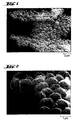
- microparticles are provided in the dry formulation, as described in the patent application (DPA, AZ: 197 37 481.6). These are monoparticles (FIGS. 1 and 2) which have a particularly suitable aerodynamic diameter, which has an advantageous effect on inhalation (e.g. reduced deposition on walls).
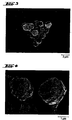
- the clusters and / or aggregates and / or agglomerates formed from the monoparticles show particularly advantageous aerodynamic diameters for the purposes of the invention.
- an improved distribution of active ingredients and lung penetration also: depth of breath is achieved (see examples for Andersen Impactor).
- the invention uses the definition based on document WO 97/36574 to define the aerodynamic diameter mentioned, the multiplication of the geometric diameter determining the spatial extent of a spherical structure (e.g. a spherical particle) by the distance from Surface to surface is determined by the center of the spherical structure, with the root of the particle density.
- a cluster and / or an aggregate and / or agglomerate is to be understood as an accumulation of monoparticles which result from the build-up of non-covalent forces.
- a cap-like and / or raspberry-like and / or spherical structure for example, has a particularly advantageous effect here, as shown in FIGS. 3 and 4.
- Noncovalent forces can be, for example, dipolar interactions, van der Waals forces, hydrogen bonds or also steric interactions, the latter in general definition also being known as the key-lock principle.
- the molecular weights M w of the linear polysaccharides used according to the invention can vary in a wide range from 10 3 g / mol to 10 7 g / mol, preferably molecular weights M w in the range from 10 4 g / mol to 10 5 g / mol, in particular 5 times 10 3 g / mol to 5 x 10 4 g / mol used.
- Corresponding ranges of molecular weights are used for the linear polysaccharide poly (1,4-alpha-D-glucan) which is preferably used.
- Biocompatible in the sense of this invention means that the polysaccharides used can be subjected to complete biological degradation and that there is largely no accumulation in the organism. Biodegradation refers to any process that takes place in vivo that leads to the degradation or destruction of the polymer. In particular, hydrolytic or enzymatic processes also fall into this range. Last but not least, the nature-identical nature of the polysaccharides used is of great importance for the biocompatibility of the polysaccharides and their degradation products (metabolites). The polysaccharides in question are therefore particularly suitable for therapeutic, diagnostic or prophylactic use.
- the term "pharmaceutically acceptable” in the sense of this invention supplements the fact that a carrier for an active ingredient, an auxiliary or also a so-called excipient can be taken up by a living being without significant side effects for the organism.
- a carrier for an active ingredient an auxiliary or also a so-called excipient can be taken up by a living being without significant side effects for the organism.
- the aid can be absorbed through the lungs and broken down there by the body's own mechanisms, dissolved, transported on or there are deposits that also do not lead to adverse effects for the living being through accumulation.
- a "controlled release of active ingredient” is understood to mean that the active ingredient is released after acceptance of a statistical deviation corresponding to the circumstances after a certain time and / or period in a dose which is advantageous for the biological organism.
- This definition also includes extremes. On the one hand, the spontaneous release of all active substances present in the formulation within a period of time that is close to zero. On the other hand, the minimum amount / dose required to achieve a therapeutic effect over a long, even infinite period of time, at least a period of time that is necessary to release all active substances present in the formulation. For this reason, the dry formulation available here is synonymous with a depot formulation or a formulation with delayed release.
- “Dry formulation” and / or “powder” in the sense of this invention means a composition which consists of fine solid particles of the respective pharmaceutical composition. All of these particles are free-flowing and dispersible.
- dry formulation and / or powder additionally means that they are used in an inhalation device for a dry powder, so that a therapeutic effect can be recognized.
- the term "applicable for the pulmonary transport of active substances” or “inhalable”, “breathable” or “respirable” is also used in this context.
- dry is understood to mean a water content of less than 25%, with a water content of less than 15% being preferred. a water content of 5% to 10% is particularly preferred.
- Therapeutic effect in the sense of this invention means that a therapeutically effective amount of an active ingredient reaches the desired target location, there its effect unfolds, and a physiological reaction results. The palliative and / or curative effect is included.
- Disposibility in the sense of this invention means that the dry formulation obtained can be atomized or whirled up by external mechanical forces so that this state is so stable for a certain short period of time (solid in gaseous or solid in liquid) that a further process is initiated can be, which creates a higher benefit.
- pulmonary use that is to say the absorption of active substance via the lungs, serves as an outstanding example, but other phenomena relating to the transport of active substances are also not excluded.
- the generally available inhalers on the market in particular so-called “dry powder inhalers”, can be used, and apparatuses already described in patents and disclosures can be used (manufacturer: 3M Manufacturing Minnesota Mining, Inc., Inhale Therapeutic Systems, Inc., Dura Pharmaceuticals, Aerogen and Aradigm Corporation, from: WO 94/16756, WO 96/30068, WO 96/13292, WO 96/33759, WO 96/13290, WO 96/32978, WO 94/08552, WO 96/09085, WO 95/28192).
- the active ingredients which can be administered as a pharmaceutical composition by means of the active ingredient carrier described, are subject to no restrictions.
- the pharmaceutical composition is effective for clinical pictures that are either genetically determined or have been acquired in the course of life.
- the active ingredient can be released either systemically or locally. A palliative or curative effect can be sought.
- the active ingredients used with the present invention can be both water-soluble and water-insoluble.
- the active substances or active substances used in the pharmaceutical field can be either therapeutic or diagnostic, but also prophylactic.
- the active ingredients used can refer to a wide variety of indications.
- Some examples are: Asthma, cystic fibrosis, general lung disease, diabetes (hypoglycemic reaction), cancer, cystic fibrosis, renal anemia, hemophilia, Ovulation stimulation, neutropenia, Gaucher disease, Hypemephrom, hairy cell leukemia, cancers, multiple sclerosis, chronic granulomatous disease, myocardial infarction, thrombosis, pituitary dwarfism , Treatment of heparin-associated thrombocytopenia (HAT) type II, vaccinations, hepatitis B prevention, growth stimulation of cellular elements, bronchitis, chronic respiratory diseases, lung diseases and breast infections.
- the particulate active substance carriers are not subject to any restrictions with regard to the stability of the active substances.
- the nature-identical polysaccharides used are chemically inert substances, so that even sensitive active ingredients, such as peptides, proteins, can be applied.
- active ingredients such as peptides, proteins
- peptides and proteins that are built from the twenty natural amino acids.
- the partial replacement of natural amino acids by non-naturally occurring amino acids has no influence on the applicability of the invention described here (eg Cetrorelix).
- the application of oligonucleotides or viral vectors is also possible.
- compounds derived from nature can be used or those which can be produced in particular by means of biotechnological and / or genetic engineering process steps and which can generally be classified under the name of the recombinant active ingredients.
- Therapeutics or vaccines are particularly notable here, as are human DNAse (Dornase alpha), erythropoietin alpha (epoetin alpha), erythropoietin beta (epoetin beta), factor VII (Eptacog alpha), factor VIII, follitropin alpha, follitropin beta, G -CSF, glycosylated (lenograstim), G-CSF (filgrastim), GM-CSF (molgramostim), glucagon, glucocerebrosidase (alglucerase), IL-2 (aldesleukin), interferon alpha-2a, interferon alpha-2b, interferon beta-1b , Interferon gamma-1b, insulin, (human insulin, lispro), t-PA (alteplase), r-PA (reteplase), human growth hormone (HGH, somatropin), hirudin, hepatit
- active substances from the following group and classes of these active substances can advantageously be used with the technology presented here, especially in pulmonary application: Calcitonin, felbamate, AZT, DDI, GCSF, lamotrigine, gonadotropin releasing factor (hormone) (GNRH, GHRH and GHRH analogues), luteinizing hormone releasing hormone (LHRH) and LHRH analogues (both antagonists and agonists, e.g.
- Analgesics anginal preparations, antiallergics, antihistamines, anti-inflammatories, bronchodilators, bronchospasmolytics, diuretics, anticholinergics, anti-adhesion molecules, cytokine modulators, biologically active endonucleases, recombinant human DNases, neurotransmitters, leukotrasoactive inhibitors, antagonists, antagonists, antagonists Analeptics, analgesics, local anesthetics, anesthetics, antiepileptics, anticonvulsants, antiparkinsonian drugs, antiemetics, compounds regulating or stimulating the hormone system, compounds regulating or stimulating the cardiovascular system, regulating or stimulating the respiratory system, vitamins, trace elements, antioxidants, antioxidants, antioxidants Antimetabolites, anti-infectives, Immunomodulators, immunosuppressants, antibiotics, proteins, peptides, hormones, growth hormones, growth factors, xanthines, vaccines
- the residue remaining in the filter becomes Temperatures between 30 and 40 ° C in the drying cabinet with the application of a Vacuum using a diaphragm pump (company Vacuubrand GmbH & Co, CVC 2) dried.
- the mass is 685 g (yield 69%).
- the procedure for separating dimethyl sulfoxide remaining in the particles is as follows. 100 g of the amylose particles from Example 9 are placed in 1000 ml of deionized water. The mixture is left to stand for 24 hours with a slight swirl. The particles are separated off as described in Example 9 (ultracentrifuge RC5C: 15 minutes each, 3000 rpm. After freeze-drying, the weight is 98.3 g (98% yield).
- the sulfur determination by elemental analysis gives the following values (test method combustion and IR detection): Sulfur content of the particles from example 2 6% +/- 0.1% Sulfur content of the particles from example 3 ⁇ 0.01%
- REM Scanning electron microscope images are used to characterize the particles (REM) (Camscan S-4) performed.
- the pictures (Fig. 1 and 2) show recordings of the particles that clarify that they are spherical, very uniform particles in terms of shape, size and surface roughness.
- the pictures show pictures of the illustrated clusters and / or Agglomerates.
- Device D consists of a cascade of discrete plates that are successively equipped with smaller holes (pores). Depending on the aerodynamic particle size, a deposit takes place on the individual plates.
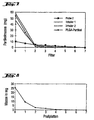
- the Andersen Impactor experiments proceed as follows: 100 mg of the substance (here: three different samples of microparticles and agglomerates (clusters) Poly (1,4- ⁇ -D-glucan); manufactured according to Ex. 3 and 4), are in the neck of the impactor and with the pump belonging to the equipment into the Filter cascade sucked in (pump output: 35 l / min.). After a minute it will the device is stopped and the mass of the individual filters (or baffle plates) is determined. The masses of microparticles are plotted in the following figure. there the good flight behavior with minimal pump performance becomes clear, which is reflected in the high mass on higher baffle plates (filters). The rest remaining at the starting point can be minimized by the particles due to mechanical vibration at the neck of the impactor in suspension be held (see sample 2).
- the comparative examples with other, partly water-soluble polysaccharides, Material from conventional inhalers and microparticles from synthetic, however Biodegradable polymers were analogous to example 8 carried out.
- the polysaccharides are a potato starch from the Type Toffena (from southern starch) and a rice starch of type Remygel (from REMY) with particle sizes up to 100 mm and around 4 mm.
- the inhalers are around the Aerolizer (inhaler 1, Ciba Geigy) and the Atemur Diskus (Inhaler 2, Fa. Cascan).
- the microparticles from polylactide-co-glycolide (PLGA) were analyzed using Spray drying (material PLGA 65: 35-d, I from Medisorb) and have approx. diameter between 2 and 15 mm.
- the flight or separation behavior of microparticles of different sizes and surface roughness in a curved tube is examined.
- the tests form the basis for estimating an optimal morphology of particles and agglomerates for application in a dry powder inhaler.
- the deviation of the particle shape from the sphere can be described using the shape factor Form. It is defined as the ratio of the surface area of a sphere with the same volume to the actual surface area of the particle.
- ⁇ 1, for non-spherical particles, gilt ⁇ 1.
- the aerodynamic diameter is reciprocal to the form factor.
- the roughness was approximated by smaller spherical sections (spherical caps), which were placed on a base sphere.
- the sections were on the one hand outward (raspberry structure) on the other hand inward (crater landscape).
- Agglomerates made from particles were also considered.
- the considered agglomerates (bodies) ideally form the following arrangements in the arrangement of a densest spherical packing (for tetrahedra see also Figure 2).
- the bodies are modeled from agglomerates of individual spheres and have the following structure: a) A tetrahedron composed of spheres with 4 layers.
- the edges are formed from 4 balls each.
- the tetrahedron consists of 20 individual balls; b) body from three spherical layers with 3, 7 and again 3 single spheres (small double cone); c) Bodies of 5 layers with a number of balls of 1, 3, 7, 3 and 1 per layer (large double cone).
- the table summarizes the results of the calculations. For the comparability, only the deviation from the spherical shape is considered as a parameter for a given vofumen-equivalent particle diameter of 5 ⁇ m. It should be noted that the diameter of the individual balls for the above geometries is correspondingly smaller. The rate of descent decreases with increasing deviation from the spherical shape.
- the degree of separation also decreases when flowing through a pipe bend.
- the degree of separation for the particle shapes made up of agglomerates is reduced to 66%.
- the results of these model tests demonstrate the advantageousness of the present invention with regard to the surface roughness, as well as the agglomerates, which are organized in the sense of a densest spherical packing.
- the aerodynamic diameter improves. The better the aerodynamic diameter, the deeper the lung penetration (breathing depth).
- microparticles, or agglomerates, made of poly (1,4- ⁇ -D-glucan) are loaded with active ingredient by a suspension process.
- 250 mg buserelin * are dissolved in 10 ml distilled water. It becomes 100 mg Particles added.
- the suspension is stirred for 3 hours.
- the suspension will centrifuged.
- the centrifugate is washed with water.
- the particulate solid is separated by centrifuge (3000 rpm) and the centrifugate is freeze-dried.
- the microparticles are suspended in distilled water or a mixture of water and a volatile component such as acetone or ethanol.
- 10 g of the solid are suspended in 1,000 ml of the solvent.
- 0.5 g of theophylline was previously dissolved in the solvent.
- the spray dryer (mini spray dryer 191 from Büchi) is operated as follows: Atomizing air flow 700 liters per hour, inlet temperature 200 ° C, nozzle cooling switched on, nozzle diameter 0.5 mm, aspirator 70%, pump 10%.
- the upper spectroscopic check of the load shows a degree of loading of 4.8%. This value corresponds to the theoretically achievable value of 5.0% within the error limits.
- poly (1,4- ⁇ -D-glucan) are dissolved in approx. 0.5 L double-distilled water at 1.3 bar and heated at 130 ° C for 1.5 hours in an autoclave (Certoclav apparatus). Of the weight of the reaction vessel has been measured beforehand. After that the The equipment is relaxed and cooled at room temperature. The content is weighed. It corresponds to 501.74 g. After a further 24 hours, centrifugation and decantation are carried out. The solid residue is dried and weighed out: 468 mg. Calculated from this a dissolved portion of 96 mg. Based on the solvent used is calculated from that for 1 mg of poly (1,4- ⁇ -D-glucan) 5226 mg of water are necessary.
- Example 13 The test is carried out as in Example 13. The only difference is one Cooling process after the autoclave treatment and cooling Room temperature is connected. The mixture of substances is at for 3 hours Store at 5 ° C.
- the spray dryer (Mini Spray Dryer 191, Büchi, Switzerland) is operated as follows: atomizing nitrogen flow 700 liters per hour, inlet temperature 220 ° C, switched on nozzle cooling, nozzle diameter 0.5mm, aspirator 70%, pump 70%.
- the spray-dried material is removed from the cyclone's collecting vessel and stored dry.
- the size of the microparticles is over 90% in a range smaller than 10 ⁇ m (evaluation of electron microscope images).
- a 20% suspension is prepared by suspending 500 g of poly (1,4-alpha-D-glucan) from Example 1 in 2.5 l of water. The suspension is spray dried.
- the spray dryer (Mini Spray Dryer B-191 from Büchi) is operated as follows: atomizing air flow 650 liters per hour, inlet temperature 140 ° C, no nozzle cooling, nozzle diameter 0.7 mm, aspirator 70%, pump 30%. There are 197.5 g of white solid from the Product collection - container removed. The yield is 40%. A proportion of more than 90% of the particles with their diameter are in the range of 1-10 ⁇ m.
- the usability as a carrier material for an application as a dry powder at Inhaled administration of an active ingredient is carried out using the method described in Example 7 Andersen Impactor equipment determined.
- the results show in FIG Principal respiratory mobility of the particles obtained by spray drying (see also Figures 5-7 to Examples 7 and 8).
- Powders with a slope angle ⁇ 30 ° are particularly suitable.
- Appropriate Reference measurements with well-known, well-pouring materials such as EMDEX®, Avicel®, Toffena® result in embankment angles of around 30 ° (see Bauer, Fröming, 5.3, Pharmaceutical Technology, Stuttgart, 1989, p. 345).
- the suspension is continuously stirred using a magnetic stirrer.
- the spray dryer (Mini Spray Dryer 191, Büchi, Switzerland) is operated as follows: atomizing nitrogen flow 700 liters per hour, inlet temperature 220 ° C, switched on nozzle cooling, nozzle diameter 0.5mm, aspirator 70%, pump 70%.
- the spray-dried material yield at least 25% based on the amount of solids used in the autoclave
- the size of the microparticles is over 90% in a range smaller than 10 ⁇ m (evaluation of electron microscope images).
- the loading of the microparticles with theophylline is checked photometrically.
- the sample For this purpose, 50 mg of the sample are dissolved in 100 ml of dimethyl sulfoxide at 60 ° C and measured at 271 nm (Lambda 20 photometer, Perkin Elmer). The degree of loading is at least 95%. 20 mg of the active substance-loaded microparticles are filled into the metering chamber of a commercially available dry powder inhaler (Aerolizer®, from Ciba-Geigy) and the flight distance is measured with the Andersen impactor as described in Example 7.
- a commercially available dry powder inhaler Align®, from Ciba-Geigy
Landscapes
- Health & Medical Sciences (AREA)
- Engineering & Computer Science (AREA)
- Bioinformatics & Cheminformatics (AREA)
- Animal Behavior & Ethology (AREA)
- Public Health (AREA)
- Chemical & Material Sciences (AREA)
- Medicinal Chemistry (AREA)
- Pharmacology & Pharmacy (AREA)
- Epidemiology (AREA)
- Life Sciences & Earth Sciences (AREA)
- Veterinary Medicine (AREA)
- General Health & Medical Sciences (AREA)
- Pulmonology (AREA)
- Otolaryngology (AREA)
- Medicinal Preparation (AREA)
- Medicines Containing Material From Animals Or Micro-Organisms (AREA)
- Pharmaceuticals Containing Other Organic And Inorganic Compounds (AREA)
- Medicines Containing Plant Substances (AREA)
- Compounds Of Unknown Constitution (AREA)
- Saccharide Compounds (AREA)
Abstract
Description
Die Erfindung betrifft einen trockenformulierbaren partikulären Wirkstoffträger der aus linearen wasserunlöslichen Polysacchariden hergestellt wird, Verfahren zu seiner Herstellung sowie seiner Verwendung.The invention relates to a dry-formulated particulate active ingredient carrier is produced from linear water-insoluble polysaccharides, process to its manufacture and its use.
In der modernen pharmazeutischen Technologie sind Formulierungen erwünscht, deren Anwendungsform sich auf eine schonende Weise applizieren läßt und gezielt Einfluß auf die Bioverteilung, Bioverfügbarkeit oder Resorption eines Medikaments nehmen.In modern pharmaceutical technology, formulations are desirable whose application form can be applied in a gentle manner and specifically Influence on biodistribution, bioavailability or absorption of a drug to take.
Vor allem partikuläre Systeme, sogenannte Mikropartikel, die im allgemeinen eine Teilchengröße im Bereich kleiner 100 µm aufweisen, haben sich als Applikationsformen bzw. "Drug Delivery Systeme" hoher Güte erwiesen und dienen zur Bereitstellung von Wirkstoffen, insbesondere Pharmaka, im biologischen Organismus. Dabei haben sich Mikropartikel in einem Größenbereich von 1 bis 100 µm vor allem für die parenterale Anwendung, z. B. die subkutane Injektion bewährt, bei der eine Langzeitabgabe des Wirkstoffs über Wochen erfolgen kann. Wesentlich kleinere Mikropartikel im Bereich kleiner 0,5 µm werden intensiv untersucht, um die Blut-Hirn-Schranke zu überwinden.Especially particulate systems, so-called microparticles, which are generally one Particle size in the range less than 100 microns have Application forms and "drug delivery systems" of high quality have been proven and used for the provision of active ingredients, in particular pharmaceuticals, in biological Organism. Microparticles have a size range from 1 to 100 µm especially for parenteral use, e.g. B. proven subcutaneous injection, in which long-term release of the active ingredient can take place over weeks. Much smaller microparticles in the range of less than 0.5 µm become intense studied to cross the blood-brain barrier.
Therapeutische Stoffe bedürfen einer Applikationsform, die den physiologischen Gegebenheiten gerecht wird (z. B. therapeutische Proteine u. v. a., die beispielsweise oral appliziert werden, können im Magen denaturieren oder der enzymatischen Verdauung unterliegen, und werden daher zumeist nur als Injektion oder anders invasiv verabreicht). Therapeutic substances require an application form that is physiological Conditions (e.g. therapeutic proteins, among others, the for example, administered orally, can denature in the stomach or are subject to enzymatic digestion, and are therefore mostly used only as an injection or otherwise administered invasively).
Insbesondere eine spezielle Form der nichtinvasiven Verabreichung, die pulmonale
Applikationsform, bietet im Rahmen einer Inhalationstherapie die Möglichkeit über
die Lunge therapeutische Stoffe unter Wahrung der therapeutischen,
diagnostischen oder prophylaktischen Eigenschaften zu resorbieren (Patton,
Chemtech 1997, 27 (12), 34-38) und ermöglicht die systemische und lokale
Behandlung und führt somit zu einer höheren Patienten-Compliance. Hierzu ist es
notwendig, partikuläre Systeme in Größe und Qualität bereitzustellen, die in der
Lage sind, in Bronchien und Alveolen vorzudringen, wo aufgrund empfindlicher
Membranen eine effektive Wirkstoffaufnahme in die Blutbahn des Organismus
erfolgt.
Bekannt ist bisher vor allem die bereits am Markt erhältliche pulmonale
Applikationsform auf der Basis von treibgasgetriebenen Dosieraerosolen, die
nahezu vollständig für die Therapie von asthmatischen Erkrankungen eingesetzt
wird. Nachteilig ist jedoch die Verwendung ozonschädigender Treibgase.
Es werden derzeit große Anstrengungen unternommen, um die Applikation von
Arzneistoffen über die Lunge auch auf andere Wirkstoffe mit anderen
Indikationsgebieten zu übertragen. Im Blickpunkt des Interesses stehen derzeit
Pulverinhalationssysteme, sogenannte "Dry Powder Inhaler" auf der Basis einer
pharmazeutischen Trockenformulierung. Diese wird in WO 96/32149 beschrieben,
hierzu wird als Trägermaterial für den Wirkstoff humanes Serum Albumin
einschließlich Zusatzmittel verwendet, Langer et al. beschreiben in Science 276,
1997, 1868 die Verwendung von Mikropartikeln aus Polymilchsäure, die zu 10-20 %
mit Insulin beladen werden und vergleichbare Ergebnisse erzielen, wie
entsprechend subkutan injiziert (Abstract Controlled Release Society Conference,
Sweden 1997). Die Größe der Partikel liegt im Bereich zwischen 8 und 20 µm.In particular, a special form of non-invasive administration, the pulmonary application form, offers the possibility of resorbing therapeutic substances via the lungs while maintaining the therapeutic, diagnostic or prophylactic properties (Patton, Chemtech 1997, 27 (12), 34-38). and enables systemic and local treatment and thus leads to higher patient compliance. For this purpose, it is necessary to provide particulate systems in size and quality that are able to penetrate into the bronchi and alveoli, where the effective absorption of active substances into the bloodstream of the organism takes place due to sensitive membranes.
The pulmonary form of application based on propellant-driven metered dose inhalers, which is already available on the market and which is almost completely used for the therapy of asthmatic diseases, is known to date. However, the use of propellant gases which damage the ozone is disadvantageous.
Great efforts are currently being made to transfer the application of drugs via the lungs to other drugs with other indications. The focus of interest is currently on powder inhalation systems, so-called "dry powder inhalers" based on a pharmaceutical dry formulation. This is described in WO 96/32149; for this purpose, albumin, including additives, is used as the carrier material for the active ingredient human serum, Langer et al. describe in Science 276, 1997, 1868 the use of microparticles made of polylactic acid which are loaded with 10-20% insulin and achieve comparable results, as injected subcutaneously (Abstract Controlled Release Society Conference, Sweden 1997). The size of the particles is in the range between 8 and 20 µm.
In WO 97/35562 werden wirkstoffbeladene Mikropartikel zur pulmonalen Applikation beschrieben, die aus wäßriger Lösung hergestellt werden und nachteilig nur wasserlösliche Wirkstoffe aufnehmen können.WO 97/35562 describes drug-laden microparticles for pulmonary application described, which are made from aqueous solution and disadvantageous only can absorb water-soluble active ingredients.
Eine weitere Druckschrift WO 97/44013 offenbart poröse Partikel aus Polymilch-coglycolsäure, die einen Durchmesser von 5 bis 30 µm aufweisen. Another publication WO 97/44013 discloses porous particles made of poly-milk-coglycolic acid, which have a diameter of 5 to 30 microns.
In WO 96/32116 werden Mikropartikel in der Größenordnung von 0,5 bis 50 µm
beschrieben, die aus Nukleinsäuren oder viralen Vektoren bestehen und aus einer
Suspension mittels hydrophilen oligomeren Polysacchariden unter Trocknung,
insbesondere Sprühtrocknung, erhalten werden können.
WO 96/32152 beschreibt Partikel, bestehend aus dem Wirkstoff α-1-Antitrypsin in
der Größe von 1-50 µm, wobei auch Verdünnungsmittel zugelassen sind.
Die Druckschrift WO 97/36574 beschreibt hohle Partikel mit glatter Oberfläche, die
Größe beträgt 0,5-7,0 µm.WO 96/32116 describes microparticles in the order of magnitude of 0.5 to 50 μm which consist of nucleic acids or viral vectors and can be obtained from a suspension by means of hydrophilic oligomeric polysaccharides with drying, in particular spray drying.
WO 96/32152 describes particles consisting of the active ingredient α-1-antitrypsin in the size of 1-50 μm, diluents also being permitted.
The publication WO 97/36574 describes hollow particles with a smooth surface, the size is 0.5-7.0 microns.
In den Druckschriften WO 97/36574, WO 96/36314, WO 96/00127 und WO 96/32096 werden weitere partikuläre Systeme beschrieben, die aus teilweise synthetischen Polymeren bestehen oder aus dem Wirkstoff als solcher unterschiedlichster Größe.In the publications WO 97/36574, WO 96/36314, WO 96/00127 and WO 96/32096 further particulate systems are described, which in part synthetic polymers or consist of the active substance as such different sizes.
Im Stand der Technik ist problematisch, daß die Depotwirkung der Partikel relativ begrenzt ist. Des weiteren handelt es sich um wasserlösliche, zumeist aus einer chemischen Synthese hervorgehende Produkte, die deren Biokomptabilität einschränkt (Lösungsmittelreste, Fremdmaterial etc.). Ebenso werden in Größe, Oberfläche und Zusammensetzung unheitliche inhomogene Partikel erhalten, die insbesondere in der pulmonalen Applikation die Bioverfügbarkeit einschränkt, z. B. Verlust durch Ablagerungen außerhalb des Erfolgsortes sowie Beeinträchtigung der Dispergierbarkeit. Des weiteren ergeben sich Probleme im Stand der Technik hinsichtlich der Beladbarkeit des Trägers.It is problematic in the prior art that the depot effect of the particles is relative is limited. Furthermore, it is water-soluble, mostly from one chemical synthesis resulting products, their biocompatibility restricted (solvent residues, foreign material, etc.). Likewise, in size, Surface and composition get uneven, inhomogeneous particles limits bioavailability, especially in pulmonary administration, e.g. B. Loss due to deposits outside the place of success and impairment of the Dispersibility. Furthermore, problems arise in the prior art with regard to the loadability of the carrier.
Daher ist es Aufgabe der Erfindung einen trockenformulierbaren Wirkstoffträger
besonderer Güte für die auf dem Markt befindlichen Applikatoren zu entwickeln, der
diese Nachteile umgeht. Insbesondere sollte dabei die Möglichkeit gegeben sein,
eine Partikeltechnik zu etablieren, die in der Lage ist, einen Depoteffekt in der
Lunge zu erzielen. Deshalb ist es ebenfalls die Aufgabe der Erfindung
dispergierbare partikuläre Wirkstoffträger herzustellen. Ebenfalls eine Aufgabe ist
die Bereitstellung eines möglichst einfachen und vorteilhaften Verfahrens zur
Herstellung von Trockenformulierungen, die vorzugsweise im Rahmen der
pulmonalen Applikation verwendet werden können. Insofern stellt ebenfalls die
Optimierung des Wirkstoffträgers in Größe, Oberfläche und Morphologie hinsichtlich
der Anwendung zur Inhalation eine Aufgabe dar.
Die Aufgabe wird dadurch gelöst, daß partikuläre Wirkstoffträger zur pulmonalen
Applikation bereitgestellt werden, die mindestens ein lineares wasserunlösliches
Polysaccharid enthalten und deren mittlere Größe kleiner als 10 µm ist.It is therefore an object of the invention to develop a dry-formulated active substance carrier of special quality for the applicators on the market which avoids these disadvantages. In particular, the possibility should be given to establish a particle technique that is able to achieve a depot effect in the lungs. It is therefore also the object of the invention to produce dispersible particulate active ingredient carriers. Another object is to provide the simplest and most advantageous method for producing dry formulations, which can preferably be used in the context of pulmonary administration. In this respect, the optimization of the active ingredient carrier in size, surface and morphology with regard to the use for inhalation is also a task.
The object is achieved in that particulate active substance carriers for pulmonary application are provided which contain at least one linear water-insoluble polysaccharide and whose average size is less than 10 μm.
Durch die erfindungsgemäßen Maßnahmen werden zusätzliche Vorteile erzielt:
- Leichtere Beladbarkeit des Trägermaterials mit Wirkstoff durch die gute Suspendierbarkeit in verschiedenen Medien (z. B. Dispersionsverfahren, Sprühtrocknung);
- Unbedenklichkeit und hohe Biokomptabilität des verwendeten Trägermaterials durch natürlich vorkommende Strukturen und durch die Verwendung naturidentischer Produkte;
- Die Vermeidung eines Zusatz von oberflächenaktiven Verbindungen bei der Herstellung der Wirkstofformulierung;
- Der für das Flugverhalten sich positiv auswirkende aerodynamische Durchmesser. Dieser wird aufgrund der porösen Oberflächenbeschaffenheit im Vergleich zu einer glatten Kugel erreicht und durch die gleichzeitig mit der Oberflächenrauigkeit einhergehende Tendenz zur Cluster- und / oder Agglomeratbildung unterstützt.
- Easier loading of the carrier material with the active ingredient due to the good suspendability in various media (e.g. dispersion process, spray drying);
- Safe and high biocompatibility of the carrier material used due to naturally occurring structures and the use of nature-identical products;
- Avoiding the addition of surface-active compounds in the preparation of the active substance formulation;
- The aerodynamic diameter that has a positive effect on flight behavior. This is achieved due to the porous nature of the surface compared to a smooth ball and is supported by the tendency towards cluster and / or agglomerate formation that goes hand in hand with the surface roughness.
Im Sinne der Erfindung bezeichnet partikulärer Wirkstoffträger Partikel einer
mittleren Größe kleiner als 10 µm, insbesondere von 1 bis 10 µm, vorzugsweise 2
bis 6 µm und besonders bevorzugt 1 bis 3 µm, die als essentiellen Bestandteil
mindestens ein lineares wasserunlösliches Polysaccharid enthalten.
Lineare wasserunlösliche Polysaccharide im Sinne der vorliegenden Erfindung sind
Polysaccharide, vorzugsweise Polyglukane, insbesondere Poly(1,4-alpha-Dglukan),
die aus Monosacchariden, Disacchariden, weiteren Oligomeren davon oder
Derivaten bestehen.
Diese sind stets in der gleichen Art miteinander verknüpft. Jede so definierte
Grundeinheit hat genau zwei Verknüpfungen, jeweils eine zu einem anderen
Monomer. Davon sind ausgenommen die beiden Grundeinheiten, die den Anfang
und das Ende des Polysaccharids bilden. Diese Grundeinheiten haben nur eine
Verknüpfung zu einem weiteren Monomer. Bei drei oder mehr Verknüpfungen
(kovalente Bindungen) eines Monomers zu einer anderen Gruppe, bevorzugt einer
weiteren Saccharideinheit, spricht man von einer Verzweigung. Von jedem
Saccharidbaustein im Polymerrückgrat gehen dann mindestens drei glykosidische
Bindungen ab.
Erfindungsgemäß treten Verzweigungen nicht oder nur in so untergeordnetem Maß
auf, daß sie bei den vorliegenden sehr kleinen Verzweigungsanteilen im
allgemeinen den herkömmlichen analytischen Methoden nicht mehr zugänglich sind.
Dies ist zum Beispiel dann der Fall, wenn bezogen auf die Gesamtheit aller
vorhandenen Hydroxygruppen auf einhundert Hydroxygruppen, die nicht zum
Aufbau des linearen Polysaccharids benötigt werden, maximal fünf Hydroxygruppen
durch Verknüpfungen zu anderen Saccharidbausteinen belegt sind.
Dabei ist der Verzweigungsgrad maximal (100 %), wenn an jeder Saccharideinheit
die freien Hydroxygruppen (oder andere auftretende funktionelle Gruppen) weitere
glykosidische (oder andere) Bindungen zu weiteren Sacchariden aufweisen. Der
Verzweigungsgrad ist minimal (0 %), wenn an den Sacchariden außer den
Hydroxygruppen, die die Linearität des Polymers bedingen, keine weiteren
Hydroxygruppen durch chemische Reaktion verändert sind.
Beispiele für bevorzugte wasserunlösliche lineare Polysaccharide sind lineare Poly-D-glucane,
wobei die Art der Verknüpfung unwesentlich ist, solange Linearität im
Sinne der Erfindung vorliegt. Beispiele sind Poly(1,4-alpha-D-Glucan) und Poly(1,3-beta-D-Glucan),
wobei Poly(1,4-alpha-D-Glucan besonders bevorzugt ist.For the purposes of the invention, particulate active substance carrier refers to particles with an average size of less than 10 μm, in particular from 1 to 10 μm, preferably 2 to 6 μm and particularly preferably 1 to 3 μm, which contain at least one linear water-insoluble polysaccharide as an essential component.
Linear water-insoluble polysaccharides for the purposes of the present invention are polysaccharides, preferably polyglucans, in particular poly (1,4-alpha-dglucan), which consist of monosaccharides, disaccharides, further oligomers thereof or derivatives.
These are always linked in the same way. Each basic unit defined in this way has exactly two links, one each to a different monomer. This does not include the two basic units that form the beginning and the end of the polysaccharide. These basic units have only one link to another monomer. In the case of three or more linkages (covalent bonds) of a monomer to another group, preferably another saccharide unit, one speaks of a branch. At least three glycosidic bonds then go off from each saccharide building block in the polymer backbone.
According to the invention, branches do not occur or only to such a minor extent that they are generally no longer accessible to the conventional analytical methods given the very small proportions of branches present. This is the case, for example, if, based on the totality of all hydroxyl groups present per hundred hydroxyl groups which are not required for the construction of the linear polysaccharide, a maximum of five hydroxyl groups are occupied by links to other saccharide units.
The degree of branching is at a maximum (100%) if the free hydroxyl groups (or other functional groups which occur) have further glycosidic (or other) bonds to further saccharides on each saccharide unit. The degree of branching is minimal (0%) if no further hydroxyl groups on the saccharides apart from the hydroxyl groups, which determine the linearity of the polymer, have been changed by chemical reaction.
Examples of preferred water-insoluble linear polysaccharides are linear poly-D-glucans, the type of linkage being immaterial as long as there is linearity in the sense of the invention. Examples are poly (1,4-alpha-D-glucan) and poly (1,3-beta-D-glucan), poly (1,4-alpha-D-glucan) being particularly preferred.
Besitzt die Grundeinheit drei oder mehr Verknüpfungen, wird von Verzweigung gesprochen. Dabei ergibt sich aus der Anzahl der Hydroxylgruppen pro 100 Grundeinheit, die nicht am Aufbau des linearen Polymerrückgrats beteiligt sind und die Verzweigungen ausbilden, der sogenannte Verzweigungsgrad.If the basic unit has three or more links, branching occurs spoken. The number of hydroxyl groups per 100 results Basic unit that are not involved in the construction of the linear polymer backbone and form the branches, the so-called degree of branching.
Erfindungsgemäß weisen die linearen wasserunlöslichen Polysaccharide einen Verzweigungsgrad von weniger als 8 % auf, d.h. sie haben weniger als 8 Verzweigungen auf 100 Grundeinheiten. Vorzugsweise ist der Verzweigungsgrad kleiner 4 % und insbesondere maximal 1,5 %.According to the invention, the linear water-insoluble polysaccharides have one Degree of branching of less than 8%, i.e. they have less than 8 Branches on 100 basic units. The degree of branching is preferred less than 4% and in particular a maximum of 1.5%.
Ist das wasserunlösliche lineare Polysaccharid ein Polyglucan, z.B. Poly-(1,4-alpha-D-Glucan), ist der Verzweigungsgrad in 6-Position kleiner 4 %, vorzugsweise maximal 2 % und insbesondere maximal 0,5 % und der Verzweigungsgrad in den anderen nicht an der linearen Verknüpfung beteiligten Positionen, z.B. der 2- bzw. 3-Position im Fall des bevorzugten Poly-(1,4-alpha-D-Glucans), ist vorzugsweise jeweils maximal 2 % und insbesondere maximal 1 %.If the water-insoluble linear polysaccharide is a polyglucan, e.g. Poly (1,4-alpha-D-glucan), the degree of branching in the 6 position is less than 4%, preferably a maximum of 2% and in particular a maximum of 0.5% and the degree of branching in the other positions not involved in the linear link, e.g. the 2- or 3-position in the case of the preferred poly (1,4-alpha-D-glucan) is preferred in each case a maximum of 2% and in particular a maximum of 1%.
Besonders bevorzugt sind Polysaccharide, insbesondere Poly-alpha-D-Glucane, die keine Verzweigungen aufweisen, bzw. deren Verzweigungsgrad so minimal ist, daß er mit herkömmlichen Methoden nicht mehr nachweisbar ist.Polysaccharides, in particular poly-alpha-D-glucans, are particularly preferred have no branches, or the degree of branching is so minimal that it is no longer detectable using conventional methods.
Erfindungsgemäß beziehen die Präfixe "alpha", "beta" oder "D" allein auf die Verknüpfungen, die das Polymerrückgrat ausbilden und nicht auf die Verzweigungen.According to the invention, the prefixes "alpha", "beta" or "D" refer solely to the Links that form the polymer backbone and not on the Branches.
"Wasserunlöslichkeit" im Sinne der vorliegenden Erfindung bedeutet, daß keine erkennbare Löslichkeit der Verbindung unter Normalbedingungen (Raumtemperatur von 25 °C und ein Luftdruck von 101325 Pascal oder davon maximal 20 % abweichende Werte zugrundeliegt) besteht."Water insolubility" in the sense of the present invention means that none recognizable solubility of the compound under normal conditions (room temperature of 25 ° C and an air pressure of 101325 Pascal or a maximum of 20% deviating values).
Im Fall der erfindungsgemäß verwendeten Polysaccharide, insbesondere der
Polyglukane wie Poly(1,4-alpha-D-glukan), bedeutet dies, daß mindestens 98 % der
eingesetzten Menge, bevorzugt eine Menge größer 99,5 %, in Wasser unlöslich ist.
Dabei kann der Begriff Unlöslichkeit auch anhand folgender Beobachtung erläutert
werden. Erhitzt man 1 g des zu untersuchenden linearen Polysaccharids in 1 I
entionisiertem Wasser auf 130 °C unter einem Druck von 1 bar, so bleibt die
entstehende Lösung nur kurzzeitig, über wenige Minuten stabil. Beim Erkalten unter
Normalbedingungen fällt die Substanz wieder aus. Nach weiterem Erkalten und
Abtrennung mit der Zentrifuge unter Einkalkulation von experimentellen Verlusten,
lassen sich auf diese Weise mindestens 66 % der eingesetzten Menge
zurückgewinnen.
Im Rahmen dieser Erfindung werden bevorzugt lineare, wasserunlösliche
Polysaccharide verwendet, welche mit Hilfe von biotechnischen oder
gentechnischen Methoden allgemeiner Definition gewonnen werden können. Eine
besonders vorteilhafte Ausführungsform für die hier beschriebene Erfindung ist die
Herstellung in einem biotechnischen Verfahren, insbesondere in einem
biokatalytischen Verfahren, oder in einem fermentativen Verfahren.
Lineare Polysaccharide hergestellt durch Biokatalyse (ebenso: Biotransformation)
im Rahmen dieser Erfindung bedeutet, daß das lineare Polysaccharid durch
katalytische Reaktion von monomeren Grundbausteinen wie oligomeren
Sacchariden, z. B. von Mono- und / oder Disacchariden hergestellt wird, indem ein
sogenannter Biokatalysator, üblicherweise ein Enzym, unter geeigneten
Bedingungen verwendet wird. Bevorzugt wird insbesondere Poly(1,4-alpha-Dglukan)
mittels Polysaccharidsynthasen und / oder Stärkesynthasen und /oder
Glykosyltransferasen und / oder alpha-1,4-Glukantransferasen und / oder
Glycogensynthasen und / oder Amylosucrasen und / oder Phosphorylasen
hergestellt.
Lineare Polysaccharide aus Fermentation sind im Gebrauch der Erfindung lineare
Polysaccharide, die durch fermentative Prozesse unter der Verwendung in der Natur
vorkommender Organismen, wie Pilze, Algen oder Mikroorganismen oder unter der
Verwendung von in der Natur nicht vorkommender Organismen, die durch
Modifizierung von natürlichen Organismen, wie Pilze, Algen oder Mikroorganismen,
mittels gentechnischer Methoden allgemeiner Definition gewonnen werden können.
Darüber hinaus können lineare Polysaccharide zur Herstellung der in der
vorliegenden Erfindung beschriebenen Retardtablette aus nicht-linearen
Polysacchariden, die Verzweigungen enthalten, gewonnen werden, indem sie mit
einem Enzym behandelt werden und unter Spaltung (z. B. mittels Enzyme, wie
Amylase, iso-Amylase, Gluconohydrolase, Pullulanase u. a.) und Abtrennung der
Verzweigungen lineare Polymere daraus erhalten werden können. In the case of the polysaccharides used according to the invention, in particular the polyglucans such as poly (1,4-alpha-D-glucan), this means that at least 98% of the amount used, preferably an amount greater than 99.5%, is insoluble in water. The term insolubility can also be explained using the following observation. If 1 g of the linear polysaccharide to be examined is heated in 1 l of deionized water to 130 ° C. under a pressure of 1 bar, the resulting solution remains stable only for a short time, over a few minutes. When cooling under normal conditions, the substance precipitates again. After further cooling and separation with the centrifuge, taking into account experimental losses, at least 66% of the amount used can be recovered in this way.
In the context of this invention, linear, water-insoluble polysaccharides are preferably used, which can be obtained with the help of biotechnical or genetic engineering methods of general definition. A particularly advantageous embodiment for the invention described here is the production in a biotechnical process, in particular in a biocatalytic process, or in a fermentative process.
Linear polysaccharides produced by biocatalysis (also: biotransformation) in the context of this invention means that the linear polysaccharide by catalytic reaction of monomeric building blocks such as oligomeric saccharides, e.g. B. is produced by mono- and / or disaccharides by using a so-called biocatalyst, usually an enzyme, under suitable conditions. In particular, poly (1,4-alpha-dglucan) is preferably produced by means of polysaccharide synthases and / or starch synthases and / or glycosyl transferases and / or alpha-1,4-glucan transferases and / or glycogen synthases and / or amylosucrases and / or phosphorylases.
Linear polysaccharides from fermentation are, in use of the invention, linear polysaccharides which are obtained by fermentative processes using organisms found in nature, such as fungi, algae or microorganisms, or using organisms which are not found in nature, by modification of natural organisms, such as fungi, algae or microorganisms, can be obtained using genetic engineering methods with a general definition. In addition, linear polysaccharides for the production of the prolonged-release tablet described in the present invention can be obtained from non-linear polysaccharides containing branches by treating them with an enzyme and isolating them with cleavage (e.g. by means of enzymes such as amylase). Amylase, gluconohydrolase, pullulanase and others) and separation of the branches linear polymers can be obtained therefrom.
Die Gewinnung und Aufreinigung linearer wasserunlöslicher Polysaccharide mittels
bio- und gentechnischen Methoden aus Pflanzen kann nicht ausgeschlossen
werden und wird ausdrücklich mit einbezogen.
Die partikuläre Wirkstoffträger können insbesondere durch die Mikropartikeltechnik
hergestellt werden, die Gegenstand der Patentanmeldung (DPA, AZ: 197 37 481.6)
ist.
Denkbar sind neben der Trockenformulierung Inhalationen auf der Basis von
Dispersionen und Suspensionen des Wirkstoffträgers, die hier ausdrücklich mit
einbezogen werden. Als besonders geeignet und bevorzugte Ausführungsform ist
jedoch die inhalation auf der Basis der Trockenformulierung zu sehen. Hierbei
handelt es sich um ein dispergierbares trockenes Pulver, welches mittels
Pulverinhalatoren ("Dry Powder Inhaler") pulmonal appliziert werden kann.
Erfindungswesentlich ist, daß in der Trockenformulierung Mikropartikel bereitgestellt
werden, wie in der Patentanmeldung (DPA, AZ: 197 37 481.6) beschrieben. Hierbei
handelt es sich um Monopartikel (Fig. 1 und 2), die einen besonders geeigneten
aerodynamischen Durchmesser aufweisen, der sich vorteilhaft auf eine Inhalation
auswirkt (z. B. verminderte Abscheidung an Wänden). Besonders vorteilhafte
aerodynamischen Durchmesser für die Zwecke der Erfindung zeigen die aus den
Monopartikel gebildeten Cluster und / oder Aggregate und / oder Agglomerate.
Ebenso wird aufgrund der Mischung dieser Partikel unter Berücksichtigung der
anatomischen Gegebenheiten der Lunge eine verbesserte Wirkstoffverteilung und
Lungenpenetration (auch: Atemtiefe) erzielt (siehe Beispiele zu Andersen-Impactor).
Zur Definition des genannten aerodynamischen Durchmesser bedient sich die
Erfindung, der Definition anhand der Schrift WO 97/36574, wobei durch die
Multiplikation des geometrischen Durchmessers, der die räumliche Ausdehnung
eines kugelförmigen Gebildes (z. B. ein sphärischer Partikel) bestimmt durch den
Abstand von Oberfläche zu Oberfläche durch den Mittelpunkt des kugelförmigen
Gebildes ermittelt wird, mit der Wurzel der Partikeldichte.
Unter einem Cluster und / oder einem Aggregat und / oder Agglomerat ist eine
Anhäufung von Monopartikeln zu verstehen, die durch den Aufbau nichtkovatenter
Kräfte entstehen. Besonders vorteilhaft wirkt sich hier beispielsweise eine
kappenartige und / oder himbeerartige und / oder sphärische Struktur aus, wie in
Bild 3 und Bild 4 dargestellt. Nichtkovalente Kräfte können beispielsweise dipolare
Wechselwirkungen, van-der-Waals-Kräfte, Wasserstoffbrückenbindungen oder
auch sterische Wechselwirkungen sein, wobei letztere in allgemeiner Definition
auch als Schlüsset-Schloss-Prinzip bezeichnet werden können.
Die Molekulargewichte Mw der erfindungsgemäß verwendeten linearen
Polysaccharide können in einem weiten Bereich von 103 g/mol bis 107 g/mol
variieren, vorzugsweise Molekulargewichte Mw im Bereich von 104 g/mol bis 105
g/mol, insbesondere 5 x 10³ g/mol bis 5 x 10⁴ g/mol verwendet. Für das
vorzugsweise verwendete lineare Polysaccharid Poly(1,4-alpha-D-glukan) werden
entsprechende Bereiche der Molekulargewichte verwendet.
"Biokompatibel" im Sinne dieser Erfindung bedeutet, daß die eingesetzten
Polysaccharide einem vollständigen biologischen Abbau unterzogen werden können
und weitgehendst keine Anreicherung im Organismus erfolgt.
Unter biologischen Abbau ist dabei jedweder in vivo ablaufende Vorgang
angesprochen, der zu einem Abbau oder Zerstörung des Polymers führt
Insbesondere fallen ebenfalls hydrolytische oder enzymatische Prozesse in diesen
Bereich. Für die Biokompatibilität der Polysaccharide sowie seiner Abbauprodukte
(Metabolite) ist nicht zuletzt auch der naturidentische Charakter der eingesetzten
Polysaccharide von hoher Bedeutung. Daher sind die in Frage kommenden
Polysaccharide für den therapeutischen, diagnostischen oder prophylaktischen
Einsatz besonders geeignet.
Des weiteren ergänzt der Begriff "pharmazeutisch akzeptabel" im Sinne dieser
Erfindung, daß ein Träger für einen Wirkstoff, ein Hilfsmittel oder auch sogenanntes
Excipient, durch ein lebendes Wesen aufgenommen werden kann, ohne daß
signifikante Nebenwirkungen für den Organismus entstehen. Im besonderen Fall der
pulmonalen Verabreichung bedeutet dies, daß das Hilfsmittel durch die Lunge
aufgenommen werden kann und dort durch die körpereigenen Mechanismen
abgebaut, aufgelöst, weitertransportiert wird oder aber es zu Ablagerungen kommt,
die auch durch Kumulation nicht zu nachteiligen Effekten für das Lebewesen führen.
Unter einer "kontrollierten Wirkstoffabgabe" wird verstanden, daß der Wirkstoffe
unter Akzeptanz einer den Umständen entsprechenden statistischen Abweichung
nach einer bestimmten Zeit und / oder Zeitdauer in einer für den biologischen
Organismus vorteilhaften Dosis freigesetzt wird.The extraction and purification of linear water-insoluble polysaccharides by means of bio- and genetic engineering methods from plants cannot be excluded and is expressly included.
The particulate active ingredient carriers can in particular be produced by the microparticle technology which is the subject of the patent application (DPA, AZ: 197 37 481.6).
In addition to the dry formulation, inhalations based on dispersions and suspensions of the active ingredient carrier are also conceivable, which are expressly included here. However, inhalation based on the dry formulation is to be seen as a particularly suitable and preferred embodiment. This is a dispersible dry powder which can be administered pulmonally using powder inhalers ("dry powder inhalers"). It is essential to the invention that microparticles are provided in the dry formulation, as described in the patent application (DPA, AZ: 197 37 481.6). These are monoparticles (FIGS. 1 and 2) which have a particularly suitable aerodynamic diameter, which has an advantageous effect on inhalation (e.g. reduced deposition on walls). The clusters and / or aggregates and / or agglomerates formed from the monoparticles show particularly advantageous aerodynamic diameters for the purposes of the invention. Likewise, due to the mixture of these particles, taking into account the anatomical conditions of the lungs, an improved distribution of active ingredients and lung penetration (also: depth of breath) is achieved (see examples for Andersen Impactor). The invention uses the definition based on document WO 97/36574 to define the aerodynamic diameter mentioned, the multiplication of the geometric diameter determining the spatial extent of a spherical structure (e.g. a spherical particle) by the distance from Surface to surface is determined by the center of the spherical structure, with the root of the particle density.
A cluster and / or an aggregate and / or agglomerate is to be understood as an accumulation of monoparticles which result from the build-up of non-covalent forces. A cap-like and / or raspberry-like and / or spherical structure, for example, has a particularly advantageous effect here, as shown in FIGS. 3 and 4. Noncovalent forces can be, for example, dipolar interactions, van der Waals forces, hydrogen bonds or also steric interactions, the latter in general definition also being known as the key-lock principle.
The molecular weights M w of the linear polysaccharides used according to the invention can vary in a wide range from 10 3 g / mol to 10 7 g / mol, preferably molecular weights M w in the range from 10 4 g / mol to 10 5 g / mol, in particular 5 times 10 3 g / mol to 5 x 10 4 g / mol used. Corresponding ranges of molecular weights are used for the linear polysaccharide poly (1,4-alpha-D-glucan) which is preferably used.
“Biocompatible” in the sense of this invention means that the polysaccharides used can be subjected to complete biological degradation and that there is largely no accumulation in the organism.
Biodegradation refers to any process that takes place in vivo that leads to the degradation or destruction of the polymer. In particular, hydrolytic or enzymatic processes also fall into this range. Last but not least, the nature-identical nature of the polysaccharides used is of great importance for the biocompatibility of the polysaccharides and their degradation products (metabolites). The polysaccharides in question are therefore particularly suitable for therapeutic, diagnostic or prophylactic use.
Furthermore, the term "pharmaceutically acceptable" in the sense of this invention supplements the fact that a carrier for an active ingredient, an auxiliary or also a so-called excipient can be taken up by a living being without significant side effects for the organism. In the special case of pulmonary administration, this means that the aid can be absorbed through the lungs and broken down there by the body's own mechanisms, dissolved, transported on or there are deposits that also do not lead to adverse effects for the living being through accumulation. A "controlled release of active ingredient" is understood to mean that the active ingredient is released after acceptance of a statistical deviation corresponding to the circumstances after a certain time and / or period in a dose which is advantageous for the biological organism.
Diese Definition beinhaltet auch Extreme. Zum einen die spontane Freigabe aller in
der Formulierung vorliegenden Wirkstoffen innerhalb einer auf den Wert Null
zusehenden Zeitdauer. Zum anderen die minimal erforderliche Menge/Dosis zur
Erzielung eines therapeutischen Effekts über einen langen, gar unendlichen
Zeitdauer, mindestens einer Zeitdauer, die notwendig ist, sämtliche in der
Formulierung vorliegende Wirkstoffe freizusetzen.
Daher wird für die hier vorliegende Trockenformulierung synonym von einer
Depotformulierung oder Formulierung mit verzögerter Freisetzung gesprochen.
"Trockenformulierung" und / oder "Puder" im Sinne dieser Erfindung bedeutet eine
Komposition, die aus feinen festen Partikeln der jeweiligen pharmazeutischen
Zusammensetzung besteht. Diese Partikel sind in ihrer Gesamtheit frei fließend und
dispergierbar.
Im besonderen Fall der Inhalationsanwendung bedeutet Trockenformulierung
und/oder Puder zusätzlich, daß sie in einem Gerät für die Inhalation für ein
trockenes Pulver angewendet werden, so daß ein therapeutischer Effekt erkennbar
ist. Man benutzt in diesem Zusammenhang auch den Terminus "anwendbar für den
pulmonalen Transport von Wirkstoffen" oder "einatembar", "atembar" oder
"respirabel" (engl. "respirable").This definition also includes extremes. On the one hand, the spontaneous release of all active substances present in the formulation within a period of time that is close to zero. On the other hand, the minimum amount / dose required to achieve a therapeutic effect over a long, even infinite period of time, at least a period of time that is necessary to release all active substances present in the formulation.
For this reason, the dry formulation available here is synonymous with a depot formulation or a formulation with delayed release. "Dry formulation" and / or "powder" in the sense of this invention means a composition which consists of fine solid particles of the respective pharmaceutical composition. All of these particles are free-flowing and dispersible.
In the special case of inhalation use, dry formulation and / or powder additionally means that they are used in an inhalation device for a dry powder, so that a therapeutic effect can be recognized. The term "applicable for the pulmonary transport of active substances" or "inhalable", "breathable" or "respirable" is also used in this context.
In diesem Zusammenhang wird im Rahmen dieser Erfindung unter "trocken" ein
Wassergehalt von weniger als 25 % verstanden, wobei ein Wassergehalt von
weniger als 15 % bevorzugt ist. insbesondere bevorzugt ist ein Wassergehalt von 5
% bis 10 %.
"Therapeutischer Effekt" im Sinne dieser Erfindung bedeutet, daß eine
therapeutisch effektive Menge eines Wirkstoffs an den angestrebten Zielort gelangt,
dort seine Wirkung entfaltet, und eine physiologische Reaktion bewirkt Der
palliative und / oder kurative Effekt wird einbezogen. In this context, in the context of this invention, “dry” is understood to mean a water content of less than 25%, with a water content of less than 15% being preferred. a water content of 5% to 10% is particularly preferred.
"Therapeutic effect" in the sense of this invention means that a therapeutically effective amount of an active ingredient reaches the desired target location, there its effect unfolds, and a physiological reaction results. The palliative and / or curative effect is included.
"Dispergierbarkeit" im Sinne dieser Erfindung bedeutet, daß die erhaltene
Trockenformulierung durch äußere mechanische Kräfte so zerstäubt oder
aufgewirbelt werden kann, daß dieser Zustand für einen bestimmten kurzen
Zeitraum so stabil ist (fest in gasförmig oder fest in flüssig), daß ein weitergehender
Prozeß eingeleitet werden kann, der einen höheren Nutzen stiftet. Im Rahmen
dieser Erfindung dient die pulmonale Anwendung, also die Wirkstoffaufnahme über
die Lunge, als herausragendes Beispiel, aber auch andere
Wirkstofftransportphänomene sind nicht ausgeschlossen.
Zur pulmonalen Applikation können die allgemein zugänglichen auf dem Markt
befindlichen Inhalatoren, insbesondere sogenannte "Dry Powder Inhalatoren"
eingesetzt werden sowie bereits in Patenten und Offenlegungen beschriebene
Apparaturen verwendet werden (Hersteller: 3M Manufacturing Minnesota Mining,
Inc., Inhale Therapeutic Systems, Inc., Dura Pharmaceuticals, Aerogen und Aradigm
Corporation, aus: WO 94/16756, WO 96/30068, WO 96/13292, WO 96/33759, WO
96/13290, WO 96/32978, WO 94/08552, WO 96/09085, WO 95/28192).
Die Wirkstoffe, die als pharmazeutische Zusammensetzung mittels des
beschriebenen Wirkstoffträgers pulmonal appliziert werden können, unterliegen
keinerlei Einschränkungen.
Insbesondere ist die pharmazeutische Zusammensetzung wirksam für
Krankheitsbilder, die entweder genetisch bedingt sind oder aber im Lauf des Lebens
erworben wurden.
Die Freigabe des Wirkstoffs kann entweder systemisch oder lokal erfolgen. Es kann
ein palliativer oder kurativer Effekt angestrebt werden.
Die mit der vorliegenden Erfindung eingesetzten Wirkstoffe können sowohl
wasserlöslich als auch wasserunlöslich sein. Die im pharmazeutischen Bereich
eingesetzten aktiven Substanzen oder Wirkstoffe können entweder therapeutisch
oder diagnostisch, aber auch prophylaktisch aktiv sein.
Die eingesetzten Wirkstoffe können sich auf die verschiedensten indikationen
beziehen. Zu nennen sind etwa:
Asthma, zystische Fibrose, allgemeine Lungenkrankheiten, Diabetes
(Hypoglykämische Reaktion), Krebs, Mukoviszidose, renale Anämie, Hämophilie,
Ovulationsstimulation, Neutropenien, Morbus Gaucher, Hypemephrom, Haarzell-Leukämie,
Karzinome, Multiple Sklerose, chronische Granulomatose,
Myokardinfarkt, Thrombosen, Hypophysärer Kleinwuchs, Behandlung
Heparinassoziierter Thrombozytopenie (HAT) Typ II, Vakzinierungen, Hepatitis B-Prävention,
Wachstumsstimulation von zellulären Elementen, Bronchitis, chronische
Atemwegserkrankungen, Lungenkrankheiten und Brust Infektionen.
Die partikulären Wirkstoffträger unterliegen keinerlei Einschränkungen hinsichtlich
der Stabilität der Wirkstoffe. Bei den verwendeten naturidentischen Polysacchariden
handelt es sich um chemisch inerte Substanzen, so daß auch empfindliche
Wirkstoffe, wie Peptide, Proteine, appliziert werden können. Hierbei sind
insbesondere Peptide und Proteine von Interesse, die aus den zwanzig natürlichen
Aminosäuren aufgebaut werden. Der teilweise Ersatz natürlicher Aminosäuren
durch nicht natürlich vorkommende Aminosäuren hat jedoch keinen Einfluß auf die
Anwendbarkeit der hier beschriebenen Erfindung (z. B. Cetrorelix). Weiterhin ist
auch die Applikation von Oligonucleotiden oder viralen Vektoren möglich.
Bei den Proteinen und Peptiden können aus der Natur stammende Verbindungen
eingesetzt werden oder aber solche, die sich insbesondere durch bio- oder / und
gentechnische Verfahrensschritte herstellen lassen und allgemein unter der
Bezeichnung der rekombinaten Wirkstoffe einzugliedern sind. Hier zeichnen sich
insbesondere Therapeutika oder Impfstoffe aus, als da sind humane DNAse
(Dornase alpha), Erythropoietin alpha (Epoetin alpha), Erythropoietin beta (Epoetin
beta), Faktor VII (Eptacog alpha), Faktor VIII, Follitropin alpha, Follitropin beta, G-CSF,
glykosyliert (Lenograstim), G-CSF (Filgrastim), GM-CSF (Molgramostim),
Glucagon, Glucocerebrosidase (Alglucerase), IL-2 (Aldesleukin), Interferon alpha-2a,
Interferon alpha-2b, Interferon beta-1b, Interferon gamma-1b, Insulin,
(Humaninsulin, Lispro), t-PA (Alteplase), r-PA (Reteplase), humane
Wachstumshormon (HGH, Somatropin), Hirudin, Hepatitis B-antigen , Hepatitis A/B
Kombinationsimpfstoff, MPIF-1 (Myeloid Progenitor Inhibitor Factor-1), KGF-2
(Keratinozyten-Wachstumsfaktor)."Dispersibility" in the sense of this invention means that the dry formulation obtained can be atomized or whirled up by external mechanical forces so that this state is so stable for a certain short period of time (solid in gaseous or solid in liquid) that a further process is initiated can be, which creates a higher benefit. In the context of this invention, pulmonary use, that is to say the absorption of active substance via the lungs, serves as an outstanding example, but other phenomena relating to the transport of active substances are also not excluded.
For pulmonary administration, the generally available inhalers on the market, in particular so-called "dry powder inhalers", can be used, and apparatuses already described in patents and disclosures can be used (manufacturer: 3M Manufacturing Minnesota Mining, Inc., Inhale Therapeutic Systems, Inc., Dura Pharmaceuticals, Aerogen and Aradigm Corporation, from: WO 94/16756, WO 96/30068, WO 96/13292, WO 96/33759, WO 96/13290, WO 96/32978, WO 94/08552, WO 96/09085, WO 95/28192).
The active ingredients, which can be administered as a pharmaceutical composition by means of the active ingredient carrier described, are subject to no restrictions.
In particular, the pharmaceutical composition is effective for clinical pictures that are either genetically determined or have been acquired in the course of life.
The active ingredient can be released either systemically or locally. A palliative or curative effect can be sought.
The active ingredients used with the present invention can be both water-soluble and water-insoluble. The active substances or active substances used in the pharmaceutical field can be either therapeutic or diagnostic, but also prophylactic.
The active ingredients used can refer to a wide variety of indications. Some examples are:
Asthma, cystic fibrosis, general lung disease, diabetes (hypoglycemic reaction), cancer, cystic fibrosis, renal anemia, hemophilia, Ovulation stimulation, neutropenia, Gaucher disease, Hypemephrom, hairy cell leukemia, cancers, multiple sclerosis, chronic granulomatous disease, myocardial infarction, thrombosis, pituitary dwarfism , Treatment of heparin-associated thrombocytopenia (HAT) type II, vaccinations, hepatitis B prevention, growth stimulation of cellular elements, bronchitis, chronic respiratory diseases, lung diseases and breast infections.
The particulate active substance carriers are not subject to any restrictions with regard to the stability of the active substances. The nature-identical polysaccharides used are chemically inert substances, so that even sensitive active ingredients, such as peptides, proteins, can be applied. Of particular interest here are peptides and proteins that are built from the twenty natural amino acids. However, the partial replacement of natural amino acids by non-naturally occurring amino acids has no influence on the applicability of the invention described here (eg Cetrorelix). Furthermore, the application of oligonucleotides or viral vectors is also possible.
In the case of the proteins and peptides, compounds derived from nature can be used or those which can be produced in particular by means of biotechnological and / or genetic engineering process steps and which can generally be classified under the name of the recombinant active ingredients. Therapeutics or vaccines are particularly notable here, as are human DNAse (Dornase alpha), erythropoietin alpha (epoetin alpha), erythropoietin beta (epoetin beta), factor VII (Eptacog alpha), factor VIII, follitropin alpha, follitropin beta, G -CSF, glycosylated (lenograstim), G-CSF (filgrastim), GM-CSF (molgramostim), glucagon, glucocerebrosidase (alglucerase), IL-2 (aldesleukin), interferon alpha-2a, interferon alpha-2b, interferon beta-1b , Interferon gamma-1b, insulin, (human insulin, lispro), t-PA (alteplase), r-PA (reteplase), human growth hormone (HGH, somatropin), hirudin, hepatitis B antigen, hepatitis A / B combination vaccine, MPIF -1 (myeloid progenitor inhibitor factor-1), KGF-2 (keratinocyte growth factor).
Insgesamt können auch Wirkstoffe aus der folgenden Gruppe und Klassen dieser
Wirkstoffe vorteilhaft mit der hier vorgestellten Technologie vor allem in der
pulmonalen Applikation zur Anwendung gelangen:
Calcitonin, Felbamat, AZT, DDI, GCSF, Lamotrigin, Gonadotropin Releasing Faktor
(Hormon) (GNRH, GHRH und GHRH-Analoga), Luteinisierendes Hormon Releasing
Hormon (LHRH) und LHRH Analoga (sowohl Antagonisten als auch Agonisten, z. B.
Leuprolid Acetat, Leuprolid, Lupron or Lupron Depot, Buserelin, Ramorelix,
Cetrorelix), TRH (Thyreotropin Releasing Hormon), Adenosine Deaminase,
Argatroban, α1-Antitrypsin, Albuterol, Amilorid, Terbutalin, Isoproterenol,
Metaprotaranol, Pirbuterol, Fluticason Propionat, Budesonied, Beclomethasone
Dipropionate, Cromoglycinsäure, Dinatriumcromoglycinat, Nedocromil, Sultanol,
Beclomethason, Bambuterol, Mometason, Triacetonid, Isoproterenol, Cromolyn,
Salmeterol, Salmeterol Xinotat, Formotorol, Triamcinolon Acetonid, Flunisolid,
Fluticason, Salbutamol, Budesonid, Fenoterol, Ipratropiumbromid, Tachykinin,
Tradykinin, Furosemid, Dinatriumcromoglycat, Nafarelin, Cromolyn Natrium,
Albuterolsulfat, Metaproterenolsulfat, Somatostatin, Oxytocin, Desmopressin, ACTH
Analoga, secretin glucagon, Kodein, Morphin, Diltiazem, Cromoglycat, Ketotifen,
Cephalosporin, Pentamidin, Fluticason, Tipredan, Noscapine, Isoetharin, Amilorid,
Ipratropium, Oxitropium, Cortison, Prednisolon, Aminophylin, Theophylin,
Methapyrilen.
Analgetika, Anginal Präparationen, Antiallergika, Antihistamine, Anti-inflammatories,
Bronchodilatoren, Bronchospasmolytika, Diuretika, Anticholinergetika, Anti-Adhäsions
Moleküle, Zytokin Modulatoren, biologisch aktive Endonucleasen,
rekombinante Human-DNasen, Neurotransmitter, Leukotrin Inhibitoren, vasoaktive
Intestinal Peptide, Endothelin Antagonisten, Analeptika, Analgetika,
Lokalanästhetika, Narkosemittel, Antiepileptika, Antikonvulsiva, Antiparkinsonmittel,
Antiemetika, das Hormonsystem regulierende oder stimulierende Verbindungen, das
Herz-Kreislauf-System regulierende oder stimulierende Verbindungen, den
Respirationstrakt System regulierende oder stimulierende Verbindungen, Vitamine,
Spurenelemente, Antioxidantien, Zytostatika, Antimetabolite, Antiinfektiva,
Immunmodulatoren, Immunsuppressiva, Antibiotika, Proteine, Peptide, Hormone,
Wachstumshormone, Wachstumsfaktoren, Xanthine, Vakzine, Steroide, b2-Mimetika.
Es können sowohl entweder die freien Säuren oder Basen, aber auch
pharmazeutisch aktive und akzeptable Salze dieser Verbindungen und
Substanzklassen, sowie deren Hydrolysate oder Bruchstücke oder Metabolite davon
verwendet werden.
Ebenso können für die vorliegende Formulierung übliche Hilfs- und Zusatzstoffe
verwendet werden.
Die nachfolgenden Beispiele dienen zur näheren Erläuterungen der Erfindung, ohne
dieselbe auf in den Beispielen beschriebenen Produkte und Ausführungsformen
einzuschränken.Overall, active substances from the following group and classes of these active substances can advantageously be used with the technology presented here, especially in pulmonary application:
Calcitonin, felbamate, AZT, DDI, GCSF, lamotrigine, gonadotropin releasing factor (hormone) (GNRH, GHRH and GHRH analogues), luteinizing hormone releasing hormone (LHRH) and LHRH analogues (both antagonists and agonists, e.g. leuprolide Acetate, Leuprolide, Lupron or Lupron Depot, Buserelin, Ramorelix, Cetrorelix), TRH (Thyreotropin Releasing Hormone), Adenosine Deaminase, Argatroban, α1-Antitrypsin, Albuterol, Amilorid, Terbutaline, Isoproterenolone, Budaputerolonasol, Metaprotonasolone, Metaprotonasolone, Metaprotononaslone, Metaprotonasolone, Metaprotonaslone, Metaprotonasolone, Metaprotonasolone, Metaprotonasolone, Metaprotonasolone, Metaprotonasolone, Metaprotonasolone, Metaprotonasolone, Metaprotonasolone, Metaprotonasolone, Metaprotonasolone, Metaprotonasolone, Metaprotonasolone, Metaprotonaslone, Pirapolone Dipropionate, Cromoglycic Acid, Disodium Cromoglycinate, Nedocromil, Sultanol, Beclomethason, Bambuterol, Mometason, Triacetonid, Isoproterenol, Cromolyn, Salmeterol, Salmeterol Xinotat, Formotorol, Triamcinolon Acetonid, Flunisol, Furutinasoloninolinkinolinokinol Disodium cromoglycate, nafarelin, cromolyn sodium, albuterol sulfate, metaproterenol sulfate, somatostatin, oxytocin, desmopressin, ACTH A naloga, secretin glucagon, codeine, morphine, diltiazem, cromoglycate, ketotifen, cephalosporin, pentamidine, fluticasone, tipredan, noscapine, isoetharin, amiloride, ipratropium, oxitropium, cortisone, prednisolone, aminophylin, theophylin, theophylin.
Analgesics, anginal preparations, antiallergics, antihistamines, anti-inflammatories, bronchodilators, bronchospasmolytics, diuretics, anticholinergics, anti-adhesion molecules, cytokine modulators, biologically active endonucleases, recombinant human DNases, neurotransmitters, leukotrasoactive inhibitors, antagonists, antagonists, antagonists, antagonists Analeptics, analgesics, local anesthetics, anesthetics, antiepileptics, anticonvulsants, antiparkinsonian drugs, antiemetics, compounds regulating or stimulating the hormone system, compounds regulating or stimulating the cardiovascular system, regulating or stimulating the respiratory system, vitamins, trace elements, antioxidants, antioxidants, antioxidants Antimetabolites, anti-infectives,
Immunomodulators, immunosuppressants, antibiotics, proteins, peptides, hormones, growth hormones, growth factors, xanthines, vaccines, steroids, b 2 mimetics.
Either the free acids or bases, but also pharmaceutically active and acceptable salts of these compounds and classes of substances, as well as their hydrolyzates or fragments or metabolites thereof can be used.
Customary auxiliaries and additives can also be used for the present formulation.
The following examples serve to explain the invention in more detail without restricting it to the products and embodiments described in the examples.
Die folgende Beispiele beziehen sich insbesondere auf die Herstellung der
Mikropatikel, wie in der Patentanmeldung (DPA, AZ: 197 37 481.6) beschrieben, auf
diese wird ausdrücklich bezug genommen. Des weiteren wird eine besonders
vorteilhafte Methode zur Herstellung von Poly(1,4-alpha-D-glukan) in WO 95/31553
beschrieben.
Zudem werden Beispiele zur Verdeutlichung der pulmonalen Applikation
insbesondere mit Hilfe der Trockenformulierung im Rahmen der Pulverinhalation
angeführt.The following examples relate in particular to the production of the micropaticles, as described in the patent application (DPA, AZ: 197 37 481.6), to which reference is expressly made. Furthermore, a particularly advantageous method for the production of poly (1,4-alpha-D-glucan) is described in WO 95/31553.
In addition, examples are given to illustrate the pulmonary application, in particular with the help of the dry formulation in the context of powder inhalation.
In einem sterilisierten (Dampfsterilisation) 15 I Gefäß werden 10 I einer 20 %igen Saccharose Lösung gegeben. Der mittels einer Fermentation erhaltene Amylosucrase enthaltende Enzymextrakt wird in einer Portion zu der Saccharoselösung gegeben. Die Enzymaktivität beträgt 16 units (1 unit entspricht der Umsetzung von 1 µmol Saccharose pro Minute pro mg Enzym). Die Apparatur wird mit einem ebenfalls sterilisierten KPG-Rührer versehen. Das Gefäß wird verschlossen und bei 40 °C aufbewahrt und gerührt. Nach einiger Zeit bildet sich ein weißer Niederschlag. Die Reaktion wird nach einer Zeitdauer von 180 Stunden beendet. Der Niederschlag wird abfiltriert und zur Abtrennung niedermolekularer Zucker mehrfach gewaschen. Der im Filter verbleibende Rückstand wird bei Temperaturen zwischen 30 und 40 °C im Trockenschrank unter Anlegung eines Vakuums mit Hilfe einer Membranpumpe (Firma Vacuubrand GmbH & Co, CVC 2) getrocknet. Die Masse beträgt 685 g (Ausbeute 69 %).In a sterilized (steam sterilization) 15 l container, 10 l of a 20% Given sucrose solution. The one obtained by fermentation Enzyme extract containing amylosucrase is added in one portion to the Given sucrose solution. The enzyme activity is 16 units (1 unit corresponds to the conversion of 1 µmol sucrose per minute per mg enzyme). The apparatus is provided with an also sterilized KPG stirrer. The vessel will sealed and stored at 40 ° C and stirred. After some time it imagines white precipitation. The reaction is complete after a period of 180 hours completed. The precipitate is filtered off and low molecular weight for separation Washed sugar several times. The residue remaining in the filter becomes Temperatures between 30 and 40 ° C in the drying cabinet with the application of a Vacuum using a diaphragm pump (company Vacuubrand GmbH & Co, CVC 2) dried. The mass is 685 g (yield 69%).
Es werden 2 mg des Poly(1,4-α-D-glukan) aus Beispiel 1 bei Raumtemperatur in
Dimethylsulfoxid (DMSO, p. a. von Riedel-de-Haen) gelöst und filtriert (2 mm Filter).
Ein Teil der Lösung wird in eine Gelpermeationschromatographie Säule injeziert. Als
Elutionsmittel wird DMSO verwendet. Die Signalintensität wird mittels eines RI-Detektors
gemessen und gegen Pullulanstandards (Firma Polymer Standard
Systems) ausgewertet. Die Flußrate beträgt 1.0 ml pro Minute.
Ein Meßergebnis ist im folgenden angegeben: Zahlenmittel des Molekulargewichts
(Mn) von 3.200 g/mol und ein Gewichtsmittel des Molekulargewichts (Mw) von 9.300
g/mol. Dies entspricht einer Dispersität von 2,82 mg of the poly (1,4-α-D-glucan) from Example 1 are dissolved in dimethyl sulfoxide (DMSO, pa von Riedel-de-Haen) at room temperature and filtered (2 mm filter). Part of the solution is injected into a gel permeation chromatography column. DMSO is used as the eluent. The signal intensity is measured by means of an RI detector and evaluated against pullulin standards (company Polymer Standard Systems). The flow rate is 1.0 ml per minute.
A measurement result is given below: number average molecular weight (M n ) of 3,200 g / mol and weight average molecular weight (M w ) of 9,300 g / mol. This corresponds to a dispersity of 2.8
400 g Poly(1,4-α-D-glukan) werden in 2 I Dimethylsulfoxid (DMSO, p. a. von Riedel-de-Haen) bei 40 °C innerhalb von gelöst. Dann wird eine Stunde bei Raumtemperatur gerührt. Die Lösung wird in 20 l bidestilliertem Wasser unter Rühren durch einen Tropftrichter über einen Zeitraum von 2 h hinzugegeben. Der Ansatz wird für 40 h bei 6°C gelagert. Es bildet sich eine feine Suspension aus. Der Partikel werden abgetrennt, indem zunächst der Überstand abdekantiert wird. Der Bodensatz wird aufgeschlämmt und in kleinen Portionen zentrifugiert (Ultrazentrifuge RC5C: je 5 Minuten bei 5000 Umdrehungen pro Minute). Der feste Rückstand wird insgesamt drei Mal mit bidestilliertem Wasser aufgeschlämmt und erneut zentrifugiert. Die Feststoffe werden gesammelt und die Suspension von ca. 1000 ml gefriergetrocknet (Christ Delta 1-24 KD). Es werden 283 g weißer Feststoff isoliert (Beispiel 3a: Ausbeute 71 %). Die gesammelten Überstände werden bei einer Temperatur von 18 °C über Nacht verwahrt. Die Aufarbeitung erfolgt wie beschrieben. Es werden weitere 55 g des weißen Feststoffs isoliert (Beispiel 3b: Ausbeute 14 %). Die Gesamtausbeute beträgt 85 %.400 g of poly (1,4-α-D-glucan) are dissolved in 2 l of dimethyl sulfoxide (DMSO, p.a. from Riedel-de-Haen) dissolved at 40 ° C within. Then an hour at Room temperature stirred. The solution is immersed in 20 liters of double-distilled water Stir through a dropping funnel over a period of 2 h. The The batch is stored at 6 ° C. for 40 h. A fine suspension is formed. The Particles are separated by first decanting the supernatant. The The sediment is slurried and centrifuged in small portions (RC5C ultracentrifuge: 5 minutes each at 5000 revolutions per minute). The firm Residue is slurried three times with bidistilled water and centrifuged again. The solids are collected and the suspension of approx. 1000 ml freeze-dried (Christ Delta 1-24 KD). There are 283 g of white solid isolated (Example 3a: yield 71%). The collected supernatants are at kept at a temperature of 18 ° C overnight. The processing takes place as described. A further 55 g of the white solid are isolated (Example 3b: Yield 14%). The overall yield is 85%.
Zur Abtrennung in den Partikeln verbliebenen Dimethylsulfoxids wird wie folgt
vorgegangen. 100 g der Amylosepartikel aus Beispiel 9 werden in 1000 ml
entionisiertem Wasser gegeben. Der Ansatz wird für 24 h unter leichtem Schwenken
sich selbst überlassen. Die Abtrennung der Partikel erfolgt wie in Beispiel 9
beschrieben (Ultrazentrifuge RC5C: je 15 Minuten, 3000 U / min. Nach der
Gefriertrocknung ergibt sich eine Auswaage von 98,3 g (98 % Ausbeute).
Die Schwefelbestimmung durch Elementaranalyse ergibt folgende Werte
(Prüfmethode Verbrennung und IR-Detektion):
The sulfur determination by elemental analysis gives the following values (test method combustion and IR detection):
Zur Charakterisierung der Partikel werden Rasterelektronenmikroskopaufnahmen (REM) (Camscan S-4) durchgeführt. Die Bilder (Fig. 1 und 2) zeigen Aufnahmen der Partikel, die verdeutlichen, daß es sich um sphärische, sehr einheitliche Partikel hinsichtlich der Form, Größe und Oberflächenrauigkeit handelt. Scanning electron microscope images are used to characterize the particles (REM) (Camscan S-4) performed. The pictures (Fig. 1 and 2) show recordings of the particles that clarify that they are spherical, very uniform particles in terms of shape, size and surface roughness.
Die Bilder (Fig. 3 und 4) zeigen Aufnahmen der bebildeten Cluster und / oder Agglomerate.The pictures (FIGS. 3 and 4) show pictures of the illustrated clusters and / or Agglomerates.
Zur Charakterisierung der Größenverteilungen der Partikel aus den Beispielen 1
und 9 wurden Untersuchungen mit einem Mastersizer durchgeführt (Fa. Malvem
Instruments). Die Untersuchung erfolgte im Fraunhofer Modus (Auswertung:
multimodal, Anzahl) mit einer Dichte von 1,080 g/cm3 und Volumenkonzentration im
Bereich von 0,012 % bis 0,014 %.
(mm)
(mm)
(mm)
(mm)
(mm)
(Mm)
(Mm)
(Mm)
(Mm)
(Mm)
Andersen Impactor (Andersen Sampiers Inc., 4215 Wendell Drive, Atlanta, GA, USA
und vgl. Pharmacopoeia Europaeum, Stuttgart, Deutscher Apothekerverlag 1997,
kap. 2.9.18; dort: Gerät D) besteht aus einer Kaskade von voneinander
abgetrennten Platten, die sukzessiv mit kleineren Löchern (Poren) ausgestattet
sind. Abhängig von der aerodynamischen Partikelgröße findet auf den einzelnen
Platten eine Ablagerung statt.
[inch]
[µm]
[inch]
[.Mu.m]
Die Andersen-Impactor Experimente verlaufen wie folgt: 100 mg der Substanz (hier: drei verschiedene Proben von Mikropartikeln und Agglomeraten (Cluster) aus Poly(1,4-α-D-glukan); hergestellt nach Bsp. 3 und 4), werden in den Ansatzstutzen des Impactors gegeben und mit der zur Ausrüstung gehörenden Pumpe in die Filterkaskade hineingesaugt (Pumpenleistung: 35 l/min.). Nach einer Minute wird das Gerät gestoppt und die Masse der einzelnen Filter (oder Prallplatten) bestimmt. Die Massen an Mikropartikeln sind in der folgenden Abbildung aufgetragen. Dabei wird vor allem das gute Flugverhalten bei minimaler Pumpenleistung deutlich, welches sich in der hohen Masse auf höheren Prallplatten (Filtern) widerspiegelt. Der am Startpunkt verbleibende Rest kann minimiert werden, indem die Partikel durch mechanische Vibration am Ansatzstutzen des Impactors in der Schwebe gehalten werden (vgl. Probe 2).The Andersen Impactor experiments proceed as follows: 100 mg of the substance (here: three different samples of microparticles and agglomerates (clusters) Poly (1,4-α-D-glucan); manufactured according to Ex. 3 and 4), are in the neck of the impactor and with the pump belonging to the equipment into the Filter cascade sucked in (pump output: 35 l / min.). After a minute it will the device is stopped and the mass of the individual filters (or baffle plates) is determined. The masses of microparticles are plotted in the following figure. there the good flight behavior with minimal pump performance becomes clear, which is reflected in the high mass on higher baffle plates (filters). The rest remaining at the starting point can be minimized by the particles due to mechanical vibration at the neck of the impactor in suspension be held (see sample 2).
Das Verhalten verschiedener Proben von Poly(1,4-α-D-glukan) im Andersen Impactor ist in Fig. 5 gezeigtThe behavior of different samples of poly (1,4-α-D-glucan) in the Andersen Impactor is shown in Fig. 5
Die Vergleichsbeispiele mit anderen, teils wasserlöslichen Polysacchariden,
Material aus herkömmlichen Inhalern und Mikropartikeln aus synthetischen, aber
bioabbaubaren Polymeren (Vergleichsbeispiele) wurden analog zu Beispiel 8
durchgeführt. Bei den Polysacchariden handelt es sich um eine Kartoffelstärke des
Typs Toffena (Fa. Südstärke) und eine Reisstärke des Typs Remygel (Fa. REMY)
mit Partikelgrößen bis zu 100 mm und um 4 mm. Bei den Inhalern handelt es sich
um den Aerolizer (inhaler 1, Fa. Ciba Geigy) und den Atemur Diskus (Inhaler 2, Fa.
cascan). Die Mikropartikel aus Polylactid-co-glycolid (PLGA) wurden mittels
Sprühtrocknung (Material PLGA 65:35-d, I der Fa. Medisorb) hergestellt und haben
ca. Durchmesser zwischen 2 und 15 mm.The comparative examples with other, partly water-soluble polysaccharides,
Material from conventional inhalers and microparticles from synthetic, however
Biodegradable polymers (comparative examples) were analogous to example 8
carried out. The polysaccharides are a potato starch from the
Type Toffena (from southern starch) and a rice starch of type Remygel (from REMY)
with particle sizes up to 100 mm and around 4 mm. The inhalers are
around the Aerolizer (
Das Verhalten anderer, teils wasserlöslicher Polysaccharide im Andersen Impactor (Vergleichsbeispiele) ist in Fig. 6 gezeigt.The behavior of other, partly water-soluble polysaccharides in the Andersen Impactor (Comparative examples) is shown in Fig. 6.
Das Verhalten von Material herkömmlicher Inhaler und Mikropartikeln aus synthetischen, bioabbaubaren Polymeren im Andersen Impactor (Vergleichsbeispiele) ist in Fig. 7 gezeigtThe behavior of material from conventional inhalers and microparticles synthetic, biodegradable polymers in the Andersen Impactor (Comparative examples) is shown in Fig. 7
Es wird das Flug- oder Abscheideverhalten von Mikropartikeln verschiedener Größe
und Oberflächenrauigkeit in einem gekrümmten Rohr untersucht. Die Versuche
bilden die Grundlage für eine Abschätzung einer optimalen Morphologie von
Partikeln und Agglomeraten für die Applikation in einem Dry Powder Inhaler.
Folgende Annahmen liegen dem Modell zugrunde: luftdurchströmter Kanal d = 20
mm; Luftdichte rfl = 1,2 kg/m3; Luftviskosität h = 1,81 x 10⁻⁵ Pa s;
Strömungsgeschwindigkeit vfl = 5 m/s; Krümmungsradius R = 20 (200) mm;
Krümmungswinkel a = 45°; Partikeldurchmesser x = 1 - 5 mm; Feststoffdichte rs =
1550 kg/m3; Formfaktor Y = 1 und abweichend.
Zunächst wird das Verhalten kugeliger und nichtkugeliger Partikeln zueinander
vergleichen. Für nichtkugelige Partikeln wird eine Struktur zur Beschreibung der
Geometrie vorgegeben. Gesucht sind die Sinkgeschwindigkeit im Schwerefeld in
Luft sowie die radiale Auslenkung eines solchen Partikels bei Durchströmung eines
Rohrbogens. Anhand der berechneten Auslenkung kann abgeschätzt werden, wie
viele Teilchen bei der Durchströmung des Rohrbogens die Wand berühren und
haften bleiben, also abgeschieden werden. The flight or separation behavior of microparticles of different sizes and surface roughness in a curved tube is examined. The tests form the basis for estimating an optimal morphology of particles and agglomerates for application in a dry powder inhaler. The model is based on the following assumptions: air-flow duct d = 20 mm; Air density r fl = 1.2 kg / m 3 ; Air viscosity h = 1.81 x 10 -5 Pa s; Flow velocity v fl = 5 m / s; Radius of curvature R = 20 (200) mm; Angle of curvature a = 45 °; Particle diameter x = 1 - 5 mm; Solids density r s = 1550 kg / m 3 ; Form factor Y = 1 and deviating.
First, the behavior of spherical and non-spherical particles is compared. A structure for describing the geometry is specified for non-spherical particles. We are looking for the sinking speed in the gravitational field in air as well as the radial deflection of such a particle when flowing through a pipe bend. Based on the calculated deflection, it can be estimated how many particles touch the wall and remain adherent when flowing through the pipe bend, i.e. are separated.
Die Abweichung der Partikelform von der Kugel läßt sich mit Hilfe des Formfaktors
Ψ beschreiben. Er ist definiert als das Verhältnis der Oberfläche einer Kugel mit
gleichem Volumen zur tatsächlichen Oberfläche des Partikels. Für Kugeln ist Ψ = 1,
für nichtkugelige Partikeln gilt Ψ < 1. Je kleiner der Formfaktor wird, um so eher
folgt ein Teilchen der Luftströmung und um so weniger wird es durch Wandhaftung
in Rohrkrümmungen abgeschieden. Der aerodynamische Durchmesser verhält sich
reziprok zum Formfaktor. Ein Wert von Ψ = 0,8 ist zum Beispiel mit einer Absenkung
der Feststoffdichte von 1550 kg/m3 auf 1400 kg/m3 vergleichbar.
In einer ersten Betrachtung wurde eine glatte Kugel mit einer Kugel mit rauher
Oberfläche verglichen. Die Rauheit wurde durch kleinere Kugelabschnitte
(Kugelkappen), die auf eine Basiskugel aufgesetzt wurden, angenähert. Die
Abschnitte waren einerseits nach außen (Himbeerstruktur) andererseits nach innen
(Kraterlandschaft) gerichtet. Für nach außen gerichtete Abschnitte ergab sich der
Formfaktor zu Ψ = 0,958, für nach innen gerichtete zu Ψ = 0,946. Weiterhin wurden
Agglomerate aus Partikeln betrachtet. Die betrachteten Agglomerate (Körper) bilden
idealerweise folgende Anordnungen in der Anordnung einer dichtesten
Kugelpackung (für Tetraeder vgl. auch Abbildung 2). Die Körper werden aus
Agglomeraten einzelner Kugeln modelliert und besitzen folgende Struktur: a) ein
aus Kugeln aufgebauter Tetraeder mit 4 Schichten. Die Kanten werden aus jeweils 4
Kugeln gebildet. Insgesamt besteht der Tetraeder aus 20 Einzelkugeln; b) Körper
aus drei Kugelschichten mit 3, 7 und nochmals 3 Einzelkugeln (kleiner
Doppelkegel); c) Körper aus 5 Schichten mit einer Kugelanzahl von 1, 3, 7, 3 und 1
je Schicht (großer Doppelkegel).
Die Tabelle faßt die Ergebnisse der Berechnungen zusammen. Als Parameter wird
für die Vergleichbarkeit nur die Abweichung von der Kugelform bei einem
vorgegebenen vofumenäquivalenten Partikeldurchmesser von 5 µm betrachtet. Es
ist zu beachten, daß der Durchmesser der Einzelkugeln für die o. a. Geometrien
entsprechend geringer ist. Die Sinkgeschwindigkeit nimmt mit zunehmender
Abweichung von der Kugelform ab. Demzufolge verringert sich auch der
Abscheidegrad bei der Durchströmung eines Rohrbogens. Im Vergleich zur Kugel
mit dem Durchmesser von 5 µm reduziert sich der Abscheidegrad für die aus
Agglomeraten aufgebauten Partikelformen auf 66 %. Die Ergebnisse dieser
Modellversuche belegen die Vorteilhaftigkeit der vorliegenden Erfindung hinsichtlich
der Oberflächenrauigkeit, sowie der Agglomerate, die im Sinne einer dichtesten
Kugelpackung organisiert sind. Insbesondere zeigt sich, daß mit fallendem
Formfaktor Ψ, d. h. gegen Null, der aerodynamische Durchmesser sich verbessert.
Je besser der aerodynamische Durchmesser desto tiefer die Lungenpenetration
(Atemtiefe).
Ψ
[kg/m3]
Schwerefeld
[m/s]
Auslenkung
[mm]
[%]
(Kappen innen)
(Kappen außen)
Tetraeder
Doppelkegel
3 Ebenen
Doppelkegel
5 Ebenen
In a first look, a smooth ball was compared to a ball with a rough surface. The roughness was approximated by smaller spherical sections (spherical caps), which were placed on a base sphere. The sections were on the one hand outward (raspberry structure) on the other hand inward (crater landscape). The shape factor was Ψ = 0.958 for outward-facing sections and Ψ = 0.946 for inward-facing sections. Agglomerates made from particles were also considered. The considered agglomerates (bodies) ideally form the following arrangements in the arrangement of a densest spherical packing (for tetrahedra see also Figure 2). The bodies are modeled from agglomerates of individual spheres and have the following structure: a) A tetrahedron composed of spheres with 4 layers. The edges are formed from 4 balls each. In total, the tetrahedron consists of 20 individual balls; b) body from three spherical layers with 3, 7 and again 3 single spheres (small double cone); c) Bodies of 5 layers with a number of balls of 1, 3, 7, 3 and 1 per layer (large double cone).
The table summarizes the results of the calculations. For the comparability, only the deviation from the spherical shape is considered as a parameter for a given vofumen-equivalent particle diameter of 5 µm. It should be noted that the diameter of the individual balls for the above geometries is correspondingly smaller. The rate of descent decreases with increasing deviation from the spherical shape. As a result, the degree of separation also decreases when flowing through a pipe bend. Compared to the ball with a diameter of 5 µm, the degree of separation for the particle shapes made up of agglomerates is reduced to 66%. The results of these model tests demonstrate the advantageousness of the present invention with regard to the surface roughness, as well as the agglomerates, which are organized in the sense of a densest spherical packing. In particular, it can be seen that as the form factor fall falls, ie towards zero, the aerodynamic diameter improves.
The better the aerodynamic diameter, the deeper the lung penetration (breathing depth).
Ψ
[kg / m 3 ]
gravitational field
[M / s]
deflection
[Mm]
[%]
(Caps inside)
(Caps outside)
tetrahedron
double cone
3 levels
double cone
5 levels
Die Mikropartikel, bzw. Agglomerate, aus Poly(1,4-α-D-glukan) (Herstellung in Beispiel 3 und 4) werden durch einen Suspensionsprozeß mit Wirkstoff beladen. 250 mg Buserelin* werden in 10 ml destilliertem Wasser gelöst. Es werden 100 mg Partikel hinzugegeben. Die Suspension wird 3 h gerührt. Die Suspension wird zentrifugiert. Das Zentrifugat wird mit Wasser gewaschen. Der partikuläre Feststoff wird per Zentrifuge abgetrennt (3000 U/min) und das Zentrifugat gefriergetrocknet. Durch Auflösung einer exakten Menge der Partikel in einem Wasser-Dimethylsulfoxid und der spektroskopischen Vermessung im UV-Vis-Spektrometer kann über eine Eichkurve die Beladung mit Buserelin zu 3,28 % bezogen auf die Gesamtmasse der Partikel berechnet werden. Durch die Modifizierung des Lösungsmittels für den Wirkstoff, z. B. Alkohole, kann die Löslichkeit und damit die Beladung der Partikel mit Wirkstoff beeinflußt werden.The microparticles, or agglomerates, made of poly (1,4-α-D-glucan) (manufactured in Examples 3 and 4) are loaded with active ingredient by a suspension process. 250 mg buserelin * are dissolved in 10 ml distilled water. It becomes 100 mg Particles added. The suspension is stirred for 3 hours. The suspension will centrifuged. The centrifugate is washed with water. The particulate solid is separated by centrifuge (3000 rpm) and the centrifugate is freeze-dried. By dissolving an exact amount of the particles in a water dimethyl sulfoxide and the spectroscopic measurement in the UV-Vis spectrometer can be loaded with Buserelin to 3.28% based on the calibration curve Total mass of the particles can be calculated. By modifying the Solvent for the active ingredient, e.g. B. alcohols, the solubility and thus the Loading of the particles can be influenced with active ingredient.
Die Mikropartikel werden in destilliertem Wasser, bzw. einer Mischung aus Wasser
und einer leicht flüchtigen Komponente wie Aceton oder Ethanol, suspendiert.
Hierzu werden 10 g des Feststoffs in 1 000 ml des Lösungsmittels suspendiert. In
dem Lösungsmittel wurden zuvor 0,5 g Theophyllin aufgelöst. Der Sprühtrockner
(Mini Sprühtrockner 191 der Fa. Büchi) wird wie folgt betrieben:
Zerstäubungsluftstrom 700 Liter pro Stunde, Eingangstemperatur 200 °C,
eingeschaltete Düsenkühlung, Düsendurchmesser 0,5 mm, Aspirator 70 %, Pumpe
10 %. Die spektroskopische Oberprüfung der Beladung (Beschreibung siehe
Beispiel oben) ergibt einen Beladungsgrad von 4,8 %. Dieser Wert stimmt mit dem
theoretisch erreichbaren Wert von 5,0 % im Rahmen der Fehlergrenzen überein. The microparticles are suspended in distilled water or a mixture of water and a volatile component such as acetone or ethanol. For this purpose, 10 g of the solid are suspended in 1,000 ml of the solvent. 0.5 g of theophylline was previously dissolved in the solvent. The spray dryer (mini spray dryer 191 from Büchi) is operated as follows:
Atomizing air flow 700 liters per hour, inlet temperature 200 ° C, nozzle cooling switched on, nozzle diameter 0.5 mm, aspirator 70%, pump 10%. The upper spectroscopic check of the load (for a description, see example above) shows a degree of loading of 4.8%. This value corresponds to the theoretically achievable value of 5.0% within the error limits.
Es werden 100 mg Poly(1,4-α-D-glukan) in 5 ml bidestilliertem Wasser gegeben.
Das Reaktionsgefäß wird unter Rühren (Magnetrührer) langsam aufgehetzt. Es wird
in einem Stufenprogramm mit Abständen von zwanzig Grad erhitzt und mit dem
Auge beobachtet. Bei Temperaturen von 40 °C, 60 °C, 80 °C und 100 °C sind keine
Veränderungen zu beobachten. Gemäß dieser Beobachtungen ist die Verbindung
die Eigenschaft "wasserunlöslich" zuzuordnen.100 mg of poly (1,4-α-D-glucan) are added to 5 ml of double-distilled water.
The reaction vessel is slowly agitated with stirring (magnetic stirrer). It is heated in a step program at intervals of twenty degrees and observed with the eye. No changes can be observed at temperatures of 40 ° C, 60 ° C, 80 ° C and 100 ° C. According to these observations, the compound can be assigned the property "water-insoluble".
564 mg Poly(1,4-α-D-glukan) werden in ca. 0,5 L bidestilliertem Wasser bei 1,3 bar
und 130 °C für 1,5 Stunden in einem Autoklaven erhitzt (Apparat Certoclav). Von
dem Reaktionsgefäß ist zuvor das Gewicht gemessen worden. Danach wird die
Apparatur entspannt und bei Raumtemperatur abgekühlt. Der Inhalt wird gewogen.
Er entspricht 501,74 g. Nach weiteren 24 Stunden wird zentrifugiert und dekantiert.
Der feste Rückstand wird getrocknet und ausgewogen: 468 mg. Daraus errechnet
sich ein gelöster Anteil von 96 mg. Bezogen auf das eingesetzte Lösungsmittel
errechnet sich daraus, daß für 1 mg Poly(1,4-α-D-glukan) 5226 mg Wasser
notwendig sind. Gemäß der Klassifizierung nach Deutschem Arzneibuch ergibt sich
daraus die Einteilung, daß diese Substanz "sehr schwer löslich" ist, da zwischen
1.000 und 10.000 Teilen Lösungsmittel notwendig sind, um 1 Teil der Substanz in
Lösung zu bringen. Dies ist von den 7 Klassen zur Einteilung der Löslichkeit (von
"sehr leicht löslich" (Klasse 1) bis "praktisch unlöslich"(Klasse 7) die Klasse
Nummer 6. 564 mg poly (1,4-α-D-glucan) are dissolved in approx. 0.5 L double-distilled water at 1.3 bar
and heated at 130 ° C for 1.5 hours in an autoclave (Certoclav apparatus). Of
the weight of the reaction vessel has been measured beforehand. After that the
The equipment is relaxed and cooled at room temperature. The content is weighed.
It corresponds to 501.74 g. After a further 24 hours, centrifugation and decantation are carried out.
The solid residue is dried and weighed out: 468 mg. Calculated from this
a dissolved portion of 96 mg. Based on the solvent used
is calculated from that for 1 mg of poly (1,4-α-D-glucan) 5226 mg of water
are necessary. According to the classification according to the German Pharmacopoeia
hence the classification that this substance is "very poorly soluble", since between
1,000 and 10,000 parts of solvent are necessary to inject 1 part of the substance
Bring solution. This is from the 7 solubility classification classes (from
"very easily soluble" (class 1) to "practically insoluble" (class 7) the
Der Versuch wird wie in Beispiel 13 durchgeführt. Der einzige Unterschied bildet ein Kühlprozeß, der nach der Autoklavbehandlung und dem Abkühlen auf Raumtemperatur nachgeschaltet wird. Das Substanzgemisch wird für 3 Stunden bei 5 °C aufbewahrt.The test is carried out as in Example 13. The only difference is one Cooling process after the autoclave treatment and cooling Room temperature is connected. The mixture of substances is at for 3 hours Store at 5 ° C.
Es werden 526 mg Poly(1,4-α-D-glukan) auf ca. 480 mL bidestilliertem Wasser
eingewogen. Nach der thermischen Behandlung ergibt sich eine Auswaage von
468,09 g. Das getrocknete Sediment beträgt 488 mg. Demnach sind 38 mg des
Poly(1,4-α-D-glukans) in Lösung gegangen. Dies entspricht einem Verhältnis von 1
mg Substanz zu 12.318 Teilen Lösungsmittel. Demnach ist die Substanz nach
dieser Behandlungsmethode in Klasse Nummer 7 nach DAB einzustufen und
danach als praktisch unlöslich zu klassifizieren, weil mehr als 10.000 Teile
Lösungsmittel für ein Teil Substanz benötigt werden.There are 526 mg of poly (1,4-α-D-glucan) on about 480 mL of double-distilled water
weighed. After the thermal treatment there is a weight of
468.09 g. The dried sediment is 488 mg. Accordingly, 38 mg of the
Poly (1,4-α-D-glucans) went into solution. This corresponds to a ratio of 1
mg substance to 12.318 parts solvent. So the substance is after
classify this treatment method in
3,5g Poly(1-4-alpha-D-glukan)-Pulver werden dreimal mit 60°C heißem Wasser
gewaschen. Anschließend wird in 200 ml entionisiertem Wasser suspendiert. Die
Suspension wird in einem Laborautoklaven (Pressure Vessels; Typ 452 HCT 316;
Fa. Parr Instruments Deutschland GmbH) angesetzt. Die Kammer wird mit Stickstoff
gespült, so daß ein Druck von 1,5 bar erreicht wird.
Unter Rühren wird der Autoklav auf 130°C erwärmt. Die Autoklavierzeit bei dieser
Temperatur beträgt 30 min. Es wird ein Druck von ca. 5 bar erzeugt.
Nach dem Abkühlen des Autoklavs wird die Suspension entnommen und sofort im
Sprühtrockner versprüht. Dabei wird die Suspension mit Hilfe eines Magnetrührers
kontinuierlich gerührt.
Der Sprühtrockner (Mini Sprühtrockner 191, Fa. Büchi, Schweiz) wird wie folgt
betrieben: Zerstäubungsstickstoffstrom 700 Liter pro Stunde, Eingangstemperatur
220°C, eingeschaltete Düsenkühlung, Düsendurchmesser 0,5mm, Aspirator 70%,
Pumpe 70%.
Das Sprühtrocknungsgut wird dem Auffanggefäß des Zyklons entnommen und
trocken gelagert. Die Größe der Mikropartikel liegt zu über 90 % in einem Bereich
kleiner 10 µm (Auswertung von Elektronenmikroskop-Aufnahmen).3.5 g of poly (1-4-alpha-D-glucan) powder are washed three times with water at 60 ° C. It is then suspended in 200 ml of deionized water. The suspension is prepared in a laboratory autoclave (pressure vessels; type 452 HCT 316; Parr Instruments Deutschland GmbH). The chamber is flushed with nitrogen so that a pressure of 1.5 bar is reached.
The autoclave is heated to 130 ° C. with stirring. The autoclaving time at this temperature is 30 minutes. A pressure of approx. 5 bar is generated.
After the autoclave has cooled, the suspension is removed and sprayed immediately in the spray dryer. The suspension is continuously stirred using a magnetic stirrer.
The spray dryer (Mini Spray Dryer 191, Büchi, Switzerland) is operated as follows: atomizing nitrogen flow 700 liters per hour, inlet temperature 220 ° C, switched on nozzle cooling, nozzle diameter 0.5mm, aspirator 70%, pump 70%.
The spray-dried material is removed from the cyclone's collecting vessel and stored dry. The size of the microparticles is over 90% in a range smaller than 10 µm (evaluation of electron microscope images).
Es wird die Möglichkeit untersucht, direkt aus der Biotransformation anfallendes
Polyglukan für die Herstellung lungengängiger Partikel herzustellen. Hierzu wird
eine 20 %ige Suspension hergestellt, indem 500 g Poly(1,4-alpha-D-glukan) aus
Beispiel 1 in 2,5 I Wasser suspendiert werden. Die Suspension wird
sprühgetrocknet. Hierzu wird der Sprühtrockner ( Mini Spray Dryer B-191 der Firma
Büchi) wie folgt betrieben: Zerstäubungsluftstrom 650 Liter pro Stunde,
Eingangstemperatur 140 °C, keine Düsenkühlung, Düsendurchmesser 0,7 mm,
Aspirator 70 %, Pumpe 30 %. Es werden 197,5 g weißer Feststoff aus dem
Produkt auffang - Gefäß entnommen. Die Ausbeute beträgt 40 %. Ein Anteil von
mehr als 90 % der Partikel liegen mit ihrem Durchmesser im Bereich von 1-10 µm.The possibility of producing polyglucan directly from the biotransformation for the production of respirable particles is investigated. For this purpose, a 20% suspension is prepared by suspending 500 g of poly (1,4-alpha-D-glucan) from Example 1 in 2.5 l of water. The suspension is spray dried. For this purpose, the spray dryer (Mini Spray Dryer B-191 from Büchi) is operated as follows: atomizing air flow 650 liters per hour, inlet temperature 140 ° C, no nozzle cooling, nozzle diameter 0.7 mm, aspirator 70%, pump 30%. There are 197.5 g of white solid from the
Product collection - container removed. The yield is 40%. A proportion of more than 90% of the particles with their diameter are in the range of 1-10 µm.
Die Verwendbarkeit als Trägermaterial für eine Applikation als Dry Powder bei der inhalativen Gabe eines Wirkstoffs wird mittels der in Beispiel 7 beschriebenen Andersen Impactor-Apparatur bestimmt. Die Ergebnisse zeigen in Figur 8 die prinzipielle Lungengängigkeit der durch Sprühtrocknung erhaltenen Partikel (siehe auch Figuren 5 - 7 zu den Beispielen 7 und 8). The usability as a carrier material for an application as a dry powder at Inhaled administration of an active ingredient is carried out using the method described in Example 7 Andersen Impactor equipment determined. The results show in FIG Principal respiratory mobility of the particles obtained by spray drying (see also Figures 5-7 to Examples 7 and 8).
100 g Pulver aus Bsp. 3 und 4 sowie Bsp. 1 werden in einen Rieseltrichter
(Rieselfähigkeits-Prüfgerät, Fa. Engelsmann, Ludwigshafen) gefüllt und dabei die
Ausflußöffnung verschlossen gehalten. Die Ausflußöffnung wird freigegeben und
das Pulver während des Auslaufens mit dem Rührbügel durch Betätigung einer
Kurbel durchmischt. Nach 2 Minuten Ruhezeit werden der Durchmesser und die
Höhe des Pulverkegels vermessen und daraus der Böschungswinkel bestimmt.
Bei zu hohem Schüttvolumen werden statt 100 g Pulver nur 50 g eingesetzt.
If the bulk volume is too high, only 50 g is used instead of 100 g powder.
Besonders geeignet sind Pulver mit einem Böschungswinkel ≤ 30°. Entsprechende referenzmessungen mit bekannt gut fkießenden Materialien wie EMDEX®, Avicel®, Toffena® ergeben Böschungswinkel um die 30° (Vgl. Bauer, Fröming, Führer, Phamazeutische Technologie, Stuttgart, 1989, S. 345).Powders with a slope angle ≤ 30 ° are particularly suitable. Appropriate Reference measurements with well-known, well-pouring materials such as EMDEX®, Avicel®, Toffena® result in embankment angles of around 30 ° (see Bauer, Fröming, Führer, Pharmaceutical Technology, Stuttgart, 1989, p. 345).
3,5g Poly(1-4-alpha-D-glukan)-Pulver werden dreimal mit 60°C heißem Wasser
gewaschen. Anschließend wird in 200 ml entionisiertem Wasser suspendiert. Die
Suspension wird in einem Laborautoklaven (Pressure Vessels; Typ 452 HCT 316;
Fa. Parr Instruments Deutschland GmbH) angesetzt. Die Kammer wird mit Stickstoff
gespült, so daß ein Druck von 1,5 bar erreicht wird.
Unter Rühren wird der Autoklav auf 130°C erwärmt. Die Autoklavierzeit bei dieser
Temperatur beträgt 30 min. Es wird ein Druck von ca. 5 bar erzeugt.
Nach dem Abkühlen des Autoklavs wird die Suspension entnommen, 175 mg
Theophyllin (entspricht 5% Beladung) darin gelöst und die wirkstoffhaltige
Suspension sofort im Sprühtrockner versprüht. Dabei wird die Suspension mit Hilfe
eines Magnetrührers kontinuierlich gerührt.
Der Sprühtrockner (Mini Sprühtrockner 191, Fa. Büchi, Schweiz) wird wie folgt
betrieben: Zerstäubungsstickstoffstrom 700 Liter pro Stunde, Eingangstemperatur
220°C, eingeschaltete Düsenkühlung, Düsendurchmesser 0,5mm, Aspirator 70%,
Pumpe 70%.
Das Sprühtrocknungsgut (Ausbeute mind. 25% bezogen auf die im Autoklaven
eingesetzte Menge Feststoff) wird dem Auffanggefäß des Zyklons entnommen und
trocken gelagert. Die Größe der Mikropartikel liegt zu über 90 % in einem Bereich
kleiner 10 µm (Auswertung von Elektronenmikroskop-Aufnahmen).
Die Beladung der Mikropartikel mit Theophyllin wird photometrisch überprüft. Dazu
werden 50 mg der Probe bei 60°C in 100 ml Dimethylsulfoxid gelöst und bei 271 nm
vermessen (Lambda 20 Photometer,Perkin Elmer). Der Beladungsgrad liegt bei
mind. 95%.
20 mg der wirkstoffbeladenen Mikropartikel werden in die Dosierkammer eines
handelsüblichen Dry Powder Inhalers (Aerolizer®, Fa. Ciba-Geigy) gefüllt und die
Flugweite wie in Beispiel 7 beschrieben mit dem Andersen-Impaktor vermessen.
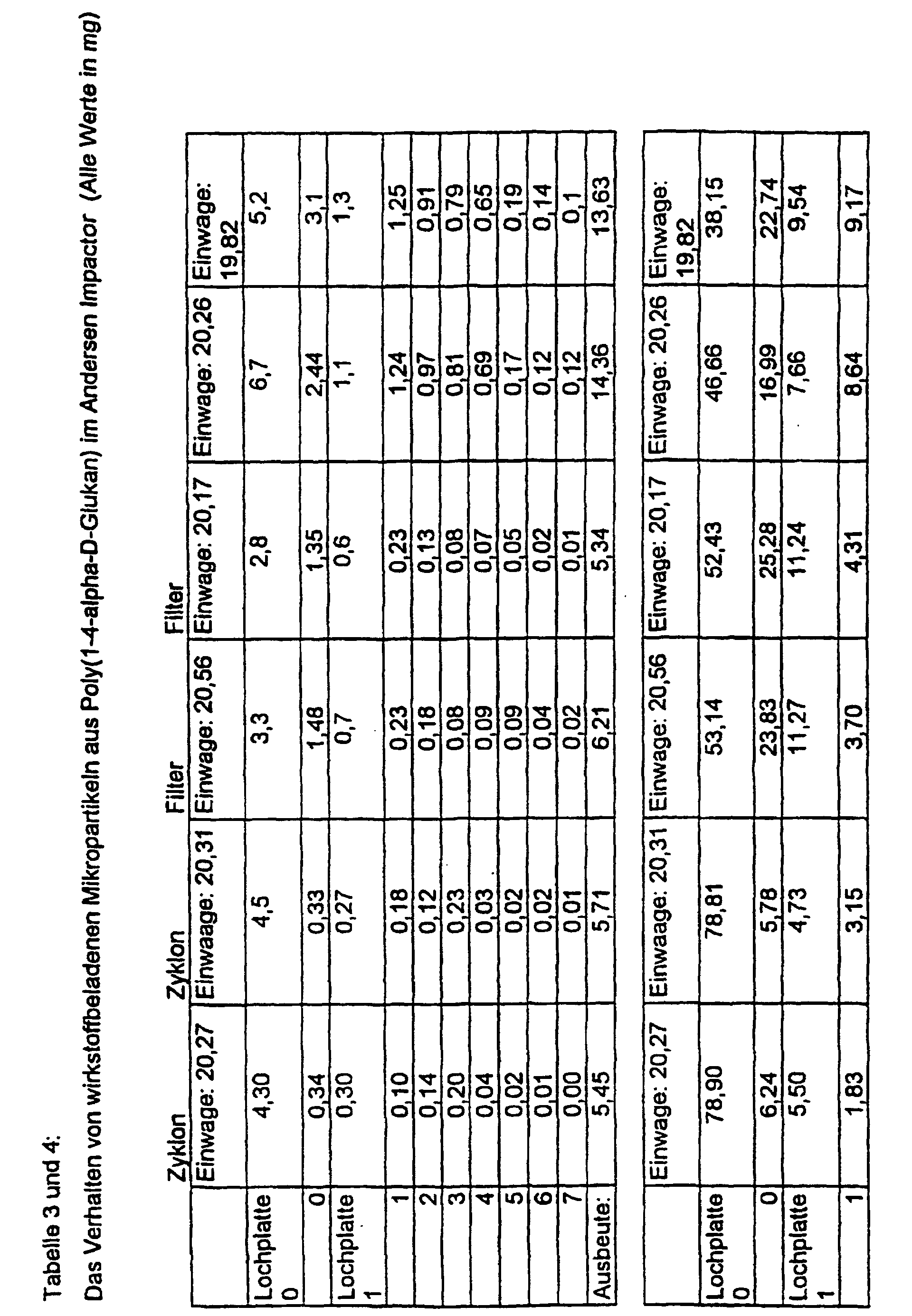
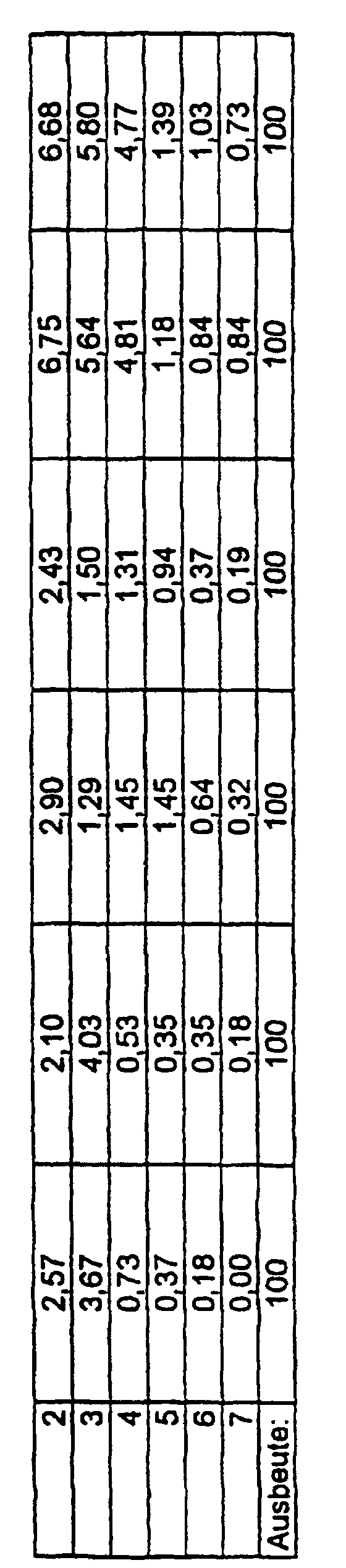
The autoclave is heated to 130 ° C. with stirring. The autoclaving time at this temperature is 30 minutes. A pressure of approx. 5 bar is generated.
After the autoclave has cooled, the suspension is removed, 175 mg of theophylline (corresponds to 5% loading) are dissolved in it and the active ingredient-containing suspension is immediately sprayed in the spray dryer. The suspension is continuously stirred using a magnetic stirrer.
The spray dryer (Mini Spray Dryer 191, Büchi, Switzerland) is operated as follows: atomizing nitrogen flow 700 liters per hour, inlet temperature 220 ° C, switched on nozzle cooling, nozzle diameter 0.5mm, aspirator 70%, pump 70%.
The spray-dried material (yield at least 25% based on the amount of solids used in the autoclave) is removed from the cyclone collecting vessel and stored dry. The size of the microparticles is over 90% in a range smaller than 10 µm (evaluation of electron microscope images).
The loading of the microparticles with theophylline is checked photometrically. For this purpose, 50 mg of the sample are dissolved in 100 ml of dimethyl sulfoxide at 60 ° C and measured at 271 nm (
20 mg of the active substance-loaded microparticles are filled into the metering chamber of a commercially available dry powder inhaler (Aerolizer®, from Ciba-Geigy) and the flight distance is measured with the Andersen impactor as described in Example 7.
Claims (15)
- The use of a particulate excipient for the production of pharmaceutical preparations for pulmonary administration, wherein the particulate excipient comprises at least one linear water-insoluble polysaccharide and its average size is smaller than 10 µm.
- Use as claimed in claim 1, wherein the particulate excipient forms agglomerates and/or clusters that are smaller than 60 µm.
- Use as claimed in claim 1 or 2, wherein the particulate excipient is present in a mixture and enables effective active substance distribution and penetration thereof in the lungs.
- Use as claimed in one of the preceding claims, wherein the particulate excipient consists entirely or partially of at least one water-insoluble linear polysaccharide that has been produced in a biotechnological process.
- Use as claimed in one of the preceding claims, wherein the particulate excipient consists entirely or partially of at least one water-insoluble linear polysaccharide that has been produced by a biocatalytic process.
- Use as claimed in one of the preceding claims, wherein the particulate excipient consists entirely or partially of at least one water-insoluble linear polysaccharide that has been produced by a fermentation process.
- Use as claimed in one of claims 1 to 6, wherein the linear water-insoluble polysaccharide is poly(1,4-α-D-glucan).
- Use as claimed in one of claims 1 to 7, wherein the particulate excipient is biocompatible and/or pharmaceutically acceptable.
- Use as claimed in one of claims 1 to 8, wherein the particulate excipient provides a controlled release of its active substances in the alveoli.
- Use as claimed in one of claims 1 to 9, wherein the particulate excipient additionally comprises one or more active substances.
- Use as claimed in one of claims 1 to 10, wherein the particulate excipient is inhalable with the aid of a dry powder inhaler.
- A dispersible dry formulation and/or powder comprising particulate excipients as claimed in one of claims 1 to 10.
- A dispersible dry formulation and/or powder as claimed in one of claims 12 to 22, which has a water content of less than 25 %, preferably a water content of less than 15 % and particularly preferably a water content of 5 - 10 %.
- A dispersible dry formulation and/or powder as claimed in claims 12 and 13 having an angle of repose ≤ 30 degrees.
- A pharmaceutical composition comprising linear water-insoluble polysaccharides as claimed in one of claims 1 to 8 and 10 together with customary excipients, auxiliaries and/or additives.
Applications Claiming Priority (3)
| Application Number | Priority Date | Filing Date | Title |
|---|---|---|---|
| DE19816085 | 1998-04-09 | ||
| DE19816085 | 1998-04-09 | ||
| PCT/EP1999/002385 WO1999052506A1 (en) | 1998-04-09 | 1999-04-08 | Particulate active agent support for pulmonary application |
Publications (2)
| Publication Number | Publication Date |
|---|---|
| EP1069889A1 EP1069889A1 (en) | 2001-01-24 |
| EP1069889B1 true EP1069889B1 (en) | 2004-06-30 |
Family
ID=7864224
Family Applications (1)
| Application Number | Title | Priority Date | Filing Date |
|---|---|---|---|
| EP99915750A Expired - Lifetime EP1069889B1 (en) | 1998-04-09 | 1999-04-08 | Partikulärer wirkstoffträger für die pulmonale applikation |
Country Status (12)
| Country | Link |
|---|---|
| EP (1) | EP1069889B1 (en) |
| JP (1) | JP2002511399A (en) |
| KR (1) | KR20010034755A (en) |
| CN (1) | CN1423553A (en) |
| AT (1) | ATE270097T1 (en) |
| AU (1) | AU3421099A (en) |
| CA (1) | CA2340340A1 (en) |
| DE (1) | DE59909854D1 (en) |
| HU (1) | HUP0101912A2 (en) |
| NO (1) | NO20004980L (en) |
| PL (1) | PL343342A1 (en) |
| WO (1) | WO1999052506A1 (en) |
Families Citing this family (33)
| Publication number | Priority date | Publication date | Assignee | Title |
|---|---|---|---|---|
| DE19847593A1 (en) * | 1998-10-15 | 2000-04-20 | Aventis Res & Tech Gmbh & Co | Parenteral drug administration composition with depot and controlled release comprises active agent and water soluble polysaccharide microparticles as carrier |
| ES2395096T3 (en) | 1999-06-29 | 2013-02-08 | Mannkind Corporation | Purification and stabilization of pharmaceutical agents based on peptides and proteins |
| US9006175B2 (en) | 1999-06-29 | 2015-04-14 | Mannkind Corporation | Potentiation of glucose elimination |
| JP4681231B2 (en) | 2002-03-20 | 2011-05-11 | マンカインド コーポレイション | Inhaler |
| US20080090753A1 (en) | 2004-03-12 | 2008-04-17 | Biodel, Inc. | Rapid Acting Injectable Insulin Compositions |
| ATE486064T1 (en) | 2004-08-20 | 2010-11-15 | Mannkind Corp | CATALYSIS OF DIKETOPIPERAZINE SYNTHESIS |
| HUE025151T2 (en) | 2004-08-23 | 2016-01-28 | Mannkind Corp | Diketopiperazine salts for drug delivery |
| MX373000B (en) | 2005-09-14 | 2020-05-21 | Mannkind Corp | METHOD FOR FORMULATING A DRUG BASED ON INCREASING THE AFFINITY OF ACTIVE AGENTS TOWARDS THE SURFACES OF CRYSTALLINE MICROPARTICLES. |
| US8084420B2 (en) | 2005-09-29 | 2011-12-27 | Biodel Inc. | Rapid acting and long acting insulin combination formulations |
| CN104383546B (en) * | 2006-02-22 | 2021-03-02 | 曼金德公司 | Method for improving the pharmaceutical properties of microparticles comprising diketopiperazines and an active agent |
| MY155524A (en) | 2008-06-13 | 2015-10-30 | Mannkind Corp | A dry powder inhaler and system for drug delivery |
| US8485180B2 (en) | 2008-06-13 | 2013-07-16 | Mannkind Corporation | Dry powder drug delivery system |
| EP2609954B1 (en) | 2008-06-20 | 2021-12-29 | MannKind Corporation | An interactive apparatus for real-time profiling of inhalation efforts |
| TWI494123B (en) | 2008-08-11 | 2015-08-01 | Mannkind Corp | Ultra-fast use of insulin |
| US8314106B2 (en) | 2008-12-29 | 2012-11-20 | Mannkind Corporation | Substituted diketopiperazine analogs for use as drug delivery agents |
| US9060927B2 (en) | 2009-03-03 | 2015-06-23 | Biodel Inc. | Insulin formulations for rapid uptake |
| US8538707B2 (en) | 2009-03-11 | 2013-09-17 | Mannkind Corporation | Apparatus, system and method for measuring resistance of an inhaler |
| SG10201403147SA (en) | 2009-06-12 | 2014-10-30 | Mannkind Corp | Diketopiperazine microparticles with defined isomer contents |
| AU2010259943C1 (en) | 2009-06-12 | 2016-03-03 | Mannkind Corporation | Diketopiperazine microparticles with defined specific surface areas |
| JP5784622B2 (en) | 2009-11-03 | 2015-09-24 | マンカインド コーポレ−ション | Apparatus and method for simulating inhalation activity |
| RU2531455C2 (en) | 2010-06-21 | 2014-10-20 | Маннкайнд Корпорейшн | Systems and methods for dry powder drugs delivery |
| MX353285B (en) | 2011-04-01 | 2018-01-05 | Mannkind Corp | Blister package for pharmaceutical cartridges. |
| WO2012174472A1 (en) | 2011-06-17 | 2012-12-20 | Mannkind Corporation | High capacity diketopiperazine microparticles |
| HK1201475A1 (en) | 2011-10-24 | 2015-09-04 | Mannkind Corporation | Methods and compositions for treating pain |
| AU2013289957B2 (en) | 2012-07-12 | 2017-02-23 | Mannkind Corporation | Dry powder drug delivery systems and methods |
| WO2014066856A1 (en) | 2012-10-26 | 2014-05-01 | Mannkind Corporation | Inhalable influenza vaccine compositions and methods |
| BR112015010601B1 (en) * | 2012-11-09 | 2022-07-19 | Civitas Therapeutics, Inc. | PHARMACEUTICAL COMPOSITION AND USE OF THE COMPOSITION |
| BR112015023168B1 (en) | 2013-03-15 | 2021-08-10 | Mannkind Corporation | COMPOSITION OF 3,6-BIS(N-FUMARYL-4-AMINOBUTYL)-2,5-CRYSTALLINE DICETOPIPERAZINE, METHOD OF PRODUCTION OF 3,6-BIS(N-FUMARYL-4-AMINOBUTYL)-2,5-DICETOPIPERAZINE PARTICLES AND USE OF A CRYSTALLINE DICETOPIPERAZINE COMPOSITION |
| BR122019026637B1 (en) | 2013-07-18 | 2023-09-26 | Mannkind Corporation | PHARMACEUTICAL DRY POWDER FORMULATIONS AND METHOD FOR MANUFACTURING A DRY POWDER FORMULATION |
| CA2920488C (en) | 2013-08-05 | 2022-04-26 | Mannkind Corporation | Insufflation apparatus and methods |
| US10307464B2 (en) | 2014-03-28 | 2019-06-04 | Mannkind Corporation | Use of ultrarapid acting insulin |
| US10561806B2 (en) | 2014-10-02 | 2020-02-18 | Mannkind Corporation | Mouthpiece cover for an inhaler |
| WO2018222581A1 (en) * | 2017-05-29 | 2018-12-06 | Resinnate Therapeutics Llc | Methods and formulations for administering beta glucan |
Family Cites Families (4)
| Publication number | Priority date | Publication date | Assignee | Title |
|---|---|---|---|---|
| GB937303A (en) * | 1959-01-02 | 1963-09-18 | Benger Lab Ltd | Improvements in and relating to the application of drugs in finely divided condition |
| US6428771B1 (en) * | 1995-05-15 | 2002-08-06 | Pharmaceutical Discovery Corporation | Method for drug delivery to the pulmonary system |
| GB9606188D0 (en) * | 1996-03-23 | 1996-05-29 | Danbiosyst Uk | Pollysaccharide microspheres for the pulmonary delivery of drugs |
| DE19737481A1 (en) * | 1997-08-28 | 1999-03-04 | Hoechst Ag | Microparticles containing spherical linear polysaccharides |
-
1999
- 1999-04-08 PL PL99343342A patent/PL343342A1/en unknown
- 1999-04-08 EP EP99915750A patent/EP1069889B1/en not_active Expired - Lifetime
- 1999-04-08 KR KR1020007011142A patent/KR20010034755A/en not_active Withdrawn
- 1999-04-08 AT AT99915750T patent/ATE270097T1/en not_active IP Right Cessation
- 1999-04-08 CN CN99806153A patent/CN1423553A/en active Pending
- 1999-04-08 CA CA002340340A patent/CA2340340A1/en not_active Abandoned
- 1999-04-08 WO PCT/EP1999/002385 patent/WO1999052506A1/en not_active Ceased
- 1999-04-08 DE DE59909854T patent/DE59909854D1/en not_active Expired - Lifetime
- 1999-04-08 HU HU0101912A patent/HUP0101912A2/en unknown
- 1999-04-08 AU AU34210/99A patent/AU3421099A/en not_active Abandoned
- 1999-04-08 JP JP2000543116A patent/JP2002511399A/en active Pending
-
2000
- 2000-10-03 NO NO20004980A patent/NO20004980L/en not_active Application Discontinuation
Also Published As
| Publication number | Publication date |
|---|---|
| HUP0101912A2 (en) | 2001-10-28 |
| AU3421099A (en) | 1999-11-01 |
| EP1069889A1 (en) | 2001-01-24 |
| CA2340340A1 (en) | 1999-10-21 |
| ATE270097T1 (en) | 2004-07-15 |
| KR20010034755A (en) | 2001-04-25 |
| JP2002511399A (en) | 2002-04-16 |
| NO20004980D0 (en) | 2000-10-03 |
| DE59909854D1 (en) | 2004-08-05 |
| PL343342A1 (en) | 2001-08-13 |
| CN1423553A (en) | 2003-06-11 |
| WO1999052506B1 (en) | 1999-11-25 |
| NO20004980L (en) | 2000-12-08 |
| WO1999052506A1 (en) | 1999-10-21 |
Similar Documents
| Publication | Publication Date | Title |
|---|---|---|
| EP1069889A1 (en) | Partikulärer wirkstoffträger für die pulmonale applikation | |
| DE69631881T2 (en) | PULMONAL ADMINISTRATION OF MEDICINES IN AEROSOL FORM | |
| DE60127175T2 (en) | STORAGE-STABLE POWDER COMPOSITIONS WITH INTERLEUKIN-4 RECEPTOR | |
| DE60025019T2 (en) | DRY POWDER COMPOSITIONS WITH IMPROVED DISPERSIBILITY | |
| DE69714448T2 (en) | METHOD FOR PRODUCING PREPARATIONS WITH CONTROLLED ACTIVE SUBSTANCE RELEASE BASED ON POLYMERS | |
| DE69711626T2 (en) | AERODYNAMIC LIGHT PARTICLES FOR DELIVERING DRUGS TO THE LUNG | |
| EP0454044B1 (en) | Pharmacological product containing polyelectrolyte complexes in microparticulate form and at least one substance | |
| DE69230254T2 (en) | Manufacture of microparticles | |
| DE60021059T2 (en) | A particulate pharmaceutical composition for transdermal particle delivery from a needleless syringe system | |
| Klingler et al. | Insulin-micro-and nanoparticles for pulmonary delivery | |
| EP2124898B1 (en) | Enhanced delivery of immunosuppressive drug compositions for pulmonary delivery | |
| EP1107737B1 (en) | Microparticles for use in needleless injection | |
| DE69415684T2 (en) | METHOD FOR PRODUCING MICROSPHERES WITH A FLUIDIZED LAYER | |
| DK153920B (en) | DRY, POWDER-SENSITIZED ALLERGEN MATERIAL AND PROCEDURES FOR PRODUCING THEREOF | |
| EP1069890B1 (en) | Incorporation of active substances in carrier matrixes | |
| Steckel et al. | In-situ-micronization of disodium cromoglycate for pulmonary delivery | |
| EP0400522B1 (en) | Process for the preparation of micronised biodegradable particles | |
| DE69900495T2 (en) | LIQUID CRYSTALS OF CYCLOSPORINE | |
| WO2021110732A1 (en) | Method for producing spray-freeze-dried particles, and particles produced accordingly | |
| US20160008287A1 (en) | Micronized insulin, micronized insulin analogues, and methods of manufacturing the same | |
| EP1069914B1 (en) | Controlled release tablet produced from linear water-insoluble polysaccharides | |
| DE10145361A1 (en) | Sterile liquid composition for pulmonary administration in aerosol form comprises a sparingly water-soluble drug in the form of suspended particles of defined size | |
| EP1562559B1 (en) | Bio-degradable colloid particles, in particular for pulmonary applications | |
| US11446360B2 (en) | High-purity inhalable particles of insulin and insulin analogues, and high-efficiency methods of manufacturing the same | |
| DE19847593A1 (en) | Parenteral drug administration composition with depot and controlled release comprises active agent and water soluble polysaccharide microparticles as carrier |
Legal Events
| Date | Code | Title | Description |
|---|---|---|---|
| PUAI | Public reference made under article 153(3) epc to a published international application that has entered the european phase |
Free format text: ORIGINAL CODE: 0009012 |
|
| 17P | Request for examination filed |
Effective date: 20001109 |
|
| AK | Designated contracting states |
Kind code of ref document: A1 Designated state(s): AT BE CH DE DK ES FI FR GB IE IT LI NL PT SE |
|
| 17Q | First examination report despatched |
Effective date: 20010910 |
|
| RAP1 | Party data changed (applicant data changed or rights of an application transferred) |
Owner name: CELANESE VENTURES GMBH |
|
| GRAP | Despatch of communication of intention to grant a patent |
Free format text: ORIGINAL CODE: EPIDOSNIGR1 |
|
| GRAS | Grant fee paid |
Free format text: ORIGINAL CODE: EPIDOSNIGR3 |
|
| GRAA | (expected) grant |
Free format text: ORIGINAL CODE: 0009210 |
|
| AK | Designated contracting states |
Kind code of ref document: B1 Designated state(s): AT BE CH DE DK ES FI FR GB IE IT LI NL PT SE |
|
| PG25 | Lapsed in a contracting state [announced via postgrant information from national office to epo] |
Ref country code: NL Free format text: LAPSE BECAUSE OF FAILURE TO SUBMIT A TRANSLATION OF THE DESCRIPTION OR TO PAY THE FEE WITHIN THE PRESCRIBED TIME-LIMIT Effective date: 20040630 Ref country code: IT Free format text: LAPSE BECAUSE OF FAILURE TO SUBMIT A TRANSLATION OF THE DESCRIPTION OR TO PAY THE FEE WITHIN THE PRE;WARNING: LAPSES OF ITALIAN PATENTS WITH EFFECTIVE DATE BEFORE 2007 MAY HAVE OCCURRED AT ANY TIME BEFORE 2007. THE CORRECT EFFECTIVE DATE MAY BE DIFFERENT FROM THE ONE RECORDED.SCRIBED TIME-LIMIT Effective date: 20040630 Ref country code: IE Free format text: LAPSE BECAUSE OF FAILURE TO SUBMIT A TRANSLATION OF THE DESCRIPTION OR TO PAY THE FEE WITHIN THE PRESCRIBED TIME-LIMIT Effective date: 20040630 Ref country code: GB Free format text: LAPSE BECAUSE OF FAILURE TO SUBMIT A TRANSLATION OF THE DESCRIPTION OR TO PAY THE FEE WITHIN THE PRESCRIBED TIME-LIMIT Effective date: 20040630 Ref country code: FR Free format text: LAPSE BECAUSE OF FAILURE TO SUBMIT A TRANSLATION OF THE DESCRIPTION OR TO PAY THE FEE WITHIN THE PRESCRIBED TIME-LIMIT Effective date: 20040630 Ref country code: FI Free format text: LAPSE BECAUSE OF FAILURE TO SUBMIT A TRANSLATION OF THE DESCRIPTION OR TO PAY THE FEE WITHIN THE PRESCRIBED TIME-LIMIT Effective date: 20040630 |
|
| REG | Reference to a national code |
Ref country code: GB Ref legal event code: FG4D Free format text: NOT ENGLISH Ref country code: CH Ref legal event code: EP |
|
| PG25 | Lapsed in a contracting state [announced via postgrant information from national office to epo] |
Ref country code: DE Free format text: LAPSE BECAUSE OF THE APPLICANT RENOUNCES Effective date: 20040716 |
|
| REG | Reference to a national code |
Ref country code: IE Ref legal event code: FG4D Free format text: GERMAN |
|
| REF | Corresponds to: |
Ref document number: 59909854 Country of ref document: DE Date of ref document: 20040805 Kind code of ref document: P |
|
| RAP2 | Party data changed (patent owner data changed or rights of a patent transferred) |
Owner name: SUEDZUCKER AKTIENGESELLSCHAFT MANNHEIM/OCHSENFURT |
|
| PG25 | Lapsed in a contracting state [announced via postgrant information from national office to epo] |
Ref country code: SE Free format text: LAPSE BECAUSE OF FAILURE TO SUBMIT A TRANSLATION OF THE DESCRIPTION OR TO PAY THE FEE WITHIN THE PRESCRIBED TIME-LIMIT Effective date: 20040930 Ref country code: DK Free format text: LAPSE BECAUSE OF FAILURE TO SUBMIT A TRANSLATION OF THE DESCRIPTION OR TO PAY THE FEE WITHIN THE PRESCRIBED TIME-LIMIT Effective date: 20040930 |
|
| NLT2 | Nl: modifications (of names), taken from the european patent patent bulletin |
Owner name: SUEDZUCKER AKTIENGESELLSCHAFT MANNHEIM/OCHSENFURT |
|
| PG25 | Lapsed in a contracting state [announced via postgrant information from national office to epo] |
Ref country code: ES Free format text: LAPSE BECAUSE OF FAILURE TO SUBMIT A TRANSLATION OF THE DESCRIPTION OR TO PAY THE FEE WITHIN THE PRESCRIBED TIME-LIMIT Effective date: 20041011 |
|
| GBV | Gb: ep patent (uk) treated as always having been void in accordance with gb section 77(7)/1977 [no translation filed] |
Effective date: 20040630 |
|
| NLV1 | Nl: lapsed or annulled due to failure to fulfill the requirements of art. 29p and 29m of the patents act | ||
| REG | Reference to a national code |
Ref country code: IE Ref legal event code: FD4D |
|
| PG25 | Lapsed in a contracting state [announced via postgrant information from national office to epo] |
Ref country code: AT Free format text: LAPSE BECAUSE OF NON-PAYMENT OF DUE FEES Effective date: 20050408 |
|
| PG25 | Lapsed in a contracting state [announced via postgrant information from national office to epo] |
Ref country code: LI Free format text: LAPSE BECAUSE OF NON-PAYMENT OF DUE FEES Effective date: 20050430 Ref country code: CH Free format text: LAPSE BECAUSE OF NON-PAYMENT OF DUE FEES Effective date: 20050430 Ref country code: BE Free format text: LAPSE BECAUSE OF NON-PAYMENT OF DUE FEES Effective date: 20050430 |
|
| PLBE | No opposition filed within time limit |
Free format text: ORIGINAL CODE: 0009261 |
|
| STAA | Information on the status of an ep patent application or granted ep patent |
Free format text: STATUS: NO OPPOSITION FILED WITHIN TIME LIMIT |
|
| 26N | No opposition filed |
Effective date: 20050331 |
|
| EN | Fr: translation not filed | ||
| BERE | Be: lapsed |
Owner name: *CELANESE VENTURES G.M.B.H. Effective date: 20050430 |
|
| REG | Reference to a national code |
Ref country code: CH Ref legal event code: PL |
|
| BERE | Be: lapsed |
Owner name: *CELANESE VENTURES G.M.B.H. Effective date: 20050430 |
|
| PG25 | Lapsed in a contracting state [announced via postgrant information from national office to epo] |
Ref country code: PT Free format text: LAPSE BECAUSE OF NON-PAYMENT OF DUE FEES Effective date: 20041130 |