EP1069606A2 - Herstellung einer Halbleiterstruktur mit veringerter Verlusststromdichte - Google Patents
Herstellung einer Halbleiterstruktur mit veringerter Verlusststromdichte Download PDFInfo
- Publication number
- EP1069606A2 EP1069606A2 EP00115127A EP00115127A EP1069606A2 EP 1069606 A2 EP1069606 A2 EP 1069606A2 EP 00115127 A EP00115127 A EP 00115127A EP 00115127 A EP00115127 A EP 00115127A EP 1069606 A2 EP1069606 A2 EP 1069606A2
- Authority
- EP
- European Patent Office
- Prior art keywords
- forming
- fabricating
- semiconductor structure
- layer
- buffer layer
- Prior art date
- Legal status (The legal status is an assumption and is not a legal conclusion. Google has not performed a legal analysis and makes no representation as to the accuracy of the status listed.)
- Withdrawn
Links
Images

Classifications
-
- H—ELECTRICITY
- H10—SEMICONDUCTOR DEVICES; ELECTRIC SOLID-STATE DEVICES NOT OTHERWISE PROVIDED FOR
- H10D—INORGANIC ELECTRIC SEMICONDUCTOR DEVICES
- H10D1/00—Resistors, capacitors or inductors
- H10D1/60—Capacitors
- H10D1/68—Capacitors having no potential barriers
- H10D1/682—Capacitors having no potential barriers having dielectrics comprising perovskite structures
- H10D1/684—Capacitors having no potential barriers having dielectrics comprising perovskite structures the dielectrics comprising multiple layers, e.g. comprising buffer layers, seed layers or gradient layers
-
- H—ELECTRICITY
- H10—SEMICONDUCTOR DEVICES; ELECTRIC SOLID-STATE DEVICES NOT OTHERWISE PROVIDED FOR
- H10P—GENERIC PROCESSES OR APPARATUS FOR THE MANUFACTURE OR TREATMENT OF DEVICES COVERED BY CLASS H10
- H10P14/00—Formation of materials, e.g. in the shape of layers or pillars
- H10P14/60—Formation of materials, e.g. in the shape of layers or pillars of insulating materials
-
- H—ELECTRICITY
- H10—SEMICONDUCTOR DEVICES; ELECTRIC SOLID-STATE DEVICES NOT OTHERWISE PROVIDED FOR
- H10P—GENERIC PROCESSES OR APPARATUS FOR THE MANUFACTURE OR TREATMENT OF DEVICES COVERED BY CLASS H10
- H10P14/00—Formation of materials, e.g. in the shape of layers or pillars
- H10P14/60—Formation of materials, e.g. in the shape of layers or pillars of insulating materials
- H10P14/63—Formation of materials, e.g. in the shape of layers or pillars of insulating materials characterised by the formation processes
- H10P14/6326—Deposition processes
- H10P14/6328—Deposition from the gas or vapour phase
- H10P14/6329—Deposition from the gas or vapour phase using physical ablation of a target, e.g. physical vapour deposition or pulsed laser deposition
-
- H—ELECTRICITY
- H10—SEMICONDUCTOR DEVICES; ELECTRIC SOLID-STATE DEVICES NOT OTHERWISE PROVIDED FOR
- H10P—GENERIC PROCESSES OR APPARATUS FOR THE MANUFACTURE OR TREATMENT OF DEVICES COVERED BY CLASS H10
- H10P14/00—Formation of materials, e.g. in the shape of layers or pillars
- H10P14/60—Formation of materials, e.g. in the shape of layers or pillars of insulating materials
- H10P14/63—Formation of materials, e.g. in the shape of layers or pillars of insulating materials characterised by the formation processes
- H10P14/6326—Deposition processes
- H10P14/6328—Deposition from the gas or vapour phase
- H10P14/6334—Deposition from the gas or vapour phase using decomposition or reaction of gaseous or vapour phase compounds, i.e. chemical vapour deposition
-
- H—ELECTRICITY
- H10—SEMICONDUCTOR DEVICES; ELECTRIC SOLID-STATE DEVICES NOT OTHERWISE PROVIDED FOR
- H10P—GENERIC PROCESSES OR APPARATUS FOR THE MANUFACTURE OR TREATMENT OF DEVICES COVERED BY CLASS H10
- H10P14/00—Formation of materials, e.g. in the shape of layers or pillars
- H10P14/60—Formation of materials, e.g. in the shape of layers or pillars of insulating materials
- H10P14/65—Formation of materials, e.g. in the shape of layers or pillars of insulating materials characterised by treatments performed before or after the formation of the materials
- H10P14/6516—Formation of materials, e.g. in the shape of layers or pillars of insulating materials characterised by treatments performed before or after the formation of the materials of treatments performed after formation of the materials
- H10P14/6529—Formation of materials, e.g. in the shape of layers or pillars of insulating materials characterised by treatments performed before or after the formation of the materials of treatments performed after formation of the materials by exposure to a gas or vapour
-
- H—ELECTRICITY
- H10—SEMICONDUCTOR DEVICES; ELECTRIC SOLID-STATE DEVICES NOT OTHERWISE PROVIDED FOR
- H10P—GENERIC PROCESSES OR APPARATUS FOR THE MANUFACTURE OR TREATMENT OF DEVICES COVERED BY CLASS H10
- H10P14/00—Formation of materials, e.g. in the shape of layers or pillars
- H10P14/60—Formation of materials, e.g. in the shape of layers or pillars of insulating materials
- H10P14/69—Inorganic materials
- H10P14/692—Inorganic materials composed of oxides, glassy oxides or oxide-based glasses
- H10P14/6921—Inorganic materials composed of oxides, glassy oxides or oxide-based glasses containing silicon
- H10P14/69215—Inorganic materials composed of oxides, glassy oxides or oxide-based glasses containing silicon the material being a silicon oxide, e.g. SiO2
-
- H—ELECTRICITY
- H10—SEMICONDUCTOR DEVICES; ELECTRIC SOLID-STATE DEVICES NOT OTHERWISE PROVIDED FOR
- H10P—GENERIC PROCESSES OR APPARATUS FOR THE MANUFACTURE OR TREATMENT OF DEVICES COVERED BY CLASS H10
- H10P14/00—Formation of materials, e.g. in the shape of layers or pillars
- H10P14/60—Formation of materials, e.g. in the shape of layers or pillars of insulating materials
- H10P14/69—Inorganic materials
- H10P14/692—Inorganic materials composed of oxides, glassy oxides or oxide-based glasses
- H10P14/6938—Inorganic materials composed of oxides, glassy oxides or oxide-based glasses the material containing at least one metal element, e.g. metal oxides, metal oxynitrides or metal oxycarbides
- H10P14/6939—Inorganic materials composed of oxides, glassy oxides or oxide-based glasses the material containing at least one metal element, e.g. metal oxides, metal oxynitrides or metal oxycarbides characterised by the metal
- H10P14/69392—Inorganic materials composed of oxides, glassy oxides or oxide-based glasses the material containing at least one metal element, e.g. metal oxides, metal oxynitrides or metal oxycarbides characterised by the metal the material containing hafnium, e.g. HfO2
-
- H—ELECTRICITY
- H10—SEMICONDUCTOR DEVICES; ELECTRIC SOLID-STATE DEVICES NOT OTHERWISE PROVIDED FOR
- H10P—GENERIC PROCESSES OR APPARATUS FOR THE MANUFACTURE OR TREATMENT OF DEVICES COVERED BY CLASS H10
- H10P14/00—Formation of materials, e.g. in the shape of layers or pillars
- H10P14/60—Formation of materials, e.g. in the shape of layers or pillars of insulating materials
- H10P14/69—Inorganic materials
- H10P14/692—Inorganic materials composed of oxides, glassy oxides or oxide-based glasses
- H10P14/6938—Inorganic materials composed of oxides, glassy oxides or oxide-based glasses the material containing at least one metal element, e.g. metal oxides, metal oxynitrides or metal oxycarbides
- H10P14/69398—Inorganic materials composed of oxides, glassy oxides or oxide-based glasses the material containing at least one metal element, e.g. metal oxides, metal oxynitrides or metal oxycarbides the material having a perovskite structure, e.g. BaTiO3
Definitions
- the present invention relates in general to a method for fabricating a semiconductor structure including a buffer layer between a silicon substrate and metal oxides, and more particularly to a method for fabricating a semiconductor structure including a buffer layer and a high dielectric constant oxide formed using activated oxygen to reduce leakage current density.
- Epitaxial growth of single crystal oxide thin films on silicon is of great interest in numerous device applications, e.g., ferroelectrics or high dielectric constant oxides for non-volatile high density memory and next generation MOS devices. Also, in the preparation of these films, it is pivotal to establish an ordered transition layer or buffer layer on the Si surface, especially for subsequent growth of single crystal oxides, e.g., perovskites.
- SrTiO 3 on silicon (100) using an SrO buffer layer has been accomplished. See for example: T. Tambo et al., Jpn. J. Appl. Phys. , Vol. 37 (1998), pp. 4454-4459.
- the SrO buffer layer was thick (100 ⁇ ), thereby limiting application for transistor films, and crystallinity was not maintained throughout the growth.
- SrTiO 3 has been grown on silicon using thick oxide layers (60-120 ⁇ ) of SrO or TiO. See for example: B. K. Moon et al., Jpn. J. Appl. Phys ., Vol. 33 (1994), pp. 1472-1477. These thick buffer layers would limit the application for transistors.
- CMOS applications these types of oxide layers are fabricated using molecular oxygen and are formed thin (less than 50 ⁇ ). Accordingly, a result is leaky films in which high electrical leakage is experienced due to oxygen deficiencies or vacancies. Furthermore, these films require a post growth anneal in oxygen to reduce leakage current density across the oxide layer.
- a method of fabricating a semiconductor structure including the steps of providing a silicon substrate having a surface, forming on the surface of the silicon substrate a buffer layer characterised by a crystalline material formed using molecular oxygen and forming one or more layers of a high dielectric constant oxide on the buffer layer using activated oxygen.
- This disclosure teaches a method of fabricating a high dielectric constant (high-k) metal oxide having an interface with a silicon substrate.
- the process is based on the fabrication of a high dielectric constant oxide layer utilizing activated oxygen.
- the process includes the fabrication of a buffer layer as an interface for subsequent growth of the high dielectric constant oxide layer using molecular oxygen. Accordingly, disclosed is a new method of growing perovskite oxides such as SrTiO 3 , BaTiO 3 , SrBaTiO 3 , CaTiO 3 , or the like utilizing activated oxygen.
- Si substrate having silicon dioxide (SiO 2 ) on the surface.
- SiO 2 silicon dioxide
- the silicon dioxide is disclosed as formed of a native oxide, or utilizing thermal, or chemical techniques.
- SiO 2 is amorphous rather than single crystalline which is desirable for purposes of growing additional single crystal material on the substrate.
- FIG. 1 illustrates a Si substrate 10 having a surface 12, and an optional layer 14 of SiO 2 thereupon.
- layer 14 of SiO 2 naturally exists (native oxide) once the silicon substrate 10 is exposed to air (oxygen).
- layer 14 of SiO 2 may be formed purposely in a controlled fashion well known in the art, e.g., thermally by applying oxygen onto the surface 12 at a high temperature, or chemically using a standard chemical etch process.
- layer 14 of SiO 2 is removed utilizing thermal desorption of the native oxide, or the like.
- layer 14 is formed with a thickness in a range of 5-100 ⁇ thick, and more particularly with a thickness in a range of 10-25 ⁇ .
- a thin (e.g few mono-layers) seed layer 18 (as illustrated in FIG. 2) of a silicate nature or the like is formed using either the process of metal reaction with the SiO 2 or a metal oxide such as SrO, BaO or the like, to the surface 15 of SiO 2 layer 14 at 0-900°C and under oxygen partial pressure equal to or less than 1 x 10 -4 mBar.
- This can be accomplished in a molecular beam epitaxy chamber or in a chemical vapor deposition (CVD) or a physical vapor deposition (PVD) chamber under inert ambient conditions.
- substrate 10 is properly heated and substrate 10 having SiO 2 layer 14 thereon is exposed to a beam of metal, such as strontium (Sr), barium (Ba), calcium (Ca), zirconium (Zr), hafnium (Hf), or the like to react with the SiO 2 layer, or to a metal oxide compound such as SrO, BaO or the like utilizing molecular oxygen to form an amorphous oxide 16 onto the SiO 2 oxide 14 as illustrated in FIG. 1.
- a beam of metal such as strontium (Sr), barium (Ba), calcium (Ca), zirconium (Zr), hafnium (Hf), or the like to react with the SiO 2 layer, or to a metal oxide compound such as SrO, BaO or the like utilizing molecular oxygen to form an amorphous oxide 16 onto the SiO 2 oxide 14 as illustrated in FIG. 1.
- metal such as strontium (Sr), barium (Ba), calcium (Ca), zirconium (Zr), hafn
- This step provides for the formation of a stable silicate on silicon substrate 10.
- the next step is the formation of a high-k oxide layer using molecular oxygen only, this layer is of low resistivity but will serve as a barrier layer thus limiting the oxygen diffusion to the silicon substrate thus limiting the seed layer thickness to few monolayers.
- the thickness of metal oxide layer 16 buffer layer is 5-100 ⁇ , with a preferred thickness in the range of 15-50 ⁇ . This oxide layer is crystalline.
- the insertion of a buffer layer between the seed layer and the final oxide layer is crucial in maintaining thin interface seed layer 18.
- this growth is monitored using reflection high energy electron diffraction (RHEED) techniques which are well documented in the art and which can be used in situ, i.e., while performing the exposing step within the growth chamber.
- RHEED reflection high energy electron diffraction
- monitoring of the crystalline structure can be accomplished utilizing any surface sensitive technique, such as reflection difference spectroscopy (RDS), spectroscopic ellipsometry (SE), or the like wherein the surface is monitored by in situ techniques.
- RDS reflection difference spectroscopy
- SE spectroscopic ellipsometry
- seed layer 18 comprises rows of strontium, silicon, and oxygen atoms in a 2x1 configuration on a (001) surface of silicon substrate 10, 1x in the ⁇ 110 ⁇ direction and 2x in the orthogonal ⁇ 110 ⁇ direction.
- a buffer layer 20 is formed on a surface 19 of seed layer 18.
- Buffer layer 20 is formed by exposing the structure to a beam of metal, such as strontium (Sr), barium (Ba), calcium (Ca), zirconium (Zr), hafnium (Hf), or the like utilizing molecular oxygen to form an oxide onto the seed layer 18 as illustrated in FIG. 3.
- Buffer layer 20 serves to smooth the surface of seed layer 18 for the subsequent growth of a high dielectric constant oxide (discussed presently).
- Buffer layer also serves to preserve the structure of seed layer 18.
- Buffer layer 20 is formed to a thickness in a range of 0-100 ⁇ . As taught, buffer layer 20 is crystalline.
- a high dielectric constant oxide layer 22 is accomplished by either the simultaneous or alternating supply to a surface 23 of the buffer layer 20 of an alkaline-earth metal and a transition metal at less than or equal to 800°C, more particularly at a temperature in a range of 350-650°C and under a partial pressure of less than or equal to 1x10 -4 mBar of activated oxygen.
- Single crystal high dielectric constant oxide layer 22 is formed on surface 23 of buffer layer 20 by either the simultaneous or alternating supply of alkaline-earth metal (Sr, Ba etc), activated oxygen, more particularly atomic oxygen, and a transition metal, such as titanium, at less than or equal to 800°C under an activated oxygen partial pressure of less than or equal to 1x10 -4 mBar.
- This single crystal oxide layer 22 may, for example, comprise a thickness of 50-1000 ⁇ and will be substantially lattice matched with the underlying buffer layer 20.
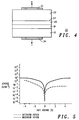
- high dielectric constant layer 22 when formed in this manner utilizing activated oxygen exhibits a decrease in current leakage of two orders of magnitude, for example 10 ⁇ 2 A/cm 2 at -1V, than that of oxide layers grown with molecular oxygen.
- a device structure 30 fabricated according to the inventive method disclosed herein. More particularly, illustrated is device 30 including substrate 10, seed layer 18, buffer layer 20, and high dielectric constant oxide layer 22. Further included, are a positive metal contact 32 and a negative metal contact 34. Leakage current density is measured across structure of device 30 and resultant values are illustrated graphically in FIG. 5. As illustrated, leakage current density across device structure 30 is decreased due to the utilization of activated oxygen to form the semiconductor structure.
- Illustrated comparatively in FIG. 5 are layers formed with molecular oxygen and layers formed with activated oxygen according to the present invention.
- this method can be used to grow additional oxide layers of the ABO 3 structure, e.g. SrTiO 3 , BaTiO 3 , CaTiO 3 , (Ba, Sr)TiO 3 , or the like.
- this method can be used in a variety of growth deposition methods, including, but not limited to molecular beam epitaxy (MBE), chemical beam epitaxy (CBE), metal-organic molecular beam epitaxy (MOMBE), ultra-high vacuum chemical vapor deposition (UHVCVD), physical vapor deposition (PVD), metal-organic chemical vapor deposition (MOCVD), or the like.
- MBE molecular beam epitaxy
- CBE chemical beam epitaxy
- MOMBE metal-organic molecular beam epitaxy
- UHVCVD ultra-high vacuum chemical vapor deposition
- PVD physical vapor deposition
- MOCVD metal-organic chemical vapor deposition
- the interface of buffer layer, 20 is formed utilizing molecular oxygen.
- the high dielectric constant oxide layer 22 is formed utilizing activated oxygen, thereby providing for reduced leakage current density.
- Activated or atomic oxygen is utilized during the growth step of the oxide layer 22, generated using an RF plasma source, an electron cyclotron resonance (ECR), ozone gas, or the like.
- ECR electron cyclotron resonance
- This method of fabrication provides for reduced leakage current density across the oxide layer 22, thus as a result, processing steps and thermal budgets for CMOS applications are considerably reduced. It should be understood that this method as disclosed can be applied for the growth of a variety of oxide layers in a number of deposition processes.
Landscapes
- Formation Of Insulating Films (AREA)
- Semiconductor Memories (AREA)
- Insulated Gate Type Field-Effect Transistor (AREA)
Applications Claiming Priority (2)
| Application Number | Priority Date | Filing Date | Title |
|---|---|---|---|
| US354173 | 1999-07-15 | ||
| US09/354,173 US6270568B1 (en) | 1999-07-15 | 1999-07-15 | Method for fabricating a semiconductor structure with reduced leakage current density |
Publications (1)
| Publication Number | Publication Date |
|---|---|
| EP1069606A2 true EP1069606A2 (de) | 2001-01-17 |
Family
ID=23392154
Family Applications (1)
| Application Number | Title | Priority Date | Filing Date |
|---|---|---|---|
| EP00115127A Withdrawn EP1069606A2 (de) | 1999-07-15 | 2000-07-12 | Herstellung einer Halbleiterstruktur mit veringerter Verlusststromdichte |
Country Status (7)
| Country | Link |
|---|---|
| US (1) | US6270568B1 (de) |
| EP (1) | EP1069606A2 (de) |
| JP (1) | JP2001068469A (de) |
| KR (1) | KR20010029918A (de) |
| CN (1) | CN1145196C (de) |
| SG (1) | SG85711A1 (de) |
| TW (1) | TW471066B (de) |
Cited By (27)
| Publication number | Priority date | Publication date | Assignee | Title |
|---|---|---|---|---|
| WO2002099897A1 (en) * | 2001-06-01 | 2002-12-12 | Motorola, Inc., A Corporation Of The State Of Delaware | Optically-communicating integrated circuits |
| US6589856B2 (en) | 2001-08-06 | 2003-07-08 | Motorola, Inc. | Method and apparatus for controlling anti-phase domains in semiconductor structures and devices |
| US6638838B1 (en) | 2000-10-02 | 2003-10-28 | Motorola, Inc. | Semiconductor structure including a partially annealed layer and method of forming the same |
| US6639249B2 (en) | 2001-08-06 | 2003-10-28 | Motorola, Inc. | Structure and method for fabrication for a solid-state lighting device |
| US6646293B2 (en) | 2001-07-18 | 2003-11-11 | Motorola, Inc. | Structure for fabricating high electron mobility transistors utilizing the formation of complaint substrates |
| US6667196B2 (en) | 2001-07-25 | 2003-12-23 | Motorola, Inc. | Method for real-time monitoring and controlling perovskite oxide film growth and semiconductor structure formed using the method |
| US6673646B2 (en) | 2001-02-28 | 2004-01-06 | Motorola, Inc. | Growth of compound semiconductor structures on patterned oxide films and process for fabricating same |
| US6673667B2 (en) | 2001-08-15 | 2004-01-06 | Motorola, Inc. | Method for manufacturing a substantially integral monolithic apparatus including a plurality of semiconductor materials |
| US6693033B2 (en) | 2000-02-10 | 2004-02-17 | Motorola, Inc. | Method of removing an amorphous oxide from a monocrystalline surface |
| US6693298B2 (en) | 2001-07-20 | 2004-02-17 | Motorola, Inc. | Structure and method for fabricating epitaxial semiconductor on insulator (SOI) structures and devices utilizing the formation of a compliant substrate for materials used to form same |
| US6709989B2 (en) | 2001-06-21 | 2004-03-23 | Motorola, Inc. | Method for fabricating a semiconductor structure including a metal oxide interface with silicon |
| WO2004053949A1 (en) * | 2002-12-09 | 2004-06-24 | Infineon Technologies Ag | Ferroelectric capacitor and process for its manufacture |
| US6855992B2 (en) | 2001-07-24 | 2005-02-15 | Motorola Inc. | Structure and method for fabricating configurable transistor devices utilizing the formation of a compliant substrate for materials used to form the same |
| US6885065B2 (en) | 2002-11-20 | 2005-04-26 | Freescale Semiconductor, Inc. | Ferromagnetic semiconductor structure and method for forming the same |
| US6916717B2 (en) | 2002-05-03 | 2005-07-12 | Motorola, Inc. | Method for growing a monocrystalline oxide layer and for fabricating a semiconductor device on a monocrystalline substrate |
| US6965128B2 (en) | 2003-02-03 | 2005-11-15 | Freescale Semiconductor, Inc. | Structure and method for fabricating semiconductor microresonator devices |
| US6992321B2 (en) | 2001-07-13 | 2006-01-31 | Motorola, Inc. | Structure and method for fabricating semiconductor structures and devices utilizing piezoelectric materials |
| US7005717B2 (en) | 2000-05-31 | 2006-02-28 | Freescale Semiconductor, Inc. | Semiconductor device and method |
| US7019332B2 (en) | 2001-07-20 | 2006-03-28 | Freescale Semiconductor, Inc. | Fabrication of a wavelength locker within a semiconductor structure |
| US7020374B2 (en) | 2003-02-03 | 2006-03-28 | Freescale Semiconductor, Inc. | Optical waveguide structure and method for fabricating the same |
| US7045815B2 (en) | 2001-04-02 | 2006-05-16 | Freescale Semiconductor, Inc. | Semiconductor structure exhibiting reduced leakage current and method of fabricating same |
| US7067856B2 (en) | 2000-02-10 | 2006-06-27 | Freescale Semiconductor, Inc. | Semiconductor structure, semiconductor device, communicating device, integrated circuit, and process for fabricating the same |
| US7105866B2 (en) | 2000-07-24 | 2006-09-12 | Freescale Semiconductor, Inc. | Heterojunction tunneling diodes and process for fabricating same |
| US7161227B2 (en) | 2001-08-14 | 2007-01-09 | Motorola, Inc. | Structure and method for fabricating semiconductor structures and devices for detecting an object |
| US7169619B2 (en) | 2002-11-19 | 2007-01-30 | Freescale Semiconductor, Inc. | Method for fabricating semiconductor structures on vicinal substrates using a low temperature, low pressure, alkaline earth metal-rich process |
| US7211852B2 (en) | 2001-01-19 | 2007-05-01 | Freescale Semiconductor, Inc. | Structure and method for fabricating GaN devices utilizing the formation of a compliant substrate |
| US7342276B2 (en) | 2001-10-17 | 2008-03-11 | Freescale Semiconductor, Inc. | Method and apparatus utilizing monocrystalline insulator |
Families Citing this family (28)
| Publication number | Priority date | Publication date | Assignee | Title |
|---|---|---|---|---|
| AU2001280609A1 (en) * | 2000-07-20 | 2002-02-05 | North Carolina State University | High dielectric constant metal silicates formed by controlled metal-surface reactions |
| US6806095B2 (en) | 2002-03-06 | 2004-10-19 | Padmapani C. Nallan | Method of plasma etching of high-K dielectric materials with high selectivity to underlying layers |
| US20060252265A1 (en) * | 2002-03-06 | 2006-11-09 | Guangxiang Jin | Etching high-kappa dielectric materials with good high-kappa foot control and silicon recess control |
| US7094704B2 (en) * | 2002-05-09 | 2006-08-22 | Applied Materials, Inc. | Method of plasma etching of high-K dielectric materials |
| US6902681B2 (en) * | 2002-06-26 | 2005-06-07 | Applied Materials Inc | Method for plasma etching of high-K dielectric materials |
| US20040007561A1 (en) * | 2002-07-12 | 2004-01-15 | Applied Materials, Inc. | Method for plasma etching of high-K dielectric materials |
| US6855643B2 (en) * | 2002-07-12 | 2005-02-15 | Padmapani C. Nallan | Method for fabricating a gate structure |
| JP4009550B2 (ja) * | 2003-03-27 | 2007-11-14 | エルピーダメモリ株式会社 | 金属酸化膜の形成方法 |
| EP1611215A2 (de) * | 2003-03-27 | 2006-01-04 | Construction Research & Technology GmbH | Flüssige farbstoffsuspension |
| US20060102197A1 (en) * | 2004-11-16 | 2006-05-18 | Kang-Lie Chiang | Post-etch treatment to remove residues |
| US7368394B2 (en) * | 2006-02-27 | 2008-05-06 | Applied Materials, Inc. | Etch methods to form anisotropic features for high aspect ratio applications |
| US20070202700A1 (en) * | 2006-02-27 | 2007-08-30 | Applied Materials, Inc. | Etch methods to form anisotropic features for high aspect ratio applications |
| US7846845B2 (en) * | 2006-10-26 | 2010-12-07 | Applied Materials, Inc. | Integrated method for removal of halogen residues from etched substrates in a processing system |
| US7655571B2 (en) * | 2006-10-26 | 2010-02-02 | Applied Materials, Inc. | Integrated method and apparatus for efficient removal of halogen residues from etched substrates |
| US7946759B2 (en) * | 2007-02-16 | 2011-05-24 | Applied Materials, Inc. | Substrate temperature measurement by infrared transmission |
| US20080203056A1 (en) * | 2007-02-26 | 2008-08-28 | Judy Wang | Methods for etching high aspect ratio features |
| JP2009021584A (ja) * | 2007-06-27 | 2009-01-29 | Applied Materials Inc | 高k材料ゲート構造の高温エッチング方法 |
| US20100330805A1 (en) * | 2007-11-02 | 2010-12-30 | Kenny Linh Doan | Methods for forming high aspect ratio features on a substrate |
| CN101752237B (zh) * | 2008-12-16 | 2012-08-08 | 国际商业机器公司 | 在半导体器件中形成高k栅极叠层的方法 |
| US11171008B2 (en) | 2011-03-01 | 2021-11-09 | Applied Materials, Inc. | Abatement and strip process chamber in a dual load lock configuration |
| US8992689B2 (en) | 2011-03-01 | 2015-03-31 | Applied Materials, Inc. | Method for removing halogen-containing residues from substrate |
| JP6054314B2 (ja) | 2011-03-01 | 2016-12-27 | アプライド マテリアルズ インコーポレイテッドApplied Materials,Incorporated | 基板搬送及びラジカル閉じ込めのための方法及び装置 |
| US8845816B2 (en) | 2011-03-01 | 2014-09-30 | Applied Materials, Inc. | Method extending the service interval of a gas distribution plate |
| WO2012118897A2 (en) | 2011-03-01 | 2012-09-07 | Applied Materials, Inc. | Abatement and strip process chamber in a dual loadlock configuration |
| US9533332B2 (en) | 2011-10-06 | 2017-01-03 | Applied Materials, Inc. | Methods for in-situ chamber clean utilized in an etching processing chamber |
| CN106847737B (zh) | 2012-02-29 | 2020-11-13 | 应用材料公司 | 配置中的除污及剥除处理腔室 |
| US8932947B1 (en) | 2013-07-23 | 2015-01-13 | Applied Materials, Inc. | Methods for forming a round bottom silicon trench recess for semiconductor applications |
| US9214377B2 (en) | 2013-10-31 | 2015-12-15 | Applied Materials, Inc. | Methods for silicon recess structures in a substrate by utilizing a doping layer |
Family Cites Families (10)
| Publication number | Priority date | Publication date | Assignee | Title |
|---|---|---|---|---|
| US4888202A (en) * | 1986-07-31 | 1989-12-19 | Nippon Telegraph And Telephone Corporation | Method of manufacturing thin compound oxide film and apparatus for manufacturing thin oxide film |
| US5225031A (en) * | 1991-04-10 | 1993-07-06 | Martin Marietta Energy Systems, Inc. | Process for depositing an oxide epitaxially onto a silicon substrate and structures prepared with the process |
| US5482003A (en) * | 1991-04-10 | 1996-01-09 | Martin Marietta Energy Systems, Inc. | Process for depositing epitaxial alkaline earth oxide onto a substrate and structures prepared with the process |
| WO1993012542A1 (en) * | 1991-12-13 | 1993-06-24 | Symetrix Corporation | Layered superlattice material applications |
| US5326721A (en) * | 1992-05-01 | 1994-07-05 | Texas Instruments Incorporated | Method of fabricating high-dielectric constant oxides on semiconductors using a GE buffer layer |
| EP0568064B1 (de) * | 1992-05-01 | 1999-07-14 | Texas Instruments Incorporated | Pb/Bi enthaltende Oxide von hohen Dielektrizitätskonstanten unter Verwendung von Perovskiten als Pufferschicht, die keine Pb/Bi enthalten |
| US5450812A (en) * | 1993-07-30 | 1995-09-19 | Martin Marietta Energy Systems, Inc. | Process for growing a film epitaxially upon an oxide surface and structures formed with the process |
| US5589284A (en) * | 1994-08-01 | 1996-12-31 | Texas Instruments Incorporated | Electrodes comprising conductive perovskite-seed layers for perovskite dielectrics |
| US6088216A (en) * | 1995-04-28 | 2000-07-11 | International Business Machines Corporation | Lead silicate based capacitor structures |
| AU8473998A (en) * | 1998-07-01 | 2000-01-24 | Lockheed Martin Energy Research Corporation | Geometric shape control of thin film ferroelectrics |
-
1999
- 1999-07-15 US US09/354,173 patent/US6270568B1/en not_active Expired - Lifetime
-
2000
- 2000-07-03 SG SG200003693A patent/SG85711A1/en unknown
- 2000-07-11 KR KR1020000039467A patent/KR20010029918A/ko not_active Withdrawn
- 2000-07-12 EP EP00115127A patent/EP1069606A2/de not_active Withdrawn
- 2000-07-14 JP JP2000213905A patent/JP2001068469A/ja active Pending
- 2000-07-14 CN CNB001202553A patent/CN1145196C/zh not_active Expired - Fee Related
- 2000-07-14 TW TW089114109A patent/TW471066B/zh not_active IP Right Cessation
Cited By (28)
| Publication number | Priority date | Publication date | Assignee | Title |
|---|---|---|---|---|
| US7067856B2 (en) | 2000-02-10 | 2006-06-27 | Freescale Semiconductor, Inc. | Semiconductor structure, semiconductor device, communicating device, integrated circuit, and process for fabricating the same |
| US6693033B2 (en) | 2000-02-10 | 2004-02-17 | Motorola, Inc. | Method of removing an amorphous oxide from a monocrystalline surface |
| US7005717B2 (en) | 2000-05-31 | 2006-02-28 | Freescale Semiconductor, Inc. | Semiconductor device and method |
| US7105866B2 (en) | 2000-07-24 | 2006-09-12 | Freescale Semiconductor, Inc. | Heterojunction tunneling diodes and process for fabricating same |
| US6638838B1 (en) | 2000-10-02 | 2003-10-28 | Motorola, Inc. | Semiconductor structure including a partially annealed layer and method of forming the same |
| US7211852B2 (en) | 2001-01-19 | 2007-05-01 | Freescale Semiconductor, Inc. | Structure and method for fabricating GaN devices utilizing the formation of a compliant substrate |
| US6673646B2 (en) | 2001-02-28 | 2004-01-06 | Motorola, Inc. | Growth of compound semiconductor structures on patterned oxide films and process for fabricating same |
| US7045815B2 (en) | 2001-04-02 | 2006-05-16 | Freescale Semiconductor, Inc. | Semiconductor structure exhibiting reduced leakage current and method of fabricating same |
| WO2002099897A1 (en) * | 2001-06-01 | 2002-12-12 | Motorola, Inc., A Corporation Of The State Of Delaware | Optically-communicating integrated circuits |
| US6709989B2 (en) | 2001-06-21 | 2004-03-23 | Motorola, Inc. | Method for fabricating a semiconductor structure including a metal oxide interface with silicon |
| US6992321B2 (en) | 2001-07-13 | 2006-01-31 | Motorola, Inc. | Structure and method for fabricating semiconductor structures and devices utilizing piezoelectric materials |
| US6646293B2 (en) | 2001-07-18 | 2003-11-11 | Motorola, Inc. | Structure for fabricating high electron mobility transistors utilizing the formation of complaint substrates |
| US6693298B2 (en) | 2001-07-20 | 2004-02-17 | Motorola, Inc. | Structure and method for fabricating epitaxial semiconductor on insulator (SOI) structures and devices utilizing the formation of a compliant substrate for materials used to form same |
| US7019332B2 (en) | 2001-07-20 | 2006-03-28 | Freescale Semiconductor, Inc. | Fabrication of a wavelength locker within a semiconductor structure |
| US6855992B2 (en) | 2001-07-24 | 2005-02-15 | Motorola Inc. | Structure and method for fabricating configurable transistor devices utilizing the formation of a compliant substrate for materials used to form the same |
| US6667196B2 (en) | 2001-07-25 | 2003-12-23 | Motorola, Inc. | Method for real-time monitoring and controlling perovskite oxide film growth and semiconductor structure formed using the method |
| US6639249B2 (en) | 2001-08-06 | 2003-10-28 | Motorola, Inc. | Structure and method for fabrication for a solid-state lighting device |
| US6589856B2 (en) | 2001-08-06 | 2003-07-08 | Motorola, Inc. | Method and apparatus for controlling anti-phase domains in semiconductor structures and devices |
| US7161227B2 (en) | 2001-08-14 | 2007-01-09 | Motorola, Inc. | Structure and method for fabricating semiconductor structures and devices for detecting an object |
| US6673667B2 (en) | 2001-08-15 | 2004-01-06 | Motorola, Inc. | Method for manufacturing a substantially integral monolithic apparatus including a plurality of semiconductor materials |
| US7342276B2 (en) | 2001-10-17 | 2008-03-11 | Freescale Semiconductor, Inc. | Method and apparatus utilizing monocrystalline insulator |
| US6916717B2 (en) | 2002-05-03 | 2005-07-12 | Motorola, Inc. | Method for growing a monocrystalline oxide layer and for fabricating a semiconductor device on a monocrystalline substrate |
| US7169619B2 (en) | 2002-11-19 | 2007-01-30 | Freescale Semiconductor, Inc. | Method for fabricating semiconductor structures on vicinal substrates using a low temperature, low pressure, alkaline earth metal-rich process |
| US6885065B2 (en) | 2002-11-20 | 2005-04-26 | Freescale Semiconductor, Inc. | Ferromagnetic semiconductor structure and method for forming the same |
| US7031138B2 (en) | 2002-12-09 | 2006-04-18 | Infineon Technologies Ag | Ferroelectric capacitor and process for its manufacture |
| WO2004053949A1 (en) * | 2002-12-09 | 2004-06-24 | Infineon Technologies Ag | Ferroelectric capacitor and process for its manufacture |
| US7020374B2 (en) | 2003-02-03 | 2006-03-28 | Freescale Semiconductor, Inc. | Optical waveguide structure and method for fabricating the same |
| US6965128B2 (en) | 2003-02-03 | 2005-11-15 | Freescale Semiconductor, Inc. | Structure and method for fabricating semiconductor microresonator devices |
Also Published As
| Publication number | Publication date |
|---|---|
| CN1145196C (zh) | 2004-04-07 |
| CN1281246A (zh) | 2001-01-24 |
| KR20010029918A (ko) | 2001-04-16 |
| US6270568B1 (en) | 2001-08-07 |
| TW471066B (en) | 2002-01-01 |
| SG85711A1 (en) | 2002-01-15 |
| JP2001068469A (ja) | 2001-03-16 |
Similar Documents
| Publication | Publication Date | Title |
|---|---|---|
| US6270568B1 (en) | Method for fabricating a semiconductor structure with reduced leakage current density | |
| EP1069605B1 (de) | Herstellung einer Halbleiterstruktur mit einem Metalloxidinterface zu Silizium | |
| US6241821B1 (en) | Method for fabricating a semiconductor structure having a crystalline alkaline earth metal oxide interface with silicon | |
| US6224669B1 (en) | Method for fabricating a semiconductor structure having a crystalline alkaline earth metal oxide interface with silicon | |
| EP1108805B1 (de) | Verfahren zur Herstellung einer Halbleiterstruktur mit einer auf Silizium stabilen kristallinen Zwischenschicht | |
| US6248459B1 (en) | Semiconductor structure having a crystalline alkaline earth metal oxide interface with silicon | |
| US6709989B2 (en) | Method for fabricating a semiconductor structure including a metal oxide interface with silicon | |
| EP1109212B1 (de) | Halbleiteranordnung mit einem kristallinen Erdalkalimetall - Siliziumnitrid/oxid Interface mit Silizium | |
| US6501121B1 (en) | Semiconductor structure | |
| EP1096042A1 (de) | Verfahren zur Herstellung einer Halbleiter-Anordnung mit einer Silizium-Metalloxid Zwischenschicht | |
| US6933566B2 (en) | Method of forming lattice-matched structure on silicon and structure formed thereby | |
| US7851365B1 (en) | Methods for preparing semiconductor substrates and interfacial oxides thereon | |
| KR20030051820A (ko) | 고 유전 상수 재료를 가지는 반도체 구조체 | |
| JP2005019976A (ja) | High−kゲート酸化物上のC軸方向Pb5Ge3O11薄膜のMOCVD選択的堆積 |
Legal Events
| Date | Code | Title | Description |
|---|---|---|---|
| PUAI | Public reference made under article 153(3) epc to a published international application that has entered the european phase |
Free format text: ORIGINAL CODE: 0009012 |
|
| AK | Designated contracting states |
Kind code of ref document: A2 Designated state(s): AT BE CH CY DE DK ES FI FR GB GR IE IT LI LU MC NL PT SE |
|
| AX | Request for extension of the european patent |
Free format text: AL;LT;LV;MK;RO;SI |
|
| STAA | Information on the status of an ep patent application or granted ep patent |
Free format text: STATUS: THE APPLICATION HAS BEEN WITHDRAWN |
|
| 18W | Application withdrawn |
Effective date: 20031020 |